

Submitted:
03 February 2026
Posted:
05 February 2026
You are already at the latest version
Abstract
This paper addresses the failure of major digital investments to achieve sustained technology adoption in developing countries, hindering their business growth. While existing research identifies institutional drawbacks as a key problem, it offers limited guidance on progress within these constraints. To address this gap, the new Institutional Framework for Smart Technology Adoption (IFSTA), pronounced Eye-f-sta, is developed as a contingent institutional framework connecting digital transformation theory with practical assessment tools. IFSTA argues that adoption success depends not on technology alone, but on strategic alignment with specific institutional contexts. Built around three core pillars, governance, socio-technical infrastructure, and adaptive capacity, the framework explains how their interactions shape adoption. Three questions are addressed: (1) how local conditions moderate infrastructure impact; (2) what workarounds enable progress amid fragile systems; and (3) how digital investments can be sequenced based on institutional starting points. A central insight is the critical role of localization, adapting standards, platforms, and partnerships to local context as a fundamental mechanism. Contributions are threefold: addressing the gap between diagnosis and implementation by developing effective guidance for developing economies; methodologically bridging static assessments with actionable diagnostics; and practically providing a structured framework and Performance-Knowledge Index (PKI) tool to diagnose contexts and prioritize interventions, moving from agnostic best practices to local strategies.
Keywords:
digital innovation
; sustainable growth
; transitioning economies
; institutional frameworks
; resource allocation efficiency
; socio-technical systems
; organizational challenges
1. Introduction
The adoption of smart technologies, such as artificial intelligence, the Internet of Things, and digital government platforms presents a critical paradox for developing countries [1,2,3]. Those technologies are widely envisioned as vital for economic competitiveness and improved public services. Yet, substantial investments in digital infrastructure repeatedly fail to translate into widespread, effective, or sustainable use [4]. The gap between spending and adoption points to a fundamental limitation in prevailing approaches: they often treat technology as a universal solution, overlooking the institutional environment in which it is introduced [5,6,7].
Legacy models of technology adoption and digital maturity, while generally working, frequently assume relatively stable and supportive institutional environments [8,9,10]. In the complex realities of developing countries, however, institutional systems are often characterized by gaps or voids, weak formal regulations, fragmented governance, and limited coordination capacity [11]. Interestingly enough, research shows that in these contexts, general public and organizations do not stagnate, but they innovate, mapping adaptive mechanisms and workarounds [12,13]. Unfortunately, the existing literature offers more description of these barriers than explanation of the adaptive processes that lead to success [14,15].
This paper addresses the gap between diagnosis and implementation by developing empirically grounded guidance, asking: How can smart technology adoption advance in the face of persistent institutional constraints? This is addressed through the development of the new Institutional Framework for Smart Technology Adoption (IFSTA). IFSTA is grounded in two key perspectives. From contingent digital transformation theory [16,17,18], it adopts the principle that there is no single best path; effective strategy depends entirely on local conditions. From digital maturity assessments [19,20,21,22], it utilizes the concept of staged progression yet seeks to explain the mechanics of how institutions move between stages when resources are limited.
IFSTA's main delivery is reshaping digital transformation from deficit narratives and toward an adaptive, responsive approach. The framework moves beyond deficit enumeration to theorize the dynamic inter-dependencies among three institutional pillars and the localization mechanisms that underpin observable adoption outcomes [23,24,25]. By following such an approach, it provides policymakers, development partners, and organizational leaders with a coherent framework for designing context digital strategies that have a higher probability of success[20,21].
The paper is structured to present the development and implications of the new IFSTA Framework. Following this introduction, the remainder of the paper is organized into six main sections:
Section 2 formally outlines the study's three research questions and its integrated contributions to theory, method, and practice. Section 3 reviews the literature on digital maturity, critiquing the gap between assessment and action in developing countries. The main contribution of the paper, the new Institutional Framework for Smart Technology Adoption (IFSTA) is presented in Section 4, detailing its three pillars and the crucial role of localization. Section 5 translates this into a practical toolkit, introducing the Performance-Knowledge Index (PKI) and an implementation process. Section 6 analyses the findings, highlighting context-dependent infrastructure, institutional compensation, localization, and sequencing rules. Finally, Section 7 concludes with implications, limitations, and a future research approach.
This logical progression guides the reader from problem definition and theoretical grounding, through the presentation of the novel framework and its analytical findings, to its practical application and the identification of future research directions.
2. Research Questions and Contributions
This study addresses the persistent gap between digital investment and sustainable adoption in developing countries through an institutional lens. The investigation is structured around three interconnected research questions:
RQ1: How do institutional contexts moderate the relationship between digital infrastructure investment and adoption outcomes in developing countries?
This question examines why similar levels of technological investment produce dramatically different results across contexts. The analysis investigates how institutional capacity particularly in governance and organizational learning, acts as a critical filter that determines whether infrastructure translates into effective use or remains underutilized.
RQ2: What compensatory mechanisms enable organizations to advance smart technology adoption in the presence of institutional voids?
Rather than treating institutional fragility as an absolute barrier, this question explores how organizations adapt through alternative pathways. Specific compensatory patterns are identified, including network reliance, human capital substitution, and strategic partnerships that facilitate progress despite formal system limitations.
RQ3: How can smart technology adoption be sequenced to align with institutional maturity and capacity development trajectories?
This question addresses the practical challenge of prioritization faced by decision-makers. The analysis moves beyond universal checklists to develop context-sensitive sequencing rules that guide what to focus on first based on specific institutional starting points.
Addressing these questions yields three interconnected contributions that advance both theory and practice:
A contingent institutional model: Contingent digital transformation theory is extended by making institutional adaptation not only institutional presence, but central to adoption models. The IFSTA framework introduces specific propositions about how the three institutional pillars (Governance, Infrastructure, and Adaptive Capacity) interact differently across contexts and how compensation mechanisms evolve systematically. This provides a more dynamic and realistic explanation of adoption pathways than static maturity models or deficit-focused institutional analyses.
Bridging diagnosis with an executable strategy: The gap between descriptive maturity assessment and actionable intervention design is addressed through the Performance-Knowledge Index (PKI) and the context assessment methodology developed here. By linking contingent contexts to specific pillar weightings and sequencing rules, the approach provides not just a diagnostic snapshot but a framework for determining how to move forward given specific constraints. This methodological contribution addresses the practical limitations of existing maturity models in guiding progression under institutional constraints.
A practical framework with analytical tools: For policymakers, development partners, and organizational leaders, a structured model and practical toolkit are provided. The IFSTA framework replaces the search for universal best practices with a disciplined process for: (1) diagnosing institutional context, (2) identifying leverage points within the three pillars, and (3) designing localized, sequenced interventions. The framework's explicit attention to localization in standards, platforms, and partnerships offers specific guidance on adapting global technologies to local realities.
These contributions collectively advance the understanding of smart technology adoption from a techno-centric perspective to an institutionally-grounded, context-sensitive approach that better reflects the realities of developing countries.
3. Literature Review
Many literature reviews have focused on diagnosing digital maturity [9,10,19], yet they often stop short of providing actionable pathways for implementation [15]. The present section provides an overview of this critical gap. To achieve that, this study conducted a systematic review of recent digital transformation literature (2019-2025). The analysis reveals a critical pattern: while studies excel at describing technological constraints [14,26], they remain limited in proposing institutionally grounded strategies for translating assessment into action.
Research emphasizes that strategic alignment between organizational goals and information technology is paramount, leading to the development of numerous maturity models [27]. These models serve as valuable reference frameworks, helping organizations evaluate their current state and plot a course to higher capability levels through structured dimensions and metrics [28]. Their methodology is often rigorous, incorporating established approaches such as Design Science Research and the Capability Maturity Model Integration (CMMI) to create tailored assessment tools [19].
This diagnostic work extends to the national and regional level, where readiness for the digital era is linked to benchmarks such as, the Sustainable Development Goals (SDGs) [29]. Studies consistently reveal significant global disparities, with developing regions including Africa and parts of the Middle East and North Africa (MENA) lagging in composite ICT indices, broadband speed, and innovation output [30,31,32]. Crucially, this literature identifies that global assessment may have not captured local realities and culture, highlighting underrepresented factors including last-mile connectivity and certain skill gaps [33,34].
However, a critical gap remains between this predominantly diagnostic literature and the practical needs of policymakers and practitioners. Although maturity models [2,19,35] and composite indices [29] offer valuable static assessments of digital readiness, they provide limited guidance on the dynamic trajectories through which organizations and countries can progress, particularly under conditions of institutional, financial, and capacity constraints. They describe stages instead of contingent processes of becoming digital amid institutional voids. Second, although sector-specific adaptations exist [36], models often insufficiently integrate the profound role of informal institutions, socio-cultural norms, and adaptive behaviours. Studies note the ineffectiveness of generic metrics in Africa [30] and the disconnect between innovation inputs and outputs in MENA [32], yet they stop short of systematically modelling the compensatory mechanisms that facilitate progress. Third, the literature excels at identifying gaps but provides limited prescriptive, contingent theory on sequencing. There is inadequate guidance on what to prioritize when based on an entity's specific institutional starting point.
The proposed IFSTA framework is designed to address these three gaps. It synthesizes the diagnostic power of maturity assessment with the explanatory power of institutional theory to offer a dynamic, contingent model that explains variation, identifies adaptive mechanisms, and guides strategic sequencing in developing country contexts.
3.1. Description of IFSTA
IFSTA is a theoretical construct that re-conceptualizes technology adoption as fundamentally an institutional process rather than a purely technological one. Departing from universal models of digital transformation, IFSTA posits that adoption outcomes are contingent upon the configuration and interaction of three core institutional pillars: governance architecture, socio-technical infrastructure, and adaptive capacity. Each pillar incorporates a critical localization dimension that enables global technologies to be effectively adapted to specific contextual realities.
The framework addresses a persistent gap in adoption literature: why similar technological investments yield divergent outcomes across different institutional settings. By integrating contingency theory with institutional analysis, IFSTA provides both a diagnostic tool for assessing adoption readiness and a prescriptive guide for sequencing interventions. This section elaborates the framework's theoretical foundations, pillar structure, and contextual contingencies that shape adoption pathways in developing economies.
3.2. Core institutional Pillars and the Role of Localization
Moving from institutional diagnosis to effective implementation requires more than identifying drawbacks; it requires an explanation of how institutional capacity is built and why certain domains are crucial for smart technology adoption. The IFSTA framework therefore conceptualizes institutional capacity as emerging from three interdependent pillars that function as causal mechanisms rather than descriptive categories. Each pillar addresses a distinct source of adoption failure while remaining structurally and functionally connected to the others.
A central contribution of IFSTA is the explicit positioning of localization as the operational logic that activates all three pillars [37]. Localization is defined here as the systematic adaptation of governance arrangements, technological solutions, and implementation practices to local socio-economic, administrative, and cultural conditions. In developing-country contexts, where institutional templates are frequently imported, localization determines whether reforms remain symbolic or become actionable.
Pillar 1: Governance Architecture establishes the institutional architecture that shape incentives, coordination, and risk perceptions. This pillar is essential because smart technology adoption involves uncertainty, long investment horizons, and multi-actor coordination. Clear governance reduces these uncertainties, thereby enabling sustained commitment. Localization plays a critical role by translating global standards and regulatory models into local enforcement mechanisms that reflect institutional maturity.
Pillar 2: Socio-Technical Infrastructure explains how governance is converted into operational capability. Beyond the availability of technology, this pillar addresses whether systems are usable, maintainable, and scalable within local constraints. Infrastructure becomes a binding constraint when global platforms are deployed without contextual adaptation [38]. Localization transforms infrastructure into an enabling capability by aligning technical design, skills development, and service delivery models with local access conditions and workforce realities [39].
Pillar 3: Adaptive Capacity captures the dynamic ability of institutions to learn, adjust, and sustain transformation over time. This pillar is essential because digital transformation is inherently non-linear and characterized by experimentation and failure [36]. Localization enables adaptive capacity by embedding feedback mechanisms, locally grounded partnerships, and culturally compatible change management practices [40], consequently ensuring that reforms are internalized rather than externally imposed.
Collectively, the three pillars form a mutually reinforcing system and fragility in any single pillar constrains overall adoption outcomes. Localization functions as the connective mechanism that has to be well maintained to ensure institutional interventions are credible, context-sensitive, and sustainable.
How institutional contexts shape adoption dynamics
The interaction between the three pillars is not uniform; it is systematically conditioned by the prevailing institutional environment. This contingency explains how and why the same technological intervention follows divergent adoption pathways across different settings, as conceptualized in Figure 1. Institutional context determines the relative salience of each pillar, the nature of their interplay, and the compensatory mechanisms that emerge, thereby structuring the rationality of adoption.
Established Institutional Contexts: In those settings, robust and well-aligned pillars create a self-reinforcing system. Strong governance provides clear rules and accountability, reducing transaction costs associated with deploying and utilizing infrastructure. This stability enables market actors to invest confidently in complementary assets and localization efforts, which further solidify institutional legitimacy. Consequently, adoption dynamics are characterized by reinforcing complementarity: infrastructure investments yield predictable, near-linear returns because they operate within a coherent institutional framework that efficiently translates capacity into use. Localization in this context focuses on incremental optimization and market fit, allowing parallel advancement across technical and institutional domains.
Transitional Institutional Contexts: These environments are defined by asynchronous development, where one pillar often governance lags behind, creating a critical bottleneck. Adoption logic therefore becomes sequential rather than parallel. Basic governance and regulatory clarity must often precede substantive infrastructure investment, as the risks of misallocation or capture are high. Localization assumes a bridging function, creating interim solutions that navigate institutional gaps, such as adapting global standards to partial or evolving regulatory regimes. Adoption thus follows threshold dynamics: limited progress occurs until essential institutional capacities are established, after which returns on infrastructure investment can accelerate significantly.
Institutional Voids: Where formal pillars are fragile or absent, adoption cannot rely on standard institutional scripts. Instead, the process is driven by compensatory mechanisms that substitute for missing formal structures. Intensive localization gives rise to parallel, often informal, systems. The infrastructure-adoption relationship is therefore fully mediated by these compensations, leading to highly unpredictable and non-linear pathways. Primary compensatory mechanisms operate through:
Network Compensation: Informal coordination via social, professional, or kinship networks replaces formal regulatory and information systems, reducing uncertainty through trust-based relations.
Human Capital Compensation: Skilled individuals or champions create ad hoc governance routines and bridge technical and local knowledge, personally assuming roles typically performed by institutions.
External Actor Compensation: International organizations, donors, or NGOs provide temporary institutional scaffolding, offering external legitimacy, funding, and managerial oversight that are absent in the local context.
This mediation implies that interventions have to be carefully sequenced and institutionally sensitive, often requiring the construction of compensatory bridges before, or alongside, technical deployment.
4. Operationalizing IFSTA: Assessment and Application
Existing maturity models and readiness indices typically provide static, uniform scores that obscure which institutional dimension constitutes the binding constraint in a given context. As a result, decision-makers are often left with descriptive assessments but limited direction on where to intervene [39]. More importantly, how to sequence investments, or why similar technologies perform differently across different settings. Addressing this gap requires an assessment approach that is not only multidimensional, but explicitly sensitive to institutional contingency [41].
To meet this need, IFSTA is operationalized through a structured diagnostic instrument, the Performance-Knowledge Index (PKI). Rather than producing a generic readiness score, the PKI generates a composite measure of institutional capacity by aggregating pillar-level indicators while adjusting their relative weights to reflect the institutional context in which adoption occurs [22]. This contingent weighting approach recognizes that governance, socio-technical infrastructure, and adaptive capacity do not contribute equally across contexts, and that adoption failures often arise from misaligned prioritization instead of absolute capacity deficits. By embedding contextual sensitivity directly into the assessment logic, the PKI moves beyond one-size-fits-all evaluation models and provides a practical mechanism for identifying institutional bottlenecks and guiding sequenced, context-appropriate interventions [42,43].
4.1. The Performance-Knowledge Index (PKI)
A central challenge in institutional assessments of digital transformation is not the absence of indicators, but the absence of a principled way to determine which institutional dimension constitutes the binding constraint in a given context [44,45]. Conventional composite indices typically apply uniform or implicit weights, thereby assuming that governance, infrastructure, and adaptive capacity contribute equally across settings. Such assumptions obscure institutional bottlenecks and risk producing misleading policy signals [46]. The Performance-Knowledge Index (PKI) is introduced to address this limitation by explicitly incorporating contextual prioritization into the measurement logic of institutional capacity.
The PKI operationalizes the core theoretical premise of the IFSTA framework that smart technology adoption is institutionally contingent rather than universally determined by assigning context-specific, normalized weights to its three pillars: governance (Gw), socio-technical infrastructure (Iw), and adaptive capacity (Aw) as shown in Table 1. These weights do not represent absolute importance, but the relative constraining power of each pillar within a given institutional context. For each context, weights are normalized such that ensuring internal consistency and comparability across cases:
Gw + Iw + Aw = 1
Weight determination follows a prioritization logic in IFSTA's institutional sequencing argument. In transitional contexts, governance typically represents the dominant bottleneck; accordingly, it receives the highest weight. In established contexts, where governance and adaptive routines are largely in place, infrastructure becomes the primary lever for performance gains. In institutional voids, no single pillar dominates; instead, adoption depends on adaptive and compensatory capacity operating alongside weak formal structures, justifying a more balanced distribution of weights [2]. This approach aligns measurement priorities with empirically observed institutional constraints rather than imposing uniform scoring rules.
The PKI is computed as:
PKI = (Gscore × Gw) + (Iscore × Iw) + (Ascore × Aw), where each pillar score is normalized to a common scale prior to aggregation. The PKI thus functions not as a universal ranking metric, but as a diagnostic instrument that reveals misalignments between institutional capacity and investment focus, enabling context-sensitive prioritization and sequencing of digital interventions.
4.1.1. Illustrative PKI Scenarios
To clarify the diagnostic logic of the PKI, Table 2 presents illustrative examples for each institutional context. The examples demonstrate how identical or similar infrastructure investments can yield different PKI outcomes depending on which institutional pillar constitutes the dominant constraint [47].
In an established context, governance and adaptive routines are largely consolidated. Infrastructure quality becomes the primary driver of marginal adoption gains.
PKI_Established = (0.80 × 0.30)
+ (0.90 × 0.40)
+ (0.75 × 0.30)
=0.825
Despite already strong governance and adaptive capacity, improvements in infrastructure translate efficiently into adoption outcomes, producing a high and stable PKI score [19].
In transitional contexts, infrastructure may be partially developed, but weak or fragmented governance limits effective utilization.
PKI_Transitional = (0.40 × 0.50)
+ (0.75 × 0.30)
+ (0.60 × 0.20)
= 0.545
Here, relatively strong infrastructure does not compensate for governance deficiencies. The PKI reveals misalignment, indicating that further infrastructure investment would yield limited returns unless governance capacity is strengthened first.
In institutional voids, no pillar is structurally dominant. Adoption depends heavily on adaptive and compensatory capacity rather than formal institutions.
PKI_Voids = (0.30 × 0.35)
+ (0.40 × 0.30)
+ (0.65 × 0.35)
= 0.455
Although formal governance and infrastructure scores are low, relatively strong adaptive capacity partially offsets institutional absence, producing a moderate PKI that reflects fragile but viable adoption pathways.
4.2. Implementation Pathways and Strategic Implications
Operationalizing the IFSTA framework follows a structured, four-step process designed to translate contextual diagnosis into actionable strategy:
Context Diagnosis: Classify the institutional environment as Established, Transitional, or an Institutional Void. This initial step determines the relative importance of the three pillars, governance, infrastructure, and adaptive capacity, which directly informs the weighting scheme used in the subsequent Performance-Knowledge Index (PKI) assessment.
Pillar Assessment: Systematically evaluate governance mechanisms, infrastructural readiness, and adaptive capabilities using standardized metrics. This granular assessment quantifies current institutional capacity, generating a PKI score that identifies specific strengths and weaknesses within each pillar.
Gap and Leverage Analysis: Identify the most significant constraints by comparing pillar performance against their context-specific weights. This analysis highlights where institutional gaps are most severe relative to their contextual importance, pinpointing the highest-leverage points for intervention.
Sequenced Intervention Design: Develop a prioritized action plan based on IFSTA sequencing rules. This ensures binding constraints are addressed first and that improvements in one pillar strategically reinforce capabilities in others, moving from diagnosis to context-sensitive implementation.
The framework yields clear strategic implications. It cautions against major infrastructure investments in institutional voids without parallel development of governance and compensatory networks. In transitional settings, it prioritizes governance reforms and localization before technological scaling. Ultimately, IFSTA refocuses the central question from which technology to adopt to which institutional conditions must first be established for technology to succeed, providing a diagnostic and prescriptive bridge between institutional theory and practical policy.
5. Analysis and Discussion
This section synthesizes analytical insights from applying the new IFSTA across diverse developing-country settings. Moving beyond conventional adoption models, the analysis examines how institutional configurations, specifically governance capacity, infrastructural maturity, and adaptive readiness, interact to shape technology uptake. An integrated overview of the framework, illustrated conceptually in Figure 1, elucidates the relationships between institutional pillars, context-dependent localization strategies, and the framework's theoretical and practical contributions.
5.1. From Theoretical Foundations to Practical Insights
The IFSTA framework establishes that digital infrastructure investment is necessary, yet insufficient for achieving growth through digital transformation. Consistent with critiques of technologically deterministic models, the framework demonstrates that infrastructure effectiveness is institutionally mediated by governance capacity, coordination mechanisms, and adaptive routines [48,49,50].
In established settings, infrastructure investments yield predictable returns when aligned with coherent policy frameworks, as exemplified by Malaysia's MyDIGITAL agenda and Kenya's mobile money evolution [51,52,53]. In transitional contexts, however, threshold effects emerge: early infrastructure investments often generate limited returns until foundational governance and coordination capacities are established, as observed in Ethiopia's digital reforms [54,55]. These findings confirm that inconsistent institutional alignment delays the translation of technological inputs into tangible gains [56].
IFSTA integrates these patterns into a policy-relevant contribution by conceptualizing institutions as active mechanisms shaping transformation trajectories. This shifts strategic focus toward institutional sequencing, prioritizing regulatory clarity, coordination capacity, and legitimacy-building alongside infrastructure investment thereby bridging strategic theory with implementation realities [57].
5.2. Localization as the Key Mechanism of Adaptation
Successful adoption hinges on localization, the contextual adaptation of technologies, standards, and practices to local institutional realities [24,37]. Localization operates distinctly across each pillar:
Governance localization tailors regulatory frameworks to existing administrative capacity.
Infrastructure localization prioritizes mobile-first designs and offline functionality.
Adaptive capacity localization emphasizes culturally aligned change management.
The required intensity of localization increases as institutional strength decreases, becoming indispensable in voids and transitional settings.
This principle directly informs context-specific investment sequencing:
In established contexts, infrastructure-first sequencing capitalizes on existing institutional foundations.
In transitional contexts, governance-first sequencing addresses the binding constraint.
In institutional voids, hybrid compensatory mechanisms enable initial progress while formal institutions are built incrementally.
The required intensity of localization increases inversely with institutional strength, becoming most critical in transitional contexts and indispensable in institutional voids. Analysis reveals that optimal investment sequencing varies systematically by institutional context. Rather than advocating uniform best practices, IFSTA generates context-dependent sequencing rules derived from observed pathway dependencies (Figure 2).
Supportive evidence comes from cases such as Nigeria's digital health platforms, which succeeded only after basic data governance was established, and Bangladesh's mobile money, which thrived through initial network-based compensation [26,58]. Broader evidence, including IMF analysis of digital payments in sub-Saharan Africa, confirms that infrastructure-led innovation yields uneven outcomes without complementary governance and adaptive capacity [59], directly aligning with IFSTA's core proposition.
6. Conclusions
This study examines the gap between technological investment and sustainable adoption in developing economies, demonstrating that institutional conditions, governance, infrastructure, and adaptive capacity determine whether digital innovations achieve impact. In response, the new Institutional Framework for Smart Technology Adoption (IFSTA) is developed as a contingent institutional framework with diagnostic logic, reframing digital transformation as an institutional alignment challenge.
IFSTA’s three-pillar architecture explains how localization mediates between global technologies and local realities, while its contingency principle accounts for how adoption pathways vary systematically across contexts, moving beyond one-size-fits-all models toward context-sensitive strategies. The framework advances theory by centering institutional adaptation and provides practical tools, notably the Performance-Knowledge Index (PKI) and context-specific sequencing, for policymakers, practitioners, and researchers.
Four directions for future research emerge as particularly valuable. First, empirical validation across diverse sectors and regions would strengthen the framework’s generalization. Second, longitudinal studies examining how localization mechanisms evolve alongside institutional development would deepen our understanding of adaptive processes. Third, comparative analyses of how different technologies interact with varying institutional configurations could refine contingency propositions. Fourth, and crucially, examining the political economy dimensions of digital transformation, specifically how power relations, interest group dynamics, and institutional path dependencies shape implementation would complement IFSTA’s institutional analysis with essential real-world constraints.
Finally, this study concludes that sustainable digital transformation depends fundamentally on aligning technological innovation with institutional realities. As digital technologies continue to permeate development agendas, institutionally grounded, diagnostically precise approaches such as IFSTA, are essential for translating technological potential into tangible, equitable development outcomes.
Author Contributions
Ibrahim Ejdayid Ajbarah Mansour: Conceptualization, methodology, analysis, writing the original and the final draft editing. Abdelhamid Bouchachia: Conceptual guidance, critical feedback, and oversight throughout the paper.
Funding
This research received no external funding.
Acknowledgments
The first author acknowledges the use of large language model–based tools to assist with language refinement, structural organization, and formatting of the manuscript. The tools were used solely to improve clarity and presentation. All scientific content, interpretations, and conclusions remain the sole responsibility of the author.
Conflicts of Interest
The authors declare that there is no known competing financial interests or personal relationships that could have appeared to influence the work reported in this paper.
References
- Das, D.K. Digital Technology and AI for Smart Sustainable Cities in the Global South: A Critical Review of Literature and Case Studies. Urban Science 2025, 9. [Google Scholar] [CrossRef]
- Tõnurist, P.; Hanson, A. Anticipatory Innovation Governance: Shaping the Future Through Proactive Policy Making 2020.
- Zhou, Z.; Liu, D.; Chen, Z.; Pancho, M. Government Adoption of Generative Artificial Intelligence and Ambidextrous Innovation. International Review of Economics & Finance 2025, 98, 103953. [Google Scholar] [CrossRef]
- Zhang, Y.; Bilawal Khaskheli, M. The Role of Digital Technologies in Advancing Sustainable Economic Development into Intersections of Policy, Law, Environmental Economics, and a Comparative Study of China, the EU, and the USA. Sustainability 2025, 17. [Google Scholar] [CrossRef]
- Chen, W.; Filieri, R. Institutional Forces, Leapfrogging Effects, and Innovation Status: Evidence from the Adoption of a Continuously Evolving Technology in Small Organizations. Technological Forecasting and Social Change 2024, 206. [Google Scholar] [CrossRef]
- Kasim, I.; Amidu, A.-R.; Levy, D. A Conceptual Bridge for the Innovation-Adoption Gap in the Property Profession. Journal of Property Research 2025, 42, 66–95. [Google Scholar] [CrossRef]
- Montes de Oca Munguia, O.; Bayne, K. Bridging the Adoption Gap in Primary Sectors: A Systemic Technology Adoption Model. Agronomy 2025, 15. [Google Scholar] [CrossRef]
- Andrei, M.; Johnsson, S. Advancing Maturity in the Adoption of Digital Technologies for Energy Efficiency in Manufacturing Industry. Journal of Manufacturing Technology Management 2025, 36, 114–133. [Google Scholar] [CrossRef]
- Festing, C.; Proff, H. Assessing the Impact of National Culture on Digital Maturity. Digital Business 2025, 5, 100121. [Google Scholar] [CrossRef]
- Hortovanyi, L.; Morgan, R.E.; Herceg, I.V.; Djuricin, D.; Hanak, R.; Horvath, D.; Mocan, M.L.; Romanova, A.; Szabo, R.Z. Assessment of Digital Maturity: The Role of Resources and Capabilities in Digital Transformation in B2B Firms. International Journal of Production Research 2023, 61, 8043–8061. [Google Scholar] [CrossRef]
- Yan, J.; Ahmad, F. Bridging Institutional Voids in a Volatile Emerging Economy: Role of Regulatory Cultural Stewardship as a Dynamic Capability for Sustainable AI-Enabled Digital Transformation in SMEs. Sustainability 2025, 17. [Google Scholar] [CrossRef]
- Millard, J. Impact of Digital Transformation on Public Governance: New Forms of Policy-Making and the Provision of Innovative, People-Centric and Inclusive Public Services 2023.
- OECD Going Digital: Shaping Policies, Improving Lives 2019.
- Mayer, A.-S.; Strich, F. Barriers to a Successful Digital Transformation and How to Mitigate Them: Insights From the Banking Industry. In Digital Transformation: Organizational Challenges and Management Transformation Methods; Emarald Publishing Limited, 2023; ISBN 979-8-88730-205-8. [Google Scholar]
- Singun, A., Jr. Unveiling the Barriers to Digital Transformation in Higher Education Institutions: A Systematic Literature Review. Discover Education 2025, 4, 37. [Google Scholar] [CrossRef]
- Cardoso, A.; Figueiredo, J.; Oliveira, I.; Pocinho, M. From Crisis to Opportunity: Digital Transformation, Digital Business Models, and Organizational Resilience in the Post-Pandemic Era. Administrative Sciences 2025, 15. [Google Scholar] [CrossRef]
- Li, M. Challenging the “IS” in ISD: From Software to Sociotechnical Systems Design and Development. In Proceedings of the Proceedings of the International Conference on Information Systems (ICIS 2024), Bangkok, Thailand, 2024. [Google Scholar]
- Meegle Contingency Planning for Digital Transformation 2025.
- Omol, E.J.; Mburu, L.W.; Abuonji, P.A. Digital Maturity Assessment Model (DMAM): Assimilation of Design Science Research (DSR) and Capability Maturity Model Integration (CMMI). Digital Transformation and Society 2024, 4, 128–152. [Google Scholar] [CrossRef]
- Plekhanov, D.; Franke, H.; Netland, T.H. Digital Transformation: A Review and Research Agenda. European Management Journal 2023, 41, 821–844. [Google Scholar] [CrossRef]
- Umantsiv, Y.; Biliavska, Y.; Osiyevskyy, O. Digital Transformation as a Business Development Strategy. Strategy & Leadership 2025, 53, 489–503. [Google Scholar] [CrossRef]
- UNDP Digital Maturity Assessment: Lao PDR – Supporting Digital Government Transformation 2022.
- Barbu, M.; Vevera, A.-V.; Barbu, D.-C. Standardization and Interoperability: Key Elements of Digital Transformation. Digital Transformation: Technology, Tools, and Studies 2024, 87–94. [Google Scholar] [CrossRef]
- Setyadi, A.; Pawirosumarto, S.; Damaris, A. Rethinking Sustainable Operations: A Multi-Level Integration of Circularity, Localization, and Digital Resilience in Manufacturing Systems. Sustainability 2025, 17. [Google Scholar] [CrossRef]
- Yan, S.; Xi, Y.; Wu, Z. Enterprise Digital Transformation and Compliance in Cross-Regional Development: A Dynamic Capabilities Perspective. Sustainability 2024, 16. [Google Scholar] [CrossRef]
- Okeke, E.B.; Forman, D.; Taylor, E.; Hyde, E.; Parente, F.; Kanmodi, K.K.; Wordsworth, S. Barriers and Facilitators to Digital Health Adoption: A Thematic Analysis of Healthcare Professionals’ Perspectives in Rural Oyo State, Nigeria. BMC Digital Health 2025, 3, 85. [Google Scholar] [CrossRef]
- Korachi, Z.; Bounabat, B. Towards a Maturity Model for Digital Strategy Assessment. In Proceedings of the Advanced Intelligent Systems for Sustainable Development (AI2SD’2019); Ezziyyani, M., Ed.; Springer International Publishing, 2020; pp. 456–470. [Google Scholar]
- Sener, U.; Gokalp, E.; Eren, P.E. Intelligent Digital Transformation Strategy Management: Development of a Measurement Framework. In Intelligent Systems in Digital Transformation: Theory and Applications; Kahraman, C., Haktanır, E., Eds.; Springer International Publishing, 2023; pp. 77–93. ISBN 978-3-031-16598-6. [Google Scholar]
- Nhamo, G.; Nhemachena, C.; Nhamo, S. Using ICT Indicators to Measure Readiness of Countries to Implement Industry 4.0 and the SDGs. Environmental Economics and Policy Studies 2020, 22, 315–337. [Google Scholar] [CrossRef]
- Assefa, S.; Rorissa, A.; Alemneh, D. Digital Readiness Assessment of Countries in Africa: A Case Study Research. Proceedings of the Association for Information Science and Technology 2021, 58, 400–404. [Google Scholar] [CrossRef]
- Bello, F.Z.M. Towards a Digital Capability Maturity Framework for Tertiary Institutions. PhD Thesis, University of Hertfordshire, Hertfordshire, United Kingdom, 2023. [Google Scholar]
- Guermit, A.; Laouedj, Z. The Duality of Digital Innovation and Sustainable Development in MENA Countries. In Competitive Advantage, Strategy and Innovation in Africa; Routledge, 2023; p. 27. [Google Scholar]
- Djatmiko, G.H.; Sinaga, O.; Pawirosumarto, S. Digital Transformation and Social Inclusion in Public Services: A Qualitative Analysis of E-Government Adoption for Marginalized Communities in Sustainable Governance. Sustainability 2025, 17. [Google Scholar] [CrossRef]
- Rikala, P.; Braun, G.; Järvinen, M.; Stahre, J.; Hämäläinen, R. Understanding and Measuring Skill Gaps in Industry 4.0 — A Review. Technological Forecasting and Social Change 2024, 201, 123206. [Google Scholar] [CrossRef]
- Lee, K.; Song, Y.; Park, M.; Yoon, B. Development of Digital Transformation Maturity Assessment Model for Collaborative Factory Involving Multiple Companies. Sustainability 2024, 16. [Google Scholar] [CrossRef]
- Varzaru, A.A.; Bocean, C.G. Digital Transformation and Innovation: The Influence of Digital Technologies on Turnover from Innovation Activities and Types of Innovation. Systems 2024, 12. [Google Scholar] [CrossRef]
- ElMassah, S.; Mohieldin, M. Digital Transformation and Localizing the Sustainable Development Goals (SDGs). Ecological Economics 2020, 169, 106490. [Google Scholar] [CrossRef]
- Umeike, R.; Dao, T.; Crawford, S. State-of-the-Art Review of Resilient Smart Cities: Progress and Challenges. Urban Governance 2025, 5, 222–239. [Google Scholar] [CrossRef]
- Rinchen, S.; Banihashemi, S.; Alkilani, S. Driving Digital Transformation in Construction: Strategic Insights into Building Information Modelling Adoption in Developing Countries. Project Leadership and Society 2024, 5, 100138. [Google Scholar] [CrossRef]
- Rizana, A.F.; Wiratmadja, I.I.; Akbar, M. Exploring Capabilities for Digital Transformation in the Business Context: Insight from a Systematic Literature Review. Sustainability 2025, 17. [Google Scholar] [CrossRef]
- Zhu, H.; Wang, L.; Li, C.; Philbin, S.P.; Li, H.; Li, H.; Skitmore, M. Building a Digital Transformation Maturity Evaluation Model for Construction Enterprises Based on the Analytic Hierarchy Process and Decision-Making Trial and Evaluation Laboratory Method. Buildings 2024, 14. [Google Scholar] [CrossRef]
- Kaufmann, D.; Kraay, A.; Mastruzzi, M. The Worldwide Governance Indicators: Methodology and Analytical Issues; The World Bank: Washington, DC, 2010. [Google Scholar]
- Zeng, Q.; Beelaerts van Blokland, W.W.A.; Santema, S.C.; Lodewijks, G. Composite Indicators of Company Performance: A Literature Survey. Performance Improvement Quarterly 2021, 33, 385–418. [Google Scholar] [CrossRef]
- Colovic, A.; Caloffi, A.; Rossi, F.; Russo, M. Institutionalising the Digital Transition: The Role of Digital Innovation Intermediaries. Research Policy 2025, 54, 105146. [Google Scholar] [CrossRef]
- OECD Digital Transformation of National Statistical Offices; Organisation for Economic Co-operation and Development (OECD), 2022.
- Liu, J.; Hu, S.; Jin, Y.; Weng, L. Digital Red Tape in Public Organizations: Challenges to Sustainable Digital Transformation. Sustainability 2025, 17. [Google Scholar] [CrossRef]
- Valaskova, K.; Nagy, M.; Juracka, D. Digital Transformation and Financial Performance: An Empirical Analysis of Strategic Alignment in the Digital Age. Journal of Enterprising Communities: People and Places in the Global Economy 2025, 19. [Google Scholar] [CrossRef]
- Cojocaru, A. Governing AI with Trust: An Adaptive Framework for Institutional Legitimacy in the UK Public Sector. Transforming Government: People, Process and Policy 2025, 1–22. [Google Scholar] [CrossRef]
- OECD The Digitalisation of Science, Technology and Innovation 2020.
- Sekasi, J.; Harrod, S.; Andrade, V. Governance, Contracts, and Culture: A Triadic Approach to Megaproject Performance. Project Leadership and Society 2025, 6, 100197. [Google Scholar] [CrossRef]
- Malaysia Digital Economy Corporation (MDEC) MyDIGITAL: The Malaysian Digital Economy Blueprint 2021.
- MRANTI Corporation MyDigital Charting Malaysia’s Path towards Digital Transformation 2023.
- World Bank Mobile Money and Economic Activity: Evidence from Kenya 2025.
- Boru, E.M.; Hwang, J.; Ahmad, A.Y. Governance and Institutional Frameworks in Ethiopian Integrated Agro-Industrial Parks: Enhancing Innovation Ecosystems and Multi Stakeholder Coordination for Global Market Competitiveness. Economies 2025, 13. [Google Scholar] [CrossRef]
- Worku, G.; Adugna, D. Two Studied Metropolitan Cities in Ethiopia and Their Current Integrated Infrastructure Plan to Enhance Resilience and Sustainability. Environmental and Sustainability Indicators 2025, 26, 100668. [Google Scholar] [CrossRef]
- OECD Identifying the Main Drivers of Productivity Growth 2022.
- Vial, G. Understanding Digital Transformation: A Review and a Research Agenda. The Journal of Strategic Information Systems 2019, 28, 118–144. [Google Scholar] [CrossRef]
- Ehsan, Md.A.; Feroz, F.; Chowdhury, M.; Noor, J. Connecting Mobile Money: Understanding the Adoption and Usage of Mobile Financial Services (MFS) by Low-Income Internal Migrant Workers in Dhaka. In Proceedings of the Proceedings of the 11th International Conference on Networking, Systems, and Security, Association for Computing Machinery, 2025; pp. 86–95. [Google Scholar]
- Ricci, L.A.; Ahokpossi, C.; Quayyum, S.N.; Turk, R.A.; Belianska, A.; Cangul, M.; Fuje, H.; Lee, S.; Li, G.B.; Li, X.; et al. Digital Payments and Financial Inclusion in Sub-Saharan Africa. 2025. [Google Scholar] [CrossRef]
Figure 1.
IFSTA Framework: Three main pillars with localization bridge.
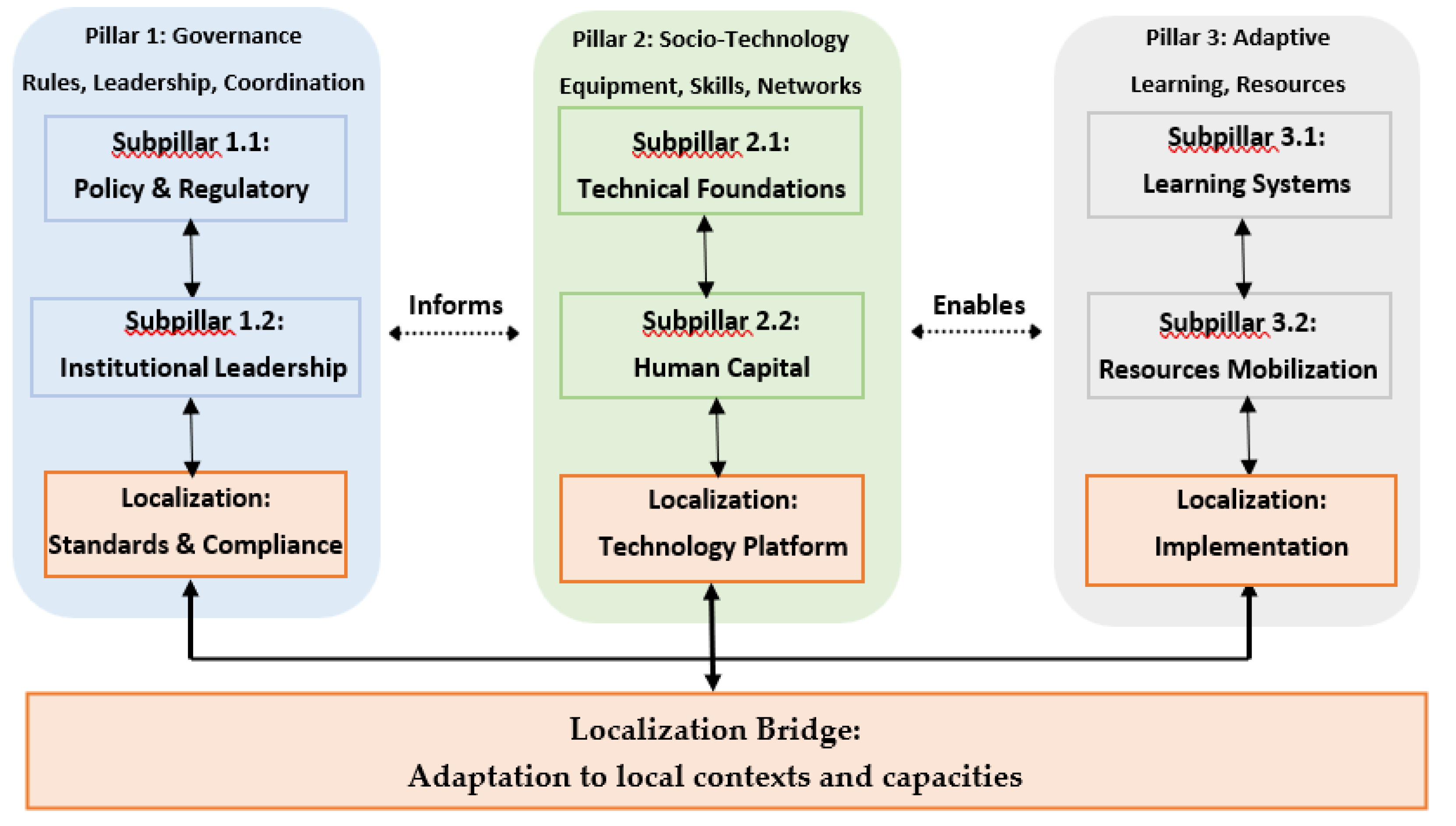
Figure 2.
Investment sequencing by institutional context.
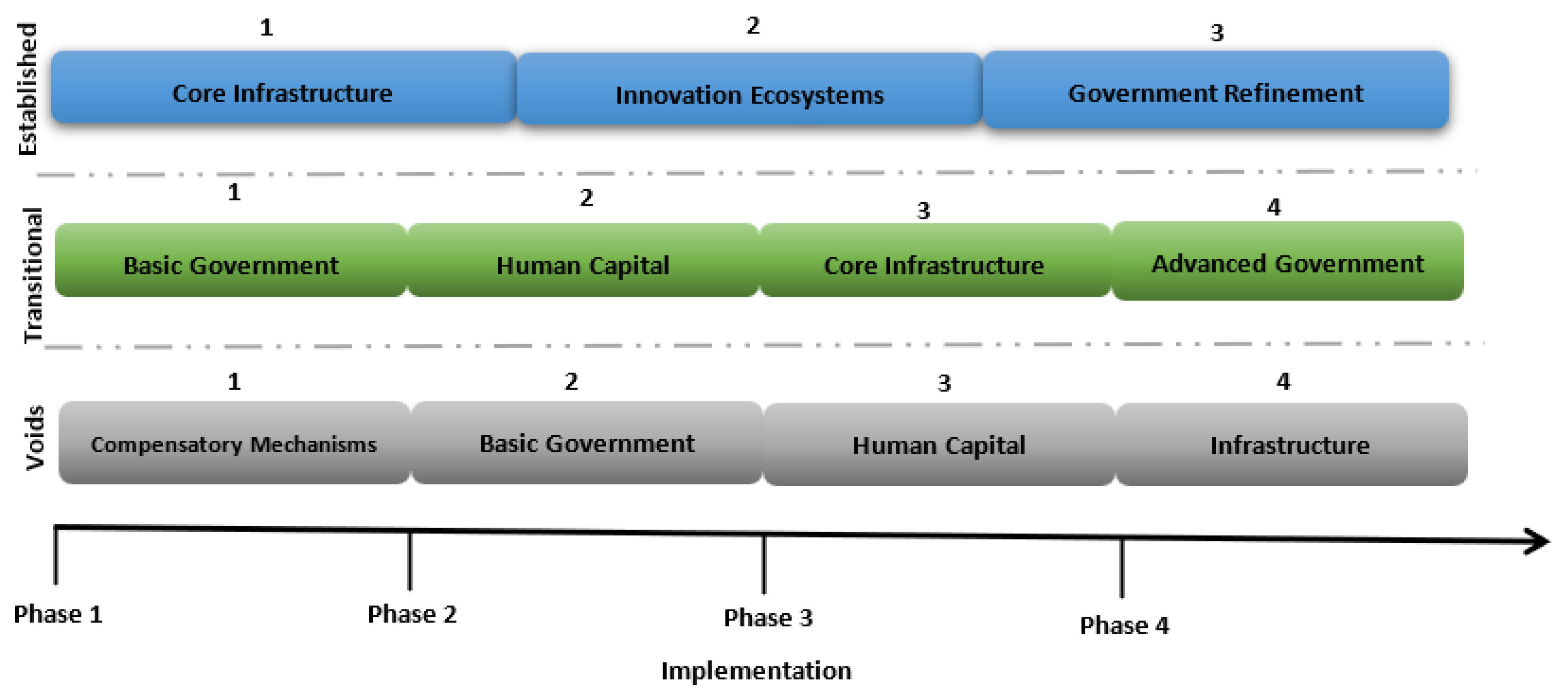

Table 1.
Context-specific PKI weightings.
| Institutional Context | Governance (Gw) | Infrastructure (Iw ) |
Adaptive Capacity (Aw) |
|---|---|---|---|
|
Established Transitional Institutional Void |
0.30 0.50 0.35 |
0.40 0.30 0.30 |
0.30 0.20 0.35 |
Table 2.
Illustrative PKI computation across institutional contexts.
| Context | Gscore | Iscore | Ascore | Gw | Iw | Aw | PKI |
|---|---|---|---|---|---|---|---|
|
`Established Transitional Institutional Void |
0.80 0.40 0.30 |
0.90 0.75 0.40 |
0.75 0.60 0.65 |
0.30 0.50 0.35 |
0.40 0.30 0.30 |
0.30 0.20 0.35 |
0.83 0.55 0.46 |
Disclaimer/Publisher’s Note: The statements, opinions and data contained in all publications are solely those of the individual author(s) and contributor(s) and not of MDPI and/or the editor(s). MDPI and/or the editor(s) disclaim responsibility for any injury to people or property resulting from any ideas, methods, instructions or products referred to in the content. |
© 2026 by the authors. Licensee MDPI, Basel, Switzerland. This article is an open access article distributed under the terms and conditions of the Creative Commons Attribution (CC BY) license (http://creativecommons.org/licenses/by/4.0/).
Copyright: This open access article is published under a Creative Commons CC BY 4.0 license, which permit the free download, distribution, and reuse, provided that the author and preprint are cited in any reuse.


