

Submitted:
03 February 2026
Posted:
05 February 2026
You are already at the latest version
Abstract
We present a physically intuitive and mathematically rigorous framework for deriving the relativistic quantum wave equations, dynamics, and topological structures of bosons and fermions in 1+1-dimensional spacetime. Starting from a simple flip-flop dual-component system that models internal oscillations, we show how first-order linear rate equations naturally give rise to the Klein-Gordon and Dirac equations. For bosons, the system leads to the familiar Klein-Gordon equation, while for spin-½ fermions—augmented by an internal clock degree of freedom—the Dirac equation emerges in 1+1D. The topological distinction between bosons and fermions is revealed through their rotational symmetry: bosons follow a 360° closed loop structure, while fermions are represented by a Möbius band, requiring a 720° rotation to return to their original state. We also introduce two distinct Lorentz transformation structures: hyperbolic (sinh–cosh) for bosons and trigonometric (sin–cos) for fermions. This approach provides a clear, unified, and pedagogical interpretation of relativistic quantum dynamics and internal particle structure.
Keywords:
bosons
; fermions
; 1+1D spacetime
; flip-flop dual-component
; Klein-Gordon equation
; Dirac equation
; Lorentz transformation
; internal clock
; spin-½
; topological structure
; Möbius band
1. Introduction
The quantum behavior of particles in relativistic regimes is governed by fundamental wave equations such as the Klein-Gordon equation [1] for scalar particles and the Dirac equation [2] for spin-½ fermions. These equations are traditionally derived from symmetry principles and relativistic covariance, often appearing abstract and mathematically sophisticated to students and researchers new to the field.
In this work, to elucidate the underlying physical concepts for bosons and fermions and their topological structures, for simplicity and pedagogical reasons, we introduce a physically intuitive and mathematically simple model: a flip-flop dual-component system in 1+1-dimensional spacetime. This model describes a particle as having two internal states that oscillate with a frequency proportional to its rest mass. For fermions, an additional internal degree of freedom—a pseudo-time denoted by τ—is introduced, reflecting the internal spin dynamics that contribute to the total rest energy of the particle. This setup allows us to derive first-order rate equations in time and space that naturally lead to second-order wave equations.
We further show that for a scalar boson, the propagation behavior follows a standard Lorentz transformation [3] with imaginary angles (hyperbolic rotation) [4], consistent with Minkowski spacetime [5]. In contrast, a fermion requires a real-angle Lorentz transformation (circular rotation), which naturally reflects its topological Möbius-band structure [6]—requiring 720° to return to its original state, in contrast to the 360° required for bosons.
This paper is structured to provide both a theoretical derivation and a visual, intuitive understanding of the difference between fermions and bosons. It also demonstrates how relativistic quantum behavior emerges from internal oscillation dynamics, offering a new and instructive path to understanding core principles in quantum field theory.
2. Flip-Flop Dual-Component Model and Emergent Relativistic Wave Equations in 1+1D
2.1. Internal Flip-Flop Dynamics at Rest Frame
We begin by modeling a massive particle at rest as an oscillation between two internal real-valued components and , where is the proper time in the particle’s rest frame. These components obey a simple set of coupled linear first-order rate equations:
where is the natural internal oscillation frequency associated with the rest mass? . This system describes a simple harmonic oscillator in two dimensions, and it conserves the total magnitude:
We define a complex wave function:
which satisfies the first-order differential equation:
The solution is:
describing a stationary wave in the rest frame, oscillating with frequency . This forms the core of our model: the internal flip-flop between two components gives rise to a complex-valued wave function.
2.2. First-Order Rate Equation in Time and Space
We now derive the traveling wave solution for a bosonic particle not by Lorentz boosting the rest-frame solution, but directly by proposing a first-order linear rate equation that governs the wave function’s evolution in both time and space
2.2.1. Motivating a Linear Rate Equation
Based on the internal flip-flop model, the rest-frame wave function obeys:
To generalize this to an observer frame where the particle is moving, we propose that the wave function satisfies a first-order rate equation involving both time and space derivatives:
where is the velocity of the particle in the observer frame.
This equation reflects a drift-plus-oscillation dynamic: the wave function propagates at speed while undergoing internal oscillations with frequency . It is a transport-type equation with a source term.
2.2.2. Solution and Lorentz-Consistency of the Linear Rate Equation
We consider the first-order rate equation:
which has the general solution:
with the wave number . This form corresponds to a traveling wave propagating in space with velocity , while also undergoing internal oscillations with frequency . . Such a simple flip-flop dual-component model om 1+1-dimension has been considered in our previous study of mass oscillations for a relativistic light-weighted particle [7].
Relation to Lorentz Transformation
This traveling wave solution is the same as the solution obtained by applying a Lorentz transformation to the rest-frame solution:
with the standard Lorentz transformation:
yielding the same form:
Thus, this first-order linear equation is Lorentz-consistent and reproduces the correct relativistic transformation behavior. Although it does not explicitly contain the Lorentz transformation, it is implicitly Lorentz-covariant, because the solution itself respects relativistic invariance.
This demonstrates the elegance and generality of the linear rate equation formulation.
Emergence of the Second-Order Klein-Gordon Equation
By taking another derivative of the linear rate equation in time and space, we can derive the second-order wave equation naturally. Start with:
Take the time derivative:
Similarly, take the space derivative:
Eliminating the cross-derivative, we obtain:
Now recall that and , so , and , thus:
which is exactly the Klein-Gordon equation:
Thus, the linear rate equation is more fundamental: it both respects Lorentz symmetry and naturally leads to the Klein-Gordon equation upon further differentiation. It can be viewed as a first-principles dynamical law, from which the second-order relativistic wave equation emerges.
2.3. Schrödinger Equation as a Non-Relativistic Limit
Starting from the relativistic wave function derived from the flip-flop dual-component model in the rest frame and then transformed to the observer frame, we had:
with , and , where the energy satisfies the Einstein relation:
In the non-relativistic limit, where the momentum , the total energy can be approximated using a Taylor expansion:
This separates the energy into two parts:
- A large rest mass energy: ,
- A small kinetic energy: . (22)
Thus, the wave function becomes:
We define a reduced wave function by factoring out the rapidly oscillating rest energy term:
with:
This satisfies the Schrödinger equation. We show this explicitly:
Hence, we recover the one-dimensional Schrödinger equation:
2.4. Non-Relativistic Limit and Emergence of Schrödinger Equation
In the limit where , the relativistic energy reduces via Taylor expansion:
We factor out the rapidly oscillating rest-mass term from the wave function:
where is the slowly varying envelope function. Substituting into the Klein-Gordon equation and neglecting second-order time derivatives of , we obtain:
which is the Schrödinger equation for a free particle in 1D. Hence, our framework reproduces both relativistic and non-relativistic quantum mechanics as emergent limits of a deeper flip-flop dynamics.
2.5. Summary of Section 2
- A particle at rest undergoes internal harmonic oscillation between two real-valued components.
- This flip-flop yields a complex wave function satisfying a first-order ODE.
- Applying the Lorentz transformation yields a traveling wave that satisfies the Klein-Gordon equation.
- In the non-relativistic limit, this naturally reduces to the Schrödinger equation.
- Thus, the flip-flop dual-component model provides a unified origin for quantum wave equations from simple physical assumptions.
Summary of Section 2
- The flip-flop dual-component model for a scalar particle leads to intrinsic oscillation at frequency in the rest frame.
- When observed in a moving frame, the wave function exhibits spatial dependence, derived either via Lorentz transformation or by solving a linear rate equation.
- The first-order rate equation naturally leads to the second-order Klein-Gordon equation, showing Lorentz-consistency.
- In the low-momentum limit, the solution gives rise to the familiar Schrödinger equation, justifying its emergence from a more fundamental relativistic structure.
- This framework gives a physically transparent, pedagogical derivation of both relativistic and non-relativistic quantum equations from a simple physical model based on intrinsic time oscillation.
3. Emergence of Relativistic Dynamics for Spin-½ Fermions in 1+1D
3.1. Internal Dynamics and the Need for an Extra Degree of Freedom
In contrast to scalar bosons, which require only a single intrinsic oscillation mode (flip-flop between dual components in time ), spin-½ particles exhibit a richer internal structure due to spinor degrees of freedom. To capture this, we introduce a second internal time-like coordinate:
- : the usual time evolution in the rest frame,
- : an internal clock associated with the intrinsic spin dynamics.
This internal clock, while not directly observable, modulates the internal state of the fermion and gives rise to an effective spin-induced mass-energy.
Let the state of the fermion be described by a two-component spinor:
We postulate the evolution of this spinor to be governed by the following first-order rate equation in the rest frame:
where:
- : oscillation rate related to the rest mass,
- : coupling strength due to internal spin dynamics across τ,
- : Pauli matrices [8].
This Hamiltonian has two non-commuting contributions, reflecting independent oscillatory behavior along and . It can be compactly written as:
This is a two-dimensional representation of the internal Hamiltonian governing the spin-half fermion in its rest frame.
3.2. Coupling to Space and Emergence of Relativistic Wave Equation
In a moving frame, with constant velocity along the spatial -direction, Lorentz invariance demands that spatial and temporal dynamics couple. We extend the first-order equation by introducing an additional term proportional to the spatial derivative:
Like the standard Dirac equation [9] for a point-like electron in 4D spacetime that involves four anti-commutative 4x4 gamma matrices [10], in this 1+1-dimensional case, we only need three anti-commutative 2x2 Pauli matrices, , for three degrees of freedom that include one internal degree of freedom . Each component serves the following roles:
- : exchange between dual components in time,
- : intrinsic spin orientation along τ,
- : coupling to spatial propagation .
The full Hamiltonian becomes:
The above approach in a 1+1-dimensional flip-flop dual-component model provides a simple, elegant approach to grasp the physical origins of these emergent wave equations.
3.3. Relativistic Energy and Emergent Mass from Spin
3.3. Wave Functions in Rest Frame and Laboratory Frame
Wave Function in the Rest Frame
In the rest frame of the spin-½ particle, the spatial degree of freedom is irrelevant. The wave function depends only on internal times and . The internal Hamiltonian includes mass oscillation and spin dynamics:
where and is the intrinsic spin coupling.
We consider the solution of the rate equation:
Assuming no explicit -dependence (i.e., it is encoded in the internal coupling term), the general solution is:
This can be evaluated using standard matrix exponential identities for two-level systems. Denoting , the solution becomes:
This solution describes oscillatory internal dynamics, modulated by both rest mass and intrinsic spin frequency. This implies that the spin dynamics also contribute to Einstein’s Pythagorean mass energy relationship [11] of an electron, which is absent for a scalar particle without spin.
Wave Function in the Laboratory Frame
In a laboratory frame where the particle travels with velocity , the wave function must reflect both internal dynamics and spatial propagation. We apply a Lorentz boost in the -direction and introduce the spatial derivative coupling:
The sign of with respect to and propagation direction dictates the spin’s hardness. We assume a plane-wave solution in space:
Inserting into the equation, the energy eigenvalue problem becomes:
As derived earlier, the energy eigenvalue is:
This wave function clearly shows the combined effect of rest mass, internal spin, and momentum in shaping the temporal evolution and spatial behavior of the spin-½ particle in motion.

Table 1.
Comparison Between Rest and Moving Frame Wave Functions.
| Aspect | Rest Frame | Moving Frame (Lab Frame) |
| Coordinates | (only time), internal spin in τ | (space-time), spin via coupling to σ-matrices |
| Hamiltonian | ||
| Solution | ||
| Energy | ||
| Interpretation | Internal oscillation of dual components | Internal + external dynamics with momentum propagation |
This comparison highlights a key point:
The spin-½ wave function at rest involves only internal oscillations (mass + spin), while the wave function in motion incorporates spatial propagation via an additional Pauli matrix, resulting in a fully relativistic Dirac-like behavior.Top of Form
3.4. Physical Interpretation and Summary
This derivation offers the following physical insights:
- Spin-½ particles require an extra internal degree of freedom for consistent modeling in 1+1D.
- The first-order rate equation encodes all dynamics: mass oscillation, spin flip, and spatial propagation.
- The resulting wave function satisfies a Dirac-type equation.
-
The total energy naturally includes:
- o
- Rest mass energy,
- o
- Spin-induced internal energy,
- o
- Kinetic energy.
- The geometry of spin-½ objects emerges as topologically Möbius-like, consistent with their 720-degree rotation symmetry and distinct from bosonic 360-degree periodicity.
4. Topological and Lorentz Structure of Bosons and Fermions in 1+1D
4.1. Lorentz Transformations in 1+1D
In the standard formulation, the Lorentz transformation in D for a frame moving at velocity relative to a rest frame is given by the hyperbolic rotation matrix
where the rapidity is defined as:
This transformation preserves the Minkowski spacetime interval:
This transformation applies to both bosonic and fermionic fields in the external spacetime, but their topological structure leads to fundamentally different physical behaviors, especially under rotation.
4.2. Topological Distinction Between Bosons and Fermions
The geometric nature of wave functions differs between bosons and fermions:
- Bosons correspond to closed-loop bands, and the wave function returns to its original state after a rotation.
This distinction is not merely mathematical—it reflects a topological twist in the structure of the fermion's wave function and aligns with the spin-statistics theorem in quantum field theory.
To further clarify the fundamental difference in the topological behavior between bosons and fermions in 2D spacetime, Table 2 summarizes their contrasting rotational and wave function properties, highlighting the necessity of introducing an internal degree of freedom (τ) for fermions in our flip-flop model.
This topological difference justifies the introduction of an additional internal degree of freedom (denoted ) for fermions in our flip-flop model, which is absent in bosonic systems.
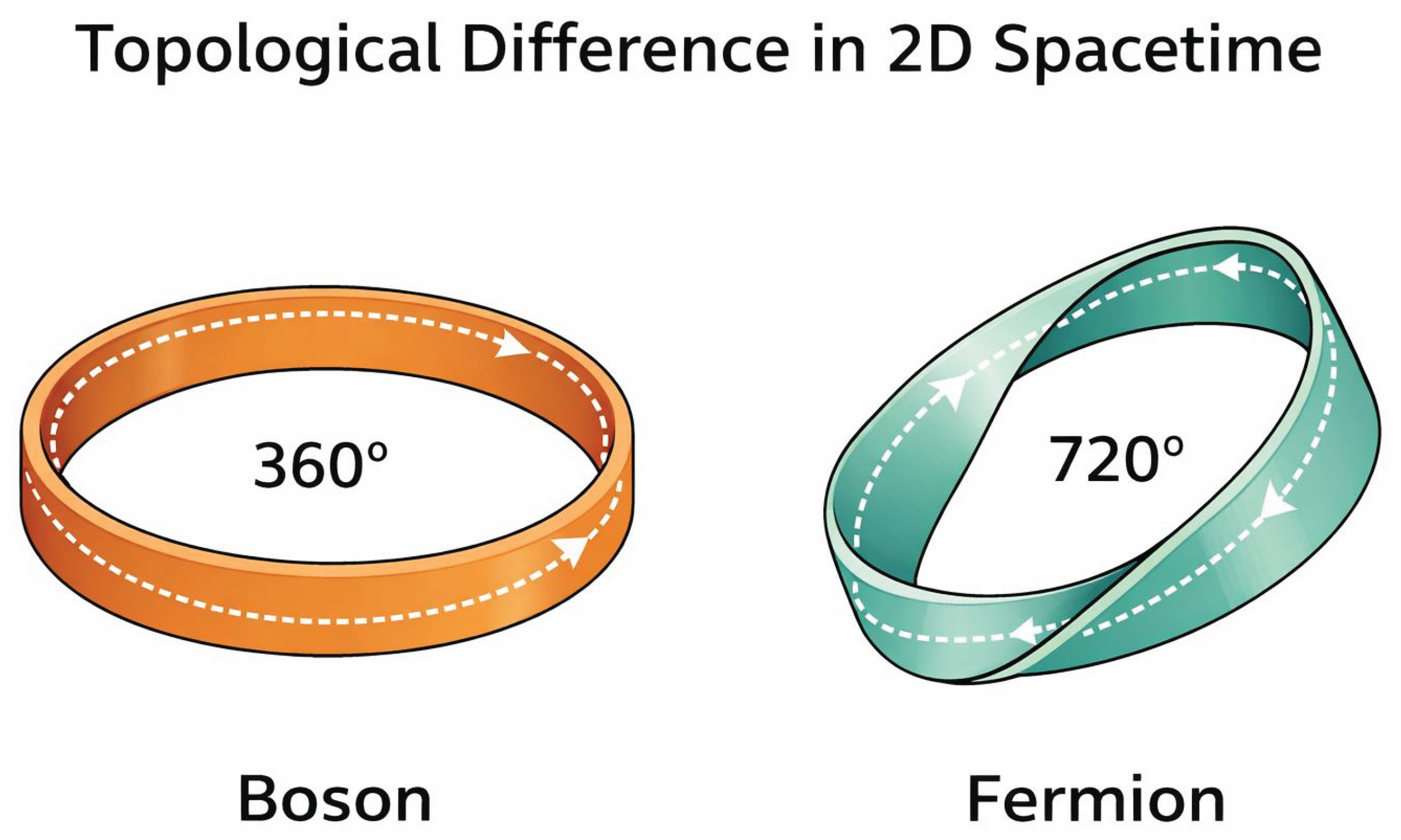
The fundamental difference between bosons and fermions can be visualized not only algebraically but also through their topological properties in spacetime. In the 1+1D framework, a boson can be represented as a simple closed loop—a band with no twist—analogous to a watch strap forming a continuous path. This structure implies that a 360-degree rotation restores the system to its original configuration, consistent with the spin-0 or integer-spin nature of bosons. In contrast, a fermion is topologically equivalent to a Möbius band—featuring a single twist in its path. This twist results in a unique requirement: a 720-degree rotation is needed to return the system to its initial state, capturing the essence of spin-½ particles. This topological distinction reveals a deeper layer of quantum structure and helps explain the fundamental differences in their statistical behavior and transformation properties under spacetime symmetries.
Figure 1.
Topological Structure of Bosons and Fermions in 1+1D Spacetime. This diagram illustrates the fundamental topological distinction between bosons and fermions in two-dimensional spacetime. On the left, the boson is represented by a closed untwisted loop (similar to a watch band), requiring a 360° rotation to return to its original configuration. The twist direction dictates the handedness of the spin. On the right, the fermion is depicted as a Möbius strip, which requires a full 720° rotation to complete one cycle—an intrinsic feature of spin-½ particles. The dotted lines trace the propagation path of internal phase evolution. The spin can be understood as a twist between a time and an internal degree of freedom, a 3D topological structure being projected onto a 2D Möbius spacetime strip strip. These visual captures the difference in quantum phase behavior under spacetime rotations, offering an intuitive explanation for the spin-statistics connection.
Figure 1.
Topological Structure of Bosons and Fermions in 1+1D Spacetime. This diagram illustrates the fundamental topological distinction between bosons and fermions in two-dimensional spacetime. On the left, the boson is represented by a closed untwisted loop (similar to a watch band), requiring a 360° rotation to return to its original configuration. The twist direction dictates the handedness of the spin. On the right, the fermion is depicted as a Möbius strip, which requires a full 720° rotation to complete one cycle—an intrinsic feature of spin-½ particles. The dotted lines trace the propagation path of internal phase evolution. The spin can be understood as a twist between a time and an internal degree of freedom, a 3D topological structure being projected onto a 2D Möbius spacetime strip strip. These visual captures the difference in quantum phase behavior under spacetime rotations, offering an intuitive explanation for the spin-statistics connection.
4.3. Summary of Section
- Lorentz symmetry is encoded using the standard Minkowski transformation in both bosonic and fermionic systems.
- However, fermions display a deeper topological structure, requiring a Möbius band-like behavior.
- This leads to observable consequences such as the spin-½ rotational behavior, emergence of internal structure, and sign inversion of the wave function under certain transformations.
- In our model, this supports the necessity of the flip-flop dual-component model with an internal time clock to describe fermions properly.
5. Hamiltonian Structure and Effective Mass-Energy Relations
5.1. Hamiltonian for Scalar (Bosonic) Flip-Flop Model
In the 1+1D scalar boson model, we start with the rest-frame first-order rate equation:
where encodes the rest mass energy of the scalar particle.
This system preserves the norm , and can be recast as a complex wave function , which satisfies:
This is equivalent to a stationary-state Schrödinger equation at rest. When extended to a moving frame using the Lorentz transformation, we obtain a traveling wave solution:
where , and , satisfying:
This confirms the Klein–Gordon equation [15]:
governs the propagation of this wave function.
In the non-relativistic limit, where , we can approximate:
By removing the rest energy term via a phase shift, the residual wave function satisfies the Schrödinger equation [16]
Thus, based on our flip-flop dual-component model, we could easily and elegantly rewrite the Klein-Gordon equation for a relativistic massive scalar particle, the Schrödinger equation for a non-relativistic particle, and the Dirac equation for an electron with an internal spin dynamic in 1+1-dimensional spacetime, all without a priori axiomatic assumptions.
5.2. Effective Mass-Energy Relation and Spin Interpretation
We have now derived a full expression for the total energy of a spin-½ particle in 1+1D spacetime:
where:
- is the bare rest mass from mass oscillation in ,
- is the mass-equivalent contribution from spin-coupled internal time,
- is the momentum along the space axis .
This Pythagorean energy structure reflects the orthogonality of degrees of freedom in Minkowski space, and provides a physical interpretation of spin as a source of internal mass-energy. It supports the idea that spin is not just a quantum number, but an emergent internal process contributing to inertia and dynamics.
6. Conclusion and Outlook
In this work, we introduced a novel and pedagogically transparent framework to understand relativistic quantum behavior of particles in 1+1D spacetime using a flip-flop dual-component model. Starting from first principles and minimal assumptions, we showed that scalar bosons can be modeled using a two-state oscillation system at rest, whose natural frequency is directly proportional to the rest mass via the relation . By applying a Lorentz transformation, this rest-frame oscillation is shown to evolve into a traveling wave solution governed by the Klein-Gordon equation. Furthermore, in the non-relativistic limit, this same model naturally reduces to the Schrödinger equation. This illustrates how relativistic and non-relativistic wave dynamics emerge from a simple physical concept—oscillatory dynamics between two internal states.
For spin-½ fermions, we extended the model by introducing an internal clock degree of freedom , orthogonal to both the external time and spatial coordinate . This led to a three-component system where spin emerges naturally from internal exchange dynamics. The resulting wave equation, when projected into the laboratory frame, displays a coupling structure reminiscent of the Dirac equation and obeys Einstein's energy-momentum relation with contributions from intrinsic mass, spin, and kinetic energy.
We have demonstrated that to describe a spin for an electron one must include an internal degree of freedom and the spin dynamics contribute to the effective mass of the electron at the rest frame. Assuming an electron is a point-like particle without an internal structure is conceptually inconsistent. In addition, there also exists an inconsistency in the Dirac equation in $D spacetime. Consider the standard Dirac electron with rest mass , one has
In the rest frame, where the spatial momentum vanishes (), the above reduces to:
This equation contains no spatial derivatives or coupling to spin terms, and the associated Dirac current becomes . Similarly, the antisymmetric spin tensor lacks spatial contributions. As a result, the spin angular momentum — a defining intrinsic property of the electron — appears to vanish in the rest frame. This is a contradiction: the electron retains spin regardless of its motion. This paradox arises because the Dirac equation treats the electron as a point particle with no internal structure. Consequently, to be consistent, the electron cannot be treated as a point0like particle without an internal structure. One way to generalize the conventional 4D Dirac equation that involves four gamma matrices but can be expanded to an 8D generalized Dirac equation using Clifford algebra [17] or hypercomplex algebra of octonion algebra [18], or even further to sedenions [19,20], so that the internal spin dynamics could be treated properly without self-inconsistency as encountered in the standard Dirac equation.
Another key insight from our analysis is the topological distinction between bosons and fermions in 1+1D spacetime: bosons correspond to closed loops (360° periodicity), while fermions behave like Möbius bands (720° periodicity). This fundamental difference is encoded in the structure of their respective Lorentz transformations: bosons are governed by hyperbolic rotations (Minkowski spacetime), whereas fermions involve real-angle rotations (Euclideanized transformation), reflecting their internal spin geometry.
Moreover, the probabilistic interpretation of the wavefunction, often postulated axiomatically in quantum mechanics, emerges naturally in this model from the conservation of the internal flip-flop dynamics , thus offering a conceptual foundation for the Born rule.
This approach is not only physically illuminating but also pedagogically valuable, offering a bridge between classical intuition, relativistic kinematics, and quantum field theory. It enables students and researchers alike to observe how profound relativistic quantum behavior and probabilistic interpretation can arise from straightforward dynamical assumptions.
Outlook
The insights developed in this 1+1-D model lay the groundwork for a more general theory in 3+1D spacetime. The model can be naturally extended to describe the dynamics of photons (massless spin-1 bosons) and fermions (massive spin-½ particles) in full spacetime, where the internal degrees of freedom play a central role in encoding spin and mass generation.
For fermions, the inclusion of an internal degree of freedom such as becomes crucial for a consistent dynamical origin of spin and leads to a generalized mass that includes rest mass, spin contribution, and kinetic energy. The total energy of such particles satisfies a Pythagorean-like structure, suggesting a deeper geometric origin of relativistic energy relations.
While the gamma matrices in the standard Dirac formulation are associative and sufficient in 3+1D, future extensions could involve quaternionic or octonionic algebra, where non-associativity and internal symmetries may account for additional internal dynamics, symmetry breaking, or mass hierarchy in particle physics.
This paper lays the groundwork for a dynamic and geometrical interpretation of relativistic quantum equations, providing new insights into the internal structure of particles, the topological aspects of spin, and the emergence of quantum laws from first-order rate dynamics. It provides a new foundation not just for research, but also for teaching quantum mechanics in a more physically intuitive and unified way.
Funding
The author is a retired professor with no funding.
Data Availability Statement
All reasonable questions about the data or derivations can be requested by contacting the corresponding author.
Conflicts of Interest
The author has np conflict of interest with anyone.
References
- Schrödinger, E. Quantisierung als Eigenwertproblem (Erste Mitteilung). Annalen der Physik 1926, 384(4), 361–376. [Google Scholar] [CrossRef]
- Klein, O.; Gordon, W. Quantentheorie und fünfdimensionale Relativitätstheorie. Zeitschrift für Physik 1926, 37, 895–906. [Google Scholar] [CrossRef]
- Dirac, P. A. M. The quantum theory of the electron. Proceedings of the Royal Society A 1928, 117(778), 610–624. [Google Scholar] [CrossRef]
- Sakurai, J. J.; Napolitano, J. Modern Quantum Mechanics, 2nd ed.; Cambridge University Press, 2017. [Google Scholar]
- Ryder, L. H. Quantum Field Theory, 2nd ed.; Cambridge University Press, 1996. [Google Scholar]
- Peskin, M. E.; Schroeder, D. V. An Introduction to Quantum Field Theory; Addison-Wesley, 1995. [Google Scholar]
- Tang, J.; Tang, Q.; Hu, Z.B. Mass oscillations and Heisenberg-type internal dynamics of particles in a dual-component model. Scientific Reports 2022, 12, 14532. [Google Scholar]
- Weinberg, S. The Quantum Theory of Fields, Vol. 1: Foundations; Cambridge University Press, 1995. [Google Scholar]
- Penrose, R.; Rindler, W. Spinors and Space-Time: Volume 1, Two-Spinor Calculus and Relativistic Fields; Cambridge University Press, 1986. [Google Scholar]
- Feynman, R. P.; Leighton, R. B.; Sands, M. The Feynman Lectures on Physics; Addison-Wesley, 1965; Vol. 3. [Google Scholar]
- Nakahara, M. Geometry, Topology and Physics, 2nd ed.; Institute of Physics Publishing, 2003. [Google Scholar]
- Frankel, T. The Geometry of Physics: An Introduction, 3rd ed.; Cambridge University Press, 2011. [Google Scholar]
- Nash, C.; Sen, S. Topology and Geometry for Physicists; Academic Press, 1983. [Google Scholar]
- Greiner, W.; Reinhardt, J. Field Quantization; Springer, 1996. [Google Scholar]
- Kaku, M. Quantum Field Theory: A Modern Introduction; Oxford University Press, 1993. [Google Scholar]
- Cohen-Tannoudji, C.; Diu, B.; Laloë, F. Quantum Mechanics; Wiley-Interscience, 1977; 2 vols. [Google Scholar]
- Ohanian, H. C. What is spin? American Journal of Physics 1986, 54(6), 500–505. [Google Scholar] [CrossRef]
- Baez, J. C. The Octonions. Bulletin of the American Mathematical Society 2002, 39(2), 145–205. [Google Scholar] [CrossRef]
- Tang, Q.; Tang, J. Sedenion Algebra Model as an Extension of the Standard Model and Its Link to SU(5). Symmetry 2024, 16(5), 626. [Google Scholar] [CrossRef]
- Tang, J. From Complex Number to Hypercomplex Algebra: An Evolution from Non-Relativistic Quantum Theory to Particle Physics in 16D Spacetime. Preprints.org 2025. [Google Scholar] [CrossRef]
Table 2.
Topological and Rotational Differences Between Bosons and Fermions in 2D Spacetime.
| Property | Boson | Fermion |
| Rotation required | ||
| Topology | Closed band | Möbius band |
| Wave function phase change | No sign flip | |
| Return to initial state | After 1 full turn | After 2 full turns |
Disclaimer/Publisher’s Note: The statements, opinions and data contained in all publications are solely those of the individual author(s) and contributor(s) and not of MDPI and/or the editor(s). MDPI and/or the editor(s) disclaim responsibility for any injury to people or property resulting from any ideas, methods, instructions or products referred to in the content. |
© 2026 by the authors. Licensee MDPI, Basel, Switzerland. This article is an open access article distributed under the terms and conditions of the Creative Commons Attribution (CC BY) license (http://creativecommons.org/licenses/by/4.0/).
Copyright: This open access article is published under a Creative Commons CC BY 4.0 license, which permit the free download, distribution, and reuse, provided that the author and preprint are cited in any reuse.


