

Submitted:
01 February 2026
Posted:
05 February 2026
You are already at the latest version
Abstract
The Bologna Process has served as the primary template for higher education reform in post-Soviet Central Asia for two decades. However, the linear application of European integration theories fails to account for the region’s distinct governance legacy, characterized by vertical state control and low horizontal trust between institutions. This theoretical paper addresses this gap by synthesizing literature on policy transfer, norm localization, and digital governance to construct a region-specific framework for integration. We propose a "Three-Stage Governance Model" moving from structural comparability to quality assurance mechanisms, and finally to mobility. Crucially, we argue that in the absence of historical institutional trust, the region is pivoting towards "algorithmic trust." By analyzing recent legislative shifts in Kazakhstan, Kyrgyzstan, and Uzbekistan alongside emerging technical infrastructures (e.g., blockchain-based credentialing), we demonstrate that technical interoperability is functioning as a substitute for political harmonization. The study concludes that Central Asian regionalism is evolving not into a cultural community like the EHEA, but into a "techno-institutional" network where digital standards drive policy convergence.
Keywords:
higher education regionalization
; Central Asia
; bologna process
; norm localization
; algorithmic trust
; education governance
; blockchain in education
1. Introduction
The transformation of higher education in post-Soviet Central Asia represents one of the most complex instances of policy borrowing in the 21st century. Since the dissolution of the Soviet Union in 1991, the newly independent states of Kazakhstan, Kyrgyzstan, and Uzbekistan have engaged in a dual process of nation-building and internationalization. In this context, the European Bologna Process has served as the dominant normative script for reform (Silova & Niyozov, 2020). The adoption of the three-cycle degree system (Bachelor-Master-PhD), the European Credit Transfer and Accumulation System (ECTS), and the establishment of independent accreditation agencies suggests a trajectory of convergence with the European Higher Education Area (EHEA).
However, a significant gap persists between the de jure adoption of these structures and the de facto reality of regional integration. While individual universities have modernized their curricula, the region lacks a cohesive, functional space for academic mobility comparable to Europe. Students moving between Bishkek and Tashkent often face bureaucratic hurdles—such as the arduous “nostrification” process—that the Bologna tools were specifically designed to eliminate. Existing literature often attributes this “implementation gap” to a lack of political will, insufficient funding, or weak institutional capacity (Heyneman & Skinner, 2014).
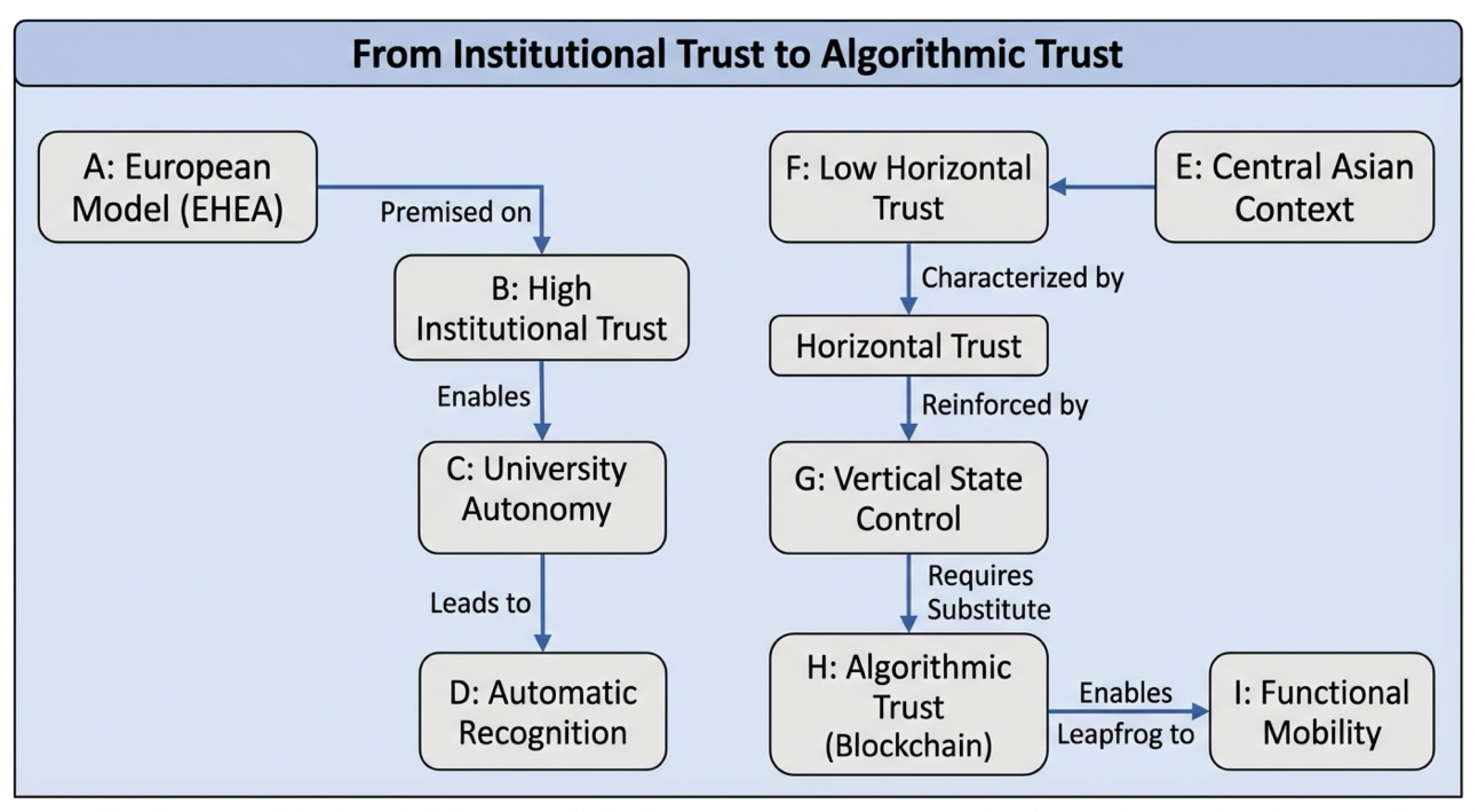
This paper argues for a different interpretation: the European model of integration, premised on “institutional trust” and university autonomy, is structurally incompatible with the vertical governance models of Central Asia. In the EHEA, trust preceded the tools; universities trusted each other’s quality judgments, allowing for the mutual recognition of credits. In Central Asia, governance remains “vertical,” where trust flows upwards to the Ministry of Education rather than outwards to peer institutions. Therefore, simply transplanting Bologna tools without the underlying trust infrastructure results in what Sabzalieva (2022) describes as “isomorphic mimicry”—institutions that look European in form but function according to Soviet bureaucratic logic.
Consequently, this study asks: How can regional integration be achieved in a low-trust governance environment? To answer this, we synthesize theories of policy transfer (Phillips & Ochs, 2003) and norm localization (Acharya, 2004) with emerging scholarship on digital governance and blockchain technology (Turkanović et al., 2018). We propose a “Three-Stage Governance Framework” that redefines integration not as a cultural project, but as a technical one. We argue that Central Asian states are bypassing the slow process of building institutional trust by leveraging “algorithmic trust”—specifically through digital verification technologies—to create a functional regional market.
2. Literature Review and Theoretical Framework
2.1. The Bologna Process: Convergence vs. Divergence
The theoretical debate on the Bologna Process has largely focused on the tension between convergence and divergence. Proponents of the “convergence” thesis argue that global isomorphism is inevitable as universities strive for legitimacy (Meyer et al., 1997). However, critics note that in non-European contexts, Bologna reforms are often adopted selectively. In Central Asia, the adoption of the three-cycle system was driven less by a desire for regional cohesion and more by the need for global signaling and competitiveness (Isaacs, 2014). This has led to a “Bologna with Soviet characteristics,” where ECTS credits are calculated based on contact hours rather than learning outcomes, preserving the teacher-centered pedagogy of the past.
2.2. Policy Borrowing and Norm Localization
To understand this divergence, we employ two complementary theoretical lenses. First, Phillips and Ochs’s (2003) model of policy borrowing suggests that educational policies pass through stages of attraction, decision, implementation, and internalization. In Central Asia, the “internalization” phase has been stalled by local resistance. Second, and more critically, we utilize Acharya’s (2004) theory of “norm localization.” Acharya argues that external norms (like academic mobility) are not passively adopted; they are actively reconstructed to fit local cognitive priors. In Central Asia, the norm of “quality assurance” (QA) has been localized not as a mechanism for institutional enhancement, but as a new instrument for state control and standardization (Anafinova, 2024). This localization process explains why legislative frameworks in the region often appear contradictory—simultaneously promoting autonomy in rhetoric while tightening regulation in practice.
2.3. The Emergence of Algorithmic Trust in Education
A novel contribution of this paper is the integration of literature on “algorithmic trust.” Traditional governance theories rely on “institutional trust”—the belief that an institution will act according to shared values. In low-trust environments, however, technology can serve as a substitute. The literature on blockchain in education (Turkanović et al., 2018; Cardenas-Quispe & Pacheco, 2025) demonstrates how distributed ledger technologies (DLT) can create immutable records of achievement.
- EduCTX and Blockcerts: Studies on platforms like EduCTX show that blockchain can decentralize credit transfer, removing the need for a central authority to verify every transaction (Turkanović et al., 2018).
- Fraud Prevention: Abdelmagid et al. (2024) highlight that in regions with high rates of credential fraud, blockchain provides a “trustless” verification mechanism. This literature has largely remained in the domain of computer science. By bringing it into the discussion of higher education governance, we provide a theoretical bridge for understanding how Central Asia might leapfrog traditional integration hurdles.
Figure 1.
Theoretical Synthesis: From Institutional Trust to Algorithmic Trust in Regional Integration. (Note: This figure will illustrate the shift from the European “Trust-based” model to the proposed Central Asian “Tech-based” model.).
Figure 1.
Theoretical Synthesis: From Institutional Trust to Algorithmic Trust in Regional Integration. (Note: This figure will illustrate the shift from the European “Trust-based” model to the proposed Central Asian “Tech-based” model.).
3. The Context: Governance Paradox in Central Asia
The implementation of the Bologna Process in Central Asia operates within a unique “governance paradox.” On the surface, the region exhibits a high degree of declaratory convergence: legislative frameworks in Kazakhstan, Kyrgyzstan, and Uzbekistan have been systematically rewritten to incorporate European terminology. However, a granular analysis of bylaws, ministerial decrees, and institutional practices reveals a persistent implementation divergence. This section deconstructs this paradox by contrasting the de jure autonomy granted by statutes with the de facto vertical control exercised through bureaucratic mechanisms.
3.1. Kazakhstan: The Illusion of “Managed Autonomy”
Kazakhstan represents the region’s most aggressive adopter of Bologna norms, having become the first Central Asian signatory to the Bologna Declaration in 2010. The legal cornerstone of this integration is the Law of the Republic of Kazakhstan “On Education” (2007), which has undergone significant amendments, most notably the 2018 Law on Expanding Academic and Managerial Autonomy of Higher Education Institutions (Law No. 171-VI).
The Legal Framework: Law No. 171-VI was hailed as a paradigm shift. It theoretically dismantled the Soviet-era command system by transferring authority from the Ministry of Science and Higher Education to university rectors. Key provisions included the right for universities to design their own academic programs without ministerial pre-approval, the ability to manage their own financial resources, and the freedom to establish admission criteria. Ostensibly, this aligns perfectly with the Magna Charta Universitatum’s principles of institutional autonomy.
The Administrative Reality: However, the practical application of this law reveals a system of “managed autonomy” (Anafinova, 2024). While universities can design curricula, they must still adhere to the State Compulsory Standards of Higher and Postgraduate Education (SCSE). These standards prescribe a rigid ratio of “general education” (history, philosophy, language) to “major” courses, often consuming up to 25-30% of the total ECTS credits. This centralized curriculum block creates a structural incompatibility with European partners, where general education is typically minimal or integrated.
Furthermore, the governance structure remains vertically integrated. Despite the legal provision for “corporate governance” via Boards of Trustees, the appointment of rectors in national universities remains the prerogative of the central government. This creates a dual-loyalty dilemma: rectors are accountable to the Ministry rather than to the academic community or external stakeholders. Consequently, “autonomy” is often interpreted by university administrators not as the freedom to innovate, but as the responsibility to execute state directives more efficiently. The “trust” required for Bologna mobility is thus directed upwards to the state apparatus, rather than horizontally towards partner institutions.

Table 1.
Comparative Governance Matrix of Higher Education in Central Asia (2024).
| Dimension | Kazakhstan | Kyrgyzstan | Uzbekistan |
|---|---|---|---|
| Primary Legislation | Law “On Education” (2007, amended 2024); Law No. 171-VI (2018) | Law “On Education” (2023); Gov. Decree No. 5212/1 (State Standards) | Law “On Education” (2020); Decree UP-5847 (2030 Concept) |
| Governance Model | Managed Autonomy: Universities have legal autonomy but operate under strict Ministry KPIs and appointed Rectors. | Prescriptive Control: Curriculum content and structure are heavily dictated by State Educational Standards (SES). | Transitioning Centralism: Moving from rigid state quotas to gradual academic independence; rapid top-down digitization. |
| Curriculum Flexibility | Medium: Universities design programs, but ~30% of credits are mandated “General Education” (History, Language). | Low: High percentage of mandatory courses; strict adherence to “Model Study Plans” required. | Medium-Low: ECTS adopted, but often superimposed on traditional “contact hour” requirements. |
| Quality Assurance | Decentralized: Market-driven accreditation via independent agencies (e.g., IAAR, IQAA) listed on EQAR. | Centralized: Oversight via the Ministry’s Department for Quality Development (Decree No. 568). | State-Inspectorate: Quality control managed directly by the State Inspectorate for Supervision. |
| Recognition Barrier | Digitalizing: Integration with Digital Kazakhstan for automated verification; reducing bureaucratic friction. | High Friction: Heavy reliance on manual “Nostrification” (Decree No. 671); “Academic Difference” exams common. | Centralized Pilot: State-managed recognition process, currently piloting blockchain-based diplomas. |
3.2. Kyrgyzstan: The “Standardization Trap”
If Kazakhstan suffers from managed autonomy, Kyrgyzstan struggles with a “standardization trap.” The Law of the Kyrgyz Republic “On Education” (2023) provides the overarching framework for integration, mandating the use of ECTS and the three-cycle system. However, the operational reality is governed by a complex web of State Educational Standards (SES) that are far more prescriptive than their Kazakh counterparts.
The Curriculum Straitjacket: In Kyrgyzstan, the Ministry of Education and Science approves specific SES for every specialization (e.g., Decree No. 5212/1). These standards dictate not only the learning outcomes but often the specific list of subjects and contact hours required for a degree. This legacy of the Soviet typooy uchebnyi plan (model study plan) means that a “Bachelor of Economics” in Bishkek is structurally identical across all public universities, but potentially incompatible with a flexible European curriculum.
The friction becomes evident in student mobility. When a Kyrgyz student attempts to transfer ECTS credits from a European university, the rigid SES often prevents recognition if the course names do not perfectly match the state-approved list. This forces students to take “academic difference” exams upon their return, effectively penalizing mobility. The system prioritizes compliance with the standard over the recognition of learning outcomes, directly contradicting the core philosophy of the Lisbon Recognition Convention.
3.3. The “Nostrification” Barrier: Quantifying the Trust Deficit
The most tangible manifestation of the region’s low-trust environment is the persistence of “nostrification” (state recognition of foreign diplomas). In a high-trust region like the EHEA, recognition is increasingly automatic or handled at the institutional level. In Central Asia, it remains a centralized, defensive bureaucratic procedure.
The Bureaucratic Anatomy of Distrust: Under regulations such as Kyrgyzstan’s Government Decree No. 671, the recognition of a foreign degree historically involved a multi-stage forensic audit. An applicant was required to submit notarized translations, archival certificates confirming the university’s accreditation status, and detailed syllabus comparisons. The process could take months, during which a panel of experts would compare the foreign curriculum against the national SES. If the discrepancy in “contact hours” exceeded a certain threshold (often 10-20%), the degree would be rejected or the applicant required to pass additional state exams.
This procedure functions as a “Trust Tax”—a high transaction cost imposed on mobility due to the absence of institutional trust. The state operates on a default presumption of fraud or quality deficiency. Even degrees from neighboring Central Asian states are subject to this scrutiny, highlighting the lack of regional cohesion. This “nostrification barrier” is not merely an administrative nuisance; it is a structural governance failure. It demonstrates that despite two decades of Bologna rhetoric, the fundamental unit of currency in higher education—the degree—is not fungible across borders without state intervention.
Conclusion of Context: This comparative analysis establishes the “Problem” of our study. We see a region where laws promise autonomy and mobility (Declaratory Convergence), but bylaws and administrative cultures enforce standardization and border control (Implementation Divergence). The failure is not one of policy design, but of trust architecture. The traditional Bologna tools (ECTS, Diploma Supplement) assume a level of institutional trust that simply does not exist in the vertical governance hierarchies of Central Asia. Therefore, a new mechanism is required to bridge this gap—one that does not rely on human or institutional trust.
4. The Proposed Framework: A Three-Stage Model
To resolve the governance paradox described in the previous section—where legal convergence masks operational divergence—we propose a region-specific governance framework. This model moves beyond the linear “policy borrowing” approach, suggesting instead a phased evolution from structural imitation to functional integration via technological intervention.
Stage 1: Structural Comparability (The “Hardware”)
The first stage involves the standardization of degree architectures and credit systems. In the Central Asian context, this is the “hardware” of integration—the necessary physical infrastructure that allows disparate systems to connect.
The Mechanism of Tuning: This stage has largely been achieved through the top-down adoption of the Bachelor-Master-PhD cycles. As Isaacs (2014) notes in the analysis of the TuCAHEA (Tuning Central Asian Higher Education Area) project, the “Tuning” methodology provided a shared lexicon. For the first time, a “credit” in Bishkek and a “credit” in Tashkent were theoretically defined by the same metric: student workload (25-30 hours per ECTS). However, this comparability remains superficial. While the labels are identical, the content is not. A 240-ECTS Bachelor’s degree in Kyrgyzstan, heavily laden with state-mandated ideological courses, is structurally distinct from a 240-ECTS degree in a more autonomous Kazakh university. Thus, Stage 1 creates the possibility of connection but does not guarantee the interoperability of content. It is akin to laying down railway tracks of the same gauge but having trains that run on different signaling systems.
Stage 2: Quality Assurance as Standardization (The “Software”)
The second stage addresses the “signaling system”—Quality Assurance (QA). In the European model, QA is primarily a tool for enhancement and accountability. In the post-Soviet context, our framework posits that QA must function as a tool for standardization.
From Licensing to Accreditation: Historically, Central Asian states relied on “licensing” (attestatsiya)—a punitive, state-driven inspection of inputs (e.g., square meters of classroom space, number of books in the library). Stage 2 requires a shift to “accreditation”—an evaluation of outputs (learning outcomes). Recent legislative shifts indicate this transition is underway but contested. In Kazakhstan, the government has deregulated QA, allowing independent agencies like IAAR and IQAA to operate. In contrast, Kyrgyzstan’s Decree No. 568 (2024) recentralized QA under a new Ministry department. The “Bounded Innovation” Strategy: Applying Elken and Stensaker’s (2023) concept of “bounded innovation,” we argue that for regional integration, these divergent QA agencies do not need to be identical, but they must be mutually intelligible. The goal of Stage 2 is not to create a single “Central Asian QA Agency,” but to establish a “zone of mutual recognition” where a QA decision in one country is accepted as valid in another. Currently, this is the bottleneck: the lack of trust between QA agencies mirrors the lack of trust between universities.
Stage 3: Mobility via Algorithmic Trust (The “Leapfrog Mechanism”)
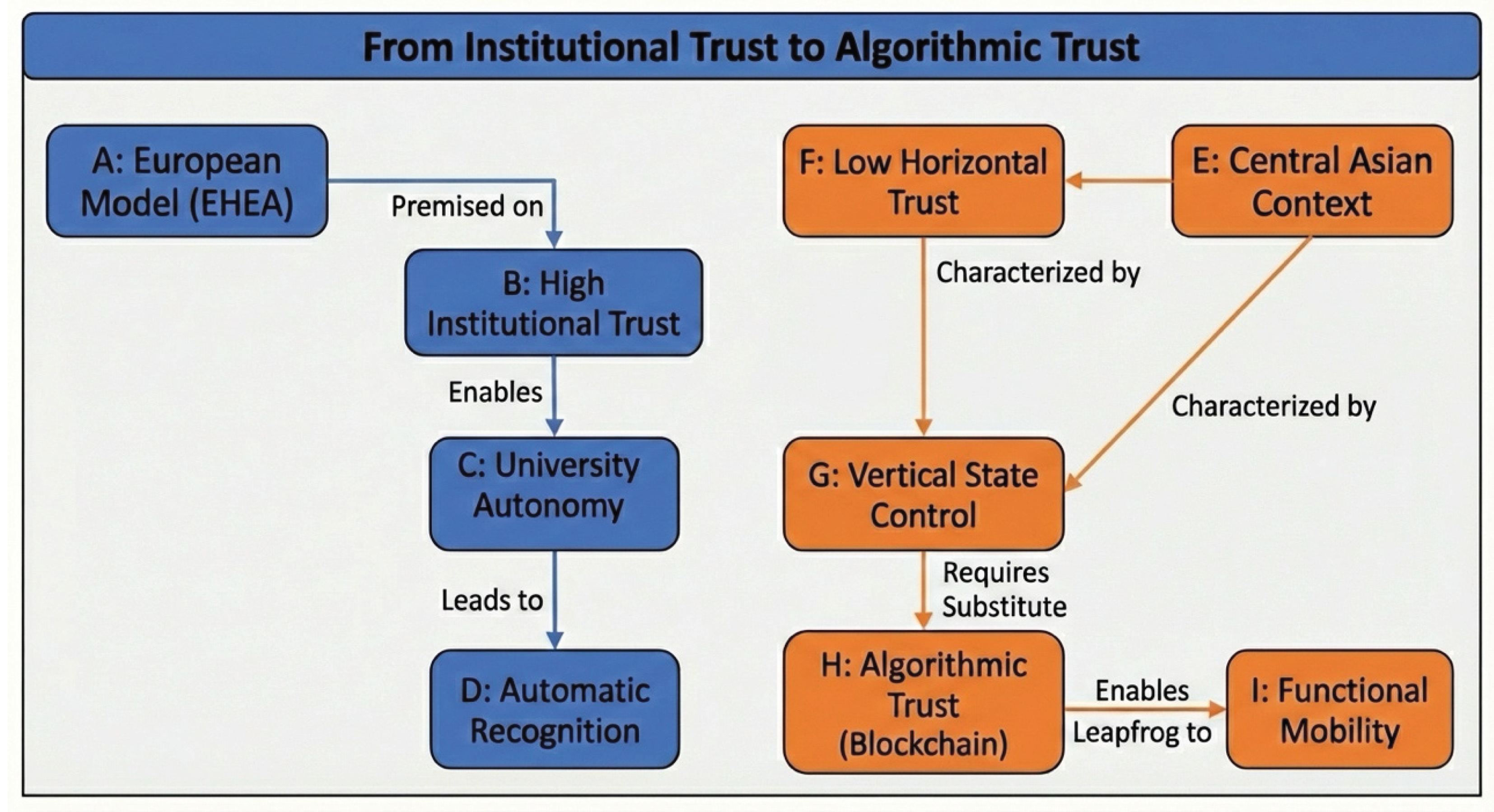
This is the critical divergence from the European model and the primary contribution of this paper. Given the entrenched “Trust Tax” identified in Section 3.3, and the slow pace of QA alignment in Stage 2, the region is poised to leapfrog directly to Algorithmic Trust.
The Theoretical Pivot: Traditional integration theories assume that “social trust” (trust in people/institutions) is a prerequisite for mobility. We argue that “technological trust” (trust in code/protocols) can serve as a functional substitute. The emerging literature on blockchain in education (Turkanović et al., 2018; Cardenas-Quispe & Pacheco, 2025) provides the blueprint for this “leapfrog.”
The Technical Solution to a Governance Problem: We propose a Regional Digital Credential Framework (RDCF) based on distributed ledger technology (DLT). This system addresses the specific pain points of the “Nostrification Barrier”:
- Immutable Record vs. Notarized Paper: Currently, a student must pay a notary to translate and certify a paper diploma. In an RDCF, the diploma is issued as a Verifiable Credential (VC) on a blockchain. The “original” is not a piece of paper, but a cryptographic hash anchored on the ledger. This eliminates the need for notaries and prevents the rampant fraud that drives defensive state policies (Abdelmagid et al., 2024).
- Instant Verification vs. Bureaucratic Delay: Instead of a Ministry official in Bishkek writing a letter to a university in Almaty to confirm a degree (a process taking weeks), the verification is instantaneous. The receiving institution simply queries the ledger. If the cryptographic signature matches the issuing university’s public key, the degree is valid. Trust is placed in the cryptography, not in the foreign university’s registrar.
- Smart Contracts for Automatic Recognition: The most transformative aspect is the potential for Smart Contracts. The recognition criteria (e.g., “Degree must be from an accredited university” + “Must have 240 ECTS”) can be coded into the contract. When a student presents their digital wallet, the smart contract automatically checks these conditions against the ledger. If met, recognition is granted instantly. This removes human discretion—and the potential for rent-seeking or corruption—from the process entirely.
Evidence of Emergence: This is not science fiction. Elements of this stage are already appearing. Digital Kazakhstan has integrated diploma verification into its e-government portal. Uzbekistan is piloting digital diplomas. The “Digital Silk Road” initiative provides the shared technical infrastructure. Our model suggests that these disparate national projects will inevitably coalesce into a regional network, driven by the pragmatic need to reduce the “Trust Tax.”
Figure 2.
The Three-Stage Governance Framework: From Structural Comparability to Algorithmic Mobility. (Note: This figure will visualize the three stages, highlighting the “Leapfrog” role of technology in Stage 3.).
Figure 2.
The Three-Stage Governance Framework: From Structural Comparability to Algorithmic Mobility. (Note: This figure will visualize the three stages, highlighting the “Leapfrog” role of technology in Stage 3.).
5. Discussion
5.1. The “Trust Paradox” in Post-Soviet Integration
The central finding of our theoretical synthesis is that the European model of integration—premised on “mutual trust” between institutions—cannot be simply transplanted to Central Asia. In the EHEA, trust preceded the tools (ECTS, Diploma Supplement). In Central Asia, our analysis suggests the reverse must occur: tools must precede trust. Existing literature on policy borrowing (Phillips & Ochs, 2003; Steiner-Khamsi, 2004) often frames the “implementation gap” in Central Asia as a failure of political will or capacity. However, applying Acharya’s (2004) norm localization theory, we argue this is not a failure, but a structural adaptation. As noted by Sabzalieva (2022) and Silova & Niyozov (2020), post-Soviet universities operate in a context of centralized control and varying degrees of institutional autonomy. In this environment, “trust” is not horizontal (between universities) but vertical (upwards to the Ministry).
5.2. Technology as the Governance Substitute
A critical theoretical proposition emerging from our framework is the role of digital infrastructure in bypassing institutional weakness. The extensive literature on blockchain in education (Turkanović et al., 2018; Cardenas-Quispe & Pacheco, 2025) is typically discussed in technical journals, yet it has profound implications for governance theory in this region. In the absence of deep historical trust between a university in Bishkek and a university in Tashkent, algorithmic trust becomes the necessary substitute. Our review of recent initiatives—such as the digital degree verification prototypes (Abdelmagid et al., 2024) and the push for “Digital Silk Road” cooperation—suggests that Central Asia is attempting to “leapfrog” the slow cultural process of building trust. By anchoring qualifications in immutable ledgers (blockchain), the region attempts to solve the “recognition” problem identified in the Lisbon Recognition Convention without waiting for institutional cultures to align perfectly. This supports our Proposition: In low-trust governance environments, technical interoperability (digital credentials) acts as a functional proxy for institutional quality assurance. This explains why recent policy documents in Uzbekistan (Decree UP-134) and Kazakhstan (Digital Kazakhstan) prioritize digitalization alongside Bologna compliance. They are not separate goals; the digital tool is the governance mechanism.
5.3. From “Islands of Excellence” to Regional Connectivity
Finally, our framework addresses the fragmentation noted by Heyneman (2014) and Isaacs (2014). The “TuCAHEA” project attempted to build a region from the top down. However, real integration is happening through specific, pragmatic channels—what we term “functional clusters.” The divergence in national legislations—such as the specific nostrification procedures in Kyrgyzstan versus the autonomous governance models emerging in Kazakhstan—creates friction. A pure “policy transfer” perspective would view this divergence as a barrier. However, our “Three-Stage Model” suggests that regionalization in Central Asia will not look like a uniform European space. Instead, it will likely resemble a “hub-and-spoke” model, where dominant educational hubs (e.g., Almaty, Tashkent) set the de facto standards for comparability, forcing peripheral institutions to align not for ideological reasons, but for survival and mobility access.
6. Conclusions
This article set out to resolve a theoretical tension in the study of post-Soviet higher education: the disconnect between the de jure adoption of Bologna Process norms and the de facto persistence of centralized, vertical governance. By synthesizing theories of policy transfer with norm localization, we proposed a “Three-Stage Governance Framework” tailored to the Central Asian context.
6.1. Theoretical Implications
Our analysis challenges the prevailing assumption in comparative education that regional integration requires deep political convergence. Instead, the case of Central Asia suggests that functional interoperability can precede political harmonization. The “Bologna Process” in this region is not functioning as a tool for Europeanization, but as a neutral grammar for modernization. As shown in our discussion of the “Trust Paradox,” local actors (ministries and universities) are using international standards not to signal shared values, but to build necessary infrastructure for survival in a global market.
6.2. Policy Implications: From Legislation to Infrastructure
For policymakers in Kazakhstan, Kyrgyzstan, and Uzbekistan, the implication is clear: legislative harmonization alone is insufficient. The focus must shift from rewriting laws (e.g., endless amendments to Laws on Education) to building digital verification infrastructure. As highlighted by the emerging literature on blockchain credentials (e.g., EduCTX models, Blockcerts), the future of regional mobility lies in algorithmic trust. If institutional trust is slow to build due to historical legacies, technology can provide the “leapfrog” mechanism. A shared, blockchain-based degree verification system across Central Asia could achieve what decades of ministerial communiqués have struggled to do: guarantee the instant, trusted recognition of qualifications across borders.
6.3. Limitations and Future Research
This study is limited by its theoretical nature. While we have mapped the conceptual pathways for integration, empirical work is needed to test these propositions. Future research should move beyond policy analysis to examine the technical implementation of these new governance tools. Specifically, how do university registrars and quality assurance agencies actually interact with these new digital verification systems? Are the “digital silos” replacing the “national silos”?
Ultimately, the “Central Asian Higher Education Area” will likely not be a replica of Europe. It will be a hybrid entity—governed by post-Soviet ministries but connected by global digital standards. This hybridity is not a flaw; it is the defining feature of regionalism in the 21st century.
Author Contributions
Conceptualization, Cheng Junru and Toksobaev Bulat T.; methodology, Cheng Junru and Du Xingyou; validation, Kambarova Zhumagul Ularbaevna and Toksobaev Bulat T.; formal analysis, Cheng Junru and Du Xingyou; investigation, Toksobaev Bulat T. and Kambarova Zhumagul Ularbaevna; resources, Kambarova Zhumagul Ularbaevna; data curation, Cheng Junru; writing—original draft preparation, Cheng Junru; writing—review and editing, Du Xingyou and Toksobaev Bulat T.; visualization, Du Xingyou; supervision, Cheng Junru; project administration, Toksobaev Bulat T. All authors have read and agreed to the published version of the manuscript.
Funding
This research received no external funding.
Data Availability Statement
No new data were created or analyzed in this study. Data sharing is not applicable to this article as it is a theoretical study based on the analysis of existing public legislation and literature.
Conflicts of Interest
The authors declare no conflicts of interest.
Declaration of Generative AI
During the preparation of this work, the authors used Large Language Models (LLMs), e.g., ChatGPT to improve the readability and language quality of the manuscript and to assist in generating the JSON code structures for the figures. After using this tool/service, the authors reviewed and edited the content as needed and take full responsibility for the content of the publication.
References
- Abdelmagid, R.; Abdelsalam, M.; Alsheref, F. K. A blockchain framework for academic certificates authentication. International Journal of Advanced Computer Science and Applications 2024, 15(7). [Google Scholar] [CrossRef]
- Acharya, A. How ideas spread: Whose norms matter? Norm localization and institutional change in Asian regionalism. International Organization 2004, 58(2), 239–275. [Google Scholar] [CrossRef]
- Anafinova, S. Localization of the Bologna Process in post-Soviet context: The case of Kazakhstan. Journal of Comparative & International Higher Education 2024, 16(3). [Google Scholar] [CrossRef]
- Biloshchytskyi, A.; Mukhatayev, A.; Kuchanskyi, O.; Omirbayev, S.; Andrashko, Y.; Biloshchytska, S. Method for assessing quality assurance in higher education institutions. TEM Journal 2025, 14, 372–386. [Google Scholar] [CrossRef]
- Cardenas-Quispe, M. A.; Pacheco, A. Blockchain ensuring academic integrity with a degree verification prototype. Scientific Reports 2025, 15(1), 9281. [Google Scholar] [CrossRef] [PubMed]
- Elken, M.; Stensaker, B. Bounded innovation or agency drift? Developments in European higher education quality assurance. Assessment & Evaluation in Higher Education 2023, 48(3), 321–332. [Google Scholar] [CrossRef]
- Heyneman, S. P.; Skinner, B. T. The Bologna Process in the countries of the former Soviet Union: An outsider’s perspective. Journal of the European Higher Education Area 2014, 1. [Google Scholar]
- Isaacs, A. K. Building a higher education area in Central Asia: Challenges and prospects. Tuning Journal for Higher Education 2014, 2(1), 31–58. [Google Scholar] [CrossRef]
- Meyer, J. W.; Boli, J.; Thomas, G. M.; Ramirez, F. O. World society and the nation-state. American Journal of Sociology 1997, 103(1), 144–181. [Google Scholar] [CrossRef]
- Phillips, D.; Ochs, K. Processes of policy borrowing in education: Some explanatory and analytical devices. Comparative Education 2003, 39(4), 451–461. [Google Scholar] [CrossRef]
- Sabzalieva, E. Responding to major institutional change: The fall of the Soviet Union and higher education in Central Asia. In Building Research Capacity at Universities: Insights from Post-Soviet Countries; Chankseliani, M., Fedyukin, I., Frumin, I., Eds.; Springer, 2022; pp. 1–20. [Google Scholar] [CrossRef]
- Silova, I.; Niyozov, S. Globalization on the margins: Education and post-socialist transformations in Central Asia; Information Age Publishing, 2020. [Google Scholar]
- Steiner-Khamsi, G. The global politics of educational borrowing and lending; Teachers College Press, 2004. [Google Scholar]
- Turkanović, M.; Hölbl, M.; Košič, K.; Heričko, M.; Kamišalić, A. EduCTX: A blockchain-based higher education credit platform. IEEE Access 2018, 6, 5112–5127. [Google Scholar] [CrossRef]
- Legal and Policy Documents.
- Government of the Kyrgyz Republic. Decree No. 671: On the approval of the regulation on nostrification in the Kyrgyz Republic of diplomas of higher academic degrees. Ministry of Justice of the Kyrgyz Republic, 2016. [Google Scholar]
- Government of the Kyrgyz Republic. Decree No. 568: On questions of development of quality of education . In Cabinet of Ministers of the Kyrgyz Republic; 2024. [Google Scholar]
- Parliament of the Kyrgyz Republic. Law No. 179: On education . Jogorku Kenesh, 2023. [Google Scholar]
- Parliament of the Republic of Kazakhstan. Law No. 319-III: On education (with amendments and additions as of 2024). In Adilet Legal Information System; 2007. [Google Scholar]
- Parliament of the Republic of Kazakhstan. (2018). Law No. 171-VI: On amendments and additions to some legislative acts of the Republic of Kazakhstan on expanding academic and managerial autonomy of higher education institutions. Adilet Legal Information System.
- President of the Republic of Uzbekistan. (2019). Decree No. UP-5847: On approval of the concept for the development of the higher education system of the Republic of Uzbekistan until 2030. Lex.uz. 2019.
Disclaimer/Publisher’s Note: The statements, opinions and data contained in all publications are solely those of the individual author(s) and contributor(s) and not of MDPI and/or the editor(s). MDPI and/or the editor(s) disclaim responsibility for any injury to people or property resulting from any ideas, methods, instructions or products referred to in the content. |
© 2026 by the authors. Licensee MDPI, Basel, Switzerland. This article is an open access article distributed under the terms and conditions of the Creative Commons Attribution (CC BY) license (http://creativecommons.org/licenses/by/4.0/).
Copyright: This open access article is published under a Creative Commons CC BY 4.0 license, which permit the free download, distribution, and reuse, provided that the author and preprint are cited in any reuse.


