Preprint
Article

This version is not peer-reviewed.

Decolourization of Azo Dyes Reactive Black 5, Acid Orange 7 and Acid Orange 20 from Synthetic Textile Effluent Using Soybean Peroxidase: Optimization and Kinetic Study

Submitted:

02 February 2026

Posted:

05 February 2026

You are already at the latest version

Abstract

This study investigates the application of soybean peroxidase (SBP), an enzyme extracted from a soybean processing byproduct, for the decolourization and oxidative treatment of three industrial azo dyes: Acid Orange 7 (AO7), Acid Orange 20 (AO20), and Reactive Black 5 (RB5), each at a concentration of 50 µM. These dyes are widely used in textile, paper, and leather industries and persist in wastewater. Optimization experiments were conducted at room temperature (approximately 22°C) to examine the effects of pH, SBP activity, and hydrogen peroxide (H2O2) concentration. Optimal degradation conditions were identified as: for RB5, pH 3.5, 0.075 U/mL SBP, and 0.0375 mM H2O2; for AO7, pH 3.0, 0.5 U/mL SBP, and 0.0375 mM H2O2; and for AO20, pH 3.0, 0.0025 U/mL SBP (200-fold less than for the isomeric AO7) and 0.0625 mM H2O2. Under these conditions, dye removal kinetics followed pseudo-first-order behaviour during the initial stages, assuming constant SBP and H2O2 concentrations. However, accumulation of oligomeric products, depletion of H2O2 over time, and enzyme inactivation caused deviation from first-order kinetics. The initial rate constants and half-lives were 10.7 min-1 and 0.065 min (AO7), 7.3 min-1 and 0.095 min (AO20), and 8.5 min-1 and 0.081 min (RB5). When normalized to enzyme activity, AO7 showed the highest catalytic efficiency. More than 95% decolourization was achieved in under 30 seconds. These findings support the use of SBP as a low-cost, eco-friendly, and effective biocatalyst for the rapid treatment of dye-containing industrial wastewater.

Keywords: 
;  ;  ;  ;  ;  
Subject: 
Engineering  -   Bioengineering

1. Introduction

This study finds that soybean peroxidase treatment of aqueous azo dyes is effective and efficient, providing a means for cost-effective treatment of industrial dye effluents.
The textile history is almost as old as human civilization, since colour has always been a part of human life, starting with natural dyes made from plants, insects or natural minerals [1]. The advent of synthetic dyes in 1856 brought about an industrial revolution due to their better colour-fastness and easier application [1].
The majority (60 – 70%) of synthetic dyes used in textile dyeing are azo dyes 1], water-soluble anionic compounds, in which azo bonds link an arylamine fragment to a substituted-phenyl or -naphthyl fragment. They are preferentially used for cellulosic, synthetic and protein fibers due to low cost, superior wet fastness, and a wide range of colour shades. Reactive dyes, for covalent attachment to cotton or cellulose fibres, whereas acid dyes, for protein fibers such as silk, wool, and leather, attach electrostatically [2,3].
More than 15% of azo dyes remain unfixed during the dyeing process, and their loss into wastewater ranges up to 50% for reactive dyes [4], producing a vast quantity of toxic effluents [5], accounting for 17 – 20% of water pollution [4]. They are xenobiotic and recalcitrant to biodegradation; hence, lack of proper treatment leads to bioaccumulation and biomagnification in the food chain [4].
Conventional chemical treatment methods, such as coagulation, adsorption, flocculation, precipitation, membrane filtration, photodegradation, amongst others, are cost-intensive and ineffective, merely resulting in the transfer of pollutants to solid waste [6,7,8]. Advanced oxidation processes (AOP) are considered more effective than conventional methods by generating hydroxyl radical or oxygen radical for degradation of refractory and hazardous effluents harmless products such as water, CO2, and salts [9]. Biological processes are not efficient at high contaminant concentrations, are susceptible to shock loads, require lengthy hydraulic retention time, and generate large quantities of sludge. Azo dyes are generally recalcitrant to biodegradation under anaerobic conditions and require aerobic conditions [10].
The foregoing drawbacks can be overcome by treatment using enzymes, which operate quickly over wide ranges of contaminant concentration, temperature, salinity, and pH [11]. Enzymatic treatment has emerged as an effective treatment for textile dye effluents. Moreover, enzymes have greater specificity, better standardization, easy handling and storage, no dependence on microbial growth rates, and they are rapid (hence smaller treatment footprint) [12]. Microbial extracellular peroxidases and laccases [13,14,15], as well as plant peroxidases (soybean peroxidase, SBP, and horseradish peroxidase, HRP) have been favoured [16,17]. Although HRP has been the most studied, it has low thermal stability compared to SBP [18] and is not available in quantity for commercial application. Soybean peroxidase is applicable to more substrates due to its wide range of operational pH (2-10), unlike pH 4 – 8 in HRP [19,20] and, importantly, its potential availability in quantity at a low cost.
Peroxidases are heme proteins for which the reaction mechanism begins with its oxidation by peroxide, to form enzyme Compound I, followed by two successive 1-electron oxidations of reducing substrate molecules, with the enzyme passing through Compound II back to its resting state. The reducing substrate molecules are converted to delocalized aryl free radicals, which couple non-enzymically to form dimers and thence, through additional peroxidase cycles, to higher oligomers [21]. The overall reaction is summarized by reaction 1.
H2O2 + 2 DH → 2DŸ + 2H2O
where DH is a reducing substrate (an aniline or phenol) and DŸ is its corresponding resonance-delocalized free radical. The stoichiometric 2:1 ratio established between the aromatic molecules and hydrogen peroxide has also been confirmed experimentally, although oligomerization requires more peroxide, up to equimolar with the donor [22,23,24].
The reactions are influenced by pH and temperature, where pH affects the degree of ionization of amino acid side chains in the enzyme and/or in the reducing substrate. and temperature may increase the reaction rate in accordance with the Arrhenius equation up to an optimal temperature, after which any additional increase leads to the denaturation of the enzyme [18]. However, deactivation of the peroxidase can occur in three ways: permanent inactivation caused by the free radicals formed during the catalytic process [25]; inactivation by the formation of end-product polymers during the catalytic process, which adsorb the enzyme [26]; inactivation caused by excess hydrogen peroxide leading to the formation of a terminally inactive verdo-hemoprotein also referred to as P-670 [27].
The current study focuses on soybean peroxidase (SBP) for the decolorization of Acid Orange 7 (AO7), Acid Orange 20 (AO20), and Reactive Black 5 (RB5), Figure 1, in buffered aqueous solutions. The process parameters optimized were pH, peroxide concentration, and enzyme activity to investigate the feasibility of soybean peroxidase catalysis for the ≥95 % removal of the dyes. Under these optimum conditions, the initial first-order rate constants and half-lives for the enzymatic removal process were determined. Also, the relationship between the isomeric AO7 and AO20 with SBP was assessed. Such studies with ‘synthetic’ wastewater provide baseline data for subsequent studies with real textile effluent.

2. Materials and Methods

2.1. Chemicals and Reagents

Reactive Black 5 (RB5, 55 % purity) and Acid Orange 7 (AO7, ≥85 % purity) were purchased from Sigma-Aldrich Chemical Company (Oakville, ON). Acid Orange 20 (AO20, ≥90 % purity) was purchased from TCI America (Montgomeryville, Pennsylvania). Crude dry solid SBP (E.C. 1.11.1.7, Industrial Grade lot #18541NX, RZ = 0.750, activity 5 U/mg) was obtained from Organic Technologies (Coshocton, OH). Catalase from bovine liver (CAS 9001-05-2, lot #SLBB1797V, activity 2000-5000 U/mg protein) was purchased from Sigma Chemical Company Inc. (Oakville, ON). 4-Aminoantipyrine (AAP) was obtained from BDH Inc. (Toronto, ON), ammonium formate HPLC-grade was purchased from Fluka Analytical (Oakville, ON), and hydrogen peroxide (30 % w/v), analytical grade monobasic and dibasic sodium phosphate, sodium bicarbonate, and hydrochloric acid were purchased from ACP Chemicals Inc. (Montreal, QC) Citric acid, sodium bicarbonate and sodium carbonate were purchased from Sigma-Aldrich Chemical Company. HPLC-grade water was obtained from BDH; HPLC-grade acetonitrile (ACN), and HPLC-grade methanol (MeOH) were obtained from Fisher Scientific Company (Ottawa, ON).

2.2. Buffer Preparation

The buffers were prepared according to Gomori [28]. pH 2.0-2.6 using hydrochloric acid-potassium chloride, pH 2.6-5.5 using citrate-phosphate buffer, pH 6.0-8.0 using monobasic-dibasic sodium phosphate buffer and pH 9.2-10.0 using sodium carbonate-bicarbonate buffer.

2.3. Enzyme Stock Solutions

Crude SBP extract stored at -15 °C was brought to room temperature for about 15 minutes, 1.4 g of the extract was suspended in 100 mL of distilled water and stirred at ambient temperature at 200 rpm for 24 h. The suspension was then centrifuged for 25 minutes at 4000 rpm, and the supernatant was stored at 4 °C. Catalase solution was prepared by adding 0.1 g in 20 mL of distilled water with gentle stirring for an hour and then stored at 4 °C.

2.4. Soybean Peroxidase Activity Assay

SBP activity was determined by a colorimetric assay [24] and it entails the determination of the initial rate of colour formation due to the oxidative coupling of phenol (10 mM) and 4-AAP (2.4 mM) in the presence of hydrogen peroxide (0.2 mM) and SBP. For example, 50 uL of a 50-fold dilution of SBP stock solution was rapidly diluted by 950 µL of freshly prepared reagent formulated to give the foregoing concentrations. The reaction was monitored at 510 nm for 30 s at 5 s intervals in a quartz cuvette. This leads to the formation of pink chromophore at an absorption peak of 510 nm and an extinction coefficient of 6000 M-1 cm-1, equation 2.
4-AAP + Phenol + H2O2 → SBP + pink chromophore
SBP activities are calculated as U/mL, where 1 U is the amount of enzyme catalysing the conversion of hydrogen peroxide at 1 µmol/min. Generally, the detection limit for this activity is 0.1 U/mL for a 50 µL sample. For lower activities, the reagent was concentrated by two-fold or four-fold to accommodate larger sample volumes. This is the basis for the residual enzyme assay.

2.5. Dye Reactions

Batch reactor formulation, in 30- vials, involved the sequential addition of water, buffer, dye, enzyme, and hydrogen peroxide solutions of known concentration (in μL) to make a total volume of 20.0 mL (except for time course where the total volume was 80 mL). The concentrations of the dye and buffer (50 μM and 40 mM, respectively) were constant for all the batch reactor runs. A Teflon-coated magnetic stir bar was used in each batch reactor for uniform mixing over 3 h at ambient temperature, whereupon 100 µL of catalase stock solution was added to the batch reactor to stop the reaction via the breakdown of H2O2 into water and oxygen. Subsequently, the reaction solution was filtered using a 0.2-micron filter and then analyzed by HPLC.

2.6. HPLC Analysis

The residual substrate concentrations after enzymatic treatment were analyzed with an HPLC system with binary pumps (model 1525), a dual-wavelength absorbance detector (model 2487), and an autosampler (model 717 plus). Breeze software was used to operate this system, which was connected to a computer. Elution was isocratic and sample injection volume was 10 µL. The UV-detector was adjusted according to the predetermined λmax obtained by the spectrophotometer. Table 1 summarizes the HPLC conditions for the aromatic pollutants.

3. Results and Dicussion

3.1. Effect of pH

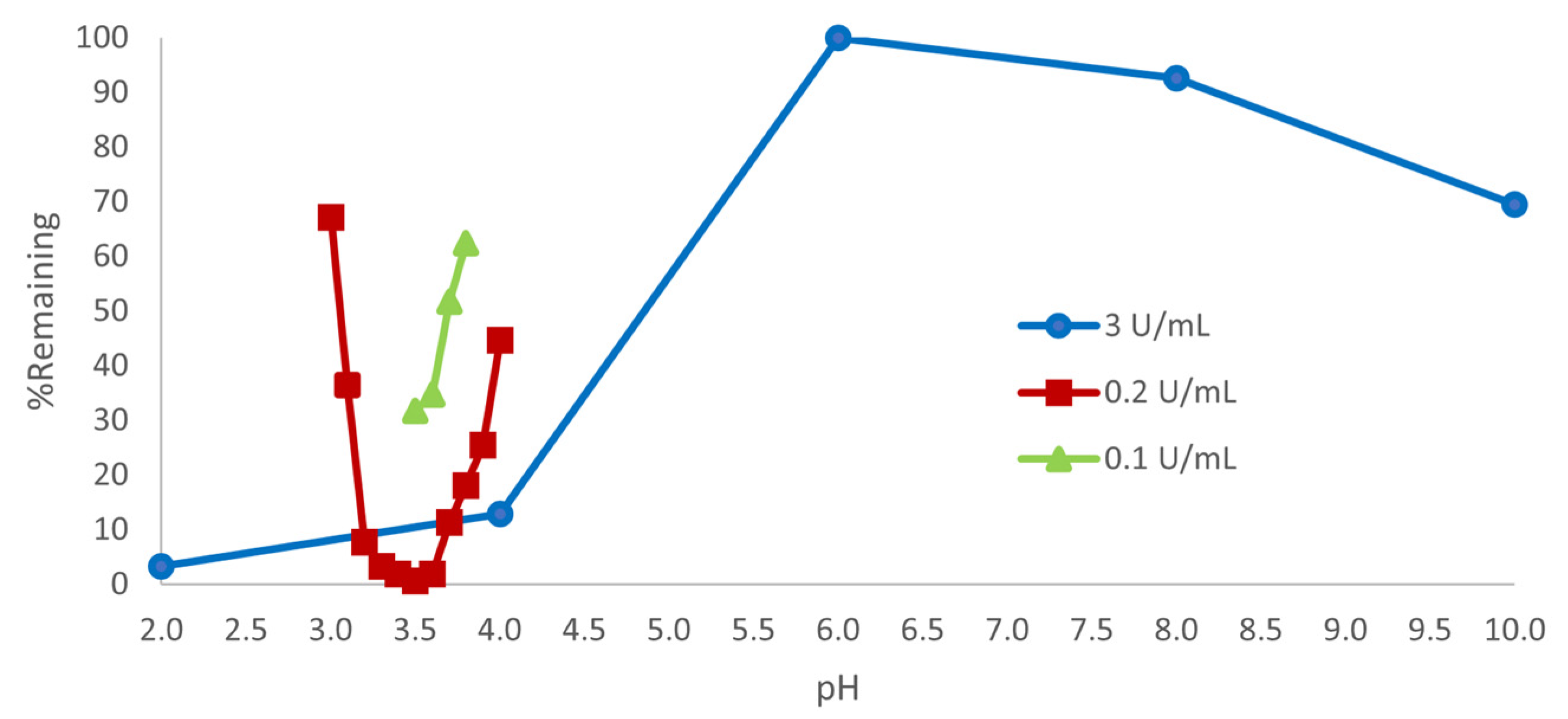
Reactive Black 5. Initial range-finding for pH-sensitivity was conducted by UV-vis analysis from pH 2 – 10, Figure 2, ● symbol, at a high enzyme activity, which can be seen to be excessive. Over a narrower pH range with HPLC analysis, even 15-fold lower SBP activity is seen to be excessive, but the outline of the classical bell-shaped pH-dependence curve is seen, Figure 2, ■ symbol. Finally, at a stringent enzyme activity, Figure 2, ▲ symbol, the pH optimum may be discerned as 3.5.
The pH optimum determined here agrees with previous reports that optimal pH for most azo dyes falls within the acidic region. For example, Baumer [29] in the enzymatic removal of 50 mg/L of RB5 using HRP showed the optimum pH as pH 4, whereas Yousefi [30] found an optimum at pH of 9 with Coprinus cinereus peroxidase.
The sharp decline in the removal efficiency above pH 4.0 was due to the change in ionization of RB5 at the respective pH values due to its pKa values of 3.8 and 6.9 for protonated -NH2 and -OH groups, respectively [31,32]. The high removal in the pH 2 – 4 range indicates that the acidic form of the dye group with a pKa value of 3.8 is dominant. This form has the phenolic group in the -OH form and the amino group in the protonated -NH3+ form, from which it would be inferred that the functional group active in the enzymatic reaction would be the hydroxyl group. The lowest apparent removal efficiency occurred at pH 6, after which the removal efficiency increased due to conversion to the basic form of the compound with a pKa of 6.9. This basic form has the phenolic group in the -OH form and the amino group in the free-base (-NH2) form from which it would be inferred that either functional group could be active in the enzymatic reaction. That the reaction is not efficient in this pH range suggests that it is an ionization on the enzyme which influenced the pH behaviour of the dye reaction. Hsueh et al. [33] studied the plausible reason for the reaction selectivity of azo dye decolorization using Pseudomonas luteola. They suggested that a sulfo-group produced the strongest electron-withdrawing effect, resulting in the fastest rate of decolourization compared to other groups such as carboxyl and hydroxyl groups. Also, the position of the sulfo group relative to the azo bond influenced the decolourization rate as a para-substituent has faster decolourization than an ortho-substituent, likely due to steric hindrance near the azo linkage.
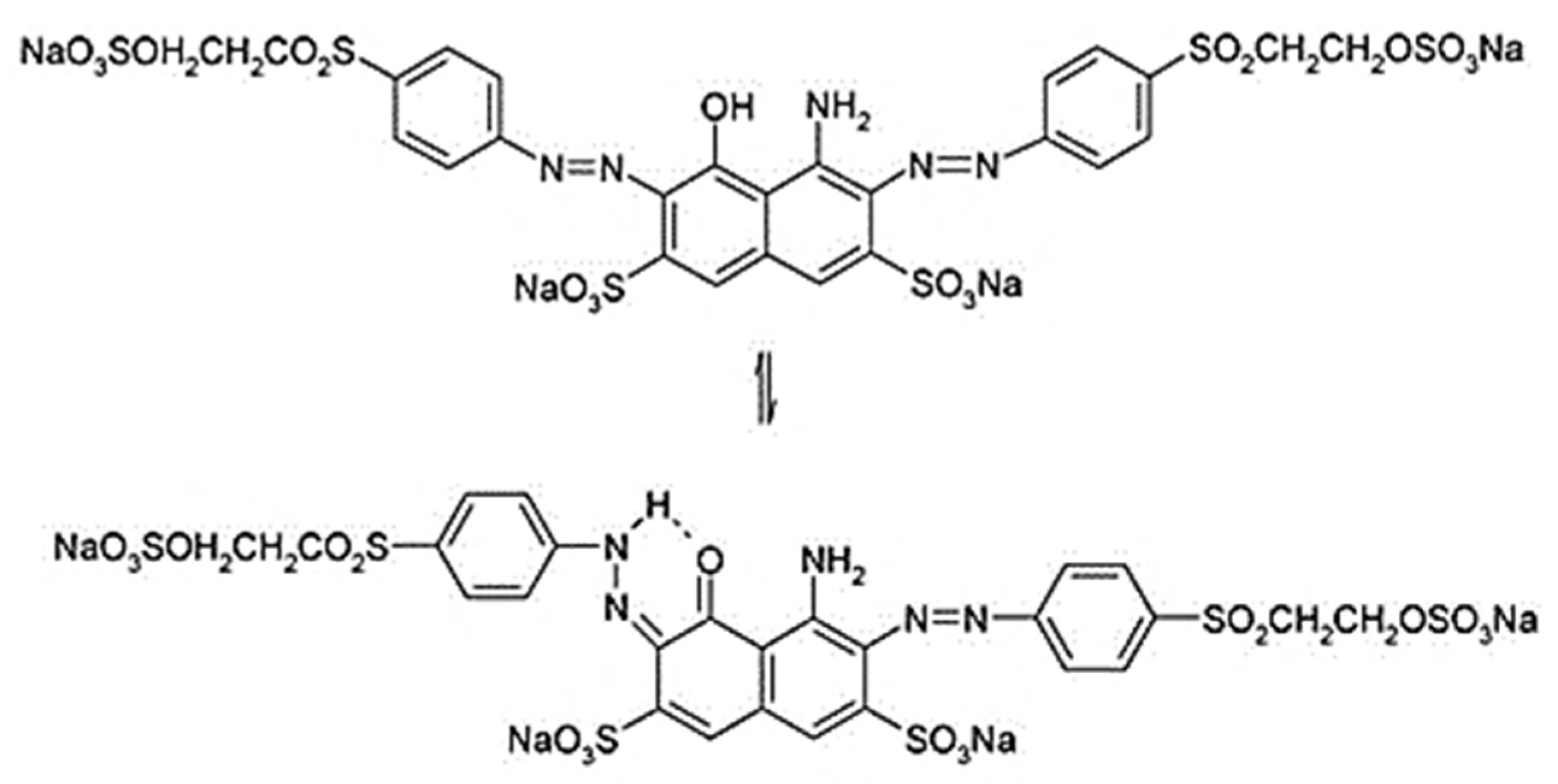
Zimmermann et al. [34] pointed out that the hydroxyl group ortho to the azo bond has a great influence on dye decolourization due to azo-hydrazone tautomerism (–N=N– ⇆ =N–NH-), which turns the aryl hydroxyl group, an electron-releasing group, into a carbonyl group (an electron-withdrawing group) as shown in Figure 3 for RB5. Analogous tautomerization could occur with AO7.
Although the sulfo-group (SO3Na) ortho to an azo group introduces steric hindrance to reductive biodegradation of RB5, it had minimal effect on the biocatalytic conversion by their azoreductase [34]. This is because the high electronegativity of the sulfo-group allowed the withdrawal of electrons via inductive and resonance effects. The higher the positive redox potential of the azo dye, the faster the reduction. However, the two vinyl sulfone-derived (–SO2(CH2)2SO3Na) para to an azo group do not impart steric hindrance to the naphthyl hydroxyl or amino groups. This led to an increase in reduction and greater decolourization efficiency. Also, both groups are high electronegativity groups; thus, electron withdrawal via resonance made the azo bond more electrophilic and subject to reduction, hence facilitating azoreductase-catalyzed decolourization. Thus, substituent(s) with high electronegativity near the azo bond could stabilize the negative charge formed at the reduced azo dye, considerably escalating the decolorization rate of azo dye.
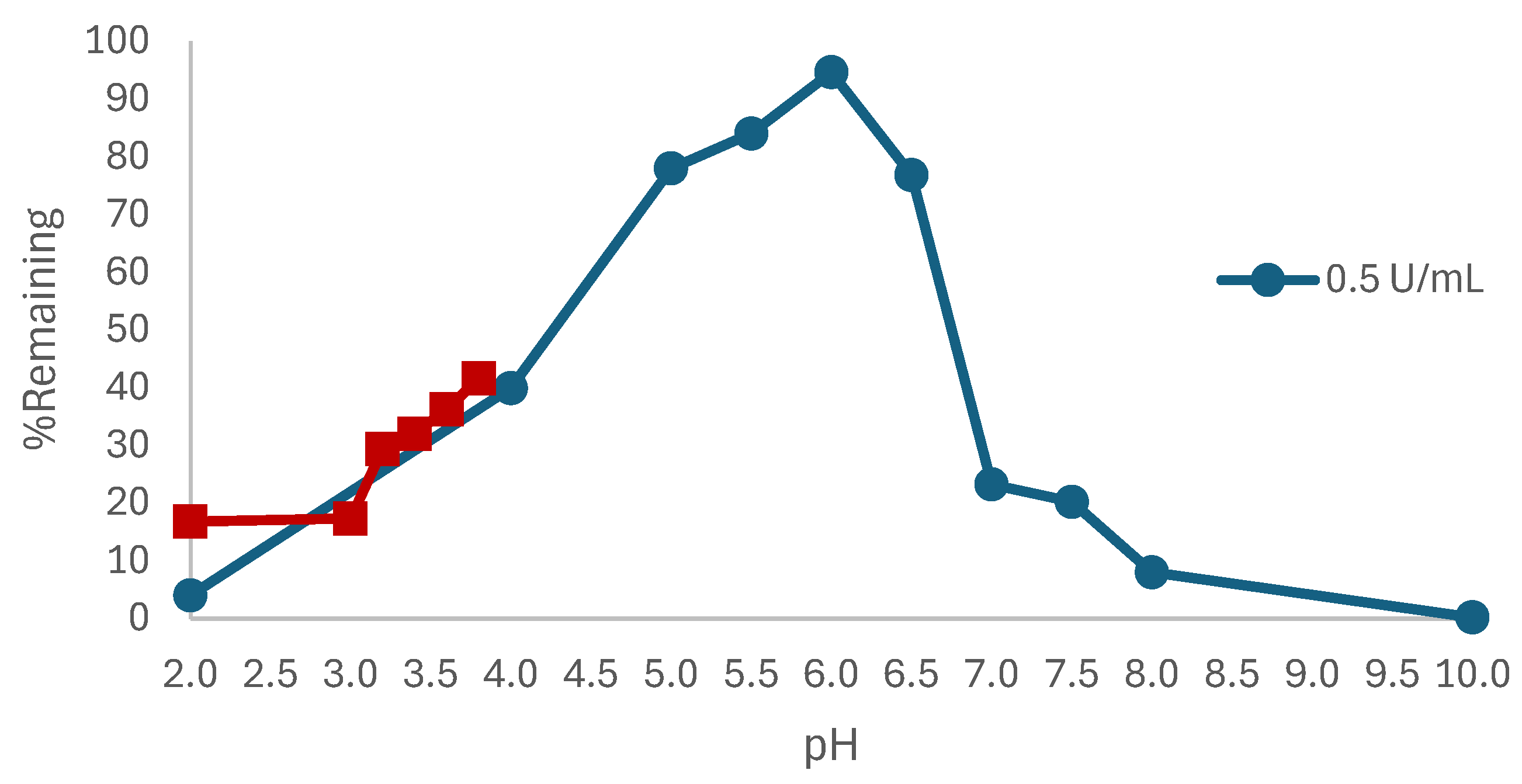
Acid Orange 7. Analogous approach to pH optimization for AO7 using HPLC analysis gave the results shown in Figure 4. The % remaining at pH 2.0 was only slightly less than at pH 3.0. However, to avoid the extreme acidity of pH 2.0, pH 3.0 was chosen as the optimum pH for further study. Furthermore, this pH was chosen to be consistent with the optima found for RB5, above, and AO20, below, to cover the likelihood that they would co-occur in real wastewater. Literature reports gave optima for AO7 with HRP at pH 7 [35] or pH 9 [36,37,38] and for C. Cinereus peroxidase [30]. In contrast, optima for manganese peroxidases were reported at pH 4.5 [39] and pH 2.9 [40] and for a lignin peroxidase at pH 3.1 [40].
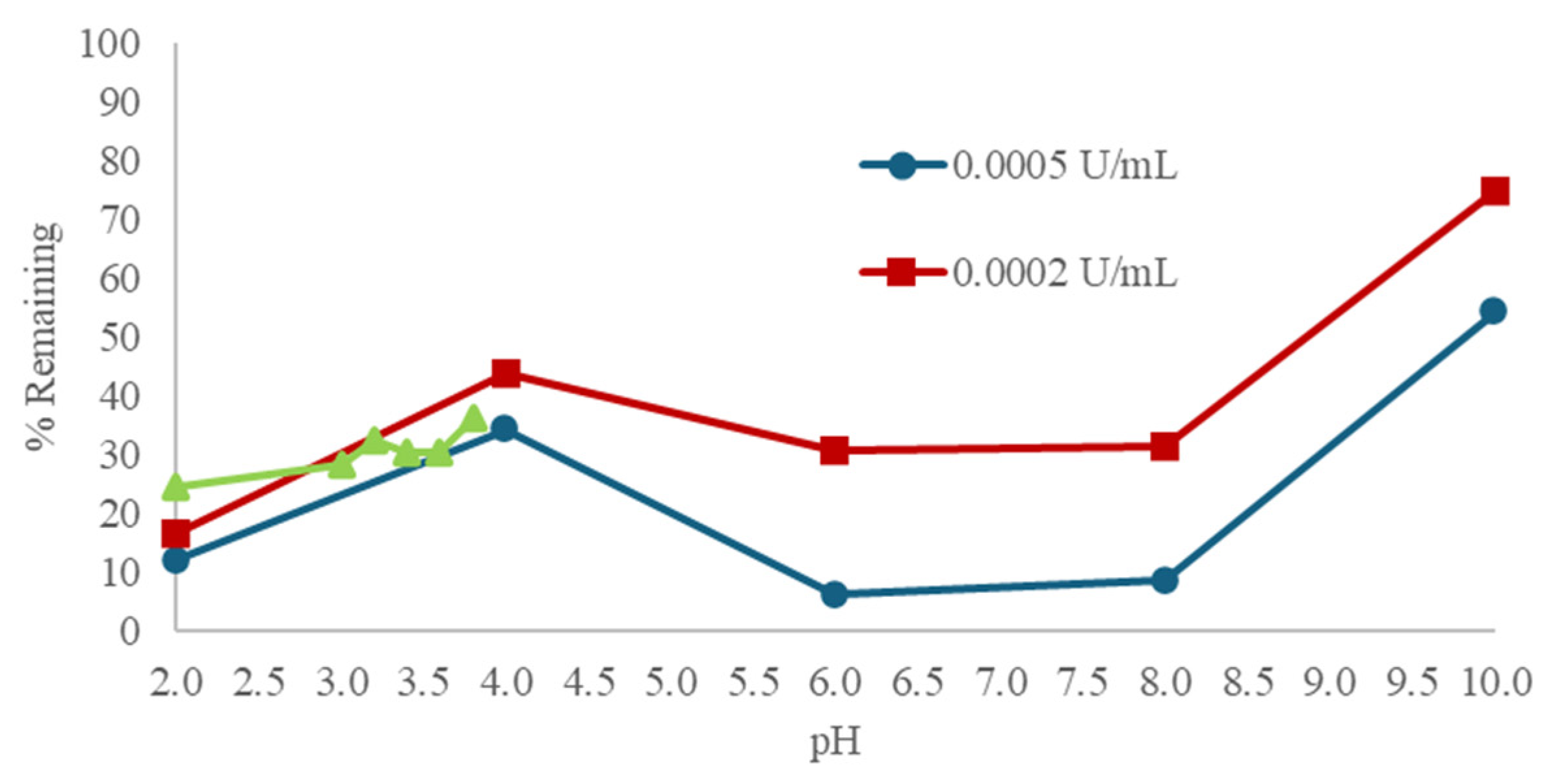
Acid Orange 20. Analogous approach to pH optimization for AO20 using HPLC gave the results shown in Figure 5, which revealed the lowest percentage remaining under stringent conditions at pH 2. However, as shown in the pH optimization of RB5 and AO7, this pH is too acidic for industrial effluents. Therefore, pH 3 is adopted as the optimum pH for further study of the enzymatic removal of AO20. As noted above, this choice is consistent with those chosen for the other two dyes, allowing for their mixture to be treated. With HRP, an optimum at pH 7 was reported [41].

3.2. Effect of SBP and H2O2

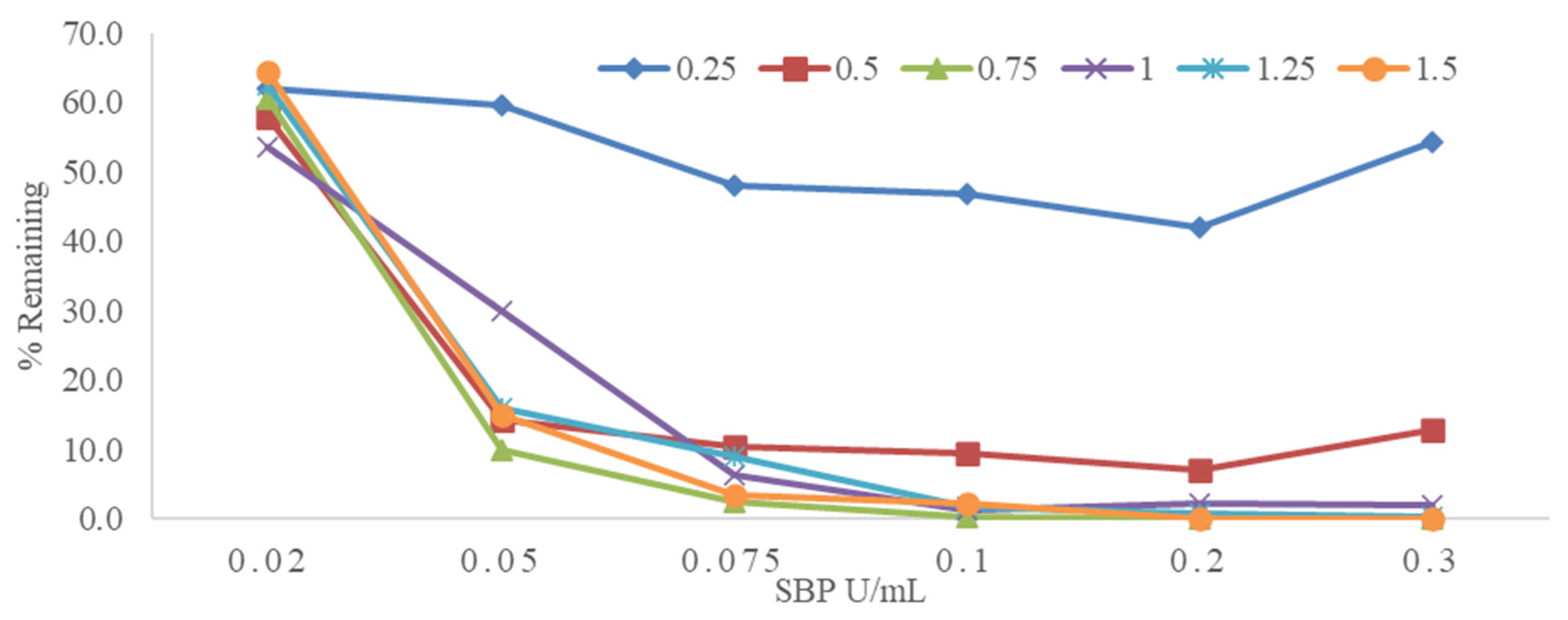
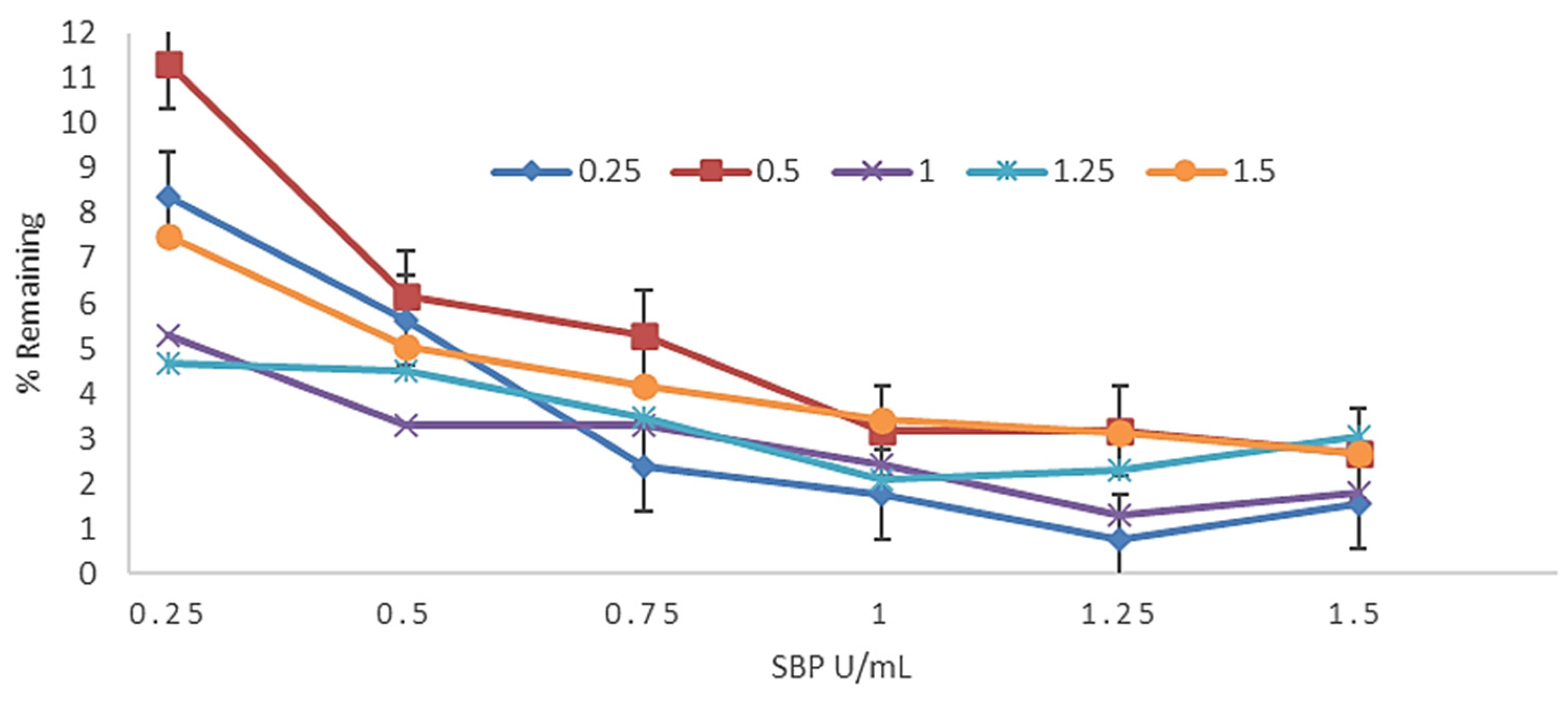
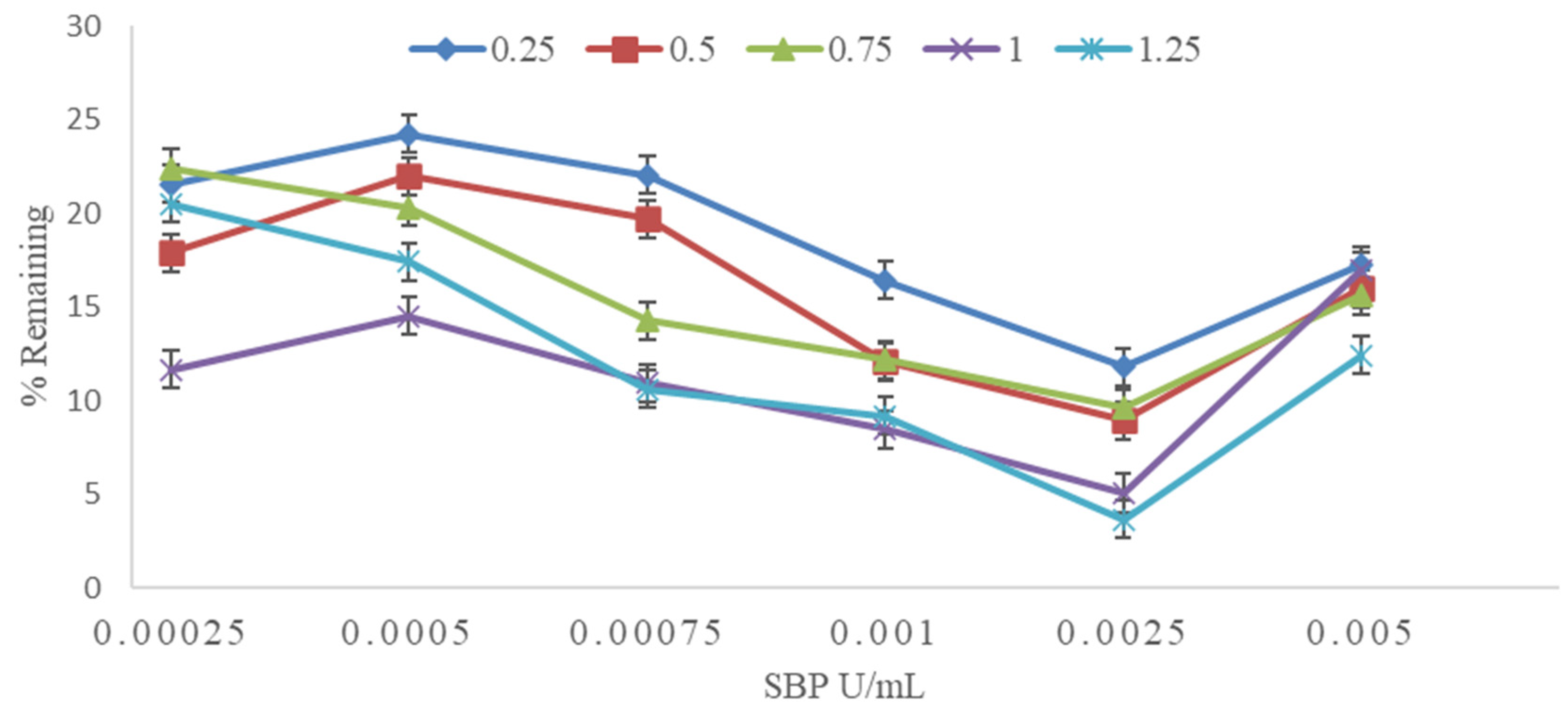
Cost effectiveness and economic feasibility are criteria for successful enzymatic treatment. Hence, the minimum effective concentration of SBP required is seriously considered to estimate the cost of enzymatic treatment. For these experiments, the minimum activity of SBP to achieve a 95 % removal was arbitrarily chosen as the most effective. (For any given application, a different target removal might be specified, in which case re-optimization of the SBP requirement would be needed; 95% was chosen in this work to allow comparison with previous work in the lab on other substrates.) The experiments were conducted at the pH optima established above. Hydrogen peroxide, which acts as a co-substrate for SBP, initiates the peroxidase reaction. An excess of H2O2 leads to enzyme inactivation, whereas a low concentration leads to insufficient conversion of the substrate. The effect of the initial enzyme activity on the dye conversion was investigated in the range from 0.02 to 0.3 U/mL for RB5, 0.25 to 1.5 U/mL for AO7 and 0.00025 to 0.005 U/mL for AO20 and the results are presented in Figure 6, Figure 7 and Figure 8. Concurrently, the influence of H2O2 was examined by varying the molar ratios of H2O2:dye between from 0.25 to 1.5.
Reactive Black 5. Figure 6 shows that the H2O2:dye molar ratio of 0.75 and SBP of 0.075 U/mL reached the ≥95 % removal criterion. With HRP and 50 μ M RB5, Baumer et al. [29] reported a peroxide:dye molar ratio of 6 was optimal for colour removal (78 %), assuming the peroxide concentration used was 3 x 10⁻⁴ M, not 3 x 10⁻⁴ mM as reported. The efficiencies of SBP and HRP cannot be quantitatively compared because of the different activity tests used: Baumer et al. [29] used 40 U/mL, activity test based on 2,2'-azino-bis (3-ethylbenzthiazoline-6-sulfonic acid)), but it is safe to say qualitatively that substantially less SBP activity is required for treatment of this dye.
M dye, 40 mM citrate buffer pH 3.5, varying concentration of peroxide for 3 h. Numbers in the legend are molar ratios, [peroxide]/[dye]. Results presented as mean± SD of triplicate determinations, error bars not visible because they are smaller than the symbols.
Acid Orange 7. Figure 7 shows that an H2O2:dye molar ratio of 1.25 with 0.25 U/mL of SBP achieved a removal of 95 % and a highest removal of 99 % at 1.25 U/mL, 5-fold more enzyme. With HRP, Gholami et al. [35] reported optimal color removal of 89 % for 32 uM dye and 1 U/mL of enzyme (same unit definition and activity test as the current work) at an H2O2:dye molar ratio of 25.
Acid Orange 20. Figure 8 shows that an H2O2:dye molar ratio of both 1.0 and 1.25, with 0.0025U/mL of SBP achieved a removal of 95 %. The 100-fold lower SBP requirement for AO20 compared to that for AO7 could be a feature of the structural differences of the two isomers: in AO20 the reactive phenolic group is in the para-position, in contrast to AO7 where it is in the sterically hindered ortho-position. Zhu et al. [2] found the peak dye (0.143 mM) removal for AO20 using 3 U/mL (guaiacol activity test) of HRP occurred at an H2O2:dye ratio of 1.4. As with RB5, the efficiencies of SBP and HRP cannot be quantitatively compared because of the different activity tests used, but it is safe to say qualitatively that substantially less SBP activity is required for the treatment of this dye.

3.3. SBP Efficiency in Dye Removal

Table 2 summarizes the optimum conditions identified for the enzymatic treatment of the dyes. The normalized efficiencies may be compared with those tabulated by Haghighatnama et al. [42], Supplementary information Table S1: AO20 ranks among the best (normalized SBP <0.1 U/mL/mM) with enzyme ‘turnovers’ of nearly 600,000 substrate molecules per enzyme molecule, whereas RB5 and AO7 rank amongst the least efficient (normalized SBP >1 U/mL/mM) with enzyme ‘turnovers’ of about 20,000 and 3,000, respectively. Substantially lower efficiencies for RB5 and AO7 are consistent with their being involved in the unfavorable azo-hydrazone tautomerism shown in Figure 3; even the relative efficiencies of these two dyes are consistent with RB5 being a bis-azo dye and, therefore, having an anilino group available for enzymatic reaction while the phenolic group is tied up in the azo-hydrazone tautomer.

3.4. Kinetic Measurements

Over the course of 3 hours, the colour of the RB5 underwent significant changes from the original dark blue colour to purple. The colour change could be due to oligomerization and precipitation of the dyes and/or the rupture of the azo bonds (N=N).
The initial rate of removal of the dyes follows pseudo-first-order kinetics, with the assumption that the enzyme and peroxide concentrations are constant for the analytical period [43]. Time courses of percentage dye remaining were monitored by HPLC using batch reactors operating under optimal conditions of pH, hydrogen peroxide concentration and enzyme activity. For a complete time-course over 3 hours, the enzyme activity and peroxide concentration also decrease with time as reactive radicals and then oligomers are formed; hence, leading to possible inactivation of the enzyme, as discussed in the Introduction and the loss of first-order dependence.
However, under the optimal conditions, the reactions were essentially complete in 30 s (the first data point)—showing 98.6, 99.5, and 97.4 % conversion by HPLC for RB5, AO7, and AO20, respectively. Thus, rather than first-order decay fits, these 30-s points were used to estimate lower limits for the rate constants and thence upper limits for the half-lives as shown in Table 3. The Table also shows the values normalized for the respective enzyme activities used [42].
The rate constants and half-lives of substrates determined from time-course experiments are shown in Table 3. The normalized initial kinetic efficiencies may be compared with those tabulated by Haghighatnama et al. [42], Supplementary information Table S2: the normalized half-life of AO20, ≤0.00024 min, is markedly shorter in SBP-catalyzed reactions than all the listed compounds, whereas RB5 and AO7 are amongst the shortest listed. The 135-fold shorter normalized half-life of AO20 than that of its isomer, AO7, parallels their relative treatment efficiencies (Table 2), consistent with the lack of steric hindrance of the enzyme’s access to AO20’s phenolic hydroxyl group, as well as the involvement of RB5 and AO7 azo-hydrazone tautomerism as noted above.

3.5. Products

The reaction products are expected to be oligomers through oxidative coupling of the dye aryl hydroxyl and/or amino groups, as has been confirmed by mass spec analysis for simple single-ring compounds [17,22,44,45,46] and for dyes [42,47]. The latter dye reactions were accompanied by some azo cleavage, the anilino products of which were oligomerized in the peroxidase reaction [42].

4. Conclusion

The three dyes were best treated in the pH range 3.0 – 3.5. The dyes compared favourably with
approximately 25 other substrates for the same SBP preparation, tabulated previously: AO20 had amongst the highest normalized treatment efficiencies (200-fold less SBP required than for AO7) and fastest normalized initial kinetic efficiency of all; RB5 and AO7 had amongst the poorest treatment efficiencies, but amongst the fastest kinetic efficiencies of the tabulated compounds. Differences between the isomeric AO20 and AO7 with respect to both these criteria are consistent with the lack of steric hindrance of the enzyme to the phenolic hydroxyl group of AO20, as well as the absence of the azo-hydrazone tautomer. The results further substantiate soybean peroxidase as an eco-friendly enzyme with a broad substrate range for cost-effective application in environmental remediation.

Supplementary Materials

The following supporting information can be downloaded at the website of this paper posted on Preprints.org.

Author Contributions

Temidayo Oyelere, Samira Narimannejad, Keith Taylor and Nihar Biswas contributed to the study conception, design and analysis. Material preparation and data collection were performed by Temidayo Oyelere and Samira Narimannejad. The first draft of the manuscript was written by Temidayo Oyelere. Temidayo Oyelere, Samira Narimannejad, Keith Taylor and Nihar Biswas commented on and contributed to subsequent versions of the manuscript. Temidayo Oyelere, Samira Narimannejad, Keith Taylor and Nihar Biswas read and approved the final manuscript.

Funding

This work was supported by NSERC Discovery Grant RGPIN-2019-04426 to Nihar Biswas from the Natural Science and Engineering Research Council of Canada. The University of Windsor provided graduate assistantships to Temidayo Oyelere and Samira Narimannejad.

Acknowledgments

N/A.

Compliance With Ethical Standards

N/A.

Conflicts of Interest

The authors declare no relevant financial or non-financial competing interests.

References

  1. Allen, N., Colour Chemistry, by H. Zollinger, Weinheim: VCH Verlagsgesellschaft, 1987, 367 pp. J. Photochem. Photobiol. A: Chem., 1987, vol. 41, no. 1, p. 145.2.
  2. Lewis, D.M., Developments in the chemistry of reactive dyes and their application processes, Color. Technol., 2014, vol. 130, no. 6, pp. 382–412.
  3. Saleem, M.A., Pei, L., Saleem, M.F., Shahid, S., and Wang, J., Sustainable dyeing of nylon fabric with acid dyes in decamethylcyclopentasiloxane (D5) solvent for improving dye uptake and reducing raw material consumption, J. Clean. Prod., 2021, vol. 279, p. 123480.
  4. Singh, S.N., Microbial Degradation of Xenobiotics (Springer, Berlin–Heidelberg, 2012).
  5. Ghaly, A., Ananthashankar, R., Alhattab, M., and Ramakrishnan, V.V., Production, characterization and treatment of textile effluents: a critical review, J. Chem. Eng. Process Technol., 2014, vol. 5, no. 1, pp. 1–19.
  6. Piaskowski, K., Świderska-Dąbrowska, R., and Zarzycki, P.K., Dye removal from water and wastewater using various physical, chemical, and biological processes, J. AOAC Int., 2018, vol. 101, no. 5, pp. 1371–1384.
  7. Katheresan, V., Kansedo, J., and Lau, S.Y., Efficiency of various recent wastewater dye removal methods: A review, J. Environ. Chem. Eng., 2018, vol. 6, no. 4, pp. 4676–4697.
  8. Slama, H.B., Chenari Bouket, A., Pourhassan, Z., Alenezi, F.N., Silini, A., Cherif-Silini, H., et al., Diversity of synthetic dyes from textile industries, discharge impacts and treatment methods, Appl. Sci., 2021, vol. 11, no. 14, 6255.
  9. Das, S. and Mahalingam, H., Multiphase reactors in photocatalytic treatment of dye wastewaters: design and scale-up considerations, in Advanced Oxidation Processes in Dye-Containing Wastewater, Sharma, Y.C. and Sanghi, R., Eds., Singapore: Springer, 2022, vol. 1, pp. 219–250.
  10. Salehi, S., Abdollahi, K., Panahi, R., Rahmanian, N., Shakeri, M., Mokhtarani, B. Applications of biocatalysts for sustainable oxidation of phenolic pollutants: A review. Sustainability, 2021, 13, 8620.
  11. Jun, L.Y., Yon, L.S., Mubarak, N., Bing, C.H., Pan, S., Danquah, M.K., et al., An overview of immobilized enzyme technologies for dye and phenolic removal from wastewater, J. Environ. Chem. Eng., 2019, vol. 7, no. 2, 102961.
  12. Šekuljica, N.Ž., Prlainović, N.Ž., Stefanović, A.B., Žuža, M.G., Čičkarić, D.Z., Mijin, D.Ž., et al., Decolorization of anthraquinonic dyes from textile effluent using horseradish peroxidase: optimization and kinetic study, Sci. World J., 2015, vol. 2015, no. 1, pp. 371625.
  13. Barreiro, D.S., Oliveira, R.N., and Pauleta, S.R., Bacterial peroxidases–Multivalent enzymes that enable the use of hydrogen peroxide for microaerobic and anaerobic proliferation, Coord. Chem. Rev., 2023, vol. 485, 215114.
  14. Freitas, C.D., Costa, J.H., Germano, T.A., Rocha, R.d.O., Ramos, M.V., and Bezerra, L.P., Class III plant peroxidases: From classification to physiological functions, Int. J. Biol. Macromol., 2024, vol. 263, 130306.
  15. ur Rahman, M., Ullah, M. W., Shah, J. A., Sethupathy, S., Bilal, H., Abdikakharovich, S. A., Khan, A. U., Khan, K. A., Elboughdiri, N., Zhu, D. Harnessing the power of bacterial laccases for xenobiotic degradation in water: A 10-year overview. Sci. Tot. Environ., 2024, 918, 170498.
  16. Sellami, K., Couvert, A., Nasrallah, N.,Maachi, R., Abouseoud, M.,Amrane, A. Peroxidase enzymes as green catalysts for bioremediation and biotechnological applications: A review. Sci, Tot. Environ., 2022, 806, 150500.
  17. Pishyar, S., Narimannejad, S., Taylor, K.E., and Biswas, N., Enzymatic removal of diclofenac and aceclofenac from water by soybean peroxidase, Molecules, 2025, vol. 30, no. 8, pp. 1817.
  18. Kamal, J.A. and Behere, D.V., Kinetic stabilities of soybean and horseradish peroxidases, Biochem. Eng. J., 2008, vol. 38, no. 1, pp. 110–114.
  19. Gogliettino, M., Cocca, E., Apone, F., Del Prete, S., Balestrieri, M., Mirino, S., et al., A new versatile peroxidase with extremophilic traits over-produced in MicroTom cell cultures, Sci. Rep., 2023, vol. 13, no. 1, p. 15338.
  20. Chen, Z., Wu, J., Huang, W., Li, Y., Mao, Y., Han, J., et al., Preparation and catalytic degradation of phenol achieved by utilizing pH and upper critical solution temperature dual responsive intelligent enzyme catalysts, J. Clean. Prod., 2023, vol. 423, 138579.
  21. Dunford, H.B., Heme Peroxidase Kinetics, in Heme Peroxidases, Dunford, H.B. and Raven, E.,, Ed., Cambridge: Cambridge University Press, 2015, pp. 99–112.
  22. Uyama, H., Synthesis of poly(aromatics). I: Oxidoreductase as catalyst, in Enzymatic Polymerization Towards Green Polymer Chemistry, 2019, pp. 267–305.
  23. Urlacher, V., Peroxidases and Catalases: Biochemistry, Biophysics, Biotechnology and Physiology, Dunford, H.B., Ed., Wiley, Hoboken,2010.
  24. Wright, H., Nicell, J. A. Characterization of soybean peroxidase for the treatment of aqueous phenols. Bioresour. Technol., 1999, 70, 69-79.
  25. Ortiz de Montellano, P.R., Hydrocarbon hydroxylation by cytochrome P450 enzymes, Chem. Rev., 2010, vol. 110, no. 2, pp. 932–948.
  26. Feng, W., Taylor, K., Biswas, N., and Bewtra, J.K., Phenolic precipitates from soybean peroxidase–catalyzed wastewater treatment: concentrated waste serves to concentrate its progenitor, J. Hazard. Toxic Radioact. Waste, 2016, vol. 20, no. 2, p. 04015023.
  27. Arnao, M., Acosta, M., del Río, J., Varón, R., and García-Cánovas, F., A kinetic study on the suicide inactivation of peroxidase by hydrogen peroxide, Biochim. Biophys. Acta, Protein Struct. Mol. Enzymol., 1990, vol. 1041, no. 1, pp. 43–47.
  28. Gomori, G., Preparation of buffers for use in enzyme studies, in Methods in Enzymology, Colowick, S.P. and Kaplan, N.O., Eds., New York: Academic Press, 1955, vol. 1, part C, pp. 138–146.
  29. Baumer, J., Valério, A., Souza, S., Guelli, S., Erzinger, G., and Furigo, A., Jr., Remazol black dye (reactive black 5) decolorization by horseradish peroxidase enzyme, J. Textile Eng. Fashion Technol., 2018, vol. 4, no. 2, pp. 147–149.
  30. Yousefi, V. and Kariminia, H.-R., Statistical analysis for enzymatic decolorization of acid orange 7 by Coprinus cinereus peroxidase, Int. Biodeterior. Biodegrad., 2010, vol. 64, no. 3, pp. 245–252.
  31. Saroyan, H., Ntagiou, D., Rekos, K., and Deliyanni, E., Reactive black 5 degradation on manganese oxides supported on sodium hydroxide modified graphene oxide, Appl. Sci., 2019, vol. 9, no. 10, 2167.
  32. Murugesan, S., Sasibabu, V., Jegadeesan, G.B., and Venkatachalam, P., Photocatalytic degradation of Reactive Black dye using ZnO–CeO2 nanocomposites, Environ. Sci. Pollut. Res., 2023, vol. 30, no. 15, pp. 42713–42727.
  33. Hsueh, C.-C., Chen, B.-Y., and Yen, C.-Y., Understanding effects of chemical structure on azo dye decolorization characteristics by Aeromonas hydrophila, J. Hazard. Mater., 2009, vol. 167, nos. 1–3, pp. 995–1001.
  34. Zimmermann, T., Kulla, H.G., and Leisinger, T., Properties of purified Orange II azoreductase, the enzyme initiating azo dye degradation by Pseudomonas KF46, Eur. J. Biochem., 1982, vol. 129, no. 1, pp. 197–203.
  35. Gholami-Borujeni, F., Mahvi, A.H., Nasseri, S., Faramarzi, M.A., Nabizadeh, R., and Alimohammadi, M., Enzymatic treatment and detoxification of acid orange 7 from textile wastewater, Appl. Biochem. Biotechnol., 2011, vol. 165, no. 5, pp. 1274–1284.
  36. Zhang, A., Fang, L., Wang, J., and Liu, W., Enzymatic decolorization of Orange II: optimization by response surface methodology and pathway, Environ. Prog. Sustain. Energy, 2013, vol. 32, no. 2, pp. 294–301.
  37. Morales Urrea, D.A., Haure, P.M., García Einschlag, F.S., and Contreras, E.M., Horseradish peroxidase-mediated decolourization of Orange II: modelling hydrogen peroxide utilization efficiency at different pH values, Environ. Sci. Pollut. Res., 2018, vol. 25, no. 20, pp. 19989–20002.
  38. Morales Urrea, D.A., Haure, P.M., and Contreras, E.M., Orange II removal by a horseradish peroxidase immobilized onto chemically modified diatomites is a combination of adsorption and oxidation processes, J. Appl. Res. Technol., 2022, vol. 20, no. 2, pp. 203–220.
  39. López, C., Valade, A.-G., Combourieu, B., Mielgo, I., Bouchon, B., and Lema, J.M., Mechanism of enzymatic degradation of the azo dye Orange II determined by ex situ ¹H nuclear magnetic resonance and electrospray ionization-ion trap mass spectrometry, Anal. Biochem., 2004, vol. 335, no. 1, pp. 135–149.
  40. Asgher, M., Kausar, S., Bhatti, H.N., Shah, S.A.H., and Ali, M., Optimization of medium for decolorization of Solar golden yellow R direct textile dye by Schizophyllum commune IBL-06, Int. Biodeterior. Biodegrad., 2008, vol. 61, no. 2, pp. 189–193.
  41. Zhu, Y., Liu, Y., Guo, X., Wu, Q., and Xu, X. Decolorization of Color Index Acid Orange 20 buffer solution using horseradish peroxidase immobilized on modified PAN-beads, RSC Adv., 2017, vol. 7, no. 31, pp. 18976–18986.
  42. Haghighatnama, M., Narimannejad, S., Biswas, N., and Taylor, K.E. Biocatalytic treatment of cresols in aqueous solution with soybean peroxidase, RSC Adv., 2026, 16, pp. 5079–5087.
  43. Altahir, B.M., Feng, W., Jasim, H.H., Taylor, K.E., Biswas, N., Bewtra, J.K., et al., Soybean peroxidase-catalysed removal of benzidines from water, J. Environ. Eng. Sci., 2016, vol. 10, no. 4, pp. 73–80.
  44. Mukherjee, D., Bhattacharya, S., Taylor, K.E., and Biswas, N., Enzymatic treatment for removal of hazardous aqueous arylamines, 4,4′-methylenedianiline and 4,4′-thiodianiline, Chemosphere, 2019, vol. 235, pp. 365–372.
  45. Sharifzadeh, M., Narimannejad, S., Taylor, K.E., and Biswas, N., Enzymatic removal of the sulfa drugs sulfamethoxazole and sulfamerazine from synthetic wastewater by soybean peroxidase, Environ. Sci. Pollut. Res., 2024, vol. 31, no. 56, pp. 64760–64771.
  46. Yarkwan, B., Soybean peroxidase catalyzed oligomerization of acetaminophen and selected parabens for wastewater treatment. Ph. D. Thesis, Windsor: University of Windsor, 2021.
  47. Cordova Villegas, L.G., Mazloum, S., Taylor, K.E., and Biswas, N., Soybean peroxidase-catalyzed treatment of azo dyes with or without FeO pretreatment, Water Environ. Res., 2018, vol. 90, no. 8, pp. 675–684.
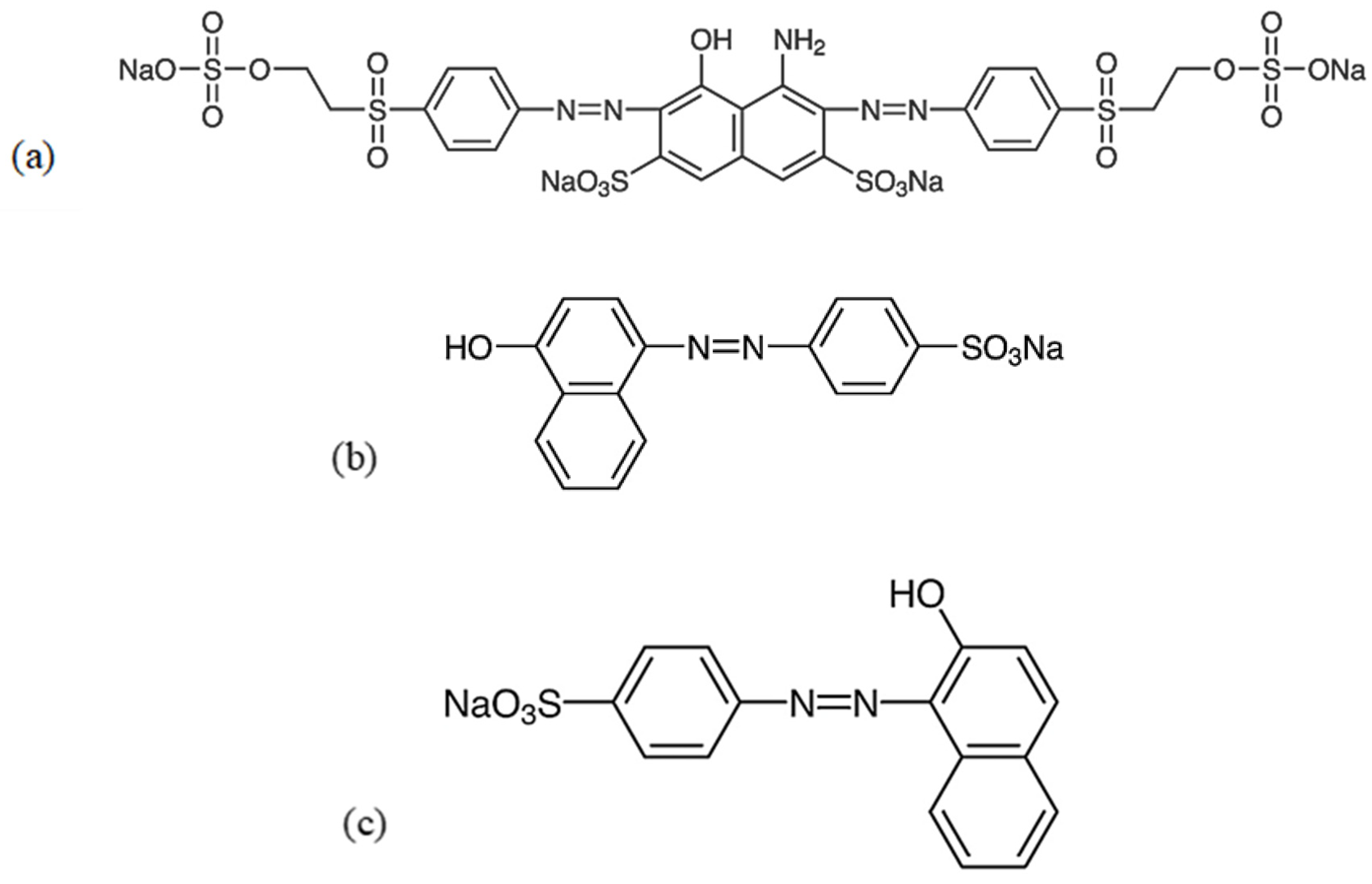
Figure 1. (a) Reactive Black 5, (b) Acid Orange 20 (Orange I), (c) Acid Orange 7 (Orange II).
Preprints 197231 g001
Figure 2. pH optimization of RB5 – Reaction conditions: 50 μM dye, 1.5 mM H2O2, 40 mM buffers for 3 h. Analysis by UV-Vis (596 nm) for wide pH range, and by HPLC for narrow ranges. Results presented as mean±SD where error bars represent the SD of triplicate determinations, not visible here because they are smaller than the symbols.
Preprints 197231 g002
Figure 3. Azo-hydrazone tautomerism of RB5.
Preprints 197231 g003
Figure 4. pH optimization of AO7 – Reaction conditions: 50 μM dye, 1.5 mM H2O2, 40 mM buffers for 3 h. Analysis by HPLC. Results presented as mean±SD of triplicate determinations, error bars not visible because they are smaller than the symbols.
Preprints 197231 g004
Figure 5. pH optimization of AO20 – Reaction conditions: 50 μM dye, 1.5 mM H2O2, 40 mM buffers for 3 h. Analysis by HPLC. Results presented as mean±SD of triplicate determinations, error bars not visible because they are smaller than the symbols.
Preprints 197231 g005
Figure 6. SBP optimization for RB5 by HPLC analysis. Reaction conditions: 50 μ
Preprints 197231 g006
Figure 7. SBP optimization for AO7. Reaction conditions: 50 μ M dye, 40 mM citrate buffer pH 3.5, varying amount of H2O2 for 3 h. Numbers in the legend are molar ratios, [peroxide]/[dye]. Triplicate results presented as mean±SD where error bars represent the SD.
Preprints 197231 g007
Figure 8. SBP optimization for AO20 by HPLC analysis. Reaction conditions: 50 μ M dye, 40 mM citrate buffer pH 3.5, varying concentration of H2O2 for 3 h. Numbers in the legend are molar ratios, [peroxide]/[dye]. Triplicate results presented as mean±SD where error bars represent the SD.
Preprints 197231 g008
Table 1. HPLC analytical conditions for the analysis of azo dyes (flowrate = 1.0 mL/min).
Dye
Aqueous Phase
A
Organic Phase
B
Mobile Phase composition (%) Wavelength (λmax)
A B
RB5 Ammonium Formate
(5 mM)
Methanol 70 30 596 nm
AO7 Ammonium Formate
(5 mM)
Methanol 40 60 485 nm
AO20 Ammonium Formate
(5 mM)
Methanol 40 60 485 nm
Table 2. Optimum conditions for enzymatic treatment of dyes (50 µM).
Dye pH SBP Activity (U/mL) H₂O₂
(mM)
Normalized SBP*
(U/mL/mM)
Removal %
RB5 3.5 0.075 0.0375 1.5 98.6
AO7 3.0 0.5 0.0375 10 99.5
AO20 3.0 0.0025 0.0625 0.05 97.4
*SBP activity divided by dye concentration.
Table 3. Rate constants and half-lives of substrates determined from time-course experiments.
Substrate Rate constant
(min-1)
Half-life
(min)
Normalized rate
constant*
(min-1)
Normalized
half-life
(min)
RB5 ≥8.5 ≤0.081 ≥0.64 ≤0.0061
AO7 ≥10.7 ≤0.065 ≥5.3 ≤0.033
AO20 ≥7.3 ≤0.095 ≥0.018 ≤0.00024
* Rate constants were normalized by dividing them by the enzyme activity used (Table 2).
Disclaimer/Publisher’s Note: The statements, opinions and data contained in all publications are solely those of the individual author(s) and contributor(s) and not of MDPI and/or the editor(s). MDPI and/or the editor(s) disclaim responsibility for any injury to people or property resulting from any ideas, methods, instructions or products referred to in the content.
Copyright: This open access article is published under a Creative Commons CC BY 4.0 license, which permit the free download, distribution, and reuse, provided that the author and preprint are cited in any reuse.
Prerpints.org logo

Preprints.org is a free preprint server supported by MDPI in Basel, Switzerland.

Subscribe

Disclaimer

Terms of Use

Privacy Policy

Privacy Settings

© 2026 MDPI (Basel, Switzerland) unless otherwise stated