
Submitted:
02 February 2026
Posted:
04 February 2026
You are already at the latest version
Abstract
Western Ethiopia has been invaded by termites, and their activities have resulted in noticeable physicochemical changes. In order to assess the pH of termite mound soil (TMS) in Gidami district, western Ethiopia, the study was carried out on a one-hectare area of 100 m × 100 m in three replications that covered farm, pasture, and forest land uses. For soil sample, three live termite mounds were chosen at random from each land use group. Soil samples were collected from 20–60 cm depth at the center of each mound, while control soil samples were taken 8 m away from each mound in adjacent areas free of mound effects. From each mound and control site, 0.5 kg soil samples were collected, labeled, and taken to Oromia Research Institutions of Nekemte Soil Laboratory for pH analysis. Soil pH was measured in 1:2.5 soil-to-water suspensions using a digital pH meter. From 28 peasant associations (PAs) in the district, Alchea Jilo PA was purposely selected due to the presence of all three land use types and abundant termite mounds. To assess farmers’ perceptions and soil acidity management practices, 259 households were interviewed. Data were analyzed using SPSS, and paired sample t-tests determined differences between TMS and control soils. Results showed that TMS had higher pH than control soils across all land use types, indicating that termite activity reduces soil acidity. About 31% of farmers recognized soil acidity on their land, attributing it to high rainfall, leaching, fertilizer use, and continuous cultivation. With the exception of termites' detrimental effects on agricultural output, none of the farmers reported utilizing TMS as a soil amendment, despite the widespread use of liming, organic fertilizers, and crop rotation. Significantly, soil research highlights the potential application of termite mound soils as a natural means of enhancing soil fertility and pH levels; nevertheless, the TMS in agricultural production have to be investigated in the region.
Keywords:
termites
; mound soil
; control soils
; soil pH
; land use categories
1. Introduction
Termite activities cause pronounced physicochemical modifications in tropical and sub-tropical soil environments [1,2]. Termites construct mounds of different sizes and structural complexity that function as long-term soil engineering features [3] and are widely recognized as major biological drivers of soil physicochemical transformation [4]. Through bioturbation, organic matter turnover, and nutrient cycling, termites contribute directly to soil formation and ecosystem productivity [5]. These activities enhance the release of plant-available nutrients from organic and mineral sources. Recent studies have documented significantly higher concentrations of Ca, Mg, P, K, Na and organic carbon in termite mound soils than in surrounding soils [6,7].
Termite activity also alters soil chemical properties by increasing organic matter and carbon stocks within the soils they occupy. This enrichment results from the incorporation of clay particles, plant residues, and salivary secretions used during mound construction [2]. Consequently, mound materials exhibit distinct physicochemical characteristics compared with adjacent soils, including elevated nutrient concentrations and buffering capacity. In many African smallholder systems, farmers intentionally spread termite mound soil on their fields to improve soil structure and nutrient availability [8,9]. Termite mounds therefore serve as biological indicators of soil fertility and are increasingly used as affordable alternatives to mineral fertilizers where access to NPK inputs is limited [7,8,9,10].
Despite their ecological benefits, termites are also among the most destructive agricultural and structural pests worldwide [11,12]. Their feeding and tunneling activities damage crops, irrigation structures, houses, and earth dams. In tropical and subtropical Africa, termites significantly reduce crop yields and degrade rangelands and grazing areas, posing serious threats to food security and rural livelihoods [13,14]. Agricultural lands and pasture systems are particularly vulnerable to termite-related soil disturbance and plant damage.
In Ethiopia, termite populations are widely distributed, particularly in western and southern regions where warm and moist conditions favor their proliferation [15,16]. In Gidami district and surrounding areas of West Wallaga, termite infestation has become an increasing concern for both farmers and local administrations. Historical records indicate that termite outbreaks began in the early twentieth century and have expanded spatially over time due to land-use change, deforestation, and continuous cultivation [15,16,17]. As infestation intensifies, its influence on soil properties and agricultural productivity has become more evident.
Soil acidity remains one of the most serious constraints to agricultural productivity in Ethiopia, where crop production forms the backbone of the national economy. Approximately 41% of cultivated land is affected by soil acidity, with nearly 28% classified as strongly acidic [18,19]. Soil pH is shaped by biological processes, topography, climate, and land management practices. However, the specific influence of mound-building termites on soil pH, together with farmers’ knowledge and use of termite mound soils as amendments for acidic soils, has received little scientific attention, particularly in Gidami district. Therefore, this study aims to comparatively assess the pH of termite mound soils and adjacent control soils and to evaluate farmers’ perceptions and amendment practices related to soil acidity management.
2. Materials and Methods
2.1. Description of the Study Area
The study was conducted in Gidami district of Kellem Wallaga Zone within the Oromia Regional State of Ethiopia located at about 652 km from Addis Ababa, the capital city of the country. Gidami town is located at 8o 59ꞌ N 34°37´E / 8.340 37ꞌ longitude with an elevation between 1776 and 1928 above sea level. The district is bounded by Sudan in the north, Jima Horo district in the east, Anfilo district in the south and Begi district in the west. Gidami district was established in the late 1998 by detaching itself from Jima Horo district (Figure 1).
The The mean maximum and minimum temperature of the study area ranges around 25 °C, with an average temperature of about 24°C and an optimum temperature close to 23 °C, creating generally favorable thermal conditions for crop and biological activity. The total annual rainfall varies between 1500 and 1600 mm, placing the area within a moist sub-humid to semi-arid transitional climatic zone [20]. Summer is the wettest season, while winter is the driest period in the district. The highest temperatures occur during the winter months of January, February, and March, whereas the lowest temperatures are observed during July and August, mainly due to extensive cloud cover despite the high solar angle [21]. The study area contains diverse soil types that support a wide range of food crops and natural vegetation, including loam, sand, and clay fractions with relatively high porosity. According to recent district population records, the total population has reached 118,690, of which 68,488 are males and 50,202 are females. Similarly, there are 27,200 households in the district, including 13,100 male-headed and 14,100 female-headed households [20].
The average family size in the district is more than four persons for urban households and about five persons for rural families, reflecting the largely agrarian and community-based livelihood system of the area. The major religious affiliations include Christianity, represented by Orthodox and several Protestant churches such as Mekane Yesus, Full Gospel, Emanuel, and others, alongside Islam and Traditional Oromo belief systems. These belief systems play an important role in shaping social organization, land use, and local environmental stewardship. Ethnically, the Oromo people form the dominant group in the district, maintaining strong cultural ties to farming, land management, and communal resource use [20,21].
2.2. Research Design and Period
A field-based experimental design was employed to assess the effect of mound-building termites on soil pH, while a community-based cross-sectional survey design was used to examine farmers’ perceptions of soil acidity and its amendment practices. The study was conducted during the peak period of termite activity from January to March 2023, a time when mound formation and soil modification processes are most active and observable [2,11].
2.3. Soil Sampling and pH Analysis
2.3.1. Selection of Study Sites
The experimental site for soil acidity analysis was selected based on the abundance of termite mounds and the accessibility of different land-use types. The district consists of two urban administrations and 28 peasant associations, from which the most accessible and termite-affected association, Alchea Jilo PA, was purposively selected. The experiment was carried out within a one-hectare plot (100 m × 100 m, equivalent to 10,000 m²) in each identified land-use category, in three replications, following standard soil ecological sampling protocols [2,22].
2.3.2. Collection of Soil Samples
First, a general field reconnaissance survey was conducted to obtain an overview of landscape and mound distribution across the study area. Thereafter, sampling was undertaken within one-hectare plots (100 m × 100 m) established in each selected land-use type. Soil samples were collected from three active termite mounds and their adjacent soils in each land-use category. For each land use, soil from three randomly selected live termite mounds was taken as replicates at depths of 20–60 cm using a soil auger from the top center of each mound and then composited into a single sample.
Control soil samples were collected at a distance of 8 m from the base of each mound from areas free of direct termite influence. From each mound and its corresponding control area, 0.5 kg of soil was collected, packed in labeled plastic bags, and transported to Nekemte Regional Soil Laboratory for analysis. Sampling was conducted before the onset of rainfall between February and March 2023, coinciding with peak termite activity. Soil pH (H₂O) was determined in a 1:2.5 soil-to-water suspension using a digital pH meter with a glass electrode, following internationally accepted laboratory procedures [22,23].
2.4. Survey of Farmers’ Perceptions
2.4.1. Sample Size Determination
For assessing farmers’ perceptions of soil acidity and its amendment practices, the same Peasant Association was selected based on the severity of termite activity. The total study population consisted of 729 households, from which a sample of 259 households was drawn. In total, 259 households, representing about 36% of the target population, were included in the survey, of which 179 (69%) were male and 80 (31%) were female respondents. The sample size was determined using Yamane’s simplified formula as widely applied in agricultural and social science research, with a 5% margin of error [24].
2.4.2. Data Collection Tools and Procedures
Data on farmers’ perceptions of soil acidity and control practices were collected using structured questionnaires. In addition, focus group discussions and key informant interviews were conducted to enrich and validate the information obtained. The survey was implemented through individual household interviews and direct field observations using interviewer-administered questionnaires. Households were selected using systematic random sampling, with every third household included in the survey. Data collected covered socio-economic characteristics (age, gender, education level, farming experience, and household size), farmers’ understanding of soil acidity causes, and the management practices used to reduce soil acidity [25,26].
2.5. Data Analysis
The Statistical Package for Social Sciences [27] was used for data analysis. A paired-sample t-test was applied to determine significant differences between the pH values of termite mound soils and adjacent control soils across the different land-use types. Statistical significance was tested at a probability level of 0.05 (P < 0.05). Farmers’ perceptions of soil acidity and amendment practices were analyzed using descriptive statistics, and the results were summarized and presented in tables for clarity and interpretation [28].
3. Results
3.1. pH Values of Termite Mound Soil versus the Control Soil
There were variations in pH values between TMS and the SCS free of mound effects in the different land use categories (farm land, grazing land and forest land). The mean pH values of termite mound soil (TMS) were higher than the surrounding control soil (SCS) for the three land use categories (Table 1) that is the mean values of pH were higher in TMS than the SCS. On the farm land, the SCS free of mound effects had a mean pH value range from 4.5-5.0 whereas in TMS the range was from pH 5.1-5.5. In grazing land the SCS is found in the pH range of 4.5-6.0 but from the same land, the pH of TMS was only in the range of pH 5.1-6.0. In the case of forest land, even though there was a slight shift in pH to the higher in TMS than the SCS, both are found in the range of pH 5.1-6.0. All the termite mound soils had higher mean pH values closer to neutral than the surrounding control soils free of mound effects.
3.2. Farmers’ Perception About Soil Acidity and Their Control Practices
3.2.1. Socio-Economic Information of Respondents
Among 259 respondents the majority 179(69%) were males and 80(31%) were females (Table 4.2). The age group of household heads in years ranged from 15- 60 years old; the majority of them 192(74%) were between the age group of 15- 45 years, and the others 67 (26%) were above 45 years old. With regard to their education level the majority of them 124(48%) attended primary level, 65(25%) secondary education, 41(16%) above Secondary and 29(11%) of them had no formal education (Table 2).
3.2.2. Farmers’ Perception About Soil Acidity and Its Control Practices
Of the surveyed farmers 31% reported that their soil was acidic. From this 23% of them reported the acidity on the farm land, whereas 8% said that there was also soil acidity on their grazing land. With regard to the causes of soil acidity about 12% of interviewed household heads believed that high rainfall and leaching makes the soil acidic. About 7% of the farmers believed that the use of chemical fertilizers causes soil acidity and 5% of them believed the cause of soil acidity was due to continuous cultivation of the land. Farmers’ practices to reduce soil acidity of their land also vary. About 18% of the farmers perceived that liming the soil reduces acidity of the soil. About 8% of the farmers believed that using organic fertilizer (composting the soil) reduces soil acidity and 2% of the farmers reported crop rotation can reduce acidity of the soil. From the interviewed household farmers none of them reported that application TMS to the land reduces soil acidity (Table 3).
4. Discussions
4.1. The pH Values of Termite Mound Soil versus the Control Soil
The results revealed clear variations in the mean pH values between termite mound soils (TMS) and the surrounding control soils (SCS) that are free from mound influence across farmland, grazing land, and forest land. As presented in the Results section, the average pH was consistently higher in TMS than in SCS (Table 1). In farmland, the SCS was classified as very strongly acidic (pH 4.5–5.0), whereas termite activity shifted the pH of TMS toward a less acidic range (pH 5.1–5.5). In grazing land, SCS ranged from very strongly to moderately acidic (pH 4.5–6.0), while TMS was mainly moderately acidic to near neutral (pH 5.1–6.0). In forest land, although the difference was smaller, TMS still showed slightly higher pH values than SCS, with both falling within the moderately acidic to near neutral range (pH 5.1–6.0). Overall, all termite mound soils had pH values closer to neutrality than the adjacent soils. These findings are consistent with recent studies showing that termite mounds significantly modify soil properties and commonly raise soil pH compared with surrounding soils by redistributing bases and organic materials [2,4,6,7]. Termite activity therefore plays an important role in regulating soil chemical environments, including soil acidity. Studies from eastern and western Africa have also demonstrated that termite mound soils reduce the risk of crop failure by improving soil reaction and nutrient availability [29,30]. Most crops grow best within a pH range of about 5.5–6.0, meaning that the pH of TMS observed in this study falls within a productive range for many crops, suggesting their suitability as soil amendments [18,19]. Farmers across Africa and parts of Asia have increasingly been reported to spread termite mound soils on their fields to improve soil fertility and crop performance, particularly under low-input farming systems [7,8].
4.2. Farmers’ Perception of Soil Acidity
Many farmers in Gidami district recognized the presence of soil acidity, especially in farmland and grazing land. The results also showed that soil acidity was prevalent across all land-use types, with the highest severity occurring on farmland, followed by grazing land and forest land (Table 1). These findings are in line with recent national assessments indicating that about 41% of cultivated land in Ethiopia is affected by soil acidity, with nearly 28% classified as strongly acidic [18,19]. Soil acidity remains one of the leading constraints to sustainable agricultural productivity in Ethiopia, particularly in the western highlands where rainfall is high and soil nutrient depletion is widespread [9,17]. Many soils in western Ethiopia have recently been reported to be increasingly acidic, with varying severity, significantly limiting crop yields and calling for urgent soil management interventions.
Farmers also identified high rainfall and leaching, the use of chemical fertilizers, and continuous cultivation as major causes of soil acidity. Scientific evidence supports these perceptions, as high rainfall accelerates leaching of basic cations, while continuous cropping and fertilizer use can intensify soil acidification processes [18,19]. In particular, repeated application of ammonium-based fertilizers, such as urea and diammonium phosphate (DAP), contributes to the buildup of acidity in cultivated soils when not balanced with liming materials [17,30]. Although nitrate-based fertilizers can have a neutralizing effect, they are expensive and rarely used outside horticultural systems in Ethiopia [21].
Continuous cultivation further enhances soil acidification because crops absorb basic cations while releasing hydrogen ions into the soil solution. When crops and residues are removed from the field, these basic elements are exported, leaving soils progressively more acidic [19,29]. This long-term depletion of base cations weakens the soil’s buffering capacity and accelerates the development of acidity, particularly under intensive farming systems.
Farmers in the study area believed that soil acidity can be reduced through crop rotation, the application of organic fertilizers such as compost, and the use of lime. These perceptions are supported by recent research showing that liming remains the most effective and long-term method of correcting soil acidity and improving crop productivity on acidic soils [17,18,19]. Liming neutralizes soil acidity by supplying calcium and magnesium, thereby raising soil pH and improving nutrient availability. The amount of lime required depends on soil type, current pH, rainfall, cropping system, and the quality of the liming material [21,30].
The use of organic materials such as compost, manure, and plant residues can also help improve soil structure and nutrient availability, although their long-term decomposition may contribute slightly to acidification. Nevertheless, for farmers who lack access to lime due to cost or availability, organic inputs can provide a useful short-term option for managing soil acidity [18,19]. Manure and compost also contain basic cations that can partly offset the acids produced during decomposition, helping to buffer soil pH.
Different crops vary in their tolerance to acidic soils, and selecting acid-tolerant crop species and varieties is another management option. Recent breeding programs in Ethiopia and eastern Africa have produced crop varieties that perform better under acidic conditions, which can reduce yield losses where liming is not feasible [17,21]. However, without long-term soil amendments, acidity will continue to increase, making crop tolerance only a temporary solution.
Farmers in the study area did not commonly use termite mound soils (TMS) as a soil amendment for acidity management. However, the present study clearly showed that TMS had higher pH values than the surrounding control soils (Table 4), indicating their capacity to shift soil pH from more acidic toward less acidic conditions. Recent studies have similarly reported that termite mound soils tend to be closer to neutral than adjacent soils and can be used as natural soil conditioners [2,6,7]. Therefore, the application of TMS represents a locally available and low-cost option for reducing soil acidity in smallholder farming systems.
5. Conclusions and Recommendation
The present study demonstrated that mound-building termites are widely distributed across all land-use types in Gidami district, including farmland, grazing land, and forest land. Significant differences were observed in soil pH between termite mound soils (TMS) and surrounding control soils (SCS) that are free from termite influence. In all land-use categories, TMS consistently showed higher pH values than SCS, indicating that termite activity shifts soil conditions toward a less acidic and more favorable range. Farmers in the district identified high rainfall, fertilizer use, and continuous cultivation as the main causes of soil acidity, and they commonly rely on liming, composting, and crop rotation to manage this problem, while TMS is not currently used. Based on the observed higher pH of TMS, the study recommends that termite mound soils can be promoted as an alternative or supplementary soil amendment to reduce soil acidity and improve soil productivity in the study area and similar areas.
Data Availability Statement
The data used to support the findings of this study are available from the corresponding author upon request.
Acknowledgments
The authors would also like to thank Wollega University, for detailed supervision and Oromia Research Institution of Soil Laboratory at Nekemte Branch for laboratory support.
Conflicts of Interest
The authors declare that they have no conflicts of interest.
References
- Subedi, R.; et al. Role of soil macrofauna in soil physicochemical dynamics. Geoderma 2020, 367, 114. [Google Scholar]
- Jouquet, P.; Bottinelli, N.; Capowiez, Y. Termite ecosystem engineering and soil chemical processes. Applied Soil Ecology 2021, 166, 103. [Google Scholar]
- Assefa, T.; Abebe, A. Termite mounds as soil engineering structures in tropical agroecosystems. African Journal of Ecology 2022, 60, 784–796. [Google Scholar]
- Konaté, S; et al. Soil modification by termites in tropical ecosystems. Soil Biology & Biochemistry 2021, 154, 108. [Google Scholar]
- Bignell, D. E.; Roisin, Y.; Lo, N. Biology of termites: A modern synthesis; Springer, 2022. [Google Scholar]
- Nyamwange, M.; et al. Chemical and physical properties of termite mound soils in East Africa. Catena 2021, 204, 105. [Google Scholar]
- Abdeta, J.; Jembere, B. Nutrient enrichment of termite mound soils and their potential for smallholder farming systems in Ethiopia. Ethiopian Journal of Agricultural Sciences 2022, 32(1), 45–58. [Google Scholar]
- Girma, T.; Wolde, M.; Bekele, D. Indigenous soil fertility management using termite mound soils in western Ethiopia. Journal of Sustainable Agriculture 2020, 14(2), 87–99. [Google Scholar]
- Bekele, D.; Girma, T.; Tola, Y. Soil acidity and nutrient limitations in western Ethiopian highlands. Soil Use and Management 2023, 39(1), 198–210. [Google Scholar]
- Enagbonma, B. J.; Babalola, O. O. Termite mound soils as bioindicators of soil fertility and microbial activity. Frontiers in Environmental Science 2021, 9, 654. [Google Scholar]
- Temesgen, T.; Emana, G. Termite pests and management options in Ethiopian agriculture. Ethiopian Journal of Agricultural Research 2021, 29(1), 33–48. [Google Scholar]
- FAO. Termites and their impact on agriculture and food security in sub-Saharan Africa; FAO: Rome, 2023. [Google Scholar]
- Maayiem, D.; et al. Termite damage to agricultural land and infrastructure in Africa. International Journal of Pest Management 2021, 67(3), 215–228. [Google Scholar]
- Kibret, K.; Tesfaye, M.; Alemu, T. Economic losses caused by termite infestation in Ethiopian farming systems. African Crop Science Journal 2022, 30(4), 563–577. [Google Scholar]
- Debelo, D.G.; Tadesse, S.; Bekele, M. Distribution and impact of termites in western Ethiopia. Ethiopian Journal of Biological Sciences 2020, 19(2), 75–92. [Google Scholar]
- Wakbulcho, G.; Kenea, O. Farmers’ perceptions of termite infestation in western Ethiopia. African Journal of Rural Development 2021, 6(2), 145–156. [Google Scholar]
- Tadesse, B.; et al. Land-use change and termite expansion in western Ethiopia. Environmental Monitoring and Assessment 2023, 195, 456. [Google Scholar]
- Ejersa, M.T. Extent, causes, and management of soil acidity in Ethiopian agricultural lands. Journal of Soil Science and Environmental Management 2021, 12(3), 101–113. [Google Scholar]
- ATA (Ethiopian Agricultural Transformation Agency). Soil acidity management in Ethiopia: Status and strategies; Addis Ababa, 2022. [Google Scholar]
- CSA (Central Statistical Agency of Ethiopia). Population and Housing Census Projections for Districts of Ethiopia; Addis Ababa, 2021. [Google Scholar]
- MoA (Ministry of Agriculture, Ethiopia). Agro-climatic and Soil Resource Atlas of Western Ethiopia; Addis Ababa, 2023. [Google Scholar]
- FAO. Soil laboratory methods and procedures; FAO: Rome, 2020. [Google Scholar]
- ISO. ISO 10390:2021; Soil quality- Determination of pH. International Organization for Standardization, 2021.
- Kothari, C. R.; Garg, G. Research methodology: Methods and techniques, 4th ed.; New Age International, 2021. [Google Scholar]
- Creswell, J. W.; Poth, C. N. Qualitative inquiry and research design, 4th ed.; Sage Publications, 2020. [Google Scholar]
- FAO. Guidelines for farmer surveys and participatory rural appraisal; FAO: Rome, 2021. [Google Scholar]
- SPSS. IBM SPSS Statistics for Windows, Version 29.0; IBM Corp, 2023. [Google Scholar]
- Field, A. Discovering statistics using IBM SPSS Statistics, 6th ed.; Sage Publications, 2022. [Google Scholar]
- Bekele, D.; Girma, T.; Tola, Y. Use of termite mound soil for soil fertility improvement by smallholder farmers in western Ethiopia. Soil Use and Management 2023, 39(1), 198–210. [Google Scholar]
- FAO. Managing acid soils for food security in sub-Saharan Africa; FAO: Rome, 2023. [Google Scholar]
Figure 1.
Geographical Location of Gidami district in Ethiopia.
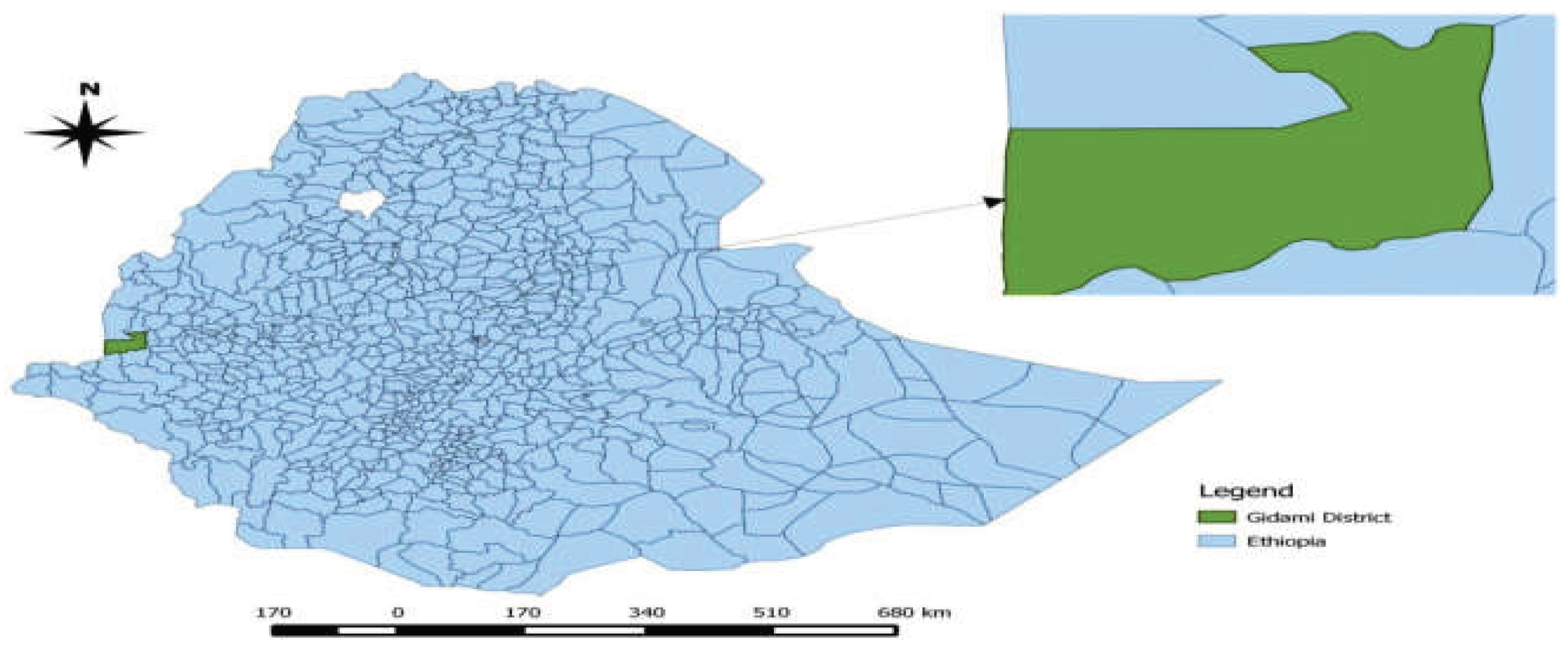

Table 1.
The soil pH of termite mound versus the control soil.
| Land use type | Mean pH values of TMS | Mean pH values of SCS | TMS-SCS | T-Value | N |
| Farm land | 5.22 ± 0.1 [5.12-5.32] |
4.67 ± 0.1 [4.57-4.77] |
0.55 | 4.73 | 6 |
| Grazing Land | 5.44 ± 0.42 [5.02-5.86] |
5.23 ± 0.41 [4.82-5.64] |
0.21 | 4.55 | 6 |
| Forest Land | 5.25 ± 0.25 [5.00-5.50] |
5.22 ± 0.2 [5.02-5.42] |
0.03 | 4.27 | 6 |
Significant at the p ≤ 0.05; values are mean ± SD [minimum-maximum]; SD: standard deviation.
Table 2.
The socio-demographic information of the respondents.
| Category | Variables | Number of respondents | Percentage (%) |
|---|---|---|---|
| Gender | Male | 179 | 69% |
| Female | 80 | 31% | |
| Age group | 15-45 | 192 | 74% |
| 45-60 | 67 | 26% | |
| Above 60 | 0 | 0% | |
| Education level | No formal education | 29 | 11% |
| Primary | 124 | 48% | |
| Secondary | 65 | 25% | |
| Above Secondary | 41 | 16% |
Table 3.
Farmers’ perception about causes of soil acidity and its control practices.
| Item | Variables | Frequency | Percentage (%) |
| 1. Is there soil acidity on your land? | 1) Yes 2) No 3) I don’t know |
80 36 143 |
31 14 55 |
| 2. If your response to question number 1 is yes, on which land? | 1) Forest land 2) Grazing land 3) Farm land 4) all |
- 21 59 - |
- 8 23 - |
| 3. Do You know what causes soil acidity? | 1) Yes 2) No 3) I don’t know |
62 18 179 |
24 7 69 |
| 4. If yes, what are the major causes? | 1) High rainfall and leaching 2) Chemical fertilizer 3) Continuous cultivating 4) I don’t know |
30 18 14 179 |
12 7 5 69 |
| 5. Do you know any measure that should be taken to reduce soil acidity of your land? | 1) Yes 2) No 3) I don’t know |
72 23 164 |
28 9 63 |
| 6. If yes, what is it? | 1) Liming the soil 2) Using organic fertilizer (Composting the soil) 3) Crop rotation 4) Applying TMS to the land 4) I don’t know |
46 20 6 - 187 |
18 8 2 - 72 |
Disclaimer/Publisher’s Note: The statements, opinions and data contained in all publications are solely those of the individual author(s) and contributor(s) and not of MDPI and/or the editor(s). MDPI and/or the editor(s) disclaim responsibility for any injury to people or property resulting from any ideas, methods, instructions or products referred to in the content. |
© 2026 by the authors. Licensee MDPI, Basel, Switzerland. This article is an open access article distributed under the terms and conditions of the Creative Commons Attribution (CC BY) license (http://creativecommons.org/licenses/by/4.0/).
Copyright: This open access article is published under a Creative Commons CC BY 4.0 license, which permit the free download, distribution, and reuse, provided that the author and preprint are cited in any reuse.


