

Submitted:
02 February 2026
Posted:
03 February 2026
You are already at the latest version
Abstract
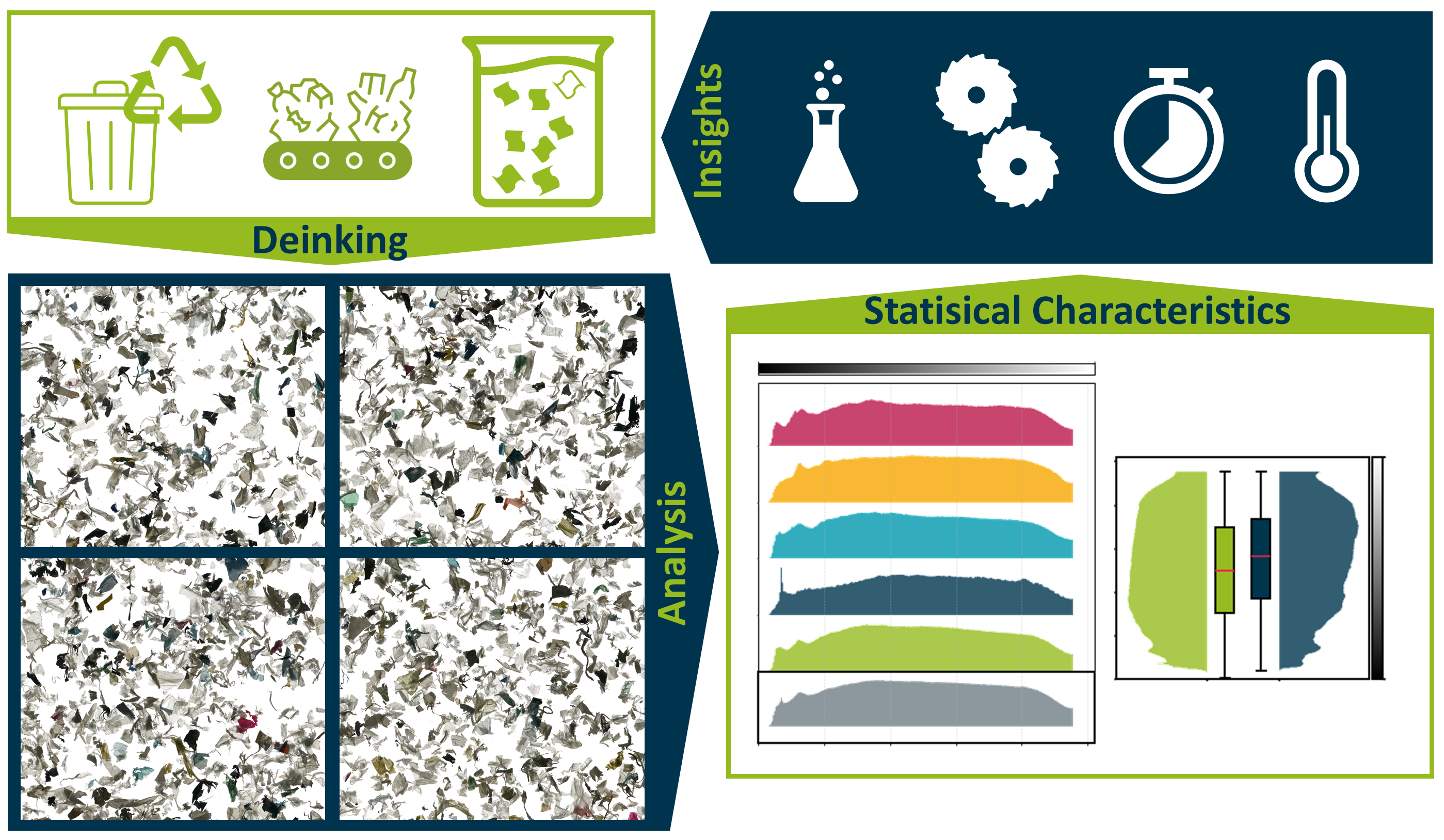
The deinking of plastic packaging waste offers the potential of decreasing contamination and thus increasing the overall quality of recycled plastics, enabling their use in more demanding applications. The removal of printing inks from the usually heavily printed flexible polyethylene (PE) plastic films yields transparent flakes that generally allow the recycling into materials with better mechanical properties as well as lower odor and optical defects. However, for flexible PE packaging waste, the deinking is not yet implemented on an industrial scale and there is currently no objective methodology to evaluate the deinking effect on those inhomogeneous flakes. In this study, a novel approach for the objective assessment of the ink removal on flexible post-consumer waste (PCW) is proposed. Via an image-based analysis, the transparency of the flakes is transformed into the 8-bit grey scale, and the calculation of statistical characteristics from these grey value distributions allows to quantifiably compare the deinking efficiency of several experiments. Using this analysis method allows to investigate the general behavior of contaminated PCW materials in deinking and to identify the most effective parameters for ink removal.
Keywords:
polymer recycling
; circular economy
; waste management
; deinking
; statistical analysis
1. Introduction
In 2018, 8.5 – 9.0 Mt of flexible PE packaging were produced within the EU28+2, making it the biggest application field for plastics [1]. This is because of their potential to incorporate barriers against oxygen, moisture, and light while assuring high printability, low weight, and low cost [2,3,4,5]. The high production volume of flexible PE packaging, along with their usually short lifespan of few weeks consequently leads to immense amounts of PCW [6,7]. The recycling of flexible PE packaging poses great challenges, as their exceptional properties are commonly achieved via the introduction of foreign materials and polymers. Multilayer packaging oftentimes contains ethylene vinyl alcohol (EVOH) or even metal barriers, polypropylene (PP) and polyethylene terephthalate (PET) films, and printing inks (generally 2 to 4%) [8], leading to a highly inhomogeneous material flow [7]. While there are barrier technologies, following a mono-material approach [9,10,11], the use of printing inks has not decreased significantly in recent years, as the print serves marketing and mandatory product information purposes [12].
During mechanical recycling, foreign materials can cause degradation and the formation of unwanted side-products. Especially the degradation products of printing inks, or more specifically their binding agents, are known to be among the main originators for unpleasant odor and color as well as a reduction of mechanical properties [7,13,14,15,16,17,18]. Current industrial washing procedures for polymer waste prove unable to remove printing inks from flexible PE waste before regranulation, thus restricting the application range of their recycling material to those with low requirements, such as waste bags or park benches [19]. This conflicts with the EU’s 2030 goals presented in the packaging and packaging waste regulation (PPWR), demanding specific minimum amounts of post-consumer recyclates (PCR) in a variety of packaging solutions, e.g., 10% for contact-sensitive packaging [20]. Considering these developments, the rapid implementation of an ink removal strategy is of great economic and political interest.
In recent years, studies have shown that deinking processes, carried out prior to regranulation, improve the recycling quality by minimizing the amount of thermally unstable compounds und thus the level of degradation during mechanical recycling [21,22,23]. This deinking process can be explained as washing, oftentimes using high water temperatures and appropriate surfactant and lye formulations. The effectiveness of this process is highly dependent on the film properties (e.g., printing type, lamination, type of binding agent) [24] and the washing parameters (e.g., temperature, pH, surfactant formulation) [14].
Research on model films (oftentimes uniformly surface-printed mono-layer PE films), that allow for straight-forward assessment of ink removal, led to the understanding of the deinking mechanism and found generally effective deinking parameters, that were recorded to build a methodological basis in the DIN SPEC 91496 in 2024 [5,14,22,23,25,26,27,28,29,30]. However, this test procedure cannot be easily implemented for the deinking of PCW flakes from household collection systems. These collection fractions contain a variety of film structures, from transparent and surface-printed to laminated as well as mass-colored flakes, that are highly inhomogeneous in colour and type of printing ink. Therefore, it is not possible to describe ink removal in a reproducible and objective manner via visual examination of the flakes. Furthermore, the contamination of PCW films with e.g., food residues, oils and fats, and other foreign materials can interact with washing solutions and affect the deinking [2,24]. Thus, parameters that were found effective for the deinking of model-films cannot be transferred to PCW flakes without further research. Taking these factors into account, the necessity for the development of an objective and quantitative analysis method for the deinking of flexible PE flakes becomes apparent.
This study proposes a novel approach for the objective assessment of the deinking on flexible PCW flakes. The aim is to achieve measurable and reproducible results for the deinking of unaltered household PCW flakes while still following the laboratory-scale approach that was carried out by earlier studies and described in the DIN SPEC 91496 [25]. Using an analysis method based on transmitted light, the transparency of the flakes is transformed into the 8-bit grey scale, assigning each pixel a brightness value between 0 and 255. The resulting distributions can then be described and compared by statistical parameters, allowing the objective investigation of the deinking on highly inhomogeneous PCW materials. Utilization of this analysis method would enable not only the transfer of current results on model films to household PCW flakes but could also be used as a basis for a standardized analysis method that would allow the deinking results of different research groups to be compared with one another.
2. Materials and Methods
This chapter lists the utilized materials, the sourcing and pre-treatment of the PCW flakes, the deinking procedure, and the evaluation of the ink removal via image-based analysis and statistical characterization.
2.1. Pre-Treatment of PCW Flakes
PCW flakes from the “DSD310” fraction were kindly provided by the Green Dot Holding GmbH & Co. KG. In this fraction, household waste is sorted for flexible PE films. The films are shredded to a size of 40 to 60 mm and separated from coarse impurities and labels using a metal separator, air separator and dry mechanical cleaning. The flakes then undergo a cold washing step including a float-sink-separation and are collected before entering regranulation.
To facilitate handling and increase the specific surface area for the following deinking trials, the flakes were dried at 80 °C for 6 hours and cut to a target size of 10-20 mm using a MDSi 410/200 cutting mill from Hellweg Maschinenbau GmbH & Co. KG, Roetgen.
2.2. Deinking Trials
The washing trials were based on the DIN SPEC 91496 but were modified to account for the peculiarities of PCW flakes [25]. The water temperature varied in three steps (30 °C, 60 °C, and 80 °C), with the lowest temperature marking a change compared to the 40 °C proposed in the DIN SPEC 91496. This change was made to represent the temperature of a cold washing process as is oftentimes used in current industrial washing processes. In contrast to the DIN SPEC 91496, which intends the removal of a single flake sample at specific times in a period of 15 minutes, trials in this study were conducted at three different washing times of 15, 60 and 120 minutes without the removal of flake samples [25]. This is because the removal of a single PCW flake does not reflect the deinking of the highly inhomogeneous fraction. Furthermore, washing times were significantly increased compared to the DIN SPEC 91496 [25]. This change accounts for the contamination on PCW flakes, that interact with the washing solution, potentially reducing their deinking capability. Moreover, the increased washing times should lead to increased friction on the flakes, further promoting the penetration of the washing solution and thus ink removal. As dissolved printing inks can recolor the flakes via migration into the polymer matrix, an effect that would increase with increased washing time, a transparent virgin PE flake was added to each experiment to trace possible recoloring of the flakes. However, none of the trials showed any sign of recoloring, which is most likely due to the overall lower concentration of printing inks in PCW flake fractions compared to the model films used in other studies. Lye as well as surfactant concentration were kept as in the DIN SPEC 91496 at 1% and 0.2% respectively [25]. Accounting for the inhomogeneity of PCW flakes, the general setup was increased to wash 10 g of flakes per trial. In a 2 L beaker, the surfactant (1-Hexadecyl)trimethylammonium chloride (96%), also known as Cetronium chloride (CTAC, supplied from Thermo Fischer Scientific) was dissolved in a solution (1 L) of sodium hydroxide (≥98%, supplied from Carl Roth GmbH + Co. KG), and the mixture was held at the target temperature. PCW flakes were stirred in the solution at 200 min−1 for the target washing time. The flakes were then removed from the washing solution, rinsed with 0.5 L of water and dried in a convection oven at 80 °C for 6 hours.
2.3. Evaluation of Ink Removal
Transmission measurements are conducted on a Perfection V750 Pro from SEIKO Epson Corporation. For the measurement, a 2 g batch of flakes is placed on the scanning surface and manually distributed to ensure an even distribution of flakes without them overlapping. This measurement is repeated four times for each experiment, with the next 2 g batch respectively, yielding a total of 4 scans and 8 g of scanned flakes per experiment. Scans are then transformed into greyscale and the grey values of all pixels below a threshold of 240, which corresponds to the grey value of a transparent virgin PE film lying flat on the scanning surface, are evaluated. This threshold ensures that both the background, which due to total transparency has the maximum grey value of 255, and distorting light effects causing higher grey values are excluded from the evaluation. Grey values from all scans of an experiment are further processed into an experiment’s distribution with the aim of minimizing the deviation of the inhomogeneous nature of the PCW fraction as well as the deviation of the process-related wrinkles of the flakes. From these distributions, normalized histograms and statistical characteristics (skewness, median, and quartiles) can be calculated, allowing a quantitative comparison between experiments.
2.4. Calculation of Statistical Characteristics
Characteristics used for the evaluation in this study are the quartiles, and the skewness. The quartiles Q1, Q2 (also called median), and Q3 divide the grey value distributions into four parts of equal size. Hence, 25% of the grey values lie below Q1, half of the grey values lie below Q2, and 75% of the grey values lie below Q3, respectively. These values are the basis for the generation of box plots [31,32]. The skewness is a measure to describe the symmetry of a distribution. The skewness is mathematically defined as the third central moment normalized by the standard deviation and is derived in equation 1 to 4 below [31,32,33]. A ridge plot, depicting exemplary distributions, is shown in Figure 1.
With:
- being the grey values between 0 and 240
- being the number of pixels with a certain grey value
- being the total pixel count
With:
- being the standard deviation
As can be seen in Figure 1, the skewness is equal to zero for normal distributions. A positive skew indicates that the mass of the distribution is concentrated to the left side of the distribution, in this case towards lower grey values, with tailing to the right side of the distribution. Consequently, negative skew indicates that the mass of the distribution is concentrated to the right side of the distribution with tailing to the left side of the distribution. In the context of deinking on PCW flakes, a shift in grey values towards higher values, thus higher transparency, is expected. Therefore, the skewness can be used as a measure to evaluate the effectiveness of deinking experiments. It should however be noted that a skew of zero is also possible if one tail of the distribution is long and thin, while the other is short and fat. Hence, the skewness should not be used as a single evaluation metric without inspecting the shape of the distribution.
3. Results and Discussion
To evaluate the accuracy and the reproducibility of the measurement method described above, the scanning routine was repeated five times for PCW flakes prior to deinking, yielding a total of 20 scans and 40 g of scanned flakes. As this approach is suitable to incorporate not only the inaccuracies of the measurement practice (e.g., wrinkles and overlapping of the flakes) but also the inhomogeneity of the PCW fraction, the skewness standard deviation of this experiment was adopted for all deinked experiments. A ridge plot depicting the normalized histograms of the five flake batches as well as the total normalized histogram, containing the grey values of all batches, is shown in Figure 2.
The normalized histograms depicted in Figure 2 are similar in shape and almost normally distributed, which is confirmed by the skewnesses close to 0. Two peaks, in the grey value range of 15 to 20 and 30 to 40 respectively, are prominent in some of the histograms. These peaks are in the grey value range of dark mass-colored flakes that are present in this PCW fraction (as can be seen in Figure 3). Especially black recycling flakes, originating from waste bags that are currently produced from the material of this PCW fraction, have a grey value of 18. Batches in which these flakes are disproportionately included show a sharp peak in this area, as can be seen in batch 4. The total skewness, amounting to 0.0017 with a standard deviation of 0.0609 will subsequently be used as a measure of evaluation for the effectiveness of the deinking experiments.
Deinking experiments were based on the parameters of the DIN SPEC 91496 with alterations made to account for the peculiarities of PCW flakes [25]. Trials using 1% NaOH and 0.2% CTAC were varied in washing time and water temperature, whereby an increase in those parameters is expected to result in an increase of the deinking performance. A picture of the flakes prior (A) and post (B) deinking with a water temperature of 80 °C and a washing time of 120 minutes is shown in Figure 3.
While the general brightening of the flakes due to deinking is apparent, mass-colored and laminated flakes are not affected by deinking and thus lead to a mixed appearance that cannot be quantified visually. The ridge plots of the deinking experiments with a washing time of 120 minutes and varying water temperatures are shown in Figure 4.
The histograms of deinked batches depicted in Figure 4 show a slight shift towards higher grey values compared to the batch prior to deinking, indicating a higher transparency and thus the removal of printing inks from the PCW flakes. Especially at a temperature of 80 °C, the number of pixels below a grey value of 100 is decreased, while the amount in the range of 150 to 200 is increased. This observation is confirmed quantitatively by the skewnesses that are decreasing with increasing washing temperature, marking a reduction in the skewness of 0.0446 (26%) at 30 °C, 0.0720 (42%) at 60 °C, and 0.2081 (122%) at 80 °C respectively. Considering the deviation on the skewness of the batch prior to deinking, a significant decrease in the skewness is achieved only for the experiment at a water temperature of 80 °C. At higher temperatures, the diffusion of surfactants and lye into the printing ink layers is accelerated and the layer itself expands and softens, further promoting the diffusion. These results are in accordance with the studies on model films published to date and thus indicate the capability of the measurement method. Keeping the most efficient water temperature of 80 °C, deinking experiments with different washing times are depicted in Figure 5.
The histograms of the deinked batches shown in Figure 5 show a shift towards higher grey values compared to the sample prior to deinking. This again indicates higher flake transparency and thus the removal of printing inks. A decrease in the number of pixels below a grey value of 100 as well as an increase in the amount in the range of 150 to 200 can be observed for all washing times. Quantifying this observation, the decrease in the skewnesses amounts to 0.1409 (83%) after 15 minutes, 0.2008 (118%) after 60 minutes, and 0.2081 (122%) after 120 minutes respectively. It can be concluded that the skewness decreases significantly for all experiments but is almost indifferent for the experiments with a washing temperature of 60 and 120 minutes. These results indicate that the dissolution of printing inks is still in progress after 15 minutes but could be duly completed by 60 minutes. In the DIN SPEC 91496, the maximum washing time is set to 15 minutes [25]. This is because the deinking of surface-printed films usually proceeds rapidly under the proposed conditions as the ink layer is readily accessible to the washing solution. Furthermore, recoloring is oftentimes observed in the deinking of these films which renders unnecessary high washing times counterproductive. PCW fractions, being composed of surface- and reverse-printed but also mass-colored, laminated and transparent flakes, usually possess lower amounts of dissolvable printing ink. Hence, no recoloring could be observed in any of the deinking experiments using PCW flakes. The increased washing times are meant to account for the contamination residues on the flakes and to introduce friction via the prolonged wiping of the flakes onto each other. However, the effect of this friction cannot be investigated in the course of these experiments and is expected to be negligible compared to the friction that is introduced via state of the art polymer washing devices that are currently investigated in the pilot-scale [34]. A direct comparison of the batch prior to deinking with the deinked batch using a water temperature of 80 °C and a washing time of 120 minutes is shown in Figure 6.
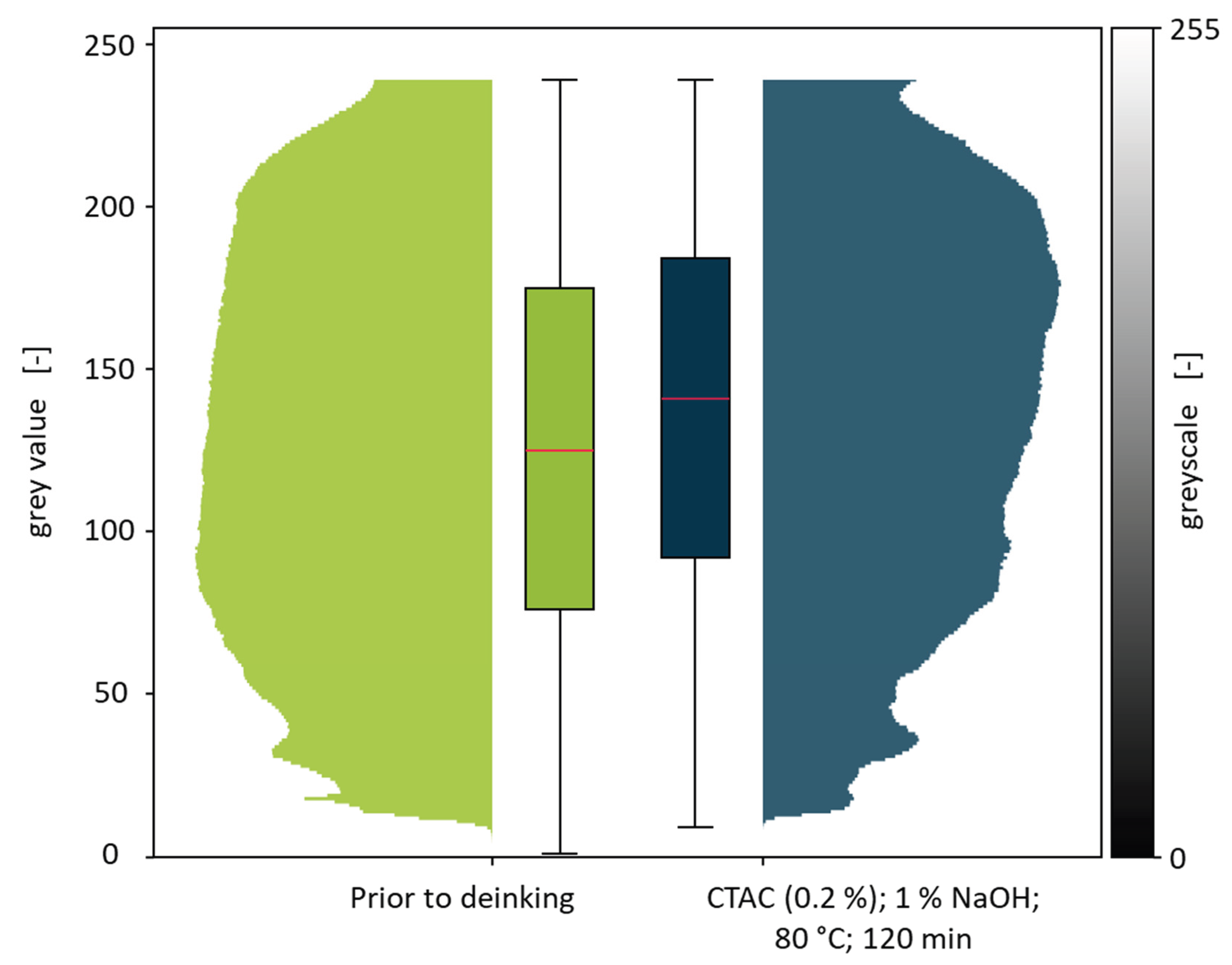
The direct comparison of the PCW flake batches prior and post deinking further emphasizes the shift in grey values that is caused by the deinking process. While the pixel count significantly decreases at grey values below 100, it increases for grey values above 150. Box plots for both experiments show an increase in the median from 124, with a standard deviation of 3.76, to 141, marking an increase of 17. It can thus be concluded that both the skewness and the median can be used to describe the effectiveness of deinking trials. The whiskers of the box plot however cannot display the interquartile range for these broad distributions, which is why they are defined as the minimum and maximum grey value measured for the experiment.
4. Conclusions
This study proposes a novel measurement method to objectively quantify the deinking efficiency on household PCW flakes. Deinking trials were based on the washing parameters listed in the DIN SPEC 91496 with few alterations made to account for the peculiarities of PCW flakes. It could be shown that the image-based analysis method, using grey values to create histograms, yields sufficiently accurate results to allow for the observation of significant changes in the experiments.
Trends, that were previously confirmed by other researchers, could be observed and quantified by calculating statistical characteristics such as the skewness and the median from the grey value distributions. With a reduction in the skewness of 122% and an increase in the grey value median of 17, the deinking trial with the highest water temperature of 80 °C and the longest washing time of 120 minutes showed the highest deinking effect. Within the range of the parameters investigated, the water temperature showed to have a greater effect on the deinking efficiency than the washing time.
Additional deinking experiments, expanding the parameters to various surfactants, lye concentrations, film structures, and deinking setups would put the method further to test, allowing improvements to the analysis method. Further variations of the washing time and water temperature would allow to quantify their correlation with the deinking efficiency.
Author Contributions
Conceptualization, S.Z.; methodology, S.Z.; software, S.Z.; validation, S.Z.; formal analysis, S.Z.; investigation, S.Z.; resources, S.Z.; data curation, S.Z.; writing—original draft preparation, S.Z.; writing—review and editing, S.Z. and L.S. and R.D.; visualization, S.Z.; supervision, S.Z. and L.S. and R.D.; project administration, S.Z. and L.S. and R.D.; funding acquisition, S.Z. and L.S. and R.D. All authors have read and agreed to the published version of the manuscript.
Funding
This research was funded as part of the joint research project LoopCycling. Financial support was received by BASF SE, Brückner Maschinenbau GmbH, CeDo Recycling B.V., Constantia Flexibles GmbH, Coperion GmbH, Der Grüne Punkt GmbH & Co. KG, DOW Deutschland Anlagengesellschaft mbH, Entex Rust&Mitschke GmbH, Essity GmbH, Evonik IndustriesAG, Forum Rezyklat, Hellweg Maschinenbau GmbH & Co. KG, HydroDyn Recycling GmbH, Constab Polyolefin Additives GmbH, Quickpack Haushalt + Hygiene GmbH, RKW SE, Siegwerk Druckfarben AG & Co. KGaA, Südpack Holding GmbH, TOMRA Systems ASA, Windmöller und Hölscher SE & Co. KG, and Zeppelin GmbH.
Institutional Review Board Statement
Not applicable.
Data Availability Statement
All data presented in this study are available on request from the corresponding author.
Acknowledgments
We want to thank the companies listed above for their funding and for supporting the investigations.
Conflicts of Interest
The funders had no role in the design of the study; in the collection, analyses, or interpretation of data; in the writing of the manuscript; or in the decision to publish the results.
Abbreviations
The following abbreviations are used in this manuscript:
| PE | Polyethylene |
| PCW | Post-consumer waste |
| EVOH | Ethylene vinyl alcohol |
| PP | Polypropylene |
| PET | Polyethylene terephthalate |
| PPWR | Packaging and packaging waste regulation |
| PCR | Post-consumer recyclate |
| CTAC | Cetronium chloride |
References
- Flexible Films Market in Europe: State of Play. Eunomia 2022 15.07.2025]; Available from: https://www.plasticsrecyclers.eu/wp-content/uploads/2022/10/flexible-films-market.pdf.
- Horodytska, O.; Valdés, F.J.; Fullana, A. Plastic flexible films waste management – A state of art review. Waste Management 2018, 77, 413–425. [Google Scholar] [CrossRef] [PubMed]
- Hahladakis, J.N. An overview of chemical additives present in plastics: Migration, release, fate and environmental impact during their use, disposal and recycling. Journal of Hazardous Materials 2018, 344, 179–199. [Google Scholar] [CrossRef]
- Żołek-Tryznowska, Z. 4 - Additives for Ink Manufacture, in Printing on Polymers; Izdebska, J., Thomas, S., Eds.; William Andrew Publishing, 2016; pp. 57–66. [Google Scholar]
- Ügdüler, S. Understanding the complexity of deinking plastic waste: An assessment of the efficiency of different treatments to remove ink resins from printed plastic film. Journal of Hazardous Materials 2023, 452, 131239. [Google Scholar] [CrossRef]
- Stoffstrombild Kunststoffe in Deutschland 2023. Conversio 2024 14.05.2025]; Available from: https://www.bkv-gmbh.de/files/bkv/studien/Kurzfassung%20Stoffstrombild%202023.pdf.
- Dahlmann, R.; Hopmannn, C. Nachhaltige Kunststoffverpackungen aus Post Consumer-Rezyklaten; Springer, 2025. [Google Scholar]
- Printing inks and Plastic Recycling – Q & A. 2021 10.01.2026]; Available from: https://www.eupia.org/wp-content/uploads/2022/09/Printing_inks_and_Plastic_Recycling_-_Q___A.pdf.
- Cabanes, A.; Valdés, F.J.; Fullana, A. A review on VOCs from recycled plastics. Sustainable Materials and Technologies 2020, 25, 179–201. [Google Scholar] [CrossRef]
- Designing for a Circular Economy. 2025 10.01.2026]; Available from: https://guidelines.ceflex.eu/assets/public_docs/D4ACE_Guidelines_Executive%20Summary_Sep25.pdf.
- Handbook on Decorative Technologies. 2023 15.05.2025]; Available from: https://recyclass.eu/wp-content/uploads/2025/10/Handbook-on-decorative-technologies-for-PEPP-flexibles-v1.0.pdf.
- Ewald Rempel, A.M., Fit for recycling - How inks enable a Circular Economy. 2024.
- Guo, J. Thermal degradation and hydrolysis depolymerization of printing ink components for plastic packaging in recycling processes: a review. Frontiers of Environmental Science & Engineering 2024, 18(10), 1–15. [Google Scholar] [CrossRef]
- Guo, J. Screening the Impact of Surfactants and Reaction Conditions on the De-Inkability of Different Printing Ink Systems for Plastic Packaging. Polymers 2023, 15(9), 1–25. [Google Scholar] [CrossRef] [PubMed]
- Cecon, V.S. The challenges in recycling post-consumer polyolefins for food contact applications: A review. Resources, Conservation and Recycling 2021, 167, 105422–105433. [Google Scholar] [CrossRef]
- Berg, E.; Leuchtenberger, L.; Dahlmann, R. Investigation of gel formation and degradation of representative polyolefin recyclates. in ANTEC® 2024. 2024. St. Louis, USA.
- Berg, E.; Leuchtenberger, L.; Dahlmann, R. Influence of varying material components in representative polyethylene recyclates on the mechanical properties of blown films. 32nd International Colloquium Plastics Technology, 2024. [Google Scholar]
- Lisiecki, M. Mechanical recycling of printed flexible plastic packaging: The role of binders and pigments. Journal of Hazardous Materials 2024, 472, 134375. [Google Scholar] [CrossRef] [PubMed]
- Dahlmann, R.; Berg, E.; Schön, M. Usage potentials for different qualities of recyclates in plastics packaging. 31st International Colloquium Plastics Technology, 2022; pp. 190–203. [Google Scholar]
- Regulation (EU) 2025/40 of the European Parliament and of the Council of 19 December 2024 on packaging and packaging waste. The European Parliament and the Council of the European Union 2025 20.09.2025]; Available from: https://eur-lex.europa.eu/legal-content/EN/TXT/?uri=OJ:L_202500040&pk_campaign=todays_OJ&pk_source=EUR-Lex&pk_medium=X&pk_co%E2%80%A6.
- Strangl, M.; Ortner, E.; Buettner, A. Evaluation of the efficiency of odor removal from recycled HDPE using a modified recycling process. Resources, Conservation and Recycling 2019, 146, 89–97. [Google Scholar] [CrossRef]
- Roosen, M. Towards a better understanding of odor removal from post-consumer plastic film waste: A kinetic study on deodorization efficiencies with different washing media. Waste Management 2021, 120, 564–575. [Google Scholar] [CrossRef] [PubMed]
- Roosen, M. Deodorization of post-consumer plastic waste fractions: A comparison of different washing media. Science of The Total Environment 2022, 812, 152467–152478. [Google Scholar] [CrossRef] [PubMed]
- Izdebska, J. 1 - Printing on Polymers: Theory and Practice, in Printing on Polymers; Izdebska, J., Thomas, S., Eds.; William Andrew Publishing, 2016; pp. 1–20. [Google Scholar]
- DIN SPEC 91496; Recycling of printed polymer packaging – Evaluation of deinking using a test procedure. DIN Deutsches Institut für Normung e. V., 2024.
- Gecol, H. Use of surfactants to remove water based inks from plastic films. Colloids and Surfaces A: Physicochemical and Engineering Aspects 2001, 189(1), 55–64. [Google Scholar] [CrossRef]
- Gecol, H. Deinking of water-based ink printing from plastic film using nonionic surfactants. Journal of Surfactants and Detergents 2002, 5(4), 363–374. [Google Scholar] [CrossRef]
- Gecol, H. Use of surfactants to remove water-based inks from plastic film: effect of calcium ion concentration and length of surfactant hydrophobe. Colloid and Polymer Science 2004, 283(2), 154–163. [Google Scholar] [CrossRef]
- Gecol, H. Use of surfactants to remove solvent-based inks from plastic films. Colloid and Polymer Science 2003, 281(12), 1172–1177. [Google Scholar] [CrossRef]
- Strangl, M. Odor characterization along the recycling process of post-consumer plastic film fractions. Journal of Cleaner Production 2020, 260, 121104–121115. [Google Scholar] [CrossRef]
- William H. Press, S.A.T., William T. Vetterling, Brian P. Flannery. Numerical Recipes: The Art of Scientific Computing Third Edition; Cambridge University Press, 1992. [Google Scholar]
- Spiegel, M.R.; Stephens, L.J. Schaums Outline of Theory and Problems of Statistics Third Edition; McGraw-Hill: New York, 1999. [Google Scholar]
- Joanes, D.N.; Gill, C.A. Comparing measures of sample skewness and kurtosis. Journal of the Royal Statistical Society: Series D (The Statistician) 1998, 47(1), 183–189. [Google Scholar] [CrossRef]
- Wegbereiter für eine grüne Zukunft - Recycling neu definiert. 2025 10.08.2025]; Available from: https://www.hydrodyn.de.
Figure 1.
Exemplary grey value distributions and their respective skewness.
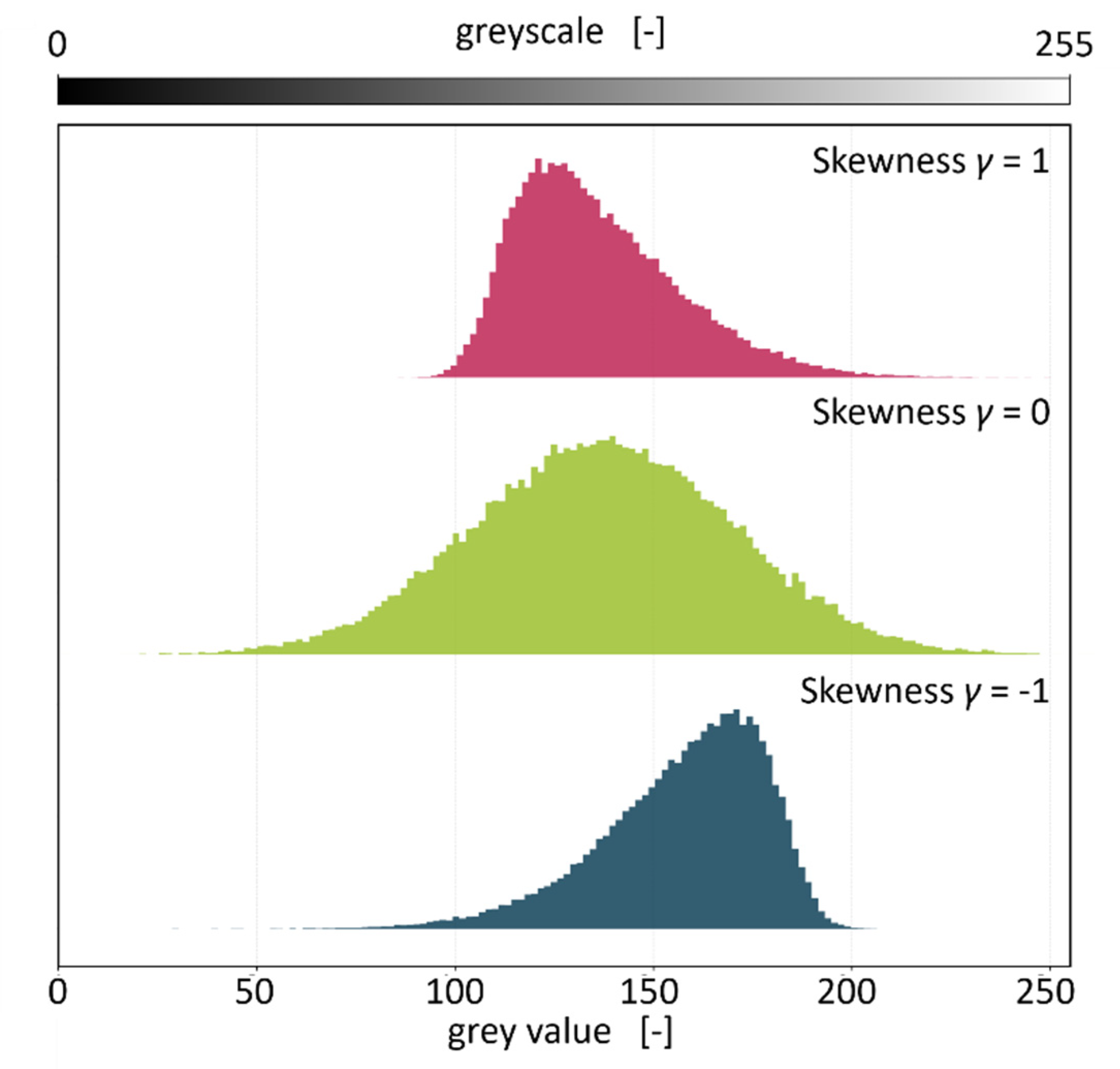
Figure 2.
Ridge plot of 5 batches of PCW flakes prior to deinking and total normalised histogram containing the grey values of all scans.
Figure 2.
Ridge plot of 5 batches of PCW flakes prior to deinking and total normalised histogram containing the grey values of all scans.
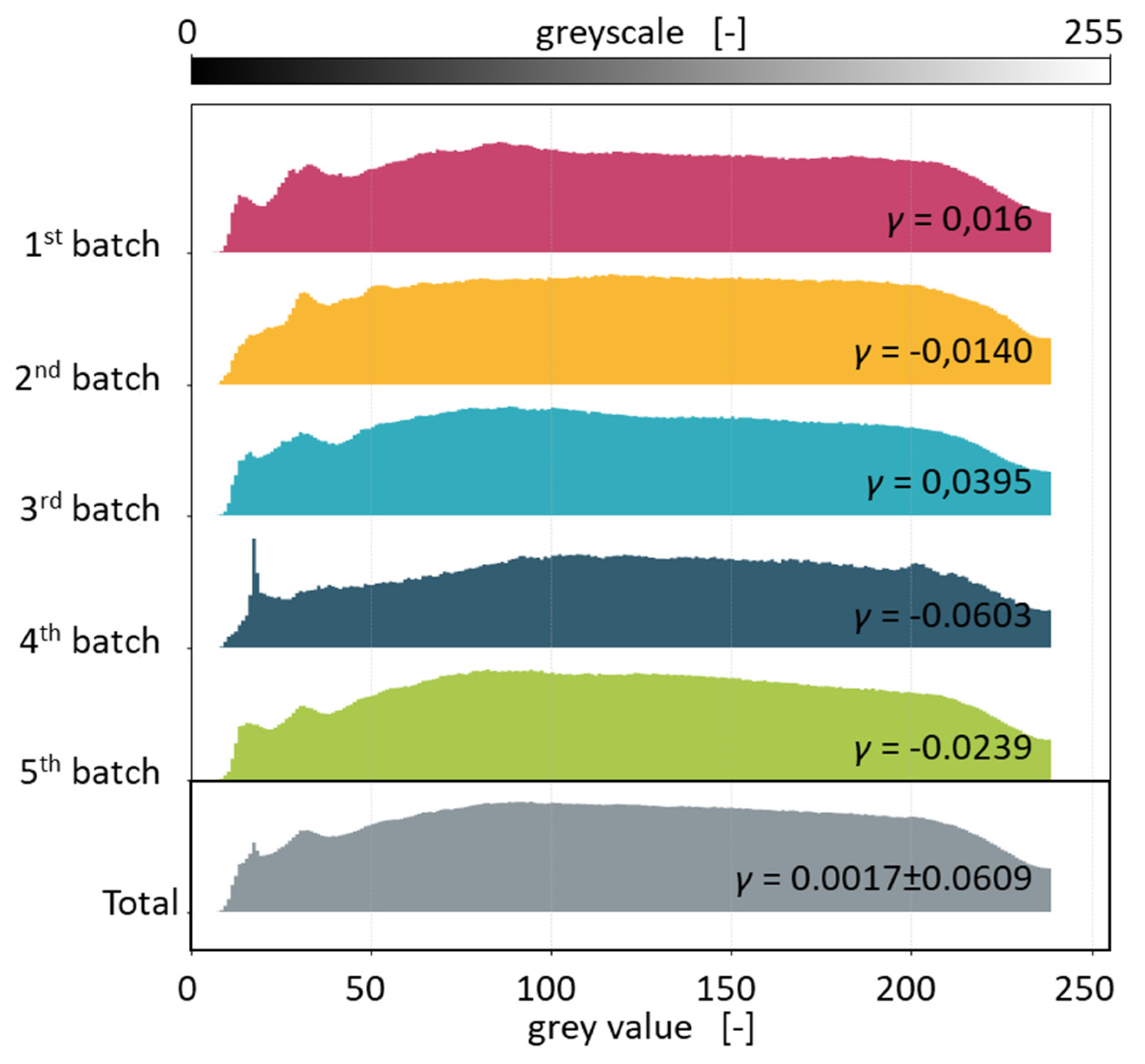
Figure 3.
Picture of PCW flakes prior (A) and post (B) deinking. Deinking was conducted with a water temperature of 80 °C and a washing time of 120 min.
Figure 3.
Picture of PCW flakes prior (A) and post (B) deinking. Deinking was conducted with a water temperature of 80 °C and a washing time of 120 min.
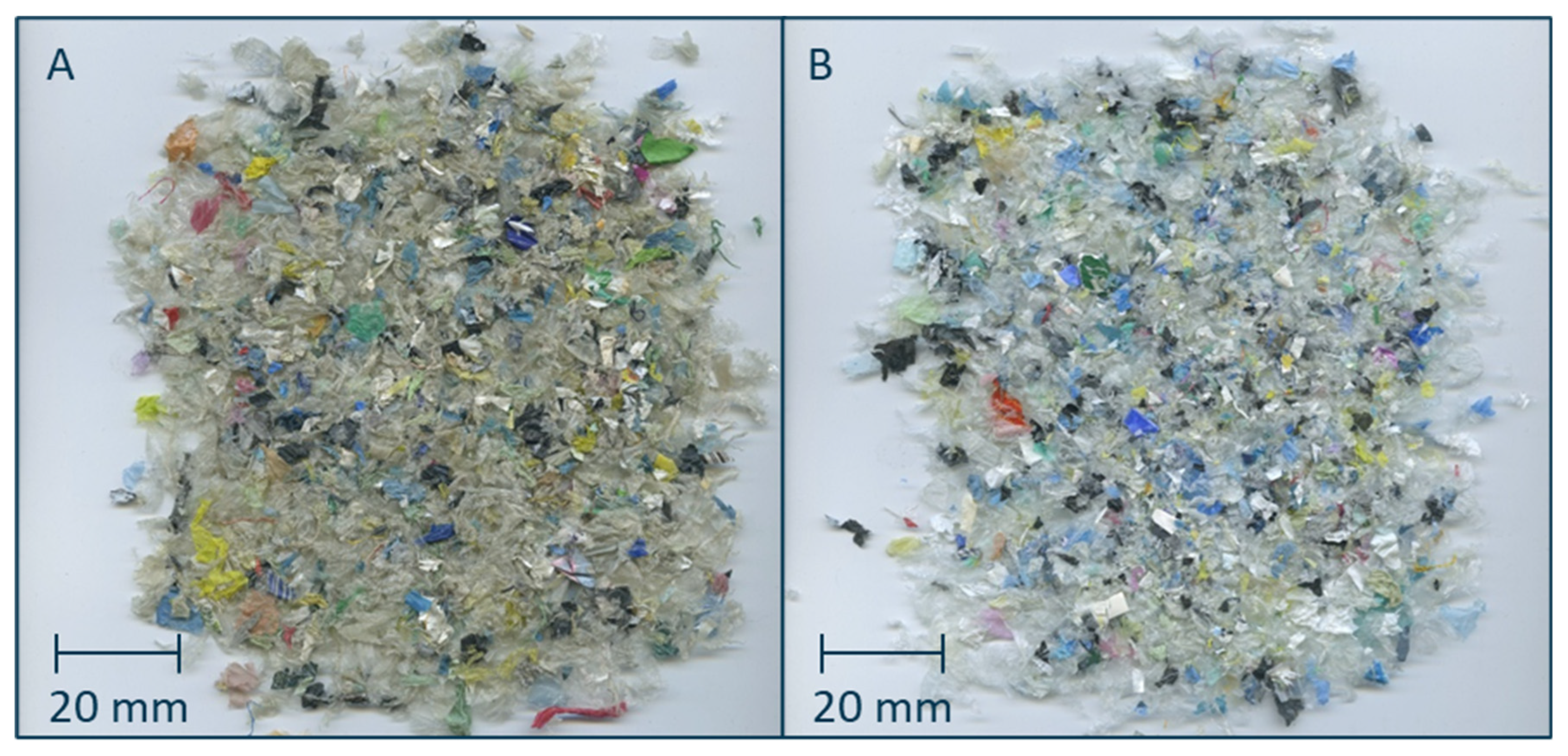
Figure 4.
Ridge plot containing grey value histograms of PCW flakes prior and post deinking with varying water temperatures.
Figure 4.
Ridge plot containing grey value histograms of PCW flakes prior and post deinking with varying water temperatures.
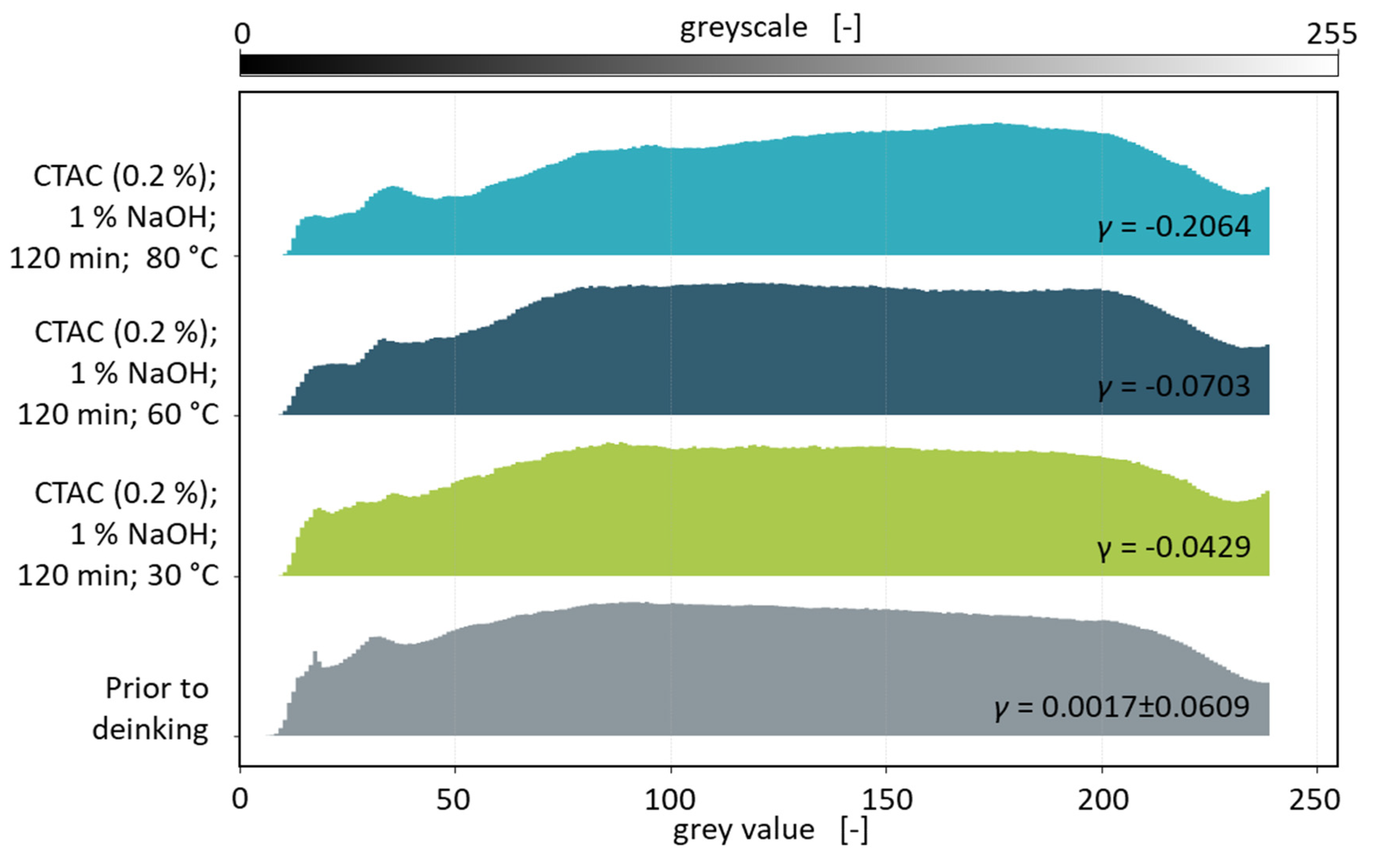
Figure 5.
Ridge plot containing grey value histograms of PCW flakes prior and post deinking with varying washing times.
Figure 5.
Ridge plot containing grey value histograms of PCW flakes prior and post deinking with varying washing times.
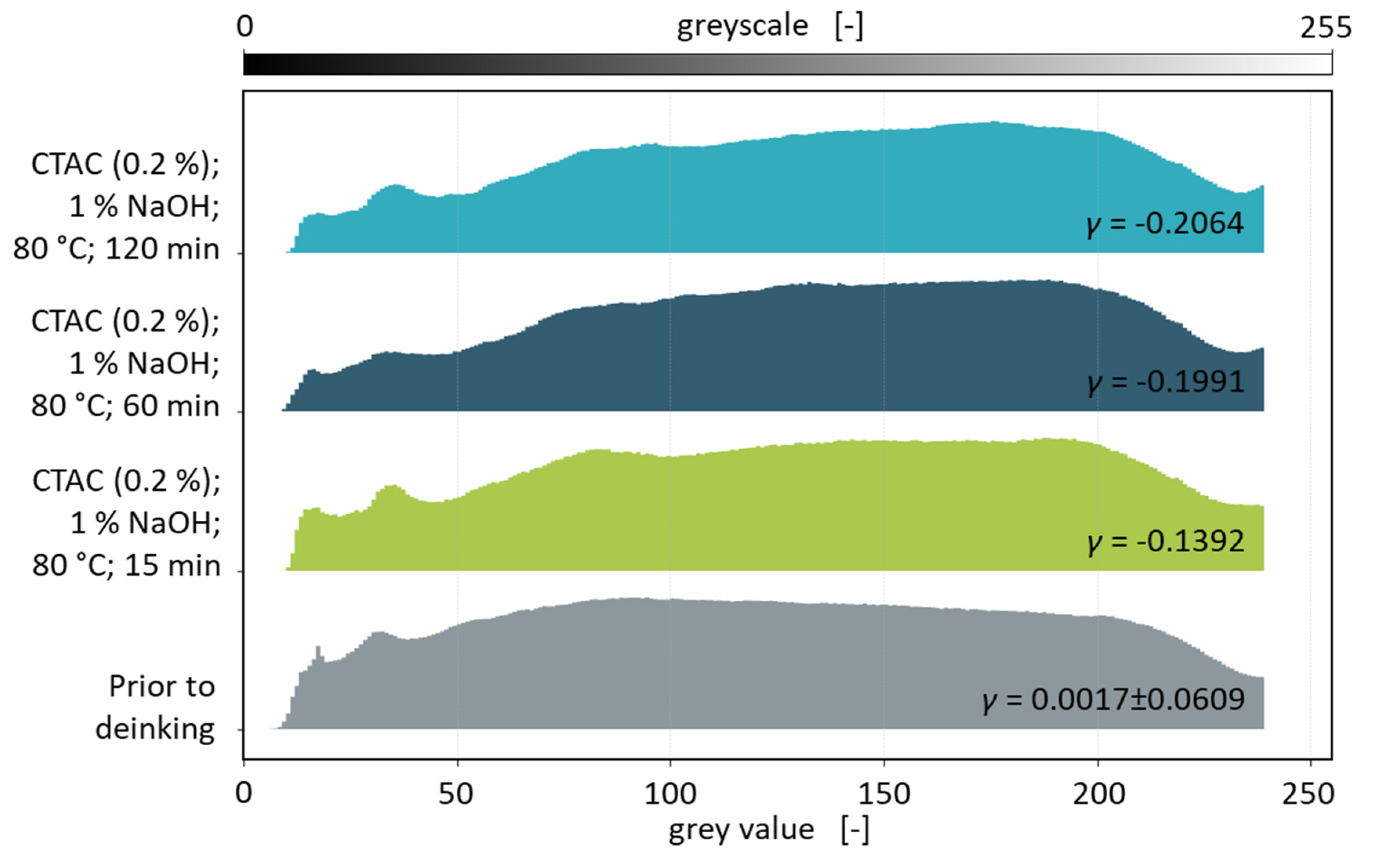
Figure 6.
Violin plot for the comparison of the PCW flake batches prior to deinking and the batch deinked with a water temperature of 80 °C and a washing time of 120 minutes, which achieved the lowest skewness out of the conducted experiments. Box plots of the respective experiments are shown to further describe the grey value distributions.
Figure 6.
Violin plot for the comparison of the PCW flake batches prior to deinking and the batch deinked with a water temperature of 80 °C and a washing time of 120 minutes, which achieved the lowest skewness out of the conducted experiments. Box plots of the respective experiments are shown to further describe the grey value distributions.
Disclaimer/Publisher’s Note: The statements, opinions and data contained in all publications are solely those of the individual author(s) and contributor(s) and not of MDPI and/or the editor(s). MDPI and/or the editor(s) disclaim responsibility for any injury to people or property resulting from any ideas, methods, instructions or products referred to in the content. |
© 2026 by the authors. Licensee MDPI, Basel, Switzerland. This article is an open access article distributed under the terms and conditions of the Creative Commons Attribution (CC BY) license.
Copyright: This open access article is published under a Creative Commons CC BY 4.0 license, which permit the free download, distribution, and reuse, provided that the author and preprint are cited in any reuse.


