

Submitted:
02 February 2026
Posted:
03 February 2026
You are already at the latest version
Abstract
Background/Objectives: Developmental prosopagnosia (DP) is a neurodevelopmental condition characterised by lifelong difficulties in face recognition. Although substantial work has examined identity processing impairments in DP, less is known about whether these difficulties extend to other aspects of social cognition, including implicit trait judgements from faces. Prior research using Implicit Association Task (IAT) paradigms shows that neurotypical observers can automatically associate facial composites with personality traits such as extraversion. Although some studies report preserved explicit social evaluations in DP, no work has assessed whether individuals with DP can form implicit personality-trait impressions from faces. Methods: The present study examined whether adults with DP (N = 36) exhibit implicit extraversion trait associations using a validated extraversion IAT. Results: Group-level analyses showed a significant IAT effect, indicating sensitivity to congruent face–trait pairings. Single-case analyses using Crawford and Garthwaite’s modified t-test showed that no participant scored significantly below the neurotypical range. Conclusions: These findings suggest that implicit trait-inference processes may remain accessible in DP despite severe identity-recognition impairments, highlighting the potential functional independence of certain social-evaluative mechanisms from those supporting facial identity.
Keywords:
developmental prosopagnosia
; implicit cognition
; personality trait judgements
; face recognition
1. Introduction
A human face conveys a multitude of information to the observer. Primarily, it allows us to identify individuals, but it also signals additional cues such as mood, intention, and attentiveness [6]. Considerable work further demonstrates that stable traits including dominance, competence, and personality dimensions such as extraversion can also be inferred from faces [7,8]. These impressions are formed rapidly, often within milliseconds [9], tend to be highly consistent across observers, and can influence consequential real-world outcomes such as hiring decisions and voting behavior [10].
To investigate the degree to which such automatic trait impressions may be formed implicitly, research using the Implicit Association Task (IAT) [11,12] has demonstrated that personality traits such as extraversion, agreeableness and neuroticism can be automatically inferred from composite facial stimuli [1,13]. These findings suggest that trait-impression formation operates below conscious awareness and may rely on mechanisms partly independent from those supporting face-identity recognition. However, it remains unclear whether successful trait inference shares cognitive substrates with identity recognition or whether the two processes are functionally dissociable. This question can be addressed by examining trait inference in individuals with developmental prosopagnosia (DP), who exhibit severe lifelong impairments in face-identity recognition. As a consequence, this question is particularly relevant for individuals with developmental prosopagnosia (DP), who have severe lifelong impairments in face-identity recognition [14,15,16,17]. Individuals with DP typically show impaired face memory, including difficulty recognizing familiar people and poor performance on standardized tasks such as the Cambridge Face Memory Test (CFMT) [18]. Nonetheless, increasing evidence shows that not all aspects of face processing are uniformly impaired in DP [19,20,21,22,23]. Little is known about the status of this population on the kind of automatic trait judgements we seek to investigate - thus the current study therefore examines whether individuals with DP show intact implicit face-based trait judgements or whether these abilities are similarly compromised.
Theoretical models of face processing offer further grounds to expect that trait inference may be preserved in DP. In the influential functional model proposed by Bruce and Young [24], face processing is fractionated into partially independent components, with identity recognition supported by face-recognition units while other social attributes—such as expression, gaze, and intention—are processed along separate pathways. More recent neural models similarly distinguish between a core face-processing system, specialized for invariant structural cues supporting identity (e.g., lateral fusiform regions), and an extended system that engages limbic and prefrontal regions to extract social-evaluative meaning, including emotion and person knowledge [25]. These frameworks therefore predict that trait inference may be supported predominantly by extended mechanisms and thus could remain intact even when core identity processes are compromised. This also aligns with recent evidence emphasizing the conceptual and diagnostic heterogeneity of DP and the need to distinguish between identity-specific and broader social-perceptual processes [26]. Developmental prosopagnosia, which is characterized by disruptions to identity-specific mechanisms but often preserved performance in other social-cognitive domains, thus provides a strong test case for evaluating this theoretical aspect.
Although individuals with DP typically exhibit severe identity-recognition deficits [15,27], there are indications that trait inferences may draw on perceptual cues that are partly independent from those required for recognizing identity. Trait judgements may depend more heavily on local or featural cues than on holistic processing [28], and even incomplete facial information can elicit reliable trustworthiness judgements [4]. Consequentially, we may predict that performance for DP cases will be intact. Consistent with this, individuals with DP have been shown to make normative judgements of trustworthiness and attractiveness from faces [3,29]. These findings raise the possibility that identity recognition and social-evaluative processes are at least partly separable; although identity recognition is severely compromised, other social-perceptual mechanisms may remain intact. By extension, trait-judgement abilities that draw on different perceptual cues may show relative independence from face-identity processing.
Further support for preserved aspects of social cognition in DP comes from Knutson et al. [2], who reported a single case demonstrating typical social IAT effects where, stronger associations for culturally congruent pairings (e.g., self + positive, ingroup + positive) than for incongruent ones. Crucially, this form of IAT does not involve faces or personality cues; instead, it indexes general socio-affective associative learning. Thus, while the study indicates preserved implicit social evaluation in DP, it does not speak directly to whether DPs can extract personality traits from faces. To date, no published work has examined implicit personality-trait judgements from facial stimuli in DP, leaving open the question of whether high-level social impressions can be formed despite profound identity-recognition impairments.
Taken together, these findings indicate that while DP severely affects face-identity recognition, other components of social face processing may remain intact. The present study is the first to test whether individuals with DP can form implicit automatic personality judgements, specifically extraversion trait judgements from faces using an IAT paradigm. Based on evidence of preserved social evaluations [3,4] and intact implicit associative processes in at least one documented case [2], we hypothesized that individuals with DP would show intact implicit trait inference despite compromised identity recognition. If DP selectively disrupts mechanisms specialized for identity recognition while sparing those involved in rapid social evaluation, then individuals with DP should exhibit typical IAT effects. Conversely, if trait inference depends on holistic or identity-related processing, DP participants should show reduced or absent associations. To complement group analyses, we also employed Crawford and Garthwaite’s [5,30] modified t-tests to assess whether trait-inference ability is preserved at the single-case level. Together, these analyses provide a clear test of implicit face-based trait processing in DP.
2. Materials and Methods
2.1. Participants
Participants were recruited from the FaReS group DP database. All the tasks and questionnaires used in this study were designed using the software Gorilla [31]. All participants provided informed consent online before taking part in the study and were fully debriefed after study completion. DP diagnosis was confirmed using the Cambridge Face Memory Task (CFMT) [15], Cambridge Face Perception Test (CFPT) [32], and Famous Faces Test (FFT) [33,34,35], along with scores on the Prosopagnosia Index-20 (PI20) questionnaire [36]. Participants were excluded if they had high levels of autistic traits, significant neurological conditions, or poor task engagement [37].
Out of the 51 participants, 15 participants scored high on the AQ scale (AQ score of ≥ 32). Upon further review, participants scoring high on the AQ scale were excluded from the study [14,32]. After all exclusions, a final sample size of the DP group was thirty-six (26 Female: age range 18 - 81, age M = 53, SD = 14.39). To control for a possible other-ethnicity effect, this study only recruited a Caucasian sample.
Control Group: A neurotypical control group was previously tested using the identical extraversion IAT paradigm as part of an earlier publication [1]. The control data were collected by the authors as part of the same research, and using the same Gorilla testing platform, stimuli, response mappings, trial structure, timing parameters, and instructions as those used for the present DP sample. For transparency, full details of the control sample are provided below.
The combined control dataset consisted of 180 neurotypical adults (age range 18–78). Participants were recruited through study link online. All participants reported normal or corrected-to-normal vision, no neurological conditions, and no history of developmental conditions. The same exclusion criteria applied to the DP sample were applied to the control dataset, including removal of participants with excessive IAT error rates or extreme response latencies (≥10% trials <300 ms). All participants provided informed consent and were fully debriefed on study completion. Control participants completed the same extraversion IAT used in the present study. The mean IAT D-score in the combined control sample was 0.082 (SD = 0.405, N = 180). Younger and older adult D-scores were also analyzed separately; however, because the combined dataset provides a more stable normative distribution for single-case analyses, it was used as the primary comparison sample. Age-stratified results are provided in the Appendix (Table A1).
2.2. Background for Screening Individuals with Developmental Prosopagnosia
Inclusion criteria: All participants in this study were categorized as individuals with developmental prosopagnosia (DP). None of the participants reported having any history of head injury or brain damage. While there is no single standardized diagnostic tool to measure prosopagnosia, tests measuring face perception (CFPT), unfamiliar face recognition (CFMT), familiar face recognition (FFT) are largely classified as diagnostic tools for identifying DP. Additionally, the self-report measure (PI20) measure was included; several studies have suggested that self-rating of DP should be supplemented by objective measures of face recognition mentioned above. Together these tests offer a theoretically driven assessment battery. Each of these measures are described in detail below.
CFMT upright version [15]: The CFMT was used to test face memory. A target image was presented with two distractor images. The CFMT task presentation is made up of four stages: stage 1- Practice task, stage 2 - Introduction/same images, stage 3- novel images, stage 4 - novel images with noise. Participants completed this task using standard procedures (See [15]). A total accuracy score was calculated from the three test blocks with a maximum possible score of 72.
CFPT upright version [32]: The CFPT is a standardized tool that measures face perception abilities. In each trial, participants are shown a target face along with 6 comparison images that appear similar in varying degrees to the target image. Participants arrange six facial images according to their similarity to the target image. On each trial, a ¾ view of the target image is presented above in frontal views in a random order. Participants had one minute to sort each set. The upright version of the task contained 8 trials. For each trial, the final matched order is scored by summing the deviations from the correct order (e.g., if a face is five places away from its proper place, it contributes 5 to the score). A score of 0 represents perfect performance, while the maximum possible score is 144. However, it should be noted that DP diagnosis is not completely reliant on the CFPT, and performance on this task highlights the nature of the respective DP participants. For example, in some cases DP individuals typically performing poorly on the CFMT might score within the normal range in the CFPT; these cases can be considered as individuals suffering from face memory difficulties but not the perception of faces, as in the case of associative DP (e.g., [38,39]). However, in the current work, participants possessing both memory and perceptual problems are included as DP cases.
FFT [33,34,35]: The FFT is a measure widely used to gauge recognition memory deficits (e.g., [27,40]). Two versions of the FFT were employed based on the participant's age range: one for adults 35 years and above, and another for younger adults (age range 18 – 34). Both versions of the FFT contained 60 images of celebrities each. These images were presented in a sequential randomized order without any time limit. A correct identification was scored by the participant’s ability to provide information about the celebrity’s name or identifying biographical information about that person. If a participant was unable to identify a face, they were subsequently told who that person was after recording their response and asked if they had previous exposure to that individual. Any celebrities that were unknown to each participant by name or biographical information were removed from the overall score and the percentage correct was adjusted accordingly.
PI20 [36]: The PI20 is a highly valid 20 item self-report questionnaire designed to assess Prosopagnosic traits. Using a five-point Likert scale (strongly agree to strongly disagree), participants indicate the extent to which they agree or disagree on statements describing face recognition experiences. Fifteen statements are scored positively (i.e., strongly agree = 5, strongly disagree = 1), and five statements are reverse scored (i.e., strongly agree = 1, strongly disagree = 5). Total scores are calculated, and the DP classification is made based on the score ranges such as mild (65-74), moderate (75-84) and severe (85-100) impairments. It is to note that PI20 is used as a complementary diagnosis instrument rather than replacing the objective measures of face recognition abilities.
The current consensus of DP diagnosis is that an individual should demonstrate substantial impairment where individuals scoring 2 S.D.s below the control mean are categorized as DPs based on their lack of recognition abilities on at least 2 of the objective face tasks described above.
Exclusion Criteria: an exclusion criterion for DP was to remove participants scoring high on the autism screening questionnaire [41]. Individuals with autism also tend to exhibit face processing difficulties and these difficulties are reported based on their inability to possess sustained attention throughout life and thus exhibiting difficulties in face processing. Evidence exploring the relationship between DP and autism have suggested that these two groups that predominantly exhibit difficulties in face processing and social dysfunction respectively, raises the possibility that these conditions co-occur in several cases [42,43]. As such, it has been suggested that DP should be viewed as a condition with face recognition difficulties independent of socio-emotional difficulties such as autism (e.g., [14,44]). Thus, we have excluded any participant scoring higher than 32 on the autism screening questionnaire [41] from the current analysis. See Table 1 for descriptive statistics on the neurological testing battery. See Appendix (Table A2) for breakdown of individual scores.
2.3. Materials
2.3.1. Face Trait Implicit Association Task (IAT): A Novel Version of the IAT [11] Was Used in This Study with Female Composite Facial Stimuli
Stimuli. A set of facial composites were generated from a sample of 64 Caucasian females (age M = 21.03, SD = 1.94) who completed the 20-item measure of mini-IPIP from the big-five personality inventory [45]. The photographs were averaged using the software Psychomorph. These images were obtained from previous work by Kramer and Ward [46], and we created novel versions of the facial composites. For the purposes of this study, we included composite facial stimuli portraying high extraversion, and low extraversion personality traits (See Figure 1) and words describing personality traits high extraversion (Confident, Sociable, Outgoing, Talkative), low extraversion (Shy, Quiet, Reserved, Thoughtful).
Procedure. In the present study, high-extraversion composite faces were labelled “Jane” and low-extraversion composites were labelled “Mary.” Participants responded using the ‘E’ key for left-hand categories and the ‘I’ key for right-hand categories. The task began with general instructions followed by a familiarization phase in which participants learned the face and word categories. Participants were then presented with a standard seven-block IAT structure [12] (see Table 2).
Participants completed two practice blocks (faces only; words only), followed by two test blocks in the initial mapping condition, a reversal of face–key mappings, and two further test blocks. Block order was counterbalanced across participants such that half completed the congruent condition first, and half completed the incongruent condition first. When an incorrect response was made, a red cross appeared on screen and participants were required to correct their response before proceeding to the next trial. A fixation cross was presented for 200 ms between trials.
IAT scoring procedure. Reaction time data were scored using a Python implementation of the improved IAT D-score algorithm described by Greenwald et al. (2003). Consistent with this algorithm, trials with latencies greater than 10,000 ms were removed. Participants were excluded if more than 10% of their trials had response latencies below 300 ms. Importantly, exclusions were applied at the trial level for extreme latencies and at the participant level for excessive fast responses, rather than removing participants based on single trials.
IAT D-scores were computed using response latencies from the four critical test blocks (Blocks 3, 4, 6, and 7), comparing congruent and incongruent face–trait pairings. Error trials were handled using a built-in error-penalty approach: rather than applying the standard +600 ms replacement described in the reference algorithm, the full latency from stimulus onset to the corrected response was retained. This method incorporates an implicit error penalty and has been shown to produce equivalent or improved sensitivity relative to fixed-penalty approaches [13,47].
Table 3 presents the standard improved IAT scoring algorithm for reference. The implemented variant used in the present analyses differs only in its treatment of error trials in step 7, as described above. All analyses reported in this study reflect the implemented Python pipeline, and the full code is available on the Open Science Framework.
2.4. Data Analysis
Because age modestly predicted IAT performance in controls (e.g., [1]), single-case comparisons were conducted using both pooled and age-matched control subsamples. Classification outcomes were identical across comparison methods. Age-stratified results are provided in the Appendix (Table A1).
2.4.1. Crawford Approach
To evaluate whether individual participants with developmental prosopagnosia (DP) showed atypical implicit trait-judgement performance, we conducted single-case analyses using the Crawford and Garthwaite modified t-test for comparing a single case against a control sample [30,48]. This method treats the neurotypical comparison group as a sample rather than a population, providing more accurate Type I error control than traditional z-score approaches when normative samples are modest in size. For each DP participant, their IAT D-score was compared against the distribution of control scores to determine whether performance fell within or below the expected normative range. The analysis also yields an estimated percentile rank, indicating the proportion of the population expected to score lower than the individual. Single-case comparisons were conducted using (a) young adult controls, (b) older adult controls, and (c) a combined control dataset, allowing us to assess whether normative group selection influenced classification outcomes. Analyses were conducted using a Python implementation of the Crawford and Garthwaite modified t-test [30,48], following the same statistical procedure implemented in singlims.exe [5]. The full analysis script is provided on the OSF repository.
3. Results
3.1. How Do Individuals with Developmental Prosopagnosia Perform on Face-Based Implicit Extraversion Trait Judgements?
Reaction time data obtained from the extraversion IAT was converted into IAT D scores using python scripts following the improved scoring algorithm [12]. A one-sample t-test against zero was conducted to identify whether there was a significant relationship between extraversion composite faces and personality trait words. The results revealed that the DP sample were able to make accurate implicit personality trait judgements from faces, extraversion IAT D = .156 (SD = .35), 95% CI [.038, .274], t (35) = 2.635, p = .010, Cohen’s d = .439. Participants responded faster on trials where highly extraverted faces were paired with highly extraverted words, and on trials where highly introverted faces were paired with highly introverted words. A Bayesian approach was also considered given the small sample size. A Bayesian one-sample t-test revealed moderate evidence for the alternative hypothesis with BF10 = 3.51, supporting the results of the frequentist approach. See Figure 1 for Bayesian sequential analysis. No significant correlation was found between age and IAT performance, Spearman’s ρ = –.12, p = .47, indicating that implicit trait-judgement ability did not vary across the wide age range represented in the DP group.
3.2. Single Case Analyses
To evaluate whether implicit trait-judgement ability was preserved at the individual level, each DP participant’s IAT D-score was compared against neurotypical performance using the Crawford and Garthwaite [5] modified t-test for single-case comparisons. Normative data were drawn from the combined control sample tested using the same IAT paradigm in Kannan et al. [1] (N = 180, M = 0.082, SD = 0.405). Across the DP group, no participant scored significantly below the normative range under either pooled or age-matched norms (all ps ≥ .05), indicating no evidence of impairment in implicit face–trait inference. All cases fell within the expected range of neurotypical performance. Table 4 presents the Crawford statistics, including modified t-values, p-values, and percentile-rank estimates for each participant.
Together, these findings indicate that implicit extraversion–trait judgements are preserved across all individuals with DP. The absence of below-normal scores at the single-case level demonstrates that the group-level IAT effect is not driven by a small subset of high-performing individuals; rather, implicit trait-inference ability appears broadly intact despite severe face-identity recognition deficits.
4. Discussion
This study examined whether individuals with developmental prosopagnosia (DP) can form automatic, implicit judgements of extraversion from faces. Using an extraversion IAT previously validated in a neurotypical sample, we observed significant IAT D-scores, indicating that the DP group showed the expected associative pattern: faster pairing of highly extraverted faces with extraversion-related words and of low-extraversion faces with introversion-related words. Although the IAT does not measure the accuracy of trait judgements directly, it provides a robust index of implicit associative strength. Thus, our findings provide novel evidence that individuals with DP can engage in implicit social trait cognition even when identity recognition is impaired.
Prior work shows that spontaneous associations of extraversion can be elicited with composite facial stimuli (e.g., [1,13]). Young Caucasian adults implicitly and reliably associated facial composites of women scoring high versus low on extraversion with corresponding trait descriptors, and previous studies have ruled out naming or label-based confounds [13]. This supports the interpretation that the IAT captures an automatic, trait-specific evaluative process rather than a task-specific artefact. The present study extends this body of work into a sub-clinical population characterized by profound deficits in face-identity processing such as DP.
Importantly, the current findings demonstrate preserved implicit (rather than explicit) trait inference in DP. Whereas earlier DP studies examined explicit judgements of trustworthiness or attractiveness (e.g., [3,4]), the present IAT required rapid, automatic associations between facial cues and personality attributes. This indicates that even when identity processing is degraded, pathways involved in rapid social evaluation remain operational. This pattern aligns with functional and neural models of face processing [24,25], which propose separable pathways for identity and social-evaluative information. Our findings suggest that the extended face-processing system remains functional in DP, even when core identity mechanisms are impaired.
Furthermore, our single-case analyses revealed that no DP participant performed significantly below the normative range, and only one participant showed a significantly elevated D-score relative to controls. This pattern demonstrates that the group-level effect is not attributable to a small subset of high-performing individuals; rather, implicit trait inference appears largely preserved across individuals with DP. This is notable given the considerable heterogeneity often observed across cognitive domains in DP.
Several mechanisms may explain preserved implicit trait inference in DP. One possibility is that trait judgements rely predominantly on featural or local cues—such as eye openness, mouth curvature, or structural correlates of perceived sociability—that remain accessible even when holistic face processing is impaired [28]. Another possibility is that trait impressions arise from rapid affective evaluations mediated by the amygdala or the extended face-processing network [25]. These pathways may operate relatively independently from the cortical mechanisms supporting stable identity representation, such as the fusiform face area. Importantly, the present data cannot discriminate between these accounts; however, they provide behavioral evidence that the cognitive route supporting implicit trait inference remains functional in DP.
These findings also complement single-case evidence of preserved socio-affective associative learning in DP [2]. Although that study did not assess face-based trait inference, it demonstrated intact implicit processing in another socio-cognitive domain, consistent with the idea that DP primarily disrupts identity-specific mechanisms rather than global social cognition. Thus, the present work contributes to a growing literature suggesting that DP is not a unitary deficit but a heterogeneous condition in which some social-perceptual functions remain preserved.
Several limitations warrant consideration. Although we did not include a concurrent neurotypical control group, matched participants completed the same task and stimuli in a prior study [1], providing a relevant benchmark. The present study focused on within-group performance and single-case analyses; future work should include a concurrently tested control group to rule out contextual or procedural effects. Additionally, the IAT provides a global measure of implicit associations; future research should model the IAT at the trial level to capture within-subject variability more precisely; and employ neuroimaging to identify pathways that support trait judgements when identity recognition is compromised. Finally, we examined only extraversion; it remains unknown whether other personality domains (e.g., neuroticism, agreeableness) show the same pattern of preservation.
5. Conclusions
In sum, this study offers initial evidence that individuals with developmental prosopagnosia can form implicit associations between unfamiliar faces and extraversion-related traits. These results contribute to a growing literature indicating that not all face-related processes are impaired in DP, suggesting that DP may not be a unitary deficit but a heterogeneous condition in which some social-perceptual functions remain preserved. The apparent relative independence between identity recognition and trait inference suggests preserved perceptual and social-evaluative pathways that can potentially operate independently of compromised identity mechanisms. Future work should test the generalizability of this dissociation across additional trait domains and characterize its neural correlates using imaging methods.
Supplementary Materials
The following supporting information can be downloaded at the website of this paper posted on Preprints.org.
Author Contributions
Conceptualization, C.K. and J.T.; methodology, C.K and J.T.; software, C.K.; validation, C.K.; formal analysis, C.K.; investigation, C.K. and J.T.; resources, C.K.; data curation, C.K.; writing—original draft preparation, C.K.; writing—review and editing, C.K. and J.T.; visualization, C.K. All authors have read and agreed to the published version of the manuscript.
Funding
This research received no external funding.
Institutional Review Board Statement
The study was conducted in accordance with the Declaration of Helsinki, and approved by the Swansea University Department of Psychology Research Ethics Committee (protocol code 0277 and date of approval 04/10/2018).
Informed Consent Statement
Informed consent was obtained from all subjects involved in the study.
Data Availability Statement
The datasets generated and analyzed during the current study, including raw IAT data, processed D-scores, screening battery scores, analysis scripts, and task materials, are publicly available on the Open Science Framework (OSF) at: https://osf.io/hv23u/
Acknowledgments
The authors thank the FaReS group Swansea, and the participants for their time and contribution.
Conflicts of Interest
The authors declare no conflicts of interest.
Abbreviations
The following abbreviations are used in this manuscript:
| DP | Developmental Prosopagnosia |
| IAT | Implicit Association Task |
| CFMT | Cambridge Face Memory Task |
| CFPT | Cambridge Face Perception Task |
| FFT | Famous Face Test |
| AQ | Autism Quotient |
| TAS20 | Toronto Alexithymia Scale 20 |
| PI20 | Prosopagnosia Index 20 |
| FaReS | Face Research Swansea |
| BF | Bayes Factor |
References
- Kannan, C.; Jones, A.L.; Towler, J.; Tree, J.J. Do young and older adult populations perform equivalently across different automatic face-trait judgements? Evidence for differential impacts of ageing. PLOS ONE 2025, 20, e0322165. [Google Scholar] [CrossRef]
- Knutson, K.M.; DeTucci, K.A.; Grafman, J. Implicit attitudes in prosopagnosia. Neuropsychologia 2011, 49, 1851–1862. [Google Scholar] [CrossRef]
- Rezlescu, C.; Susilo, T.; Barton, J.J.; Duchaine, B. Normal social evaluations of faces in acquired prosopagnosia. Cortex 2014, 50, 200–203. [Google Scholar] [CrossRef]
- Todorov, A.; Duchaine, B. Reading trustworthiness in faces without recognizing faces. Cogn. Neuropsychol. 2008, 25, 395–410. [Google Scholar] [CrossRef]
- Crawford, J.R.; Garthwaite, P.H.; Ryan, K. Comparing a single case to a control sample: Testing for neuropsychological deficits and dissociations in the presence of covariates. Cortex 2011, 47, 1166–1178. [Google Scholar] [CrossRef]
- Baron, R.J. Mechanisms of human facial recognition. Int. J. Man-Machine Stud. 1981, 15, 137–178. [Google Scholar] [CrossRef]
- Little, A.C.; Perrett, D.I. Using composite images to assess accuracy in personality attribution to faces. Br. J. Psychol. 2007, 98, 111–126. [Google Scholar] [CrossRef]
- Penton-Voak, I.S.; Pound, N.; Little, A.C.; Perrett, D.I. Personality Judgments from Natural and Composite Facial Images: More Evidence For A “Kernel Of Truth” In Social Perception. Soc. Cogn. 2006, 24, 607–640. [Google Scholar] [CrossRef]
- Todorov, A.; Olivola, C.Y.; Dotsch, R.; Mende-Siedlecki, P. Social Attributions from Faces: Determinants, Consequences, Accuracy, and Functional Significance. Annu. Rev. Psychol. 2015, 66, 519–545. [Google Scholar] [CrossRef]
- Rule, N.; Ambady, N. First Impressions of the Face: Predicting Success. Soc. Pers. Psychol. Compass 2010, 4, 506–516. [Google Scholar] [CrossRef]
- Greenwald, A.G.; McGhee, D.E.; Schwartz, J.L.K. Measuring individual differences in implicit cognition: The implicit association test. J. Pers. Soc. Psychol. 1998, 74, 1464–1480. [Google Scholar] [CrossRef]
- Greenwald, A.G.; Nosek, B.A.; Banaji, M.R. Understanding and using the Implicit Association Test: I. An improved scoring algorithm. J. Pers. Soc. Psychol. 2003, 85, 197–216. [Google Scholar] [CrossRef]
- Jones, A.L.; Tree, J.J.; Ward, R. Personality in faces: Implicit associations between appearance and personality. Eur. J. Soc. Psychol. 2018, 49, 658–669. [Google Scholar] [CrossRef]
- Bate, S.; Tree, J.J. The Definition and Diagnosis of Developmental Prosopagnosia. Q. J. Exp. Psychol. 2017, 70, 193–200. [Google Scholar] [CrossRef]
- Duchaine, B.; Nakayama, K. The Cambridge Face Memory Test: Results for neurologically intact individuals and an investigation of its validity using inverted face stimuli and prosopagnosic participants. Neuropsychologia 2006, 44, 576–585. [Google Scholar] [CrossRef]
- Behrmann, M.; Avidan, G. Congenital prosopagnosia: face-blind from birth. Trends Cogn. Sci. 2005, 9, 180–187. [Google Scholar] [CrossRef]
- Susilo, T.; Duchaine, B. Advances in developmental prosopagnosia research. Curr. Opin. Neurobiol. 2013, 23, 423–429. [Google Scholar] [CrossRef]
- Duchaine, B.C.; Weidenfeld, A. An evaluation of two commonly used tests of unfamiliar face recognition. Neuropsychologia 2003, 41, 713–720. [Google Scholar] [CrossRef]
- Avidan, G.; Behrmann, M. Impairment of the face processing network in congenital prosopagnosia. Front. Biosci. 2014, 6, 236–257. [Google Scholar] [CrossRef]
- Barton, J.J.; Corrow, S.L. Recognizing and identifying people: A neuropsychological review. Cortex 2016, 75, 132–150. [Google Scholar] [CrossRef]
- DeGutis, J.; Bahierathan, K.; Barahona, K.; Lee, E.; Evans, T.C.; Shin, H.M.; Mishra, M.; Likitlersuang, J.; Wilmer, J.B. What is the prevalence of developmental prosopagnosia? An empirical assessment of different diagnostic cutoffs. Cortex 2023, 161, 51–64. [Google Scholar] [CrossRef]
- Humphreys, K.; Avidan, G.; Behrmann, M. A detailed investigation of facial expression processing in congenital prosopagnosia as compared to acquired prosopagnosia. Exp. Brain Res. 2006, 176, 356–373. [Google Scholar] [CrossRef]
- Palermo, R.; Willis, M.L.; Rivolta, D.; McKone, E.; Wilson, C.E.; Calder, A.J. Impaired holistic coding of facial expression and facial identity in congenital prosopagnosia. Neuropsychologia 2011, 49, 1226–1235. [Google Scholar] [CrossRef]
- Bruce, V.; Young, A. Understanding face recognition. Br. J. Psychol. 1986, 77, 305–327. [Google Scholar] [CrossRef]
- Haxby, J.V.; Hoffman, E.A.; Gobbini, M.I. The distributed human neural system for face perception. Trends Cogn. Sci. 2000, 4, 223–233. [Google Scholar] [CrossRef]
- Bennetts, R.J.; Gregory, N.J.; Bate, S. Both identity and non-identity face perception tasks predict developmental prosopagnosia and face recognition ability. Sci. Rep. 2024, 14, 1–14. [Google Scholar] [CrossRef]
- Bate, S.; Cook, S.J.; Duchaine, B.; Tree, J.J.; Burns, E.J.; Hodgson, T.L. Intranasal inhalation of oxytocin improves face processing in developmental prosopagnosia. Cortex 2014, 50, 55–63. [Google Scholar] [CrossRef]
- Sutherland, C.A.; Oldmeadow, J.A.; Santos, I.M.; Towler, J.; Burt, D.M.; Young, A.W. Social inferences from faces: Ambient images generate a three-dimensional model. Cognition 2013, 127, 105–118. [Google Scholar] [CrossRef]
- Todorov, A.; Baron, S.G.; Oosterhof, N.N. Evaluating face trustworthiness: a model based approach. Soc. Cogn. Affect. Neurosci. 2008, 3, 119–127. [Google Scholar] [CrossRef]
- Crawford, J.; Garthwaite, P.H. Investigation of the single case in neuropsychology: confidence limits on the abnormality of test scores and test score differences. Neuropsychologia 2002, 40, 1196–1208. [Google Scholar] [CrossRef]
- Anwyl-Irvine, A.L.; Massonnié, J.; Flitton, A.; Kirkham, N.; Evershed, J.K. Gorilla in our midst: An online behavioral experiment builder. Behav. Res. Methods 2019, 52, 388–407. [Google Scholar] [CrossRef]
- Bowles, D.C.; McKone, E.; Dawel, A.; Duchaine, B.; Palermo, R.; Schmalzl, L.; Rivolta, D.; Wilson, C.E.; Yovel, G. Diagnosing prosopagnosia: Effects of ageing, sex, and participant–stimulus ethnic match on the Cambridge Face Memory Test and Cambridge Face Perception Test. Cogn. Neuropsychol. 2009, 26, 423–455. [Google Scholar] [CrossRef]
- Bobak, A.K.; Pampoulov, P.; Bate, S. Detecting Superior Face Recognition Skills in a Large Sample of Young British Adults. Front. Psychol. 2016, 7, 1378–1378. [Google Scholar] [CrossRef]
- Barton, J.J.S. Structure and function in acquired prosopagnosia: Lessons from a series of 10 patients with brain damage. J. Neuropsychol. 2008, 2, 197–225. [Google Scholar] [CrossRef]
- Duchaine, B.; Germine, L.; Nakayama, K. Family resemblance: Ten family members with prosopagnosia and within-class object agnosia. Cogn. Neuropsychol. 2007, 24, 419–430. [Google Scholar] [CrossRef]
- Shah, P.; Gaule, A.; Sowden, S.; Bird, G.; Cook, R. The 20-item prosopagnosia index (PI20): a self-report instrument for identifying developmental prosopagnosia. R. Soc. Open Sci. 2015, 2, 140343. [Google Scholar] [CrossRef]
- Bate, S.; Bennetts, R.J.; Gregory, N.; Tree, J.J.; Murray, E.; Adams, A.; Bobak, A.K.; Penton, T.; Yang, T.; Banissy, M.J. Objective Patterns of Face Recognition Deficits in 165 Adults with Self-Reported Developmental Prosopagnosia. Brain Sci. 2019, 9, 133. [Google Scholar] [CrossRef]
- De Renzi, E.; Faglioni, P.; Grossi, D.; Nichelli, P. Apperceptive and Associative Forms of Prosopagnosia. Cortex 1991, 27, 213–221. [Google Scholar] [CrossRef]
- Fox, C.J.; Oruç, I.; Barton, J.J.S. It doesn't matter how you feel. The facial identity aftereffect is invariant to changes in facial expression. J. Vis. 2008, 8, 11–11. [Google Scholar] [CrossRef]
- Eimer, M.; Gosling, A.; Duchaine, B. Electrophysiological markers of covert face recognition in developmental prosopagnosia. Brain 2012, 135, 542–554. [Google Scholar] [CrossRef]
- Baron-Cohen, S.; Wheelwright, S.; Skinner, R.; Martin, J.; Clubley, E. The Autism-Spectrum Quotient (AQ): Evidence from Asperger Syndrome/High-Functioning Autism, Males and Females, Scientists and Mathematicians. J. Autism Dev. Disord. 2001, 31, 5–17. [Google Scholar] [CrossRef] [PubMed]
- Minio-Paluello, I.; Porciello, G.; Pascual-Leone, A.; Baron-Cohen, S. Face individual identity recognition: a potential endophenotype in autism. Mol. Autism 2020, 11, 1–16. [Google Scholar] [CrossRef] [PubMed]
- Schultz, R.T. Developmental deficits in social perception in autism: the role of the amygdala and fusiform face area. Int. J. Dev. Neurosci. 2005, 23, 125–141. [Google Scholar] [CrossRef] [PubMed]
- Duchaine, B.; Murray, H.; Turner, M.; White, S.; Garrido, L. Normal social cognition in developmental prosopagnosia. Cogn. Neuropsychol. 2009, 26, 620–634. [Google Scholar] [CrossRef]
- Donnellan, M.B.; Oswald, F.L.; Baird, B.M.; Lucas, R.E. The Mini-IPIP Scales: Tiny-yet-effective measures of the Big Five Factors of Personality. Psychol. Assess. 2006, 18, 192–203. [Google Scholar] [CrossRef]
- Kramer, R.S.S.; Ward, R. Internal Facial Features are Signals of Personality and Health. Q. J. Exp. Psychol. 2010, 63, 2273–2287. [Google Scholar] [CrossRef]
- Back, M.D.; Schmukle, S.C.; Egloff, B. Predicting actual behavior from the explicit and implicit self-concept of personality. J. Pers. Soc. Psychol. 2009, 97, 533–548. [Google Scholar] [CrossRef]
- Crawford, J.R.; Garthwaite, P.H. Comparison of a single case to a control or normative sample in neuropsychology: Development of a Bayesian approach. Cogn. Neuropsychol. 2007, 24, 343–372. [Google Scholar] [CrossRef]
Figure 1.
Bayesian sequential analysis for Extraversion IAT among DPs. * Note. The trend line represents the degree of evidence in favor of the alternative hypothesis (above the line for alternative hypothesis H1 and below the line for null hypothesis H0).
Figure 1.
Bayesian sequential analysis for Extraversion IAT among DPs. * Note. The trend line represents the degree of evidence in favor of the alternative hypothesis (above the line for alternative hypothesis H1 and below the line for null hypothesis H0).
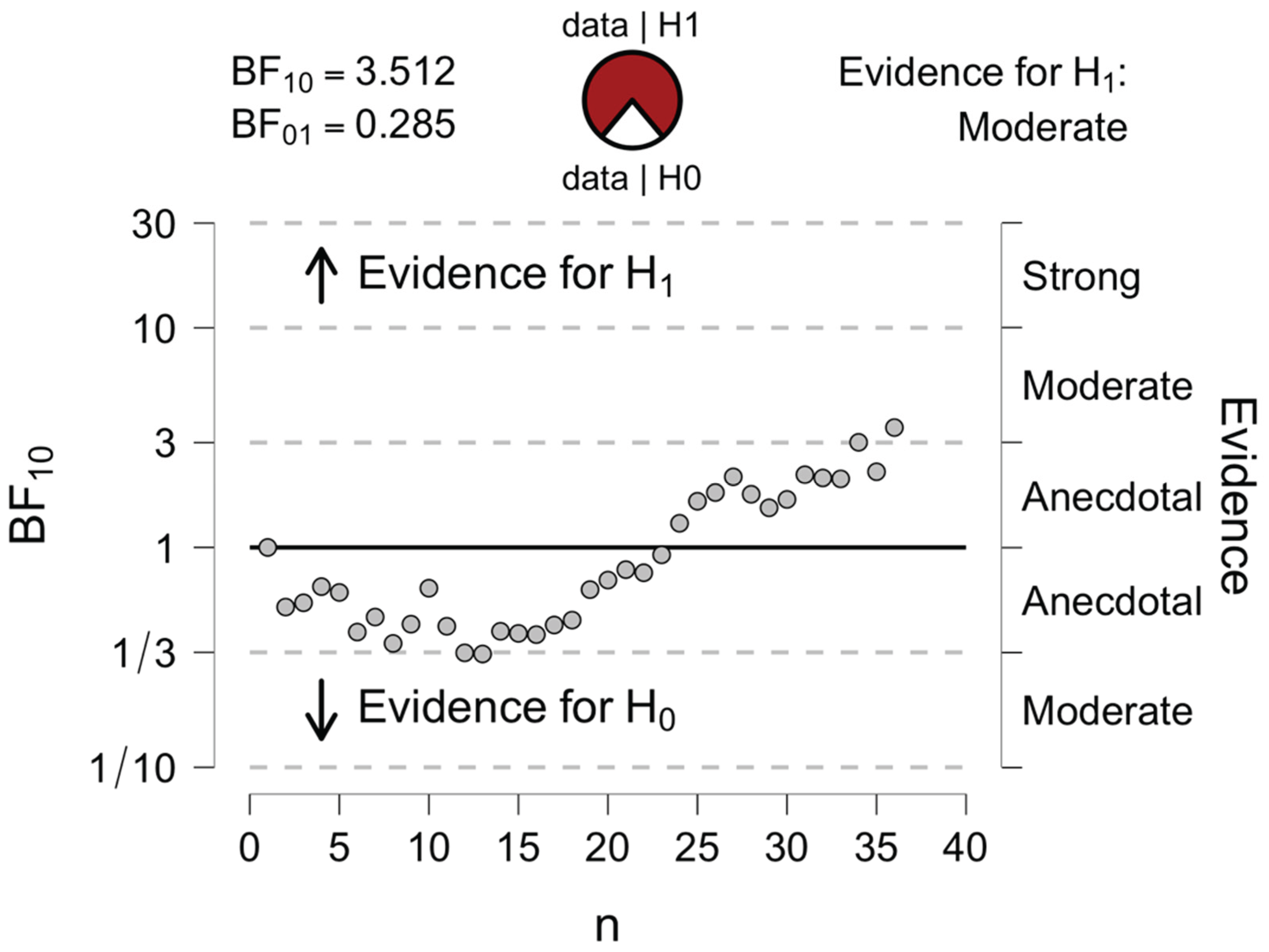

Table 1.
Developmental prosopagnosia scores on the neuropsychological testing battery (N=36).
| Measure | Mean | Std. Deviation | Minimum | Maximum |
| Age | 53 | 14.40 | 18 | 81 |
| CFMT | 33.11 | 4.86 | 24 | 43 |
| CFPT | 27.72 | 4.44 | 20.67 | 36.67 |
| FFT | 44.73 | 15.38 | 15.39 | 70 |
| PI20 | 80.44 | 7.44 | 61 | 92 |
| AQ | 18 | 6.97 | 4 | 31 |
*Note: CFMT – face memory, CFPT – face perception, FFT- famous face test, PI20 – prosopagnosia index, AQ – Autism Quotient.
Table 2.
IAT block design (from improved scoring algorithm [12]).
Table 2.
IAT block design (from improved scoring algorithm [12]).
| Block | No. of trials | Function | Item assigned to left key | Item assigned to right key |
| 1 | 20 | Practice | Jane images | Mary images |
| 2 | 20 | Practice | Extraverted words | Introverted words |
| 3 | 20 | Test | Jane images + extraverted words | Mary images + introverted words |
| 4 | 40 | Test | Jane images + extraverted words | Mary images + introverted words |
| 5 | 20 | Practice | Mary images | Jane images |
| 6 | 20 | Test | Mary images + extraverted words | Jane images + introverted words |
| 7 | 40 | Test | Mary images + extraverted words | Jane images + introverted words |
*Note: This table is an example of the congruent conditions of the IAT. Blocks 5,2,6,7 appear at the start in the incongruent conditions followed by blocks 1,3,4. This is an outline of the extraversion IAT block design.
Table 3.
IAT Scoring procedure.
| Step | Improved Algorithm | Present Study implementation |
| 1 | Use data from B3, B4, B6, & B7 | Use data from B3, B4, B6, & B7 |
| 2 | Eliminate trials with latencies > 10,000ms; eliminate subjects for whom more than 10% of trials have latency less than 300ms | Eliminate trials with latencies > 10,000ms; eliminate subjects for whom more than 10% of trials have latency less than 300ms |
| 3 | Use all trials | Use all trials |
| 4 | No extreme-value treatment (beyond Step 2) | No extreme-value treatment (beyond Step 2) |
| 5 | Compute mean of correct latencies for each block | Compute mean of correct latencies for each block |
| 6 | Compute one pooled SD for all trials in B3 & B6; another for B4 & B7 | Compute one pooled SD for all trials in B3 & B6; another for B4 & B7 |
| 7 | Replace each error latency with block mean (computed in Step 5) + 600 ms | Retain full latency from stimulus onset to corrected response (implicit error penalty) |
| 8 | No transformation | No transformation |
| 9 | Average the resulting values for each of the four blocks | Average the resulting values for each of the four blocks |
| 10 | Compute two differences: B6 - B3 and B7 - B4 | Compute two differences: B6 - B3 and B7 - B4 |
| 11 | Divide each difference by its associated pooled trials SD from Step 6 | Divide each difference by its associated pooled trials SD from Step 6 |
| 12 | Average the two quotients from Step 11 | Average the two quotients from Step 11 |
*Note. The present implementation differs from the reference algorithm only in the treatment of error trials.
Table 4.
Single Case Comparisons for IAT D using Crawford Approach.
| Participant | DP IAT D | Crawford t | p value | Percentile |
|---|---|---|---|---|
| 1 | 0.190 | 0.276 | 0.783 | 56.2 |
| 2 | 0.153 | 0.194 | 0.846 | 54.2 |
| 3 | 0.263 | 0.442 | 0.659 | 59.8 |
| 4 | 0.886 | 1.981 | 0.050 | 97.6 |
| 5 | -0.156 | -0.353 | 0.725 | 34.4 |
| 6 | -0.538 | -1.309 | 0.192 | 13.0 |
| 7 | 0.011 | -0.020 | 0.984 | 50.8 |
| 8 | -0.209 | -0.474 | 0.636 | 33.0 |
| 9 | 0.012 | -0.018 | 0.986 | 50.7 |
| 10 | 0.364 | 0.676 | 0.500 | 63.4 |
| 11 | 0.207 | 0.300 | 0.765 | 57.2 |
| 12 | -0.227 | -0.516 | 0.606 | 31.0 |
| 13 | -0.019 | -0.041 | 0.967 | 49.2 |
| 14 | 0.081 | -0.002 | 0.998 | 52.0 |
| 15 | 0.093 | -0.074 | 0.941 | 52.5 |
| 16 | -0.041 | -0.089 | 0.929 | 48.4 |
| 17 | -0.004 | -0.012 | 0.990 | 49.8 |
| 18 | 0.020 | -0.001 | 0.999 | 51.2 |
| 19 | 0.113 | -0.024 | 0.981 | 53.3 |
| 20 | 0.042 | -0.060 | 0.953 | 51.7 |
| 21 | 0.212 | 0.312 | 0.755 | 57.4 |
| 22 | -0.132 | -0.297 | 0.767 | 36.2 |
| 23 | -0.074 | -0.166 | 0.868 | 40.6 |
| 24 | 0.013 | -0.018 | 0.986 | 50.7 |
| 25 | -0.110 | -0.254 | 0.800 | 38.0 |
| 26 | 0.260 | 0.437 | 0.663 | 59.6 |
| 27 | 0.008 | -0.023 | 0.982 | 50.5 |
| 28 | -0.083 | -0.185 | 0.853 | 39.7 |
| 29 | 0.007 | -0.024 | 0.981 | 50.5 |
| 30 | -0.114 | -0.262 | 0.794 | 37.8 |
| 31 | 0.171 | 0.235 | 0.814 | 55.0 |
| 32 | 0.175 | 0.244 | 0.808 | 55.2 |
| 33 | -0.073 | -0.164 | 0.870 | 40.5 |
| 34 | 0.026 | -0.009 | 0.993 | 51.6 |
| 35 | 0.062 | -0.041 | 0.967 | 51.1 |
| 36 | 0.044 | -0.058 | 0.954 | 51.8 |
*Note. Modified t-tests computed using Crawford & Garthwaite [5] method. Significant values (p < .05) appear in bold. Percentiles reflect the expected rank of each score within the combined normative sample (N = 180, M = 0.082, SD = 0.405).
Disclaimer/Publisher’s Note: The statements, opinions and data contained in all publications are solely those of the individual author(s) and contributor(s) and not of MDPI and/or the editor(s). MDPI and/or the editor(s) disclaim responsibility for any injury to people or property resulting from any ideas, methods, instructions or products referred to in the content. |
© 2026 by the authors. Licensee MDPI, Basel, Switzerland. This article is an open access article distributed under the terms and conditions of the Creative Commons Attribution (CC BY) license.
Copyright: This open access article is published under a Creative Commons CC BY 4.0 license, which permit the free download, distribution, and reuse, provided that the author and preprint are cited in any reuse.