

Submitted:
24 April 2026
Posted:
27 April 2026
You are already at the latest version
Abstract
In classical mechanics, force is the physical entity mediating interactions between physical objects. Such objects consist of point masses, or appear as continuous bodies formed by a continuum of point masses. Force is defined as the sole entity capable of altering a point mass's state of motion (velocity) and is mathematically represented as a bound vector. However, this description of the physical world no longer holds at the atomic or subatomic level, where matter is discretized into quanta and interactions occur through the exchange of quanta of linear momentum and energy. While this dichotomy is currently accepted as the status quo, efforts to harmonize these frameworks into a more coherent formulation remain highly desirable. This paper investigates the extent to which interactions in classical mechanics can be reinterpreted as an exchange of linear momentum quanta. This investigation leads to a coherent reformulation of Newton’s laws, in which forces are treated as flow rates of these quanta. Therefore, classical mechanics admits a discretized description of the physical world even at the macroscopic level.
Keywords:
classical mechanics
; quantum mechanics
; force
; interaction
; momentum
1. Introduction
Force is the physical entity conceived to model the interaction between physical objects in classical mechanics. Its formal definition dates back to the 17th century. During that period, Galilei [1] first experimentally demonstrated that a free body, whose motion is not opposed by any resistance, maintains a constant velocity. Subsequently, Newton [2] enunciated the three laws of mechanics.
These laws, which refer to a point mass as the elementary physical object, identify the state of motion with the point mass's velocity (1st law), define force as the sole physical entity capable of changing this state of motion (2nd law), and model the interaction mechanism between two points as two equal, opposite, and aligned forces (3rd law). Consequently, force is mathematically modeled as a bound vector, as it must share the direction of the acceleration and be applied specifically to the point mass whose motion is being modified.
However, such a force model had the drawback of implying an instantaneous 'action at a distance' to explain interactions such as universal gravitation [2]. In the 19th century, Faraday [3,4], based on his experiments in magnetism, proposed that the interaction between two distant points could be interpreted as being locally mediated by lines of force, which constitute a physical state of the intervening space. Later, in the same century, Maxwell [5] formalized this insight, translating Faraday’s physical lines into a rigorous mathematical framework. In Maxwell’s equations, the interaction between two distant points is not direct but it is mediated by a vector field that acts locally and is a continuous entity permeating space. Moreover, the same equations show that disturbances in the electromagnetic field propagate at a finite speed (the speed of light). Therefore, at the end of the 19th century, the idea that the interaction between physical objects required a physical mediator (i.e., the field) was well established: the field locally exerts forces on objects and the field source is a physical property (i.e., the mass or the charge) of a physical object.
In the meantime, the development of calculus allowed Lagrange [6], at the end of the 18th century, and Hamilton [7,8], in the first half of the 19th century, to lay the foundations of Analytical Mechanics (AM). Such an approach reduces any mechanical system to a point in a multidimensional space (the configuration space in Lagrange’s formulation; the phase space in Hamilton’s formulation), which is specific to the studied mechanical system. In this context, the motion of the system is the trajectory of the point that represents it, and the actual motion of the system is the trajectory that makes a functional, called the action, stationary. In this global approach, the interaction among parts of the mechanical system is directly obtained from the analytical model of the constraints without using the concept of force.
Although the fundamental building blocks of Classical Mechanics (CM), in both Newtonian and analytical formulations, are point masses, these represent merely a conceptual step toward modeling continuous bodies or systems of bodies. Therefore, physical reality, as modeled in CM, consists of rigid or deformable continua combined into mechanical systems.
In the early 20th century, however, experimental evidence showed that this model, which is in agreement with common sense and correctly describes the behavior of macroscopic systems, was inapplicable to microscopic systems at the atomic scale, where a discretized world made of quanta [9,10,11] emerged. Modeling this discretized world required new ideas [12] and new mathematical formulations [13,14,15,16,17,18] that laid the foundations of Quantum Mechanics (QM).
In QM, particles are the building blocks of physical reality; however, they do not possess a precise location in space. Instead, they are described by a complex wave function distributed in space, whose squared absolute value represents the probability density of their location. Furthermore, their observables (e.g., energy, linear and angular momenta) can assume only discrete values, corresponding to the eigenvalues of suitable operators.
The early developments of QM [13,14,15,16,17,18] focused primarily on the interaction between particles, with the main effort devoted to correctly predicting atomic spectra; significantly, the generation or destruction of particles was not modeled. Subsequently, QM was extended to include the interaction between particles and radiation [19,20], thus paving the way for Quantum Electrodynamics (QED) [21,22,23,24,25,26,27,28] and Quantum Field Theory (QFT) [29]. In these frameworks, fields constitute the building blocks of physical reality: particles are understood merely as quanta arising from field quantization, and interactions are mediated by the exchange of specific types of particles (bosons). In the latter half of the 20th century, QFT served as the framework for developing the Standard Model (SM) of elementary particles [30,31,32,33,34,35,36,37,38,39,40]. Although SM does not justify everything, it is the currently accepted framework for interpreting phenomena at the subatomic scale.
In summary, at the macroscopic scale, which is successfully described by CM, interaction between physical objects is mediated by forces. These forces are modeled as bound vectors and are physical entities distinct from the interacting objects themselves. Conversely, at the microscopic (atomic or subatomic) scale, which is successfully governed by QM, the same interaction is mediated by the exchange of specific quanta (bosons). Unlike classical forces, these bosons possess the same physical nature as the objects they cause to interact. While this dichotomy is currently accepted as the status quo, efforts to harmonize these two interaction models remain highly desirable.
This paper investigates the extent to which interactions in CM can be reinterpreted as an exchange of linear momentum quanta. Starting from a reformulation of Newton’s third law (which describes interaction in CM) in terms of quanta exchange, a coherent analysis of the implications leads to interpreting CM forces as flow rates of these quanta. The result is a unified framework that reformulates Newton’s laws from a novel perspective, thereby demonstrating that CM admits a discretized description of the physical world even at the macroscopic level.
2. Materials and Methods
In CM, the point mass (with constant rest mass) serves as the fundamental building block of physical reality, and its state of motion is characterized by its velocity. Furthermore, linear momentum (the product of mass and velocity) is the mechanical quantity that best combines the physical property of the point (its mass) with its state of motion (its velocity). This concept is formally established through the following postulate, which encompasses Newton’s first law:
Postulate 1 (Law of Inertia): The state of motion of a point mass is defined by its linear momentum. An isolated (i.e., non-interacting) point maintains its linear momentum unchanged.
An interaction between point masses, depicted as an exchange of quanta that preserves the rest mass of the points, must involve carriers that are linear momentum quanta with zero rest mass. It is worth noting that, in a vacuum, a massless carrier possessing finite linear momentum must travel at the speed of light, as dictated by special relativity [41]. For the sake of brevity, this linear momentum quantum exchanged during interactions will be referred to as the moton, a term derived from the Latin word “motus” (meaning 'motion' or 'movement').
In the context of this purely classical framework, the term 'quantum' is used in its most fundamental sense: a discrete, indivisible amount of a physical entity (specifically, linear momentum) exchanged during an interaction. Unlike in Quantum Mechanics (QM), where quantization often emerges from eigenvalue problems matching specific boundary conditions, the quantization in this classical model refers simply to the granular nature of the exchanged momentum carriers.
It should be noted that the 'discretization' proposed in this framework refers to the granular nature of the momentum transfer mechanism (the carriers), rather than a restriction on the macroscopic momentum states of objects, which remain continuous. Because classical force is defined as the rate of change of linear momentum, any discrete mediator of such a force must inherently act as a discrete carrier of linear momentum.
If the interaction between point masses is mediated by the exchange of motons, point masses must act as emitters (sources), receivers (sinks), or passive objects traversed by motons generated elsewhere. Consequently, Newton’s third law must be reformulated as follows:
Postulate 2 (Law of Action and Reaction): Two point masses interact with each other by exchanging an equal number of motons propagating in opposite directions along the line connecting the two points.
In this context, the reinterpretation of Newton’s second law implies the following two further postulates
Postulate 3 (Law of Emission): A point mass that accelerates (i.e., that changes its state of motion) generates (emits) a flow of motons that corresponds to an exiting flow rate of linear momentum with direction opposite to its acceleration and magnitude equal to the product of its mass and its acceleration.
Postulate 4 (Law of Balance): An interacting (i.e., non-isolated) point mass must release (emit) a flow of motons that balances the flow of motons it receives (absorbs) from the external world. Specifically, the net exchange of linear momentum between the point and the external world is always zero.
It is important to emphasize that Postulate 3 implies that a change in the state of motion causes the point mass to generate new motons, whereas Postulate 4 states that an interaction causes the point mass to release motons to the exterior. Consequently, the motons released during an interaction can be either generated by a change in the state of motion or simply be those received (absorbed) from other simultaneous interactions. Thus, a physical object undergoing multiple interactions maintains its state of motion unchanged when the net flow rate of linear momentum it receives is balanced (i.e., when external actions satisfy equilibrium conditions). Moreover, since a flow rate of linear momentum acts as a bound vector, the equilibrium of a system of such flows implies both a zero linear momentum resultant and a zero angular momentum resultant.
Moreover, the proposed postulates depict a physical world where interactions between point masses occur with zero net exchange of linear momentum (Postulate 4) and the generation of new motons from a point mass compensates for its change in linear momentum (Postulate 3). This picture naturally leads to the conclusion that the Universe must maintain its total linear and angular momenta constant in any inertial reference, and equal to zero in its Center of Momentum Frame (CMF). Such a conclusion is in accordance with independent theoretical arguments based on cosmological symmetries (homogeneity and isotropy) [41,42,43] as well as experimental data from the Cosmic Microwave Background (CMB) [44,45,46].
Because the postulates introduced in this section serve as an alternative, mathematically equivalent enunciation of Newton’s laws, all continuous space-time symmetries inherent to Classical Mechanics (e.g., spatial translation and rotation) are strictly preserved. Consequently, by virtue of Noether’s theorem, the associated conserved quantities—such as angular momentum and energy—maintain their standard validity within this framework. Furthermore, the absolute conservation of linear momentum is not merely a derived consequence, but is explicitly embedded as the foundational postulate governing the moton exchange. It must be emphasized that the conservation laws derived from Noether’s theorem apply to the total closed system consisting of both the macroscopic point masses and the intervening moton fluid. In this way, the momentum 'in transit' within the moton flux ensures that the total momentum of the system remains invariant, even when accounting for the finite propagation speed.
2.1. Relationship Between Newton’s Force and the Flow Rate of Motons
In CM, the instantaneous rate of change of a point mass's linear momentum is caused by a force and is equal to that force (Newton’s second law). Consequently, in the new framework, a force applied to a point mass corresponds to the flow rate of motons that the point mass receives (absorbs) from the external world (see Postulates 3 and 4). In the remaining part of this section, this correspondence is analytically expressed.
The following definitions and notations are introduced:
- moton’s velocity ( and u are the velocity’s magnitude and its direction’s unit vector, respectively);
- moton’s linear momentum ( is linear momentum’s magnitude);
- moton’s relativistic mass;
- moton’s De Broglie wavelength ( h is the Planck constant);
- density of motons;
- effective (absorption/emission) cross section [47] of the point mass;
- current density of linear momentum due to motons;
- flow rate of motons received (absorbed) by the point mass;
- force applied to the point mass in Newton’s framework.
It must be emphasized that a moton does not act as a massive carrier possessing an independent proper momentum distinct from the momentum it transports. Because it possesses zero rest mass and travels at the speed of light, the moton's proper momentum coincides exactly with the discrete quantum of linear momentum (pm) it represents; it is essentially pure momentum in transit.
With these notations, the compatibility between Newton’s framework and the new framework implies that the following relationships hold:
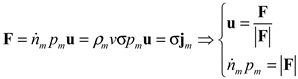
Moreover, let a and m be the point mass acceleration and its mass, respectively. The inertia force, , of the point mass and Postulate 3 together with Eq. (1) lead to the following relationship:
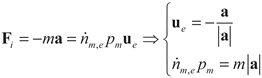 where and are the direction’s unit vector and the flow rate of the emitted motons, respectively.
Finally, the correctness of the proposed framework is proved by the fact that Postulate 4 leads to the following balance of linear momentum’s flow rates
 which, after the introduction of Formulas (1) and (2), becomes equivalent to Newton’s law of motion (i.e., ).
It is worth stressing that, in the context of a force field, Eq. (1) requires the lines of force to be tangent to the local velocities of the motons. This implies that these lines can be interpreted as the streamlines (or flux lines) of a vector field describing the motion of a fluid composed of motons.
3. Results
In this section, the effectiveness of the reformulation proposed above is tested by using it to reinterpret Newton’s law of universal gravitation and Coulomb’s law of electrostatics.
3.1. Gravitational Force
The equivalence principle [41] states that gravitational mass and relativistic (inertial) mass are the same mechanical property of a physical object. Moreover, the gravitational force is proportional to the masses of the two interacting point masses. Specifically, let mi and mj denote the masses of two point masses located at point Pi and Pj, respectively. The law of universal gravitation is:
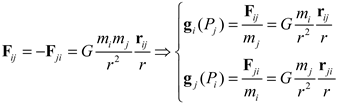 where G is the gravitational constant (6.674×10⁻¹¹ m3⋅kg−1⋅s−2), () is the force exerted by point Pi (Pj) on point Pj (Pi), () is the gravitational field strength (gravitational acceleration) caused by mi (by mj) at Pj (at Pi), , and .
If interactions are mediated by motons, the gravitational interaction is possible only if a point mass acts simultaneously as an emitter (source) and a receiver (sink) of motons, structured such that emitted motons propagate into the external world, whereas received motons originate from it. Moreover, the fact that the gravitational acceleration (Eq. (4)) is proportional to mass, radial, and tangent to the streamlines of the moton fluid leads to the conclusion that the emission rate (i.e., the number of motons emitted per unit of time) of the point mass must be proportional to the mass. Therefore, the following relationships must hold:

 where () and () are the emission rate of mi (of mj) and the corresponding current density of linear momentum it generates at Pj (at Pi), respectively; whereas kg is a proportionality coefficient that relates the mass to the emission rate.
The mass mj (mi), which is located at Pj (at Pi), also acts as a receiver (sink) with an absorption rate proportional to its mass via a coefficient that must be the absorption cross-section per unit of mass, σa. Therefore, if fj and fi denote the absorbed flow rates of linear momentum at Pj and at Pi, respectively, the following relationships must hold (see Eqs. (1) and (5)):
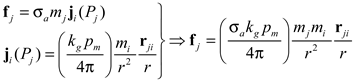
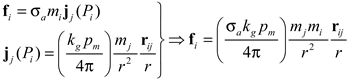
An isolated point mass produces an isotropic emission of linear momentum that yields a null thrust on the point (i.e., does not change its state of motion). Thus, during interaction, the presence of fj and fi, which are absorbed by mj and mi, respectively, cancels the static effects of equal and opposite resultants of linear momentum due to the emission of those point masses. These cancelations generate the following non-null thrusts, Tj exerted on mj and Ti exerted on mi:
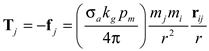
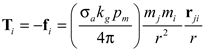
The comparison of Eq. (7) with Eq. (4) reveals that Tj and Ti are coincident with Fij and Fji, respectively, if the following condition is imposed on the constants appearing in the formulas:
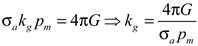
This result leads to the conclusion that the law of universal gravitation can be reinterpreted as an interaction mediated by the exchange of particles even in CM. Also, it is worth stressing that, in the new framework, the presence of a fluid of motons, which replaces the gravitational field, opens up the possibility of modeling waves (i.e., gravitational waves) propagating inside that fluid even in CM.
It is important to emphasize that the proposed framework strictly satisfies the weak Equivalence Principle (EP). Indeed, within this model, the capacity of a point mass to emit or absorb motons is proportional to its mass, inherently guaranteeing that gravitational mass and inertial mass are manifestations of the exact same mechanical property. Because the scope of this paper is strictly confined to CM, potential violations of the EP in the context of quantum gravity fall outside the present domain of applicability.
3.2. Electrostatic Force
Coulomb’s law of electrostatics defines the electrostatic force in the interaction between two point charges. Specifically, let qi and qj denote the electric charges of two point charges located at points Pi and Pj, respectively. This law states that:
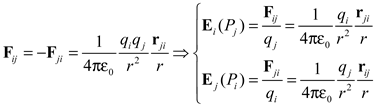 where is the vacuum permittivity (8.854×10⁻¹² C2⋅J−1⋅m−1; also known as electric constant), () is the force exerted by point Pi (Pj) on point Pj (Pi), () is the electric field caused by qi (by qj) at Pj (at Pi), , and .
If interactions are mediated by motons, the electrostatic interaction is possible only if a point charge acts as an emitter (source) of motons that simultaneously functions as a receiver (sink) of motons originating from charges of opposite signs, and as a reflector (mirror) of motons originating from charges of like signs. Moreover, the fact that the electric field (Eq. (9)) is proportional to charge, radial, and tangent to the streamlines of the moton fluid implies that the emission rate of the point charge must be proportional to the absolute value of the charge. Therefore, the following relationships must hold:

 where () and () are the emission rate of qi (of qj) and the corresponding current density of linear momentum it generates at Pj (at Pi), respectively; whereas kq is a proportionality coefficient relating the charge to the emission rate.
The charge qj (qi), which is located at Pj (at Pi), also acts as a receiver (sink) or reflector (mirror) with an absorption/reflection rate proportional to the absolute value of its charge via a coefficient, σq, representing the absorption/reflection cross-section per unit of charge. Therefore, if fj and fi denote the absorbed/reflected flow rates of linear momentum at Pj and at Pi, respectively, the following relationships must hold (see Eqs. (1) and (9)):
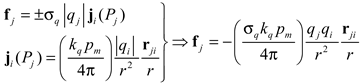
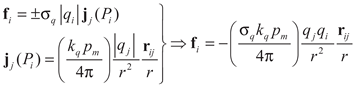 Here, the double sign ± resolves the absolute value |⋅| on the charges, ensuring the correct sign for the product qjqi.
An isolated point charge produces an isotropic emission of linear momentum that yields a null thrust on the point (i.e., does not change its state of motion). Thus, during interaction, the presence of fj and fi (which are absorbed or reflected by qj and qi, respectively) cancels the static effects of equal and opposite resultants of linear momentum due to the emission of those point charges. These cancelations generate the following non-null thrusts, Tj exerted on qj and Ti exerted on qi:
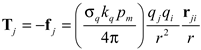
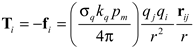
Comparing Eq. (12) with Eq. (9) reveals that Tj and Ti coincide with Fij and Fji, respectively, if the following condition is imposed on the constants appearing in the formulas:
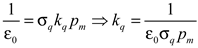
This result leads to the conclusion that the Coulomb’s law of electrostatics can be reinterpreted as an interaction mediated by the exchange of particles even in CM.
4. Discussion
The results obtained from applying the proposed framework demonstrate that an interaction model based on the exchange of linear momentum quanta naturally leads to the derivation of the inverse square laws of universal gravitation and electrostatics from geometric flux conservation in 3D space (see Eqs. (5) and (10)).
Furthermore, motons bear a strong resemblance to virtual photons, which are the exchange particles in QED, and to gravitons, the hypothetical exchange particles of the gravitational interaction in the SM. Indeed, like photons and gravitons, motons possess zero rest mass and must travel at the speed of light in a vacuum to possess finite linear momentum [41]. Consequently, the proposed framework exhibits congruence with both Classical Mechanics (CM) and Quantum Mechanics (QM).
Moreover, this framework offers a justification for why the gravitational interaction is significantly weaker than the electrostatic interaction. Specifically, it allows one to interpret the motons emitted by an electrically neutral point mass as a 'leakage' of flux from a structure composed of two equal and opposite point charges located at the same point. To fully realize the mechanical interaction between macroscopic charges, the model requires that motons possess a binary physical quality allowing the receiving point charge to kinematically distinguish the sign of the emitting source. In the context of relativistic classical mechanics and classical field theory, a massless carrier can possess classical intrinsic angular momentum (analogous to the circular polarization of a classical wave). The projection of this classical intrinsic angular momentum onto the carrier's linear momentum vector defines a classical helicity. Because classical helicity naturally permits exactly two states (right-handed and left-handed), it serves as the ideal kinematic mechanism to distinguish the motons. By postulating that positive and negative charges emit motons of opposite classical helicity, a macroscopic receiver can mechanically 'recognize' the incoming continuous flux and trigger the appropriate macroscopic kinematic response (absorption or reflection). Furthermore, establishing this specific binary distinction robustly supports the hypothesis that electrically neutral macroscopic masses behave fundamentally as perfectly overlapping, equal-and-opposite point charges. Such a neutral composite releases a balanced 'leakage' flux containing equal proportions of both moton helicities. In the classical fluid-dynamic analogy, this configuration acts strictly as a combined sink-source couple, which naturally produces the weak, purely attractive 1/r2 macroscopic force we identify as universal gravitation.
Since Coulomb’s law does not cover all aspects of electromagnetism, it is necessary to examine how these results, when combined with Maxwell’s equations, depict electromagnetic phenomena within this new framework. The remainder of this section is devoted to this discussion.
By using the SI units, Maxwell’s equations in a vacuum are (V is any volume with a closed boundary surface ∂V; S is any surface with a closed boundary curve ∂S):
i) Gauss’s Law:
 ii) Faraday’s Law of Induction:
 iii) Gauss’s Law for Magnetism:
 iv) Ampère-Maxwell Law:
 where E is the electric field, B is the magnetic field, ρq is the charge density, jq is the current density of charges, and μ0 is the vacuum magnetic permeability (≈4π×10−7 N A−1).
Introducing expression (13) into Eq. (10) yields:
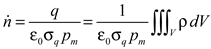 where the absolute value of the charge (Eq. (10)) has been eliminated by associating the minus sign to the emission rate of a negative charge.
Equation (18) and Gauss’s law (Eq. (14)) lead to the following relationships between the moton fluid’s parameters and the electric field:
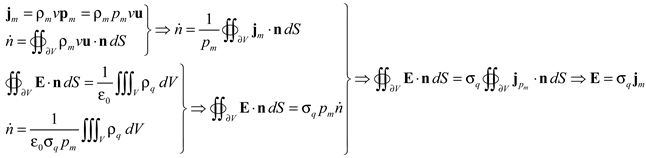
Equation (19) provides a theoretical basis for interpreting the flux lines of an electric field as streamlines of the associated moton fluid. In addition, introducing the definition of jm (i.e., ) into Eq. (19) put it into the form , which states a direct proportionality between E and vpm that is also found in QFT.
Equation (19) and Faraday’s Law of Induction (Eq. (15)) yield the following relationships (where ωm is the vorticity of the current-density field):
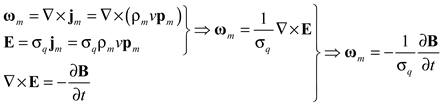 which relates the magnetic field to the vorticity of the moton fluid.
Equation (20) and Gauss’s Law for Magnetism (Eq. (16)) lead to the following relationship:
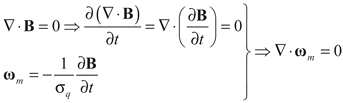
Since the vorticity vector field is, by definition, a solenoidal vector field, Eq. (21) shows that Gauss’s Law of Magnetism is a logical consequence of the fact that the magnetic field is related to the vorticity of a vector field. This confirms that the underlying reality of an electromagnetic field is the description of the instantaneous motion of quanta.
Equations (19)–(21) and Ampère-Maxwell Law (Eq. (17)) allow for the deduction of the following relationship:
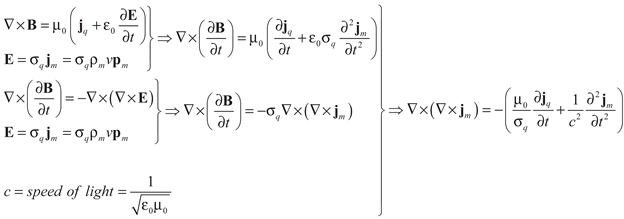 which can be further elaborated as follows:

Equation (23) is the equation of motion for the moton fluid. It relates the moton sources (i.e., and ) to the motion parameters of the moton fluid (i.e., ). The analysis of Eq. (23) leads to the conclusion that moton waves propagate at the speed of light (see the right-hand side of Eq. (23)) in free space.
It is crucial to distinguish the moton fluid from the historical concept of the 'luminiferous ether.' The old ether was postulated as an absolute, independent background medium filling space. Conversely, the moton fluid proposed here is entirely relational; it is directly and exclusively generated by the emitters and receivers (i.e., mass and charge). It exists if and only if interacting matter is present. Thus, macroscopic measurements of classical vector fields (or their corresponding waves) are reinterpreted here as direct macroscopic measurements of this underlying, source-generated discrete flux.
In short, within this framework, a point mass (or charge) cannot be considered in isolation from the moton fluid it emits and absorbs. Together, they constitute a single, extended physical object. This provides a purely classical, ontological analog to the wave function in Quantum Mechanics—replacing the concept of a discrete 'point' with a continuous structure that fills space and mediates interactions.
To fully contextualize this framework within modern physics, it is necessary to formally map the transition from the discrete exchange of motons to the emergence of a continuous classical force field. Conceptually, this transition is governed by the classical fluid limit, where a sufficiently high flux density of discrete momentum carriers (motons) converges to a continuous force vector. This process is the classical mechanical analog of the correspondence principle seen in quantum phase-space formalisms, such as the Wigner quasiprobability distribution [48]. In this high-density limit (N → ∞), the statistical expectation value of the discrete momentum impulses recovers the continuous macroscopic force, rendering the discrete-to-continuous transition mathematically robust via the Law of Large Numbers. This transition is physically analogous to the Sudarshan-Glauber representation in quantum optics [49,50] (which has been extensively validated in the domain of charged particle beam optics [51]), where the discrete nature of massless photons disappears into a continuous classical wave. By treating the moton flux as a classical fluid, the model bridges the gap between granular exchange and continuous field theory without departing from the deterministic framework of classical physics.
5. Conclusions
The extent to which interactions in classical mechanics can be reinterpreted as an exchange of linear momentum quanta has been investigated. Specifically, Newton’s laws have been reformulated to define physical interaction as an exchange of linear momentum quanta, termed 'motons.'
This new framework was tested by applying it to Newton’s law of universal gravitation and Coulomb’s law of electrostatics. In this context, the reinterpretation of the universal gravitation law naturally led to modeling an electrically neutral point mass as a simultaneous emitter and receiver of motons. Conversely, the reinterpretation of the law of electrostatics implied modeling a point charge as a simultaneous emitter, receiver, and reflector of motons; specifically, a structure that absorbs motons emitted by opposite charges and reflects those emitted by like charges.
These models enabled the correct prediction of both attractive and repulsive interactions and established the relationships between the constant parameters appearing in the new and old frameworks. Moreover, they offer a justification for why the gravitational interaction is significantly weaker than the electrostatic interaction, as the motons emitted by an electrically neutral point mass can be interpreted as a 'leakage' of flux from a structure composed of two equal and opposite point charges located at the same point.
Finally, introducing the relationships established between the two frameworks into Maxwell’s equations allowed for the deduction of the equation of motion for the moton fluid, demonstrating that moton waves propagate at the speed of light in free space. Furthermore, the derived formulas bear a striking resemblance to those found in quantum mechanics.
Collectively, these results demonstrate that classical mechanics admits a discretized description of the physical world—even at the macroscopic level—that is congruent with the description provided by quantum mechanics.
Funding
This research received no external funding.
Data Availability Statement
No new data were created or analyzed in this study. Data sharing is not applicable to this article.
Acknowledgments
During the preparation of this manuscript, the author used Google Gemini for the purposes of checking the English style, finding relevant literature pertaining to the addressed subject, and checking the coherence and the novelty of the proposed formulation. The author has reviewed and edited the output and takes full responsibility for the content of this publication.
Conflicts of Interest
The author declares no conflicts of interest.
Abbreviations
The following abbreviations are used in this manuscript:
| AM | Analytical mechanics |
| CM | Classical mechanics |
| QM | Quantum mechanics |
| QED | Quantum electrodynamics |
| QFT | Quantum field theory |
| SM | Standard model |
| CMF | Center of momentum frame |
| CMB | Cosmic Microwave Background |
References
- Galilei, G. Discorsi e dimostrazioni matematiche intorno a due nuove scienze; Elsevirii: Leiden, Netherlands, 1638. [Google Scholar]
- Newton, I. Philosophiæ Naturalis Principia Mathematica; Royal Society Press: London, England, 1686. [Google Scholar]
- Faraday, M. L.I.V. Thoughts on Ray-Vibrations. Lond. Edinb. Dublin Philos. Mag. J. Sci. 1846, 28(188), 345–50. [Google Scholar] [CrossRef]
- Faraday, M. On the Physical Character of the Lines of Magnetic Force. Lond. Edinb. Dublin Philos. Mag. J. Sci. 1852, 3(20), 401–28. [Google Scholar] [CrossRef]
- Maxwell, J.C., VIII. A dynamical theory of the electromagnetic field. Phil. Trans. R. Soc. 1865, 155, 459–512. [Google Scholar] [CrossRef]
- Lagrange, J.-L. Mécanique analytique; Veuve Desaint: Paris, France, 1788. [Google Scholar]
- Hamilton, W. R. XV. On a general method in dynamics; by which the study of the motions of all free systems of attracting or repelling points is reduced to the search and differentiation of one central relation, or characteristic function. Phil. Trans. R. Soc. 1834, 124, 247–308. [Google Scholar] [CrossRef]
- Hamilton, W. R., VII. Second essay on a general method in dynamics. Phil. Trans. R. Soc. 1835, 125, 95–144. [Google Scholar] [CrossRef]
- Boltzmann, L. Theorie der Gase mit einatomigen Molekülen, deren Dimensionen gegen die mittlere Weglänge verschwinden; J. A. Barth: Leipzig, Germany, 1896. [Google Scholar]
- Planck, M. Ueber das Gesetz der Energieverteilung im Normalspectrum. Ann. Der Phys. 1901, 309(3), 553–563. [Google Scholar] [CrossRef]
- Einstein, A. Über einen die Erzeugung und Verwandlung des Lichtes betreffenden heuristischen Gesichtspunkt. Ann. Der Phys. 1905, 322(6), 132–148. [Google Scholar] [CrossRef]
- Bohr, N.I. On the constitution of atoms and molecules. Lond. Edinb. Dublin Philos. Mag. J. Sci. 1913, 26(151), 1–25. [Google Scholar] [CrossRef]
- Heisenberg, W. Über quantentheoretische Umdeutung kinematischer und mechanischer Beziehungen. Z. Phys. 1925, 33, 879–893. [Google Scholar] [CrossRef]
- Born, M.; Jordan, P. Zur Quantenmechanik. Z. Phys. 1925, 34, 858–888. [Google Scholar] [CrossRef]
- Schrödinger, E. Quantisierung als Eigenwertproblem. Ann. Der Phys. 1926, 384(4), 361–376. [Google Scholar] [CrossRef]
- Born, M. Quantenmechanik der Stoßvorgänge. Z. Phys. 1926, 38, 803–827. [Google Scholar] [CrossRef]
- Heisenberg, W. Über den anschaulichen Inhalt der quantentheoretischen Kinematik und Mechanik. Z. Phys. 1927, 43, 172–198. [Google Scholar] [CrossRef]
- Dirac, P. A. M. The quantum theory of the electron. R. Soc. Proc. A 1928, 117(778), 610–624. [Google Scholar] [CrossRef]
- Dirac, P. A. M. The quantum theory of the emission and absorption of radiation. R. Soc. Proc. A 1927, 114(767), 243–265. [Google Scholar] [CrossRef]
- Yukawa, H. On the Interaction of Elementary Particles. I. Proc. Phys. Math. Soc. Jap. 3rd Ser.> 1935, 17, 48–57. [Google Scholar] [CrossRef]
- Tomonaga, S. On a Relativistically Invariant Formulation of the Quantum Theory of Wave Fields. Prog. Theor. Phys. 1946, 1(2), 27–42. [Google Scholar] [CrossRef]
- Schwinger, J. On Quantum-Electrodynamics and the Magnetic Moment of the Electron. Phys. Rev. 1948, 73(4), 416–417. [Google Scholar] [CrossRef]
- Schwinger, J. Quantum Electrodynamics. I. A Covariant Formulation. Phys. Rev. 1948, 74(10), 1439–1461. [Google Scholar] [CrossRef]
- Feynman, R. P. Space-Time Approach to Quantum Electrodynamics. Phys. Rev. 1949, 76(6), 769–789. [Google Scholar] [CrossRef]
- Feynman, R. P. The Theory of Positrons. Phys. Rev. 1949, 76(6), 749–759. [Google Scholar] [CrossRef]
- Dyson, F. J. The Radiation Theories of Tomonaga, Schwinger, and Feynman. Phys. Rev. 1949, 75(3), 486–502. [Google Scholar] [CrossRef]
- Dyson, F. J. The S Matrix in Quantum Electrodynamics. Phys. Rev. 1949, 75(11), 1736–1755. [Google Scholar] [CrossRef]
- Feynman, R. P. Mathematical Formulation of the Quantum Theory of Electromagnetic Interaction. Phys. Rev. 1950, 80(3), 440--457. [Google Scholar] [CrossRef]
- Weinberg, S. The Quantum Theory of Fields; CUP: New York, USA, 1995. [Google Scholar]
- Yang, C. N.; Mills, R. L. Conservation of Isotopic Spin and Isotopic Gauge Invariance. Phys. Rev. 1954, 96(1), 191–195. [Google Scholar] [CrossRef]
- Glashow, S. L. Partial-symmetries of weak interactions. Nucl. Phys. 1961, 22(4), 579–588. [Google Scholar] [CrossRef]
- Higgs, P. W. Broken Symmetries and the Masses of Gauge Bosons. Phys. Rev. Lett. 1964, 13(16), 508–509. [Google Scholar] [CrossRef]
- Englert, F.; Brout, R. Broken Symmetry and the Mass of Gauge Vector Mesons. Phys. Rev. Lett. 1964, 13(9), 321–323. [Google Scholar] [CrossRef]
- Weinberg, S. A Model of Leptons. Phys. Rev. Lett. 1967, 19(21), 1264–1266. [Google Scholar] [CrossRef]
- Salam, A. Weak and Electromagnetic Interactions. In Elementary Particle Theory: Relativistic Groups and Analyticity (Proceedings of the Eighth Nobel Symposium); Svartholm, N., Ed.; Almqvist & Wiksell: Stockholm, Sweden, 1968; pp. 367–377. [Google Scholar]
- 't Hooft, G.; Veltman, M. Regularization and renormalization of gauge fields. Nucl. Phys. B 1972, 44(1), 189–213. [Google Scholar] [CrossRef]
- Gross, D. J.; Wilczek, F. Ultraviolet Behavior of Non-Abelian Gauge Theories. Phys. Rev. Lett. 1973, 30(26), 1343–1346. [Google Scholar] [CrossRef]
- Politzer, H. D. Reliable Perturbative Results for Strong Interactions. Phys. Rev. Lett. 1973, 30(26), 1346–1349. [Google Scholar] [CrossRef]
- Fritzsch, H.; Gell-Mann, M.; Leutwyler, H. Advantages of the Color Octet Gluon Picture. Phys. Lett. B 1973, 47(4), 365–368. [Google Scholar] [CrossRef]
- Schwartz, M. D. Quantum Field Theory and the Standard Model; CUP: New York, USA, 2014. [Google Scholar]
- Landau, L. D.; Lifshitz, E. M. The Classical Theory of Fields (Course of Theoretical Physics; Pergamon Press: Oxford, UK, 1975; Vol. 2, ISBN 978-0-08-018176-9. [Google Scholar]
- Peebles, P. J. E. Principles of Physical Cosmology ISBN; PUP: Princeton, USA, 1993. [Google Scholar]
- Liddle, A. An Introduction to Modern Cosmology; John Wiley & Sons: Chichester, UK, 2015; ISBN 9781118502099. [Google Scholar]
- Barrow, J. D.; Juszkiewicz, R.; Sonoda, D. H. Universal rotation: how large can it be? Mon. Not. R. Astron. Soc. 1985, 213(4), 917–943. [Google Scholar] [CrossRef]
- Barrow, J. D.; Liddle, A. R. Perturbation spectra from intermediate inflation. Phys. Rev. D. 1993, 47(12), R5219–R5223. [Google Scholar] [CrossRef] [PubMed]
- Planck Collaboration. Planck 2015 results. XIII. Cosmological parameters. Astron. Astrophys. 2016, 594, A13. [Google Scholar] [CrossRef]
- Enge, H. A. Introduction to Nuclear Physics; Addison-Wesley: London, UK, 1966; ISBN 9780201018707. [Google Scholar]
- Wigner, E. On the Quantum Correction for Thermodynamic Equilibrium. Phys. Rev. 1932, 40(5), 749–759. [Google Scholar] [CrossRef]
- Sudarshan, E. C. G. Equivalence of Semiclassical and Quantum Mechanical Descriptions of Statistical Light Beams. Phys. Rev. Lett. 1963, 10(7), 277–279. [Google Scholar] [CrossRef]
- Glauber, R. J. Coherent and Incoherent States of the Radiation Field. Phys. Rev. 1963, 131(6), 2766–2788. [Google Scholar] [CrossRef]
- Jagannathan, R.; Khan, S.A. Quantum Theory of the Optics of Charged Particles. Adv. Imaging Electron Phys. 1996, 97, 257–358. [Google Scholar] [CrossRef]
Disclaimer/Publisher’s Note: The statements, opinions and data contained in all publications are solely those of the individual author(s) and contributor(s) and not of MDPI and/or the editor(s). MDPI and/or the editor(s) disclaim responsibility for any injury to people or property resulting from any ideas, methods, instructions or products referred to in the content. |
© 2026 by the authors. Licensee MDPI, Basel, Switzerland. This article is an open access article distributed under the terms and conditions of the Creative Commons Attribution (CC BY) license (http://creativecommons.org/licenses/by/4.0/).
Copyright: This open access article is published under a Creative Commons CC BY 4.0 license, which permit the free download, distribution, and reuse, provided that the author and preprint are cited in any reuse.


