

Submitted:
31 January 2026
Posted:
03 February 2026
You are already at the latest version
Abstract
Over the past two decades, Ethiopia has established an extensive environmental policy framework; however, substantial gaps persist between formal policy commitments and on-the-ground environmental outcomes. This study systematically reviews 264 empirical studies to examine how institutional, political, and capacity constraints, both independently and in interaction, shape environmental policy implementation across federal, regional, and local governance levels. The reviewed studies consistently identify fragmented institutional mandates, weak inter-agency coordination, and limited regulatory enforcement as key institutional barriers, alongside political constraints such as competing development priorities and policy inconsistency, and capacity-related limitations including shortages of technical expertise, financial resources, and reliable environmental data. These constraints interact to structurally block iterative learning, feedback integration, and responsive decision-making. To address these gaps, reforms should realign political incentives, strengthen institutional coordination, and build sustained technical and human capacity to support evidence-based, adaptive environmental management.
Keywords:
environmental policy
; implementation gaps
; institutional constraints
; political constraints
; capacity constraints
; adaptive environmental management
; Ethiopia
Introduction
Ethiopia’s environmental governance has evolved through a series of policies, strategies, and legal frameworks aimed at mitigating land degradation, biodiversity loss, deforestation, and climate-related vulnerability (Federal Democratic Republic of Ethiopia, 2011). These include environmental impact assessment regulations, sectoral conservation strategies, and national development frameworks that integrate sustainability objectives. This policy expansion reflects a broad global trend in environmental governance, in which comprehensive regulatory and strategic instruments are widely adopted (Abebe et al., 2024; Genet et al., 2025). However, despite this policy proliferation, environmental outcomes on the ground remain uneven, and many ecosystems continue to degrade. This persistent disconnect between policy intent and practical outcomes highlights a central challenge: environmental policy implementation gaps (Bantider & Desta, 2022; Assele, 2019).
Implementation gaps, defined as the discrepancy between the formal existence of environmental policies and their sustained effective enactment in practice, highlight systematic challenges within the governance process (Van Meter & Van Horn, 1974). In Ethiopia, such gaps are amplified by the country’s rapid population growth, development pressures, and heavy dependence on natural resources for livelihoods and economic growth. These contextual conditions often create tensions between environmental protection objectives and competing socio-economic models that assume predictable policy outcomes (Genet et al., 2025; Abebe et al., 2024).
Despite a growing body of scholarship on environmental policy and governance in Ethiopia, much of the literature has focused on either policy design or isolated sectoral challenges. Few studies systematically examine how institutional, political, and capacity constraints interact to shape implementation dynamics across governance levels. As a result, the reinforcing and structural nature of implementation barriers remains insufficiently understood. Moreover, the implications of these persistent implementation gaps for the feasibility of adaptive environmental management, an approach increasingly advocated for managing complex socio-ecological systems, have received limited empirical attention (Addis et al., 2024; Assele, 2019).
This review, therefore, examines gaps in environmental policy implementation in Ethiopia across three interrelated dimensions: institutional, political, and capacity constraints. Institutional constraints concern organizational and procedural limitations; political constraints relate to competing priorities and shifting commitments; and capacity constraints involve shortages in expertise, resources, and data. Rather than treating these dimensions as isolated problems, this paper synthesizes existing evidence to show how their interactions influence environmental policy outcomes at federal, regional, and local governance levels. By synthesizing existing literature, the review aims to clarify how these interacting constraints contribute to implementation gaps and to assess the implications of these systemic challenges for adaptive environmental management. In doing so, it contributes to a more nuanced understanding of environmental governance in Ethiopia and offers insights that may be relevant for other low- and lower-middle-income countries facing similar implementation dilemmas.
Methodology
Review Design
This study employed a systematic literature review to synthesize evidence on environmental policy implementation gaps in Ethiopia, following the approach outlined by Pickering and Byrne (2014). The review aimed to identify patterns in institutional, political, and capacity constraints and their implications for adaptive environmental management across federal, regional, and local governance levels
Search Strategy, Screening, and Inclusion Criteria
A comprehensive search was conducted across Scopus, Web of Science, JSTOR, and Google Search, supplemented with grey literature from government reports, environmental agencies, and non-governmental organizations. Keywords were developed iteratively, combining terms related to environmental policy, policy implementation, governance, Ethiopia, and adaptive environmental management. Boolean operators and quotation marks were applied to ensured accurate phrase matching. Searches were restricted to the title, abstract, or keywords fields. Only studies published in English from 2005 onward were included.
The initial search returned 2136 records, comprising 1245 from Scopus, 856 from Web of Science, and 35 from Google Scholar and grey literature. After removing duplicates and applying filters for relevance to environmental and social sciences, 1300 records remained for title and abstract screening. Studies were excluded at this stage if they focused on countries other than Ethiopia, examined purely technical interventions without policy relevance, or were inaccessible or methodologically insufficient. Following full-text review, 264 studies met all the inclusion criteria and were retained for quantitative synthesis (Figure 1).
Inclusion criteria required that studies assess environmental policy implementation in Ethiopia, identify institutional, political, or capacity constraints, and provide empirical evidence, case studies, or policy analysis relevant to adaptive environmental management. All included studies were further screened for clarity, relevance, and contribution to understanding implementation challenges and adaptive management.
Data Extraction and Synthesis
From each included study, information was systematically extracted on:
- Authors and publication year
- Governance level analyzed (federal, regional, or local);
- Type of evidence (Qualitative, quantitative, or mixed-methods);
- Institutional, political, and capacity constraints identified;
- Implications for adaptive environmental management.
Data were then organized thematically into three primary categories: institutional, political, and capacity constraints. Patterns, discrepancies, and context-specific insights were identified across governance levels.
Results
Study Overview
The systematic search and screening process yielded 264 studies relevant to environmental policy implementation in Ethiopia. Of these, 182 (69%) were qualitative, 52 (20%) were mixed-methods, and 30 (11%) were quantitative. The studies addressed challenges at federal (40%), regional (35%), and local (25%) governance levels. Across all studies, institutional, political, and capacity constraints were consistently reported as barriers to effective environmental policy implementation in Ethiopia (Bantider & Desta; Addis et al., 2022; Genet et al., 2025; Assele, 2019; Yimam et al., 2024).
Constraints to Environmental Policy Implementation
The included studies consistently identified institutional, political, and capacity constraints that limit the effectiveness of environmental policy implementation in Ethiopia (Table 1).
- Institutional constraints comprised fragmented mandates, weak horizontal and vertical coordination, limited enforcement, and organizational instability. Across the reviewed studies, these constraints were repeatedly associated with reported challenges in policy continuity, delayed decision-making, and constrained adaptive learning across federal, regional, and local governance levels (Bantider & Desta, 2022; Addis et al., 2022).
- Political constraints were reflected in shifting priorities, policy inconsistency, limited stakeholder engagement, and competing development objectives. The reviewed literature reported that environmental objectives were frequently subordinated within broader development agendas, influencing how policies were prioritized and implemented (Genet et al., 2025; Assele, 2019).
- Capacity constraints involved shortages of technical expertise, inadequate financial resources, and insufficient environmental data. Consistent across studies, implementing agencies experienced shortages in technical personnel, limited financial resources, and gaps in environmental data availability (Addis et al., 2022; Bantider & Desta, 2022).
The interaction among these constraints amplifies implementation gaps. For instance, limited enforcement capacity combined with shifting political priorities often allowed sectoral development interests to override environmental objectives, while capacity gaps restrict institutional flexibility and responsiveness. Collectively, these barriers weaken the feasibility and effectiveness of adaptive environmental management across governance levels.
Discussion
Institutional Constraints in Environmental Policy Implementation in Ethiopia
Institutional constraints in Ethiopia manifest in multiple, overlapping ways that collectively hinder effective policy implementation. Rather than isolated administrative weaknesses, these constraints reflect deeper structural features of Ethiopia’s governance system and developmental state model. Environmental authorities, such as the Environmental Protection Authority (EPA), are formally responsible for setting standards and overseeing compliance; however, their mandates remain institutionally subordinate to powerful sectoral ministries responsible for agriculture, water management, forestry, and infrastructure development (Kefale & Gebresenebt, 2014; Di Nunzio, 2015; Genet et al., 2025).
This subordination is not a technical oversight but a structural mechanism through which political priorities determine which policies can be enforced. Fragmented mandates generate ambiguity over decision-making authority and produce persistent conflicts between sectoral development objectives and environmental protection goals. For example, studies from the Lake Tana region show that forestry management initiatives often clash with agricultural expansion programs due to unclear delineation of authority, resulting in delayed enforcement and inconsistent application of policy directives that directly impede effective policy implementation (Genet et al., 2025; Birhan et al., 2025).
Another key challenge is sectoral fragmentation, which further impedes coordinated action by limiting agencies’ ability to work toward shared environmental priorities. In this sense, fragmentation functions as a barrier to learning: it prevents environmental feedback from being incorporated into decision-making, which is central to adaptive management (Pahl-Wostle, 2009; Armitage et al., 2008). In the Awash River Basin, efforts to control water pollution are hindered by the fact that regulatory authority is divided between water management agencies, regional governments, and industrial licensing authorities, with minimal formal mechanisms for coordination (Adane, 2023; Hailu & Tolossa, 2020). Consequently, even when policies are well-designed on paper, conflicting mandates prevent coherent implementation, allowing environmental degradation continue despite formal regulatory frameworks (Adane, 2023; CMP Ethiopia reviews, 2013; water governance capacity reports).
Weak horizontal and vertical coordination further compounds these challenges. Horizontal coordination between ministries is largely ad hoc, relying on informal networks rather than structured institutional procedures, while vertical coordination across federal, regional, and local offices is limited by insufficient guidance, resources, and authority (Bantider & Desta, 2022). Evidence of these coordination gaps can be seen in urban climate adaptation initiatives in Addis Ababa, which demonstrate that transport, land-use planning, and water resource management operate in silos, leading to disjointed implementation of climate policies and reducing the effectiveness of regulatory oversight (Addis et al., 2022). Similarly, in rural areas, local offices frequently struggle to reconcile federal directives with community needs, as centralized reporting structures and limited discretionary authority prevent locally generated environmental feedback from influencing implementation decisions, thereby blocking adaptive learning and constraining the enforcement of locally relevant environmental policies (Kassahun et al., 2021).
Limited enforcement capacity exacerbates institutional gaps, undermining the ability of agencies to ensure compliance with environmental regulations. Monitoring, inspection, and compliance checks are chronically under-resourced, both financially and technically (Assele, 2019; Gebremariam et al., 2020), which reduce their effectiveness. Consequently, critical tools for environmental oversight, such as Environmental Impact Assessments (EIAs), are often conducted superficially, with limited follow-up on mitigation measures. This weak enforcement is evident in industrial zones near Addis Ababa, where several companies received initial approval for projects but were not held accountable for non-compliance with pollution regulations due to weak monitoring and enforcement mechanisms, directly preventing policies from achieving their intended environmental outcomes (Bantider & Desta, 2022; Genet et al., 2025).
Organizational instability is another key factor affecting the implementation of environmental policies in Ethiopia. Frequent restructuring, unclear role definitions, and a mismatch between mandates and available resources reduce institutional effectiveness (Yimam et al., 2024). These changes are often politically driven, reinforcing central control while eroding institutional memory and local adaptive capacity. In addition, many agencies lack sufficient technical expertise or data management capacity to implement complex policies, such as climate-resilient land management or biodiversity monitoring programs (Genet et al., 2025). Together, these shortcomings demonstrate that institutional capacity limitations directly compromise the enforcement of environmental policies, allowing non-compliance to persist despite existing legal frameworks.
Political Constraints in Environmental Policy Implementation in Ethiopia
Political dynamics in Ethiopia significantly influence environmental policy implementation, shaping both prioritization and execution of environmental actions within the broader development agenda. Although formal environmental policies and strategies exist, their domestic implementation is often weakened by the low political priority accorded to environmental protection relative to economic growth objectives. Empirical studies consistently show that political interest tends to favor rapid agricultural expansion, large infrastructure projects, and industrial growth, often at the expense of environmental safeguards (Mebrahtu, 2021; Yimam et al., 2024).
When environmental protection is treated as a secondary concern, this perception translates directly into delayed approvals, selective enforcement, and the sidelining of monitoring results whenever environmental requirements conflict with development timelines (Yimam et al., 2024). National development policies and strategic programs prioritize poverty reduction and economic growth in ways that systematically marginalize environmental requirements during project design and execution, leading to the approval and implementation of development initiatives without effective incorporation of ecological safeguards (Dejenie & Kakiso, 2023).
Policy inconsistency across political transitions further compounds implementation challenges. Scholars point to leadership changes and shifting sectoral agendas that drive frequent changes in emphasis, funding, and institutional arrangements for environmental programs, disrupting sustained implementation (Assele, 2019; Hadis et al., 2019). Such shifts prevent agencies from establishing stable and predictable operational cycles, hindering the continuity of environmental programs over time. An analysis of environmental governance since 1991 shows that policy gaps, institutional dissonance, and limited political commitment have hindered the translation of high-level environmental goals into effective actions, despite government advocacy of environmental objectives internationally (Hadis et al., 2019).
Stakeholder engagement in environmental decision-making is often symbolic rather than substantive, meaning that local communities, civil society, and non-governmental organizations are formally consulted but lack the authority to influence regulatory decisions, enforcement actions, or project approvals. Studies of urban climate governance in Addis Ababa document weak participation by NGOs, communities, and businesses in regulatory implementation, and note that non-compliant actors frequently avoid sanctions, reflecting both inadequate political support for enforcement and limited institutional accountability (Addis, Simane, & Zeleke, 2022). However, in the absence of clear consultation platforms and enforceable accountability mechanisms, stakeholders are unable to meaningfully influence regulatory reviews, compliance checks, or policy adjustments during implementation (Addis et al., 2022; Abdeta et al., 2025).
Short-term political incentives further undermine enforcement by discouraging regulators from applying sanctions, suspending projects, or requiring costly mitigation measures that could delay politically supported investments (Hadis et al. 2019). Large-scale infrastructure developments, including investments in dams and irrigation schemes, are often politically backed despite evidence of environmental trade-offs, and environmental regulations are either enforced or sidelined in the implementation of these projects (Mebrahtu, 2021; Yimam et al., 2024). These dynamics suppress feedback mechanisms, preventing monitoring results, public complaints, and evaluation findings from influencing enforcement or policy adjustment (Mebrehatu, 2021; Yimam et al., 2024; Abdeta et al., 2025).
Capacity Constraints in Environmental Policy Implementation in Ethiopia
Capacity limitations represent a critical barrier to effective environmental policy implementation in Ethiopia. Even where institutional frameworks exist and political commitment is articulated, inadequate technical expertise, limited financial resources, and insufficient environmental data impede the translation of policy into practice. These constraints operate across federal, regional, and local levels and interact with institutional and political factors to exacerbate implementation gaps (Folke et al., 2005).
One of the key aspects of these capacity limitations is the shortage of skilled personnel within environmental agencies. Federal and regional offices often lack specialists in ecology, natural resource management, climate adaptation, and environmental monitoring (Bantider & Desta, 2022; Kefale & Gebresenebt, 2014). For example, watershed management programs in the Blue Nile Basin have been delayed due to insufficient trained staff to conduct assessments, coordinate stakeholders, and implement monitoring protocols (Genet et al., 2025; Adane, 2023). These human resource gaps are reinforced by political and institutional incentives that limit support for adaptive and learning-oriented activities. High staff turnover, uneven training opportunities, and limited professional development further erode institutional memory, weakening agencies’ ability to maintain continuity and effectiveness in environmental programs.
Financial constraints emerge in the literature as a major barrier to environmental policy implementation in Ethiopia, compounding human resource limitations. Addis et al. (2022) and Assele (2019) report that many federal and regional agencies operate on restricted budgets that cover only a fraction of monitoring, enforcement, or community engagement activities. For instance, regional forestry offices responsible for reforestation initiatives often cannot complete their programs due to insufficient funding, which undermines national environmental objectives (FAO, 2009). These funding limitations are unevenly distributed: politically prioritized sectors tend to receive the majority of resources, while areas requiring adaptive interventions to challenge centralized control remain chronically underfunded. As a result, these offices lack access to essential tools such as GIS mapping systems, water quality testing equipment, and biodiversity monitoring devices, reducing their ability for evidence-based management (FAO, 2009; EBI, 2024).
Data scarcity further limits adaptive implementation. Studies in Oromia and Amhara indicate that inconsistent satellite data and fragmented monitoring networks hinder accurate assessment of deforestation rates and environmental degradation (Bantider & Desta, 2022; Adane, 2023). Limited mechanisms for sharing environmental information across federal and regional agencies prevent critical data from informing decision-making cycles, leaving agencies unable to evaluate policy effectiveness or adjust interventions in response to emerging conditions (Kassahun et al., 2021; Genet et al., 2025).
Collectively, these capacity constraints, spanning human resources, finance, and data, significantly weaken environmental policy implementation in Ethiopia. The reviewed studies suggest that these limitations are not isolated technical failures but are embedded within a broader political-institutional system that prioritizes sectoral dominance and centralized control over sustained investment in environmental governance (Assele, 2019; Yimam et al., 2024; Dejene & Kakiso, 2023). Consequently, even well-designed policies often fail to achieve measurable improvements in ecosystem health, biodiversity conservation, or climate resilience (Addis et al., 2022).
Structural Interaction of Institutional, Political, and Capacity Constraints
Across federal, regional, and local governance levels, the constraints identified in this review do not operate independently. Instead, they interact in ways that undermine environmental policy implementation and limit the ability of agencies to apply adaptive environmental management in Ethiopia. Political prioritization emerges as the dominant driver, shaping institutional authority and determining how financial, human, and informational capacities are allocated (Hadis et al., 2019). Political support for large-scale agricultural expansion, infrastructure development, and industrialization results in environmental agencies operating within fragmented institutional arrangements, with limited enforcement authority and chronic resource constraints. As documented in the Lake Tana and Awash River Basin Cases, environmental mandates are routinely subordinated to sectoral objectives, resulting in delayed enforcement, inconsistent application of regulations, and continued environmental degradation despite the existence of formal policy frameworks (Adane, 2023; Genet et al., 2025; Bantider & Desta, 2022).
Institutional fragmentation, often framed as an adaptive weakness, functions politically to prevent learning and accountability. Overlapping mandates, unclear authority, and weak horizontal and vertical coordination block the transmission of environmental feedback from monitoring systems to higher-level decision-making arenas. Consequently, ecological evidence generated at local or basin levels fails to influence federal policy priorities, preventing iterative adjustment and locking policies into static implementation pathways. Organizational instability, manifested through frequent restructuring, shifting mandates, and unclear role definitions, further erodes institutional memory and undermines the development of long-term implementation strategies (Yimam et al., 2024).
Capacity constraints both result from and reinforce these political-institutional arrangements. Persistent shortages of skilled personnel, inadequate financing, and fragmented data systems reflect political incentives that maintain weak environmental agencies where adaptive intervention could challenge centralized control. Together, these dynamics link political prioritization, institutional fragmentation, and capacity limitation into a self-reinforcing governance pattern.
These interactions produce a hierarchical constraint structure: political priorities restrict institutional authority and enforcement space, limiting what environmental agencies can implement; institutions reproduce political logic through fragmented mandates and weak coordination; and capacity deficits limit agencies’ access to the tools, expertise, and data required to implement adaptive responses independently. As illustrated in Figure 2, these dynamics not only generate environmental policy implementation gaps as emergent properties of the governance system but also structurally block adaptive management. This synthesis clarifies why adaptive environmental management remains structurally blocked in Ethiopia. Even well-designed policies, improved monitoring frameworks, or targeted capacity-building initiatives cannot generate meaningful change without addressing the underlying political and institutional drivers that suppress learning, flexibility, and responsiveness, setting the stage for the implications discussed in the following section.
Implications for Adaptive Environmental Management
The findings of this review indicate that adaptive environmental management in Ethiopia is not merely weak or underdeveloped, but structurally constrained by the interaction of political priorities, institutional arrangements, and capacity allocation. Adaptive management depends on iterative learning, feedback integration, flexibility in decision-making, and responsiveness to environmental change (Folke et al., 2005). Yet the prevailing governance system systematically neutralizes each of these mechanisms during policy implementation.
First, political prioritization of short-term development objectives directly undermines adaptive learning by insulating decision-making from environmental feedback. When large-scale agricultural expansion, infrastructure projects, and industrial investments are politically protected, evidence generated through environmental monitoring is unable to influence regulatory enforcement or project continuation. Monitoring results may be produced, but they do not trigger sanctions, policy revision, or corrective action. As a result, adaptive management fails at its core premise: learning from outcomes and adjusting interventions. Feedback becomes informational rather than consequential, rendering monitoring and evaluation exercises largely symbolic.
Second, institutional fragmentation and centralized, top-down decision-making prevent adaptive processes from operating across governance levels. Overlapping mandates, unclear authority, and weak horizontal and vertical coordination obstruct the transmission of environmental information from local monitoring systems to higher-level policy arenas. The absence of a structured consultation platform further limits the integration of local knowledge and stakeholder experience into policy revision. This disconnect blocks the formation of iterative environmental policies, static even as ecological conditions deteriorate. In practice, institutional design functions to suppress learning rather than enable it.
Third, capacity constraints, human, financial, and informational, disable the operational tools required for adaptive management. Shortages of skilled personnel, chronic underfunding of monitoring and enforcement functions, and a fragmented or outdated environmental data systems limit agencies’ ability to evaluate policy effectiveness or experiment with alternative interventions. These capacity deficits are not neutral technical shortcomings; they are produced and maintained by political and institutional arrangements that divert resources toward politically prioritized sectors while underfunding functions that could challenge established development trajectories.
Crucially, these constraints are mutually reinforcing. Political priorities shape institutional design, institutional design governs capacity allocation, and capacity deficits ensure that environmental evidence cannot contest dominant development narratives. Institutional fragmentation shields political decisions from environmental accountability, while limited monitoring capacity prevents the generation of credible, adaptive management is not simply under-resourced; it is structurally incompatible with prevailing governance logics.
The implication is clear: adaptive environmental management in Ethiopia cannot be achieved through technical fixes alone. Capacity-building initiative, improved data systems, or institutional restructuring will remain performative unless political incentives are realigned to allow environmental feedback to influence enforcement decisions and policy outcomes. Without reforms that embed learning, uncertainty, and long-term ecological considerations into political decision-making processes, adaptive management will remain theoretically endorsed but practically unattainable.
Conclusions
Ethiopia’s environmental policies reflect strong formal commitments to sustainability; however, persistent implementation gaps continue to undermine outcomes on the ground. These gaps arise from the interconnected effect of political, institutional, and capacity constraints which reinforce one another to produce a hierarchical governance structure that systematically blocks adaptive environmental management. Fragmented mandates, weak coordination, and organizational instability, compounded by shortages in human, financial, and informational resources, prevent iterative learning, flexibility, and evidence-based policy adjustments. As a result, implementation gaps are not accidental failures but predictable outcomes of the political-institutional system. To address these challenges, policy reforms should realign political incentives to support decentralized decision-making, strengthen institutional coordination, and invest in human and technical capacities. Establishing mechanisms for meaningful stakeholder engagement, adaptive monitoring, and feedback-driven policy adjustments can further enhance environmental governance. By framing implementation gaps as systematically produced barriers, this study highlights not only the structural causes of failure in Ethiopia but also provides actionable guidance for other low- and lower-middle-income countries facing similar governance constraints.
Competing Interests
The authors declare no competing interests.
Author Contributions
A.T and T.K. contributed equally to the preparation of this manuscript.
Funding
This study received no external funding.
References
- Abdeta, D.; Diriba, A.; Alemayehu, A.; Munuye, A.; Shewa, D.; Alemayehu, A.; Ware, R. Status of forest governance in Ethiopia: Evidence from a diagnostic assessment of policies, planning, and implementation. Environmental and Sustainability Indicators 2025, 28, 100994. [Google Scholar] [CrossRef]
- Adane, A. Water governance in the Awash Basin, Ethiopia: Achievements, challenges, and opportunities. Abyssinia Journal of Business and Social Sciences 2023, 8(2), 13–22. [Google Scholar]
- Addis, T. L.; Simane, B.; Zeleke, T. Effectiveness of urban climate change governance in Addis Ababa City, Ethiopia. Urban Science 2022, 6(3), 64. [Google Scholar] [CrossRef]
- Armitage, D.; Marschke, M.; Plummer, R. Adaptive co-management and the paradox of learning. Global Environmental Change 2008, 18(1), 86–98. [Google Scholar] [CrossRef]
- Assefa, A. The political economy of environmental governance in Ethiopia: Exploring trends, actors, and drivers. Doctoral dissertation, Addis Ababa University, 2019. [Google Scholar]
- Climate governance and federalism in Ethiopia. In Climate governance and federalism; Cambridge University Press; Cambridge University Press, 2023; pp. 109–127.
- CMP Ethiopia. Reviews of basin governance and coordination mechanisms. In CMP Ethiopia; 2013. [Google Scholar]
- Dejenie, T.; Kakiso, T. Development and environmental policies of Ethiopia: A review from the viewpoint of development–environment sustainability linkages. Heliyon 2023, 9(6), e16608. [Google Scholar] [CrossRef] [PubMed]
- Di Nunzio, M. What is the alternative? Youth, entrepreneurship and the developmental state in urban Ethiopia. Development and Change 2015, 46(5), 1179–1200. [Google Scholar] [CrossRef]
- Ethiopian Biodiversity Institute. Assessment of matters related to biodiversity and ecosystem services in Ethiopia. Ethiopian Biodiversity Institute. 2023. Available online: https://ebi.gov.et/wp-content/uploads/2024/07/Assessment_of_Matters_Related_to_Biodiversity_and_Ecosystem_Services.pdf.
- Federal Democratic Republic of Ethiopia. Climate-Resilient Green Economy (CRGE) Strategy . Government of Ethiopia, 2011. [Google Scholar]
- Folke, C.; Carpenter, S.; Walker, B.; Scheffer, M.; Elmqvist, T.; Gunderson, L.; Holling, C. S. Adaptive governance of social–ecological systems. Annual Review of Environment and Resources 2005, 30, 441–473. [Google Scholar] [CrossRef]
- Food and Agriculture Organization. The forest revenue system and government expenditure on forestry in Ethiopia (FAO Working Paper); FAO, 2009. [Google Scholar]
- Gashu, K.; Gebre Egziabher, T. Public assessment of green infrastructure benefits in Bahir Dar and Hawassa, Ethiopia. BMC Ecology 2019, 19, 16. [Google Scholar] [CrossRef] [PubMed]
- Genet, M.; Alamirew, B.; Tsehay, S. Policy integration for sustainable environmental management of Lake Tana. Ethiopian Journal of Development Research 2025, 47(2), 213–242. [Google Scholar]
- Hadis, S.; Tesfaye, M.; Hailu, S. The politics of environment in Ethiopia: Policies and practices since 1991. Advances in Sciences and Humanities 2019, 5(4), 88–97. [Google Scholar] [CrossRef]
- Hailemariam, S.; Soromessa, T.; Teketay, D. Institutional arrangements and management of environmental resources in Ethiopia. n.d. [Google Scholar] [CrossRef]
- Hailu, R.; Tolossa, D. Multistakeholder platforms as institutional options to achieve water security in the Awash Basin of Ethiopia. World Development Perspectives 2020, 19, 100213. [Google Scholar] [CrossRef]
- Kefale, A.; Gebresenbet, F. The expansion of the sugar industry in the southern pastoral lowlands . In Reflections on development in Ethiopia; Rahmato, D., Ayenew, M., Kefale, A., Habtemariam, B., Eds.; 2014; pp. 247–268. [Google Scholar]
- Pahl-Wostl, C. A conceptual framework for analysing adaptive capacity and multi-level learning processes in resource governance regimes. Global Environmental Change 2009, 19(3), 354–365. [Google Scholar] [CrossRef]
- Paul, J.; Weinthal, E. Governing green industrialisation in Africa: Assessing key parameters for Ethiopia. Journal of Development Studies 2018, 54(8), 1367–1385. [Google Scholar]
- Pickering, C. M.; Byrne, J. The benefits of publishing systematic quantitative literature reviews for PhD candidates and other early career researchers. Higher Education Research & Development 2014, 33(3), 534–548. [Google Scholar]
- Van Meter, D.S.; Van Horn, C.E. The Policy Implementation Process: A Conceptual Framework.; 1974. [Google Scholar]
- Water Governance Centre. Assessment of water governance capacity in the Awash River Basin, Central Ethiopia. In Water Governance Centre / CMP Ethiopia; 2013. [Google Scholar]
- Worku, T. The political economy of environmental governance in Ethiopia: Exploring trends, actors, and drivers. Master’s thesis, Addis Ababa University, 2025. [Google Scholar]
- Yimam, S.; Arega, T.; Occhiali, G. Evaluating Ethiopia’s environmental management strategy: Does it support green growth? ICTD Working Paper No. 198; Institute of Development Studies, 2024. [Google Scholar]
Figure 1.
PRISMA flow diagram showing identification, screening, eligibility, and inclusion of studies.
Figure 1.
PRISMA flow diagram showing identification, screening, eligibility, and inclusion of studies.
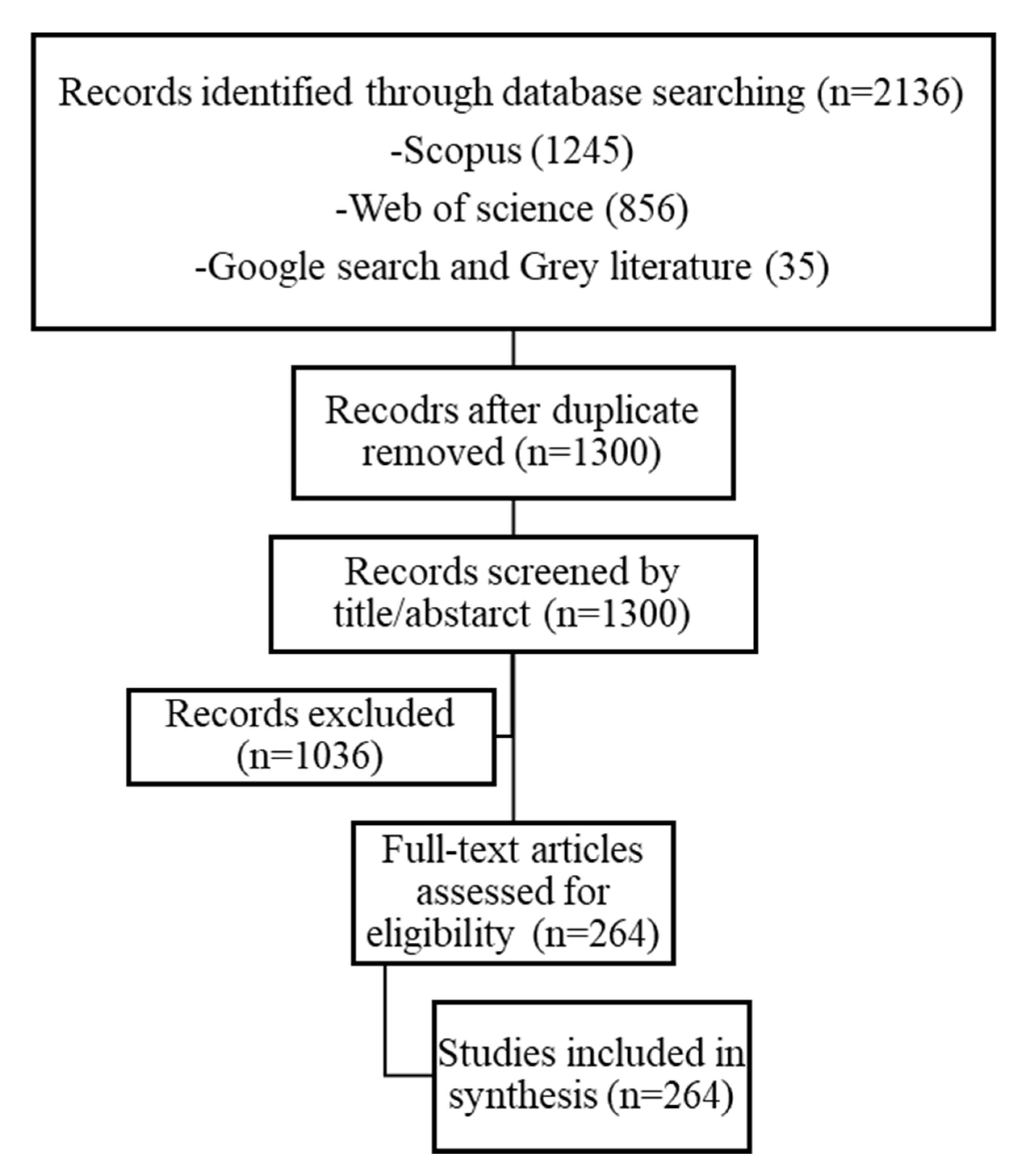
Figure 2.
The interplay of political, institutional, and capacity constraints blocking adaptive environmental management.
Figure 2.
The interplay of political, institutional, and capacity constraints blocking adaptive environmental management.
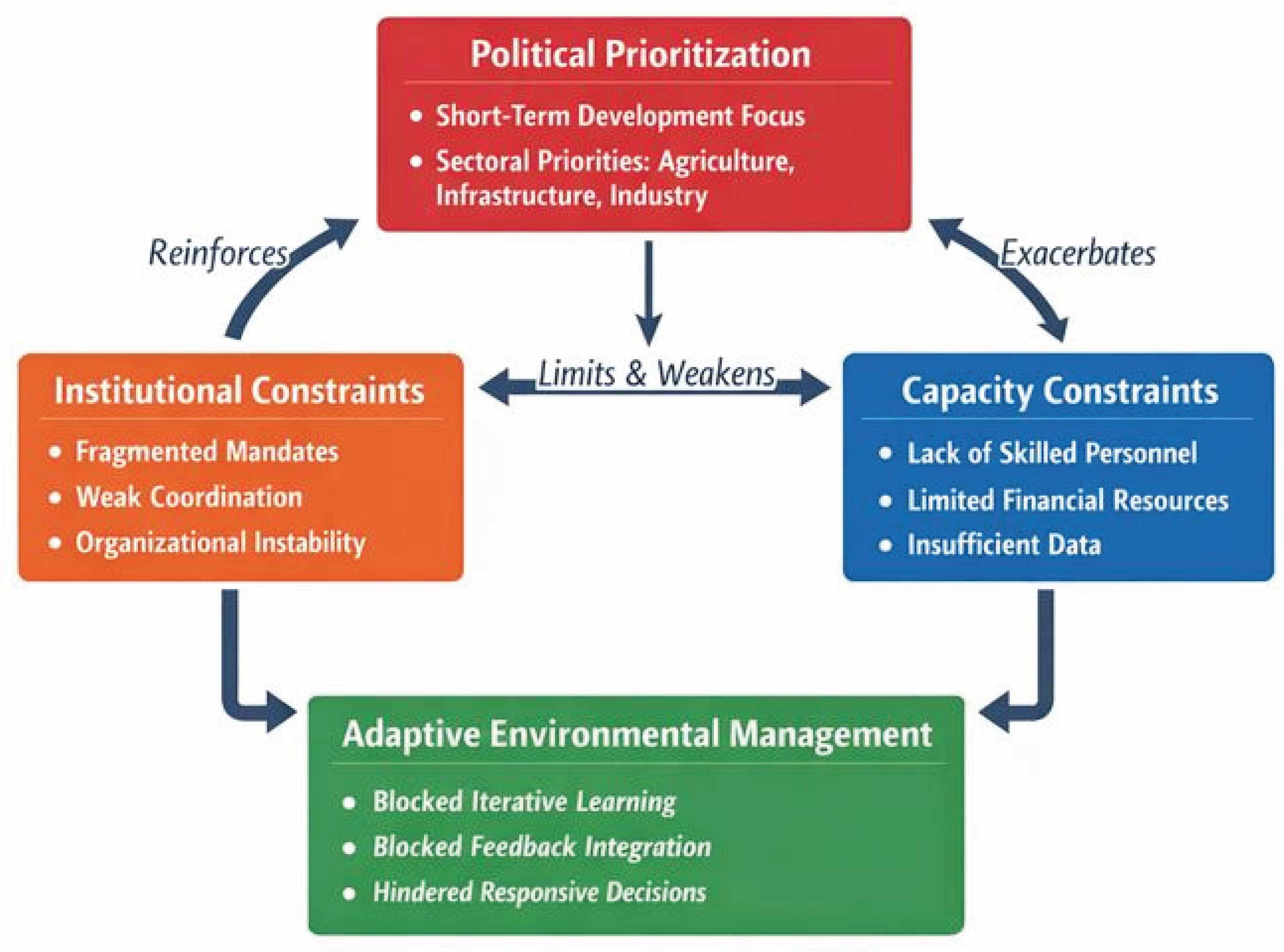

Table 1.
Number of studies reporting institutional, political, and capacity constraints to environmental policy implementation in Ethiopia (n=264).
Table 1.
Number of studies reporting institutional, political, and capacity constraints to environmental policy implementation in Ethiopia (n=264).
| Constraint category | Specific category | frequency | Key findings |
|---|---|---|---|
| Institutional | Fragmented mandates | 78 studies | Overlapping responsibilities and unclear authority between environmental agencies and sectoral ministries (Bantider & Desta, 2022; Addis et al., 2022) |
| Weak coordination | 65 studies | Limited horizontal and vertical coordination across ministries and governance levels (Kassahun et al., 2021; Bantider & Desta, 2022; Addis et al., 2022 | |
| Limited enforcement | 54 studies | Under-resourced monitoring and inspection systems: EAIs were often carried out superficially (Bantider & Desta, 2022; Addis et al., 2022; Genet et al., 2025) | |
| Organizational instability | 48 studies | Frequent restructuring and nuclear role definitions in environmental agencies (Yimam et al., 2024; Genet et al., 2025) | |
| Political | Shifting priorities | 72 studies | Changes in political leadership and sectoral agendas disrupt stable implementation of environmental programs (Assele, 2019; Mebrehatu, 2021) |
| Policy inconsistency | 68 studies | Variability in policy emphasis, funding, and institutional arrangements across administrations (Assele, 2019; Yimam et al., 2024; Hadis et al., 2019) | |
| Limited stakeholder engagement | 61 studies | Local communities, NGOs, and civil society have minimal influence on policy decision-making (Addis et al., 2022; Dejenie & Kakiso, 2023) | |
| Competing development objectives | 74 studies | Short-term economic growth objectives are often prioritized over environmental protection (Mebrehatu, 2021; Yimam et al., 2024) | |
| Capacity | Shortages of technical expertise | 83 studies | Lack of skilled personnel hinders monitoring, assessment, and adaptive interventions (Bantider & Desta, 2022; Genet et al., 2025; Kefale & Gebresenebt, 2014) |
| Inadequate financial resources | 79 studies | Limited budgets restrict monitoring, enforcement, and program implementation (Addis et al., 2022; Assele, 2019) | |
| Insufficient environmental data | 71 studies | Fragmented or outdated environmental data prevents evidence-based decision-making and feedback-driven adjustments (Bantider & Desta, 2022; Adane, 2023; Kassahun et al., 2021) |
Disclaimer/Publisher’s Note: The statements, opinions and data contained in all publications are solely those of the individual author(s) and contributor(s) and not of MDPI and/or the editor(s). MDPI and/or the editor(s) disclaim responsibility for any injury to people or property resulting from any ideas, methods, instructions or products referred to in the content. |
© 2026 by the authors. Licensee MDPI, Basel, Switzerland. This article is an open access article distributed under the terms and conditions of the Creative Commons Attribution (CC BY) license (http://creativecommons.org/licenses/by/4.0/).
Copyright: This open access article is published under a Creative Commons CC BY 4.0 license, which permit the free download, distribution, and reuse, provided that the author and preprint are cited in any reuse.


