

Submitted:
02 February 2026
Posted:
03 February 2026
You are already at the latest version
Abstract
In this exercise, we will discuss quantum entanglement in an intuitionistic context and its evolution. This requires a definition of the tensor product, as well as the introduction of a Hamiltonian.
Keywords:
Heyting algebra
; logic
; quantum entanglement
1. Introduction
In a previous article [1], we defined a notion of probability for finite Heyting algebras. These algebras can be embedded in a Hilbert space in order to deal with the non-commutativity of quantum measurement.
This embedding allows us to introduce a Hamilton operator and study the temporal evolution of entanglement in a tensor algebra.
2. Ingredients
Let be a finite Heyting algebra. We denote G the inclusion of its spectrum in itself via the infima of its prime filters [2].
A probability on is first defined as a classical probability on G, then extended to by . It is useful to introduce the order matrix on . By making and line vectors, we will have with Einstein’s summation convention. We show that the restriction of this matrix to is invertible, which allows us to obtain from .
An observable will be an embedding of into a Hilbert space in the following manner. Each element is associated with an orthogonal projector such that the set forms a partition of the identity of . We then have
For each element , we construct the orthogonal projector . We then note that , , and . If is not a Boolean algebra, we will generally not have .
The probability on will be obtained by a quantum amplitude , a unit vector of , by calculating the matrix products:
An observable is characterized by its observable values given by an injective application1. This gives us the standard quantum model using Hermitian operators
A projector then represents a quantum measurement, which is simply a question relating to the spectrum [3]. Since , this question is expressed as a? = Will the value of the observable appear in the set ?. If the state of the system is , the Copenhagen school tells us that the answer will be yes with a probability , that the state will evolve towards , and that the answer will be no with a probability and a resulting state .
A yes answer validates a. But since the algebra is only Heyting, a no answer doesn’t necessarily validate . We will see below that it is nevertheless possible to validate another proposition.
Furthermore, not all questions relating to the spectrum (the set of its parts) can be asked. Since G is equipped with an order that is generally not completely disconnected, a yes answer to validates all . If there is an , there can be no answer to the question Is the value of the observable exactly equal to g ?
The order placed on the spectrum has, a priori, nothing to do with the order of observable values, which is that of the real numbers. It reflects a certain fuzziness on these values through the application of Birkhoff’s representation theorem [4].
The advantage of this formalism is that it allows different algebras to coexist. The set of projectors induces a unitary embedding operator for each observable. In particular, the values of the observables can evolve over time by introducing a Hamiltonian on the space.
The evolution chosen here will be that of Schroedinger [5]:
3. Tensor Product
3.1. Definition and Inclusions
Let be a set of Heyting algebras, called local. The tensor product is the algebra generated by the product spectrum:
equipped with the order .
This algebra, called global, is canonically constituted by the antichains of .
The projectors associated with the tensor algebra will be
We have canonical inclusions defined by
These inclusions define subsystems .
These subsystems are subalgebras of . We can therefore solve for the system
It is worth noting that . The are generally not even in the algebra of the tensor.
3.2. Pure Global States
Suppose that we choose a question in each local algebra . Let us consider the projector , which we can call and which also happens to be .
If the global system is in the original state , the state is the one we would obtain if all the answers to the local questions were positive. This resulting state, which appears with probability , will be called pure2.
4. Validation of Negative Responses
We have seen that a positive response to a question validates a in the sense that the resulting state will definitely answer yes, since it is then in the image of (provided we do not wait too long ...).
If the answer is no, the system then finds itself in the image of which may well not correspond to any proposition. Nevertheless, it is possible to obtain an optimum.
Proposition
is the minimal proposition that is validated by .
Demo
In the finite case, the opposite lattice is also a Heyting algebra, so we have:
But .
A no answer to the question validates any proposition implied by .
qed
Remarks
If the algebra is Boolean, we have .
We always have , because
5. Study of a Specific Case of Entanglement
Consider the following experiment.
The algebra of this system is the tensor product of two Boolean algebras with four elements:
This gives a Boolean algebra with 16 elements Figure 1.
From an original state , chosen at random, we prepare the initial state with the projector:
The interesting questions that A can ask are or , which we will denote . Similarly, B can ask . Suppose that A asks the question for the prepared state . If the answer is yes, then remains for B, and if it is no, then remains for B.
Symmetrically, for asked by B. The answers are therefore initially completely correlated.
A travels through space undergoing numerous accelerations, while B remains on Earth Figure 2. The gravitational effects of general relativity will shift the clocks, but we assume that if one of the observers measures their subsystem, the quantum repercussion occurs at the same proper time for the other observer.
We see that the action of A influences the state of B and vice versa, immediately in the sense of equal proper times.
A therefore asks the question at its proper time , and B asks the question at its proper time . When they meet again , they communicate their answers to each other after the last measurement.
Two cases must be distinguished: and .
In the Figure 2 and formulas below, we have denoted by the action of the time propagator .
For example, in the case , the probability of responses for A is given by
which reduces to
For the observer B, we obtain
which reduces to the same expression as that of A, which is reassuring.
We note that the time-shift due to general relativity and the final delay do not come into play.
The calculation cannot be simplified further because the questions do not commute with the Hamiltonian.
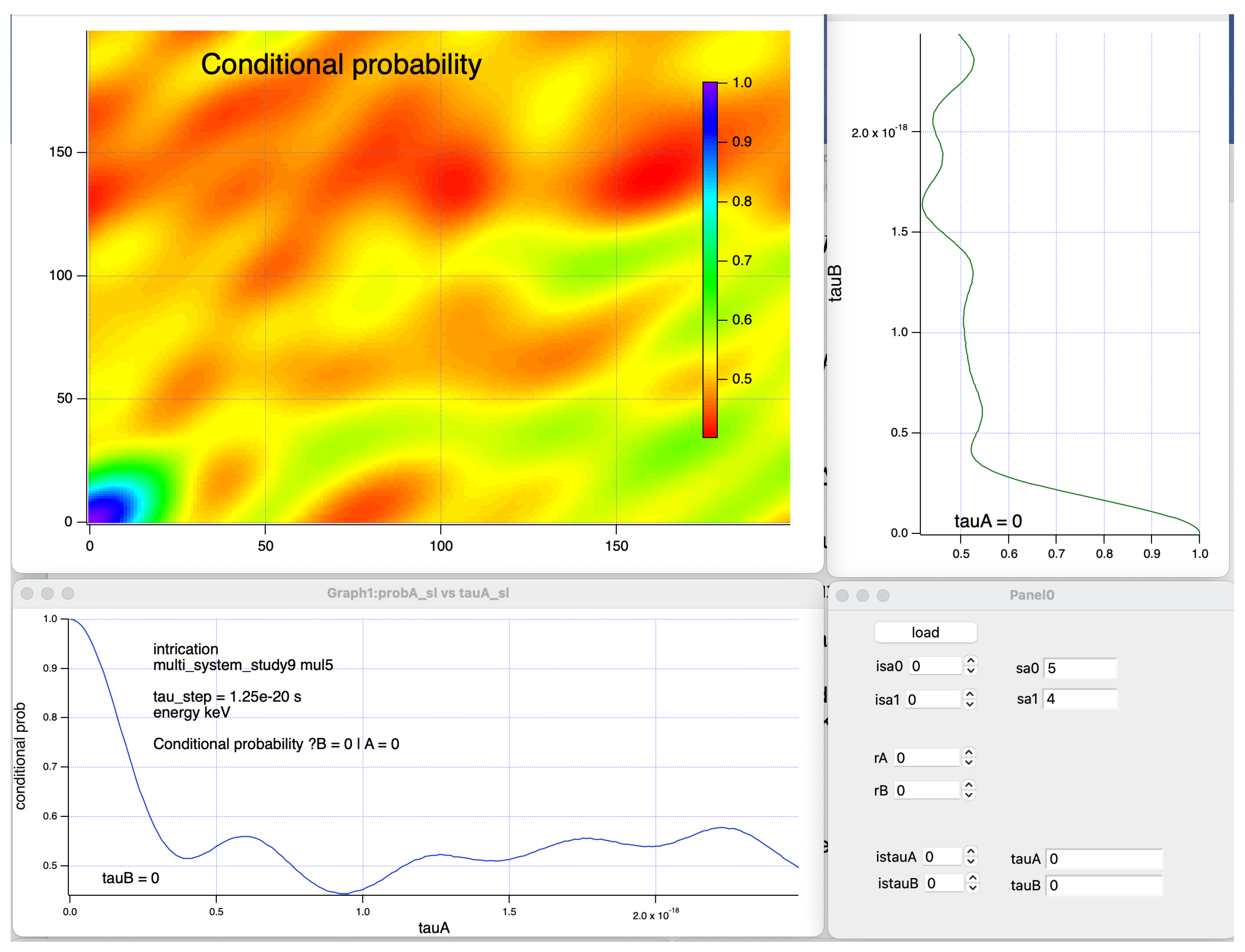
The graphs Figure 3 show the evolution of the conditional probability as a function of measurement times for a Hamiltonian of average energy 2 keV.
The diagrams are digitized temporally by 200 steps of 1.25, 2.5, and 5e-20 s.
5.1. Analysis
The correlation initially decreases as a function of the time difference, then becomes periodic. There is indeed a decoherence effect.
The graph is not symmetrical, but the conditional probability is continuous, including on the diagonal .
The derivatives on this diagonal are not continuous, but are expressed by commutators.
This result is consistent with the fact that time derivatives can be expressed by commutators with the Hamiltonian.
6. Conclusions
Quantum entanglement can easily be generalized to non-Boolean observables.
The famous spooky action at a distance mentioned by Einstein can be interpreted as a concordance of the proper times of the two subsystems. We can see that time shifts have no influence on the probabilities and correlations of quantum responses.
Negative responses validate the negations of the opposite algebra.
References
- Laedermann J.-P. https://laedus.org/logique Probabilities on a Heyting algebra Probability and Temporality unpublished.
- Lombardi H. Treillis distributifs et espaces spectraux, un petit dictionnaire. Laboratoire de Mathématiques de Besançon, Université de Franche-Comte 2020.
- Piron C. Mécanique quantique Presses polytechniques et universitaires romandes 1987.
- Birkhoff G. https://en.wikipedia.org/wiki/Birkhoff’s representation theorem.
- Schroedinger E. https://en.wikipedia.org/wiki/Schroedinger equation.
- Le Bellac M. Introduction à l’information quantique Belin 2006.
| 1 | Multiple eigenvalues are taken into account by the traces of the basic projectors |
| 2 | These states can be obtained by rejection. Since the number of subsystems is finite, the waiting times are almost surely finite. |
Figure 1.
Tensor algebra
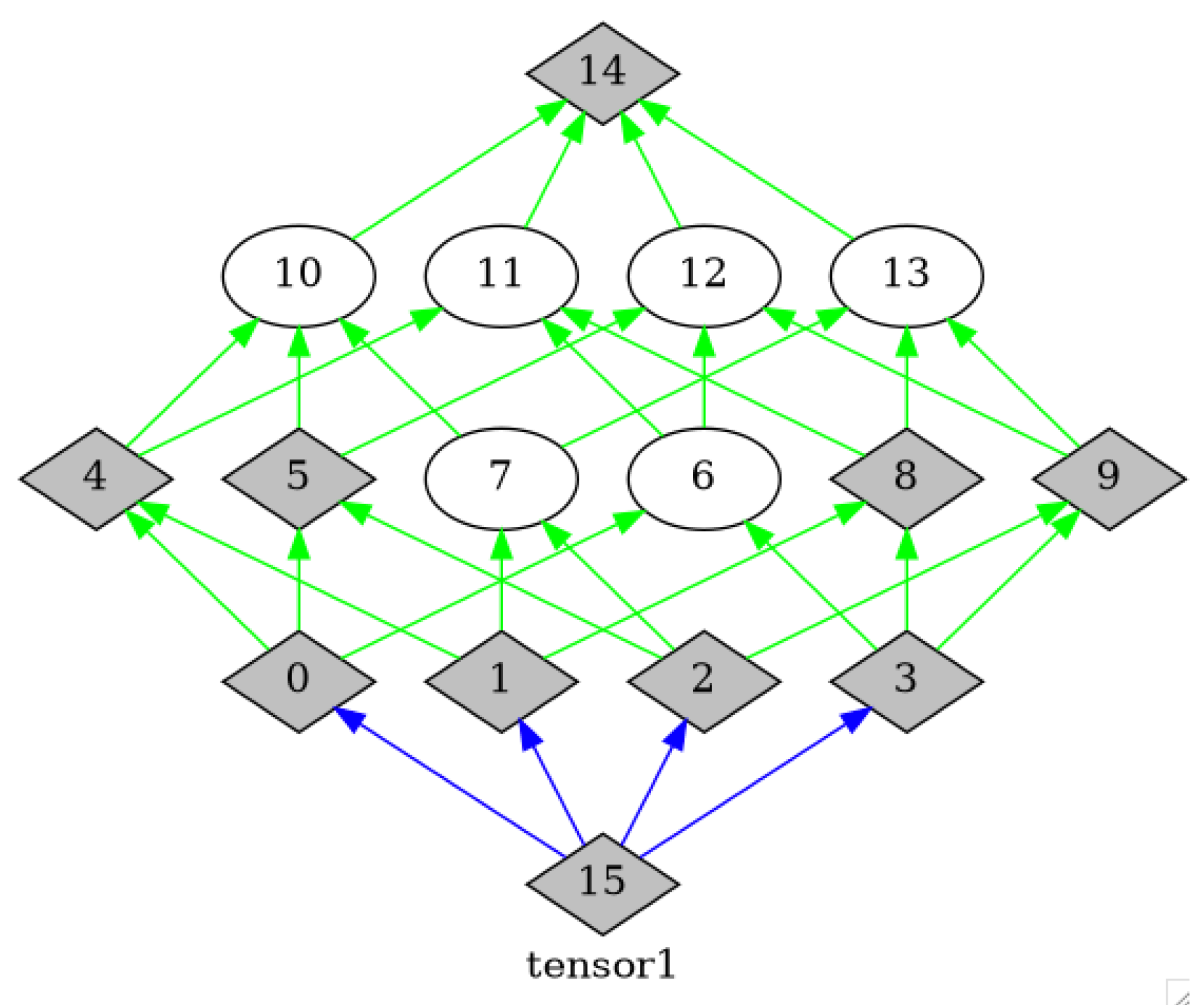
Figure 2.
Trajectories of observers A and B.
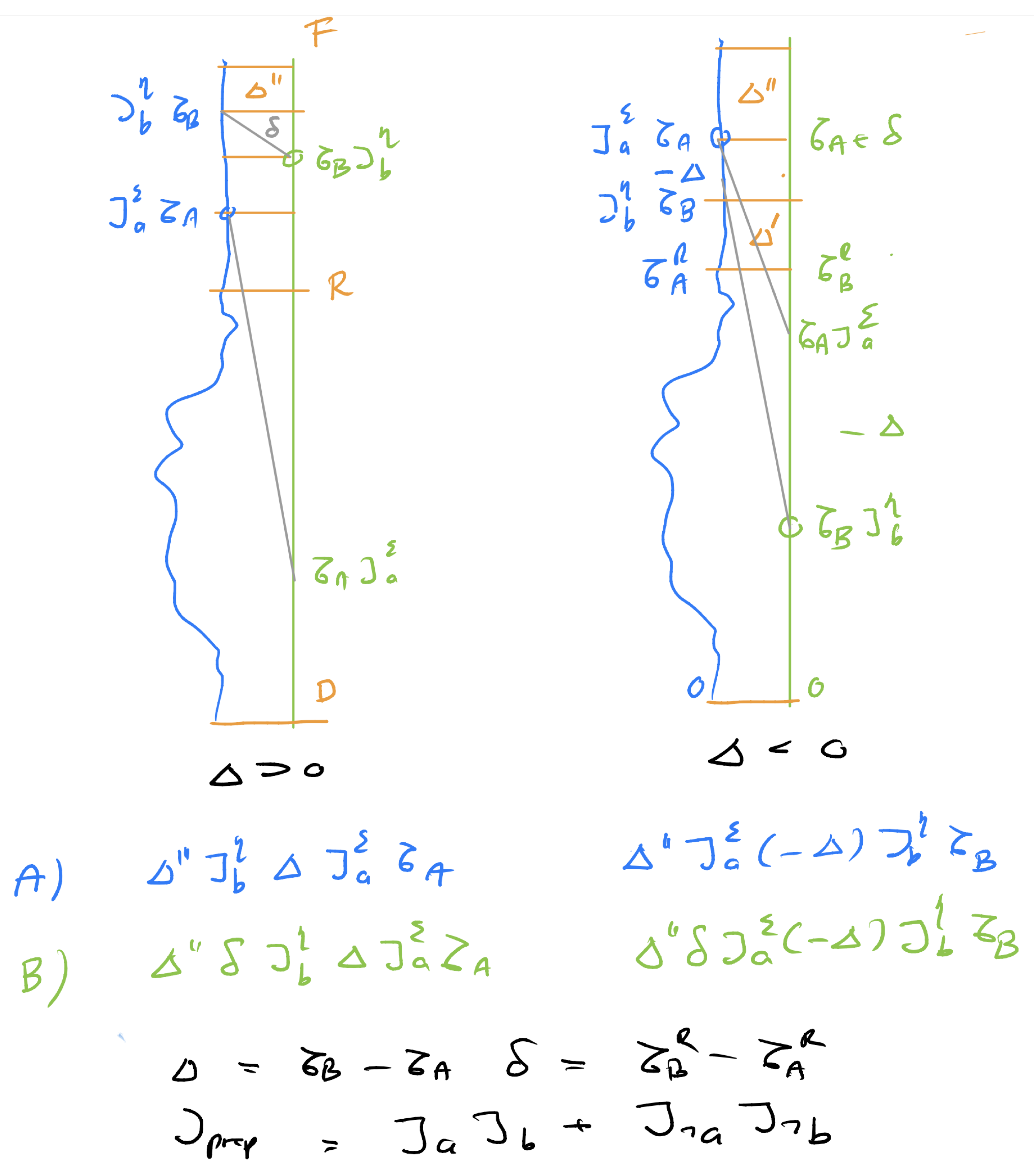
Figure 3.
Evolution of conditional intricated probabilities
Disclaimer/Publisher’s Note: The statements, opinions and data contained in all publications are solely those of the individual author(s) and contributor(s) and not of MDPI and/or the editor(s). MDPI and/or the editor(s) disclaim responsibility for any injury to people or property resulting from any ideas, methods, instructions or products referred to in the content. |
© 2026 by the authors. Licensee MDPI, Basel, Switzerland. This article is an open access article distributed under the terms and conditions of the Creative Commons Attribution (CC BY) license (http://creativecommons.org/licenses/by/4.0/).
Copyright: This open access article is published under a Creative Commons CC BY 4.0 license, which permit the free download, distribution, and reuse, provided that the author and preprint are cited in any reuse.


