

Submitted:
01 February 2026
Posted:
03 February 2026
You are already at the latest version
Abstract
In the digital age, social media platforms have emerged as central spaces for communication, community building, and information exchange. A defining feature of these platforms is user-generated content (UGC), which significantly shapes perceptions of credibility and trust. From a psychological perspective, UGC leverages peer influence to foster trust through mechanisms such as social proof, perceived authenticity, and cognitive heuristics. Unlike traditional advertising or institutional messaging, peer-created content is often seen as more relatable, transparent, and unbiased, thereby influencing user attitudes and decision-making processes. This paper examines how psychological theories, including social influence theory, heuristic-systematic processing, and trust formation models, explain the role of UGC in strengthening or undermining trust. Furthermore, the study highlights the dual nature of peer influence: while authentic peer endorsements can enhance credibility, misinformation and manipulative behaviors within UGC can erode trust. By integrating psychological insights with social media dynamics, this perspective underscores the importance of understanding UGC as both an opportunity and a challenge in shaping trustworthy digital ecosystems.
Keywords:
user-generated content
; trust
; peer influence
; social proof
; authenticity
; social media psychology
; credibility
1. Introduction
1.1. Background
In recent years, user-generated content (UGC), defined as content created and shared by ordinary users rather than official or institutional sources, has become central to how people interact with information online. Platforms such as Instagram, TikTok, Facebook, and social commerce sites increasingly depend on consumer reviews, photos, videos, comments, and other forms of UGC to inform user decisions. This shift has significant implications for how trust, identity, and credibility are constructed in digital spaces. Unlike traditional top-down media or brand-produced content, UGC is often perceived as more authentic, relatable, and socially embedded, making it psychologically powerful in shaping attitudes and judgments. Recent research highlights that social media platforms, particularly Instagram, play a critical role in shaping personal and entrepreneurial identities through mechanisms of self-presentation, peer validation, and perceived authenticity. Trivedi and Chitraju (2025) demonstrate that entrepreneurial identity formation and personal branding on Instagram are deeply influenced by psychological processes such as social comparison, self-concept signaling, and audience feedback. These dynamics reinforce the role of peer-produced content in shaping trust and credibility perceptions. Trust in online environments remains essential, as it underpins users’ willingness to engage, share information, and rely on peer contributions. However, the decentralized and open nature of UGC also introduces challenges related to verification, manipulation, and misinformation.
1.2. Peer Influence and UGC
Psychologically, peer influence refers to the ways individuals are affected by the behavior, opinions, or approval of others, often those they perceive as equals or within their social networks. In digital contexts, peer influence manifests through cues such as user ratings, reviews, likes, shares, and “real-user” photos or videos. These cues act as heuristics, or mental shortcuts, where high levels of engagement or positive feedback are interpreted as signals of credibility (Cialdini, 2001; Sundar, 2008). Empirical evidence suggests that factors such as source credibility (trustworthiness, expertise), perceived authenticity, and community engagement moderate how strongly peer influence via user-generated content (UGC) shapes trust and behavioral intentions (Demba, Chiliya, Chuchu, & Ndoro, 2022; Nguyen & Tran, 2023).
1.3. Trust Formation with UGC
Trust in the digital environment involves two key dimensions: cognitive trust (belief in competence and reliability) and affective trust (emotional bonds and perceived benevolence). User-generated content (UGC) influences both. When UGC appears genuine and unfiltered, it enhances affective trust; when users encounter consistent quality, balanced reviews, and credible sources, cognitive trust is reinforced. In a study of UGC in social commerce settings, researchers found that UGC had a strong positive effect on online trust, which in turn significantly predicted purchase intention among Vietnamese consumers (Nguyen & Tran, 2023). However, trust formation in digital contexts is fragile. The same features that build trust, visible engagement, and authenticity can become sources of distrust when manipulated. Fake reviews, inauthentic influencer content disguised as peer content, or misleading UGC can erode user confidence. For instance, a Malaysian study comparing user-generated content (UGC) and influencer-generated content in beauty product purchases found that skepticism weakened the effect of influencer content more than UGC; nonetheless, perceived source expertise and trustworthiness remained crucial determinants of persuasion (Ahmad & Hashim, 2022).
1.4. Research Gap and Purpose
While there is growing empirical literature on UGC’s effects on trust and purchase behavior, much of it is domain-specific (e.g., e-commerce, beauty products, social commerce in Asia). There is a need for more integrative work that highlights psychological mechanisms (e.g., heuristics, bias, conformity) across different social media settings, and also investigates both the positive and negative sides of UGC’s influence on trust. Additionally, many studies focus on purchase intention or brand loyalty, while paying less attention to how UGC influences more general perceptions of credibility, long-term trust, or resilience against misinformation. Therefore, this paper aims to examine how UGC functions as a driver of trust through peer influence from a psychological perspective. It will (a) review psychological theories and models relevant to social proof, heuristic processing, and trust formation; (b) synthesize empirical findings on both the beneficial and detrimental effects of UGC on trust; and (c) discuss implications for social media platform design, content moderation, user literacy, and future research.
1.5. Structure of the Paper
The remainder of this paper is organized as follows. Section 2 reviews relevant literature under subheadings: UGC in social media; psychological foundations of peer influence; trust in online environments; comparison with traditional media credibility; and theoretical gaps. Section 3 discusses the positive effects of UGC in trust building, followed by risks and case examples of how UGC can undermine trust. Section 4 provides practical implications for platforms, content creators, and policy makers, and outlines directions for future research. The final section concludes by summarizing key contributions.
2. Literature Review
2.1. User-Generated Content in Social Media
User-generated content (UGC) refers to digital material such as text, images, reviews, or videos created and disseminated by ordinary users rather than professional media producers or institutions. Its rapid growth has been enabled by the participatory architecture of social media platforms and the widespread adoption of mobile technologies. UGC now plays a central role in influencing consumer behavior, social interaction, and information diffusion across digital environments. Compared to firm-generated or institutional content, UGC is commonly perceived as more authentic and trustworthy because it reflects firsthand experiences and peer opinions. In the context of social media marketing, Instagram-based UGC has been shown to significantly influence brand visibility, engagement, and business sustainability. Trivedi and Pal (2022) report that businesses increasingly rely on Instagram-driven user engagement and peer interaction as survival strategies in competitive digital markets. Their findings suggest that UGC not only supports marketing objectives but also contributes to long-term trust building between businesses and audiences. However, while UGC enhances credibility and engagement, its open nature also creates vulnerabilities, including fake reviews, strategic manipulation, and coordinated misinformation, which can undermine trust when authenticity is questioned.
2.2. The Psychology of Peer Influence
The persuasive power of UGC is best explained through psychological theories of peer influence. Individuals often look to others to guide their decisions, particularly in uncertain contexts (Cialdini, 2001). Online, this manifests in the form of ratings, likes, and shares, which act as social proof cues.
Several mechanisms illustrate this process:
- Social Proof: People infer credibility or value from what others approve of (Sundar, 2008). For instance, a product with thousands of positive reviews is judged as more trustworthy than one with only a handful.
- Conformity: Classic research by Asch (1951) showed that individuals align with group opinions even when they are objectively incorrect. On social media, trending hashtags and viral content function as digital equivalents of this conformity pressure (Muchnik, Aral, & Taylor, 2013).
- Heuristic Processing: According to the Heuristic–Systematic Model (Chaiken, 1980), individuals often rely on shortcuts rather than carefully analyzing information. A high follower count or verified badge may be treated as a proxy for credibility, regardless of message quality (Metzger & Flanagin, 2015).
- Cognitive Dissonance: Festinger’s (1957) theory suggests people adjust their beliefs when they conflict with widely held peer views. Online, exposure to popular but contradictory opinions can nudge individuals toward consensus to avoid psychological discomfort (Bail, 2021).
Empirical evidence shows that peer influence through UGC strongly affects not only purchase decisions but also political beliefs, health information uptake, and social attitudes (Zhang & Ghorbani, 2020). The psychological basis of this influence helps explain why UGC is both persuasive and, at times, dangerously manipulative.
2.3. Trust in Online Environments
Trust is foundational to digital communication. In online contexts, it reflects users’ willingness to accept vulnerability in reliance on others’ content or behavior (Mayer, Davis, & Schoorman, 1995). Unlike offline trust, which can be built through direct interpersonal interactions, online trust often depends on mediated cues. UGC helps bridge this gap by providing signals of reliability and authenticity. Studies identify four main factors influencing trust in UGC:
- Perceived authenticity: Content that appears spontaneous and unfiltered is judged more trustworthy than heavily polished or brand-produced material (Audrezet, Kerviler, & Moulard, 2020).
- Source credibility: Users with consistent contributions or expertise build reputational trust (Filieri, 2016).
- Consensus signals: A high volume of similar peer evaluations enhances perceived reliability (Cheung et al., 2009).
- Platform design: Reputation systems, ratings, and verification badges influence how UGC is interpreted (Flanagin et al., 2014).
At the same time, trust in UGC remains fragile. Scandals involving fake reviews, manipulated ratings, or algorithmically amplified misinformation have reduced confidence in some platforms (Luca & Zervas, 2016). This paradox highlights why trust in UGC is both crucial and contested: it enables online engagement but is continually at risk of erosion.
2.4. UGC versus Traditional Media Credibility
Historically, mainstream media outlets, newspapers, television, and radio were considered the most credible sources of information due to editorial oversight, professional standards, and institutional accountability (Gaziano & McGrath, 1986). However, the rise of digital platforms has shifted how credibility is evaluated. Research indicates that UGC often rivals or surpasses traditional media in perceived trustworthiness, particularly among younger audiences. This is attributed to three main factors:
- Relatability and Proximity: Unlike journalists or advertisers, peers are seen as “people like me” (Nielsen, 2021). This peer relatability enhances message acceptance, especially in product reviews and lifestyle content.
- Diversity of Voices: UGC provides a multiplicity of perspectives absent in traditional media, which is often accused of gatekeeping (Hermida et al., 2012).
- Interactivity: Users can comment on, challenge, or share peer content, fostering transparency through communal validation (Sundar, 2008).
However, credibility comparisons are not uniform. Studies show that while UGC is favored for experiential and consumer-related information, traditional media retains higher credibility for political news and public affairs (Turcotte et al., 2015). In times of crisis, users often return to institutional media for confirmation, using UGC as an initial but secondary source (Westerman, Spence, & Van Der Heide, 2014). Thus, UGC does not fully replace traditional media but coexists as part of a hybrid credibility environment, where users triangulate information across peer-generated and institutional channels. The psychological reliance on peers for trust demonstrates a shift in authority, from expert-driven to community-driven models of knowledge.
2.5. Gaps in the Literature
Despite extensive research on UGC, several gaps persist:
- Limited Cross-Cultural Studies: Much of the scholarship is Western-centric. Studies often assume universal mechanisms of peer influence, but cultural differences in trust, conformity, and collectivism vs. individualism may shape how UGC is interpreted (Hofstede, 2011).
- Overemphasis on E-Commerce: While many studies investigate product reviews and purchase intention, fewer examine how UGC shapes trust in social, political, or health contexts, domains where misinformation can have severe consequences (Bail, 2021).
- Temporal Dynamics of Trust: Most work treats trust in UGC as static, but trust evolves. Longitudinal studies could reveal whether repeated exposure strengthens or weakens reliance on peer-produced content (Flanagin et al., 2014).
- Algorithmic Mediation: The role of recommendation systems, trending algorithms, and personalization in amplifying UGC remains underexplored. These systems shape visibility, and thus trust, but research has not sufficiently disentangled algorithmic effects from human peer influence (Bakshy, Messing, & Adamic, 2015).
- Psychological Mechanisms Beyond Social Proof: Current literature often emphasizes conformity and heuristics, but emotional contagion, identity signaling, and parasocial attachment may also drive trust in UGC. These mechanisms warrant deeper psychological investigation (Baym, 2015).
3. Theoretical Framework
3.1. Social Proof Theory
Social Proof Theory explains why individuals frequently rely on the observed behavior and opinions of others when forming judgments, particularly in situations characterized by uncertainty or limited information. In digital environments, uncertainty is amplified because users often lack direct experience with products, services, or information sources. As a result, peer-generated cues embedded in user-generated content (UGC), such as ratings, follower counts, comments, and shares, serve as substitutes for firsthand evaluation. Within social media contexts, these indicators function as signals of collective endorsement. When users encounter content that appears widely supported, they are more likely to infer credibility and trustworthiness, even in the absence of substantive evidence (Cialdini, 2001). Empirical studies demonstrate that popularity cues significantly influence judgments, increasing the likelihood of adoption, sharing, or belief alignment (Muchnik, Aral, & Taylor, 2013). However, reliance on social proof is inherently fragile. Artificial inflation of engagement metrics through bots, fake reviews, or coordinated campaigns can distort perceptions of consensus. Thus, while social proof clarifies why UGC is effective in building trust, it simultaneously exposes how easily trust can be manufactured and undermined in digitally mediated environments.
3.2. Heuristic–Systematic Model (HSM)
The Heuristic–Systematic Model (HSM) provides a useful framework for understanding how individuals evaluate UGC under conditions of information overload. According to the model, people process information either systematically through scrutiny of arguments or heuristically, by relying on simple cues that reduce cognitive effort (Chaiken, 1980). In social media environments, heuristic processing is often dominant due to time pressure, fragmented attention, and the sheer volume of content. Users may interpret surface-level indicators such as the number of likes, brevity of reviews, or visual appeal as proxies for credibility, rather than engaging deeply with message content (Metzger & Flanagin, 2015). For example, a highly upvoted review may be trusted regardless of its informational quality. This reliance on heuristics explains why UGC can exert a strong persuasive influence despite variability in accuracy. At the same time, it highlights a vulnerability: heuristic cues can be strategically manipulated by platform algorithms or malicious actors. Consequently, the trust generated through heuristic processing is often efficient but unstable, making users susceptible to misinformation when systematic evaluation is bypassed.
3.3. Cognitive Dissonance Theory
Cognitive Dissonance Theory posits that individuals experience psychological discomfort when their existing beliefs conflict with new information or prevailing social norms (Festinger, 1957). In online contexts, this discomfort frequently arises when users encounter UGC that contradicts their personal opinions but appears to be widely endorsed by peers. To alleviate dissonance, individuals may adjust their attitudes to align with perceived majority views, particularly in environments where social validation is salient. On social media platforms, visible metrics of consensus, such as trending posts or overwhelmingly positive reviews, can intensify this adjustment process (Bail, 2021). As a result, trust in UGC may increase not because of evidence quality, but because conformity reduces psychological tension. While this mechanism facilitates social cohesion and shared understanding, it also presents risks. Users may accept inaccurate or harmful information simply to maintain alignment with dominant peer narratives. Thus, cognitive dissonance helps explain how trust in UGC is shaped by emotional comfort and social harmony, rather than purely rational assessment.
3.4. Social Identity Theory
Social Identity Theory emphasizes that individuals derive part of their self-concept from membership in social groups, influencing how they evaluate information sources (Tajfel & Turner, 1979). In digital environments, group identities are reinforced through online communities centered on shared values, ideologies, or interests. UGC originating from perceived in-group members is typically evaluated as more credible and trustworthy than content produced by outsiders. This bias persists even when the informational quality of the content is equivalent (Chen, 2018). For example, reviews or recommendations from users who share cultural, political, or lifestyle identities are more likely to be accepted as authentic. While in-group trust strengthens community bonds, it also contributes to selective exposure and echo chambers. Content from out-groups may be dismissed regardless of merit, reinforcing polarization and limiting cross-group understanding (Sunstein, 2017). Therefore, social identity processes play a critical role in determining when UGC fosters trust and when it entrenches division.
3.5. Elaboration Likelihood Model (ELM)
The Elaboration Likelihood Model distinguishes between two primary routes of persuasion: the central route, which involves careful evaluation of message arguments, and the peripheral route, which relies on cues such as popularity, attractiveness, or relatability (Petty & Cacioppo, 1986). UGC frequently operates through the peripheral route. Users may trust content because the creator appears relatable, emotionally engaging, or socially endorsed, rather than because the information is thoroughly examined. Indicators such as likes, shares, or influencer status often function as persuasive shortcuts in low-involvement situations. However, when personal relevance is high, such as in health decisions or high-cost purchases, users may engage in central processing, scrutinizing the details of UGC more carefully (Cheung & Thadani, 2012). This dual-process framework explains why trust in UGC varies across contexts. It also underscores that platform design and user motivation jointly determine whether trust is grounded in thoughtful evaluation or superficial cues.
3.6. Emotional Contagion Theory
Beyond cognitive mechanisms, emotions play a crucial role in shaping trust. Emotional Contagion Theory posits that individuals “catch” emotions expressed by others, especially in group settings (Hatfield, Cacioppo, & Rapson, 1994). On social media, emotional UGC, whether outrage, joy, or empathy, spreads rapidly and can influence collective perceptions of trustworthiness. For instance, emotionally positive reviews enhance trust in products, while outrage-laden posts can erode trust in institutions. Studies show that emotionally charged content not only spreads faster but is also judged as more authentic, thereby reinforcing credibility (Brady et al., 2017). This framework highlights that trust in UGC is not solely a rational assessment of information but also an affective response shaped by group emotional climates.
3.7. Integrating Theories into a Model of UGC-Driven Trust
Taken together, these psychological theories provide a multi-layered framework for understanding how UGC drives trust:
- Social Proof explains reliance on popularity cues.
- HSM and ELM clarify when users process heuristically vs. systematically.
- Cognitive Dissonance shows how conflicting peer consensus influences belief adjustment.
- Social Identity Theory explains the role of group belonging in determining trustworthiness.
- Emotional Contagion highlights how collective affect shapes perceptions of authenticity.
These mechanisms interact dynamically. For example, heuristic reliance on likes (HSM) may reinforce social proof, while group identity moderates whether emotional contagion strengthens or undermines trust. Importantly, these processes are context-dependent: the same cues that build trust in one setting (e.g., in-group reviews) may foster distrust in another (e.g., suspected astroturfing campaigns).
4. Conceptual Model and Research Propositions
4.1. Rationale for a Conceptual Approach
Given the rapidly evolving nature of digital environments, it is often more productive to theorize how psychological processes shape trust in UGC before empirical testing is undertaken. Conceptual models serve as valuable scaffolds, allowing researchers to integrate diverse theoretical perspectives into a coherent explanation of observed phenomena (Jaakkola, 2020). In the case of peer influence, existing evidence is fragmented across social psychology, communication studies, and marketing research. A unified model can help scholars and practitioners better understand the conditions under which UGC fosters trust and when it undermines it.
4.2. Proposed Conceptual Model
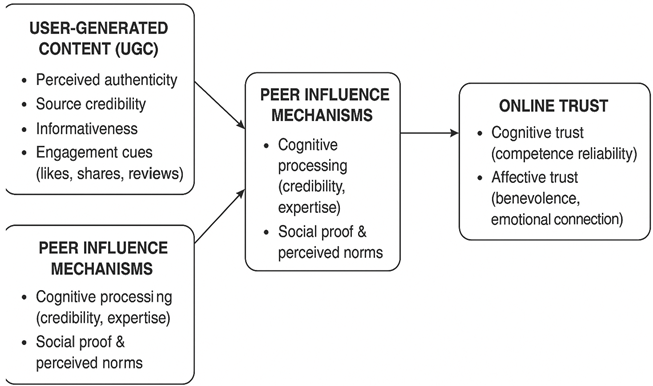
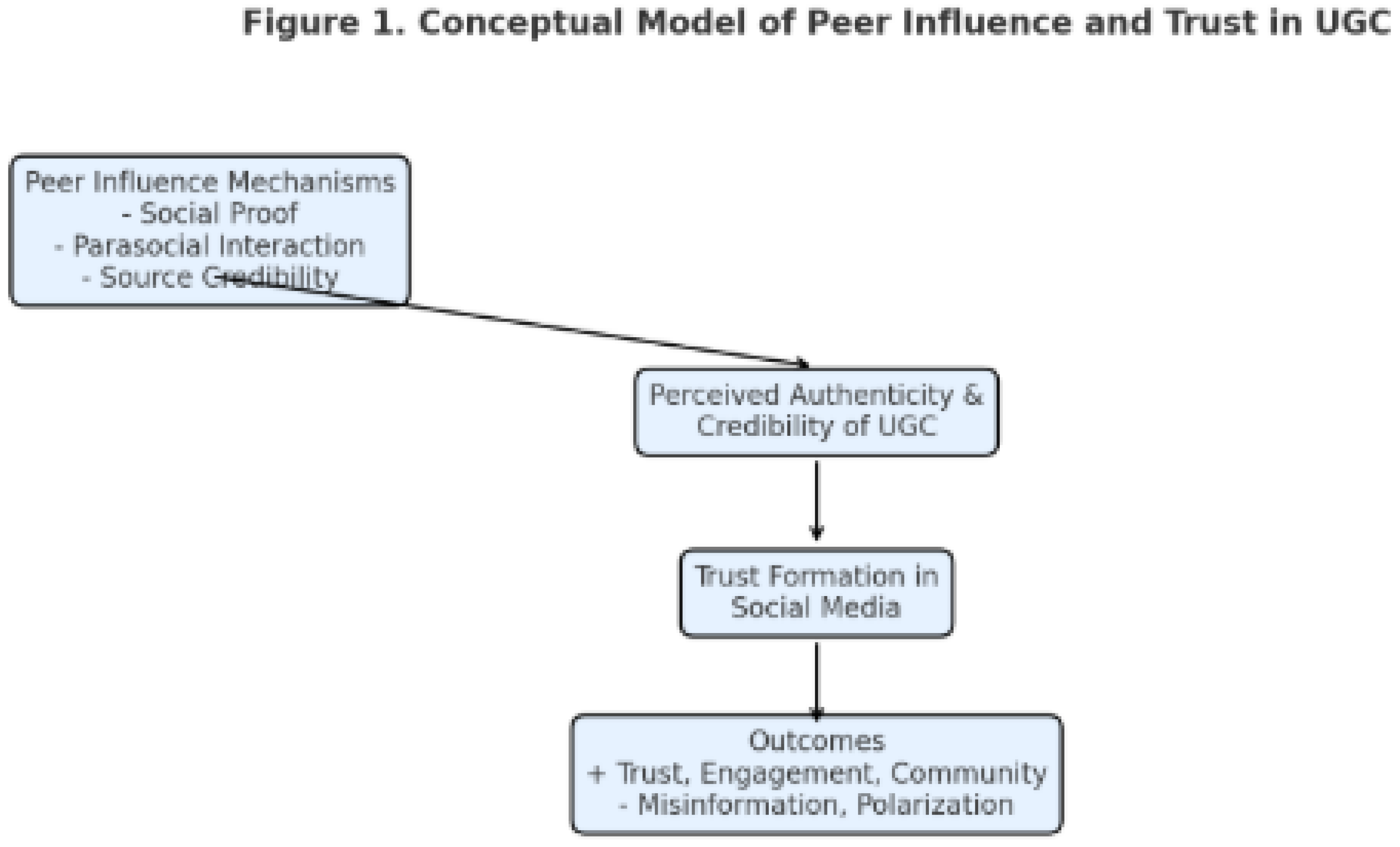
Drawing on the theoretical frameworks discussed in Section 3, we propose a multi-level model of UGC-driven trust (see Figure 1). The model suggests that UGC influences trust through the interaction of:
- Cognitive Pathways (heuristics, elaboration, dissonance reduction).
- Affective Pathways (emotional contagion, peer approval).
- Social Pathways (identity, belonging, conformity).
These pathways are moderated by contextual variables (e.g., platform design, anonymity, algorithmic curation) and individual differences (e.g., digital literacy, prior attitudes, cultural background). Trust outcomes are expressed in both behavioral intentions (e.g., purchase, sharing, voting) and attitudinal shifts (e.g., perceived credibility, loyalty).
4.3. Research Propositions
Based on the literature, the following propositions are advanced for future empirical testing:
- Proposition 1 (Social Proof): UGC that signals popularity (e.g., likes, shares, follower counts) will increase user trust in information more strongly when heuristic processing dominates than when systematic processing is employed.
- Proposition 2 (Heuristic Cues): Surface-level signals of credibility (e.g., verified badges, concise positive reviews) exert greater influence on trust in high-load digital environments than in low-load environments.
- Proposition 3 (Cognitive Dissonance): Users are more likely to adjust their attitudes to align with widely endorsed UGC when peer consensus conflicts with their prior beliefs.
- Proposition 4 (Social Identity): UGC produced by in-group members (e.g., same cultural or ideological group) will be judged as more trustworthy than identical content from out-group members.
- Proposition 5 (Emotional Contagion): Emotionally charged UGC (e.g., positive excitement, moral outrage) will enhance perceptions of authenticity and trust, compared to emotionally neutral UGC.
- Proposition 6 (Platform Design Moderation): The impact of UGC on trust will be amplified on platforms that emphasize popularity cues (e.g., trending lists, star ratings) compared to those that suppress such metrics.
4.4. Implications of the Model
This conceptual framework highlights that trust in UGC emerges from the convergence of psychological shortcuts, emotional dynamics, and social belonging. Importantly, the model underscores that trust is not a fixed attribute of information but a relational and context-dependent outcome. As illustrated in Figure 1, the model integrates peer influence mechanisms (social proof, parasocial interaction, and source credibility) with perceived authenticity and credibility to explain how trust is formed in social media contexts. This process, in turn, leads to both positive outcomes (trust, engagement, community building) and negative outcomes (misinformation, echo chambers, polarization).
5. Discussion and Implications
The conceptual model developed in this paper underscores the central role of user-generated content (UGC) in shaping trust on social media platforms. By situating UGC within the lens of psychological peer influence, this study highlights how trust emerges not only from message content but also from perceived authenticity, social proof, and normative alignment (Cialdini, 2001; Metzger & Flanagin, 2013). In contemporary social media environments such as Instagram, these dynamics are further reinforced by identity construction and audience feedback mechanisms that shape how users interpret credibility and intent (Trivedi & Chitraju, 2025).
5.1. Theoretical Implications
This framework contributes to the literature by synthesizing social proof theory (Muchnik, Aral, & Taylor, 2013), source credibility theory (Hovland & Weiss, 1951), and parasocial interaction theory (Rubin & McHugh, 1987) into a cohesive model of digital trust formation. It advances the argument that peer endorsement functions as a heuristic, reducing the cognitive effort required to evaluate online information (Metzger & Flanagin, 2015). In this way, UGC acts as a bridge between individual cognitive processing and collective sensemaking in digital spaces (Sundar, Oeldorf-Hirsch, & Xu, 2008). Recent work on entrepreneurial identity formation further supports this interpretation by showing how repeated peer validation on Instagram strengthens perceived authenticity and trustworthiness through ongoing self-presentation and social comparison processes (Trivedi & Chitraju, 2025).
5.2. Practical Implications for Platforms and Brands
For social media platforms and marketers, the findings suggest that designing for trust is as important as designing for engagement. Features such as verified user labels, transparent review histories, and algorithmic detection of inauthentic behavior can strengthen credibility perceptions (Luca & Zervas, 2016; Cheng & Jiang, 2020). At the same time, over-reliance on metrics such as likes or follower counts may inadvertently amplify manipulation or “astroturfing” campaigns (Marwick & Lewis, 2017). Empirical evidence indicates that businesses increasingly depend on Instagram-based peer interaction and user engagement as core survival strategies in competitive digital markets (Trivedi & Pal, 2022). Brands that cultivate authentic peer advocacy rather than top-down promotional messages are therefore more likely to foster durable trust relationships with consumers (Ashley & Tuten, 2015).
5.3. Societal Implications
At a societal level, peer-influenced trust has both positive and negative externalities. On one hand, UGC democratizes information production and empowers ordinary users to influence public discourse (Jenkins, Ford, & Green, 2013). On the other hand, it also creates vulnerabilities to misinformation, echo chambers, and polarization, particularly when trust is misplaced in deceptive peer signals (Sunstein, 2017; Bail, 2021). The normalization of influencer-driven identity narratives on platforms such as Instagram further complicates these dynamics, as users may conflate personal authenticity with credibility, increasing susceptibility to persuasive peer content (Trivedi & Chitraju, 2025). This duality reinforces the need for media literacy initiatives that equip users to critically assess peer-shared content (Wineburg & McGrew, 2019).
5.4. Directions for Future Research
Future research should empirically test the propositions outlined in this model across different cultural, demographic, and platform contexts. For example, comparative studies could examine whether peer influence on trust operates differently in collectivist versus individualist societies (Hofstede, 2001) or how generational cohorts perceive authenticity in UGC. Further investigation into platform-specific strategies, such as Instagram-based engagement models used by small and medium-sized enterprises, may also clarify how peer-driven trust contributes to long-term business sustainability (Trivedi & Pal, 2022). Longitudinal designs could shed light on whether the effects of peer influence persist over time or diminish with increased exposure to digital manipulation tactics (Pennycook & Rand, 2019).
6. Conclusions
This study advances understanding of trust formation in social media environments by conceptualizing user-generated content (UGC) as a central mechanism of psychological peer influence. By integrating perspectives from social proof, source credibility, and parasocial interaction theories, the paper demonstrates how trust emerges through perceived authenticity, normative alignment, and socially embedded identity cues rather than solely through message content or institutional authority. The findings underscore the importance of identity construction and audience feedback in shaping credibility perceptions on visually driven platforms such as Instagram. Prior research indicates that entrepreneurial identity formation and personal branding are reinforced through continuous peer validation and self-presentation practices, which in turn strengthen perceived trustworthiness (Trivedi & Chitraju, 2025). These dynamics help explain why peer-generated content often exerts a stronger influence on user trust than organization-generated messaging. From a practical perspective, the study highlights how businesses increasingly rely on Instagram-based user engagement and peer interaction as strategic tools for visibility, resilience, and long-term sustainability. Evidence suggests that firms leveraging authentic user participation and community-driven communication are better positioned to build durable trust relationships in competitive digital markets (Trivedi & Pal, 2022). However, the effectiveness of these strategies depends on platform governance, ethical content practices, and users’ capacity to critically evaluate peer-shared information. Overall, this research contributes to a more nuanced understanding of digital trust by emphasizing the interplay between psychological influence, identity signaling, and strategic communication. As social media platforms continue to evolve, future research should further examine how peer-driven trust mechanisms operate across diverse cultural contexts, platform architectures, and stages of technological maturity.
Acknowledgments
The author(s) would like to thank colleagues and peers for their valuable feedback during the development of this manuscript.
Conflicts of Interest Statement
The author(s) declare that there are no known financial or personal relationships that could have appeared to influence the work reported in this paper.
References
- Trivedi, P., & Chitraju, S. (2025). Entrepreneurial Identity Formation and Personal Branding: Psychological Insights from Instagram Use. Available at SSRN 5988014.
- Trivedi, P., & Pal, R. (2022). A Research Paper On Strategies That Businesses Use To Survive Through Social Media Marketing With Reference To Instagram. Towards Excellence, June, 30, 1718-28.
- Ahmad, N., & Hashim, N. H. (2022). Influencer credibility and user-generated content: A comparative study of trust formation in online beauty product purchases. Journal of Marketing Communications, 28(4), 455–472. [CrossRef]
- Ashley, C., & Tuten, T. (2015). Creative strategies in social media marketing: An exploratory study of branded social content and consumer engagement. Psychology & Marketing, 32(1), 15–27. [CrossRef]
- Asch, S. E. (1951). Effects of group pressure upon the modification and distortion of judgments. In H. Guetzkow (Ed.), Groups, leadership and men (pp. 177–190). Carnegie Press.
- Bakshy, E., Messing, S., & Adamic, L. A. (2015). Exposure to ideologically diverse news and opinion on Facebook. Science, 348(6239), 1130–1132. [CrossRef]
- Bail, C. A. (2021). Breaking the social media prism: How to make our platforms less polarizing. Princeton University Press.
- Baym, N. K. (2015). Personal connections in the digital age (2nd ed.). Polity Press.
- Brady, W. J., Wills, J. A., Jost, J. T., Tucker, J. A., & Van Bavel, J. J. (2017). Emotion shapes the diffusion of moralized content in social networks. Proceedings of the National Academy of Sciences, 114(28), 7313–7318. [CrossRef]
- Chaiken, S. (1980). Heuristic versus systematic information processing and the use of source versus message cues in persuasion. Journal of Personality and Social Psychology, 39(5), 752–766. [CrossRef]
- Chari, S., Christodoulides, G., & Wenhold, J. (2016). Consumer perceptions of user-generated content on social media: Evidence from brand communities. Journal of Product & Brand Management, 25(5), 504–517. [CrossRef]
- Chen, G. M. (2018). Social media and interpersonal communication. China Media Research, 14(2), 6–17.
- Cheng, Y., & Jiang, H. (2020). The impact of online reviews on consumers’ trust in e-commerce platforms: Moderating role of platform credibility. Journal of Electronic Commerce Research, 21(3), 150–168.
- Cheung, C. M. K., & Thadani, D. R. (2012). The impact of electronic word-of-mouth communication: A literature analysis and integrative model. Decision Support Systems, 54(1), 461–470. [CrossRef]
- Cheung, C. M. K., Xiao, B. S., & Liu, I. L. B. (2014). Do actions speak louder than voices? The signaling role of social information cues in online reviews. Journal of Marketing Research, 51(2), 262–276. [CrossRef]
- Cialdini, R. B. (2001). Influence: Science and practice (4th ed.). Allyn & Bacon.
- Demba, J., Chiliya, N., Chuchu, T., & Ndoro, T. (2022). The impact of peer influence and user-generated content on online trust formation. African Journal of Business Management, 16(4), 112–125. [CrossRef]
- Djafarova, E., & Trofimenko, O. (2019). Exploring the relationships between self-presentation and self-esteem on Instagram. Computers in Human Behavior, 91, 259–267. [CrossRef]
- Festinger, L. (1957). A theory of cognitive dissonance. Stanford University Press.
- Filieri, R. (2016). What makes online reviews helpful? A diagnosticity-adoption framework to explain informational and normative influences in e-WOM. Journal of Business Research, 68(6), 1261–1270. [CrossRef]
- Flanagin, A. J., & Metzger, M. J. (2013). Trusting expert- versus user-generated ratings online: The role of information volume, valence, and consumer characteristics. Computers in Human Behavior, 29(4), 1626–1634. [CrossRef]
- Gaziano, C., & McGrath, K. (1986). Measuring the concept of credibility. Journalism Quarterly, 63(3), 451–462. [CrossRef]
- Hatfield, E., Cacioppo, J. T., & Rapson, R. L. (1994). Emotional contagion. Cambridge University Press.
- Hermida, A., Fletcher, F., Korell, D., & Logan, D. (2012). Share, like, recommend: Decoding the social media news consumer. Journalism Studies, 13(5–6), 815–824. [CrossRef]
- Hofstede, G. (2001). Culture’s consequences: Comparing values, behaviors, institutions, and organizations across nations (2nd ed.). Sage.
- Hovland, C. I., & Weiss, W. (1951). The influence of source credibility on communication effectiveness. Public Opinion Quarterly, 15(4), 635–650. [CrossRef]
- Jaakkola, E. (2020). Designing conceptual articles: Four approaches. AMS Review, 10(1–2), 18–26. [CrossRef]
- Jenkins, H., Ford, S., & Green, J. (2013). Spreadable media: Creating value and meaning in a networked culture. NYU Press.
- Kaplan, A. M., & Haenlein, M. (2010). Users of the world, unite! The challenges and opportunities of social media. Business Horizons, 53(1), 59–68. [CrossRef]
- Luca, M., & Zervas, G. (2016). Fake it till you make it: Reputation, competition, and Yelp review fraud. Management Science, 62(12), 3412–3427. [CrossRef]
- Marwick, A., & Lewis, R. (2017). Media manipulation and disinformation online. Data & Society Research Institute. https://datasociety.net/library/media-manipulation-and-disinfo-online/.
- Mayer, R. C., Davis, J. H., & Schoorman, F. D. (1995). An integrative model of organizational trust. Academy of Management Review, 20(3), 709–734. [CrossRef]
Figure 1.
Conceptual model of peer influence in user-generated content as a driver of trust on social media.
Figure 1.
Conceptual model of peer influence in user-generated content as a driver of trust on social media.
Disclaimer/Publisher’s Note: The statements, opinions and data contained in all publications are solely those of the individual author(s) and contributor(s) and not of MDPI and/or the editor(s). MDPI and/or the editor(s) disclaim responsibility for any injury to people or property resulting from any ideas, methods, instructions or products referred to in the content. |
© 2026 by the authors. Licensee MDPI, Basel, Switzerland. This article is an open access article distributed under the terms and conditions of the Creative Commons Attribution (CC BY) license (http://creativecommons.org/licenses/by/4.0/).
Copyright: This open access article is published under a Creative Commons CC BY 4.0 license, which permit the free download, distribution, and reuse, provided that the author and preprint are cited in any reuse.


