
Submitted:
27 August 2024
Posted:
29 August 2024
You are already at the latest version
Abstract
The significance of digital sustainability in donation-based crowdfunding platforms lies in its ability to encourage environmentally aware and socially responsible practices in the sphere of online philanthropy. Fundraising has been revolutionized by the emergence of donation-based crowdfunding platforms. This study explores the various factors influencing individuals' attitudes towards these platforms, particularly focusing on perceived usefulness, ease of use, credibility, and self-efficacy. The study examines how these factors affect donation intentions and electronic word-of-mouth intentions, utilizing data from 326 college students. The findings confirm that perceived usefulness, ease of use, credibility, and self-efficacy play crucial roles in shaping attitudes. Furthermore, these attitudes significantly impact both donation intentions and electronic word-of-mouth intentions. Adjustments to the structural model highlight the interconnectedness of these factors, improving the model's accuracy. The results provide practical guidance for platform administrators, campaign creators, and stakeholders involved in online philanthropy, emphasizing the need for user-friendly designs, trust-building, and fostering user confidence for successful crowdfunding efforts.
Keywords:
donation-based crowd-funding platform
; perceived usefulness
; perceived ease of use
; perceived credibility
; self-efficacy
1. Introduction
The connection between donation-based crowdfunding platforms and digital sustainability lies in the use of digital technologies to promote and support sustainable behaviors within the realm of philanthropy and fundraising. Platforms like GoFundMe and Kickstarter utilize digital tools to extend their reach globally, enabling users worldwide to engage with and contribute to various causes, thus fostering a global sense of community. The use of these digital tools enhances the sustainability of philanthropic efforts by raising global awareness and allowing campaigns to access a wider audience, thereby increasing support for diverse sustainable initiatives.
These platforms democratize the philanthropic process by offering individuals and organizations a digital space to showcase their causes directly to potential donors. This empowerment enables anyone, regardless of location or financial status, to participate in philanthropy. The democratization of philanthropy aligns with sustainability principles, emphasizing inclusivity and equal opportunity. Digital tools ensure that a wide range of voices and causes, especially those focused on environmental and social sustainability, can find support. The expansion of donation-based crowdfunding platforms has revolutionized how individuals and organizations secure financial backing for various projects, from creative endeavors to charitable causes.
The success of these crowdfunding campaigns largely depends on the attitudes and intentions of both the creators of the campaigns and the potential donors. This research delves into the complex factors that shape individuals’ attitudes toward donation-based crowdfunding platforms, focusing on the key antecedents that influence these attitudes and their subsequent impact on donation and word-of-mouth intentions.
Critical to this analysis are antecedents such as perceived usefulness, perceived ease of use, perceived credibility of the platform, and self-efficacy. Perceived usefulness refers to the degree to which users believe that the platform effectively facilitates fundraising efforts. Perceived ease of use is the user’s view of how simple and convenient the platform is to navigate. Perceived credibility involves the trust and legitimacy that users attribute to the platform. Self-efficacy pertains to an individual’s confidence in their ability to use the platform effectively.
The study also examines the outcomes of these attitudes, particularly focusing on donation intention and word-of-mouth intention. Donation intention is the individual’s likelihood to financially contribute to a campaign, while word-of-mouth intention refers to the likelihood of the individual sharing the campaign with others, potentially leading to more donations.
Understanding the intricate relationships between these antecedents and their consequences is vital for researchers and practitioners working with donation-based crowdfunding platforms. It provides insights into what motivates individuals to engage with these platforms, the potential challenges they might face, and how these factors affect the success of crowdfunding campaigns and the platform’s overall appeal.
In the following sections, we will explore each of these antecedents in-depth, investigating their influence on attitudes toward donation-based crowdfunding platforms. We will also examine how these attitudes mediate the relationship between antecedents and both donation and word-of-mouth intentions. By illuminating these dynamics, this study aims to enhance the existing research on crowdfunding and offer practical insights for platform managers, campaign creators, and participants in online philanthropy and fundraising.
2. Theoretical Framework
2.1. Growth of Crowdfunding Platforms
In recent years, the rapid expansion of donation-based crowdfunding platforms has significantly transformed the fundraising environment, offering individuals and organizations a variety of opportunities to secure financial backing for a wide range of projects and causes. Platforms like Kickstarter, GoFundMe, and Indiegogo have seen remarkable growth, becoming key players in the digital economy.
Belleflamme, Lambert, and Schwienbacher [1] highlight the rise of crowdfunding platforms as a pivotal development in both financial and entrepreneurial sectors. These platforms have revolutionized fundraising by providing direct connections between creators—whether innovators, artists, philanthropists, or entrepreneurs—and potential supporters, thereby removing many of the traditional hurdles associated with securing financing. This shift has made it easier for a wider array of projects, from artistic endeavors to tech startups and charitable causes, to obtain the necessary funds.
Mollick [2] emphasizes the varied nature of campaigns hosted on crowdfunding platforms, noting that these platforms support an extensive range of initiatives—from creative projects such as independent films and video games to charitable efforts aimed at covering medical expenses or aiding disaster relief. The diversity of these campaigns underscores the platforms’ adaptability and their ability to engage a wide and diverse audience.
The expansion of crowdfunding platforms is a global phenomenon, with these platforms reaching across borders to connect creators and campaigners with supporters worldwide [3]. This international reach has broadened the potential donor base, contributing to the platforms’ success and their role in fostering cross-border collaborations.
Moreover, the rise of crowdfunding has sparked innovation within the financial sector, leading to ongoing discussions about how to best regulate and accommodate this new form of fundraising [4]. Both the financial industry and policymakers have had to adjust to the rapid growth of crowdfunding, reflecting its broader impact on the economic landscape.
Overall, the rise of donation-based crowdfunding platforms marks a significant development in today’s financial and entrepreneurial landscape. These platforms have democratized fundraising, expanded the variety of campaigns, crossed geographical barriers, and initiated important regulatory discussions, laying the groundwork for further exploration of the factors that influence this burgeoning field.
2.2. Antecedents: Perceived Usefulness; Perceived Ease of Use; Perceived Credibility of Crowd Funding Platform; Self-Efficacy
2.2.1. Perceived Usefulness
Perceived usefulness, a critical element in shaping individuals’ attitudes towards technology, is essential for understanding their interaction with donation-based crowdfunding platforms. Davis [5] introduced the concept of perceived usefulness, defining it as the degree to which users believe that a particular technology or system will improve their performance or assist in achieving their objectives. In the realm of crowdfunding, this concept is key to explaining why individuals opt to use these platforms for fundraising and how it impacts their attitudes and behaviors.
The Technology Acceptance Model (TAM), developed by Davis [5], has been extensively employed to analyze technology adoption and usage patterns. According to this model, perceived usefulness is a major factor influencing users’ attitudes towards technology. When applied to crowdfunding platforms, perceived usefulness becomes the central factor that determines whether users view these platforms as effective for meeting their fundraising requirements [5].
Research in the field of crowdfunding consistently underscores the significance of perceived usefulness in users’ decisions to embrace these platforms. Studies indicate that individuals are more inclined to use crowdfunding platforms when they perceive them as advantageous for raising funds for creative projects, entrepreneurial initiatives, or charitable causes [3].
The impact of perceived usefulness on users’ attitudes towards crowdfunding platforms is particularly significant. When individuals recognize these platforms as valuable resources for achieving their fundraising goals, it fosters a more positive attitude. This positive attitude, in turn, enhances their engagement with the platform and increases their willingness to support campaigns [1]. Based on the aforementioned discussion, the following hypothesis is proposed:
H1:
Perceived usefulness has a positive impact on attitude toward donation-based crowd-funding platform.
2.2.2. Perceived Ease of Use
Perceived ease of use, as highlighted in the Technology Acceptance Model (TAM) introduced by Davis [5], is a crucial factor that significantly shapes individuals’ attitudes and behaviors on donation-based crowdfunding platforms. This concept refers to users’ perceptions of how simple, intuitive, and convenient a technology or system is to use. Within the context of crowdfunding platforms, perceived ease of use is instrumental in influencing users’ willingness to participate and subsequently affects their attitudes, donation intentions, and word-of-mouth intentions.
The Technology Acceptance Model (TAM) is a widely accepted framework for analyzing technology adoption and usage. Perceived ease of use is one of its core elements. According to TAM, when users find a technology or system easy to operate, they are more likely to embrace it [5]. In relation to crowdfunding platforms, perceived ease of use plays a vital role in shaping users’ decisions to engage with these platforms.
Research on crowdfunding consistently highlights the importance of user-friendly interfaces and ease of navigation. Platforms that are perceived as easy to use typically attract a larger and more diverse user base [3]. A well-designed, user-friendly interface enables users to efficiently create campaigns, contribute to projects, and interact with the platform, thereby fostering a more positive attitude.
The ease with which a platform can be used directly influences users’ attitudes toward it. When individuals perceive the platform as convenient and easy to navigate, they are more likely to develop positive attitudes. This positive outlook can enhance their level of engagement with the platform and increase their willingness to support various campaigns [1]. Accordingly, the following hypothesis is proposed:
H2:
Perceived ease of use has a positive impact on attitude toward donation-based crowd-funding platform.
2.2.3. Perceived Credibility of Crowdfunding Platform
Perceived credibility of a crowdfunding platform is a key factor that significantly shapes individuals’ attitudes and behaviors in donation-based crowdfunding. The perception of credibility plays a crucial role in determining whether users trust the platform to protect their contributions and view it as a dependable means of supporting campaigns. This literature review examines the importance of perceived credibility and its effects on attitudes, donation intentions, and word-of-mouth intentions in the crowdfunding context.
Perceived credibility is a well-recognized concept in online settings. Flanagin and Metzger [6] have extensively studied online credibility, highlighting its importance in influencing user behavior. Within crowdfunding, the perceived credibility of the platform is critical, as it impacts users’ trust in the platform’s legitimacy and security.
Trust is a fundamental element in the success of crowdfunding campaigns [7], and trust in the platform’s credibility is a crucial aspect of this trust. When potential donors view the platform as reliable and credible, they are more likely to contribute, believing that their donations will be managed securely and transparently. Based on this discussion, the following hypothesis is proposed:
H3:
Perceived credibility of crowdfunding platform has a positive impact on attitude toward donation-based crowd-funding platform.
2.2.4. Perceived Self-Efficacy
Self-efficacy, a fundamental psychological concept introduced by Bandura [8], is essential for understanding how individuals form attitudes and behaviors on donation-based crowdfunding platforms. It refers to a person’s belief in their ability to successfully execute specific tasks. In the crowdfunding context, self-efficacy is vital in building users’ confidence in their ability to effectively navigate the platform and meet their fundraising goals.
This literature review examines the importance of self-efficacy and its impact on attitudes, donation intentions, and word-of-mouth intentions within crowdfunding. Self-efficacy is widely acknowledged as a crucial factor in the adoption and use of technology [9]. Individuals with higher levels of self-efficacy are more inclined to actively engage with new technologies and platforms. In crowdfunding, self-efficacy can affect how willing users are to interact with the platform effectively.
Self-efficacy greatly influences users’ attitudes toward crowdfunding platforms. Users with a strong sense of self-efficacy are more likely to develop positive attitudes, as they feel confident in their ability to use the platform successfully. This positive attitude can, in turn, increase their engagement with the platform [1]. Therefore, the following hypothesis is proposed:
H4:
Self-efficacy has a positive impact on attitude toward donation-based crowd-funding platform.
2.3. Antecedents: Perceived Usefulness; Perceived Ease of Use; Perceived Credibility of Crowdfunding Platform; Self-Efficacy
2.3.1. Donation Intention
Donation intention, a key outcome of individuals’ attitudes toward donation-based crowdfunding platforms, is essential for understanding how users’ beliefs and perceptions translate into actual contributions on these platforms. According to the Theory of Planned Behavior [1], attitudes significantly influence behavioral intentions, including the intention to donate. When users have a favorable attitude toward a crowdfunding platform, they are more inclined to donate to campaigns hosted there. Research consistently highlights the strong connection between attitudes and donation intentions [1].
Attitudes are reliable predictors of donation intentions. Users with a positive outlook on a crowdfunding platform and its campaigns are more likely to show a willingness to donate [1]. These positive attitudes often stem from perceptions of the platform’s usefulness, ease of use, and credibility. Therefore, the following hypothesis is proposed:
H5:
Attitude toward donation-based crowd-funding platform has a positive impact on donation intention.
2.3.2. E-Word-of-Mouth Intention
Electronic Word of Mouth (e-WOM) refers to all informal communications directed at consumers through Internet-based technology related to the usage or characteristics of particular good and services, or their sellers [11]. It encompasses the electronic transmission of word-of-mouth communication, often in the form of text, images, videos, or other digital content, from one individual to another or among a broader online community.
The attitude toward donation-based crowdfunding platforms has a profound influence on users’ word-of-mouth intentions. Attitudes toward crowdfunding platforms are instrumental in shaping word-of-mouth intentions. When users hold a positive attitude toward a platform, they are more likely to engage in word-of-mouth activities, such as sharing information about campaigns with their network. Positive attitudes significantly contribute to the likelihood of users becoming advocates for campaigns [2]. Consequently, donation intention may result in e-word-of-mouth-intention. Based on the discussion above, the following hypothesis is posited as below;
H6:
Attitude toward donation-based crowd-funding platform has a positive impact on e-word-of-mouth intention.
H7:
Donation intention has a positive impact on e-word-of-mouth-intention.
3. Method
3.1. Sample and Data Collection
A total of 357 college students took a survey for this study in return for course credits. However, 31 students who did not complete the survey were deleted and 326 subjects were remained for further analyses. The largest portion of these participants were sophomores (49.7%, n =162), followed by seniors (29.4%, n = 96), freshmen (14.7%, n = 48), and juniors (6.1%, n = 20). The mean age of participants was 22 years old. By using Qualtrics an online survey was created to collect data from college students. Online survey invitation e-mails were sent out to students. Then, only students who agreed to participate and provide consent were selected as participants. Afterwards, they were asked to click on the “Proceed” button to complete the survey.
3.2. Measures
3.2.1. Perceived Usefulness
Perceived usefulness was measured using five items based on a Pavlou’s study [12]. Perceived usefulness was measured on a 7-point scale anchored with “strongly disagree” and “strongly agree.” Some items included 1) I evaluate donation-based crowdfunding platforms as useful; 2) I evaluate donation-based crowdfunding platforms service as practical; and 3) I evaluate donation-based crowdfunding platforms as functional. The reliability for this scale was .78.
3.2.2. Perceived Ease of Use
For measuring perceived ease of use, a 5-items scale was employed on a 7-point Likert scale where 1 = “strongly disagree” and 7 = “strongly agree” based on a study by Mohammadi [13]. Five items were as follows: 1) Donation-based crowdfunding platforms are easy to use; 2) Donation-based crowdfunding platforms are easy to access; 3) The structure and design of the interaction function of the donation-based crowdfunding platform is easy to understand; 4) It is convenient to donate to crowdfunding; 5) It is easy to use the crowdfunding platforms to donate. The reliability for this scale was .86.
3.2.3. Perceived Crowdfunding Platform Credibility
Perceived crowdfunding platform credibility was measured using four 7-point Likert items anchored by: “strongly agree (7),” “agree (6),” “somewhat agree (5),” “neither agree nor disagree (4),” and “somewhat disagree (3),” “disagree (2),”, and “strongly disagree (1).” Four items include 1) The crowdfunding platform is trustworthy; 2) The crowdfunding platform is reliable; 3) The crowdfunding platform keeps promises; and 4) The crowdfunding platform has my best interests in mind [14]. The reliability for this scale was .89.
3.2.4. Perceived Self-Efficacy
To measure perceived self-efficacy on a scale of 1-7, where 7 meant “strongly agree” and 1 meant “strongly disagree” [15], subjects were asked four questions. The statements were: “Donation-based crowdfunding platforms make me confident in my ability to support campaigns;” “Donation-based crowdfunding platforms make me have the expertise needed to contribute to campaigns;” “Donation-based crowdfunding platforms make me confident in my ability to navigate and use websites to obtain projects’ information;” and “Donation-based crowdfunding platforms make me confident in my ability to contribute to campaigns model.” In this study, the reliability was .84.
3.2.5. Attitude toward Donation-Based Crowdfunding Platforms
Attitude toward donation-based crowdfunding platforms was measured on a 7-point scale anchored with 1 = “strongly disagree” to 7 = “strongly agree,” in response to three items which were developed by Davis [5]. Three items were as follows: 1) I would have positive feelings towards using donation-based crowdfunding platforms; 2) I think donation-based crowdfunding platforms would make my life more interesting; 3) It would be a good idea to make use of donation-based crowdfunding platforms. The reliability for this scale was .76.
3.2.6. Donation Intention
To measure donation intention on a scale of 1-7, where 7 meant “strongly agree” and 1 meant “strongly disagree” [16], subjects were asked five questions. The statements were: “Given the chance, I intend to donate in crowdfunding;” “I intend to actively donate in crowdfunding;” “I expect to donate in crowdfunding in the future;” “I would use the donation-based crowdfunding platform to help others” and “I am willing to make donations to good projects on the platform.” In this study, the reliability was .82.
3.2.7. E-Word-of-Mouth Intention
For measuring e-WOM intention, a 2-items scale was employed on a 7-point Likert scale where 1 = “strongly disagree” and 7 = “strongly agree” based on a study by Feng et al. [17]. Two items were as follows: 1) I intend to talk to others about donating to a crowdfunding project on social media; and 2) I intend to talk to others about donating to a project on crowdfunding website. The reliability for this scale was .93.
4. Results
Table 1 shows the relationships among perceived usefulness, perceived ease of use, perceived credibility of crowd-funding platform, perceived self-efficacy, attitude toward donation-based crowd-funding platform, donation intention, and e-word-of-mouth intention. The correlation results in Table 1 indicate significant relationships among measured variables. To test the structural model concerning the relationships among the variables, researchers performed a path analysis via SPSS AMOS 21.0. As shown in Table 2, the overall fit indices for the model were not acceptable, revealing a weak fit of the model to the data (x2 = 15.90, df = 14, p < .001; GFI = .65; NFI = .66; CFI = .67; IFI = .68; RFI = .33; RMSEA = .214).

Table 1.
Correlation Metrics among Measured Variables.
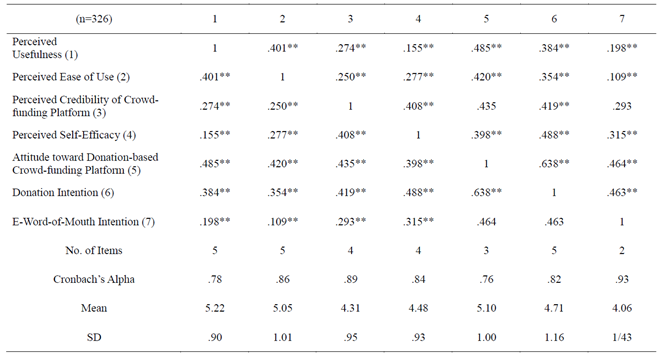
Table 2.
Parameter estimates for causal paths: Original Model.
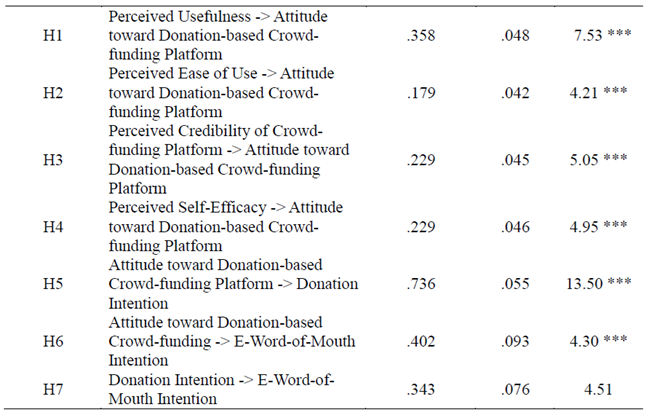
Figure 1.
Path Model of Attitude toward Donation based Crowd funding Platform.
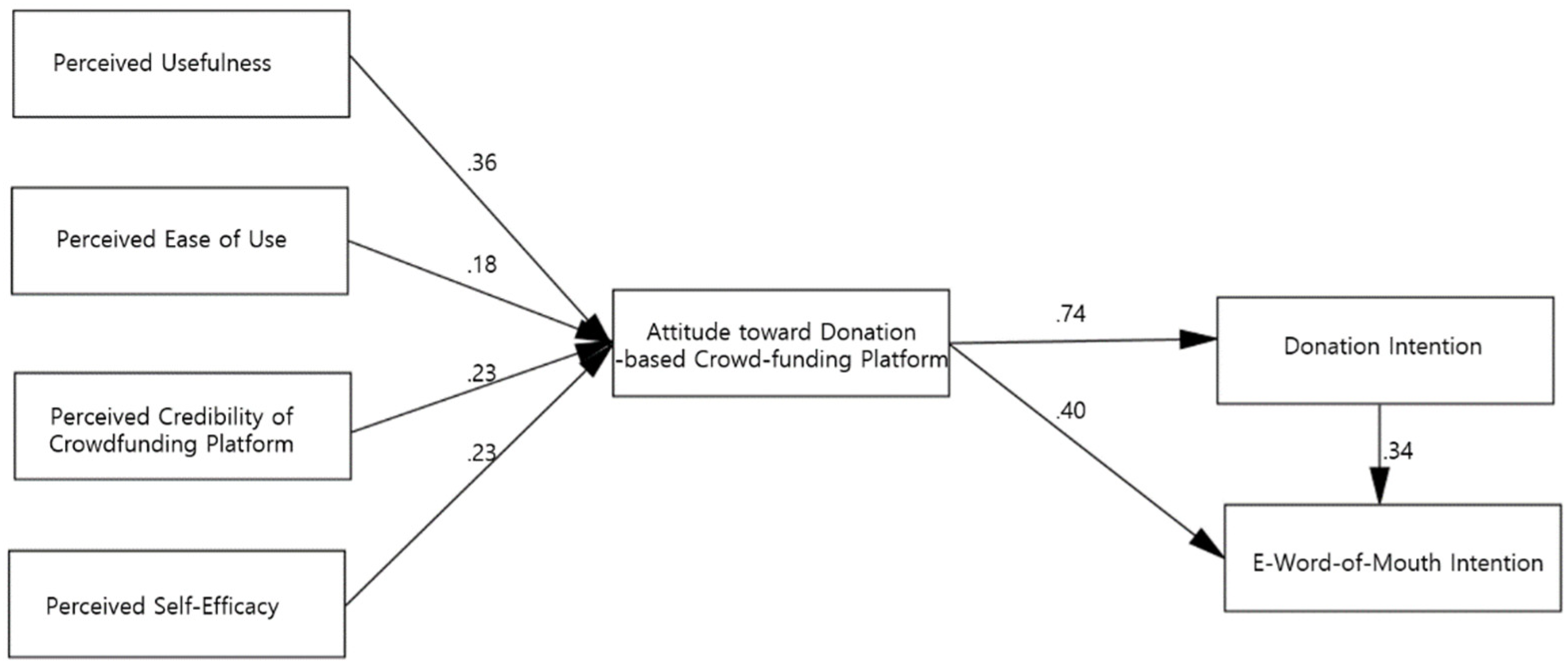
Hypothesized
Goodness-of-fit statistics x2 = 15.90, df = 14, p < .001; GFI = .65; NFI = .66; CFI = .67; IFI = .68; RFI = .33; RMSEA = .214
p < .05, ** p < .01, *** p < .001
A model is regarded acceptable if normed fit index (NFI) and goodness of fit index (GFI) exceed .90 and comparative fit index (CFI) exceed .93, and when RMS is less than .08 [18,19]. Thus, the original model was rejected and the modification indices were examined as a way of improving the model fit [20]. The modification indices showed that the model fit could be improved by adding covariance paths between the following: perceived usefulness and perceived self-efficacy; perceived ease of use and perceived self-efficacy; perceived credibility of crowd-funding platform and perceived self-efficacy; perceived usefulness and perceived credibility of crowd-funding platform; perceived ease of use and perceived credibility of crowd-funding platform; and perceived usefulness and perceived ease of use.
Therefore, these covariance paths are justifiable. After the model modification, the goodness of fit statistics demonstrated that the modified model provided a better fit (x2 = 59.55, df = 8, p < .001; GFI = .94; NFI = .93; CFI = .94; IFI = .93; RFI = .69; RMSEA = .074). Figure 2 shows the modified model and Table 2 indicates the parameter estimates for paths.
H1 posits that perceived usefulness has a positive impact on attitude toward donation-based crowd-funding platform. According to Anderson and Gerbing (1988), a t-value of greater than 2 for each coefficient indicates a statistical significance. As shown in Table 3, study results show that perceived usefulness is positively related attitude toward donation-based crowd-funding platform (t = 6.76, p > .001). H2 proposes that perceived ease of use is positively related to attitude toward donation-based crowd-funding platform. As expected, study results show that perceived eases of use is positively related attitude toward donation-based crowd-funding platform (t = 3.74, p < .001).
H3 states that perceived credibility of crowdfunding platform has a positive impact on attitude toward donation-based crowd-funding platform. As shown in Table 3, the study results show that perceived credibility of crowdfunding platform is positively related to attitude toward donation-based crowd-funding platform (t = 4.47, p < .001). H4 posits that self-efficacy has a positive impact on attitude toward donation-based crowd-funding platform. As shown in Table 3, academic self-efficacy is positively related to attitude toward donation-based crowd-funding platform (t = 4.43, p < .001).
Table 3.
Parameter estimates for causal paths: Modified Model.
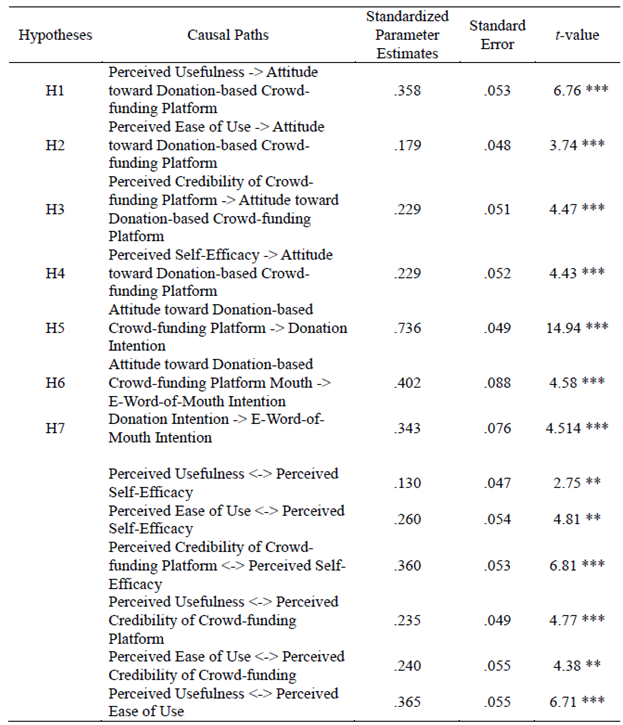
Figure 2.
Path Model of Attitude toward Donation based Crowd funding Platform.
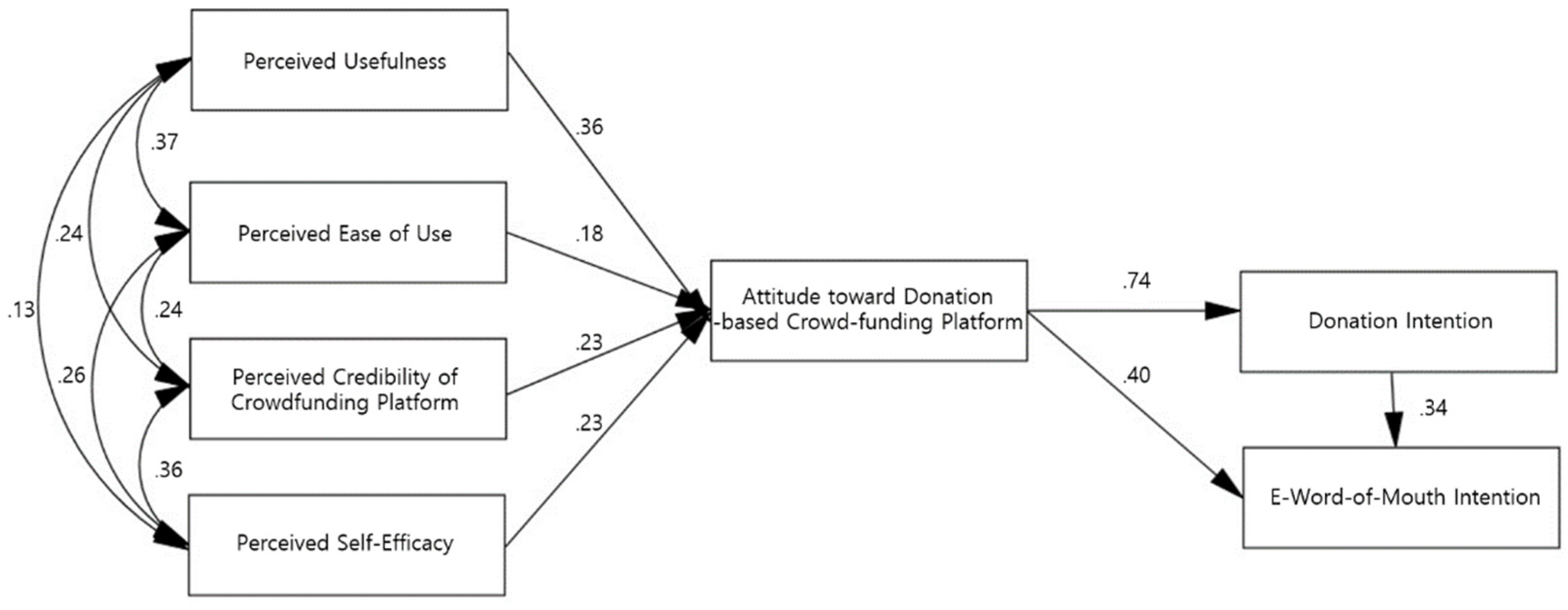
Modified
Goodness-of-fit statistics x2 = 59.55, df = 8, p < .001; GFI = .94; NFI = .93; CFI = .94; IFI = .93; RFI = .69; RMSEA = .074
p < .05, ** p < .01, *** p < .001
H5 proposes that attitude toward donation-based crowd-funding platform has a positive impact on donation intention. As expected, study results indicate that attitude toward donation-based crowd-funding platform is positively related to donation intention (t = 14.94, p < .001). H6 states that attitude toward donation-based crowd-funding platform has a positive impact on e-word-of-mouth intention. As shown in Table 3, the study results show that attitude toward donation-based crowd-funding platform is positively related to e-word-of-mouth intention (t = 4.58, p < .001). Lastly, H7 posits that donation intention has a positive impact on e-word-of-mouth intention. As shown in Table 3, donation intention is positively related to e-word-of-mouth-intention (t = 4.51, p < .001). In sum, H1, H2, H3, H4, H5, H6, and H7 were supported in the study.
Six additional paths were added in the modified model. As shown in Table 3, study results indicate the following six items: 1 perceived usefulness and perceived self-efficacy path coefficient is .13 with a t-value of 2.75 (p < .01); 2) ; perceived ease of use and perceived self-efficacy path coefficient is .26 with a t-value of 4.81 (p < .001); 3) perceived credibility of crowd-funding platform and perceived self-efficacy path coefficient is .36 with a t-value of 6.81 (p < .001); 4) perceived usefulness and perceived credibility of crowd-funding platform path coefficient is .24 with a t-value of 4.77 (p < .001); 5) perceived ease of use and perceived credibility of crowd-funding platform path coefficient is .24 with a t-value of 4.38 (p < .001); and 6) perceived usefulness and perceived ease of use path coefficient is .37 with a t-value of 6.71 (p < .001).
5. Discussion
The study delves into the factors influencing individuals’ attitudes towards donation-based crowdfunding platforms, focusing on antecedents such as perceived usefulness, perceived ease of use, perceived credibility, and self-efficacy. The consequences explored include donation intention and electronic word-of-mouth (e-WOM) intention.
The current study found that the positive relationship between perceived usefulness and attitudes aligns with prior research, emphasizing the pivotal role perceived usefulness plays in users’ decisions to adopt crowdfunding platforms. The positive impact of perceived ease of use on attitudes is consistent with the Technology Acceptance Model (TAM) and underscores the importance of user-friendly design in attracting and retaining users. Trust and credibility are crucial, as evidenced by the positive relationship between perceived credibility and attitudes. Users are more likely to engage when they perceive the platform as trustworthy and reliable. Users’ confidence in their ability to navigate the platform positively influences attitudes. This highlights the psychological aspect of self-efficacy in shaping user engagement.
In regards to consequences of attitude toward donation-based crowdfunding platform, this study found that attitude significantly influences donation intentions, confirming that positive perceptions lead to a greater likelihood of financial contributions. Positive attitudes also contribute to e-WOM intentions, emphasizing the role of users as advocates who share information about campaigns, thereby potentially influencing others.
Lastly, the positive impact of donation intention on e-WOM intention suggests that users who intend to contribute financially are more likely to share information about campaigns with their networks.
In this study the sample consisted of college students, limiting the generalizability of the findings. Future research could consider diverse demographics for a more comprehensive understanding of crowdfunding platform engagement. In terms of practical implications, platform administrators and campaign creators should prioritize user-friendly designs, build trust, and enhance users’ confidence in navigating the platform. These strategies are crucial for fostering positive attitudes and increasing engagement.
The study contributes valuable insights into the factors influencing individuals’ engagement with donation-based crowdfunding platforms. By understanding these antecedents and consequences, stakeholders can make informed decisions to enhance the success of campaigns and the overall popularity of crowdfunding platforms.
Three future research areas are suggested. First, we need to explore cultural variations in the perception of crowdfunding platforms and digital sustainability. It would be interesting to investigate how cultural nuances in the adoption of sustainable behaviors within diverse online philanthropic communities influence individuals’ perceptions of crowdfunding platforms by examining whether the factors such as perceived usefulness, ease of use, credibility, and self-efficacy vary across different cultural contexts. Understanding cultural nuances can provide valuable insights for designing more culturally tailored crowdfunding campaigns and platforms.
Second, it would be important to examine the role of visual content in crowdfunding campaigns. We need to explore the impact of visual content (e.g., images, videos) on users’ attitudes and intentions in crowdfunding campaigns by investigating how a user-friendly design and transparent information on digital sustainability practices impact user engagement and donation intentions.
Third, it would be meaningful to delve into long-term engagement and retention in crowdfunding platforms. We need to examine the factors influencing long-term engagement and retention of users on crowdfunding platforms by investigating whether how positive user experiences and a sense of community contribute to the overall success of sustainability-focused campaign. Additionally, it is also important to explore the role of ongoing communication, updates, and feedback mechanisms in maintaining user interest and participation in multiple crowdfunding campaigns.
Funding
This research received no external funding.
Institutional Review Board Statement
The study was conducted according to the guidelines of the Declaration of Helsinki and approved by the Institutional Review Board (or Ethics Committee) of Hongik University.
Informed Consent Statement
Informed consent was obtained from all subjects involved in the study.
Data Availability Statement
Not applicable.
Conflicts of Interest
The author declares no conflict of interest.
References
- Belleflamme, P., Lambert, T., & Schwienbacher, A. (2014). Crowdfunding: Tapping the right crowd. Journal of Business Venturing, 29(5), 585-609.
- Mollick, E. (2014). The dynamics of crowdfunding: An exploratory study. Journal of Business Venturing, 29(1), 1-16.
- Ordanini, A., Miceli, L., Pizzetti, M., & Parasuraman, A. (2011). Crowd-funding: Transforming customers into investors through innovative service platforms. Journal of Service Management, 22(4), 443-470.
- Gerber, E. M., Hui, J. S., & Kuo, P. Y. (2012). Crowdfunding: Why people are motivated to post and fund projects on crowdfunding platforms. In Proceedings of the International Workshop on Design, Influence, and Social Technologies: Techniques, Impacts and Ethics (pp. 143-150).
- Davis, F.D. (1989). Perceived usefulness, perceived ease of use, and user acceptance of information technology. MIS Quarterly, 13(3), 319-340.
- Flanagin, A. J., & Metzger, M. J. (2000). Perceptions of Internet information credibility. Journalism & Mass Communication Quarterly, 77(3), 515-540.
- Kuppuswamy, V., & Bayus, B. L. (2017). Does my contribution to your crowdfunding project matter?. Journal of Business Venturing, 32(1), 72-89.
- Bandura, A. (1977). Self-efficacy: Toward a unifying theory of behavioral change. Psychological Review, 84(2), 191-215.
- Compeau, D. R., & Higgins, C. A. (1995). Computer self-efficacy: Development of a measure and initial test. MIS Quarterly, 189-211.
- Ajzen, I. (1991). The theory of planned behavior. Organizational Behavior and Human Decision Processes, 50(2), 179-211.
- Litvin, W. S., Goldsmith, E. R., & Pan, B. (2008). Electronic word-of-mouth in hospitality and tourism management. Tourism Management, 29(3), 458–468.
- Pavlou, P.A. (2003). Consumer acceptance of electronic commerce: Integrating trust and risk with the technology acceptance model. International Journal of Electronic Commerce, 7(3), 101-134.
- Mohammadi, H. (2015). Investigating users’ perspectives on e-learning: An integration of TAM and IS success model. Computers in Human Behavior, 45, 359-374.
- Jarvenpaa, S. L., Tractinsky, N., & Vitale, M. (2000). Consumer trust in an Internet store. Information Technology and Management, 1, 45-71.
- Shneor, R., & Munim, Z. H. (2019). Reward crowdfunding contribution as planned behaviour: An extended framework. Journal of Business Research, 103, 56-70.
- Wang, T., Li, Y., Kang, M., & Zheng, H. (2019). Exploring individuals’ behavioral intentions toward donation crowdfunding: evidence from China. Industrial Management & Data Systems, 119(7), 1515-1534.
- Feng, Y., Du, L., & Ling, Q. (2017). How social media strategies of nonprofit organizations affect consumer donation intention and word-of-mouth. Social Behavior and Personality: an international journal, 45(11), 1775-1786.
- Byrne, B.M. (1994). Testing for the factorial validity, replication, and invariance of a measuring instrument: A paradigmatic application based on the Maslach Burnout Inventory. Multivariate Behavioral Research, 29(3), 289-311.
- Browne, M. W., & Cudeck, R. (1993). Alternative Ways of Assessing Model Fit.” In Testing Structural Equation Models, Edited by Bollen, KA and JS Long. NP: Sage Publications.
- Anderson, J. C., & Gerbing, D. W. (1988). Structural equation modeling in practice: A review and recommended two-step approach. Psychological Bulletin, 103(3), 411-423.
Disclaimer/Publisher’s Note: The statements, opinions and data contained in all publications are solely those of the individual author(s) and contributor(s) and not of MDPI and/or the editor(s). MDPI and/or the editor(s) disclaim responsibility for any injury to people or property resulting from any ideas, methods, instructions or products referred to in the content. |
© 2024 by the author. Licensee MDPI, Basel, Switzerland. This article is an open access article distributed under the terms and conditions of the Creative Commons Attribution (CC BY) license (https://creativecommons.org/licenses/by/4.0/).
Copyright: This open access article is published under a Creative Commons CC BY 4.0 license, which permit the free download, distribution, and reuse, provided that the author and preprint are cited in any reuse.


