

Submitted:
30 January 2026
Posted:
30 January 2026
You are already at the latest version
Abstract
This study proposes and applies an objective methodology for the evaluation and assignment of the Pueblo Señorial tourist badge in the context of the management of cultural destinations in Sinaloa, Mexico. In the absence of standardized procedures to ensure comparability and transparency in public decision-making, a quantitative approach based on multi-criteria decision analysis was adopted. The research uses the ELECTRE III method to integrate 12 criteria linked to tourism demand and supply, destination management, infrastructure, cultural and natural resources, social impact and economic benefits. The data used come from official secondary sources, mainly from the National Institute of Statistics and Geography, and are applied to four candidate localities for the label. The results allow us to build a composite indicator and establish a ranking of relative performance, identifying Sinaloa de Leyva as the alternative with the best comprehensive evaluation. The application of the model demonstrates its usefulness in reducing institutional discretion, strengthening the technical coherence of the process and supporting evidence-based tourism planning. It is concluded that the methodological proposal constitutes a replicable and adaptable tool for destination management, the design of tourism policies and the evaluation of certificate.
Keywords:
multi-criteria decision analysis
; ELECTRE III
; tourism policy
; destination evaluation
1. Introduction
In recent years, different countries have considered tourism as one of their main economic activities (Carayannis et al. 2018). Due to this relevance, competition among tourist destinations around the world has increased (Zainuddin et al., 2016). For this reason, according to Pearce (1997), recreation sites need more flexible approaches to be able to compete with other destinations. On the one hand, they seek to implement new technologies to be more innovative (Huertas et al., 2019) and on the other, they strive to promote more competitive entertainment venues (Iniesta-Bonillo et al., 2016).
In 2001, Mexico implemented the “Magical Towns” Program (PPM), whose purpose is to promote the economic development of localities through tourism, with a view to raising levels of well-being, maintaining and increasing employment, and promoting investment (SECTUR, 2017). In this sense, the concept of Magical Town, created by the Ministry of Tourism of Mexico (SECTUR), served to designate a town that demonstrates the conservation of its historical and cultural heritage through time and despite modernity. For example, the town of Tequila in the state of Jalisco received its recognition in 2003, and thanks to public investment it soon became the third most important tourist attraction in that state, only behind its capital Guadalajara, and Puerto Vallarta. By 2021, the number of Magical Towns amounted to 132 (SECTUR, 2024).
In view of this significant growth, the Magical Towns Program is considered one of the most important tourism policy decisions that have been initiated by the federal administration within Mexican territory (Madrid, 2022). However, it is difficult to assess and compare the degree of development that these localities have been experiencing since there is no consensus on the ideal indicators to make this comparison (Huertas et al., 2019).
There is a large number of publications that address the issue of PM from different perspectives; some under a more comprehensive approach than others through the application of different methods anchored to quantitative and/or qualitative paradigms. This is the case of the one developed by Coronado et al., (2018), where they propose the use of socioeconomic, environmental, sustainability, geographical, and institutional variables in the evaluation of 62 localities, seeking to determine the ecotourism potential in the magical town of La Trampa, Mexico.
Madrid (2022), on the other hand, proposes to identify successes and challenges faced by the Magical Towns Program, in order to present the bases of a proposal to evolve the program through greater citizen participation, both in its definitions and in its operation. Likewise, Balslev and Gyimóthy (2016) developed a case study in the town of Álamos, Sonora state, through in-depth qualitative interviews with key people with influence in decision-making, as well as 36 households to collect their perceptions regarding local tourism development.
Similarly, Hoyos-Castillo and Hernández-Lara, (2008), carry out a socio-territorial analysis and progress of the Magical Towns Program in Tepotzotlán and Valle de Bravo, where they present the main attributes with which the municipalities have joined the PPM and also the implementation of this according to the profile of each municipality. Finally, Madrid (2012) examines the socio-territorial process of the municipalities of Tepotzotlán and Valle de Bravo, considering the implementation of the PPM from the analytical perspective of the new rurality with a tourist profile. In this regard, he argues that the program can generate important social and activity changes in the territory, while referring to the importance of concentrating investment to focus its impact on dynamic tourism structures.
At the regional level, there are also efforts to diversify the tourism offer by taking advantage of the natural and cultural resources that are available, in different states of the Mexican Republic similar programs have been created, such as “Charming Towns” (Fernández, 2016). Such is the case of the tourist distinctive “Pueblo Señorial”, a recognition created by the Ministry of Economic Development and the Government of the State of Sinaloa in order to promote tourism in certain colonial towns within the entity, in addition to promoting the conservation of their historical and cultural heritage, their daily lifestyles, customs, festivities, etc. art, among others (Velarde et al., 2009). It is worth mentioning that this distinction appeared long before the one of magical towns promoted at the national level by the Federal Ministry of Tourism of Mexico (Fernández, 2016).
The Secretary of Tourism of the State of Sinaloa describes the stately town on its official website as that place “where history, culture and magic are intertwined to give you unique experiences in every corner of Sinaloa.” Among the various requirements that are necessary to obtain this distinction, it is highlighted that the settlement must have cobblestone or cobblestone streets; a colonial-style arch at the entrance, a historic center with a minimum of ten mansions, a lodging center, one or more restaurants, a religious temple with history, a religious festival with roots, a museum, a historical monument, a pantheon more than a century old (Velarde et al., 2009, p.83).
In this way, the distinctive “Manor Town” is seen as an element of attraction that will facilitate the promotion of tourism in the destination that holds it (Félix-Miranda et al., 2015). In addition, it allows the site to be integrated into the state’s tourism offer as cultural and gastronomic destinations (Velarde et al., 2009). For example, the towns of Concordia and San Ignacio are sites that already have the designation and are distinguished by the diversity of their natural and cultural resources (Olaguez et al., 2022). According to Alvarado and Argüello (2019), in 2019 there were nine towns registered with the distinction: Sinaloa de Leyva, San Ignacio, Elota, Villa de Ahome, Choix, El Quelite, Imala, Concordia and Copala, thanks to their cultural and historical heritage and their high tourist value.
Some studies have addressed the way in which the manorial villages have permeated the local economy of the sites that hold this designation. In the case of the municipality of Choix Parra-Aceviz (2025), he argues that by receiving this distinction, the site has registered greater interest and an increase in the number of visitors, in addition to an increase in the generation of jobs. On the contrary, Gutiérrez (2023, p.62), argues that during the first decade of the twentieth century these destinations have not been able to channel cultural resources towards tourism activity in an acceptable way, putting the traditions of native peoples at risk.
Despite the possible tourist and cultural contradictions, there has been an increase in the number of towns that hold the badge. For example, for Alvarado and Argüello (2019), in Sinaloa during 2019 there were nine stately towns registered thanks to their cultural and historical heritage and their high tourist value. By 2025, there are already 12: Villa de Ahome, Choix, Sinaloa de Leyva, La Noria, Elota, Badiraguato, El Quelite, Imala, Tacuichamona, Copala, Agua Caliente de Gárate and Concordia.
Various municipal authorities have requested the State Government to provide the badge for some of their settlements. However, the procedure by which it is chosen and ruled is not clear. In this sense, the main objective of this study is to design a methodological proposal that serves as an alternative for the evaluation of criteria that allow differentiating and assigning the distinctive manorial town in a more objective way through the use of multi-criteria analysis methods for decision-making.
Multi-Criteria Decision-Making and Evaluation
From the administrative point of view, a decision “is the choice of a course of action among several alternatives” (Münch & Galindo, 2004, p.153), therefore, it also represents one of the main activities for any executive, regardless of whether his role is in the public or private sector.
Making decisions can be analyzed from two perspectives, one of them is represented by a simplistic scenario where decision-making represents an everyday phenomenon that can develop at any time randomly and even fortuitously, but with the ability to determine the quality of life of the individual, such as choosing a partner or university career.
Such is the importance of decision-making that “numerous techniques have been developed, mainly based on mathematical tools and operations research” (Münch & Galindo, 2004, p.153). For this reason, it is pertinent to develop experimental models that allow representing the potential behavior of the individual in various situations; Hence, the decision-making process is conceived as a particularity of the administration and, consequently, implies the comparison between the alternatives that can be chosen in the face of a certain present dilemma.
Adequate decision-making requires, in the first place, to divide any problematic situation into the elements that compose it in order to reach an approach from the parts to the whole, which allows its contrast and sifting. In this way, decision-making involves comparing possible alternatives, which underlies the need to carry out measurements that allow defining and applying comparison criteria according to the priorities and pretensions of the decision-maker, being able to establish the hierarchy of key success factors (Pacheco & Contreras, 2008, p.39).
In summary, decision theory “is concerned with analyzing how a person or group of people chooses that action that, from a set of possible actions, leads to the best result given their preferences” (Aguiar, 2004, p.139), which is why within every decision-making process the set of possible or feasible solutions to the decision problem examined is established. Next, an arrangement of feasible solutions is established. Subsequently, and with the support of mathematical techniques, we proceed to look for among the feasible solutions the one that has a greater degree of desirability, representing this as an optimal solution.
In this context of complexity that increases day by day in this field, there are methods of support for Multicriteria Decision Aiding (MCDA), whose purpose and scope “is to support decision makers by addressing complex problems of evaluation and decision-making... focuses on aspects of model development directly related to the presentation and modeling of the decision-maker’s preferences, judgments, and values” (Leyva & Gastélum, 2013, p.11), the breadth of which is explained in greater detail in the following paragraphs.
In this sense, decision models play an essential role in helping people and organizations to make the best and most viable decision with the information and data available (Salvador et al., 2024). Similarly, multi-criteria decision models represent tools that allow the comparison of alternatives that meet one or more criteria at the same time, making it easier for the user who develops it to determine it (Izar, 2022).
Within the management process in organizations, multi-criteria decision analysis not only represents a firm aid in the practice of decision-making since “it constitutes a way of modeling the decision processes, in which the following come into play: a decision to be made, unknown events that may affect the result(s), the possible courses of action, and the results of these” (Chica, 2013, p.52). Likewise, multi-criteria evaluation techniques allow us to deal with very complex decision problems, even when there are heterogeneous characteristics in a given phenomenon. García et al., (2013, p.4), summarize this procedure clearly:
Once the problem has been identified (we do not know which alternatives to choose, we have doubts about what is best) and placed in its context (by virtue of the decision-making environment), the decision-maker, in order to address the last phase of the process that will lead to choosing an alternative (in the best of cases), will first need to determine the attributes that he intends to evaluate in order to correctly define the objectives.
That is why multi-criteria analysis for decision-making in recent decades has become a relevant support for theoretical and practical evolution in decision science (León & Larrañaga, 2019, p.30). For example, Salvador et al., (2024), presented a literature review on a multi-criteria decision model called ELimination and Choice Expressing REALity based on ELECTRE, to locate studies linked to decision-making in provider selection, finding frequent and hybrid use, since it has been merged with other methods such as AHP and TOPSIS.
For their part, Vilela et al., (2024), developed a multi-criteria model based on the FITradeoff method for the classification of problems applied in Brazilian textile companies in order to establish an evaluation in terms of technological maturity for industry 4.0. In another study, a hierarchical order was calculated to plan the electrification of 8 rural communities in Mexico, using a combination of the AHP method with discrete commitment programming, allowing criteria related to budget constraints to be resolved (Gómez-Hernández, 2023).
Castro-Nuño et al. (2024) also evaluate the adaptation of tourism competitiveness in ten Spanish destinations based on a multi-criteria proposal using the Discrete Multi-Criteria Decision Theory based on the PROMETHEE technique. Two coastal regions of Thailand were assessed to determine their level of vulnerability to the impacts of climate change, using a multi-criteria decision analysis (MCDA) and GIS approach, according to geographically pre-established criteria and sub-districts (Cheewinsiriwat et al., 2024). In this same vein, Sina et al., (2023), adopted a Laboratory for Evaluation and Testing of Decision Making (DEMATEL) approach, and the Analytical Network Process (ANP) to examine environmental criteria for sustainable management in the hotel industry.he introduction should briefly place the study in a broad context and highlight why it is important. It should define the purpose of the work and its significance.
2. Materials and Methods
Considering the breadth, subjectivity, and variety of indicators that can be used to weight villages that are candidates for the stately town badge, it is evident that the decisions faced by tourism planners often include variables that are difficult to measure directly, even in the process of obtaining numerical measures of relative importance of decision variables.
Therefore, for this study, a method of support for decision-making was used in scenarios in which multiple variables or selection criteria intervene, because it facilitates multidimensional analysis, as is the problem in question (León & Larrañaga, 2019). On the other hand, the procedure for constructing the multicriteria model is the one proposed by Roy (1991), due to its usefulness called the ELECTRE III method in the construction of a family consisting of decision criteria and their respective evaluation criteria, it has been successfully tested and developed in different disciplinary fields.
A characteristic of multicriteria decision analysis is the use of a performance matrix: each row describes an alternative and each column refers to the values of these with respect to each criterion (Dodgson, et al., 2009). By way of summary, this proposal followed three stages:
- Identification of the decision alternatives (4 localities seeking the badge).
- The weights for each of the 12 criteria selected as important to obtain the badge (tourism demand, tourism supply, tourism management, infrastructure, natural and cultural resources, professionalization, water, waste, economic benefits, services and social impact), extracted from the INEGI database (2023), are determined.
- In the third stage, a measurement scale is made, characterization of the criteria, as well as a measure of agreement for each pair of alternatives under the principle of majority, which allows establishing a classification relationship. In this way, once the criteria have been defined and the decision alternatives have been identified, it is possible to measure and compare, therefore, the calculation is made using a decision matrix that allows the execution of the multi-criteria evaluation model.
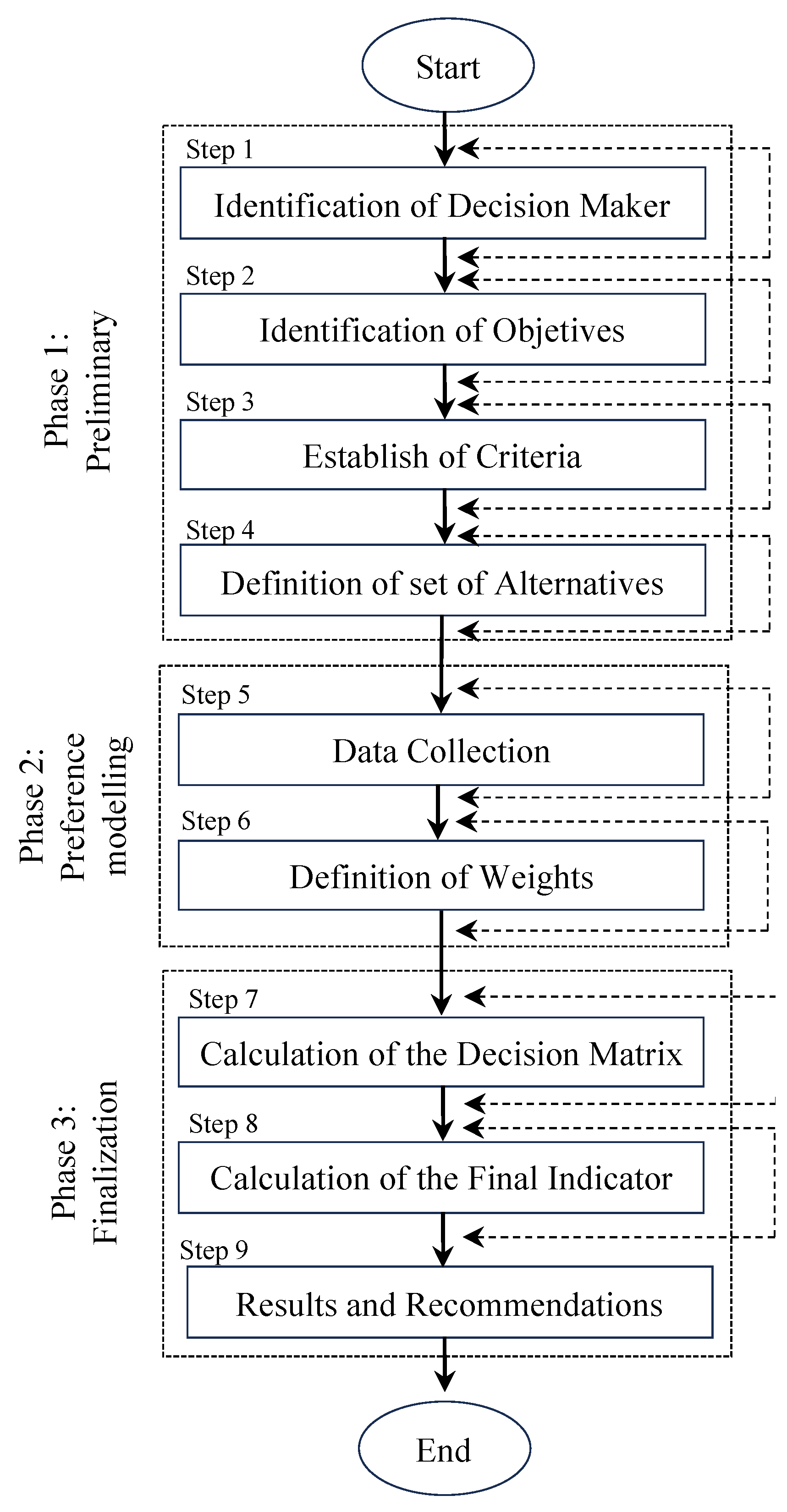
For the study that is addressed, the ELECTRE III Method used by León and Leyva (2017) is used and the development is proposed using the procedure to solve problems and build multicriteria models developed by De Almeida (2015) and as proposed to design the decision model in this work (Figure 1).
The methodology was designed to consider the criteria of the localities of the state of Sinaloa, Mexico, namely Concordia, Elota, Escuinapa and Sinaloa, where the objective is to know which of these has a greater possibility of assigning the distinction of Lordly Town, as well as to build a composite indicator that allows evaluating this appreciation. Finally, Excel 2023 was used to calculate the results of this multi-criteria model.
Scale of measurement and characterization of the criteria: for each criterion, a series of indicators are proposed on a group of destinations, from these, a set of criteria is calculated. Each where is a combination of originals by the weight for each criterion (Almeida, Figueira, & Roy, 2006), that is:
On the other hand, in order to comply with the principle of concordance, the first step is to develop a measure of agreement, for each pair of alternatives (majority principle), which defines an outranking relationship (Leyva, 2010) as follows:
where:
Figure 1.
Design of multi-criteria decision support models for tourism destinations. Source: Adapted from De Almeida (2105).
Figure 1.
Design of multi-criteria decision support models for tourism destinations. Source: Adapted from De Almeida (2105).
3. Results
This section describes the results obtained from the process developed in the study, based on a method of support for decision-making supported by multi-criteria evaluation techniques to be developed in three stages as follows:
3.1. Stage 1
Identification of alternatives: A matrix of alternatives was constructed. Being (|A|= a_1.a_2,... a_m) the finite set of alternatives, (|A|=m) Almeida, et al. (2006). These are shown in Table 1.
3.2. Stage 2
Criteria are measures that represent the means-end goals, which means that each criterion has its own analytical representation as a measurement tool to define the consequence to evaluate a specific alternative (León et al. 2025). This is maximizing the indicators is considered of utmost relevance, because they directly influence the local development of the manorial towns (see Table 2).
In the construction of the model, the support provided to the decision-maker is the definition through the weights for the criteria. After selecting the 12 criteria (see Table 3), the weight of each of them was established using the Revised Simos procedure (Figueira & Roy, 2002, p.321).
3.3. Stage 3
After preparing the data collected in Table 3, according to the values of weights, direction, preference and indifference, Table 4 allows us to exploit the fuzzy exceedance relationship to obtain an ordering of alternatives of decreasing preferences.
For the calculation of the final indicator, it was used using the tool called SADGAGE, recommended by Leyva et al. (2016), which allows solving multi-criteria ranking problems in small to medium-sized samples, whose algorithm makes it easier to include tens or hundreds of indicators or criteria. Considering the stages indicated in the methodological proposal, the final product of the procedure is summarized with the establishment of a ranking of the alternatives compared (Sinaloa de Leyva, Elota, Concordia and Escuinapa. In this sense, according to the results obtained, the A1 alternative located (Sinaloa de Leyva), is positioned as the locality that should receive the distinction of stately town, since it presented better development and evaluation among the previously defined criteria (see Figure 2).
4. Discussion
The results of the study confirm that the application of multi-criteria analysis methods represents a solid methodological alternative for the objective evaluation of candidate localities to receive the Pueblo Señorial tourist distinction, especially in contexts characterized by the coexistence of tourist, social, environmental and management criteria. The structuring of the problem through a multi-criteria model made it possible to integrate heterogeneous information and reduce discretion in the decision-making process, which coincides with what was pointed out by Zavadskas et al. (2016), who highlight the usefulness of these methods to improve transparency and consistency in territorial planning.
The order obtained should not be interpreted only as a numerical hierarchy of alternatives, but as the reflection of an integral performance against a set of weighted criteria. This approach is consistent with the recent literature on competitiveness and evaluation of tourist destinations, which underscores the need to consider multiple dimensions beyond purely economic or demand indicators (Salinas et al., 2020; Pulido-Fernández & Rodríguez-Díaz, 2016). In this sense, the inclusion of criteria related to social impact, economic benefits and tourism management reinforces the relevance of the model for badge programs with implications for local development.
From the methodological point of view, the use of the ELECTRE III method proved to be adequate to normalize and compare criteria expressed at different scales, facilitating the interpretation of the results by decision-makers. Although the literature recognizes the existence of more sophisticated multi-criteria methods, recent studies indicate that additive models continue to be widely used in the field of tourism and regional planning due to their operational clarity, flexibility, and ease of replication (Gómez-Navarro et al., 2009; Botti & Peypoch, 2013; Jittamai et al., 2025). Consequently, the present study provides empirical evidence that supports the validity of ELECTRE III in destination evaluation scenarios.
The assignment of weights through the Revised Simos procedure is another relevant element of the methodological proposal, as it allows an explicit and transparent hierarchy of the evaluation criteria. This aspect has been identified as critical in the literature on multicriteria analysis, given that the weighting of criteria directly influences the final results and the legitimacy of the decision-making process (Figueira et al., 2016). In this sense, the methodology applied contributes to reducing the subjectivity inherent in the traditional schemes for evaluating tourist distinctives.
Previous studies applied to tourism certifications and distinctions have indicated that the lack of systematic and comparable methodologies can generate perceptions of inequity or discretion in the assignment of recognitions (Elhoushy et al., 2025; Grapentin & Ayikoru, 2019; Sánchez, 2019). In this context, the results of the study show that the multi-criteria approach can contribute to strengthening the institutional credibility of this type of program. The findings and their implications should be discussed in the broadest context possible. Future research directions may also be highlighted.
5. Conclusions
The study allowed the generation of empirical evidence of its applicability in this type of problem. Therefore, it is proposed as a contribution to scientific-technical development in this area of knowledge to strengthen the application and use of the methodology developed in similar contexts. That is, from the point of view of tourism or in other fields, the methodology favours the use of different criteria, regardless of their number or characteristic.
The application of multicriteria analysis made it possible to systematically integrate a broad and diverse set of criteria, overcoming the limitations of traditional evaluation schemes based on predominantly subjective judgments. In this sense, the use of the ELECTRE III method, combined with a structured procedure for the assignment of weights, facilitated the comparison between alternatives and the obtaining of a clear, understandable and useful ranking for decision-makers.
The methodological proposal provides relevant information to the managers of these destinations for decision-making and the construction of public policies. One of its strengths is that it can be replicated by incorporating a greater number of Manor Towns or other types of destinations, periods of time, segments or geographical regions (local, national and international). That is, it can be adapted, as long as the criteria submitted are present in each of the alternatives under analysis.
The results of the study from a practical perspective offer a valuable representation for tourism management and decision-making in the destinations that are analyzed, since it is possible to understand through the relationship between tourism factors linked to local development, in this way the decision-maker has sufficient elements to plan his investments, promote the destination to increase the influx of visitors, etc.
Finally, it is recognized that future research could deepen the comparison between different multi-criteria methods, as well as the incorporation of perceptual or participatory indicators that complement quantitative information. However, the results of this study constitute a significant step towards the design of more objective and rigorous evaluation schemes for the assignment of tourist labels.
References
- Aguilar, F. Teoría de la decisión e incertidumbre: modelos normativos y descriptivos. EMPIRIA, Revista de Metodología de Ciencias Sociales 2004, (8), 139–160. [Google Scholar] [CrossRef]
- Alireza, A.; Majid, M.; Rosnah, Y. Simple Additive Weighting approach to Personnel Selection Problem. International Journal of Innovation, Management and Technology 2010, 1(5), 511–515. Available online: https://www.ijimt.org/papers/89-M474.pdf.
- Alvarado Borrego, A.; Argüello Silva, N.R. Turismo cultural como base para el desarrollo local del pueblo étnico mayo-yoreme; En Guerra García, E., Vargas Hernández, J.G., y Alvarado Borrego, A., Eds.; (Coord.). Gestión intercultural y cultura de paz desde el norte de Sinaloa. Universidad Autónoma Intercultural de Sinaloa. Ediciones del Lirio, 2019; pp. 79–106. [Google Scholar]
- Balslev Clausen, H.; Gyimóthy, S. Seizing community participation in sustainable development: pueblos mágicos of Mexico. Journal of Cleaner Production 2016, 111, 318–326. [Google Scholar] [CrossRef]
- Botti, L.; Peypoch, N. Multi-criteria ELECTRE method and destination competitiveness. Tourism Management Perspectives 2013, (6), 108–113. [Google Scholar] [CrossRef]
- Carayannis, E.; Ferreira, F.; Bento, P.; Ferreira, J.; Jalali, M.; Fernandes, B. Developing a socio-technical evaluation index for tourist destination competitiveness using cognitive mapping and MCDA. Technological Forecasting and Social Change 2018, 131, 147–158. [Google Scholar] [CrossRef]
- Castro-Nuño, M.; López-Valpuesta, L.; Chávez Solís, M. Evaluando la adaptación de la competitividad turística en diez destinos españoles: Una propuesta multicriterio. Cuadernos de Turismo 2024, (53), 187–213. [Google Scholar] [CrossRef]
- Chica Salgado, C. A. Modelo matemático multicriterio para coadyuvar a la toma de decisiones en la selección de alternativas en Pymes. Estrategias 2013, 11(21), 49–63. [Google Scholar] [CrossRef]
- Cheewinsiriwat, P.; Langkulsen, U.; Lertwattanamongkol, V.; Poompongthai, W.; Lambonmung, A.; Chamchan, C.; Boonmanunt, S.; Nakhapakorn, K.; Moses, C. Assessing Coastal Vulnerability to Climate Change: A Case Study of Nakhon Si Thammarat and Krabi. Social Sciences 2024, 13(3), 142. [Google Scholar] [CrossRef]
- Coronado Martínez, Y.; Rosas Baños, M.; Cerón Monroy, H. Ecotourism as a path to sustainable development in an isolated Magic Town: The case study of La Trampa, Mexico. Journal of Tourism Analysis 2018, 25((1).), 23–38. [Google Scholar] [CrossRef]
- De Almeida, AT; Cavalcante, CAV; Alencar, MH; Ferreira, RJP; De Almeida-Filho, AT; Garcez, TV. Multicriteria and multiobjec-tive models for risk, reliability and maintenance decision analysis; Springer International Publishing; New York; Vol. 1.
- Dodgson, J.S.; Spackman, M.; Pearman, A.; Phillips, L.D. Multi-Criteria Analysis: A Manual; Department for Communities and Local Government, 2009. [Google Scholar]
- Elhoushy, S.; Elzek, Y.; Font, X. Sustainable tourism certification: a systematic literature review and suggested ways forward. Journal of Sustainable Tourism 2025, 1–27. [Google Scholar] [CrossRef]
- Félix-Miranda, L.; Cong-Hermida, M.C.; Santillán-Núñez, M.A. Valor de los recursos turísticos una experiencia en el campamento ecoturístico “palo blanquito”, Choix, Sinaloa. Juyyaania. Revista sobre el Manejo, Uso y Aprovechamiento de los Recursos Naturales 2015, 3(1), 105–118. [Google Scholar]
- Fernández Poncela, A.M. Una revisión del programa pueblos mágicos. CULTUR - Revista de Cultura e Turismo 2016, 10(1), 3–33. Available online: https://periodicos.uesc.br/index.php/cultur/article/view/944/890.
- Figueira, J. R.; Greco, S.; Ehrgott, M. Multiple criteria decision analysis: State of the art surveys, 2nd ed.; Springer, 2016. [Google Scholar]
- Figueira, J.; y Roy, B. Determining the weights of criteria in the Electre type methods with a revised Simos’ procedure. European Journal of Operational Research 2002, 139(2), 317–326. [Google Scholar] [CrossRef]
- García Aguado, A.; Martínez Rodríguez, E.; Del Campo Campos, C.; Y López Zafra, J.M. Técnicas multicriterio de ayuda a la decisión; Editorial Pearson, 2013. [Google Scholar]
- Gómez-Hernández, D.F.; Domenech, B.; Juanpera, M.; Ferrer-Martí, L. Ranking projects in regional electrification plans considering technical and social criteria. Case study in Mexico; Energy for Sustainable Development, 2023; p. 77. [Google Scholar] [CrossRef]
- Gómez-Navarro, T.; García-Melón, M.; Acuña-Dutra, S.; Díaz-Martín, D. An environmental pressure index proposal for urban development planning based on the analytic network process. Environmental Impact Assessment Review 2009, 5(29), 319–329. [Google Scholar] [CrossRef]
- Grapentin, S.; Ayikoru, M. Destination Assessment and Certification: Challenges and Opportunities. Sustainability 2019, 11(13), 3691. [Google Scholar] [CrossRef]
- Gutiérrez Aguilar, J.O. Propuesta metodológica para el diagnóstico del sector cultural en Culiacán desde la perspectiva del desarrollo local y la gestión del conocimiento, evaluado de 2011-2015. Tesis Maestría. Maestría en Ciencias Económicas y Sociales; Universidad Autónoma de Sinaloa, 2023. Available online: http://tesis.uas.edu.mx/handle/DGB_UAS/520.
- Hoyos Castillo, G.; Hernández Lara, O. Localidades con recursos turísticos y el programa pueblos mágicos en medio del proceso de la nueva ruralidad. Los casos de Tepotzotlán y Valle de Bravo en el Estado de México. Quivera. Revista de Estudios Territoriales 2008, 10(2), 111–130. Available online: https://www.redalyc.org/articulo.oa?id=40113196008.
- Huertas, A.; Moreno, A.; y Ha My, T. Which destination is smarter? Application of the (SA)6 framework to establish a ranking of smart tourist destinations. International Journal of Information Systems and Tourism 2019, 4(1), 19–28. Available online: http://uajournals.com/ojs/index.php/ijist/article/view/437/313.
- Izar Landeta, J.M. Modelos de decisión multicriterio en el ámbito administrativo; Instituto Mexicano de Contadores Públicos, 2022. [Google Scholar]
- Instituto Nacional de Estadística; Geografía e Informática INEGI. National Statistical Directory of Economic Units 2023. México. 2023. Available online: https://www.inegi.org.mx/rnm/index.php/catalog/924.
- Iniesta-Bonillo, M.; Sánchez-Fernández, R.; y Jiménez-Castillo, D. Sustainability, value, and satisfaction: model testing and cross-validation in tourist destinations. Journal of Business Research 2016, 69(11), 5002–5007. [Google Scholar] [CrossRef]
- Jittamai, P.; Toek, S.; Phengarree, K.; Kongkanjana, K.; Chanlawong, N. Multi-Criteria Decision-Making for Assessing and Evaluating Health and Wellness Tourism Destination Potential Using the 6AsTD Framework: A Case Study of Nakhon Ratchasima Province, Thailand. Sustainability 2025, 17(11), 4995. [Google Scholar] [CrossRef]
- León Santiesteban, M.; Flores Gamboa, S.; Leyva López, J. C.; Solares Lachica, E. Modelo de decisión multicriterio para evaluar el nivel de desarrollo local turístico de los pueblos mágicos del Noroeste de México. In Cuadernos de Turismo; Universidad de Murcia, 2025; Volume 55, pp. 47–68. [Google Scholar] [CrossRef]
- León Santiesteban, M.; Larrañaga Núñez, A.M. Integración de conocimiento en restaurantes mediante el análisis multicriterio para la toma de decisiones. Inquietud Empresarial 2019, 19(2), 25–38. Available online: https://revistas.uptc.edu.co/index.php/inquietud_empresarial/article/download/9005/9302/37432. [CrossRef]
- León Santiesteban, M.; Leyva López, J. C. A multicriteria decision aid for evaluating the competitiveness of tourist destinations in the Northwest of Mexico. Turismo y Sociedad 2017, (21), 51–67. [Google Scholar] [CrossRef]
- Leyva López, J.C. Métodos de ordenamiento multicriterio; México; Plaza y Valdes Editores, 2010. [Google Scholar]
- Leyva López, J.C.; Gastélum, D.; Evaluación del desarrollo socioeconómico de Sinaloa bajo un enfoque multicriterio. Universidad de Occidente. Juan Pablo EditoreLeyva López; J.C; Solano Noriega; J.J; García Alcaraz, J.L.; Gastélum Chavira, D.A. : Exploitation of a Medium-Sized Fuzzy Outranking Relation Based on Multi-objective Evolutionary Algorithms to Derive a Ranking. International Journal of Computational Intelligence Systems 2013, 9, 745–764. [Google Scholar] [CrossRef]
- Madrid Flores, F. Magical towns 2.0. Journal of Tourism and Heritage Research 2022, 5(4), 102–121. Available online: https://www.jthr.es/index.php/journal/article/view/423.
- Madrid Flores, F. Diagnóstico y oportunidades del turismo en México; Editorial Limusa, 2012. [Google Scholar]
- Münch Galindo, L.; García Martínez, J. Fundamentos de Administración; Editorial Trillas, 2004. [Google Scholar]
- Olaguez Torres, J.E.; Lizárraga Morales, M.A.; Prieto García, M.A.; Nordahl Mandujano, E. Capacitación y desarrollo de habilidades de los directores de las mypes de Rosario, Concordia y Escuinapa, Sinaloa, México. In book: Capacitación y desarrollo de habilidades de los directores de las mypes de Latinoamérica. Tomo II; 2022. [Google Scholar] [CrossRef]
- Pacheco, J. F.; Contreras, E. Manual metodológico de evaluación multicriterio para programas y proyectos; CEPAL, 2008. [Google Scholar]
- Parra Aceviz, L. C. Estudio de economía regional de la zona norte de Sinaloa, México: 2003-2018. Revista Ra Ximhai 2025, 21(1), 43–66. [Google Scholar] [CrossRef]
- Pearce, D. Competitive destination analysis in Southeast Asia. Journal of Travel Research 1997, 35(4), 16–24. [Google Scholar] [CrossRef]
- Pulido-Fernández, J. I.; Rodríguez-Díaz, B. Reinterpreting the World Economic Forum’s global tourism competitiveness index. Tourism Management Perspectives 2016, 20, 131–140. [Google Scholar] [CrossRef]
- Roy, B. The outranking approach and the foundations of ELECTRE methods. Theory and decision 1991, 31(1), 49–73. [Google Scholar] [CrossRef]
- Salinas Fernández, J.A; Serdeira Azevedo, P.; Martín Martín, J.M.; Rodríguez Martín, J.A. Determinants of tourism destination competitiveness in the countries most visited by international tourists: Proposal of a synthetic index. Tourism Management Perspectives 2020, 33. [Google Scholar] [CrossRef]
- Salvador, S.; Moura, M.; Campos, P.; Cardoso, P.; Espadinha-Cruz, P.; y Godina, R. Electre applied in supplier selection – a literature review; Procedia Computer Science, 2024; Vol. 232, pp. 1759–1768. [Google Scholar] [CrossRef]
- Sánchez Valdés, A. Certificaciones de calidad, un análisis de las limitantes para su aceptación y posterior adopción en las MiPymes turísticas del Estado de México. Kalpana 2019, 17, 137–150. Available online: https://dialnet.unirioja.es/descarga/articulo/7313494.pdf.
- Secretaría de Turismo de México SECTUR. Pueblos Mágicos. Secretaría de Turismo. Gobierno de México. 2024. Available online: https://www.gob.mx/sectur/acciones-y-programas/pueblos-magicos-267851.
- Secretaría de Turismo de México SECTUR. Guía para la Integración documental Pueblos Mágicos 2017. Secretaría de Turismo. Gobierno de México. 2017. Available online: https://www.gob.mx/cms/uploads/attachment/file/273030/Gui_a_2017_de_Incorporacio_n_2017.pdf.
- Sina, K.Y.; Lo, M.; Mohamad, A. A.; Al Mamunc, A.; Sim, C. L. Selecting total quality management (TQM) Best practices in the hotel industry environment: A hybrid model based on DEMATEL and ANP. International Journal of Supply and Operations Management 2023, 10(3), 245–270. [Google Scholar] [CrossRef]
- Velarde Valdez, M.; Maldonado Alcudia, A.V.C.; y Maldonado Alcudia, M.C. Pueblos Mágicos. Estrategia para el desarrollo turístico sustentable: caso Sinaloa. Teoría y Praxis 2009, (6), 79–93. Available online: https://www.redalyc.org/pdf/4561/456145109005.pdf. [CrossRef] [PubMed]
- Vilela Ferreira, D.; Henriques de Gusmão, A.P.; y Araújo de Almeida, J. A multicriteria model for assessing maturity in industry 4.0 context. Journal of Industrial Information Integration 2024, Vol. 38. [Google Scholar] [CrossRef]
- Zainuddin, Z.; Radzi, S.; y Zahari, M. Perceived destination competitiveness of Langkawi Island, Malaysia. Procedia-Social and Behavioral Sciences 2016, 222, 390–397. [Google Scholar] [CrossRef]
- Zavadskas, E. K.; Govindan, K.; Antucheviciene, J. Hybrid multiple criteria decision-making methods: A review of applications for sustainability issues. Economic Research-Ekonomska Istraživanja 2016, 29(1), 857–887. [Google Scholar] [CrossRef]
Figure 2.
Recommendation for the decision maker.
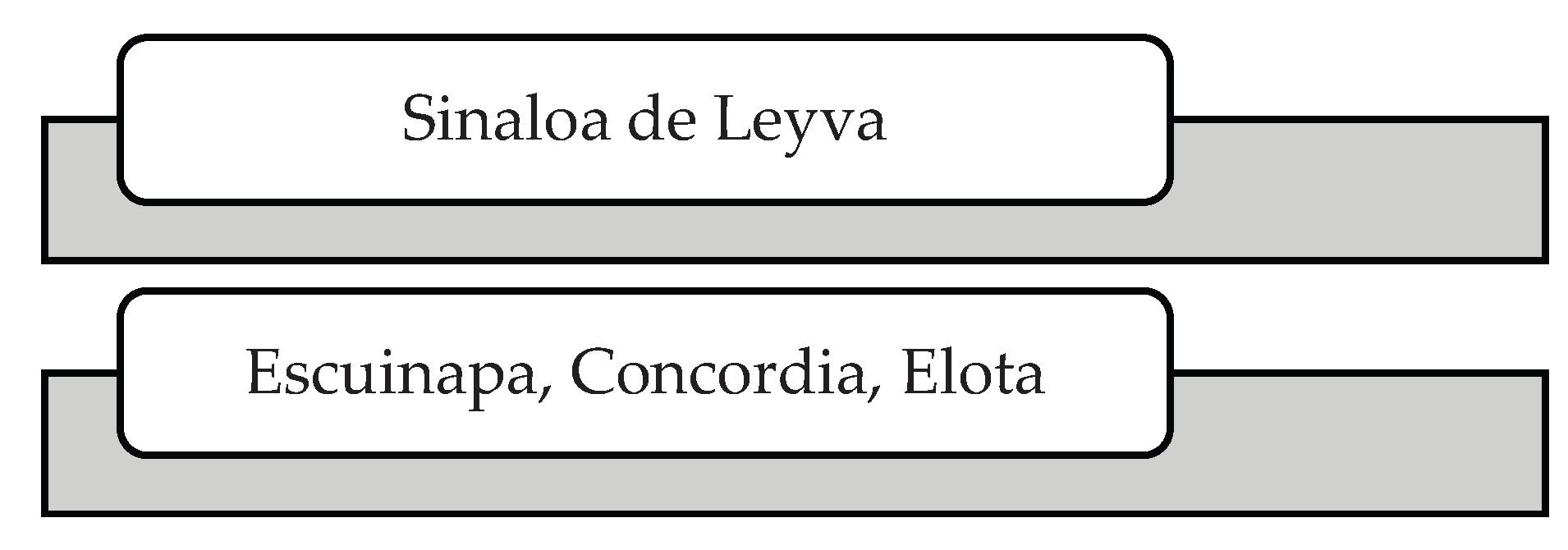

Table 1.
Alternatives.
| Alternative | Municipality |
| A1 | Sinaloa |
| A2 | Elota |
| A3 | Concord |
| A4 | Escuinapa |
Source: Own elaboration.
Table 2.
Criteria.
| Criteria | Concept | Criteria | Concept |
| C1 | General Destination | C7 | Natural and cultural resources |
| C2 | Tourist demand | C8 | Professionalization |
| C3 | Tourist offer | C9 | Water |
| C4 | Tourism Management | C10 | Waste |
| C5 | Infrastructure | C11 | Economic benefits |
| C6 | Services | C12 | Social impact |
Source: Authors.
Table 3.
Weights of the criteria.
| Subset | Number of cards | Position | Normalized weights |
| C1 | 1 | 1 | 1.3 |
| C10 | 1 | 2 | 2.6 |
| C9 | 1 | 3 | 3.8 |
| C4 | 1 | 4 | 5.1 |
| C5 | 1 | 5 | 6.4 |
| C6 | 1 | 6 | 7.7 |
| C7 | 1 | 7 | 9.0 |
| C8 | 1 | 8 | 10.3 |
| C2 | 1 | 9 | 11.5 |
| C3 | 1 | 10 | 12.8 |
| C11 | 1 | 11 | 14.1 |
| C12 | 1 | 12 | 15.4 |
| Sum | 12 | 78 | 100 |
Source: Authors.
Table 4.
Data collected.
| Criteria | Sinaloa | Elota | Concord | Escuinapa |
| C1 | 17.32 | 3.19 | 6.36 | 9.94 |
| C2 | 4.83 | 2.65 | 2.40 | 3.21 |
| C3 | 18.79 | 7.40 | 10.62 | 15.29 |
| C4 | 13.08 | 0.96 | 5.95 | 7.10 |
| C5 | 10.39 | 1.91 | 3.82 | 5.96 |
| C6 | 2.90 | 1.59 | 1.44 | 1.93 |
| C7 | 11.27 | 4.44 | 6.37 | 9.17 |
| C8 | 7.85 | 0.57 | 3.57 | 4.26 |
| C9 | 9.39 | 3.70 | 5.31 | 7.65 |
| C10 | 6.54 | 0.48 | 2.97 | 3.55 |
| C11 | 4.70 | 1.85 | 2.66 | 3.82 |
| C12 | 3.27 | 0.24 | 1.49 | 1.77 |
Source: Authors.
Disclaimer/Publisher’s Note: The statements, opinions and data contained in all publications are solely those of the individual author(s) and contributor(s) and not of MDPI and/or the editor(s). MDPI and/or the editor(s) disclaim responsibility for any injury to people or property resulting from any ideas, methods, instructions or products referred to in the content. |
© 2026 by the authors. Licensee MDPI, Basel, Switzerland. This article is an open access article distributed under the terms and conditions of the Creative Commons Attribution (CC BY) license (http://creativecommons.org/licenses/by/4.0/).
Copyright: This open access article is published under a Creative Commons CC BY 4.0 license, which permit the free download, distribution, and reuse, provided that the author and preprint are cited in any reuse.


