

Submitted:
29 January 2026
Posted:
31 January 2026
You are already at the latest version
Abstract
The governance of Intangible Cultural Heritage (ICH) has emerged as a critical issue for sustainable local development, particularly in cities where cultural vitality is large-ly community-driven but institutionally under-supported. This study examines the case of Kalamata, Greece, a medium-sized city with a dense network of community-based cultural associations, in order to analyse how ICH is governed in practice and how it contributes to social capital formation and sustainability outcomes. The research is based on 49 semi-structured interviews with representatives of 25 cultural associations and public or municipal bodies and employs qualitative thematic analysis. The findings demonstrate that cultural associations function as key governance actors at the com-munity level, generating strong bonding social capital through participation, informal education, and collective memory. At the same time, limited bridging and linking social capital constrain inter-organisational cooperation, institutional coordination, and the integration of ICH into long-term development strategies. The study identifies signifi-cant governance challenges, including fragmented policy frameworks, unstable fund-ing mechanisms, limited professional support, and weak participatory decision-making structures. By explicitly linking empirical findings to the Sustainable Development Goals—particularly SDGs 4.7, 11.4, 16.7, and 17—the paper highlights the importance of participatory cultural governance and co-governance models for enhancing the sus-tainability of local cultural ecosystems. The article contributes to policy-oriented de-bates on cultural sustainability by providing evidence from a Mediterranean medi-um-sized city and by proposing governance-relevant directions for integrating com-munity-based ICH into sustainable local development planning.
Keywords:
intangible cultural heritage
; cultural sustainability
; social capital
; community-based cultural associations
; cultural governance
; sustainable development goals
; medium-sized cities
1. Introduction
Intangible Cultural Heritage (ICH) has become increasingly central to international academic and policy debates, not only as a key expression of cultural identity but also as a critical component of sustainable development. According to the UNESCO Convention for the Safeguarding of the Intangible Cultural Heritage [1,2], ICH encompasses practices, representations, expressions, knowledge, and skills that communities recognise as part of their cultural heritage. These practices are deeply embedded in collective memory and are transmitted through social relations and intergenerational processes [3].
Unlike tangible heritage, ICH is not static, this dynamic character positions ICH as a significant social resource. As Poulios (2014) argues, heritage should be approached as a living and continually negotiated process, shaped through the interaction between communities, practices, and shared meanings. It evolves over time, adapting to contemporary social conditions while maintaining continuity with the past [4]. This dynamic character positions ICH as a significant resource for strengthening social cohesion, cultural continuity, and sustainable local development, particularly at the community level [5,6,7,8].Previous research has highlighted the role of ICH in reinforcing collective identity, informal learning, and participatory cultural practices, all of which contribute to social sustainability [9].
Over the past two decades, research on cultural sustainability has expanded considerably [10]. The debate has moved beyond a narrow focus on the economic value of culture to encompass social, environmental, and governance dimensions. In this context, cultural and creative activities operate as local cultural ecosystems that generate cultural ecosystem services, including social cohesion, intergenerational learning, psychosocial well-being, empowerment of marginalised groups, and community resilience [11]. These services directly support several Sustainable Development Goals (SDGs), particularly SDG 11.4 (heritage protection), SDG 4.7 (education for sustainable development and cultural diversity), SDG 8.3 (local economic development), and SDG 16.7 (inclusive decision-making).
Cultural associations play a particularly important role in this process. In small and medium-sized cities, where cultural infrastructure and institutional capacity are often limited, associations frequently function as the primary agents of cultural production, transmission, and participation [12]. Their contribution to local development is not limited to economic or tourism outcomes but is primarily expressed through the strengthening of social networks, collective action, and community resilience [13].
The city of Kalamata provides a particularly relevant case for examining these dynamics. Following the devastating earthquake of 1986, Kalamata experienced a significant cultural revitalisation driven largely by community initiatives and cultural associations [14]. The mobilisation of local actors, the creation of festivals and cultural institutions, and the strengthening of artistic production reshaped the city’s cultural identity and reinforced its role as a cultural hub for the wider region of Messinia [5]. Today, Kalamata hosts a diverse range of cultural associations active in dance, music, theatre, folklore, and other forms of cultural expression. More specific, the city has a complex cultural ecosystem, where traditional and contemporary forms of cultural expression, intense association activity and significant artistic work come together [5,15]. As noted by Bitsani (2002), the cultural development of Kalamata has been historically shaped by strong community engagement, dense associative networks, and bottom-up cultural dynamics [5].
Despite this cultural vitality, Kalamata faces challenges common to many medium-sized cities in Southern Europe. These include inadequate cultural infrastructure, fragmented and short-term funding, limited institutional support, a lack of professional cultural management expertise, weak strategic planning, and limited integration into international cultural networks [5,16]. As several research participants noted, cultural energy often remains underutilised due to the absence of stable governance mechanisms and long-term cultural strategies.
Against this background, the present study investigates how cultural associations in Kalamata contribute to sustainable local development through the preservation and renewal of Intangible Cultural Heritage. It also examines the structural and institutional constraints that affect the sustainability of these organisations and explores how ICH can be more effectively integrated into local development strategies and the SDGs framework.
Specifically, the study aims to:
- analyse the role of cultural associations as key actors in the safeguarding and transmission of ICH
- examine how community-based cultural practices contribute to social cohesion and cultural sustainability
- identify governance, infrastructure, and resource-related challenges affecting cultural sustainability
- propose policy directions for integrating ICH into sustainable local development strategies.
By addressing these objectives, the paper responds to a gap in international literature concerning community-based cultural heritage management in small and medium-sized cities, particularly in Mediterranean contexts. While existing research has largely focused on metropolitan centres and formal cultural institutions [17,18], less attention has been paid to decentralised cultural ecosystems sustained through volunteering, social networks, and local knowledge. The case of Kalamata offers valuable insights into how ICH operates as a driver of sustainability “from below” and highlights the conditions under which cultural vitality can be transformed into long-term developmental capacity [1,10,19].
2. Theoretical Framework
The concept of Intangible Cultural Heritage (ICH) has received increasing academic and policy attention over the past two decades, particularly following the adoption of the UNESCO (2003) Convention for the Safeguarding of the Intangible Cultural Heritage. This Convention marked a fundamental shift from monument-centred approaches to heritage protection towards an anthropologically informed understanding of heritage as a living, socially embedded process. Within this framework, ICH is defined not as a static cultural asset but as a set of practices, knowledge systems, and expressions that are continuously recreated by communities in response to their social environment [20].
This dynamic understanding positions ICH as a key resource for sustainable social development. Rather than focusing solely on preservation, contemporary heritage theory emphasises processes of transmission, adaptation, and community participation. As communities reinterpret and renew their cultural practices, ICH becomes closely linked to social cohesion, collective identity, and local resilience. These characteristics make ICH particularly relevant to sustainability-oriented approaches that prioritise long-term social capacity over short-term economic outcomes.
Despite growing consensus on the importance of ICH, the theoretical foundations of cultural sustainability remain complex and multifaceted. Cultural sustainability does not constitute a single, unified concept but rather an interdisciplinary framework shaped by social, political, and spatial contexts. As a result, different models have emerged to explain how cultural heritage contributes to sustainable development, particularly at the local level.
Within this theoretical landscape, the role of ICH in sustainable development can be analytically approached through four interrelated dimensions: (a) ICH as a social process, (b) the cultural sustainability of ICH, (c) institutional governance models, and (d) hybrid or co-governance approaches.
a. Intangible Cultural Heritage as a Social Process
A substantial body of literature emphasises that ICH should be understood primarily as a social process rather than as a collection of cultural elements. Heritage practices are produced and reproduced through social relations, shared experiences, and intergenerational interaction [21]. Through these processes, communities construct collective memory, identity, and a sense of belonging [3].
From this perspective, ICH functions as a mechanism of social reproduction, reinforcing social cohesion and cultural continuity [21]. Participation in cultural practices fosters trust, reciprocity, and informal learning, contributing to cultural well-being and community stability [22]. Contemporary cultural policy increasingly recognises these social dimensions, particularly in relation to inclusion, mental well-being, and community empowerment
Importantly, ICH is also a field of negotiation. Communities continuously redefine which practices are valued, how they are transmitted, and how they adapt to changing social conditions. This process-oriented understanding shifts attention away from the protection of an idealised past and towards the dynamic interaction between heritage, identity, and contemporary life [23].
In cities such as Kalamata, where ICH is largely produced outside formal institutions, cultural associations play a central role in this process. They act simultaneously as transmitters of tradition and as spaces for creative reinterpretation, enabling heritage practices to remain socially relevant while maintaining continuity over time.
b. Cultural Sustainability and Community-Based Approaches
The concept of cultural sustainability emerged internationally in the early 2000s as a response to the limited recognition of culture within dominant models of sustainable development [24]. For many years, sustainability frameworks focused primarily on environmental protection, economic growth, and social equity, while culture remained marginal or implicit. The introduction of culture as a “fourth pillar” of sustainability sought to address this gap by recognising cultural practices as foundational to long-term development [24,25].
Within this context, community-based models of cultural sustainability have gained particular prominence. Often referred to as “living heritage” approaches, these models emphasise the role of local communities, informal learning, volunteering, and participatory cultural production. Rather than prioritising formal institutions, they focus on the everyday practices through which heritage is maintained and renewed [26,27].
Community-based models are especially relevant in small and medium-sized cities, where cultural life is often shaped primarily by local actors rather than large cultural institutions. In such contexts, cultural associations function as core components of the local cultural infrastructure. They operate as mechanisms for the production and transmission of ICH, spaces of informal education, and hubs of social cohesion and cultural resilience [4,27].
Research consistently shows that local communities are often more effective than formal institutions in safeguarding ICH, particularly when heritage practices depend on embodied knowledge and social participation [5]. In Kalamata, the density of cultural associations and the high levels of volunteer engagement reinforce this community-based model, making it a key explanatory framework for understanding cultural sustainability at the local level [5]. Bitsani (2014a) similarly underscores that local cultural associations in Greece operate as informal infrastructures of participation, identity continuity, and collective symbolic production [6].
c. Institutional Models of Cultural Governance
In contrast to community-based approaches, institutional models of cultural governance emphasise the role of public authorities, formal cultural organisations, and professional management structures [28]. From this perspective, cultural sustainability depends on stable funding mechanisms, administrative capacity, strategic planning, and policy continuity [27,28,29].
Institutional governance models are often effective in large urban centres, where cultural policy is supported by substantial infrastructure and professional expertise [27,29]. However, in small and medium-sized cities, institutional frameworks are frequently fragmented, short-term, or under-resourced [5,15]. As a result, formal cultural policies may fail to reflect local cultural dynamics or to engage meaningfully with community actors
A common limitation of institutional models is their tendency to prioritise bureaucratic procedures over participatory processes. Cultural policies may remain top-down, with limited opportunities for community involvement in decision-making. This can lead to policy discontinuity, weak implementation, and a lack of trust between cultural actors and public institutions. Poulios (2014) also highlights that top-down governance frameworks often prioritise administrative control over community participation, limiting the adaptive and socially embedded character of living heritage [4].
In the case of Kalamata, existing institutional structures provide limited and inconsistent support for cultural associations [5,15]. Funding mechanisms are often unclear, strategic planning is weak, and professional cultural management capacity is limited. These conditions constrain the ability of institutions to support the long-term sustainability of ICH, despite the city’s strong cultural vitality.
d. Hybrid and Co-Governance Models
In response to the limitations of both community-based and institutional approaches, hybrid models of cultural governance have gained increasing attention in recent years. Co-governance frameworks seek to combine the strengths of community participation with institutional coordination, promoting shared responsibility for cultural development [6,7,11,30].
Co-governance models are based on principles of joint decision-making, collaboration between public authorities and cultural communities, and participatory planning processes [30]. When effectively implemented, they can enhance trust, improve resource allocation, and support the long-term sustainability of cultural ecosystems.
However, co-governance is also challenging to implement. It requires stable institutional mechanisms, professional facilitation, social trust, and long-term policy commitment. In contexts where institutional capacity is weak or political continuity is limited, co-governance often remains an aspirational goal rather than an operational reality.
In the Greek context, and particularly in medium-sized cities such as Kalamata, many of the conditions necessary for effective co-governance are only partially present. Nevertheless, the co-governance model provides a valuable analytical and policy framework for examining how ICH can be integrated into sustainable local development strategies and aligned with the Sustainable Development Goals, especially SDG 16 (inclusive institutions) and SDG 17 (partnerships).
3. Cultural Ecosystem Services and Social Resilience
The concept of cultural ecosystem services has gained increasing attention in recent years, particularly in research linking culture, sustainability, and community well-being [31]. Cultural ecosystem services refer to the non-material benefits that individuals and communities derive from cultural practices, including identity formation, social cohesion, knowledge transmission, psychosocial well-being, and a sense of place [32]. Within this framework, Intangible Cultural Heritage (ICH) operates as a socially embedded ecosystem in which communities act simultaneously as cultural producers and beneficiaries.
Unlike market-oriented approaches to cultural value, the ecosystem perspective highlights the relational and collective dimensions of culture. Cultural practices generate benefits that extend beyond individual participants, reinforcing social bonds, collective memory, and shared meanings. These outcomes are particularly relevant for sustainability, as they contribute to long-term social capacity rather than short-term economic outputs [33].
In the context of ICH, cultural ecosystem services are produced primarily through participation, intergenerational interaction, and informal learning. Cultural associations play a central role in facilitating these processes by providing spaces where traditions are practised, transmitted, and adapted. Through regular engagement in cultural activities, communities strengthen trust, reciprocity, and mutual support, which are essential components of social sustainability [34].
This ecosystem approach is closely linked to the concept of social resilience. Social resilience refers to the capacity of communities to absorb disturbances, adapt to change, and maintain social cohesion in the face of social, economic, or environmental challenges [35]. Cultural practices contribute to resilience by reinforcing collective identity, providing shared narratives, and offering mechanisms for collective action during periods of crisis.
Empirical research has shown that communities with strong cultural life demonstrate higher levels of adaptive capacity and social solidarity (In such contexts, ICH functions not only as a repository of tradition but also as a resource for coping, recovery, and regeneration. Cultural associations often act as informal support networks, particularly in times of economic hardship or social disruption, helping to maintain continuity and psychosocial stability [36].
The case of Kalamata illustrates this dynamic clearly. Following the 1986 earthquake, the city experienced a period of cultural revitalisation in which community-based cultural practices played a key role in rebuilding social ties and redefining local identity. Rather than diminishing cultural activity, the crisis intensified community engagement and reinforced the role of ICH as a foundation for resilience and collective recovery.
From a sustainability perspective, the integration of cultural ecosystem services into local development strategies is particularly important for small and medium-sized cities. These cities often lack the financial and institutional resources associated with large metropolitan centres, but they possess dense social networks and strong cultural traditions. By recognising and supporting ICH as a provider of cultural ecosystem services, local authorities can strengthen social cohesion, enhance community resilience, and contribute to the achievement of sustainability goals [34].
In this sense, ICH aligns closely with several Sustainable Development Goals. It supports SDG 11.4 by safeguarding cultural heritage within urban development, SDG 4.7 by promoting informal and intergenerational learning, and SDG 16 by fostering inclusive and participatory community practices (33Yang & Cao, 2022).. However, the capacity of ICH to function as a driver of sustainability depends on the extent to which cultural ecosystem services are recognised, supported, and integrated into governance frameworks.
This section may be divided by subheadings. It should provide a concise and precise description of the experimental results, their interpretation, as well as the experimental conclusions that can be drawn.
4. Cultural Sustainability, Intangible Heritage, and Social Resilience
Cultural sustainability has emerged as a critical dimension of sustainable development, particularly in relation to social cohesion, resilience, and participatory governance. While early sustainability frameworks focused primarily on environmental and economic dimensions, growing research has highlighted the importance of culture as a foundational element that shapes values, practices, and collective capacity for long-term development [37].
In this context, Intangible Cultural Heritage (ICH) plays a central role. As a living and community-based form of heritage, ICH contributes to cultural sustainability not only through the preservation of traditions but through the continuous production of social meaning, identity, and participation. Cultural practices embedded in everyday life strengthen social ties and enhance the adaptive capacity of communities, making ICH particularly relevant for sustainability-oriented local policies [38].
4.1. Cultural Sustainability as a Functional Dimension of Sustainability
Rather than treating culture as a symbolic or supplementary element, contemporary sustainability approaches increasingly recognise cultural sustainability as a functional dimension that supports social continuity and collective well-being .Cultural practices contribute to sustainability by reinforcing shared norms, fostering inclusion, and enabling intergenerational knowledge transfer [5,10,11] .
In medium-sized cities, where formal institutional resources are often limited, cultural sustainability is largely generated through community-based mechanisms. Cultural associations operate as informal infrastructures that sustain participation, learning, and cultural continuity. Their contribution extends beyond cultural expression to the strengthening of social capital and local resilience.
4.2. Intangible Cultural Heritage and Social Resilience
Social resilience refers to the capacity of communities to adapt to change, respond to crises, and maintain social cohesion over time. Cultural practices are increasingly recognised as key resources for resilience, as they provide shared narratives, collective memory, and mechanisms for mutual support [38].
ICH contributes to resilience by:
- reinforcing collective identity and belonging,
- maintaining stable social networks,
- enabling collective action during periods of crisis,
- supporting psychosocial well-being.
In this sense, ICH functions not only as a cultural resource but as a resilience mechanism embedded in everyday social life. This role is particularly evident in cities that have experienced social, economic, or environmental shocks, where cultural continuity supports recovery and adaptation.
4.3. Cultural Sustainability and the Sustainable Development Goals
Although culture is not included as a standalone goal in the Sustainable Development Goals (SDGs), it operates as a cross-cutting enabler of sustainable development [11,39,40]. ICH is directly linked to several SDGs, particularly:
- SDG 11.4, through the safeguarding of cultural heritage within urban development;
- SDG 4.7, by promoting informal, lifelong, and intergenerational learning;
- SDG 16.7, by fostering participatory and inclusive cultural practices;
- SDG 17, by creating opportunities for partnerships between communities and institutions.
The contribution of ICH to the SDGs, however, depends on the extent to which cultural practices are integrated into governance and policy frameworks. Without institutional recognition and coordination, the sustainability benefits generated at the community level remain fragmented and underutilised.
4.4. From Cultural Practices to Policy-Relevant Frameworks
For ICH to function effectively as a driver of cultural sustainability and resilience, it must be connected to policy-relevant governance mechanisms. This requires moving beyond ad hoc cultural support towards integrated strategies that recognise community-based cultural actors as partners in sustainable development.
Positioning ICH within cultural sustainability and resilience frameworks provides the conceptual foundation for the empirical analysis that follows. It allows the findings to be interpreted not only as cultural dynamics but as indicators of broader sustainability and governance processes at the local level.
5. Methodology
5.1. Research Design
This study adopts a qualitative research design, which is particularly suited to the investigation of complex social and cultural phenomena such as Intangible Cultural Heritage (ICH), social cohesion, and cultural governance. Qualitative methods allow for an in-depth exploration of meanings, practices, and lived experiences that cannot be adequately captured through quantitative indicators alone [41].
The research is structured as a case study focusing on the city of Kalamata, Greece. The case study approach enables a contextualised analysis of a specific local cultural ecosystem, taking into account its historical, social, and institutional characteristics [42]. Kalamata was selected due to its dense network of cultural associations, strong community participation in cultural practices, and its role as a cultural centre for the wider region of Messinia. These characteristics make the city an appropriate case for examining the relationship between ICH and sustainable local development in medium-sized urban contexts.
5.2. Sampling and Participants
Participants were selected using purposeful sampling, with the aim of including individuals and organisations that are directly and substantially involved in the production, transmission, and governance of ICH [43]. This strategy ensured the inclusion of information-rich cases with extensive knowledge of the local cultural field.
The sample consisted of 25 cultural associations and public or municipal bodies active in Kalamata, from which 49 semi-structured interviews were conducted. Participants represented a broad range of roles within the local cultural ecosystem, including:
- members and administrators of cultural associations
- artists, performers, and cultural practitioners
- educators and representatives of educational institutions
- members of informal community groups
- local government and municipal officials.
The diversity of the sample allowed for the exploration of multiple perspectives on cultural participation, governance, sustainability challenges, and institutional collaboration. This heterogeneity enhanced the analytical depth of the study and supported the examination of different forms of social capital within the cultural ecosystem.
5.3. Data Collection
Data were collected through semi-structured interviews conducted over a four-month period. Each interview lasted between 45 and 60 minutes and followed a flexible interview guide designed to ensure comparability while allowing participants to elaborate on issues they considered important.
The interview guide focused on the following thematic areas:
- the role and activities of cultural actors
- transmission and education in ICH practices
- forms of participation and community cohesion
- collaborations, networking, and partnerships
- relationships with institutional bodies and local government
- sustainability challenges and resource constraints
- perceptions of the role of ICH in sustainable development.
All interviews were conducted with the informed consent of participants. Interviews were audio-recorded and transcribed verbatim. Anonymity and confidentiality were ensured in accordance with ethical research standards.
5.4. Data Analysis
Data analysis followed a qualitative thematic analysis approach, as outlined by Braun and Clarke. The analysis was conducted in several stages. First, transcripts were read repeatedly to ensure familiarisation with the data. Second, initial open coding was applied to identify key concepts and recurring patterns. Third, codes were grouped into broader thematic categories. Finally, themes were interpreted in relation to the theoretical framework of cultural sustainability and social capital.
Six main thematic categories emerged from the analysis:
(a) transmission and education,
(b) community cohesion,
(c) cultural identity and collective memory,
(d) collaborations and networking,
(e) sustainability challenges, and
(f) cultural governance.
The thematic analysis followed an inductive logic, allowing empirical findings to emerge from the data while being interpreted in dialogue with existing theoretical frameworks. Selected interview excerpts are presented in the findings section to illustrate recurring patterns and support analytical claims.
6. Findings/Results
The findings of the study illustrate how Intangible Cultural Heritage (ICH) in Kalamata operates as a socially embedded cultural ecosystem that generates different forms of social capital and contributes to community resilience. The analysis is structured around four main dimensions: bonding social capital, bridging social capital, linking social capital, and the role of ICH in resilience. A final subsection summarises the key challenges affecting the sustainability of cultural practices.
6.1. ICH as a Mechanism for Strengthening Community Cohesion (Bonding Social Capital)
The findings indicate that cultural associations in Kalamata function as core spaces of social cohesion and belonging. Participants consistently described their associations as “second families”, highlighting long-term relationships of trust, emotional attachment, and mutual support. Intergenerational participation in practices such as traditional dance, music, and folklore reinforces shared identity and continuity across age groups. These findings resonate with Bitsani’s (2014b) analysis of community-based cultural organisations as generators of bonding social capital and intergenerational cohesion [6,7].
These dynamics correspond to what is defined in the literature as bonding social capital, namely the strong, inward-looking ties that reinforce solidarity within relatively homogeneous groups [44]. Participation in ICH practices is not perceived merely as cultural activity, but as an integral part of everyday social life.
As one participant explained:
“The association is much more than an activity. We grew up here, we know each other, and if someone is absent, we check on them.”(Participant S2, cultural association)
Another participant noted:
“People do not come only for dance or music. They come because they feel that they belong somewhere.”(Participant S3, association member)
These excerpts illustrate that bonding social capital generated through ICH provides emotional security, social support, and stability, particularly in periods of social or economic uncertainty [6,7,44,45]. Cultural practices function as shared routines that reinforce trust, collective memory, and a sense of continuity.
However, the findings also suggest that strong internal cohesion may sometimes limit openness towards external actors, creating relatively closed cultural networks.
6.2. Fragmented Collaboration and Limited Bridging Social Capital
While cultural activity in Kalamata is intense, cooperation between different cultural actors remains limited and fragmented. Bridging social capital, which refers to connections between different groups, organisations, or social sectors [44,46], appears underdeveloped.
Participants reported that collaborations are largely informal and based on personal relationships rather than institutionalised frameworks. As one respondent stated:
“Any cooperation that exists happens because we know each other personally. There is no formal mechanism that brings cultural actors together.”(Participant E2, educational actor)
Another participant observed:
“Efforts are made, but they do not last. When one person changes position, everything stops.”(Participant M2, municipal organisation)
These accounts indicate that collaborative initiatives lack continuity and structural support The absence of stable networks, shared strategic vision, and coordination mechanisms limits the diffusion of knowledge, innovation, and resources across the cultural ecosystem [47].
Identified barriers to bridging social capital include:
- competition for limited funding and resources
- lack of common planning platforms
- weak connections between cultural associations and educational or social institutions
- reliance on individual actors rather than collective structures.
As a result, the cultural ecosystem remains segmented, reducing its potential contribution to inclusive and sustainable development.
6.3. Weak Linking Social Capital and Institutional Discontinuities
Linking social capital, which refers to vertical relationships between community actors and institutions with decision-making power [48], is particularly weak in the case of Kalamata. Participants described their relationship with local government as inconsistent, unclear, and dependent on changing political or administrative conditions.
Key issues reported include:
- unclear or unpredictable funding procedures
- absence of a long-term cultural strategy
- limited participation of cultural actors in decision-making processes.
As one association president stated:
“There is no stable way to communicate with the municipality. Every time we have to start again from zero.”(Participant S1)
Similarly, an artist noted:
“Sometimes there is support, sometimes there isn’t. We never know what to expect.”(Participant A1)
These narratives point to a lack of institutional trust and continuity, which undermines the sustainability of cultural organisations. The absence of formalised cooperation mechanisms prevents cultural actors from accessing resources, participating in planning processes, or contributing systematically to local development strategies [48].
The weakness of linking social capital exacerbates what can be described as a policy implementation gap, where cultural vitality at the community level is not matched by effective institutional governance.
6.4. ICH as a Resource for Community Resilience
Despite governance limitations, the findings demonstrate that ICH plays a significant role in strengthening community resilience. Cultural practices function as mechanisms of psychosocial support, collective meaning-making, and social stability, particularly during periods of crisis [34,35].
Participants highlighted the importance of cultural associations during difficult times:
“In hard periods, the association kept people together. It was not only culture; it was support.”(Participant C1, informal community group)
Cultural associations have served as informal resilience structures by maintaining social ties, offering spaces for collective expression, and reinforcing a sense of continuity [34]. This role is particularly evident in the historical memory of the 1986 earthquake, where cultural activity contributed to collective recovery and the redefinition of local identity
However, this resilience remains largely informal and dependent on volunteerism and personal commitment. Without institutional reinforcement, the capacity of cultural associations to sustain their role in long-term resilience is constrained.
6.5. Challenges to the Sustainability of ICH
Across all interviews, participants identified a common set of challenges that threaten the sustainability of ICH practices:
- lack of stable and long-term funding
- inadequate cultural infrastructure and spaces
- absence of systematic digital documentation
- limited professional and administrative support
- heavy reliance on unpaid volunteer work.

Table 1.
ICH → Social Capital → Resilience.
| ICH element | Form of Social Capital | Resilience Indicators |
| Traditional Dances | Collective action | |
| Bonding Capital (group cohesion) | social support | |
| Musical Practices | Bridging Capital (different groups) | Intercultural dialogue |
| integration of new members | ||
| Folklore Customs | Linking Capital (relationships with institutions) | Collaborations with the municipality |
| cultural continuity | ||
| Youth cultural practices | New forms of social capital | Innovation |
| cultural renewal |
Table 2.
Summary of Findings and Research Conclusions.
| Main Findings | Research Conclusions | What this means for sustainability |
| The ICH strengthens social cohesion | Associations are informal social structures data | SDG 11 & 16: strengthening communities’ data |
| Lack of infrastructure | Cultural ecosystems are fragile | Need for institutional support |
| High youth participation | Culture produces informal learning | SDG 4: education through culture |
| Policy discontinuity | Lack of strategic cultural planning |
SDG 17: need for stable partnerships |
These challenges make the sustainability of ICH fragile and dependent on individual initiatives.
Overall, the findings show that ICH in Kalamata:
- strongly reinforces bonding social capital and community cohesion
- exhibits limited and fragmented bridging social capital
- demonstrates weak linking social capital due to institutional gaps
- contributes significantly to community resilience
- remains insufficiently supported by formal governance structures.
This imbalance between strong community dynamics and weak institutional support forms the central empirical insight of the study and provides the foundation for the discussion and policy recommendations that follow.
7. Discussion
7.1. Interpretation of Findings in Relation to Theory
The findings of this study confirm the central role of Intangible Cultural Heritage (ICH) as a socially embedded resource that contributes to social cohesion, community resilience, and cultural sustainability [44,46]. In line with established theoretical frameworks, the analysis demonstrates that ICH practices in Kalamata primarily generate strong bonding social capital, reinforcing trust, shared identity, and long-term social ties within cultural communities [35].
This predominance of bonding social capital reflects the participatory and intergenerational nature of ICH. Cultural associations do not operate merely as organisational entities but function as social spaces where emotional investment, collective memory, and everyday interaction are cultivated [49]. These findings align with theoretical approaches that conceptualise heritage as a living social process rather than a fixed cultural asset. In this sense, ICH contributes directly to social sustainability by strengthening internal cohesion and community stability [19].
However, the findings also reveal a structural imbalance between different forms of social capital. While bonding social capital is highly developed, bridging social capital remains limited and fragmented. Collaborations between cultural actors, educational institutions, and other social sectors are largely informal and dependent on personal relationships. This limits the circulation of knowledge, innovation, and resources across the local cultural ecosystem and constrains its broader social impact [11,50].
The weakness of bridging social capital is further compounded by the limited development of linking social capital. Relationships between cultural actors and institutional power structures are characterised by discontinuity, lack of trust, and unclear governance mechanisms [30]. Despite strong cultural vitality at the community level, the absence of stable institutional frameworks prevents ICH from being systematically integrated into local development strategies [48].
These findings are consistent with the literature on cultural governance, which highlights the existence of policy implementation gaps in contexts where community-driven cultural activity is not matched by institutional coordination and long-term planning [47]. The case of Kalamata illustrates how cultural sustainability cannot be achieved solely through strong community dynamics but requires governance structures that connect grassroots initiatives with public policy and resource allocation [51].
7.2. ICH, Community Resilience, and Sustainable Local Development
One of the most significant contributions of the study concerns the relationship between ICH and community resilience. The findings demonstrate that cultural practices function as mechanisms of psychosocial stability, collective meaning-making, and social support, particularly during periods of crisis [36]. Bitsani (2016) further argues that cultural participation in Greek cities operates as a buffer against social fragmentation, reinforcing community resilience during periods of crisis. Cultural associations provide continuity, reinforce shared narratives, and facilitate collective action, all of which are key components of resilience [52].
In Kalamata, this role is historically evident in the period following the 1986 earthquake, when cultural activity contributed to the reconstruction of social ties and the redefinition of local identity [36,37]. More broadly, the empirical evidence suggests that ICH enhances adaptive capacity by maintaining social networks and reinforcing a sense of belonging [6,7,49,52].
However, this resilience remains largely informal and dependent on volunteerism. Without institutional recognition and support, cultural actors bear a disproportionate responsibility for sustaining social cohesion. From a sustainability perspective, this raises important concerns. Resilience should not be understood solely as a community obligation but as a shared responsibility involving multiple governance levels.
Integrating ICH into sustainable local development therefore requires policies that move beyond symbolic recognition and provide concrete support mechanisms [37]. These include stable funding, accessible infrastructure, and participatory governance arrangements that allow cultural actors to contribute meaningfully to decision-making processes.
7.3. Cultural Sustainability and the Sustainable Development Goals
The findings highlight the relevance of ICH to several Sustainable Development Goals. In particular, community-based cultural practices contribute to:
- SDG 4.7, by promoting informal, intergenerational learning and cultural diversity;
- SDG 11.4, by safeguarding intangible heritage within the context of urban development;
- SDG 16.7, by fostering participatory and inclusive cultural practices;
- SDG 17, by creating opportunities for partnerships between communities and institutions.
Despite this alignment, the contribution of ICH to the SDGs in Kalamata remains largely indirect. Cultural activity operates parallel to, rather than integrated within, formal sustainability strategies. This reflects a broader tendency in sustainability policy to marginalise cultural dimensions or treat them as secondary to economic and environmental objectives.
The case study demonstrates that without governance mechanisms explicitly designed to link culture and sustainability, the potential of ICH to support the SDGs remains underutilised. Effective integration requires locally adapted indicators, participatory planning processes, and cross-sectoral collaboration frameworks.
7.4. Cultural Governance and the Policy Implementation Gap
The findings point to cultural governance as a critical factor shaping the sustainability of ICH [30]. Although Kalamata exhibits high levels of cultural participation and community engagement, institutional support remains fragmented and inconsistent. The absence of a long-term cultural strategy, coupled with unstable funding mechanisms and limited administrative capacity, undermines the sustainability of cultural organisations.
This situation exemplifies a policy implementation gap, where policy intentions and international commitments are not translated into effective local action. Cultural governance remains largely top-down and reactive, offering limited opportunities for co-decision and long-term planning.
From a sustainability perspective, this gap has significant implications. Weak governance structures limit the development of linking social capital, restrict access to resources, and reduce the ability of cultural actors to contribute to broader development objectives. Strengthening cultural governance therefore emerges as a prerequisite for transforming cultural vitality into sustainable development capacity.
7.5. Tangible and Intangible Cultural Heritage: A Comparative Perspective
Although the study focuses on intangible cultural heritage, participants’ narratives also reveal important differences between tangible and intangible forms of heritage. Tangible heritage is generally perceived as institutionally protected, administratively regulated, and distant from everyday community participation. In contrast, ICH is experienced as a living, accessible, and participatory practice embedded in daily social life. This aligns with Poulios’ (2014) distinction between object-centred heritage management and community-centred approaches, the latter being essential for sustaining the living and evolving nature of ICH [4,27].
The interviews show that tangible cultural heritage is perceived mainly as an institutionally protected and “static” resource, associated with monuments, historic sites and cultural infrastructure, the management of which is largely outside the direct sphere of action of local communities [4,51,53,54].
“Monuments are important for the city, but they are not something we can touch. There are rules, services, approvals. It’s not like the association.”(Participant S1, cultural association)
The excerpt shows that tangible cultural heritage is mainly experienced as a field of institutional management, linked to linking social capital and limited community agency.
“We all participate in the association. We just look at the monuments. They are important, but they are not ‘ours’ in the same way.”(Participant C2, community group)
The comparison highlights intangible heritage as a field of bonding and participation, in contrast to tangible heritage, which remains distant from everyday social practice.
Unlike intangible cultural heritage, which emerges through everyday practices and relationships, tangible heritage appears in the narratives as an object of institutional care and administrative management. Participants recognise its importance for local identity and cultural tourism, but point out that their access to decision-making regarding its management is limited. In this way, tangible cultural heritage is more closely linked to forms of linking social capital than to bonding or bridging ties.
In contrast, intangible cultural heritage functions as a living field of social interaction, mainly strengthening bonding social capital and, to a lesser extent, bridging social capital. This comparison highlights a critical asymmetry: while intangible heritage produces social cohesion without adequate institutional support, tangible heritage has institutional protection without meaningful community integration. This asymmetry underscores the need for integrated models of cultural governance that dynamically link tangible and intangible cultural heritage, bridging the gap between community participation and institutional management.
This distinction highlights a critical asymmetry. While tangible heritage benefits from institutional protection but limited community involvement, ICH generates strong social cohesion without adequate institutional support. From a sustainability perspective, this imbalance underscores the need for integrated cultural governance models that connect tangible and intangible heritage through participatory frameworks.
Such integration could enhance linking social capital, strengthen community engagement with heritage management, and support more inclusive and sustainable cultural policies.
8. Policy Implications
The findings of this study have direct implications for cultural policy and sustainable local development, particularly in medium-sized cities characterised by strong community participation but limited institutional capacity. The case of Kalamata demonstrates that while Intangible Cultural Heritage (ICH) generates significant social capital and resilience, its contribution to sustainability remains constrained by governance gaps, fragmented policies, and insufficient coordination between community actors and public institutions.
To address these challenges, policy interventions should move beyond ad hoc cultural support and adopt integrated, participatory, and long-term approaches. The following policy implications are organised around four interrelated strategic priorities.
8.1. Strengthening Cultural Governance and Linking Social Capital
A central policy priority is the strengthening of cultural governance mechanisms that enhance linking social capital between cultural communities and institutional actors. Local authorities should establish formal structures that enable regular dialogue, shared decision-making, and strategic planning.
Key policy actions include:
- the establishment of a Local Intangible Cultural Heritage Council, comprising representatives of cultural associations, educational institutions, civil society organisations, and municipal authorities
- the institutionalisation of consultation procedures for cultural planning and funding allocation
- the development of transparent and predictable funding frameworks with clearly defined criteria and timelines.
These measures directly support SDG 16.7 by promoting inclusive, participatory, and representative decision-making. They also contribute to SDG 17 by fostering partnerships between public institutions and community-based cultural actors.
8.2. Enhancing Bridging Social Capital Through Networks and Collaboration
The findings highlight the need to strengthen bridging social capital by promoting collaboration across cultural, educational, and social sectors. Policies should encourage networks that connect cultural associations with schools, universities, social services, and other local stakeholders [55].
Recommended policy actions include:
- the creation of local cultural networks or hubs that facilitate coordination and knowledge exchange
- incentives for joint cultural programmes involving multiple associations and social groups
- partnerships between cultural associations and educational institutions to support informal learning and youth engagement
- support for intercultural and inclusive cultural initiatives that broaden participation.
These actions enhance social inclusion and innovation, contributing to SDG 4.7 (education for sustainable development and cultural diversity) and reinforcing the social dimension of sustainability.
8.3. Digital Documentation and Innovation for ICH Sustainability
The absence of systematic digital infrastructure emerged as a critical barrier to the long-term sustainability of ICH. Digital tools can support documentation, transmission, accessibility, and visibility of cultural practices, particularly for younger generations.
Policy priorities in this area include:
- the development of digital ICH archives at the local level, in collaboration with universities and research institutions
- training programmes for cultural associations on digital documentation and storytelling
- the integration of digital platforms into cultural education and community outreach activities.
Digital innovation supports intergenerational transmission and aligns with SDG 11.4 by enhancing the safeguarding of cultural heritage within contemporary urban environments.
8.4. Integrating ICH Into Local Sustainability and Resilience Strategies
Finally, cultural policy should explicitly integrate ICH into broader sustainability and resilience frameworks. Cultural practices should be recognised not only as expressions of identity but as functional components of social cohesion, well-being, and crisis response.
Proposed actions include:
- recognising cultural spaces as community resilience hubs
- linking cultural activities with social welfare, inclusion, and mental well-being initiatives
- incorporating ICH into local emergency preparedness and recovery strategies
- aligning cultural indicators with local SDG monitoring frameworks.
These measures reinforce the role of ICH as a cross-cutting driver of sustainability and contribute to a more holistic approach to urban development.
In summary, the policy implications of this study highlight the need for:
- institutional upgrading through participatory cultural governance (strengthening linking social capital)
- collaborative networks that enhance cross-sectoral cooperation (strengthening bridging social capital)
- digital strategies that support documentation, transmission, and innovation
- explicit alignment of cultural policy with the Sustainable Development Goals.
In addition their implementation can transform Kalamata into an example of sustainable cultural development in Greece within the framework of a holistic sustainable model of cultural development.
Figure 1.
Integrated Cultural Sustainability Model.
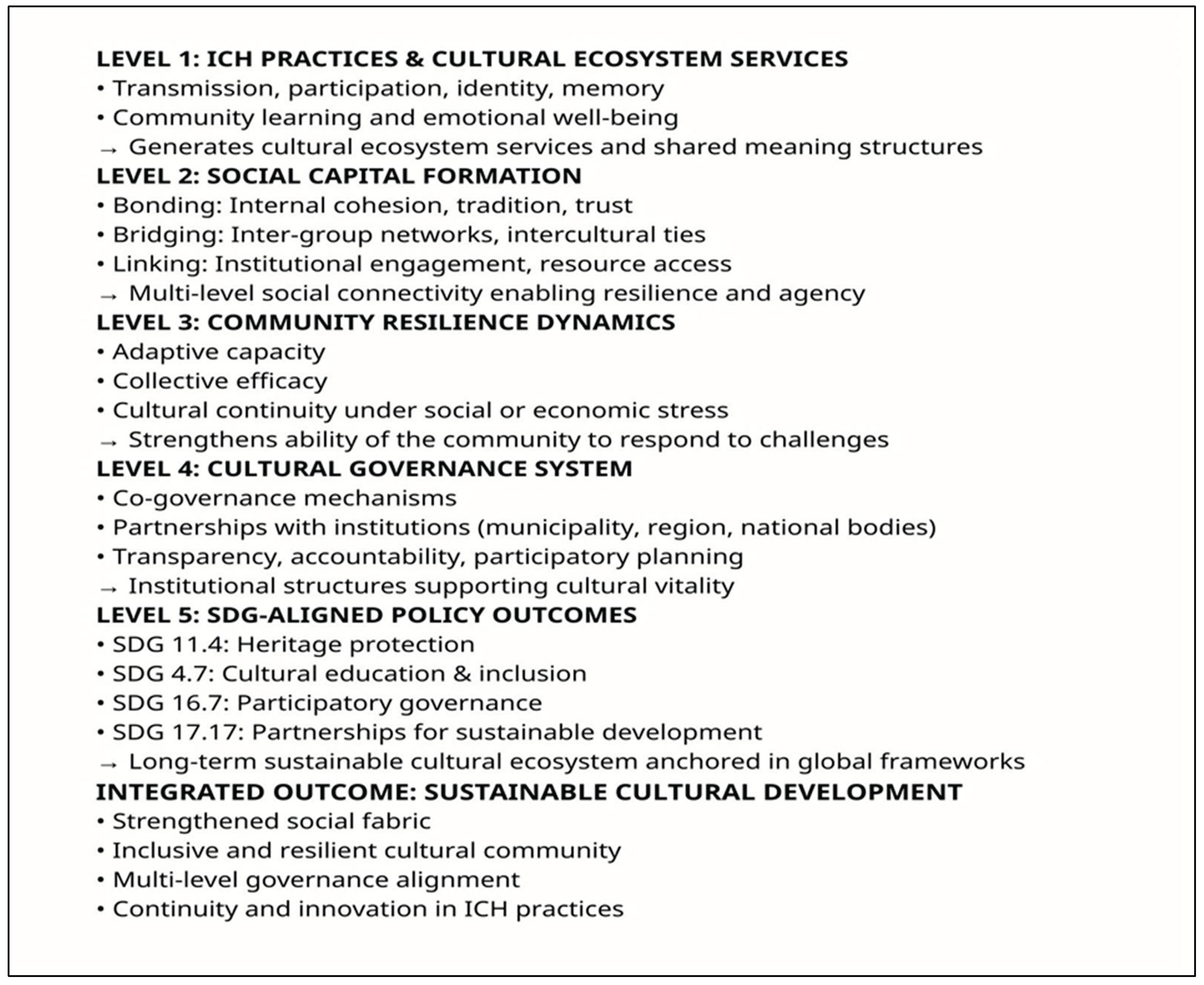
This integrated model visualises how Intangible Cultural Heritage (ICH), social capital formation (bonding, bridging, linking), cultural- -governance structures, and SDG-oriented policy frameworks interact to produce sustainable cultural development outcomes. The diagram synthesises all thematic dimensions of the study into a unified conceptual framework.
By adopting these policy directions, cities such as Kalamata can transform community-based cultural vitality into a sustainable development asset, ensuring that Intangible Cultural Heritage functions not only as a cultural resource but as a structural component of inclusive and resilient urban governance.
9. Conclusions and Future Research
This study examined the role of Intangible Cultural Heritage (ICH) in Kalamata as a living cultural ecosystem embedded in community practices, social capital dynamics, and local governance structures. The findings demonstrate that ICH in the city functions as a critical mechanism for social cohesion, cultural continuity, and community resilience, primarily through the strong development of bonding social capital within cultural associations.
At the same time, the research reveals a significant imbalance between community-driven cultural vitality and institutional capacity. While cultural associations generate dense social networks, trust, and collective identity, the limited development of bridging and linking social capital constrains collaboration, institutional coordination, and long-term sustainability. This imbalance highlights a structural governance gap, where community-based cultural activity is not sufficiently supported or integrated into local development strategies [28,30,56].
A key contribution of the study lies in its empirical demonstration that cultural sustainability cannot be achieved solely through strong community cohesion. Although bonding social capital is essential for cultural continuity and resilience, sustainable local development requires the systematic strengthening of bridging and linking mechanisms. Without institutional frameworks that support participation, coordination, and policy continuity, the social benefits generated by ICH remain largely informal and vulnerable.
The findings also underscore the relevance of ICH to the Sustainable Development Goals. Community-based cultural practices in Kalamata contribute directly to SDG 4.7 through informal and intergenerational learning, SDG 11.4 through the safeguarding of intangible heritage, SDG 16.7 through participatory cultural practices, and SDG 17 through the potential for partnerships between communities and institutions. However, the absence of explicit cultural governance mechanisms limits the capacity of ICH to function as a strategic driver of sustainability within the local policy framework.
From a policy perspective, the study highlights the need for integrated cultural governance models that connect community participation with institutional support. Strengthening participatory decision-making structures, stabilising funding mechanisms, investing in digital documentation, and aligning cultural policy with SDG frameworks are essential steps for transforming cultural vitality into sustainable development capacity. These measures are particularly relevant for medium-sized cities, where cultural ecosystems are often community-driven but institutionally fragile.
The study also contributes to the broader debate on the relationship between tangible and intangible cultural heritage. While tangible heritage benefits from institutional protection with limited community involvement, ICH generates strong social cohesion without adequate governance support. Bridging this divide through integrated and participatory cultural governance can enhance both cultural sustainability and social inclusion.
Future Research Directions
While this research provides a comprehensive qualitative analysis of ICH and sustainability in Kalamata, several avenues for future research emerge. First, longitudinal studies could examine how social capital dynamics and cultural participation evolve over time, particularly in response to demographic change, economic pressures, or policy interventions. Such research would offer deeper insights into the long-term sustainability of community-based cultural ecosystems.
Second, comparative studies across Greek and European medium-sized cities of south would help identify transferable governance models and contextual factors that influence cultural sustainability. Comparative analysis could support the development of typologies of cultural governance and inform more context-sensitive policy design.
Third, future research could adopt mixed methods approaches, combining qualitative analysis with social network analysis, spatial mapping of cultural infrastructure, and digital ethnography. These methods would enhance understanding of connectivity, inclusion, and the spatial distribution of cultural resources.
Finally, further research is needed on the role of digital technologies in the transmission and transformation of ICH. While digital tools offer opportunities for documentation, accessibility, and innovation, they also raise questions regarding authenticity, participation, and digital inequality. Evaluating the impact of digital and co-governance initiatives on cultural sustainability and SDG implementation would provide valuable evidence for policymakers and practitioners.
In conclusion, this study demonstrates that Intangible Cultural Heritage can function as a powerful driver of sustainable local development when supported by appropriate governance structures, participatory mechanisms, and long-term policy commitment. By aligning community-based cultural practices with institutional frameworks and sustainability agendas, cities such as Kalamata can leverage their cultural capital to build inclusive, resilient, and sustainable urban futures.
Author Contributions
Conceptualization, I.T,E.B.I.P.I.S., and methodology, I.T.,E.B.,I.P,.I.S. and investigation, I.T.,E.B.I.P.,I.S., and writing—original draft, I.T., E.B., I.P.,I.S. and review and editing I.T., E.B., I.P., I.S., and Supervision E.B., I.P.,I.S. All authors have read and agreed to the published version of the manuscript.
Funding
This research received no external funding
Institutional Review Board Statement
Not applicable.
Informed Consent Statement
Informed consent was obtained from all subjects involved in the study and their responses were collected anonymously and stored securely.
Data Availability Statement
Data will be made available on request.
Acknowledgments
The authors would like to acknowledge the support provided by the supervisory committee of the doctoral research from which this article derives. In particular, the first author expresses her gratitude to Professor Eugenia Bitsani, Professor Ioannis Poulios, and Professor Ioanna Spiliopoulou for their academic guidance and constructive feedback throughout the development of the dissertation project. Their insights contributed to shaping the broader research framework within which this study was conducted. Any remaining errors or interpretations are solely the responsibility of the authors.
Conflicts of Interest
The authors declare no conflicts of interest.
Abbreviations
The following abbreviations are used in this manuscript:
| ICH | Intangible Cultural Heritage |
| ICOMOS | International Council on Monuments and Sites |
| SDG | Sustainable Development Goal |
| UNESCO | United Nations Educational, Scientific and Cultural Organization |
| UCLG | United Cities and Local Governments |
| UN | United Nations |
References
- UNESCO. Convention for the Safeguarding of the Intangible Cultural Heritage; UNESCO, 2003; Available online: https://ich.unesco.org/en/convention.
- UNESCO. Intangible cultural heritage and gender; UNESCO, 2015; Available online: https://ich.unesco.org/doc/src/34300-EN.pdf.
- Smith, L. Uses of heritage; Routledge, 2006. [Google Scholar]
- Poulios, I. The Past in the Present: A Living Heritage Approach—Metamora, Greece; Ubiquity Press, 2014a; file:///C:/Users/user/Downloads/ac911695-3723-4d6f-a4c0-5efa85041496.pdf. [Google Scholar]
- Bitsani, E. Culture and local society: Local cultural development in Greece and the role of local government (1980–2000). Doctoral dissertation, Panteion University of Social and Political Sciences, Department of Sociology, Sector of Modern Greek Society, 2002. [Google Scholar]
- Bitsani, E. Intercultural City Identity and Human Intercultural Cities (H.I.C.): An Ontological/Dynamic Model for the Social Cohesion of Modern and Post-Modern Cities; Nova Science Publishers, 2014a. [Google Scholar]
- Bitsani, E. Promoting Traditions of Multicultural Communities as a Tool for Social Cohesion in Trieste, Italy. Procedia – Social and Behavioural Sciences 2014b, 148, 412–419. [Google Scholar] [CrossRef]
- Logan, W. Cultural diversity, cultural heritage and human rights: towards heritage management as human rights-based cultural practice. International Journal of Heritage Studies 2012, 18(3), 231–244. [Google Scholar] [CrossRef]
- Bortolotto, C. UNESCO, cultural heritage, and outstanding universal value: value-based analyses of the World Heritage and Intangible Cultural Heritage Conventions. International Journal of Heritage Studies 2015, 21(5), 528–530. [Google Scholar] [CrossRef]
- Soini, K.; Birkeland, I. Exploring the scientific discourse on cultural sustainability. Geoforum 2014, 51, 213–223. [Google Scholar] [CrossRef]
- Bitsani, E; Tsekos, Th.; Thymi, I.; Marava, G. (2025). The Biocultural City as a Utopia or the Future Reality?Models, Policies, and the City of Ixelles. Cities, Heritage and Transformation (in press).
- A research agenda for creative tourism; Duxbury, N., Richards, G., Eds.; Edward Elgar Publishing, 2019. [Google Scholar] [CrossRef]
- Throsby, D. Economics and culture; Cambridge University Press, 2001. [Google Scholar]
- Thymi, I.; Bitsani, E.; Spiliopoulou, I. The regeneration of historic city centres as a key factor of urban sustainable development: Case study of Kalamata’s historic centre. Pelopas: Interdisciplinary Journal of the University of the Peloponnese 2025, 9(1). Available online: https://magazine.library.uop.gr/magazine/index.php/pelopas/issue/view/23/27.
- Thymi, I.; Bitsani, E. The strategic management of empowerment and human resource development in cultural entities: The research example of Association “Lyceum of Greek Women” in Kalamata, Greece. The University Without Borders Journal of Economics and Business 2020, 3(2). [Google Scholar] [CrossRef]
- Duxbury, N.; Kangas, A.; De Beukelaer, C. Cultural policies for sustainable development: Four strategic paths. International Journal of Cultural Policy 2017, 23(2), 214–230. [Google Scholar] [CrossRef]
- Richards, G. Creativity and tourism in the city. Current Issues in Tourism 2014, 17(2), 119–144. [Google Scholar] [CrossRef]
- Museums, equality and social justice, 1st ed.; Sandell, R., Nightingale, E., Eds.; Routledge, 2012. [Google Scholar] [CrossRef]
- Duxbury, N.; Jeannotte, M. S. Introduction: Culture and sustainable communities. Culture and Local Governance 2011, 3(1), 1. [Google Scholar] [CrossRef]
- Intangible heritage; Smith, L., Akagawa, N., Eds.; Routledge, 2008. [Google Scholar] [CrossRef]
- Lowenthal, D. The Heritage Crusade and the Spoils of History; Cambridge University Press, 1998. [Google Scholar]
- Miles, A.; Gibson, L. Everyday participation and cultural value. Cultural Trends 2016, 25(3), 151–157. [Google Scholar] [CrossRef]
- Intangible Cultural Heritage and Sustainable Development: Inside a UNESCO Convention; Bortolotto, C., Skounti, A., Eds.; Routledge, 2024. [Google Scholar]
- Hawkes, J. The fourth pillar of sustainability: Culture’s essential role in public planning; Pty Ltd. in association with the Cultural Development Network (Vic), 2001; ISBN 1 86335 050 0. [Google Scholar]
- Astara, O. H. Culture as the fourth pillar of sustainable development. Sustainable Development, Culture, Traditions 2014, 1a(2a), 93. Available online: https://sdct-journal.com/images/Issues/2015/7.pdf.
- Duxbury, N.; Gillette, E.; Pepper, K. Culture as a key dimension of sustainability: Exploring concepts, themes, and models (Working Paper No. 1); Centre of Expertise on Culture and Communities, Creative City Network of Canada, 2007; p. 26. Available online: https://www.creativecity.ca/wp-content/uploads/2020/12/Creative_City_News_E.pdf.
- Poulios, I. Discussing strategy in heritage conservation: Living heritage approach as an example of strategic innovation. Journal of Cultural Heritage Management and Sustainable Development 2014b, 4(1), 16–34. [Google Scholar] [CrossRef]
- Cultural policies in Europe: A participatory turn? Dupin-Meynard, F., Négrier, E., Bonet, L., Calvano, G., Carnelli, L., Zuliani, E., Eds.; Éditions de l’Attribut, 2020. [Google Scholar] [CrossRef]
- Craik, J. Re-visioning arts and cultural policy: Current impasses and future directions; ANU E Press, 2007. [Google Scholar] [CrossRef]
- Bonet, L.; Négrier, E. The participative turn in cultural policy: Paradigms, models, contexts. Poetics 2018, 66, 64–73. [Google Scholar] [CrossRef]
- Chan, K. M. A.; Satterfield, T.; Goldstein, J. Rethinking ecosystem services to better address and navigate cultural values. Ecological Economics 2012, 74, 8–18. [Google Scholar] [CrossRef]
- Daniel, T. C.; Muhar, A.; Arnberger, A.; Aznar, O.; Boyd, J. W.; Chan, K. M. A.; Costanza, R.; Elmqvist, T.; Flint, C. G.; Gobster, P. H.; Grêt-Regamey, A.; Lave, R.; Muhar, S.; Penker, M.; Ribe, R. G.; Schauppenlehner, T.; Sikor, T.; Soloviy, I.; Spierenburg, M.; von der Dunk, A. Contributions of cultural services to the ecosystem services agenda. Proceedings of the National Academy of Sciences 2012, 109(23), 8812–8819. [Google Scholar] [CrossRef] [PubMed]
- Yang, L.; Cao, K. Cultural Ecosystem Services Research Progress and Future Prospects: A Review. Sustainability 2022, 14(19), 11845. [Google Scholar] [CrossRef]
- Berkes, F.; Ross, H. Community resilience: Toward an integrated approach. Society & Natural Resources 2013, 26(1), 5–20. [Google Scholar] [CrossRef]
- Adger, W. N. Social and ecological resilience: are they related? Progress in Human Geography 2000, 24(3), 347–364. [Google Scholar] [CrossRef]
- Magis, K. Community resilience: An indicator of social sustainability. Society & Natural Resources 2010, 23(5), 401–416. [Google Scholar] [CrossRef]
- Wilson, G. A. Community Resilience and Social Memory. Environmental Values (Original work published 2015). 2015, 24(2), 227–257. [Google Scholar] [CrossRef]
- Zabulis, X.; Partarakis, N.; Zidianakis, E.; Kaplanidi, D. A Critical Review of the Function of Intangible Cultural Heritage as a Driver for Social Resilience and Cohesion. Encyclopedia 2025, 5(4), 189. [Google Scholar] [CrossRef]
- United Nations General Assembly. Culture and sustainable development (A/RES/70/214); United Nations, 2016; Available online: https://undocs.org/A/RES/70/214.
- United Cities and Local Governments. Towards the localisation of the Sustainable Development Goals: Local and Regional Governments’ report to the High-Level Political Forum (2019). United Cities and Local Governments. 2019. Available online: https://www.gold.uclg.org/sites/default/files/Localization2019_EN.pdf.
- Creswell, J. W.; Poth, C. N. Qualitative inquiry and research design: Choosing among five approaches, 4th ed.; SAGE Publications, 2018. [Google Scholar]
- Yin, R. K. Case study research and applications: Design and methods, 6th ed.; SAGE Publications, 2018. [Google Scholar]
- Patton, M. Q. Qualitative research & evaluation methods, 4th ed.; SAGE Publications, 2015. [Google Scholar]
- Putnam, R. D. Bowling alone: The collapse and revival of American community; Touchstone Books/Simon & Schuster, 2000. [Google Scholar] [CrossRef]
- Bourdieu, P. The Forms of Capital. In Handbook of Theory and Research for the Sociology of Education; Richardson, J., Ed.; Greenwood, 1986; pp. 241–258. Available online: https://www.marxists.org/reference/subject/philosophy/works/fr/bourdieu-forms-capital.htm.
- Woolcock, M. The place of social capital in understanding social and economic outcomes. Canadian Journal of Policy Research 2001, 2(1), 11–17. Available online: https://faculty.washington.edu/matsueda/courses/590/Readings/Woolcock%20Soc%20Cap%20Development.pdf.
- Woolcock, M.; Narayan, D. Social Capital: Implications for Development Theory, Research, and Policy. The World Bank Research Observer 2000, 15(2), 225–249. [Google Scholar] [CrossRef]
- Szreter, S.; Woolcock, M. Health by association? Social capital, social theory, and the political economy of public health. International Journal of Epidemiology 2004, 33(4), 650–667. [Google Scholar] [CrossRef]
- Poulios, I. Rethinking Community Participation in Destination Planning Towards Achieving Sustainable Development: The Role of Civil Society—The Maniatakeion Foundation at the Town of Koroni, Greece, in Connection with the Mediterranean Diet. Tourism and Hospitality 2025, 6(5), 263. [Google Scholar] [CrossRef]
- Arnold, M.-T.; Le, T. H. T.; Kolleck, N. Expectations of Cross-Sector Collaboration in Cultural and Arts Education. Social Sciences 2022, 11(8), 343. [Google Scholar] [CrossRef]
- Johnson, S.; Stapleton, L.; Berrett, B. Deaf community cultural wealth in community college students. The Journal of Deaf Studies and Deaf Education 2020, 25(4), 438–446. [Google Scholar] [CrossRef]
- Bitsani, E. Migration memory, cultural heritage: A vehicle of the intercultural identity of a city. The case study of the Eastern Greek Community and the Greek museums of Trieste Italy. Cogent Arts & Humanities 2016, 3(1). [Google Scholar] [CrossRef]
- Spiliopoulou, I. The protection and utilisation of cultural heritage as a driver of sustainable development in a modern regional city: The case of Kalamata. In Greek Regional Cities and Sustainable Development Proceedings of a Scientific Conference; Harokopio University, Department of Home Economics and Ecology, Mitoula, R., Ed.; 2016; pp. 39–51. Available online: https://dhee.hua.gr/images/Article-pdf/2020/praktika-imeridas-17-12-2016.pdf.
- Spiliopoulou, I. The Contribution of the Project “Kalamata 1821: Roads of Freedom” (Research-Create-Innovate, ESPA 2018-2021) to the sustainable development of the city: Memory of Nikos Zacharias (+20.03.2024). Sustainable Development, Environment, Culture, Economy, Society 2024, 4, 5–24. Available online: https://sdct-journal.gr/teychi/tefchos-2024-4/.
- Bortolotto, C. UNESCO, cultural heritage, and outstanding universal value: value-based analyses of the World Heritage and Intangible Cultural Heritage Conventions. International Journal of Heritage Studies 2015, 21(5), 528–530. [Google Scholar] [CrossRef]
- Duxbury, N.; Hosagrahar, J.; Pascual, J. Why must culture be at the heart of sustainable urban development? United Cities and Local Governments – Committee on Culture, 2016; Available online: https://www.researchgate.net/publication/295086795_Why_must_culture_be_at_the_heart_of_sustainable_urban_development.
Disclaimer/Publisher’s Note: The statements, opinions and data contained in all publications are solely those of the individual author(s) and contributor(s) and not of MDPI and/or the editor(s). MDPI and/or the editor(s) disclaim responsibility for any injury to people or property resulting from any ideas, methods, instructions or products referred to in the content. |
© 2026 by the authors. Licensee MDPI, Basel, Switzerland. This article is an open access article distributed under the terms and conditions of the Creative Commons Attribution (CC BY) license (http://creativecommons.org/licenses/by/4.0/).
Copyright: This open access article is published under a Creative Commons CC BY 4.0 license, which permit the free download, distribution, and reuse, provided that the author and preprint are cited in any reuse.


