

Submitted:
29 January 2026
Posted:
30 January 2026
You are already at the latest version
Abstract
The current research aims to examine the reasons behind the higher ERP system integration in some European countries compared to others. This research conceptualizes ERP system integration not merely as a technological phenomenon but also as a strategic organizational capability. This research is based on the existing literature on Strategic Information Systems, digital transformation, and IT-Business alignment. This research aims to explore the impact of the external innovation ecosystem on ERP system diffusion and assimilation. This research utilizes a mixed research method that combines panel data analysis with machine learning algorithms and cluster analysis. This research utilizes panel data analysis by combining the ERP system integration data from the EUROSTAT database with the European Innovation Scoreboard. This research identifies that countries with higher innovation ecosystem maturity exhibit higher ERP system integration. This research also identifies different patterns of ERP system integration in various clusters of countries. This research has managerial implications that highlight the strategic importance of ERP system integration. This research also has implications for policymakers that highlight the importance of investing in the innovation ecosystem. This research contributes to the existing literature on Strategic Information Systems by combining macro-level data analysis with strategic insights on ERP system integration.
Keywords:
ERP integration
; strategic information systems
; national innovation ecosystems
; IT–business alignment
; digital transformation
1. Introduction
The purpose of this study is to investigate the reasons for the more effective integration of ERP systems in some countries compared to others. In addition, the study aims to investigate the factors related to innovation that could be responsible for the observed differences. ERP systems are now a common technological standard in modern organizations. However, the actual impact of ERP systems varies significantly from country to country. In the context of a competitive and highly technological business environment, organizations face the challenge of integrating intricate internal business processes, handling vast amounts of information, and responding effectively to changes in the market and technology. In this context, ERP systems are the focal point of the organizational transformation process. However, the benefits of ERP systems are not entirely automatic. Rather, they are determined by organizational, institutional, and technological factors rather than the adoption of ERP systems themselves (Saadé & Nijher, 2020; Gbabo et al., 2022). This leads us to the fundamental research question of this study. What are the factors that lead some countries to achieve the effective integration of ERP systems, while in other countries the integration of ERP systems is superficial? More specifically, the question is what factors related to innovation could be responsible for the differences in the ability of organizations, particularly large organizations, in different countries to integrate ERP systems in a manner consistent with organizational goals. The study takes a perspective that goes beyond the mere technology-based understanding of ERP systems. Rather than understanding ERP as a standardized software solution with largely uniform effects, the analysis conceptualizes ERP integration as a strategic organizational capability. Such a perspective on ERP integration implies the ability of firms to coordinate processes, information flows, and decision-making through integrated systems, which is the result of the interaction between technology, organizational practices, and the innovation environment (Umezurike et al., 2023; Hanandeh et al., 2025). This understanding of ERP integration as a strategic capability leads to the formulation of a second research question: to what extent can ERP integration be understood as the result of IT-business alignment processes within the context of national innovation systems, rather than as a specific technological decision at the firm level? The focus on ERP integration, as opposed to ERP adoption, shifts the attention from the possession of ERP systems by firms to the effective use of ERP systems (Al Maruf, 2025). The existing literature on ERP systems offers a variety of insights but has some gaps in it. A large body of this literature has focused on implementation processes, critical success factors, and post-implementation performance at the firm level (Saadé & Nijher, 2020; Gbabo et al., 2022). These studies have contributed to a better understanding of the managerial issues involved in ERP implementation and user resistance, but these studies are mostly limited to a specific context and cannot explain the systematic differences between countries in ERP integration. At the same time, the studies on digital transformation and strategic information systems increasingly emphasize the role of IT-business alignment, organizational capabilities, and dynamic capabilities in value creation (Bui et al., 2025; Madaki et al., 2024). These studies do not relate these concepts to the macro-level innovation environment and do not examine the role of national systems of innovation in shaping the ability of firms to build and exploit ERP system capabilities. Thus, ERP integration is mostly viewed as a technical implementation problem or a managerial problem at the firm level, but the role of the institutional and systemic factors is not examined. This study fills this research gap by explicitly relating ERP integration to national innovation ecosystems. It contributes to the research literature in several ways: It takes a country-level approach, which allows for an analysis of relevant structural and institutional factors, such as human capital development, public and private R&D investment, digital infrastructure, and innovation collaboration, which influence firms' opportunities and constraints (Bui et al., 2025). It integrates relevant aspects of the innovation systems literature, which emphasizes systemic interactions between actors, institutions, and technologies, while until now ignoring ERP systems as strategic organizational technologies. It provides a capability perspective on ERP integration, which conceptualizes ERP integration as an enabling technology whose effectiveness depends on complementary organizational and innovation-related capabilities (Ashar, 2025). What is particularly original with this study is its methodological approach: Recognizing ERP integration as a socio-technical phenomenon, it uses a combination of traditional econometric methods, machine learning, and clustering analysis. Panel regression analysis is used to identify robust associations between ERP integration and relevant innovation-related variables, while controlling for unobserved heterogeneity across countries. Machine learning methods are applied to identify non-linear relationships and local similarity structures that are difficult to model with traditional regression analysis, allowing us to move beyond average effects and explore how different combinations of innovation-related variables relate to ERP integration outcomes. Hierarchical clustering analysis complements this approach by identifying distinct regimes of ERP integration and innovation, which would be invisible with regression analysis alone (Umezurike et al., 2023). The results of this study will also make a contribution to the larger discussion in strategic information systems and organizational science, where it will reinforce the understanding of IT value creation as a context-dependent process. Thus, ERP integration is not an outcome of a technology-centric process, but an emergent organizational capacity, a function of complementarities between human capital, innovation activities, technology, and institutional support (Hanandeh et al., 2025; Yadav, 2025). The results of this study will also highlight the importance of understanding IT-business alignment as an organizational process, which is contingent upon the firm’s environment. National innovation systems will play a role in determining the availability of skills, organizational practices, and the motivation of firms in developing an integrated information technology base, and hence the depth of ERP integration (Bui et al., 2025). The results of this study will also have implications for managers, where it will highlight the importance of a more holistic approach in understanding the role of technology in ERP integration. Thus, investing in technology will not be sufficient in an organizational environment characterized by a lack of skills, disintegrated innovation activities, and insufficient institutional support. Hence, it is critical that organizations investing in ERP systems also make complementary investments in human capital, innovation, and organizational development, and have the capacity to align technology with organizational strategy, a critical requirement in effective ERP integration (Saadé & Nijher, 2020; Al Maruf, 2025). The results of this study will also have implications for policymakers, where it will highlight the importance of a more holistic approach in developing a digital transformation strategy. Thus, it is critical that policymakers look beyond technology adoption and include initiatives in areas such as education and lifelong learning, public-private partnerships, and innovation in order to facilitate organizations in leveraging technology in developing effective organizational capacities. In conclusion, it can be said that this study, in its attempt to address an important gap in the literature on ERP integration, has offered a fresh perspective on ERP integration as an important aspect of the strategic organizational capability in national innovation ecosystems, which is subject to the impact of IT-business alignment processes. The analysis, which is also an attempt to break new ground in terms of its conceptual and methodological approach, is an important contribution to the subject, providing fresh insights into the role of information systems in organizational transformation, which is in line with some of the important themes in contemporary strategy, innovation, and information systems research.
2. Literature Review
Some of the contributions highlight the potential of advanced digital technologies such as artificial intelligence, blockchain, and generative AI. Valerio et al. (2026), Mannan et al. (2025), Moica et al. (2025), and Andres et al. (2025) are some of the works that highlight the potential of AI-based technologies. These works are consistent with the abstract’s focus on ERP as enabling infrastructure and not as a standalone technology, suggesting that ERP systems are increasingly acting as a platform that integrates other enabling technologies. These works also highlight the importance of digital governance and management capabilities as factors that influence the outcome of integration. Some other works focus on the micro-level aspects of ERP adoption and usage, while the study focuses on the macro-level. Yudhistyra and Srinuan (2025) and Mandane and Reyes (2025) are some of the works that highlight the importance of ERP usage and integration as depending upon the mediating capabilities such as organizational agility. These findings are consistent with the abstract’s focus on ERP integration as a function of underlying organizational capabilities and IT-business alignment processes as opposed to the availability of the technology itself. These findings are also consistent with the cross-country differences in ERP integration since the national context is likely to affect the development of such capabilities by the firm. The general innovation and institutional context is further clarified by Li (2025) and Hernandez-Vivanco et al. (2025), who explore innovation paradigms, regulatory conditions, and endogenous potential. Although they do not deal with ERP systems per se, they support the abstract’s focus on innovation ecosystems by illustrating their impact on innovation outcomes. In addition, Srivastava and Kandikonda (2025) address the risks of an overly positive perspective on digital transformation and highlight governance and risk issues that may compromise strategic value when digital systems are introduced. More peripheral contributions, such as those by Mi et al. (2025) and Wang et al. (2025), illustrate digital technology’s contribution to coordination, control, and innovation in highly specialized domains. Although these contributions are quite remote from ERP integration per se, they illustrate that there is one common thread: complex technologies can create strategic value if they are part of an overall organizational and institutional framework. Hosseini and Seilani (2025) present an extensive overview of agentic AI, focusing on autonomy, flexibility, and coordination in complex socio-technical systems. This study also supports the abstract’s perspective that ERP systems should be considered as part of digital ecosystems rather than transactional tools. Zhang et al. (2025) and Franchi et al. (2025) also emphasize the importance of digital architecture and performance standards, supporting the idea that integration quality depends on infrastructural maturity rather than on the adoption of specific technologies. At the organizational and human levels, there are a number of contributions that highlight skills, flexibility, and managerial competencies. Indiran & Abdull Rahman (2025) highlight the strategic role of human capital in entrepreneurial and innovation-based contexts, which is in line with the policy implications of the current study. Anduyo et al. (2025) also highlight the role of user perceptions, service quality, and behavioral intentions in the adoption of technology, which is also relevant to the adoption of technology such as ERP. A large body of literature has addressed the role of ERP systems in the digital transformation journey. Farmakis et al. (2025), Abendroth & Bender (2025), Mamone (2025), and Yadav (2025) highlight the role of ERP systems as a flexible technology that is constantly evolving, encompassing the integration of cloud, AI, and low-code technologies. This is in line with the abstract of the current study, which highlighted the role of ERP integration as a strategic organizational capability. The role of customization, hybrid technologies, and re-engineering of the process is also in line with the argument that the outcomes of ERP integration are a reflection of the quality of organizational management rather than the technology itself. Another series of papers offers contextual or ecosystem-based approaches. Mohite et al. (2025), Kambarov et al. (2025), Nesterov and Efimova (2025), and Osei Kuffour et al. (2025) emphasize the contextual or ecosystem-based approaches to the dynamics of innovation, sustainability, and digitalization, particularly in the contexts of SMEs and high-tech businesses. Such papers are consistent with the macro-level findings, which suggest that favorable innovation ecosystems contribute to the development of higher levels of ERP integration. Mamani De La Cruz et al. (2025), Manan et al. (2025), Mogali (2025), and Thambireddy et al. (2025) emphasize the capabilities of IoT, ML, blockchain, cloud computing, and AI technologies in extending the capabilities of ERP systems beyond transactional processing into decision optimization, lifecycle management, and strategic coordination. Such papers are consistent with the manuscript’s argument that ERP systems are becoming enabling infrastructures within digital ecosystems, whose effectiveness is dependent on the capabilities of the organization or environment to integrate, govern, and align them with strategic objectives. See Table 1.
3. A Capability-Based Conceptual Framework Linking Innovation Systems and ERP Integration
This section develops the conceptual framework that guides the analysis by establishing the relationship between the characteristics of the external innovation ecosystem and the level of enterprise resource planning (ERP) system integration at the national level. The dependent variable, ERP system integration, is defined using indicators that reflect the level of effectiveness of the enterprise in assimilating internal business processes through the use of ERP systems. Rather than considering ERP system integration as a function of enterprise technology, the conceptual framework employs the capability perspective and defines ERP system integration as an outcome of systemic conditions that determine the effectiveness of the enterprise in assimilating and leveraging complex information systems (Chesang, 2024). The conceptual framework builds on the theoretical perspectives of Strategic Information Systems, digital transformation, and IT-business alignment, which argue that the value of enterprise systems is determined by complementary organizational and innovation ecosystem factors, as opposed to enterprise technology (Onifade et al., 2023). The conceptual framework also builds on the European Innovation Scoreboard (EIS) indicators of the innovation ecosystem as a factor that determines the level of ERP system integration. The innovation ecosystem is defined as the sum of human capital development, digital infrastructure, innovation support, and the propensity of the enterprise to innovate (Bui et al., 2025). These factors determine the level of ERP system integration as well as the level of assimilation of the ERP system into the enterprise. The conceptual framework also builds on the theoretical proposition that nations with more developed innovation ecosystems offer more conducive environments for ERP system integration. With the skills base higher, the learning process ongoing, and connectivity via technology pervasive, absorptive capacity is increased, which makes IT-business alignment more feasible, thus making ERP systems enabling infrastructures for coordination, control, and planning (Onifade et al., 2023). Thus, the first hypothesis is that national innovation performance is positively correlated with the extent of ERP integration. The proposed framework also recognizes the heterogeneity of innovation systems across countries. It is also recognized that different systemic configurations could produce different ERP integration patterns. Countries are grouped into different innovation performance groups, which include Innovation Leaders, Strong Innovators, Moderate Innovators, and Emerging Innovators. These countries are expected to have significantly different ERP assimilation. This is in line with the cross-country study that showed that the differences in national innovation systems are a factor that determines the capacity of the firm to develop intangible and organizational capabilities (Bui et al., 2025). The second hypothesis is therefore that the country clusters, based on innovation performance, have structurally different ERP integration outcomes. Finally, the proposed framework identifies the underlying mechanisms through which the innovation ecosystem impacts ERP integration. These include organizational capabilities, digital leadership, the availability of skills, and the existence of a governance system that enables coordinated digital transformation. ERP systems require not just technological implementation but also organizational learning and knowledge integration. Thus, ERP system success is determined by the extent of knowledge management system usage and ERP system alignment with organizational processes (Chesang, 2024). The proposed conceptual model thus explicitly relates the information systems theory with the empirical results used in the study.
4. Data Sources, Variable Construction, and Descriptive Characteristics
The dependent variable is drawn from EUROSTAT and refers to ERP250 integration in enterprises with over 250 employees, which measures the share of large firms that have integrated Enterprise Resource Planning (ERP) systems across their internal processes. This indicator captures the extent to which ERP systems are used to coordinate and integrate information flows among different functional areas and is therefore interpreted as a measure of process and information integration rather than simple technological adoption, consistent with recent studies that emphasize ERP systems as organization-wide coordination and decision-support infrastructures (Al Maruf, 2025). Missing data for the dependent variable (y) were handled through interpolation and extrapolation procedures, ensuring the continuity of the time series while preserving the overall structure of the data. The explanatory variables are derived from the European Innovation Scoreboard (EIS) and are employed as proxies for the conditions of the external innovation ecosystem in which firms operate. These indicators reflect key dimensions of national innovation systems, including human capital, digital skills, institutional support for innovation, and firms’ innovation activities—factors that have been shown to shape the effectiveness of ERP systems beyond their technical implementation (Hanandeh et al., 2025). The unit of analysis consists of European Union countries, and the dataset has a panel structure with annual observations over a multi-year period, allowing the analysis to capture both cross-country heterogeneity and temporal dynamics. Particular attention is devoted to the main limitations of the dataset. First, some variables are affected by breaks in series, which may reduce comparability over time. Second, several EIS indicators are characterized by relatively low levels of statistical reliability, a common issue in cross-country innovation data that may introduce measurement noise and affect cross-national comparisons. These limitations are explicitly acknowledged and taken into account in the interpretation of the empirical results. The choice of ERP250 integration in enterprises with over 250 employees as the dependent variable is theoretically motivated. Focusing on large firms reduces heterogeneity related to resource constraints and emphasizes contexts in which ERP systems are more likely to be deployed as organization-wide infrastructures, often integrated with advanced digital architectures such as cloud-based and hybrid ERP solutions (Yadav, 2025). Moreover, the indicator reflects the degree of integration of business processes and information systems, which is consistent with the conceptualization of ERP integration as a strategic organizational capability rather than a binary adoption decision (Al Maruf, 2025). Finally, the use of EIS indicators is justified by their ability to capture the broader competitive and institutional environment shaping firms’ digital transformation trajectories. By linking ERP integration in large enterprises to national innovation ecosystems, the dataset enables an analysis of how systemic conditions—such as digital infrastructure, skills, and innovation support—affect firms’ capacity to exploit ERP systems for coordination, efficiency, and decision-making quality (Hanandeh et al., 2025; Yadav, 2025). This approach is fully aligned with the strategic and macro-level orientation of the study.
Descriptive Statistics. The descriptive statistics offer a complete picture of the distributional characteristics of the dependent variable ERP250 and the innovation-related variables. A significant amount of cross-country heterogeneity is observed for both sets of variables. In the case of the dependent variable, the integration of ERP systems by firms with more than 250 employees has shown relatively higher average values for ERP250 (mean ≈ 79.2; median ≈ 81.1), reflecting that on average a significant number of firms from this group have already adopted ERP systems. However, the range varies from a minimum of 28.0 to a maximum of 97.2, and the standard deviation is approximately 12. The negative sign of the skewness (-1.046) reflects a skewed distribution to the left, with a larger number of countries performing better and a few lagging behind. The positive sign of the kurtosis value (1.220) reflects a more peaked distribution than a normal distribution, suggesting the presence of convergence among the high-performing countries. In the case of the innovation-related variables, a significant amount of dispersion and cross-country heterogeneity are observed. The variables related to human capital and skills development, such as NDG, TERE, and LLL, are observed to have high standard deviations and a significant range, reflecting the significant cross-country differences observed in the education system and the intensity of lifelong learning (LLL). The positive sign of the skewness value reflects the presence of a few countries that are significantly innovative. Variables related to knowledge creation and diffusion, such as ISCP, TOPC, PPCP, PCTA, TMAP, and DSAP, are observed to have extremely high variability and a skewed distribution to the right, reflecting the presence of a few countries that are significantly innovative. This reflects the presence of asymmetric innovation ecosystems within the European Union. The relatively low kurtosis value reflects a relatively flat distribution. Indicators of digital infrastructure and digital capabilities, such as HSIA, DIGS, ICTS, and CLOD, also reveal significant dispersion, as there are a number of zeros. The presence of zeros and the high level of variation in the data suggest a lack of homogeneity in terms of digital readiness, which could be reflected in the different levels of capability to integrate ERP systems effectively. The values of skewness are moderate, suggesting a gradual rather than a step-like progression in the level of digital maturity. Indicators of innovation expenditure and economic performance, such as PRDE, BRDE, NRDI, INEX, VCEX, RESP, CO2P, LABP, reveal a high level of standard deviation, with a number of the indicators showing significant right skewness. This suggests that the financial resources devoted to innovation, productivity, and economic performance in the EU countries are not uniformly distributed, but a small number of countries operate significantly higher than the EU average. The descriptive statistics reveal that, although the integration of ERP systems is relatively high in large enterprises, the underlying innovation ecosystem variables reveal high levels of heterogeneity. This is in line with the analytical framework of the current study, which aims to explain the differences in the integration of ERP systems in the EU countries through systemic factors rather than adoption effects. See Table 2.
5. A Mixed-Methods Analytical Strategy for Studying ERP Integration
In accordance with this conceptual understanding of the integration of ERP systems, which is framed more in terms of a strategic organizational capability than a technological outcome, the methodological approach is designed to incorporate a pluralistic approach in which econometric and data-analytical approaches are used to detect both structural and complex, non-linear relationships. This approach is in accordance with the increasingly prominent discussion in the IS literature of the integration of both exploratory and explanatory approaches in the study of digital transformation and socio-technical systems (Chen et al., 2012; Rai et al., 2019; Kraus et al., 2021). First, a panel data regression approach is used to estimate the relationship between the conditions of innovation ecosystems and the integration of ERP systems. In this approach, fixed effects models are used as a baseline approach, allowing for the inclusion of unobserved, time-invariant country-specific effects, such as institutional quality, governance culture, and historical paths of digitalization. This approach is in accordance with the theoretical discussion of the role of persistent contextual factors in determining the outcomes of digital transformation and organizational capabilities. Lagged independent variables are also included in the models to allow for temporal dynamics and lagged effects of investments in innovation ecosystems on organizational integration processes. Robust standard errors and diagnostics are used to ensure the reliability of the results and detect possible violations of classical assumptions. Second, machine learning methods are used in an exploratory approach. In this approach, machine learning methods such as Random Forest and Extreme Gradient Boosting (XGBoost) are used to detect non-linear relationships and interaction effects, which may not be captured in a parametric panel regression approach. Instead of using these methods for predictive purposes, they are used to detect relevant factors of ERP integration and the relative importance of innovation-related variables. This data-driven analytical strategy is consistent with the business intelligence and analytics perspective, which emphasizes the importance of advanced analytical techniques in revealing insights from complex and heterogeneous data structures (Chen et al., 2012). It is also consistent with recent calls to utilize AI- and machine learning-based analytical techniques to complement traditional theory-driven approaches in digital platform research, as well as IT-enabled organizational change (Rai et al., 2019). Third, clustering analysis is conducted to reveal homogeneous sets of countries in terms of their levels of ERP integration as well as innovation ecosystem characteristics. In particular, hierarchical clustering analysis is conducted to reveal empirically grounded typologies reflecting distinct models of ERP integration strategies. The analytical strategy facilitates a comparative analysis of clusters in terms of ERP integration, which is consistent with the digital transformation literature arguing that there is not a single dominant model of digital transformation, but rather multiple trajectories reflecting context-dependent digital transformation paths (Kraus et al., 2021). In total, each empirical technique is explicitly linked to the overall theoretical objectives of the research. The panel regressions facilitate hypothesis testing and structural inference, while machine learning analysis facilitates exploratory analysis of complex and non-linear relationships, and clustering analysis facilitates the identification of regimes in ERP integration. The overall analytical strategy facilitates a coherent and robust analytical framework to examine ERP integration as an emergent organizational capability within national innovation ecosystems. See Figure 1.
6. Econometric model
This section identifies the econometric specification that is used to explore the relationship between the national innovation ecosystems and the ERP system integration in large enterprises. Consistent with the conceptual framework, ERP system integration is viewed as a strategic organizational outcome that is shaped by systemic and institutional factors rather than technological determinism. The dependent variable is ERP system integration in enterprises with more than 250 employees (ERP 250). This is regressed on a set of variables that capture the main components of the innovation ecosystem and the organizational capacity. The specification includes lifelong learning (LLL) as a proxy for lifelong skill development, high-speed internet access (HSIA) as a proxy for digital infrastructure, and public R&D expenditure (PRDE) as a proxy for institutional support for innovation. Non-R&D innovation expenditure (NRDI) is used to distinguish between fragmented and integrated innovation strategies. The share of SMEs introducing business process innovations (SMBP) is used to capture the diffusion of organizational innovation. Employment in innovative enterprises (INEM) is used to capture the structural heterogeneity of innovation-intensive economic activities. The specification is estimated using panel data techniques with fixed and random effects for the 28 countries over eight years to capture the effects of changes in the innovation ecosystems on changes in ERP system integration.To estimate the value of ERP250 we have used the variables in Table 3.
Specifically, we have estimated the following equation:
where i=351 and t=[2018; 2025].
This empirical evidence can be interpreted coherently from a theoretical and methodological perspective with respect to the concerns raised in the abstract and the main text, in which ERP integration is conceptualized as a strategic organizational capability within the context of national innovation systems instead of a technological outcome (Chesang, 2024; Ashar, 2025). In accordance with the manuscript’s objective to explain the cross-country differences in ERP integration by means of systemic innovation-related factors, the panel estimation results reveal that the level of internal business process integration by means of ERP integration is strongly related to human capital development, digital infrastructure, innovation support, and organizational innovation behavior. The panel estimation approach tackles the deep structural and institutional heterogeneity between the countries that cannot be captured by a cross-sectional approach. The rejection of the hypothesis of common intercepts across units is significant, supporting the view that ERP integration is affected by country-specific characteristics that are persistent over time, such as governance quality, management traditions, and the historical development of digitalization. This result is also consistent with the literature that emphasizes contextual instead of standardized technological characteristics as drivers of ERP effectiveness (Ashar, 2025; Kraus et al., 2021). In this regard, the significant positive correlation between lifelong learning participation and ERP system integration serves to reinforce the emphasis of this manuscript on the importance of organizational capabilities and digital skills as key antecedents to successful IT-business alignment. As a matter of fact, ERP systems require learning processes, learning of new processes, and learning of complex managerial logics, and the results of this study indicate that countries that invest more in lifelong learning are more likely to leverage the implementation of ERP systems to achieve successful process integration (Saadé & Nijher, 2020; Hanandeh et al., 2025). Moreover, the positive correlation between high-speed internet access and ERP system integration serves to reinforce the emphasis of this manuscript on the role of ERP systems as key enablers of a digital ecosystem. It is important to point out that ERP systems do not function in a vacuum, independent of other digital technologies, but instead require high-speed internet access to facilitate the necessary coordination and integration processes that are necessary for successful ERP system implementation. As such, digital infrastructure is a necessary but not sufficient condition for successful strategic ERP system integration (Hanandeh et al., 2025; Kraus et al., 2021). The positive coefficient of the effect of public R&D spending also corroborates the ecosystem view of the role of the innovation environment as discussed in this study. As discussed in the literature review and conceptual framework, public R&D spending may help create collective knowledge bases and innovation environments, which may indirectly help firms assimilate complex information systems. The positive coefficient of the effect of ERP integration on leveraging the spillover effects of public R&D spending thus corroborates the overall thesis of this manuscript that the innovation ecosystems of nations may influence the assimilation depth of technologies, as discussed by Ashar (2025). The negative coefficient of the effect of non-R&D innovation spending may also be seen as corroborating the thesis that innovation spending may be fragmented and may not necessarily be strategically aligned, especially in the context of digital transformation. The negative coefficient may also be seen as indicating that innovation spending without the proper organizational and governance framework may hinder ERP assimilation rather than help it. The positive relationship between the percentage of SMEs that have introduced business process innovations and ERP250 reinforces the manuscript’s emphasis on process integration as a driver of value creation. SMEs are critical agents in disseminating organizational innovations in the economy. The positive relationship between this percentage and ERP250 also suggests a positive impact on total ERP250, reinforcing the argument that ERP systems are coordinative infrastructures whose benefits are realized through process and workflow redesign, rather than technology adoption per se (Al Maruf, 2025). The negative relationship between employment in innovative enterprises and ERP250 hints at a more complex reality, in line with the manuscript’s discussion of sectoral heterogeneity and innovation diversity. The positive relationship between innovation intensity and ERP250 suggests a sectoral reality in which flexible organizational forms may not rely on ERP250. This supports the argument that innovation intensity does not necessarily imply ERP250 integration (Kraus et al., 2021). From a methodological viewpoint, it is clear that the comparison of fixed effects and random effects estimates is crucial for robustness and identification in macro-level digital transformation research. Moreover, the borderline results of the Hausman test suggest that, even if random effects estimates may be more efficient, fixed effects estimates may be more conservative in light of unobserved heterogeneity emphasized in the theoretical discourse. The high within-group R-squared value for fixed effects estimates may suggest that changes in the innovation system over time may significantly relate to changes in ERP integration, as suggested by the dynamic view of the innovation system based on capabilities employed in this study (Bui et al., 2025). Overall, it is possible to suggest that the results of the econometric study support the main claim presented in the abstract and the entire paper. Indeed, ERP integration appears as a strategic capability that is influenced by the interaction of organizational competencies, digital infrastructures, and innovation-oriented institutional environments (Chesang, 2024; Onifade et al., 2023). The results support the claim that countries with more developed innovation ecosystems may reach higher levels of ERP integration, whereas the lack of an innovation ecosystem may not produce integrated organizational outcomes. Therefore, it is possible to suggest that the panel regression analysis provides macro-level empirical support for the strategic information systems perspective on ERP integration presented in this study. Indeed, it is possible to suggest that ERP integration may be related to long-run capabilities, governance quality, and conditions for digital transformation (Ashar, 2025; Al Maruf, 2025). See Table 4.
7. Machine Learning Analysis of ERP Integration and Innovation Ecosystems
In addition to the econometric approach, this section introduces a machine learning-based approach to the evaluation of ERP integration that is able to account for non-linear and context-dependent relationships that might be missed by the econometric approach. While the goal of the machine learning-based approach is similar to the econometric approach in terms of predicting the outcome, it differs significantly in the goal of identifying the best approach to modeling the ERP integration as an emergent property of diverse national-level innovation ecosystems. The performance of the machine learning-based approach is assessed using a range of normalized error and explanation metrics that allow the performance of different and diverse modeling techniques to be compared and contrasted. These metrics include linear methods, ensemble methods, support vector machines, neural networks, and instance-based methods. Among the diverse range of machine learning-based methods, the K-Nearest Neighbors algorithm is shown to be the most consistent with the theoretical approach adopted by the study. This is because the algorithm is able to capture the complex relationships between diverse innovation-related variables as a non-parametric approach to machine learning. The subsequent analysis will seek to understand why the KNN algorithm was able to perform best and what it can tell us about the mechanisms driving ERP integration.
In light of the aforementioned normalized performance metrics, the K-Nearest Neighbors (KNN) algorithm is established as the most effective model out of all the ones compared. This is a result of the performance metrics of all the evaluation criteria, both quantitatively and qualitatively. Quantitatively, the KNN algorithm is observed to outperform all other models on all metrics. It achieves the maximum performance of 1.00 on all error-related metrics, i.e., MSE, scaled MSE, RMSE, MAE/MAD, and MAPE. This implies the lowest prediction error compared to all other models. At the same time, the KNN algorithm also achieves the maximum performance of 1.00 on the R² metric, indicating the maximum variance explained compared to the target variable. Since the normalization function increases the values of metrics that are higher for a better performance, the KNN algorithm is established as the most effective model out of all the ones compared. In addition to the quantitive performance metrics, the non-parametric nature of the KNN algorithm also makes it more effective compared to the other models. Unlike the Linear Regression model, the KNN algorithm does not require the assumption of linearity between the predictor variables and the target variable. Instead, the KNN algorithm relies on the local data similarity principle for predictions (Alpaydin, 2020). The performance of the KNN algorithm compared to the Linear Regression model and the Artificial Neural Network model suggests the non-linearity of the relationship between the predictor variables and the target variable. The performance of the KNN algorithm compared to the Random Forest model and the Boosting model suggests the local neighborhood effect on the ERP integration outcomes, which is a characteristic of the complex socio-technical information systems (Ma et al., 2025). On the contrary, there are various alternative models that possess considerable disadvantages. For instance, Artificial Neural Networks display very poor performance in almost all aspects, possibly owing to data availability issues, sub-optimal design, and inadequate tuning. This is also seen in deep learning approaches, which are often data-intensive and require appropriate tuning for stability (Bali & Mansotra, 2024). Although Linear Regression and its variants show better performance than ANN, they are still significantly worse than KNN, suggesting that linear relationships may not adequately capture the complexity of relationships under investigation. Although Random Forest and Boosting display strong performance, suggesting an appropriate bias-variance trade-off, they still fall short of KNN in terms of both accuracy and interpretability. Their application is also seen in optimization problems, as discussed in the optimization context and in Houssein et al. (2024). Reliability and interpretability issues also affect the choice of an appropriate machine learning algorithm. Although KNN possesses considerable disadvantages, such as high computational cost and scaling issues, these do not affect performance significantly, especially when normalization is considered in evaluation, as discussed in Alpaydin (2020). Moreover, the consistent high performance of KNN in all aspects minimizes the probability that its selection is based on an exceptional performance in one aspect. In summary, with regards to overall accuracy, robustness, and ability to explain, the KNN algorithm distinctly stands out as the best among the evaluated models. Although the other models may excel in other areas, such as dealing with large data sets and ease of explanation, none of the models match the overall robustness and accuracy of the KNN algorithm. Thus, with regards to the overall aim of attaining the highest prediction accuracy and sensitivity to complex non-linear relationships, the KNN algorithm has been identified as the best-performing model, as supported by recent studies on machine learning and information systems research (Ma et al., 2025; Alpaydin, 2020). See Table 5.
The results of the feature importance analysis of the KNN model offer substantial insights into the factors influencing ERP integration (ERP 250) when interpreted in the context of innovation and technological capabilities. The fact that the feature importance results are derived from a non-parametric local learning model, the KNN model, using the results of the mean dropout loss function, makes the results particularly appropriate for the analysis of ERP integration as an emergent property of a complex innovation system rather than a linear function of the input variables, which is in line with the recent applications of the KNN model for data-driven analysis of governance and organizations (Suharyanto et al., 2024). The most important variables are all related to the topic of digital infrastructure, knowledge creation, and innovation. The variable "High Speed Internet Access" has the highest feature importance score, which highlights the foundational role of digital connectivity for the successful operation of ERP systems as integrated real-time coordination systems. ERP systems are highly dependent on the exchange of data between different organizational units, which needs to be stable and fast. The feature importance of the HSIA variable confirms the assumption that the development of advanced digital infrastructure is a technological prerequisite for the successful integration of ERP systems. This is also in line with the findings of the digital transformation literature, which highlights the role of connectivity and data infrastructures as a prerequisite for the successful development of integrated ERP systems (Kraus et al., 2021). Following closely are Venture Capital Expenditures (VCEX) and Sales of New-to-Market and New-to-Firm Innovations (INNS), reflecting the importance of entrepreneurial finance and innovation outputs. The high dropout losses of these indicators also imply that ERP integration is more common in a business environment that is conducive to experimentation, risk-taking, and innovation commercialization. This supports the view of ERP systems not merely as administrative tools but also as innovation-supporting infrastructures for innovation-driven business strategies and sophisticated decision-making processes (Al Maruf, 2025). The group of human capital and knowledge production indicators also plays a vital role. Indicators such as New Doctorate Graduates (NDG), Population with Tertiary Education (TERE), Lifelong Learning (LLL), and International Scientific Co-publications (ISCP) underscore the importance of high-level skills and continuous learning. ERP systems require not only technological but also organizational learning and reengineering. The KNN results imply that countries with strong knowledge bases have a higher capacity for ERP adoption to drive internal process integration. This is also supported by other studies that have shown the positive relationship between intangible investment and human capital and organizational innovation capacity (Bui et al., 2025). The group of indicators on organizational and process innovation—such as SMEs introducing product and business process innovations (SMPI, SMBP), collaboration of innovative SMEs (SMCO), and public-private co-publications (PPCP)—also supports the view that ERP integration thrives in a business environment that is conducive to organizational innovation. The relatively non-negligible importance of this group of indicators also implies that ERP system integration is complementary rather than substitutive of organizational innovation. This view is also supported by analytics-based perspectives of ERP systems that view ERP systems as coordination and knowledge integration tools for the enterprise (Chen et al., 2012). Technology-specific variables such as Cloud Computing (CLOD), Employed ICT Specialists (ICTS), and Digital Skills (DIGS) fall in the middle tier of importance. This result indicates that, although technology readiness is a critical factor, the integration of an ERP system is less dependent on individual digital technologies and more on the embedding of these technologies in the broader innovation and organizational contexts. In fact, technology is not sufficient without complementary managerial, learning, and governance capacities, a finding that is reinforced in both digital transformation and ERP-related literature (Kraus et al., 2021; Al Maruf, 2025). Finally, the productivity-oriented variables (LABP, CO2P, RESP) and the formal intellectual property outputs (TMAP, DSAP) have relatively low importance. This implies that the ERP integration is not influenced by the downstream efficiency effects or the formal innovation outputs but rather the upstream effects of the learning, connectivity, and innovation-related capabilities. In conclusion, the feature importance analysis through the KNN method supports the idea that the ERP integration can be viewed as a strategic organizational capability that is influenced by the innovation ecosystems. The results support the idea of an innovation and technology-oriented view of ERP systems that are most effective when embedded in digital infrastructure and innovation environments (Bui et al., 2025). Thus, ERP integration is not a result of technological determinism but is influenced by the systemic interactions of technology and innovation. See Table 6.
The table shows the case-level decomposition of the predicted level of ERP integration (ERP 250) based on the KNN-based explanatory model. Each case starts with a baseline level of 82.286, showing the positive or negative contribution of the overall set of innovation, technology, and productivity variables to the predicted level of ERP integration. This provides a more refined understanding of the level of ERP integration as a result of systemic interactions in the national innovation ecosystem rather than a technological construct, which is in line with the ecosystem-based and capability-oriented approaches to digital transformation (Kraus et al., 2021; Bui et al., 2025). Cases 1 to 4 indicate a high level of predicted ERP integration, at around 90, which is much higher than the baseline. This shows a high level of innovation environment support for internal process integration in large enterprises. In all these cases, a common feature is the high level of public and private support for R&D. The variables PRDE, GSRD, and BRDE, in particular, contribute some of the highest positive contributions to the predicted level of ERP integration in Cases 1 and 3. This shows the importance of innovation policy in driving the organizational capabilities needed to support the effective implementation of ERP systems. In other words, ERP integration is not just the result of innovation activity in the enterprise but is also a result of the overall R&D ecosystem that supports process standardization, data integration, and organizational alignment (Bui et al., 2025; Ashar, 2025). In addition, the digital infrastructure variables, such as high-speed internet access (HSIA) and cloud computing (CLOD), also contribute positively in the high-performing cases, which is in line with the proposition that ERP systems depend on the reliability of the internet connectivity. This is in line with the literature on ERP systems as coordination and knowledge integration infrastructures in the context of digital transformation (Kraus et al., 2021; Chesang, 2024). On the other hand, the digital skills (DIGS) indicators show mixed results, with positive or zero contributions to ERP-based integration in Cases 1 to 4, while Case 5 shows a very negative contribution. This may imply that digital skills are a necessary but not sufficient condition, and the absence of organizational and institutional support may mean that digital skills may not lead to ERP-based integration (Al Maruf, 2025). With regard to the role of human capital and knowledge-based indicators, the mixed results are more evident. Indicators such as new doctorate graduates (NDG), foreign doctorate students (FDS), and international scientific co-publications (ISCP) show positive contributions to ERP-based integration in some cases, while the negative contributions imply that the presence of high levels of scientific capabilities is not a guarantee of ERP-based integration. It may depend on the extent to which the knowledge is absorbed and used within the organizational context. The negative contributions of the TOPC indicators to ERP-based integration in several cases may imply that high levels of scientific excellence may coexist with low levels of organizational integration (Chesang, 2024; Umezurike et al., 2023). Case 3 may be considered to be a more balanced innovation system, given the positive contributions to ERP-based integration from the indicators on R&D support (RDSP), SMEs introducing business process innovations (SMBP), collaboration among innovative SMEs (SMCO), job-to-job mobility (J2JM), and patent activity (PCTA). Case 4 also supports the importance of collaboration and mobility, with significant positive contributions from SMCO and J2JM, but also highlights the issue of misalignment. The strong negative contribution of INEX implies that innovation expenditures not coherently aligned with process integration can negatively impact ERP effectiveness, even in an otherwise innovative context. The result supports the distinction between coherent digital transformation strategies and fragmented innovation strategies, as discussed in the digital transformation and public sector ERP literature (Kraus et al., 2021; Ashar, 2025). Case 5 highlights a stark contrast, with a predicted ERP integration level significantly below the baseline. The result is due to strong negative contributions from digital skills, public R&D expenditure, innovation expenditure per employee, productivity, and environmental efficiency. The result highlights a structurally weak innovation system with fragmented innovation, low absorptive capacity, and low productivity. Although some innovation variables contribute positively, they do not compensate for the systemic weaknesses. The result supports the cumulative nature of conditions required to support ERP integration (Bui et al., 2025). The results support the interpretation of ERP integration as a strategic organizational capability, which is a result of coherent innovation ecosystems. The strong ERP integration is supported by complementarities in digital infrastructure, R&D support, organizational innovation, and human capital. Misalignment, fragmentation, or systemic weaknesses significantly hinder ERP integration, regardless of innovation system strengths. The results support the contemporary ERP and digital transformation literature, which highlights the importance of systemic coherence rather than isolated innovation or digital infrastructure inputs (Kraus et al., 2021; Chesang, 2024; Ashar, 2025). See Table 7.
The figure illustrates the main diagnostic results of the K-Nearest Neighbors (KNN) model used to predict ERP integration (ERP 250), highlighting its predictive accuracy, tuning behavior, and weighting structure. KNN is particularly suitable for this task because of its non-parametric nature and its ability to exploit local similarity structures in complex and heterogeneous datasets, a property that has proven valuable in data-driven IT governance and organizational prediction contexts (Suharyanto et al., 2024). Panel A shows the relationship between observed and predicted test values. The scatter plot reveals a strong alignment of predictions along the 45-degree line, indicating a high degree of correspondence between actual and estimated ERP integration levels. Most observations cluster closely around the diagonal, with limited dispersion, suggesting that the KNN model captures the underlying structure of the data effectively. The absence of systematic bias—such as consistent overestimation or underestimation—supports the robustness of the model in approximating real-world ERP integration outcomes across different contexts. This result is particularly relevant given the complexity and heterogeneity of innovation ecosystems, which are difficult to model using purely parametric approaches and often benefit from flexible, data-driven learning methods (Chen et al., 2012). Panel B reports the mean squared error (MSE) for both training and validation sets as the number of nearest neighbors increases. The training error (dashed line) is lowest for very small values of k and increases steadily as more neighbors are included, reflecting the well-known bias–variance trade-off in KNN models (James et al., 2013). The validation error (solid line) follows a similar but smoother pattern, reaching its minimum at a low value of k before rising gradually. This behavior indicates that the optimal number of neighbors is relatively small, implying that local similarity structures are crucial for explaining ERP integration. In other words, ERP outcomes appear to be driven by comparisons with closely similar countries rather than by broad averages, reinforcing the idea that ERP integration is shaped by context-specific combinations of innovation, digital infrastructure, and organizational capabilities. Panel C displays the relative weight assigned to neighbors as a function of distance. The flat line at a weight of one suggests that the model uses uniform weighting, meaning that all selected neighbors contribute equally to the prediction within the chosen distance threshold. This choice emphasizes structural resemblance rather than distance-based dominance and aligns with an interpretation of ERP integration as an ecosystem phenomenon: countries with similar innovation and technological profiles exert comparable influence on predicted outcomes. From a modeling perspective, uniform weighting can also enhance transparency and interpretability, supporting trust in algorithmic outputs when models are used for policy-relevant or strategic analysis (Gebru et al., 2022). Overall, the figure confirms that KNN is well suited to modeling ERP integration. Its strong predictive accuracy, sensitivity to local structures, and transparent tuning behavior support the view of ERP integration as an emergent organizational capability embedded in heterogeneous innovation systems rather than as the result of uniform, global relationships. By effectively balancing flexibility and interpretability, the KNN diagnostics provide methodological support for the study’s broader argument that ERP integration outcomes are driven by systemic and context-dependent factors rather than by simple linear effects (Chen et al., 2012; James et al., 2013). See Figure 2.
8. Clustering ERP Integration Regimes: Method Selection and Validation Evidence
This section of the paper discusses clustering analysis that aims to reveal structurally different patterns of ERP integration and innovation ecosystems in various countries. Although regression and machine learning models can explain and predict ERP integration, clustering analysis plays an additional role in revealing meaningful typologies that reflect the heterogeneity of innovation, technology, and organizational capabilities that come together in innovation ecosystems. In light of this, it is important to select an appropriate clustering method that can handle the multi-dimensional nature of the data and ensure that meaningful and statistically significant patterns of ERP integration and innovation ecosystems emerge. In this regard, various clustering approaches were considered based on an extensive range of normalized validation indices that consider internal compactness, external separation, global coherence, and balance in terms of cluster size. In this study, robustness and consistency in clustering outcomes, rather than relying on a specific criterion, are emphasized. This is consistent with the exploratory nature of clustering. The clustering results reveal that hierarchical clustering produces the most reliable and informative clustering outcomes for understanding different patterns of ERP integration in various countries.
By employing normalized clustering validation metrics, Hierarchical clustering is determined to be the best approach among the different options tested. This is not the result of dominating the field in any one measure, but rather a balanced performance across the key dimensions of cluster quality, a factor that is particularly relevant when clustering is used as a tool to discover structurally significant clusters as opposed to optimizing a single statistical measure (Xu & Tian, 2015). Hierarchical clustering achieves the maximum normalized score of 1.00 across the three most important structural-based cluster quality metrics: maximum diameter, minimum separation, and Dunn Index. A low maximum diameter indicates high internal compactness within the clusters, while a high minimum separation indicates high distinctiveness between the different clusters. The Dunn Index is a measure that encompasses both compactness and separation within a single metric. The fact that Hierarchical clustering dominates this measure as well suggests that the clusters produced by this approach are both compact and distinct from one another. From a practical perspective, this suggests that the approach is particularly effective at discovering clear and significant differences within the data as opposed to clusters that are ambiguous and overlapping. This is a trait that has been widely acknowledged within the broader literature on Hierarchical clustering (Murtagh & Contreras, 2012). In addition to the above-mentioned metrics, Hierarchical clustering also achieves a high normalized score across the correlation-based and global cluster validity metrics as well. Its Pearson’s γ score is ranked as one of the highest at 0.88. This suggests a high degree of correlation between the distances between the different points and the clusters themselves. This is also consistent with the idea that the clusters produced by this approach are a true representation of the underlying data as opposed to a representation of the algorithm itself. This is also consistent with the broader literature suggesting that Hierarchical clustering is a more effective approach than partition-based methods at maintaining the underlying distances within the data in a variety of different multidimensional contexts (Rodriguez et al., 2019). The Calinski-Harabasz index, with a value of 0.78, also supports the robustness of this cluster partition, as this criterion measures solutions with maximum variance between clusters relative to variance within clusters. While Random Forest Clustering slightly edges out Hierarchical Clustering on this criterion, the latter makes up for it with higher values on compactness and separation measures. Entropy and HH Index help us understand the balance of clusters. For Hierarchical Clustering, entropy is low (0.08) with a low HH Index (0.74), indicating a reasonably balanced cluster size distribution with no extreme concentrations. While Model-Based Clustering also has a perfect score on entropy, it also indicates extreme concentrations with an HH Index of 0.00, indicating a dominance of certain clusters, which might mask other important variations. This limitation of probabilistic clusterings, such as Model-Based Clustering, has already been noted in other studies (Xu & Tian, 2015). By contrast, Hierarchical Clustering does not suffer from this limitation, as it retains diversity among clusters while also being interpretable. Compared to other clusterings, Density-Based Clustering appears to have more serious limitations, as it shows poor results on almost all geometric and validity measures. This might indicate poor cluster structures, although it does have a high HH Index. This limitation of Density-Based Clustering has already been noted in other studies, particularly on high-dimensional data with heterogeneous data distributions, such as those with large variations in cluster density (Campello et al., 2015). Fuzzy C-Means Clustering appears to have poor results on separation, while K-Means Clustering, although having a high Calinski-Harabasz Index, also shows poor results on separation measures and Dunn Index, indicating poor cluster boundaries. The Dunn Index measures cluster compactness and separation. Overall, Hierarchical Clustering appears to have the most favorable trade-offs. This robust and consistent performance with respect to a number of conceptually distinct validation measures makes it the most reliable method when the aim is to uncover meaningful and interpretable structures within complex and multidimensional data sets, especially with respect to exploratory and comparative research (Murtagh & Contreras, 2012; Xu & Tian, 2015). See Table 8.
The results of the hierarchical clustering analysis create a sophisticated typology of countries (or units) based on the level of integration of the ERP in large firms (ERP 250) and the general pattern of the variables associated with innovation, technology, and productivity. Taking into consideration the standardization of the variables, a comparative approach focused on clusters would highlight structural strengths and weaknesses rather than absolute levels of performance. This position is in accordance with a comparative approach that highlights the structural complementarity and heterogeneity of national innovation systems (Grillitsch et al., 2019; Sahiti, 2024). Cluster 5 represents the most advanced and integrated level of innovation systems. This is characterized by the highest positive value of the ERP 250 and strong positive values of all variables: human capital (NDG, TERE, LLL); scientific excellence (ISCP, TOPC, FDS); organizational and business innovation (SMPI, SMBP, SMCO); and technological outputs (PCTA, TMAP, DSAP). In addition, the digital and innovation infrastructure variables DIGS, CLOD, and ICT specialists also have strong positive values. This cluster may be seen as a mature level of innovation systems, where the integration of the ERP is embedded in a framework characterized by strong human capital and innovation potential. This is in accordance with the finding that the productivity-enhancing effect of digital technologies is most significant when complemented by high levels of human capital and knowledge recombination (Gal et al., 2019; Grillitsch et al., 2019). Cluster 1 also shows high ERP integration; however, this time with a selective configuration. The strong points of this cluster are digital infrastructures, public/business support for R&D, and innovation outputs (PCTA, DSAP, INNS). The human capital indicators have moderate positive values, while the digital skills indicators have slightly negative values. This cluster also shows the technology-based ERP model. This means that ERP integration occurs through formal investments in R&D and digital infrastructures. This phenomenon is also related to the innovation models in which capital investments compensate for the lack of a strong foundation of human capital (Sahiti, 2024). Cluster 7 shows a balanced intermediate case. ERP integration is around the mean. All the variables have values close to zero. The relatively strong points of this cluster are HSIA, VCEX, innovation outputs, and SMEs. This cluster shows the phenomenon of incremental ERP integration. ERP integration occurs without a strong innovation system; however, it occurs due to selective technological and financial factors. This phenomenon shows the intermediate regime of innovation related to the gradualist model of digitalization in which productivity and organizational change progress unevenly across dimensions (Gal et al., 2019). The remaining clusters—2, 3, 4, 9, and 10—show low ERP integration with different structural configurations. Cluster 2 shows low ERP integration with all the variables having negative values. This indicates a low innovation system. This low ERP integration shows a low capability equilibrium. This phenomenon occurs due to low skills, low R&D investments, low digital infrastructures, and low innovation outputs (Quatraro, 1980; Sahiti, 2024). On the other hand, clusters 3 and 6 display more heterogeneous patterns. Cluster 3 shows ERP integration and infrastructure issues, while labor mobility (J2JM), business R&D, and exports are present. Cluster 6 shows a mix of human capital and collaboration, while venture capital and public R&D are lacking. These clusters suggest a partial or incomplete system of innovation, where some dynamic aspects are present but not fully integrated into organizational capabilities, such as ERP. This is consistent with research emphasizing the need to integrate innovation inputs with organizational/institutional complements to support sustained digital and productivity gains (Grillitsch et al., 2019). In particular, Clusters 8 and 9 are notable for their high values on the indicators of scientific and human capital excellence (ISCP, FDS, TERE, DIGS) but simultaneously low values on ERP integration. This supports the argument that scientific and human capital excellence is not sufficient to support ERP-based integration; rather, organizational alignment and innovation management are needed to close the gap. Such contradictions have been noted in settings with high-level knowledge creation, organizational fragmentation, and poor managerial capabilities (Malik & Budhwar, 2023). Cluster 10 is the most precarious setting with highly negative values on almost all the variables, including ERP integration. This cluster represents the low capability trap. This finding supports the theories on the relationship between the gaps in innovation and productivity and the relationship between structural change and innovation and productivity gaps (Quatraro, 1980). The hierarchical clustering analysis supports the initial findings and reinforces the argument that ERP integration is not only a technological feat but also a strategic capability that is conditional on the complementarity of human capital, innovation, digitalization, and organizational excellence. The variety of the clusters supports the idea of multiple development trajectories and the systemic significance of coherence in innovation and digitalization policy. This is consistent with recent research on innovation systems and digitalization policy (Gal et al., 2019; Sahiti, 2024). See Table 9.
The tripartite figure indicates the rationale, architecture, and results of the hierarchical clustering method. This figure offers different views on the selection of clusters, the composition of the clusters, and the hierarchical relationships of the observations. This type of figure represents best practice in clustering analysis, where selection, validation, and interpretability of the results are considered jointly rather than in isolation (Tyagi, 2021). Panel A of the figure represents the selection of the optimal number of clusters. This panel indicates the behavior of various clustering validity measures such as AIC, BIC, and within-cluster sum of squares as the number of clusters increases. In accordance with expectation, the within-cluster sum of squares decreases with an increasing number of clusters. This is because an increasing number of clusters improves the fit mechanically. In contrast, the AIC and BIC measures, which are based on information, show an increasing value with an increasing number of clusters. This is because an increasing number of clusters increases data fragmentation. The red dot represents the minimum BIC value. This indicates that the optimal number of clusters is chosen on the basis of a trade-off between fit and complexity. This type of selection is consistent with statistical approaches to clustering, where parsimony and prevention of overfitting are emphasized (Bouveyron et al., 2019). Panel B of the figure represents a low-dimensional view of the clusters. In this figure, observations are projected onto two dimensions. The color of each observation represents its cluster membership, and lines connect observations that are close to each other. From this figure, it may be seen that the clusters are well separated and well connected. What is more, it may also be seen that some of the clusters are well defined and well connected, whereas others are more scattered. This indicates that there are differences in the internal heterogeneity of the clusters. This type of figure is commonly used for hierarchical clustering and is considered an important part of clustering validity (Essary et al., 2022). The hierarchical dendrogram underlying the clustering results is shown in Panel C. The tree-like shape of this dendrogram indicates how data points are being progressively grouped as the distance increases. The large vertical leaps in this dendrogram indicate large differences between groups, thereby providing empirical evidence for the existence of structurally different clusters. At the same time, this dendrogram also reveals the presence of sub-structures within clusters, thereby highlighting another advantage of using hierarchical clustering, which is its ability to accommodate multilevel information while being able to account for broad regimes as well as subtle distinctions within a single framework (Bouveyron et al., 2019). This aspect of hierarchical clustering results is particularly pertinent while dealing with the results of ERP integration, as it suggests that there may exist broad regimes of innovation between countries or units while, at the same time, there may also exist differences between them on more specific grounds. The three panels provide a clear insight into the methodological consistency of the hierarchical clustering approach. The methodological consistency of this approach, therefore, makes it particularly suitable for detecting heterogeneous patterns of innovation as well as ERP integration. The fact that this methodological approach incorporates information criteria, low-dimensional visualization, as well as dendrogram analysis makes it particularly suitable for such a purpose, as it attempts a delicate balance between being statistically rigorous as well as being easily interpretable, a requirement that assumes greater significance while dealing with cluster analysis, particularly when it is not used for predictive purposes (Tyagi, 2021; Essary et al., 2022). See Figure 3.
9. Empirical Results and Hypothesis Evaluation
This section presents the empirical results of the analysis and evaluates the hypotheses derived from the conceptual framework. Rather than focusing solely on the magnitude and statistical significance of estimated coefficients, the results are interpreted through the lens of strategic information systems, emphasizing the mechanisms through which national innovation ecosystems shape ERP integration as an organizational capability.
Panel Regression Results. The panel regression results show robust evidence that ERP integration in large enterprises (ERP 250) is systematically related to key dimensions of the national innovation ecosystem. Both fixed effects and random effects show that countries with higher levels of human capital development, digital infrastructure, and innovation support framework exhibit significantly higher levels of ERP integration. This is consistent with the idea that digital technology diffusion is influenced not only by access to technology but also by complementary factors and incentives that are part of the broader national and organizational context (Andrews et al., 2018). The strong rejection of the hypothesis of common intercepts across countries also confirms that there is strong structural heterogeneity, suggesting that ERP integration is very much part of the country-specific context. This is consistent with cross-country differences in intangible capital accumulation and organizational capabilities that play an important role in influencing productivity and digital technology outcomes (Kepler et al., 2025). The participation in LLL reveals a positive and statistically significant relationship with ERP integration, thus supporting the hypothesis that skills development in the context of LLL enhances the capacity of the firm to assimilate complex information systems and to harmonize the functionalities of ERP with organizational processes. This finding is in line with the evidence on the value-creation potential of digital technologies being conditional on the skills of the workforce and learning-intensive organizational practices (Andrews et al., 2018; Gal et al., 2019). Furthermore, high-speed internet access (HSIA) appears as the most statistically significant predictor in all model specifications, thus underlining the importance of digital infrastructure as the foundation for the implementation of real-time data integration and cross-functional coordination. The findings from the prior studies on the digitalisation of the enterprise also highlight the importance of infrastructure and connectivity as necessary conditions for the effective exploitation of integrated digital systems and the achievement of productivity gains (Gal et al., 2019). The public R&D expenditure (PRDE) also reveals a statistically significant and positive relationship with ERP integration, thus providing empirical evidence in favor of the ecosystem-based approach adopted in this study. The public investment in the creation of new knowledge and innovation seems to generate spillovers to the capacity of the firm to transform the ERP system into a coordination infrastructure. The spillovers of public investment in innovation and knowledge creation are closely linked to the accumulation of intangible assets, including organizational capital and process know-how, which underpin the effective exploitation of enterprise information systems (Kepler et al., 2025). On the contrary, the coefficients for non-R&D innovation expenditures (NRDI) appear negative, thus suggesting that the piecemeal nature of innovation expenditures might be a hindrance to, rather than a facilitator of, the deep integration of ERP. The share of SMEs with business process innovations (SMBP) is positively correlated with ERP integration, suggesting that organizational and process-oriented innovations at the firm level are driving factors for overall ERP integration levels. On the other hand, employment in innovative enterprises (INEM) has a negative correlation with ERP integration, which might be explained by the fact that employment-intensive innovative sectors might be dominated by organizational forms that are less compatible with traditional ERP solutions. This observation is supported by recent research indicating that different paths of innovation and digitalization coexist, with varying levels of integration of enterprise systems (Gal et al., 2019). On the whole, the results of the panel provide support for the hypothesis that ERP integration is a function of deeper organizational and systemic capabilities than the mere availability of technology. The results suggest that changes in the conditions of the innovation ecosystem over time are significantly related to changes in ERP integration, which is consistent with a dynamic view of ERP integration as a function of skills, infrastructural, and intangible capital factors in the context of digital transformation (Andrews et al., 2018; Kepler et al., 2025).
Machine Learning Results. The results of the machine learning approach can be seen as a complement to the econometric results, where the model is able to detect non-linear relationships and complex interaction effects. With regard to the results of the machine learning approach, it is noticeable that the K-Nearest Neighbors (KNN) model performs best in comparison to the other algorithms in terms of all applied evaluation criteria. This suggests that the integration of ERP systems is mainly driven by local similarity patterns and not by global linear relationships. Therefore, it can be stated that countries tend to converge in terms of the integration of ERP systems, which is similar to the results of countries that have a similar structural composition of their innovation ecosystems. A feature importance analysis of the KNN model shows that digital infrastructure, entrepreneurial finance, and innovation outputs are the most relevant factors in explaining the integration of ERP systems. High-speed internet access, venture capital expenditures, and sales of new-to-market innovations are the most important variables in this regard, followed by variables measuring human capital and knowledge production. These results can be seen as a further indicator of the view of ERP systems as an enabling technology that is embedded in a broader innovation ecosystem.
Clustering Results. The hierarchical clustering analysis points to different clusters of countries, which relate to different regimes of ERP integration and innovation ecosystems. The clusters with high levels of integration relate to the presence of a cohesive set of human capital, digital infrastructure, R&D support, and organizational innovation, while the clusters with low levels of integration relate to a fragmented innovation ecosystem, weak governance, and low absorptive capacity. However, the presence of some clusters with high levels of scientific or human capital, along with low levels of ERP integration, points to the idea that excellence in the production of scientific knowledge is not sufficient to ensure high levels of integration in organizational contexts without the presence of proper managerial alignment. The overall results converge to the idea that ERP integration is a strategic capability that is emergent in nature, depending on the innovation ecosystem of the country. The differences in ERP integration between countries relate to the differences in the quality of governance, skills, and innovation coherence, thereby providing support to the overall idea of the current study that ERP systems lead to strategic value depending on the organizational and institutional context. See Table 10.
10. Discussion: ERP Integration as a Strategic Capability within Innovation Ecosystems
The current research contributes to filling this gap by proposing an explanatory framework for cross-country differences in ERP system integration from a new perspective: the strategic organizational capability in the innovation ecosystem. The analysis provides strong empirical support for this perspective and contributes insights that complement previous research on strategic information systems, digitalization, and IT-business alignment. This evolutionary concept of the innovation ecosystem corresponds with the theoretical discussion on the co-evolution of the firm, the technology, and the institutional environment (Cantwell et al., 2015; Martin & Sunley, 2006). Firstly, the panel regression analysis shows that ERP system integration is systematically related to factors at the level of the innovation ecosystem and not technological factors. The determinants of ERP system integration identified for large firms concern the development of human capital, digitalization infrastructure, public innovation support policies, and organizational process innovation. This result supports the core assumption of the Strategic IS literature that the value of enterprise systems, such as ERPs, is not based on their technological characteristics but on the organizational and institutional context in which they are implemented (Benitez et al., 2018; Vial, 2021). ERPs act as coordination tools that depend on absorptive capacity, organizational process innovation, and the alignment of the information system with strategic objectives. Greater participation in lifelong learning and the development of digital infrastructure are seen as conducive for success in these areas, which translates into ERP adoption as a proxy for internal process integration. The positive relationship between lifelong learning and ERP integration is interesting from a capability point of view. ERP systems require adaptation, learning, and change, particularly during the integration of new ERP modules, analytics, and digital extensions. The results suggest that countries investing highly in lifelong learning provide a conducive environment for IT-business alignment through absorptive capacity. This lends credence to the argument that ERP integration is not just a consequence of ERP adoption but a learning process that is significantly influenced by the human capital environment, which is related to the evolutionary and opportunity-based perspectives of organizational change (Felin et al., 2014). Countries that invest low in lifelong learning may not be able to achieve more than superficial ERP adoption, even though ERP systems are available. Digital infrastructure, measured by the availability of high-speed internet access, is seen as the strongest predictor of ERP integration, irrespective of model specification, analytical method, or regression technique. What is more interesting is that this is a system that enables ERP capabilities rather than an ERP system. Real-time data integration, functional integration, and interorganizational integration are all contingent on the quality of the digital infrastructure. From a strategic point of view, ERP integration is contingent on the development of digital transformation initiatives and the investment in digital infrastructure for enabling organizational capabilities (Autio et al., 2021; Vial, 2021). Similarly, public R&D spending also supports the ecosystem-based explanation offered in this paper. It appears that public spending on knowledge development and innovation activities has a positive impact on indirect spillovers, which improves the firm’s absorptive capacity for complex information systems, such as the dissemination of managerial skills, the workforce, and innovation systems. Most importantly, the research revealed that the integration of the ERP system is not only affected by organizational factors, but it is also affected by systemic institutional factors, thus expanding the traditional IT-Business alignment model beyond the organizational level (Cantwell et al., 2015; Gong et al., 2020). In contrast, the negative relationship between non-R&D innovation expenditures and ERP integration provides a more nuanced outcome that supports the idea that disintegrated innovation processes may impede ERP integration. This outcome supports the strategic management perspective that a digitally integrated innovation strategy is more important than innovation processes for achieving ERP value. ERP systems can be considered strategic assets only when they are integrated within a cohesive and integrated innovation process, as complementarities between intangibles and general-purpose technologies (Brynjolfsson et al., 2021). Finally, the inconclusive results on the relationship between employment in innovative enterprises and ERP integration highlight the importance of organizational fit between innovation intensity and ERP integration. High employment-intensive innovation may be characteristic of industries with flexible and platform-based organizational structures that may not be dependent on ERP systems. This outcome suggests that innovation intensity does not always translate into ERP-based integration; instead, other forms of integration may be more important. The heterogeneity of the results on ERP integration may be seen as supporting the idea that ERP integration is but one form of organizational response to complexity, echoing the heterogeneity in digitalization trajectories and GVC reconfigurations (Autio et al., 2021; Laplume et al., 2016). See Table 11.
11. Managerial and Policy Implications of ERP Integration as a Strategic Capability
The findings of this study also carry important implications for managerial practice and public policy, as they shed light on the circumstances under which ERP systems change from being technical tools to strategic organizational capabilities. The study demonstrates that ERP system integration is systematically linked to national innovation ecosystems rather than the availability of technology per se. The findings of this research encourage a more comprehensive and strategic view of enterprise systems at the firm level and the system level. This view of enterprise systems is also supported by other studies on value co-creation in the context of complex digital and platform ecosystems, where enterprise software systems create value only as part of complementary organizational and institutional arrangements (Ceccagnoli et al., 2012). From the point of view of ERP system integration as a managerial issue, the findings of this study encourage a more comprehensive view of ERP system integration as a strategic tool for the enterprise rather than merely as an IT investment. ERP system integration encourages the manager to transcend the traditional focus on software system implementation and cost minimization. The positive effect of lifelong learning and process innovation also points to the importance of the internal capabilities of the enterprise as the foundation of ERP value creation. The view of ERP systems as enabling infrastructure for enterprise process management and information quality also resonates with the digital transformation literature, where value creation is seen as depending on the capabilities of the manager and the enterprise as a whole rather than on the adoption of technology (Loonam et al., 2018; Teece et al., 2016). ERP systems require continuous adaptation, user engagement, and process reconfiguring; hence, without proper investment in training and organizational learning, there is a risk of suboptimal ERP system utilization and the restriction of ERP system utilization to transactional activities. The above findings resonate with the general literature on technological and organizational change and labor, which argues that technological change is likely to enhance organizational capabilities only with the appropriate development of human capital and the right institutional context (Kuloğlu, 2024; Baldwin & Forslid, 2023). The positive association between digital infrastructure and ERP system integration has significant managerial implications. First, the quality of digital connectivity and digital platforms is likely to facilitate the integration of ERP systems with other functions and departments. This is important for the full utilization of ERP system capabilities. Hence, managers should ensure that ERP system strategies are consistent with digital transformation strategies. Another important implication of the results is the potential for uncoordinated innovation strategies. The negative association between non-R&D innovation expenses and ERP system integration implies that uncoordinated innovation activities may hinder ERP system integration. This finding is consistent with the literature on the importance of strategic governance for enterprise-wide innovation and the risk of misaligned digital investments (Bag et al., 2022). Another important implication of the results is the potential for ERP system suboptimization. The mixed effects of ERP system integration on innovation-intensive employment suggest that ERP systems may not be universally optimal. Hence, managers should carefully evaluate the extent to which ERP system strategies are consistent with their organizational models. In the policy domain, the results point to the importance of ERP integration as a systemic phenomenon, depending on the level of development of the national innovation system. Thus, countries where there is a combination of good levels of development in human capital, digital infrastructure, R&D support in the public sector, and organizational innovation present much higher levels of ERP integration in large enterprises. This finding is consistent with the innovation policy literature, which points to the relevance of systemic coherence and complementarity between firms, organizations, and knowledge systems (De Marco et al., 2020). Investments in education, lifelong learning, and digital skills are found to be critical factors. These investments in absorptive capacity at the workforce level are found to be relevant in facilitating higher levels of ERP integration. Likewise, investments in digital infrastructure are found to be a necessary condition for ERP systems to act as coordination tools in real-time. From a policy viewpoint, it is necessary to view digital infrastructure as a strategic asset in the hands of the public sector, particularly in an environment where services and digital work can be easily internationalized (Baldwin & Forslid, 2023). The positive impact of public R&D expenditure also implies that innovation policy spillovers extend beyond technology to organizational capabilities. Well-designed and well-aligned innovation support policy frameworks seem to foster organizational and managerial capabilities, governance structures, and institutional conditions that facilitate ERP integration. On the contrary, the negative relationship between non-R&D innovation public expenditure and ERP integration may imply that innovation policy fragmentation can hinder ERP integration. Therefore, it is crucial for policymakers to focus on coherence and alignment in innovation, digitalization, and industrial policy. The clustering results also provide further policy relevance for innovation policy design. For instance, there exist different ERP integration regimes in various countries. Some countries may possess high levels of scientific performance or high levels of human capital endowment but relatively lower levels of ERP integration. In such countries, innovation policy may focus on organizational and managerial capabilities, digital governance, and organizational innovation rather than investing more in research and education. This also highlights the importance of differentiated innovation policy approaches that consider the national institutional context and development paths. Thus, the overall results suggest that the integration of ERP systems can be considered as a reflection of the level of maturity of the competitive system of the economy. High levels of integration of ERP systems reflect the ability of firms and countries to manage complex processes, to match technology with strategy, and to effectively use innovation systems. In a sense, the integration of ERP systems reflects a specific aspect of competitiveness, which goes beyond the results of productivity and innovation. It is related to the capability of the organization to manage specific aspects of its activity. In conclusion, the results of the research suggest that the strategic role of ERP systems is closely related to the complementarity of technology, skills, governance, and the institutional context. For managers, the results of the research suggest that the implementation of ERP systems requires a capability-based, governance-driven approach. For policymakers, the results suggest the need to develop integrated strategies to support innovation systems as a whole. The results of the research, which frame the integration of ERP systems as a systemic, strategic concept, suggest the importance of developing specific strategies to support the sustainable development of digital transformation in the economy.
12. Limitations of the Study and Directions for Future Research
The current study recognizes the following limitations, which should be taken into account in the interpretation of the results, but also suggest promising avenues for further research. First of all, the following limitations are recognized, which are associated with the data employed. The current analysis is based on country-level data from EUROSTAT and the European Innovation Scoreboard. Although these are highly authoritative sources of data, the variables employed in the analysis are necessarily a simplification of the more complex phenomenon. The variables of ERP integration and innovation ecosystem quality are necessarily proxy variables, which are employed to represent the more complex phenomenon. As a result, the current analysis cannot account for the heterogeneity of the data within the country, between industries, or between firms, which could have a significant impact on the ERP integration outcomes. This limitation is an intrinsic limitation of the analysis, which is also related to the more general issue of the loss of local nuance in regional studies (Iammarino et al., 2017). The following limitations are also recognized, which are associated with the time series data employed. Although the current analysis is based on a panel data set, which enables the analysis of the changes in the variables of interest over time, the relatively short time period of the analysis and the breaks in the series of the data employed could have an impact on the stability of the estimates. The differences in the data collection methodologies employed in the different countries could also be a source of measurement noise, which could impact the results. Although the interpolation and extrapolation methodologies employed could mitigate this limitation, these methodologies could also be a source of additional noise in the results. More advanced methodologies of panel data analysis, which employ interactive fixed effects, could be employed for the analysis. These models could account for the unobserved common shocks, which are not explicitly modeled in the current analysis. The unobserved common factors could be a source of the evolution of the latent factors over time (Bai, 2009). Another limitation of the study lies in the issue of causality. The authors use an observational method, which allows for the detection of robust relationships between the characteristics of innovation ecosystems and ERP system integration. However, the study does not allow for causal inference. Reverse causality and omitted variables cannot be completely excluded. To illustrate this, the positive relationship between the level of innovation ecosystems and ERP system integration could be due to the reverse effect, where ERP system integration contributes to the level of innovation ecosystems and learning of the institution. Although the use of the fixed-effects method and robustness tests reduces the risk of omitted variables, the use of quasi-experimental methods could improve the causal inference of the study. Recent developments in the field of econometrics and the use of machine learning techniques could improve the causal inference of the study on ERP system integration (Athey & Imbens, 2019). Finally, the focus of the study on large enterprises, as measured by the ERP 250 indicator, may limit the generalizability of the study. Indeed, large enterprises are likely to have more financial, managerial, and absorptive capacity than smaller enterprises. The mechanisms of ERP system integration may therefore be different for smaller enterprises. The issue of firm size may be particularly important with regard to the digital transformation of enterprises, where the size of the enterprise plays an important role in the adoption and use of advanced information systems (Goldfarb & Tucker, 2019). From a methodological point of view, the combination of econometric methods, machine learning algorithms, and clustering analysis is certainly a strength of the paper. However, each of these methods has its limitations. For example, the machine learning approach with the KNN algorithm is very good for predictions and for finding non-linear relationships but has limited capacity for causal interpretation and theoretical clarity. Clustering methods are also good for finding structural regimes but require methodological decisions to be made about the choice of distance metric, scaling, and the number of clusters. Future research could explore alternative algorithms and robustness tests or even the combination of causal modeling with machine learning methods, as has been suggested for economic and organizational research in general (Varian, 2018; Athey & Imbens, 2019). From the limitations of the paper, there are several interesting paths for future research. First and foremost is the potential for the use of micro-data at the firm or establishment level. This would allow for the connection of firm-level ERP and organizational practices with regional/national conditions of innovation and thus for multilevel analyses that connect macro and micro levels. This is an important issue for regional development research as well (Iammarino et al., 2017). The other area is the explicit incorporation of emerging technologies, such as artificial intelligence, advanced analytics, and platform-based architectures, into the study of ERP integration. With the incorporation of artificial intelligence in ERP systems, future research in this area should include an examination of the impact of these technologies on the nature of integration, decision-making, and organizational capabilities (Varian, 2018). Lastly, the incorporation of sustainability and ESG-related variables is another area that would be valuable in the study of ERP integration. With the rise of digital transformation and ERP integration, there is a direct relationship between these concepts and sustainability, environmental, and social performance. However, there is a high level of measurement divergence and conceptual ambiguity in ESG indicators, such as those discussed in Berg et al. (2022). An examination of the role of innovation ecosystems in aligning ERP systems, sustainability, and regulatory environments, despite the limitations of ESG metrics, would improve our understanding of ERP integration as a strategic capability in the economy. In conclusion, addressing these limitations would further improve the theoretical and empirical contribution of research on ERP integration in strategic information systems, improving causal inference and the link between digital technologies, organizational capabilities, and innovation ecosystems.
13. Conclusions
The research re-examines the strategic role of Enterprise Resource Planning (ERP) systems by conceptualizing ERP integration as a strategic information system capability within the context of the innovation ecosystems of nations. In this context, the research contributes to the Strategic Information System (IS) research area by changing the analytical perspective from the adoption and implementation of ERP systems to the underlying conditions for effective integration of business processes and value creation. The study uses panel data for European countries to examine the relationship between the characteristics of innovation ecosystems and the level of ERP integration in the region. The results show that the cross-country differences in ERP integration systematically relate to the cross-country differences in the characteristics of innovation ecosystems. The study finds that the correlates of high ERP integration include the development of human capital, the development of digital infrastructure, the level of public support for research and innovation, and the engagement of organizations in organizational and process innovation. The study thus supports the overarching argument that ERP systems provide strategic value only to the extent that they are embedded in supportive innovation ecosystems. The study thus conceptualizes ERP integration as the maturity of strategic information system capabilities rather than the diffusion of standardized ERP software solutions. The study contributes to the IS research area by integrating the results of the empirical analysis at the macro level with the conceptualization of information system capabilities, which is traditionally applied at the organizational level, such as IT-business alignment, digital governance, and organizational capabilities. The results suggest that the alignment of IT and business strategy should be understood as a construct conditioned by the innovation ecosystems in the region. The results suggest that the countries with well-functioning innovation ecosystems appear to be better positioned to leverage ERP systems as infrastructures for coordination, control, and informed decision-making. From a methodological point of view, the research contributes to the advancement of research on digital transformation and strategic information systems by employing a combination of panel regression analysis, machine learning, and clustering techniques. The use of quantitative research methods in this paper is more focused on supporting the interpretation of the results, rather than using them as a prediction tool. The research results contribute to the call for more comprehensive research methodologies that are capable of capturing the complexity of digital transformation phenomena. From a theoretical point of view, the research results provide support for the interpretation of ERP integration as a capability, which is in line with the trends in the field of Strategic IS research. The results show that ERP systems are infrastructural technologies whose strategic value depends on the complementarities between human capital, organizational innovation, and institutional support. The results challenge technologically deterministic approaches to digital transformation and highlight the importance of the strategic value of the organization, the role of governance, and the learning dimension. The research results contribute to the extension of the theories on the value creation of IT beyond the firm level, linking them to the national innovation ecosystems. The study also has some important implications for both managerial practice and public policy. For managers, the research supports the limitations of a technology-focused approach to ERP projects and the importance of investing in human capital and organizational and governance structures that facilitate integration. For policymakers, the research supports the idea that innovation ecosystems should be the focus of public policy to support digital transformation beyond the adoption of digital technologies and that ERP integration is an important indicator of the competitiveness of an economic system and its ability to support new forms of organizational coordination. In conclusion, this research has important contributions to the Strategic Information Systems literature as it reframes ERP integration as an emergent strategic capability that is influenced by innovation ecosystems. This research bridges theory and macro-level empirical evidence to further our understanding of the heterogeneous nature of ERP integration as a function of the interplay between digital infrastructures and organizational and institutional conditions. This research also supports the idea that future research can continue to explore the multi-level nature of ERP integration and digital transformation and further support the importance of Strategic IS as a critical approach to understanding competitiveness and organizational change in digitally intensive economies.
Acronyms
Variables and Indicators Used to Measure ERP Integration, Innovation, and Digital Ecosystem Characteristics.
| Integration of internal processes by size class of enterprise | ERP 250 |
| New doctorate graduates | NDG |
| Population with tertiary education | TERE |
| Population involved in lifelong learning | LLL |
| International scientific co-publications | ISCP |
| Scientific publications among the top 10% most cited | TOPC |
| Foreign doctorate students (% of all doctorate students) | FDS |
| High speed internet access | HSIA |
| Individuals with above basic overall digital skills | DIGS |
| R&D expenditure in the public sector | PRDE |
| Venture capital expenditures | VCEX |
| Direct and indirect government support of business R&D | GSRD |
| R&D expenditure in the business sector | BRDE |
| Non-R&D innovation expenditures | NRDI |
| Innovation expenditures per person employed | INEX |
| Cloud computing | CLOD |
| Employed ICT specialists | ICTS |
| SMEs introducing product innovations | SMPI |
| SMEs introducing business process innovations | SMBP |
| Innovative SMEs collaborating with others | SMCO |
| Public-private co-publications | PPCP |
| Job-to-job mobility of HRST | J2JM |
| PCT patent applications | PCTA |
| Trademark applications | TMAP |
| Design applications | DSAP |
| Sales of new-to-market and new-to-firm innovations | INNS |
| Employment in innovative enterprises | INEM |
| Exports of medium and high-tech products | HTEX |
| Knowledge-intensive services exports | KISE |
| High-tech imports from partners outside the EU | HTIM |
| Resource productivity | RESP |
| Production-based CO₂ productivity | CO2P |
| Labour productivity | LABP |
Note. The table lists all indicators employed in the empirical analysis, linking ERP integration with education, knowledge creation, digital infrastructure, innovation activity, environmental performance, and productivity, thereby capturing the multidimensional structure of national innovation ecosystems affecting ERP integration outcomes.
References
- Abendroth, A.; Bender, B. Bridging the gap: Low-code platforms and the future of ERP customization. In Proceedings of the Americas Conference on Information Systems (AMCIS 2025); Association for Information Systems, 2025; Vol. 1, pp. 391–400. [Google Scholar]
- Al Maruf, A. A systematic review of ERP-integrated decision support systems for financial and operational optimization in global retails business. American Journal of Interdisciplinary Studies 2025, 6, 236–262. [Google Scholar] [CrossRef]
- Alpaydin, E. Introduction to machine learning; MIT press, 2020. [Google Scholar]
- Andres, B.; Urze, P.; Araujo, E.; Camarinha-Matos, L. M. Artificial intelligence use in collaborative network processes. Journal of Industrial Information Integration 2025, 47, 100883. [Google Scholar] [CrossRef]
- Andrews, D.; Nicoletti, G.; Timiliotis, C. Digital technology diffusion: A matter of capabilities, incentives or both? 2018. [Google Scholar]
- Anduyo, D. A. F.; Ong, A. K. S.; Cahigas, M. M. L.; Gumasing, M. J. J.; Tomas, D. Q. A descriptive analysis of significant factors influencing the behavioral intention to adopt robot kiosks/service robots in service stores: Integrating the UTAUT and higher-order SERVQUAL approach. Results in Engineering 2025, 26, 105029. [Google Scholar] [CrossRef]
- Anomah, S.; Mahama, A. Enterprise resource planning implementation complexity in higher education finance: A socio-technical examination of Ghanaian universities. Advance online publication. EDPACS, 2025. [Google Scholar] [CrossRef]
- Ashar, M. EERP IN PUBLIC SECTOR REFORM: A SYSTEMATIC LITERATURE REVIEW OF TECHNOLOGICAL, ORGANIZATIONAL, AND INSTITUTIONAL FACTORS. Journal Research of Social Science, Economics & Management 2025, 4. [Google Scholar]
- Athey, S.; Imbens, G. W. Machine learning methods that economists should know about. Annual Review of Economics 2019, 11, 685–725. [Google Scholar] [CrossRef]
- Autio, E.; Mudambi, R.; Yoo, Y. Digitalization and globalization in a turbulent world: Centrifugal and centripetal forces. Global Strategy Journal 2021, 11, 3–16. [Google Scholar] [CrossRef]
- Ávila-Gutiérrez, M. J.; Córdoba-Roldán, A.; Morato-Huerta, P.; Lama-Ruiz, J. R. Modernizing small and medium-sized enterprises: A lean audit model for digital integration. Systems 2025, 13, 304. [Google Scholar] [CrossRef]
- Bag, S.; Gupta, S.; Wood, L. Big data analytics in sustainable humanitarian supply chain: Barriers and their interactions. Annals of Operations Research 2022, 319, 721–760. [Google Scholar] [CrossRef]
- Bai, J. Panel data models with interactive fixed effects. Econometrica 2009, 77, 1229–1279. [Google Scholar] [CrossRef]
- Baldwin, R.; Forslid, R. Globotics and development: When manufacturing is jobless and services are tradeable. World Trade Review 2023, 22, 302–311. [Google Scholar] [CrossRef]
- Bali, A.; Mansotra, V. Analysis of deep learning techniques for prediction of eye diseases: A systematic review. Archives of Computational Methods in Engineering 2024, 31, 487–520. [Google Scholar] [CrossRef]
- Batista de Paula e Souza, G.; Henrique de Araujo Godoi, L.; Eduarda Libânia Souza, M.; Ramos Azevedo, W.; Furtado, A. How can the management of critical assets in the pulp and paper industry be transformed through predictive maintenance and proactive anomaly detection using PIMS to enhance planning and ensure OEE? Proceedings of TAPPICON 2025; 2025. [Google Scholar]
- Benitez, J.; Chen, Y.; Teo, T. S.; Ajamieh, A. Evolution of the impact of e-business technology on operational competence and firm profitability: A panel data investigation. Information & management 2018, 55, 120–130. [Google Scholar]
- Berg, F.; Kölbel, J. F.; Rigobon, R. Aggregate confusion: The divergence of ESG ratings. Review of Finance 2022, 26, 1315–1344. [Google Scholar] [CrossRef]
- Bouveyron, C.; Celeux, G.; Murphy, T. B.; Raftery, A. E. Model-based clustering and classification for data science: with applications in R; Cambridge University Press, 2019; Vol. 50. [Google Scholar]
- Brynjolfsson, E.; Rock, D.; Syverson, C. The productivity J-curve: How intangibles complement general purpose technologies. American Economic Journal: Macroeconomics 2021, 13, 333–372. [Google Scholar] [CrossRef]
- Bui, H. Q.; Hoang, K.; Hoang, H. V.; Huynh, A. N. Q.; Vu, G. T. M.; Pham, T. D. P. National Innovation Systems and Corporate Intangible Investment as a Driver of Sustainable Development: A Cross-Country Study. Sustainable Development 2025, 33, 9226–9244. [Google Scholar] [CrossRef]
- Campello, R. J.; Moulavi, D.; Zimek, A.; Sander, J. Hierarchical density estimates for data clustering, visualization, and outlier detection. ACM Transactions on Knowledge Discovery from Data (TKDD) 2015, 10, 1–51. [Google Scholar] [CrossRef]
- Cantwell, J.; Dunning, J. H.; Lundan, S. M. An evolutionary approach to understanding international business activity: The co-evolution of MNEs and the institutional environment. In The Eclectic Paradigm: A Framework for Synthesizing and Comparing Theories of International Business from Different Disciplines or Perspectives; London; Palgrave Macmillan UK, 2015; pp. 192–223. [Google Scholar]
- Ceccagnoli, M.; Forman, C.; Huang, P.; Wu, D. J. Cocreation of value in a platform ecosystem! The case of enterprise software. MIS quarterly 2012, 263–290. [Google Scholar] [CrossRef]
- Chen, H.; Chiang, R. H.; Storey, V. C. Business intelligence and analytics: From big data to big impact. MIS quarterly 2012, 1165–1188. [Google Scholar] [CrossRef]
- Chesang, A. The effectiveness of enterprise resource planning systems in knowledge management. Jour. of Information and Knowledge Management 2024. [Google Scholar] [CrossRef]
- De Marco, C. E.; Martelli, I.; Di Minin, A. European SMEs’ engagement in open innovation When the important thing is to win and not just to participate, what should innovation policy do? Technological Forecasting and Social Change 2020, 152, 119843. [Google Scholar] [CrossRef]
- Essary, C. R.; Fischer, L. M.; Irlbeck, E. A Statistical Approach to Classification: A guide to hierarchical cluster analysis in agricultural communications research. Journal of Applied Communications 2022, 106, 3. [Google Scholar] [CrossRef]
- Farmakis, T.; Papanikolaou, G.; Doukidis, G. The role of enterprise resource planning systems in the digital transformation journey of businesses. In Lecture Notes in Business Information Processing; Springer, 2025; Vol. 536, pp. 140–155. [Google Scholar] [CrossRef]
- Felin, T.; Kauffman, S.; Koppl, R.; Longo, G. Economic opportunity and evolution: Beyond landscapes and bounded rationality. Strategic Entrepreneurship Journal 2014, 8, 269–282. [Google Scholar] [CrossRef]
- Foà, C.; Geada, N. Navigating the Portuguese digital landscape: Martech systems’ adoption, digital intensity, transition and transformation: Balancing traditional and innovative marketing strategies. In Smart Innovation, Systems and Technologies; Springer, 2025; Vol. 393, pp. 69–85. [Google Scholar]
- Franchi, F.; Smarra, F.; Di Fina, E.; Galassi, A. On the performance of geospatial services deployment: An experimental benchmark analysis. Journal of Grid Computing 2025, 23, 17. [Google Scholar] [CrossRef]
- Gal, P.; Nicoletti, G.; Renault, T.; Sorbe, S.; Timiliotis, C. Digitalisation and productivity: In search of the holy grail–Firm-level empirical evidence from EU countries. 2019. [Google Scholar]
- Gbabo, E. Y.; Okenwa, O. K.; Chima, P. E. Designing ERP Integration Frameworks for Operational Compliance in Insurance and Utility Sectors; 2022. [Google Scholar]
- Gebru, B.; Zeleke, L.; Blankson, D.; Nabil, M.; Nateghi, S.; Homaifar, A.; Tunstel, E. A review on human–machine trust evaluation: Human-centric and machine-centric perspectives. IEEE Transactions on Human-Machine Systems 2022, 52, 952–962. [Google Scholar] [CrossRef]
- Goldfarb, A.; Tucker, C. Digital economics. Journal of economic literature 2019, 57, 3–43. [Google Scholar] [CrossRef]
- Gong, Y.; Yang, J.; Shi, X. Towards a comprehensive understanding of digital transformation in government: Analysis of flexibility and enterprise architecture. Government Information Quarterly 2020, 37, 101487. [Google Scholar] [CrossRef]
- Grillitsch, M.; Schubert, T.; Srholec, M. Knowledge base combinations and firm growth. Research policy 2019, 48, 234–247. [Google Scholar] [CrossRef]
- Hanandeh, A.; Shalluf, S.; Alnajdawi, S. M.; Arafat, O.; Kilani, Q.; Hanandeh, R. The effect of cloud-based ERP system, employee competency, and organizational agility on operational efficiency and decision-making quality. Journal of Posthumanism 2025, 5, 404–419. [Google Scholar] [CrossRef]
- Hernandez-Vivanco, A.; Vlaisavljevic, V.; Gonzalez-Moragas, L.; Santana, M. Quality-by-design as the pharmaceutical innovation paradigm: Mapping the field and proposing a conceptual framework. Technological Forecasting and Social Change 2025, 217, 124182. [Google Scholar] [CrossRef]
- Hosseini, S.; Seilani, H. The role of agentic AI in shaping a smart future: A systematic review. Array 2025, 26, 100399. [Google Scholar] [CrossRef]
- Houssein, E. H.; Saeed, M. K.; Hu, G.; Al-Sayed, M. M. Metaheuristics for solving global and engineering optimization problems: review, applications, open issues and challenges. Archives of computational methods in engineering 2024, 31, 4485–4519. [Google Scholar] [CrossRef]
- Iammarino, S.; Rodríguez-Pose, A.; Storper, M. Why regional development matters for Europe’s economic future. European Commission Directorate General for Regional and Urban Policy Working Paper; 2017; 7. [Google Scholar]
- Indiran, L.; Abdull Rahman, R. H. Leveraging human capital in entrepreneurial strategies; Springer, 2025. [Google Scholar]
- James, G.; Witten, D.; Hastie, T.; Tibshirani, R. An introduction to statistical learning: with applications in R; springer: New York, 2013; Vol. 103. [Google Scholar]
- Ji, P.; Yuan, X.; Zhang, Y.; Zhao, L.; Qu, C. Research on integration technology of information platform for school–enterprise cooperation in electric power enterprises based on SOA architecture. In Proceedings of the 2025 International Conference on Electrical Drives, Power Electronics and Engineering (EDPEE 2025); 2025; pp. 1004–1010. [Google Scholar]
- Kambarov, A. M.; Kovtun, S. A.; Surkova, E. V. Managing the development of high-tech enterprises in digital transformation. Russian Engineering Research 2025, 45, 262–266. [Google Scholar] [CrossRef]
- Kepler, J. D.; McClure, C.; Stewart, C. R. Quantifying Intangible Capital Shares and their Implications for Productivity and Growth. Chicago Booth Research Paper, 2025; 25–17. [Google Scholar]
- Kraus, S.; Jones, P.; Kailer, N.; Weinmann, A.; Chaparro-Banegas, N.; Roig-Tierno, N. Digital transformation: An overview of the current state of the art of research. Sage Open 2021, 11, 21582440211047576. [Google Scholar] [CrossRef]
- Kuloğlu, A. The impacts of technological transformation on labor and employment: The future of the business world and economic growth. International Research in Social, Human and Administrative Sciences 2024, XVII, 21. [Google Scholar]
- Laplume, A. O.; Petersen, B.; Pearce, J. M. Global value chains from a 3D printing perspective. Journal of International Business Studies 2016, 47, 595–609. [Google Scholar] [CrossRef]
- Li, S. Environmental regulation policy, firm endogenous capability, and green technological innovation: Evidence from a multi-period DID study in heavily polluting industries. Journal of Environmental Management 2025, 391, 126436. [Google Scholar] [CrossRef] [PubMed]
- Liu, L.; Long, J.; Liu, L. Understanding the manufacturer’s technological innovation driven by digital business strategy. Journal of Manufacturing Technology Management 2025, 1–24. [Google Scholar] [CrossRef]
- Loonam, J.; Eaves, S.; Kumar, V.; Parry, G. Towards digital transformation: Lessons learned from traditional organizations. Strategic Change 2018, 27, 101–109. [Google Scholar] [CrossRef]
- Ma, X.; Xiao, Y.; Zhan, J. Advancing Multi-Scale Information Systems: A Synthesis of Theoretical Insights, Practical Applications, and Emerging Challenges; IEEE Transactions on Fuzzy Systems, 2025. [Google Scholar]
- Madaki, A. S. A.; Ahmad, K.; Singh, D. Information technology integration implementation in public sector organizations: Exploring challenges, opportunities, and future trends. Information Development 2024, 02666669241255661. [Google Scholar] [CrossRef]
- Magdy Elhusseiny, H.; Crispm, J. Assessing Industry 4.0 adoption in Cairo SMEs: A study on manufacturing sector. International Journal of Computer Integrated Manufacturing. Advance online publication. 2025. [Google Scholar]
- Malik, A.; Budhwar, P. S. Artificial Intelligence and International HRM. Challenges, Opportunities and a Research Agenda. 2023. [Google Scholar]
- Mamone, H. AI integration in ERP systems: Optimizing knowledge management and business process re-engineering for strategic outcomes. In Lecture Notes in Computer Science; Springer, 2025; Vol. 15804, pp. 173–184. [Google Scholar] [CrossRef]
- Manan, L. O. A.; Panga, L.; Mahmoud, M. A. The role of blockchain, big data and cloud computing in modern ERP implementation. Proceedings of the International Conference on Applied Innovation in IT 2025, 13, 297–304. [Google Scholar]
- Mandane, M. G. T.; Reyes, A. N. Mediating role of organizational agility on the relationship between ERP usage and service differentiation among casual restaurants in Makati City, Philippines. International Journal of Accounting and Economics Studies 2025, 12, 52–63. [Google Scholar] [CrossRef]
- Mannan, M. A.; Shaikh, A. K.; Khan, A. A.; Raahemifar, K.; Mohamed, M. A. Transforming ERP systems with collaborative AI: Paving the path to strategic growth and sustainability. Array 2025, 28, 100517. [Google Scholar] [CrossRef]
- Marchuk, U.; Gutsalenko, L.; Rybalchenko, S.; Zabolotnyy. Accounting and control in the system of marketing and logistics support for Ukrainian wineries. Accounting and Financial Control 2025, 6, 24–37. [Google Scholar] [CrossRef] [PubMed]
- Martin, R.; Sunley, P. Path dependence and regional economic evolution. Journal of economic geography 2006, 6, 395–437. [Google Scholar] [CrossRef]
- Mi, Z.; Wang, R.; Wang, C. A blockchain-based smart contract framework for enterprise intellectual property management. Journal of Circuits, Systems and Computers 2025, 34, 2550331. [Google Scholar] [CrossRef]
- Miguel Mamani De La Cruz, A.; Alfredo Urbiola Huaylla, J.; Nelio Cruz Arpi, F. Using IoT and ML in ERP: A method for optimising decisions. In Proceedings of the LACCEI International Multi-Conference for Engineering, Education and Technology; 2025. [Google Scholar]
- Mogali, S. K. AI-powered cloud-based ERP solutions transforming product lifecycle management in the manufacturing sector. In Proceedings of the 2025 Global Conference in Emerging Technology (GINOTECH 2025); 2025. [Google Scholar]
- Mohite, R. A.; Chourasiya, R. H.; Sharma, S. Innovation, sustainability and growth: MSMEs as catalysts in India’s textile manufacturing ecosystem. Journal of the Textile Association 2025, 86, 710–717. [Google Scholar] [CrossRef]
- Moica, S.; Lucian, T.; Kostopoulos, V.; Gligor, A.; Mostafa, N. A. GenAI technology approach for sustainable warehouse management operations: A case study from the automotive sector. Sustainability 2025, 17, 9081. [Google Scholar] [CrossRef]
- Murtagh, F.; Contreras, P. Algorithms for hierarchical clustering: an overview. Wiley interdisciplinary reviews: data mining and knowledge discovery 2012, 2, 86–97. [Google Scholar] [CrossRef]
- Muthusamy, D.; Udara, I. Is the human capital management (HCM) module under utilised in enterprise resource planning (ERP) systems? A literature review. In Proceedings of the International Research Conference on Smart Computing and Systems Engineering (SCSE 2025); 2025. [Google Scholar]
- Nesterov, O. V.; Efimova, N. S. Managing the innovative development of high-tech enterprises. Russian Engineering Research 2025, 45, 267–271. [Google Scholar] [CrossRef]
- Nitulescu, I.-V.; Korodi, A.; Curiac, D.-I. Contribution study for digital transformation in the context of legacy IT level asset management systems. In Proceedings of the 25th International Conference on Control Systems and Computer Science (CSCS 2025); IEEE, 2025; pp. 225–230. [Google Scholar]
- Onifade, A. Y.; Ogeawuchi, J. C.; Abayomi, A. A. Advances in digital transformation strategy through IT-business alignment in growth enterprises. International Journal of Management and Organizational Research 2023, 2, 151–164. [Google Scholar] [CrossRef]
- Osei Kuffour, E.; Anomah, S.; Aduamoah, M.; Aduamoah, J. Cloud ERP adoption and its impact on management accounting practices: A study of SMEs in Ghana. Advance online publication. EDPACS, 2025. [Google Scholar] [CrossRef]
- Paludo, B.; Szejka, A. L.; Rudek, M.; Canciglieri Junior, O. Towards a multi-criteria decision-making framework for R&D project prioritisation driven by innovation incentives and enterprise strategies. In IFIP Advances in Information and Communication Technology; Springer, 2025; Vol. 741, pp. 329–342. [Google Scholar]
- Pandey, D. R.; Kirit, D. D. The implementation and integration of AI in the field of SM. In Proceedings of the 2025 International Conference on Intelligent Control, Computing and Communications (IC3 2025); 2025; pp. 965–970. [Google Scholar]
- Quatraro, F. Innovation, structural change and productivity growth. Evidence from; 1980. [Google Scholar]
- Rai, A.; Constantinides, P.; Sarker, S. Editor’s comments: Next-generation digital platforms: Toward human–AI hybrids. MIS quarterly 2019, 43, iii–ix. [Google Scholar] [CrossRef]
- Rodriguez, M. Z.; Comin, C. H.; Casanova, D.; Bruno, O. M.; Amancio, D. R.; Costa, L. D. F.; Rodrigues, F. A. Clustering algorithms: A comparative approach. PloS one 2019, 14, e0210236. [Google Scholar] [CrossRef] [PubMed]
- Saadé, R. G.; Nijher, H. S. User-Centered Factors for Digital ERP Im-plementation. 2020. [Google Scholar]
- Sabri, E. Supply chain transformation through generative AI and machine learning; Springer, 2025. [Google Scholar]
- Sahiti, F. Industrial Policies for Technological Upgrading in Western Balkan Countries. Springer Nature Switzerland, 2024. [Google Scholar]
- Srivastava, G.; Kandikonda, S. S. Digital dreams or cyber nightmares? Emerald Emerging Markets Case Studies 2025, 15, 1–17. [Google Scholar] [CrossRef]
- Suharyanto, A.; Kraugusteeliana, K.; Yuniningsih, Y.; Agustinova, D.; Ramdani, A.; Rahim, R. K-Nearest Neighbor Algorithm for Data-Driven IT Governance: A Case Study of Project Outcome Prediction. Journal of Logistics, Informatics and Service Science 2024, 11, 142–154. [Google Scholar]
- Sysoieva, I.; Pukas, A.; Dobizha, N.; Pohrishchuk, O.; Nadvynychnyy, S. Synergy of information technology and management: Digital strategies for improving management efficiency. In Proceedings of the International Conference on Advanced Computer Information Technologies (ACIT 2025); 2025; pp. 287–292. [Google Scholar]
- Teece, D.; Peteraf, M.; Leih, S. Dynamic capabilities and organizational agility: Risk, uncertainty, and strategy in the innovation economy. California management review 2016, 58, 13–35. [Google Scholar] [CrossRef]
- Thambireddy, S.; Reddy Bussu, V. R.; Madathala, H.; Mane, V.; Inamdar, C. AI-enabled SAP enterprise systems: A comprehensive business use case survey. In Proceedings of the 5th International Conference on Soft Computing for Security Applications (ICSCSA 2025); 2025; pp. 1045–1052. [Google Scholar]
- Tyagi, A. K. Data Science and Data Analytics; CRC Press, Dec, 2021. [Google Scholar]
- Umezurike, S. A.; Akinrinoye, O. V.; Kufile, O. T.; Onifade, A. Y.; Otokiti, B. O.; Ejike, O. G. International Journal of Management and Organizational Research. 2023. [Google Scholar]
- Umezurike, S. A.; Akinrinoye, O. V.; Kufile, O. T.; Onifade, A. Y.; Otokiti, B. O.; Ejike, O. G. International Journal of Management and Organizational Research. 2023. [Google Scholar]
- Valeri, M.; Salloum, C. Strategic diversity and inclusion in organizations: Unity in variety; Springer, 2025. [Google Scholar]
- Valerio, C. L.; Méndez-Porras, A.; Rodríguez, C. G.; Barrantes, E. B.; Fajardo, J. C. M. Using artificial intelligence for business creation and development: A case study in the real estate and education sectors. In Lecture Notes in Networks and Systems; Springer, 2026; Vol. 1717, pp. 179–192. [Google Scholar]
- Vaníčková, R. Technological changes and innovations in manufacturing and assembly processes in industrial production of incubators. Management and Production Engineering Review 2025, 16. [Google Scholar] [CrossRef]
- Varian, H. Artificial intelligence, economics, and industrial organization. In The economics of artificial intelligence: an agenda; University of Chicago Press, 2018; pp. 399–419. [Google Scholar]
- Vial, G. Understanding digital transformation: A review and a research agenda; Managing digital transformation, 2021; pp. 13–66. [Google Scholar]
- Wang, W.; Ma, Z.; Lou, Q.; Lou, C.; Xiang, Y. Development strategies for influenza vaccines utilizing phage RNA polymerase and capping enzyme NP868R. Chem and Bio Engineering 2025, 2, 475–484. [Google Scholar] [CrossRef]
- Xu, D.; Tian, Y. A comprehensive survey of clustering algorithms. Annals of data science 2015, 2, 165–193. [Google Scholar] [CrossRef]
- Yadav, S. Hybrid cloud strategies for SAP ERP modernization: Bridging S/4HANA and legacy systems. International Journal of Applied Mathematics 2025, 38, 1114–1129. [Google Scholar] [CrossRef]
- Yordanova, Z. Role of artificial intelligence in facilitating open innovation in VAT management. In Communications in Computer and Information Science; Springer, 2025; Vol. 2110, pp. 185–197. [Google Scholar]
- Yordanova, Z. Supporting digitalization of ERP (SAP) value-added tax management through data analytics tools. In Communications in Computer and Information Science; Springer, 2025; Vol. 2110, pp. 215–227. [Google Scholar] [CrossRef]
- Yudhistyra, W. I.; Srinuan, C. Adoption of industry-oriented enterprise resource planning systems: A rigorous empirical research in the mining industry leveraging PLS-SEM and artificial neural networks models. Results in Engineering 2025, 28, 107280. [Google Scholar] [CrossRef]
- Yurtay, Y. Carbon footprint management with Industry 4.0 technologies and ERP systems in sustainable manufacturing. Applied Sciences 2025, 15, 480. [Google Scholar] [CrossRef]
- Zhang, X.; Yu, S. C. Reform of environmental protection management mode of green agricultural enterprises. International Journal of Agricultural and Environmental Information Systems 2025, 16. [Google Scholar] [CrossRef]
- Zhang, X.; Cao, S.; Lu, T.; Xie, G.; Niu, W. Research framework and anticipated results of key technologies for distributed certificate-less network identity systems. Advanced Engineering Sciences 2025, 57, 1–10. [Google Scholar]
| 1 | Countries are: Austria, Belgium, Bosnia and Herzegovina, Bulgaria, Croatia, Cyprus, Czechia, Denmark, Estonia, Finland, France, Germany, Greece, Hungary, Iceland, Ireland, Italy, Latvia, Lithuania, Luxembourg, Malta, Montenegro, Netherlands, North Macedonia, Norway, Poland, Portugal, Romania, Serbia, Slovakia, Slovenia, Spain, Sweden, Türkiye, United Kingdom. |
Figure 1.
ERP Integration as a Strategic Capability within National Innovation Ecosystems Note. The figure illustrates ERP integration as a strategic capability shaped by digital infrastructure, innovation finance, and human capital, highlighting ecosystem-driven differences between high- and low-performing national profiles and emphasizing systemic, rather than purely technological, determinants of ERP success.
Figure 1.
ERP Integration as a Strategic Capability within National Innovation Ecosystems Note. The figure illustrates ERP integration as a strategic capability shaped by digital infrastructure, innovation finance, and human capital, highlighting ecosystem-driven differences between high- and low-performing national profiles and emphasizing systemic, rather than purely technological, determinants of ERP success.
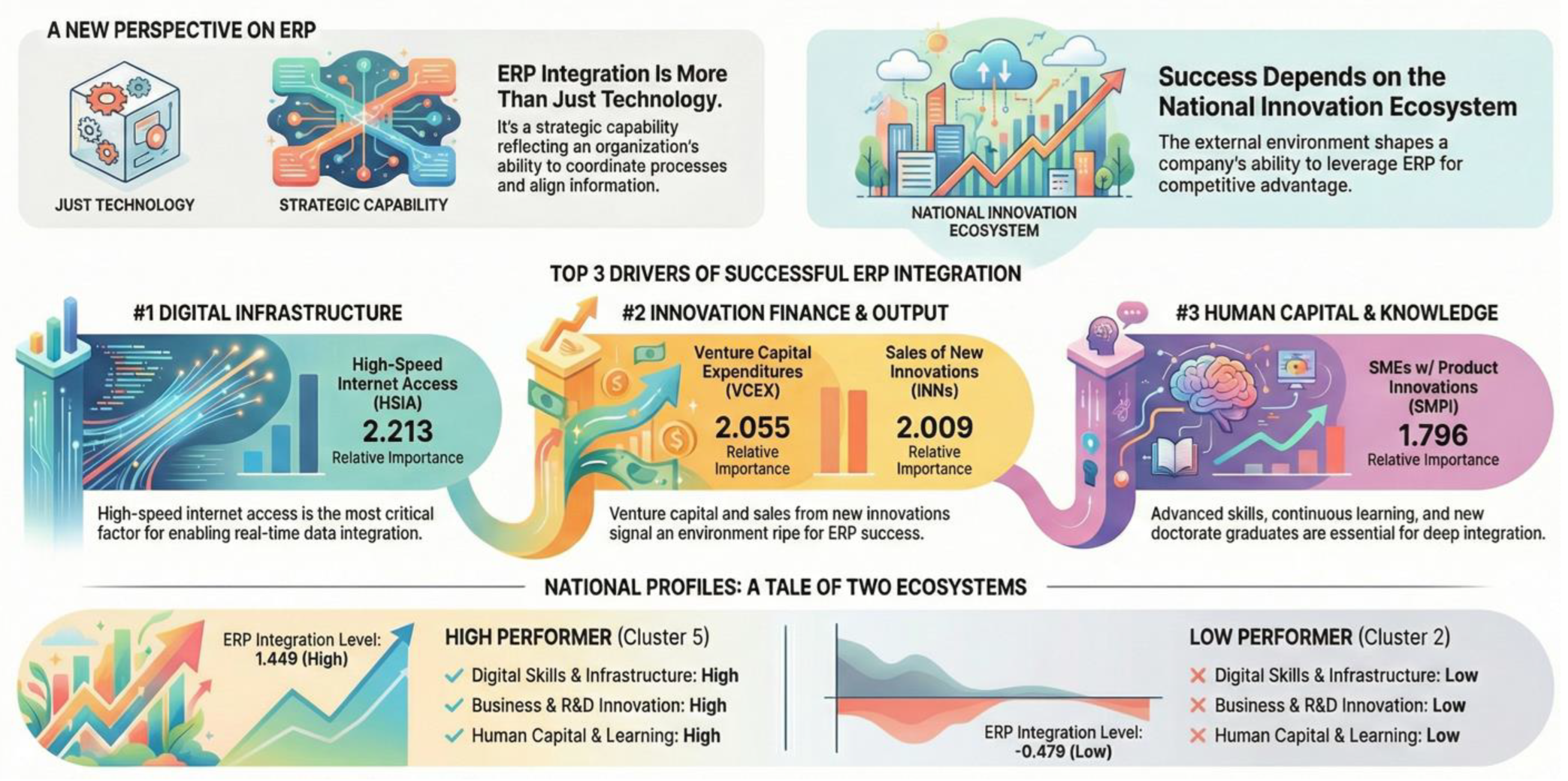
Figure 2.
KNN Model Performance Diagnostics and Distance Weighting. Note. The figure reports KNN diagnostics, showing predicted versus observed values, training and validation error across neighbor counts, and distance-based weighting, illustrating model accuracy, overfitting behavior, and the role of local similarity in explaining ERP integration outcomes.
Figure 2.
KNN Model Performance Diagnostics and Distance Weighting. Note. The figure reports KNN diagnostics, showing predicted versus observed values, training and validation error across neighbor counts, and distance-based weighting, illustrating model accuracy, overfitting behavior, and the role of local similarity in explaining ERP integration outcomes.
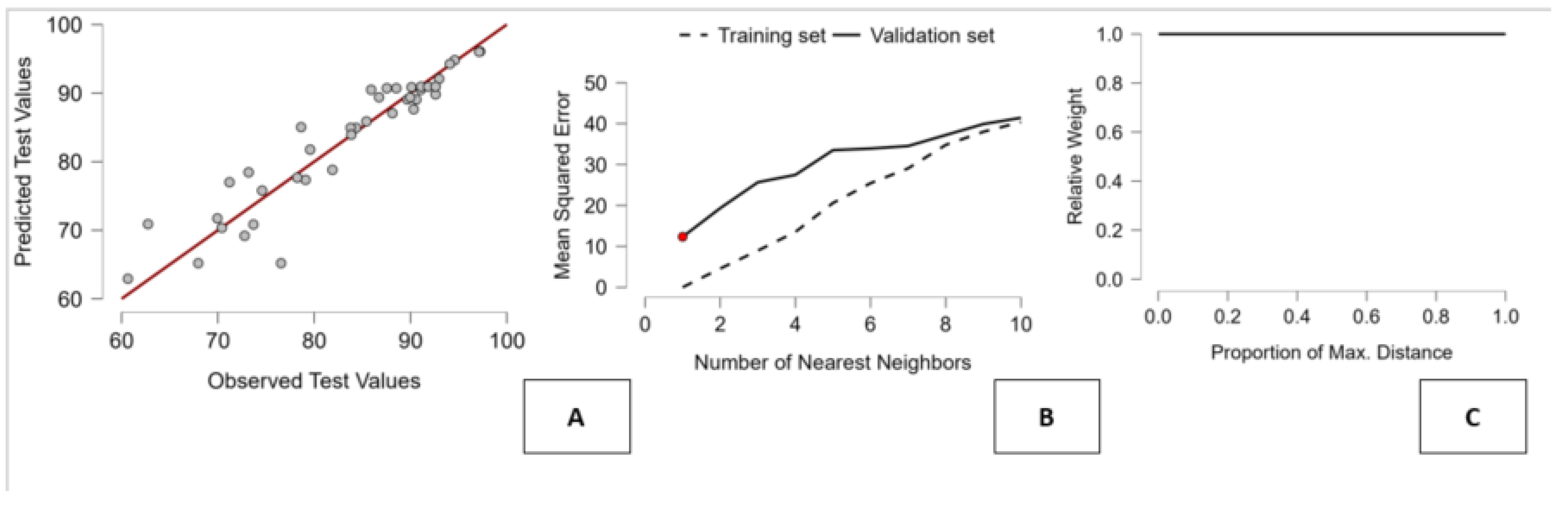
Figure 3.
Cluster Selection, Visualization, and Hierarchical Structure of ERP Integration Profiles. Note. The figure combines cluster validity criteria, multidimensional cluster visualization, and a hierarchical dendrogram, illustrating the rationale for cluster selection and revealing distinct, interpretable national ERP integration regimes within complex innovation and digital ecosystem data.
Figure 3.
Cluster Selection, Visualization, and Hierarchical Structure of ERP Integration Profiles. Note. The figure combines cluster validity criteria, multidimensional cluster visualization, and a hierarchical dendrogram, illustrating the rationale for cluster selection and revealing distinct, interpretable national ERP integration regimes within complex innovation and digital ecosystem data.
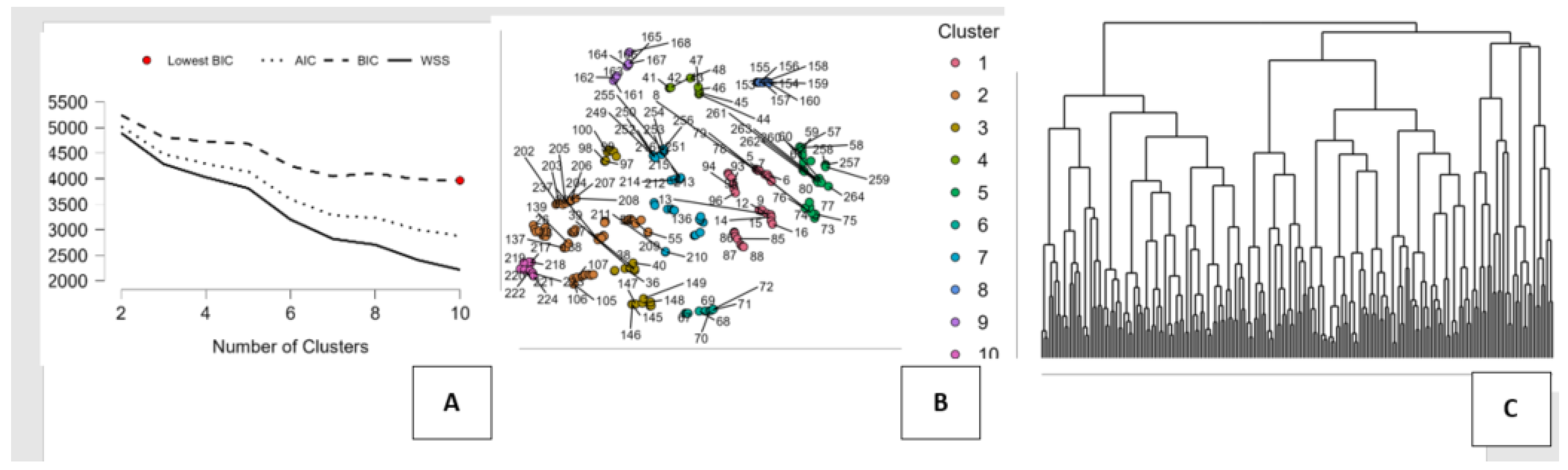

Table 1.
Macro-Thematic Synthesis of ERP Integration and Digital Transformation Literature.
| Macro-Theme | Conceptual Focus | Relevance to the Reviewed Literature |
| ERP as a Strategic Capability and Enabling Infrastructure | ERP systems are conceptualized not merely as operational technologies but as organizational infrastructures that enable process integration, coordination, and information quality. Their strategic value emerges from the ability to orchestrate complementary digital technologies and support decision-making. | Studies on AI-, cloud-, blockchain-, and IoT-enabled ERP systems emphasize the evolution of ERP into integrative platforms. The literature highlights that effective integration depends on governance structures and managerial capabilities rather than on technology adoption alone. |
| Digital Transformation, IT–Business Alignment, and Digital Governance | Digital transformation is framed as a socio-technical process requiring alignment between business strategy, organizational structures, and information systems. Digital governance and leadership play a central role in shaping ERP integration outcomes. | Contributions on ERP customization, AI-enabled ERP, hybrid cloud architectures, and process re-engineering show that ERP success reflects strategic alignment and governance quality rather than technological determinism. |
| Innovation Ecosystems and Institutional Context | ERP integration is influenced by external ecosystem conditions, including human capital availability, digital infrastructure, innovation policies, and inter-organizational collaboration. ERP outcomes therefore reflect systemic rather than purely firm-level capabilities. | Studies on innovation, sustainability, SMEs, and high-tech enterprises demonstrate that supportive institutional and national environments foster more effective digital integration and higher ERP maturity. |
| Human Capital, Organizational Capabilities, and Technology Acceptance | Skills, learning capabilities, organizational agility, and user acceptance are critical in transforming complex digital systems into organizational value. ERP integration depends on absorptive capacity and cultural readiness. | Research on human capital, agentic AI, behavioral intention, service quality, and digital skills reinforces the view that ERP integration is fundamentally an organizational and human-driven process. |
Note. The table synthesizes dominant macro-themes in ERP literature, linking conceptual perspectives with empirical insights to show how strategic, organizational, institutional, and human factors jointly shape ERP integration, governance, and value creation in digital transformation contexts.
Table 2.
Descriptive Statistics of Innovation, Digital Readiness, and Economic Indicators across EU Countries.
Table 2.
Descriptive Statistics of Innovation, Digital Readiness, and Economic Indicators across EU Countries.
| Valid | Missing | Mode | Median | Mean | Std. Deviation | Skewness | Std. Error of Skewness | Kurtosis | Std. Error of Kurtosis | Minimum | Maximum | |
| EPR250 | 280 | 0 | 72.770 | 81.085 | 79.178 | 12.019 | -1.046 | 0.146 | 1.220 | 0.290 | 28.000 | 97.220 |
| NDG | 280 | 0 | 76.883 | 71.104 | 69.316 | 44.472 | 0.366 | 0.146 | -0.762 | 0.290 | 0.000 | 169.350 |
| TERE | 280 | 0 | 74.834 | 105.960 | 112.329 | 60.763 | 0.293 | 0.146 | -0.375 | 0.290 | 0.000 | 240.397 |
| LLL | 280 | 0 | 275.000 | 99.519 | 112.663 | 75.272 | 0.652 | 0.146 | -0.453 | 0.290 | 10.577 | 275.000 |
| ISCP | 280 | 0 | 381.627 | 112.753 | 143.165 | 103.333 | 0.739 | 0.146 | -0.421 | 0.290 | 4.087 | 381.627 |
| TOPC | 280 | 0 | 26.174 | 81.553 | 78.343 | 41.933 | 0.209 | 0.146 | -1.243 | 0.290 | 13.683 | 163.227 |
| FDS | 272 | 8 | 358.926 | 137.223 | 143.964 | 95.882 | 0.409 | 0.148 | -0.724 | 0.294 | 0.000 | 358.926 |
| HSIA | 232 | 48 | 0.000 | 153.770 | 147.051 | 76.767 | -0.415 | 0.160 | -0.852 | 0.318 | 0.000 | 262.951 |
| DIGS | 272 | 8 | 18.441 | 88.107 | 93.706 | 53.654 | 0.217 | 0.148 | -0.675 | 0.294 | 5.969 | 208.018 |
| PRDE | 280 | 0 | 71.186 | 71.186 | 72.824 | 41.742 | 0.226 | 0.146 | -0.790 | 0.290 | 0.000 | 161.017 |
| VCEX | 280 | 0 | 0.000 | 76.104 | 117.210 | 115.153 | 1.018 | 0.146 | -0.034 | 0.290 | 0.000 | 392.329 |
| GSRD | 280 | 0 | 0.000 | 43.777 | 70.812 | 67.569 | 0.757 | 0.146 | -0.711 | 0.290 | 0.000 | 207.570 |
| BRDE | 280 | 0 | 4.478 | 55.597 | 68.763 | 51.679 | 0.574 | 0.146 | -0.777 | 0.290 | 0.746 | 201.432 |
| NRDI | 272 | 8 | 109.513 | 78.461 | 82.557 | 39.348 | 0.601 | 0.148 | 1.100 | 0.294 | 0.000 | 201.432 |
| INEX | 272 | 8 | 16.006 | 53.169 | 68.721 | 50.346 | 0.796 | 0.148 | -0.430 | 0.294 | 0.531 | 181.885 |
| CLOD | 272 | 8 | 493.443 | 164.426 | 199.076 | 146.643 | 0.596 | 0.148 | -0.749 | 0.294 | 0.000 | 493.443 |
| ICTS | 280 | 0 | 79.486 | 97.069 | 97.981 | 47.045 | 0.127 | 0.146 | -0.403 | 0.290 | 9.154 | 193.777 |
| SMPI | 280 | 0 | 56.365 | 118.341 | 112.948 | 52.469 | 0.103 | 0.146 | -0.512 | 0.290 | 0.000 | 225.268 |
| SMBP | 280 | 0 | 92.995 | 115.594 | 112.160 | 49.558 | -0.181 | 0.146 | -0.306 | 0.290 | 0.000 | 218.286 |
| SMCO | 272 | 8 | 61.400 | 134.939 | 145.647 | 86.949 | 0.620 | 0.148 | -0.541 | 0.294 | 0.000 | 329.421 |
| PPCP | 280 | 0 | 589.811 | 148.673 | 201.904 | 160.956 | 0.913 | 0.146 | -0.087 | 0.290 | 7.279 | 589.811 |
| J2JM | 264 | 16 | 144.118 | 129.412 | 131.785 | 73.711 | 0.155 | 0.150 | -0.877 | 0.299 | 0.000 | 282.353 |
| PCTA | 280 | 0 | 139.482 | 57.324 | 67.266 | 35.653 | 0.645 | 0.146 | -0.674 | 0.290 | 12.928 | 139.482 |
| TMAP | 280 | 0 | 224.288 | 96.557 | 96.408 | 55.184 | 0.612 | 0.146 | 0.396 | 0.290 | 0.000 | 224.288 |
| DSAP | 280 | 0 | 0.000 | 54.681 | 60.294 | 47.557 | 0.536 | 0.146 | -0.687 | 0.290 | 0.000 | 165.977 |
| INNS | 280 | 0 | 22.771 | 79.551 | 83.387 | 39.235 | 0.669 | 0.146 | 0.307 | 0.290 | 22.771 | 187.312 |
| INEM | 280 | 0 | 50.166 | 106.778 | 96.635 | 45.582 | -0.245 | 0.146 | -1.047 | 0.290 | 0.000 | 182.134 |
| HTEX | 280 | 0 | 0.000 | 74.738 | 69.828 | 30.195 | -0.534 | 0.146 | -0.341 | 0.290 | 0.000 | 119.389 |
| KISE | 280 | 0 | 0.000 | 61.505 | 66.765 | 34.874 | 0.166 | 0.146 | -0.833 | 0.290 | 0.000 | 135.896 |
| HTIM | 240 | 40 | 0.000 | 77.051 | 70.617 | 33.993 | -0.597 | 0.157 | -0.569 | 0.313 | 0.000 | 122.801 |
| RESP | 272 | 8 | 234.698 | 80.662 | 94.898 | 65.561 | 0.625 | 0.148 | -0.573 | 0.294 | 0.000 | 234.698 |
| CO2P | 280 | 0 | 273.581 | 115.068 | 121.562 | 67.617 | 0.539 | 0.146 | -0.249 | 0.290 | 0.000 | 273.581 |
| LABP | 233 | 47 | 267.819 | 65.179 | 94.699 | 72.421 | 0.705 | 0.159 | -0.580 | 0.318 | 0.000 | 267.819 |
Note. Descriptive statistics show wide dispersion and right skewness across innovation, readiness, and economic indicators, highlighting asymmetric EU ecosystems, uneven resource allocation, moderate maturity progression, and heterogeneous conditions shaping countries’ capacities to integrate ERP systems nationally.
Table 3.
Definition and Operationalization of ERP Integration and Innovation Ecosystem Variables.
| Definition | Acronym | Description |
| ERP integration in enterprises with over 250 employees | ERP 250 | Measures the share of enterprises with more than 250 employees that use an ERP software package to share information across different functional areas. It captures the degree of internal process integration and reflects the ability of large firms to coordinate activities, data flows, and decision-making through integrated information systems rather than simple ERP adoption. |
| Population involved in lifelong learning | LLL | Indicates the proportion of the population involved in lifelong learning activities, capturing the availability of continuous skills development and human capital relevant for digital and organizational transformation. |
| High speed internet access | HSIA | Represents access to high-speed internet, measuring the quality of digital infrastructure that enables advanced information systems and real-time data integration. |
| R&D expenditure in the public sector | PRDE | Public sector expenditure on research and development, used as a proxy for institutional support to innovation and knowledge creation. |
| Non-R&D innovation expenditures | NRDI | Non-R&D innovation expenditures, including innovation-related investments not formally classified as R&D, often reflecting fragmented or incremental innovation efforts. |
| SMEs introducing business process innovations | SMBP | Share of SMEs introducing business process innovations, capturing firms’ capability to reorganize and improve internal processes. |
| Employment in innovative enterprises | INEM | Employment in innovative enterprises, reflecting the structural presence of innovation-oriented firms within the economy. |
Note. This table defines core dependent and explanatory variables, clarifying how ERP integration, human capital, digital infrastructure, innovation investment, and firm-level capabilities operationalize systemic conditions influencing organizational integration capacity beyond mere technology adoption across European economies.
Table 4.
Fixed-Effects and Random-Effects Panel Regression Results for ERP Integration in Large Enterprises.
Table 4.
Fixed-Effects and Random-Effects Panel Regression Results for ERP Integration in Large Enterprises.
| Fixed-effects, using 224 observations Included 28 cross-sectional units Time-series length = 8 Dependent variable: EPR250 |
Random-effects (GLS), using 224 observations Using Nerlove's transformation Included 28 cross-sectional units Time-series length = 8 Dependent variable: EPR250 |
|||||
| Coefficient | Std. Error | t-ratio | Coefficient | Std. Error | z | |
| const | 58.9764*** | 4.62403 | 12.75 | 62.1393*** | 3.95791 | 15.70 |
| LLL | 0.0770531*** | 0.0249275 | 3.091 | 0.0440641** | 0.0200216 | 2.201 |
| HSIA | 0.0543574*** | 0.00911950 | 5.961 | 0.0540192*** | 0.00851710 | 6.342 |
| PRDE | 0.105108** | 0.0430158 | 2.443 | 0.111675*** | 0.0341632 | 3.269 |
| NRDI | −0.0432088** | 0.0176116 | −2.453 | −0.0411510** | 0.0165328 | −2.489 |
| SMBP | 0.0507304** | 0.0232549 | 2.181 | 0.0615259*** | 0.0221197 | 2.781 |
| INEM | −0.0535022* | 0.0288833 | −1.852 | −0.0624247** | 0.0277373 | −2.251 |
| Statistics | Mean dependent var | 81.60554 | Mean dependent var | 81.60554 | ||
| Sum squared resid | 3123.647 | Sum squared resid | 18090.21 | |||
| LSDV R-squared | 0.866188 | Log-likelihood | −809.6880 | |||
| LSDV F(33, 190) | 37.26972 | Schwarz criterion | 1657.258 | |||
| Log-likelihood | −612.9746 | rho | 0.589183 | |||
| Schwarz criterion | 1409.945 | S.D. dependent var | 10.23130 | |||
| rho | 0.589183 | S.E. of regression | 9.109481 | |||
| S.D. dependent var | 10.23130 | Akaike criterion | 1633.376 | |||
| S.E. of regression | 4.054658 | Hannan-Quinn | 1643.016 | |||
| Within R-squared | 0.456281 | Durbin-Watson | 0.681374 | |||
| P-value(F) | 3.59e-66 | |||||
| Akaike criterion | 1293.949 | |||||
| Hannan-Quinn | 1340.771 | |||||
| Durbin-Watson | 0.681374 | |||||
| Tests | Joint test on named regressors - Test statistic: F(6, 190) = 26.5742 with p-value = P(F(6, 190) > 26.5742) = 7.20842e-23 |
'Between' variance = 92.4962 'Within' variance = 13.9449 theta used for quasi-demeaning = 0.863998 Joint test on named regressors - Asymptotic test statistic: Chi-square(6) = 166.259 with p-value = 2.79423e-33 |
||||
| Test for differing group intercepts - Null hypothesis: The groups have a common intercept Test statistic: F(27, 190) = 21.0546 with p-value = P(F(27, 190) > 21.0546) = 1.58025e-43 |
Breusch-Pagan test - Null hypothesis: Variance of the unit-specific error = 0 Asymptotic test statistic: Chi-square(1) = 316.624 with p-value = 7.87445e-71 |
|||||
| Hausman test - Null hypothesis: GLS estimates are consistent Asymptotic test statistic: Chi-square(6) = 11.0419 with p-value = 0.0870903 |
||||||
Note: *, **, and *** denote statistical significance at the 10%, 5%, and 1% levels, respectively, indicating increasing confidence that estimated coefficients differ from zero and reflect robust relationships between explanatory variables and ERP integration.
Table 5.
Comparative Predictive Performance of Machine Learning and Regression Models.
| Modello | MSE | MSE (scaled) | RMSE | MAE / MAD | MAPE | R² |
| Boosting | 0.70 | 0.57 | 0.60 | 0.56 | 0.45 | 0.47 |
| Decision Tree | 0.62 | 0.57 | 0.53 | 0.49 | 0.33 | 0.47 |
| KNN | 1.00 | 1.00 | 1.00 | 1.00 | 1.00 | 1.00 |
| Linear Regression | 0.07 | 0.10 | 0.09 | 0.02 | 0.00 | 0.07 |
| ANN | 0.00 | 0.00 | 0.00 | 0.00 | 0.11 | 0.00 |
| Random Forest | 0.86 | 0.63 | 0.78 | 0.73 | 0.76 | 0.55 |
| Regularized Linear | 0.80 | 0.80 | 0.69 | 0.65 | 0.58 | 0.73 |
| SVM | 0.77 | 0.33 | 0.65 | 0.68 | 0.64 | 0.31 |
Note. The table compares predictive accuracy across models using scaled error and goodness-of-fit metrics, highlighting substantial performance differences and indicating how model choice influences explanatory power and prediction reliability when modeling ERP integration outcomes across heterogeneous systems.
Table 6.
Feature Importance Rankings Based on Mean Dropout Loss.
| Feature Importance Metrics | Mean dropout loss | Feature Importance Metrics | Mean dropout loss |
| HSIA | 2.213 | CO2P | 0.658 |
| VCEX | 2.055 | PRDE | 0.627 |
| INNS | 2.009 | FDS | 0.596 |
| SMPI | 1.796 | DIGS | 0.524 |
| SMCO | 1.683 | PPCP | 0.493 |
| NRDI | 1.540 | INEM | 0.404 |
| NDG | 1.374 | SMBP | 0.400 |
| HTEX | 1.297 | LLL | 0.334 |
| GSRD | 1.182 | PCTA | 0.322 |
| CLOD | 1.107 | ISCP | 0.312 |
| TOPC | 1.076 | BRDE | 0.289 |
| J2JM | 1.059 | ICTS | 0.287 |
| RESP | 0.891 | INEX | 0.268 |
| KISE | 0.879 | TERE | 0.246 |
| DSAP | 0.784 | TMAP | 0.096 |
| HTIM | 0.728 | LABP | 0.036 |
Note. This table reports feature importance derived from mean dropout loss, indicating each variable’s marginal contribution to predictive accuracy. Higher values signal stronger influence, revealing which innovation, digital, and economic factors most affect ERP integration outcomes.
Table 7.
Case-Level Decomposition of Predicted ERP Integration (ERP 250) from the KNN Model.
| Case | Predicted | Base | NDG | TERE | LLL | ISCP | TOPC | FDS | HSIA | DIGS | PRDE | VCEX | GSRD | BRDE | NRDI | INEX | CLOD |
| 1 | 90.710 | 82.286 | -0.327 | 0.000 | 0.000 | 0.000 | -1.403 | 0.222 | -0.677 | 0.035 | 1.122 | -0.113 | 3.096 | 0.509 | 0.206 | 0.000 | 0.559 |
| 2 | 90.710 | 82.286 | 0.341 | 0.000 | 0.000 | 0.000 | -1.329 | 0.818 | -0.677 | 0.035 | 1.060 | -0.296 | 2.370 | 1.465 | 0.206 | 0.000 | 0.302 |
| 3 | 90.480 | 82.286 | 1.742 | 9.375×10⁻⁴ | -0.034 | 0.030 | -0.075 | 1.308 | -0.231 | -0.046 | 0.139 | -0.152 | 2.917 | 0.350 | 0.416 | -0.042 | 0.472 |
| 4 | 89.390 | 82.286 | 0.247 | -0.116 | 0.000 | 0.022 | 1.308 | 0.072 | 0.593 | 0.000 | 1.215 | -0.172 | 1.013 | 1.619 | 0.355 | -1.224 | 0.438 |
| 5 | 62.920 | 82.286 | 0.211 | 0.000 | -0.565 | -0.053 | -1.956 | 1.539 | -0.100 | -4.411 | -2.419 | 1.193 | -0.353 | 0.259 | 0.400 | -3.091 | -0.297 |
| Case | ICTS | SMPI | SMBP | SMCO | PPCP | J2JM | PCTA | TMAP | DSAP | INNS | INEM | HTEX | KISE | HTIM | RESP | CO2P | LABP |
| 1 | 0.000 | 0.598 | 0.000 | 0.016 | 1.012 | -0.009 | -0.009 | 0.000 | 2.138 | -0.376 | 0.391 | 0.924 | 0.340 | -0.105 | 0.363 | -0.088 | 0.000 |
| 2 | 0.000 | 0.798 | 0.000 | 0.541 | 0.056 | -0.009 | -0.009 | 0.000 | 1.491 | -0.376 | 0.019 | 1.026 | 0.280 | -0.105 | 0.411 | 0.007 | 0.000 |
| 3 | -0.093 | 0.256 | 0.587 | 0.339 | 0.108 | 0.411 | 0.362 | 0.000 | -0.263 | -0.412 | 0.062 | -0.498 | 0.500 | -0.323 | 0.461 | -0.100 | 0.000 |
| 4 | -0.009 | -0.067 | -0.416 | 0.901 | 0.235 | 0.803 | 0.375 | 0.000 | 0.011 | -0.412 | -0.083 | 0.412 | -0.092 | 0.244 | -0.322 | 0.156 | 0.000 |
| 5 | -0.352 | -0.670 | -0.303 | -0.186 | -0.305 | -1.065 | -0.170 | 0.000 | 0.159 | 0.028 | 0.796 | -0.646 | -0.974 | -0.137 | -2.933 | -2.873 | -0.088 |
Note. The table reports case-level contributions of standardized innovation, human capital, digital infrastructure, and productivity variables to predicted ERP integration. Values indicate marginal effects relative to a common baseline, highlighting complementarities, misalignments, and systemic heterogeneity across cases.
Table 8.
Cluster Validation Results across Alternative Clustering Algorithms.
| Algorithms | Max diameter | Min separation | Pearson’s γ | Dunn | Entropy | Calinski-H | HH index |
| Density Based | 0.00 | 0.02 | 0.00 | 0.00 | 0.56 | 0.00 | 1.00 |
| Fuzzy C-Means | 0.59 | 0.00 | 0.72 | 0.03 | 0.09 | 0.55 | 0.76 |
| Hierarchical | 1.00 | 1.00 | 0.88 | 1.00 | 0.08 | 0.78 | 0.74 |
| Model Based | 0.56 | 0.95 | 1.00 | 0.83 | 1.00 | 0.75 | 0.00 |
| K-Means | 0.68 | 0.42 | 0.79 | 0.40 | 0.00 | 0.85 | 0.82 |
| Random Forest | 0.56 | 0.84 | 0.88 | 0.72 | 0.27 | 1.00 | 0.63 |
Note. Validation indices compare cluster compactness and separation across algorithms, showing hierarchical clustering achieves the best balance, robustness, and interpretability, making it most suitable for exploratory and comparative analysis of complex innovation and ERP integration data.
Table 9.
Standardized Cluster Profiles of ERP Integration, Innovation, and Digital Readiness Indicators.
Table 9.
Standardized Cluster Profiles of ERP Integration, Innovation, and Digital Readiness Indicators.
| EPR > 250 | NDG | TERE | LLL | ISCP | TOPC | FDS | HSIA | DIGS | PRDE | VCEX | GSRD | BRDE | NRDI | INEX | CLOD | |
| Cluster 1 | 1.358 | 0.009 | 0.147 | 0.110 | 0.370 | 0.495 | 0.597 | 1.284 | -0.460 | 0.647 | 0.617 | 0.158 | 0.982 | 1.296 | 0.212 | 0.130 |
| Cluster 2 | -0.479 | -0.611 | -0.739 | -0.719 | -0.323 | -0.206 | -0.609 | -0.244 | -0.251 | 0.293 | -0.459 | -0.487 | -1.017 | -0.694 | -0.444 | -0.857 |
| Cluster 3 | -0.749 | -0.409 | -0.113 | -0.154 | -1.150 | -0.101 | -1.085 | -0.746 | -0.755 | -1.418 | 0.113 | -0.928 | 0.425 | -0.387 | 0.605 | -0.607 |
| Cluster 4 | -1.132 | 0.097 | -0.860 | -0.558 | -0.068 | -0.462 | 0.004 | -0.956 | -1.269 | 0.212 | -1.537 | -0.333 | 0.198 | -0.868 | 0.186 | 1.121 |
| Cluster 5 | 1.449 | 1.768 | 1.119 | 1.575 | 0.739 | 0.646 | 0.654 | -0.174 | 0.707 | 0.019 | 0.682 | 1.716 | 0.654 | 1.419 | 0.290 | 1.649 |
| Cluster 6 | -0.323 | 0.572 | -1.149 | 0.234 | 0.619 | -0.872 | 0.060 | -0.626 | 0.073 | -0.904 | -1.352 | 1.272 | 0.953 | 0.130 | 0.057 | 0.515 |
| Cluster 7 | -0.098 | -0.077 | 0.013 | 0.085 | 0.026 | 0.630 | -0.157 | 0.763 | 0.318 | -0.011 | 0.925 | -0.314 | 0.056 | -0.350 | 0.653 | -0.115 |
| Cluster 8 | -0.675 | -0.329 | 0.360 | 0.539 | 1.281 | -0.273 | 2.403 | -0.692 | 1.221 | -0.523 | -1.688 | 1.754 | 0.139 | -0.233 | -1.551 | 1.831 |
| Cluster 9 | -1.015 | 0.715 | 2.089 | 1.025 | 1.000 | -0.617 | 1.918 | -0.910 | 1.579 | 0.595 | -1.076 | 0.082 | -0.573 | -0.356 | -0.843 | -0.199 |
| Cluster 10 | -1.119 | -1.194 | 0.336 | -1.971 | -1.242 | -2.680 | -1.196 | -0.785 | 0.619 | 0.514 | -0.144 | -1.589 | -2.005 | -1.386 | -1.328 | -1.310 |
| ICTS | SMPI | SMBP | SMCO | PPCP | J2JM | PCTA | TMAP | DSAP | INNS | INEM | HTEX | KISE | HTIM | RESP | CO2P | LABP |
| 0.390 | 0.544 | 0.957 | 0.003 | 0.820 | -0.028 | 1.130 | 0.403 | 1.037 | 0.867 | 0.799 | 0.666 | 0.541 | 0.191 | -0.272 | 0.760 | 0.344 |
| -0.747 | -0.384 | -0.848 | -0.760 | -0.683 | 0.014 | -0.703 | -0.801 | -0.678 | -0.561 | -1.006 | -0.723 | -0.888 | -0.530 | -0.607 | -1.174 | -0.610 |
| -0.072 | -1.032 | -0.804 | -0.932 | -0.587 | 0.879 | -0.901 | -0.542 | 0.013 | -0.180 | 0.691 | 0.402 | 0.564 | 0.286 | -0.635 | -0.652 | -0.062 |
| 1.002 | 1.415 | -0.277 | -0.397 | -1.141 | 0.106 | -0.720 | 0.558 | -1.212 | -0.427 | 0.816 | 0.867 | 0.614 | 1.783 | 2.256 | 0.756 | -0.092 |
| 0.805 | 1.275 | 1.342 | 2.003 | 1.354 | -0.204 | 1.855 | 1.754 | 1.552 | -0.730 | 0.467 | 0.759 | 0.791 | 0.334 | 0.131 | 1.372 | 1.021 |
| 0.795 | 0.125 | -0.630 | 0.970 | -0.020 | 1.928 | -0.396 | 0.086 | 0.475 | -1.258 | 0.556 | 1.753 | 0.410 | -0.065 | 1.579 | 0.171 | 1.246 |
| -0.291 | -0.720 | -0.156 | 0.225 | 0.423 | -0.391 | -0.154 | -0.233 | -0.142 | 0.746 | 0.074 | -0.421 | 0.082 | -0.313 | -0.117 | 0.222 | -0.443 |
| 1.151 | 1.847 | 2.538 | 0.650 | 0.631 | -1.177 | 0.213 | 1.528 | -0.236 | 1.851 | 0.120 | -0.224 | 0.159 | 2.098 | 1.891 | 1.315 | 0.715 |
| 0.715 | -0.783 | -0.319 | 0.225 | -1.430 | 0.610 | -0.300 | -0.507 | -1.575 | 0.840 | -0.424 | -0.935 | -0.554 | -0.007 | 2.256 | -0.318 | 0.003 |
| -1.775 | -0.331 | -1.043 | -1.017 | -1.213 | -1.900 | -1.349 | -1.177 | -1.657 | -1.365 | -1.999 | -1.586 | -1.858 | -2.000 | -1.272 | -0.967 | -0.693 |
Note. The table reports case-level contributions of standardized innovation, human capital, digital infrastructure, and productivity variables to predicted ERP integration. Values indicate marginal effects relative to a common baseline, highlighting complementarities, misalignments, and systemic heterogeneity across cases.
Table 10.
Integrated Interpretation of Empirical Findings on ERP Integration and Strategic Information Systems.
Table 10.
Integrated Interpretation of Empirical Findings on ERP Integration and Strategic Information Systems.
| Macro-theme | Key Empirical Evidence | Interpretation in Strategic IS Terms | Strategic Implications |
| ERP Integration as an Organizational Capability | Panel regressions show that ERP integration (ERP 250) is positively associated with lifelong learning, digital infrastructure, public R&D support, and business process innovation, while fragmented innovation spending shows negative effects. Strong country fixed effects confirm structural heterogeneity. | ERP integration reflects the development of organizational and systemic capabilities rather than a purely technological outcome. It emerges from the interaction between skills, governance, and coordinated innovation efforts. | ERP systems should be managed as long-term organizational infrastructures supporting coordination, information quality, and process integration, not as isolated IT investments. |
| Innovation Ecosystems and Institutional Embeddedness | Significant effects of public R&D expenditure, SME process innovation, and clustering results revealing distinct national ERP integration regimes linked to ecosystem coherence. Some clusters combine strong scientific output with weak ERP integration. | National innovation ecosystems condition firms’ ability to assimilate complex systems. Scientific excellence alone is insufficient without institutional alignment and managerial absorption mechanisms. | Policies and strategies should focus on ecosystem coherence, aligning education, innovation policy, and digital governance to enable ERP-based integration. |
| Digital Infrastructure and Complementarities | High-speed internet access is consistently one of the strongest predictors in both econometric and machine learning models. Cloud computing and ICT specialists play a supportive but secondary role. | Digital infrastructure acts as a foundational enabler that allows ERP systems to function as real-time coordination platforms, but only when complemented by organizational capabilities. | Investments in connectivity and platforms must be accompanied by process redesign, governance mechanisms, and skills development to generate strategic value. |
| Non-linearity, Heterogeneity, and Strategic Configurations | Machine learning results (KNN) outperform linear models, highlighting local similarity patterns. Hierarchical clustering identifies multiple ERP integration regimes with different innovation configurations. | ERP integration follows non-linear, context-dependent paths shaped by complementarities and local structures rather than universal best practices. | Managers and policymakers should avoid one-size-fits-all approaches and instead design ERP strategies tailored to specific institutional and innovation contexts. |
Note. This table synthesizes econometric, machine learning, and clustering evidence into strategic IS interpretations, highlighting ERP integration as a systemic, non-linear capability shaped by institutional contexts, digital infrastructure, and complementary organizational resources rather than standalone technology adoption.
Table 11.
Analytical Dimensions Linking ERP Integration to Strategic IS Capabilities and Ecosystem Factors.
Table 11.
Analytical Dimensions Linking ERP Integration to Strategic IS Capabilities and Ecosystem Factors.
| Analytical Dimension | Key Empirical Evidence | Interpretation in Strategic IS Terms | Strategic Implications |
| Human Capital and Skills Development | Lifelong learning (LLL) shows a positive and statistically significant association with ERP integration (ERP 250) across panel specifications. Knowledge and skills indicators also emerge as relevant in machine learning feature importance. | ERP integration depends on absorptive capacity, continuous learning, and the ability to reconfigure processes and routines. Skills enable IT–business alignment rather than simple system usage. | Firms should complement ERP investments with continuous training and organizational learning. At the system level, investments in education and lifelong learning strengthen digital integration capabilities. |
| Digital Infrastructure and Technological Readiness | High-speed internet access (HSIA) is one of the most robust predictors in panel regressions and the most important feature in KNN models. Cloud-related variables also contribute positively in high-performing clusters. | ERP systems function as enabling infrastructures that require reliable connectivity and scalable digital platforms. Infrastructure is a necessary condition for real-time coordination and integration. | Digital infrastructure policies are foundational for effective ERP integration. Managers should view connectivity and platform readiness as strategic prerequisites, not technical add-ons. |
| Innovation Governance and Institutional Support | Public R&D expenditure (PRDE) is positively associated with ERP integration, while non-R&D innovation expenditures (NRDI) show a negative effect. Clustering highlights higher integration where innovation support is coherent. | Coherent and coordinated innovation policies generate spillovers that enhance organizational integration. Fragmented or tactical innovation efforts may undermine ERP-based coordination. | Innovation strategies should prioritize coherence and alignment. Policymakers should focus on systemic innovation support rather than isolated incentives. |
| Organizational and Process Innovation | The share of SMEs introducing business process innovations (SMBP) is positively related to ERP integration. Clusters with strong organizational innovation show higher ERP integration. | ERP integration reflects process reconfiguration and organizational change, not merely software deployment. Organizational innovation acts as a complement to ERP systems. | Managers should embed ERP projects within broader process innovation initiatives. Ecosystems that promote organizational experimentation facilitate deeper ERP integration. |
| Structural Heterogeneity and Ecosystem Effects | Fixed-effects models reject common intercepts across countries; clustering reveals distinct ERP integration regimes. KNN results emphasize local similarity patterns. | ERP integration is context-dependent and shaped by national innovation ecosystems, governance quality, and institutional paths. There is no single convergence model. | One-size-fits-all digital strategies are ineffective. Both firms and policymakers should adopt context-sensitive approaches to ERP and digital transformation. |
| Strategic Role of ERP Systems | Convergent evidence from regressions, machine learning, and clustering shows ERP integration linked to capabilities rather than technology availability alone. | ERP systems act as strategic infrastructures that support coordination, control, and long-term value creation when embedded in supportive ecosystems. | ERP should be managed as a strategic capability. Competitive advantage depends on alignment between technology, organization, and the external innovation environment. |
Note. The table reports case-level contributions of standardized innovation, human capital, digital infrastructure, and productivity variables to predicted ERP integration. Values indicate marginal effects relative to a common baseline, highlighting complementarities, misalignments, and systemic heterogeneity across cases.
Disclaimer/Publisher’s Note: The statements, opinions and data contained in all publications are solely those of the individual author(s) and contributor(s) and not of MDPI and/or the editor(s). MDPI and/or the editor(s) disclaim responsibility for any injury to people or property resulting from any ideas, methods, instructions or products referred to in the content. |
© 2026 by the authors. Licensee MDPI, Basel, Switzerland. This article is an open access article distributed under the terms and conditions of the Creative Commons Attribution (CC BY) license (http://creativecommons.org/licenses/by/4.0/).
Copyright: This open access article is published under a Creative Commons CC BY 4.0 license, which permit the free download, distribution, and reuse, provided that the author and preprint are cited in any reuse.


