

Submitted:
28 January 2026
Posted:
29 January 2026
You are already at the latest version
Abstract
Based on the scientific and technological revolutions that have characterized Structural Engineering during the last two centuries, we can acknowledge how the historical scale doubling of suspension bridges has occurred for at least four times, from the beginning of the XIX to the end of the XX Century. These four revolutions represent the tangible mankind’s challenge against natural forces: gravity, wind, earthquake. In this context, the prospective scale doubling requested by next-generation bridges (e.g., the Messina Straits Bridge) could take place only if significant scientific and/or technological innovations occur. This opportunity is presently offered by Fracture Mechanics, since any appropriate advanced design approach should take into account also brittleness size-scale effects, in addition to loading-capacity size-scale effects, which are well-known since Galileo’s studies. From the technological point of view, the open problem of physical similitude could be effectively solved by using fibre-reinforcement.
Keywords:
scale doubling
; suspension bridges
; brittleness
; size-scale effects
; fibre-reinforced composites
1. Introduction: Size-Scale Effects on Structural Brittleness
The phenomenon of fracture in the structural materials takes place at different scales, depending on the microstructure of the materials themselves, and evolves from microscopic to macroscopic scale passing through a sequence of intermediate stages. The study of fracture is highly interdisciplinary, involving experts from different fields: from Solid State Physics to Material Science to Structural Engineering. Size-scale is a fundamental factor for understanding the natural laws governing the phenomenon of fracture. By varying the size-scale over several orders of magnitude, the experimental results seem to be inexplicable on the basis of traditional theories (Carpinteri and Pugno, 2005; Carpinteri, 2021). Surprising was the case of Liberty ships, which failed in two parts in an extremely brittle way, although subject to not excessive stress, against a material −steel− characterized as strong and ductile at the laboratory scale. The same astonishment came from the mechanical behaviour of glass filaments, the so-called whiskers, which bend like rubber and show strengths that are even one hundred times higher than those by glass samples of a more usual size (Carpinteri, 2021; Carpinteri and Accornero, 2021; 2024). As evidenced by the two extreme cases just mentioned, strength and ductility are not invariant characteristics of the material, but, on the contrary, they vary considerably with the size-scale of the structure. In the context of Philosophy of Science, Karl Popper would have classified these two experimental observations as falsifications of previous conjectures (Popper, 1934).
As regards the strength of materials, the first hypothesis of invariance dates back to two great scientists, Leonardo da Vinci (1519) and Galileo Galilei (1638), who were the first to deal with the mechanical behavior of materials. Although the two opposite mechanical behaviours are particularly evident at the extreme scales (macroscopic and microscopic), they also manifest themselves at the intermediate scales, which are characteristic of Structural Engineering laboratories. In larger samples, the material appears as more brittle and weaker, whereas in smaller samples it is more ductile and stronger. During a fracturing process, the advancing crack presents very different features: in larger samples, it propagates suddenly through a material that is substantially uncracked and elastic, whereas in smaller samples the propagation is slowed down by yielding or different dissipative phenomena (Figure 1). The vertical drop of the load, which is evident in the diagram, actually hides highly unstable branches called snap-back (Carpinteri, 1989). In general, we can acknowledge the occurrence of fold catastrophes (strain-softening) for small sizes, and cusp catastrophes (snap-back) for large sizes, according to the terminology introduced by Renè Thom (1972). The latter is, for instance, the case of plain concrete slabs in tension (Figure 2a), whose overall responses are highly influenced by the softening behaviour of the process zone (Figure 2b), which is governed by the fracture energy of the material, GF.
Let us consider an elastic-softening slab made of a material with a double constitutive law (Carpinteri and Accornero, 2024): being E the elastic modulus, the constitutive law is described as tension σ versus dilation ε, and, after attainment of ultimate tensile strength σu or strain εu = σu/E, we have tension σ versus crack opening displacement w (Figure 2b).
If the plane slab of elastic-softening material is increasingly loaded, three different deformation histories will arise after the ultimate tensile strength σu has been reached, depending on its characteristic structural size L (Figure 3): (1) normal softening, when wc > εu L; (2) vertical loading-drop, when wc = εu L; (3) snap-back, when wc < εu L.
In other terms, the Brittleness Ratio of the slab can be defined as the ratio of ultimate elastic energy at the peak load contained in the body to the energy dissipated by fracture:
This dimensionless quantity is higher than the unity when wc < εu L (specimen n. 3 in Figure 3) and a catastrophic softening instability occurs (Carpinteri, 1989).
From Equation (1), it is evident how the brittleness of structural elements depends, via the structural size, on strength and fracture energy, which are properties of the material having different physical dimensions (Carpinteri and Accornero, 2024; Carpinteri, 1989): tensile strength is a force per unit area, or an energy per unit volume, as well as fracture energy is a force per unit length, or an energy per unit area.
Brittleness is often misinterpreted as a low strength of the material. The two properties are, on the other hand, completely independent of each other (Carpinteri, 1994). In fact, we can have strong but brittle materials (e.g., glass, ceramics, wrought iron, etc.), and, on the other hand, weak but tough materials (e.g., concrete, rocks, wood, etc.). Thus, brittleness is the propensity to break in a sudden and catastrophic way, i.e., with emission of energy. The last are the most dangerous accidents, usually involving large structures, such as dams, bridges, ships, etc. They occur without any warning or precursor phenomena, and with an enormous emission of energy.
The variation in the structural behaviour depending on the change in size-scale can be referred to as “ductile-to-brittle transition”: over the past half-century, a flourishing of theories and models arose in the framework of Fracture Mechanics (Carpinteri, 1982; 1984; 1989; 2021; Dugdale, 1960; Tipper, 1962; Barenblatt, 1962; Bilby et al., 1963; Rice, 1968; Leicester, 1973; Smith, 1974; Hillerborg et al., 1976; Sih, 1980; Koyanagi et al., 1984; Karihaloo, 1992; Carpinteri and Massabò, 1997; Bosco and Carpinteri, 1995; Ruiz et al., 1999; Carpinteri et al., 2009). Some of them are capable of describing and reproducing this remarkably complex phenomenon.
2. Galileo’s Early Strength Studies and Extension to Brittleness Ratio
As mentioned above, the idea of size effect is not recent. Galileo in his “Discorsi e Dimostrazioni Matematiche attorno a Due Nuove Scienze” (Galileo, 1638) presented the problem of size effect related to solids subject to their self-weight (Carpinteri and Accornero, 2024). He stated that small-scale structures are relatively stronger than large-scale ones. Quoting from his work: “A horse will break its bone when falling from a height of three arms, whereas a cat will not be injured falling from eight or ten, neither a cricket from a tower, or an ant from the moon”. And also: “Nature could not make trees of enormous magnitude because their branches would break due to self-weight, nor giant men or animals unless much stronger or much less slender bones would exist” (Figure 4).
Nevertheless, Galileo was not aware of Fracture Mechanics, nor of the above-mentioned size-scale effects on structural brittleness. He considered the ultimate collapse of solids due to self-weight, F, by applying the stress criterion:
where γ is the specific weight of the material and A is the critical cross-section area of the solid subject to self-weight. Since F increases with the volume, the related stress increases proportionally to the size-scale L (Carpinteri and Accornero, 2021).
As a limit condition, Equation (4) returns:
Analogously, Galileo’s concept could be extended to the Brittleness Ratio, leading to:
Therefore, the Brittleness Ratio is proportional to L raised to 3 and increases more rapidly with size-scale than the load-bearing material strength.
3. Historical Scale Doubling of Suspension Bridges
Since several decades, the stable crossing of Straits of Messina in Italy has been a subject of debate, becoming a symbol of next-generation Structural Engineering. The very first proposals about it were presented at the “International Competition of Ideas for a Stable Road and Rail Link between Sicily and the Continent”, called on May 28, 1969, by a joint collaboration between the National Agency for Roads (ANAS) and the State Administration of Railways (FS). Among the proposals, the solution that has now acquired an official role is that of a suspension bridge with single span of 3,300 m, to be completed in the next few years (Mazzolani, 2004).
Since then, the international scientific community has been following the evolution of this project with unwavering interest, wonder, and even amazement. This operation is part of the challenges of mankind against natural forces: gravity, wind, earthquake.
These challenges mainly leaped out in the XX Century, although they had already begun in the XIX Century, thanks to the revolutionary discovery of new building materials, i.e., wrought iron and steel (Billington, 1983). These materials have progressively provided the way to achieve long spans and high rises. In particular, wrought iron allowed to reach the first record-breaking span of 177 m with the Menai Straits Bridge, Anglesey, 1826, by Thomas Telford (1757-1834), whilst steel enabled the record-breaking span of 486 m with the Brooklyn Bridge, New York, 1883, by John Roebling (1806-1869) (Billington, 1983; Kurrer, 2008).
Furthermore, with the introduction of the analytical tools offered by Structural Mechanics (Menabrea, 1858; Castigliano, 1875; Müller-Breslau, 1886; Cross, 1930), the suspension bridge structural scheme exceeded the limit of 1,000 m already in the first half of the XX Century with two cutting-edge masterpieces by Othmar Ammann (1879-1965): the George Washington Bridge, New York, 1931, with span of 1,067 m, and the Golden Gate Bridge, San Francisco, 1937, with span of 1,280 m, which was only slightly exceeded after 27 years by the Verrazzano Bridge, New York, 1964, with span of 1,298 m (Billington, 1983). This American record by Ammann remained unchallenged for several years, until in 1981 the Humber Bridge with span of 1,410 m was inaugurated in England, also surpassing the previous European record held by the 25 de Abril Bridge over the Tagus in Lisbon, 1973, with span of 1074 m (Mazzolani, 2004). Humber Bridge became the longest bridge in the World for the following 17 years.
Then, after several years, in which the use of computers in Structural Engineering dramatically transformed the computational skills of the designers (Zienkiewicz, 1971), in 1998 the opening of two major record-breaking bridges took place at the same time: the Great Belt Bridge, which connects Jutland with the island of Zealand in Denmark, with span of 1,624 m (currently, the longest bridge in Europe), and the Akashi Kaikyo Bridge in Japan, which is 1,991 m in span and the longest bridge in the world (until the most recent Çanakkale Bridge in Turkey slightly surpassed Akashi Kaikyo in 2022 by only 32 m).
The events mentioned above represent the tangible mankind’s challenge in the field of long spans to overcome. In this context, it is worth noting that a peculiar sequence of scale doubling of suspension bridges arises at almost constant time intervals, i.e., approximately every half-century (Figure 5 and Figure 6): from Menai Straits (1826, 177 m) to Brooklyn (1883, 486 m) to George Washington (1931, 1,067 m) to Akashi Kakyo (1998, 1,991 m) to, possibly, Messina Straits Bridge (2030?, 3,300 m).
4. Scientific and Technological Revolutions in Structural Engineering
Scientific revolutions have characterized the entire history of mankind, emerging with particular evidence in the past two centuries. Modern experimental discoveries and theoretical interpretations have thrown the categories of the Galilean physics into crisis, as also the observability and objectivity of certain phenomena (Popper, 1934; Kuhn, 1962; Petroni, 1993). In this context, the conceptual achievements of Science show a complex relationship with both Technology and Philosophy.
The interactions between Science and Technology are well-known. Science needs Technology to carry out its experimental and computational research activity. On the other hand, Technology can also be the output result or final goal of fundamental scientific research. It is a loop where the role of Science should not be under-estimated. When the role of Science is not adequately considered, then we have a short-cut with a prevalence of Technology, and no real scientific advancements.
Also in the case of Philosophy, we have a loop: the current philosophical main-streams influence the scientific research, as well as the latter may influence the next philosophical positions. According to the epistemological school of Critical Rationalism (Popper, 1934), all theories are nothing but systems of hypotheses −conjectures− that sooner or later are confuted −falsified− and then lead to new systems. In other words, we can change the scientific paradigm −the so-called “paradigm shift” by Thomas Kuhn (1962)− when the current theory falls into contradiction.
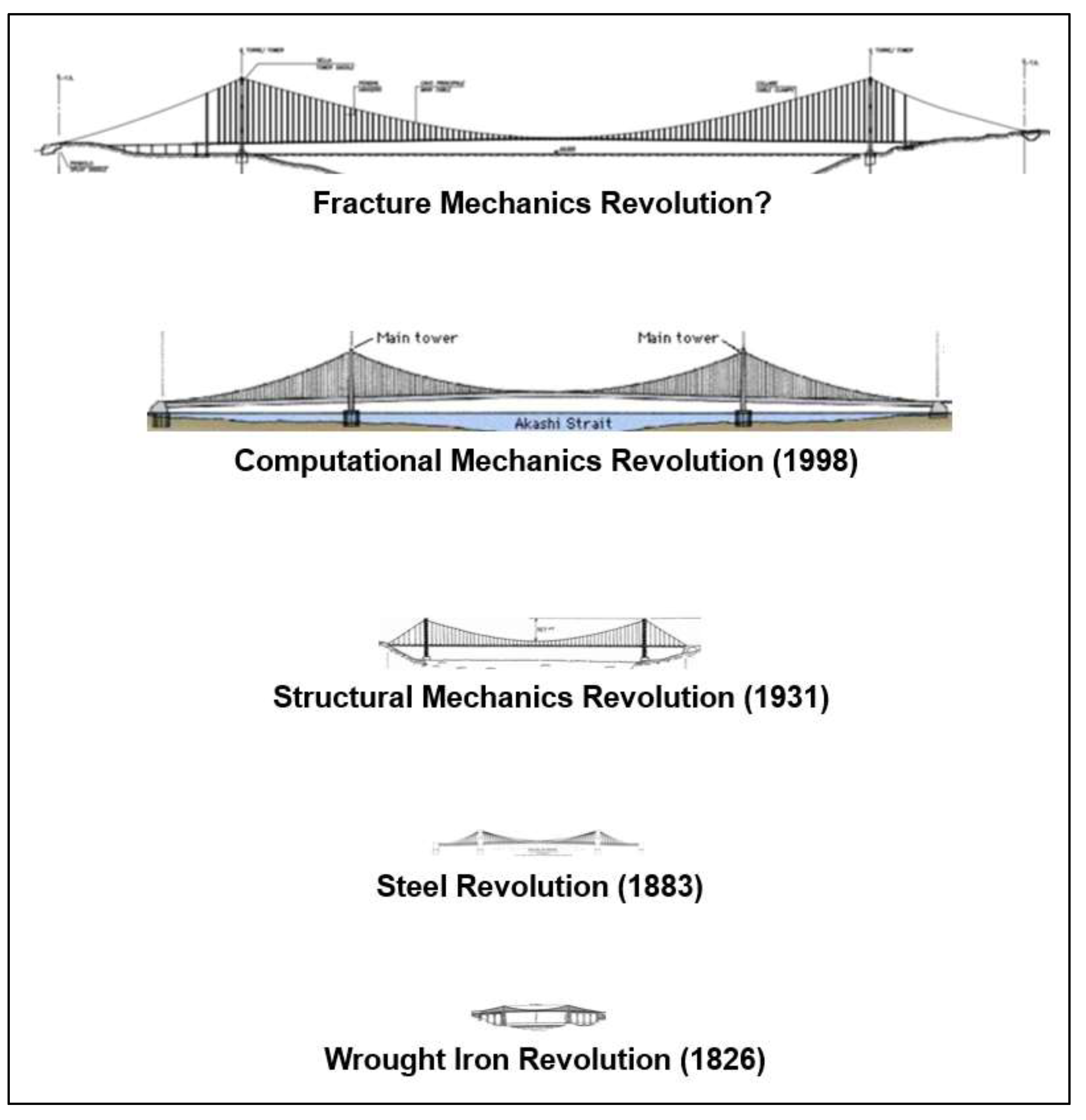
Regarding the progressive scale doubling of suspension bridges, we can observe at least two changes of paradigm enabling the achievement of the corresponding record-breaking bridge spans (Figure 7): after the two technological revolutions triggered by the introduction of iron and steel in Structural Engineering (Menai Straits Bridge, 1826, and Brooklyn Bridge, 1883), we assist so far to the scientific revolutions due to Structural Mechanics (George Washington Bridge, 1931) and to Computational Mechanics (Akashi Kaikyo Bridge, 1998).
In the philosophical context of Critical Rationalism, the next scale doubling (Messina Straits Bridge) should take place only when significant innovations brought by new materials or theories occur. This opportunity is presently offered by Fracture Mechanics, since any advanced design approach should take into account brittleness size-scale effects (Carpinteri, 1984; 1989; 2021; Carpinteri and Accornero, 2024).
Considering the next record-breaking long-span bridge, Galileo’s size effect (Equation (5)) on scale doubling (L2 = 2L1) entails:
where is the characteristic strength of the structural materials used for the last record (L1), and is the higher characteristic strength of the structural materials for the prospective double-span bridge (L2). A meaningful suggestion about high-strength materials arises, as implied by Galileo.
On the other hand, brittleness size-scale effects (Equation (6)) indicate the scale doubling implications:
B2 = 23 B1
Regarding the choice of suitable structural materials, not only a higher strength, but also a much higher fracture energy is required to break the new scale-doubling world record:
GF,2 = 23 GF,1 = 8 GF,1
This high-performance material property can be obtained, in the case of structural concrete, by adding steel or carbon fibres to the standard mix design (Carpinteri and Accornero, 2024; Carpinteri et al., 2023; FIB, 2022).
5. Conclusions
Following the historical evolution of suspension bridges from the beginning of the XIX Century to the end of the XX Century, the prospective scale doubling represented by the Messina Straits Bridge should take place only if significant innovations brought by new materials and theories occur. This opportunity is presently offered by Fracture Mechanics, given that any advanced design approach should consider today also brittleness size-scale effects. Accordingly, the new selection criteria in terms of structural materials should take into account a higher strength, together with a much higher fracture energy, in order to guarantee the physical similitude with the previous situation and consequently to break the new scale-doubling world record. A crucial change is provided by the use of fibre-reinforcement: fibre addition can in fact increase fracture energy of plain concrete up to 103 times.
Author Contributions
Alberto CARPINTERI: Writing – review & editing, Project administration, Supervision, Conceptualization; Federico ACCORNERO: Writing – original draft, Methodology, Investigation, Data curation.
Funding
The authors wish to acknowledge the Chang Jiang Chair Professorship Grant N. NTF23025 and Shantou University Outstanding Talent Grant N. 140-09423016.
Data Availability Statement
The authors declare that there are no data associated to this manuscript.
Conflicts of Interest
The authors declare no conflicts of interest.
References
- Barenblatt, G.I. The mathematical theory of equilibrium cracks in brittle fracture. Advances in Applied Mechanics 1962, 7, 55–129. [Google Scholar]
- Bilby, B.A.; Cottrell, A.H.; Swinden, K.H. The spread of plastic yield from a notch. Proceedings of the Royal Society of London A 1963, 272, 304–314. [Google Scholar] [CrossRef]
- Billington, D.P. The Tower and the Bridge; Princeton University Press: New Jersey, 1983. [Google Scholar]
- Bosco, C.; Carpinteri, A. Discontinuous constitutive response of brittle matrix fibrous composites. Journal of the Mechanics and Physics of Solids 1995, 43, 261–274. [Google Scholar] [CrossRef]
- Carpinteri, A. Notch sensitivity in fracture testing of aggregative materials. Engineering Fracture Mechanics 1982, 16, 467–481. [Google Scholar] [CrossRef]
- Carpinteri, A. Stability of fracturing process in RC beams. Journal of Structural Engineering (ASCE) 1984, 110, 544–58. [Google Scholar] [CrossRef]
- Carpinteri, A. Cusp catastrophe interpretation of fracture instability. Journal of the Mechanics and Physics of Solids 1989, 37, 567–582. [Google Scholar] [CrossRef]
- Carpinteri, A. Scaling laws and renormalization groups for strength and toughness of disordered materials. International Journal of Solids and Structures 1994, 31, 291–302. [Google Scholar] [CrossRef]
- Carpinteri, A. Fracture and Complexity: One Century since Griffith’s Milestone; Springer, 2021. [Google Scholar]
- Carpinteri, A.; Massabò, R. Continuous vs discontinuous bridged crack model of fiber-reinforced materials in flexure. International Journal of Solids and Structures 1997, 34, 2321–2338. [Google Scholar] [CrossRef]
- Carpinteri, A.; Pugno, N. Are scaling laws on strength of solids related to mechanics or to geometry? Nature Materials 2005, 4, 421–423. [Google Scholar] [CrossRef]
- Carpinteri, A.; Accornero, F. Dimensional analysis of critical phenomena: Self-weight failure, turbulence, resonance, fracture. Physical Mesomechanics 2021, 24(4), 459–463. [Google Scholar] [CrossRef]
- Carpinteri, A.; Accornero, F. Micro-damage instability mechanisms in composite materials: Cracking coalescence versus fibre ductility and slippage. International Journal of Damage Mechanics 2024. [Google Scholar] [CrossRef]
- Carpinteri, A.; Corrado, M.; Paggi, M.; Mancini, G. New model for the analysis of size-scale effects on the ductility of reinforced concrete elements in bending. Journal of Engineering Mechanics (ASCE) 2009, 135, 221–229. [Google Scholar] [CrossRef]
- Carpinteri, A.; Accornero, F.; Rubino, A. Scale effects in the post-cracking behaviour of fibre-reinforced concrete beams. International Journal of Fracture 2023, 240, 1–16. [Google Scholar] [CrossRef]
- Castigliano, A. Intorno all’equilibrio dei sistemi elastici. Atti Reale Accademia delle Scienze di Torino 1875, 10. [Google Scholar]
- Cross, H. Analysis of continuous frames by distributing fixed-end moments. Proceedings of the American Society of Civil Engineers 1930, 1930, 56:919–928. [Google Scholar] [CrossRef]
- Dugdale, D.S. Yielding of steel sheets containing slits. Journal of the Mechanics and Physics of Solids 1960, 8, 100–104. [Google Scholar] [CrossRef]
- FIB Bulletin N. 105; Fibre-reinforced Concrete. State-of-the-art Report. 2022.
- Galileo Galilei (1638) Discorsi e Dimostrazioni Matematiche attorno a Due Nuove Scienze; Elsevier: Leiden.
- Hillerborg, A.; Modeer, M.; Petersson, P.E. Analysis of crack formation and crack growth in concrete by means of fracture mechanics and finite elements. Cement and Concrete Research 1976, 6, 773–782. [Google Scholar] [CrossRef]
- Karihaloo, B.L. Failure modes of longitudinally reinforced beams. In Applications of Fracture Mechanics to Reinforced Concrete; Elsevier Applied Science: London, 1992; pp. 523–546. [Google Scholar]
- Koyanagi, W.; Rokugo, K.; Uchida, Y. Stability and measurement in concrete failure. Concrete Library of JSCE 1984, 3, 163–175. [Google Scholar]
- Kuhn, T. The Structure of Scientific Revolutions; The University of Chicago Press, Illinois, 1962. [Google Scholar]
- Kurrer, K.E. The History of the Theory of Structures. In Ernst & Sohn, Berlin; 2008. [Google Scholar]
- Leicester, R.H. Effect of size on the strength of structures; Forest Products Laboratory: Melbourne, 1973. [Google Scholar]
- Leonardo da Vinci (1519) Codex Atlanticus, Veneranda Biblioteca Ambrosiana.
- Mazzolani, F.M. Alcune considerazioni sulla realizzazione di quello che sarà il ponte sospeso più lungo del mondo per l’attraversamento dello Stretto di Messina. Costruzioni Metalliche 2004, 1, 47–50. [Google Scholar]
- Menabrea, L.F. Nouveau principe sur la distribution des tensions dans les systèmes élastiques. Comptes Rendus de l’Académie des Sciences 1858, 46, 1056–1060. [Google Scholar]
- Müller-Breslau, H.F.B. Die Neueren Methoden der Festigkeitlehre; Lipsia, 1886. [Google Scholar]
- Petroni, A.M. Conventionalism, scientific discovery, and the sociology of knowledge. International Studies in the Philosophy of Science 1993, 7, 225–240. [Google Scholar] [CrossRef]
- Popper, K.V. The Logic of Scientific Discovery; Hutchinson: New York, 1934. [Google Scholar]
- Rice, J.R. A path independent integral and the approximate analysis of strain concentration by notches and cracks. Journal of Applied Mechanics (ASME) 1968, 31, 379–386. [Google Scholar] [CrossRef]
- Ruiz, G.; Elices, M.; Planas, J. Size effect and bond-slip dependence of lightly reinforced concrete beams. In Minimum Reinforcement in Concrete Members; Elsevier Science: Oxford, 1999; pp. 67–98. [Google Scholar]
- Sih, G.C. Phenomena of instability: Fracture mechanics and flow separation. Naval Research Reviews 1980, 32, 30–42. [Google Scholar]
- Smith, E. The structure in the vicinity of a crack tip: A general theory based on the cohesive zone model. Engineering Fracture Mechanics 1974, 6, 213–222. [Google Scholar] [CrossRef]
- Thom, R. Structural Stability and Morphogenesis; Benjamin, New York, 1972. [Google Scholar]
- Tipper, C. The Brittle Fracture Story; Cambridge University Press: Cambridge, 1962. [Google Scholar]
- Zienkiewicz, O.C. The Finite Element Method in Engineering Science; McGraw-Hill, 1971. [Google Scholar]
Figure 1.
Different nonlinear behaviours depending on the size-scale of the specimen.
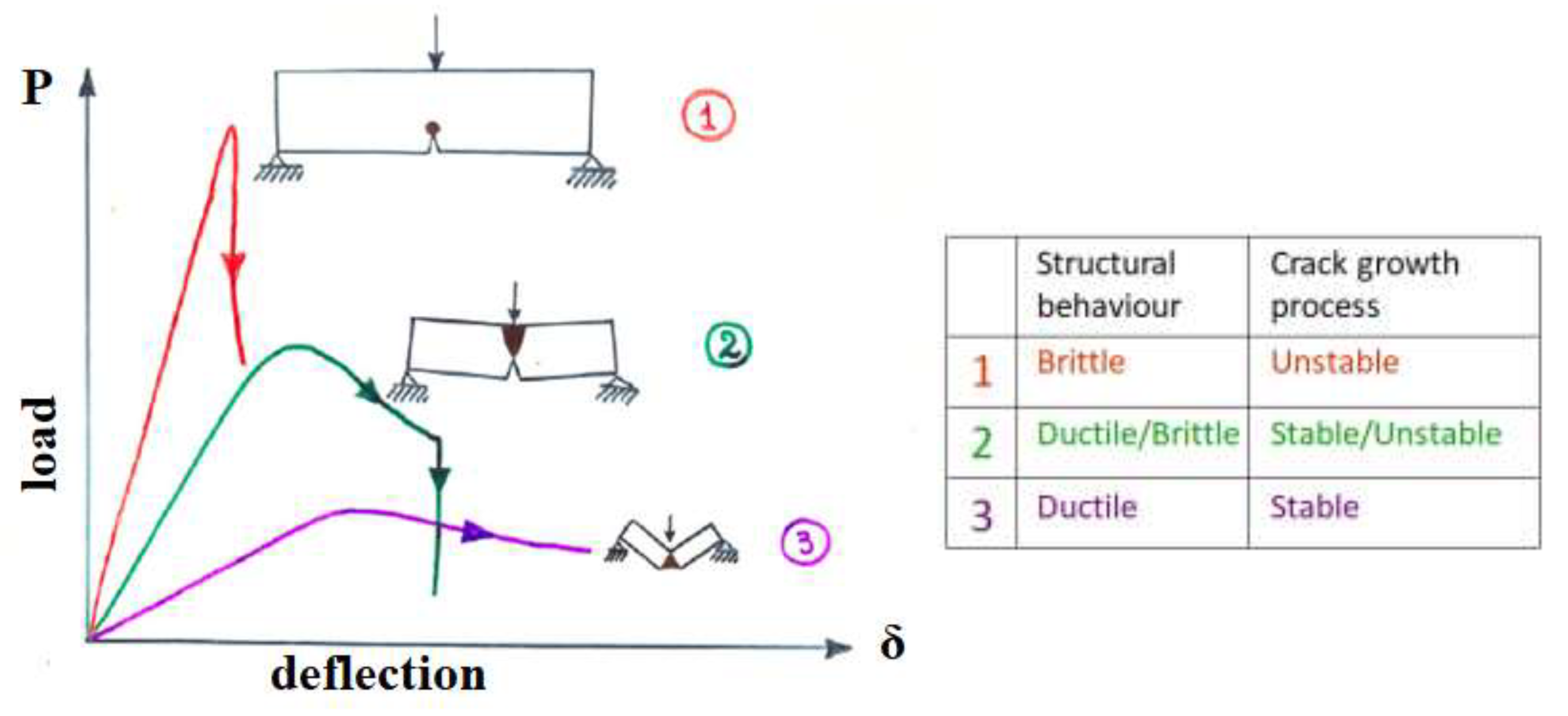
Figure 2.
Softening due to damage localization: Ductile-to-brittle transition influenced by the length of the specimen (a); Stress-strain vs. cohesive behaviour (b).
Figure 2.
Softening due to damage localization: Ductile-to-brittle transition influenced by the length of the specimen (a); Stress-strain vs. cohesive behaviour (b).
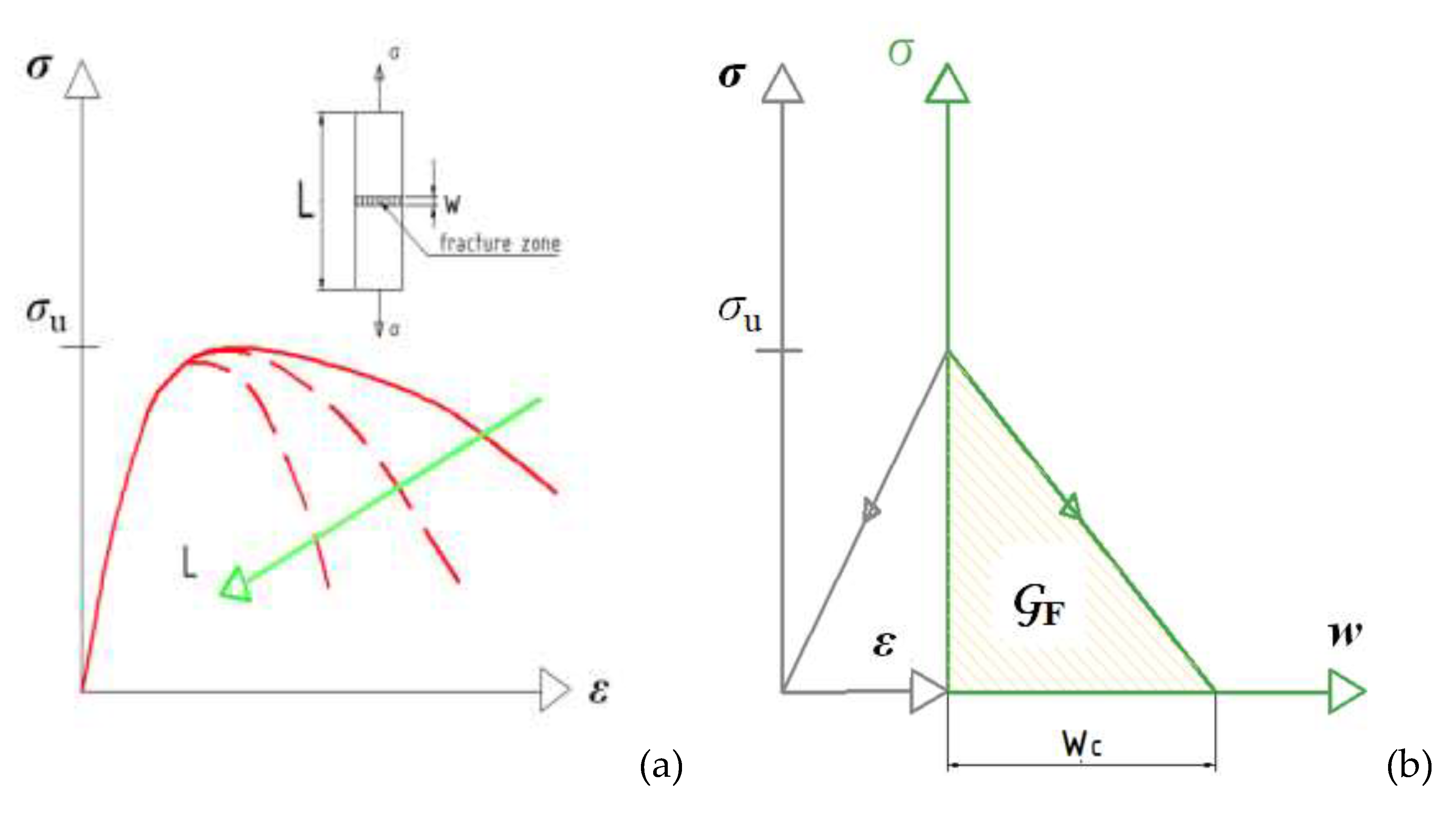
Figure 3.
Plane slab in tension: Normal softening (1), vertical drop (2), and snap-back (3).
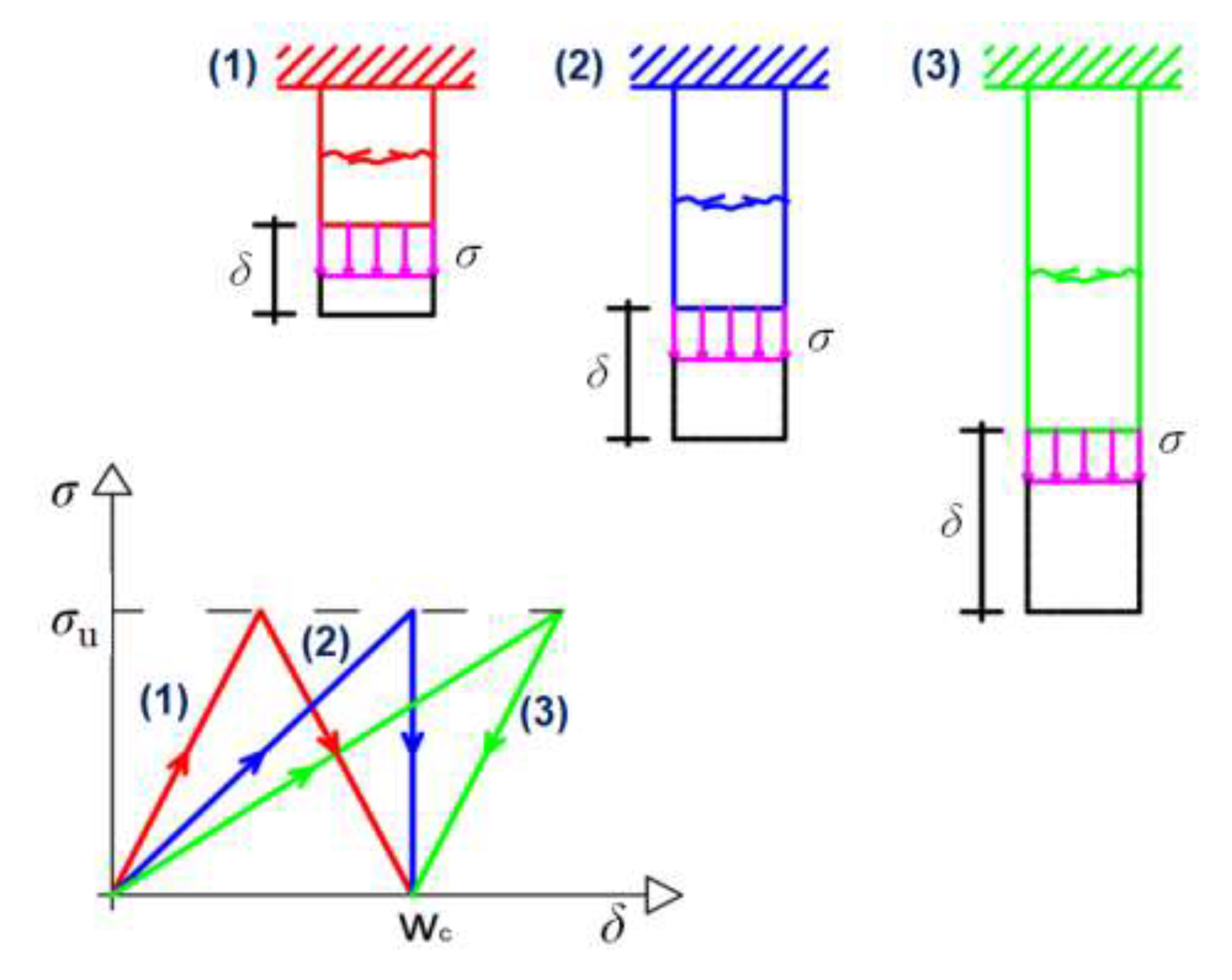
Figure 4.
Size effect in relation to animal bones (a); Galileo Galilei (b).
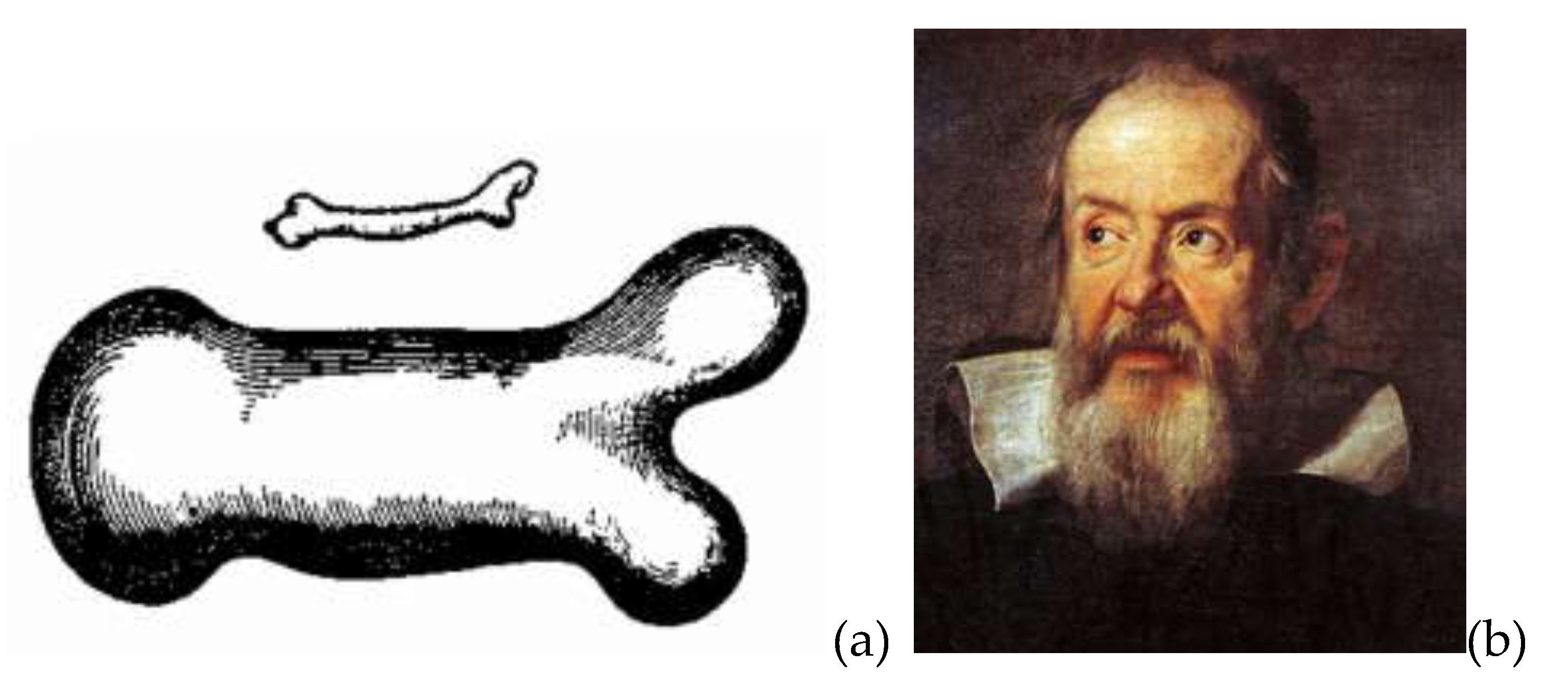
Figure 5.
Menai Straits (Telford, 1826, 177 m. In yellow), Brooklyn (Roebling, 1883, 486 m. In green), and George Washington (Ammann, 1931, 1067 m. In red) suspension bridges reported at the same scale.
Figure 5.
Menai Straits (Telford, 1826, 177 m. In yellow), Brooklyn (Roebling, 1883, 486 m. In green), and George Washington (Ammann, 1931, 1067 m. In red) suspension bridges reported at the same scale.
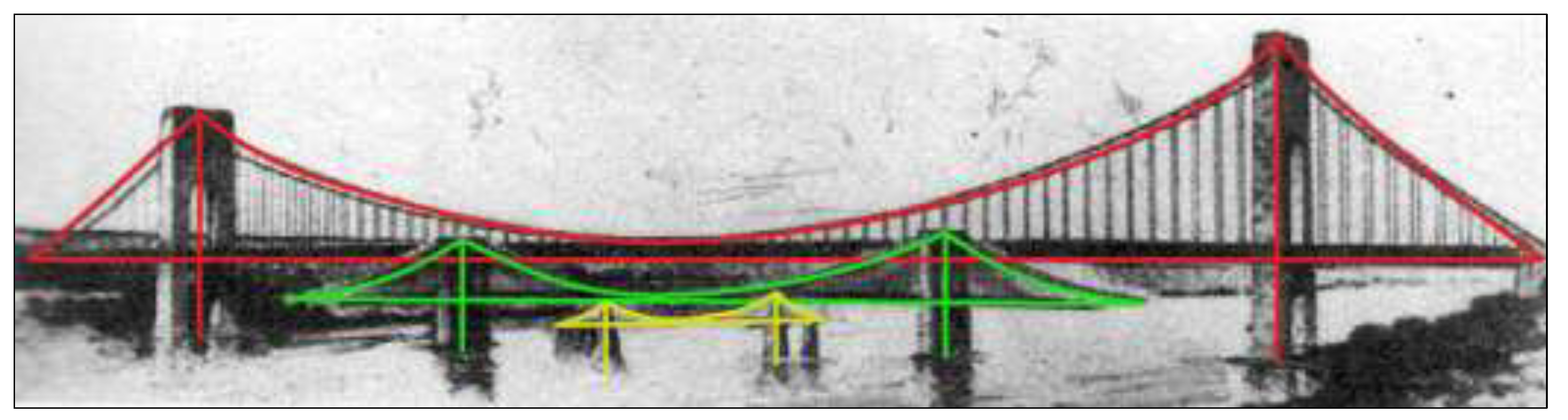
Figure 6.
George Washington (1931, 1067 m. In red), Akashi Kaikyo (1998, 1991 m. In blue), and Messina Straits (2030?, 3300 m. In violet) suspension bridges reported at the same scale.
Figure 6.
George Washington (1931, 1067 m. In red), Akashi Kaikyo (1998, 1991 m. In blue), and Messina Straits (2030?, 3300 m. In violet) suspension bridges reported at the same scale.
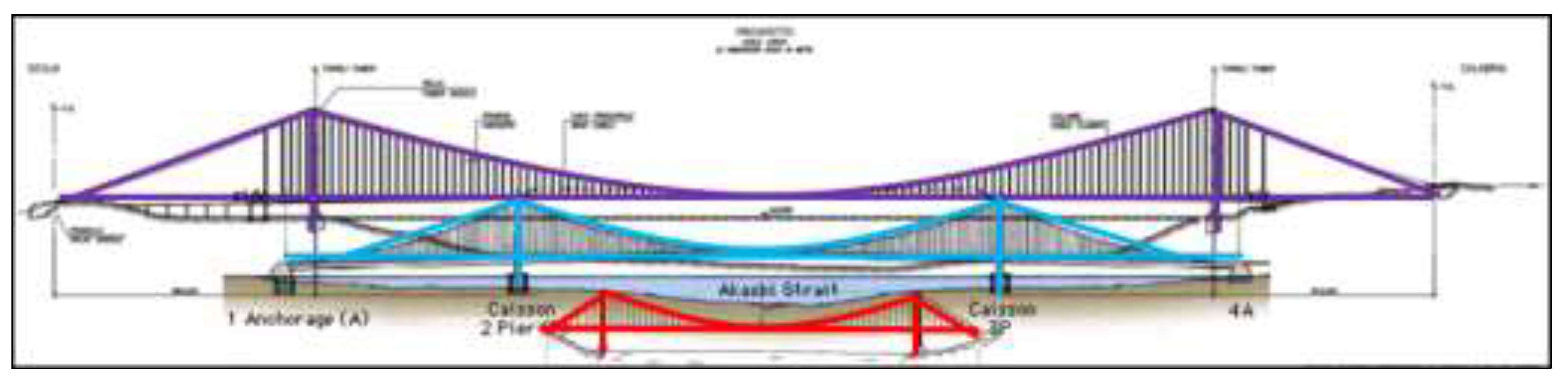
Figure 7.
Scientific and technological revolutions in Structural Engineering: Comparison between different record-breaking suspension bridges reported at the same scale. From bottom to top: Menai Straits (1826), Brooklyn (1883), George Washington (1931), Akashi Kaikyo (1998), Messina Straits (2030?) suspension bridges.
Figure 7.
Scientific and technological revolutions in Structural Engineering: Comparison between different record-breaking suspension bridges reported at the same scale. From bottom to top: Menai Straits (1826), Brooklyn (1883), George Washington (1931), Akashi Kaikyo (1998), Messina Straits (2030?) suspension bridges.
Disclaimer/Publisher’s Note: The statements, opinions and data contained in all publications are solely those of the individual author(s) and contributor(s) and not of MDPI and/or the editor(s). MDPI and/or the editor(s) disclaim responsibility for any injury to people or property resulting from any ideas, methods, instructions or products referred to in the content. |
© 2026 by the authors. Licensee MDPI, Basel, Switzerland. This article is an open access article distributed under the terms and conditions of the Creative Commons Attribution (CC BY) license.
Copyright: This open access article is published under a Creative Commons CC BY 4.0 license, which permit the free download, distribution, and reuse, provided that the author and preprint are cited in any reuse.


