

Submitted:
22 March 2026
Posted:
23 March 2026
You are already at the latest version
Abstract
Neurodegenerative diseases, including Alzheimer's Disease (AD), Parkinson's Disease (PD), Lewy Body Disease (LBD), and related dementias, represents a global health challenge, particularly in aging populations. The simultaneous occurrence of neurodegenerative diseases in an aging population suggests a potential link between causative proteins. Such neurodegenerative proteins, including amyloid-β (Aβ), τ-protein (tau), α‑synuclein, TAR DNA-binding protein 43 (TDP-43), and Fused in Sarcoma (FUS), share key characteristics of intrinsically disordered proteins (IDPs), which can explain promiscuous physical interactions, cross-seeding, co-occurrence, pathological synergy, and shared upstream and downstream mechanisms. This review synthesizes current evidence on (1) shared biophysical features of neurodegeneration-associated proteins, (2) mechanisms driving mixed neuropathology, (3) therapeutic implications of disorder-driven interactions, and (4) key unresolved questions shaping future research. By framing neurodegeneration as a network of interacting, disorder-driven proteinopathies rather than isolated entities, this perspective highlights the need for integrative, systems-level approaches to better understand disease heterogeneity and to identify novel targets for intervention.
Keywords:
protein intrinsic disorder
; neurodegeneration
; proteinopathies
; liquid-liquid phase separation
; amyloid-β
; tau
; α-synuclein
; TDP-43
; FUS
1. Introduction
1.1. Clinical and Pathological Motivation
Neurodegenerative diseases are a diverse group of maladies, varying by pathology, clinical symptoms, and genetics. Until now, they lack effective disease-modifying treatments. Mechanistically, they are classified as proteinopathies characterized by the accumulation of specific, misfolded proteins that aggregate into toxic, ordered structures in glial cells, neurons, or extracellularly. Some of these diseases share similar pathologies, where the same misfolded protein deposits in different brain regions and causes distinct cognitive and/or motor neuronal impairments, as illustrated by so-called synucleinopathies, e.g., Parkinson's Disease (PD), Dementia with Lewy Bodies (DLB), Multiple System Atrophy (MSA), Pure Autonomic Failure (PAF), and Rapid Eye Movement (REM) Sleep Behavior Disorder (REM) [1], as well as tauopathies, such as Alzheimer's disease (AD), frontotemporal dementia (FTD), Pick's disease, chronic traumatic encephalopathy (CTE), Progressive Supranuclear Palsy (PSP), Argyrophilic Grain Disease (AGD), and corticobasal degeneration (CBD) [2]. Different pathologies are associated with the accumulation of aggregated forms of α-synuclein and τ-protein (tau) protein in different brain regions [3]. However, it is increasingly recognized that neurodegenerative diseases often involve multiple co-occurring proteinopathies rather than a single, isolated one [4]. In fact, around 75% of autopsies revealed multiple neuropathologies in older adults, highlighting a pressing global health concern in a worldwide growing aging population [5]. This mixed (neuro-)pathology seems to be the rule rather than the exception [6] and makes diagnosis and treatment difficult, e.g., for AD, PD, LBD, Vascular Brain injury (VBI), or dementia. Since such mixed pathology is most seen in dementia, it is frequently referred to as “mixed” dementia. This means the simultaneous occurrence of several distinct brain diseases in one patient, which suggests that proteinopathies occur not isolated and independent, but rather with other diseases [7,8]. In these cases, hallmark markers of AD (amyloid plaques and tau tangles) often overlap with other issues, such as vascular damage (blood vessel disease) or the accumulation of additional proteins, α-synuclein (Lewy bodies), TAR DNA-binding protein 43 (TDP-43), and Fused in Sarcoma (FUS) [4]. The synergistic effect of multiple pathologies commonly results in more rapid, severe dementia, underlining why many cases involve complex, multifactorial, or “mixed” dementia rather than pure AD. Since the prevalence of mixed pathologies increases in the context of an aging population, and since the related pathologies are associated with misbehavior of specific proteins, these findings need to be better understood, particularly considering the phenomenon of protein intrinsic disorder (PID) which can shed additional light on neuropathologies.
PID refers to the property of many proteins or protein regions not to adopt a single, stable three-dimensional (3D) structure under physiological conditions, but are fully functional, with intrinsically disordered proteins (IDPs) and intrinsically disordered regions (IDRs) being the categories within this framework [9,10,11,12,13,14,15,16,17,18,19,20,21,22,23,24,25,26]. IDPs are proteins that entirely lack a stable fold, while IDRs are segments within otherwise structured proteins that exhibit disorder. Key characteristics of IDPs are (1) structural features, e.g., high conformational flexibility, interconverting conformations, lack of a stable folded 3D structure, and sensitivity to environmental conditions, such as pH, ions, and crowding [10,12,14,15,27,28]; (2) sequence peculiarities, e.g. high content of charged and polar amino acids ((Glutamic acid (E), Aspartic acid (D), Lysine (K), Arginine (R), Glutamine (Q), Serine (S)), therefore low hydrophobic content and depletion in bulky hydrophobic residues (Isoleucine (I), Leucine (L), Valine (V), Phenylalanine (F), Tryptophan (W)), low sequence complexity, and presence of repetitive motifs [11,29,30,31,32]. Therefore, the absence of regular structure in these proteins has been explained by these specific features of their amino acid sequences including the presence of numerous uncompensated charged groups (often negative); i.e., a high net charge at neutral pH, arising from the extreme pI values in such proteins [33,34,35], and a low content of hydrophobic amino acid residues [30].
IDPs/IDRs are known as promiscuous binders capable of interaction with a variety of binding partners, including other proteins, membranes, nucleic acids, and various small molecules, and as a result, they have multiple biological functions [28]. Many IDPs/IDRs are capable of undergoing at least partial disorder-to-order transition upon binding [28], whereas others retain a considerable level of disorder even in their bound states forming “fuzzy” complexes [36,37,38,39,40,41,42,43,44,45]. IDPs/IDRs often act as hub proteins with many connections and form complex protein-protein interaction (PPI) networks [46,47,48,49,50]. Among the important biological functions of IDPs/IDRs, which are complementary to the activities of ordered proteins and domains [9,11,13,17,51], are regulation of cell division, transcription and translation, signal transduction, storage of small molecules, and chaperone activity [52,53,54,55,56,57,58,59]. These proteins regulate the function of binding partners and promote the assembly of various complexes [60,61,62], ranging from BAF complex [63], mediator complex [64], and mitochondrial enzymatic machines [65], to spliceosomes [66], nucleosomes, histones [67], and ribosomes [25]. Biological functions of IDPs/IDRs are fine-tuned by various post-translational modifications (PTMs) [68,69,70].
Recent studies indicated that IDPs/IDRs serve as fundamental drivers of liquid-liquid phase separation (LLPS), a biophysical process that yields diverse physiological results. Specifically, it is associated with the biogenesis of numerous membrane-less organelles (MLOs, which are also known as biomolecular condensates (BCs), granules, intracellular microdomains, speckles, bodies, puncta, coacervates, and naked cellular organelles among others), which are ubiquitous throughout the cytoplasm and nucleus [71,72,73,74,75,76,77,78,79,80,81]. Often, LLPS is activated when cells experience stress, and thereby it represents a protective mechanism [81,82]. The droplet-like structures formed as a result of LLPS limit the interaction volume of the molecules and increase the probability of interaction [81]. Many MLOs are expected to be present in a certain location at a certain time [81]. Beyond merely operating within favorable conditions, MLOs are characterized by a distinct timeframe and specific requirements for secure existence, alongside the “comfort zone” of the conditions favorable to LLPS [81]. When MLOs persist beyond their intended functional lifespan, they can undergo a "pathological aging" process. This transformation may trigger neurodegenerative diseases by turning these organelles into hubs for the accumulation of toxic amyloidogenic proteins [81]. Other triggers for pathological LLPS and abnormal MLOs are increased levels of proteins which undergo LLPS, irregular PTMs, specific disease-linked mutations, or chromosomal translocations [81]. A key finding in the field is the prevalent association of intrinsic disorder with disease. It ranges from cancer and infectious diseases to cardiovascular disease and neurodegeneration [83,84,85,86,87].
1.2. Purpose and Scope of the Review
This review provides a comprehensive evaluation of the five major neurodegeneration-related, aggregating proteins involved in mixed pathology such as Amyloid beta (Aβ), tau, α-synuclein, TDP-43, and FUS, within the context of PID. Figure 1 illustrates an accepted model linking misbehavior and aggregation of the neurodegeneration-related proteins with transition from a healthy to a diseased brain state. Misbehavior of these proteins that can occur individually or in combination, can be better understood by applying the PID concept, which aids in explaining the underlying regulatory failures. This raises questions about physical interactions, cross-seeding, co-occurrence, pathological synergy, and shared upstream and downstream mechanisms with a unique view on PID and its neuropathological impact. Here, we will discuss those proteins in the light of functional advantages and disadvantages such as (1) binding promiscuity: IDPs can interact with many different partners and one region can bind multiple targets using different conformations; (2) molecular recognition flexibility where binding often occurs via disorder-to-order transitions and enables context-dependent interactions; (3) regulatory versatility as ideal substrates for various PTMs, e.g., phosphorylation, acetylation, ubiquitination, and SUMOylation; and (4) multifunctionality, in which the same protein participates in transcription, RNA metabolism, signaling, and stress responses forming stress granules. All these interactions need to be considered when referring to neuropathological proteins. In the past, the population prevalence of the co-occurrence of the hallmarks of different proteinopathies was reported in mixed pathologies [4,88,89], what seems not to be sufficient.
2. Overview of the Five Neurodegeneration-Associated Proteins and Their Intrinsic Disorder Status
2.1. Amyloid-β (Aβ)
Amyloid-β (Aβ) is a peptide abundantly produced in the brain, with Blood-Brain Barrier (BBB) serving as a critical gateway that regulates the bidirectional movement (influx and efflux) of existing Aβ peptides between the brain and the peripheral blood circulation [90,91,92]. It is derived from the type I transmemebrane amyloid precursor protein (APP) via the sequential cleavage by β-secretase (BACE1) and γ-secretases. Low concentrations of soluble forms of Aβ contribute to the normal neuronal activity [93]. Various forms, such as Aβ40 (40-residue-long peptide that corresponds to the residues 672-711 of the APP), Aβ42 (42-residue-long peptide corresponding to the APP residues 671-712), N-truncated Aβ4-42, and amyloid-α (also known as Aβ17-40/42 or p3) and different oligomeric and aggregated states, such as non-fibrillar or soluble forms, amyloid fibrils, and amorphous aggregates are known. Among these, Aβ42 aggregates more readily, whereas oligomeric Aβ species are particularly associated with neurotoxicity and the development of AD and related neuropathologies [94].
Aβ is an intrinsically disordered peptide as a monomer, whose amino acid sequence is characterized by a charged, flexible N-terminus and a hydrophobic C-terminal region containing aggregation-prone motifs [95]. This sequence organization underlies its conformational plasticity, binding promiscuity, and strong tendency toward β-sheet–rich self-assembly [96]. The presence of additional hydrophobic residues in Aβ42 further enhances aggregation propensity, providing a molecular explanation for its increased pathogenicity [97]. Furthermore, PTMs, such as phosphorylation and acetylation, can significantly influence the aggregation of Aβ. It has been shown, that PTMs could modulate the polymerization rates of Aβ and thus impact its neurotoxicity. Thus, the peculiarities of the amino acid sequence of Aβ directly link PID with aggregation and neurotoxicity [98]. Aβ aggregation emerges from the plasticity of a disordered peptide, not from destabilization of a folded state [99,100,101]. It was also indicated that clinical variability of AD, at least in part, can be associated with the possibility of misfolded Aβ to acquire different conformations (referred to as “Aβ strains”) [102]. High levels of aggregated Aβ are associated with cognitive decline, dementia, and AD, and misfolded Aβ species can promote the misfolding of other aggregation-prone proteins, particularly tau, thereby accelerating disease progression through prion-like mechanisms [103,104,105,106].
AD is characterized by the accumulation of extracellular Aβ plaques and intracellular tau-containing neurofibrillary tangles (NFTs). Both contribute to impaired neuronal communication and synaptic function. The imbalance in proteostasis between Aβ production and clearance leads to the accumulation of extracellular Aβ, while abnormal tau phosphorylation leads to intracellular NFT formation showing synergistic effects [107,108].
The pathology of AD rarely occurs in isolation, especially in aging populations. Neuropathological and biomarker-based studies indicate that Aβ plaques and tau NFTs frequently coexist with additional proteinopathies, including α-synuclein–positive Lewy pathology and TDP-43 inclusions. Moreover, increasing evidence implicates RNA-binding proteins, such as TDP-43 and FUS, in overlapping neurodegenerative processes. It links classical amyloid and tau pathology to dysregulated RNA metabolism and stress-granule dynamics. Biomolecules, such as Aβ, tau, α-synuclein, TDP-43, and FUS can interact and exhibit prion-like seeding properties, cross-aggregation, and shared proteostatic pathways, thereby amplifying cellular dysfunction [3]. These convergent mechanisms support the view that AD is not driven by a single misfolded protein, but rather arises from a broader network of interacting IDPs [109]. Those connections will be elucidated further below.
Figure 2 illustrates the intrinsic disorder status of human amyloid precursor protein (APP). This protein operates as a cell surface receptor on neurons, facilitating critical physiological processes such as neurite outgrowth, neuronal adhesion, and axonogenesis [110]. Furthermore, trans-cellular interaction between APP molecules on adjacent cells can promote synaptogenesis [110]. Position of the Aβ peptide, which is located within the C-terminal part of the protein is shown in the black box. Figure 2 shows that APP is predicted to have a high level of intrinsic disorder. This is evidenced by the presence of long regions with low and very low confidence scores (pLDDT (Predicted Local Distance Difference Test) below 70) (see Figure 2A) and by the multiple IDRs confidently predicted (see Figure 2B). IDRs are very prominent especially in the central part of APP, which is also predicted to contain 12 disorder-based PPI sites (molecular recognition features (MoRFs), that are disordered regions undergoing folding at binding to specific partners), and multiple different PTMs, indicating that intrinsic disorder is utilized by APP for its binding functions, which are regulated by PTMs. Likely, because of these features, APP is capable of interaction with a very broad spectrum of proteins (e.g., according to BioGRID [111,112], it has more than 2400 protein partners). Although Aβ peptides are lipophilic, they are also predicted to contain some disorder, which might be utilized in coordination of Cu2+ and Zn2+ ions by these metal chelators with metal-reducing activity [113]. As per the FuzDrop analysis [114], APP is expected to spontaneously undergo LLPS (i.e., being characterized by a probability of spontaneous LLPS, pLLPS, of 0.7463, it can act as a droplet driver) and contain five droplet-promoting regions (DPRs, residues 188-216, 230-285, 353-373, 437-451, and 624-657), indicating that LLPS is included in its functional repertoire. Curiously, although most disease-causal mutations of APP occur within the Aβ-coding region or in its immediate proximity, it was recently shown that mutations in the N-terminus of APP protein might have pathological consequences as well, as they can promote AD-like tau pathology and notably alter the LLPS of intracellular tau [115].
2.2. τ-Protein (Tau)
τ-Protein (Tau) is a microtubule-associated protein, which stabilizes the structure and regulate the function of microtubules. However, recent research indicated that Tau does not merely anchor microtubules in axons. Instead, it protects dynamic, labile regions from excessive stabilization by other proteins, acting as a regulator that keeps microtubule tracks flexible to ensure healthy neuronal transport [118]. This protein does much more than interact with microtubules. It acts as a signaling hub, a scaffold protein, a regulator of motor proteins (like kinesin and dynein), and even plays roles in DNA/RNA protection within the nucleus [118]. The understanding of the sequence feature and structure of tau can provide valuable insights into the biological functions and pathology caused by this protein. It has a high conformational flexibility, because of the presence of charged and polar amino acids, such as aspartic acid (D), glutamic acid (E), lysine (K), serine (S), and arginine (R), while being low in hydrophobic amino acids like leucin (L), isoleucine (I), phenylalanine (F), valine (V), tryptophan (W), and tyrosine (Y). These amino acid biases prevent the formation of stable 3D structures, highlighting tau as an IDP that maintains the dynamic flexibility required for its cellular functions.
Tau is classified as an IDP that lacks a stable three-dimensional structure in its native, monomeric form, existing instead as a dynamic ensemble of interconverting conformers. This inherent structural flexibility allows it to contain IDRs that can adopt multiple structural states [119,120], facilitating binding to numerous partner proteins. This shows how this IDP functions as an interaction hub in cellular networks [119,120,121]. Tau´s plasticity leads to the engagement in diverse interactions and connections with microtubules and other cellular proteins. This depends on environmental factors, such as pH, ionic strength, and macromolecular crowding, which complicates its behavior in cells, their environment and other proteins contributing to mixed proteinopathies [122].
Tau undergoes LLPS driven by multivalent electrostatic interactions, leading to the formation of membrane-less liquid-like droplets. Phase-separated Tau can transit into β-sheet–rich fibrillar aggregates because of its repetitive motifs, which leads to more condensed amyloid structures under certain conditions, e.g., cellular stress [123,124,125,126,127,128,129,130,131,132,133,134,135,136]. Positively charged amino acids of tau contribute to LLPS, remaining essential for both cell signaling and pathology [81]. PTMs, especially phosphorylation, is as a key driver to expand tau´s interaction properties and structural behavior [120,137]. Acetylation of tau is a driver of neurodegenerative disease [138]. In neurodegenerative disease such as AD and tauopathies, it undergoes hyperphosporylation. This leads to aggregation, formation of NFTs, and prion-like spreading [139,140]. For example, the abnormal accumulation of NFTs after chronic traumatic encephalopathy (CTE) disrupt normal cellular function. As mixed pathology concepts suggests, Aβ initiate a pathophysiological change leading to tau aggregation. Interestingly, NFTs of the brain´s neocortex are more related to cognitive decline than amyloid plaques [140] and Aβ plaques influences tau pathology in mixed pathology manner by facilitating tau aggregation processes in the presence of misfolded tau seeds [141].
In summary, low sequence complexity, repetitive motifs, and tau´s amino acids contributes to its flexibility and functional diversity and enable tau to participate in various cellular processes, including organization of cytoskeletal formation [142]. In the context of neurodegenerative disease like AD or tauopathies, the IDRs of tau are particularly important, as they can aggregate into neurotoxic fibrils, highlighting the dual nature of PIDs [17].
Figure 3 provides an outlook on the prevalence of functional disorder in human tau protein and shows that this protein is mostly disordered and contains multiple PTMs. Furthermore, according to Figure 3B, tau´s almost entire sequence is expected to be involved in disorder-based interactions and therefore can serve as a disordered scaffold. In line with these predictions, BioGRID [111,112] indicates that tau has more than 1100 protein partners. According to FuzDrop, human tau protein is clearly defined as a strong droplet driver, since it is predicted to have a very high pLLPS of 0.9985 and contain four DPRs (residues 1-30, 309-589, 608-622, and 719-739) that cover almost entire sequence of this protein.
2.3. α-Synuclein
α-Synuclein is an 140-amino-acid-long protein that was originally identified as non-Aβ component (NAC) precursor (NACP). It is predominantly found in presynaptic terminals in the brain and neuronal cell bodies, where it is involved in synaptic vesicle transmission and vascular regulation. α-Synuclein is involved in transport processes in synapses and exists as multiple proteoforms, generated by truncation, PTMs, and aggregation states. These proteoforms influence aggregation and toxicity and is an ideal example of an IDP [143]. Under physiological conditions within neurons, α-synuclein is natively unfolded, lacking a stable 3D conformation, which allows aggregation to amyloids and connection to lipid membranes [35,144,145,146,147].
The primary sequence of α-synuclein is enriched in polar and charged amino acids, particularly in its N-terminal region, with a high density of lysine (K), serine (S), and glutamic acid (E) residues. This amino acid composition contributes to its low hydrophobicity and helps maintain a flexible structure without stable α-helices or β-sheets [148].
The protein contains three functional regions, such as an amphipathic N-terminal region (residues 1–60) containing an 11-residue repeat including the KTKEGV motif. Another region allows the protein to bind to acidic lipid membranes and forms α-helices (residues 61–95) so called NAC – a highly hydrophobic, aggregation-prone region. Its highly acidic and proline-rich C-terminal region (residues 96-140) is involved in regulating solubility, interacting with metal ions [148], and binding to protein partners in environment-dependent manner [143,144]. Furthermore, the NAC region of α-synuclein has repetitive motifs, which promotes on the one hand its flexible interaction with lipid membranes and other cellular components, and on the other hand its aggregation to amyloid fibrils and its pathogenic forms [149,150], enabling it to engage in multiple PPI crucial for its function within the brain [151]. The adoption of multiple conformations can stabilize intermolecular interactions [150].
This “chameleon” protein [144] is highly conformational flexible and characterized to exist in various structural conformations [145]. The protein has a strong aggregation potential and its ability to form amyloid fibrils is enhanced through different factors. Its intrinsic disorder allows the protein to adopt different conformations depending on intrinsic (negatively charged membranes, metal ions) and extrinsic environmental factors (herbicides and pesticides), such as the presence of negatively charged membranes [148,152,153,154]. Now, they undergo a change to an α-helical structure [155,156,157].
α-Synuclein can undergo LLPS [158,159,160,161,162]. Phase-separated droplets can convert into oligomers and amyloid fibrils, known for their implications in neurodegenerative diseases. Oligomers disrupt neuronal function and are toxic in neurons in vivo [163,164]. Interestingly, the generated pre-fibrillar oligomers are often more toxic than mature fibrils, emphasizing the pathological implications of transient conformational states [164].
PTMs, such as N-terminal acetylation has been shown to influence aggregation of α-synuclein dynamics [165]. Additionally, the interactions with chaperons can alter the aggregation propensity of α-synuclein [122,146,150].
PD and other synucleinopathies such as LBD and dementia with Lewy bodies are based on SNCA gene mutations. The decline in the clearance capacity of the ubiquitin-proteasome and the autophagy-lysosomal systems, together with mitochondrial dysfunction, have been indicated as major pathophysiological mechanisms of PD neurodegeneration [166]. In mice, misfolded α-synuclein acts in a prion-like manner and induces the misfolding of proteins in neighboring cells [167]. The interaction of distinct α-synuclein strains and tau impacts neurodegeneration [167]. Other studies show the formation of heterotypic droplets composed of α-synuclein and tau and at physiologically relevant mole ratios that mimic neurons’ soma and terminal buttons, which means that heterotypic LLPS of tau and α-synuclein can be implicated in overlapping neuropathologies, which contribute to mixed pathology [168]. In cerospinal fluid (CSF), α-synuclein function as biomarker for cognitive decline and total tau/α-synuclein and phosphorylated ratios of tau/α-synuclein can contribute to the discrimination of PD [169].
A deeper comprehension of α-synuclein's structure, sequence, conformational flexibility, propensity to undergo LLPS, and aggregation capacity provides a framework for targeted therapeutic strategies aimed at mitigating α-synuclein-associated neurodegenerative diseases. Different roles of intrinsic disorder in multifunctionality and polypathogenicity of were discussed in a comprehensive review, where it was emphasized that the remarkable structural, functional, and dysfunctional multifaceted nature of this protein can be understood using the intrinsic disorder-based proteoform concept [143]. Figure 4 illustrates these points by showing a conformational ensemble generated for human α-synuclein by AFflecto (Figure 4A) and functional disorder profile generated by D2P2 (Figure 4B). High binding promiscuity of α-synuclein is illustrated by the fact that according to BioGRID, it is involved in interaction with more than 1500 protein partners. With the pLLPS of 0.6249 and a long IDR (residues 101-140), human α-synuclein is expected to serve as a droplet driver capable of spontaneous LLPS.
2.4. TAR DNA-Binding Protein 43 (TDP-43)
Transactive response (TAR) DNA-binding protein 43 (TDP-43) is a ubiquitously expressed, highly conserved, 414 amino acid long, RNA and DNA binding protein, important for alternative splicing, mRNA stability, transport processes, and translation. It has a central role in neuronal RNA homeostasis and stabilizing stress granules under physiological conditions. The protein exists in a range of conformations, facilitating its involvement in the regulation of gene expression and RNA processing [172,173,174].
The C-terminal low complexity region has a high content of charged and polar amino acid residues such as glycine (G), glutamine (Q), and asparagine (N) contributing to its low hydrophobicity [175], typically for IDPs [176]. TDP-43 contains two RNA recognition motifs (RRMs), critical for its binding to RNA/DNA and exerting its role on mRNA, as well as forming ribonucleotide granules [175]. The C-terminal domain is also called LCD prion-like domain (PrLD), promoting PPI with other factors as well as FUS [175]. Under pathological conditions, it can be sequestered into the cytoplasm and cleaved into C-terminal fragments which are abnormally hyperphosphorylated and subsequently aggregate forming intracellular inclusions [177]. The sequence of TDP-43 includes IDRs, showing the ´two faces´ of intrinsic disorder in physiology and pathology that allow significant conformational flexibility [73,178,179]. A deeper understanding of TDP-43's intrinsic disorder can aid to develop new therapeutic approaches for TDP-43 proteinopathies [173]. The co-occurrence of proteinopathies was already highlighted but remains to be understood better [180].
TDP-43 can undergo LLPS, which leads to the formation of MLOs [73,74,82,175,181,182,183,184,185,186,187,188,189,190,191,192,193,194]. Over time, these dynamic forms can solidify to abnormal aggregates, which is a hallmark of neurodegenerative diseases.
PTMs play a critical role in neurodegenerative disease. Aggregated TDP-43 in ALS, FTD, and AD is hyperphosphorylated in its C-terminal IDR, while physiological TDP-43 is phosphorylated at lower level [195]. TDP-43 misfolding is connected to translocation of the protein from nucleus to cytoplasm due to stress like it has been seen for tau [196]. Evidence suggests, that TDP-43 occur alongside Aβ, tau, and α-synuclein in older individuals and has been shown to contribute to mixed pathology within the aging brain [197]. TDP-43 pathology is a defining feature of ALS and FTLD, but it is also highly prevalent in aging-related neuropathologies and mutations in the TARDBP gene, coding for TDP-43, were found in patients with FTLD [198]. Autopsy studies indicate that TDP-43 inclusions are present in approximately 40–50% of AD cases and in 20–30% of cognitively normal individuals over 80 years [199]. This age-associated presentation, termed limbic-predominant age-related TDP-43 encephalopathy (LATE) [200], frequently coexists with Aβ and tau pathology and is associated with disproportionate hippocampal atrophy and accelerated cognitive decline. These epidemiological findings identify TDP-43 as one of the most common contributors to mixed neuropathologies and proteinopathies in late-life dementia [177,201].
Figure 5 illustrates the highly disordered nature of human TDP-43 and shows that its IDRs serve as targets for various PTMs and are also used for disorder-based interaction with partners (as per BioGRID, there are at least 572 protein partners of TDP-43). Furthermore, as per FuzDrop analysis, human TDP-43 has a high probability of spontaneous LLPS (pLLPS = 0.8981) and contains a long, C-terminally located DPR (residues 251-414), confirming that the amino acid sequence features of this protein are consistent with its ability to undergo spontaneous LLPS.
2.5. Fused in Sarcoma (FUS)
Fused in sarcoma (FUS), also known as translocated in liposarcoma (TLS), is a nuclear DNA/RNA-binding protein essential for RNA metabolism, transcription and splicing of mRNA, and stress responses [174,202]. Outside of the nucleus, FUS play an important role in neurons and is involved in dendritic maturation and complexity of mouse hippocampal neurons via transporting mRNA to the dendrites [203]. FUS is characterized by an intrinsically disordered structure, which allows it to exist in a dynamic ensemble of conformations rather than adopting a stable 3D structure. The protein has a N-terminal QGSY-rich region, a globular RNA-recognition motif (RRM) with the classical βαββαβ fold, a zinc finger domain (ZnF), three different RGG boxes (RGG 1, RGG 2 and RGG 3), a G-rich region and a C-terminal nuclear localization signal (NLS). The RGG boxes promote the affinity of folded domains for RNA possibly without taking a defined confomation during nucleotide binding [73,178,204].
The high proportion of Arg-Gly-Gly repeats in the RGG motifs seems to be a key factor for RNA-protein interactions and are predicted to be completely disordered with a high degree of flexibility, which is typical of IDPs. The presence of disordered and low-complexity domains allows FUS to engage in various interactions while retaining flexibility, which is essential for its multifunctional role within the cell during RNA binding [204].
Missense mutations (R521C) in FUS can lead to neurodegenerative diseases such as familial ALS [205,206]. Around 5% of mutations in FUS/TLS account for familial ALS [206]. Additionally, mutations in the FUS gene can lead to forms of FTD and FTLD, linking specific sequence variations to pathogenic behavior and further suggesting that the functional capacity of FUS is heavily dictated by its disordered nature [73,207,208]. Sporadic ALS and FTLD often arise from spontaneous mutations. Mutations in FUS/TLS also trigger degeneration of motor neurons [73,109,209]. FUS was also found in neuronal inclusions and shown in previously unrecognized glial pathology. Immunoblot analysis of protein extracted from post-mortem FTLD patient brain tissue demonstrated increased levels of insoluble FUS, but mutations in the FUS gene were not found [210].
FUS have been demonstrated to undergo LLPS in vitro and its RNA-binding capacity is closely related to their ability to phase-separate [211,212]. It can form MLOs that play critical roles in stress response and RNA processing [213,214,215,216,217,218,219,220,221,222,223,224,225]. The ability of FUS to condense into these structures underscores the significance of its dynamic properties in cellular contexts. The transitions between soluble and aggregated states are influenced by its IDRs, highlighting the pathogenic potential of FUS misfolding [84]. PTMs such as methylation, phosphorylation, acetylation, and ubiquitination play a critical role in the regulation of FUS. Interestingly, the phosphorylation of FUS´s low complexity domain disrupts phase separation, aggregation, and toxicity [215].
TDP-43 and FUS/TLS have striking structural and functional similarities, implicating alterations in RNA processing as a key event in ALS pathogenesis [205]. Abnormal aggregation contribute to dysfunctional protein homeostasis to neurodegeneration, with FUS anomalies exacerbating these conditions [7].
These sequence characteristics of FUS and related RNA-binding proteins provide valuable insights into how they can maintain functional flexibility with their ability to misfold and aggregate under pathological conditions. Furthermore, FUS aggregates are able to form cytoplasmic inclusions which are associated with neurodegeneration [226].
FUS exemplifies how intrinsic disorder can have both effects: ability to interact with multiple partners for its normal functions and its aggregation-capacity, contribution to neurodegeneration. A detailed understanding of FUS's intrinsic disorder can lead to potential therapeutic approaches.
Figure 6 illustrates the prevalence of intrinsic disorder in human FUS and suggests that structural pliability is important for function of this protein, which is heavily decorated by multiple different PTMs and contains 15 MoRFs that covers a very significant part of its sequence. Intrinsic disorder can contribute to multifunctionality of this protein and its ability to interact with multiple partners. According to BioGRID, FUS can interact with almost 850 proteins. FuzDrop analysis revealed that human FUS has an extremely high pLLPS of 0.9999 and contains three DPRs (residues 1-294, 360-437, and 443-526) that cover almost 90% of its sequence, providing strong support to the capability of this protein to act as a powerful droplet driver capable of undergoing spontaneous LLPS.
2.6. Commonality of Individualities
Table 1 provides a systematic overview of some of the characteristic features of human Aβ, tau, α-synuclein, TDP-43 and FUS and shows that these proteins exhibit substantial IDRs that support physiological flexibility but also predispose to aggregation and cross-interaction under pathological conditions.
2.7. Mightly Alliance: Beyond the Individual Armies
Facts considered so far illustrated individual importance of Aβ/APP, tau, α-synuclein, TDP-43, and FUS in both physiological and pathological processes. However, these proteins are not acting alone but do interact with each other forming a network with seven edges and an average local clustering coefficient of 0.767. Since the expected number of edges for the random network of this size is 0, this intra-set PPI network has significantly more interactions than expected (PPI enrichment p-value 3×10-11) (see Figure 7A).
Crucially, these five proteins not only possess individual “armies” of numerous interactors, but they also exhibit collective interactivity, featuring multiple shared binding partners. This idea is illustrated by Figure 7B showing that these proteins function not just as individual “hubs”, but as a unified group with high interconnectivity. In fact, although this network was generated using the highly restringing settings (the highest confidence level of 0.9 for a minimal interaction score), it includes 190 proteins involved in 807 interactions, which significantly exceeds the 289 interactions expected to occur in a random set of proteins of the same size and degree distribution drawn from the genome (PPI enrichment p-value < 10-16). The average local clustering coefficient of this network is 0.654, and its average node degree is 8.5. Among the 190 proteins in this network, 83 have at least 8 interacting partners, with 26 proteins interacting with more than 15 partners each. The most significant number of interactors is ascribed to the “army commanders”, APP, MAPT/TAU, SNCA/synuclein, TARDBP/TDP-43, and FUS, which interact with 63, 49, 45, 43, and 34 partners, respectively. Next in the interactivity ranks within this united network are HNRNPA1, HNRNPC, HNRNPM, HSP90AA1, HNRNPA2B1, HNRNPH1, HNRNPK, and GSK3B interacting with 30, 24, 24, 23, 22, 22, 22, and 21 partners. There are also 26 proteins that interact exclusively with one of the “army commanders”. There are no proteins that would serve as joint interactors for five and four connect human proteins linked to mixed pathologies, and only one “outside” protein, APOE, is connecting three “army commanders” (APP, SNCA, and MAPT). However, TARD and FUS have 15 joint interactors DROSHA, EWSR1, HNRNPA1, HNRNPA2B1, HNRNPA3, HNRNPC, HNRNPH1, HNRNPK, HNRNPM, MATR3-2, OPTN, RBMX, SFPQ, SOD1, and UBQLN2); IAPP, KLC1, KLC2, and PRNP are common binding partners of APP and SNCA; MAPT and APP share CASP3, GSK3A, and PSEN1; LRRK2, PRKN and VDAC1 are shared by MAPT and SNCA; whereas HSPA4 and HTT serve as joint interactors for TARDBP and SNCA. Obviously, if less restrictive settings are used, the resulting PPI network will include more shared partners. However, conducting such analysis is outside the scopes of this review.
The most enriched biological processes, molecular functions, and cellular components (as per Gene Ontology annotations) of the members of joined network are shown in Figure 8, along with the most enriched KEGG pathways and the most enriched subcellular localizations and disease-gene associations. Figure 8A shows that among the 1055 significantly enriched biological process GO terms associated with the members of this network, the most enriched are related to modulation of chemical synaptic transmission, amyloid precursor protein metabolic process, regulation of calcium-mediated signaling, cellular response to Aβ, regulation of calcium ion import across plasma membrane, negative regulation of mRNA metabolic process, and regulation of neurotransmitter levels. Figure 8B shows that among the 150 significantly enriched molecular function GO terms, and the most enriched are Aβ binding, tau protein binding, peptide binding, structural constituent of cytoskeleton, and single-stranded RNA binding. As per Figure 8C, of the 188 cellular component GO terms, the most enriched are distal axon, growth cone, inclusion body, cell body, somatodendritic compartment, dendrite, and microtubule. Analysis of the most significantly enriched KEGG pathways revealed that the members of the studied network are related to PD, AD, ALS, HD, prion disease, gap junction, amphetamine addiction, dopaminergic synapse, and long-term potentiation (Figure 8D). Figure 8E shows that among the 186 significantly enriched subcellular compartments are inclusion body, Aβ complex, extracellular membrane-bounded organelle, growth cone, distal axon, calcineurin complex, and cell body. The multifunctionality of the analyzed five proteins and their interactors indicates that misbehavior and deregulation of these proteins can be associated with various pathological processes. In agreement with this notion, Figure 8F shows that among the 80 significantly enriched diseases linked to the members of this network are dementia, cognitive disorder, AD, ALS, FTD, PD, neurodegenerative disease, central nervous system disease, motor neuron disease, and synucleinopathy.
Importantly, not only APP, tau, α-synuclein, TDP-43, and FUS are characterized by high intrinsic disorder content; many of their interactors are disordered as well. This is illustrated by Figure 9A representing the PONDR® VSL2 score (average disorder score, ADS) vs. PONDR® VSL2 (%) (percent of predicted intrinsically disordered residues, PPIDR) plot. Both PPIDR and ADS values are used to rank proteins. Based on their PPIDR scores, proteins are classified as highly ordered, moderately disordered, or highly disordered, if their PPIDR values are below 10%, between 10% and 30%, and above 30%, respectively [233,234]. Alternative classification of proteins as highly ordered, moderately disordered/flexible, or highly disordered is derived from their ADS values, with ADS < 0.15, 0.15 ≤ ADS < 0.5, and ADS ≥ 0.5, respectively.
Based on these criteria, almost all interactors are clearly classified as moderately or highly disordered by PONDR® VSL2, with just one protein being predicted as highly ordered by PPIDR and not by ADS (i.e., is located within cyan area). For comparison, the analogous analysis of the entire human proteome (20,317 proteins) revealed that 0.4%, 5.1%, 33.7%, 21.0%, and 39.8% proteins were located within dark blue, cyan, dark pink, light pink, and red areas, respectively [235]. Therefore, with their 0.0% – 0.53% – 37.04% – 20.10% – 42.33% distribution, interactors are generally more disordered than the whole proteome. Note that APP, tau, α-synuclein, TDP-43, and FUS are all predicted as highly disordered (see Figure 9). Figure 9B represents the results of global disorder analysis of human proteins interacting with APP, tau, α-synuclein, TDP-43, and FUS in the form of the ΔCH-ΔCDF plot that can be used for further classification of proteins as mostly ordered, molten globule-like or hybrid, or highly disordered based on their positions within the resulting CH-CDF phase space [236,237,238,239]. This analysis provided further support to the idea that the human proteins interacting with APP, tau, α-synuclein, TDP-43, and FUS include noticeable levels of disorder, being a bit more disordered than human proteome in general, which contains 59.1%, 25.5%, 12.3%, and 3.1% proteins in quadrants Q1, Q2, Q3, and Q4, respectively [235]. Figure 9C shows correlation between interactability of the analyzed proteins (in terms of their node degree) with their intrinsic disorder status and demonstrates that there is a weak positive correlation between these two parameters. This is an expected behavior, as disordered proteins are typically prone to be more promiscuous binders. Finally, Figure 9D shows correlation between the propensity of all the query proteins to undergo LLPS and their intrinsic disorder status in a form of the pLLPS vs. PPIDR plot. This analysis revealed that many studied proteins, which are predicted as highly disordered, are capable of spontaneous LLPS. In fact, in addition to APP, tau, α-synuclein, TDP-43, and FUS 60 of their interactors are expected to serve as droplet drivers, and 74 interactors can operate as droplet clients. In other words, only about one-third of these proteins are not related to LLPS.
3. And Intrinsic Disorder to Rule Them All
Despite their diverse primary sequences and physiological roles, Aβ, tau, α-synuclein, TDP-43, and FUS share a pronounced degree of intrinsic disorder, low sequence complexity, and enrichment in charged and polar residues. These common biophysical features promote multivalent and dynamic PPIs, extensive PTMs, and participation in highly connected interaction networks. Importantly, the same disorder-driven properties that enable functional flexibility under physiological conditions also predispose these proteins to undergo LLPS and aberrant phase transitions. Consequently, intrinsic disorder provides a mechanistic bridge linking protein-specific biology with the formation of biomolecular condensates and, under conditions of stress or aging, their conversion into pathological aggregates.
Due to structural and functional similarities of IDPs, mixed proteinopathies and neuropathologies occur frequently rather than being rare exceptions [5]. These proteins often share IDRs with amino acid compositions known to promote disorder and can interact through multiple pathways, facilitating their co-aggregation with metabolites shown to form amyloid-like structures in inborn error of metabolism disorders and the potential to promote protein aggregation [240]. Multiple protein aggregations lead to specific symptoms of neurodegenerative diseases. This phenomenon is well studied for the major proteins involved in neurodegeneration including Aβ and tau in AD, α-synuclein in PD, and TDP-43 in ALS. These proteins are described as intrinsically disordered and possess enhanced ability to partition into biomolecular condensates [241]. This pathological interplay is shown for Aβ, tau and α-synuclein, highlighting the need for a holistic understanding of neurodegeneration [242] which would enhance the understanding of neurodegenerative diseases. The sections below provide more insides into the involvement of intrinsic disorder in various aspects of these proteins.
3.1. Intrinsic Disorder and LLPS
LLPS is a physical and reversible phenomenon that plays a fundamental role in biological processes. The biomolecular condensates exchanging between condensed and dilute phases [243,244] within cells and allows compartimentalization without a membrane. This phenomenon is important for various biological processes and evident for the innate immune system [245], cancer [246,247] and health and disease in general [243]. Biomolecules can spontaneously demix into liquid phases, where they form MLOs or compartments in which proteins or RNA are concentrated. Physically, these biomolecules become energetically favored because they minimize free energy. LLPS is driven by multivalent, weak interactions among biomolecules [243]. Phase separation allows the components to become rapidly concentrated in one place in the cell [248].Proteins, for example, APP [115], tau [81,123,124,125,126,127,128,129,130,131,132,133,134,135,136], α-synuclein [158,159,160,161,162], TDP-43 [73,74,82,181,182,183,184,185,186,187,188,189,190,191,192,193,194,202], and FUS [213,214,215,216,217,218,219,220,221,222,223,224,225,249] undergo LLPS because of their IDRs, leading to the formation of MLOs that are essential for various biological and cellular functions. IDRs have weak and multivalent interactions which enable the reversible assembly and dynamic compartmentalization even without membranes. This process play an important role in a lot of proteins, especially neurodegenerative proteins and their aggregation [242]. Chronic stress, aging, or impaired proteostasis can drive these normally reversible condensates toward pathology [243,244]. Aberrant forms of condensates are associated with many human diseases, including cancer, neurodegeneration, and infectious diseases [242,244].
3.2. Intrinsic Disorder and Aggregation
Many proteins in the brain are known for their intrinsic disorder, where they support physiological functions and regulation but also increase vulnerability to aberrant phase transitions and aggregation. In neurodegenerative diseases, including Aβ [98,250,251,252,253], tau [124,254,255,256,257], α-synuclein [143,144,150,164], TDP-43, and FUS [178,216] are highly intrinsically disordered. It is their structural plasticity that enables them to potentially engage in various biological functions such as cell signaling and transport [258]. Exemplary, the fibrils and oligomers of Aβ40, Aβ42, and α-synuclein act as seeds, affecting the aggregation pathways among IDPs [259]. Other evidence shows that α-synuclein can enhance tau inclusions in neurons, indicating that the aggregation of these proteins is not isolated but rather interconnected [167]. This supports the concept of mixed proteinopathies and neuropathologies, wherein multiple proteins can aggregate together, contributing to complex disease manifestations [3,260]. For example, studies with Aβ and tau suggest similar cross and prion-like seeding mechanisms [261,262].
In summary, IDRs in proteins can promote cross-seeding and co-aggregation. This provides valuable mechanistic insides for the emergence of mixed proteinopathies in neurodegeneration [259].
3.3. Shared Disorder Features Across Neurodegeneration-Associated Proteins
Shared disorder features drive mixed pathology in neurodegeneration. Co-occurrence of neurodegenerative non-AD-type proteinopathies is increasingly recognized to be a frequent event in the brains of symptomatic and asymptomatic patients, particularly in older people [263]. These features are for example high conformational flexibility, a lack of entirely or partially stable secondary and 3D structure, and the ability for aggregation. PID may explain the effects of neurodegeneration through shared molecular mechanisms, underscoring their connection.
3.4. Prion-like Behaviors in Disordered Protein Systems
Evidence over the last years indicate the possibility, that mixed pathologies arise from cross-seeding of one amyloidogenic protein by aggregated states of unrelated proteins. α-synuclein demonstrate cross-seeding of prion proteins, which shows direct cross-seeding between unrelated amyloidogenic proteins associated with different neurodegenerative diseases [264]. It was also shown that Aβ and α-synuclein aggregates induce the fibrillation of tau, framing neurodegeneration as a collapse of proteostatic networks rather than isolated proteinopathies showing that aberrant conformations can be transmitted [3,261]. IDPs aid this process with their share structural features.
3.5. Convergence of Aggregation Pathways in Mixed Pathology
The overlap in aggregation pathways of different proteins promote neurodegeneration. Shared oligopeptide structures act as nucleation sites for aggregates, accelerating the aggregation process across proteins [265]. As emphasized before, Aβ, α-synuclein and tau have been shown to influence each other’s aggregation, leading to mixed proteinopathies in neurodegeneration, emphasizing the interconnection [3,261].
3.6. Intrinsic Disorder, Aging, and Proteostasis Failure
The connection of intrinsic disorder, aging, and proteostasis failure within the cell provides significant insights into the mechanisms underlying proteinopathies and neurodegeneration. This section discusses the rise in proteostasis failure with age, the vulnerability of IDPs to age-related stress, the stabilization of aberrant condensates, and the systems-level failures in long-lived neurons [5].
Proteostasis is the balance between protein synthesis, folding, and degradation. The decline in proteostasis by age results in accumulation of misfolded and aggregated proteins affects, in particular, postmitotic cell types such as neurons. It is marked by decreased efficiency of degradation pathways such as ubiquitination and molecular chaperones and making it harder for cells to manage protein homeostasis [266,267]. The accumulation of misfolded proteins increases the risk of neurodegenerative diseases such as AD, PD, and, potentially, diabetes type 2 [267,268]. Age-related stress induces misfolding and aggregation of IDPs as their structural flexibility makes them more likely for misfolding and aggregation [269,270]. The progressive increase of proteostasis leads to the aggregation of IDPs, which play important roles in cellular functions but can lead to toxicity when they undergo misfolding [267].
3.7. Aberrant Stabilization of Condensates and Irreversible Aggregation
Under pathological conditions, IDPs with its specific IDRs can transit into solid-like states and form irreversible aggregates and thereby disrupt normal cellular function. For example, TDP-43 aggregation appears to be largely driven by its low-complexity domain (LCD) [271]. In neurodegeneration, this transition can be troubling. Tau and FUS are shown to form stable aggregates which can be neurotoxic and disrupt cellular function [82,270,272]. The stress-induced formation of these pathological aggregates highlights the importance of understanding phase transitions and chaperone systems to enhance protein stability in the context of age-related neurodegeneration and therefore long-lived neurons [81,266,272,273].
3.8. Systems-Level Failure to Regulate Disorder in Long-Lived Neurons
Long-lived neurons face various challenges in regulating proteostasis, which restricts their ability to eliminate damaged proteins. The accumulation of disordered proteins and aggregates can interfere with neuronal function [266,274]. Especially under stress, the inability of the proteostasis network adaptively respond to the accumulation of cytotoxic protein aggregates in neurons and may lead to the risk for neurodegenerative diseases, indicating a failure in managing intrinsic disorder during aging [266,275,276].
3.9. Implications for Disease Classification and Mechanistic Understanding: Rethinking Neurodegenerative Diseases as Disorder-Driven Network Failures
Neurodegenerative disorders can be reframed as failures in disorder-driven networks in which IDPs play a central role. That means that IDPs within one cell often can aggregate and propagate the aggregation of other proteins, which suggests that protein aggregation is often part of the cellular responses to an imbalanced proteostasis [269]. This underscores the role of PID in the development and progression of neurodegeneration and mixed proteinopathies, underlining the need for a holistic understanding of neurodegenerative diseases and its therapeutical implications.
4. Potential Therapeutic Implementations of Intrinsic Disorder
4.1. Challenges of Targeting IDPs
Although IDPs hold great potential for treating cancer, neurodegeneration, viral infections, and many other maladies, their lack of a stable 3D structure makes them difficult to target using traditional structure-based “lock-and-key” drug design. Indeed, how do you fit a key into a lock that is constantly changing its tumblers? Some of the major challenges associated with designing a drug for a “protein cloud” that constantly changes shape are briefly outlined below.
IDPs lack a stable 3D structure under physiological conditions, being characterized by high structural complexity and existing as dynamic conformational ensembles at the edge of chaos [277]. Conventional drugs target deep, hydrophobic pockets, such as active sites of enzymes, allowing highly specific high affinity binding (nM range) required for drugs to be effective at low doses with reduced off-target side effects. However, because of their highly flexible nature, IDPs/IDRs lack those stable, deep binding sites, typically possessing only shallow, solvent-exposed surfaces instead. This lack of a permanent, deep pocket makes it difficult for small molecules to get the necessary surface area contact to achieve high-affinity binding, resulting in weak, micromolar (μM) to millimolar (mM) affinities [278,279,280,281,282,283].
The conformational flexibility allows IDPs to act as highly promiscuous binders interacting with a broader range of partners than typical ordered proteins [11,47,54,119,121] and efficiently orchestrating activities of their numerous partners [284,285,286,287]. By acting as hubs in signaling protein-protein interaction networks, IDPs interact with many different partners [288]. Targeting a hub protein to block one interaction often accidentally disrupts other vital, normal functions, leading to poor specificity and high side effects [289].
IDPs show a unique ability to undergo conformational changes in different environmental conditions. This is known for interactions with various partners, including small molecules, nucleic acids, membranes, and other proteins [9,10,11,13,14,15,16,47,50,290,291,292,293,294,295]. Conformation of proteins ranging from loosely organized to tightly compact [14,44,296]. Furthermore, many IDPs do not follow the "one structure – one function" paradigm by adopting different conformations when binding to different partners [50,297], thereby directly contradicting the “you cannot kill two birds with one stone” rule, and proving that a single protein can indeed serve multiple roles. This highly adaptive nature of IDPs/IDRs poses a challenge for drug design, since a therapeutic molecule must outcompete the natural partner binding, which is generally faster and stronger than binding to a single, fleeting conformation in the “cloud” [283,298,299].
This functional versatility stems from intrinsic specific features, such as exceptional spatiotemporal heterogeneity, where proteins act as "structural mosaics". These mosaics consist of diverse functional modules, including ordered foldons, disorder-to-order binding modules (inducible foldons), partner-dependent morphing inducible foldons, and order-to-disorder activation modules (unfoldons). This heterogeneity enables a "structure-function continuum". Distinct regions of proteins perform specialized roles based on their level of disorder [300,301,302,303]. Various PTMs [68,69,70,304,305,306,307] and alternative splicing [308,309,310] regulate and control the biological activities of IDPs/IDRs. These are two important factors contributing to the complexity of proteomes, where a single gene is known to encode for multiple proteoforms [311,312]. Obviously, these intrinsic features complicate druggability of IDPs [59,313,314].
Besides their lack of stable 3D structures, high conformational flexibility, “protein cloud” nature, rapid switching between various conformations, multifunctionality, environmental sensitivity, high binding promiscuity, and lack of “deep” binding pockets, which all render conventional structure-based drug design (e.g., docking) ineffective, IDPs have other features that makes them difficult drug targets. For example, IDPs/IDRs are often highly hydrophilic, being generally enriched in charged and polar residues making hydrophobic interaction-driven binding thermodynamically unfavorable [315,316,317,318]. Furthermore, due to their conformational flexibility, these proteins are highly susceptible to proteolysis, creating additional challenges not only for studying them in vitro but also for their therapeutic stability in vivo, where they can be quickly targeted by cellular proteases [319,320]. Another complication stems from the ability of IDPs to undergo LLPS and form various MLOs or biomolecular condensates. The environment within these liquid droplets (such as water activity, viscosity, pH, ionic strength) is different from the cytoplasm or nucleoplasm. As a result, drugs do not distribute evenly between the cytoplasm and the droplet. Since they partition based on their solubility, charge, and hydrophobicity, their effective concentration might be 100 times higher inside a condensate than in the surrounding cytoplasm/nucleoplasm. In other words, the affinity and concentration of drugs can be altered due to LLPS, making it hard to predict drug efficacy in a cellular environment [247,321,322,323,324,325,326,327].
4.2. Disorder-Aware Drug Discovery and Intervention Approaches
Despite all the aforementioned challenges, at least some of the IDPs/IDRs can be targeted. In fact, although IDPs/IDRs lack a fixed structure, during interaction with their specific partners they often form transient localized structures, such as α-helices or β-strands, which can also exist within the conformational ensembles of IDPs/IDRs as transiently populated pre-folded (or pre-structured) motifs. Such transient localized conformations may act as specific targets for small-molecule stabilization [328,329,330]. Such targeting can utilize several specific mechanisms, such as conformational selection via binding and stabilizing the transient pre-structured motifs, thereby shifting the equilibrium toward the more ordered state, or target sequestration by “trapping” the IDP/IDR in a shape that is either compatible or incompatible with its natural binding partner [280,328,329,330].
Another useful strategy is based on inhibiting PPIs by targeting the folded/ordered partner of an IDP/IDR. Since small molecules can bind to the well-defined, structured binding groove on the ordered partner protein to prevent binding of specific disordered motifs (molecular recognition features), they can effectively disrupt the PPI without directly targeting the disordered region itself. This approach represents a crucial, high-affinity strategy in drug discovery, where traditional structure-based drug design techniques can be used to identify small molecules targeting such stable binding pockets [87,331,332,333].
Targeting IDPs/IDRs with covalent inhibitors is a powerful strategy for dealing with these “undruggable” targets. By establishing a stable chemical bond with specific residues (typically cysteine (C) is taken as the preferred target due to its high nucleophilicity and low natural abundance, which helps minimize off-target effects), these inhibitors bypass the need for traditional binding pockets, ensuring superior potency and extended target engagement compared to non-covalent ligands [334]. Such covalent inhibitors utilize a two-step mechanism, where the molecule first establishes a weak, reversible non-covalent bond with a specific motif in the IDP/IDR, and subsequently, a reactive “warhead” on the drug anchors to a nearby cysteine, forming a permanent or reversible bond that locks the inhibitor in place and inactivates the protein [334,335].
An alternative approach is given by utilization of PROTACs (proteolysis targeting chimeras) [336] or other forms of targeted protein degradation (TPD) [337], such as lysosome-targeting chimeras (LYTACs) [338], Trim-Away [339], autophagosome-tethering compound (ATTEC) [340], autophagy-targeting nanobody chimera (ATNC) [341], and proteolysis targeting nanobody conjugate (PROTNC) [342] that represent a groundbreaking “event-driven” therapy, which completely removes a target protein rather than just temporarily blocking its function. These approaches are based on the utilization of the ubiquitin-proteasome system (UPS), lysosome-endocytosis, or autophagy pathways to clear target proteins [343,344]. This method is especially powerful for targeting IDPs, which were labeled “undruggable” because they lack the stable structural pockets required for traditional drugs to bind.
Also, targeting the charged or polar surfaces of IDPs/IDRs marks a departure from traditional drug discovery, which typically uses the hydrophobic effect to secure molecules in deep, non-polar pockets. Since IDPs/IDRs lack these stable hydrophobic cores and instead feature abundant polar and charged residues, modern therapeutic strategies are shifting toward hydrogen bonding and electrostatic steering to facilitate binding [345,346,347].
It is clear that in the field of neurodegeneration, the intrinsic disorder-aware drug discovery efforts should target conformational ensembles rather than single states, take into account the reality of the interference with multiple binding partners [348], and look for means to block or interfere with the prion-like domains (PrLDs) to prevent pathology spreading [349] and modulate enzymes catalyzing PTMs, such as acetyltransferases, kinases, or phosphatases [350].
Furthermore, possible therapeutic strategies for diseases linked to protein aggregation should follow two primary tracks, (1) modulation of phase behavior to prevent the formation of harmful structures (e.g., stabilization of liquid-phase condensates, regulation of PTMs, or inhibition or beneficial alteration of LLPS) [82,271,351,352,353,354,355,356,357] and (2) enhancement of proteostasis (e.g., enhancing chaperon activity, promoting disaggregation machinery, or activating ubiquitin-proteasome pathways to clear aggregated proteins) [266,267,354,355,358,359]. These and related strategies may help reduce the harmful effects of protein aggregates in neurodegeneration.
4.3. Integrating Intrinsic Disorder into Models of Protein-Specific Diseases
Current models of disease progression often focus on specific proteins, which may overlook the contributions of intrinsic disorder and their interconnection. To overcome this, the field should adopt a system-level approach that uses intrinsic disorder as a central framework. This shift from a single-protein-centric model to a system-level framework centered on intrinsic disorder offers a more holistic understanding of how diseases, particularly neurodegeneration, progress. Since IDPs and IDRs are fundamental regulators in signaling and act as “hubs” in interaction networks, adopting this perspective provides several critical advantages.
One of those advantages is improved understanding of complex, multi-step pathogenesis of neurodegenerative diseases [360]. As unlike ordered proteins and domains, IDPs and IDRs can adopt different structures depending on their environment and binding partner, a system-level view helps tracking these conformational changes, revealing how a single protein can trigger different, or even contradictory, downstream pathways during different stages of disease [143]. Furthermore, a systemic approach illuminates the transition from “functional” disordered monomer to “pathological” amyloid fibril, highlighting the environmental factors (pH, crowding, chaperones) that drive this shift [361,362,363].
A holistic understanding of PID offers the benefit of the identification of network reconfiguration by highlighting system hubs as points of extreme vulnerability. In this context, mutations or PTMs, can restructure PPIs. Alternative splicing of proteins often targets IDRs, and system approaches can track those proteins [120,364,365,366,367].
Systems approach can also enhance drug discovery and therapeutic possibilities. IDPs/IDRs often form “fuzzy” complexes, maintaining their flexibility even after binding. By taking this fuzziness into account and by targeting these fluid, dynamic interfaces rather than traditional static pockets, one can design small molecules that more effectively disrupt PPIs [37,44,368,369,370,371]. A systemic view shows how cellular chaperones normally protect IDPs. Disease is often a failure of this system, and targeting chaperones or the “nanny” proteins that protect IDPs is a better strategy than trying to correct a single misfolded protein [372].
At least in part, IDPs/IDRs function as master regulatory hubs due to their high density of different PTM sites, such as phosphorylation and acetylation to name a couple. By acting as molecular “rheostats” or “switches,” these modifications tune charge, shape, and binding preferences of a protein, thereby representing shifts that can fundamentally drive or disrupt disease progression [68,69,70]. Because PTMs are dynamic and often exist as complex combinations, only the system-level, multi-PTM proteomic approaches allow detection and interpretation of these important functional shifts and provide means to decode the vital PTM code determining how these flexible regions integrate multiple cellular signals into a single functional output [373,374,375].
As it was already emphasized, many disease-related IDPs, such those involved in mixed pathology (i.e., tau, α-synuclein, FUS, or TDP-43), are central to the formation of various liquid droplets, e.g., stress granules. From a systems perspective, pathology often stems from the LLPS deregulation [376,377]. This can trigger a transition toward “solidification” or pathological aggregation, which represents a structural shift that remains largely invisible to traditional structural biology techniques and requires a system-level approach that involves analyzing, modeling, and targeting the aberrant formation of biomolecular condensates across molecular, cellular, and organismal levels [378,379].
Finally, a system-level, disorder-based approach allows capturing how the unique nature of IDPs/IDRs turns their greatest asset, structural flexibility, into a primary driver of pathology. This is done by integrating dynamic factors that are often overlooked, such as aging and stress, where age-related decline in proteostasis promotes accumulation of damaged disordered proteins, cumulative protein burden, where the accumulation of misfolded IDPs overloads cellular degradation machinery leading to a cascade of proteostasis failure, and molecular mimicry in IDPs that facilitates the hijacking of regulatory networks in neurodegeneration by exploiting the structural flexibility and functional promiscuity of these proteins to replace physiological regulators and subvert the cellular processes [266].
In summary, viewing diseases through the lens of intrinsic disorder reveals them not as localized malfunctions of a single protein, but as the collapse of a flexible, coordinated, and highly interconnected interactive “social network” of the cell.
4.4. Biomarkers in Neurodegeneration Considering Intrinsic Disorder
Intrinsic disorder can explain neurodegeneration and research about it is transforming biomarker identification by shifting focus from rigid protein structures to dynamic conformational ensembles [380]. The high sensitivity of IDPs by environmental factors can act as potential indicators for early pathological changes. These proteins are significantly accumulated in blood and cerebrospinal fluid (CSF) of patients with neurodegenerative diseases. For example, nearly 75% of proteins in Aβ-specific aggregates are elevated in the serum of Alzheimer’s patients, highlighting their potential as a source of non-invasive biomarkers [380].
IDPs/IDRs are highly susceptible to various modifications, such as excessive PTM. Because these modifications occur in response to cellular stress, or pathological environments, they act as early, sensitive molecular biomarkers [381,382,383]. Therefore, PTMs show the “canary in the coal mine” effect, since targeting these specific modifications (using specialized antibodies or mass spectrometry) potentially allows for the detection of “pre-symptomatic” disease states [384,385].
5. Open Questions and Future Directions
Despite strong associations and correlations between PID and neurodegeneration, major conceptual gaps remain. For tau, α-synuclein, TDP-43, and FUS, it is unresolved which disordered conformational sub-ensembles are toxic and how physiological phase separation transitions into irreversible aggregation. Furthermore, it is still unclear whether intrinsic disorder itself enables cross-seeding and mixed pathology or merely amplifies vulnerability under conditions of aging and proteostasis decline. A further unresolved issue is why broadly expressed disordered proteins produce highly selective neuronal degeneration. Aβ, while less intrinsically disordered, may act as an initiator that destabilizes cellular environments rich in disordered proteins. Overall, intrinsic disorder appears to function as a risk amplifier rather than a singular cause, with pathogenic outcomes emerging from context-dependent failures of regulation, buffering, and cellular resilience.
5.1. Quantitative Thresholds Between Functional Disorder and Pathology
A central unresolved question is whether a quantitative or qualitative threshold of intrinsic disorder exists that permits prediction of neuropathological severity or clinical disease. Importantly, the presence of neuropathological proteins in the brain does not uniformly translate into disease, and conversely, clinical neurodegenerative syndromes do not always correspond to a single, well-defined pathology. Much of the current prevalence data relies on post-mortem studies with limited sample sizes and substantial uncertainty arising from retrospective assessment, comorbidities, and confounders. These limitations complicate efforts to draw causal or predictive conclusions and highlight the need for longitudinal and ethically conducted human studies incorporating a risk-benefit assessment with risky elements.
Another major open issue concerns the determinants of reversibility versus irreversibility in protein condensates. Experimental and pathological studies suggest that IDPs can form dynamic, reversible condensates under physiological conditions, but may transition into irreversible aggregates in disease. Factors implicated in this transition include:(1) biophysical properties such as composition, charge distribution, pH, and ionic environment; (2) cross-seeding and direct interactions between different disordered proteins that co-localize within the same cellular compartments; (3) pathological synergy arising from the simultaneous presence of multiple proteinopathies; (4) shared upstream stressors, including inflammation, oxidative stress, and proteostasis failure; and (5) shared downstream consequences such as synaptic dysfunction and neuronal loss. The relative contribution of these factors, and their interaction over time, remains incompletely understood and this knowledge could be an important advantage for systems neuroscience.
6. Conclusions
6.1. Intrinsic Disorder as a Unifying Biophysical Principle
This review highlights PID as a unifying biophysical framework for the understanding of neurodegenerative disease. IDPs play essential physiological roles in the brain, where synaptic plasticity, rapid signaling, and dynamic PPI require structural flexibility. However, these same properties render such proteins vulnerable to dysregulation, misfolding, and pathological interaction. The evidence reviewed here suggests that PID does not represent a pathological feature per se, but rather a context-dependent risk factor whose consequences depend on cellular environment, aging, and network-level interactions.
6.2. From Isolated Proteinopathies to Interacting Disorder-Driven Networks
The isolated look on proteinopathies without considering interacting neuropathological proteins and their PID leads to misunderstanding of the whole picture and must lead to a holistic understanding of neuropathology and neurodegeneration, especially in an aging population.
6.3. Outlook for Disorder-Centric Neurodegeneration Research
The understanding as interacting disorder-driven networks can lead to research which could consider determinants of molecular biological, biophysical, and interconnectedness to move basic research forward and convert it into treatment options in interdisciplinary manner.
Author Contributions
Conceptualization, A.S.S. and V.N.U.; methodology, A.S.S. and V.N.U.; software, V.N.U.; validation, A.S.S. and V.N.U.; investigation, A.S.S. and V.N.U.; data curation, A.S.S. and V.N.U.; writing—original draft preparation, A.S.S. and V.N.U.; writing—review and editing, A.S.S. and V.N.U.; visualization, A.S.S. and V.N.U.; supervision, V.N.U.; project administration, A.S.S. and V.N.U. All authors have read and agreed to the published version of the manuscript.
Funding
This research was partially supported by the CREATE (Collaborative Research Excellence and Translational Efforts) award from the University of South Florida (V.N.U.).
Institutional Review Board Statement
Not applicable.
Data Availability Statement
Dataset available on request from the corresponding authors.
Acknowledgments
Citation contexts were assessed using the Scite database (Scite, Brooklyn, NY, USA). During the preparation of this work the author(s) used ChatGPT (OpenAI, San Francisco) to improve readability and language of the work. After using this tool, the authors reviewed and edited the content as needed and take full responsibility for the content of the publication. A.S.S. gratefully acknowledges Bennet Lutz for his unwavering support, patience, and encouragement throughout this work in the Christmas break.
Conflicts of Interest
The authors declare no conflicts of interest.
Abbreviations
The following abbreviations are used in this manuscript:
| Aβ | Amyloid-β |
| AD | Alzheimer's disease |
| AGD | Argyrophilic Grain Disease |
| ALS | Amyotrophic lateral sclerosis |
| APP | Amyloid precursor protein |
| CAA | Cerebral amyloid angiopathy |
| CBD | Corticobasal degeneration |
| CSF | Cerebrospinal fluid |
| CTE | Chronic traumatic encephalopathy |
| FTLD | Frontotemporal lobar degeneration |
| FTLD-FUS | Frontotemporal lobar degeneration with FUS pathology |
| FTLD-TDP | Frontotemporal lobar degeneration with TDP-43 pathology |
| FUS | Fused in sarcoma |
| IDP | Intrinsically disordered protein |
| IDR | Intrinsically disordered region |
| LATE | Limbic-predominant age-related TDP-43 encephalopathy |
| LLPS | Liquid–liquid phase separation |
| MSA | Multiple system atrophy |
| NFT | Neurofibrillary tangle |
| NAC | Non-amyloid component |
| NACP | Non-amyloid component precursor |
| PAF PD |
Pure Autonomic Failure Parkinson's Disease |
| PID | Protein intrinsic disorder |
| PiD | Pick’s disease |
| PSP | Progressive supranuclear palsy |
| PTM RBD |
Post-translational modification Rapid Eye Movement (REM) Sleep Behavior Disorder |
| RNA | Ribonucleic acid |
| SNCA | Synuclein alpha gene |
| TDP-43 | TAR DNA-binding protein 43 |
References
- Goedert, M.; Jakes, R.; Spillantini, M.G. The Synucleinopathies: Twenty Years On. J Parkinsons Dis 2017, 7, S51–S69. [Google Scholar] [CrossRef] [PubMed]
- Hattiholi, A.; Hegde, H.; Shetty, S.K. Tauopathies: Emerging discoveries on tau protein, with a special focus on Alzheimer's disease. Neuropeptides 2025, 112, 102536. [Google Scholar] [CrossRef] [PubMed]
- Padilla-Godínez, F.J.; Vázquez-García, E.R.; Trujillo-Villagrán, M.I.; Soto-Rojas, L.O.; Palomero-Rivero, M.; Hernández-González, O.; Pérez-Eugenio, F.; Collazo-Navarrete, O.; Arias-Carrión, O.; Guerra-Crespo, M. A-Synuclein and Tau: Interactions, Cross-Seeding, and the Redefinition of Synucleinopathies as Complex Proteinopathies. Frontiers in Neuroscience 2025, 19. [Google Scholar] [CrossRef] [PubMed]
- Forrest, S.L.; Kovacs, G.G. Current Concepts of Mixed Pathologies in Neurodegenerative Diseases. Can J Neurol Sci 2023, 50, 329–345. [Google Scholar] [CrossRef]
- Brenowitz, W.D.; Hubbard, R.A.; Keene, C.D.; Hawes, S.E.; Longstreth, W.T., Jr.; Woltjer, R.L.; Kukull, W.A. Mixed neuropathologies and estimated rates of clinical progression in a large autopsy sample. Alzheimers Dement 2017, 13, 654–662. [Google Scholar] [CrossRef]
- Attems, J.; Jellinger, K.A. The overlapping spectrum of Alzheimer disease, Lewy body disease and vascular pathology. Lancet Neurology 2014. [Google Scholar]
- Ling, S.C.; Polymenidou, M.; Cleveland, D.W. Converging Mechanisms in ALS and FTD: Disrupted RNA and Protein Homeostasis. Neuron 2013, 79, 416–438. [Google Scholar] [CrossRef]
- Spires-Jones, T.L.; Attems, J.; Thal, D.R. Interactions of pathological proteins in neurodegenerative diseases. Acta Neuropathologica 2017, 134, 187–205. [Google Scholar] [CrossRef]
- Wright, P.E.; Dyson, H.J. Intrinsically unstructured proteins: re-assessing the protein structure-function paradigm. J Mol Biol 1999, 293, 321–331. [Google Scholar] [CrossRef]
- Uversky, V.N.; Gillespie, J.R.; Fink, A.L. Why are "natively unfolded" proteins unstructured under physiologic conditions? Proteins 2000, 41, 415–427. [Google Scholar] [CrossRef]
- Dunker, A.K.; Lawson, J.D.; Brown, C.J.; Williams, R.M.; Romero, P.; Oh, J.S.; Oldfield, C.J.; Campen, A.M.; Ratliff, C.M.; Hipps, K.W.; et al. Intrinsically disordered protein. J Mol Graph Model 2001, 19, 26–59. [Google Scholar] [CrossRef] [PubMed]
- Dunker, A.K.; Obradovic, Z. The protein trinity--linking function and disorder. Nat Biotechnol 2001, 19, 805–806. [Google Scholar] [CrossRef] [PubMed]
- Tompa, P. Intrinsically unstructured proteins. Trends Biochem Sci 2002, 27, 527–533. [Google Scholar] [CrossRef] [PubMed]
- Uversky, V.N. Natively unfolded proteins: a point where biology waits for physics. Protein Sci 2002, 11, 739–756. [Google Scholar] [CrossRef]
- Uversky, V.N. What does it mean to be natively unfolded? Eur J Biochem 2002, 269, 2–12. [Google Scholar] [CrossRef]
- Dyson, H.J.; Wright, P.E. Intrinsically unstructured proteins and their functions. Nat Rev Mol Cell Biol 2005, 6, 197–208. [Google Scholar] [CrossRef]
- Uversky, V.N.; Dunker, A.K. Understanding Protein Non-Folding. Biochimica Et Biophysica Acta (Bba) - Proteins and Proteomics 2010, 1804, 1231–1264. [Google Scholar] [CrossRef]
- Uversky, V.N. The mysterious unfoldome: structureless, underappreciated, yet vital part of any given proteome. J Biomed Biotechnol 2010, 2010, 568068. [Google Scholar] [CrossRef]
- Dunker, A.K.; Oldfield, C.J.; Meng, J.; Romero, P.; Yang, J.Y.; Chen, J.W.; Vacic, V.; Obradovic, Z.; Uversky, V.N. The unfoldomics decade: an update on intrinsically disordered proteins. BMC Genomics 2008, 9 Suppl 2, S1. [Google Scholar] [CrossRef]
- Dunker, A.K.; Silman, I.; Uversky, V.N.; Sussman, J.L. Function and structure of inherently disordered proteins. Curr Opin Struct Biol 2008, 18, 756–764. [Google Scholar] [CrossRef]
- Dunker, A.K.; Obradovic, Z.; Romero, P.; Garner, E.C.; Brown, C.J. Intrinsic protein disorder in complete genomes. Genome Inform Ser Workshop Genome Inform 2000, 11, 161–171. [Google Scholar] [PubMed]
- Ward, J.J.; Sodhi, J.S.; McGuffin, L.J.; Buxton, B.F.; Jones, D.T. Prediction and functional analysis of native disorder in proteins from the three kingdoms of life. J Mol Biol 2004, 337, 635–645. [Google Scholar] [CrossRef] [PubMed]
- Oldfield, C.J.; Cheng, Y.; Cortese, M.S.; Brown, C.J.; Uversky, V.N.; Dunker, A.K. Comparing and combining predictors of mostly disordered proteins. Biochemistry 2005, 44, 1989–2000. [Google Scholar] [CrossRef] [PubMed]
- Xue, B.; Dunker, A.K.; Uversky, V.N. Orderly order in protein intrinsic disorder distribution: disorder in 3500 proteomes from viruses and the three domains of life. Journal of biomolecular structure & dynamics 2012, 30, 137–149. [Google Scholar] [CrossRef]
- Peng, Z.; Oldfield, C.J.; Xue, B.; Mizianty, M.J.; Dunker, A.K.; Kurgan, L.; Uversky, V.N. A creature with a hundred waggly tails: intrinsically disordered proteins in the ribosome. Cellular and molecular life sciences: CMLS 2014, 71, 1477–1504. [Google Scholar] [CrossRef]
- Peng, Z.; Yan, J.; Fan, X.; Mizianty, M.J.; Xue, B.; Wang, K.; Hu, G.; Uversky, V.N.; Kurgan, L. Exceptionally abundant exceptions: comprehensive characterization of intrinsic disorder in all domains of life. Cellular and molecular life sciences: CMLS 2015, 72, 137–151. [Google Scholar] [CrossRef]
- Uversky, V.N. Protein folding revisited. A polypeptide chain at the folding-misfolding-nonfolding cross-roads: which way to go? Cellular and molecular life sciences: CMLS 2003, 60, 1852–1871. [Google Scholar] [CrossRef]
- Uversky, V.N. Intrinsic disorder-based protein interactions and their modulators. Curr Pharm Des 2013, 19, 4191–4213. [Google Scholar] [CrossRef]
- Williams, R.M.; Obradovi, Z.; Mathura, V.; Braun, W.; Garner, E.C.; Young, J.; Takayama, S.; Brown, C.J.; Dunker, A.K. The protein non-folding problem: amino acid determinants of intrinsic order and disorder. Pac Symp Biocomput 2001, 89–100. [Google Scholar]
- Romero, P.; Obradovic, Z.; Li, X.; Garner, E.C.; Brown, C.J.; Dunker, A.K. Sequence complexity of disordered protein. Proteins 2001, 42, 38–48. [Google Scholar] [CrossRef]
- Radivojac, P.; Iakoucheva, L.M.; Oldfield, C.J.; Obradovic, Z.; Uversky, V.N.; Dunker, A.K. Intrinsic disorder and functional proteomics. Biophys J 2007, 92, 1439–1456. [Google Scholar] [CrossRef]
- Vacic, V.; Uversky, V.N.; Dunker, A.K.; Lonardi, S. Composition Profiler: a tool for discovery and visualization of amino acid composition differences. BMC Bioinformatics 2007, 8, 211. [Google Scholar] [CrossRef] [PubMed]
- Hemmings, H.C., Jr.; Nairn, A.C.; Aswad, D.W.; Greengard, P. DARPP-32, a dopamine- and adenosine 3':5'-monophosphate-regulated phosphoprotein enriched in dopamine-innervated brain regions. II. Purification and characterization of the phosphoprotein from bovine caudate nucleus. J Neurosci 1984, 4, 99–110. [Google Scholar] [CrossRef] [PubMed]
- Gast, K.; Damaschun, H.; Eckert, K.; Schulze-Forster, K.; Maurer, H.R.; Muller-Frohne, M.; Zirwer, D.; Czarnecki, J.; Damaschun, G. Prothymosin alpha: a biologically active protein with random coil conformation. Biochemistry 1995, 34, 13211–13218. [Google Scholar] [CrossRef] [PubMed]
- Weinreb, P.H.; Zhen, W.; Poon, A.W.; Conway, K.A.; Lansbury, P.T., Jr. NACP, a protein implicated in Alzheimer's disease and learning, is natively unfolded. Biochemistry 1996, 35, 13709–13715. [Google Scholar] [CrossRef]
- Freiberger, M.I.; Wolynes, P.G.; Ferreiro, D.U.; Fuxreiter, M. Frustration in Fuzzy Protein Complexes Leads to Interaction Versatility. J Phys Chem B 2021, 125, 2513–2520. [Google Scholar] [CrossRef]
- Fuxreiter, M. Fuzziness: linking regulation to protein dynamics. Mol Biosyst 2012, 8, 168–177. [Google Scholar] [CrossRef]
- Fuxreiter, M. Towards a Stochastic Paradigm: From Fuzzy Ensembles to Cellular Functions. Molecules 2018, 23. [Google Scholar] [CrossRef]
- Fuxreiter, M. Fuzzy protein theory for disordered proteins. Biochem Soc Trans 2020, 48, 2557–2564. [Google Scholar] [CrossRef]
- Fuxreiter, M. Context-dependent, fuzzy protein interactions: Towards sequence-based insights. Curr Opin Struct Biol 2024, 87, 102834. [Google Scholar] [CrossRef]
- Fuxreiter, M.; Tompa, P. Fuzzy complexes: a more stochastic view of protein function. Adv Exp Med Biol 2012, 725, 1–14. [Google Scholar] [CrossRef] [PubMed]
- Miskei, M.; Gregus, A.; Sharma, R.; Duro, N.; Zsolyomi, F.; Fuxreiter, M. Fuzziness enables context dependence of protein interactions. FEBS Lett 2017, 591, 2682–2695. [Google Scholar] [CrossRef] [PubMed]
- Sharma, R.; Raduly, Z.; Miskei, M.; Fuxreiter, M. Fuzzy complexes: Specific binding without complete folding. FEBS Lett 2015, 589, 2533–2542. [Google Scholar] [CrossRef] [PubMed]
- Tompa, P.; Fuxreiter, M. Fuzzy complexes: polymorphism and structural disorder in protein-protein interactions. Trends Biochem Sci 2008, 33, 2–8. [Google Scholar] [CrossRef]
- Welch, G.R. Fuzziness" in the celular interactome: a historical perspective. Adv Exp Med Biol 2012, 725, 184–190. [Google Scholar] [CrossRef]
- Dosztanyi, Z.; Chen, J.; Dunker, A.K.; Simon, I.; Tompa, P. Disorder and sequence repeats in hub proteins and their implications for network evolution. J Proteome Res 2006, 5, 2985–2995. [Google Scholar] [CrossRef]
- Dunker, A.K.; Cortese, M.S.; Romero, P.; Iakoucheva, L.M.; Uversky, V.N. Flexible nets. The roles of intrinsic disorder in protein interaction networks. FEBS J 2005, 272, 5129–5148. [Google Scholar] [CrossRef]
- Haynes, C.; Oldfield, C.J.; Ji, F.; Klitgord, N.; Cusick, M.E.; Radivojac, P.; Uversky, V.N.; Vidal, M.; Iakoucheva, L.M. Intrinsic disorder is a common feature of hub proteins from four eukaryotic interactomes. PLoS Comput Biol 2006, 2, e100. [Google Scholar] [CrossRef]
- Hu, G.; Wu, Z.; Uversky, V.N.; Kurgan, L. Functional Analysis of Human Hub Proteins and Their Interactors Involved in the Intrinsic Disorder-Enriched Interactions. Int J Mol Sci 2017, 18. [Google Scholar] [CrossRef]
- Oldfield, C.J.; Meng, J.; Yang, J.Y.; Yang, M.Q.; Uversky, V.N.; Dunker, A.K. Flexible nets: disorder and induced fit in the associations of p53 and 14-3-3 with their partners. BMC Genomics 2008, 9 Suppl 1, S1. [Google Scholar] [CrossRef]
- Oldfield, C.J.; Dunker, A.K. Intrinsically disordered proteins and intrinsically disordered protein regions. Annu Rev Biochem 2014, 83, 553–584. [Google Scholar] [CrossRef] [PubMed]
- Uversky, V.N. Intrinsically disordered proteins from A to Z. Int J Biochem Cell Biol 2011, 43, 1090–1103. [Google Scholar] [CrossRef] [PubMed]
- Wright, P.E.; Dyson, H.J. Intrinsically disordered proteins in cellular signalling and regulation. Nat Rev Mol Cell Biol 2015, 16, 18–29. [Google Scholar] [CrossRef] [PubMed]
- Dunker, A.K.; Brown, C.J.; Obradovic, Z. Identification and functions of usefully disordered proteins. Adv Protein Chem 2002, 62, 25–49. [Google Scholar]
- Tompa, P.; Csermely, P. The role of structural disorder in the function of RNA and protein chaperones. Faseb J 2004, 18, 1169–1175. [Google Scholar] [CrossRef]
- Bondos, S.E.; Dunker, A.K.; Uversky, V.N. On the roles of intrinsically disordered proteins and regions in cell communication and signaling. Cell Commun Signal 2021, 19, 88. [Google Scholar] [CrossRef]
- Bondos, S.E.; Dunker, A.K.; Uversky, V.N. Intrinsically disordered proteins play diverse roles in cell signaling. Cell Commun Signal 2022, 20, 20. [Google Scholar] [CrossRef]
- Kulkarni, P.; Bhattacharya, S.; Achuthan, S.; Behal, A.; Jolly, M.K.; Kotnala, S.; Mohanty, A.; Rangarajan, G.; Salgia, R.; Uversky, V. Intrinsically Disordered Proteins: Critical Components of the Wetware. Chem Rev 2022, 122, 6614–6633. [Google Scholar] [CrossRef]
- Kulkarni, P.; Leite, V.B.P.; Roy, S.; Bhattacharyya, S.; Mohanty, A.; Achuthan, S.; Singh, D.; Appadurai, R.; Rangarajan, G.; Weninger, K.; et al. Intrinsically disordered proteins: Ensembles at the limits of Anfinsen's dogma. Biophys Rev (Melville) 2022, 3, 011306. [Google Scholar] [CrossRef]
- Fuxreiter, M.; Tompa, P.; Simon, I.; Uversky, V.N.; Hansen, J.C.; Asturias, F.J. Malleable machines take shape in eukaryotic transcriptional regulation. Nat Chem Biol 2008, 4, 728–737. [Google Scholar] [CrossRef]
- Fuxreiter, M.; Toth-Petroczy, A.; Kraut, D.A.; Matouschek, A.; Lim, R.Y.; Xue, B.; Kurgan, L.; Uversky, V.N. Disordered proteinaceous machines. Chem Rev 2014, 114, 6806–6843. [Google Scholar] [CrossRef] [PubMed]
- Uversky, V.N. The multifaceted roles of intrinsic disorder in protein complexes. FEBS Lett 2015, 589, 2498–2506. [Google Scholar] [CrossRef] [PubMed]
- El Hadidy, N.; Uversky, V.N. Intrinsic Disorder of the BAF Complex: Roles in Chromatin Remodeling and Disease Development. Int J Mol Sci 2019, 20. [Google Scholar] [CrossRef] [PubMed]
- Toth-Petroczy, A.; Oldfield, C.J.; Simon, I.; Takagi, Y.; Dunker, A.K.; Uversky, V.N.; Fuxreiter, M. Malleable machines in transcription regulation: the mediator complex. PLoS Comput Biol 2008, 4, e1000243. [Google Scholar] [CrossRef]
- Nesterov, S.V.; Ilyinsky, N.S.; Plokhikh, K.S.; Manuylov, V.D.; Chesnokov, Y.M.; Vasilov, R.G.; Kuznetsova, I.M.; Turoverov, K.K.; Gordeliy, V.I.; Fonin, A.V.; et al. Order wrapped in chaos: On the roles of intrinsically disordered proteins and RNAs in the arrangement of the mitochondrial enzymatic machines. Int J Biol Macromol 2024, 267, 131455. [Google Scholar] [CrossRef]
- Coelho Ribeiro Mde, L.; Espinosa, J.; Islam, S.; Martinez, O.; Thanki, J.J.; Mazariegos, S.; Nguyen, T.; Larina, M.; Xue, B.; Uversky, V.N. Malleable ribonucleoprotein machine: protein intrinsic disorder in the Saccharomyces cerevisiae spliceosome. PeerJ 2013, 1, e2. [Google Scholar] [CrossRef]
- Peng, Z.; Mizianty, M.J.; Xue, B.; Kurgan, L.; Uversky, V.N. More than just tails: intrinsic disorder in histone proteins. Mol Biosyst 2012, 8, 1886–1901. [Google Scholar] [CrossRef]
- Iakoucheva, L.M.; Radivojac, P.; Brown, C.J.; O'Connor, T.R.; Sikes, J.G.; Obradovic, Z.; Dunker, A.K. The importance of intrinsic disorder for protein phosphorylation. Nucleic Acids Res 2004, 32, 1037–1049. [Google Scholar] [CrossRef]
- Pejaver, V.; Hsu, W.L.; Xin, F.; Dunker, A.K.; Uversky, V.N.; Radivojac, P. The structural and functional signatures of proteins that undergo multiple events of post-translational modification. Protein Sci 2014, 23, 1077–1093. [Google Scholar] [CrossRef]
- Darling, A.L.; Uversky, V.N. Intrinsic Disorder and Posttranslational Modifications: The Darker Side of the Biological Dark Matter. Front Genet 2018, 9, 158. [Google Scholar] [CrossRef]
- Meng, F.; Na, I.; Kurgan, L.; Uversky, V.N. Compartmentalization and Functionality of Nuclear Disorder: Intrinsic Disorder and Protein-Protein Interactions in Intra-Nuclear Compartments. Int J Mol Sci 2015, 17. [Google Scholar] [CrossRef] [PubMed]
- Darling, A.L.; Liu, Y.; Oldfield, C.J.; Uversky, V.N. Intrinsically Disordered Proteome of Human Membrane-Less Organelles. Proteomics 2018, 18, e1700193 (1700112 pages. [Google Scholar] [CrossRef] [PubMed]
- Uversky, V.N. The roles of intrinsic disorder-based liquid-liquid phase transitions in the "Dr. Jekyll-Mr. Hyde" behavior of proteins involved in amyotrophic lateral sclerosis and frontotemporal lobar degeneration. Autophagy 2017, 13, 2115–2162. [Google Scholar] [CrossRef] [PubMed]
- Uversky, V.N. Intrinsically disordered proteins in overcrowded milieu: Membrane-less organelles, phase separation, and intrinsic disorder. Curr Opin Struct Biol 2017, 44, 18–30. [Google Scholar] [CrossRef]
- Uversky, V.N. Protein intrinsic disorder-based liquid-liquid phase transitions in biological systems: Complex coacervates and membrane-less organelles. Adv Colloid Interface Sci 2017, 239, 97–114. [Google Scholar] [CrossRef]
- Antifeeva, I.A.; Fonin, A.V.; Fefilova, A.S.; Stepanenko, O.V.; Povarova, O.I.; Silonov, S.A.; Kuznetsova, I.M.; Uversky, V.N.; Turoverov, K.K. Liquid-liquid phase separation as an organizing principle of intracellular space: overview of the evolution of the cell compartmentalization concept. Cellular and molecular life sciences: CMLS 2022, 79, 251. [Google Scholar] [CrossRef]
- Fonin, A.V.; Antifeeva, I.A.; Kuznetsova, I.M.; Turoverov, K.K.; Zaslavsky, B.Y.; Kulkarni, P.; Uversky, V.N. Biological soft matter: intrinsically disordered proteins in liquid-liquid phase separation and biomolecular condensates. Essays Biochem 2022, 66, 831–847. [Google Scholar] [CrossRef]
- Fonin, A.V.; Darling, A.L.; Kuznetsova, I.M.; Turoverov, K.K.; Uversky, V.N. Intrinsically disordered proteins in crowded milieu: when chaos prevails within the cellular gumbo. Cellular and molecular life sciences: CMLS 2018, 75, 3907–3929. [Google Scholar] [CrossRef]
- Turoverov, K.K.; Kuznetsova, I.M.; Fonin, A.V.; Darling, A.L.; Zaslavsky, B.Y.; Uversky, V.N. Stochasticity of Biological Soft Matter: Emerging Concepts in Intrinsically Disordered Proteins and Biological Phase Separation. Trends Biochem Sci 2019, 44, 716–728. [Google Scholar] [CrossRef]
- Uversky, V.N.; Kuznetsova, I.M.; Turoverov, K.K.; Zaslavsky, B. Intrinsically disordered proteins as crucial constituents of cellular aqueous two phase systems and coacervates. FEBS Lett 2015, 589, 15–22. [Google Scholar] [CrossRef]
- Darling, A.L.; Zaslavsky, B.Y.; Uversky, V.N. Intrinsic Disorder-Based Emergence in Cellular Biology: Physiological and Pathological Liquid-Liquid Phase Transitions in Cells. Polymers 2019, 11, 990. [Google Scholar] [CrossRef] [PubMed]
- Darling, A.L.; Shorter, J. Combating deleterious phase transitions in neurodegenerative disease. Biochim Biophys Acta Mol Cell Res 2021, 1868, 118984. [Google Scholar] [CrossRef] [PubMed]
- Uversky, V.N.; Dave, V.; Iakoucheva, L.M.; Malaney, P.; Metallo, S.J.; Pathak, R.R.; Joerger, A.C. Pathological unfoldomics of uncontrolled chaos: intrinsically disordered proteins and human diseases. Chem Rev 2014, 114, 6844–6879. [Google Scholar] [CrossRef] [PubMed]
- Uversky, V.N.; Oldfield, C.J.; Dunker, A.K. Intrinsically Disordered Proteins in Human Diseases: Introducing the D2Concept. Annual Review of Biophysics 2008, 37, 215–246. [Google Scholar] [CrossRef]
- Gadhave, K.; Gehi, B.R.; Kumar, P.; Xue, B.; Uversky, V.N.; Giri, R. The dark side of Alzheimer's disease: unstructured biology of proteins from the amyloid cascade signaling pathway. Cellular and molecular life sciences: CMLS 2020, 77, 4163–4208. [Google Scholar] [CrossRef]
- Uversky, V.N. Wrecked regulation of intrinsically disordered proteins in diseases: pathogenicity of deregulated regulators. Front Mol Biosci 2014, 1, 6. [Google Scholar] [CrossRef]
- Uversky, V.N. Rebellion of the deregulated regulators: What is the clinical relevance of studying intrinsically disordered proteins? Expert Rev Proteomics 2022, 19, 279–282. [Google Scholar] [CrossRef]
- Rahimi, J.; Kovacs, G.G. Prevalence of mixed pathologies in the aging brain. Alzheimers Res Ther 2014, 6, 82. [Google Scholar] [CrossRef]
- Kovacs, G.G.; Milenkovic, I.; Wohrer, A.; Hoftberger, R.; Gelpi, E.; Haberler, C.; Honigschnabl, S.; Reiner-Concin, A.; Heinzl, H.; Jungwirth, S.; et al. Non-Alzheimer neurodegenerative pathologies and their combinations are more frequent than commonly believed in the elderly brain: a community-based autopsy series. Acta Neuropathol 2013, 126, 365–384. [Google Scholar] [CrossRef]
- Sagare, A.P.; Deane, R.; Zloković, B.V. Low-Density Lipoprotein Receptor-Related Protein 1: A Physiological Aβ Homeostatic Mechanism With Multiple Therapeutic Opportunities. Pharmacology & Therapeutics 2012, 136, 94–105. [Google Scholar] [CrossRef]
- Xin, S.-H.; Tan, L.; Cao, X.P.; Yu, J.T.; Tan, L. Clearance of Amyloid Beta and Tau in Alzheimer’s Disease: From Mechanisms to Therapy. Neurotoxicity Research 2018, 34, 733–748. [Google Scholar] [CrossRef]
- Alvira, X.; Carro, E. Clearance of Amyloid-Β Peptide Across the Choroid Plexus in Alzheimers Disease. Current Aging Science 2010, 3, 219–229. [Google Scholar] [CrossRef] [PubMed]
- Chen, G.-f.; Xu, T.-H.; Yan, Y.; Zhou, Y.-r.; Jiang, Y.; Melcher, K.; Xu, H.E. Amyloid Beta: Structure, Biology and Structure-Based Therapeutic Development. Acta Pharmacologica Sinica 2017, 38, 1205–1235. [Google Scholar] [CrossRef] [PubMed]
- Eisenberg, D.; Jucker, M. The Amyloid State of Proteins in Human Diseases. Cell 2012, 148, 1188–1203. [Google Scholar] [CrossRef] [PubMed]
- Petkova, A.T.; Yau, W.M.; Tycko, R. Experimental Constraints on Quaternary Structure in Alzheimer's Β-Amyloid Fibrils. Biochemistry 2005, 45, 498–512. [Google Scholar] [CrossRef]
- Selkoe, D.J. Translating Cell Biology Into Therapeutic Advances in Alzheimer's Disease. Nature 1999, 399, A23–A31. [Google Scholar] [CrossRef]
- Bitan, G.; Kirkitadze, M.; Lomakin, A.; Vollers, S.S.; Benedek, G.B.; Teplow, D.B. Amyloid Β-Protein (Aβ) Assembly: Aβ40 and Aβ42 Oligomerize Through Distinct Pathways. Proceedings of the National Academy of Sciences 2002, 100, 330–335. [Google Scholar] [CrossRef]
- Hamley, I.W. The Amyloid Beta Peptide: A Chemist’s Perspective. Role in Alzheimer’s and Fibrillization. Chemical Reviews 2012, 112, 5147–5192. [Google Scholar] [CrossRef]
- Vivekanandan, S.; Brender, J.R.; Lee, S.Y.; Ramamoorthy, A. A partially folded structure of amyloid-beta(1-40) in an aqueous environment. Biochem Biophys Res Commun 2011, 411, 312–316. [Google Scholar] [CrossRef]
- Hou, L.; Shao, H.; Zhang, Y.; Li, H.; Menon, N.K.; Neuhaus, E.B.; Brewer, J.M.; Byeon, I.J.; Ray, D.G.; Vitek, M.P.; et al. Solution NMR studies of the A beta(1-40) and A beta(1-42) peptides establish that the Met35 oxidation state affects the mechanism of amyloid formation. J Am Chem Soc 2004, 126, 1992–2005. [Google Scholar] [CrossRef]
- Lazo, N.D.; Grant, M.A.; Condron, M.C.; Rigby, A.C.; Teplow, D.B. On the nucleation of amyloid beta-protein monomer folding. Protein Sci 2005, 14, 1581–1596. [Google Scholar] [CrossRef] [PubMed]
- Saieva, S.; Morales, R. Misfolded amyloid-beta conformational variants (strains) as drivers of Alzheimer's disease neuropathology. Neural Regen Res 2025, 20, 3219–3220. [Google Scholar] [CrossRef] [PubMed]
- Guo, J.L.; Lee, V.M. Cell-to-cell transmission of pathogenic proteins in neurodegenerative diseases. Nat Med 2014, 20, 130–138. [Google Scholar] [CrossRef] [PubMed]
- Jucker, M.; Walker, L.C. Self-propagation of pathogenic protein aggregates in neurodegenerative diseases. Nature 2013, 501, 45–51. [Google Scholar] [CrossRef] [PubMed]
- Morales, R.; Green, K.M.; Soto, C. Cross currents in protein misfolding disorders: interactions and therapy. CNS Neurol Disord Drug Targets 2009, 8, 363–371. [Google Scholar] [CrossRef]
- Zhang, X.; Fu, Z.; Meng, L.; He, M.; Zhang, Z. The Early Events That Initiate beta-Amyloid Aggregation in Alzheimer's Disease. Front Aging Neurosci 2018, 10, 359. [Google Scholar] [CrossRef]
- Dey, A.; Verma, A.; Bhaskar, U.; Sarkar, B.; Kallianpur, M.; Vishvakarma, V.; Das, A.K.; Garai, K.; Mukherjee, O.; Ishii, K.; et al. A Toxicogenic Interaction Between Intracellular Amyloid-Β and Apolipoprotein-E. Acs Chemical Neuroscience 2024, 15, 1265–1275. [Google Scholar] [CrossRef]
- Busche, M.A.; Hyman, B.T. Synergy between amyloid-β and tau in Alzheimer's disease. Nat Neurosci 2020, 23, 1183–1193. [Google Scholar] [CrossRef]
- Porta, S.; Xu, Y.; Restrepo, C.R.; Kwong, L.K.; Zhang, B.; Brown, H.J.; Lee, E.B.; Trojanowski, J.Q.; Lee, V.M. Patient-Derived Frontotemporal Lobar Degeneration Brain Extracts Induce Formation and Spreading of TDP-43 Pathology in Vivo. Nature Communications 2018, 9. [Google Scholar] [CrossRef]
- Baumkotter, F.; Schmidt, N.; Vargas, C.; Schilling, S.; Weber, R.; Wagner, K.; Fiedler, S.; Klug, W.; Radzimanowski, J.; Nickolaus, S.; et al. Amyloid precursor protein dimerization and synaptogenic function depend on copper binding to the growth factor-like domain. J Neurosci 2014, 34, 11159–11172. [Google Scholar] [CrossRef]
- Oughtred, R.; Rust, J.; Chang, C.; Breitkreutz, B.J.; Stark, C.; Willems, A.; Boucher, L.; Leung, G.; Kolas, N.; Zhang, F.; et al. The BioGRID database: A comprehensive biomedical resource of curated protein, genetic, and chemical interactions. Protein Sci 2021, 30, 187–200. [Google Scholar] [CrossRef] [PubMed]
- Breitkreutz, B.J.; Stark, C.; Reguly, T.; Boucher, L.; Breitkreutz, A.; Livstone, M.; Oughtred, R.; Lackner, D.H.; Bahler, J.; Wood, V.; et al. The BioGRID Interaction Database: 2008 update. Nucleic Acids Res 2008, 36, D637–640. [Google Scholar] [CrossRef] [PubMed]
- Curtain, C.C.; Ali, F.; Volitakis, I.; Cherny, R.A.; Norton, R.S.; Beyreuther, K.; Barrow, C.J.; Masters, C.L.; Bush, A.I.; Barnham, K.J. Alzheimer's disease amyloid-beta binds copper and zinc to generate an allosterically ordered membrane-penetrating structure containing superoxide dismutase-like subunits. J Biol Chem 2001, 276, 20466–20473. [Google Scholar] [CrossRef] [PubMed]
- Hardenberg, M.; Horvath, A.; Ambrus, V.; Fuxreiter, M.; Vendruscolo, M. Widespread occurrence of the droplet state of proteins in the human proteome. Proc Natl Acad Sci U S A 2020, 117, 33254–33262. [Google Scholar] [CrossRef]
- Chen, J.; Li, S.; Zhang, F.; Chen, J.; Cai, C.; Guo, Y.; Lei, Z.; Zeng, L.H.; Zi, D.; Shen, Y.; et al. The pathogenic APP N-terminal Val225Ala mutation alters tau protein liquid-liquid phase separation and exacerbates synaptic damage. Mol Psychiatry 2025, 30, 2316–2334. [Google Scholar] [CrossRef]
- Jumper, J.; Evans, R.; Pritzel, A.; Green, T.; Figurnov, M.; Ronneberger, O.; Tunyasuvunakool, K.; Bates, R.; Zidek, A.; Potapenko, A.; et al. Highly accurate protein structure prediction with AlphaFold. Nature 2021, 596, 583–589. [Google Scholar] [CrossRef]
- Oates, M.E.; Romero, P.; Ishida, T.; Ghalwash, M.; Mizianty, M.J.; Xue, B.; Dosztanyi, Z.; Uversky, V.N.; Obradovic, Z.; Kurgan, L.; et al. D(2)P(2): database of disordered protein predictions. Nucleic Acids Res 2013, 41, D508–516. [Google Scholar] [CrossRef]
- Baas, P.W.; Qiang, L. Tau: It's Not What You Think. Trends Cell Biol 2019, 29, 452–461. [Google Scholar] [CrossRef]
- van der Lee, R.; Buljan, M.; Lang, B.; Weatheritt, R.J.; Daughdrill, G.W.; Dunker, A.K.; Fuxreiter, M.; Gough, J.; Gsponer, J.; Jones, D.T.; et al. Classification of intrinsically disordered regions and proteins. Chem Rev 2014, 114, 6589–6631. [Google Scholar] [CrossRef]
- Uversky, V.N. A Decade and a Half of Protein Intrinsic Disorder: Biology Still Waits for Physics. Protein Science 2013, 22, 693–724. [Google Scholar] [CrossRef]
- Uversky, V.N. Intrinsically Disordered Proteins and Their “Mysterious” (Meta)Physics. Frontiers in Physics 2019, 7. [Google Scholar] [CrossRef]
- Uversky, V.N. Intrinsically Disordered Proteins and Their Environment: Effects of Strong Denaturants, Temperature, pH, Counter Ions, Membranes, Binding Partners, Osmolytes, and Macromolecular Crowding. The Protein Journal 2009, 28, 305–325. [Google Scholar] [CrossRef] [PubMed]
- Zhang, X.; Lin, Y.; Eschmann, N.A.; Zhou, H.; Rauch, J.N.; Hernandez, I.; Guzman, E.; Kosik, K.S.; Han, S. RNA stores tau reversibly in complex coacervates. PLoS Biol 2017, 15, e2002183. [Google Scholar] [CrossRef]
- Wegmann, S.; Eftekharzadeh, B.; Tepper, K.; Zoltowska, K.M.; Bennett, R.E.; Dujardin, S.; Laskowski, P.R.; MacKenzie, D.; Kamath, T.; Commins, C.; et al. Tau protein liquid-liquid phase separation can initiate tau aggregation. EMBO J 2018, 37. [Google Scholar] [CrossRef]
- Boyko, S.; Qi, X.; Chen, T.H.; Surewicz, K.; Surewicz, W.K. Liquid-liquid phase separation of tau protein: The crucial role of electrostatic interactions. J Biol Chem 2019, 294, 11054–11059. [Google Scholar] [CrossRef] [PubMed]
- Margittai, M. Driving tau into phase-separated liquid droplets. J Biol Chem 2019, 294, 11060–11061. [Google Scholar] [CrossRef] [PubMed]
- Wegmann, S. Liquid-Liquid Phase Separation of Tau Protein in Neurobiology and Pathology. Adv Exp Med Biol 2019, 1184, 341–357. [Google Scholar] [CrossRef]
- Boyko, S.; Surewicz, K.; Surewicz, W.K. Regulatory mechanisms of tau protein fibrillation under the conditions of liquid-liquid phase separation. Proc Natl Acad Sci U S A 2020, 117, 31882–31890. [Google Scholar] [CrossRef]
- Kanaan, N.M.; Hamel, C.; Grabinski, T.; Combs, B. Liquid-liquid phase separation induces pathogenic tau conformations in vitro. Nat Commun 2020, 11, 2809. [Google Scholar] [CrossRef]
- Ukmar-Godec, T.; Wegmann, S.; Zweckstetter, M. Biomolecular condensation of the microtubule-associated protein tau. Semin Cell Dev Biol 2020, 99, 202–214. [Google Scholar] [CrossRef]
- Zhang, X.; Vigers, M.; McCarty, J.; Rauch, J.N.; Fredrickson, G.H.; Wilson, M.Z.; Shea, J.E.; Han, S.; Kosik, K.S. The proline-rich domain promotes Tau liquid-liquid phase separation in cells. J Cell Biol 2020, 219. [Google Scholar] [CrossRef]
- Dong, X.; Bera, S.; Qiao, Q.; Tang, Y.; Lao, Z.; Luo, Y.; Gazit, E.; Wei, G. Liquid-Liquid Phase Separation of Tau Protein Is Encoded at the Monomeric Level. J Phys Chem Lett 2021, 12, 2576–2586. [Google Scholar] [CrossRef] [PubMed]
- Lin, Y.; Fichou, Y.; Longhini, A.P.; Llanes, L.C.; Yin, P.; Bazan, G.C.; Kosik, K.S.; Han, S. Liquid-Liquid Phase Separation of Tau Driven by Hydrophobic Interaction Facilitates Fibrillization of Tau. J Mol Biol 2021, 433, 166731. [Google Scholar] [CrossRef] [PubMed]
- Chakraborty, P.; Zweckstetter, M. Phase separation of the microtubule-associated protein tau. Essays Biochem 2022, 66, 1013–1021. [Google Scholar] [CrossRef] [PubMed]
- Prince, P.R.; Hochmair, J.; Brognaro, H.; Gevorgyan, S.; Franck, M.; Schubert, R.; Lorenzen, K.; Yazici, S.; Mandelkow, E.; Wegmann, S.; et al. Initiation and modulation of Tau protein phase separation by the drug suramin. Sci Rep 2023, 13, 3963. [Google Scholar] [CrossRef]
- Cuevas-Velazquez, C.L.; Vellosillo, T.; Guadalupe, K.; Schmidt, H.B.; Yu, F.; Moses, D.; Brophy, J.A.N.; Cosio-Acosta, D.; Das, A.; Wang, L.; et al. Intrinsically Disordered Protein Biosensor Tracks the Physical-Chemical Effects of Osmotic Stress on Cells. Nature Communications 2021, 12. [Google Scholar] [CrossRef]
- Bianchi, G.; Mangiagalli, M.; Ami, D.; Ahmed, J.; Lombardi, S.; Longhi, S.; Natalello, A.; Tompa, P.; Brocca, S. Condensation of the N-Terminal Domain of Human Topoisomerase 1 Is Driven by Electrostatic Interactions and Tuned by Its Charge Distribution. International Journal of Biological Macromolecules 2024, 254, 127754. [Google Scholar] [CrossRef]
- Bravo, C.; Krukowski, K.; Barker, S.; Wang, C.; Li, Y.; Fan, L.; Vázquez-Rosa, E.; Shin, M.K.; Wong, M.Y.; McCullough, L.D.; et al. Anti-Acetylated-Tau Immunotherapy Is Neuroprotective in Tauopathy and Brain Injury. Molecular Neurodegeneration 2024, 19. [Google Scholar] [CrossRef]
- Ayers, J.I.; Giasson, B.I.; Borchelt, D. Prion-Like Spreading in Tauopathies. Biological Psychiatry 2018, 83, 337–346. [Google Scholar] [CrossRef]
- Arriagada, P.V.; Growdon, J.H.; Hedley-Whyte, E.T.; Hyman, B.T. Neurofibrillary Tangles but Not Senile Plaques Parallel Duration and Severity of Alzheimer's Disease. Neurology 1992, 42, 631–631. [Google Scholar] [CrossRef]
- Eisele, Y.S. From Soluble Aβ to Progressive Aβ Aggregation: Could Prion-Like Templated Misfolding Play a Role? Brain Pathology 2013, 23, 333–341. [Google Scholar] [CrossRef] [PubMed]
- Lin, Y.H.; Chan, H.S. Phase Separation and Single-Chain Compactness of Charged Disordered Proteins Are Strongly Correlated. Biophysical Journal 2017, 112, 2043–2046. [Google Scholar] [CrossRef] [PubMed]
- Uversky, V.N. Looking at the recent advances in understanding alpha-synuclein and its aggregation through the proteoform prism. F1000Res 2017, 6, 525. [Google Scholar] [CrossRef] [PubMed]
- Uversky, V.N. A protein-chameleon: conformational plasticity of alpha-synuclein, a disordered protein involved in neurodegenerative disorders. Journal of biomolecular structure & dynamics 2003, 21, 211–234. [Google Scholar] [CrossRef]
- Theillet, F.X.; Binolfi, A.; Bekei, B.; Martorana, A.; Rose, H.; Stuiver, M.; Verzini, S.; Lorenz, D.; Rossum, M.v.; Goldfarb, D.; et al. Structural Disorder of Monomeric A-Synuclein Persists in Mammalian Cells. Nature 2016, 530, 45–50. [Google Scholar] [CrossRef]
- Burmann, B.M.; Gerez, J.; Matečko-Burmann, I.; Campioni, S.; Kumari, P.; Ghosh, D.; Mazur, A.; Aspholm, E.E.; Šulskis, D.; Wawrzyniuk, M.; et al. Regulation of A-Synuclein by Chaperones in Mammalian Cells. Nature 2019, 577, 127–132. [Google Scholar] [CrossRef]
- Uversky, V.N.; Li, J.; Fink, A.L. Evidence for a partially folded intermediate in alpha-synuclein fibril formation. J Biol Chem 2001, 276, 10737–10744. [Google Scholar] [CrossRef]
- Moons, R.; Konijnenberg, A.; Mensch, C.; Elzen, R.V.; Johannessen, C.; Maudsley, S.; Lambeir, A.M.; Sobott, F. Metal Ions Shape A-Synuclein. Scientific Reports 2020, 10. [Google Scholar] [CrossRef]
- Lashuel, H.A.; Overk, C.; Oueslati, A.; Masliah, E. The Many Faces of A-Synuclein: From Structure and Toxicity to Therapeutic Target. Nature Reviews Neuroscience 2012, 14, 38–48. [Google Scholar] [CrossRef]
- Uversky, V.N.; Eliezer, D. Biophysics of Parkinsons Disease: Structure and Aggregation of &Amp;#945;- Synuclein. Current Protein and Peptide Science 2009, 10, 483–499. [Google Scholar] [CrossRef]
- Stephens, A.D.; Zacharopoulou, M.; Moons, R.; Fusco, G.; Seetaloo, N.; Chiki, A.; Woodhams, P.J.; Mela, I.; Lashuel, H.A.; Phillips, J.J.; et al. Extent of N-Terminus Exposure of Monomeric Alpha-Synuclein Determines Its Aggregation Propensity. Nature Communications 2020, 11. [Google Scholar] [CrossRef] [PubMed]
- Uversky, V.N.; Li, J.; Fink, A.L. Metal-triggered structural transformations, aggregation, and fibrillation of human alpha-synuclein. A possible molecular NK between Parkinson's disease and heavy metal exposure. J Biol Chem 2001, 276, 44284–44296. [Google Scholar] [CrossRef] [PubMed]
- Uversky, V.N.; Li, J.; Fink, A.L. Pesticides directly accelerate the rate of alpha-synuclein fibril formation: a possible factor in Parkinson's disease. FEBS Lett 2001, 500, 105–108. [Google Scholar] [CrossRef] [PubMed]
- Manning-Bog, A.B.; McCormack, A.L.; Li, J.; Uversky, V.N.; Fink, A.L.; Di Monte, D.A. The herbicide paraquat causes up-regulation and aggregation of alpha-synuclein in mice: paraquat and alpha-synuclein. J Biol Chem 2002, 277, 1641–1644. [Google Scholar] [CrossRef]
- Trexler, A.; Rhoades, E. A-Synuclein Binds Large Unilamellar Vesicles as an Extended Helix. Biochemistry 2009, 48, 2304–2306. [Google Scholar] [CrossRef]
- Jo, E.; McLaurin, J.; Yip, C.M.; St. George-Hyslop, P.; Fraser, P.E. α-Synuclein Membrane Interactions and Lipid Specificity *. Journal of Biological Chemistry 2000, 275, 34328–34334. [Google Scholar] [CrossRef]
- Davidson, W.S.; Jonas, A.; Clayton, D.F.; George, J.M. Stabilization of α-Synuclein Secondary Structure upon Binding to Synthetic Membranes *. Journal of Biological Chemistry 1998, 273, 9443–9449. [Google Scholar] [CrossRef]
- Ray, S.; Singh, N.; Kumar, R.; Patel, K.; Pandey, S.; Datta, D.; Mahato, J.; Panigrahi, R.; Navalkar, A.; Mehra, S.; et al. alpha-Synuclein aggregation nucleates through liquid-liquid phase separation. Nat Chem 2020, 12, 705–716. [Google Scholar] [CrossRef]
- Piroska, L.; Fenyi, A.; Thomas, S.; Plamont, M.A.; Redeker, V.; Melki, R.; Gueroui, Z. alpha-Synuclein liquid condensates fuel fibrillar alpha-synuclein growth. Sci Adv 2023, 9, eadg5663. [Google Scholar] [CrossRef]
- Rodriguez, L.C.; Foressi, N.N.; Celej, M.S. Liquid-liquid phase separation of tau and alpha-synuclein: A new pathway of overlapping neuropathologies. Biochem Biophys Res Commun 2024, 741, 151053. [Google Scholar] [CrossRef]
- Ruiz-Ortega, E.D.; Wilkaniec, A.; Adamczyk, A. Liquid-liquid phase separation and conformational strains of alpha-Synuclein: implications for Parkinson's disease pathogenesis. Front Mol Neurosci 2024, 17, 1494218. [Google Scholar] [CrossRef] [PubMed]
- Sternke-Hoffmann, R.; Sun, X.; Menzel, A.; Pinto, M.D.S.; Venclovaite, U.; Wordehoff, M.; Hoyer, W.; Zheng, W.; Luo, J. Phase Separation and Aggregation of alpha-Synuclein Diverge at Different Salt Conditions. Adv Sci (Weinh) 2024, 11, e2308279. [Google Scholar] [CrossRef] [PubMed]
- Winner, B.; Jappelli, R.; Maji, S.K.; Desplats, P.; Boyer, L.; Aigner, S.; Hetzer, C.; Loher, T.; Vilar, M.; Campioni, S.; et al. In Vivo Demonstration That A-Synuclein Oligomers Are Toxic. Proceedings of the National Academy of Sciences 2011, 108, 4194–4199. [Google Scholar] [CrossRef] [PubMed]
- Breydo, L.; Wu, J.; Uversky, V.N. A-Synuclein Misfolding and Parkinson's Disease. Biochimica Et Biophysica Acta (Bba) - Molecular Basis of Disease 2012, 1822, 261–285. [Google Scholar] [CrossRef]
- Maltsev, A.S.; Ying, J.; Bax, A. Impact of N-Terminal Acetylation of A-Synuclein on Its Random Coil and Lipid Binding Properties. Biochemistry 2012, 51, 5004–5013. [Google Scholar] [CrossRef]
- Picca, A.; Guerra, F.; Calvani, R.; Romano, R.; Coelho-Júnior, H.J.; Bucci, C.; Marzetti, E. Mitochondrial Dysfunction, Protein Misfolding and Neuroinflammation in Parkinson's Disease: Roads to Biomarker Discovery. Biomolecules 2021, 11. [Google Scholar] [CrossRef]
- Guo, J.; Covell, D.J.; Daniels, J.P.; Iba, M.; Stieber, A.; Zhang, B.; Riddle, D.M.; Kwong, L.K.; Xu, Y.; Trojanowski, J.Q.; et al. Distinct A-Synuclein Strains Differentially Promote Tau Inclusions in Neurons. Cell 2013, 154, 103–117. [Google Scholar] [CrossRef]
- Foressi, N.N.; Rodriguez, L.C.; Celej, M.S. Heterotypic liquid-liquid phase separation of tau and alpha-synuclein: Implications for overlapping neuropathologies. Biochim Biophys Acta Proteins Proteom 2023, 1871, 140950. [Google Scholar] [CrossRef]
- Parnetti, L.; Chiasserini, D.; Bellomo, G.; Giannandrea, D.; Carlo, C.D.; Qureshi, M.M.; Ardah, M.T.; Varghese, S.; Bonanni, L.; Borroni, B.; et al. Cerebrospinal Fluid Tau/A-synuclein Ratio in Parkinson's Disease and Degenerative Dementias. Movement Disorders 2011, 26, 1428–1435. [Google Scholar] [CrossRef]
- Pajkos, M.; Clerc, I.; Zanon, C.; Bernado, P.; Cortes, J. AFflecto: A web server to generate conformational ensembles of flexible proteins from AlphaFold models. J Mol Biol 2025, 437, 169003. [Google Scholar] [CrossRef]
- Humphrey, W.; Dalke, A.; Schulten, K. VMD: visual molecular dynamics. J Mol Graph 1996, 14, 33-38, 27-38. [Google Scholar] [CrossRef] [PubMed]
- Latimer, C.S.; Liachko, N.F. Tau and TDP-43 synergy: a novel therapeutic target for sporadic late-onset Alzheimer's disease. Geroscience 2021, 43, 1627–1634. [Google Scholar] [CrossRef] [PubMed]
- Ratti, A.; Buratti, E. Physiological functions and pathobiology of TDP-43 and FUS/TLS proteins. J Neurochem 2016, 138 Suppl 1, 95–111. [Google Scholar] [CrossRef] [PubMed]
- Ling, S.C.; Polymenidou, M.; Cleveland, D.W. Converging mechanisms in ALS and FTD: disrupted RNA and protein homeostasis. Neuron 2013, 79, 416–438. [Google Scholar] [CrossRef]
- Nasir, A.R.; Delpirou Nouh, C. TDP-43-proteinopathy at the crossroads of tauopathy: on copathology and current and prospective biomarkers. Front Cell Neurosci 2025, 19, 1671419. [Google Scholar] [CrossRef]
- Wright, P.E.; Dyson, H.J. Intrinsically Disordered Proteins in Cellular Signalling and Regulation. Nature Reviews Molecular Cell Biology 2014, 16, 18–29. [Google Scholar] [CrossRef]
- McAleese, K.E.; Walker, L.; Erskine, D. TDP-43 pathology in Alzheimer’s disease, dementia with Lewy bodies and aging. Brain Pathology 2017, 27, 472–479. [Google Scholar] [CrossRef]
- Santamaria, N.; Alhothali, M.; Alfonso, M.H.; Breydo, L.; Uversky, V.N. Intrinsic disorder in proteins involved in amyotrophic lateral sclerosis. Cellular and molecular life sciences: CMLS 2017, 74, 1297–1318. [Google Scholar] [CrossRef]
- Loughlin, F.E.; Wilce, J.A. TDP-43 and FUS-structural insights into RNA recognition and self-association. Curr Opin Struct Biol 2019, 59, 134–142. [Google Scholar] [CrossRef]
- Zhang, Y.P.; Kedia, S.; Klenerman, D. Rethinking neurodegeneration through a co-proteinopathy lens. Trends Neurosci 2025, 48, 952–963. [Google Scholar] [CrossRef]
- Igaz, L.M.; Kwong, L.K.; Lee, E.B.; Chen-Plotkin, A.; Swanson, E.A.; Unger, T.L.; Malunda, J.; Xu, Y.; Winton, M.J.; Trojanowski, J.Q.; et al. Dysregulation of the ALS-associated Gene TDP-43 Leads to Neuronal Death and Degeneration in Mice. Journal of Clinical Investigation 2011, 121, 726–738. [Google Scholar] [CrossRef] [PubMed]
- Lang, R.; Hodgson, R.E.; Shelkovnikova, T.A. TDP-43 in nuclear condensates: where, how, and why. Biochem Soc Trans 2024, 52, 1809–1825. [Google Scholar] [CrossRef] [PubMed]
- Conicella, A.E.; Zerze, G.H.; Mittal, J.; Fawzi, N.L. ALS Mutations Disrupt Phase Separation Mediated by alpha-Helical Structure in the TDP-43 Low-Complexity C-Terminal Domain. Structure 2016, 24, 1537–1549. [Google Scholar] [CrossRef]
- Gopal, P.P.; Nirschl, J.J.; Klinman, E.; Holzbaur, E.L. Amyotrophic lateral sclerosis-linked mutations increase the viscosity of liquid-like TDP-43 RNP granules in neurons. Proc Natl Acad Sci U S A 2017, 114, E2466–E2475. [Google Scholar] [CrossRef] [PubMed]
- Li, H.R.; Chiang, W.C.; Chou, P.C.; Wang, W.J.; Huang, J.R. TAR DNA-binding protein 43 (TDP-43) liquid-liquid phase separation is mediated by just a few aromatic residues. J Biol Chem 2018, 293, 6090–6098. [Google Scholar] [CrossRef]
- Babinchak, W.M.; Haider, R.; Dumm, B.K.; Sarkar, P.; Surewicz, K.; Choi, J.K.; Surewicz, W.K. The role of liquid-liquid phase separation in aggregation of the TDP-43 low-complexity domain. J Biol Chem 2019, 294, 6306–6317. [Google Scholar] [CrossRef]
- Mann, J.R.; Gleixner, A.M.; Mauna, J.C.; Gomes, E.; DeChellis-Marks, M.R.; Needham, P.G.; Copley, K.E.; Hurtle, B.; Portz, B.; Pyles, N.J.; et al. RNA Binding Antagonizes Neurotoxic Phase Transitions of TDP-43. Neuron 2019, 102, 321–338 e328. [Google Scholar] [CrossRef]
- Wang, C.; Duan, Y.; Duan, G.; Wang, Q.; Zhang, K.; Deng, X.; Qian, B.; Gu, J.; Ma, Z.; Zhang, S.; et al. Stress Induces Dynamic, Cytotoxicity-Antagonizing TDP-43 Nuclear Bodies via Paraspeckle LncRNA NEAT1-Mediated Liquid-Liquid Phase Separation. Mol Cell 2020, 79, 443–458 e447. [Google Scholar] [CrossRef]
- Webber, C.J.; Lei, S.E.; Wolozin, B. The pathophysiology of neurodegenerative disease: Disturbing the balance between phase separation and irreversible aggregation. Prog Mol Biol Transl Sci 2020, 174, 187–223. [Google Scholar] [CrossRef]
- Pakravan, D.; Michiels, E.; Bratek-Skicki, A.; De Decker, M.; Van Lindt, J.; Alsteens, D.; Derclaye, S.; Van Damme, P.; Schymkowitz, J.; Rousseau, F.; et al. Liquid-Liquid Phase Separation Enhances TDP-43 LCD Aggregation but Delays Seeded Aggregation. Biomolecules 2021, 11. [Google Scholar] [CrossRef]
- Bhopatkar, A.A.; Dhakal, S.; Abernathy, H.G.; Morgan, S.E.; Rangachari, V. Charge and redox states modulate granulin-TDP-43 coacervation toward phase separation or aggregation. Biophys J 2022, 121, 2107–2126. [Google Scholar] [CrossRef] [PubMed]
- Staderini, T.; Bigi, A.; Mongiello, D.; Cecchi, C.; Chiti, F. Biophysical characterization of full-length TAR DNA-binding protein (TDP-43) phase separation. Protein Sci 2022, 31, e4509. [Google Scholar] [CrossRef] [PubMed]
- Song, J. Molecular Mechanisms of Phase Separation and Amyloidosis of ALS/FTD-linked FUS and TDP-43. Aging Dis 2024, 15, 2084–2112. [Google Scholar] [CrossRef] [PubMed]
- Sergeeva, O.S.; Neklesova, M.V.; Reushev, V.A.; Artemov, A.V.; Kuznetsova, I.M.; Turoverov, K.K.; Uversky, V.N.; Fonin, A.V. On the potential roles of TDP-43 in the formation of membraneless organelles and their transformation into toxic aggregates. Biochem Biophys Res Commun 2025, 788, 152808. [Google Scholar] [CrossRef]
- Mosna, S.; Dormann, D. TDP-43 Phosphorylation: Pathological Modification or Protective Factor Antagonizing TDP-43 Aggregation in Neurodegenerative Diseases? Bioessays 2026, 48, e70084. [Google Scholar] [CrossRef]
- Cairns, N.J.; Neumann, M.; Bigio, E.H.; Holm, I.E.; Troost, D.; Hatanpaa, K.J.; Foong, C.; White, C.L.; Schneider, J.A.; Kretzschmar, H.A.; et al. TDP-43 in Familial and Sporadic Frontotemporal Lobar Degeneration With Ubiquitin Inclusions. American Journal of Pathology 2007, 171, 227–240. [Google Scholar] [CrossRef]
- Robinson, J.; Lee, E.B.; Xie, S.X.; Rennert, L.; Suh, E.; Bredenberg, C.; Caswell, C.; Deerlin, V.M.V.; Yan, N.; Yousef, A.H.; et al. Neurodegenerative Disease Concomitant Proteinopathies Are Prevalent, Age-Related and APOE4-associated. Brain 2018, 141, 2181–2193. [Google Scholar] [CrossRef]
- Benajiba, L.; Ber, I.L.; Camuzat, A.; Lacoste, M.; Thomas-Antérion, C.; Couratier, P.; Legallic, S.; Salachas, F.; Hannequin, D.; Décousus, M.; et al. Annals of Neurology 2009, 65, 470–473. [CrossRef]
- Josephs, K.A.; Murray, M.E.; Tosakulwong, N. TDP-43 pathology in aging and Alzheimer's disease. Lancet Neurology 2016, 15, 129–138. [Google Scholar] [CrossRef]
- Nelson, P.T.; Trojanowski, J.Q.; Jack, C.R.; Boyle, P.A.; Arfanakis, K.; Rademakers, R.; Alafuzoff, I.; Attems, J.; Brayne, C.; Coyle-Gilchrist, I.T.S.; et al. Limbic-predominant age-related TDP-43 encephalopathy (LATE). Brain 2019, 142, 1503–1527. [Google Scholar] [CrossRef]
- Neumann, M.; Mackenzie, I.R.A. Review: Neuropathology of TDP-43 proteinopathies. Neuropathology and Applied Neurobiology 2019, 45, 521–537. [Google Scholar] [CrossRef]
- Carey, J.L.; Guo, L. Liquid-Liquid Phase Separation of TDP-43 and FUS in Physiology and Pathology of Neurodegenerative Diseases. Frontiers in Molecular Biosciences 2022, 9. [Google Scholar] [CrossRef] [PubMed]
- Fujii, R.; Takumi, T. TLS facilitates transport of mRNA encoding an actin-stabilizing protein to dendritic spines. J Cell Sci 2005, 118, 5755–5765. [Google Scholar] [CrossRef] [PubMed]
- Bonucci, A.; Murrali, M.G.; Banci, L.; Pierattelli, R. A combined NMR and EPR investigation on the effect of the disordered RGG regions in the structure and the activity of the RRM domain of FUS. Sci Rep 2020, 10, 20956. [Google Scholar] [CrossRef]
- Lagier-Tourenne, C.; Cleveland, D.W. Rethinking ALS: The FUS about TDP-43. Cell 2009, 136, 1001–1004. [Google Scholar] [CrossRef]
- Kwiatkowski, T.J.; Bosco, D.A.; Leclerc, A.; Tamrazian, E.; Vanderburg, C.; Russ, C.; Davis, A.; Gilchrist, J.M.; Kasarskis, E.J.; Munsat, T.L.; et al. Mutations in The. Science 2009, 323, 1205–1208. [Google Scholar] [CrossRef]
- Kang, J.; Lim, L.; Lu, Y.; Song, J. A Unified Mechanism for LLPS of ALS/FTLD-causing FUS as Well as Its Modulation by ATP and Oligonucleic Acids. Plos Biology 2019, 17, e3000327. [Google Scholar] [CrossRef]
- Mehdiabadi, M. Modeling Intrinsically Disordered Regions From AlphaFold2 to AlphaFold3. Protein Science 2025, 35. [Google Scholar] [CrossRef]
- Lagier-Tourenne, C.; Cleveland, D.W. Rethinking ALS: The FUS/TDP-43 paradigm. Cold Spring Harbor Perspectives in Biology 2009, 1, a003689. [Google Scholar] [CrossRef]
- Neumann, M.; Rademakers, R.; Roeber, S.; Baker, M.; Kretzschmar, H.A.; Mackenzie, I.R.A. A New Subtype of Frontotemporal Lobar Degeneration With FUS Pathology. Brain 2009, 132, 2922–2931. [Google Scholar] [CrossRef]
- Molliex, A.; Temirov, J.; Lee, J.; Coughlin, M.; Kanagaraj, A.; Kim, H.J.; Mittag, T.; Taylor, J.P. Phase Separation by Low Complexity Domains Promotes Stress Granule Assembly and Drives Pathological Fibrillization. Cell 2015, 163, 123–133. [Google Scholar] [CrossRef] [PubMed]
- Hallegger, M.; Chakrabarti, A.M.; Lee, F.C.Y.; Lee, B.L.; Amalietti, A.G.; Odeh, H.M.; Copley, K.E.; Rubien, J.D.; Portz, B.; Kuret, K.; et al. TDP-43 condensation properties specify its RNA-binding and regulatory repertoire. Cell 2021, 184, 4680–4696.e4622. [Google Scholar] [CrossRef]
- Soranno, A.; Koenig, I.; Borgia, M.B.; Hofmann, H.; Zosel, F.; Nettels, D.; Schuler, B. Single-Molecule Spectroscopy Reveals Polymer Effects of Disordered Proteins in Crowded Environments. Proceedings of the National Academy of Sciences 2014, 111, 4874–4879. [Google Scholar] [CrossRef] [PubMed]
- Burke, K.A.; Janke, A.M.; Rhine, C.L.; Fawzi, N.L. Residue-by-Residue View of In Vitro FUS Granules that Bind the C-Terminal Domain of RNA Polymerase II. Mol Cell 2015, 60, 231–241. [Google Scholar] [CrossRef] [PubMed]
- Monahan, Z.; Ryan, V.H.; Janke, A.M.; Burke, K.A.; Rhoads, S.N.; Zerze, G.H.; O'Meally, R.; Dignon, G.L.; Conicella, A.E.; Zheng, W.; et al. Phosphorylation of the FUS low-complexity domain disrupts phase separation, aggregation, and toxicity. Embo j 2017, 36, 2951–2967. [Google Scholar] [CrossRef]
- Qamar, S.; Wang, G.; Randle, S.J.; Ruggeri, F.S.; Varela, J.A.; Lin, J.Q.; Phillips, E.C.; Miyashita, A.; Williams, D.; Strohl, F.; et al. FUS Phase Separation Is Modulated by a Molecular Chaperone and Methylation of Arginine Cation-pi Interactions. Cell 2018, 173, 720–734 e715. [Google Scholar] [CrossRef]
- Murthy, A.C.; Dignon, G.L.; Kan, Y.; Zerze, G.H.; Parekh, S.H.; Mittal, J.; Fawzi, N.L. Molecular interactions underlying liquid-liquid phase separation of the FUS low-complexity domain. Nat Struct Mol Biol 2019, 26, 637–648. [Google Scholar] [CrossRef]
- Boczek, E.E.; Fursch, J.; Niedermeier, M.L.; Jawerth, L.; Jahnel, M.; Ruer-Gruss, M.; Kammer, K.M.; Heid, P.; Mediani, L.; Wang, J.; et al. HspB8 prevents aberrant phase transitions of FUS by chaperoning its folded RNA-binding domain. Elife 2021, 10. [Google Scholar] [CrossRef]
- Davis, R.B.; Kaur, T.; Moosa, M.M.; Banerjee, P.R. FUS oncofusion protein condensates recruit mSWI/SNF chromatin remodeler via heterotypic interactions between prion-like domains. Protein Sci 2021, 30, 1454–1466. [Google Scholar] [CrossRef]
- Joshi, A.; Walimbe, A.; Avni, A.; Rai, S.K.; Arora, L.; Sarkar, S.; Mukhopadhyay, S. Single-molecule FRET unmasks structural subpopulations and crucial molecular events during FUS low-complexity domain phase separation. Nat Commun 2023, 14, 7331. [Google Scholar] [CrossRef]
- Esteban-Hofer, L.; Emmanouilidis, L.; Yulikov, M.; Allain, F.H.; Jeschke, G. Ensemble structure of the N-terminal domain (1-267) of FUS in a biomolecular condensate. Biophys J 2024, 123, 538–554. [Google Scholar] [CrossRef]
- Thirumalai, D.; Kumar, A.; Chakraborty, D.; Straub, J.E.; Mugnai, M.L. Conformational fluctuations and phases in fused in sarcoma (FUS) low-complexity domain. Biopolymers 2024, 115, e23558. [Google Scholar] [CrossRef]
- Miller, A.; Toprakcioglu, Z.; Qamar, S.; St George-Hyslop, P.; Ruggeri, F.S.; Knowles, T.P.J.; Vendruscolo, M. Nanoscale profiling of evolving intermolecular interactions in ageing FUS condensates. Commun Chem 2025, 8, 284. [Google Scholar] [CrossRef]
- Weng, S.L.; Mohanty, P.; Mittal, J. Elucidation of the Molecular Interaction Network Underlying Full-Length FUS Conformational Transitions and Its Phase Separation Using Atomistic Simulations. J Phys Chem B 2025, 129, 8843–8857. [Google Scholar] [CrossRef] [PubMed]
- Zheng, T.; Sojitra, K.A.; Cummings, S.; Chen, Q.; Mohanty, P.; Mittal, J.; Fawzi, N.L. RNA modulates FUS condensate assembly, dynamics, and aggregation through diverse molecular contacts. bioRxiv 2025. [Google Scholar] [CrossRef]
- Almalki, S.; Salama, M.; Taylor, M.J.; Ahmed, Z.; Tuxworth, R.I. FUS-related amyotrophic lateral sclerosis-frontotemporal dementia and links to the DNA damage response: a systematic review. Front Mol Neurosci 2025, 18, 1671910. [Google Scholar] [CrossRef] [PubMed]
- Selkoe, D.J.; Hardy, J. The Amyloid Hypothesis of Alzheimer’s Disease at 25 Years. EMBO Journal 2016, 35, 595–608. [Google Scholar] [CrossRef]
- Lashuel, H.A. Structural biology of alpha-synuclein and its aggregation. Nature Reviews Molecular Cell Biology 2020. [Google Scholar]
- Neumann, M.; Sampathu, D.M.; Kwong, L.K.; Truax, A.C.; Micsenyi, M.C.; Chou, T.T.; Bruce, J.; Schuck, T.; Grossman, M.; Clark, C.M.; et al. Ubiquitinated TDP-43 in Frontotemporal Lobar Degeneration and Amyotrophic Lateral Sclerosis. Science 2006, 314, 130–133. [Google Scholar] [CrossRef]
- Szklarczyk, D.; Kirsch, R.; Koutrouli, M.; Nastou, K.; Mehryary, F.; Hachilif, R.; Gable, A.L.; Fang, T.; Doncheva, N.T.; Pyysalo, S.; et al. The STRING database in 2023: protein-protein association networks and functional enrichment analyses for any sequenced genome of interest. Nucleic Acids Res 2023, 51, D638–D646. [Google Scholar] [CrossRef]
- Szklarczyk, D.; Nastou, K.; Koutrouli, M.; Kirsch, R.; Mehryary, F.; Hachilif, R.; Hu, D.; Peluso, M.E.; Huang, Q.; Fang, T.; et al. The STRING database in 2025: protein networks with directionality of regulation. Nucleic Acids Res 2025, 53, D730–D737. [Google Scholar] [CrossRef] [PubMed]
- von Mering, C.; Huynen, M.; Jaeggi, D.; Schmidt, S.; Bork, P.; Snel, B. STRING: a database of predicted functional associations between proteins. Nucleic Acids Res 2003, 31, 258–261. [Google Scholar] [CrossRef] [PubMed]
- Rajagopalan, K.; Mooney, S.M.; Parekh, N.; Getzenberg, R.H.; Kulkarni, P. A majority of the cancer/testis antigens are intrinsically disordered proteins. J Cell Biochem 2011, 112, 3256–3267. [Google Scholar] [CrossRef]
- Uversky, V.N. Analyzing IDPs in interactomes. In Intrinsically Disordered Proteins;Volume Methods in Molecular Biology; Kragelund, B.B., Skriver, K., Eds.; Humana New York, NY, 2020; pp. 895–945. [Google Scholar]
- Mohammed, A.S.; Uversky, V.N. Intrinsic Disorder as a Natural Preservative: High Levels of Intrinsic Disorder in Proteins Found in the 2600-Year-Old Human Brain. Biology (Basel) 2022, 11. [Google Scholar] [CrossRef] [PubMed]
- Sun, X.; Xue, B.; Jones, W.T.; Rikkerink, E.; Dunker, A.K.; Uversky, V.N. A functionally required unfoldome from the plant kingdom: intrinsically disordered N-terminal domains of GRAS proteins are involved in molecular recognition during plant development. Plant Mol Biol 2011, 77, 205–223. [Google Scholar] [CrossRef]
- Xue, B.; Oldfield, C.J.; Van, Y.Y.; Dunker, A.K.; Uversky, V.N. Protein intrinsic disorder and induced pluripotent stem cells. Mol Biosyst 2012, 8, 134–150. [Google Scholar] [CrossRef]
- Mohan, A.; Sullivan, W.J., Jr.; Radivojac, P.; Dunker, A.K.; Uversky, V.N. Intrinsic disorder in pathogenic and non-pathogenic microbes: discovering and analyzing the unfoldomes of early-branching eukaryotes. Mol Biosyst 2008, 4, 328–340. [Google Scholar] [CrossRef]
- Huang, F.; Oldfield, C.; Meng, J.; Hsu, W.L.; Xue, B.; Uversky, V.N.; Romero, P.; Dunker, A.K. Subclassifying disordered proteins by the CH-CDF plot method. Pac Symp Biocomput 2012, 128–139. [Google Scholar]
- Sade, D.; Shaham-Niv, S.; Arnon, Z.A.; Tavassoly, O.; Gazit, E. Seeding of Proteins Into Amyloid Structures by Metabolite Assemblies May Clarify Certain Unexplained Epidemiological Associations. Open Biology 2018, 8, 170229. [Google Scholar] [CrossRef]
- Tsoi, P.S.; Quan, M.D.; Ferreon, J.C.; Ferreon, A.C.M. Aggregation of Disordered Proteins Associated with Neurodegeneration. International Journal of Molecular Sciences 2023, 24, 3380. [Google Scholar] [CrossRef]
- Tsoi, P.S.; Quan, M.D.; Ferreon, J.C.; Ferreon, A.C.M. Aggregation of Disordered Proteins Associated With Neurodegeneration. International Journal of Molecular Sciences 2023, 24, 3380. [Google Scholar] [CrossRef] [PubMed]
- Wang, B.; Zhang, L.; Dai, T.; Qin, Z.; Lu, H.; Zhang, L.; Zhou, F. Liquid–liquid Phase Separation in Human Health and Diseases. Signal Transduction and Targeted Therapy 2021, 6. [Google Scholar] [CrossRef] [PubMed]
- Alberti, S.; Dormann, D. Liquid–Liquid Phase Separation in Disease. Annual Review of Genetics 2019, 53, 171–194. [Google Scholar] [CrossRef] [PubMed]
- Wang, L.; Zhou, W. Phase separation as a new form of regulation in innate immunity. Mol Cell 2024, 84, 2410–2422. [Google Scholar] [CrossRef]
- Xie, C.C.; Wang, T.; Liu, X.R.; Wang, Y.; Dang, Q.; Ding, T.; Xu, J.Q.; Yu, X.J.; Lin, H.; Xu, X.W.; et al. Liquid-Liquid Phase Separation in Major Hallmarks of Cancer. Cell Prolif 2026, 59, e70122. [Google Scholar] [CrossRef]
- Thakur, D.K.; Padole, S.; Sarkar, T.; Arumugam, S.; Chattopadhyay, S. Liquid-Liquid Phase Separation: Mechanisms, Roles, and Implications in Cellular Function and Disease. FASEB Bioadv 2025, 7, e70054. [Google Scholar] [CrossRef]
- Hyman, A.A.; Weber, C.A.; Jülicher, F. Liquid-Liquid Phase Separation in Biology. Annual Review of Cell and Developmental Biology 2014, 30, 39–58. [Google Scholar] [CrossRef]
- Wang, J.; Choi, J.M.; Holehouse, A.S.; Lee, H.O.; Zhang, X.; Jahnel, M.; Maharana, S.; Lemaitre, R.; Pozniakovsky, A.; Drechsel, D.; et al. A Molecular Grammar Governing the Driving Forces for Phase Separation of Prion-Like RNA Binding Proteins. Cell 2018, 174, 688–699.e616. [Google Scholar] [CrossRef]
- Korsak, M.; Kozyreva, T. Beta Amyloid Hallmarks: From Intrinsically Disordered Proteins to Alzheimer's Disease. Adv Exp Med Biol 2015, 870, 401–421. [Google Scholar] [CrossRef]
- Coskuner, O.; Uversky, V.N. Intrinsically disordered proteins in various hypotheses on the pathogenesis of Alzheimer's and Parkinson's diseases. Prog Mol Biol Transl Sci 2019, 166, 145–223. [Google Scholar] [CrossRef]
- Nguyen, P.H.; Derreumaux, P. Structures of the intrinsically disordered Abeta, tau and alpha-synuclein proteins in aqueous solution from computer simulations. Biophys Chem 2020, 264, 106421. [Google Scholar] [CrossRef] [PubMed]
- Tsoi, P.S.; Quan, M.D.; Ferreon, J.C.; Ferreon, A.C.M. Aggregation of Disordered Proteins Associated with Neurodegeneration. Int J Mol Sci 2023, 24. [Google Scholar] [CrossRef] [PubMed]
- Skrabana, R.; Skrabanova, M.; Csokova, N.; Sevcik, J.; Novak, M. Intrinsically disordered tau protein in Alzheimer's tangles: a coincidence or a rule? Bratisl Lek Listy 2006, 107, 354–358. [Google Scholar] [PubMed]
- Sabbagh, J.J.; Dickey, C.A. The Metamorphic Nature of the Tau Protein: Dynamic Flexibility Comes at a Cost. Front Neurosci 2016, 10, 3. [Google Scholar] [CrossRef]
- Cehlar, O.; Bagarova, O.; Hornakova, L.; Skrabana, R. The structure of the unstructured: mosaic of tau protein linear motifs obtained by high-resolution techniques and molecular simulation. Gen Physiol Biophys 2021, 40, 479–493. [Google Scholar] [CrossRef]
- Chinnathambi, S.; Velmurugan, G.; Chandrashekar, M. Tau protein structure and dynamics. Adv Protein Chem Struct Biol 2025, 147, 241–258. [Google Scholar] [CrossRef]
- Sandeep, K.; Savastano, A.; Singh, P.; Mukhopadhyay, S.; Zweckstetter, M. Liquid–liquid Phase Separation of Tau: From Molecular Biophysics to Physiology and Disease. Protein Science 2021, 30, 1294–1314. [Google Scholar] [CrossRef]
- Ono, K.; Takahashi, R.; Ikeda, T.; Yamada, M. Cross-seeding Effects of Amyloid Β-protein and A-synuclein. Journal of Neurochemistry 2012, 122, 883–890. [Google Scholar] [CrossRef]
- Sengupta, U.; Kayed, R. Amyloid β, Tau, and α-Synuclein aggregates in the pathogenesis, prognosis, and therapeutics for neurodegenerative diseases. Prog Neurobiol 2022, 214, 102270. [Google Scholar] [CrossRef]
- Vasconcelos, B.; Stancu, I.C.; Buist, A.; Bird, M.; Wang, P.; Vanoosthuyse, A.; Kolen, K.V.; Verheyen, A.; Kienlen-Campard, P.; Octave, J.N.; et al. Heterotypic Seeding of Tau Fibrillization by Pre-Aggregated Abeta Provides Potent Seeds for Prion-Like Seeding and Propagation of Tau-Pathology in Vivo. Acta Neuropathologica 2016, 131, 549–569. [Google Scholar] [CrossRef]
- Moreno-González, I.; Edwards, G.A.; Salvadores, N.; Shahnawaz, M.; Díaz-Espinoza, R.; Soto, C. Molecular Interaction Between Type 2 Diabetes and Alzheimer’s Disease Through Cross-Seeding of Protein Misfolding. Molecular Psychiatry 2017, 22, 1327–1334. [Google Scholar] [CrossRef] [PubMed]
- Rahimi, J.; Kovács, G.G. Prevalence of Mixed Pathologies in the Aging Brain. Alzheimer S Research & Therapy 2014, 6. [Google Scholar] [CrossRef]
- Katorcha, E.; Makarava, N.; Lee, Y.J.; Lindberg, I.; Monteiro, M.J.; Kovács, G.G.; Baskakov, I.V. Cross-Seeding of Prions by Aggregated A-Synuclein Leads to Transmissible Spongiform Encephalopathy. Plos Pathogens 2017, 13, e1006563. [Google Scholar] [CrossRef] [PubMed]
- Cukalevski, R.; Yang, X.; Meisl, G.; Weininger, U.; Bernfur, K.; Frohm, B.; Knowles, T.P.J.; Linse, S. The Aβ40 and Aβ42 Peptides Self-Assemble Into Separate Homomolecular Fibrils in Binary Mixtures but Cross-React During Primary Nucleation. Chemical Science 2015, 6, 4215–4233. [Google Scholar] [CrossRef]
- Hipp, M.S.; Kasturi, P.; Hartl, F.U. The Proteostasis Network and Its Decline in Ageing. Nature Reviews Molecular Cell Biology 2019, 20, 421–435. [Google Scholar] [CrossRef]
- Hipp, M.S.; Park, S.H.; Hartl, F.U. Proteostasis impairment in protein-misfolding and aggregation diseases. Nature Reviews Molecular Cell Biology 2014. [Google Scholar] [CrossRef]
- Mukherjee, A.; Morales-Scheihing, D.; Butler, P.C.; Soto, C. Type 2 Diabetes as a Protein Misfolding Disease. Trends in Molecular Medicine 2015, 21, 439–449. [Google Scholar] [CrossRef]
- Tyedmers, J.; Mogk, A.; Bukau, B. Cellular Strategies for Controlling Protein Aggregation. Nature Reviews Molecular Cell Biology 2010, 11, 777–788. [Google Scholar] [CrossRef]
- Patel, A.; Lee, H.O.; Jawerth, L.; Maharana, S.; Jahnel, M.; Hein, M.Y.; Stoynov, S.; Mahamid, J.; Saha, S.; Franzmann, T.M.; et al. A Liquid-to-Solid Phase Transition of the ALS Protein FUS Accelerated by Disease Mutation. Cell 2015, 162, 1066–1077. [Google Scholar] [CrossRef]
- Babinchak, W.M.; Surewicz, W.K. Liquid-Liquid Phase Separation and Its Mechanistic Role in Pathological Protein Aggregation. J Mol Biol 2020, 432, 1910–1925. [Google Scholar] [CrossRef]
- Balchin, D.; Hayer-Hartl, M.; Hartl, F.U. In Vivo Aspects of Protein Folding and Quality Control. Science 2016, 353. [Google Scholar] [CrossRef]
- Powers, E.T.; Morimoto, R.I.; Dillin, A.; Kelly, J.W.; Balch, W.E. Biological and Chemical Approaches to Diseases of Proteostasis Deficiency. Annual Review of Biochemistry 2009, 78, 959–991. [Google Scholar] [CrossRef] [PubMed]
- Zhou, Z.; Selvaratnam, T.; Lee, J.C.T.; Chao, Y.; Tan, E.K. Molecular Targets for Modulating the Protein Translation Vital to Proteostasis and Neuron Degeneration in Parkinson’s Disease. Translational Neurodegeneration 2019, 8. [Google Scholar] [CrossRef] [PubMed]
- Shorter, J. The Mammalian Disaggregase Machinery: Hsp110 Synergizes With Hsp70 and Hsp40 to Catalyze Protein Disaggregation and Reactivation in a Cell-Free System. Plos One 2011, 6, e26319. [Google Scholar] [CrossRef] [PubMed]
- Hipp, M.S.; Park, S.-H.; Hartl, F.U. Proteostasis Impairment in Protein-Misfolding and -Aggregation Diseases. Trends in Cell Biology 2014, 24, 506–514. [Google Scholar] [CrossRef]
- Uversky, V.N. Unusual biophysics of intrinsically disordered proteins. Biochim Biophys Acta 2013, 1834, 932–951. [Google Scholar] [CrossRef]
- Cheng, Y.; LeGall, T.; Oldfield, C.J.; Mueller, J.P.; Van, Y.Y.; Romero, P.; Cortese, M.S.; Uversky, V.N.; Dunker, A.K. Rational drug design via intrinsically disordered protein. Trends Biotechnol 2006, 24, 435–442. [Google Scholar] [CrossRef]
- Dunker, A.K.; Uversky, V.N. Drugs for 'protein clouds': targeting intrinsically disordered transcription factors. Curr Opin Pharmacol 2010, 10, 782–788. [Google Scholar] [CrossRef]
- Metallo, S.J. Intrinsically disordered proteins are potential drug targets. Curr Opin Chem Biol 2010, 14, 481–488. [Google Scholar] [CrossRef]
- Uversky, V.N. Intrinsically disordered proteins and novel strategies for drug discovery. Expert Opin Drug Discov 2012, 7, 475–488. [Google Scholar] [CrossRef]
- Hu, G.; Wu, Z.; Wang, K.; Uversky, V.N.; Kurgan, L. Untapped Potential of Disordered Proteins in Current Druggable Human Proteome. Curr Drug Targets 2016, 17, 1198–1205. [Google Scholar] [CrossRef]
- Uversky, V.N. How to drug a cloud? Targeting intrinsically disordered proteins. Pharmacol Rev 2024. [Google Scholar] [CrossRef] [PubMed]
- Cortese, M.S.; Uversky, V.N.; Dunker, A.K. Intrinsic disorder in scaffold proteins: getting more from less. Prog Biophys Mol Biol 2008, 98, 85–106. [Google Scholar] [CrossRef] [PubMed]
- Buday, L.; Tompa, P. Functional classification of scaffold proteins and related molecules. FEBS J 2010, 277, 4348–4355. [Google Scholar] [CrossRef] [PubMed]
- Barbar, E.; Nyarko, A. Polybivalency and disordered proteins in ordering macromolecular assemblies. Semin Cell Dev Biol 2015, 37, 20–25. [Google Scholar] [CrossRef]
- Clark, S.A.; Jespersen, N.; Woodward, C.; Barbar, E. Multivalent IDP assemblies: Unique properties of LC8-associated, IDP duplex scaffolds. FEBS Lett 2015, 589, 2543–2551. [Google Scholar] [CrossRef]
- Patil, A.; Kinoshita, K.; Nakamura, H. Hub promiscuity in protein-protein interaction networks. Int J Mol Sci 2010, 11, 1930–1943. [Google Scholar] [CrossRef]
- Carels, N.; Sgariglia, D.; Junior, M.G.V.; Lima, C.R.; Carneiro, F.R.G.; Silva, G.F.D.; Silva, F.; Scardini, R.; Tuszynski, J.A.; Andrade, C.V.; et al. A Strategy Utilizing Protein-Protein Interaction Hubs for the Treatment of Cancer Diseases. Int J Mol Sci 2023, 24. [Google Scholar] [CrossRef]
- Iakoucheva, L.M.; Brown, C.J.; Lawson, J.D.; Obradovic, Z.; Dunker, A.K. Intrinsic disorder in cell-signaling and cancer-associated proteins. J. Mol. Biol. 2002, 323, 573–584. [Google Scholar] [CrossRef]
- Dunker, A.K.; Brown, C.J.; Lawson, J.D.; Iakoucheva, L.M.; Obradovic, Z. Intrinsic disorder and protein function. Biochemistry 2002, 41, 6573–6582. [Google Scholar] [CrossRef]
- Dyson, H.J.; Wright, P.E. Insights into the structure and dynamics of unfolded proteins from nuclear magnetic resonance. Adv Protein Chem 2002, 62, 311–340. [Google Scholar]
- Fink, A.L. Natively unfolded proteins. Curr Opin Struct Biol 2005, 15, 35–41. [Google Scholar] [CrossRef]
- Uversky, V.N.; Oldfield, C.J.; Dunker, A.K. Showing your ID: intrinsic disorder as an ID for recognition, regulation and cell signaling. J Mol Recognit 2005, 18, 343–384. [Google Scholar] [CrossRef] [PubMed]
- Oldfield, C.J.; Cheng, Y.; Cortese, M.S.; Romero, P.; Uversky, V.N.; Dunker, A.K. Coupled folding and binding with alpha-helix-forming molecular recognition elements. Biochemistry 2005, 44, 12454–12470. [Google Scholar] [CrossRef] [PubMed]
- Uversky, V.N. Multitude of binding modes attainable by intrinsically disordered proteins: a portrait gallery of disorder-based complexes. Chem Soc Rev 2011, 40, 1623–1634. [Google Scholar] [CrossRef] [PubMed]
- Hsu, W.L.; Oldfield, C.; Meng, J.; Huang, F.; Xue, B.; Uversky, V.N.; Romero, P.; Dunker, A.K. Intrinsic protein disorder and protein-protein interactions. Pac Symp Biocomput 2012, 116–127. [Google Scholar]
- Babu, M.M.; van der Lee, R.; de Groot, N.S.; Gsponer, J. Intrinsically disordered proteins: regulation and disease. Curr Opin Struct Biol 2011, 21, 432–440. [Google Scholar] [CrossRef]
- Kim, J.Y.; Chung, H.S. Disordered proteins follow diverse transition paths as they fold and bind to a partner. Science 2020, 368, 1253–1257. [Google Scholar] [CrossRef]
- Uversky, V.N. Dancing Protein Clouds: The Strange Biology and Chaotic Physics of Intrinsically Disordered Proteins. J Biol Chem 2016, 291, 6681–6688. [Google Scholar] [CrossRef]
- Uversky, V.N. Protein intrinsic disorder and structure-function continuum. Prog Mol Biol Transl Sci 2019, 166, 1–17. [Google Scholar] [CrossRef]
- Gupta, M.N.; Uversky, V.N. Protein structure-function continuum model: Emerging nexuses between specificity, evolution, and structure. Protein Sci 2024, 33, e4968. [Google Scholar] [CrossRef] [PubMed]
- Kulkarni, P.; Porter, L.; Chou, T.F.; Chong, S.; Chiti, F.; Schafer, J.W.; Mohanty, A.; Ramisetty, S.; Onuchic, J.N.; Tuite, M.; et al. Evolving concepts of the protein universe. iScience 2025, 28, 112012. [Google Scholar] [CrossRef] [PubMed]
- Uversky, V.N.; Dunker, A.K. Understanding protein non-folding. Biochim. Biophys. Acta 2010, 1804, 1231–1264. [Google Scholar] [CrossRef] [PubMed]
- Collins, M.O.; Yu, L.; Campuzano, I.; Grant, S.G.; Choudhary, J.S. Phosphoproteomic analysis of the mouse brain cytosol reveals a predominance of protein phosphorylation in regions of intrinsic sequence disorder. Molecular & cellular proteomics: MCP 2008, 7, 1331–1348. [Google Scholar] [CrossRef]
- Pejaver, V.; Hsu, W.L.; Xin, F.; Dunker, A.K.; Uversky, V.N.; Radivojac, P. The structural and functional signatures of proteins that undergo multiple events of post-translational modification. Protein Sci 2014. [Google Scholar] [CrossRef]
- Kurotani, A.; Tokmakov, A.A.; Kuroda, Y.; Fukami, Y.; Shinozaki, K.; Sakurai, T. Correlations between predicted protein disorder and post-translational modifications in plants. Bioinformatics 2014. [Google Scholar] [CrossRef]
- Romero, P.R.; Zaidi, S.; Fang, Y.Y.; Uversky, V.N.; Radivojac, P.; Oldfield, C.J.; Cortese, M.S.; Sickmeier, M.; LeGall, T.; Obradovic, Z.; et al. Alternative splicing in concert with protein intrinsic disorder enables increased functional diversity in multicellular organisms. Proc Natl Acad Sci U S A 2006, 103, 8390–8395. [Google Scholar] [CrossRef]
- Buljan, M.; Chalancon, G.; Dunker, A.K.; Bateman, A.; Balaji, S.; Fuxreiter, M.; Babu, M.M. Alternative splicing of intrinsically disordered regions and rewiring of protein interactions. Current opinion in structural biology 2013, 23, 443–450. [Google Scholar] [CrossRef]
- Buljan, M.; Chalancon, G.; Eustermann, S.; Wagner, G.P.; Fuxreiter, M.; Bateman, A.; Babu, M.M. Tissue-specific splicing of disordered segments that embed binding motifs rewires protein interaction networks. Molecular cell 2012, 46, 871–883. [Google Scholar] [CrossRef]
- Smith, L.M.; Kelleher, N.L.; Consortium for Top Down, P. Proteoform: a single term describing protein complexity. Nat Methods 2013, 10, 186–187. [Google Scholar] [CrossRef]
- Uversky, V.N. p53 Proteoforms and Intrinsic Disorder: An Illustration of the Protein Structure-Function Continuum Concept. Int J Mol Sci 2016, 17, 1874. [Google Scholar] [CrossRef] [PubMed]
- Zhou, J.; Zhao, S.; Dunker, A.K. Intrinsically Disordered Proteins Link Alternative Splicing and Post-translational Modifications to Complex Cell Signaling and Regulation. J Mol Biol 2018, 430, 2342–2359. [Google Scholar] [CrossRef] [PubMed]
- Ruan, H.; Sun, Q.; Zhang, W.; Liu, Y.; Lai, L. Targeting intrinsically disordered proteins at the edge of chaos. Drug Discov Today 2019, 24, 217–227. [Google Scholar] [CrossRef] [PubMed]
- Hong, S.; Choi, S.; Kim, R.; Koh, J. Mechanisms of Macromolecular Interactions Mediated by Protein Intrinsic Disorder. Mol Cells 2020, 43, 899–908. [Google Scholar] [CrossRef]
- Morris, O.M.; Torpey, J.H.; Isaacson, R.L. Intrinsically disordered proteins: modes of binding with emphasis on disordered domains. Open Biol 2021, 11, 210222. [Google Scholar] [CrossRef]
- Bugge, K.; Sottini, A.; Ivanovic, M.T.; Buus, F.S.; Saar, D.; Fernandes, C.B.; Kocher, F.; Martinsen, J.H.; Schuler, B.; Best, R.B.; et al. Role of charges in a dynamic disordered complex between an IDP and a folded domain. Nat Commun 2025, 16, 3242. [Google Scholar] [CrossRef]
- Das, R.K.; Pappu, R.V. Conformations of Intrinsically Disordered Proteins Are Influenced by Linear Sequence Distributions of Oppositely Charged Residues. Proceedings of the National Academy of Sciences 2013, 110, 13392–13397. [Google Scholar] [CrossRef]
- Suskiewicz, M.J.; Sussman, J.L.; Silman, I.; Shaul, Y. Context-dependent resistance to proteolysis of intrinsically disordered proteins. Protein Sci 2011, 20, 1285–1297. [Google Scholar] [CrossRef]
- Manav, N.; Jit, B.P.; Kataria, B.; Sharma, A. Cellular and epigenetic perspective of protein stability and its implications in the biological system. Epigenomics 2024, 16, 879–900. [Google Scholar] [CrossRef]
- Conti, B.A.; Oppikofer, M. Biomolecular condensates: new opportunities for drug discovery and RNA therapeutics. Trends Pharmacol Sci 2022, 43, 820–837. [Google Scholar] [CrossRef]
- Igelmann, S.; Lessard, F.; Ferbeyre, G. Liquid-Liquid Phase Separation in Cancer Signaling, Metabolism and Anticancer Therapy. Cancers (Basel) 2022, 14. [Google Scholar] [CrossRef] [PubMed]
- Mitrea, D.M.; Mittasch, M.; Gomes, B.F.; Klein, I.A.; Murcko, M.A. Modulating biomolecular condensates: a novel approach to drug discovery. Nat Rev Drug Discov 2022, 21, 841–862. [Google Scholar] [CrossRef] [PubMed]
- Patel, A.; Mitrea, D.; Namasivayam, V.; Murcko, M.A.; Wagner, M.; Klein, I.A. Principles and functions of condensate modifying drugs. Front Mol Biosci 2022, 9, 1007744. [Google Scholar] [CrossRef] [PubMed]
- Ambadi Thody, S.; Clements, H.D.; Baniasadi, H.; Lyon, A.S.; Sigman, M.S.; Rosen, M.K. Small-molecule properties define partitioning into biomolecular condensates. Nat Chem 2024, 16, 1794–1802. [Google Scholar] [CrossRef] [PubMed]
- Qin, C.; Wang, Y.L.; Zheng, J.; Wan, X.B.; Fan, X.J. Current perspectives in drug targeting intrinsically disordered proteins and biomolecular condensates. BMC Biol 2025, 23, 118. [Google Scholar] [CrossRef]
- Deka, N.; Nag, N.; Tripathi, T. Intrinsically disordered proteins and liquid-liquid phase separation in drug discovery. Drug Discov Today 2026, 31, 104603. [Google Scholar] [CrossRef]
- Kim, D.H.; Han, K.H. Transient Secondary Structures as General Target-Binding Motifs in Intrinsically Disordered Proteins. Int J Mol Sci 2018, 19. [Google Scholar] [CrossRef]
- Wichapong, K.; Silvestre-Roig, C.; Braster, Q.; Schumski, A.; Soehnlein, O.; Nicolaes, G.A.F. Structure-based peptide design targeting intrinsically disordered proteins: Novel histone H4 and H2A peptidic inhibitors. Comput Struct Biotechnol J 2021, 19, 934–948. [Google Scholar] [CrossRef]
- Hadži, S.; Purič, S.; Zavrtanik, U.; Vranken, W. What stabilizes pre-folded structures in the intrinsically disordered α-helical binding motifs? bioRxiv 2022, 2022.2001. 2028.478151. [CrossRef]
- Fry, D.C. Targeting protein-protein interactions for drug discovery. Methods Mol Biol 2015, 1278, 93–106. [Google Scholar] [CrossRef]
- Modell, A.E.; Blosser, S.L.; Arora, P.S. Systematic Targeting of Protein-Protein Interactions. Trends Pharmacol Sci 2016, 37, 702–713. [Google Scholar] [CrossRef] [PubMed]
- Olah, J.; Szenasi, T.; Lehotzky, A.; Norris, V.; Ovadi, J. Challenges in Discovering Drugs That Target the Protein-Protein Interactions of Disordered Proteins. Int J Mol Sci 2022, 23. [Google Scholar] [CrossRef] [PubMed]
- Petri, L.; Abranyi-Balogh, P.; Vagrys, D.; Imre, T.; Varro, N.; Mandity, I.; Racz, A.; Wittner, L.; Toth, K.; Toth, E.Z.; et al. A covalent strategy to target intrinsically disordered proteins: Discovery of novel tau aggregation inhibitors. Eur J Med Chem 2022, 231, 114163. [Google Scholar] [CrossRef] [PubMed]
- Huang, F.; Han, X.; Xiao, X.; Zhou, J. Covalent Warheads Targeting Cysteine Residue: The Promising Approach in Drug Development. Molecules 2022, 27. [Google Scholar] [CrossRef]
- Sakamoto, K.M.; Kim, K.B.; Kumagai, A.; Mercurio, F.; Crews, C.M.; Deshaies, R.J. Protacs: Chimeric molecules that target proteins to the Skp1–Cullin–F box complex for ubiquitination and degradation. Proceedings of the National Academy of Sciences 2001, 98, 8554–8559. [Google Scholar] [CrossRef]
- Schapira, M.; Calabrese, M.F.; Bullock, A.N.; Crews, C.M. Targeted protein degradation: expanding the toolbox. Nat Rev Drug Discov 2019, 18, 949–963. [Google Scholar] [CrossRef]
- Banik, S.M.; Pedram, K.; Wisnovsky, S.; Ahn, G.; Riley, N.M.; Bertozzi, C.R. Lysosome-targeting chimaeras for degradation of extracellular proteins. Nature 2020, 584, 291–297. [Google Scholar] [CrossRef]
- Clift, D.; McEwan, W.A.; Labzin, L.I.; Konieczny, V.; Mogessie, B.; James, L.C.; Schuh, M. A Method for the Acute and Rapid Degradation of Endogenous Proteins. Cell 2017, 171, 1692–1706 e1618. [Google Scholar] [CrossRef]
- Li, Z.; Wang, C.; Wang, Z.; Zhu, C.; Li, J.; Sha, T.; Ma, L.; Gao, C.; Yang, Y.; Sun, Y.; et al. Allele-selective lowering of mutant HTT protein by HTT-LC3 linker compounds. Nature 2019, 575, 203–209. [Google Scholar] [CrossRef]
- He, H.; Zhou, C.; Chen, X. ATNC: versatile nanobody chimeras for autophagic degradation of intracellular unligandable and undruggable proteins. Journal of the American Chemical Society 2023, 145, 24785–24795. [Google Scholar] [CrossRef]
- Sun, X.; Wu, D.; Zhou, C.; Xia, S.; Chen, X. Degradation of intrinsically disordered proteins using proteolysis targeting nanobody conjugate. bioRxiv 2024, 2024.2011. 2027.622182.
- Pan, Y.; Wang, Y.; Gou, S. Proteolysis targeting chimera, molecular glue degrader and hydrophobic tag tethering degrader for targeted protein degradation: Mechanisms, strategies and application. Bioorg Chem 2025, 161, 108491. [Google Scholar] [CrossRef] [PubMed]
- Zhao, L.; Zhao, J.; Zhong, K.; Tong, A.; Jia, D. Targeted protein degradation: mechanisms, strategies and application. Signal Transduct Target Ther 2022, 7, 113. [Google Scholar] [CrossRef] [PubMed]
- Ganguly, D.; Otieno, S.; Waddell, B.; Iconaru, L.; Kriwacki, R.W.; Chen, J. Electrostatically accelerated coupled binding and folding of intrinsically disordered proteins. J Mol Biol 2012, 422, 674–684. [Google Scholar] [CrossRef]
- Saurabh, S.; Nadendla, K.; Purohit, S.S.; Sivakumar, P.M.; Cetinel, S. Fuzzy Drug Targets: Disordered Proteins in the Drug-Discovery Realm. ACS Omega 2023, 8, 9729–9747. [Google Scholar] [CrossRef]
- Lazar, T.; Connor, A.; DeLisle, C.F.; Burger, V.; Tompa, P. Targeting protein disorder: the next hurdle in drug discovery. Nat Rev Drug Discov 2025, 24, 743–763. [Google Scholar] [CrossRef]
- Coskuner, O.; Uversky, V.N. Current Stage and Future Perspectives for Homology Modeling, Molecular Dynamics Simulations, Machine Learning With Molecular Dynamics, and Quantum Computing for Intrinsically Disordered Proteins And Proteins With Intrinsically Disordered Regions. Current Protein and Peptide Science 2024, 25, 163–171. [Google Scholar] [CrossRef]
- Zhang, Z.; Nie, S.; Chen, L. Targeting prion-like protein spreading in neurodegenerative diseases. Neural Regen Res 2018, 13, 1875–1878. [Google Scholar] [CrossRef]
- Zafar, S.; Fatima, S.I.; Schmitz, M.; Zerr, I. Current Technologies Unraveling the Significance of Post-Translational Modifications (PTMs) as Crucial Players in Neurodegeneration. Biomolecules 2024, 14. [Google Scholar] [CrossRef]
- Hofweber, M.; Dormann, D. Friend or foe-Post-translational modifications as regulators of phase separation and RNP granule dynamics. J Biol Chem 2019, 294, 7137–7150. [Google Scholar] [CrossRef]
- Mathieu, C.; Pappu, R.V.; Taylor, J.P. Beyond aggregation: Pathological phase transitions in neurodegenerative disease. Science 2020, 370, 56–60. [Google Scholar] [CrossRef] [PubMed]
- Wheeler, R.J. Therapeutics-how to treat phase separation-associated diseases. Emerg Top Life Sci 2020, 4, 307–318. [Google Scholar] [CrossRef] [PubMed]
- Amzallag, E.; Hornstein, E. Crosstalk between Biomolecular Condensates and Proteostasis. Cells 2022, 11. [Google Scholar] [CrossRef] [PubMed]
- Vendruscolo, M.; Fuxreiter, M. Protein condensation diseases: therapeutic opportunities. Nat Commun 2022, 13, 5550. [Google Scholar] [CrossRef]
- Li, S.; Wang, Y.; Lai, L. Small molecules in regulating protein phase separation. Acta Biochim Biophys Sin (Shanghai) 2023, 55, 1075–1083. [Google Scholar] [CrossRef]
- Ding, M.; Xu, W.; Pei, G.; Li, P. Long way up: rethink diseases in light of phase separation and phase transition. Protein Cell 2024, 15, 475–492. [Google Scholar] [CrossRef]
- Liang, P.; Zhang, J.; Wang, B. Emerging Roles of Ubiquitination in Biomolecular Condensates. Cells 2023, 12. [Google Scholar] [CrossRef]
- Yerbury, J.J.; Ooi, L.; Dillin, A.; Saunders, D.N.; Hatters, D.M.; Beart, P.M.; Cashman, N.R.; Wilson, M.R.; Ecroyd, H. Walking the Tightrope: Proteostasis and Neurodegenerative Disease. Journal of Neurochemistry 2016, 137, 489–505. [Google Scholar] [CrossRef]
- Wood, L.B.; Winslow, A.R.; Strasser, S.D. Systems biology of neurodegenerative diseases. Integr Biol (Camb) 2015, 7, 758–775. [Google Scholar] [CrossRef]
- Uversky, V.N. Targeting intrinsically disordered proteins in neurodegenerative and protein dysfunction diseases: another illustration of the D(2) concept. Expert Rev Proteomics 2010, 7, 543–564. [Google Scholar] [CrossRef]
- Utami, K.H.; Morimoto, S.; Mitsukura, Y.; Okano, H. The roles of intrinsically disordered proteins in neurodegeneration. Biochim Biophys Acta Gen Subj 2025, 1869, 130772. [Google Scholar] [CrossRef] [PubMed]
- Martinelli, A.H.S.; Lopes, F.C.; John, E.B.O.; Carlini, C.R.; Ligabue-Braun, R. Modulation of Disordered Proteins with a Focus on Neurodegenerative Diseases and Other Pathologies. Int J Mol Sci 2019, 20. [Google Scholar] [CrossRef] [PubMed]
- Aftab, A.; Sil, S.; Nath, S.; Basu, A.; Basu, S. Intrinsic Disorder and Other Malleable Arsenals of Evolved Protein Multifunctionality. J Mol Evol 2024, 92, 669–684. [Google Scholar] [CrossRef] [PubMed]
- Chakrabarti, P.; Chakravarty, D. Intrinsically disordered proteins/regions and insight into their biomolecular interactions. Biophysical Chemistry 2022, 283, 106769. [Google Scholar] [CrossRef]
- Wesseling, H.; Mair, W.; Kumar, M.; Schlaffner, C.N.; Tang, S.; Beerepoot, P.; Fatou, B.; Guise, A.J.; Cheng, L.; Takeda, S.; et al. Tau PTM Profiles Identify Patient Heterogeneity and Stages of Alzheimer's Disease. Cell 2020, 183, 1699–1713 e1613. [Google Scholar] [CrossRef]
- Lin, W.; Phanse, S.; van der Spek, S.J.F.; Lampl, N.; Stephens, M.C.; Ortiz, A.R.; Taylor, A.; Hekman, R.; Roberts, R.; Jiang, L.; et al. Progressive Remodeling of Global Protein Interaction Networks in a Mouse Model of Tauopathy. bioRxiv 2025. [Google Scholar] [CrossRef]
- Gruet, A.; Dosnon, M.; Blocquel, D.; Brunel, J.; Gerlier, D.; Das, R.K.; Bonetti, D.; Gianni, S.; Fuxreiter, M.; Longhi, S.; et al. Fuzzy regions in an intrinsically disordered protein impair protein-protein interactions. FEBS J 2016, 283, 576–594. [Google Scholar] [CrossRef]
- Bhattacharya, S.; Lin, X. Recent Advances in Computational Protocols Addressing Intrinsically Disordered Proteins. Biomolecules 2019, 9. [Google Scholar] [CrossRef]
- Sharma, R.; Demeny, M.; Ambrus, V.; Kiraly, S.B.; Kurtan, T.; Gatti-Lafranconi, P.; Fuxreiter, M. Specific and Fuzzy Interactions Cooperate in Modulating Protein Half-Life. J Mol Biol 2019, 431, 1700–1707. [Google Scholar] [CrossRef]
- Fuxreiter, M.; Tompa, P. Fuzzy interactome: the limitations of models in molecular biology. Trends in Biochemical Sciences 2009, 34, 3. [Google Scholar] [CrossRef]
- Tsvetkov, P.; Reuven, N.; Shaul, Y. The nanny model for IDPs. Nat Chem Biol 2009, 5, 778–781. [Google Scholar] [CrossRef] [PubMed]
- Gajadhar, A.S.; White, F.M. System level dynamics of post-translational modifications. Curr Opin Biotechnol 2014, 28, 83–87. [Google Scholar] [CrossRef] [PubMed]
- Bah, A.; Forman-Kay, J.D. Modulation of Intrinsically Disordered Protein Function by Post-translational Modifications. J Biol Chem 2016, 291, 6696–6705. [Google Scholar] [CrossRef] [PubMed]
- Gluth, A.; Li, X.; Gritsenko, M.A.; Gaffrey, M.J.; Kim, D.N.; Lalli, P.M.; Chu, R.K.; Day, N.J.; Sagendorf, T.J.; Monroe, M.E. Integrative multi-PTM proteomics reveals dynamic global, redox, phosphorylation, and acetylation regulation in cytokine-treated pancreatic beta cells. Molecular & Cellular Proteomics 2024, 23, 100881. [Google Scholar]
- Sprunger, M.L.; Jackrel, M.E. Prion-Like Proteins in Phase Separation and Their Link to Disease. Biomolecules 2021, 11. [Google Scholar] [CrossRef]
- Cai, N.; Zhan, X.; Zhang, Q.; Di, H.; Chen, C.; Hu, Y.; Yan, X. Red Blood Cell-Derived Small Extracellular Vesicles Inhibit Influenza Virus Through Surface-Displayed Sialic Acids. Angewandte Chemie 2024, 137. [Google Scholar] [CrossRef]
- Zhang, Y.; Jin, C.; Xu, X.; Guo, J.; Wang, L. The role of liquid-liquid phase separation in the disease pathogenesis and drug development. Biomed Pharmacother 2024, 180, 117448. [Google Scholar] [CrossRef]
- Sun, J.; Chen, Y.; Bi, R.; Yuan, Y.; Yu, H. Bioinformatic approaches of liquid–liquid phase separation in human disease. Chinese medical journal 2024, 137, 1912–1925. [Google Scholar] [CrossRef]
- Ayyadevara, S.; Ganne, A.; Balasubramaniam, M.; Shmookler Reis, R.J. Intrinsically disordered proteins identified in the aggregate proteome serve as biomarkers of neurodegeneration. Metab Brain Dis 2022, 37, 147–152. [Google Scholar] [CrossRef]
- Manzanza, N.O.; Sedlackova, L.; Kalaria, R.N. Alpha-Synuclein Post-translational Modifications: Implications for Pathogenesis of Lewy Body Disorders. Front Aging Neurosci 2021, 13, 690293. [Google Scholar] [CrossRef]
- Oh, I.M.; Li, S.H.; Pereira, F.L.; Kaur, P.; Raju, A.; Jerfy, R.; Suemoto, C.K.; Leite, R.E.P.; Ribeiro Paes, V.; Rodriguez, R.D.; et al. Truncated tau accumulates before hyperphosphorylated tau and in relatively distinct neuronal subpopulations in entorhinal cortex and inferior temporal gyrus in Alzheimer’s disease patients. Alzheimer's & Dementia 2025, 20, e093137. [Google Scholar] [CrossRef]
- Snider, N.T.; Omary, M.B. Post-translational modifications of intermediate filament proteins: mechanisms and functions. Nat Rev Mol Cell Biol 2014, 15, 163–177. [Google Scholar] [CrossRef]
- Zhang, H.; Ge, Y. Comprehensive analysis of protein modifications by top-down mass spectrometry. Circ Cardiovasc Genet 2011, 4, 711. [Google Scholar] [CrossRef]
- Zetterberg, H.; Blennow, K. Chronic traumatic encephalopathy: fluid biomarkers. Handb Clin Neurol 2018, 158, 323–333. [Google Scholar] [CrossRef]
Figure 1.
Figure 1. Proteins in neurodegeneration exist on a continuum between, where normal, soluble proteins gradually misfold into insoluble, pathogenic aggregates that trigger disease, marking a transition from healthy cellular homeostasis to neurodegeneration. The processes of misfolding and aggregation are sometimes reversible. Proteins can undergo LLPS leading to the formation of dynamic, liquid-like condensates. Sometimes, these assemblies can age/mature from liquid-like droplets into more gel-like or glass-like condensates. Those forms are intermediates for protofibrils and insoluble amyloid fibrils. Cellular dysfunction and neurodegenerative diseases are caused by misfolding, aggregation, and amyloid fibril formation, as evidenced by the transition from a healthy to a diseased brain state. Arrows through the different states indicate reversible and irreversible transitions between aggregation states. Created with BioRender.com.
Figure 1.
Figure 1. Proteins in neurodegeneration exist on a continuum between, where normal, soluble proteins gradually misfold into insoluble, pathogenic aggregates that trigger disease, marking a transition from healthy cellular homeostasis to neurodegeneration. The processes of misfolding and aggregation are sometimes reversible. Proteins can undergo LLPS leading to the formation of dynamic, liquid-like condensates. Sometimes, these assemblies can age/mature from liquid-like droplets into more gel-like or glass-like condensates. Those forms are intermediates for protofibrils and insoluble amyloid fibrils. Cellular dysfunction and neurodegenerative diseases are caused by misfolding, aggregation, and amyloid fibril formation, as evidenced by the transition from a healthy to a diseased brain state. Arrows through the different states indicate reversible and irreversible transitions between aggregation states. Created with BioRender.com.
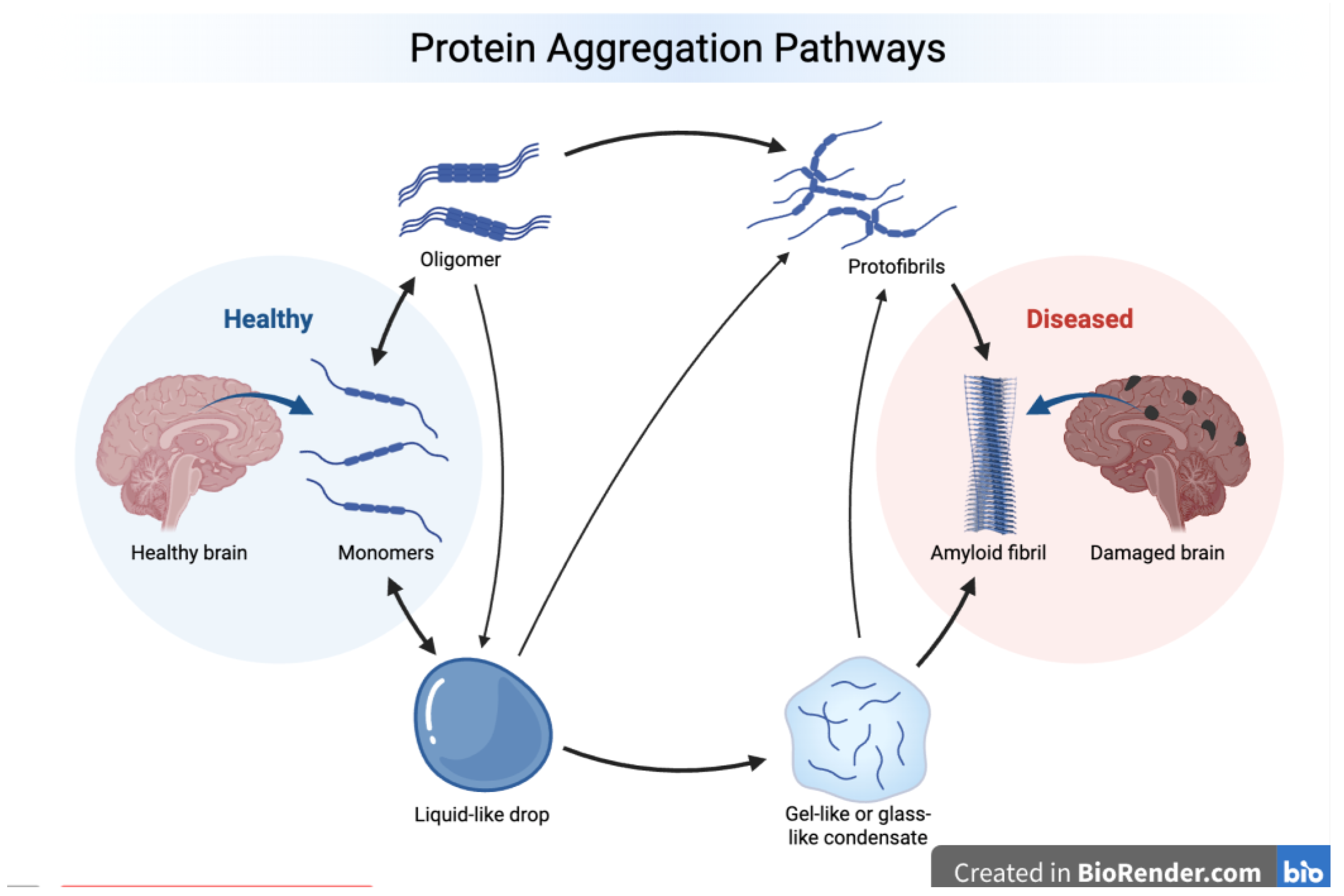
Figure 2.
Figure 2. Intrinsic disorder status of human amyloid precursor protein (APP) (UniProt ID: P05067). A. 3D structural model generated for human APP by AlphaFold [116]. The structure is colored based on the per-residue model confidence (pLDDT), which ranges between 0 and 100. Regions with very high (pLDDT > 90), high (90 > pLDDT > 70), low (70 > pLDDT > 50), and very low model confidence (pLDDT < 50) are shown by blue, cyan, yellow, and orange colors, respectively. Regions with low pLDDT may be unstructured in isolation. B. Functional disorder profile generated by D2P2 [117] shows the outputs of several disorder predictors such as PONDR® VLXT, PONDR® VSL2b, PrDOS, IU-Pred and Espritz. Consensus disorder predictions are shown by blue-green-white bar, where blue indicates regions are where the disorder predictions intersect the SCOP domain prediction and green indicates regions represent disorder that is not found within a predicted SCOP domain. The colored bar highlighted by blue and green shade represents the consensus disorder prediction. Above this consensus bar, line with numbered, colored bars show the predicted locations of SCOP (Structural Classifications of Proteins) domains. Yellow zigzagged bars show positions of MoRFs, whereas colored circles in the bottom of the plot show the positions of predicted PTMs. Position of Aβ, which is located within the C-terminal part of the protein is shown within the black box.
Figure 2.
Figure 2. Intrinsic disorder status of human amyloid precursor protein (APP) (UniProt ID: P05067). A. 3D structural model generated for human APP by AlphaFold [116]. The structure is colored based on the per-residue model confidence (pLDDT), which ranges between 0 and 100. Regions with very high (pLDDT > 90), high (90 > pLDDT > 70), low (70 > pLDDT > 50), and very low model confidence (pLDDT < 50) are shown by blue, cyan, yellow, and orange colors, respectively. Regions with low pLDDT may be unstructured in isolation. B. Functional disorder profile generated by D2P2 [117] shows the outputs of several disorder predictors such as PONDR® VLXT, PONDR® VSL2b, PrDOS, IU-Pred and Espritz. Consensus disorder predictions are shown by blue-green-white bar, where blue indicates regions are where the disorder predictions intersect the SCOP domain prediction and green indicates regions represent disorder that is not found within a predicted SCOP domain. The colored bar highlighted by blue and green shade represents the consensus disorder prediction. Above this consensus bar, line with numbered, colored bars show the predicted locations of SCOP (Structural Classifications of Proteins) domains. Yellow zigzagged bars show positions of MoRFs, whereas colored circles in the bottom of the plot show the positions of predicted PTMs. Position of Aβ, which is located within the C-terminal part of the protein is shown within the black box.
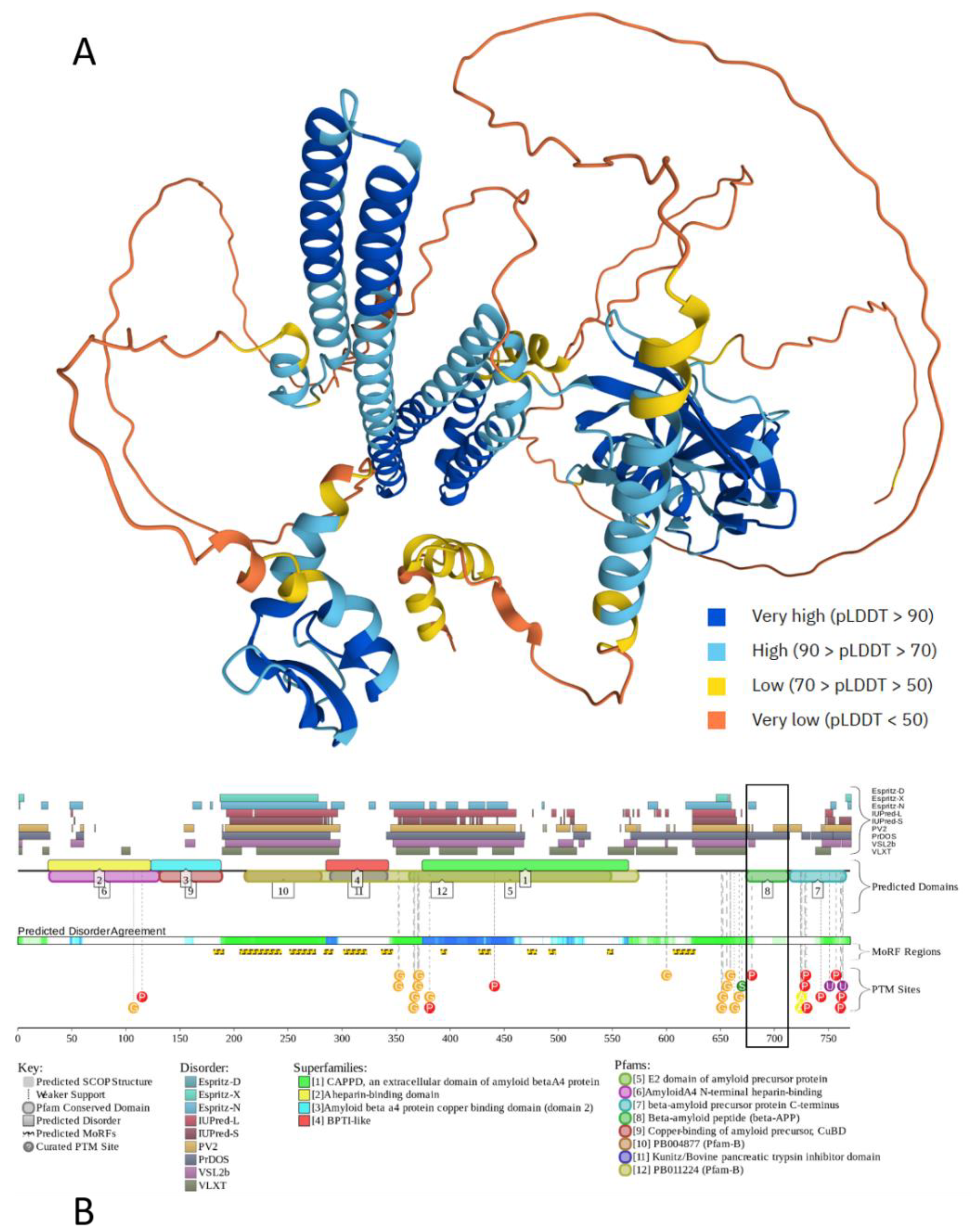
Figure 3.
Figure 3. Evaluation of intrinsic disorder in human microtubule-associated protein tau (UniProt ID: P10636). A. 3D structural model generated for human tau by AlphaFold. B. Functional disorder profile generated by D2P2.
Figure 3.
Figure 3. Evaluation of intrinsic disorder in human microtubule-associated protein tau (UniProt ID: P10636). A. 3D structural model generated for human tau by AlphaFold. B. Functional disorder profile generated by D2P2.
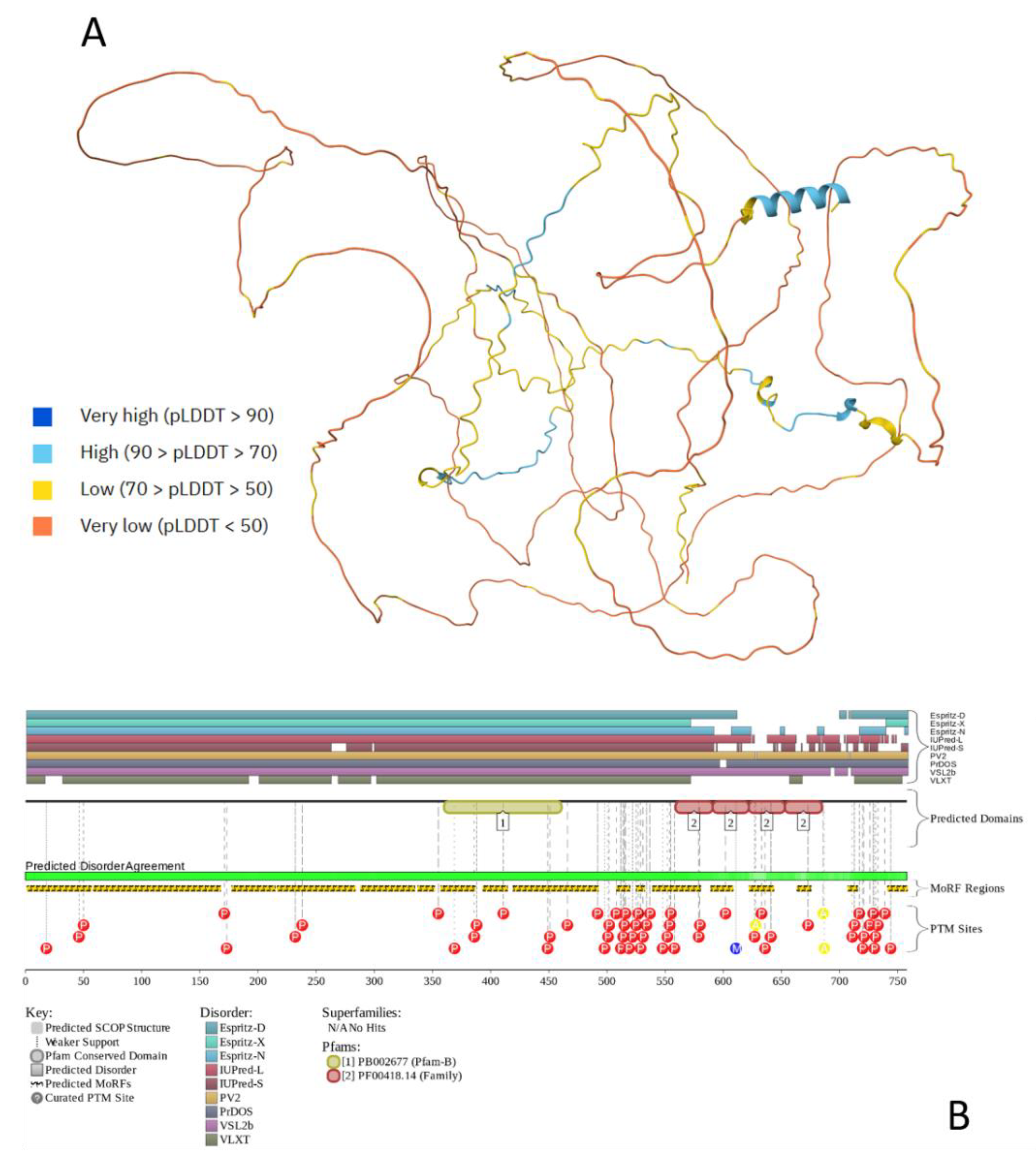
Figure 4.
Figure 4. Evaluation of the intrinsic disorder predisposition of human α-synuclein (UniProt ID: P37840). A. 3D conformational ensemble generated by AFflecto (https://moma.laas.fr/applications/AFflecto/) [170]. By analyzing the structural properties of the AlphaFold model, AFflecto identifies IDRs based on the pLDDT score (i.e., based on the analysis of structural context) and classifies them as tails, linkers, or loops. To explore the conformational diversity of these flexible regions, AFflecto employs computationally efficient stochastic sampling algorithms [170]. It also incorporates a method to identify conditionally folded IDRs that AF may incorrectly predict as natively folded elements [170]. Therefore, AFflecto generates protein ensembles that provide realistic representation of protein structural heterogeneity [170]. Ensemble includes 28 models. Plot was generated using Visual Molecular Dynamics (VMD) software for molecular visualization [171]. B. Functional disorder profile generated by D2P2.
Figure 4.
Figure 4. Evaluation of the intrinsic disorder predisposition of human α-synuclein (UniProt ID: P37840). A. 3D conformational ensemble generated by AFflecto (https://moma.laas.fr/applications/AFflecto/) [170]. By analyzing the structural properties of the AlphaFold model, AFflecto identifies IDRs based on the pLDDT score (i.e., based on the analysis of structural context) and classifies them as tails, linkers, or loops. To explore the conformational diversity of these flexible regions, AFflecto employs computationally efficient stochastic sampling algorithms [170]. It also incorporates a method to identify conditionally folded IDRs that AF may incorrectly predict as natively folded elements [170]. Therefore, AFflecto generates protein ensembles that provide realistic representation of protein structural heterogeneity [170]. Ensemble includes 28 models. Plot was generated using Visual Molecular Dynamics (VMD) software for molecular visualization [171]. B. Functional disorder profile generated by D2P2.
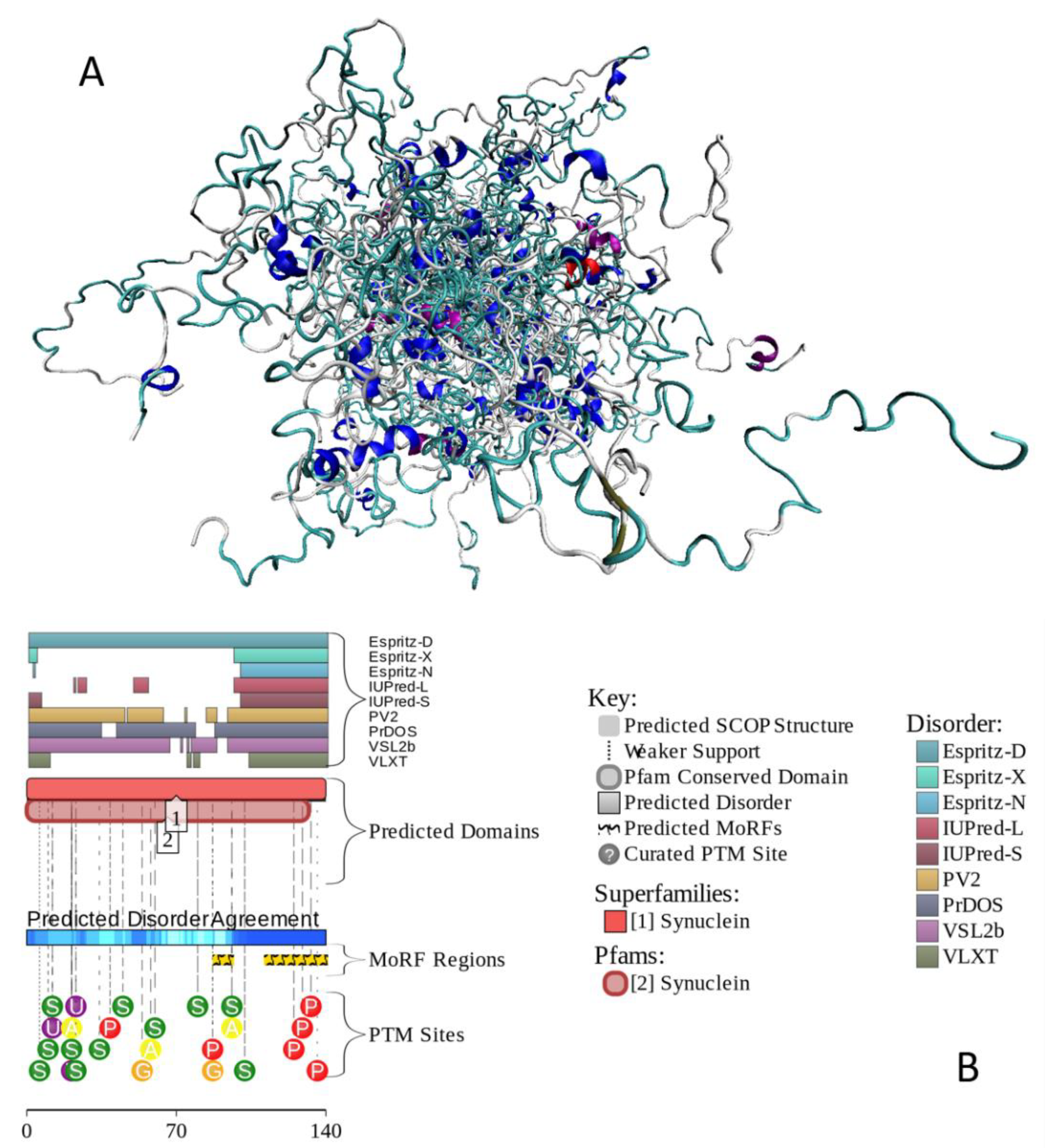
Figure 5.
Figure 5. Evaluation of intrinsic disorder in human TAR DNA-binding protein 43 (UniProt ID: Q13148). A. 3D structural model generated for human TDP-43 by AlphaFold. B. Functional disorder profile generated by D2P2.
Figure 5.
Figure 5. Evaluation of intrinsic disorder in human TAR DNA-binding protein 43 (UniProt ID: Q13148). A. 3D structural model generated for human TDP-43 by AlphaFold. B. Functional disorder profile generated by D2P2.
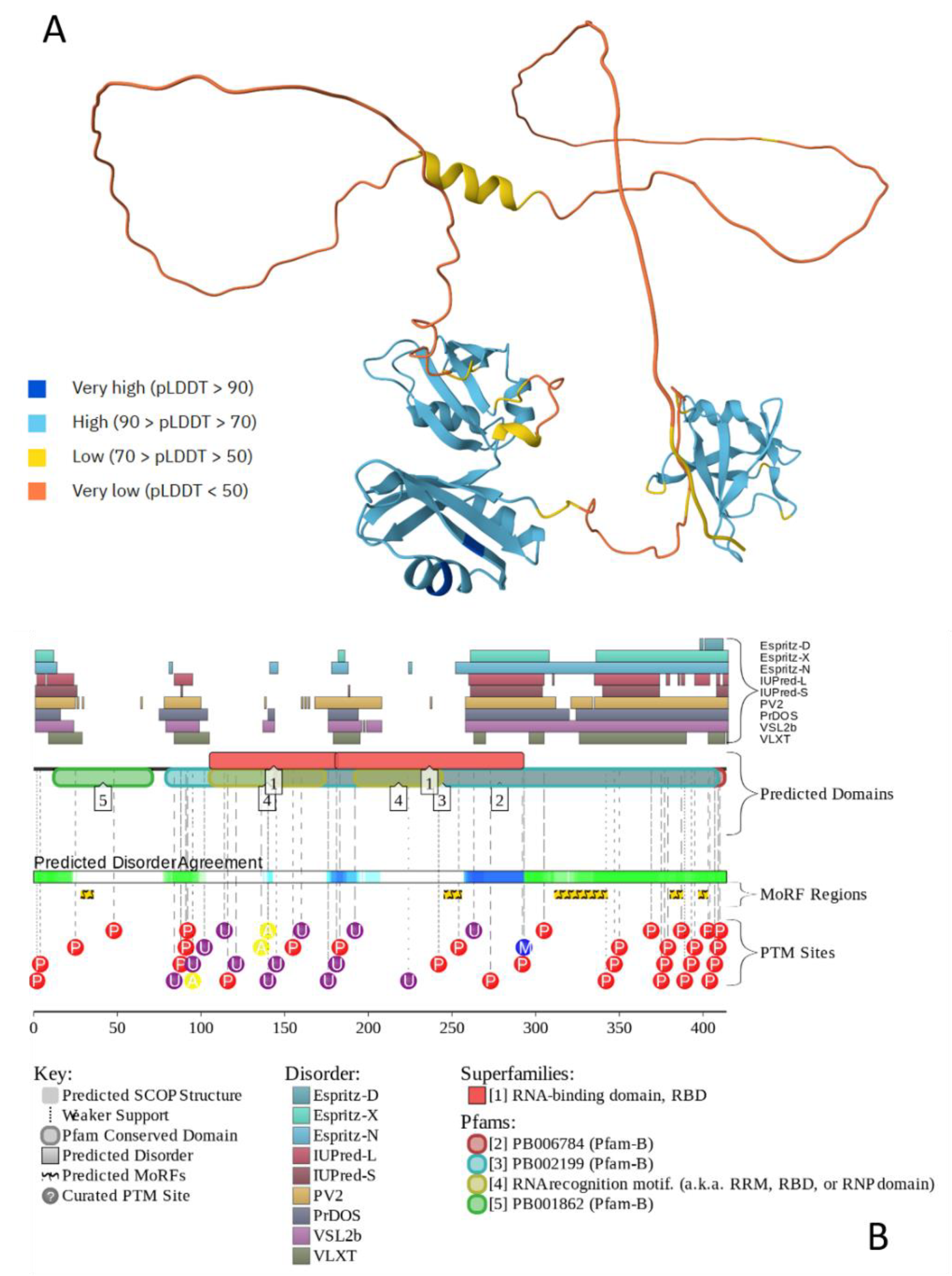
Figure 6.
Figure 6. Evaluation of intrinsic disorder in human RNA-binding protein FUS (UniProt ID: P35637). A. 3D structural model generated for human FUS by AlphaFold. B. Functional disorder profile generated by D2P2.
Figure 6.
Figure 6. Evaluation of intrinsic disorder in human RNA-binding protein FUS (UniProt ID: P35637). A. 3D structural model generated for human FUS by AlphaFold. B. Functional disorder profile generated by D2P2.
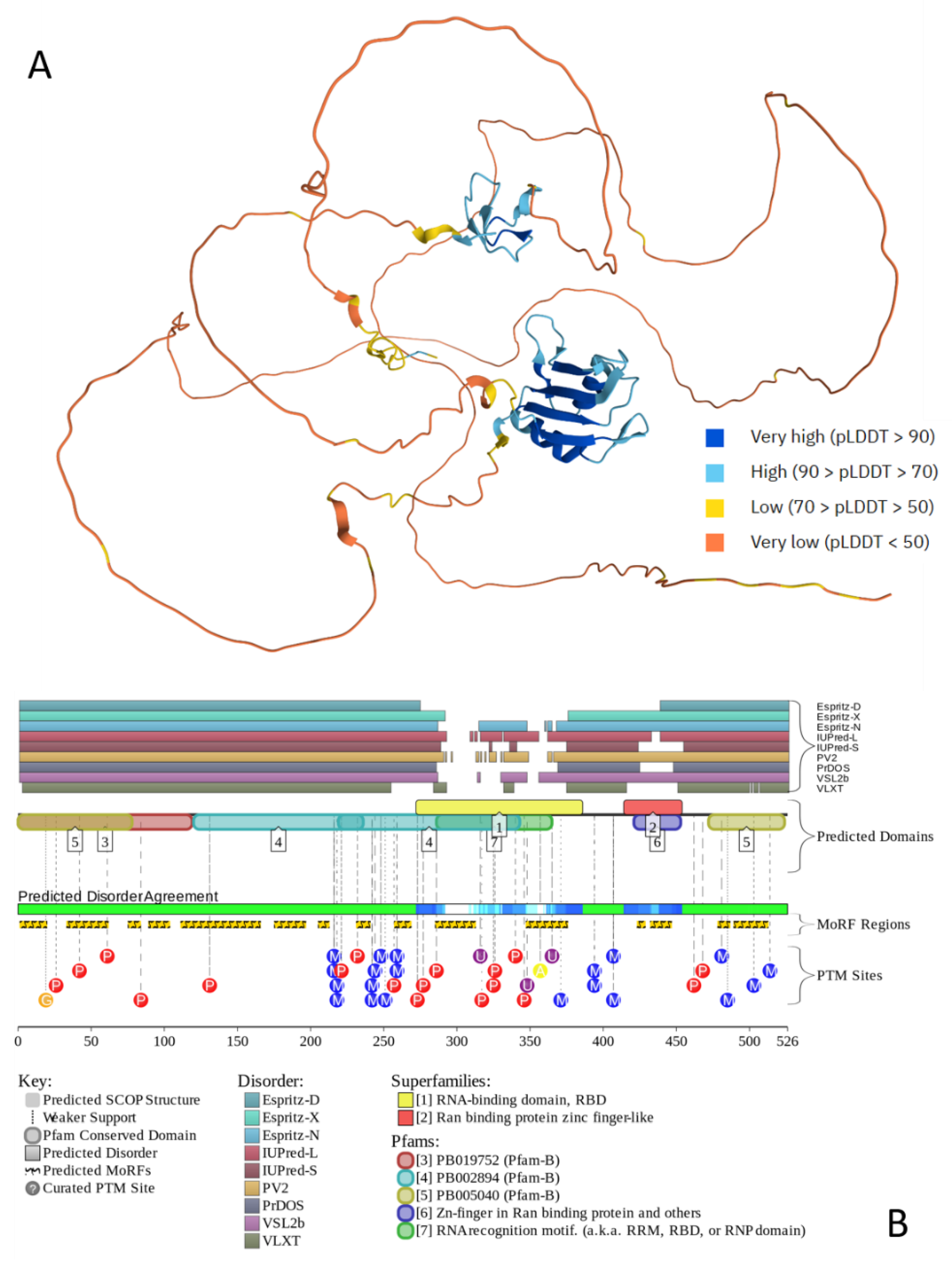
Figure 7.
Figure 7. STRING-generated protein-protein interaction (PPI) networks of human proteins linked to mixed pathologies. A. Intraset PPI network connecting APP, tau, α-synuclein, TDP-43, and FUS. B. Joint PPI network centered at five major mixed pathology-related proteins, highlighting shared interactors. Positions of APP, tau, α-synuclein, TDP-43, and FUS within this network are highlighted by yellow circles. This PPI network was generated by STRING database (https://string-db.org; [230,231,232]) using the maximum number of interactors in the first shell of 500 and a highest confidence level of 0.9 based on a minimum required interaction score. Here, individual proteins act as network nodes, whereas differently colored edges show protein-protein associations based on different types of evidence. The blue line represents information extracted from the curated databases, the black line represents co-expression, and the green line represents gene neighborhoods. Based on the STRING annotations, edges are expected to be specific and meaningful, indicating that linked proteins jointly contribute to a shared function. However, this does not necessarily mean that they are physically binding to each other. The interactive version of the joint PPI network can be viewed at the following permalink: https://version-12-0.string-db.org/cgi/network?networkId=bhz5YRrlPsno.
Figure 7.
Figure 7. STRING-generated protein-protein interaction (PPI) networks of human proteins linked to mixed pathologies. A. Intraset PPI network connecting APP, tau, α-synuclein, TDP-43, and FUS. B. Joint PPI network centered at five major mixed pathology-related proteins, highlighting shared interactors. Positions of APP, tau, α-synuclein, TDP-43, and FUS within this network are highlighted by yellow circles. This PPI network was generated by STRING database (https://string-db.org; [230,231,232]) using the maximum number of interactors in the first shell of 500 and a highest confidence level of 0.9 based on a minimum required interaction score. Here, individual proteins act as network nodes, whereas differently colored edges show protein-protein associations based on different types of evidence. The blue line represents information extracted from the curated databases, the black line represents co-expression, and the green line represents gene neighborhoods. Based on the STRING annotations, edges are expected to be specific and meaningful, indicating that linked proteins jointly contribute to a shared function. However, this does not necessarily mean that they are physically binding to each other. The interactive version of the joint PPI network can be viewed at the following permalink: https://version-12-0.string-db.org/cgi/network?networkId=bhz5YRrlPsno.
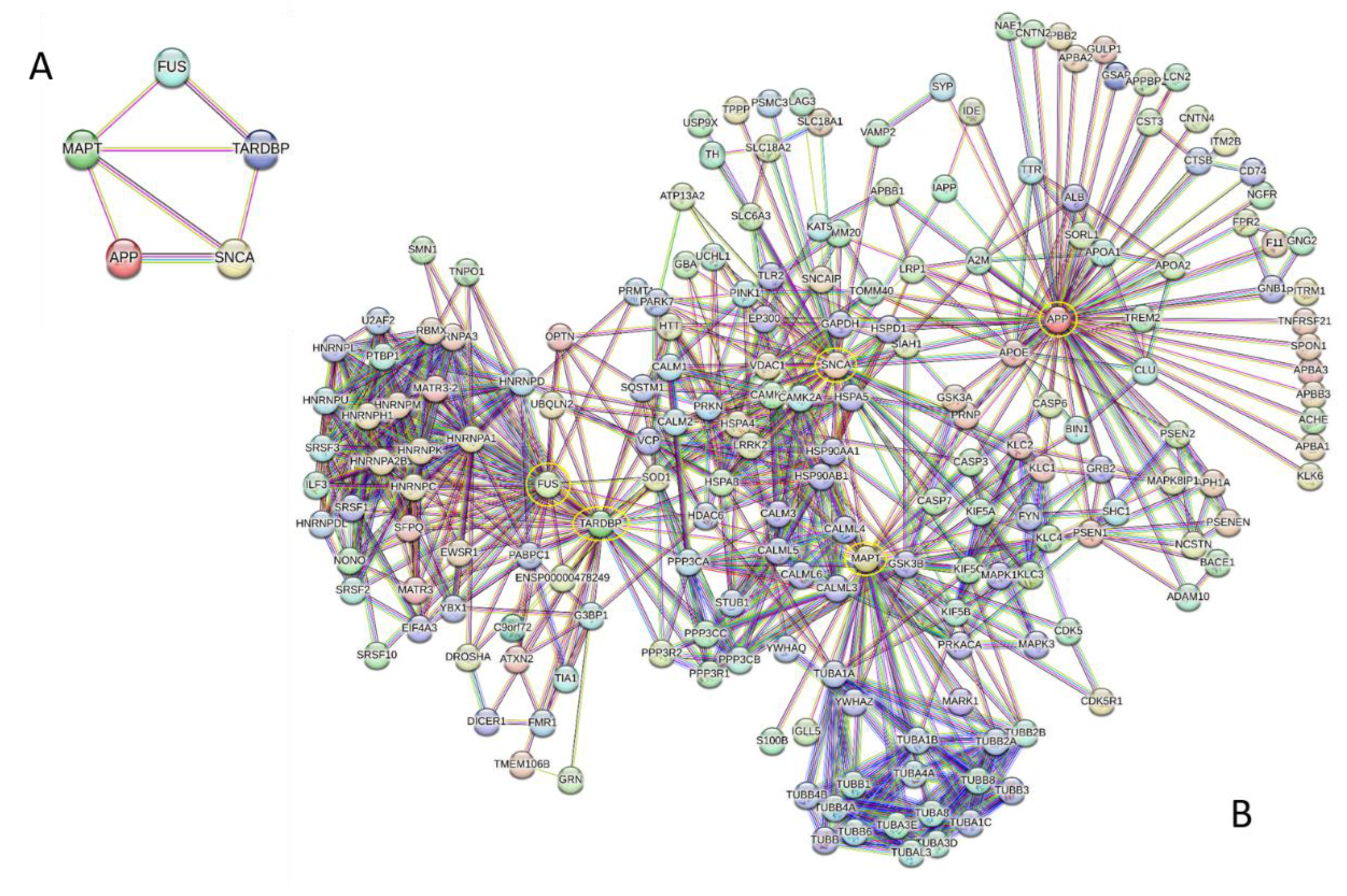
Figure 8.
Functional enrichment analysis of the joint interactome of APP, tau, α-synuclein, TDP-43, and FUS. A. 20 most enriched Biological Process (BP) Gene Ontology (GO) terms (of the 1055 significantly enriched BP terms). B. 20 most enriched Molecular Function (MF) GO terms (of 150 significantly enriched MF terms). C. 20 most enriched Cellular Component (CC) GO terms (of 188 significantly enriched CC terms). D. Enrichment analysis of the members of the interactome in KEGG Pathways (20 most enriched of 114 significantly enriched KEGG pathways). E. Enrichment analysis in the Subcellular Localization (COMPARTMENTS; 20 most enriched of 185 significantly enriched localizations). F. Enrichment analysis of interactome in the Disease Gene Association (DGA) terms (20 most enriched of 80 significantly enriched DGA terms).
Figure 8.
Functional enrichment analysis of the joint interactome of APP, tau, α-synuclein, TDP-43, and FUS. A. 20 most enriched Biological Process (BP) Gene Ontology (GO) terms (of the 1055 significantly enriched BP terms). B. 20 most enriched Molecular Function (MF) GO terms (of 150 significantly enriched MF terms). C. 20 most enriched Cellular Component (CC) GO terms (of 188 significantly enriched CC terms). D. Enrichment analysis of the members of the interactome in KEGG Pathways (20 most enriched of 114 significantly enriched KEGG pathways). E. Enrichment analysis in the Subcellular Localization (COMPARTMENTS; 20 most enriched of 185 significantly enriched localizations). F. Enrichment analysis of interactome in the Disease Gene Association (DGA) terms (20 most enriched of 80 significantly enriched DGA terms).
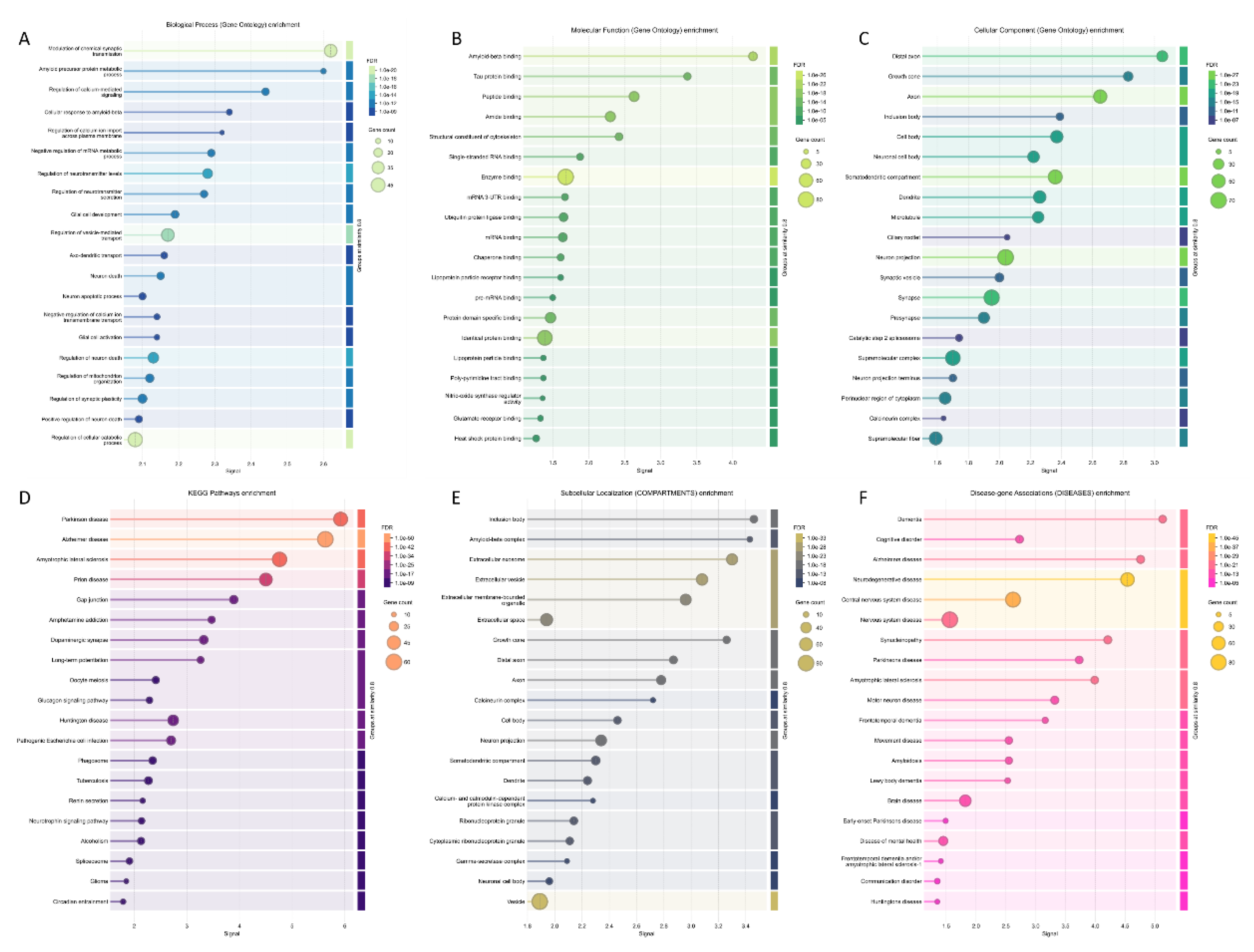
Figure 9.
Figure 9. Evaluation of global intrinsic disorder predisposition of human proteins associated with mixed pathologies and their interactors. A. The PONDR® VSL2 score (average disorder score, ADS) vs. PONDR® VSL2 (%) (percent of predicted intrinsically disordered residues, PPIDR) plot, where each point corresponding to a query protein. In this plot, the coordinates are derived from the PONDR® VSL2 data as the corresponding ADS and PPIDR values. The areas containing highly disordered, moderately disordered, and ordered proteins (based on the accepted classification, see text) are shown by red, pink/light pink, and blue/light blue colors, respectively. The regions where the ADS are PPIDR agree are indicated by dark (blue or pink) colors, whereas light blue or pink colors correspond to the areas, where only one of these criteria applies. B. Classification of query proteins based on the outputs of the charge-hydropathy (CH, which correlates a protein's net charge with its hydrophobicity) and cumulative distribution function analyses (CDF, which correlates the cumulative frequency of disorder scores with the disorder scores). The resulting ΔCH-ΔCDF plot integrates the corresponding outputs as a two-dimensional graph, where the deviation of the disorder frequency of a query protein from the CDF boundary (ΔCDF) is shown at the X-axis, and the distance of a protein from the CH boundary (ΔCH) is shown at the Y-axis. Here, proteins, which are expected to be structured, molten globular/hybrid, highly disordered, or mixed are located within the Quadrant 1 (blue, bottom right), Quadrant 2 (pink, bottom left), Quadrant 3 (red, top left), and Quadrant 4 (violet, top right). C. Correlation between the interactivity (measured as the node degree in the STRING-generated PPI network shown in Figure 7B) and intrinsic disorder (measured as PONDR® VSL2-based PPIDR) among the members of the analyzed interactome. D. Comparison of the LLPS predisposition of the analyzed proteins with their intrinsic disorder propensity. Vertical lines show 10% and 30% PPIDR thresholds, whereas the horizontal line corresponds to the pLLPS threshold of 0.6. Proteins not related to LLPS (showing pLLPS below 0.6 and not containing DPRs) are shown by dotted circles. In these plots, the positions of individual major proteins associated with mixed pathologies are shown by differently shaped green symbols, whereas the gray circles indicate the corresponding data for their interactome.
Figure 9.
Figure 9. Evaluation of global intrinsic disorder predisposition of human proteins associated with mixed pathologies and their interactors. A. The PONDR® VSL2 score (average disorder score, ADS) vs. PONDR® VSL2 (%) (percent of predicted intrinsically disordered residues, PPIDR) plot, where each point corresponding to a query protein. In this plot, the coordinates are derived from the PONDR® VSL2 data as the corresponding ADS and PPIDR values. The areas containing highly disordered, moderately disordered, and ordered proteins (based on the accepted classification, see text) are shown by red, pink/light pink, and blue/light blue colors, respectively. The regions where the ADS are PPIDR agree are indicated by dark (blue or pink) colors, whereas light blue or pink colors correspond to the areas, where only one of these criteria applies. B. Classification of query proteins based on the outputs of the charge-hydropathy (CH, which correlates a protein's net charge with its hydrophobicity) and cumulative distribution function analyses (CDF, which correlates the cumulative frequency of disorder scores with the disorder scores). The resulting ΔCH-ΔCDF plot integrates the corresponding outputs as a two-dimensional graph, where the deviation of the disorder frequency of a query protein from the CDF boundary (ΔCDF) is shown at the X-axis, and the distance of a protein from the CH boundary (ΔCH) is shown at the Y-axis. Here, proteins, which are expected to be structured, molten globular/hybrid, highly disordered, or mixed are located within the Quadrant 1 (blue, bottom right), Quadrant 2 (pink, bottom left), Quadrant 3 (red, top left), and Quadrant 4 (violet, top right). C. Correlation between the interactivity (measured as the node degree in the STRING-generated PPI network shown in Figure 7B) and intrinsic disorder (measured as PONDR® VSL2-based PPIDR) among the members of the analyzed interactome. D. Comparison of the LLPS predisposition of the analyzed proteins with their intrinsic disorder propensity. Vertical lines show 10% and 30% PPIDR thresholds, whereas the horizontal line corresponds to the pLLPS threshold of 0.6. Proteins not related to LLPS (showing pLLPS below 0.6 and not containing DPRs) are shown by dotted circles. In these plots, the positions of individual major proteins associated with mixed pathologies are shown by differently shaped green symbols, whereas the gray circles indicate the corresponding data for their interactome.
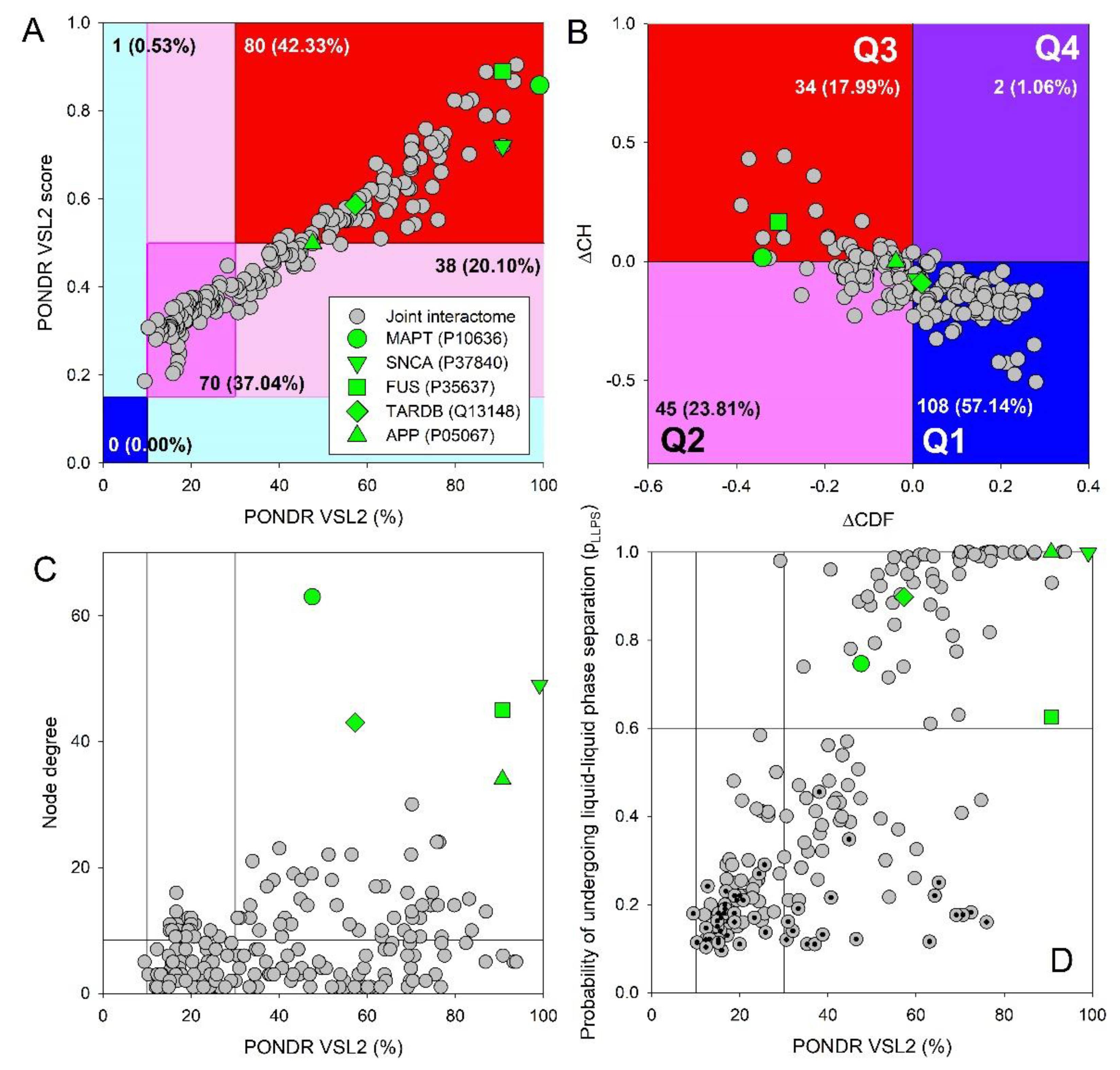

Table 1.
Table 1. Comparative overview of major neurodegeneration-associated proteins with respect to intrinsic disorder, aggregation behavior, phase separation, and contribution to mixed neuropathology.
Table 1.
Table 1. Comparative overview of major neurodegeneration-associated proteins with respect to intrinsic disorder, aggregation behavior, phase separation, and contribution to mixed neuropathology.
| Feature | Amyloid-β (Aβ) [94,96,98,227] | τ-protein (tau) [120,140] | α-synuclein [150,167,228] | TDP-43 [197,200,229] | FUS [122,201,209] |
| Physiological role | APP-derived peptide; modulates synaptic activity at low concentrations | Microtubule-associated protein stabilizing neuronal function | Presynaptic protein regulating vesicle trafficking | RNA-binding protein regulating splicing and RNA metabolism | RNA/DNA-binding protein involved in RNA metabolism and stress responses |
| Pathological aggregate | Extracellular plaques; soluble toxic oligomers | Intracellular neurofibrillary tangles (NFTs) | Lewy bodies and Lewy neurites; oligomers | Cytoplasmic inclusions with nuclear depletion | Cytoplasmic inclusions due to nuclear clearance defects |
| Intrinsic disorder features | Intrinsically disordered as a monomer | Highly intrinsically disordered; conformationally flexible | Almost entirely intrinsically disordered | Large intrinsically disordered regions | Highly intrinsically disordered; prion-like domains |
| Sequence determinants of disorder | Charged and flexible N-terminus; hydrophobic C-terminal motifs (Aβ42) | Low sequence complexity; polar and charged amino acid residues | NAC region; polar and charged amino acid residues, particularly in its N-terminal region | Low-complexity C-terminal domain with polar and charged amino acid residues; charge asymmetry | Low-complexity, Arg-Gly-Gly repeats in the RGG motif |
| Post-translational modifications (PTMs) | Phosphorylation and acetylation | Hyperphosphorylation and acetylation | N-terminal acetylation and phosphorylation | Hyperphosphorylation and ubiquitination | PTMs modulate phase behavior and aggregation |
| Phase separation (LLPS) | No classical LLPS; APP can undergo LLPS, aggregation emerges from disordered peptide plasticity | Undergoes LLPS; droplets can mature into fibrillar aggregates | Forms stress-induced condensates | Stress-granule–associated LLPS precedes aggregation | Prominent LLPS; condensate hardening linked to disease |
| Prevalence in aged brain | Very high | Very high | Moderate to high | Common, especially in elderly | Rare in community autopsy series |
| Common co-pathologies | Tau, α-synuclein, TDP-43, FUS, vascular pathology | Aβ, α-synuclein, TDP-43 | Aβ, tau | Aβ, tau, α-synuclein | TDP-43; ALS/FTLD spectrum |
| Cross-seeding/ synergy | Seeds tau misfolding; interacts with α-synuclein | Synergizes with Aβ; interacts with α-synuclein | Cross-seeds tau and Aβ; strain-dependent | Often superimposed on AD pathology | Stress-granule and RNA-metabolism interactions |
| Impact on mixed-pathology dementia | Early driver and amplifier of downstream proteinopathies | Strong determinant of cognitive decline and neuronal loss | Exacerbates cognitive and neuropsychiatric symptoms | Accelerates dementia severity and memory impairment | Associated with earlier onset and aggressive disease |
| Associated diseases | AD, cerebral amyloid angiopathy (CAA), Down syndrome, Aβ–related angiitis (ABRA), CAA-related inflammation, cerebral amyloidoma, dementia with Lewy bodies (DLB), retinal disorders, traumatic brain injury (TBI) | AD, progressive supranuclear palsy (PSP), corticobasal degeneration (CBD), Pick’s disease (PiD), frontotemporal dementia with parkinsonism-17 (FTDP-17), argyrophilic grain disease (AGD), chronic traumatic encephalopathy (CTE), down syndrome, Guam parkinsonism-dementia complex, postencephalitic parkinsonism, DLB, PD | PD, DLB, multiple system atrophy (MSA), pure autonomic failure (PAF), REM sleep behavior disorder (RBD), AD, Gaucher’s disease, neuroaxonal dystrophy, neurodegeneration with brain iron accumulation (NBIA) | ALS, FTLD-TDP, LATE, AD, CTE, LBD, Huntington’s disease (HD), multisystem proteinopathy (MSP), Perry syndrome, Alexander disease | ALS-FUS, FTLD-FUS, neuronal intermediate filament inclusion disease (NIFID), basophilic inclusion body disease (BIBD), essential tremor (ET), polyglutamine (PolyQ) diseases (HD and spinocerebellar ataxias SCA1 and SCA3), cancers (myxoid liposarcoma, ewing sarcoma, acute myeloid leukemia (AML) |
Disclaimer/Publisher’s Note: The statements, opinions and data contained in all publications are solely those of the individual author(s) and contributor(s) and not of MDPI and/or the editor(s). MDPI and/or the editor(s) disclaim responsibility for any injury to people or property resulting from any ideas, methods, instructions or products referred to in the content. |
© 2026 by the authors. Licensee MDPI, Basel, Switzerland. This article is an open access article distributed under the terms and conditions of the Creative Commons Attribution (CC BY) license (http://creativecommons.org/licenses/by/4.0/).
Copyright: This open access article is published under a Creative Commons CC BY 4.0 license, which permit the free download, distribution, and reuse, provided that the author and preprint are cited in any reuse.


