

Submitted:
26 January 2026
Posted:
27 January 2026
You are already at the latest version
Abstract
The growing environmental impacts associated with conventional plastics and textiles have intensified interest in bio-based and circular material alternatives. This study examines the feasibility of valorizing fruit and nut agricultural residues as sustainable feedstocks for biomaterials and biotextiles, with a strategic focus on Greece. Drawing on an extensive review of international literature, regional agricultural production data, and validated processing technologies, the work evaluates residue availability, conversion routes, environmental performance, and economic potential. Methods include analysis of mechanical, chemical, and biological preprocessing techniques; polymer and fiber isolation pathways; fabrication routes for fibers, films, and composites; and comparative life cycle assessment (LCA) evidence. Results indicate that residues such as grape pomace, olive by-products, citrus peels, and nut shells are technically suitable for cellulose-, lignin-, and pectin-based materials, offering substantially lower water use, greenhouse gas emissions, and land-use intensity than conventional cotton and synthetic textiles. The analysis further highlights emerging opportunities for multifunctional textiles, improved end-of-life performance, and decentralized biofabrication models. The study concludes that Greece can position itself as a regional circular bioeconomy hub by developing integrated residue-to-biomaterial value chains, provided that coordinated policy support, research investment, standards development, and stakeholder engagement are implemented.
Keywords:
agricultural residues
; biotextiles
; biomaterials
; circular bioeconomy
; cellulose
; fruit and nut waste
; life cycle assessment
; Greece
1. Introduction
The global textile and materials industries are increasingly identified as major contributors to environmental degradation due to their heavy reliance on petroleum-based polymers and resource-intensive natural fibers such as conventional cotton [1]. These production systems are associated with high greenhouse gas emissions, excessive water and energy consumption, extensive land use, and the generation of persistent waste streams, including microplastics and chemically complex effluents [2]. The rapid expansion of fast-fashion business models has further intensified these impacts by accelerating production cycles and shortening product lifetimes, thereby increasing material throughput and post-consumer textile waste [3].
In response to these challenges, bio-based materials have emerged as promising alternatives to fossil-dependent production systems, particularly when integrated within circular economy strategies [4]. Among available bio-based feedstocks, agricultural residues have attracted increasing attention due to their availability as unavoidable by-products of food production and agro-industrial processing [5]. Fruit and nut residues, including peels, pomace, shells, pruning waste, and stalks, are rich in lignocellulosic polymers such as cellulose, hemicellulose, lignin, and pectin, which can be converted into fibers, films, coatings, and composite materials suitable for textile and technical applications [6]. Their utilization avoids competition with food systems and does not require additional agricultural land, supporting more efficient resource use and waste minimization [7].
At the global level, the valorization of agro-industrial waste into biomaterials and biotextiles has progressed substantially over the past decade [8]. Numerous experimental and pre-commercial studies demonstrate that residues from fruit and nut production can be transformed into regenerated cellulose fibers, bio-based leather alternatives, functional textile finishes, and biodegradable composites with mechanical and aesthetic properties comparable to conventional materials [9]. Life cycle assessment (LCA) studies consistently report significant reductions in water use, cumulative energy demand, and greenhouse gas emissions when agricultural residues are used as feedstock instead of virgin polymers or dedicated fiber crops [10]. These environmental benefits are particularly pronounced when regional sourcing and decentralized processing models are employed [11].
Several pioneering industrial initiatives and research-driven demonstrations further illustrate the technical feasibility and growing market relevance of agricultural residue valorization in the textile sector [7,8]. Citrus peels have been successfully converted into regenerated cellulose fibers suitable for apparel applications, while grape pomace has enabled the development of bio-based leather-like materials for fashion and interior uses [12,13]. Similarly, pineapple leaves, banana pseudostems, nut residues, and stone fruit processing wastes have been explored as alternative lignocellulosic feedstocks for the production of fibers, bioplastics, and composite materials targeting textiles, footwear, and automotive interiors [9,14,15,16,17]. In this context, recent studies have demonstrated the upcycling of industrial fruit-processing residues, such as peach waste, into high-purity dissolving-grade cellulose pulp exhibiting physicochemical and morphological properties comparable to commercial textile pulps, thereby confirming the suitability of fruit waste streams for regenerated cellulosic fiber production [18].
In parallel, advances in green chemistry, enzymatic and biological processing, ultrasonic-assisted treatments, and low-impact finishing technologies have expanded the functional scope of biotextiles [19,20]. These approaches enable the incorporation of antimicrobial, UV-protective, antioxidant, and other multifunctional properties while reducing reliance on toxic synthetic additives, heavy-metal mordants, and resource-intensive wet-processing routes [21]. Such developments are particularly relevant for improving the environmental performance and market acceptance of bio-based textiles in high-value applications.
Despite substantial technological progress, regional disparities persist in the adoption and industrial scaling of agro-residue-based biomaterials, particularly across Southern Europe [22]. Greece has not yet fully exploited its extensive agricultural residue streams beyond low-value applications such as energy recovery, animal feed, or disposal, despite being a major producer of olives, grapes, citrus fruits, figs, almonds, and other crops [23,24]. These activities generate large volumes of lignocellulosic residues with significant potential for conversion into value-added biomaterials and biotextiles, representing an opportunity to reduce waste management pressures while supporting rural economic development and regional industrial diversification.
Within this context, fruit and nut agricultural residues can be reframed from waste streams into strategic resources for sustainable material production. By situating Greece within the broader international landscape of biomaterials and biotextiles, this study aims to assess the country’s residue availability, relevant conversion technologies, environmental performance, and economic potential. The overarching objective is to provide a structured framework that supports the development of integrated residue-to-biomaterial value chains and informs a national roadmap for agricultural waste valorization within a circular bioeconomy.
2. Global and Greek Context of Fruit and Nut Agricultural Residues
Agricultural and agro-industrial activities generate substantial quantities of residual biomass worldwide, much of which remains underutilized or is directed toward low-value applications such as composting, energy recovery, or disposal [5,8,25]. Fruit and nut processing in particular produces residues including peels, pomace, stones, shells, and fibrous pulp that are rich in lignocellulosic polymers and bioactive compounds, making them attractive feedstocks for biomaterials and biotextiles [6,9]. In recent years, increasing attention has been directed toward valorizing these streams as part of circular bioeconomy strategies that aim to close material loops and reduce environmental burdens associated with conventional material production [4,26].
At the global level, several regions have demonstrated early adoption of agricultural residue valorization pathways for textile and material applications. Representative examples of biotextile and biomaterial innovations derived from fruit and nut residues are illustrated in Figure 1, highlighting initiatives across Europe, Asia, and North America. These include the conversion of citrus-processing waste into regenerated cellulose fibers, the utilization of grape pomace for bio-based leather-like materials, and the exploitation of pineapple leaves, banana pseudostems, and other fruit residues for fiber, composite, and bioplastic production [8,9,12,13,14,15]. For example, Orange Fiber, an innovative Italian company, has successfully launched commercial-scale biotextiles meticulously crafted from citrus waste, transforming what was once a discarded byproduct of the juice industry into a valuable textile resource. Similarly, VEGEA, based in Spain, has developed and commercialized sustainable materials derived from grape skins, leveraging the abundant residues from the wine industry. In a remarkable display of cross-continental collaboration, Ananas Anam, a company with roots in both the UK and the Philippines, has gained international recognition for its Piñatex material, an innovative leather alternative produced from the leaves of pineapples, which are typically discarded after fruit harvesting. Collectively, these cases demonstrate that agricultural residues can be transformed into commercially relevant materials when supported by appropriate processing technologies, market demand, and policy frameworks.
Southern Europe occupies a particularly strategic position within this global landscape due to its high intensity of fruit and nut production and processing activities [11,22]. However, despite favorable climatic conditions and strong agricultural output, the region has not yet fully translated its residue availability into high-value biomaterial production at scale. Greece represents a characteristic case, combining substantial agricultural residue generation with limited industrial valorization beyond traditional uses [23,27]. This gap highlights both a challenge and an opportunity for the development of localized residue-to-biomaterial value chains.
In Greece, fruit and nut cultivation is geographically distributed across several regions, each characterized by distinct crop profiles and residue streams. Table 1 summarizes estimated production volumes and corresponding residue generation for major Greek fruit and nut crops in 2023, including grapes, olives, citrus fruits, figs, almonds, and chestnuts. Annually, Greece produces over 1 million tons of olives, alongside substantial outputs of grapes, citrus fruits, and nuts. These crops collectively generate hundreds of thousands of tons of lignocellulosic residues annually, providing a stable and renewable feedstock base for biomaterial and biotextile production. Importantly, these residues are largely produced as a consequence of food processing activities, ensuring their availability without additional land or resource inputs [5,24].
The spatial distribution of these residue streams further underscores Greece’s potential for regional specialization. As shown in Figure 2, the Peloponnese emerges as a key zone for citrus and grape residues, Crete is dominated by olive, grape, and fig by-products, while Thessaly contributes significant almond residues alongside other agricultural biomass. Northern Greece also plays a role through chestnut and mixed fruit production. This regional differentiation creates favorable conditions for decentralized processing models, where biofabrication and preprocessing facilities are co-located near feedstock sources to reduce transportation costs, emissions, and logistical complexity.
Taken together, the global examples highlighted in Figure 1 and the national residue mapping presented in Table 1 and Figure 2 indicate that Greece possesses both the resource base and regional structure necessary to support agricultural residue valorization into biomaterials and biotextiles. The challenge lies in translating this potential into coordinated industrial activity through appropriate technological choices, supply-chain organization, and policy support. The following sections therefore examine the protocols, technologies, and processing routes that enable the conversion of fruit and nut residues into high-value biomaterials and biotextiles.
3. Protocols, Techniques, and Technologies for Biomaterial and Biotextile Creation
The transformation of fruit and nut agricultural residues into high-value biomaterials and biotextiles involves a series of interconnected protocols, techniques, and technologies designed to extract, isolate, and convert lignocellulosic components into functional material forms. These processes aim to maximize resource efficiency, ensure consistent material quality, and minimize environmental impacts associated with conventional textile production routes [6,15,26,27]. A systematic understanding of these methodologies is therefore essential for supporting industrial scalability and sustainable implementation.
3.1. Raw Material Preprocessing
Before the extraction of valuable compounds, agricultural residues must undergo preprocessing steps that prepare the biomass for efficient fractionation and conversion. These treatments are critical for reducing heterogeneity, increasing surface area, and improving the accessibility of target polymers. The choice of preprocessing method depends on residue type, moisture content, and intended end use.
Mechanical separation involves physical size-reduction and fractionation techniques such as grinding, shredding, milling, and sieving. These methods are commonly used to isolate fibrous fractions from pulp, stones, or seeds and to standardize feedstock characteristics. For example, nut shells may be processed into powders or granules depending on their intended application as reinforcement fillers or fiber sources, while fruit peels are typically shredded to enhance subsequent chemical or biological treatments [6,14].
Chemical extraction employs acidic, alkaline, or solvent-based treatments to disrupt the lignocellulosic matrix and selectively solubilize biomass components [28,29]. Acid hydrolysis is frequently used to decompose hemicellulose into fermentable sugars, whereas alkaline treatments effectively remove lignin and increase cellulose accessibility [30]. Organic solvents may also be applied for the extraction of pectin, polyphenols, and waxes. Process parameters such as reagent concentration, temperature, and residence time are optimized to maximize yield while minimizing polymer degradation [28].
Biological methods rely on enzymatic or microbial activity to deconstruct complex plant cell walls [20]. Enzymatic hydrolysis using cellulases, hemicellulases, and pectinases enables selective polymer release under mild conditions, reducing energy input and chemical consumption [31]. Microbial treatments may further contribute to polymer modification or the production of bioactive co-products [32]. These approaches align strongly with green chemistry principles and are increasingly explored as sustainable alternatives to conventional chemical pretreatments [20,33].
3.2. Fiber and Polymer Isolation
Following preprocessing, isolation of key polymers forms the basis of biomaterial and biotextile production. Cellulose and lignin are the primary targets due to their abundance and favorable mechanical and functional properties [25].
Cellulose is the most abundant biopolymer in plant biomass and serves as the foundation for regenerated fibers and composite materials [34]. Lignin, a complex aromatic polymer, contributes structural rigidity and is increasingly valorized as a bio-based additive or functional material component [27]. Separation techniques include traditional pulping methods (e.g., Kraft and sulfite processes) and more environmentally benign alternatives such as organosolv pulping [35]. Isolated cellulose can be processed into viscose- or lyocell-type fibers, while lignin fractions can be utilized in advanced material formulations [30].
Beyond cellulose and lignin, pectin and polyphenols represent valuable co-products, particularly in fruit-derived residues [15]. Pectin extracted from citrus peels and apple pomace is widely used in food applications but also exhibits potential in biomedical materials, coatings, and films [36]. Polyphenols recovered from grape skins and pomace function as natural antioxidants, colorants, or functional additives, enhancing the performance and sustainability profile of biomaterials [37]. Co-extraction strategies increase overall resource efficiency and support zero-waste valorization models [38,39].
3.3. Conversion to Biotextiles
Isolated polymers and fibers are subsequently converted into textile-compatible forms through diverse manufacturing pathways.
Fiber spinning transforms cellulose-based solutions or suspensions into continuous filaments suitable for weaving or knitting. Depending on polymer characteristics, wet spinning, dry spinning, or melt spinning techniques may be applied. Fibers derived from banana stems, coconut husks, and nut residues can be blended with other natural or synthetic fibers to tailor mechanical strength, flexibility, and surface properties, enabling applications ranging from apparel to home textiles [27,32,40].
Sheet and film formation enables the production of leather-like or plastic-like materials from agricultural pulps. Residues from apples, mangoes, and grapes have been processed into flexible films and sheets with aesthetic and mechanical properties suitable for fashion accessories, footwear, and interior design applications. These bio-based alternatives offer biodegradable and cruelty-free solutions that address environmental and ethical concerns associated with conventional leather and plastics [3,25,41].
Composite materials incorporate agricultural residues as fillers or reinforcements within biodegradable polymer matrices. Such composites are increasingly used in footwear components, automotive interiors, furniture upholstery, and packaging. By replacing virgin fossil-based fillers with bio-derived residues, these materials achieve improved sustainability profiles while maintaining functional performance [1,11,18].
3.4. Textile Properties Enhancement
To meet application-specific performance requirements, biotextiles often undergo post-processing and functionalization.
Cross-linking agents, such as citric acid and selected isocyanates, enhance mechanical strength, dimensional stability, and wrinkle resistance by forming chemical bonds between polymer chains [42,43]. These treatments are particularly important for ensuring durability in apparel and technical textiles [31,32,42,43].
Bio-coatings derived from natural polymers offer environmentally friendly performance enhancements [32]. Chitosan provides antimicrobial activity and improved dye affinity, while lignin-based coatings function as natural UV stabilizers or flame retardants [19]. These approaches reduce dependence on synthetic chemical finishes and improve biodegradability [10].
Blending with biodegradable polymers, including polylactic acid (PLA) and polyhydroxyalkanoates (PHAs), further improves processability, elasticity, and mechanical performance [14,44]. Hybrid materials combining agricultural fibers with biodegradable matrices exhibit properties suitable for demanding textile and technical applications while maintaining reduced environmental footprints [4].
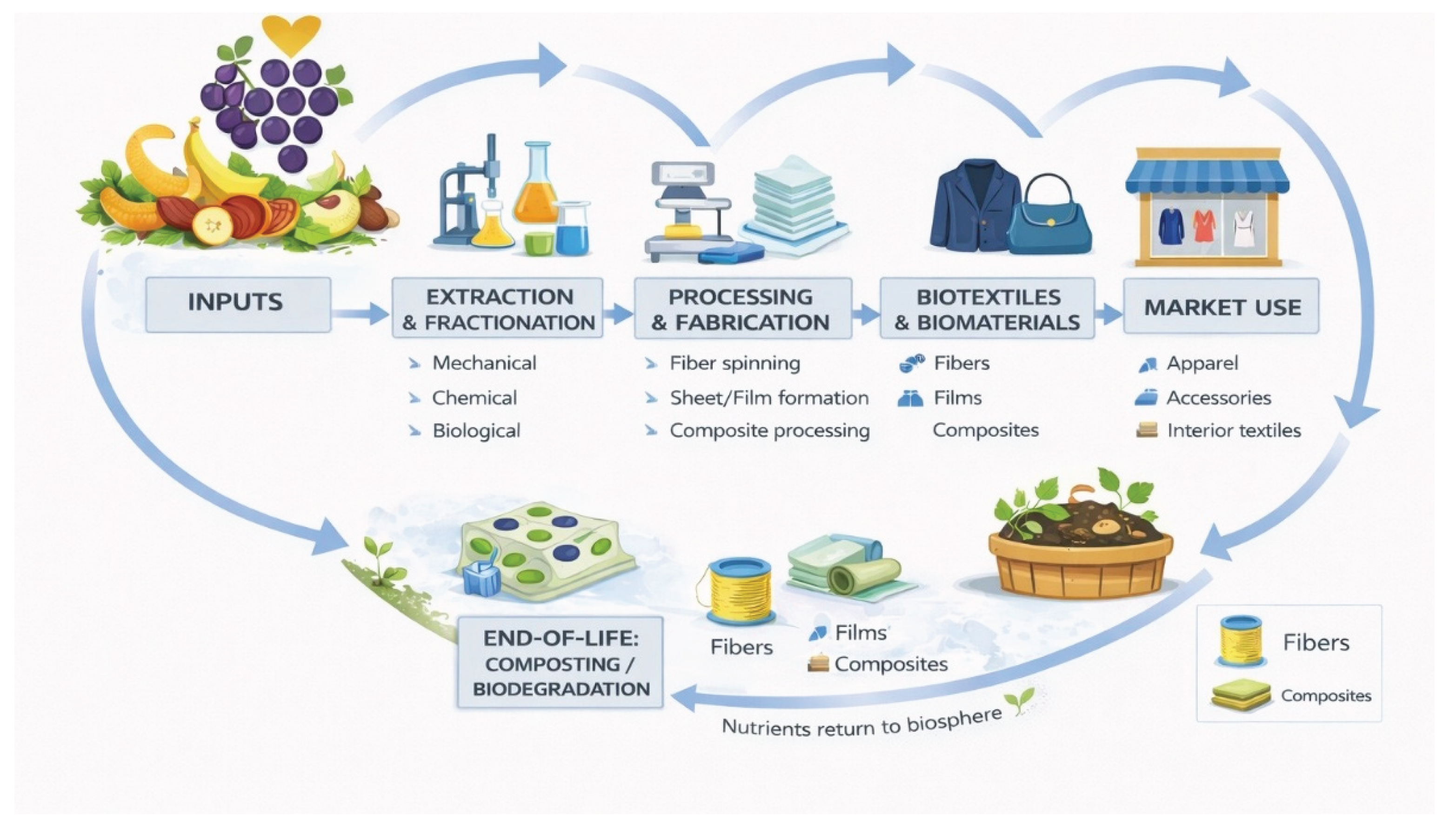
Figure 3 illustrates the closed-loop lifecycle of agricultural residue valorization, showing how fruit and nut waste streams are transformed into biotextiles and ultimately reintegrated into natural systems at end-of-life (EoL). This model emphasizes resource efficiency, cascading use of biomass, and alignment with circular bioeconomy principles by ensuring that materials return safely to the biosphere after use.
4. Economic Impact Assessment and Market Opportunities
The economic viability and market potential of valorizing fruit and nut agricultural residues into biomaterials and biotextiles are increasingly recognized as strong drivers for industrial uptake, particularly when residue streams are treated as strategic, low-cost feedstocks within integrated regional supply chains [11,15]. In parallel, policy frameworks that incentivize circular bioeconomy transitions, together with brand-level sustainability commitments, are accelerating demand for bio-based alternatives and creating clearer market pull for residue-derived materials [22].
4.1. Cost and Value Chain Integration
One of the most compelling economic advantages of utilizing agricultural residues is the reduction in raw material and feedstock procurement costs, because residues are generated as by-products and can often be sourced locally with limited land- and input-related cost burdens compared with dedicated fiber crops [5,6]. In practical terms, this can translate into substantial savings along the value chain, and multiple techno-economic and sectoral assessments indicate that cost reductions can reach up to ~60% under favorable sourcing and preprocessing conditions compared with conventional synthetic or virgin natural-fiber routes [11,15].
Beyond feedstock pricing, strategic co-location of agri-processing facilities with preprocessing and textile-material conversion units can improve profitability by lowering transportation costs, reducing handling losses, and stabilizing supply logistics, particularly for moist residues (e.g., pomace) that are costly to transport over long distances [11,23]. Such localized value-chain architectures are also associated with lower logistics-related emissions and can support rural employment, supplier diversification, and stronger regional industrial resilience, key objectives aligned with circular economy policy directions in the EU [22].
4.2. Global Market Trends
Market dynamics further reinforce the strategic importance of this sector. According to UNIDO, the global biomaterials market was valued at USD 61.4 billion (2020) and is projected to exceed USD 125 billion by 2030, indicating strong growth expectations that can stimulate investment into bio-based fiber, film, and composite value chains [8]. Within this broader expansion, biotextiles are positioned to capture a growing share as sustainability requirements intensify in fashion, packaging, and mobility-related sectors (e.g., automotive interiors), where renewable and lower-impact material inputs are increasingly prioritized [8,22].
Policy and funding instruments in Europe are also shaping the innovation landscape. The Circular Bio-based Europe Joint Undertaking (CBE JU) functions as a public–private partnership under Horizon Europe to support the scale-up and deployment of competitive bio-based industries, directly strengthening the financing environment for circular bioeconomy solutions (including bio-based textiles and materials) [45].
In parallel, corporate actions signal stronger demand-side commitments to alternative and lower-impact material sourcing. For example, recent industry reporting highlights major brand engagement with next-generation cellulose-based material strategies and multi-year agreements intended to reduce reliance on virgin feedstocks, reflecting the broader shift toward circular and bio-based supply chains (examples Stella McCartney and H&M Conscious) [46,47]. Wider cross-brand initiatives and public sustainability commitments, reinforced through multi-stakeholder fashion-climate programs, also indicate that the adoption of alternative materials is increasingly treated as a structural transition rather than a niche trend [48].
4.3. Potential for Greece
Greece is well positioned to translate residue availability into bio-industrial activity due to its high and geographically concentrated production of olives and grapes, which generate substantial volumes of process residues suitable for biomaterial and biotextile conversion [24]. Conservative scenario estimates suggest that if ~20% of annual olive pomace and grape pomace streams were converted into biotextiles, Greece could potentially generate ~5,000 jobs (notably in rural regions) and contribute up to EUR 150 million per year in new bio-industrial output [49].
Critically, these opportunities become more realistic when combined with (i) decentralized preprocessing near feedstock sources (to reduce logistics burdens), (ii) technology pathways aligned with scalable cellulose/fiber and film/composite production routes, and (iii) enabling policy mechanisms that de-risk investment and stimulate demand through circular procurement and innovation funding [11,22].
5. Environmental Sustainability and Life Cycle Assessment (LCA)
The environmental advantages of producing biomaterials and biotextiles from fruit and nut agricultural residues are substantial and can be systematically evaluated through Life Cycle Assessment (LCA). LCA is a standardized methodological framework (ISO 14040/14044) [50] that quantifies environmental impacts across the entire life cycle of a product, encompassing raw material sourcing, processing, manufacturing, use, and EoL stages [51,52]. Applying LCA to biotextiles enables a transparent comparison with conventional textile materials, such as polyester and cotton, and provides a robust scientific basis for assessing sustainability performance within a circular bioeconomy context.
A growing body of literature demonstrates that residue-derived biotextiles consistently outperform conventional textiles across key environmental indicators, including water consumption, greenhouse gas (GHG) emissions, land-use intensity, and EoL performance [10,26,41,51,53]. These benefits arise primarily from the use of secondary biomass streams that do not require dedicated cultivation, irrigation, or land conversion, thereby avoiding upstream environmental burdens associated with fiber crop production and fossil-based polymer synthesis.
Table 2 summarizes indicative LCA-based performance metrics comparing conventional textiles with biotextiles derived from agricultural residues, based on harmonized literature values and cradle-to-gate or cradle-to-grave system boundaries. Although absolute values vary depending on feedstock type, processing route, and system boundaries, the overall trends are consistent across multiple LCA studies.
5.1. Water Footprint Reduction
One of the most significant environmental benefits of biotextiles derived from fruit and nut residues is their markedly reduced water footprint. Conventional cotton cultivation is among the most water-intensive agricultural activities, requiring up to 10,000 L of water per kilogram of fiber, largely due to irrigation demands [10,54]. In contrast, residue-based biotextiles eliminate agricultural water inputs entirely, as feedstocks are generated as by-products of food production [55].
Water use in biotextile systems is primarily associated with preprocessing, extraction, and material conversion steps, resulting in typical values around 400-600 L/kg of material [26,41,54]. This represents a reduction of up to 95% compared with cotton-based textiles, making residue-derived biotextiles particularly attractive for deployment in water-scarce regions and under increasingly restrictive water-management policies [54,55].
5.2. Greenhouse Gas Emissions and Energy Demand
Synthetic fibers such as polyester exhibit high GHG emissions due to their reliance on fossil-based feedstocks and energy-intensive polymerization processes, with cradle-to-gate emissions commonly exceeding 9 kg CO₂-eq/kg of fiber [10,51]. Cotton textiles, although bio-based, also incur substantial emissions associated with fertilizer application, irrigation, and land management practices. In contrast, LCA studies consistently report significantly lower GHG emissions for agricultural-residue-based biotextiles, typically below 2 kg CO₂-eq/kg [26,29,51,53].
As summarized in Table 2, biotextiles exhibit emissions of around 1.6 kg CO₂/kg, corresponding to a reduction of approximately 70-80% relative to conventional synthetic fibers. These reductions are primarily attributed to the use of renewable biomass feedstocks and less energy-intensive processing routes, and they are further enhanced when decentralized or regionally integrated processing models are applied, reducing transportation-related emissions and supporting localized circular value chains [10,26,33,53,56]. Such emission reductions contribute directly to climate change mitigation objectives and the transition toward lower-carbon textile production systems.
5.3. Land Use and Circular Resource Efficiency
A critical environmental advantage of residue-based biotextiles is the absence of additional land-use requirements [57]. Unlike cotton and other fiber crops cultivated specifically for textile production, biotextiles derived from fruit and nut residues utilize waste streams generated by existing agricultural systems, thereby avoiding land expansion, deforestation, and indirect land-use change [22,41,58]. This benefit is quantitatively reflected in Table 2, where land-use intensity for biotextiles (0.1 m²/kg) is substantially lower than that of cotton (2.6 m²/kg), highlighting the land-efficiency of residue-based feedstocks.
From a circular economy perspective, this approach exemplifies cascading biomass utilization, in which food production remains the primary function of agricultural systems while material valorization occurs as a secondary, high-value pathway [4,22,59]. LCA-based ecodesign studies further demonstrate that such strategies enhance overall resource efficiency and minimize environmental trade-offs across the life cycle, supporting sustainable land-use management and circular bioeconomy objectives [46,60].
5.4. End-of-Life Performance and Biodegradability
EoL considerations are increasingly recognized as a critical component of textile sustainability. Conventional synthetic textiles contribute to persistent waste streams and microplastic pollution, while even natural fibers may be problematic if blended with non-biodegradable components [61,62].
Biotextiles derived from lignocellulosic agricultural residues exhibit inherently favorable EoL characteristics, including biodegradability and compatibility with composting or biological treatment routes, provided that auxiliary additives and coatings are appropriately selected [63,64]. Recent LCA and EoL assessments highlight that integrating ecodesign principles, such as mono-material construction, biodegradable finishes, and avoidance of toxic auxiliaries, can further enhance circularity and reduce downstream environmental burdens [65,66].
6. Internet of Things (IoT) Market Overview and Relevance to Biomaterials
The rapid expansion of the Internet of Things (IoT) is transforming industrial systems by enabling real-time data acquisition, connectivity, and intelligent decision-making across complex value chains. Within the context of sustainable biomaterials and biotextiles, IoT technologies offer important opportunities to enhance material traceability, process efficiency, resource optimization, and circularity. The integration of IoT systems is increasingly recognized as a key enabler for scaling bio-based material systems while maintaining transparency and environmental performance [67].
6.1. Global IoT Market Trends
The global IoT market is undergoing rapid expansion, driven by advances in connectivity, cloud computing, data analytics, and the increasing deployment of connected devices across industrial and consumer applications [68]. Recent market assessments highlight both the scale and the growth dynamics of IoT, underscoring its relevance for digitally enabled and sustainability-oriented sectors such as biomaterials and biotextiles [69].
Quantitative estimates from leading market intelligence sources are summarized in Table 3, which compares IoT market size forecasts reported by Statista and Fortune Business Insights across different reference years. According to Statista, global IoT revenues are projected to reach approximately USD 1.06 trillion by 2025, increasing further to USD 1.56 trillion by 2029, corresponding to a compound annual growth rate (CAGR) of approximately 10.17% over the 2025-2029 period [38]. Industrial IoT (IIoT) represents a dominant segment within this growth, reflecting strong adoption in manufacturing, logistics, and process industries.
Complementary projections from Fortune Business Insights indicate an even more accelerated expansion trajectory. The global IoT market was valued at USD 595.73 billion in 2023 and is expected to grow from USD 714.48 billion in 2024 to over USD 4.06 trillion by 2032, corresponding to a CAGR of 24.3% [40]. These forecasts highlight the increasing penetration of IoT technologies across sectors and regions, with North America currently holding the largest market share due to advanced digital infrastructure and early adoption of smart industrial systems.
Table 3 presents a comparative overview of IoT market size forecasts derived from the two sources. Table highlights both the magnitude of the global IoT market and the variability in long-term projections, reflecting differences in methodological assumptions, sectoral coverage, and growth expectations. Values demonstrate that IoT represents a rapidly expanding technological domain with substantial economic significance. This growth creates favorable conditions for the integration of IoT solutions into biomaterials and biotextile value chains, where digital monitoring, traceability, and smart process control can support sustainability objectives and industrial scalability.
6.2. Relevance of IoT to Biomaterials and Biotextiles
The convergence of IoT technologies with biomaterials and biotextiles introduces new functional and operational capabilities across the entire life cycle of bio-based products, from agricultural residue sourcing to manufacturing, use, and EoL management. Beyond data collection, the integration of advanced machine learning frameworks enables autonomous interpretation of complex datasets and adaptive decision-making under dynamic conditions.
Smart and Functional Biotextiles. IoT-enabled sensors can be integrated into biotextiles to create smart materials capable of monitoring environmental conditions, mechanical stress, or physiological parameters. Such applications are particularly relevant for healthcare, sports, and protective textiles, where bio-based fibers can be combined with embedded sensing elements to deliver functionality while maintaining reduced environmental footprints [70]. When coupled with adaptive learning algorithms, these systems can dynamically interpret sensor signals, adjust responses in real time, and improve performance over repeated use cycles.
Supply Chain Traceability and Transparency. IoT systems enable continuous monitoring of temperature, humidity, location, and handling conditions during the collection, transport, and processing of agricultural residues and biomaterials. When combined with digital platforms and blockchain technologies, IoT supports end-to-end traceability, ensuring material integrity, quality control, and verified sustainability claims. Advanced learning frameworks, such as Open World Machine Learning (OWML), further enhance these systems by enabling continuous adaptation to previously unseen events, process deviations, or supply disruptions, thereby strengthening traceability and resilience across complex bio-based value chains [71,72].
Precision Agriculture and Residue Optimization. IoT-enabled precision agriculture systems allow real-time monitoring of soil moisture, nutrient availability, and crop health, supporting optimized agricultural practices and improved residue quality. By enhancing yield predictability and reducing variability in biomass composition, these technologies contribute to more stable and reliable feedstock streams for biomaterial production without increasing land or resource inputs [73].
Waste Management and Circularity. IoT applications extend to waste collection, sorting, and recycling systems, facilitating efficient management of agricultural residues and post-consumer biotextile waste. Smart bins, sensor-based sorting technologies, and data-driven logistics improve recovery rates and enable closed-loop material flows, reinforcing circular economy objectives and reducing landfill dependency [74].
The integration of IoT technologies into biomaterial and biotextile value chains enhances process control, transparency, and resource efficiency, supporting both environmental and economic sustainability objectives. By enabling real-time data flows and adaptive management, IoT systems can reduce material losses, improve life-cycle performance, and strengthen consumer trust through verified sustainability information. As digital and bio-based transitions increasingly converge, IoT combined with open-world learning approaches is expected to play a critical enabling role in the industrial scaling of circular biomaterials.
7. Acceptability of Environment-Friendly Materials
Growing consumer awareness of environmental degradation, climate change, and ethical production practices has significantly increased demand for sustainable and eco-friendly materials across the textile and fashion sectors [75,76]. Empirical studies consistently report positive consumer perceptions toward environmentally friendly textiles, particularly when sustainability attributes are clearly communicated and verified. Compared to conventional products, sustainable textiles are associated with higher perceived quality, enhanced product value, stronger purchase intention, and increased likelihood of repurchase [77].
The use of sustainable materials has emerged as a decisive purchasing criterion for a substantial share of consumers, alongside traditional factors such as price, durability, and aesthetics [78]. This shift is particularly pronounced among younger and environmentally conscious demographics, reflecting broader societal transitions toward responsible consumption patterns. As a result, brands increasingly recognize sustainability not only as an ethical imperative but also as a source of competitive advantage.
Despite this positive trajectory, several barriers continue to hinder widespread adoption. These include higher production costs, supply-chain complexity, limited economies of scale, and persistent misconceptions regarding the performance, durability, and comfort of bio-based textiles [79]. However, ongoing advances in material science, improved processing efficiency, and strengthening regulatory frameworks are progressively mitigating these challenges. Major brands are actively investing in sustainable material portfolios, including organic fibers, recycled polymers, and bio-based alternatives, to reduce environmental impacts while responding to evolving consumer expectations [80,81,82].
8. Policy Recommendations and Strategic Roadmap for Greece
To fully harness Greece’s potential within the emerging biomaterials and biotextiles sector, coordinated policy action, targeted research investment, and active stakeholder engagement are essential. The following strategic recommendations outline a roadmap for integrating agricultural residue valorization into national circular bioeconomy objectives.
8.1. Incentivizing Circular Bioeconomy Hubs
The establishment of regional circular bioeconomy hubs represents a cornerstone for localized value creation and industrial scaling. Such hubs would function as integrated centers for residue collection, preprocessing, biofabrication, and material development.
Regional biofabrication centers. Strategic placement in high-production areas such as the Peloponnese (citrus and olives), Crete (grapes, olives, figs), and Thessaly (almonds and other crops) would reduce transportation requirements, lower emissions, and strengthen rural economies [83].
EU and national funding mechanisms. Leveraging European Green Deal instruments, the Circular Bio-based Europe Joint Undertaking (CBE JU), and National Strategic Reference Framework (NSRF) programs can provide essential financial support for infrastructure, technology deployment, and workforce development [45,84].
8.2. Regulatory and R&D Support
A supportive regulatory environment, combined with robust research and development infrastructure, is critical for overcoming technological, economic, and market barriers.
Fiscal incentives for biomaterial SMEs. Targeted tax reductions and subsidies for small and medium-sized enterprises can stimulate innovation, reduce financial risk, and accelerate market entry for bio-based products [85].
National R&D platforms. Dedicated research platforms focused on biopolymer extraction, material characterization, scale-up validation, and standardized testing would foster collaboration between academia, industry, and government, strengthening Greece’s innovation capacity [86].
Importantly, policy design must also explicitly address long-term EoL management of emerging bio-based materials. Experience from other rapidly expanding renewable technology sectors demonstrates that insufficient early-stage planning can lead to substantial downstream waste management challenges. For example, projections of photovoltaic panel waste volumes in the European Union highlight the urgency of proactive regulatory frameworks, recycling infrastructure development, and circular design integration well before large-scale deployment occurs [87]. Incorporating similar foresight into biomaterials and biotextiles policy can help prevent future waste bottlenecks and ensure that circular bioeconomy objectives are achieved in practice.
8.3. Farmer and Cooperative Engagement
Active participation of agricultural stakeholders is fundamental for securing reliable feedstock streams and ensuring equitable value distribution.
Valorization contracts with cooperatives. Formal agreements for residue collection and preprocessing can generate additional income streams for farmers while promoting sustainable waste management practices [88].
9. Conclusions and Future Research Directions
This review demonstrates that fruit and nut agricultural residues constitute a highly promising feedstock for the sustainable production of advanced biomaterials and biotextiles. Their valorization offers clear environmental advantages, including reduced greenhouse gas emissions, lower water consumption, minimal land-use impacts, and improved end-of-life performance, while simultaneously delivering economic and social benefits. Greece, with its abundant agricultural residue streams and alignment with European circular economy policies, is well positioned to emerge as a regional leader in this domain.
Nevertheless, realizing this potential requires continued research, innovation, and coordinated policy implementation. Key future research directions include:
- Scaling enzymatic and microbial extraction technologies. Further optimization and industrial scaling of bio-based extraction processes are required to improve efficiency, reduce costs, and enhance process robustness.
- Standardization and certification of biotextiles. The development of harmonized standards and certification schemes is essential for ensuring product credibility, facilitating market acceptance, and strengthening consumer trust.
- Techno-economic assessment of decentralized models. Comprehensive techno-economic and life cycle evaluations of decentralized residue-processing systems are needed to quantify economic feasibility, environmental benefits, and social impacts under real-world conditions.
By addressing these challenges and implementing the proposed strategic roadmap, Greece can effectively leverage its agricultural heritage to build a resilient, innovative, and sustainable biomaterials and biotextiles sector, contributing to national economic development and global sustainability objectives.
Author Contributions
Conceptualization, G.Z. and K.K.; methodology, K.K and G.Z.; validation, S.P, D.N. and E.S.; investigation, K.K and N.G; resources, K.K, S.P., D.N. and G.P.; data curation, D.N and N.G.; writing—original draft preparation, G.Z and K.K.; writing—review and editing, K.K., S.P, D.N, E.S.; visualization, K.K and G.Z.; supervision, G.Z. and G.P.; project administration, G.P.; funding acquisition, G.P. All authors have read and agreed to the published version of the manuscript.
Funding
This research received no external funding.
Data Availability Statement
No new data were created or analyzed in this study. Data sharing is not applicable to this article.
Acknowledgments
During the preparation of this manuscript, the authors used Google Gemini for language editing, formatting assistance, and improvement of clarity and readability. In addition, ChatGPT (version 5.2) was used for the generation of Figure 3. Maps were created using MapChart and are licensed under the Creative Commons Attribution–ShareAlike 4.0 International License (CC BY-SA 4.0). The authors have reviewed and edited all content generated using these tools and take full responsibility for the integrity, accuracy, and originality of the final manuscript.
Conflicts of Interest
The authors declare no conflicts of interest.
Abbreviations
The following abbreviations are used in this manuscript:
| AI | Artificial Intelligence |
| AGPHF | Advanced Graph–Physics Hybrid Framework |
| CAGR | Compound Annual Growth Rate |
| CBE JU | Circular Bio-based Europe Joint Undertaking |
| CC BY | Creative Commons Attribution license |
| CO₂ | Carbon Dioxide |
| CO₂-eq | Carbon Dioxide Equivalent |
| EoL | End-of-Life |
| EU | European Union |
| GHG | Greenhouse Gas |
| ICT | Information and Communication Technologies |
| IIoT | Industrial Internet of Things |
| IoT | Internet of Things |
| ISO | International Organization for Standardization |
| LCA | Life Cycle Assessment |
| LCI | Life Cycle Inventory |
| ML | Machine Learning |
| NSRF | National Strategic Reference Framework |
| OWML | Open World Machine Learning |
| PHA | Polyhydroxyalkanoate |
| PLA | Polylactic Acid |
| SME | Small and Medium-sized Enterprise |
| UNIDO | United Nations Industrial Development Organization |
| USD | United States Dollar |
| UV | Ultraviolet |
References
- European Environment Agency. Textiles and the Environment: The Role of Design in a Circular Economy; EEA: Copenhagen, Denmark, 2022; Available online: https://www.eea.europa.eu/publications/textiles-and-the-environment (accessed on 10 January 2026).
- World Bank. Fashion on Climate: How the Fashion Industry Can Urgently Act to Reduce Its Greenhouse Gas Emissions; World Bank: Washington, DC, USA, 2020; Available online: https://www.worldbank.org/en/topic/sustainabledevelopment/publication/fashion-on-climate (accessed on 20 December 2025).
- Ellen MacArthur Foundation. A New Textiles Economy: Redesigning Fashion’s Future; EMF: Cowes, UK, 2017; Available online: https://ellenmacarthurfoundation.org/our-work/activities/make-fashion-circular/a-new-textiles-economy (accessed on 15 December 2025).
- Sillanpää, M.; Ncibi, C. The Circular Economy: Concepts, Applications, and Case Studies; Academic Press: London, UK, 2019; Available online: https://www.elsevier.com/books/the-circular-economy/sillanpaa/978-0-12-818402-4.
- FAO. Agricultural Waste Management; Food and Agriculture Organization of the United Nations: Rome, Italy, 2021; Available online: https://www.fao.org/sustainable-development-goals/indicators/1231/en/.
- Ammayappan, L.; Nallusamy, S. Valorization of agricultural waste for sustainable textile production: A review. J. Clean. Prod. 2021, 297, 126653. [Google Scholar] [CrossRef]
- Ellen MacArthur Foundation. Completing the Picture: How the Circular Economy Tackles Climate Change; EMF: Cowes, UK, 2021; Available online: https://www.ellenmacarthurfoundation.org/completing-the-picture (accessed on 10 December 2025).
- UNIDO. Bioplastics and Biomaterials: Opportunities and Challenges; United Nations Industrial Development Organization: Vienna, Austria, 2021; Available online: https://www.unido.org/sites/default/files/2021-06/Bioplastics%20and%20Biomaterials_Opportunities%20and%20Challenges.pdf.
- Siqueira, M.U.; Contin, B.; Fernandes, P.R.B.; Ruschel-Soares, R.; Baruque-Ramos, J. Brazilian agro-industrial wastes as potential textile and other raw materials. Mater. Circ. Econ. 2022, 4, 9. [Google Scholar] [CrossRef]
- Pimenta, A.; Moraes, D. Life cycle assessment of bio-based textiles: A review. J. Ind. Ecol. 2021, 25, 1375–1390. [Google Scholar] [CrossRef]
- Sholokhova, A.; Varžinskas, V.; Rutkaitė, R. Valorization of agro-waste in bio-based and biodegradable polymer composites: A European perspective. Waste Biomass Valor. 2025, 16, 1537–1571. [Google Scholar] [CrossRef]
- Orange Fiber, S.r.l. Citrus-Based Sustainable Textiles; Catania, Italy, 2020. [Google Scholar]
- Taymaz, E.R.; Uslu, M.E. Innovations in biocompatible materials: Exploring the potential of cellulose nanocrystals from grape pomace. Chem. Pap. 2024, 78, 5445–5455. [Google Scholar] [CrossRef]
- Waithaka, A.; Plakantonaki, S.; Kiskira, K.; Mburu, A.W.; Chronis, I.; Zakynthinos, G.; Githaiga, J.; Priniotakis, G. Cellulose-Based Biopolymers from Banana Pseudostem Waste: Innovations for Sustainable Bioplastics. Waste 2025, 3, 37. [Google Scholar] [CrossRef]
- Dantas, M.P.; Oliveira, C.R.S.; Corrêa, R.C.G.; et al. Pathways in agro-industrial waste upcycling for sustainable textiles. Plants 2025, 14, 3574. [Google Scholar] [CrossRef] [PubMed]
- Sholokhova, A.; Varžinskas, V.; Rutkaitė, R. Valorization of agro-waste in bio-based and biodegradable polymer composites: A comprehensive review with emphasis on Europe perspective. Waste Biomass Valor. 2025, 16, 1537–1571. [Google Scholar] [CrossRef]
- Carnaval, L.S.C.; Jaiswal, A.K.; Jaiswal, S. Agro-Food Waste Valorization for Sustainable Bio-Based Packaging. J. Compos. Sci. 2024, 8, 41. [Google Scholar] [CrossRef]
- Plakantonaki, S.; Zacharopoulos, N.; Christopoulos, M.; Kiskira, K.; Markou, G.; Tsakanika, L.-A.; Priniotakis, G. Upcycling industrial peach waste to produce dissolving pulp. Environ. Sci. Pollut. Res. 2025, 32, 4636–4655. [Google Scholar] [CrossRef]
- Baseri, S. Management of agricultural waste in green multifunctional finishing of wool yarns using ultrasonic environment. Fibers Polym. 2025, 26, 5159–5172. [Google Scholar] [CrossRef]
- Choudhury, A.K.R. Sustainable and Nonconventional Textiles; Springer: Singapore, 2020. [Google Scholar]
- Walawska, A.; Olak-Kucharczyk, M.; Kaczmarek, A.; Kudzin, M.H. Environmentally friendly bleaching process of the cellulose fibres materials using ozone and hydrogen peroxide in the gas phase. Materials 2024, 17, 1355. [Google Scholar] [CrossRef]
- European Commission. A New Circular Economy Action Plan. EC: Brussels, Belgium, 2020; Available online: https://eur-lex.europa.eu/legal-content/EN/TXT/HTML/?uri=CELEX:52020DC0098 (accessed on 15 January 2026).
- European Environment Agency. Bio-waste in Europe; EEA: Copenhagen, Denmark, 2021; Available online: https://www.eea.europa.eu/en/analysis/publications/bio-waste-in-europe (accessed on 15 January 2026).
- Food and Agriculture Organization of the United Nations (FAO). Agricultural production statistics 2010–2023: FAOSTAT Analytical Brief No. 96. Rome, Italy, 2024. Available online: https://openknowledge.fao.org/items/ab36b259-d641-4ded-8832-32f579685be7 (accessed on 17 January 2026).
- Plakantonaki, S.; Kiskira, K.; Zacharopoulos, N.; Belessi, V.; Sfyroera, E.; Priniotakis, G.; Athanasekou, C. Investigating the routes to produce cellulose fibers from agro-waste: An upcycling process. ChemEngineering 2024, 8, 112. [Google Scholar] [CrossRef]
- Kiskira, K.; Plakantonaki, S.; Gerolimos, N.; Kalkanis, K.; Sfyroera, E.; Coelho, F.; Priniotakis, G. Life Cycle Optimization of Circular Industrial Processes: Advances in By-Product Recovery for Renewable Energy Applications. Clean Technol. 2026, 8, 5. [Google Scholar] [CrossRef]
- Plakantonaki, S.; Stergiou, M.; Panagiotatos, G.; Kiskira, K.; Priniotakis, G. Regenerated Cellulosic Fibers from Agricultural Waste. AIP Conf. Proc. 2022, 2430, 080006. [Google Scholar] [CrossRef]
- Bano, S.; Arshad, M.; Imran, M. Sustainable extraction of lignocellulosic biomass from agricultural waste for value-added products: A review. Environ. Technol. Innov. 2022, 27, 102492. [Google Scholar] [CrossRef]
- Kiskira, K.; Gerolimos, N.; Priniotakis, G.; Nikolopoulos, D. Life-Cycle Assessment of Innovative Industrial Processes for Photovoltaic Production: Process-Level LCIs, Scale-Up Dynamics, and Recycling Implications. Appl. Sci. 2026, 16, 501. [Google Scholar] [CrossRef]
- García, I.M.; López-Mesa, B. Lignin valorization from agricultural residues: A review of extraction methods and applications. Ind. Crops Prod. 2023, 196, 116512. [Google Scholar] [CrossRef]
- Matei, E.; Râpă, M.; Predescu, A.M.; Turcanu, A.A.; Vidu, R.; Predescu, C.; Bobirica, C.; Bobirica, L.; Orbeci, C. Valorization of agri-food wastes as sustainable eco-materials for wastewater treatment: Current state and new perspectives. Materials 2021, 14, 4581. [Google Scholar] [CrossRef]
- Castagna, A.; Aboudia, A.; Guendouz, A.; Scieuzo, C.; Falabella, P.; Matthes, J.; Schmid, M.; Drissner, D.; Allais, F.; Chadni, M.; et al. Transforming agricultural waste from Mediterranean fruits into renewable materials and products with a circular and digital approach. Materials 2025, 18, 1464. [Google Scholar] [CrossRef]
- Kiskira, K.; Lalopoulou, A.; Kalkanis, K.; Vokas, G. Closing the Loop on Solar: A Sustainability Assessment of Photovoltaic Recycling in Greece. Energies 2025, 18, 6314. [Google Scholar] [CrossRef]
- Tu, H.; Zhu, M.; Duan, B.; Zhang, L. Recent progress in high-strength and robust regenerated cellulose materials. Adv. Mater. 2021, 33, 2000682. [Google Scholar] [CrossRef]
- Popa, V.I. Pulp Production and Processing: High-Tech Applications; Walter de Gruyter GmbH & Co. KG: Berlin, Germany, 2020. [Google Scholar]
- Xiang, T.; Yang, R.; Li, L.; Lin, H.; Kai, G. Research progress and application of pectin: A review. J. Food Sci. 2024, 89, 6985–7007. [Google Scholar] [CrossRef] [PubMed]
- Nutraceutics from Agri-Food By-Products; Spizzirri, U.G., Ed.; John Wiley & Sons: Hoboken, NJ, USA, 2023. [Google Scholar]
- Statista. Internet of Things (IoT) - Worldwide. Available online: https://www.statista.com/outlook/tmo/internet-of-things/worldwide (accessed on 17 January 2026).
- Kalkanis, K.; Kiskira, K.; Papageorgas, P.; Kaminaris, S.D.; Piromalis, D.; Banis, G.; Mpelesis, D.; Batagiannis, A. Advanced manufacturing design of an emergency mechanical ventilator via 3D printing—Effective crisis response. Sustainability 2023, 15, 2857. [Google Scholar] [CrossRef]
- Fortune Business Insights. Internet of Things (IoT) Market Size, Share & COVID-19 Impact Analysis. Available online: https://www.fortunebusinessinsights.com/industry-reports/internet-of-things-iot-market-100307 (accessed on 10 January 2026).
- Kalkanis, K.; Vokas, G.; Kiskira, K.; Psomopoulos, C.S. Investigating the sustainability of wind turbine recycling: A case study—Greece. Mater. Circ. Econ. 2024, 6, 52. [Google Scholar] [CrossRef]
- Zare, A. Citric acid as environment-friendly crease-resistance finishing agent for silk fabric combined with β-cyclodextrin. Res. J. Text. Appar. 2022, 26, 238–254. [Google Scholar] [CrossRef]
- Sarwar, A.; Jabbar, A.; Riaz, S.; et al. Enhancement in the dyeability of bamboo fabric by using an isocyanate-based crosslinking agent. Cellulose 2024, 31, 6501–6516. [Google Scholar] [CrossRef]
- Olonisakin, K.; Mohanty, A.K.; Thimmanagari, M.; Misra, M. Recent advances in biodegradable polymer blends and their biocomposites: A comprehensive review. Green Chem. 2025, 27, 11656–11704. [Google Scholar] [CrossRef]
- European Commission. Circular Bio-based Europe Joint Undertaking (CBE JU). Circular Bio-based Europe Joint Undertaking (Factsheet/Overview); Horizon Europe: Brussels, Belgium, n.d.; Available online: https://www.horizonteeuropa.es/sites/default/files/inline-files/Circular%20Bio-based%20Europe%20Joint%20Undertaking.pdf (accessed on 17 January 2026).
- Business, Vogue. H&M Group Inks Multi-Year Deal with Circulose; Vogue Business: London, UK, 2025; Available online: https://www.vogue.com/article/handm-group-inks-multi-year-deal-with-circulose (accessed on 16 January 2026).
- McCartney, Stella. Sustainability. Available online: https://www.stellamccartney.com/us/en/sustainability (accessed on 10 January 2026).
- The Guardian. G7 and Fashion Houses Join Forces to Make Clothes More Sustainable; The Guardian: London, UK, 2019; Available online: www.theguardian.com/world/2019/aug/21/fashion-g7-summit-sustainability-kering-inditex-macron (accessed on 17 January 2026).
- H; M Group. Annual and Sustainability Report 2024; H&M Group: Stockholm, Sweden, 2025; Available online: https://hmgroup.com/wp-content/uploads/2025/03/HM-Group-Annual-and-sustainability-report-2024.pdf.
- ISO 14040; Environmental Management—Life Cycle Assessment—Principles and Framework, Requirements and Guidelines. International Organization for Standardization: Geneva, Switzerland, 2006.
- Almeida, P.V.; Déda, D.; Gervásio, H.; Gando-Ferreira, L.M.; Quina, M.J. Life cycle assessment and eco-efficiency of biorefineries and conventional management strategies for agro-industrial residues. J. Clean. Prod. 2025, 517, 145895. [Google Scholar] [CrossRef]
- Kiskira, K.; Kalkanis, K.; Coelho, F.; Plakantonaki, S.; D’Onofrio, C.; Psomopoulos, C.S.; Priniotakis, G.; Ioannidis, G.C. Life cycle assessment of organic solar cells: Structure, analytical framework, and future product concepts. Electronics 2025, 14, 2426. [Google Scholar] [CrossRef]
- Hildebrandt, J.; Thrän, D.; Bezama, A. The circularity of potential bio-textile production routes: Comparing life cycle impacts of bio-based materials used within the manufacturing of selected leather substitutes. J. Clean. Prod. 2021, 287, 125470. [Google Scholar] [CrossRef]
- Network, Water Footprint. Water footprint of cotton. Available online: https://waterfootprint.org/en/water-footprint/product-water-footprint/water-footprint-cotton/ (accessed on 5 January 2026).
- Mikucionienė, D.; Mínguez-García, D.; Repon, M.R.; Milašius, R.; Priniotakis, G.; Chronis, I.; Kiskira, K.; Hogeboom, R.; Belda-Anaya, R.; Díaz-García, P. Understanding and addressing the water footprint in the textile sector: A review. AUTEX Res. J. 2024, 24, 20240004. [Google Scholar] [CrossRef]
- European Bioplastics. Bioplastics facts and figures. Available online: https://www.european-bioplastics.org/bioplastics/materials/ (accessed on 10 December 2025).
- Rana, P.; Sethi, S. Utilising agro-waste in textile industry: Advancing sustainability with a year-round waste cycle. Mater. Circ. Econ. 2025, 7, 30. [Google Scholar] [CrossRef]
- Hammar, T.; Peñaloza, D.; Hanning, A.-C. Life cycle assessment of a circular textile value chain: the case of a garment made from chemically recycled cotton. Int. J. Life Cycle Assess. 2024, 29, 1880–1898. [Google Scholar] [CrossRef]
- Burnstine, A.; Camargo, A. Bio-based textiles, circular innovation, and sustainability in emerging markets. Clothing Cult. Body 2025, 100194. [Google Scholar] [CrossRef]
- Parnell, K. Circular economy in the textile industry: a review of material value retention and waste avoidance strategies. Recycling 2025, 10, 225. [Google Scholar] [CrossRef]
- Zambrano, M.C.; Pawlak, J.J.; Daystar, J.; Ankeny, M.; Venditti, R.A. Microfibers generated from the laundering of cotton, rayon and polyester based fabrics and their aquatic biodegradation. Mar. Pollut. Bull. 2019, 142, 394–407. [Google Scholar] [CrossRef]
- De Falco, F.; Di Pace, E.; Cocca, M.; et al. The contribution of washing processes of synthetic clothes to microplastic pollution. Sci Rep 2019, 9, 6633. [Google Scholar] [CrossRef]
- Shen, L.; Patel, M.K. Life cycle assessment of polysaccharide materials: A review. J. Polym. Environ. 2008, 16, 154–167. [Google Scholar] [CrossRef]
- Patel, M.; Bastioli, C.; Marini, L.; Würdinger, E. Life-cycle assessment of bio-based polymers and natural fiber composites. Biopolymers Online: Biology, Chemistry, Biotechnology, Applications 2005, 10. [Google Scholar] [CrossRef]
- Mestre, A.; Cooper, T. Circular product design: A multiple loops life cycle design approach for the circular economy. Des. J. 2017, 20, S1620–S1635. [Google Scholar] [CrossRef]
- Bourtsalas, A.C.; Papadatos, P.E.; Kiskira, K.; Kalkanis, K.; Psomopoulos, C.S. Ecodesign for industrial furnaces and ovens: A review of the current environmental legislation. Sustainability 2023, 15, 9436. [Google Scholar] [CrossRef]
- Kouhizadeh, M.; Sarkis, J.; Zhu, Q. At the nexus of blockchain technology, the circular economy, and product deletion. Appl. Sci. 2019, 9, 1712. [Google Scholar] [CrossRef]
- McKinsey Global Institute. The Internet of Things: Catching Up to an Accelerating Opportunity; McKinsey & Company: New York, NY, USA, 2023; Available online: https://www.mckinsey.com/capabilities/tech-and-ai/our-insights/the-internet-of-things (accessed on 19 January 2026).
- Digitalisation and Energy; IEA Publications: Paris, France, 2022; Available online: https://www.iea.org/reports/digitalisation-and-energy (accessed on 15 January 2026).
- Ramaiah, G.B. Theoretical Analysis on Application Aspects of Smart Materials and Internet of Things (IoT) in Textile Technology. Materials Today: Proceedings 2021, 45, 4633–4638. [Google Scholar] [CrossRef]
- Khan, M.; Parvaiz, G.S.; Dedahanov, A.T.; Abdurazzakov, O.S.; Rakhmonov, D.A. The Impact of Technologies of Traceability and Transparency in Supply Chains. Sustainability 2022, 14, 16336. [Google Scholar] [CrossRef]
- Gerolimos, N.; Alevizos, V.; Edralin, S.; et al. Autonomous Decision-Making Enhancing Natural Disaster Management through Open World Machine Learning: A Systematic Review. Human-Centered Intelligence Systems 2025, 5, 269–284. [Google Scholar] [CrossRef]
- Atalla, S.; Tarapiah, S.; Gawanmeh, A.; Daradkeh, M.; Mukhtar, H.; Himeur, Y.; Mansoor, W.; Hashim, K.F.B.; Daadoo, M. IoT-Enabled Precision Agriculture: Developing an Ecosystem for Optimized Crop Management. Information 2023, 14, 205. [Google Scholar] [CrossRef]
- Lombardi, P.; Todella, E. Multi-Criteria Decision Analysis to Evaluate Sustainability and Circularity in Agricultural Waste Management. Sustainability 2023, 15, 14878. [Google Scholar] [CrossRef]
- IJRASET. Survey on Consumer Preference of Sustainable Textiles and Fashion. International Journal for Research in Applied Science & Engineering Technology. Available online: https://www.ijraset.com/best-journal/survey-on-consumer-preference-of-sustainable-textiles-and-fashion (accessed on 13 January 2026).
- Azad, M.A. Sustainable Manufacturing Practices in the Apparel Industry: Integrating Eco-Friendly Materials and Processes. TechRxiv 2025. [Google Scholar] [CrossRef]
- Li, M.; Choe, Y.H.; Gu, C. How perceived sustainability influences consumers’ clothing preferences. Scientific Reports 2024, 14, 28672. [Google Scholar] [CrossRef]
- McKinsey; Company. Survey: Consumer sentiment on sustainability in fashion. McKinsey Insights. 2020. Available online: https://www.mckinsey.com/industries/retail/our-insights/survey-consumer-sentiment-on-sustainability-in-fashion (accessed on 3 January 2026).
- Erzen, B.; Karataş, M.; Orhan, R.; Aydoğmuş, E. Advancements and challenges in biomaterials: Innovations, sustainability, and future prospects. Journal of Macromolecular Science, Part B 2025, 1–27. [Google Scholar] [CrossRef]
- Lindenwood University. Sustainable fashion: Exploring eco-friendly practices in the industry. 2024. Available online: https://online.lindenwood.edu/blog/sustainable-fashion-exploring-eco-friendly-practices-in-the-industry/ (accessed on 4 January 2026).
- 4Ocean. Sustainable fashion: Innovations in eco-friendly textiles. 2024. Available online: https://www.4ocean.com/blogs/industry-news/sustainable-fashion-innovations-in-eco-friendly-textiles (accessed on 19 January 2026).
- Plakantonaki, S.; Kiskira, K.; Zacharopoulos, N.; Chronis, I.; Coelho, F.; Togiani, A.; Kalkanis, K.; Priniotakis, G. A review of sustainability standards and ecolabeling in the textile industry. Sustainability 2023, 15, 11589. [Google Scholar] [CrossRef]
- European Commission. Regional policy. Available online: https://ec.europa.eu/regional_policy/index_en.cfm (accessed on 19 January 2026).
- European Structural and Investment Funds (ESIF). NSRF 2014–2020. Available online: https://www.espa.gr/en/Pages/default.aspx (accessed on 14 January 2026).
- European Commission. SME policy. Available online: https://ec.europa.eu/growth/smes/sme-policy_en (accessed on 19 January 2026).
- European Commission. Research and innovation. Available online: https://ec.europa.eu/info/research-and-innovation_en (accessed on 19 January 2026).
- Psomopoulos, C.S.; Kalkanis, K.; Chatzistamou, E.D.; Kiskira, K.; Ioannidis, G.C.; Kaminaris, S.D. End of Life Treatment of Photovoltaic Panels: Expected Volumes up to 2045 in the EU. AIP Conference Proceedings 2022, 2437, 020084. [Google Scholar] [CrossRef]
- European Network for Rural Development (ENRD). Co-operatives. Available online: https://enrd.ec.europa.eu/thematic-work/smart-and-competitive-rural-areas/co-operatives_en (accessed on 19 January 2026).
- de Priall, O.; Gogulancea, V.; Brandoni, C.; Hewitt, N.; Johnston, C.; Onofrei, G.; Huang, Y. Modelling and experimental investigation of small-scale gasification CHP units for enhancing the use of local biowaste. Waste Management 2021, 136, 174–183. [Google Scholar] [CrossRef] [PubMed]
- Mehdizadeh, M.; Omidi, A.; Matindike, R.; et al. Agri-waste valorization: Pathways to sustainable bioenergy and biochemical innovation. Circular Economy and Sustainability 2025, 5, 5247–5277. [Google Scholar] [CrossRef]
Figure 1.
Global overview of representative biotextile and biomaterial innovations derived from agricultural residues, including citrus peels, grape pomace, pineapple leaves, banana pseudostems, and fruit pulp by-products. The figure highlights selected commercial and pilot-scale initiatives across Europe, Asia, and North America and illustrates the diversity of residue-to-textile valorization pathways.
Figure 1.
Global overview of representative biotextile and biomaterial innovations derived from agricultural residues, including citrus peels, grape pomace, pineapple leaves, banana pseudostems, and fruit pulp by-products. The figure highlights selected commercial and pilot-scale initiatives across Europe, Asia, and North America and illustrates the diversity of residue-to-textile valorization pathways.
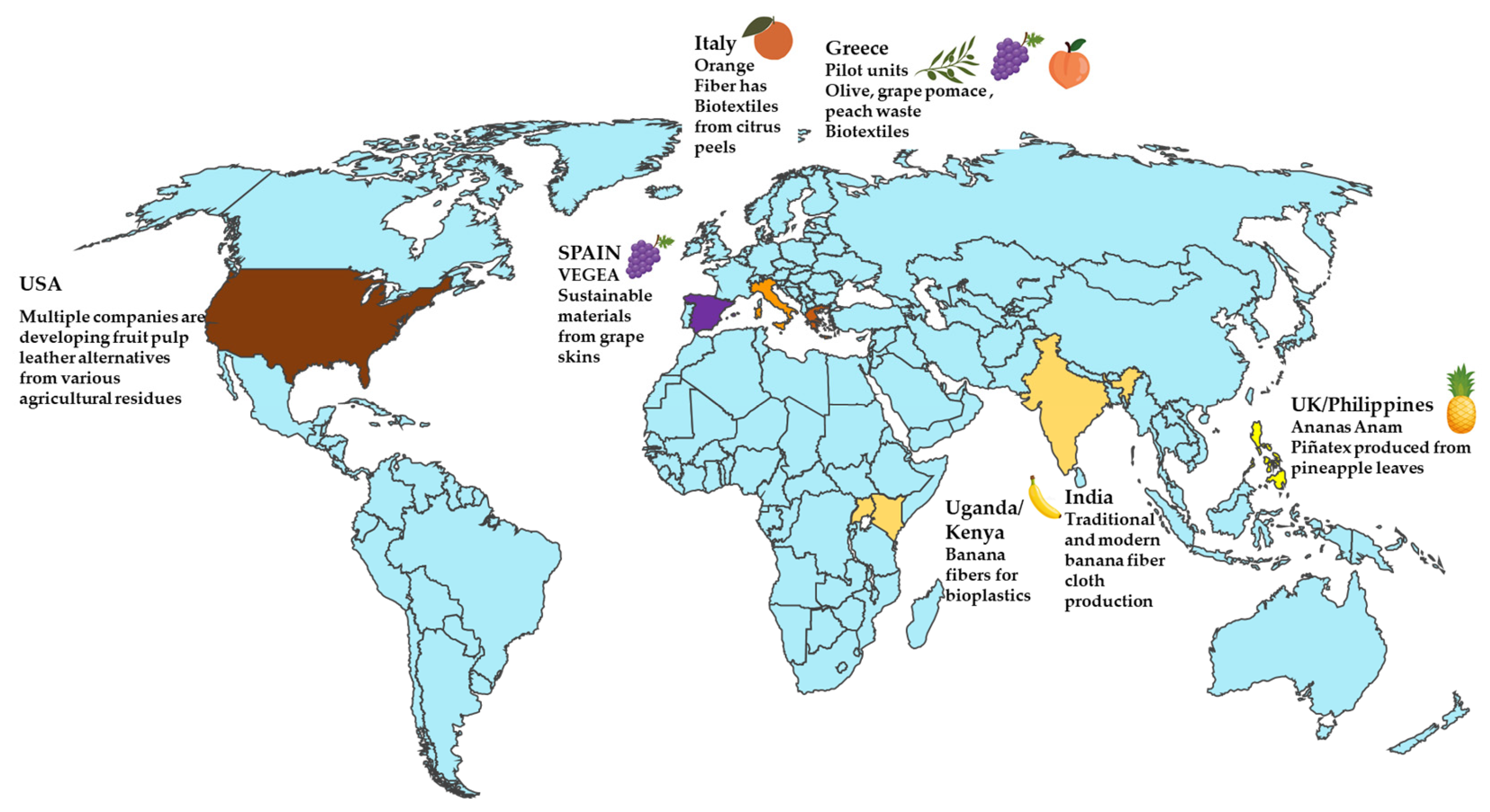
Figure 2.
Regional distribution of major fruit and nut agricultural residues in Greece relevant to biomaterial and biotextile production, including citrus peels, olive stones, almond shells, grape pomace, and fig stems. Highlighted regions correspond to dominant production and residue-generation areas based on national agricultural statistics.
Figure 2.
Regional distribution of major fruit and nut agricultural residues in Greece relevant to biomaterial and biotextile production, including citrus peels, olive stones, almond shells, grape pomace, and fig stems. Highlighted regions correspond to dominant production and residue-generation areas based on national agricultural statistics.
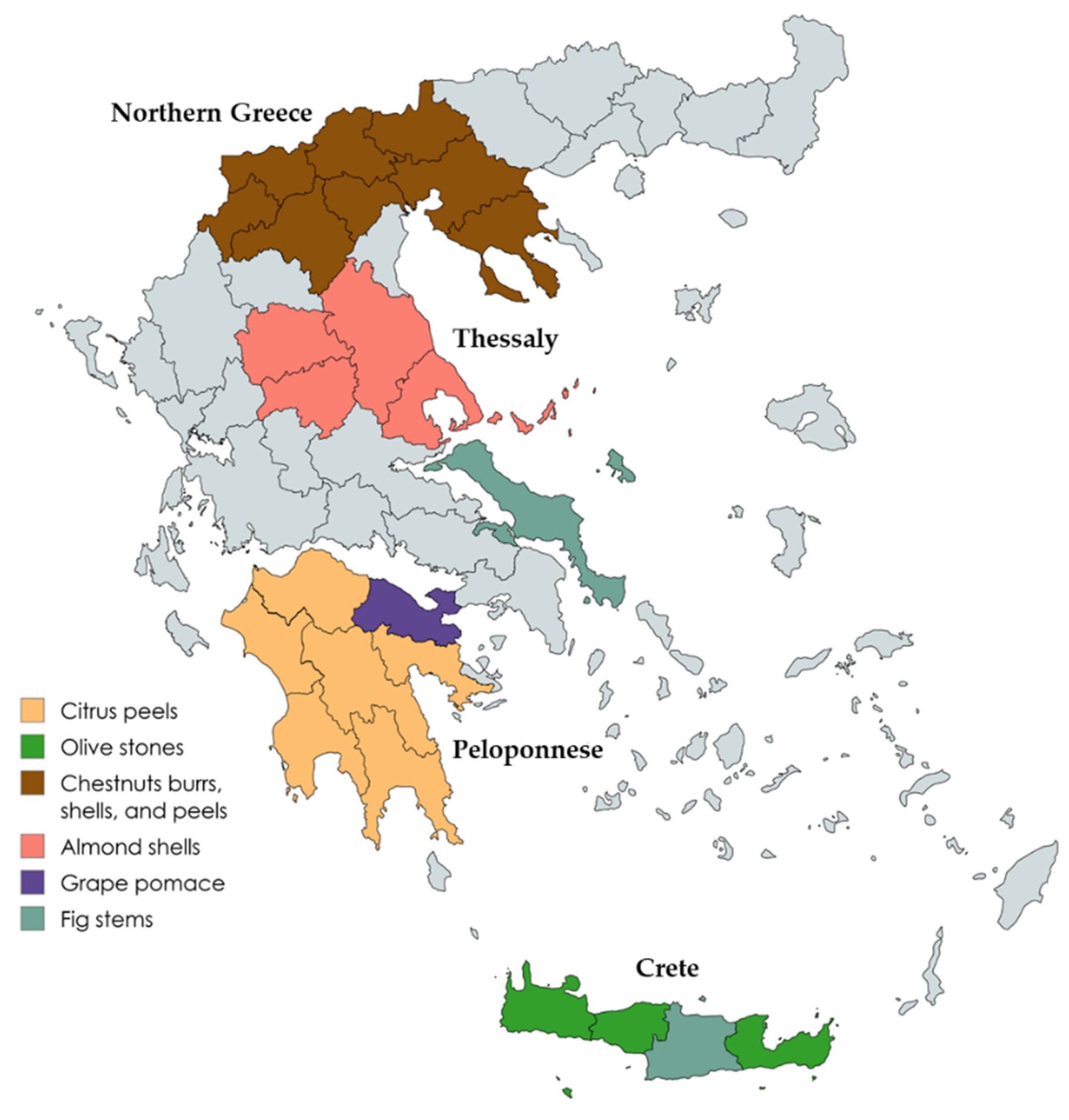
Figure 3.
Circular value chain model for agricultural residue valorization into biomaterials and biotextiles.
Figure 3.
Circular value chain model for agricultural residue valorization into biomaterials and biotextiles.

| Crop | Region | Production (tons) | Residues (tons) |
| Olives | Crete | 1,100,000 | 250,000 |
| Grapes | Peloponnese | 720,000 | 180,000 |
| Citrus | Peloponnese | 420,000 | 130,000 |
| Almonds | Thessaly | 85,000 | 25,000 |
| Figs | Evia, Crete | 70,000 | 20,000 |
| Chestnuts | Northern Greece | 30,000 | 8,000 |
Table 2.
Life Cycle Assessment Comparison of Conventional Textiles and Biotextiles (reported values are indicative and depend on feedstock type, system boundaries, and processing routes).
Table 2.
Life Cycle Assessment Comparison of Conventional Textiles and Biotextiles (reported values are indicative and depend on feedstock type, system boundaries, and processing routes).
| Indicator | Polyester | Cotton | Biotextile |
| Water Use (L/kg) | ~ 60 | ~ 10,000 | ~ 500 |
| CO₂ Emissions (kg) | ~ 9.5 | ~ 5.4 | ~ 1.6 |
| Land Use (m²/kg) | ~ 0.3 | ~ 2.6 | ~ 0.1 |
| Biodegradability | No | Yes | Yes |
Table 3.
IoT Market Size Forecasts from Various Sources. Data compiled from Statista [38] and Fortune Business Insights [40].
| Source | Year | Market Size (USD Billion) |
| Statista | 2025 | 1060 |
| Statista (Projected) | 2029 | 1560 |
| Fortune Business Insights | 2023 | 595.73 |
| Fortune Business Insights (Projected) | 2024 | 714.48 |
| Fortune Business Insights (Projected) | 2032 | 4062.34 |
Disclaimer/Publisher’s Note: The statements, opinions and data contained in all publications are solely those of the individual author(s) and contributor(s) and not of MDPI and/or the editor(s). MDPI and/or the editor(s) disclaim responsibility for any injury to people or property resulting from any ideas, methods, instructions or products referred to in the content. |
© 2026 by the authors. Licensee MDPI, Basel, Switzerland. This article is an open access article distributed under the terms and conditions of the Creative Commons Attribution (CC BY) license (http://creativecommons.org/licenses/by/4.0/).
Copyright: This open access article is published under a Creative Commons CC BY 4.0 license, which permit the free download, distribution, and reuse, provided that the author and preprint are cited in any reuse.


