

Submitted:
27 January 2026
Posted:
27 January 2026
You are already at the latest version
Abstract
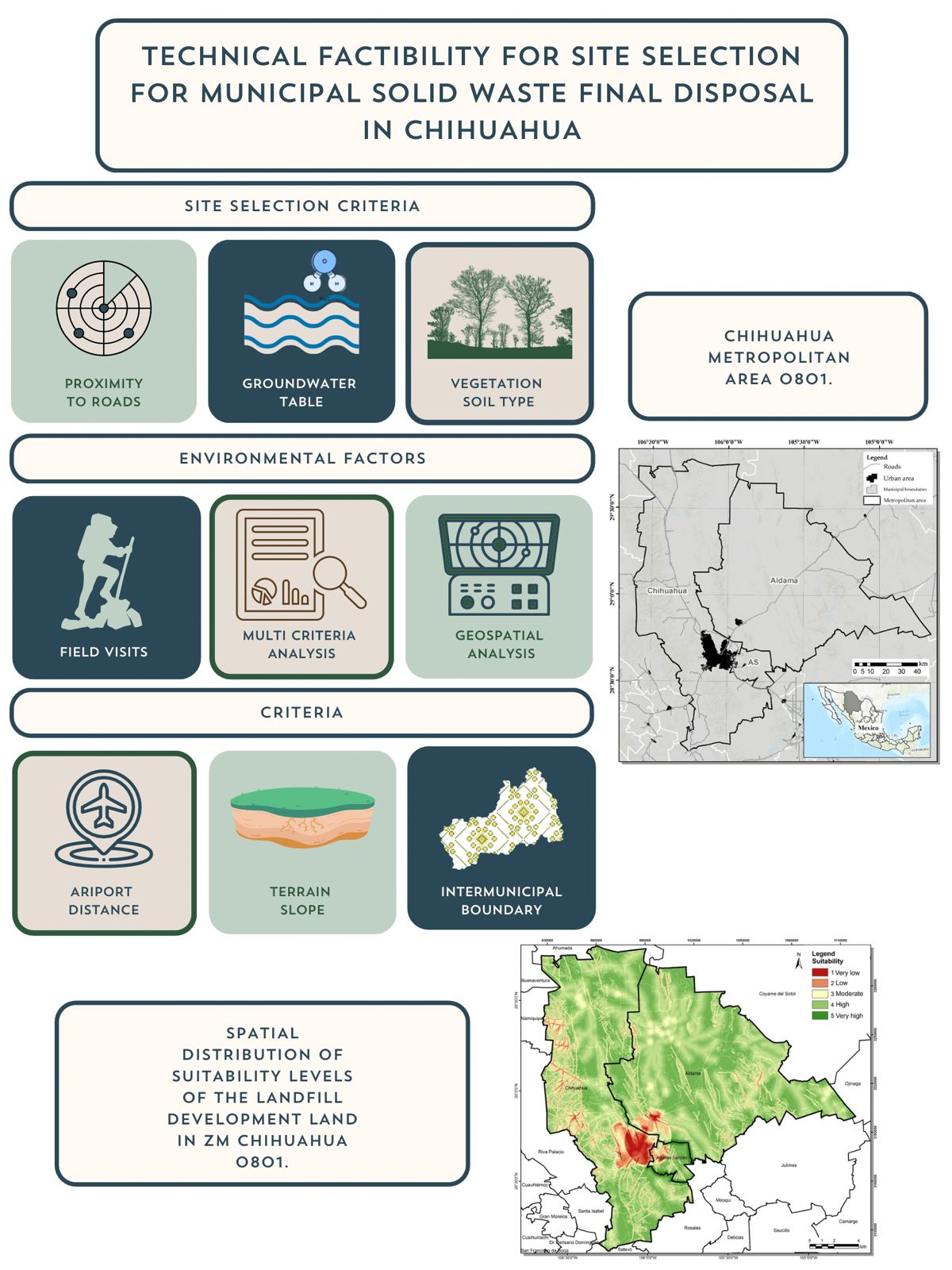
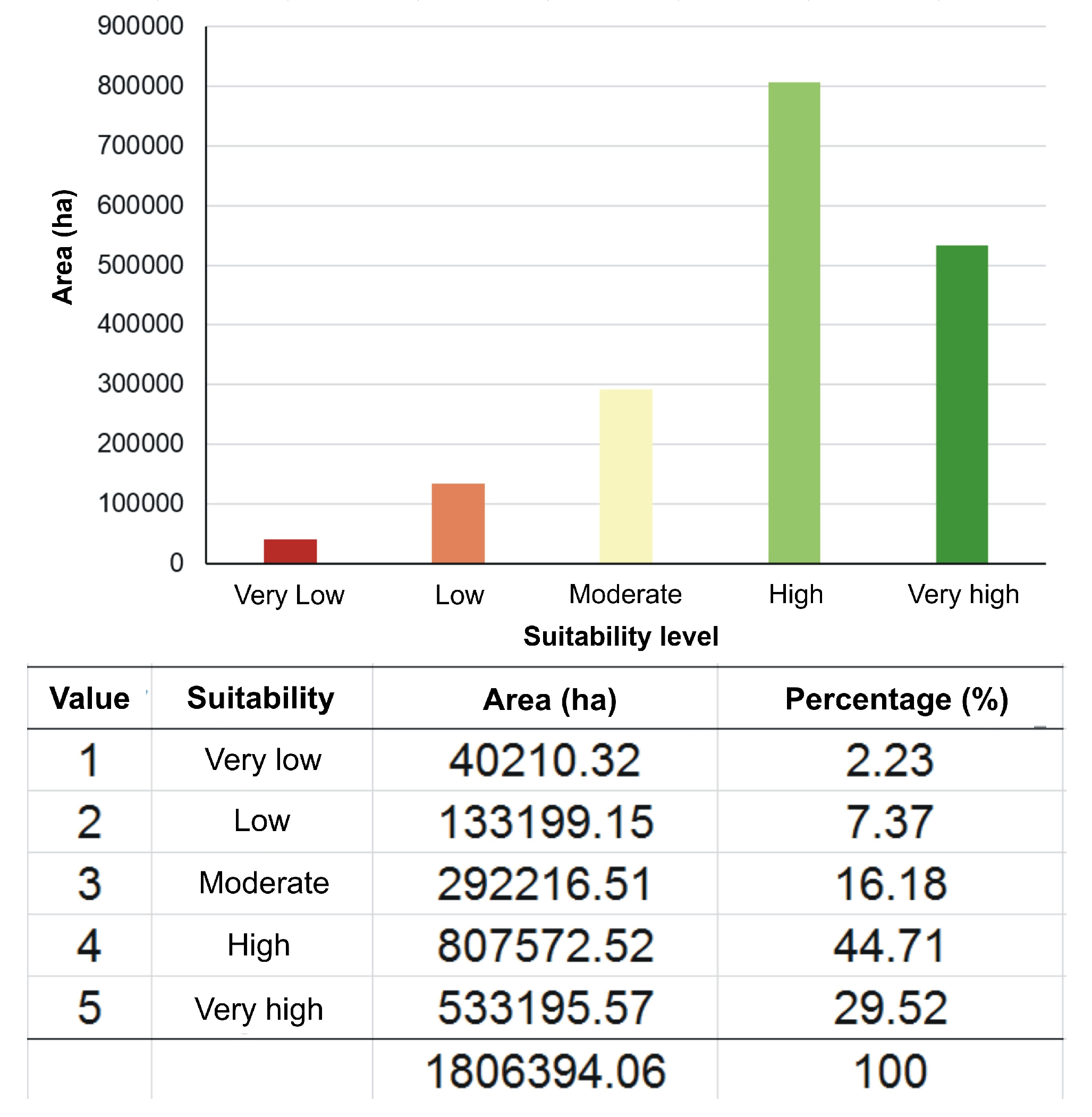
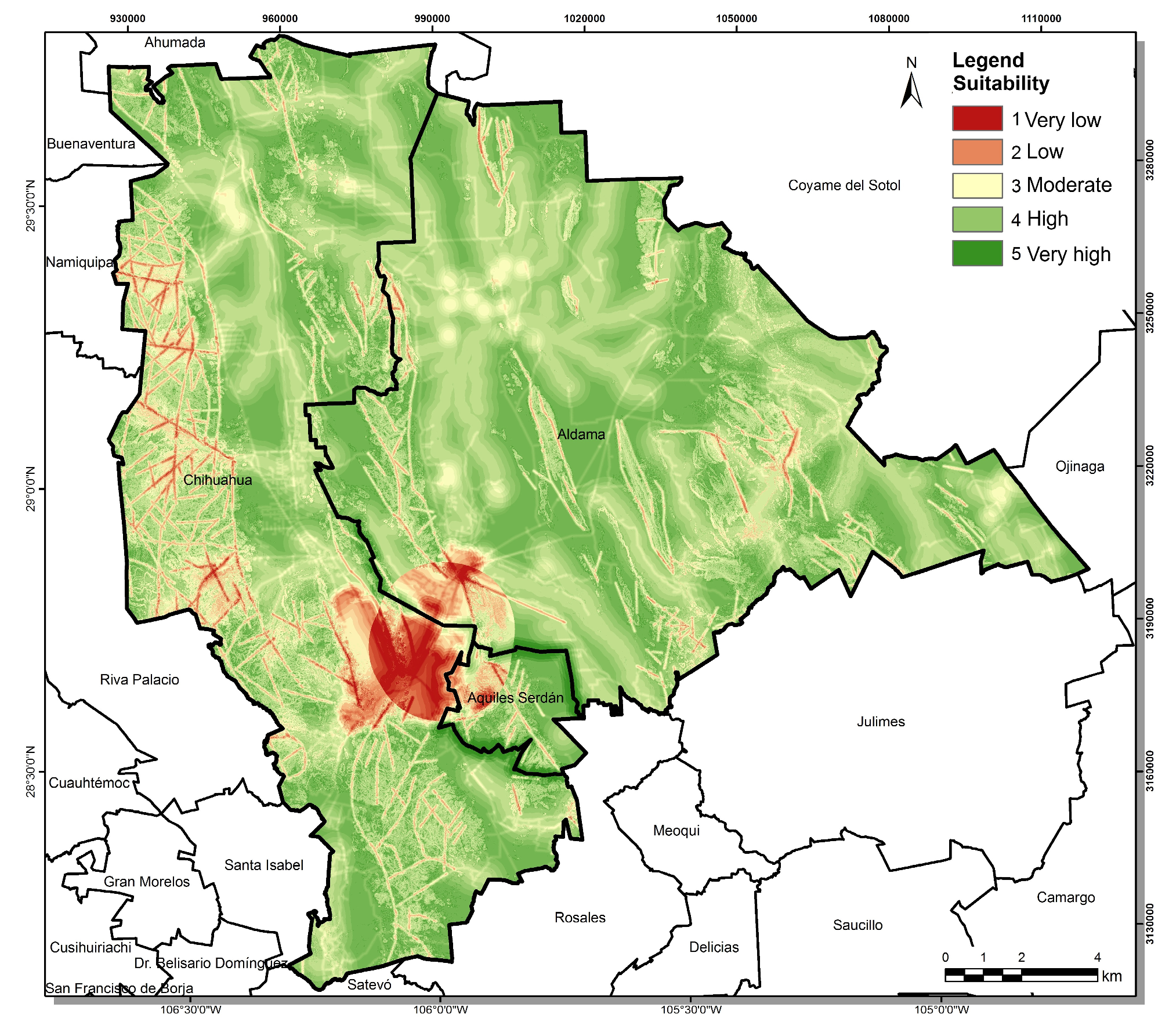
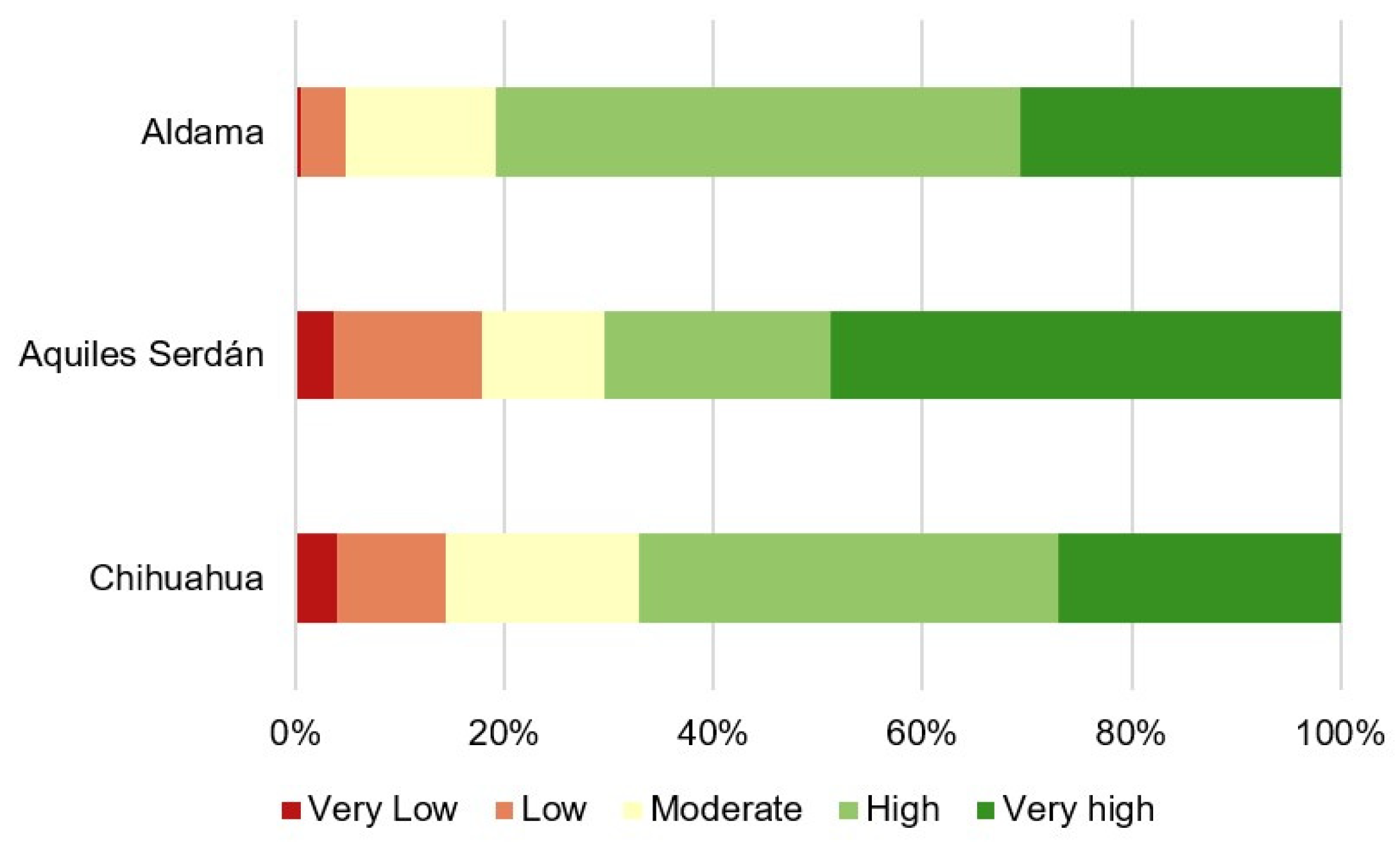
Municipal solid waste (MSW) generation is a global problem affecting the environment and public health. The current landfill’s useful life is reaching its end, making new site selection a priority to guarantee proper MSW management. This research evaluated the suitability of the Metropolitan area in the Chihuahua, Aldama and Aquiles Serdan municipalities, through spatial decision support systems (SDSS) integrated with multi-criteria decision-making (MCDM) and ascending hierarchical analysis integrated to Geographic Information Systems (GIS) to determine potential sites for new Metropolitan landfill development. Results showed that 44.7% of the studied area presents a high suitability level, while 29.52% reaches a very high suitability level. These areas are located mainly in the north and center zones of the Chihuahua and Aldama municipalities, with some isolated Aquiles Serdan areas. The key criteria affecting the selection were: the airport distance, the land slope and proximity to the intermunicipal boundary, which allowed identifying sites with lower environmental impact and higher technical and economic feasibility. This study demonstrates SDSS and GIS are efficient tools to identify potential sites for new landfill location. The results highlight the importance of integrating technical, environmental, and social criteria in planning MSW management, contributing to the region’s sustainable and efficient management.
Keywords:
1. Introduction
2. Materials and Methods
A. Study Area
B. Review of Literature
- When a final disposal site is intended to be located less than 13 kilometers from the center of the airport or airfield providing service to the public, the chosen distance will be determined through an aviation safety analysis.
- Sites should not be located within protected natural areas, except for the sites provided in the protected natural area management plans.
- In towns with over 2500 inhabitants, the final disposal site limit must be at a minimum distance of 500 m (five hundred meters) counted from the limit of the existing urban layout or provided in the urban development plan.
- It must not be in zones with marshlands, mangals, estuaries, swamps, flood plains, river plains, aquifer recharge areas, archeological areas, nor above caverns, nor faults, nor fractures.
- The final disposal site must be located outside of flood areas with 100-year return period. In case of not complying with the above, it must be demonstrated there will be no flow obstruction in the flood area or possibility of landslides or erosion affecting the physical stability of the works comprising the final disposal site.
- The final disposal site location minimum distance respect to surface bodies of water such as rivers, lakes and lagoons must be 500 m (five hundred meters).
- The location between the final disposal site limit and any water extraction well for domestic, industrial, irrigation, and livestock uses, both in operation and abandoned, must be 100 meters addition to the horizontal projection of the greater circumference of the drawdown of wells. When the latter cannot be determined, the distance to the well shall not be less than 500 meters.
C. Criteria Selection
D. Criteria Standardization
E. Criteria Weighing
F Final Decision Map Generation
G. Comparison with Predefined Sites
3. Results
A. Boolean Suitability Model
B. Non-Boolean Suitability Model

| Criteria | Airfields | Airport | Towns > 2500 inhab | Flood zones | Archeological zones | Urban layout | Wells | Inter-municipal boundary | Roads | Dam wall |
| Airfields | 1 | 1/8 | 1/6 | 1/7 | 1/3 | 1/9 | 1/4 | 1/9 | 1/5 | 1/4 |
| Airport | 8 | 1 | 2 | 8 | 7 | 2 | 4 | 2 | 3 | 5 |
| Towns > 2500 inhab | 6 | ½ | 1 | 4 | 5 | 1 | 2 | 1 | 2 | 6 |
| Flood zones | 7 | 1/8 | ¼ | 1 | 2 | 1/4 | 2 | 1/6 | 1/6 | 1/2 |
| Archeological zones | 3 | 1/7 | 1/5 | 1/2 | 1 | 1/6 | 2 | 1/7 | 1/4 | 3 |
| Urban layout | 9 | ½ | 1 | 4 | 6 | 1 | 3 | 1 | 2 | 6 |
| Wells | 4 | ¼ | ½ | 1/2 | ½ | 1/3 | 1 | 1/4 | 1/5 | 1/2 |
| Inter-municipal boundary | 9 | ½ | 1 | 6 | 7 | 1 | 4 | 1 | 3 | 7 |
| Roads | 5 | 1/3 | ½ | 6 | 4 | 1/2 | 5 | 1/3 | 1 | 4 |
| Dam wall | 4 | 1/5 | 1/6 | 2 | 1/3 | 1/6 | 2 | 1/7 | 1/4 | 1 |
| Criteria | Protected natural area | Wetlands | Alluvial plains | River plains | Aquifer recharge | Caverns | Faults and Fractures | Bodies of water | Water streams | Lakes | Land slope |
| Protected natural areas | 1 | 2 | 3 | 3 | 2 | 4 | 2 | 5 | 5 | 6 | 1 |
| Wetlands | 1/2 | 1 | ½ | 1/2 | 1/3 | 3 | 1/4 | 3 | 3 | 3 | 1/3 |
| Alluvial plains | 1/3 | 2 | 1 | 1 | 1/4 | 5 | 1/2 | 1/2 | 3 | 4 | 1/6 |
| River plains | 1/3 | 2 | 1 | 1 | 3 | 1/5 | 1/5 | 1/3 | 1/4 | 1/4 | 1/5 |
| Aquifer recharge | 1/2 | 3 | 4 | 2 | 1 | 4 | 1/6 | 1 | 2 | 3 | ¼ |
| Caverns | 1/4 | 1/3 | 1/5 | 1/3 | 1/3 | 1 | 1/6 | 1/5 | 1/6 | 1/6 | 1/7 |
| Faults and Fractures | 1/2 | 4 | 2 | 5 | 6 | 6 | 1 | 5 | 5 | 5 | 2 |
| Bodies of water | 1/5 | 1/3 | 2 | 3 | 1 | 5 | 1/5 | 1 | 2 | 1 | 1/5 |
| Streams of water | 1/5 | 1/3 | 1/3 | 4 | 1/2 | 6 | 1/5 | 1/2 | 1 | 1/2 | 1/6 |
| Lakes | 1/6 | 1/3 | ¼ | 4 | 1/3 | 6 | 1/5 | 1 | 2 | 1 | 1/6 |
| Land slope | 1 | 3 | 6 | 5 | 4 | 7 | 1/2 | 6 | 6 | 6 | 1 |
4. Conclusions
References
- Kaza, S.; Yao, L.C.; Bhada-Tata, P.; Van Woerden, F. What a Waste 2.0: A Global Snapshot of Solid Waste Management to 2050. Urban Development Series. World Bank Group: Washington, D.C., 2018.
- Santhosh, L. G.; Sivakumar Babu, G. L. Landfill site selection based on reliability concepts using the DRASTIC method and AHP integrated with GIS–a case study of Bengaluru city, India. Georisk: Assessment and Management of Risk for Engineered Systems and Geohazards 2018, 12, 234–252. [CrossRef]
- Omoloso, O.; Wise, W. R.; Mortimer, K.; Jraisat, L. Corporate sustainability disclosure: a leather industry perspective. Emerging Science Journal 2020, 4, 44–51. [CrossRef]
- Palomar, A. A. U.; Sundo, M. B.; Velasco, P. P.; Camus, D. R. D. End-of-pipe waste analysis and integrated solid waste management plan. Civil Engineering Journal 2019, 5, 1970–1982. [CrossRef]
- Rahmat, Z. G.; Niri, M. V.; Alavi, N.; Goudarzi, G.; Babaei, A. A.; Baboli, Z.; Hosseinzadeh, M. Landfill site selection using GIS and AHP: a case study: Behbahan, Iran. KSCE Journal of Civil Engineering 2017, 21, 111–118. [CrossRef]
- Elahi, A.; Samadyar, H. Municipal solid waste landfill site selection using analytic hierarchy process method for Tafresh Town. Middle-East Journal of Scientific Research 2014, 22, 1294–1307.
- Soltani, A.; Hewage, K.; Reza, B.; Sadiq, R. Multiple stakeholders in multi-criteria decision-making in the context of municipal solid waste management: a review. Waste Management 2015, 35, 318–328. [CrossRef]
- Sumathi, V. R.; Natesan, U.; Sarkar, C. GIS-based approach for optimized siting of municipal solid waste landfill. Waste Management 2008, 28, 2146–2160. [CrossRef]
- Ersoy, H.; Bulut, F.; Berkün, M. Landfill site requirements on the rock environment: a case study. Engineering Geology 2013, 154, 20–35. [CrossRef]
- Ojha, C. S. P.; Goyal, M. K.; Kumar, S. Applying Fuzzy logic and the point count system to select landfill sites. Environmental monitoring and assessment 2007, 135, 99–106. [CrossRef]
- Kao, J. J.; Lin, H. Y. Multifactor spatial analysis for landfill siting. Journal of environmental Engineering 1996, 122, 902–908. [CrossRef]
- Eskandari, M.; Homaee, M.; Mahmoodi, S.; Pazira, E.; Van Genuchten, M. T. Optimizing landfill site selection by using land classification maps. Environmental Science and Pollution Research 2015, 22, 7754–7765. [CrossRef]
- Baban, S. M.; Flannagan, J. Developing and implementing GIS- assisted constraints criteria for planning landfill sites in the UK. Planning Practice y Research 1998, 13, 139–151. [CrossRef]
- Jankowski, P. Collaborative spatial decision making in environmental restoration management: an experimental approach. Journal of Hydroinformatics 2000, 2, 197–206. [CrossRef]
- Jankowski, P.; Robischon, S.; Tuthill, D.; Nyerges, T.; Ramsey, K. Design considerations and evaluation of a collaborative, spatio-temporal decision support system. Transactions in GIS 2006, 10, 335–354. [CrossRef]
- Kontos, T. D.; Komilis, D. P.; Halvadakis, C. P. Siting MSW landfills with a spatial multiple criteria analysis methodology. Waste Management 2005, 25, 818–832. [CrossRef]
- Sener, B.; Süzen, M. L.; Doyuran, V. Landfill site selection by using geographic information systems. Environmental Geology 2006, 49, 376–388. [CrossRef]
- Vasiljevic, T. Z.; Srdjevic, Z.; Bajcetic, R.; Miloradov, M. V. GIS and the analytic hierarchy process for regional landfill site selection in transitional countries: a case study from Serbia. Environmental Management 2012, 49, 445. [CrossRef]
- Khan, M. M. U. H.; Vaezi, M.; Kumar, A. Optimal siting of solid waste-to-value-added facilities through a GIS-based assessment. Science of the Total Environment 2018, 610, 1065–1075. [CrossRef]
- Allen, B. G.; Caetano, P.; Costa, C.; Cummins, V.; Donnelly, J.; Koukoulas, S.; Vendas, D. A landfill site selection process incorporating GIS modelling. In Proceedings of Sardinia 2003.
- Saaty, T. L. How to make a decision: the analytic hierarchy process. European Journal of Operational Research 1990, 48, 9–26. [CrossRef]
- SEMARNAT. Residuos Sólidos Urbanos (RSU). Secretaría de Medio Ambiente y Recursos Naturales: México, 2017.
- Caballero-Saldívar, D. E.; de la Garza-Requena, F. R.; del Carmen Andrade-Limas, E.; Briones-Encinia, F. Los rellenos sanitarios: una alternativa para la disposición final de los residuos sólidos urbanos. CienciaUAT 2011, 6, 14–17.
- Buenrostro Delgado, O.; Mendoza, M.; López Granados, E. Análisis comparativo de tres modelos de soporte de decisiones espaciales en la selección de sitios para rellenos sanitarios en la cuenca del lago de Cuitzeo, México. Investigaciones Geográficas 2005, 57, 21-38.
- SEMARNAT. NORMA Oficial Mexicana NOM-083-SEMARNAT-2003, Especificaciones de protección ambiental para la selección del sitio, diseño, construcción, operación, monitoreo, clausura y obras complementarias de un sitio de disposición final de residuos sólidos urbanos y de manejo especial. Secretaría de Medio Ambiente y Recursos Naturales: México, 2003.
- Gómez, G. Aplicación de técnicas de ciclo de vida al diseño de un sistema de gestión de residuos urbanos para la ciudad de Chihuahua. Tesis Doctoral, Universitat Rovira i Virgili (URV), España, 2009.
- SEDATU- INEGI. Delimitación de las zonas metropolitanas de México. Secretaría de Desarrollo Agrario, Territorial y Urbano Consejo Nacional de Población - Instituto Nacional de Estadística y Geografía: México, 2015.
- Gorsevski, P. V.; Donevska, K. R.; Mitrovski, C. D.; Frizado, J. P. Integrating multi-criteria evaluation techniques with geographic information systems for landfill site selection: a case study using ordered weighted average. Waste Management 2012, 32, 287–296. [CrossRef]
- Kamdar, I.; Ali, S.; Bennui, A.; Techato, K.; Jutidamrongphan, W. Municipal solid waste landfill siting using an integrated GIS-AHP approach: A case study from Songkhla, Thailand. Resources, Conservation and Recycling 2019, 149, 220–235. [CrossRef]
- Tobler, W. Measuring spatial resolution. En Proceedings of the International Workshop on Geographic Information Systems 48; Unión Geográfica Internacional: Beijing, China, 1987; pp. 2–16.
- FAO. A framework for land evaluation. FAO and agriculture organization of the United Nations: Rome, Italy, 1976.
- Saaty, T.; Vargas, L. Models, methods, concepts & applications of the analytic hierarchy process. In Driven Demand and Operations Management Models; Springer: New York, NY, USA, 2001. [CrossRef]
- Barzehkar, M.; Dinan, N. M.; Mazaheri, S.; Tayebi, R. M.; Brodie, G. I. Landfill site selection using GIS-based multi-criteria evaluation (case study: SaharKhiz Region located in Gilan Province in Iran). SN Applied Sciences 2019, 1, 1–11. [CrossRef]
- Demesouka, O. E.; Anagnostopoulos, K. P.; Siskos, E. Spatial multicriteria decision support for robust land-use suitability: The case of landfill site selection in Northeastern Greece. European Journal of Operational Research 2019, 272, 574–586. [CrossRef]
- Mallick, J. Municipal solid waste landfill site selection based on fuzzy-AHP and geoinformation techniques in Asir Region Saudi Arabia. Sustainability 2021, 13, 1538. [CrossRef]
- Durán, C. E. S.; González, O. N. Identificación de sitios con potencial para la disposición final de residuos sólidos urbanos en el municipio de Tepic, Nayarit, México. Revista Internacional de Contaminación Ambiental 2019, 35, 69–77. [CrossRef]
| No | Criteria | Type | Unit | Group | Source |
| 1 | Airfields | Distance | M | Infrastructure | INEGI |
| 2 | Airport | Distance | M | Infrastructure | INEGI |
| 3 | Protected natural area | Distance | M | Physical environment | CONANP |
| 4 | Towns with over 2500 inhabitants | Distance | M | Población | INEGI |
| 5 | Wetlands | Distance | Physical environment | RAMSAR | |
| 6 | Alluvial plains | Categorical | N/A | Physical environment | Own source |
| 7 | River plains | Categorical | N/A | Physical environment | Own source |
| 8 | Aquifer recharge | Distance | Physical environment | CONAGUA | |
| 9 | Flood zones | Distance | Infrastructure | Own source | |
| 10 | Archeological areas | Distance | M | Infrastructure | Own source |
| 11 | Caverns | Distance | M | Physical environment | Own source |
| 12 | Faults and failures | Distance | M | Physical environment | INEGI |
| 13 | Bodies of water | Distance | M | Physical environment | INEGI |
| 14 | Streams of water | Distance | M | Physical environment | INEGI |
| 15 | Lakes | Distance | M | Physical environment | INEGI |
| 16 | Urban layout | Distance | M | Infrastructure | INEGI |
| 17 | Wells | Distance | M | Infrastructure | CONAGUA |
| 18 | Inter-municipal border | Distance | M | Infrastructure | INEGI |
| 19 | Land slope | Degrees | ° | Physical environment | Own source |
| 20 | Roads | Distance | M | Infrastructure | INEGI |
| 21 | Dam wall | Distance | M | Infrastructure | IMPLAN/INEGI |
| No. | Layer | Type |
| 1 | Slope | Angle |
| 2 | Faults and fractures | Distance |
| 3 | Lakes | Distance |
| 4 | Inter-municipal boundary | Distance |
| 5 | Airfield | Distance |
| 6 | Bodies of water | Distance |
| 7 | Secondary roads | Distance |
| 8 | Archeological zones | Distance |
| 9 | Main roads | Distance |
| 10 | Railways | Distance |
| 11 | Protected natural areas | Distance |
| 12 | Urban layout | Distance |
| 13 | Airport | Distance |
| 14 | Reservoir | Distance |
| 15 | Wells | Distance |
| SV | Distance to the airport (km) | Protected natural areas | Town >2500 inhabitants’ distance (m) | Wetlands | Alluvial plains | River plains | Aquifer recharge |
| 1 | 0-13 | 0-3000 | 0-500 | 0-1000 | 0 | 0 | 0-1000 |
| 2 | 3000-4000 | 500-1000 | 1000-1500 | 1000-1500 | |||
| 3 | 4000-5000 | 1000-1500 | 1500-2000 | 1500-2000 | |||
| 4 | 5000-6000 | 1500-2000 | 2500-3000 | 2500-3000 | |||
| 5 | 13-> | 6000-> | 2000-> | 3000-> | 1 | 1 | 3000-> |
| SV | Inter-municipal boundary | Flood zones (100-year return period) | Slope (%) | Distance to airfields (m) | Caverns | Faults and fractures | Archeological zones |
| 1 | 2500-> | 0-1000 | 0-5 | 0-1500 | 0-100 | 0-100 | 0-100 |
| 2 | 1500-2000 | 1000-1500 | 5-10 | 1500-2000 | 100-200 | 100-200 | 100-200 |
| 3 | 1000-1500 | 1500-2000 | 10-15 | 2000-2500 | 200-300 | 200-300 | 200-300 |
| 4 | 500-1000 | 2500-3000 | 15-30 | 2500-3000 | 300-400 | 300-400 | 300-400 |
| 5 | 0-500 | 3000-> | 30-> | 3000-> | 400-> | 400-> | 400-> |
| SV | Bodies of water (m) | Lakes (m) | Dam wall (m) | Water extraction well (m) | Water streams (perennial) (m) | Urban layout | Roads |
| 1 | 0-1000 | 0-1000 | 0-1000 | 0-500 | 0-1000 | 0-500 | 0-70 |
| 2 | 1000-1500 | 1000-1500 | 1000-1500 | 500-1000 | 1000-1500 | 500-1000 | 70-100 |
| 3 | 1500-2000 | 1500-2000 | 1500-2000 | 1000-1500 | 1500-2000 | 1000-1500 | 100-200 |
| 4 | 2500-3000 | 2500-3000 | 2500-3000 | 1500-2000 | 2500-3000 | 1500-2000 | 200-300 |
| 5 | 3000-> | 3000-> | 3000-> | 2000-> | 3000-> | 2000-> | 300-> |
| Suitability level | Value | Description |
| Very high | 5 | Zones without significant limitations for sustainable landfill development |
| High | 4 | Zones without significant limitation for sustainable landfill development. It may include minor modifications that do not affect the productivity or benefits and without increasing inputs above an acceptable level |
| Moderate | 3 | Zones with overall moderate limitations for landfill development; these limitations will reduce productivity or benefits and will increase necessary inputs to the point the global advantage obtained from its use, although still attractive, will be significantly lower to what is expected in highly suitable areas. |
| Low | 2 | Zones with generally bad limitations for sustainable landfill development. These limitations will reduce productivity or benefits or will increase necessary inputs. |
| Very low | 1 | The land has limitations that may be overcome with time; limitations are severe and would hinder the successful and sustainable use of this area for landfill development. |
| Verbal judgments of preference between alternatives | Numerical classification (importance or intensity) | Explanation |
| Extreme preference | 9 | Tests favoring one criterion over another are the highest possible order |
| Very strong preference | 7 | One criterion is very strongly favored, and its domain is demonstrated in practice |
| Strong preference | 5 | Experience and judgment strongly favor one criterion over another |
| Moderate preference | 3 | Experience and judgment slightly favor one criterion over another |
| Same preference | 1 | Two criteria contribute equally to the objective |
| Intermediate value | 2, 4, 6, 8 | When intermediate judgment is needed |
Disclaimer/Publisher’s Note: The statements, opinions and data contained in all publications are solely those of the individual author(s) and contributor(s) and not of MDPI and/or the editor(s). MDPI and/or the editor(s) disclaim responsibility for any injury to people or property resulting from any ideas, methods, instructions or products referred to in the content. |
© 2026 by the authors. Licensee MDPI, Basel, Switzerland. This article is an open access article distributed under the terms and conditions of the Creative Commons Attribution (CC BY) license (http://creativecommons.org/licenses/by/4.0/).


