

Submitted:
23 January 2026
Posted:
28 January 2026
You are already at the latest version
Abstract
Human African Trypanosomiasis (HAT) and malaria are serious infectious diseases endemic in tropical regions, caused by protozoan parasites, and necessitating an urgent development of new antiprotozoal drugs. As part of our ongoing search for new antiprotozoal steroidal alkaloids from plants, we investigated the methanolic stem bark extract of Holarrhena pubescens (Apocynaceae). H. pubescens is a tropical tree that some Kenyan coastal communities have long used to treat various ailments, including fever and stomach pain. The crude extract, alkaloid fraction, and 16 subfractions acquired through centrifugal partition chromatography (CPC) displayed promising in vitro antiprotozoal activity against Trypanosoma brucei rhodesiense (Tbr) and Plasmodium falciparum (Pf). Partial least squares (PLS) regression modelling of UHPLC/+ESI QqTOF-MS data and antiprotozoal activity data of the crude extract and its fractions was performed to predict compounds that may be responsible for the observed antiplasmodial activity. Chromatographic separation of the alkaloid fraction afforded one new steroidal alkaloid (5), along with 18 known compounds (1, 2, 4, 6–20), and one artifact (3) that was presumably formed during the acid-base extraction process. The structural characterization of the isolated compounds was accomplished using UHPLC/+ESI-QqTOF-MS/MS and NMR spectroscopy. The isolated compounds were tested for their in vitro antiprotozoal properties against the two aforementioned pathogens, as well as for their cytotoxicity against mammalian cells (L6 cell line). Compounds 2 and 16 (IC50 = 0.2 μmol/L) demonstrated the highest antitrypanosomal activity, with compound 2 showing the highest selectivity (SI = 127). The new compound 5 exhibited the strongest antiplasmodial activity and selectivity against Pf (IC50 = 0.7 μmol/L, SI = 43). Our findings provide further promising antiprotozoal leads for HAT and Malaria.
Keywords:
Holarrhena pubescens Wall. ex G. Don
; Apocynaceae
; steroidal alkaloids
; Trypanosoma brucei rhodesiense
; Plasmodium falciparum
; natural products
; centrifugal partition chromatography (CPC)
; partial least squares (PLS) regression
1. Introduction
Human African trypanosomiasis (HAT), also known as sleeping sickness, and Malaria are protozoan diseases that cause devastating socio-economic effects and remain major public health concerns. While concerted global control initiatives by the World Health Organization (WHO) and other stakeholders have substantially reduced the number of new HAT cases down to less than 1,000 per year on average, challenges such as underdiagnosis and sporadic outbreaks still persist [1,2]. Consequently, the search for new antitrypanosomal drugs with novel mechanisms of action remains essential. In 2024, there were an estimated 282 million Malaria cases and 610,000 deaths worldwide [3]. Although artemisinin-based combination therapies (ACTs) remain the cornerstone of Malaria treatment, the emergence of resistance against artemisinin and other existing antimalarials [4] highlights the urgent need for new drugs. Incidentally, ongoing efforts to discover new antiprotozoal agents have found natural products to be promising inhibitors against causative parasites of these two diseases (Trypanosoma brucei rhodesiense (Tbr) and Plasmodium falciparum (Pf), respectively) [5,6] and various amino-nortriterpenoids and aminosteroids isolated in our group have shown strong activity against both pathogens [7,8,9,10,11].
Holarrhena pubescens Wall. ex G. Don (Syn. Holarrhena antidysenterica var. pubescens (Wall. ex G. Don), is a deciduous tree of the Apocynaceae family that is native to Tropical Africa, East and West Asia [12]. It is widely used in traditional medicine to treat various ailments such as stomach pain, lactation, liver disorders and jaundice, haemorrhoids but also conditions related to infectious diseases such as fever and diarrhoea, potentially caused by influenza and amoebic dysentery [13,14,15]. Previous phytochemical investigations have found this species to be rich in steroidal alkaloids of the conanine and aminopregnane type, the principal one being conessine [16,17]. Furthermore, these chemical constituents have been reported to possess antibacterial, antidiabetic, anthelmintic and antimalarial properties [18,19,20,21,22]. As part of our continuous investigation to identify antiprotozoal natural compounds from the classes of amino-norcycloartanes and aminosteroids [7,8,9,10,11], our research group previously isolated various steroidal alkaloids from the leaves and stem bark of the West African Holarrhena africana A. DC. (a synonym of H. floribunda (G. Don) T. Durand & Schinz), which were found to display strong antitrypanosomal activity [8]. A study by other authors has also demonstrated some antiplasmodial activity of the aminosteroids of this species [23].
The aim of the present work was, therefore, to identify and characterize more steroidal alkaloids from the stem bark of H. pubescens and explore their in vitro antiprotozoal activity against Tbr and Pf, as well as selectivity to these parasites by comparison with their cytotoxic activity against mammalian cells. Although this species has been the subject of some previous phytochemical studies, no accession of Kenyan (or other East African) origin has been phytochemically examined. It was therefore of interest, also from a geobotanical perspective, to investigate the specialized metabolites present in this plant.
2. Results and Discussion
2.1. Antiprotozoal Activity of the Crude Extracts and Acid-Base Fractions
In order to identify the most suitable plant part and extraction solvent, 5 g of air-dried leaves, twigs and stem bark were each subjected to small-scale extraction using dichloromethane (CH2Cl2) and methanol (CH3OH). The resulting preliminary crude extracts were tested in vitro for their activity against Tbr (bloodstream trypomastigotes) and Pf (intraerythrocytic forms) as well as for their cytotoxicity towards L6 rat skeletal myoblasts (Cytotox. L6), to assess the selectivity (selectivity index SI=IC50(L6)/IC50(parasite)). Additionally, the extracts were also assessed for activity against the protozoan parasites Trypanosoma cruzi (intracellular amastigotes) and Leishmania donovani (axenic amastigotes), but none of them showed significant activity (data not shown). The methanol stem bark extract showed the strongest activity and selectivity indices (SI) against Tbr (IC50 = 1.6 ± 0.2 µg/mL, SI = 43) and Pf (IC50 = 6.7 ± 0.8 µg/mL, SI = 10), respectively (Table 1). Based on these preliminary biological results, the CH3OH extract of the stem bark was selected for large-scale extraction fractionation, and isolation of active compounds (see Scheme 1). Using Soxhlet apparatus, approximately 800 g of the powdered plant material was exhaustively extracted with CH3OH to afford a crude extract, which was subsequently subjected to acid-base extraction, yielding the alkaloid fraction and a lipophilic residue. For consistency, the total crude extract, the alkaloid fraction, and the lipophilic fraction were tested for antiprotozoal and cytotoxic activities. The results (Table 1), showed that the alkaloid fraction displayed a significant increase of antiprotozoal activity against Tbr and Pf compared to both the crude extract and the lipophilic residue. Interestingly, in contrast to our group’s earlier investigation of the stem bark of H. africana, which only showed notable in vitro activity against Tbr [8], the alkaloid fraction in the current study exhibited strong activity against Tbr and Pf. Based on these findings, the alkaloid fraction was selected for further fractionation and isolation of pure compounds.
2.2. Fractionation, LC/MS Profiling and PLS Modeling to Predict Constituents with High Activity
Using centrifugal partition chromatography (CPC), the alkaloid fraction was fractionated using a biphasic solvent system comprised of iso-hexane/ethyl acetate (8:2; v/v, upper phase) and CH3OH/H2O (7:3; v/v, lower phase) to afford 16 subfractions (Scheme 1). The obtained subfractions were analyzed using TLC and UHPLC/+ESI-QqTOF-MS/MS (hereafter abbreviated LC/MS) and subsequently evaluated for their in vitro antiprotozoal activity and cytotoxicity (Table 2). A majority of the CPC subfractions demonstrated strong antiprotozoal activity (IC50 < 1 μg/mL), with subfraction 01 exhibiting the highest potency against Tbr (IC50 = 0.1 ± 0.0 μg/mL, SI = 250), while subfraction 11 showed the highest activity against Pf (IC50 = 0.1 ± 0.0 μg/mL, SI = 150). Furthermore, 69% of the CPC subfractions displayed high selectivity indices (SI >10), indicating selective inhibitory effects of Holarrhena steroid alkaloids.
Given the notable variations in antiplasmodial activity of the CPC subfractions, a preliminary partial least squares (PLS) regression model was constructed in order to predict the constituents responsible for the observed activity. This approach has previously been used by our research group to successfully predict chemical constituents with promising antiprotozoal activity [24]. The total crude extract and the fractions were analyzed by LC/MS (Supplementary Materials, Figures S1–S18) and the data were processed using DataAnalysis 4.1 and ProfileAnalysis 2.1 softwares (Bruker Daltonik GmbH, Bremen, Germany). The resulting bucket table of variables, indicating MS signal intensity within defined retention time and m/z value intervals, was composed of 735 [m/z: tR] variables × 18 analyses. The LC-MS data were used as independent variables (X-matrix), while the bioactivity data served as dependent variables (Y-matrix). This dataset was then used to generate a PLS model for antiplasmodial activity in ProfileAnalysis. The resulting scores and loadings plots are shown in Figure 1 and Figure 2, respectively. In the scores plot, the samples are distributed according to their values on the first and second PLS components (PC2 versus PC1), which represents the combinations of independent variables (X) with the second-highest versus the highest influence, respectively, on the dependent (Y) variable, the biological activity). The corresponding loadings plot of PC2 vs PC1 demonstrates how each X-variable (MS signal defined by its retention time and m/z value) contributes to the variable combinations in PC1 and PC2, and thus illustrates their contributions to the placement of samples in the scores plot. For instance, variables associated with samples located on the far right of the scores plot also appear on the far right side of the loadings plot (i.e. they have high loadings on PC1 and therefore are most influential for high activity). Variables in this region can thus be expected to represent compounds with strong antiplasmodial activity. Consequently, the initial isolation efforts focused on compounds corresponding to signals/loadings located on the right side of the loadings plot. Such compounds were tentatively identified by retrieving their full mass spectra and comparing the data with literature information. In the present case, this approach led to the preliminary identification of seven compounds (Figure 2), followed by their targeted isolation (Section 2.3). Consistent with the PLS model prediction, the compounds predicted by the model and subsequently isolated indeed displayed strong activity against Pf upon biological evaluation (Table 4). The only exception was compound 12, which exhibited only moderate activity. The other compounds described in this study (Section 2.3, Figure 3) were isolated using an untargeted isolation approach.
2.3. Isolation of Steroidal Alkaloids from Holarrhena pubescens Stem Bark
Through repeated chromatographic separation and purification using preparative HPLC, a total of 20 pure aminosteroid alkaloids were isolated from different CPC subfractions (Scheme 1 above, 2.2). The structures of the isolated compounds (Figure 1) were established through LC/MS analysis together with NMR spectroscopic measurements. In total, ten oxygen-free Holarrhena alkaloids (also known as “Kurchi alkaloids”[25]) (1–4 and 6–11), along with ten oxygen-containing alkaloids (also termed as “free alkamines” [25]), comprising two pentacyclic (5 and 12) and eight tetracyclic compounds (13–20) were isolated and identified. Compound 3 was found to be an artifact generated by reaction of 2 with dichloromethane during the isolation process. Compound 5 represents a new Holarrhena alkaloid and the first N3-formyl-conarrhimine from this genus. Although database searches confirmed that the structures of compounds 3 and 13 have been previously postulated in SciFinder and PubChem, respectively, no primary literature reports on their isolation or synthesis could be found. In addition, only compounds 1, 2, 4, 7 and 11 have previously been reported from H. pubescens, while compounds 6 and 10 are reported here for the first time from the genus Holarrhena. Compounds 8, 9, 14 and 17–20 have only been previously described as synthetic products and are therefore reported in this study for the first time as genuine natural constituents. The known compounds were identified as dihydroisoconessine (1) [26,27], conessine (2) [8,28], N3-chloromethylconessine (3) [29], isoconessimine (4) [8,28], 3β-aminoconan-5-ene (6) [30], 3α-aminoconan-5-ene (7) [27], 3β-aminoconanine (8) [31], 3α-aminoconanine (9) [31], wrightiamine A (10) [32], irehline (11) [18], holadienine (12) [8], 3β-amino-5α-pregnan-20α-ol (13) [33], 3α-amino-5-pregnen-20α-ol (14) [34], funtumidine (15) [35], 3β-dihydroholaphyllamine (16) [8], holafebrine (17) [36], 20α-aminopregnan-3β-ol (18) [36,37], 20α-amino-5α-pregnane-3β,18-diol (19) [38] and 20α-amino-5-pregnene-3β,18-diol (20) [39,40] by their high resolution mass spectrometry, NMR spectroscopic data, and comparison with previously published data. Furthermore, because no or only limited spectroscopic data are available in the literature for compounds 3, 6–9, 13–15 and 17–20, their complete NMR assignments are reported here for the first time (Section 3.5).
Compound 5 was acquired as a yellow gum. Its molecular formula was determined as C23H38N2O, by the high-resolution +ESI LC/MS, which showed a quasimolecular ion peak at m/z 359.3129 [M + H]+ (calcd. for C23H39N2O+: 359.3057), indicating six degrees of unsaturation in the molecule (Supplementary Materials, Figures S19–S21). Five of these degrees of unsaturation were accounted for by a pentacyclic structure of a conanine-type skeleton, and one was due to a formamide functionality at the C-3 position. The NMR spectroscopic data of 5 (Table 3; Supplementary Materials, Figures S22 and S32) displayed typical structural characteristics associated with a conanine-type Holarrhena alkaloid [41,42]. The 13C-NMR and HSQC data of 5 showed 23 carbon resonances comprising three methyl groups (δC = 12.0, 12.5, 40.4), ten methylenes (δC = 23.0, 23.3, 27.2, 29,3, 29.4, 33.0, 35.9, 37.9, 38.5, 62.6), seven sp3 methines (δC = 38.9, 46.5, 49.0, 53.5, 54.7, 55.5, 67.5), two quaternary carbons (δC = 36.6, 53.2) and a formamide carbonyl carbon (δC = 162.8). The complete assignments of all the 13C NMR signals were accomplished using HMBC correlations. The 1H-NMR spectrum of 5 showed signals attributable to two tertiary methyl groups at δH = 0.82 (H-19) and δH = 2.88 (N-CH3), and a secondary methyl group at δH = 1.39 (d, J = 6.63 Hz, H-21). In addition to these groups, the 1H-NMR spectrum showed signals due to two nitrogen-bearing sp3 methines at δH = 3.58 (H-20) and δH = 3.74 (H-3), respectively. A proton singlet at δH = 7.95, correlated with the carbonyl carbon signal at δC = 162.8 in the 1H/13C-HSQC spectrum, showing the presence of a formamide group, C-1′. The HMBC correlation observed between the proton singlet (H-1′) and the methine carbon at δC = 49.0 placed the formamide moiety at C-3. Comparison of the NMR spectral data between compound 5 and the known dihydroisoconessine 1 revealed a close structural similarity, except for the replacement of the methyl amino group in 1 with the formamido moiety. The NOESY cross peaks of H-3 with H-1a and H-5 indicated that H-3 occupied the α-position while the formamide functionality was β-oriented. Based on these mentioned spectroscopic observations and in full agreement of all other signal assignments, the structure of this new alkaloid was identified as the N3-formyl derivative of 4, and was thus named N3-formyl-dihydroisoconessine.
2.3. Antiprotozoal Activity of the Steroidal Alkaloids Isolated from Holarrhena pubescens
The in vitro antiprotozoal activity against Trypanosoma brucei rhodesiense (Tbr), and Plasmodium falciparum (Pf), along with cytotoxicity against L6 rat skeletal myoblasts was determined as described in section 2.1 for all the isolated compounds (Table 4). Since the alkaloids, depending on their number of basic amino groups, were isolated as either mono- or bis-trifluoroacetate salts, the molar IC50 values were calculated using the molecular masses of the corresponding salts as reported in our recent publication [11]. Compounds 2, 4 and 16 demonstrated remarkable activity (IC50 < 1.0 μmol/L) as well as high selectivity indices (SI = 23–127) against Tbr. Interestingly, these activities were within the same range as those reported by Nnadi et al. of our group in the study of Holarrhena africana for the same compounds [8]. Compounds 1, 5, 6, 8, 10, 11, 13, 15, 17 and 18 showed moderate activities (IC50 = 1.3–5.7 μmol/L), while the rest of the other compounds showed low antitrypanosomal activity (Table 4).
The new compound 5 displayed the most promising antiplasmodial activity (IC50 = 0.7 μmol/L), and the highest selectivity index (SI = 43) against Pf. Except compounds 3, 13–15 and 17–20, which exhibited weak activity (IC50 > 7 μmol/L), all other compounds (2, 4, 6–12 and 16) showed moderate activities with IC50 values ranging from 1.0 to 4.9 μmol/L.
In continuation to the basic structure–activity relationship (SAR) of Holarrhena africana alkaloids previously described by Nnadi et al. of our research group [8], a preliminary SAR of the 20 compounds isolated in the present study was derived through comparison of their in vitro antiprotozoal activities. In agreement with the findings of Nnadi and coauthors, an amino group at C-3 was shown to be the key structural requirement for potent antiprotozoal activity against Tbr (IC50 < 1.0 μmol/L). Compounds bearing an oxygen function (ketone or hydroxyl group) at this position (12 and 17–20, respectively), generally showed low activity against both target parasites (Table 4). In line with the same previous study, compounds containing a monomethylated C-3 amino group showed slightly higher antitrypanosomal activity than their unsubstituted counterparts (1 and 4 marginally more active than 8 and 6, respectively) in the present work. Interestingly, the opposite trend was observed against Pf, where compounds 6 and 8 were slightly more active than 4 and 1, respectively. Surprisingly, and in contrast to the findings from the H. africana study, the dimethylated conessine (2) displayed higher activity against Tbr (IC50 = 0.2 μmol/L) than the monomethylated isoconessimine (4) (IC50 = 0.5 μmol/L), while their activity against Pf remained identical (IC50 = 2.0 μmol/L). Furthermore, substitution of the dimethylamino group with a chlorinated methylene led to a significant decrease in activity against both parasites (2 was substantially more active than 3). This is in contrast with a recent study from our group on similar aminosteroids from Pachysandra terminalis (Buxcaceae), where an N3-choloromethylamino-derivative (N3-chloromethyl-desacyl-epipachysamine) displayed a very high level of activity against Pf (IC50 = 0.39 µmol/L) [10]. However, this compound does not feature the additional pyrrolidine ring closed between N20 and C-18 typical for the Holarrhena alkaloids, so that a direct comparison may be difficult. It is worth noting, however, that in the present study, the N3-formamide appears to be exceptionally active against Pf. Testing and comparison of further N3-chloromethyl- and N3-formamide derivatives from both series against this parasite may hence be interesting.
The presence of a ∆5,6 was shown to greatly enhance antitrypanosomal activity among the Kurchi alkaloids (4, 6, and 7 more active than 1, 8, and 9, respectively). However, this substitution was less consequential for antiplasmodial activity, in which the pregnene derivatives showed either equal (1 vs 4), or slightly reduced activity compared to their pregnane congeners (6 < 8 and 7 < 9). Notably, an additional double bond (∆18,N) resulted in decreased activity against both Tbr and Pf (11 less active than 6), whereas 10, which possesses only the ∆18, N, is more active than 11 against both parasites. In regards to the tetracyclic free alkamines, the ∆5,6-pregnene derivatives were either less active (14 < 15) or equipotent (17 vs 18 and 19 vs 20, respectively) against Tbr. With respect to Pf, the ∆5,6-pregnenes consistently exhibited lower activity than their corresponding 5,6-saturated pregnane counterparts within this series. The stereochemistry at C-3 was found to have a pronounced effect on antitrypanosomal activity, but a lesser effect on antiplasmodial activity, among the oxygen-free alkaloids. Particularly, the 3β-configured derivatives showed a notably higher activity against Tbr than their the 3α-configured derivatives (6 vs 7 and 8 vs 9, respectively), whereas these C-3 epimers showed comparable potency against Pf. In contrast, the impact of stereochemistry at this position on Tbr activity was minimal among the oxygen-containing alkaloids (13 vs 15), consistent with the observations of Nnadi et al. [8]. However, the 3β-configured 13 was approximately 2-fold less active than the 3α-configured 15 against Pf. Moreover, substitution at the C-20 position with a ketone greatly enhanced activity against both parasites compared to a hydroxyl group (13 vs 16), again in agreement with Nnadi et al. [19]. Another notable observation was that the introduction of a hydroxyl group at C-18 led to reduced antiprotozoal activity against both Tbr and Pf (17 vs 20 and 18 vs 19, respectively).
In terms of selectivity, Nnadi et al. observed that presence of an amino group incorporated within a pyrrolidine or pyrroline ring, in addition to the C-3 amino group, enhances selectivity against Tbr over cytotoxicity against L6 cells, albeit with a minor reduction in activity. Although this finding was also observed in the current study for Tbr (Table 4), it was not consistent in all cases (e.g., compound 8 is less selective than 16). On the other hand, this substitution pattern was shown to enhance activity as well as selectivity against Pf with compounds 1, 2, 4–11 showing stronger activity and higher selectivity than 13–20.
3. Materials and Methods
3.1. Plant Material
The leaves, twigs and stem bark of H. pubescens were collected from the Gongoni forest, Kenya (04°24′35.3′′ S 039°28′34.2′′ E) in May 2022. The plant material was identified by Mr. Patrick Mutiso, a taxonomist at the Faculty of Science and Technology, University of Nairobi. The voucher specimens were deposited at both the University of Nairobi Herbarium (UoN_JM 2022_001) and at the Institute of Pharmaceutical Biology and Phytochemistry, University of Münster (IPBP 917 - TS_JM_2022_002). The plant material was air-dried under shade at room temperature to constant weight and then ground into fine powder using a mill.
3.2. Preparation of Small-Scale Extracts
Small scale extraction of the leaves, twigs and stem bark was performed using 3 x 100 mL of each, dichloromethane (CH2Cl2) and methanol (CH3OH). To 5 g of each plant material, 100 mL of each solvent was added separately and agitated continuously on a magnetic stirrer for 30 minutes. The extraction was carried out using three successive portions of fresh solvents, and the combined extracts for each solvent were thoroughly evaporated using a rotary evaporator at 40 °C.
3.3. Extraction of Holarrhena pubescens Stem Bark for Detailed Study
Using Soxhlet apparatus, the powdered plant material (814 g) was exhaustively extracted in two equal parts, with 1.5 L methanol (CH₃OH) for each part for 36 h. The extracts were combined and evaporated in vacuo at 40 °C to obtain 81.1 g of crude extract, translating to 10 % yield. An acid-base extraction was subsequently performed in order to separate the alkaloids from the crude extract. For each batch of extraction, 5 g of the extract was redissolved in 250 mL of distilled water acidified with 40 mL of 1 M HCl, and filtered through a Büchner funnel. Using a separatory funnel, this was extracted three times with 130 mL of dichloromethane (CH2Cl2) to obtain a total of 2.6 g of the lipophilic fraction (0.3 % yield). The aqueous phases were alkalized to ≈ pH 10 with sodium hydroxide solution (aq., 2 M) and exhaustively extracted with 130 mL of CH2Cl2, yielding, after evaporation, 8.7 g of the alkaloid fraction (1.1 % yield), which was stored in a refrigerator at 4 °C until further work.
3.4. Isolation of Alkaloids from Holarrhena pubescens Stem Bark Extract
Using a CPC-250 (Gilson, Limburg, Germany) chromatography system, a portion of 7.5 g of the alkaloid fraction was separated using the centrifugal partition chromatography (CPC) method that was previously used for B. sempervirens in our research group [43], with minor changes. This was done using a biphasic solvent system consisting of iso-hexane/ethyl acetate (8/2; v/v) as the upper phase and CH3OH/H2O (7/3; v/v) as the lower phase. Prior to the experiment, the biphasic system was equilibrated in a separatory funnel overnight and sonicated. The alkaloid fraction (8 portions of 0.5 – 1 g) was dissolved in 6 mL of the upper phase and 2 mL lower phase. In ascending mode (1200 rpm, 2 mL/min), 4 mL eluates were collected into test tubes. After termination of the elution mode, the lower phase was also separated and collected into test tubes by stopping the rotation and simultaneously increasing the flow rate to 5 mL/min. The obtained eluates were monitored on pre-coated silica gel 60 F254 thin layer chromatography (TLC) plates, (Merck KGaA, Darmstadt, Germany) using a mobile phase of ethyl acetate:CH3OH:NH4OH (9:1:1.5) (v/v/v) and spraying with Dragendorff’s reagent (bismuth subnitrate (0.85 g):H2O (40 mL): CH3COOH (10 mL):potassium iodide solution (40%; 20 mL)). The CPC eluates were combined into 16 subfractions (1–16) based on the TLC and LC/MS profiles. The upper phase yielded 12 subfractions while the lower phase afforded 4 subfractions (see Scheme 1).
CPC subfractions 01 (0.12 g), 05 + 06 (2.04 g), 07–12 (0.38 g), 13+14 (0.27 g), and 16 (1.14 g) were separated by prep-HPLC on a RP-18 phase (VP 250/21 Nucleodur C-18 HTec with a VP 10/16 Nucleodur C-18 HTec pre-column, Macherey-Nagel, Düren, Germany) using binary gradients of H2O (+0.1% TFA; A) and ACN (+0.1% TFA; B). The following gradient conditions were used in all separations: 5%–20% of B (0.1–15 min), 20%–30% of B (15–30 min), 30%–43% of B (30–45 min), 43%–50% of B (45–50 min), 50%–100% of B (50–55 min), and 100% of B (55–60 min) at a flow rate of 10 mL/min and a column temperature of 40 °C. The separation of CPC subfraction 01 yielded compound 2 (27.4 mg, tR 14.1 min. prep-HPLC of CPC subfractions 05 and 06 resulted in isolation of compounds 1 (13.7 mg, tR 30.8 min), 4 (106.2 mg, tR 28.7 min), 7 (16.5 mg, tR 19.7 min), and 9 (20.4 mg, tR 22.0 min). Compounds 5 (2.8 mg, tR 38.2 min), 6 (15.0 mg, tR 21.2), 8 (26.2 mg, tR 23.5), and 12 (11.3 mg, tR 33.1) were distributed in CPC subfractions 07–12 in varying concentrations. Compound 16 (2.9 mg, tR 47.8) was obtained from CPC subfractions 13 and 14, while compounds 3 (3.8 mg, tR 26.6), 10 (4.9 mg, tR 23.0), 11 (3.4 mg, tR 22.4), 13 (3.0 mg, tR 42.8), 14 (7.7 mg, tR 44.0), 15 (3.5 mg, tR 47.1), 17 (9.5 mg, tR 37.9), 18 (3.7 mg, tR 40.0), 19 (4.8 mg, tR 35.5) and 20 (4.1 mg, tR 32.5) were isolated from CPC subfraction 16.
3.5. Liquid Chromratographic/Mass Spectrometric Analysis
The crude extract, alkaloid fraction, CPC subfractions and the isolated compounds were analysed using the previously described UHPLC/+ESI-QqTOF-MS/MS (LC/MS) method and parameters [11]. For multivariate data analysis, each of the samples was analyzed in duplicate; first in chronological order and subsequently in a randomized sequence.
3.6. Multivariate Data Analysis/PLS Modelling
To process the LC/MS data, a previously established method developed by our research group [24] was applied with minor modifications. The raw data were converted into molecular features using Bruker Data Analysis 4.1 software (Bruker Daltonik GmbH, Bremen, Germany) via the molecular features function. The parameters were set as follows: signal/noise threshold: 15, correlation coefficient threshold: 0.7, minimum compound length: 10 spectra, smoothing width: 1, additional smoothing: enabled, chemistry: positive adducts M+ H, M+ NH4, M+ Na, M + K, M-H2O + H, M-CO2 + H, 2M + H, 2M + Na, 2M + NH4, 2M + K, 2M + CH3CN + H, 2M + CH3CN + Na, spectrum type: line spectra only, background subtraction: disabled and fragment spectra were not added.
The resulting molecular features were subsequently imported into Bruker ProfileAnalysis 2.1 software (Bruker Daltonik GmbH, Bremen, Germany). A descriptor table (“bucket table”) was generated, in which each bucket represented the signal intensity at a specific m/z value and retention time (min). Further data processing was performed using the find molecular features function as follows: retention time range: 1–15 min, mass range: 100–1500 m/z, advanced bucketing: retention time window of 0.1 min; m/z window of 100 mDa, split buckets with multiple compounds: enabled, bucket filter: value count of bucket ≥ 10%, allow empty group attributes: disabled, bucket value transformation: none and display bucket values in table: enabled. The resulting bucket table (735 buckets × 18 analyses) was used as the X-matrix (independent variables. The antiplasmodial activity data of the total crude extract and the fractions were logarithmically transformed to pIC50 values (pIC50= −log IC50 (µg/mL) and subsequently converted to positive values as follows; pIC50 × 100 −(−97.08), where −97.08 corresponds to the least active sample (Fr. 04)). These values constituted the Y-matrix (dependent variables). A PLS model was calculated using Pareto scaling and validated by the leave-one-out cross-validation.
3.7. NMR Spectroscopic Analysis
1H and 13C (1D-NMR) and 1H/1H-COSY, 1H/1H-NOESY, 1H/13C-HSQC, and 1H/13C-HMBC (2D-NMR) spectra were recorded on an Agilent DD2 600 MHz spectrometer (Agilent, Santa Clara, CA, USA) at 26 °C in deuterated chloroform (CDCl3) or methanol (CD3OD). The recorded spectra were analysed with MestReNova version 15.0.0-34764 software and were referenced to the CD3OD solvent signals (1H: 3.310 ppm; and 13C: 49.000 ppm).
3.8. Spectral Data of the Known Compounds
Dihydroisoconessine (1): colorless gum; 1H NMR (600 MHz, CD3OD; δ (ppm), intensity,mult., J (Hz)): 3.61 (1H, d, 13.0, H-18), 3.58 (1H, m, H-20), 3.02 (1H, tt, 12.5, 4.6, H-3), 2.90 (1H, d, 13.0, H-18), 2.88 (3H, s, H-22), 2.67 (3H, s, H-23), 2.34 (1H, dt, 10.9, 4.6, H-17), 2.04 (1H, dt, 12.6, 3.3, H-12), 1.95 (1H, m, H-2), 1.88 (1H, m, H-1), 1.83 (1H, m, H-15), 1.82 (1H, m, H-7), 1.80 (1H, m, H-11), 1.71 (1H, m, H-4), 1.70 (2H, m, H-16), 1.52 (1H, m, H-2), 1.48 (1Hm, H-12), 1.38 (2H, m, H-6), 1.38 (1H, m, H-14), 1.38 (3H, d, 6.7, H-21), 1.38 (1H, m, H-4), 1.28 (1H, m, H-8), 1.25 (1H, m, H-5), 1.19 (1H, m, H-15), 1.12 (1H, m, H-1), 1.07 (1H, m, H-7), 1.08 (1H, m, H-11), 0.83 (1H, m, H-9), 0.83 (3H, s, H-19);
13C NMR (150 MHz, CD3OD; δ (ppm)): 67.5 (CH, C-20), 62.5 (CH2, C-18), 59.3 (CH, C-3), 55.4 (CH, C-14), 54.3 (CH, C-9), 53.5 (CH, C-17), 53.2 (qC, C-13), 45.7 (CH, C-5), 40.4 (CH3, C-22), 38.7 (CH, C-8), 37.9 (CH2, C-12), 37.6 (CH2, C-1), 36.7 (qC, C-10), 32.9 (CH2, C-7), 32.0 (CH2, C-4), 30.5 (CH3, C-23), 29.2 (CH2, C-6), 27.1 (CH2, C-15), 25.7 (CH2, C-2), 23.3 (CH2, C-16), 23.0 (CH2, C-11), 12.3 (CH3, C-19), 12.0 (CH3, C-21).
+ESI-QqTOF-MS (m/z): 345.3291 [M + H]+ (calcd. for C23H41N2+: 345.3265), 173.1711 [M + 2H]2+ (calcd. for C23H42N22+: 173.1669).
Conessine (2): white solid; 1H NMR (600 MHz, CDCl3; δ (ppm), intensity,mult., J (Hz)): 5.45 (1H, m, H-6), 3.85 (1H, dd, 12.8, 6.4 H-18), 3.37 (1H, m, H-20), 3.03 (1H, td, 12.5, 3.6, H-3), 2.83 (3H, d, 4.4, H-22), 2.81 (3H, d, 4.6, H-23/24), 2.79 (3H, d, 4.6, H-23/24), 2.61 (1H, d, 12.8, 6.8, H-18), 2.45 (1H, m, H-4), 2.37 (1H, m, H-4), 2.26 (1H, dd, 11.2, 4.7, H-17), 2.12 (1H, m, H-7), 2.01 (1H, m, H-2), 1.98 (1H, m, H-1), 1.94 (1H, m, H-16), 1.94 (1H, m, H-12), 1.77 (1H, m, H-11), 1.77 (1H, m, H-15), 1.73 (1H, m, H-2), 1.72 (1H, m, H-16), 1.61 (1H, m, H-7), 1.52 (1H, td, 12.8, 3.6, H-12), 1.46 (3H, d, 6.6, H-21), 1.41 (1H, m, H-15), 1.30 (1H, m, H-8), 1.29 (1H, m, H-14), 1.16 (1H, m, H-1), 1.13 (1H, m, H-11), 1.04 (1H, m, H-9), 0.93 (3H, s, H-19);
13C NMR (150 MHz, CDCl3; δ (ppm)): 137.1 (qC, C-5), 124.1 (CH, C-6), 66.5 (CH, C-20), 65.7 (CH, C-3), 61.1 (CH2, C-18), 54.7 (CH, C-14), 52.7 (CH, C-17), 51.8 (qC, C-13), 49.1 (CH, C-9), 40.7 (CH3, C-22), 40.4 (CH3, C-23/24), 39.0 (CH3, C-23/24), 37.2 (CH2, C-1), 37.1 (CH2, C-12), 36.6 (qC, C-10), 33.5 (CH, C-8), 32.1 (CH2, C-4), 31.5 (CH2, C-7), 25.9 (CH2, C-15), 23.1 (CH2, C-2), 22.5 (CH2, C-16), 22.0 (CH2, C-11), 19.2 (CH3, C-19), 12.0 (CH3, C-21).
+ESI-QqTOF-MS (m/z): 357.3310 [M + H]+ (calcd. for C24H41N2+: 357.3265), 179.1718 [M + 2H]2+ (calcd. for C24H42N22+: 179.1669).
N3-Chloromethylconessine (3): white gum; 1H NMR (600 MHz, CD3OD; δ (ppm), intensity,mult., J (Hz)): 5.59 (1H, m, H-6), 5.33 (2H, m, H-1′), 3.64 (1H, d, 12.9, H-18), 3.59 (1H, m, H-20), 3.54 (1H, tt, 12.3, 3.5, H-3), 3.19 (3H, s, H-23/24), 3.19 (3H, s, H-23/24), 2.96 (1H, d, 12.9, H-18), 2.89 (3H, s, H-22), 2.65 (1H, ddt, 15.1, 12.7, 2.6, H-4), 2.56 (1H, dt, 12.7, 3.5, H-4), 2.38 (1H, dtd, 18.0, 5.1, 2.5, H-17), 2.18 (1H, m, H-7), 2.13 (1H, m, H-1), 2.11 (1H, m, H-2), 2.09 (1H, m, H-12), 1.89 (1H, m, H-2), 1.85 (1H, m, H-15), 1.84 (1H, m, H-11), 1.81 (1H, m, H-16), 1.73 (1H, m, H-7), 1.73 (1H, m, H-16), 1.55 (1H, td, 12.9, 3.6, H-12), 1.42 (1H, m, H-8), 1.40 (3H, d, 6.6, H-21), 1.39 (1H, m, H-14), 1.29 (1H, m, H-1), 1.25 (1H, m, H-11), 1.22 (1H, m, H-15), 1.12 (1H, m, H-9), 1.05 (3H, s, H-19);
13C NMR (150 MHz, CD3OD; δ (ppm)): 139.2 (qC, C-5), 125.4 (CH, C-6), 73.8 (CH, C-3), 69.3 (CH2, C-1′), 67.5 (CH, C-20), 62.2 (CH2, C-18), 55.6 (CH, C-14), 53.4 (CH, C-17), 52.8 (qC, C-13), 50.4 (CH, C-9), 47.8 (CH3, C-23/24), 47.4 (CH3, C-23/24), 40.3 (CH3, C-22), 38.7 (CH2, C-1), 37.6 (CH2, C-12), 37.4 (qC, C-10), 34.5 (CH, C-8), 32.8 (CH2, C-4), 32.7 (CH2, C-7), 27.2 (CH2, C-15), 23.3 (CH2, C-16), 23.1 (CH2, C-11), 22.9 (CH2, C-2), 19.5 (CH3, C-19), 12.0 (CH3, C-21).
+ESI-QqTOF-MS (m/z): 405.3071 [M]+ (calcd. for C25H42ClN2+: 405.3032), 203.1600 [M + H]2+ (calcd. for C25H43ClN22+: 203.1552).
Isoconessimine (4): colorless gum; 1H NMR (600 MHz, CD3OD; δ (ppm), intensity,mult., J (Hz)): 5.53 (1H, m, H-6), 3.63 (1H, d, 12.9, H-18), 3.60 (1H, m, H-20), 2.95 (1H, d, 12.9, H-18), 2.92 (1H, m, H-3), 2.88 (3H, s, H-22), 2.70 (3H, s, H-24), 2.47 (1H, m, H-4), 2.37 (1H, m, H-4), 2.37 (1H, m, H-17), 2.15 (1H, m, H-7), 2.08 (1H, dt, 12.8, 3.4, H-12), 2.04 (1H, m, H-1), 2.01 (1H, m, H-2), 1.85 (1H, m, H-15), 1.83 (1H, m, H-11), 1.73 (2H, m, H-16), 1.71 (1H, m, H-7), 1.63 (1H, m, H-2), 1.54 (1H, td, 13.0, 3.5, H-12), 1.41 (1H, m, H-8), 1.40 (1H, m, H-14), 1.39 (3H, d, 6.7, H-21), 1.24 (1H, m, H-11), 1.21 (1H, m, H-15), 1.20 (1H, m, H-1), 1.12 (1H, m, H-9), 1.03 (3H, s, H-19);
13C NMR (150 MHz, CD3OD; δ (ppm)): 139.4 (qC, C-5), 124.2 (CH, C-6), 67.4 (CH, C-20), 62.2 (CH2, C-18), 60.0 (CH, C-3), 55.7 (CH, C-14), 53.4 (CH, C-17), 52.8 (qC, C-13), 50.5 (CH, C-9), 40.3 (CH3, C-22), 38.1 (CH2, C-1), 37.8 (qC, C-10), 37.6 (CH2, C-12), 35.9 (CH2, C-4), 34.6 (CH, C-8), 32.6 (CH2, C-7), 30.6 (CH3, C-23), 27.2 (CH2, C-15), 25.9 (CH2, C-2), 23.3 (CH2, C-16), 23.1 (CH2, C-11), 19.5 (CH3, C-19), 12.0 (CH3, C-21).
+ESI-QqTOF-MS (m/z): 343.3152 [M + H]+ (calcd. for C23H39N2+: 343.3108), 172.1634 [M + 2H]2+ (calcd. for C23H40N22+: 172.1590).
3β-aminoconamine (6): colorless gum; 1H NMR (600 MHz, CD3OD; δ (ppm), intensity,mult., J (Hz)): 5.49 (1H, m, H-6), 3.64 (1H, d, 13.0, H-18), 3.59 (1H, m, H-20), 2.98 (1H, m, H-3), 2.95 (1H, d, 13.0, H-18), 2.89 (3H, s, H-22), 2.37 (2H, m, H-4), 2.37 (1H, m H-17), 2.14 (1H, m, H-7), 2.08 (1H, dt, 12.6, 3.4, H-12), 2.01 (1H, dt 13.4, 3.5, H-1), 1.91 (1H, m, H-2), 1.84 (1H, m, H-15), 1.81 (1H, m, H-11), 1.74 (2H, m, H-16), 1.70 (1H, m, H-7), 1.67 (1H, m, H-2), 1.54 (1H, td, 12.8, 3.6, H-12), 1.40 (1H, m, H-8), 1.39 (1H, m, H-14), 1.39 (3H, d, 6.6, H-21), 1.24 (1H, m, H-11), 1.22 (1H, m, H-15), 1.21 (1H, m, H-1), 1.11 (1H, m, H-9), 1.03 (3H, s, H-19);
13C NMR (150 MHz, CD3OD; δ (ppm)): 139.8 (qC, C-5), 123.9 (CH, C-6), 67.4 (CH, C-20), 62.2 (CH2, C-18), 55.7 (CH, C-14), 53.4 (CH, C-17), 52.8 (qC, C-13), 52.4 (CH, C-3), 50.5 (CH, C-9), 40.3 (CH3, C-22), 38.7 (CH2, C-1), 37.7 (qC, C-10), 37.6 (CH2, C-12), 37.6 (CH2, C-4), 34.6 (CH, C-8), 32.6 (CH2, C-7), 27.7 (CH2, C-2), 27.2 (CH2, C-15), 23.3 (CH2, C-16), 23.0 (CH2, C-11), 19.6 (CH3, C-19), 12.0 (CH3, C-21).
+ESI-QqTOF-MS (m/z): 329.3035 [M + H]+ (calcd. for C22H37N2+: 329.2952), 165.1565 [M + 2H]2+ (calcd. for C22H38N22+: 165.1512).
3α-aminoconamine (7): white solid; 1H NMR (600 MHz, CD3OD; δ (ppm), intensity,mult., J (Hz)): 5.53 (1H, m, H-6), 3.62 (1H, d, 13.0, H-18), 3.58 (1H, m, H-20), 3.52 (1H, br s, H-3), 2.95 (1H, d, 13.0, H-18), 2.89 (3H, s, H-22), 2.78 (1H, m H-4), 2.37 (1H, dt, 10.9, 4.5, H-17), 2.15 (1H, m, H-4), 2.15 (1H, m, H-7), 2.09 (1H, m, H-12), 2.04 (1H, dt 14.9, 4.2, H-2), 1.85 (1H, m, H-15), 1.82 (1H, m, H-1), 1.82 (2H, m, H-11), 1.80 (1H, m, H-16), 1.77 (1H, m, H-2), 1.76 (1H, m, H-7), 1.73 (1H, m, H-16), 1.53 (1H, td, 12.8, 3.9 H-12), 1.39 (1H, m, H-14), 1.39 (3H, d, 6.6, H-21), 1.38 (1H, m, H-8), 1.35 (1H, d, 14.3, 4.1, H-1), 1.24 (1H, m, H-9), 1.24 (1H, m, H-11), 1.21 (1H, m, H-15), 1.04 (3H, s, H-19);
13C NMR (150 MHz, CD3OD; δ (ppm)): 136.9 (qC, C-5), 126.2 (CH, C-6), 67.4 (CH, C-20), 62.2 (CH2, C-18), 55.7 (CH, C-14), 53.4 (CH, C-17), 52.8 (qC, C-13), 49.3 (CH, C-3), 50.1 (CH, C-9), 40.3 (CH3, C-22), 38.2 (qC, C-10), 37.6 (CH2, C-12), 36.0 (CH2, C-4), 34.5 (CH, C-8), 33.3 (CH2, C-1), 32.7 (CH2, C-7), 27.3 (CH2, C-15), 25.5 (CH2, C-2), 23.3 (CH2, C-16), 22.8 (CH2, C-11), 19.2 (CH3, C-19), 12.0 (CH3, C-21).
+ESI-QqTOF-MS (m/z): 329.2976 [M + H]+ (calcd. for C22H37N2+: 329.2952), 165.1539 [M + 2H]2+ (calcd. for C22H38N22+: 165.1512).
3β-aminoconanine (8): colorless gum; 1H NMR (600 MHz, CD3OD; δ (ppm), intensity,mult., J (Hz)): 3.61 (1H, d, 13.0, H-18), 3.58 (1H, m, H-20), 3.10 (1H, m, H-3), 2.89 (1H, m, H-18), 2.88 (3H, s, H-22), 2.34 (1H, dt, 10.7, 4.6, H-17), 2.04 (1H, dt, 12.5, 3.4, H-12), 1.85 (1H, m, H-1), 1.85 (1H, m, H-2), 1.82 (1H, m, H-15), 1.81 (1H, m, H-7), 1.78 (1H, m, H-11), 1.72 (2H, m, H-16), 1.62 (1H, m, H-4), 1.55 (1H, m, H-2), 1.48 (1H, m, H-12), 1.42 (1H, d, 12.2, H-4), 1.38 (3H, d, 6.6, H-21), 1.37 (1H, m, H-14), 1.36 (2H, m, H-6), 1.26 (1H, m, H-5), 1.26 (1H, m, H-8), 1.20 (1H, m, H-15), 1.12 (1H, m, H-1), 1.08 (1H, m, H-7), 1.08 (1H, m, H-11), 0.83 (1H, m, H-9), 0.83 (3H, s, H-19);
13C NMR (150 MHz, CD3OD; δ (ppm)): 67.4 (CH, C-20), 62.8 (CH2, C-18), 55.5 (CH, C-14), 54.3 (CH, C-9), 53.7 (CH, C-17), 53.2 (qC, C-13), 51.6 (CH, C-3), 45.8 (CH, C-5), 40.4 (CH3, C-22), 38.8 (CH, C-8), 37.9 (CH2, C-12), 37.7 (CH2, C-1), 36.5 (qC, C-10), 33.9 (CH2, C-4), 32.9 (CH2, C-7), 29.2 (CH2, C-6), 27.5 (CH2, C-2), 27.1 (CH2, C-15), 23.3 (CH2, C-16), 23.0 (CH2, C-11), 12.4 (CH3, C-19), 12.0 (CH3, C-21).
+ESI-QqTOF-MS (m/z): 331.3193 [M + H]+ (calcd. for C22H39N2+: 331.3108), 166.1657 [M + 2H]2+ (calcd. for C22H40N22+: 166.1590).
3α-aminoconanine (9): white solid; 1H NMR (600 MHz, CD3OD; δ (ppm), intensity,mult., J (Hz)): 3.61 (1H, d, 13.1, H-18), 3.58 (1H, m, H-20), 3.52 (1H, br s, H-3), 2.91 (1H, d, 13.0, H-18), 2.88 (3H, s, H-22), 2.35 (1H, dt, 10.8, 4.5, H-17), 2.06 (1H, dt, 12.6, 3.3, H-12), 1.94 (1H, tt, 15.4, 4.5, H-2), 1.83 (1H, m, H-15), 1.83 (1H, m, H-7), 1.80 (1H, m, H-11), 1.77 (1H, m, H-4), 1.75 (2H, m, H-16), 1.71 (1H, m, H-2), 1.65 (1H, ddd, 13.9, 4.6, 2.7, H-1), 1.48 (1H, m, H-12), 1.47 (1H, d, 12.2, H-4), 1.41 (1H, m, H-5), 1.39 (1H, m, H-14), 1.39 (3H, d, 6.6, H-21), 1.31 (2H, m, H-6), 1.28 (1H, m, H-8), 1.26 (1H, m, H-1), 1.18 (1H, m, H-15), 1.11 (1H, m, H-7), 1.05 (1H, m, H-11), 0.92 (1H, ddd, 12.4, 10.3, 3.7, H-9), 0.84 (3H, s, H-19);
13C NMR (150 MHz, CD3OD; δ (ppm)): 67.5 (CH, C-20), 62.5 (CH2, C-18), 55.5 (CH, C-14), 54.2 (CH, C-9), 53.5 (CH, C-17), 53.2 (qC, C-13), 48.7 (CH, C-3), 40.4 (CH3, C-22), 40.1 (CH, C-5), 38.7 (CH, C-8), 37.9 (CH2, C-12), 37.1 (qC, C-10), 32.8 (CH2, C-7), 32.6 (CH2, C-1), 32.0 (CH2, C-4), 28.9 (CH2, C-6), 27.1 (CH2, C-15), 25.3 (CH2, C-2), 23.3 (CH2, C-16), 22.7 (CH2, C-11), 12.0 (CH3, C-21), 11.5 (CH3, C-19).
+ESI-QqTOF-MS (m/z): 331.3182 [M + H]+ (calcd. for C22H39N2+: 331.3108), 166.1656 [M + 2H]2+ (calcd. for C22H40N22+: 166.1590).
Wrightiamine A (10): colorless gum; 1H NMR (600 MHz, CD3OD; δ (ppm), intensity,mult., J (Hz)): 9.04 (1H, d, 2.6, H-18), 4.69 (1H, m, H-20), 3.12 (1H, m, H-3), 2.56 (1H, ddd, 11.0, 6.3, 2.9, H-17), 2.19 (1H, ddd, 13.2, 4.1, 2.7, H-12), 1.95 (1H, m, H-15), 1.89 (1H, m, H-11), 1.88 (1H, m, H-2), 1.88 (1H, m, H-16), 1.87 (1H, m, H-1), 1.87 (1H, m, H-7), 1.83 (1H, m, H-8), 1.83 (1H, m, H-12), 1.67 (1H, m, H-15), 1.66 (1H, m, H-4), 1.62 (1H, m, H-14), 1.58 (1H, m, H-2), 1.49 (3H, d, 7.0, H-21), 1.45 (1H, d, 12.2, H-4), 1.41 (2H, m, H-6), 1.41 (1H, m, H-11), 1.33 (1H, m, H-5), 1.17 (1H, m, H-1), 1.14 (1H, m, H-7), 1.07 (1H, m, H-9), 0.96 (3H, s, H-19), 0.81 (1H, m, H-16);
13C NMR (150 MHz, CD3OD; δ (ppm)): 187.0 (CH, C-18), 68.2 (qC, C-13), 66.2 (CH, C-20), 56.4 (CH, C-14), 54.9 (CH, C-9), 51.6 (CH, C-3), 48.2 (CH, C-17), 45.8 (CH, C-5), 38.5 (CH, C-8), 37.7 (CH2, C-1), 36.7 (qC, C-10), 33.9 (CH2, C-4), 33.4 (CH2, C-12), 33.1 (CH2, C-7), 30.4 (CH2, C-16), 29.1 (CH2, C-6), 27.5 (CH2, C-2), 24.4 (CH2, C-15), 23.9 (CH2, C-11), 14.3 (CH3, C-21), 12.5 (CH3, C-19).
+ESI-QqTOF-MS (m/z): 315.2837 [M + H]+ (calcd. for C21H35N2+: 315.2795), 158.1465 [M + 2H]2+ (calcd. for C21H36N22+: 158.1434).
Irehline (11): colorless gum; 1H NMR (600 MHz, CD3OD; δ (ppm), intensity,mult., J (Hz)): 9.03 (1H, d, 2.6, H-18), 5.52 (1H, m, H-6), 4.72 (1H, m, H-20), 3.01 (1H, m, H-3), 2.59 (1H, ddd, 11.0, 6.4, 2.9, H-17), 2.40 (2H, m, H-4), 2.26 (1H, m, H-12), 2.22 (1H, m, H-7), 2.04 (1H, dt, 13.7, 3.7, H-1), 1.97 (1H, m, H-15), 1.93 (1H, m, H-2), 1.93 (1H, m, H-8), 1.92 (1H, m, H-11), 1.89 (1H, m, H-16), 1.89 (1H, m, H-12), 1.77 (1H, m, H-7), 1.70 (1H, m, H-2), 1.70 (1H, m, H-15), 1.65 (1H, m, H-14), 1.58 (1H, m, H-11), 1.50 (3H, d, 7.1, H-21), 1.37 (1H, m, H-9), 1.27 (1H, m, H-1), 1.15 (3H, s, H-19), 0.86 (1H, m, H-16);
13C NMR (150 MHz, CD3OD; δ (ppm)): 189.9 (CH, C-18), 139.8 (qC, C-5), 123.6 (CH, C-6), 67.9 (qC, C-13), 66.6 (CH, C-20), 56.7 (CH, C-14), 52.3 (CH, C-3), 51.2 (CH, C-9), 48.1 (CH, C-17), 38.1 (CH2, C-1), 37.7 (CH2, C-4), 37.7 (qC, C-10), 34.6 (CH, C-8), 33.4 (CH2, C-12), 32.8 (CH2, C-7), 30.4 (CH2, C-16), 27.7 (CH2, C-2), 24.4 (CH2, C-15), 24.0 (CH2, C-11), 19.7 (CH3, C-19), 14.4 (CH3, C-21).
+ESI-QqTOF-MS (m/z): 313.2714 [M + H]+ (calcd. for C21H33N2+: 313.2639), 157.1407 [M + 2H]2+ (calcd. for C21H34N22+: 157.1356).
Holadienine (12): colorless gum; 1H NMR (600 MHz, CD3OD; δ (ppm), intensity,mult., J (Hz)): 7.29 (1H, d, 10.1, H-1), 6.23 (1H, dd, 10.1, 2.0, H-2), 6.09 (1H, t, 1.7, H-4), 3.72 (1H, d, 13.0, H-18), 3.62 (1H, dq, 6.6, 4.7, H-20), 3.01 (1H, d, 13.0, H-18), 2.92 (3H, s, H-22), 2.60 (1H, tdd, 13.5, 5.2, 1.6, H-6), 2.43 (1H, ddd, 13.3, 4.4, 2.6, H-6), 2.36 (1H, dt, 10.8, 4.7, H-17), 2.11 (1H, dt, 12.5, 3.4, H-12), 2.09 (1H, m, H-7), 2.02 (1H, m, H-11), 1.86 (1H, m, H-15), 1.76 (2H, m, H-16), 1.59 (1H, qd, 11.0, 3.8, H-8), 1.51 (1H, m, H-12), 1.48 (1H, m, H-11), 1.40 (3H, d, 6.6, H-21), 1.38 (1H, m, H-14), 1.30 (1H, m, H-15), 1.25 (3H, s, H-19), 1.16 (1H, m, H-7), 1.14 (1H, m, H-9);
13C NMR (150 MHz, CD3OD; δ (ppm)): 188.7 (qC, C-3), 172.7 (qC, C-5), 158.9 (CH, C-1), 127.8 (CH, C-2), 124.3 (CH, C-4), 67.5 (CH, C-20), 62.4 (CH2, C-18), 54.5 (CH, C-14), 53.4 (CH, C-17), 53.3 (qC, C-13), 52.9 (CH, C-9), 45.1 (qC, C-10), 40.4 (CH3, C-22), 38.7 (CH, C-8), 37.5 (CH2, C-12), 34.8 (CH2, C-7), 33.6 (CH2, C-6), 27.3, (CH2, C-15), 24.7 (CH2, C-11), 23.2 (CH2, C-16), 19.0 (CH3, C-19), 12.0 (CH3, C-21).
+ESI-QqTOF-MS (m/z): 326.2514 [M + H]+ (calcd. for C22H32NO+: 326.2479).
3β-Amino-5α-pregnan-20α-ol (13): yellow solid; 1H NMR (600 MHz, CD3OD; δ (ppm), intensity,mult., J (Hz)): 3.59 (1H, dq, 8.8, 6.2, H-20), 3.08 (1H, tt, 12.0, 4.4, H-3), 1.92 (1H, m, H-16), 1.90 (1H, m, H-12), 1.84 (1H, m, H-2), 1.83 (1H, m, H-1), 1.72 (1H, m, H-7), 1.64 (1H, m, H-15), 1.60 (1H, m, H-4), 1.56 (1H, m, H-16), 1.55 (1H, m, H-2), 1.55 (1H, m, H-11), 1.42 (1H, m, H-8), 1.41 (1H, m, H-4), 1.34 (2H, m, H-6), 1.34 (1H, m, H-11), 1.31 (1H, m, H-17), 1.23 (1H, m, H-5), 1.19 (3H, d, 6.3, H-21), 1.14 (1H, m, H-12), 1.13 (1H, m, H-15), 1.08 (1H, m, H-1), 1.05 (1H, m, H-14), 0.97 (1H, m, H-7), 0.87 (3H, s, H-19), 0.73 (1H, ddd, 12.4, 10.4, 3.9, H-9), 0.68 (3H, s, H-18);
13C NMR (150 MHz, CD3OD; δ (ppm)): 71.0 (CH, C-20), 59.8 (CH, C-17), 57.7 (CH, C-14), 55.4 (CH, C-9), 51.8 (CH, C-3), 46.1 (CH, C-5), 42.8 (qC, C-13), 40.4 (CH2, C-12), 37.7 (CH2, C-1), 36.5 (CH, C-8), 36.5 (qC, C-10), 34.0 (CH2, C-4), 33.0 (CH2, C-7), 29.6 (CH2, C-6), 27.6 (CH2, C-2), 27.4 (CH2, C-16), 25.1 (CH2, C-15), 23.9 (CH3, C-21), 22.0 (CH2, C-11), 12.9 (CH3, C-18), 12.5 (CH3, C-19).
+ESI-QqTOF-MS (m/z): 320.3037 [M + H]+ (calcd. for C21H38NO+: 320.2948).
3α-Amino-5-pregnen-20α-ol (14): yellow solid; 1H NMR (600 MHz, CD3OD; δ (ppm), intensity,mult., J (Hz)): 5.52 (H, m, H-6), 3.61 (1H, dq, 8.9, 6.2, H-20), 3.52 (1H, br s, H-3), 2.78 (1H, m, H-4), 2.14 (1H, dt, 15.4, 2.6, H-4), 2.04 (1H, m, H-2), 2.04 (1H, m, H-7), 1.95 (1H, m, H-12), 1.94 (1H, m, H-16), 1.81 (1H, m, H-1), 1.76 (1H, m, H-2), 1.68 (1H, m, H-15), 1.66 (1H, m, H-7), 1.60 (1H, m, H-16), 1.54 (2H, m, H-11), 1.51 (1H, m, H-8), 1.33 (1H, m, H-1), 1.33 (1H, m, H-17), 1.21 (3H, d, 6.2, H-21), 1.19 (1H, m, H-12), 1.18 (1H, m, H-15), 1.17 (1H, m, H-9), 1.09 (1H, m, H-14), 1.08 (3H, s, H-19), 0.72 (3H, s, H-18);
13C NMR (150 MHz, CD3OD; δ (ppm)): 136.9 (qC, C-5), 126.8 (CH, C-6), 71.0 (CH, C-20), 59.7 (CH, C-17), 58.0 (CH, C-14), 51.0 (CH, C-9), 49.5 (CH, C-3), 42.6 (qC, C-13), 40.1 (CH2, C-12), 38.3 (qC, C-10), 36.1 (CH2, C-4), 33.4 (CH2, C-1), 33.0 (CH2, C-7), 32.7 (CH, C-8), 27.4 (CH2, C-16), 25.5 (CH2, C-2), 25.2 (CH2, C-15), 24.0 (CH3, C-21), 21.6 (CH2, C-11), 19.2 (CH3, C-19), 12.7 (CH3, C-18).
+ESI-QqTOF-MS (m/z): 318.2839 [M + H]+ (calcd. for C21H36NO+: 318.2792).
Funtumidine (15): yellow solid; 1H NMR (600 MHz, CD3OD; δ (ppm), intensity,mult., J (Hz)): 3.59 (1H, dq, 8.9, 6.2, H-20), 3.51 (1H, br s, H-3), 1.94 (1H, m, H-2), 1.92 (1H, m, H-16), 1.92 (1H, m, H-12), 1.77 (1H, m, H-4), 1.75 (1H, m, H-7), 1.70 (1H, m, H-2), 1.65 (1H, m, H-1), 1.65 (1H, m, H-15), 1.57 (1H, m, H-16), 1.56 (1H, m, H-11), 1.45 (1H, m, H-4), 1.44 (1H, m, H-8), 1.37 (1H, m, H-5), 1.33 (1H, m, H-11), 1.31 (1H, m, H-17), 1.28 (2H, m, H-6), 1.21 (1H, m, H-1), 1.21 (1H, m, H-15), 1.19 (3H, d, 6.2, H-21), 1.15 (1H, m, H-12), 1.07 (1H, m, H-14), 1.00 (1H, m, H-7), 0.87 (3H, s, H-19), 0.83 (1H, m, H-9), 0.68 (3H, s, H-18);
13C NMR (150 MHz, CD3OD; δ (ppm)): 71.0 (CH, C-20), 59.8 (CH, C-17), 57.8 (CH, C-14), 55.3 (CH, C-9), 48.8 (CH, C-3), 42.8 (qC, C-13), 40.4 (CH, C-5), 40.4 (CH2, C-12), 37.1 (qC, C-10), 36.4 (CH, C-8), 33.0 (CH2, C-7), 32.7 (CH2, C-1), 32.1 (CH2, C-4), 29.3 (CH2, C-6), 27.4 (CH2, C-16), 25.3 (CH2, C-2), 25.0 (CH2, C-15), 23.9 (CH3, C-21), 21.6 (CH2, C-11), 12.9 (CH3, C-18), 11.6 (CH3, C-19).
+ESI-QqTOF-MS (m/z): 320.2998 [M + H]+ (calcd. for C21H38NO+: 320.2948).
3β-Dihydroholaphyllamine (16): colorless gum; 1H NMR (600 MHz, CD3OD; δ (ppm), intensity,mult., J (Hz)): 3.09 (1H, tt, 12.1, 4.3, H-3), 2.63 (1H, t, 8.9, H-17), 2.12 (1H, m, H-16), 2.11 (3H, s, H-21), 2.04 (1H, m, H-12), 1.86 (1H, m, H-1), 1.86 (1H, m, H-2), 1.73 (1H, m, H-7), 1.69 (1H, m, H-15), 1.66 (1H, m, H-16), 1.65 (1H, m, H-11), 1.54 (1H, m, H-4), 1.55 (1H, m, H-2), 1.45 (1H, m, H-12), 1.43 (1H, m, H-8), 1.40 (1H, d, 12.2, H-4), 1.37 (1H, m, H-11), 1.35 (2H, m, H-6), 1.25 (1H, m, H-5), 1.22 (1H, m, H-14), 1.22 (1H, m, H-15), 1.11 (1H, m, H-1), 1.00 (1H, m, H-7), 0.87 (3H, s, H-19), 0.80 (1H, ddd, 12.3, 10.5, 4.1, H-9) 0.61 (3H, s, H-18);
13C NMR (150 MHz, CD3OD; δ (ppm)): 212.3 (qC, C-20), 64.7 (CH, C-17), 57.8 (CH, C-14), 55.3 (CH, C-9), 51.7 (CH, C-3), 46.1 (CH, C-5), 45.3 (qC, C-13), 40.0 (CH2, C-12), 37.7 (CH2, C-1), 36.8 (CH, C-8), 36.5 (qC, C-10), 34.0 (CH2, C-4), 33.0 (CH2, C-7), 31.6 (CH3, C-21), 29.5 (CH2, C-6), 27.6 (CH2, C-2), 25.4 (CH2, C-15), 23.8 (CH2, C-16), 22.2 (CH2, C-11), 13.8 (CH3, C-18), 12.4 (CH3, C-19).
+ESI-QqTOF-MS (m/z): 318.2812 [M + H]+ (calcd. for C21H36NO+: 318.2792).
Holafebrine (17): yellow solid; 1H NMR (600 MHz, CD3OD; δ (ppm), intensity,mult., J (Hz)): 5.35 (1H, dt, 5.5, 1.9, H-6), 3.39 (1H, tt, 11.1, 4.7, H-3), 3.21 (1H, dq, 9.4, 6.3, H-20), 2.24 (1H, m, H-4), 2.21 (1H, m, H-4), 2.01 (1H, m, H-7), 1.99 (1H, m, H-12), 1.92 (1H, m, H-16), 1.88 (1H, m, H-1), 1.80 (1H, m, H-2), 1.76 (1H, m, H-15), 1.61 (1H, m, H-11), 1.59 (1H, m, H-7), 1.53 (1H, m, H-11), 1.52 (1H, m, H-8), 1.51 (1H, m, H-14), 1.50 (1H, m, H-2), 1.50 (1H, m, H-16), 1.36 (3H, d, 6.5, H-21), 1.28 (1H, m, H-12), 1.27 (1H, m, H-15), 1.15 (1H, m, H-17), 1.08 (1H, m, H-1), 1.03 (3H, s, H-19), 0.99 (1H, ddd, 12.4, 10.6, 4.8, H-9), 0.77 (3H, s, H-18);
13C NMR (150 MHz, CD3OD; δ (ppm)): 142.3 (qC, C-5), 122.1 (CH, C-6), 72.4 (CH, C-3), 57.7 (CH, C-17), 55.8 (CH, C-14), 52.6 (CH, C-20), 51.5 (CH, C-9), 43.5 (qC, C-13), 43.0 (CH2, C-4), 40.2 (CH2, C-12), 38.5 (CH2, C-1), 37.6 (qC, C-10), 33.0 (CH, C-8), 32.8 (CH2, C-7), 32.3 (CH2, C-2), 27.5 (CH2, C-16), 25.2 (CH2, C-15), 22.0 (CH2, C-11), 19.8 (CH3, C-19), 19.5 (CH3, C-21), 12.2 (CH3, C-18).
+ESI-QqTOF-MS (m/z): 318.2828 [M + H]+ (calcd. for C21H36NO+: 318.2792).
20α-Aminopregnan-3β-ol (18): yellow solid; 1H NMR (600 MHz, CD3OD; δ (ppm), intensity,mult., J (Hz)): 3.51 (1H, tt, 11.2, 4.7, H-3), 3.20 (1H, m, H-20), 1.94 (1H, m, H-12), 1.90 (1H, m, H-16), 1.76 (1H, m, H-2), 1.74 (1H, m, H-15), 1.72 (1H, m, H-1), 1.70 (1H, m, H-7), 1.59 (1H, m, H-11), 1.53 (1H, m, H-4), 1.49 (1H, m, H-17), 1.48 (1H, m, H-16), 1.43 (1H, m, H-8), 1.40 (1H, m, H-2), 1.35 (1H, m, H-11), 1.34 (3H, d, 6.6, H-21), 1.30 (2H, m, H-6), 1.28 (1H, m, H-4), 1.25 (1H, m, H-15), 1.24 (1H, m, H-12), 1.13 (1H, m, H-14), 1.12 (1H, m, H-5), 0.99 (1H, m, H-1), 0.95 (1H, m, H-7), 0.84 (3H, s, H-19), 0.74 (3H, s, H-18), 0.69 (1H, ddd, 12.5, 10.5, 4.1, H-9);
13C NMR (150 MHz, CD3OD; δ (ppm)): 71.8 (CH, C-3), 57.6 (CH, C-14), 55.9 (CH, C-17), 55.6 (CH, C-9), 52.6 (CH, C-20), 46.2 (CH, C-5), 43.8 (qC, C-13), 40.5 (CH2, C-12), 39.9 (CH2, C-4), 38.2 (CH2, C-1), 36.6 (CH, C-8), 36.6 (qC, C-10), 33.2 (CH2, C-7), 32.1 (CH2, C-2), 29.8 (CH2, C-6), 27.5 (CH2, C-16), 25.1 (CH2, C-15), 22.1 (CH2, C-11), 19.4 (CH3, C-21), 12.7 (CH3, C-19), 12.4 (CH3, C-18).
+ESI-QqTOF-MS (m/z): 320.2999 [M + H]+ (calcd. for C21H38NO+: 320.2948).
20α-Amino-5α-pregnane-3β,18-diol (19): yellow gum; 1H NMR (600 MHz, CD3OD; δ (ppm), intensity,mult., J (Hz)): 3.75 (1H, d, 11.3, H-18), 3.54 (1H, m, H-20), 3.52 (1H, m, H-3), 3.39 (1H, d, 11.3, H-18), 2.35 (1H, dt, 12.6, 3.6, H-12), 1.90 (1H, m, H-16), 1.76 (1H, m, H-2), 1.76 (1H, m, H-15), 1.74 (1H, m, H-1), 1.70 (1H, m, H-7), 1.65 (1H, m, H-16), 1.62 (1H, m, H-11), 1.61 (1H, m, H-17), 1.53 (1H, m, H-4), 1.41 (1H, m, H-2), 1.41 (1H, m, H-8), 1.40 (1H, m, H-11), 1.38 (3H, d, 6.6, H-21), 1.31 (2H, m, H-6), 1.28 (1H, m, H-4), 1.21 (1H, m, H-14), 1.21 (1H, m, H-15), 1.14 (1H, m, H-5), 1.01 (1H, m, H-1), 0.95 (1H, m, H-12), 0.92 (1H, m, H-7), 0.86 (3H, s, H-19), 0.74 (1H, m, 4.1, H-9);
13C NMR (150 MHz, CD3OD; δ (ppm)): 71.8 (CH, C-3), 58.7 (CH2, C-18), 56.6 (CH, C-14), 56.2 (CH, C-17), 55.9 (CH, C-9), 50.0 (CH, C-20), 47.8 (qC, C-13), 46.2 (CH, C-5), 38.8 (CH2, C-4), 38.2 (CH2, C-1), 36.8 (CH, C-8), 36.7 (qC, C-10), 33.8 (CH2, C-12), 33.4 (CH2, C-7), 32.1 (CH2, C-2), 29.8 (CH2, C-6), 24.6 (CH2, C-15), 24.0 (CH2, C-16), 21.6 (CH2, C-11), 20.0 (CH3, C-21), 12.7 (CH3, C-19).
+ESI-QqTOF-MS (m/z): 336.2952 [M + H]+ (calcd. for C21H38NO2+: 336.2898).
20α-Amino-5-pregnene-3β,18-diol (20): yellow gum; 1H NMR (600 MHz, CD3OD; δ (ppm), intensity,mult., J (Hz)): 5.35 (1H, m, H-6), 3.78 (1H, d, 11.6, H-18), 3.56 (1H, p, 6.4, H-20), 3.41 (1H, d, 11.6, H-18), 3.40 (1H, m, H-3), 2.39 (1H, dt, 12.5, 3.6, H-12), 2.24 (2H, m, H-4), 2.00 (1H, m, H-7), 1.92 (1H, m, H-16), 1.89 (1H, m, H-1), 1.80 (1H, m, H-2), 1.78 (1H, m, H-15), 1.67 (1H, m, H-16), 1.62 (1H, m, H-17), 1.61 (1H, m, H-11), 1.58 (1H, m, H-11), 1.56 (1H, m, H-7), 1.50 (1H, m, H-2), 1.49 (1H, m, H-8), 1.39 (3H, d, 6.6, H-21), 1.24 (1H, m, H-15), 1.23 (1H, m, H-14), 1.11 (1H, m, H-1), 1.06 (3H, s, H-19), 1.04 (1H, m, H-9), 1.01(1H, dd, 13.0, 4.6, H-12);
13C NMR (150 MHz, CD3OD; δ (ppm)): 142.4 (CH, C-6), 122.0 (qC, C-5), 72.4 (CH, C-3), 58.5 (CH2, C-18), 56.8 (CH, C-14), 56.1 (CH, C-17), 51.8 (CH, C-9), 50.0 (CH, C-20), 47.7 (qC, C-13), 43.0 (CH2, C-4), 38.5 (CH2, C-1), 37.8 (qC, C-10), 33.6 (CH2, C-12), 33.3 (CH, C-8), 33.1 (CH2, C-7), 32.3 (CH2, C-2), 24.6 (CH2, C-15), 24.0 (CH2, C-16), 21.4 (CH2, C-11), 20.1 (CH3, C-21), 19.8 (CH3, C-19).
+ESI-QqTOF-MS (m/z): 334.2819 [M + H]+ (calcd. for C21H36NO2+: 334.2741).
3.9. In Vitro Bioassays
The in vitro activities against Trypanosoma brucei rhodesiense (bloodstream trypomastigotes, STIB 900 strain), Plasmodium falciparum (intraerythrocytic form, NF54 strain) and cytotoxicity evaluation using rat skeletal myoblasts (L6 cell line) were determined at the Swiss Tropical and Public Health Institute (Swiss TPH, Allschwil, Switzerland) in line with the established standard protocols, using the same experimental conditions and cell lines as previously reported [10].
4. Conclusions
Phytochemical investigation of the methanolic stem bark extract of Holarrhena pubescens afforded a total of 20 steroidal alkaloids, including one previously undescribed compound (5). Notably, this new compound represents the first N3-formyl-conarrhimine from this genus. Although the majority of the compounds isolated in this study are known, only compounds 1, 2, 4, 7, and 11 have been reported from H. pubescens originating from West Africa and Asia. Furthermore, compounds 17–20, which are reported here for the first time as genuine natural compounds represent the only pregnane-type alkaloids from this genus bearing a free hydroxyl group at C-3. It may therefore be interesting to search for such compounds in H. pubescens or other species in order to assess whether this structural feature can be considered a potential chemotaxonomic marker for the East African H. pubescens. Among the 20 compounds, seven (1, 2, 5, 6, 8, 12, 15) were isolated using an activity-oriented approach, based on PLS modelling of UHPLC/+ESI QqTOF-MS and antiprotozoal activity data. The alkaloid fraction, most CPC subfractions as well as the isolated compounds, demonstrated conspicuous activity against Plasmodium falciparum and Trypanosoma brucei rhodesiense. Compounds 2 and 16 showed the highest activity against Tbr, while the new compound 5 displayed the strongest activity and selectivity against Pf. Our findings provide further promising antiprotozoal leads for HAT and Malaria. A comprehensive analysis of quantitative structure-activity relationships (QSAR) of the compounds isolated in the present study together with those previously reported from H. africana [8], B. obtusifolia [11], B. sempervirens [7,9] and P. terminalis [10] by our research group, is currently underway.
Supplementary Materials
The following supporting information can be downloaded at: Preprints.org, LC/MS chromatograms of the total crude extract, alkaloid fraction and CPC subfractions 1–16 (Figures S1–S18), spectral data (LC/MS, 1H NMR, 13C NMR, 2D NMR (HSQC, COSY, HMBC, NOESY)) of N3-formyl-dihydroisoconessine (5) (Figures S19–S32).
Author Contributions
Conceptualization, T.J.S.; investigation, J.W.M., M.K. and M.C.; resources, T.J.S.; L.K.O. and P.M.; data curation, J.W.M., M.K. and M.C.; writing–original draft preparation, J.W.M and T.J.S.; writing—review and editing, L.K.O.; N.M.K.; P.M., M.K. and M.C.; supervision, T.J.S. and P.M.; project administration, T.J.S.; funding acquisition, T.J.S., and P.M. All authors have read and agreed to the published version of the manuscript.
Funding
This research received external funding in the form of a doctoral fellowship for Mr. Justus Wambua Mukavi from the Kenyan government, through National Research Fund-Kenya, in cooperation with the German Academic Exchange Service (NRF-DAAD). External funding was also received from Apothekerstiftung Westfalen-Lippe under the project title: “Struktur-Wirkungsbeziehungen für die antiprotozoale Aktivität von Aminosteroiden und Amino-nortriterpenen aus Buxaceae und Apocynaceae”.
Institutional Review Board Statement
Not applicable.
Informed Consent Statement
Not applicable.
Data Availability Statement
The original data of this study is detailed in the article and Supplementary Materials. The raw data supporting the conclusions of this article will be made available by the authors on request.
Acknowledgments
J.W.M is most grateful to the Kenyan government, through National Research Fund - Kenya, in cooperation with the German Academic Exchange Service (NRF-DAAD) for a doctoral fellowship to Mr. Justus Mukavi at the University of Münster, Germany. The authors very cordially thank Apothekerstiftung Westfalen-Lippe for the financial support of this study. The authors thank the Kenya Forest Service (KFS) for providing the plant material and Mr. Patrick Mutiso of the University of Nairobi (Kenya) for the plant identification. Thanks are due to J. Köhler (Münster) for NMR measurements, J. Sendker (Münster) for the support with the LC/MS measurements and S. Keller-Maerki and R. Rocchetti (Allschwil) for assistance with the parasite and cytotoxicity assays. This work is part of the activities of the Research Network Natural Products against Neglected Diseases (ResNet NPND, see www.resnetnpnd.org).
Conflicts of Interest
The authors declare no conflict of interest.
Author Statement
References
- World Health Organization Trypanosomiasis, Human African (Sleeping Sickness) Available online: https://www.who.int/news-room/fact-sheets/detail/trypanosomiasis-human-african-(sleeping-sickness) (accessed on 5 January 2026).
- Franco, J.R.; Priotto, G.; Paone, M.; Cecchi, G.; Ebeja, A.K.; Simarro, P.P.; Sankara, D.; Metwally, S.B.A.; Argaw, D.D. The Elimination of Human African Trypanosomiasis: Monitoring Progress towards the 2021–2030 WHO Road Map Targets. PLoS Negl Trop Dis 2024, 18, e0012111. [CrossRef]
- World Health Organization Malaria Available online: https://www.who.int/news-room/fact-sheets/detail/malaria (accessed on 5 January 2026).
- Haldar, K.; Bhattacharjee, S.; Safeukui, I. Drug Resistance in Plasmodium. Nat Rev Microbiol 2018, 16, 156–170. [CrossRef]
- Nweze, J.A.; Mbaoji, F.N.; Li, Y.M.; Yang, L.Y.; Huang, S.S.; Chigor, V.N.; Eze, E.A.; Pan, L.X.; Zhang, T.; Yang, D.F. Potentials of Marine Natural Products against Malaria, Leishmaniasis, and Trypanosomiasis Parasites: A Review of Recent Articles. Infect Dis Poverty 2021, 10, 9-. [CrossRef]
- Cheuka, P.M.; Mayoka, G.; Mutai, P.; Chibale, K. The Role of Natural Products in Drug Discovery and Development against Neglected Tropical Diseases. Molecules 2017, 2016, 22, 58. [CrossRef]
- Althaus, J.B.; Jerz, G.; Winterhalter, P.; Kaiser, M.; Brun, R.; Schmidt, T.J. Antiprotozoal Activity of Buxus sempervirens and Activity-Guided Isolation of O-Tigloylcyclovirobuxeine-B as the Main Constituent Active against Plasmodium falciparum. Molecules 2014, 19, 6184–6201. [CrossRef]
- Nnadi, C.; Nwodo, N.; Kaiser, M.; Brun, R.; Schmidt, T.J. Steroid Alkaloids from Holarrhena africana with Strong Activity against Trypanosoma brucei rhodesiense. Molecules 2017, 22, 1129. [CrossRef]
- Szabó, L.U.; Kaiser, M.; Mäser, P.; Schmidt, T.J. Antiprotozoal Nor-Triterpene Alkaloids from Buxus sempervirens L. Antibiotics 2021, 10, 696. [CrossRef]
- Schäfer, L.; Cal, M.; Kaiser, M.; Mäser, P.; Schmidt, T.J. Antiprotozoal Aminosteroids from Pachysandra terminalis. Molecules 2025, 30, 1093. [CrossRef]
- Mukavi, J.W.; Cal, M.; Kaiser, M.; Mäser, P.; Kimani, N.M.; Omosa, L.K.; Schmidt, T.J. Antiprotozoal Aminosteroid Alkaloids from Buxus obtusifolia (Mildbr.) Hutch. Molecules 2025 30, 4558. [CrossRef]
- Royal Botanic Gardens, K. Plants of the World Online. Holarrhena pubescens Wall. Ex G.Don Available online: https://powo.science.kew.org/taxon/urn:lsid:ipni.org:names:79318-1 (accessed on 5 January 2026).
- Omino, E.; Kokwaro, J. Ethnobotany of Apocynaceae Species in Kenya. J Ethnopharmacol 1993, 40, 167–180. [CrossRef]
- Gaur, R.; Sharma, J.; Painuli, R. Plants Used in Traditional Healthcare of Livestock by Gujjar Community of Sub-Himalayan Tracts, Uttarakhand, India. Indian J Nat Prod Resour 2010, 1, 243–248.
- Prasad, A.G.D.; Shyma, T.B.; Raghavendra, M.P. Plants Used by the Tribes for the Treatment of Digestive System Disorders in Wayanad District, Kerala. J Appl Pharm Sci 2013, 3, 171–175. [CrossRef]
- Pawar, G.; Pandey, V.; Saxena, H.O.; Anil; Yadav, K.; Dabral, A. Holarrhena Species: A Review of the Traditional Uses, Active Constituents and Pharmacological Properties. Discover Plants 2024, 1, 52-. [CrossRef]
- Sinha, S.; Sharma, A.; Reddy, P.H.; Rathi, B.; Prasad, N.V.S.R.K.; Vashishtha, A. Evaluation of Phytochemical and Pharmacological Aspects of Holarrhena antidysenterica (Wall.): A Comprehensive Review. J Pharm Res 2013, 6, 488–492. [CrossRef]
- Cheenpracha, S.; Boapun, P.; Limtharakul (née Ritthiwigrom), T.; Laphookhieo, S.; Pyne, S.G. Antimalarial and Cytotoxic Activities of Pregnene-Type Steroidal Alkaloids from Holarrhena pubescens Roots. Nat Prod Res 2019, 33, 782–788. [CrossRef]
- Alyahya, A.R.A.I.; Asad, M.; Alhussaini, M.S.; Abdelsalam, K.E.A.; Alenezi, E.A. The Antidiabetic Effect of Methanolic Extract of Holarrhena pubescens Seeds Is Mediated through Multiple Mechanisms of Action. Saudi Pharm J 2023, 31, 824–833. [CrossRef]
- Chakraborty, A.; Brantner, A.H. Antibacterial Steroid Alkaloids from the Stem Bark of Holarrhena pubescens. J Ethnopharmacol 1999, 68, 339–344. [CrossRef]
- Saha, R.; Gupta, M.; Majumdar, R.; Saha, S.; Kar, P.K. Anthelmintic Efficacy of Holarrhena pubescens against Raillietina Spp. of Domestic Fowl through Ultrastructural, Histochemical, Biochemical and GLCM Analysis. PLoS One 2023, 18, e0282033. [CrossRef]
- Nondo, R.S.O.; Moshi, M.J.; Erasto, P.; Masimba, P.J.; Machumi, F.; Kidukuli, A.W.; Heydenreich, M.; Zofou, D. Anti-Plasmodial Activity of Norcaesalpin D and Extracts of Four Medicinal Plants Used Traditionally for Treatment of Malaria. BMC Complement Altern Med 2017, 17, 167-. [CrossRef]
- Djila Possi, F.L.; Kinyok, M.J.; Mbasso Tameko, J.E.; Bel, B.Y.; Jumeta Dongmo, J.K.; Tchatat Tali, M.B.; Kene Dongmo, A.; Fekam Boyom, F.; Kezetas Bankeu, J.J.; Sewald, N.; et al. UHPLC-QTOF-ESI-MS/MS, SNAP-MS Identification, In Silico Prediction of Pharmacokinetic Properties of Constituents from the Stem Bark of Holarrhena floribunda (G. Don) T. Durand and Schinz (Apocynaceae). Biomolecules 2025, 15, 1415. [CrossRef]
- Szabó, L.U.; Kaiser, M.; Mäser, P.; Schmidt, T.J. Identification of Antiprotozoal Compounds from Buxus sempervirens L. by PLS-Prediction. Molecules 2021, 26. [CrossRef]
- Jeger, O.; Prelog, V. Chapter 15 Steroid Alkaloids: The Holarrhena Group. Alkaloids: Chem Physiol 1960, 7, 319–342. [CrossRef]
- Tran, H.; Nguyen, Q.; Phan, V.; Chau, V.; Nguyen, H.; Nguyen, X. Alkaloidal Steroids from the Stem Bark of “Moc Hoa Trang”(Holarrhena pubescens Buch. Harm) Wall Ex. G. Don. Tap Chi Duoc Hoc 2006, 46, 24–27.
- Černý, V.; Dolejš, L.; Šorm, F. On Steroids. LXXXVII. Dihydroisoconessimine and 3α-Aminoconan-5-Ene, New Alkaloids from Holarrhena antidysenterica WALL. Collect Czechoslov Chem Commun 1964, 29, 1591–1597. [CrossRef]
- Zirihi, G.N.; Grellier, P.; Guédé-Guina, F.; Bodo, B.; Mambu, L. Isolation, Characterization and Antiplasmodial Activity of Steroidal Alkaloids from Funtumia elastica (Preuss) Stapf. Bioorg Med Chem Lett 2005, 15, 2637–2640. [CrossRef]
- Chemical Abstracts Service. SciFinder CAS Registry Number: 802860-24-8. Available online: https://scifinder-n.cas.org/ (accessed on 6 January 2026).
- Tolela, M.D.L.; Foche, P. Minor Alkaloids of the Seeds of Funtumia elastica of Zaire. Planta Med 1979, 35, 48–50. [CrossRef]
- Janot, M.M.; Khuong-Huu-Laine, F.; Goutarel, R.; Magdeleine, M.J. Steroid Alkaloids. XVI. Malouphyllamine, Alkaloid of Malouetia bequaertiana. Bull Soc Chim Fr 1963, 641–646.
- Kawamoto, S.; Koyano, T.; Kowithayakorn, T.; Fujimoto, H.; Okuyama, E.; Hayashi, M.; Komiyama, K.; Ishibashi, M. Wrightiamines A and B, Two New Cytotoxic Pregnane Alkaloids from Wrightia javanica. Chem Pharm Bull (Tokyo) 2003, 51, 737–739. [CrossRef]
- National Center for Biotechnology Information. “PubChem Compound Summary for CID 99572304” PubChem Available online: https://pubchem.ncbi.nlm.nih.gov/compound/99572304 (accessed on 6 January 2026).
- Dadoun, H.; Cave, A.; Goutarel, R. Steroidal Alkaloids. CLVII. Alkaloids from the Bark of Holarrhena febrifuga (Apocynaceae). Ann Pharm Fr 1973, 31, 237–247.
- Greenspan, G.; Rees, R.; Smith, L.L.; Alburn, H.E. Microbiological Hydroxylation of Alkaloids from Funtumia latifolia. J Org Chem 2002, 30, 4215–4219. [CrossRef]
- Janot, M.M.; Monseur, X.; Conreur, C.; Goutarel, R. Steroidal Alkaloids. X. Holafebrine, 20-α-Amino-5-Pregnen-3β-ol, a Natural Steroid Amine, Obtained from Holarrhena febrifuga and Kibatalia arborea. Bull Soc Chim Fr 1962, 285–287.
- Edge, G.J.; Imam, S.H.; Marples, B.A. Steroids. Part 21. Photorearrangement of Steroidal Nitronate Salts and a N-Butyl Spiro-Oxaziridine. J Chem Soc Perkin 1 1984, 2319–2325. [CrossRef]
- Lábler, L.; Šorm, F. On Steroids. XLIV. 3β,18-Dihydroxy-5α-Pregnan-20-One (18→20 Cyclohemiketal) from Holarrhimine. Collect Czechoslov Chem Commun 1959, 24, 2975–2985. [CrossRef]
- Lábler, L.; Šorm, F. On Steroids. XLVIII. Partial Synthesis of 18-Hydroxyprogesterone from Holarrhimine. Collect Czechoslov Chem Commun 1960, 25, 265–269. [CrossRef]
- Ram, M.; Godse, D.D.; Bhattacharyya, P.K. Transformations of Kurchi Alkaloids—I: The Action of Nitrous Acid on Holarrhimine. Tetrahedron 1962, 18, 1457–1466. [CrossRef]
- Siddiqui, B.S.; Usmani, S.B.; Begum, S.; Siddiqui, S. Steroidal Alkaloids and an Androstane Derivative from the Bark of Holarrhena pubescens. Phytochemistry 1993, 33, 925–928. [CrossRef]
- Abd Karim, H.A.; Ismail, N.H.; Osman, C.P. Steroidal Alkaloids From the Apocynaceae Family: Their Isolation and Biological Activity. Nat Prod Commun 2022, 17. [CrossRef]
- Szabó, L.U.; Schmidt, T.J. Target-Guided Isolation of O-Tigloylcyclovirobuxeine-B from Buxus sempervirens L. by Centrifugal Partition Chromatography. Molecules 2020, 25, 4804. [CrossRef]
- Mukavi, J.; Kaiser, M.; Mäser, P.; Kimani, N.M.; Omosa, L.K.; Schmidt, T.J. Holarrhena pubescens: alkaloid fractions with promising antiprotozoal activities. In Proceedings of the Annual Meeting of the German Pharmaceutical Society (DPhG); Münster, September 23 2023; p. 113.
- Mukavi, J.; Cal, M.; Kaiser, M.; Mäser, P.; Kimani, N.M.; Omosa, L.K.; Schmidt, T.J. Antiprotozoal Aminosteroid Alkaloids from Holarrhena pubescens Wall. ex G. Don. In Proceedings of the 73rd International Congress and Annual Meeting of the Society for Medicinal Plant and Natural Product Research (GA); Naples, August 31 2025.
Scheme 1.
Isolation scheme for steroidal alkaloids from the stem bark of Holarrhena pubescens.
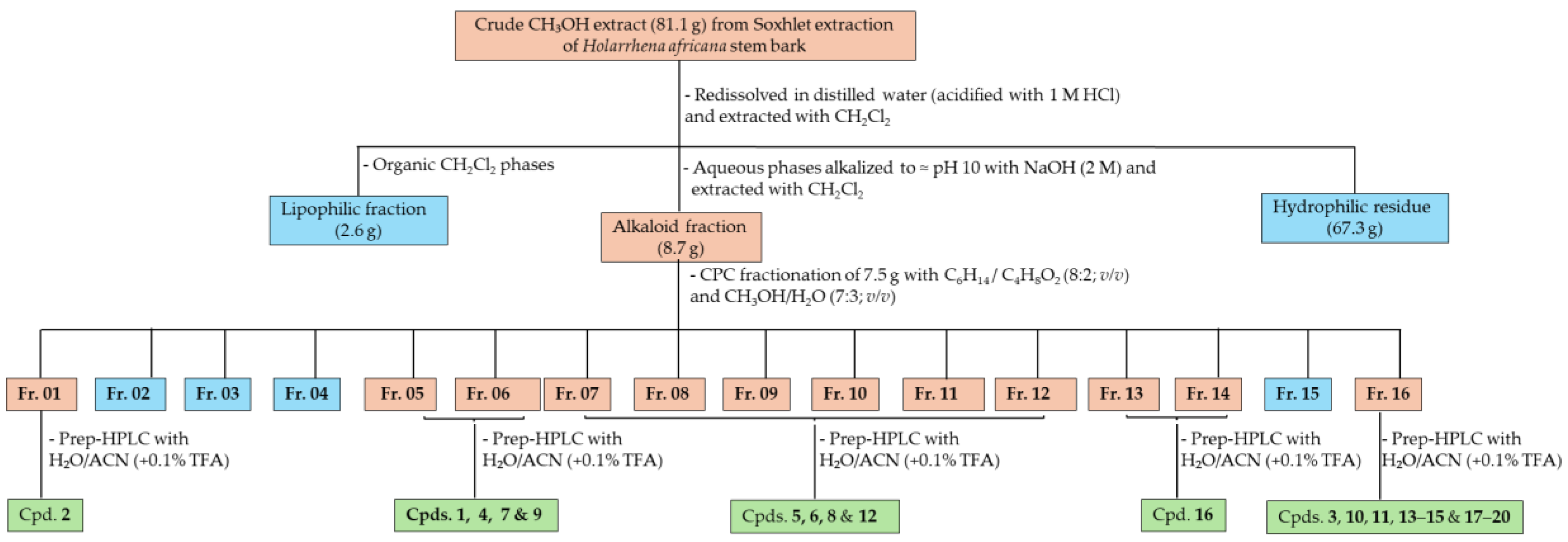
Figure 1.
Scores plot (PC2 vs. PC1) of the PLS model illustrating the antiplasmodial activity of the samples against Pf, ranging from the least active (Fr. 04) to the most active (Fr. 11).
Figure 1.
Scores plot (PC2 vs. PC1) of the PLS model illustrating the antiplasmodial activity of the samples against Pf, ranging from the least active (Fr. 04) to the most active (Fr. 11).
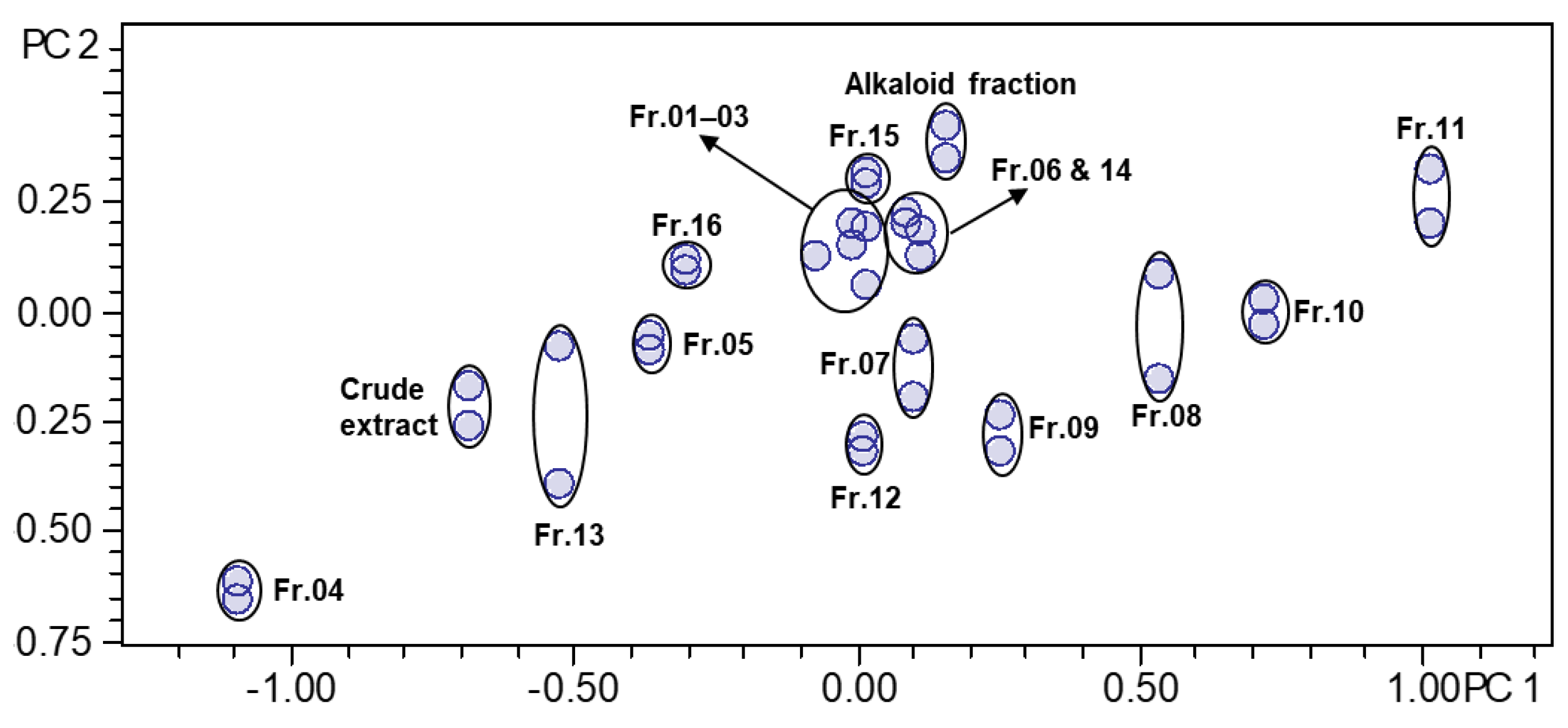
Figure 2.
Loadings plot (PC2 vs. PC1) of the PLS model predicting antiplasmodial compounds from Holarrhena pubescens. The variables on the right side (high loadings on PC1) are predicted by this model to be most influential for antiplasmodial activity, i.e. to possess high potency against Pf. The new compound 5 is highlighted by a red frame.
Figure 2.
Loadings plot (PC2 vs. PC1) of the PLS model predicting antiplasmodial compounds from Holarrhena pubescens. The variables on the right side (high loadings on PC1) are predicted by this model to be most influential for antiplasmodial activity, i.e. to possess high potency against Pf. The new compound 5 is highlighted by a red frame.
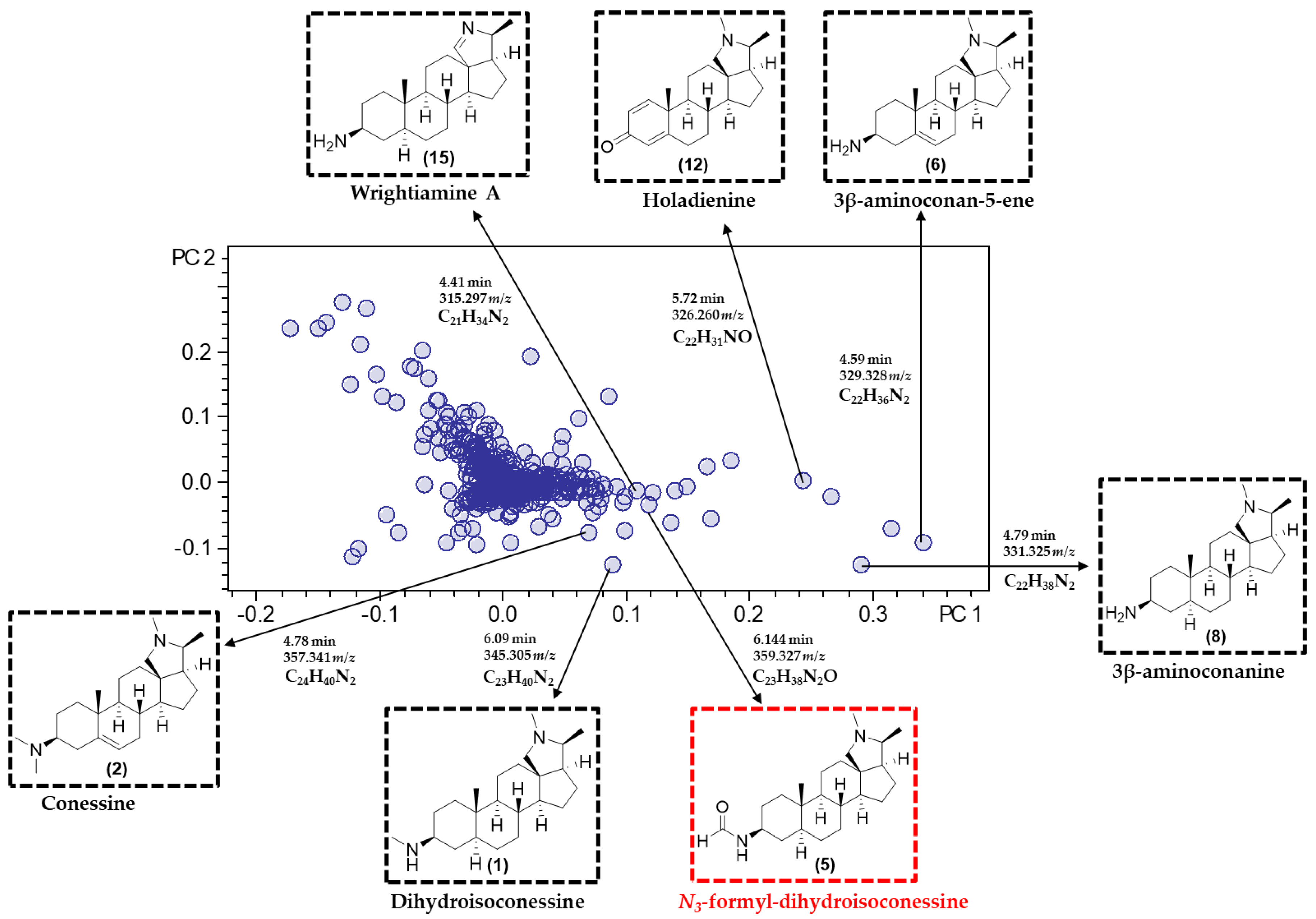
Figure 3.
Structures of alkaloids isolated from the stem bark of Holarrhena pubescens, including the new compound 5.
Figure 3.
Structures of alkaloids isolated from the stem bark of Holarrhena pubescens, including the new compound 5.
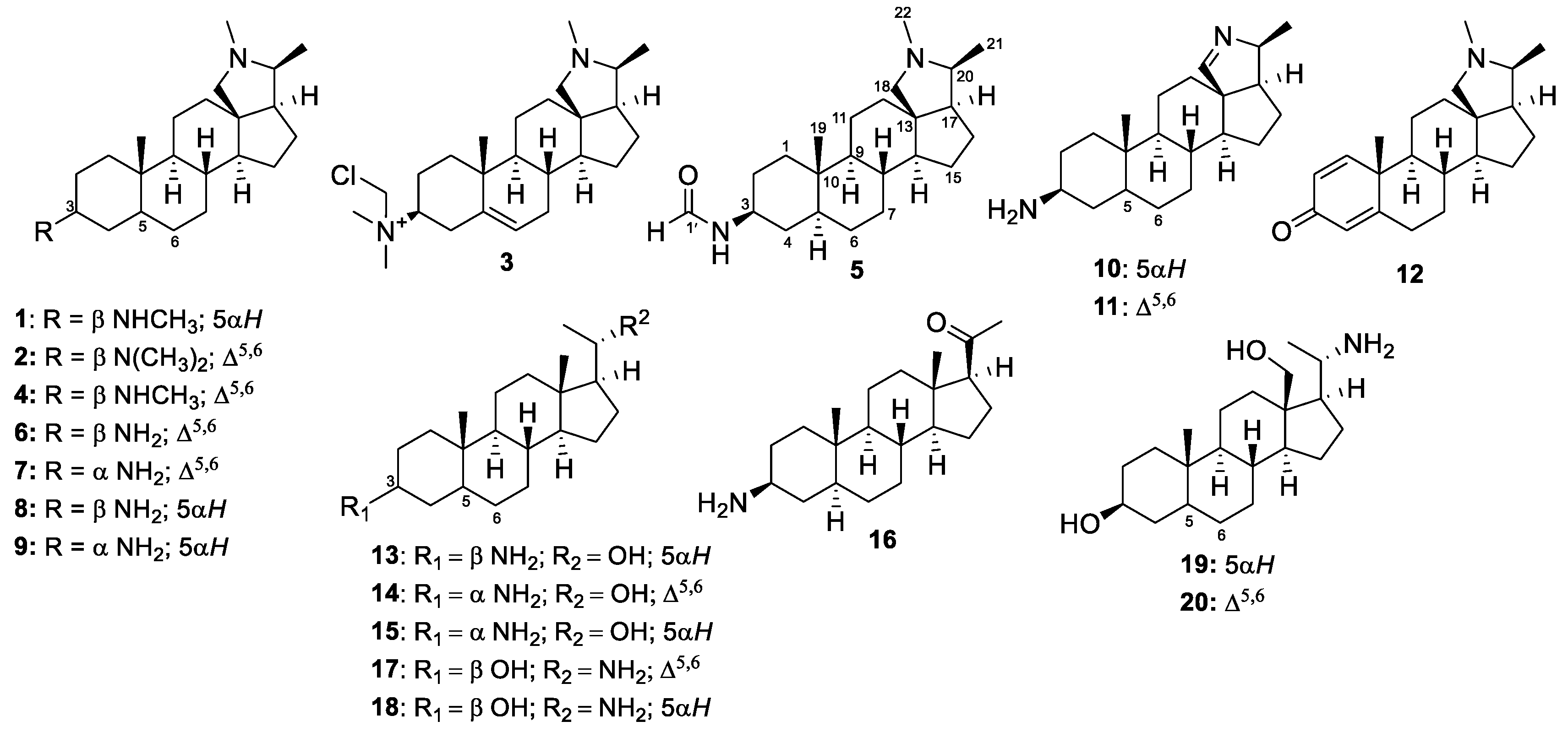

Table 1.
In vitro antiprotozoal and cytotoxic activities of the crude extracts and acid-base extraction fractions of the stem bark of Holarrhena pubescens. Data are expressed as IC50 in µg/mL and represent the means of two independent determinations ± the absolute deviations from the mean.
Table 1.
In vitro antiprotozoal and cytotoxic activities of the crude extracts and acid-base extraction fractions of the stem bark of Holarrhena pubescens. Data are expressed as IC50 in µg/mL and represent the means of two independent determinations ± the absolute deviations from the mean.
| Test sample | Tbr | Pf | Cytotox. L6 | SI (Tbr) | SI (Pf) |
| Small-scale extracts | |||||
| Twigs (CH3OH) | 16 ± 0.5 | 17 ± 0.4 | 63 ± 7.9 | 3.9 | 3.7 |
| Twigs (CH2Cl2) | 34 ± 7.9 | 21 ± 1.0 | 62 ± 8.6 | 1.8 | 3.0 |
| Leaves (CH3OH) | 3.9 ± 0.2 | 14 ± 4.5 | 57 ± 7.7 | 15 | 4.1 |
| Leaves (CH2Cl2) | 30 ± 8.8 | 8.1 ± 0.1 | 55 ± 7.5 | 1.8 | 6.8 |
| Stem bark (CH3OH) | 1.6 ± 0.2 | 6.7 ± 0.8 | 69a | 43 | 10 |
| Stem bark (CH2Cl2) | 45 ± 1.1 | 27 ± 2.6 | >100b | - | - |
| Large-scale CH3OH stem bark extract and its acid-base fractions | |||||
| Total crude extract | 0.9 ± 0.2 | 4.0 ± 0.1 | 61 ± 4.8 | 68 | 15 |
| Alkaloid fraction | 0.2 ± 0.0 | 0.7 ± 0.2 | 15 ± 4.1 | 75 | 21 |
| Lipophilic fraction | 2.1 ± 0.0 | 4.1 ± 0.6 | 51 ± 9.2 | 24 | 12 |
| Positive controls | 0.004 ± 0.000 | 0.002 ± 0.000 | 0.007 ± 0.003 | - | - |
aValue based on a single determination, as 50% inhibition was not reached in the second replicate at the maximal concentration tested (>100 µg/mL); b50% inhibition was not reached in either replicate at the maximal concentration tested (>100 µg/mL). Positive controls: melarsoprol (Tbr), chloroquine (Pf), podophyllotoxin (cytotoxic L6); Selectivity indices (SI) were calculated as: SI = IC50 (Cytotox. L6)/ IC50 (parasite).
Table 2.
Antiprotozoal activity of centrifugal partition chromatography (CPC) subfractions and positive controls. Data are expressed as IC50 values in µg/mL and represent the means of two independent determinations ± the absolute deviations from the mean.
Table 2.
Antiprotozoal activity of centrifugal partition chromatography (CPC) subfractions and positive controls. Data are expressed as IC50 values in µg/mL and represent the means of two independent determinations ± the absolute deviations from the mean.
| Test sample | Tbr | Pf | Cytotox.L6 | SI Tbr | SI Pf |
| Fr. 01 | 0.1 ± 0.0 | 1.0 ± 0.1 | 25 ± 6.2 | 250 | 25 |
| Fr. 02 | 0.2 ± 0.0 | 1.1 ± 0.1 | 39 ± 11 | 195 | 35 |
| Fr. 03 | 0.2 ± 0.0 | 1.0 ± 0.1 | 42 ± 7.2 | 210 | 42 |
| Fr. 04 | 2.0 ± 0.2 | 9.4 ± 2.2 | 84a | 42 | 9 |
| Fr. 05 | 0.5 ± 0.1 | 2.1 ± 0.5 | 50 ± 3.8 | 100 | 24 |
| Fr. 06 | 0.5 ± 0.2 | 0.8 ± 0.1 | 46 ± 4.6 | 92 | 58 |
| Fr. 07 | 0.8 ± 0.2 | 0.8 ± 0.2 | 43 ± 6.9 | 54 | 54 |
| Fr. 08 | 0.8 ± 0.1 | 0.3 ± 0.0 | 18 ± 0.6 | 23 | 60 |
| Fr. 09 | 0.7 ± 0.0 | 0.6 ± 0.2 | 17 ± 0.4 | 24 | 28 |
| Fr. 10 | 0.6 ± 0.2 | 0.2 ± 0.1 | 15 ± 1.7 | 25 | 75 |
| Fr. 11 | 0.8 ± 0.0 | 0.1 ± 0.0 | 15 ± 2.6 | 19 | 150 |
| Fr. 12 | 2.4 ± 0.2 | 1.0 ± 0.1 | 46 ± 2.7 | 19 | 46 |
| Fr. 13 | 2.1 ± 0.1 | 2.9 ± 0.3 | 16 ± 1.7 | 8 | 6 |
| Fr. 14 | 0.3 ± 0.1 | 0.8 ± 0.2 | 9.5 ± 4.0 | 32 | 12 |
| Fr. 15 | 0.5 ± 0.1 | 0.9 ± 0.1 | 9.2 ± 0.4 | 18 | 10 |
| Fr. 16 | 3.0 ± 0.7 | 1.8 ± 0.7 | 22 ± 5.0 | 7 | 12 |
| Positive controls | 0.004 ± 0.001 | 0.002 ± 0.000 | 0.010 ± 0.001 | - | - |
aDeviation not calculable, as the result of one replicate exceeded the maximal concentration tested (>100 µg/mL); positive controls: melarsoprol (Tbr), chloroquine (Pf), podophyllotoxin (Cytotox. L6); selectivity indices (SI) = IC50 (Cytotox. L6)/ IC50 (parasite).
Table 3.
NMR data of N3-formyl-dihydroisoconessine (5) in CD3OD (1H 600 MHz, 13C 150 MHz). All assignments were confirmed by 1H/13C-HSQC, COSY, HMBC and NOESY correlations.
Table 3.
NMR data of N3-formyl-dihydroisoconessine (5) in CD3OD (1H 600 MHz, 13C 150 MHz). All assignments were confirmed by 1H/13C-HSQC, COSY, HMBC and NOESY correlations.
| Pos. | 1H-NMRδ(ppm) Mult.J [Hz] | 13C-NMR (ppm) |
| 1 | 1.78, m 1.11, m |
38.5 |
| 2 | 1.76, m 1.39, m |
29.4 |
| 3 | 3.74, m | 49.0 |
| 4 | 1.52, m 1.27, m |
35.9 |
| 5 | 1.25, m | 46.5 |
| 6 | 1.32, m 1.26, m |
29.3 |
| 7 | 1.81, m 1.09, m |
33.0 |
| 8 | 1.26, m | 38.9 |
| 9 | 0.82, m | 54.7 |
| 10 | - | 36.6 |
| 11 | 1.80, m 1.06, m |
23.0 |
| 12 | 2.04, m 1.49, m |
37.9 |
| 13 | - | 53.2 |
| 14 | 1.38, m | 55.5 |
| 15 | 1.84, m 1.17, m |
27.2 |
| 16 | 1.69, m, (2H) | 23.3 |
| 17 | 2.35, dt, (9.77, 4.71) | 53.5 |
| 18 | 3.59, m 2.90, m |
62.6 |
| 19 | 0.82, s, (3H) | 12.5 |
| 20 | 3.58, m | 67.5 |
| 21 | 1.38, d (3H, 6.63) | 12.0 |
| 22 | 2.88, s (3H) | 40.4 |
| 1′ | 7.95, s | 162.8 |
Table 4.
Antiprotozoal activity and cytotoxicity of compounds isolated from Holarrhena pubescens stem bark. Data are IC50 values in µmol/L and represent the means of two separate determinations ± the absolute deviations from the mean. Compounds were tested as the monoa- or bis b-trifluoroacetates.
Table 4.
Antiprotozoal activity and cytotoxicity of compounds isolated from Holarrhena pubescens stem bark. Data are IC50 values in µmol/L and represent the means of two separate determinations ± the absolute deviations from the mean. Compounds were tested as the monoa- or bis b-trifluoroacetates.
| Compound | Tbr [μmol/L] | Pf[μmol/L] | Cytotox[μmol/L] | SI Tbr | SI Pf |
| 1b | 4.0 ± 1.2 | 2.0 ± 0.0 | 25.7 ± 4.6 | 6 | 13 |
| 2b | 0.2 ± 0.0 | 2.0 ± 0.2 | 25.3 ± 6.7 | 127 | 13 |
| 3b | 17.3 ± 1.2 | 11.8 ± 1.6 | >100 | - | - |
| 4b | 0.5 ± 0.1 | 2.0 ± 0.1 | 35.0 ± 11 | 70 | 18 |
| 5a | 5.1 ± 0.7 | 0.7 ± 0.1 | 29.8 ± 7.4 | 6 | 43 |
| 6b | 1.3 ± 0.6 | 1.7 ± 0.0 | 29.8 ± 7.5 | 23 | 18 |
| 7b | 13.2 ± 5.9 | 1.5 ± 0.1 | 29.6 ± 1.4 | 2 | 20 |
| 8b | 4.2 ± 1.7 | 1.4 ± 0.1 | 19.6 ± 4.5 | 5 | 14 |
| 9a | 44.2 ± 6.0 | 1.0 ± 0.2 | 23.1 ± 3.1 | 1 | 23 |
| 10b | 1.5 ± 0.5 | 1.8 ± 0.2 | 15.6 ± 2.5 | 10 | 9 |
| 11b | 2.9 ± 1.1 | 3.3 ± 1.0 | 31.9 ± 7.3 | 11 | 10 |
| 12a | 16.4 ± 1.6 | 4.8 ± 0.1 | 56.5 ± 7.8 | 3 | 12 |
| 13a | 2.0 ± 0.1 | 12.7 ± 0.2 | 17.9 ± 0.1 | 9 | 1 |
| 14a | 11.4 ± 5.4 | 13.6 ± 2.8 | 23.6 ± 0.5 | 2 | 2 |
| 15a | 1.8 ± 0.1 | 7.1 ± 0.3 | 19.3 ± 0.7 | 11 | 3 |
| 16a | 0.2 ± 0.1 | 4.9 ± 0.8 | 4.5 ± 1.4 | 23 | 1 |
| 17a | 5.3 ± 0.1 | 11.3 ± 3.2 | 12.6 ± 4.9 | 2 | 1 |
| 18a | 5.7 ± 0.4 | 7.2 ± 0.2 | 12.7 ± 4.4 | 2 | 2 |
| 19a | 18.1 ± 1.5 | 11.0 ± 2.6 | 47.6 ± 1.6 | 3 | 4 |
| 20a | 18.5 ± 1.2 | 16.0 ± 1.8 | 52.2 ± 3.2 | 3 | 3 |
| Positive controls | 0.010 ± 0.003 | 0.003 ± 0.001 | 0.010 ± 0.000 | - | - |
aMono-trifluroracetate; bbis-trifluoroacetate; positive controls: melarsoprol (Tbr), chloroquine (Pf), podophyllotoxin (Cytotox.L6); selectivity indices (SI) = IC50 (Cytotox. L6)/ IC50 (parasite).
Disclaimer/Publisher’s Note: The statements, opinions and data contained in all publications are solely those of the individual author(s) and contributor(s) and not of MDPI and/or the editor(s). MDPI and/or the editor(s) disclaim responsibility for any injury to people or property resulting from any ideas, methods, instructions or products referred to in the content. |
© 2026 by the authors. Licensee MDPI, Basel, Switzerland. This article is an open access article distributed under the terms and conditions of the Creative Commons Attribution (CC BY) license.
Copyright: This open access article is published under a Creative Commons CC BY 4.0 license, which permit the free download, distribution, and reuse, provided that the author and preprint are cited in any reuse.


