

Submitted:
27 May 2024
Posted:
28 May 2024
You are already at the latest version
Abstract
The serendipitous discovery of antiparasitic drugs, such as quinine and artemisinin from plant origin reveals that the search for new chemical pharmacophores from medicinal plants is valuable. The present study sought to explore the antiplasmodial, antileishmanial, and antitrypanosomal activities of extracts from Lippia adoensis. Crude extracts of L. adoensis leaves and twigs, which were obtained by extraction using 70% ethanol in water, were assayed for antiplasmodial activity against P. falciparum 3D7 and Dd2 through the SYBR green I-based fluorescence assay; and for antileishmanial, antitrypanosomal, and cytotoxic effects on Leishmania donovani, Trypanosoma brucei brucei, and Vero cells, respectively, using the resazurin colorimetric assays. The phytochemical analysis of the extracts was performed using a liquid chromatography-mass spectrometry (LC-MS) feature-based detection and molecular networking flow on Global Natural Product Social (GNPS). As a result, the crude extracts from L. adoensis inhibited growth of P. falciparum (3D7 and Dd2) (IC50s; (3D7): 10.008 and 97.467 μg/mL; (Dd2): 29.48 and 26.96 μg/mL), L. Donovani (IC50s: 22.879-10.522 μg/mL), and T. brucei brucei (IC50s: 2.3085-55.06 μg/mL). The extracts were found to be non-cytotoxic to Vero cells, thus yielding median cytotoxic concentrations (CC50s) above 100 μg/mL. The LC-MS tandem molecular networking flow predicted that the extracts contain valsafungin A and bacillamidin on the first cluster, and fatty acids, ketone and aldehyde derivatives on the second cluster. Overall, the present study demonstrated the antiparasitic effects of L. adoensis extracts, thus justifying the use of this plant in the traditional treatment of fever and malaria conditions. Nevertheless, detailed metabolomic studies and antiparasitic mechanisms of action of the extracts are expected to unveil the potential antiparasitic hit compounds.
Keywords:
Lippia adoensis
; Plasmodium falciparum
; Leishmania donovani
; Trypanosoma brucei
; molecular networking
; LC-MS analysis
1. Introduction
The World Health Organization (WHO) classified malaria, leishmaniasis and African trypanosomiasis as the triad parasitic diseases that are more prevalent in tropical regions, especially in Sub-Saharan Africa [1]. These diseases claim the lives of a billion people worldwide annually [2]. They are considered neglected and are typically found in tropical and subtropical zones with deprived sanitation and sewage disposal, deficient hygiene practices, as well as low host resistance and environmental changes [3,4]. More than fifty countries have eliminated at least one neglected disease since 2023, thus featuring the midway point towards eradication in hundred countries by 2030. This notorious disease is triggered by parasites of the genus Plasmodium, the deadliest being caused by Plasmodium falciparum, which is transmitted through bites of infected female Anopheles mosquitoes [5]. In 2022, there were an estimated 249 million malaria cases and 608 000 malaria deaths worldwide [5]. Countries, such as Mozambique (4.2%), Uganda (5.1%), the Democratic Republic of the Congo (12.3%) and Nigeria (26.8%) were the most affected by malaria accounting for over half of all malaria deaths in the world. Malaria is a curable disease; however, early diagnosis and treatment ensures a fast and complete elimination of the parasites from the bloodstream [5]. As per the last malaria report by WHO, artemisinin-based combination therapies are the recommended treatments for uncomplicated falciparum malaria, whereas the intravenous or intramuscular administration of artesunate is indicated for the severe form, with the use of quinine as an acceptable alternative [5].
Caused by parasites of the Leishmania genus, leishmaniasis is transmitted through bites by infected female phlebotomine sandflies and manifests into three forms, including cutaneous, mucocutaneous and visceral forms [6,7]. It affects mostly the poorest regions of the globe and an estimated 1 million new cases occur annually [7]. The arsenal of antileishmanial therapies include pentavalent antimonials, miltefosine, amphotericin B, paromomycin, and pentamidine and others [8]. However, the Leishmania parasites have become resistant to the majority of these antileishmanial treatments [9].
Human African trypanosomiasis (HAT, sleeping sickness), which is caused by Trypanosoma brucei menaces millions of individuals, especially in sub-Saharan Africa where high transmission occurs due to the presence of tsetse flies [10]. Two parasites that feature the two forms of this disease include Trypanosoma brucei rhodesiense and gambiense, the latter accounting for over 98% of reported cases (WHO, 2024c) [10]. Current medications for human American trypanosomiasis comprise nifurtimox, suramin, pentamidine, eflornithine, and melarsoprol, etc.; however, these medicines require prolonged parenteral administration and cause undesirable side effects, such as loss of weight, anorexia, depression of bone marrow, psychic alterations, and articular and muscular pain [11,12].
The continuous use of the same drugs over decades to cure these tropical diseases has led to the development of resistance by the disease-causing parasites [12,13]. Further challenges for trypanosomiasis and leishmaniasis treatment consist of patient compliance with therapy, complex or unknown pathogenic mechanisms, drug instability, and environmental factors that influence the transmission of infection [14].
In addition to the problem of drug resistance, these therapies exhibit a range of toxic effects, thus, justifying the pressing need to search for effective antiprotozoal agents.
The serendipitous finding of the two well-known antimalarial drugs quinine and artemisinin from Cinchona tree and Artemisia annua, respectively has revolutionize the development of antimalarial therapies from medicinal plants, even though these medications have become less effective due to parasite drug resistance [15]. Moreover, most of the anti-Trypanosomatid or anti-kinetoplastid drugs originate from structural modifications of known natural product scaffolds (nifurtimox: nitrofuran derivative, pentamidine: diamidine derivative), by chemical synthesis (pentavalent antimonials) or repurposed from existing drugs (eflornithine and miltefosine, previous anticancer agents; amphotericin B; an antifungal agent) [16,17].
Furthermore, the interest of natural product-based drug discovery over high throughput screening of combinatorial libraries [18] justifies the suitability of natural compound pharmacophores in the discovery of antiprotozoal drugs. Lippia adoensis is an example of medicinal plants used for the traditional treatment of several diseases, including skin disorders, superficial fungal infections, malaria, and fever conditions [19]. In Ethiopia, the leaves of Lippia adoensis are used to cure toothache, diarrhea and indigestion [20], whereas the leaf decoction is employed as a remedy for fever and constipation in children, and for the treatment of bronchitis, skin disorders and ophthalmia [21,22]. Other plants from the genus Lippia are used traditionally to relieve cough and colds, wounds, gastrointestinal and respiratory problems, malaria and fever conditions [23,24]. Before the 1990’s, Lippia adoensis was already coined for its high content in volatile compounds, with linalool (81.30-94.56%) as the highest compound, followed by caryophyllene (5.66%), and 1,8-cineole (3.22%), among others [25]. Research by Abegaz et al. [26] revealed a different composition of essential oil in cultivated and Wild type Lippia adoensis with the monoterpene ketone ipsdienone found in both types. Linalool, which is reported by the majority of authors as the main constituent of Lippia adoensis’ essential oil was found in the cultivated form, but was absent in the wild plant type, even though there was a number of compounds peculiar to the wild type [limonene (3.44–32.73%), perillaldehyde (0.04–26.90%) and piperitenone (0.15–44.48%)] [26]. More than a decade later, Kasali et al. [27] performed the GC-MS analysis of the essential oil of a Nigerian (Ajara-Badagry, Lagos)-growing Lippia adoensis leaves. As a result, monoterpenes, such as linalool (26.1%), 1,8-cineole (17.4%) and geraniol (19.0%), and the sesquiterpene germacrene D (4.6%) were recorded as the major ingredients. In another location of Nigeria (Ife-Odan, Osun State), Adelani et al. [28] recorded a different chemical composition of the essential oil of Lippia adoensis leaves [major constituents: 1,3,6,10-dodecatetraene (3.74%), 1H-cyclopropa[a]naphthalene (4.25%), α-pinene (5.08%), γ-terpinene (15.24%), α-terpineol (25.99%), and eucalyptol (28.36%)]. Fikadu et al. [29] revealed a variability of major compounds of L. adoensis, collected in Ethiopia from two different sites viz. Debre Berhan [linalool (86.11%)] and Bishoftu [linalool (66.60%) and caryophyllene (4.28%)]. In addition, a phytochemical analysis of water, methanol, petroleum ether, acetone, and aqueous: methanol (20:80, v/v) extracts from L. adoensis leaves revealed the presence of phenolic compounds and flavonoids in this plant [30].
To unravel the phytochemical composition of plant extracts, recent approaches, such as molecular networking has become an essential bioinformatics tool to visualize and annotate non-targeted mass spectrometry data [31,32,33]. This tool was released through the Global Natural Product Social (GNPS) Molecular Networking, a web-enabled mass spectrometry knowledge capture and analysis platform (http://gnps.ucsd.edu) [34], and has been widely applied in mass spectrometry-based metabolomics to aid in the annotation of molecular families from their fragmentation spectra [32]. This very metabolomics tool might help to unveil the chemical constituents of Lippia adoensis, which are responsible for its pharmacological effects, such as antibacterial and antifungal [35] and antioxidant [30] activities. Noteworthy, higher (500-2000 mg/kg) repeated oral doses of the ethanolic extract of L. adoensis in Wistar rats for 28 days showed signs of toxicity, even though acute toxicity experiment revealed median lethal dose (LD50) less than 10 000 mg/kg [24]. To our knowledge, the antiparasitic effects of L. adoensis against pathogens like Plasmodium, Leishmania and Trypanosoma are still unknown.
Based on the above considerations, the scientific validation of the medicinal plant L. adoensis, which is used for the traditional treatment of malaria and fever conditions is valuable. Thus, this study sought to investigate the antiparasitic effect of L. adoensis extracts against Plasmodium, Leishmania, and Trypanosoma parasites. The phytochemical screening of L. adoensis extract is also evaluated using a LC-MS feature detection and alignment, and then a molecular networking workflow on GNPS (http://gnps.ucsd.edu).
2. Materials and Methods
2.1. Plant Material
2.1.1. Plant Collection and Identification
The leaves and twigs of Lippia adoensis (Figure 1) were collected at Etoa, Yaounde, Cameroon, in June 2023. The plant material was identified by Mr. NANA Victor, botanist at the Cameroon National Herbarium and a Voucher specimen number HNC-00428FC was attributed.
2.1.2. Plant Extraction
Following plant collection, the organs (leaves and twigs) were dried at room temperature and coarsely powdered. Next, the crude extracts were prepared by maceration of the dried powders in hydroethanol (30/70; v/v). Briefly, 500g of dried powder were macerated in hydroethanol (1500 ml) for 72 hours at room temperature. The resulting solution was then filtered using a hydrophilic cotton, and the filtrate was further concentrated using a Buchi rotary evaporator at 55oC to yield the crude extracts. The extraction yield was calculated using the following formula:
Extraction yield (%) = (mass of the crude extract (g))/(mass of the plant material(g)) × 100
The crude extracts were kept in the refrigerator until further use.
2.2. In Vitro Antiparasitic Activity of Lippia adoensis Extracts
2.2.1. In Vitro Antiplasmodial Test
a. Plasmodium falciparum culture and maintenance
Plasmodium falciparum (chloroquine-sensitive 3D7; Pf3D7 and -resistant Dd2; PfDd2) strains were maintained in culture using the method of Trager and Jensen [36] with some modifications [37]. Parasites were cultured in fresh human erythrocytes (O+ve) suspended at 4% (v/v) hematocrit in complete RPMI 1640 medium [16.20 g/L of RPMI 1640 containing 25 mM HEPES, 11.11 mM glucose, 0.20% sodium bicarbonate, 0.50% Albumax I (Gibco, Waltham, MA, USA), 45 μg/mL hypoxanthine (Sigma, Munich, Germany) and 50 μg/mL gentamicin (Gibco, Waltham, MA, USA)] and incubated at 37 °C in an atmosphere of 5% CO2. To propagate the culture, the consumed medium was replenished with fresh complete medium every day. To monitor cell cycle transition and parasitaemia, giemsa-stained blood smears were observed microscopically under oil immersion.
b. In vitro assay on P. falciparum
Lippia adoensis extracts were assessed for in vitro antiplasmodial activity using the SYBR green I-based fluorescence assay set up as described by Smilkstein et al. [38]. Crude extracts were prepared at 25 mg/mL in dimethyl sulfoxide (DMSO), whereas the chloroquine (Sigma-Aldrich) stock solution used as standard drug was prepared in water (Milli-Q grade) at 1 mM. The as-prepared stock solutions were then diluted in 96-well, round-bottom, and tissue culture-grade plates with fresh RPMI 1640 culture medium to achieve the suitable concentrations for tests. Except for chloroquine and artemisinin (positive controls), the final solution of each well contained 0.4 % DMSO, which was found to be non-toxic to the parasite. Extracts were tested at concentrations ranging from 0.10 to 100 μg/mL, whereas the positive controls chloroquine and artemisinin (Sigma-Aldrich) were used at 1 µM. Overall, the tests were performed in triplicate. Briefly, 100 μL of sorbitol-synchronized P. falciparum [39] were incubated under normal culture conditions (37 °C and 5% CO2) at 1% parasitemia and 2% hematocrit in flat-bottomed 96-well plates in the absence or presence of increasing concentrations of crude extracts for 48 h. Chloroquine and artemisinin were used as positive controls, whereas 0.4% (v/v) DMSO was used as a negative control. After the incubation period, 100 μL of SYBR green I lysis buffer [Tris (20 mM, pH 7.5), ethylenediaminetetraacetic acid (EDTA) (5 mM), saponin (0.008%, w/v), and Triton X-100 (0.08, v/v)] was added to each well and mixed gently twice, and then incubated in dark at 37 °C for 1 h. Next, the fluorescence was measured by using a Tecan Infinite M200 fluorescence multi-well plate reader with excitation and emission wavelength bands centered at 485 and 530 nm, respectively. The median inhibitory concentrations (IC50s) were determined by analysis of dose-response curves obtained by plotting fluorescence counts versus concentrations of extracts or drugs (chloroquine or artemisinin). The results were further validated microscopically by examination of Giemsa-stained smears of treated (extracts or drug) or untreated parasite cultures.
2.2.2. Antileishmanial Screening
a. Parasite culture and maintenance
The cryopreserved promastigote form of L. donovani (1S (MHOM/SD/62/1S) was obtained from the Biodefense and Emerging Infections Research Resources Repository (Bei Resources) (https://www.beiresources.org/) and is under a routine culture at the Antimicrobial and Biocontrol Agents Unit, University of Yaoundé I, in Medium 199 (Sigma, Darmstadt, Germany) supplemented with 10% heat-inactivated fetal bovine serum (HIFBS) (Sigma, Darmstadt, Germany) and 100 IU/mL penicillin and 100 μg/mL streptomycin. The culture was sustained in 75 Cm2 cell culture flasks at 28 °C and checked for growth daily, whereas parasite sub-culturing was done every 3 days [40].
b. Inhibitory assay against L. donovani promastigotes
As previously described by Siqueira-Neto et al. [41], the resazurin colorimetric assay was used to evaluate the antileishmanial activity of Lippia adoensis crude extracts against cultured L. donovani promastigotes. To this end, stock solutions were prepared by dissolving each extract in 100% DMSO, followed by a serial dilution in non-supplemented culture medium. To assess the antileishmanial activity, 4×10⁵ promastigotes/mL/well were seeded in a 96 well microtiter plate, treated with 5-fold diluted concentrations of Lippia adoensis extracts (0.16, 0.8, 4, 20 and 100 μg/mL) and incubated for 72 h at 28 °C. The rate of viability of promastigotes correlated well with the quantity of pink resorufin that was generated following the reduction of blue resazurin by the inner mitochondrial dehydrogenases of living parasites. Briefly, 90 μL of promastigotes from a logarithmic phase culture (4×10⁵ cells/mL) were seeded in 96-well microtiter plates and then treated with 10 μl of each plant extract at different triplicate concentrations ranging from 100 to 0.16 μg/mL. The final concentration of DMSO in each well was not higher than 1%. After incubation of the plates for 28 h at 28 °C, a resazurin (Sigma, Darmstadt, Germany) solution was added at 1 mg/mL, followed by an additional incubation for 44 h. The negative and positive controls were 0.1% DMSO and amphotericin B (Sigma, Darmstadt, Germany) (10-0.016 μg/mL), respectively. After the incubation period, the plates were then read on a Magelan Infinite M200 fluorescence multiwell plate reader (Tecan, Männedorf, Switzerland) at appropriate excitation (530 nm) and emission (590 nm) wavelengths. For each sample, growth percentages were calculated and dose–response curves were plotted to determine the median inhibitory concentration (IC50) using the GraphPad Prism 8.0 software (San Diego, California, USA).
2.2.3. Antitrypanosomal Screening
a. Parasite growth conditions
Kindly donated by the BEI resource, the parasite used for this study was the bloodstream form trypomastigotes of Trypanosoma brucei subsp. brucei, Strain Lister 427 VSG 221. An axenic culture of parasites was done in sterile vented flasks containing complete Hirumi’s modified Iscove’s medium 9 (HMI-9) [500 mL IMDM (Iscove’s modified Dulbecco’s medium) (Gibco, Waltham, MA, USA) supplemented with 10% (v/v) heat-inactivated fetal bovine serum (HIFBS) (Sigma Aldrich), 10% (v/v) serum plus (Sigma Aldrich), HMI-9 supplement (1 mM hypoxanthine, 50 µM bathocuproine disulfonic acid, 0.16 mM thymidine, 1.25 mM pyruvic acid, 1.5 mM cysteine, and 0.2 mM 2-mercaptoethanol (Sigma Aldrich)), and 1% (v/v) penicillin–streptomycin (Sigma Aldrich)] and incubated at 37 °C in a 5% CO2 atmosphere. To assess parasite density, cultures were routinely monitored every 72 h using a Lumascope LS520 inverted fluorescence microscope (Etaluma, Inc., USA), and subsequently passaged with fresh complete medium so that the cell density did not exceed 2×10⁶ cells/mL [42].
b. Inhibition test against Trypanosoma brucei brucei
The in vitro inhibitory activity of Lippia adoensis extracts was evaluated against bloodstream forms of Trypanosoma brucei brucei using the resazurin-based test as previously described [43]. In brief, parasites at their mid-logarithmic growth phase were counted, and the cell density was adjusted with fresh complete HMI-9 medium to 2×10⁵ trypanosomes per mL. Next, 90 µL of parasite suspension was distributed into 96-well flat-bottomed plates containing 10 µL of extracts, followed by a serial dilution at 5-point concentrations (0.16, 0.8, 4, 20 and 100 μg/mL). In each plate, the first column served as a negative (cells with 0.1% DMSO) control, whereas the last column was employed for positive (cells with 10 µM pentamidine isethionate) control. Next, the plates were incubated for 68 h at 37 °C and 5% CO2, followed by an addition of a resazurin solution (0.15 mg/mL in DPBS, Sigma–Aldrich) and incubation in darkness for an extra 4 h. Then, the fluorescence of the as-prepared solution was measured using a Tecan Infinite M200 fluorescence multiwell plate reader (Austria) at wavelengths of 530 and 590 nm for excitation and emission, respectively. Each assay was performed in duplicate and repeated two times. The percent parasite inhibition was determined for each sample (extract or drug) based on fluorescence data relative to the mean fluorescence of negative control wells. Mean fluorescence readouts were normalized to percent control activity using Microsoft Excel, and the median inhibitory concentrations (IC50) were calculated using Prism 8.0 software (GraphPad) with data fitted by nonlinear regression to the variable slope sigmoidal concentration–response formula: y = 100/[1+ 10 (logIC50/99-x)H], where H is the slope factor or hill coefficient [44].
2.3. Cytotoxicity Assay
2.3.1. Maintenance of Mammalian Cells
The African green monkey kidney Vero cell line (ATCC CRL-1586), which was generously received from the Centre Pasteur of Cameroon (CPC) was grown in T-25 vented cap culture flasks using complete DMEM (Dulbecco’s modified Eagle’s medium) supplemented with 10% FBS, 1% nonessential amino acids and 1% (v/v) penicillin–streptomycin and incubated at 37 °C in 5% CO2 atmosphere. The medium was replenished every 3 days, and cell growth was assessed using an inverted microscope (Lumascope LS520). At approximately 80–90% cell confluence, subculture was performed by detaching using 0.25% trypsin-EDTA followed by centrifugation at 1800 rpm for 5 min. The resulting pellet was then resuspended and counted in a Neubauer chamber in the presence of trypan blue to exclude nonviable cells (colored cells in blue). After cell load estimation, cells were either used for next passage in a new flask or to process the cytotoxicity test.
2.3.2. Cytotoxic Effect of Extracts
The cytotoxicity of extracts was performed in a 96-well tissue culture-treated plate as per a previously described protocol [43]. Briefly, Vero cells (density: 104 cells/well) were plated in 100 µL of complete DMEM and incubated overnight to allow cell attachment. Thereafter, plates were controlled under an inverted fluorescence microscope (Lumascope LS520) to verify adherence, sterility and cell integrity. Next, culture medium was carefully emptied from each well, and plates were filled with 90 µL of fresh complete medium followed by the addition of 10 µL of serial 5-fold dilutions of extract solutions. Podophyllotoxin (100–0.16 µg/mL) was used as a positive control, whereas 0.5% DMSO (100% cell viability) was used as a negative control. Thereafter, the plates were incubated in a humidified atmosphere and 5% CO2 for a period of 48 h. After the incubation period, 10 µL of resazurin solution (0.15 mg/mL in DPBS) was added to each well and incubated for an additional 4 h. Fluorescence was then read using a Magelan Infinite M200 fluorescence multiwell plate reader (Tecan) at wavelengths of 530 nm and 590 nm for excitation and emission, respectively. The percentage of cell viability was calculated from readouts, and the 50% cytotoxic concentration (CC50) for each extract was surmised from concentration–response curves using GraphPad Prism 8.0 software. Next, the selectivity indices (SIs) were determined for each extract as follows: SI = CC50 (Vero cells)/IC50 (parasite).
2.3.3. Buildout of Feature-Based Molecular Networking
The generation of feature-based molecular networking (FBMN) was performed in two main steps: (i) LC-MS feature detection and alignment, then (ii) a molecular networking workflow on GNPS. Following step 1 (feature detection and alignment), two files were exported: a MS spectral summary (.MGF format) and a feature quantification table (.TXT format) [32]. The feature quantification table contains information about LC-MS features across all considered samples including a unique identifier (feature ID) for each feature, retention time, m/z value, and intensity. The MS spectral summary contains a list of MS spectra, with one representative MS spectrum per feature. The mapping information between the feature quantification table and the MS [32] spectral summary was stored in these files using the feature ID and scan number, respectively. This mapping allows to relate LC-MS feature information or statistically consequent results to the molecular network nodes. The FBMN workflow [that supports mzTab-M format8, a standardized output format designed for the report of metabolomics MS-data processing results (whereby mzTab-M file is used instead of feature quantification table and requires the input of the mzML files instead of the MS spectral summary file)] was integrated into the GNPS ecosystem and thus benefiting from the connection with other GNPS features, e.g. the possibility to perform automatic MS spectral library search, the direct addition and curation of library entries, as well as the search of a spectrum against public datasets with mass spectrometry search tool (MASST) [45], and the visualization of molecular networks directly in the web browser [46] or with Cytoscape [47]. In fact, the FBMN workflow is available on the GNPS platform (https://gnps.ucsd.edu/) via a web interface. Data is computed and stored on the computational infrastructure of the Center for Computational Mass Spectrometry at the University of California San Diego. Each and every job done is saved in the private user space for further examination and has a permanent static link that allows data sharing and concerted analyses. Sharing of this static link along with publications using GNPS workflows is strongly recommended to facilitate results’ availability and data analysis reproducibility. Guidelines to carry out FBMN with the supported tools are supplied in the GNPS documentation (https://ccms-ucsd.github.io/GNPSDocumentation/featurebasedmolecularnetworking).
2.4. Statistical Analysis
The data, which were collected from at least two independent experiments and performed in duplicate, are expressed as the mean ± standard deviation (SD). They were analyzed through Dunnett’s multiple comparison test using GraphPad 8.0 software. Differences were considered statistically significant at p < 0.05 (*), p < 0.001 (**), and p < 0.0001 (***).
3. Results
3.1. Antiparasitic Tests
In this study, the inhibitory effects of Lippia adoensis extracts were evaluated against Plasmodium falciparum (strains 3D7 and Dd2), Leishmania donovani promastigotes, and trypomastigotes of Trypanosoma brucei brucei. Results of the median inhibitory concentrations (IC50) of the plant extracts are summarized in Table 1.
3.1.1. Antiplasmodial Effect
The hydroethanolic extracts of leaves and twigs showed relevant activity against P. falciparum 3D7 with IC50 values of 10.008 and 97.467 μg/mL, respectively, vs chloroquine and artemisinin (IC50 values: 0.859 and 0.0034 μg/mL, respectively). Against P. falciparum Dd2, hydroethanolic extracts of leaves and twigs presented moderate inhibitory effects with IC50 values of 29.48 and 26.96 μg/mL, respectively, vs chloroquine and artemisinin (IC50 values of 0.0514 and 0.0644 μg/mL, respectively).
3.1.2. Antileishmanial Activity
The incubation of L. donovani promastigotes with hydroethanolic extracts from leaves and twigs of Lippia adoensis inhibited the parasite’s population, thus yielding IC50 values of 22.879 and 10.522 μg/mL, respectively, versus amphotericin B (IC50 value: 1.11 μg/mL).
3.1.3. Antitrypanosomal Role
Against T. brucei, the extracts of L. adoensis exhibited IC50 values of 2.308 and 55.06 μg/mL, respectively, versus pentamidine (IC50 value: 0.00675 μg/mL).
3.2. Cytotoxicity Assay
Upon cytotoxicity test, the hydroethanol extracts from leaves and twigs of Lippia adoensis showed common half maximal cytotoxic concentrations (CC50) values above 100 μg/mL, inferring that these extracts are non-toxic to the human mammalian cells Vero. Thus, the extracts were found to be selective to the parasitic cells with selectivity indices ranging from > 1.81 to > 43.47.
3.3. Development of Molecular Networking
LC-MS feature detection and alignment, followed by a dedicated molecular networking workflow on GNPS were successively used to predict the chemical constituents present in Lippia adoensis. As a result, two clusters of compounds were obtained. The first cluster was dominated by valsafungin A and bacillamidin, which are well known antifungal antibiotics [48], in addition to N-isopentyltridecanamide and the codified compound AKD-2A, which were also predicted. The second cluster consisted of ketones (hexadec-10-en-2-one and its isomers hexadec-12-en-2-one and hexadec-8-en-2-one; 14-methylpentadec-8-en-2-one and its isomer 14-methylpentadec-10-en-2-one; 13-methylpentadec-8-en-2-one; (Z)-15-methylhexadec-10-en-2-one), fatty acids (6-methyl-9-heptadecenoic acid; 4-methyl-7,11-heptadecadienoic acid; and 11-hexadecenoic acid) and the aldehyde derivative 4-methyl-7,11-heptadecadienal (Figure 2).
4. Discussion
The scientific evaluation of medicinal plants used in the preparation of folk remedies has provided modern medicine with several effective pharmaceuticals for the treatment of diseases caused by protozoan parasites [49,50,51]. As a result, during the last two decades, numerous studies from various parts of the world on antiprotozoal activity of medicinal plants have been reported [2,52,53,54,55]. In continuation of our search for bioactive compounds of plant origin with antiparasitic effects, the hydroethanol extracts of Lippia adoensis leaves and twigs were screened for their antiplasmodial, antileishmanial, and antitrypanosomal potential. Noteworthy, to the best of our knowledge, this study represents the first report on antiparasitic activity of Lippia adoensis against Plasmodium, Leishmania and Trypanosoma species. The hydroethanolic extract of leaves showed significant (IC50: 10.008 μg/mL) antiplasmodial activity against the sensitive strain of P. falciparum (3D7), whereas that of the twigs revealed moderate (IC50: 97.467 μg/mL) activity. Against P. falciparum Dd2, hydroethanolic extracts of leaves and twigs presented moderate inhibitory effects with IC50 values of 29.48 and 26.96 μg/mL, respectively. As already discussed, Lippia adoensis has been reported to contain flavonoids and phenolic compounds [30], monoterpenes (ipsdienone, linalool, cineole, geraniol and caryophyllene) and sesquiterpenes (germacrene D) [25,26,27,28,29]. Accumulated evidence has shown that these compounds reveal antiplasmodial activity. For instance, Santos et al. [56] recently described the implication of monoterpenes such as 1,8-cineole in the inhibition P. falciparum in vitro, thus preventing severe malaria in P. berghei-infected mice [56]. In addition, Boyom et al. [57] previously demonstrated that the antiplasmodial activity of the essential oil from Cleistopholis patens was attributed to the presence of β-caryophyllene, germacrene D, and germacrene B, whereas that from Uvariastrum pierreanum was due to the presence of β-bisabolene and α-bisabolol, α- and β-pinenes [57]. A detailed mechanism of antiplasmodial action of 1,8-cineole showed inhibition of hemoglobin degradation thereby preventing the hemozoin formation [56,58,59], even though more experiments are necessary to confirm this allegation. Linalool, the major compound of Lippia adoensis’s essential oil, was also reported to induce leishmanial cell death by nuclear and kinetoplast chromatin destruction, followed by cell lysis, which was observed within 1 h of cell treatment [60]. Rodrigues Goulart et al. [61] have previously demonstrated cell cycle arrest by linalool in P. falciparum [61]. Lippia adoensis, which majorly contains monoterpenes, such as linalool, might have exerted antiplasmodial and antileishmanial activities through at least one of these mechanisms, even though additional mechanistic studies are required to validate this claim. Although the antiparasitic mechanisms of action of flavonoids are unknown, a number of studies has shown that this class of compounds exert antiplasmodial and antitrypanosomatid effects via inhibition of type two fatty acid (FAS II) biosynthesis pathway [62,63,64], inhibition of protein kinase (Pf RIO-2 kinase), or by targeting other functional biomolecules (protein, enzymes, DNA etc.) [65] that are essential for the survival and virulence of the parasites. On the other hand, terpenes are well known to inhibit the biosynthesis of isoprenoids in P. falciparum [61]. Furthermore, the LC-MS feature detection and alignment, with molecular networking workflow on GNPS allowed for the identification of two clusters, mainly composed of known antifungal compounds, such as valsafungin A and bacillamidin on one hand, as well as fatty acids, ketone and aldehyde derivatives on the other hand. Valsafungin A and bacillamidin are well known to alter drug target and sterol biosynthesis in the membranes of certain microorganisms, such as fungi [48]. It has also been reported that antiplasmodial activity of aldehyde and ketone derivatives might be attributed to the inhibition of heme detoxification pathway [66]. Thus, it is not unreasonable to speculate that the Lippia adoensis extracts might have exerted antiparasitic activity by at least one of these mechanisms of action. The extracts from L. adoensis were also found to be non-cytotoxic on Vero cells, thus justifying the safe traditional use of this plant in the treatment of several parasitic diseases. However, additional cytotoxicity assays towards other cell lines, and in vivo toxicity experiments are needed to confirm this claim.
Overall, L. adoensis extracts, which were predicted to contain a number of secondary metabolites including valsafungin A and bacillamidin, fatty acids, ketone and aldehyde derivative; and reported to contain a number of terpenoids, inhibited the growth of three parasites viz. P. falciparum, T. brucei brucei and Leishmania donovani. As per our knowledge, this is the first report on the antiparasitic activity of L. adoensis, thus justifying the use of this plant in the traditional treatment of fever and malaria symptoms in ethnomedicine. However, additional studies, including in depth toxicity tests, pharmacokinetics and in vivo antiparasitic experiments are warranted to support the successful utilization of this plant in treating malaria and other parasitic diseases.
5. Conclusion
This study sought to investigate the antiparasitic potential of the hydroethanol extracts from Lippia adoensis leaves and twigs. The obtained results provide adequate evidence lending support to some extent, the use Lippia adoensis preparations in traditional practice to treat fever and certain parasitic infections in humans. LC-MS feature detection tandem molecular networking on GNPS predicted valsafungin A and bacillamidin, quite a few fatty acids, ketone and aldehyde derivatives as the main plant constituents responsible for the observed antiparasitic effects. The significantly low IC50 values recorded for the plant extracts against the four test parasites might be attributable to the synergy or combined effects elicited by multi-component extracts, so achieved by concerted actions of the ligands to produce suitable perturbations of cellular targets. Isolation, purification, and structure elucidation of major constituents from Lippia adoensis leaves and twigs are warranted to support discovery of novel antiplasmodial, antileishmanial, and antitrypanosomal compounds. Further phytochemical and assay-guided activity studies are strongly recommended to determine participating major and minor compounds present in the promising extracts, moieties responsible for activity, combinatorial synergies of participating molecules and toxicity. While crude extracts may show negligible toxicities in traditional preparations, validation of their safety in vitro and in vivo is very crucial for the successful utilization of this plant.
Author Contributions
Conceptualization, B.P.K., E.A.M.K. and F.F.B.; methodology, E.A.M.K., M.B.T.T., D.D. and C.A.N.N.; software, E.A.M.K., M.B.T.T., D.D. and C.A.N.N.; validation, B.P.K., E.A.M.K. and F.F.B.; formal analysis, E.A.M.K., M.B.T.T., D.D. and C.A.N.N.; investigation, E.A.M.K., M.B.T.T., D.D. and C.A.N.N.; resources, B.P.K., E.A.M.K. and F.F.B.; data curation, E.A.M.K., M.B.T.T., D.D. and C.A.N.N.; writing—original draft preparation, E.A.M.K., M.B.T.T., D.D. and C.A.N.N.; writing—review and editing, B.P.K. and F.F.B.; visualization, B.P.K. and F.F.B.; supervision, B.P.K. and F.F.B.; project administration, B.P.K. and F.F.B.; funding acquisition, B.P.K. and F.F.B. All authors have read and agreed to the published version of the manuscript.
Funding
This investigation received funds from Seeding Labs’ Instrumental Access and from the Yaounde–Bielefeld Bilateral Graduate School for Natural Products with Anti-parasite and Antibacterial Activity (YaBiNaPA) (grant number 57316173). The APC was funded by the authors.
Institutional Review Board Statement
Not applicable.
Informed Consent Statement
Not applicable.
Data Availability Statement
Data is available from the corresponding author(s) upon reasonable request. The data are not publicly available due to the sensitive nature of the research supporting data.
Acknowledgments
The authors acknowledge the Cameroon National Herbarium (Yaounde, Cameroon) for their assistance with plant identification. The authors are also thankful to the Biodefense and Emerging Infections Research Resources Repository (Bei Resources) for providing Leishmania, Trypanosoma and Plasmodium parasites. Thanks to the ‘‘Centre Pasteur’’ of Cameroon and for providing the mammalian African Green monkey Vero ATCC CRL 1586.
Conflicts of Interest
The authors declare no conflicts of interest. The funders had no role in the design of the study; in the collection, analyses, or interpretation of data; in the writing of the manuscript; or in the decision to publish the results.
References
- The World Health Organization (WHO), 2023. Neglected tropical diseases. https://www.who.int/news-room/questions-and-answers/item/neglected-tropical-diseases, Accessed on 5th April 2024.
- Tchatat Tali, M.B.; Pone Kamdem, B.; Tchouankeu, J.C.; Boyom, F.F. Current developments on the antimalarial, antileishmanial, and antitrypanosomal potential and mechanisms of action of Terminalia spp. S. Afr. J. Bot. 2023, 156, 309–333. [Google Scholar] [CrossRef]
- Yang, D.; He, Y.; Wu, B.; Deng, Y.; Li, M.; Yang, Q.; Huang, L.; Cao, Y.; Liu, Y. Drinking water and sanitation conditions are associated with the risk of malaria among children under five years old in sub-Saharan Africa: A logistic regression model analysis of national survey data. J. Adv. Res. 2019, 21, 1–13. [Google Scholar] [CrossRef] [PubMed]
- Tigabu, A.; Taye, S.; Aynalem, M.; Adane, K. Prevalence and associated factors of intestinal parasitic infections among patients attending Shahura Health Center, Northwest Ethiopia. BMC Res. Notes 2019, 12, 333. [Google Scholar] [CrossRef] [PubMed]
- The World Health Organization (WHO), 2024a. Malaria. The key facts. https://www.who.int/news-room/fact-sheets/detail/malaria, Accessed on 05th April 2024.
- Hustedt, J.; Prasetyo, D.B.; Fiorenzano, J.M.; von Fricken, M.E.; Hertz, J.C. Phlebotomine sand flies (Diptera: Psychodidae) and sand fly-borne pathogens in the Greater Mekong Subregion: A systematic review. Parasit. Vectors 2022, 15, 355. [Google Scholar] [CrossRef] [PubMed]
- The World Health Organization (WHO), 2024b. Health topics/Leishmaniasis. https://www.who.int/health-topics/leishmaniasis#tab=tab_1, Accessed on 27th May 2024.
- Hannan, T.B.; Hossain, Z.; Roy, U.; Rahman, S.M.M.; Rahman, M.S.; Sabah, S.; Rahat, M.A.; Chowdhury, R.; Hossain, F.; Mondal, D.; et al. Successful treatment of recurrent visceral leishmaniasis relapse in an immunocompetent adult female with functional hypopituitarism in Bangladesh. PLoS Negl. Trop. Dis. 2024, 18, e0012134. [Google Scholar] [CrossRef] [PubMed]
- Olías-Molero, A.I.; de la Fuente, C.; Cuquerella, M.; Torrado, J.J.; Alunda, J.M. Antileishmanial Drug Discovery and Development: Time to Reset the Model? Microorganisms 2021, 9, 2500. [Google Scholar] [CrossRef] [PubMed]
- The world Health Organization (WHO), 2024c. Key facts. Trypanosomiasis, African. https://www.afro.who.int/health-topics/trypanosomiasis-african#:~:text=Since%20the%20number%20of%20new,public%20health%20problem%20by%202020.&text=Sleeping%20sickness%20threatens%20millions%20of,countries%20in%20sub%2DSaharan%20Africa, (Accessed on 20th April 2024).
- Castro, J.A.; de Mecca, M.M.; Bartel, L.C. Toxic side effects of drugs used to treat Chagas' disease (American trypanosomiasis). Hum. Exp. Toxicol. 2006, 25, 471–479. [Google Scholar] [CrossRef] [PubMed]
- Kwofie, K.D.; Tung, N.H.; Suzuki-Ohashi, M.; Amoa-Bosompem, M.; Adegle, R.; Sakyiamah, M.M.; Ayertey, F.; Owusu, K.B.; Tuffour, I.; Atchoglo, P.; et al. Antitrypanosomal activities and mechanisms of action of novel tetracyclic iridoids from Morinda lucida Benth. Antimicrob. Agents Chemother. 2016, 60, 3283–3290. [Google Scholar] [CrossRef]
- Lozano-Cruz, O.A.; Jiménez, J.V.; Olivas-Martinez, A.; Ortiz-Brizuela, E.; Cárdenas-Fragos, J.L.; Azamar-Llamas, D.; Rodríguez-Rodríguez, S.; Oseguera-Moguel, J.C.; Dorantes-García, J.; Barrón-Magdaleno., C.; et al. Adverse effects associated with the use of antimalarials during the COVID-19 pandemic in a tertiary care center in Mexico City. Front Pharmacol. 2021, 12, 668678. [Google Scholar] [CrossRef] [PubMed]
- Scariot, D.B.; Staneviciute, A.; Zhu, J.; Li, X.; Scott, E.A.; Engman, D.M. Leishmaniasis and Chagas disease: Is there hope in nanotechnology to fight neglected tropical diseases? Front. Cell Infect. Microbiol. 2022, 12, 1000972. [Google Scholar] [CrossRef] [PubMed]
- Ceravolo, I.P.; Aguiar, A.C.; Adebayo, J.O.; Krettli, A.U. Studies on activities and chemical characterization of medicinal plants in search for new antimalarials: A ten-year review on ethnopharmacology. Front. Pharmacol. 2021, 12, 734263. [Google Scholar] [CrossRef] [PubMed]
- Charlton, R.L.; Rossi-Bergmann, B.; Denny, P.W.; Steel, P.G. Repurposing as a strategy for the discovery of new anti-leishmanials: The-state-of-the-art. Parasitology 2018, 145, 219–236. [Google Scholar] [CrossRef] [PubMed]
- Kourbeli, V.; Chontzopoulou, E.; Moschovou, K.; Pavlos, D.; Mavromoustakos, T.; Papanastasiou, I.P. An overview on target-based drug design against kinetoplastid protozoan infections: Human African Trypanosomiasis, Chagas Disease and Leishmaniases. Molecules 2021, 26, 4629. [Google Scholar] [CrossRef] [PubMed]
- Atanasov, A.G.; Zotchev, S.B.; Dirsch, V.M. The International Natural Product Sciences Taskforce, Supuran CT, 2021. Natural products in drug discovery: Advances and opportunities. Nat. Drug Discov. 2021, 20, 200–216. [Google Scholar] [CrossRef] [PubMed]
- Godeto, Y.G.; Bachheti, R.K.; Bachheti, A.; Saini, S.; Wabaidur, S.M.; Mohammed, A.A.A.; Širić, I.; Kumar, P.; Fayssal, S.A.; Rai, N. Sustainable use of extracts of some plants growing in Ethiopia for the formulation of herbal shampoo and its antimicrobial evaluation. Sustainability 2023, 15, 3189. [Google Scholar] [CrossRef]
- Shiferaw, M.; Yusuf, Z.; Desta, M. Physicochemical properties and biological activities of Koseret (Lippia adoensis Hochst. Var. Koseret) seed and leaf oil extracts. Recent Pat. Biotechnol. 2023, 17, 142–150. [Google Scholar] [CrossRef] [PubMed]
- Quattrocchi, U. CRC World Dictionary of Medicinal and Poisonous Plants: Common Names, Scientific names, Eponyms, Synonyms, and Etymology 1-5, CRC Press, Boca Raton, 2012, United States of America.
- Wansi, J.D.; Sewald, N.; Nahar, L.; Martin, C.; Sarker, S.D. Bioactive essential oils from the Cameroonian rain forest: A review - Part II. Trends Phytochem. Res. 2019, 3, 3–52. [Google Scholar]
- Maroyi, A. Lippia javanica (Burm.f.) Spreng.: Traditional and commercial uses and phytochemical and pharmacological significance in the African and Indian Subcontinent. Evid. Based Complement. Alternat. Med. 2017, 2017, 6746071. [Google Scholar] [CrossRef] [PubMed]
- Boye, A.T.; Ekanem, P.E.; Hailu, T.B.; Hordofa, I.D.; Asfaw, M.S. Histopathological evaluation of ethanolic leaf extract of Lippia adoensis on liver, kidney, and biochemical parameters in Swiss albino mice. Hepatic Medicine: Evidence and Research 2022, 14, 123–133. [Google Scholar] [CrossRef] [PubMed]
- Stella, D.; Elakovich, S.D.; Oguntimein, B.O. The essential oil of Lippia adoensis leaves and flowers. J. Nat. Prod. 1987, 50, 503–506. [Google Scholar]
- Abegaz, B.; Asfaw, N.; Lwande, W. Constituents of the essential oils from Wild and cultivated Lippia adoensis Hochst. ex Walp. J. Essent. Oil Res. 1993, 5, 487–491. [Google Scholar] [CrossRef]
- Kasali, A.A.; Ekundayo, O.; Winterhalter, P.; Koenig, W.A.; Eshilokun, A.O. Chemical constituents of the essential oil of Lippia adoensis Hochst. ex Walp. Flavour Fragr. J. 2004, 19, 210–212. [Google Scholar] [CrossRef]
- Adelani, B.S.; Olusegun, O.S.; Olulakin, A.G.; Adeolu, A.M. Chemical composition and bioactivity of Lippia adoensis Hochst ex. Walp (Verneneaceae) leaf essential oil against Callosobruchus maculatus Fabricius (Coleoptera: Chrysomelidae). J. Northeast Agric. Univ. 2016, 23, 8–14. [Google Scholar] [CrossRef]
- Fikadu, Y.; Yaya, E.E.; Chandravanshi, B.S. Chemical composition and antioxidant activities of the essential oils of Lippia adoensis hochst ex. walp and Ocimum sanctum linn. Bull. Chem. Soc. Ethiop. 2022, 36, 95–108. [Google Scholar] [CrossRef]
- Dessalegn, E.; Bultosa, G.; Haki, G.D.; Rupasinghe, H.P.V. Effect of extraction solvents on total phenolic contents and in vitro antioxidant activity of the leaves of Lippia adoensis var. Koseret Sebsebe. Food Sci. Qual. Manag. 2020, 94, 29–37. [Google Scholar]
- Watrous, J.; Roach, P.; Alexandrov, T.; Heath, B.S.; Yang, J.Y.; Kersten, R.D.; van der Voort, M.; Pogliano, K.; Gross, H.; Raaijmakers, J.M.; et al. Mass spectral molecular networking of living microbial colonies. Proc. Natl. Acad. Sci. USA. 2012, 109, E1743–E1752. [Google Scholar] [CrossRef] [PubMed]
- Quinn, R.A.; Nothias, L.F.; Vining, O.; Meehan, M.; Esquenazi, E.; Dorrestein, P.C. Molecular networking as a drug discovery, drug metabolism, and precision medicine strategy. Trends Pharmacol. Sci. 2017, 38, 143–154. [Google Scholar] [CrossRef] [PubMed]
- Fox Ramos, A.E.; Evanno, L.; Poupon, E.; Champy, P.; Beniddir, M.A. Natural products targeting strategies involving molecular networking: Different manners, one goal. Nat. Prod. Rep. 2019, 36, 10–960. [Google Scholar] [CrossRef]
- Wang, M.; Carver, J.J.; Phelan, V.V.; Sanchez, L.M.; Garg, N.; Peng, Y.; Nguyen, D.D.; Watrous, J.; Kapono, C.A.; Luzzatto-Knaan, T.; et al. Sharing and community curation of mass spectrometry data with Global Natural Products Social Molecular Networking. Nat Biotechnol. 2016, 34, 828–837. [Google Scholar] [CrossRef]
- Buli, G.A.; Duga, A.G.; Dessalegn, E. Antimicrobial activity of Lippia adoensis var. koseret against human pathogenic bacteria and fungi. Adv. J. Clin. Exp. Med. 2015, 3, 118–123. [Google Scholar] [CrossRef]
- Trager, W.; Jensen, J.B. Human malaria parasites in continuous culture. Science 1976, 193, 673–675. [Google Scholar] [CrossRef] [PubMed]
- Kaushik, N.K.; Bagavan, A.; Rahuman, A.A.; Zahir, A.A.; Kamaraj, C.; Elango, G.; Jayaseelan, C.; Kirthi, A.V.; Santhoshkumar, T.; Marimuthu, S.; et al. Evaluation of antiplasmodial activity of medicinal plants from North Indian Buchpora and South Indian Eastern Ghats. Malar. J. 2015, 14, 65. [Google Scholar] [CrossRef] [PubMed]
- Smilkstein, M.; Sriwilaijaroen, N.; Kelly, J.X.; Wilairat, P.; Riscoe, M. Simple and inexpensive fuorescence-based technique for high-throughput antimalarial drug screening. Antimicrob. Agents Chemother. 2004, 48, 1803–1806. [Google Scholar] [CrossRef] [PubMed]
- Lambros, C.; Vanderberg, J.P. Synchronization of Plasmodium falciparum erythrocytic stages in culture. J. Parasitol. 1979, 65, 418–420. [Google Scholar] [CrossRef] [PubMed]
- Khanjani, J.S.; Farazmand, A.; Amin, M.; Doroodgar, A.; Shirzadi, M.; Razavi, M. Methanolic extract’s activity of Artemisia absinthium, Vitex agnuscastus and Phytolaca americana against Leishmania major in vitro and in vivo. IAHS. 2015, 2, 69–74. [Google Scholar]
- Siqueira-Neto, J.L.; Song, O.R.; Oh, H.; Sohn, J.H.; Yang, G.; Nam, J.; Jang, J.; Cechetto, J.; Lee, C.B.; Moon, S.; et al. Antileishmanial high-throughput drug screening reveals drug candidates with new scaffolds. PLoS Negl. Trop. Dis. 2010, 4, e675. [Google Scholar] [CrossRef] [PubMed]
- Hirumi, H.; Hirumi, K. Continuous cultivation of Trypanosoma brucei blood stream forms in a medium containing a low concentration of serum protein without feeder cell layers. J. Parasitol. 1989, 75, 985–989. [Google Scholar] [CrossRef] [PubMed]
- Bowling, T.; Mercer, L.; Don, R.; Jacobs, R.; Nare, B. Application of a resazurin-based high-throughput screening assay for the identification and progression of new treatments for Human African Trypanosomiasis. Int. J. Parasitol. Drugs Drug Resist. 2012, 2, 262–270. [Google Scholar] [CrossRef]
- Singh, A.; Rosenthal, P.J. Comparison of efficacies of cysteine protease inhibitors against five strains of Plasmodium falciparum. Antimicrob. Agents Chemother. 2001, 45, 949–951. [Google Scholar] [CrossRef] [PubMed]
- Wang, M.; Jarmusch, A.K.; Vargas, F.; Aksenov, A.A.; Gauglitz, J.M.; Weldon, K.; Petras, D.; da Silva, R.; Quinn, R.; Melnik, A.; et al. Mass spectrometry searches using MASST. Nat. Biotechnol. 2020, 38, 23–26. [Google Scholar] [CrossRef] [PubMed]
- Ono, K.; Demchak, B.; Ideker, T. Cytoscape tools for the web age: D3.js and Cytoscape.js exporters. F1000Res 2014, 3, 143. [Google Scholar] [CrossRef] [PubMed]
- Shannon, P.; Markiel, A.; Ozier, O.; Baliga, N.S.; Wang, J.T.; Ramage, D.; Amin, N.; Schwikowski, B.; Ideker, T. Cytoscape: A software environment for integrated models of biomolecular interaction networks. Genome Res. 2003, 13, 2498–2504. [Google Scholar] [CrossRef] [PubMed]
- Ishijima, H.; Uchida, R.; Ohtawa, M.; Kondo, A.; Nagai, K.; Shima, K.; Nonaka, K.; Masuma, R.; Iwamoto, S.; Onodera, H.; et al. Simplifungin and valsafungins, antifungal antibiotics of fungal origin. J. Org. Chem. 2016, 81, 7373–7383. [Google Scholar] [CrossRef] [PubMed]
- Phillipson, J.D.; Wright, C.W. Antiprotozoal agents from plant sources. Planta Med. 1991, 57, 53–59. [Google Scholar] [CrossRef] [PubMed]
- Chan-Bacab, M.J.; Peña-Rodríguez, L.M. Plant natural products with leishmanicidal activity. Nat. Prod. Rep. 2001, 18, 674–688. [Google Scholar] [PubMed]
- Al-Musayeib, N.M.; Mothana, R.A.; Matheeussen, A.; Cos, P.; Maes, L. In vitro antiplasmodial, antileishmanial and antitrypanosomal activities of selected medicinal plants used in the traditional Arabian Peninsular region. BMC Complement. Altern. Med. 2012, 12, 49. [Google Scholar] [CrossRef] [PubMed]
- Boniface, P.K.; Pal, A. Susbtantiation of the ethnopharmacological use of Conyza sumatrensis in the treatment of malaria through in vivo evaluation in Plasmodium berghei K173 infected mice. J. Ethnopharmacol. 2013, 145, 373–377. [Google Scholar] [CrossRef] [PubMed]
- Boniface, P.K.; Singh, M.; Maurya, A.K.; Pal, A. Acute and sub-chronic toxicity of HPLC fingerprinted extract of Conyza sumatrensis in rodents. J. Ethnopharmacol. 2013, 149, 833–837. [Google Scholar] [CrossRef] [PubMed]
- Tajbakhsh, E.; Kwenti, T.E.; Kheyri, P.; Nezaratizade, S.; Lindsay, D.S.; Khamesipour, F. Antiplasmodial, antimalarial activities and toxicity of African medicinal plants: A systematic review of literature. Malar. J. 2021, 20, 349. [Google Scholar] [CrossRef] [PubMed]
- Amang À Ngnoung, G.A.; Sidjui, L.S.; Leutcha, P.B.; Nganso Ditchou, Y.O.; Tchokouaha, L.R.Y.; Herbette, G.; Baghdikian, B.; Kowa, T.K.; Soh, D.; Kemzeu, R.; et al. Antileishmanial and antiplasmodial activities of secondary metabolites from the root of Antrocaryon klaineanum Pierre (Anacardiaceae). Molecules 2023, 28, 2730. [Google Scholar] [CrossRef] [PubMed]
- Santos, E.C.D.; Silva, L.S.; Pinheiro, A.S.; Teixeira, D.E.; Peruchetti, D.B.; Silva-Aguiar, R.P.; Wendt, C.H.C.; Miranda, K.R.; Coelho-de-Souza, A.N.; Leal-Cardoso, J.H.; et al. The monoterpene 1,8-cineole prevents cerebral edema in a murine model of severe malaria. PLoS ONE. 2022, 17, e0268347. [Google Scholar] [CrossRef] [PubMed]
- Boyom FF, Ngouana V, Kemgne EA, Zollo PH, Menut C, Bessiere JM, Gut J, Rosenthal PJ. Antiplasmodial volatile extracts from Cleistopholis patens Engler & Diels and Uvariastrum pierreanum Engl. (Engl. & Diels) (Annonaceae) growing in Cameroon. Parasitol. Res. 2011, 108, 1211–1217.
- Pagola, S.; Stephens, P.W.; Bohle, D.S.; Kosar, A.D.; Madsen, S.K. The structure of malaria pigment beta-haematin. Nature 2000, 404, 307–310. [Google Scholar] [CrossRef] [PubMed]
- Egan, T.J. Haemozoin formation. Mol. Biochem. Parasitol. 2008, 157, 127–136. [Google Scholar] [CrossRef] [PubMed]
- Kamatou, P.P.; Viljoen, A.M. Linalool–A review of a biologically active compound of commercial importance. Nat. Prod. Commun. 2008, 3, 1183–1192. [Google Scholar] [CrossRef]
- Rodrigues Goulart, H.; Kimura, E.A.; Peres, V.J.; Couto, A.S.; Aquino Duarte, F.A.; Katzin, A.M. Terpenes arrest parasite development and inhibit biosynthesis of isoprenoids in Plasmodium falciparum. Antimicrob Agents Chemother. 2004, 48, 2502–2509. [Google Scholar] [CrossRef] [PubMed]
- van Schaijk, B.C.; Kumar, T.R.; Vos, M.W.; Richman, A.; van Gemert, G.J.; Li, T.; Eappen, A.G.; Williamson, K.C.; Morahan, B.J.; Fishbaugher, M.; et al. Type II fatty acid biosynthesis is essential for Plasmodium falciparum sporozoite development in the midgut of Anopheles mosquitoes. Eukaryot. Cell 2014, 13, 550–559. [Google Scholar] [CrossRef] [PubMed]
- Parreira de Aquino, G.; Mendes Gomes, M.A.; Köpke Salinas, R.; Laranjeira-Silva, M.F. Lipid and fatty acid metabolism in trypanosomatids. Microb Cell. 2021, 8, 262–275. [Google Scholar] [CrossRef] [PubMed]
- Arya, R.; Dhembla, C.; Makde, R.D.; Sundd, M.; Kundu, S. An overview of the fatty acid biosynthesis in the protozoan parasite Leishmania and its relevance as a drug target against leishmaniasis. Mol. Biochem. Parasitol. 2021, 246, 111416. [Google Scholar] [CrossRef] [PubMed]
- Almeida Rezende, B.; Pereira, A.C.; Cortes, S.F.; Lemos, V.S. Vascular effects of flavonoids. Curr. Med. Chem. 2016, 23, 87–102. [Google Scholar] [CrossRef] [PubMed]
- Gupta, M.; Kumar, S.; Kumar, R.; Kumar, A.; Verma, R.; Darokar, M.P.; Rout, P.; Pal, A. Inhibition of heme detoxification pathway in malaria parasite by 3-hydroxy-11-keto-β-boswellic acid isolated from Boswellia serrata. Biomed. Pharmacother. 2021, 144, 112302. [Google Scholar] [CrossRef] [PubMed]
Figure 1.
Picture of Lippia adoensis growing in the Etoa Village, Yaounde VI, Centre region, Cameroon (photograph by E.A.M.K.).
Figure 1.
Picture of Lippia adoensis growing in the Etoa Village, Yaounde VI, Centre region, Cameroon (photograph by E.A.M.K.).
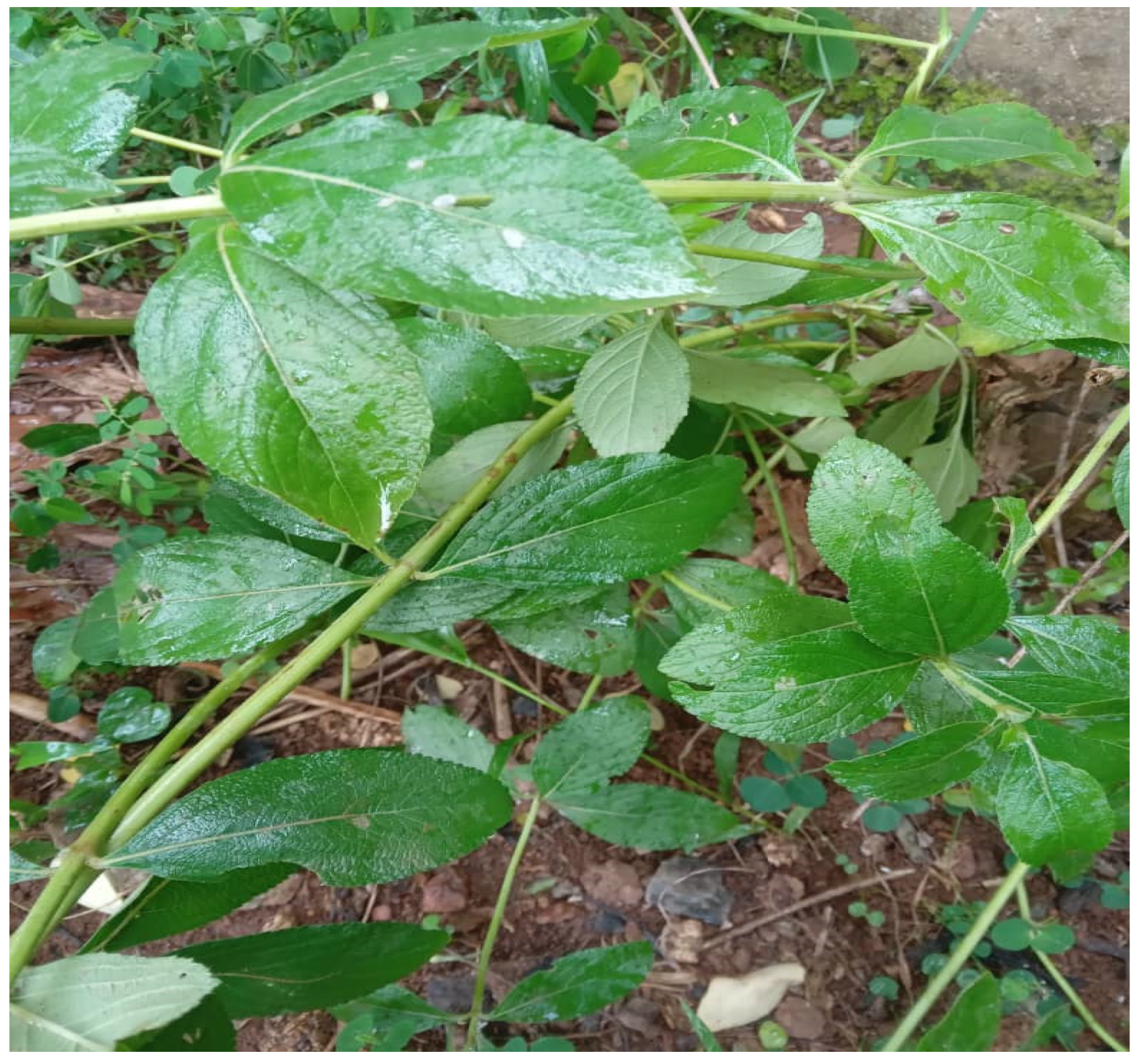
Figure 2.
LC-MS feature-based molecular networking of the leaf extract of Lippia adoensis.


Table 1.
Antiprotozoal activity (IC50: μg/mL) and cytotoxicity (CC50: μg/mL) of the hydroethanol extracts of Lippia adoensis twigs and leaves.
Table 1.
Antiprotozoal activity (IC50: μg/mL) and cytotoxicity (CC50: μg/mL) of the hydroethanol extracts of Lippia adoensis twigs and leaves.
| Extracts/ compounds |
IC50 (μg/mL)/SI | CC50 (μg/mL) Vero cells |
|||||||
|---|---|---|---|---|---|---|---|---|---|
|
P. falciparum 3D7 |
SI | P. falciparum Dd2 | SI | L. donovani | SI | T. brucei brucei | SI | ||
| Leaves | 10.0085±0.42 | >9.99 | 29.48±1.00 | >3.39 | 22.879±1.369 | >4.37 | 2.3085±0.492 | > 43.47 | >100 |
| Twigs | 97.467±0.955 | > 1.02 | 26.96±1.59 | >3.71 | 10.522±1.085 | >9.50 | 55.06±4.652 | > 1.81 | >100 |
| Chloroquine | 0.0514±0.0049 | - | 0.859±0.0034 | - | - | - | - | - | |
| Artemisinin | 0.0644±0.0026 | - | 0.00339±0.0032 | - | - | - | - | - | |
| Amphotericin B | - | - | - | - | 1.11±0.076 | - | - | - | |
| Pentamidine | - | - | - | - | - | 0.00675±0.0005 | - | - | |
| Podophyllotoxin | - | - | - | - | - | - | - | - | 0.4 ± 0.1 |
IC50: half-maximal inhibitory concentrations were calculated from two replicates of P. falciparum, T. brucei brucei, L. donovani promastigotes. CC50: half-maximal cytotoxic concentration in Vero cells. SI: selectivity index. The positive controls used were amphotericin B for L. donovani, pentamidine for T. brucei brucei, artemisinin for P. falciparum, and podophyllotoxin for Vero cells.
Disclaimer/Publisher’s Note: The statements, opinions and data contained in all publications are solely those of the individual author(s) and contributor(s) and not of MDPI and/or the editor(s). MDPI and/or the editor(s) disclaim responsibility for any injury to people or property resulting from any ideas, methods, instructions or products referred to in the content. |
© 2024 by the authors. Licensee MDPI, Basel, Switzerland. This article is an open access article distributed under the terms and conditions of the Creative Commons Attribution (CC BY) license (http://creativecommons.org/licenses/by/4.0/).
Copyright: This open access article is published under a Creative Commons CC BY 4.0 license, which permit the free download, distribution, and reuse, provided that the author and preprint are cited in any reuse.


