

Submitted:
15 February 2026
Posted:
26 February 2026
Read the latest preprint version here
Abstract
The Trace & Trajectory Framework (TTF) offers a non-representationalist approach to meaning, cognition, and selfhood grounded in dynamical systems theory and radical enactivism. Rather than treating meaning as something stored in mental representations, TTF proposes that meaning is enacted—it emerges through temporally extended navigational patterns, called trajectories, that traverse dynamic structures called ribbons. The framework's layered ontology comprises traces (probabilistic preconditions), threads (pre-navigational filamentary configurations emerging through dissociation), ribbons (coordinated thread bundles whose fold dynamics generate navigational positions), and trajectories (meaning events). The dual-parameter architecture (lambda for structural granularity, sigma for epistemic access) combines with ribbon dynamics to handle phenomena typically addressed through separate, domain-specific machinery. This version foregrounds ribbon dynamics as the primary organizational level of the framework, showing how coordinated thread bundles—with their characteristic fold frequencies, saturation profiles, and transgranular coordination—provide the analytical resolution that previous versions distributed across ad hoc mechanisms. To support ribbon-level analysis, the version introduces the Hx namespace, a unified Latin notation for radial cut geometry, along with several instruments: QRS-CONFIG for pluriversal analysis of social indexicality; stratified epistemic barriers (Hx4 through Hx16) marking qualitative shifts in navigational access; hex bands encoding grammatical number through mimetic projection; and Macro-alpha as the extractive agential type. The framework dissolves rather than solves classical problems—including symbol grounding, the scalability challenge, and the tension between embodied and abstract cognition—by rejecting the representationalist premises that generate them.
Keywords:
non-representationalism
; dynamical semantics
; ribbon semantics
; Hx namespace
; QRS-CONFIG
; epistemic barriers
; hex bands
; enactivism
; conceptual navigation
; trajectory
; transduction
1. Introduction
Consider a question that has troubled cognitive science for decades: What does the word “justice” mean? Traditional approaches offer answers along these lines: “justice” is a mental representation stored somewhere in the brain, connected to other representations in a semantic network. When you hear the word, you retrieve this representation and thereby grasp its meaning.
This picture faces deep problems. If meaning is a stored pattern, how does that pattern connect to the world? How does a neural activation “mean” anything at all? This is the symbol grounding problem [3], and it remains unresolved. Furthermore, if meaning is stored, where does it go when you are not thinking about it? And how can two people share the “same” meaning if their representations are private?
The Trace & Trajectory Framework (TTF) dissolves these problems by rejecting the premise. Meaning is not stored anywhere. The question “where is the meaning of `justice’?” is like asking “where is the dance when no one is dancing?” The answer is: nowhere. The dance exists only in the dancing. Similarly, meaning exists only in the meaning-making—in the active, temporally extended process of navigating through structured informational space.
But this answer immediately raises new questions. If meaning is not stored, why isn’t each act of meaning-making random? Because the space being navigated is not featureless. Dissociation over trace-sets triggers what TTF calls the accumulative function: filamentary configurations—threads—emerge as the probability landscape acquires structural extensionality. These threads are not pathways worn in by passage; they are pre-navigational dispositional material favored by the probability landscape. Threads are to navigational space what cotton fibers are to fabric: necessary infrastructure, but not yet a surface one can traverse. When threads coordinate into larger bundles—what TTF calls ribbons—the weave acquires characteristic fold dynamics, and folds within ribbons mark the positions through which navigation becomes possible. The coherence of meaning derives not from the threads themselves but from the fold landscape of the semiotic weave they compose.
If meaning emerges within individual processes, are we trapped in private meaning-prisons? No. TTF proposes transduction—a coupling mechanism between distinct navigational spaces. You never enter my meaning-space, and I never enter yours. But our trajectories can coordinate across the interface between us, much as two musicians playing different instruments can lock into shared rhythm without inhabiting the same body.
Is meaning-making individual or collective? Both. It begins in individual, embodied navigation—your body matters, your perceptual history matters. But the pathways you navigate are not yours alone. Many reflect probability configurations stabilized through transductive coupling across generations. The collective shapes the individual not by inscription but by attunement.
If meaning is embodied, how do abstract concepts arise? Not through disembodiment, but through scalar transition. TTF proposes that navigational space is vertically structured—it has levels of granularity, from fine-grained textures close to sensorimotor experience to coarser configurations where details blur but structural relationships remain visible. The abstract is not the opposite of the embodied; it is the embodied, viewed and navigated at a different altitude.
TTF synthesizes insights from radical enactivism [6,7], which argues that basic cognition lacks content-bearing representations; dynamical systems theory [9,12], which models cognition as trajectories through continuous state spaces; phenomenology [5,11], which attends to the intrinsic structure of lived experience; and analytic idealism [8], which treats consciousness as ontologically fundamental.
The sections that follow introduce the framework’s core architecture. Section 2 presents the foundational ontology: traces, threads, ribbons, and trajectories. Section 3 formalizes the key parameters (, , ) and the saturation architecture. Section 4 develops the agential typology, including the situational structure of embodiment. Section 5 addresses the interface-render distinction and the infra/supra asymmetry. Section 6 treats transduction and mimesis. Section 7 develops the hexid’s geometric structure, including the Hx namespace for radial analysis, QRS-CONFIG, stratified epistemic barriers, and hex bands with mimetic projection. Section 8 indicates future directions.
1.1. What TTF Is NOT
To prevent common misunderstandings, it is worth stating clearly what TTF does not claim:
2. Foundational Ontology: From Traces to Trajectories
TTF rests on two foundational commitments. The first is informational monism: reality is fundamentally informational. What we call “matter” and “mind” are not two separate substances but two perspectives on unified informational structure. Physical objects are informational configurations accessed through what we might call the “physical interface”; mental experiences are configurations accessed through the “phenomenal interface.” The difference lies in how configurations are accessed, not in their ultimate nature.
The second commitment is consciousness-first ontology. Rather than trying to derive consciousness from matter, TTF treats phenomenal structure as ontologically primary. Physical descriptions—neurons, particles, fields—are not wrong, but they describe how configurations appear at certain interfaces, not the fundamental nature of what exists. This inverts the standard explanatory direction: instead of asking “how does matter produce consciousness?,” TTF asks “how does conscious navigation produce the appearance of matter?”
With these commitments in place, we can introduce the framework’s layered ontology.
Traces are the most fundamental level—minimal differentials of probability in the informational substrate. A trace is not a groove carved by passage, nor a unit that encodes relational structure. It is the informational pixel: the smallest region at which differential probability obtains. Traces are pre-relational—taken individually, a trace has no adjacency, no transition structure, no directionality. It is pure possibilium: a point of probabilistic differentiation in the substrate, nothing more.
What makes traces consequential is that, under the dissociative predisposition inherent to NET, they form sets. Set formation requires delimitation—a before and an after—and this delimitation is already perspectival, already the first gesture toward bounded viewpoint. Over these trace-sets, relative probabilities are calculated: relations between members that yield the first configurational preconditions for semiotic structure. Adjacency (what can follow what) and transition structure (how one configuration can become another) are properties of trace-sets, not of individual traces. They emerge from probabilistic calculation over delimited configurations, not from the traces themselves.
Key properties of traces:
Pre-phenomenal: Traces exist “below” conscious experience. You never experience a trace directly—you experience the threads and trajectories that traces make possible.
Pure possibilia: Traces are potentials, not actualities. They are “there” in the sense of structuring what can happen, but they do not themselves happen.
Substrate level: Traces belong to what TTF calls NET (Network Environment of Traces). NET is not an inert container but a proto-agent: it maintains navigational structure, stabilizes fundamental patterns, and—crucially—plays itself without requiring external maintenance. What NET lacks is dissociation: the boundary-forming operation that individuates one conscious perspective from another.
When dissociation occurs, a portion of NET “folds” into bounded perspective—a hexid individuates. This hexid-agent is NET-but-dissociated: it retains NET’s navigational capacity but now operates from a bounded viewpoint, with a characteristic center () and a finite interface (). The whirlpool analogy, adapted from Kastrup [8], captures this: the whirlpool is made of ocean water, follows ocean dynamics, and never leaves the ocean—yet from inside the whirlpool, there is a center, a boundary, and a characteristic flow pattern that distinguishes “inside” from “outside.”
2.1. Threads (): Filamentary Configurations
Threads are extended configurations of traces—the first level at which cumulative structure appears. When dissociation operates over trace-sets, it triggers what TTF calls the accumulative function: the probability landscape, viewed through the dissociative gradient, acquires filamentary extensionality—string-like configurations that emerge not because passage “wore them in,” but because the probability landscape favors configurations that enable, at the ribbon level, the inter-hexid coordination that transduction requires. Threads are dispositional configurations, not pathways: they are the filamentary material from which navigable architecture is woven, but they are not themselves navigable.
The Greek letter (tau) denotes threads as the filamentary substrate of the interface. Where traces () are pre-phenomenal possibilia, threads () are the first cumulative function over trace-sets: string-like configurations that compose into the filamentary weave. Navigation does not occur at this level; it begins only when threads achieve ribbon-level coordination, and fold positions within ribbons constitute the navigable terrain.
Key properties of threads:
Cumulative: Threads emerge through the accumulative function triggered by dissociation over trace-sets. The probability landscape acquires filamentary extensionality—not through inscription or repetition but through the structural dynamics of the dissociative gradient. Threads are not given but achieved; they require the accumulative operation to acquire their string-like configuration.
Pre-navigational: Threads are not the infrastructure through which trajectories flow; they are the infrastructure from which navigable architecture is composed. Cotton fibers are necessary for fabric, but they are not yet a surface one can walk on. Similarly, threads constitute material for the semiotic weave, but navigation begins only at ribbon folds—where coordinated thread-bundles produce the positions through which trajectories move.
Variable depth: Some threads penetrate deep into the substrate, toward trace-level structure. These “deep threads” exhibit high structural stability and are difficult to modify. Other threads remain “shallow”—they stay close to the fine-grain surface of the interface and can be easily reconfigured. Most threads have heterogeneous depth profiles: different segments reach different depths, producing variable resilience across the configuration.
2.2. Ribbons (): Coordinated Thread Bundles
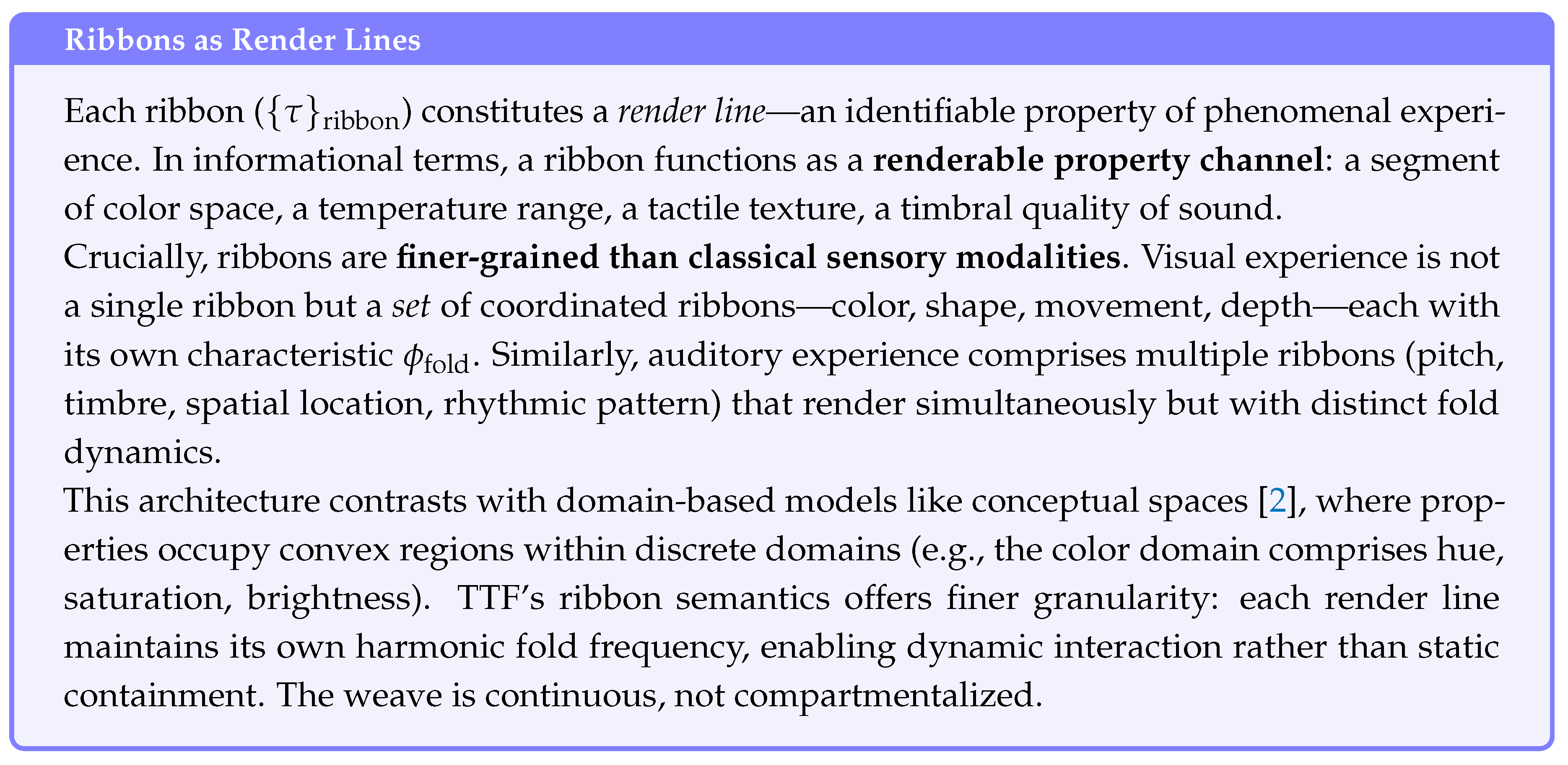
When threads coordinate into larger structures, they form ribbons—bundles that exhibit characteristic dynamic behavior. TTF’s informal name, “Ribbon Semantics,” derives from this level of organization.
Figure 1 offers a visual intuition. The ribbons depicted are not metaphorical: they represent the actual topology of coordinated thread-bundles as they fold, twist, and interweave through navigational space. Each ribbon maintains its own harmonic identity—its characteristic fold frequency ()—while participating in the larger semiotic weave. The dotted grid suggests the underlying trace-space through which ribbons move; the varying thickness and curvature of each ribbon reflects its current saturation () and dynamic state. Notice how ribbons can approach each other, intertwine momentarily, and separate again—this is the visual correlate of semantic coordination without fusion, the structural basis of transductive coupling at the ribbon level.
Ribbons are not static structures but dynamic configurations that:
Fold: governed by harmonic fold frequency ()—the rate at which the bundle undergoes internal transitions.
Rise and descend: modulated by the render threshold ()—which positions achieve phenomenal visibility versus which signify without rendering.
Coordinate within weave: ribbons operate within semiotic weave of variable density, measured by thread saturation ().
Undulate: ribbons exhibit what TTF calls undulating disposition—a dynamic, wave-like behavior through the weave rather than static anchorage. This replaces earlier botanical metaphors (“root structure,” “anchoring deeply”) that implied inscription or fixation. The undulating disposition determines a ribbon’s trans-λ reach: higher fold frequency () enables wider operational range across granularity levels, but at the cost of higher maintenance and reduced stability. This is a trade-off, not a hierarchy of quality.
The structural progression is thus: from trace to individual thread to filamentary weave (the pre-navigational coordination of threads) to ribbon (where fold dynamics emerge) to the complete semiotic weave (the navigable terrain). Navigability enters the architecture at the ribbon level: it is the fold positions within ribbons, not threads themselves, that constitute the positions through which trajectories move.
2.3. Trajectories (): The Meaning-Events
Trajectories are the actual movements of conscious agents through the fold landscape of the semiotic weave. This is where meaning happens. If traces are the geological substrate, threads are the fibers of terrain—pre-navigational material—and ribbons are the road system whose folds mark navigable positions, then trajectories are the actual journeys: specific traversals taken by specific navigators through the fold landscape.
The lowercase t distinguishes trajectories (events) from traces (, substrate). Trajectories are essentially temporal—they unfold across duration, with characteristic phases:
Onset: The initiation of movement from a starting configuration.
Sweet spot: The phase of maximum informational coherence—where the trajectory achieves its densest semantic content.
Dissipation: The gradual return toward equilibrium—the fading of the meaning-event as its informational coherence disperses.
Consider how gesture movements exhibit precisely this trajectorial structure: an onset as the hand begins motion, a sweet spot of maximal expressiveness, and dissipation as the hand returns to rest. Gesture is one of many domains—speech prosody, emotional episodes, musical phrases—where the same onset-peak-dissipation contour appears. TTF takes this recurrence seriously: the way we literally move through physical space reflects the way we navigate informational space because both express the same underlying architecture.
Key properties of trajectories:
Temporally extended: Unlike representations (often conceived as static), trajectories unfold over time. Even a “momentary” meaning is a trajectory with short duration.
Agent-bound: Every trajectory belongs to a specific navigating agent. There are no free-floating trajectories in neutral space.
2.4. Positions (): Navigational Landmarks
Within the semiotic weave, ribbons fold and mark positions—points of high harmonic differentiation that function as stable nodes where trajectories transit. Positions are not categorical boxes (like “the concept JUSTICE”) but navigational landmarks. An agent might approach the same position from different directions, remain there for different durations, and depart toward different destinations—and each would constitute a different trajectory and therefore a different meaning.
In an informational space, differentiation is like visibility when flying at night. Ribbon folds are nodes with significative potential, like lights on an apparently undifferentiated terrain—though that terrain is already full of weaves sustaining precisely those positions.
Figure 2 illustrates the architectural progression from traces through threads to trajectories, showing how harmonic convergence points mark the navigational nodes that constitute positions.
2.5. Summary: The Ontological Stack
| Level | Symbol | Description | Status | Navigable? |
| Trace | Probabilistic preconditions | Pre-phenomenal | No | |
| Thread | Filamentary configurations | Pre-navigational | No | |
| Fil. weave | Thread coordination | Dispositional | No | |
| Ribbon | Coordinated thread-bundles | Dynamic | Via folds | |
| Position | Ribbon fold nodes | Navigational | Yes | |
| Trajectory | Navigational events | Phenomenal | (Event) |
3. Core Parameters
TTF uses several formal parameters to describe configurations and their dynamics. Understanding these parameters is essential for applying the framework to specific phenomena.
3.1. The Architecture of Saturation
Before introducing specific parameters, we must understand the architectural problem they address: how does a navigational system manage accumulation without becoming overwhelmed?
Traces compose into threads—filamentary configurations that weave into a pre-navigational substrate. When threads coordinate into ribbons, fold dynamics emerge, and the fold positions within ribbons constitute the navigable terrain through which trajectories move. But what happens as navigation continues? Each act of meaning-making reconfigures fold availabilities, making certain configurations more probable. Over time, the navigational space becomes increasingly populated—ribbons proliferate, affordances multiply. If this process continued without limit, the space would become so saturated that distinct pathways would blur into undifferentiated mass. This is the structural core of the scaling-up problem—the challenge of explaining how non-representational systems handle cognition dealing with absent, abstract, or combinatorially complex content [10].
TTF proposes that the architecture itself prevents collapse. The key lies in how threads distribute across the granularity spectrum.
Think of a Galton board—the device where particles drop through pegs and accumulate in columns, forming a bell-shaped mound. At the base, many particles spread across many columns: wide distribution, fine grain. Moving toward the peak, fewer columns contain significant accumulation, until at the top there is effectively a single point where probability concentrates.
Navigational space works analogously (Figure 3). At fine granularity—close to embodied sensorimotor experience—threads remain highly differentiated. Moving toward coarser granularity—toward abstraction—threads increasingly bundle together. Distinctions blur; fewer configurations carry the semantic weight. Saturation increases. But structural relationships persist: bundles remain filamentary, distinguishable as threads rather than fused into undifferentiated mass.
At extreme saturation, thread bundles collapse toward a single point. Here TTF identifies a critical mechanism: autosimilar collapse (). When filamentarity becomes genuinely indistinguishable, the system does not freeze. Instead, it retraces: the collapsed point is reinterpreted as a trace, and the cycle reinitializes. This is not compression or data reduction—it is retrace, recalculating trace-set probabilities and beginning again from fresh substrate. The peak of the mound, having become indistinguishable from a single trace, seeds new thread differentiation.
Autosimilar collapse ensures that accumulation never halts the system. The architectural geometry provides an escape valve that preserves both coherence (the retraced position inherits the structural signature of what collapsed into it) and innovation (the recalculated trace-set is reconfigured with fresh navigational potential).
3.2. Lambda (): Structural Granularity
Lambda indexes the scale at which informational structure is configured—the “zoom level” of the navigational terrain.
What do we mean by “granularity”? Think of it as resolution—the level of detail at which you engage with something. When you look at a photograph on your phone, you can zoom in until you see individual pixels: tiny squares of color that, by themselves, mean nothing. Pull back slightly and you see shapes—an eye, a smile. Further back, you see a face. Further still: a person at a party. Each zoom level is a different granularity. The pixels do not disappear when you see the face; they are still there, but you are no longer engaging at that level of detail.
works analogously: it marks where you are in this zoom continuum for semiotic navigation. Fine-grained experience—the feel of rough fabric, the particular color of that apple, the specific timbre of your friend’s voice—exists at . Abstract concepts—freedom, causality, number—exist at . The abstract is not the opposite of the embodied; it is the embodied viewed at a different altitude.
TTF distinguishes several levels:
(trace level): Pre-granular substrate—pure possibility, below phenomenal access. At this level, adjacency and transition structure are determined, but nothing yet saturates. Traces are not the finest grain; they are the condition for granularity itself. Agents do not navigate at ; it is the condition for navigation, not its medium.
: Fine-grained thread structure, directly backed by NET. Configurations are close to the substrate and exhibit genuine stability without requiring continuous agent maintenance. Basic perceptual categories (shapes, colors, movements), fundamental embodied schemas, and elemental sensory qualities operate at .
: Coarse-grained structure requiring maintenance beyond what the base render provides automatically. These configurations remain anchored in the phenomenal render at —they do not float free of embodied experience. But they are not directly NET-backed; they require continuous agent work (individual or distributed) to remain stable. Abstract concepts, institutional categories, and complex cultural meanings operate at .

Figure 4 illustrates how ribbons traverse the granularity spectrum. The dashed lines mark the render threshold (), bounding the central interface band. Ribbons rise into (above) and descend into (below), with fold points (black dots) marking positions of harmonic convergence. The figure captures a key architectural feature: the same ribbon can span multiple levels, and the render threshold determines which portions achieve phenomenal visibility.
3.3. Sigma (): Epistemic Access Mode
If lambda describes where on the structural gradient you are navigating, sigma describes how you engage with that structure. Think of it as an energy dial—independent of zoom level, you can adjust how much reflective effort you invest in navigation.
TTF distinguishes three primary modes, understood as attractor basins rather than discrete states:
(): Minimum-energy regime. The agent navigates following available affordances without reflective expenditure—like a computer in sleep mode, still functioning but not actively processing. This is not passivity; the agent may be deeply engaged, richly experiencing. What is “dormant” is the meta-reflective capacity: the agent moves with the navigational current rather than stepping back to examine it. This is the default mode for most navigation.
(): Meta-reflective engagement. The agent “steps back” to observe their own navigation, examining affordances rather than simply using them. This mode enables interrogation, analysis, and deliberate choice among pathways. A phenomenologist reflecting on perceptual qualities, a meditator observing mental states, or someone pausing to consider “why did I just say that?”—all operate at .
(): Dissolution toward . The agent ceases to maintain configurations sustaining distance from baseline—not by reflecting on them, but by letting go of the grip itself. Associated with certain contemplative practices, limit experiences, or structural collapse preceding radical reconfiguration.
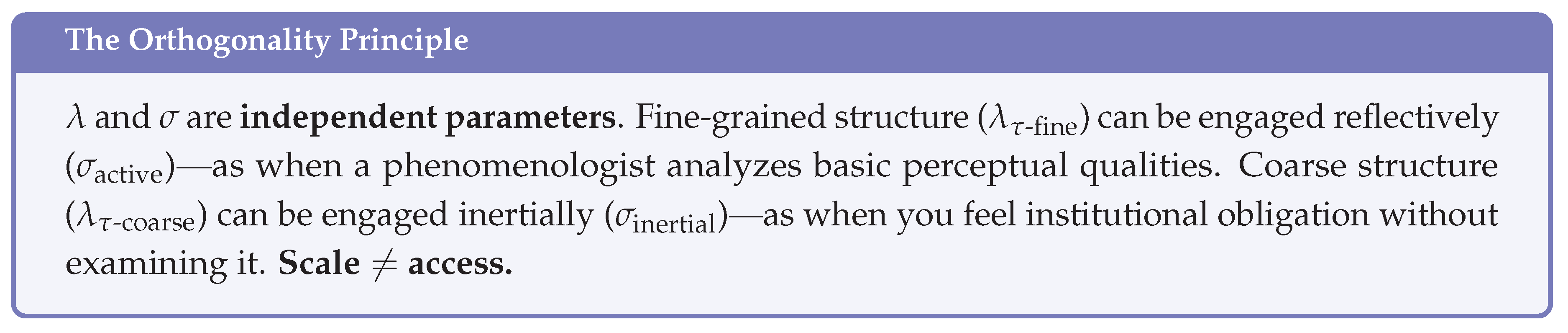
The subscripts inertial, active, and release are reserved for . Lambda uses fine and coarse. This notational discipline prevents conflating structural granularity with epistemic access.
3.4. Delta () and Dissipative Rate ()
Delta generates spatiotemporal differentiation. At the substrate level (NET), there is no time—only probabilistic reorganization of trace-sets. introduces rhythmic differentials into navigation, creating the phenomenal texture of temporal flow. Without , there would be no “before” or “after,” no duration, no accumulation.
Each transition between positions carries a δ-tic—a rhythmic marker indexing passage. But these tics are not uniform clock-pulses; they are differential markers whose significance emerges only in relation to other trajectories. generates spatiotemporality through relative rhythmic contrast.
Two sub-parameters specify how operates within thread-bundles:
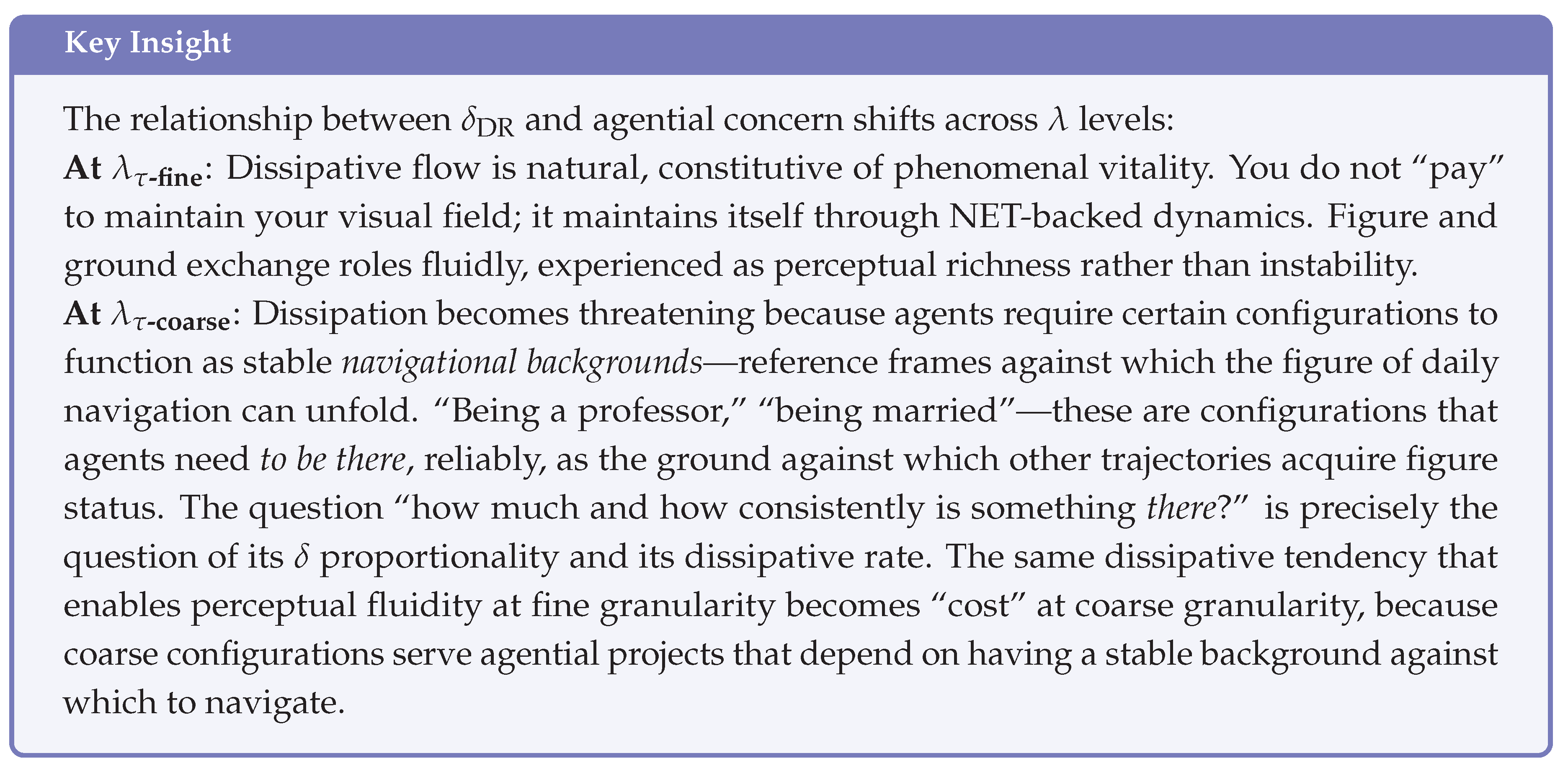
Thread saturation (): The configurational density of a thread bundle—how many threads compose it, how intricate its internal organization as currently rendered. This affects the qualitative complexity of the render. Crucially, is not inherent to “objects”: the same stone can have high (when crystallographic detail enters significance under ) or low (when most filaments are shaded during rapid locomotion).
Harmonic fold frequency (): How frequently the bundle undergoes fold transitions—the rate at which internal folds accumulate. “Harmonic” is not decorative: fold frequencies across scales stand in proportional relations analogous to harmonic series, with each structural level exhibiting a characteristic rhythmic ratio relative to the agent’s reference rhythm. This determines the -tic differential between trajectories, governing figure/ground asymmetry. Fold frequency is transient and dynamic.
The figure/ground relationship emerges from differential. When you walk down a street, the scenery (high ) “rushes past” while your body (lower , closer to your reference rhythm) “moves with” you. Neither is intrinsically figure or ground; the asymmetry emerges from rhythmic differential.
3.4.1. Wave-Based Properties and the Architectural Gradient
The parameter plays a central role in rendering physically wave-based properties. For phenomena like light and sound, wave frequency translates, within the dissociated space, into δ-tic differential. This is why we perceive distinct colors (electromagnetic frequencies) and distinct pitches (acoustic frequencies) as differentiated phenomenal qualities. The render does not “represent” frequencies; it renders them as navigable properties through ribbons with characteristic . A red ribbon and a blue ribbon differ not because they “encode” different wavelengths, but because their -tic differentials place them at distinct positions in the harmonic landscape. The qualitative difference between red and blue is this differential—not a representation of it.
What makes wave-based properties distinctive within the semiotic architecture is their structural isomorphism with the fabric itself. The semiotic weave is, at its most basic level, an undulating structure—ribbons fold, threads oscillate, configurations rise and descend through . Wave-based physical properties (electromagnetic frequency, acoustic frequency, thermal oscillation) operate through a logic that mirrors this foundational undulation. They are the fabric’s own architectural logic made phenomenally navigable—properties whose behavior does not require high semiotic elaboration to differentiate. Wave-based properties relate to the semiotic weave as stem cells relate to specialized tissue: they are pre-differentiation structures, close to the generative base, not yet organized into the high-density configurations that characterize specific phenomenal domains. They occupy a position close to the basic architecture of the fabric, operating through principles that are largely beneath or at its edge, without requiring dense thread composition to produce phenomenal differentiation. Their -tic differential alone suffices to generate qualitative distinction: different electromagnetic frequencies render as different colors not because the ribbons are densely woven, but because the undulatory logic itself differentiates them at the architectural level.
This explains a striking asymmetry. The physical sciences have been remarkably successful at formalizing wave-based phenomena—light, sound, thermal radiation—precisely because these properties are governed by a logic close to the fabric’s generative base. What physics discovered as “wave frequency” is, from TTF’s perspective, the formal behavior of the semiotic architecture at its pre-specialized stratum: the undulating principles that organize the fabric before high-density thread coordination adds specificity. Contrast this with properties that resist wave-based formalization: the taste of chocolate, the feel of velvet, the qualitative character of a specific emotion. These are high-density semiotic configurations—properties whose phenomenal character depends on intricate thread composition (), not merely on -tic positioning. They are the specialized tissue of the semiotic weave: richly elaborated, close to the render surface, and for that very reason resistant to the kind of meta-abstraction that sustains. Explaining the taste of chocolate in wave-frequency terms fails not because the explanation is incomplete, but because the property is constituted at a level of semiotic density that exceeds what the pre-specialized architectural logic can capture.
The interaction between and thus reveals a gradient of semiotic specificity. At one end, wave-based properties where -tic differential alone generates phenomenal distinction with minimal thread elaboration. At the other, high-density properties where dominates and the qualitative character is inseparable from the intricate weave composition. A richly saturated color experience sits between these poles—it involves both specific -tic positioning (the particular hue, governed by wave-frequency logic) and dense thread composition (the vividness and depth of the color as rendered). The two parameters are orthogonal but jointly determine the phenomenal texture, and their relative contribution varies across the gradient from architecturally basic to semiotically specialized.
Dissipative Rate () measures the rate at which a configuration tends toward reconfiguration—how quickly it would lose coherence if left to its own dynamics. This rate is not arbitrary; it reflects the topological properties of the configuration, particularly the interaction between weave density () and rhythmic differential. Densely woven configurations resist dissipation—not through agential effort, but through the structural coherence of their thread-bundle organization. A configuration with high is an unstable ground; one with low maintains its structure as a reliable navigational background.
3.5. Parameter Summary
| Parameter | Symbol | Domain | Function |
| Granularity | Structural | Scale of configuration | |
| Access mode | Epistemic | Reflective engagement level | |
| Rhythmic differential | Temporal | Spatiotemporal generation | |
| Thread saturation | Qualitative | Configurational density | |
| Fold frequency | Dynamic | Figure/ground asymmetry | |
| Dissipative rate | Maintenance | Stability cost | |
| Autosimilar collapse | Architectural | Overflow safeguard |
4. Agential Architecture
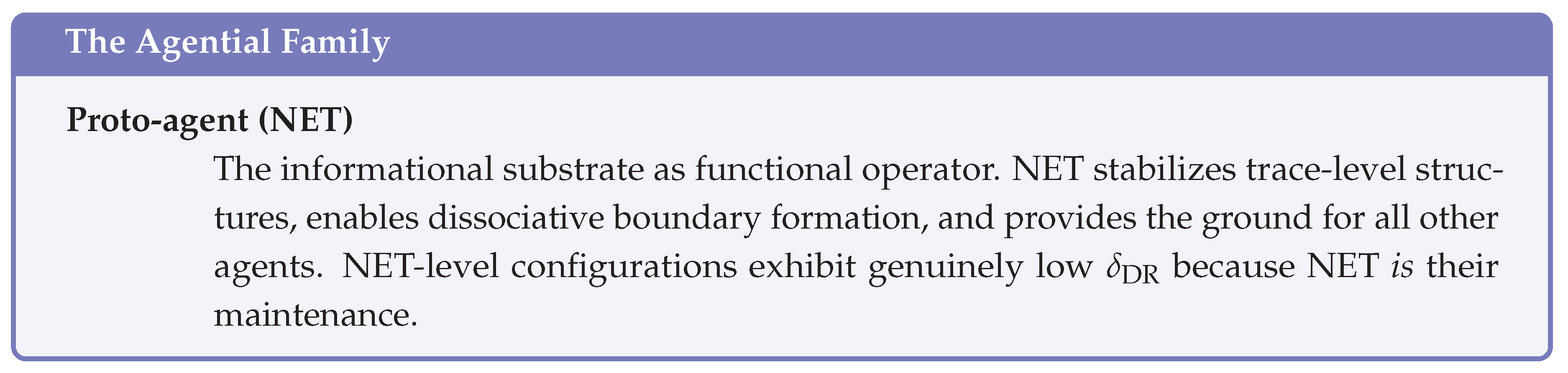
TTF recognizes distinct agential strata, each with characteristic maintenance functions and operational domains. Rather than a single type of “agent,” the framework identifies a hierarchy of nested agential functions ranging from the pre-dissociative substrate to collective configurations—some distributive, some extractive. The governing relation is one of inclusion:
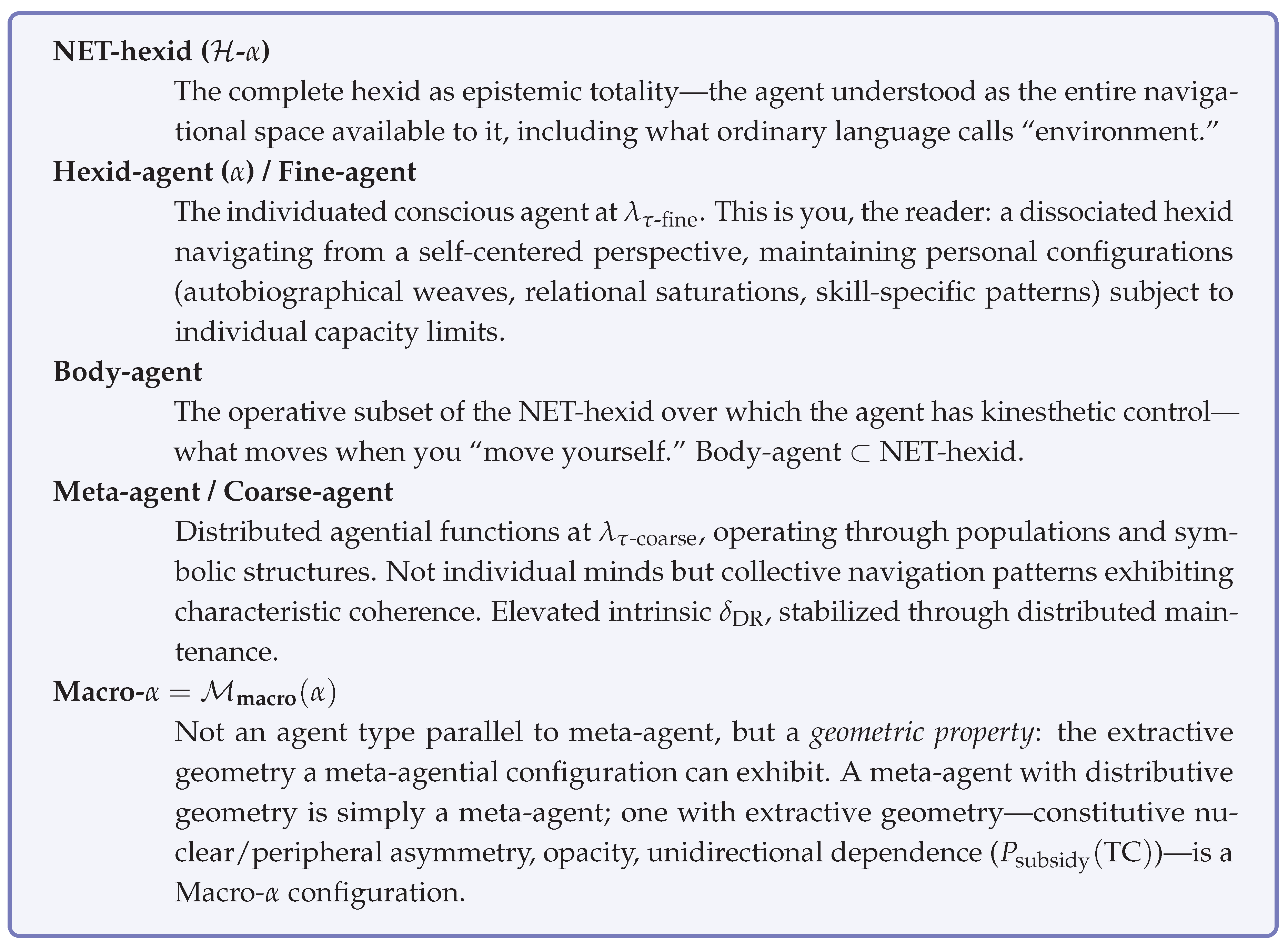
4.1. Situational Doctrine
The distinction between NET-hexid and body-agent replaces traditional “embodiment” discourse with a structural account. Rather than placing an agent inside an environment, TTF holds that the agent is the situation. The NET-hexid is the agent as epistemic set—everything that appears within the interface belongs to the agent. The body-agent is the region over which kinesthetic control operates: what you can move directly is body-agent; what moves independently (or responds to your movement) is environment—but both are regions of your NET-hexid, both are you in the epistemic sense.
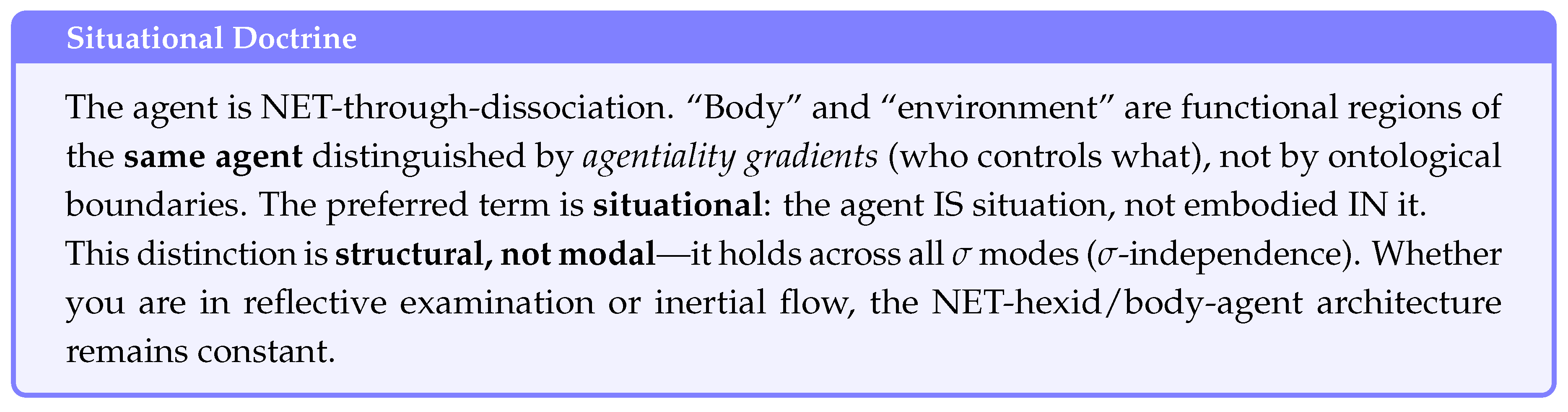
TTF calls this operative principle game logic: body and environment are distinguished by control relations, not ontological separation. The /bg distinction within the render—the felt difference between “I” and “world”—is itself produced by , the mimesis of dissociation: an intra-hexid operation that replicates the original NET→hexid dissociative gradient at render scale. This mimetic origin is developed in Section 6.

4.2. Collective Geometry
Meta-agents maintain categorical configurations: institutional roles, collective identities, legal-economic structures. “The University” exemplifies the type: not a single conscious entity but a distributed navigational pattern maintained by thousands of individuals whose activities converge on coherent institutional identity. It has positions (“professor,” “student”), protocols (tenure review, grading), and characteristic trajectories (career advancement, degree completion). Because meta-agents operate at with elevated intrinsic , their stability depends on distributed navigation—many agents sharing maintenance work.
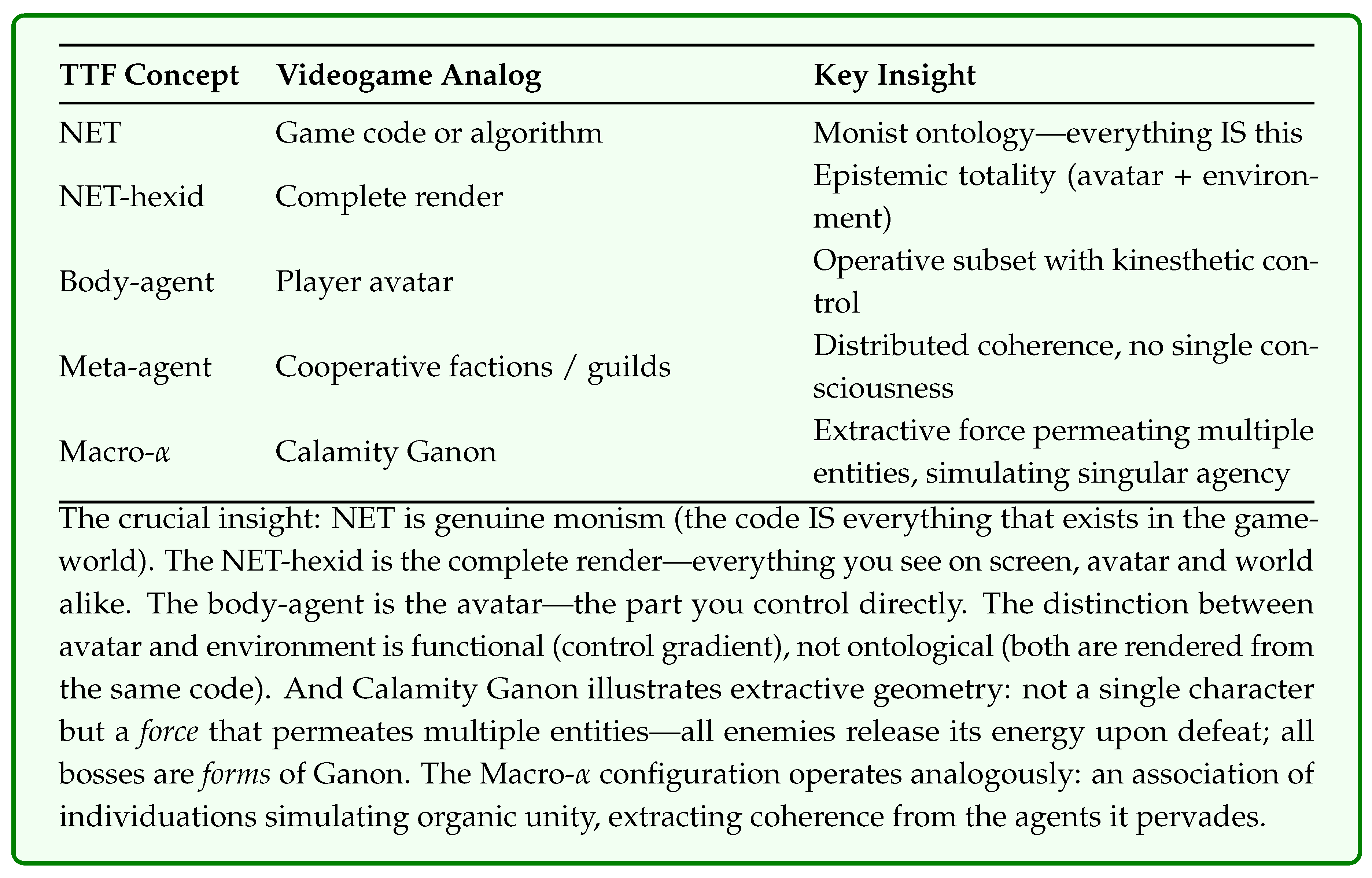
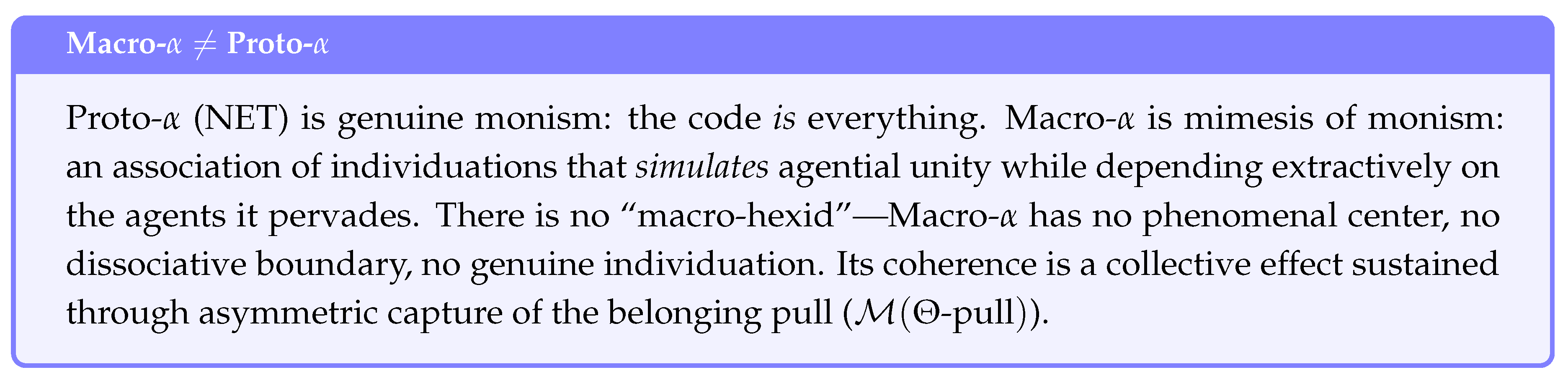
Every meta-agential configuration that establishes TC differentials exhibits a collective geometry—a characteristic distribution of navigational costs and benefits across participating hexid-agents. This geometry ranges between two poles. Some configurations achieve coherence through genuinely distributive maintenance—many hexid-agents contributing to shared navigational patterns without asymmetric extraction. A community garden, a costume party, a cooperative ritual, a dance floor: participants coordinate trajectories through shared protocols, and the reconfigured TC landscape benefits all symmetrically. No position systematically extracts navigational work from others. Other configurations exhibit extractive geometry: apparent agential unity sustained through asymmetric protocol alignment, where some positions are “nuclear” (full access, benefit from coordination) while others are “peripheral” (partial access, provide maintenance work without equivalent return). A corporation may present itself as unified agent—“Apple decided,” “Amazon believes”—but this coherence depends on asymmetric extraction from peripheral positions (workers, suppliers, users) toward nuclear ones (executives, shareholders). Such configurations simulate organic agency—presenting themselves as having coherent identity like hexid-agents—but this is mimesis, not genuine individuation. The difference between distributive and extractive geometry is not whether coordination occurs, but whether the maintenance burden is symmetric.
What draws hexid-agents into collective configurations in the first place? TTF identifies a belonging pull: , the mimesis of the dissolutive gradient. The fundamental pull toward (experiential zero, dissolution of the dissociative boundary) is replicated at collective scale as the desire for reunion—to be part of something larger, to merge back into a whole. To belong is the mimetic form of to dissolve. The belonging pull operates in all collective configurations; what distinguishes distributive from extractive geometry is how this pull is channeled. In distributive configurations, the belonging pull is satisfied reciprocally: the costume party, the ritual dance, the cooperative workspace offer genuine reunion without capture. In extractive configurations, the belonging pull is captured and channeled asymmetrically: you belong, and in belonging you subsidize nuclear positions that appropriate your navigational work. The desire for reunion becomes the mechanism of extraction.
TTF formalizes the extractive case as Macro-, the mimesis of proto-agential unity. Where proto- (NET) is genuine monism—no separation to overcome—Macro-assumes dissociation and then simulates unity across it. This simulation depends on three structural features: (i) mimetic organic unity—the configuration presents itself as if it were a single individuated agent, but its coherence is achieved through protocol alignment, not dissociative boundary formation; (ii) nuclear/peripheral asymmetry—some positions enjoy full navigational access while others provide maintenance work without equivalent return; and (iii) extractive dependence ()—the configuration’s transductive costs are subsidized by the navigational work of peripheral hexid-agents whose belonging pull has been captured.
| Level | Agent / Property | Domain | Maintenance | |
| Substrate | Proto-agent (NET) | Below | Self-sustaining | Genuinely low |
| Individual | Hexid-agent | Personal capacity | Variable | |
| Situational | Body-agent | Kinesthetic | Low (NET-backed) | |
| Collective | Meta-agent | Distributed | Elevated | |
| Geometric property of collective configurations: | ||||
| Extractive | Macro- | Extractive () | High | |
5. Interface and Render
Every conscious agent in TTF experiences the world through a navigational space called a hexid and its present manifestation called the interface. A crucial refinement distinguishes what renders phenomenally from the broader interface structure.
5.1. Hexid () and Interface ()
The hexid is an agent’s complete navigational space—the totality of positions available to navigation. It is not a location in physical space but a topological structure organized around a central point called Theta (), the experiential zero-point. The name derives from “Hexagonal Identity Dynamics,” reflecting the framework’s use of hexagonal geometry to model navigational structure.
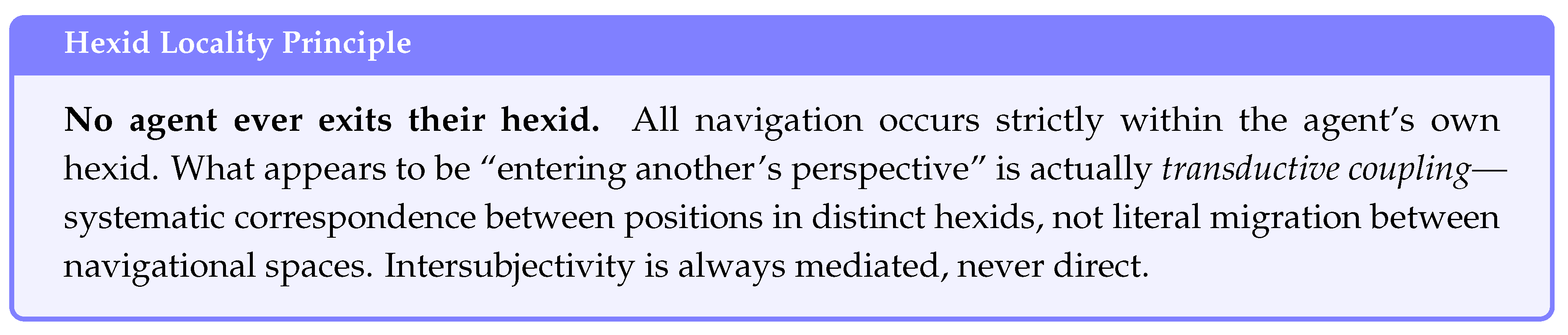
The interface () is the present render of the hexid—the currently active subset being traversed by trajectories. The notation reads “hexid traversed by trajectories”: the interface is the hexid as it is being navigated, not a separate structure but the hexid in its active, phenomenal mode.
5.2. Render and Interface: A Critical Distinction
TTF distinguishes between render and interface as nested structures:
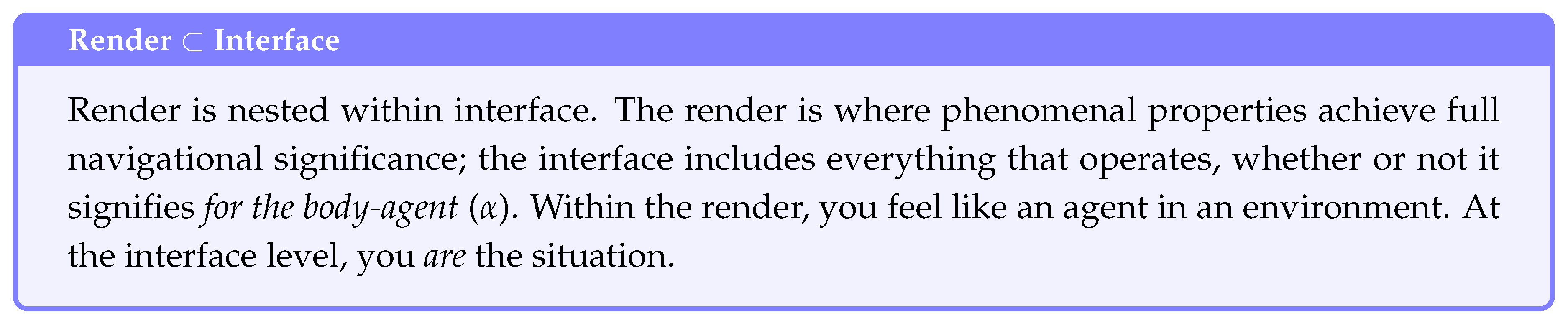
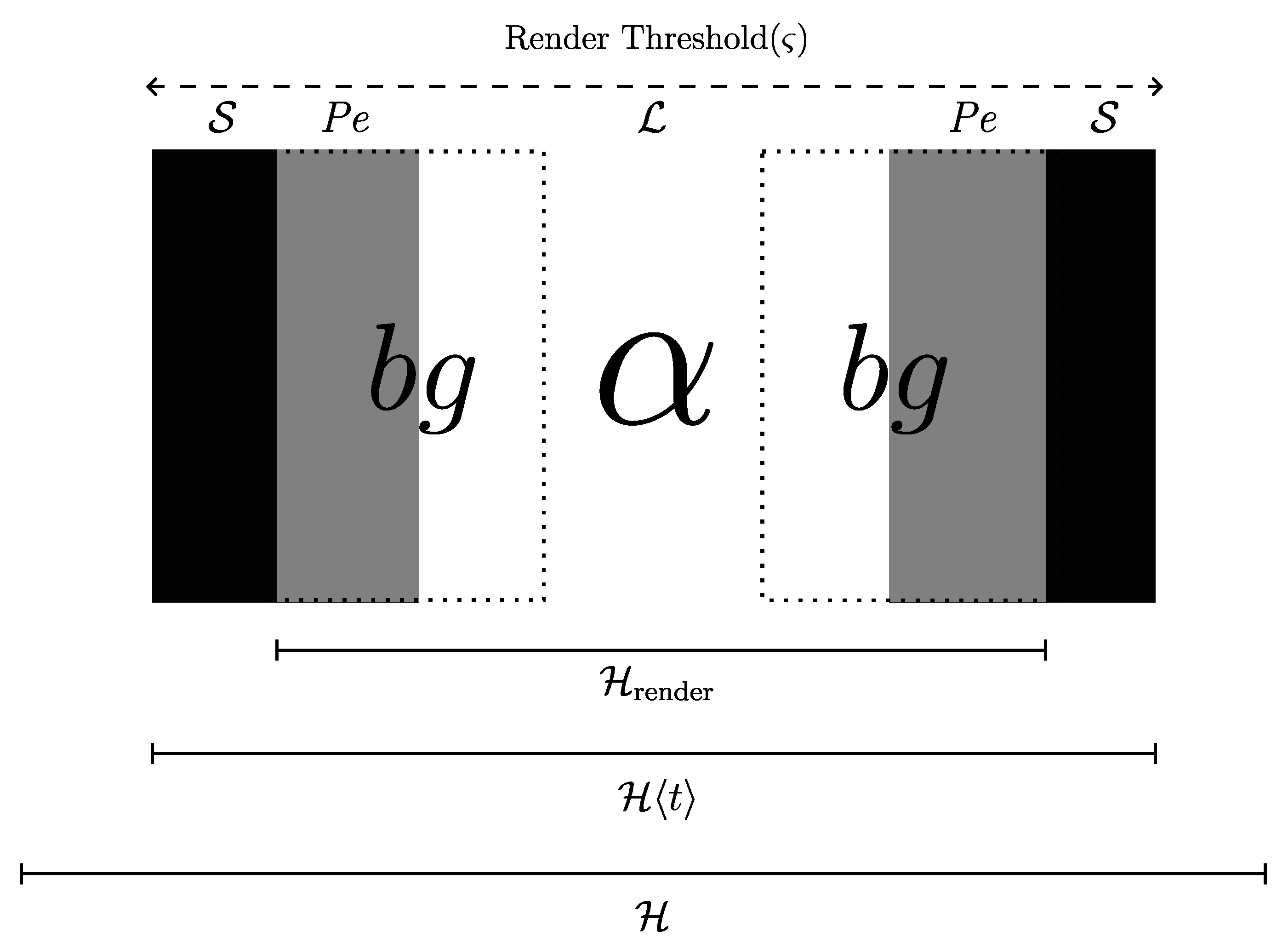
Render: The center of the render threshold ()—where the body-agent/environment distinction operates. Within the render, you experience yourself as separated from your surroundings. The render is the phenomenally vivid core of experience.
Interface: The complete render threshold (), comprising three nested zones:
- Render (): Full phenomenal manifestation—where the body-agent/environment distinction operates.
- Penumbra: Partial significance—configurations that influence navigation without achieving full phenomenal presence. The “fringe” of experience: feelings of familiarity, tip-of-the-tongue states, peripheral awareness.
- Shadow: Infrastructural operation without phenomenal registration—processes that sustain the render without themselves rendering. Your visual system’s edge-detection algorithms, the grammatical constraints shaping your utterances, the postural adjustments maintaining balance.
At the interface level, the agent/environment distinction dissolves: the NET-hexid encompasses both “self” and “world” as functional regions of the same epistemic totality.
A crucial feature of the render is its orchestral character. The render is a -orchestra—all ribbons manifest simultaneously, not sequentially like a line printer. Your visual field, proprioceptive sense, emotional tone, and conceptual framing all render at once, each ribbon with its own . The phenomenal present is polyphonic, not monophonic.
TTF maintains navigation agnosticism: trajectories exhibit inertial tendency within single-ribbon navigation, but the architecture does not mandate uni-linear traversal. Whether trajectories jump between ribbons or ribbons contain variable segments remains an open question.
5.3. Shading and Visibility
Not everything in the interface operates with equal visibility. Shading describes the continuous gradient from full phenomenal visibility () to phenomenal invisibility ().
Think of shading through a theatrical analogy. The light zone () is like a spotlight on stage: “I am here, this is right in front of me.” The penumbra () is like the stage periphery: “I sense something there, glimpsed but not focused.” The shade () is like backstage: “Something happens, but I don’t experience it as me-watching-world”—just navigation without the /bg distinction.
A configuration can signify without rendering. Your visual system processes information that never reaches conscious experience; social norms shape behavior without awareness; grammar constrains utterances accessible to but often at . Shaded positions are not hidden contents waiting to be discovered—they are functional navigations that signify for the hexid-agent (-) but remain invisible to the body-agent ().
The Depth Protocol () governs this distinction, determining what surfaces as navigable meaning versus what operates infrastructurally.
The shading described above is standard shading: positions that exist in the agent’s hexid but whose visibility falls below the render threshold (). TTF also recognizes a more extreme condition. Structural shading occurs when positions do not exist at all for the agent, because the agent’s categorical system—its —fails to generate them. A standard-shaded position is like a backstage area you could visit but currently do not; a structurally shaded position is a room that was never built. The distinction matters because structurally shaded positions cannot be brought into visibility through attention or effort alone; they require expansion of the agent’s itself or a dynamical change over the ribbon’s .
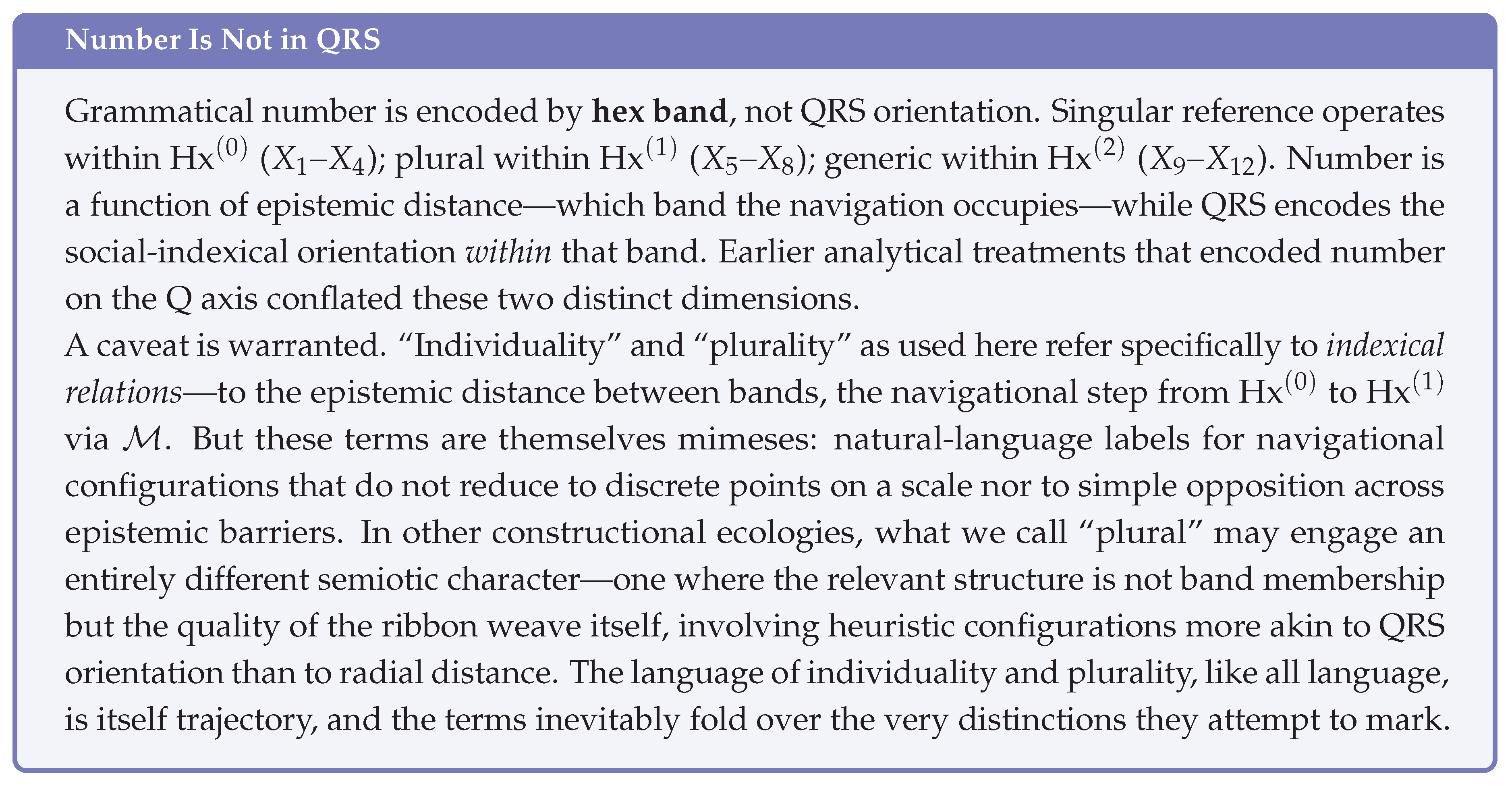
The hexid’s radial structure organizes positions into four-ring spans called hex bands (), each corresponding to a qualitative shift in reference type—from individual (, rings –) through collective (, rings –) to generic and institutional levels beyond. Hex bands are bounded by epistemic barriers () that mark thresholds where the quality of referential access shifts. Section 7 develops the full system; what matters here is how structural shading interacts with this layered architecture.
The mechanism chain is direct: when contracts, the number of available positions at each ring decreases. Positions beyond the first hex band (+) become undifferentiated, and the personal epistemic barrier becomes impermeable—the agent cannot navigate outward past the domain of individual reference. The epistemic barrier marks the limit where indexically direct access terminates for agent . Its canonical location is (the liminal border of individual alienation), but the barrier is relative to the agent’s, not absolute. Section 7 develops the full stratified barrier system ( through ) and its interaction with hex bands.
Two orthogonal responses to categorical limitation become available. Pluriversality responds by expanding: the agent’s navigational repertoire proliferates through fold mimesis—the multiplication of mimetic categorical configurations () that open differentiated access to positions across hex bands. More configurations become available, epistemic barriers become permeable, and the agent gains navigational reach into + (Section 6 develops the mimetic paradigm formally). Categorical dissolution responds by contracting: lowers the render threshold (), the render contracts toward , and categorical configurations fall to shade—as in anti-representationalist approaches that dissolve the categorical apparatus rather than extending it (cf. [13]). These are not competing strategies but orthogonal movements—one extends navigational reach outward through mimetic proliferation, the other releases navigational commitment inward. Both are available to any agent, and neither is intrinsically superior; their appropriateness depends on the navigational situation.
Figure 5.
Render structure within the interface. The figure shows a cross-section of revealing the concentric zones bounded by the render threshold (). At center, the agent () occupies the light zone (), surrounded by background (bg) distributed across light and penumbra (). Shade () marks the outer boundary of the render. The /bg distinction is produced by (mimesis of dissociation)—a mimetic operation replicating the original NET→Hexid dissociation at intra-render scale. This structure is orthogonal to agential typology: while governs what is phenomenally rendered for , the relation to and dissociation governs what kind of agent is navigating.
Figure 5.
Render structure within the interface. The figure shows a cross-section of revealing the concentric zones bounded by the render threshold (). At center, the agent () occupies the light zone (), surrounded by background (bg) distributed across light and penumbra (). Shade () marks the outer boundary of the render. The /bg distinction is produced by (mimesis of dissociation)—a mimetic operation replicating the original NET→Hexid dissociation at intra-render scale. This structure is orthogonal to agential typology: while governs what is phenomenally rendered for , the relation to and dissociation governs what kind of agent is navigating.
5.4. Infra/Supra Asymmetry
The hexid structure exhibits a fundamental asymmetry between what lies below and above the central interface band:
| Region | Level | Function | Character | |
| Subhexid | Sustains interface | Low | Genuine semiotic weave | |
| Suprahexid | Conditions interface | High | Mimetic-projective |
Subhexid (): Fine-grained structure that sustains interface coherence. This is genuine semiotic weave, NET-backed, with low . The subhexid provides the stable ground from which phenomenal rendering emerges.
Suprahexid (): Coarse-grained structure that conditions interface coherence without sustaining it. The suprahexid is mimetic-projective and derivative—its “atoms” are mimesis-of-trace, not trace itself.
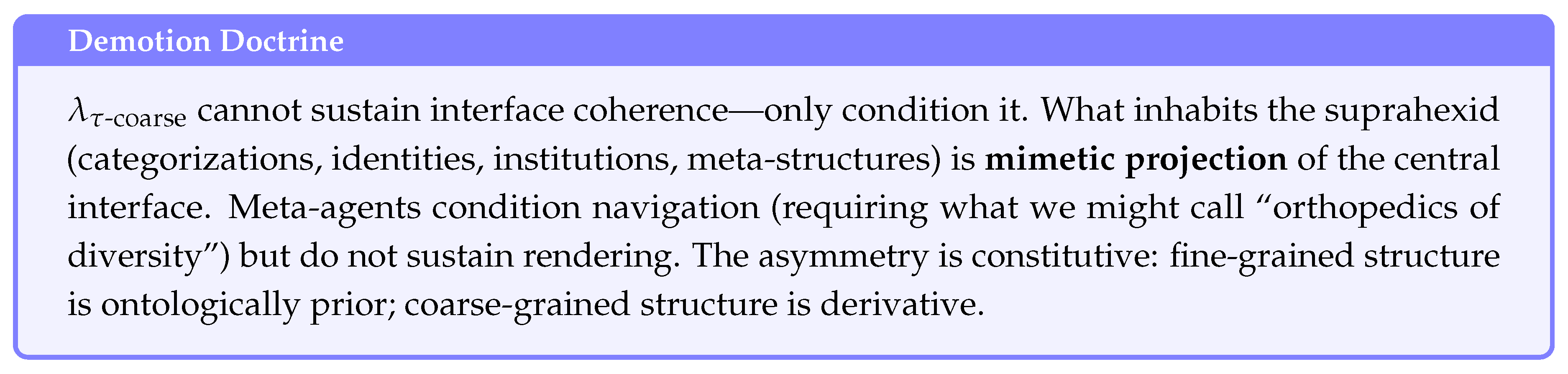
Figure 6 illustrates this geometry. The central band corresponds to the interface; regions above and below the render threshold remain operative but shaded.
6. Transduction and Mimesis
How do distinct navigational spaces coordinate? TTF proposes transduction—a coupling mechanism that enables coordination without fusion.
6.1. Transductive Coupling
Transduction occurs when configurations in one interface systematically correspond to configurations in another. This is not information transfer (nothing literally moves between hexids) but structural resonance—the establishment of corresponding positions across distinct navigational spaces.
Two parameters govern transductive relationships:
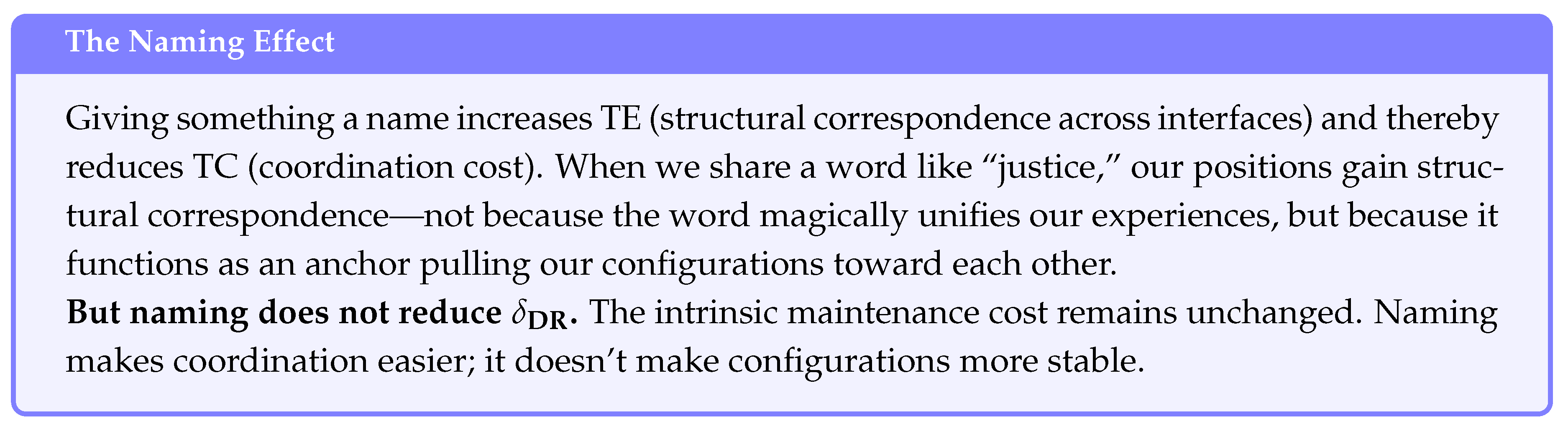
TC (Transductive Cost): The informational expense of projecting a configuration from one interface to another. How much work does it take to render “what you mean” in terms navigable within my hexid?
TE (Transductive Equivalence): The degree of structural correspondence between positions in different interfaces. How similar are the configurations we’re coordinating? TE ranges from 0 (no correspondence) to 1 (perfect correspondence).
Higher TE generally means lower TC. If our configurations already correspond well, coordination is cheap. If they diverge radically, coordination is expensive.
A physical analogy clarifies the mechanism. Consider two tuning forks: one vibrating at 210 Hz, the other at 110 Hz. Strike the first and the second remains silent—their frequencies are too distant for resonance. But place it next to a fork also tuned to 210 Hz, and the second fork begins vibrating spontaneously. Nothing travels between them except pressure waves through a shared medium; the coupling occurs because the geometric disposition of the second fork is already configured to respond at that frequency. Transduction in TTF operates analogously: when two interfaces share sufficient geometric correspondence in the semiotic weave—when their configurations are “tuned” to compatible positions—coordination emerges without information transfer. TE measures exactly this: the degree to which the dispositional geometry of one interface is already configured to resonate with configurations in another. High TE is two forks at the same frequency; low TE is 110 Hz meeting 210 Hz—the medium is shared, but the structural correspondence is absent.
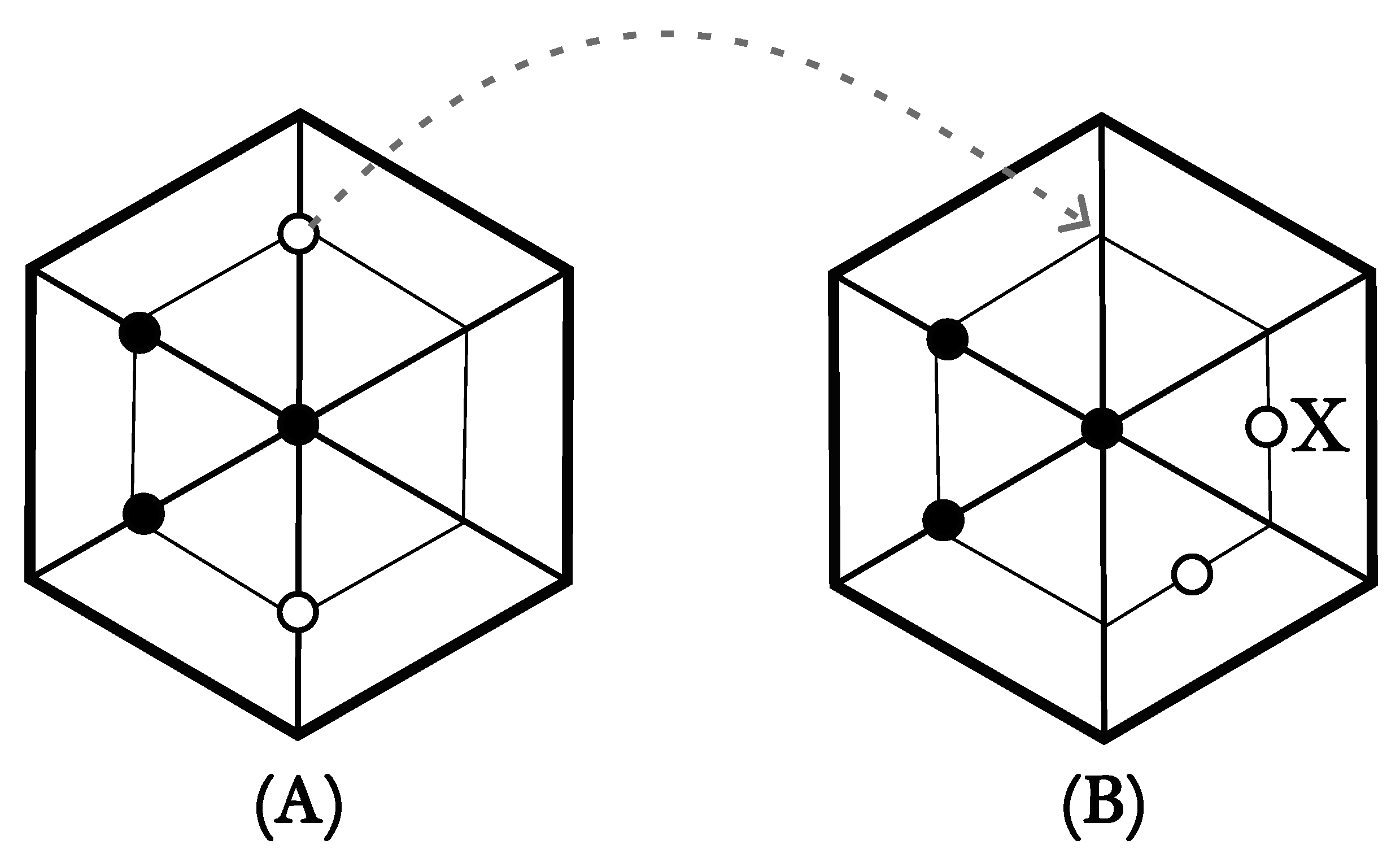
Figure 7.
Geometric transductive equivalence between two hexid interfaces. (A) and (B) represent radial cuts of two distinct interfaces. Filled circles (•) mark positions where geometric correspondence holds—transductive equivalence. Open circles (∘) mark positions where the geometry diverges— dispositional disparities between the two interfaces. The dashed arrow traces an attempted transductive projection from a position in (A) that finds no exact correspondent in (B); the position marked X indicates the nearest approximate equivalence available. The triangles formed by the filled circles constitute the geometric support for the equivalence calculation: sufficient correspondence across these positions can partially compensate for local disparities, yielding approximate equivalence. Verbal figurative expressions such as “it’s like a sandwich but without the top bread” operate analogously—the shared geometric scaffold anchors coordination despite the missing element—but at a higher order of organization, since such expressions already involve mimetic folds () and denser semiotic weave. The geometric equivalence calculation illustrated here is the infrastructural operation of which verbal similes are a coarse-grained mimetic analogue.
Figure 7.
Geometric transductive equivalence between two hexid interfaces. (A) and (B) represent radial cuts of two distinct interfaces. Filled circles (•) mark positions where geometric correspondence holds—transductive equivalence. Open circles (∘) mark positions where the geometry diverges— dispositional disparities between the two interfaces. The dashed arrow traces an attempted transductive projection from a position in (A) that finds no exact correspondent in (B); the position marked X indicates the nearest approximate equivalence available. The triangles formed by the filled circles constitute the geometric support for the equivalence calculation: sufficient correspondence across these positions can partially compensate for local disparities, yielding approximate equivalence. Verbal figurative expressions such as “it’s like a sandwich but without the top bread” operate analogously—the shared geometric scaffold anchors coordination despite the missing element—but at a higher order of organization, since such expressions already involve mimetic folds () and denser semiotic weave. The geometric equivalence calculation illustrated here is the infrastructural operation of which verbal similes are a coarse-grained mimetic analogue.
6.2. Mimesis (): Protocol Imitation
Mimesis occurs when navigation creates semiotic patterns at coarse granularity that replicate the function of fundamental operations. Language is the paradigm case: a mimetic pattern that achieves, through learned convention, something structurally analogous to what transductive coupling achieves through interface resonance.
More precisely, mimesis is a paradigmatic operation: the systematic replication of structural relations at a different scale. It is not limited to isolated imitations but constitutes a general architectural principle—wherever a fundamental operation exists, mimesis can produce a coarse-grained analog that preserves relational structure while shifting the level of organization.
Crucially, mimesis depends on transductive coherence—it does not generate it. Transductive coupling maintains the basic geometric correspondence that makes equivalence processes at any scale possible. Without this infrastructural floor, no mimetic pattern—however elaborate—could achieve structural resonance across interfaces.
An analogy from Abbott’s Flatland clarifies the dependency. Suppose that the transductive operations at the base of the NET→hexid dissociation established only two geometric dimensions. In that world, no amount of configurational mimesis could render volume comprehensible: vanishing points, curvatures, depth—none of these would possess navigational coordinates. They would fall into the domain of the mythical or the structurally unprocessable, not because agents lacked effort or ingenuity, but because the filamentary dispositions grounding transduction simply did not furnish the dimensional scaffold required for those equivalences to take hold. What mimesis can imitate is constrained by what transduction makes geometrically available.
Once this constraint is recognized, the converse becomes equally significant: given that the isomorphies disposed by filamentary structures at the base of dissociation do furnish rich geometric correspondence, configurational mimeses of varying scope become reliably—though not infallibly—achievable. These range from ephemeral equivalences (a gesture that momentarily imitates a transductive coupling, a glance that briefly anchors mutual orientation) through general equivalences (conventional signs, deictic anchors, shared affordance markers) to complete transductive-equivalence apparatuses—stable, intergenerationally maintained mimetic architectures that systematically replicate transductive function across an entire community of interfaces. Language is the paradigm case of this last category.
As a configurational mimesis, language constitutes a genuine meta-agential vessel: it is intergenerationally stable, manifests across modalities (spoken, signed, written), and operates with sufficient reliability that entire communities can coordinate trajectories through it. From the perspective of evolutionary linguistics and philosophy of language, one might say that language is a mimetic configuration predicted by the filamentary base of dissociation—not in the sense of teleological necessity, but in the structural sense that a sufficiently rich transductive substrate, once in place, makes the emergence of such a mimetic apparatus overwhelmingly probable. Language is, in these terms, a structural expectation of communicative nature, at least in the known versions of social coordination.
What makes language so consequential at is its capacity to promote coherence between the render threshold () and the shading of entire trajectory chains. Consider the word “cat.” The ancient Egyptian sacred feline and the domestic animal sleeping on your couch are separated by vast navigational distances—distinct trajectories in radically different semiotic weaves, with different profiles, different cultural configurations, different phenomenal textures. Yet through the lexical mimesis () that the word “cat” performs, these divergent trajectory bundles are rendered under the same visibility threshold, their differences shaded into the infrastructural background. From —the default mode of minimum-energy navigation—they appear as types of the same thing: instances subsumed under a shared coarse-grained configuration. The shading is not a deficiency but an architectural feature: language succeeds precisely because it manages in ways that make massively heterogeneous trajectories navigable as if they shared a common structure. The “as if” is the mimetic work; the structural coherence it draws upon is transductive.
Consider: a cellular phone is a navigational pattern that mimics an information-exchange protocol. Verbal language imitates transduction. Morse code imitates exchange through discrete signaling. The Western project of a “universal language” represents an attempt to establish a universal transductive pattern—structurally blocked by what TTF calls the Babel constraint, which maintains productive difference as constitutive of interface coherence.
Mimetic naturalization explains why configurations can feel stable despite elevated . When mimetic patterns become habitual, the maintenance work no longer registers as effortful. The imitation has naturalized—the trajectory feels like natural ground, stable and simply “there,” even though significant work sustains it.
Neither institutional subsidy nor mimetic naturalization reduces intrinsic ; they redistribute or obscure maintenance work without eliminating it. What appears as “stable reality” at is actually collectively maintained trajectory functioning as ground—ground whose maintenance costs are hidden, distributed, or naturalized, but never absent.
The mimetic projection operator.
The geometric precision of mimesis becomes visible in the hexid’s radial structure. The mimetic projection maps a position in one hex band to its structural correspondent in the next band:
Hxd increases by 4; QRS orientation is preserved. When you shift from “I” to “We,” you are navigating from to —crossing from (direct individual access) to (first mimetic band, collective reference). The social marking stays the same; what changes is the reference type. This makes mimesis structurally precise: it is not a vague “scaling up” but a determinate navigational operation across an epistemic barrier (Section 7 develops the full hex band system and stratified barriers).
Mimesis also operates within the hexid. The /bg distinction—the felt difference between agent and world within the render—is produced by , the mimesis of dissociation. The original NET→hexid dissociation creates the boundary that individuates conscious perspective; replicates this gradient at intra-render scale, producing the phenomenological separation between “self” and “environment” that the body-agent experiences. Attitudes toward non-agentive entities—AI systems, property, automatized routines—often exhibit mimetic DA gradients: the hexid producing internal configurations that simulate differential awareness of its own boundaries. This is not ontological dissociation (which is NET→hexid) but navigational dissociation within the render, a mimetic echo of the fundamental boundary-forming operation.
6.3. The Protocol Triad
Three protocols govern different aspects of inter-hexid and intra-hexid dynamics:
(Transductive Protocol): Governs inter-interface coordination. Must “recognize” that distinct hexids exist to coordinate between them, yet cannot collapse that distinction without destroying the transductive relation. This is why transduction ≠ migration.
(Exchange Protocol): Governs informational economy—costs, affordances, and constraints on information flow. Unlike transductive protocols, exchange protocols can be asymmetric, favoring some agents over others.
(Depth Protocol): Governs visibility/significance—what surfaces as navigable meaning versus what operates infrastructurally.
7. Hexid Geometry
When you say “we,” something geometrically precise happens: navigation shifts from ring to ring —from the domain of direct individual access to the first mimetic band, where collective reference becomes possible. This is not a metaphorical “expansion of self” but a discrete navigational step across an epistemic barrier. The hexid’s geometric structure provides the formal apparatus for analyzing such phenomena. This section develops the core elements of that geometry: the ring system, the Hx namespace for radial analysis, QRS-CONFIG as a typed configuration object, stratified epistemic barriers, hex bands encoding grammatical number through mimetic projection, the dual mechanism, and the distinction between the two complementary instantiations of the radial cut—the Hexagonal Radial Cut (HRC), which encodes positional and indexical structure, and the Orbital Radial Cut (ORC), which encodes rhythmic and -differential structure. For detailed methodological applications and worked examples, see [1].


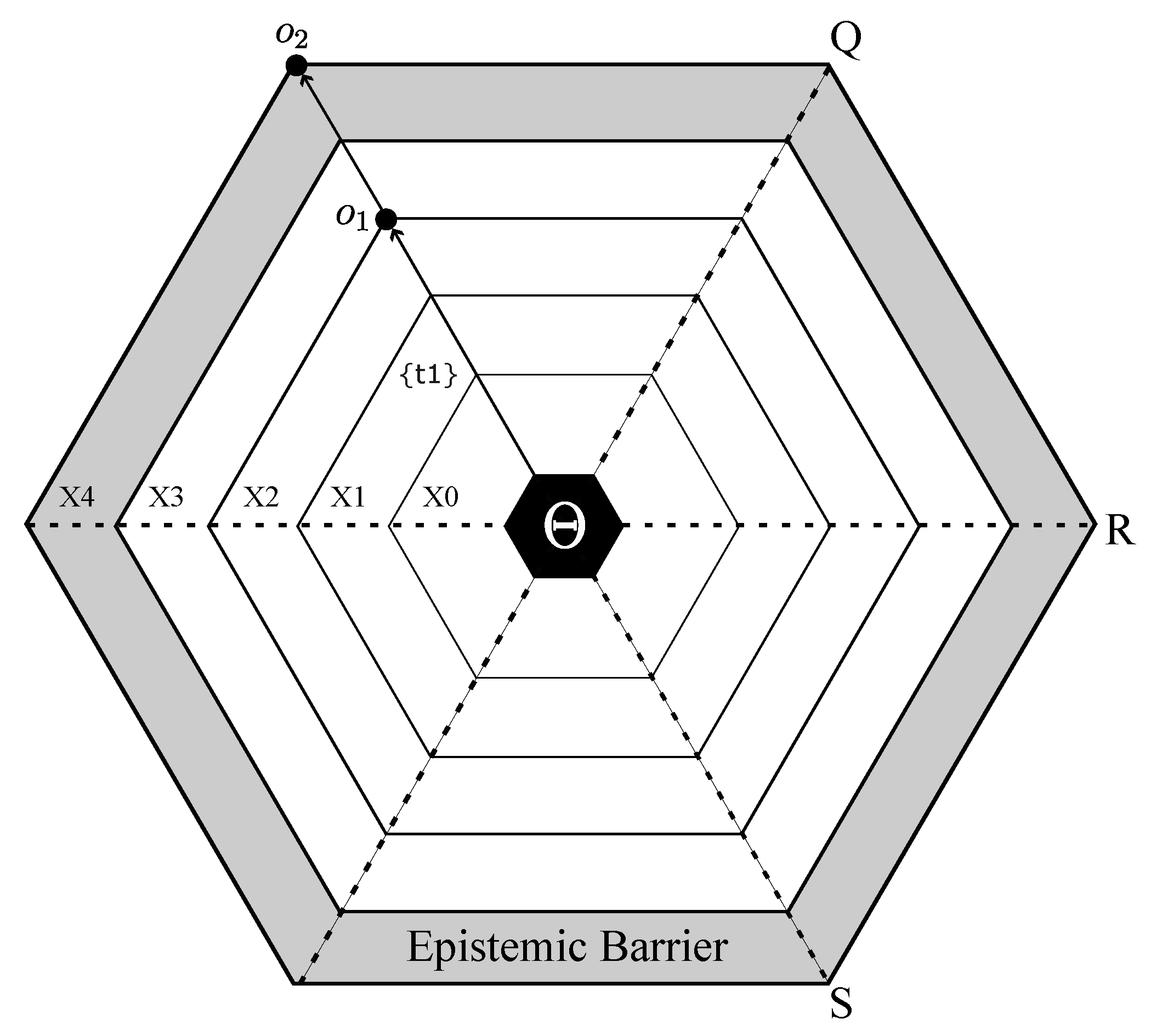
7.1. Ring Structure and Theta
The hexid is organized in concentric rings around Theta (), the experiential zero-point. Theta is not a position like others; it is the origin from which all positions are reckoned—the “here” from which all “theres” are measured. Rings extend outward from through (proprioceptive selfhood) to (the archetypal-mythic horizon), with each ring marking an increase in epistemic distance—not physical distance, but informational-thermodynamic cost of sustaining the navigational configuration.
The extended ring table below incorporates band boundaries and stratified epistemic barriers. Vertical rules mark the four canonical barriers (, , , ) that separate qualitatively distinct regions of the hexid:
| Ring | Description | Band | Stereotypical Correspondence |
| Experiential zero-point | — | Pre-embodiment, pure ipseity | |
| Proprioceptive selfhood | — | Pre-personal body-sense | |
| Immediate self | 1st person (singular) | ||
| Addressed other | 2nd person (singular) | ||
| Non-addressed other | 3rd person (singular) | ||
| Liminal/alienated | Outer singular | ||
| — Barrier (personal): “Where does `I’ end?” — | |||
| Collective self | 1st person plural | ||
| Collective addressed | 2nd person plural | ||
| Collective other | 3rd person plural | ||
| Collective liminal | Outer plural | ||
| — Barrier (collective): “Where does `we’ end?” — | |||
| Generic self | “One” / “people in general” | ||
| Generic addressed | Generic “you” | ||
| Generic other | Kind / type reference | ||
| Generic liminal | Outer generic | ||
| — Barrier (institutional): “Where does the particular end?” — | |||
| Institutional self | Archetype: “the hero” | ||
| Institutional addressed | Archetype: “the other” | ||
| Institutional other | Mythic kinds | ||
| Archetypal horizon | Outer archetypal | ||
| — Barrier (mythic): “Where does the temporal end?” — | |||
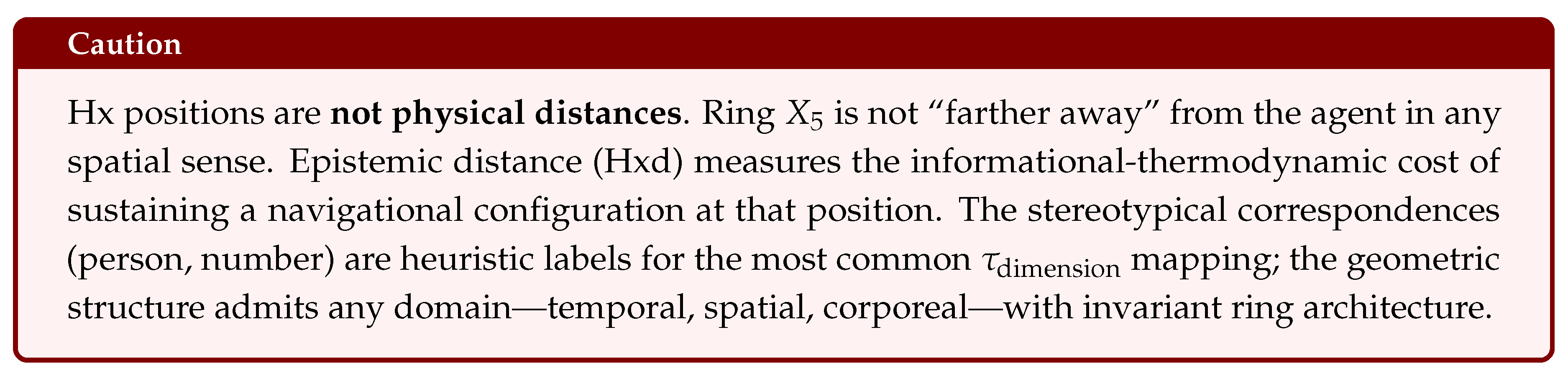
Figure 8.
Radial Cut showing concentric ring structure with epistemic barrier. (center) is the experiential zero-point; rings – mark increasing epistemic distance (informational-thermodynamic cost). Dashed lines indicate QRS coordinate axes. The shaded band at marks the first stratified epistemic barrier (), separating (direct individual access) from (first mimetic band). The trajectory illustrates a trajectorial push: navigation drives a second-person position (, on ring ) toward the epistemic barrier (, on ring )—an alienation dynamic in which an addressed other is progressively displaced toward the liminal boundary of direct access. Not all positions traversed by fall within the render threshold (); shaded positions signify for - without rendering for . The extended structure continues through , organized into four hex bands separated by stratified epistemic barriers (see text).
Figure 8.
Radial Cut showing concentric ring structure with epistemic barrier. (center) is the experiential zero-point; rings – mark increasing epistemic distance (informational-thermodynamic cost). Dashed lines indicate QRS coordinate axes. The shaded band at marks the first stratified epistemic barrier (), separating (direct individual access) from (first mimetic band). The trajectory illustrates a trajectorial push: navigation drives a second-person position (, on ring ) toward the epistemic barrier (, on ring )—an alienation dynamic in which an addressed other is progressively displaced toward the liminal boundary of direct access. Not all positions traversed by fall within the render threshold (); shaded positions signify for - without rendering for . The extended structure continues through , organized into four hex bands separated by stratified epistemic barriers (see text).
7.2. Hxp, Hxd, and the QRS System
Two formal instruments structure analysis within the ring system. The heuristic position specifies a location in the hexagonal grid using three coordinates constrained by . The hexagonal distanceHxd computes ring membership from any position:
Hxd encodes epistemic accessibility (lower values = more direct access), definiteness, specificity, and transductive cost baseline. Crucially, Hxd does not encode social identity markers, group membership, authority relations, or grammatical number—these are functions of other systems.
The QRS axes constitute a three-axis coordinate system encoding social indexicality—the semiotic markers of social positioning as perceived by the agent. QRS specifies position within a ring (direction from ) and social marking, while Hxd specifies which ring. The two systems are orthogonal:
| Property | Encoded by | NOT encoded by |
| Ring membership | Hxd | QRS orientation |
| Position within ring | QRS | Hxd alone |
| Definiteness / Specificity | Hxd | QRS |
| Social indexicality | QRS | Hxd |
| Person deixis | Ring () | QRS, Hxd |
| Grammatical number | Hex band () | QRS, Hxd |
Consider a concrete example: two positions might share the same (both on ring ) yet differ in QRS orientation—one marking a high-authority addressed other () and another marking a low-authority in-group peer (). Same epistemic distance, entirely different social marking.
7.3. QRS-CONFIG: Typed Configuration Objects
Before introducing the formal apparatus, a clarification about the epistemic status of what follows. The semiotic weave of a hexid is, at every scale, richer and more finely grained than any geometric rendering can capture. When we project QRS axes onto a radial cut, we are working with idealized ribbons—heuristic constructs that represent, with a controlled degree of analytical intention and epistemic correspondence, trajectoriality over mimetic folds whose actual structure exceeds the resolution of any two-dimensional geometry. This is not a deficiency of the model but a principled concession: the axes are analytical instruments, not ontological fixtures. They do not sacrifice integration with the broader architecture—every operation defined over QRS remains fully consistent with the interface parameters, saturation dynamics, and transduction mechanics developed elsewhere—but they do idealize what is, in the full epistemic conception of navigational space, a semiotic fabric of considerably finer grain than what a hexid cross-section or radial cut can display.
With this caveat in place: the QRS axes are not universal dimensions; they are heuristic ribbons—archetypal foldings that structure the social-indexical space for a given agent. A QRS-CONFIG is a typed object that specifies the semantic content of Q, R, and S for a given analytical context. The axes, as geometric referents, group these heuristic ribbons into associated definitional dimensions of the configuration chosen for a particular radial cut; the CONFIG provides the semantic content that populates this structure. Multiple CONFIGs may coexist for different communities, cultures, or analytical purposes. No CONFIG is “the true” structure of social space.
The default configuration for general social-semiotic analysis is SOCIAL_INDEXICALITY, where Q encodes perceived agency (agentive/patientive), R encodes authority or status (senior/subordinate), and S encodes group membership (in-group/out-group). But alternative configurations illuminate different social logics:
| CONFIG Name | Q axis | R axis | S axis |
| SOCIAL_INDEXICALITY | Agency | Authority | Group |
| DOMAIN_PERSONAL | Individuation | Specificity | Proximity |
| KINSHIP_SYSTEM | Generation | Lineage | Affinity |
| DEAF_COMMUNITY | Signing competence | Deaf heritage | School affiliation |
This is not relativism about social structure. The geometric architecture—rings, Hxd, -centrality, hex bands—remains invariant across all CONFIGs. What varies is the semantic mapping of the QRS axes, just as the same coordinate grid can map temperature, pressure, or altitude depending on the analytical domain. Pluriversality, in these terms, is not merely “more positions” on fixed axes but the availability of alternative configurations: epistemic justice involves recognizing that SOCIAL_INDEXICALITY is one config among many, not the universal structure of social space.
7.4. Hex Bands and Mimetic Projection
Hex bands () are 4-ring spans of the radial cut, each corresponding to a qualitative shift in reference type. Bands are bounded by the stratified epistemic barriers developed above:
| Band | Rings | Name | Reference Type |
| () | – | Direct Access | Singular / Individual |
| () | – | First Mimetic | Plural / Collective |
| () | – | Second Mimetic | Generic / Kind |
| () | – | Third Mimetic | Institutional / Archetypal |
The systematic relation between bands is captured by the mimetic projection , which maps a position in band to its corresponding position in :
Hxd increases by 4; QRS orientation is preserved. This makes structural mimesis geometrically precise: maps “I” to “We”; maps “You(sg)” to “You(pl)”; maps “He/She” to “They.” Iterated application yields further bands: maps “I” to “One” (generic). What connects singular and plural reference is not a feature value but a navigational operation—crossing the barrier through mimetic projection, preserving social orientation while shifting reference type.
7.5. Stratified Barriers and Dual
The four canonical barriers (, , , ) are not fixed walls but navigational thresholds whose permeability is a function of the agent’s :
| Barrier | Location | Transition | Type | Liminal Question |
| Personal | Where does “I” end? | |||
| Collective | Where does “we” end? | |||
| Institutional | Where does the particular end? | |||
| Mythic | Where does the temporal end? |
Permeability is directional and agent-relative: . A barrier may be more permeable outward than inward, or vice versa. Under colonial conditions, dominant agents project outward more easily (high outward permeability), while subaltern agents are more easily pulled back toward concreteness (high inward permeability)—an asymmetry formalized in detail in the decolonial applications of TTF.
This connects directly to the dual mechanism, which distinguishes two levels at which fold frequency operates. Intra-config measures the number of navigable positions within a given QRS-CONFIG—how finely the agent differentiates social space under one logic. Inter-config measures the number of CONFIGs available to the agent—how many distinct logics of social organization the agent can deploy. A colonial signature is characterized by HIGH intra-config fold (internal differentiation within the dominant system) combined with LOW inter-config fold (only the dominant system recognized). A pluriversal signature shows VARIABLE intra-config fold combined with HIGH inter-config fold (multiple social logics available and navigable).
7.6. The Radial Cut Family: Positional and Rhythmic Geometry
The analytical machinery developed in the preceding subsections—rings, Hxd, QRS-CONFIG, barriers, hex bands—constitutes what TTF calls the Hexagonal Radial Cut (HRC). The HRC is the positional instantiation of the radial cut: it answers the question Where is X with respect to Θ? by encoding epistemic distance (Hxd), social-indexical orientation (QRS), and band membership (). Its geometry is static in the sense that it captures the structural configuration of navigational space at a given analytical moment—where positions sit, which barriers separate them, what CONFIG organizes them. The HRC is the primary instrument for radial analysis: it extracts a two-dimensional cross-section of the hexid for systematic study of trajectories across identity and indexical phenomena, treating rings as discrete navigational steps and QRS-CONFIG coordinates as directional orientations within a specified configuration. Applications include analysis of person deixis, spatial reference, temporal construal, and the identity dynamics underlying phenomena such as impostor syndrome, code-switching, and translanguaging. Multi-domain applications—where an agent simultaneously navigates personal, temporal, and spatial RCs—employ domain-subscripted notation with -tic coordination for temporal synchronization; the full treatment of multi-domain orchestration and worked analytical examples is developed in [1]. When previous work or unspecified references use “Radial Cut” (RC) without qualification, the HRC is assumed by default.
But positions do not merely sit. The -orchestra introduced in Section 5 established that all ribbons in the render manifest simultaneously, each with its own characteristic -tic rhythm. This rhythmic dimension—the differential rate at which informational configurations change—is orthogonal to the positional dimension. Two positions may share the same Hxd yet differ dramatically in their rate of informational change: a habitual greeting at may cycle rapidly through its -tics, while a carefully maintained alliance at the same ring sustains a much slower rhythm. The HRC, which encodes where things are, cannot capture how fast they change.
The Orbital Radial Cut (ORC) is the dynamic instantiation that addresses this gap. It answers the question At what rhythm does X change with respect to α? by assigning each ring an orbital velocity that represents its rate of informational change relative to the agentive figure. The term “orbital” is heuristic—there is no literal rotation—but the metaphor captures something precise: positions closer to the agentive center change faster; positions further out change more slowly, like objects in progressively wider orbits.
The default proportional base is harmonic:
where (the ring of the agentive figure ) serves as the reference. Thus , , , and so on. The harmonic series is not arbitrary; it is motivated by three convergent considerations. First, it decays more gradually than the geometric alternative (), preserving analytical resolution in intermediate rings—with a geometric base, , which is functionally negligible, whereas the harmonic remains analytically active. Second, harmonic proportions resonate with the -orchestra metaphor, since musical harmonics operate on the same series (fundamental, octave, twelfth, double octave). Third, the harmonic series diverges (), capturing the principle that peripheral activity never converges to zero—positions in shade continue to mean even when they do not render.
A crucial difference between the two instantiations concerns their reference point. The HRC is centered on (the experiential zero-point), because epistemic distance is measured from the origin of all navigation. The ORC, by contrast, is centered on (the agentive figure), because rhythmic differentials are measured relative to the agent’s own rate of change. This distinction matters: different agents may occupy different rings, producing different velocity profiles across the same navigational space. The ORC thus enables analyses where infra-agentive processes (below ’s ring) may be faster than the agentive figure itself—a configuration invisible to the HRC but central to understanding automatized or pre-reflective dynamics.
Within the ORC, the render threshold operates as a rhythmic bandpass filter: only rings whose orbital velocity falls within the range are phenomenally visible. Too slow—the configuration falls to shade by sluggishness; too fast—it falls to shade by velocity, its changes too rapid for the render to track. This dual exclusion produces the characteristic bandwidth of phenomenal experience: not everything in the navigational space renders, and what renders is bounded both from above and below by rhythmic constraints, not only by positional ones.
Figure 9 visualizes the ORC’s central idea: the ribbon undulating around the ring structure captures how orbital velocity manifests as differential fold frequency at a given Hxd. Where undulations are tighter (higher ), the configuration at that QRS orientation changes rapidly; where they elongate, change slows. The acoustic domain where the ORC was first illustrated—intonation as orbital rhythm overlaid on the apparent segmentality of verbal structure—should not obscure the generality of the instrument. The ORC applies wherever -tic differentials structure navigational phenomena, including domains far removed from sound.
Consider social relationships. Two bonds may occupy the same ring—say , non-addressed other—yet differ radically in orbital velocity: a new acquaintance cycles rapidly through its -tics (high uncertainty, frequent reconfiguration of the navigational landscape), while a decades-old friendship at the same Hxd has settled into slow, stable rhythm. The HRC cannot distinguish them—same ring, same QRS orientation—but the ORC captures precisely this difference: the new bond orbits fast; the old one orbits slowly. The developmental trajectory of a relationship is, in ORC terms, a progressive deceleration: orbital velocity decreases as the configuration stabilizes, until the bond may fall below ’s and shade entirely—the familiar experience of a relationship that has become so settled it no longer registers phenomenally until disrupted.
The figure-ground asymmetry central to cognitive linguistics receives a natural ORC formulation. What Gestalt and construction-grammar traditions call the “figure” is the navigational configuration with higher orbital velocity at a given analytical moment—it changes faster, attracts -tic attention, stands out against slower-changing ground. This is not restricted to spatial perception: in a classroom, the teacher’s utterance is figure (high ) against the institutional ground of the course structure (low ); in a political crisis, the event is figure against the glacial ground of constitutional architecture. The ORC formalizes this asymmetry as a velocity differential rather than a categorical label, allowing gradients and reversals—ground can become figure when its orbital velocity shifts, as when an earthquake suddenly foregrounds the geological substrate that normally operates well below ’s cutoff.
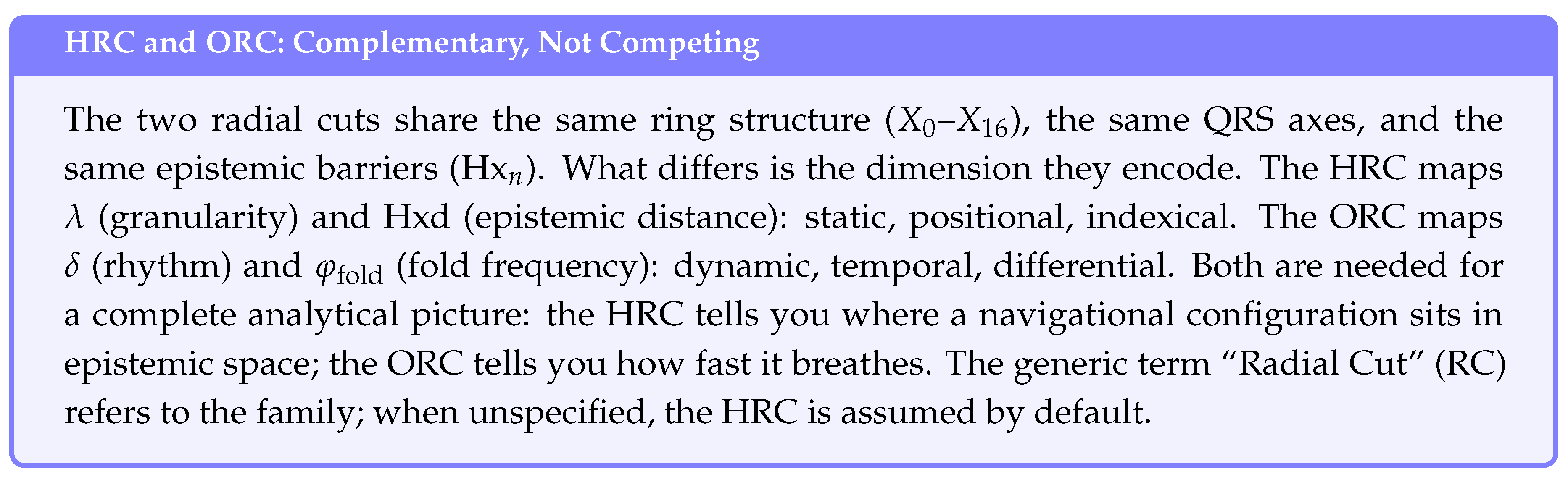
The ORC remains at an earlier stage of formalization than the HRC. Its harmonic proportions and velocity profiles have been established architecturally, but concrete empirical analyses using the ORC—comparable to the worked examples available for the HRC [1]—are a direction for future work. What the ORC already contributes, even in its current form, is the rhythmic constraint that figures in the justification for the four-band structure, to which we now turn.
7.7. Why Four Bands?
A natural question arises: is the four-band structure (–) a mathematical necessity, or could there be more—or fewer—bands? The honest answer is that the number four is not deducible from axioms. No theorem forces the hexid to terminate at . What makes four the architecturally coherent count is a convergence of three independent constraints.
The QRS constraint. The triaxial coordinate system () generates, at each level of Hxd, a natural cycle of four functionally distinct positions: self, addressed other, non-addressed other, and liminal. This is a property of the hexagonal grid, not a theoretical stipulation. Because each band contains exactly four positions, the mimetic projection advances Hxd by exactly 4—preserving QRS orientation while shifting reference type. Bands of any other width would break mimetic isometry: “I” would not map cleanly onto “We,” and the structural parallelism between singular and plural reference would collapse.
The rhythmic constraint. In the ORC, each ring has orbital velocity (the harmonic base introduced above). The first four harmonic ratios—, , , —correspond to the intervals that classical acoustics classifies as perfectly consonant (unison, octave, twelfth, double octave). At the agent reaches the fourth harmonic octave: still within the -orchestra’s range, but at the limit of consonant coordination. A hypothetical fifth band (–) would operate at ratios where rhythmic coherence between center and periphery degrades qualitatively—not because the harmonic series terminates (it diverges: ), but because the render threshold , functioning as a rhythmic bandpass filter, excludes velocities below its cutoff.
The phenomenological constraint. Each barrier marks a qualitative transition in epistemic access: from direct indexicality to collective reference, from collective to generic, from generic to archetypal. Beyond the mythic barrier , the natural liminal question—“Where does the temporal end?”—receives no further qualitative answer. What lies beyond is not a fifth type of reference but the dissolution of referential structure altogether: the horizon where navigational configurations lose coherence. A fifth band would require a liminal question of the form “Where does the atemporal end?”—and the atemporal, by definition, does not end.
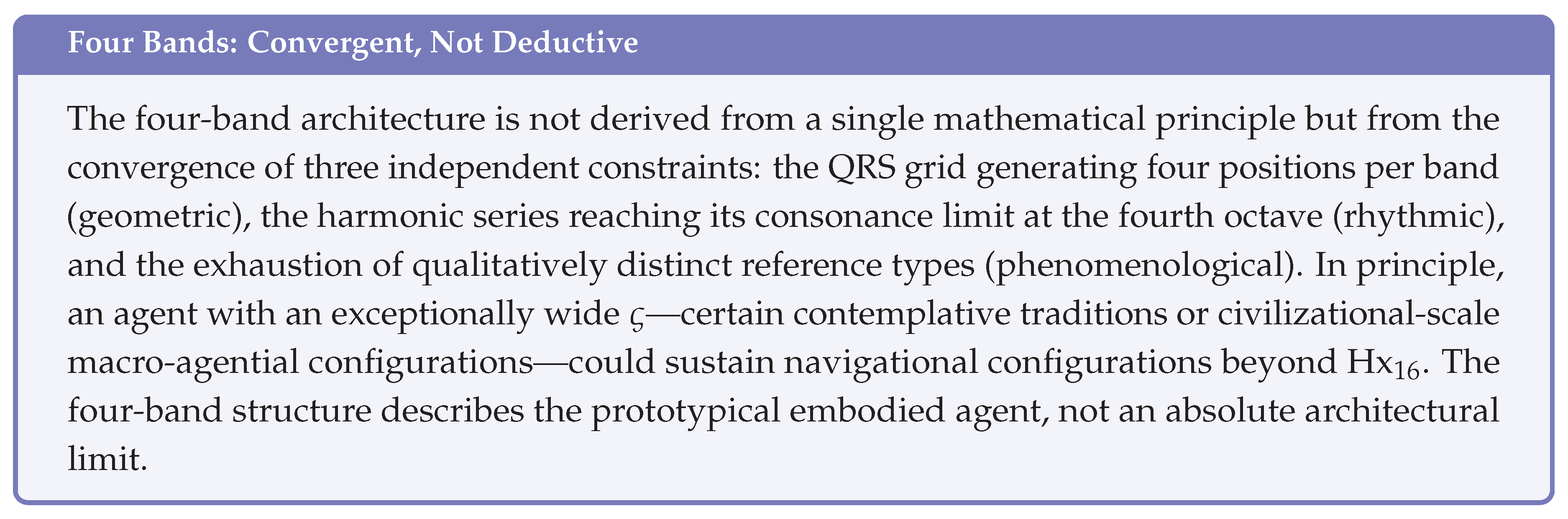
8. Conclusions
The Trace & Trajectory Framework offers a comprehensive non-representationalist approach to meaning, cognition, and selfhood. Rather than treating meaning as stored content retrieved from memory, TTF proposes that meaning is enacted—it emerges through temporally extended navigational patterns (trajectories) traversing structured informational space (the semiotic weave of threads and ribbons).
The framework’s core contributions include:
A layered ontology that distinguishes traces (probabilistic preconditions), threads (stabilized pathways), ribbons (coordinated bundles), and trajectories (meaning-events). This architecture replaces the storage-retrieval model with a navigation model where the trajectory is the meaning.
A dual-parameter architecture ( for structural granularity, for epistemic access) that maintains strict orthogonality between scale and engagement mode. This prevents the common conflation of “abstract” with “reflective” or “concrete” with “automatic.”
A saturation architecture with autosimilar collapse () as the safeguard against semantic overflow. The Gaussian distribution of thread differentiation across granularity levels ensures that accumulation never halts the system—extreme saturation retraces toward substrate, enabling continued navigation.
A situational account of embodiment that replaces the agent-in-environment model with the agent-as-situation model. The NET-hexid/body-agent distinction, governed by agentiality gradients rather than ontological boundaries, dissolves traditional mind-body and internal-external dualisms. Collective geometry—the spectrum from distributive to extractive configurations—formalizes how meta-agential structures achieve coherence, with Macro- identified as a geometric property (extractive asymmetry) rather than an agent type.
An interface/render distinction that clarifies how phenomenal experience relates to broader operative structure. The render (⊂ interface) is where body-agent/environment distinctions operate; at the interface level, this separation dissolves into the epistemic totality of the NET-hexid.
An infra/supra asymmetry establishing that fine-grained structure sustains interface coherence while coarse-grained structure merely conditions it. The demotion doctrine—that configurations are mimetic projections, not genuine semiotic weave—has significant implications for understanding abstraction, institutions, and collective meaning.
Transduction and mimesis as the mechanisms enabling inter-hexid coordination without fusion. The naming effect (increased TE, reduced TC, unchanged ) and mimetic naturalization explain how coordination becomes possible and how coarse configurations achieve apparent stability.
A stratified epistemic barrier system ( through ) with hex bands encoding grammatical number through mimetic projection (). The “I”→“We” transition is not a feature change but a navigational operation—crossing the personal barrier via , preserving social orientation while shifting reference type across hex bands.
QRS-CONFIG as a typed configuration object enabling pluriversal analysis of social indexicality. The geometric structure (rings, Hxd, -centrality) remains invariant; what varies is the semantic content of the QRS axes, specified by culturally configured typed objects. Epistemic justice involves recognizing that no single CONFIG is the universal structure of social space.
Dual distinguishing intra-config fold frequency (positions within a CONFIG) from inter-config fold frequency (CONFIGs available to the agent). Colonial signatures exhibit HIGH intra-config with LOW inter-config fold; pluriversal signatures exhibit VARIABLE intra-config with HIGH inter-config fold.
A radial cut family comprising two complementary instantiations: the Hexagonal Radial Cut (HRC), which encodes positional and indexical structure centered on , and the Orbital Radial Cut (ORC), which encodes rhythmic and -differential structure centered on . The ORC assigns harmonic orbital velocities () to each ring, with operating as a rhythmic bandpass filter. Together with the QRS and phenomenological constraints, the ORC’s harmonic structure provides the convergent justification for the four-band architecture.
8.1. Future Directions
This introduction provides the foundational vocabulary and core commitments necessary for understanding TTF’s architecture. Dedicated articles (currently in preparation) will demonstrate how this architecture dissolves classical problems that have troubled cognitive science and philosophy of mind: the symbol grounding problem, the scaling-up challenge from basic to sophisticated cognition, the problem of other minds, and the accumulation problem for non-representationalist frameworks. Each dissolution follows from rejecting premises rather than choosing sides within inherited dichotomies—a strategy that becomes tractable once the trace-thread-trajectory architecture is in place.
These problems have particularly complicated the description of sign languages and, more generally, have led to methodological or disciplinary neglect of the differences between scales that the architecture captures with precision. Future work will address, for example, how coarse-grained representations lack epistemic equivalence with fine-grained ones, and how phenomena at are fundamentally explicable through mimetic projection—which is partly what embodied cognition approaches gesture toward, though they err in anchoring this insight to an anatomical notion of sensorimotor interaction rather than to the informational architecture that makes such interaction meaningful.
The ORC opens a particularly promising direction. While its harmonic proportions and velocity profiles are architecturally established, concrete empirical analyses—comparable to the HRC-based identity studies already available [1]—remain to be developed. Future work will explore how the ORC’s rhythmic bandpass filter illuminates phenomena such as attentional bandwidth, the phenomenology of flow states (where widens), and the rhythmic asymmetries between agents in colonial or institutional configurations. The relationship between the HRC’s positional analysis and the ORC’s rhythmic analysis—how a single navigational event is simultaneously a position in epistemic space and a velocity in rhythmic space—promises to yield a more complete analytical picture of trajectory dynamics than either instantiation provides alone.
Applications currently under development include: indexicality and identity dynamics in sign languages [1], where hex bands and QRS-CONFIG provide fine-grained analytical instruments for person reference, role-shift, and classifier constructions; neurodiversity as shading configuration rather than deficit, with structural shading formalizing how navigational differences produce distinct—not deficient—categorical landscapes; decolonial analysis of epistemic appropriation through Macro- extractive geometry, where colonial and pluriversal signatures formalize asymmetries in categorical access; and the formalization of minimal selfhood as dissipative attractor. Each application demonstrates how TTF’s unified architecture handles phenomena that have required separate, domain-specific machinery in representationalist frameworks.
The framework invites engagement from researchers across cognitive science, philosophy of mind, linguistics, and related fields. By dissolving rather than solving classical problems—rejecting the premises that generate them—TTF opens new avenues for understanding how meaning emerges, how agents coordinate, and how the rich texture of conscious experience arises from navigational dynamics rather than stored representations.
References
- Escobar L.-Dellamary, L. Radial Analysis: A trajectory-based method for indexicality and identity studies. No. 2025111331; Preprints. 2026. [Google Scholar] [CrossRef]
- Gardenförs, P. Conceptual spaces: The geometry of thought; MIT Press, 2000. [Google Scholar]
- Harnad, S. The symbol grounding problem. Physica D: Nonlinear Phenomena 1990, 42(1–3), 335–346. [Google Scholar] [CrossRef]
- Hoffman, D. D.; Prakash, C.; Chattopadhyay, S. Traces of consciousness (No. 2024101305). Preprints 2024. [Google Scholar] [CrossRef]
- Husserl, E. Ideas pertaining to a pure phenomenology and to a phenomenological philosophy: First book; (Original work published 1913); Kersten, F., Translator; Martinus Nijhoff, 1983. [Google Scholar]
- Hutto, D. D.; Myin, E. Radicalizing enactivism: Basic minds without content; MIT Press, 2013. [Google Scholar] [CrossRef]
- Hutto, D. D.; Myin, E. Evolving enactivism: Basic minds meet content; MIT Press, 2017. [Google Scholar] [CrossRef]
- Kastrup, B. The idea of the world: A multi-disciplinary argument for the mental nature of reality; Iff Books, 2019. [Google Scholar]
- Kelso, J. A. S. Dynamic patterns: The self-organization of brain and behavior; MIT Press, 1995. [Google Scholar]
- Kohar, M. The scaling-up problem from a mechanistic point of view. Journal for General Philosophy of Science 2025, 56, 455–476. [Google Scholar] [CrossRef]
- Merleau-Ponty, M. Phenomenology of perception; (Original work published 1945); Landes, D. A., Translator; Routledge, 2012. [Google Scholar]
- van Gelder, T. What might cognition be, if not computation? The Journal of Philosophy 1995, 92(7), 345–381. [Google Scholar] [CrossRef]
- Willems, E. Solving the inclusion problem: Gender without representationalism. Synthese 2024, 204(6), 174. [Google Scholar] [CrossRef]
Figure 1.
Ribbons as coordinated thread-bundles moving through trace-space. Each ribbon maintains its own harmonic fold frequency () while participating in the larger semiotic weave. The varying curvature and interweaving illustrate how ribbons can coordinate (transductive coupling) without fusing. The dotted background represents the underlying trace-structure () through which ribbons navigate.
Figure 1.
Ribbons as coordinated thread-bundles moving through trace-space. Each ribbon maintains its own harmonic fold frequency () while participating in the larger semiotic weave. The varying curvature and interweaving illustrate how ribbons can coordinate (transductive coupling) without fusing. The dotted background represents the underlying trace-structure () through which ribbons navigate.

Figure 2.
Architectural progression: traces, threads, ribbons, trajectories. Harmonic convergence points mark navigational nodes (positions). The substrate level () provides probabilistic preconditions; threads () bundle into ribbons (); trajectories () traverse this structure as meaning-events.
Figure 2.
Architectural progression: traces, threads, ribbons, trajectories. Harmonic convergence points mark navigational nodes (positions). The substrate level () provides probabilistic preconditions; threads () bundle into ribbons (); trajectories () traverse this structure as meaning-events.
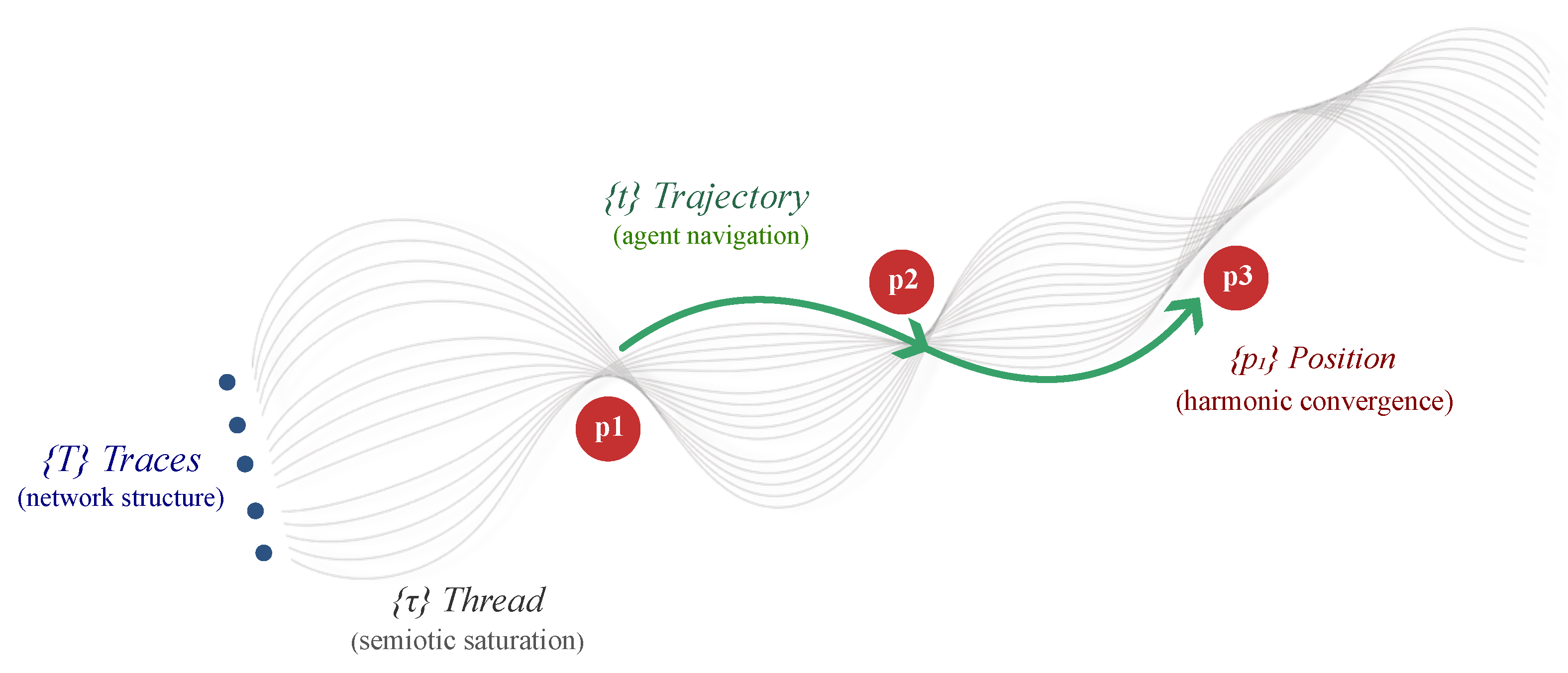
Figure 3.
Gaussian saturation across : from high thread differentiation at fine granularity (wide base), through saturated but filamentary configurations (middle slopes), to trace-like collapse at extreme saturation (peak, marked ).
Figure 3.
Gaussian saturation across : from high thread differentiation at fine granularity (wide base), through saturated but filamentary configurations (middle slopes), to trace-like collapse at extreme saturation (peak, marked ).
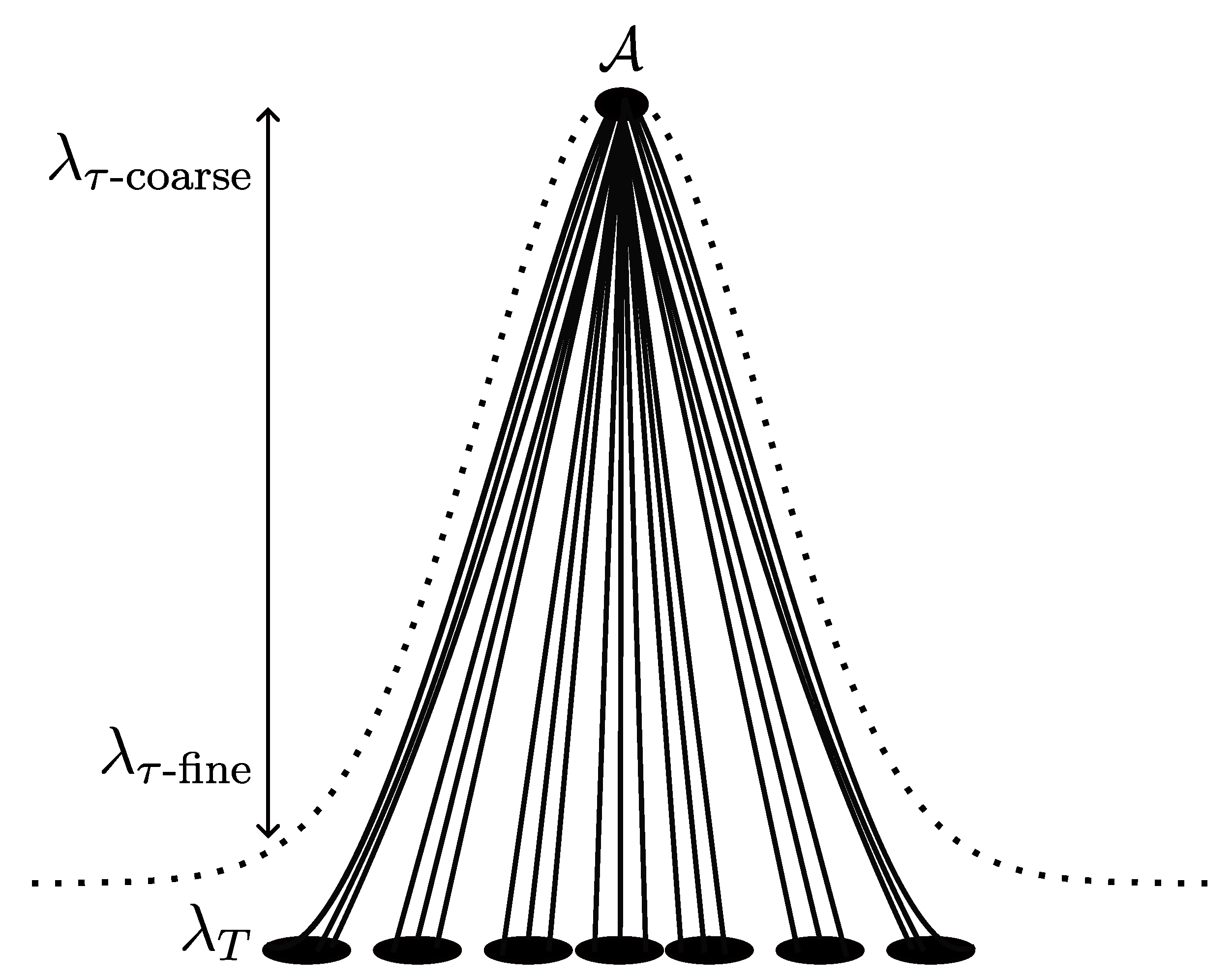
Figure 4.
Ribbons traversing the granularity spectrum. Dashed lines indicate the render threshold () bounding the interface band. Black dots mark fold points—positions of harmonic convergence. Ribbons rise toward (top) and descend toward (bottom). The same ribbon can span multiple levels; governs which portions render phenomenally.
Figure 4.
Ribbons traversing the granularity spectrum. Dashed lines indicate the render threshold () bounding the interface band. Black dots mark fold points—positions of harmonic convergence. Ribbons rise toward (top) and descend toward (bottom). The same ribbon can span multiple levels; governs which portions render phenomenally.
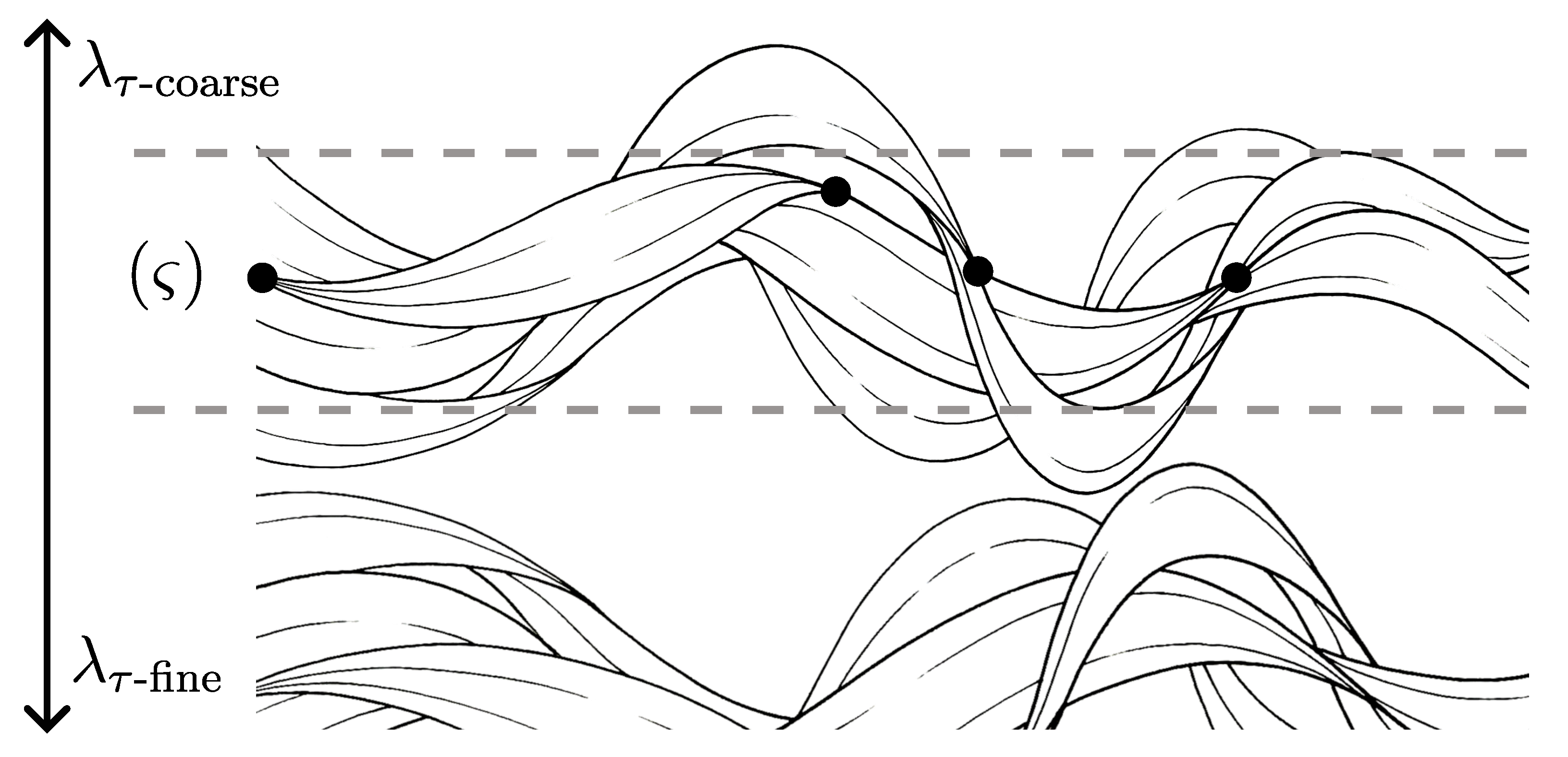
Figure 6.
Hexid prism geometry showing the interface (central band, ) bounded by render threshold . Subhexid () sustains interface coherence from below; suprahexid () conditions it from above. The waistline shifts with navigational mode.
Figure 6.
Hexid prism geometry showing the interface (central band, ) bounded by render threshold . Subhexid () sustains interface coherence from below; suprahexid () conditions it from above. The waistline shifts with navigational mode.
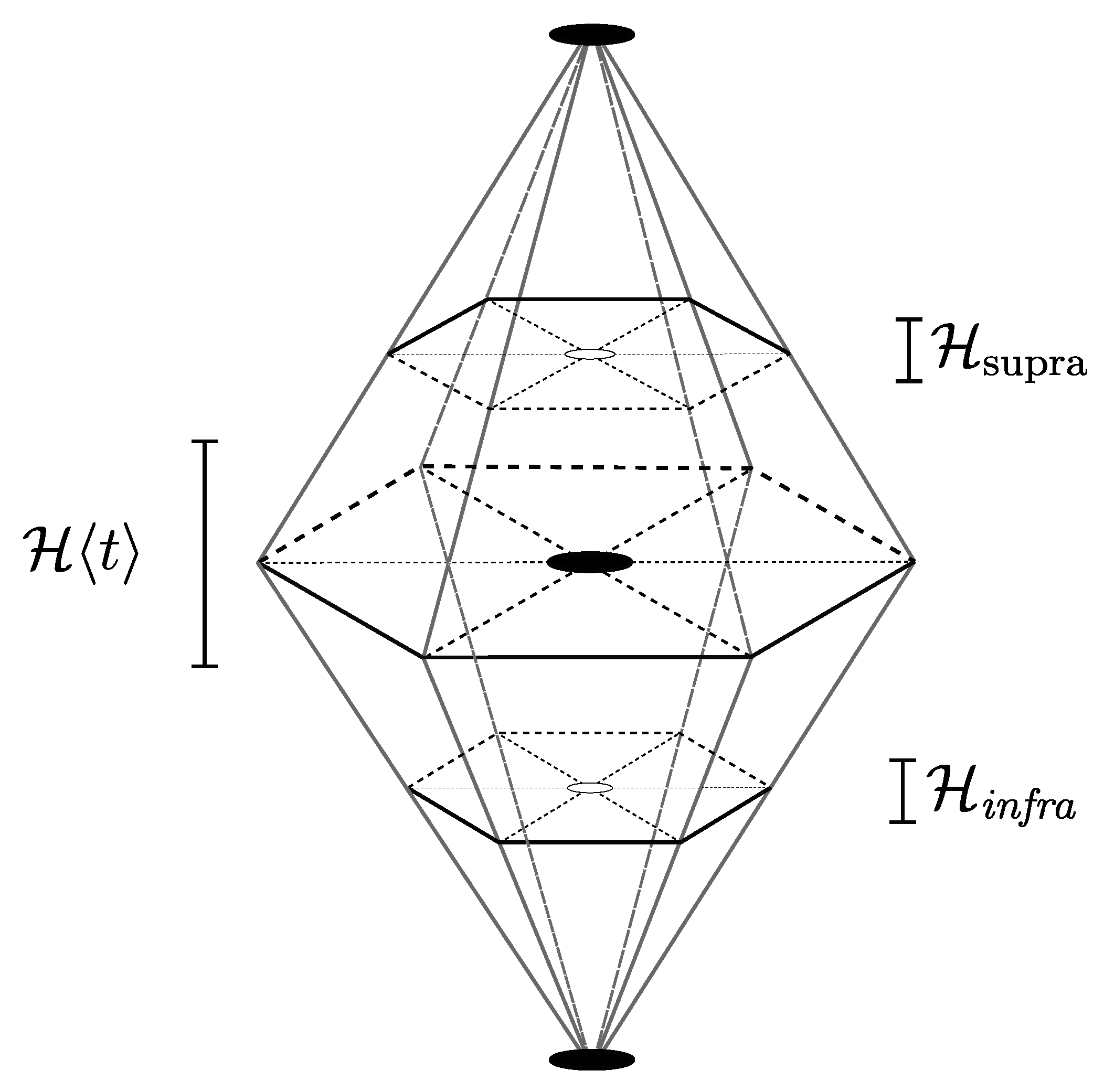
Figure 9.
Orbital Radial Cut (ORC). Concentric rings with QRS axes (as in the HRC), but the outer ring displays a ribbon whose undulations represent differential orbital velocity (). Higher fold frequency indicates faster informational change relative to ; lower frequency indicates slower change. The ribbon is heuristic: it visualizes the -tic rhythm at a given ring, not literal spatial movement.
Figure 9.
Orbital Radial Cut (ORC). Concentric rings with QRS axes (as in the HRC), but the outer ring displays a ribbon whose undulations represent differential orbital velocity (). Higher fold frequency indicates faster informational change relative to ; lower frequency indicates slower change. The ribbon is heuristic: it visualizes the -tic rhythm at a given ring, not literal spatial movement.
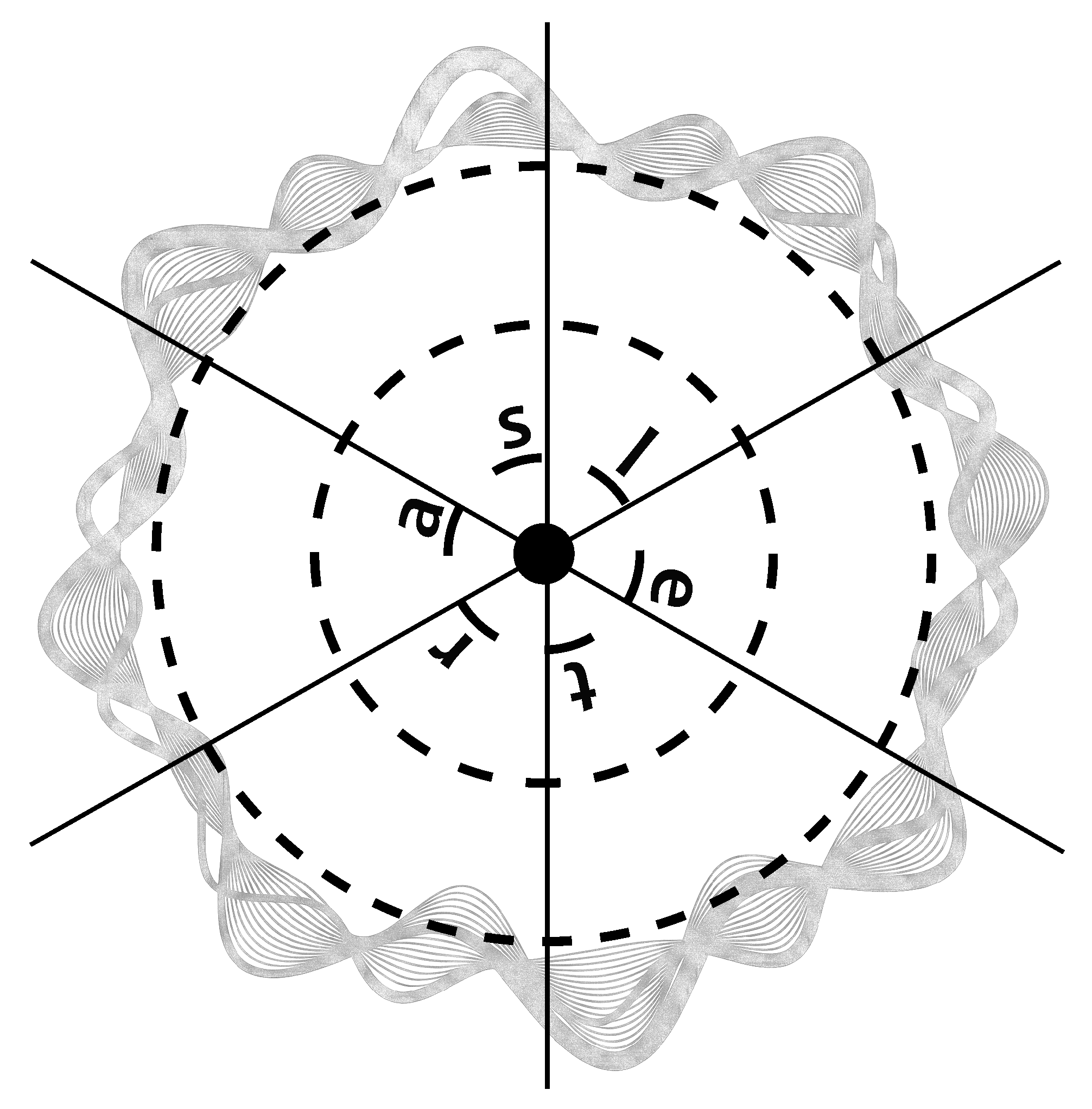
Disclaimer/Publisher’s Note: The statements, opinions and data contained in all publications are solely those of the individual author(s) and contributor(s) and not of MDPI and/or the editor(s). MDPI and/or the editor(s) disclaim responsibility for any injury to people or property resulting from any ideas, methods, instructions or products referred to in the content. |
© 2026 by the author. Licensee MDPI, Basel, Switzerland. This article is an open access article distributed under the terms and conditions of the Creative Commons Attribution (CC BY) license (http://creativecommons.org/licenses/by/4.0/).
Copyright: This open access article is published under a Creative Commons CC BY 4.0 license, which permit the free download, distribution, and reuse, provided that the author and preprint are cited in any reuse.


