

Submitted:
24 January 2026
Posted:
27 January 2026
You are already at the latest version
Abstract
Liver resection for hepatocellular carcinoma (HCC) and hepatic metastases (primarily from colorectal origins, but including various primaries) demands careful navigation of anatomical complexities, tumor heterogeneity, and risks like bleeding and tissue deformation. This narrative review reframes the integration of artificial intelligence (AI), robotics, and nanotechnology within the surgical workflow preoperative planning, intraoperative execution, and postoperative monitoring emphasizing hybrid systems (defined as combinations of two or more technologies, such as AI-guided robotics with nanotechnology) that could leverage synergies for enhanced decision making. Unlike prior reviews that assess individual technologies in silos, focus on performance metrics without workflow integration, or overlook cases where hybrids fail to add value, we prioritize surgeon centered challenges, translational readiness, and barriers to adoption, drawing from 2020-2026 evidence. Emerging data suggest potential for AI's predictive analytics, robotics' dexterity, and nanotechnology's molecular targeting in hybrid setups, though evidence is often from small, retrospective cohorts with limited external validity. As hybrid surgical systems are increasingly proposed but rarely evaluated as integrated workflows, this review addresses a critical gap between technological innovation and clinical decision-making. We propose a speculative roadmap for multidisciplinary validation, addressing ethical, regulatory, and equity issues to guide cautious clinical integration. This review is primarily intended for hepatobiliary surgeons and translational researchers evaluating near to mid term clinical adoption.
Keywords:
liver neoplasms
; hepatectomy
; robotic surgical procedures
; artificial intelligence
; nanotechnology
; augmented reality
; intraoperative complications
; postoperative complications
; treatment outcome
; minimally invasive surgical procedures
; imaging
; three-dimensional
; translational medical research
Introduction
Liver resection remains a cornerstone for curative treatment of HCC and hepatic metastases, yet it is constrained by complex vascular anatomy, cirrhosis related risks, and the need for parenchyma preservation to avoid postoperative liver failure [2,4,18]. Traditional approaches often rely on preoperative imaging for planning and manual skill during execution, leading to variable outcomes. Reported recurrence and morbidity rates vary widely depending on tumor biology, cirrhosis severity, and institutional expertise, with recurrence rates up to 70% at 5 years in selected HCC series and morbidity in 20-40% of cases in retrospective series [3,8,17]. Emerging technologies AI for data integration, robotics for precise manipulation, and nanotechnology for targeted interventions offer a potential paradigm shift, but most literature examines them in silos, overlooking hybrid potential and translational gaps [1,10,13,50]. Unlike prior reviews that assess individual technologies, this review reframes liver surgery through a workflow centered hybrid systems lens, explicitly addressing when integration fails to add value. By synthesizing 2020-2026 evidence, we aim to provide a forward looking framework that advances surgical decision making without overhyping, distinguishing preclinical promise from clinical reality. Given the heterogeneity of technologies, endpoints, and readiness levels, formal meta-analysis would be methodologically inappropriate and a systematic review framework would risk artificial homogeneity across fundamentally dissimilar technologies; instead, this narrative format maps what should be tested next, not what is already proven [11,52].
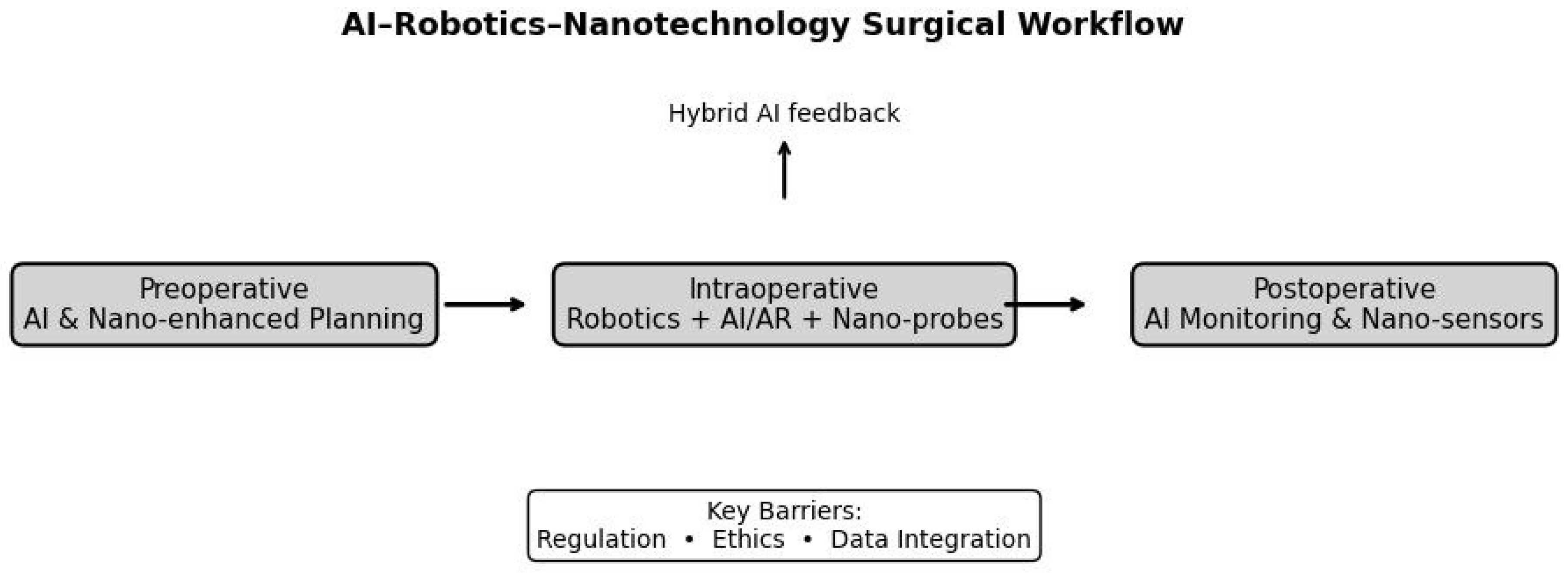
Figure 1.
Conceptual framework of technology integration in liver surgery workflow.
Methods
This narrative review synthesizes clinical and preclinical evidence from 2020-2026 on AI, robotics, and nanotechnology in liver surgery, with a focus on hybrid integration. To ensure transparency and a priori specification of objectives, this narrative review was registered on PROSPERO (CRD420261289929). The registration included the planned inclusion criteria, search strategy, and objectives for evaluating hybrid systems in liver surgery.
Eligibility Criteria
Studies were included if they involved patients of any age or sex undergoing liver resection for primary or secondary hepatic malignancies, including HCC and liver metastases, using open or minimally invasive approaches. Eligible interventions encompassed AI for planning or guidance, robotic assisted surgery, nanotechnology for imaging or targeting, or hybrid combinations. Both randomized and nonrandomized designs were considered, with no language or date restrictions applied.
Searching and Screening
Both published and unpublished studies were sought. Main bibliographic databases searched included Embase (via Ovid), MEDLINE, PubMed, Science Citation Index (SCI), and Scopus. Google Scholar was used as a specialist database. No other methods for identifying studies were employed. A full search strategy is available in the PROSPERO protocol. Studies were screened independently by at least two reviewers (or person/machine combination), with a process to resolve differences.
Data Collection Process
Data were extracted independently by at least two reviewers (or person/machine combination), with a process to resolve differences. Authors were contacted for any required data not available in published reports. Risk of bias/study quality, reporting bias, and certainty of findings were not formally assessed, consistent with the narrative synthesis approach.
Planned Data Synthesis
No formal data synthesis was planned; data were described narratively without combination.
Current Review Stage
The review is ongoing, with formal searching, screening, and data extraction started but not completed.
Conceptual Role in Preoperative Planning
Preoperative planning in liver surgery involves tumor localization, vascular mapping, and functional liver volume estimation to minimize risks like ischemia or incomplete resection [12,14]. AI excels by integrating multimodal data (e.g., CT, MRI, omics) to predict recurrence and guide resectability, addressing surgeon challenges in high risk cirrhotic livers, though often in retrospective cohorts [2,6,7]. Machine learning models, for instance, combine radiomics with clinical variables to forecast early HCC recurrence post-resection with AUCs >0.80 in small pilot studies [3,16]. However, most models lack external validation and are susceptible to overfitting, limiting clinical generalizability [5,11]. Robotics contributes through virtual simulations, incorporating haptic feedback to rehearse complex resections like those in segment VIII, reducing planning uncertainty in feasibility trials [22,23,67]. Nanotechnology enhances imaging via targeted nanoparticles, such as glypican 3 conjugated agents, improving detection of microvascular invasion a key prognostic factor with up to 25% better tumor accumulation in preclinical models [33,35,41].
Conceptually, hybrid systems unify these: AI analyzes nano enhanced scans to create probabilistic maps, which robotic platforms simulate for rehearsal. This dynamic approach could account for patient-specific variability, potentially decreasing intraoperative adjustments and conversion rates, though current evidence is largely preclinical with limited external validity [34,59,61]. Hybrid value should be judged by cognitive offloading and workflow simplification, not technological sophistication alone, particularly in addressing margin uncertainty [15].
Intraoperative Guidance and Execution
Intraoperative challenges include achieving R0 margins, preserving vessels, and adapting to deformation in cirrhotic livers [13]. Robotics addresses these with tremor free precision and 3D visualization, showing lower blood loss (e.g., 200-300 mL) and conversion rates (4 -5%) in major hepatectomies for metastases (predominantly colorectal liver metastases, CRLM) compared to laparoscopy in meta analyses of predominantly retrospective data from high volume centers [9,19,20,21,23,25,27,28]. AI augments by overlaying navigation, segmenting tissues in real time, and predicting bleeding from vascular patterns in early feasibility studies [1,7]. Nanotechnology provides molecular tools, like fluorescence-guided nano probes for margin delineation or drug-eluting particles for targeted ablation, reducing off target effects in fibrotic tissue in preclinical settings [30,32,43].
Hybrid frameworks could enable adaptive resection: AI processes robotic sensor data and nano markers to adjust paths dynamically, as seen in AR-assisted robotic hepatectomies achieving sub centimeter precision and lower complications (10-30%) in small pilot cohorts [70,72,78]. This system supported approach may mitigate skill variability, particularly in minimally invasive HCC resections, but demands scrutiny for registration accuracy amid deformation, directly tackling bleeding risks and deformation mismatches [68,79,82].
Postoperative Monitoring and Outcomes
Postoperative focus includes complication detection, recovery optimization, and recurrence surveillance [18]. AI predicts morbidity using perioperative metrics, enabling early interventions for liver failure with accuracies >85% in retrospective analyses [6,8]. Robotics correlates with shorter stays (5–7 days) and reduced morbidity in HCC cases due to minimal invasiveness in single center studies [9,26]. Nanotechnology supports via nano sensors for biomarker monitoring or sustained release systems for healing, showing 30-50% improved drug uptake in preclinical HCC models [42,45].
Hybrids could create feedback loops: AI interprets nano-delivered biomarkers from robotic-implanted devices to forecast recurrence, integrating with EHRs for personalized follow up. This may extend workflow impact, potentially informing recurrence free survival through earlier detection, though long-term data are sparse and from limited cohorts, solving real surveillance challenges without over interpreting pilot data [61,64].
Limitations, Safety Concerns, and Barriers to Adoption
AI risks dataset bias and overfitting, limiting generalizability across diverse populations in early studies [5,11]. Robotics incurs high costs ($1-2 million/system) and steep learning curves, restricting access in low-resource settings [22,23,48,49]. Nanotechnology faces biocompatibility issues, with potential toxicity in cirrhotic livers in preclinical evaluations [29,37,38]. Hybrids compound these, requiring interdisciplinary validation; readiness varies AI/robotics in trials, nanotechnology preclinical [34,59,62]. Ethical concerns include data privacy, surgeon deskilling, and liability in AI-driven decisions [50,52,53]. Regulatory hurdles, like FDA approval, slow adoption, emphasizing need for honest discussion of neutral/negative trials; negative or neutral findings are likely underrepresented due to publication bias, particularly in early feasibility studies [5]. Additional barriers include lack of interoperability between proprietary platforms and risks of vendor lock-in. Without parallel investment in training and cost reduction, hybrid systems risk exacerbating disparities in global liver surgery [12,77].

Table 1.
Nanotechnology Readiness Levels in Liver Surgery.
| Nano Application | Evidence Level | Clinical Status |
|---|---|---|
| Fluorescence probes | Preclinical / early human pilots | Experimental |
| Drug-eluting particles | Preclinical | Not approved in US/EU |
| Targeted contrast agents | Animal models / phase I trials | Investigational |
| Nano-sensors for monitoring | Preclinical concepts | Not in clinical use |
Evidence for Hybrid Systems
Evidence for hybrids is nascent, focusing on dual systems like AI-robotics for navigation or AI-nanotechnology for targeting, mostly in small, single-center studies [34,59,62]. AI-integrated robotics with AR adapts to deformation, supporting R0 resections in metastases without recurrence at 22 months in highly selected pilot patients, though with limited validity [70,71]. AI-nanotechnology optimizes HCC nanoparticle delivery, yielding 25% higher accumulation and lower toxicity in animal models [35,47]. Tri-hybrids (e.g., AI-guided robotic nano-probes) demonstrate 30-50% preclinical efficacy gains but lack clinical data; tri-hybrid systems currently remain conceptual or preclinical and should not be interpreted as near-term clinical solutions [31,54]. Key gaps: standardized interfaces, multicenter trials; barriers: overfitting, costs [11,77].
Table 2.
Comparing Single-Technology vs. Hybrid Value in Liver Surgery.
| Aspect | Single-Technology (e.g., AI Alone, Robotics Alone, Nano Alone) | Hybrid Systems (e.g., AI-Robotics-Nano Integration) |
| Strengths | Simpler implementation; lower cost; focused on specific pain points (e.g., AI for prediction, robotics for dexterity). | Potential synergies for adaptive workflows; addresses multiple challenges simultaneously (e.g., real-time margin adjustment). |
| Weaknesses | Limited scope; may not handle complexity like deformation or heterogeneity. | Increased complexity; higher risk of compounded errors; regulatory hurdles. |
| Evidence Maturity | Higher for AI/robotics (trials); lower for nano (preclinical). | Mostly preclinical/pilot; lacks RCTs. |
| Clinical Value | High for routine cases; reduces cognitive load in isolated tasks. | May add value in complex resections; could degrade performance in routine ones due to latency/setup. |
| Adoption Barriers | Cost/learning curve for robotics; bias for AI. | Vendor lock-in; interoperability issues; equity gaps. |
| When to Prefer | Standard procedures where one tech suffices. | High-risk cases needing multi-layered support, pending validation. |
When Hybrid Systems May NOT Add Value
We intentionally include scenarios where hybrid systems may degrade performance, as these are underreported in current literature. While hybrids offer potential synergies, they may not always improve outcomes and could introduce drawbacks. Increased system complexity might lead to longer setup times or higher failure rates in resource-limited settings. Latency in real-time AI processing could delay critical decisions during bleeding events. Compounded failure modes, such as AI misinterpretation of nano data, risk amplifying errors. Regulatory burdens for hybrid approvals may outweigh benefits for routine cases, where single technologies suffice. We suggest tiered adoption: hybrids for complex cases, single tech for routine resections.
Current regulatory frameworks still place final accountability on the operating surgeon under current regulatory frameworks, underscoring the need for decision support not decision replacement AI, with acknowledgment of regulatory lag for hybrids.
Box 1: What Evidence Surgeons Should Demand Before Adoption
Before adopting hybrid systems in liver surgery, surgeons should demand robust, multicenter evidence addressing translational gaps. Key requirements include: (1) Prospective RCTs demonstrating workflow improvements (e.g., reduced operative time, margin positivity) over single technologies, with endpoints like intraoperative decision latency and conversion rates; (2) External validation of AI models to mitigate bias and overfitting, including diverse cohorts reflecting global populations; (3) Long term data on outcomes like recurrence free survival and morbidity, accounting for publication bias in neutral/negative trials; (4) Safety assessments, including failure mode analyses for compounded errors (e.g., AI latency during bleeding); (5) Cost effectiveness studies, factoring equity and interoperability to avoid vendor lock in; (6) Ethical evaluations, ensuring transparency, patient autonomy in consent, and surgeon accountability. Until such evidence exists, hybrids should be piloted in high volume centers with fallback protocols.
Future Roadmap
A phased, speculative roadmap, dependent on reimbursement models and regulatory harmonization, is proposed: (1) Short-term (1-3 years): Multicenter trials validating hybrids on workflow metrics (e.g., margin uncertainty reduction, intraoperative decision latency, conversion rates) in diverse cohorts. (2) Medium-term (3-5 years): Prototype development, like AI-robotics with nano-imaging, tested preclinically for safety. (3) Long-term (5+ years): RCTs on integrated systems, assessing cost-effectiveness and global equity. Gaps: Longitudinal hybrid impact studies, AI ethics. Multidisciplinary collaboration essential for potential standardization by 2030, though timelines remain uncertain.
Conclusions
Integrating AI, robotics, and nanotechnology could redefine liver surgery workflows, tackling surgeon challenges in HCC and hepatic metastases. Hybrids offer a pathway to enhanced decision making, but require rigorous validation to bridge hype and reality, particularly given evidence limitations. Surgeons should prioritize hybrids that demonstrably reduce uncertainty at decision critical moments, such as margin assessment or bleeding control, rather than those offering marginal technical enhancements. They should demand multicenter RCTs before adoption, remain cautious in routine cases where hybrids may add complexity without value, and advocate for equity focused implementations to avoid widening global disparities. Until such evidence exists, hybrid systems should be considered experimental adjuncts rather than standards of care.
References
- Artificial Intelligence Applications in the Diagnosis, Treatment, and Prognosis of Hepatocellular Carcinoma - PMC - NIH. https://pmc.ncbi.nlm.nih.gov/articles/PMC12800664.
- Artificial intelligence in hepatocellular carcinoma screening: applications and challenges. https://www.frontiersin.org/journals/medicine/articles/10.3389/fmed.2025.1713887/full.
- Machine learning integrating MRI and clinical features predicts early recurrence of hepatocellular carcinoma after resection | Scientific Reports - Nature. https://www.nature.com/articles/s41598-026-36261-3.
- Current status and prospects of artificial intelligence in liver cancer management. https://www.sciencedirect.com/science/article/pii/S295026162500038X.
- Study reveals AI strengths and limits in real-world liver cancer treatment - HAB Central. https://habcentral.habcommunity.com/article/study-reveals-ai-strengths-and-limits-in-real-world-liver-cancer-treatment?article_id=7066699&article_title=Study+reveals+AI+strengths+and+limits+in+real-world+liver+cancer+treatment.
- Can AI Guide the Decision to Transplant or Resect for Hepatocellular Carcinoma? | Gastroenterology and Hepatology | JAMA Network Open. https://jamanetwork.com/journals/jamanetworkopen/fullarticle/2839040.
- Artificial Intelligence in Hepatocellular Carcinoma: Applications and | IJGM - Dove Medical Press. https://www.dovepress.com/an-artificial-intelligence-pipeline-for-hepatocellular-carcinoma-from--peer-reviewed-fulltext-article-IJGM.
- Artificial intelligence in predicting recurrence after first-line treatment of liver cancer: a systematic review and meta-analysis | BMC Medical Imaging. https://link.springer.com/article/10.1186/s12880-024-01440-z.
- Robotic liver resection for HCC reduced length of hospital stay, ICU admissions - Healio. https://www.healio.com/news/gastroenterology/20221221/robotic-liver-resection-for-hcc-reduced-length-of-hospital-stay-icu-admissions.
- Emerging Role of MRI--Based Artificial Intelligence in Individualized Treatment Strategies for Hepatocellular Carcinoma: A Narrative Review - NIH. https://pmc.ncbi.nlm.nih.gov/articles/PMC12706715.
- Artificial Intelligence in Hepatopancreaticobiliary Surgery: A Systematic Review. https://journal.hep.com.cn/artis/EN/10.20517/ais.2022.20.
- The role of artificial intelligence and 3D printing in minimally invasive liver surgery. https://www.oaepublish.com/articles/2574-1225.2024.78.
- Artificial intelligence in the detection, characterisation and prediction of hepatocellular carcinoma: a narrative review - Translational Gastroenterology and Hepatology. https://tgh.amegroups.org/article/view/6429/html.
- Artificial Intelligence in Perioperative Planning and Management of Liver Resection | Request PDF - ResearchGate. https://www.researchgate.net/publication/377597661_Artificial_Intelligence_in_Perioperative_Planning_and_Management_of_Liver_Resection.
- Current state of artificial intelligence in liver transplantation - ScienceDirect.com. https://www.sciencedirect.com/science/article/pii/S2451959625000034.
- Machine learning integrating MRI and clinical features predicts early recurrence of hepatocellular carcinoma after resection - Nature. https://www.nature.com/articles/s41598-026-36261-3_reference.pdf.
- Role of artificial intelligence in the diagnosis and treatment of hepatocellular carcinoma. https://www.wjgnet.com/2644-3236/full/v3/i4/96.htm.
- Redefining precision medicine in hepatocellular carcinoma through omics, translational, and AI-based innovations. https://www.jprecisionmedicine.org/article/S3050-6328(25)00003-4/fulltext.
- Robotic versus laparoscopic hepatectomy: meta-analysis of... https://pmc.ncbi.nlm.nih.gov/articles/PMC11957917.
- An updated meta-analysis of the efficacy and safety of robot-assisted... https://journals.lww.com/md-journal/fulltext/2025/01030/an_updated_meta_analysis_of_the_efficacy_and.8.aspx.
- Robotic versus laparoscopic hepatectomy for liver malignancies... https://www.thelancet.com/journals/lanepe/article/PIIS2666-7762(24)00139-X/fulltext.
- Robotic Liver Resections: Current State-of-the-Art and Future... https://link.springer.com/article/10.1007/s40137-025-00469-5.
- Laparoscopic versus Robotic Hepatectomy: A Systematic Review... https://www.mdpi.com/2077-0383/11/19/5831.
- International experts consensus guidelines on robotic liver resection... https://pmc.ncbi.nlm.nih.gov/articles/PMC10494765.
- Robotic versus conventional laparoscopic liver resections. https://journals.sagepub.com/doi/10.1177/1457496920925637.
- Robotic-assisted laparoscopic liver resection in hepatocellular... https://journal.hep.com.cn/hepatomaresearch/EN/10.20517/2394-5079.2020.86.
- Robotic versus open resection for colorectal liver metastases in a... https://www.cell.com/heliyon/fulltext/S2405-8440(24)00831-4.
- Robotic versus laparoscopic liver resection: a systematic review and... https://journals.lww.com/international-journal-of-surgery/fulltext/2025/08000/robotic_versus_laparoscopic_liver_resection__a.46.aspx.
- Advanced nanotheranostic approaches for hepatocellular carcinoma management. https://www.sciencedirect.com/science/article/pii/S2949916X2500012X.
- Application of nanotechnology in the treatment of hepatocellular carcinoma - Frontiers. https://www.frontiersin.org/journals/pharmacology/articles/10.3389/fphar.2024.1438819/full.
- Nanotechnology for the Diagnosis and Treatment of Liver Cancer - PMC - NIH. https://pmc.ncbi.nlm.nih.gov/articles/PMC11681781.
- Full article: Application of Nanotechnology in TACE Treatment of Liver Cancer. https://www.tandfonline.com/doi/full/10.2147/IJN.S527518.
- A Narrative Review on Functionalized Nanoparticles for the Treatment and Early Detection of Hepatocellular Carcinoma - MDPI. https://www.mdpi.com/2076-3417/15/14/7649.
- Convergence of nanotechnology and artificial intelligence in the fight against liver cancer: a comprehensive review | Discover Oncology | Springer Nature Link. https://link.springer.com/article/10.1007/s12672-025-01821-y.
- Recent advances in hepatocellular carcinoma-targeted nanoparticles - IOP Science. https://iopscience.iop.org/article/10.1088/1748-605X/ad46d3/pdf.
- Nanotechnology at the forefront of liver cancer diagnosis - ScienceDirect - DOI. [CrossRef]
- Advancements in nano drug delivery system for liver cancer therapy based on mitochondria-targeting - ScienceDirect. https://www.sciencedirect.com/science/article/pii/S0753332224014069.
- nanotechnology-driven therapeutics for liver cancer: clinical applications and pharmaceutical insights - ResearchGate. https://www.researchgate.net/publication/388876344_NANOTECHNOLOGY-DRIVEN_THERAPEUTICS_FOR_LIVER_CANCER_CLINICAL_APPLICATIONS_AND_PHARMACEUTICAL_INSIGHTS.
- Nanoparticles and their application in the diagnosis of hepatocellular carcinoma. https://www.researchgate.net/publication/385657291_Nanoparticles_and_their_application_in_the_diagnosis_of_hepatocellular_carcinoma.
- Engineering nanotheranostic strategies for liver cancer; Baishideng Publishing Group; https://www.wjgnet.com/1948-5204/full/v13/i10/1213.htm.
- The improving strategies and applications of nanotechnology-based drugs in hepatocellular carcinoma treatment - Frontiers. https://www.frontiersin.org/journals/bioengineering-and-biotechnology/articles/10.3389/fbioe.2023.1272850/full.
- Current status of sorafenib nanoparticle delivery systems in the treatment of hepatocellular carcinoma - Theranostics. https://www.thno.org/v11p5464.htm.
- Nanomedicine in Hepatocellular Carcinoma: A New Frontier in Targeted Cancer Treatment. https://www.mdpi.com/1999-4923/14/1/41.
- Engineered nanoparticles for imaging and targeted drug delivery in hepatocellular carcinoma | Experimental Hematology & Oncology - Springer Link. https://link.springer.com/article/10.1186/s40164-025-00658-z.
- Current advances in nanoparticle-based approaches for the hepatocellular carcinoma treatment - ScienceDirect. https://www.sciencedirect.com/science/article/abs/pii/S2210740124002298.
- Advances of Nanotechnology in the Diagnosis and Treatment of Hepatocellular Carcinoma. https://www.semanticscholar.org/paper/Advances-of-Nanotechnology-in-the-Diagnosis-and-of-Escutia-Guti%C3%A9rrez-Sandoval-Rodr%C3%ADguez/2774b8da70739a1ed08b337898cec1ab434a49af.
- (PDF) Recent advances in hepatocellular carcinoma-targeted nanoparticles - ResearchGate. https://www.researchgate.net/publication/380312181_Recent_advances_in_hepatocellular_carcinoma-targeted_nanoparticles.
- Liver Robotic Surgery: A Review of Current Use and Future Perspectives - MDPI. https://www.mdpi.com/2077-0383/14/19/7014.
- Robotic Liver Resections: Current State-of-the-Art and Future Perspectives - Springer Link. https://link.springer.com/article/10.1007/s40137-025-00469-5.
- Review Article Artificial Intelligence and liver: Opportunities and barriers - ScienceDirect.com. https://www.sciencedirect.com/science/article/pii/S1590865823009003.
- Liver Robotic Surgery: A Review of Current Use and Future Perspectives - ResearchGate. https://www.researchgate.net/publication/396188100_Liver_Robotic_Surgery_A_Review_of_Current_Use_and_Future_Perspectives.
- The current status and future directions of artificial intelligence in the prediction, diagnosis, and treatment of liver diseases - Sage Journals. https://journals.sagepub.com/doi/10.1177/20552076251325418.
- The rise of robotics and AI-assisted surgery in modern healthcare - PMC - PubMed Central. https://pmc.ncbi.nlm.nih.gov/articles/PMC12181090.
- Nano bio-robots: a new frontier in targeted therapeutic delivery. https://www.frontiersin.org/journals/robotics-and-ai/articles/10.3389/frobt.2025.1639445/full.
- The future of robotic liver surgery - Giulianotti. https://hbsn.amegroups.org/article/view/39794/html.
- A bright future for robotic surgery - Open MedScience. https://openmedscience.com/bright-future-for-robotic-surgeons.
- Robotic liver surgery: literature review and current evidence - OAE Publishing Inc. https://www.oaepublish.com/articles/2574-1225.2020.90.
- International experts consensus guidelines on robotic liver resection in 2023 - PMC. https://pmc.ncbi.nlm.nih.gov/articles/PMC10494765.
- Convergence of nanotechnology and artificial intelligence in the fight against liver cancer: a comprehensive review | Discover Oncology | Springer Nature Link. https://link.springer.com/article/10.1007/s12672-025-01821-y.
- Total robotic liver transplant: the final frontier of minimally invasive surgery - ScienceDirect. https://www.sciencedirect.com/science/article/pii/S1600613524002405.
- Redefining precision medicine in hepatocellular carcinoma through omics, translational, and AI-based innovations. https://www.jprecisionmedicine.org/article/S3050-6328(25)00003-4/fulltext.
- AI-Integrated Micro/Nanorobots for Biomedical Applications: Recent Advances in Design, Fabrication, and Functions - MDPI. https://www.mdpi.com/2079-6374/15/12/793.
- The future of robotic surgery | Stanford University School of Engineering. https://engineering.stanford.edu/news/future-robotic-surgery.
- Medical Micro/Nanorobots in Precision Medicine - Soto - The Advanced Portfolio - Wiley; https://advanced.onlinelibrary.wiley.com/doi/10.1002/advs.202002203.
- Advancements and Challenges in Robotic Liver Transplantation - AZoRobotics. https://www.azorobotics.com/News.aspx?newsID=15115.
- World’s First Remote Head & Neck Robotic Surgery | Yao Li | Borns Medical Robotics. https://www.youtube.com/watch?v=kEZjp93p7OI.
- Robotics as the natural evolution for minimally invasive surgery liver surgery: technological advances for patient and surgeon benefit - Digestive Medicine Research. https://dmr.amegroups.org/article/view/7827/html.
- Augmented and mixed reality in liver surgery: a comprehensive narrative review of novel clinical implications on cohort studies - PubMed Central. https://pmc.ncbi.nlm.nih.gov/articles/PMC12245099.
- Robotic Liver Resections: Current State-of-the-Art and Future Perspectives - Springer Link. https://link.springer.com/article/10.1007/s40137-025-00469-5.
- Augmented Reality and Image-Guided Robotic Liver Surgery - MDPI. https://www.mdpi.com/2072-6694/13/24/6268.
- Robotic Liver Resections: Current State-of-the-Art and Future Perspectives - ResearchGate. https://www.researchgate.net/publication/396198790_Robotic_Liver_Resections_Current_State-of-the-Art_and_Future_Perspectives.
- Leveraging augmented reality for dynamic guidance in 3-dimensional laparoscopic and robotic liver surgery: a prospective case series study. https://astr.or.kr/DOIx.php?id=10.4174%2Fastr.2025.109.1.44.
- Augmented Reality and Navigation Technologies in Liver Surgery | Nature Research Intelligence. https://www.nature.com/research-intelligence/nri-topic-summaries/augmented-reality-and-navigation-technologies-in-liver-surgery-micro-1206576.
- The role of 3D printing, virtual and augmented reality in liver surgery: The technological imperative! | Gastroenterology and Functional Medicine. https://www.hksmp.com/journals/gfm/article/view/383.
- Application value of mixed reality in hepatectomy for hepatocellular carcinoma. https://www.wjgnet.com/1948-9366/full/v14/i1/36.htm.
- Enhancing liver surgery and transplantation: the role of 3D printing and virtual reality. https://journal.hep.com.cn/artis/EN/10.20517/ais.2024.07.
- Cost-effectiveness and clinical impact of robotic-assisted hepatectomy - PubMed Central. https://pmc.ncbi.nlm.nih.gov/articles/PMC11997018.
- The value of Augmented Reality in surgery — A usability study on laparoscopic liver surgery. https://www.sciencedirect.com/science/article/pii/S1361841523002037.
- (PDF) Integrating Mixed Reality, Augmented Reality, and Artificial Intelligence in Complex Liver Surgeries: Enhancing Precision, Safety, and Outcomes - ResearchGate. https://www.researchgate.net/publication/391830083_Integrating_Mixed_Reality_Augmented_Reality_and_Artificial_Intelligence_in_Complex_Liver_Surgeries_Enhancing_Precision_Safety_and_Outcomes.
- Augmented reality in hepatobiliary-pancreatic surgery: a technology at your fingertips | Cirugía Española (English Edition) - Elsevier. https://www.elsevier.es/en-revista-cirugia-espanola-english-edition--436-articulo-augmented-reality-in-hepatobiliary-pancreatic-surgery-S2173507723000388.
- Augmented reality in liver surgery - HAL-Inria. https://inria.hal.science/hal-04414274/document.
- Augmented reality during laparoscopic liver resection: a work in progress that is terribly necessary - Laurent. https://ls.amegroups.org/article/view/4686/html.
- Advanced liver surgery training in collaborative VR environments | Computers and Graphics. [CrossRef]
- Augmented Reality Integration for Surgical Enhancement in Hepatic Surgery - Review of the Current Literature - PubMed. https://pubmed.ncbi.nlm.nih.gov/41196075.
- Enhancing liver surgery and transplantation: the role of 3D printing and virtual reality. https://www.oaepublish.com/articles/ais.2024.07.
Disclaimer/Publisher’s Note: The statements, opinions and data contained in all publications are solely those of the individual author(s) and contributor(s) and not of MDPI and/or the editor(s). MDPI and/or the editor(s) disclaim responsibility for any injury to people or property resulting from any ideas, methods, instructions or products referred to in the content. |
© 2026 by the authors. Licensee MDPI, Basel, Switzerland. This article is an open access article distributed under the terms and conditions of the Creative Commons Attribution (CC BY) license (http://creativecommons.org/licenses/by/4.0/).
Copyright: This open access article is published under a Creative Commons CC BY 4.0 license, which permit the free download, distribution, and reuse, provided that the author and preprint are cited in any reuse.