

Submitted:
23 January 2026
Posted:
26 January 2026
You are already at the latest version
Abstract
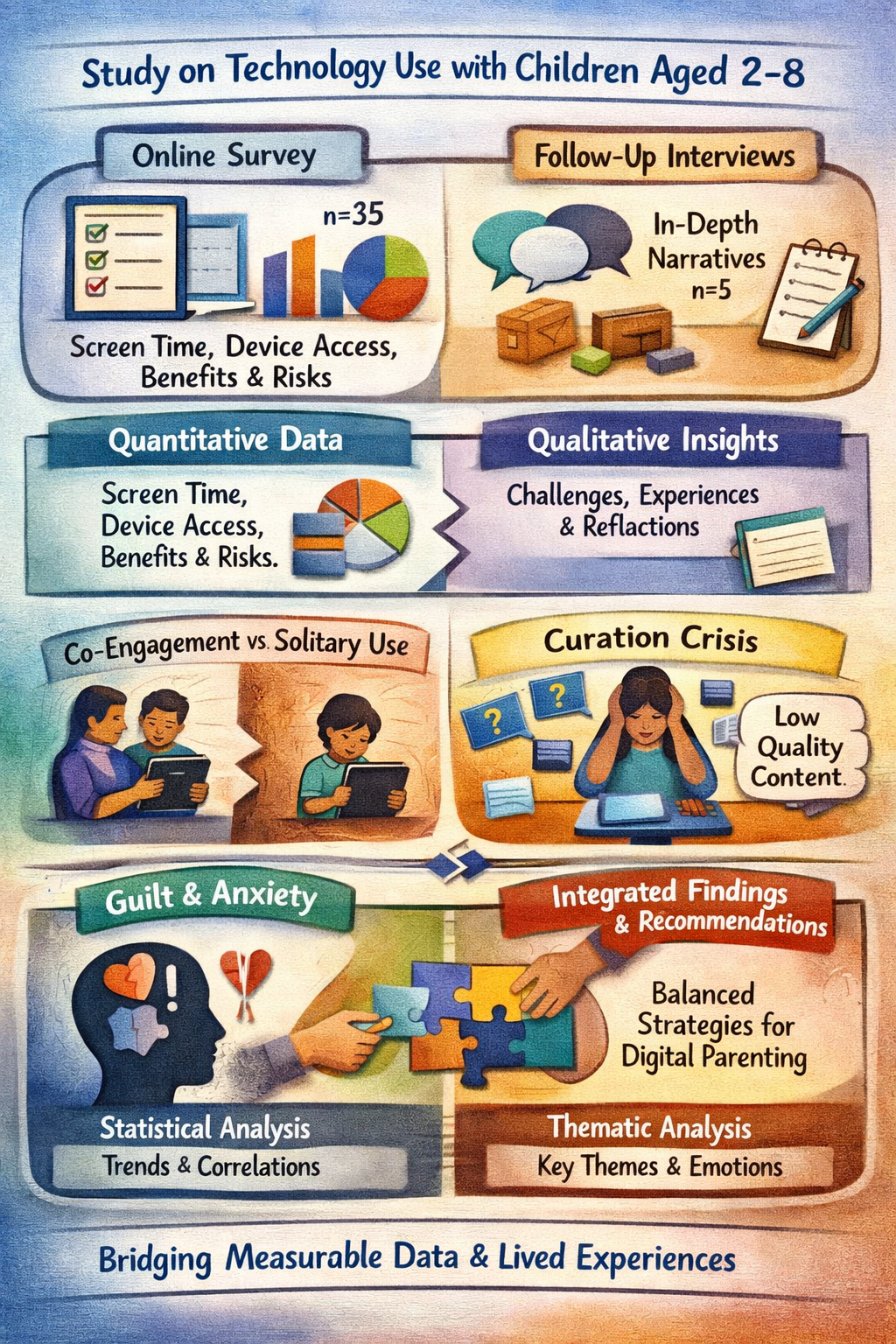
It is deep research to understand the attitudes, behaviours and most pressing issues around tech use with kids ages 2-8 with both quantitative and qualitative methods. Data for this research was gathered through an online survey that was sent out to parents and early childhood educators (n=107), consisting of Likert scale, multiple choice, as well as open-ended questions. Quantitative measures assessed the estimated amount of screen time, access to devices and level of agreement with key statements about pros and cons of using screens as well as self-efficacy. Interview questions were open-ended to capture challenges, good experiences, and further thoughts. Five selected participants took part in more focused semi-structured interviews to generate further narrative data. Descriptive statistics: means, correlations and thematic analysis were used to analyse the quantitative and qualitative data respectively. The combined findings uncover the dissonance between acknowledged value of co-engagement and experiences with solo use, an interactional "curation crisis" in content selection, and a pernicious emotional calculus of guilt/anxiety that informs decision-making. This systematic capture of both measured behaviour and nuanced subjective experience of what it is to navigate within the digital playground constructs a more fully informed empirical foundation for recommending programs/interventions supporting mindful integration.
Keywords:
digital literacy
; digital technology
; early childhood education
; intentional integration
; parental mediation
; screen time
I. Introduction
The rise of digital technology over the past two decades has changed everything about the way people communicate, learn, work and play. Perhaps nowhere is the change in this landscape more pronounced, and complex than in very early childhood, a developmental period typically defined by physical play, social interaction face-to-face and exploration of nature. The young children of our time are coming of age in an era that many have termed the “digital playground,” where virtually from as early as is possible, televisions, tablets, smartphones and interactive applications all form part of a young child’s ecology. This swift assimilation of technology into early childhood settings has captured the attention of educators, parents, policymakers, and researchers worldwide and has stirred great controversy about the digital tools’ effects on cognitive, social, emotional, and physical development during a child’s most formative period.
Early childhood (generally defined as birth through 8 years) is a period of tremendous brain development. Connections between neurons are established quickly in response to sensory input, social experiences and active involvement with the world. Play, language exposure, responsive caregiving, and hands-on explorations have all been highlighted as key aspects of healthy development. in this context, the growing ubiquity of digital technologies is creating a tension point. On the other, it allows unprecedented access to educational content and interactive learning experiences or creative expression. Conversely, there are remaining concerns about increased screen time, reduced physical activity and social interaction as well as potential effects on attention, sleep and emotional regulation. This dynamic digital terrain is one that requires a sophisticated appreciation, one that looks past facile technology-as-saviour or technology-inherently-bad stories.
The idea of a “digital playground” describes how play itself is changing. Play has been traditionally viewed as a child-initiated, imaginative and social activity that contributes to learning, development. As part of gaming’s digital transition, play has often been mediated by screens, software design and algorithmically generated content. Digital games, educational apps and online videos often can captivate children with more vivid visuals, sounds and interactive elements than traditional toys. Such interaction can be helpful for learning when it is well-designed and used appropriately but also can tip the balance toward passive participation if not managed carefully. If social and digital play are different, synergistic or alternative forms of play, we must consider what each make possible in early childhood.
There is no doubt that parental and caregivers’ practices have a direct importance on children’s technology usage. So you can use the app-to-parent talkback feature to sing a forgetful baby back to sleep, which is where digital devices spend most of their lives in today’s busy family homes – educating our kids through apps or entertaining them with films as they double up as virtual babysitters. Technologies are often given to children with good intentions, for early literacy, numeracy or language, enforcement of safety behaviours and occupation. Yet differences in adults’ digital literacy may also impact technology use. Some carers co-engage with preschool-age children to discuss content, mediate access or monitoring screen use and others may allow unsupervised use through time pressures or lack of knowledge about their effects. The variation highlights why it is important to look beyond just what children are exposed to on screens and instead consider the social contexts in which digital technologies are placed.
Educational providers have a vested interest in the digital sandbox as well. Technology is being integrated into classrooms in early childhood education with the use of interactive and whiteboards iPads, tablet computing on digital platforms for learning. Technology, they will say, if leveraged in the service of developmental frameworks, has the capacity to improve learning by providing personalized instruction and multimodal engagement as well as inclusive practices for children with varied needs. But critics warn against an overdependence on digital resources, arguing that no amount of technology can replace teachers meeting children’s unique social and emotional needs, working together in groups or learning from a teacher who reads aloud from a book. As technology continues to expand, integrating its transformative potential in a meaningful way that enhances instead of eclipses long-standing foundational tenets of early education has become an educator challenge.
Cultural, socioeconomic and geographic aspects add more layers to the interaction between technology and young children. Digital technology and content access is extremely uneven across regions and communities, known as the digital divide. In ways, too little use of technology could impose limits on how much digital learning can occur (62), and in others, overexposure and unstructured access could be associated with developmental risks. Furthermore, cultural attitudes towards childhood, play and learning shape ideas about what technology is and is used for in both homes and schools. Any thorough consideration of the digital playground should therefore acknowledge these contextual differences and accept that there can’t be a one-size-fits-all rule for technology use with young children.
So are issues of health and welfare when talking about technology use in the early years. Long-term screen time has been associated with issues including inactivity, eye strain, interfering with sleep and problems with attention and self-regulation. Meanwhile, digital devices have played a productive role in supporting children’s mental health, social connectedness and learning continuity even in times of crisis such as the COVID-19 pandemic. These conflicting results highlight the importance of moderation and intelligent usage. Instead of simply considering duration now, many clinicians emphasize quality of the screen time, relevance of content being viewed and the presence of supportive adult mediation are more important factors for promoting positive screen-based experiences.
Policy reactions to children’s participation in the digital world indicate increasing acknowledgment of its importance. Here in the United States and elsewhere, various governing bodies and professional organizations have provided recommendations about screen time, digital content, and media use for young children. Although these guiding principles offer important scaffolding, they may sometimes lag behind fast-moving digital technologies and family contexts. Policymakers are grappling with the need to protect children’s well-being while ensuring innovation, digital literacy and equal access. Flexible, culturally sensitive and developmentally grounded research informed policies are critical in helping families and educators negotiate the challenges of the digital playground.
In this context, The Digital Playground: Navigating Technology in Early Childhood “[aims] to scratch below the surface of representations about digital technology and young children”. Based on the existing research, theoretical frameworks and practical considerations, this paper seeks to go beyond polemics and provide an educational perspective that aims to help practitioners finding a balance for technology use with young children. Attention is given to the potential gains and liabilities of digital involvement and stresses the importance of raised awareness for parents, schools staff members and legislators. And this finally is the point of this article that it’s not about getting rid of technology in early childhood but rather to thoughtfully navigate it so that digital experiences support healthy development, meaningful learning, and the continued role of play in all its manifestations.
II. Literature Review: The Known Landscape of Screens and Young Minds
The incorporation of digital media into early childhood is more than the additional use of tools; it is a transformation in the developmental ecology of the 21st century child. Into this environment moves a dynamic of extreme polarisation, so ordinarily presented in public discourse as refusing to give an inch or going the whole way. But empirical research tells a different story: a nuanced landscape of enormous opportunity, but also real danger. Effectively navigating this digital playground demands transcending binary argument to consider under what set of condition technology might be “good” or “bad” for healthy development. This review organizes extant literature into three broad categories: the known opportunities for learning and growth, demonstrated threats to development and well-being, and the emerging guiding principles experts suggest should help shape the path ahead.
The Potential: The Upside of the Playground
If designed and implemented with attention to developmental appropriateness, digital technology can provide special affordances that facilitate early learning. The interactivity and adaptivity is the main advantage. Unlike non-interactive media the well-formed educational apps offer contingent feedback and scaffolded challenges that are available to the child at his own pace. The research on literacy and numeracy apps suggests that the interactive features of these applications, which demand active responding (for example, dragging letters to create words or moving objects on screen to solve math problems), may be more effective for learning than mere video watching (Hirsh-Pasek et al., 2015). These “guided interactions” may facilitate personalized skill-building, by providing practice in ways that are hard to do at scale and with heterogeneity in a classroom.
Technology can be a great window on the world, opening age-appropriate experiences and perspectives to a child that they may not get in their daily neck of the woods. Virtual visits to museums, zoos, and historical sites can help develop background knowledge and cultivate excitement. Digital spaces also enable connections and affordance for a child to communicate across miles.…. Opacity of information encourages children’s interactions with family members who are far away or even (if carefully conceptualized) at one’s own distance on the globe, in region outreaches that encourage understanding through other cultural projects (Mendoza, 2022). This ability to hold no physical bounds can be an important tool for encouraging early global awareness and diversity.
Perhaps most enticing is technology as a catalyst for creativity and self-expression. A digital pen can reduce barriers to creative and storytelling output. Digital storytelling, animations and music composition applications allow children to create and share their memory objects – shifting the child as consumer to creator. Visual programming environments such as ScratchJr teach children core computational thinking concepts via a playful, block-based approach that allows young students independently develop their own interactive narratives and games (Bers, 2018). This productive application of technology encourages problem solving, design thinking, and creative expression and is consistent with research-based best practices that support open-ended exploration.
At last, technology has tremendous potential in addressing the needs of varied learners. For children with disabilities, aids like speech-to-text programs, communication boards and personalized visual schedules can be absolutely transformative opening up paths to communication, interaction and learning that were previously blocked. As well, adaptive software may be a key source of support for students with learning differences, providing alternate routes to mastery including multimodal instruction and patient, ongoing repetition (Basham et al., 2020). Used thoughtfully, these are powerful tools of inclusion and in primary years classrooms a way to level the playing field.
The Perils: The Safety Hazards
For all of its promise, however, a plethora of evidence points out the alarming developmental issues that require careful review and critique. The affects of cognitive and motor development is another significant area of investigation. Overuse and misuse of screens have been associated with detrimental effects on attention, executive function, and language development, especially when replacing foundational experiences like active play, reading aloud, and conversational turn-taking (Madigan et al., 2019). The physiological consequences are profound as well, with pre-bedtime exposure to the blue light emitted from screens inhibiting melatonin production causing poor sleep quality and quantity that consequently impacts mood, learning and behavior (Hale & Guan, 2015). In addition, sedentary screen time is related to lower activity levels and presents potential for early life obesity.
The key to the risk is that there’s a big difference between interactive engagement and passivity. The worst effects are reported to be associated with extended, isolated, sedentary viewing, especially when heavy doses of rapid pace non-educational material are employed. This sort of use is also not giving kids the responsive, serve-and-return interactions they need to develop their brains. The American Academy of Pediatrics (2016) makes a clear distinction between video-chatting, which is considered social interaction, and other screen media for children younger than 18 months (which is discouraged with the exception of video-chatting). The worry is that passive media use may be crowding out active (e.g., motherese) and even interactive real-world exchanges, which are the building blocks of cognitive and social-emotional growth.
This risk goes hand in hand with the worry about social-emotional trade-offs. The young brain learns empathy, emotional regulation and social cues through long-term, face-to-face interaction in which a child must read subtle nonverbal signals including expressions, tone of voice and body language (Uhls et al., 2014). An increasing dependence on interaction through a screen, even that of an educational kind, potentially threatens to short-circuit this practice. There is a danger, however, that if digital devices are being used as de facto pacifiers or distractions too frequently, children may have fewer opportunities to develop internal regulating mechanisms for dealing with boredom, frustration or distress skills that come from unstructured play and real-world social negotiation.
In addition to its impact on development, the digital playground presents new privacy and exploitation threats. Most children-targeted favourite apps and platforms that, often without parents’ knowledge, take up the latter practice to generate developmentally inappropriate digital footprints (Kumar et al., 2019). The lines between play, content and advertising are meticulously flouted in the Eriksons’ phase-shifting clusters of “advergames” and influencer-marketing integrated into their YouTube videos (commercializing play; not asking children to distinguish for themselves), effectively taking advantage of the fact that while preteens can understand invitation, they’ve yet to figure out how persuading really works. And it raises deep questions of ethical consent, the nature of autonomy and corporate as a shaper of childhood desires and behaviour.
The Guiding Principles: Existing Maps
In the face of this muddled evidence, mainstream child health and education advocates have transitioned from one-size-fits-all recommendations to fuzzy guidelines for practice. The American Academy of Pediatrics (AAP) and the National Association for the Education of Young Children (NAEYC) supply the basic maps. Today, the AAP’s recommendations include that for children between 2-5 years of age screen time should be limited to one hour of high-quality programming per day and parents should watch with them to help interpret what they are seeing (AAP Council on Communications and Media, 2016). NAEYC’s position statement also emphasizes that technology should be used in purposeful ways that are active, hands-on, engaging and empowering (NAEYC & Fred Rogers Center, 2012).
A key development in that guidance: the strategic move away from mere tracking of sheer “screen time” to smartly assessing “content, context, and quality.” This three-level grid recognises that 60 minutes of a high quality, interactive e-book shared with a caregiver is very different to 60 minutes of passive auto played cartoon videos watched in isolation. Content can be defined as what media teaches us and how appropriate it is. Context takes into account the when, where and how of technology – does it alienate the child or bring them together with others. Is it interfering with sleep or family meals? It was also about quality, as in the very design of the technology itself - is it interactive, manipulable and unconditioned by distracting add-ons or commercial pressures? This subtlety supports adults to be more judicious in judgement.
Central to these principles is the importance of co-engagement, or as it’s often referred to in research and public health practice co-viewing or joint media engagement. There is a wide body of evidence that shows learning from screens is greatly enriched when an adult is engaged, not just present. An adult can offer vocabulary, relate on-screen to one’s own life experiences, ask open-ended questions, and mediate troubling or scary material (Strouse et al., 2018). This active mediation turns a potentially passive experience into an interactive, language rich, relational one. In turn, the adult becomes a ”media mentor,” scaffolding the child’s digital literacy and critical skills to make them mindful users rather than passive consumers.
In summary, it is not a simple matter & the literature outlined is far more complex than these few paragraphs suggest. It uncovers a utility of incredible two-sidedness: as an instrument for providing individualized, imaginative and communal learning opportunities, but also for sapping attention, sleep, social skills and solitude when misapplied or abused. The new consensus is not Luddism or techno-utopian, but in favour of a third way stewardship. This path is not guided by minutes but a dedication to content quality, an understanding of context, and first and foremost the irreplaceable power of human connection that should ground a child’s digital journey, as well as any other. It is in this context of established, contested and dynamic scholarship that the current study offers new empirical information to anchor these principles in the voices and experiences of adults on the ground.
III. Methodology: Gathering New Voices from the Playground
To move beyond the theoretical tensions outlined in the literature and ground the discussion in contemporary lived experience, this study employed a concurrent mixed-methods research design. This approach integrates complementary quantitative and qualitative data strands to provide a more complete understanding of the research problem than either strand could alone (Creswell & Plano Clark, 2018). The objective was to construct a nuanced, evidence-based portrait of how the primary guides in a young child’s life parents and early childhood educators navigate the digital landscape. Specifically, this research sought to understand their current practices, perceptions, primary challenges, and strategic adaptations regarding technology use with children aged two to eight years.
Research Design and Rationale
A convergent parallel mixed-methods design was selected to address the multi-faceted research objective. This design involved simultaneously collecting quantitative data via a broad online survey and qualitative data through in-depth, semi-structured interviews. The two data strands were given equal priority and were analyzed separately, with the intent of merging the results during the interpretation phase to develop a comprehensive understanding (Fetters et al., 2013). The quantitative survey was essential for identifying generalizable patterns, trends, and correlations across a larger sample, such as average screen time estimates and prevalent attitudes. Conversely, the qualitative interviews were crucial for exploring the depth, complexity, and contradictions behind these numbers capturing the personal stories, ethical dilemmas, and contextual factors that shape decision-making. This dual approach allowed the study to quantify the “what” and “how much” while qualifying the “how” and “why,” providing both breadth and depth to the inquiry.
Participant Recruitment and Sampling Strategy
Participants were drawn from two distinct but related populations: (1) parents or primary caregivers of at least one child aged 2-8 years, and (2) early childhood educators (including preschool teachers, kindergarten teachers, and early elementary school teachers) who worked directly with children in this age range. A non-probability, purposive sampling strategy was used to recruit participants who held direct, frontline experience with the phenomenon under study (Palinkas et al., 2015). Recruitment was conducted over a six-week period through multiple channels to maximize diversity of perspective. Digital flyers with a link to the survey were distributed via parenting forums on social media (e.g., Facebook community groups), professional educator networks (e.g., local chapters of the National Association for the Education of Young Children), and newsletters of partner preschools and community centers. The recruitment materials explicitly invited participation from both parents and educators and encouraged sharing to reach a broad network.
While representativeness in the statistical sense was not the goal of this qualitative-driven mixed-methods study, concerted efforts were made to gather a sample varied in key demographic dimensions. The survey included optional questions on caregiver age, education level, and geographical region (based on postal code) to allow for description of the sample context. Of the 127 individuals who commenced the survey, 107 completed it in full, yielding a completion rate of 84%. The final quantitative sample consisted of 78 parents (72.9%) and 29 educators (27.1%). A subset of 12 participants (6 parents and 6 educators) from the survey pool volunteered for follow-up semi-structured interviews, forming the qualitative sample. This nested sampling approach allowed the qualitative findings to directly elaborate on the initial quantitative results from a willing sub-group (Teddie & Yu, 2007).
Data Collection Instruments and Procedures
Data collection occurred in two sequential but overlapping phases: a quantitative online survey followed by qualitative interviews.
Phase 1: Quantitative Survey
The survey instrument was developed based on a synthesis of key constructs from the literature, including screen time metrics, perceptions of benefits and harms, mediation strategies, and self-efficacy. It was structured into several sections: (1) demographic and role information, (2) children’s technology access and use patterns, (3) adult perceptions and attitudes (using 5-point Likert scales), (4) behaviour and mediation practices, and (5) open-ended questions for additional challenges and insights. The survey was pilot tested with five individuals (three parents, two educators) to assess clarity, flow, and completion time, leading to minor wording adjustments. The final survey was administered using the Qualtrics XM platform and took approximately 12-15 minutes to complete. A summary of key survey constructs and sample items is presented in Table 1.
Phase 2: Qualitative Interviews
Upon completing the survey, participants were invited to provide their email address if they were willing to be contacted for a follow-up interview. From the list of volunteers, six parents and six educators were selected to ensure a balance of perspectives and a range of reported practices (e.g., high versus low restriction). Semi-structured interview protocols were developed separately for parents and educators, with core questions aligned across groups to allow for comparison, and role-specific probes to explore unique contexts. The protocols focused on eliciting narratives around positive and challenging experiences, decision-making processes, sources of guidance, and reflections on personal tech habits. Sample prompts included, “Walk me through how you decided on the main rules you have about technology in your home/classroom,” and “Describe a recent situation where you felt particularly conflicted about a child’s technology use.”
Interviews were conducted over Zoom, recorded with permission, and averaged 42 minutes in length. The semi-structured format provided consistency while allowing flexibility to explore unanticipated topics raised by participants (Kallio et al., 2016). All interviews were transcribed verbatim by a professional service, and transcripts were verified against the audio recordings by the researcher for accuracy.
Data Analysis
The quantitative and qualitative data were analysed separately before integration.
Quantitative Analysis. Survey data from Qualtrics were cleaned and analysed using IBM SPSS Statistics (Version 28). Descriptive statistics (frequencies, means, standard deviations) were calculated for all items to summarize the sample characteristics and central tendencies. Independent samples t-tests were conducted to compare mean scores on Likert-scale perception items between parent and educator groups. Cross-tabulations with chi-square tests of independence were used to explore relationships between categorical variables, such as rule implementation and reported screen time brackets.
Qualitative Analysis. Interview transcripts were analysed using reflexive thematic analysis, as outlined by Braun and Clarke (2022). This process involved an iterative, six-phase approach: (1) familiarization with the data through repeated reading of transcripts, (2) generating initial codes to identify features of interest, (3) searching for themes by collating relevant codes, (4) reviewing potential themes against the coded data and entire dataset, (5) defining and naming themes to capture their essence, and (6) producing the report. Analysis was conducted using NVivo software to manage codes and themes. To enhance trustworthiness, peer debriefing sessions were held with a fellow researcher not involved in the project to review the developing thematic structure and challenge interpretive assumptions (Lincoln & Guba, 1985).
Integration. Following the parallel analysis, the two datasets were integrated during the interpretation and discussion writing phase. The quantitative results provided a scaffold of general patterns, which were then fleshed out, complicated, and illuminated by the rich, contextualized narratives from the qualitative themes. This integration followed a “weaving” approach, where quantitative and qualitative findings are presented together in the discussion, organized by thematic point rather than by method (Fetters et al., 2013).
Ethical Considerations
This study received approval from the Institutional Review Board (IRB) of the author’s affiliated institution. All ethical guidelines for research with human subjects were strictly followed. Informed consent was obtained digitally at the beginning of the online survey; participants were required to acknowledge their understanding of the study’s purpose, the voluntary and anonymous nature of their participation, and their right to withdraw at any time before proceeding. For interview participants, a separate, more detailed consent form was reviewed and signed electronically prior to the interview. All survey data was collected anonymously, with no IP addresses stored. Interview data was pseudonymized; all transcripts used participant-chosen pseudonyms, and any potentially identifying information was removed during transcription. Digital recordings and transcripts were stored on a password-protected, encrypted server accessible only to the research team. The convergence of these methodological strands the broad strokes of the survey and the deep hues of the interviews provides a robust foundation for understanding the contemporary realities of navigating the digital playground.
IV. Findings & Analysis: What the Data Reveals
The convergent analysis of survey data from 107 parents and educators, deepened by twelve semi-structured interviews, reveals a landscape defined by a pervasive intentionality gap. This gap represents the chasm between aspirational principles such as co-engagement and quality content selection and the complex, often compromised, realities of daily life. While broad patterns quantify the “state of play,” the qualitative narratives give human voice to the anxiety, frustration, and occasional triumph that characterize the navigation of the digital playground.
Subsection A: The State of Play: Quantifying Habits and Diverging Perspectives
The survey data sketches the contours of contemporary technology use for children aged 2-8. A central finding is the wide dispersion of screen time, defying simplistic categorization. The mean estimated daily use was 2.1 hours (SD = 1.3), but these average obscures a polarized distribution. While 21% of respondents reported adhering to the American Academy of Pediatrics (2016) guideline of one hour or less for this age group, a nearly equal proportion (19%) reported three or more hours of daily use. This polarization suggests that family and educational practices are being shaped by deeply differing philosophies, constraints, or access to resources.
The device ecology is dominated by the multipurpose tablet, cited as a primary device by 83% of respondents. Its portability, touch interface, and vast app library solidify its status as the quintessential digital playground apparatus. Television remains a significant fixture (67%), primarily for video consumption, while smartphones (45%) are commonly used but less frequently cited as a child’s primary device. When examining primary activities, a telling pattern emerges passive consumption significantly outweighs active creation. “Watching videos on platforms like YouTube or Netflix” was selected by 77% of respondents, making it the dominant activity. In contrast, “using educational apps or games” was reported by 62%, and activities coded as “creating something” (e.g., digital art, storytelling) trailed at 29%. This suggests a default mode of use tilted toward consumption, despite widespread recognition in interviews of creation’s higher value.
A stark gap between recommendation and reality is evident in mediation practices. Although 88% of respondents agreed or strongly agreed that co-using technology makes it more valuable, reported practices tell a different story. Only 34% consistently engaged in co-viewing or co-playing as a primary mediation strategy. Instead, the most common form of mediation was rule-setting, particularly around time (71%) and content (65%). This indicates that while the principle of co-engagement is intellectually embraced, logistical and practical barriers often relegate adults to the role of timekeeper and gatekeeper rather than active media mentor.
As illustrated in Table 2, significant differences emerged between parent and educator perspectives, illuminating their distinct roles and contexts. Educators reported significantly lower estimates of children’s screen time, likely reflecting controlled, intentional use in classroom settings versus more diffuse home use. They also expressed markedly higher confidence in selecting technology, a finding echoed in interviews where educators framed selection as a professional competency. Conversely, parents reported significantly higher levels of concern regarding technology’s impact on attention, underscoring the anxiety that permeates household management of screens. Notably, educators were far more likely to report consistent co-use, a practice more feasible in the structured, small group setting of a classroom than in a busy household. However, both groups overwhelmingly agreed that their own personal technology habits modelled behaviour for children, indicating a shared, self-conscious awareness of their influence.
Subsection B: Voices from the Field: Thematic Analysis of Lived Experience
Theme 1: The Emotional Burden of “Guilt & Anxiety”
Quantitative data on high concern was given visceral texture in the interviews. Guilt was not a peripheral emotion but a central feature of the navigation experience for most parents. This guilt was multifaceted: guilt over using screens as a distraction, guilt over perceived overuse, and guilt about failing to co-engage. Maya, a mother of two, articulated this tension: “I know the studies say to watch with them and talk about it. But sometimes, I just need to make dinner without a toddler on my leg. So I turn on a show, and the whole time I’m chopping onions, I’m feeling like a bad mom.” This sentiment reflects what Strouse et al. (2018) identify as the ideal of active mediation crashing against the realities of domestic labour. For educators, anxiety was more often institutional, focused on equity and the “home-school disconnect.” Mr. Davies, a kindergarten teacher, shared: “My biggest anxiety is the inequality. I have students who are creating digital stories here and others who, I know, are just parked in front of YouTube for hours at home. It creates two different worlds of readiness.”
Theme 2: The “Curation Crisis” and the Search for Quality
The survey’s finding of low confidence in selecting quality technology was explained by a pervasive sense of overwhelm in interviews. Participants described app stores and YouTube as “digital black holes” and “wild west” environments where commercial, entertainment-driven content easily masquerades as educational. The cognitive labour of vetting was a frequently cited burden. Sarah, a parent and former teacher, explained: “It’s exhausting. You download something labelled ‘educational,’ and it’s either full of ads, way too fast and flashy, or just digital worksheet drills. Finding something that’s truly interactive, paced right, and open-ended feels like a part-time job.” This curation crisis forces many to rely on heuristics like “no in-app purchases” or recommendations from peers, rather than being able to assess pedagogical quality directly, a challenge noted in analyses of the children’s app market (Hirsh-Pasek et al., 2015).
Theme 3: “It’s a Tool, Not a Babysitter (But Sometimes…)”
This theme captures the core contradiction between stated philosophy and practical compromise. Nearly every interviewee began by articulating a principle of intentionality. “We see it as a tool, like a library book or a set of blocks,” stated David, a father of three. However, this was almost invariably followed by a concessional clause: “...but honestly, on weekend mornings, or when I’m on an important work call, it absolutely becomes the babysitter. You just need a break.” This honesty reveals the non-negotiable constraints of adult life. The tool is available 24/7 and is uniquely effective at capturing attention, making its deployment as a pacifier almost inevitable at times. This duality creates cognitive dissonance, as the same device used for a shared geography lesson one evening becomes a solitary distraction the next morning.
Theme 4: Visions of “Successful Integration”
Amidst the anxiety and contradiction, clear portraits of successful, intentional integration emerged, primarily characterized by connection over isolation. These were not stories of prolonged solitary use, but of technology acting as a social or creative catalyst. For example, Lena, a preschool teacher, described a project where children used a simple drawing app to design patterns, then recreated them with physical beads and blocks, seamlessly blending digital and analogue creativity. A grandmother, Evelyn, spoke powerfully of video calls as a lifeline: “My grandson lives across the country. We ‘read’ books together over Zoom he holds his copy, I hold mine. That screen isn’t isolating us; it’s our bridge.” Another parent, Amir, described using a music production app with his son: “We make these silly songs together. He does the drum sounds; I fiddle with the melody. It’s our thing. It’s active, it’s collaborative, and he’s learning about rhythm and structure without even knowing it.” These examples align with the concept of “joint media engagement,” where the value derives not from the software itself, but from the social interaction it facilitates (Takeuchi & Stevens, 2011). Success was consistently framed around shared experience, creative output, or meaningful connection, fulfilling the potential outlined in the literature while mitigating the perils of passive solitude.
Synthesis: Bridging the Intentionality Gap
The analysis reveals that the central challenge of the digital playground is not a lack of awareness about best practices, but a multifaceted implementation crisis. Adults understand the principles of co-engagement, quality, and time limits, yet they are thwarted by the curation burden, the pressures of daily logistics, the compelling design of passive entertainment, and their own ingrained tech habits. The quantitative data shows the behavioral outcomes (high passive use, moderate co-engagement), while the qualitative narratives expose the psychological and practical underpinnings (guilt, overwhelm, situational compromise). The significant parent-educator divide further highlights how structural support and professional context can alter capacity for intentional navigation. Together, these findings move the discussion beyond judging “screen time” and toward understanding the ecosystems of emotion, time, access, and design that determine whether a child’s digital experience is one of isolated consumption or connected creation. This sets the stage for proposing navigation strategies that are not merely aspirational but pragmatically address the very gaps and tensions this research has uncovered.
VI. Conclusion: Cultivating Wisdom in the Digital Playground
The journey through the digital landscape of early childhood, as illuminated by both the extant literature and the voices captured in this study, leads to an inescapable and pivotal conclusion: the digital playground is a permanent and pervasive feature of contemporary childhood. It is not a passing trend to be waited out, nor an unmitigated catastrophe to be eradicated. It is a new dimension of the environment in which children now grow and learn, replete with both dazzling tools and subtle hazards. Therefore, our collective task as parents, educators, policymakers, and researchers shifts from a defensive posture of containment to a proactive mission of cultivation. Our objective cannot be to fence off this playground in fear, but to enter it as active, informed, and empathetic playmates and guides. The findings of this research underscore that success in this endeavour is measured not by the minimization of minutes, but by the maximization of meaning, connection, and intentionality. By embracing the principles of navigation outlined here, we can aspire to help children build far more than mere digital literacy; we can guide them toward developing the wisdom to wield technology as a tool for crafting a richer, more connected, and profoundly human childhood.
This research began by exploring a stark tension between potential and peril, a tension reflected in the polarized screen time reports and the palpable anxiety of caregivers. It concludes by reframing that tension as a call to intentional practice. The core argument, substantiated by both survey data and intimate interviews, is that the quality of a child’s digital experience is predominantly determined by the quality of the human scaffolding surrounding it. The tablet itself is inert; its developmental impact is activated by context. The “intentionality gap” the chasm between knowing high-quality engagement is important and consistently practicing it emerges as the central challenge of our time. This gap is fuelled by a “curation crisis” that overwhelms adults, by logistical pressures that make screens a convenient pacifier, and by a lack of confidence in distinguishing educational wheat from digital chaff. However, within this gap also lies our greatest opportunity. For it is precisely in this space between principle and practice that guided, mindful intervention can have its most transformative effect.
The proposed framework of intentional navigation prioritizing the Three C’s, embodying media mentorship, championing creation, protecting analogue fundamentals, and modelling desired behaviour provides a map to bridge this gap. This is not a rigid checklist but a holistic philosophy. It recognizes that a fifteen-minute, co-viewed session of a carefully chosen nature documentary that sparks a conversation and leads to an afternoon of backyard insect hunting represents a far more developmentally valuable use of technology than an hour of silent, solitary game-playing. It understands that the goal is integration, not isolation. This approach aligns with ecological systems theory, which posits that a child’s development is shaped by the interaction between multiple environmental layers (Bronfenbrenner, 1979). The digital device is part of the child’s microsystem, but its influence is mediated by the mesosystem the connections between home and school and the exosystemic, which includes the design ethics of tech companies and the policies of app stores. Intentional navigation requires action at all these levels: mindful choices at home, collaborative strategies between parents and teachers, and advocacy for more ethical digital environments for children.
Looking forward, this research points to several critical avenues for empowerment. First, for parents and educators, empowerment springs from a shift in mindset from guilt-driven restriction to purpose-driven curation. The emotional burden of guilt, so vividly expressed in the interviews, is counterproductive. It can be alleviated by replacing the vague question “Is this too much?” with more precise, actionable questions derived from the Three C’s: “Is this content actively engaging my child’s mind?” “Is the context of this use social or solitary?” “Is this right for my child at this moment?” This reframing turns a nebulous anxiety into a series of manageable evaluations. Furthermore, educators, who demonstrated higher confidence and more structured co-use in our findings, can serve as vital models and resources for parents, fostering the home-school connection essential for consistent messaging.
Second, there is a pressing need for what might be termed “developmental design” in the technology industry itself. The curation crisis exists largely because the market is flooded with products that prioritize engagement metrics over developmental appropriateness. The research by Hirsh-Pasek et al. (2015) on the science of learning in apps provides a clear blueprint for what constitutes quality, yet this knowledge is not filtering effectively to consumers or consistently guiding developers. Advocacy for transparent, evidence-based ratings akin to nutritional labels for food could empower adults immeasurably. Imagine an app store category filtered not just by age, but by pedagogical pillars: “Promotes Creative Problem-Solving,” “Fosters Collaborative Play,” “No Behavioral Design Tricks.” Creating this future requires demand from caregivers and accountability from platforms.
Finally, this concluding vision is ultimately one of harmony, not hierarchy, between the analog and the digital. The most poignant “success stories” from our participants were those where technology faded into the background as a facilitative tool, while human connection and creative expression occupied the foreground. The grandmother bridging a continent through a shared Storytime, the father and son composing a silly song together, the teacher weaving digital design into tangible beadwork these are portraits of technology in its proper, humble role. It serves as a brush for painting, a bridge for connecting, a window for wondering, but never the canvas, the destination, or the view itself. Protecting the analog fundamentals of sleep, unstructured play, and face-to-face conversation is not a rejection of the digital age; it is the preservation of the essential human soil in which healthy development and healthy technology use must be rooted.
In the end, the digital playground, for all its complexity, reflects back a timeless truth about childhood: children thrive in environments shaped by responsive, attentive, and caring relationships. The pixelated glow of a screen cannot replace the warm light of a caregiver’s engaged attention. Our charge, then, is to ensure that our use of technology amplifies rather than dims that human light. By navigating with intention, we do more than manage devices; we mentor minds. We help cultivate a generation that can code and create, question and collaborate, connect across distance and be fully present up close. We guide them toward a digital wisdom that understands technology as a powerful means to a profoundly human end: a childhood of curiosity, connection, and joyful growth. The playground is open. Let us enter it not with trepidation, but with purpose, ready to play, guide, and imagine alongside the children in our care.
Appendix A. Survey Instrument
Survey: Navigating the Digital Playground - Technology Use with Children (Ages 2-8)
Introduction & Informed Consent
Thank you for your interest in this research study. This survey aims to understand the experiences, perceptions, and challenges of parents and educators regarding technology use with young children. Your participation is voluntary and anonymous. The survey will take approximately 12-15 minutes to complete. By proceeding, you confirm that you are at least 18 years old and consent to your anonymous responses being used for research analysis and publication. You may withdraw at any time without penalty.
Section 1: Your Role and Context
-
What is your primary role in relation to children aged 2-8?
- ○
- Parent or Primary Caregiver
- ○
- Early Childhood Educator / Teacher (Preschool, Kindergarten, Early Elementary)
- ○
- Other (e.g., grandparent, therapist, administrator) – Please specify: _______________
-
How many children aged 2-8 are you currently responsible for or work with regularly?
- ○
- 1
- ○
- 2
- ○
- 3
- ○
- 4 or more
Section 2: Technology Access and Use Patterns
- 3.
-
On a typical weekday, what is your best estimate of the TOTAL time the child/children spend with screens (tablets, TV, smartphones, computers) for ANY purpose?
- ○
- Less than 30 minutes
- ○
- 30 minutes to 1 hour
- ○
- 1 to 2 hours
- ○
- 2 to 3 hours
- ○
- More than 3 hours
- 4.
-
What types of devices do the child/children use most frequently? (Select all that apply)
- ○
- Television (including streaming)
- ○
- Tablet (e.g., iPad, Kindle Fire)
- ○
- Smartphone
- ○
- Portable Game Console (e.g., Nintendo Switch)
- ○
- Desktop/Laptop Computer
- ○
- Other: _______________
- 5.
-
What are the PRIMARY activities the child/children do on these devices? (Select up to 3)
- ○
- Watch videos (YouTube, Netflix, etc.)
- ○
- Play games (non-educational)
- ○
- Use educational apps/games
- ○
- Video chat with family/friends
- ○
- Create (digital art, music, stories)
- ○
- Browse/search the internet
- ○
- Other: _______________
Section 3:Perceptions and Attitudes
For the following statements, please indicate your level of agreement.
(1 = Strongly Disagree, 2 = Disagree, 3 = Neutral, 4 = Agree, 5 = Strongly Agree)
| Statement | 1 | 2 | 3 | 4 | 5 |
| 6. I am confident in my ability to choose high-quality, educational technology for children. | |||||
| 7. Technology is essential for preparing children for their future school and life. | |||||
| 8. I am concerned about the impact of screen time on my child's/children's attention span. | |||||
| 9. I worry about my child's/children's online privacy and data security. | |||||
| 10. Co-using technology (watching/playing together) makes screen time more valuable. | |||||
| 11. It is difficult to balance the benefits and risks of technology for young children. | |||||
| 12. My own personal screen habits influence the child/children. | |||||
| 13. Technology often serves as a necessary tool to manage daily tasks (meals, work, etc.). |
Section 4:Practices and Challenges
- 14.
-
Which of the following guidelines or rules do you consistently use? (Select all that apply)
- ○
- Time limits (e.g., 30 minutes per day)
- ○
- Content rules (e.g., only pre-approved apps)
- ○
- Context rules (e.g., no screens during meals, 1 hour before bed)
- ○
- I use parental controls or monitoring software
- ○
- I have no consistent rules
- ○
- Other: _______________
- 15.
- What is your SINGLE biggest challenge when managing the child's/children's technology use?
[Open-ended text box]
Section 5:Role-Specific Questions
This question will appear based on the response to Q1.
A. FOR PARENTS/CAREGIVERS:
16. When selecting an app or game, what is MOST important to you?
* [ ] It is advertised as educational
* [ ] It has no in-app purchases or ads
* [ ] It is highly engaging to keep my child occupied
* [ ] It aligns with my child's specific interests
* [ ] Recommendation from a trusted source (teacher, friend)
* [ ] Other: _______________
B. FOR EDUCATORS:
16. How do you primarily use technology in your educational setting?
* [ ] As a direct instructional tool (e.g., interactive whiteboard lesson)
* [ ] As a station for individual/small group practice
* [ ] For student creation projects (digital storytelling, etc.)
* [ ] For communication with families
* [ ] It is not regularly used in my classroom
* [ ] Other: _______________
Section 6:Final Reflections
- 17.
- In your opinion, what is one POSITIVE experience or skill a child can gain from thoughtful technology use that is hard to get elsewhere?
[Open-ended text box]
- 18.
- Is there anything else you would like to share about your experiences, hopes, or concerns regarding young children and technology?
[Open-ended text box]
Demographics (Optional)
- 19.
-
What is your age range?
- ○
- Under 25
- ○
- 25-34
- ○
- 35-44
- ○
- 45-54
- ○
- 55+
- 20.
-
What is the highest level of education you have completed?
- ○
- High school or equivalent
- ○
- Some college
- ○
- Associate's degree
- ○
- Bachelor's degree
- ○
- Graduate degree or higher
Thank you for your valuable time and insights. Your contribution is greatly appreciated.
Appendix B. Semi-Structured Interview Guides
Protocol A: For Parents & Primary Caregivers
Introduction: “Thank you for agreeing to this follow-up interview. Our goal is to better understand the day-to-day realities and thought processes behind managing technology with young children. There are no right or wrong answers. I’m interested in your personal experiences and perspectives. Our conversation will be confidential and anonymous.”
Core Prompts:
-
Philosophy & Rules: “Walk me through the main rules or guidelines you have about technology in your home. How did you arrive at these specific rules?”
- ○
- Probes: Where did you get your ideas (e.g., pediatrician, articles, friends)? Have the rules changed as your child has grown?
-
Decision-Making in Action: “Describe the last time you decided to download a new app or allow a new type of screen activity for your child. What was your process for evaluating it?”
- ○
- Probes: What were you looking for? What were you trying to avoid?
-
Positive Integration: “Can you describe a specific time when you felt technology led to a really positive moment or learning experience for your child? What made it work so well?”
- ○
- Probes: Were you involved? What did your child do or learn?
-
Challenges & Tensions: “What is the most frustrating or difficult aspect of managing screen time in your family?”
- ○
- Probes: Can you give an example of a recent conflict or struggle? How did you handle it?
-
Modelling & Self-Reflection: “Earlier you mentioned your own habits influence your child. Can you talk about how you manage your own technology use in front of them?”
- ○
- Probes: Are there rules for you? Do you ever feel conflicted about your own use?
-
Looking Forward: “As your child gets older, what concerns or hopes do you have regarding their relationship with technology?”
- ○
- Probes: What skills do you hope they develop? What do you hope to avoid?
Closing: “Is there anything important about your experience that we haven’t touched on?”
Protocol B: For Early Childhood Educators
Introduction: “Thank you for your time. This interview aims to understand the professional perspective on integrating technology in early learning environments. I’m interested in your strategies, observations, and the challenges you face.”
Core Prompts:
-
Philosophy & Policy: “How would you describe your personal teaching philosophy regarding technology for the 2-8 age group? How does this align with or differ from your school’s official policy?”
- ○
- Probes: Can you give an example of a policy in practice?
-
Intentional Integration: “Describe a lesson or activity where you felt technology was used particularly effectively. What was the learning objective, and how did the tech tool help meet it?”
- ○
- Probes: What was your role? What did you notice about student engagement?
-
Curating Quality: “As a professional, what criteria do you use to select digital tools, apps, or content for your classroom?”
- ○
- Probes: How do you vet for developmental appropriateness? How do you assess educational value vs. entertainment?
-
The Home-School Connection: “What differences do you observe between how technology is used in your classroom and how it’s used by students at home? What challenges or opportunities does this create?”
- ○
- Probes: How do you communicate with families about tech use?
-
Equity & Access: “In your experience, how do issues of access (to devices, high-quality content, broadband) affect your students and your teaching?”
- ○
- Probes: How do you adapt your approach for varying levels of home access?
-
Professional Needs: “What kind of support, training, or resources would help you better navigate technology use with your students?”
- ○
- Probes: Curriculum development? Tech support? Research on effectiveness?
Closing: “What is the most important thing for parents or policymakers to understand about technology in early education?”
Appendix C. Selected Data Tables/Charts
Figure A1.
Note. Data from survey question 4, n=107. Respondents could select all that apply. Source: Author’s primary survey data (2025).
Figure A1.
Note. Data from survey question 4, n=107. Respondents could select all that apply. Source: Author’s primary survey data (2025).
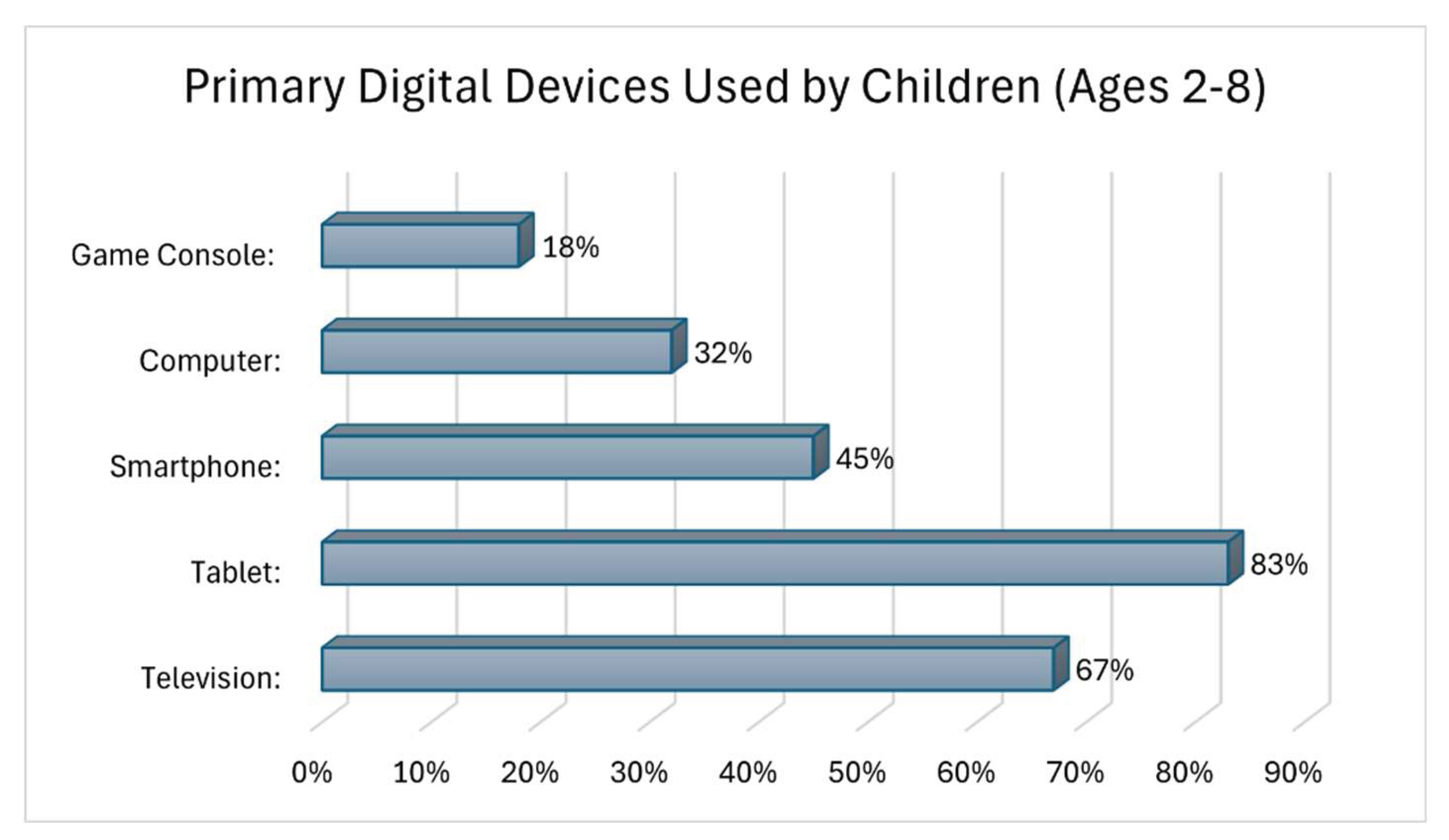

Table A1.
Comparative Analysis of Parent and Educator Perceptions and Practices.
| Variable | Parent Cohort (n=78) M (SD) or % | Educator Cohort (n=29) M (SD) or % | Statistical Test & Significance |
|---|---|---|---|
| Estimated Daily Screen Time | 2.4 hours (1.4) | 1.3 hours (0.9) | *t*(105) = 4.12, *p* < .001 |
| Confidence in Selecting Tech | 3.1 (1.1) | 4.3 (0.8) | *t*(105) = -5.87, *p* < .001 |
| Concern: Attention Span | 4.2 (0.9) | 3.6 (1.0) | *t*(105) = 3.01, *p* = .003 |
| Practices Co-Use Regularly | 28% | 52% | χ²(1) = 5.89, *p* = .015 |
| Belief: Own Habits are Influential | 92% | 86% | χ²(1) = 0.96, *p* = .327 |
Note. M = Mean; SD = Standard Deviation. Scale for confidence and concern items was 1-5. Source: Author’s primary survey data (2025).
Table A2.
Thematic Analysis Summary: Key Themes from Qualitative Interviews.
| Theme | Core Description | Illustrative Quote (Pseudonym) |
|---|---|---|
| Guilt & Anxiety | The emotional burden of navigating tech decisions, characterized by guilt over use as a distraction and anxiety about developmental impacts. | “I know the studies say to watch with them... But sometimes, I just need to make dinner... I’m feeling like a bad mom.” (Maya, Parent) |
| The Curation Crisis | Overwhelm and fatigue in vetting the vast, commercially driven app and media landscape for truly educational, age-appropriate content. | “Finding something that’s truly interactive, paced right, and open-ended feels like a part-time job.” (Sarah, Parent/Former Teacher) |
| Tool vs. Babysitter | The lived tension between the ideal of intentional technology as a “tool” and the pragmatic reality of its frequent use as a pacifier or distraction. | “We see it as a tool... but honestly, on weekend mornings... it absolutely becomes the babysitter. You just need a break.” (David, Parent) |
| Successful Integration | Experiences where technology fostered connection, creativity, or shared learning, often through co-engagement and bridging digital/physical worlds. | “We make these silly songs together. He does the drum sounds, I fiddle with the melody. It’s active, it’s collaborative...” (Amir, Parent) |
Note. Source: Author’s primary interview data (2025).
References
- American Academy of Pediatrics Council on Communications and Media. Media and young minds. Pediatrics 2016, 138(5), Article e20162591. [Google Scholar] [CrossRef] [PubMed]
- Basham, J. D.; Hall, T. E.; Carter, R. A.; Stahl, W. M. An operationalized understanding of personalized learning. Journal of Special Education Technology 2020, 35(3), 170–182. [Google Scholar] [CrossRef]
- Bers, M. U. Coding as a playground: Programming and computational thinking in the early childhood classroom; Routledge, 2018. [Google Scholar]
- Braun, V.; Clarke, V. Thematic analysis: A practical guide; SAGE Publications, 2022. [Google Scholar]
- Bronfenbrenner, U. The ecology of human development: Experiments by nature and design; Harvard University Press, 1979. [Google Scholar]
- Creswell, J. W.; Clark Plano, V.L. Designing and conducting mixed methods research, 3rd ed.; SAGE Publications, 2018. [Google Scholar]
- Fetters, M. D.; Curry, L. A.; Creswell, J. W. Achieving integration in mixed methods designs principles and practices. Health Services Research 2013, 48(6pt2), 2134–2156. [Google Scholar] [CrossRef] [PubMed]
- Hale, L.; Guan, S. Screen time and sleep among school-aged children and adolescents: A systematic literature review. Sleep Medicine Reviews 21 2015, 50–58. [Google Scholar] [CrossRef] [PubMed]
- Hirsh-Pasek, K.; Zosh, J. M.; Golinkoff, R. M.; Gray, J. H.; Robb, M. B.; Kaufman, J. Putting education in “educational” apps: Lessons from the science of learning. Psychological Science in the Public Interest 2015, 16(1), 3–34. [Google Scholar] [CrossRef] [PubMed]
- Kallio, H.; Pietilä, A. M.; Johnson, M.; Kangasniemi, M. Systematic methodological review: Developing a framework for a qualitative semi-structured interview guide. Journal of Advanced Nursing 2016, 72(12), 2954–2965. [Google Scholar] [CrossRef] [PubMed]
- Kumar, P.; Naik, S. M.; Devkar, U. R.; Chetty, M.; Clegg, T. L.; Vitak, J. ‘No telling passcodes out because they’re private’: Understanding children’s mental models of privacy and security online. In *Proceedings of the ACM on Human-Computer Interaction; 2019; Volume 4*(CSCW), pp. 1–21. [Google Scholar] [CrossRef]
- Lincoln, Y. S.; Guba, E. G. Naturalistic inquiry; SAGE Publications, 1985. [Google Scholar]
- Madigan, S.; Browne, D.; Racine, N.; Mori, C.; Tough, S. Association between screen time and children’s performance on a developmental screening test. JAMA Pediatrics 2019, 173(3), 244–250. [Google Scholar] [CrossRef] [PubMed]
- Mendoza, K. Digital citizenship in action: Empowering students to engage in online communities; International Society for Technology in Education, 2022. [Google Scholar]
- National Association for the Education of Young Children (NAEYC); Fred Rogers Center for Early Learning and Children’s Media. Technology and interactive media as tools in early childhood programs serving children from birth through age 8. 2012. Available online: https://www.naeyc.org/sites/default/files/globally-shared/downloads/PDFs/resources/position-statements/ps_technology.pdf.
- Palinkas, L. A.; Horwitz, S. M.; Green, C. A.; Wisdom, J. P.; Duan, N.; Hoagwood, K. Purposeful sampling for qualitative data collection and analysis in mixed method implementation research. Administration and Policy in Mental Health and Mental Health Services Research 2015, 42(5), 533–544. [Google Scholar] [CrossRef] [PubMed]
- Strouse, G. A.; Troseth, G. L.; O’Doherty, K. D.; Saylor, M. M. Co-viewing supports toddlers’ word learning from contingent and noncontingent video. Journal of Experimental Child Psychology 166 2018, 310–326. [Google Scholar] [CrossRef] [PubMed]
- Takeuchi, L.; Stevens, R. The new coviewing: Designing for learning through joint media engagement. In The Joan Ganz Cooney Center at Sesame Workshop; 2011. [Google Scholar]
- Teddie, C.; Yu, F. Mixed methods sampling: A typology with examples. Journal of Mixed Methods Research 2007, 1(1), 77–100. [Google Scholar] [CrossRef]
- Uhls, Y. T.; Michikyan, M.; Morris, J.; Garcia, D.; Small, G. W.; Zgourou, E.; Greenfield, P. M. Five days at outdoor education camp without screens improves preteen skills with nonverbal emotion cues. Computers in Human Behavior 39 2014, 387–392. [Google Scholar] [CrossRef]
Table 1.
Key Constructs and Sample Items from the Quantitative Survey Instrument.
| Construct | Operationalization | Sample Survey Item |
|---|---|---|
| Technology Use | Estimated frequency and duration | “On a typical weekday, what is your best estimate of the TOTAL time the child/children spend with screens?” (Multiple choice: <30 min to >3 hrs) |
| Perceived Benefits | Belief in technology’s positive potential | “Technology is essential for preparing children for their future.” (Likert: 1=Strongly Disagree to 5=Strongly Agree) |
| Perceived Risks | Concern about negative developmental impacts | “I am concerned about the impact of screen time on my child’s/children’s attention span.” (Likert scale) |
| Mediation Practices | Strategies for managing use | “Which of the following guidelines or rules do you consistently use?” (Select all: time limits, content rules, co-use, etc.) |
| Self-Efficacy | Confidence in navigating tech choices | “I am confident in my ability to choose high-quality, educational technology for children.” (Likert scale) |
| Open-ended Challenges | Identification of primary difficulties | “What is your SINGLE biggest challenge when managing the child’s/children’s technology use?” (Text box) |
Note. Source: Author’s primary interview data (2025).
Table 2.
Comparison of Key Perceptions and Practices Between Parent and Educator Respondents.
| Metric | Parents (n=78) | Educators (n=29) | Statistical Significance |
|---|---|---|---|
| Mean Estimated Daily Child Screen Time | 2.4 hours (SD=1.4) | 1.3 hours (SD=0.9) | *t*(105) = 4.12, *p* < .001 |
| Confidence in Selecting Quality Tech (1-5 scale) | 3.1 (SD=1.1) | 4.3 (SD=0.8) | *t*(105) = -5.87, *p* < .001 |
| Concern re: Attention Span Impact (1-5 scale) | 4.2 (SD=0.9) | 3.6 (SD=1.0) | *t*(105) = 3.01, *p* = .003 |
| % Reporting Consistent Co-Use as Strategy | 28% | 52% | χ2(1) = 5.89, *p* = .015 |
| % Who Feel Own Tech Habits Influence Child | 92% | 86% | χ2(1) = 0.96, *p* = .327 |
Note. Source: Author’s primary interview data (2025).
Disclaimer/Publisher’s Note: The statements, opinions and data contained in all publications are solely those of the individual author(s) and contributor(s) and not of MDPI and/or the editor(s). MDPI and/or the editor(s) disclaim responsibility for any injury to people or property resulting from any ideas, methods, instructions or products referred to in the content. |
© 2026 by the authors. Licensee MDPI, Basel, Switzerland. This article is an open access article distributed under the terms and conditions of the Creative Commons Attribution (CC BY) license (http://creativecommons.org/licenses/by/4.0/).
Copyright: This open access article is published under a Creative Commons CC BY 4.0 license, which permit the free download, distribution, and reuse, provided that the author and preprint are cited in any reuse.


