

Submitted:
23 January 2026
Posted:
26 January 2026
You are already at the latest version
Abstract
Municipal markets are increasingly recognized as vital infrastructures for contemporary urban challenges, rather than mere remnants of outdated cities. Within the frameworks of the circular economy and the 15-minute city, local markets facilitate daily food access, enhance neighborhood connectivity, and foster social interactions while optimizing material and organic resource flows to promote sustainable urban cycles.This article considers municipal markets as multifunctional urban infrastructure situated at the intersection of circular economy strategies, proximity-based urbanism, and governance models. Based on an extensive review of international scientific literature, it analyses how markets can support short food supply chains, waste reduction, neighbourhood accessibility and everyday sociability, while identifying important risks such as gentrification, touristification and functional decharacterisation. Special attention is given to governance arrangements, comparing public, private, community and hybrid models, and assessing their ability to balance economic viability with social and environmental objectives.The article proposes a hybrid governance structure based on public ownership but also involving participatory management, multifunctional programming, territorial integration and adaptive learning. It argues that, when properly governed, municipal markets can function as urban commons and strategic nodes within broader sustainability transition processes, contributing to more inclusive, resilient and proximity-oriented cities.
Keywords:
local markets
; circular economy
; 15-minute city
; governance
; short food supply chains
1. Introduction
The transition of contemporary cities towards sustainable development models has exposed the limits of the 20th-century urban paradigm. The linear ‘extract-produce-dispose’ model has proven to be environmentally unsustainable, socially unequal and spatially fragmented, contributing to increased dependence on motorised transport and the erosion of everyday urban life [1,2]. In response, the circular economy and the 15-minute city have emerged as strategic principles that seek to refocus urban life on proximity, waste reduction and territorial regeneration [3,4].
Municipal markets are reappearing in the urban debate not as a nostalgic throwback, but as potentially useful infrastructure for implementing these agendas. Historically central to European and Latin American cities, markets have simultaneously played economic (supply spaces), social (places of sociability) and symbolic (collective identity) roles [5,6]. However, recent decades have seen a decline associated with the large expansion of retail and corresponding changes in consumption habits, as well as inadequate responses from public management to competitive and digitised commercial contexts [7,8].
Paradoxically, this context highlights the renewed relevance of markets. As spaces of proximity in consolidated urban fabrics, markets have unique characteristics that make them suitable for integrating the principles of the 15-minute city: promoting daily access to essential goods, reducing travel and reinforcing the centrality of neighbourhoods [3,9]. As hubs for food flows and producers of organic waste, markets are privileged nodes for urban circular economy strategies, from short marketing circuits to local waste management and combating food waste [10,11].
Beyond their functional and environmental dimensions, markets stand out as relational spaces. In an era of fast-paced urban rhythms and dematerialised consumption, markets preserve the logic of ‘slow time’, based on co-presence, informal encounters and direct relationships between seller and consumer [12,13]. This social dimension, often overlooked in regeneration, is a key differentiating factor and a central element for social cohesion and a sense of belonging in the neighbourhood [14,15].
However, the recent rehabilitation of the concept of the local market has highlighted significant tensions. Interventions aimed at real estate appreciation, tourism or gastronomy have converged in gentrification, functional decharacterisation and the exclusion of traditional traders, compromising the role of markets as local facilities and urban common goods [7,16,17,18]. These cases raise fundamental questions about governance models capable of reconciling economic viability with social and territorial functions.
This article examines the potential of municipal markets as strategic infrastructure for the circular economy and the 15-minute city, analysing contemporary challenges and governance models. Through a systematic review of cases documented in the existing literature, we identify the main tensions and propose a hybrid governance framework that balances the dimensions of sustainability. The article in section 2 establishes the theoretical foundations linking markets to the concepts of the circular economy and the proximity city; section 3 analyses contemporary challenges, including gentrification, touristification and short supply chains; section 4 examines governance models; section 5 presents conclusions and recommendations for urban policy.
2. Markets, Circular Economy, the Proximity City: A Theoretical Framework
2.1. Municipal Markets as Urban Infrastructure
Municipal markets are a specific type of infrastructure that combines physical, functional and symbolic dimensions. Physically, they are public or state-regulated buildings that house various commercial units, usually focused on the food sector [19]. Functionally, they operate as centres of retail trade, but their logic differs fundamentally from that of shopping centres because, as they are usually municipally owned, they pursue social and territorial objectives that go beyond profit maximisation [5,20].
The concept of infrastructure applied to markets goes beyond its physical materiality. According to Star [21], infrastructures are relational systems embedded in social structures, transparent in their use and visible when they collapse. Markets function as infrastructures, structuring everyday urban life, organising food supply flows and articulating social relations, becoming visible when threatened with closure or transformation [22].
This infrastructural character has three main implications. First, markets are not mere commercial spaces, but structuring elements of the territory, which historically shape the centralities of neighbourhoods and urban morphology [23]. Secondly, as public facilities, markets embody principles of collective interest, requiring management that balances economic efficiency with accessibility, equity and social function [24]. Thirdly, the infrastructural nature of markets implies a long-term temporal logic, contrasting with the focus on short-term profitability of commercial real estate [25].
Contemporary literature emphasises the multifunctionality of markets [15,26]. In addition to retail, markets perform social (meeting places, community identity), cultural (gastronomic heritage, cultural diversity), environmental (short supply chains, waste reduction) and economic (local employment, support for entrepreneurship) functions. This multifunctionality makes markets particularly relevant for integrated urban sustainability strategies but also generates governance tensions when different functions conflict [27].
2.2. Markets and the Circular Economy: Closing Urban Metabolic Cycles
The circular economy proposes a transition from linear ‘extract-produce-dispose’ models to regenerative systems, in which materials circulate in closed loops, minimising waste and maximising the value of resources [1,28]. Applied to cities, this implies redesigning the urban metabolism (material and energy flows that sustain urban life) for greater circularity [29].
Municipal markets present multiple entry points for circular economy implementation. First, as food flow concentrators, markets can facilitate short supply chains connecting urban consumers with peri-urban or regional producers, reducing transportation, packaging, intermediation [30,31]. Literature documents cases where markets have become platforms for local and organic product marketing, strengthening regional food systems and reducing environmental footprints [10,32].
Second, markets generate significant organic waste volumes, making them strategic nodes for decentralized waste management. Experiences in cities like Madrid, Milan, Paris show markets implementing on-site composting, biogas generation, or organic waste collection for urban agriculture, closing nutrient cycles at neighborhood scale [10,33,34]. These initiatives not only reduce waste sent to landfills but create local value through compost or energy production.
Third, markets can combat food waste through surplus redistribution to social organizations, discounted sales of near-expiry products, or educational campaigns [35]. The European Union estimates one-third of food produced is wasted, with significant environmental and social impacts [36]. Markets, through direct producer-consumer contact, enable more flexible waste reduction strategies than large retail formats.
Fourth, markets can promote circular consumption patterns through bulk sales, reusable packaging, product repair, consumer education [37]. Some rehabilitated markets have integrated “zero waste” spaces, repair workshops, or circular economy information centers, positioning markets as sustainability education hubs [38].
However, the implementation of the circular economy in markets also faces significant barriers. Existing infrastructure often lacks adequate space for waste separation or composting [39]. Regulatory frameworks may not facilitate short circuits or alternative marketing models [40]. Suppliers’ resistance to changes in practices and a lack of coordination between market management and municipal waste/food policy services pose additional challenges [41]. The literature suggests that successful integration of the circular economy requires systemic approaches that combine infrastructure, regulation, training, coordination between various actors [42].
2.3. Markets and the 15-Minute City: Proximity, Accessibility, Polycentricity
The concept of the 15-minute city, popularised by Moreno et al. [3], proposes an urban organisation in which residents have access to essential everyday functions, particularly housing, work, commerce, education, health, leisure, within a 15-minute walk or bike ride. This model builds on earlier traditions of proximity planning, from Perry’s neighbourhood unit [43] to New Urbanism [44], but takes on renewed urgency in the face of the climate crisis and the vulnerabilities revealed by the pandemic of dispersed, car-dependent urban models [45].
Municipal markets naturally align with the principles of the 15-minute city. Located in established neighbourhoods, markets provide daily access to food without the need for motorised transport, reducing emissions and promoting active mobility [46]. Their neighbourhood scale reinforces local centralities, counteracting the functional dispersion that characterises contemporary metropolises [47].
In addition to geographical proximity, markets incorporate ‘temporal proximity’ in the form of extended and flexible opening hours that accommodate diverse needs, ‘social proximity’ in the form of trust-based relationships between sellers and regular customers [12,48]. This multidimensional proximity contrasts with the standardised and impersonal model of supermarkets, offering an alternative consumer experience that values human interaction and local knowledge [13].
Markets also contribute to urban polycentrism, a key dimension of the 15-minute city. Rather than monocentric models that concentrate functions in central commercial districts, polycentric cities distribute services across multiple neighbourhood centres [49]. Markets, as multifunctional hubs that combine commerce, sociability and culture, can anchor these local centres, providing identity and vitality [50].
However, the potential for market proximity also faces challenges. Socioeconomic and spatial inequalities mean that market distribution does not always match needs, with peripheral or low-income neighbourhoods poorly served [51]. Market accessibility depends not only on distance, but also on affordability, cultural suitability and physical accessibility for older people or people with disabilities [52]. In addition, markets compete with supermarkets and online retailers, which offer convenience, even longer opening hours every day, variety and often lower prices [53].
The literature suggests that maximising the advantage of proximity markets requires integrated strategies such as ensuring equitable territorial distribution, adapting offerings to neighbourhood demographics, improving physical accessibility, complementing markets with other proximity services [9,54]. Markets cannot, on their own, achieve the 15-minute city, but they are essential components of broader proximity ecosystems.
2.4. Markets as Relational Spaces and Urban Commons
Beyond their practical functions, markets stand out as relational spaces where social interactions unfold with particular intensity and quality. Watson [13] describes markets as spaces of ‘forced coexistence’, where diverse people meet spontaneously and informally, generating micro-audiences that can promote intercultural understanding and social cohesion.
This contrasts with increasingly privatised, securitised and socially homogeneous urban spaces [55]. Markets represent one of the few remaining urban spaces where encounters between classes, cultures and generations occur routinely and organically, without the mediation of commercial impositions or security protocols that characterise other commercial spaces.
The relational nature of markets stems from several factors. Face-to-face interaction between seller and customer creates personalised relationships and trust built up over time [56]. Unlike supermarket transactions, which are characterised by anonymity and efficiency, exchanges in markets involve conversation, negotiation, advice and mutual recognition. Regular customers develop loyalty to specific sellers, who, in turn, learn their preferences, food needs, family situations. These relationships transcend mere commercial exchange, becoming forms of social capital that strengthen community ties and provide informal support networks.
The spatial configuration of markets (open circulation, visual permeability, sensory richness) invites casual and prolonged encounters [57]. The architectural openness of traditional markets, with their high ceilings, natural light and interconnected stalls, creates environments conducive to chance encounters and prolonged stays. The sensory experience that results from the colours of fresh produce, the aromas of spices and baked goods, the sounds of vendors announcing their wares and customers haggling, engages visitors in multisensory ways that contrast sharply with the controlled and standardised environments of modern retail. This sensory richness makes local markets memorable, anchoring neighbourhood identity and collective memory.
The temporal rhythms of markets (weekly cycles, seasonal variations, daily peaks) create shared routines that structure community life [58]. The weekly market day becomes a social institution, a predictable occasion to see neighbours, catch up on news, participate in collective rituals. Seasonal variations in product availability connect urban consumers to agricultural cycles and regional ecosystems, promoting awareness of the temporal and spatial origins of food. The daily rhythms, from the freshness of the morning, the hustle and bustle of midday to the calm of the afternoon, accommodate different groups of users and purposes, from professional chefs looking for morning quality to elderly residents enjoying the sociability of the afternoon.
This social dimension is particularly relevant for vulnerable populations. For older people, markets offer accessible spaces for socialising and familiar landmarks in rapidly changing cities [59]. In contexts of urban transformation, where long-time residents feel displaced by gentrification and cultural changes, markets can ensure continuity, recognition and belonging. The regular presence of familiar vendors and customers provides social contact, combating isolation, while market shopping promotes health and autonomy. For immigrants, markets can offer culturally appropriate products, employment opportunities, spaces for community connection [60]. Ethnic markets or multicultural sections of markets become cultural anchors where immigrants have access to food from their homeland, speak their native languages, maintain their cultural practices. Vendor positions offer entrepreneurial opportunities that require low capital investment, enabling economic integration while preserving cultural identity. For low-income populations, markets offer affordable food and opportunities to participate in the informal economy [61]. The ability to purchase small quantities, negotiate prices, access imperfect but nutritious products makes markets important resources for the food security of vulnerable families.
Recent literature frames markets as potential ‘urban commons’, i.e., collectively managed resources that generate shared value [62,63]. Unlike private goods (individual ownership) or public goods (state provision), commons are governed by communities of users who establish rules for access, use, maintenance [64]. Markets exhibit common characteristics such as public or collective ownership, shared use by multiple actors, value dependent on community participation [65]. The common structure emphasises the collective nature of markets because their value does not emerge from individual transactions, but from the ecosystem of shared relationships, practices and understandings that constitute market culture. This perspective challenges neoliberal tendencies to view markets primarily as revenue-generating assets, positioning them instead as collective resources that require management for the benefit of the community.
However, this nature of markets is not always guaranteed. It requires governance structures that allow for meaningful community participation, rules that protect against enclosure or privatisation, practices that promote collective management [66]. The tragedy of the commons (degradation through overuse or underinvestment) occurs when governance fails to balance individual and collective interests. On the other hand, the ‘enclosure’ of the commons (appropriation for private benefit) occurs when market rehabilitation prioritises commercial exploitation over community access. The literature documents cases where market rehabilitation has strengthened the dimensions of the commons through participatory management, community events, social programmes [67], but also cases where commercialisation has eroded them, excluding traditional users and prioritising tourist or elite consumption [17,18]. The challenge is to devise governance that protects and cultivates the common qualities of markets while ensuring their economic sustainability.
3. Contemporary Challenges: Between Revitalization and Gentrification
3.1. The Gentrification Paradox: Rehabilitating Without Displacing
The rehabilitation of municipal markets has become a frequent urban regeneration strategy in recent decades, particularly in Europe and Latin America. These interventions usually combine the modernisation of facilities, diversification of the commercial mix and cultural/gastronomic repositioning [68]. Although often successful in attracting visitors and increasing revenues, they have also generated gentrification processes, raising fundamental questions about for whom the markets are being rehabilitated [69].
Gentrification, which is the transformation of working-class neighbourhoods, neighbourhoods with an elderly population or neighbourhoods that have fallen into disrepair due to a lack of investment, displacing original residents and businesses [70], manifests itself differently in markets. González and Waley [6] identify “market-driven gentrification”, in which market regeneration catalyses a broader transformation of the neighbourhood. Improved and ‘trendy’ markets attract new consumers and businesses, increasing rents and property values, ultimately displacing traditional vendors and residents [71].
The literature documents this pattern in various contexts. In Barcelona, iconic markets such as La Boqueria (Figure 1) and Santa Caterina have undergone transformations that prioritise tourism and gourmet consumption, displacing traditional vendors and neighbourhood customers [16,72].
In London, Borough Market has evolved from a wholesale centre to a tourist destination, with stall income increasing dramatically and traditional traders being replaced by artisanal food vendors [18]. In Mexico City, markets in gentrifying neighbourhoods such as Roma (Figure 2) and Condesa have undergone similar processes [73].
These transformations involve multiple aspects. Firstly, physical rehabilitation often increases operating costs (rent, taxes, maintenance), making traditional low-margin businesses unviable [74]. Secondly, commercial mix policies that favour gastronomy, design or specialised products displace or render invisible sellers of basic necessities [75]. Thirdly, the new aesthetics and atmospheres of the market, emphasising heritage, authenticity or cosmopolitanism, can alienate traditional users, while attracting tourists and middle-class consumers [76].
The paradox of gentrification is that redevelopment designed to ‘save’ markets may destroy what makes them socially valuable, such as accessibility, diversity and roots in neighbourhood life [77]. This raises the question: can markets be modernised without gentrification? What governance mechanisms can protect traditional vendors and users? How can economic viability be balanced with social function?
The literature suggests several strategies. Rent control and vendor protection policies can prevent displacement [78]. Participatory planning involving traditional vendors and neighbourhood residents can ensure that interventions respond to local needs [79]. Balanced commercial diversification policies, maintaining basic products alongside specialised offerings, can respond to diverse demands [80]. Public or community ownership can and should prioritise social objectives over profit maximisation [81].
However, these strategies face significant obstacles. Municipal fiscal pressures encourage revenue maximisation approaches [82]. Vendors’ organisations may lack the capacity to ensure effective participation [83]. The pressures of gentrification often exceed the control of specific market interventions [84]. Successful strategies against gentrification require sustained political commitment, adequate resources, coordination across multiple policy domains [85].
3.2. Touristification: Markets Between Local Service and Tourist Attraction
Closely related to gentrification is touristification, i.e., the transformation of markets into tourist attractions. Although tourism can bring economic benefits, excessive focus on tourism can compromise the local service function of markets and generate conflicts between residents and visitors [86].
Touristification is visible in multiple ways. Markets are included in tourist itineraries and guidebooks, attracting streams of visitors [87]. Vendors adapt their offerings to tourists’ preferences, preparing souvenirs, prepared foods, exotic products, reducing space for everyday staples [88]. Market hours and events are aligned with tourist schedules rather than those of residents [89]. Physical spaces are reconfigured for tourist consumption (photo opportunities, shows. authentic” experiences) rather than efficient shopping [90].
The literature abundantly documents the negative impacts of touristification. For example, at La Boqueria in Barcelona, the overwhelming presence of tourists has driven away local customers, with some vendors reporting more than 80% of their clientele being tourists [91]. At the Mercato Centrale in Florence (Figure 3), the transformation into a gourmet market has effectively excluded local shoppers [92]. At the Surquillo Market in Lima, tourism-oriented interventions have created tensions with traditional vendors and customers [93].
Touristification requires renewed reflection on the primary purpose of markets. Should markets prioritise local demand or leverage tourism for economic sustainability? Can both functions coexist? The literature suggests that balanced approaches are possible but require careful management [94]. Strategies include spatial zoning separating tourist and local areas [95]; temporal regulation limiting tourist access during peak local shopping hours [96]; commercial mix policies ensuring the availability of basic products [97]; and communication campaigns educating tourists on respectful market use [98].
Some cases demonstrate a successful balance. Markthal in Rotterdam combines tourist attraction with neighbourhood services through mixed programming and a design that accommodates both uses [99]. Torvehallerne in Copenhagen (Figure 4) maintains its local customer base while attracting tourists through quality offerings and strategic location [100]. These examples suggest that touristification is not inherently problematic but requires intentional governance to prevent the erasure of local function.
3.3. Potential and Limitations of the Short Food Supply Chains
Short food supply chains (SFSCs), as systems that minimise intermediaries between producers and consumers, have gained prominence in alternative food movements and sustainable urban development agendas [101]. Municipal markets are often proposed as ideal platforms for SFSCs, reconnecting cities with regional food systems and supporting small-scale producers [102].
SFSCs offer multiple benefits. In environmental terms, they reduce transport distances and associated emissions, minimise packaging and can support agroecological production [103]. Economically, they provide better prices for farmers by eliminating intermediaries and creating local employment [104]. Socially, they rebuild relationships between producers and consumers, increase the transparency of the food system and strengthen regional identities [105].
The literature reveals markets that successfully integrate SFSCs. In France, markets have historically facilitated direct sales by farmers, a tradition that is being revitalised [106]. In Italy, farmers’ markets and “zero km” initiatives in municipal markets connect urban consumers with local producers [107]. In the United States, farmers’ markets have proliferated, often within or near traditional market facilities [108]. In Latin America, markets are being reconnected with peasant and indigenous producers through public procurement and dedicated spaces [109].
However, implementing SFSC in markets is not always easy. Logistical barriers include producers’ limited capacity to supply markets regularly, a lack of adequate storage and cold chain infrastructure, difficulties in coordinating production and market schedules [110]. Economic barriers include price competition from conventional supply chains that benefit from economies of scale and consumers’ limited willingness to pay premiums for local products [111]. Regulatory barriers include health and safety standards designed for industrial food systems that can disadvantage small producers [112].
Furthermore, SFSCs are not automatically more sustainable or equitable. ‘Local’ does not guarantee environmental benefits if production methods are intensive or careless, or social benefits if working conditions are poor [113]. SFSCs can be exclusive, accessible mainly to informed and affluent consumers [114]. The literature emphasises the need for a critical assessment of specific SFSC configurations, rather than immediately assuming inherent superiority [115].
The successful integration of SFSCs into markets requires favourable ecosystems, namely public procurement policies that favour local products [116]; provision of storage and processing infrastructure [117]; organisation of producers and their training [118]; consumer education on seasonal and local foods [119]; and regulatory frameworks that take small-scale production into account [120]. Markets alone cannot transform food systems, but they can be strategic nodes in broader territorial food strategies [121].
3.4. Governance Tensions Between Public, Private and Community Actors
Market governance (the structures, processes, actors involved in market management and decision-making) is fundamental to addressing contemporary challenges. Traditional models of public management, in which municipalities directly operate markets, have been criticised as inefficient, bureaucratic and unresponsive [122]. This has led to experimentation with alternative governance arrangements, ranging from privatisation to community management, each with distinct implications [123].
Privatisation or public-private partnerships transfer market management to private operators, theoretically improving efficiency and service quality [124]. The literature documents ambiguous results. In some cases, private management has modernised facilities and increased revenues, but it has also increased rents, displaced traditional vendors, prioritised profit over social functions [125]. In Barcelona, the private management of some markets has been controversial, with accusations of gentrification and loss of public control [126].
Community or cooperative management models place control in vendor or user hands, theoretically ensuring responsiveness to local needs and protecting social functions [127]. Successful examples include Seattle’s Pike Place Market, managed by a public development authority with vendor and community representation [128], various Latin American markets with strong vendor cooperatives [129]. However, community management faces challenges including limited technical and financial capacity, internal conflicts, difficulty balancing diverse stakeholder interests [130].
Hybrid models that combine public ownership with participatory management are increasingly being proposed as a way to balance efficiency, accountability, social responsiveness [131]. These models typically involve municipal ownership and oversight, professional management, structured participation of suppliers and the community in decision-making [132]. The literature suggests that hybrid approaches can reconcile different objectives, but require careful institutional co-design, sustained capacity building, political commitment [133].
Governance challenges are compounded by the fact that markets are located at the intersection of multiple domains such as trade, urban planning, food, culture, tourism, social services, which are often managed by different municipal departments with limited coordination [134]. Effective market governance requires integrated approaches and interdepartmental collaboration, which existing administrative structures often prevent or at least hinder [135].
4. Toward ProxiMark: Principles and Strategies for a Governance Model
Based on a critical analysis of the literature, we propose a hybrid governance model for municipal markets that balances economic viability with social and environmental functions. This model should integrate five fundamental principles:
4.1. Public Ownership with Participatory Management
Markets should remain under public or community ownership to ensure a long-term commitment to social objectives and avoid speculative pressures [136]. However, ownership should be complemented by participatory management structures that allow for the meaningful involvement of vendors, users and neighbours in decision-making [137].
Participatory mechanisms may include actors such as vendor associations with formal roles on boards of directors [138]; user committees representing diverse customer segments [139]; neighbourhood councils providing community input [140]; and participatory budgets for market improvements [141]. The literature emphasises that participation must be genuine, with real decision-making power, adequate resources and capacity building to be effective [142].
4.2. Multifunctional Programming and Balanced Commercial Mix
Markets should be managed as multifunctional spaces that integrate commercial, social, cultural and environmental functions [143]. Trade diversification policies should balance traditional food vendors, specialised products, prepared foods and non-food services, ensuring accessibility for diverse populations and maintaining economic viability [144].
Strategies may include reserving stalls for essential goods [145]; appropriate rental structures that support small businesses and social economy enterprises [146]; complementary programming, including community events, educational activities, social services [147]; and flexible use of space, accommodating diverse activities and temporalities [148].
4.3. Territorial Integration and Proximity Focus
Markets should be managed as neighbourhood infrastructure, prioritising local services over tourism or external attraction [149]. This requires ensuring that the product offering corresponds to the neighbourhood’s demographics and needs [150]; maintaining affordable prices [151]; coordinating with other local services [152]; and managing tourist flows to avoid displacing local functions [153].
Territorial integration also involves connecting markets to regional food systems through the support of SFSC, local producer platforms, coordination with peri-urban agriculture [154]. Markets can and should function as hubs in broader territorial food strategies, linking urban consumption to regional production [155].
4.4. Circular Economy Integration
Markets should systematically integrate circular economy principles through: infrastructure for waste separation, composting and resource recovery [156]; facilitating SFSC, reducing transport and packaging [157]; food waste prevention and surplus redistribution programmes [158]; promoting bulk sales and reusable packaging [159]; and educational activities related to sustainable consumption [160].
The affirmation of the circular economy requires coordination between market management and municipal environmental, waste and food policy services, as well as partnerships with social organisations, urban agriculture projects and waste management companies [161].
4.5. Adaptive and Learning-Oriented Management
Given the complexity and specificity of the market context, governance must be adaptive, learning from experience and adjusting strategies based on ongoing monitoring and evaluation [162]. Markets operate in dynamic environments characterised by socio-demographic changes, consumption patterns, competitive scenarios and political contexts. Rigid, standardised approaches that assume stable conditions and predictable outcomes are inadequate for this complexity. Instead, adaptive management treats interventions as experiments, systematically monitoring outcomes, analysing successes and failures, adjusting strategies accordingly.
This requires several elements. First, establishing clear social, economic, environmental objectives and indicators [163]. Rather than focusing exclusively on financial metrics like revenue and occupancy rates, adaptive management requires balanced scorecards tracking diverse outcomes: vendor diversity and turnover, customer demographics and satisfaction, product range and affordability, waste generation and diversion, local sourcing percentages, community event participation, neighborhood economic impacts. These indicators should be developed participatively, reflecting stakeholder priorities rather than imposed top-down.
Secondly, regular monitoring and transparent reporting [164]. Data collection should be systematic and continuous, not limited to occasional assessments. Transparent reporting, making data publicly accessible and understandable, enables accountability and informed participation. When stakeholders can see how markets are performing across various dimensions, they can engage more meaningfully in governance.
Thirdly, mechanisms for feedback from sellers, users and the community [165]. Formal feedback channels such as surveys, suggestion boxes and regular meetings should be complemented by informal channels that capture day-to-day experiences and concerns. Market managers should maintain a regular presence in the markets, observing operations, talking to vendors and customers, remaining alert to emerging issues. This ‘management by observation’ provides qualitative insights that quantitative indicators may miss.
Fourth, openness to experiment and review approaches [166]. Adaptive management requires organisational cultures that view failures as learning opportunities rather than occasions to blame something or someone. Pilot projects such as testing new categories of suppliers, waste management systems or programming should be encouraged, with clear evaluation criteria and a commitment to scaling up successful innovations or discontinuing unsuccessful ones. This experimental approach requires political and administrative support for risk-taking and tolerance of short-term setbacks in the pursuit of long-term improvements.
Learning-oriented management also involves knowledge exchange between markets and cities and contributes to broader learning about urban sustainability [167]. Markets facing similar challenges can learn from each other’s experiences, avoiding repeated mistakes and adapting successful innovations to local contexts. Inter-city networks, facilitated by public market associations or networks or urban sustainability initiatives, can organise working visits, webinars and collaborative research. Academic partnerships can provide rigorous evaluations and theoretical frameworks for understanding market dynamics. This collective learning approach recognises that no single market or city has all the answers and that the challenges of urban sustainability require collaborative knowledge production.
4.6. The ProxiMark Framework: Towards a Replicable Governance Model for Municipal Markets
The analysis developed throughout this section 4 highlights that the successful transformation of municipal markets into local, sustainable and inclusive infrastructures depends less on isolated architectural or economic interventions and more on the articulation of governance principles, management agreements and territorial integration. While the previous subsections addressed these dimensions separately, this final subsection synthesises them into a coherent and transferable governance framework.
To this end, the article proposes ProxiMark (Proximity-based Market Governance Framework), a conceptual-operational model designed to support policy makers and local authorities in the rehabilitation and management of municipal markets. ProxiMark is not a prescriptive model, but rather a flexible framework that identifies essential components that can be adapted to different institutional, cultural and territorial contexts.
4.6.1. Rationale of the ProxiMark Framework
Municipal markets operate at the intersection of several domains described in detail above. Their hybrid nature requires governance arrangements capable of coordinating diverse actors and objectives, while safeguarding the public interest and the day-to-day functioning of markets as neighbourhood infrastructure.
The ProxiMark framework responds to this complexity by foregrounding proximity, social use and public value as guiding principles, while recognising the potential role of hybrid management models and cross-sectoral integration. It explicitly seeks to prevent the functional decharacterisation of markets associated with excessive commercialisation, touristification or mono-functional redevelopment.
4.6.2. Core Components of ProxiMark
The ProxiMark framework is structured around six interrelated components, each addressing a critical dimension of municipal market governance:
- P – Public ownership and public interest
Municipal ownership of market infrastructure ensures long-term public control, enabling the definition of social, territorial and environmental objectives beyond short-term economic returns.
- R – Relational and everyday-oriented use
Markets should prioritise everyday fresh food provision and regular use by local residents, supporting sociability, trust and repeated social interactions.
- O – Operational hybrid management
Hybrid governance models involving public authorities, private operators and community actors can enhance operational capacity, provided that clear public-interest clauses and accountability mechanisms are in place.
- X – Cross-sectoral policy integration
Market governance should be embedded within broader urban policies, linking food systems, waste management, mobility, housing and social programmes at neighbourhood scale.
- I – Inclusive access and social safeguards
Affordability, diversity of traders and protection of traditional vendors are essential to prevent exclusion and to maintain markets as inclusive urban spaces.
- MARK – Market as neighbourhood infrastructure
Markets should be recognised and planned as core neighbourhood infrastructure, anchoring proximity, centrality and everyday urban life.
4.6.3. ProxiMark as a Transferable Policy Framework
ProxiMark was designed as a replicable but adaptable model. Its components can be prioritised or combined differently, depending on local conditions, market size, institutional capacity. It is important to note that the framework emphasises continuous monitoring, stakeholder engagement, adaptive learning, allowing governance arrangements to evolve over time.
By synthesising governance principles derived from empirical evidence and theoretical insights, ProxiMark offers a robust and practical tool for policymakers seeking to align municipal market rehabilitation with urban strategies based on proximity, social inclusion, long-term urban sustainability. Table 1 summarises the core components of the ProxiMark framework, highlighting its relevance for public policy and local governance.
5. Conclusions and Recommendations
Recognising that municipal markets are at a critical juncture. Decades of decline have threatened their viability and even heralded their demise, but contemporary urban challenges reveal a renewed strategic relevance. As local infrastructure, markets can help implement and give meaning to the principles of the 15-minute city, providing accessible daily services and reinforcing neighbourhood centralities. As nodes in the food system, markets can promote the circular economy through short supply chains, waste reduction and recycling of local resources. As relational spaces, markets can promote social cohesion and urban commons in increasingly fragmented cities.
However, to realise this potential, certain difficulties must be overcome. Recent experiences show that market interventions can generate negative externalities such as gentrification, touristification and social displacement, undermining the qualities that make markets valuable. The central challenge is to rehabilitate markets in a way that improves and reinforces, rather than compromises, their social and territorial functions, modernising without displacing, generating investment without gentrifying, integrating tourism without touristification.
The bibliography considered in this article reveals several important ideas. First, the value of markets lies in their multifunctionality, which is simultaneously economic, social, cultural, environmental. Governance models that prioritise single dimensions (e.g., profit maximisation, heritage preservation) fail to capture the full potential of markets and generate significant negative externalities. Second, successful market governance requires balancing multiple, sometimes conflicting objectives such as economic viability and social accessibility, modernisation and tradition, local services and external attraction. This balance requires sophisticated governance capable of managing complexity and negotiating compromises. Third, context is extremely important. Markets are embedded in specific territorial, cultural, institutional contexts that shape their challenges and opportunities. Governance models must be adapted to local conditions rather than applying universal models.
Based on these ideas, we propose a hybrid governance model that combines public ownership, participatory management, multifunctional programming, territorial integration, circular economy principles, adaptive learning. This model seeks to reconcile the economic sustainability of markets with their relevance as local infrastructure, food system hubs, relational spaces, urban commons.
The implementation of this model requires different actions. At the municipal level, integrated market policies are needed, coordinating the commercial, urban, food, environmental, cultural and social dimensions, which are currently fragmented across various departments. Markets must be recognised in urban planning as strategic infrastructure, with location care that ensures equitable access. Regulatory frameworks should facilitate SFSCs, circular economy practices and social economy enterprises. Financial mechanisms should support market modernisation, protecting affordable vendors and preventing gentrification.
At the market level, participatory governance structures should enable meaningful involvement of vendors, users and the community. Management should balance commercial viability with social objectives through graduated rents, commercial diversification policies and complementary programming. Markets should support the circular economy through waste management, local product platforms and the promotion of sustainable consumption. Monitoring and evaluation should track social and environmental outcomes as well as economic ones.
At a broader territorial level, knowledge exchange networks should facilitate learning between markets and cities. Research should continue to document experiences, evaluate interventions, develop governance innovations. Advocacy should position markets within broader urban sustainability agendas, from climate action to food security and social cohesion.
Some gaps in the research have been identified that warrant attention. First, more comparative analysis is needed to examine the performance of different governance models in diverse contexts. Second, longitudinal studies should track market transformations over time, assessing the long-term impacts of gentrification and displacement. Third, research should examine the actual (rather than just potential) contributions of markets to the circular economy and 15-minute city goals, with rigorous assessment of environmental and social impacts. Fourth, research is needed on the role of markets in food security and nutrition, particularly for vulnerable populations. Fifth, research should explore the potential of markets in peripheral and informal places, contexts that receive less attention than more central urban areas.
Municipal markets obviously cannot solve contemporary urban challenges on their own. However, as multifunctional infrastructures integrated into the social fabric of neighbourhoods, they offer strategic entry points for integrated sustainability interventions. To realise this potential, it is necessary to go beyond nostalgic preservation or commercial exploitation and move towards sophisticated governance that recognises the complexity of markets and manages them as urban commons. At a time when more sustainable, equitable and liveable cities are required, local markets, when properly managed, can be powerful tools for urban transformation.
The path forward requires political will and institutional innovation and sustained commitment to markets as public goods. It requires resisting pressures to maximise short-term revenues at the expense of long-term social and environmental value. It requires genuine participation, ensuring that markets serve diverse communities rather than the consumption of the elite or tourists. It requires patience, recognising that building sustainable and equitable markets is a long-term endeavour with no quick fixes.
Ultimately, the question is not whether municipal markets are relevant to contemporary cities, but what kind of markets we want and for whom. The answer will shape not only markets themselves but the broader character of our cities and neighborhoods, whether they prioritize profit or people, exclusion or inclusion, consumption or community. Municipal markets, as spaces where these tensions play out daily, are microcosms of larger urban futures. Governing them well is both challenge and opportunity for building the sustainable, equitable, proximity-oriented cities we need.
References
- Ellen MacArthur Foundation. Circular economy in cities: Project guide; Ellen MacArthur Foundation, 2019. [Google Scholar]
- Prendeville, S.; Cherim, E.; Bocken, N. Circular cities: Mapping six cities in transition. Environmental Innovation and Societal Transitions 2018, 26, 171–194. [Google Scholar] [CrossRef]
- Moreno, C.; Allam, Z.; Chabaud, D.; Gall, C.; Pratlong, F. Introducing the ‘15-minute city’: Sustainability, resilience and place identity in future post-pandemic cities. Smart Cities 2021, 4, 93–111. [Google Scholar] [CrossRef]
- Paiho, S.; et al. Towards circular cities - Conceptualizing core aspects. Sustainable Cities and Society 2020, 1021, 5943. [Google Scholar] [CrossRef]
- Fuertes, A.M.; Casares-Hontañón, C.; Ponce-Solé, M.; Fernández, S. Retail public markets as a tool for urban regeneration: The Barcelona case. Cities 2020, 1028, 10792. [Google Scholar]
- González, S.; Waley, P. Traditional retail markets: The new gentrification frontier? Antipode 2013, 45, 965–983. [Google Scholar] [CrossRef]
- Guimarães, M. H. Resilience of urban retail landscapes: The case of Lisbon’s traditional retail markets. Cities 2018, 78, 90–101. [Google Scholar]
- Parra, C.; Gómez-Baggethun, P.; Siebenhüner, M. Plural values of urban public markets: Contested rationalities and governance implications. Sustainability Science 2022, 17, 1–16. [Google Scholar]
- Balsas, C. A. L. Sustainable urban regeneration of traditional retail districts. Journal of Place Management and Development 2019, 12, 490–506. [Google Scholar]
- Simón-Rojo, M.; Sanfeliu, E.M.; Zazo-Moratalla, A. Connecting local food and organic waste management systems: Closing nutrient loops in the city of Madrid. In Urban Agriculture Europe;Jovis; Lohrberg, A., et al., Eds.; 2017; pp. 95–100. [Google Scholar]
- Ozcam, A. Circular economy in urban food systems: Exploring the role of public markets. Journal of Cleaner Production 2021, 327, 129513. [Google Scholar]
- Janssens, F. The relational dimension of retail: A literature review. In Retail Futures; Wrigley, N., Lambiri, M., Eds.; Utrecht University, 2017; pp. 45–67. [Google Scholar]
- Watson, S. The magic of the marketplace: Sociality in a neglected public space. Urban Studies 2009, 46, 1577–1591. [Google Scholar] [CrossRef]
- González, S.; Dawson, M.; Paddison, A. Traditional markets under threat: Why it’s happening and what traders and customers can do; University of Leeds, 2017. [Google Scholar]
- Schappo, P. Public markets and social justice in cities: A South-North comparative study of markets’ social justice potential and the role of urban governance. Ph.D. dissertation, University of Leeds, 2020. [Google Scholar]
- Arreortua, L. M. Mercados públicos: Espacios de resistencia en la ciudad neoliberal. Bitácora Urbano Territorial 2016, 26, 39–46. [Google Scholar]
- González, S. Contested markets, contested cities: Gentrification and urban justice in retail spaces. In Routledge; 2020. [Google Scholar]
- Vincent, C. Action publique et gentrification commerciale: La régénération contestée d’un marché municipal à Londres. Métropoles 2022, 30. [Google Scholar] [CrossRef]
- Janssens, M.; Sezer, B. Marketplaces as an urban development strategy. Built Environment 2013, 39, 169–171. [Google Scholar] [CrossRef]
- Delgadillo, M. Mercados públicos en la ciudad de México: Patrimonio, turismo y gentrificación. Economía, Sociedad y Territorio 2022, 22, 1–30. [Google Scholar]
- Star, S. L. The ethnography of infrastructure. American Behavioral Scientist 1999, 43, 377–391. [Google Scholar] [CrossRef]
- Chabrol, M. Les marchés alimentaires comme équipements marchands ordinaires: Circulations, ancrages et transactions à Barbès et Château-Rouge. Géographie et Cultures 2011, 80, 73–92. [Google Scholar]
- Medina, H. Los mercados municipales como espacios de centralidad urbana. Cuadernos Geográficos 2019, 58, 95–115. [Google Scholar]
- Alkon, C.; Agyeman, J. Cultivating Food Justice: Race, Class, and Sustainability; MIT Press, 2011. [Google Scholar]
- Carmona, M. Public places, urban spaces: The dimensions of urban design; Routledge, 2010. [Google Scholar]
- Janssens, M.; Sezer, B. Flying markets: Activating public space. In Adaptive Reuse of Industrial Heritage; Fusco Girard, L., Nijkamp, P., Eds.; Routledge, 2009; pp. 234–256. [Google Scholar]
- Agyeman, E.; González, S. The multifunctionality of urban markets: Conflicts and synergies. Urban Geography 2020, 41, 789–808. [Google Scholar]
- Bocken, N.M.P.; de Pauw, I.; Bakker, C.; van der Grinten, B. Product design and business model strategies for a circular economy. Journal of Industrial and Production Engineering 2016, 33, 308–320. [Google Scholar] [CrossRef]
- Pincetl, P.; Bunje, P.; Holmes, T. An expanded urban metabolism method: Toward a systems approach for assessing urban energy processes and causes. Landscape and Urban Planning 2012, 107, 193–202. [Google Scholar] [CrossRef]
- Renting, H.; Marsden, T.K.; Banks, J. Understanding alternative food networks: Exploring the role of short food supply chains in rural development. Environment and Planning A 2003, 35, 393–411. [Google Scholar] [CrossRef]
- Pensado-Leglise, M.; Smolski, J.; Gómez-Álvarez, D. An eco-egalitarian solution to the capitalist consumer paradox: Integrating short food chains and public market systems. Agriculture 2017, 7, 76. [Google Scholar] [CrossRef]
- Vaarst, M.; et al. Exploring the concept of agroecological food systems in a city-region context. Agroecology and Sustainable Food Systems 2018, 42, 686–711. [Google Scholar] [CrossRef]
- Calafati, A. Urban circular economy: The new frontier of European cities. Sustainability 2020, 12, 6907. [Google Scholar]
- Mazzucato, C.; Pareglio, R. Urban food waste management in Milan: From linear to circular models. Waste Management 2019, 89, 250–261. [Google Scholar]
- Garrone, J.; Melacini, M.; Perego, A. Surplus food recovery and donation in Italy: The upstream process. British Food Journal 2014, 116, 1460–1477. [Google Scholar] [CrossRef]
- European Commission. EU actions against food waste; European Commission, 2020. [Google Scholar]
- Michelini, L.; et al. Circular economy and consumer behavior: A systematic literature review. Sustainability 2021, 13, 4. [Google Scholar]
- Lazarevic, D.; Valve, N. Narrating expectations for the circular economy: Towards a common and contested European transition. Energy Research & Social Science 2017, 31, 60–69. [Google Scholar] [CrossRef]
- Giampietro, M.; Mayumi, K. The biofuel delusion: The fallacy of large-scale agro-biofuel production; Earthscan, 2009. [Google Scholar]
- Kirwan, J.; Ilbery, B.; Maye, D.; Carey, J. Grassroots social innovations and food localisation: An investigation of the Local Food programme in England. Global Environmental Change 2013, 23, 830–837. [Google Scholar] [CrossRef]
- Maye, D.; Kirwan, J. Food security: A fractured consensus. Journal of Rural Studies 2013, 29, 1–6. [Google Scholar] [CrossRef]
- Caraher, E.; Coveney, J. Public health nutrition and food policy. Public Health Nutrition 2004, 7, 591–598. [Google Scholar] [CrossRef]
- Perry, C. A. The neighborhood unit: A scheme of arrangement for the family-life community. In Regional Survey of New York and Its Environs; Committee on Regional Plan of New York and Its Environs; vol. 7 1929, pp. 2–140.
- Calthorpe, P. The Next American Metropolis: Ecology, Community, the American Dream; Princeton Architectural Press, 1993. [Google Scholar]
- Pozoukidou, G.; Chatziyiannaki, Z. 15-minute city: Decomposing the new urban planning eutopia. Sustainability 2021, 13, 928. [Google Scholar] [CrossRef]
- Weng, M. “The 15-minute walkable neighborhoods: Measurement, social inequalities and implications for building healthy communities in urban China. Journal of Transport & Health 2019, 13, 259–273. [Google Scholar]
- Soja, E.W., Seeking Spatial Justice; University of Minnesota Press, 2010.
- Chabrol, M. Gentrifications; Éditions Amsterdam, 2016. [Google Scholar]
- Hall, P.; Pain, K. The Polycentric Metropolis: Learning from Mega-City Regions in Europe; Routledge, 2006. [Google Scholar]
- Jacobs, J. The Death and Life of Great American Cities; Random House, 1961. [Google Scholar]
- Alkon, H.; Agyeman, J. Cultivating Food Justice: Race, Class, and Sustainability; MIT Press, 2011. [Google Scholar]
- Schappo, P.; González, S. Accessibility and social justice in public markets. Urban Studies 2021, 58, 2456–2473. [Google Scholar]
- Wrigley, N.; Lowe, M. Reading Retail: A Geographical Perspective on Retailing and Consumption Spaces; Arnold, 2002. [Google Scholar]
- Moreno, C. The 15-minute city: For a new chrono-urbanism! In Sorbonne University; 2020. [Google Scholar]
- Davis, M.; Sorkin, M. Fortress Los Angeles: The militarization of urban space. In Variations on a Theme Park; Ed. Hill and Wang, 1992; pp. 154–180. [Google Scholar]
- Granovetter, M. Economic action and social structure: The problem of embeddedness. American Journal of Sociology 1985, 91(no. 3), 481–510. [Google Scholar] [CrossRef]
- Gehl, J. Life Between Buildings: Using Public Space; Island Press, 2011. [Google Scholar]
- Shove, E.; Pantzar, M.; Watson, M. The Dynamics of Social Practice: Everyday Life and How It Changes; Sage, 2012. [Google Scholar]
- Putnam, R.D. Bowling Alone: The Collapse and Revival of American Community; Simon & Schuster, 2000. [Google Scholar]
- Lin, J. Ethnic places, postmodernism, and urban change in Houston. The Sociological Quarterly 1995, 36, 629–647. [Google Scholar] [CrossRef]
- Sreerupa, S.; Narayanan, S.; Pingali, P. The invisible workers of urban food systems: Waste collectors, home-based workers and street vendors in Delhi’s informal food economy. SSRN Electronic Journal 2024. [Google Scholar]
- Dellenbaugh, M. Urban Commons: Moving Beyond State and Market; Birkhäuser, 2015. [Google Scholar]
- Wang, Y.; Lau, S.S.Y.; Giridharan, R. Commoning experiments in a state-corporatist city state: The case of Hong Kong. Urban Affairs Review 2023, 59, 1467–1500. [Google Scholar] [CrossRef]
- Ostrom, E. Governing the Commons: The Evolution of Institutions for Collective Action; Cambridge University Press, 1990. [Google Scholar]
- Harvey, D. The future of the commons. Radical History Review 2011, 109, 101–107. [Google Scholar] [CrossRef]
- Hess, C.; Ostrom, E. Understanding Knowledge as a Commons: From Theory to Practice; MIT Press, 2007. [Google Scholar]
- Delgadillo, M. Mercados públicos: Espacios de resistencia y patrimonio intangible. Alteridades 2016, 26, 69–79. [Google Scholar]
- Zukin, S. Naked City: The Death and Life of Authentic Urban Places; Oxford University Press, 2010. [Google Scholar]
- Lees, L.; Slater, T.; Wyly, E. Gentrification; Routledge, 2008. [Google Scholar]
- Smith, N. The New Urban Frontier: Gentrification and the Revanchist City; Routledge, 1996. [Google Scholar]
- González, S. The north/south divide in Italy and England: Discursive construction of regional inequality. European Urban and Regional Studies 2011, 18, 62–76. [Google Scholar] [CrossRef]
- Hernández-Cordero, M.; Andreeva, A. Mercados de Barcelona: De espacio de consumo a espacio consumido. Encrucijadas 2016, 12, 1–23. [Google Scholar]
- Delgadillo, M. Patrimonio urbano y turismo cultural en la Ciudad de México: Las chinampas de Xochimilco y el Centro Histórico. Andamios 2009, 6, 69–94. [Google Scholar] [CrossRef]
- Hamnett, C. Gentrification and the middle-class remaking of inner London. Progress in Planning 2003, 59, 1–67. [Google Scholar]
- Zukin, S.; et al. New retail capital and neighborhood change: Boutiques and gentrification in New York City. City & Community 2009, 8, 47–64. [Google Scholar] [CrossRef]
- Artists, D.L., aestheticisation and the field of gentrification. Urban Studies 2003, 40, 2527–2544. [CrossRef]
- Butler, T.; Robson, G. London Calling: The Middle Classes and the Remaking of Inner London; 2003. [Google Scholar]
- P. Marcuse, Abandonment, gentrification, displacement: The linkages in New York City. In Gentrification of the City; Smith, N., Williams, P., Eds.; Allen & Unwin, 1986; pp. 153–177. [Google Scholar]
- Angotti, J. New York for Sale: Community Planning Confronts Global Real Estate; MIT Press, 2008. [Google Scholar]
- Atkinson, R. Does gentrification help or harm urban neighborhoods? An assessment of the evidence-base in the context of the new urban agenda. ESRC Centre for Neighbourhood Research, 2004. [Google Scholar]
- Kohn, M.E. Brave New Neighborhoods: The Privatization of Public Space; Routledge, 2004. [Google Scholar]
- Harvey, D. From managerialism to entrepreneurialism: The transformation in urban governance in late capitalism. Geografiska Annaler B 1989, 71, 3–17. [Google Scholar] [CrossRef]
- DeFilippis, J.; Fisher, R.; Shragge, E. Contesting Community: The Limits and Potential of Local Organizing; Rutgers University Press, 2010. [Google Scholar]
- New globalism, N.S., new urbanism: Gentrification as global urban strategy. Antipode 2002, 34, 427–450. [CrossRef]
- Slater, T. Missing Marcuse: On gentrification and displacement. City 2009, 13, 292–311. [Google Scholar] [CrossRef]
- Colomb, C.; Novy, J. Protest and Resistance in the Tourist City; Routledge, 2016. [Google Scholar]
- Judd, D.; Fainstein, S.; Press, T.T.C.Y.U. 1999.
- Cócola-Gant, M. Tourism gentrification. In Handbook of Gentrification Studies; Lees, L., Phillips, M., Eds.; Edward Elgar, 2018; pp. 281–293. [Google Scholar]
- Nofre, A.; et al. Exploring nightlife and urban change in Bairro Alto, Lisbon. City & Community 2017, 16, 330–344. [Google Scholar] [CrossRef]
- Urry, J. The Tourist Gaze; Sage, 2002. [Google Scholar]
- Hernández-Cordero, M. La Boqueria market in Barcelona: The gentrification of a public market. Scripta Nova 2015, 19. [Google Scholar]
- Capineri, P.; Landi, L. The transformation of Florence’s central market: From local service to tourist attraction. Italian Journal of Planning Practice 2014, 4, 56–78. [Google Scholar]
- Ludeña, C. Lima: Poder, centro y centralidad. EURE 2002, 28, 45–65. [Google Scholar]
- Colás-Neila, A.; Hernández-Ramírez, J. Tourism and gentrification in Seville’s historic center. Revista de Estudios Andaluces 2019, 38, 1–23. [Google Scholar]
- Ashworth, R.; Page, S. J. Urban tourism research: Recent progress and current paradoxes. Tourism Management 2011, 32, 1–15. [Google Scholar] [CrossRef]
- Koens, A.; Postma, A.; Papp, B. Is overtourism overused? Understanding the impact of tourism in a city context. Sustainability 2018, 10, 4384. [Google Scholar] [CrossRef]
- Ioannides, D.; Petersen, T. Tourism ‘bubbles’ and regional development: The case of Cyprus. Journal of Sustainable Tourism 2003, 11, 41–62. [Google Scholar]
- Hall, C. M. Constructing sustainable tourism development: The 2030 agenda and the managerial ecology of sustainable tourism. Journal of Sustainable Tourism 2019, 27, 1044–1060. [Google Scholar] [CrossRef]
- Schans, J. W. Developing the Rotterdam city region food system: Acting and thinking at the same time. In Towards System Innovations; Broerse, J., Grin, J., Eds.; Wageningen Academic Publishers, 2015; pp. 79–96. [Google Scholar]
- Jensen, K. B. Copenhagen’s food markets: Balancing tradition and innovation. Scandinavian Journal of Hospitality and Tourism 2018, 18, 267–283. [Google Scholar]
- Renting, H.; Marsden, T.K.; Banks, J. Understanding alternative food networks: Exploring the role of short food supply chains in rural development. Environment and Planning A 2003, 35, 393–411. [Google Scholar] [CrossRef]
- Morgan, K. Feeding the city: The challenge of urban food planning. International Planning Studies 2009, 14, 341–348. [Google Scholar] [CrossRef]
- Aubry, C.; Chiffoleau, Y. Le développement des circuits courts et l’agriculture périurbaine: Histoire, évolution en cours et questions actuelles. Innovations Agronomiques 2009, 5, 53–67. [Google Scholar]
- Ilbery, B.; Maye, D. Food supply chains and sustainability: Evidence from specialist food producers in the Scottish/English borders. Land Use Policy 2005, 22, 331–344. [Google Scholar] [CrossRef]
- Marsden, T.; Banks, J.; Bristow, G. Food supply chain approaches: Exploring their role in rural development. Sociologia Ruralis 2000, 40, 424–438. [Google Scholar] [CrossRef]
- Chiffoleau, Y. Circuits courts alimentaires, dynamiques relationnelles et lutte contre l’exclusion en agriculture. Économie Rurale 2012, 332, 88–101. [Google Scholar] [CrossRef]
- Di Iacovo, F.; O’Connor, D. Supporting Policies for Social Farming in Europe; Arsia, 2009. [Google Scholar]
- Alkon, A. From value to values: Sustainable consumption at farmers markets. Agriculture and Human Values 2008, 25, 487–498. [Google Scholar] [CrossRef]
- Pensado-Leglise, M.; Smolski, J.; Gómez-Álvarez, D. An eco-egalitarian solution to the capitalist consumer paradox: Integrating short food chains and public market systems. Agriculture 2017, 7, 76. [Google Scholar] [CrossRef]
- Maye, D.; Holloway, L.; Kneafsey, M. Alternative Food Geographies: Representation and Practice; Elsevier, 2007. [Google Scholar]
- Ilbery, B.; Kneafsey, M. Producer constructions of quality in regional speciality food production: A case study from south west England. Journal of Rural Studies 2000, 16, 217–230. [Google Scholar] [CrossRef]
- Kneafsey, M. Reconnecting Consumers, Producers and Food: Exploring Alternatives; Berg, 2008. [Google Scholar]
- Born, C.; Purcell, M. Avoiding the local trap: Scale and food systems in planning research. Journal of Planning Education and Research 2006, 26, 195–207. [Google Scholar] [CrossRef]
- Guthman, J. Bringing good food to others: Investigating the subjects of alternative food practice. Cultural Geographies 2008, 15, 431–447. [Google Scholar] [CrossRef]
- Goodman, E. M. DuPuis, and M. K. Goodman, Alternative Food Networks: Knowledge, Practice, and Politics; Routledge, 2012. [Google Scholar]
- Morgan, K.; Sonnino, R. The School Food Revolution: Public Food and the Challenge of Sustainable Development; Earthscan, 2008. [Google Scholar]
- Wascher, D. Food Planning and Innovation for Sustainable Metropolitan Regions: Synthesis Report. FOODMETRES Project 2015. [Google Scholar]
- Renting, H.; et al. Building food democracy: Exploring civic food networks and newly emerging forms of food citizenship. International Journal of Sociology of Agriculture and Food 2012, 19, 289–307. [Google Scholar]
- Lang, T.; Heasman, M. Food Wars: The Global Battle for Mouths, Minds and Markets; Earthscan, 2004. [Google Scholar]
- Sonnino, R. Quality food, public procurement, sustainable development: The school meal revolution in Rome. Environment and Planning A 2009, 41, 425–440. [Google Scholar]
- Morgan, K. Nourishing the city: The rise of the urban food question in the Global North. Urban Studies 2015, 52, 1379–1394. [Google Scholar]
- Healey, P. Building institutional capacity through collaborative approaches to urban planning. Environment and Planning A 1998, 30, 1531–1546. [Google Scholar] [CrossRef]
- Ostrom, E. Crossing the great divide: Coproduction, synergy, development. World Development 1996, 24, 1073–1087. [Google Scholar] [CrossRef]
- Bel, R.; Warner, M. E. Does privatization of solid waste and water services reduce costs? A review of empirical studies. Resources, Conservation and Recycling 2008, 52, 1337–1348. [Google Scholar] [CrossRef]
- Lowndes, J.; Thacher, D. Governing below the state: Lessons from the municipal moment in immigration politics. PS: Political Science & Politics 2016, 49, 446–451. [Google Scholar]
- Martí-Costa, M.; Pradel, M. The knowledge city against urban creativity? Artists’ workshops and urban regeneration in Barcelona. European Urban and Regional Studies 2012, 19, 92–108. [Google Scholar] [CrossRef]
- Amin, J.; Cameron, A.; Hudson, R. Placing the Social Economy; Routledge, 2002. [Google Scholar]
- Morales, A. Public markets as community development tools. Journal of Planning Education and Research 2009, 28, 426–440. [Google Scholar] [CrossRef]
- Bromley, C.; Mackie, D. Displacement and the new spaces for informal trade in the Latin American city centre. Urban Studies 2009, 46, 1485–1506. [Google Scholar] [CrossRef]
- Cornwall, A. Unpacking ‘participation’: Models, meanings and practices. Community Development Journal 2008, 43, 269–283. [Google Scholar] [CrossRef]
- Swyngedouw, E. Governance innovation and the citizen: The Janus face of governance-beyond-the-state. Urban Studies 2005, 42, 1991–2006. [Google Scholar] [CrossRef]
- Edelenbos, J.; Klijn, E. H. Trust in complex decision-making networks: A theoretical and empirical exploration. Administration & Society 2007, 39, 25–50. [Google Scholar]
- Fung, A.; Wright, E.O. Deepening Democracy: Institutional Innovations in Empowered Participatory Governance; Verso, 2003. [Google Scholar]
- Morgan, K.; Sonnino, R. The urban foodscape: World cities and the new food equation. Cambridge Journal of Regions, Economy and Society 2010, 3, 209–224. [Google Scholar] [CrossRef]
- Pahl-Wostl, C. A conceptual framework for analysing adaptive capacity and multi-level learning processes in resource governance regimes. Global Environmental Change 2009, 19, 354–365. [Google Scholar] [CrossRef]
- Harvey, D. The right to the city. New Left Review 2008, 53, 23–40. [Google Scholar] [CrossRef]
- Arnstein, S. A ladder of citizen participation. Journal of the American Institute of Planners 1969, 35, 216–224. [Google Scholar] [CrossRef]
- Gaventa, J. Finding the spaces for change: A power analysis. IDS Bulletin 2006, 37, 23–33. [Google Scholar] [CrossRef]
- Cornwall, A.; Coelho, V.S. Spaces for Change? The Politics of Citizen Participation in New Democratic Arenas; Zed Books, 2007. [Google Scholar]
- Cabannes, Y. Participatory budgeting: A significant contribution to participatory democracy. Environment and Urbanization 2004, 16, 27–46. [Google Scholar] [CrossRef]
- Wampler, B. Participatory Budgeting in Brazil: Contestation, Cooperation, Accountability; Penn State Press, 2007. [Google Scholar]
- Mansuri, J.; Rao, V. Localizing development: Does participation work? In World Bank Policy Research Working Paper; 2013. [Google Scholar]
- Carmona, M.; Places, P. Urban Spaces: The Dimensions of Urban Design; Routledge, 2010. [Google Scholar]
- Wrigley, N.; Warm, D.; Deprivation, B.M. diet, food-retail access: Findings from the Leeds ‘food deserts’ study. Environment and Planning A 2003, 35, 151–188. [Google Scholar] [CrossRef]
- Alkon, A.; Mares, T. M. Food sovereignty in US food movements: Radical visions and neoliberal constraints. Agriculture and Human Values 2012, 29, 347–359. [Google Scholar] [CrossRef]
- Gibson-Graham, J.K. A Postcapitalist Politics; University of Minnesota Press, 2006. [Google Scholar]
- Sennett, R. Building and Dwelling: Ethics for the City; Farrar, Straus and Giroux, 2018. [Google Scholar]
- de Certeau, M. The Practice of Everyday Life; University of California Press, 1984. [Google Scholar]
- Moreno, C. “Introducing the ‘15-minute city’: Sustainability, resilience and place identity in future post-pandemic cities. Smart Cities 2021, 4, 93–111. [Google Scholar] [CrossRef]
- Cummins, S.; Macintyre, S. Food environments and obesity—neighbourhood or nation? International Journal of Epidemiology 2006, 35, 100–104. [Google Scholar] [CrossRef] [PubMed]
- Rose, D.; Richards, R. Food store access and household fruit and vegetable use among participants in the US Food Stamp Program. Public Health Nutrition 2004, 7, 1081–1088. [Google Scholar] [CrossRef]
- Gehl, J. Cities for People; Island Press, 2010. [Google Scholar]
- Koens, A.; Postma, A.; Papp, B. Is overtourism overused? Understanding the impact of tourism in a city context. Sustainability 2018, 10, 4384. [Google Scholar] [CrossRef]
- Morgan, K. Feeding the city: The challenge of urban food planning. International Planning Studies 2009, 14, 341–348. [Google Scholar] [CrossRef]
- Sonnino, R. The new geography of food security: Exploring the potential of urban food strategies. The Geographical Journal 2016, 182, 190–200. [Google Scholar] [CrossRef]
- Simón-Rojo, M.; Sanfeliu, E.M.; Zazo-Moratalla, A. Connecting local food and organic waste management systems: Closing nutrient loops in the city of Madrid. In Urban Agriculture Europe;Jovis; Lohrberg, A., et al., Eds.; 2017; pp. 95–100. [Google Scholar]
- Renting, H.; Marsden, T.K.; Banks, J. Understanding alternative food networks: Exploring the role of short food supply chains in rural development. Environment and Planning A 2003, 35, 393–411. [Google Scholar] [CrossRef]
- Garrone, J.; Melacini, M.; Perego, A. Surplus food recovery and donation in Italy: The upstream process. British Food Journal 2014, 116, 1460–1477. [Google Scholar] [CrossRef]
- Michelini, L.; et al. Circular economy and consumer behavior: A systematic literature review. Sustainability 2021, 13, 4. [Google Scholar]
- Lang, T.; Heasman, M. Food Wars: The Global Battle for Mouths, Minds and Markets; Earthscan, 2004. [Google Scholar]
- Prendeville, S.; Cherim, E.; Bocken, N. Circular cities: Mapping six cities in transition. Environmental Innovation and Societal Transitions 2018, 26, 171–194. [Google Scholar] [CrossRef]
- Pahl-Wostl, C. A conceptual framework for analysing adaptive capacity and multi-level learning processes in resource governance regimes. Global Environmental Change 2009, 19, 354–365. [Google Scholar] [CrossRef]
- Innes, M.; Booher, D. Consensus building and complex adaptive systems: A framework for evaluating collaborative planning. Journal of the American Planning Association 1999, 65, 412–423. [Google Scholar] [CrossRef]
- Edelenbos, J.; van Buuren, N.; van Schie, N. Co-producing knowledge: Joint knowledge production between experts, bureaucrats and stakeholders in Dutch water management projects. Environmental Science & Policy 2011, 14, 675–684. [Google Scholar] [CrossRef]
- Fung, A. Varieties of participation in complex governance. Public Administration Review 2006, 66, 66–75. [Google Scholar] [CrossRef]
- Schön, D.A. The Reflective Practitioner: How Professionals Think in Action; Basic Books, 1983. [Google Scholar]
- Senge, P. The Fifth Discipline: The Art and Practice of the Learning Organization; Doubleday, 1990. [Google Scholar]
Figure 1.
Aspect of La Boqueria Market, Barcelona, Spain.
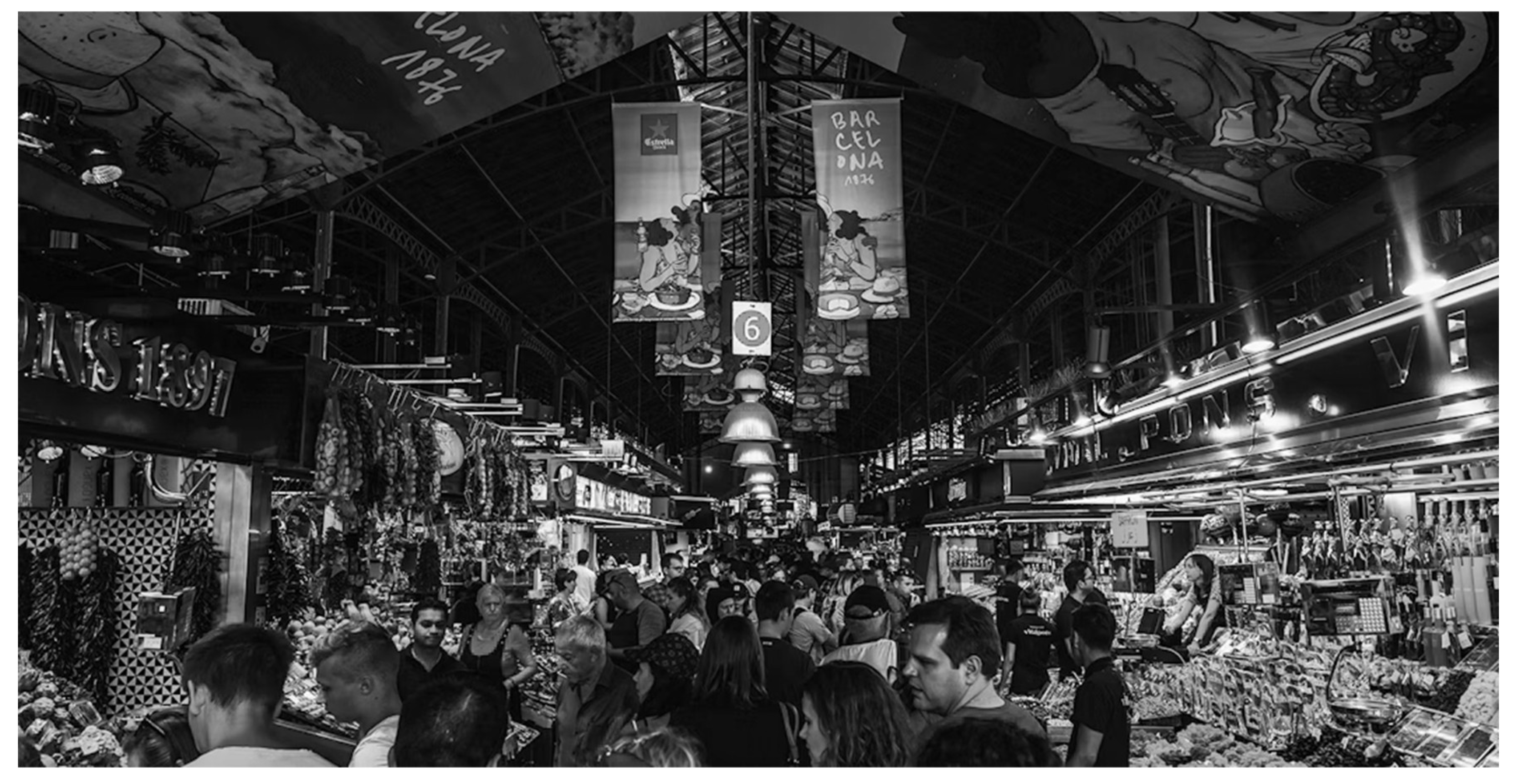
Figure 2.
Aspect of Roma Market, Ciudad del Mexico, Mexico.
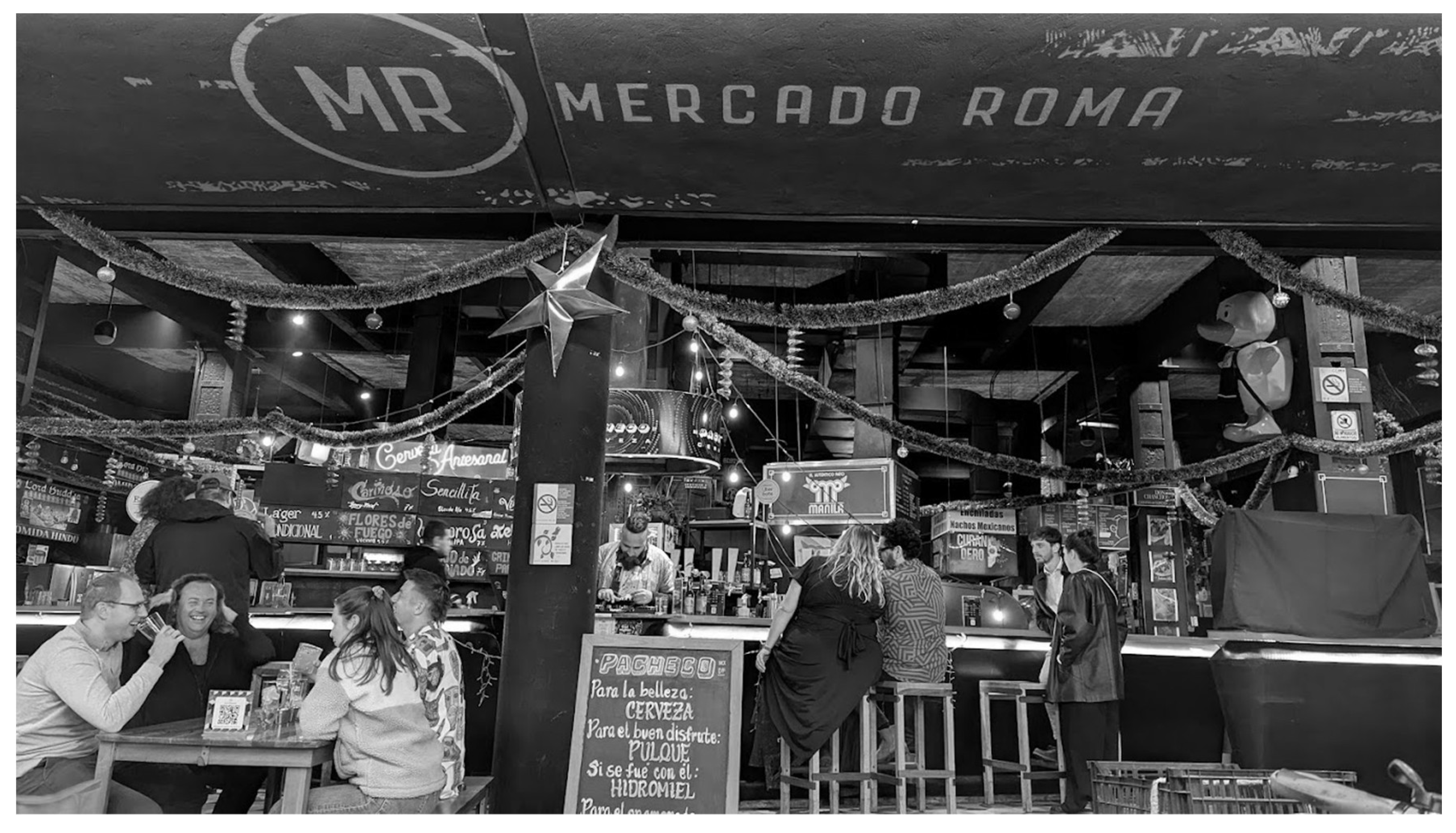
Figure 3.
Aspect of Mercato Centrale, Florence, Italy.
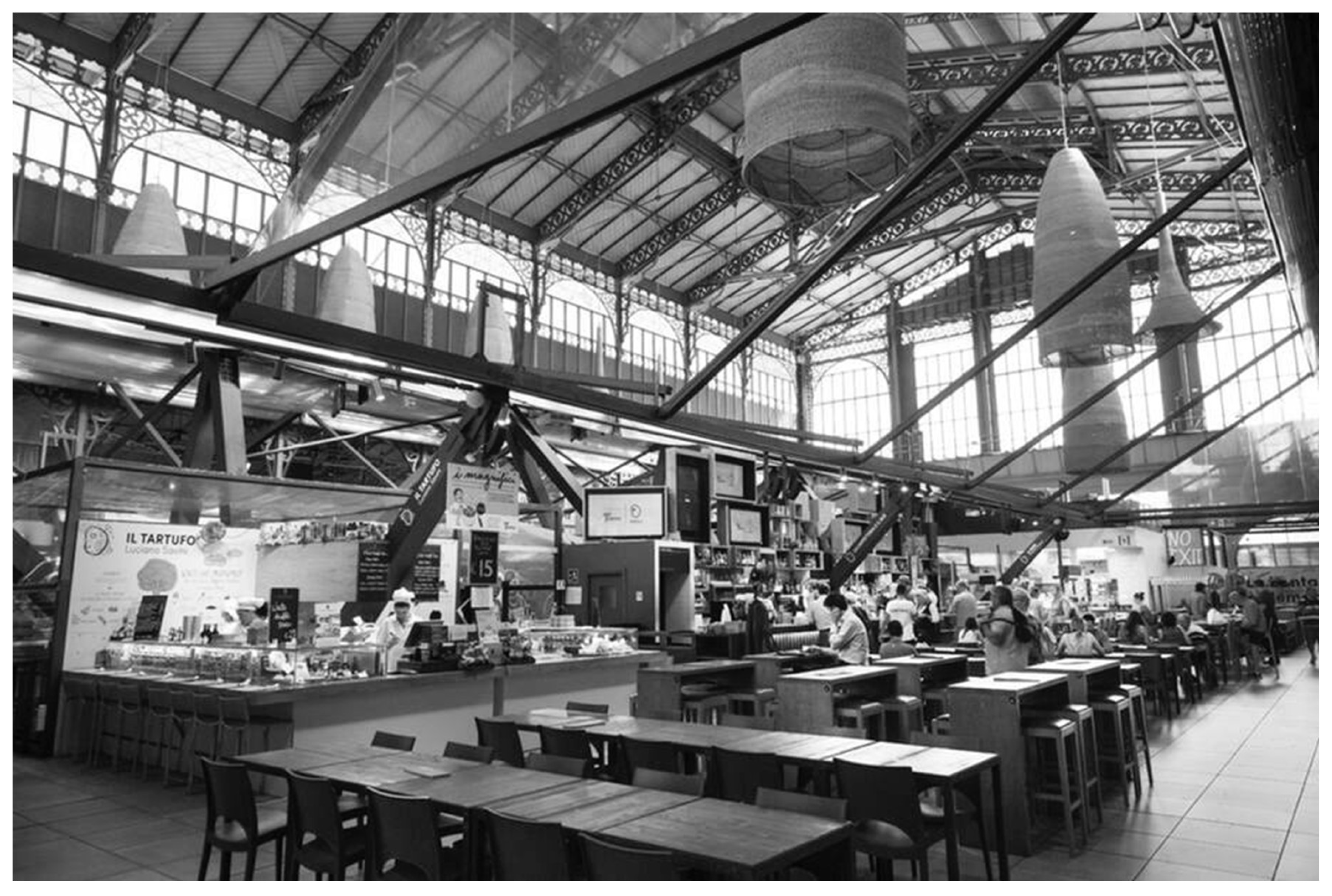
Figure 4.
Aspect of Torvehallerne Market, Copenhagen, Denmark.
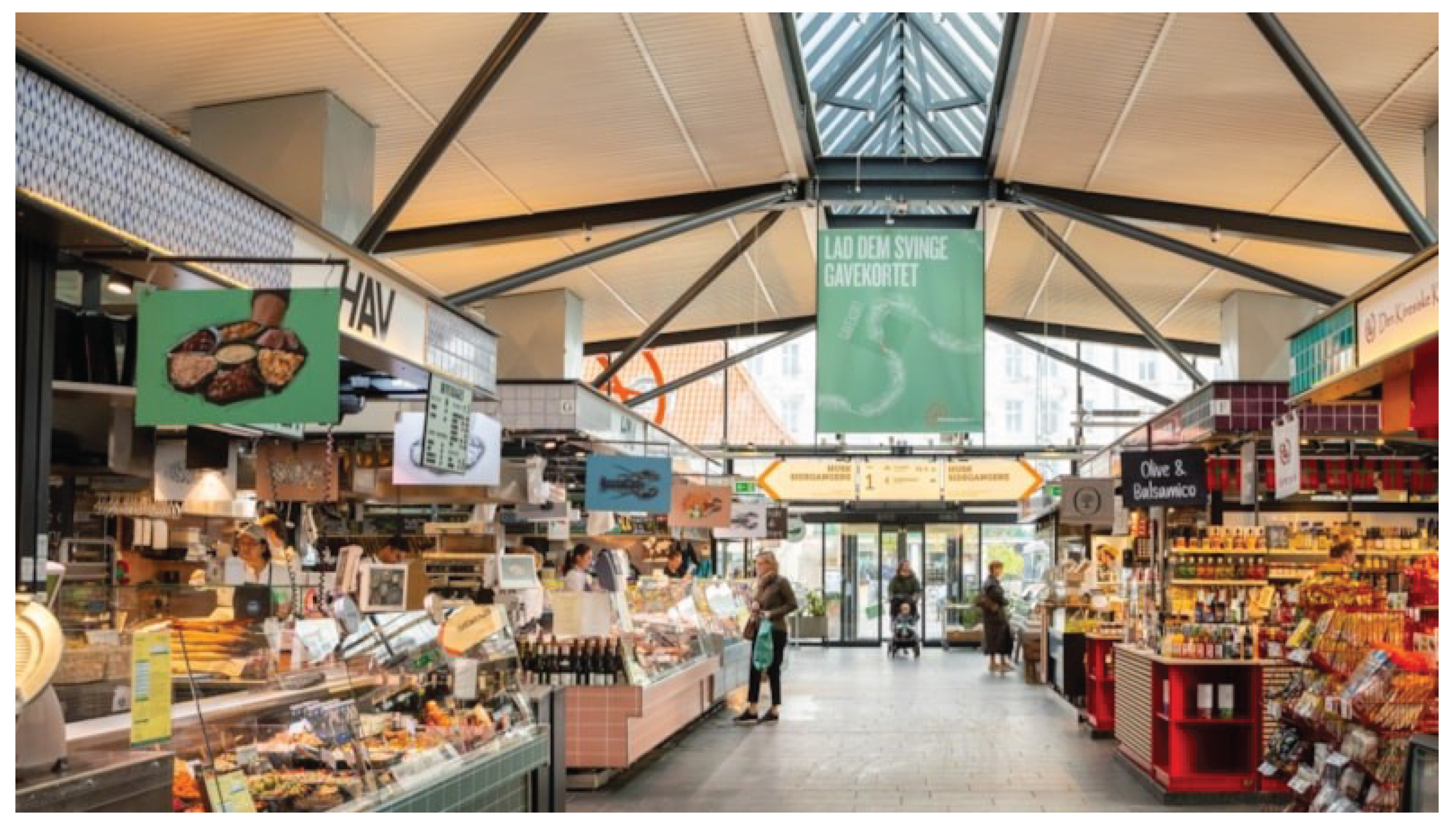

Table 1.
The ProxiMark governance framework for municipal markets.
| ProxiMark component | Key focus | Policy relevance |
|---|---|---|
| P – Public ownership | Public control and long-term vision | Safeguards public interest and social objectives |
| R – Relational use | Everyday use and sociability | Reinforces neighbourhood life and proximity |
| O – Operational hybrid management | Shared management models | Balances efficiency and accountability |
| X – Cross-sectoral integration | Policy coordination | Aligns food, waste, mobility and social policies |
| I – Inclusive access | Social and economic inclusion | Prevents exclusion and gentrification |
| MARK – Neighbourhood infrastructure | Territorial anchoring | Strengthens local centrality and resilience |
Disclaimer/Publisher’s Note: The statements, opinions and data contained in all publications are solely those of the individual author(s) and contributor(s) and not of MDPI and/or the editor(s). MDPI and/or the editor(s) disclaim responsibility for any injury to people or property resulting from any ideas, methods, instructions or products referred to in the content. |
© 2026 by the authors. Licensee MDPI, Basel, Switzerland. This article is an open access article distributed under the terms and conditions of the Creative Commons Attribution (CC BY) license (http://creativecommons.org/licenses/by/4.0/).
Copyright: This open access article is published under a Creative Commons CC BY 4.0 license, which permit the free download, distribution, and reuse, provided that the author and preprint are cited in any reuse.


