

Submitted:
29 January 2026
Posted:
02 February 2026
You are already at the latest version
Abstract
Background: Ejagham, an endangered African language, has received limited scholarly focus compared to other African languages. Most studies emphasise grammar and sociolinguistics, while its number system remains underdocumented. Number systems in underdocumented languages like Ejagham are rarely examined for their cognitive, philosophical, or symbolic dimensions. Yet, Ejagham’s counting system may encode concepts of economy, hierarchy, memory, and logic, reflecting broader cultural values. Objective: This paper analyses the Ejagham counting system from one to ten, seeking to understand its structure, cultural reasoning, and mnemonic potential. It also aims to support the documentation and promotion of this endangered language. Method: This study focuses on the Cameroonian variety of Ejagham, also known as Eastern Ejagham. It employs critical analysis, an insider perspective, and simple arithmetic to examine patterns and explore possible connections. The numbers are transcribed using the International Phonetic Alphabet. Results: Ejagham numbers from one to ten follow a cultural logic: larger numbers are formed additively and spoken first, reflecting seniority and economic mastery. A distinct word for ten confirms a decimal system. Conclusion and Recommendation: This research argues that Ejagham’s numerical expressions reflect a worldview grounded in economy, seniority, symmetry, and cognitive efficiency. The cultural logic embedded in Ejagham numbers contributes to ongoing efforts to document this endangered language. Increased scholarly and financial support is vital for its preservation and for further interdisciplinary study.
Keywords:
endangered languages
; Ejagham
; Cameroon
; indigenous cultures
; African philosophy
1. Introduction
Following a summary of the Ejagham people, this section examines how the Ejagham language has been represented and written for a global audience since the post-colonial era.
The Ejagham people are an indigenous ethnic group primarily located in southeastern Nigeria’s Cross River region and extending into parts of southwestern Cameroon (Eberhard, Simons, and Fennig 2024). Renowned for their rich oral traditions, artistic expressions, unique cuisine, and cultural institutions, they have played a significant role in the region’s historical and political landscape. A notable example of their traditional systems is the Ekpe society (Etchi 2024)—a male-led organisation responsible for maintaining social order. Its choreographic and female-led counterpart, Monkinkim, similarly embodies communal values and empowerment through performance (Ozah 2015; Benoni-Wang and Vellem 2020).
The University of Missouri’s Database for Indigenous Cultural Evolution houses datasets and questionnaires detailing cultural variation globally. On the page dedicated to the Ejagham people, responses are provided to numerous questions, ranging from “What other names are used for the tribe?” to “What colours do they paint their bodies in which ceremonies?” (Ejagham n.d.).
Linguistically, Ejagham belongs to the Cross River branch of the Niger-Congo family and is spoken across several communities. Historically, the Ejagham language has been preserved through oral tradition (Joshua Project n.d.).
Ancient members of the Ekpe society developed a symbolic writing system called Nsibidi, used to encode sacred information (Agbo 2019). This script was esoteric, restricted to initiates, and thus not part of general public education, reflecting a broader pattern of controlled knowledge transmission within Ejagham society.
Figure 1.
Nsibidi, source: The Guardian, Nigeria.

However, twentieth-century European missionaries introduced more literary scripts such as the African Reference Alphabet (ARA), which is essentially the Latin alphabet adapted with accents and other signs to represent non-European sounds.
1.1. Ejagham People in History
Compared to their language, the Ejagham people are relatively well documented in historical texts. Peter L. Shumaker (2012) offers a comprehensive work covering the long and complex history of Cameroon, including the colonial period. While not solely focused on the Ejagham, it discusses the region where the Ejagham people live and provides important context for understanding the social and political dynamics during the German and British colonial periods, including resistance movements.
R. F. Salisbury (1973) explores the anthropology and ethnography of the Ejagham people, providing insights into their cultural practices, belief systems, and social organisation.
Cultural historian Ivor Miller’s A Secret Society Goes Public explains that some enslaved Africans from the Ejagham lands of southeastern Nigeria and southwestern Cameroon, as well as from neighboring tribes where Ékpè societies were practiced, brought these traditions to Cuba. In 1836, they founded a similar secret society known as Abakuá in Havana to resist slavery, which has since been active in many aspects of Cuban culture (Miller 2000).
A close study of the lyrics and chants of Cuban Abakuá music indicates a linguistic relationship with Èfik, a language closely related to Ejagham (Miller 2005).
Several other historical texts present the people from diverse viewpoints, such as migration, art, and philosophy.
1.2. Ejagham People in Modern Fiction
Ejagham characters and their culture are rarely portrayed in modern African literature. However, Lasso Tambong in Donald Besong’s Bleeding Stubs (2024) is an Ejagham character. While Ejagham is not used in Bleeding Stubs, Besong plans sequels in which Lasso will speak the language. Based on the researcher’s lived experience, Tambong is an Ejagham name. The short thriller is set in Cameroon, where Lasso, demonstrating stoicism, serves as a gendarme recruited by the fictional African Military Intelligence Bureau, the CIA’s African branch (Besong 2024). Lasso’s resilient spirit aligns with traits historically associated with the Ejagham people.
2. Methodology
This study adopts a multidisciplinary approach, drawing on ethnographic research, the researcher’s status as a native of Ejagham, basic mathematical knowledge, and familiarity with the International Phonetic Alphabet (IPA). IPA was chosen because it is familiar to English readers through its use in Oxford and Cambridge dictionaries, yet it is a universal system capable of representing sounds from all human languages. Given the researcher’s limited formal linguistic training, the analysis focuses on cultural patterns in the counting system rather than detailed linguistic structures.
The interpretation of Ejagham numerals in this study is informed by critical analysis insofar as it considers the researcher’s speculation about how cultural values and shared mental models may have shaped numerical representation and usage in the language.
The researcher’s personal heritage plays a vital role, as conversations with family elders and members of undisturbed Ejagham communities have offered direct insight into the language’s structure and cultural significance. Additional sources of insight include academic literature, historical documents, and linguistic analyses on Ejagham and its broader cultural setting.
3. Literature Review
Africa is home to an extraordinary linguistic diversity, with estimates of about 2000 distinct languages spoken across the continent (Orife et al. 2020; Munteanu 2024; Adeodun 2024). Most of these languages have limited documentation, only a small subset receiving disproportionate scholarly and technological attention.
Languages such as Swahili, Hausa, Amharic, Arabic, and Igbo are among the most frequently researched and resourced due to their regional prominence, written traditions, and digital availability (Munteanu 2024; Adeodun 2024). Efforts to preserve and digitise these languages continue through initiatives like Masakhane and AI4D, which focus on developing language corpora and digital translation tools for numerous African languages (Orife et al. 2020; Siminyu et al. 2021).
Ejagham is among the languages that remain relatively underdocumented, with limited linguistic resources available (Williamson and Blench 2000). In fact, the Ejagham language is considered endangered due to challenges in intergenerational transmission and reduced use in various social domains (Ejagham Tradition n.d.).
Written material on Ejagham history, culture and their language includes the works of Ute Röschenthaler (1961), a German anthropologist who produced some of the most detailed and influential published work on the Ejagham people.
Several linguists have studied Ejagham. Most use a Latin-IPA hybrid orthography, possibly the Pan-Nigerian Alphabet (PNA), which can be considered a blend of ARA and IPA.
A broad and profound thesis on the language is presented in John Robert Watters’ doctoral dissertation, which expounds on the phonology and morphology of Ejagham (Watters 1981). Phonology studies how sounds and pitch patterns create meaning in a language, while morphology studies word structure. It is a comprehensive study that begins with the origins and distribution of the Ejagham people, then explores the language’s dialects within the Benue-Niger language group and their relationships with other language families, before delving into the specifics of Ejagham linguistics. Watters is the author of several linguistic texts on Ejagham and other Bantoid languages.
These scholarly contributions are crucial for documenting, preserving, and promoting the Ejagham language, as they provide rigorous linguistic analyses, including grammar and phonetics.
In his paper The inclusive/exclusive distinction in Ejagham, Watters (1985) showed that the Ejagham word for “we” does not change depending on whether the listener is included or excluded. He describes the phenomenon as “the difference between inclusive and exclusive senses in the first-person plural pronoun,” technical expression beyond the scope of this paper.
Reduplication and the Origin of High Tone on Noun Prefixes in Ejagham discusses prefixes and reduplication in various contexts (Watters 1990). The detailed study pays special attention to Western Ejagham, spoken in Nigeria
Roger Blench (n.d.) presents research on the cartography, classification, phonology, and morphology of the Ekoid-Mbe language subgroup, of which Ejagham is a member. The book also provides a comparative wordlist across the languages of the subgroup, compiled from multiple sources.
Having cited linguistic papers that use a standardised orthography to script Ejagham, this section now proceeds to review non-linguistic sources.
Several efforts have been made to project and amplify African indigenous cultures and languages. For instance, Achebe has been described as “a custodian of Igbo oral tradition” due to his skilful integration of proverbs, folktales, Igbo words, and traditional speech patterns into his fiction, effectively reflecting the Igbo worldview and preserving its cultural heritage (Nwachukwu-Agbada 2013: 105). However, Walter Ong (1982) observes that in predominantly oral African cultures, artistic expression is rooted in communal verbal performance rather than in written literature, with orature serving as the preferred medium of cultural transmission. Building on this view, Nwapa (2025) argues that if the goal were truly the preservation of African indigenous languages, rather than acceptance into global literary circles, African scholars would have capitalised on the radio-cassette era to preserve the oral tradition. In such a scenario, libraries could now be holding Ejagham conversations and fireside stories.
It is, perhaps, the failure to capitalise on the radio-cassette era that has prompted several Ejagham people to use the digital era to promote their language. A notable example is the YouTube channel Ejaghamwithebanessame (2023), which teaches and promotes it. One of their videos, titled “How to count 1-20 in Ejagham,” demonstrates the educational value of their content. Another channel, Nguid Ejagham (2020), incorporates more casual and real-life scenarios to showcase and teach this powerful language on a deeper level. In a heart-warming video by Nguid Ejagham (2020), two Ejagham men engage in conversation over diced garden eggs and spicy peanut butter.
Although the sources are diverse, the Ejagham language remains scarcely documented, and its mathematics and philosophy have not been examined at all. These subjects will be discussed in the next section.
4. Discussion
First, it is important to stress that this paper does not claim Ejagham’s number system is unique or peculiar, nor does it place the language above others; rather, it seeks to contribute in the language’s documentation while highlighting a relatively underdocumented domain of the language.
The following table shows the numbers from 1 to 10 in Ejagham. The words are written using standard Latin letters rather than specialised systems like ARA. This Latin spelling is only a guide, while the approximate pronunciation is shown using the International Phonetic Alphabet (IPA). The IPA here is called “approximate” not because it is incomplete, but because symbols representing Ejagham tone and stress are omitted for simplicity. A video by Ejaghamwithebanessame (2023) demonstrates the full pronunciation, helping learners hear the language naturally. For simplicity, this paper does not use phonemic slashes to mark the beginning and end of IPA spellings, as is common in English dictionaries.
As with any language, no writing system can fully capture Ejagham’s unique phonology and intonation without the guidance of a living human teacher or audio recordings. Therefore, readers are encouraged to watch the referenced video or engage with a local Ejagham community.
The Analysis of Ejagham Numbers
Garri Economics: Garri is a crumbly, granular food made by roasting fermented cassava, a starchy tuber widely consumed across West Africa. The Ejagham people waste nothing—not even fermented cassava. What others might throw away, they turn into garri. This instinct for transformation isn’t just culinary; it’s economic genius. In fact, their resourcefulness runs so deep that they count from one to ten using only six distinct words. As shown in Table 1, the numbers 6, 7, 8, and 9 are constructed by combining smaller numbers. For example, six (esa-ga-sa) is simply three (esa) and three, with ga meaning “and.” It’s a system that reflects a deeper principle: efficiency as a way of life.

Table 1.
Ejagham numbers (1–10) with IPA transcription using TypeIt (n.d.).
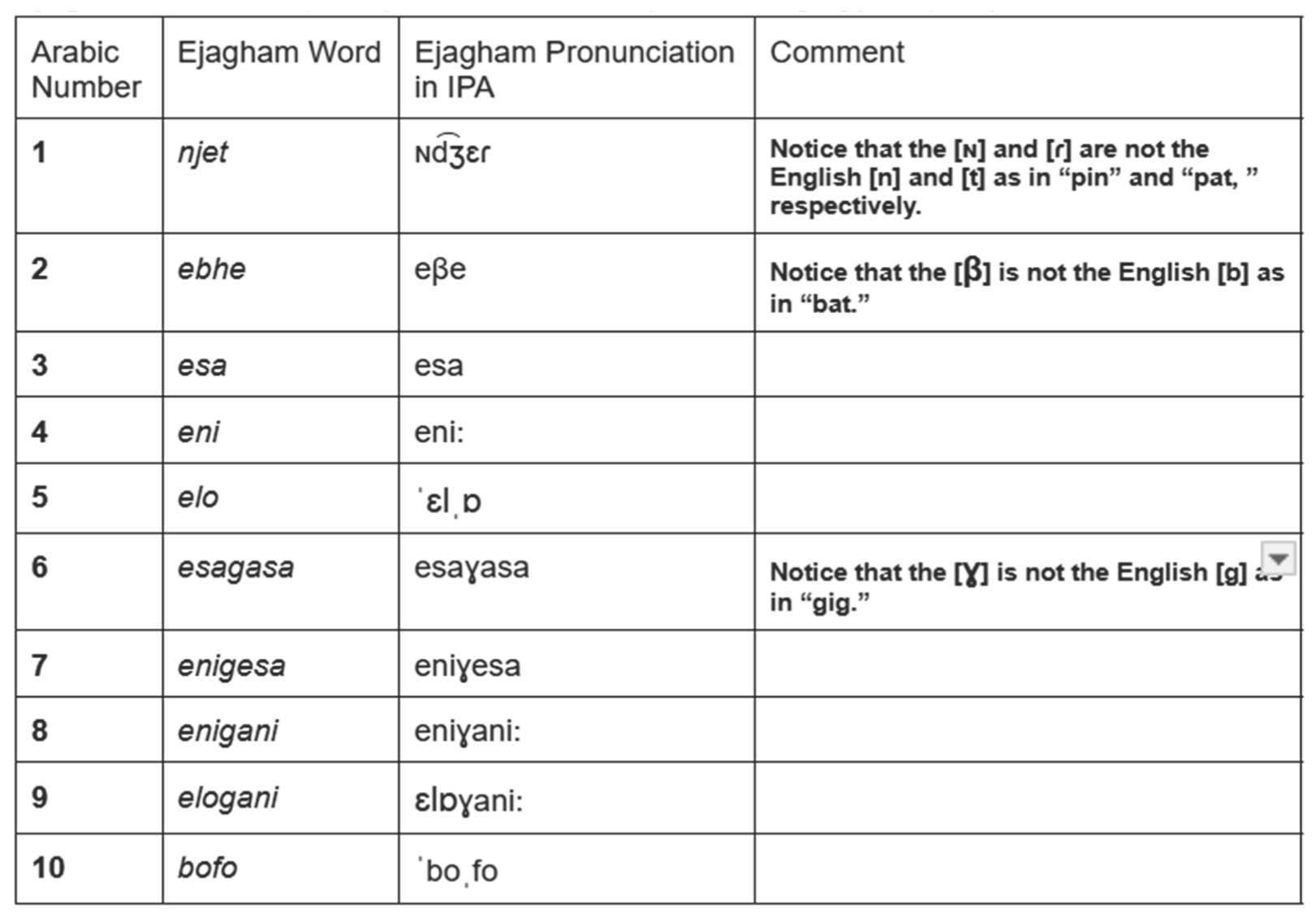 |
The Oldest Seat by the Fire: The numbers in Table 1 that are formed by adding two unequal numbers are 7 and 9. In both cases, the larger number comes first—a linguistic nod to hierarchy. For instance, 7 (eni-ga-sa) is composed of 4 (eni) and 3 (esa), with “ga” meaning “and.” Similarly, 9 (elo-ga-eni) combines 5 (elo) and 4 (eni), again placing the greater number before the lesser. In Ejagham, both people and numbers know their place—the elder goes first.
The Fireside Mathematician: Long before classrooms and calculators, mathematics lived by the fire in stories, rhythms, and relationships. The economic and seniority rules described above are grounded in addition, reflecting a deep-rooted logic that is evident in everyday life. Notably, 10 (bofo) is a distinct word and is not formed from smaller numbers, suggesting a decimal system embedded in the language. Even in practical settings, mathematical thinking quietly shaped culture.
Memory Matters: Remembering numbers becomes easier with the addition rule, where larger numbers are built from smaller ones. Even for five (elo), which isn’t formed through addition, the letter “L” interestingly represents 5 in some mnemonic systems, such as the Major System. The Major System is more recent than the Ejagham language, and their shared use of “L” is coincidental. The speculative comparison evokes the notion of a universal “thought bank” from which both systems might have fetched ideas, offering a playful nod to the Akashic Records.
The Major System assigns specific consonants to digits 0–9 so that users can form memorable phrases to remember long numbers, e.g., bank accounts or multiple telephone numbers (Lorayne and Lucas 2006). Leadbeater (1910) describes the Akashic Records as living “reflections” or “cinematic” scenes accessible to a clairvoyant on the mental plane, allowing one to experience past events as if present.
Contextual Nugget: The Ejagham word “esagasa” (meaning “8”) is also used to refer to the immunodeficiency disease AIDS, because the English acronym “AIDS” sounds like the number “eight.”
5. Conclusions and Recommendations
This paper has analysed the numbers from one to ten in Ejagham to document aspects of the endangered language in a creative and accessible way. Compound numbers reduce the memorisation burden on learners, requiring fewer lexical items than ten distinct forms, reflecting linguistic economy. They also encode ordering principles, with the placement of the larger numeral first, signalling notions of seniority. As Ejagham faces increasing endangerment, greater scholarly attention and financial support are essential for its preservation and for encouraging interdisciplinary research.
References
- Adeodun, A. How African languages are being preserved in the digital age. The African Spectator. 20 January 2025. Available online: https://spectator.africa/2025/01/20/how-african-languages-are-being-preserved-in-the-digital-age/.
- Agbo, N. 2019, April 14. A look at Nsibidi: The long-lost Nigerian writing. The Guardian Nigeria. https://guardian.ng/life/a-look-at-nsibidi-the-long-lost-african-writing/.
- Orife, I., J. Kreutzer, B. Sibanda, D. Whitenack, K. Siminyu, L. Martinus, J. T. Ali, J. Abbott, V. Marivate, S. Kabongo, M. Meressa, E. Murhabazi, O. Ahia, E. van Biljon, A. Ramkilowan, A. Akinfaderin, A. Öktem, W. Akin, G. Kioko, K. Degila, H. Kamper, B. Dossou, C. Emezue, K. Ogueji, and A. Bashir. 2020. Masakhane – Machine translation for Africa. arXiv. https://arxiv.org/pdf/2003.11529.
- Benoni-Wang, T. J. O. E.; Vellem, V. S. A womanist theological engagement of triple patriarchy and its implications on (Ejagham) women’s liberation. HTS Teologiese Studies / Theological Studies 2020, 76(1), Article a5601. [Google Scholar] [CrossRef]
- Besong, D. O. (2024). Bleeding stubs. Available online: https://www.amazon.com/dp/B0CSGF1PBP.
- Blench, R.; Williamson, K. Heine, B., Nurse, D., Eds.; Niger-Congo . In African Languages: An Introduction; Cambridge University Press, 2000; pp. 11–42. [Google Scholar]
- Blench, R. n.d. Ekoid: Bantoid languages of the Nigeria–Cameroon borderland [Unpublished manuscript]. https://www.rogerblench.info/Language/Niger-Congo/Bantoid/Ekoid/Comparative%20Ekoid.pdf.
- Bower, G. H. 2010. Mnemonic systems and memory techniques. Memory Studies Press.
- Ejagham. n.d. Niger-Congo languages: DICE, Database for Indigenous Cultural Evolution. University of Missouri. https://dice.missouri.edu/assets/docs/niger-congo/Ejagham.pdf.
- Ejagham Tradition. (n.d.). Ejagham language intelligibility and endangerment survey. Retrieved August 31, 2025, from https://www.ejaghamtradition.org/ejagham-language-intelligibility-test/.
- Ejaghamwithebanessame. 2023, October 20. How to count 1-20 in Ejagham [Video]. YouTube. https://www.youtube.com/watch?v=RFZUxG9ecr0. 20 October.
- Ejagham . In Ethnologue: Languages of the world, 26th ed.; Eberhard, D. M., Simons, G. F., Fennig, C. D., Eds.; SIL International, 2024; Available online: https://www.ethnologue.com/language/eka.
- Essien, M. The Grammar of Ejagham; University of Ibadan Press, 1989. [Google Scholar]
- Etchi, B. Ejagham mysticism in the funeral practices of the Mgbe (Ekpe) and Moninkim institutions: Insights for research methodology and theological epistemology. Doctoral dissertation, Duquesne University, Duquesne Scholarship Collection, 2024. Available online: https://dsc.duq.edu/etd/2222.
- Joshua Project. Ejagham, Ekoi in the Cameroon people group profile. Joshua Project. n.d. Available online: https://joshuaproject.net/people_groups/11728/CM.
- Leadbeater, C. W. The hidden side of things; Theosophical Publishing House, 1910. [Google Scholar]
- Lorayne, H.; Lucas, J. The memory book: The classic guide to improving your memory at work, at school, and at play; Ballantine Books, 2006. [Google Scholar]
- Miller, I. A Secret Society Goes Public: The Relationship Between Abakuá and Cuban Popular Culture. African Studies Review 2000, 43(1), 161–188. [Google Scholar] [CrossRef]
- Miller, I. Cuban Abakuá Chants: Examining New Linguistic and Historical Evidence for the African Diaspora. African Studies Review 2005, 48(1), 23–58. [Google Scholar] [CrossRef]
- Munteanu, O. The most spoken languages in Africa; Polilingua, 25 July 2024. [Google Scholar]
- Ejagham, Nguid. Echort Ejgham (Nlaghambah Efagha) First episode - Let’s speak Ejagham [Video]; YouTube, 31 October 2020; Available online: https://www.youtube.com/watch?v=gZDs08Drs2c.
- Nwachukwu-Agbada, J. O. J. The Igbo oral tradition in Achebe’s Things Fall Apart. Tydskrif vir Letterkunde 2013, 50(1), 105–117. [Google Scholar] [CrossRef]
- Nwapa, E. Stop playing: African writers and the abandonment of oral tradition. Medium. 2025. Available online: https://medium.com/@emerencia.nwapa/stop-playing-african-writers-and-the-abandonment-of-oral-tradition-7581387632e6.
- DOI: https://doi.org/10.5281/zenodo.16959719.
- Ong, W. J. Orality and Literacy: The Technologizing of the Word; London; Methuen, 1982. [Google Scholar]
- Ozah, M. A. Moninkim: A symbiotic performance of ritual, music, and dance by the Ejagham people of Nigeria and Cameroon. Ethnomusicology 2015, 59(3), 421–449. [Google Scholar] [CrossRef]
- Röschenthaler, U. Ejagham; Rosen Publishing Group, 1996. [Google Scholar]
- Salisbury, R. F. Witchcraft, oracles, and magic among the Ejagham; Oxford University Press, 1973. [Google Scholar]
- Siminyu, K.; Kalipe, G.; Orlic, D.; Abbott, J.; Marivate, V.; Freshia, S.; Sibal, P.; Neupane, B.; Adelani, D. I.; Taylor, A.; Ali, J. T.; Degila, K.; Balogoun, M.; Diop, T. I.; David, D.; Fourati, C.; Haddad, H.; Naski, M. AI4D – African Language Program (preprint) . arXiv 2021. [Google Scholar] [CrossRef]
- Shumaker, P. L. The history of Cameroon since 1800; Cambridge University Press, 2012. [Google Scholar]
- TypeIt. Type IPA phonetic symbols – online keyboard. n.d. Available online: https://ipa.typeit.org/.
- Watters, D. A phonology and morphology of Ejagham, with notes on dialect variation. Doctoral dissertation, University of California, UCLA, Los Angeles, 1981. Available online: https://linguistics.ucla.edu/images/stories/Watters.1981.pdf.
- Watters, J. R. The inclusive/exclusive distinction in Ejagham. Journal of West African Languages 1985, 15(2), 75–92. [Google Scholar]
- Watters, J. R. Reduplication and the origin of high tone on noun prefixes in Ejagham. Journal of West African Languages 1990, 20(1), 105–117. [Google Scholar]
Disclaimer/Publisher’s Note: The statements, opinions and data contained in all publications are solely those of the individual author(s) and contributor(s) and not of MDPI and/or the editor(s). MDPI and/or the editor(s) disclaim responsibility for any injury to people or property resulting from any ideas, methods, instructions or products referred to in the content. |
© 2026 by the authors. Licensee MDPI, Basel, Switzerland. This article is an open access article distributed under the terms and conditions of the Creative Commons Attribution (CC BY) license (http://creativecommons.org/licenses/by/4.0/).
Copyright: This open access article is published under a Creative Commons CC BY 4.0 license, which permit the free download, distribution, and reuse, provided that the author and preprint are cited in any reuse.


