

Submitted:
22 January 2026
Posted:
26 January 2026
You are already at the latest version
Abstract
Our 4G model of final unification proposes four distinct gravitational constants associated with the fundamental interactions—nuclear, electromagnetic, weak, and classical gravity—offering a comprehensive framework that unifies these forces. By calculating the geometric mean of the nuclear and electromagnetic gravitational constants, a fundamental length scale analogous to a black hole radius for the unified atomic mass unit emerges, closely matching the basic empirical covalent bond length of 33 pm. Extending Rutherford’s nuclear radius law, we propose a generalized atomic radius scaling law as, Atomic radius=[(mass number)1/3 * 33 pm]*f(electronic configuration, quantum corrections, etc). We emphasize the point that, atomic structure is shaped by the combined effect of strong and electromagnetic interactions, not merely electromagnetic interactions. This framework bridges nuclear physics, quantum chemistry, and gravitational theory, providing novel insights into atomic size variations and chemical bonding phenomena grounded in fundamental constants. With reference to our recent publications, in this paper, we are making an attempt to interconnect various atomic radii based on the first principles and advanced 4G concepts. We have presented this in the conference "Integrated Computational and Experimental Methods for Innovation in Chemistry and Interdisciplinary Sciences", ICEMI-CHEMIS 2025, P P Savani University, Surat, Gujarat, India.
Keywords:
4G model of final unification
; 4 gravitational constants
; atomic radii
; combined effect of strong and electromagnetic interactions
1. Introduction
Atomic dimensions underpin chemical behaviour and material properties, yet the fundamental origins of atomic and molecular sizes remain an active area of research bridging nuclear, quantum, and gravitational physics. Historically, Rutherford’s nuclear radius law [1] empirically connected nuclear size to the cube root of the mass number, a volumetric scaling widely accepted in nuclear physics:
However, atomic scale dimensions—such as covalent and van der Waals radii—are influenced not only by nuclear size [2,3,4,5,6,7,8,9,10] but also significantly by electronic structure and interactions [11,12]. Our 4G model of final unification [13,14,15,16,17] expands this foundation by introducing four gravitational constants linked separately to the fundamental interactions: strong nuclear (Gn), electromagnetic (Ge), weak (Gw), and classical gravitational (GN) forces. By unifying these constants, notably through geometric means, the model derives characteristic length scales that resonate with atomic and chemical dimensions.
This paper explores these advancements by proposing a unified scaling law for atomic radii that extends the classical cubic root dependence on mass number via incorporation of electronic shell filling effects. A key result is the identification of a fundamental length scale associated with the “black hole radius” [18] of the unified atomic mass unit [19], rooted in the geometric mean gravitational constant derived from Gn and Ge. This scale corresponds closely to observed covalent bond lengths, providing a physical and theoretical grounding for observed atomic sizes.
Further, this work emphasizes that atoms are not purely electromagnetic in nature but are complex composite entities shaped by unified gravitational analogues of multiple fundamental forces acting at the picometer scale. Integrating these insights offers a cohesive framework linking nuclear physics, quantum chemistry, and gravity-inspired unification theories, enriching our understanding of the fundamental nature of matter.
2. Three assumptions and Two Applications of Our 4G Model of Final Unification
1) There exists a characteristic electroweak fermion of rest energy, . It can be considered as the zygote of all elementary particles.
2) There exists a nuclear elementary charge in such a way that, = Strong coupling constant and .
3) Each atomic interaction is associated with a characteristic large gravitational coupling constant. Their fitted magnitudes are,
It may be noted that,
1) Recent high-precision astrophysical observations lend growing support to our first assumption of a characteristic electroweak fermion with rest energy near 585 GeV. In particular, the sharp spectral break at 1.17 TeV in the all-electron cosmic-ray spectrum reported by H.E.S.S., and independently confirmed by DAMPE and CALET, coincides precisely with twice the proposed fermion mass, suggesting the presence of bound or resonant fermion–antifermion states. This correspondence is further reinforced by Galactic gamma-ray excess studies, which infer neutral particles in the 500–800 GeV range, consistent with the neutral component of our 4G fermion doublet. Together, these converging astrophysical signatures provide empirical motivation for the 585 GeV fermion hypothesis, strengthening its role as a unifying microscopic origin for both nuclear phenomenology and TeV-scale cosmic-ray features [16].
2) In the 4G model, the strong coupling constant [20] acquires a simple, physically transparent definition: , where is the fundamental electromagnetic charge and is the nuclear elementary charge. This relation reveals that strong interaction strength arises directly from the ratio of these fundamental charges, eliminating arbitrary empirical parameters. With nearly three times , the formula naturally yields 2, matching low-energy experimental values (–) and elegantly unifying electromagnetic and nuclear forces. In the context of the 4G model of nuclear charge, if one assigns a nuclear elementary charge of 3e to quarks, then the electromagnetic charges of the quark families can be expressed in a simple and unified manner. Specifically, the up-series quarks (u, c, t) carry an effective electromagnetic charge of 2e, while the down-series quarks (d, s, b) carry an effective charge of e. This formulation, provides a charge-based reinterpretation of quark structure [21]. It highlights how quark charges may be understood as scaled fractions of a fundamental nuclear charge, offering a natural bridge between electromagnetic and nuclear interactions within the 4G framework. The universal nuclear energy scale is set by Important point to be noted is that, the strong attraction between protons is about times stronger than the repulsive Coulomb energy, ensuring nuclear stability. Coming to the Bohr radius of Hydrogen atom, it is very interesting to note that, where
3) In our 4G framework, the necessity of large gravitational couplings arises from the fundamental requirement that point particles must sustain non-trivial spacetime curvature at quantum scales. If gravity were as weak as the classical Newtonian constant, the immense energy density of point-like particles would fail to generate meaningful curvature, undermining the geometric foundation of quantum structure. By assigning enhanced gravitational constants to the strong, electromagnetic, and weak interactions, curvature is preserved at the femtometer–picometer domain. Moreover, as particle mass increases, the effective gravitational influence decreases with the square of the mass, ensuring that heavier particles and nuclei do not collapse under excessive curvature. This dual principle—that high gravity is essential for point particles, yet naturally weakens with increasing mass—provides a coherent explanation for the observed hierarchy of forces and the emergence of atomic radii consistent with experimental bond lengths.
4) In a unified approach, most important point to be noted is that,
Clearly speaking, based on the electroweak interaction, the well believed quantum constant seems to have a deep inner meaning. Following this kind of relation, there is a possibility to understand the integral nature of quantum mechanics with a relation of the form, It needs further study with reference to EPR argument [22] and String theory [23] can be made practical with reference to the three atomic gravitational constants associated with weak, strong and electromagnetic interaction gravitational constants. See Table 1. and Table 2. for sample string tensions and energies without any coupling constants. Readers are encouraged to refer our recent paper [24].
5) Weak interaction point of view [25], following our assumptions, Fermi’s weak coupling constant can be fitted with the following relations.
2. Black Hole Radius Formula in the 4G Model Context
A cornerstone of the 4G model is the reinterpretation of characteristic length scales governing atomic and nuclear dimensions through an analogy with black hole physics. The black hole analogy primarily emphasizes the minimum radius that a massive body can attain before its spacetime curvature becomes extreme, as described by the Schwarzschild radius. Extending this concept to the quantum domain, the same reasoning can be applied to elementary particles, which are point-like yet possess finite mass and energy density. By introducing large gravitational couplings at atomic scales, the 4G model allows one to define an effective “black hole radius” for particles, analogous to the Schwarzschild radius of macroscopic bodies. This radius represents the smallest possible spatial extent consistent with the particle’s mass and interaction strength, thereby linking gravitational geometry with quantum structure. In this way, the black hole analogy provides a natural framework for understanding why elementary particles exhibit finite characteristic sizes and how atomic radii emerge from unified gravitational principles.
The classical Schwarzschild radius formula describes the radius RBH of the event horizon of a non-rotating black hole as,
Where, GN is the gravitational constant, MBH is the mass of the black hole and c is the speed of light.
Within the 4G framework, the concept extends by replacing the universal gravitational constant GN with the geometric mean gravitational constant
that embodies the coupling of strong nuclear and electromagnetic gravitational analogues. Applying this to the unified atomic mass unit MU, the effective “black hole radius” becomes:
A natural question arises as to why the geometric mean of the nuclear and electromagnetic gravitational constants is employed in defining the fundamental atomic length scale. The reasoning is straightforward: an atom as a whole is governed by electromagnetic interactions, which shape the electron cloud and chemical bonding, while its massive nucleus is dominated by the strong interaction, which ensures nuclear stability and confinement. Since both forces act simultaneously and inseparably in determining atomic dimensions, the geometric mean provides a balanced and physically meaningful coupling constant. It represents the effective scale at which nuclear compactness and electromagnetic extension coexist, yielding the characteristic 33 pm “black hole radius” that matches empirical covalent bond lengths. Thus, the geometric mean is not arbitrary but reflects the dual nature of atomic structure—electromagnetic on the outside, strong at the core.
This formula links the gravitational analogue forces characteristic to nuclear and electromagnetic interactions to a length scale on the order of tens of picometers, aligning closely with covalent bond lengths. This interpretation bridges astrophysical black hole physics and atomic scale phenomena, revealing a profound cross-scale physical unification and providing a robust theoretical foundation for atomic size laws. Moreover, this black hole radius sets the scale constant 33 pm in the generalized atomic radius law, demonstrating how gravitational interactions at fundamental levels dictate chemical bonding distances.
3. Overview of Atomic Radii
Atomic radius represents the distance from the centre of an atom’s nucleus to the boundary of its outermost electron shell. Because the electron cloud does not end abruptly, the atomic radius is defined differently depending on the atom’s environment and the type of bond it forms.
Main Factors Influencing Atomic Radius
1) Number of Electron Shells: Additional electron shells increase the atomic size by placing electrons further from the nucleus.
2) Effective Nuclear Charge (Zeff): A greater nuclear charge pulls electrons closer, decreasing atomic radius. Increased shielding by inner electrons allows the radius to expand.
3) Bonding and Coordination: Whether atoms are isolated, bonded, or in a crystal lattice influences their measured radii.
4) Ionic Charge: Cations (positive ions) have smaller radii than their neutral atoms; anions (negative ions) are larger due to changes in electron repulsion and attraction.
5) Spin State and Coordination Number: The ionic radius is affected by electron spin states and how many adjacent atoms (coordination number) are present in a crystal structure.
6) Types of Atomic Radii

Table 3.
Various kinds of atomic radii and their definitions
| Type | Definition of various atomic radii |
| Covalent Radius |
Half the bond length between two identical covalently bonded atoms; common in molecules |
| Ionic Radius | The size of an ion in a crystal lattice; varies by charge and coordination number. |
| Metallic Radius | Half the distance between nuclei of adjacent atoms in a metallic lattice. |
| Van der Waals Radius | Half the minimum distance between non-bonded atoms, often used for noble gases |
| Bohr Radius |
Physical constant representing the ground-state average distance of an electron from the nucleus in hydrogen atom (53pm) |
Measurement Methods
- 1)
- X-ray Crystallography: Measures distances between nuclei in crystals to determine atomic and ionic radii.
- 2)
- Electron Diffraction: Uses electron scattering patterns from molecules for bond length and radius estimation.
- 3)
- Spectroscopic Techniques: Analyse atomic spectra to deduce electron cloud extents and radii.
- 4)
- Theoretical Calculations: Quantum mechanical models, such as the Heisenberg Uncertainty Principle, estimate the probability boundary for the outer electrons.
Thus, atomic radii are context-sensitive values that depend on electron configuration, bonding environments, and measurement technique, reflecting the “fuzzy” boundary of atomic size.
4. Generalized Scaling Law for Atomic Radii
Building on Rutherford’s mass-based nuclear radius scaling, the atomic covalent radius RAc is chosen for simplicity to incorporate electronic structure effects as follows [17]. For Z > 1,
where ,
This formulation recognizes:
- a)
- For hydrogen atom, modern theoretical values use statistical averages from vast crystal structure data, confirming the value of (31 to 37) pm with slight variation due to chemical environments.
- b)
- Without the correction factor f(x,y,z), for Z=1 to 118, atomic radii seem to have a range of 33 pm to 227 pm.
- c)
- Atoms as composite entities formed by nuclear and electromagnetic forces unified in a gravitational analogue framework,
- d)
- Electronic shell filling modulates atomic radii by altering effective nuclear charge and electron cloud distribution,
- e)
- Variations and anomalies in periodic atomic radii trends arise naturally from f(x,y,z).
- f)
5. Correction Factors and Comparison with Experimental Data
1) The base scale constant Rx ≈ 33 pm, derived from the black hole radius formula, provides a consistent foundational length scale. It is matching with Hydrogen’s single bond covalent bond radius.
2) For many elements, particularly those with partially filled shells, the predicted radii closely approximate observed values when appropriate electronic shell correction factors f(x,y,z) are applied. Starting from Helium to Curium, average %error for 94 atoms is -16%. Interested scholars can work in their own approach for a better understanding and accuracy.
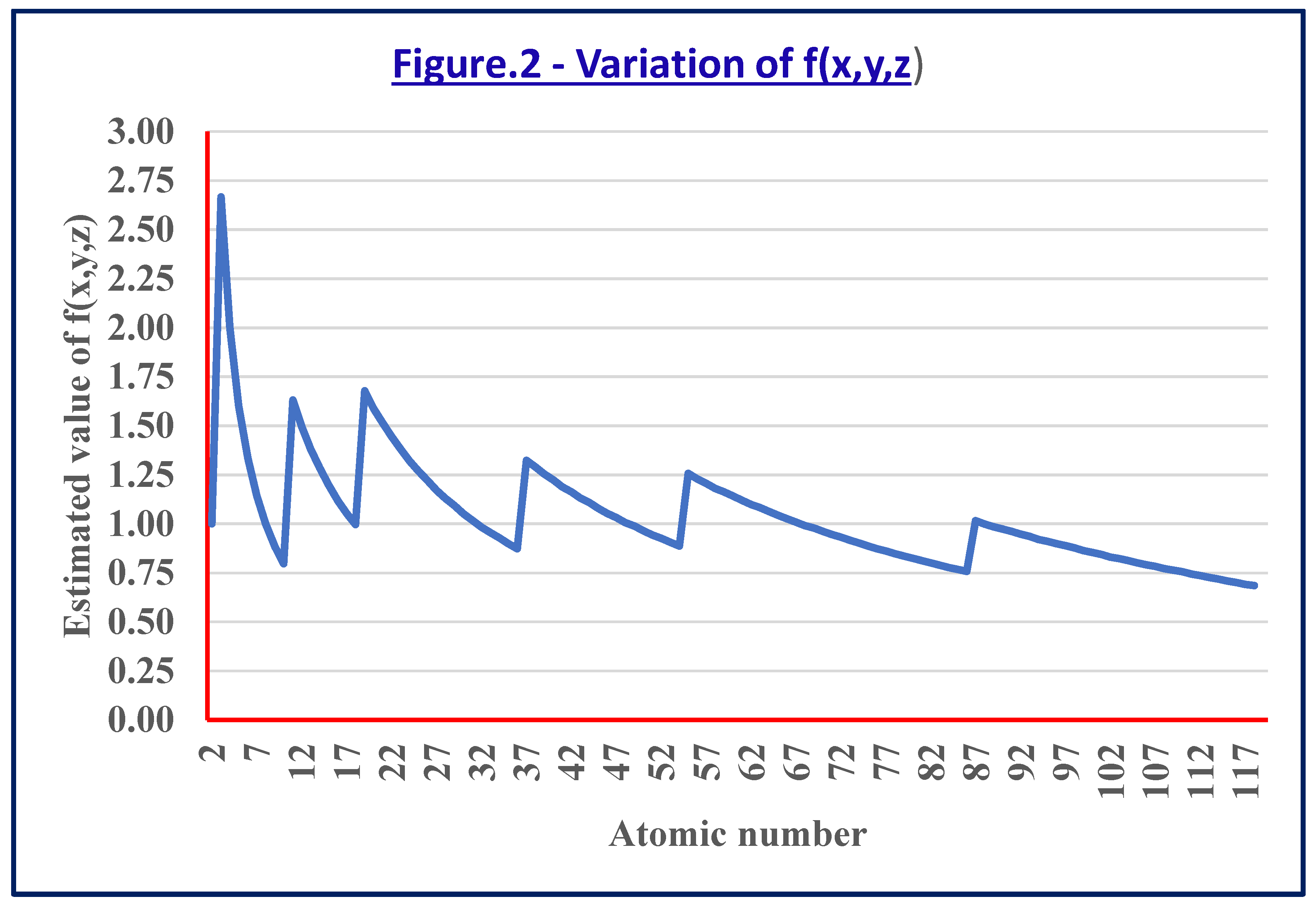
3) On a whole, range of f(x,y,z) seems to be around “0 to 2.67”. See the following fig. 2 for the periodic variation of f(x,y,z). It may be noted that, it is our bold attempt and it needs further study in all possible ways.
4) The first correction factor, Simply connected with ‘proton’ and ‘neutron’ numbers of the atom. One can consider Z for a significant reduction in the atomic radii. By considering N, one can find a significant increment in the atomic radii.
5) The second correction factor, Simply connected with the proton number and mass number of the atom. Its value seems to lie in the range of “1.25 to 2.0”. One can consider a factor 3.5 in place of 4 for a significant reduction in the atomic radii. By considering a factor 4.5 in place of 4, one can find a significant increment in the atomic radii.
6) The third correction factor, Simply connected with the proton number and its period number. Its value seems to lie in the range of “0 to 0.44”. Power of this factor can be adjusted as or 7) Deviations between predicted and experimental radii emphasize the impact of electron shielding, penetration, and subshell filling, all embedded within f(x,y,z).
8) Our model qualitatively captures periodic trends—atomic size decreasing across the periods due to increased nuclear charge and electron shielding, and atomic size increasing down the groups with additional shells.
9) Following the above procedure, van der Waals radii, metallic radii and other radii can be studied in a unified approach.
10) This framework rationalizes exceptions and anomalies by explicitly including electronic structure, beyond simple mass number scaling.
The overall agreement supports the potency of the 4G model in linking atomic size to unified fundamental constants, filtered through quantum electronic structure effects.
6. Implications and Future Directions
The unified scaling law has broad implications for both fundamental physics and applied chemistry:
- 1)
- It offers a conceptually simple yet physically profound bridge connecting nuclear physics, gravitation-inspired unification frameworks, and atomic-scale quantum chemistry.
- 2)
- Provides a predictive tool linking fundamental constants to chemical bonding distances, potentially improving computational modelling and materials design.
- 3)
- Opens avenues to incorporate relativistic effects and electron correlation into the correction factor f(x,y,z), further refining predictive power.
- 4)
- Suggests new cross-disciplinary research linking astrophysical black hole physics concepts with atomic and molecular sciences.
- 5)
- Encourages experimental efforts to test subtle predictions, especially in heavy elements where relativistic and unification effects may be pronounced.
Future work involves formalizing the electronic shell correction factor via advanced quantum mechanical methods, extending the model to ionic and molecular radii, and exploring the role of the weak interaction gravitational constant within the unified framework.
7. Conclusion
In our generalized approach, the objective is not to reproduce tabulated covalent radii with minimal percentage error, but rather to establish a fundamental scaling law that connects atomic size directly to nuclear and electromagnetic gravitational analogues. Since bond radii are emergent quantities shaped by electronic configuration, shell filling, and quantum corrections, they cannot be treated as fixed constants across all chemical environments. Thus, percentage error comparisons, while useful in empirical fitting, are not strictly applicable to our framework. Instead, our model provides a baseline scale constant (33 pm) and a correction factor f(x,y,z) that together capture the physics of bond formation. Further study of bond basics—including the role of hybridization, coordination, and multi-bond environments—is required to refine these estimates and align them more closely with experimental datasets.
Our 4G model’s innovative use of four gravitational constants unifies nuclear and electromagnetic interactions into a fundamental length scale analogous to a black hole radius based on the unified atomic mass unit. This scale (~33 pm) emerges naturally as the cornerstone constant in an extended Rutherford-style cubic root mass number law for atomic radii.
The proposed law reveals atoms as composite entities defined not solely by electromagnetic interactions but by the intertwined influence of strong nuclear forces, electromagnetic forces, and gravitational analogues. This unification ushers in a compelling paradigm for understanding matter’s structure and chemical bonding from first principles.
Incorporating electronic shell filling effects corrects the quantum mechanical and chemical environmental factors, explaining observed periodic trends and anomalies in atomic sizes. This comprehensive framework effectively bridges quantum physics, nuclear structure, gravitational theories, and chemistry.
Data availability statement
The data that support the findings of this study are openly available.
Conflicts of Interest
Authors declare no conflict of interest in this paper or subject .
Acknowledgments
Author Seshavatharam is indebted to professors Padma Shri M. Nagaphani Sarma, Chairman, Shri K.V. Krishna Murthy, founder Chairman, Institute of Scientific Research in Vedas (I-SERVE), Hyderabad, India and Shri K.V.R.S. Murthy, former scientist IICT (CSIR), Govt. of India, Director, Research and Development, I-SERVE, for their valuable guidance and great support in developing this subject. Authors are very much thankful to the organising committee of the international conference, “Integrated Computational and Experimental Methods for Innovation in Chemistry and Interdisciplinary Sciences”, ICEMI-CHEMIS 2025, P P Savani University, Surat, Gujarat, India.
References
- Rutherford, E. The scattering of α and β particles by matter and the structure of the atom. Philosophical Magazine 1911, 21, 669–688. [Google Scholar] [CrossRef]
- Slater, C. Atomic Radii in Crystals. The Journal of Chemical Physics 1964, 41, 3199–3204. [Google Scholar] [CrossRef]
- Bondi. van der Waals Volumes and Radii. The Journal of Physical Chemistry 1964, 68, 441–451. [Google Scholar] [CrossRef]
- Clementi, E.; Raimondi, D.L.; Reinhardt, W.P. Atomic Screening Constants from SCF Functions. II. Atoms with 37 to 86 Electrons. The Journal of Chemical Physics 1967, 47, 1300–1307. [Google Scholar] [CrossRef]
- Ghosh, D.C.; Biswas, R. Theoretical Calculation of Absolute Radii of Atoms and Ions. Part 1. The Atomic Radii. Int. J. Mol. Sci. 2002, 3, 87–113. [Google Scholar] [CrossRef]
- Ganguly, P. Atomic sizes and atomic properties. J. Phys. B At. Mol. Opt. Phys. 2008, 41, 105002. [Google Scholar] [CrossRef]
- Mantina, M.; Chamberlin, A.C.; Valero, R.; Cramer, C.J.; Truhlar, D.G. Consistent van der Waals Radii for the Whole Main Group. The Journal of Physical Chemistry A. American Chemical Society (ACS) 2009, 113, 5806–5812. [Google Scholar] [CrossRef]
- Rahm, M.; Hoffmann, R.; Ashcroft, N.W. Atomic and Ionic Radii of Elements. 1–96. Chemistry (Weinheim an der Bergstrasse, Germany) 2016, 22, 14625–14632. [Google Scholar] [CrossRef]
- Yadav, P.; Tandon, H.; Malik, B.; et al. A quest for the universal atomic radii. Struct. Chem. 2022, 33, 389–394. [Google Scholar] [CrossRef]
- Owolabi, T.O.; Akande, K.O.; Olatunji, S.O. Estimation Of The Atomic Radii Of Periodic Elements Using Support Vector Machine. International Journal of Advanced Information Science and Technology 2014, 8, 105–113. [Google Scholar]
- Griffiths, D.J. Introduction to Quantum Mechanics, 2nd ed.; Pearson Prentice Hall, 2005. [Google Scholar]
- Pyykkö, P. Relativistic effects in chemistry: more common than you thought. Annual Review of Physical Chemistry 2008, 63, 45–64. [Google Scholar] [CrossRef]
- Seshavatharam, U.V.S; Gunavardhana Naidu, T.; Lakshminarayana, S. Nuclear evidences for confirming the physical existence of 585 GeV weak fermion and galactic observations of TeV radiation. International Journal of Advanced Astronomy 2025, 13, 1–17. [Google Scholar] [CrossRef]
- Seshavatharam, U.V.S.; Gunavardhana Naidu, T.; Lakshminarayana, S. To confirm the existence of heavy weak fermion of rest energy 585 GeV. AIP Conf. Proc. 2022, 2451, 020003. [Google Scholar]
- Seshavatharam, U.V.S.; Lakshminarayana, S. 4G model of final unification – A brief report. Journal of Physics: Conference Series 2022, 2197, 012029. [Google Scholar] [CrossRef]
- Seshavatharam, U.V.S.; Gunavardhana Naidu, T.; Lakshminarayana, S. 4G Model of Heavy Electroweak Charged 585 GeV Fermions as the Supposed Microscopic Origin of the 1.17 TeV All-Electron Spectral Break. International Journal of Advance Research and Innovative Ideas in Education 2025, 11, 2116–2140. [Google Scholar]
- Seshavatharam, U.V.S.; Lakshminarayana, S. Inferring and confirming the rest mass of electron neutrino with neutron life time and strong coupling constant via 4G model of final unification. World Scientific News 2024, 191, 127–156. [Google Scholar]
- Cox, B.; Mann, R.B. Black holes and fundamental constants: An overview. Physics Reports 2020, 865, 1–32. [Google Scholar]
- Seshavatharam, U.V.S.; Gunavardhana, T.N.; Lakshminarayana, S. Avogadro’s Number: History, Scientific Role, State-of-the-Art, and Frontier Computational Perspectives. Preprints 2025, 2025080338. [Google Scholar]
- d’Enterria, D; et al. The strong coupling constant: state of the art and the decade ahead. J. Phys. G: Nucl. Part. Phys. 2024, 51, 090501. [Google Scholar] [CrossRef]
- Seshavatharam, U.V.S.; Lakshminarayana, S. Understanding the Origins of Quark Charges, Quantum of Magnetic Flux, Planck’s Radiation Constant and Celestial Magnetic Moments with the 4G Model of Nuclear Charge. Current Physics 2024, 1, e090524229812. [Google Scholar] [CrossRef]
- Patel, A.D. EPR Paradox, Bell Inequalities and Peculiarities of Quantum Correlations. arXiv 2025, arXiv:2502.06791v1. [Google Scholar] [CrossRef]
- Cheung, C.; Hillman, A.; Remmen, G.N. String Theory May Be Inevitable as a Unified Theory of Physics. Physics World 2025. [Google Scholar]
- Seshavatharam, U.V.S.; Gunavardhana, T.N.; Lakshminarayana, S. Advancing String Theory with 4G Model of Final Unification. Preprints 2025, 2025110136.
- Abokhalil, A. The Higgs Mechanism and Higgs Boson: Unveiling the Symmetry of the Universe. arXiv 2023, arXiv:2306.01019. [Google Scholar] [CrossRef]
- Pyykkö, P.; Atsumi, M. Molecular single-bond covalent radii for elements 1-118. Chemistry 2009, 15, 186–197. [Google Scholar] [CrossRef]
- Atomic radii of the elements (data page). Available online: https://en.wikipedia.org/wiki/Atomic_radii_of_the_elements_(data_page).
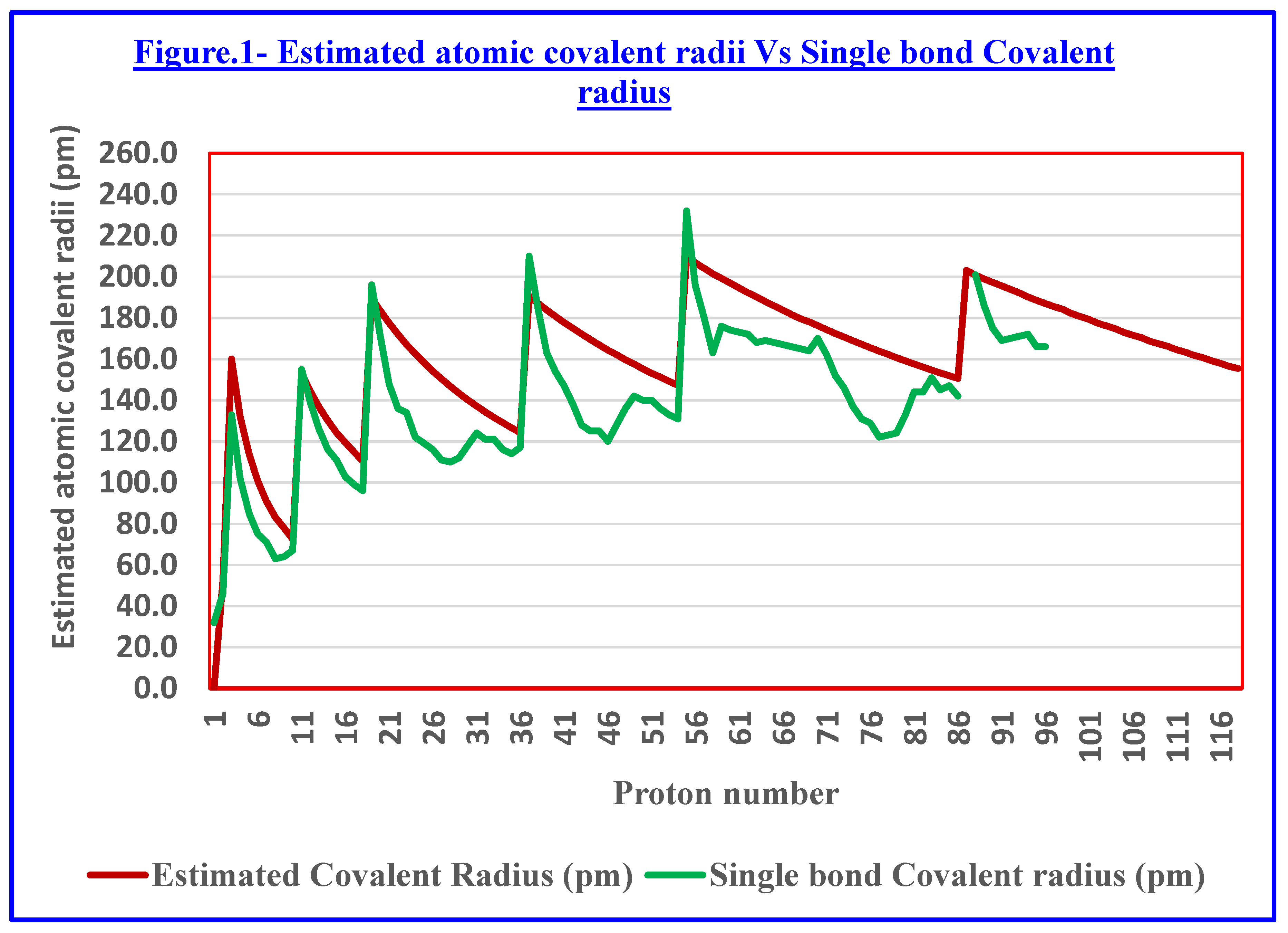
Table 1.
Charge dependent string tensions and string energies
| S.No | Interaction | String Tension | String energy |
|
1 |
Weak |
||
|
2 |
Strong |
||
|
3 |
Electromagnetic |
Table 2.
Quantum string tensions and string energies
| S.No | Interaction | String Tension | String energy |
|
1 |
Weak |
||
|
2 |
Strong |
||
|
3 |
Electromagnetic |
||
| Proton number |
Element Name |
Period number |
Approx. Stable mass number As |
pm |
Estimated (pm) |
Experimental single bond covalent radius (pm) |
%Error | |
|---|---|---|---|---|---|---|---|---|
| 2 | HELIUM | 1 | 4 | 52.4 | 1.00 | 52.4 | 46 | -13.9 |
| 3 | LITHIUM | 2 | 6 | 60.0 | 2.67 | 159.9 | 133 | -20.2 |
| 4 | BERYLLIUM | 2 | 8 | 66.0 | 2.00 | 132.0 | 102 | -29.4 |
| 5 | BORON | 2 | 10 | 71.1 | 1.60 | 113.8 | 85 | -33.8 |
| 6 | CARBON | 2 | 12 | 75.6 | 1.33 | 100.7 | 75 | -34.3 |
| 7 | NITROGEN | 2 | 14 | 79.5 | 1.14 | 90.9 | 71 | -28.0 |
| 8 | OXYGEN | 2 | 16 | 83.2 | 1.00 | 83.2 | 63 | -32.0 |
| 9 | FLUORINE | 2 | 19 | 88.1 | 0.88 | 77.9 | 64 | -21.8 |
| 10 | NEON | 2 | 21 | 91.0 | 0.80 | 72.6 | 67 | -8.3 |
| 11 | SODIUM | 3 | 23 | 93.8 | 1.63 | 153.1 | 155 | 1.2 |
| 12 | MAGNESIUM | 3 | 25 | 96.5 | 1.50 | 144.4 | 139 | -3.9 |
| 13 | ALUMINIUM | 3 | 27 | 99.0 | 1.38 | 136.8 | 126 | -8.6 |
| 14 | SILICON | 3 | 29 | 101.4 | 1.28 | 130.1 | 116 | -12.2 |
| 15 | PHOSPHORUS | 3 | 31 | 103.7 | 1.20 | 124.2 | 111 | -11.9 |
| 16 | SULFUR | 3 | 34 | 106.9 | 1.12 | 119.6 | 103 | -16.1 |
| 17 | CHLORINE | 3 | 36 | 109.0 | 1.05 | 114.8 | 99 | -16.0 |
| 18 | ARGON | 3 | 38 | 110.9 | 1.00 | 110.4 | 96 | -15.1 |
| 19 | POTASSIUM | 4 | 40 | 112.9 | 1.68 | 189.3 | 196 | 3.4 |
| 20 | CALCIUM | 4 | 43 | 115.6 | 1.59 | 183.5 | 171 | -7.3 |
| 21 | SCANDIUM | 4 | 45 | 117.4 | 1.51 | 177.6 | 148 | -20.0 |
| 22 | TITANIUM | 4 | 47 | 119.1 | 1.44 | 172.1 | 136 | -26.5 |
| 23 | VANADIUM | 4 | 49 | 120.8 | 1.38 | 167.0 | 134 | -24.6 |
| 24 | CHROMIUM | 4 | 52 | 123.2 | 1.32 | 162.6 | 122 | -33.3 |
| 25 | MANGANESE | 4 | 54 | 124.7 | 1.27 | 158.2 | 119 | -32.9 |
| 26 | IRON | 4 | 56 | 126.3 | 1.22 | 154.1 | 116 | -32.8 |
| 27 | COBALT | 4 | 59 | 128.5 | 1.17 | 150.4 | 111 | -35.5 |
| 28 | NICKEL | 4 | 61 | 129.9 | 1.13 | 146.8 | 110 | -33.4 |
| 29 | COPPER | 4 | 63 | 131.3 | 1.09 | 143.4 | 112 | -28.0 |
| 30 | ZINC | 4 | 66 | 133.4 | 1.05 | 140.2 | 118 | -18.9 |
| 31 | GALLIUM | 4 | 68 | 134.7 | 1.02 | 137.2 | 124 | -10.6 |
| 32 | GERMANIUM | 4 | 71 | 136.6 | 0.98 | 134.4 | 121 | -11.0 |
| 33 | ARSENIC | 4 | 73 | 137.9 | 0.95 | 131.6 | 121 | -8.8 |
| 34 | SELENIUM | 4 | 75 | 139.2 | 0.93 | 129.0 | 116 | -11.2 |
| 35 | BROMINE | 4 | 78 | 141.0 | 0.90 | 126.6 | 114 | -11.0 |
| 36 | KRYPTON | 4 | 80 | 142.2 | 0.87 | 124.2 | 117 | -6.2 |
| 37 | RUBIDIUM | 5 | 83 | 143.9 | 1.32 | 190.5 | 210 | 9.3 |
| 38 | STRONTIUM | 5 | 85 | 145.1 | 1.29 | 187.2 | 185 | -1.2 |
| 39 | YTTRIUM | 5 | 88 | 146.8 | 1.25 | 183.9 | 163 | -12.8 |
| 40 | ZIRCONIUM | 5 | 90 | 147.9 | 1.22 | 180.8 | 154 | -17.4 |
| 41 | NIOBIUM | 5 | 93 | 149.5 | 1.19 | 177.8 | 147 | -20.9 |
| 42 | MOLYBDENUM | 5 | 95 | 150.6 | 1.16 | 175.0 | 138 | -26.8 |
| 43 | TECHNETIUM | 5 | 98 | 152.1 | 1.13 | 172.2 | 128 | -34.5 |
| 44 | RUTHENIUM | 5 | 100 | 153.2 | 1.11 | 169.6 | 125 | -35.7 |
| 45 | RHODIUM | 5 | 103 | 154.7 | 1.08 | 166.9 | 125 | -33.6 |
| 46 | PALLADIUM | 5 | 106 | 156.2 | 1.05 | 164.4 | 120 | -37.0 |
| 47 | SILVER | 5 | 108 | 157.2 | 1.03 | 162.1 | 128 | -26.6 |
| 48 | CADMIUM | 5 | 111 | 158.6 | 1.01 | 159.7 | 136 | -17.4 |
| 49 | INDIUM | 5 | 113 | 159.5 | 0.99 | 157.6 | 142 | -11.0 |
| 50 | TIN | 5 | 116 | 160.9 | 0.97 | 155.3 | 140 | -10.9 |
| 51 | ANTIMONY | 5 | 119 | 162.3 | 0.94 | 153.1 | 140 | -9.4 |
| 52 | TELLURIUM | 5 | 121 | 163.2 | 0.93 | 151.2 | 136 | -11.2 |
| 53 | IODINE | 5 | 124 | 164.6 | 0.91 | 149.2 | 133 | -12.2 |
| 54 | XENON | 5 | 127 | 165.9 | 0.89 | 147.2 | 131 | -12.3 |
| 55 | CAESIUM | 6 | 129 | 166.7 | 1.26 | 209.5 | 232 | 9.7 |
| 56 | BARIUM | 6 | 132 | 168.0 | 1.23 | 206.7 | 196 | -5.5 |
| 57 | LANTHANUM | 6 | 135 | 169.3 | 1.21 | 204.1 | 180 | -13.4 |
| 58 | CERIUM | 6 | 138 | 170.5 | 1.18 | 201.5 | 163 | -23.6 |
| 59 | PRASEODYMIUM | 6 | 140 | 171.4 | 1.16 | 199.3 | 176 | -13.3 |
| 60 | NEODYMIUM | 6 | 143 | 172.6 | 1.14 | 196.9 | 174 | -13.1 |
| 61 | PROMETHIUM | 6 | 146 | 173.8 | 1.12 | 194.5 | 173 | -12.4 |
| 62 | SAMARIUM | 6 | 149 | 174.9 | 1.10 | 192.1 | 172 | -11.7 |
| 63 | EUROPIUM | 6 | 151 | 175.7 | 1.08 | 190.3 | 168 | -13.3 |
| 64 | GADOLINIUM | 6 | 154 | 176.9 | 1.06 | 188.0 | 169 | -11.3 |
| 65 | TERBIUM | 6 | 157 | 178.0 | 1.04 | 185.9 | 168 | -10.6 |
| 66 | DYSPROSIUM | 6 | 160 | 179.2 | 1.03 | 183.8 | 167 | -10.0 |
| 67 | HOLMIUM | 6 | 163 | 180.3 | 1.01 | 181.7 | 166 | -9.5 |
| 68 | ERBIUM | 6 | 166 | 181.4 | 0.99 | 179.7 | 165 | -8.9 |
| 69 | THULIUM | 6 | 168 | 182.1 | 0.98 | 178.1 | 164 | -8.6 |
| 70 | YTTERBIUM | 6 | 171 | 183.2 | 0.96 | 176.2 | 170 | -3.6 |
| 71 | LUTETIUM | 6 | 174 | 184.2 | 0.95 | 174.3 | 162 | -7.6 |
| 72 | HAFNIUM | 6 | 177 | 185.3 | 0.93 | 172.5 | 152 | -13.5 |
| 73 | TANTALUM | 6 | 180 | 186.3 | 0.92 | 170.7 | 146 | -16.9 |
| 74 | TUNGSTEN | 6 | 183 | 187.4 | 0.90 | 168.9 | 137 | -23.3 |
| 75 | RHENIUM | 6 | 186 | 188.4 | 0.89 | 167.2 | 131 | -27.6 |
| 76 | OSMIUM | 6 | 189 | 189.4 | 0.87 | 165.5 | 129 | -28.3 |
| 77 | IRIDIUM | 6 | 192 | 190.4 | 0.86 | 163.9 | 122 | -34.3 |
| 78 | PLATINUM | 6 | 195 | 191.4 | 0.85 | 162.3 | 123 | -31.9 |
| 79 | GOLD | 6 | 198 | 192.3 | 0.84 | 160.7 | 124 | -29.6 |
| 80 | MERCURY | 6 | 201 | 193.3 | 0.82 | 159.1 | 133 | -19.6 |
| 81 | THALLIUM | 6 | 204 | 194.3 | 0.81 | 157.6 | 144 | -9.5 |
| 82 | LEAD | 6 | 207 | 195.2 | 0.80 | 156.1 | 144 | -8.4 |
| 83 | BISMUTH | 6 | 210 | 196.1 | 0.79 | 154.7 | 151 | -2.4 |
| 84 | POLONIUM | 6 | 213 | 197.1 | 0.78 | 153.3 | 145 | -5.7 |
| 85 | ASTATINE | 6 | 216 | 198.0 | 0.77 | 151.9 | 147 | -3.3 |
| 86 | RADON | 6 | 219 | 198.9 | 0.76 | 150.5 | 142 | -6.0 |
| 87 | FRANCIUM | 7 | 222 | 199.8 | 1.02 | 203.0 | ||
| 88 | RADIUM | 7 | 226 | 201.0 | 1.00 | 200.7 | 201 | 0.2 |
| 89 | ACTINIUM | 7 | 229 | 201.9 | 0.99 | 198.9 | 186 | -7.0 |
| 90 | THORIUM | 7 | 232 | 202.8 | 0.97 | 197.2 | 175 | -12.7 |
| 91 | PROTACTINIUM | 7 | 235 | 203.6 | 0.96 | 195.5 | 169 | -15.7 |
| 92 | URANIUM | 7 | 238 | 204.5 | 0.95 | 193.9 | 170 | -14.1 |
| 93 | NEPTUNIUM | 7 | 241 | 205.4 | 0.94 | 192.3 | 171 | -12.4 |
| 94 | PLUTONIUM | 7 | 245 | 206.5 | 0.92 | 190.1 | 172 | -10.5 |
| 95 | AMERICIUM | 7 | 248 | 207.3 | 0.91 | 188.6 | 166 | -13.6 |
| 96 | CURIUM | 7 | 251 | 208.2 | 0.90 | 187.0 | 166 | -12.7 |
| 97 | BERKELIUM | 7 | 254 | 209.0 | 0.89 | 185.5 | ||
| 98 | CALIFORNIUM | 7 | 257 | 209.8 | 0.88 | 184.1 | ||
| 99 | EINSTEINIUM | 7 | 261 | 210.9 | 0.86 | 182.1 | ||
| 100 | FERMIUM | 7 | 264 | 211.7 | 0.85 | 180.7 | ||
| 101 | MENDELEVIUM | 7 | 267 | 212.5 | 0.84 | 179.3 | ||
| 102 | NOBELIUM | 7 | 271 | 213.6 | 0.83 | 177.4 | ||
| 103 | LAWRENCIUM | 7 | 274 | 214.3 | 0.82 | 176.0 | ||
| 104 | RUTHERFORDIUM | 7 | 277 | 215.1 | 0.81 | 174.7 | ||
| 105 | DUBNIUM | 7 | 281 | 216.1 | 0.80 | 172.9 | ||
| 106 | SEABORGIUM | 7 | 284 | 216.9 | 0.79 | 171.6 | ||
| 107 | BOHRIUM | 7 | 287 | 217.7 | 0.78 | 170.4 | ||
| 108 | HASSIUM | 7 | 291 | 218.7 | 0.77 | 168.6 | ||
| 109 | MEITNERIUM | 7 | 294 | 219.4 | 0.76 | 167.4 | ||
| 110 | DARMSTADTIUM | 7 | 297 | 220.2 | 0.76 | 166.2 | ||
| 111 | ROENTGENIUM | 7 | 301 | 221.2 | 0.74 | 164.6 | ||
| 112 | COPERNICIUM | 7 | 304 | 221.9 | 0.74 | 163.4 | ||
| 113 | NIHONIUM | 7 | 308 | 222.9 | 0.73 | 161.8 | ||
| 114 | FLEROVIUM | 7 | 311 | 223.6 | 0.72 | 160.7 | ||
| 115 | MOSCOVIUM | 7 | 315 | 224.5 | 0.71 | 159.1 | ||
| 116 | LIVERMORIUM | 7 | 318 | 225.2 | 0.70 | 158.0 | ||
| 117 | TENNESSINE | 7 | 322 | 226.2 | 0.69 | 156.5 | ||
| 118 | OGANESSON | 7 | 325 | 226.9 | 0.69 | 155.5 |
Disclaimer/Publisher’s Note: The statements, opinions and data contained in all publications are solely those of the individual author(s) and contributor(s) and not of MDPI and/or the editor(s). MDPI and/or the editor(s) disclaim responsibility for any injury to people or property resulting from any ideas, methods, instructions or products referred to in the content. |
© 2026 by the authors. Licensee MDPI, Basel, Switzerland. This article is an open access article distributed under the terms and conditions of the Creative Commons Attribution (CC BY) license (http://creativecommons.org/licenses/by/4.0/).
Copyright: This open access article is published under a Creative Commons CC BY 4.0 license, which permit the free download, distribution, and reuse, provided that the author and preprint are cited in any reuse.


