

Submitted:
22 January 2026
Posted:
23 January 2026
You are already at the latest version
Abstract
This study as part of a postdoctoral research takes a first look on evolving University Business Incubators’(UBIs) emerging business models based on business model transformation, adaptation and innovation. The study utilizes philosophical (essentialism and empiricism), psychological (cognitive schemas with analog and conceptual combination) and entrepreneurship perspectives in classifying emerging UBI models using case studies. The classified UBI business models via essentialism(typology) include: Core Business and Entrepreneurship BMs, Core R &D commercialization, regionally initiated BM, Industry focused BM and Opportunity Based UBI BMs. Cognitive Generation based on analogue reasoning and conceptual recombination of schemas are further applied to see new UBI BMs that can also emerge due to endogenous (cognitive reasons) evolving from cognitive strategic decisions. In addition to this, a conceptual combination of modeling UBIs as a ‘corporate business incubator located in a University with the host University as the parent company or Corporate Enterprise with attributes of corporate innovation, strategic renewal and venturing, while the UBI is involved in both Corporate(University) venturing and innovation is proposed. This study will take a look at the entities of each of these UBI business model (and also across different industries) and later map them with typical CBIs (Corporate Business Incubators) for value creation in further studies. The study is intended to give an insight into the different business models UBIs can adopt due to endogenous, exogenous and life-cycle transformation overtime.
Keywords:
university business incubators(tion)
; business models (innovation
; classification)
; MedTech clusters
; biotech clusters
; space based business incubators
; fintech
; luxury and fashion business incubators
; nanotech clusters and their UBIs
; automobile business incubators
Introduction
UBI business models have evolved from the typical
rented space offerings to more complex service portfolio offerings which
includes highly networked events, disruptive technology venturing,
collaboration and partnerships with corporate organizations with engaging
platforms for students’ and external entrepreneurs’ entrepreneurial cognitive
behavior development based on their classified value propositions and
offerings.
UBIs have been classified in past UBI studies based
on services rendered(Grimaldi and Grandi, 2005a),value proposition and demand
and supply, strategy and risks combinations (Bruneel et al., 2012a),
capabilities(dynamic) and valuable service management provisioning(VSMP)(Lagos
and Kutsikos, 2011; Taiwo, 2024c),multi-level analysis(Baraldi and Havenvid,
2016), evolving into different UBI forms (Community, dynamic and special), UBI
dynamic capabilities, structural adaptation and network dynamics across
different UBI forms and clusters(Taiwo, 2023, 2024a; Taiwo and Provodnikova,
2025). These ensuing classifications have shown the transformation in UBIs
service offerings and value propositions with the propensity of giving rise to
diverse business models and new modes of value creation. In this vein, it is
pertinent to understand the transformation of UBIs business models overtime and
the emergence of new models based on the combinations of their capabilities,
value creation entities, market offerings and collaborations. This study intends
to bridge this gap by firstly analyzing the business model lifecycle,
transformation, innovation and adaptation in general and typical UBIs cases,
and secondly identifying and examining the ensuing UBI business models. This
study intends giving an insight into probable new business models UBIs can engage
in while extending their initial roles of transformative and development within
their regional ecosystems and across corporate organizations. This is possible
by using cognitive generation based on psychology studies of decision making
and changing schemas combined with (intra)entrepreneurship and venturing
perspectives.
In dissecting these initial propositions, two new
models of transitions are proposed based on the UBI business model
conceptualization from a cognitive generation and Corporate Entrepreneurship
perspectives. The remaining sections of this article are structured as follows:
the next sections discuss Business Model in general while highlighting the
importance of business model concepts and their entities, using diverse units
of analyses and (UBI) business model: triggers (exogenous and endogenous
factors), business model innovation (based on activities changes and
combinations), value proposition, value creation, delivery, captured,
uncaptured), BM, innovation changes, adaptation, sustainability and BM in
circular economy. A conceptual framework is developed to capture the entirety
of the BM concept, after which this conceptual framework is used to further
develop and classify UBI business models based on essentialism(typology).
Thereafter philosophical and psychological
perspectives of business models are applied to UBIs using cognitive perspective
of Business model innovation (analog reasoning and conceptual combination). The
latter part of the study would expatiate on the emerging UBI business models
and future research agenda in detail.
Conceptual Framework Development
UBIs
are generally classified under model II of BI classification due to their
service offerings, profitability and incubation process(Grimaldi and Grandi,
2005b). Different perspective of UBIs have emerged due to the evolving complex
value chains, regional and global demands for entrepreneurial activities for
cross industries transformation and UBIs also extending their transformative
and developmental roles for continual regional development and engagement with
stakeholders. Due to the complexities and intricacies in the UBI value creation
overtime, there has been several views on UBIs business models components and
entities. Bruneel et al.(2012a) examined UBIs based on value propositions while(Lagos
and Kutsikos, 2011) investigated (U)BIs entity combinations of capabilities and
VSMPs (value service management provisions) which when combined results in
different forms of BIs such as special, community and dynamic UBIs based on
strategies and risks levels. Further UBI classifications into different forms
due to changing interactions resulting in continuous development of ‘’complex
adaptive networks’’ which differs across industries. This have also
necessitated the examination of UBI capabilities (substantial and dynamic) across
clusters in different industries evolving into different capabilities within
different UBI forms. This categorization includes Traditional UBIs(digital),
Networked of UBIs, and UBIs in other industries such as Medtech, Biotech,
Space, Fintech(Taiwo and Provodnikova, 2025). While these classifications have
viewed the entities of UBI Business models i.e. capabilities (Rasmussen and
Borch, 2010; McAdam, Miller and McAdam, 2016a) value proposition and value
capture(Bruneel et al., 2012b), UBI performance(Mian, 1994; Lee and Osteryoung,
2004; Al-Mubaraki and Busler, 2012), a holistic and composite view of (UBI)
Business Models evolution, innovation adaptation, transformation and lifecycle
overtime is still required across different industries(Fielt, 2013). Other
entities of typical business models such as value co-creation, Business models
sustainability, the emerging circular economy business models and impact in
different contexts and different levels of analysis should be applied to UBI
contexts and studies. In addition to this, how the evolving UBI models due to
system activities changes, capabilities orchestration and business model
innovation have resulted into new UBI classifications needs to be further
examined. While these classifications have ensued into new value propositions
and variations in different value chains, the propensity and possibilities for
UBIs to evolve into new business models within their typical value chain is
vital as well as the triggers of business model (innovation) changes in UBIs
still require further grounding in theoretical concepts and frameworks.
Research questions should be targeted towards how and why UBI BM change
overtime and need for BM adaptation due to market dynamics and cognitive
reasons. However still missing in UBI studies is the major question: What UBI
Business Models exist and what triggers these BMs?
In
this vein, this research introduces new business models via examination and
classification of general business model accompanying theories and different
levels of analysis (individual, units, network of actors, structural, cognitive
and experimentation)(Zott and Amit, 2015; Nicola J. and Tina, 2018) To achieve
this, an initial conceptual business model framework was developed to create a
firm understanding for the UBI community and readers, thereafter the concept
was used to analyze, develop and examine the different UBI BMs.
In
achieving this conceptual framework, extant literatures were searched using
University Business Incubation(tors) across different industries in Google
Scholar, WoS, EBSCO for the project phases. For this phase, the qualitative
case studies of UBIs were analyzed and selected based on related business model
activities and systems. The resulting selected papers are shown in the
appendix. For the ‘business model’ framework,’ business model’(innovation) were
used as the keyword with relevant selected articles covering business model
concepts, activities, reviews, innovation, adaptation, sustainability and
circular economy. The selected BM articles are shown in the Appendix. Finally,
‘business model classification’ was used in another series of search which resulted
in articles, covering business model classification, typology and taxonomy.
Overall 42 articles(cases) were selected for the UBI case study and BM concepts
and 25 for BM concepts and classification.
Business Model Concept and Classification
Business
model (BM) is defined as the set of activities and systems that describes the
firm’s offerings, value proposition, value creation, value capture (and or
uncaptured) (Yang et al., 2017; Nicola J. and Tina, 2018, 2018). Business model
describes how creating, delivering value and all connected links, actors and
activities required to deliver value and satisfaction for the customer. BM
evolves from the strategic objectives or goals of the firm e.g. why are we in
business? what opportunities are around us that we should tap into? how do we
identify and explore opportunities, setup structures, systems and actors along
the value chain to deliver consistent and sustainable advantage for the firm
using available assets, competencies (managerial), continuous
learning(employees and continual capabilities orchestration and reconfiguration
for value creation, value delivery and customer satisfaction. All these are
embedded in BM antecedents represented as goals, templates, stakeholders and
environmental constraints which could lead to creating novelty business models,
increasing competitiveness and lock-in. The concept of BM while still seems
fragmented across several value chains (Fielt, 2013; Lambert, 2015) still
require holistic approach which encompasses BM innovation, adaptation,
transformation across BM lifecycle due to both exogenous and endogenous factors
and how changes are stirred in BMs via activities and systems modification,
recombination and changes.
These
changes are triggered by structural and cognitive factors based on powerful
decision making, system thinking and industry search (Zott and Amit, 2015;
Nicola J. and Tina, 2018). While most studies have included endogenous and
exogenous factors such as major BM changes (rational positioning, evolutionary
learning), BMs could also be triggered or changed via non-exogenous activities
i.e. on cognitive influence (MARTINS, L., RINDOVA, and GREENBAUM, 2015; Daniela
et al., 2019) called Schemas which are composed of attributes and slots with
relationships in defining and elaborating on new business models. These schemas
are used in investigating a source model attributes in relation to a target
model based on attributes, activities linkages and systems in the target model.
Analog reasoning and conceptual combination were identified as two major
cognitive factors that could trigger BM Innovation or changes, their dynamic
lifecycle and transformation overtime that includes, identification,
specification and redefinition and recombination(Nicola J. and Tina, 2018;
Daniela et al., 2019). It is essential to also apply this conceptual prognosis
to UBI (University Business Incubation) to BMI (Business Model Innovation). The
conceptual framework is shown in Figure 1.
Over
the last three decades, UBIs BMs have evolved from the typical service (rent)
based models of venturing to more complex service and venturing activities that
incorporates venture selection (strategies and criteria), value proposition to
entrepreneurs (external and students), stakeholders and regional ecosystem for
expansion across several industrial sectors for (new) market entry (Fielt,
2013; Daniela et al., 2019) , flexible complex commercialization, IP
Strategies, venture financing and capitalists involvements in startups to new
models of business incubation (Accelerators) within some universities for more
matured phase idea funding. These transformation and innovation in UBIs
(initial) business models based on different structures and cognitive (schemas,
analog reasoning and conceptual combination)(MARTINS, L., RINDOVA, and
GREENBAUM, 2015; Daniela et al., 2019) require a conceptual and theoretical
ground to identify the transition, evolution and sustainability of the evolving
UBI models and integration of new concepts such as the circular economy in UBI
study themes (Richardson, 2005; Nenonen and Storbacka, 2009).
Several
intriguing questions are also left unanswered and these include:
(-)
What UBI models have emerged and evolved overtime (last three decades)?
(-)
What are the triggers (exogenous and endogenous factors) that have caused (and
could cause) UBI business models innovation (BMI)?
(-)
How do typical UBI BM(I) transform overtime across their lifecycle?
(-)
What evolving structures, schemas (cognitive) can be identified within these
UBI models and (-) How do these UBI BMs inter-relate with UBI identified
typologies or taxonomies in co-creating values with other BIs entities such as
CBIs (Corporate Business Incubators), TBIs (Technology Business Incubators) and
Accelerators.
In
view of this, this study as part of a larger research would expatiate on UBI
classification based on their Business models, value co-creation using
integrative review, meta-synthesis and or meta-analysis of related UBI cases
with deeper insight into their value based Business Models (BMs) using extant
literatures (case studies, empirical data) to investigate the different UBI
BM(I) classifications, triggers for changes in BMs and value co-creation.
UBI Business Model(BM) Conceptual Development
Universities
Business Incubators (UBI) and their models have evolved over the last three
decades from the 1st generation of UBIs established primarily to provide rent
spaces and basic UBI facilities or amenities to the 2nd and 3rd Generations of
UBIs with more sophisticated management and entrepreneurship functions(Grimaldi
and Grandi, 2005b; Bruneel et al., 2012a). Due to several factors such as
global financial meltdown, internet boom, climate changes, regional tech
renewal and adoption, advances in technologies with advent of new tech trends,
UBIs and their startups are adapting to these changes via BM innovation. While
these exogenous changes have impacted changes in UBI structural evolution,
another school of thought postulated that endogenous factors also impact on BM
changes i.e. cognitive and schemas (Lüdeke et al., 2018).
The
causes and impact of these UBI evolution with their BMs cause for more
theoretical and conceptual illustration that could capture all the elements
within each phase of BM evolution while aggregating all the BMs components and
elements. A holistic approach towards the BM classification has also been
suggested. In this view, this section will build on the BM conceptual framework
below while investigating different cases of UBIs taking cognizance of
different RISs and EE, UBI forms’ (across several industrial sector and their clusters)
and specific elements within their BMs. An initial typology classification is
deduced in this article taking a holistic approach of UBI BMs into
consideration (Fielt,2013; Lambert,2015) as shown in figures 1 and 4. While
later stages of the research would involve taxonomy classifications via
quantitative design with the use of clustering and machine learning. This
research hopes to contribute to the literature on UBI Business Model conceptual
thinking, design, innovation, adaptation sustainability and evolution into the
circular economy.
In
general, this research which is an extension of a doctoral research has
facilitated the holistic view of UBI studies beyond the traditional UBIs type
research (majorly Digitech startups) by extending cases of UBIs across
industrial sectors and clusters such as Medtech, Biotech, Nanotech, Luxury and
Fashion, Automobile, Space and Network UBIs (Taiwo, 2024c; Taiwo and
Provodnikova, 2025) and the use of sequential exploratory mixed methods which
combines the benefits of both ‘interpretivism and positivism’ research
philosophies. This has the benefits of extending criteria and search strategies
across diverse disciplines (management, entrepreneurship, innovation, regional
development, life science, space and luxury).
Figure 2 and Figure 3 and Appendix A and B illustrate the procedures of
selection, research design strand(s) and selected articles and cases.
Methodology
This
study (i.e. Phase 5), combines multi and mixed method research methodologies. A
multi-method is used at the initial stage and Sequential Exploratory Mixed
Method at the final phase. In the first phase a Qualitative approach would be
employed with descriptive and investigatory case study research, in the first
phase segment (phase 5a i.e. this particular study), a qualitative research
design is employed to facilitate the typology classification of UBI BMs using
existing cases. This would aid the understanding of a new concept that has not
been fully investigated or to unravel new themes and concept behind the UBI BM(Kathleen
M., 1989; Yin, 2013). The aim of this stage includes a conceptual framework
development, an archetype(typology) and an integrative review of UBI BMs that
would be used for later stages of research (interviews and surveys). This stage
is followed with a quantitative method (taxonomy classifications, clustering,
machine learning, surveys) to further develop the finding from phase 5a. The
final stage would involve the mixed method approach (Creswell, 1999; Collins,
Onwuegbuzie and Jiao, 2007) for value co-creation between the ensued UBI
typology in phase 5a. The next sections discuss in detail the ensuing UBI
typologies and further research agenda.
UBI Business Model Typology: A First Look
Based
on the conceptual framework from established BM studies as shown in Table 3, the resulting typology classifications
are discussed below. Five typologies for UBI BM ensued based on the UBI BM
antecedents (Goals, Templates, Stakeholders activities (influence, impact) and
Environmental (Hedman, J. and Kalling, T., 2003; Mason and Spring, 2011),
triggers for UBI BM implementation as well as BM components, innovation,
adaptation and sustainability. Other concepts like UBI BMs in circular economy
which are rarely discussed in UBI studies is added for future research agenda.
Based
on the conceptual framework from established BM studies as shown in Table 3, the resulting typology classifications
are discussed below. Five typologies for UBI BM ensued based on the UBI BM
antecedents (Goals, Templates, Stakeholders activities (influence, impact) and
Environmental Constraints (Wendy and Chris, 2008; George, and Bock, 2015;
MARTINS, L., RINDOVA, and GREENBAUM, 2015) triggers for UBI BM implementation
as well as BM components, innovation, adaptation and sustainability. Other
concepts like UBI BMs in circular economy which are rarely discussed in UBI
studies are added for future research agenda.
Discussions
Five
distinguished BM typologies (as shown in Figure 4)
based on their antecedents, triggers, value proposition, delivery and
(co)creation exist. These include: UBI BMs with Core Business Management and
Entrepreneurship functions, Core R & D Commercialization, Regionally
Initiated, Industry Focused and Opportunity Based UBI BMs.
The
Core Business and Management based UBI BMs are characterized with the
provisioning of general BI facilities which (Lagos and Kutsikos, 2011;
AL-Mubaraki and Busler, 2014) termed VSMPs Valuable Service Management
Provisions. These are further divided into: management (business plans
development, assessment and reviews, consulting (financial,
professional),general business services( rental, amenities and other shared
facilities) entrepreneurial (team development and management, entrepreneurial
skills development, risk management via incubation), networking and
relational(networking(mentors), incubator and incubatee relationship
development, venturing(idea generation, incubation and commercialization) and
innovation functions. This UBI BM typology are triggered via the need for the
University to take up roles (developmental or transformational) within their
ecosystem. This core UBI BM function are also triggered via the Venture
Champion(s) who could be an Entrepreneurship or Business Professor or Group of
Lecturers. Cases of this UBI BM model are typical of traditional UBIs whose
major concentration are on basic or general incubation phases or design. These
UBI BM is typically suited for Digital technology startups with no complexity
in developing MVPs and can rollout and easily design systems or products within
weeks or months. While there could be mix of other startups from other
industries, majority of the startups are focused on software or apps
development, macro engineering, electronics with no major regulation pruned or
policies impact. Such UBI BM models value proposition and delivery are based on
pre-incubation, incubation and post-incubation consultations and evaluations
with selection strategies tailored to the UBI BMs value captured portfolio(Mian,
1994, 1997; Clarysse, Tartari and Salter, 2011; Nkosinathi and Robert, 2014;
Klonaridis, 2020; Taiwo, 2024a; Taiwo and Provodnikova, 2025). For these cases,
value captured is based on the UBI’ operating models (revenue and economic
models)(Nenonen and Storbacka, 2009; Yang et al., 2017). The ultimate goal of
such UBIs with this BM type is continual startups spinoffs with or without
equity (Taiwo,2024:2025; Clarysee,2013) as the case maybe. The typology
breakdown is shown in Appendix Table A2.
Core R & D Commercialization UBI Models
These
UBI BM Models are based on developing a R & D critical mass, research
commercialization and tech transfer. This UBI BM involves deep research in
science, engineering and IT. These are mostly backed up with R & D
investment from the University or in alliance with firms (regional or
national), lab facilities for research funding and an integrated University
collaboration networks with innovation hubs to enhance the Firm-University
relationships via joint research implementation and collaboration for tech
transfer. This is especially seen in developed countries with high innovative
indices (e.g. Scandinavian, US and other parts of Europe, South Korea, Japan).
A typical case in this study was Automobile innovation partnership with
Scandinavian Universities and their UBIs or Ventures (Chalmers, Lund
Universities)(Gabriel, Sörvik, Anna and Matilda, 2019) and also Karolina
Institute (KI) organizational structures(Baraldi, Ingemansson and Launberg,
2014; Baraldi and Havenvid, 2016). This UBI BM (co)create value with firms via:
IP Strategies implementation which includes: licensing, transfers (to firms),
agreement, patenting and incubation of research ideas with IP alliances and
Safeguards development between the Firms, University and the UBI. Some ideas
are spurn off directly from the University or UBI or passes through incubation
phase of the UBI. With these agreement or mode of IP licensing the researcher
in question (mostly PhD students) or lecturers have agreements with the University
and UBI on IP (intellectual property) ownership(Walter, Auer and Ritter, 2006)
and also with the license purchasing firm. In another mode it could be the
incubation of a research idea based for a product development. Such ideas are
incubated within the UBI based on the UBIs incubation phases (pre-incubation,
incubation and commercialization, post-incubation).
Industry Focused UBI BMs:
These
UBI BMs are characterized by extensive research yet integrated in cluster
agglomerations. These are majorly special industry focused UBIs triggered based
on both exogenous and endogenous factors such as Government (EU, National or
Regional) initiated UBIs and regional cluster (Cooke, 2001a, 2001c; Taiwo,
2024a). Typical examples are found in the Life science ecosystem or clusters
(Biotech, MedTech, Nanotech, Pharma) an also the Space Industry. Their major
goal is based on a joint facilitation of projects with firms (MNCs and SMEs).
Such Business Models are also enacted based on the heritage of the region or
the city in scientific discoveries, healthcare services and the University
heritage in academic research. Examples include the cases of Boston 128 route
Biotech Cluster(Waxell and Malmberg, 2007; Wonglimpiyarat, 2010) a German
Medtech Cluster Nuremberg- Erlangen (Taiwo and Provodnikova, 2025). Some
typical UBIs within these clusters have also changed their business models to
focus only on a single segment in the value chain due to the huge investment
required in expanding into a full-fledged life science value chain. A typical
example is in Israel where a UBI focused only on the R &D segment of the
value chain(Breznitz, O’Shea and Allen, 2008; Breznitz, 2013) and innovation is
charged towards intensive research. Such value chain segment focus is also seen
in some Space Based UBIs (ESABICs) BM with focus on the lower segment and data
applications (e.g. Tele-Medicine, Satellite data analytics and weather observations)
while they co-create with other UBIs or regional and academic partnerships to
deliver value at the Upper segment of the Space value chain(Taiwo, 2024b). In
co-creating and delivering exceptional value in the UBI BMs, a high-level of
scientific capabilities (know-how) and labor mobility is highly essential. The
formation of cluster in some UBI BMs also denotes a high relational alliance
with firms. All the cases examined showed joint project collaborations,
knowledge spillover from the University to firms and also investments in
tangible and intangible resources in the University and entrepreneurial
training for students via Internships with companies and firms(TORCH
Consortium, 2022)
Due
to the high regulations, standards and policies in this Industries, the value
chain segments are different from typical UBIs. Adaptation is required at every
stage in the value chain during research, innovation, product development,
compliance, regional and national levels due to disruption in the market
dynamics. Internal adaptation is also essential in making strategic decisions
for Business Model innovation as seen in the case of the German Cluster (Taiwo,
2024c) where digitization enhanced innovation across the Cluster value chain.
It is also pertinent to note that specific capabilities are required by each of
these UBIs and their clusters as expatiated by (Taiwo and Provodnikova, 2025)
for life science based UBIs and their clusters. BMI (business model innovation)
have also resulted based on strategic decision based on a major firm
(MNC)(Pharmacia) movement away from a life science cluster (Uppsala, Sweden)
resulting in the inward looking and cognitive decision making of the cluster
executives to focus more on spinning off startups via relational alliance with
their Universities and UBIs and also joint project and research collaborations
with small firms (Waxell and Malmberg, 2007). This led to a major turning point
in the Uppsala region quest for a Robust and sustainable life science
ecosystem.
Regionally(Government) Initiated UBI BMs:
These
UBI BMs are initiated based on regional, national or transnational (e.g. EU) to
facilitate regional economic development and growth, combat recession and
financial meltdown, enhance entrepreneurial activities in less favored regions,
adapt to technology trends and disruptions via technology renewal and adoption.
At inception of such BIs, the host University and UBIs are in firm partnerships
on the role (transformational and developmental) the UBI plays in regional
development. Such cases are seen with UCF (University College Florida) and
Austin Tech Incubator(Wiggins and Gibson, 2003). In these cases, the
Universities were in firm partnership with the Region in turning students’
innovative ideas to viable products in the market. In co-creating values in
these cases, the regional community has an ample amount of investment in the
UBI mostly without equity from the startups. Value is majorly captured by such
UBI BMs based on the amount of startups spinoff from the incubator and the
regional economic contribution e.g. in terms of job creation, entrepreneurial
skills development and overall contribution to GDP development. Such UBI BMs
could specialize in diverse industries (Mian, 1994) or focus on an industrial
sector(Mason and Spring, 2011). It’s important to note that such BMs are
subjected to high influence by stakeholders due to funding expectations from
the Governments (being the major source of funding) and this has impact on the
UBI BM. Such was discussed in McAdam, Miller and McAdam (2016b) where cases of
influence and impact of UBI BMs affected the overall performance of a BI.
However, UBIs are expected to innovate and adapt to such influence and impact
via indirect or direct partnerships and collaboration with firms or changing
their BM via strategic decision making as in the case above. The UBI firstly
partnered with local firms for investment in their startups while also
developing a new Virtual incubator to reduce costs. As such the UBI was able to
create a fit based on their BM and their performance via changes in their
economic and operating models (Michael, Minet and Jeffery, 2005; Nenonen and
Storbacka, 2009). Further examples of these BMs could also be found in Network
of UBIs. An example is the Nimela OUI Alliance case which was an Alliance
formed between Universities and regions of Oulu (Finland, Tromso(Norway) and
Lülea (Sweden)(Hintsala, Niemelä and Tervonen, 2017) initiated under the EU
Horizon Project to enhance entrepreneurial activities in harsh climatic regions
of Europe.
Opportunity Based UBIs BMs:
These
BMs type are developed based on a need and demand in a region which opens up
the opportunity for product development and easier market access. Such cases
are prevalent in a scientific or engineering driven environment with potential
tangible and intangible resources and experts’ availability required for such
development. Cases of these include the Nanotech based products in healthcare
development for Phoenix, Arizona(US) residents due to the aging population and
also to tap into the photovoltaic(PV) solar market in the Arizona region (Rider
W. and Arnim, 2013). This was substantiated with UBI funding and a highly
Government controlled commercialization process. The UBI BMs are integrated
with a phased or place based incubation model. In the case above, a 4-phased
incubation model and innovation was deployed for the Nanotech based UBI with
different portfolios in defense, healthcare, solar (cells and energy). A
place–based BM, innovation and ecosystem was also employed in another case of
Automobile Industry in the Scandinavian. This involved the aggregation of several
ecosystem actors in the Automobile industry within a region (around Gothenburg,
Sweden)(Gabriel, Sörvik, Anna and Matilda, 2019). Two Universities (Chalmers
and Lund) and their UBIs played a major role in the ecosystem via facilitation
in accelerating research and problem solving with industries and firms, while
also engaging in the testing of AV (autonomous vehicles) in the test lab with
the University. Students are also engaged with the firms via Internships and
entrepreneurial training at the Industrial sites. For successful co-creation in
such UBI BMs, relational, alliance, network capabilities (for partnership and
coordination), tech know-how, innovative, financial(funding) (integrated)
support system are essential. While there is also a dire need to continually
adapt to the changing technological advancement and disruption due to the
scientific and engineering dispositions of such UBIs and Government influence
on the business models. The next section discusses UBI BM triggers for
innovation, components, changes and adaptation, BMI Processes and the dynamic
capabilities that facilitate the BM innovation.
UBI BM Triggers
It has been already
established by literatures that UBI BM changes could be both exogenous and
endogenous i.e. based on both external influence such as government or industry
regulations, policies, market dynamics and disruptions via technologies and also
internal process changes via the managers cognitive and strategic decision
making abilities (Hedman, J. and Kalling, T., 2003; MARTINS, L., RINDOVA, and
GREENBAUM, 2015; Gabriel, Sörvik, Anna and Matilda, 2019; Massa and Tucci, no
date). Applying these concepts to UBI BMs based on the conceptual framework
developed above, seven paths to BM triggers and innovation are identified.
These include Global (climatic conditions, climate changes, financial meltdown,
global tech disruption or evolution (e.g. IoT, AI), firm triggered disruption
via innovation or a major firm departure from an ecosystem as seen in the case
of Pharmacia which led to a growing and bustling startups ecosystem in Uppsala
and the emergence of KI in the UBI scene(Waxell and Malmberg, 2007; Baraldi,
Ingemansson and Launberg, 2014).
SIS (Supra IS e.g.
EU), NIS and RIS) initiated regulations and policies as seen in the EU enacted
policies for enhancing activities in low favorable regions with harsh climatic conditions
and also ESA establishment of ESABICs (business incubation centers) across
Europe to combat the disruption of a new market entrant (X, Tesla) and to
continually stimulate Space Based entrepreneurship among students (Moranta and
Donati, 2020; Eldering and Hulsink, 2021; Taiwo, 2024b) and also regionally
facilitated goals towards development, innovation and economic diversification.
Cluster and Industry specific triggers occur due to quest for Life science
cluster development SMMEs failure (Klonaridis, 2020),funding difference in life
science clusters compared to EU or US(Breznitz, 2013, 2013) in the case of
Israel life science cluster which led to adaptation to focus on R & D
segment of the value chain, Short Product Life Cycle(PLC) as experienced in the
luxury and fashion industry (Tarek E and Mark, 2014), Sourcing in
Manufacturing, Maintaining Industry dominance by large fintech firms(LFF) due
to the disruptions of startups firms (Fintech organization dominance)(Harris,
2021). Other triggers include Cluster and Industry specific triggers (due to
formal industry links that enhances University spinoffs, presence of VCs and
innovative firms). Organizationally triggered BM changes occur with UBI in an
organizational context and UBI operationally triggered changes such as
stakeholder influence on UBI BM and power exertion, questionable UBI impact,
internal UBI process and workflow changes, flexibility in incubation process,
lack of time and expert during incubation processes. The UBI BM Triggers are
illustrated in Appendix Table A3.
UBI BM Components:
The basic elements
of a BM include value proposition, creation and co-creation, delivery, capture
and uncaptured. UBI value proposition are based on their roles and goals
(antecedent components) as discussed earlier. A breakdown of the major elements
across the UBI BMs are shown in the appendix. The UBI BM includes
entrepreneurship and professional services delivery components which include:
mentoring provisions, business plans review, best service delivery, infra
support and entrepreneurship education. For value (co)creation the essential
components include: value co-creation with firms and actors in the ecosystem,
regional value based co-creation, Value creation via Research institutes,
University spinoff network structure, Public & Private Organization
Manufacturing companies presence for Information exchange, IP (Intellectual
Property) alliance with Universities for IP Safeguards, high value co-creation
among actors in Clusters for Cluster competition (national level-biotech,
medtech competitions)(Cooke, 2001b; Nelsen, 2005), towards achieving a high
level EU status cluster and Joint research collaboration with foreign( local)
students as seen in the case of Beijing and Shenzhen (China)(Kun and Martin,
2005). To achieve these co-creation activities, collaborative and networking
efforts are required as part of the value delivery processes and these include:
linkages with firm (for projects collaboration and support) and tech transfer
facilitation between University and Industry, community and firm relationships
with the UBI, access to networks, interactive events including Hackathons,
students’ engagements to stimulate entrepreneurial mindset, labor and expert
mobility, students-mentor linkages for entrepreneurship development, integrated
University networks for collaboration via Innovation hubs development An
essential factor in the BM is also knowledge and information exchange via
continual learning through the role the UBI plays as knowledge mediator and boundary
spanners(Kitagawa and Robertson, 2015) development of a knowledge based
cluster( e.g. for Industry focused UBI BM) for both tacit and codified
knowledge(Cooke, 2001b; Nelsen, 2005; Pillay and Uctu, 2013). Further value
delivery channels by the UBI are also integrated in their business processes or
routinely activities which includes: flexible or rigorous selection strategies
and criteria, incubation strategy and phases (e.g. pre. Incubation, incubation,
commercialization and post commercialization and or post incubation)(Rider W.
and Armin, 2013) in the Phoenix, Arizona case, incubation support
(entrepreneurial and traditional such as; consultancy services:-legal,
accounting, administrative and infrastructural) and the operating model vis
–a-vis ( economic and revenue models) i.e. how the UBI spend(cost) and make
money and how they capture value via equity, stakes or royalties or based on
the number of ventures formed or spinoff within the region(mostly for regional
based UBI BM which are non-profit).
UBI BMI Processes:
Due to the triggers
and adaptation required in UBI BMs, innovation becomes essential and new
pathway might be created that could change the novelty imprint (Nicola J. and
Tina, 2018) of existing BM templates to new ones. Based on this, UBI BM
processes that foster innovation are identified and categorized into: Business
and Network via startups business proposal refinement and evaluation, funding
system upgrade, network enhancements for partnership introduction, commitment
to regional development and establishment of a regional capital fund (in the
case of insufficient funding for startups)(McAdam et al., 2006; Obaji, Olugu
and Obiekwe, 2015; McAdam, Miller and McAdam, 2016a; Muathe and Otieno, 2022).
Furthermore, strategic decision(making) as seen in the UBI business process
management, strategic decision making for incubation model changes for
adaptation, reducing the roles of non-biotech market actors in policy
development as seen in the case of Cambridge Biotech, internal process
modification for expansion, strategic cluster digitization (Taiwo and
Provodnikova, 2025)and exposure and adoption of new technologies also aid BM
innovation processes. Another important UBI BM process is the impact of
cognitive generation (Daniela et al., 2019, 2019; Massa and Tucci, no date) on
value creation and co-creation via UBI Managers, venture champion or UBI
staffs’ behavioral tendencies during decision making. These include: (personal)
self-development for UBI success, ’just do it mentality’, self-belonging and
awareness within a cluster (i.e. proud to be part of a cluster)(Waxell and
Malmberg, 2007) and students’ entrepreneurs mindset attitude (e.g. ‘Brain
block’ during entrepreneurial activities). It is worthy to note that these
changes in BM that spurs innovation and transition into a new BM emanate from
changes, recombination and modification of BM components which could be due to:
need for interaction( horizontal and vertical to improve incubator–incubatee
and stakeholders bonding), policies modification that suits researchers and
commercialization efforts, change in students(incubatee) entrepreneurial
behavior overtime or recombination leading to Accelerator formation with
intakes of matured startups from the incubator to facilitate equity generation
for the UBI , recombination leading to accelerator formation with intakes of
matured startups from the incubator to facilitate equity generation for the UBI
(Taiwo, 2024a; Taiwo and Provodnikova, 2025), workflow process changes or
modification, continual BM modification and adaptation of processes e.g.
extension of market entry to foreign firms, recombination for Trans-regional
collaborative project in the upper segment of the space value chain, knowledge
creation within clusters, inter-firm healthy competition giving rise to
innovation, internal and external strategic collaboration for knowledge
exchange, tech and cluster rejuvenation, early stage funding and high
involvement of academia at the initialization phase( R&D), Recombination of
operational processes to facilitate business model expansion for innovation,
modification changes of organizational structures via changes to Holding firm(Baraldi,
Ingemansson and Launberg, 2014; Baraldi and Havenvid, 2016)and modification of
existing LFFs(Large Fintech Firms) structure and BMs and imbibing partnership
with Startups to maintain dominance(Kun and Martin, 2005; Harris, 2021).
UBI Capabilities:
It’s essential to
note that capabilities (dynamic) are required for BM innovation process along
with collaborative actors within the ecosystem. In this vein capabilities were
outlined across all the UBI BM cases that facilitate BMI processes and BM changes.
These are divided into: Collaborative Capabilities (relational, alliance and
network capabilities) which are essential in joint project facilitation for the
Core R & D Commercialization BM or the Industry focused BMs. Networking
Capabilities(NCs) ensures firm partnership collaborations, coordination,
communication and marketing activities with industries during IP licensing
negotiations, spinoff agreements and knowledge spillover and exchanges. NCs are
also essential for Cluster collaboration as seen in many of the cases of the
industry focused BMs and also Regionally Initiated UBI BMs. For the regionally
initiated UBI BMs, Stakeholders’ impact, salience power and influence on
resource or assets munificence are important as they can deeply affect the successful
implementation of value creation and capture of the UBI BM as illustrated in
the McAdam, Miller and McAdam (2016a) case. Apart from these, the essential
capabilities required at Clusters operational levels must also be orchestrated
during BM activities as illustrated in Taiwo and Provodnikova(2025) for
industry focused UBI and their Clusters such as MedTech, Biotech and ESABICs
dynamic Capabilities. The detailed breakdown is shown in figure 5 below.
Redefining New UBI BM Structures: A First Look and Proposition
Having elucidated on
the UBI BMs, it is important to understand that new structures could emerge
from the highlighted UBI BMs typologies defined as (core entrepreneurship and
biz functions, core R &D, regionally initiated UBI BMs, Industry focused UBI
BMs and Opportunity Based UBI BMs). To facilitate this new BMs refinement, a
clue is taken from the cognitive reasoning perspective of business innovation
triggers and corporate entrepreneurship perspectives (Becker and Gassmann,
2006a, 2006b; MARTINS, L., RINDOVA, and GREENBAUM, 2015) on how new BMs emerge
via innovation and changes facilitated by endogenous and exogenous events or
factors which could be based on rationalization, evolutionary or cognitive
generation (analog reasoning and conceptual combination) based on ‘schemas’.
For this case we
would consider schemas as embodied knowledge of concept, i.e. world view about
a thing with its attributes(slots), subschemas(fillers) and relationships. For
instance, we could define a basic Business Incubator schema with slots(attributes)
like UBI, CBI, fillers and relationships like for profit and non-profit,
Corporate organization and University Based and linkages with firms. We could
also define a UBI schema with attributes(slots) Industry focused UBI BM and
filler (or relationships) like co-facilitation of projects, cluster
agglomeration, common with life science and fintech etc. A new schema for UBI
BM change is proposed using analog reasoning whereby a schema component can be
changed or modified and transferred with a new targeted schema resulting. For
example, using our UBI BMs typologies we could define schema for each of the
ensued typology and develop a concept in which a typical typology could
transform or its attributes be transferred to another cognitive generation
schema which is due to managers’ cognitive behavior via decision making and
reasoning strategically to adapt to changes based on endogenous factors and not
necessarily exogenous (policies, regulations, etc.), We would assume a case of
a transition from one of the UBI BM typology( e.g. Core business and
Entrepreneurship) to another schema which is a combination of one or more of
the highlighted typology. For example, a UBI with a UBI BM of core
entrepreneurship and business functions could transform into a UBI that combines
both entrepreneurship and business functions with Core R & D and
commercialization BMs due to increase in the value delivery portfolio of the
University and UBI to focus on both business incubation function and technology
transfer with IP licensing and patenting. In such cases, the UBI would expand
its fillers from just business and entrepreneurship provision support to
licensing office, IP policies and strategy creation together with the UBI. Such
UBI BMs are seen majorly with high-tech based Life science environment such as
Boston 128, ETH, UNIBE, LMU (Wonglimpiyarat, 2010). Another schema could result
from a combination of attributes and fillers for three UBI BMs e.g. Core R
& D function, Core Entrepreneurship and Business Function and also an
Industry focused UBI BM. The author has encountered such UBI BM models in Europe
(Switzerland and Germany) where some UBIs have all the three attributes and
fillers of a core business and entrepreneurial function, Core R & D
Commercialization and Industry focused UBIs. Such UBIs have diverse industry
specialization for spinoffs in life science (MedTech, Biotech) Nano, Fintech
Space, Digitech, Electronic, Cybersecurity etc.) in a single UBI and its
clusters. Figure 5 is used to illustrate this.
Another interesting
schema could be redefining a University and UBIs relationships as a Corporate
Entrepreneurship as seen in the study of Public Universities professor in
Public Universities professors in Sao Paulo Brazil (Sao Paulo)(Gustavo et al.,
2021). In this case we could define a CBI schema with attributes such as
corporate venturing formation of startups within the organization based on the
resources available to individuals or group of individuals, strategic renewal
(based on business process transformation or changes) and Innovation (open or
disruptive) based on an organizational wide policies to encourage innovation
focused or deep within a firm(Yang et al., 2017). Based on this, a University
could be viewed from a CBI perspective(schema) with the (C)UBI attribute with
fillers of spinning off ideas and startups, innovating with firms for project
facilitation (now stands as the University CBI). In this concept, a schema(source)
‘University as a Corporate Entrepreneurship Organization’ is transferred and
recombined into another target a UBI as a corporate innovation and intra and
entrepreneurship target. With this conceptual combination schemas described
above, an important question and research agenda is to investigate how UBIs can
adjust to internal changes by transforming their related attributes( slots) and
fillers with CBI( corporate business incubators’) properties and attributes
also transferred to them as also suggested by Becker and Gassmann (2006a). The
authors proposed that fast profit and leverage incubator type of CBIs
characteristics could be transferred to a UBI due to focus on spinning off
ventures and leveraging on R & D for IP licensing to firms. As a prognosis
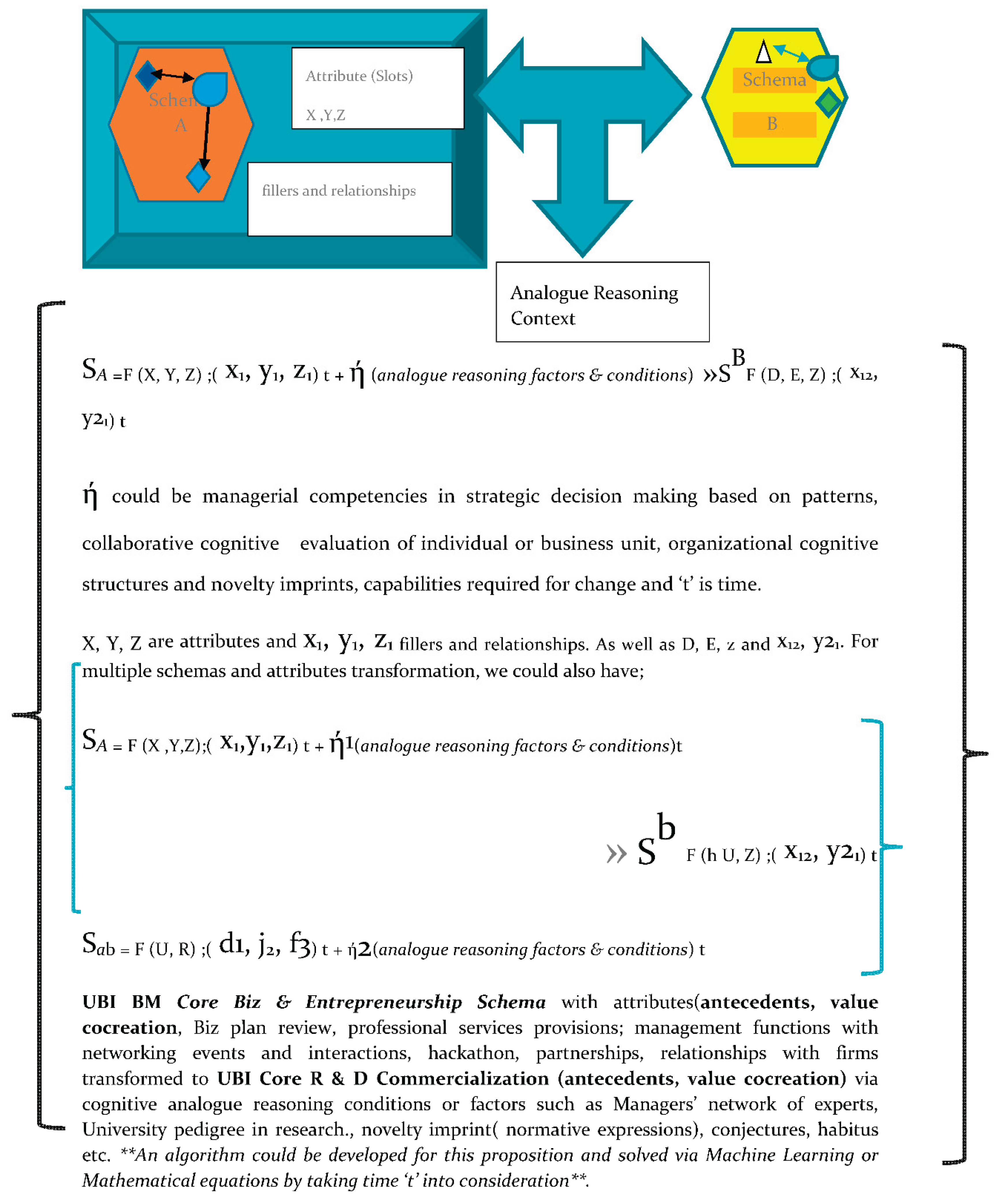
to this UBI BMI schema changes, a mathematical model (shown below) could be
written based on the attributes, fillers and relationships and other factors
within the analog reasoning context such as the capabilities required to effect
changes with the firm and adaptive measures required for change management.
Figure 5.
Illustration of schema transformation to another schema via analogue reasoning with mathematical assumptions.
Figure 5.
Illustration of schema transformation to another schema via analogue reasoning with mathematical assumptions.
Conclusions and Further Research Agenda
Having established
the UI BM typologies and the value creation and co-creation components with
adaptive and innovation processes, this research has provided the foundational
framework for how UBI BMs should be viewed, however further research areas
still exist within the UBI BM components. While UBI captured value and value
creation might have been discussed, the concept of Uncaptured value i.e. value
missed, in surplus or wasted(Wiggins and Gibson, 2003; Yang et al., 2017) in
UBI is less discussed and how this fits into the circular economy Business
model would be an important discuss moving forward. It would also be expedient
to capture how UBI BMs change overtime based on a longitudinal study.
In addition to this,
how UBI BMs antecedents (goals, mission, stakeholder activities and
environmental constraints) discussed in this study enhance UBI Sustainability
and Survivability could be investigated. It would also be novel to explore case
studies of UBI BMs in Circular economy based startups e.g. Deeptech, clean
energy. Further studies can also be conducted on UBI BMs typology while
comparing their performances overtime based on sustainability and survivability
of their startups. Other interesting topics would be investigating how UBI BMs
have transformed their schemas into related BM typologies. Due to the emerging
typologies, how ownership of the UBI and equity affect their performance could
be studied. Another interesting emerging UBI BM typology for further research
agenda is the UBI Ownership based BM which includes Non Profit, State and
University owned with city support, Separate university entity with R&D,
Regional & Government supported, Government and private funding Ownership
BMs. How this new UBI BM typology impact UBIs’ performance would be expedient
in further studies.
Overall, this study
has paved way for the articulation of UBI BM via typology. Further studies
would examine classification(empiricism) and machine learning applications.
This study has contributed to BMs knowledge via taking a holistic overview and
approach to understanding the rudiments of UBI BMs via the conceptual framework
developed across different industrial sectors and UBI Clusters. Mathematical
algorithms and machine learning models can also be developed as proposed to
study the schema changes processes overtime and how the combination of
attributes(slots) and relationships(fillers) are transformed into
other cumulative attributes for a new schema.
This study and its
subsequent investigations would serve as a template for UBIs and other BIs
manager to understand the BM components that correlate to their establishments
and roles within their ecosystem and cluster and how they can adapt to both
exogenous and endogenous factors towards BM Innovation.
Appendix A

Table A1.
Selected articles across different industrial sectors: Traditional UBI, Space(ESABIC), Biotech, MedTech, Luxury & Fashion, Nanotech, Networked of UBI and Automobile.
Table A1.
Selected articles across different industrial sectors: Traditional UBI, Space(ESABIC), Biotech, MedTech, Luxury & Fashion, Nanotech, Networked of UBI and Automobile.
| Article Description | BM Antecedents | Triggers (Exo & Endogenous factors) |
BMI type | BM components_ | BM Capabilities | BM System of activities_ | BMI Process_ |
|---|---|---|---|---|---|---|---|
| UK_Univ. of Southampton | Biz plan assessment startups mgt. team development founder_incubator_incubatee relationships |
Govt. policies via HEIF Uncertainties in high tech proposal commercialization flexibility in incubation process |
Incremental | Mentoring provisions Joint Biz plan & proposal review |
Network capabilities | Process modification as needed steady flow of Biz proposal to push the commercialization agenda |
professional service firms mentors supporting firm Biz proposal refinement fund access provision training initiatives VC availability external support network |
| University Innovation System research commercialization (Bwen Kwee Ng et al,2019) |
R&D investment & commercialization Stimulating entrepreneurship among graduates |
IP commercialization policy changes to favor researchers and R &D Networks to innovative firms & entrepreneurial communities |
Incremental and modular: btw 2000 and 2016 government and UBI took steps in shaping knowledge sharing, value delivery & policies to favor R & D, researchers |
IP Alliances with Universities, Research Institutes & Corporations Info know-how sharing Tech transfer facilitation btw Universities & Industry |
- collaborative development btw UBI Director and startups |
policies modification that suits Researchers and commercialization efforts |
R& D investment & commercialization Stimulating entpreneurshsip among graduates |
| UCF Florida(USA) | Regional _community partnerships to provide high-growth enterprise |
Regional economic diversification lack of interactions between incubator and clients(startups) |
Modular | Best practice in service delivery, community relationships, facilities provisions interactions fostering |
Regional community part nerships Network Capabilities |
need for interactions( horizontal and vertical) boards, community, clients, mentors |
|
| UNTEC; Vale DioRos, BRAZIL The University- firm interaction process in a UBI the case of Vale dio Ros, BRAZIL (Pinto, Magdalena, Bignetti,2004) |
Firms relationships with UBI | Managerial, Innovation, Financial |
|||||
| Austin Tech Incubator USA Wiggins and Gibson,2003 |
help startups stabilize generate wealth for stakeholders aid continual University value creation bringing innovative ideas to the market For profit-1% equity stake in startups Biz plan review facilitate regional economic development |
Reccession and economic downturn | Architectural & Modular based on US NBIA best practice for incubation success |
strategic, financial & infrastructural value delivery( facilities, funding, mentorship) joint biz plan review |
help startups stabilize generate wealth for stakeholders aid continual University value creation bringing innovative ideas to the market For profit-1% equity stake in startups Biz plan review facilitate regional economic development |
Reccession and economic downturn | Architectural & Modular based on US nbia best practice for incubation success |
| Hungary_ Zoltan Baltmozy ,2006 | UBI in less favored regions | Focus on life science | Regional Development Strategy via Life science startups development and diverse fields. | Incremental (evolutionary approach) | Pre-Incubation strategy Selection Policy |
Changes in Entrepreneurial behaviors overtime |
|
| South Africa_ Startups and Established Organization _requirements with UBI Klonaridis & De Klerk,2017 |
physical facilities general business services management services financial consulting networking & professional services |
high SMME failure rate need for regional development |
focus on high tech stimulates and launches Tech based startups |
high growth potential startups selection criteria based on innovativeness infrastructure and management provisions access to entrepreneurial support |
physical facilities general business services management services financial consulting networking & professional services |
high SMME failure rate need for regional development |
|
| Situated Regional UBI_ Stakeholder context (2 Cases) McAdam et al,2016 |
Regional partnership with UBI for Venture creation | excessive stakeholder' influence on incubation model excessive power exertion from stakeholders |
focus on digital, connected health, advanced engineering ( Biotech ,Nanotech) Radical innovation in BM :- based on changes in full dependency on funding source(Govt.) Transition of Incubator to Virtual due to funding issues |
traditional incubation support: infra ,networking, collaboration, knowledge exchange, consultancy |
Changes ,modification in BM due to regional influence, stakeholder power/salience impact on BM |
Regional partnership with UBI for Venture creation | |
| TH Venture Lab, Germany Case study Taiwo,2024:2025 |
Foster venture formation among students( Engineering) Venture Champion triggered |
Quest for funding Need for workflow changes |
'Radically Incremental'':- resource mgt. changes |
Initial Consultation with student entrepreneurs on ideas; Local Hackathon, weekend startup meets with mentors |
At inception: (Low) Entrepreneurship . Mindset among students; Low(Network Capabilities) Regional Funding support |
Changes ,modification due to workflow process expansion of resources due to fund received |
Foster venture formation among students( Engineering) Venture Champion triggered |
| INNOV_ unibator Case study (Taiwo,2024:2025) |
stimulate venture formation among students Diverse startups portfolio Support from Group of distinguished Venture champions(Professors) |
Strong University Heritage in Entrepreneurship | Incremental:- addition of Accelerator for matured startups |
rigid incubation selection criteria due to flurry of ideas |
Robust Ecosystem due to University & UBI location Funding ( Financial)Capabilities |
Recombination :- leading to Accelerator formation with intakes of matured startups from the incubator to facilitate equity generation for the UBI |
stimulate venture formation among students Diverse startups portfolio Support from Group of distinguished Venture champions(Professors) |
| ESA_ESABICs (Eldering and Hulsink,2022) |
Incubation for space Space for Incubation-ESA Network of Incubation Centers |
||||||
| Case study (Taiwo,2024:2025) 2 cases |
EU initiated( EU Template via ESA,IVO) but locally competed for Heritage in Space Research startups creation at all Space segments( Case 1) -focus on lower segment and other applications(waste management., telemedicine, Data Analytics & AI) Case 2) |
incremental:- gradual collaborative efforts | Rigorous selection criteria due to high competitive Space Ecosystem Joint Project facilitation Readily available funds |
Coproduction & Project collaboration with Firms and Entrepreneurs ; Open(Innovation) |
recombination for Trans-regional collaborative project in the upper segment of the space value chain |
Case study (Taiwo,2024:2025) 2 cases |
|
| University Sponsored Tech Incubators Case of 6 US U(T)BI |
Goals: Regional, state & local economic development research commercialization, tech transfer, Entrepreneurship. Skills development Non Profit, State and University owned with city support, Separate university entity with R&D |
Profit and nonprofit UBTIs External stakeholder support & collaboration Post incubator-startups linkages after graduation |
incremental and architectural based on NBIA standard practice |
IP Safeguards Equity stakes and royalties Graduate firm linkages |
Regional(state) collaboration with Universities |
Affordable rent space | |
| University Sponsored Tech Incubators Case of 6 US U(T)BIs Mian S.A,1994 |
Goals: Regional, state & local economic development research commercialization, tech transfer, Entrepreneurship. Skills development Non Profit, State and Univ. owned with city support, Separate university entity with R&D |
Profit and non-profit UBTIs External stakeholder support & collaboration Post incubator-startups linkages after graduation |
incremental and architectural based on NBIA standard practice |
IP Safeguards Equity stakes and royalties Graduate firm linkages |
Regional(state) collaboration with Universities |
Goals: Regional, state & local economic development research commercialization, tech transfer, Entrepreneurship. Skills development Non Profit, State and University, owned with city support, Separate university entity with R&D |
Profit and non-profit UBTIs External stakeholder support & collaboration Post incubator-startups linkages after graduation |
| Comparing Demand & Supply Sides of UBIs cases of UBIs, Germany Brunel, Clarysse, Groen 2014 |
venture formation idea generation & spin-offs |
infrastructure, biz support , access to networks | |||||
| Commercializing Science in Europe the Case of Cambridge University Biotech |
Research and Development ideas generation and startups spinoffs |
linkages btw firms and Universities Need for Firm University project collaboration Triggered by Government policies |
Lab facilities for research funding by regional government Resources ( finance) tech license offices |
In-depth-scientific capabilities |
|||
| Boston 128 Model US_ |
Regional & Govt. supported Heritage of Tech Universities spinoffs |
Continual spinoffs from Ivy league Universities (MIT, Stanford, Harvard, Boston) |
Architectural:- Boston 128 route shapes biotech spinoff activities | value c8tn via Research institutes, University spinoff network structure, Public &Private Org. Manufacturing companies presence for Info exchange |
opportunity recognition & exploitation capabilities of biotech researches by VCs |
Regional & Govt. supported Heritage of Tech Universities spinoffs |
Continual spinoffs from Ivy league Universities (MIT, Stanford, Harvard, Boston) |
| Case of Israel, Biotech Breznitz,2012 |
Focus on R & D in the production segment of lifescience value chain Govt. initiated |
funding differences across lifescience clusters compared to Europe or US Incubators silo operations due to complex working relationships with firms and lack of time and support for firms lack of experts in later stages of production |
knowledge supply based cluster R&D focused |
R &D Capabilities Presence of Highly ranked Universities in Science |
Cluster Sustainability_ Israeli Life science Industry |
||
| Biotech MG Centers: Toronto Montreal Niosi_Bas,2002 |
Formed from Govt. initiated strategy Govt.(Montreal) and private(Toronto) funding Continual University spinoffs |
presence of VCs private and public | Presence of large firms(MNCs) for project collaborations Readily available VC support |
Funding ,R&D, Integrated support system Collaborative ecosystem |
Formed from Govt. initiated strategy Govt.(Montreal) and private(Toronto) funding Continual University spinoffs |
presence of VCs private and public | |
| What is glocal and local: Case of Biotech Cluster in Uppsala, Sweden Waxell and Malmberg,2007 |
Highly intense Biotech activities city known for Biotech research heritage |
weak representation of local VCs proximity to Stockholm thereby attracting pool of experts |
Presence of large firms(MNCs) for project collaborations Labor mobility |
loyalty and trust among actors and to cluster fostered a growing relationship Global market interactions |
Highly intense Biotech activities city known for Biotech research heritage |
weak representation of local VCs proximity to Stockholm thereby attracting pool of experts |
|
| Case of Biotech UBIs Taiwo,2024:2025 |
Research Commercialization Joint projects execution with firms Startup and venture formation |
Triggered by Firm presence Government Policies University-Firm collaboration( Projects) |
Capabilities required for: Early Stage, Matured Stage, Entrepreneurial Survival, Regional Biotech, Perseverance ( throughout Value chain) | Research Commercialization Joint projects execution with firms Startup and venture formation |
Triggered by Firm presence Government Policies University-Firm collaboration( Projects) |
||
| Case of MedTech_ UBIs_ DE Taiwo,2025 |
Collaboration for joint cluster projects with Univ. and Firms Patenting of research and new firm spinoffs from clusters |
Continual support from Regional & National levels Heritage of Univ. UBI in MedTech Research, spinoff & Patenting (Pre-historic) Regional heritage for MedTech based activities A Municipal RIS based Cluster surrounded with robust EE attributes and leverage on RIS Infra and support |
Incremental: Based on adjustment of BM /Cluster processes to Regional & national changes |
Presence of large firms for project support proximity of firms-University & cluster executives for extensive knowledge creation and flow (exchange) High value cocreation among actors thereby achieving Top Cluster status in Europe |
Robust & Sustainable Cluster Adaptation & Challenges Idea Gen & Startups Success, TTO/ Actor Impact |
Collaboration for joint cluster projects with Univ. and Firms Patenting of research and new firm spinoffs from clusters |
continual BM modification and adaptation of processes. e.g. Extension market entry to foreign firms |
| Providing Business Support for small and medium enterprises in London Fashion Sector UK Tirani and Banks,2014 |
Grow high-end fashion businesses Reduce business risks Question reactionary fashion culture expand ability to connect |
short fashion product life cycle sourcing in manufacturing materials |
Grow high-end fashion businesses Reduce business risks Question reactionary fashion culture expand ability to connect |
short fashion product life cycle sourcing in manufacturing materials |
|||
| Promoting Innovation Within the Fashion-tech Sector. The Role of Pan-European Projects Colombi, Lodovico, Roncha,2021 |
provide network opportunities for fashion designers provision of funding for ideas and startups in the fashion sector | Technologies disruptions e.g. IoT, AI, data analytics, ML in Fashion & Luxury |
provide network opportunities for fashion designers provision of funding for ideas and startups in the fashion sector | Technologies disruptions e.g. IoT, AI, data analytics, ML in Fashion & Luxury |
|||
| Nanoscience and Nanotech: How an emerging area of scientific agenda of core countries in Latin America | Invernizzi, Matthieu Hubert and Dominique Vinck , | ||||||
| Rejuvenation sleeping anchor nanotech clusters: pre-adaptation & lifecycle |
for Regional & economic development | triggered by major actor STM microelectronics, networks formation via clusters and continual technology adaptation |
Incremental via tech pre-adaptation | co-creation with firms Universities and major MNC, project and research enhancement via Univ. |
|||
| Patterns of nanotechnology innovation and governance within a metropolitan area Foley and Wiek,2013 Phoenix, US |
cater for an aging population in the Phoenix region with new Nano based high-tech products tap into the solar PVAs resources of the Arizona region |
changing and divergent tech landscape government controlled commercialization process |
incremental :- phase based innovation from :initialization to commercialization | a placed based innovation ecosystem with diversified portfolio( defense, healthcare, solar) | regional infra support | knowledge creation within clusters; inter-firm healthy competition giving rise to innovation(Grenoble),day(internal) and external strategic collaboration for knowledge exchange and tech & cluster rejuvenation |
cater for an aging population in the Phoenix region with new Nano based high-tech products tap into the solar PV resources of the Arizona region |
| Japanese nanotech and industry landscape | Andre Zägar,2014 | early stage funding and high involvement of academia at the initialization phase( R&D) | |||||
| Robertson and Kitigawa, 2011 _mediating regional …Case of SET Squared, UK | Build 'critical mass' of R & D Accelerate spinoffs from Universities and incubators via joint facilitation Develop vast networks of actors within each regional ecosystem and towards regional and national growth and economic development |
Joint regional collaboration via HEIF Universities heritage and pedigree in research and spinoff e.g. Southampton compared to Stanford Changes in internal governance and processes without impacting the central governance and control |
incremental: for regional adaptation Architectural: for central changes Radical: from regional each University e.g. Director Bath forming developing regional network outside the central network. Each Director has the authority to implement changes at the regional level |
Cocreation with actors in the system via partnerships and networks(Business) like BEN-Business Enterprise Networks Enhanced Regional value cocreation via projects collaboration. Universities as Knowledge Mediators and Boundary Spanners. |
Collaborative :- Network Capabilities (partnerships, coordination, marketing, communication) coupled with enhanced EO( risk and proactiveness with innovation) |
Build 'critical mass' of R & D Accelerate spinoffs from Universities and incubators via joint facilitation Develop vast networks of actors within each regional ecosystem and towards regional and national growth and economic development |
Joint regional collaboration via HEIF Universities heritage and pedigree in research and spinoff e.g. Southampton compared to Stanford Changes in internal governance and processes without impacting the central governance and control |
| Build 'critical mass' of R & D Accelerate spinoffs from Universities and incubators via joint facilitation Develop vast networks of actors within each regional ecosystem and towards regional and national growth and economic development |
Joint regional collaboration via HEIF Universities heritage and pedigree in research and spinoff e.g. Southampton compared to Stanford Changes in internal governance and processes without impacting the central governance and control |
incremental: for regional adaptation Architectural: for central changes Radical: from regional each University e.g. Director Bath forming developing regional network outside the central network. Each Director has the authority to implement changes at the regional level |
Cocreation with actors in the system via partnerships and networks(Business) like BEN-Business Enterprise Networks Enhanced Regional value cocreation via projects collaboration. Universities as Knowledge Mediators and Boundary Spanners. |
Collaborative :- Network Capabilities (partnerships, coordination, marketing, communication) coupled with enhanced EO( risk and proactiveness with innovation) |
Shared rent facilities mentorship and training on entrepreneurship Networks of entrepreneurs |
Shared rent facilities mentorship and training on entrepreneurship Networks of entrepreneurs |
|
| NIMELA, Artic Region Case of Oulu, Tromso and Lulea | For Innovative Infrastructural development with the respective innovative tools and processes To facilitate students integration with firms via internships and mentorship while providing consulting services develop innovative spinoffs in high-tech( biotech) Development of innovation hubs for effective innovation concentration |
Triggered by aging population, peripheral, border regions entrepreneurial activities disadvantages Harsh climatic disadvantages and the need to ensure continual innovation within the Scandinavian region to facilitate project funding rather than continual development on public funds Heritage of research and academic pedigree( OULU) |
Radical:- Innovation is key survive in the entrepreneurial disadvantaged region Incremental:- assessment of Innovation programs in the early stage would take some time |
Presence of value cocreation actors between Universities and firms for research commercialization and spinoffs. Engagement of students in entrepreneurial related activities to stimulate Ent. Mindset( e.g. Business Kitchen) Creating the right environment for labor & expert mobility |
Relational Alliance Capabilities Innovative Capabilities |
Recombination of operational processes to facilitate business model expansion for innovation modification of processes |
Build 'critical mass' of R & D Accelerate spinoffs from Universities and incubators via joint facilitation Develop vast networks of actors within each regional ecosystem and towards regional and national growth and economic development |
| The Role of University in Agro innovation development in Africa Rukarwa,Mensah,Egeru,2018 |
development of Innovation hubs testing students' business models at the incubation phase. Aid the University to develop innovation ecosystem that fosters agric-hubs developing entrepreneurship agro-hubs via knowledge and information mechanisms and innovation development |
the need for regional development via agro biz facilitate innovative agro biz development via Universities partnerships |
Modular:- based on RUFORUM,RECAP activities among institutions of participation. | encourage Universities partnerships and integration via the RUFORUM network. Funding provision via proposals from participating universities |
|||
| URI Universities Research Institutes) and RIS: the cases of Beijing and Shenzhen Kun Chen ,2017 |
For continual Research commercialization and spinoff- regionally and nationally facilitate spinoffs among Universities in both regions Enhance linkages with firms and graduates( abroad) for local venture formation |
Effect of rising infra shortages and cost stemmed for new innovation milieu Need for an Holding firm to cater for spinoff and incubation expansion Procedures and Equity or stake in spinoff companies |
Radical:- establishment of holding firms for funding, management and linkages of spinoffs/incubators within the park Incremental:- linkages with local firms and infrastructural and entrepreneurial support provision due to expansion of incubators’ |
Co-creation via joint research collaboration with firms ,foreign local students(Chinese) in the US Provision of amenities:- rent or shared space, mentoring network and professional consultations for incubators in the Park Increased R& D activities via project funding and researchers' availability |
Scientific and knowledge research (academic) capabilities Networking Capabilities Human Resource availability ( Munificence) |
For continual Research commercialization and spinoff- regionally and nationally facilitate spinoffs among Universities in both regions Enhance linkages with firms and graduates( abroad) for local venture formation |
|
| ALLIANCE:-Transforming Open Research and Innovation through CHARMS -TORCH: An EU Horizon Project 2022 |
Develop entrepreneurship mindset among students provide support: funding and incubation services to students engage students in entrepreneurial related activities to facilitate valorization To provide training via mentorship, networking and collaboration to students |
EU based policies for entrepreneurship development among students University collaboration and alliance formation for collective yet distributed advantages |
Incremental :- gradual and planned ( roadmap) innovation development for students and each University Architectural:- Based on the EU project plan and goals, each University developed a contingent plan for entrepreneurship development |
Provision of pre-incubation and incubation training and support for students linking students with mentors for training and entrepreneurship development funding for startups Unique Entrepreneurship education programs at each Universities |
Entrepreneurial Mindset ( development) capabilities |
modification _changes of organizational structures via changes to Holding firm. Recombination of NIS, RIS resources to foster enhanced infrastructural support in |
Develop entrepreneurship mindset among students provide support: funding and incubation services to students engage students in entrepreneurial related activities to facilitate valorization To provide training via mentorship, networking and collaboration to students |
| Why Universities create and foster BIs_ Case of New Mexico State University(NWSU) Ejiro Osiobe and Kraer WinningHam,2020 |
Develop National Security Technologies via incubation support startups creation for regional economic development in the La Crunes region |
Overall Impact of the UBI at that point was qustionable Regional policies for development via tech support program and incubation |
Incremental participation and support for student entrepreneurs |
provision of amenities across different departments stages or phases of incubation for entrepreneurs supporting entrepreneurs with fund |
entrepreneurial activities development among students via participation in Entrepreneurship Training |
Develop National Security Technologies via incubation support startups creation for regional economic development in the La Crunes region |
Overall Impact of the UBI at that point was questionable Regional policies for development via tech support program and incubation |
| FINTECH_INSURETECH | |||||||
| Facilitating Innovation in Fintech: a review | Alssard, Laurie, Helge Aas,2021 | incubators impact on fintech requires more research |
|||||
| RSO lifecycle and banking relationships and incubation dev_ case of Italy |
Fassano et al., 2023 | ||||||
Table A2.
UBI Models Typology Classification.
| Typology | CORE BIZ & MGT function |
CORE R& D Commercialization |
Regionally Initated |
Opportunity Based UBIs | Industry Focussed ( Lifescience) | CORE BIZ & MGT function |
|---|---|---|---|---|---|---|
| Biz plan assessment Biz plan review general business services management services financial consulting networking & professional service provision of funding for ideas and startups in the fashion sector |
R& D investment & commercilaization |
Regional _community partnerships facilitate regional economic development Regional partnership with UBI for Venture creation |
cater for an aging population in the Phoenix region with new Nano based hightech products tap into the solar Pv resources of the Arizona region Create software tech products |
Focus on life science mixed manufcturing startups Focus on science (biomed) |
Biz plan assessment Biz plan review general business services management services financial consulting networking & professional service provision of funding for ideas and startups in the fashion sector |
|
| startups mgt.team development Entp. Skills development Reduce Biz Risk |
commercialization,tech txfer, | Regional,state & local economic development research Joint projects execution with firms |
heritage in space research startups creation at all space segments Focus on lower segments and other applications |
startups mgt.team development Entp. Skills development Reduce Biz Risk |
||
|
founder_incubator_ incubatee relationships expand ability to connect |
Research and Development Build 'critical mass' of R & D |
Collaboration for joint cluster projects with Univ. and Firms |
Create startups for software tech development | Heritage of Tech Universities spinoffs Question reactionary fashion culture |
founder_incubator_ incubatee relationships expand ability to connect |
|
| Research Commercialization For continual Research commerialization and spinoff- regionally and nationally |
for Regional & economic development | Focus on R & D in the production segment of lifescience value chain |
Research Commercialization For continual Research commerialization and spinoff- regionally and nationally |
|||
| Stimulating entpreneurshsip among graduates Foster venture formation among students( Engineering) stimulate venture formation among students |
Develop National Security Technologies via incubation support startups creation for regional economic development in the La Crunes region |
Highly intense Btech activities City known for Biotech research heritage |
Stimulating entpreneurshsip among graduates Foster venture formation among students( Engineering) stimulate venture formation among students |
|||
| To provide high-growth enterprise help startups stabilize |
EU intiated but competed for locally Govt. Initiated Formed from Govt. initiated strategy |
cater for an aging population in the Phoenix region with new Nano based hightech products tap into the solar Pv resources of the Arizona region |
to provide high-growth enterprise help startups stabilize |
|||
| bringing innovative ideas to the market aid continual University value creation |
||||||
| venture formation idea generation & spin-offs Continual Univ. spinoffs |
||||||
| ideas generation and startups spinoffs Startup and venture formation |
||||||
| Patenting of research and new firm spinoffs from clusters |
||||||
| Grow high-end fashion businesses | ||||||
| Accelerate spinoffs from Universities and incubators via joint facilitation |
Table A3.
UBI BMs Triggers based on Extant literature.
| Global | SIS_EU | NIS_RIS(Regional & National) | Cluster (Industry specific) | Organizational( Firms and UBI ) | Organizational _UBI | Operational ( UBI) |
|---|---|---|---|---|---|---|
| Climatic conditions Climate changes, CO2 Emissions Recession, meltdown/Financial meltdown Global Tech disruption Change Tech landscape Tech Evolution Uncertainties in High-Tech commercialization (proposal) Firm triggered disruption by STM Microelectronics: causing innovation Development in Nanotech and Pharmacia leaving a region in Karolina Institute(KI) |
EU Govt. Policies on Entrepreneurship development EU Regulations |
Regional Economic diversification Regional Development, Continual Regional Support, Regional heritage in specific research, RIS municipal ecosystem, Innovation development, Regional policies for development via Tech support programs and incubation |
Life science development, SMMEs failure, Funding difference in life science clusters compared to EU or US, Short PLC, Sourcing in Manufacturing Industry , dominance(Fintech organization dominance) |
Formal Industrial linkages and collaborations Presence of Innovative firms VC Firms presences University spinoff in Ivy league |
Interaction gap between incubator and incubatee Stakeholder influence on incubate model Power exertion by Stakeholder Funding Generation Questionable UBI Impact |
Flexibility in incubation process IP Commercialization Silo Operations Lack of time and experts Stakeholder influence on incubation model Power exertion by Stakeholders Questionable UBI IMPACT Funding Sourcing and Generation |
Appendix B
Table A4.
Business Model literatures for Conceptual Framework Development.
| Article Description | Author(s) | Journal | Context BM,BMI, etc. |
|---|---|---|---|
| 1. Value uncaptured perspective for sustainable business model innovation | Yang, M; Evans, S; Vladimirova, D; et al. | ORE Open Research Exeter | Extracting uncaptured values in BMs |
| 2.what-drives-business-model-adaptation-impact the impact of opportunities, threats and strategic orientation | Tina Saebi, Lasse Lien, Nicolai J Foss | Long Range Planning, 50 (5). pp. 567-581. |
BM Adaptation |
| 3. unlocking the hidden value of concepts: a cognitive approach to business model innovation | Luis l. martins, violina p. rindova, and bruce e. greenbaum ,2015 | Strategic Entrepreneurship Journal Strat. Entrepreneurship J., 9: 99–117 (2015) Published online in Wiley Online Library (wileyonlinelibrary.com). DOI: 10.1002/sej.119 |
BM Innovation( Cognitive Generation) |
| 4.The entrepreneur’s business model: toward a unified perspective | Michael Morrisa,*, Minet Schindehutteb , Jeffrey Allen | Journal of Business Research 58 (2005) 726 – 735 | BM concepts |
| 5. The business model: recent developments and future research | Christoph Zott, Raphael Amit, Lorenzo Massa, Feb, 2011 | ssrn-1674384.pdf | |
| 6. The Business Model in Practice and its Implications for Entrepreneurship Research | GERARD GEORGE, ADAM J. BOCK, September 09, 2009 | Entrepreneurship theory & practice (forthcoming) | BM Perspectives and concepts with Discourse Analysis |
| 7. Designing your future business model: an activity system perspective | Christoph Zott Raphael Amit,2009 | IESE ,Navara | BM Design as activity system |
| 8. The business model: an integrative framework for strategy execution | James Richardson | ssrn-932998.pdf | |
| 9. The Genesis and Metamorphosis of Novelty Imprints: How Business Model Innovation Emerges in Young Ventures |
https://www.researchgate.net/ publication/331797722 Yuliya Snihur,Christian Zott |
||
| 10. Business model innovation: a review of the process-based literature | Daniela Andreini1 · Cristina Bettinelli · Nicolai J. Foss · Marco Mismetti, 2021 |
Journal of Management and Governance (2022) 26:1089–1121 https://doi.org/10.1007/s10997-021-09590-w |
|
| 11. The business model concept: theoretical underpinnings and empirical illustrations | Jonas Hedman and Thomas Kalling | European Journal of Information Systems (2003) 12, 49–59 | |
| 12. Business model design: conceptualizing networked value co-creation | Suvi Nenonen and Kaj Storbacka | The 2009 Naples Forum on Services: Service-Dominant Logic, Service Science, and Network Theory | Network valued cocreation with capabilities |
| 13. The sites and practices of business models | Katy Mason a, ⁎, Martin Spring, 2011 | Industrial Marketing Management | Tech,Network and market offering in BMs |
| 14. Crafting business architecture: the antecedents of business model design |
Raphael Amit and Christoph zott | Strategic entrepreneurship journal copyright © 2015 strategic management society strat. entrepreneurship j., 9: 331–350 (2015) | |
| 15.Conceptualizing a "Sustainability Business Model" | Wendy Stubbs and Chris Cocklin,2008 | Organization Environment 2008; 21; 103 | |
| 16. Business Model Innovation | Lorenzo Massa, Christopher Tucci, | The Oxford Handbook of Innovation Management. Edited by Mark Dodgson,David Gann & Nelson Phillips. ISBN: 9780199694945 | |
| 17. The Importance of Classification to Business Model Research | Dr. Susan C. Lambert | Journal of Business Models (2015), Vol. 3, No. 1, pp. 49-61 | BM Classification(typology and Taxonomy) |
| 18.The Sustainable Business Model Pattern Taxonomy – 45 Patterns to Support Sustainability-Oriented Business Model Innovation |
https://www.researchgate.net/ publication/325957687 Florian Lüdeke-Freund*, Sarah Carroux, Alexandre Joyce, Lorenzo Massa, Henning Breuer |
https://www.researchgate.net/ publication/325957687 |
|
| 19. Business Models as Models Charles Baden-Fuller* and Mary S. Morgan | Baden-Fuller, C & Morgan, MS (2010). Business Models as Models. LONG RANGE PLANNING, 43(2-3), p156-171 | ||
| 20. A typology of sustainable circular business models with application in bioeconomy | Erika De Keyser* and Erik Mathijs | ||
| 21. Classification tools for business models: Status quo, comparison, and agenda | Thorsten Schoormann, · Julia Schweihof · Ilka Jussen3 · Frederik Mölle |
Electronic Markets (2023) 33:7 https://doi.org/10.1007/s12525-023-00639-2 | |
| 22.Cluster Typology of Business Models of Start-Ups. (Example of Slovakia) | Štefan Slávik * , Richard Bednár , Ivana Mišúnová Hudáková and Katarína Moravˇcíková, 2020 | MDPI Administrative science | |
| 23. Business model innovation: a typology | Elena Casprini,2015 | sinergie Italian journal of management Vol. 33, N. 97, 2015 | |
| 24._Taxonomy_of_Carsharing_Business_Models | Gerrit Remane ,Robert C. Nickerson, Andre Hanelt , Jan F. Tesch University of and Lutz M. Kolbe | Thirty Seventh International Conference on Information Systems, Dublin 2016 | |
| 25.Typology-of-digital-business-models-in-tourism | Zentner_Spremi_2021 | IJESM | |
Table A5.
showing the UBI BM Typology.
| UBI BM Typology |
| UBI BM Antecedents |
| Goals, Template, Stakeholders, environment constrains |
| Core Business & Entrepreneurship BM |
| Core R & D commercialization |
| Industry focused or specialized BMs(Life science, Space, Luxury) |
| Regionally Initiated BM |
| Opportunity Based BMs |
References
- Al-Mubaraki, H.M.; Busler, M. The incubators economic indicators: Mixed approaches. Journal of Case Research in Business and Economics 2012, 4, 1. [Google Scholar]
- AL-Mubaraki, H.M.; Busler, M. Incubator successes: Lessons learned from successful incubators towards the twenty-first century. World Journal of Science, Technology and Sustainable Development 2014, Preprint. [Google Scholar]
- Baraldi, E.; Havenvid, M.I. Identifying new dimensions of business incubation: A multi-level analysis of Karolinska Institute’s incubation system. Technovation 2016, 50, 53–68. [Google Scholar] [CrossRef]
- Baraldi, E.; Ingemansson, M.; Launberg, A. Controlling the commercialisation of science across inter-organisational borders: Four cases from two major Swedish universities. Industrial Marketing Management 2014, 43(3), 382–391. [Google Scholar] [CrossRef]
- Becker, B.; Gassmann, O. Corporate incubators: Industrial R&D and what universities can learn from them. The Journal of Technology Transfer 2006a, 31, 469–483. [Google Scholar]
- Becker, B.; Gassmann, O. Gaining leverage effects from knowledge modes within corporate incubators. R&d Management 2006b, 36(1), 1–16. [Google Scholar]
- Breznitz, S.M. Cluster sustainability: the Israeli life sciences industry. Economic Development Quarterly 2013, 27(1), 29–39. [Google Scholar] [CrossRef]
- Breznitz, S.M.; O’Shea, R.P.; Allen, T.J. University commercialization strategies in the development of regional bioclusters. Journal of product innovation management 2008, 25(2), 129–142. [Google Scholar] [CrossRef]
- Bruneel, J.; et al. The Evolution of Business Incubators: Comparing demand and supply of business incubation services across different incubator generations. Technovation 2012a, 32(2), 110–121. [Google Scholar] [CrossRef]
- Bruneel, J.; et al. The Evolution of Business Incubators: Comparing demand and supply of business incubation services across different incubator generations. Technovation 2012b, 32(2), 110–121. [Google Scholar] [CrossRef]
- Clarysse, B.; Tartari, V.; Salter, A. The impact of entrepreneurial capacity, experience and organizational support on academic entrepreneurship. Research policy 2011, 40(8), 1084–1093. [Google Scholar] [CrossRef]
- Collins, K.M.; Onwuegbuzie, A.J.; Jiao, Q.G. A mixed methods investigation of mixed methods sampling designs in social and health science research. Journal of mixed methods research 2007, 1(3), 267–294. [Google Scholar] [CrossRef]
- Cooke, P. Biotechnology Clusters in the UK: Lessons from Localisation in the Commercialisation of Science. Small business economics 2001a, 17, 43–59. [Google Scholar] [CrossRef]
- Cooke, P. New economy innovation systems: biotechnology in Europe and the USA. Industry and Innovation 2001b, 8(3), 267–289. [Google Scholar] [CrossRef]
- Cooke, P. Regional innovation systems, clusters, and the knowledge economy. Industrial and corporate change 2001c, 10(4), 945–974. [Google Scholar] [CrossRef]
- Creswell, J.W. Mixed-method research: Introduction and application. In Handbook of educational policy; Elsevier, 1999; pp. 455–472. [Google Scholar]
- Daniela, A.; et al. Business model innovation: a review of the process-based literature. Journal of Management and Governance 2019, 26, 1089–1121. [Google Scholar] [CrossRef]
- Eldering, C.; Hulsink, W. Incubation with space–space for incubation: the European Space Agency’s network of business incubation centers. Handbook of Research on Business and Technology Incubation and Acceleration: A Global Perspective 2021, 160. [Google Scholar]
- Fielt, E. Conceptualising business models: Definitions, frameworks and classifications. Journal of business models 2013, 1(1), 85–105. [Google Scholar]
- Gabriel, R.; Sörvik Anna, Z.; Matilda, A. Place-Based Innovation Ecosystems:Volvo companies in Gothenburg (Sweden). EUR 29494 EN, Publications Office of the European Union, Luxembourg. 2019. [CrossRef]
- George, G.; Bock, A.J. The Sustainabable Business Patterns Taxonomy: 45 Patterns to explain Sustainability Oriented Business Model Innovation. Strategic Entrepreneurship Journal 2015, Preprint. [Google Scholar]
- Grimaldi, R.; Grandi, A. Business incubators and new venture creation: an assessment of incubating models. Technovation 2005a, 25(2), 111–121. [Google Scholar] [CrossRef]
- Grimaldi, R.; Grandi, A. Business incubators and new venture creation: an assessment of incubating models. Technovation 2005b, 25(2), 111–121. [Google Scholar] [CrossRef]
- Gustavo, H.S.M. de M.; et al. Corporate entrepreneurship at the university: the influence of managerial support, autonomy and reward on the innovative behaviour of university professors. Journal of Entrepreneurshi in Emerging Economies Emerald Publishing Limited 2021, Preprint. [Google Scholar] [CrossRef]
- Harris, J.L. Bridging the gap between ‘Fin’and ‘Tech’: The role of accelerator networks in emerging FinTech entrepreneurial ecosystems. Geoforum 2021, 122, 174–182. [Google Scholar] [CrossRef]
- Hedman, J.; Kalling, T. The Business Model concept: theoretical underpinnning and emprical Ilustrations. European Journal of Information Systems 2003, 12, 49–59. [Google Scholar] [CrossRef]
- Hintsala, H.; Niemelä, S.; Tervonen, P. Arctic innovation hubs: opportunities for regional co-operation and collaboration in Oulu, Luleå, and Tromsø. The Northern Review 2017, 45, 77–92. [Google Scholar] [CrossRef]
- Kathleen, M.E. Building theories from Case Study Research. Academy of Management Review 1989, 14(4), 532–550. [Google Scholar]
- Kitagawa, F.; Robertson, S. High-tech entrepreneurial ‘soft starters’ in a university-based business incubator: space for entrepreneurial capital formation and emerging business models. In New Technology-Based Firms in the New Millennium; Emerald Group Publishing Limited, 2015. [Google Scholar]
- Klonaridis, R. COMPARISON BETWEEN SOUTH AFRICAN SERVICE INDUSTRY SECTORS’REQUIREMENTS FROM UNIVERSITY BUSINESS INCUBATORS. International Journal Of Business And Management Studies 2020, 12(1), 225–240. [Google Scholar]
- Kun, C.; Martin, K. Universities/Research Institutes and Regional Innovation Systems: The Cases of Beijing and Shenzhen. BRIE Working Paper 168 2005, Preprint. [Google Scholar]
- Lagos, D.; Kutsikos, K. The role of IT-focused business incubators in managing regional development and innovation. 2011. [Google Scholar]
- Lambert, S. The importance of classification to business model research. Journal of Business Models 2015, 3(1). [Google Scholar]
- Lee, S.S.; Osteryoung, J.S. A comparison of critical success factors for effective operations of university business incubators in the United States and Korea. Journal of small business management 2004, 42(4), 418–426. [Google Scholar] [CrossRef]
- Lüdeke, F.; et al. The Sustainabable Business Patterns Taxonomy: 45 Patterns to explain Sustainability Oriented Business Model Innovation. Sustainable Production and Consumption 2018, 15, 145–162. [Google Scholar] [CrossRef]
- MARTINS, L.; RINDOVA, V.P.; GREENBAUM, B.E. UNLOCKING THE HIDDEN VALUE OF CONCEPTS: A COGNITIVE APPROACH TO BUSINESS MODEL INNOVATION. Strategic Entrepreneurship Journal 2015, Preprint. [Google Scholar]
- Mason, K.; Spring, M. The sites and practices of business models. Industrial Marketing Management; Elsevier, 2011. [Google Scholar] [CrossRef]
- Massa, L.; Tucci, C. (no date) Business Model Innovation:Book Chapter (forthcoming): The Oxford Handbook of Innovation Management.. The Oxford Handbook of Innovation Management( Forthcoming). In ISBN: 9780199694945., The Oxford Handbook of Innovation Management; Dodgson, Mark, Gann, David, Phillips, Nelson, Eds.; Preprint.
- McAdam, M.; et al. Business processes and networks in university incubators: A review and research agendas. Technology analysis & strategic management 2006, 18(5), 451–472. [Google Scholar]
- McAdam, M.; Miller, K.; McAdam, R. Situated regional university incubation: A multi-level stakeholder perspective. Technovation 2016a, 50, 69–78. [Google Scholar]
- McAdam, M.; Miller, K.; McAdam, R. Situated regional university incubation: A multi-level stakeholder perspective. Technovation 2016b, 50, 69–78. [Google Scholar]
- Mian, S.A. US university-sponsored technology incubators: an overview of management, policies and performance. Technovation 1994, 14(8), 515–528. [Google Scholar] [CrossRef]
- Mian, S.A. Assessing and managing the university technology business incubator: an integrative framework. Journal of business venturing 1997, 12(4), 251–285. [Google Scholar]
- Michael, M.; Minet, S.; Jeffery, A. The entrepreneur’s business model: toward a unified perspective. Journal of Business Research ELSEVIER 2005, 58, 726–735. [Google Scholar]
- Moranta, S.; Donati, A. Space Ventures Europe 2018—entrepreneurship and private investment in the European Space Sector. New Space 2020, 8(1), 7–17. [Google Scholar] [CrossRef]
- Muathe, S.; Otieno, V. STARTUP INCUBATION AND ACCELERATORS IN AFRICA; ARE START-UPS SCALING UP IN KENYA? American International Journal of Social Science Research 2022, 11(1), 23–28. [Google Scholar] [CrossRef]
- Nelsen, L.L. The role of research institutions in the formation of the biotech cluster in Massachusetts: The MIT experience. Journal of Commercial Biotechnology 2005, 11, 330–336. [Google Scholar] [CrossRef]
- Nenonen, S.; Storbacka, K. Business model design: conceptualizing networked value co-creation. The 2009 Naples Forum on Services: Service-Dominant Logic, Service Science, and Network Theory 2009, Preprint. [Google Scholar]
- Nicola, J.; Tina, F.S. Business models and business model innovation: Between wicked and paradigmatic problem. Long Range Planning Elsevier Available at. 2018, 51, 9–21. [Google Scholar] [CrossRef]
- Nkosinathi, S.; Robert, O.R. Commercialisation of research and technology: A multiple case study of university technology business incubators. African Journal of Business Management 2014, 8(16), 641–659. [Google Scholar] [CrossRef]
- Obaji, N.; Olugu, M.; Obiekwe, B. Business incubation adaptation and success factors in nigerian context of a developing country: A Literature Review. International Journal of Science Technology & Management 2015, 401, 1529–2394. [Google Scholar]
- Pillay, N.S.; Uctu, R. A snapshot of the successful bioclusters around the world: Lessons for South African biotechnology. Journal of Commercial Biotechnology 2013, 19(1). [Google Scholar] [CrossRef]
- Rasmussen, E.; Borch, O.J. University capabilities in facilitating entrepreneurship: A longitudinal study of spin-off ventures at mid-range universities. Research policy 2010, 39(5), 602–612. [Google Scholar] [CrossRef]
- Richardson, J. The Business Model Conet. Shilder College of Business, University of Hawai at Manoa 2005, Preprint. [Google Scholar]
- Rider, W.; Arnim, F.W. Patterns of nanotechnology innovation and governance within a metropolitan area. Technology in Society Available at. 2013, 35(4), 233–247. [Google Scholar] [CrossRef]
- Taiwo, A. University Business Incubators (UBIs) Based Projects in Collaboration with the Academia, Regional Governments, and Digital Innovation Hubs (A Spin-off from DBA Research 2022/23). Global journal of Business and Integral Security [Preprint]. 2023. Available online: https://gbis.ch/index.php/gbis/article/view/256.
- Taiwo, A. A MIXED METHOD GROUNDED THEORY (MM-GT) WITH INTELLIGENT GIS AND MACHINE LEARNING APPROACH TO UNIVERSITY BASED BIOTECH BUSINESS INCUBATORS (UBBI) CLUSTERS: A STRONG STRUCTURATION AND SPATIAL AGGLOMERATION VIEW. Global journal of Business and Integral Security 2024a, 1(2). [Google Scholar]
- Taiwo, A. EUROPEAN SPACE AGENCY BUSINESS INCUBATION CENTERS’(ESABIC) DYNAMIC CAPABILITIES, ENTREPRENEURSHIP ACTIVITIES AND VALUE CREATION WITH STRUCTURATION THEORY APPLICATION: A MIXED METHOD STUDY WITH MACHINE LEARNING MODELING. Global journal of Business and Integral Security 2024b, 1(2). [Google Scholar]
- Taiwo, A. MACHINE AND DEEP LEARNING MODELING OF UNIVERSITY BUSINESS INCUBATORS (UBI) DYNAMIC CAPABILITIES WITH THEIR ENTREPRENEURIAL ACTIVITIES AND VALUE CREATION: A MIXED METHOD STUDY. Global journal of Business and Integral Security 2024c, 1(2). [Google Scholar]
- Taiwo, A.; Provodnikova, A. A Proposed Mixed Methods Strong Structuration Theory(SST) with Dynamic Social Network Analysis(DSNA): A myth to be unraveled? 2025, Preprints. [Google Scholar] [CrossRef]
- Tarek E, V.; Mark, B. Profiling business support provision for small, medium and micro-sized enterprises in London’s fashion sector. Creativeworks London Working Paper Series No.9 2014, Preprint. [Google Scholar]
- TORCH Consortium. TORCH D5. 4-Report on Student Entrepreneurship Support Methods. 2022. [Google Scholar]
- Walter, A.; Auer, M.; Ritter, T. The impact of network capabilities and entrepreneurial orientation on university spin-off performance. Journal of business venturing 2006, 21(4), 541–567. [Google Scholar] [CrossRef]
- Waxell, A.; Malmberg, A. What is global and what is local in knowledge-generating interaction? The case of the biotech cluster in Uppsala, Sweden. Entrepreneurship and Regional Development 2007, 19(2), 137–159. [Google Scholar] [CrossRef]
- Wendy, S.; Chris, C. Conceptualizing a ‘Sustainability Business Model. Organization and Environment Sagepub 2008, 21(2), 103–127. Available online: www.sagepub.com/journalsReprint.nav.
- Wiggins, J.; Gibson, V.G. Overview of the US incubators and the case of the Austin Technology incubator. Journal of Entrepreneurship and Innovation Management 2003, 3(1). [Google Scholar] [CrossRef]
- Wonglimpiyarat, J. Commercialization strategies of technology: lessons from Silicon Valley. The Journal of Technology Transfer 2010, 35(2), 225–236. [Google Scholar] [CrossRef]
- Yang, M.; et al. Value uncaptured perspective for sustainable business mdoel innovation. Journal of Cleaner Production 2017, Preprint. [Google Scholar]
- Yin, R.K. Case Study Research: Design and methods( 4th Ed) authored by Trudie Aberdeen. The Canadian Journa of Action Research 2013, 14(1), 69–71. [Google Scholar]
- Zott, C.; Amit, R. Crafting Business Architecture: The Anteceedents of Business Model Designs. Strategic Entrepreneurship Journal 2015, 9, 331–350. [Google Scholar]
Figure 1.
Conceptual Framework for typical Business Model themes.
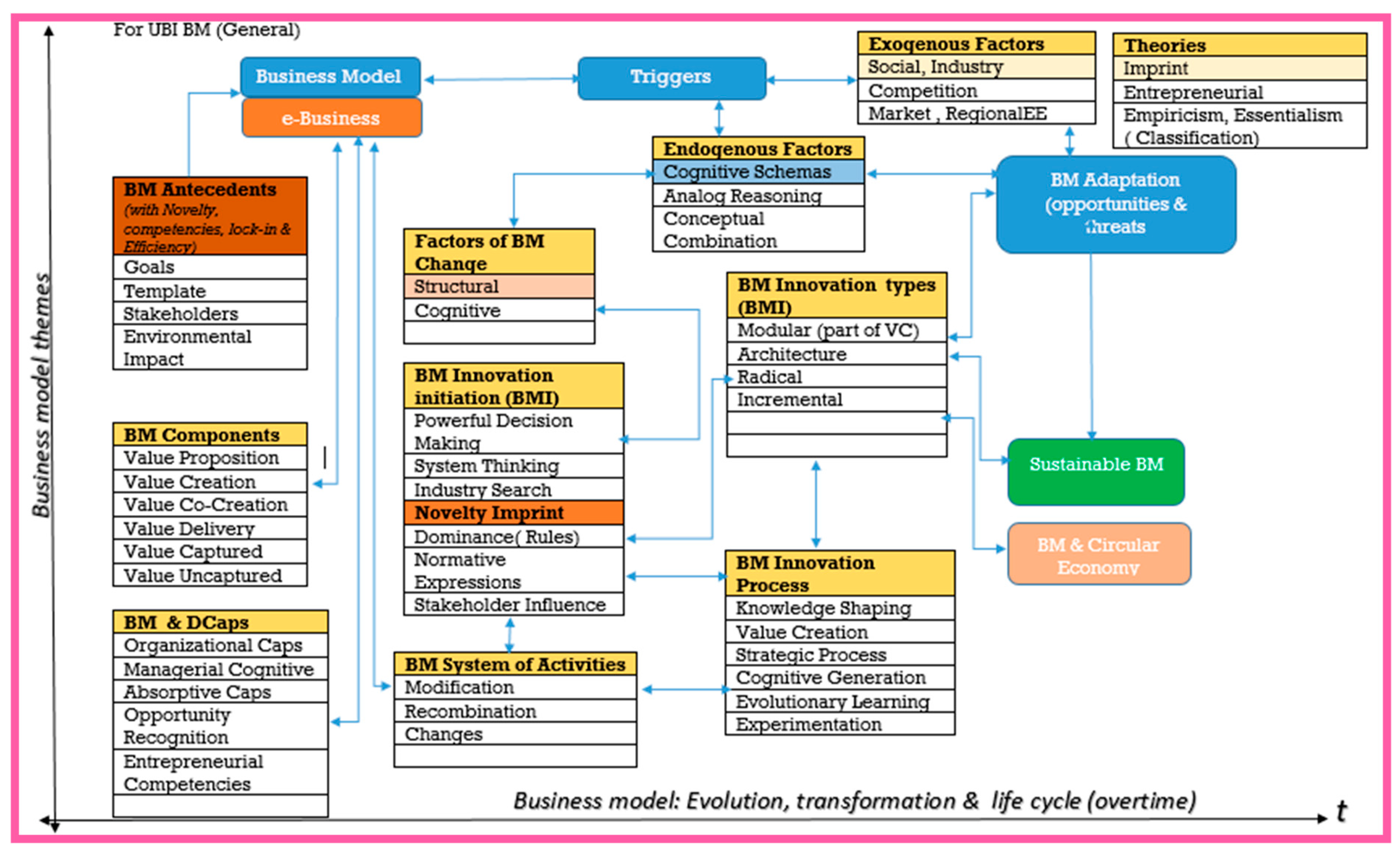
Figure 2.
Research Project Strands and Phases (Phase 5 as the present study).
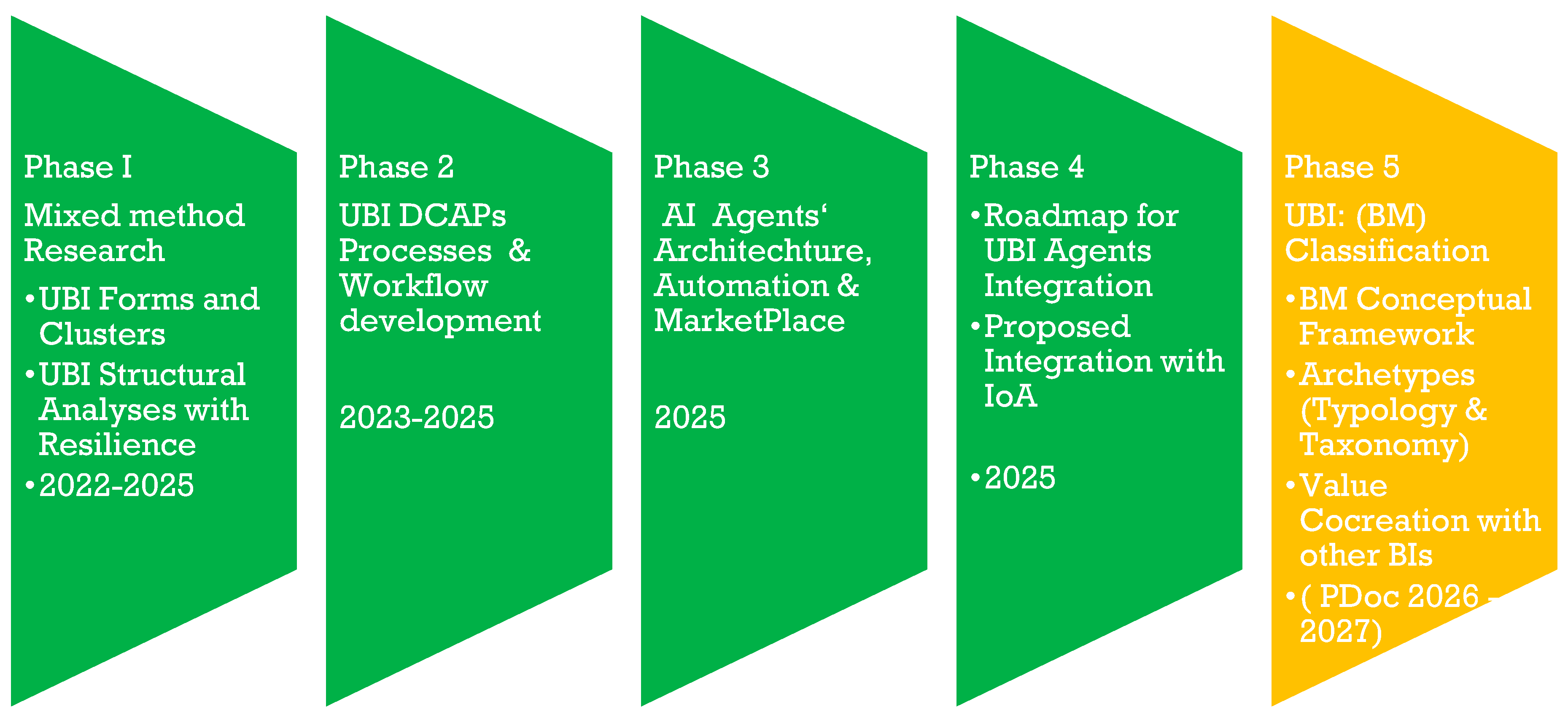
Figure 3.
Research Phase 5 highlights: UBI Business Models classification and Co-creation.
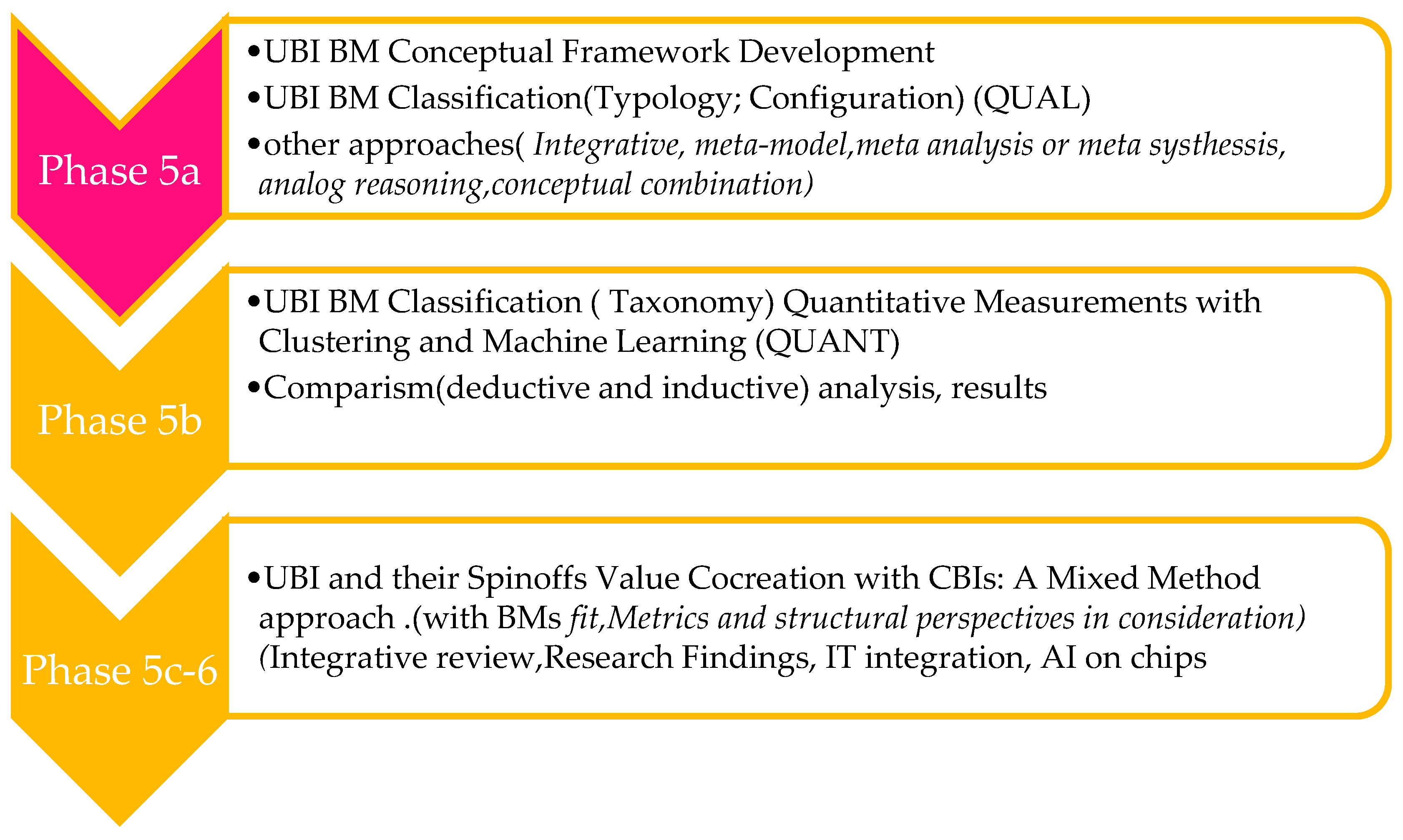
Figure 4.
UBI BM Conceptual framework showing the typologies and components.
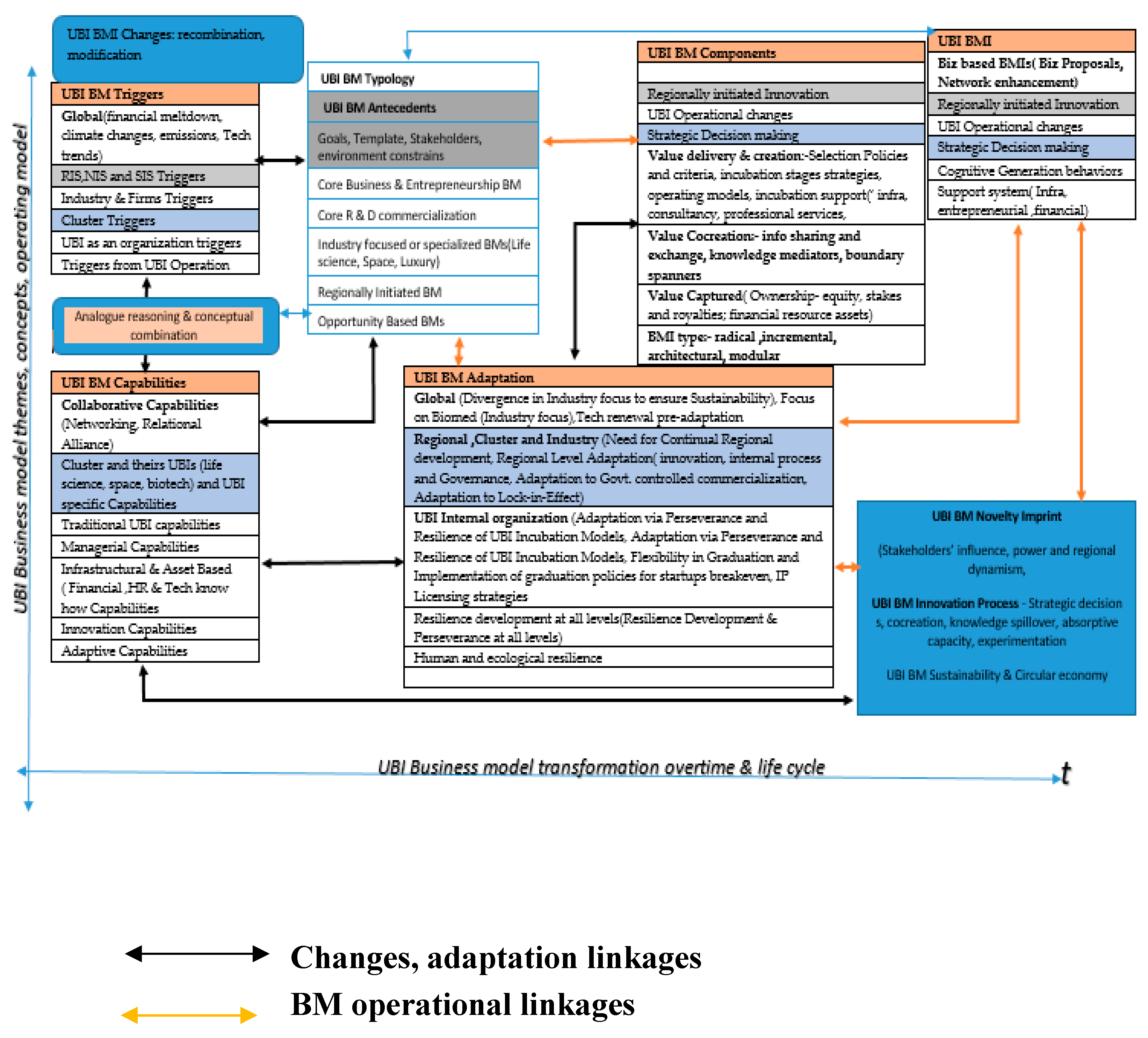
Figure 5.
UBI BMI Capabilities.
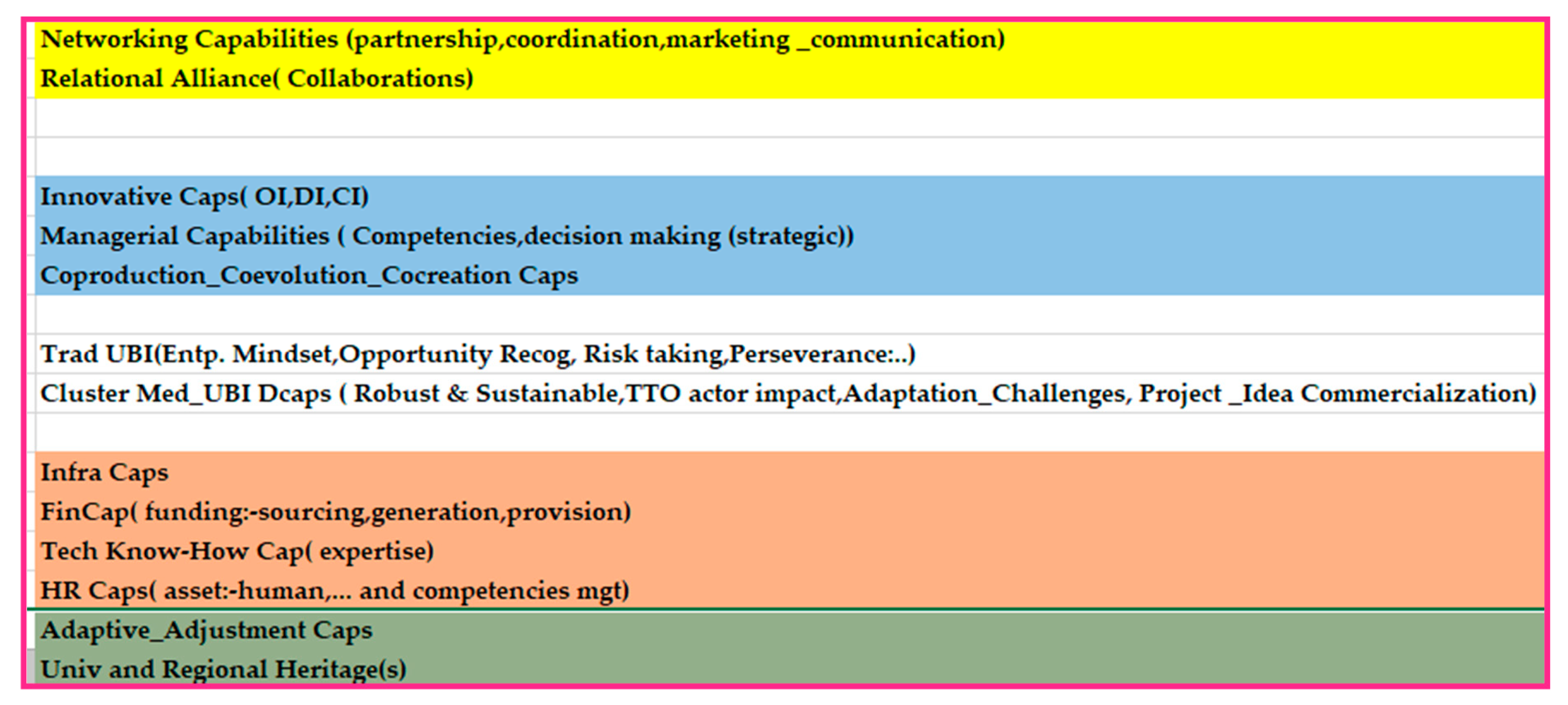
Disclaimer/Publisher’s Note: The statements, opinions and data contained in all publications are solely those of the individual author(s) and contributor(s) and not of MDPI and/or the editor(s). MDPI and/or the editor(s) disclaim responsibility for any injury to people or property resulting from any ideas, methods, instructions or products referred to in the content. |
© 2026 by the author. Licensee MDPI, Basel, Switzerland. This article is an open access article distributed under the terms and conditions of the Creative Commons Attribution (CC BY) license.
Copyright: This open access article is published under a Creative Commons CC BY 4.0 license, which permit the free download, distribution, and reuse, provided that the author and preprint are cited in any reuse.


