

Submitted:
22 January 2026
Posted:
22 January 2026
You are already at the latest version
Abstract
This research presents a comprehensive framework for optimizing Electric Vehicle (EV) charging infrastructure along the Lake Michigan circuit (LMC) in Michigan to support ecotourism, considering both slow charging at destinations and fast charging along the corridor. The framework identifies the optimum location and number of Level 2 chargers and Direct Current Fast Chargers (DCFC), using heuristic algorithms. The study evaluates infrastructure planning based on four key objectives: (1) minimizing overall charging infrastructure costs, (2) reducing grid network upgrade costs, (3) providing an acceptable level of service to long-distance travelers using DCFCs by minimizing queuing delays and deviations from their intended routes, and (4) improving destination charging to mitigate battery degradation by minimizing unserved charging demand from Level 2 chargers redirected to DCFCs. The integration of Level 2 and DCFC networks facilitates strategic investment by effectively managing charging demand, allowing unserved Level 2 demand to be accommodated at DCFC stations while adhering to budgetary constraints. The results show that increasing the budget from $15 to $20 million reduces user inconvenience by 47%, while a further increase to $25 million yields an additional 18% reduction. Additionally, increasing users’ value of time from $13 to $36 per hour results in a 50% reduction in average queuing time.
Keywords:
electric vehicles
; charging station
; tourism
; optimization
; transportation energy
1. Background
Electric Vehicle (EV) technology is a pivotal solution to traffic-induced air pollution and environmental challenges, as it eliminates on-road emissions. The adoption of EVs has surged recently due to factors such as energy efficiency and zero tailpipe emissions. Additional considerations such as fuel costs, purchase prices, and demographic influences also significantly shape the market share of alternative fuel vehicles (1, 2). In this study, the term ‘EV’ specifically refers to Battery Electric Vehicles (BEVs). By the end of 2024, Evs and PHEVs (Plug-in Hybrid Electric Vehicles) constituted 1.09% of all vehicles in Michigan, compared to 6.12% in California and 2.02% across the United States. Additionally, there were 3,731 public charging stations in Michigan, 48,778 in California, and 194,767 nationwide, translating to 25, 39, and 30 Evs per charger, respectively (3). The Michigan Future Mobility Plan aims to support 2 million Evs by 2030 with the deployment of 100,000 EV chargers (4). However, widespread EV acceptance is hindered by issues like range anxiety, prolonged charging durations, and insufficient charging infrastructure (5). To address these challenges and enhance EV market share, the construction of a robust network of EV chargers is crucial. This network should strategically integrate both slow and fast chargers to ensure trip feasibility, reduce range anxiety, and offer an acceptable level of service to EV users, while balancing costs and grid impacts, mitigating battery degradation, and supporting equitable access (6).
EV adoption has recently emerged as a key strategy for promoting sustainable ecotourism and boosting economic growth in regions renowned for tourist attractions. Despite the potential benefits, consumers perceive EV limitations as a barrier to purchasing such vehicles (7). Therefore, exploring these limitations from a tourism standpoint and identifying strategies to overcome them is essential (8). EV charging infrastructure is crucial for supporting ecotourism by providing sustainable and convenient travel options. As Evs gain popularity among tourists, the availability of charging stations along travel routes and at tourist destinations becomes increasingly important.
1.1. EV Charger Technologies
Globally, EV charging infrastructure is divided into three levels based on voltage and recharging time. Level 1 is the slowest, uses a standard 120 V AC outlet, typically providing around 1–1.9 kW of power, and charging about 40 miles in eight hours. Level 2 charging operates on 208–240 V AC and delivers approximately 3 kW and 19 kW of power. It is commonly used in private and public facilities and charges 100 miles in eight hours. Level 3, or Direct Current Fast Charging (DCFC), is the fastest charging option, delivering roughly 50 kW to more than 350 kW per port. It can recharge an EV battery up to 80% in 30 minutes or less, suitable for long-distance travel (9–11). Although DCFC reduces charging time, it has higher implementation costs and higher charging costs for users and causes more battery degradation due to higher currents and temperatures. Conversely, Level 2 chargers are more cost-effective and gentler on batteries (12, 13). On average, Level 2 charging costs approximately $0.20–$0.26 per kilowatt-hour (kWh), whereas DC fast charging typically ranges from $0.35–$0.60 per kWh. Actual prices can vary substantially depending on local electricity rates, utility demand charges, and site-specific operational factors (14).
Multiple recent studies have focused on the effects of charging speed on lithium-ion battery health. A consistent finding across these studies is that frequent use of high-power DC fast charging accelerates battery degradation relative to slower Level 1 and Level 2 charging. Elevated charging currents and the associated thermal stress during DCFC sessions contribute to faster capacity fade over time. For example, an experimental 2025 study cycling batteries under mixed charging patterns found that the scenario involving more than 90% DC fast charging led to significantly greater capacity loss (and earlier need for pack replacements) than predominantly Level 2 charging, although the severity varied by battery chemistry (15). Real-world data support this trend: analysis of 10,000 Evs in the U.S. showed Level 2 charging is much gentler on batteries, while heavy DCFC usage, especially in hot conditions, correlates with higher degradation rates (16). These findings reinforce that although fast charging is convenient, moderating its use can prolong battery life. Integrating both Level 2 chargers and DCFCs creates a comprehensive and balanced charging network to meet the diverse needs of EV users.
1.2. Intercity vs. Urban Charging Planning
There are four aspects in charging infrastructure planning objectives: transportation network, grid network, infrastructure specifications, and user behavior and experience (17). This requires considering charging demand, power supply, and budget limitations, creating a planning challenge to optimize the charging configuration for a given demand (18). The planning problem can be categorized into intercity models and urban models, which differ mainly in traveled distance and initial State of Charge (SoC) distribution. Intercity trips are long-distance journeys where the EV users typically start fully charged to plan ahead for the trips, however, the trip distance might exceed the range of a fully charged battery (19, 20). In contrast, urban trip distances generally fall within the driving range of Evs and require consideration of travelers’ activities and chain of trips. Urban trips can begin with any SoC, influenced by factors such as the availability of home or workplace chargers, preceding trips, and dwell time at the origin or destination (21, 22).
Intercity charging stations are generally located along highways to facilitate intermediate (on-route) charging, with a focus on DCFCs (23). Conversely, urban charging stations are typically located in areas where vehicles are parked either for short durations, supporting the use of DCFCs, or for extended periods, where Level 2 chargers facilitate destination (end-of-route) charging for urban trip patterns. These locations vary based on factors such as time of day and land use, including home, workplace, and public parking (24, 25).
1.3. Charging Infrastructure Optimization
Research on EV charger placement focuses on identifying charging demand and installing chargers to meet this demand (26, 27). There are two main approaches: flow-based and node-based (28). The flow-based approach treats demand as network flow, placing stations at key intersections to capture traffic, often using models like the Flow-Capturing Location Model (29, 30). However, this model overlooks EV range limitations (31). To address this, Kuby and Lim developed the Flow Refueling Location Model, which incorporates range constraints to improve vehicle flow coverage (32). Other models use set-covering methods to minimize costs while ensuring complete EV flow coverage, accounting for construction costs (33, 34), charging and waiting times (25, 35), and travel time (36, 37). Station capacity can be treated as a constraint (31, 38) or a decision variable (25, 33). The node-based approach frames the problem as a facility location problem, positioning stations at nodes to ensure coverage within a specific distance (39). The Set Covering Location Model minimizes the number of facilities needed, while the Maximum Covering Location Model maximizes coverage within budget constraints (40, 41).
Studies on EV charging infrastructure planning employ a wide range of objective functions and constraints, reflecting the multidimensional and interdisciplinary nature of the problem. A substantial body of research prioritizes cost minimization, where models reduce installation costs, such as land acquisition, construction, charger hardware, and labor, or operating costs including electricity prices and demand charges. For example, He et al. develop a mixed-integer linear program that minimizes total system costs across vehicle batteries, fast charging stations, energy storage systems, and peak-demand charges (42). Similarly, Huang et al. identify cost effective charging station deployment strategies that satisfy alternative fuel vehicle demand across all origin–destination pairs, explicitly accounting for multiple deviation paths in the network (43). Another major category focuses on demand coverage maximization, where classic models such as the Flow-Capturing Location Model aim to maximize the EV flow served along origin destination paths (29). User inconvenience minimization represents another objective function, with models that reduce detour distance, waiting time, and charging duration. For instance, Honma et al. compare path-based and node-based formulations to minimize additional travel time while ensuring feasible demand coverage (44), whereas Chen et al. optimize the placement of dynamic charging lanes to minimize total trip time (45). In studies integrating the electricity network, power-system objectives such as minimizing power losses, voltage deviations, and thermal overload are emphasized, particularly in co-optimization frameworks that couple transportation demand with distribution-grid performance (46). Increasingly, researchers adopt multi-objective formulations that simultaneously balance cost, coverage, user inconvenience, and power system performance, highlighting the trade-offs inherent in comprehensive EV infrastructure planning (22, 47, 48).
Two primary approaches for optimizing the placement of charging infrastructure are exact and heuristic methods (17). Exact methods include linear (40, 49, 50) and non-linear (41, 51) models with single or multiple objectives. These models are commonly solved using commercial solvers such as CPLEX, Knitro and Gurobi (52–54). In real-world scenarios and networks, the problem size increases significantly, especially in terms of the number of variables and constraints (22). Thus, heuristic methods such as greedy algorithms (55), simulated annealing (SA) (20, 22), genetic algorithms (56), chicken swarm optimization (57, 58), and other evolutionary algorithms (59), are introduced which excel in finding optimized solutions to complex and multi-dimensional problems (60).
1.4. Charging Networks Integration
As highlighted by Bhat et al., designing an EV charging network requires integrating both fast and slow charging stations to accommodate diverse user demands and preferences (61). Most existing studies on EV charging infrastructure optimization focus on fast chargers, with few addressing multiple charging modes (17), and those that do typically use a single optimization framework. Huang et al. proposed optimization models for fast and slow chargers, focusing on minimizing total cost while meeting coverage (40). Wang et al. proposed a four-step method to deploy normal and fast charging stations to meet the charging demands of private Evs and electric taxis, focusing on estimating demand using EV profiles and transport statistics (6). Sun et al. proposed a location model for slow and fast charging stations with dual objectives: maximizing coverage and capturing maximum flow (41). Their model considers urban residents’ travel behaviors and operates within a budget limit. Lin et al. proposed a framework to optimize the location and size of Level 2 chargers and DCFCs, maximizing investment benefits (49). Their framework considers charging behaviors, urban land use, and uses an agent-based trip chain model to represent EV owners’ travel and charging patterns. Bhat et al. examines potential electric vehicle buyers’ location preferences for public charging stations, considering station attributes and individual characteristics (61). Some studies assume that the budget is sufficient to serve all the demand (50, 58). Conversely, other studies consider budget constraints and use partial coverage strategies to maximize demand coverage (41, 51) or include a penalty term for unserved demand (40).
1.5. EV Tourism and Charging Planning
Tourism often involves long-distance travel and extended stays, requiring tailored EV charging infrastructure planning. Proper planning can reduce costs for both providers and users, and influences EV users’ itinerary (24). An effective approach to planning chargers for EV tourism combines DCFCs for intermediate charging during long-distance trips with Level 2 chargers at tourist destinations, where visitors stay longer. Thus, an integrated framework is needed to optimize the placement and capacity of both Level 2 chargers and DCFCs within tourist regions.
Research on EV tourism is still emerging. Wang and Lin used set- and maximum-coverage models with mixed integer programming to locate chargers based on vehicle refueling patterns, applying their approach to Penghu Island and considering tourist sites for slow chargers (51). Wang et al. addressed tourist trip design for Evs, factoring in time windows and range constraints (62). Suanpang et al. employed reinforcement learning for EV-charging recommendations, using Chiang Mai, Thailand, as a smart tourism city case study (63). Xu et al. developed a model for selecting EV charging station sites using kernel density analysis of urban populations, including tourist areas, to maximize EV user satisfaction (64). Knowles et al. created an EV readiness index assessing 94 road trip itineraries related to Canada’s national parks by assessing factors such as the number of Level 2 and Level 3 chargers, the spacing between chargers, and the corresponding road distances(65).
These studies highlight the necessity of incorporating diverse charging options and real-world case studies to better predict future EV charging needs, moving beyond theoretical and test networks. This research aims to address this gap by providing a framework for optimizing Level 2 chargers at tourist destinations and DCFCs along the Lake Michigan corridor, facilitating realistic EV charging infrastructure planning.
1.6. Research Gaps and Study Contributions
The literature review has identified four major gaps in the current research, and this paper contributes to the field by addressing each of these gaps as follows:
- Planning EV charging infrastructure for tourist regions through an integrated Level 2 and DCFC network, where unmet demand from Level 2 stations dynamically shifts to nearby DCFCs. This study introduces a novel framework that explicitly models the interconnection between charger types, an aspect rarely examined in existing literature.
- A balanced planning framework is developed that integrates Level 2 and DCFC infrastructure, in which Level 2 siting decisions are informed by the spatial distribution of DCFCs. The framework also incorporates both system-level and user-oriented perspectives and explicitly accounts for users’ charging behaviors.
- The model introduces a battery-health–aware operational strategy by prioritizing charging at destination Level 2 stations and reserving DCFCs primarily for intermediate travel needs. This coordinated approach minimizes exposure to high-current charging events that accelerate battery degradation, while still ensuring trip feasibility and reliability for long-distance EV travelers.
- By addressing the distinctive travel and charging patterns of tourism destinations, the proposed approach offers a unique and forward-looking pathway for enabling sustainable and eco-friendly tourism.
This study addresses these gaps by proposing a comprehensive framework to optimize the locations and quantities of Level 2 chargers at tourist destinations and DCFCs along the primary LMC corridor within Michigan. The framework aims to minimize costs for both users and providers while ensuring trip feasibility and adhering to budget constraints. It develops distinct but interconnected networks for Level 2 and DCFCs, utilizing heuristic methods like greedy and SA algorithms, dynamic penalties, and two-stage decision-making techniques. This approach considers intercity trips, existing charging infrastructure, and associated costs to identify the best investment strategy for supporting ecotourism in Michigan, based on extensive real-world data.
The remainder of the paper ©s organized as follows: starting with the Problem Statement, followed by the Data Summary. Next, it presents the Modeling Framework and Solution Approaches. Finally, it presents the Case Study and discusses the Results. The paper concludes with key insights and recommendations for future research.
2. Problem Statement
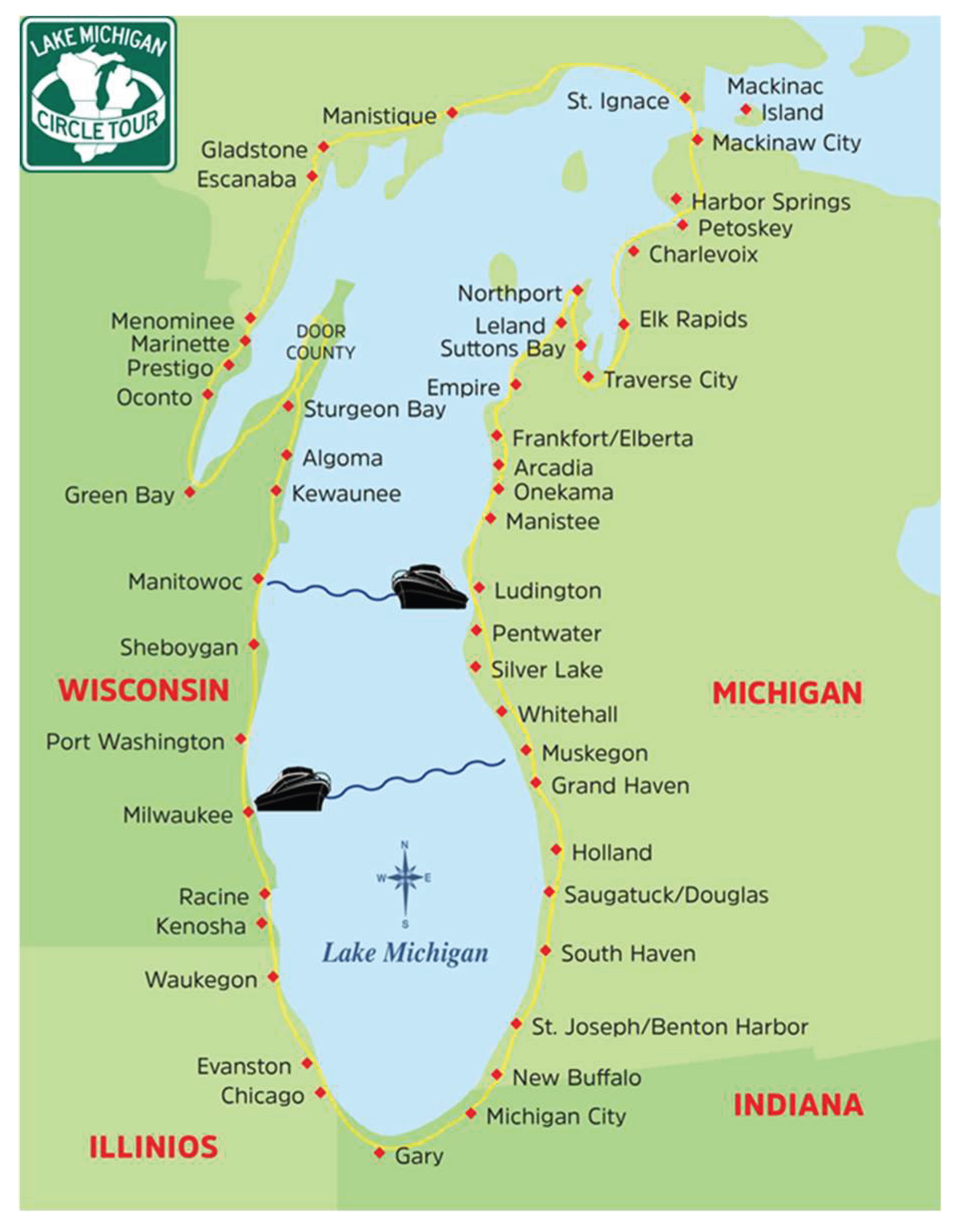
The “Lake Michigan EV Circuit Tour” is a multi-state initiative involving Michigan, Wisconsin, Illinois, and Indiana to establish EV infrastructure along Lake Michigan’s 1,100-mile coastline. The project aims to enhance coastal tourism by installing reliable charging stations at recreational areas, hospitality businesses, and entertainment attractions, allowing EV drivers to enjoy long-distance vacations without range anxiety (66). Figure 1 depicts Lake Michigan, the main corridor (a.k.a. Lake Michigan Circuit or LMC), and the surrounding cities and states. Given that more than 50% of the circuit is located within Michigan, this area has been chosen as the initial focus for planning charging infrastructure to support EV tourism around Lake Michigan.
Figure 1.
Lake Michigan and surrounding area (reproduced from (67)).
This research presents a comprehensive framework for optimizing EV charging infrastructure along the Lake Michigan coastline in Michigan, addressing both slow charging at tourist destinations and fast charging along the LMC corridor. The framework consists of two interconnected sections, each addressing unique aspects of the charging infrastructure.
Destination charging focuses on determining the optimal locations and quantities of Level 2 chargers at tourist destinations, particularly lodging sites. It involves travel demand analysis, EV and energy demand estimation, and charger placement optimization, employing a heuristic algorithm to balance and minimize infrastructure costs and user inconveniences. A node-based approach is used to model Level 2 charging demand. Due to the extended charging times of Level 2 chargers, queuing models are not employed for destination chargers, as they are impractical in this context.
Intermediate charging focuses on determining the optimal locations and quantities of DCFCs at the corridor level to balance and minimize infrastructure costs and user inconvenience, while ensuring trip feasibility and compliance with budget constraints. This is accomplished through a heuristic algorithm with dynamic penalties and a two-stage decision-making process that identifies both the locations and number of DCFCs. This section also utilizes a flow-based charging demand modeling approach and an M/M/c queuing model (Poisson arrival distribution, exponential service distribution, and c parallel servers) to manage high EV turnover rates. The algorithm models EV charging behaviors by considering multiple charging station options during intercity trips. The framework also ensures that any unserved destination charging demand is covered by DCFC stations.
This study aims to answer three key questions in supporting EV tourism through charging infrastructure planning:
- How might a strategic combination of slow and fast chargers be effectively planned for tourist regions to support eco-friendly travels?
- What constitutes the optimum investment strategy for providers to install slow and fast chargers in a real-world large-scale case study, ensuring trip feasibility and adherence to budgetary limitations?
- What is the optimal charging configuration from users’ perspective that minimizes inconveniences while also reducing battery degradation?
By incorporating both slow and fast chargers, this study aims to support EV adoption and ecotourism in Michigan. The research considers EV users’ intercity trips, existing charger capabilities, and costs to identify the best investment strategy.
3. Summary of Data
Charging infrastructure planning involves a diverse range of stakeholders. For this research, extensive meetings have been held with these stakeholders to gain their insights and perspectives. The collected data were then used as inputs for the modeling framework. This section provides an overview of the data collected.
3.1. Study Area and Road Network
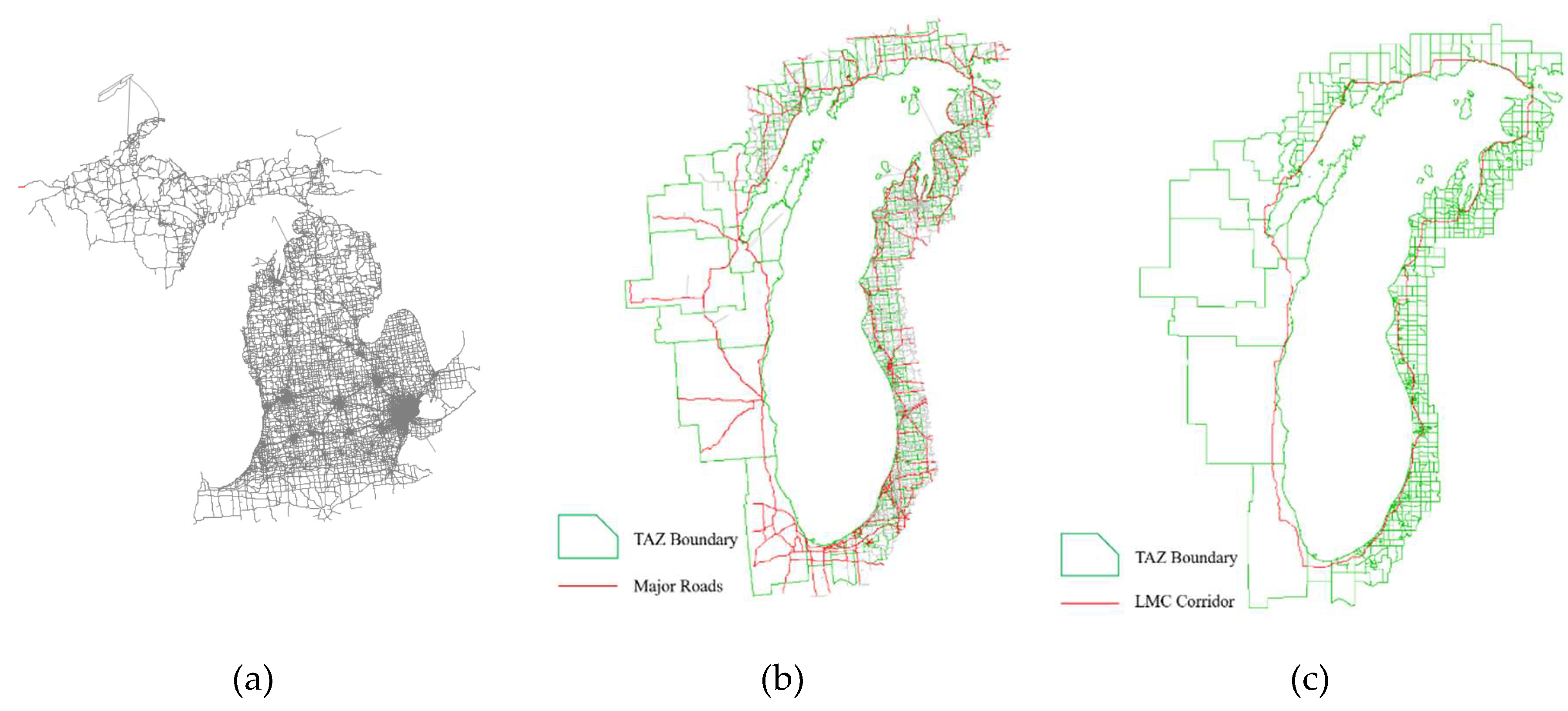
The designated study area, referred to as LMC area, includes the region within a 10-mile distance from the Lake Michigan shoreline. The road network data were sourced from the 2015 updated and calibrated Michigan network provided by the Michigan Department of Transportation (MDOT). In this dataset, Michigan is divided into smaller geographical regions called Traffic Analysis Zones (TAZ). Michigan has a total of 4,461 TAZs, with 626 TAZs either entirely or partially within the LMC area. The LMC area contains approximately 10,000 nodes and 32,000 links. Each TAZ is represented by a centroid with specific geographical coordinates. Visual representations of the road network in Michigan and the LMC area are shown in Figure 2(a) and Figure 2(b), respectively.
3.2. Corridor Structure
The goal is to establish an EV charging corridor with DCFCs for convenient road trips within the LMC area. The corridor should be close to the shoreline and accessible to tourist attractions and amenities around the lake. It should also include major arterial roads and expressways with high-speed limits and capacity. The proposed corridor encompasses interstates I-94 and I-196, and highways US-31 in the Lower Peninsula (LP) and US-2 and US-35 in the Upper Peninsula (UP), covering approximately 600 miles. Figure 2(c) provides a visual representation of the proposed charging corridor.
Figure 2.
Road networks originally provided by MDOT: (a) State of Michigan network; (b) Lake Michigan network; (c) Lake Michigan corridor.
Figure 2.
Road networks originally provided by MDOT: (a) State of Michigan network; (b) Lake Michigan network; (c) Lake Michigan corridor.
3.3. Candidate Points
Since the goal of this study is to establish a network supporting EV tourism, tourist attractions and businesses in the LMC area are considered as potential sites for EV chargers. Candidate points are categorized by business type and average visitor stay duration: (i) short-term stay locations (less than 2 hours): retail stores, restaurants, gas stations; (ii) mid-term stay locations (2-6 hours): parks, shopping malls, movie theaters, stadiums; and (iii) long-term stay locations (more than 6 hours): hotels, motels, and rental cabins.
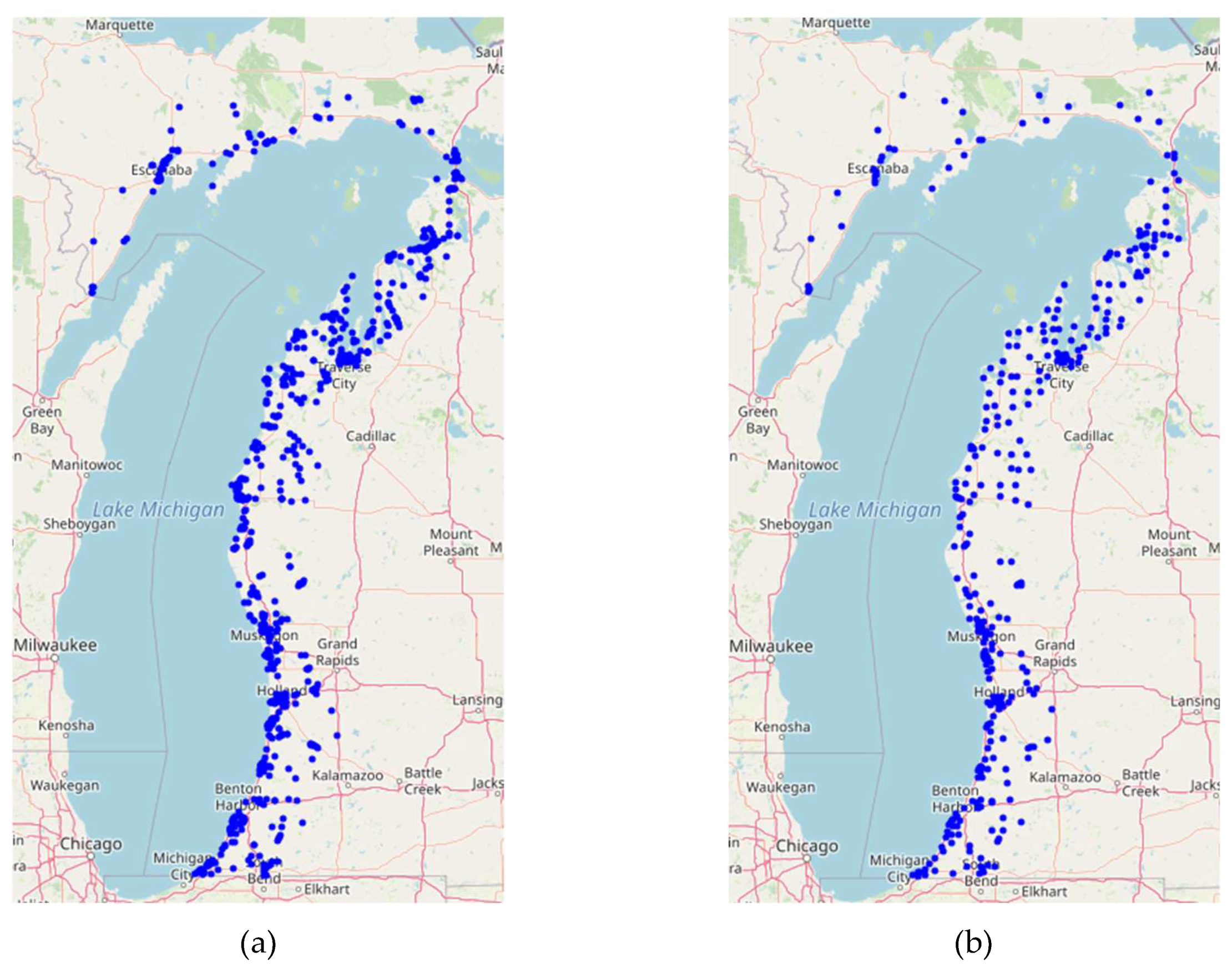
Level 2 chargers are slower and best suited for long-term stay locations. As shown in Figure 3(a), 964 of the 7,074 candidate points in the LMC area correspond to long-term stay locations. For planning purposes, all long-term stay locations within a single TAZ were aggregated, and the centroid of that TAZ was designated as the representative candidate location. Of the 626 TAZs within the LMC area, 343 TAZs contain at least one long-term stay location, and thus their centroids were considered candidate locations for Level 2 charger deployment. Figure 3(b) depicts the TAZ centroids that serve as the final candidate locations for Level 2 charging station deployment.
Figure 3.
Level 2 candidate locations: (a) Long-term stay locations; (b) TAZ centroids representing long-term stay locations.
Figure 3.
Level 2 candidate locations: (a) Long-term stay locations; (b) TAZ centroids representing long-term stay locations.
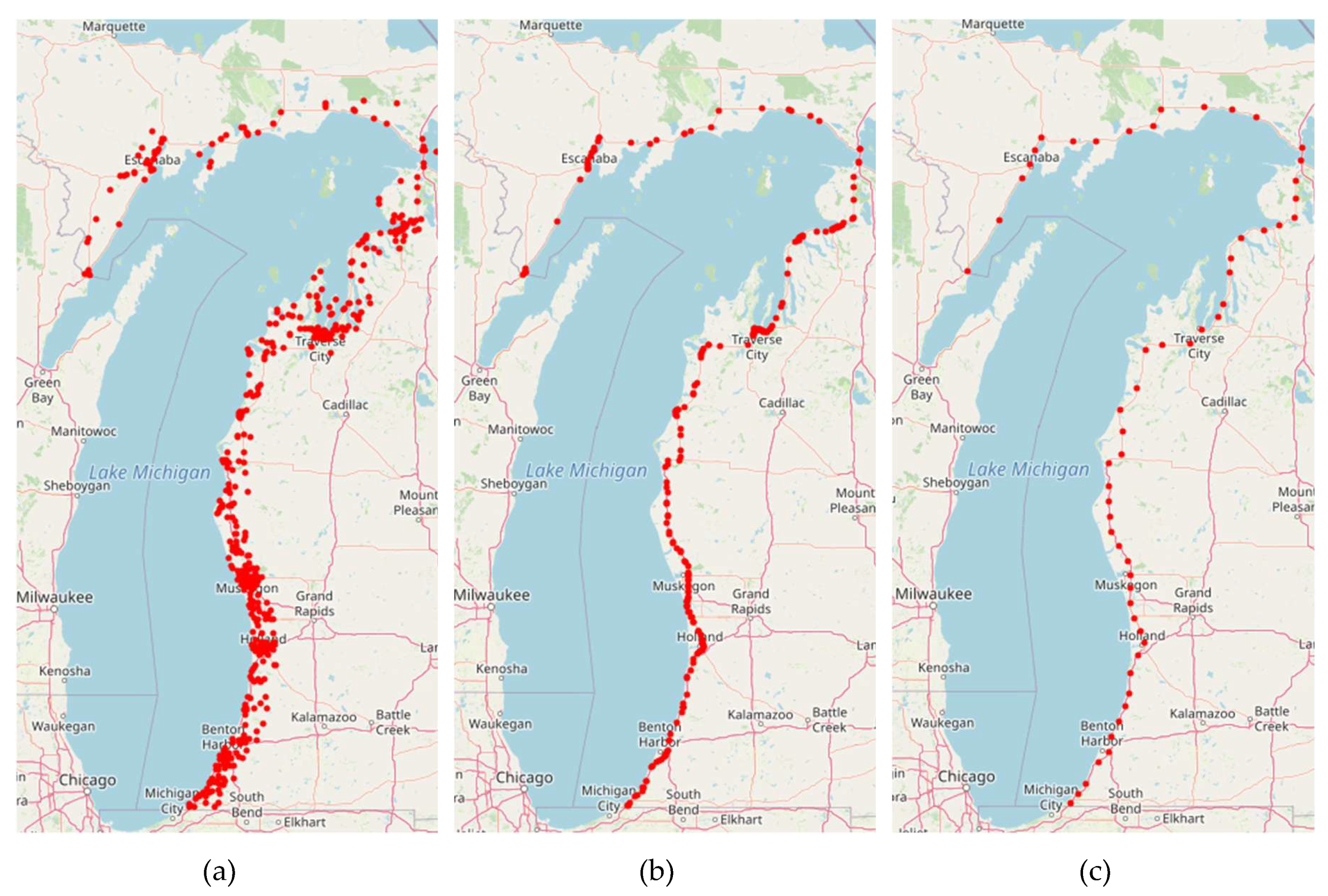
Short-term stay locations are ideal for DCFC stations due to their average visit duration of 15 to 60 minutes. A total of 640 short-term stay locations were identified in the LMC area, as shown in Figure 4(a). These locations were subsequently linked to the nearest access points along the main corridor, and the shortest paths were recorded to estimate detour travel distances, yielding 219 candidate locations located on the corridor, as illustrated in Figure 4(b). Most locations, as shown in Figure 4(b), were closely distributed, with an average distance of less than 3 miles between them. However, in less developed areas of UP, distances could extend up to 24 miles. Evaluating the optimal charging infrastructure among 219 candidate locations can be time-consuming, especially in densely populated areas. To streamline this, hierarchical clustering was used. The algorithm merges the two closest clusters until the distance between adjacent cluster centroids exceeds 5 miles. The resulting centroids serve as corridor node representations, reducing the candidate locations to 58 nodes along the LMC corridor, as shown in Figure 4(c). These 58 nodes are the final DCFC candidate locations for constructing charging infrastructure and generating and attracting EV trips.
Figure 4.
DCFC candidate locations: (a) Short-term stay locations; (b) Corridor access points; (c) Final candidate locations.
Figure 4.
DCFC candidate locations: (a) Short-term stay locations; (b) Corridor access points; (c) Final candidate locations.
3.4. Travel Demand
The study utilized the Michigan Origin-Destination (OD) demand table from MDOT, which provides data on trips to and from each of the 4,461 TAZs. However, specific tourism-related trip data was unavailable, so an alternative approach, detailed in the solution approach section, was used to estimate tourism demand.
After identifying the final 58 DCFC candidate locations along the main corridor, the next step was to assess travel demand along the LMC corridor. The OD demand matrix of Michigan was analyzed to determine the trips passing through these nodes. The LMC corridor demand is categorized into two main groups: (i) demand generated and attracted within the LMC area and (ii) demand passing through the LMC. For the first group, the study assigned the origin and destination to the nearest of the 58 corridor nodes, converting the Michigan TAZ demands into corridor demands. For the second group, the shortest path algorithm was applied to all OD pairs to identify trips traversing the LMC area. The first and last trajectory points within the LMC along the shortest path were matched to the nearest corridor node. Out of the 19.7 million daily trips in Michigan, 1.3 million were recognized as moving between the specified corridor nodes, indicating the travel demand along the LMC.
3.5. Charging Infrastructure Cost
In this study, charging infrastructure costs are categorized into three primary components: charging station costs, charger costs, and electric grid upgrade costs. A charging station is defined as a physical site hosting one or more EV chargers. Charger costs represent the price of individual charging units, which vary by type (Level 2 or DCFC), power rating, and manufacturer. Charging station costs capture a wider set of expenditures, including electrical panel and switchgear installation, engineering and design, permitting, and project management. Electric grid upgrade costs account for the investments required to ensure that the power grid can accommodate the energy demand at each site. Cost estimates were obtained from multiple industry sources, including Greenlots, ChargePoint, Ford Pro, RED-E, and Consumers Energy.
3.6. Electric Grid Upgrade Cost
Michigan is divided into regions managed by different utility providers, who have provided electric grid make-ready cost estimates for specific power levels to designated locations. Five distinct energy levels were considered separately for Level 2 and DCFC stations. These grid upgrade costs cover expenses for acquiring, installing, and maintaining the power grid infrastructure needed to support the demands of charging stations.
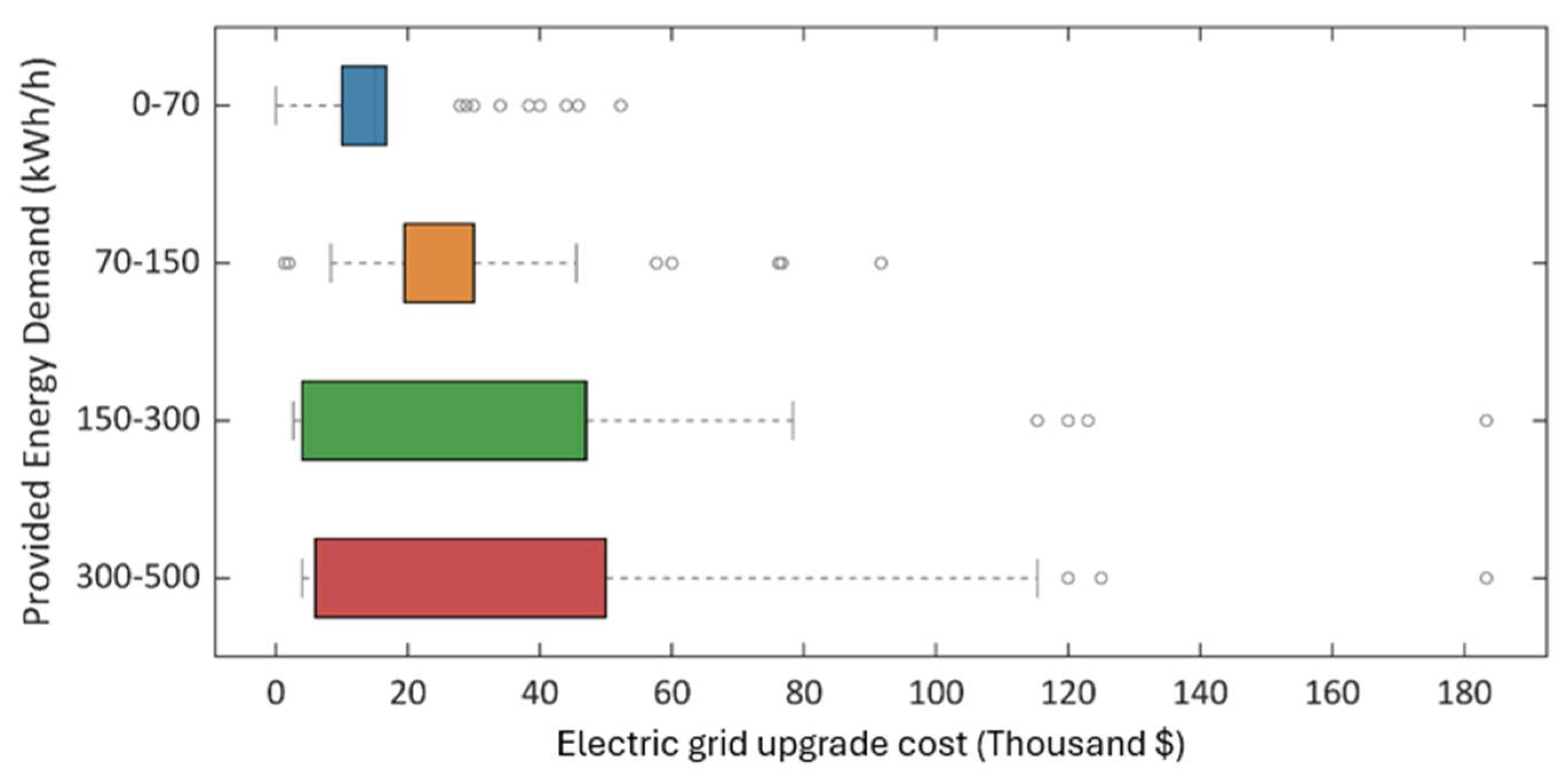
Grid upgrade costs in the LMC area varied significantly due to diverse land development and environmental characteristics, ranging from rural to densely urban regions. While some locations showed consistent costs regardless of energy level, others experienced significant cost increases as energy demand rose. These increases are largely due to the need for technological upgrades or enhancements in grid capacity. To address this variability, the study devised a step function capturing grid upgrade costs for different ranges of hourly energy demand. Figure 5 shows the distribution of grid upgrade costs by energy demand level for Level 2 chargers.
Figure 5.
Electric grid upgrade cost distribution across energy demand steps for Level 2 chargers (reproduced from (68)).
Figure 5.
Electric grid upgrade cost distribution across energy demand steps for Level 2 chargers (reproduced from (68)).
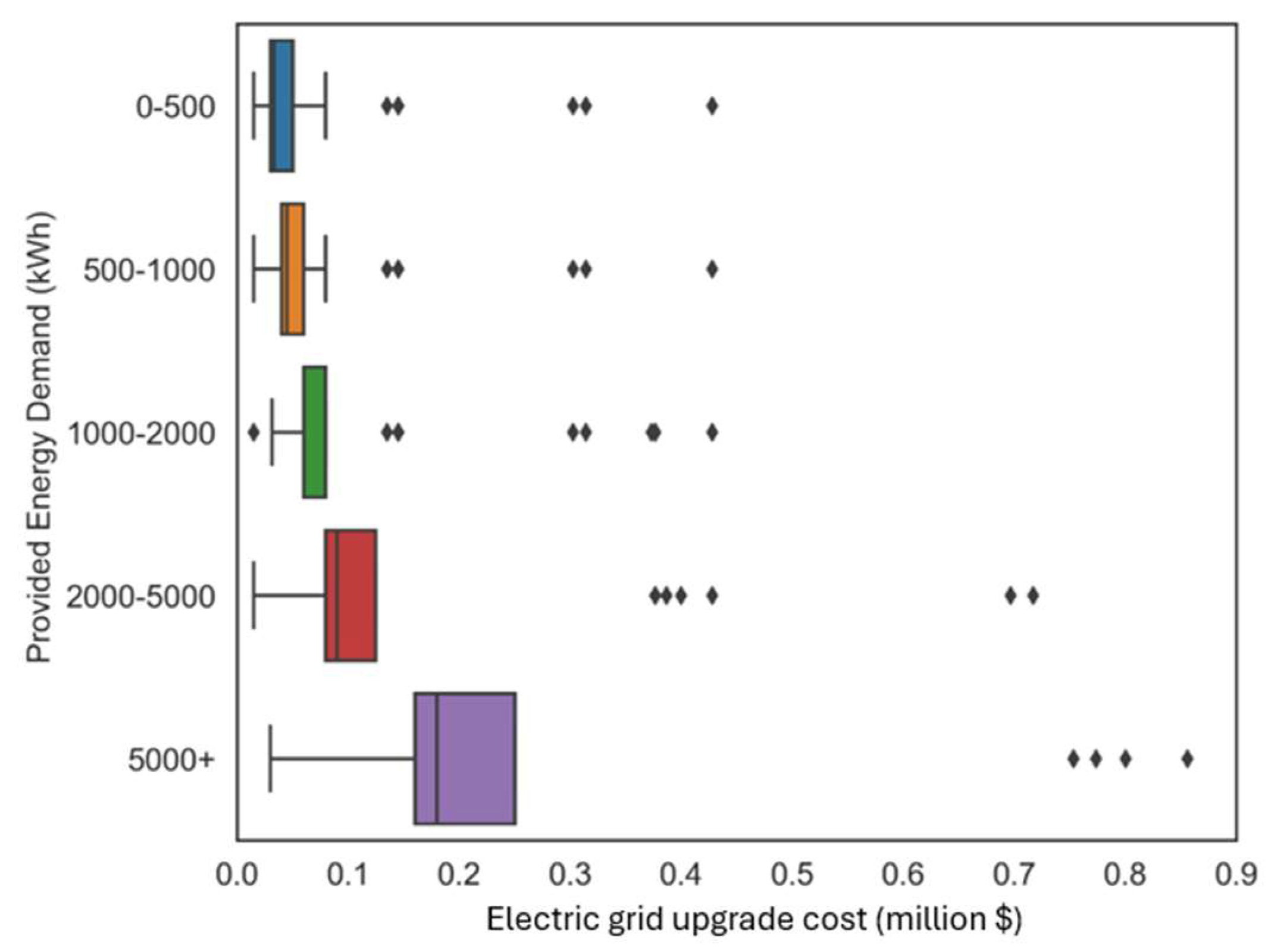
Electric grid upgrade cost data for all 640 initial DCFC candidate points were also acquired. For each of the final 58 corridor nodes, the grid upgrade cost was calculated as the average of the grid upgrade costs associated with the originally aggregated DCFC candidate points at that location. Figure 6 visually represents the distribution of grid upgrade costs across corridor nodes by energy demand level for DCFCs.
Figure 6.
Electric grid upgrade cost distribution across energy demand steps for DCFCs (reproduced from (69)).
Figure 6.
Electric grid upgrade cost distribution across energy demand steps for DCFCs (reproduced from (69)).
3.7. Current Charging Infrastructure
Incorporating existing chargers in the analysis is essential, as they currently meet a portion of the charging demand. This inclusion allows for a more comprehensive and realistic evaluation of the charging infrastructure needs and efficient use of resources.
3.7.1. Existing Level 2 Chargers
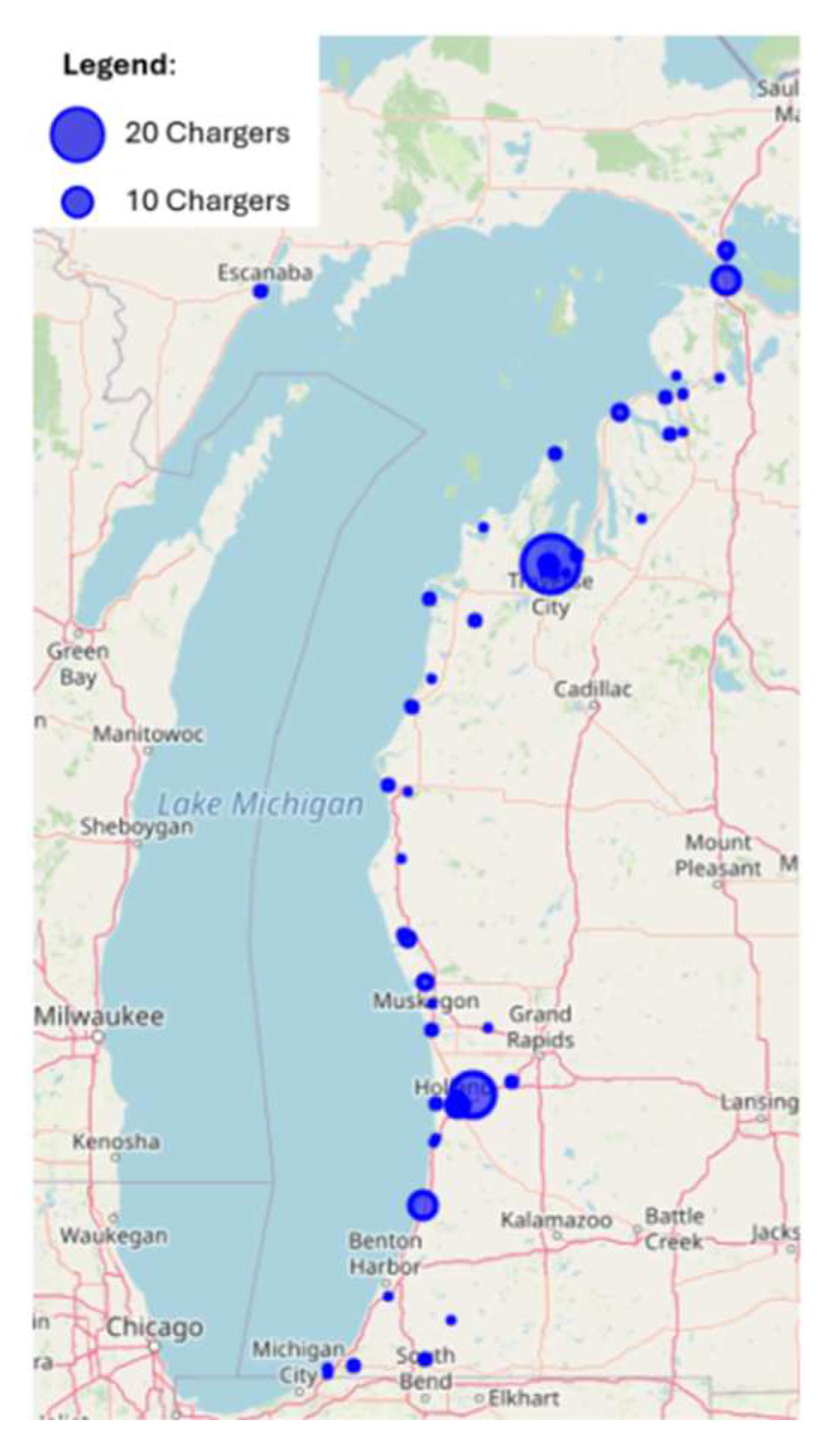
The Alternative Fuel Data Center (AFDC) (70) provides data on EV charging station locations across the nation, including Michigan. In the LMC area, a Level 2 charger is considered accessible if it is within a 0.5-mile radius of a Level 2 candidate point. As a result, 230 existing Level 2 chargers are included in the analysis. Figure 7 shows the distribution of these chargers in the LMC area.
Figure 7.
Existing Level 2 chargers in LMC area.
3.7.2. Existing DC Fast Chargers
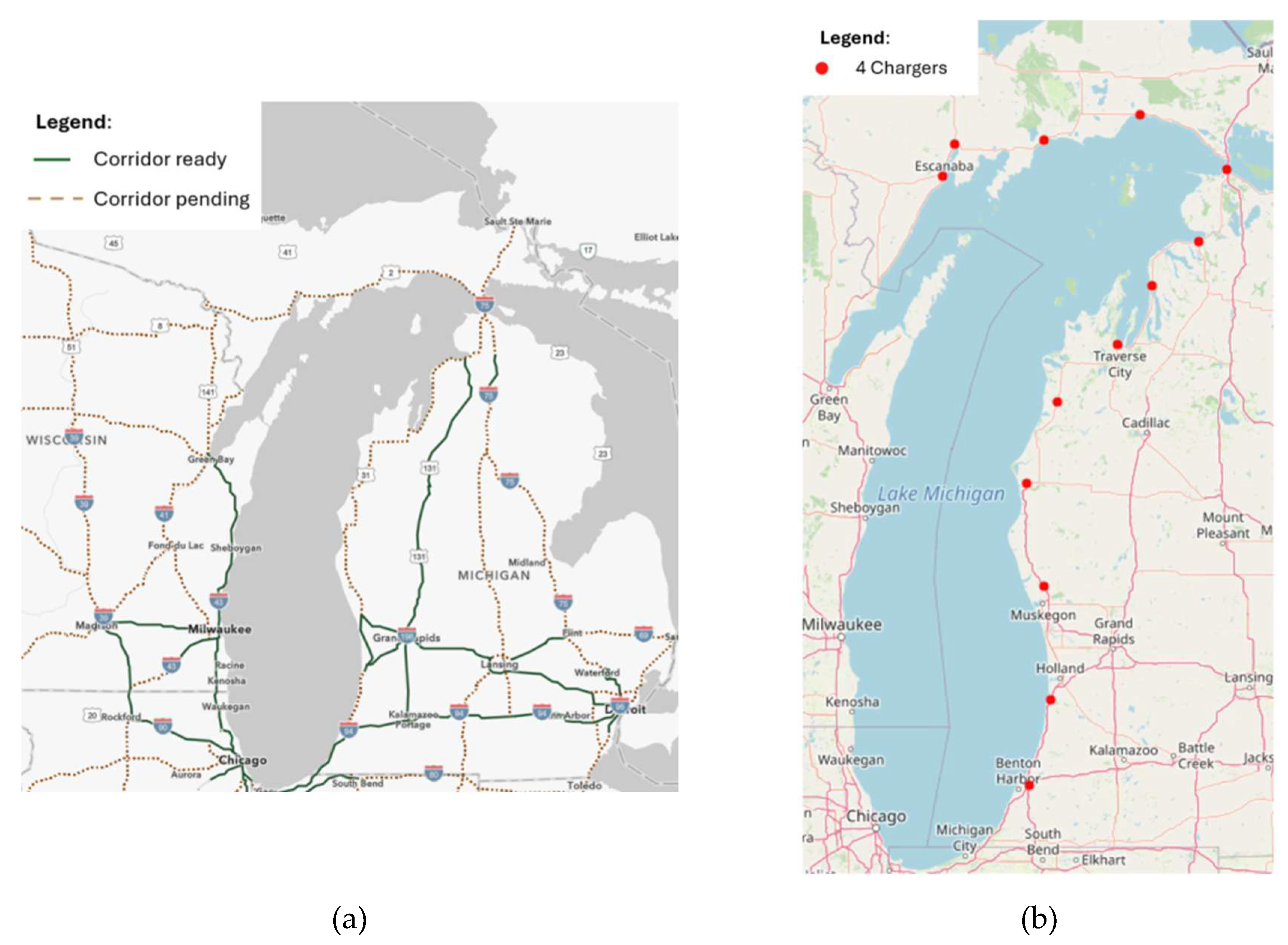
Federal and state initiatives aimed at expanding fast-charging infrastructure are designed to enhance intercity electric vehicle mobility across Michigan. As part of these efforts, designated Alternative Fuel Corridors are planned to host sites equipped with a minimum of four 150 kW DCFCs, as illustrated in Figure 8(a). This planned corridor network was evaluated to identify facilities that could contribute to the existing and near-term charging landscape along the LMC corridor. The assessment identified 13 stations along the corridor that are expected to provide four or more DCFC units by 2026, yielding an estimated total of 52 current and planned fast chargers incorporated into the LMC analyses, as shown in Figure 8(b). These corridor-based fast chargers will accommodate a portion of the DCFC demand and any unserved charging demand from the Level 2 network.
Figure 8.
Existing DCFCs in LMC area: (a) Alternative fuel corridors in Michigan (reproduced from (75)); (b) Nevi-planned DCFCs.
Figure 8.
Existing DCFCs in LMC area: (a) Alternative fuel corridors in Michigan (reproduced from (75)); (b) Nevi-planned DCFCs.
4. Modeling Framework
This section presents the modeling framework developed to optimize EV charging infrastructure across the Lake Michigan coastline in Michigan. The framework integrates two interconnected components: (i) determining the optimal location and number of Level 2 chargers to serve destination-based demand, and (ii) determining the optimal location and number of DCFCs to support corridor travel demand. In this study, an EV charging station is a site where one or more chargers are installed to recharge an EV’s battery (Figure 9).
The key decision variables include the selection of candidate sites for Level 2 charging stations () and the number of chargers to be installed at each site (), along with the choice of candidate sites for DCFC stations () and their corresponding charger counts (). To structure the problem, two sets of nodes are defined: , representing candidate locations for Level 2 chargers at destination zones, and , denoting candidate DCFC sites along the corridor. Table 1 summarizes the notations and parameters employed in the analysis.
4.1. Level 2 Charging Model
Equations (1) through (11) define the objective function and associated constraints for Level 2 charging infrastructure. Equation (1) minimizes the total system cost, comprising capital expenditures (calculated in Eq. 2) and user inconvenience resulting from detours and reliance on DCFC stations due to insufficient Level 2 availability. The total system cost in Eq. (1) is divided by the infrastructure lifetime to obtain the daily system cost, ensuring comparability with the user inconvenience cost. Equation (2) specifies the total infrastructure cost, including station construction, charger installation, and electric grid upgrade expenses, while Equation (3) imposes the budget constraint for Level 2 deployment. Constraint (4) models electric grid upgrade costs as a stepwise function of aggregate charging power, determined by both the number of chargers and their rated capacity. Constraint (5) prohibits charger installation at non-designated sites. Constraints (6) and (7) quantify unserved energy demand and the number of unserved EVs at Level 2 stations due to limited availability or full utilization. Finally, Constraints (10) and (11) assign each Level 2 site to its nearest DCFC station to accommodate unserved EVs through detours.
4.2. DCFC Charging Model
Equations (12) through (36) specify the objective function and constraints governing the deployment of DCFC infrastructure. Equation (12) defines the objective of minimizing total system cost (adjusted by the infrastructure lifetime to express the system cost on a daily basis, allowing comparability with the user inconvenience cost), which consists of capital expenditures (Equation 13) and user inconvenience arising from detour time, charging duration, and queueing delays. Equation (13) calculates the total cost of DCFC infrastructure, including station construction, charger installation, and electric grid upgrade expenses, while Constraint (14) enforces the budget limitation. Constraint (15) models electric grid upgrade costs as a stepwise function of aggregate charging power, determined by both the number of chargers and their rated capacity. Constraint (16) restricts charger installation to designated sites, and Constraint (17) imposes a minimum charger requirement per station. Constraints (18) and (19) ensure that if a stop combination s is not selected for a given ω, no vehicles are assigned to that configuration. Constraint (20) prohibits vehicle stops at locations with no station. Constraint (22) guarantees that, for each OD pair, the total number of EVs distributed across stop combinations equals the total travel demand. Constraint (23) permits energy supply only during charging events. Constraint (24) updates vehicle SoC at each node based on prior SoC, travel energy consumption, and charging activity at the previous node. Constraint (26) defines trip feasibility by requiring SoC to remain above the minimum threshold along the entire route. Constraints (27) and (28) specify that charging occurs once SoC falls below the search threshold but remains above the minimum SoC level reflecting drivers’ range anxiety. Constraint (29) enforces the feasibility of all EV trips. Constraints (30) and (31) quantify the total incoming travel demand and energy demand at each DCFC station, respectively, incorporating unserved demand redirected from Level 2 chargers. Constraint (32) evaluates detour time at each station, consisting of detour time for users traveling directly to a DCFC station, computed as the product of incoming demand and average detour travel time. Constraint (33) calculates total refueling time at DCFC stations. Finally, Constraints (34) through (36) capture queueing delays: Constraint (34) determines the vehicle arrival rate, Constraint (35) specifies the service rate, and Constraint (36) computes expected waiting time as a function of arrival rate, service rate, number of chargers, and charging power. Queueing dynamics are modeled under steady-state assumptions using the M/M/c stochastic model, following Zukerman (71).
5. Solution Approach
The optimization problem formulated in this study is characterized as a Mixed-Integer Nonlinear Programming (MINLP) model. The nonlinearities stem primarily from constraints associated with stochastic queuing at DCFC stations, path feasibility along the travel corridor, and the stepwise representation of electric grid upgrade costs. While commercial solvers can be applied to such problems, they typically require considerable computational effort and cannot reliably ensure global optimality. To address these challenges, this study employs an integrated solution framework consist of multiple heuristic algorithms: the Greedy Adaptive Incremental allocatioN (GAIN) method developed by Soltanpour et al. (68) for Level 2 charging infrastructure and the Modified Constrained Simulated Annealing (MCSA) method introduced by Rostami et al. (69) for DCFC infrastructure. Figure 10 illustrates the proposed integrated framework developed in this study, which solves Level 2 and DCFC networks simultaneously with the interconnected solution approach.
As illustrated in Figure 10, the proposed framework employs an iterative process that integrates Level 2 (destination-based) and DCFC (corridor-based) charging networks, rather than addressing them sequentially. The process begins by randomly initializing the locations of DCFC stations through binary assignments of the decision variable , with the condition that existing charging sites are always included. The traffic assignment module is then applied to evaluate the feasibility of trips along the corridor and to estimate the corresponding energy demand at each DCFC station. These preliminary DCFC locations are subsequently incorporated into the Level 2 charging framework.
Within the Level 2 framework, knowledge of DCFC station placement is required to allocate unserved EVs and their associated energy demand from Level 2 stations to the nearest DCFC stations, while also calculating detour times. Once the Level 2 framework is solved, the number of unserved EVs, their energy requirements, and their assigned DCFC stations are determined. This information is then used to update the EV and energy demand at each DCFC station, which in turn informs the optimization of charger quantities at these stations. The decision variable is subsequently perturbed by slightly modifying the current configuration, generating a new that alters Level 2 detour travel times and, in turn, the associated unserved charging demand. This iterative process continues until the termination criteria are satisfied. The following sections present a detailed description of the solution approaches for both networks.
5.1. Level 2 Destination Charging
The primary analytical steps in this section include: (i) trip generation, (ii) trip distribution, (iii) EV and charging demand estimation, (iv) charging infrastructure optimization. These steps determine the optimal location and number of Level 2 chargers.
5.1.1. Trip Generation
First, due to the absence of tourism-specific data, trip generation rates from the ITE Trip Generation Manual (72) are derived by matching the business types of candidate locations with the corresponding land use categories in the manual and are then used to estimate the number of trips attracted to each destination zone.
5.1.2. Trip Distribution
The origins of trips are identified by considering both traveled distance and state OD demand, used for accurately predicting tourism travel patterns. Although trips originating from distant locations are more likely to terminate at long-term destinations such as hotels, they typically appear less frequently in the OD demand table. Consequently, the distribution factor must strike a balance between travel distance and state OD demand to more accurately capture tourism travel behavior. Equation (37) defines the calculation of the distribution factor, excluding trips under 85 miles that are unlikely to end at long-term destinations. The probability of zone m serving as the origin of trips attracted to zone n () is proportional to two ratios: the share of demand between zones m and n relative to the total demand attracted to zone n (), and the share of the distance between zones m and n relative to the total distance between all zones and zone n (). Normalization of demand and distance mitigates scale disparities and enables their meaningful combination. The resulting product integrates the effects of both travel demand and distance in the trip distribution process.
5.1.3. EV and Charging Demand Estimation
The destination charging demand is then estimated based on factors including EV market share, initial SoC, minimum allowable SoC, and desired SoC (which represents the battery level that users aim to achieve upon arrival at their destination, at which point they recharge their vehicle to this level) at the destinations. Figure 11 summarizes the assumptions adopted in this study to estimate the EV charging demand, which are informed by stakeholder feedback.
5.1.4. Charging Infrastructure Optimization
The first three steps are computed once at the outset, as they are independent of DCFC placement and remain constant across iterations. The subsequent step introduces the charger optimization model, which determines the optimal location and number of Level 2 chargers based on the outputs of the preceding steps and the location of DCFC stations. The GAIN method begins by enumerating the costs associated with different quantities of Level 2 chargers at each destination zone. The algorithm then performs an iterative allocation process, incrementally adding chargers across locations. At each step, it evaluates the potential benefits of all possible allocations by considering user inconvenience costs, delays, and infrastructure costs, and then selects the location and number of chargers that provide the greatest marginal improvement. Unlike approaches restricted to adding a single charger per iteration, GAIN permits the allocation of one or multiple chargers simultaneously, thereby reducing the likelihood of entrapment in local optima. The process continues until the available budget is exhausted or all destination zones are fully served, with no remaining unserved demand, whichever condition is met first (for detailed methodology, refer to Ref. (68)).
5.2. DCFC Intermediate Charging
This section describes the MCSA algorithm developed by Rostami et al., along with required adaptation to be included as part of the integrated framework: (i) charging station location, (ii) traffic assignment, and (iii) charger allocation. Together, these steps determine the optimal siting and sizing of DCFC infrastructure.
The general framework of the MCSA method, as illustrated in Figure 12, begins with the initialization of the temperature and cooling rate parameters, which regulate the rate at which the temperature decreases over time. The algorithm also specifies the number of temperature changes and the number of inner iterations performed at each temperature level. In each iteration, a new neighboring solution is generated by perturbing the current solution (Step 1: Charging Station Location). This is followed by Step 2, traffic assignment, and Step 3, charger allocation. Once the station locations and charger quantities are determined, the objective function is evaluated for the new solution, incorporating infrastructure costs, user inconvenience costs, and constraint violations. The acceptance of a new solution depends on its objective function value relative to the current solution. If the new solution yields a lower objective function, it is accepted outright. Otherwise, it may still be accepted according to a probabilistic acceptance function that depends on both the current temperature and the relative objective function values of the new and current solutions. As the temperature decreases over time, the probability of acceptance diminishes, thereby guiding the algorithm toward convergence to the optimal solution. When a new solution is accepted, it becomes the basis for subsequent perturbations; if rejected, the current solution is retained as the basis. This iterative process continues until the termination criteria are satisfied. The following subsections provide detailed explanations of each step.
5.2.1. Charging Station Location
Charging station location is treated differently in the initial iteration compared to subsequent ones. In the first iteration, the algorithm randomly initializes DCFC station through binary assignments of the decision variable with the condition that existing stations are always included. In later iterations, a new neighboring solution is generated by perturbing the current either by adding or removing a station. The probability of removal is lower for stations with higher EV and energy demand, while the probability of addition is higher for sites with greater EV traffic. To effectively manage feasibility and budget constraints, the algorithm employs a dynamic penalty approach, allowing perturbation not only in station locations but also in the penalty vector. In this step, each station is assigned the minimum allowable number of chargers ().
5.2.2. Traffic Assignment
To evaluate system feasibility, this study proposes an EV station selection and assignment algorithm. The algorithm defines the buffer range, the search area within which users searching for charging stations, assigns vehicles to stations located within this range, and determines their charging behavior. If no charging stations fall within the buffer, the trip and its associated demand are deemed infeasible, and the total infeasible demand across all corridor trips is used as the feasibility violation for that solution. Otherwise, demand is distributed evenly among the available stations. Charging behavior is determined by trip context: if the charging event is the final one before reaching the destination, vehicles charge only enough to ensure at least the minimum SoC upon arrival; otherwise, they recharge to the maximum allowable SoC at that stage. When multiple charging events are required, the trip is divided into smaller segments, and each event is evaluated independently. By performing this step, the EV and energy demand at each station are calculated and subsequently used in the next step to determine the required number of chargers at each station.
5.2.3. Charger Allocation
In this step, the total infrastructure cost of constructing charging stations with the minimum number of chargers, as specified in the first step, is first calculated. Any remaining budget is then allocated to install additional chargers across the stations. If the calculated infrastructure cost exceeds the available budget, the solution is classified as infeasible, and the excess amount beyond the budget is recorded as the budget violation for that solution. For each DCFC charging station, the unserved EV and energy demand redirected from the Level 2 network must be incorporated into the existing EV and energy demand at that station. Given a specified set of station locations, the corresponding charging events and associated energy demands are used to determine the optimal number of chargers at each station, with the objective of balancing electric grid upgrade costs, charger installation costs, and user queueing delays. In the absence of budgetary constraints, sufficient chargers are allocated at each station to minimize the objective function defined in Figure 10 across all charging stations. Under budget limitations, however, this study introduces an iterative greedy allocation strategy. In each iteration, one charger is assigned to the station that yields the lowest combined infrastructure cost (electric grid upgrade and charger cost) while producing the greatest reduction in user queueing time. The process continues until the budget threshold is reached.
6. Numerical Example
This section presents the results of the proposed framework by applying the solution approach to the LMC study area. The main scenario assumes a total budget of $20 million for constructing charging infrastructure, followed by a budget-sensitivity analysis to examine how different budget levels influence infrastructure deployment and user inconvenience. In addition, a value-of-time analysis is conducted based on average hourly wages in the United States to assess how user time valuation affects charging infrastructure decisions and associated inconvenience. Table 2 presents the assumptions and parameter values adopted for the main scenario in this study, developed in consultation with major and relevant stakeholders. Parameters with location-specific variation, such as land costs and electric grid upgrade costs, and total DCFC EV and energy demand, are excluded due to their substantial variability.
In this study, alternative allocation strategies are applied to divide the total budget between Level 2 chargers () and DCFCs (), with the goal of evaluating overall network performance from the users’ perspective. When assigning budgets to Level 2 or DCFC networks, because the model simultaneously minimizes total infrastructure cost and user inconvenience (Equations (1) and (12)) it may either use the entire allocated budget to construct charging infrastructure or spend less if additional chargers do not provide significant benefits to users. As a result, it is essential to compare alternative budget allocation strategies to determine which configuration performs best from both system and user perspectives.
Table 3 presents the optimal results for an interconnected network of Level 2 chargers and DCFCs under a total budget of $20 million. To compare alternative budget allocation strategies, the last two rows of Table 3 present (i) the total user inconvenience cost, defined as the sum of detour time, queuing time, and refueling time for users charging at DCFCs, as well as the detour time for users who cannot access Level 2 chargers and the additional monetary cost incurred due to the price differential between DCFC and Level 2 charging, all calculated on a daily basis; and (ii) the total infrastructure and user inconvenience cost, defined as the sum of the total infrastructure cost, spread over the infrastructure’s lifetime to obtain a per-day value that is comparable to user inconvenience, and the total user inconvenience cost.
In evaluating alternative budget-allocation strategies, scenarios allocating $3 million or less to DCFC are excluded from the results, as several corridor trips become infeasible under those conditions. Overall, the proposed infrastructure effectively accommodates the entire LMC EV demand, regardless of the budget split between Level 2 chargers and DCFCs, indicating that in most cases the interconnected network provides an acceptable level of service. However, exceptions arise when only $4 million or $5 million are allocated to DCFC stations, as the average queuing time at DCFCs increases to over 10 minutes. To maintain an acceptable level of service, at least $6 million of the budget must be allocated to the DCFC network.
By comparing the total user inconvenience cost across allocation strategies, it becomes evident that decreasing the allocation to Level 2 chargers while increasing the allocation to DCFCs initially reduces overall user inconvenience, after which it begins to rise again. Figure 13 illustrates how user inconvenience costs for both Level 2 and DCFC users evolve as more budget is shifted toward DCFCs. The figure shows that: (i) the inconvenience cost for Level 2 users increases because more users must detour to DCFCs, and the rate of increase accelerates as the Level 2 budget is reduced; and (ii) the inconvenience cost for DCFC users, and the total user inconvenience cost, initially decreases sharply due to higher DCFC availability and shorter queuing times, but eventually begins to rise again as an increasing number of users are redirected from Level 2 chargers and increasing the number of users charging at DCFCs, with the rate of increase gradually accelerating.
In Table 3, certain configurations do not fully utilize the entire budget (when $15 million and $16 million are allocated to DCFCs). This occurs because the marginal benefit of investing in additional chargers, measured as the reduction in user inconvenience, does not outweigh the extra infrastructure cost. Consequently, for these scenarios, comparing only the total user inconvenience cost is insufficient, since the total infrastructure cost is not necessarily the same across strategies. A comparison of total cost of infrastructure and user inconvenience indicates that decreasing the allocation to Level 2 chargers while increasing the allocation to DCFCs initially reduces the combined cost before it begins to rise again. The minimum combined cost is achieved when $13 million is allocated to Level 2 chargers and $7 million to DCFCs. Figure 14 depicts the spatial distribution of interconnected Level 2 and DCFC chargers for the optimal configuration.
6.1. Total Budget Sensitivity Analysis
This section evaluates three total budget scenarios, $15 million, $25 million, and a scenario with no budget limit to assess how different investment levels influence infrastructure deployment, and compares these outcomes with the $20 million main scenario. For each scenario, alternative budget allocation strategies between Level 2 chargers () and DCFCs () are examined. Table 4 through 6 present the optimal results for the interconnected network of Level 2 chargers and DCFCs under these three total budget scenarios.
In the $15 million budget-limit scenario, the entire budget is fully utilized in all allocation strategies; therefore, the system perspective remains unchanged, and the comparison focuses on the user perspective. Comparing the total user inconvenience cost across allocations reveals that as the budget allocated to Level 2 chargers decreases and the allocation to DCFC increases, the total user inconvenience cost initially declines before rising again. The minimum total user inconvenience cost is achieved when $8 million is allocated to Level 2 chargers and $7 million to DCFCs.
In the $25 million budget-limit scenario, allocation strategies that assign $16 million or more to Level 2 chargers do not fully utilize the total available budget, meaning that the reduction in user inconvenience does not outweigh the additional investment cost. As a result, comparison of the total infrastructure cost and user inconvenience shows that decreasing the allocation to Level 2 chargers while increasing the allocation to DCFCs initially reduces the combined cost, after which it begins to rise again. The minimum combined cost occurs when $16 million is allocated to Level 2 chargers and $9 million to DCFCs.

Table 5.
Optimal charging infrastructure results for the $25 million budget scenario.
| Allocated budget to Level 2 | $21 M | $20 M | $19 M | $18 M | $17 M | $16 M | $15 M | $14 M | $13 M |
| Allocated budget to DCFC | $4 M | $5 M | $6 M | $7 M | $8 M | $9 M | $10 M | $11 M | $12 M |
| Level 2 total infrastructure cost ($M) | 15.09 | 15.57 | 15.09 | 15.57 | 15.57 | 15.57 | 14.6 | 13.99 | 13 |
| DCFC total infrastructure cost ($M) | 3.99 | 4.98 | 5.99 | 6.97 | 7.96 | 8.93 | 10 | 10.93 | 11.94 |
| Number of new Level 2 stations | 285 | 285 | 285 | 285 | 285 | 285 | 285 | 279 | 264 |
| Number of new Level 2 chargers | 1,109 | 1,111 | 1,109 | 1,111 | 1,111 | 1,111 | 1,106 | 1,096 | 1,069 |
| Number of new DCFC stations | 9 | 9 | 10 | 9 | 9 | 9 | 10 | 10 | 14 |
| Number of new DCFC chargers | 36 | 46 | 60 | 70 | 85 | 97 | 105 | 118 | 124 |
| Level 2 unserved energy demand served by DCFC (MWh) | 0.78 | 0.43 | 0.78 | 0.43 | 0.43 | 0.43 | 1.44 | 2.64 | 4.9 |
| Level 2 unserved EVs served by DCFC | 30 | 17 | 30 | 17 | 17 | 17 | 56 | 102 | 189 |
| Total Level 2 detour delay (veh.hr) | 5.56 | 5.47 | 5.44 | 5.47 | 2.46 | 3.75 | 7.81 | 11 | 22.56 |
| Ave. Level 2 detour delay per unserved demand (min) | 11 | 19.2 | 10.7 | 19.2 | 8.6 | 13.2 | 8.4 | 6.5 | 7.2 |
| Ave. DCFC refueling time (min) | 7.9 | 7.9 | 8 | 7.9 | 8 | 8 | 8 | 8 | 8.1 |
| Ave. DCFC queueing time (min) | 44.9 | 11 | 1.8 | 0.8 | 0.5 | 0.2 | 0.1 | 0.1 | 0.1 |
| Ave. DCFC detour time (min) | 2 | 1.9 | 1.9 | 1.8 | 1.5 | 1.4 | 1.4 | 1.4 | 1.3 |
| Total user inconvenience cost ($k) | 135.9 | 51.79 | 28.92 | 26.1 | 24.55 | 23.78 | 23.93 | 24.38 | 25.37 |
| Total infrastructure and user inconvenience cost ($k) | 141.1 | 57.42 | 34.69 | 32.27 | 30.99 | 30.49 | 30.68 | 31.21 | 32.21 |
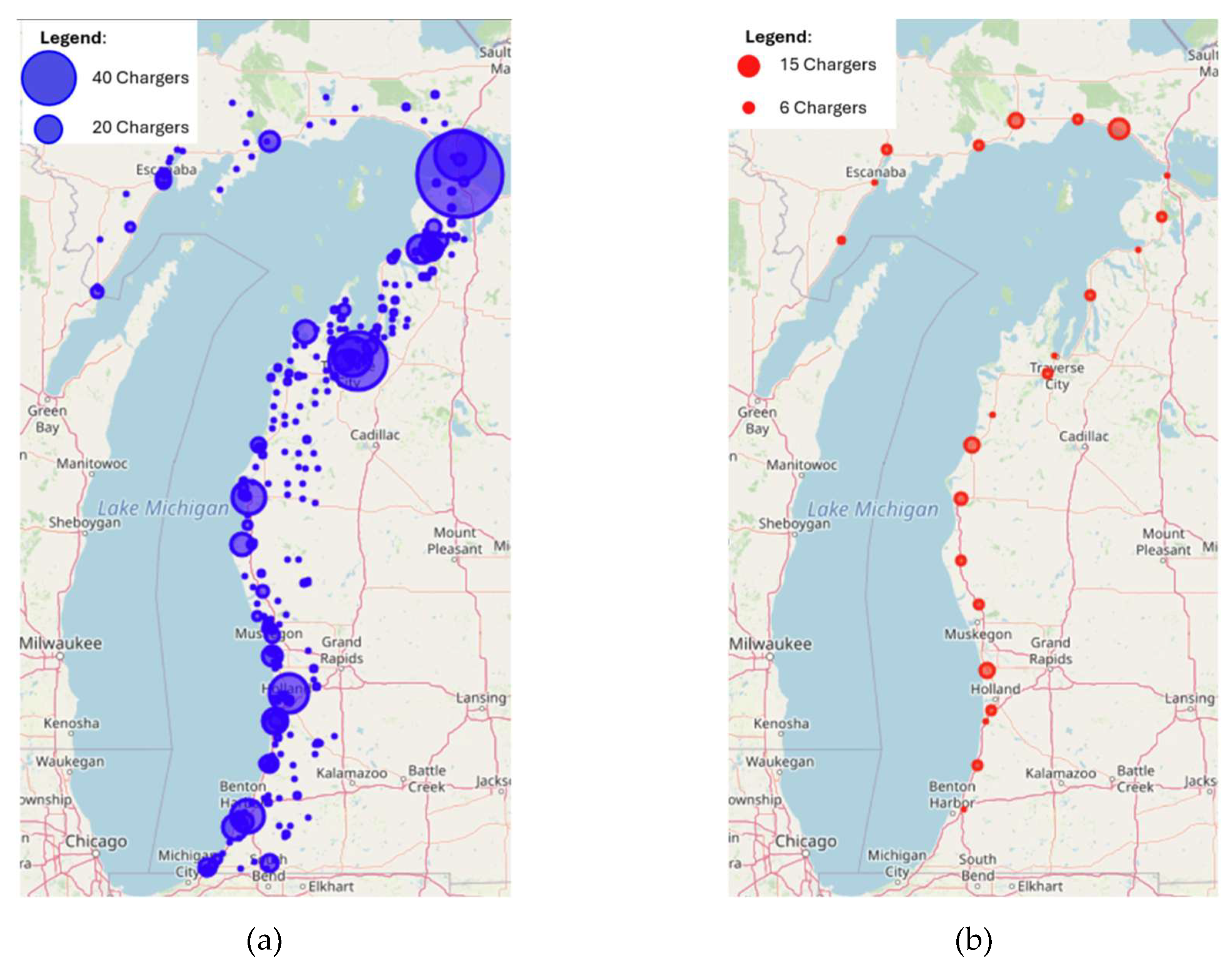
Table 6 reports the optimal results for the no-budget-limit case. These results suggest that a total investment of about $26 million ($15.57 million for Level 2, $10.22 million for DCFC) is adequate to deploy the necessary charging infrastructure across the LMC to accommodate tourism trips and achieve an acceptable level of service. This configuration yields a user-inconvenience cost of $23.46 thousand, the minimum across all scenarios evaluated.
Table 7 compares the optimal configurations for each budget-limit scenario identified in the preceding analysis. As shown, increasing investment in charging infrastructure decreases Level 2 unserved EV and energy demand, total Level 2 detour delay, total DCFC delay per user (refueling, queuing, and detour), and total user inconvenience cost. When the budget is raised from $15 million to $20 million, the entire increment is allocated to Level 2 chargers; when it is raised from $20 million to $25 million, the additional funds are divided roughly equally between Level 2 and DCFC. This occurs because, at lower budgets, substantial Level 2 demand remains unserved, causing users to detour to DCFCs and increasing DCFC queuing time; therefore, the algorithm initially prioritizes Level 2 investment. Moreover, increasing the budget from $15 million to $20 million reduces the total user inconvenience cost by 47%, while increasing it from $20 million to $25 million reduces the cost by 18%. Comparing all scenarios, it is found that achieving the optimal configuration requires allocating between 35% and 47% of the total budget to DCFCs, depending on the overall budget level.
To identify the best-performing scenario across all budget limits, it is necessary to assess whether the benefits of additional chargers (reduced user inconvenience cost) outweigh the added infrastructure cost. Comparing the total cost of infrastructure and user-inconvenience (last row of Table 7) indicates that the minimum occurs when $15.57 million is allocated to Level 2 and $8.93 million to DCFC, yielding a total infrastructure cost of $24.50 million.
Figure 15 through 17 depict the spatial distribution of interconnected Level 2 and DCFC chargers for the optimal configuration in each budget-limit scenario.
Figure 15.
Optimal charging infrastructure distribution with a $15 million total investment budget: (a) Level 2; (b) DCFC.
Figure 15.
Optimal charging infrastructure distribution with a $15 million total investment budget: (a) Level 2; (b) DCFC.
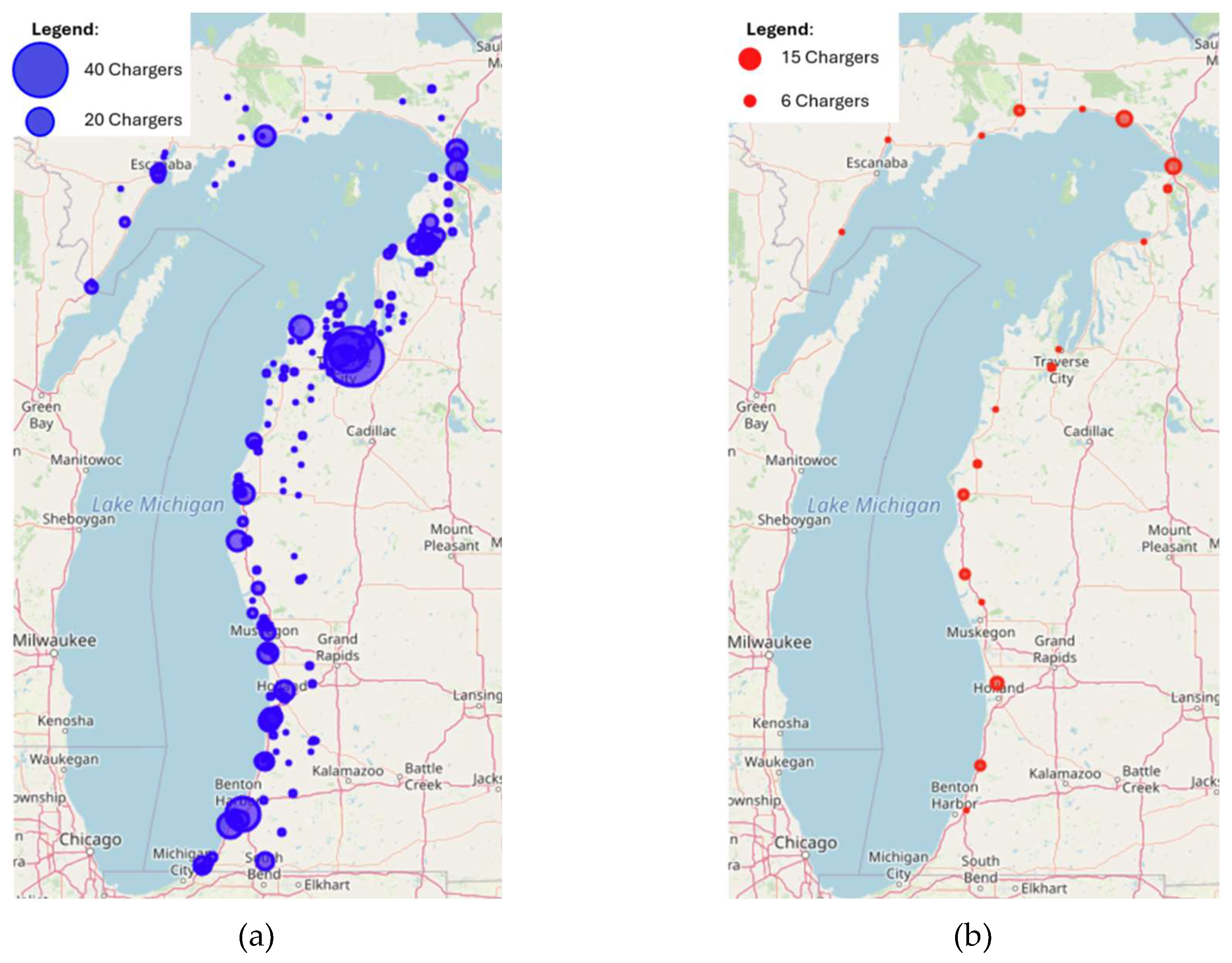
Figure 16.
Optimal charging infrastructure distribution with a $25 million total investment budget: (a) Level 2; (b) DCFC.
Figure 16.
Optimal charging infrastructure distribution with a $25 million total investment budget: (a) Level 2; (b) DCFC.
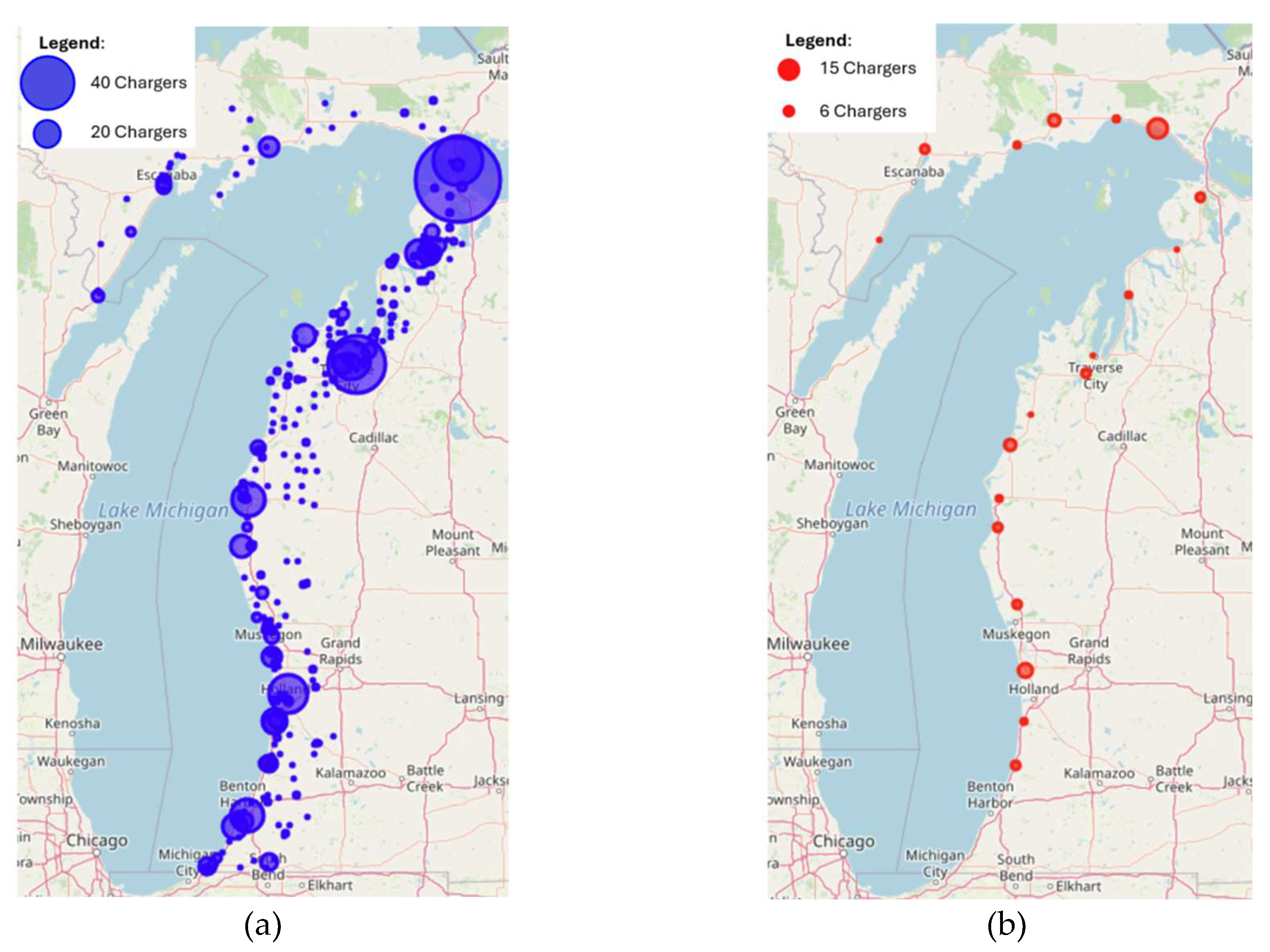
Figure 17.
Optimal charging infrastructure distribution with no budget limit: (a) Level 2; (b) DCFC.
Figure 17.
Optimal charging infrastructure distribution with no budget limit: (a) Level 2; (b) DCFC.
6.2. User Value of Time Sensitivity Analysis
In this section, different values of time for users are examined to assess how changes in time valuation influence charger deployment. Hourly wage data for Michigan are obtained from the Michigan Department of Technology, Management, and Budget, which reports 2024 wage statistics for the state’s Prosperity Regions (73). Table 8 summarizes these data, with the last row presenting the weighted average hourly wage. In addition, the minimum hourly wage in Michigan for 2024 is $12.48, as reported by the Department of Labor and Economic Opportunity (74). Based on these sources, values of time of $13, $23, and $36 per hour are evaluated and compared to the $18 per hour assumption used in the main scenario.
Table 9 summarizes the results obtained from running the framework under an unconstrained budget scenario for charging-infrastructure deployment, considering different values of time for users. The last row reports the total user delay, which includes the detour delay for unserved users at Level 2 chargers as well as the detour, queuing, and refueling times for users charging at DCFCs. Overall, the results indicate that as the value of time increases, the total number of required chargers increases, unserved EV and energy demand at Level 2 chargers decreases, DCFC queuing time is reduced, and the total user delay declines. Increasing the value of time from $18 to $23 per hour slightly worsens the Level 2 charging network by increasing the total detour delay experienced by unserved users at Level 2 chargers from 3.7 to 3.9 hours. However, the total user delay still decreases. This reduction is driven by the interconnection between the Level 2 and DCFC networks, where improvements in the DCFC network more than offset the deterioration observed in the Level 2 network. By increasing the value of time from $13 to $36 per hour, which correspond to the minimum hourly wage and the average of the 75th-percentile hourly wage in Michigan respectively, the number of DCFCs increases by almost 18%, and the average queuing time decreases by approximately 50%.
7. Conclusions
This research presents a comprehensive framework for optimizing a mix of DCFC and Level 2 EV charging infrastructure along the Lake Michigan coastline in Michigan, using methods that are readily transferable to other tourism-oriented regions. The charging stations include destination charging at tourist destinations and intermediate charging along the main corridor. Destination chargers are Level 2 chargers, capable of adding approximately 100 miles of range over an eight-hour charging period. In contrast, intermediate chargers are DCFCs, which can recharge an EV battery to about 80% in 30 minutes or less. Although DCFCs provide substantially faster charging, their higher currents and associated thermal stress can accelerate battery degradation, whereas Level 2 charging is generally much gentler on battery health.
For destination charging, a heuristic algorithm known as GAIN determines the optimal locations and quantities of Level 2 chargers, focusing on minimizing system costs and user inconveniences. The intermediate charging incorporates MCSA, dynamic penalties, and a two-stage decision-making process to determine the best locations and quantities for DCFCs. The objective is to minimize both user and system provider costs while ensuring feasible and cost-effective tourism trips. The interconnection of destination (Level 2) and intermediate (DCFC) charging options ensures that DCFC stations, primarily deployed to sustain trip feasibility as intermediate charging, can effectively compensate for any insufficiencies in destination charging.
The study also accounted for variable electric grid costs across different regions, incorporating the need for technological upgrades and grid capacity enhancements. A step function was developed to capture electric grid costs corresponding to various hourly energy demand ranges, providing a realistic evaluation of charging infrastructure needs. Moreover, existing Level 2 and DCFC chargers were considered in the analysis, acknowledging their role in partially meeting the charging demand and influencing the optimal placement of new chargers.
The proposed infrastructure satisfies the full LMC EV demand across all budget limit scenarios and across different allocations between destination and intermediate charging. Ensuring that all corridor trips remain feasible, that drivers can reach a charger before depleting their battery, requires allocating at least $4 million to DCFCs. Overall, the interconnected network provides satisfactory service; however, when DCFC funding falls below $6 million, the average total DCFC delay (detour, queuing, and refueling) exceeds 20 minutes per user. Thus, while trip feasibility can be maintained with a $4 million investment in DCFC infrastructure, although reaching an acceptable level of service requires 1.5 times more investment in DCFC, expanding DCFC investment to approximately $6 million.
The proposed algorithm determines the optimal locations and number of chargers under a budget constraint for an interconnected Level 2 and DCFC network. Because the two networks interact, users unserved at Level 2 stations may detour to DCFCs. The algorithm uses the budget efficiently, it avoids additional installations when the benefit from added chargers does not exceed the extra investment cost, leaving funds unspent. As the budget increases, it directs money to the network that helps users most. Empirically, when the budget rises from $15 million to $20 million, the full increment is directed to Level 2 chargers, resulting in a 47% reduction in total user inconvenience cost. when it increases from $20 million to $25 million, the increment is divided approximately evenly between Level 2 and DCFC installations, leading to an 18% reduction in total user inconvenience cost. The analysis indicates that achieving the optimal configuration requires allocating approximately 35% to 47% of the total budget to DCFCs, with the exact proportion depending on the overall budget level.
The proposed algorithm also assesses how charging-infrastructure deployment responds to different user values of time. The results show that higher values of time lead to an increase in the total number of required chargers, a reduction in unserved EV and energy demand at Level 2 chargers, shorter queuing times at DCFC stations, and an overall decline in total user delay. When the value of time increases from $13 to $36 per hour, corresponding to the minimum hourly wage and the average 75th-percentile hourly wage in Michigan, respectively, the number of DCFC chargers increases by nearly 18%, while average queuing time decreases by approximately 50%.
Overall, this study underscores the need to balance investment between destination (Level 2) and intermediate (DCFC) charging to optimize infrastructure performance. Comparisons in Error! Reference source not found. through Table 5 show substantial variation in total user inconvenience, confirming that budget allocation between Level 2 and DCFC is consequential and should be optimized jointly. The interconnected network adapts to diverse travel patterns in the LMC region, demonstrating the flexibility and reliability of an integrated approach for meeting charging demand. By providing dependable, efficient charging for visitors, this strategy supports EV adoption and advances Michigan’s ecotourism goals.
Future research could explore dynamic adjustments to the infrastructure based on real-time data and evolving EV technologies. Expanding the framework to include diverse geographic regions could also provide further insights into optimizing EV infrastructure on a larger scale. A key limitation is the reliance on ITE Trip Generation rates to estimate tourism travel at long-term stay locations due to the lack of tourism-specific origin–destination data; validating these estimates with more comprehensive and up-to-date tourism travel data would improve accuracy. By implementing this interconnected framework, this research lays the foundation for a more sustainable and user-friendly EV charging network, contributing to broader environmental and economic benefits for the region.
Acknowledgments
This material is based upon work supported by the Michigan Department of Environment, Great Lakes, and Energy under Award Number EE008653. The authors also appreciate the assistance of the Bureau of Transportation Planning staff at the Michigan Department of Transportation (MDOT) in making data available to the study, especially Bradley Sharlow and Jesse Frankovich. The authors naturally remain solely responsible for all contents of the paper.
Author Contributions
All authors contributed to all aspects of the study, from conception and design to analysis and interpretation of results and manuscript preparation. All authors reviewed the results and approved the final version of the manuscript. The authors do not have any conflicts of interest to declare.
Acknowledgment of AI Assistance
Artificial intelligence tools were used solely to improve the grammar, clarity, and readability of the manuscript. No AI tools were involved in the research design, data analysis, or generation of original scientific content.
References
- Zhang, X.; Rey, D.; Waller, S. T. Multitype Recharge Facility Location for Electric Vehicles. Computer-Aided Civil and Infrastructure Engineering 2018, Vol. 33(No. 11), 943–965. [Google Scholar] [CrossRef]
- Nie, Y.; Ghamami, M.; Zockaie, A.; Xiao, F. Optimization of Incentive Polices for Plug-in Electric Vehicles. Transportation Research Part B: Methodological 2016, Vol. 84, 103–123. [Google Scholar] [CrossRef]
- Alliance for Automotive Innovation. Get Connected, Electric Vehicle Quarterly Report. 2024. [Google Scholar]
- MI Future Mobility Plan. 2022.
- Mao, H.; Shi, J.; Zhou, Y.; Zhang, G. The Electric Vehicle Routing Problem with Time Windows and Multiple Recharging Options. IEEE Access 2020, Vol. 8, 114864–114875. [Google Scholar] [CrossRef]
- Wang, H.; Zhao, D.; Meng, Q.; Ong, G. P.; Lee, D. H. A Four-Step Method for Electric-Vehicle Charging Facility Deployment in a Dense City: An Empirical Study in Singapore. Transportation Research Part A: Policy and Practice 2019, Vol. 119, 224–237. [Google Scholar] [CrossRef]
- McKercher, B.; Tkaczynski, A. Will Electric Vehicles Decarbonise Drive Tourism? Annals of Tourism Research Empirical Insights 2024, Vol. 5(No. 2). [Google Scholar] [CrossRef]
- Eijgelaar, E.; Peeters, P. Zero-Emission Tourism Mobility A Research and Policy Agenda PIB Connecting Success Formulas: Sustainable Mobility and Energy in Austria and the Netherlands-K2K Consortium Development Zero-Emission Tourism Mobility; 2018. [Google Scholar]
- Mastoi, M. S.; Zhuang, S.; Munir, H. M.; Haris, M.; Hassan, M.; Usman, M.; Bukhari, S. S. H.; Ro, J. S. An In-Depth Analysis of Electric Vehicle Charging Station Infrastructure, Policy Implications, and Future Trends. Energy Reports Volume 8, 11504–11529. [CrossRef]
- Khan, W.; Ahmad, A.; Ahmad, F.; Alam, M. Saad. A Comprehensive Review of Fast Charging Infrastructure for Electric Vehicles. In Smart Science. 3; Volume 6, pp. 256–270.
- Alternative Fuels Data Center (Electric Vehicle Charging Stations). Available online: https://afdc.energy.gov/fuels/electricity-stations#:~:text=Level%201%20charging%20is%20typically,United%20States%20were%20Level%201 (accessed on Dec. 16 2025).
- Ou, S. Estimate Long-Term Impact on Battery Degradation by Considering Electric Vehicle Real-World End-Use Factors. Journal of Power Sources 2023, Vol. 573. [Google Scholar] [CrossRef]
- Stroe, D.-I.; Swierczynski, M.; Kær, S. K.; Laserna, E. M.; Zabala, E. S. ECCE 2017: IEEE Energy Conversion Congress & Expo: Cincinnati, Ohio, October 1-5. 2017.
- How Much Does It Cost to Charge at a Public EV Charging Station? Available online: https://www.evconnect.com/blog/how-much-does-it-cost-to-charge-an-electric-car-at-a-public-charging-station/#:~:text=On%20average%2C%20Level%202%20charging%20can%20range,other%20factors%20specific%20to%20each%20charging%20station (accessed on Dec. 16 2025).
- Morin, H. R.; Whitacre, J. F.; Michalek, J. Quantifying the Degradation Cost of Frequent Fast Charging across Multiple Electric Vehicle Battery Chemistries. Journal of Power Sources Vol. 652(2025), 237552. [CrossRef]
- How Long Do Electric Car Batteries Last? Available online: https://www.geotab.com/blog/ev-battery-health/ (accessed on Dec. 16 2025).
- Unterluggauer, T.; Rich, J.; Andersen, P. B.; Hashemi, S. Electric Vehicle Charging Infrastructure Planning for Integrated Transportation and Power Distribution Networks: A Review. In eTransportation; Volume 12.
- Kavianipour, M.; Verbas, O.; Rostami, A.; Soltanpour, A.; Gurumurthy, K. M.; Ghamami, M.; Zockaie, A. Deploying Fast Charging Infrastructure for Electric Vehicles in Urban Networks: An Activity-Based Approach. Transportation Research Record 2023. [Google Scholar] [CrossRef]
- Kavianipour, M.; Fakhrmoosavi, F.; Shojaei, M. H.; Zockaie, A.; Ghamami, M.; Wang, J.; Jackson, R. Impacts of Technology Advancements on Electric Vehicle Charging Infrastructure Configuration: A Michigan Case Study. International Journal of Sustainable Transportation 2022, Vol. 16(No. 7), 597–609. [Google Scholar] [CrossRef]
- Ghamami, M.; Kavianipour, M.; Zockaie, A.; Hohnstadt, L. R.; Ouyang, Y. Refueling Infrastructure Planning in Intercity Networks Considering Route Choice and Travel Time Delay for Mixed Fleet of Electric and Conventional Vehicles. Transportation Research Part C: Emerging Technologies 2020, Vol. 120. [Google Scholar] [CrossRef]
- Singh, H.; Kavianipour, M.; Soltanpour, A.; Fakhrmoosavi, F.; Ghamami, M.; Zockaie, A.; Jackson, R. Macro Analysis to Estimate Electric Vehicles Fast-Charging Infrastructure Requirements in Small Urban Areas. In Transportation Research Record; SAGE Publications Ltd; pp. 446–461.
- Kavianipour, M.; Fakhrmoosavi, F.; Singh, H.; Ghamami, M.; Zockaie, A.; Ouyang, Y.; Jackson, R. Electric Vehicle Fast Charging Infrastructure Planning in Urban Networks Considering Daily Travel and Charging Behavior. Transportation Research Part D: Transport and Environment 2021, Vol. 93. [Google Scholar] [CrossRef]
- Xie, F.; Lin, Z. Integrated U.S. Nationwide Corridor Charging Infrastructure Planning for Mass Electrification of Inter-City Trips. Applied Energy 2021, Vol. 298. [Google Scholar] [CrossRef]
- Csiszár, C.; Csonka, B.; Földes, D.; Wirth, E.; Lovas, T. Urban Public Charging Station Locating Method for Electric Vehicles Based on Land Use Approach. Journal of Transport Geography 2019, Vol. 74, 173–180. [Google Scholar] [CrossRef]
- Wang, C.; He, F.; Lin, X.; Shen, Z. J. M.; Li, M. Designing Locations and Capacities for Charging Stations to Support Intercity Travel of Electric Vehicles: An Expanded Network Approach. Transportation Research Part C: Emerging Technologies 2019, Vol. 102, 210–232. [Google Scholar] [CrossRef]
- Khadem, N. K.; Nickkar, Amirreza; Shin, H.-S.; Student, P. D. A Review of Different Charging Stations Optimal Localization Models and Analysis Functions for the Electric Vehicle Charging Infrastructure; 2020. [Google Scholar]
- Metais, M. O.; Jouini, O.; Perez, Y.; Berrada, J.; Suomalainen, E. Too Much or Not Enough? Planning Electric Vehicle Charging Infrastructure: A Review of Modeling Options. In Renewable and Sustainable Energy Reviews; Volume 153.
- Kchaou-Boujelben, M. Charging Station Location Problem: A Comprehensive Review on Models and Solution Approaches. In Transportation Research Part C: Emerging Technologies; Volume 132.
- Kweon, S. J.; Hwang, S. W.; Ventura, J. A. A Continuous Deviation-Flow Location Problem for an Alternative-Fuel Refueling Station on a Tree-Like Transportation Network. Journal of Advanced Transportation Vol. 2017, 2017. [CrossRef]
- Wang, X.; Shahidehpour, M.; Jiang, C.; Li, Z. Coordinated Planning Strategy for Electric Vehicle Charging Stations and Coupled Traffic-Electric Networks. IEEE Transactions on Power Systems 2019, Vol. 34(No. 1), 268–279. [Google Scholar] [CrossRef]
- Zockaie, A.; Aashtiani, H. Z.; Ghamami, M.; Nie, Y. Marco. Solving Detour-Based Fuel Stations Location Problems. Computer-Aided Civil and Infrastructure Engineering 2016, Vol. 31(No. 2), 132–144. [Google Scholar] [CrossRef]
- Kuby, M.; Lim, S. The Flow-Refueling Location Problem for Alternative-Fuel Vehicles. Socio-Economic Planning Sciences 2005, Vol. 39(No. 2), 125–145. [Google Scholar] [CrossRef]
- Ghamami, M.; Zockaie, A.; Nie, Y. M. A General Corridor Model for Designing Plug-in Electric Vehicle Charging Infrastructure to Support Intercity Travel. Transportation Research Part C: Emerging Technologies 2016, Vol. 68, 389–402. [Google Scholar] [CrossRef]
- Guo, F.; Yang, J.; Lu, J. The Battery Charging Station Location Problem: Impact of Users’ Range Anxiety and Distance Convenience. Transportation Research Part E: Logistics and Transportation Review 2018, Vol. 114, 1–18. [Google Scholar] [CrossRef]
- He, F.; Yin, Y.; Zhou, J. Deploying Public Charging Stations for Electric Vehicles on Urban Road Networks. Transportation Research Part C: Emerging Technologies 2015, Vol. 60, 227–240. [Google Scholar] [CrossRef]
- Liu, H.; Wang, D. Z. W. Locating Multiple Types of Charging Facilities for Battery Electric Vehicles. Transportation Research Part B: Methodological 2017, Vol. 103, 30–55. [Google Scholar] [CrossRef]
- Chen, Z.; He, F.; Yin, Y. Optimal Deployment of Charging Lanes for Electric Vehicles in Transportation Networks. Transportation Research Part B: Methodological 2016, Vol. 91, 344–365. [Google Scholar] [CrossRef]
- Zheng, H.; Peeta, S. Routing and Charging Locations for Electric Vehicles for Intercity Trips. Transportation Planning and Technology 2017, Vol. 40(No. 4), 393–419. [Google Scholar] [CrossRef]
- Deb, S.; Tammi, K.; Kalita, K.; Mahanta, P. Review of Recent Trends in Charging Infrastructure Planning for Electric Vehicles. In Wiley Interdisciplinary Reviews: Energy and Environment; 6.; Volume 7.
- Huang, K.; Kanaroglou, P.; Zhang, X. The Design of Electric Vehicle Charging Network. Transportation Research Part D: Transport and Environment 2016, Vol. 49, 1–17. [Google Scholar] [CrossRef]
- Sun, Z.; Gao, W.; Li, B.; Wang, L. Locating Charging Stations for Electric Vehicles. Transport Policy 2020, Vol. 98, 48–54. [Google Scholar] [CrossRef]
- He, Y.; Song, Z.; Liu, Z. Fast-Charging Station Deployment for Battery Electric Bus Systems Considering Electricity Demand Charges. Sustainable Cities and Society 2019, Vol. 48. [Google Scholar] [CrossRef]
- Huang, Y.; Li, S.; Qian, Z. S. Optimal Deployment of Alternative Fueling Stations on Transportation Networks Considering Deviation Paths. Networks and Spatial Economics 2015, Vol. 15(No. 1), 183–204. [Google Scholar] [CrossRef]
- Honma, Y.; Kuby, M. Node-Based vs. Path-Based Location Models for Urban Hydrogen Refueling Stations: Comparing Convenience and Coverage Abilities. International Journal of Hydrogen Energy 2019, Vol. 44(No. 29), 15246–15261. [Google Scholar] [CrossRef]
- Chen, Z.; He, F.; Yin, Y. Optimal Deployment of Charging Lanes for Electric Vehicles in Transportation Networks. Transportation Research Part B: Methodological 2016, Vol. 91, 344–365. [Google Scholar] [CrossRef]
- Pan, Z. J.; Zhang, Y. A Novel Centralized Charging Station Planning Strategy Considering Urban Power Network Structure Strength. Electric Power Systems Research 2016, Vol. 136, 100–109. [Google Scholar] [CrossRef]
- Mozafari, H.; Soltanpour, A.; Jazlan, F.; Vosoughinia, S.; Ghamami, M.; Zockaie, A. Leveraging Alternative Fuel Vehicles in Operation and Asset Management Strategies to Reduce Fleet Economic and Societal Impacts. Journal of Transportation Technologies Vol. 15(No. 03, 2025), 335–373. [CrossRef]
- Ghamami, M.; Zockaie, A.; Vosoughinia, S.; Soltanpour, A. EV Charging Infrastructure Study . 2025.
- Lin, H.; Bian, C.; Wang, Y.; Li, H.; Sun, Q.; Wallin, F. Optimal Planning of Intra-City Public Charging Stations. Energy 2022, Vol. 238. [Google Scholar] [CrossRef]
- Davidov, S.; Pantoš, M. Optimization Model for Charging Infrastructure Planning with Electric Power System Reliability Check. Energy 2019, Vol. 166, 886–894. [Google Scholar] [CrossRef]
- Wang, Y. W.; Lin, C. C. Locating Multiple Types of Recharging Stations for Battery-Powered Electric Vehicle Transport. Transportation Research Part E: Logistics and Transportation Review 2013, Vol. 58, 76–87. [Google Scholar] [CrossRef]
- Zhou, B.; Chen, G.; Huang, T.; Song, Q.; Yuan, Y. Planning PEV Fast-Charging Stations Using Data-Driven Distributionally Robust Optimization Approach Based on φ-Divergence. IEEE Transactions on Transportation Electrification 2020, Vol. 6(No. 1), 170–180. [Google Scholar] [CrossRef]
- Zhang, H.; Hu, Z.; Song, Y. Power and Transport Nexus: Routing Electric Vehicles to Promote Renewable Power Integration. IEEE Transactions on Smart Grid 2020, Vol. 11(No. 4), 3291–3301. [Google Scholar] [CrossRef]
- Kabir, M. E.; Assi, C.; Alameddine, H.; Antoun, J.; Yan, J. Demand-Aware Provisioning of Electric Vehicles Fast Charging Infrastructure. IEEE Transactions on Vehicular Technology 2020, Vol. 69(No. 7), 6952–6963. [Google Scholar] [CrossRef]
- Lim, S.; Kuby, M. Heuristic Algorithms for Siting Alternative-Fuel Stations Using the Flow-Refueling Location Model. European Journal of Operational Research 2010, Vol. 204(No. 1), 51–61. [Google Scholar] [CrossRef]
- Liu, G.; Kang, L.; Luan, Z.; Qiu, J.; Zheng, F. Charging Station and Power Network Planning for Integrated Electric Vehicles (EVs). Energies 2019, Vol. 12(No. 13). [Google Scholar] [CrossRef]
- Deb, S.; Tammi, K.; Kalita, K.; Mahanta, P. Charging Station Placement for Electric Vehicles: A Case Study of Guwahati City, India. IEEE Access 2019, Vol. 7, 100270–100282. [Google Scholar] [CrossRef]
- Deb, S.; Gao, X. Z.; Tammi, K.; Kalita, K.; Mahanta, P. A Novel Chicken Swarm and Teaching Learning Based Algorithm for Electric Vehicle Charging Station Placement Problem. Energy 2021, Vol. 220. [Google Scholar] [CrossRef]
- Wang, S.; Dong, Z. Y.; Luo, F.; Meng, K.; Zhang, Y. Stochastic Collaborative Planning of Electric Vehicle Charging Stations and Power Distribution System. IEEE Transactions on Industrial Informatics 2018, Vol. 14(No. 1), 321–331. [Google Scholar] [CrossRef]
- Deb, S.; Gao, X. Z.; Tammi, K.; Kalita, K.; Mahanta, P. Nature-Inspired Optimization Algorithms Applied for Solving Charging Station Placement Problem: Overview and Comparison. Archives of Computational Methods in Engineering 2021, Vol. 28(No. 1), 91–106. [Google Scholar] [CrossRef]
- Bhat, F. A.; Tiwari, G. Y.; Verma, A. Preferences for Public Electric Vehicle Charging Infrastructure Locations: A Discrete Choice Analysis. Transport Policy 2024, Vol. 149, 177–197. [Google Scholar] [CrossRef]
- Wang, Y. W.; Lin, C. C.; Lee, T. J. Electric Vehicle Tour Planning. Transportation Research Part D: Transport and Environment 2018, Vol. 63, 121–136. [Google Scholar] [CrossRef]
- Suanpang, P.; Jamjuntr, P.; Kaewyong, P.; Niamsorn, C.; Jermsittiparsert, K. An Intelligent Recommendation for Intelligently Accessible Charging Stations: Electronic Vehicle Charging to Support a Sustainable Smart Tourism City. Sustainability (Switzerland) 2023, Vol. 15(No. 1). [Google Scholar] [CrossRef]
- Xu, D.; Pei, W.; Zhang, Q. Optimal Planning of Electric Vehicle Charging Stations Considering User Satisfaction and Charging Convenience. Energies 2022, Vol. 15(No. 14). [Google Scholar] [CrossRef]
- Knowles, N. L. B.; Scott, D.; Mitchell, S. The Great Canadian (Electric) Road Trip: Evaluating EV Use in National Park Tourism. Tourism and Hospitality 2024, Vol. 5(No. 2), 314–332. [Google Scholar] [CrossRef]
- Lake Michigan Circuit. Available online: https://www.michigan.gov/egle/about/organization/materials-management/energy/rfps-loans/lake-michigan-circuit (accessed on Sep. 22 2025).
- Lake Michigan Circle Tour. Available online: https://lakemichigandestinations.com/lake-michigan-circle-tour (accessed on Sep. 22 2025).
- Soltanpour, A.; Rostami, A.; Ghafarnezhad, B.; Ghamami, M.; Zockaie, A. Strategic Deployment of Level-2 Charging Infrastructure at Long-Distance Trip Endpoints Integrated with Fast Charging Network to Enhance EV Tourism. Sustainable Cities and Society Vol. 130(2025), 106516. [CrossRef]
- Rostami, A.; Soltanpour, A.; Kamjoo, E.; Ghamami, M.; Zockaie, A.; Zhao, D. Optimizing DC Fast Charger Placement Along Tourism Corridor Under Budget Constraints. 2025. [Google Scholar] [CrossRef]
- Alternative Fuels Data Center: Alternative Fuel Vehicle Emissions. Available online: https://afdc.energy.gov/vehicles/emissions (accessed on Jul. 25 2023).
- Zukerman, M. Introduction to Queueing Theory and Stochastic Teletraffic Models; 2000. [Google Scholar]
- ITE, 2012_Trip Generation Manual_201411071426035221. 2012.
- Michigan Prosperity Region Hourly Wage Rates, Michigan Department of Technology, Management & Budget. Available online: https://milmi.org/datasearch/OEWS-Prosperity (accessed on Dec. 18 2025).
- Minimum Wage & Overtime, Labor and Economic Opportunity. Available online: https://www.michigan.gov/leo/bureaus-agencies/ber/wage-and-hour/min-wage (accessed on Dec. 18 2025).
- U.S. Department of Transportation Federal Highway Administration. Available online: https://hepgis-usdot.hub.arcgis.com/apps/5c4d9e173301473688468fc7cf6dbe19/explore (accessed on Sep. 22 2025).
Figure 9.
Example of an EV charging station with two chargers (reproduced from (48)).
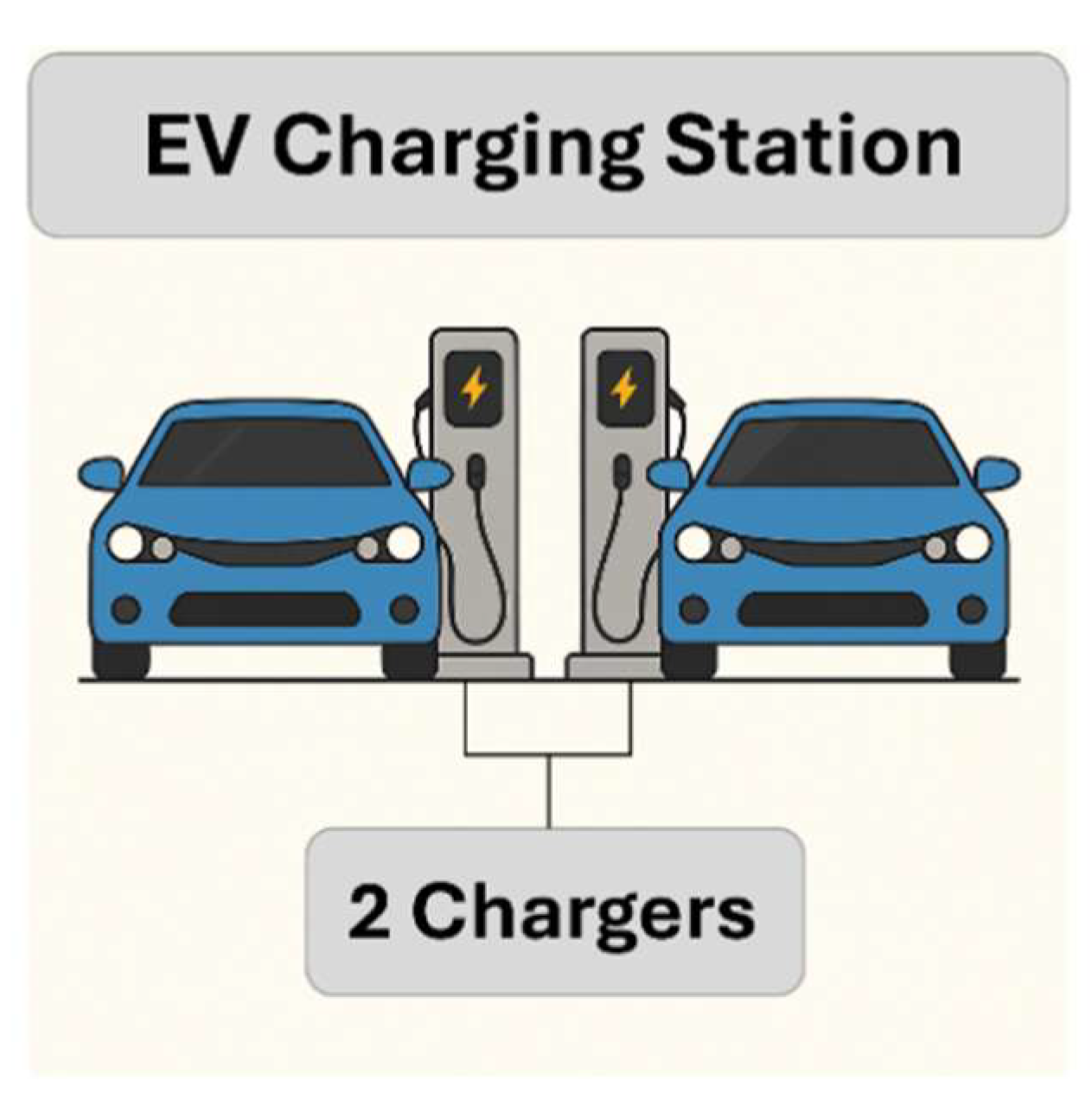
Figure 10.
Integrated framework.
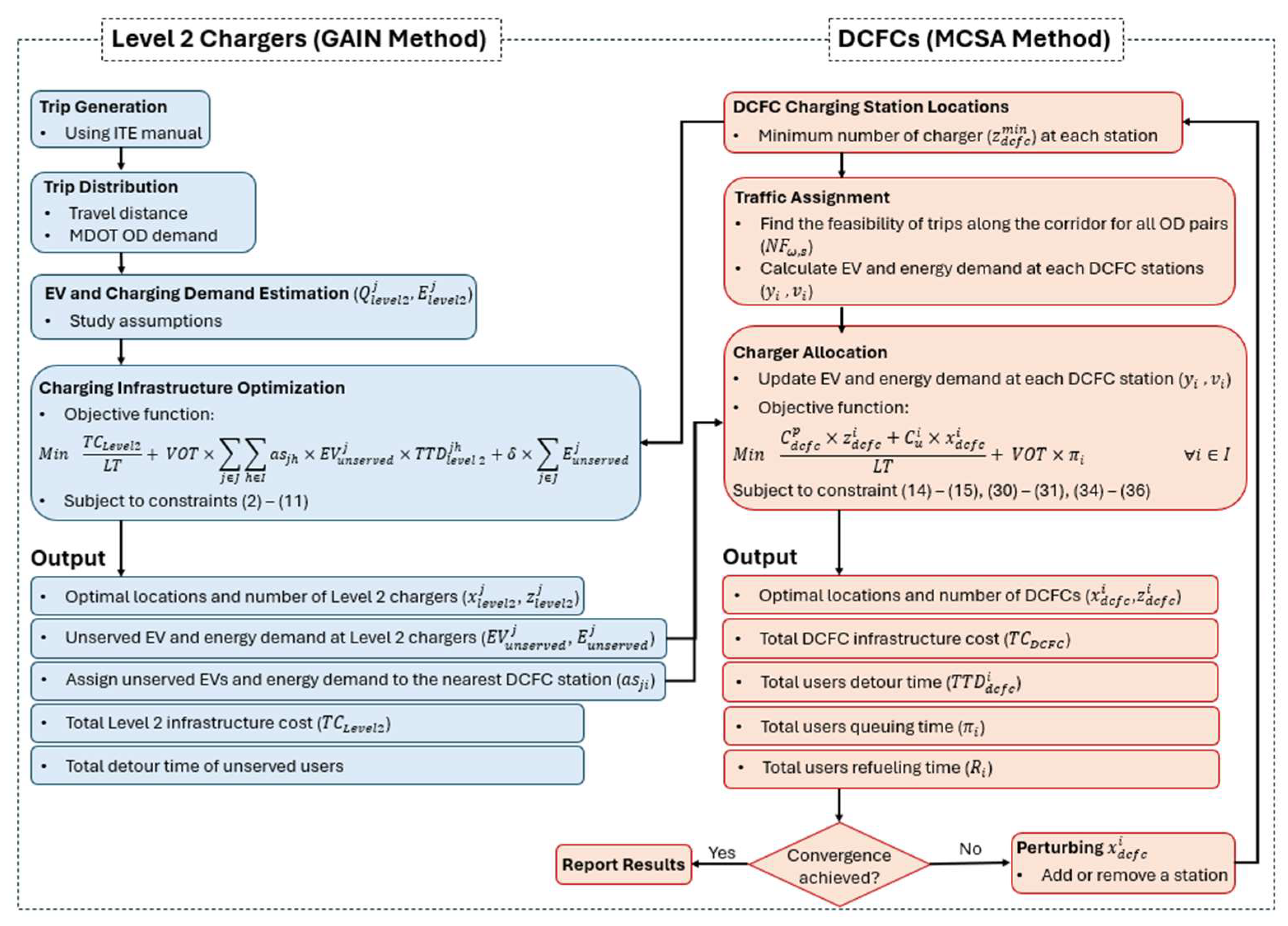
Figure 11.
Assumptions for estimating Level 2 EV and charging demand (reproduced from (68)).
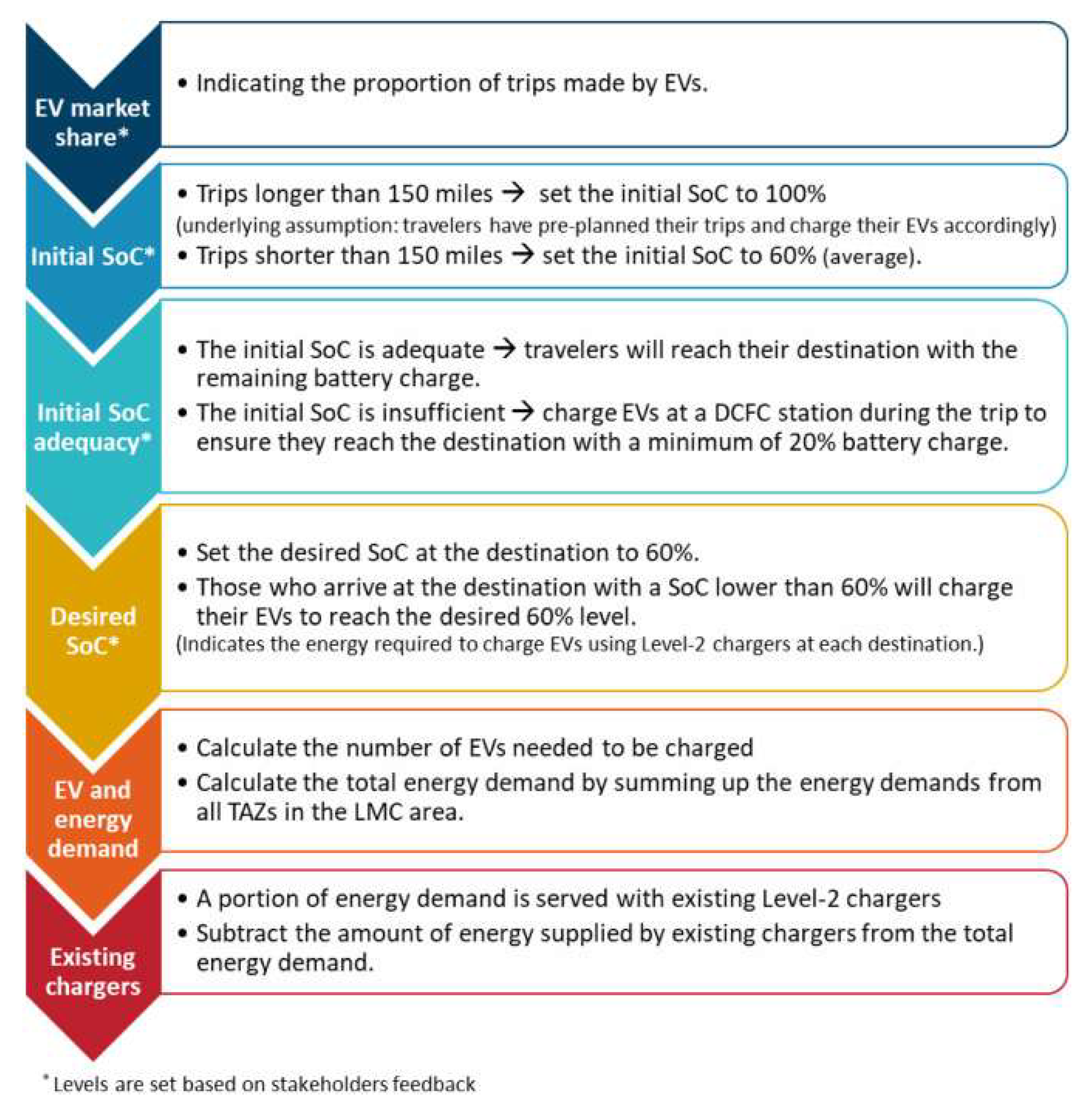
Figure 12.
MCSA algorithm flowchart.
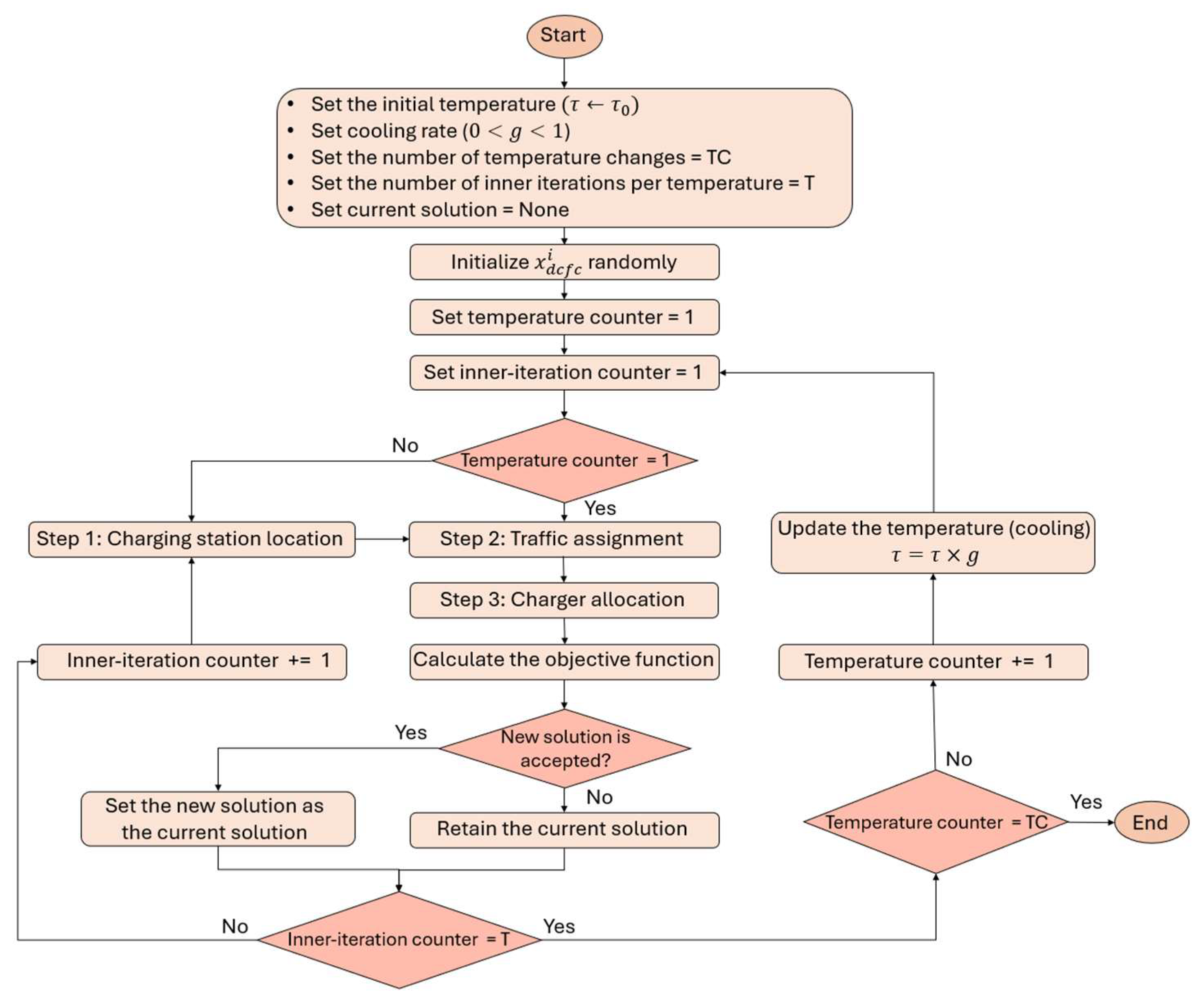
Figure 13.
Evolution of user inconvenience costs across alternative budget allocation strategies.
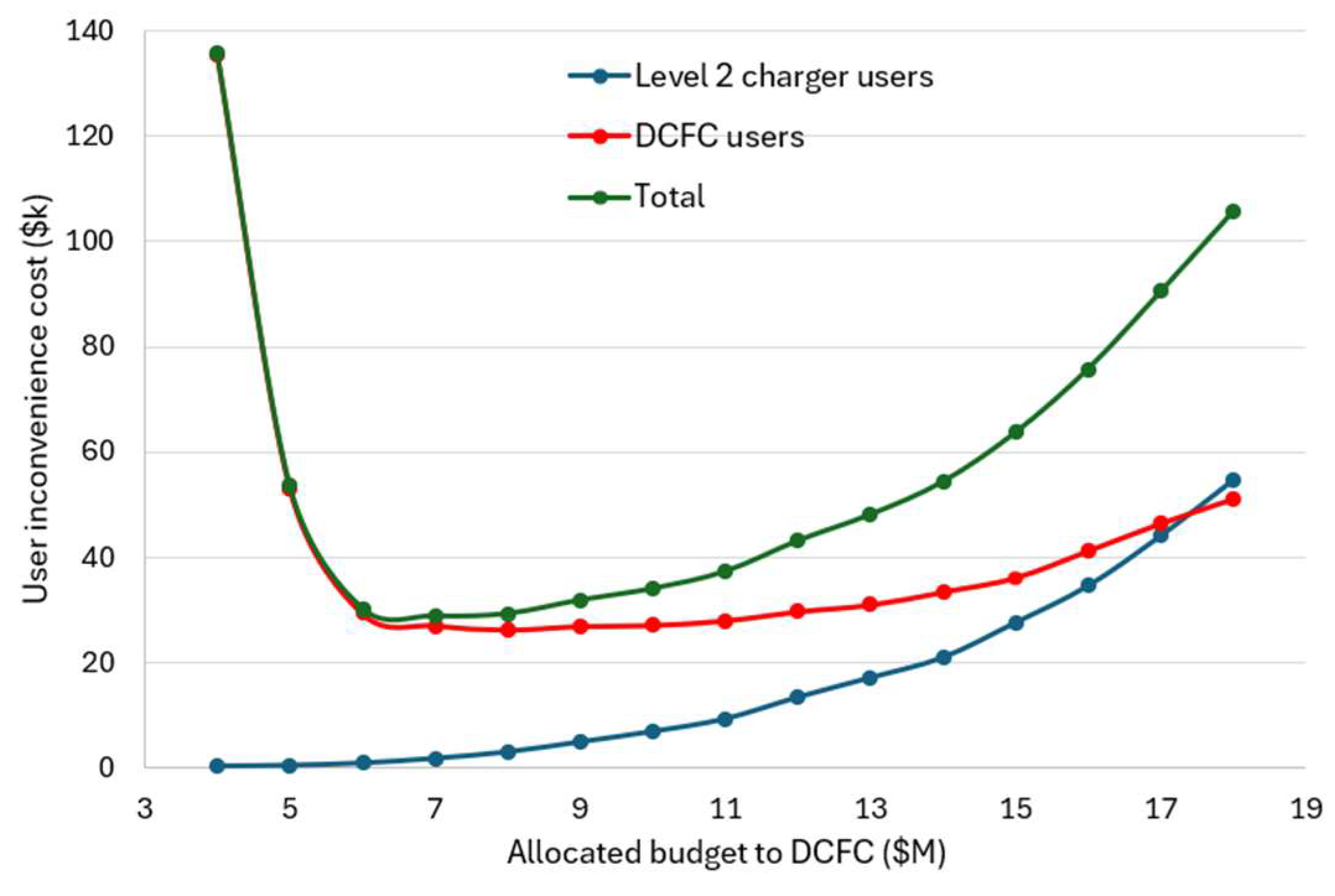
Figure 14.
Optimal charging infrastructure distribution with a $20 million total investment budget: (a) Level 2; (b) DCFC.
Figure 14.
Optimal charging infrastructure distribution with a $20 million total investment budget: (a) Level 2; (b) DCFC.
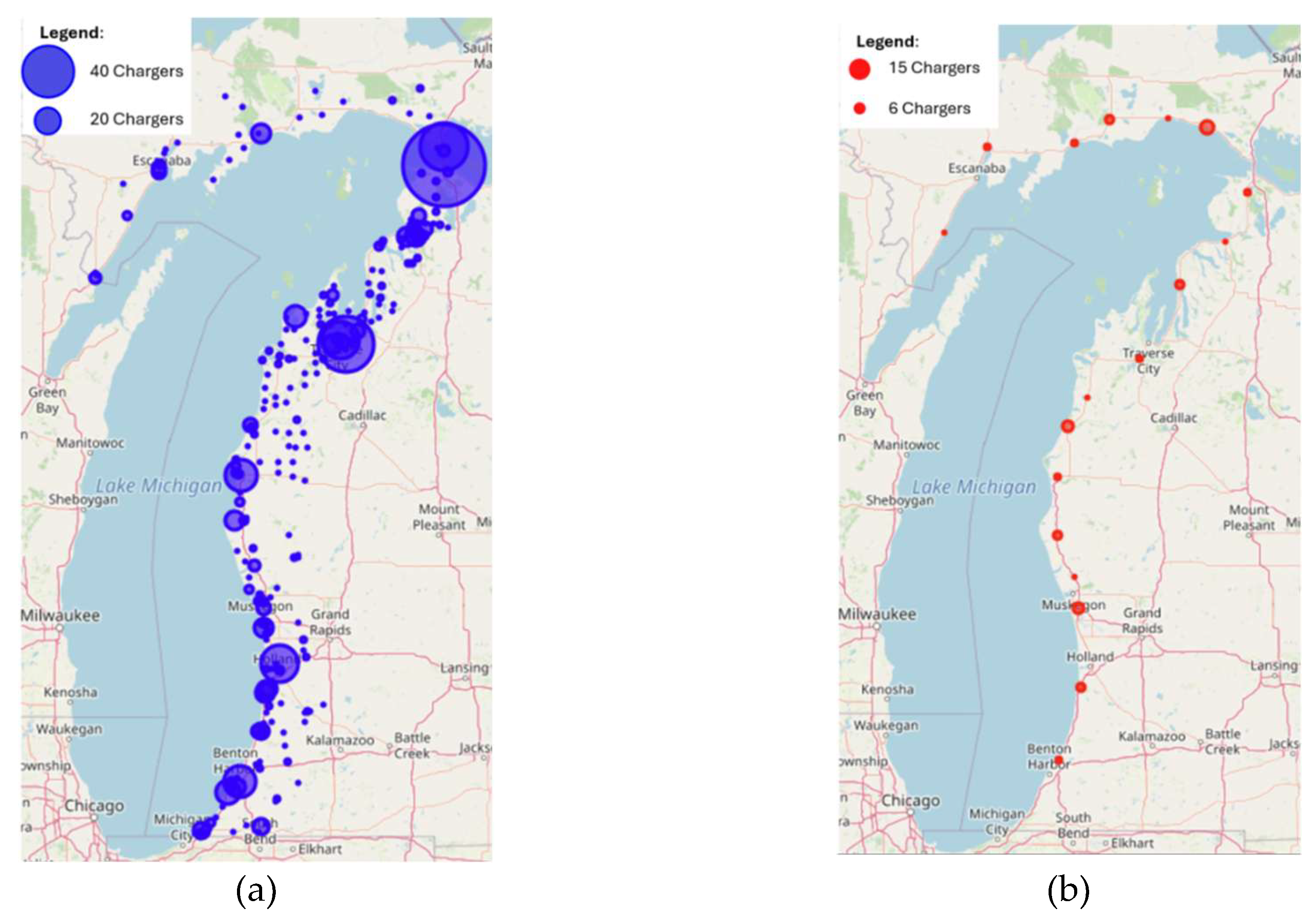
Table 1.
List of notations and their definitions within the modeling framework.
| Sets | |
| Set of Level 2 candidate locations | |
| Set of DCFC candidate locations | |
| Set of OD pair within the corridor | |
| Set of consecutive nodes = , +1,…, ,, visited by EVs in OD pair | |
| Set of indices corresponding to all possible combinations of charging stopping points for the EV during the trip for the OD pair excluding the origin and destination, = | |
| Parameters | |
| Big number | |
| Battery capacity (kWh) | |
| Battery performance (mile/kWh) | |
| Total budget available for Level 2 charging infrastructure ($) | |
| Level 2 charging power (kW) | |
| Fixed cost of building a level 2 charging station ($) | |
| Cost of installing one Level 2 charger ($) | |
| Travel time to detour from Level 2 charging station j to the DCFC station i (hour) | |
| Daily availability time window for Level 2 chargers | |
| Level 2 Charger efficiency | |
| Total number of EVs required to charge at level 2 chargers at destination j | |
| Total energy demand at destination j (kWh) | |
| Total budget available for DCFC charging infrastructure ($) | |
| DCFC charging power (kW) | |
| Fixed cost of building a DCFC charging station ($) | |
| Cost of installing one DCFC charger ($) | |
| Daily availability time window for DCFCs | |
| DCFC Charger efficiency | |
| Travel Demand for OD pair (vehicle) | |
| Origin node of trip for OD pair | |
| Destination node of trip for OD pair | |
| Shortest distance from node k to k+1 | |
| Minimum acceptable state of charge during a trip within the corridor | |
| Maximum acceptable state of charge during a trip within the corridor | |
| State of charge threshold at which users begin seeking DCFC charging stations | |
| Minimum number of DCFCs to be installed at each charging station | |
| Binary parameter, indicating whether stopping point is part of the combination for OD pair . It takes a value of 1 if an EV stops at node in the specified combination, and 0 otherwise. | |
| Average detour travel time required to reach the actual charging station from node i per user (hour) | |
| User value of time ($/hour) | |
| User cost difference between Level 2 chargers and DCFCs ($/kWh) | |
| Infrastructure lifetime (days) | |
| State variables | |
| Number of EVs remaining unserved at destination j due to lack of Level 2 chargers and make a detour to the nearest DCFC station | |
| Energy remained unserved at destination j (kWh) due to lack of Level 2 chargers and served by the nearest DCFC station | |
| Binary variable, equal to 1 if DCFC station i is the closest station to the Level 2 station j, and 0 otherwise. | |
| Electric grid upgrade cost of a charging station at node | |
| Energy demand (kWh) acquired by a vehicle visiting a DCFC station at node , corresponding to OD pair , and in stopping points combination of | |
| State of Charge (SoC) after visiting node for OD pair , and stopping points combination | |
| Binary variable, equal to 1 if EV trips for OD pair with stopping points combination is infeasible; and 0 otherwise | |
| Binary variable, takes a value of 1 if the EV for OD pair ω, and stopping points combination visited charging station for refueling, and 0 otherwise | |
| Travel Demand for OD pair and stopping points combination | |
| Binary variable, takes a value of 1 if the stopping points combination for EVs in OD pair ω is a valid charging stop set (it has been selected for this ω), and 0 otherwise. | |
| Total number of EVs visiting DCFC charging station in node i | |
| Total energy demand of EVs visiting DCFC charging station in node i (kWh) | |
| Total detour travel time experienced by all users charging at DCFC station at node i (hour) | |
| Total refueling time for EVs recharging at DCFC charging station at node i (hour) | |
| Arrival rate of EVs at DCFC station at node i () | |
| Charging service rate of DCFCs at node i () | |
| Total queuing time experienced by EVs visiting the DCFC charging station in node i (hour) | |
| Total Level 2 infrastructure cost ($) | |
| Total DCFC infrastructure cost ($) | |
| Decision variables | |
| Binary variable, 1 if a Level 2 charging station is built at node i and 0 otherwise | |
| Integer variable, number of Level 2 chargers installed at destination j | |
| Binary variable, 1 if a DCFC station is built at node i and 0 otherwise | |
| Integer variable, number of DCFCs installed at node i |
Table 2.
Modeling assumptions and parameters.
| Parameter | Description | Value |
| Demand | EV market share | 0.25 |
| Total Level 2 EV demand (vehicles) | 9,254 | |
| Total Level 2 energy demand (MWh) | 241.63 | |
| Battery | Battery efficiency (mile/kWh) | 3.5 |
| Battery capacity (kWh) | 70 | |
| Minimum SoC (%) | 20 | |
| Charger | Level 2 efficiency | 1.18 |
| DCFC efficiency | 1.33 | |
| Level 2 charging power (kW) | 11 | |
| DCFC charging power (kW) | 150 | |
| Infrastructure Costs | DCFC to Level 2 charging cost differential ($/kWh) | 0.25 |
| Value of time ($/hour) | 18.00 | |
| Level 2 station cost per location ($) | 5,465.00 | |
| Level 2 charger cost per charger per power ($/kW) | 403.93 | |
| DCFC station cost per location ($) | 80,125.00 | |
| DC fast charger cost per charger per power ($/kW) | 508.33 | |
| Study period (hour) | 24 | |
| Infrastructure lifetime (years) | 10 |
Table 3.
Optimal charging infrastructure results for the $20 million budget scenario.
| Allocated budget to Level 2 | $16 M | $15 M | $14 M | $13 M | $12 M | $11 M | $10 M | $9 M |
| Allocated budget to DCFC | $4 M | $5 M | $6 M | $7 M | $8 M | $9 M | $10 M | $11 M |
| Level 2 total infrastructure cost ($M) | 15.09 | 14.61 | 13.99 | 12.99 | 11.99 | 11 | 10 | 9 |
| DCFC total infrastructure cost ($M) | 3.99 | 4.97 | 5.97 | 6.99 | 7.94 | 8.96 | 9.94 | 10.99 |
| Number of new Level 2 stations | 285 | 285 | 278 | 263 | 246 | 228 | 213 | 193 |
| Number of new Level 2 chargers | 1,109 | 1,106 | 1,095 | 1,073 | 1,037 | 1,001 | 971 | 932 |
| Number of new DCFC stations | 9 | 9 | 10 | 9 | 10 | 9 | 9 | 10 |
| Number of new DCFC chargers | 36 | 46 | 59 | 74 | 81 | 97 | 107 | 121 |
| Level 2 unserved energy demand served by DCFC (MWh) | 0.78 | 1.43 | 2.64 | 4.91 | 8.62 | 14.50 | 18.78 | 25.03 |
| Level 2 unserved EVs served by DCFC | 30 | 56 | 102 | 189 | 337 | 556 | 718 | 952 |
| Total Level 2 detour delay (veh.hr) | 5.56 | 4.79 | 11.44 | 29 | 45.68 | 69.63 | 120.89 | 167.40 |
| Ave. Level 2 detour delay per unserved demand (min) | 10.95 | 5.2 | 6.72 | 9.2 | 8.14 | 7.5 | 10.10 | 10.6 |
| Ave. DCFC refueling time (min) | 7.95 | 8 | 8.05 | 8.1 | 8.19 | 8.3 | 8.42 | 8.5 |
| Ave. DCFC queueing time (min) | 44.91 | 11.8 | 2.33 | 0.9 | 0.65 | 0.5 | 0.31 | 0.2 |
| Ave. DCFC detour time (min) | 2.00 | 1.8 | 1.49 | 1.8 | 1.47 | 1.5 | 1.44 | 1.5 |
| Total user inconvenience cost ($k) | 135.91 | 53.76 | 30.19 | 28.85 | 29.18 | 31.62 | 33.94 | 37.28 |
| Total infrastructure and user inconvenience cost ($k) | 141.14 | 59.12 | 35.66 | 34.33 | 34.64 | 37.09 | 39.40 | 42.75 |
Table 4.
Optimal charging infrastructure results for the $15 million budget scenario.
| Allocated budget to Level 2 | $11 M | $10 M | $9 M | $8 M | $7 M | $6 M | $5 M | $4 M |
| Allocated budget to DCFC | $4 M | $5 M | $6 M | $7 M | $8 M | $9 M | $10 M | $11 M |
| Level 2 total infrastructure cost ($M) | 11 | 10 | 9 | 8 | 7 | 6 | 5 | 4 |
| DCFC total infrastructure cost ($M) | 3.93 | 4.98 | 5.94 | 6.98 | 8 | 8.95 | 10 | 10.98 |
| Number of new Level 2 stations | 230 | 215 | 191 | 184 | 148 | 121 | 98 | 79 |
| Number of new Level 2 chargers | 1,001 | 971 | 927 | 880 | 819 | 745 | 654 | 547 |
| Number of new DCFC stations | 9 | 9 | 11 | 9 | 9 | 10 | 11 | 10 |
| Number of new DCFC chargers | 33 | 48 | 55 | 73 | 83 | 94 | 107 | 121 |
| Level 2 unserved energy demand served by DCFC (MWh) | 14.45 | 18.81 | 26.29 | 36.06 | 43.98 | 57.94 | 76.24 | 98.44 |
| Level 2 unserved EVs served by DCFC | 554 | 719 | 999 | 1,364 | 1,671 | 2,206 | 2,921 | 3,780 |
| Total Level 2 detour delay (veh.hr) | 69.87 | 119.44 | 144.72 | 220.07 | 345.32 | 441.13 | 530.29 | 657.37 |
| Ave. Level 2 detour delay per unserved demand (min) | 7.6 | 9.97 | 8.7 | 9.7 | 12.4 | 12 | 10.9 | 10.4 |
| Ave. DCFC refueling time (min) | 8.3 | 8.3 | 8.5 | 8.7 | 8.9 | 9.2 | 9.4 | 9.7 |
| Ave. DCFC queueing time (min) | 65.5 | 15.5 | 7 | 3.7 | 2.2 | 1.4 | 2.1 | 2.2 |
| Ave. DCFC detour time (min) | 2 | 2 | 2 | 2.1 | 2.1 | 2 | 1.8 | 1.9 |
| Total user inconvenience cost ($k) | 204.3 | 76.54 | 57.68 | 54.67 | 56.25 | 61.42 | 73 | 83.3 |
| Total infrastructure and user inconvenience cost ($k) | 208.39 | 80.64 | 61.77 | 58.77 | 60.36 | 65.52 | 77.11 | 90.41 |
Table 8.
Hourly wage statistics in Michigan, 2024.
| Prosperity Region | Employment | 25th Percentile | Median | 75th Percentile |
| Upper Peninsula | 111,150 | $16.50 | $21.62 | $30.46 |
| Northwest | 125,620 | $17.00 | $21.75 | $29.91 |
| Northeast | 59,780 | $15.84 | $20.20 | $28.86 |
| West | 714,100 | $17.44 | $22.61 | $32.59 |
| East Central | 205,240 | $16.66 | $21.92 | $32.81 |
| East | 244,580 | $16.66 | $21.58 | $31.79 |
| South Central | 213,640 | $17.74 | $24.34 | $37.37 |
| Southwest | 298,090 | $17.10 | $22.44 | $32.70 |
| Southeast | 417,360 | $17.48 | $23.17 | $37.22 |
| Detroit Metro | 1,781,940 | $18.04 | $24.69 | $38.69 |
| Weighted Average | $17.55 | $23.45 | $35.68 |
Table 9.
Optimal charging infrastructure results for the no budget limit scenario across different user values of time.
Table 9.
Optimal charging infrastructure results for the no budget limit scenario across different user values of time.
| User value of time ($/hour) | 13.00 | 18.00 | 23.00 | 36.00 |
| Level 2 total infrastructure cost ($M) | 15.09 | 15.57 | 15.57 | 15.63 |
| DCFC total infrastructure cost ($M) | 9.77 | 10.22 | 10.85 | 11.91 |
| Total infrastructure cost ($M) | 24.86 | 25.79 | 26.42 | 27.54 |
| Number of new Level 2 stations | 285 | 285 | 285 | 287 |
| Number of new Level 2 chargers | 1109 | 1111 | 1111 | 1113 |
| Number of new DCFC stations | 9 | 10 | 10 | 12 |
| Number of new DCFC chargers | 108 | 112 | 118 | 127 |
| Level 2 unserved energy demand served by DCFC (MWh) | 0.77 | 0.43 | 0.43 | 0.41 |
| Level 2 unserved EVs served by DCFC | 30 | 17 | 17 | 16 |
| Total Level 2 detour delay (veh.hr) | 7.16 | 3.7 | 3.9 | 3.3 |
| Ave. Level 2 detour delay per unserved demand (min) | 14.11 | 13 | 13.8 | 12.4 |
| Ave. DCFC refueling time (min) | 7.92 | 7.94 | 7.94 | 7.93 |
| Ave. DCFC queueing time (min) | 0.17 | 0.15 | 0.11 | 0.08 |
| Ave. DCFC detour time (min) | 1.41 | 1.41 | 1.37 | 1.32 |
| Total user delay (veh.hr) | 1305.56 | 1297.18 | 1287.62 | 1276.61 |
Table 6.
Optimal charging infrastructure results for the no budget limit scenario.
| Level 2 total infrastructure cost ($M) | 15.57 |
| DCFC total infrastructure cost ($M) | 10.22 |
| Number of new Level 2 stations | 285 |
| Number of new Level 2 chargers | 1,111 |
| Number of new DCFC stations | 10 |
| Number of new DCFC chargers | 112 |
| Level 2 unserved energy demand served by DCFC (MWh) | 0.43 |
| Level 2 unserved EVs served by DCFC | 17 |
| Total Level 2 detour delay (veh.hr) | 3.7 |
| Ave. Level 2 detour delay per unserved demand (min) | 13 |
| Ave. DCFC refueling time (min) | 7.9 |
| Ave. DCFC queueing time (min) | 0.1 |
| Ave. DCFC detour time (min) | 1.4 |
| Total user inconvenience cost ($k) | 23.46 |
| Total infrastructure and user inconvenience cost ($k) | 30.52 |
Table 7.
Comparison of optimal configurations across budget limit scenarios.
| Total budget | $15 M | $20 M | $25 M | No budget limit |
| Level 2 total infrastructure cost ($M) | 8 | 12.99 | 15.57 | 15.57 |
| DCFC total infrastructure cost ($M) | 6.98 | 6.99 | 8.93 | 10.22 |
| Level 2 unserved energy demand served by DCFC (MWh) | 36.06 | 4.91 | 0.43 | 0.43 |
| Level 2 unserved EVs served by DCFC | 1364 | 189 | 17 | 17 |
| Total Level 2 detour delay (veh.hr) | 220.07 | 29 | 3.75 | 3.7 |
| Ave. Level 2 detour delay per unserved demand (min) | 9.7 | 9.2 | 13.2 | 13 |
| Ave. DCFC delay (min) | 14.5 | 10.8 | 9.6 | 9.4 |
| Total user inconvenience cost ($k) | 54.67 | 28.85 | 23.78 | 23.46 |
| Total infrastructure and user inconvenience cost ($k) | 58.77 | 34.33 | 30.49 | 30.52 |
Disclaimer/Publisher’s Note: The statements, opinions and data contained in all publications are solely those of the individual author(s) and contributor(s) and not of MDPI and/or the editor(s). MDPI and/or the editor(s) disclaim responsibility for any injury to people or property resulting from any ideas, methods, instructions or products referred to in the content. |
© 2026 by the authors. Licensee MDPI, Basel, Switzerland. This article is an open access article distributed under the terms and conditions of the Creative Commons Attribution (CC BY) license (http://creativecommons.org/licenses/by/4.0/).
Copyright: This open access article is published under a Creative Commons CC BY 4.0 license, which permit the free download, distribution, and reuse, provided that the author and preprint are cited in any reuse.


