

Submitted:
21 January 2026
Posted:
22 January 2026
You are already at the latest version
Abstract
This study examines how firms restore moral legitimacy after ethical disruption within interdependent and competitive networks. Existing research on trust repair emphasizes competence and reliability, yet the behavioral processes that rebuild ethical integrity remain underexplored. Conceptual analysis and semiconductor evidence support a multi-level framework that defines ethical trust repair as moral resilience. The model identifies three behavioral mechanisms: relational repair through moral dialogue and empathy, institutional reinforcement through accountability and transparent governance, and systemic renewal through shared moral norms and collective learning. Together, these mechanisms illustrate how organizations transform moral failure into behavioral adaptation and sustained cooperation. Ethical resilience emerges as a proactive capability that integrates moral reasoning with organizational learning and decision processes. By linking moral cognition with responsible innovation, this research extends behavioral ethics theory and offers a foundation for examining how moral recovery sustains long-term organizational legitimacy and ecosystem stability.
Keywords:
moral cognition
; behavioral ethics
; ethical resilience
; trust repair
; moral learning
; decision behavior
; responsible business development
; co-opetition
; semiconductor industry
1. Introduction
In today’s high-tech economy, cooperation and competition intersect (Tidström & Rajala, 2016; Klimas et al., 2022). Semiconductor firms face constant tension between sharing knowledge and guarding proprietary technology (Huggins & Johnston, 2025). Recent incidents highlight this strain. Intel hired a senior executive from Taiwan Semiconductor Manufacturing Company (TSMC), and Tokyo Electron (TEL) allegedly misused TSMC’s two-nanometer process data (Lim, 2023; Kodama, 2025). These actions turned collaboration into crises of trust and legitimacy (Rondinelli & London, 2017). They endangered partnerships and revealed the weak ethical core of global innovation networks (Chatterjee et al., 2023).
Business ecosystems depend on relational, contractual, and institutional trust (Pomegbe et al., 2021). Acts of opportunism, data misuse, or boundary violations weaken these foundations (Romar, 2004). When trust collapses, firms face a moral challenge: preserving cooperation essential for innovation while maintaining integrity (Sako, 1992; Amankwah-Amoah et al., 2018). Prior studies in business ethics and inter-firm governance examine trust formation and moral responsibility but give little attention to how organizations repair trust after misconduct (Kautonen, 2006; Brown et al., 2016). This omission leaves limited insight into how firms recover ethically and rebuild legitimacy in co-opetitive environments.
This study defines ethical trust repair as a moral and strategic process that helps organizations restore credibility and collaboration after a breach of integrity (Gillespie & Dietz, 2009). Most previous models treat trust repair as an interpersonal or dyadic issue (Lewicki & Brinsfield, 2017). Yet inter-organizational ecosystems involve broader dynamics where relational, institutional, and systemic levels interact (Shipilov & Gawer, 2020). High-tech industries, built on deep knowledge interdependence and opaque technologies, provide a rich context for examining these multilevel processes (Brennecke & Rank, 2015).
Drawing on trust theory (Mayer et al., 1995; Castelfranchi & Falcone, 2010) and ethical governance (Agatiello, 2008), this study develops a multi-level framework of ethical trust repair in co-opetitive settings. Two cases clarify the model: Intel and TSMC illustrate a symmetric breach among interdependent rivals, while TSMC and TEL illustrate an asymmetric breach involving a dominant buyer and a dependent supplier (Zaheer et al., 1998; Provan et al., 2007). The analysis highlights different moral patterns of accountability, legitimacy, and governance.
The paper aims to explain how ethical trust repair supports sustainable business development in environments where cooperation and competition coexist. It addresses three core questions:
- How do ethical breaches disrupt trust in inter-firm relationships within high-tech ecosystems?
- Through which relational, institutional, and systemic mechanisms can organizations ethically restore trust?
- Under what conditions does trust repair produce enduring partnership renewal instead of short-term compliance?
This inquiry contributes to business ethics in three ways. First, it shifts focus from trust formation to trust repair, emphasizing moral continuity within co-opetitive ecosystems. Second, it combines ethical theory with evolutionary and governance perspectives to model trust as a dynamic, recoverable ethical capability. Third, it introduces ethical resilience, a firm’s ability to restore legitimacy and cooperation after moral disruption (Lengnick-Hall et al., 2011). This capability provides a foundation for responsible business development in technology-intensive industries.
The study explores how organizations manage moral complexity and interdependence in competitive environments. Framing trust repair as both an ethical and strategic process links moral philosophy with governance practice. The analysis shows how firms strengthen accountability, legitimacy, and resilience by rebuilding trust with integrity after failure.
2. Theoretical Background and Conceptual Framework
2.1. Trust and Moral Responsibility in Inter-Firm Relationships
Trust forms the moral foundation of cooperation under uncertainty (Mayer et al., 1995). In inter-firm relations, trust extends beyond reliability and reflects an ethical commitment to reciprocity, fairness, and integrity (Hosmer, 1995). In cooperative-competitive environments, firms share knowledge while protecting their interests (Bengtsson & Kock, 2014).
Ethical responsibility sustains trust (Brien, 1998). When a firm violates explicit or implicit norms, the act shows both strategic failure and moral wrongdoing (Kim et al., 2009). The affected firm’s response through forgiveness, sanction, or withdrawal shows moral reasoning and economic judgment (Fulmer & Gelfand, 2012). Trust among firms requires ethical analysis rooted in accountability, legitimacy, and fairness (Rhee & Valdez, 2009).
Ethical trust repair differs from conventional trust recovery in both scope and orientation. While general repair focuses on restoring reliability and performance credibility, ethical trust repair emphasizes the restoration of integrity and moral intent through dialogue, accountability, and reflection (Lewicki & Brinsfield, 2017; Mayer et al., 1995). This distinction clarifies that moral repair seeks ethical renewal within and across organizational relationships, reestablishing cooperation on a foundation of shared values and integrity.
2.2. The Ethics of Trust Repair
Trust repair demands deliberate effort to rebuild confidence, legitimacy, and cooperation after misconduct (Bachmann et al., 2015). Research highlights interpersonal and organizational repair through apology, restitution, or governance reform (Sharma et al., 2023). In business networks, ethical trust repair operates across relational and moral dimensions (Vives-Gabriel et al., 2023).
Ethical trust repair differs from governance-driven recovery in three ways:
- Moral Intent: It requires acknowledgment of wrongdoing and acceptance of responsibility instead of compliance with contracts (Sims, 2009; Goodstein & Butterfield, 2010).
- Legitimacy Restoration: It reaffirms organizational integrity to internal and external stakeholders (Poppo & Schepker, 2010; Gillespie et al., 2014; Ahn & Park, 2018).
- Collective Renewal: It rebuilds shared norms and mutual obligations, turning isolated repair into systemic renewal (Eberl et al., 2015; Gillespie & Siebert, 2018).
Ethical trust repair acts as moral reconstruction (Walker, 2006). Through this process, organizations restore integrity and renew the ethical foundation of cooperation (Caldwell & Karri, 2005).
2.3. Differentiating Ethical Trust Repair from General Trust Repair
General trust repair restores confidence after failures in competence, reliability, or contractual performance (Kramer & Lewicki, 2010). The process centers on cognitive judgment and behavioral correction. The offended party evaluates whether the violator can meet expectations again through credible signals such as restitution or improved controls (Haesevoets et al., 2015; Tomlinson et al., 2021).
Ethical trust repair concerns breaches that weaken moral integrity (Kim et al., 2006). Such violations expose failures of fairness, respect, and duty rather than performance deficiencies (Sitkin & Roth, 1993). Restoration requires moral reassessment through acknowledgment of wrongdoing and pursuit of repentance (Schweitzer et al., 2006). Offended parties seek integrity affirmation through genuine accountability rather than procedural assurance (Dirks et al., 2009).
General repair depends on procedural safeguards, whereas ethical repair requires institutional mechanisms that affirm integrity, including transparent dialogue, independent verification, and ethical governance (Dietz & Gillespie, 2011). These mechanisms rebuild legitimacy through accountability rather than compliance (Suchman, 1995). Ethical repair integrates conscience and governance, transforming trust recovery into moral reconstruction rather than functional correction (Pfarrer et al., 2008).
2.4. Responsible Business Development as an Outcome of Ethical Trust Repair
Responsible business development pursues sustainable growth through transparent, fair, and mutually beneficial partnerships (Freeman, 2007). In global industries, long-term value creation depends on managing moral tension between competition and cooperation (Brandenburger & Nalebuff, 2011). After a breach of trust, restoring ethical legitimacy enables renewed collaboration and continued innovation (Gillespie & Dietz, 2009).
Ethical trust repair provides the moral foundation for responsible business development (Böhm et al., 2022). Organizations that neglect trust rebuilding after misconduct may recover short-term cooperation but lose legitimacy for lasting partnerships (Marks, 2019). Firms that commit to ethical repair achieve deeper cooperation grounded in credibility and shared responsibility (Daboub & Calton, 2002). This connection aligns business ethics with development strategy and defines trust repair as a moral act and a capability for responsible growth (Pirson, 2017).
2.5. Three Mechanisms of Ethical Trust Repair
Drawing from prior research and evidence from high-tech ecosystems, this study identifies three mechanisms that guide ethical trust repair: relational, institutional, and systemic. These mechanisms illustrate how moral recovery could occur within cooperative–competitive networks.
2.5.1. Relational Mechanism
At the relational level, trust repair develops through moral communication and reaffirmed values between firms (Dietz & Gillespie, 2012). Actions such as open disclosure, apology, restitution, and continued dialogue can rebuild goodwill and integrity (Lewicki & Wiethoff, 2000). In cooperative–competitive partnerships such as Intel and TSMC, relational repair may involve redefining knowledge boundaries and clarifying ethical expectations in joint innovation (Luo, 2007). The process centers on moral reciprocity expressed through acknowledgment of harm and a commitment to corrective action (Kim et al., 2004).
2.5.2. Institutional Mechanism
Institutional repair establishes formal structures that strengthen ethical conduct and prevent repeated misconduct (Bachmann et al., 2015). Oversight committees, compliance reviews, and contractual terms on data security and intellectual-property management provide visible accountability (Poppo & Schepker, 2010; Liu, 2022). These mechanisms act as ethical assurances that show a firm’s commitment to responsibility (Ghose & Das, 2025). In the TEL–TSMC case, institutional repair could involve transparent investigations and independent verification, transferring trust from personal relations to structured procedures (Solís, 2021; Kobayashi, 2025). The discussion remains conceptual, as these cases have not yet reached a visible repair stage.
2.5.3. Systemic Mechanism
At the ecosystem level, systemic repair restores collective norms and shared reputation (Liu et al., 2025). Ethical breaches within interconnected networks expose all participants to legitimacy risk (Spanuth & Urbano, 2024). Systemic repair promotes industry learning, standard formation, and moral renewal (Ryan et al., 2023). It moves from individual correction to collective ethical resilience, enabling the ecosystem to meet moral challenges with stronger capacity and integrity (Delgado et al., 2021).
2.6. Integrative Conceptual Framework
Ethical trust repair unfolds as a continuous process linking ethical breach, moral recovery, and responsible business development (Hosmer, 1995; Vives-Gabriel et al., 2023). A breach disrupts relational integrity and challenges the legitimacy that sustains cooperation (Kramer & Lewicki, 2010; Nicholls & Huybrechts, 2016). Recovery may occur through relational, institutional, and systemic mechanisms that restore trust across multiple levels of interaction (Gillespie et al., 2014; Bachmann et al., 2015). Each mechanism serves a distinct moral function: relational mechanisms rebuild goodwill, institutional mechanisms strengthen accountability, and systemic mechanisms advance shared learning (Caldwell & Karri, 2005; Krlev, 2023).
The interaction among these mechanisms generates ethical resilience, which enables organizations to preserve moral continuity during disruption (Otola et al., 2023). Ethical resilience reinforces both individual firms and the broader ecosystem by embedding moral learning into structures and practices (Kornberger & Leixnering, 2025). Through this regenerative process, ethical repair becomes a foundation for responsible business development rather than a reaction to failure (Caldeira & Infante-Moro, 2025; Zhu et al., 2025).
Figure 1 summarizes this conceptual framework. It presents ethical trust repair as a cycle (Gillespie & Dietz, 2009; Bachmann et al., 2015). Breaches trigger moral responses that may build ethical resilience and renew cooperation grounded in integrity and transparency (Delgado et al., 2021; Ryan et al., 2023; Vives-Gabriel et al., 2023). The framework suggests that responsible business development arises from a firm’s capacity to recover ethically, learn collectively, and institutionalize integrity as a strategic capability (Caldeira & Infante-Moro, 2025; Kornberger & Leixnering, 2025; Zhu et al., 2025).
2.7. Theoretical Propositions
The conceptual framework produces three propositions that link moral processes with organizational outcomes.
Proposition 1: Moral communication at the relational level may restore integrity and strengthen mutual respect after an ethical breach (Kim et al., 2009; Gillespie & Dietz, 2009).
Proposition 2: Institutional transparency mechanisms may reinforce legitimacy and stabilize cooperation through structured accountability (Poppo & Schepker, 2010; Bachmann et al., 2015).
Proposition 3: Systemic repair may foster collective ethical resilience, providing the moral foundation for sustainable business development in cooperative–competitive ecosystems (Zabaniotou, 2020; Delgado et al., 2021; Ryan et al., 2023).
Together, these propositions connect micro-level moral actions with macro-level business outcomes. They illustrate how ethical recovery could strengthen legitimacy and support responsible growth across interconnected organizations.
3. Methodological Orientation and Illustrative Cases
3.1. Methodological Orientation: Phenomenon-Based Conceptual Inquiry
This study applies a phenomenon-based conceptual approach (von Krogh et al., 2012; Edmondson & McManus, 2007) to examine ethical dynamics that resist quantitative analysis. The focus lies on interpretive theorization rather than measurement or statistical generalization, using real ethical tensions in inter-firm relationships as the foundation for conceptual development.
Phenomenon-based inquiry begins with an observable moral tension: the decline and recovery of trust among firms that operate as both partners and competitors. Examining these interactions through ethical and relational perspectives clarifies how trust repair functions as a moral process.
This approach enables conceptual integration of moral reasoning, responsibility, and organizational behavior in contemporary business environments.
3.2. Conceptual Definitions and Operationalization
This research defines the constructs that anchor the analytical framework. Each concept explains how moral processes unfold within and across firms. The operational indicators describe how each construct appears in practice and support its use in future empirical research.
- Ethical Trust Repair
This construct describes a process integrating moral reasoning and strategic action to help organizations regain credibility, rebuild cooperation, and restore shared norms after a trust breach. Traditional models emphasize contractual correction. This approach focuses on acknowledgment of wrongdoing and acceptance of moral responsibility rather than legal compliance.
Operational indicators: public acknowledgment of mistakes, apology and restitution, sustained ethical dialogue, and corrective governance practices.
- 2.
- Ethical Resilience
This construct refers to an organization’s ability to absorb moral disruption, restore legitimacy, and rebuild trust through reflection and adaptive governance. Ethical resilience differs from operational resilience by maintaining integrity rather than performance.
Operational indicators:
- Cognitive dimension – reinterpretation of ethical norms.
- Relational dimension – renewal of dialogue and trust.
- Institutional dimension – stability and adaptability of governance structures.
- 3.
- Responsible Business Development
This construct represents the outcome of ethical trust repair. It reflects a firm’s capacity to pursue sustainable growth in competitive environments through transparency, fairness, and mutual benefit. Integrity functions as a strategic capability linking moral recovery with renewed competitiveness.
Operational indicators: long-term partnership stability, sustained innovation, and contribution to collective norms within the ecosystem.
- 4.
- Systemic Renewal
This mechanism operates at the ecosystem level and denotes the reestablishment of moral order through shared norms, common standards, and cooperative learning among interconnected actors. It extends ethical restoration beyond individual firms toward the collective integrity of the industrial network.
Operational indicators: industry-wide codes of conduct, cross-firm ethics audits, and participation in joint learning initiatives.
- 5.
- Phenomenon-Based Conceptual Inquiry
This methodological stance explores complex ethical interactions among firms that quantitative methods cannot capture. It connects moral reasoning, responsibility, and organizational behavior by analyzing documented ethical tensions as theoretical material.
Operational indicators: use of public ethical incidents, comparative case interpretation, and synthesis of relational, institutional, and systemic evidence.
3.3. Case Selection Rationale
The semiconductor industry provides a strong setting for studying ethical trust repair. It exhibits interdependence, rapid innovation, and sensitivity to knowledge flows, conditions that heighten the impact of ethical breaches on relationships. Within this industry, two recent events illustrate distinct moral challenges:
- Intel and TSMC: a symmetric breach within a cooperative–competitive partnership.
- Tokyo Electron and TSMC: an asymmetric breach within a dependent relationship.
Both cases raise a central question: how organizations can restore trust when cooperation grounded in knowledge sharing, confidentiality, and integrity breaks down.
This study identifies three bases for case selection: moral tension, ecosystem impact, and illustrative diversity. Each case shows moral tension through conflict between competitive ambition and partnership duty, while both also shape industry legitimacy and influence cooperative stability. Illustrative diversity emerges as the two occupy opposite positions on the dependency spectrum, showing distinct paths of relational and institutional trust repair.
Methodological Note on Case Sources
The study draws on open-source reports that describe events in the semiconductor industry. These reports, issued through international news agencies and professional media, serve as conceptual illustrations rather than empirical data. They provide context for examining ethical trust repair in real organizational environments.
All information comes from verifiable public sources available for academic review. The analysis excludes factual verification or investigative claims. Each case functions as a moral and relational illustration that clarifies organizational responses to breaches of integrity. This approach maintains transparency, preserves reputational fairness, and follows recognized research ethics.
A summary of the primary sources appears in Appendix A.
This study uses case materials drawn from reports published by Reuters, Bloomberg, The Japan Times, and Tom’s Hardware. Each case contributes to theoretical exploration rather than asserting factual or legal claims. The analysis examines ethical, organizational, and governance dimensions through a business ethics perspective. Mentioning company names and events serves an analytical purpose and implies neither endorsement nor liability.
3.4. Illustrative Case I: Intel–TSMC and the Ethics of Co-opetition
Intel and TSMC exemplify the moral tension between joint manufacturing and technological competition. Intel’s 2025 recruitment of a senior TSMC executive raised ethical concern in the industry, challenging the norms of trust and confidentiality that sustain collaboration.
3.4.1. Nature of the Ethical Breach
The situation involved no formal contract breach but a moral one: the transfer of tacit knowledge through executive mobility. From TSMC’s perspective, Intel’s recruitment appeared to cross ethical boundaries and exploit professional familiarity. The event affected reputation and strained trust, yet technical cooperation continued.
3.4.2. Moral Dynamics of Repair
Available reports provide no confirmation of a formal repair process. Observers describe symbolic gestures that may indicate an intent to restore professional respect and clarify ethical boundaries. Intel reiterated its commitment to fair competition, while TSMC reaffirmed its confidentiality policies and internal trust systems. These actions may represent moral communication that reflects awareness of ethical responsibility within the partnership and across the ecosystem.
The Intel–TSMC example suggests that trust repair in balanced partnerships depends on mutual recognition of ethical responsibility rather than formal control. The interaction maintained functional collaboration without restoring full relational intimacy.
3.5. Illustrative Case II: Tokyo Electron and TSMC — Institutional Ethics of Dependence
Tokyo Electron (TEL), a major supplier to TSMC, faced 2025 allegations of data misuse involving TSMC’s two-nanometer process technology. TEL denied involvement, and available information shows no public confirmation of misconduct. The event revealed weak information controls in joint R&D and prompted inquiry into institutional responsibility within dependent partnerships.
3.5.1. Nature of the Ethical Breach
This situation differed from the Intel–TSMC case. It involved a dependent supplier accused of compromising proprietary information belonging to a dominant buyer. The issue extended beyond economics and damaged trust across the equipment-supplier network. Dependence created moral risk when a weaker partner appeared to use privileged access under the cover of collaboration.
3.5.2. Moral Dynamics of Repair
Trust recovery requires institutional accountability rather than relational gestures. TSMC may respond by applying third-party audits and unified compliance standards for major suppliers. Such measures could transform a bilateral issue into a shared governance framework that strengthens collective integrity. This approach illustrates how moral repair may progress at the institutional level and restore confidence across the supply chain.
3.6. Comparative Insight: From Moral Breach to Ethical Resilience
Taken together, the two cases clarify how ethical trust repair operates through distinct relational structures and moral logics. In the Intel–TSMC relationship, symmetry balances cooperation and competition through acknowledgment and restraint, whereas the TEL–TSMC partnership reveals dependency, where transparency and oversight within institutional mechanisms strengthen legitimacy. These contrasting paths illustrate the movement from moral breach to ethical renewal within the semiconductor ecosystem.
Table 1 summarizes the possible mechanisms and potential ethical outcomes of trust repair suggested by the two semiconductor cases.
Ethical resilience represents a strategic capacity that restores legitimacy after moral disruption. Organizations develop resilience by transforming ethical failure into reflection, accountability, and learning. Trust repair functions as a moral process that links integrity, governance, and interdependence, forming the basis for responsible business growth.
3.7. The Value of Illustrative Cases in Ethical Theory Building
Both incidents occurred in the recent past and remain outside formal legal proceedings. The study avoids normative or factual judgment and focuses on the moral structure of each situation. Examining their ethical configuration clarifies the theoretical mechanisms of ethical trust repair. This orientation maintains conceptual rigor and fairness toward the organizations discussed.
These cases serve as conceptual illustrations that expose moral dynamics difficult to capture through abstract models. They strengthen theory by adding context and clarifying the ethical realities of global partnerships.
Grounding theory in concrete ethical events connects moral reasoning with business practice. This perspective demonstrates how phenomenon-based research advances conceptual understanding and guides managerial judgment. It also shows how ethical inquiry integrates philosophy and organizational behavior.
3.8. Conceptual Synthesis
The comparative analysis of the two semiconductor cases shows that ethical trust repair operates differently across relational and institutional contexts yet fulfills the same moral purpose: rebuilding legitimacy, integrity, and responsible continuity. Ethical recovery restores cooperation by embedding moral reflection within organizational routines and governance systems. Through this process, inter-firm relationships evolve toward greater ethical maturity and resilience, establishing a foundation for sustainable and responsible development.
4. Dynamics of Ethical Resilience and Moral Learning
4.1. From Ethical Breach to Moral Recovery
Ethical breaches in inter-firm relationships disrupt transactions and weaken the moral foundation that sustains cooperation. The aftermath of each crisis creates a moment for ethical reconstruction. When organizations engage in trust repair, they rebuild confidence and take part in moral renewal that strengthens shared norms within the ecosystem.
Each breach exposes the assumptions that anchor trust: confidentiality, reciprocity, fairness, and respect. The repair process compels organizations to examine these foundations and reaffirm their commitment under new conditions. Every restorative act contributes to the moral development of the broader network.
4.2. Conceptualizing Ethical Resilience
Ethical resilience describes the capacity of an organization or ecosystem to absorb moral disruption, restore legitimacy, and rebuild trust through reflection and adaptive governance. Unlike operational resilience, which focuses on continuity of performance, ethical resilience centers on continuity of integrity (Maak & Pless, 2006).
It involves three interrelated dimensions:
- Cognitive Resilience — the ability to reinterpret ethical norms and find meaning in moral disruption.
- Relational Resilience — the ability to rebuild confidence through dialogue and acknowledgment of harm.
- Institutional Resilience — the ability to embed moral lessons in lasting governance structures.
Together, these dimensions explain how firms confront ethical breaches, reestablish integrity, and strengthen their moral systems.
4.3. The Cycle of Ethical Learning
Ethical learning transforms disruption into reflection, repair, and renewal. It links moral reasoning with organizational practice and converts ethical crises into opportunities for growth. Figure 2 outlines this process as a continuous cycle that builds ethical resilience within and across firms.
Ethical learning unfolds in four phases:
- Disruption: an ethical breach exposes the fragility of trust and challenges legitimacy.
- Reflection: participants analyze responsibility and evaluate harm.
- Repair: relational, institutional, and systemic mechanisms restore integrity.
- Reintegration: lessons from each episode shape norms, practices, and governance systems.
Repeated engagement with this cycle strengthens moral capacity. Organizations improve their ability to recognize ethical tension, address moral failure, and integrate lessons into governance. This process aligns with Argyris and Schön’s concept of double-loop learning, where behavioral correction occurs alongside the reexamination of moral assumptions (Argyris & Schön, 1997).
4.4. Learning Across Levels: From Firms to Ecosystems
Ethical learning develops across three connected levels: the organization, the partnership, and the ecosystem. Each level builds upon the previous one, translating moral reflection into structures that sustain cooperation.
Learning at one level strengthens moral capacity at the next. Internal reforms enable responsible partnerships, and shared standards among partners reinforce the integrity of the larger network. Through this layered process, ethical understanding evolves from individual awareness to collective responsibility.
4.4.1. Organizational Learning
Inside a firm, ethical learning begins when leaders and employees assess how internal decisions embody moral principles. Governance systems, value communication, and leadership conduct define the organization’s ethical tone. Continuous reflection turns ethics from a compliance requirement into an element of strategic culture.
Firms realize this learning through direct action. They establish ethics training, revise incentives, and sustain open communication for moral dialogue. These initiatives align performance with purpose and embed integrity within everyday operations. The outcome is an organization capable of confronting ethical challenges without undermining trust.
4.4.2. Inter-Organizational Learning
Partnerships provide a setting for moral alignment and ethical growth. Collaboration enables firms to compare standards, revealing differences in governance and judgment. Dialogue over those differences generates shared understanding that guides collective norms and strengthens accountability.
Partnerships institutionalize these lessons through joint codes of conduct, shared audit practices, and transparency agreements. These structures transform relational trust into formal governance, turning expectations into written commitments that sustain cooperation and mutual responsibility.
4.4.3. Ecosystemic Learning
Across industries, ethical learning advances through observation and adaptation. Firms respond to visible breaches and corrective actions by revising their own standards. This diffusion of practice transforms isolated moral reflection into shared progress.
Industry associations and regulators consolidate such learning through guidelines and benchmarking. Shared norms stabilize expectations among diverse actors. In technology-intensive fields such as semiconductors, collective learning preserves legitimacy and supports collaboration under competitive and geopolitical pressure.
4.5. Linking Ethical Resilience to Responsible Business Development
Ethical resilience functions as both protection and propulsion. It shields organizations from moral failure and drives renewal. When firms repair trust through ethical action, they regain credibility that strengthens partnerships, attracts responsible investors, and supports collaborative innovation.
Responsible business development demonstrates this resilience through practice. Progress arises through recovery with integrity rather than through uninterrupted success. A reputation for moral consistency, proven under challenge, becomes a strategic resource that reinforces cooperation and shared growth.
Ethical trust repair sustains responsible business development, and responsible business development embodies ethical resilience through institutional design. Together, they form a continuing process that connects moral recovery with business continuity and grounds legitimacy in lasting integrity.
4.6. Theoretical Propositions on Moral Learning Dynamics
The relationship between ethical resilience and moral learning generates the following propositions:
Proposition 4: Repeated engagement with ethical breaches and subsequent repair builds cumulative moral insight and strengthens ethical resilience over time (Delgado et al., 2021; Rushton & Sharma, 2018; Kornberger & Leixnering, 2025).
Proposition 5: Ethical resilience links trust repair and responsible business development by transforming restored integrity into durable legitimacy (Maak, 2007; Nicholson & Kurucz, 2019; Alibašić, 2025).
Proposition 6: Collective moral learning develops when firms demonstrate accountability that aligns ethical standards throughout the ecosystem (Snell, 2001; Daboub & Calton, 2002; Ryan et al., 2023).
These propositions shift the analytical focus from isolated misconduct toward continuous moral capability. They define ethics as an evolving organizational practice rooted in reflection, accountability, and renewal.
4.7. Illustrative Continuity: Semiconductor Ecosystem Learning
Within the semiconductor sector, the Intel–TSMC and TEL–TSMC relationships illustrate how moral learning accumulates through successive interactions. Repeated breaches of trust have encouraged the ecosystem to formalize ethical governance through confidentiality standards, joint audits, and coordinated dialogue on responsible innovation.
These developments mark a shift from isolated repair to collective ethical resilience. In this new phase, firms build moral infrastructure that maintains technological collaboration amid competition and uncertainty. Integrity, transparency, and accountability function as core measures of strategic capacity within this evolving industrial system.
4.8. Integrating Moral Learning and Business Development
Ethical resilience functions as a moral capability that develops through a continuous cycle of breach, repair, and learning. Trust repair advances ethical maturity and embeds moral reflection within organizational and inter-organizational practice.
The framework links ethics with business development through renewal rather than avoidance. In interdependent markets, the capacity to rebuild trust and sustain shared learning defines legitimate and enduring growth.
5. Discussion
5.1. Revisiting the Core Argument
This study examines how firms in mixed ecosystems restore moral legitimacy after ethical failure. The analysis of Intel–TSMC and TEL–TSMC cases develops a conceptual model linking ethical trust repair with responsible business development through ethical resilience.
Ethical trust repair operates as a continuing process of moral reconstruction. Firms in cooperative and competitive relationships cannot rely on contracts or technical controls alone to maintain legitimacy. They strengthen ethical capacity, confront misconduct, rebuild trust, and create shared learning. Responsible business development advances through the recovery of integrity that follows moral testing.
Figure 3 presents the multi-level model of ethical trust repair. It integrates relational, institutional, and systemic mechanisms within one framework connecting moral recovery, resilience, and business renewal.
The model explains how firms rebuild moral legitimacy after ethical disruption through three levels of repair: relational, institutional, and systemic. Relational repair rebuilds confidence through moral dialogue and renewed cooperation. Institutional repair strengthens integrity through accountability and transparent governance. Systemic repair restores moral order through shared norms and collective learning within the wider network. Together these levels form a continuous moral process that sustains ethical resilience and responsible business development.
5.2. Assessing Ethical Resilience
Ethical resilience arises from theories of organizational learning, moral trust, and responsible governance. Argyris and Schön (1997) describe double-loop learning as a process that leads organizations to reexamine moral assumptions as they reflect on ethical disruption. This concept forms the cognitive foundation of ethical resilience. Mayer et al. (1995) and Lewicki and Brinsfield (2017) provide a relational view that centers moral dialogue and mutual recognition as conditions for cooperation. Donaldson and Dunfee (2002) and Maak and Pless (2006) offer an institutional view that explains how organizations translate moral lessons into governance and accountability.
These theories define ethical resilience as a moral capability that unites reflection, relational renewal, and institutional integrity. The three dimensions parallel the mechanisms of ethical trust repair presented in previous sections. This alignment shows how relational, institutional, and systemic processes evolve into visible forms of moral capacity and how moral learning enters organizational responsibility.
Table 2 summarizes these relationships. It links each repair mechanism with its corresponding resilience dimension and theoretical foundation, showing how moral recovery progresses from reflection to learning and the institutionalization of integrity.
5.3. Theoretical Contributions
5.3.1. Conceptual Innovation
This study introduces four conceptual advances that expand the understanding of trust repair and ethical resilience in co-opetitive ecosystems.
- Ethical Resilience as Moral Capacity for Transformation.
Most definitions describe resilience as a return to stability. Here, it becomes a moral capacity for renewal. Organizations regain legitimacy when they turn ethical crises into opportunities for reflection and reconstruction. Through moral reasoning and adaptive governance, they transform disruption into capability building and sustained integrity.
- 2.
- Ethical Trust Repair as Moral Capability.
Prior research defines trust repair as restoring reliability or performance. This framework reframes it as a moral capability that joins accountability with reflection. Ethical trust repair directs attention from behavioral adjustment to normative reconstruction and positions it as a deliberate moral practice.
- 3.
- Systemic Renewal within the Ecosystem.
Traditional models emphasize dyadic relationships. This study adds systemic renewal to describe how connected organizations rebuild moral order through shared norms and coordinated learning. Ethical recovery occurs within firms and across the network, producing resilience grounded in collective moral capacity.
- 4.
- Responsible Business Development.
Responsible business development follows ethical repair and defines growth sustained by moral legitimacy. Firms achieve progress when integrity functions as a strategic resource that links competitiveness with fairness.
Together, these ideas integrate moral philosophy, learning theory, and ecosystem governance into a unified framework for recovery and renewal.
5.3.2. Extending Trust Repair Theory
This framework strengthens trust repair theory by embedding it within a moral structure. Previous research portrays repair as a pragmatic reaction to betrayal. Here, it becomes a process of legitimacy reconstruction that joins sincerity, transparency, and moral learning. These dimensions turn trust repair into a dynamic capability that enables moral recovery and enduring cooperation. The analysis shifts from behavioral correction to ethical responsibility and defines trust repair as an expression of corporate integrity.
5.3.3. Integrating Ethics and Business Development
The model connects ethics and business development within a single logic of responsible growth. Conventional views treat ethics as compliance and development as expansion. This framework merges them by making moral responsibility the foundation of sustainable progress. In global industries where competition and collaboration intersect, ethical legitimacy becomes a core form of capital that sustains innovation and shared advancement.
5.3.4. Advancing the Concept of Ethical Resilience
Ethical resilience extends beyond individual virtue toward collective moral capacity. Organizations build resilience through reflective trust repair, structured learning, and shared improvement across their ecosystems. This view contrasts with static models of corporate responsibility by emphasizing adaptation through moral growth. Ethics functions as a renewing practice that preserves legitimacy amid uncertainty and interdependence.
5.3.5. Integrative Logic among Propositions
The six propositions describe a moral sequence that unfolds across relational, institutional, and systemic levels. P1 and P2 explain how breaches provoke immediate recovery of integrity. P3 and P4 show how iterative repair deepens moral learning and strengthens resilience. P5 and P6 link this evolution to responsible business development, identifying moral recovery as the basis of sustainable legitimacy.
Trust theory clarifies how communication restores credibility after violation (Mayer et al., 1995). Institutional theory explains how governance embeds accountability (Scott, 2013). Systems theory outlines collective adaptation through learning (Senge, 1990). Integrating these perspectives positions trust repair as a multi-level capability that transforms ethical disruption into moral growth. Ethical resilience connects relational restoration, institutional reinforcement, and systemic renewal, forming a coherent explanation of how moral recovery sustains responsible development.
5.4. Practical Implications
5.4.1. For Managers: Building Ethical Recovery Capability
Managers in technology-driven industries should view trust repair as a core part of strategic management. Ethical breaches caused by opportunism, misuse of knowledge, or aggressive hiring create moral disruption and legal tension. Effective recovery requires:
- Transparent acknowledgment of misconduct and a clear moral response.
- Institutional systems that enforce accountability and enable verification.
- Renewal of partnerships through dialogue and shared governance norms.
When firms embed these measures in their operations, they build internal capacity for moral recovery that strengthens legitimacy and sustains collaboration.
5.4.2. For Ecosystem Governance
Industry associations and leading firms can promote moral learning through structured dialogue, unified compliance systems, and open communication on repair outcomes. Coordinated governance transforms isolated repair actions into collective ethical resilience: the capacity of an ecosystem to correct misconduct and restore legitimacy through its own institutions.
In the semiconductor sector, confidentiality standards and joint audit frameworks show how firm-level ethical repair evolves into broader industry integrity.
5.4.3. For Policymakers and Regulators
Public authorities guiding innovation governance should frame ethics as an active process of moral learning. Policies that protect whistleblowers, encourage openness, and reward post-crisis cooperation increase moral capacity across industries. Regulation that joins accountability with support for recovery enables integrity and innovation to reinforce each other.
5.5. Directions for Future Research
This conceptual inquiry offers a foundation for continued study. Future work can expand these ideas in several directions:
- Empirical Validation: Research that measures how ethical trust repair shapes reputation, partnership durability, and network cohesion can test this model’s practical relevance.
- Cross-Cultural Comparison: Comparative studies can reveal how cultural traditions influence moral interpretation of breach and repair across regions.
- Temporal Development: Long-term analysis can trace how repeated trust repair builds moral habits and stable ethical norms.
- Ethics of Artificial Intelligence: As algorithmic systems influence cooperation and decision-making, research can explore how automated governance affects accountability and ethical restoration.
Such investigations will clarify how moral resilience develops within digital and global ecosystems.
5.6. Limitations and Scope
This study builds theory through conceptual reasoning rather than empirical testing. Its framework draws on interpretation of industry practice and ethical theory, relying on logical coherence and contextual accuracy.
The semiconductor cases serve as analytical examples that illustrate the structure of ethical trust repair without claiming causal proof. Broader research across industries and cultures can evaluate the model’s wider relevance.
The analysis centers on inter-firm ethics within global production networks. Future studies can extend this reasoning to corporate governance and public–private cooperation, offering deeper insight into moral resilience in complex systems.
6. Conclusion
This study explains how firms restore moral legitimacy after ethical disruption in cooperative and competitive environments. It addresses three central questions: how ethical breaches erode trust among partners, which mechanisms rebuild that trust, and what conditions allow repair to support long-term renewal. Analysis of the Intel–TSMC and TEL–TSMC cases identifies three mechanisms of recovery: relational repair grounded in moral dialogue, institutional reinforcement achieved through accountability, and systemic renewal based on shared norms and collective learning.
The framework advances business ethics by defining ethical trust repair as a moral capability instead of a reactive adjustment. It defines ethical resilience as a firm’s capacity to regain credibility, sustain cooperation, and turn disruption into collective progress. Its structure integrates moral reasoning with governance and strategic adaptation, revealing ethical recovery as a dynamic form of organizational learning. Such integration extends trust repair theory and grounds business ethics in responsible management.
The study connects these insights with business development. Sustainable growth in interdependent markets depends on integrity, transparency, and moral credibility. Ethical resilience provides that foundation by aligning governance with moral purpose. Firms that institutionalize ethical repair reinforce their legitimacy, attract reliable partners, and sustain innovation through renewed trust. By linking theory with practice, this framework strengthens empirical research and guides organizations to turn moral challenge into lasting strategic strength.
Author Contributions
The author confirms sole responsibility for all aspects of the manuscript. Conceptualization, methodology, formal analysis, investigation, data curation, original draft writing, review and editing, visualization, and project administration were all completed by the author.
Funding
This research received no external funding.
Institutional Review Board Statement
Not applicable.
Informed Consent Statement
Not applicable.
Data Availability Statement
The original contributions presented in this study are included in the article material. Further inquiries can be directed to the corresponding author.
Acknowledgments
The authors appreciate the feedback that informed the refinement of this research.
Conflicts of Interest
The author declares no conflict of interest.
Abbreviations
The following abbreviations are used in this manuscript:
| TSMC | Taiwan Semiconductor Manufacturing Company |
| TEL | Tokyo Electron Ltd. |
Appendix A
Appendix A.1 International Media Sources for Case Contexts
The following tables summarize the principal international sources used for the two illustrative cases analyzed in this study. These reports supply factual background on ethical and governance issues without implying any legal conclusion. Each entry lists the publisher, date, article title, and web address.

Table A1.
Primary Media Sources for Case 1: TSMC–Intel Trade Secret Allegation.
| Publisher | Publication Date | Article Title | URL |
| Reuters | November 28, 2025 | Taiwan raids former TSMC exec's home in trade secrets probe | https://www.reuters.com/legal/litigation/intel-denies-tsmc-allegations-that-executive-leaked-trade-secrets-2025-11-27/ |
| Bloomberg | November 25, 2025 | TSMC Sues Ex-Executive Over Move to Join Intel | https://www.bloomberg.com/news/articles/2025-11-25/tsmc-files-trade-secret-suit-against-ex-executive-at-intel |
| The Japan Times | November 27, 2025 | Intel denies TSMC allegations that executive leaked trade secrets | https://www.japantimes.co.jp/business/2025/11/27/tech/intel-executive-tsmc-leak/ |
Table A2.
Primary Media Sources for Case 2: TSMC–Tokyo Electron (TEL) Trade Secret Case.
| Publisher | Publication Date | Article Title | URL |
| Reuters | December 2, 2025 | Taiwan charges Tokyo Electron’s Taiwan unit in TSMC trade secrets case | https://www.reuters.com/world/china/taiwan-charges-tokyo-electron-unit-tsmc-trade-secrets-case-2025-12-02/ |
| The Japan Times | August 28, 2025 | Taiwan prosecutors charge three with stealing TSMC trade secrets | https://www.japantimes.co.jp/business/2025/08/28/companies/tsmc-taiwan-charge/ |
| Tom’s Hardware | December 2, 2025 | Taiwan hits Japanese firm with indictment in TSMC data theft saga: Tokyo Electron charged with failing to prevent its staff from stealing trade secrets | https://www.tomshardware.com/tech-industry/taiwan-hits-japanese-firm-with-indictment-in-tsmc-data-theft-saga-tokyo-electron-charged-with-failing-to-prevent-its-staff-from-stealing-trade-secrets |
Ethical and Legal Disclaimer
This study uses open international reports from Reuters, Bloomberg, The Japan Times, and Tom’s Hardware. Each case serves as a conceptual illustration that supports theoretical development without asserting factual or legal claims. The analysis examines ethical, organizational, and governance issues in business ethics. Company names and events appear as analytical references and indicate neither endorsement nor liability.
References
- Agatiello, O. R. Ethical governance: beyond good practices and standards. Management decision 2008, 46(8), 1132–1145. [Google Scholar] [CrossRef]
- Ahn, S. Y.; Park, D. J. Corporate social responsibility and corporate longevity: The mediating role of social capital and moral legitimacy in Korea. Journal of Business Ethics 2018, 150(1), 117–134. [Google Scholar] [CrossRef]
- Alibašić, H. Advancing disaster resilience: The ethical dimensions of adaptability and adaptive leadership in public service organizations. Public Integrity 2025, 27(3), 209–221. [Google Scholar] [CrossRef]
- Amankwah-Amoah, J.; Debrah, Y. A.; Nuertey, D. Institutional legitimacy, cross-border trade and institutional voids: Insights from the cocoa industry in Ghana. Journal of Rural Studies 2018, 58, 136–145. [Google Scholar] [CrossRef]
- Argyris, C.; Schön, D. A. Organizational learning: A theory of action perspective. Reis 1997, (77/78), 345–348. [Google Scholar] [CrossRef]
- Bachmann, R.; Gillespie, N.; Priem, R. Repairing trust in organizations and institutions: Toward a conceptual framework. Organization studies 2015, 36(9), 1123–1142. [Google Scholar] [CrossRef]
- Bengtsson, M.; Kock, S. Coopetition—Quo vadis? Past accomplishments and future challenges. Industrial marketing management 2014, 43(2), 180–188. [Google Scholar] [CrossRef]
- Bies, R. J.; Tripp, T. M.; Kramer, R. M.; Tyler, T. R. Beyond distrust. Trust in organizations 1996, 246–260. [Google Scholar]
- Böhm, S.; Carrington, M.; Cornelius, N.; de Bruin, B.; Greenwood, M.; Hassan, L.; Shaw, D. Ethics at the centre of global and local challenges: Thoughts on the future of business ethics. Journal of Business Ethics 2022, 180(3), 835–861. [Google Scholar] [CrossRef]
- Brandenburger, A. M.; Nalebuff, B. J. Co-opetition; Crown Currency, 2011. [Google Scholar]
- Brennecke, J.; Rank, O. N. Knowledge networks in high-tech clusters: A multilevel perspective on interpersonal and inter-organizational collaboration. In Multilevel network analysis for the social sciences: Theory, methods and applications; Springer International Publishing: Cham, 2015; pp. 273–293. [Google Scholar] [CrossRef]
- Brien, A. Professional ethics and the culture of trust. Journal of Business Ethics 1998, 17(4), 391–409. [Google Scholar] [CrossRef]
- Brown, J. A.; Buchholtz, A. K.; Dunn, P. Moral salience and the role of goodwill in firm-stakeholder trust repair. Business Ethics Quarterly 2016, 26(2), 181–199. [Google Scholar] [CrossRef]
- Caldeira, R.; Infante-Moro, A. The importance of ethics in organisations, their leaders, and sustainability. Administrative Sciences 2025, 15(9), 372. [Google Scholar] [CrossRef]
- Caldwell, C.; Karri, R. Organizational governance and ethical systems: A covenantal approach to building trust. Journal of business ethics 2005, 58(1), 249–259. [Google Scholar] [CrossRef]
- Castelfranchi, C.; Falcone, R. Trust theory: A socio-cognitive and computational model; John Wiley & Sons, 2010. [Google Scholar]
- Chatterjee, S.; Chaudhuri, R.; Mikalef, P.; Sarpong, D. Coopetition in the platform economy from ethical and firm performance perspectives. Journal of Business Research 2023, 157, 113576. [Google Scholar] [CrossRef]
- Daboub, A. J.; Calton, J. M. Stakeholder learning dialogues: How to preserve ethical responsibility in networks. Journal of Business Ethics 2002, 41(1), 85–98. [Google Scholar] [CrossRef]
- Delgado, J.; Siow, S.; De Groot, J.; McLane, B.; Hedlin, M. Towards collective moral resilience: the potential of communities of practice during the COVID-19 pandemic and beyond. Journal of Medical Ethics 2021, 47(6), 374–382. [Google Scholar] [CrossRef]
- Dietz, G.; Gillespie, N. Building and restoring organisational trust; Institute of Business Ethics: London, 2011. [Google Scholar]
- Dietz, G.; Gillespie, N. Recovery of trust: Case studies of organisational failures and trust repair; Institute of Business Ethics: London, 2012; Vol. 5. [Google Scholar]
- Dirks, K. T.; Lewicki, R. J.; Zaheer, A. Reparing relationships within and between organizations: building a conceptual foundation. Academy of Management Review 2009, 34(1), 68–84. [Google Scholar] [CrossRef]
- Donaldson, T.; Dunfee, T. W. Ties that bind in business ethics: Social contracts and why they matter. Journal of Banking & Finance 2002, 26(9), 1853–1865. [Google Scholar] [CrossRef]
- Eberl, P.; Geiger, D.; Aßländer, M. S. Repairing trust in an organization after integrity violations: The ambivalence of organizational rule adjustments. Organization Studies 2015, 36(9), 1205–1235. [Google Scholar] [CrossRef]
- Edmondson, A. C.; McManus, S. E. Methodological fit in management field research. Academy of management review 2007, 32(4), 1246–1264. [Google Scholar] [CrossRef]
- Freeman, R. E.; Harrison, J. S.; Wicks, A. C. Managing for stakeholders: Survival, reputation, and success; Yale University Press, 2007. [Google Scholar]
- Fulmer, C. A.; Gelfand, M. J. At what level (and in whom) we trust: Trust across multiple organizational levels. Journal of management 2012, 38(4), 1167–1230. [Google Scholar] [CrossRef]
- Ghose, A.; Das, M. Techno-nationalism and Techno-globalism in Asia: Geopolitical Dynamics and Intellectual Property Implications of Semiconductor Innovations. In Decoding the Chessboard of Asian Geopolitics: Asian Powerplay in East and Southeast Asia, The Global North, and Other Emerging Issues; Springer Nature Singapore: Singapore, 2025; pp. 323–342. [Google Scholar] [CrossRef]
- Gillespie, N.; Dietz, G. Trust repair after an organization-level failure. Academy of management review 2009, 34(1), 127–145. [Google Scholar] [CrossRef]
- Gillespie, N.; Siebert, S. Organizational trust repair. The Routledge companion to trust 2018, 284–301. [Google Scholar]
- Gillespie, N.; Dietz, G.; Lockey, S. Organizational reintegration and trust repair after an integrity violation: A case study. Business Ethics Quarterly 2014, 24(3), 371–410. [Google Scholar] [CrossRef]
- Goodstein, J.; Butterfield, K. D. Extending the horizon of business ethics: Restorative justice and the aftermath of unethical behavior. Business Ethics Quarterly 2010, 20(3), 453–480. [Google Scholar] [CrossRef]
- Haack, P.; Schoeneborn, D.; Wickert, C. Talking the talk, moral entrapment, creeping commitment? Exploring narrative dynamics in corporate responsibility standardization. Organization Studies 2012, 33(5-6), 815–845. [Google Scholar] [CrossRef]
- Haesevoets, T.; Reinders Folmer, C.; Van Hiel, A. Is trust for sale? The effectiveness of financial compensation for repairing competence-versus integrity-based trust violations. PloS one 2015, 10(12), e0145952. [Google Scholar] [CrossRef]
- Hosmer, L. T. Trust: The connecting link between organizational theory and philosophical ethics. Academy of management Review 1995, 20(2), 379–403. [Google Scholar] [CrossRef]
- Huggins, R.; Johnston, A. Conflict and cooperation in the semiconductor industry: the global evolution of chip production. Eurasian Geography and Economics 2025, 66(1), 153–158. [Google Scholar] [CrossRef]
- Kautonen, T. Trust as a governance mechanism in inter-firm relations—conceptual considerations. Evolutionary and Institutional Economics Review 2006, 3(1), 89–108. [Google Scholar] [CrossRef]
- Kim, P. H.; Dirks, K. T.; Cooper, C. D. The repair of trust: A dynamic bilateral perspective and multilevel conceptualization. Academy of management review 2009, 34(3), 401–422. [Google Scholar] [CrossRef]
- Kim, P. H.; Dirks, K. T.; Cooper, C. D.; Ferrin, D. L. When more blame is better than less: The implications of internal vs. external attributions for the repair of trust after a competence-vs. integrity-based trust violation. Organizational behavior and human decision processes 2006, 99(1), 49–65. [Google Scholar] [CrossRef]
- Kim, P. H.; Ferrin, D. L.; Cooper, C. D.; Dirks, K. T. Removing the shadow of suspicion: the effects of apology versus denial for repairing competence-versus integrity-based trust violations. Journal of applied psychology 2004, 89(1), 104. [Google Scholar] [CrossRef]
- Klimas, P.; Czakon, W.; Fredrich, V. Strategy frames in coopetition: An examination of coopetition entry factors in high-tech firms. European Management Journal 2022, 40(2), 258–272. [Google Scholar] [CrossRef]
- Kobayashi, T. Supply Chains, Digital Governance, and Strategic Coordination in the Indo-Pacific: A Case Study of Japan’s Semiconductor Policy. The Journal of World Investment & Trade 2025, 26(4), 648–679. [Google Scholar] [CrossRef]
- Kodama, M. Creative New Product Development in Semiconductor Industry—Case Studies of Qualcomm, TSMC, and NVIDIA. In Developing Knowledge Convergence Through Collective Phronesis; Springer Nature Singapore: Singapore, 2025; pp. 171–240. [Google Scholar] [CrossRef]
- Kornberger, M.; Leixnering, S. Moral Learning in Organizations: An Integrative Framework for Organizational Ethics. Journal of Business Ethics 2025, 1–12. [Google Scholar] [CrossRef]
- Kramer, R. M.; Lewicki, R. J. Repairing and enhancing trust: Approaches to reducing organizational trust deficits. Academy of Management annals 2010, 4(1), 245–277. [Google Scholar] [CrossRef]
- Krlev, G. Let’s join forces: Institutional resilience and multistakeholder partnerships in crises. Journal of business ethics 2023, 186(3), 571–592. [Google Scholar] [CrossRef]
- Lengnick-Hall, C. A.; Beck, T. E.; Lengnick-Hall, M. L. Developing a capacity for organizational resilience through strategic human resource management. Human resource management review 2011, 21(3), 243–255. [Google Scholar] [CrossRef]
- Lewicki, R. J.; Brinsfield, C. Trust repair. Annual review of organizational psychology and organizational behavior 2017, 4(1), 287–313. [Google Scholar] [CrossRef]
- Lewicki, R. J.; Wiethoff, C. Trust, trust development, and trust repair. The handbook of conflict resolution: Theory and practice 2000, 1(1), 86–107. [Google Scholar]
- Lim, T. W. Japanese semiconductor industry’s collaboration with Taiwan semiconductor manufacturing company. East Asian Policy 2023, 15(01), 47–59. [Google Scholar] [CrossRef]
- Liu, K. C. The problems with trade secret protection/overprotection in Asia. IIC-International Review of Intellectual Property and Competition Law 2022, 53(1), 94–115. [Google Scholar] [CrossRef]
- Liu, Y.; Hyun, E.; Choi, Y. Buffering Effect of CSR Reputation During Product Recalls: Evidence from Global Automakers Across Institutional Contexts. Systems 2025, 13(6), 402. [Google Scholar] [CrossRef]
- Luo, Y. A coopetition perspective of global competition. Journal of world business 2007, 42(2), 129–144. [Google Scholar] [CrossRef]
- Maak, T. Responsible leadership, stakeholder engagement, and the emergence of social capital. Journal of business ethics 2007, 74(4), 329–343. [Google Scholar] [CrossRef]
- Maak, T.; Pless, N. M. Responsible leadership in a stakeholder society–a relational perspective. Journal of business ethics 2006, 66(1), 99–115. [Google Scholar] [CrossRef]
- Marks, J. H. The perils of partnership: industry influence, institutional integrity, and public health; Oxford University Press, 2019. [Google Scholar]
- Mayer, R. C.; Davis, J. H.; Schoorman, F. D. An integrative model of organizational trust. Academy of management review 1995, 20(3), 709–734. [Google Scholar] [CrossRef]
- Nicholls, A.; Huybrechts, B. Sustaining inter-organizational relationships across institutional logics and power asymmetries: The case of fair trade. Journal of Business Ethics 2016, 135(4), 699–714. [Google Scholar] [CrossRef]
- Nicholson, J.; Kurucz, E. Relational leadership for sustainability: Building an ethical framework from the moral theory of ‘ethics of care’. Journal of Business Ethics 2019, 156(1), 25–43. [Google Scholar] [CrossRef]
- Otola, I.; Grabowska, M.; Krupka, Z. Trust and organizational resilience; Routledge, 2023. [Google Scholar] [CrossRef]
- Pirson, M. Humanistic management: Protecting dignity and promoting well-being; Cambridge University Press, 2017. [Google Scholar]
- Pfarrer, M. D.; Decelles, K. A.; Smith, K. G.; Taylor, M. S. After the fall: Reintegrating the corrupt organization. Academy of Management Review 2008, 33(3), 730–749. [Google Scholar] [CrossRef]
- Pomegbe, W. W. K.; Li, W.; Dogbe, C. S. K.; Otoo, C. O. A. Closeness or opportunistic behavior? Mediating the business ecosystem governance mechanisms and coordination relationship. Cross Cultural & Strategic Management 2021, 28(3), 530–552. [Google Scholar] [CrossRef]
- Poppo, L.; Schepker, D. J. Repairing public trust in organizations. Corporate Reputation Review 2010, 13(2), 124–141. [Google Scholar] [CrossRef]
- Provan, K. G.; Fish, A.; Sydow, J. Interorganizational networks at the network level: A review of the empirical literature on whole networks. Journal of management 2007, 33(3), 479–516. [Google Scholar] [CrossRef]
- Rhee, M.; Valdez, M. E. Contextual factors surrounding reputation damage with potential implications for reputation repair. Academy of Management Review 2009, 34(1), 146–168. [Google Scholar] [CrossRef]
- Romar, E. J. Globalization, ethics, and opportunism: A Confucian view of business relationships. Business Ethics Quarterly 2004, 14(4), 663–678. [Google Scholar] [CrossRef]
- Rondinelli, D. A.; London, T. Stakeholder and corporate responsibilities in cross-sectoral environmental collaborations: Building value, legitimacy and trust. In Unfolding Stakeholder Thinking; Routledge, 2017; pp. 201–215. [Google Scholar]
- Rushton, C. H.; Sharma, M. Designing sustainable systems for ethical practice; Oxford University Press: New York, NY, 2018; pp. 206–242. [Google Scholar]
- Ryan, A.; Geiger, S.; Haugh, H.; Branzei, O.; Gray, B. L.; Lawrence, T. B.; McKeever, E. Emplaced partnerships and the ethics of care, recognition and resilience. Journal of Business Ethics 2023, 184(4), 757–772. [Google Scholar] [CrossRef]
- Sako, M. Price, quality and trust: Inter-firm relations in Britain and Japan (No. 18); Cambridge University Press, 1992. [Google Scholar]
- Schweitzer, M. E.; Hershey, J. C.; Bradlow, E. T. Promises and lies: Restoring violated trust. Organizational behavior and human decision processes 2006, 101(1), 1–19. [Google Scholar] [CrossRef]
- Scott, W. R. Institutions and organizations: Ideas, interests, and identities; Sage publications, 2013. [Google Scholar]
- Senge, P. M. The art and practice of the learning organization; Doubleday: New York, 1990; Vol. 1. [Google Scholar]
- Sharma, K.; Schoorman, F. D.; Ballinger, G. A. How can it be made right again? A review of trust repair research. Journal of Management 2023, 49(1), 363–399. [Google Scholar] [CrossRef]
- Shipilov, A.; Gawer, A. Integrating research on interorganizational networks and ecosystems. Academy of management annals 2020, 14(1), 92–121. [Google Scholar] [CrossRef]
- Sims, R. Toward a better understanding of organizational efforts to rebuild reputation following an ethical scandal. Journal of Business Ethics 2009, 90(4), 453–472. [Google Scholar] [CrossRef]
- Sitkin, S. B.; Roth, N. L. Explaining the limited effectiveness of legalistic “remedies” for trust/distrust. Organization science 1993, 4(3), 367–392. [Google Scholar] [CrossRef]
- Snell, R. S. Moral foundations of the learning organization. Human relations 2001, 54(3), 319–342. [Google Scholar] [CrossRef]
- Solís, M. Toward a US-Japan digital alliance. Shaping the Pragmatic and Effective Strategy toward China Project: Working Paper 2021, 1. [Google Scholar]
- Spanuth, A.; Urbano, D. Exploring social enterprise legitimacy within ecosystems from an institutional approach: A systematic literature review and research agenda. International Journal of Management Reviews 2024, 26(2), 211–231. [Google Scholar] [CrossRef]
- Suchman, M. C. Managing legitimacy: Strategic and institutional approaches. Academy of management review 1995, 20(3), 571–610. [Google Scholar] [CrossRef]
- Tidström, A.; Rajala, A. Coopetition strategy as interrelated praxis and practices on multiple levels. Industrial Marketing Management 2016, 58, 35–44. [Google Scholar] [CrossRef]
- Tomlinson, E. C.; Nelson, C. A.; Langlinais, L. A. A cognitive process model of trust repair. International Journal of Conflict Management 2021, 32(2), 340–360. [Google Scholar] [CrossRef]
- Vives-Gabriel, J.; Van Lent, W.; Wettstein, F. Moral repair: Toward a two-level conceptualization. Business Ethics Quarterly 2023, 33(4), 732–762. [Google Scholar] [CrossRef]
- Von Krogh, G.; Rossi-Lamastra, C.; Haefliger, S. Phenomenon-based research in management and organisation science: When is it rigorous and does it matter? Long range planning 2012, 45(4), 277–298. [Google Scholar] [CrossRef]
- Walker, M. U. Moral repair: Reconstructing moral relations after wrongdoing; Cambridge University Press, 2006. [Google Scholar]
- Zabaniotou, A. A systemic approach to resilience and ecological sustainability during the COVID-19 pandemic: Human, societal, and ecological health as a system-wide emergent property in the Anthropocene. Global transitions 2020, 2, 116–126. [Google Scholar] [CrossRef] [PubMed]
- Zaheer, A.; McEvily, B.; Perrone, V. Does trust matter? Exploring the effects of interorganizational and interpersonal trust on performance. Organization science 1998, 9(2), 141–159. [Google Scholar] [CrossRef]
- Zhu, J.; Zhi, W.; Fang, Y. Ethical leadership, organizational learning, and corporate ESG performance: A moderated mediation model. International Review of Economics & Finance 2025, 98, 103966. [Google Scholar] [CrossRef]
Figure 1.
Conceptual Framework of Ethical Trust Repair.
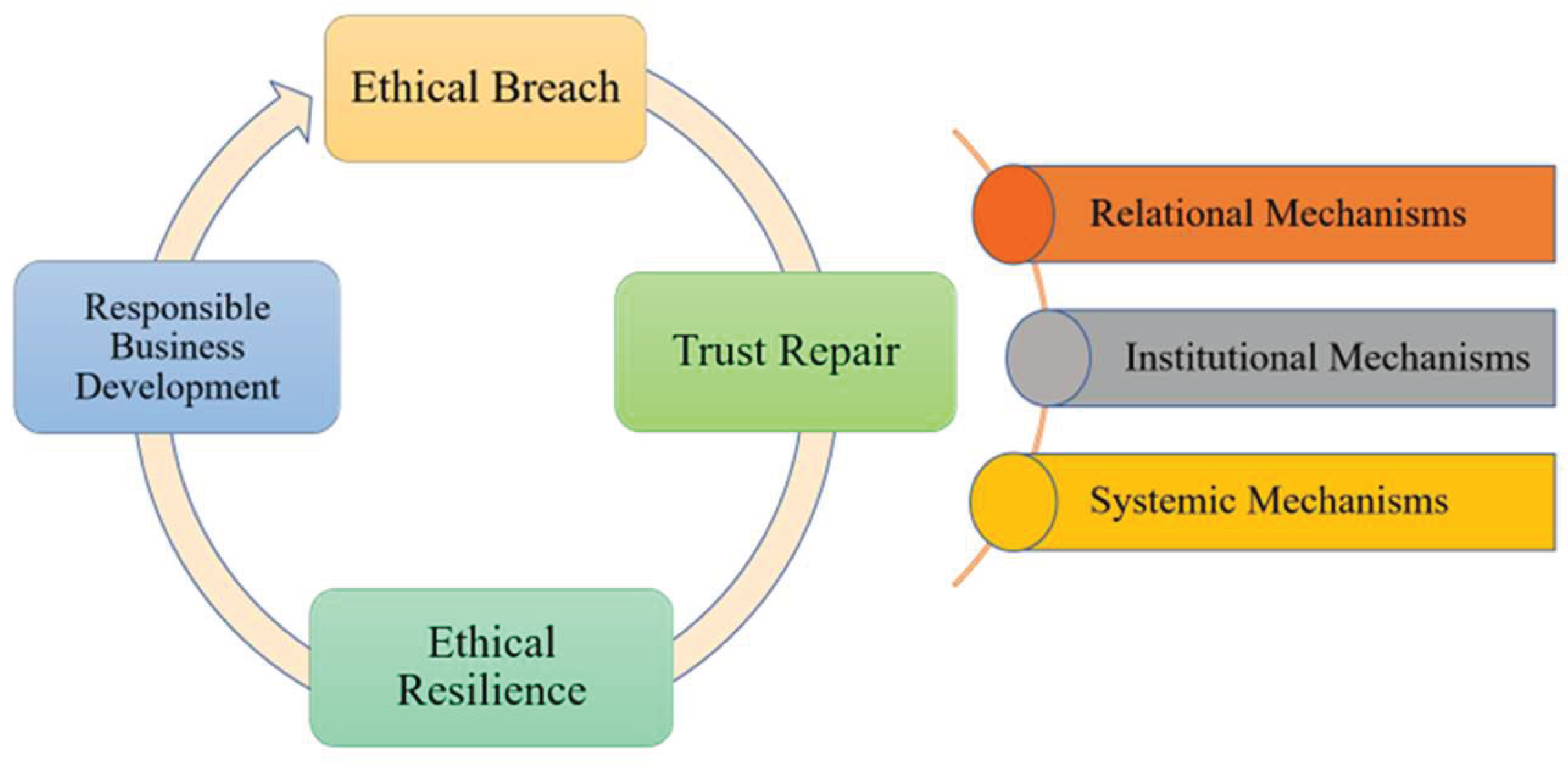
Figure 2.
Cycle of Ethical Learning and Resilience.
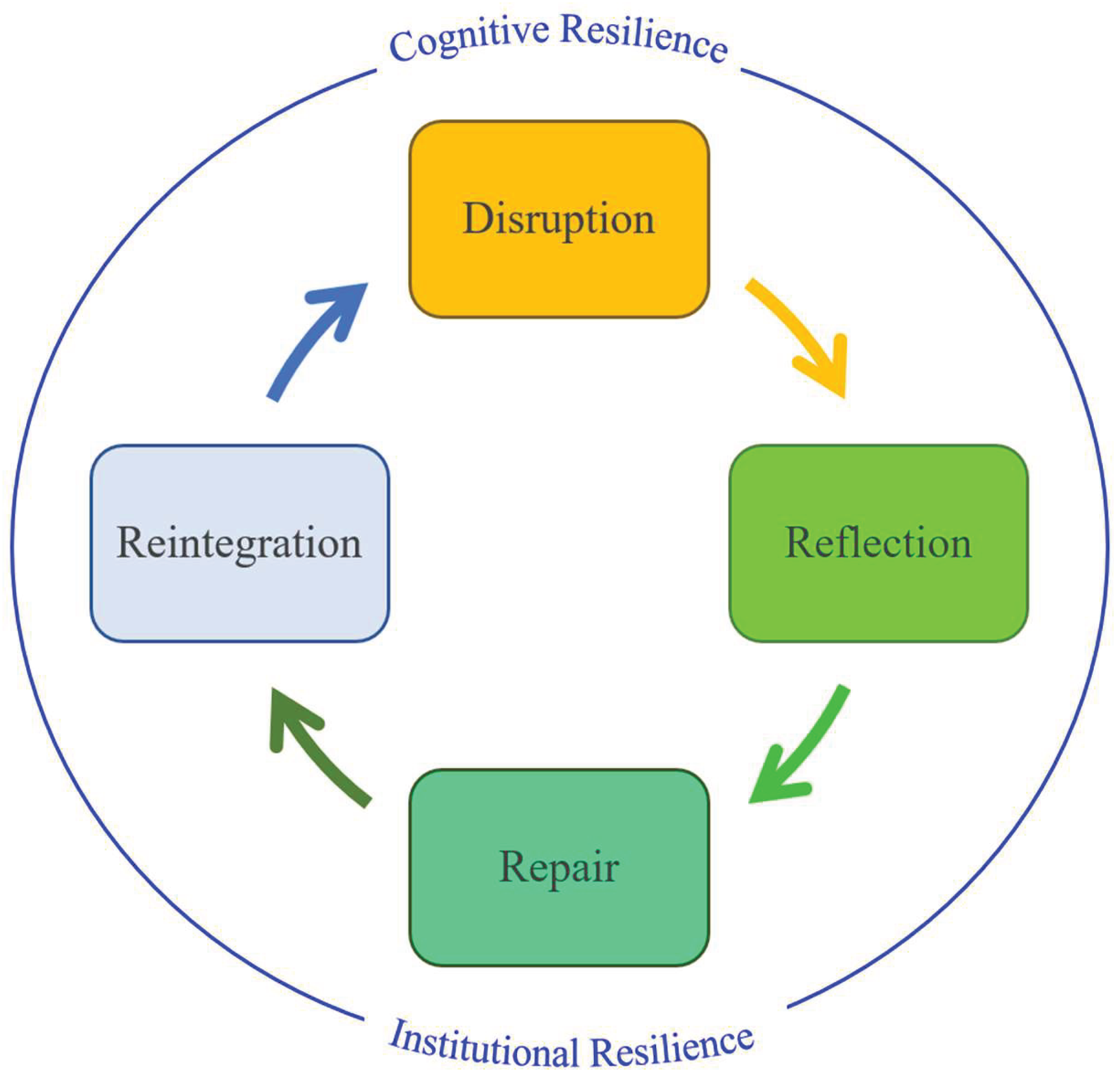
Figure 3.
Multi-Level Model of Ethical Trust Repair.
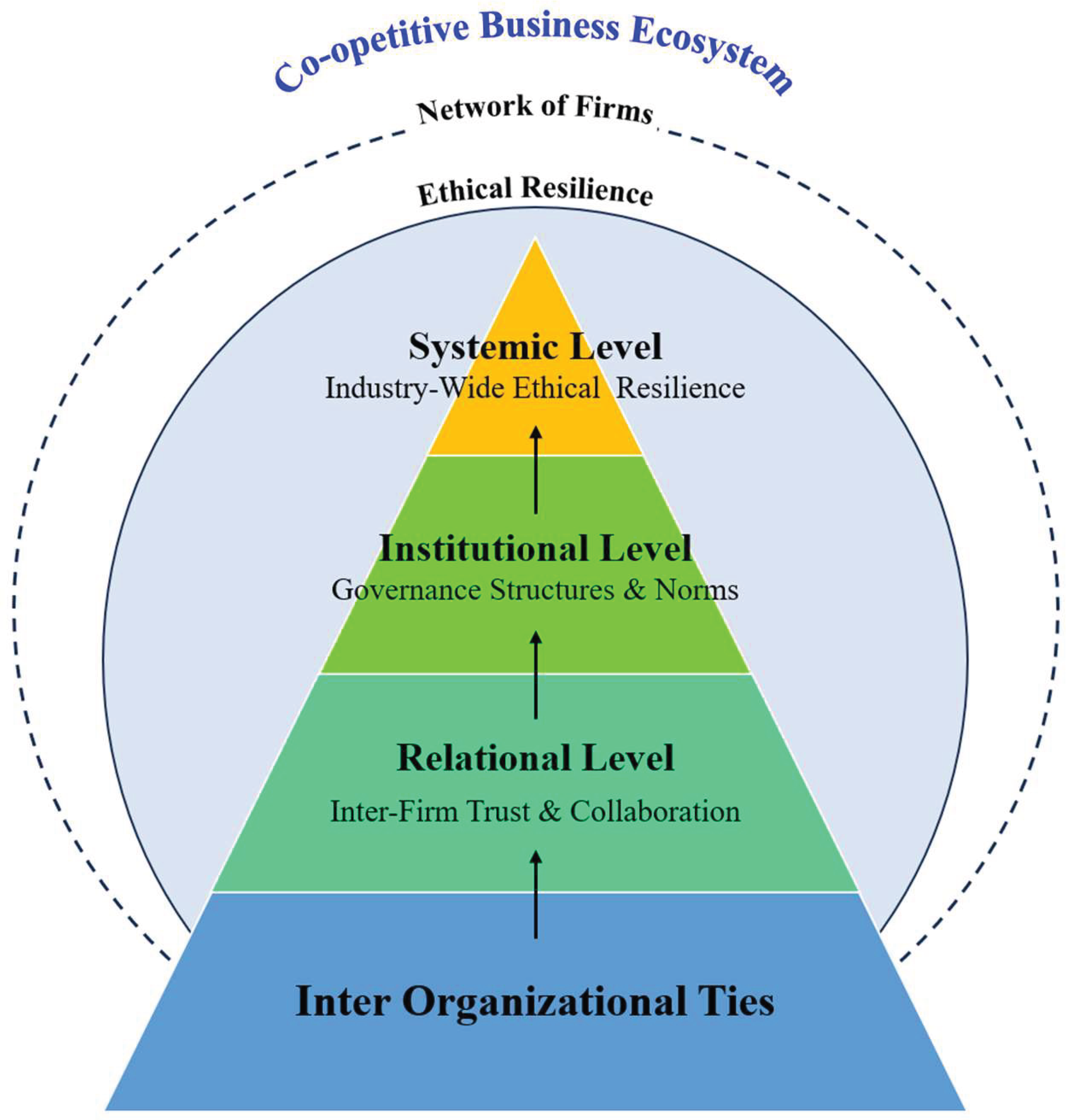
Table 1.
Conceptual Comparison of Ethical Trust Repair.
| Case | Type of Relationship | Nature of Breach | Possible Repair Mechanism | Potential Ethical Outcome |
| Intel–TSMC | Cooperative–competitive (symmetric) | Boundary violation through knowledge transfer | Relational moral communication | Restored moral balance |
| TEL–TSMC | Dependent (asymmetric) | Breach of confidentiality and institutional trust | Institutional transparency and accountability | Reestablished legitimacy and collective learning |
Table 2.
Theoretical Alignment between Trust Repair Mechanisms and Ethical Resilience Dimensions.
| Trust Repair Mechanism | Ethical Resilience Dimension | Theoretical Foundation | Core Function |
| Relational Repair | Relational Dimension | Mayer et al. (1995); Lewicki & Brinsfield (2017) | Rebuilding moral dialogue and mutual recognition |
| Institutional Repair | Institutional Dimension | Donaldson & Dunfee (2002); Maak & Pless (2006) | Embedding accountability within governance structures |
| Systemic Renewal | Cognitive Dimension | Argyris & Schön (1997); Haack et al. (2012) | Reinterpreting moral assumptions through reflective learning |
Disclaimer/Publisher’s Note: The statements, opinions and data contained in all publications are solely those of the individual author(s) and contributor(s) and not of MDPI and/or the editor(s). MDPI and/or the editor(s) disclaim responsibility for any injury to people or property resulting from any ideas, methods, instructions or products referred to in the content. |
© 2026 by the authors. Licensee MDPI, Basel, Switzerland. This article is an open access article distributed under the terms and conditions of the Creative Commons Attribution (CC BY) license (http://creativecommons.org/licenses/by/4.0/).
Copyright: This open access article is published under a Creative Commons CC BY 4.0 license, which permit the free download, distribution, and reuse, provided that the author and preprint are cited in any reuse.


