

Submitted:
21 January 2026
Posted:
22 January 2026
You are already at the latest version
Abstract
Defect-based quantum emitters in gallium nitride (GaN) have recently emerged as highly promising quantum light sources for quantum information technologies. Dephasing processes lead to the broadening of the photoluminescence (PL) linewidth, thereby limiting photon indistinguishability. Experimental studies of GaN defect emitters integrated with solid immersion lenses have revealed a clear temperature dependence of both the PL linewidth and lineshape. In this paper, we present a rigorously derived theoretical model that explains the temperature-dependent evolution of the PL linewidth and lineshape. This theoretical framework is not only applicable to GaN, but is also instructive for defect emitters in other wide-bandgap solid-state materials.
Keywords:
dephasing
; stark effect
; GaN
; quantum emitters
Introduction
Single-photon sources are fundamental components for quantum information platforms[1]. Ideally, a high-performance emitter should combine several key properties[2,3,4]: strong emission intensity, spectrally narrow output, well-defined linear polarization, compatibility with room-temperature operation, integrability into devices, and long-term stability, while exhibiting minimal photobleaching and blinking. Defects in GaN have been shown to satisfy many of the above-mentioned requirements[5,6,7,8,9]. Among those properties, a narrow PL linewidth is of particular importance, since it enables the generation of indistinguishable photons, a key requirement for many quantum information applications[10]. An ideal single-photon source is often modeled as a two-level system. In the absence of interactions with the surrounding environment, its emission spectrum approaches a very narrow line. In the basic framework describing spontaneous photon emission, the resulting spectral profile is intrinsically Lorentzian; however, its linewidth is extremely narrow, allowing it to be effectively treated as a Dirac delta function, as will be elaborated in subsequent sections. In this limit, the linewidth is solely determined by the excited-state lifetime via the energy-time uncertainty relation. Coupling between a two-level emitter and its surrounding environment induces spectral broadening, commonly known as dephasing. Different types of dephasing affect the emission spectrum in distinct ways, typically altering both its linewidth and lineshape.
In experimental studies, dephasing is often probed through temperature-dependent measurements of the PL spectrum[11,12,13]. The author has previously performed extensive investigations on GaN defect emitters[14,15,16,17]. Readers interested in further details are referred to the relevant literature[18,19,20,21]. The present work focuses on constructing a detailed theoretical model to interpret the observed experimental behavior, incorporating both spectral diffusion and the acoustic-phonon-driven Stark effect as the primary mechanisms. We demonstrate that, at low temperatures, the PL spectrum is a Gaussian profile as a result of spectral diffusion, with a linewidth that remains essentially independent of temperature. By contrast, at elevated temperatures, the emission exhibits a Lorentzian lineshape due to the acoustic-phonon-mediated Stark effect, with a linewidth that clearly depends on temperature, as will be shown.
Results and Discussion
We first briefly summarize previous experimental findings[15,22]. Specific experimental details can be found in earlier work. From temperature-dependent PL measurements of GaN defect emitters, the following conclusions are drawn: (1) At low temperatures, the PL exhibits a Gaussian lineshape, with a linewidth on the order of ∼1 meV that remains essentially independent of temperature. (2) As the temperature increases, the lineshape gradually evolves into a Lorentzian profile, with the linewidth broadening correspondingly with increasing temperature. In the intermediate temperature range, the emission exhibits a “hybrid” lineshape, namely a Voigt profile (the convolution of a Gaussian and a Lorentzian function). This suggests the involvement of at least two, and quite possibly more, dephasing mechanisms.
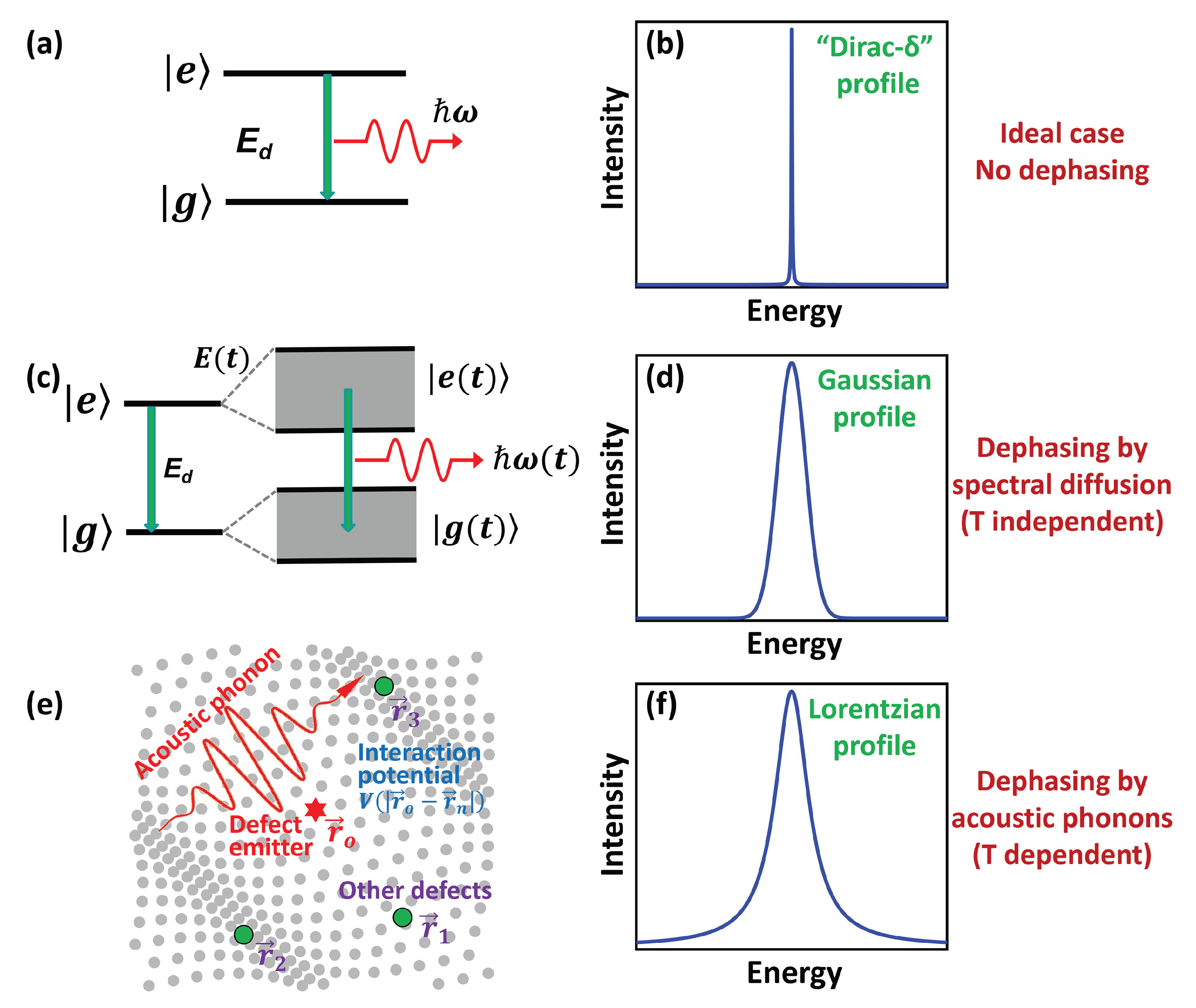
We now introduce the theoretical framework. Before diving into the rigorous derivation, we first outline the underlying physical principles that motivate the model. In the absence of any dephasing, an ideal two-level system, as illustrated in Figure 1 (a-b), exhibits an emission spectrum that is, strictly speaking, a very narrow Lorentzian, with a linewidth determined by the energy-time uncertainty relation. Given that the lifetime of a GaN defect emitter is on the order of nanoseconds, the corresponding linewidth can be estimated as:
Clearly, this linewidth is extremely narrow, about 10,000 times smaller than the linewidths observed experimentally (∼1-10 meV), allowing us to safely approximate the naturally broadened Lorentzian as a Dirac delta function. This permits us to neglect the spontaneous emission term when formulating the system Hamiltonian, thereby simplifying the model without affecting the essential physics. Of course, one could retain the spontaneous emission term, which contributes negligibly to the linewidth, but this offers little insight into the underlying physics.
We then turn to the mechanisms responsible for dephasing. In most wide-bandgap semiconductors, defect emitters are subject to spectral diffusion arising from fluctuations in their local electric environment. As illustrated in Figure 1 (c-d), when a time-varying local electric field is present, both the ground and excited states of the two-level system are adiabatically modulated by the field, resulting in photon energies that vary with time. The linewidth resulting from spectral diffusion is typically Gaussian. Its origin does not lie in the intrinsic properties of the defect two-level system, but rather in the characteristics of the surrounding local electric field that fluctuates over time. Essentially, the Gaussian lineshape represents the envelope of the intrinsic emission spectrum modulated by the electric field. If the fluctuations of the local electric field are independent of temperature, the Gaussian linewidth remains essentially unchanged with temperature. Finally, we consider the Stark effect induced by acoustic phonons. As illustrated in Figure 1 (e-f), a charged defect emitter (red star) coexists with other charged defects in the crystal. In the presence of acoustic phonons, the distances between them are modulated, thereby altering their interaction energies and resulting in a broadening of the PL linewidth. This lineshape can be shown to be Lorentzian. Clearly, since phonons participate in this dephasing process, the linewidth increases with rising temperature.
We formally construct the system Hamiltonian step by step based on the analysis presented above. As illustrated in Figure 1(e), a defect emitter (denoted by a red star at position ) embedded in a defect-dense crystal interacts with nearby charged defects (shown as green dots located at ) through a distance-dependent potential . The corresponding electric field contribution from each charged defect is expressed as . Lattice vibrations in the form of acoustic phonons induce fluctuations in the separations between the emitter and surrounding charges, thereby modulating the local electric field experienced by the emitter:
The amplitude of the acoustic phonon can be expressed as:
The total Hamiltonian in the problem is given by:
In this formulation, corresponds to the energy separation between the ground and excited states of the defect emitter, while d and denote the annihilation operators for the electronic state and the acoustic phonon mode, respectively. The first two contributions in the second line together define the unperturbed Hamiltonian , whereas the remaining terms constitute the interaction Hamiltonian . Specifically, describes the coupling of the defect emitter to a temporally varying external electric field , which gives rise to spectral diffusion, and captures the quadratic Stark effect mediated by acoustic phonons. By substituting Eq. 4 into Eq. 5, the acoustic-phonon-induced quadratic Stark effect Hamiltonian can be written as:
The coefficient is given by .
The spectral density function can be expressed as in Eq. 7, where is the time-ordering operator, and is the coupling Hamiltonian in the interaction picture.
If there is no dephasing and , the time-ordering operator in Eq. 7 reduces to the identity operator, and the resulting spectral density function becomes a Dirac delta profile . This corresponds to the emission from an intrinsic, ideal two-level system without linewidth broadening (recalling that, as discussed above, the extremely narrow intrinsic Lorentzian linewidth is neglected), as shown in Figure 1 (b).
When , it is evident that the spectral density function is the Fourier transform of the product of two functions, and , where arises from acoustic phonon coupling and leads to a Lorentzian lineshape, while originates from spectral diffusion and results in a Gaussian lineshape. A product in the time domain translates into a convolution in the frequency domain, yielding a Voigt lineshape, as captured by Eq. 8 and reported in earlier studies.
Furthermore, we can calculate and explicitly. The external electric field is taken to have zero mean, , and its autocorrelation function is modeled as , with defining the field’s correlation time. Since this correlation time is much longer than any other characteristic timescale of the system, the quasi-static approximation () can be applied. Indeed, prior experiments indicate that the timescale associated with the external field fluctuations, corresponding to spectral diffusion, is on the order of microseconds, far exceeding the nanosecond lifetimes of GaN defect emitters.[20].
is a Gaussian function, and its Fourier transform is also a Gaussian function, with , which is a temperature-independent constant. This explains the low-temperature behavior of the PL spectrum, as observed in previous experimental results. Although is independent of temperature, it clearly shows a direct linear dependence on the electric field strength . Consequently, it depends on the pump laser power . This explains why, as experimentally observed in previous work[20], the Gaussian linewidth of the defect emitter at low temperature exhibits a square-root dependence on the pump laser power, given that the laser intensity is proportional to the square of the electric field strength (). And can be calculated also,
The form of will result in a Lorentzian shape for , which corresponds to the experimentally observed spectrum at high temperatures. The Lorentzian HWHM linewidth can be calculated using the integral in Eq. 10, where the Debye frequency is given by . is the Boltzmann constant, is the Debye temperature, and is the Bose-Einstein occupation function. Note that during the derivation, temperature-independent prefactors are progressively absorbed into the effective coefficient C, which ultimately serves as a fitting parameter (indeed, the only one) in the model.
Having obtained the linewidth parameter for the Gaussian component from (spectral diffusion), and for the Lorentzian component from (acoustic phonon coupling), We can calculate the total linewidth using the expression for the Voigt function linewidth given in Eq.12.
Here, the Gaussian and Lorentzian full widths at half maximum (FWHM) are given by , . It should be emphasized that the Gaussian and Lorentzian contributions, and , cannot be combined by simple addition (i.e., ), because the linewidth of the resulting Voigt profile, formed by convolving the two functions, does not equal the arithmetic sum of the individual linewidths. In fact, there is no exact analytical expression for the linewidth of the Voigt function. However, various accurate empirical formulas, such as Eq.12, have been proposed based on extensive numerical calculations[23].
Conclusion
In this work, we present a detailed derivation of a dephasing model for GaN defect emitters, incorporating both spectral diffusion and the acoustic-phonon-induced Stark effect. This model and its theoretical framework not only explain the behavior of defect emitters in GaN, but also provide insights into dephasing mechanisms in other wide-bandgap semiconductors. This work serves as an important complement to the author’s previous experimental studies and is expected to provide useful insights for research in the related field.
References
- Aharonovich, I.; Englund, D.; Toth, M. Solid-state single-photon emitters. Nature photonics 2016, 10, 631–641. [Google Scholar] [CrossRef]
- Geng, Y. Defect Quantum Emitters in Gallium Nitride. PhD thesis, Cornell University, 2024. [Google Scholar]
- Luo, J.; Geng, Y.; Rana, F.; Fuchs, G.D. Room temperature optically detected magnetic resonance of single spins in GaN. Nature Materials 2024, 23, 512–518. [Google Scholar] [CrossRef] [PubMed]
- Geng, Y.; Luo, J.; van Deurzen, L.; Jena, D.; Fuchs, G.D.; Rana, F.; et al. Decoherence by Optical Phonons in GaN Defect Single-Photon Emitters. arXiv arXiv:2206.12636.
- Berhane, A.M.; Jeong, K.Y.; Bodrog, Z.; Fiedler, S.; Schröder, T.; Triviño, N.V.; Palacios, T.; Gali, A.; Toth, M.; Englund, D.; et al. Bright Room-Temperature Single-Photon Emission from Defects in Gallium Nitride. Advanced Materials 2017, 29, 1605092. [Google Scholar] [CrossRef] [PubMed]
- Geng, Y.; Jena, D.; Fuchs, G.D.; Zipfel, W.R.; Rana, F. Optical dipole structure and orientation of GaN defect single-photon emitters. ACS Photonics 2023, 10, 3723–3729. [Google Scholar] [CrossRef]
- Luo, J.; Geng, Y.; Rana, F.; Fuchs, G. GaN quantum emitters: basic physics, spin structure, and optically detected magnetic resonance (ODMR). In Proceedings of the Gallium Nitride Materials and Devices XX. SPIE, 2025; p. PC1336605. [Google Scholar]
- Berhane, A.M.; Jeong, K.Y.; Bradac, C.; Walsh, M.; Englund, D.; Toth, M.; Aharonovich, I. Photophysics of GaN single-photon emitters in the visible spectral range. Physical Review B 2018, 97, 165202. [Google Scholar] [CrossRef]
- Luo, J.; Geng, Y.; Farhan, R.; Fuchs, G.; et al. Data and scripts from: Room temperature optically detected magnetic resonance of single spins in GaN. Cornell eCommons, 2024. [Google Scholar]
- Santori, C.; Fattal, D.; Vučković, J.; Solomon, G.S.; Yamamoto, Y. Indistinguishable photons from a single-photon device. nature 2002, 419, 594–597. [Google Scholar] [CrossRef] [PubMed]
- Sontheimer, B.; Braun, M.; Nikolay, N.; Sadzak, N.; Aharonovich, I.; Benson, O. Photodynamics of quantum emitters in hexagonal boron nitride revealed by low-temperature spectroscopy. Physical Review B 2017, 96, 121202. [Google Scholar] [CrossRef]
- Geng, Y.; Luo, J.; van Deurzen, L.; Jena, D.; Fuchs, G.D.; Rana, F.; et al. Temperature Dependence of the Emission Spectrum of GaN Defect Single-Photon Emitters. arXiv e-prints 2022, arXiv–2206. [Google Scholar]
- Geng, Y.; Luo, J.; van Deurzen, L.H.; Jena, D.; Fuchs, G.D.; Rana, F. Temperature Dependence of Spectral Emission from GaN Defect Quantum Emitters. In Proceedings of the APS March Meeting 2022, APS, 2022. [Google Scholar]
- Luo, J.; Geng, Y.; Rana, F.; Fuchs, G.D. Room-Temperature Optically Detected Magnetic Resonance of GaN Defect Single-Photon Emitters. In Proceedings of the CLEO: Fundamental Science; Optica Publishing Group, 2023; pp. FM1E–5. [Google Scholar]
- Geng, Y.; Luo, J.; van Deurzen, L.; Xing, H.; Jena, D.; Fuchs, G.D.; Rana, F. Dephasing by optical phonons in GaN defect single-photon emitters. Scientific Reports 2023, 13, 8678. [Google Scholar] [CrossRef] [PubMed]
- Luo, J.; Geng, Y.; Rana, F.; Fuchs, G. Room temperature optically detected magnetic resonance in single spins hosted in GaN. Bulletin of the American Physical Society, 2024. [Google Scholar]
- Geng, Y. Temperature-Dependent Emission Polarization in GaN Defect-Based Quantum Emitters. arXiv arXiv:2504.18548.
- Fu, K.M.C.; Santori, C.; Barclay, P.E.; Rogers, L.J.; Manson, N.B.; Beausoleil, R.G. Observation of the Dynamic Jahn-Teller Effect in the Excited States of Nitrogen-Vacancy Centers in Diamond. Physical Review Letters 2009, 103, 256404. [Google Scholar] [CrossRef] [PubMed]
- Yi-Fei, G.; Zhu-Ning, W.; Yao-Guang, M.; Fei, G. Topological surface plasmon. polaritons. Acta Physica Sinica 2019, 68. [Google Scholar] [CrossRef]
- Geng, Y.; Nomoto, K. Ultrafast spectral diffusion of GaN defect single photon emitters. Applied Physics Letters 2023, 123. [Google Scholar] [CrossRef]
- Yuan, J.; Hou, Y.; Yang, Z.; Chen, F.; Li, Q. GaN as a Material Platform for Single-Photon Emitters: Insights from Ab Initio Study. Advanced Optical Materials 2023, 11, 2202158. [Google Scholar] [CrossRef]
- Geng, Y. Acoustic Phonon-Induced Dephasing in Gallium Nitride Defect-Based Quantum Emitters. arXiv arXiv:2506.12984.
- Olivero, J.J.; Longbothum, R. Empirical fits to the Voigt line width: A brief review. Journal of Quantitative Spectroscopy and Radiative Transfer 1977, 17, 233–236. [Google Scholar] [CrossRef]
Figure 1.
(a) Schematic of an ideal two-level quantum system with a ground state and an excited state . (b) In the absence of dephasing mechanisms, the PL spectrum (essentially a very narrow Lorentzian) can be theoretically approximated as a delta-like function (for the justification of this approximation, see the main text). (c) Exposure to a slowly varying external electric field causes a temporal modulation of the system’s energy levels, thereby altering the energy of the emitted photon. (d) Random fluctuations of the photon energy, following a Gaussian distribution, produce a temperature-independent Gaussian spectral profile, a phenomenon referred to as spectral diffusion. (e) In a crystal containing numerous defects, interactions between a target defect emitter and surrounding charged defects are modulated by acoustic phonons, resulting in a quadratic Stark shift that introduces dephasing. (f) The acoustic-phonon-mediated quadratic Stark effect gives rise to a Lorentzian spectral lineshape, where the linewidth acquires temperature dependence due to the phonon occupation number , as expressed in Eq. 7.
Figure 1.
(a) Schematic of an ideal two-level quantum system with a ground state and an excited state . (b) In the absence of dephasing mechanisms, the PL spectrum (essentially a very narrow Lorentzian) can be theoretically approximated as a delta-like function (for the justification of this approximation, see the main text). (c) Exposure to a slowly varying external electric field causes a temporal modulation of the system’s energy levels, thereby altering the energy of the emitted photon. (d) Random fluctuations of the photon energy, following a Gaussian distribution, produce a temperature-independent Gaussian spectral profile, a phenomenon referred to as spectral diffusion. (e) In a crystal containing numerous defects, interactions between a target defect emitter and surrounding charged defects are modulated by acoustic phonons, resulting in a quadratic Stark shift that introduces dephasing. (f) The acoustic-phonon-mediated quadratic Stark effect gives rise to a Lorentzian spectral lineshape, where the linewidth acquires temperature dependence due to the phonon occupation number , as expressed in Eq. 7.
Disclaimer/Publisher’s Note: The statements, opinions and data contained in all publications are solely those of the individual author(s) and contributor(s) and not of MDPI and/or the editor(s). MDPI and/or the editor(s) disclaim responsibility for any injury to people or property resulting from any ideas, methods, instructions or products referred to in the content. |
© 2026 by the authors. Licensee MDPI, Basel, Switzerland. This article is an open access article distributed under the terms and conditions of the Creative Commons Attribution (CC BY) license (http://creativecommons.org/licenses/by/4.0/).
Copyright: This open access article is published under a Creative Commons CC BY 4.0 license, which permit the free download, distribution, and reuse, provided that the author and preprint are cited in any reuse.


