
Submitted:
21 January 2026
Posted:
22 January 2026
You are already at the latest version
Abstract
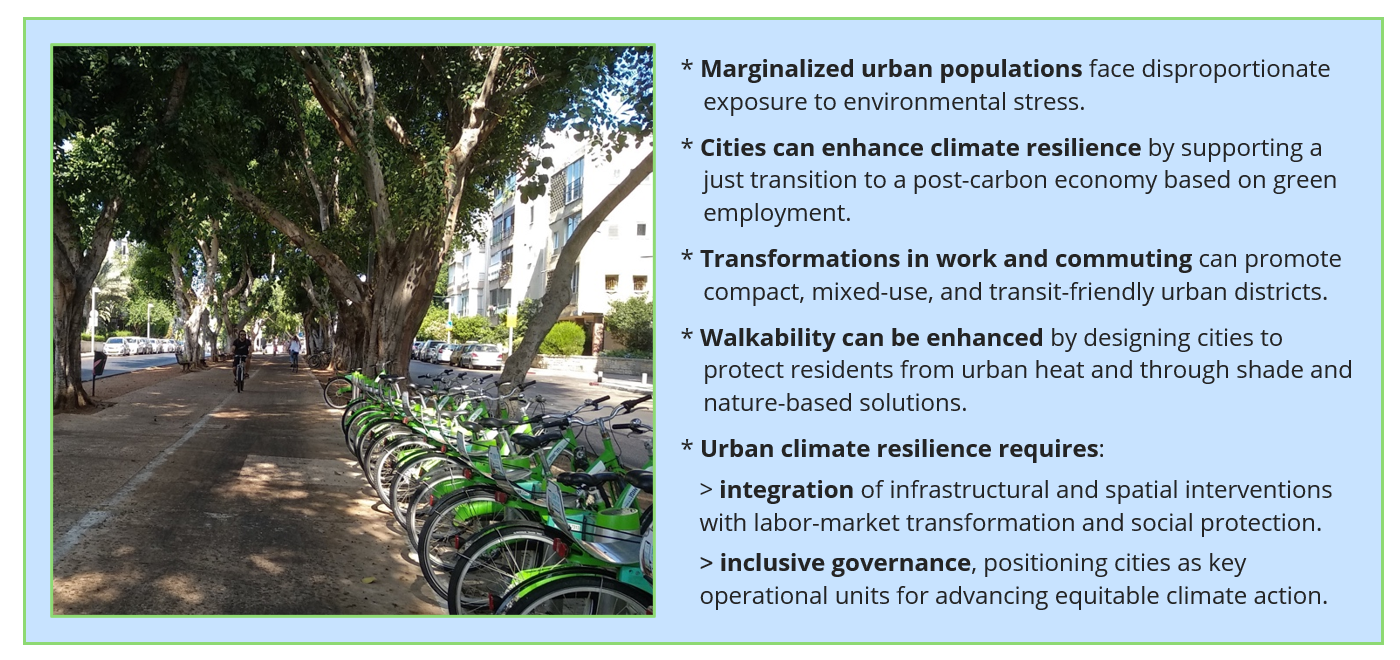
Cities play a central role in shaping societal responses to the climate crisis, concen-trating both climate risks and institutional capacity to address them. While climate impacts are widely distributed, they are experienced unevenly, with marginalized populations facing disproportionate exposure to economic disruption and environ-mental stress, particularly in urban environments. This review article examines how cities can enhance climate resilience while supporting a just transition to a post-carbon economy. It addresses three interrelated questions: how vulnerable urban populations can be better prepared for green employment; how transformations in work and commuting can promote compact, mixed-use, and transit-friendly urban districts; and how such districts can be designed to protect residents from urban heat and improve walkability through shade and nature-based solutions. The analysis synthesizes find-ings from recent empirical studies and applied policy initiatives, including a municipal green-employment pilot in Tel Aviv-Yafo, the “Reinventing Paris” office-to-housing program, and urban heat and pedestrian-behavior research. Together, these cases il-lustrate how physical adaptation strategies interact with labour-market dynamics and social policy. The review concludes that effective urban climate resilience requires in-tegrating infrastructural and spatial interventions with labour-market transformation, social protection, and inclusive governance, positioning cities as key operational units for advancing equitable climate action.
Keywords:
urban climate resilience
; just transition
; green employment
; urban adaptation
; sustainable mobility
; heat mitigation
; municipal governance
1. Introduction
The climate crisis is the most fundamental challenge facing humanity today. Addressing this existential crisis will require comprehensive societal changes, both in the infrastructure of the productive economy and in the nature of human activities that are crucial for transitioning to a low-carbon economy.
While the burden of climate change, and society’s response to it, ultimately affect everyone, these impacts are not be distributed equally. Different populations face very different levels of vulnerability, depending on variables such as their geographical location and socio-economic status. Disadvantaged and marginalized groups are especially susceptible to economic stressors such workplace disruption, as well physical stressors such exposure to extreme heat, and ignoring these unequal sensitivities poses a tangible threat to social cohesion and resilience.
Many of the most vulnerable live and work in cities, which impose extraordinary stresses but also offer extraordinary opportunities. Therefore cities today stand at the forefront of both the problem and the solution to the climate crisis. As dense centers of population, production, and innovation, they generate a significant share of global emissions, yet also possess unmatched capacity for experimentation and governance beyond traditional nation-state frameworks. Recent scholarship suggests that urban actors have begun to move beyond conventional state and transnational regulation, developing hybrid governance models that blend public authority with the initiative of NGOs, community organizations, and private actors to advance environmental goals where national policies often falter [1,2].
At the same time, a growing body of research highlights cities as critical nodes in a multi-level governance system capable of implementing climate adaptation through spatial planning, transport, and social policy interventions [3,4]. In this sense, cities are not merely passive arenas of climate impact but active laboratories for resilience, spaces where new forms of social organization, economic activity, and ecological design can be tested to shape urban futures in an era of climatic and political volatility [5,6].
Building on this premise, we begin this article with the overarching question of how cities can enhance resilience in the face of climate change and enable a just transition to a sustainable post-carbon economy, and proceed to three specific lines of inquiry: 1) How can vulnerable populations in urban areas be better prepared for the economic shift from polluting industries to a sustainable service economy, to catalyze a just transition to “green” jobs; 2) How can the ongoing transformation of the workplace facilitated by electronic communication be leveraged to reduce long-distance commuting and promote mixed-use and transit-friendly urban districts; and 3) How can such districts be designed to better protect workers and other city-dwellers from the environmental stress of urban heat – with an eye toward improving walkability through shade and nature-based solutions?
2. Cities as an Adaptation Agency in Addressing the Climate Crisis
To address these three questions, we draw on a collection of our recent studies and one applied policy project, each highlighting different aspects of urban climate resilience:
- The “Tel Aviv-Yafo Green Employment” promotion plan is examined as a case study illustrating the practical application of green employment policies at the municipal level.
- The “Rebuilding Paris” plan is considered as an initiative to promote the conversion of office to residential space in mixed-use districts.
- The “Tel Aviv-Yafo Pedestrian Behavior” study illustrates the link between urban resilience and the physical urban environment.
2.1. The Low-Carbon Economy and Green Employment
Addressing the climate crisis and preventing its escalation demands a fundamental change in economic activity. Cities around the world must transition to a low-carbon economy, which at its core implies a shift from their current reliance on fossil fuels to a prioritization of clean energy sources and increased energy efficiency; it also means in practice that some industries will contract or disappear, while others will expand or evolve - demanding new skills from workers that were not previously needed. While this “energy transition” is a vast and unprecedented challenge, its potential trajectory is clear. In recent years the price of solar and wind energy has dropped so dramatically that in many locations, renewables have not only reached grid parity but are broadly seen as the most economical sources of electric power available [7]. In the US, the bulk of all new power generation (over 90% in 2024) is based on renewables, and the state of California increasingly meets its entire demand with solar PV and battery storage [8]. The electrification of transport and other sectors means that clean power can ultimately replace carbon emitting fuels in these activities as well.
However, this transition also carries significant social and economic implications. Workers employed in fossil-fuel–based industries are expected to face substantial job losses, necessitating large-scale retraining and support programs to facilitate their economic reintegration, particularly in emerging green sectors [9]. Yet this challenge extends beyond the energy sector alone. As the broader economy undergoes decarbonization, many polluting industries, from manufacturing and construction to transport and agriculture, will undergo structural transformation, leading to further employment disruptions. Moreover, the spatial distribution of green job creation rarely aligns with the regions experiencing industrial decline, exacerbating existing regional inequalities and raising questions of justice and inclusion within the low-carbon transition [10].
These socioeconomic dynamics underscore that even as the world moves toward cleaner energy, the overall demand landscape remains complex and uneven. In other words, we are chasing a moving target. Energy demand continues to grow, not only as a function of population growth and rising standards of living, but due to climate change itself and our attempts to address it. Warming cities on a warming planet require more air-conditioned buildings and vehicles, and the widespread adoption of EVs is threatening to outpace the capacity of power grids to keep them charged. Emerging technologies like artificial intelligence, which promise to solve these problems more efficiently than any human, are themselves projected to devour more energy than all current industries combined [11].
Despite these challenges, the transition to a low-carbon economy is an environmental imperative and also offers substantial potential for medium- and long-term economic growth. For example, the global renewable energy sector employed 13.7 million people in 2022 and is projected to yield a net gain of around 5.7 million energy-related jobs by 2030 under current policy trajectories [12]. In the short term, however, it may disproportionately affect vulnerable groups, particularly workers in polluting industries and adjacent sectors. These workers often possess limited formal skills and come from lower socio-economic backgrounds.
Moreover, empirical studies show that low-carbon job creation tends to be concentrated in wealthier regions with stronger labour markets, whereas high-carbon employment is often clustered in disadvantaged communities [13,14]; this spatial mismatch increases the risk of exacerbating regional inequality and raises the need for targeted place-based policy support, under a “just transition” approach.
The concept of a Just Transition has emerged as a normative framework that foregrounds the idea that the shift to a low-carbon economy must be not only rapid and technically feasible, but also socially inclusive, ensuring that “no people, workers, places, sectors, countries or regions are left behind” [15]. Within this framework, Green Jobs are defined as those forms of employment that directly contribute to environmental and social improvement within the sustainability paradigm [16]. This dual focus, on decent work and ecological imperatives, positions green jobs as both an outcome and a lever of just transition policy. For example, Atkins [16] emphasizes the need for active industrial strategy, skills agendas, and labour-environmentalist coalitions to ensure that green employment opportunities are equitable and resilient. Similarly, policy-oriented scholarship emphasizes the distributional and institutional dimensions of the transition, cautioning that the greening of work must be matched by frameworks that safeguard labour rights, regional equity and inclusive access to emerging sectors [17,18].
Furthermore, effectively catalyzing a just transition requires a policy mix that reaches beyond simple job-creation metrics to engage the structural and spatial dynamics of employment in carbon-intensive industries. As noted in the literature, many of the workers most at risk come from industries characterised by low formal skills and precarious employment conditions; their displacement therefore demands proactive retraining, social protection and place-based support [19]. Empirical studies emphasize that policies must address: (i) the employment implications of greening across sectors; (ii) labour market and skills-policy readiness; and (iii) institutional arrangements that link industrial policy, social policy and labor governance [20]. At the regional scale, research on low-carbon restructuring warns that unless adequately managed, the transition may reinforce existing spatial inequalities, as greener sectors tend to cluster in advantaged locales while declining industries are often located in disadvantaged regions [21]. These insights underscore that a just transition is not simply about creating “green jobs” but about managing how, where, and for whom these jobs are created, and ensuring that those affected by industrial decline are actively supported to participate in the new economy.
Beyond the role of cities in climate adaptation and governance innovation, what is the specific function of municipalities in promoting green employment and enabling just transitions at the local scale? Urban authorities occupy a unique institutional position: situated directly within the public sphere, they combine regulatory power, responsibility for residents’ well-being, and close engagement with local businesses and civil society. This enables them to coordinate labour-market interventions, align skills training with spatial and environmental planning, and stimulate private-sector investment in green sectors. As noted in recent policy analyses, “green jobs in cities are key to ensuring a just transition of local employment markets, both formal and informal, and making cities function more sustainably” [22]. Within this framework, our collaboration with the Tel Aviv–Yafo Municipality formed part of a national effort to pilot Israel’s roadmap for a just transition – a strategy co-developed by civil society organizations, the environmental movement and the Ministry of Environmental Protection. Although several Jewish and Arab local authorities participated in the pilot phase, Tel Aviv–Yafo offered the most fully realized model, operationalizing the roadmap’s three core pillars: Green Entry into the Workforce, Supporting Existing Green Employment, and Fair Retraining for a Low-Carbon Economy.
The Tel Aviv–Yafo pilot was structured as a partnership between the municipality, local employers and academic institutions, with the aim of leveraging green-job creation to support vulnerable populations while advancing urban climate-resilience goals. The first program, a solar installation training course for Arab youth in Jaffa, enrolled twenty participants, most of them men, and fifteen completed the program successfully. Developed jointly with a local academic college and solar-energy companies, the initiative combined classroom instruction with supervised on-the-job training provided by an employer who viewed the program as a direct workforce-development pipeline. A second initiative, the Green Rehabilitation Program for Survivors of Prostitution, offered vocational retraining in environmentally oriented sectors, implemented in collaboration with a specialized NGO and businesses in food-recovery and fashion-reuse industries. Without compromising the anonymity of participants, it is important to note that the program integrated social-support services with employment pathways to ensure dignified and sustainable re-entry into the labour market. Together, these initiatives expanded access to green employment, strengthened socio-economic resilience among marginalized groups, and illustrated how municipal just-transition efforts can simultaneously advance climate-adaptation objectives. While the pilot was not without limitations, it provided valuable early lessons on the institutional, social and practical challenges of developing climate resilience through green employment.
2.2. Rethinking the Commute in a Changing Urban Landscape
In the 20th century, cities in the western world adopted a pattern of living, commuting and working that turned out to be unsustainable. The cost of suburban sprawl can be measured in terms of land use, social alienation and deleterious health effects, geopolitical conflict over the control of fossil fuels, and destabilization of the planet’s atmosphere. But our over-reliance on over-sized, overly air-conditioned houses, cars and offices became so pervasive that by the time the magnitude of these costs seeped into the public consciousness, it seemed too late to undo the damage – in many cases contributing to severe crises of housing availability and affordability [23]. The nature of this urban dynamic, however, is changing. Following the public health measures instituted to combat COVID-19, many cities have seen a surge in the number of urban residents working from home rather than commuting to offices: in the US, nearly two thirds of employees in “teleworkable” jobs rarely, if ever, worked from home before the pandemic, but in 2024 this proportion was only one quarter [24].
This trend towards remote work had already been underway since the advent of digital communication, and the principle of replacing transportation with communication [25] fully aligns with policies promoting professions that are inherently low-carbon and offer high social benefits – i.e. green employment. Recent research also suggests that, in the wake of COVID-19, public willingness to support green policies, including incentives for working from home, significantly increased, indicating broader societal openness to behavioral and policy shifts that reduce carbon-intensive commuting [26]. More recently, however, we can see this trend leading to a convergence of key structural changes within the urban landscape.
One consequence is that many companies are reducing their on-site workforce and real estate expenses, contributing to the growing proportion of unused office space in many cities. In the city of San Francisco, the office vacancy rate climbed steadily from about 5% in 2019 to 35% in 2025 [27] – a seven-fold increase, and the type of dislocation which can hollow out city centers by depriving them of economic and social activity.
At the same time, there is an acute need to increase the housing stock in many of these cities. According to a recent survey of major European cities, only 14% of the available housing is considered “affordable” – with 40% defined as “unaffordable” and the rest characterized as being “at risk” [28]. Among the many drivers of this housing unaffordability, the most-cited factor is that the demand in the local market simply exceeds the supply.
A logical solution to these parallel challenges, which also offers prominent social benefits, can be found in the conversion of vacant office space into housing. This is in fact a well-known strategy in cities like Paris, where office building transformations had been common for at least two decades before the pandemic, albeit at a modest scale – with transformed offices accounting for about 15% of all housing permits [29]. Ramping up these efforts now aligns with short-term economic imperatives, and in theory can produce some important long-term environmental benefits as well.
The first of these is the potential for urban rejuvenation made possible by partial conversion of office buildings to residential and other functions. By shifting away from the single-use model of commercial districts that are spatially detached from residential sub-divisions, municipalities are discovering that mixed-use, transit friendly and walkable urban districts are often as politically viable as they are sustainable. This approach aligns closely with the “15-minute city” concept popularized in Paris, by which residents can access all of their daily needs within a reasonable travel radius by foot or bicycle [30].
Additionally, turning empty office space into “green” housing through energy-efficient refurbishment can help reduce GHG emissions to combat climate change. While green retrofits are currently performed on an ad-hoc basis, a comprehensive strategy to turn office space into residences could provide the impetus for large scale implementation of energy-efficient green design within the building stock.
In reality, though, the transformation of vacant offices is reliant on multiple factors and actors with conflicting interests, involvements and investments. It requires appropriate, and often contested, changes in statutory urban planning and zoning, as well as financial mechanisms to facilitate the process. One crucial factor is that supply must match demand, in terms of building characteristics and location.
In a recent study [31], we aimed to identify the crucial factors affecting the potential transformation of vacant offices into housing, from both the supply side (i.e., housing construction) and the demand side (i.e. market needs). We evaluated the economic feasibility of building-use transformation and the practicalities of municipal policy, with the goal of answering several key questions:
- What design factors determine the feasibility of commercial building conversion, and to what extent is a given office building, based on its various characteristics, suitable for conversion into housing?
- What policy tools and strategies would mostly effectively catalyze the implementation of office building conversion, and how could the conversion process be leveraged to foster “green” building refurbishment and the transformation of commercial districts into sustainable mixed-use urban centers?
- What regulatory changes are needed to facilitate the establishment of such centers and who are the main actors involved?
As a case study, we examined “Reinventing Paris: Transforming Offices into Housing” – an ambitious program initiated by the city of Paris with the stated objective of converting obsolete offices, often left vacant, into affordable housing on a large scale [32]. Among the six sites analyzed, a particularly successful renovation was the Tati Barbes stores, a 6,500 sq. m. project in the 18th district of Paris.
As stipulated in the city’s bioclimatic master plan, the project’s designers strove to preserve as much as possible of the original construction from an urban point of view, and therefore demolish as little as possible – thereby reducing the volume of construction waste to be disposed of [33]. Of central importance was a focus on mixed use and social diversity, with the plan requiring at least 800 m2 of social housing – ensuring that a block which previously consisted only of shops and offices would also integrate housing, as well as a hotel and cultural spaces. Key to the success of the project is that the Tati stores were emblematic in the fabric of the city, attracting many people to the area, and by strategically maintaining this commercial atmosphere, the designers helped bring value to these rejuvenated mixed-use buildings.
Among the lessons learned is that the success of building transformations can hinge on the effectiveness of financial incentives, and that substantial up-front capital investment tends to be more effective in making conversions financially viable than longer term tax abatement programs. Another, perhaps more fundamental, lesson is that the feasibility of transforming a building’s basic function is limited by its initial design. Typical glass office towers with curtain-wall facades are notoriously unsuited to the requirements of living space, especially when their “deep plan” layout precludes the possibility of providing balanced daylight and natural ventilation. Architectural solutions to this conundrum, such as carving an internal courtyard into the existing structure, can be prohibitively expensive.
In Paris, Article 5 of the “Climate and Resilience Law” which took effect in 2023 addressed this issue with a long-term vision of urban sustainability – mandating that new buildings are subject, before construction, to a study of the potential for reversibility and future development, making permits for plans which allow “mixed-use” development less complicated and costly. According to the text of the law, “Projects must, from their design stage, give priority to reversibility, scalability and modularity, so as not to be obsolete at the time of their delivery. Office buildings should therefore aim to be reversible into housing. Projects must favor buildings that can be reconfigured according to climate, lifestyles changes, work and leisure.” [29].
An example of such pre-planned “reversible” mixed-use development is the “Three Black Swans” project in Strasbourg, a 28,000 m2 complex including offices, shops, housing and hotel space, all transformable. The project’s developers claim that the extra cost for making the construction reversible in advance, by design, is much less than what is required for transformation of an existing building [34]. Another, particularly prominent case of pre-planned transformation is the housing that was designed for the 2024 Olympic Games, a 125,000 m2 development in the Saint-Denis district of Paris which housed approximately 6,000 athletes. The four buildings were designed so that at the end of the Games they could be transformed into a new mixed-used neighborhood featuring 64,000 m2 of housing, 57,000 m2 of offices and 4000 m2 of shops [35].
Other mixed-use development projects in Paris include the “Quartier Les Messageries” neighborhood, which blends commercial, residential, and retail space in the redevelopment of a former railway site [36], and the “Jean Moulin” site in La Défense, which aims to cut embodied and operational carbon by 50% by building the offices and residences in a modular prefabricated timber structure, with parts to be repurposed from other buildings [37].
2.3. Walkability, Shade, and Nature-Based Solutions
“As an increasing number of cities are facing severe consequences of air pollution, traffic and noise, urban decision-makers are continually looking for ways to change mobility for the benefit of people and nature. Paris Mayor Anne Hidalgo sees the “15-Minute city” concept as the ideal approach to replace car dependency in people’s daily lives by promoting livable neighborhoods where residents can reach everything important on foot or by bicycle from their homes in 15 minutes.” [38]
Bipedalism is perhaps the oldest of all human traits, and the concept of using one’s two feet for urban mobility and even daily commuting is indeed enticing. It is equally clear that displacing vehicular traffic, which is still mostly powered by internal combustion engines, can reduce carbon pollution. But as urban heat islands intensify and background warming amplifies heat stress for pedestrians, how much of the population is willing to shoulder this burden by the sweat of their own brow?
While virtually all inhabited regions on the globe are getting warmer, they are doing so in different ways. According to climate models, some regions are becoming hotter and more humid, which exacerbates physiological heat stress, and others are becoming hotter and drier. One of the most notable of these regions is the Mediterranean basin, which encompasses southern Europe, North Africa and much of the middle east, including the coastal plain that harbors the city of Tel Aviv. Another is the southwest region of the US, extending through Mexico to Central America and reaching the coastal city of Los Angeles – whose hot-dry summer climate is also considered “Mediterranean.”
In cities like Tel Aviv and Los Angeles, we can expect not only higher temperatures but also lower humidity and less annual rainfall. In the coming decades, Tel Aviv could become more like the Negev desert to its south and LA more like the southwestern desert extending to west Texas. This trend represents an environmental double-edged sword, because on the one hand we will need more robust urban green infrastructure (trees and other vegetation) for heat mitigation, and on the other hand our supply of fresh water will become scarcer. In such a scenario of increasing aridity, we need to look for strategies that can deliver the maximum “cooling efficiency,” or the most effective heat mitigation with the least wasteful use of water and other resources.
In a recent large-scale study funded by the Israel Science Foundation, we examined the parameters of this question by modelling urban microclimate at a scale relevant to human thermal comfort and developing a single computational data analysis platform that enables planning professionals to evaluate the heat stress of pedestrians in streets and open urban spaces.
In the first phase of the research [39], we conducted an extensive campaign of micro-climate measurements in Tel Aviv, using a mobile meteorological station to record data on radiation, temperature, humidity and wind speed in order to determine the level of pedestrian thermal stress experienced over a wide array of locations and time periods on summer days.
From our results it was clear that the most efficient ways to reduce heat stress in cities like Tel Aviv have relatively little to do with lowering the temperature or the humidity of the air, and much more to do with lowering the “radiative temperature” that a person feels – and the best way to accomplish that is with the judicious provision of shade. This is why effective shade trees are so essential – not tall skinny palm trees, not bushes and shrubs and grass lawns, but resilient tree species with dense and healthy canopies that not only shade pedestrians but also shade ground surfaces and neutralize them as sources of heat.
At the same time, effective pedestrian shading does not necessarily mean exorbitant water requirements. From the results of another experimental study [40], we know that the primary “cooling” effect of an individual tree is to lower the radiative heat burden on a pedestrian in the shade of its canopy, and the evaporative air cooling resulting from that canopy’s leaf transpiration is secondary. In most species this transpiration is mostly concentrated in the upper leaves that are exposed to sunlight for photosynthesis, rather than the lower leaves above a pedestrian’s head. This means that air cooling takes place above the tree canopy, and relieves pedestrian heat stress only to the extent that it mixes with the surrounding air at street level.
One implication is that drought-resistant tree species, even if they have low transpiration rates, can be extremely effective urban “coolers.” Another is that properly designed shading elements, even if they are artificial rather than vegetative, can make an enormous contribution to pedestrian comfort in hot-arid cities without any irrigation at all. A third lesson is that shade from the buildings themselves, when they are part of a “compact” three-dimensional urban fabric inhabited by pedestrians, can at most hours block direct sun and enhance comfort as well. This depends on their height and spacing, i.e. the aspect ratio of the urban street canyon, and on the orientation of the street facades relative to the sun over the hours of a summer day. The last take-away is that every single urban design decision must be seen as an opportunity to have more shade.
In parallel to this physio-spatial analysis of urban heat and shade, we also aimed in this study to better understand the real-world impact of urban shade and pedestrian comfort by observing their actual shade-related behavior [41]. Over 40,000 street-level images were recorded on summer days in the heart of Tel Aviv, documenting the propensity of sidewalk users to travel in the shade rather than in direct sun when it was a viable option. After extensive data analysis and filtering to account for the actual shade availability and other features of the urban environment, we found that 70% of pedestrians on foot (and nearly the same proportion of those pedaling bicycles) traveled in the shade. The magnitude of this proportion was directly correlated with the intensity of solar exposure on a person’s body at the time of observation, strongly suggesting that a) whether consciously or sub-consciously, people voted with their feet and sought shade when it was most needed, b) if more shaded sidewalks and other urban spaces were available, more pedestrians would likely use them, and c) creating a more comfortable and healthy urban environment could conceivably encourage the use of pedestrian space by luring people away from their air-conditioned buildings and cars – cumulatively putting a dent in the emissions that are fueling the extreme heat in the first place.
A corollary lesson is that shade needs to be seen as a public good. The journalist Sam Bloch has written very persuasively about this in his 2025 book “Shade: The Promise of a Forgotten Natural Resource,” [42] in which he expounds about the need for a shift in thinking and public policy about shade as an urban asset. He paints a rich historical picture of cities like Seville in southern Spain, where the shading of streets by retractable “toldos” is a municipal resource offered to citizens free of charge, and recounts the veritable abandonment of public shade in modern car-centric cities and suburbs. In Los Angeles, the prioritization of underground utilities, curb cuts for parking, and a dizzying array of bureaucratic impediments has made the provision of urban shade nearly impossible in his telling; but this just strengthens the case for changing course and reevaluating our priorities for future, more sustainable, cities.
But how do we catalyze this kind of a transformation in practice? The city of Tel Aviv has ambitious policies for tree planting (aiming to achieve 70% canopy cover along center-city streets), but like anywhere, the budget for this is limited. It is therefore essential to prioritize wisely and to know where shade trees are most needed and will have the maximum benefit. In the final phase of our study, we leveraged the findings from our previous observational efforts to develop a GIS-based tool for easily mapping the solar exposure and microclimatic heat stress in an entire city. The Urban Shade Assets Mapper (USAM) platform integrates commonly available resources (municipal land-use plans, Digital Surface Model data for buildings and trees, and the UMEP QGIS plugin) [43] for the purpose of automatically mapping each individual block of the city’s streets and quantifying its level of solar exposure and heat stress. So far Tel Aviv and several dozen other cities in Israel have been mapped using this tool, in the hope that as many municipalities as possible will use the platform to better prioritize the planting of new shade trees and the protection of existing ones.
3. Discussion and Conclusions- The Role of Cities in Promoting Climate Resilience
3.1. Reframing Cities as Integrated Climate-Resilience Systems
Urban areas are increasingly recognized not only as frontline sites of climate vulnerability, but also as critical laboratories for integrated climate-resilience strategies. Cities concentrate population, infrastructure, labour markets, and social services, making them uniquely positioned to shape both the physical and socioeconomic dimensions of adaptation. As shown across the preceding sections, climate resilience at the urban scale is not solely a matter of technological or spatial interventions; it depends equally on the economic and social conditions that determine whether residents, particularly those facing structural disadvantage, can participate safely and equitably in a rapidly changing urban environment.
These socio-economic obstacles are not disconnected, however, from the physical conditions with which city dwellers must contend. As neighborhoods and urban districts become oppressively hot and stressful for longer periods of time, the inability of underserved communities to protect the health and livelihood of their residents becomes more pronounced. Equitable urban planning in the 21st century means recognizing that shaded public spaces are a necessity rather than a luxury, and that protection from heat is an essential human resource.
Together, these observations underscore the need to conceptualize cities as holistic climate-resilience systems, integrating built-environment strategies with labour-market transitions, welfare policy, and community engagement.
3.2. Aligning Physical and Socioeconomic Adaptation Strategies
The evidence presented throughout this article suggests that successful urban climate resilience hinges on aligning physical adaptation strategies, such as shading, compact urban form, mixed-use districts, and heat-mitigating public spaces, with socioeconomic transitions, including the formation of new green labour markets and accessible mobility patterns. The increasing adoption of remote and hybrid work arrangements, as documented after the COVID-19 pandemic, further reshapes commuting behaviours and opens opportunities to reduce transport emissions and reimagine the urban core.
Mixed-use districts have long been shunned by land use planners, under the assumption that commerce and industry are incompatible with healthy living arrangements and therefore cannot be kept in close proximity. While this assumption was reasonable in 19th century London, it hardly applies to the post-industrial cities of tomorrow. Post-war monocultural suburbs were built on the promise of a newly mobile and expanding middle class, but they have not sustained the middle class and its prosperity, because the ecological price of sprawl has turned out to be prohibitive. The implications are now unavoidable: cities must change course and provide the incentives necessary to make urban life affordable, sustainable and humane. Reimagining compact walkable communities with ample green infrastructure is a good place to start.
From a socioeconomic perspective, these spatial changes interact closely with labour-market dynamics. Energy-efficient retrofits, solar installation, sustainable mobility services, circular-economy enterprises, and the expansion of public green infrastructure all generate new employment opportunities. Conversely, the decline of carbon-intensive sectors introduces new vulnerabilities that cities must anticipate. A coherent climate-resilience strategy must therefore integrate hard adaptation measures (infrastructure, spatial design) with soft adaptation measures (reskilling, fair retraining, social protection, and community participation). When aligned, these strategies reinforce one another: physical interventions reduce environmental exposure while green employment programs expand economic resilience, thereby strengthening overall urban well-being.
3.3. Conditions for a Just Urban Transition
The experience of Tel Aviv–Yafo and comparative international literature indicate that a just transition in cities requires coordinated efforts across structural, institutional, and participatory domains. Three categories emerge as central:
3.3.1. Structural Conditions
Policy alignment is essential to avoid fragmented or contradictory approaches. Climate, labour, and social-welfare policies must be integrated so that decarbonization efforts reinforce rather than undermine employment security and distributional equity. Economic diversification is equally critical: cities dependent on declining carbon-intensive sectors face heightened risks of unemployment and regional inequality unless new sectors, renewable energy, sustainable mobility, environmental services, are actively cultivated. These structural conditions form the foundation upon which place-based climate resilience strategies can be built.
3.3.2. Supportive Employment Infrastructure
A resilient urban workforce requires robust reskilling and education systems aligned with emerging labour-market demands. On-the-job training (OJT) models, developed in collaboration with employers, offer particular value because they reduce barriers to entry for low-income or low-skill workers. Complementing this, social protection mechanisms, including unemployment benefits, income support, and access to health services, are indispensable during periods of transition. Without such protections, climate-policy measures risk exacerbating the very inequalities they aim to reduce
3.3.3. Equity and Participation
Equitable transitions require meaningful stakeholder engagement, especially with workers, unions, welfare organizations, employers, local NGOs, and municipal agencies. Active community engagement ensures that vulnerable populations are not only recipients of policy interventions but participants in shaping them. Finally, municipal partnerships are indispensable: local governments possess granular knowledge of neighbourhood-level conditions and can design tailored, place-based solutions that reflect diverse socio-economic realities.
3.4. Municipal Capacity: Why Cities Are Uniquely Positioned
Cities play an outsized role in delivering climate resilience because they sit at the intersection of governance, service provision, labour markets, and spatial planning. Municipalities can shape zoning, transportation systems, housing supply, green infrastructure, and local economic development strategies, tools that national governments often cannot deploy at the same level of specificity. This positioning enables municipalities to:
- Identify vulnerable populations with precision;
- Implement targeted retraining or workforce-development programs;
- Coordinate businesses, academic institutions, and civil-society partners;
- Integrate climate adaptation with economic and social policy.
As demonstrated across multiple case studies worldwide, cities are the operational unit where climate resilience becomes real: through infrastructure, institutions, and everyday practices. Cities have in fact become the most effective governing bodies for tangibly addressing climate change, in the absence of sufficient action at higher levels. From the adoption of the Kyoto Protocol in 1997 to the Paris agreement in 2015, nation-states have tried and repeatedly failed to generate the needed incentives for coordinated international climate action. Clashes between national economic interests, the challenge of balancing top-down mandates with universal participation, and hurdles in uniting major emitters like the US, China, and developing nations under one framework, have all frustrated attempts at achieving deep decarbonization.
On the other hand, local municipalities have banded together in trans-national networks like the C40 to address the threat of climate destabilization head on. Member cities must show measurable progress on cutting emissions, building resilience, and advancing justice in city climate action, and nearly every C40 city has a 1.5 °C action plan in place – whereas most countries, as of late 2025, still do not. On average, member cities have cut per capita emissions five faster than the global average, and many have surpassed their peak emissions – demonstrating effective local climate action through initiatives in transport, buildings, waste, and energy generation [44].
3.5. Lessons from the Tel Aviv–Yafo Case
The Tel Aviv–Yafo pilot illustrates the opportunities and constraints of municipal leadership in just-transition policy. By integrating workforce development, employer partnerships, and social support into climate-resilience planning, the municipality demonstrated how local authorities can translate national policy frameworks into effective, place-based initiatives. The program’s two main components, solar installation training for Arab youth in Jaffa and green vocational rehabilitation for survivors of prostitution, highlighted the potential of municipal action to reach marginalized groups while simultaneously strengthening urban resilience.
The lessons from Tel Aviv–Yafo show that municipal action is both promising and complex. Coordinating between employers, training institutions, municipal departments, and community organizations is operationally demanding. Ensuring accessibility for disadvantaged populations requires long-term investment in social support, language assistance, counselling, and income stabilization. Yet the pilot also revealed that even modest programs can generate meaningful socio-economic and environmental benefits.
These insights provide a basis for designing more comprehensive, equitable urban climate-resilience strategies.
3.6. Towards an Integrated Urban Resilience Agenda
The findings of this article suggest that truly resilient cities will need to integrate physical climate adaptation, labour-market transformation, and inclusive social policy into a single, coherent strategy. Urban resilience depends not only on shaded streets, efficient buildings, or reduced commuting distances, but also on the presence of a trained, protected, and empowered workforce capable of sustaining the green transformation. Cities can therefore serve as laboratories for scalable national climate strategies, demonstrating how targeted investments in green jobs, social protection, and adaptive infrastructure can generate broader public benefits.
These investments take on added urgency in light of the rapid social and technological change that all of human society is now navigating. In the global north, unpredictable developments in everything from AI and robotics to the global banking system are hovering at our doorstep. But as revealed in the United Nations World Urbanization Prospects 2025 report, most population growth in the coming decades will be in the global south, concentrated in the cities of just seven countries in Africa and Asia. According to the authors, “The success or failure of urbanization in these key countries will shape global development outcomes. Their ability to manage city growth sustainably will have profound implications not only for their populations, but also for global progress toward the Sustainable Development Goals and climate objectives” [45]. In this context, we believe that findings from cities that have long been coping with climate-related issues, as presented in this article, can be beneficial in more ways than one.
This assessment might serve as a reminder that integrating geography into public policy holds great importance, and that the distribution of natural resources is inexorably entwined with human well-being. Will the supply of energy, food and material on which all cities depend be as dispersed as the sun and the wind, or will it be under the tight control of a relative few? Living together on a planet with an unstable atmosphere and a narrowing margin of error, we all have a stake in the answer to that question.
Ultimately, promoting climate resilience in cities requires aligning the physical transformation of the urban environment with the socioeconomic transformation of the people who inhabit it. When designed intentionally, these dual transitions reinforce one another, creating healthier, more adaptive, and more equitable cities in an era of accelerating climate risk.
Supplementary Materials
The following supporting information can be downloaded at: https://www.sviva.net/wp-content/uploads/2024/01/%D7%9E%D7%A1%D7%9E%D7%9A-%D7%AA%D7%A2%D7%A1%D7%95%D7%A7%D7%94-%D7%99%D7%A8%D7%95%D7%A7%D7%94-%D7%95%D7%9E%D7%A2%D7%91%D7%A8-%D7%A6%D7%95%D7%93%D7%A7-2.pdf. Green Employment and a Just Transition: Required Policy Measures. All authors have read and agreed to the published version of the manuscript.
Funding
This article was developed following the conference “Climate Resilience and Local Governmental Policy: Lessons from Los Angeles and Tel Aviv” held at Stanford University in May 2025. The conference, co-hosted by the Israel Studies program at the Center on Democracy, Development and the Rule of Law and the Environmental Social Sciences Department of the Doerr School of Sustainability, brought together researchers and policymakers from Israel and the United States to explore urban strategies for climate adaptation and resilience.
Institutional Review Board Statement
Not applicable.
Data Availability Statement
No new data were created or analyzed in this study. Data sharing is not applicable to this article.
Conflicts of Interest
The authors declare no conflicts of interest.
References
- Bulkeley, H.; Betsill, M.M. Cities and Climate Change: Urban Sustainability and Global Environmental Governance; Routledge: London, UK, 2003. [CrossRef]
- Rosen-Zvi, I. Climate Change Governance: Mapping the Terrain. Carbon & Climate Law Review 2011, 5, 234–243.
- Bulkeley, H. Climate changed urban futures: Environmental politics in the Anthropocene city. Environmental Politics 2021, 30, 266–284. [CrossRef]
- Short, J.R.; Farmer, A. Cities and climate change: Urban futures in times of climate regime change. Earth 2021, 2, 1038–1045. [CrossRef]
- Hodson, M.; Geels, F.W.; McMeekin, A. Reconfiguring urban sustainability transitions, analysing multiplicity. Sustainability 2017, 9, 299. [CrossRef]
- Talal, M.L.; Gruntman, M. Urban nature visitation, accessibility, and impact of travel distance for sustainable cities. Scientific Reports 2023, 13, 17808. [CrossRef]
- International Renewable Energy Agency (IRENA). Renewable Power Generation Costs in 2024; IRENA: Abu Dhabi, UAE, 2025. Available online: https://www.irena.org/-/media/Files/IRENA/Agency/Publication/2025/Jul/IRENA_TEC_RPGC_in_2024_2025.pdf (accessed on 10 January 2026).
- California Energy Commission. As Trump Embraces Dirty Fossil Fuels, California Hits Major Clean Energy Milestone, 9 October 2025. Available online: https://www.energy.ca.gov/news/2025-10/trump-embraces-dirty-fossil-fuels-california-hits-major-clean-energy-milestone (accessed on 10 January 2026).
- Grantham Institute – Climate Change and the Environment. Towards a Just and Equitable Low-Carbon Energy Transition; Imperial College London: London, UK, 2021. Available online: https://www.imperial.ac.uk/media/imperial-college/grantham-institute/public/publications/briefing-papers/26.-Towards-a-just-and-equitable-low-carbon-energy-transition.pdf (accessed on 10 January 2026).
- Robins, N.; Curran, B.; Plyska, S.; Selvaraju, S.; Tickell, S.; Wang, J. The Just Transition: Transforming the Financial System to Deliver Action; Just Transition Finance Lab & Grantham Research Institute on Climate Change and the Environment, London School of Economics and Political Science: London, UK, 2024. Available online: https://eprints.lse.ac.uk/129023/ (accessed on 10 January 2026).
- International Energy Agency (IEA). Energy and AI: Energy Demand from AI; IEA: Paris, France, 2025. Available online: https://www.iea.org/reports/energy-and-ai/energy-demand-from-ai (accessed on 10 January 2026).
- International Energy Agency (IEA). World Energy Employment 2023: Executive Summary; IEA: Paris, France, 2023. Available online: https://www.iea.org/reports/world-energy-employment-2023/executive-summary (accessed on 10 January 2026).
- Newell, P.; Mulvaney, D. The Political Economy of the “Just Transition”: Working Paper 381; Grantham Research Institute on Climate Change and the Environment and the Centre for Climate Change Economics and Policy, London School of Economics and Political Science: London, UK, 2022. Available online: https://eprints.lse.ac.uk/117253/1/Working_paper_381_low_carbon_transmission.pdf (accessed on 10 January 2026).
- Sovacool, B.K.; Martiskainen, M.; Hook, A.; Baker, L. Decarbonization and its discontents: A critical energy justice perspective on four low-carbon transitions. Energy Policy 2022, 169, 113–649. [CrossRef]
- United Nations Framework Convention on Climate Change (UNFCCC). Leaving No One Behind in the Transition Towards a Low-Carbon Economy, 2023. Available online: https://unfccc.int/news/leaving-no-one-behind-in-the-transition-towards-a-low-carbon-economy (accessed on 10 January 2026).
- Atkins, E. Green Jobs, Just Transition and the Future of Work; University of Bristol Research Publications: Bristol, UK, 2024. Available online: https://research-information.bris.ac.uk/en/publications/green-jobs-just-transition-and-the-future-of-work (accessed on 10 January 2026).
- van Seters, J.E.; De Lombaerde, P. Negotiating a Just Transition: The Political Economy of Trade, Labour and Climate Policy. International Journal of Sustainable Development 2021, 22, 3107. Available online: https://journals.openedition.org/poldev/3107 (accessed on 10 January 2026).
- Nordic Council of Ministers. Green Jobs: What They Are, What They Are Not; Nordic Council of Ministers: Copenhagen, Denmark, 2023. Available online: https://pub.norden.org/nord2023-036/green-jobs-what-they-are-what-they-do-not-.html (accessed on 10 January 2026).
- Newell, P.; Mulvaney, D. The Political Economy of the “Just Transition”: Working Paper. International Institute for Strategic Studies: The Hague, The Netherlands, 2013. Available online: https://www.iss.nl/sites/corporate/files/66-ICAS_CP_Newell_and_Mulvaney.pdf (accessed on 10 January 2026).
- Sovacool, B.K.; Martiskainen, M.; Hook, A.; Baker, L. Necessary, welcome or dreaded? Insights on low-carbon transitions and employment change. Sustainability 2021, 13, 7389. [CrossRef]
- Snell, D.; Fairbrother, P. Toward a theory of union environmental politics: Unions and climate action in Australia. Environmental Politics 2021, 30, 1967–1989. [CrossRef]
- Seebode, J.; Fischer, L.; Newig, J. Green Jobs and the City: Towards a Just Transition in Developing Countries; IDOS – German Development Institute: Bonn, Germany, 2021. Available online: https://www.idos-research.de/en/policy-brief/article/green-jobs-and-the-city-towards-a-just-transition-in-developing-countries/ (accessed on 10 January 2026).
- Carley, S.; Konisky, D.M.; Brown, J.P. Equity and Environmental Policy in the United States: An Analysis of Policy Design and Implementation. SSRN 2022, 3996483. [CrossRef]
- Pew Research Center. How COVID-19 Changed U.S. Workplaces, 12 February 2025. Available online: https://www.pewresearch.org/politics/2025/02/12/how-covid-19-changed-u-s-workplaces/ (accessed on 10 January 2026).
- Shapiro, D.; Pearlmutter, D.; Schwartz, M. The emergence of rural transport strategies in response to rising fuel costs. Energy Policy 2012, 44, 92–100. [CrossRef]
- Peleg Mizrachi, M.; Tal, A. The impact of the Corona crisis on the environmental behaviors of different socioeconomic groups. Environmental Research Letters, 2021, 16 (6), 064086. [CrossRef]
- City and County of San Francisco. Office Vacancy Rate. Available online: https://www.sf.gov/data--office-vacancy-rate (accessed on 10 January 2026).
- Eurocities. Housing Affordability. Available online: https://monitor.eurocities.eu/housing-affordability/ (accessed on 10 January 2026).
- Municipality of Paris. Pacte pour la construction Parisienne. Available online: https://cdn.paris.fr/paris/2021/ 03/02/343e9528c3a88309b30920627c486c97.pdf. (accessed on 10 January 2026).
- World Resources Institute (WRI). Paris 15-Minute City: How Local Planning Can Advance Climate, Health, and Equity Goals. Available online: https://www.wri.org/insights/paris-15-minute-city (accessed on 10 January 2026).
- Machline, E.; Pearlmutter, D.; Cohen, C.; Schwartz, M. COVID-19: a catalyst for revitalizing mixed-use urban centers? The case of Paris. Building Research & Information 2023, 51(1), 39–55. [CrossRef]
- Municipality of Paris. Reinventing Paris: Transforming Offices into Housing. Available online: https://www.c40reinventingcities.org/data/sites_134e6/fiche/277/consultation_framework_document_-_converting_offices_into_housing_bd992.pdf (accessed on 10 January 2026).
- Belem Studio. TATI Barbès: the rebirth of an ordinary Parisian monument. Available online: https://www.studiobelem.com/projets/tati-barbes (accessed on 10 January 2026).
- Constructing Sustainable Future. Reversible and Modular Constructions: Are They Models of Circularity? Available online: https://www.constructing-sustainable-future.com/en/reversible-and-modular-constructions-are-they-models-of-circularity/ (accessed on 10 January 2026).
- Le Monde. In Seine-Saint-Denis, the First Residents Move into the Paris 2024 Athletes Village, 9 October 2025. Available online: https://www.lemonde.fr/en/economy/article/2025/10/09/in-seine-saint-denis-the-first-residents-move-into-the-paris-2024-athletes-village_6746236_19.html (accessed on 10 January 2026).
- RSHP. Les Messageries - Masterplanning Project. Available online: https://rshp.com/projects/masterplanning/les-messageries/ (accessed on 10 January 2026).
- ArchDaily. RSHP Wins Competition to Transform Jean Moulin Site into Low-Carbon Mixed-Use Development in La Défense, Paris. Available online: https://www.archdaily.com/1011459/rshp-wins-competition-to-transform-jean-moulin-site-into-low-carbon-mixed-use-development-in-la-defense-paris (accessed on 10 January 2026).
- Transformative Mobility Network. The 15-Minute City. Available online: https://transformative-mobility.org/multimedia/the-15-minute-city/ (accessed on 10 January 2026).
- Aleksandrowicz, A.; Pearlmutter, D. The significance of shade provision in reducing street-level summer heat stress in a hot Mediterranean climate. Landscape and Urban Planning 2023, 229, 104588. [CrossRef]
- Pearlmutter, D.; Ugolini, F.; Berliner, P. Moderating Heat Stress and Saving Water with Urban Shade Trees. In Urban Heat Island Mitigation and Adaptation in Cities; IntechOpen: London, UK, 2024. [CrossRef]
- Levenson, M.; Pearlmutter, D.; Aleksandrowicz, O. An observational analysis of shade-related pedestrian activity. Buildings and Cities 2025, 6(1), 398–414. [CrossRef]
- Bloch, S. Shade: The Promise of a Forgotten Natural Resource; Penguin Random House: New York, NY, USA, 2025.
- Lindberg, F.; Grimmond, C.S.B.; Gabey, A.; et al. Urban Multi-scale Environmental Predictor (UMEP) QGIS Plugin. Available online: https://plugins.qgis.org/plugins/UMEP/ (accessed on 10 January 2026).
- C40 Cities. C40 Marks 20 Years of Climate Action. Available online: https://www.c40.org/news/c40-marks-20-years-of-climate-action (accessed on 10 January 2026).
- United Nations, Department of Economic and Social Affairs, Population Division. World Urbanization Prospects 2025: Summary of Results; United Nations: New York, NY, USA, 2025. Available online: https://population.un.org/wup/Publications/Files/WUP2025_Summary_of_Results.pdf (accessed on 10 January 2026).
Disclaimer/Publisher’s Note: The statements, opinions and data contained in all publications are solely those of the individual author(s) and contributor(s) and not of MDPI and/or the editor(s). MDPI and/or the editor(s) disclaim responsibility for any injury to people or property resulting from any ideas, methods, instructions or products referred to in the content. |
© 2026 by the authors. Licensee MDPI, Basel, Switzerland. This article is an open access article distributed under the terms and conditions of the Creative Commons Attribution (CC BY) license (http://creativecommons.org/licenses/by/4.0/).
Copyright: This open access article is published under a Creative Commons CC BY 4.0 license, which permit the free download, distribution, and reuse, provided that the author and preprint are cited in any reuse.


