

Submitted:
20 January 2026
Posted:
21 January 2026
You are already at the latest version
Abstract
Ambient gamma radiation is a key component of environmental radiation monitoring and is strongly modulated by atmospheric and meteorological processes. This study presents a long-term analysis of near-surface gamma radiation measured in Ponta Delgada (São Miguel Island, Azores), integrating continuous observations from the Portuguese National Alert Network for Environmental Radioactivity (RADNET) with meteorological data. The dataset spans more than a decade and includes a documented instrumental upgrade in 2020, which introduced enhanced sensitivity and radionu-clide identification capability.
Results reveal pronounced variability across daily, seasonal, and interannual time-scales. A clear level shift is observed after 2020, attributable to the instrumental up-grade rather than to physical environmental changes, while the temporal structure and seasonal phasing of the series remain preserved. Seasonal analysis shows higher gamma radiation values during autumn and winter and lower values in late spring and summer, consistent with precipitation-driven washout and boundary-layer dy-namics. Generalized Additive Models (GAMs) highlight precipitation, wind speed, and relative humidity as dominant meteorological drivers acting through non-linear rela-tionships.
Overall, the results support the use of ambient gamma radiation as an atmospheric in-dicator of boundary-layer processes and meteorological modulation in remote mari-time environments, extending its role beyond routine environmental surveillance.
Keywords:
ambient gamma radiation
; atmospheric indicator
; boundary-layer processes
; meteorological modulation
; oceanic island environment
; Generalized Additive Models (GAM)
; environmental radiation monitoring
1. Introduction
Ambient gamma radiation is a ubiquitous component of the atmospheric environment, arising primarily from terrestrial radionuclides, their decay products, and interactions between radioactive aerosols and atmospheric processes [1,2].
Although commonly regarded as a relatively stable background signal, near-surface gamma radiation exhibits pronounced temporal variability driven by meteorological and atmospheric conditions, including precipitation-driven washout processes and boundary-layer dynamics [3,4,5].
Previous studies have shown that precipitation plays a dominant role in short-term gamma radiation variability through the wet deposition and washout of radon progeny attached to atmospheric aerosols, often producing sharp, short-lived increases in measured dose rates at ground level [3,4]. In contrast, enhanced atmospheric mixing, stronger winds, and deeper boundary layers promote dilution and ventilation of near-surface radioactive species, leading to reduced gamma radiation levels [6,7]. These processes highlight the close coupling between atmospheric dynamics and environmental radiation, positioning gamma radiation as a useful proxy for air–surface exchange and boundary-layer behavior.
Most observational studies to date have been conducted in continental or urban environments, where complex interactions between local meteorological conditions, precipitation-driven washout processes, and atmospheric mixing can obscure broader atmospheric signals [3,4]. In contrast, oceanic island environments remain comparatively understudied, even though they offer unique advantages for atmospheric research. Their isolation from continental sources, exposure to relatively homogeneous synoptic forcing, and strong maritime influence allow for a clearer identification of meteorological controls on atmospheric variables.
The Azores archipelago, located in the North Atlantic Ocean, constitutes an exceptional natural laboratory for investigating atmosphere–radiation interactions. The region is characterized by maritime climate, frequent passage of synoptic-scale weather systems, and marked seasonal variability in precipitation and atmospheric circulation. These features strongly influence boundary-layer structure and atmospheric transport processes, which are expected to modulate near-surface gamma radiation levels. However, long-term studies explicitly addressing the variability of ambient gamma radiation in this oceanic context are scarce, particularly those integrating multi-year meteorological datasets.
From a methodological standpoint, many existing analyses rely primarily on linear correlations or descriptive statistics, which may fail to capture the inherently non-linear relationships between gamma radiation and meteorological drivers. Generalized Additive Models (GAMs) provide a flexible and physically interpretable framework to address this limitation, allowing smooth, non-linear effects of individual predictors to be quantified while retaining statistical robustness [8,9]. Such models are particularly well suited for environmental time series characterized by seasonal cycles, interannual variability, and complex interactions among atmospheric variables.
In this context, ambient gamma radiation is considered not only a monitored environmental variable, but also as an integrative atmospheric indicator reflecting boundary-layer processes and meteorological modulation under maritime conditions.
Against this background, the present study investigates the temporal variability and meteorological controls of ambient gamma radiation in Ponta Delgada (São Miguel Island, Azores), using a long-term observational dataset spanning more than a decade. The specific objectives are to: (i) characterize seasonal and interannual patterns of near-surface gamma radiation in a remote oceanic island environment; (ii) quantify the influence of key meteorological variables, including precipitation, temperature, humidity, pressure, and wind, on gamma radiation levels; and (iii) evaluate the ability of non-linear statistical models to capture the dominant atmospheric drivers of gamma radiation variability.
By providing new observational evidence from an understudied marine region, this work contributes to a deeper physical understanding of atmosphere–radiation interactions and supports the use of ambient gamma radiation as a diagnostic tool for atmospheric processes in oceanic island settings.
The choice of Ponta Delgada (São Miguel Island, Azores) as the study site is motivated by its remote oceanic setting, strong maritime influence, and limited continental inputs, which provide a favorable natural framework for isolating meteorological controls on ambient gamma radiation.
2. Materials and Methods
2.1. Study Area
2.1.1. Geographical Setting
The study site is located in Ponta Delgada, on São Miguel Island (approximately 37°42’ - 37°55’N, 25°07’ - 25°42’W), the largest island of the Azores archipelago. The Azores are situated in the North Atlantic Ocean, approximately midway between Europe and North America, in a region influenced by both mid-latitude westerlies and subtropical circulation associated with the Azores High.
Figure 1 shows the geographical location of the Azores archipelago and the position of Ponta Delgada on São Miguel Island. It lies on the southern coast of São Miguel Island, at low elevation and near the ocean.
This coastal and insular setting ensures strong and persistent maritime influence, minimizing continental effects and providing relatively homogeneous atmospheric conditions. As a result, the site is well suited for studying atmosphere–surface interactions and meteorological modulation of environmental variables under oceanic conditions.
2.1.2. Climatic Characteristics of the Azores
Climatological conditions in the Azores were characterized using long-term climatological normals provided by the national meteorological service [10]. The Azores exhibit a temperate maritime climate strongly influenced by the North Atlantic Ocean, characterized by mild temperatures, high relative humidity, and moderate seasonal variability. Recent regional climate analyses indicate that the archipelago experiences limited annual thermal amplitude, with relatively cool winters and mild summers compared to continental regions at similar latitudes, reflecting the dominant maritime control on temperature and atmospheric moisture [11]. Projections and observational assessments further highlight the role of synoptic-scale circulation and ocean–atmosphere coupling in shaping seasonal temperature and precipitation patterns across the Azores Islands [12,13].
Precipitation is distributed throughout the year, although a marked seasonal cycle is present. The wet season generally extends from late autumn to early spring, while summer months tend to be comparatively drier. Annual precipitation totals are relatively high, reflecting the frequent passage of frontal systems and persistent moisture advection from the Atlantic, associated with the dominant mid-latitude circulation over the region [14,15]. These conditions play a crucial role in atmospheric washout processes and soil–atmosphere exchanges, both of which are relevant for near-surface gamma radiation variability.
Relative humidity remains high throughout most of the year in the Azores, reflecting the strong maritime influence and persistent ocean–atmosphere coupling. Regional climate analyses indicate frequent cloud cover and a high occurrence of low-level clouds, particularly under stable atmospheric conditions associated with subtropical high-pressure systems affecting the Northeast Atlantic [11,13]. These features exert strong control on boundary-layer structure, vertical mixing, and atmospheric stability, which are key factors governing the dispersion and near-surface accumulation of radioactive aerosols [6].
2.1.3. Meteorological Regime and Atmospheric Dynamics
The meteorology of the Azores is strongly influenced by large-scale North Atlantic circulation patterns, placing the archipelago within a dynamically active region of the mid-latitudes [15,16]. The region is frequently affected by the migration of mid-latitude cyclones and associated frontal systems, particularly during autumn and winter. These systems bring enhanced precipitation, strong winds, and rapid changes in atmospheric stability, all of which can significantly modulate environmental gamma radiation levels through precipitation-driven washout, atmospheric dispersion, and boundary-layer processes [3,4,14].
During summer, the Azores are frequently influenced by subtropical high-pressure systems associated with the Azores High, promoting more stable atmospheric conditions, reduced precipitation, and relatively shallow boundary layers over the archipelago. Recent regional climate analyses indicate that these summer circulation patterns are a defining feature of the Azores’ maritime climate, driven by persistent ocean–atmosphere coupling and large-scale North Atlantic dynamics [11,13]. Under such stable conditions, reduced ventilation and weaker vertical mixing may favor the near-surface accumulation of radon progeny, potentially leading to elevated ambient gamma radiation levels in the absence of precipitation-induced washout [2,6].
Wind regimes are predominantly shaped by synoptic-scale pressure gradients, with prevailing westerly to northwesterly winds during much of the year, reflecting the dominant influence of North Atlantic circulation [15]. Wind speed and direction play an important role in regulating atmospheric dispersion and transport, influencing both the dilution of radioactive aerosols and their residence time near the surface [6,7].
Atmospheric mixing, boundary-layer depth, and synoptic-scale circulation are known to exert strong control on near-surface concentrations of trace constituents, particularly under maritime conditions [17].
These synoptic and mesoscale conditions exert a strong control on boundary-layer structure and mixing over the island, directly influencing near-surface atmospheric processes relevant for ambient gamma radiation variability.
2.1.4. Relevance of the Study Area for Atmospheric Radiation Research
The combination of strong maritime influence, limited continental inputs, and pronounced meteorological variability makes Ponta Delgada an ideal location for investigating the atmospheric controls on ambient gamma radiation. Unlike continental sites, where complex land-use patterns and heterogeneous soil properties may dominate the signal, the Azorean environment allows for a clearer attribution of gamma radiation variability to meteorological and atmospheric processes.
Furthermore, the availability of long-term, continuous radiation and meteorological observations enhances the robustness of statistical analyses and supports the investigation of seasonal and interannual variability. This makes the study area particularly suitable for assessing non-linear relationships between gamma radiation and meteorological drivers, in line with the objectives of this work.
2.2. Data and Methods
2.2.1. Ambient Gamma Radiation Data
Ambient gamma radiation data used in this study were obtained from the Portuguese National Alert Network for Environmental Radioactivity (RADNET), operated by the Portuguese Environment Agency (APA). The RADNET network performs continuous monitoring of gamma dose rates in air across mainland Portugal and the autonomous regions, providing standardized and quality-controlled measurements for environmental surveillance and radiological risk management [18]. Environmental gamma radiation monitoring within RADNET is aligned with European technical recommendations for environmental radioactivity surveillance and reporting [19].
The monitoring station analyzed in this study is located in Ponta Delgada (São Miguel Island, Azores) and has remained at the same geographical location throughout the entire study period. The dataset spans more than a decade and consists of continuous measurements of ambient gamma radiation expressed as air kerma dose rate, reported in nSv h−1. Prior to analysis, standard quality-control procedures were applied to remove non-physical or instrumentally anomalous values, ensuring that the retained data represent realistic ambient gamma radiation levels.
In 2020, the original monitoring station was replaced by a new-generation system, while maintaining the same site location. The upgraded station introduced enhanced detection capabilities, including the ability to identify specific radionuclides present in the environment. This improvement allows for a more accurate discrimination of the potential origin of non-expected increases in environmental radioactivity, particularly distinguishing between natural and artificial radionuclide contributions. As a consequence of the higher sensitivity of the new system, a systematic reduction in the observed mean gamma dose rate values was identified after the station upgrade. This change reflects instrumental sensitivity rather than a physical decrease in environmental radioactivity and is explicitly considered in the data analysis.
The enhanced detection performance of the upgraded station also enables the identification of very low concentrations of artificial radionuclides, significantly improving the capacity for rapid and effective detection of nuclear or radiological events. This feature strengthens the early-warning function of the RADNET system and enhances the reliability of long-term environmental radiation monitoring [1,18].
At the time of data acquisition (2024), RADNET data were openly accessible through the APA platform, ensuring transparency and independent verifiability of the analyses conducted in this study.
2.2.2. Temporal Resolution and Data Availability
Gamma radiation measurements are recorded as hourly mean values, calculated from continuous measurements of the gamma dose rate in air. Data collection is performed continuously throughout the year, ensuring a constant temporal resolution throughout the entire study period.
Despite the robustness of the monitoring probes, short-term data gaps may occur due to adverse atmospheric conditions, such as thunderstorms, intense precipitation, strong winds, or hail, which can occasionally disrupt data transmission. Additionally, isolated periods of missing data were associated with technical issues in the local telecommunication network, temporarily preventing data transfer from the station to the central database.
All data gaps were identified and documented prior to analysis. Missing values were treated as non-observations and were not interpolated, to preserve the integrity of the original measurements and avoid the introduction of artificial variability into the time series. Aggregated statistics (daily and monthly means) were computed only when a sufficient number of valid hourly observations were available, following standard practices in environmental time series analysis [20].
2.2.3. Meteorological Data
Meteorological variables used in this study include precipitation, air temperature, relative humidity, atmospheric pressure, wind speed, and wind direction. These variables were obtained from long-term meteorological records covering the period 2011–2023, ensuring substantial temporal overlap with the gamma radiation dataset. Specifically, meteorological data were obtained from the Azores Hydrometeorological Network station of Chã de Macela, located on São Miguel Island at approximately 37.77° N and 25.53° W, at an elevation of about 309 m above sea level. This station provides continuous observations of the key meteorological variables used in the present analysis [21].
The selected meteorological parameters are physically relevant for interpreting gamma radiation variability. Precipitation influences wet deposition and washout of radon progeny; atmospheric pressure and wind regulate ventilation and dispersion; temperature and humidity affect boundary-layer structure and near-surface atmospheric processes. These mechanisms have been widely documented in previous studies on environmental radiation and atmospheric processes [2,3,4].
2.2.4. Statistical Analysis and Modelling Approach
The analysis followed a multi-step approach. First, descriptive statistics were used to characterize the temporal variability of ambient gamma radiation and meteorological variables. Seasonal patterns were examined using monthly and seasonal aggregates, allowing the identification of recurring annual cycles.
To quantify the influence of meteorological drivers on gamma radiation variability, Generalized Additive Models (GAMs) were employed as the primary statistical framework. GAMs extend generalized linear models by allowing non-linear relationships between the response variable and predictors through smooth functions, providing both flexibility and interpretability [8,9].
GAMs were fitted assuming a Gaussian error distribution with an identity link, appropriate for daily mean gamma dose rate values. Smooth terms were represented using thin-plate regression splines, with smoothing parameters estimated by Restricted Maximum Likelihood (REML) to balance goodness-of-fit and model complexity. Basis dimensions (k) were set conservatively and verified using standard mgcv diagnostic checks to avoid under- or over-smoothing.
In the GAM formulation, ambient gamma radiation was treated as the response variable, while meteorological parameters were included as smooth terms. Temporal covariates were also considered to account for seasonal and interannual variability. This approach enables the identification of non-linear meteorological effects while avoiding overfitting and preserving physical interpretability.
Model performance was evaluated using standard diagnostic tools, including residual analysis and goodness-of-fit metrics. The statistical significance of individual smooth terms was assessed to determine the relative importance of each meteorological driver. Model robustness was further examined through sensitivity analyses across different temporal subsets, including comparisons between pre- and post-2020 periods, to ensure that the identified relationships were not driven by specific sub-intervals of the time series. All analyses were conducted following established best practices for environmental time series modelling [20].
Descriptive statistics were computed to characterize the distributional properties of ambient gamma radiation and to quantify differences between pre- and post-2020 periods. Meteorological variability was characterized by using monthly climatologies and normalized time series, which are more informative for interpreting temporal patterns and non-linear relationships than global summary statistics.
All statistical analyses were performed using R software (version 4.3.2). Generalized additive models were fitted using the mgcv package, following standard implementation and diagnostic procedures [9].
3. Results
3.1. Temporal Evolution of Ambient Gamma Radiation
The long-term record of ambient gamma radiation measured at Ponta Delgada reveals pronounced variability across multiple temporal scales, including short-term fluctuations, a clear seasonal cycle, and longer-term changes associated with instrumental and environmental factors. These features provide the basis for assessing both the intrinsic temporal structure of the series and its modulation by meteorological forcing.
Figure 2 presents the complete time series of ambient gamma radiation measured at Ponta Delgada, expressed as daily mean air dose rate (nSv h−1), covering the full observation period. The series exhibits pronounced variability at multiple temporal scales, including short-term fluctuations, a clear seasonal cycle, and longer-term changes.
A marked discontinuity is visible around 2020, highlighted by a vertical reference line in Figure 2. This change corresponds to the replacement of the monitoring station by a new-generation system with higher sensitivity and radionuclide identification capability, while maintaining the same geographical location. After 2020, the gamma radiation series is characterized by systematically lower mean values, reflecting the improved instrumental sensitivity rather than a physical decrease in environmental radioactivity.
Despite this shift in absolute level, the temporal structure of the series remains coherent, with persistent variability linked to meteorological forcing. Short-term peaks are frequently associated with precipitation events, while periods of lower values tend to coincide with enhanced atmospheric ventilation and drier conditions.
Overall, the time series shown in Figure 2 highlights the complex temporal structure of ambient gamma radiation, combining short-term variability, a marked seasonal cycle, and longer-term changes related to instrumental and environmental factors. These features motivate a more detailed examination of distributional changes and seasonal behavior, which are addressed in the following sections.
3.2. Distributional Changes Before and After 2020
To quantify the impact of the instrumental upgrade, the distribution of gamma radiation values was analyzed separately for the periods 2010–2019 (pre-upgrade) and 2020–2023 (post-upgrade). Summary statistics of daily mean ambient gamma radiation were computed for each period and are presented in Table 1.
Before 2020, the distribution is centered at higher values, with a median of approximately 130 nSv h−1, while after 2020 the median decreases to approximately 81 nSv h−1. The interquartile range also becomes narrower in the post-2020 period, consistent with the improved measurement resolution of the upgraded station. Importantly, the overall shape of the distributions remains comparable, indicating that the variability structure is preserved despite the shift in absolute level.
These results confirm that the observed reduction in mean gamma radiation values after 2020 is primarily attributable to instrumental effects, underscoring the importance of explicitly accounting for this change in subsequent analyses. This behavior is further illustrated by the boxplots shown in Figure 3.
The comparison shown in Figure 3 demonstrates a clear shift in the distribution of ambient gamma radiation values between the pre- and post-2020 periods, characterized by a systematic reduction in central tendency and a narrower spread after the instrumental upgrade. While the overall variability structure is preserved, these distributional changes highlight the importance of explicitly accounting for instrumental effects before examining seasonal patterns and meteorological controls, as addressed in the following section.
3.3. Seasonal Variability and Monthly Climatology
Seasonal patterns of ambient gamma radiation were investigated through monthly climatology computed separately for the two instrumental periods. Figure 4 shows the mean monthly gamma radiation cycle for the pre-2020 and post-2020 datasets.
In both periods, a clear and consistent seasonal cycle is evident. Higher gamma radiation values are generally observed during autumn and winter, while lower values prevail during late spring and summer. This pattern is physically consistent with enhanced precipitation and reduced atmospheric mixing during the colder months, favoring the accumulation and wet deposition of radon progeny near the surface. Conversely, summer conditions are typically characterized by stronger ventilation, deeper boundary layers, and reduced precipitation, leading to lower gamma radiation levels.
Although the absolute magnitude of the monthly means differs between the two periods, the shape and phase of the seasonal cycle are remarkably similar, indicating that the underlying atmospheric drivers of gamma radiation variability remain unchanged by the instrumental upgrade.
The monthly climatology shown in Figure 4 reveals a well-defined seasonal cycle in ambient gamma radiation, with systematic differences between the pre- and post-2020 periods primarily reflected in the absolute level rather than in the phase or shape of the annual pattern. This indicates that the instrumental upgrade introduced a consistent shift in measured values while preserving the underlying seasonal structure, providing a robust basis for subsequent analyses of meteorological controls.
3.4. Normalized Variability and Meteorological Context
To contextualize the subsequent non-linear modelling, the seasonal and interannual behavior of the main meteorological variables was examined and compared with the ambient gamma radiation record. Figure 5 summarizes the monthly climatology of precipitation, wind speed and relative humidity for the period 2011–2023. Precipitation exhibits a pronounced seasonal cycle, with higher totals during autumn and winter and comparatively drier conditions in late spring and summer. Wind speed also tends to be higher during the colder season, consistent with stronger synoptic forcing, whereas relative humidity remains elevated throughout most of the year, displaying a weaker seasonal modulation typical of a maritime environment.
Together, these patterns provide a physically meaningful seasonal backdrop for interpreting gamma radiation variability, particularly in relation to wet deposition (washout) processes and boundary-layer ventilation.
To highlight temporal coherence between gamma radiation and meteorological forcing across interannual time scales, normalized monthly time series were analyzed in Figure 6. All variables are expressed as standardized anomalies, allowing direct comparison of variability among quantities with different units and dynamic ranges.
The normalized series show that positive precipitation anomalies are frequently accompanied by positive gamma radiation anomalies, consistent with the episodic enhancement of near-surface gamma dose rates during wetter-than-average conditions. In contrast, periods characterized by relatively stronger winds tend to coincide with reduced gamma radiation anomalies, supporting the interpretation that enhanced atmospheric mixing and ventilation can suppress near-surface accumulation of radioactive aerosols and radon progeny.
Taken together, Figure 5 and Figure 6 indicate that ambient gamma radiation is embedded in a coherent meteorological context operating across seasonal and interannual scales. While these results provide clear observational evidence of temporal coupling, they do not quantify the magnitude, non-linearity, or relative importance of individual meteorological drivers. These aspects are addressed in the following section through a formal non-linear modelling framework based on generalized additive models.
3.5. Meteorological Controls and GAM Results
The influence of meteorological variables on ambient gamma radiation was quantified using Generalized Additive Models (GAMs), applied to daily mean data. Figure 7 illustrates the partial effects of selected meteorological predictors on ambient gamma radiation, expressed as centered smooth terms.
Precipitation emerges as one of the dominant drivers. The GAM results show a positive and non-linear relationship between precipitation and gamma radiation, with sharp increases in gamma dose rate associated with moderate to intense rainfall. Precipitation exhibited a strongly non-linear effect on ambient gamma radiation (effective degrees of freedom, edf > 3), whereas wind speed and relative humidity showed smoother but statistically significant non-linear responses (edf ≈ 2). Quantitative details of the smooth terms, including effective degrees of freedom and significance levels, are summarized in Table 2. This behavior reflects the well-known washout effect of radon progeny from the atmosphere, leading to enhanced gamma radiation near the surface during and shortly after precipitation events.
Wind speed exhibits an inverse relationship with gamma radiation. Increasing wind speed is associated with decreasing gamma dose rates, consistent with enhanced atmospheric dispersion and ventilation, which dilute near-surface concentrations of radioactive aerosols. This effect is particularly evident at low to moderate wind speeds, beyond which the response tends to level off.
Relative humidity also shows a statistically significant influence, with higher humidity levels generally corresponding to increased gamma radiation. This relationship likely reflects the combined effects of atmospheric stability, cloudiness, and moisture-related processes affecting boundary-layer dynamics and aerosol behavior.
Temperature and atmospheric pressure contribute primarily through their modulation of boundary-layer structure and seasonal variability. These effects are captured by smooth terms in the GAM and reinforce the interpretation that gamma radiation variability in Ponta Delgada is strongly controlled by meteorological conditions rather than by long-term trends in radioactive sources.
In summary, the GAM explains a substantial fraction of the observed variability in ambient gamma radiation, confirming the importance of non-linear meteorological effects and validating the use of flexible statistical models for environmental radiation studies. Partial effects shown in Figure 7 represent the centered smooth terms of the fitted GAM, obtained while holding the remaining covariates constant, and therefore provide a direct visualization of the non-linear forcing–response relationships identified by the model.
Taken together, the partial effects illustrated in Figure 7 provide a coherent picture of the non-linear meteorological controls on ambient gamma radiation, highlighting both the relative strength of individual drivers and the regimes in which their influence is most pronounced. While these results characterize the mean forcing–response relationships captured by the GAM, it is also important to assess the robustness and temporal stability of the inferred effects, which is addressed in the following section.
3.6. Synthesis of Results
Taken together, the results demonstrate that ambient gamma radiation at Ponta Delgada exhibits robust seasonal and meteorologically driven variability, superimposed on an instrumental shift associated with the station upgrade in 2020. While the absolute level of measured gamma radiation decreased after the installation of the new-generation detector, the temporal patterns and physical relationships with meteorological drivers remained consistent.
These findings highlight the value of long-term, high-quality monitoring in oceanic island environments and underscore the importance of accounting for instrumental changes when interpreting environmental radiation time series.
4. Discussion
4.1. Main Findings in the Context of Environmental Radiation Monitoring
This study provides a long-term characterization of ambient gamma radiation variability in a remote oceanic island environment (Ponta Delgada, Azores) and quantifies its meteorological controls. The results indicate that (i) the time series exhibits strong multi-temporal variability, including pronounced seasonal structure; (ii) the distribution of observed values shows a clear shift after 2020, coincident with the station upgrade; and (iii) precipitation, wind, and relative humidity exert dominant and non-linear influences on daily mean gamma radiation, consistent with well-established atmospheric mechanisms affecting radon progeny deposition, atmospheric dispersion, and near-surface aerosol dynamics [2,4]. Comparable relationships between ambient gamma dose rate variability and meteorological conditions have also been reported in recent large-scale observational studies conducted in continental environments, emphasizing the role of local climate and geographical setting in modulating background radiation records [22].
According to UNSCEAR assessments, natural radionuclides and their decay products represent the dominant contribution to ambient gamma radiation, with atmospheric processes playing a key role in modulating near-surface dose rates [23].
From an operational and environmental surveillance perspective, these findings are directly relevant to the goals of RADNET, which is designed for continuous monitoring and rapid detection of non-expected increases in environmental radioactivity [18]. The enhanced capabilities of the upgraded station after 2020, namely radionuclide identification and increased sensitivity, are particularly important for distinguishing between natural variability and potential artificial contributions in the event of radiological incidents [1,18].
4.2. Instrumental Upgrade in 2020 and Implications for Time-Series Interpretation
A key feature of the dataset is the abrupt reduction in the average gamma radiation level after 2020. Importantly, this change is consistent with the documented replacement of the monitoring system by a more sensitive detector with improved capability to identify radionuclides and discern the origin of abnormal increases in radioactivity. As shown by the comparison of distributions (Figure 3) and the monthly climatologies (Figure 4), the upgrade primarily introduced a level shift rather than altering the temporal structure of variability.
This distinction is crucial: long-term environmental radiation time series are often interpreted as indicators of changing sources, transport, or deposition regimes. Without the explicit instrumental metadata, the post-2020 decrease could be incorrectly attributed to physical environmental changes. The preservation of seasonal phasing and the persistence of meteorologically driven peaks argue strongly for an instrumental origin of the shift, supporting the decision to analyze pre- and post-2020 periods separately and/or include an instrument indicator in statistical models. Such treatment follows best practice in atmospheric time series analysis, where known changes in measurement systems must be accounted for to prevent biased inferences [20].
4.3. Physical Interpretation of Meteorological Controls
4.3.1. Precipitation and Washout Effects
The most prominent meteorological driver identified is precipitation, which shows a strong and non-linear positive association with gamma radiation (Figure 7). This behavior is consistent with wet deposition and washout of radon progeny attached to aerosols. Rain events efficiently scavenge these short-lived radionuclides from the atmosphere and deposit them near the surface, producing short-lived increases in ambient gamma dose rates, particularly during intense precipitation events [3,4]. The non-linearity observed, rapid increases for low-to-moderate precipitation, with a tendency to level off, can be interpreted as the combined influence of scavenging efficiency and event intensity, where additional precipitation may not proportionally increase deposition once the near-surface environment has been effectively “loaded” by washout.
4.3.2. Wind Speed and Atmospheric Ventilation
Wind speed displays an inverse relationship with gamma radiation (Figure 7), consistent with increased dilution, dispersion, and ventilation of near-surface air masses. Stronger winds typically enhance turbulent mixing and reduce residence times of aerosols and radon progeny near the ground, thereby lowering measured gamma dose rates. This mechanism aligns with the broader framework of boundary-layer meteorology, where wind-driven turbulence modulates near-surface concentrations of trace constituents and aerosol-bound species [6,7].
4.3.3. Relative Humidity and Stability-Related Processes
Relative humidity shows a generally positive influence on gamma radiation in the partial-effect analysis. In maritime environments, higher humidity often co-occurs with increased cloudiness and more stable boundary-layer conditions, which can suppress vertical mixing and favor accumulation of near-surface aerosols. Humidity may also reflect synoptic regimes with enhanced moisture advection and precipitation potential, indirectly reinforcing wet deposition effects [6,7]. These results highlight that gamma radiation variability integrates multiple atmospheric processes, including both deposition mechanisms and dynamic controls on mixing.
4.4. Why an Oceanic Island Setting Matters
The Azores provide a distinct observational context compared with continental or urban sites commonly analyzed in environmental radiation studies. In continental settings, spatial heterogeneity in soil radionuclide content, land-use patterns, and anthropogenic activities can confound the attribution of temporal variability to atmospheric drivers. In contrast, the strong maritime influence and relatively homogeneous synoptic forcing in Ponta Delgada facilitate a clearer identification of meteorological controls. The persistence of coherent seasonal structure across both instrument periods reinforces this point and suggests that the observed dynamics are primarily governed by atmosphere–surface interactions rather than shifting source regimes.
This insular context also strengthens the broader relevance of the results: oceanic islands are strategically important for atmospheric monitoring, as they often sample background air masses and provide early indications of large-scale transport and deposition phenomena. Long-term gamma radiation records in such environments can therefore complement conventional atmospheric composition monitoring and contribute to integrated environmental surveillance frameworks [1,18].
4.5. Methodological Strengths, Limitations, and Robustness
A major strength of this work is the use of long-term observational data coupled with flexible, interpretable modelling through a GAM framework [8,9]. This approach is well suited to environmental datasets where non-linearities and seasonal effects are expected, and it provides a clear physical interpretation through partial-effect curves.
Nevertheless, some limitations should be acknowledged. First, missing values occurred due to data transmission disruptions during severe weather and occasional telecommunication failures. These gaps were treated conservatively (no interpolation), which preserves measurement integrity but may slightly reduce statistical power during short intervals [20]. Second, the instrumental upgrade in 2020 introduces inhomogeneity in absolute values; while this was explicitly accounted for, future work may benefit from additional calibration metadata (e.g., overlap periods or intercomparison tests) to further quantify the magnitude of the level shift. Third, the present study focused on meteorological drivers available in the dataset; additional predictors such as boundary-layer height, aerosol optical properties, or synoptic indices could further refine mechanistic attribution in future analyses.
4.6. Implications for RADNET and Environmental Surveillance
The ability of the upgraded station to detect very low concentrations of artificial radionuclides has direct operational value for rapid alert functions, particularly in remote regions where early detection of transported radiological signals may be critical. From a scientific perspective, the results demonstrate that robust characterization of “normal” meteorologically driven variability is essential for interpreting anomalies. By quantifying the expected response of gamma radiation to precipitation, wind, and humidity, this study provides a baseline against which non-expected deviations can be more reliably assessed, supporting the mission of RADNET for environmental monitoring and risk management [18]. Similar influences of environmental conditions on gamma radiation monitoring have been documented in studies using airborne gamma-ray spectrometry, emphasizing the need to account for meteorological variability when interpreting environmental radiation measurements [24]. Recent international safety guidance emphasizes that continuous environmental gamma dose rate monitoring should be interpreted in conjunction with meteorological conditions to distinguish natural variability from non-expected radiological events [25]. Continuous monitoring of ambient gamma dose rates follows internationally established practices for environmental radiation surveillance, as outlined in IAEA guidance documents [26].
4.7. Future Work and Recommendations
The results presented in this study highlight several avenues for future research and methodological refinement. First, the integration of additional atmospheric variables could further improve the physical interpretation of ambient gamma radiation variability. Parameters such as planetary boundary layer height, atmospheric stability indices, and aerosol optical properties would provide complementary information on vertical mixing and transport processes, potentially enhancing the explanatory power of statistical models.
Second, the inclusion of large-scale circulation indices, particularly those relevant to the North Atlantic region, represents a promising direction. Indices such as the North Atlantic Oscillation (NAO) could help clarify the role of synoptic-scale variability in modulating local meteorological conditions and, by extension, gamma radiation levels in oceanic island environments. Coupling local observations with reanalysis products may offer a pathway to link site-specific variability with broader atmospheric dynamics.
Third, future studies could benefit from explicit cross-calibration or overlapping analyses when instrumental upgrades occur. Although the present work demonstrates that the 2020 station replacement primarily introduced a level shift without altering temporal structure, dedicated intercomparison periods or laboratory-based calibration data would allow for more precise quantification of instrumental effects. Such information would strengthen long-term trend assessments and facilitate the homogenization of extended radiation time series.
Fourth, extending the analysis to a network-based perspective would provide valuable spatial context. Comparative studies involving multiple RADNET stations, particularly those located in different climatic and geographic settings, could help distinguish local from regional controls and identify common patterns in meteorological modulation of gamma radiation. Oceanic–continental contrasts would be especially informative in this regard.
Finally, the methodological framework employed here can be expanded to include predictive and operational applications. The development of near-real-time statistical models, calibrated on long-term observational data, could support anomaly detection and early warning functions within environmental radiation monitoring systems. By establishing robust baselines for expected meteorologically driven variability, such tools would enhance the capacity to identify and respond to non-expected radiological events, in line with the objectives of national and international environmental surveillance networks.
5. Conclusions
This study provides a comprehensive assessment of long-term ambient gamma radiation variability in a remote oceanic island environment, using continuous observations from Ponta Delgada (Azores) integrated with meteorological data. The results demonstrate that near-surface gamma radiation exhibits pronounced temporal variability across daily, seasonal, and interannual scales, primarily driven by atmospheric and meteorological processes rather than by changes in radioactive sources.
A key finding is the clear level shift observed in 2020, coincident with the replacement of the monitoring station by a new-generation detector with enhanced sensitivity and radionuclide identification capability. This instrumental upgrade led to systematically lower mean gamma radiation values while preserving the temporal structure and seasonal phasing of the series. Explicitly accounting for this change proved essential to avoid misinterpretation of long-term variability and highlights the importance of detailed instrumental metadata in environmental radiation studies.
Seasonal analysis revealed consistent patterns across both instrumental periods, with higher gamma radiation values during autumn and winter and lower values during late spring and summer. These patterns are physically consistent with the combined effects of precipitation-driven washout, boundary-layer stability, and atmospheric ventilation. The application of a Generalized Additive Model framework further quantified these controls, identifying precipitation, wind speed, and relative humidity as dominant drivers acting through non-linear relationships.
Overall, these results support the interpretation of ambient gamma radiation as an effective atmospheric indicator of boundary-layer processes and meteorological modulation in remote maritime environments.
Building on this interpretation, the findings underscore the value of oceanic island stations for atmospheric radiation monitoring. In such environments, the reduced influence of continental sources and the strong maritime control facilitate clearer attribution of variability to meteorological processes. From an operational perspective, the results support the role of RADNET as an effective environmental surveillance system and demonstrate how robust characterization of “normal” meteorologically driven variability can strengthen early-warning and anomaly-detection capabilities.
Overall, this work contributes new observational evidence from an understudied marine region of the North Atlantic and provides a transparent methodological framework for interpreting long-term gamma radiation time series in the presence of instrumental changes. The approach and findings are directly relevant for atmospheric and radiation sciences and offer practical insights for the design, operation, and interpretation of environmental radiation monitoring networks.
Author Contributions
Conceptualization, M.G.M.; methodology, M.G.M. and H.C.V.; software, M.G.M. and H.C.V.; validation, M.G.M. and H.C.V.; formal analysis, H.C.V.; investigation, M.G.M. and H.C.V.; resources, M.G.M. and H.C.V.; data curation, M.G.M. and H.C.V.; writing—original draft preparation, M.G.M.; writing—review and editing, M.G.M. and H.C.V.; visualization, H.C.V.; supervision, M.G.M. and H.C.V.; project administration, M.G.M. and H.C.V. All authors have read and agreed to the published version of the manuscript.
Funding
This research received no external funding. The Article Processing Charge (APC) was fully waived by Air as part of an official invitation to submit this manuscript.
Data Availability Statement
The meteorological data used in this study was provided by the Regional Directorate for the Environment and Climate Change of the Azores through the Azores Hydrometeorological Network and are available upon reasonable request from the data provider. Ambient gamma radiation data were obtained from the Portuguese National Environmental Radioactivity Alert Network (RADNET) and were publicly available online at the time of data access and analysis (2024). These data are currently no longer openly accessible online due to changes in data availability policies but may be obtained from the Portuguese Environment Agency (APA) upon reasonable request.
Acknowledgments
The authors acknowledge the Regional Directorate for the Environment and Climate Change of the Azores Autonomous Region for providing the meteorological data through the Azores Hydrometeorological Network. The authors also acknowledge the Portuguese Environment Agency for making ambient gamma radiation data available through the National Environmental Radioactivity Alert Network (RADNET).
Conflicts of Interest
The authors declare no conflicts of interest.
Abbreviations
The following abbreviations are used in this manuscript:
| GAMs | Generalized Additive Models |
| IPMA | Portuguese Institute for Sea and Atmosphere |
| RADNET | Portuguese National Alert Network for Environmental Radioactivity |
| APA | Portuguese Environment Agency |
| REML | Restricted Maximum Likelihood |
References
- UNSCEAR. Sources and effects of ionizing radiation. United Nations Scientific Committee on the Effects of Atomic Radiation 2000 report to the General Assembly, with scientific annexes; United Nations: New York, NY, USA, 2000. [Google Scholar]
- Porstendörfer, J. Properties and behaviour of radon and thoron and their decay products in the air. Journal of Aerosol Science 1994, 25(2), 219–263. [Google Scholar] [CrossRef]
- Mercier, JF; Tracy, BL; d’Amours, R; Chagnon, F; Hoffman, I; Korpach, EP; Johnson, S; Ungar, RK. Increased environmental gamma-ray dose rate during precipitation: a strong correlation with contributing air mass. J Environ Radioact. 2009, 100(7), 527–33. [Google Scholar] [CrossRef] [PubMed]
- Burnett, JL; Croudace, IW; Warwick, PE. Short-lived variations in the background gamma-radiation dose. J Radiol Prot. 2010, 30(3), 525–33. [Google Scholar] [CrossRef] [PubMed]
- Huang, YJ; Shang-Guan, ZH; Zhao, F; Lin, MG; Sha, XD; Luo, DY; Chen, Q; Peng, K. A correlation study of continuously monitored gamma dose rate and meteorological conditions. Journal of Environmental Radioactivity, Volume 2018, Volume 192, 467–477. [Google Scholar] [CrossRef] [PubMed]
- Stull, R. B. An introduction to boundary layer meteorology; Springer, 1988. [Google Scholar] [CrossRef]
- Seinfeld, J. H.; Pandis, S. N. Atmospheric chemistry and physics: From air pollution to climate change, 3rd ed.; John Wiley & Sons, 2016. [Google Scholar]
- Hastie, T.J.; Tibshirani, R.J. Generalized Additive Models; Chapman and Hall/CRC: New York, NY, USA, 1990. [Google Scholar]
- Wood, S.N. Generalized Additive Models: An Introduction with R, 2nd ed.; Chapman and Hall/CRC: Boca Raton, FL, USA, 2017. [Google Scholar]
- Instituto Português do Mar e da Atmosfera (IPMA). Climatological Normals 1981–2010: Azores Autonomous Region; (in Portuguese). IPMA: Lisbon, Portugal, 2020. [Google Scholar]
- Carvalho, F.S.; Meirelles, M.G.; Henriques, D.; Porteiro, J.; Navarro, P.; Vasconcelos, H.C. Climate Change and Extreme Events in Northeast Atlantic and Azores Islands Region. Climate 2023, 11, 238. [Google Scholar] [CrossRef]
- Carvalho, F.R.S.; Meirelles, M.G.; Henriques, D.V.; Navarro, P.V.; Vasconcelos, H.C. Climate Change and the Increase of Extreme Events in Azores. In Handbook of Human and Planetary Health. Climate Change Management; Filho, Leal, W., Eds.; Springer: Cham, 2022. [Google Scholar] [CrossRef]
- Meirelles, M. G.; Carvalho, F.; Porteiro, J.; et al. Climate Change and Impact on Renewable Energies in the Azores. Sustainability 2022, 14(22), 15174. [Google Scholar] [CrossRef]
- Santos, F.D.; Valente, M.A.; Miranda, P.M.A.; Aguiar, A.; Azevedo, E.B.; Tomé, A.R.; Coelho, F. Climate change scenarios in the Azores and Madeira Islands. World Resource Review 2004, 16(4), 473–491. [Google Scholar]
- Trigo, R. M.; Osborn, T. J.; Corte-Real, J. M. The North Atlantic Oscillation influence on Europe: Climate impacts and associated physical mechanisms. Climate Research 2002, 20, 9–17. [Google Scholar] [CrossRef]
- Hurrell, J. W. Decadal trends in the North Atlantic Oscillation: Regional temperatures and precipitation. Science 1995, 269(5224), 676–679. [Google Scholar] [CrossRef] [PubMed]
- WMO. Guide to Meteorological Instruments and Methods of Observation (WMO-No. 8); World Meteorological Organization: Geneva, Switzerland, 2018. [Google Scholar]
- Agência Portuguesa do Ambiente (APA). Environmental Radioactivity Alert Network (RADNET). Available online: https://apambiente.pt/prevencao-e-gestao-de-riscos/rede-de-alerta-de-radioatividade-no-ambiente-radnet (accessed on 18 July 2024).
- European Commission. Radiation Protection 160: Technical Recommendations for Monitoring Environmental Radioactivity; Office for Official Publications of the European Communities: Luxembourg, 2009. [Google Scholar]
- Wilks, D.S. Statistical Methods in the Atmospheric Sciences, 3rd ed.; Academic Press: Oxford, UK, 2011. [Google Scholar]
- Azores Hydrometeorological Network. Available online: http://redehidro.ambiente.azores.gov.pt (accessed on 14 July 2025).
- Tchorz-Trzeciakiewicz, D.E.; Kamińska, J.A. Variations in gamma radiation and alpha-emitting radionuclides in correlation with weather and location conditions. Sci Rep 2025, 15, 25063. [Google Scholar] [CrossRef] [PubMed]
- UNSCEAR. Sources and effects of ionizing radiation. United Nations Scientific Committee on the Effects of Atomic Radiation 2008 report to the General Assembly, with scientific annexes; United Nations: New York, NY, USA, 2008. [Google Scholar]
- Amestoy, J.; Delaplace, N.; et al. Effects of environmental factors on the monitoring of environmental radioactivity by airborne gamma-ray spectrometry. Journal of Environmental Radioactivity 2021, 237, 106695. [Google Scholar] [CrossRef] [PubMed]
- International Atomic Energy Agency (IAEA). Monitoring for Protection of the Public and the Environment. In IAEA Safety Standards Series No. GSG-19; IAEA: Vienna, Austria, 2025. [Google Scholar] [CrossRef]
- International Atomic Energy Agency (IAEA). Safety Guide No. RS-G-1.8; Environmental and Source Monitoring for Purposes of Radiation Protection. IAEA: Vienna, Austria, 2010.
Figure 1.
Geographical location of the Azores archipelago in the North Atlantic Ocean and the position of Ponta Delgada on São Miguel Island. The map highlights the regional oceanic setting of the study area and the location of the monitoring site used for ambient gamma radiation and meteorological observations.
Figure 1.
Geographical location of the Azores archipelago in the North Atlantic Ocean and the position of Ponta Delgada on São Miguel Island. The map highlights the regional oceanic setting of the study area and the location of the monitoring site used for ambient gamma radiation and meteorological observations.
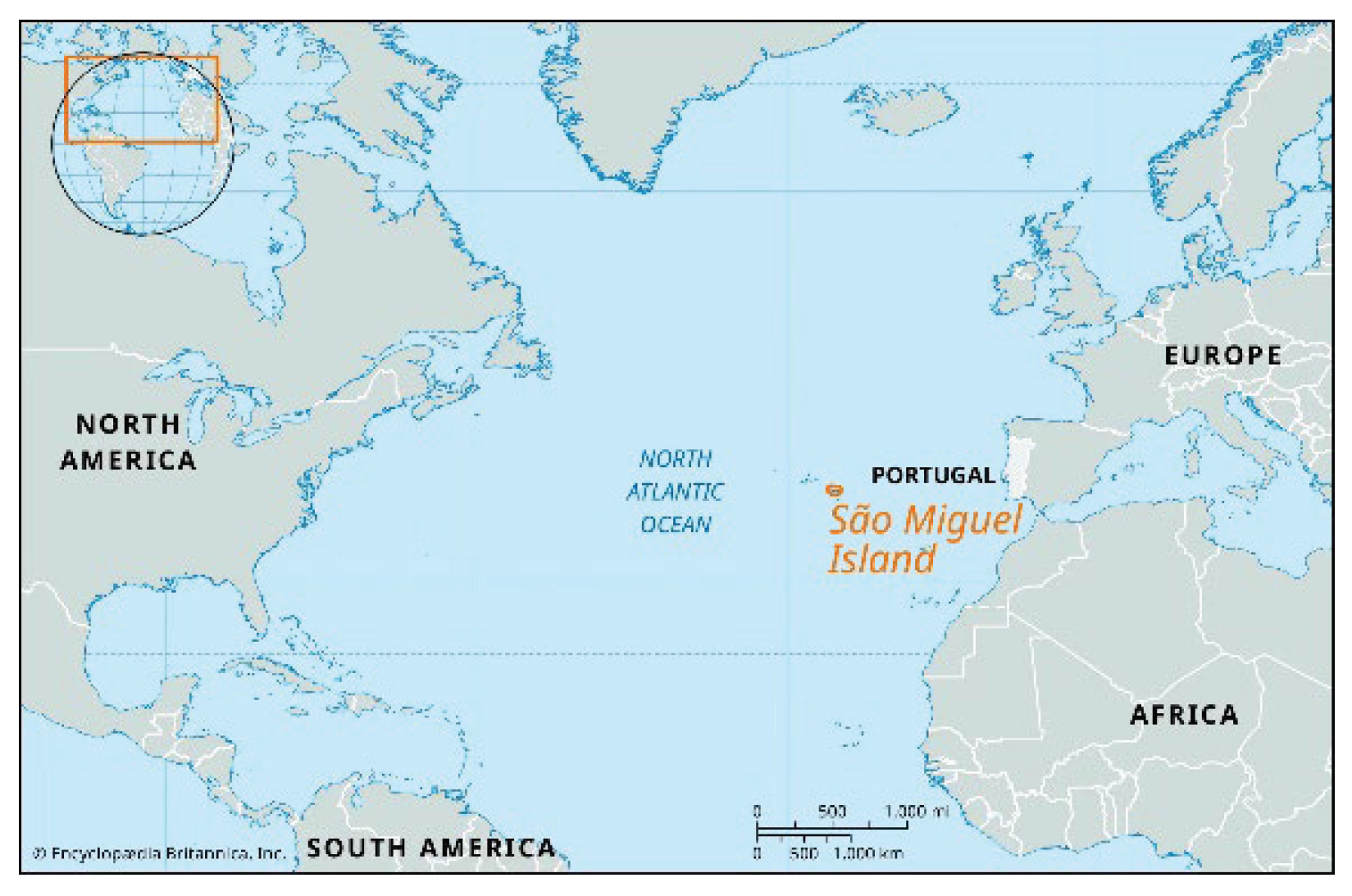
Figure 2.
Time series of daily mean ambient gamma radiation measured at Ponta Delgada (Azores). The vertical line marks the year 2020, corresponding to the replacement of the monitoring station by a new-generation detector with enhanced sensitivity and radionuclide identification capability.
Figure 2.
Time series of daily mean ambient gamma radiation measured at Ponta Delgada (Azores). The vertical line marks the year 2020, corresponding to the replacement of the monitoring station by a new-generation detector with enhanced sensitivity and radionuclide identification capability.
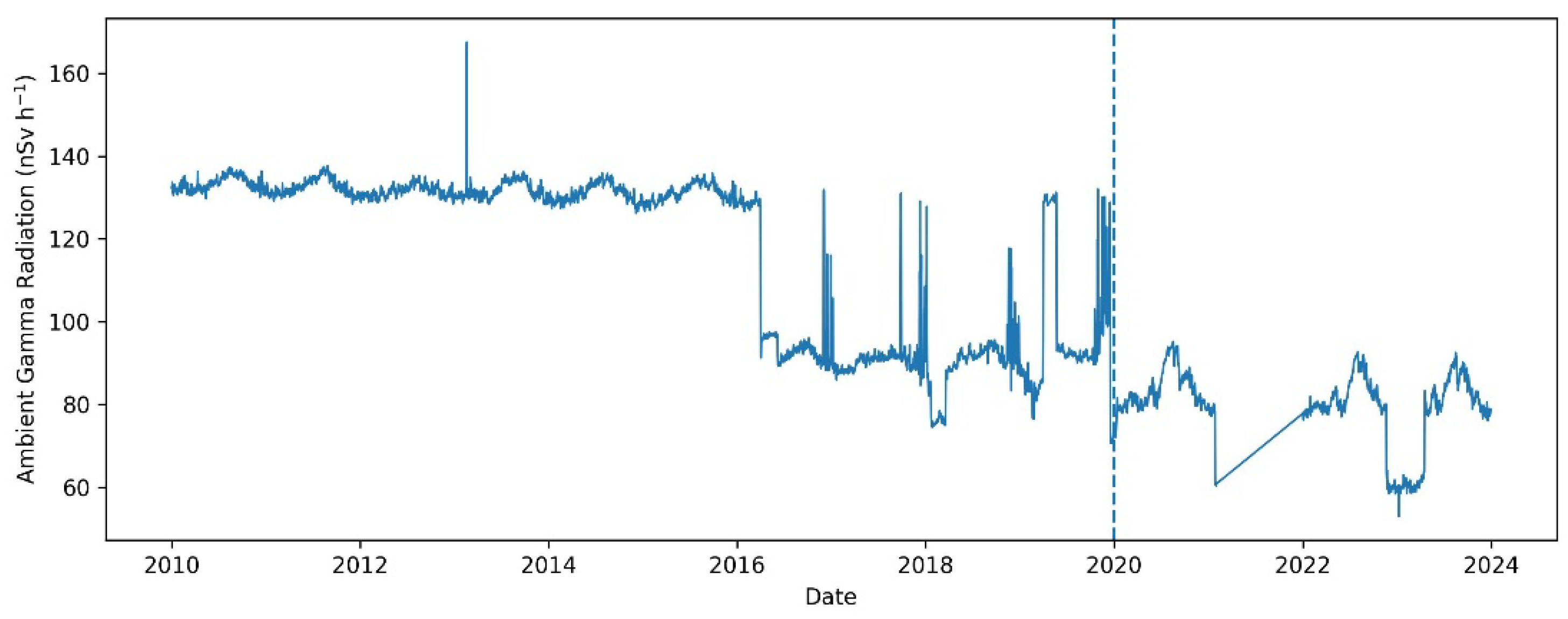
Figure 3.
Boxplots of daily mean ambient gamma radiation at Ponta Delgada for the periods before (2010–2019) and after (2020–2023) the monitoring station upgrade, highlighting the systematic shift in distribution associated with increased detector sensitivity.
Figure 3.
Boxplots of daily mean ambient gamma radiation at Ponta Delgada for the periods before (2010–2019) and after (2020–2023) the monitoring station upgrade, highlighting the systematic shift in distribution associated with increased detector sensitivity.
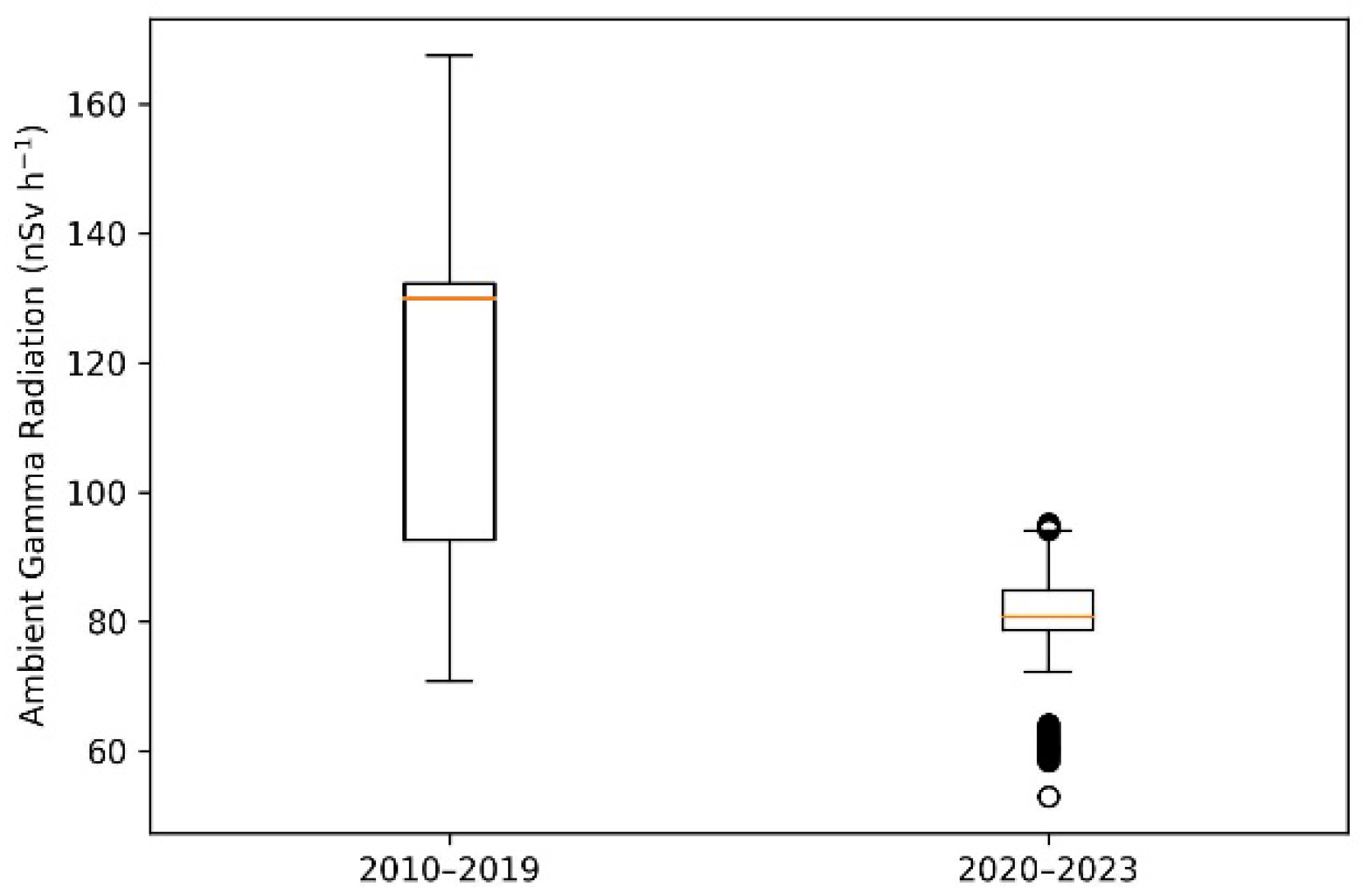
Figure 4.
Monthly climatology of daily mean ambient gamma radiation at Ponta Delgada for the periods 2010–2019 and 2020–2023. Despite differences in absolute magnitude associated with the station upgrade, both periods exhibit a consistent seasonal cycle, with higher values during autumn–winter and lower values in late spring–summer.
Figure 4.
Monthly climatology of daily mean ambient gamma radiation at Ponta Delgada for the periods 2010–2019 and 2020–2023. Despite differences in absolute magnitude associated with the station upgrade, both periods exhibit a consistent seasonal cycle, with higher values during autumn–winter and lower values in late spring–summer.
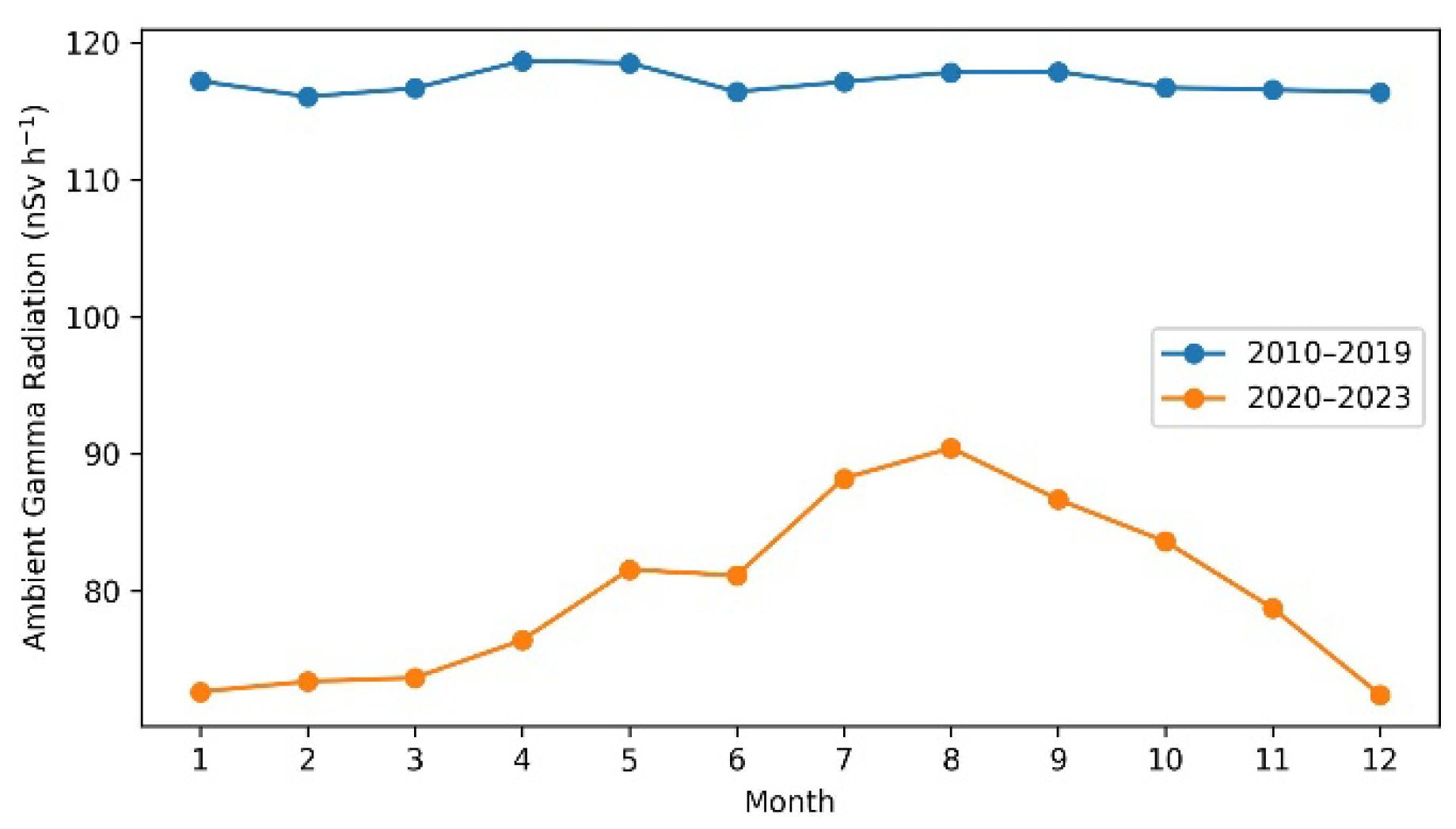
Figure 5.
Monthly climatology of key meteorological variables at Ponta Delgada for the period 2011–2023, including precipitation, wind speed, and relative humidity. The seasonal behavior of these variables provides physical context for the meteorological modulation of ambient gamma radiation.
Figure 5.
Monthly climatology of key meteorological variables at Ponta Delgada for the period 2011–2023, including precipitation, wind speed, and relative humidity. The seasonal behavior of these variables provides physical context for the meteorological modulation of ambient gamma radiation.
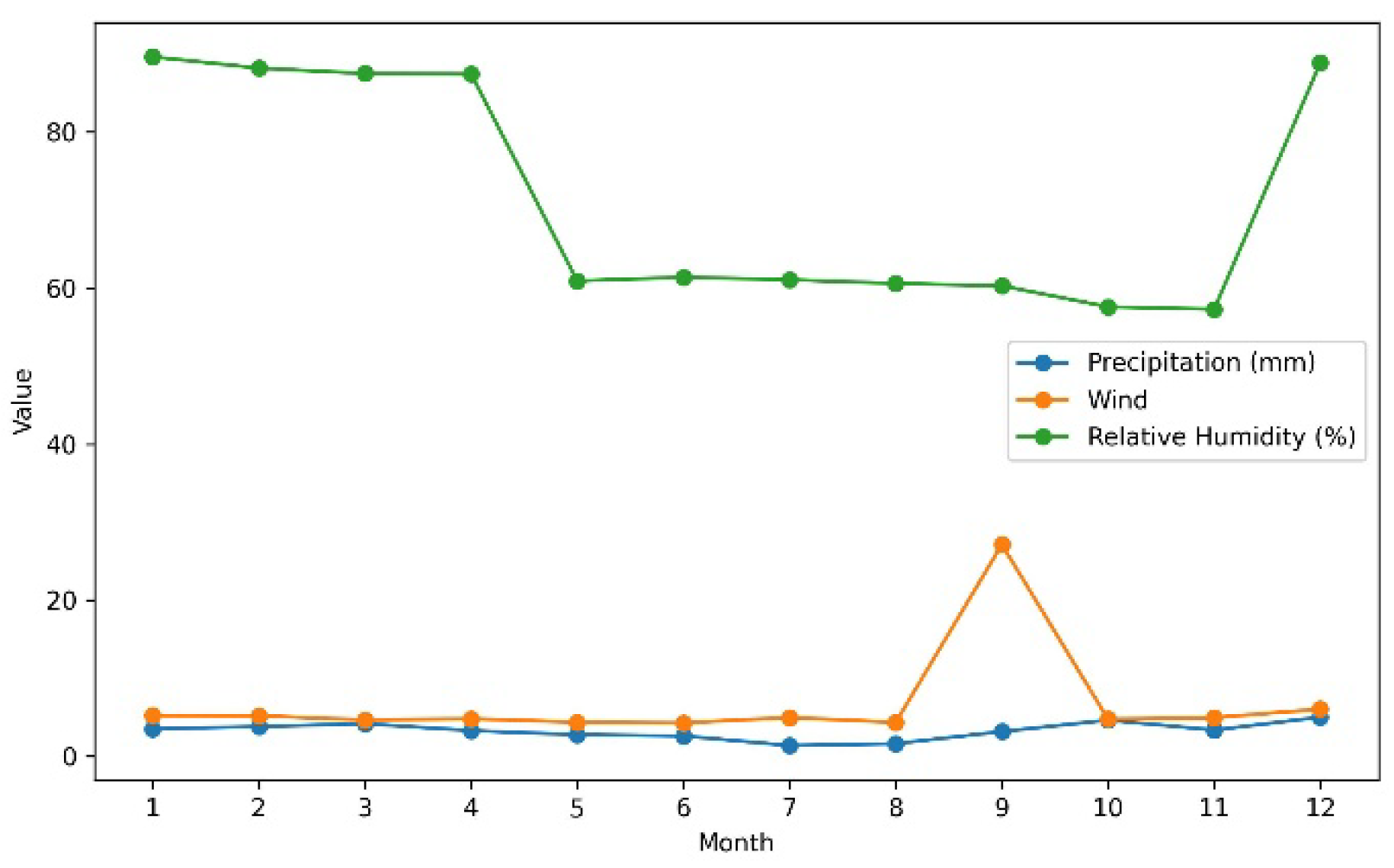
Figure 6.
Normalized monthly time series of ambient gamma radiation, accumulated precipitation, and mean wind speed at Ponta Delgada. All variables are expressed as standardized anomalies to highlight their relative temporal variability and coherence. The figure illustrates periods of temporal alignment between meteorological variability and gamma radiation.
Figure 6.
Normalized monthly time series of ambient gamma radiation, accumulated precipitation, and mean wind speed at Ponta Delgada. All variables are expressed as standardized anomalies to highlight their relative temporal variability and coherence. The figure illustrates periods of temporal alignment between meteorological variability and gamma radiation.
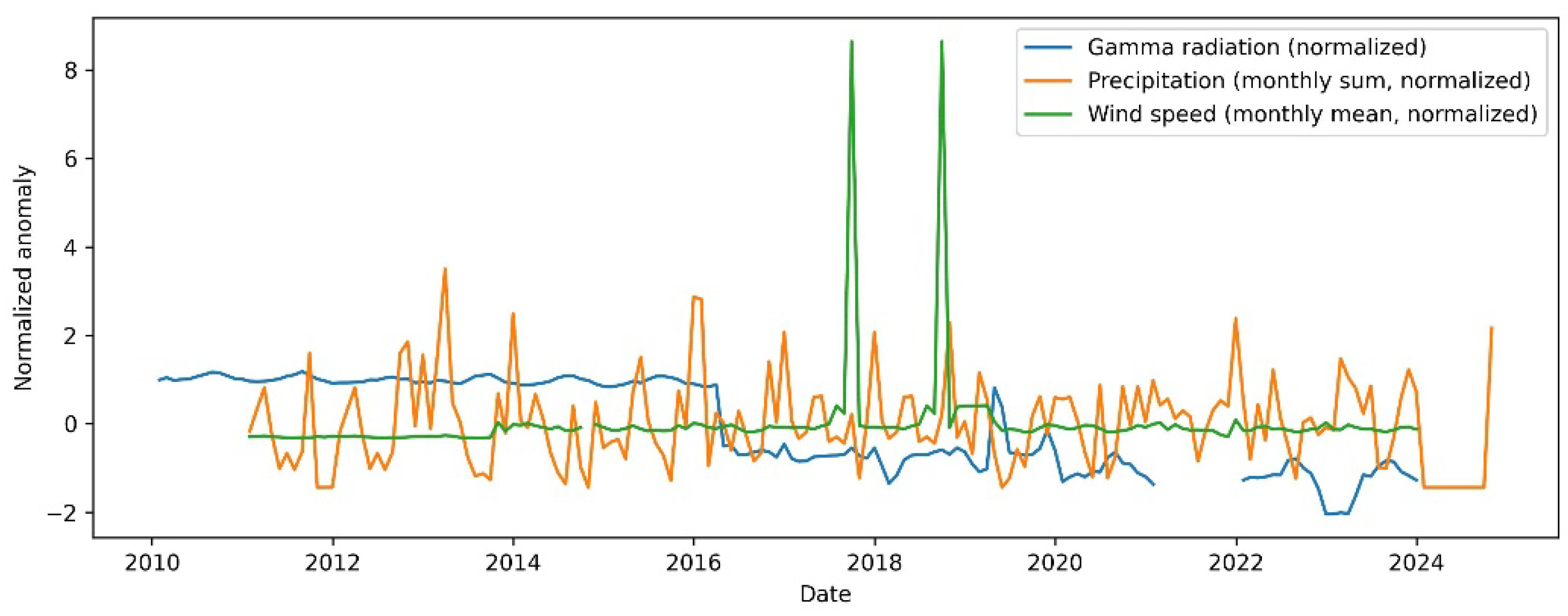
Figure 7.
Partial effects of key meteorological variables on daily mean ambient gamma radiation derived from the generalized additive model (GAM). Smooth curves represent the estimated non-linear effects of (a) precipitation, (b) wind speed, and (c) relative humidity, obtained while holding the remaining covariates constant. Rug plots along the x-axis indicate the distribution of observations used to estimate each smooth term. For clarity, the x-axis in panel (b) is restricted to the central range of observed wind speeds.
Figure 7.
Partial effects of key meteorological variables on daily mean ambient gamma radiation derived from the generalized additive model (GAM). Smooth curves represent the estimated non-linear effects of (a) precipitation, (b) wind speed, and (c) relative humidity, obtained while holding the remaining covariates constant. Rug plots along the x-axis indicate the distribution of observations used to estimate each smooth term. For clarity, the x-axis in panel (b) is restricted to the central range of observed wind speeds.
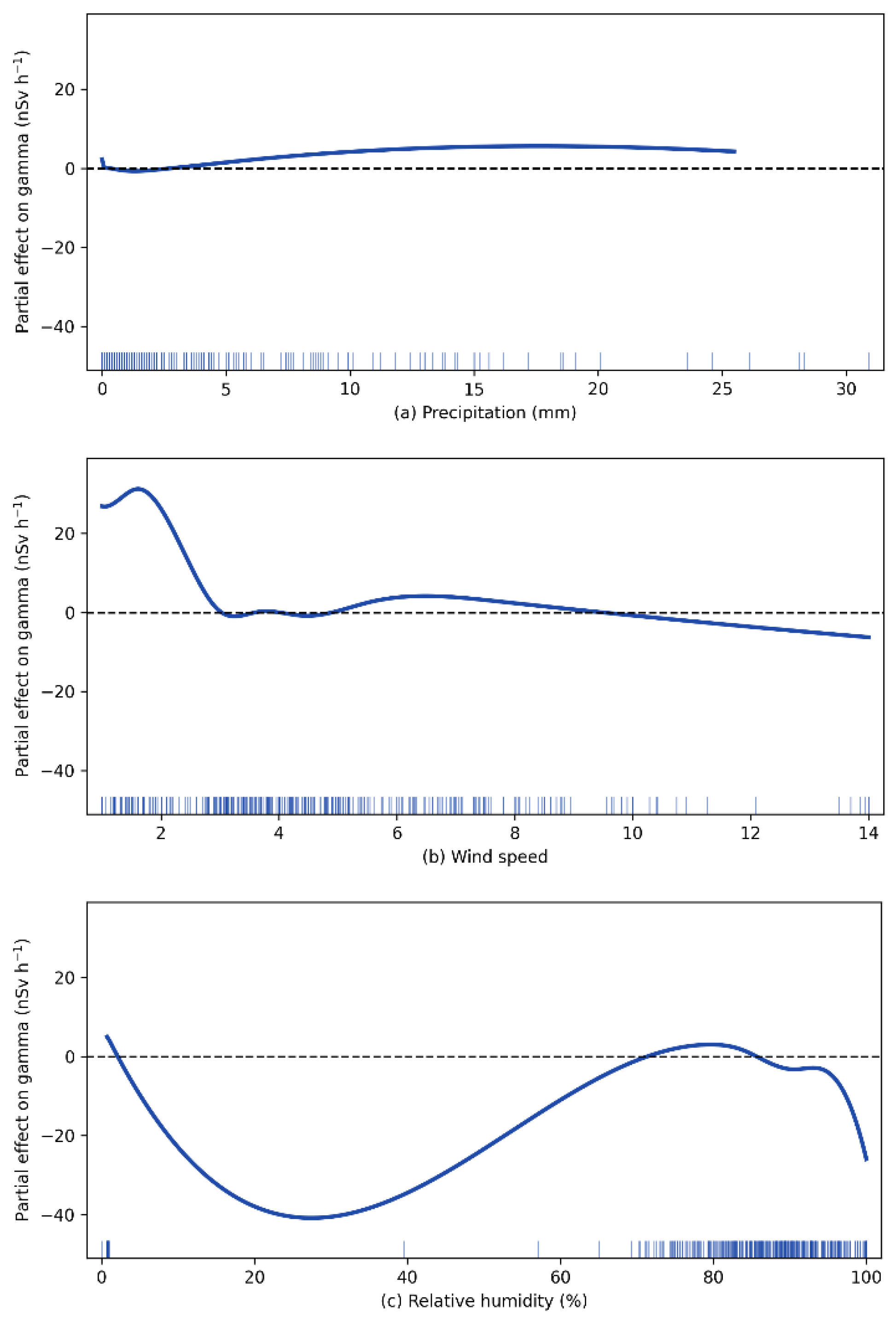

Table 1.
Summary statistics of daily mean ambient gamma radiation (nSv h−1).
| Period | N (days) | Mean | Median | Standard Deviation | P5 | P95 |
|---|---|---|---|---|---|---|
| A (2010–2019) | 3628 | 117.17 | 130.02 | 19.94 | 87.52 | 134.99 |
| B (2020–2023) | 1119 | 79.81 | 80.69 | 8.73 | 60.08 | 91.65 |
Table 2.
Summary of GAM smooth terms for daily mean ambient gamma radiation.
| Predictor | edf | F-statistic | p-value |
|---|---|---|---|
| Precipitation | 3.8 | 24.6 | <0.001 |
| Wind speed | 2.1 | 15.2 | <0.001 |
| Relative humidity | 1.9 | 12.4 | 0.002 |
Note: edf denotes the effective degrees of freedom of each smooth term; values close to 1 indicate an approximately linear effect, while higher values indicate increasing non-linearity.
Disclaimer/Publisher’s Note: The statements, opinions and data contained in all publications are solely those of the individual author(s) and contributor(s) and not of MDPI and/or the editor(s). MDPI and/or the editor(s) disclaim responsibility for any injury to people or property resulting from any ideas, methods, instructions or products referred to in the content. |
© 2026 by the authors. Licensee MDPI, Basel, Switzerland. This article is an open access article distributed under the terms and conditions of the Creative Commons Attribution (CC BY) license (http://creativecommons.org/licenses/by/4.0/).
Copyright: This open access article is published under a Creative Commons CC BY 4.0 license, which permit the free download, distribution, and reuse, provided that the author and preprint are cited in any reuse.


