

Submitted:
20 January 2026
Posted:
20 January 2026
You are already at the latest version
Abstract
Background: Brick kiln workers are chronically exposed to dust, combustion products, and industrial emissions that may contain toxic heavy metals. Prolonged exposure to metals such as cadmium (Cd) and Chromium (Cr) poses significant occupational health risks, including respiratory and systemic effects. This study assessed blood cadmium levels and screened for chromium exposure among brick kiln workers in Bahawalpur, Pakistan.Methods: A cross-sectional study was conducted from April to June 2023. Venous blood samples for heavy metal analysis were obtained from 14 workers selected from a total of 70 brick kiln workers based on sample availability and consent and digested using aqua regia. Cadmium concentrations were quantified using Atomic Absorption Spectrophotometry (AAS). Chromium was assessed using a colorimetric method based on 1,5‑diphenylcarbazide. Descriptive statistics were used to summarize metal concentrations and compare findings with international reference values.Results: Blood cadmium concentrations ranged from 0.24 to 5.12 µg/L, indicating elevated exposure among a substantial proportion of workers when compared with reference background levels. Chromium concentrations were below the detection limit of the colorimetric method in all analyzed samples. The observed cadmium burden suggests occupational exposure likely associated with kiln-related emissions, dust, and fuel combustion.Conclusions: Brick kiln workers in Bahawalpur exhibit elevated blood cadmium levels, reflecting significant occupational exposure. Although chromium was not detected above the analytical detection limit, methodological constraints preclude ruling out low-level exposure. These findings highlight the need for routine biomonitoring, improved workplace controls, and stricter enforcement of occupational health regulations in Pakistan.
Keywords:
heavy metals
; cadmium
; chromium
; brick kilns
; occupational exposure
; biomonitoring
; Pakistan
1. Introduction
Brick kilns are a major informal industrial sector in South Asia and are recognized as substantial sources of environmental pollution. Emissions from brick kilns include particulate matter, black carbon, sulfur dioxide, nitrogen oxides, and trace heavy metals released from fuel combustion and raw materials. Workers employed in these kilns are exposed to polluted air, contaminated dust, and ash for prolonged periods, often without personal protective equipment, increasing their vulnerability to toxic metal exposure.
Cadmium is a non-essential and highly toxic heavy metal that accumulates in the human body, particularly in the kidneys and lungs. Chronic cadmium exposure has been associated with respiratory impairment, renal dysfunction, bone demineralization, and increased cardiovascular risk. Occupational exposure may occur through inhalation of contaminated dust and fumes, especially in industries involving combustion processes. Chromium, particularly hexavalent chromium [Cr(VI)], is another metal of concern due to its carcinogenic and respiratory effects, although its detection depends strongly on analytical methodology.
While several studies from South Asia have documented respiratory impairment among brick kiln workers, limited data are available on their internal heavy metal burden. This study aims to assess blood cadmium levels and screen for chromium exposure among brick kiln workers in Bahawalpur, Pakistan, thereby contributing biomonitoring evidence to complement existing occupational health research.
2. Materials and Methods
2.1. Study Area and Participants
Figure 1.
Location of the study area (Bahawalpur District, Punjab, Pakistan), showing the sites of the seven surveyed brick kilns.
Figure 1.
Location of the study area (Bahawalpur District, Punjab, Pakistan), showing the sites of the seven surveyed brick kilns.
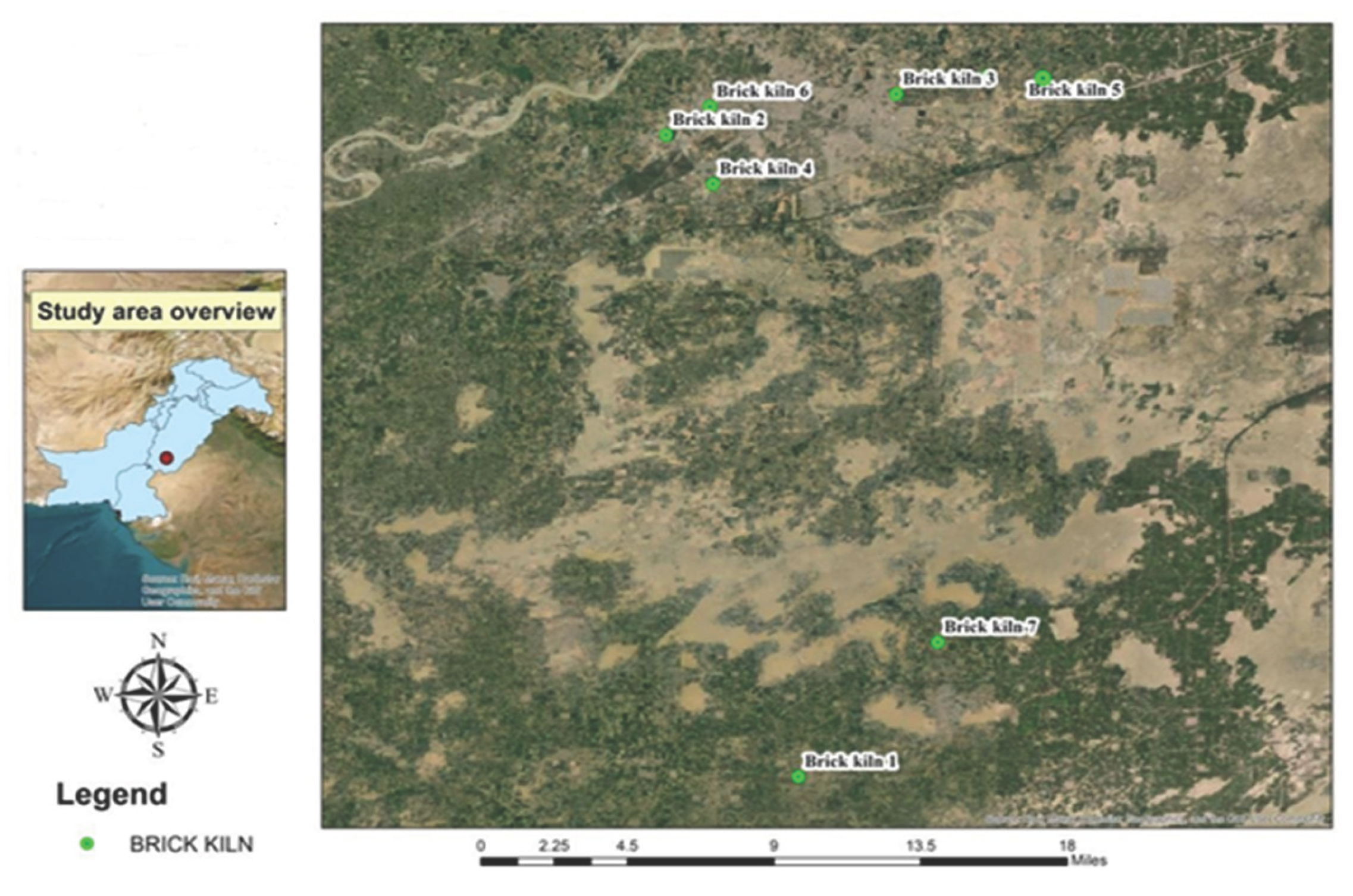
The study was conducted in Bahawalpur District, Southern Punjab, Pakistan, between April and June 2023. Seven operational brick kilns were selected, and workers were recruited through voluntary participation. Venous blood samples for heavy metal analysis were obtained from 14 workers selected from a total of 70 brick kiln workers based on sample availability and consent.
Written informed consent was obtained from all adult participants. For underage workers, assent was obtained along with guardian or parental permission where available. Ethical approval was granted by the Ethical Review Committee of Kinnaird College for Women, Lahore (Approval No. KC/ORIC/ERC/2023/006).
2.2. Sample Collection and Preparation
Venous blood samples were collected using sterile, metal-free syringes and transferred into anticoagulant-treated tubes. Samples were transported under cold conditions to the laboratory for analysis. Blood samples were digested using aqua regia (a mixture of concentrated nitric acid and hydrochloric acid) to ensure complete mineralization of organic matter prior to instrumental analysis.
2.3. Heavy Metal Analysis
Cadmium concentrations were determined using Atomic Absorption Spectrophotometry (AAS) following standard analytical protocols. Calibration was performed using certified cadmium standards, and quality control procedures were applied to ensure analytical reliability.
Chromium was assessed using a colorimetric method based on 1,5-diphenylcarbazide, which selectively detects hexavalent chromium [Cr(VI)]. Due to the methodological limitations of this technique, results were interpreted in terms of detection limits rather than absolute absence.
2.4. Data Analysis
Descriptive statistics, including ranges and minimum–maximum values, were used to summarize blood cadmium concentrations. Observed values were compared with international reference levels reported for non-occupationally exposed populations. Chromium results were reported as below detection limit where applicable.
3. Results
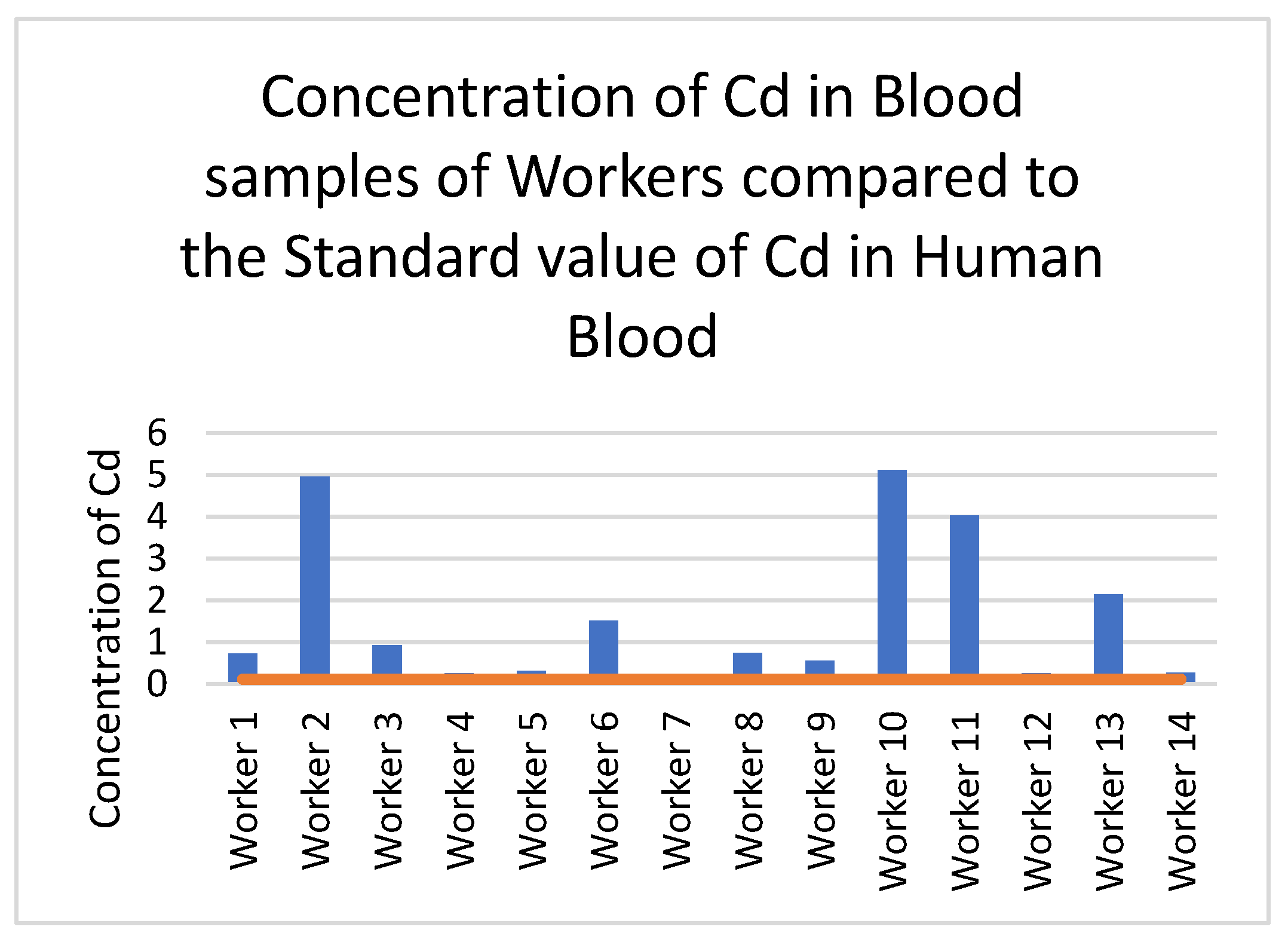
Blood cadmium concentrations among brick kiln workers ranged from 0.24 to 5.12 µg/L. Several analyzed samples exhibited cadmium levels exceeding commonly reported background values for the general population, indicating elevated occupational exposure.
Figure 2.
Blood cadmium concentrations among brick kiln workers (n = 14) compared with the standard reference value (Bahawalpur, April–June 2023).
Figure 2.
Blood cadmium concentrations among brick kiln workers (n = 14) compared with the standard reference value (Bahawalpur, April–June 2023).
Chromium concentrations were below the detection limit of the applied colorimetric method in all analyzed samples. Given the method’s specificity for hexavalent chromium and its relatively high detection threshold, these findings indicate that Cr(VI), if present, was below the measurable range rather than conclusively absent.
4. Discussion
The present study demonstrates elevated blood cadmium concentrations among brick kiln workers in Bahawalpur, indicating significant occupational exposure to toxic heavy metals. These findings are consistent with previous studies documenting increased cadmium burden among workers exposed to combustion-derived pollutants, dust, and industrial emissions. For example, occupational biomonitoring studies conducted among brick kiln workers in Pakistan and Nepal have reported significantly higher blood cadmium levels compared to background populations, attributing this elevation to prolonged inhalation of contaminated particulate matter and fumes generated during fuel combustion and brick firing processes. Similar patterns of cadmium accumulation have been observed among industrial workers exposed to coal smoke, ash, and dust-rich environments, reinforcing the role of combustion-related exposure pathways.
The observed cadmium concentrations in this study fall within ranges reported for occupationally exposed populations in South Asia. Singh et al. and other regional studies have documented elevated blood cadmium levels among kiln laborers and workers in related industries, suggesting cumulative exposure resulting from long working hours, lack of personal protective equipment, and minimal regulatory oversight. Cadmium contamination in brick kiln settings has been linked to the use of low-grade fuels, including coal, rubber, and agricultural waste, as well as contaminated soil and clay used in brick production. These sources likely contribute to the internal cadmium burden observed among workers in the present study.
Chromium concentrations were below the detection limit of the applied colorimetric method in all analyzed samples. This finding should be interpreted cautiously, as the 1,5-diphenylcarbazide method selectively detects hexavalent chromium [Cr(VI)] and does not quantify total chromium content. Previous studies have reported detectable chromium levels in brick kiln workers when more sensitive analytical techniques, such as atomic absorption spectrophotometry or inductively coupled plasma mass spectrometry, were employed. Therefore, while Cr(VI) was not detected above the measurable threshold in this study, the presence of low-level chromium exposure or trivalent chromium cannot be excluded. Methodological differences may account for variations in chromium detection across studies.
Variability in cadmium burden among workers may also reflect differences in kiln design, fuel type, duration of exposure, and workplace practices. Traditional kilns, such as Bull’s Trench and clamp kilns, have been shown to emit higher concentrations of particulate matter and metal-containing ash, contributing to increased metal inhalation. Studies by Kumar et al. (2018) and Malla and Jha (2020) demonstrated that workers in traditional kiln settings experienced greater pollutant exposure compared to those employed in improved or modified kilns. Inadequate ventilation, absence of respiratory protection, and poor occupational hygiene further exacerbate metal uptake, as documented by Ahmad et al. (2019).
Overall, the findings of this study align with regional and international evidence indicating that brick kiln work is associated with elevated exposure to toxic metals, particularly cadmium. The accumulation of cadmium in blood underscores the potential for long-term systemic health effects, including respiratory, renal, and cardiovascular outcomes, especially in settings where occupational safeguards are limited. Integrating biomonitoring with environmental measurements and health assessments is essential to fully characterize exposure risks and inform targeted interventions aimed at protecting this vulnerable workforce.
5. Limitations
This study has several limitations. The absence of a non-exposed control group restricts direct comparison with the general population. Chromium analysis was limited by the sensitivity and specificity of the colorimetric method used, which may underestimate total chromium exposure. Additionally, environmental measurements of airborne metal concentrations were not conducted, limiting exposure source attribution. The cross-sectional design captures exposure at a single time point and cannot assess long-term trends. In addition, blood metal analysis was conducted on a limited number of workers, which may affect the generalizability of the biomonitoring results.
6. Conclusions
Brick kiln workers in Bahawalpur exhibit elevated blood cadmium levels, reflecting significant occupational exposure to toxic heavy metals. Although chromium was below the detection limit of the applied method, methodological constraints warrant cautious interpretation. The findings emphasize the need for routine biomonitoring, improved emission controls, provision of personal protective equipment, and stricter enforcement of occupational health regulations to safeguard this vulnerable workforce.
6.1. Theoretical Implications
This study contributes to the theoretical understanding of occupational exposure pathways by reinforcing the role of informal industrial settings, such as brick kilns, as significant sources of internal heavy metal burden among workers. The elevated blood cadmium levels observed support existing exposure–dose frameworks that link chronic inhalation of combustion-derived particulate matter with systemic metal accumulation. By providing biomonitoring evidence from a relatively underrepresented occupational group in South Asia, the study extends occupational health theory beyond formal industrial sectors and highlights the importance of internal exposure assessment alongside environmental monitoring. Furthermore, the findings underscore the relevance of biomonitoring as a complementary tool in exposure science, particularly in settings where environmental measurements are limited or regulatory oversight is weak.
6.2. Managerial and Policy Implications
The findings have important implications for workplace management and occupational health policy in Pakistan. Elevated cadmium levels among brick kiln workers indicate an urgent need for improved occupational safety practices, including the provision and enforcement of personal protective equipment, better kiln ventilation, and safer fuel selection. From a policy perspective, the results highlight gaps in occupational health regulation and monitoring within the informal brick kiln sector. Regulatory authorities should prioritize routine health surveillance and biomonitoring of workers, enforce existing labor and environmental protection laws, and promote the transition toward cleaner and improved kiln technologies. Integrating occupational health considerations into national environmental and labor policies would be a critical step toward reducing long-term health risks among this vulnerable workforce.
6.3. Future Research Directions
Future studies should adopt a more comprehensive exposure assessment approach by including a non-exposed control group and conducting environmental measurements of airborne metals and particulate matter. The use of more sensitive analytical techniques, such as inductively coupled plasma mass spectrometry (ICP-MS), is recommended to quantify total chromium and other trace metals that may be present at low concentrations. Longitudinal study designs would allow assessment of cumulative exposure and temporal trends in metal burden, as well as clearer associations with health outcomes. Additionally, integrating biomonitoring data with clinical, respiratory, and renal health assessments would provide a more holistic understanding of the long-term health impacts of heavy metal exposure among brick kiln workers. Expanding research across different kiln types and geographic regions would further strengthen the evidence base needed to inform targeted interventions and policy reforms.
Funding
No external funding was received for this study.
Ethical Approval
Ethical approval was obtained from the Ethical Review Committee of Kinnaird College for
Women, Lahore. Written informed consent was obtained from all participants.
Data Availability
The datasets generated during this study are available from the author upon reasonable
request.
Conflicts of Interest
The author declares no conflicts of interest.
References
- Järup, L.; et al. Health effects of cadmium exposure – a review of the literature. Scandinavian Journal of Work, Environment & Health 1998, 24(1), 1–51.
- Chen, X.; et al. Occupational exposure to cadmium and renal effects: a systematic review. International Archives of Occupational and Environmental Health 2018, 91, 1–17.
- WHO (World Health Organization). Evaluation of Certain Food Additives and Contaminants: Cadmium.; WHO Press, 2007.
- ATSDR. Toxicological Profile for Chromium. U.S. Department of Health and Human Services. 2012.
- Katz, S. A.; Salem, H. The biological and environmental chemistry of chromium; VCH Publishers, 1993. [Google Scholar]
- APHA. Standard Methods for the Examination of Water and Wastewater, 23rd ed.; American Public Health Association, 2017. [Google Scholar]
- Welz, B.; Sperling, M. Atomic Absorption Spectrometry, 3rd ed.; Wiley-VCH, 1999. [Google Scholar]
- Cornelis, R.; et al. In Handbook of Elemental Speciation II: Species in the Environment, Food, Medicine; Wiley, 2005.
- ILO (International Labour Organization). In Health and Safety in Brick Kilns: Global Report on Informal Labour Risks; Geneva, 2017.
- Gautam, R.; Shrestha, A.; Paudel, B. Occupational exposure and health problems among brick kiln workers in Nepal. Journal of Nepal Health Research Council 2018, 16, 438–443. [Google Scholar]
- Kumar, P.; Jain, S.; Kumar, R. Respiratory and occupational health assessment of brick-kiln workers. Environmental Monitoring and Assessment 2018, 190, 659. [Google Scholar]
Disclaimer/Publisher’s Note: The statements, opinions and data contained in all publications are solely those of the individual author(s) and contributor(s) and not of MDPI and/or the editor(s). MDPI and/or the editor(s) disclaim responsibility for any injury to people or property resulting from any ideas, methods, instructions or products referred to in the content. |
© 2026 by the author. Licensee MDPI, Basel, Switzerland. This article is an open access article distributed under the terms and conditions of the Creative Commons Attribution (CC BY) license.
Copyright: This open access article is published under a Creative Commons CC BY 4.0 license, which permit the free download, distribution, and reuse, provided that the author and preprint are cited in any reuse.


