
Submitted:
19 January 2026
Posted:
20 January 2026
You are already at the latest version
Abstract
Architect Vladimir Potočnjak (1904-1952), a cofounder of Croatian Modern Movement is almost nonexistent in the recent Croatian architectural history. The research of archival sources, accompanied by acquired drawings and books from his library, comprised thor-ough analysis of his realizations, projects and publications. Potočnjak graduated from the Architectural Department of Zagreb’s Institute of Technology in 1926 and apprenticed to Adolf Loos in Paris where he improved drawing skills, subsequently to Ernst May in Frankfurt a/M and finally to Hugo Ehrlich in Zagreb. Between 1931 and 1945 he was li-censed architectural engineer in Kingdom of Yugoslavia and successively in the Inde-pendent State of Croatia, additionally an architectural critic and theoretician preoccupied with problems of standardization. After 1945 he was appointed senior manager for archi-tecture in the collectivized Croatian Stately Design and Planning Institute. Cooperating with Zlatko Neumann, junior architects Antun Ulrich and Dragica Perak, in 1947 he won Yugoslav competition for the Federal Government Presidency Palace, later the Federal Ex-ecutive Council Palace, today the Palata “Srbije”. Fully preoccupied to its construction un-til his death, he concurrently translated Ernst Neufert’s “Bauordnungslehre” in Serbo-Croatian. Although classically educated, Potočnjak blended Modern Architectural narrative with layers of German Expressionism, visible on seminal drawings of Palata “Srbije”.
Keywords:
Vladimir Potočnjak
; German expressionism
; modern architecture
; standardization
; Adolf Loos
; Ernst May
; Zlatko Neumann
; Palata “Srbije”
; Yugoslavia
; Ernst Neufert
; Croatia
1. Introduction
The architect Vladimir Potočnjak (1904-1952) is one of the most underrated architects in the history of Modern Architecture in Croatia, although being among pioneers of Croatian Modern Movement between the World Wars. To his contemporaries he was known as an apprentice to Adolf Loos, further to Ernst May and finally to Loos’s Croatian acquaintance Hugo Ehrlich. As a licensed architectural engineer in Croatia through the 1930s, he introduced Modern Movement principles into the design of industrial facilities of the Aluminum Factory in Lozovac near Šibenik in 1937. He published the seminal comprehensive review of Croatian Architecture in 1939 and started to engage himself in standardization. In the Independent State of Croatia he was appointed professor of the building construction in 1942 yet was fired in 1943 and subsequently gone to the underground resistance. In 1945 he was appointed as the senior manager for architectural design in the collectivized Croatian Stately Design and Planning Institute. With his friend and cooperative Zlatko Neumann, strengthen with junior architects Antun Ulrich and Dragica Perak, they together won the Yugoslav competition for the Federal Government Presidency Palace in New Belgrade in 1947, today the Palata “Srbije” [1]. He translated and published Ernst Neufert’s “Bauordnungslehre” in Serbo-Croatian in 1952, when he suddenly died from exhaustion. Besides the obituary [1], the seminal article published by Professor architect Zvonimir Vrkljan [2,3] and standard articles in Croatian encyclopedias [4,5,6], he is practically nonexistent in the recent Croatian architectural history, although some contemporary [7,8] or recent authors [9,10] mentioned him. Therefore the aim of this article is to enlighten his crucial position and to introduce him to the international architectural community.
2. Methodology
The author of this article conducted archival research upon the Modern Architecture in Zagreb and Croatia between 1998 and 2024, further comparatively noticing the work of chosen architects as Vladimir Šterk, Zlatko Neumann, Georg Kiverov, Jovan Korka, Đorđe Krekić, Zdenko Strižić, Zvonimir Pavešić and Vladimir Potočnjak. Consequently a certain amount of Potočnjak’s projects and realizations was found and duly noted. In the period 2019-2024 the author luckily bought the batch of Potočnjak’s drawings [11,12] from prominent secondhand bookshops in Croatia, including the map of his projects itself composed in 1942, further found and documented the manuscript written by him from the internet [13]. Through the years the author bought a few volumes from Potočnjak’s rich library, e.g., written by the architects Josef Durm [14,15] and Fritz Schumacher [16]. In Spring 2022 the author researched Vladimir Potočnjak’s personal file at the Archives of the Faculty of Architecture of the University of Zagreb, with the selfless help of Professor architect Zlatko Karač. The Potočnjak’s work between 1945 and 1952, stored at the Croatian State Archives [Croatian: Hrvatski Državni Arhiv] was not researched, instead the analysis of his work during this period was conducted from published sources (“Arhitektura”, “Čovjek i prostor”). Projects and realizations are chronologically and typologically divided in three periods: 1) Apprenticeships to Adolf Loos, Ernst May and Hugo Ehrlich (1927-1931); 2) Licensure as architectural engineer (1931-1945); and 3) Work as the Responsible Designer [Croatian: Odgovorni projektant] and mutual leader of various cooperatives (with Zlatko Neumann, shorter with Antun Ulrich, Dragica Perak and Branko Vasiljević, probably with Stjepan Gomboš and Mladen Kauzlarić) (1945-1952). The second period was additionally typologically divided into apartment houses, villas, industrial facilities, office buildings etc. The analysis was based on the classic theory of architectural composition, which Hugo Ehrlich taught him and his colleagues, i.e., the system based on the “Handbuch der Architektur”, as Ehrlich’s successor on the chair of “The Architectural Compositions” Professor Architect Alfred Albini later witnessed in the early 1950s. Potočnjak himself possessed at least a dozen volumes of the Handbuch, e.g., Durm’s 3rd edition of “Die Baukunst der Griechen” from 1910 [14] and 2nd edition of “Die Baukunst der Etrusker / Römer” from 1905 [15], given to him in Frankfurt a/M when practicing for May. With the time Potočnjak became acquainted on French architectural theory, probably on Julien Guadet’s “Éléments et théorie de l’architecture”, further with Ernst Neufert’s work on standardization and codification of architecture. Last but not least, similarly to Zlatko Neumann and Zdenko Strižić, Potočnjak owed his drawing style to his stay with Neumann and Loos in Paris in Spring 1927.
3. Vladimir Potočnjak’s Architectural Career from the Typological Point of View
3.1. The Prelude: Education
The Architect Vladimir Potočnjak was born on January 17th, 1904, in Zagreb, Kingdom of Croatia and Slavonia, Transleithania, Austria-Hungary [1,17]. His father Eduard Potočnjak was presumably of Croatian ancestry, while his mother Marija née Pogorjelov [Russian: Мария /Mariya/, Пoгoрелoв /Pogorelov/] was of Russian ancestry. He was baptized as a Russian Orthodox [17], however probably shortly after the proclamation of fascist Independent State of Croatia (April 10th / April 25th, 1941) he converted himself to a Roman Catholic. He attended the primary school in Zagreb (1910?-1913?), further the Natural Science High School [German / Croatian: Realgymnasium/(I.) Realna gimnazija] in Zagreb (1913-1914; 1918-1922) and between 1914-1918 in Sušak [17], probably because his father’s resettlement there while serving as an official. On July 3rd, 1922, he passed the Matura Exam [17], consisting of written examinations in Croato-Serbian [: Hrvatski ili srpski jezik] [17], grade B; German, grade D; French, grade A and Descriptive Geometry, grade C; further of oral examinations in French (Prosper Mérimée: Colomba); History-Geography; Mathematics and Physics. He was rated as “[being] matured with distinction for attending the study [at the Institute of] Technology” [Croatian: zreo s odlikom za polaženje visokih tehničkih nauka] [17]. Potočnjak attended the Academy of Visual Arts in Munich in 1922 [1], yet his 2nd Stately Exam / Diploma Certificate [18] stated 1922/1923 as the Freshman year at the Architectural Department of Zagreb Institute of Technology, therefore it is to conclude that he studied in Munich for a month or possibly for a couple of months [1], after that he returned to Zagreb and orderly studied until 1926, when he passed the 2nd Stately / Diploma Exam [Croatian: drugi državni / diplomski ispit] on June 25th, 1926 [1]. The members of Examination Committee were renowned professors of the Architectural Department: Architect Ćiril Metod Iveković, Architect Janko Holjac, Architect Eduard [Edo] Schön, Architect Martin Pilar, Architect Hugo Ehrlich (an acquaintance of Architect Adolf Loos), Structural Engineer Aleksandar Kaiser (one of pioneers of reinforced concrete structures in Zagreb) and Architect Karl Gentzkow [err. Gentzkov], who served as the Examination Committee Chair [18]. The exam itself consisted of written (practical) exam, passed by grade C, and of four oral examinations in courses “Modern architectural forms from the Renaissance” [Croatian: Arhitektonski oblici novoga vijeka od renesanse, probably Iveković], Architectural compositions [Croatian: Arhitektonske kompozicije, probably Ehrlich], Construction science [German / Croatian: Baukunde / Graditeljstvo, probably Holjac, Pilar or/and Gentzkow] and “Steel and reinforced concrete structures” [Croatian: Željezne [literally iron, in the meaning of steel] i armirano-betonske konstrukcije, probably Kaiser] all passed with grade A, consequently making him an Architectural Engineer [Croatian: inženjer arhitekture] [2,18].
3.2. The Early Period: Apprenticing to Adolf Loos, Ernst May and Hugo Ehrlich (1926-1931)
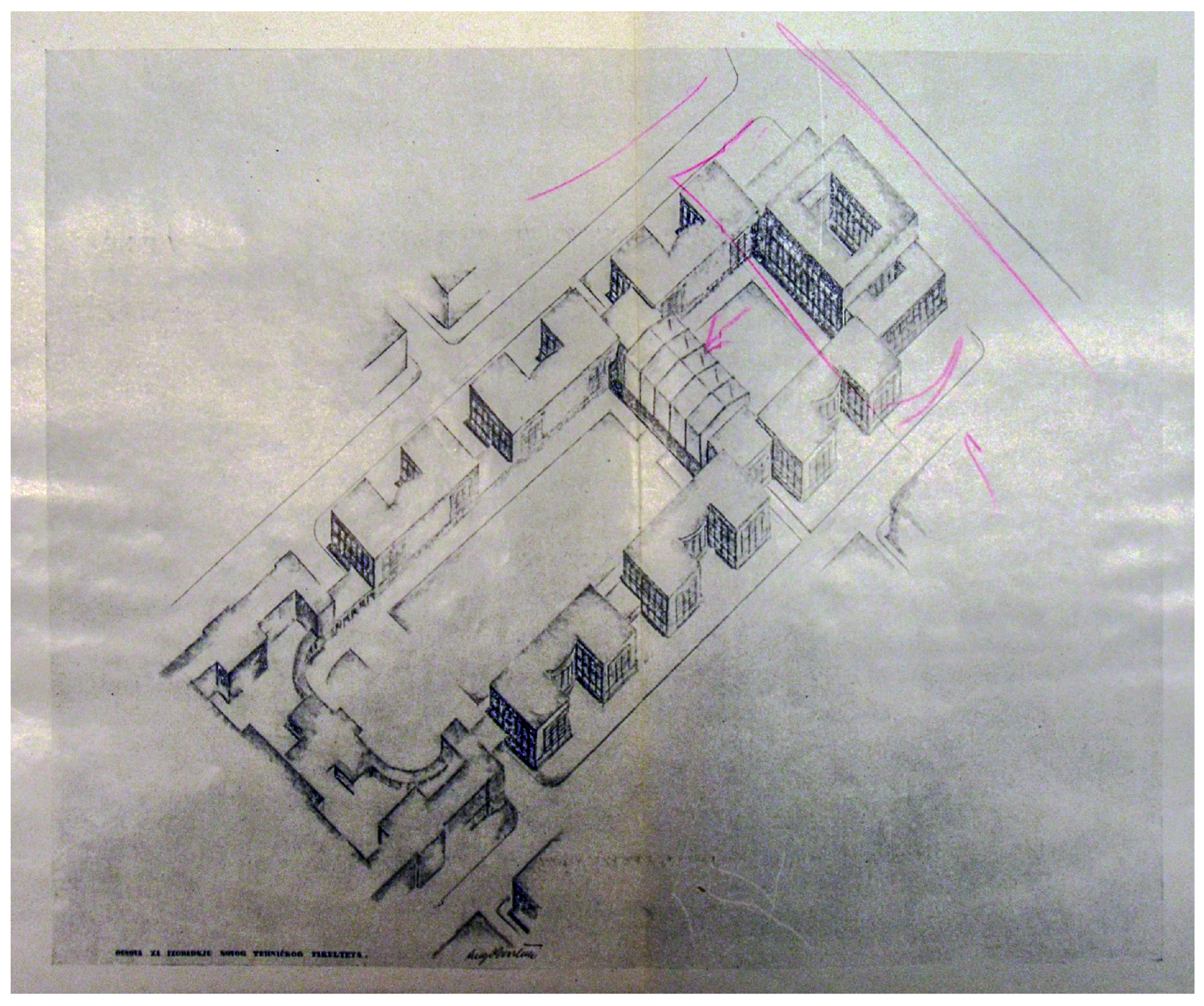
According to the Professor architect Zvonimir Vrkljan, the Architectural Engineer Vladimir Potočnjak was immediately after passing the 2nd Stately / Diploma Examination, due to his distinctive success, appointed as the “contractual assistant” [Croatian: kontraktualni asistent] at the Chair of Building Structures [Croatian: Građevne konstrukcije], headed by the Professor architect Karl Gentzkow, similarly like Vrkljan himself two years ago [2]. Being granted with the study year at the school’s expense, Potočnjak went to Milan and immediately after that to Paris in Autumn 1926, where he contacted the Architect Zlatko Neumann, who mediated Potočnjak’s informal apprenticeship to the Architect Adolf Loos. Like Zlatko Neumann, Architect Vladimir Potočnjak was fluent in German and French (although based on Matura Exam notes he had preferred French over German), thus seemed to be an ideal collaborator in presenting Loos’s ideas to French speaking investors in Paris, conceived as a younger colleague of Zlatko Neumann. Whether Potočnjak was felt unused due to Loos’s not quite ideal financial status, or he regarded the Architect Ernst May as the more avantgarde architect cannot be judged from accessible sources. He obtained the [still undiscovered] Letter of Recommendation from Adolf Loos probably in Winter 1926 and was employed in the first half of 1927 in the Municipal office of the City of Frankfurt am Main, where the Architect Ernst May was the chief architect [2]. Thus Potočnjak had the unique opportunity to study the design and construction of the Wohnsiedlungen in Frankfurt am Main from the first hand and see them with his own eyes. When Potočnjak came back from his study year in Summer 1927, he found his contractual employment at the Architectural Department of the School of Technology, University of Zagreb terminated [2]. One can only assume that in the financial turmoil of the Zagreb Institute of Technology immediately before its formal merger with the University of Zagreb, many prospective teaching appointments were washed away. It is probable that, after Ilija Badovinac’s dismissal by Gentzkow in Autumn 1925, the elderly assistant Zvonimir Vrkljan, although being studied Florence and Rome Renaissance architecture during his study year 1924-1925 made himself irreplaceable to Gentzkow, while the younger assistant, while being studied the recent Modern Movement architecture beside Loos and May had to leave and find further prospective apprenticeships elsewhere. Potočnjak was subsequently conscripted between Autumn 1927 and Summer 1928 to the Construction Direction of the Royal Navy of the Kingdom of Serbs, Croats and Slovenes [Croatian: Gradj.(evna) Uprava Mornarice] in Tivat (Zeta County [Croatian: Zetska Oblast], today Montenegro) [2]. Being an Engineer, he probably attended the Navy School for Reserve Officers and was eventually, after the yet unknown military drill, promoted to the rank of reserve lieutenant. However, he was never mobilized in the Second World War, thus staying a civilian for the rest of his life. Probably in Autumn 1928 he was employed as an apprentice in the Architectural Office of Hugo Ehrlich, one of his professors from the Schools of Technology, where the Engineer-in-charge was Juraj Meniga [2]. The professional relationships in Ehrlich’s Architectural Office are relatively well-known, due to the Ehrlich’s monograph written in Croatian in 1979 by the late art historian and politician Žarko Domljan, although his conclusions are more general, while the in-depth authorship analysis is nonexistent [19]. It is certain that Loos’s Letter of Recommendation to Potočnjak secured the latter’s apprenticeship by Hugo Ehrlich, known as Loos’s successor at the Villa Karma and later acquaintance in Zagreb together with the architect Viktor Kovačić. Two important projects of Hugo Ehrlich, which can be attributed to Potočnjak with utmost certainty, were the First project for the School of Technology campus of the University of Zagreb (Appendix 1.1.) [20] and the Second phase of the Endowment of the Archdiocese of Zagreb [Croatian: Nadarbina Nadbiskupije Zagrebačke] residential complex (Appendix 1.2.). The First project for the School of Technology’s complex was not intended to be built, but to bargain and eventually rewon the Ciglana plot for the School of Technology, recently being taken away by the City of Zagreb authorities [20,21]. Hence the Architectural Engineer Vladimir Potočnjak had much more room to play with contemporary design idiom, which he mastered in vague transformation of the Count Sanguszko Stalls project either designed by Zlatko Neumann or by his master Adolf Loos himself. The Campus project represents one of rare public building projects in Zagreb inspired by Adolf Loos and undoubtedly cemented Vladimir Potočnjak’s acquaintance with Zlatko Neumann ( Figure 1., 2.), which will bear two apartment buildings in early 1930s and later the fruitful cooperation after the Second World War.
Figure 1.
The first project for the School of Technology campus, Zagreb, Yugoslavia, today Croatia, 1928-1929 (Appendix 1.1.), plan [21].
Figure 1.
The first project for the School of Technology campus, Zagreb, Yugoslavia, today Croatia, 1928-1929 (Appendix 1.1.), plan [21].
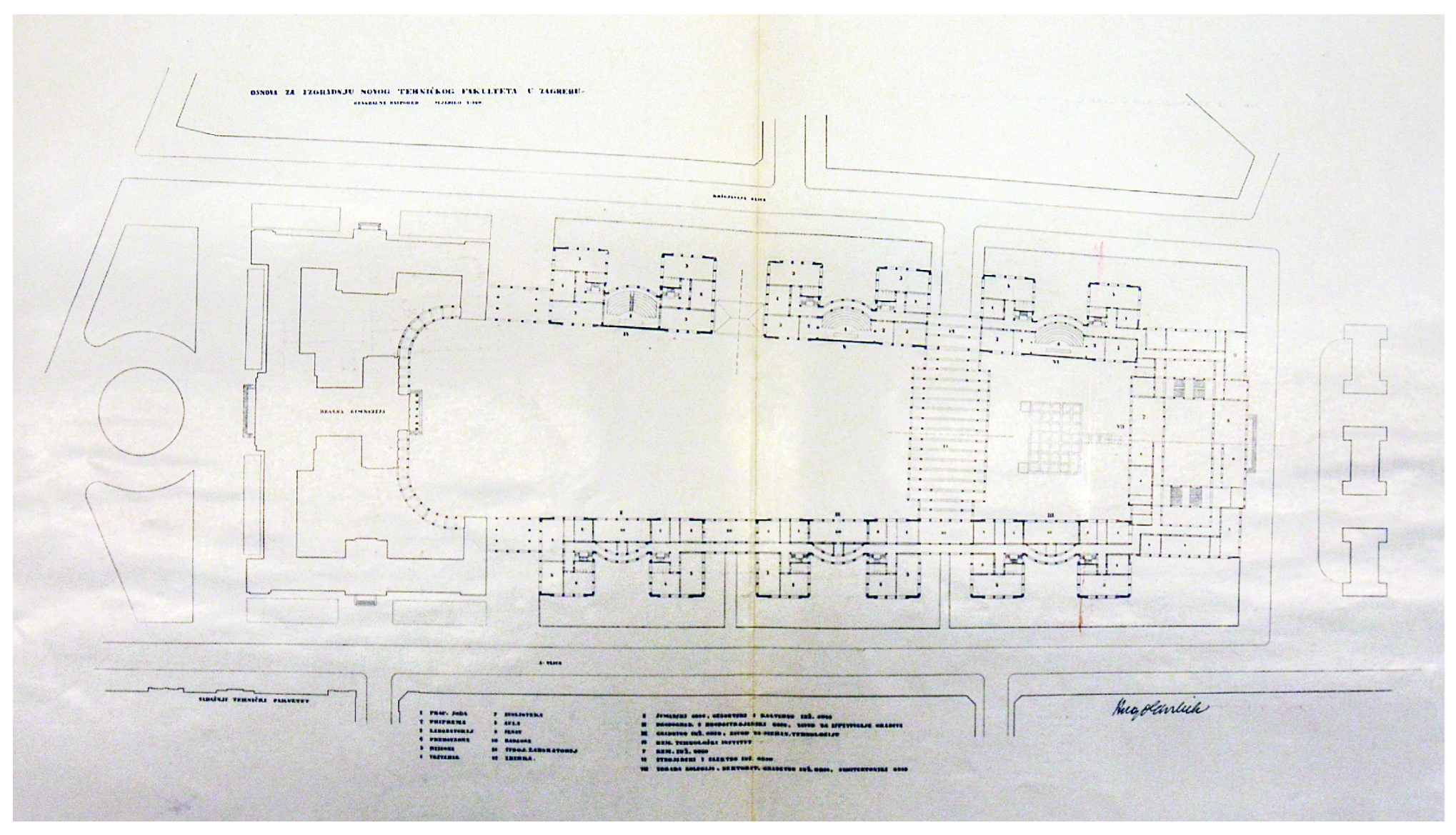
Figure 2.
The first project for the School of Technology campus, Zagreb, Yugoslavia, today Croatia, 1928-1929 (Appendix 1.1.), axonometric [21].
Figure 2.
The first project for the School of Technology campus, Zagreb, Yugoslavia, today Croatia, 1928-1929 (Appendix 1.1.), axonometric [21].
The Endowment residential complex was conceived as a closed block built in two phases at the former Archdiocese gardens, therefore the old gardener’s lodge in Vlaška St from 18th Century was carefully preserved and it still exists today as a kindergarten. The new street, today the Ratkajev passage [Croatian: prolaz] was planned to separate the complex from other urban tissue, however due to a building speculation the complex was cantilevered above the Ratkajev passage in Vlaška and Martićeva street fronts. The lodge implied a small northerly square around it and the square’s southerly pendant in Martićeva St, connected by the cinema auditorium, planned to be built in a second phase. Yet the building speculation, present in Zagreb between 1926-1932, further dictated the construction of new apartments instead of cinema, so the Architectural Engineer Vladimir Potočnjak directed the detail design and realization of the Second phase, acting as the Architect-in-charge while reporting directly to Ehrlich.
He simplified both fronts in Vlaška and Martićeva St yet left them arranged in earlier pseudoclassic design ( Figure 3.). On the contrary, he designed four fronts oriented to the yard linking both squares in the Neue Sachlichkeit manner, on the convex angles with modest traces of expressionism in the form of horizontal convex strips ( Figure 4.). The most functionalist contribution was the abandonment of light wells in the ground plan and showing the staircases on the main fronts, half of them on main fronts in Martićeva and Vlaška St. After leaving Ehrlich’s office, Potočnjak was employed in the City Construction Office in the period 1930-1931, as the contractual official [Croatian: ugovorni činovnik] in the Department for the New Construction [Croatian: Odjel za novogradnje Gradskog građevnog ureda] [2], although his personal file there is not in existence [2]. In his Curriculum Vitae he specified the employment during a two-year time period being the architect of the metalware and chandelier factory “Lux d.d.” in Zagreb, although from his apprenticeship timeline it is uncertain to locate this appointment. He probably worked concurrently for both Ehrlich / City construction office and Lux factory.
3.3. The Main Period: Licensed Architectural Engineer (1931-1945)
3.3.1. Apartment Houses
In the Spring 1931 the Architectural Engineer Vladimir Potočnjak passed the Licensing Examination in Belgrade, consequently in May 1931 he was appointed as the Licensed Architect by taking the oath and subsequently opened the private practice in Zagreb [1] in the period 1931-1942, when he was appointed as an adjunct honorary teacher at the School of Technology of the Croatian University in Zagreb. Taking into the account that both Potočnjak and Neumann obtained the status of Licensed Architect in 1931 (Potočnjak in May while Neumann probably in Autumn) it is intriguing to locate both apartment buildings which Potočnjak attributed to Neumann and himself in his CV while Neumann avoided them in his revealed correspondence. The edifices which both men designed under their concurrent apprenticeships cannot be taken into the account for obvious reasons, as the edifices which they separately designed running their concurrent practices. However, in 1932 they designed two apartment houses, distinctive for their unusual distribution and concealment of authors, by being signed by respective landlords who acted as their own contractors. The first project, the apartment house 3 Laginjina St (Figure 5.) was built by its landlord Licensed Engineer Makso Korenić and comprised an embryo of the “Raumplan” in ground floor. The second project, double apartment house 5-7 Vrbanićeva St was later built as two separate and ordinary apartment houses: The Architect Lav Kalda redesigned No. 5, while the Architectural Engineer Zvonimir Pavešić serving as an apprentice in Construction Office Engineer Leo Neuberger redesigned No. 7 [22]. The project was initially designed for Neuberger and Auspitz families and intended to be built by Leo Neuberger himself. Zlatko Neumann, probably at the moment in tense relationship with his former boss, invited Potočnjak and they designed a double building sharing the common light well and rectangular avant-corps [risalit]. The latter was rejected by authorities and companion Auspitz-Heisler family started to build their half on Kalda’s project, consequently invalidated the light well and mandated Pavešić’s plan to be almost identical as its counterpart [23]. Later, Vladimir Potočnjak designed two apartment house projects, the first “Lebinec” at 14, today 20 Ribnjak St (Figure 6., 7.), where the architect Slavko Löwy designed his variant and supervised its construction, while the second was the apartment house “Ventilator” at 32 Radnička St as the street part of the industrial facility building, left unbuilt.
3.3.2. Villas
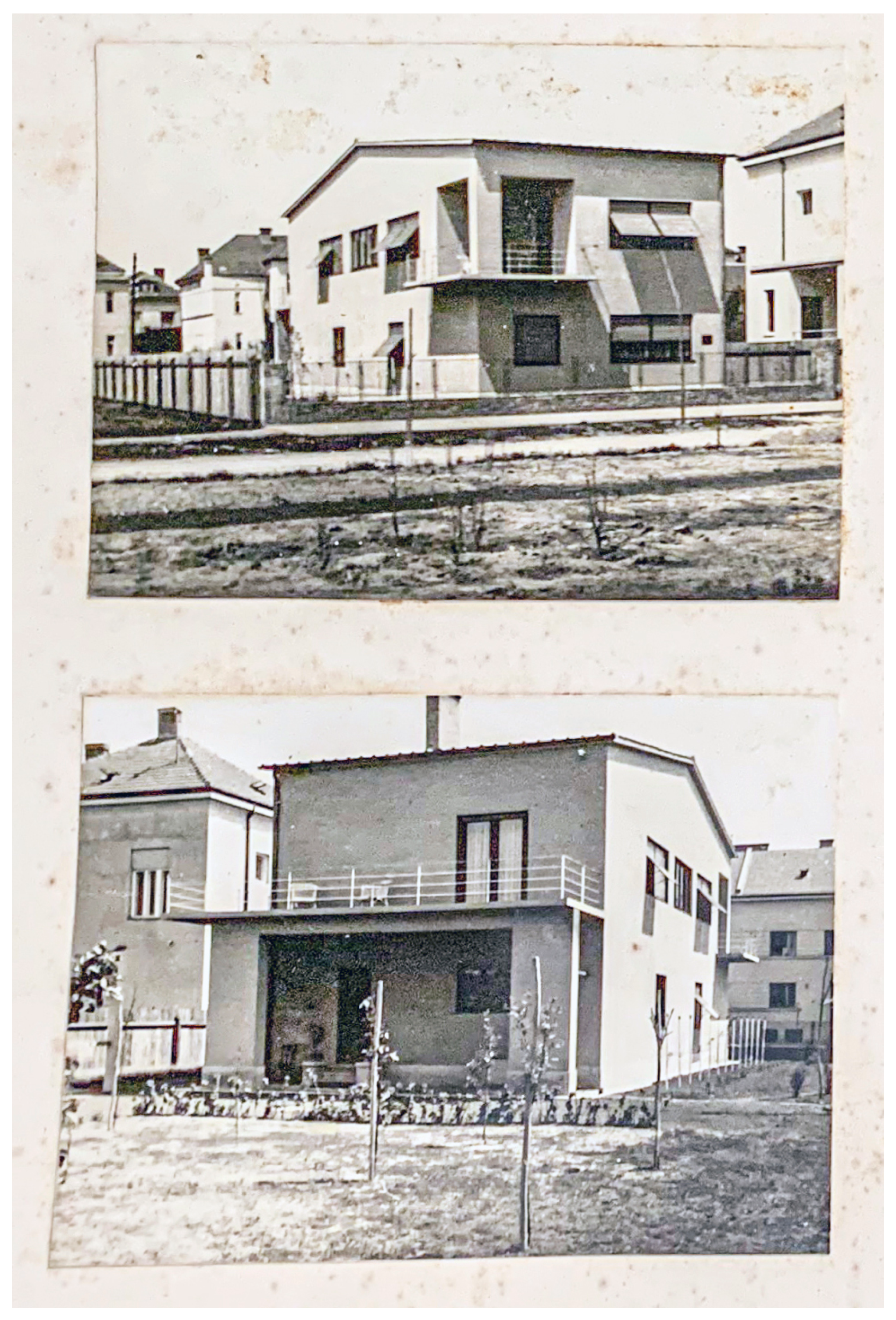
At the beginning of the career of licensed architectural engineer, Vladimir Potočnjak acted as the architect-in-charge for the construction of the one of most iconic villas of the Croatian Modern Movement between the Wars, the villa “Mrs. Hedviga Bauer” in 15 Jabukovac St, Zagreb, designed by the famous maverick of the Modern Architecture in Zagreb, the Professor Architect Drago Ibler, while the contractor was the Licensed Master Builder Ašer Kabiljo. Preserved drawing sheets represent the reinforced concrete skeleton scaffoldings and furnishing details of the children’s room. According to the official documentation in DAZG, there are no traces of Potočnjak’s collaboration, although some certified drawings are missing there. During the middle and late 1930s Vladimir Potočnjak designed 10 villas, probably nine of them in Novi Vinodolski and one in Osijek [3]. He avoided to follow the “Raumplan” devised by Adolf Loos and his friend, Loos’s pupil and assistant Zlatko Neumann, who himself designed villa “Freund” in Selce in 1932, in the vicinity of Novi Vinodolski. While Neumann’s villa recounts the International Style, Potočnjak designed the exterior of his littoral villas more attuned to the landscape (Figure 8., 9., 10., 11.). He preponderantly used tiles, stone covers, even gable roofs. The roof of villa “Muačević” has transversally placed ridge, thus reminisces to the architecture of the Alps (Figure 12.). In the other hand, Potočnjak did not try to press spaces into the box, as Adolf Loos and Zlatko Neumann experienced. Instead, he logically developed spatial conceptions around landlords’ wishes and later designed the outer appearance around, thus literally designed “from the interiority outside”, just as the German Functionalist School contemporarily taught. Consequently, Potočnjak designed complex and interesting but pleasant space bodies and their surroundings.
Figure 8.
Villa “princess Lobkowicz”, Novi Vinodolski, Croatia (Appendix 2.2.) [11].
Figure 8.
Villa “princess Lobkowicz”, Novi Vinodolski, Croatia (Appendix 2.2.) [11].
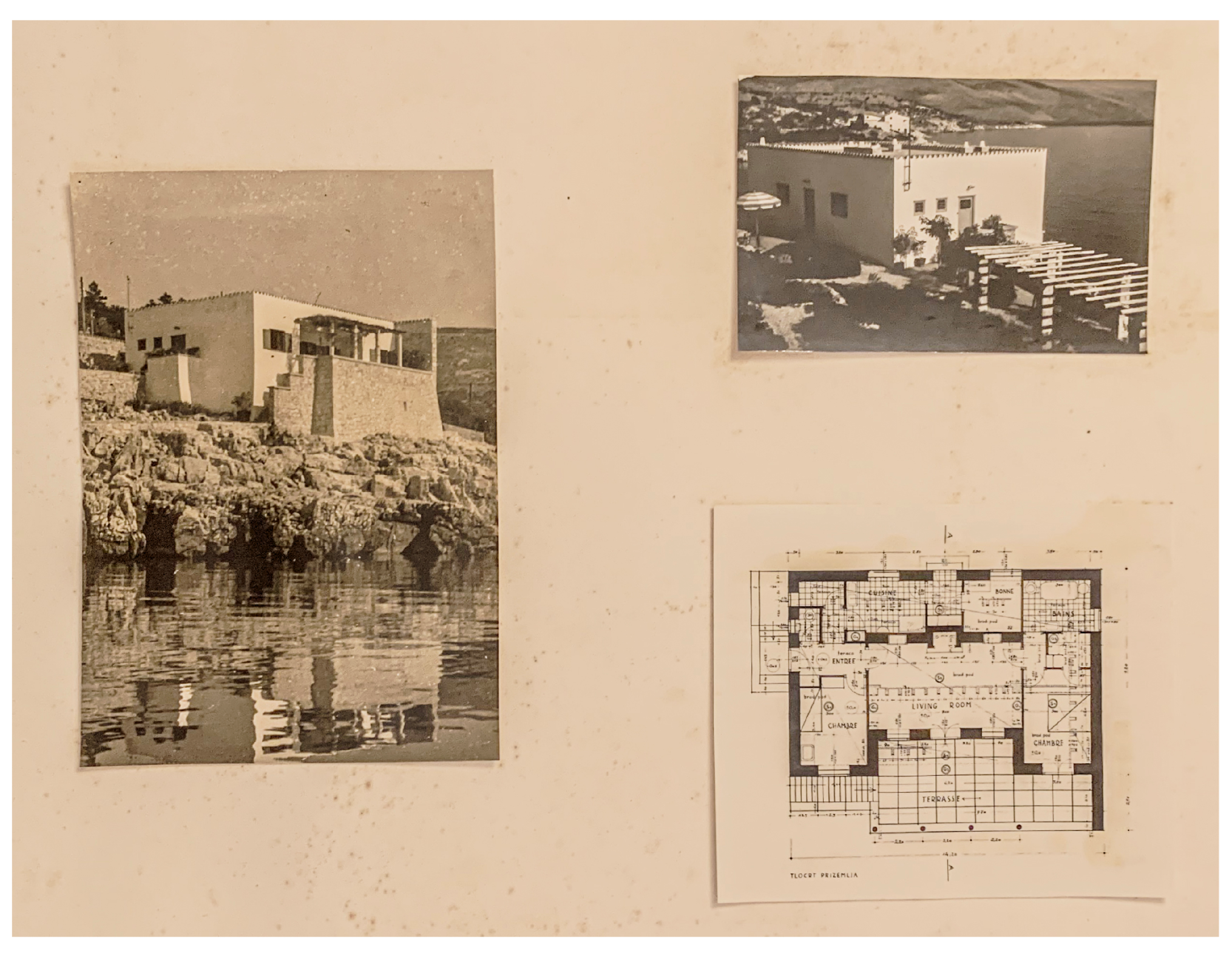
Figure 9.
Villa “prof. dr. Koch”, Novi Vinodolski, Yugoslavia, today Croatia (App. 2.3.) [11].
Figure 9.
Villa “prof. dr. Koch”, Novi Vinodolski, Yugoslavia, today Croatia (App. 2.3.) [11].
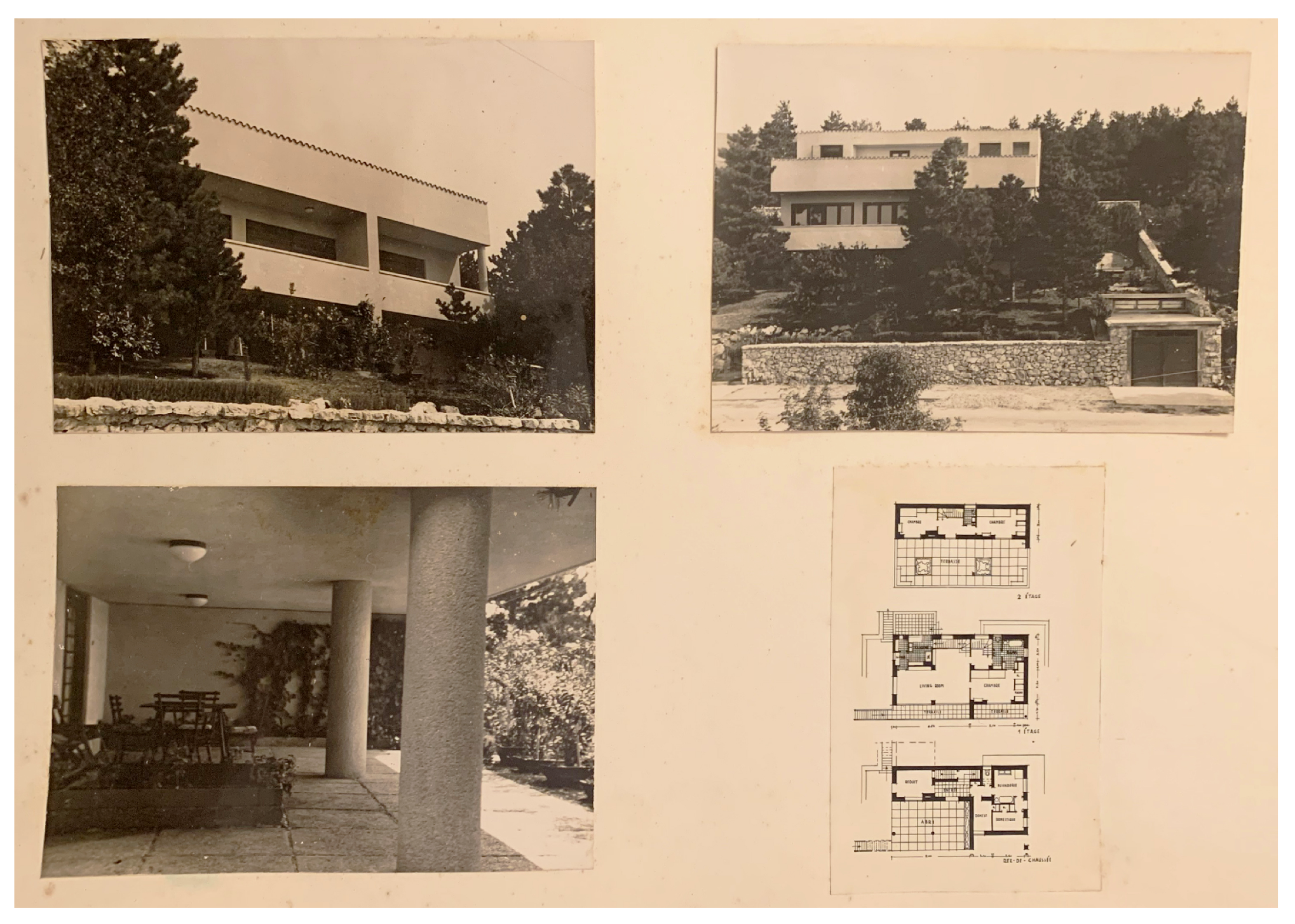
Figure 10.
Villa “P”, [Novi Vinodolski (?)], Yugoslavia, today Croatia (Appendix 2.4.) [11].
Figure 10.
Villa “P”, [Novi Vinodolski (?)], Yugoslavia, today Croatia (Appendix 2.4.) [11].
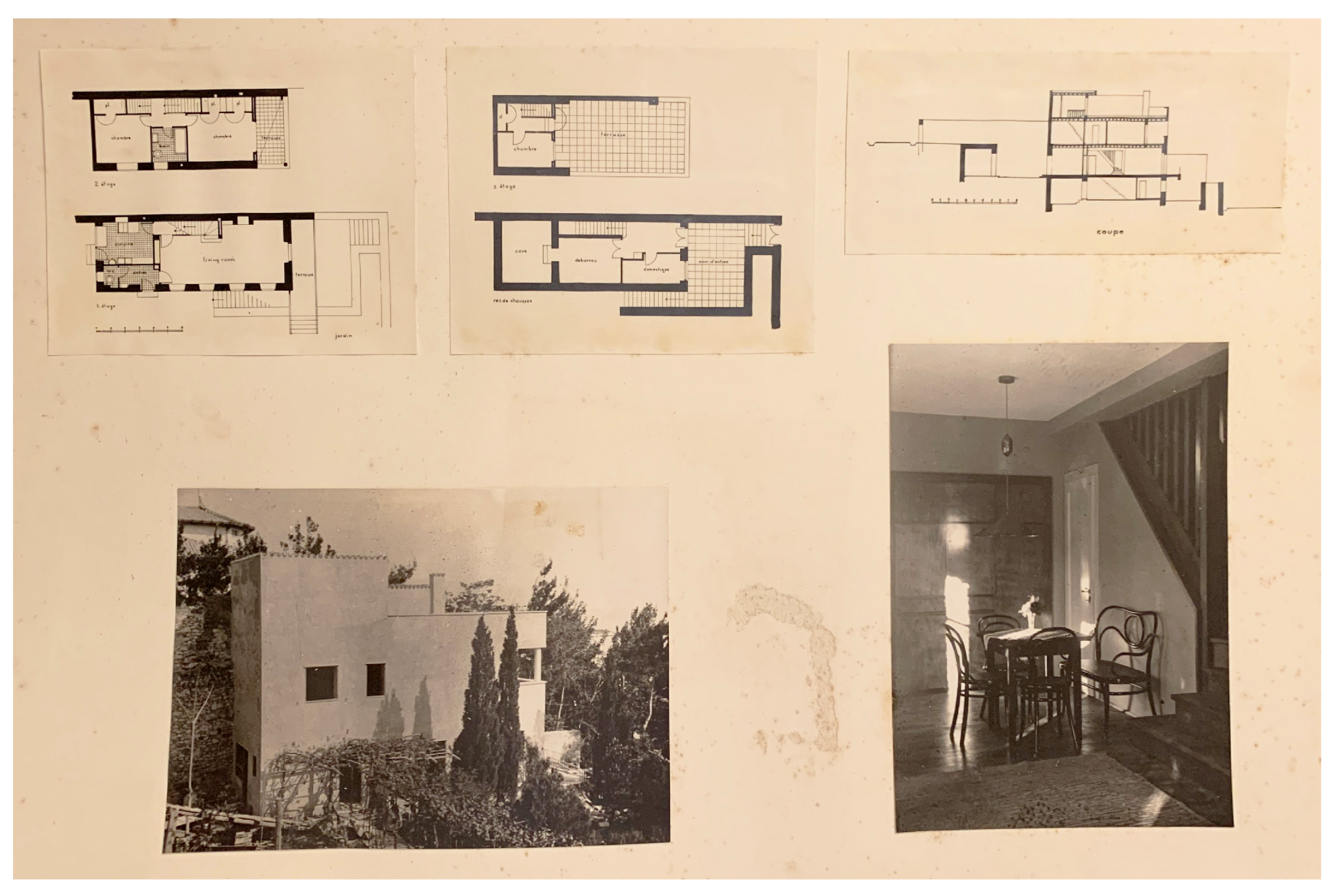
Figure 11.
Villa “Dr. Rajtora”, [Novi Vinodolski (?)], Yugoslavia, today Croatia, project (Appendix 2.7.) [11].
Figure 11.
Villa “Dr. Rajtora”, [Novi Vinodolski (?)], Yugoslavia, today Croatia, project (Appendix 2.7.) [11].
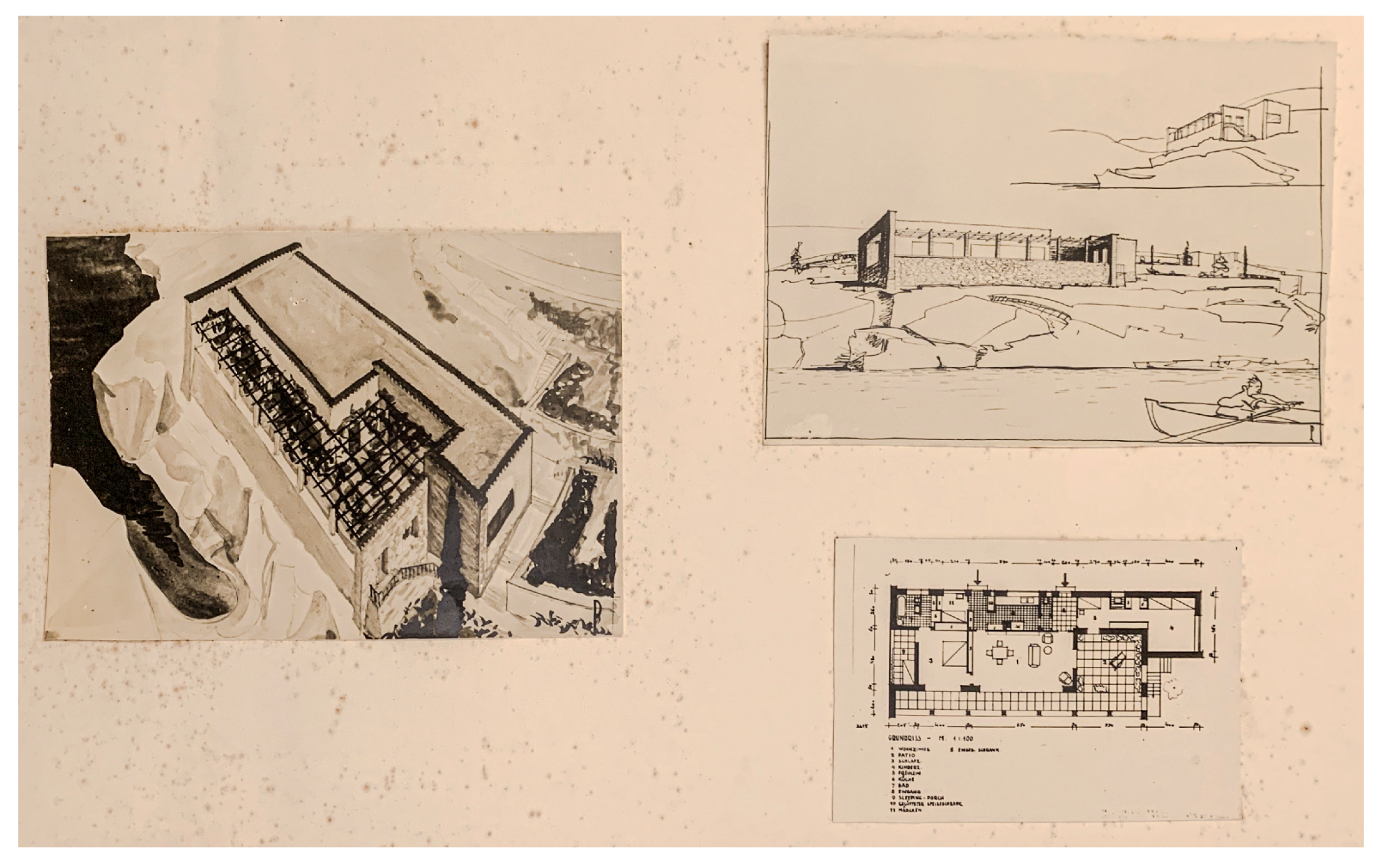
Figure 12.
Villa “dr. Muačević”, Osijek, Yugoslavia, today Croatia (Appendix 2.6.) [11].
Figure 12.
Villa “dr. Muačević”, Osijek, Yugoslavia, today Croatia (Appendix 2.6.) [11].
3.3.3. Industrial and Other Facilities
The architect Vladimir Potočnjak designed and supervised the construction of two important industrial facilities in Yugoslavia before the Second World War: The Aluminum Factory in Lozovac near Šibenik, and the Fan Factory “Ventilator” in Radnička St, Zagreb. In Lozovac Potočnjak designed the industrial complex as the logical composition around the production process, following contemporary German examples and adapted them to the environment by using shallow pitched roofs. The complex is situated on the plateau above the famous Krka waterfalls, with the aim of using the electricity from the Krka hydro-power plant, established in 1895 (later known as “Jaruga 1”) and enlarged in 1904 (“Jaruga 2”) whose turbines were refurbished in 1937. After the Second World War the complex known as “Ivanal” was nationalized, after the Croatian independence in 1990s denationalized, today left abandoned and is planned for the demolition (Figure 13.). The “Ventilator” factory was established for the Mechanical Engineer Hrvoje Korporić, who designed and produced the most advanced Yugoslav HVAC equipment for public buildings, e.g., for the Worker’s Chamber Building at 2 King Petar Krešimir Square in Zagreb, designed by Architects Vladimir Šterk, Jovan Korka, Đorđe Krekić and Georg Kiverov, today known as “The Culture Factory / Tvornica Kulture”. Differently from the complex in Lozovac, “Ventilator” was incorporated in the one of city blocks at Radnička St as a masterpiece of organizing the production on a rather limited plot, also currently demolished and its site immediately rebuilt with a luxury residential complex.
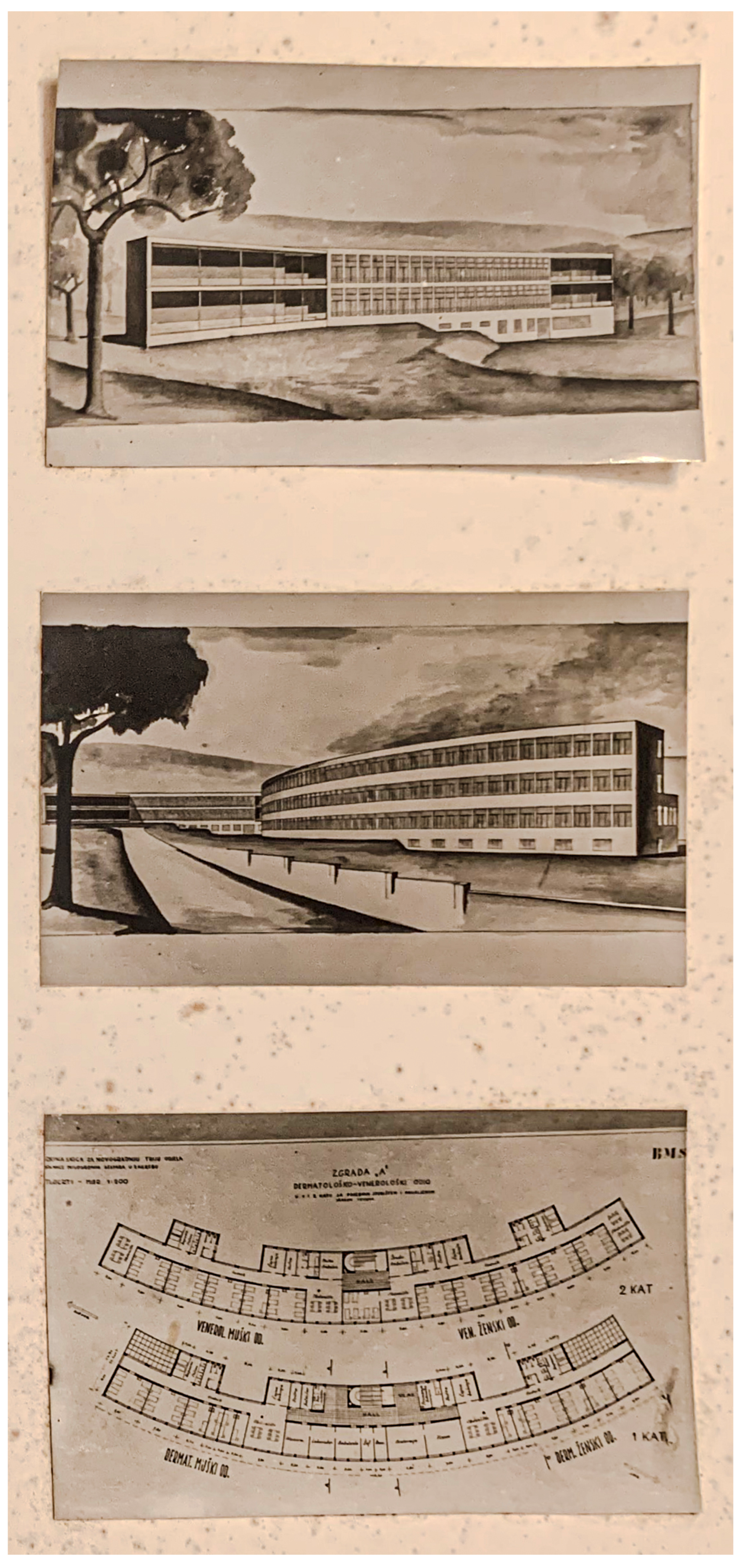
The Swimming Pool Novi Vinodolski was designed to serve both the population and the tourists, conceived as a multifunctional longitudinal facility around the beach, divided into three areas: the westerly part with natural stone beach, the central part containing gravel and sand beach, while the easterly part included the beach house surrounded by columns (Figure 14., 15.). In various competition projects for residential, office and public buildings Potočnjak successfully blended International Functionalism and German Expressionism. Probably the seminal one was the competition project “Workers’ Institutions’ Palace” in 1932 (Figure 16., at the same place where he in 1929 designed the First School of Technology campus, compare Figure 1., 2.). The model shows Janus’s face of two methods of composition, the symmetrical westerly front (Figure 16., above) and the asymmetrical, avant-garde easterly front (Figure 16., below), where he incorporated the round part from Ehrlich’s project for the “Privileged Agricultural Bank / Privilegovana Agrarna Banka” in Belgrade from 1931. Yet he proposed a multifunctional complex which could serve either for the “Workers’ Institutions’” or for the “School of Technology”, consequently his entry was neglected and not rewarded. In the competition entry for the office building “PR[ivilegovano] IZ[vozno] A[kcionarsko] D[ruštvo] / PRIZAD” in Belgrade Potočnjak meticulously proposed functional office plan regarding to the irregular lot, which again generated Janus solution of two various fronts (Figure 17., 18. 19.). For the public palace “The Croatian Home / Hrvatski Dom”, Sušak, today Rijeka, Croatia, his competition proposal did not include a skyscraper, contrary to the awarded Pičman’s, although smoothly rounded southern front anticipated the elongated forms of today’s “Palata ‘Srbija’ “ (Figure 20.). The competition project for the Railway worker’s housing estate “Crni Vrh” in Sarajevo encompasses the whole estate (Figure 21.) at the principle of a uniform “White City” like the “Baba” estate in Prague, Czechoslovakia, today Czechia which he subsequently upgraded, diversified and typified as the competition entry for the “Baťa’s International Housing Competition in 1935” in Zlín, where he was awarded (Figure 22.). The competition entry for the Opera in Belgrade from 1940 was made with colossal columns made in reinforced concrete and covered in noble stone although being opposite to Zdenko Strižić’s projects for theater in Kharkov or Belgrade (Figure 23.). The project for hospital pavilions in the “Sisters of Mercy / Sestre Milosrdnice” hospital in Vinogradska St, Zagreb, repeated rounded forms from Sušak (Figure 24.). After the proclamation of Banovina of Croatia in 1939, Potočnjak participated in the invited competition for the Banovina Croatia’s Ban’s Palace, at the westerly part of the southern front of the Zagreb’s Upper Town. All projects were subjugated to the strict terms of conservators, consequently he designed a palace with pitched roof, harmonized with the historical urban fabric. The plot was made by the demolition of the centuries old Hellenbach palace and left unbuilt due to the coming of the Second World War in Yugoslavia in April 1941. For the Independent State of Croatia Potočnjak arranged many interiors between 1941 and 1943 (Appendix 2.35.-2.40.), e.g., the interior dr. Pavelić in Zagreb, the interior of the villa dr. Mladen Lorković, 35 Tuškanac St in Zagreb, the interior of the Ministry of Foreign Affairs of the Independent State of Croatia, 3 & 4 Sv. Marka Sq. in Zagreb, all in Croatia, further the interior of the Embassy of Independent State of Croatia in the State of Slovakia, Bratislava, and finally the interior of the assembly hall of the Sabor, finished after 1945 as the Sabor / Assembly of the People’s Republic of Croatia, Radić’s Sq., today Sv. Marka Sq., Zagreb and the interior of the Club of Foreign Journalists, finished after 1945 as The People’s Republic of Croatia Reporters’ Club, Zagreb, Croatia, with Mladen Kauzlarić [1]. Consequently, the good ideas were taken over from the prequel regime to the sequel regime, if they are good enough to withstand various ideological settings. Certainly, the obituary in 1952 mentioned only these two last interiors exclusively in the correlation to the socialist society [1].
Figure 14.
Swimming pool Novi Vinodolski, Yugoslavia, today Croatia, axonometric (Appendix 2.19.) [11].
Figure 14.
Swimming pool Novi Vinodolski, Yugoslavia, today Croatia, axonometric (Appendix 2.19.) [11].
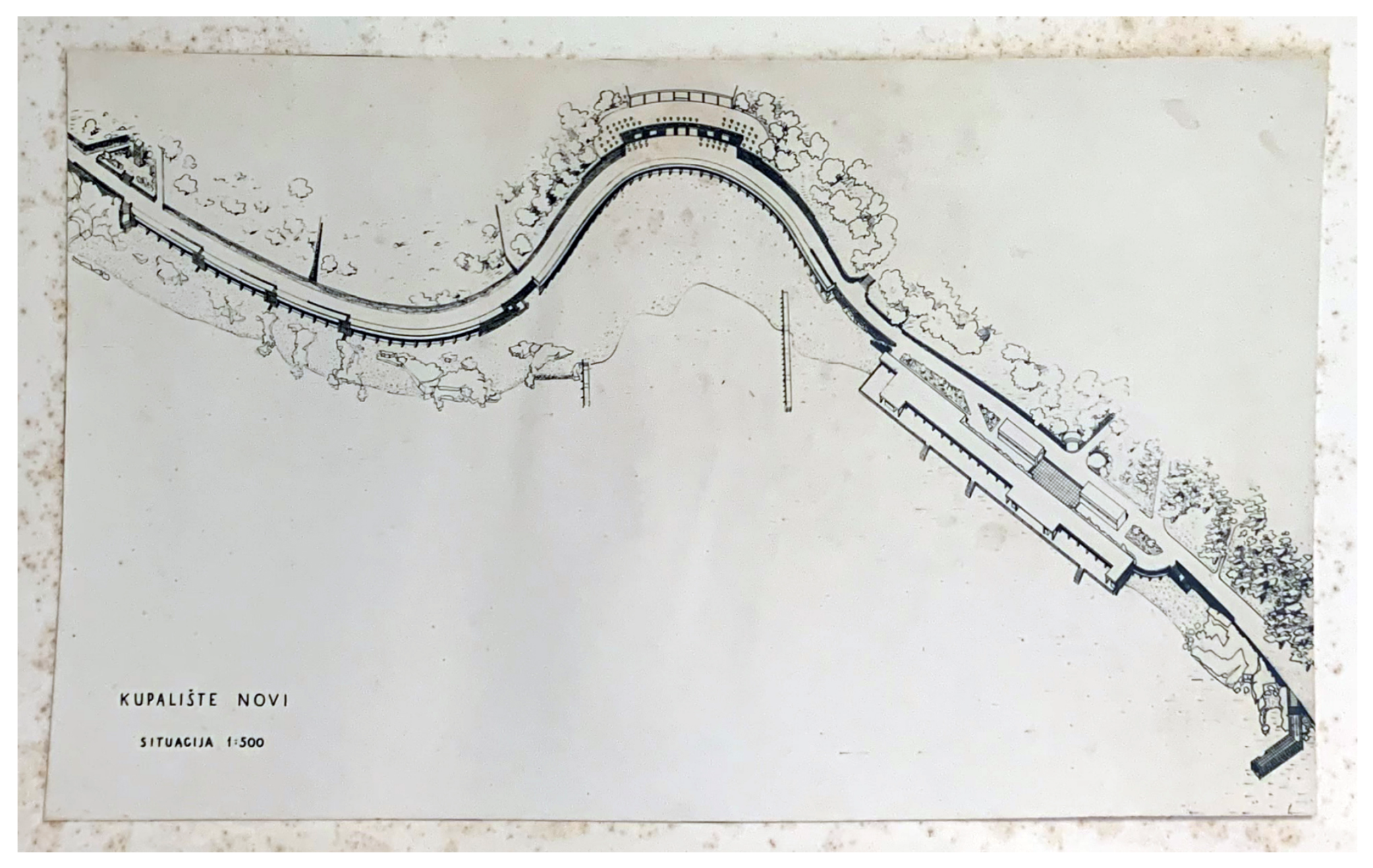
Figure 15.
Ibid, the detail of the realized part (Appendix 2.19.) [11].
Figure 15.
Ibid, the detail of the realized part (Appendix 2.19.) [11].
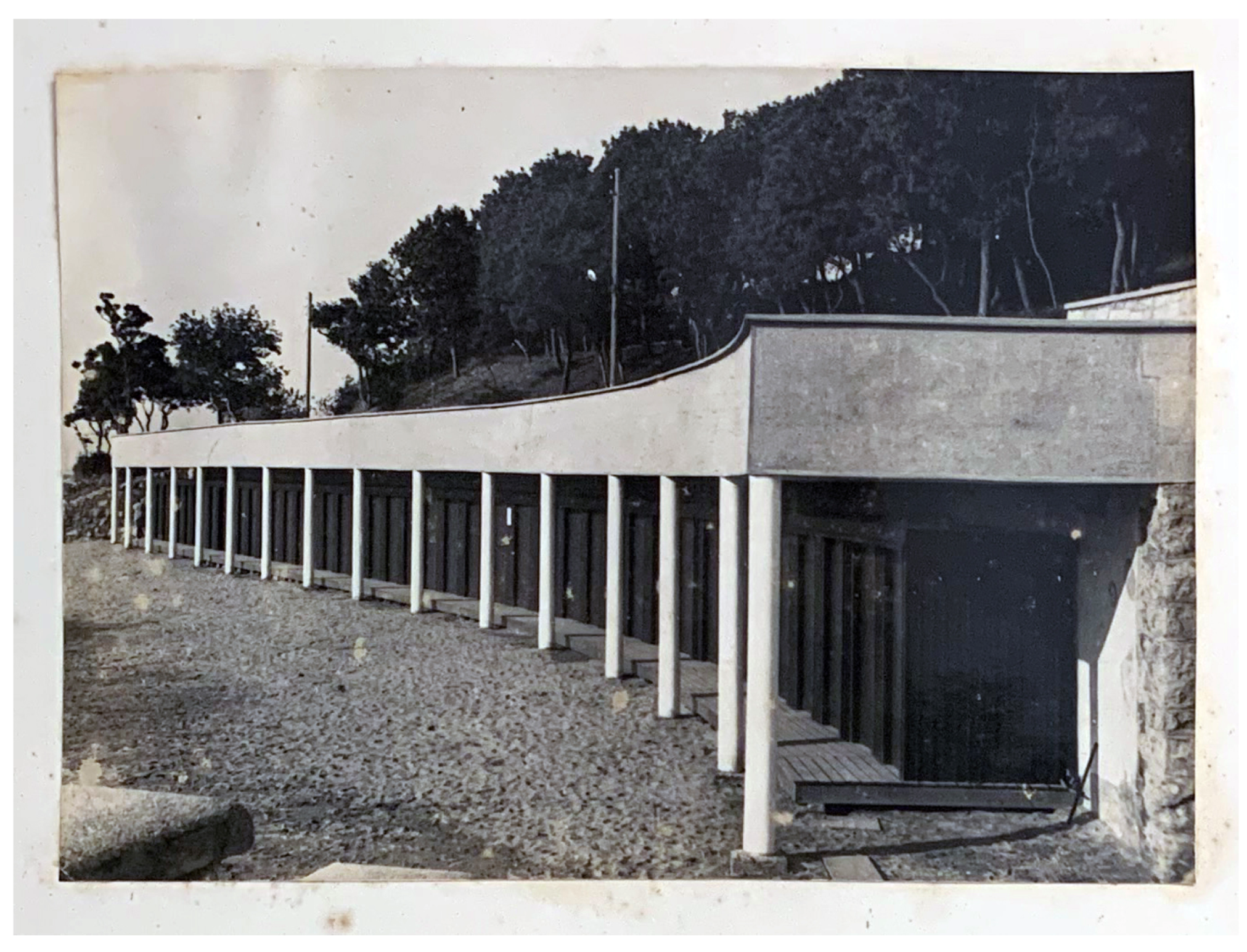
Figure 16.
“Workers’ Institutions’ Palace”, competition project, Zagreb, Yugoslavia, today Croatia, photographs of the model (Appendix 2.29.) [11].
Figure 16.
“Workers’ Institutions’ Palace”, competition project, Zagreb, Yugoslavia, today Croatia, photographs of the model (Appendix 2.29.) [11].
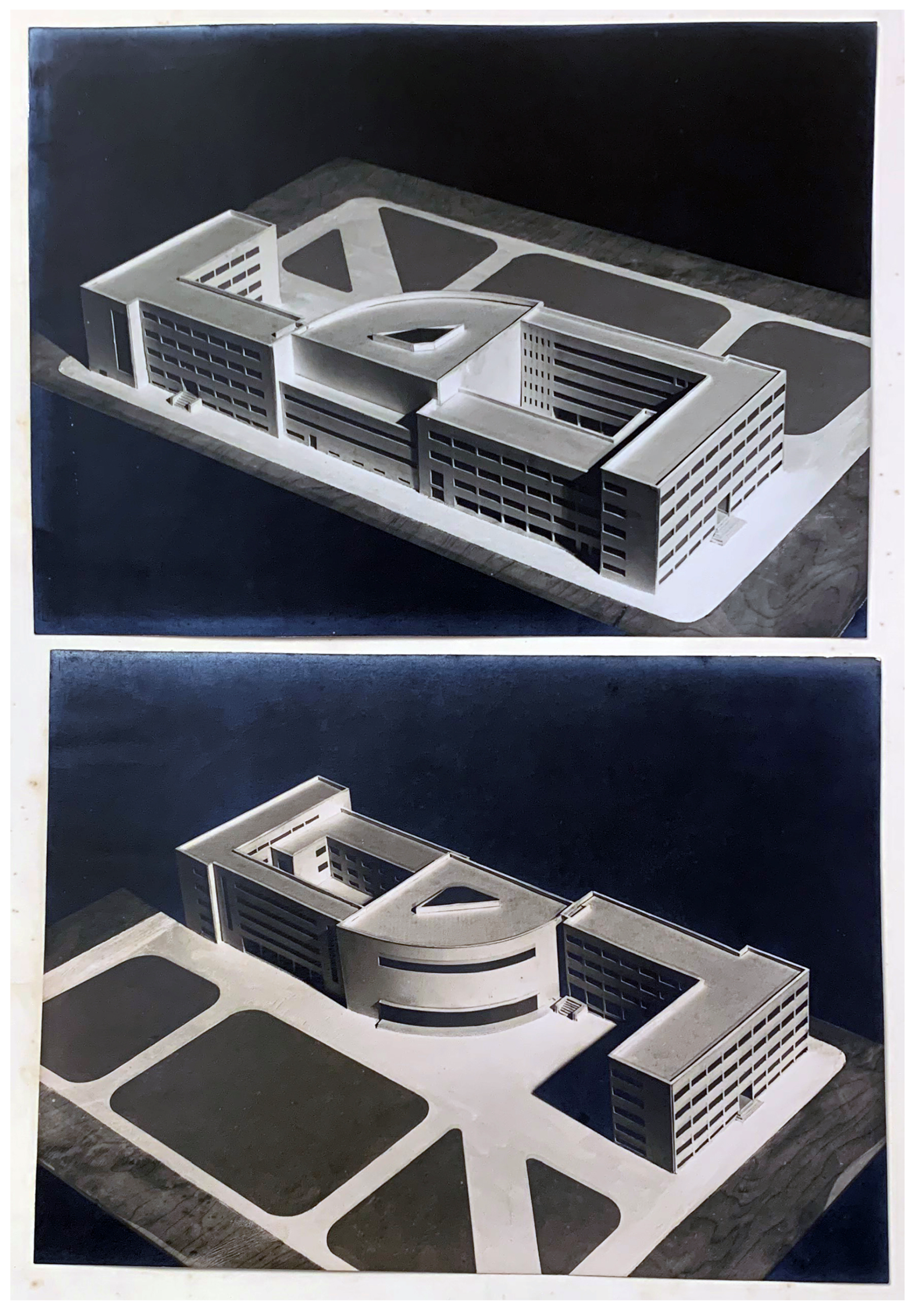
Figure 17.
, 18., 19. Office building “PRIZAD”, competition project, Belgrade, Serbia, floor plans, perspective views (Appendix 2.28.) [11].
Figure 17.
, 18., 19. Office building “PRIZAD”, competition project, Belgrade, Serbia, floor plans, perspective views (Appendix 2.28.) [11].
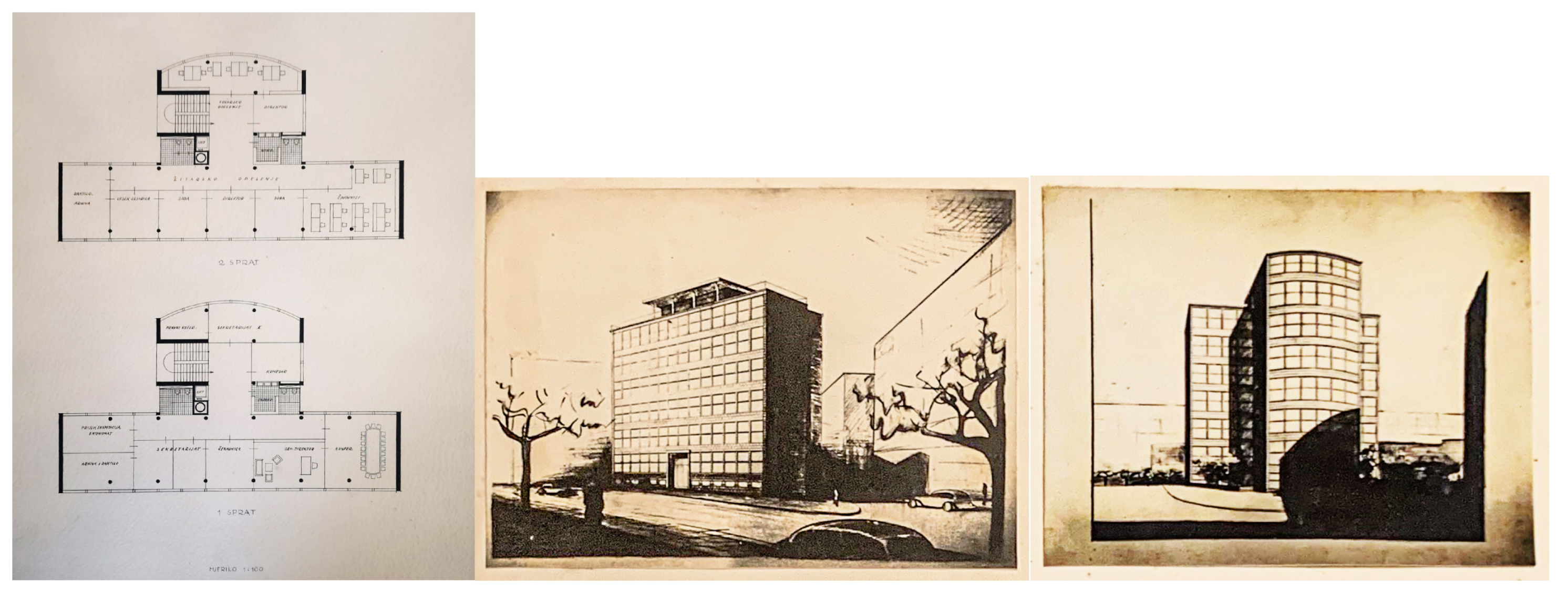
Figure 20.
Public edifice “Hrvatski Dom / The Croatian Home”, Sušak, Yugoslavia, today Rijeka, Croatia, perspective drawing (Appendix 2.32.) [12].
Figure 20.
Public edifice “Hrvatski Dom / The Croatian Home”, Sušak, Yugoslavia, today Rijeka, Croatia, perspective drawing (Appendix 2.32.) [12].
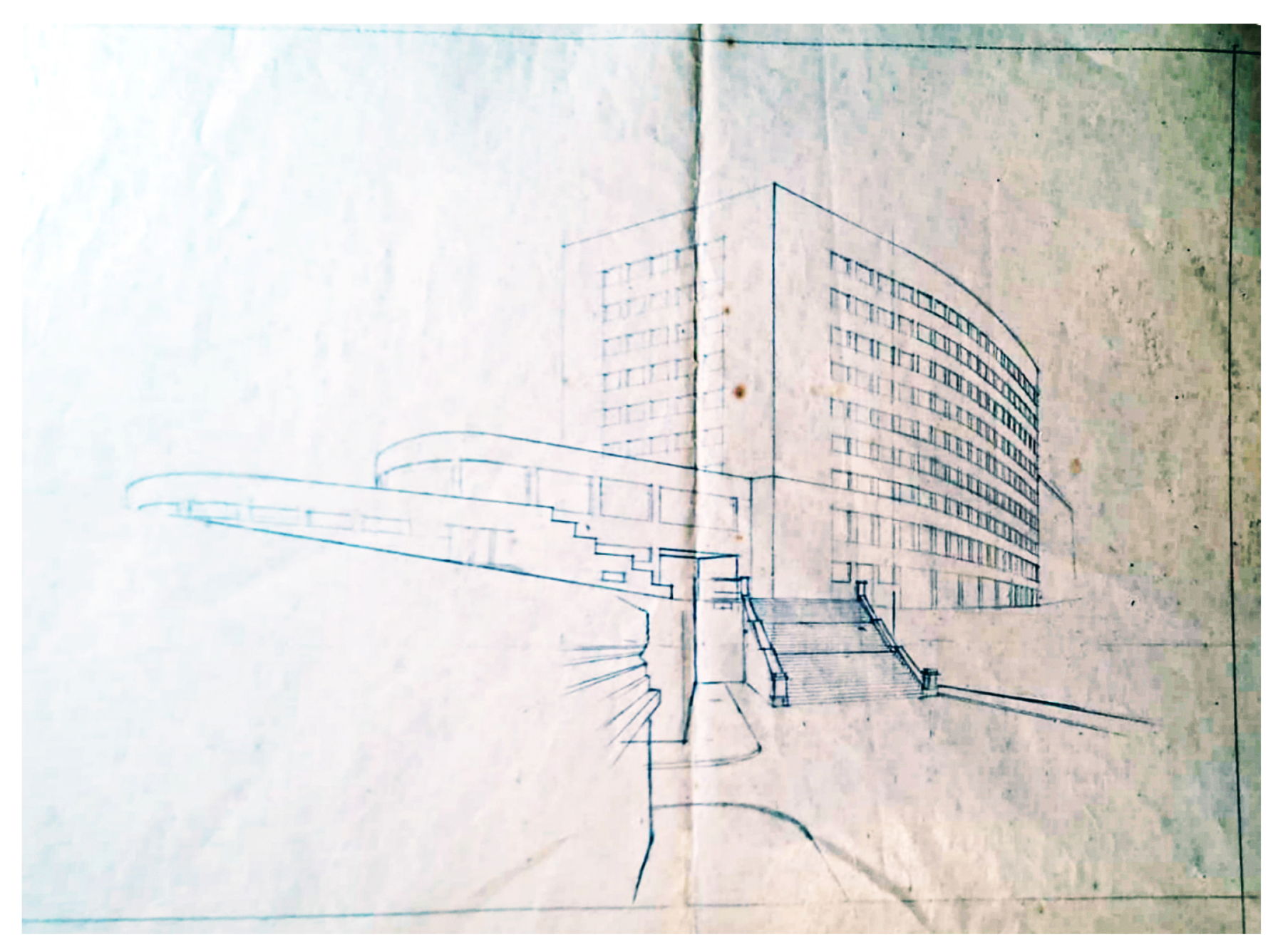
Figure 21.
Railway worker’s housing estate “Crni Vrh”, competition project, Sarajevo, Yugoslavia, today Bosnia & Herzegovina, axonometric (Appendix 2.25.) [11].
Figure 21.
Railway worker’s housing estate “Crni Vrh”, competition project, Sarajevo, Yugoslavia, today Bosnia & Herzegovina, axonometric (Appendix 2.25.) [11].
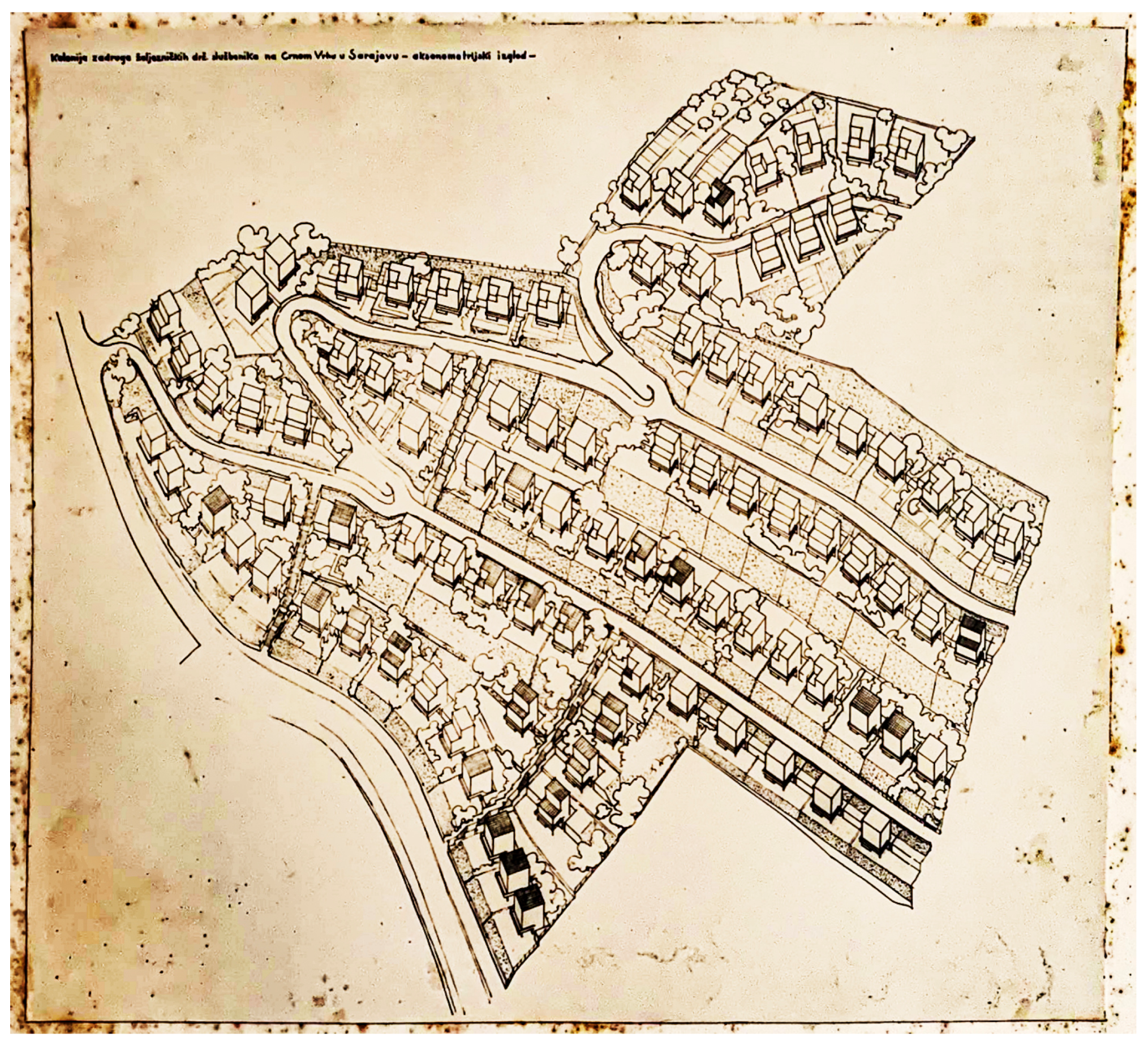
Figure 22.
Housing estate “Bat’a”,competition project, Zlín, Czechoslovakia, today Czechia, typology, plans, sections, fronts, axonometric (Apprendix 2.26.) [11].
Figure 22.
Housing estate “Bat’a”,competition project, Zlín, Czechoslovakia, today Czechia, typology, plans, sections, fronts, axonometric (Apprendix 2.26.) [11].
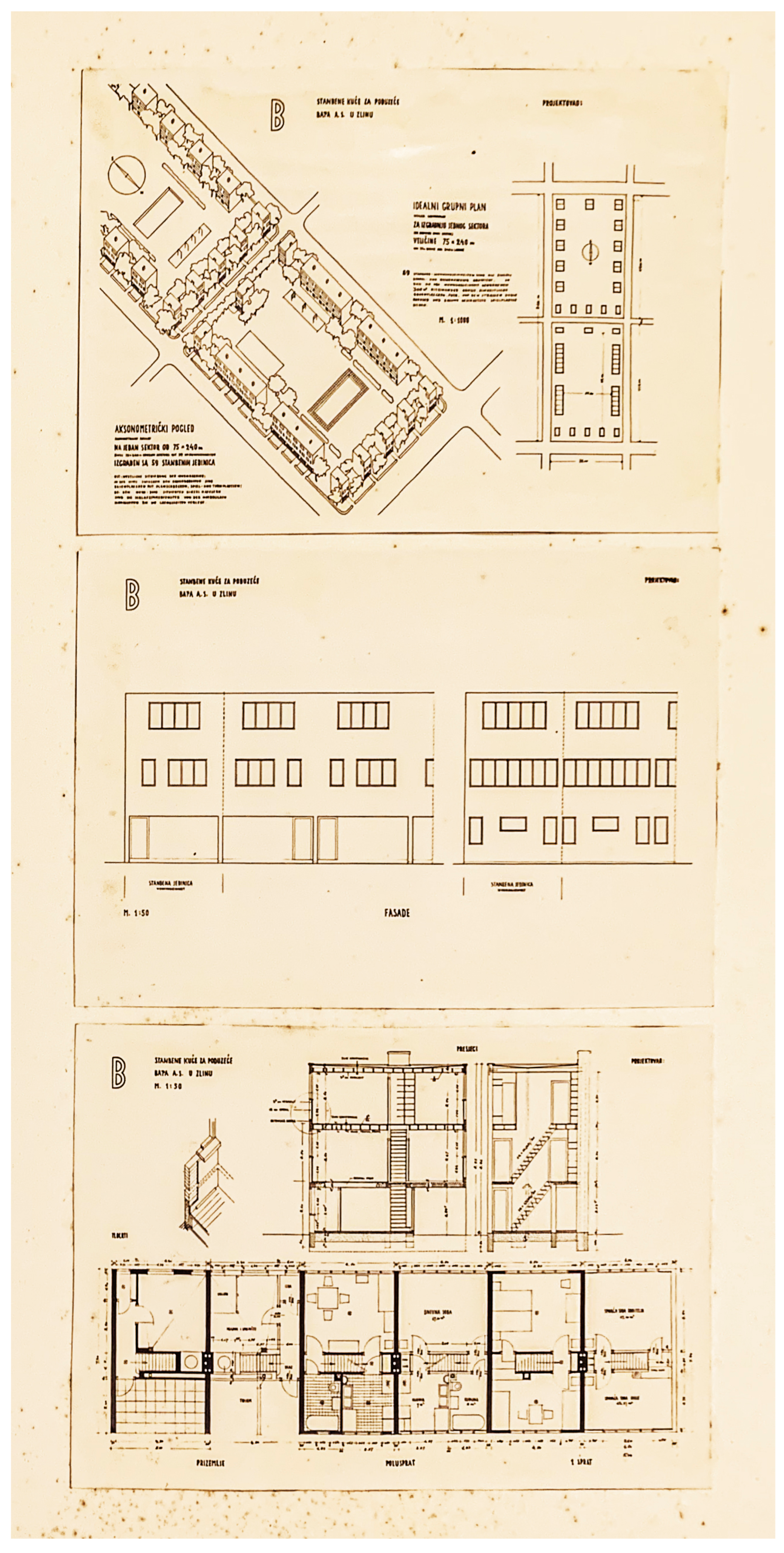
Figure 23.
Opera, Belgrade, Yugoslavia, today Serbia, ground plan, perspective view, watercolor (Appendix 2.31.) [11].
Figure 23.
Opera, Belgrade, Yugoslavia, today Serbia, ground plan, perspective view, watercolor (Appendix 2.31.) [11].
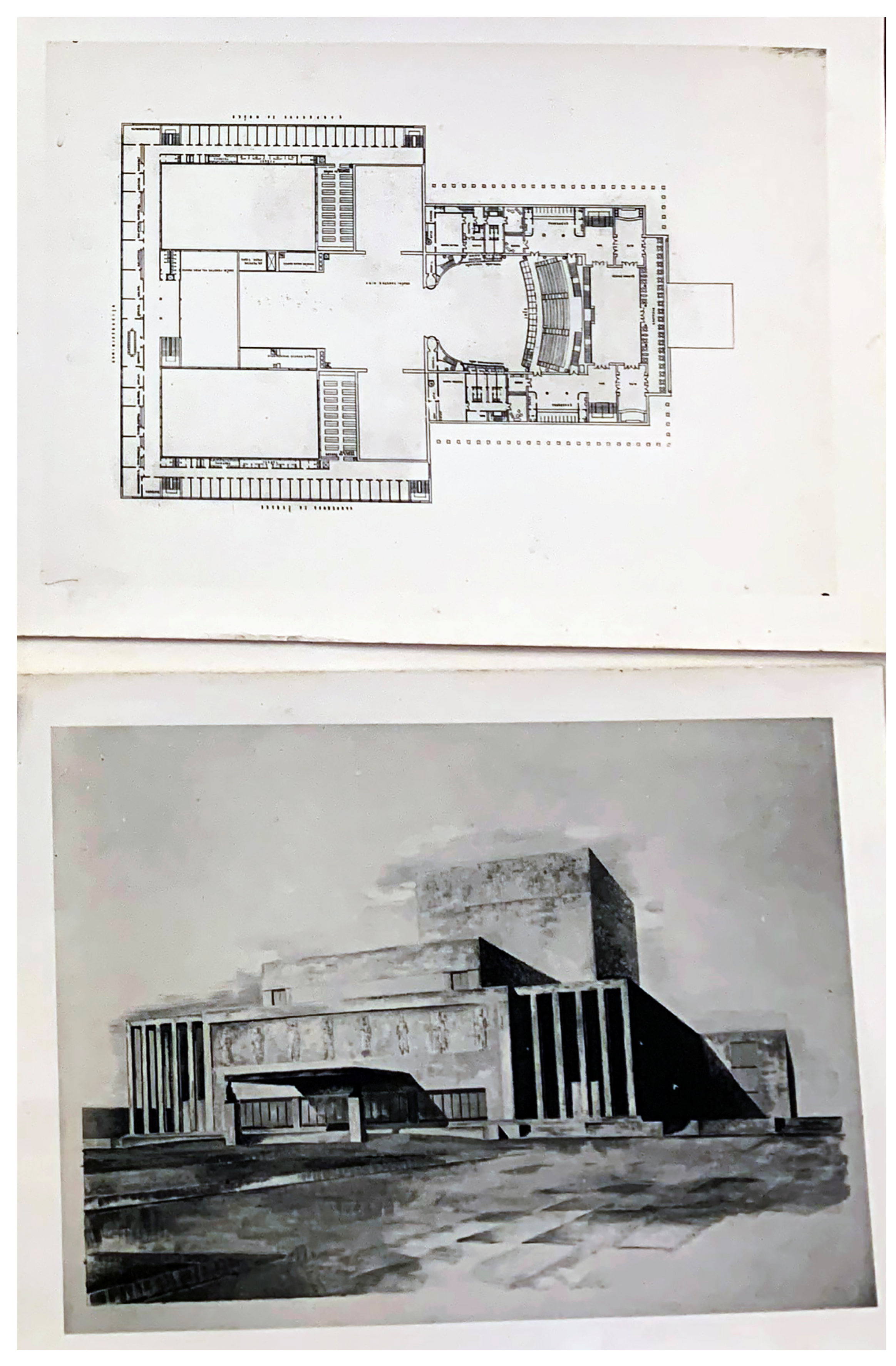
Figure 24.
Hospital pavilions in “Sisters of Mercy” hospital, Zagreb, Yugoslavia, today Croatia, project, perspective views and corresponding ground plans (Appendix 2.22) [11].
Figure 24.
Hospital pavilions in “Sisters of Mercy” hospital, Zagreb, Yugoslavia, today Croatia, project, perspective views and corresponding ground plans (Appendix 2.22) [11].
3.3.4. Publications
The architect Vladimir Potočnjak published ten articles in various Croatian and Yugoslavian professional journals before the end of the Second World War (Appendix 4.1.-4.10.). He composed explanations of his domestic and international projects and realizations, such as the housing estate in Zlin, the swimming pool in Novi Vinodolski or aluminum factory in Lozovac (Appendix 4.1., 4.2., 4.9., 4.10.). Furthermore he analyzed contemporary agenda as the organization of competitions (Appendix 4.3., 4.8.) or construction methods of public buildings (Appendix 4.4.). His important theoretical publication encircles the architecture in Croatia in the period 1888-1938 (Figure 25.) [1,2], representing the seminal scientific study about the subject consisted of three parts: the narrative (Appendix 4.5.), the illustrative material made of contemporary photographs (Appendix 4.6.) and the catalogue with biographies of all architects included (Appendix 4.7.). As the insider connected with the pioneers of Modern Architecture in Zagreb and Croatia between the World Wars, he noticed that the development was interwoven through many factors, preponderantly from Austrian, Czech and German influences, while the influence from Le Corbusier came later.
The majority of pioneers graduated at the Austrian and German Institutes of Technology, while only a few at the Academies of Visual Arts, although almost all of them apprenticed abroad by Loos, Poelzig, May, Strnad or Le Corbusier. Students at seminal Croatian architectural schools, whether at the School of Technology (students of Kovačić, Ehrlich, Albini) or the Academy of Visual Arts (students of Ibler) started to apprentice to elder Croatian architects instead of abroad only in the few years before Potočnjak composed his review. Furthermore, all architectural periodicals from Yugoslavia and abroad (Austria, Germany, Czechoslovakia, France, Italy, the UK, even the USA) were easy contemporary obtainable whether in the bookshops or in the National and University Library stored in famous Rudolf Lubynski’s building at Marulić Square in Zagreb. (The author of the article possesses the issue 12/1936 of the “L’Architecture d’Aujourd’Hui” signed by Potočnjak.) That said, Potočnjak realized that Croatian Modern Movement has manifold roots and accordingly put elder architects, as Pilar, Holjac, Lubynski, Kovačić and his mentor Ehrlich as the movement’s trailblazers.
3.3.5. Work in the Directorial Bodies of Professional Organizations
When becoming the licensed architectural engineer in 1931, the Architect Vladimir Potočnjak obligatory entered the Zagreb Engineering Chamber, itself being established in 1924 [2,24,26]. A year before (1930) he entered another professional association, the Zagreb’s section of the Association of Yugoslav Engineers and Architects, established in 1919 [2,26], where he served from 1936 to 1942 as the committee member [26]. During the time he was the president of Zagreb Engineering Chamber (1939-1941) [1,2], further its Commisioner (1941) and finally its Vice President (1941-1942) [26]. From 1937 to 1940 he was the deputy member of the Construction Committee of the Assembly of City of Zagreb [26], additionally a juror in architectural competitions, where he helped to find best solutions for design and construction of various public edifices. Finally, from 1939 to probably 1943 he served as the examiner for Licensing examinations (Rigoros) for civil and architectural engineers [26].
3.3.6. Professorship at the University of Zagreb’s School of Technology during the Independent State of Croatia
As was mentioned before, the Architect Vladimir Potočnjak converted himself to a Roman Catholic [24] probably shortly after the proclamation of fascist Independent State of Croatia (April 10th / April 25th, 1941) [25]. As a licensed architectural engineer, just like the all of his professional colleagues, he signed the oath to the new state [25]. Potočnjak was soon appointed as the commissioner of Zagreb’s Engineering Chamber [2,26]. In the next year, on July 9th, 1942, the Minister of Education approved his appointment as the adjunct honorary teacher for the course “Building Construction” [Croatian: izvedba zgrade] at the Department of Architecture of The School of Technology of the Croatian University in Zagreb (the official name of the University of Zagreb during the Independent State of Croatia in the period 1941-1945) [2,25,26]. The nomenclature of the fascist Independent State of Croatia wanted to look as taking care for social agenda, therefore the Open Competition for Design of Peasant Farm Estates [Croatian: javni natječaj za projekte seljačkih gospodarstava (u raznim krajevima)] was announced in 1943, with Professors Juraj Denzler, Zvonimir Pavešić, Vladimir Potočnjak and Zvonimir Vrkljan as members of the jury, while similar competitions in nazi Germany being the paragon. They explained awarded projects personally to the Poglavnik Ante Pavelić, according to the Vrkljan’s testimony [27]. In October 1943, the Professors from the Architectural Department of School of Technology: Edo Šen (Eduard Schön), Alfred Albini, Zvonimir Pavešić and Vladimir Potočnjak were fired, and new Professors were appointed: Marijan Haberle (after the Second World War general manager of APB Haberle), Josip Budak (after the Second World War general manager of APB Projektant, further APB Donat in Zadar), Ljudevit Pelzer, Krunoslav Jurišić (executed in 1945 near Maribor by Yugoslav Army) and Velimir Jamnicky (died in 1945 in the air disaster near Zagreb Borongaj airport) [2,28]. Shortly after that, Potočnjak gone to illegal, a status obtained by many professionals who tended to sympathize the Resistance Movement but waited to see what will happen after the end of the Second World War. The documentation supporting his illegal status has yet to be found, however it is possible that he was ousted for his involvement in designing and supervising the interior of villa dr. Mladen Lorković (Appendix 2.36.), who himself was fallen from regime’s favor in April 1943, to be executed in April 1945 [29].
3.3.7. Standardization
When apprenticing to Ernst May in Frankfurt a/M in the first half of 1927, the architect Vladimir Potočnjak witnessed the early approach of standardization and industrial construction of community residential estates, which encompassed the early phase of the “Neues Bauen / New Construction / [Croatian: Novo Građenje]”, consecutively with the Weissenhof exhibition opened in the same year. Additionally, he witnessed the publication of the journal “Das Neue Frankfurt. Monatsschrift für die Fragen der Großstadt-Gestaltung.”, issued in the period 1926-1933 as many other connected concepts, e.g., “The Frankfurt Standard / Die Frankfurter Norm”, “The Frankfurt Kitchen / Die Frankfurter Küche”, furniture design by Franz Schuster, etc. The tendency to standardize the elements of construction and furniture is noticeable on every project and competition issue he made after returning to Zagreb, even on his work for Hugo Ehrlich. The first competition project where he applied this approach straight from the urban planning to the detail of windows was “Housing estate “Bat’a”, competition project, Zlín” in 1935 (Figure 21., Figure 26.), an early date for Yugoslav circumstances.
He engaged himself in theoretical issues of construction of minimal residential estates and the organization of building construction. He collected the material for issuing the Yugoslav, after 1941 the Croatian Standards [Croatian: Hrvatske Norme, acronym HN, until 1945), additionally issued the standard for the painting and decorating works (Appendix 4.15.). Stayed connected with the German theoretical approach through books and periodicals, he adopted the organization principle similar to the “Procurement and Contract Regulations for Construction Services / [German: Vergabe- und Vertrags[O]rdnung für Bauleistungen, acronym VOB]”[30], which originated in 1926, and represents today’s standard for the organization of construction industry in Germany. Needless to say that until 1952 he acted as the mediator of adoption of German standards in Yugoslavia.
3.4. The Late Period: People’s Republic of Croatia’s Stately Design and Planning Institute (1945-1952)
The Federative People’s Republic of Yugoslavia was proclaimed on November 29th, 1945, together with six constituent states, including the People’s Republic of Croatia. The architectural affairs were managed by the architect Branko Tučkorić (1910-1971) [31], whose sister Melita Tučkorić Viličić (1913-2005) was the Professor for the History of non-European architecture (India, China, Korea, Japan, Africa and native Americas) at the Faculty of Architecture of the University of Zagreb. Her spouse, the architect Vjekoslav Viličić (1907-1999) was initially employed at the Construction Company Eng. Leo Neuberger, later served as an apprentice to the architect Zlatko Neumann in 1930s, while in-between he designed the villa “Tučkorić [-Viličić]” at 48 Srebrnjak St, Zagreb, where both families lived. In 1944 Branko and his spouse Viktorija Vikica Tučkorić were arrested by the militia of the Independent State of Croatia. Soon after Viktorija was executed, Branko was released from prison and escaped to the territory under control of the Yugoslav Partisans. That said, before and immediately after the Second World War a mutual professionally acquainted network existed, composed of Branko Tučkorić, Vjekoslav Viličić, brothers Mladen and Veljko Kauzlarić, Vladimir Potočnjak, Zlatko Neumann, earlier being connected with deceased persons as Viktorija Tučkorić and Leo Neuberger or with absent persons as the attorney Pavao Neuberger, itself acquainted with the Freund family, owners of the Zagreb paper industry between the World Wars [32,33]. According to the obituary [31], after reaching the territory under control of the Yugoslav Partisans, Branko Tučkorić was appointed to many duties, the most important was the Chief of The Architectural Department of the State Anti-Fascist Council for the National Liberation of Croatia [34]. After the proclamation of Federative People’s Republic of Yugoslavia and People’s Republic of Croatia, he was appointed to the Chief of The Architectural Department of the Croatian Ministry of Construction [31]. Holding this office, in 1946 Tučkorić established the collectivized “[Croatian] Stately Design and Planning Institute [Croatian: Zemaljski građevno-projektni zavod Hrvatske]” [31], where the architect Vladimir Potočnjak was appointed as the Chief of Department for [general] Architecture [Croatian: Šef Odjela opće arhitekture [2], a post held until his death in 1952. As the project manager Potočnjak cooperated in 1946-1947 with Zlatko Neumann and various architects as Mladen Kauzlarić, Stjepan Gomboš, Branko Bartolić and Viktor Hečimović on the design and construction of the first eight Collective Housing Blocks in the socialist Yugoslavia (Appendix 3.1.-3.4.; 3.5.-3.8.), where he implemented correct solution of four dwellings per staircase, two of them being oriented exclusively to the easterly and another two exclusively to the westerly side of the front, a variation of standard German solutions between the World Wars. In 1947 Branko Tučkorić was appointed as the Minister’s Aide of the Croatian Ministry of Construction [Croatian: Pomoćnik Ministra Građevina Hrvatske], and shortly after as the Federal Minister’s Aide of the Yugoslav Federal Ministry of Construction [Croatian: Pomoćnik Ministra Građevina Jugoslavije] [31]. Tučkorić’s prevalent task was to organize design and construction of the three iconic Yugoslav buildings (The Federal Government Presidency Palace, The Federal Party Presidency Palace and The Federal Nomenclature Hotel), placed in the iconic future capital appropriately called the “New Belgrade”. Tučkorić consequently served as the Deputy of the Chairman of the Professional-Technical Panel [Croatian: stručno-tehnička komisija] for both Presidency Palaces while his successor at the “Croatian Stately Design and Planning Institute” architect Veljko Kauzlarić served as a member of the same panel. Being the project manager, Vladimir Potočnjak coopted his longtime friend Zlatko Neumann as the senior responsible designer, further junior architects Antun Ulrich and Dragica Perak, consequently they won the competition for the Government Presidency Palace (Appendix 3.17.) and obtained an ex-aequo third prize for the Party Presidency Palace (Appendix 3.18.), the later with another junior architect Branko Vasiljević as the fifth member. From the practical and construction point of view, rewarding Potočnjak as the project’s team leader was obviously, while he was in the position to guarantee impeccable edifice without usual flaws in Yugoslav construction industry, regarding the future commission of Yugoslav Youth Brigades for excavating, scaffolding, reinforcement, concrete pouring and bricklaying labor. From the functional point of view, the project of the team leading by Potočnjak was obviously the most convenient one, again by the merit of Potočnjak’s experience of studying the functionality of contemporary German office and public edifices. From the aesthetical point of view, Potočnjak and Neumann blended Loos’s elusive classicism with the German Expressionism, when compared with contemporary projects (Figure 27.).
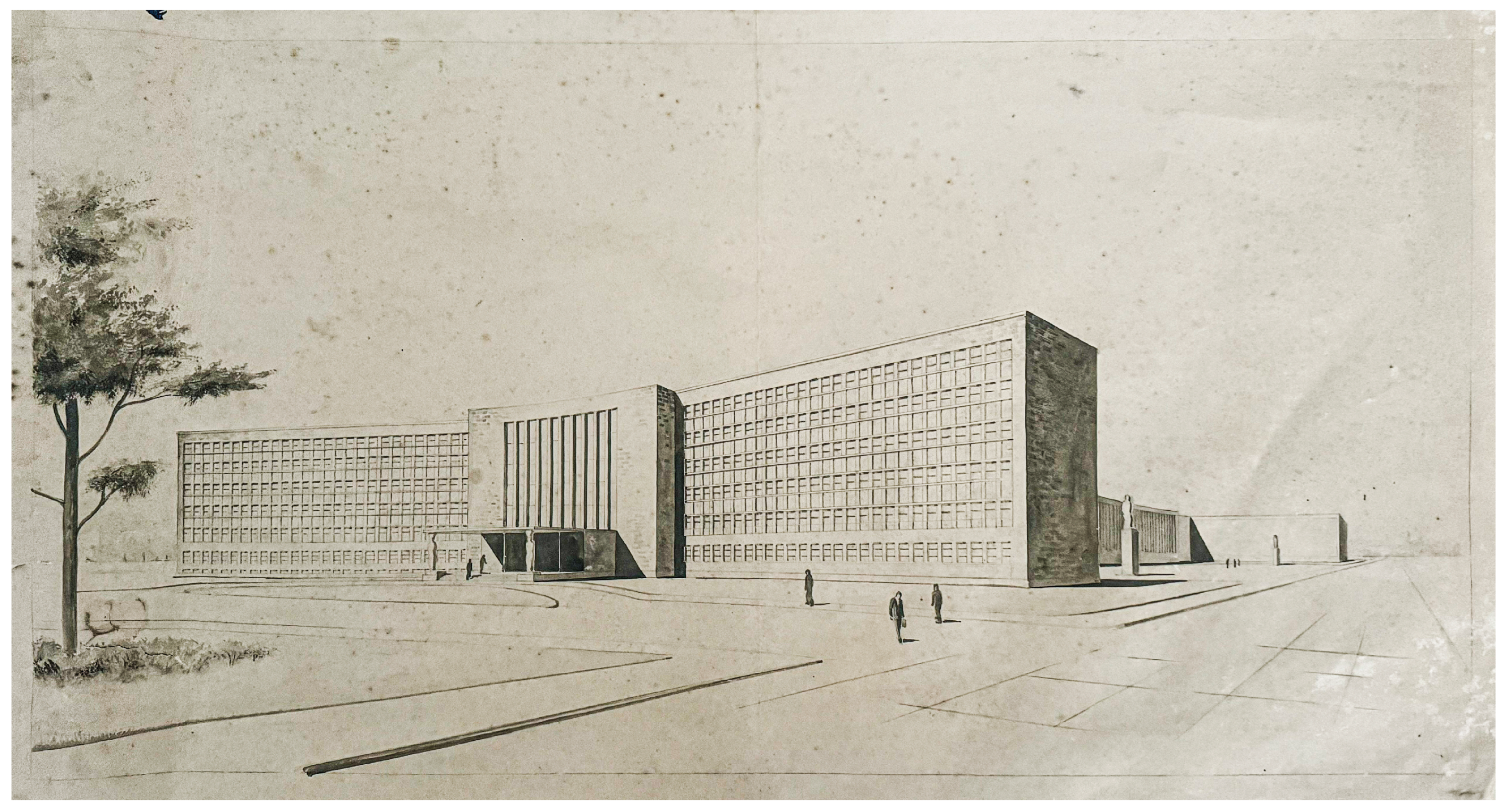
To analyze the probable inspiration of Potočnjak (and Neumann) in conceiving their solution for the Federal Government Presidency building, one have to look at two preserved drawings before the documentation was sent to Belgrade, which the author of this article recently bought in a secondhand bookshop: a section of a building’s wing juxtaposed to its front, drawn and signed by Potočnjak as the responsible designer [Croatian: Odg. Projektant], additionally by Veljko Kauzlarić as the chairman [Croatian: Upravitelj] (Figure 28.) and a perspective view drawn either by Potočnjak or by Neumann or by both, from which the monumentality of chosen H-floor plan can be noticed (Figure 29.).
The selection of the H-shaped floor plan for the whole building, also being concurrently chosen by the team of the architect Marijan Haberle who won an ex-aequo 2nd prize, was made as the symbolization of the people (or peoples) of Yugoslavia, when pronounced in Serbian as “Нарoд (Нарoди)”. Yet, the same letter H could symbolize Croatia (or Croatian), when pronounced in Croatian as “Hrvatska (Hrvatski)”. Due to the longevity of its central part, the floor plan could also symbolize expressionistically curved “I” shaped beam section. Accordingly to rediscovered drawing sheets, the preponderant fronts of edifice’s wings express horizontality in the manner of German Expressionism, while the central portions denote verticality close to the work of Fritz Schumacher (Figure 27.) or to “The School of Public Health”, an earlier public edifice built in Zagreb in 1927, financed by the Rockefeller Foundation and designed by the architects Juraj Denzler (Potočnjak’s partner during the Independent State of Croatia) and Mladen Kauzlarić (the elder brother of Veljko Kauzlarić). Fully preoccupied to its construction until his death, the architect Vladimir Potočnjak designed a few public buildings and industrial facilities in the community with Zlatko Neumann (Appendix 3.9.-3.16.). When in 1950 the Stately Design and Planning Institute was transformed into the “Architectural Design Institute” [Croatian: Arhitektonski Projektni Zavod, acronym APZ], Potočnjak was appointed as the President of the Workers Council [Croatian: Radnički savjet], additionally as the President of the Executive Board [Croatian: Upravni odbor] [2]. As a member of both Croatian State and Yugoslav Federal Commissions for Standardization [2], he translated Ernst Neufert’s “Bauordnungslehre” in Serbo-Croatian (Figure 30.). The architect Vladimir Potočnjak suddenly died in Zagreb, People’s Republic of Croatia, Federative People’s Republic of Yugoslavia on May 16th, 1952 [1].
4. Discussion and Conclusions
The overwhelming encirclement of the life and work of the architect Vladimir Potočnjak appears from researched and presented material. He graduated from the Architectural Department of Zagreb’s Institute of Technology / School of Technology of the University of Zagreb in 1926, as a member of the group of seminal architectural engineers educated there. Appointed to a contractual teaching assistant at the same institution, he considered apprenticing to the pioneers of Modern Movement as the second step in his architectural career. With the help of his acquaintance Zlatko Neumann, he apprenticed to Adolf Loos in Paris, concurrently improving his drawing and painting styles. With the Loos’s recommendation, he further apprenticed in the Ernst May’s office in Frankfurt a/M in 1927, when the most important residential estates of the Neue Sachlichkeit were conceived and started to build, additionally when the publication covering these activities was started. From Loos he inherited deep respect for classic appeal in architecture, while from May he adopted the rational and scientific approach to the architecture, especially the socially responsible design and construction, which will later evolve to his obsession with the standardization and normalization. In the other hand, with the literature he read in Germany or brought with him to Zagreb, he was affected by the German Expressionism, especially with the Northern variant applied in Hamburg by Fritz Schumacher. After his return to Zagreb and cancellation of his assistant appointment at the University, he further apprenticed principally to Hugo Ehrlich, another admirer of Adolf Loos, where he obtained a semi-autonomous status, reporting to Ehrlich only, although in the concordance with the practice, only Ehrlich’s name appeared on all official documentation and / or presentations. One of Potočnjak’s most important task was the First project for the School of Technology’s campus in 1929, where he seminally blended Loos’s and Schumacher’s monumentalism with the pragmatical proto-Modern floor plan. After acquiring the licensure in 1931 and probably in the mutual agreement with his former boss Ehrlich, in the Spring 1932 he submitted yet completely unknown competition entry for the “Workers’ Institutions’ Palace” at the place of his First project for the Technology campus, with which he argued that a monumental architecture can change functional utility with ease, whether for educational or for sequel social purposes. Recognized by the Competition Jury as Ehrlich’s protégé, he was left without the placement in the second round. Therefore he dedicated himself to private commissions, further submitting competition entries only when he considered that he has something to expose. Potočnjak’s unbuilt projects and built edifices until the proclamation of the Independent State of Croatia and further until 1943, when he was forced to submerge into the illegal life, exemplify the three principles he adopted, i.e., the simplicity and rationalization of the construction process through standardization, further the logical evolution of client’s wishes and functional needs to a rational but not necessarily complicated ground plan of every edifice or complex he designed, literally from a villa to an industrial facility, and finally his aesthetical choice to blend Loos’s naked monumentalism of a white box with the design means of German expressionism. These composition principles consequently made his architecture truly impressive in the Yugoslav and Croatian circumstances of pioneering and embedding the Modern Architecture, by encircling all the villas in Novi Vinodolski and Osijek, the swimming pool in Novi Vinodolski, the “Workers’ Institutions’” in Zagreb, the “PRIZAD” in Belgrade and the “Croatian Home” in Sušak competition entries for public buildings, the masterly conceived “Crni Vrh” and “Bat’a” residential estates projects with the seminal aluminum industrial edifice in Lozovac. His public activity as the manager in licensure and standardization bodies gave him the merit to cooperate with the authorities of the Independent State of Croatia, although with a price of converting from a Russian Orthodox to a Roman Catholic. Yet that same dictatorial regime expunged him because of his cooperation with the former nomenclature member who dared to organize the opposition. After the establishment of the Federal People’s Republic of Yugoslavia and the People’s Republic of Croatia, the architect Vladimir Potočnjak emerged as the probably one of the most valued professionals, although it is not known if he ever became a member of the Communist Party. In 1947 he and his team including Zlatko Neumann, Antun Ulrich and Dragica Perak were awarded the first prize and the subsequent construction of the Federal Government Presidency Palace, mostly because Potočnjak’s expertise in the construction process, standardization and normalization of the construction industry, additionally because of the team’s solving the functionality of the government offices with the sound “H”/”I”-shaped plan scheme, and finally because of the building’s suspended monumentality, achieved by amalgamating Loos’s worh with German Expressionism. When compared with the Soviet classicist “palaces”, e.g., Halabyan and Simbirtsev’s “Theater of the Red Army” from 1935, the Federal Government Presidency Palace project from 1947 look fresh and modern. During the process of its construction, Potočnjak translated Ernst Neufert’s “Bauordnungslehre” in Serbo-Croatian, yet Neufert’s octameter system did not embed in Yugoslavia, probably while the majority of Yugoslav architects already knew and possessed Neufert’s earlier publication, the “Bauentwurfslehre” from 1936, later also translated to Serbo-Croatian in 1968 as “Arhitektonsko Projektovanje”. Conclusively, the significance of Vladimir Potočnjak’s achievements go beyond Croatian or Yugoslavian architectural communities, to the interaction of German methods of architectural design and construction with Croatian and / or Yugoslav practices.
Appendix A. Comprehensive List of Projects, Realizations and Publications [78]
A.1. Apprenticeship (1926-1931) (2)
0.1. No project has been found yet.
0.2. No project has been found yet.
1.1. [1928-?]1929 The “first project” for the School of Technology’s campus, University of Zagreb, Klaićeva St, published 1929
1.2. 1929-1930 The “second phase” of the apartment block of the Zagreb’s Archdiocese’s Endowment, known as the “Vatikan”, Vlaška St, Martićeva St [DAZG]
A.2. Licensed Architectural Engineer (1931-1945) (41)
2.1. 1931-1932 Villa “Bauer”, 15 Jabukovac St, Zagreb, Croatia, designed by Drago Ibler: Architect-in-charge [12,26.2]
2.2.-2.11. 1932-1941 ten villa residences [1,26.2]:
2.2. Villa “princess Lobkowicz”, Novi Vinodolski, Croatia [11]
2.3. Villa “prof. dr. Koch”, Novi Vinodolski, Croatia [11]
2.4. Villa “P”, [Novi Vinodolski (?)], Croatia [11]
2.5. Villa “prof. dr. Mašek”, Novi Vinodolski, Croatia [11]
2.6. Villa “dr. Muačević”, Osijek, Croatia [11]
2.7. Villa “Dr. Rajtora”, [Novi Vinodolski (?)], Croatia, project [11]
2.8. Villa “Lebinec”, Novi Vinodolski, Croatia, project [12]
2.9.-2.11. Three still unknown villa projects
2.12. 1932-1934 (with Zlatko Neumann) Apartment house “Korenić”, 3 Laginjina St, Zagreb, Croatia [2,26.7]
2.13. 1932-1934 (with Zlatko Neumann) Apartment house “Neuberger-Auspitz-Heisler”, 5-7 Vrbanićeva St, Zagreb, Croatia, architect-in-charge: Zvonimir Pavešić (Apartment house “Neuberger”, 7 Vrbanićeva St.), Lav Kalda (Apartment house “Auspitz-Heisler”5 Vrbanićeva St) [2,23,26.7]
2.14. Apartment house “Lebinec”, 14, today 20 Ribnjak St, Zagreb, Croatia, project [11]
2.15. Apartment house “Ventilator”, Zagreb, Croatia, project
2.16. Adaptation and refurbishment of houses 2 Habdelićeva st & 16 Opatička St, Zagreb, Croatia [26.1]
2.17. Aluminum factory, Lozovac near Šibenik, Croatia [2,7,11,26.4]
2.18. Fan factory “Ventilator”, Zagreb, Croatia [1]
2.19. Swimming pool Novi Vinodolski, Croatia [1,2,11,12,26.3]
2.20. Laboratory building of the School of Technology, University of Zagreb, Kačićeva St, Zagreb [2,25.8], recently enlarged and redesigned
2.21. School for deaf-mute “Josipovac”, Zagreb, Croatia, with Juraj Denzler [1,2,26.6]
2.22. Hospital pavilions in “Sisters of Mercy” hospital, Zagreb, Croatia, project [11]
2.23. The church of the Holy Ghost, Sveti Duh, Zagreb, Croatia [probably as a co-designer to the architect Juraj Denzler, or architect-in-charge], [12]
2.24. The unknown church design [12]
Competitions [1]
2.25. Railway worker’s housing estate “Crni Vrh”, Sarajevo, Yugoslavia, today Bosnia & Herzegovina [2,11,26]
2.28. Office building “PR[ivilegovano]IZ[vozno]A[kcionarsko]D[ruštvo]”, Belgrade, Yugoslavia, today Serbia [11,12]
2.29. Public and office complex “Workers’ Institutions’ Palace”, Zagreb, Croatia [11]
2.31. Opera, Belgrade, Yugoslavia, today Serbia [11]
2.32. Public edifice “Hrvatski Dom / The Croatian Home”, Sušak, today Rijeka, Croatia [12]
Interiors [1]
2.34. The “rounded” interior [12]
2.35. The interior dr. Pavelić, Zagreb, Croatia [11]
2.36. The interior of the villa dr. Mladen Lorković, 35 Tuškanac St, Zagreb, Croatia [26.5]
2.37. The interior of the Ministry of Foreign Affairs of Independent State of Croatia, 3 & 4 Sv. Marka Sq., Zagreb, Croatia [26.5]
2.38. The interior of the Embassy of Independent State of Croatia in the State of Slovakia, Bratislava [26.5]
2.39. The assembly hall of the Sabor, finished after 1945 as the Sabor / Assembly of the People’s Republic of Croatia, Radić’s Sq., today Sv. Marka Sq., Zagreb, Croatia [26.5]
2.40. The Club of Foreign Journalists, finished after 1945 as The People’s Republic of Croatia Reporters’ Club, Zagreb, Croatia, with Mladen Kauzlarić [26.5]
2.41. The standardized window type [2]
A.3. Responsible Designer, People’s Republic of Croatia’s Stately Design and Planning Institute (18)
3.1.-3.4. 1946-1947 4 CHBs Beogradska St, today 5-8 Alage St, 5-8 Bošnjakovića St, 5-8 Stožira St, 5-8 Vrančića St, Zagreb, Croatia [2], with Zlatko Neumann, Stjepan Gomboš & Mladen Kauzlarić [10]
3.5.-3.8. 1946-1947 4 CHBs Beogradska St, today 1-4 Alage St, 1-4 Bošnjakovića St, 1-4 Stožira St, 1-4 Vrančića St, Zagreb, Croatia [2], with Branko Bartolić, Viktor Hečimović & Stjepan Gomboš [10]
3.9. Housing estate, Karlovac, Croatia [2]
3.10. Atelier of sculptor Frane Kršinić, Šalata, Zagreb, Croatia [2]
3.11. Social buildings of the “Jugonafta” oil industry, Šumećani near Ivanić Grad, Croatia [2]
3.12. Primary school, Križevci, Croatia [2]
3.13. Factory, Vela Luka, Croatia [2]
3.15. Coal separation facility, Raša, Croatia [2]
3.16. Factory of laboratory glass [?], Croatia
Competitions [1]
3.17. Yugoslav Federal Government Presidency Palace in New Belgrade (with Zlatko Neumann, Antun Ulrich and Dragica Perak), 1st prize, architect-in-charge, realization of reinforced concrete skeleton, completed by architect Mihailo Janković, today the Palata “Srbije”, Belgrade, Serbia [2]
3.18. Yugoslav Federal Party Presidency Palace in New Belgrade (with Zlatko Neumann, Antun Ulrich, Dragica Perak and Branko Vasiljević), ex-aequo 3rd prize, project [10]
A.4. Publications (17)
4.1. “Radničko naselje Bata, Zlyn” [“Bat’a workers’ settlement, Zlín”], in: Građevinski Vjesnik 1937, 1, 9.
4.2. “Novogradnja tvornice aluminiuma a.d. u Lozovcu kraj Šibenika (sa slikama)” [“The construction of the aluminum factory Co. in Lozovac near Šibenik (with pictures)”], in: Građevinski Vjesnik 1937, 6, 161-164.
4.3. “O arhitektonskim natječajima kod nas” [“About architectural competitions in our country”], in: Građevinski Vjesnik, 1938, 7, 33-34.
4.4. “Tko će graditi Operu i Stadion u Beogradu?” [“Who will build the Opera House and the Stadium in Belgrade?”], in: Građevinski Vjesnik, 1938, 7, 100-101.
4.5. “Arhitektura u Hrvatskoj 1888-1938” [“The Architecture in Croatia 1888-1938”], in: Građevinski Vjesnik, 1939, 8, 49-55 [2,9].
4.6. [A collection of photographs of architectural works in Croatia between 1888 and 1938, provided with captions in Croatian], in: Građevinski Vjesnik, 1939, 8, 56-77.
4.7. “Arhitekti čiji su radovi reproducirani u ovom dvobroju” [“[Short Biographies of] Architects whose architectural works were reproduced in this double issue”], in: Građevinski Vjesnik, 1939, 8, 78-79.
4.8. “Pravilnik za internacionalne arhitektonske natječaje” [“The regulations for international architectural competitions”], in: Građevinski Vjesnik, 1939, 8, 103-104.
4.9. “Stanbene jedinice za Batu u Zlinu” [“Housing units for Bat’a in Zlín”], in: Tehnički List, 1939, 21, 140-141.
4.10. “Vila ‘L’ u Novom [Vinodolskom]” [“Villa ‘L’ in Novi [Vinodolski]”], in: Tehnički List, 1939, 21, 144.
4.11. “Jednoobrazni troškovnici u građevinarstvu” [“The uniform cost estimates in construction industry”], in: Naše Građevinarstvo, 1947, 1, 21-23 [2].
4.12. “Industrijalizacija u građevinarstvu” [“The industrialization in construction industry”], in: Naše Građevinarstvo, 1947, 1, 67-71 [2].
4.13. “Osvrt na izgradnju pozorišta u Jugoslaviji od oslobođenja do danas” [“An overview of the construction of theaters in Yugoslavia from liberation to the present day”], in: Naše Građevinarstvo, 1950, 4, 576-577.
4.14. “[I. Bartolić, K. Ostrogović, V. Potočnjak:] Projektanti govore o svojim projektima stanova” [“[I. Bartolić, K. Ostrogović, V. Potočnjak:] Designers talk about their apartment projects”], in: Arhitektura, 1952, 6, 21-25.
Standards
4.15. “Soboslikarski i ličilački radovi / HN 28 [The standard for the painting and decorating works]”, 1943, Savjetodavni odbor za normizaciju, Zagreb, Trg II, br. 4, pp. 1-12 [26].
Translations
4.16. “Pravila građevinarstva”, 1952, Građevinska Knjiga, Belgrade, Yugoslavia, the translation of Ernst Neufert’s “Bauordnungslehre”, 1944, Volk und Reich Verlag, Berlin, German Reich [2], with Zlatko Neumann [10].
Manuscripts
4.17. “Zbor nacrta u APZ-u” [“The Assembly of drawings in the APZ”], spoof, unpublished manuscript dated 23. 2. 1951 and signed [13].Table A1. This is a table caption.
| 1 | According to the Book of Matura Exam Records, No. 38 [/1922], pages 557 recto & verso, on July 3rd, 2022, he was born on January 17th, 1904. Yet, according to the uncertified transcript of his 2nd Stately Exam / Diploma Certificate, No. 46 [/1926], he was born on January 4th, 1904. I presume that his birth date on the Diploma Certificate was erroneously rewritten from the original, because in other documents, submitted as the evidentiary support to his application for professorship at the School of Technology, Croatian University in Zagreb in May 1942, his date of birth was stated on January 17th, 1904. |
| 2 | In the DAZG / State Archives Zagreb (Državni Arhiv u Zagrebu), 29 Opatička St, Zagreb, the “Vladimir Potočnjak personal file” as contractual engineer at the Zagreb’s City Construction Office [a city official] does not exist. |
| 3 | The archival documentation of this 10 villas probably exist, although it is necessary to thoroughly research all corresponding archives in the wider Rijeka area. The archival documentation of villa Muačević should be placed in the DAO / State Archives Osijek. |
References
- Anon. Arhitekt Vladimir Potočnjak [Obituary]. Arhitektura 1952, 6, 27-31.
- Vrkljan, Z. Obljetnice: Dipl. inž. arh. Vladimir Potočnjak (1904-1952) [Anniversaries: Dipl. Eng. Arch. Vladimir Potočnjak (1904-1952)]. Čovjek i prostor, 1977, 24, , p. 30.
- Vrkljan, Z. Sjećanja [Memories]; Publisher: Sveučilište u Zagrebu, Zagreb, Croatia, 1995; pp. 144-145.
- Premerl, T. Potočnjak, Vladimir. In Likovna Enciklopedija Jugoslavije 2 K-Ren.; Domljan, Ž., Šercar, H., Eds.; Publisher: Jugoslavenski Leksikografski Zavod “Miroslav Krleža”, Zagreb, Croatia, Yugoslavia, 1987; Volume 2, pp. 624.
- Premerl, T. Potočnjak, Vladimir. In Enciklopedija Hrvatske Umjetnosti 2 Novi-Ž.; Domljan, Ž., Ed.; Publisher: Leksikografski Zavod “Miroslav Krleža”, Zagreb, Croatia, 1996; Volume 2, pp. 85.
- Blažić, M. Potočnjak, Vladimir. Hrvatska tehnička enciklopedija. Available online: https://tehnika.lzmk.hr/potocnjak-vladimir/ (accessed on 7 January 2026).
- Širola, B. S.; Kreković, M. Gradnja tvornice aluminiuma a.d. u Lozovcu kraj Šibenika (sa slikama) [The construction of the aluminum factory Co. in Lozovac near Šibenik (with pictures)]. Građevinski Vjesnik 1937, 6, 165-168.
- Steinmann, E. Buduća izgradnja Griča [The future construction of Grič]. Tehnički Vjesnik 1943, 3, 369-375.
- Kahle, D. Architect Zlatko Neumann: Buildings and Projects between the World Wars. Prostor 2015, 23, 28-41. Available online: https://www.researchgate.net/publication/279531945_Architect_Zlatko_Neumann_Buildings_and_Projects_between_the_World_Wars (accessed on 17 August 2021).
- Kahle, D. Architect Zlatko Neumann: Works after the Second World War (1945-1963). Prostor 2016, 24, 172-187. Available online: https://www.researchgate.net/publication/329438932_Arhitekt_Zlatko_Neumann_Djela_nakon_Drugoga_svjetskog_rata_1945-1963 (accessed on 17 August 2021). [CrossRef]
- Potočnjak, V. [Vladimir Potočnjak drawings collection: A. The Map.] 1942, unpublished (in possession of the article’s author).
- Potočnjak, V. [Vladimir Potočnjak drawings collection: B. Drawings in folio.] 1932-1952, unpublished (in possession of the article’s author).
- Potočnjak, V. [ZBOR NACRTA U APZ-u – Vladimir Potočnjak], 23. 2. 1951, aukcije.hr . Was available online: https://www.aukcije.hr/prodaja/kolekcionarstvo/Stari-dokumenti-i-fotografije/367/oglas/ZBOR-NACRTA-U-APZ-u-Vladimir-Poto%C4%8Dnjak/2763464/ (accessed on 17 August 2021, page vanished, the author created the captured site’s PDF file on 13:46:18).
- Durm, J. Die Baukunst der Griechen, 3rd ed. [Handbuch der Architektur, II. Teil, 1. Band]; Publisher: Alfred Kröner Leipzig, Germany, 1910; pp. 1–ff. [stamped: ARH. VLADIMIR POTOČNJAK, in author’s library].
- Durm, J. Die Baukunst der Etrusker, Die Baukunst der Römer, 2nd ed. [Handbuch der Architektur, II. Teil, 2. Band]; Publisher: Arnold Bergsträsser Stuttgart, Germany, 1905; pp. 1–ff. [stamped: ARH. VLADIMIR POTOČNJAK, in author’s library].
- Schumacher, F. Zeitfragen der Architektur, Erstes und zweites Tausend.; Publisher: Eugen Diederichs Jena, Germany, 1929; pp. 1–ff. [signed: Volodja [Vladimir] Potočnjak, in author’s library].
- Vladimir Potočnjak’s MEC / The Maturity Exam Certificate, no. 38 / 3. 7. 1922; in the DAZG / State Archives Zagreb (Državni Arhiv u Zagrebu), 29 Opatička St, Zagreb.
- Vladimir Potočnjak’s 2nd Stately Exam / Diploma Certificate, no. 46 / 25. 6. 1926; in the Vladimir Potočnjak’s personal file at the Faculty of Architecture, University of Zagreb.
- Domljan, Ž. Arhitekt Ehrlich.; Društvo povjesničara umjetnosti Hrvatske: Zagreb, Yugoslavia, 1979; p. 110.
- Kahle, D. THE “WORKERS’ INSTITUTIONS’ PALACE COMPETITION” IN ZAGREB AND ITS AFTERMATH. In Proceedings of the 13th / 13. Architecture in Perspective 2021 / Architektura v perspektivě 2021, Ostrava, Czech Republic, Date of Conference (29.-30. 09. 2021). Available online: https://www.researchgate.net/publication/355928346_The_Workers’_Institutions’_Palace_Competition_in_Zagreb_and_its_aftermath (accessed on 7 January 2026).
- Ehrlich, H. Gradnja Tehničkog fakulteta Sveučilišta Kraljevine Jugoslavije [The construction of the Faculty of Technology of the University of the Kingdom of Yugoslavia]. Godišnjak Sveučilišta u Zagrebu, 1929, pp. 1114-17.
- Kahle, D. Zagrebačka ugrađena najamna kuća u razdoblju od 1928. do 1934. godine [Built-in Apartment Houses in Zagreb between 1928 and 1934]. Prostor 2002, 10, 162, Figure 15-16. Available online: https://www.researchgate.net/publication/350410742_Built-in_Apartment_Houses_in_Zagreb_between_1928_and_1934 (accessed on 7 January 2026).
- Kahle, D. Die Liste der gefundenen Projekte und ausgeführten Bauten des Architekten Zvonimir Pavešić (1907-1978). [2025] (A private research project submitted to the Architect’s granddaughters Mrs. Sanja Pavešić-Hirschfeld and Mrs. Zinka Forth).
- Vladimir Potočnjak’s Statement on 18. 6. 1942; in the Vladimir Potočnjak’s personal file at the Faculty of Architecture, University of Zagreb.
- Kahle, D. THE COMPARISON OF CONSECUTIVE ARCHITECTURAL LEGISLATIONS IN CROATIAN LANDS FROM THE HABSBURG EMPIRE UNTIL THE INDEPENDENT STATE OF CROATIA. In Proceedings of the Art and the State in Modern Central Europe (18th – 21st Century), Zagreb, Croatia, Date of Conference (Day Month Year). Available online: https://www.researchgate.net/publication/385300754_THE_COMPARISON_OF_CONSECUTIVE_ARCHITECTURAL_LEGISLATIONS_IN_CROATIAN_LANDS_FROM_THE_HABSBURG_EMPIRE_UNTIL_THE_INDEPENDENT_STATE_OF_CROATIA (accessed on 7 January 2026).
- Vladimir Potočnjak’s Curriculum Vitae on 11. 5. 1942; in the Vladimir Potočnjak’s personal file at the Faculty of Architecture, University of Zagreb.
- Vrkljan, Z. Sjećanja [Memories]; Publisher: Sveučilište u Zagrebu, Zagreb, Croatia, 1995; pp. 60.
- Vrkljan, Z. Sjećanja [Memories]; Publisher: Sveučilište u Zagrebu, Zagreb, Croatia, 1995; pp. 61.
- Mladen Lorković. Available online: https://en.wikipedia.org/wiki/Mladen_Lorkovi%C4%87 (accessed on 7 January 2026).
- Vergabe- und Vertragsordnung für Bauleistungen. Available online, in German: https://de.wikipedia.org/wiki/Vergabe-_und_Vertragsordnung_f%C3%BCr_Bauleistungen (accessed on 7 January 2026).
- Kolacio, Z. In memoriam BRANKO TUČKORIĆ (1910-1971). Čovjek i prostor 1972, 4 [228], 25. Available online, in Croatian: https://arhitekti.eindigo.net/?pr=iiif.v.a&id=10590&tify={%22pages%22:[25],%22panX%22:0.204,%22panY%22:0.982,%22view%22:%22info%22,%22zoom%22:0.471} (accessed on 7 January 2026).
- Kahle, D. Architect Zlatko Neumann: Works after the Second World War (1945-1963), chapter “THE PERIOD FROM 1945 TO 1954”. Prostor 2016, 24, 176-178.
- Kahle, D. THE RISE AND FALL OF THE ZAGREB PAPER INDUSTRY 1893-2006. In Proceedings of the 12th / 12. Architecture in Perspective 2020 / Architektura v perspektivě 2020, Ostrava, Czech Republic, Date of Conference (14.-15. 10. 2020). Available online: https://www.researchgate.net/publication/347380847_The_Rise_and_Fall_of_the_Zagreb_Paper_Industry_1893-2006 (accessed on 7 January 2026).
- State Anti-Fascist Council for the National Liberation of Croatia. Available online: https://en.wikipedia.org/wiki/State_Anti-Fascist_Council_for_the_National_Liberation_of_Croatia (accessed on 7 January 2026).
Figure 3.
The second phase of the Endowment of the Archdiocese of Zagreb, Zagreb, Yugoslavia, today Croatia, 1930 (Appendix 1.2.), street front in Martićeva St (Author).
Figure 3.
The second phase of the Endowment of the Archdiocese of Zagreb, Zagreb, Yugoslavia, today Croatia, 1930 (Appendix 1.2.), street front in Martićeva St (Author).
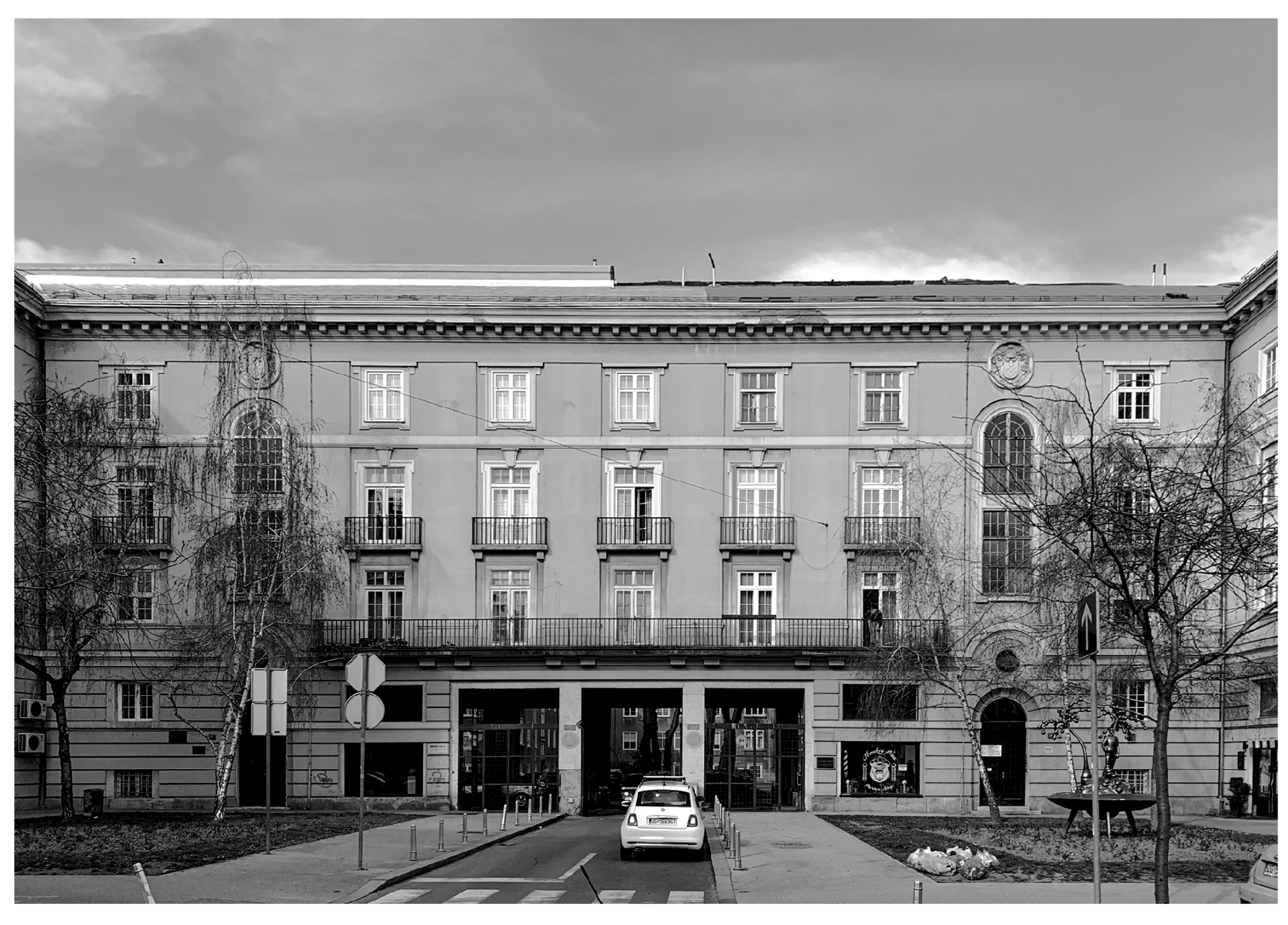
Figure 4.
The second phase of the Endowment of the Archdiocese of Zagreb, Zagreb, Yugoslavia, today Croatia, 1930 (Appendix 1.2.), yard front toward Martićeva St (Author).
Figure 4.
The second phase of the Endowment of the Archdiocese of Zagreb, Zagreb, Yugoslavia, today Croatia, 1930 (Appendix 1.2.), yard front toward Martićeva St (Author).
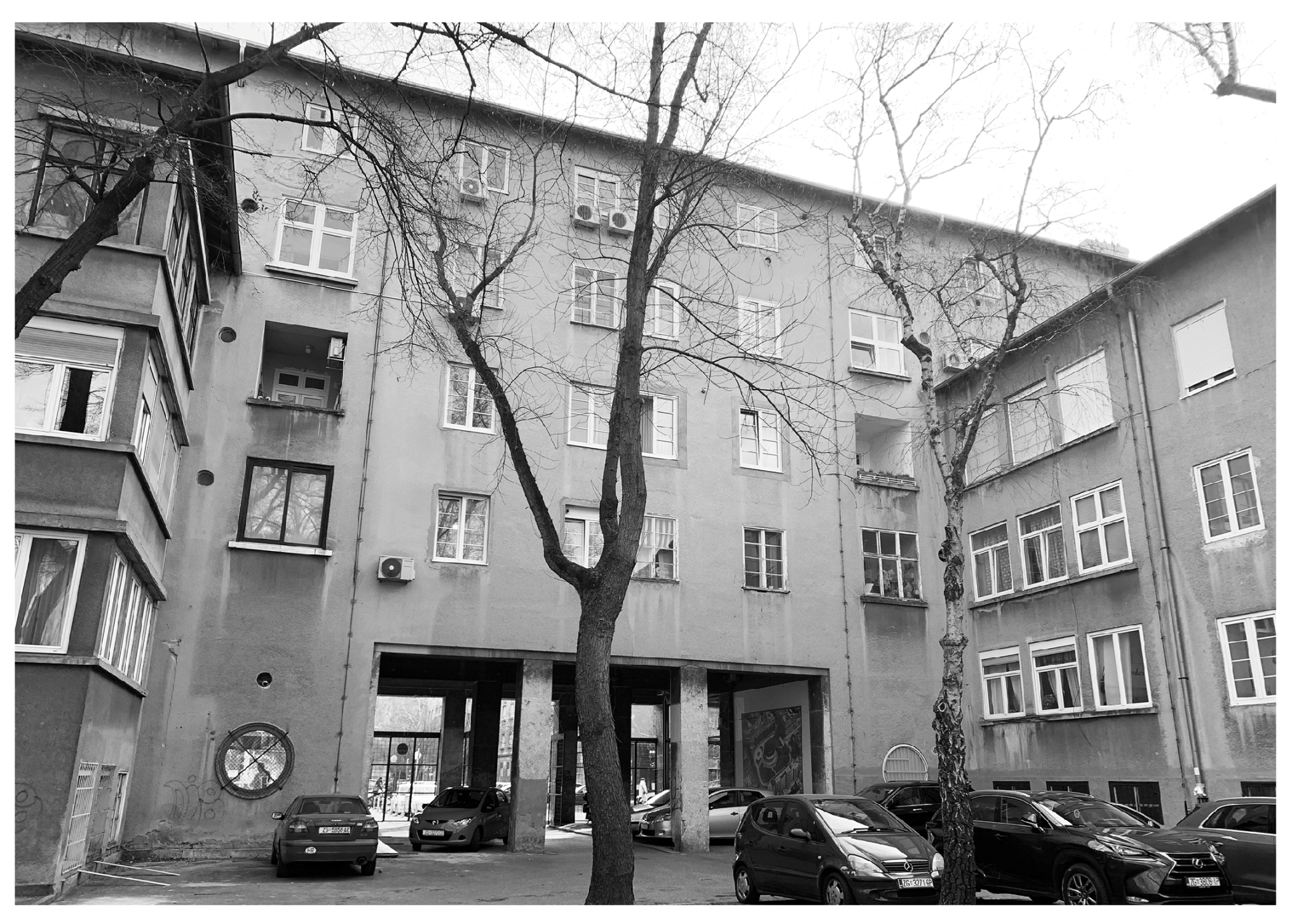
Figure 5.
The apartment house “Korenić”, 3 Laginjina St, Zagreb, Yugoslavia, today Croatia, 1932 (Appendix 2.12.), detail of the house entrance (Author).
Figure 5.
The apartment house “Korenić”, 3 Laginjina St, Zagreb, Yugoslavia, today Croatia, 1932 (Appendix 2.12.), detail of the house entrance (Author).
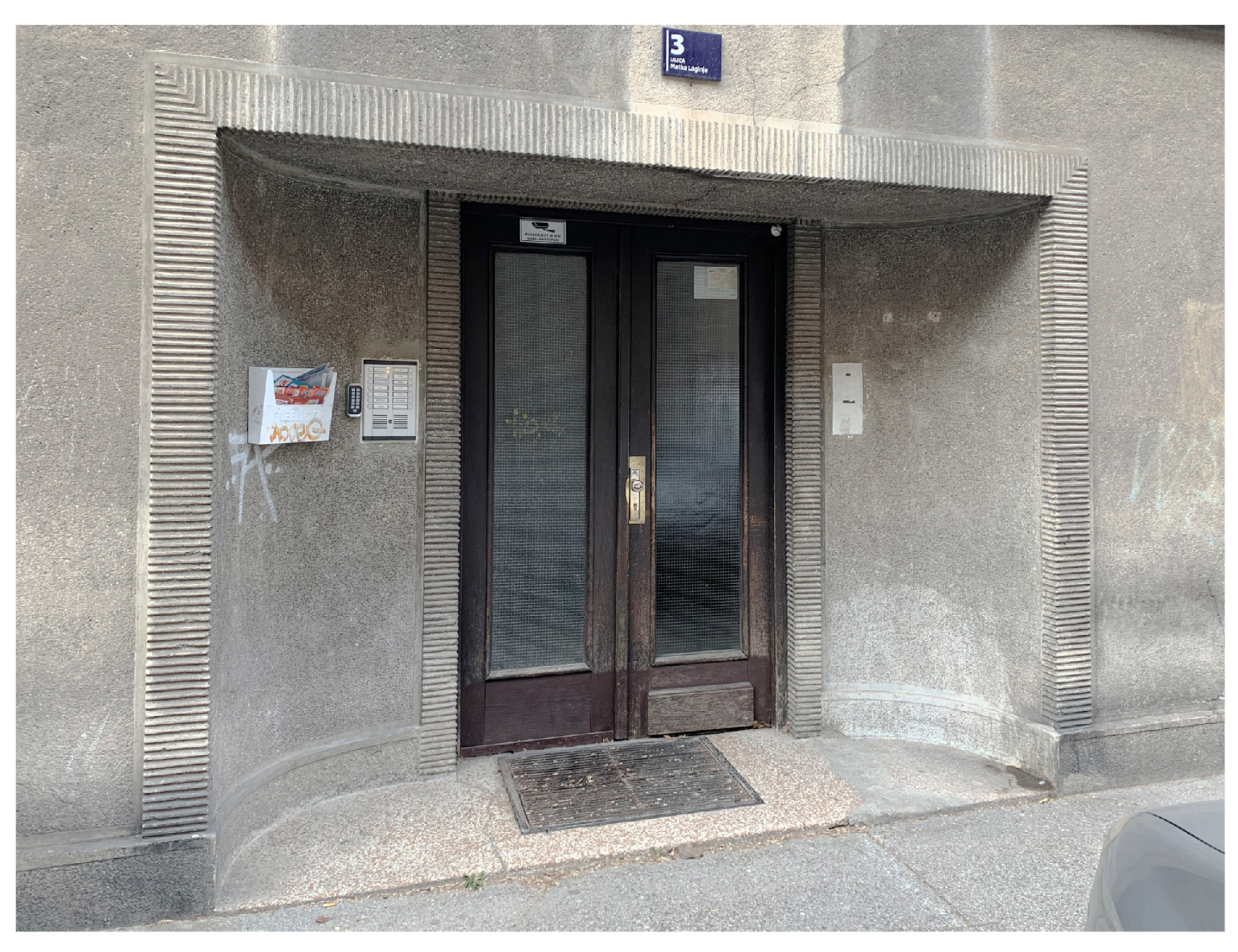
Figure 6.
The apartment house “Lebinec”, 20 Ribnjak St, Zagreb, Yugoslavia, today Croatia, 1936(?) (Appendix 2.14.), floor plan [11] / Figure 7. Ibid., street front [11].
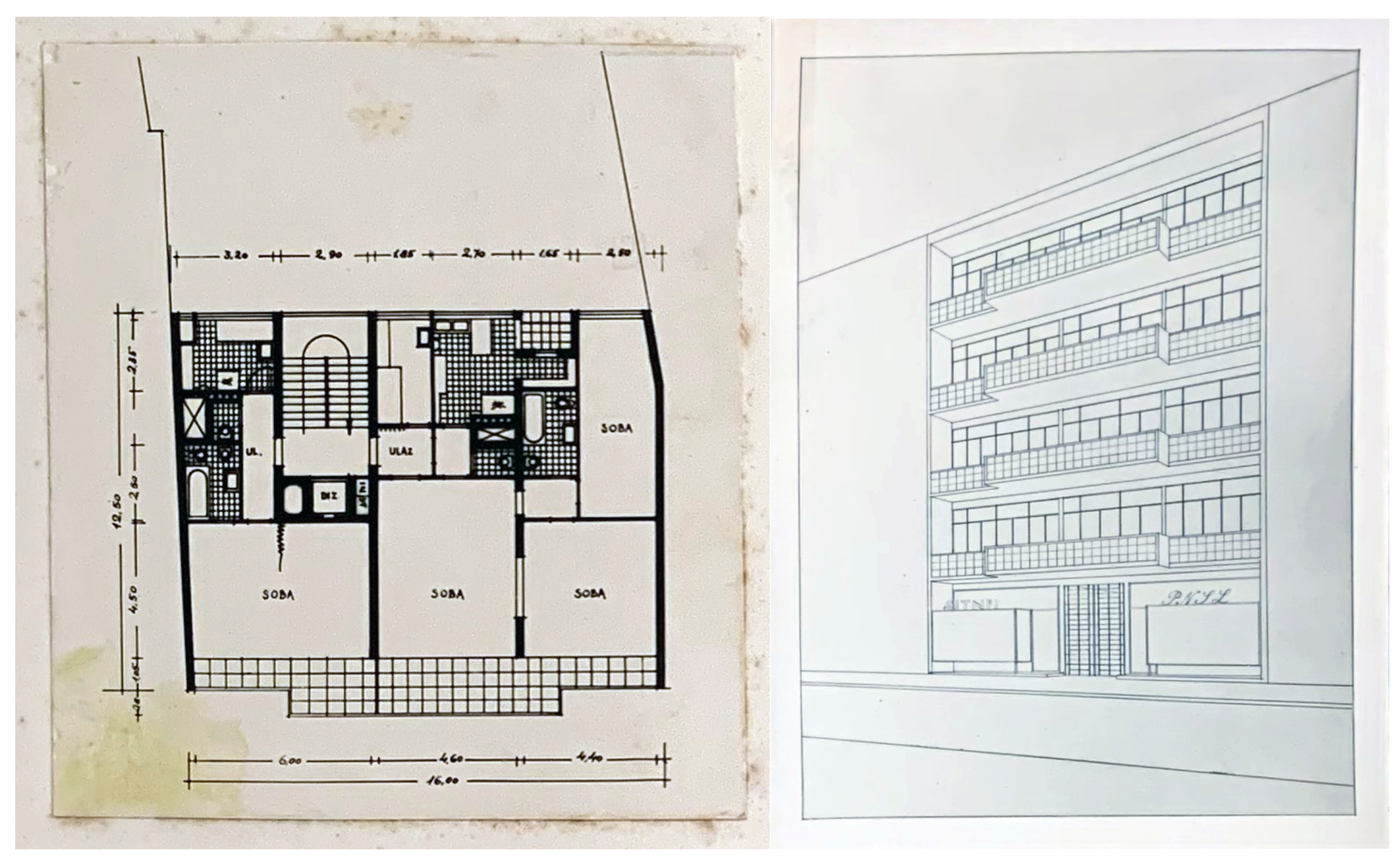
Figure 13.
Aluminum factory, Lozovac, Yugoslavia, today Croatia (Appendix 2.17.) [11].
Figure 13.
Aluminum factory, Lozovac, Yugoslavia, today Croatia (Appendix 2.17.) [11].
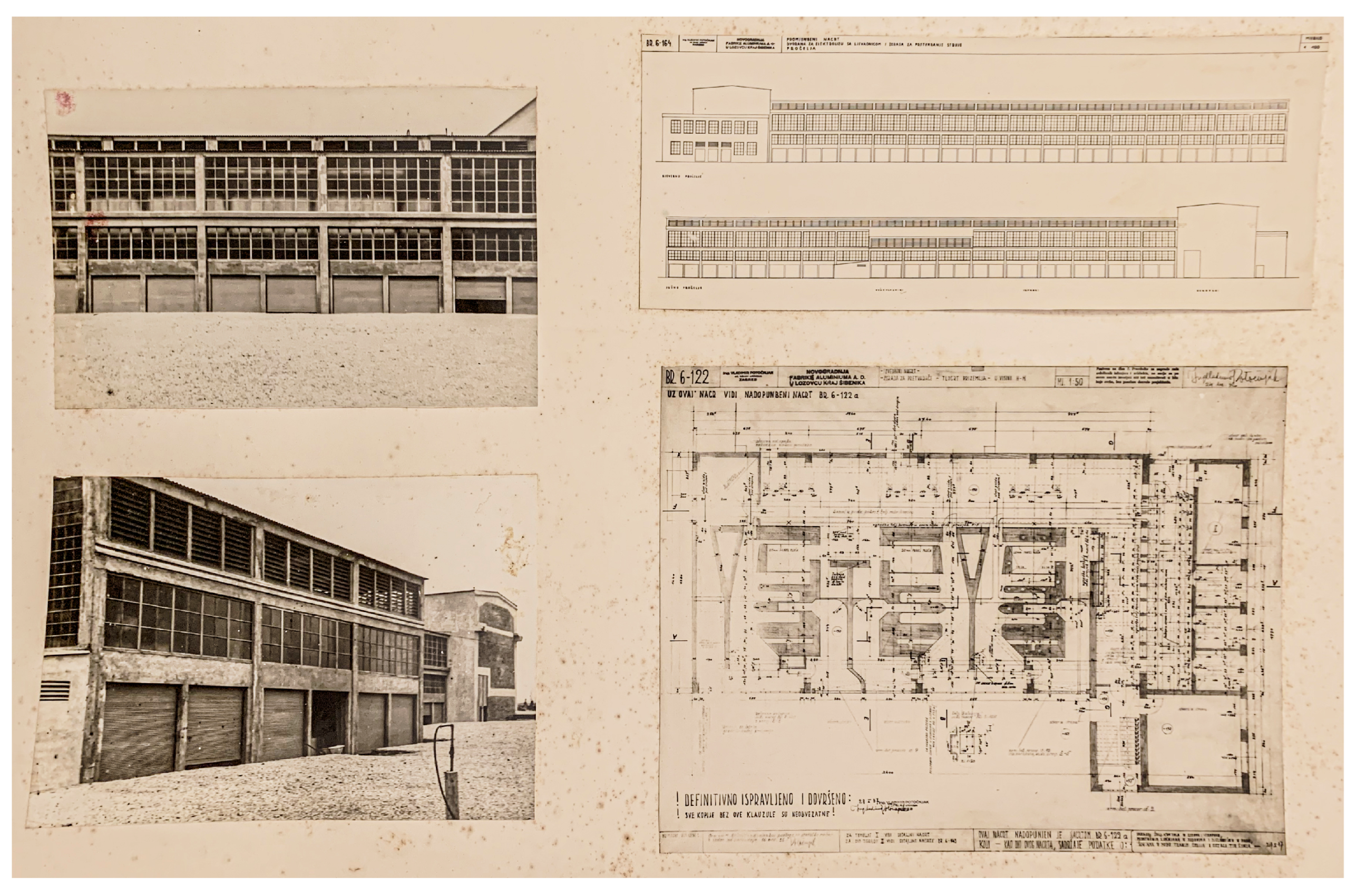
Figure 25.
The Architecture in Croatia, the frontispiece (Appendix 4.5.-4.7.).
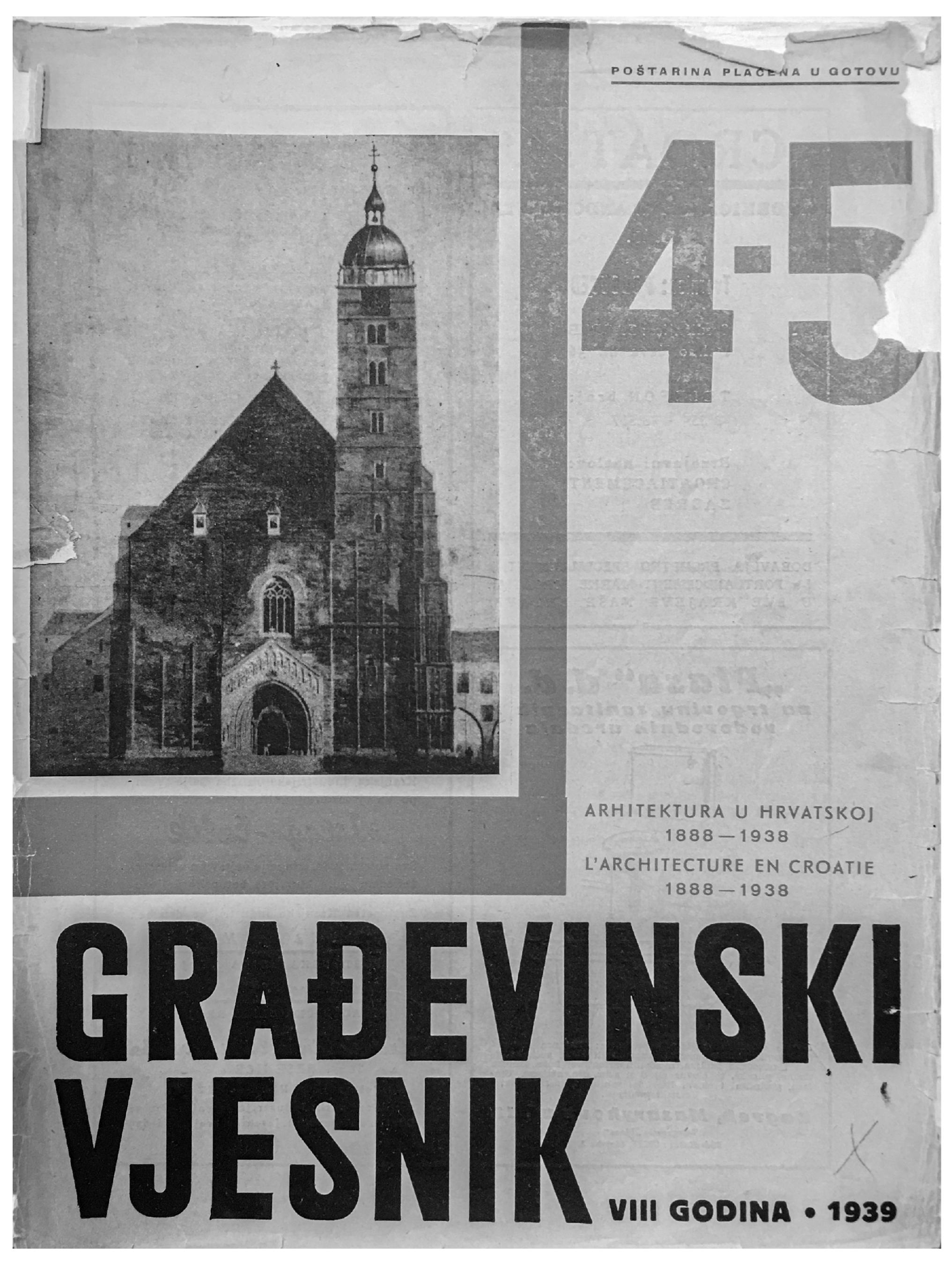
Figure 26.
The “Standardized Windows / [Croatian: Normirani prozori]”, “Bat’a” competition project, Zlín, Czechoslovakia, today Czechia, detailed scheme (Appendix 2.41.) [11].
Figure 26.
The “Standardized Windows / [Croatian: Normirani prozori]”, “Bat’a” competition project, Zlín, Czechoslovakia, today Czechia, detailed scheme (Appendix 2.41.) [11].
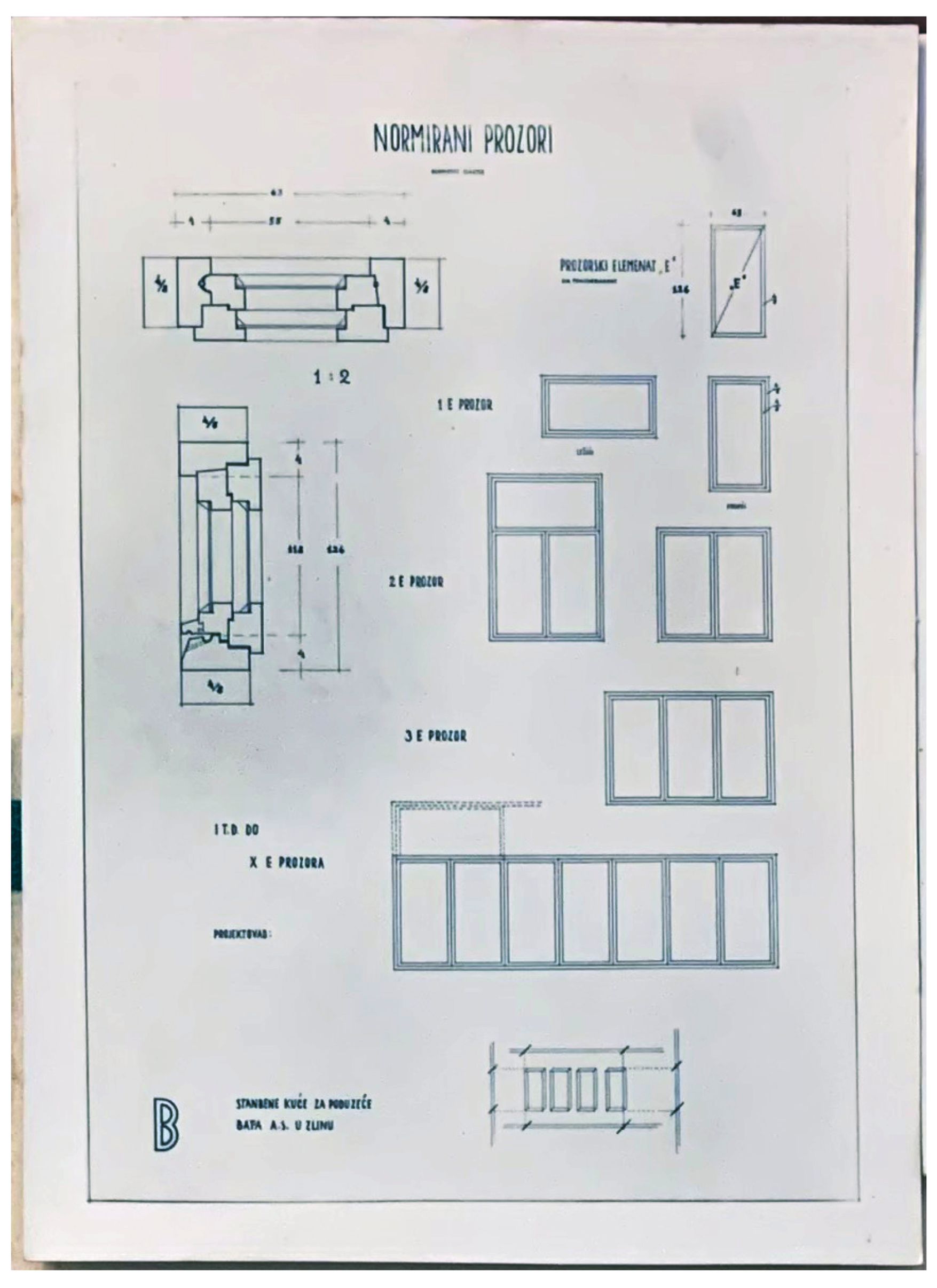
Figure 27.
The Veddel primary school, Hamburg, Germany, by the architect Fritz Schumacher, 1928-1929, model [16].
Figure 27.
The Veddel primary school, Hamburg, Germany, by the architect Fritz Schumacher, 1928-1929, model [16].
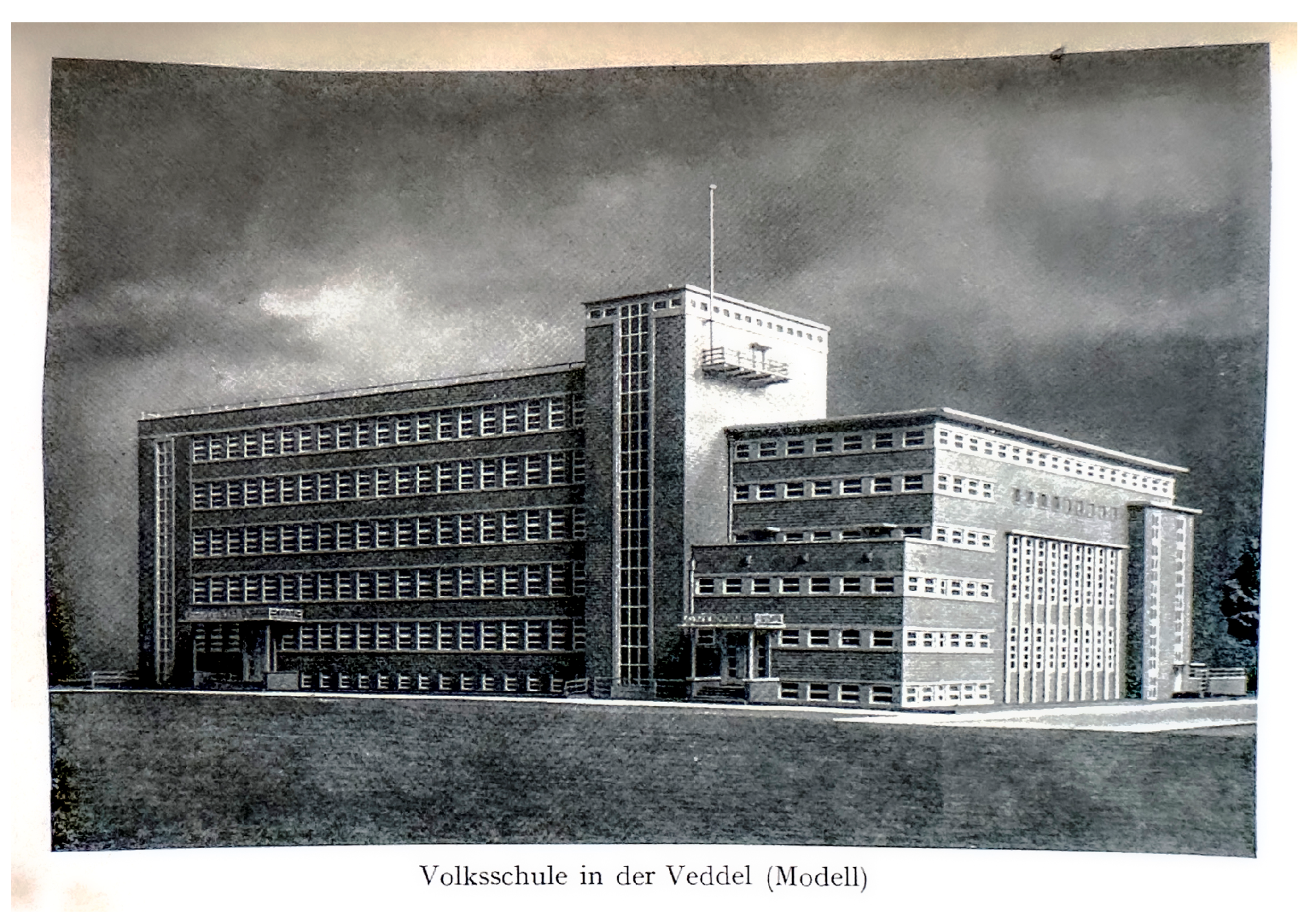
Figure 28.
The Federal Government Presidency’s palace, the wing section juxtaposed to its front, drawn and signed by Potočnjak as the responsible designer, 1947 [11].
Figure 28.
The Federal Government Presidency’s palace, the wing section juxtaposed to its front, drawn and signed by Potočnjak as the responsible designer, 1947 [11].
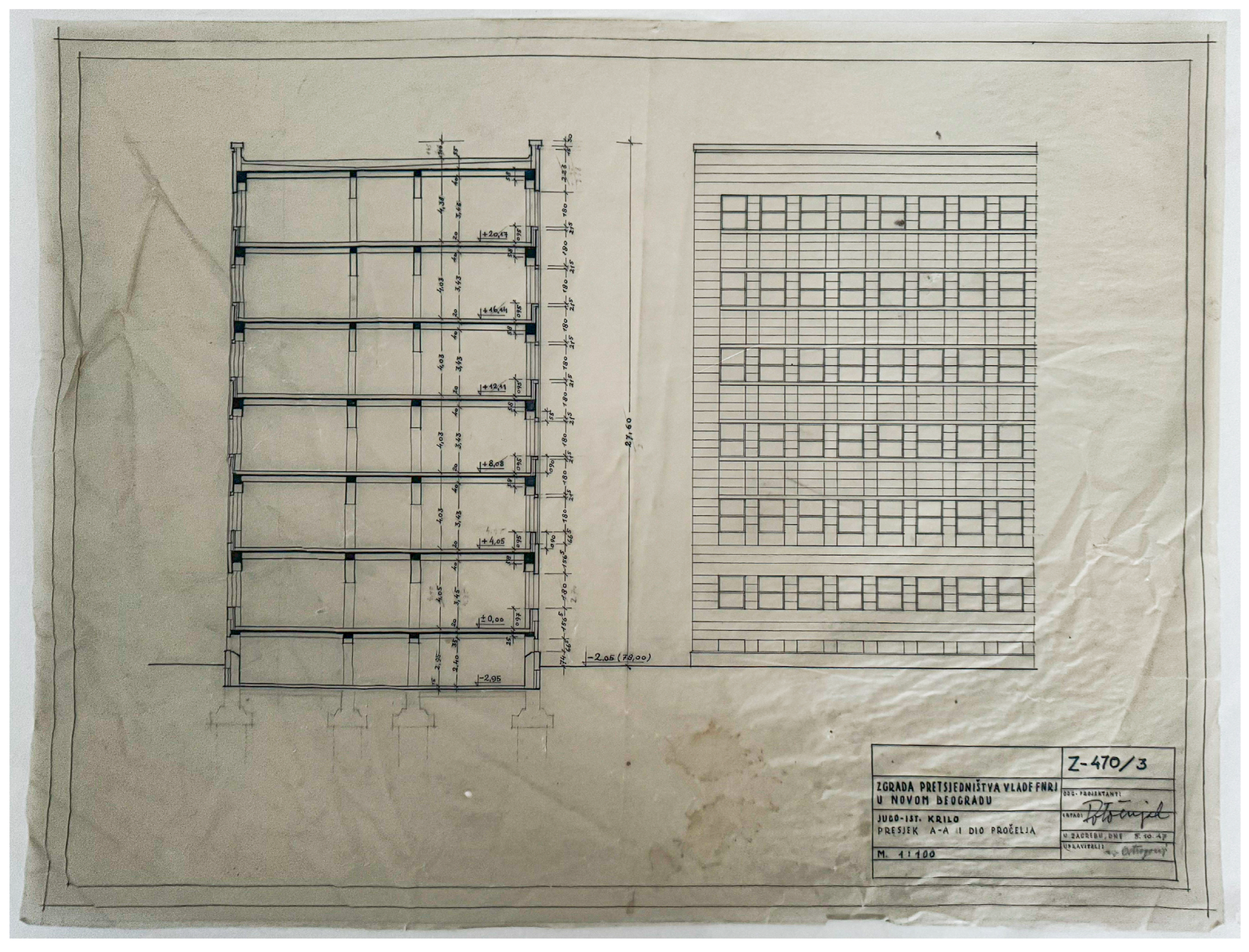
Figure 29.
The Federal Government Presidency’s palace, the perspective view drawn either by Potočnjak or by Neumann or by both, 1947 [11].
Figure 29.
The Federal Government Presidency’s palace, the perspective view drawn either by Potočnjak or by Neumann or by both, 1947 [11].
Disclaimer/Publisher’s Note: The statements, opinions and data contained in all publications are solely those of the individual author(s) and contributor(s) and not of MDPI and/or the editor(s). MDPI and/or the editor(s) disclaim responsibility for any injury to people or property resulting from any ideas, methods, instructions or products referred to in the content. |
© 2026 by the authors. Licensee MDPI, Basel, Switzerland. This article is an open access article distributed under the terms and conditions of the Creative Commons Attribution (CC BY) license (http://creativecommons.org/licenses/by/4.0/).
Copyright: This open access article is published under a Creative Commons CC BY 4.0 license, which permit the free download, distribution, and reuse, provided that the author and preprint are cited in any reuse.


