

Submitted:
17 January 2026
Posted:
19 January 2026
You are already at the latest version
Abstract
This paper addresses the critical intersection of demographic shifts and private land conservation, with a focus on the implications for wildlife management in rural private ecosystems. As private land ownership, resulting from the phenomenon of amenity migration, continues to fragment and diversify, understanding how these emerging landowners interact with wildlife and engage in management practices is essential to achieving large-scale conservation outcomes. The purpose of this paper is to shed light on this understudied intersection of literatures through a review that synthesizes existing scholarship, identifies critical gaps, and outlines opportunities for future research and institutional response. Building on socio-ecological systems perspectives, our results showcase four themes where wildlife is mentioned in the amenity migration literature, yet wildlife is rarely treated as a managed social-ecological system in this literature. Our call for action argues that the implications of amenity migration on wildlife management extend beyond individual landowners to include institutional systems, shifting com-munity dynamics, and new patterns of land use that together shape the conditions under which wildlife can persist.
Keywords:
amenity migration
; private land conservation
; socio-ecological implications
; wildlife stewardship
1. Introduction
Wildlife ecosystem management entails the restoration and maintenance of ecological balance while addressing both wildlife conservation and human needs. Contemporary natural resource managers increasingly recognize the critical role that human activities play in the conservation, preservation, and long-term sustainability of such ecosystems [1]. In eastern U.S. states, where most of the land is under private ownership, the responsibility for maintaining wildlife health and ensuring ecosystem sustainability primarily rests with private landowners. Over time, public policies and governmental agencies have established working relationships with what we refer to as long-term ‘traditional landowners’, offering regulatory frameworks, technical expertise, financial incentives, and strategic guidance. These efforts have been instrumental in integrating conservation objectives into private land management plans, thereby advancing ecosystem stewardship. Yet the effectiveness of these efforts depends on socio-ecological alignment; programs must match not only ecological conditions but also evolving landowner identities, knowledge systems, and the institutional environments in which management occurs [2].
Over the past several decades, natural areas worldwide have been experiencing significant population shifts, characterized by population movements from urban to rural areas that bring new and different actors in comparison to the long-term rural population [3,4]. First studied in the United States during the 1970s, this phenomenon, known as amenity migration, involves individuals relocating to reorient their lives around nature and the perceived benefits this creates [5,6,7]. Amenity migration is driven by a combination of push factors (e.g., reasons to escape urban life) and pull factors (e.g., reasons to seek out rural environments), mediated by contemporary macro social conditions such as the commodification of rural land for its aesthetic value, advancements in telecommunications, and the transgenerational transfer of wealth [8]. These factors have contributed to the expansion of amenity migration over time. Critically, however, this expansion represents a socio-ecological transformation. New populations bring distinct values, expectations, and management goals and capacities that lead to alterations in the institutional, social, and ecological foundations upon which wildlife depends [3,9,10].
Existing scholarship has documented multiple pathways through which amenity migration reshapes ecological conditions on private lands. For example, [5], one of the most widely cited syntheses of the ecological implications of amenity migration, provides a comprehensive international review highlighting impacts related to land subdivision, habitat fragmentation, altered disturbance regimes, and changing human–environment interactions. Within this body of work, wildlife is typically framed marginally, rather than as the focus of intentional wildlife management by landowners or communities. While this literature clearly establishes that amenity migration matters for wildlife, it also underscores the limited attention given to how changing landownership patterns, values, and community dynamics shape wildlife management practices and cross-boundary stewardship on private lands.
Yet despite extensive scholarship on amenity migration and its ecological consequences, how this process reshapes wildlife management on private lands remains poorly understood. Consequently, the goal of this review is to assess how wildlife management, where it is present, has been examined within the amenity migration literature, to identify emerging themes and critical gaps in both research and practice. Based on such analysis, we offer a call for action framed around a social-ecological perspective in which landowners, institutions, and ecosystems reciprocally interact and are accounted for.
2. Materials and Methods
Literature Review Approach
This paper is based on an integrative narrative review examining amenity migration in working and productive landscapes and assessing how wildlife, and wildlife management specifically, are represented within that literature. The objective was to synthesize interdisciplinary scholarship and to document the extent to which amenity migration research explicitly evaluates wildlife management practices, decisions, or governance.
To systematically support and update the authors’ cumulative engagement with amenity migration and rural land-use research, we conducted a structured literature search in Google Scholar between August and December 2025. Google Scholar was used to capture interdisciplinary scholarship spanning rural studies, conservation, and land-use planning, including journals not indexed consistently across discipline-specific databases. Searches used combinations of key terms including “amenity migration,” “lifestyle migration,” “exurban development,” “private land conservation,” “landownership change,” “wildlife,” “wildlife management,” “habitat management,” “stewardship,” and “landowner behavior.” Searches were iterative, and reference lists of key publications were reviewed to identify additional relevant studies.
We included peer-reviewed journal articles, scholarly books and book chapters, and review papers in which amenity migration (or closely related rural in-migration framing) was a central focus in rural or working landscapes. For each included study, we extracted whether wildlife was mentioned (Y/N) and whether wildlife management was empirically analyzed (Y/N), where wildlife management was defined as intentional practices, decisions, or governance arrangements aimed at influencing wildlife populations or habitats.
To characterize how wildlife was conceptualized across the literature, each study was read with attention to the role wildlife played in the research question, analytical focus, and interpretation of findings. Studies were assigned to a single framing category based on the primary analytical role of wildlife in the study, rather than on incidental mentions or secondary interpretations. Based on our findings, we coded wildlife framings using a four-category typology: F1 (wildlife framed as an amenity motivating migration), F2 (wildlife framed as an ecological outcome of land-use or demographic change), F3 (wildlife framed through landowner values, attitudes, or conservation orientations), and F4 (wildlife framed as a managed socio-ecological system shaped by intentional management actions, habitat decision-making, or governance processes). This approach follows established qualitative content analysis and framing methodologies that classify texts based on their dominant analytical emphasis rather than incidental references [68].
Given the study’s purpose of characterizing framing patterns and identifying gaps, results are presented as a descriptive synthesis supported by summary counts and qualitative interpretation, rather than as a meta-analysis. This approach highlights the persistent disconnect between frequent references to wildlife in amenity-migration scholarship and the near absence of empirical attention to wildlife management behaviors and cross-boundary stewardship on private lands.
3. Results
Scope of the Literature and Wildlife Framings
A total of 29 amenity-migration studies met the inclusion criteria for this review (Table 1). Among studies that mentioned wildlife, framing varied substantially, but wildlife was rarely treated as the object of intentional management.
Most studies framed wildlife either as an amenity associated with rural landscapes (F1; n = 11) or as an ecological outcome of land-use and demographic change (F2; n = 7) (Figure 1). A smaller subset emphasized wildlife as a conservation value or attitudinal concern (F3; n = 11), typically documenting pro-environmental orientations or support for wildlife protection without examining specific management actions. These themes will be discussed in more detail below.
Notably, no amenity-migration studies framed wildlife as a managed socio-ecological system (F4), and none explicitly analyzed wildlife management practices, habitat decision-making, or governance processes associated with amenity migration. Where wildlife management was mentioned, it was typically referenced in general or aspirational terms rather than evaluated empirically. We treated ‘wildlife management analyzed’ as distinct from wildlife framing; a study could reference management or hold attitudes about management without empirically evaluating practices, decisions, or governance outcomes.
Together, these patterns reveal a substantial gap between the extensive literature documenting amenity migration and the near absence of research examining how this process shapes wildlife management on private lands. These patterns provide the empirical backdrop for understanding why amenity migration presents distinct challenges for wildlife management in contemporary working landscapes.
These results summarize how wildlife has been framed across the amenity migration literature, revealing clear patterns in emphasis as well as notable absences. The following section moves beyond these numerical patterns to contextualize and elaborate the themes identified above, situating them within the socio-demographic and land-use transformations that characterize amenity migration and clarifying why certain framings have prevailed while wildlife management has remained marginal as an analytical focus.
Contextualizing Amenity Migration for Wildlife Management: From High-Amenity Ranches to Small-Acreage Working Lands
Our literature review found a marginal connection between the amenity migration phenomenon and the wildlife literature. Critical to understanding the intersection of these literatures is the contemporary context in which they take place, which is detailed in this section, and which was present in much of the literature analyzed.
Amenity migration was long understood as a movement of affluent urban residents seeking large, aesthetically striking properties in high amenity rural settings such as mountain valleys, coastlines, and lakesides [11]. These early patterns concentrated newcomers in expansive scenic landscapes and reinforced the notion of amenity migration as a lifestyle choice for the privileged [12]. Specifically, within working lands, this population appropriates large contiguous ranches owned by individuals with considerable financial resources, supporting the hiring of professional managers, investment in infrastructure, and the implementation of coordinated grazing, vegetation, and fire management at scales conducive to ecological coherence [13,14,15]. These ultra-wealthy amenity migrants often struggle with issues of identity, cultural integration, and community acceptance; however, unlike the amenity migrants discussed here, they generally did not face constraints related to financial resources, land management coherence afforded by large landholdings, or access to the expertise and tools needed to implement large-scale stewardship [11,13,14,15,16].
The COVID-19 pandemic catalyzed a dramatic shift that democratized and diffused amenity migration into ordinary working lands, most of which takes place in small-sized properties [4,17]. Contemporary amenity migration increasingly involves the purchase of small acreage parcels, often under 50 acres, by a broader socioeconomic spectrum [4], taking place in highly fragmented landscapes. Such land fragmentation is driven by the combined effects of population growth and outward urban expansion, rising land values associated with non-agricultural demand, declining agricultural profitability, aging farmers and ranchers, and the high costs of intergenerational land transfer, which together incentivize the subdivision of large rural parcels and the conversion of working lands to residential, recreational, or other non-agricultural uses [28,65]. As ranches subdivide into smaller parcels, economically viable ranching becomes increasingly difficult, encouraging amenity- and consumption-oriented land uses and reshaping the economic, ecological, and social functioning of rural working landscapes [4,18,34,65].
From previous work on land fragmentation, we know that this phenomenon complicates the coordination of stewardship practices, reduces the continuity of grazing and vegetation management, and introduces mismatches between ecological processes and the scales at which individual landowners make decisions [19,20,21,65]. In turn, the capacity for effective cross-boundary action, whether related to wildfire mitigation, invasive species control, water management, or wildlife habitat conservation, is diminished [22,23,65]. Fragmentation also places greater demands on institutional actors, who must engage with a larger and more heterogeneous landowner base while attempting to maintain ecological coherence across landscapes that no longer function as unified management units [4].
While the parcelization literature showcases the spatial transformation and consequences on working lands, the amenity migration literature denotes a social transformation in that space. In states like Texas, where land is predominantly privately owned, amenity migration is evident in regions undergoing the above-mentioned parcelization, making small-sized properties readily available to amenity migrants [4,28,29,30]. Subsequently, management becomes dispersed across a diverse set of owners with varying experience, values, and objectives [4,34,65].
For instance, according to the Texas Land Trends Fragmentation Risk Index developed by the Texas A&M Natural Resources Institute [28], the region encompassed by the so-called Texas Triangle, which includes counties within and surrounding the metropolitan areas of Austin, San Antonio, Houston, and Dallas/Fort Worth, experiences high levels of land fragmentation due to urban expansion pressure. On the ground, both news media [29,30] and the academic literature [4,31,32,33] highlight the growing prominence of amenity migrants post COVID-19 in multiple parts of the United States. Extension and conservation staff also often describe amenity migrants (referred to by them as “exurban landowners”) as their main clientele [4,17,34].
Although no national dataset directly counts amenity migrants, numerous studies have quantified the phenomenon indirectly by linking net in-migration to amenity-rich counties. These analyses consistently show that rural counties with higher natural amenity scores have experienced disproportionately higher population growth since the 1970s, underscoring the substantial and measurable role of amenities in driving demographic change across the United States. For example, McGranahan [24] found that from 1970 to 1996, nonmetropolitan counties with high natural amenity rankings grew by 20 percent compared to only 1 percent growth in low-amenity counties, a pattern confirmed in subsequent national and regional studies [25,26,27]. Taken together, from national migration patterns to Texas parcelization trends and the observed presence of amenity migrants on the ground, the evidence makes clear that amenity migration is not a marginal phenomenon but a central force shaping rural change.
Despite the prominence of amenity migration and its recorded social and ecological implications [5,11], little has been said about the relationship between amenity migration and wildlife management. While existing evidence shows that amenity migrants often express strong pro-environmental values and favorable attitudes toward wildlife, including higher tolerance of predators and support for wildlife-friendly policies [40], values alone rarely translate into effective management. Land stewardship practices depend heavily on knowledge, institutional incentives, and community norms [41,42,43]. Although many amenity migrants espouse conservation values and intend to manage their properties in ecologically beneficial ways [44], their views of nature and property goals do not always align with the practical requirements for creating and maintaining functional wildlife habitats.
It is also increasingly clear that amenity migrants are far from a uniform group. Research highlights meaningful variation in their socioeconomic backgrounds, land-use goals, and environmental identities [17]. Some newcomers pursue ecological restoration or native landscaping, while others prioritize scenic aesthetics, passive nature enjoyment, hobby agriculture, recreational amenities, or privacy. Additional distinctions appear among retirees, remote workers, investors, part-time residents, and those seeking alternative lifestyles. These diverse orientations shape how landowners perceive wildlife, what they consider desirable habitat conditions, and their willingness or capacity to engage in active management. Many newcomers engage more with the idea of appreciating nature than with the hands-on practices required to maintain it [5,45], underscoring the importance of tailoring outreach, incentives, and conservation strategies to this heterogeneity.
Further, well-documented limitations in ecological knowledge and land management expertise among amenity migrants frequently hinder the translation of their values and goals into effective stewardship practices [4,46,47]. These challenges are often compounded by the social disconnect that they experience with long-term ranchers and community residents, whose land-use traditions, cultural norms, and expectations for good stewardship frequently differ from those of the amenity migrants, leading to mistrust and limited opportunities for knowledge exchange [4,10,13,14]. Moreover, many existing policy tools and institutional programs were designed for large, production-oriented operations and therefore do not match the needs, capacities, or circumstances of small-acreage amenity landowners, creating an institutional mismatch that further constrains effective management [4,5,46,48].
These knowledge and expertise gaps and learning opportunity barriers can lead to unintended ecological consequences, including the spread of encroaching woody vegetation such as mesquite and juniper, which proliferate under poorly informed management. Resulting shifts in plant communities alter the structure and function of working lands by reducing native grass cover, elevating fire risk, expanding bare ground, and disrupting ecological processes [49,50]. Together, these dynamics illustrate that amenity migration is not merely a demographic trend, but a driver of systemic ecological change whose implications extend well beyond individual properties.
Wildlife Framings in the Amenity Migration Literature
As shown in the quantified results section above, across the literature reviewed, wildlife appears frequently but unevenly, and rarely as the central focus of management. Instead, four dominant ways of framing wildlife emerge. First, wildlife is framed as a valued amenity that attracts migrants to rural landscapes (38% of the cases). In this framing, wildlife is appreciated for its aesthetic, recreational, or symbolic value, reinforcing motivations for rural relocation and nature-oriented lifestyles [3,5,11,26,35,36]. Wildlife is treated primarily as a desirable part of the landscape experience rather than as a system requiring active stewardship or coordinated management.
Second, wildlife is presented as an ecological outcome of amenity-driven land-use change (24% of the cases). Numerous studies document how subdivision, residential development, and changing land uses associated with amenity migration affect habitat fragmentation, disturbance regimes, and species distributions [9,13,15]. In this framing, wildlife is positioned as a recipient of indirect impacts, with limited attention to how landowner decisions or management practices shape these outcomes.
Third, some scholarship frames wildlife as a desired conservation goal (38% of the cases), emphasizing pro-environmental values, positive attitudes toward biodiversity, and support for wildlife-friendly policies among amenity migrants [4,40,44]. While this literature highlights conservation-oriented intentions, it rarely examines how such values translate into concrete management actions, particularly in fragmented, privately owned landscapes.
Finally, and most notably, to our knowledge, wildlife is not framed as a managed socio-ecological system shaped by landowner practices, institutional arrangements, and cross-boundary coordination. No studies explicitly examine how amenity migration reshapes wildlife management decisions, habitat stewardship, or governance processes on private lands. This absence represents a central finding of this review and underscores a critical gap between the well-documented ecological implications of amenity migration and the limited attention given to wildlife management as an intentional, collective practice. This gap is particularly consequential given the post–COVID-19 circumstances faced by amenity migrants discussed above.
Taken together, these framings demonstrate that although wildlife is frequently referenced in the amenity migration literature, it is rarely treated as a managed socio-ecological system shaped by landowner practices, institutional arrangements, and cross-boundary coordination. This absence is particularly consequential in fragmented, privately owned landscapes where wildlife outcomes depend on collective action across diverse landowners.
In effect, the amenity migration literature has treated wildlife primarily as a passive beneficiary or casualty of land-use change, rather than as an actively governed social–ecological system requiring coordination, learning, and institutional alignment. Although amenity migrants may value wildlife, the circumstances under which they operate can produce habitat conditions that undermine wildlife's needs. Amenity landowners, often drawn to rural landscapes for natural beauty, solitude, or environmental stewardship, frequently arrive without a foundational understanding of ecological systems or land management practices [4,5]. Their properties are typically small and fragmented, which reduces habitat connectivity and constrains the application of traditional wildlife management strategies, particularly for wide-ranging species or those requiring heterogeneous habitat structures [4,9,37].
Without ecological literacy, well-intentioned actions such as artificial feeding, unmanaged reforestation, or poorly designed water features may lead to unintended negative outcomes, including species overabundance, disease transmission, or habitat degradation [51,52,53]. In addition, the absence of professional guidance or robust peer networks in many rural areas often leaves these landowners reliant on Internet sources or anecdotal information, compounding the potential for mismanagement [4]. This dynamic creates both challenges and opportunities for conservation staff, including the wildlife management profession.
From the above analysis, we can see how the impacts of amenity migrants on wildlife and ecosystems, however, remain understudied and, when mentioned, they are often indirect, shaped through land use changes, residential development, fragmentation, and ecological disruption [54], or altered governance dynamics [5,14,48,55]. A socio-ecological framing makes clearer why these indirect pathways matter: shifts in governance, knowledge systems, and land-use patterns accumulate to produce landscape-level outcomes that determine ecosystem viability [41,66,67]. These challenges highlight the need to view wildlife management as embedded in coupled social–ecological systems, wherein ecological outcomes depend not only on biological processes but also on the social dynamics, knowledge flows, and institutional structures shaping landowner behaviors.
Amenity migration in fragmented landscapes not only alters who owns and manages the land but also reshapes the motivations, knowledge systems, and land-use practices that underpin habitat quality. Why these shifts matter for wildlife management becomes clear when we consider how wildlife persistence depends on coordinated actions across multiple properties [37,38,39]. As landscape-level wildlife outcomes emerge from the cumulative effects of many small decisions, even modest changes in landowner behavior can produce significant ecological consequences. Thus, understanding amenity migrants is not optional for wildlife managers; it is foundational to achieving conservation goals in increasingly fragmented, privately owned ecosystems.
As found in our review, wildlife in this literature tends to be positioned as an appealing feature of rural landscapes rather than as a socio-ecological system affected by newcomers’ land use behaviors. And although wildlife and intact natural environments are frequently cited as key amenities attracting migrants, particularly in regions rich in public lands, wilderness, and protected areas [26,35,36], empirical research directly examining how amenity migration shapes wildlife management, habitat conditions, or species-level ecological processes remains extremely limited. A need arises for research agendas that tackle these issues.
A Call for Action: Leveraging Amenity Migration for Wildlife Stewardship
Amenity migrants, despite their varied backgrounds and frequent lack of ecological training, represent one of the most significant new opportunities for advancing wildlife conservation on private lands. Many arrive with strong conservation-oriented identities and an intrinsic desire to protect wildlife, restore habitat, and care for the land [4,5,11,34]. Their value systems often emphasize biodiversity, ecological health, and the aesthetic qualities of landscapes, distinguishing them from production-oriented landowners whose stewardship decisions are shaped in part by economic considerations [5,11]. Importantly, amenity migrants tend to be highly receptive to learning [4,34,46,47]. Many participate in workshops, native plant courses, and habitat certification programs, and report a strong willingness to adopt new management practices when provided with guidance [34,56]. Their openness to innovation, combined with relatively high volunteerism, makes them strong candidates for participation in collaborative conservation networks [11]. Numerous examples show that with appropriate support, amenity migrants can contribute meaningfully to habitat restoration [16,44,57,58,59]. Their expanding peer networks, both local and digital, further strengthen these opportunities by accelerating the spread of stewardship ideas across fragmented landscapes [4,34].
Translating this motivation into ecological outcomes requires institutions and long-term landowners to recognize and address the barriers faced by this increasingly influential population. Even when motivated, many amenity migrants lack the labor, time, or financial resources needed to implement best practices consistently, particularly on parcels with degraded infrastructure or long-standing management challenges [4]. The rapid subdivision of rural lands intensifies these constraints by creating a mosaic of ownerships with diverse goals and inconsistent approaches to management [14,60]. In landscapes where wildlife regularly moves across property boundaries, this variability produces management mismatches that fragment habitat and reduce continuity [61]. These challenges are further compounded by institutional arrangements designed for large, production-oriented operations. Many existing programs, incentives, and outreach models do not align with the needs or capacities of small-acreage amenity landowners, resulting in an institutional mismatch that constrains effective habitat restoration [5,46,48]. Addressing these structural barriers is essential if wildlife agencies are to work effectively in the increasingly complex socioecological contexts of rural regions.
Meeting these emerging dynamics requires strategic adaptation by wildlife agencies, conservation organizations, and local networks. Agencies will need to develop extension models that reflect smaller parcel sizes, diverse motivations, and novice landowners. Approaches such as personalized site visits, tailored stewardship plans, and microgrants for habitat improvements can significantly enhance landowner participation. Programs such as Texas Parks and Wildlife’s Landowner Incentive Program [62] demonstrate the potential of targeted support to empower individuals while advancing broader conservation goals. Collaborative structures that bring together traditional producers and amenity migrants, such as wildlife cooperatives, watershed groups, and land trusts, are equally important. These networks foster mutual learning, reduce social divides, build trust, and create shared stewardship norms capable of coordinating management across fragmented properties [63,64]. Strengthening these cooperative arrangements is increasingly urgent as wildlife conservation becomes more dependent on the ability of institutions to coordinate action across diverse landowner identities and small-acreage landscapes.
Despite these efforts, important research gaps remain. No study, to our knowledge, has yet systematically examined how the newest wave of amenity migrants, characterized by small parcels, socioeconomic diversity, nature-oriented identities, and limited ecological expertise, affects wildlife outcomes at multiple scales. Addressing this gap will require interdisciplinary research integrating ecological monitoring, landowner behavior analysis, institutional evaluation, and cross-boundary governance. Comparative studies between traditional and amenity landowners can help identify differences in motivations, land ethics, and management effectiveness. Just as importantly, research must attend to heterogeneity within the amenity migrant population itself. Socioeconomic position, education, age, migration history, and cultural background all influence stewardship engagement in ways that remain poorly understood. As private landownership patterns continue to shift, these questions become increasingly important for designing inclusive, adaptive, and ecologically effective wildlife management strategies. Ultimately, recognizing amenity migration as a profound socioecological force, rather than merely a demographic trend, is essential for sustaining wildlife across today’s increasingly complex rural landscapes. Addressing these gaps is essential if wildlife conservation is to remain viable in landscapes increasingly shaped by amenity-driven landownership change.
4. Conclusions
This review examined the intersection of amenity migration and wildlife management on private lands, synthesizing scholarship across rural studies, natural resource management, and conservation. While amenity migration has been widely documented as a driver of demographic change, land-use transformation, and shifting landowner values, our review shows that wildlife management has received remarkably little explicit attention within this body of work. Where wildlife does appear, it is most often framed as an amenity, an ecological outcome of land-use change, or a general conservation goal, rather than as a managed socio-ecological system shaped by landowner practices, community dynamics, and institutional arrangements. As amenity migration continues to expand, research is needed to clarify how amenity migrants’ constraints, goals, and capacities can be leveraged, and, where necessary, guided, to support effective wildlife management and broader sustainability outcomes.
This gap has important applied implications for sustainability. As private land ownership becomes increasingly fragmented and socially heterogeneous, wildlife outcomes depend not only on ecological conditions but also on how landowners learn, coordinate, and engage in stewardship across property boundaries. Addressing this challenge requires moving beyond institutional and programmatic approaches alone to more fully recognize the interactional and relational processes through which collective capacity for wildlife management emerges within communities. In increasingly fragmented landscapes, amenity migrants will require support to navigate knowledge gaps, institutional misfit, and relational challenges with other landowners. When such support is in place, ecological outcomes, including wildlife conservation, can be strengthened alongside the economic and socio-cultural dimensions of changing working lands.
By clarifying how wildlife has been conceptualized in the amenity migration literature and identifying key gaps, this review provides a foundation for future research and institutional adaptation. Advancing wildlife conservation in amenity-driven landscapes will require greater attention to landowner learning, community relationships, and cross-boundary collaboration, as well as governance approaches that support these processes over time. Together, these insights highlight the need to better align wildlife management with the social realities of contemporary private-land systems to achieve durable conservation outcomes.
Author Contributions
For research articles with several authors, a short paragraph specifying their individual contributions must be provided. The following statements should be used: “Conceptualization, DM and TW; writing—original draft preparation, D.M., T.W., C.V.; writing—review and editing, D.M., T.W., C.V.; funding acquisition, D.M., T.W. All authors have read and agreed to the published version of the manuscript.” Please turn to the CRediT taxonomy for the term explanation. Authorship must be limited to those who have contributed substantially to the work reported.
Funding
This research was funded by USDA NRCS, grant number NR237442XXXXC017 and the College of Agriculture and Life Sciences, Texas A&M University Rangeland Ecology & Management Research Funding. Check carefully that the details given are accurate and use the standard spelling of funding agency names at https://search.crossref.org/funding. Any errors may affect your future funding.
Institutional Review Board Statement
In this section, please add the Institutional Review Board Statement and approval number for studies involving humans or animals. You might choose to exclude this statement if the study did not require ethical approval. Please note that the Editorial Office might ask you for further information. Please add “The study was conducted in accordance with the Declaration of Helsinki, and approved by the Institutional Review Board (or Ethics Committee) of NAME OF INSTITUTE (protocol code XXX and date of approval).” for studies involving humans. OR “The animal study protocol was approved by the Institutional Review Board (or Ethics Committee) of NAME OF INSTITUTE (protocol code XXX and date of approval).” for studies involving animals. OR “Ethical review and approval were waived for this study due to REASON (please provide a detailed justification).” OR “Not applicable” for studies not involving humans or animals.
Informed Consent Statement
Any research article describing a study involving humans should contain this statement. Please add “Informed consent was obtained from all subjects involved in the study.” OR “Patient consent was waived due to REASON (please provide a detailed justification).” OR “Not applicable.” for studies not involving humans. You might also choose to exclude this statement if the study did not involve humans. Written informed consent for publication must be obtained from participating patients who can be identified (including by the patients themselves). Please state “Written informed consent has been obtained from the patient(s) to publish this paper” if applicable.
Data Availability Statement
We encourage all authors of articles published in MDPI journals to share their research data. In this section, please provide details regarding where data supporting reported results can be found, including links to publicly archived datasets analyzed or generated during the study. Where no new data were created, or where data is unavailable due to privacy or ethical restrictions, a statement is still required. Suggested Data Availability Statements are available in section “MDPI Research Data Policies” at https://www.mdpi.com/ethics.
Acknowledgments
In this section, you can acknowledge any support given which is not covered by the author contribution or funding sections. This may include administrative and technical support, or donations in kind (e.g., materials used for experiments). Where GenAI has been used for purposes such as generating text, data, or graphics, or for study design, data collection, analysis, or interpretation of data, please add “During the preparation of this manuscript/study, the author(s) used [tool name, version information] for the purposes of [description of use]. The authors have reviewed and edited the output and take full responsibility for the content of this publication.”
Conflicts of Interest
Declare conflicts of interest or state “The authors declare no conflicts of interest.” Authors must identify and declare any personal circumstances or interest that may be perceived as inappropriately influencing the representation or interpretation of reported research results. Any role of the funders in the design of the study; in the collection, analyses or interpretation of data; in the writing of the manuscript; or in the decision to publish the results must be declared in this section. If there is no role, please state “The funders had no role in the design of the study; in the collection, analyses, or interpretation of data; in the writing of the manuscript; or in the decision to publish the results”.
References
- Bennett, N.J.; Roth, R.; Klain, S.C.; Chan, K.; Christie, P.; Clark, D.A.; Cullman, G.; Curran, D.; Durbin, T.J.; Epstein, G. Conservation Social Science: Understanding and Integrating Human Dimensions to Improve Conservation. Biological conservation 2017, 205, 93–108. [Google Scholar] [CrossRef]
- du Toit, J.T.; Cross, P.C.; Valeix, M. Managing the Livestock–Wildlife Interface on Rangelands. In Rangeland systems: Processes, management and challenges; Springer International Publishing Cham, 2017; pp. 395–425. [Google Scholar]
- Moss, L.A.G.; Glorioso, R.S. Global Amenity Migration. Transforming Rural Culture, Economy &Landscape; New Ecology Press, 2014. [Google Scholar]
- Matarrita-Cascante, D.; Veintimilla, C.; Brooke, C.; Treadwell, M.; Castro, C. Amenity Migration for Land Stewardship: Getting to Know the New Faces in Ranching. Rangelands 2025, 47, 151–160. [Google Scholar] [CrossRef]
- Abrams, J.B.; Gosnell, H.; Gill, N.J.; Klepeis, P.J. Re-Creating the Rural, Reconstructing Nature: An International Literature Review of the Environmental Implications of Amenity Migration. Conservation and society 2012, 10, 270–284. [Google Scholar] [CrossRef]
- Krannich, R.S.; Luloff, A.E.; Field, D.R. People, Places and Landscapes: Social Change in High Amenity Rural Areas; Springer Science & Business Media, 2011; ISBN 978-94-007-1263-8. [Google Scholar]
- Lekies, K.S.; Matarrita-Cascante, D.; Schewe, R.; Winkler, R. Amenity Migration in the New Global Economy: Current Issues and Research Priorities. Society & Natural Resources 2015, 28, 1144–1151. [Google Scholar] [CrossRef]
- Cortes, G.; Matarrita-Cascante, D.; Rodriguez, M.F. International Amenity Migration: Implications for Integrated Community Development Opportunities. In Rural Wealth Creation as a Sustainable Economic Development Strategy; Routledge, 2017; pp. 85–102. [Google Scholar]
- Hansen, A.J.; Knight, R.L.; Marzluff, J.M.; Powell, S.; Brown, K.; Gude, P.H.; Jones, K. Effects of Exurban Development on Biodiversity: Patterns, Mechanisms, and Research Needs. Ecological Applications 2005, 15, 1893–1905. [Google Scholar] [CrossRef]
- Yung, L.; Belsky, J.M. Private Property Rights and Community Goods: Negotiating Landowner Cooperation Amid Changing Ownership on the Rocky Mountain Front. Society & Natural Resources 2007, 20, 689–703. [Google Scholar] [CrossRef]
- Gosnell, H.; Abrams, J. Amenity Migration: Diverse Conceptualizations of Drivers, Socioeconomic Dimensions, and Emerging Challenges. GeoJournal 2011, 76, 303–322. [Google Scholar] [CrossRef]
- Winkler, R.L.; Matarrita-Cascante, D. Exporting Consumption: Lifestyle Migration and Energy Use. Global Environmental Change 2020, 61, 102026. [Google Scholar] [CrossRef]
- Gosnell, H.; Travis, W.R. Ranchland Ownership Dynamics in the Rocky Mountain West. Rangeland Ecology & Management 2005, 58, 191–198. [Google Scholar] [CrossRef]
- Gosnell, H.; Haggerty, J.H.; Travis, W.R. Ranchland Ownership Change in the Greater Yellowstone Ecosystem, 1990–2001: Implications for Conservation. Society & Natural Resources 2006, 19, 743–758. [Google Scholar] [CrossRef]
- Haggerty, J.H.; Epstein, K.; Gosnell, H.; Rose, J.; Stone, M. Rural Land Concentration & Protected Areas: Recent Trends from Montana and Greater Yellowstone. Society & Natural Resources 2022, 35, 692–700. [Google Scholar] [CrossRef]
- Epstein, K.; Haggerty, J.H.; Gosnell, H. With, Not for, Money: Ranch Management Trajectories of the Super-Rich in Greater Yellowstone. Annals of the American Association of Geographers 2022, 112, 432–448. [Google Scholar] [CrossRef]
- Veintimilla, C.; Matarrita-Cascante, D.; Treadwell, M.; Brooke, C. From Consumers to Stewards: Understanding the Spectrum of Amenity Migrants. Society and Natural Recources In Press.
- Lopez, A.; Barrientos, D. Updates and trends in landowner demographics and their relationship with wildlife management: A Texas Landowner Survey report; Texas A&M Natural Resources Institute: College Station, TX, USA, 2024. [Google Scholar]
- Cumming, G.S.; Cumming, D.H.; Redman, C.L. Scale Mismatches in Social-Ecological Systems: Causes, Consequences, and Solutions. Ecology and society 2006, 11. [Google Scholar] [CrossRef]
- Poiani, K.A.; Richter, B.D.; Anderson, M.G.; Richter, H.E. Biodiversity Conservation at Multiple Scales: Functional Sites, Landscapes, and Networks. BioScience 2000, 50, 133–146. [Google Scholar] [CrossRef]
- Wiens, J.A. Spatial Scaling in Ecology. Functional Ecology 1989, 3, 385–397. [Google Scholar] [CrossRef]
- Fernandez-Gimenez, M.E.; Ballard, H.L.; Sturtevant, V.E. Adaptive Management and Social Learning in Collaborative and Community-Based Monitoring: A Study of Five Community-Based Forestry Organizations in the Western USA. Ecology and Society 2008, 13. [Google Scholar] [CrossRef]
- Wilmer, H.; Derner, J.D.; Fernández-Giménez, M.E.; Briske, D.D.; Augustine, D.J.; Porensky, L.M. Collaborative Adaptive Rangeland Management Fosters Management-Science Partnerships. Rangeland Ecology & Management 2018, 71, 646–657. [Google Scholar] [CrossRef]
- McGranahan, D.A. NATURAL AMENITIES DRIVE RURAL POPULATION CHANGE. Available online: https://ageconsearch.umn.edu/record/33955/ (accessed on 15 December 2025).
- Cordell, H.K. Natural Amenities and Rural Population Migration. General technical report SRS 2011. [Google Scholar]
- Hjerpe, E.; Hussain, A.; Holmes, T. Amenity Migration and Public Lands: Rise of the Protected Areas. Environmental Management 2020, 66, 56–71. [Google Scholar] [CrossRef] [PubMed]
- Hjerpe, E.; Armatas, C.A.; Haefele, M. Amenity-Based Development and Protected Areas in the American West. Land Use Policy 2022, 116, 106064. [Google Scholar] [CrossRef]
- Texas A; M Natural Resources Institute. Featured Map: Fragmentation Risk Index. Available online: https://nri.tamu.edu/blog/2020/march/featured-map-fragmentation-risk-index/ (accessed on 6 March 2020).
- Brown, S. Texas Rural Land Sales Spike with Pandemic. The Dallas Morning News 2021. [Google Scholar]
- Martin, F. Pandemic Drives Rural Land Sales In Texas. Available online: https://www.houstonpublicmedia.org/articles/news/business/2021/04/01/394764/pandemic-pushes-rural-land-sales-in-texas/ (accessed on 15 December 2025).
- Haslag, P.; Weagley, D. From L.A. to Boise: How Migration Has Changed During the COVID-19 Pandemic. Journal of Financial and Quantitative Analysis 2024, 59, 2068–2098. [Google Scholar] [CrossRef]
- Petersen, J.K.; Winkler, R.L.; Mockrin, M.H. Changes to Rural Migration in the COVID-19 Pandemic. Rural Sociology 2024, 89, 130–155. [Google Scholar] [CrossRef]
- Theophilus, A.; Ulrich-Schad, J.; Flint, C.; Epperson, E. Amenity Migration and Community Wellbeing in Washington’s Kittitas County Post-COVID-19 Pandemic. Rural Sociology 2025, 90, 3–22. [Google Scholar] [CrossRef]
- Matarrita-Cascante, D.; McCord, S.; Landaverde, R.; Veintimilla, C. Beyond the Productivist Ideal: Understanding the Drivers of Land Stewardship Among Amenity Migrants Transforming Agrifood Systems in Rangelands. Agriculture and Human Values 2026, 43(1), 20. [Google Scholar] [CrossRef]
- Kruger, L.E.; Mazza, R.; Stiefel, M. Amenity Migration, Rural Communities, and Public Lands. In Forest Community Connections; Taylor & Francis Group, 2008; p. 292. ISBN 978-1-936331-45-1. [Google Scholar]
- Dearien, C.; Rudzitis, G.; Hintz, J. The Role of Wilderness and Public Land Amenities in Explaining Migration and Rural Development in the American Northwest. Green, GP, Deller, SC and Marcouiller, DW Amenities and Rural Development: Theory, Methods and Public Policy 2005, 113–128. [Google Scholar]
- Fahrig, L. Effects of Habitat Fragmentation on Biodiversity. Annual review of ecology, evolution, and systematics 2003, 34, 487–515. [Google Scholar] [CrossRef]
- Lindenmayer, D.; Hobbs, R.J.; Montague-Drake, R.; Alexandra, J.; Bennett, A.; Burgman, M.; Cale, P.; Calhoun, A.; Cramer, V.; Cullen, P.; et al. A Checklist for Ecological Management of Landscapes for Conservation. Ecology Letters 2008, 11, 78–91. [Google Scholar] [CrossRef]
- Opdam, P.; Steingröver, E.; Rooij, S. van Ecological Networks: A Spatial Concept for Multi-Actor Planning of Sustainable Landscapes. Landscape and Urban Planning 2006, 75, 322–332. [Google Scholar] [CrossRef]
- Clendenning, G.; Field, D.R.; Kapp, K.J. A Comparison of Seasonal Homeowners and Permanent Residents on Their Attitudes toward Wildlife Management on Public Lands. Human dimensions of wildlife 2005, 10, 3–17. [Google Scholar] [CrossRef]
- Ostrom, E. Governing the Commons: The Evolution of Institutions for Collective Action; Cambridge University Press, 1990; ISBN 978-0-521-40599-7. [Google Scholar]
- Briske, D.D. Conservation Benefits of Rangeland Practices: Assessment, Recommendations, and Knowledge Gaps; 2011. [Google Scholar]
- Sayre, N.F. Viewpoint: The Need for Qualitative Research to Understand Ranch Management. rama.1 2004, 57, 668–674. [Google Scholar] [CrossRef]
- Emmet Jones, R.; Mark Fly, J.; Talley, J.; Ken Cordell, H. Green Migration into Rural America: The New Frontier of Environmentalism? Society &Natural Resources 2003, 16, 221–238. [Google Scholar]
- Hurst, Z.; Kreuter, U. Place-Based Identities of Landowners: Implications for Wildlife Conservation. Society & Natural Resources 2021, 34, 659–680. [Google Scholar] [CrossRef]
- Meadows, J.; Emtage, N.; Herbohn, J. Engaging Australian Small-Scale Lifestyle Landowners in Natural Resource Management Programmes – Perceptions, Past Experiences and Policy Implications. Land Use Policy 2014, 36, 618–627. [Google Scholar] [CrossRef]
- Ikutegbe, V.; Gill, N.; Klepeis, P. Same but Different: Sources of Natural Resource Management Advice for Lifestyle Oriented Rural Landholders. Journal of Environmental Planning and Management 2015, 58, 1530–1543. [Google Scholar] [CrossRef]
- Argent, N.; Tonts, M.; Jones, R.; Holmes, J. Amenity-Led Migration in Rural Australia: A New Driver of Local Demographic and Environmental Change? In Demographic change in Australia’s rural landscapes: implications for society and the environment; Springer, 2010; pp. 23–44. [Google Scholar]
- Van Auken, O.W. Causes and Consequences of Woody Plant Encroachment into Western North American Grasslands. Journal of Environmental Management 2009, 90, 2931–2942. [Google Scholar] [CrossRef]
- Archer, S.; Schimel, D.S.; Holland, E.A. Mechanisms of Shrubland Expansion: Land Use, Climate or CO2? Climatic Change 1995, 29, 91–99. [Google Scholar] [CrossRef]
- Adams, L.W.; Van Druff, L.W.; Luniak, M. Managing Urban Habitats and Wildlife. Techniques for wildlife investigations and management 2005, 714–739. [Google Scholar]
- Murray, M.H.; Becker, D.J.; Hall, R.J.; Hernandez, S.M. Wildlife Health and Supplemental Feeding: A Review and Management Recommendations. Biological Conservation 2016, 204, 163–174. [Google Scholar] [CrossRef]
- Draper, C.; Fenwick, N.; Lombard, A.; Cartwright, B.; Dubois, S.; Carter, S.; Baker, L.; Fraser, D.; Grogan, A.; Baker, S. International Consensus Principles for Ethical Wildlife Control; 2017. [Google Scholar]
- Post, C.W. Heritage, Amenity, and the Changing Landscape of the Rural American West. Journal of Cultural Geography 2013, 30, 328–355. [Google Scholar] [CrossRef]
- Gooden, J.; Moir, F.C. Consensus, Clusters, and Trade-Offs in Wildlife-Friendly Ranching: An Advance Analysis of Stakeholder Goals in Northern Mexico. Biological Conservation 2019, 236, 443–451. [Google Scholar] [CrossRef]
- Jacobson, S.K.; McDuff, M.D.; Monroe, M.C. Conservation Education and Outreach Techniques; Oxford University Press, 2015; ISBN 978-0-19-871668-6. [Google Scholar]
- Brunson, M.W.; Huntsinger, L. Ranching as a Conservation Strategy: Can Old Ranchers Save the New West? Rangeland Ecology & Management 2008, 61, 137–147. [Google Scholar] [CrossRef]
- Klepeis, P.; Gill, N.; Chisholm, L. Emerging Amenity Landscapes: Invasive Weeds and Land Subdivision in Rural Australia. Land Use Policy 2009, 26, 380–392. [Google Scholar] [CrossRef]
- Sorice, M.G.; Conner, J.R.; Kreuter, U.P.; Wilkins, R.N. Centrality of the Ranching Lifestyle and Attitudes Toward a Voluntary Incentive Program to Protect Endangered Species. Rangeland Ecology & Management 2012, 65, 144–152. [Google Scholar] [CrossRef]
- Majumdar, I.; Teeter, L.; Butler, B. Characterizing Family Forest Owners: A Cluster Analysis Approach. for sci 2008, 54, 176–184. [Google Scholar] [CrossRef]
- Sorice, M.G.; Kreuter, U.P.; Wilcox, B.P.; Fox, W.E. Classifying Land-Ownership Motivations in Central, Texas, USA: A First Step in Understanding Drivers of Large-Scale Land Cover Change. Journal of Arid Environments 2012, 80, 56–64. [Google Scholar] [CrossRef]
- Texas Parks and Wildlife Department [TPWD. Landowner Incentive Program. Available online: https://tpwd.texas.gov/landwater/land/private/lip/ (accessed on 22 April 2025).
- Olliff, T.; Mordecai, R.; Cakir, J.; Thatcher, B.S.; Tabor, G.M.; Finn, S.P.; Morris, H.; Converse, Y.; Babson, A.; Monahan, W.B.; et al. Landscape Conservation Cooperatives: Working Beyond Boundaries to Tackle Large-Scale Conservation Challenges. The George Wright Forum 2016, 33, 149–162. [Google Scholar]
- Plummer, R.; Armitage, D.R. Charting the New Territory of Adaptive Co-Management: A Delphi Study. Ecology and Society 2007, 12. [Google Scholar] [CrossRef]
- Kjelland, M. E.; Kreuter, U. P.; Clendenin, G. A.; Wilkins, R. N.; Wu, X. B.; Afanador, E. G.; Grant, W. E. Factors related to spatial patterns of rural land fragmentation in Texas. Environmental Management 2007, 40(2), 231–244. [Google Scholar] [CrossRef] [PubMed]
- Ostrom, E. Understanding Institutional Diversity; Princeton University Press, 2005. [Google Scholar]
- Ostrom, E. A general framework for analyzing sustainability of social-ecological systems. Science 2009, 325, 419–422. [Google Scholar] [CrossRef]
- Schreier, M. Qualitative Content Analysis in Practice; SAGE Publications Ltd: London, UK, 2012; ISBN 978-1-84920-592-4. [Google Scholar]
- Gill, N.; Klepeis, P.; Chisholm, L. Stewardship among lifestyle oriented rural landowners. Journal of Environmental Planning and Management 2010, 53(3), 317–334. [Google Scholar] [CrossRef]
- Cooke, B.; Lane, R. How do amenity migrants learn to be environmental stewards of rural landscapes? Landscape and Urban Planning 2015, 134, 43–52. [Google Scholar] [CrossRef]
Figure 1.
Primary wildlife framings in the amenity migration literature. Bars indicate the number of amenity migration studies in which wildlife is framed primarily as an amenity (F1), an ecological outcome of land-use change (F2), or a conservation value or attitude (F3). No studies framed wildlife as a managed socio-ecological system (F4).
Figure 1.
Primary wildlife framings in the amenity migration literature. Bars indicate the number of amenity migration studies in which wildlife is framed primarily as an amenity (F1), an ecological outcome of land-use change (F2), or a conservation value or attitude (F3). No studies framed wildlife as a managed socio-ecological system (F4).
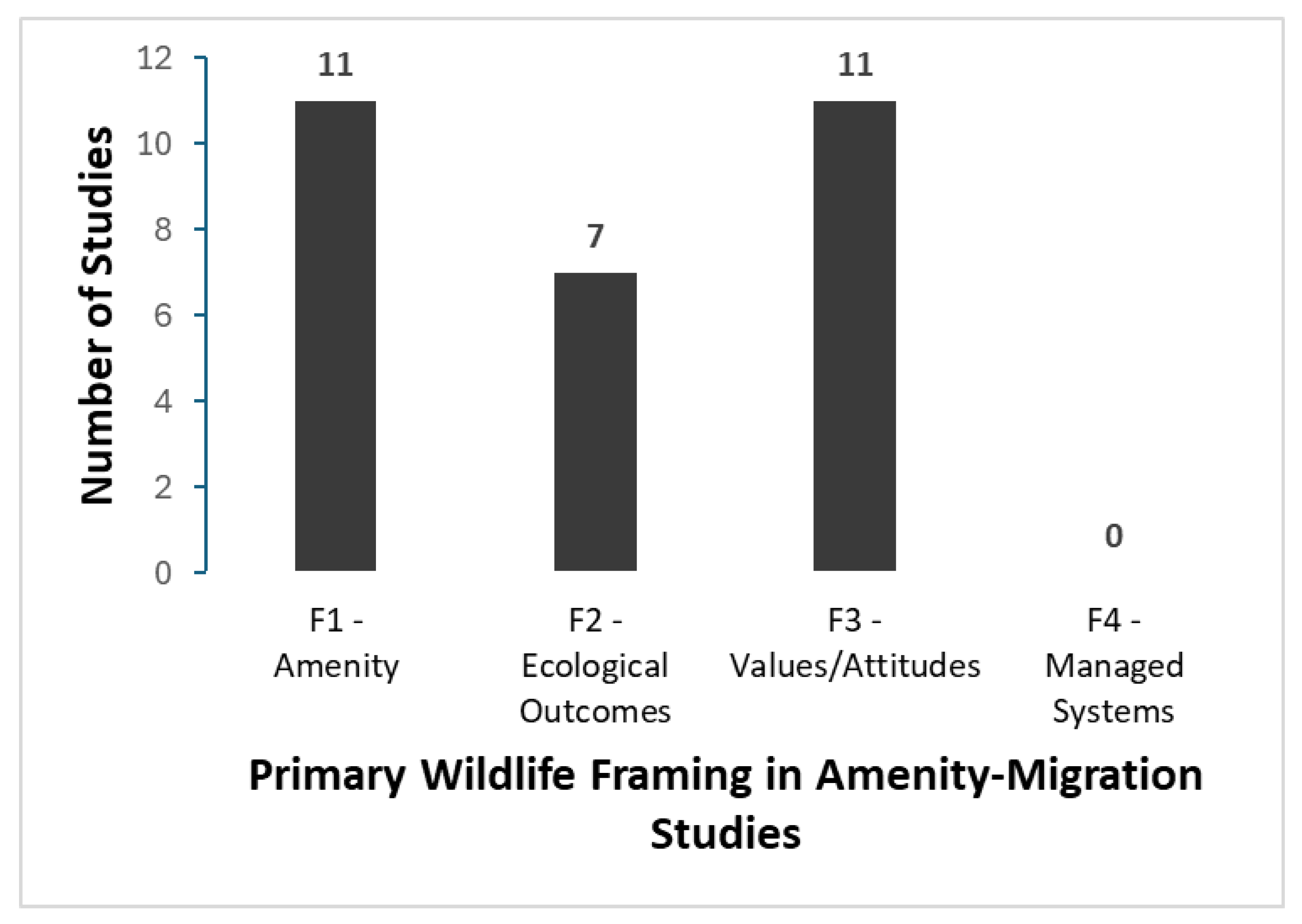

Table 1.
Amenity-migration studies reviewed and classification of wildlife framing. Studies were classified based on whether wildlife was mentioned, the dominant way wildlife was framed, and whether wildlife management practices or governance processes were explicitly analyzed. Framing reflects the primary emphasis of each study.
Table 1.
Amenity-migration studies reviewed and classification of wildlife framing. Studies were classified based on whether wildlife was mentioned, the dominant way wildlife was framed, and whether wildlife management practices or governance processes were explicitly analyzed. Framing reflects the primary emphasis of each study.
| Citation (Author, Year [Ref #]) | Wildlife Mentioned | Primary Wildlife Framing | Wildlife Management Analyzed |
| Moss & Glorioso 2014 [3] | Yes | F1 | No |
| Matarrita-Cascante et al. 2025 [4] | Yes | F3 | No |
| Abrams et al. 2012 [5] | Yes | F1 | No |
| Krannich et al. 2011 [6] | Yes | F1 | No |
| Lekies et al. 2015 [7] | Yes | F1 | No |
| Cortes et al. 2017 [8] | Yes | F1 | No |
| Hansen et al. 2005 [9] | Yes | F2 | No |
| Gosnell & Abrams 2011 [11] | Yes | F1 | No |
| Gosnell & Travis 2005 [13] | Yes | F2 | No |
| Gosnell et al. 2006 [14] | Yes | F2 | No |
| Haggerty et al. 2022 [15] | Yes | F2 | No |
| Epstein et al. 2022 [16] | Yes | F2 | No |
| Lopez & Barrientos 2024 [18] | Yes | F3 | No |
| Hjerpe et al. 2020 [26] | Yes | F1 | No |
| Hjerpe et al. 2022 [27] | Yes | F1 | No |
| Matarrita-Cascante et al. 2026 [34] | Yes | F3 | No |
| Kruger et al. 2008 [35] | Yes | F1 | No |
| Dearien et al. 2005 [36] | Yes | F1 | No |
| Clendenning et al. 2005 [40] | Yes | F3 | No |
| Emmet Jones et al. 2003 [44] | Yes | F3 | No |
| Hurst & Kreuter 2021 [45] | Yes | F3 | No |
| Meadows et al. 2014 [46] | Yes | F3 | No |
| Ikutegbe et al. 2015 [47] | Yes | F3 | No |
| Argent et al. 2010 [48] | Yes | F2 | No |
| Post 2013 [54] | Yes | F1 | No |
| Klepeis et al. 2009 [58] | Yes | F2 | No |
| Sorice et al. 2012 [59] | Yes | F3 | No |
| Gill et al. 2010 [69] | Yes | F3 | No |
| Cooke & Lane 2015 [70] | Yes | F3 | No |
* Wildlife framing categories were defined as follows: F1 (Amenity): wildlife framed as an aesthetic, recreational, or symbolic attraction; F2 (Ecological outcome): wildlife framed as a consequence of land-use or demographic change; F3 (Values/attitudes): wildlife framed through landowner values, attitudes, or conservation orientations; F4 (Managed system): wildlife framed as an intentionally managed socio-ecological system.
Disclaimer/Publisher’s Note: The statements, opinions and data contained in all publications are solely those of the individual author(s) and contributor(s) and not of MDPI and/or the editor(s). MDPI and/or the editor(s) disclaim responsibility for any injury to people or property resulting from any ideas, methods, instructions or products referred to in the content. |
© 2026 by the authors. Licensee MDPI, Basel, Switzerland. This article is an open access article distributed under the terms and conditions of the Creative Commons Attribution (CC BY) license (http://creativecommons.org/licenses/by/4.0/).
Copyright: This open access article is published under a Creative Commons CC BY 4.0 license, which permit the free download, distribution, and reuse, provided that the author and preprint are cited in any reuse.


