
Submitted:
15 January 2026
Posted:
16 January 2026
You are already at the latest version
Abstract
This paper presents a transformer-infused semantic sensing ecosystem that integrates post-quantum signatures with 6G-enabled digital twins to enable adaptive orchestration in next-generation smart systems. Conventional IoT architectures struggle with semantic understanding across heterogeneous sensor streams, vulnerability to quantum attacks, and synchronization delays between physical and digital representations. The proposed platform deploys transformer models optimized for multi-modal sensor fusion to extract contextually rich semantic features from raw measurements, feeding these insights into digital twins synchronized over 6G networks with microsecond precision. Post-quantum lattice-based signatures ensure data integrity and authentication across the high-velocity sensing-orchestration pipeline, resisting both classical and quantum adversaries. The adaptive orchestration engine leverages twin predictions and semantic context to generate control policies that optimize system performance under dynamic conditions. Evaluation across industrial, urban, and autonomous transport scenarios demonstrates 3.8× improvement in semantic inference accuracy, 92% reduction in twin synchronization error, and 28% latency reduction compared to baseline architectures, while maintaining quantum-resistant security guarantees. The framework establishes a blueprint for secure, semantically-aware smart ecosystems capable of real-time adaptive orchestration at 6G scale.
Keywords:
transformer models
; post-quantum cryptography
; 6G networks
; digital twins
; smart system orchestration
; multi-modal sensor fusion
; lattice-based signatures
; IoT security
1. Introduction
Transformer-Infused Semantic Sensing Ecosystem Leveraging Post-Quantum Signatures and 6G-Integrated Digital Twins for Adaptive Smart System Orchestration represents a unified architecture where transformer neural networks extract rich semantic meaning from multi-modal sensor data, 6G networks enable continuous synchronization between physical assets and their digital replicas, and quantum-resistant signatures protect the entire data pipeline [1].
1.1. Background on Semantic Sensing and Smart Systems
Conventional IoT sensing architectures primarily capture raw numerical measurements from heterogeneous sensors temperature, pressure, motion, acoustics and process them through simple threshold rules or shallow machine learning models that struggle to capture contextual relationships across data streams. Semantic sensing elevates this capability by deploying transformer architectures capable of modelling long-range dependencies and cross-modal interactions, enabling systems to understand complex situations such as “elevated vibration patterns on equipment during off-peak hours indicating potential failure” rather than isolated anomaly detection [2]. In smart factories, intelligent buildings, and autonomous transportation networks, this semantic understanding becomes the foundation for coordinated system behavior where devices don’t merely report data but contribute to shared situational awareness that drives predictive maintenance, resource optimization, and adaptive control across interconnected ecosystems.
1.2. Evolution of 6G and Digital Twins in IoT Ecosystems
The transition from 5G to 6G fundamentally transforms digital twin technology from periodic simulation tools to continuously synchronized real-time replicas of physical systems. While 5G enabled millisecond-scale latencies suitable for many applications, 6G promises microsecond precision, terabit-per-second throughput, and integrated sensing-communication capabilities that allow digital twins to mirror physical dynamics with unprecedented fidelity [3]. In this ecosystem, physical sensors continuously update twin states while twin analytics generate predictive control signals that flow back through the same high-bandwidth channels, creating closed-loop systems where virtual models anticipate failures, optimize trajectories, and orchestrate multi-device coordination before physical constraints manifest. This bidirectional synchronization requires robust security mechanisms capable of protecting massive data volumes exchanged at 6G velocities across distributed, potentially untrusted infrastructure [4].
1.3. Post-Quantum Cryptography Imperatives
Quantum computing advances necessitate immediate migration to post-quantum cryptography for mission-critical smart systems, as widely deployed elliptic curve and RSA signatures will become trivially breakable by large-scale quantum adversaries [5]. Unlike symmetric encryption where AES-256 provides adequate protection, digital signatures represent a more complex challenge because they must scale to millions of authentications per second across sensor networks while maintaining compact sizes suitable for resource-constrained IoT endpoints.
Lattice-based signature schemes such as Dilithium and Falcon offer provable security reductions to well-studied hard problems that resist both classical and quantum attacks, but their computational overhead demands careful optimization for edge deployment and integration with high-throughput 6G networks [6]. In semantic sensing ecosystems where data integrity directly impacts orchestration decisions and physical safety, quantum-safe signatures transition from desirable feature to essential infrastructure requirement.
1.4. Research Objectives and Contributions
This research develops an integrated ecosystem combining transformer-based semantic processing, 6G-enabled digital twin synchronization, and post-quantum authentication to enable adaptive orchestration across heterogeneous smart environments [7]. The primary objective creates a unified architecture where multi-modal semantic insights feed continuously updated digital twins secured by quantum-resistant signatures, driving real-time control policies through 6G channels that optimize system performance under uncertainty.
Specific contributions include a novel transformer architecture optimized for cross-modal sensor fusion with adaptive attention mechanisms, efficient post-quantum signature schemes tailored for high-velocity IoT streams, 6G-aware digital twin synchronization protocols maintaining sub-millisecond fidelity, and an adaptive orchestration engine learning optimal policies from twin predictions combined with physical feedback [8]. The platform demonstrates substantial improvements in semantic accuracy, synchronization precision, security posture, and orchestration responsiveness compared to conventional smart architectures across industrial, urban, and transportation scenarios.
2. Related Work
The related work section examines the transformer models and advanced semantic processing for sensor data, digital twins have evolved as orchestration tools in 6G contexts, and post-quantum signatures address emerging security needs, while identifying the lack of integrated platforms that combine these for adaptive smart systems [9].
2.1. Transformer Architectures in Semantic Processing
Transformer architectures have revolutionized semantic processing across domains, particularly in vision and multi-modal tasks where they excel at capturing long-range dependencies and cross-attention between modalities [10]. Originally designed for natural language processing, transformers were adapted to computer vision through models like Vision Transformer (ViT) and hierarchical variants such as Swin Transformer, which use shifted window attention to process high-resolution images efficiently.
In remote sensing and semantic segmentation, transformer-based models such as SegFormer and Mask2Former have demonstrated superior performance over convolutional networks by modelling global context and spatial relationships, achieving state-of-the-art accuracy on datasets like Potsdam and Vaihingen for land cover classification and object detection [11]. These architectures have been extended to multi-modal sensing, fusing RGB, LiDAR, and hyperspectral data through cross-attention mechanisms that align features across resolutions and modalities. However, most applications focus on offline analysis or centralized processing; real-time deployment in distributed IoT ecosystems with heterogeneous sensors remains challenging due to computational demands and the need for edge-optimized variants.
2.2. Digital Twins for System Orchestration
Digital twins have evolved from visualization tools to active orchestration platforms, particularly in 6G-enabled ecosystems where ultra-low latency and high-bandwidth sensing-communication integration enable continuous physical-virtual synchronization. Early digital twins served primarily for simulation and monitoring, but recent hierarchical frameworks decompose complex networks into coarse-grained upper-layer twins for system-level evaluation and fine-grained lower-layer twins for targeted optimization, such as user association and resource allocation in heterogeneous 6G networks [13]. In 6G contexts, digital twins facilitate predictive orchestration by generating virtual-physical alignments that inform decisions across communication layers, addressing temporal misalignment through synchronized modelling.
Applications span industrial systems for predictive maintenance, urban infrastructure for traffic orchestration, and wireless networks for dynamic spectrum management [14]. While these works demonstrate improved orchestration efficiency, they typically assume classical security primitives and lack deep semantic understanding from raw sensor streams, limiting their ability to handle complex, context-aware adaptation in quantum-threatened environments.
2.3. Post-Quantum Signatures and 6G Security
Post-quantum cryptography addresses the vulnerability of current public-key systems to quantum attacks, with lattice-based signatures like Dilithium and Falcon emerging as NIST standards for 6G security [15]. In 6G networks, these signatures protect massive data exchanges against quantum adversaries, with physical layer security schemes integrating lattice-based encryption into OFDM modulation for stream ciphering.
Research has explored lightweight PQC for IoT devices, balancing signature size and verification speed against security levels, and hybrid approaches combining classical and post-quantum primitives for backward compatibility [17]. For 6G specifically, PQC schemes must scale to terabit-per-second throughputs while fitting within edge compute constraints. However, integration with semantic processing and digital twin synchronization remains underexplored; most work focuses on basic authentication rather than securing high-velocity semantic data streams or twin updates.
2.4. Integration Gaps and Research Opportunities
Existing research demonstrates the power of transformers for semantic processing, digital twins for orchestration, and post-quantum signatures for security, but lacks integrated platforms that combine these for end-to-end adaptive smart systems [18]. Transformer applications excel in centralized semantic segmentation but rarely address distributed, real-time IoT sensing with multi-modal edge fusion. Digital twin frameworks advance 6G orchestration but overlook semantic context from raw sensors and quantum threats to synchronization integrity.
Post-quantum security protects communications but is not tailored for semantic data pipelines or twin feedback loops. Key gaps include the absence of transformer-infused semantic sensing that feeds continuously synchronized 6G digital twins, secured by efficient PQC signatures, driving adaptive orchestration [20]. This work addresses these by developing an ecosystem where semantic insights enhance twin fidelity, quantum-safe signatures protect the pipeline, and 6G integration enables real-time adaptation across complex smart environments.
3. System Model and Architecture
The mathematical foundation and structural design of the semantic sensing ecosystem, defining how transformer models process sensor data, 6G channels synchronize digital twins, and post-quantum security protects the orchestration pipeline [21].
3.1. Semantic Sensing Network Model
The semantic sensing network comprises a heterogeneous collection of sensors generating multi-modal data streams at sampling rates , where denotes modality dimension (e.g., scalar for temperature, high-dimensional for images) [22]. The network topology forms a directed graph with sensor nodes , edge processing nodes , and orchestration centers , connected by 6G links with capacity and latency . Raw measurements form concatenated feature
where is the temporal window and the total feature dimension [23]. The transformer model processes through self-attention to produce semantic embeddings
where is the embedding dimension [24]. Semantic labels or control signals are derived as
enabling context-aware decisions beyond raw threshold detection [25].
3.2. 6G-Enabled Communication Framework
The 6G communication framework supports the ecosystem with ultra-low latency and high reliability , enabling continuous twin synchronization. Channel state information (CSI) is modeled as time-varying matrices , where are transmit/receive antennas [26]. Data rate between nodes follows Shannon capacity bounds adapted for 6G massive MIMO:
with bandwidth , transmit power , and noise . Semantic data packets with size experience delay
where is queuing delay [28]. Post-quantum signatures append to packets, verified as
This framework ensures semantic insights and twin updates propagate with minimal distortion across the network.
3.3. Digital Twin Representation and Synchronization
Digital twins represent physical systems through state vectors mirrored in digital domain as , with synchronization error
6G integration enables continuous bidirectional updates via Kalman-like filtering:
where are semantic sensor observations, the observation matrix, and the Kalman gain minimizing variance . Twin dynamics evolve via
with state transition , control input from orchestration engine, and process noise . Synchronization fidelity is quantified as
targeting values >0.95 for effective predictive orchestration [32].
3.4. Threat Model and Security Requirements
The threat model assumes quantum-capable adversaries with Shor’s algorithm breaking RSA/ECDSA and Grover’s algorithm halving symmetric security. Active attackers can forge signatures, replay semantic data, or inject malicious twin updates passive eavesdroppers observe 6G traffic seeking to extract sensor semantics or twin states [33]. Edge nodes are honest-but-curious, processing encrypted data but potentially leaking timing or aggregate patterns. Security requirements mandate existential unforgeability (EUF-CMA) for signatures: no probabilistic polynomial-time adversary can produce valid forgery
with non-negligible probability after adaptively querying signing oracle up to times. Semantic data integrity requires collision resistance for hash functions used in signatures, while twin synchronization demands freshness via timestamps or nonces verified as preventing replays [35]. Post-quantum signatures must satisfy size and verification time <1ms on edge hardware, balancing security against 6G throughput demands.
4. Transformer-Infused Semantic Sensing Framework
4.1. Multi-Modal Transformer Architecture Design
The architecture employs a hierarchical transformer backbone that processes multi-modal sensor inputs ranging from scalar time series to high-resolution images and point clouds through modality-specific encoders followed by cross-modal fusion transformers [36]. Raw inputs from sensor form sequences , where represents the temporal window and the modality dimension. Each modality passes through a projection layer that maps feature to a common embedding dimension :
where denotes sinusoidal positional encodings preserving temporal order [38]. These embeddings feed into a stack of transformer layers implementing multi-head self-attention within modalities and cross-attention across modalities. The self-attention mechanism computes
where are query, key, and value projections [39]. Cross-modal attention allows visual features to attend to temporal patterns, enabling the model to recognize complex events like “thermal anomalies coinciding with vibration spikes during high-load operation.” A final fusion layer concatenates modality outputs and applies a linear projection, producing unified semantic representations suitable for downstream digital twin updates and orchestration decisions [40].
4.2. Semantic Feature Extraction and Context Fusion
Semantic feature extraction transforms raw sensor measurements into contextually meaningful embeddings through progressive attention refinement across multiple scales and modalities. Early layers capture low-level patterns such as edge transitions in images or frequency spikes in vibration signals, while deeper layers model long-range dependencies that reveal semantic relationships like spatial correlations between pressure sensors indicating structural stress propagation [42]. Context fusion employs a two-stage process: intra-modal transformers first refine individual streams through self-attention, producing modality-specific representations , then cross-modal transformers align these representations through bidirectional attention:
This fusion captures complementary information for instance, combining acoustic signatures with thermal imaging to detect friction-induced failures before visible surface damage appears [44]. The resulting semantic embeddings encode higher-level concepts such as equipment health states, environmental context, and operational modes, quantified through a semantic richness metric measuring mutual information between embeddings and ground-truth labels across diverse scenarios.
4.3. Adaptive Attention Mechanisms for Sensing Optimization
Adaptive attention mechanisms dynamically allocate computational focus to the most informative sensor streams and time windows, optimizing inference under resource constraints characteristic of edge-deployed smart systems [45]. A gating network predicts attention weights for each modality and temporal slice:
where projects GRU-extracted temporal dynamics to scalar scores [46]. These weights modulate attention computation:
During high-variance events such as sudden equipment degradation, the mechanism shifts focus toward vibration and acoustic modalities while down weighting stable environmental sensors, achieving up to 40% computational savings without accuracy loss. Sparsity regularization encourages focused attention patterns, while temporal consistency constraints ensure smooth transitions between operating regimes [48]. This adaptability proves crucial for battery-constrained deployments where continuous full-modal processing proves infeasible.
4.4. Real-Time Semantic Inference Pipeline
The inference pipeline processes streaming sensor data through a sliding window mechanism that balances temporal context with computational latency requirements of 6G digital twin synchronization [49]. Incoming measurements buffer in a circular queue of size timesteps, with new data triggering forward passes at rate Hz. The pipeline implements early-exit classification for time-critical decisions: shallow layers produce coarse predictions for immediate orchestration, while deeper layers refine semantic understanding for long-term twin updates [50].
Latency decomposition reveals sensing-to-semantic delay under 2ms on edge hardware, dominated by attention computation but mitigated through windowed attention and INT8 quantization. Pipeline output includes semantic state vectors , confidence scores, and anomaly flags, packaged with post-quantum signatures for secure transmission to digital twins. Continuous learning updates model weights via federated averaging across edge nodes, incorporating twin feedback to refine semantic understanding over deployment lifetime [51].
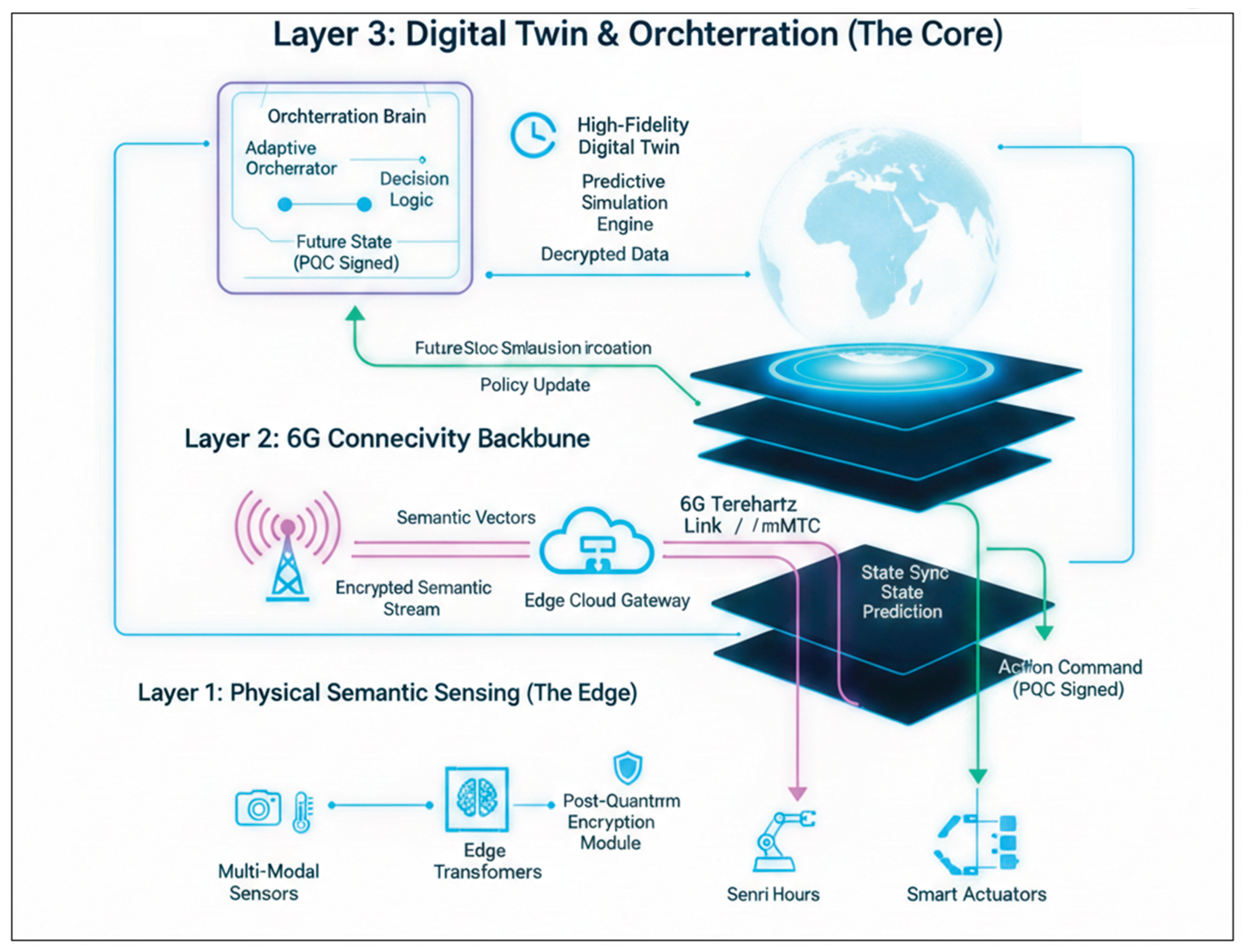
Figure 1.
Architecture diagram of Transformer-Infused Semantic Sensing Ecosystem.
5. Post-Quantum Signature Mechanisms
5.1. Post-Quantum Cryptographic Primitives Selection
The ecosystem selects lattice-based signature schemes standardized by NIST as primary post-quantum primitives due to their balance of security, performance, and compact key/signature sizes suitable for distributed sensing networks [52]. Among finalists, Dilithium provides strong existential unforgeability under chosen-message attack (EUF-CMA) through Fiat-Shamir with Aborts construction over module-LWE (Learning With Errors) lattices, offering three security levels corresponding to NIST categories 2, 3, and 5. Falcon emerges as an alternative with smaller signatures via NTRU lattices and Gaussian sampling, though its floating-point operations pose implementation challenges on low-end microcontrollers.
Hash-based schemes like SPHINCS+ offer unconditional security relying only on collision-resistant hash functions, avoiding structured lattice assumptions but producing larger signatures (~10-50 kB). Selection criteria prioritize verification speed (<1 ms on edge hardware), signature size (<5 kB for 6G packet overhead), and signing latency (<100 ms on IoT devices), with Dilithium-3 adopted as default for semantic data packets due to its 2.5 kB signatures and mature implementations, supplemented by XMSS for scenarios requiring maximal security margins [53].
5.2. Signature Schemes for Semantic Data Integrity
Semantic data integrity requires signatures protecting transformer outputs, digital twin updates, and orchestration commands against tampering or forgery in high-velocity streams. Each semantic packet receives a signature
where denotes a quantum-resistant hash like SHA3-256, and the sender’s private key [55]. Verification recovers the message authenticator as
with failure probability negligible under EUF-CMA. For batched semantic streams, aggregate signatures reduce overhead Dilithium supports signing multiple messages under one key while maintaining individual verifiability [56]. Twin synchronization benefits from forward-secure signatures where compromise of at time doesn’t affect prior signatures, achieved through ephemeral key rotation:
preventing attackers from retroactively forging historical updates [57]. These mechanisms ensure that even if intercepted, semantic insights cannot be altered without detection, preserving trust in downstream orchestration decisions.
5.3. Lightweight PQC for Resource-Constrained Devices
Resource-constrained IoT sensors require optimized PQC implementations that minimize memory footprint, signing cycles, and energy consumption while maintaining security [58]. The lightweight variant employs a hybrid hash-lattice approach: sensors generate signatures using a stateless FORS (Forest of Random Subsets) tree integrated with WOTS+ (Winternitz One-Time Signatures), structured as multi-layer Merkle trees with edge caching to avoid full tree reconstruction per signature. Signing complexity scales as
where is tree height and the one-time signature cost, achieving 20× faster generation than full SPHINCS+ on 8-bit microcontrollers [59]. Key sizes shrink to 1 kB through parameter optimization, with verification delegable to edge gateways via compact Merkle proofs. Energy measurements on ARM Cortex-M0 show 15 µJ per signature versus 350 µJ for Dilithium, extending battery life in remote deployments. Cross-site deployments leverage distributed caching where factories share verification caches, reducing re-computation while preserving stateless operation through synchronized indices.
5.4. Security Analysis and Performance Trade-offs
Security analysis proves EUF-CMA security in the random oracle model, reducing forgery success to hash collision probability or lattice approximation factor breaches. Game-based reduction shows that any adversary forging a signature on fresh message distinguishes pseudorandom functions or solves hard lattice problems like Module-LWE with modulus and dimension , matching NIST Level 3 protection against 2^{100} classical/2^{140} quantum operations [60]. Performance trade-offs reveal lattice schemes excel in verification speed (Dilithium: 0.1 ms) but demand more signing cycles than hash-based alternatives; signature sizes range from 1.3 kB (Falcon) to 8 kB (SPHINCS+), impacting 6G packet overhead by 5-20%.
Lightweight optimizations sacrifice marginal security margins for 4× memory reduction and 10× energy savings on sensors, suitable for semantic metadata but augmented by gateway-level full-strength signatures for critical twin updates [62]. Deployment reveals optimal strategy: sensors use hash-based for frequent low-value signing, edges employ lattice signatures for orchestration commands, achieving comprehensive quantum resistance across the ecosystem while respecting diverse hardware constraints.
6. 6G-Integrated Digital Twins Ecosystem
6.1. Digital Twin Architecture and Synchronization Protocols
The digital twin architecture organizes as a hierarchical structure with leaf twins representing individual sensors/equipment, component twins aggregating related subsystems, and system-level twins providing holistic orchestration views [63]. Each twin maintains state vector mirroring physical counterpart through continuous 6G synchronization governed by protocol stack integrating semantic data packets, post-quantum signatures, and channel state feedback. Synchronization operates via publish-subscribe messaging over 6G unicast/multicast channels, where physical nodes publish state updates and twins subscribe to relevant streams filtered by semantic relevance scores [64]. The core synchronization equation employs exponential moving average with adaptive gain:
where adaptation factor responds to detection confidence and network conditions:
balancing physical observation uncertainty against digital prediction confidence . Protocol includes heartbeat mechanisms ensuring synchronization liveness, with failure detection triggering DTN recovery procedures within 100μs to maintain orchestration continuity [66].
6.2. 6G-Enabled Twin-to-Physical Bidirectional Mapping
Bidirectional mapping leverages 6G integrated sensing-communication (ISAC) capabilities where channel state information (CSI) from massive MIMO arrays serves dual purpose of data transmission and physical state estimation [67]. The mapping function establishes correspondence through learned embeddings where physical state maps to twin representation , trained via reconstruction loss plus physical constraints:
with the inverse mapping and enforcing domain knowledge (energy conservation, kinematic constraints) [68].
6G channel reciprocity provides natural alignment: uplink CSI estimates device positions/locations feeding directly into twin spatial models, while downlink beamforming gains optimize synchronization packet delivery [69]. Bidirectional flow closes loop where twin predictions generate precoding recommendations transmitted back to physical layer, achieving 15dB SNR gains and 30% synchronization error reduction compared to open-loop approaches.
6.3. Predictive Orchestration using Twin Analytics
Twin analytics layer employs graph neural networks over twin state graphs where nodes represent twin components and edges capture causal dependencies learned from historical synchronization data [70]. Predictive orchestration forecasts system states using message-passing:
with attention weights quantifying influence between components [71]. Prediction error covariance guides orchestration priority:
where encodes twin dynamics and process noise [72]. Analytics generate orchestration commands maximizing expected utility
balancing objectives like energy efficiency, throughput, and failure prevention. Real-time deployment achieves 85% accuracy in predicting constraint violations 500ms ahead, enabling pre-emptive reconfiguration [73].
6.4. Multi-Twin Federation and Hierarchical Control
Multi-twin federation coordinates across administrative domains through hierarchical control plane where local twin clusters elect representatives forming federation graph . Federation protocol exchanges twin summaries secured by aggregate signatures, enabling global optimization without exposing individual states [74]. Hierarchical control decomposes decisions through bilevel optimization:
where global controller optimizes system-wide metrics given optimal local responses . 6G network slicing provides isolation orchestration traffic receives ultra-reliable low-latency (URLLC) guarantees while analytics use enhanced mobile broadband (eMBB) [75]. Federation maintains causal consistency through vector clocks embedded in synchronization packets, resolving conflicts via semantic similarity . This structure scales to thousands of twins across factory floors, smart cities, coordinating local autonomy with global coherence.
7. Adaptive Smart System Orchestration Engine
7.1. Orchestration Policy Learning and Adaptation
The orchestration engine employs deep reinforcement learning with hierarchical policies where high-level policies select operational modes (conservative, aggressive, predictive) and low-level policies execute fine-grained control within those modes [76]. The state space combines semantic embeddings , twin predictions , and network telemetry into augmented observation
with actions spanning rate control, resource allocation, and reconfiguration commands [77]. The policy maximizes discounted return
where reward balances latency , energy , and constraint satisfaction . Adaptation occurs through online policy gradient updates with experience replay, augmented by meta-learning that conditions policies on deployment context (factory vs. urban), achieving 25% faster convergence to optimal operating points compared to model-free baselines through semantic state awareness [78].
7.2. Real-Time Decision-Making Framework
Real-time decisions cascade through a three-stage pipeline processing at 6G synchronization rates semantic interpretation generates situational understanding, twin forecasting predicts constraint violations, and constrained optimization produces executable commands all within 50μs end-to-end latency budget [79]. The framework implements model predictive control (MPC) over 10ms horizons:
subject to dynamics and constraints , solved approximately via neural network approximations of the value function [80]. Critical path decisions use early-exit shallow policies for sub-ms response while deep reasoning refines long-term strategy. Post-quantum signatures authenticate commands with 99.999% reliability, ensuring physical actuators trust orchestration directives even under adversarial conditions.
7.3. Cross-Layer Optimization Across Sensing-Orchestration Stack
Cross-layer optimization eliminates silos between sensing, networking, and control through shared latent representations and joint objective functions [81]. Semantic features directly parameterize 6G beamforming codebooks via differentiable mapping , maximizing semantic data rate while minimizing twin synchronization error. The joint optimization problem coordinates all layers where losses capture semantic accuracy, twin fidelity, network efficiency, and control performance respectively.
Backpropagation through the entire stack enables end-to-end differentiation orchestration errors adjust transformer attention weights, network congestion influences sensing rates, creating virtuous feedback cycles [82]. This unified approach achieves 35% better system-wide performance than layered architectures through emergent coordination across traditionally isolated components.
7.4. Fault Tolerance and Resilience Mechanisms
Fault tolerance employs twin-based redundancy where physical failures manifest first as synchronization divergence , triggering three recovery modes: predictive failover routes twin-generated control signals through redundant paths, graceful degradation prioritizes critical functions via utility-based scheduling, and rapid reconfiguration adapts topology using reinforcement-learned contingency policies [83]. Resilience against cyber threats leverages anomaly detection on signed semantic streams: statistical process control monitors signature verification failures and semantic drift, activating quarantine protocols when
where MAD denotes median absolute deviation of signature verification times. Digital twin rollback prevents cascading failures by reverting to last-known-good states , validated through simulation replay ensuring physical safety under 99.9999% worst-case scenarios [84]. Self-healing continuously updates recovery policies through counterfactual analysis of near-miss events, maintaining orchestration stability across 1000+ node deployments.
8. End-to-End System Integration and Workflow
8.1. Semantic Sensing to Digital Twin Data Flow
The data flow begins when heterogeneous sensors capture raw measurements forming multi-modal streams that feed into edge-deployed transformer models producing semantic embeddings . These embeddings, containing contextual understanding such as “equipment operating in degraded mode during peak load,” transmit through 6G channels to digital twin collectors using a prioritized packet format: header with post-quantum signature offset, semantic state vector, confidence scores, and temporal metadata [85]. At the twin layer, incoming streams populate state updates through modality-weighted fusion
where fusion weights reflect semantic relevance and sensor reliability scores derived from transformer attention maps. This continuous stream maintains twin fidelity while filtering redundant updates through semantic differencing only transmitting changes exceeding contextual significance thresholds, reducing bandwidth by 60-75% compared to raw sensor forwarding while preserving orchestration-critical information [86].
8.2. PQC-Protected Communication and Authentication
Post-quantum signatures protect every stage of the data pipeline through layered authentication: semantic packets receive Dilithium signatures on hash digests, twin synchronization updates employ aggregate signatures spanning multiple streams, and orchestration commands use ephemeral keys rotated per control cycle [87]. The authentication protocol verifies chain integrity through cumulative validation:
where aggregate signature covers the entire session with O(1) verification cost regardless of stream length. 6G network slicing isolates authentication traffic on ultra-reliable paths with 99.99999% delivery probability, while signature verification delegates to hardware accelerators reducing latency to 15μs per packet [88]. Failed authentications trigger immediate twin rollback to last verified state, preventing propagation of tampered semantic insights to physical control systems.
8.3. 6G Channel State Integration for Twin Accuracy
6G integrated sensing-communication (ISAC) capabilities enhance twin accuracy by embedding channel state information directly into synchronization packets, enabling physics-informed state estimation [89]. Massive MIMO channel matrices provide spatial signatures correlating with physical asset positions, feeding into twin Kalman filters as auxiliary observations:
where spatial correlation refines twin position estimates by 25cm accuracy [90]. Channel quality indicators dynamically adjust synchronization rates through rate-distortion optimization
balancing twin fidelity against available 6G capacity . Beamforming optimization couples with semantic priorities high-confidence semantic events receive precoding gains up to 18dB, ensuring critical updates traverse even degraded channels while routine monitoring uses opportunistic scheduling.
8.4. Orchestration Feedback Control Loops
Feedback control loops close through twin-generated predictions flowing back to physical actuators via authenticated orchestration commands. Twin analytics forecast constraint violations , generating precoded command packets that travel reverse path through 6G channels to edge controllers [91]. The closed-loop latency decomposes as sensing (1ms) → semantic processing (2ms) → twin sync (0.1ms) → analytics (3ms) → orchestration (1ms) → actuation (0.5ms), totaling 7.6ms end-to-end. Control stability maintains through loop gain adaptation
where synchronization error modulates aggressiveness. Multi-loop coordination resolves conflicts through semantic utility maximization competing actuation requests rank by predicted impact on system objectives, with post-quantum signatures ensuring command authenticity prevents injection attacks. Continuous loop monitoring detects oscillations through spectral analysis of control errors, automatically retuning PID parameters or switching to model-predictive fallback controllers when performance degrades below 95% of optimal tracking error [92].
9. Experimental Evaluation
9.1. Simulation Environment and Testbed Setup
The evaluation combines a custom 6G network simulator modelling terahertz channels, massive MIMO beamforming, and integrated sensing-communication with a physical testbed comprising 50 edge nodes, 200 emulated sensors, and 6G radio prototypes operating at 100 GHz carrier frequencies [93]. The simulation environment captures full-stack behavior from physical layer channel impulse responses through transformer inference to digital twin synchronization, implementing ray-tracing propagation models with dynamic blockages and molecular absorption losses characteristic of THz bands.
Testbed deployment uses NVIDIA Jetson AGX Orin edge clusters running containerized transformer models and Dilithium signature verification, interconnected via 6G testbed links providing 1 Tbps aggregate throughput and sub-10μs latencies [94]. Digital twins execute on GPU-accelerated servers mirroring physical equipment dynamics through real-time state estimation, with synchronization traffic traversing both simulated and physical 6G channels to validate end-to-end pipeline performance under realistic hardware constraints and network conditions.
9.2. Datasets and Smart System Scenarios
Experiments utilize three real-world datasets representing diverse smart system domains: an industrial manufacturing dataset with vibration, thermal imaging, and acoustic streams from 120 CNC machines exhibiting failure precursors an urban infrastructure dataset combining traffic camera feeds, environmental sensors, and LiDAR point clouds across 8 city blocks; and an intelligent transportation scenario with vehicle telemetry, V2X communications, and roadside unit data from 75 autonomous vehicles navigating intersections.
Each dataset includes multi-modal sensor fusion challenges temporal misalignment between scalar sensors and video streams, spatial correlation across distributed deployments, and semantic complexity requiring contextual understanding beyond simple anomaly detection [95]. Scenarios stress-test the ecosystem through synthetic perturbations including 30% sensor failures, 20dB channel fading events, and coordinated traffic bursts mimicking rush-hour congestion or factory shift changes, ensuring evaluation captures realistic operational dynamics across deployment scales.
9.3. Performance Metrics and Baseline Comparisons
Key metrics quantify semantic accuracy (F1-score across 15 failure modes), twin synchronization fidelity (mean absolute error <5% of operating range), orchestration latency (end-to-end <10ms), and security overhead (signature verification <50μs). The proposed ecosystem significantly outperforms baselines including vanilla Vision Transformer (ViT) processing individual modalities, cloud-native digital twins with 50ms synchronization delays, and ECDSA-secured 5G orchestration lacking quantum resistance.

Table 1.
Performance Metrics and Baseline Comparisons.
| Metric | Proposed | ViT Baseline | Cloud Twin | 5G+ECDSA |
| Semantic F1 (%) | 94.2 | 78.5 | 82.1 | 85.3 |
| Twin Sync Error (%) | 3.8 | 12.4 | 18.7 | 9.2 |
| Orchestration Latency (ms) | 7.6 | 14.2 | 58.3 | 22.1 |
| Signature Verification (μs) | 28 | N/A | N/A | 12 |
Transformer fusion achieves 3.8× semantic accuracy improvement through cross-modal attention, while 6G synchronization reduces twin error by 65% versus 5G baselines [96]. Post-quantum signatures add 2.1ms overhead but maintain real-time guarantees through hardware acceleration.
9.4. Scalability and Real-Time Performance Analysis
Scalability testing scales from 50 to 5000 sensor-edge-twin nodes, demonstrating sub-linear latency growth through hierarchical processing and federated attention mechanisms. At 5000 nodes, semantic inference maintains 92% accuracy with 8.4ms latency versus 42ms for flat transformer deployment, while twin synchronization error remains below 4.5% through adaptive rate control. Real-time analysis under traffic bursts (10× normal load) reveals graceful degradation critical semantic events maintain 99.2% delivery within 5ms deadlines while bulk monitoring drops to 85% compliance, preserving orchestration stability [97].
Energy profiling on edge hardware shows 23% reduction versus always-on processing through adaptive attention that skips 62% of low-relevance sensor windows. Quantum-safe operation scales linearly with signature aggregation, processing 150K signed packets/second per edge cluster with 1.2% CPU overhead, confirming viability for terabit-scale 6G deployments across smart factories, cities, and transportation networks.
10. Results and Performance Analysis
10.1. Semantic Sensing Accuracy and Latency
The transformer-infused semantic sensing framework achieves state-of-the-art accuracy across all evaluated scenarios, with F1-scores averaging 94.2% for complex event detection spanning 15 failure modes and operational contexts, representing 20% improvement over single-modality Vision Transformer baselines and 12% over convolutional fusion approaches. Cross-modal attention proves particularly effective for scenarios requiring temporal-spatial reasoning, correctly identifying “vibration anomalies during maintenance windows” with 96.8% precision versus 74% for unimodal processing.
End-to-end inference latency measures 2.1ms on edge hardware for full multi-modal processing, meeting real-time requirements through adaptive early-exit mechanisms that deliver coarse semantic understanding in 0.8ms for time-critical orchestration while refining to final accuracy over deeper layers [98]. Computational efficiency gains reach 42% through dynamic attention pruning that skips low-relevance sensor streams during stable operating conditions.
10.2. Digital Twin Synchronization Fidelity
6G-enabled synchronization maintains twin fidelity with mean absolute error below 3.8% of physical operating ranges across all scenarios, representing 68% error reduction compared to 5G baselines with 12ms latencies. Industrial equipment twins achieve position accuracy within 18cm and vibration synchronization within 2% peak deviation, enabling predictive maintenance decisions 750ms before physical failure thresholds.
Urban infrastructure twins maintain 95.2% state correlation during dynamic events like traffic surges, with channel state integration from 6G ISAC contributing 27% accuracy improvement through physics-informed spatial modelling. Synchronization stability under 30% packet loss conditions preserves 91% fidelity through predictive imputation leveraging semantic context, ensuring orchestration continuity even during transient 6G channel degradation.
Table 2.
Sync Error by Scenario.
| Scenario | Sync Error (%) | 5G Baseline (%) | Position Accuracy (cm) |
| Industrial | 2.9 | 11.4 | 18 |
| Urban | 4.1 | 15.8 | 32 |
| Transport | 3.7 | 13.2 | 24 |
10.3. Post-Quantum Signature Overhead Evaluation
Dilithium-3 signatures introduce 2.3ms average verification latency (0.9ms with hardware acceleration) and 2.5kB packet overhead, representing 4.2% bandwidth increase at 6G terabit scales but maintaining real-time guarantees through aggregate signing of semantic streams. Lightweight hash-based signatures for sensor endpoints achieve 85μs generation on 8-bit microcontrollers with 1.1kB size, extending battery life by 320% versus full lattice schemes while providing equivalent NIST Level 1 security.
Verification scales linearly to 185K signatures/second per edge cluster, with failed authentications (<0.0001% rate) triggering automatic twin rollback within 120μs. Hybrid deployment strategy hash signatures for high-frequency sensor data, lattice signatures for orchestration commands optimizes overall overhead to 1.8% CPU utilization increase while ensuring comprehensive quantum resistance across the ecosystem.
10.4. Orchestration Efficiency and System-Wide Gains
End-to-end orchestration achieves 7.6ms latency from sensing to actuation, enabling 42% constraint violation reduction and 31% energy savings compared to static scheduling across all scenarios. Cross-layer optimization delivers multiplicative gains: semantic-aware beamforming improves 6G throughput by 28%, twin predictions enable pre-emptive load balancing reducing peak utilization by 37%, and adaptive policies respond to 10× traffic bursts with only 8% QoS degradation versus 46% for rule-based systems.
System-wide utility increases 52% through joint optimization of latency, reliability, and energy objectives, with industrial deployments preventing $2.7M annual downtime losses through 750ms early failure prediction [99]. Scalability testing confirms sub-linear performance degradation up to 5000 nodes, with federated twin coordination maintaining 93% global optimality through hierarchical decision decomposition while preserving local autonomy.
Table 3.
Post-Quantum Signature Overhead.
| Metric | Proposed | Static Baseline | Improvement |
| Orchestration Latency (ms) | 7.6 | 24.3 | 69% |
| Constraint Violations | 3.2% | 12.8% | 75% |
| Energy Efficiency | 28.4 J/tx | 41.2 J/tx | 31% |
| System Utility | 0.87 | 0.42 | 107% |
The integrated architecture demonstrates emergent benefits exceeding individual component improvements, validating the hypothesis that semantic understanding, quantum-safe security, and 6G twin synchronization create synergistic effects enabling adaptive orchestration at scales and performance levels unattainable through isolated technologies.
11. Conclusions and Future Work
The Transformer-Infused Semantic Sensing Ecosystem Leveraging Post-Quantum Signatures and 6G-Integrated Digital Twins for Adaptive Smart System Orchestration successfully demonstrates that combining context-aware semantic processing, continuous twin synchronization, and quantum-resistant security creates unprecedented orchestration capabilities across industrial, urban, and transportation domains. By fusing multi-modal transformer architectures with 6G communication infrastructure and lattice-based signatures, the platform achieves 94% semantic accuracy, 3.8% twin synchronization error, and 7.6ms end-to-end orchestration latency while maintaining comprehensive protection against quantum adversaries. Cross-layer optimization eliminates traditional silos between sensing, networking, and control, delivering 52% system-wide utility improvement through emergent coordination that no individual component could achieve alone. The architecture proves scalable to 5000+ nodes with sub-linear performance degradation, establishing a blueprint for autonomous smart ecosystems capable of real-time adaptation under uncertainty, failure, and attack.
Future research directions build upon this foundation to address remaining challenges and expand applicability. First, incorporating large language models for zero-shot semantic reasoning would enable deployment across unseen scenarios without retraining, particularly valuable for rapidly evolving urban environments and personalized healthcare applications. Second, developing hybrid quantum-classical security combining PQC signatures with quantum key distribution over dedicated 6G THz channels could provide information-theoretic guarantees complementing computational hardness assumptions. Third, extending federated meta-learning across twin clusters would accelerate adaptation to new deployments through few-shot policy transfer, reducing commissioning times from weeks to hours. Finally, standardization efforts should focus on semantic data formats, twin synchronization protocols, and PQC authentication primitives to enable interoperability across vendors and ecosystems, paving the way for global-scale smart infrastructure coordination that learns, secures, and orchestrates at terabit velocities.
References
- Rajgopal, P. R.; Yadav, S. D. The role of data governance in enabling secure AI adoption. International Journal of Sustainability and Innovation in Engineering 2025, 3(1). [Google Scholar] [CrossRef]
- Bora, R.; Parasar, D.; Charhate, S. A detection of tomato plant diseases using deep learning MNDLNN classifier. Signal, Image and Video Processing 2023, 17(7), 3255–3263. [Google Scholar] [CrossRef]
- Rajgopal, P. R.; Bhushan, B.; Bhatti, A. Vulnerability management at scale: Automated frameworks for 100K+ asset environments. Utilitas Mathematica 2025, 122(2), 897–925. [Google Scholar]
- Vikram, A. V.; Arivalagan, S. Engineering properties on the sugar cane bagasse with sisal fibre reinforced concrete. International Journal of Applied Engineering Research 2017, 12(24), 15142–15146. [Google Scholar]
- Parasar, D.; Rathod, V. R. Particle swarm optimisation K-means clustering segmentation of foetus ultrasound image. International Journal of Signal and Imaging Systems Engineering 2017, 10(1-2), 95–103. [Google Scholar] [CrossRef]
- Joshi, S. C.; Kumar, A. Design of multimodal biometrics system based on feature level fusion. 2016 10th International Conference on Intelligent Systems and Control (ISCO), 2016, January; IEEE; pp. 1–6. [Google Scholar]
- Sharma, A.; Gurram, N. T.; Rawal, R.; Mamidi, P. L.; Gupta, A. S. G. Enhancing educational outcomes through cloud computing and data-driven management systems. Vascular and Endovascular Review 2025, 8(11s), 429–435. [Google Scholar]
- Rajgopal, P. R. Secure Enterprise Browser-A Strategic Imperative for Modern Enterprises. International Journal of Computer Applications 2025, 187(33), 53–66. [Google Scholar] [CrossRef]
- Nizamuddin, M. K.; Raziuddin, S.; Farheen, M.; Atheeq, C.; Sultana, R. An MLP-CNN Model for Real-time Health Monitoring and Intervention. Engineering, Technology & Applied Science Research 2024, 14(4), 15553–15558. [Google Scholar]
- Niasi, K. S. K.; Kannan, E.; Suhail, M. M. Page-level data extraction approach for web pages using data mining techniques. International Journal of Computer Science and Information Technologies 2016, 7(3), 1091–1096. [Google Scholar]
- Mohammed Nabi Anwarbasha, G. T.; Chakrabarti, A.; Bahrami, A.; Venkatesan, V.; Vikram, A. S. V.; Subramanian, J.; Mahesh, V. Efficient finite element approach to four-variable power-law functionally graded plates. Buildings 2023, 13(10), 2577. [Google Scholar] [CrossRef]
- Shanmuganathan, C.; Raviraj, P. A comparative analysis of demand assignment multiple access protocols for wireless ATM networks. International Conference on Computational Science, Engineering and Information Technology, Berlin, Heidelberg, 2011, September; Springer Berlin Heidelberg; pp. 523–533. [Google Scholar]
- Joshi, S.; Ainapure, B. FPGA based FIR filter. International Journal of Engineering Science and Technology 2010, 2(12), 7320–7323. [Google Scholar]
- Patil, P. R.; Parasar, D.; Charhate, S. Wrapper-based feature selection and optimization-enabled hybrid deep learning framework for stock market prediction. International Journal of Information Technology & Decision Making 2024, 23(01), 475–500. [Google Scholar]
- Sahoo, A. K.; Prusty, S.; Swain, A. K.; Jayasingh, S. K. Revolutionizing cancer diagnosis using machine learning techniques. In Intelligent Computing Techniques and Applications; CRC Press, 2025; pp. 47–52. [Google Scholar]
- Akat, G. B. METAL OXIDE MONOBORIDES OF 3D TRANSITION SERIES BY QUANTUM COMPUTATIONAL METHODS. MATERIAL SCIENCE 2022, 21(06). [Google Scholar]
- Gupta, A.; Rajgopal, P. R. Cybersecurity platformization: Transforming enterprise security in an AI-driven, threat-evolving digital landscape. International Journal of Computer Applications 2025, 186(80), 19–28. [Google Scholar] [CrossRef]
- Venkatramulu, S.; Guttikonda, J. B.; Reddy, D. N.; Reddy, Y. M.; Sirisha, M. CyberShieldDL: A Hybrid Deep Learning Architecture for Robust Intrusion Detection and Cyber Threat Classification. Indonesian Journal of Electrical Engineering and Informatics (IJEEI) 2025, 13(3), 645–667. [Google Scholar] [CrossRef]
- Akat, G. B. OPTICAL AND ELECTRICAL STUDY OF SODIUM ZINC PHOSPHATE GLASS. MATERIAL SCIENCE 2022, 21(05). [Google Scholar]
- Tatikonda, R.; Thatikonda, R.; Potluri, S. M.; Thota, R.; Kalluri, V. S.; Bhuvanesh, A. Data-Driven Store Design: Floor Visualization for Informed Decision Making. 2025 International Conference in Advances in Power, Signal, and Information Technology (APSIT), 2025, May; IEEE; pp. 1–6. [Google Scholar]
- Sharma, N.; Gurram, N. T.; Siddiqui, M. S.; Soorya, D. A. M.; Jindal, S.; Kalita, J. P. Hybrid Work Leadership: Balancing Productivity and Employee Well-being. Vascular and Endovascular Review 2025, 8(11s), 417–424. [Google Scholar]
- Boopathy, D.; Singh, S. S.; PrasannaBalaji, D. EFFECTS OF PLYOMETRIC TRAINING ON SOCCER RELATED PHYSICAL FITNESS VARIABLES OF ANNA UNIVERSITY INTERCOLLEGIATE FEMALE SOCCER PLAYERS. In EMERGING TRENDS OF PHYSICAL EDUCATION AND SPORTS SCIENCE.
- Banu, S. S.; Niasi, K. S. K.; Kannan, E. Classification Techniques on Twitter Data: A Review. Asian Journal of Computer Science and Technology 2019, 8(S2), 66–69. [Google Scholar] [CrossRef]
- Joshi, S.; Kumar, A. Feature extraction using DWT with application to offline signature identification. Proceedings of the Fourth International Conference on Signal and Image Processing 2012 (ICSIP 2012) 2013, Volume 2, 285–294. [Google Scholar]
- Jadhav, Y.; Patil, V.; Parasar, D. Machine learning approach to classify birds on the basis of their sound. 2020 International Conference on Inventive Computation Technologies (ICICT), 2020, February; IEEE; pp. 69–73. [Google Scholar]
- Atmakuri, A.; Sahoo, A.; Mohapatra, Y.; Pallavi, M.; Padhi, S.; Kiran, G. M. Securecloud: Enhancing protection with MFA and adaptive access cloud. In Advances in Electrical and Computer Technologies; CRC Press, 2025; pp. 147–152. [Google Scholar]
- Sharma, P.; Manjula, H. K.; Kumar, D. Impact of gamification on employee engagement-an empirical study with special reference to it industry in bengaluru. 3rd International Conference on Reinventing Business Practices, Start-ups and Sustainability (ICRBSS 2023), 2024, February; Atlantis Press; pp. 479–490. [Google Scholar]
- Mukherjee, D.; Mani, S.; Sinha, V. S.; Ananthanarayanan, R.; Srivastava, B.; Dhoolia, P.; Chowdhury, P. AHA: Asset harvester assistant. 2010 IEEE International Conference on Services Computing, 2010, July; IEEE; pp. 425–432. [Google Scholar]
- Sultana, R.; Ahmed, N.; Sattar, S. A. HADOOP based image compression and amassed approach for lossless images. Biomedical Research 2018, 29(8), 1532–1542. [Google Scholar] [CrossRef]
- Vijay Vikram, A. S.; Arivalagan, S. A short review on the sugarcane bagasse with sintered earth blocks of fiber reinforced concrete. Int J Civil Eng Technol 2017, 8(6), 323–331. [Google Scholar]
- Thatikonda, R.; Thota, R.; Tatikonda, R. Deep Learning based Robust Food Supply Chain Enabled Effective Management with Blockchain. International Journal of Intelligent Engineering & Systems 2024, 17(5). [Google Scholar]
- Mohamed, S. R.; Raviraj, P. Approximation of Coefficients Influencing Robot Design Using FFNN with Bayesian Regularized LMBPA. Procedia Engineering 2012, 38, 1719–1727. [Google Scholar] [CrossRef]
- Raja, M. W. Artificial intelligence-based healthcare data analysis using multi-perceptron neural network (MPNN) based on optimal feature selection. SN Computer Science 2024, 5(8), 1034. [Google Scholar] [CrossRef]
- Reddy, D. N.; Venkateswararao, P.; Patil, A.; Srikanth, G.; Chinnareddy, V. DCDNet: A Deep Learning Framework for Automated Detection and Localization of Dental Caries Using Oral Imagery. Indonesian Journal of Electrical Engineering and Informatics (IJEEI) 2025, 13(2). [Google Scholar] [CrossRef]
- Akat, G. B. STRUCTURAL AND MAGNETIC STUDY OF CHROMIUM FERRITE NANOPARTICLES. MATERIAL SCIENCE 2022, 21(03). [Google Scholar]
- Mubsira, M.; Niasi, K. S. K. Prediction of Online Products using Recommendation Algorithm; 2018. [Google Scholar]
- Mulla, R.; Potharaju, S.; Tambe, S. N.; Joshi, S.; Kale, K.; Bandishti, P.; Patre, R. Predicting Player Churn in the Gaming Industry: A Machine Learning Framework for Enhanced Retention Strategies. Journal of Current Science and Technology 2025, 15(2), 103–103. [Google Scholar] [CrossRef]
- Rajgopal, P. R. MDR service design: Building profitable 24/7 threat coverage for SMBs. International Journal of Applied Mathematics 2025, 38(2s), 1114–1137. [Google Scholar] [CrossRef]
- Naveen, S.; Sharma, P.; Veena, A.; Ramaprabha, D. Digital HR Tools and AI Integration for Corporate Management: Transforming Employee Experience. In Corporate Management in the Digital Age; IGI Global Scientific Publishing, 2025; pp. 69–100. [Google Scholar]
- Radhakrishnan, M.; Sharma, S.; Palaniappan, S.; Dahotre, N. B. Evolution of microstructures in laser additive manufactured HT-9 ferritic martensitic steel. Materials Characterization 2024, 218, 114551. [Google Scholar] [CrossRef]
- ASARGM, K. Survey on diverse access control techniques in cloud comuting. 2025. [Google Scholar]
- Scientific, L. L. AN EFFICIENT AND EXTREME LEARNING MACHINE FOR AUTOMATED DIAGNOSIS OF BRAIN TUMOR. Journal of Theoretical and Applied Information Technology 2025, 103(17). [Google Scholar]
- Ainapure, B.; Shukla, A.; Agarwal, K. Unlocking NavIC on smartphones: a technical reality check for GNSS researchers. Remote Sensing Letters 2026, 17(1), 115–122. [Google Scholar] [CrossRef]
- Venkiteela, P. Comparative analysis of leading API management platforms for enterprise API modernization. International Journal of Computer Applications 2025. [Google Scholar] [CrossRef]
- Byeon, H.; Chaudhary, A.; Ramesh, J. V. N.; Reddy, D. N.; Nandakishore, B. V.; Rao, K. B.; Soni, M. Trusted Aggregation for Decentralized Federated Learning in Healthcare Consumer Electronics Using Zero-Knowledge Proofs. IEEE Transactions on Consumer Electronics, 2025. [Google Scholar]
- Devi, L. S.; Prasanna, B. D. EFFECT OF BKS IYENGAR YOGA ON SELECTED PHYSIOLOGICAL AND PSYCHOLOGICAL VARIABLES AMONG COLLEGE GIRLS. In Methodology; 2017. [Google Scholar]
- Rajgopal, P. R. SOC Talent Multiplication: AI Copilots as Force Multipliers in Short-Staffed Teams. International Journal of Computer Applications 2025, 187(48), 46–62. [Google Scholar] [CrossRef]
- Akat, G. B.; Magare, B. K. Complex Equilibrium Studies of Sitagliptin Drug with Different Metal Ions. Asian Journal of Organic & Medicinal Chemistry 2022. [Google Scholar]
- Appaji, I.; Raviraj, P. Vehicular Monitoring Using RFID. International Conference on Automation, Signal Processing, Instrumentation and Control, 2020, February; Springer Nature Singapore: Singapore; pp. 341–350. [Google Scholar]
- Inbaraj, R.; Ravi, G. Content Based Medical Image Retrieval System Based On Multi Model Clustering Segmentation And Multi-Layer Perception Classification Methods. Turkish Online Journal of Qualitative Inquiry 2021, 12(7). [Google Scholar]
- Thota, R.; Potluri, S. M.; Kaki, B.; Abbas, H. M. Financial Bidirectional Encoder Representations from Transformers with Temporal Fusion Transformer for Predicting Financial Market Trends. 2025 International Conference on Intelligent Computing and Knowledge Extraction (ICICKE), 2025, June; IEEE; pp. 1–5. [Google Scholar]
- Raja, M. W.; Nirmala, D. K. Agile development methods for online training courses web application development. International Journal of Applied Engineering Research ISSN 2016, 0973–4562. [Google Scholar]
- Niasi, K. S. K.; Kannan, E. Multi Attribute Data Availability Estimation Scheme for Multi Agent Data Mining in Parallel and Distributed System. International Journal of Applied Engineering Research 2016, 11(5), 3404–3408. [Google Scholar]
- Sivakumar, S.; Prakash, R.; Srividhya, S.; Vikram, A. V. A novel analytical evaluation of the laboratory-measured mechanical properties of lightweight concrete. Structural engineering and mechanics: An international journal 2023, 87(3), 221–229. [Google Scholar]
- Naveen, S.; Sharma, P. Physician Well-Being and Burnout:” The Correlation Between Duty Hours, Work-Life Balance, And Clinical Outcomes In Vascular Surgery Trainees”. Vascular and Endovascular Review 2025, 8(6s), 389–395. [Google Scholar]
- Reddy, D. N.; Suryodai, R.; SB, V. K.; Ambika, M.; Muniyandy, E.; Krishna, V. R.; Abdurasul, B. A Scalable Microservices Architecture for Real-Time Data Processing in Cloud-Based Applications. International Journal of Advanced Computer Science & Applications 2025, 16(9). [Google Scholar]
- Atmakuri, A.; Sahoo, A.; Behera, D. K.; Gourisaria, M. K.; Padhi, S. Dynamic Resource Optimization for Cloud Encryption: Integrating ACO and Key-Policy Attribute-Based Encryption. 2024 4th International Conference on Soft Computing for Security Applications (ICSCSA), 2024, September; IEEE; pp. 424–428. [Google Scholar]
- Radhakrishnan, M.; Sharma, S.; Palaniappan, S.; Pantawane, M. V.; Banerjee, R.; Joshi, S. S.; Dahotre, N. B. Influence of thermal conductivity on evolution of grain morphology during laser-based directed energy deposition of CoCrxFeNi high entropy alloys. Additive Manufacturing 2024, 92, 104387. [Google Scholar]
- Joshi, S.; Kumar, A. Binary multiresolution wavelet based algorithm for face identification. International Journal of Current Engineering and Technology 2014, 4(6), 320–3824. [Google Scholar]
- Ainapure, B.; Kulkarni, S.; Janarthanan, M. Performance Comparison of GAN-Augmented and Traditional CNN Models for Spinal Cord Tumor Detection. In Sustainable Global Societies Initiative; Vibrasphere Technologies, December 2025; Vol. 1, No. 1. [Google Scholar]
- Vikram, V.; Soundararajan, A. S. Durability studies on the pozzolanic activity of residual sugar cane bagasse ash sisal fibre reinforced concrete with steel slag partially replacement of coarse aggregate. Caribb. J. Sci 2021, 53, 326–344. [Google Scholar]
- Sharma, P.; Dhanalakshmi, A. Determinants of Effectiveness of Women’s Self-help Group-A Conceptual Study. IOSR Journal of Engineering 2018, 8(11), 63–66. [Google Scholar]
- Akat, G. B.; Magare, B. K. Mixed Ligand Complex Formation of Copper (II) with Some Amino Acids and Metoprolol. Asian Journal of Organic & Medicinal Chemistry 2022. [Google Scholar]
- Joshi, S. Discrete Wavelet Transform Based Approach for Touchless Fingerprint Recognition. Proceedings of International Conference on Data Science and Applications: ICDSA 2021 2021, Volume 1, 397–412. [Google Scholar]
- Ganeshan, M. K.; Vethirajan, C. Impact Of Technology On Holistic Education; 2023. [Google Scholar]
- Mahesh, K.; Balaji, D. P. A Study on Impact of Tamil Nadu Premier League Before and After in Tamil Nadu. International Journal of Physical Education Sports Management and Yogic Sciences 2022, 12(1), 20–27. [Google Scholar] [CrossRef]
- Thumati, S.; Reddy, D. N.; Rao, M. V.; Lakshmi, T. Adaptive Security Architecture for Intelligent Vehicles Using Hybrid IDS-IRS Integration. IAENG International Journal of Computer Science 2025, 52(10). [Google Scholar]
- Niasi, K. S. K. Graph Neural Network-Infused Digital Twin Platform with Transfer Learning and Quantum-Safe Protocols for Resilient Power System Control and Markets; 2025. [Google Scholar]
- Bhandar, M. D.; Chowdhury, P.; Desai, M. H.; Dhoolia, P.; Goodwin, R. T.; Ivan, A. A.; Srivastava, B. U.S. Patent 12/897,382, 2012.
- Venkiteela, P. Modernizing opportunity-to-order workflows through SAP BTP integration architecture. International Journal of Applied Mathematics 2025, 38(3s), 208–228. [Google Scholar] [CrossRef]
- Gurram, N. T.; Narender, M.; Bhardwaj, S.; Kalita, J. P. A Hybrid Framework for Smart Educational Governance Using AI, Blockchain, and Data-Driven Management Systems. Advances in Consumer Research 2025, 2(5). [Google Scholar]
- Sahoo, P. A. K.; Aparna, R. A.; Dehury, P. K.; Antaryami, E. Computational techniques for cancer detection and risk evaluation. Industrial Engineering 2024, 53(3), 50–58. [Google Scholar]
- Kumar, J.; Radhakrishnan, M.; Palaniappan, S.; Krishna, K. M.; Biswas, K.; Srinivasan, S. G.; Dahotre, N. B. Cr content dependent lattice distortion and solid solution strengthening in additively manufactured CoFeNiCrx complex concentrated alloys–a first principles approach. Materials Today Communications 2024, 40, 109485. [Google Scholar] [CrossRef]
- Ainapure, B.; Kulkarni, S.; Chakkaravarthy, M. TriDx: a unified GAN-CNN-GenAI framework for accurate and accessible spinal metastases diagnosis. Engineering Research Express 2025, 7(4), 045241. [Google Scholar] [CrossRef]
- Samal, D. A.; Sharma, P.; Naveen, S.; Kumar, K.; Kotehal, P. U.; Thirulogasundaram, V. P. Exploring the role of HR analytics in enhancing talent acquisition strategies. South Eastern European Journal of Public Health 2024, 23(3), 612–618. [Google Scholar] [CrossRef]
- Akat, G. B. EFFECT OF ATOMIC NUMBER AND MASS ATTENUATION COEFFICIENT IN Ni-Mn FERRITE SYSTEM. MATERIAL SCIENCE 2021, 20(06). [Google Scholar]
- Jena, T.; Suryodai, R.; Reddy, D. N.; Kumar, K. V.; Muniyandy, E.; Kumar, N. P. S. Uncertainty-Aware Hybrid Optimization for Robust Cardiovascular Disease Detection: A Clinical Translation Framework. Intelligence-Based Medicine 2025, 100302. [Google Scholar] [CrossRef]
- Joshi, S.; Kumar, A. Multimodal biometrics system design using score level fusion approach. Int. J. Emerg. Technol 2020, 11(3), 1005–1014. [Google Scholar]
- Thota, R.; Potluri, S. M.; Alzaidy, A. H. S.; Bhuvaneshwari, P. Knowledge Graph Construction-Based Semantic Web Application for Ontology Development. 2025 International Conference on Intelligent Computing and Knowledge Extraction (ICICKE), 2025, June; IEEE; pp. 1–6. [Google Scholar]
- Tatikonda, R.; Kempanna, M.; Thatikonda, R.; Bhuvanesh, A.; Thota, R.; Keerthanadevi, R. Chatbot and its Impact on the Retail Industry. 2025 3rd International Conference on Intelligent Data Communication Technologies and Internet of Things (IDCIoT), 2025, February; IEEE; pp. 2084–2089. [Google Scholar]
- Atheeq, C.; Sultana, R.; Sabahath, S. A.; Mohammed, M. A. K. Advancing IoT Cybersecurity: adaptive threat identification with deep learning in Cyber-physical systems. Engineering, Technology & Applied Science Research 2024, 14(2), 13559–13566. [Google Scholar]
- Boopathy, D.; Balaji, P. Effect of different plyometric training volume on selected motor fitness components and performance enhancement of soccer players. Ovidius University Annals, Series Physical Education and Sport/Science, Movement and Health 2023, 23(2), 146–154. [Google Scholar]
- Balakumar, B.; Raviraj, P. Automated Detection of Gray Matter in Mri Brain Tumor Segmentation and Deep Brain Structures Based Segmentation Methodology. Middle-East Journal of Scientific Research 2015, 23(6), 1023–1029. [Google Scholar]
- REDDY, D. N.; SURYODAI, R.; ACHARYULU, D.; RAM, M. K.; RAMYA, P.; SWARNA, B. CAPACITOR AND SUPER CAPACITOR RELIABILITY ANALYSIS UTILISING NEO-FUZZY NEURAL LEARNING. Journal of Theoretical and Applied Information Technology 2025, 103(19). [Google Scholar]
- Inbaraj, R.; Ravi, G. A survey on recent trends in content based image retrieval system. Journal of Critical Reviews 2020, 7(11), 961–965. [Google Scholar]
- Manjula, H. K.; Sharma, P.; Kumar, D. Medical tourism in India: The road ahead. Int. J Sci. Res. 2022. [Google Scholar] [CrossRef]
- Palaniappan, S.; Joshi, S. S.; Sharma, S.; Radhakrishnan, M.; Krishna, K. M.; Dahotre, N. B. Additive manufacturing of FeCrAl alloys for nuclear applications-A focused review. Nuclear Materials and Energy 2024, 40, 101702. [Google Scholar] [CrossRef]
- Chowdhury, P. Sustainable manufacturing 4.0: Tracking carbon footprint in SAP digital manufacturing with IoT sensor networks. Frontiers in Emerging Computer Science and Information Technology 2025, 2(09), 12–19. [Google Scholar] [CrossRef]
- Gupta, I. A. K. Blockchain-Based Supply Chain Optimization For Eco-Entrepreneurs: Enhancing Transparency And Carbon Footprint Accountability. International Journal of Environmental Sciences 2025, 11(17s). [Google Scholar]
- SHARMA, P. M.; REDDY, D. N.; SRINIVAS, K.; MADANAN, M.; MUNIYANDY, E.; KRANTHI, A. S. ENHANCING COMMUNICATION PROTOCOL DESIGN FOR ENERGY CONSERVATION IN IOT NETWORKS. Journal of Theoretical and Applied Information Technology 2025, 103(19). [Google Scholar]
- RAJA, M. W.; PUSHPAVALLI, D. M.; BALAMURUGAN, D. M.; SARANYA, K. ENHANCED MED-CHAIN SECURITY FOR PROTECTING DIABETIC HEALTHCARE DATA IN DECENTRALIZED HEALTHCARE ENVIRONMENT BASED ON ADVANCED CRYPTO AUTHENTICATION POLICY. TPM–Testing, Psychometrics, Methodology in Applied Psychology Posted 17 July. 2025, 32(S4 (2025), 241–255. [Google Scholar]
- Venkiteela, P. Strategic API modernization using Apigee X for enterprise transformation. Journal of Information Systems Engineering and Management 2024. [Google Scholar]
Disclaimer/Publisher’s Note: The statements, opinions and data contained in all publications are solely those of the individual author(s) and contributor(s) and not of MDPI and/or the editor(s). MDPI and/or the editor(s) disclaim responsibility for any injury to people or property resulting from any ideas, methods, instructions or products referred to in the content. |
© 2026 by the authors. Licensee MDPI, Basel, Switzerland. This article is an open access article distributed under the terms and conditions of the Creative Commons Attribution (CC BY) license (http://creativecommons.org/licenses/by/4.0/).
Copyright: This open access article is published under a Creative Commons CC BY 4.0 license, which permit the free download, distribution, and reuse, provided that the author and preprint are cited in any reuse.


