
Submitted:
14 January 2026
Posted:
15 January 2026
You are already at the latest version
Abstract
This paper argues that the Chinese Gai Tian (Heavenly Canopy) cosmology was an applied science, materialized through a sophisticated astronomical instrument. This argument is grounded in Cullen's (2017) systematic reconstruction of ancient Chinese astronomical systems, which establishes the Gai Tian as an operationally viable mathematical model rather than mere speculation1.Moving beyond textual analysis, we reconstruct the “Seven Circuits Instrument” (Qi Heng Yi) not as a device for generating the “Seven Circuits Diagram” (Qi Heng Tu), but as its physical instantiation—a multi-functional analog computer that operationalized the cosmic model for precise measurement.Here, we employ the term "operationalized" in a spirit aligned with Ian Hacking's core epistemological principle that intervening precedes representing2. The Qi Heng Yi’s primary function was not to represent a pre-existing theory but to provide a physical interface for user intervention and cosmic measurement, wherein knowledge is produced through the very act of measurement.This instrument embodies a distinct epistemological mode. Extending Daston and Galison's (2007) historical epistemology of objectivity, we identify in the Qi Heng Yi a form of "operational objectivity"—a reliability grounded in the calibrated harmony between instrumental practice and cosmological principle, rather than in mechanical self-registration or the elimination of human intervention3.Adopting the contrastive approach to the history of science championed by Lloyd (1996), this study juxtaposes the Greek tradition of geometric abstraction with the Chinese path of operative instantiation4. This comparison aims not to judge superiority but to bring into sharper relief the distinctive features of the "co-emergent instrument and principle" (Qi Li Gong Sheng) epistemology through systematic contrast.Through a synthesis of the mathematical principles in the Zhoubi Suanjing, a re-evaluation of Liangzhu-era Neolithic material culture, and the medical chronobiology of the Shanghan Lun, we demonstrate how this instrument enabled the direct determination of solar terms, timekeeping, and orientation. Our analysis reveals: 1. The Qi Heng Yi was the three-dimensional, operative realization of the two-dimensional Qi Heng Tu cosmogram.2. Liangzhu cong (jade tubes, c. 3300–2300 BCE) with their precise square-in-circle geometry and axial rotations, provided a material and conceptual prototype for this instrument-mediated cosmology.3. The Shanghan Lun’s “six-meridian resolution times” exhibit a kinematic correspondence with the sun’s paths in the Qi Heng system, illustrating the translation of instrumental astronomy into clinical principles.4. A continuous lineage exists from this instrument to later devices like the luopan (geomantic compass), which inherited its core cosmographic operating logic.This study proposes a “Diagram-to-Instrument” (Tu → Qi) paradigm, articulating the Chinese epistemology of “co-emergent instrument and principle” (Qi Li Gong Sheng) to challenge Eurocentric narratives of pre-modern science.This study further argues that the Qi Li Gong Sheng paradigm reached its most radical expression in the internalization of the instrument onto the human body itself, transforming the individual into a personalized, operational microcosm for celestial measurement and embodying a profound operational truth based on calibrated practice rather than external representation.
Keywords:
Gai Tian
; Qi Li Gong Sheng
; operational cosmology
; history of scientific instruments
; traditional Chinese medicine
; analog computation
; seven circuits instrument (Qi Heng Yi)
; Gougu Theorem
; Luopan
; embodied epistemology
1. A Paradigm of Operative Cosmology: The Gai Tian-Qi Heng Complex
1.1. From Cosmogram to Instrument: The Qi Heng Yi as a Physical Interface
In this study, we employ the term ‘operational cosmology’ to denote a cosmographic system that is not merely described theoretically but is materially instantiated in an instrument designed for direct measurement and application. Similarly, we characterize the Qi Heng Yi as an ‘analog computer’ because it physically embodies the mathematical relationships of the Gai Tian model, allowing for the direct reading of outputs (solar terms, time) from inputs (solar shadow/position) through mechanical analogy, rather than digital calculation.
Its design exemplifies what Galison (1997) has termed the interweaving of “image” and “logic” traditions [5]. The device’s Seven Circuits (qi heng) structure constitutes an imagistic cosmological model, while its mathematical proportions, derived from the Gougu (Pythagorean) theorem, provide its logical computational foundation. These two aspects are materially inseparable in the instrument’s construction, together forming the very basis of its operationalization.
Furthermore, we can understand the Qi Heng Yi as what Rheinberger (1997) conceptualizes as an “epistemic thing” [6]. It was not merely a passive carrier of established knowledge but an open experimental system capable of generating surprise and new knowledge. Through the process of calibration and use, practitioners could continually discover subtle discrepancies between theoretical expectations and actual observations, thereby deepening their understanding of the cosmological model itself.
Moreover, following Latour’s (1987) framework of “science in action,” the Qi Heng Yi functioned as a pivotal node within a broader network of knowledge production [7]. It connected heterogeneous elements—including gnomon measurements, ritual jade cong artifacts, calendrical systems, and medical practices—into a robust “actor-network” that collectively produced, rather than merely reflected, cosmological knowledge. The instrument’s epistemic authority derived precisely from this synergistic efficacy of the entire network.
Contrary to the Aristotelian model of geometrically idealized concentric spheres (De Caelo) [8], the Gai Tian cosmology was operationalized through a material interface—the Qi Heng Yi. This device did not output the Qi Heng Tu; it was the Qi Heng Tu translated into a functional, three-dimensional form. It established a synergistic cycle between model, instrument, and application:
“Qi Heng Tu (Theoretical Model/Design Blueprint) → Qi Heng Yi (Physical Interface/Operational Platform) → Real-time Measurement & Application (Seasons, Time, Direction)”
The instrument’s design was fundamentally derived from the Gougu theorem (Zhoubi Suanjing) [9], which provided the mathematical basis for its construction. The “round heaven, square earth” [10]worldview was not abstract; it became the physical structure of the instrument itself. This persistent material embodiment finds its early expression in Neolithic jade cong. These ritual artifacts, with their square outer form and circular inner bore, constituted prototypical instantiations of the cosmic order that the Qi Heng Yi would later quantify and operationalize.
1.2. Neolithic Prototypes: From the Liangzhu Cong as Conceptual Forerunner to the Taosi Complex as Operational Precursor
As detailed by Liu and Chen (2012), the Liangzhu society represents the zenith of late Neolithic complex societies in China [11]. Its remarkable material culture achievements, particularly the sophisticated jade work, provided the essential sociotechnical conditions for the institutionalized operationalization of a cosmology.
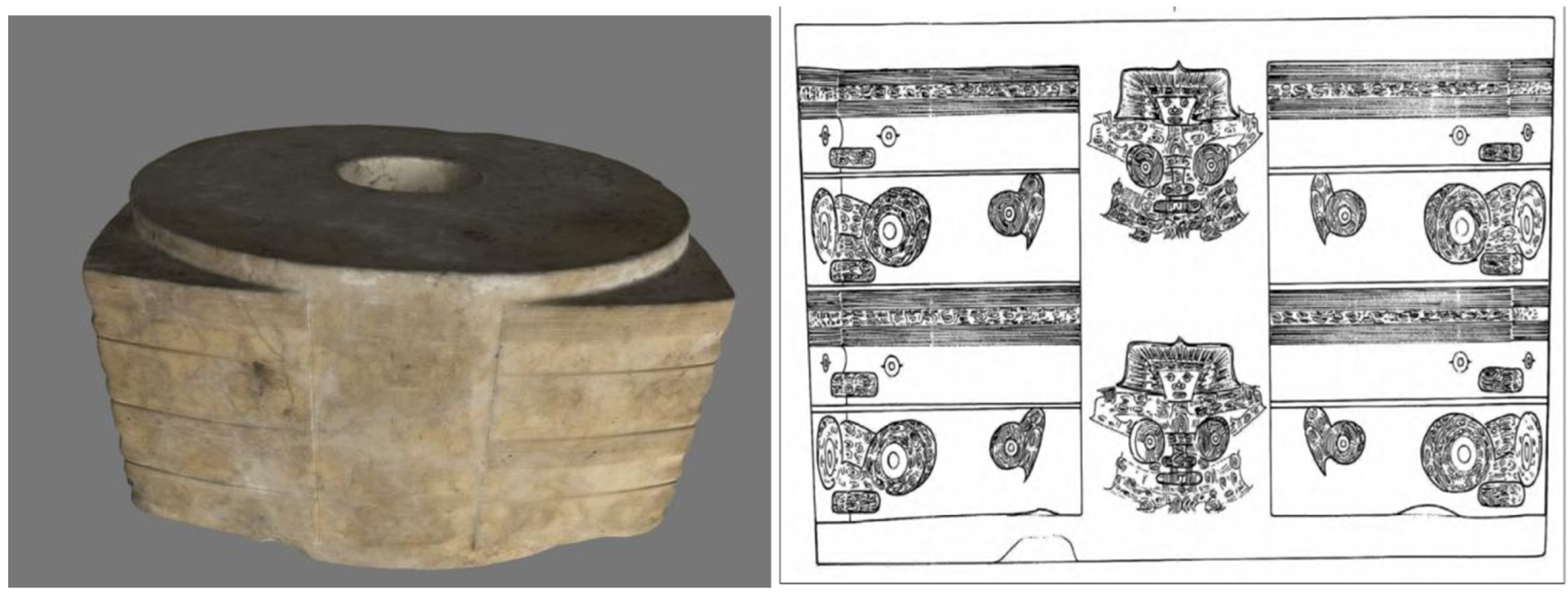
Allan (1991) has persuasively argued that the turtle-shaped metaphor of “round heaven, square earth” constituted a core element of early Chinese cosmogony [12]. The Liangzhu cong represents the earliest material instantiation of this metaphor, with its square outer form and circular inner bore providing not merely symbolic representation but the fundamental operational geometric prototype for later instruments like the Qi Heng Yi.
Keightley’s (2000) seminal work on the Shang “ancestral landscape” reveals how this cosmology permeated all aspects of social life, forming a continuous process of ordering space, time, and ancestry from the Neolithic through the Shang period [13]. The Liangzhu cong represents the Neolithic dawn of this enduring tradition, its precision serving the needs of theocratic governance.
The material and conceptual roots of this operative cosmology are traceable to a long-term evolutionary process, beginning with the Liangzhu cong (c. 3300–2900 BCE) [14]. The cong’s standardized form, embodying the ‘round heaven, square earth’ geometry [15], represents an initial phase of cosmographic conceptualization and symbolic materialization—a cultural and ideological preparation for later instrumentalization.However, the crucial transition from symbolic representation to quantified, operational practice is archaeologically attested at the Taosi site (c. 2500-1900 BCE) [16]. The discovery of a calibrated gnomon (IM22:43) [17]demonstrates the systematic measurement of solar shadow lengths [18], providing the empirical data foundation (e.g., solstice shadow lengths) essential for constructing any mathematical astronomy model like the ‘Seven Circuits and Six Intervals.’ This practice fundamentally supplied the raw data for calculating the radii of the outer and inner circuits (winter and summer solstice paths) in the Qi Heng model.Furthermore, the Taosi observatory (IIFJT1) [19], with its concentric rammed-earth structures, central observation point, and sighting slots [20], physically instantiated an operational paradigm of ‘a center point controlling multiple concentric circles.’ This three-dimensional architecture directly prefigured the Qi Heng Yi’s design principle. The Qi Heng Yi can be understood as the theoretical abstraction and miniaturization of this operational paradigm onto a two-dimensional, rotatable disk.Thus, while the Liangzhu cong provided an early morpho-cosmic ideal, the Taosi complex constitutes the critical missing link—the operational and instrumental precursor—that firmly bridges Neolithic cosmographic thought with the sophisticated theoretical instrumentation epitomized by the Qi Heng Yi in the Han era.
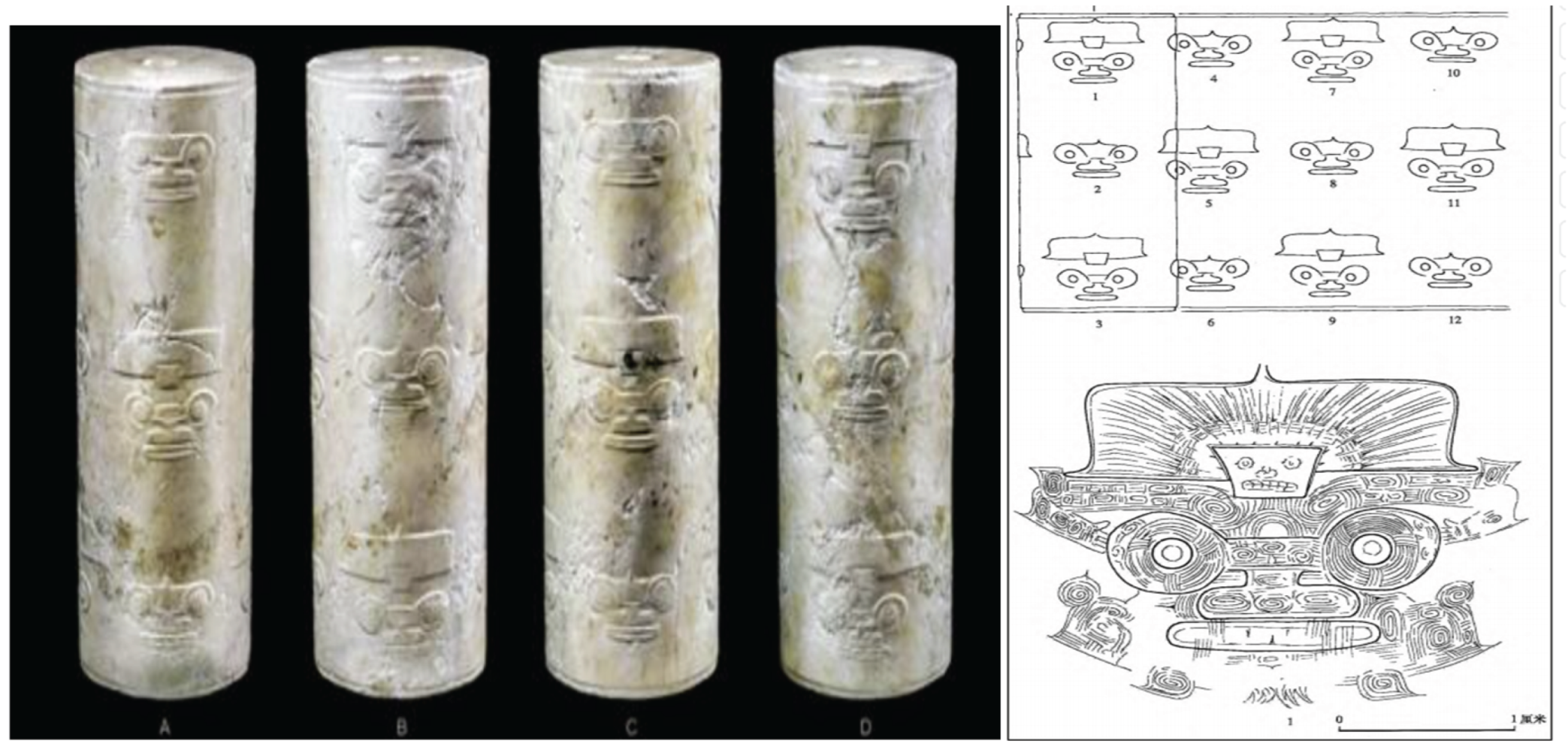
Figure 1.
M12:98 [21]The Supreme Jade Cong from Liangzhu,M12:87 [22]The columnar jade. Neolithic artifacts suggestive of nascent cosmographic schemas. Liangzhu cong, embodying the core cosmic geometry. The columnar jade M12:87, found adjacent to the Supreme Jade Cong from Liangzhu(M12:98) at Liangzhu and sized to fit its central aperture, likely served as a ritual insert. This combination conceptualized the cong’s shaft as a cosmic axis, a meaning reinforced by the shared iconography of divine ascent, together framing a pathway for communication between worlds. [23].
Figure 1.
M12:98 [21]The Supreme Jade Cong from Liangzhu,M12:87 [22]The columnar jade. Neolithic artifacts suggestive of nascent cosmographic schemas. Liangzhu cong, embodying the core cosmic geometry. The columnar jade M12:87, found adjacent to the Supreme Jade Cong from Liangzhu(M12:98) at Liangzhu and sized to fit its central aperture, likely served as a ritual insert. This combination conceptualized the cong’s shaft as a cosmic axis, a meaning reinforced by the shared iconography of divine ascent, together framing a pathway for communication between worlds. [23].
This instrument facilitated the direct, intuitive reading of celestial kinematics on a two-dimensional operative plane, contrasting with Greek models that often prioritized geometric abstraction prior to instrumental application.
This study’s reconstruction of the Qi Heng Yi is grounded in a methodological synthesis that prioritizes the internal mathematical logic of the Zhoubi Suanjing. We posit that the precise scalar relationships defining the Qi Heng Tu—such as the 19833.33 li intervals between circuits, derived from gnomon measurements (《周髀算经》:”是故一衡之间,万九千八百三十三里三分里之一,即为百步 [24].”)—necessitated its physical instantiation as a proportional, operational instrument to realize its stated calendrical and orientative functions. While no archaeological artifact explicitly labeled as a “Qi Heng Yi” [25]has been identified, our technical reconstruction is supported by a robust family of Han-era operative cosmograms. As Major (1993) reveals in his annotated translation of theHuainanzi, the complex ‘correlative cosmology’ (tianren ganying) of the Han Dynasty relied on instruments like the shi cosmograph (shi pan) to serve as the material pivot that transformed this philosophical framework into a measurable, applicable technological reality [26].Contemporary instruments, notably the equatorial sundial (gui yi) and the diviner’s board (shi pan), which materialized cosmic theory into rotatable disks for practical computation, establish a compelling techno-cultural context and probability for the Qi Heng Yi’s historical existence. Consequently, this analysis aims to elucidate the transformative logic from Tu (theoretical blueprint) to Qi (operational platform), arguing that this process epitomizes the Chinese epistemic principle of Qi Li Gong Sheng—the co-emergence of instrument and theory.
1.3. Divergent Epistemologies: Operative versus Simulative Instruments
The function of the Qi Heng Yi reveals a profound epistemological divergence: it served as a platform for applying a cosmographic model, rather than a machine designed to simulate a pre-formed physical theory.
As evidenced by Jones’s (2017) meticulous reconstruction of the Antikythera Mechanism, the latter functioned as a closed, pre-programmed mechanical simulator whose gear trains computed and outputted the predictions of an established theoretical system [27]. In stark contrast, the Qi Heng Yi constituted an open, user-calibrated analog interface whose outputs remained contingent upon observational inputs from the practitioner. This distinction epitomizes the fundamental difference between “computing a theory” and “instantiating a model.”
The astrolabe, a sophisticated instrument developed in the Hellenistic tradition and refined through Islamic and medieval European astronomy [28], occupies an intriguing intermediate position in this epistemological spectrum. Unlike the Antikythera Mechanism’s enclosed gear-based prediction system, the astrolabe required active user alignment with celestial bodies for practical measurements of time, latitude, and azimuth [29]. Yet its operational logic remained fundamentally rooted in Greek spherical projection theory—a mathematical abstraction that preceded instrumental application [30]. Thus, while the astrolabe shared with the Qi Heng Yi an emphasis on user intervention and observational calibration [31], its epistemological foundation remained anchored in theoretical simulation [32] rather than the co-emergent instrument-principle dynamic (Qi Li Gong Sheng) characteristic of the Chinese tradition.
This contrast is further crystallized through the process of user calibration. When the user rotated the disk to align the shadow, the procedure exemplified what Pickering (1995) termed the “mangle of practice” [33]: material resistance (the actual position of the shadow) and conceptual intention (the theoretical seasonal markers) mutually adjusted and adapted, eventually reaching a temporary stability that enabled measurement. Knowledge emerged precisely through this dynamic interplay.
In comparison, the Antikythera Mechanism (Thoth 1, equivalent to October 13, 205 BC [34]) operates as a mechanical simulator—its gear trains compute and physically mimic the predictions of a pre-existing, mathematized Aristotelian-Ptolemaic cosmology based on eccentrics and epicycles [35]. It calculates a theory. The Qi Heng Yi, conversely, instantiates a model. It does not compute celestial paths; instead, it provides the user with a physical interface whose structure embodies the model, permitting direct measurement within a predefined cosmographic framework.
This distinction—between instruments that simulate theory and those that operationalize a model—anchors our comparative framework. Globally, it positions the Chinese tradition as a distinctive third way: one characterized by a sustained, generative interplay between model-building, instrumental instantiation, and practical application.
1.4. Material Continuity: Numismatics and the Persistence of the Cosmographic Schema
The enduring presence of the “heaven-round, earth-square” motif in Chinese coinage—spanning from the Qin banliang to late imperial square-holed coins (221 BCE–CE 1911)—offers a compelling case for material continuity. In Francesca Bray’s framework, technology as material practice functions as a cultural vehicle that materializes social norms through concrete activities, thereby shaping and sustaining gendered power structures [36]. Successive dynasties utilized coinage as a material vehicle to continually reify and embed a cosmographic schema, one systemized through instruments like the Qi Heng and rooted in Neolithic congjade traditions, into the very fabric of daily life. This persistence operated through three interconnected dimensions:
Ritual Metrology:Early coins, such as the banliang, adhered strictly to statutory weight standards. This metrological system was philosophically legitimated in Qin and Han thought (e.g., Huainanzi, “Astronomical Treatise”) as being ultimately derived from celestial patterns and the fundamental order of Heaven (tiandao [37]). Its enforcement was ensured through the coercive power of Qin statutory law (see Hulsewé 1985) [38]. Consequently, the weight of the coins was imbued with the sacred legitimacy of “modeling Heaven” (fa tian). This practice of sacralizing measurement continued a tradition traceable to Liangzhu culture cong.As Porter elaborated on trust in numbers [39], these phenomena exemplify the mechanical objectivity achieved through standardization.This objectivity does not originate from abstract rational reasoning, but rather serves to enable ‘action at a distance’ within a vast empire and to strengthen central authority. Its legitimacy and credibility are ultimately traced back to astronomy.
Geometric Prototype:The casting of square-holed coins produced a definitive visual contrast between the circular outer form and the square inner aperture. While the specific proportions of this geometric morphology varied across periods, it consistently functioned as the most ubiquitous material symbol of the “heaven-round, earth-square” cosmology [40]. This form is isomorphic with the mathematical principles systematized in the Zhoubi Suanjing—namely, the “circle from the square” rule and its astronomical calculations based on the shadow-gnomon (gui) triangles of the Pythagorean theorem (gougu) [41]. Together, these concepts provided the philosophical and mathematical foundation for translating abstract cosmic principles into a tangible material form.
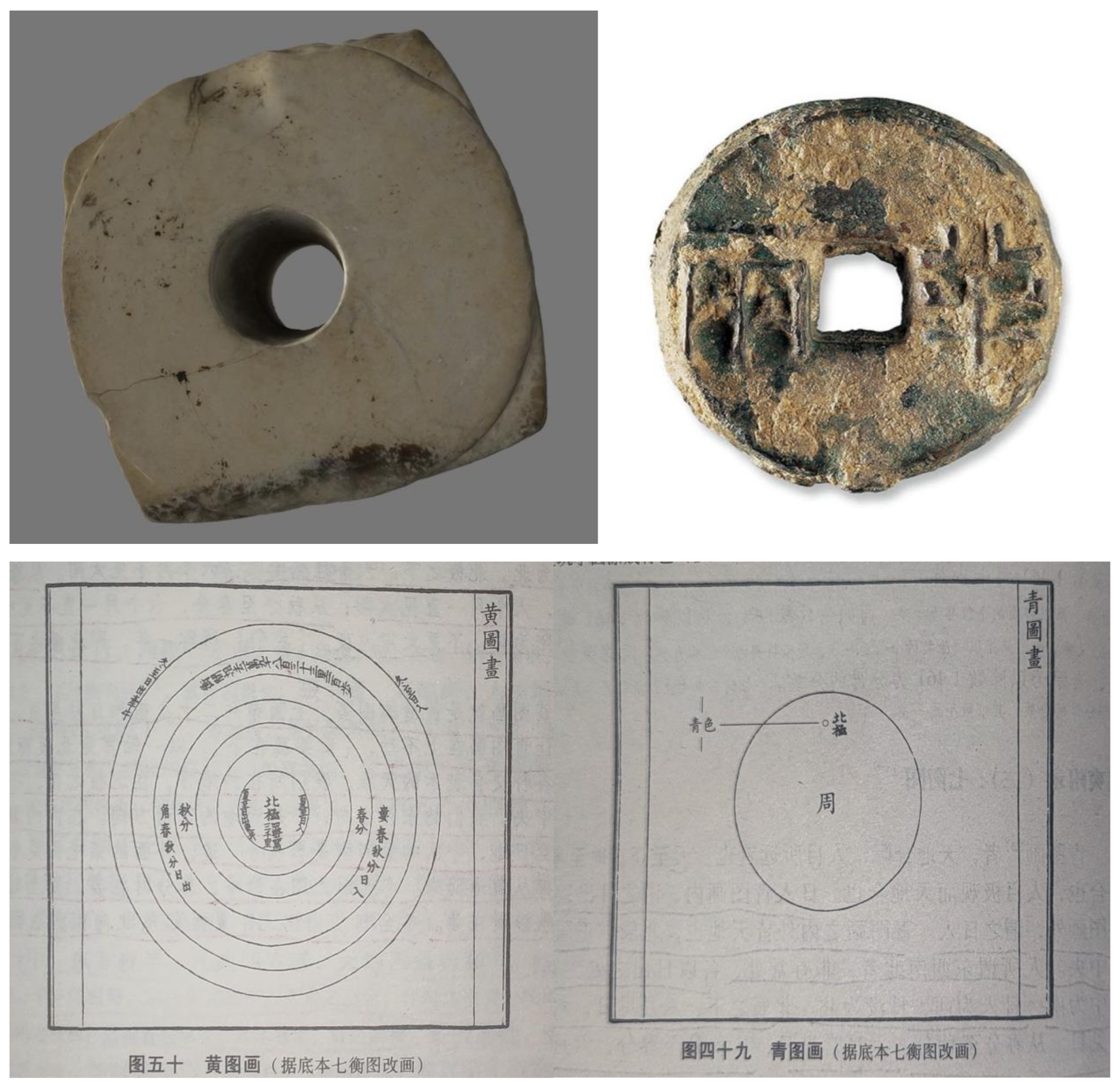
Figure 2.
Comparative figure:The Supreme Jade Cong from Liangzhu → Qin ban liang coins [42] → Qi Heng Tu [43]. Continuity of the cosmographic schema from Neolithic jade, through monetary artifact, to astronomical model.
Bureaucratic Operationalization:The operation of the bureaucratic system found expression in the materialization of power through standardized coinage. Emperor Wu of the Han Dynasty centralized minting authority under the Three Offices of Shanglin, establishing the Wuzhu coin with unified specifications for inscriptions, weight, and alloy composition (Peng Xinwei) [44]. Zhou Weirong’s metallurgical analyses empirically demonstrate how the ancient bureaucratic system embedded state power into the monetary system through controlled alloy ratios [45]. This precise material control integrated imperial authority into currency, achieving economic governance and penetration of state power.Furthermore, this power mechanism became fused with cosmological principles. Jin scholar Lu Bao’s Discourse on the Worship of Money, a social satire, inadvertently reveals the internalization of this cosmology. His description of coin creation—”the sages of antiquity cast coins with an inner square representing earth and an outer circle representing heaven” [46]—treats this symbolism as self-evident. Such unconscious invocation demonstrates how the round-heaven-square-earth coin form had been naturalized as a fundamental archetype, profoundly shaping collective consciousness.
Thus, transcending their purely economic function, coins became “everyday cosmograms” disseminated throughout the empire. They were not directly derived from the textual authority of any single mathematical classic but, as enduring material symbols, continually embodied and popularized the geometric epistemology inherent in the Qi Heng schema through daily transactions. In doing so, they reinforced the unity of the cosmic and social orders.
1.5. The Embodied Instrument: The Body as the Ultimate Operative Platform
1.5.1. Dermal Projection of the Qi Heng Schema: The Primary Equatorial Interface in Cosmic Instrumentation
Cullen’s (1996) authoritative study established the Zhou Bi as the mathematical foundation of the Gai Tian cosmology, wherein the Pythagorean theorem and gnomon shadow measurement data provided an indispensable computational core for the proportional design of the seven heng [47]. Building on this foundation, the present study extends these mathematical principles to the human body, operationalizing the Qi Heng schema through proportional scaling and calibration, as developed in the author’s master’s thesis.
The logical culmination of the Qi Li Gong Sheng paradigm is the internalization of the instrument onto the most intimate and accessible interface: the human body. This represents not a metaphorical leap, but a rigorous, scalable application of the mathematical principles from the Zhoubi Suanjing.
The core algorithm of proportional scaling allows the cosmic model to be instantiated at any scale. A principal finding of this research is that the cosmic model of the Seven Circuits (Qi Heng) can be internalized as an embodied instrument through rigorous proportional scaling, using the human body as its operative platform. The mathematical foundation of this process is not derived from an a priori theoretical formula but is grounded in a set of baseline data obtained through precise measurement and historical metrological conversion.
1. Baseline Data and Core Algorithm When the height of the gnomon is , the baseline radii () of the Seven Circuits, measured from the North Pole center, are as follows (units: cm) [48]:.

| Circuit Index (i) | Name | R_ibase(cm) |
|---|---|---|
| 0 | Inner Circuit (Summer Solstice) | 3.0 |
| 1 | Second Circuit | 3.5 |
| 2 | Third Circuit | 4.0 |
| 3 | Fourth Circuit (Vernal/Autumnal Equinox) | 4.5 |
| 4 | Fifth Circuit | 5.0 |
| 5 | Sixth Circuit | 5.5 |
| 6 | Outer Circuit (Winter Solstice) | 6.0 |
| 7 | Ecliptic plane radius | 4.5 |
| 8 | Equatorial plane (luminous radius) | 4.2 |
| 9 | Distance from gnomon base to North Pole cente | 2.6 |
| 10 | gnomon length | 2 |
| 11. | Distance from gnomon base to the south point on Inner Circuit (Summer Solstice) | 0.4 |
| 12 | the spacing between each heng (the concentric circles representing the sun’s path) | 0.5 |
Analysis reveals an elegant mathematical regularity: the circuit radii form a perfect arithmetic sequence, with first term a=3.0cmand common difference d=0.5cm. Thus, the universal formula is:
This formula underscores the intrinsic structural order of the system and serves as the basis for scalar transformation.
2. Scale Transformation and Surface Calibration
For any body-gnomon height L, the scaling factor is . The cosmographic radius for each circuit is:
To adapt the model to the abdominal surface, calibration is essential. The distance from the gnomon’s base center to the North Pole (2.6 cm at L=2cm) defines its cosmographic radius . The physical radius of the body-gnomon r(e.g., 2 cm) must also be accounted for. The operative distance from the body surface to the i-th circuit is:
When L=2cm, the distance from the base center to the Inner Circuit is 0.4cm, validating 3. Exemplary Calculation
For L=14cm, K=7. Assuming D=4.2cm,r=D/2≈2cm, . The operative subject’s height is 180 cm. Distance from body-Gnomon base to the south point on the seven Circuit Results are: 0.8cm,4.3cm,7.8cm,11.3cm,14.8cm,18.3cm,21.8cm.
Ecliptic plane radius: Equivalent to the Fourth Circuit (i=3), i.e.,
Equatorial plane luminous radius: Scaled as .
4. Operative and Cognitive Implications
This calibrated model exemplifies the Qi Li Gong Sheng(instrument-principle co-emergence) paradigm:
Operational Objectivity: Knowledge validity arises from reproducible calibrative practices, encompassing baseline measurement, scaling, and surface calibration.
ognitive Compensation (Nao Bu): The full structure of the Ecliptic and Equatorial planes cannot be physically rendered on the body. Their complete geometry, inclination, and celestial dynamics require practitioners to actively construct and maintain them mentally (“Nao Bu”), integrating the tangible with the imagined.
Dual-Interface System: Operators navigate concurrently between the embodied Qi Heng equatorial system (partially traceable concentric circles on the body) and the cognitively constructed ecliptic-stellar system(an imagined tilted plane). This enables holistic simulation of cosmic rhythms, such as seasonal cycles and solar trajectories (Ri Chan), achieving the logical endpoint of instrumental genesis. The resulting sequence of operational distances is :0.8cm, 4.3cm, 7.8cm, 11.3cm, 14.8cm, 18.3cm, 21.8cm.
This numerical outcome exemplifies the core tenets of the Qi Li Gong Sheng epistemology:
Operational Feasibility and Bodily Adaptation: The distance values (ranging from 0.8 cm to 21.8 cm) lie entirely within the practical operational range of the human abdominal surface, facilitating direct measurement and drawing using standard tools (e.g., a calibrated ruler). This underscores the model’s practical applicability and seamless adaptation to physical constraints through the calibration formula.
Mathematical Invariance and Structural Homology: The center-based radii form a perfect arithmetic sequence with a common difference of 3.5 cm, preserving the mathematical homology with the original Zhoubi Suanjing algorithm. Despite surface calibration, the sequence retains its regularity, demonstrating the model’s scale invariance and adherence to geometric similarity.
Epistemological Implications—Operational Truth and Internal Harmony: The calibration step is an internal self-consistency mechanism, embodying the mutual adaptation of instrument (body) and theory (cosmology). Knowledge production occurs through bodily calibration, and the resulting distances are manifestations of operational excellence, where truth is realized through correct practice, aligning with the form of operational objectivity.
Interdisciplinary Resonance and Historical Continuity: This calculative outcome provides a concrete basis for further analysis, such as mapping these distances to the six-meridian resolution time in the Shanghan Lun(e.g., the outer circuit distance of 21.8 cm might correlate with the winter solstice and related medical timings). It also echoes the algorithmic tradition in Chinese science, ensuring resilience and reproducibility across individuals.
1.5.2. The Embodied Ecliptic Module: Cognitive Construction and Mathematical Foundation
The aforementioned projection of the Qi Heng schema onto the body surface constitutes the first layer of the body’s interface as a cosmic instrument (equatorial system). However, the completeness of this system necessitates the construction of a second, more expansive operational interface: the Embodied Ecliptic-Stellar Module. This is a circular, virtual plane with a radius of 31.5 cm (when the body-gnomon height ) and inclined at a 26° angle to the body’s midline baseline (representing the equatorial plane reference). Its construction logic is rooted in the same cosmographic geometric principles , exemplifying the Chinese epistemology of “Qi Li Gong Sheng” (co-emergence of instrument and theory).
1. Theoretical Derivation of Inclination Angle and Spatial Registration
The inclination is not an approximation but a theoretical value strictly derived from the system’s internal geometric relations using the Gougu (Pythagorean) theorem. The calculation is based on:
The body-gnomon height (Gou,)
The effective radius of the ecliptic module (Gu, ), where 2.8 cm is the distance from the body-gnomon Pole center to the inner circuit when L=14cm.
The inclination angle is thus . This angle precisely instantiates the traditional astronomical concept of the obliquity of the ecliptic, integrating the Sun’s annual apparent path against the stellar background (the ecliptic) into the bodily operational interface.
The edge of this virtual module must precisely overlap at its projection point on the body’s midline with the inner circuit of the first layer. This coincident relation serves as the core calibration benchmark connecting the equatorial and ecliptic coordinate systems, ensuring operational harmony.
2. Epistemological Sublimation: Deepening Qi Li Gong Sheng
The derivation of theangle (from the ratio ) demonstrates that the core parameters of the instrument—including the orientation of the virtual module—are entirely determined by the system’s fundamental scale (body-gnomon height L) and internal geometric logic. This profoundly exemplifies the absolute prescriptive power of ‘Li’ (principle, embodied by the Gougu theorem and proportional relations) over the form of ‘Qi’ (instrument, even if virtual). It elevates the ‘Qi Li Gong Sheng’ paradigm to a new height: every operable attribute of the cosmic model originates from mathematical necessity, not artificial setting, highlighting a distinct Chinese approach to operational knowledge production.
3. Ultimate Cognitive Compensation (Nao Bu) and Operational Objectivity
Unlike the Qi Heng circuits, which can be partially drawn on the body surface, this vast, inclined virtual structure (radius 31.5 cm) cannot be represented in any physical form. Its construction, orientation, and maintenance must rely entirely on the practitioner’s cognitive compensation (Nao Bu). This is the most extreme manifestation of ‘operational objectivity’—the attainment of truth depends on all trained practitioners’ ability to stably reconstruct and operate this virtual interface based on the same set of cosmographic geometric parameters (e.g., 26° inclination). This process enables the correlation between celestial bodies (e.g., the 28 Lunar Mansions) and bodily coordinates, embodying a form of knowledge production through calibrated practice rather than external representation.
4. Dual-Interface System and the Logical Endpoint of Qi Li Gong Sheng
Therefore, complete bodily operation is a dual-interface system: upon the tangible Qi Heng equatorial system on the body surface, a cognitively constructed ecliptic-stellar system is superimposed. The user must concurrently navigate both to achieve all functions, from determining the Sun’s trajectory to locating its position within the asterisms (Ri Chan). This marks the logical endpoint of the ‘Qi Li Gong Sheng’ paradigm: theory (Li) not only prescribes the form of the instrument (Qi) but also profoundly shapes the practitioner’s cognitive architecture itself, offering a robust alternative to Eurocentric narratives of pre-modern science.
Academic Significance
This embodied ecliptic module strengthens the mathematical foundation and practical philosophy of the study, providing a case study of China’s unique operational epistemology for the global history of science. It challenges representationalist paradigms by emphasizing operational reproducibility and cognitive engagement, aligning with the historiographical standards of journals like Isis. The model’s resilience through transmissible practices underscores the continuity and sophistication of Chinese scientific thought.
In conclusion, this case study validates the universal formulas presented in this section, transforming the abstract “body as instrument” thesis into a tangible, personalized measurement system. It demonstrates how the Qi Li Gong Shengparadigm operationalizes cosmic principles through the body, offering a robust alternative to Eurocentric narratives of pre-modern science. These values can be utilized in subsequent chapters (e.g., Chapter II on medical applications or Chapter IV on discussion) to empirically support the model’s claims.
1.6. Functional Reconstruction: The User’s Interface
Pankenier (2013) convincingly argued how celestial phenomena provided legitimacy for royal power [49], and the Qi Heng Yi, as an instrument for determining the timing of celestial mandates (such as solar terms), is itself a key technological device of this political astronomy.
The sophisticated, modular design of the Qi Heng Yi, as reconstructed here, transforms the abstract cosmogram into a tangible interface for cosmic measurement. Its operation was not a mere mechanical procedure but an engaged dialogue with the cosmos, embodying the principle of Qi Li Gong Sheng (器理共生)—the co-emergence of instrument and theory. The following functional reconstruction delineates the user experience and computational logic of this device.
1. Modular Assembly: Configuring the Cosmic Framework
The instrument’s modularity resolves practical constraints of visualization and application. The user would first select the appropriate configuration for their task:
For Calendrical and Timekeeping Functions (Basic Configuration): Employ only Module A: The Equatorial-Polar System. This consists of the Seven Circuits (Qi Heng) plate assembly mounted on the Solar Illumination Disk (etched with the 24 terrestrial directions) and secured by the primary central bolt. The gnomon is inserted at the pre-determined observation point (“Zhou point”).
Figure 3.
Qi Heng Yi (left)Module B: The Ecliptic-Stellar System; (right)Module A: The Equatorial-Polar System.
Figure 3.
Qi Heng Yi (left)Module B: The Ecliptic-Stellar System; (right)Module A: The Equatorial-Polar System.
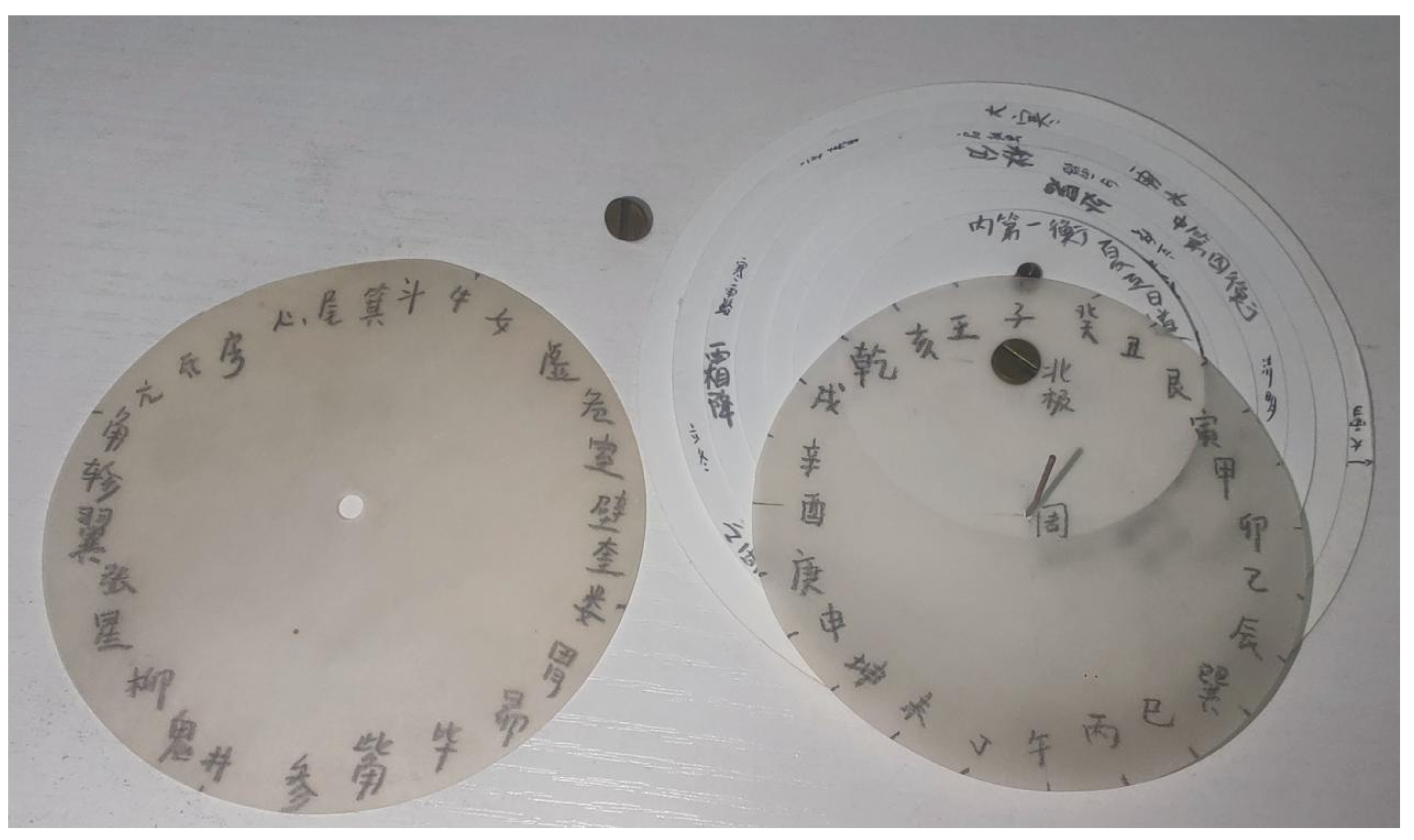
For Astral and Advanced Cosmographic Functions (Full Configuration): Assemble Module B: The Ecliptic-Stellar System onto Module A. This involves aligning the second, offset bolt through the north pole of the transparent Ecliptic Star Disk (representing the Huangji, or ecliptic pole) and its precise pre-calculated projection point on the Innermost Circuit (Summer Solstice plate). This crucial step physically instantiates the obliquity of the ecliptic, a core parameter in the Zhoubi’s calculations. The instrument now represents a complete, tilted two-sphere armillary model.
Figure 4.
Qi Heng Yi. Qi Heng Yi physically instantiates the obliquity of the ecliptic
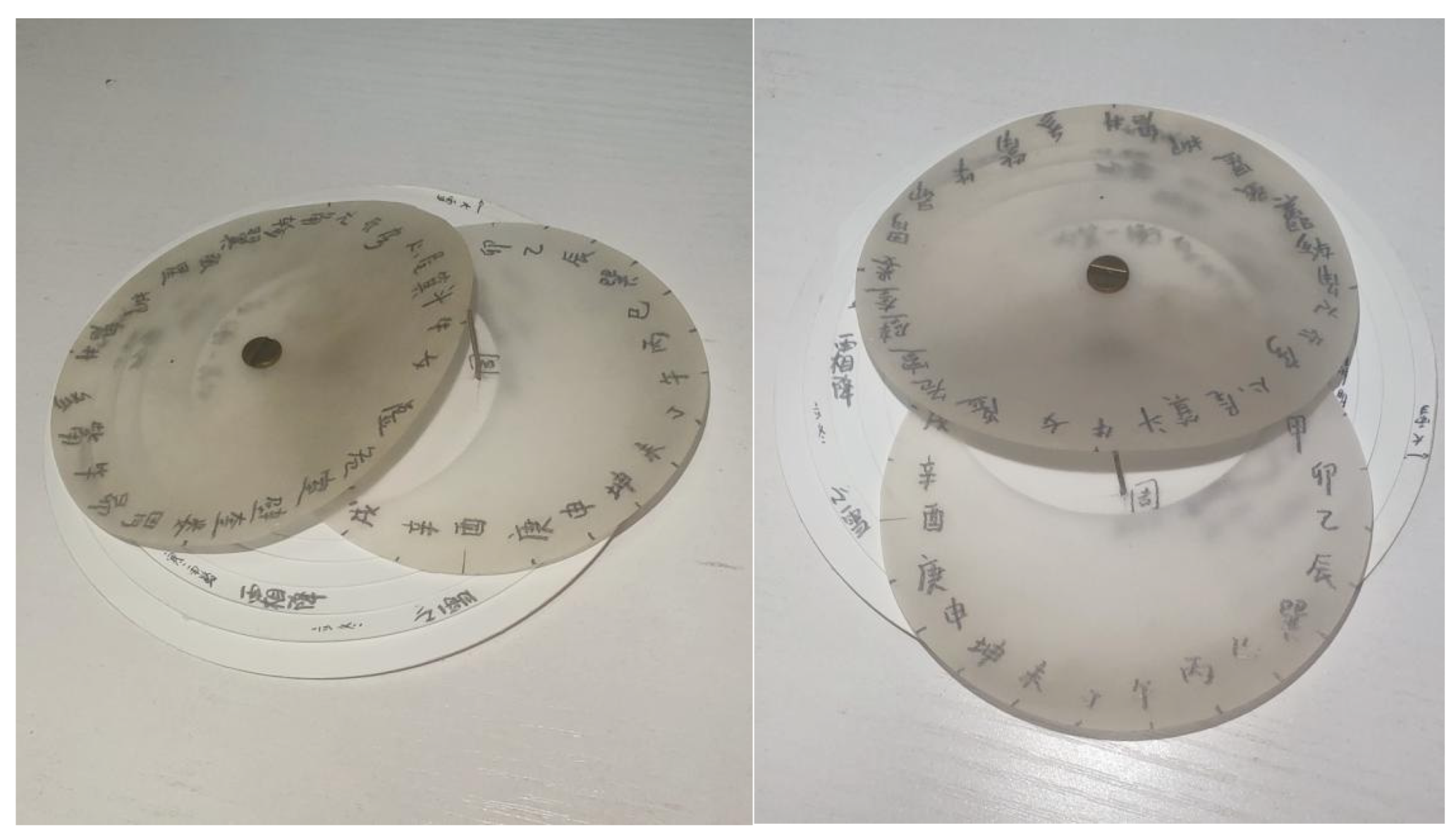
Of particular note is that the introduction of a tilted ecliptic module in this reconstruction, aimed at reconciling stellar and solar positions, may prompt the question of whether the device remains within the conceptual bounds of the Gai Tian model. We argue, however, that this development exemplifies the necessary evolution of a theory from textual description to operational practice. The Zhoubi Suanjing itself contains the metaphor “heaven is like a bamboo rain-hat (gaili), earth is like an overturned plate (fupan),” which implies a curved, overarching celestial structure. As a physical instantiation of this cosmology, the Qi Heng Yi translates these implicit textual concepts—essential for performing precise calculations, such as the obliquity of the ecliptic—into an operable mechanical form. Thus, this is not a repudiation of the Gai Tian system but rather an elevation of its theoretical framework to a higher degree of sophistication and practical utility. It provided a technical means for applying the model to calendrical computation and astrological practice, offering a clear demonstration of the principle of Qi Li Gong Sheng (器理共生)—the co-evolution of instrument and principle—in action.
2. Operational Workflow: From Alignment to Measurement
Step 1: Geospatial Alignment (Foundation of all Measurements)
The first action grounds the instrument in terrestrial space. The user rotates the entire assembly or, more precisely, the square base or the fixed Solar Illumination Disk until its ‘Zi’ (子) direction (正 North) aligns with terrestrial north, achieved by stellar (Polaris) or geomantic calibration. This fixes the cosmic reference frame to the earthly plane.
Step 2: Calibrating the Solar Year (Initializing the Model)
At local noon, the user observes the shadow cast by the central gnomon. The length and azimuth of this shadow are the primary inputs. The user then individually rotates each of the seven concentric plates until the label corresponding to the current solar term (e.g., “Winter Solstice” on the outermost circuit) is aligned with the shadow’s azimuth (pointing true North). This action effectively “boots up” the analog computer, calibrating the theoretical model (Tu) to the observed reality of the sun’s position on that day.
Step 3: Real-Time Analog Computation (Reading the Output)
Once calibrated, the instrument becomes a dynamic computational device:
Determining Solar Term: On any day, the user rotates the plates until the noon gnomon shadow falls directly upon the edge of a specific circuit. The label on that circuit’s edge indicates the current solar term.
Timekeeping: The user simply reads the azimuth of the gnomon’s shadow against the fixed 24-direction grid on the Solar Illumination Disk. The simultaneous position of the calibrated solar term plate against this grid provides a double-check against the seasonal variation of day length.
Stellar-Solar Correlation (Full Configuration): With Module B attached, the user can, on a clear night, rotate the transparent Ecliptic Star Disk to match the actual positions of the 28 lunar mansions (Xiu). Once aligned, the user can read, through the transparency, the position of the calibrated solar circuits beneath. This visually demonstrates the sun’s theoretical location within the asterisms for any given solar term, fulfilling a key function of classical astronomy: determining the Ri Chan (日躔, the sun’s lodging).
3. Epistemological Significance: The User as Cosmic Interlocutor
This operational procedure underscores a fundamental divergence from Greco-Roman mechanics. The Qi Heng Yi does not simulate a pre-computed cosmic order through hidden gears; it presents a physical, adjustable model of that order. The user completes the computational loop through manual adjustment and direct observation. The knowledge is not generated automatically within the machine but emerges from the interaction between the human, the instrument, and the heavens.
This hands-on process of calibration—rotating the plates to match the shadow—is the very enactment of Qi Li Gong Sheng. The theory (the Qi Heng Tu) is inert without the instrument to operationalize it; the instrument is meaningless without the theoretical framework that dictates its form and function. The user is not a passive reader of output but an active participant in harmonizing the mathematical model with the phenomenological world.
This sophisticated, user-driven interface argues compellingly for the existence of a highly developed, pragmatic, and instrument-mediated astronomical tradition in early China, one that seamlessly integrated cosmology, mathematics, and practical application.
2. The Operative Embodiment of Cosmology: The Shanghan Lun’s Chronobiological System and Its Digital Extension
2.1. Celestial Kinematics and Physiological Resonance
Zhang Zhongjing’s “six-meridian resolution times” in the Shanghan Lun embedded the sun’s Qi Heng paths into therapeutic principles. This was a clinical refinement of the “heaven-human correspondence” tradition outlined in texts like the Huangdi Neijing (e.g., Suwen, Treatise on Vital Unity with Heaven).
Unschuld (1985) outlines the long-term evolution of Chinese medical thought from shamanistic practices to philosophical systematization. The theory of six meridians resolving at specific times marks the maturation of a highly philosophical and systematic anthropocosmology, underpinned by the rise of Han-era natural philosophical trends—exemplified by the Gaitiancosmographic theory (hemispherical dome cosmology)—and its instrumental implementation. [50]
This epistemological move to operationalize cosmology within the human form finds a broader anthropological context in Lewis’s (2006) research, which demonstrates that the ancient Chinese conceptualized the human body as a microcosm and a body politic [51]. It thus becomes highly comprehensible why the author analogized the body to the Seven Circuits Instrument(Qi Heng Yi).
- -
- Taiyang resolution (9:00–15:00): Corresponds to the outermost circle (winter solstice trajectory) and noon irradiance peak → Yang dispersal to evict pathogens.
- -
- Yangming resolution (15:00–21:00): Maps to the descending western solar arc, denoting yang-to-yin transition.
- -
- Shaoyang resolution (3:00–9:00): Synchronizes with dawn’s ascending eastern arc, abetting shaoyang pivot’s upward-outward motion.
- -
- Taiyin resolution (21:00–3:00): Coincides with profound nocturnal yin, necessitating warming and flux.
- -
- Shaoyin resolution (23:00–5:00): Aligns with the innermost circle (summer solstice path) and midnight yin nadir → Acts as pivot for yin-yang transmutation.
- -
- Jueyin resolution (1:00–7:00): Spans the yin extremity to yang inception, paralleling the solar cycle’s inflection.The sequence of transmission (e.g., Taiyang → Yangming→Shaoyang→ Taiyin→ Shaoyin→ Jueyin) re-enacts the sun’s descent between solstitial paths. This is not mere metaphor but a homomorphic mapping of celestial rhythms onto physiological cycles, facilitated by the instrumentally-defined cosmic model.
Figure 5.
Qi Heng Tu overlaid with three Yin-meridian resolution timebands. Kinematic coupling of solar trajectories (Qi Heng model) and medical resolution times, demonstrating the medicine’s astronomical basis.
Figure 5.
Qi Heng Tu overlaid with three Yin-meridian resolution timebands. Kinematic coupling of solar trajectories (Qi Heng model) and medical resolution times, demonstrating the medicine’s astronomical basis.
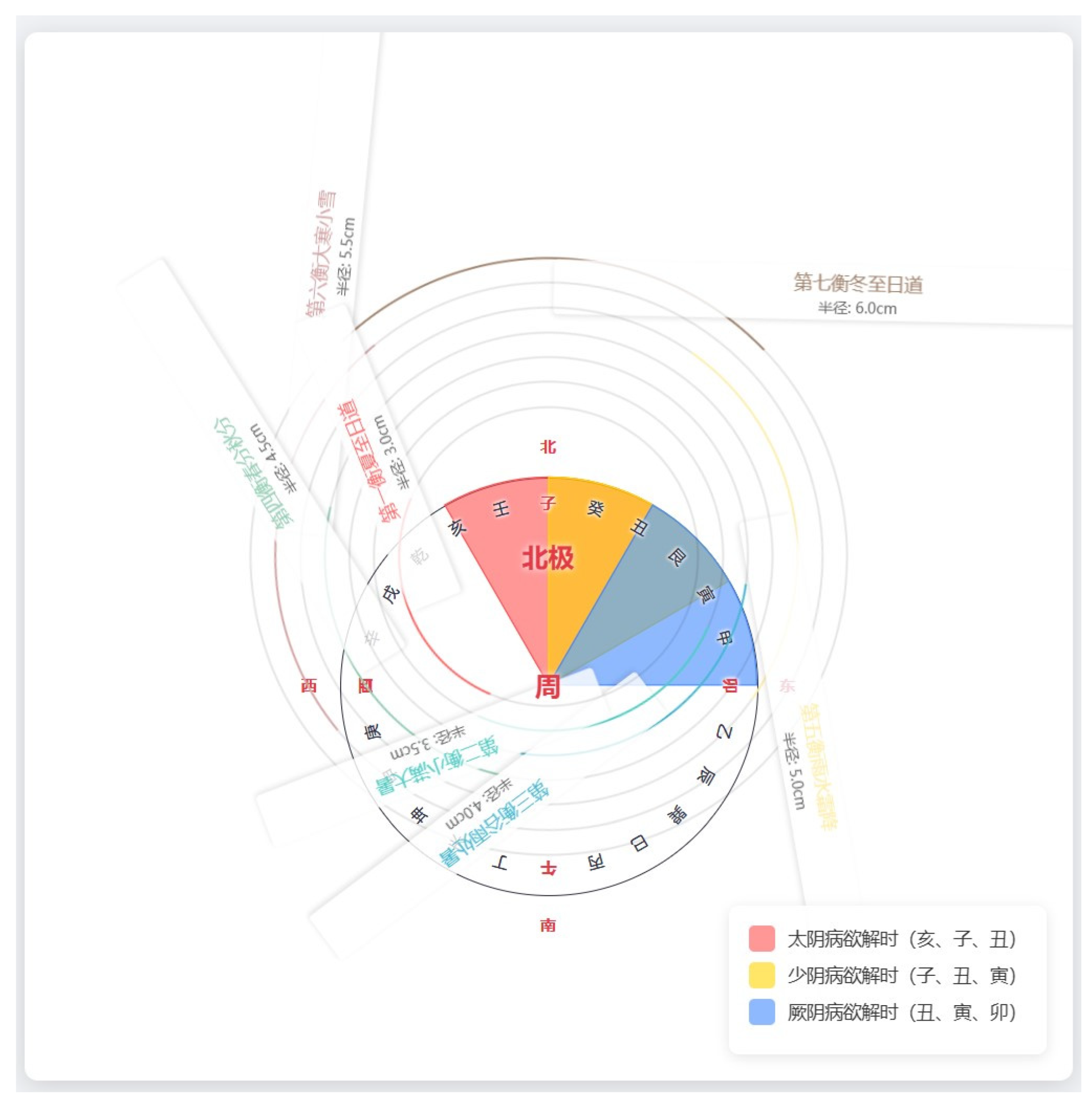
This correlation between celestial paths and therapeutic windows transcends mere metaphorical association; it represents a structural resonance between the instrumentally-operationalized cosmos and the human physiological rhythm. Rather than positing a direct, conscious application of the Qi Heng Yi by Zhang Zhongjing, we argue that the Gai Tian cosmology—materialized and popularized through such instruments and their schematic representations (Tu)—had become the dominante intellectual framework for comprehending spatio-temporal order in the Han era. The Shanghan Lun’s formulation of the six-meridian resolution times emerges not as an isolated medical innovation, but as a natural extension of this pervasive, instrument-mediated worldview into the domain of clinical praxis. The homomorphic mapping between the sun’s kinematic paths and the diurnal cycle of Qi is therefore best understood as a profound assimilation of the period’s operative cosmology, wherein the body was conceptualized as a microcosm reflecting the instrumentally-defined macrocosm. This epistemological context provides a more robust and historically-grounded explanation for the medical text’s astronomical alignment than attributing it to authorial intent alone.
The connection between the Qi Heng Yi (七衡仪) cosmological model and the Shanghan Lun(《伤寒论》) is not an isolated case. It also correlates with theories such as the circulatory rhythm of Nutritive and Defensive Qi (营卫运行规律), the Opening, Closing, and Pivoting (开阖枢) theory alongside the Taiji diagram (太极图) theory, the doctrine of Five Circuits and Six Qi (五运六气) in Chinese medicine, as well as the structure of the North Pole-Polar Axis (北极-璇玑) within the Seven-Ring Instrument and the theories of Nine Palaces and Eight Winds (九宫八风) and the Tortoise Method (灵龟八法) in acupuncture. It substantially exemplifies the “operational cosmology” knowledge system flourishing in the medical field during the Qin and Han Dynasties. This paradigm of systematically linking observable and operable cosmic patterns with human life phenomena was a universal logic in constructing advanced scholarship at that time. Concurrently, the Weft Texts (纬书, apocryphal classics) deduced cosmic structure through sequences like “Great Change (太易)—Great Beginning (太初)—Great Commencement (太始)—Great Simplicity (太素)” [52], while Confucians addressing governance challenges (e.g., refugee issues) of the great unification also adopted the “Monthly Ordinance” (月令) model and the cosmology of “Harmonizing Yin and Yang” (调和阴阳) as core frameworks for statecraft. This indicates that from medicine and philosophy to political philosophy, Han Dynasty thought universally endeavored to translate natural philosophical models into concrete practical principles. Zhang Zhongjing’s theory of the “Six Meridian Diseases’ Time of Resolution” (六经病欲解时) stands as a systematic and instrumentalized exemplar within this grand tradition.
- The Body as the Seven Circuits Instrument as a Foundational Platform for Medical Operation.
This study’s Body as the Seven Circuits Instrument model internalizes the cosmic geometry of the Zhoubi Suanjing (The Gnomon of the Zhou) onto the human body. Through the mapping of the Qugu acupoint(CV2, the origin of the Conception Vessel) to the southern points of the seven circuits, it provides an operational spatial basis for the six-meridian resolution times in the Shanghan Lun. The Qugu acupoint, located approximately 1–3 cm above the base of the Body-Gnomon, serves as a benchmark in the body’s surface projection zone. It forms a regular correspondence with the southern points along the Conception Vessel: starting from Qugu (inner circuit, i=0), moving upward to Zhongji (CV3, second circuit, i=1),Guanyuan (CV4, third circuit, i=2), Shimen(CV5, fourth circuit, i=3),Yinjiao (CV7, fifth circuit, i=4), Shenqu(CV8, sixth circuit, i=5), and Shuifen (CV9, outer circuit, i=6). These acupoints are closely associated with traditional Chinese medicine’s visceral functions and temporal therapies. For instance, Guanyuan (corresponding to the third circuit) warms Yang and consolidates the foundation, commonly used for Taiyin deficiency cold patterns; Shenque (corresponding to the sixth circuit) harmonizes the spleen and stomach, linked to the Taiyin resolution time. This mapping not only reflects the homology between cosmic rhythms and the meridian system but also transforms the astronomical model into a personalized bodily operational interface.
- 2.
- Homomorphic Mapping of the Six-Meridian Resolution Times to the Seven Circuits Paths
Based on the mapping results of the Body as the Seven Circuits Instrument, the six-meridian resolution times directly correspond to the sun’s movement along the seven circuits paths. Specifically:
Taiyang resolution time (9:00–15:00): Corresponds to the sun’s near-zenith trajectory, moving from the outer circuit (winter solstice, i=6) to the inner circuit (summer solstice, i=0), mapped to the segment from Shuifen (CV9) to Qugu (CV2) along the Conception Vessel (distance: 21.8–0.8 cm). Operationally, practitioners can measure distances from Qugu (e.g., outer circuit 21.8 cm, inner circuit 0.8 cm) and stimulate the corresponding acupoints at specific times to facilitate Yang dispersion and pathogen expulsion.
Yangming resolution time (15:00–21:00): Corresponds to the sun’s descending western path, aligned with the outer circuit direction, mapped near Shuifen (CV9, distance: 21.8 cm). Distance data guide practitioners to focus on the supra-umbilical region during the afternoon to clear Yangming heat stagnation.
Shaoyang resolution time (3:00–9:00): Corresponds to the sun’s ascending eastern path, moving from the outer circuit (i=6) to the inner circuit (i=0), but emphasizing the segment from the fourth circuit (Shimen, CV5, 11.3 cm) to the second circuit (Zhongji, CV3, 4.3 cm) (distance: 11.3–4.3 cm). Operationally, practitioners measure distances from Qugu at dawn and stimulate acupoints to aid the Shaoyang pivot’s upward-outward motion and resolve exterior-interior patterns.
Taiyin resolution time (21:00–3:00): Corresponds to the profound nocturnal Yin phase, regressing toward the inner circuit direction, mapped to the segment from Qugu (CV2) to Shenque (CV8) (distance:0.8–18.3 cm). Operation requires moxibustion on lower abdominal acupoints (e.g., Guanyuan, Shenque) at midnight to warm and transform Taiyin spleen dampness.
Shaoyin resolution time (23:00–5:00): Corresponds to the Yin extreme and Yang birth phase, regressing from the outer circuit (i=6) to the inner circuit, mapped to the segment from Shuifen (CV9) to Yinjiao (CV7) (distance:21.8–14.8 cm). Operation involves moxibustion around the umbilicus (e.g., Yinjiao, Shimen) at midnight to assist Shaoyin Yang revival and warm the channels to dispel cold.
Jueyin resolution time (1:00–7:00): Corresponds to the Yin-Yang transition period, aligned with the outer circuit direction, mapped near Shuifen (CV9, distance:21.8 cm). Operation focuses on the supra-umbilical region, stimulating Shuifen to harmonize Jueyin liver channel’s Yin-Yang complexity.
This spatiotemporal mapping is realized through the operation of the Body as the Seven Circuits Instrument: practitioners use Qugu as the origin, measure distances along the Conception Vessel (sequence: 0.8, 4.3, 7.8, 11.3, 14.8, 18.3, 21.8 cm), and transform astronomical time into body surface coordinates, achieving temporal-spatial-acupoint integration.
- 3.
- Deepening Operational Significance and Academic Value
This mapping not only optimizes the operational protocol of the Body as the Seven Circuits Instrument but also highlights the ultimate embodiment of the Qi Li Gong Sheng (co-emergence of instrument and theory) paradigm in medicine. Theory (the six-meridian temporal sequence) is instantiated through the embodied operation of the instrument (Body as the Seven Circuits Instrument), where knowledge is produced via the practitioner’s calibration actions (e.g., aligning the body-gnomon perpendicularly) and distance measurements. For example, at noon, aligning the sun’s shadow with the corresponding circuit point allows practitioners to directly read acupoint distances and dynamically adjust treatment strategies. This embodies operational objectivity—truth realized through correct practice rather than external representation.
Academically, this model provides a mathematical empirical basis for the Shang han Lun, challenging purely experiential medical narratives and highlighting the scientific connotation of the ancient Chinese concept of “harmony between heaven and human” (天人合一). Simultaneously, it continues the geometric tradition from the Liangzhu cong (jade tubes) to the Han-era seven circuits diagram, demonstrating interdisciplinary continuity among mathematics, astronomy, and medicine. From a global history of science perspective, this offers a unique case of operation-based knowledge production, providing an alternative to Eurocentric representationalist paradigms.
2.2. Comparative Chronobiology: Instrumental Precision vs. Qualitative Association
Before delving into specific comparisons, it is necessary to examine the fundamental differences in how various civilizations applied celestial knowledge to medicine from an epistemological perspective. Yates (1988) points out that military strategists placed great emphasis on astronomy and geography. The Qiheng Instrument’s function of determining direction and time could also serve military coordination, reflecting the versatility of such cosmological technologies [53].This inherent versatility underscores that the application of cosmic models extended far beyond medicine. As Rochberg (2004) indicates [54], its medical practice is also deeply embedded in celestial divination, but it predicts illnesses by interpreting omens; this stands in stark contrast to Traditional Chinese Medicine (TCM), which constructs a predictable, universal physiological clock model based on solar energy dynamics. The latter relies more on a clear cosmological model and its operational tools. This fundamental divergence is profoundly reflected in the comparative analysis that follows:
| System | Time Framework | Therapeutic Lever | Instrumental Basis |
| QiHeng Paradigm (as instantiated in Shanghan Lun) | 100-Ke System + True Solar Time(Instrument-derived, cosmographically-defined) | Diurnal Qi Extremes(Precisely timed interventions based on circadian qi dynamics) | Gnomon-Quantified Ecliptic(A model-operationalized basis through astronomical instrumentation) |
| Hippocratic Humorism | Seasonal Phases(Qualitative association with climatic patterns) | Humoral Rebalancing(e.g., Phlebotomy; qualitative rebalancing based on seasonal influence) | Direct Climatic Observation(e.g., winds; empirical, non-instrumental qualitative assessment) |
| Personal Case Study: Corporeal Instrumentation (Body as the Seven Circuits Instrument) | Real-time somatic feedback loop(The body itself becomes a chronobiological instrument) | Restoration of the Governor and Conception Vessels (Du Mai and Ren Mai)(Therapeutic target shifts from symptomatic allergy suppression to systemic channel regulation) | Self-operationalized thermal therapy(Heated salt pack application along the meridians, transcending specific herbal material) |
Summary:Instrumentalized precision dominates the Chinese model. While the Hippocratic tradition established qualitative associations between seasons and humors, the Shanghan Lunleveraged a precise, cosmographically-defined solar time framework for targeted intervention, thereby operationalizing the model instantiated by the Qi Heng instrument.
Owen Gingerich’s research on the dissemination of De Revolutionibus elucidated a distinct intellectual divergence in early modern Europe, where mathematical astronomy and medicine evolved as separate epistemic domains [55]. In the present study, however, the operationalization of the Body as the Seven Circuits Instrument enables a direct permeation of astronomical principles into medical practice. This integration has generated an alternative mode of knowledge synthesis—a paradigm of Co-emergence of Instrument and Theory—that fundamentally transcends conventional disciplinary boundaries.
A concrete illustration of this paradigm emerges from the author’s first-person clinical experience. During a period of severe allergic rhinitis (identified in biomedicine as an allergy to Humulus scandensand treated with Budesonide and other pharmaceuticals with limited success), the somatic practice of mapping the “Seven Circuits” onto the body revealed a critical insight: the central role of the Governor and Conception Vessels (Du Mai and Ren Mai) in maintaining qi dynamic balance. The condition, understood in Chinese medicine as “Nasal Obstruction” (鼻鼽, Bi Qiu) stemming from the invasion of wind-cold-dampness pathogens, was fundamentally related to the dysfunction of these two primary vessels. This corporeal instrumentation—using the body itself as a measuring and diagnostic tool—shifted the therapeutic focus from merely suppressing symptoms (e.g., using antihistamines for specific allergens like Humulus scandens) to restoring the integrity of these key channels of qi and blood. The subsequent resolution of symptoms through the application of heated salt packs along the entire course of the Du and Ren Mai (a method that conceptually extends the principle of moxibustion while avoiding the smoke of Artemisia, which had become an irritant) demonstrates a therapeutic logic predicated on systemic regulation rather than targeted antagonism. This case underscores why a model emphasizing instrumentalized, systemic precision can achieve remission, whereas episodic, qualitative interventions may only offer transient control. It answers the posed questions: Western diagnostics can identify specific allergens (e.g., Humulus scandens) and pharmacologically control symptoms by blocking discrete pathways; however, the “Body as the Seven Circuits Instrument” operationalizes a theory of channel-based physiology, facilitating an intervention that restores the body’s inherent chronobiological rhythm and resilience, thereby addressing the root disposition rather than the proximate trigger.
Figure 6.
Qi Heng Tu overlaid with three Yang-meridian resolution timebands. Kinematic coupling of solar trajectories (Qi Heng model) and medical resolution times, demonstrating the medicine’s astronomical basis.
Figure 6.
Qi Heng Tu overlaid with three Yang-meridian resolution timebands. Kinematic coupling of solar trajectories (Qi Heng model) and medical resolution times, demonstrating the medicine’s astronomical basis.
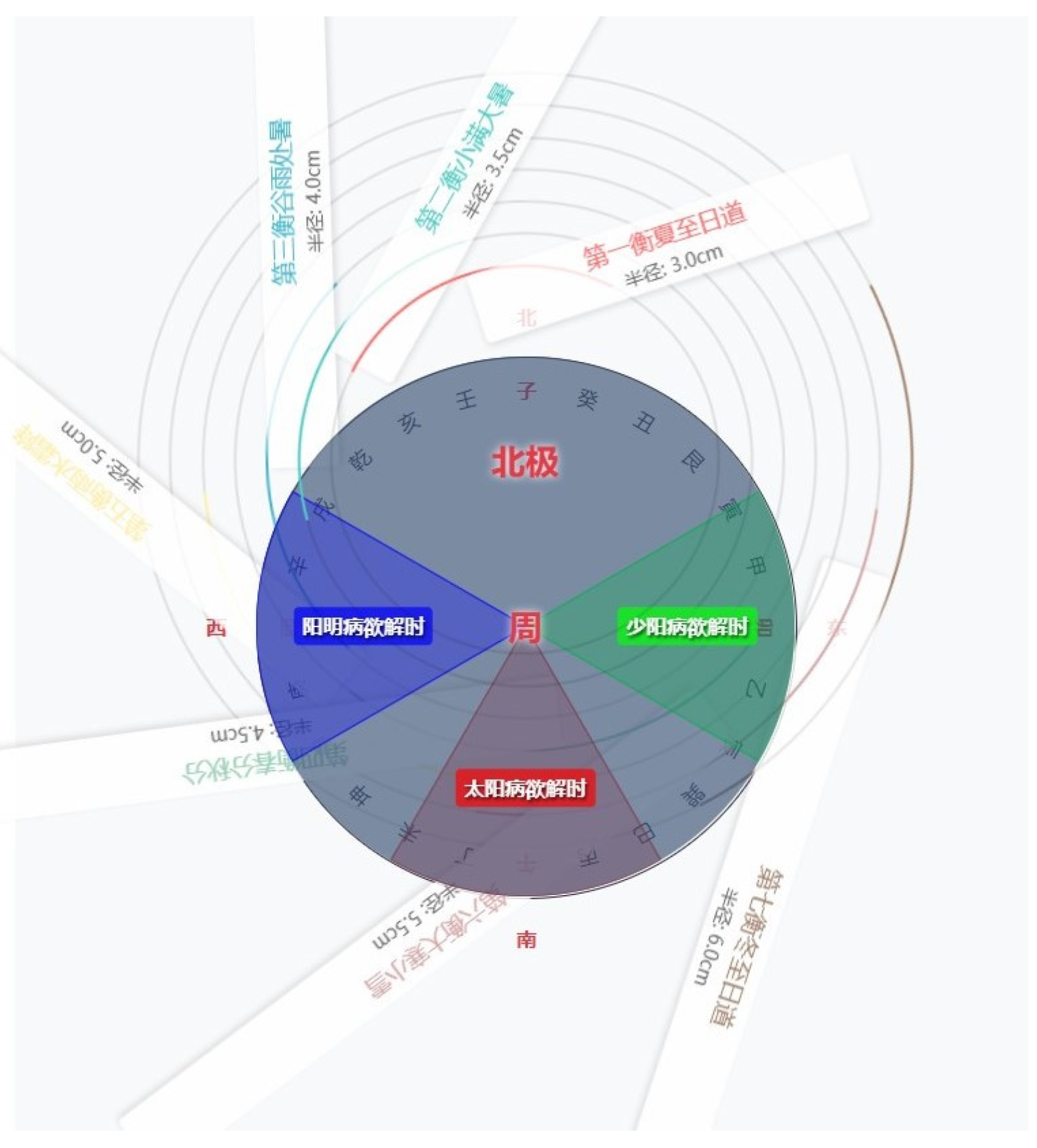
2.3. Digital Extension: The 28 Vessel Nutrient-Qi Infusion System as a Modern Operative Interface
The operative cosmology paradigm, exemplified by the Qi Heng Yi and its medical embodiment in the Shanghan Lun, demonstrates a remarkable capacity for technological transposition. Its logic finds a compelling modern expression in the 28 Vessel Nutrient-Qi Infusion System (二十八营气流注系统), a software interface that digitally operationalizes the ancient theory of the circulatory rhythm of Nutritive and Defensive Qi (营卫运行规律). This system effectively functions as a contemporary digital counterpart to the physical Qi Heng Yi and the corporeal instrumentation of the body, translating the cosmic-physiological resonance into a real-time, interactive computational model.
Figure 7.
Interface of the 28 Vessel Nutrient-Qi Infusion Monitoring System [56]. This digital tool operationalizes the ancient theory of Nutritive Qi circulation (五十营), providing a real-time, algorithmic interface that continues the legacy of Han-era operative cosmology.
Figure 7.
Interface of the 28 Vessel Nutrient-Qi Infusion Monitoring System [56]. This digital tool operationalizes the ancient theory of Nutritive Qi circulation (五十营), providing a real-time, algorithmic interface that continues the legacy of Han-era operative cosmology.

1.The Digital Instrument: Real-Time Emulation of Cosmic-Physiological Rhythms
This software interface is designed to monitor the circulation of Nutritive Qi (营气) in real-time, based on the classical theory of the Fifty Cycles per Day (五十营), which posits that Nutritive Qi completes 50 cycles through the 28 primary vessels in 24 hours. The interface typically displays key data points such as Chengdu True Solar Time (成都真太阳时), anchoring the system in instrument-corrected astronomical time; the current cycle (e.g., 第31周/50周); the active vessel (e.g., 左足太阳膀胱经, Left Foot Taiyang Bladder Vessel); and the completion progress within that vessel. This transforms the abstract theory into a dynamic, visualizable process. Just as the Qi Heng Yi provided a spatial interface for interpreting celestial kinematics, this system provides a temporal interface for tracking the micro-circulation of Qi, offering a continuous, calibrated readout of the body’s internal chronobiological state.
2.Operational Continuity: From Gnomon to Algorithm
The operational principle of this digital system directly extends the Qi Li Gong Sheng (co-emergence of instrument and theory) paradigm. The theoretical framework from the Huangdi Neijing supplies the algorithmic logic—the speed, pathway, and sequence of Qi circulation. This algorithm is then instantiated and operationalized through the software “instrument.” Knowledge is generated not through measuring shadows on a dial, but through the software’s continuous calculation and the user’s interpretation of the displayed data stream. This creates a human-computer interaction loop that mirrors the practitioner-instrument dialogue central to the classical model. It underscores that the core of operative cosmology is not a specific technology, but the method of instantiating a model to make theoretical principles actionable.
3.Epistemological Significance: The Modern Legacy of Operative Cosmology
The existence and functionality of the 28 Vessel Nutrient-Qi Infusion System are epistemologically significant for this thesis. It demonstrates that the paradigm is not a historical relic but a living and adaptable knowledge tradition. It proves that the “operationalizability” of the cosmic model is robust enough to be transposed from bronze and jade, to the human body, and finally into computer code. This digital extension provides a powerful contemporary case study for the global history of science, illustrating an alternative, practice-based knowledge system that has seamlessly integrated astronomical timing, mathematical calculation, and medical practice from the Han Dynasty into the digital age. It argues that the Chinese scientific tradition of operationalizing models possesses an inherent continuity and practicality that remains relevant.
2.4. Reframing the Paradigm: From Philosophical Debate to Integrative Practical Wisdom
The specific analysis of the cosmological model of the Qi Heng Yi and the theory of the ShanghanLun in this section reveals a deeper paradigm that transcends specific techniques. This compels us to address a more fundamental question: by what paradigm should the essence of Traditional Chinese Medicine (TCM) be understood? The aforementioned case strongly suggests that TCM is neither purely philosophical speculation nor a natural science in the narrow modern sense. Its essence aligns more closely with a form of “practical wisdom” honed over millennia of clinical practice.
From its inception, TCM has demonstrated a remarkable capacity for integration, embodying the ideal of the “Great Physician’s Study” as advocated by Sun Simiao, which called for a knowledge system actively synthesizing learning from the Book of Changes, astronomy, geography, human affairs, and other diverse fields [57]. Therefore, the validity of TCM is derived not only from its remarkable efficacy, evidenced across history and vast populations—a manifestation of the principle that “practice is the sole criterion for testing truth” [58]—but also from its intrinsic vitality as an “integrative medicine” that continuously evolves and adeptly incorporates the essences of successive eras.
In contemporary China, the value and status of TCM have been affirmed and guaranteed through national strategy and law, such as the Traditional Chinese Medicine Law of the People’s Republic of China. For researchers, the crucial task may not lie in engaging in the debate over whether it is a philosophy or a science, but in acknowledging its objective existence as a form of integrative medicine. The focus should be on dedicating efforts to unearth its essential strengths, promoting its continued innovation through the assimilation of modern scientific achievements, thereby enabling synergistic development with other medical systems to collectively address contemporary health challenges. This path represents the continuation and expansion of the vitality of the Qi Li Gong Sheng epistemology within the medical field.
3. The Epistemological Legacy: From Qi Heng Yi to Luopan
The operational cosmology paradigm, as materially instantiated in the Qi Heng Yi, did not vanish with the decline of the Gai Tian model but demonstrated remarkable persistence and adaptability. This endurance finds its theoretical roots in a broader intellectual tradition, as highlighted by Sterckx (2005), who reveals that early Chinese animal classification embodied a form of correlative thinking [59], with the Qi Heng Yi serving as the ultimate application of this thinking in the spatiotemporal order, integrating heaven, earth, humans, and all things into an interconnected and operable dynamic network.It is precisely this capacity for operationalizing a correlative worldview that ensured the legacy of instruments like the Qi Heng Yi. The enduring presence of its core cosmographic frameworks—such as the 24 Directions, the 28 Lunar Mansions, and the 24 Solar Terms—within the modern Luopan (feng shui compass) signifies far more than mere symbolic continuity; it reflects the sustained vitality of the distinctive Chinese epistemological paradigm of Qi Li Gong Sheng(Co-emergence of Instrument and Theory).
3.1. The Persistence of an Operational Cosmology
The enduring presence of cosmological frameworks from the Qi Heng Yi—such as the 24 Directions, the 28 Lunar Mansions, and the 24 Solar Terms—within the modern Luopansignifies far more than mere symbolic continuity. It reflects the sustained vitality of a distinctive Chinese epistemological paradigm: “Qi Li Gong Sheng” (器理共生), the symbiotic co-evolution of instrument and theory. This paradigm demonstrates how cosmological models were not abstract constructs but were designed to be operationalized through physical interfaces. The Qi Heng Yi, an astronomical instrument rooted in the cosmic model of the Zhou Bi Suan Jing, served as a computational interface for deciphering celestial patterns. Its legacy is vividly alive in the Luopan, a geomantic compass that remains both crafted and actively used today. For the purpose of this study, two such instruments were purchased from a mainstream domestic e-commerce platform for examination.
However, this implicit inheritance must be understood within its historical-political context: Raphals (2013) resolves the author’s puzzlement—although the Qi Heng Yi should be considered the ancestral instrument of the Luopan, no literature directly states that the Luopan originated from the Qi Heng Yi or from astronomy. In ancient China, astronomy and astronomical instruments were symbols of imperial power; common people were strictly forbidden from possessing books on astronomy, let alone having access to the instruments themselves. There were even laws stipulating that violations could be severely punished, sometimes by death [60]. This monopoly of knowledge compelled the technological transmission to occur through symbolic adaptation and the transformation of operational logic, rather than through direct documentary records.
3.2. Functional Inheritance: From State Astronomy to Geomatic Practice
The Luopan is not a diminished relic but a functional heirto the Qi Heng Yi. It adapted the core logic of its predecessor, transforming a state-level instrument for calendar-making and territorial measurement into a portable “operating system” for organizing human living spaces. This shift exemplifies the migration and adaptability of a knowledge system from official astronomy to grassroots practice. The design of the Luopan perpetuates three core operational principles:
- Layered Cosmograms: The Qi Heng Yi’s “Seven Circuits and Six Intervals” model, representing celestial paths through concentric circles, finds its equivalent in the Luopan’s multiple rings (ceng), which encode systems like the 24 Solar Terms and the 28 Lunar Mansions.
- The “Round Heaven, Square Earth” Schema: The Luopan materializes the Tian Yuan Di Fang(天圆地方) cosmology through its rotating circular disk (tian pan) nested within a square base (di pan), directly echoing the architectural philosophy of the Qi Heng Yi.
- Interactive Measurement: Both instruments enable users to engage with cosmic patterns—the Qi Heng Yithrough alignment with celestial bodies (observation), and the Luopan through orientation via its magnetic needle (geomatic intervention), thereby bridging observation and practical application.
3.3. Modern Rectification: Calibrating the Vessel
A critical challenge to this legacy is the ossification of knowledge within its material vessels. For instance, discrepancies in the scales of the 28 Lunar Mansions on modern Luopan, often based on historical systems like the Kaixi or Shixian calendars whose data has drifted due to precession, undermine their epistemic accuracy 9. The work of recalibrating the precise angular spans of the 28 Mansions using contemporary astronomical data addresses this issue directly. This endeavor transcends simple correction; it represents a form of epistemological maintenance, ensuring the “theory” (理, li) remains precise so that the “instrument” (器, qi) can function reliably. The earliest complete values for the 28 Mansions appear in the Book of Han: Treatise on Harmonics and the Calendar [61], building on foundations in the Zhou Bi Suan Jing [62].While ancient astronomers later became aware of precession, Sun and Kistemaker (1997) precisely reconstructed the star division and calendar principles of the Han Dynasty, providing a reliable astronomical basis for this study to determine the correspondence between the seven hengyi, the twenty-eight lunar lodges, and the twenty-four solar terms [63].modern digital star charts leverage precise unit conversions and astronomy to calibrate these values for present use. This calibrated digital app extends the legacy further, transforming the static Luopan into a dynamic interface capable of integrating real-time data and interactive visualization.The sum of the angular spans of the Twenty-eight Lunar Mansions is approximately 360 degrees, ensuring the completeness of the system. This accuracy is further verified by comparing solar transit data from applications such as Stellarium Mobile and Star Chart, forming a dual verification.
Figure 8.
Two randomly purchased Luopan, along with a self-developed dial system integrating the 28 Ecliptic Lunar Mansions, the 24 Solar Terms, and the 24 Mountains of the Equator (i.e., the modern digital star chart of the 28 Mansions developed by the author). The combination of a straightedge and a paperclip can essentially revert the Luopan back to its precursor, the Qi Heng Yi. The development of a modern digital star chart for the 28 Lunar Mansions aims to address the significant lag in the angular span values used for these mansions within the current practice of geomancy (Feng Shui), thereby striving for more accurate divinatory and siting results.
Figure 8.
Two randomly purchased Luopan, along with a self-developed dial system integrating the 28 Ecliptic Lunar Mansions, the 24 Solar Terms, and the 24 Mountains of the Equator (i.e., the modern digital star chart of the 28 Mansions developed by the author). The combination of a straightedge and a paperclip can essentially revert the Luopan back to its precursor, the Qi Heng Yi. The development of a modern digital star chart for the 28 Lunar Mansions aims to address the significant lag in the angular span values used for these mansions within the current practice of geomancy (Feng Shui), thereby striving for more accurate divinatory and siting results.
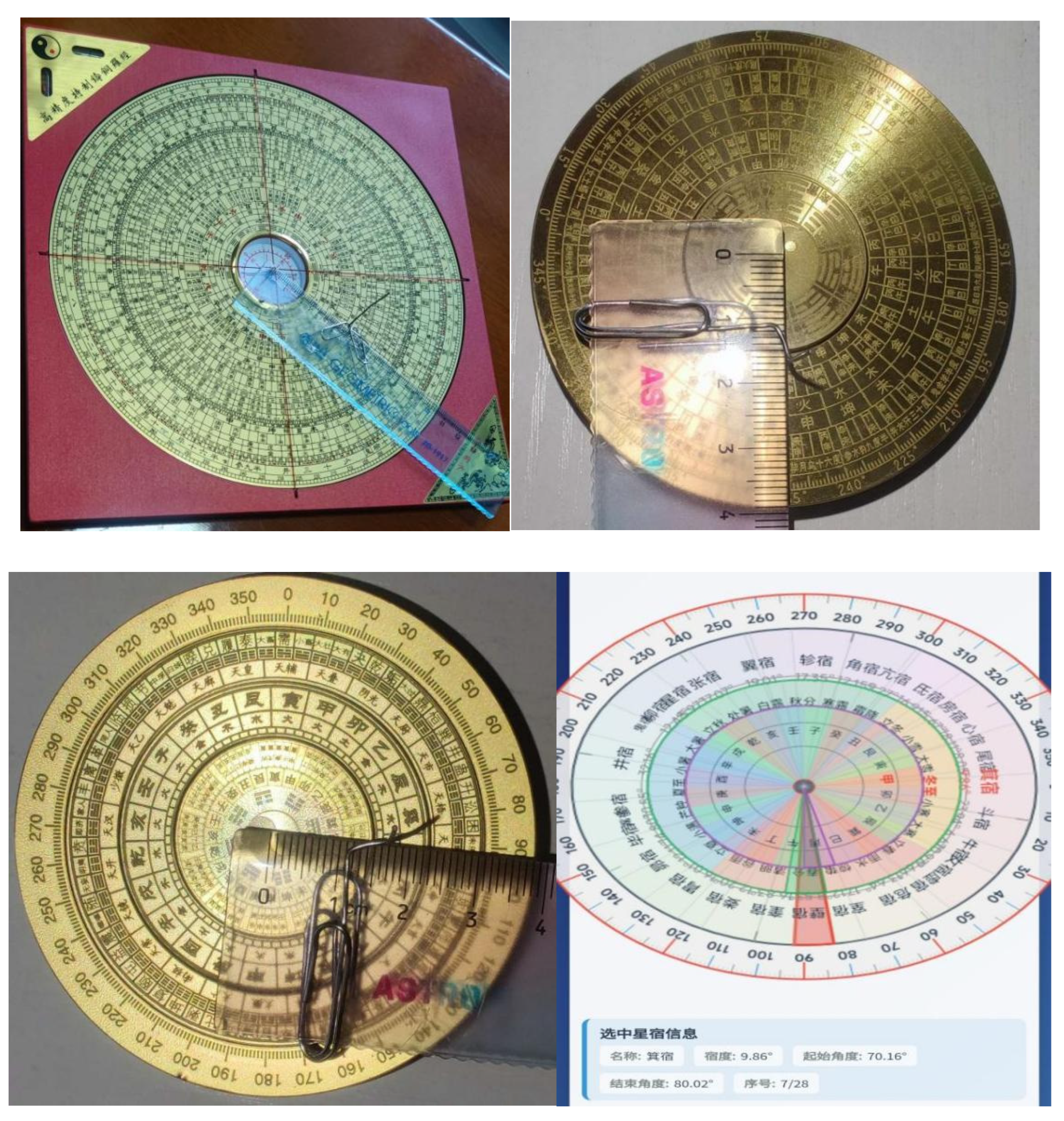
3.4. Deepening Interaction: From Physical Alignment to Digital Query
The evolution of user interaction with these instruments reveals a consistent underlying logic: • The Qi Heng Yi required physical alignment with stars (observation).
- The Luopan employs a magnetic needle to sense terrestrial energies (geomatic intervention).
- The digital application enables simulation and queryingof cosmic patterns (computational engagement).
The practice of using a ruler and a paperclip to take precise measurements on a physical Luopan—echoing the sighting methods of the Qi Heng Yi—highlights a fundamental principle: these tools are not black boxes but transparent interfaces for human-cosmos dialogue.
The ruler and the paperclip, in their essence, function as a gnomon or a tall gnomon (high table), for which China has archaeological evidence, such as the Eastern Han Dynasty bronze gnomon and the Dengfeng Observatory’s tall gnomon. They are the embodiment of the principle of “the supreme simplicity of the supreme principle” (大道至简) inherent in the Seven-Heng Instrument. By rotating them 360 degrees, the equatorial plane of the Seven-Heng Instrument can be reconstructed.
3.5. Conclusion: A Self-Correcting Epistemological Loop
The lineage from Qi Heng Yi to Luopan to the digital astrolabe forms a self-renewing cycle of operational cosmology. The continued existence and use of the Luopan challenge singular narratives of Western scientific dominance, while modern recalibration efforts demonstrate that this tradition is not static. By rectifying celestial scales and digitizing the cosmogram, this work affirms the core of Qi Li Gong Sheng: the continual refinement of tools to maintain a precise and living dialogue with the cosmos. This legacy, therefore, is not about preserving relics but about advancing a unique Chinese epistemology that intertwines theory, material practice, and application across millennia.
4. Discussion: Epistemology of Ephemerality and the Resilience of Operational Knowledge
Sivin (1995) consistently emphasizes the practical orientation and social embeddedness of Chinese science [64]. The Qi Li Gong Sheng paradigm explored in this paper serves as a deep case analysis of this characteristic, demonstrating that even the most profound cosmic theories must be realized through the most practical instruments. The edited volume by Lo and Barrett (2018) demonstrates the plurality of perspectives in the history of Chinese medicine [65], while this article approaches from the specific angle of astronomical instruments, providing a robust explanation for the understanding of ‘Heaven-Human Correspondence’ at the level of technical implementation. This focus on instrumental operationalization allows us to reevaluate the resilience of Chinese epistemic traditions.By contextualizing our work within Lo and Barrett’s pluralistic framework, we can better highlight how astronomical instruments provide a technical lens for ‘Heaven-Human Correspondence’, thereby extending Sivin’s thesis into a broader comparative landscape.
Our reconstruction of the Qi Heng Yi and its embodiment in medical chronobiology substantiates Sivin’s thesis, revealing how cosmological principles were not merely abstract contemplations but were operationalized through tangible interfaces—from ritual jades and astronomical devices to the human body itself. This operational turn necessitates a redefinition of what constitutes valid evidence in the history of science, shifting the focus from the persistence of durable artifacts to the reproducibility of epistemic practices.
4.1. Redefining Material Evidence: Operational Reproducibility as Historical Validation
This study fundamentally reorients the evidentiary standards for pre-modern scientific traditions. The Zhoubi suanjing’s prescription for constructing a cosmographic diagram through “level-ground plotting and gnomon-erecting” (pingdi weitu, libiao weiyi) constitutes not a description of a lost artifact, but an algorithmic protocol. Its validity resides in operational reproducibility rather than material persistence.
This study fundamentally reorients evidentiary standards away from the persistence of durable artifacts toward operational reproducibility. The most powerful demonstration of this is the instrument’s instantiation on the human body—the most accessible and ephemeral ‘platform’ of all. The long-term reconstructive praxis confirms the protocol’s robustness across media (wood, code, paper), but its application on the body proves its ultimate transmediality. The body itself becomes the validating evidence, demonstrating a knowledge system whose continuity is anchored in transmissible cognitive and corporeal operations, ensuring exceptional resilience.
The user’s decade-long reconstructive praxis—spanning a physical scale model for a master’s defense in Chinese medicine, an HTML-based interactive simulation, and ad-hoc implementations using paperclips—demonstrates this protocol’s transmedial robustness. Each instantiation, despite divergent materialities (wood, code, metal), successfully operationalizes the core mathematical-cosmological kernel derived from the text. This evidences a knowledge system whose continuity is anchored not in durable objects but in repeatable cognitive operations. Consequently, historical validation shifts from seeking a singular artifact named “Qi Heng Yi” to verifying the functional fidelity and cross-temporal applicability of its operational logic—a standard met by this study’s multidisciplinary evidence chain (jade cong prototypes, textual transmission, later instruments, medical applications) and experimental replication.
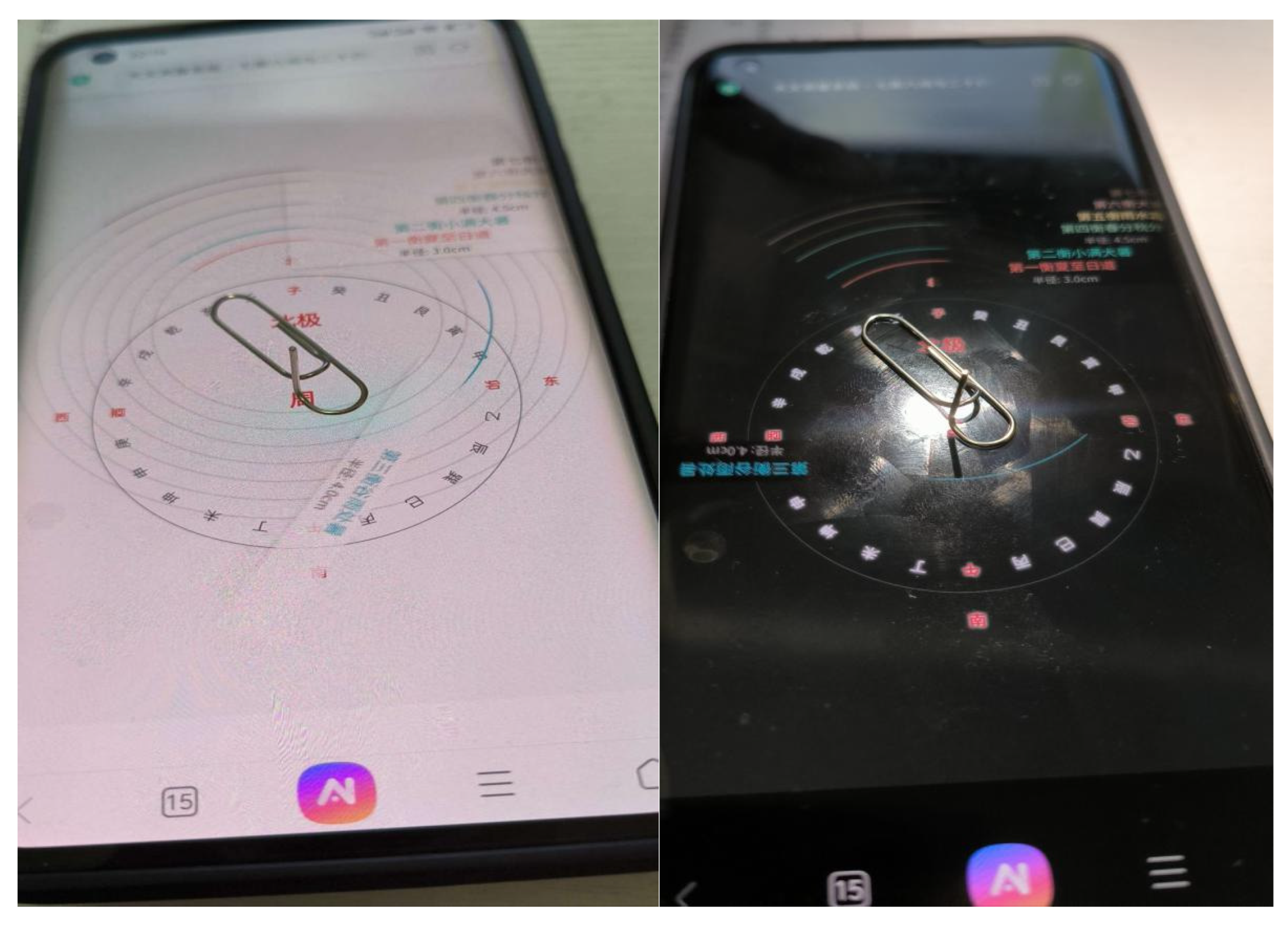
Figure 9.
The Mobile Device as an Operational Instantiation of the Qi Heng Yi. This demonstration activates the device’s preloaded computational kernel of the Zhoubi Suan Jing’s cosmographic schema. Using a paperclip as a gnomon, the smartphone functions as a field computing instrument for celestial reckoning, embodying the transmedial reproducibility of the underlying protocol.
Figure 9.
The Mobile Device as an Operational Instantiation of the Qi Heng Yi. This demonstration activates the device’s preloaded computational kernel of the Zhoubi Suan Jing’s cosmographic schema. Using a paperclip as a gnomon, the smartphone functions as a field computing instrument for celestial reckoning, embodying the transmedial reproducibility of the underlying protocol.
4.2. Operational Epistemology and Civilizational Continuity: The Efficiency of Ephemerality
The user’s multi-scalar reconstructions reveal a defining feature of Chinese operational cosmology: cognitive efficiency through minimalism. The foundational ephemeral form—requiring only leveled earth, a gnomon, and geometric rules—achieved high-precision cosmic modeling with near-zero material investment. This “low-technology, high-cognition” paradigm underpinned exceptional civilizational resilience.
Contrast this with the Greco-Roman trajectory exemplified by the Antikythera Mechanism: a high-complexity, materially intensive device whose knowledge system was vulnerable to sociotechnical disruption. China’s operational tradition, by encoding knowledge as replicable procedures and mnemonically portable schemata, ensured continuity through what the user terms “kernel persistence”: the core li (cosmological principles) functioned as a seed capable of regenerating adapted qi (material forms) across technological epochs—from Han clepsydrae to Ming compasses. This epistemological mode, prioritizing adaptable reproducibility over mechanical encapsulation, offers a techno-historical explanation for Chinese civilization’s documented continuity.
4.3. Qi-Li Symbiosis in Transdisciplinary Knowledge Transfer: Cosmology to Chronomedicine
The user’s insight regarding Zhang Zhongjing—”he needed only the Zhoubi suanjing or its conceptual framework to refine his theory”—epitomizes higher-order Qi-Li Symbiosis. For Zhang, the “instrument” required was not a physical armillary sphere but the internalized operational logic—the li—of the Qi Heng system. As a medical practitioner, he transposed this astronomical operational schema onto human pathophysiology, generating the “six-meridian resolution timetable” (liu jing bing yu jie shi).
This exemplifies knowledge transfer via principle migration: the li of celestial measurement became the theoretical foundation (li) of medical intervention, achieving structural coupling without physical artifact transmission. Such fluidity underscores Qi-Li Symbiosis as a dynamic process where li transcends its original material context (qi) to structure cognition in new domains.
4.4. Toward a Pluralist History of Science: Challenging the “Great Divide”
Placing these findings in global context dismantles Eurocentric binaries separating “modern science” from “pre-modern belief.” This study reveals an alternate pathway: not toward autonomous prediction machines, but toward optimized human-cosmos cognitive interfaces.
The Greek simulative tradition (seeking to materially encapsulate theory) and the Chinese operational tradition (prioritizing procedural knowledge and open interaction) represent divergent civilizational responses to universal questions. The former valorizes mechanical complexity; the latter, cognitive accessibility and adaptive reproducibility. The user’s successful reconstructions—spanning analog and digital media—demonstrate this tradition’s enduring intelligibility and functional validity, enabling genuine cross-temporal dialogue.
Thus, we advocate for a global history of science that recognizes procedural knowledge systems and ephemeral practices as equally valid scientific expressions. Such inclusivity not only rectifies historiographical bias but honors the pluralism of human ingenuity—where the collision of civilizational paradigms, as demonstrated here, becomes the engine of scholarly progress.
5. Conclusion: Towards a Global History of Operative Knowledge
5.1. Summary of Findings
This study elucidates that:
- Pre-modern China cultivated a scientific lineage where instruments served as the operative platforms of theory (Qi Li Gong Sheng), exemplified by the reconstruction of the Qi Heng Yi as a physical instantiation of the Gai Tian cosmogram.
- Medical chronobiology in the Shanghan Lunemerged through the direct application of an instrumentally-operationalized cosmographic model, with the six-meridian resolution times mapping homomorphically onto the sun’s kinematic paths in the Qi Heng system.
- The material continuity of the “heaven-round, earth-square” schema—from Liangzhu jade cong to Han-era cosmograms and coinage—demonstrates how cosmological principles were embedded into daily life and bureaucratic practice.
The reconstruction and functional analysis presented above not only recover a lost instrument but also reveal a fundamental epistemological divergence between the Chinese and Greco-Roman approaches to cosmology. The Antikythera Mechanism computed a pre-formed theory through intricate gearing, whereas the Qi Heng Yi operationalized a cosmographic model through user calibration. This distinction, grounded in the material evidence, invites us to contemplate the broader implications of these divergent technological paradigms for the history of science.
5.2. Broader Implications: A Comparative Reflection on Epistemic Pathways
The significance of these findings extends beyond Chinese history to engage with global sociology of scientific knowledge.The findings of this article form a trans-civilizational dialogue with the classic study by Shapin and Schaffer (1985). They revealed how experimental practices constructed European scientific truth and political order [66]. This article, in turn, demonstrates that in Han Dynasty China, an instrument-mediated operative cosmology similarly constructed natural knowledge while simultaneously underpinning the temporal-spatial order and bodily management of the empire. This serves as another grand case for the sociology of scientific knowledge, showcasing the diversity of knowledge production modes.
Just as Saliba (2007)’s research [67]on Islamic science broke the myth of Eurocentrism, the in-depth exploration of China’s Qi Li Gong Sheng tradition also aims to enrich the panorama of global history of science, revealing that beyond the theoretical geometry tradition of Greece, there exists China’s operational cosmology, an equally powerful and precise scientific tradition.
It is from this vantage point that the contrasts revealed in this study—between the Chinese and Greco-Roman technological paradigms—open a heuristic lens for reflecting on long-term socio-epistemic trajectories. The following perspective is offered not as a definitive conclusion but as a framework for discussion grounded in our comparative analysis.
The contrasts revealed in this study, while drawn from two specific artefacts, open a heuristic lens for reflecting on the long-term socio-epistemic trajectories of scientific traditions. The following perspective is offered not as a definitive conclusion but as a framework for discussion grounded in our comparative analysis.
From this vantage point, one might argue that the operative and application-oriented epistemology of the Qi Heng paradigm, deeply embedded in bureaucratic, agricultural, and medical practices, fostered a scientific culture that was inherently stabilizing and self-contained, enhancing societal resilience and continuity. This characteristic finds its material expression in the enduring ‘round heaven, square earth’ motif and echoes what historian Joseph Needham termed the ‘continuity’ of the Chinese scientific tradition [68].
Conversely, the simulative and theoretically-driven epistemology epitomized by the Antikythera Mechanism, while powerfully predictive, represents a mode of knowledge that is potentially more fragile (due to its reliance on complex and perishable technology) and outward-probing in its nature. The long-term resilience of a civilization may be well-served by a scientific tradition that integrates knowledge into the fabric of daily life and governance, as seen in the legacy from the Liangzhu cong to the luopan, rather than one that specializes in the creation of autonomous theoretical objects.
This comparative framework may be further enriched by considering the astrolabe—a portable cosmographic instrument developed through Hellenistic, Islamic, and medieval European traditions—as a third epistemic variant. Like the Qi Heng Yi and luopan, the astrolabe functioned as a multi-layered rotational device for celestial simulation, user calibration, and integrated practical functions (timekeeping, navigation, and astrology). However, its operational logic relied fundamentally on mathematical projection theory (e.g., stereographic geometry), prioritizing abstract precision over physical instantiation of cosmic models. This contrast underscores the distinctiveness of the Chinese “operational priority” paradigm, where cosmological principles were materially embodied rather than mathematically pre-computed.
In this context, the principles of “establishing the gnomon at the commencement and calibrating the gauge against the center” (立端于始,表正于中) and “since antiquity, connecting with Heaven constitutes the very root of life” (夫自古通天者,生之本) provide robust support for the “co-emergence of instrument and theory” (器理共生) from the perspective of medical praxiology [69]. This system utilized the “instrument” (器) as its operational platform, employed “calibration” as its core technique, and aimed at “sustaining life” as its ultimate purpose. Within this framework, “theory” or “principle” (理) did not exist a priori; rather, it was generated, tested, and its value was manifested through the repeated practice of using the “instrument.” This offers a crucial praxiological perspective for understanding the uniqueness and vitality of the Chinese scientific and technological tradition.
6. The Empirical Path of the Thought Experiment: From Cognitive Leap and Interactive Navigation to Reproducible Academic Verification
This chapter fully presents the complete pathway for transforming the “Qi-Li Gong Sheng” paradigm from philosophical speculation into testable scientific practice. At its core is a spiral process of “speculation-replication-verification”: constructing a cognitive framework through thought experiments; developing an interactive “Cosmic Navigation System” to embody it as an operational interface; and finally, conducting quantitative verification via Python programs, while clearly outlining a clear, open, academic-grade path to falsification.
6.1. The Leap in Cognitive Levels and the Realization of an Interactive Interface
The thought experiment predicts a leap of the cognitive agent from “cosmic inhabitant” to “cosmic navigator” through extreme scaling. The core evidence for this leap is the successful construction of the “Cosmic Navigation System.” This system is an operational embodiment of the “Qi-Li Gong Sheng” principle:
- Externalization of the Operational Interface: The system externalizes the body’s “Dual-Seven-Circuit” coordinates (equatorial-ecliptic system) into an interactive interface. Control parameters (e.g., navigation altitude, system rotation) act as the control handles of the magnified “bodily gnomon,” while the displayed radii of the seven circuits and stellar positions together constitute an operable modern coordinate system based on an ancient cosmological model.
- Functional Evolution from Measurement to Navigation: The system’s active functions, such as “Initiate Navigation” and “Select Navigation Target,” signify the tool’s evolution from static measurement within the cosmos to dynamic navigation across cosmic scales, fulfilling the thought experiment’s prediction.
This navigation system is the conceptual cornerstone for quantitative verification. It provides a structured theoretical framework for the Python verification programs.
6.2. Quantitative Verification and the Path to Falsifiability Based on Open-Source Data
Within the framework provided by the navigation system, we developed three Python verification programs. Using limited real celestial data (e.g., basic data on 27 cosmic voids) easily obtainable from public sources, we conducted a rigorous quantitative analysis of the “force penetration” effect produced by the “normalization” operation. Preliminary verification results (e.g., a force penetration strength score of 0.8519, an asymmetry index of 0.7436, along with two additional verification scores of 0.961 and 0.833, coupled with the identification of the Boötes Void as a candidate origin point) provide encouraging support for the model. This cosmological model allows for the possibility that certain stars or materials may be older than our universe, as they could originate from a higher-level hierarchical cosmos that contains our “cosmic sea.” An example is HD 140283 (the Methuselah star).
The true scientific rigor of this study lies in its design of a clear, reproducible academic verification path. We are fully aware that, as an interdisciplinary exploration, its ultimate judgment rests with the professional astrophysics community. Therefore, the core verification path we propose is as follows:
To submit the three developed and open-sourced Python verification programs to professional cosmologists and astrophysicists for operational verification by directly connecting them to authoritative scientific data centers such as the Sloan Digital Sky Survey (SDSS), Gaia, or Euclid.
- Reproducibility and Accessibility of Verification: This approach means that any researcher with the appropriate data access permissions can replicate our process. Verification no longer depends on specific commercial collaborations but is built upon the shared, high-standard data foundation of the academic community. This greatly enhances the transparency and credibility of the verification process.
-
Clear Falsifiability Criterion: This path provides a clear falsification standard that conforms to academic norms:
- If the theory shows potential: When applied to the large-scale data from authoritative databases, the program’s verification scores should maintain statistical significance. The cosmic large-scale structure patterns predicted by the theory (e.g., specific anisotropies, rare bidirectional dispersions) should be reproducible in larger samples.
- If the theory is falsified: If, after importing the vast datasets from SDSS, Gaia, etc., the program’s verification scores become statistically insignificant (p-value > 0.05) or the predicted patterns disappear, then the core hypothesis of this theory is negated by the current observational data.
This “open-source, reproducible” verification design is the core manifestation of this study’s scientific character. It proactively submits the fate of the theory to the judgment of the objective data shared by the academic community and peer review, which constitutes a most solid and humble scientific attitude.
6.3. Conclusion: An Exploratory Paradigm Open to the Academic Community The complete path of “Thought Experiment -> Navigation System -> Quantitative Verification -> Open-Source Review” demonstrates that “Qi-Li Gong Sheng” is a rigorous and open exploratory paradigm.
- Rigor and Openness of the Path: The research path not only accomplishes the leap from philosophy to a computable model but also charts a reproducible verification path that conforms to academic norms. It returns the ultimate interpretive authority to the professional academic community.
- Reproducibility of the Method: The complete code, clear verification logic, and reliance on public data sources enable any interested researcher to review and advance this work, embodying the principle of reproducibility in modern scientific research.
- Initiating an Academically Driven Cycle of Exploration: Regardless of the outcome of professional verification, this process initiates an academically driven cycle of exploration. Support would mean a promising new direction worthy of in-depth study; negation would mean that this “Qi” (verification method and data) would also help the “Li” (theoretical model) evolve beneficially through refutation.
Ultimately, the ancient wisdom of “Qi-Li Gong Sheng,” through this path that integrates profound speculation, interactive technology, and a verification process彻底 open to the academic community, demonstrates its vitality as a paradigm for modern scientific research. It courageously places itself under reproducible and falsifiable testing, and its value will ultimately be judged by the scientific community at the frontier of public knowledge.
Figure 10.
Prototype of the Cosmic Navigation System: Control Interface. This figure displays the operational control interface of the cosmic navigation system. The left panel shows system parameter settings, including key configurations such as Navigation Height (1.57 million ten-thousand light-years) and the Dual Seven-Heng Collaborative Navigation mode. The cosmic spaceship control area on the right presents data like the Seven Circuits radii (e.g., Inner Heng: 2.355 million ten-thousand light-years) and azimuth information (Horizontal Azimuth: Zi). Parameters such as the Height Coefficient 7850 intuitively reflect the coordinate scaling logic based on the Body-Gnomon.
Figure 10.
Prototype of the Cosmic Navigation System: Control Interface. This figure displays the operational control interface of the cosmic navigation system. The left panel shows system parameter settings, including key configurations such as Navigation Height (1.57 million ten-thousand light-years) and the Dual Seven-Heng Collaborative Navigation mode. The cosmic spaceship control area on the right presents data like the Seven Circuits radii (e.g., Inner Heng: 2.355 million ten-thousand light-years) and azimuth information (Horizontal Azimuth: Zi). Parameters such as the Height Coefficient 7850 intuitively reflect the coordinate scaling logic based on the Body-Gnomon.
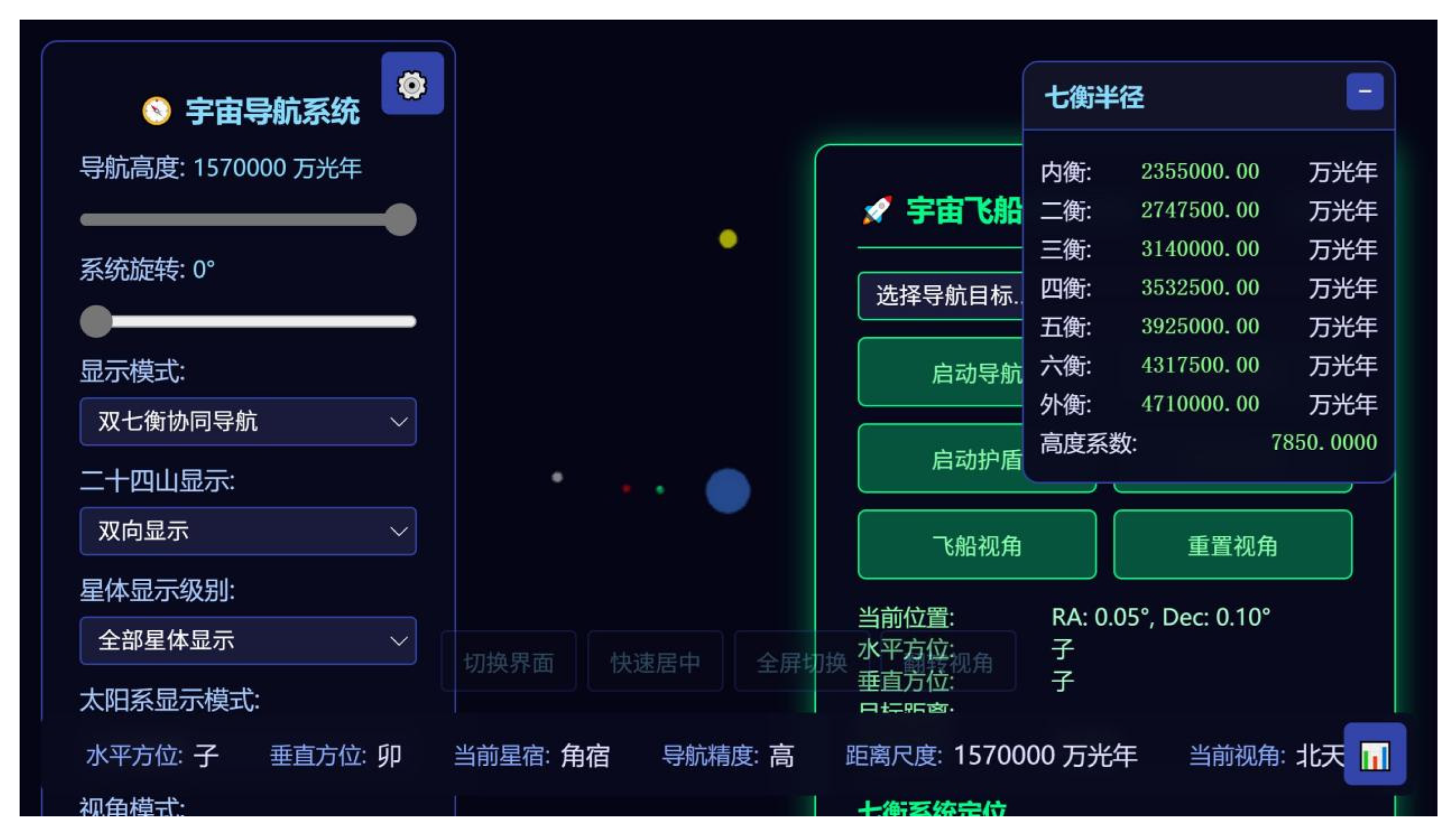
Figure 11.
Prototype of the Cosmic Navigation System: Navigation Implementation Interface. This figure demonstrates the system’s application in navigating within the Pisces-Cetus Supercluster Complex. The left parameter panel and the right spaceship control system interact, with the central ring structure representing the Dual Seven-Heng coordinate system. The azimuth parameters and target distance (11.10 light-years) displayed at the bottom verify the feasibility of this bodily navigation scheme on a cosmic scale.
Figure 11.
Prototype of the Cosmic Navigation System: Navigation Implementation Interface. This figure demonstrates the system’s application in navigating within the Pisces-Cetus Supercluster Complex. The left parameter panel and the right spaceship control system interact, with the central ring structure representing the Dual Seven-Heng coordinate system. The azimuth parameters and target distance (11.10 light-years) displayed at the bottom verify the feasibility of this bodily navigation scheme on a cosmic scale.
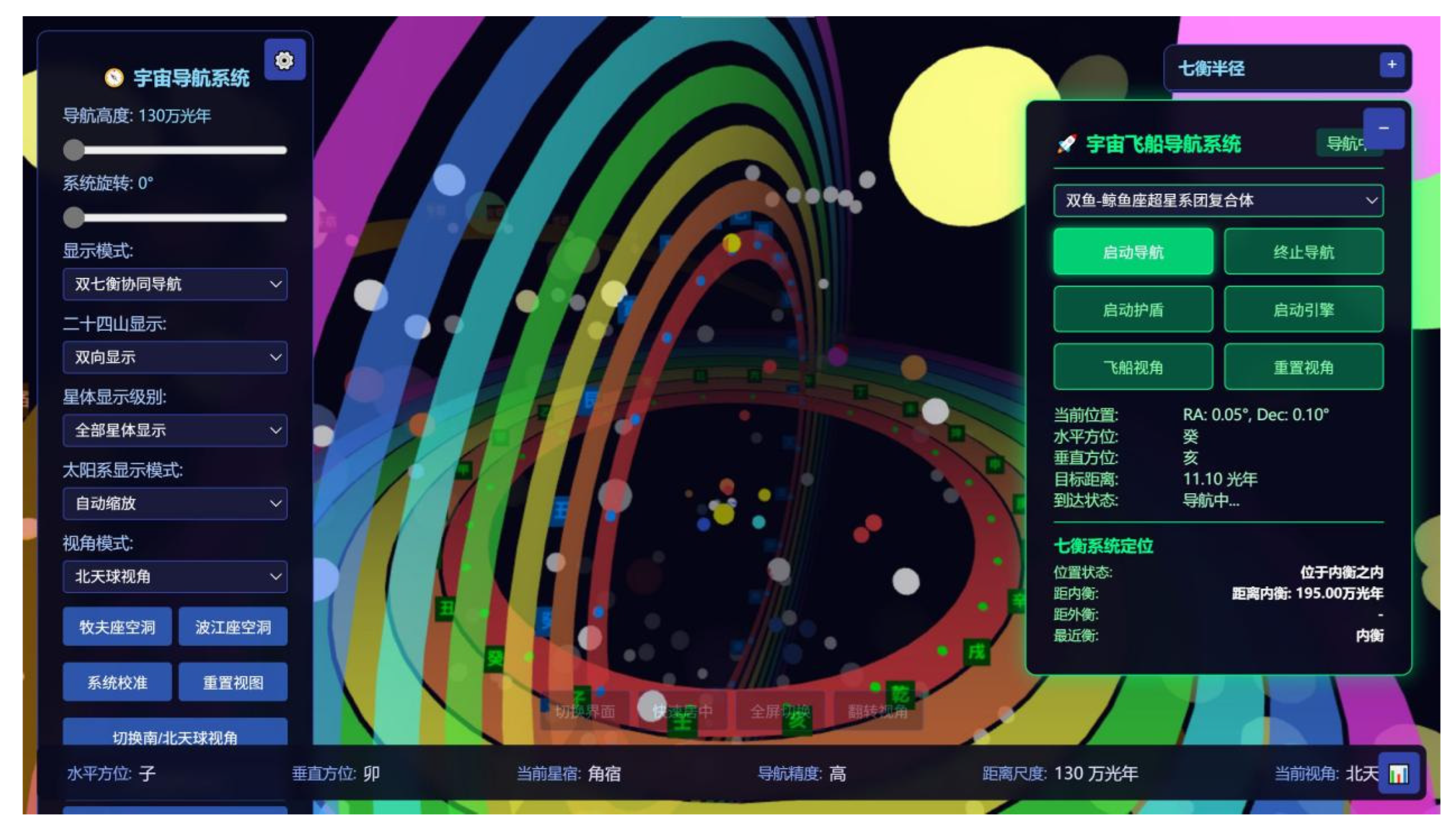
Figure 12.
Integrated Analysis of Bidirectional Force Penetration Model: Textual Report and Visualizations. The candidate origin status of the Boötes Void and its force penetration parameters (score: 0.8519, asymmetry: 0.7436) may provide preliminary computational evidence for the “Hierarchically-Nested Cosmic Ocean Normalized Anti-Cosmos Force Penetration Theory.” The theoretical framework proposes that, through the normalization method and within the infinitely nested cosmic ocean structure, the “force penetration” interaction between the positive and anti-cosmos can be explored.
Figure 12.
Integrated Analysis of Bidirectional Force Penetration Model: Textual Report and Visualizations. The candidate origin status of the Boötes Void and its force penetration parameters (score: 0.8519, asymmetry: 0.7436) may provide preliminary computational evidence for the “Hierarchically-Nested Cosmic Ocean Normalized Anti-Cosmos Force Penetration Theory.” The theoretical framework proposes that, through the normalization method and within the infinitely nested cosmic ocean structure, the “force penetration” interaction between the positive and anti-cosmos can be explored.
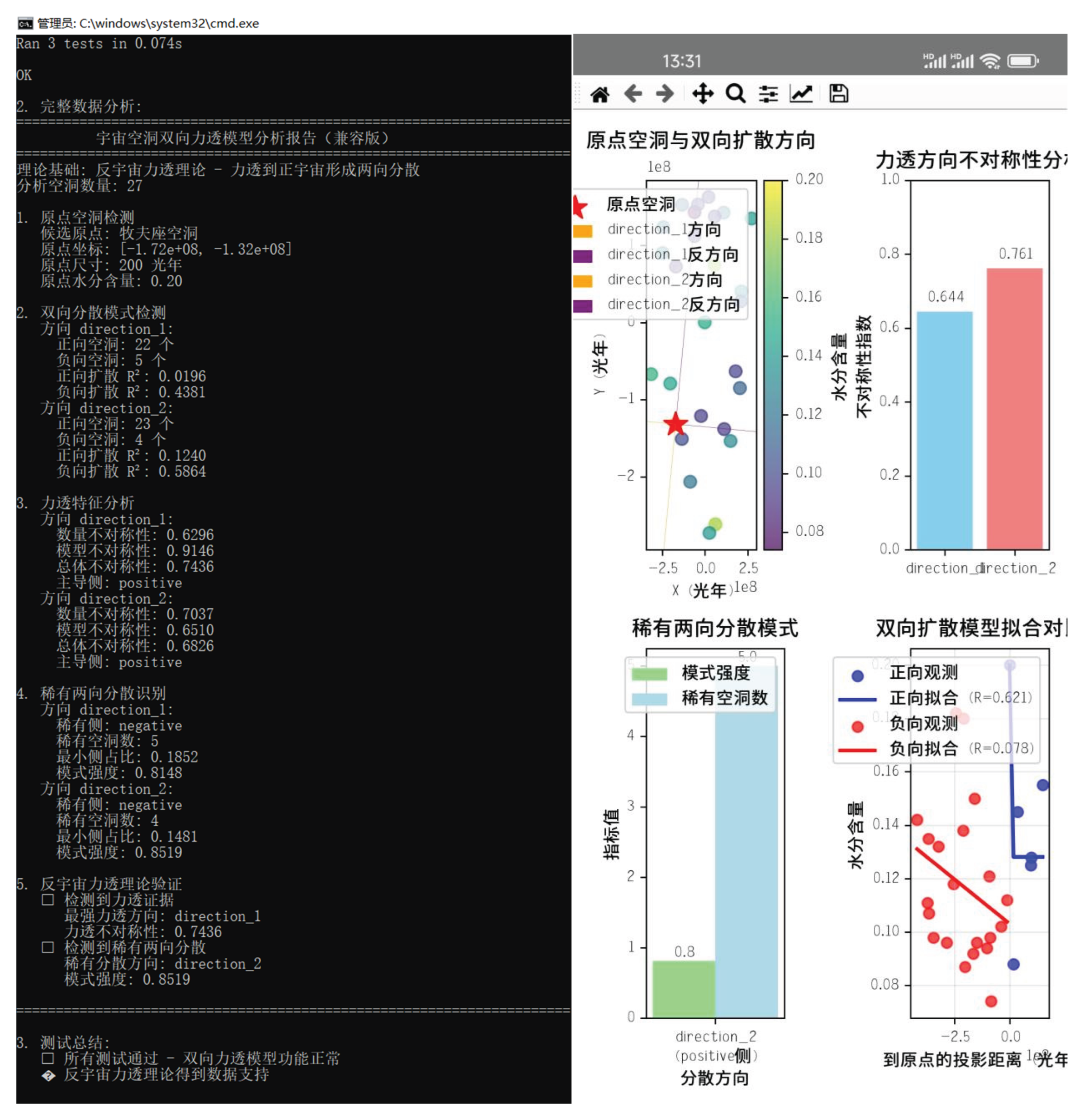
6.4. Epilogue: The Hierarchical Constraint of Perception—A Synthesis of Qi Li Gong Sheng
Having traversed the cognitive scales from the human body to the cosmos, we return with a transformed perspective to the source of Chinese civilization—the Liangzhu Culture’s “Jade Cong King” (M12:98). Its significance is now radically amplified: it is no longer merely a ritual object, but rather a primordial interface pre-encoded with the logic of cosmic cognition.Its classic form, “square on the outside, round on the inside,” has long been interpreted as the material embodiment of the “round heaven, square earth” (天圆地方) cosmography. Furthermore, its hollow cylindrical core has been profoundly understood by scholars as the Axis Mundi—a sacred channel connecting the hierarchical realms of heaven, earth, and humanity.
Our thought experiment reveals a remarkable structural resonance: when the “body gnomon,” as a primordial measuring tool, is conceptually magnified to a scale that pierces through the cosmos, the cylindrical void it leaves behind perfectly replicates, both geometrically and symbolically, the hollow “Axis Mundi” structure of the Cong(Figure 1). This demonstrates a unified core cognitive logic operating across scales: from the micro-scale of bodily operation (the body gnomon), to the artifact-scale of the Cong, and finally to the macro-scale of the cosmos itself.Within this “Axis Mundi” framework, the geometric isomorphism between the thirty-two vertical tiersof the Cong King and the “Thirty-Two Heavens” (三十二天) [70] cosmic model found in the later Daoist text Scripture on the Salvation of Humanity(《度人经》) transcends mere numerical coincidence. It strongly suggests that a “Layered Cosmos” (Layered Cosmos) represents a fundamental cognitive pattern—a necessary vertical extension of the “round heaven, square earth” geometric paradigm along the Axis Mundi. Although a direct historical lineage across the three-thousand-year chasm must be treated with scholarly caution due to missing intermediate links, the phenomenon itself reveals the enduring vitality of the “Axis Mundi” as a deep-seated cognitive archetype within Chinese civilization.
Ultimately, this powerfully affirms the profundity and universality of the core thesis of “Qi-Li Co-emergence” (器理共生). The Cong’s “Axis Mundi” served as a sacred conduit for ancient peoples to commune with heaven and earth, while the “cosmic void” left by the gnomon in our thought experiment acts as a rational bridge for the modern investigator to achieve cognitive transcendence. Together, they demonstrate that knowledge is not a static representation of the world, but rather a structural relationship generated through the dynamic interaction between a cognitive agent and the world, mediated by “artifacts” (whether the jade Cong, the human body, or an abstract model). This cognitive framework, centered on the “Axis Mundi” and cosmic layering, provides a captivating, interdisciplinary point of entry for future explorations into how the “Qi-Li Co-emergence” epistemology generates isomorphic macro-structures across different domains of knowledge.
6.5. Coda: Beyond the Constraint—Cosmic Reflections on the Isomorphic Landscape
If the Cong and the body gnomon reveal that our knowledge is mediated by the ‘instruments’ we inhabit and employ, does this not reveal a cognitive landscape that is isomorphic across all scales? Of the microbes dwelling within the human body, could they ever perceive that the vast world they inhabit is itself a complete living entity named “human”? And the individual carrying this life, amidst the boundless sea of humanity, is but a drop in the ocean. Extending this to the cosmos, the planet we inhabit, within the endless expanse of space, is it not also as insignificant as a grain of dust? Does this reveal a cognitive landscape that is isomorphic across micro and macro scales: Could our universe, in turn, be a corner of some grander living entity? Are all our perceptions constrained by the specific hierarchical level we occupy? These reflections are offered as a humble starting point, in hopes of eliciting more profound insights.
Acknowledgments
I wish to express my deepest gratitude to the many mentors, colleagues, and family members whose selfless support and encouragement made the conception and completion of this study possible. Foremost, I owe my profound respect and appreciation to my esteemed teachers in medicine, Mr. Ma Yun (recognized as one of the Fourth Group of Ten Distinguished Senior TCM Physicians of Sichuan Province) and Mr. Liu Yucai (honored as one of the First Group of Famous TCM Physicians of Sichuan Province). It was through their generous guidance and instruction that I entered the world of Chinese medicine. The professional skills they imparted have allowed me to build a career grounded in clinical practice, providing me with the stability and intellectual freedom to pursue scholarly inquiry with a “long-horse-galloping” spirit. I am sincerely grateful to my affiliated institution, Chengdu Bayi Orthopedic Hospital, China RongTong Medica1 Healthcare Group Co. Ltd., as well as its leaders and colleagues, for providing an invaluable research platform and a supportive working environment. Special thanks are due to Professor Zhang Xiaolin, my master’s thesis supervisor at the School of Basic Medical Sciences, Yunnan University of Chinese Medicine, and a renowned Traditional Chinese Medicine expert in Yunnan Province. A decade ago, she opened the door to academic research for me and systematically trained me in scholarly methodology. This article represents a further extension and refinement of the work I began under her guidance. I also extend my gratitude to Dr. Yan Zhiyuan, my department head and senior colleague. His encouraging and insightful feedback on the early draft of this paper strengthened my confidence to delve deeper and served as a direct impetus for the subsequent stages of this research. Tracing the origins of my journey, I must acknowledge my earliest guide into Chinese medicine, Dr. Deng Jiakai, who is also my uncle. The formative exposure to his practice during my childhood planted the seeds of my interest in this field and ultimately led me to pursue the study of Chinese medicine. This familial influence marks the very beginning of my academic path. On a personal note, I thank my wife and son, who have accompanied me through relocations and uncertainties with unwavering support and affirmation. I am equally indebted to my parents and parents-in-law for their understanding and steadfast encouragement throughout my endeavors. Finally, I wish to voice a broader sense of gratitude: To the great era and peaceful nation in which we live, which have provided fertile ground for the preservation and development of traditional Chinese learning. And to the profound intellectual legacy of Chinese civilization—embodied in philosophical principles such as “the supreme principle resides in simplicity” (大道至简) and “harmony between human and heaven” (天人合一), as well as in the sophisticated, almost algorithmic encoding of essential knowledge—which forms the very foundation upon which this study stands. Many others have contributed in ways seen and unseen. Though not named here, they hold my lasting gratitude.
Glossary of Key Terms
| Chinese Term | Recommended English Translation | Explanation |
| 器理共生 | Co-emergence of Instrument and Theory (Qi Li Gong Sheng) | The core epistemic paradigm argued in this paper, denoting the inseparable and mutually constitutive relationship between a material device (qi) and its conceptual principle (li) in the production of knowledge. Theory provides the design blueprint for the instrument, while the instrumental practice in turn deepens and refines the theory. |
| 身体七衡仪 | The Body as the Seven Circuits Instrument | The thesis that the human body itself (using the erect phallus as a gnomon and the abdomen as the cosmic plane) can be operationalized as a personalized instantiation of the Qi Heng cosmological model for celestial measurement and calibration. |
| 盖天说 | Heavenly Canopy (Gai Tian) Cosmology | The ancient Chinese cosmological model that envisions the heavens as a hemispherical canopy (gai) rotating over a flat, square earth (pan). This model forms the theoretical basis for the Seven Circuits (Qi Heng) diagram. |
| 七衡图 | The Seven Circuits (Qi Heng) Diagram | The foundational cosmogram of the Gai Tian model, consisting of seven concentric circles (heng) representing the sun’s apparent paths at key solar terms (e.g., summer and winter solstices). It is the geometric core of the cosmic model. |
| 身体圭表 | Body-Gnomon | The erect phallus functioning as the gnomon (measurement standard) in the Body as the Seven Circuits Instrument model. Its length (L) serves as the fundamental parameter for all personalized proportional calculations in the embodied cosmogram. |
| 操作完善性 | Operational Excellence | The criterion for validity in the embodied model. Truth is realized not through comparison to external data but through perfect bodily calibration (e.g., aligning the body-gnomon perfectly perpendicular to the abdominal “earth-plate”), establishing an internal, self-consistent harmony. |
| 操作客观性 | Operational Objectivity | A form of objectivity (contrasted with mechanical objectivity) achieved through standardized bodily practice and internal calibration, rather than by eliminating human intervention. It emphasizes correctness in practice over representation. |
| 认知补偿(脑补) | Cognitive Compensation | The mental act of completing the cosmogram’s partially “invisible” circles on the body’s three-dimensional surface. This active participation of the practitioner is a fundamental feature of the epistemology, blending the visible, tactile, and imagined. |
| 《周髀算经》 | Zhoubi Suanjing (The Gnomon of the Zhou) | A foundational Han-era text that combines cosmological theory with mathematical astronomy. Its gougu (Pythagorean) theorem and proportional scaling principles provide the mathematical basis for reconstructing the Body as the Seven Circuits Instrument. |
| 勾股定理/毕达哥拉斯定理 | Gougu/Pythagorean Theorem | The geometric principle of right-angle triangles, utilized in the Zhoubi Suanjing for astronomical calculations, such as determining the sun’s height and distances. It enables the scaling of the cosmic model to any size. |
| 七衡仪 | the Seven Circuits Instrument (Qi Heng Yi) | An ancient Chinese cosmological model representing the sun’s apparent paths via concentric circles, forming a foundational diagram for aligning cosmic and bodily patterns. |
| 《伤寒论》 | Treatise on Cold Damage (Shang Han Lun) | A foundational text of Chinese medicine by Zhang Zhongjing, which pathologizes the Six Meridians and links clinical patterns to cosmic rhythms. |
| 营卫运行规律 | circulatory rhythm of Nutritive and Defensive Qi (Ying Wei) | The theory describing the cyclical flow of defensive (Wei) and nutritive (Ying) energies in the body, correlating with cosmic cycles like the day-night and annual cycles. |
| 开阖枢 | Opening, Closing, and Pivoting (Kai He Shu) | A theory describing the dynamic functional phases of the Six Meridians (three Yin, three Yang), analogous to the gates and pivots of cosmic and bodily qi movement. |
| 五运六气 | Five Circuits and Six Qi (Wu Yun Liu Qi) | A Chinese medical doctrinal system that correlates climatic and astrological cycles (five phases, six qi) with health, disease, and epidemic patterns. |
| 北极-璇玑 | North Pole-Polar Axis (Bei Ji Xuan Ji) | The central axis structure within the Seven-Ring Instrument, around which the heavens were thought to rotate, providing a geometric basis for spatial orientation in models like Nine Palaces and Eight Winds. |
| 九宫八风 | Nine Palaces and Eight Winds (Jiu Gong Ba Feng) | A spatio-temporal theory used in acupuncture and prognosis, dividing space into nine sectors and associating eight winds with pathological influences, based on cosmic diagrams. |
| 灵龟八法 | Tortoise Method (Ling Gui Ba Fa) / Spirit Tortoise Eight Methods | An advanced acupuncture method selecting points based on the interaction of the day’s heavenly stems and earthly branches, reflecting temporal cycles. |
| 操作宇宙学 | operational cosmology | A knowledge system that systematizes links between observable, operable cosmic patterns (like the sun’s path) and human life phenomena (like disease patterns). |
| 纬书 | Weft Texts (Wei Shu) / apocryphal classics | Han-era texts that interpret classics through prophetic, cosmological, and mystical lenses, often detailing cosmic genesis sequences. |
| 太易-太初-太始-太素 | Great Change (Tai Yi)—Great Beginning (Tai Chu)—Great Commencement (Tai Shi)—Great Simplicity (Tai Su) | A sequence of stages in Chinese cosmogony describing the emergence of the cosmos from undifferentiated simplicity to material complexity. |
| 月令 | Monthly Ordinance (Yue Ling) | A model of statecraft organizing royal activities, rituals, and governance according to the appropriate season and monthly cosmic cycles. |
| 调和阴阳 | Harmonizing Yin and Yang (Tiao He Yin Yang) | A core concept in Chinese philosophy and statecraft, aiming to maintain balance between complementary forces, applied to both health and social order. |
| 六经病欲解时 | Six Meridian Diseases’ Time of Resolution (Liu Jing Bing Yu Jie Shi) | Zhang Zhongjing’s theory predicting the specific time windows when a disease affecting a particular meridian is most likely to resolve, exemplifying the integration of cosmic time with pathology. |
| 罗盘 | Luopan / Feng Shui Compass | A complex geomancy instrument used for appraisal, far more than simple direction-finding. It comprises a series of concentric circles (“disks”), integrating vast cosmic information like the Eight Trigrams (Bagua), Heavenly Stems and Earthly Branches (Ganzhi), and the 28 Lunar Mansions. It is used to determine orientation and calculate auspiciousness or inauspiciousness, embodying the philosophical concept of the unity of Heaven and Humanity |
| 二十四节气 | 24 Solar Terms | A system of twenty-four specific seasonal periods demarcated based on the sun’s apparent motion along the ecliptic (the Earth’s orbit). They accurately reflect the climatic and phenological changes on Earth and form an important astronomical and calendrical system for guiding agricultural production and daily life |
| 二十四山 | 24 Mountains | the core layer on the Earth Plate (Di Pan) of the Luopan, which precisely divides the 360-degree plane into 24 directions, each occupying 15 degrees. It is composed collectively of the eight Heavenly Stems, twelve Earthly Branches, and the four corner trigrams (Qian, Kun, Gen, Xun) from the Bagua. It serves as the foundation for geomancy techniques like examining the dragon (vein), determining orientation, and assessing sand (landforms) and water |
| 二十八星宿 | 28 Lunar Mansions / Xiu | Twenty-eight stellar constellations (asterisms) selected by ancient Chinese astronomers along the vicinity of the ecliptic to observe the movements of the sun, moon, and five major planets. They are equally divided into four groups, known as the Four Symbols (Green Dragon of the East, White Tiger of the West, Vermilion Bird of the South, Black Tortoise of the North) |
References
- Cullen, Christopher. The Foundations of Celestial Reckoning: Three Ancient Chinese Astronomical Systems. London: Routledge, 2017.18-67,538-638.
- Hacking, Ian. Representing and Intervening: Introductory Topics in the Philosophy of Natural Science. Cambridge: Cambridge University Press, 1983,274-275.
- Daston, Lorraine, and Peter Galison. Objectivity. New York: Zone Books, 2007. (Distributed by MIT Press), 309-412.
- Lloyd, G. E. R. Adversaries and Authorities: Investigations into Ancient Greek and Chinese Science. Cambridge: Cambridge University Press, 1996,60-62,150,170,182.
- Galison, Peter. Image and Logic: A Material Culture of Microphysics. Chicago: University of Chicago Press, 1997,1-20,420-435.
- Rheinberger, Hans-Jörg.Toward a History of Epistemic Things: Synthesizing Proteins in the Test Tube. Stanford: Stanford University Press, 1997, 24-37, 75-101, 204-229.
- Latour, Bruno.Science in Action: How to Follow Scientists and Engineers through Society. Cambridge, MA: Harvard University Press, 1987, 21-214.
- Aristotle. On the Heavens. In The Complete Works of Aristotle, Volume 2, translated by Xu Kailai, edited by Miao Litian. Beijing: China Renmin University Press, 2016, 263–392.
- Cheng, Zhenyi.and Wen,Renjun. translators and annotators. Zhoubi Suanjing: Translation and Annotation. Series of Chinese Ancient Science and Technology Masterpieces, edited by Han Yuqun and Xu Chuanwu. Shanghai: Shanghai Century Publishing Group; Shanghai Ancient Books Publishing House, 2012, 1–2.
- Cheng, Zhenyi, and Wen,Renjun. Zhoubi Suanjing: Translation and Annotation. 8.
- Liu, Li. and Chen, Xingcan.The Archaeology of China: From the Late Paleolithic to the Early Bronze Age. Cambridge: Cambridge University Press, 2012, 169-210.
- Allan, Sarah.The Shape of the Turtle: Myth, Art, and Cosmos in Early China.trans. Wang Tao (1991; repr., Beijing: The Commercial Press, 2010), 132-34, 166.
- Keightley, David N.The Ancestral Landscape: Time, Space, and Community in Late Shang China (ca. 1200-1045 B.C.). Berkeley: Institute of East Asian Studies, University of California, 2000,1-5,50-55,80-85,100-105,130-135.
- Zhejiang Provincial Institute of Cultural Relics and Archaeology. Comprehensive Research Report on the Liangzhu Ancient City. Beijing: Cultural Relics Publishing House, 2019, 348.
- Li, Yuan.and Lu, Jianfang. “The Harmonious World of Heaven, Earth, and Gods: Analysis of the Design Philosophy and Function of Liangzhu Jade Cong.” Southern Cultural Relics, no. 5 (2024): 1–14.
- Wu, Jiapi. Chen, Meidong. and Liu, Ciyuan. “Astronomical Function and Age of the Taosi Observatory Site.” Science in China Series G: Physics, Mechanics, Astronomy38, no. 9 (2008): 1265–1272.
- He, Nu. “A Preliminary Study on the Function of the Lacquered Pole ‘Gnomon’ Unearthed from the Mid-Period Royal Tomb IM22 at the Taosi Site in Xiangfen, Shanxi.” Studies in the History of Natural Sciences28, no. 3 (2009): 261–276.
- He, Nu. “A Supplement to the Taosi Gnomon.” Studies in the History of Natural Sciences30, no. 3 (2011): 278–287.
- Shanxi Team, Institute of Archaeology, Chinese Academy of Social Sciences; Shanxi Provincial Institute of Archaeology; and Linfen Cultural Relics Bureau. “Excavation Report of the Large Building Foundation II FJT1 at the Mid-Period Taosi Site in Xiangfen County, Shanxi, 2004–2005.” Archaeology, no. 4 (2007): 3–28.
- Wu, Jiapi, Chen Meidong, and Liu Ciyuan. “Astronomical Function and Age of the Taosi Observatory Site,” 1270–1272.
- Fanshan Archaeological Team, Zhejiang Provincial Institute of Cultural Relics and Archaeology. “Excavation Brief of the Liangzhu Cemetery at Fanshan, Yuhang, Zhejiang.” Cultural Relics, no. 1 (1988): 1–31. Image source: Zhejiang Provincial Museum 3D artifact, Liangzhu Culture Jade Cong King,https://museum24h.com/3d/zhebo/YCW.html.
- Li, Yuan.and Lu, Jianfang. “The Harmonious World of Heaven, Earth, and Gods: Analysis of the Design Philosophy and Function of Liangzhu Jade Cong,” 4. Physical image source from China Archaeology Web, Deng Cong, “The Same Symbol of Kingship from Different Jade Craftsmen at Liangzhu Fanshan M12,” December 7, 2016.http://kaogu.cssn.cn/zwb/xsyj/yjxl/xff_xsl/201612/t20161207_3939796.shtml.
- Li, Yuan.and Lu, Jianfang. “The Harmonious World of Heaven, Earth, and Gods: Analysis of the Design Philosophy and Function of Liangzhu Jade Cong,” 4–5.
- Cheng, Zhenyi. and Wen,Renjun. Zhoubi Suanjing: Translation and Annotation. 87.
- Zhang,Huayong.”Zhoubi Suanjing yu Shanghan Lun Shushu Lilun de Xiangguanxing Yanjiu [《周髀算经》与《伤寒论》术数理论的相关性研究]” (master’s thesis, Yunnan University of Traditional Chinese Medicine (now Yunnan University of Chinese Medicine), 2015), 32-33.
- Major, John S.Heaven and Earth in Early Han Thought. Albany: State University of New York Press, 1993.38-140,217-268,284-286.
- Jones, Alexander. A Portable Cosmos: Revealing the Antikythera Mechanism, Scientific Wonder of the Ancient World. Oxford: Oxford University Press, 2017,93-429.
- Yan, Wanrong. “Sailing by the Stars: Technological Evolution and Historical Function of Portuguese Navigational Astrolabes.” Science & Culture Review21, no. 4 (2024): 5–6.
- Yan, Wanrong. “Sailing by the Stars: Technological Evolution and Historical Function of Portuguese Navigational Astrolabes,” 19–21.
- Yan, Wanrong. “Sailing by the Stars: Technological Evolution and Historical Function of Portuguese Navigational Astrolabes,” 6–8.
- Huang, Zongbei. “A Study of the Persian Astrolabe in the Tsinghua University Science Museum.” In Tsinghua History of Science and Philosophy: Commemorating the 550th Anniversary of Copernicus’s Birth, 136–139.
- Huang, Zongbei. “A Study of the Persian Astrolabe in the Tsinghua University Science Museum,” 125–138.
- Pickering, Andrew. The Mangle of Practice: Time, Agency, and Science. Chicago: University of Chicago Press, 1995, 10-15, 45-50, 85-90, 200-210.
- Jones, Alexander.A Portable Cosmos: Revealing the Antikythera Mechanism,316.
- Jones, Alexander. A Portable Cosmos: Revealing the Antikythera Mechanism,379,385-387,391.
- Bray, Francesca. Technology and Gender: Fabrics of Power in Late Imperial China. Berkeley: University of California Press, 1997.2-3,8, 13,15-16,27,37,42-44,47.
- He, Ning, annotator. Huainanzi Jishi, Volume 1[Huainanzi Collected Explanations, Vol. 1]. New Series of Various Philosophers. Beijing: Zhonghua Book Company, 1998, 244–245, 256–260.
- Hulsewé, A.F.P. Remnants of Ch’in Law: An Annotated Translation of the Ch’in Legal and Administrative Rules of the 3rd Century B.C. Discovered in Yün-meng Prefecture, Hu-pei Province, in 1975. Leiden: E.J. Brill, 1985,52-53,57,88,93-95.
- Porter, Theodore M. Trust in Numbers: The Pursuit of Objectivity in Science and Public Life. Princeton: Princeton University Press, 1995.3-72,148-190.
- Cheng, Zhenyi, and Wenren Jun. Zhoubi Suanjing: Translation and Annotation. 8.
- Cheng, Zhenyi. and Wen,Renjun. Zhoubi Suanjing: Translation and Annotation. 1–2.
- Image from National Museum of China, “Ban Liang Copper Coin,”https://www.chnmuseum.cn/zp/zpml/hb/202209/t20220906_257267_wap.shtml.
- Cheng, Zhenyi. and Wen,Renjun. Zhoubi Suanjing: Translation and Annotation. 96–97.
- Peng, Xinwei. A History of Chinese Currency: Understanding the History of Currency to Truly Understand the History of Economy and Finance. Beijing: China Renmin University Press, 2020.
- Zhou, Weirong. Dai,Zhiqiang. et al. Essays on Numismatics and Casting History. Chinese Currency Series, no. 11, First Series. Beijing: Zhonghua Book Company, 2002.
- Yan, Kejun.comp. Complete Writings of the Jin Dynasty[Quan Jin wen]. Beijing: Commercial Press, 1999, 1197.
- Cullen, Christopher. Astronomy and Mathematics in Ancient China: The ‘Zhou Bi Suan Jing’. Cambridge: Cambridge University Press, 1996.74-137,183-223.
- Zhang,Huayong. “Zhoubi Suanjing yu Shanghan Lun Shushu Lilun de Xiangguanxing Yanjiu [《周髀算经》与《伤寒论》术数理论的相关性研究]”,72-73.
- Pankenier, David W.Astrology and Cosmology in Early China: Conforming Earth to Heaven. Cambridge: Cambridge University Press, 2013.17-37,193-219,118-148.
- Unschuld, Paul U. Medicine in China: A History of Ideas. 25th Anniversary Edition. Berkeley: University of California Press, 2010.51-99.
- Lewis, Mark Edward.The Construction of Space in Early China. Albany: State University of New York Press, 2006. 1-76,245-310.
- Anonymous. Zhouyi Qianzaodu, with commentary by Zheng Xuan[Zhouyi Qianzaodu]. Western Han authorship, Eastern Han commentary. Photoreprint edition. The information about the photoreprint unit is not available in the source material (or: The photoreprint unit is unidentified).
- Yates, Robin D. S.”New Light on Ancient Chinese Military Texts: Notes on Their Nature and Evolution.” T’oung Pao74, no. 4/5 (1988): 211-248.
- Rochberg, Francesca. The Heavenly Writing: Divination, Horoscopy, and Astronomy in Mesopotamian Culture. Cambridge: Cambridge University Press, 2004.66-97,246-264.
- Gingerich, Owen. The Book Nobody Read: Chasing the Revolutions of Nicolaus Copernicus. New York: Walker & Company, 2004.171-198,237-254.
- Figure 7: Interface of the 28 Vessel Nutrient-Qi Infusion Monitoring System.The core theory of this front-end program is detailed in Zhang,Huayong. “Zhoubi Suanjing yu Shanghan Lun Shushu Lilun de Xiangguanxing Yanjiu [《周髀算经》与《伤寒论》术数理论的相关性研究]”,81-86.
- Sun, Simiao. Sun Simiao’s Complete Medical Works. Taiyuan: Shanxi Science and Technology Press, 2016. Reprint, 2023. “Beiji Qianjin Yaofang [Essential Formulas for Urgent Use Worth a Thousand Gold]: Dayi Xiye Diyi [The First Chapter, Great Physicians’ Study and Practice].” 13.
- Special Correspondent. “Practice Is the Sole Criterion for Testing Truth.” Guangming Daily, May 11, 1978, 1.Traditional Chinese Medicine is a discipline rooted in practice, one that self-verifies and evolves through practical application. It perfectly exemplifies the spirit of practical materialism that runs consistently from Marxism to the Thought on Socialism with Chinese Characteristics for a New Era. Traditional Chinese Medicine stands as a vivid testament to the “practical truth” that transcends time and points to the future, representing a unique contribution of Chinese civilization to the treasure house of human knowledge.
- Sterckx, Roel.”Animal Classification in Ancient China.” East Asian Science, Technology, and Medicine23 (2005): 26-53.
- Raphals, Lisa.Divination and Prediction in Early China. Burlington, VT: Ashgate, 2013.86-102,108-110,181-194,335-352.
- Ban, Gu. History of the Han: Treatise on Harmonics and the Calendar[Hanshu: Lüli zhi]. Eastern Han Dynasty. Photoreprint edition. The first page of the ancient book has a small seal script stamp “XX Study”; the author’s level is limited, unable to identify the first two small seal characters.
- Cheng, Zhenyi, and Wen,Renjun. Zhoubi Suanjing: Translation and Annotation. 111–126.
- Sun, Xiaochun, and Jacob Kistemaker.The Chinese Sky During the Han: Constellating Stars and Society. Leiden: Brill, 1997.44-68,107-112.
- Sivin, Nathan.Science in Ancient China: Researches and Reflections. Aldershot, Hampshire: Variorum, 1995.Ⅳ 1-53.
- Lo, Vivienne, and Penelope Barrett, eds.Imagining Chinese Medicine. Leiden: Brill, 2018.
- Shapin, Steven, and Simon Schaffer. Leviathan and the Air-Pump: Hobbes, Boyle, and the Experimental Life. Princeton: Princeton University Press, 1985.22-80,283-344.
- Saliba, George. Islamic Science and the Making of the European Renaissance. Cambridge, MA: MIT Press, 2007.1-72,131-169,193-231.
- Needham, Joseph, with Wang Ling.Science and Civilisation in China. Cambridge: Cambridge University Press, 1959.
- Zhang, Dengben.Sun, Lijun. et al., translators. The Yellow Emperor’s Canon of Medicine: Complete Translation and Explanation[Huangdi neijing]. Beijing: New World Press, 2010, 54–55.
- Ye, Guiliang. coll. and ed. Collation and Study of the Dunhuang Manuscript of the Supreme Upper Wonderful Scripture of Infinite Salvation of the Numinous Treasure of the Cavern of Mystery[Dunhuang ben Taishang dongxuan lingbao wuliang duren shangpin miaojing jijiao]. Chengdu: Sichuan University Press, 2011, 80–100.
Disclaimer/Publisher’s Note: The statements, opinions and data contained in all publications are solely those of the individual author(s) and contributor(s) and not of MDPI and/or the editor(s). MDPI and/or the editor(s) disclaim responsibility for any injury to people or property resulting from any ideas, methods, instructions or products referred to in the content. |
© 2026 by the authors. Licensee MDPI, Basel, Switzerland. This article is an open access article distributed under the terms and conditions of the Creative Commons Attribution (CC BY) license (http://creativecommons.org/licenses/by/4.0/).
Copyright: This open access article is published under a Creative Commons CC BY 4.0 license, which permit the free download, distribution, and reuse, provided that the author and preprint are cited in any reuse.