

Submitted:
13 January 2026
Posted:
14 January 2026
You are already at the latest version
Abstract
Conventional teaching methods in biology often result in student disinterest and difficulty in understanding complex concepts, leading to limited long-term retention. This study addresses this issue by comparing the effectiveness of gamification with traditional teaching methods among Grade 10 Biology students using a quasi-experimental design. The intervention group experienced gamified learning, while the conventional group received standard lecture-based instruction. Results showed that the gamification group achieved significantly higher retention scores (mean = 57.29) compared to the conventional group (mean = 37.62), with statistical significance (p = 0.00). The mean scores of intervention group increased notably from pre-test to post-test by 22.58 points and further improved by 12.33 points from post-test to retention test, both with moderate effect sizes (Cohen’s d = 0.69). Students reported that gamification made learning more enjoyable and engaging, which enhanced their focus, motivation, and confidence. Additionally, gamified lessons promoted better social interaction and collaboration among students. These findings provide evidence that gamification not only improves direct learning outcomes but also supports retention and a more motivating learning environment. The study recommends integrating gamified elements thoughtfully into biology instruction to enhance student engagement, motivation, and academic performance while ensuring alignment with curriculum goals and equitable access to technology.
Keywords:
gamification
; retention
; biology education
; teaching innovation
Introduction
Gamification has emerged as a promising pedagogical strategy that applies game design elements in non-game contexts, with growing evidence supporting its application to enhance learning engagement and motivation (Costello, 2020; Chans and Portuguez Castro, 2021). It has been shown to effectively promote intrinsic motivation and academic retention (Bouchrika et al., 2021; Putz et al., 2020). As Dichev and Dicheva (2017) argue, the purpose of gamification in education is to enhance student engagement by incorporating game aspects into the learning environment. This, in turn, influences learners’ behavior, making them more likely to participate actively and sustain their involvement.
Poor academic performance among students has often been linked to several factors, with motivation and involvement playing critical roles (Gute & Wainman, 2019; Qureshi et al., 2023). Despite the continuous efforts of teachers to employ innovative educational approaches, these factors must remain central. Instructional games, in particular, have been identified as highly effective strategies for teaching and enhancing conceptual understanding. By embedding domain-specific learning elements, these games promote persistence and commitment among students (Winget & Persky, 2022; Guskey, 2022). They also encourage creative thinking and conceptual understanding through interactive technologies (Suchyadi and Suharyati, 2021; Dewi and Primayana, 2019). Consequently, these innovations contribute to effective learning environments that strengthen problem-solving skills and encourage consistency across various educational contexts (Liu et al., 2020; Owoc et al., 2019; Abdelrahman and Wang, 2019; Yuliansyah & Ayu, 2021). While games can motivate learners by offering enjoyment and healthy competition, the development of engaging educational games requires significant time and resources.
In the context of biology education, simplifying complex concepts is essential to set commitment and interest while addressing students’ perceptions of the subject as difficult or overwhelming. Incorporating active learning techniques has been shown to significantly improve participation (Hodges, 2020). For instance, tools such as Kahoot! have been found to increase interaction and make biology learning more enjoyable (Jones et al., 2019; Cameron and Bizo, 2019) and teaching models such as design thinking improves student performance and self-efficacy (Mangintay et al., 2025). Similarly, visual aids, including instructional videos and animations, make abstract concepts more tangible (Liu and Elms, 2019). The integration of emerging technologies, such as virtual reality, provides immersive experiences that deepen experiential learning and enhance commitment (Fitrianto and Saif, 2024). Ethnopedagogical approaches further enrich biology instruction by linking content tocultural contexts of students, thus, enhancing relevance and engagement (Rahmawati et al., 2020). Collectively, these strategies contribute to making biology more accessible and meaningful (Fowler et al., 2024; Skinner et al., 2022).
Recent studies on gamification in education consistently show its positive influence on student engagement, motivation, and academic performance across science and non-science disciplines (Lampropoulos & Sidiropoulos, 2024; Li et al., 2024; Nguyen-Viet et al., 2025). In biology education specifically, gamified tools and interactive strategies have been demonstrated to make abstract and complex concepts more accessible, enjoyable, and meaningful for learners (Felszeghy et al., 2019; Varol Selçuk & Özer Keskin, 2024). However, much of the existing literature remains concentrated on short-term achievement, engagement, or affective outcomes, with comparatively limited empirical attention given to deferred concept retention, particularly among secondary-level learners. Further, several gamification studies report outcomes without grounding instructional implementation in an established learning theory, making it difficult for practitioners to replicate or systematically apply the approach in classroom settings. Addressing these gaps, the present study integrates gamification within Gagne’s Nine Events of Instruction and empirically examines its effects on both direct and deferred concept retention in Grade 10 Biology, specifically focusing on the endocrine and reproductive systems. Through a theory-driven instructional design with quantitative retention measures and qualitative data for learner experiences, this study provides an original contribution that strengthens both the empirical and practical foundations of gamification in biology education.
Specifically, this study sought to 1) determine the level of performance between the intervention and conventional groups in pre-test, post-test, retention test; 2) examine the difference in their test performance; 3) evaluate the effect of gamification on students’ concept retention in biology compared to conventional teaching; and 4) explore students’ perceptions of how gamification shapes their learning experiences in Biology.
Methodology
Research Design
The study employed a quasi-experimental design complemented by qualitative analysis to examine the effect of gamification on students’ concept retention in Biology. Two comparable groups of Grade 10 students were assigned to different instructional approaches: one group received traditional standard lecture-based instruction (Conventional group), while the other participated in gamification (Intervention group). Both groups underwent a pre-test, post-test, and retention test to measure their conceptual understanding and long-term retention of biological concepts. In addition, students’ perceptions of gamification were gathered through qualitative feedback to capture their affective learning experiences. The combination of quantitative and qualitative data allowed a more comprehensive understanding of both cognitive outcomes and learner experiences.
Respondents of the Study
Ninety (90) participants were involved and grouped into two sections of grade 10 science classes from Pilot Provincial Science High School and Technology, BARMM, Philippines. The first group was assigned as the conventional group while the second group functioned as the intervention group. The researchers ensured that both groups were comparable through analysis of pretest scores, which confirmed equivalence in prior knowledge and abilities. The learning environment, instructional time, and curricular content were identical across both groups, ensuring that the only variable manipulated was the mode of instruction.
Research Instrument
The quantitative data were collected using a validated researcher-made acheivment test consisting of 80 multiple-choice items equally distributed across the two biology topics. All items were aligned with the competencies and standards stipulated in the curriculum guide of the K to 12 curriculum. The test instrument’s Table of Specifications (TOS) ensured content validity by mapping each item to specific lerning outcomes. Expert validators from the Cotabato City Schools Division, including the Subject Area Coordinator and the School Principal reviewed the test for clarity, relevance, and difficulty. The Pilot run of the test yielded a Cronbach’s alpha coefficient of 0.843, indicating high internal consistency. In addition to achievement testing, a student perception survey and open-ended interviews were conducted to gather qualitative insights on engagement, motivation, and attitudes toward gamified learning. These responses were thematically analyzed to identify common perceptions and experiences, triangulating the quantitative results with students’ reflections.
Gamification
Gamification, when implemented by a teacher as an instructional intervention, transforms traditional teaching methods by incorporating game elements to enhance student engagement (Raju et al, 2021) and learning outcomes, and promoting teamwork (Rivera & Garden, 2021). Unlike the standard lecture approach, which primarily relies on verbal explanations and passive reception of information, gamification actively involves learners through interactive challenges, immediate feedback, and motivational rewards. By integrating interactive components such as quizzes and games, teachers can cultivate a dynamic classroom atmosphere that captures and maintains students’ interest (Duggal et al, 2021). As shown in Table 1 is the comparative sequence or flow of instruction between the two groups in the study uisng Gagne’s 9 events of instruction.
Course Implementation
The implementation of the course was based on Gagne’s Nine Events of Instruction, ensuring that the lessons flowed consistently for both groups. Both the control (traditional) and experimental (gamified) groups studied the same materials focused on the endocrine and reproductive systems, aligned with the Grade 10 Biology curriculum. Over the course of three weeks, they received instruction in two 50-minute sessions per week, for a total of 10 contact hours. Each session adhered to Gagne’s Nine Events of Instruction. The gamified condition substituted conventional and structured drills and recitations with interactive challenges such as ‘Hormone Relay Race,’ ‘Game Ka Na Ba?,’ ‘Hormone Hero Scenarios’, among others.
Lessons in the conventional group were taught using a standard lecture-discussion that included teacher-led discussion, with PowerPoint presentations, and diagrams. Students paid attention, made notes, and finished assignments and follow-up tests. The intervention group, on the other hand, was given the same material through gamified activities designed to increase motivation and engagement. These included team-based competitions that rewarded accuracy and cooperation, point-based challenges, badge systems, and interactive digital games. The integration of gamification in the plan follows a clear sequence: (1) introduce the game and set goals; (2) explore the content through interactive challenges; (3) provide immediate feedback and reinforcement through rewards; and (4) have a reflective discussion to link gameplay to concept understanding and application.
The same teacher-researcher, who had previously received training in incorporating game-based principles and effectively utilizing digital platforms, taught both groups. This arrangement ensured consistency in the pace, instructional style, and content delivery. Throughout the implementation period, the subject area coordinator closely oversaw and monitored the researcher to make sure that every instructional strategy was carried out faithfully in accordance with its intended goals and flow. Lesson plans, TOS, and tests were checked and approved by science education heads and school administrators. Game-based activities and materials were also examined.
Data Gathering Procedure
The researchers obtained ethical clearance from the Office of the Vice Chancellor for Research and Extension at Mindanao State University- Maguindanao before initiating the actual conduct of the study, with the ERC Code OVCRE-ERC-004 released January 29, 2025. Figure 1 shows the flow chart of the data gathering procedure.
Following this approval, permission was sought from the school division superintendent and the school principal of the Pilot Provincial Science High School and Technology, BARMM, Philippines. After receiving the necessary permissions, a pre-test was administered to both groups. Over a three-week instructional period, the intervention group engaged in lessons that integrated games, while the conventioanl group followed traditional teaching methods. Subsequent post-tests and retention tests were conducted, and the collected data were analyzed.
Data Analysis Procedure
The data collected were organized and analyzed using descriptive statistics, including the mean scores and standard deviations, and inferential statistics using t-tests to compare the performance of between groups and types of tests, assessing the concept concept retention, and Cohen’s d for the effect sizes. Test score improvements which were categorized using a scale ranging from “Very Low” to “Very High,” and effect sizes were calculated to evaluate the effectiveness of the gamification intervention; while test performance was interpreted from “Weak Effect” to “Strong Effect”.
Results and Discussions
Level of Performance Between Conventional and Intervention Groups
Table 2 shows that both the conventional group and the intervention group had low average scores at the beginning, with means of 20.96 and 22.38. This means that participants in both groups had a low level of knowledge, skills, or performance related to the topic before any treatment or intervention was given.
These low scores set a baseline for comparing later results. After the intervention, the post-test scores improved. The intervention group, which was taught using gamification, had an average score of 44.96, which falls in the Moderate range. The conventional group scored 43.84, also in the Moderate range. Even though the gamification group scored slightly higher by 1.12 points, both groups are still in the same performance category. This matches what other studies have found such as Jo et al (2018), which showed that gamification helps students improve their learning. Similarly, Lampropoulos and Sidiropoulos (2024) suggest that gamification engages students more effectively than traditional teaching methods. These studies support the idea that gamification can make learning more effective, even if the difference in scores here is small.
Regarding retention, the intervention group achieved a mean score of 57.29, which indicates a high level of retention. This shows that the intervention group performed significantly better at retaining information compared to the conventional group. The comparison of these scores clearly demonstrates that the intervention had a positive and meaningful effect on learners’ ability to remember what they learned. The improvement from a moderate to a high retention level highlights how effective the intervention strategy was in helping students retain and recall the material.
This finding is supported by Zainuddin (2018) and Ortiz-Rojas et al (2019), explaining that gamification enriches the learning experience by adding game elements to education. Additionally, research shows that gamified workshops improve both short-term memory and long-term recall. For example, in a controlled trial comparing gamified and non-gamified workshops, participants in the gamified group performed much better on tests right after the workshops and kept higher knowledge levels over time (Putz & Treiblmaier, 2019). This suggests that gamification not only boosts immediate engagement but also helps students remember scientific concepts longer, especially in subjects like biology.
Many studies, including those by Huang et al. (2020) and Lai et al. (2020), have found that gamification greatly increases students’ commitment and learning effectiveness. Furthermore, Zhan et al. (2022) and Mula-Falcón et al. (2022) emphasize that gamified educational strategies lead to significant improvements in motivation and academic performance.
Comparison of Test Performance of the Conventional Group
Traditional teaching methods usually rely on passive, lecture-based approaches that may not encourage deep thinking or active participation during class discussions. Such methods often lead to surface-level learning and lower retention rates, resulting in weaker long-term understanding, as explained by the forgetting curve (Eze et al., 2021). Because of this, students tend to memorize information just enough to perform well in the short term, rather than developing a deeper understanding that supports long-term retention.
As shown in Table 3, the average scores of conventional group dropped from 43.84 in the post-test to 37.62 in the retention test given two weeks later. In traditional teaching, once a lesson is over, students often do not review the material, which causes their memory to fade over time. This pattern matches the Ebbinghaus forgetting curve, which shows how quickly information is lost, especially soon after learning.
The retention tests also show that although the conventional group’s scores improve somewhat, there remains a gap when compared to innovative teaching methods that encourage deeper learning and engagement, as noted by Ehsanpur and Razavi (2020) and Cheng (2023). However, Omeh and Olelewe (2021) suggest that student involvement and teaching methods together play an important role in learning outcomes for conventional groups, since greater involvement can lead to higher post-test scores. Additionally, some studies argue that while conventional groups do show improvements in pre-tests, post-tests, and retention tests, their learning is more effective when combined with other educational strategies (Lee et al., 2024; James, 2024; Ugwoke et al., 2020).
Comparison of Test Performance of the Intervention Group
Table 4 shows that the gamification intervention had a statistically significant and moderately large effect on learners’ performance right after it was applied. The biggest change was seen when comparing the pre-test and the retention test, with an average increase of 34.91 points. From the pre-test to the post-test, there was also a significant increase of 22.58 points.
This improvement was statistically significant, with a t-value of 13.45 and a p-value of 0.00, and it showed a moderate effect size (Cohen’s d = 0.80). The difference between the post-test and retention test was also statistically significant (t = 23.30, p = 0.00) with a moderate effect size (Cohen’s d = 0.69). These results clearly show that the intervention had a significant and lasting impact on learners’ performance after just a few days. Supporting this, a study by Putz et al. (2020) found similar results, with an average increase of 22.58 points from pre-test to post-test, and an even larger improvement of 34.91 points in retention test scores. This highlights the benefits of gamified learning experiences.
When comparing the post-test to the retention test, the scores improved further by 12.33 points. Although the effect size was modest (Cohen’s d = 0.24), this improvement was still statistically significant (t = 5.81, p = 0.00). This suggests that learners not only retained their knowledge over time but also built on it slightly, even though the gain was smaller than the initial improvement seen after the post-test.
Similar findings were reported by Salama and Daraghmi (2025), who noted that gamified classes not only increased student motivation but also improved performance (Taghipour et al., 2023) and interaction among students. This supports the idea that gamification offers multiple benefits.
Supporting this, Gündüz and Akkoyunlu (2020) found that adding gamification to flipped learning increased student engagement and understanding, showing that gamified methods work well across different academic subjects. Abed Khasawneh et al. (2024) further explored how skills gained in gamified environments last over time, indicating that the educational benefits continue well beyond the immediate intervention. This is important for educators who want to create lasting learning effects through innovative teaching methods.
Comparison of Concept Retention Between the Conventional and Intervention Groups
The results in Table 5 show a statistically significant difference in concept retention scores between the conventional and intervention groups. The intervention group had a higher average score of 57.29, while the conventional group scored lower, with a mean of 37.62. Their standard deviations were 9.13 and 6.06, respectively. The t-value of 11.95 and a p-value of 0.00 confirm that this difference is statistically significant at the 0.05 level.
Gambari et al. (2024) found that gamification had a positive effect on both achievement and retention among secondary biology students. The use of game elements like competitive scoring and immediate feedback appears to encourage greater participation and improve concept retention (Felszeghy et al., 2019; Rai et al., 2019; Babicz, 2025) compared to traditional teaching methods.
Several studies have shown that innovative teaching strategies, such as gamified approaches, effectively improve students’ participation and retention of biological concepts (Sionillo, 2024; Thongmak, 2019). The study found that students who learned through gamification scored significantly higher (M = 57.29) than those who attended traditional lectures (M = 37.62), clearly showing the benefits of gamified learning environments (Oliveira et al., 2025). This is further supported by Varol Selçuk and Özer Keskin (2024), whose systematic review highlights how gamification in biology education improves motivation and promotes deeper learning experiences.
Perception of Students on the Use of Gamification
Figure 2 shows the four (4) different themes that emerged from the data which elucidate the the different students’ perception on the use of gamification in teaching biology.
Students perceive gamification as a valuable teaching approach that makes learning enjoyable, improves understanding and retention, gives motivation and confidence, and promotes social interaction. While the benefits are clear, the effectiveness of gamification depends on thoughtful integration with educational goals, access to technology, and careful facilitation to ensure inclusive and meaningful learning experiences. Educators should consider these factors to fully harness the potential of gamification in creating engaging and supportive classrooms.
Increased Engagement and Enjoyment
Students consistently expressed that gamification made learning more fun and exciting, often describing it as “playing while learning,” which helped them stay focused and motivated. For example, Student 1 (Male) said, “Gamification made the lesson more fun and exciting. It felt like playing while learning, which kept me more focused.” Similarly, Student 6 (Female) shared, “I enjoyed very much when gamification was used in our class… Nagiging kakaiba rin po ang atmosphere ng klase, mas masigla, mas cooperative, at mas nakakaengganyo.” These statements highlight how gamification can transform the classroom atmosphere into a lively and enjoyable environment that encourages active participation. However, despite these positive effects, challenges remain in implementing gamification effectively, especially in online settings. Almusharraf (2023) notes that limited access to technology and students’ unfamiliarity with digital platforms can hinder the full potential of gamified learning. This suggests that while gamification can boost engagement, its success depends on addressing infrastructural and digital literacy barriers.
Improved Understanding and Retention of Lessons
Students reported that gamification helped them understand and remember lessons better than traditional methods. The interactive nature of games made concepts clearer and more memorable. For instance, Student 4 (Female) explained, “Mas nagiging memorable po yung lesson kasi nagfufunction yung utak ko… isa potalagasiyang epektibong paraan para mas maintindihan at maalala namin ‘yung mga itinuturo.” Student 3 (Female) also noted, “Gamification can easily help you retain information about our certain lesson… while you are enjoying the game you can also learn and gain knowledge.” These reflections suggest that gamification supports deeper learning by making lessons more engaging and easier to recall. Supporting this, Nguyen-Viet et al. (2025) found that gamified learning increases students’ commitment, making education both enjoyable and rewarding. Still, it is important to ensure that gamification aligns with learning objectives to avoid superficial engagement that does not translate into meaningful understanding.
Motivation and Confidence Boost
Gamification appeared to increase the motivation of students and reduce their fear of making mistakes. Student 3 (Female) said, “Mas nagkaroon ako ng motivation na galingan, hindi lang para manalo, kundi para matuto talaga.” Student 5 (Female) added, “Hindi na ako natatakot magkamali kasi lahat kami ay natututo habang nag-e-enjoy.” These comments show how gamification’s competitive and rewarding elements, such as points and rankings, encourage students to participate more actively and build confidence in their learning. Research supports these observations, showing that gamification enhances intrinsic motivation by cultivating autonomy and social connection (Li et al., 2024). Huang and Wang (2025) also highlight how gamification influences emotional responses that affect cognitive engagement and learning success. However, as Gaurina et al. (2025) caution, motivation gains must be balanced with curriculum goals to ensure that gamification supports educational outcomes rather than distracting from them.
Social Interaction and Collaboration
Gamified lessons encouraged better social interaction and collaboration among students, making learning a shared and cooperative experience. Student 2 (Female) remarked, “It can improve my behavior and performance by having a good socialize with my classmates.” Student 6 (Female) also noted, “Kapag may games nagkakatawanan din, hindi na naiiwasan, kaya sobrang na enjoy ko.” These insights show that gamification not only enhances academic learning but also builds positive relationships and teamwork skills. This aligns with Candel et al. (2024), who argue that gamification transforms learning tasks into more interactive and attractive experiences by incorporating game-like elements. However, the quality of social interaction depends on how gamification is designed and facilitated. Poorly structured gamified activities may render unhealthy competition or exclude some students, limiting social benefits.
Conclusion
This study shows that both conventional and gamified teaching methods started with students having low knowledge and skills related to the topic. After the lessons, both groups improved to a moderate level, with the gamification group scoring slightly higher. More importantly, the gamification group demonstrated a significantly better ability to retain information over time, reaching a high retention level compared to the conventional group. The results confirm that gamification not only helps students learn but also supports longer-lasting understanding and recall. Students also reported that gamified lessons were more enjoyable, motivating, and encouraged better social interaction. These findings align with previous research showing that gamification enhances engagement, motivation, and academic performance, especially in subjects like biology.
Recommendations
Educators should consider incorporating gamified elements into their lessons to boost student engagement, motivation, and retention of knowledge. Moreover, schools and institutions need to ensure students have access to the necessary technology and digital skills to fully benefit from gamified learning, especially in online settings. Gamified activities should be carefully designed by educators to support curriculum objectives and promote meaningful learning rather than just competition or entertainment. Further, educators should cultivate an inclusive environment where all students feel motivated and confident to participate without fear of mistakes. The use of gamification enhances social interaction and teamwork, but there must be monitoring to avoid unhealthy competition or exclusion.
Implications
This study highlights the potential of gamification as an effective teaching strategy that can transform traditional classrooms into more interactive, enjoyable, and productive learning environments. By improving not only immediate learning outcomes but also long-term retention, gamification offers a promising approach to address challenges in student motivation and engagement. For educators and policymakers, investing in gamified learning tools and training can lead to better academic performance and deeper understanding among students. However, successful implementation requires attention to technology access, thoughtful instructional design, and balancing motivational elements with educational goals to maximize benefits for all learners.
References
- Abdelrahman, G., & Wang, Q. (2019). Knowledge tracing with sequential key-value memory networks. In Proceedings of the 42nd international ACM SIGIR conference on research and development in information retrieval (pp. 175-184). https://dl.acm.org/doi/abs/10.1145/3331184.3331195. [CrossRef]
- Abed Khasawneh, Y. J., Khasawneh, N., & Saleem Khasawneh, M. A. (2024). Exploring the long-term effects: Retention and transfer of skills in gamified learning environment. International Journal of Data & Network Science, 8(1).
- Almusharraf, N. (2023). Incorporation of a game-based approach into the EFL online classrooms: students’ perceptions. Interactive Learning Environments, 31(7), 4440-4453. https://www.tandfonline.com/doi/abs/10.1080/10494820.2021.1969953. [CrossRef]
- Babicz, S. (2025). Comparing Learning Outcomes in Traditional and Gamified Lecture Formats. In Conference Proceedings. The Future of Education 2025. https://conference.pixel-online.net/library_scheda.php?id_abs=7492.
- Bouchrika, I., Harrati, N., Wanick, V., & Wills, G. (2021). Exploring the impact of gamification on student engagement and involvement with e-learning systems. Interactive Learning Environments, 29(8), 1244-1257. https://www.tandfonline.com/doi/abs/10.1080/10494820.2019.1623267. [CrossRef]
- Cameron, K. E., & Bizo, L. A. (2019). Use of the game-based learning platform KAHOOT! to facilitate learner engagement in Animal Science students. Research in Learning Technology, 27. https://journal.alt.ac.uk/index.php/rlt/article/view/2225. [CrossRef]
- Candel, E. C., de-la-Peña, C., & Yuste, B. C. (2024). Pre-service teachers’ perception of active learning methodologies in history: Flipped classroom and gamification in an e-learning environment. Education and Information Technologies, 29(3), 3365-3387. https://link.springer.com/article/10.1007/s10639-023-11924-0. [CrossRef]
- Candel, E. C., de-la-Peña, C., & Yuste, B. C. (2024). Pre-service teachers’ perception of active learning methodologies in history: Flipped classroom and gamification in an e-learning environment. Education and Information Technologies, 29(3), 3365-3387. https://link.springer.com/article/10.1007/s10639-023-11924-0. [CrossRef]
- Chans, G. M., & Portuguez Castro, M. (2021). Gamification as a strategy to increase motivation and engagement in higher education chemistry students. Computers, 10(10), 132. https://www.mdpi.com/2073-431X/10/10/132. [CrossRef]
- Cheng, R. J. F. (2023). STEM STUDENTS’DIRECT AND DEFERRED CONCEPTUAL UNDERSTANDING AND SELF-EFFICACY USING THE INVERTED LEARNING APPROACH IN BIOLOGY: AN EXPLANATORY SEQUENTIAL MIXED METHODS STUDY.
- Costello, R. (Ed.). (2020). Gamification Strategies for Retention, Motivation, and Engagement in Higher Education: Emerging Research and Opportunities: Emerging Research and Opportunities. https://books.google.com/books?hl=en&lr=&id=NTDeDwAAQBAJ&oi=fnd&pg=PR1&dq=Importance+of+researching+gamification+in+education+and+engagement+strategies&ots=r6L0NmQneT&sig=AhNYL_EiqgwYrZdunPqoW5h0bc8.
- Dewi, P. Y. A., & Primayana, K. H. (2019). Effect of learning module with setting contextual teaching and learning to increase the understanding of concepts. International Journal of Education and Learning, 1(1), 19-26. https://www.pubs2.ascee.org/index.php/ijele/article/view/26. [CrossRef]
- Dichev, C., Dicheva, D. (2017). Gamifying education: what is known, what is believed and what remains uncertain: a critical review. Int J Educ Technol High Educ 14, 9. https://doi.org/10.1186/s41239-017-0042-5. [CrossRef]
- Duggal, K., Gupta, L. R., & Singh, P. (2021). Gamification and machine learning inspired approach for classroom engagement and learning. Mathematical Problems in Engineering, 2021(1), 9922775. https://onlinelibrary.wiley.com/doi/abs/10.1155/2021/9922775. [CrossRef]
- Ehsanpur, S., & Razavi, M. R. (2020). A Comparative analysis of learning, retention, learning and study strategies in the traditional and M-learning systems. European Review of Applied Psychology, 70(6), 100605. https://www.sciencedirect.com/science/article/pii/S1162908820301171. [CrossRef]
- Eze, T. I., Onwusuru, I. M., & Ginigeme, O. O. (2021). Gender-relative Effect of Project-Based Learning Method on Academic Achievement AND retention of Technical College Students in Basic Electricity. NAU Journal of Technology and Vocational Education, 6(1). https://journals.unizik.edu.ng/naujtved/article/download/4844/3976.
- Felszeghy, S., Pasonen-Seppänen, S., Koskela, A., Nieminen, P., Härkönen, K., Paldanius, K. M., ... & Mahonen, A. (2019). Using online game-based platforms to improve student performance and engagement in histology teaching. BMC medical education, 19(1), 273. https://link.springer.com/article/10.1186/s12909-019-1701-0. [CrossRef]
- Fitrianto, I., & Saif, A. (2024). The role of virtual reality in enhancing Experiential Learning: a comparative study of traditional and immersive learning environments. International Journal of Post Axial: Futuristic Teaching and Learning, 97-110. https://journal.amorfati.id/index.php/postaxial/article/view/300.
- Fowler, S., Roush, R., & Wise, J. (2024). Concepts of biology. https://books.google.com/books?hl=en&lr=&id=H34gEQAAQBAJ&oi=fnd&pg=PT8&dq=Strategies+to+simplify+complex+Biology+concepts+for+better+student+engagement+and+understanding&ots=vpbp4CCp2Y&sig=_Yo6_k7jS9YQKz7TO2avPtOcQjo.
- Gambari, A. I., Sobowale, F. M., Owotomi, A. D., & Mohammed, A. N. (2024). Effects of Gimkit Gamification Software on the Achievement and Retention of Senior Secondary School Biology Students in Minna Metropolis. http://irepo.futminna.edu.ng:8080/jspui/handle/123456789/29691.
- Gaurina, M., Alajbeg, A., & Weber, I. (2025). The power of play: Investigating the effects of gamification on motivation and engagement in physics classroom. Education sciences, 15(1), 104. https://www.mdpi.com/2227-7102/15/1/104. [CrossRef]
- Gündüz, A. Y., & Akkoyunlu, B. (2020). Effectiveness of gamification in flipped learning. Sage Open, 10(4), 2158244020979837. https://journals.sagepub.com/doi/abs/10.1177/2158244020979837. [CrossRef]
- Guskey, T. R. (2022). Implementing mastery learning. Corwin Press. https://books.google.com/books?hl=en&lr=&id=SICKEAAAQBAJ&oi=fnd&pg=PP1&dq=Benefits+of+instructional+games+in+education+for+skills+and+concept+mastery&ots=08HWZKbC3x&sig=ERcEv-k3wsGjFFE7O1SWCYtFalQ.
- Gute, B. D., & Wainman, J. W. (2019). Factors influencing student engagement, motivation, and learning: Strategies to enhance student success and retention. In From general to organic chemistry: Courses and curricula to enhance student retention (pp. 159-172). American Chemical Society. https://pubs.acs.org/doi/abs/10.1021/bk-2019-1341.ch012. [CrossRef]
- Hodges, L. C. (2020). Student engagement in active learning classes. In Active learning in college science: The case for evidence-based practice (pp. 27-41). Cham: Springer International Publishing. https://link.springer.com/chapter/10.1007/978-3-030-33600-4_3. [CrossRef]
- Huang, R., Ritzhaupt, A. D., Sommer, M., Zhu, J., Stephen, A., Valle, N., ... & Li, J. (2020). The impact of gamification in educational settings on student learning outcomes: A meta-analysis. Educational Technology Research and Development, 68(4), 1875-1901. https://link.springer.com/article/10.1007/s11423-020-09807-z. [CrossRef]
- Huang, Y. T., & Wang, T. H. (2025). Effect of integrating gamified teaching activities on learning emotions of design students with different learning styles. Interactive Learning Environments, 33(5), 3614-3634. https://www.tandfonline.com/doi/abs/10.1080/10494820.2024.2446538. [CrossRef]
- Huang, Y. T., & Wang, T. H. (2025). Effect of integrating gamified teaching activities on learning emotions of design students with different learning styles. Interactive Learning Environments, 33(5), 3614-3634. https://www.tandfonline.com/doi/abs/10.1080/10494820.2024.2446538. [CrossRef]
- James, C. R. (2024). Students’ Direct and Deferred Concept Understanding and Self-Efficacy Using the Inverted Learning Approach in Biology. SEAQIS Journal of Science Education, 4(02), 1-13. [CrossRef]
- Jo, J., Jun, H., & Lim, H. (2018). A comparative study on gamification of the flipped classroom in engineering education to enhance the effects of learning. Computer Applications in Engineering Education, 26(5), 1626-1640. https://onlinelibrary.wiley.com/doi/abs/10.1002/cae.21992. [CrossRef]
- Jones, S. M., Katyal, P., Xie, X., Nicolas, M. P., Leung, E. M., Noland, D. M., & Montclare, J. K. (2019). A ‘KAHOOT!’approach: The effectiveness of game-based learning for an advanced placement biology class. Simulation & Gaming, 50(6), 832-847. https://journals.sagepub.com/doi/abs/10.1177/1046878119882048. [CrossRef]
- Lai, A. K. H., Noor Azhar, A. M. B., Bustam, A. B., Tiong, X. T., Chan, H. C., Ahmad, R. B., & Chew, K. S. (2020). A comparison between the effectiveness of a gamified approach with the conventional approach in point-of-care ultrasonographic training. BMC Medical Education, 20(1), 263. https://link.springer.com/article/10.1186/s12909-020-02173-7. [CrossRef]
- Lampropoulos, G., & Sidiropoulos, A. (2024). Impact of gamification on students’ learning outcomes and academic performance: A longitudinal study comparing online, traditional, and gamified learning. Education Sciences, 14(4), 367. https://www.mdpi.com/2227-7102/14/4/367. [CrossRef]
- Lee, Y. F., Chen, P. Y., & Cheng, S. C. (2024). Improve learning retention, self-efficacy, learning attitude and problem-solving skills through e-books based on sequential multi-level prompting strategies. Education and Information Technologies, 29(3), 3663-3680. https://link.springer.com/article/10.1007/s10639-023-11994-0. [CrossRef]
- Li, L., Hew, K. F., & Du, J. (2024). Gamification enhances student intrinsic motivation, perceptions of autonomy and relatedness, but minimal impact on competency: a meta-analysis and systematic review. Educational technology research and development, 72(2), 765-796. https://link.springer.com/article/10.1007/s11423-023-10337-7. [CrossRef]
- Li, L., Hew, K. F., & Du, J. (2024). Gamification enhances student intrinsic motivation, perceptions of autonomy and relatedness, but minimal impact on competency: a meta-analysis and systematic review. Educational technology research and development, 72(2), 765-796. https://link.springer.com/article/10.1007/s11423-023-10337-7. [CrossRef]
- Liu, C., & Elms, P. (2019). Animating student engagement: The impacts of cartoon instructional videos on learning experience. Research in Learning Technology, 27. https://journal.alt.ac.uk/index.php/rlt/article/view/2124.
- Liu, Z. Y., Shaikh, Z., & Gazizova, F. (2020). Retracted article: using the concept of game-based learning in education. International Journal of Emerging Technologies in Learning (iJET), 15(14), 53-64. https://www.learntechlib.org/d/217589/.
- Mangintay, H., Sofianidis, A., & Cheng, R. J. (2025). Students’ Performance and Self-Efficacy Using the Design Thinking Model in Grade 7 Science.
- Mula-Falcón, J., Moya-Roselo, I., & Ruiz-Ariza, A. (2022). The active methodology of gamification to improve motivation and academic performance in educational context: A meta-analysis. Rev. Eur. Stud., 14, 32. https://heinonline.org/hol-cgi-bin/get_pdf.cgi?handle=hein.journals/rveurost14§ion=17.
- Nguyen-Viet, B., Nguyen-Duy, C., & Nguyen-Viet, B. (2025). How does gamification affect learning effectiveness? The mediating roles of engagement, satisfaction, and intrinsic motivation. Interactive Learning Environments, 33(3), 2635-2653. https://www.tandfonline.com/doi/abs/10.1080/10494820.2024.2414356. [CrossRef]
- Nguyen-Viet, B., Nguyen-Duy, C., & Nguyen-Viet, B. (2025). How does gamification affect learning effectiveness? The mediating roles of engagement, satisfaction, and intrinsic motivation. Interactive Learning Environments, 33(3), 2635-2653. https://www.tandfonline.com/doi/abs/10.1080/10494820.2024.2414356. [CrossRef]
- Oliveira, C. Q., Carmo, B. P. R., & Andrade, L. C. C. (2025). Randomized study: lecture versus gamification in knowledge retention in Medical students. Revista Brasileira de Educação Médica, 49, e025. https://www.scielo.br/j/rbem/a/QyXyLDwdZcXZXJgZsnw4vgf/?lang=en. [CrossRef]
- Omeh, C. B., & Olelewe, C. J. (2021). Assessing the effectiveness of innovative pedagogy and lecture method on students academic achievement and retention in computer programming. Education Research International, 2021(1), 5611033. [CrossRef]
- Ortiz-Rojas, M., Chiluiza, K., & Valcke, M. (2019). Gamification through leaderboards: An empirical study in engineering education. Computer Applications in Engineering Education, 27(4), 777-788. https://onlinelibrary.wiley.com/doi/abs/10.1002/cae.12116. [CrossRef]
- Owoc, M. L., Sawicka, A., & Weichbroth, P. (2019). Artificial intelligence technologies in education: benefits, challenges and strategies of implementation. In IFIP international workshop on artificial intelligence for knowledge management (pp. 37-58). Cham: Springer International Publishing. https://link.springer.com/chapter/10.1007/978-3-030-85001-2_4. [CrossRef]
- Putz, L. M., Hofbauer, F., & Treiblmaier, H. (2020). Can gamification help to improve education? Findings from a longitudinal study. Computers in Human Behavior, 110, 106392. https://www.sciencedirect.com/science/article/pii/S074756322030145X. [CrossRef]
- Putz, L. M., Hofbauer, F., & Treiblmaier, H. (2020). Can gamification help to improve education? Findings from a longitudinal study. Computers in Human Behavior, 110, 106392. https://www.sciencedirect.com/science/article/pii/S074756322030145X. [CrossRef]
- Qureshi, M. A., Khaskheli, A., Qureshi, J. A., Raza, S. A., & Yousufi, S. Q. (2023). Factors affecting students’ learning performance through collaborative learning and engagement. Interactive Learning Environments, 31(4), 2371-2391. https://www.tandfonline.com/doi/abs/10.1080/10494820.2021.1884886. [CrossRef]
- Rahmawati, Y., Ridwan, A., Cahyana, U., & Wuryaningsih, T. (2020). The integration of ethnopedagogy in science learning to improve student engagement and cultural awareness. Universal Journal of Educational Research, 8(2), 662-671. https://www.academia.edu/download/73529843/UJER39-19514569.pdf. [CrossRef]
- Rai, B., Tan, H. S., & Leo, C. H. (2019). Bringing play back into the biology classroom with the use of gamified virtual lab simulations. Journal of Applied Learning and Teaching, 2(2), 48-55. https://jalt.journals.publicknowledgeproject.org/index.php/jalt/article/view/139. [CrossRef]
- Raju, R., Bhat, S., Bhat, S., & Singh, A. B. (2021). Effective usage of gamification techniques to boost student engagement. Journal of Engineering Education Transformations, 713-717. https://journaleet.in/index.php/jeet/article/view/1522. [CrossRef]
- Rivera, E. S., & Garden, C. L. P. (2021). Gamification for student engagement: a framework. Journal of further and higher education, 45(7), 999-1012. https://www.tandfonline.com/doi/abs/10.1080/0309877X.2021.1875201. [CrossRef]
- Salama, W., & Daraghmi, Y. (2025). ENHANCING STUDENT ENGAGEMENT AND LEARNING OUTCOMES THROUGH GAMIFIED FLIPPED CLASSROOMS: A STUDY ON MOTIVATION, PERFORMANCE, AND RETENTION IN HIGHER EDUCATION. In EDULEARN25 Proceedings (pp. 8496-8500). IATED. https://library.iated.org/view/SALAMA2025ENH.
- Sionillo, J. (2024). Gamified Learning Approaches and Academic Performance in Cell and Molecular Biology of Second-Year BSED Science Students at Abuyog. Available at SSRN 5305205. https://papers.ssrn.com/sol3/Delivery.cfm?abstractid=5305205.
- Skinner, E. A., Rickert, N. P., Vollet, J. W., & Kindermann, T. A. (2022). The complex social ecology of academic development: A bioecological framework and illustration examining the collective effects of parents, teachers, and peers on student engagement. Educational Psychologist, 57(2), 87-113. https://www.tandfonline.com/doi/abs/10.1080/00461520.2022.2038603. [CrossRef]
- Suchyadi, Y., & Suharyati, H. (2021). The Use Of Multimedia As An Effort To Improve The Understanding Ability Of Basic School Teachers ‘Creative Thinking In The Era ‘Freedom Of Learning,’. Yogyakarta: Zahir Publishing, 42-53. https://books.google.com/books?hl=en&lr=&id=dPwxEAAAQBAJ&oi=fnd&pg=PA42&dq=Benefits+of+instructional+games+in+education+for+skills+and+concept+mastery&ots=_9Q09SlJqr&sig=mG9MFovLqK_N2Nxne1GkXMFMZWE.
- Taghipour, E., Vizeshfar, F., & Zarifsanaiey, N. (2023). The effect of gamification-based training on the knowledge, attitudes, and academic achievement of male adolescents in preventing substance and internet addiction. BMC Medical Education, 23(1), 860. https://link.springer.com/article/10.1186/s12909-023-04858-1. [CrossRef]
- Thongmak, M. (2019). The student experience of student-centered learning methods: Comparing gamification and flipped classroom. Education for Information, 35(2), 99-127. https://journals.sagepub.com/doi/abs/10.3233/EFI-180189. [CrossRef]
- Ugwoke, E. O., Olulowo, T. G., & Adedayo, I. O. (2020). Using guided discovery to improve students’ retention and academic attitudes to financial accounting concepts. Education Research International, 2020(1), 6690082. https://onlinelibrary.wiley.com/doi/abs/10.1155/2020/6690082. [CrossRef]
- Varol Selçuk, Z., & Özer Keskin, M. E. L. İ. K. E. (2024). Gamification in biology education: A systematic review analysis. Uluslararası Avrasya Sosyal Bilimler Dergisi, 15(55). https://avesis.gazi.edu.tr/yayin/6884fe4a-5a2f-410e-9b24-3ffd53df78e8/gamification-in-biology-education-a-systematic-review-analysis. [CrossRef]
- Winget, M., & Persky, A. M. (2022). A practical review of mastery learning. American journal of pharmaceutical education, 86(10), ajpe8906. https://www.sciencedirect.com/science/article/pii/S0002945923007386. [CrossRef]
- Yuliansyah, A., & Ayu, M. (2021). The implementation of project-based assignment in online learning during covid-19. J. English Lang. Teach. Learn, 2(1), 32-38. https://pdfs.semanticscholar.org/f395/a3af94eeafe2007cf5ac4dbd26eb8a84efcc.pdf. [CrossRef]
- Zainuddin, Z. (2018). Students’ learning performance and perceived motivation in gamified flipped-class instruction. Computers & education, 126, 75-88. https://www.sciencedirect.com/science/article/pii/S0360131518301787.
- Zainuddin, Z.; Chu, S.K.W.; Shujahat, M.; Perera, C.J. (2020) The Impact of Gamification on Learning and Instruction: A Systematic Review of Empirical Evidence. [CrossRef]
- Zhan, Z., He, L., Tong, Y., Liang, X., Guo, S., & Lan, X. (2022). The effectiveness of gamification in programming education: Evidence from a meta-analysis. Computers and Education: Artificial Intelligence, 3, 100096. https://www.sciencedirect.com/science/article/pii/S2666920X22000510. [CrossRef]
Figure 1.
Flow chart for Gathering of Data.
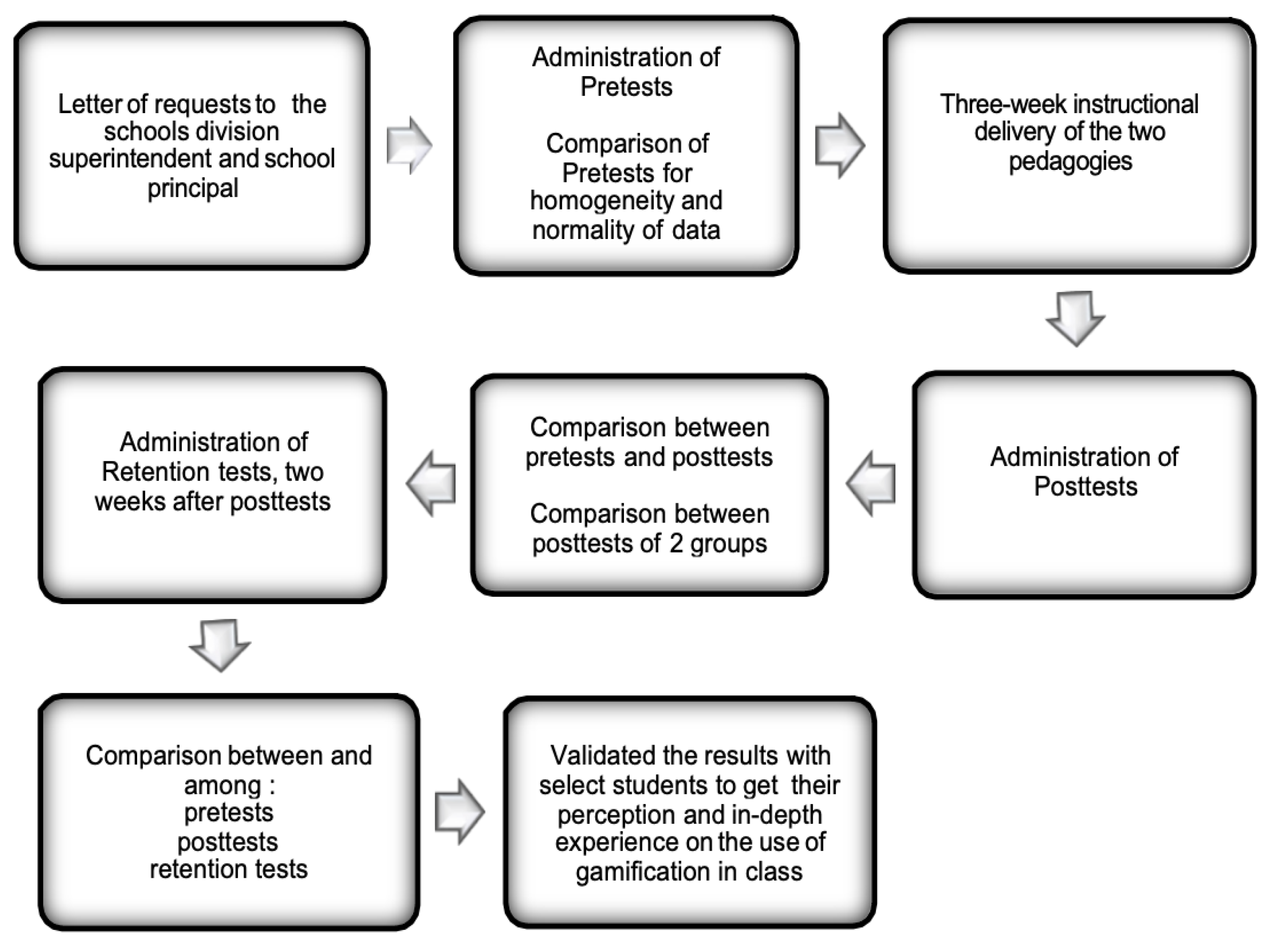
Figure 2.
Simulacrum of Themes on the Use of Gamification as Perceived by Students.
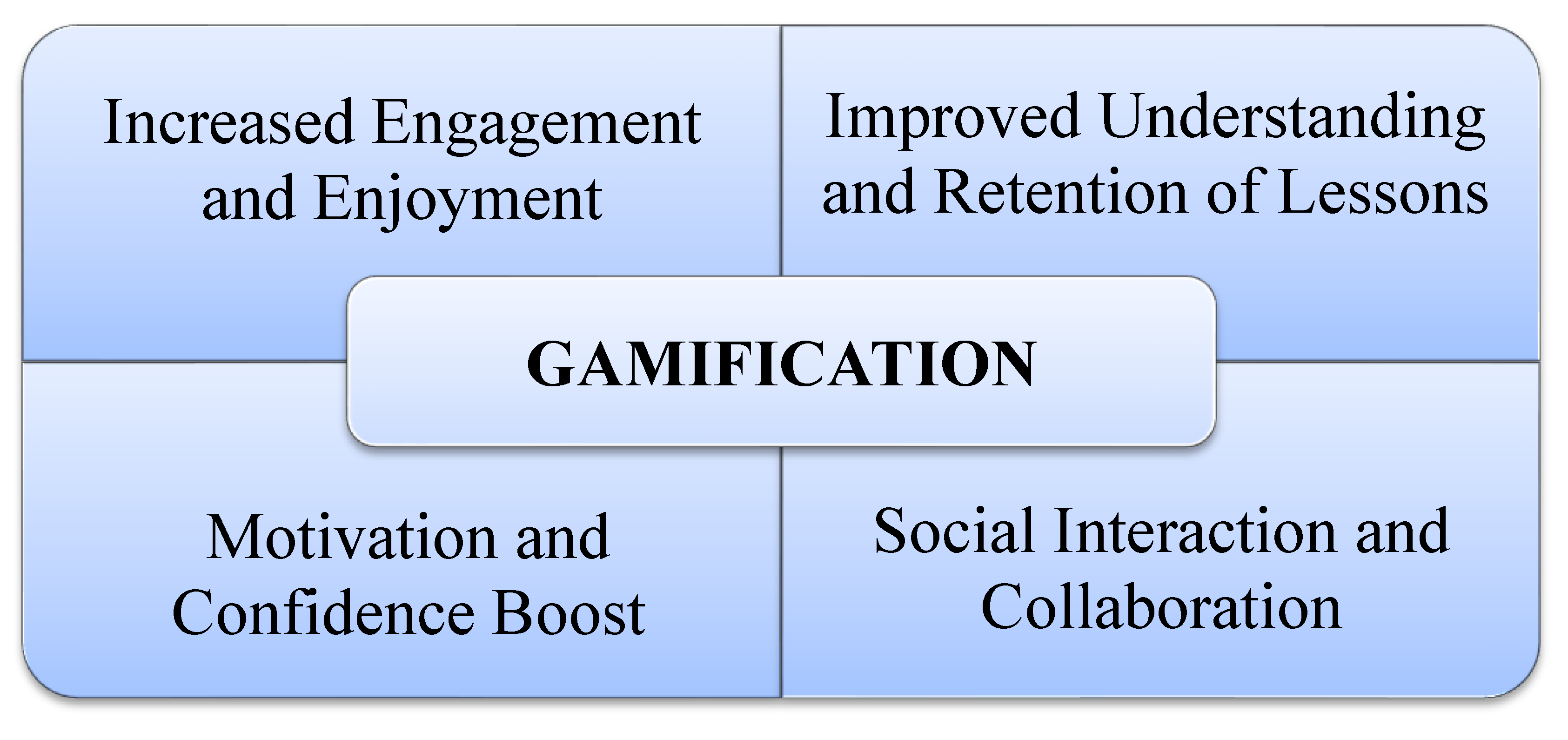

Table 1.
Comparative Flow of Instruction between Conventional and Intervention Groups.
| Gagne’s 9 Events of Instruction | Conventional Group (Standard Lecture) | Time Allotment | Intervention Group (Gamification) |
|---|---|---|---|
| Gain Attention | Teacher starts with a brief question (prompt), or visual aid to stimulate curiosity. | 3 minutes | Leaners are introduced through a gem teaser or short challenge (Game Ka Na Ba? buzzer round) that reveals the objectives of the day. |
| Inform Learners of the Objectives | Teacher states learning objectives verbally | 2 minutes | Objectives presented as game goals or mission objectives |
| Stimulate Recall of Prior Learning | Teacher asks review questions about previous topic using Q and A or a short recitation. | 5 minutes | Interactive scenarios or problem-solving tasks are explored to to recall prior knowledge |
| Present the Content (Stimulus Material) | Teacher discusses new lesson with slides explaining Biology concepts and direct explanations. | 15 minutes | Students further explore examples through digital or board-based games that unlock content as they answer correctly. |
| Provide Learning Guidance | Teacher explains key points, uses diagrams, and more examples | 8 minutes | Students perform team-based tasks and earn nadges or tokens as they take hints, tips, and feedback embedded in the game environment |
| Elicit Performance (Practice) | Students answer questions or take notes, label diagrams or answer seat works. | 7 minutes | Students complete game tasks or engage in level-up or cooperative missions (e.g. Hormone Hero Role-Play). |
| Provide Feedback | Teacher reviews answers, clarifies misconceptions, and summarizes the lesson. | 5 minutes | Students generalize concepts through peer discussion supported by leaderbaord feedback from game system; they interpret their game performance and derive key ideas. |
| Assess Performance | Students answer written exercises, short quizzes, or textbook-based problems. | 8 minutes | Game level completion or score-based assessment; students complete timed quizzes. |
| Enhance Retention and Transfer | Teacher facilitates a short dicussion on real-life applications; or homework assignment | 7 minutes | Unlocking bonus levels or real-world scenario challenges; Students reflect on the lesson through scenario-based games (What Would You Do? cards) connecting biological concepts to real-life behavior and health. |
Table 2.
The mean scores of interventions and conventional groups in pre-test, post-test, and retention-test.
Table 2.
The mean scores of interventions and conventional groups in pre-test, post-test, and retention-test.
| Test Type | Group | Mean Score | Description |
|---|---|---|---|
| Pre-test | Conventional | 20.96 | Low |
| Intervention | 22.38 | Low | |
| Post-test | Conventional | 43.84 | Moderate |
| Intervention | 44.96 | Moderate | |
| Retention-test | Conventional | 37.62 | Moderate |
| Intervention | 57.29 | High |
Table 3.
The improvement in test scores of the Conventional group.
| Test Comparison | Mean difference | SD | t- value | p- value | Cohen’s d |
Interpretation |
|---|---|---|---|---|---|---|
| Pre-test vs. Post-test | 22.88 | 7.68 | 13.04 | 0.00* | 0.78 | Moderate effect |
| Pre-test vs. Retention-test | 16.66 | 5.86 | 10.76 | 0.00* | 0.52 | Moderate effect |
| Post-test vs. Retention-test | 6.22 | 11.83 | 3.98 | 0.00* | 0.18 | Weak effect |
Note: * significant at 0.05 level > 1.00 (Strong effect); 0.50 – 1.00 (Moderate effect); 0.21 – 0.50 (Modest effect); 0 –0.20 (Weak effect).
Table 4.
The improvement in test scores of the intervention group.
| Test Comparison | Mean difference | SD | t- value | p- value | Cohen’s d |
Interpretation |
|---|---|---|---|---|---|---|
| Pre-test vs. Post-test | 22.58 | 7.80 | 13.45 | 0.00* | 0.80 | Moderate effect |
| Pre-test vs. Retention-test | 34.91 | 6.66 | 23.30 | 0.00* | 0.69 | Moderate effect |
| Post-test vs. Retention-test | 12.33 | 10.36 | 5.81 | 0.00* | 0.24 | Modest effect |
Note: * significant at 0.05 level > 1.00 (Strong effect); 0.50 – 1.00 (Moderate effect); 0.21 – 0.50 (Modest effect); 0 –0.20 (Weak effect).
Table 5.
The comparison of concept retention scores between conventional and intervention groups.
| Group | Mean | SD | t-value | p-value | Interpretation |
|---|---|---|---|---|---|
| Conventional | 37.62 | 6.06 | 11.95 | 0.00* | significant |
| Intervention | 57.29 | 9.13 |
Note: * significant at 0.05 level.
Disclaimer/Publisher’s Note: The statements, opinions and data contained in all publications are solely those of the individual author(s) and contributor(s) and not of MDPI and/or the editor(s). MDPI and/or the editor(s) disclaim responsibility for any injury to people or property resulting from any ideas, methods, instructions or products referred to in the content. |
© 2026 by the authors. Licensee MDPI, Basel, Switzerland. This article is an open access article distributed under the terms and conditions of the Creative Commons Attribution (CC BY) license.
Copyright: This open access article is published under a Creative Commons CC BY 4.0 license, which permit the free download, distribution, and reuse, provided that the author and preprint are cited in any reuse.