

Submitted:
13 January 2026
Posted:
14 January 2026
You are already at the latest version
Abstract
Tourism destination marketers increasingly rely on video advertising, yet the psycho-logical mechanisms linking perceived advertising design and destination familiarity to engagement remain underspecified in tourism contexts. Drawing on narrative trans-portation and advertising stimulation perspectives, this study examines how perceived advertising design and destination familiarity relate to narrative transportation and advertising stimulation, and how these mechanisms relate to engagement. Using a survey of 915 Portuguese respondents and structural equation modelling in AMOS, we estimate a model comprising advertising design, destination familiarity, narrative transportation, advertising stimulation, and engagement. Results show that perceived advertising design is positively associated with narrative transportation (β=0.451, p< 0.01) and advertising stimulation (β=0.158, p< 0.01). Destination familiarity is also positively associated with narrative transportation (β=0.215, p< 0.01) and advertising stimulation (β=0.104, p< 0.01). Narrative transportation strongly predicts advertising stimulation (β=0.659, p< 0.01), whereas narrative transportation Tourism destination marketers increasingly rely on video advertising, yet the psycho-logical mechanisms linking perceived advertising design and destination familiarity to engagement remain underspecified in tourism contexts. Drawing on narrative trans-portation and advertising stimulation perspectives, this study examines how perceived advertising design and destination familiarity relate to narrative transportation and advertising stimulation, and how these mechanisms relate to engagement. Using a survey of 915 Portuguese respondents and structural equation modelling in AMOS, we estimate a model comprising advertising design, destination familiarity, narrative transportation, advertising stimulation, and engagement. Results show that perceived advertising design is positively associated with narrative transportation (β=0.451, p< 0.01) and advertising stimulation (β=0.158, p< 0.01). Destination familiarity is also positively associated with narrative transportation (β=0.215, p< 0.01) and advertising stimulation (β=0.104, p< 0.01). Narrative transportation strongly predicts advertising stimulation (β=0.659, p< 0.01), whereas narrative transportation does not show a sig-nificant direct association with engagement (β=0.086, n.s.). Advertising stimulation is positively associated with engagement (β=0.288, p< 0.01). Findings suggest that, in this context, affective activation (stimulation) may be a more proximal correlate of self-reported engagement than narrative immersion alone, warranting careful inter-pretation given the cross-sectional, self-report design. does not show a sig-nificant direct association with engagement (β=0.086, n.s.). Advertising stimulation is positively associated with engagement (β=0.288, p< 0.01). Findings suggest that, in this context, affective activation (stimulation) may be a more proximal correlate of self-reported engagement than narrative immersion alone, warranting careful inter-pretation given the cross-sectional, self-report design.
Keywords:
tourism marketing
; tourism video advertising
; destination familiarity
; narrative transportation
; advertising stimulation
; consumer engagement
; structural equation modelling (SEM)
1. Introduction
In the rapidly evolving landscape of digital tourism marketing, video advertising has emerged as a dominant medium for shaping destination image and influencing traveler behavior. As competition among destinations intensifies, the ability to capture the attention of potential tourists through compelling visual narratives has become a strategic imperative. In this context, advertising design assumes a critical role. It acts not merely as an aesthetic choice but as a functional driver of consumer purchase decisions and behavioral intentions. As Duffett (2015) argues, effective advertisements must be meticulously crafted, “not forgetting the interaction and stimulation of consumers” (p. 520).
Visual elements are central to constructing and conveying these promotional messages. With consumers attaching increasingly greater importance to visual aesthetics, design plays a significant role in marketing effectiveness, particularly in tourism, where photographic and cinematic techniques serve as primary communication strategies (Lian & Yu, 2019). However, the effectiveness of these external stimuli does not occur in a vacuum; it is moderated by the consumer’s internal knowledge structures, specifically destination familiarity.
Familiarity is a pivotal factor in the tourist context. When a tourist visits a destination, the experience generates memories and a desire to revisit, fostering loyalty and word-of-mouth promotion (Johnson & Russo, 1984). Consequently, familiarity significantly influences tourists’ perspectives, reducing uncertainty and shaping how they process new advertising information.
Despite the recognized importance of both design (stimulation) and familiarity (prior knowledge), there is a need to understand the psychological mechanisms that link these factors to consumer engagement. It is not enough to present a well-designed ad to a familiar audience; one must understand how these elements trigger narrative transportation and advertising stimulation. Understanding how advertising design, storytelling, and destination familiarity interrelate is thus crucial for optimizing advertising campaigns in the tourism sector. Therefore, this study aims to investigate the impact of advertising design and destination familiarity on narrative transportation and advertising stimulation in the context of tourism video marketing. Furthermore, it aims to analyze how these psychological states ultimately influence consumer engagement, offering a comprehensive model of viewer response in the digital era.
Video advertising has become central to tourism promotion; however, the field still lacks integrative evidence on how viewers translate exposure to destination videos into engagement-related outcomes. Prior work highlights narrative transportation as an immersion mechanism that can reduce counter-arguing and shape persuasion (Green & Brock, 2000; Green & Brock, 2002), and meta-analytic evidence indicates that transportation is linked to downstream attitudinal and behavioral consequences (van Laer et al., 2014). In tourism, promotional videos are expected to create vivid mental representations of intangible experiences, making both the perceived design of the video and the viewer’s destination familiarity particularly salient (Milman & Pizam, 1995; Prentice, 2004). However, tourism research has less frequently examined these antecedents jointly within a single model that differentiates cognitive immersion (narrative transportation) from affective activation (advertising stimulation), and that links both mechanisms to engagement outcomes relevant to destination organizations’ digital strategy. Addressing this gap, we test an integrated framework in which perceived advertising design and destination familiarity relate to narrative transportation and advertising stimulation, and in turn relate to engagement in the context of tourism video advertising.
This study makes three contributions to tourism marketing research. First, it integrates perceived advertising design and destination familiarity as joint antecedents of two distinct response mechanisms (narrative transportation and advertising stimulation) within a single SEM framework. Second, it empirically examines the relationship between narrative transportation and advertising stimulation in tourism video advertising, clarifying whether immersion co-occurs with (or relates to) affective activation. Third, it documents which mechanism is more closely associated with engagement in this setting, given the observed pattern in which advertising stimulation is associated with engagement, whereas narrative transportation is not directly significant. Collectively, the study offers evidence that can inform both theory refinement and practical video design decisions for destination marketing organizations.
2. Literature Review
2.1. Narrative Transportation, Advertising Design, and Advertising Stimulation
Contemporary literature in communication and marketing has consistently highlighted the central role of narratives and advertising stimuli in shaping consumers’ perceptions, attitudes, and behaviors. Among the most discussed concepts in this context is narrative transportation, initially proposed by Green (1996) and further developed by Green and Brock (2000), who define it as a psychological process of immersion in which the receiver’s attention, imagination, and emotions converge on the story being presented. When this immersion occurs, the individual momentarily suspends their perception of the real environment and begins to experience the narrated events as if they were part of their own experiential framework, simultaneously reducing their motivation to counterargue the message. The literature supports the notion that this reduction in counter-argumentation facilitates the acceptance of the messages embedded in the narrative and enhances their persuasive effects (Green & Brock, 2002; Green & Clark, 2012). Thus, narratives constitute a particularly effective form of communication because they can integrate, in a convergent manner, cognitive and affective stimuli that appeal to both reason and emotion simultaneously.
Tourism videos operate at the intersection of narrative persuasion and sensory-rich destination communication. Narrative transportation refers to the extent to which viewers become mentally absorbed, allocating their attention and imagination to the story world (Gerrig, 1993; Green & Brock, 2000). In destination contexts, where consumption is primarily experiential and intangible, transportation is especially relevant because the video must substitute for direct experience by enabling viewers to mentally simulate the destination. Narrative involvement has also been conceptualized as a process that promotes changes in perception during exposure to the story. Gerrig (1993) argues that the receiver mentally “travels” into the narrative universe, experiencing emotions and reactions aligned with the events of the story. Subsequent studies demonstrate that the effects of narrative transportation may extend beyond the moment of exposure, influencing beliefs and attitudes in the medium term (Appel & Richter, 2007). This understanding led to the development of the concept of narrative persuasion (Appel, 2022; Hamby & Brinberg, 2016), which describes how stories shape perceptions without relying on explicit arguments, but rather through the emotional experience they promote.
To gain a more comprehensive understanding of the conditions under which narrative transportation occurs, van Laer et al. (2014) proposed the extended transportation-imagery model, which identifies imagination, empathy, and the structural quality of the narrative as essential elements of the process. The literature suggests that compelling narratives exhibit a coherent temporal sequence, characters with whom emotional bonds can be formed, and conflicts and resolutions that propel the story forward. According to Snowden (1999) and Bruner (Brechman & Purvis, 2015), such structural elements enable the construction of causality and facilitate cognitive involvement, thereby reinforcing the persuasive power of the narrative. In this sense, advertising that incorporates storytelling tends to be less intrusive and less likely to generate resistance, insofar as it does not present itself in an explicitly persuasive manner but instead appeals to emotion and identification, promoting deeper and more spontaneous involvement (Escadas, 2007).
Perceived advertising design provides immediate cues that facilitate immersion through video. Visual quality, coherence, and professional execution can enhance attention and perceived credibility, thereby supporting the conditions under which transportation is more likely to occur. In parallel, those same cues may evoke affective activation (operationalized here as advertising stimulation) through arousal, excitement, and perceived originality. The relationship between narrative transportation and advertising stimulation becomes particularly relevant when considering the role of visual, symbolic, and textual stimuli in digital communication. The effectiveness of advertising largely depends on how the design of the advertisement integrates these elements, functioning as a catalyst for consumer engagement (Cummins, 2021; Dwivedi et al., 2020; Guttmann, 2019). The literature emphasizes that design has the capacity to elicit both positive and negative emotional responses, thereby influencing perceptions and attitudes. When associated with well-structured narratives, design becomes an integral part of the immersive experience, functioning as a stimulation that reinforces the narrative’s coherence and intensifies its impact. Brechman and Purvis (2015) highlight that the integration of narrative structure and visual stimuli results in a powerful communication tool capable of generating favorable cognitive responses, positive emotions, and more positive attitudes than purely argumentative advertisements. This finding is also supported by Chang (2009) and Dessart (2018).
In the context of tourism advertising, these elements assume particular importance, given the intangible nature of tourism services and the need to create vivid mental representations of destinations that have not yet been experienced. Familiarity with the destination thus emerges as a relevant moderator of narrative transportation, as it influences risk perceptions, destination image, and travel intentions (Milman & Pizam, 1995). When the receiver possesses prior references about the destination, the narrative resonates more strongly at the cognitive level, engaging the imagination more deeply and facilitating narrative transportation. More recent literature reinforces that narrative involvement plays a crucial role in the persuasive effectiveness of tourism advertising, shaping how promotional videos are interpreted and experienced (Zhu et al., 2024).
The concept of advertising stimulation complements this process by describing the emotional and cognitive mechanisms activated by the advertisement. Well-designed stimuli (such as engaging storytelling, visual creativity, and a clear emphasis on product benefits) strengthen the emotional bond between the brand and the consumer, influencing preferences and behavioral intentions (Arora & Agarwal, 2019; Chen et al., 2023). In tourism videos, these stimuli serve a dual function: on the one hand, they facilitate narrative transportation; on the other, they directly contribute to the formation of positive perceptions of the destination by eliciting pleasure, curiosity, and enthusiasm. Thus, narrative transportation and advertising stimulation are not independent processes but complementary dimensions of consumer response to advertising.
While the evolution of digital media and social platforms has expanded the reach of narratives through user interaction and co-creation (Arvidsson & Caliandro, 2015; Hall, 2016), the fundamental efficacy of these communications remains anchored in the quality of the advertising design. The literature suggests that the structural and visual arrangement of the advertisement acts as the primary catalyst for the consumer’s psychological response. Specifically, a coherent and visually stimulating design is required to trigger the immersion mechanism of narrative transportation and the cognitive-affective activation of advertising stimulation. Therefore, it is posited that advertising design serves as a critical antecedent to both processes, leading to the following hypotheses:
H1:
(ADSG → NATX) Perceived advertising design quality (e.g., visual coherence and professional execution) is expected to support attention allocation and narrative comprehension, facilitating immersion in the promotional narrative. Accordingly, higher perceived design quality should be positively associated with narrative transportation in tourism video advertising.
H2:
(ADSG → ADST) Design elements can also elicit affective activation by intensifying sensory appeal and emotional response (e.g., excitement, originality). Therefore, perceived advertising design quality should be positively associated with advertising stimulation.
H3:
(NATX → ADST) Immersion may intensify emotional and sensory activation because being “drawn into” the narrative can heighten experienced affect. Therefore, narrative transportation should be positively associated with advertising stimulation, while acknowledging that alternative orderings are plausible and should be tested in future work.
2.2. Destination Familiarity
Destination familiarity further shapes processing by providing cognitive scaffolding, which facilitates more efficient information processing. Familiar viewers possess richer schemas, which can facilitate the integration of the video’s scenes into existing knowledge structures and, in turn, elicit higher transportation and stimulation responses (Milman & Pizam, 1995; Prentice, 2004). At the same time, familiarity may relate to engagement because familiar viewers are more likely to seek additional information about the destination and interact with official channels. Destination familiarity is multifaceted, representing an accumulated synthesis of feedback, sensory impressions, and knowledge derived from the interactions between tourists, hosts, and society (Christou, 2003). As a pivotal determinant of a destination’s reputation (Brooks & Highhouse, 2006), this construct presents a dual nature, capable of yielding positive (Yang, 2007) or adverse outcomes (Brooks, et al., 2003). From a consumer perspective, establishing high levels of familiarity is essential for interpreting reputation signals (Lange et al., 2011; Mahon & Mitnick, 2010) and reducing the inherent uncertainty associated with travel choices.
Conceptually, familiarity extends beyond mere awareness. Gefen (2000) posits that it stems from absorbing the context of human activity—understanding the what, why, where, and when. It involves not only observation but the active acquisition of information and subsequent assessment of an entity (Luhmann, 2000; Monin, 2003). Johnson and Russo (1984) frame it as a construct built on diverse information streams, including direct visits, media exposure, and word-of-mouth.
In the tourism domain, this accumulated knowledge becomes a critical driver of decision-making (Gefen & Straub, 2004). As familiarity deepens, it strengthens the visitor’s attachment to the destination (Hammitt, Kyle & Oh, 2009) and refines its overall image (Marinao et al., 2012; Prentice, 2004). This positive influence (Andsager & Drzewiecka, 2002) fosters long-term loyalty, with established familiarity serving as a primary motivation for repeat visitation (Tsai, 2012).
Traditionally, familiarity is associated with the emotional closeness tourists develop towards a destination, often contrasted with the novelty, allure of the unknown. Hu and Ritchie (1993) conceptualise familiarity as a function of the distance between the individual and the destination, mediated by past experiences. However, recent scholarship challenges the notion that familiarity and novelty are mutually exclusive opposites. Stylidis and Terzidou (2024) argue that these two concepts can operate independently to influence consumer behaviour. Drawing on the mere exposure theory, they suggest that increased exposure to a destination, even without physical visitation, enhances familiarity, which in turn breeds liking and perceived safety. This is particularly relevant for non-visitors, for whom familiarity is not experiential but informational, shaped by media and social knowledge. Thus, while the pursuit of the unknown may be a reactive mechanism in response to a new environment (Guan et al., 2022), familiarity provides the necessary cognitive framework for processing that environment.
The measurement of this construct has evolved significantly from Baloglu’s (2001) foundational distinction between experiential (visitation) and informational sources. Prentice (2004) expanded this scope with a seven-component model that integrates factors such as education and proximity. Tan and Wu (2016) further refined this argument, suggesting that these factors should not be treated as standalone entities; instead, the overlap between informational, experiential, and educational dimensions creates a more robust theoretical model. Stylidis and Terzidou (2024) reinforce the importance of this multi-dimensional approach, demonstrating that for segments who cannot visit a destination, informational familiarity is a key determinant of their cognitive and affective image, effectively acting as a substitute for direct experience.
Ultimately, consensus identifies destination familiarity as a fundamental determinant of tourist attitudes. Prentice (2004) defines ‘close familiarity’ as the relational link connecting a tourist’s habitual environment to a destination, distinguishing repeat visitors from first timers. However, as Stylidis and Terzidou (2024) highlight, familiarity is equally critical for the “non-visitor” market, where it moderates perceptions and shapes the intent to visit. While previous studies have emphasized its role in lowering perceived risk and uncertainty (Bianchi et al., 2017), its influence extends to the processing of advertising content. Familiarity provides the necessary cognitive scaffolding that allows the viewer to align the ad’s narrative with their existing mental schemas. This alignment not only facilitates a smoother entry into the story world, thereby enhancing immersion, but also amplifies the resonance of the visual and textual cues presented. Consequently, familiarity is posited to act as a catalyst that intensifies both the psychological state of being transported by the narrative and the cognitive-affective response to the advertising stimuli. Based on this theoretical framework, the following hypotheses are proposed:
H4:
(FAM → ADST) Familiarity may amplify emotional response by increasing personal relevance and recognition of destination attributes. Hence, destination familiarity should be positively associated with advertising stimulation.
H5:
(FAM → NATX). Familiarity provides prior knowledge structures that can facilitate the interpretation of destination cues and enhance resonance with the video’s content. Thus, destination familiarity should be positively associated with narrative transportation.
2.3. Engagement
Finally, engagement in social media and digital destination contexts is widely conceptualized as comprising cognitive, emotional, and behavioral dimensions (Harrigan et al., 2017; Trunfio & Rossi, 2021; So et al., 2014). In tourism video advertising, engagement can be plausibly linked to both immersion (transportation) and affective activation (stimulation). However, the relative roles of these mechanisms remain empirically unresolved in tourism settings, motivating the hypothesized model tested in this study. In the contemporary digital landscape, social media engagement (SME) has emerged as a pivotal construct in marketing and tourism research (Leung et al., 2013). While early definitions often focused on metrics, recent scholarship conceptualizes engagement as a multidimensional psychological state comprising cognitive, emotional, and behavioral components (Trunfio & Rossi, 2021). Within the tourism context, So et al. (2014) conceptualized customer engagement as a higher-order construct encompassing five dimensions: identification, enthusiasm, attention, absorption, and interaction. This scale was later validated and refined by Harrigan et al. (2017) in a social media setting, who proposed a parsimonious model highlighting absorption, identification, and interaction as the core components driving loyalty.
Trunfio and Rossi (2021) further clarify that while the behavioral dimension (often measured through metrics such as likes, comments, and shares) remains the most investigated proxy for engagement, it captures only the visible manifestation of a deeper psychological process. This aligns with the COBRA’s model (Consumers’ Online Brand Related Activities), which classifies engagement behaviors into three levels of increasing involvement: consumption, contribution, and creation (Trunfio & Rossi, 2021).
Understanding what drives engagement is critical for effective digital strategy. Santini et al. (2020) conducted a meta-analysis identifying that customer engagement is significantly driven by relationship formation variables, specifically satisfaction, positive emotions, and trust. Their findings suggest that while commitment plays a lesser role, trust and satisfaction are fundamental antecedents that foster deep engagement.
The nature of the content itself is also a primary determinant of engagement. Krowinska and Dineva (2025) categorize branded content into four types: informational, entertaining, remunerative, and contextual. Their research indicates that different content forms elicit distinct engagement behaviours; for instance, entertaining content (e.g., visual, emotional, behind-the-scenes) typically drives hedonic engagement, while informational content satisfies functional motives (Krowinska & Dineva, 2025). This is supported by Mariani et al. (2016), who found that visual content, specifically photos, and moderately long posts have a statistically significant positive impact on engagement metrics on Facebook.
Building on the role of specific content formats, Ferreira et al. (2021) examined the drivers of engagement, specifically within video advertising. Their study identifies informativeness and self-brand connection as critical predictors of engagement. They argue that for video content to generate engagement, it must not only provide utility (informativeness) but also foster a psychological bond where the consumer identifies with the brand (self-brand connection).
Recent developments in social media platforms have reshaped the tourism decision-making process. Chen (2025) proposes a four-stage framework: information acquisition, emotional engagement, social interaction, and decision output, arguing that social media facilitates a shift from rational to impulse-driven decision-making. In this environment, “emotional immersion” acts as a core variable; short-form videos and algorithmic recommendations trigger immediate affective responses that bypass traditional rational evaluation (Chen, 2025). This aligns with Jansson (2018), who discusses how “spreadable media” fosters heightened cultural reflexivity and alters how tourists appropriate and represent destinations, often creating tensions between authentic experience and digital performance.
Literature consistently links high levels of engagement to desirable marketing outcomes. So et al. (2014) and Harrigan et al. (2017) demonstrate that customer engagement significantly enhances brand usage intent and loyalty, while Santini et al. (2020) confirm its direct impact on behavioral intentions and electronic word-of-mouth (e-WOM). However, understanding the downstream effects of engagement necessitates a clear comprehension of the upstream psychological mechanisms that precipitate it. Engagement is not merely a reactive metric but a consequence of deep cognitive and affective involvement. The immersion generated by narrative transportation fosters a state of absorption that motivates users to engage with the content, sustaining the experience. Concurrently, advertising stimulation provides the sensory and emotional arousal required to capture attention and provoke a behavioral response. Thus, these constructs are posited not just as parallel processes but as the primary psychological drivers that fuel consumer engagement in digital environments.
H6: (NATX → ENG). Narrative transportation is often theorized to relate to downstream intentions and behaviors by reducing counter-arguing and increasing persuasive impact. Accordingly, narrative transportation should be positively associated with engagement.
H7: (ADST → ENG) Advertising stimulation reflects affective activation that can motivate approach behaviors and interaction with content or destination channels. Thus, advertising stimulation should be positively associated with engagement.
To understand the structural dynamics of these variables, a conceptual model is proposed, as depicted in Figure 1. This model illustrates the mediation of cognitive and affective processes in the relationship between advertising and destination stimuli, as well as the consumer’s behavioral response.
Perceived advertising design (ADSG) and destination familiarity (FAM) are hypothesized to relate to narrative transportation (NATX) and advertising stimulation (ADST). Narrative transportation is hypothesized to relate to advertising stimulation, and both mechanisms are hypothesized to relate to engagement (ENG).
3. Materials and Methods
3.1. Data Collection
The data for this study were collected using a pre-tested, self-administered questionnaire, specifically designed to capture the perceptions and behaviors of Portuguese tourists. This method is widely recognized in tourism and marketing research as a practical approach for testing theories and obtaining reliable responses from individuals directly involved in the phenomenon under investigation. Convenience sampling, although non-probabilistic, is frequently adopted in tourism studies due to its practicality and ability to reach respondents who naturally engage with the context under study, making it a suitable choice for the present research.
The questionnaire was disseminated through social media platforms, allowing the researchers to reach Portuguese tourists in a quick, accessible, and cost-effective manner. All respondents were exposed to the same official promotional video of VisitAlentejo immediately before answering the questionnaire and were approached under similar conditions. At the beginning of the questionnaire, the purpose and nature of the study were clearly explained to minimize misunderstandings and reduce response bias. This initial clarification helped ensure that respondents were aware of the study’s objectives and felt comfortable providing accurate information.
Participation in the study was entirely voluntary. Individuals who agreed to participate first provided informed consent, after which they completed the questionnaire independently. The responses were then submitted directly through the digital platform used for data collection. This process ensured transparency, participant autonomy, and adherence to ethical research standards.
A total of 915 valid responses were obtained, providing a robust dataset for subsequent analysis. Although the study targeted Portuguese tourists broadly, the final sample consisted predominantly of female respondents. This characteristic aligns with previous findings suggesting that women tend to engage more frequently and more actively in certain consumer or service-related behaviors, which may influence their likelihood of participating in research activities.
The sample profile, as shown in the dataset, reflects a diverse group of tourists. Women represented 68.3% of the respondents, while men accounted for 31.4%, with a small percentage identifying as a different gender. The average age was 30.26 years (SD = 13.83), with a substantial proportion of participants between 20 and 29 years old. Educational levels were also notably varied, with 53.9% of respondents having completed basic or secondary education and 46.1% holding higher education degrees.
Overall, the data collection process was carefully structured to preserve methodological rigor, ensure ethical compliance, and obtain reliable information from a relevant segment of Portuguese tourists. The final sample size and diversity offer a solid foundation for the empirical analyses presented in the study.
3.2. Measurement
All constructs used in this study were measured using previously validated scales, which were adapted to the context of tourism communication. As shown in the measurement table, narrative transportation was measured with three items adapted from Solja et al. (2018), advertising stimulation with three items from Voorveld et al. (2018), the destination familiarity with four items from Bianchi et al. (2017), engagement with six items from Ferreira et al. (2021), and advertising design with four items from Shaouf et al. (2016). All items were rated on a five-point Likert scale ranging from 1 (“strongly disagree”) to 5 (“strongly agree”), ensuring consistency and comparability across constructs.
Before data collection, a pre-test was conducted with 15 tourists who were pre-selected to ensure they possessed prior knowledge of the tourism context and the topic under study. This preliminary step helped refine the clarity and relevance of the items. Furthermore, the questionnaire underwent an additional layer of scrutiny through a critical review conducted by three academic experts and tourism professionals. This procedure reinforced the content validity of the measurement instrument, ensuring that each construct accurately captured its underlying theoretical domain.
Given that the data were obtained through a single self-administered questionnaire, particular care was taken to minimise potential common method bias. Following Podsakoff et al. (2003), both ex ante and ex post strategies were employed. At the ex-ante stage, respondents were not informed about the relationships being studied, which prevented them from linking items to specific hypotheses. The questionnaire design also prevented participants from returning to previous questions, and progression through the survey required full completion of each section. Respondents were reassured that their participation was anonymous and that there were no right or wrong answers, which helped reduce evaluation apprehension. Ex-post diagnostics further supported the absence of problematic method bias. Harman’s single-factor test revealed that the first factor accounted for 35.72% of the total variance—well below the 50% threshold. Multicollinearity was also assessed, with VIF values ranging from 1.876 to 4.916, which remained comfortably below the recommended upper bound of 5 (Hair et al., 2010). This indicates that common method variance was unlikely to pose a concern.
The measurement model was estimated using AMOS, and a confirmatory factor analysis (CFA) was conducted (Table 1). The analysis included five latent variables and twenty observed indicators. The initial CFA suggested that no specification was needed, and the final model demonstrated a satisfactory fit. Fit indices for the measurement model were within acceptable ranges: χ2 = 1037.05, df = 178, GFI = 0.90, CFI = 0.939, NFI = 0.927, IFI = 0.939, TLI = 0.928, and RMSEA = 0.073. Collectively, these results indicate that the measurement model exhibits a good overall fit and adequately represents the observed data.
Construct reliability was assessed through Cronbach’s alpha, with values ranging from 0.819 to 0.945, surpassing the minimum threshold of 0.70 recommended by Hair et al. (2010). Convergent validity was supported by the strength of the factor loadings, which ranged from 0.620 to 0.920, indicating that all indicators loaded significantly and meaningfully onto their respective constructs. Average Variance Extracted (AVE) values ranged from 0.578 to 0.756, exceeding the recommended threshold of 0.50, while composite reliability values ranged from 0.840 to 0.939, again surpassing accepted minimum standards. Together, these indicators confirm strong reliability and convergent validity for all constructs included in the model.
Discriminant validity was assessed using the Fornell and Larcker (1981) criterion, which examines whether the AVE for each construct is greater than the squared correlations between constructs. The results confirmed that this condition was met for all variables, providing firm evidence that each construct is empirically distinct and captures a unique aspect of the conceptual model.
The results confirm that the measurement model exhibits strong psychometric properties. The constructs demonstrate adequate reliability, convergent validity, and discriminant validity, supporting their suitability for subsequent structural model analysis.

Table 2.
Fornell and Larcker (1981) Criterion.
| Construct | NATX | ADST | FAM | ADSG | ENG |
| NATX | 0.703 | ||||
| ADST | 0.564** | 0.639 | |||
| FAM | 0.071** | 0.088** | 0.578 | ||
| ADSG | 0.227** | 0.241** | 0.013** | 0.756 | |
| ENG | 0.092** | 0.128** | 0.329** | 0.014* | 0.638 |
Notes: NATX=Narrative Transportation; ADST=Advertising Stimulation; FAM=Destination Familiarity; ADSG=Advertising Design; ENG= Engagement; Diagonal entries are AVE-Average Variance Extracted; ** correlations are significant at p<0.01 level.
4. Results
The structural model was estimated using SEM (Table 3), and the overall fit indices demonstrate that the model provides an adequate representation of the data. The chi-square statistic (χ2 = 1250.26, df = 180) is statistically significant, which is expected in large samples. More importantly, the incremental and comparative fit indices fall within acceptable thresholds, indicating that the overall model fit is acceptable but not unequivocally strong. Specifically, the GFI (0.90), CFI (0.924), NFI (0.912), IFI (0.924), and TLI (0.951) all exceed the commonly accepted benchmark of 0.90, which supports the argument that the model effectively captures the underlying structure of the relationships among constructs. Furthermore, the RMSEA value of 0.080 falls within the range considered acceptable for complex models, reinforcing the adequacy of the model’s fit. These indicators confirm that the proposed conceptual model is statistically sound and suitable for testing the hypothesised relationships. Nevertheless, we therefore interpret results as indicative and theory-consistent, while acknowledging potential misspecification and encouraging replication with alternative specifications. Additionally, given the cross-sectional, self-report design, hypotheses are framed as directional associations consistent with prior theory rather than definitive causal effects.
Hypothesis H1 predicted that advertising design would have a positive influence on narrative transportation. The results strongly support this relationship (β = 0.451; t = 13.636; p < 0.01). This suggests that visually appealing, coherent, and emotionally relevant advertising design significantly enhances tourists’ immersion in the narrative of the advertisement. Well-crafted design elements appear to draw consumers more deeply into the story being communicated, allowing them to engage with the message at a more experiential level mentally.
H2 proposed that advertising design would positively influence advertising stimulation. This hypothesis is also supported (β = 0.158; t = 5.123; p < 0.01). Although the effect is smaller than that observed for narrative transportation, the findings indicate that an effective advertising design can elevate sensory and emotional stimulation. In other words, creative and visually engaging ads can activate consumer curiosity, attention, and emotional arousal.
H3 receives strong empirical support (β = 0.659; t = 14.757; p < 0.01). Narrative transportation emerges as a powerful driver of advertising stimulation, suggesting that when tourists are fully absorbed in the story conveyed by the advertisement, they experience heightened emotional and sensory activation. This highlights the central role of narrative immersion as a catalyst for psychological stimulation.
The results also support H4 (β = 0.104; t = 3.604; p < 0.01), indicating that destination familiarity enhances the level of stimulation elicited by advertising. While the effect is modest, it suggests that tourists with prior destination knowledge respond more strongly to the emotional and sensory cues embedded in promotional messages.
Hypothesis H5 suggested that destination familiarity would have a positive influence on narrative transportation. This relationship is confirmed (β = 0.215; t = 6.261; p < 0.01), implying that tourists who are more familiar with a destination are more easily immersed in narrative content about it. Prior knowledge and personal associations likely facilitate deeper mental engagement with the storyline presented in the advertisement.
Hypothesis H6 proposed that narrative transportation would have a positive influence on engagement. However, this relationship is not statistically significant (β = 0.086; t = 1.445; p > 0.05). Although narrative immersion stimulates emotional responses (as shown in H3), it does not directly translate into higher levels of engagement. This may indicate that engagement requires additional drivers, such as trust, relevance, or perceived value, that go beyond narrative absorption alone.
The final hypothesis, H7, is supported (β = 0.288; t = 4.679; p < 0.01). Advertising stimulation demonstrates a positive and significant impact on engagement, indicating that tourists who experience strong emotional and sensory activation are more likely to interact with, respond to, or further explore the advertised destination. This reinforces the idea that engagement is largely driven by the intensity of emotional and perceptual stimulation rather than narrative immersion alone.
5. Discussion
5.1. Key Findings
This study aimed to investigate the relationship between perceived advertising design, destination familiarity, and two psychological response mechanisms—narrative transportation and advertising stimulation—and how these mechanisms influence engagement in tourism video advertising. The results indicate a consistent pattern: perceived advertising design is positively associated with both narrative transportation and advertising stimulation, with a markedly stronger association for transportation (β=0.451) than for stimulation (β=0.158). Destination familiarity is also positively associated with both mechanisms, although these relationships are smaller (β=0.215 to transportation; β=0.104 to stimulation). In addition, narrative transportation is strongly associated with advertising stimulation (β=0.659). However, narrative transportation is not directly associated with engagement (β=0.086, n.s.), whereas advertising stimulation shows a positive association with engagement (β=0.288).
Overall, these findings suggest that, in this sample and operational context, engagement is more closely aligned with affective activation than with cognitive immersion alone. The strongest relationships in the model relate to how perceived design quality and familiarity are mapped onto transportation, and how transportation is mapped onto stimulation. The non-significant transportation → engagement path is therefore central: it indicates that immersion, at least as measured here, does not translate straightforwardly into engagement, despite theoretical expectations that transportation can influence behavioral intentions by reducing counter-arguing and increasing persuasive impact (Green & Brock, 2000; van Laer et al., 2014).
5.2. Theoretical Implications
Theoretically, the results reinforce the importance of distinguishing cognitive immersion (narrative transportation) from affective activation (advertising stimulation) in tourism video advertising. The strong association between transportation and stimulation suggests that these processes are closely connected in viewers’ self-reports, which is compatible with narrative persuasion accounts that treat transportation as a state involving attention, imagery, and emotion (Green & Brock, 2000; Green & Brock, 2002). At the same time, the magnitude of the transportation → stimulation path raises an interpretive challenge: transportation and stimulation may be empirically proximal, potentially reflecting overlapping facets of a broader immersive response. This makes it essential to treat discriminant validity as an ongoing concern and to supplement Fornell–Larcker with additional checks (e.g., HTMT) and, ideally, competing model tests that evaluate whether a higher-order factor or alternative ordering provides a more parsimonious account.
A second contribution concerns the antecedent structure. Perceived advertising design shows the strongest association with narrative transportation, consistent with the idea that design cues can support attention and coherence, thereby facilitating entry into the narrative world. For tourism videos, where consumers often lack direct experience of the product, design may function as a proxy for quality and credibility, making transportation more likely. Destination familiarity also relates to both transportation and stimulation, implying that prior knowledge can shape not only comprehension and resonance but also affective responses. However, the small effect on stimulation suggests that familiarity alone may be insufficient to generate strong activation. This nuance is consistent with tourism accounts that treat familiarity as multi-dimensional and potentially operating through additional mechanisms (e.g., trust, attachment) beyond immediate ad processing.
Most importantly, the pattern of non-significant transportation → engagement alongside significant stimulation → engagement implies that affective activation may be a more proximal correlation of engagement than immersion per se in this context. One interpretation is sequential: transportation may matter insofar as it intensifies stimulation, and stimulation is the mechanism more directly aligned with engagement outcomes. This aligns with a process view of video advertising in which cognitive absorption needs to be accompanied by emotional or sensory arousal to translate into action-oriented responses. Because the current results include a strong transportation → stimulation association, a formal indirect-effect test via bootstrapping is warranted to establish whether the relationship between transportation and engagement operates primarily (or exclusively) through stimulation.
An alternative interpretation concerns measurement alignment. The engagement scale used here includes items capturing familiarity with VisitAlentejo channels and self-reported behavioral tendencies (e.g., visiting, following, sharing). As such, engagement may represent a broader propensity for destination-related digital interaction rather than a strictly post-exposure behavioral outcome caused by the video. If engagement partly reflects pre-existing platform relationships, it may be more responsive to stimulation (an arousal-linked motivational state) than to transportation, which might exert more delayed or indirect effects. This measurement-feature interpretation is consistent with why the direct transportation → engagement association may not emerge in the structural model, and it reinforces the need for future research to operationalize engagement as explicitly post-exposure intentions (and ideally observed behaviors).
5.3. Practical Implications
For destination marketing organizations and tourism communicators, the results point to two actionable implications. First, perceived advertising design quality appears central for eliciting narrative transportation and, to a lesser extent, stimulation. Investment in professional visual execution, coherence, and carefully crafted design cues is therefore likely to support viewers’ immersion and emotional activation. Second, stimulation is the mechanism most closely associated with engagement. Practically, this suggests that tourism video campaigns should deliberately incorporate elements that heighten affective activation, such as emotionally resonant scenes, novelty cues, and pacing that sustains arousal, while ensuring these elements remain coherent with the destination narrative. A further implication concerns audience segmentation. Destination familiarity has a positive relationship with both transportation and stimulation, although the effects are smaller than those of design for transportation. This suggests that campaigns can benefit from tailoring: for highly familiar audiences, videos may leverage recognition and personal relevance; for less familiar audiences, design and narrative clarity are more important in creating an immersive first experience of the destination.
5.4. Limitations
Several limitations should be acknowledged to ensure a defensible interpretation. First, the design is cross-sectional and relies on single-source self-report measures; therefore, the findings should be interpreted as directional associations consistent with theory, rather than causal effects. Second, convenience sampling via social media may introduce self-selection bias and limit generalizability beyond Portuguese respondents; the sample is also skewed by gender. Third, the stimulus and exposure procedure requires fuller documentation to support replicability and to clarify whether respondents’ answers reflect standardized viewing conditions. Fourth, the operationalization of engagement blends platform familiarity, behaviors, and intentions, which may not align perfectly with a post-exposure causal sequence from video-induced mechanisms to engagement. Finally, the strong transportation–stimulation linkage warrants additional assessment of discriminant validity and evaluation of competing models to rule out alternative specifications.
5.5. Future Research
Future research should adopt designs that better establish temporal ordering and mitigate common method concerns. Experimental studies that manipulate design features (while holding destination content constant) would strengthen causal inference regarding perceived design and psychological responses. Longitudinal designs could measure transportation and stimulation immediately post-exposure and then track engagement behaviors (e.g., follows, clicks, shares) over time. Measurement development is also important: engagement should be operationalized as explicitly post-exposure intentions and/or observed behaviors, and familiarity should be decomposed into experiential versus informational components. Finally, researchers should estimate and compare alternative model structures, such as parallel mediation (where transportation and stimulation independently relate to engagement) or higher-order immersive response models, to clarify whether transportation and stimulation are best treated as distinct, sequential mechanisms or as overlapping facets of a broader response system.
6. Conclusions
This study examined the relationship between perceived advertising design, destination familiarity, narrative transportation, and advertising stimulation, as well as their impact on engagement in tourism video advertising. Using SEM with 915 respondents, perceived design quality and destination familiarity were positively associated with both narrative transportation and stimulation, and transportation was strongly associated with stimulation. However, narrative transportation was not directly associated with engagement, whereas advertising stimulation showed a positive association with engagement. These results suggest that, in this context, affective activation may be a more proximal correlate of engagement than immersion alone, highlighting the strategic importance of design decisions that support both narrative absorption and emotional stimulation. At the same time, the cross-sectional, self-report design and the operationalization of engagement warrant cautious interpretation and motivate future research using experimental and longitudinal approaches with behavioral engagement metrics and refined measurement.
Author Contributions
Conceptualization, Sara Santos and Sónia Ferreira; methodology, Pedro Espírito Santo; software, Pedro Espírito Santo; validation, José Duarte Santos and Paulo Pires; formal analysis, Sónia Ferreira; investigation, Sara Santos and Sónia Ferreira; resources, José Duarte Santos; data curation, Pedro Espírito Santo; writing—original draft preparation, José Duarte Santos and Sara Santos; writing—review and editing, Paulo Pires; visualization, Paulo Pires and Sónia Ferreira; supervision, Paulo Pires and Pedro Espírito Santo; project administration, Sara Santos; funding acquisition, José Duarte Santos. All authors have read and agreed to the published version of the manuscript.
Funding
This research received no external funding.
Institutional Review Board Statement
Ethical review and approval were waived for this study, as it involved an anonymous and voluntary online survey of adults without sensitive data, interventions, or vulnerable populations. The study complied with Portuguese legislation (Decree-Law No. 80/2018), the EU GDPR, and the Declaration of Helsinki.
Informed Consent Statement
Informed consent was obtained from all subjects involved in the study.
Data Availability Statement
The raw data supporting the conclusions of this article will be made available by the authors on request.
Conflicts of Interest
The authors declare no conflicts of interest.
References
- Andsager, J.L., & Drzewiecka, J.A. (2002). The desirability of differences in destinations. Annals of Tourism Research, 29(2), 401–421. [CrossRef]
- Appel, M. (2022). Narrative persuasion. In J. P. Dillard & L. Shen (Eds.), The SAGE handbook of persuasion (3rd ed.). SAGE Publications.
- Appel, M., & Richter, T. (2007). Persuasive effects of fictional narratives increase over time. Media Psychology, 10(1), 113–134. [CrossRef]
- Arora, A., & Agarwal, P. (2019). Effectiveness of advertising message content: Role of narrative advertising. Journal of Marketing Communications, 25(6), 603–624. [CrossRef]
- Arvidsson, A., & Caliandro, A. (2015). Brand public. Journal of Consumer Research, 42(5), 727–748. [CrossRef]
- Baloglu, S. (2001). Image variations of Turkey by familiarity index: Informational and experiential dimensions. Tourism Management, 22(2), 127–133. [CrossRef]
- Bianchi, C., Milberg, S. & Cúneo, A. (2017). Understanding travelers’ intentions to visit a short versus long-haul emerging vacation destination: The case of Chile. Tourism Management, 59, 312–324. [CrossRef]
- Brechman, J., & Purvis, S. (2015). Narrative advertising: The role of identification, transportation, and emotion. International Journal of Advertising, 34(3), 366–381. [CrossRef]
- Brooks, M.E. & Highhouse, S. (2006). Familiarity breeds ambivalence. Corporate Reputation Review, 9(2), 105–113. [CrossRef]
- Brooks, M.E., Highhouse, S., Russell, S.S. & Mohr, D.C. (2003). Familiarity, ambivalence, and firm reputation: Is corporate fame a double-edged sword? Journal of Applied Psychology, 88(5), 904. http://dx.doi.org/10.1037/0021-9010.88.5.904.
- Bruner, J. (1990). Acts of meaning. Harvard University Press.
- Chang, C. (2009). Being hooked by editorial content: The implications for processing narrative advertising. Journal of Advertising, 38(1), 21–34.
- Chen, X., Huang, R., & Su, C. (2023). Emotional design and consumer brand preference: The mediating role of narrative engagement. Journal of Business Research, 158, 113680.
- Chen, C., & Lin, Y. H. (2012). Segmenting mainland Chinese tourists to Taiwan by destination familiarity: A factor-cluster approach. International Journal of Tourism Research, 14(4), 339–352. http://dx.doi.org/10.1002/jtr.864.
- Chen, Z. (2025). Four-stage framework of tourism decision-making in the social media era. Journal of Hospitality and Tourism Technology, Vol. ahead-of-print No. ahead-of-print. [CrossRef]
- Christou, E. (2003). Guest loyalty likelihood about hotels’ corporate image and reputation: a study of three European countries. Journal of Hospitality & Leisure Marketing, 10(3/4), 85–99. [CrossRef]
- Cummins, R. G. (2021). The Influence of Ad Design Elements on Consumer Attention and Behavior. Journal of Advertising Research, 61(1), 7–20.
- Dessart, L. (2018). Do ads that tell stories always perform better? The role of emotion in narrative advertising. Journal of Advertising Research, 58(3), 301–313.
- Duffett, R. G. (2015). Facebook advertising’s influence on intention-to-purchase and purchase amongst millennials. Internet Research, 25(4), 498–526. http://dx.doi.org/10.1108/IntR-01-2014-0020.
- Dwivedi, A., McDonald, R., & Johnson, L. (2020). The impact of visual complexity on consumer responses. Marketing Letters, 31(1), 67–81.
- Escadas, M. (2007). Publicidade e emoção: O papel das narrativas na persuasão [Doctoral dissertation, Universidade Técnica de Lisboa].
- Ferreira, S., Santos, S. & Santo, P. E. (2021). Social Media Engagement Through Video Advertising: Informativeness and Self Brand Connection as Predictors. In T. Antipova (Ed.), Advances in Digital Science (Vol. 1352, pp. 249–260). Springer International Publishing.
- Fornell, C. & Larcker, D. F. (1981). Evaluating Structural Equation Models with Unobservable Variables and Measurement Error. Journal of Marketing Research, 18(1), 39–50. [CrossRef]
- Gefen, D., & Straub, D.W. (2004). Consumer trust in b2c e-commerce and the importance of social presence: experiments in e-products and e-services. The International Journal of Management Science, 32(6), 407–424. [CrossRef]
- Gerrig, R. J. (1993). Experiencing narrative worlds: On the psychological activities of reading. Yale University Press.
- Green, M. C. (1996). Mechanisms of narrative persuasion [Doctoral dissertation, University of Pennsylvania].
- Green, M. C., & Brock, T. C. (2000). The role of transportation in the persuasiveness of public narratives. Journal of Personality and Social Psychology, 79(5), 701–721.
- Green, M. C., & Brock, T. C. (2002). In the mind’s eye: Imagery and transportation. In M. C. Green, J. Strange, & T. Brock (Eds.), Narrative impact: Social and cognitive foundations (pp. 315–341). Lawrence Erlbaum.
- Green, M. C., & Clark, J. (2012). Transportation into narrative worlds: Implications for the influence of entertainment media. In L. J. Shrum (Ed.), The psychology of entertainment media (pp. 113–137). Routledge.
- Guan, J., Chan, J. H., Bi, J., & Qi, X. (2022). Cultural proximity, destination familiarity, and tourists’ sense of away-from-home (SAFH). Journal of Destination Marketing & Management, 23. [CrossRef]
- Guttmann, A. (2019). Color psychology in digital advertising. Journal of Visual Communication, 12(2), 145–159.
- Hall, C. M. (2016). Sharing economy and tourism: Emerging research themes. Annals of Tourism Research, 59, 34–53.
- Hamby, A., & Brinberg, D. (2016). The persuasive role of storytelling in wine marketing. International Journal of Wine Business Research, 28(1), 93–108.
- Hammitt, W.E., Kyle, G.T., & Oh, C. O. (2009). Comparison of Place Models in Recreation Resource Management. Journal of Leisure Research, 41 (1), 55–70. http://dx.doi.org/10.1080/00222216.2009.11950159.
- Hair, J., Black, W., Babin, B., & Anderson, R. (2018). Multivariate Data Analysis: Global Edition (8th ed.). Annabel Ainscow.
- Harrigan, P., Evers, U., Miles, M., & Daly, T. (2017). Customer engagement with tourism social media brands. Tourism Management, 59, 597–609. [CrossRef]
- Hu, Y., & Ritchie, J. R. (1993). Measuring destination attractiveness: A contextual approach. Journal of Travel Research, 32(2), 25–34. [CrossRef]
- Hughes, C., Bendoni, W., & Pehlivan, E. (2016). Storygiving and brand community. Business Horizons, 59(4), 373–384.
- Jansson, A. (2018). Rethinking post-tourism in the age of social media. Annals of Tourism Research, 69, 101–110. [CrossRef]
- Johnson, E.J. & Russo, J.E. (1984). Product familiarity and learning new information. Journal of Consumer Research, 11(1), 542–550. http://dx.doi.org/10.1086/208990.
- Krowinska, A., & Dineva, D. (2025). The role and forms of social media branded content driving active customer engagement behaviours. Journal of Marketing Management, 41(9–10), 1030–1060. [CrossRef]
- Lange, D., Lee, P.M., Dai, Y. (2011). Organizational reputation: a review. Journal of Management. 37(1), 153–184. http://dx.doi.org/10.1177/0149206310390963.
- Leung, D., Law, R., van Hoof, H., & Buhalis, D. (2013). Social media in tourism and hospitality: A literature review. Journal of Travel & Tourism Marketing, 30(1–2), 3–22. [CrossRef]
- Luhmann, N. (2000). Familiarity, confidence, trust: problems and alternatives. Trust: Making and Breaking Cooperative Relations, 6(1), 94–107. https://citeseerx.ist.psu.edu/document?repid=rep1&type=pdf&doi=a5ae78f779284090b9cadb9c5b05501c223f9c23.
- Mahon, J.F., & Mitnick, B.M. (2010). Reputation shifting. Journal of Public Affairs, 10(4), 280–299. [CrossRef]
- Mariani, M. M., Di Felice, M., & Mura, M. (2016). Facebook as a destination marketing tool: Evidence from Italian regional Destination Management Organizations. Tourism Management, 54, 321–343. [CrossRef]
- Marinao, E., Torres, E., & Chasco, C. (2012). Trust in tourist destinations. The role of local inhabitants and institutions. Academia. Revista Latinoamericana de Administración, (51), 27–47. https://www.redalyc.org/pdf/716/71625040003.pdf.
- Milman, A., & Pizam, A. (1995). The role of familiarity in tourist behavior. Journal of Travel Research, 33(3), 21–28.
- Monin, B. (2003). The warm glow heuristic: when liking leads to familiarity. Journal of personality and social psychology, 85(6), 1035. [CrossRef]
- Podsakoff, P., MacKenzie, S., Lee, J.-Y. & Podsakoff, N. (2003). Common Method Biases in Behavioral Research: A Critical Review of the Literature and Recommended Remedies. The Journal of Applied Psychology, 88, 879–903. [CrossRef]
- Prentice, R. (2004). Tourist familiarity and imagery. Annals of Tourism Research, 31(4), 923–945. [CrossRef]
- Santini, F. O., Ladeira, W. J., Pinto, D. C., Herter, M. M., Sampaio, C. H., & Babin, B. J. (2020). Customer engagement in social media: A framework and meta-analysis. Journal of the Academy of Marketing Science, 48, 1211–1228. [CrossRef]
- Sarkis, N., Al Maalouf, N. J., & Al Geitany, S. (2025). The power of digital engagement: Unveiling how social media shapes customer responsiveness in the food and beverage industry. Administrative Sciences, 15(7), 278. [CrossRef]
- Shaouf, A., Lü, K. & Li, X. (2016). The effect of web advertising visual design on online purchase intention: An examination across gender. Computers in Human Behavior, 60, 622-634. [CrossRef]
- Snowden, R. (1999). The psychology of storytelling. Oxford University Press.
- So, K. K. F., King, C., Sparks, B. A., & Wang, Y. (2014). The role of customer engagement in building consumer loyalty to tourism brands. Journal of Travel Research, 55(1), 64–78. [CrossRef]
- Solja, E., Liljander, V. & Söderlund, M. (2018). Short brand stories on packaging: An examination of consumer responses. Psychology & Marketing, 35(4), 294-306. [CrossRef]
- Stylidis, D., & Terzidou, M. (2024). Why individuals do not visit a destination? The role of familiarity and novelty seeking in shaping non-visitors’ destination image. Journal of Travel Research, 65(1). [CrossRef]
- Tan, W. K., & Wu, C. E. (2016). Investigating the relationships among destination familiarity, destination image, and future visit intention. Journal of Destination Marketing & Management, 5(3), 214–226. [CrossRef]
- Trunfio, M., & Rossi, S. (2021). Conceptualising and measuring social media engagement: A systematic literature review. Italian Journal of Marketing, 2021, 267–292. [CrossRef]
- Tsai, S. (2012). Place attachment and tourism marketing: investigating international tourists in Singapore. International Journal of Tourism Research, 14(2), 139–152. http://dx.doi.org/10.1002/jtr.842.
- van Laer, T., de Ruyter, K., Visconti, L. M., & Wetzels, M. (2014). The extended transportation-imagery model: A meta-analysis of the antecedents and consequences of consumers’ narrative transportation. Journal of Consumer Research, 40(5), 797–817.
- Voorveld, H. A. M., van Noort, G., Muntinga, D. G. & Bronner, F. (2018). Engagement with Social Media and Social Media Advertising: The Differentiating Role of Platform Type. Journal of Advertising, 47(1), 38-54. [CrossRef]
- Yang, S. U. (2007). An integrated model for the organization – public relational for the organization – public relational outcomes, organizational reputation, and their antecedents. Journal of Public Relations Research. 19 (2), 91–121. http://dx.doi.org/10.1080/10627260701290612.
- Zhu, L., Li, X., & Zhang, H. (2024). Narrative transportation in tourism video advertising. Journal of Travel Research, 63(1), 45–60.
Figure 1.
Conceptual Model.
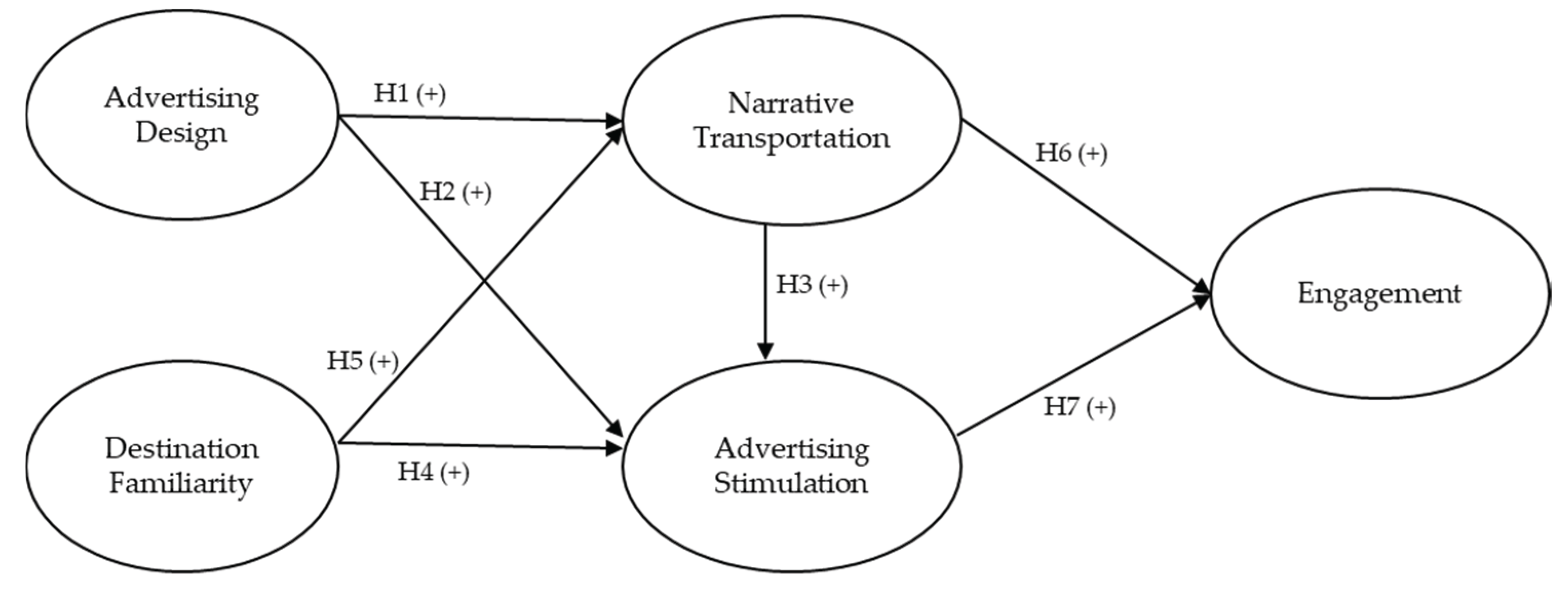
Table 1.
Measurement Model.
| Constructs and items |
Standardized Loadings |
t-value | |
| Code | Item | ||
| Narrative Transportation (α=0.87; CR=0.875; AVE=0.70) | |||
| NATX1 | While watching the promotional video, I did not think about anything else. | 0.89 | (a) |
| NATX2 | This promotional video captivated me from beginning to end. | 0.91 | 36.03 |
| NATX3 | This promotional video held my attention from start to finish. | 0.70 | 24.73 |
| Advertising Stimulation (α=0.82; CR=0.840; AVE=0.64) | |||
| ADST1 | I was thrilled by this promotional video. | 0.66 | (a) |
| ADST2 | This promotional video seduced me. | 0.84 | 21.43 |
| ADST3 | This promotional video is original and unique. | 0.89 | 22.20 |
| Destination Familiarity (α=0.84; CR=0.845; AVE=0.58) | |||
| FAM1 | I know the Alentejo well. | 0.72 | (a) |
| FAM2 | I am aware of the attractions that the Alentejo has to offer tourists. | 0.76 | 20.70 |
| FAM3 | I often look for information about the Alentejo. | 0.78 | 21.27 |
| FAM4 | I know the Alentejo better than my friends and family. | 0.78 | 21.26 |
| Advertising Design (α=0.95; CR=0.939; AVE=0.76) | |||
| ADSG1 | Overall, the visual elements of the video (e.g., colours, images, lighting, size, shape, etc.) are of high quality. | 0.91 | (a) |
| ADSG2 | Overall, the elements used made the video professional and well-designed. | 0.91 | 43.82 |
| ADSG3 | The video contained appealing visual connections. | 0.92 | 45.07 |
| ADSG4 | In general, the visual elements in the video were pleasing. | 0.87 | 39.90 |
| Engagement (α=0.91; CR=0.912; AVE=0.64) | |||
| ENG1 | I am familiar with the Alentejo Tourism website (VisitAlentejo). | 0.79 | 28.78 |
| ENG2 | I frequently visit the Alentejo Tourism website (VisitAlentejo). | 0.69 | 23.58 |
| ENG3 | I am familiar with the Alentejo Tourism Facebook/Instagram pages (VisitAlentejo). | 0.62 | 20.53 |
| ENG4 | I will follow/I follow the Alentejo Tourism (VisitAlentejo) Facebook/Instagram pages. | 0.89 | 35.73 |
| ENG5 | I want to comment on Alentejo Tourism (VisitAlentejo) content on its Facebook/Instagram page. | 0.92 | 37.51 |
| ENG6 | I often share Alentejo Tourism (VisitAlentejo) content on Facebook/Instagram. | 0.85 | (a) |
Notes: NATX=Narrative Transportation; ADST=Advertising Stimulation; FAM=Destination Familiarity; ADSG=Advertising Design; ENG= Engagement; λ= Standardized Coefficients; (a) a value of 1 was set to obtain the item metric; CR - Composite Reliability, AVE= Average Variance Extracted. The engagement scale captures respondents’ platform familiarity and self-reported behaviours/intentions related to VisitAlentejo. Accordingly, we interpret engagement as a broad propensity for destination-related digital engagement rather than a purely post-exposure behavioural outcome.
Table 3.
Hypothesis test.
| Hypothesis | Path | β | t-value | Significance |
| H1 (+) | ADSG → NATX | 0.451 | 13.636 | p<0.01 |
| H2 (+) | ADSG → ADST | 0.158 | 5.123 | p<0.01 |
| H3 (+) | NATX → ADST | 0.659 | 14.757 | p<0.01 |
| H4 (+) | FAM → ADST | 0.104 | 3.604 | p<0.01 |
| H5 (+) | FAM → NATX | 0.215 | 6.261 | p<0.01 |
| H6 (+) | NATX → ENG | 0.086 | 1.445 | N.S. |
| H7 (+) | ADST → ENG | 0.288 | 4.679 | p<0.01 |
Notes: NATX=Narrative Transportation; ADST=Advertising Stimulation; FAM=Destination Familiarity; ADSG=Advertising Design; ENG=Engagement β= Standardized path coefficients; N.S. = Not significant. Model Fit (χ2 = 1250.26; df = 180; GFI= 0.90; CFI=0.924; NFI=0.912; IFI=0.924; TLI=0.9511 RMSEA=0.080).
Disclaimer/Publisher’s Note: The statements, opinions and data contained in all publications are solely those of the individual author(s) and contributor(s) and not of MDPI and/or the editor(s). MDPI and/or the editor(s) disclaim responsibility for any injury to people or property resulting from any ideas, methods, instructions or products referred to in the content. |
© 2026 by the authors. Licensee MDPI, Basel, Switzerland. This article is an open access article distributed under the terms and conditions of the Creative Commons Attribution (CC BY) license (http://creativecommons.org/licenses/by/4.0/).
Copyright: This open access article is published under a Creative Commons CC BY 4.0 license, which permit the free download, distribution, and reuse, provided that the author and preprint are cited in any reuse.


