

Submitted:
12 January 2026
Posted:
13 January 2026
You are already at the latest version
Abstract
This study investigated whether ambient biogenic volatile organic compounds (bVOCs) scent profiles emitted by botanic glasshouse vegetation influence quantifiable human health and wellbeing outcomes, extending evidence previously obtained in clinical settings. Over 11 months in 2024 (January–December), human participant trials were conducted at the Oxford Botanic Garden to compare the physiological and psychological impacts of 30-minute exposures in five different vegetation-rich glasshouses, each characterised by a distinct and complex bVOCs profile, with those of a plant-free control room containing minimal bVOCs. Pre- and post-intervention assessments were conducted on 43 participants using the State-Trait Anxiety Inventory (STAI), heart-beat rate (beats per minute), and heart rate variability (HRV), a widely used index of autonomic regulation. Glasshouse exposure produced significant reductions in STAI anxiety scores and decreases in heart-beat rate, while HRV indices remained stable relative to the control condition. Distinct scent profiles in the glasshouses included volatiles previously associated with therapeutic effects in clinical settings, suggesting that such vegetated environments may deliver meaningful physiological and psychological benefits. Overall, these findings highlight the potential public health value of aromatic plant species and the importance of incorporating them into urban green space planning and policy.
Keywords:
anxiety
; biogenic volatile organic compounds
; health
; monoterpenes
; physiological indices
1. Introduction
Biogenic volatile organic compounds (bVOCs) are molecules synthesized and released by plants, animals, and fungi, characterized by high vapor pressures and low water solubilities. The release of bVOCs from plants can be triggered by a range of abiotic and biotica factors [1,2,3] and are associated with aspects of plant communication such as attracting pollinators and deterring herbivores [3,4]. The distinct scent profiles of different green spaces arise from the unique combination of bVOCs emitted by the plant species present, alongside seasonal variation and plant health status.
Emerging evidence suggests that bVOCs can have significant effects on human wellbeing [1,5]. Clinical studies have established that the inhalation of certain plant bVOCs can positively affect human health across a diverse set of physiological responses. [1,6,7,8,9,10,11,12]. For instance, exposure to d-limonene, a bVOC ubiquitously emitted in nature, has been shown to significantly increase parasympathetic nervous activity, evidenced by increased high-frequency indices of heart rate variability (HRV), associated with physiological calming, and enhanced reported comfort levels among participants [1,7,11]. Inhaling α-pinene, another plant-emitted monoterpene, has been demonstrated to lower heart-beat rate (bpm) and contribute to reductions in the experience of stress and anxiety [6,9,13]. Exposure to forested environments where these volatiles are present in the ambient air has also been confirmed to affect human health [1,5,14,15]. For example, forests rich in bVOCs have been shown to influence hormones, including reducing salivary cortisol concentrations, a chemical associated with stress [1,5,15,16,17,18,19,20,21,22,23,24], while a study of multi-day forest exposure reported increased presence and activity of natural killer cells, and other work has documented improvements in antibiotic efficiency [15,16].
Evidence of the benefits of spending time in nature has, in recent years contributed to the increased application of ‘green prescriptions’ – the use of exposure to nature to promote mental and physical wellbeing [25]. However, research exploring the specific effects of plant bVOCs on human health outcomes have primarily been conducted in clinical settings or forested ecosystems [26]. In particular, the impacts of bVOCs, and their links to human health outcomes in urban green spaces, such as parks and botanic gardens where people are most likely to encounter them, have not yet been investigated in detail [27]. This raises important questions including: (i) do the beneficial pharmacological effects of inhaling bVOCs seen in clinical settings also occur when encountering bVOCs in ambient urban green spaces? (ii) do human physiological and psychological responses vary between urban green spaces which contain different scents due to their composition of plant species?
To address these questions, we assessed the physiological and psychological responses of inhaling bVOCs present in the ambient air in five glasshouses in Oxford Botanic Garden (OBG) over 11 months between January- December 2024. This study examined whether variation in plant diversity among these five OBG glasshouses produces distinct bVOC profiles and whether exposure to these environments affects human health outcomes.
Specifically, this study aimed to
- Determine the profile of ambient bVOCs across the five OBG glasshouses and a plant free control room.
- Analyse the physiological and psychological effects of spending 30 minutes sitting in each glasshouse.
2. Materials and Methods
2.1. Study Site
The study was conducted in five glasshouses at the Oxford Botanic Garden (OBG)- Arid, Carnivorous Plant, Conservatory, Cloud Forest and Waterlily – as well as a plant-free control room (Figure 1). The bVOCs profile of each of the glasshouses was measured during three periods to capture seasonal variation: January-February 2024, June-August 2024 and November-December 2024. Using the Oxford Botanic glasshouses enabled us to account for all plant species present, and their abundance [28], as well as minimising any effects from natural and unnatural auditory stimulation such as bird song, rustling of leaves and traffic sounds [26,29,30].
2.2. Mapping Ambient bVOC Profiles
To measure the ambient bVOC profiles in each of the glasshouses and the control room, air samples were simultaneously captured in four Markes Tenax TA tubes during a sampling event which lasted for at least 30 minutes. We used a GilAir® pump with a flow rate of 400ml/min (100ml/min/tube). The tubes were located at a height of ~1.5 m to ensure that we captured the bVOCs at a vertical level in the ambient air closest to that experienced by the human nose (adapted from Walker et al. 2023) [32]. Using these indoor urban spaces also allowed us to map the bVOC profiles whilst minimizing variations in temperature and humidity, which are known to impact bVOC composition [32,33].
To account for diurnal variability of bVOC release, bVOCs samples were taken during three sampling events between 8am-2pm for each glasshouse [32].The bVOC compounds in the air samples were analysed using Gas Chromatography Mass Spectrometry (GC-MS) following standard procedures adapted from Kay et al. (2025)[34]. Chromatographic output data was processed using AMDIS software (v2.73) [35], which enabled identification of compounds by combined spectral (NIST20) and retention index (RI) matching. Deconvolution settings used high sensitivity and medium shape requirements to separate overlapping compound peaks. Peak areas from blank control tubes were subtracted to account for compounds originating from Tenax filters, TD trap, or GC column.
2.3. Volatile Data Analysis
The chemical profiles obtained from GC–MS were analysed using multivariate statistics. For principal component analysis (PCA) and Partial Least Squares Discriminant Analysis (PLS-DA) abundances were standardised within each sample (row standardisation) and then square-root transformed. This ensured that differences between samples reflect overall patterns in composition rather than large differences in total abundance. The PCA was carried out using the FactoMineR package in R [36], and visualised with factoextra [37].
To further distinguish between volatiles, we characterised compounds into whether they were primarily biogenic or anthropogenic. The summed relative amounts of biogenic volatiles were compared across the six sampling sites as well as the identification of compounds uniquely found at single sampling sites. To explore how many potentially human health promoting volatiles were identified in each site, we used presence/absence heatmap visualisation of monoterpenes, sesquiterpenes, and terpenoids.
To assess pollution in the sampling sites, we assessed relative amounts of benzene, toluene, ethylbenzene, and xylene (p, m, and o-xylene) – collectively named BTEX compounds – which are well documented sources of anthropogenic pollution [38]. Thirdly, as a metric for healthy: unhealthy compounds, we used the ratio of the summed abundance of bVOCs to BTEX compounds (∑bVOCs/∑BTEX) [39].
2.4. Mapping Ambient Foliage Greenness
To account for the relative amount of green foliage within each of the glasshouse environments, digital colour images were taken of each glasshouse and the density of green foliage was measured using ImageJ processing software to calculate the percentage area of green coverage across 380O – taken to represent a participant’s field of vision [42] (See supplement).
2.5. Participants and Study Design
A total of 43 participants (33 females; 10 males) aged 18 and over were recruited in three rounds between 18th January – 3rd December 2024. The experiments were conducted over three periods from i) January-February 2024, ii) June-August 2024 to iii) November-December 2024. Participants were students at the University of Oxford or volunteers associated with the Oxford University Gardens, Libraries and Museums. Full ethical approval was granted for the study before its commencement (Central University Research Ethics Committee (CUREC) reference R89114/RE001/RE002). After providing the participants with the study objectives and requirements, written consent was obtained in advance of commencing the research.
Before glasshouse exposure, psychological and physiological measurements - STAI, heart-beat rate (bpm) and HRV indices (SDNN) - were taken in the control room. Participants were then randomly allocated to one of the five glasshouses or the control room. Participants spent 30 minutes seated alone in their intervention location and were instructed to refrain from any physical activity. After the intervention, the same set of physiological and psychological measurements were recorded for participants. Participants returned weekly and were assigned a new intervention each week semi-randomly so that over the trial each participant was exposed to each glasshouse and to ensure there were no repeated sessions in the same glasshouse.
2.6. Physiological and Psychological Markers
To discern psychological anxiety, the participants filled in The State-Trait-Anxiety-Inventory (STAI) questionnaire before and after the 30 minutes (See supplement). This inventory, which involves the participants answering twenty questions, is a well-established psychological method [43,44,45] where the questions have been devised to measure both state and trait anxiety not specific to any psychiatric disorder [43,45]. Once completed, the prior and post-glasshouse exposure STAI results for each participant were coded and assigned a predetermined score with values between 20-80. Higher STAI scores have previously been shown to be indicative of more severe anxiety and negative emotions [46].
Heart-beat rate (bpm) is widely recognized as physiological indicator of stress, with increased rates often associated with elevated levels of anxiety [47]. Heart-beat rate (bpm) is regulated by the autonomic nervous system, with the parasympathetic nervous system suppressing activity and the sympathetic nervous system increasing beats per minute in stressful situations- and where an elevated parasympathetic [47]. To measure heart-beat rates (bpm) participants were provided with user-friendly technology including Fitbit Inspire 2 models and smartphones. The Welltory app (Version 4.26.0) was installed on all smartphones which uses photoplethysmography (PPG) to measure heart-beat rate (bpm) and utilizes the camera and flash to detect changes in blood volume in the user’s vessels [48,49]. Participants again recorded their own measurements before and after the session.
To monitor autonomic nervous activity, SDNN (a measure of heart rate variability measured as standard deviation of the NN interval and the quantification of the variation in the time intervals between consecutive normal heart beats) measurements were recorded from participants [50]. Both sympathetic and parasympathetic nervous system activity contribute to SDNN [51]. However, in short-term recordings, SDNN is primarily a measure of parasympathetic activity, where higher values are typically indicative of increased physiological relaxation [23,52,53]. To measure SDNN, the participants used the Welltory app (Version 4.26.0) installed on a smartphone and recorded measurements before and after the experiment [49].
2.7. Human Health Data Analysis
Microsoft Excel was used to organise participant data, and R was used for statistical analyses using R studio (version 2025.05.0+496) [54] . To compare STAI scores, heart-beat rate and HRV before and after the exposure, paired Wilcoxon signed-rank tests were performed to assess whether post-exposure values were significantly lower than pre-exposure values (alternative = After < Before). Then, per-site sample sizes and test statistics were recorded, and significance levels annotated on boxplots. Finally, to compare STAI, heart-beat rate and HRV results across different sites, linear mixed-effects models were fitted with change (Δ) values as the response and glasshouse as the fixed effect, including participant experiment as a random intercept to account for repeated measures.
Models were estimated using the lmerTest package [55], with type-III ANOVAs used to assess the overall effect of glasshouse. Post-hoc comparisons (control vs. each glasshouse) were performed using emmeans [56] with Benjamini–Hochberg correction. Tukey’s HSD contrasts across all sites were summarised as compact letter displays using the multcompView package in R [57]. For select models, baseline (Before) values were added as covariates to control for starting differences, and conditional/marginal R² values were calculated with performance [58] and plotted as boxplots.
To examine whether greenness also had effect on the health outcomes a spearman correlation test was performed to examine the relationship between the measured changes in physiological and psychological responses after participants had spent 30 minutes in the glasshouses and the amount of green foliage present in each of the glasshouses using the stats package in R [54] .
3. Results
3.1. Volatile Profiles Differ Between Glasshouses and Control Room
An initial PCA indicated separation between volatile profiles from the control room and the glasshouse environments (Figure 2A), which was supported by a significant PERMANOVA (F₅,₄₆ = 1.80, R² = 0.164, p = 0.019). All glasshouse sites exhibited higher total bVOC abundances compared to the control room; however, this difference was not statistically significant (one-way ANOVA, p = 0.17; Figure 2B). A further assessment of compounds found uniquely in a single sampling site found that the Waterlily House was most rich with 21 unique biogenic volatiles (Figure 2C). All other sites ranged from 3 to 14 unique compounds.
The proportion of BTEX compounds was highest in the control room (2.88%; Figure 2D). Three glasshouse environments showed significantly lower BTEX proportions (ANOVA with Tukey post-hoc tests, p < 0.05), ranging from 0.85% in the Waterlily House to 0.33% in the Carnivorous Plant House. These differences were primarily driven by a substantially higher proportion of xylene isomers (p-, m-, and o-xylene) in the control room relative to the glasshouses.
To summarise biogenic relative to anthropogenic contributions, bVOC:BTEX ratios were calculated (Figure 2E). The Carnivorous Plant House showed the highest ratio (27.4:1), followed by the Conservatory (24.3:1), reflecting strong biogenic dominance. Although all glasshouses showed higher ratios than the control room, these differences were not statistically significant (Tukey post-hoc tests, p > 0.05).
Across the three volatile sampling seasons, a combined total of 79 terpenes and terpenoids were identified (Figure 2F). The Waterlily House exhibited the greatest diversity, with 51 compounds detected, while the Arid House contained the fewest (33). Of the total terpene and terpenoid pool, 34 compounds were not detected in the control room. When compounds were grouped by class, the Waterlily House contained the highest numbers of both sesquiterpenes (14) and terpenoids (19) of all sampling locations, including the control room. It also exhibited the second-highest number of monoterpenes (20), slightly lower than the Carnivorous Plant House, which contained the greatest monoterpene diversity (22).
3.2. Significant Benefits to Psychological Wellbeing Were Observed Following Time Spent in All Glasshouses
Across 141 observations from 43 participant-within-experiment IDs, changes in anxiety scores were analysed following exposure to different indoor environments. When environments were grouped into the control room versus all glasshouse locations, a significant difference in percentage change in STAI scores was detected (one-way ANOVA, p < 0.001; Figure 3A). Glasshouse environments were associated with lower anxiety change scores, whereas no significant change was observed in the control room.
When individual sampling environments were considered separately, a mixed-effects delta-ANOVA revealed a significant effect of site on percentage change in STAI scores (F₅,₁₁₄.₈ = 5.49, p < 0.001; Figure 3B). All glasshouse environments were associated with reductions in anxiety scores relative to baseline, whereas the control room showed no significant change. Pairwise post-hoc comparisons indicated that anxiety reductions observed in each glasshouse environment were greater than those in the control room (Tukey-adjusted p < 0.05), while differences among glasshouse environments were more variable.
3.3. Physiological Response (Heart-Beat Rate and Heart-Rate Variability) Indicated Glasshouse Specific Reductions
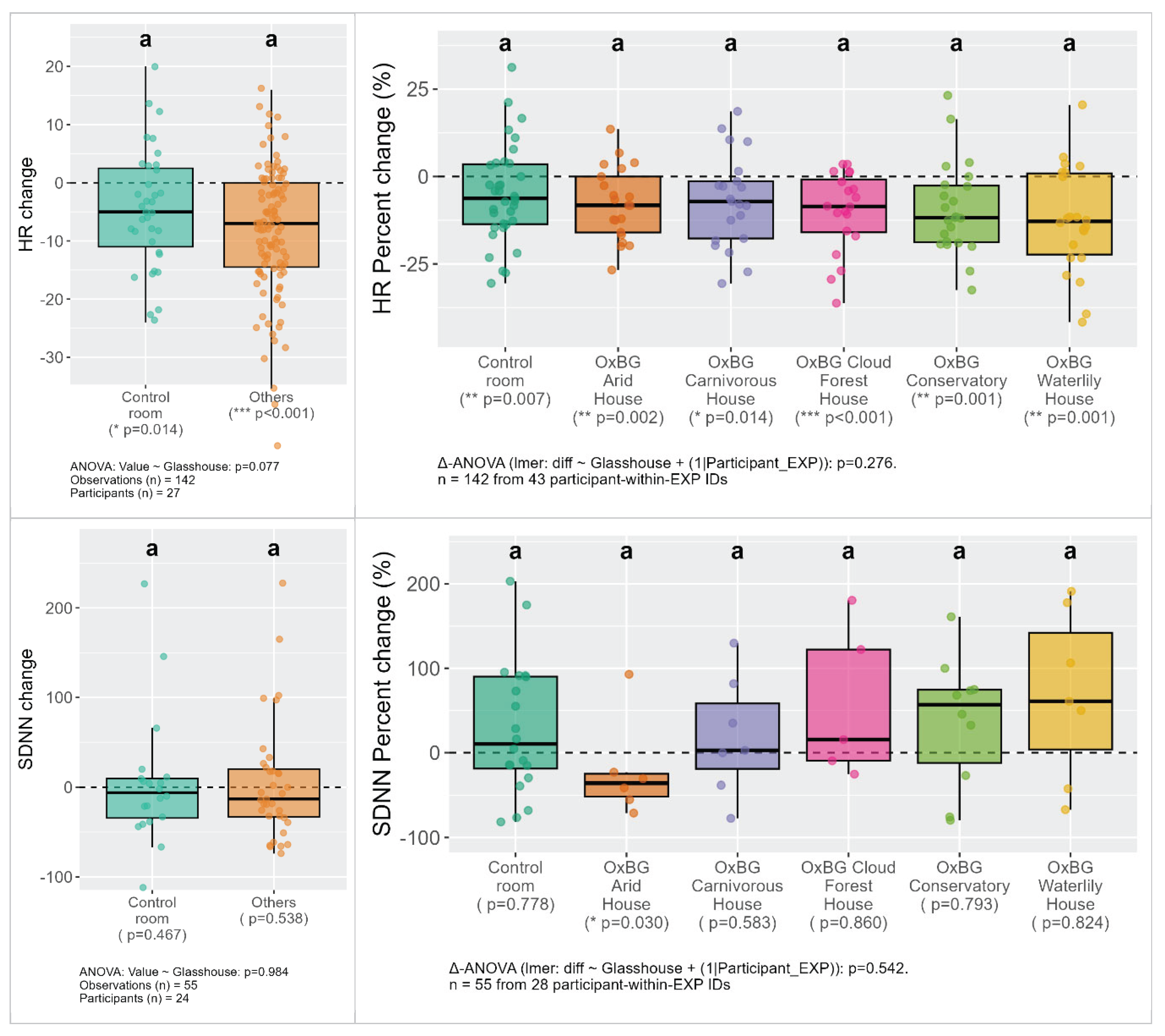
Within-site paired comparisons revealed significant reductions in heart-beat rate following exposure in the Arid, Cloud Forest, Conservatory, and Waterlily Houses (paired Wilcoxon tests, p < 0.05; Figure 4B) suggesting site-specific reductions in heart-beat rate compared to time spent in the control room, and Carnivorous House. However, given that modest reductions in heart-beat rate after 30 minutes also occurred in the control and arid room, when the grouped heart-beat rate reductions was compared to the control room, the overall effect of HR change scores did not indicate a significant difference in heart-beat rate reduction between the control room and all other glasshouses (one-way ANOVA, p = 0.077; Figure 4A).
For HRV, SDNN change scores showed substantial inter-individual variability although elevated parasympathetic activity is apparent in the Waterlily, Conservatory and Cloud Forest Houses – however, these are not statically significant when comparing among individual sites (mixed-effects delta-ANOVA, p = 0.542; Figure 4D). In addition, no statistically significant differences were detected between the control room and glasshouse environments when grouped (one-way ANOVA, p = 0.984; Figure 4C). It must be also noted, however, that due to measurement errors, the sample sizes for this metric were small and this almost certainly limited the power of the analysis.
3.4. Visual Stimulation from Glasshouse Foliage May Contribute to Wellbeing Benefits
In addition to the smell of foliage, we tested for associations from seeing vegetation in each of the glasshouses, and the control room, and the measured physiological and psychological responses (Figure S2). A small but marked negative trend was found between the amount of green foliage present and the percentage change in STAI scores among participants (r=-0.321, p=0.000103).
4. Discussion
4.1. Profiling Health-Promoting bVOCs in the OBG Glasshouses
Our findings showed that each of the glasshouses contained distinct bVOCs profiles compared with the control room (Figure 2A). The differences in volatile profiles were almost certainly related to the different plant species composition in each glasshouse, many of which have been previously demonstrated in clinical studies to produce health-enhancing bVOCs (Figure 2F) [28]. Notably, plant-derived volatiles previously associated with physiological changes indicative of relaxation were detected in all glasshouses (Figure 2F). These included aromatic monoterpenes, such as bornyl acetate- typically released by a variety of plants including by members of Asteraceae located in the Arid, Carnivorous Plant and Conservatory glasshouses and Zingiberaceae in the Waterlily glasshouse [59,60].
The compounds of α-pinene, 1,8-cineole, limonene, and menthol were also detected in each of the glasshouses. These compounds have previously been associated with parasympathetic activation and relaxation and are particularly known to be emitted by members of Rutaceae, Geraniaceae, and Lamiaceae- families represented in the Arid, Cloud Forest and Conservatory glasshouses [1,6,18,61,62,63].
Cedrol, another plant-derived compound which was detected in the Carnivorous Plant, Cloud Forest and Waterlily glasshouses, is similarly recognised for reducing sympathetic activity and promoting relaxation [64].
γ-terpinene which was among the volatiles similarly detected in these glasshouses, as well as in the Conservatory. This compound has also been linked to physiological relaxation and is a known emission from various citrus species abundant in the Conservatory glasshouse [65].
The short-term inhalation of plant-derived camphor present in the essential oil of Cinnamomum camphora and detected all of the glasshouses, has also been shown to promote positive psychophysiological outcomes by altering brain wave activity [66]. Linalool, another compound detected in all glasshouses, is specifically associated with volatile emissions from Lamiaceae species present in the Arid, Cloud Forest and Conservatory glasshouses [28,67] and has been shown to act as antidepressant agent [68,69].
β- myrcene was another volatile that was detected in the Carnivorous Plant, Cloud Forest and the Conservatory glasshouses, and is a known component of bVOC emissions from Citrus aurantium, which is present in this latter setting [70,71]. Previous studies have shown that volatiles from this species exhibit anti-anxiety effects comparable to pharmacological treatments [11,70,71].
Overall, the Waterlily glasshouse showed a higher number of unique compounds relative to the other glasshouse environments (Figure 2C & F). Several of these distinct volatile compounds, including perillaldehyde and neophytadiene, have been shown in animal models to exhibit potential antidepressant and antioxidant effects [72,73]. It should also be noted, however, that a small detection of health-enhancing terpenes such as α-pinene, ß- caryophyllene, camphene, limonene, and 1,8-cineole were also apparent in the control room (Figure 2F) [7,8,65,74,75,76]. Although, relatively higher abundances of BTEX compounds- known to be harmful to human health- were detected in this setting (Figure 2D-E), in contrast to the terpene-rich, health-enhancing glasshouse volatile profiles [1,77,78].
4.2. Physiological and Psychological Impacts of Exposure to Health-Enhancing bVOCs in the Ambient Air of the Glasshouses of OBG
Given the known compounds in these glasshouses, and previous clinical studies demonstrating physiological and psychological changes when smelling them, the second aim of our study was to ask: were there any physiological and psychological effects associated with spending time in them? Here our findings indicated that significant improvements in anxiety and alleviations of negative emotions occurred after participants spent time in each of the glasshouses compared to the control room (Figure 3). This aligns with previous research demonstrating that certain plant scents in forests can lead to improvements in mood [1,21,42,66]. The relative improvement we found in psychological wellbeing, even after only 30 minutes also aligns with observations of anxiolytic effects and elevated mood after inhaling certain plant-emitted scents in controlled clinical studies [7,8,9,28].
Despite the smaller detection of health-enhancing terpenes (Figure 2), no comparable improvements in psychological wellbeing were observed following time spent in the control room (Figure 3). This finding may reflect the greater diversity and richness of plant scent combinations present in the glasshouses than in this setting (Figure 2B & E) . Prior work also highlights that exposure to diverse bVOC blends, typical of green environments, is more effective in promoting psychological restoration than limited or synthetic scent exposure [45,70,77,79]. The presence of aromatic plant species from multiple botanical families- such as Asteraceae, Lamiaceae , Rutaceae, and Zingiberaceae- in the glasshouses and their associated bVOC emissions likely contributed to the beneficial effects observed [28,80]. However, it could also be the combined effect of both smelling and seeing the plants in the glasshouses that contributed to the relative improvements in psychological wellbeing observed, given that a small association was also detected between the amount of foliage in the glasshouses and STAI scores (Figure S2) [81,82,83,84].
Notably, greater reductions in STAI scores were observed among participants who spent time in the Cloud Forest, Conservatory, and Waterlily glasshouses (Figure 3B). This suggests that specific environments within these glasshouses may confer differentiated psychological benefits, potentially attributable to their unique volatile profiles (Figure 2 and Figure 3) [6,7,59,66,76,85]. Previous research [21,77] also demonstrates that site-specific bVOC profiles can shape mood outcomes. Donelli et al. (2023)[77], found that exposure to high concentrations of sabinene and o-cymene had minimal influence on mood, while inhalation of α-pinene led to significant reductions in anxiety during forest therapy at different sites. Evidence from other studies has also indicated that distinct floral scents can either raise or lower anxiety-related brainwave activity [61,86].
Collectively, our findings build on these results to indicate that the diversity and composition of plant-emitted volatiles within the urban greenspace of the OBG glasshouses can contribute to notable psychological improvements among participants with some evidence to suggest that specific glasshouses may hold more therapeutic potential.
Exposure to the glasshouses was also associated with small reductions in heart-beat rate (bpm) in all the glasshouses - indicative of possible physiological relaxation. It should be noted, however, that small declines were also apparent in the control room (Figure 4A-B) [6,7,12]. The fact that volatiles such as α-pinene and limonene were found in the ambient air in the control room (Figure 2F) may explain this result [6,7]. Parasympathetic heart rate responses remained less distinct between the glasshouses and the control (Figure 4A-B) and showed no statistically significant changes but again some hints of elevated parasympathetic activity in some glasshouses are apparent (Figure 4C-D). These findings partially contradict earlier studies reporting notable cardiovascular effects from inhaling plant volatiles [6,66,87,88,89]. However, the relatively small participant sample size in the present pilot study likely limited detection power for these physiological outcomes [62,63] and allow a cautious interpretation that that spending time in the Cloud Forest, Conservatory and Waterlily glasshouses may lower heart-beat rates, and elevate parasympathetic nervous system activity more than visits to other glasshouses. Future investigations should incorporate broader physiological measures- including blood pressure and cortisol levels- and larger participant cohorts to increase sensitivity to differential physiological effects [85,90].
Conclusions
Our study demonstrates that the Oxford Botanic Garden (OBG) glasshouses possess distinct and compositionally diverse bVOC profiles, with many compounds known to confer health-promoting and mood-enhancing effects. The detection of key aromatic terpenes such as α-pinene, 1,8-cineole, linalool, and limonene across all glasshouses supports the idea that these environments are rich in bioactive volatiles capable of stimulating psychophysiological relaxation. In particular, the Cloud Forest, Conservatory, and Waterlily glasshouses exhibited the greatest diversity and abundance of health-related volatiles, aligning with observed improvements in participants’ anxiety and mood scores following exposure.
These findings suggest that the specific composition and richness of natural scent blends, rather than the presence of individual compounds, may underpin the restorative psychological benefits experienced in these biodiverse plant environments.
While physiological responses, such as heart-beat rate and parasympathetic activity, were less pronounced, modest declines in heart-beat rate hint at subtle relaxation effects that likely warrant further investigation. The limited sample size and short exposure duration may have constrained detectable physiological differences. Nonetheless, the collective evidence points to the potential role of plant-emitted volatiles in shaping human wellbeing within urban green settings. Future studies incorporating larger cohorts, extended exposure times, and additional physiological indicators could clarify the mechanistic pathways linking bVOC exposure to health outcomes and help refine the design of therapeutic plant-based environments in cities.
Supplementary Materials
The following supporting information can be downloaded at the website of this paper posted on Preprints.org. Figure S1: Examples of 180-degree images taken across the glasshouses from top to bottom: 1. Arid, 2. Carnivorous Plant, 3. Cloud Forest, 4. Conservatory and 5. Waterlily glasshouses.; Figure S2: Association between green-foliage coverage and percentage change in STAI score.; Figure S3: Association between green-foliage coverage and percentage change in heart-beat rate (bpm).; Figure S4: Association between green-foliage coverage and percentage change in SDNN (ms). ; Table S1: State-Trait-Anxiety-Inventory (STAI) used in this study as an indicator of psychological well-being.
Author Contributions
Conceptualisation K.J.W. and M.R.T.; Data Curation- K.E.S., M.R.T. and W.T.K.; Formal Analysis K.E.S, M.R.T. and W.T.K.; Funding Acquisition A.L.L.B and K.J.W.; Investigation M.R.T.; Methodology M.R.T. and W.T.K.; Project Administration M.R.T.; Resources M.R.T.; Software A.L.L.B, K.E.S., M.R.T., and W.T.K. and, K.E.S.; Supervision K.J.W.; Validation M.R.T. and W.T.K.; Visualisation M.R.T and W.T.K.; Writing- Original Draft M.R.T.; Writing- Review & Editing- K.J.W, K.E.S and W.T.K. All authors have read and agreed to the published version of the manuscript.
Funding
The work of the Leverhulme Centre for Nature Recovery is made possible thanks to the generous support of the Leverhulme Trust. This publication arises from research funded by the John Fell Oxford University Press Research Fund.
Institutional Review Board Statement
This study was conducted in accordance with the Declaration of Helsinki and approved by the Central University Research Ethics Committee (CUREC) of the University of Oxford (protocol reference: R89114/RE001/ RE002; dates of approval 09/01/2024 and 05/07/2024).
Informed Consent Statement
Written informed consent was obtained from all subjects involved in the study. .
Data Availability Statement
All data are available by contacting the corresponding author.:
Acknowledgments
The study could not have been performed without the invaluable support of the Oxford Botanic Garden and Arboretum. The authors would also like to thank the Jodrell Laboratory at Kew Gardens and the Department of Chemistry at the University of Oxford for their invaluable contributions. The authors would like to thank Welltory for use of their software. Finally, we would like to thank all the volunteers who participated in the study.
Conflicts of Interest
The authors declare no conflicts of interest.
Abbreviations
The following abbreviations are used in this manuscript:
| BTEX | Benzene; Toluene; Ethylbenzene; Xylene |
| bVOCs | Biogenic Volatile Organic Compounds |
| CUREC | Central University Research Ethics Committee |
| DOAJ | Directory of open access journals |
| GC-MS | Gas Chromatography-Mass Spectrometry |
| HRV | Heart Rate Variability |
| MDPI | Multidisciplinary Digital Publishing Institute |
| OBG | Oxford Botanic Garden |
| STAI | State Trait Anxiety Inventory |
| PCA | Principle Component Analysis |
| PLS-DA | Partial Least Squares Discriminant Analysis |
| SDNN | Standard Deviation of NN intervals |
References
- Antonelli, M.; Donelli, D.; Barbieri, G.; Valussi, M.; Maggini, V.; Firenzuoli, F. Forest Volatile Organic Compounds and Their Effects on Human Health: A State-of-the-Art Review. Int. J. Environ. Res. Public Health 2020, 17, 6506. [Google Scholar] [CrossRef]
- McGee, H. Land Plants: Independence, Immobility, Virtuosity. In Nose Dive: A Field Guide to the World’s Smells; John Murray: Great Britain, 2020; pp. 131–295. [Google Scholar]
- Unsicker, S.B.; Kunert, G.; Gershenzon, J. Protective Perfumes: The Role of Vegetative Volatiles in Plant Defense against Herbivores. Curr. Opin. Plant Biol. 2009, 12, 479–485. [Google Scholar] [CrossRef]
- Bouwmeester, H.; Schuurink, R.C.; Bleeker, P.M.; Schiestl, F. The Role of Volatiles in Plant Communication. Plant J. 2019, 100, 892–907. [Google Scholar] [CrossRef] [PubMed]
- Bach Pagès, A.; Peñuelas, J.; Clarà, J.; Llusià, J.; Campillo i López, F.; Maneja, R. How Should Forests Be Characterized in Regard to Human Health? Evidence from Existing Literature. Int. J. Environ. Res. Public Health 2020, 17, 1027. [Google Scholar] [CrossRef] [PubMed]
- Ikei, H.; Song, C.; Miyazaki, Y. Effects of Olfactory Stimulation by α-Pinene on Autonomic Nervous Activity. J. Wood. Sci. 2016, 62, 568–572. [Google Scholar] [CrossRef]
- Joung, D.; Song, C.; Ikei, H.; Okuda, T.; Igarashi, M.; Koizumi, H.; Park, B.J.; Yamaguchi, T.; Takagaki, M.; Miyazaki, Y. Physiological and Psychological Effects of Olfactory Stimulation with D-Limonene. Adv. Hortic. Sci. 2014, 28, 90–94. [Google Scholar]
- Hoch, C.C.; Petry, J.; Griesbaum, L.; Weiser, T.; Werner, K.; Ploch, M.; Verschoor, A.; Multhoff, G.; Bashiri Dezfouli, A.; Wollenberg, B. 1,8-Cineole (Eucalyptol): A Versatile Phytochemical with Therapeutic Applications across Multiple Diseases. Biomed. Pharmacother. 2023, 167, 115467. [Google Scholar] [CrossRef]
- Kim, J.-C.; Dinh, T.-V.; Oh, H.-K.; Son, Y.-S.; Ahn, J.-W.; Song, K.-Y.; Choi, I.-Y.; Park, C.-R.; Szulejko, J.E.; Kim, K.-H. The Potential Benefits of Therapeutic Treatment Using Gaseous Terpenes at Ambient Low Levels. Appl. Sci. 2019, 9, 4507. [Google Scholar] [CrossRef]
- Sun, M.; Nakashima, T.; Yoshimura, Y.; Honden, A.; Nakagawa, T.; Nakashima, Y.; Kawaguchi, M.; Takamori, Y.; Koshi, Y.; Sawada, R.; et al. Physiological and Psychological Effects of Volatile Organic Compounds from Dried Common Rush (Juncus Effusus L. Var. Decipiens Buchen.) on Humans. Int. J. Environ. Res. Public Health. 2022, 19, 1856. [Google Scholar] [CrossRef]
- Vieira, A.J.; Beserra, F.P.; Souza, M.C.; Totti, B.M.; Rozza, A.L. Limonene: Aroma of Innovation in Health and Disease. Chem. Biol. Interact. 2018, 283, 97–106. [Google Scholar] [CrossRef]
- Cai, Y.; Chen, H.; Zhang, X.; Bu, W.; Ning, W. Benefits of Gardenia Jasminoides Ellis’s Floral Volatile Components on Human Emotions and Moods. Sci. Rep. 2025, 15, 4194. [Google Scholar] [CrossRef]
- Bratman, G.N.; Bembibre, C.; Daily, G.C.; Doty, R.L.; Hummel, T.; Jacobs, L.F.; Kahn, P.H., Jr.; Lashus, C.; Majid, A.; Miller, J.D.; Oleszkiewicz, A.; Olvera-Alvarez, H.; Parma, V.; Riederer, A.M.; Sieber, N.L.; Williams, J.; Xiao, J.; Yu, C.P.; Spengler, J.D. Nature and Human Well-Being: The Olfactory Pathway. Sci. Adv. 2024, 10, eadn3028. [Google Scholar] [CrossRef]
- Andersen, L.; Corazon, S.S.; Stigsdotter, U.K. Nature Exposure and Its Effects on Immune System Functioning: A Systematic Review. Int. J. Environ. Res. Public Health. 2021, 18, 1416. [Google Scholar] [CrossRef]
- Li, Q. Effect of Forest Bathing Trips on Human Immune Function. Environ. Health Prev. Med. 2009, 15, 9–17. [Google Scholar] [CrossRef]
- Bach, A.; Yáñez-Serrano, A.M.; Llusià, J.; Filella, I.; Maneja, R.; Penuelas, J. Human Breathable Air in a Mediterranean Forest: Characterization of Monoterpene Concentrations under the Canopy. Int. J. Environ. Res. Public Health. 2020, 17, 4391. [Google Scholar] [CrossRef] [PubMed]
- Bach, A.; Ceron, J.J.; Maneja, R.; Llusià, J.; Penuelas, J.; Escribano, D. Evolution of Human Salivary Stress Markers during an Eight-Hour Exposure to a Mediterranean Holm Oak Forest. A Pilot Study. Forests 2021, 12, 1600. [Google Scholar] [CrossRef]
- Cho, K.S.; Lim, Y.-R.; Lee, K.; Lee, J.; Lee, J.H.; Lee, I.-S. Terpenes from Forests and Human Health. Toxicol Res 2017, 33, 97–106. [Google Scholar] [CrossRef]
- Kim, T.; Song, B.; Cho, K. S.; Lee, I. S. Therapeutic Potential of Volatile Terpenes and Terpenoids from Forests for Inflammatory Diseases. Int. J. Mol. Sci. 2020, 21, 2187. [Google Scholar] [CrossRef]
- Lee, J.; Park, B.-J.; Tsunetsugu, Y.; Ohira, T.; Kagawa, T.; Miyazaki, Y. Effect of Forest Bathing on Physiological and Psychological Responses in Young Japanese Male Subjects. Public Health 2011, 125, 93–100. [Google Scholar] [CrossRef] [PubMed]
- Meneguzzo, F.; Albanese, L.; Antonelli, M.; Baraldi, R.; Becheri, F.R.; Centritto, F.; Donelli, D.; Finelli, F.; Firenzuoli, F.; Margheritini, G.; et al. Short-Term Effects of Forest Therapy on Mood States: A Pilot Study. Int. J. Environ. Res. Public Health 2021, 18, 9509. [Google Scholar] [CrossRef]
- Sumitomo, K.; Akutsu, H.; Fukuyama, S.; Minoshima, A.; Kukita, S.; Yamamura, Y.; Sato, Y.; Hayasaka, T.; Osanai, S.; Funakoshi, H.; et al. Conifer-Derived Monoterpenes and Forest Walking. Mass Spectrom. 2015, 4, A0042. [Google Scholar] [CrossRef]
- Zorić, M.; Farkić, J.; Kebert, M.; Mladenović, E.; Karaklić, D.; Isailović, G.; Orlović, S. Developing Forest Therapy Programmes Based on the Health Benefits of Terpenes in Dominant Tree Species in Tara National Park (Serbia). Int. J. Environ. Res. Public Health 2022, 19, 5504. [Google Scholar] [CrossRef]
- Tsao, T. M.; Tsai, M. J.; Hwang, J. S.; Cheng, W. F.; Wu, C. F.; Chou, C. K.; Su, T. C. Health Effects of a Forest Environment on Natural Killer Cells in Humans: An Observational Pilot Study. Oncotarget 2018, 9, 16501–16511. [Google Scholar] [CrossRef] [PubMed]
- Adewuyi, F.A.; Knobel, P.; Gogna, P.; Dadvand, P. Health Effects of Green Prescription: A Systematic Review of Randomized Controlled Trials. Environ. Res. 2023, 236, 116844. [Google Scholar] [CrossRef]
- Buckley, R.C.; Cooper, M.-A.; Zhong, L. Principal Sensory Experiences of Forest Visitors in Four Countries, for Evidence-Based Nature Therapy. People Nat. 2024, 6, 2480–2493. [Google Scholar] [CrossRef]
- Lamont, R. A; Hinson, C. A Narrative Review of Reviews of Nature Exposure and Human Health and Well‐Being in the UK. NEER030. Natural England 2024.
- Oxford Botanic Garden and Arboretum Glasshouse Accession List. 2024.
- Song, I.; Baek, K.; Kim, C.; Song, C. Effects of Nature Sounds on the Attention and Physiological and Psychological Relaxation. Urban For. Urban Green. 2023, 86, 127987. [Google Scholar] [CrossRef]
- Jo, H; Song, C; Ikei, H; Enomoto, S; Kobayashi, H. Physiological and Psychological Effects of Forest and Urban Sounds Using High-Resolution Sound Sources. Int. J. Environ. Res. Public Health 2019, 16, 2649. [Google Scholar] [CrossRef] [PubMed]
- OpenSteetMap Contributors OpenStreetMap 2025. Available online: https://www.openstreetmap.org/export#map=18/51.75067/-1.24769 (accessed on 06.05.2024).
- Walker, H.; Jena, A.; McEwan, K.; Evans, G.; Campbell, S. Natural Volatile Organic Compounds (NVOCs) Are Greater and More Diverse in UK Forests Compared with a Public Garden. Forests 2023, 14, 92. [Google Scholar] [CrossRef]
- Janson, R. Monoterpene Concentrations in and above a Forest of Scots Pine. J. Atmos. Chem. 1992, 14, 385–394. [Google Scholar] [CrossRef]
- Kay, W.T.; Lindström Battle, A.; Humberstone, M.; Tucker, M.; Storer, K.E.; Kite, G.; Willis, K. A Walk in the Park – Identifying Healthy Biomes Using Scent Snapshots 2025.
- National Institute of Standards and Technology. Automated Mass Spectral Deconvolution and Identification System (AMDIS). 2023. [Google Scholar]
- Lê, S; Josse, J; Husson, F. FactoMineR: An R Package for Multivariate Analysis. J. Stat. Softw. 2008, 25, 1–18. [Google Scholar] [CrossRef]
- Kassambara, A; Mundt. F Package ‘Factoextra’. In Extract and Visualize the Results of Multivariate Data Analyses; 2017. [Google Scholar]
- Kamani, H.; Baniasadi, M.; Abdipour, H.; Mohammadi, L.; Rayegannakhost, S.; Moein, H.; Azari, A. Health Risk Assessment of BTEX Compounds (Benzene, Toluene, Ethylbenzene and Xylene) in Different Indoor Air Using Monte Carlo Simulation in Zahedan City, Iran. Heliyon 2023, 9, e20294. [Google Scholar] [CrossRef]
- Malik, T.G.; Gupta, M.; Tripathi, N.; Sahu, L.K. Change in Monoterpene Concentrations during Winter-to-Summer Transition Period and Impact of COVID-19 Lockdown at an Urban Site in India. Atmos. Environ. 2025, 350, 121141. [Google Scholar] [CrossRef]
- Wickham, H. Ggplot2. WIREs Comput. Stat. 2011, 3, 180–185. [Google Scholar] [CrossRef]
- Neuwirth, E. RColorBrewer: ColorBrewer Palettes 2014.
- Schneider, C. A.; Rasband, W. S. NIH Image to ImageJ: 25 Years of Image Analysis. Nat. Methods 2012, 9, 671–675. [Google Scholar] [CrossRef]
- Spielberger, C. D State-Trait Anxiety Inventory for Adults (STAI-AD) 1983.
- Song, C.; Ikei, H.; Igarashi, M.; Takagaki, M.; Miyazaki, Y. Physiological and Psychological Effects of a Walk in Urban Parks in Fall. Int. J. Environ. Res. Public Health. 2015, 12, 14216–14228. [Google Scholar] [CrossRef]
- Donelli, D.; Meneguzzo, F.; Antonelli, M.; Ardissino, D.; Niccoli, G.; Gronchi, G.; Baraldi, R.; Neri, L.; Zabini, F. Effects of Plant-Emitted Monoterpenes on Anxiety Symptoms: A Propensity-Matched Observational Cohort Study. Int. J. Environ. Res. Public Health. 2023, 20, 2773. [Google Scholar] [CrossRef]
- Chun, M.H.; Chang, M.C.; Lee, S.-J. The Effects of Forest Therapy on Depression and Anxiety in Patients with Chronic Stroke. Int. J. Neurosci 2017, 127, 199–203. [Google Scholar] [CrossRef]
- Kasahara, Y.; Yoshida, C.; Saito, M.; Kimura, Y. Assessments of Heart Rate and Sympathetic and Parasympathetic Nervous Activities of Normal Mouse Fetuses at Different Stages of Fetal Development Using Fetal Electrocardiography. Front. Physiol. 2021, 12, 8. [Google Scholar] [CrossRef]
- Moya-Ramon, M.; Mateo-March, M.; Peña-González, I.; Zabala, M.; Javaloyes, A. Validity and Reliability of Different Smartphones Applications to Measure HRV during Short and Ultra-Short Measurements in Elite Athletes. Comput. Methods Programs Biomed. 2022, 217, 106696. [Google Scholar] [CrossRef]
- 2024.
- Yugar, L. B. T.; Yugar-Toledo, J. C.; Dinamarco, N.; Sedenho-Prado, L. G.; Moreno, B. V. D.; Rubio, T. A.; Fattori, A.; Rodrigues, B.; Vilela-Martin, J. F.; Moreno, H. The Role of Heart Rate Variability (HRV) in Different Hypertensive Syndromes. Diagnostics 2023, 13, 785. [Google Scholar] [CrossRef] [PubMed]
- Shaffer, F.; Ginsberg, J.P. An Overview of Heart Rate Variability Metrics and Norms. Front. Public Health 2017, 5, 1–17. [Google Scholar] [CrossRef]
- Kim, H.-G.; Cheon, E.-J.; Bai, D.-S.; Lee, Y.H.; Koo, B.-H. Stress and Heart Rate Variability: A Meta-Analysis and Review of the Literature. Psychiatry Investig. 2018, 15, 235–245. [Google Scholar] [CrossRef]
- Gullett, N.; Zajkowska, Z.; Walsh, A.; Harper, R.; Mondelli, V. Heart Rate Variability (HRV) as a Way to Understand Associations between the Autonomic Nervous System (ANS) and Affective States: A Critical Review of the Literature. Int. J. Psychophysiol. 2023, 192, 35–42. [Google Scholar] [CrossRef] [PubMed]
- R Core Team R: A Language and Environment for Statistical Computing. In R Foundation for Statistical Computing; 2024.
- Kuznetsova, A.; Brockhoff, P.B.; Christensen, R.H.B. lmerTest Package: Tests in Linear Mixed Effects Models. J. Stat. Softw. 2017, 82, 1–26. [Google Scholar] [CrossRef]
- Russel Lenth Emmeans: Estimated Marginal Means, Aka Least-Squares Means; 2025.
- Graves, S; Peipho, H; Selzer, L. multcompView: Visualisations of Paired Comparisons. 2024. [Google Scholar]
- Lüdecke, D.; Ben-Shachar, M.S.; Patil, I.; Waggoner, P.; Makowski, D. Performance: An R Package for Assessment, Comparison and Testing of Statistical Models. J. Open Source Softw. 2021, 6, 3139. [Google Scholar] [CrossRef]
- Matsubara, E.; Fukagawa, M.; Okamoto, T.; Ohnuki, K.; Shimizu, K.; Kondo, R. (-)-Bornyl Acetate Induces Autonomic Relaxation and Reduces Arousal Level after Visual Display Terminal Work without Any Influences of Task Performance in Low-Dose Condition. Biomed. Res. 2011, 32, 151–157. [Google Scholar] [CrossRef]
- Zhao, Z.; Sun, Y.; Ruan, X. Bornyl Acetate: A Promising Agent in Phytomedicine for Inflammation and Immune Modulation. Phytomedicine 2023, 114, 154781. [Google Scholar] [CrossRef]
- Qu, N.; Zhou, C.; Gai, M. Effects of Aromatic Component from Robinia Pseudoacacia on Human Electroencephalogram and Subjective Evaluation. J. Northwest For. Univ 2010, 25, 49–53. [Google Scholar]
- Kishida, F.; Tani, K.; Nakashima, T.; Zennifa, F.; Isa, A.; Fujimoto, N.; Fujita, K.; Taki, R.; Yasutomi, H.; Yasumori, N.; et al. A Pilot Study on Physiological Relaxation and Enhanced Work Performance by Volatile Organic Compounds Emitted from Kagawa Hinoki (Chamaecyparis Obtusa) Interior Walls. J. Wood Sci. 2025, 71, 45. [Google Scholar] [CrossRef]
- Zhang, N.; Liu, C.; Ren, Y.; Li, W.; Chen, R.; Gao, W. Effects of Plant Aromas on Stress Recovery and Brain Activity in University Students. Build. Environ. 2025, 273, 112716. [Google Scholar] [CrossRef]
- Dayawansa, S.; Umeno, K.; Takakura, H.; Hori, E.; Tabuchi, E.; Nagashima, Y.; Oosu, H.; Yada, Y.; Suzuki, T.; Ono, T.; et al. Autonomic Responses during Inhalation of Natural Fragrance of “Cedrol” in Humans. Auton. Neurosci. 2003, 108, 79–86. [Google Scholar] [CrossRef] [PubMed]
- Asikin, Y.; Shimizu, K.; Iwasaki, H.; Hirosuke, O.; Wada, K. Stress Amelioration and Anti-Inflammatory Potential of Shiikuwasha (Citrus Depressa Hayata) Essential Oil, Limonene,and γ-Terpinene. J. Food Drug Anal. 2022, 30, 454–465. [Google Scholar] [CrossRef] [PubMed]
- Gong, X.; Yang, Y.; Xu, T.; Yao, D.; Lin, S.; Chang, W. Assessing the Anxiolytic and Relaxation Effects of Cinnamomum Camphora Essential Oil in University Students: A Comparative Study of EEG, Physiological Measures, and Psychological Responses. Front. Psychol. 2024, 15, 1423870. [Google Scholar] [CrossRef] [PubMed]
- Tripathi, A.K.; Mishra, S. Chapter 16 - Plant Monoterpenoids (Prospective Pesticides). In Ecofriendly Pest Management for Food Security; Omkar, Ed.; Academic Press: San Diego, 2016; pp. 507–524. [Google Scholar]
- dos Santos, É. R. Q.; Maia, J. G. S.; Fontes-Júnior, E. A; do Socorro Ferraz Maia, C. Linalool as a Therapeutic and Medicinal Tool in Depression Treatment: A Review. Curr. Neuropharmacol. 2022, 20, 1073–1092. [Google Scholar] [CrossRef]
- Guzmán-Gutiérrez, S.L.; Bonilla-Jaime, H.; Gómez-Cansino, R.; Reyes-Chilpa, R. Linalool and β-Pinene Exert Their Antidepressant-like Activity through the Monoaminergic Pathway. Life Sci. 2015, 128, 24–29. [Google Scholar] [CrossRef]
- Moradi, M.; Niazi, A.; Mohammadi Payandar, F.; Jamali, J.; Arefadib, N. The Effect of Aromatherapy with Citrus Aurantium Essential Oil on Depression, Stress and Anxiety in Pregnant Women; a Randomized Controlled Clinical Trial. Taiwan. J. Obstet. Gynecol. 2025, 64, 512–518. [Google Scholar] [CrossRef]
- Mannucci, C.; Calapai, F.; Cardia, L.; Inferrera, G.; D’Arena, G.; Di Pietro, M.; Navarra, M.; Gangemi, S.; Ventura Spagnolo, E.; Calapai, G. Clinical Pharmacology of Citrus Aurantium and Citrus Sinensis for the Treatment of Anxiety. Evid.-Based Complement. Altern. Med. 2018, 2018, 3624094. [Google Scholar]
- Rajeswaran, S.; Rajan, D.K. Neophytadiene: Biological Activities and Drug Development Prospects. Phytomedicine 2025, 143, 156872. [Google Scholar] [CrossRef] [PubMed]
- Erhunmwunsee, F.; Pan, C.; Yang, K.; Li, Y.; Liu, M.; Tian, J. Recent Development in Biological Activities and Safety Concerns of Perillaldehyde from Perilla Plants: A Review. Crit. Rev. Food Sci. Nutr. 2022, 62, 6328–6340. [Google Scholar] [CrossRef] [PubMed]
- Mallmann, M.P.; Oliveira, M.S. Chapter Six - Beta-Caryophyllene in Psychiatric and Neurological Diseases: Role of Blood-Brain Barrier. In Vitamins and Hormones; Litwack, G., Ed.; Academic Press, 2024; Vol. 126, pp. 125–168. [Google Scholar]
- Stamatiou, R.; Anagnostopoulou, M.; Ioannidou-Kabouri, K.; Rapti, C.; Lazou, A. Camphene as a Protective Agent in Myocardial Ischemia/Reperfusion Injury. Antioxidants 2024, 13, 405. [Google Scholar] [CrossRef]
- Salehi, B.; Upadhyay, S.; Erdogan Orhan, I.; Kumar Jugran, A.; L.D. Jayaweera, S.; A. Dias, D.; Sharopov, F.; Taheri, Y.; Martins, N.; Baghalpour, N.; et al. Therapeutic Potential of α- and β-Pinene: A Miracle Gift of Nature. Biomolecules 2019, 9, 738. [Google Scholar] [CrossRef]
- Donelli, D.; Meneguzzo, F.; Antonelli, M.; Ardissino, D.; Niccoli, G.; Gronchi, G.; Baraldi, R.; Neri, L.; Zabini, F. Effects of Plant-Emitted Monoterpenes on Anxiety Symptoms: A Propensity-Matched Observational Cohort Study. Int. J. Environ. Res. Public Health 2023, 20, 2773. [Google Scholar] [CrossRef]
- Sarkhosh, M.; Najafpoor, A.A.; Alidadi, H.; Shamsara, J.; Amiri, H.; Andrea, T.; Kariminejad, F. Indoor Air Quality Associations with Sick Building Syndrome: An Application of Decision Tree Technology. Build. Environ. 2021, 188, 107446. [Google Scholar] [CrossRef]
- Fidyt, K.; Fiedorowicz, A.; Strządała, L.; Szumny, A. β-Caryophyllene and β-Caryophyllene Oxide—Natural Compounds of Anticancer and Analgesic Properties. Cancer Med. 2016, 5, 3007–3017. [Google Scholar] [CrossRef]
- Sowndhararajan, K.; Kim, S. Influences of Fragrances on Human Psychophysiological Activity: With Special Reference to Human Electroencephalographic Response. Sci. Pharm. 2016, 84, 724–752. [Google Scholar] [CrossRef]
- Song, C.; Ikei, H.; Miyazaki, Y. Physiological Effects of Forest-Related Visual, Olfactory, and Combined Stimuli on Humans: An Additive Combined Effect. Urban For. Urban Green. 2019, 44, 126437. [Google Scholar] [CrossRef]
- Mizumoto, T.; Ikei, H.; Hagiwara, K.; Matsubara, T.; Higuchi, F.; Kobayashi, M.; Yamashina, T.; Sasaki, J.; Yamada, N.; Higuchi, N.; et al. Mood and Physiological Effects of Visual Stimulation with Images of the Natural Environment in Individuals with Depressive and Anxiety Disorders. J. Affect. Disord. 2024, 356, 257–266. [Google Scholar] [CrossRef]
- Jeong, J.-E.; Park, S.-A. Physiological and Psychological Effects of Visual Stimulation with Green Plant Types. Int. J. Environ. Res. Public Health 2021, 18, 12932. [Google Scholar] [CrossRef]
- Ikei, H.; Song, C.; Igarashi, M.; Namekawa, T.; Miyazaki, Y. Physiological and Psychological Relaxing Effects of Visual Stimulation with Foliage Plants in High School Students. Adv. Hortic. Sci. 2014, 28, 111–116. [Google Scholar]
- Taufer, F.; Pálsdóttir, A.M.; Hedblom, M. Psychological and Physiological Responses to Smells from Nature—Potential Health Benefits for Urban Dwellers. npj Urban Sustain. 2025, 5, 80. [Google Scholar] [CrossRef]
- Zheng, H.; Youju, J.; Zhou Jinxing, L. Wenbin. A Preliminary Study on Human Brain Waves Influenced by Volatiles Released from Living Sorbaria Kirilowii (Regel) Maxim in Different Seasons. For. Res. 2003, 16, 328–334. [Google Scholar]
- Tsunetsugu, Y.; Ishibashi, K. Heart Rate and Heart Rate Variability in Infants during Olfactory Stimulation. Ann. Hum. Biol. 2019, 46, 347–353. [Google Scholar] [CrossRef]
- Song, X.; Li, H.; Li, C.; Xu, J.; Hu, D. Effects of VOCs from Leaves of Acer Truncatum Bunge and Cedrus Deodara on Human Physiology and Psychology. Urban For. Urban Green. 2016, 19, 29–34. [Google Scholar] [CrossRef]
- Liu, J.; Liu, M.; Peng, L.; He, H.; Sun, R.; Chang, W. Effects of Inhaling Cunninghamia Lanceolata Essential Oil on the Physiological and Psychological Relaxation of University Students. Front. Psychol. 2025, 16, 1638492. [Google Scholar] [CrossRef]
- Longman, D.P.; Van Hedger, S.C.; McEwan, K.; Griffin, E.; Hannon, C.; Harvey, I.; Kikuta, T.; Nickels, M.; O’Donnell, E.; Pham, V.A.-V.; et al. Forest Soundscapes Improve Mood, Restoration and Cognition, but Not Physiological Stress or Immunity, Relative to Industrial Soundscapes. Sci. Rep. 2025, 15, 33967. [Google Scholar] [CrossRef] [PubMed]
Figure 1.
(A) Open Street Map of the Oxford Botanic Gardens (OBG), with the boundaries of the garden highlighted in red [31]. The site contains publicly accessible glasshouses, each offering distinct plant collections. (B) OBG glasshouses included in the study 1. Arid, 2. Carnivorous Plant, 3. Cloud Forest, 4. Conservatory, 5. Waterlily, 6. Control room.
Figure 1.
(A) Open Street Map of the Oxford Botanic Gardens (OBG), with the boundaries of the garden highlighted in red [31]. The site contains publicly accessible glasshouses, each offering distinct plant collections. (B) OBG glasshouses included in the study 1. Arid, 2. Carnivorous Plant, 3. Cloud Forest, 4. Conservatory, 5. Waterlily, 6. Control room.
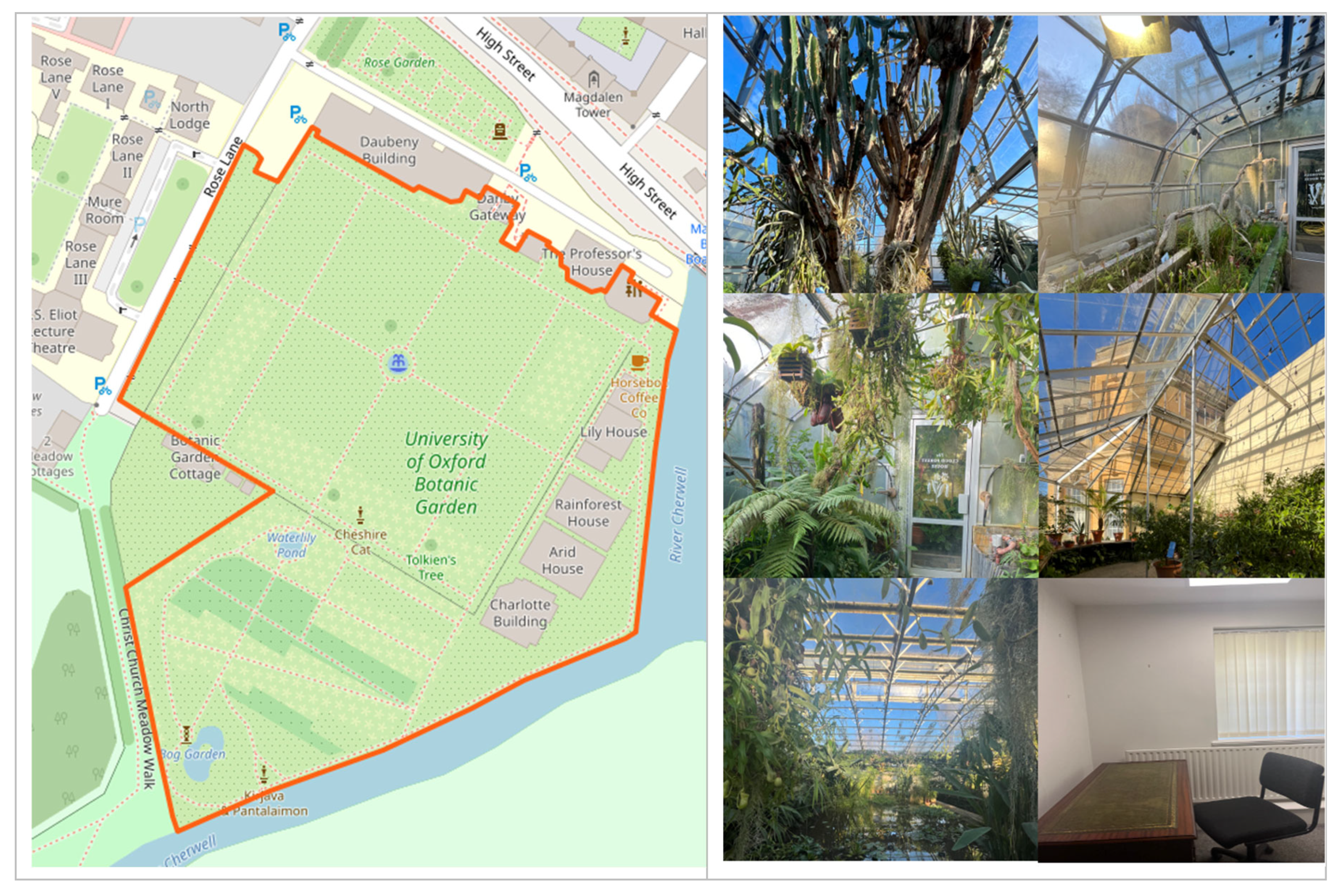
Figure 2.
Multivariate patterns and compositional differences in volatile organic compounds across Oxford Botanic Garden glasshouses and a control room. (A) Principal Component Analysis (PCA) of volatile profiles from all samples following Hellinger transformation, with points coloured by sampling environment and 95% confidence ellipses shown for each group. Percentages on axes indicate variance explained. (B) Relative contributions of major compound classes (aliphatics, aromatics, monoterpenes, sesquiterpenes, terpenoids, and others) to total identified bVOC abundance within each environment. (C) Number of site-unique compounds detected at each location, grouped by compound class. (D) Relative proportion of BTEX compounds identified at each site, with letters indicating significant differences among locations (one-way ANOVA with Tukey post-hoc tests, p < 0.05). (E) Ratios of total bVOC to BTEX abundance across locations (mean ± SE), with higher values indicating greater dominance of biogenic volatiles. Letters denote statistical groupings (Tukey post-hoc tests). (F) Presence–absence matrix of terpene and terpenoid compounds across sampling environments, grouped by compound class. Filled cells indicate detection of a compound at a given site, with totals reported beneath each location for major terpene classes.
Figure 2.
Multivariate patterns and compositional differences in volatile organic compounds across Oxford Botanic Garden glasshouses and a control room. (A) Principal Component Analysis (PCA) of volatile profiles from all samples following Hellinger transformation, with points coloured by sampling environment and 95% confidence ellipses shown for each group. Percentages on axes indicate variance explained. (B) Relative contributions of major compound classes (aliphatics, aromatics, monoterpenes, sesquiterpenes, terpenoids, and others) to total identified bVOC abundance within each environment. (C) Number of site-unique compounds detected at each location, grouped by compound class. (D) Relative proportion of BTEX compounds identified at each site, with letters indicating significant differences among locations (one-way ANOVA with Tukey post-hoc tests, p < 0.05). (E) Ratios of total bVOC to BTEX abundance across locations (mean ± SE), with higher values indicating greater dominance of biogenic volatiles. Letters denote statistical groupings (Tukey post-hoc tests). (F) Presence–absence matrix of terpene and terpenoid compounds across sampling environments, grouped by compound class. Filled cells indicate detection of a compound at a given site, with totals reported beneath each location for major terpene classes.
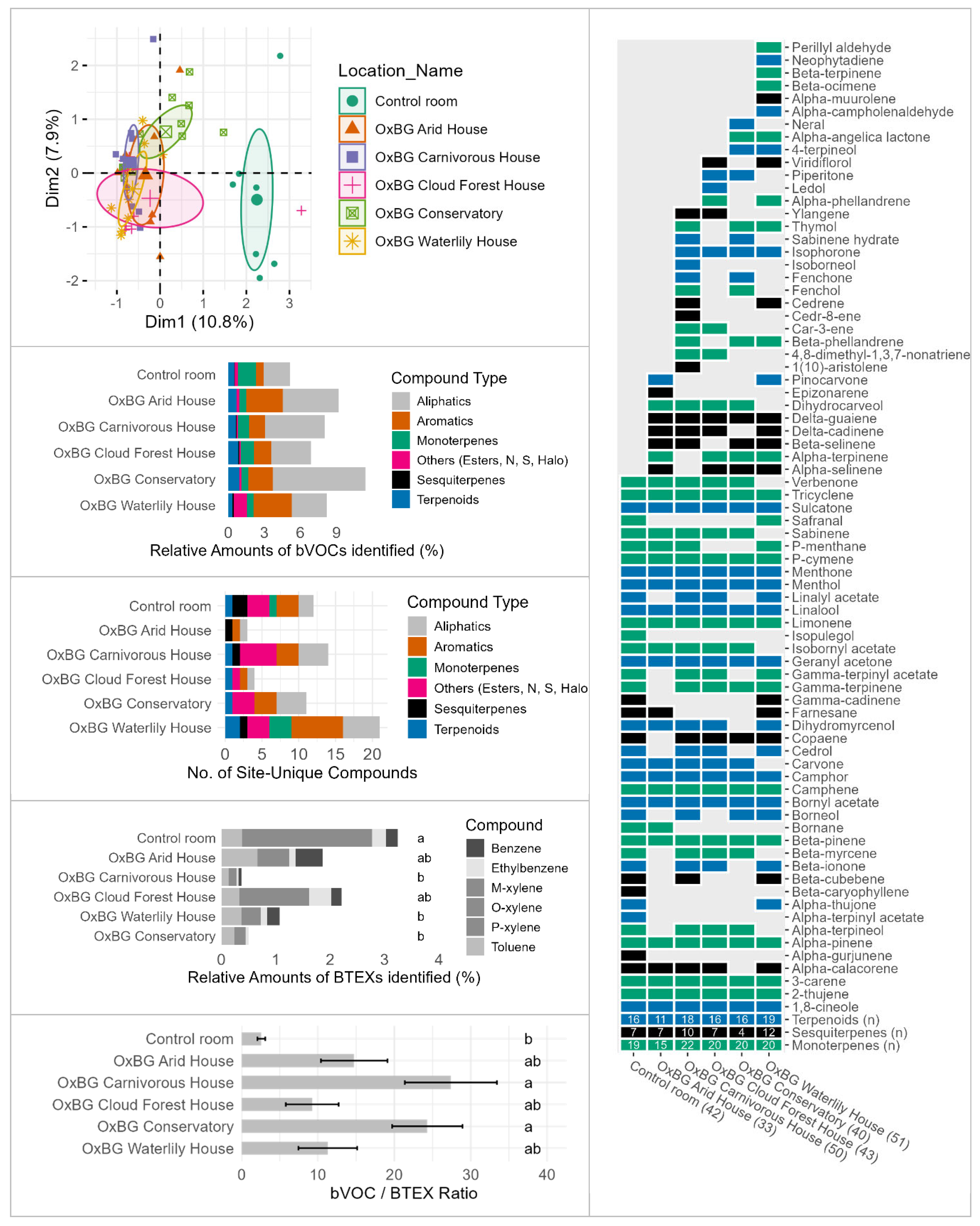
Figure 3.
Changes in anxiety (State–Trait Anxiety Inventory (STAI)) scores following exposure to Oxford Botanic Garden glasshouses and a control room. (A) Percentage change in STAI scores for the control room compared with all glasshouse environments combined. Values represent participant-normalised change scores. Points indicate individual observations; boxplots show medians, interquartile ranges, and 1.5×IQR whiskers. Different letters denote significant differences between groups based on a one-way ANOVA with Tukey post-hoc tests (p < 0.05). The horizontal dashed line indicates no change from baseline. (B) Percentage change in STAI scores across individual sampling environments. Points represent repeated observations across participants and experiments; boxplots show medians, interquartile ranges, and 1.5×IQR whiskers. Letters indicate significant differences among environments based on a mixed-effects delta-ANOVA with participant-within-experiment included as a random effect and Tukey-adjusted post-hoc comparisons (p < 0.05). Within-site p-values displayed beneath x-axis labels correspond to paired Wilcoxon tests comparing pre- and post-exposure scores. The horizontal dashed line indicates no change from baseline.
Figure 3.
Changes in anxiety (State–Trait Anxiety Inventory (STAI)) scores following exposure to Oxford Botanic Garden glasshouses and a control room. (A) Percentage change in STAI scores for the control room compared with all glasshouse environments combined. Values represent participant-normalised change scores. Points indicate individual observations; boxplots show medians, interquartile ranges, and 1.5×IQR whiskers. Different letters denote significant differences between groups based on a one-way ANOVA with Tukey post-hoc tests (p < 0.05). The horizontal dashed line indicates no change from baseline. (B) Percentage change in STAI scores across individual sampling environments. Points represent repeated observations across participants and experiments; boxplots show medians, interquartile ranges, and 1.5×IQR whiskers. Letters indicate significant differences among environments based on a mixed-effects delta-ANOVA with participant-within-experiment included as a random effect and Tukey-adjusted post-hoc comparisons (p < 0.05). Within-site p-values displayed beneath x-axis labels correspond to paired Wilcoxon tests comparing pre- and post-exposure scores. The horizontal dashed line indicates no change from baseline.
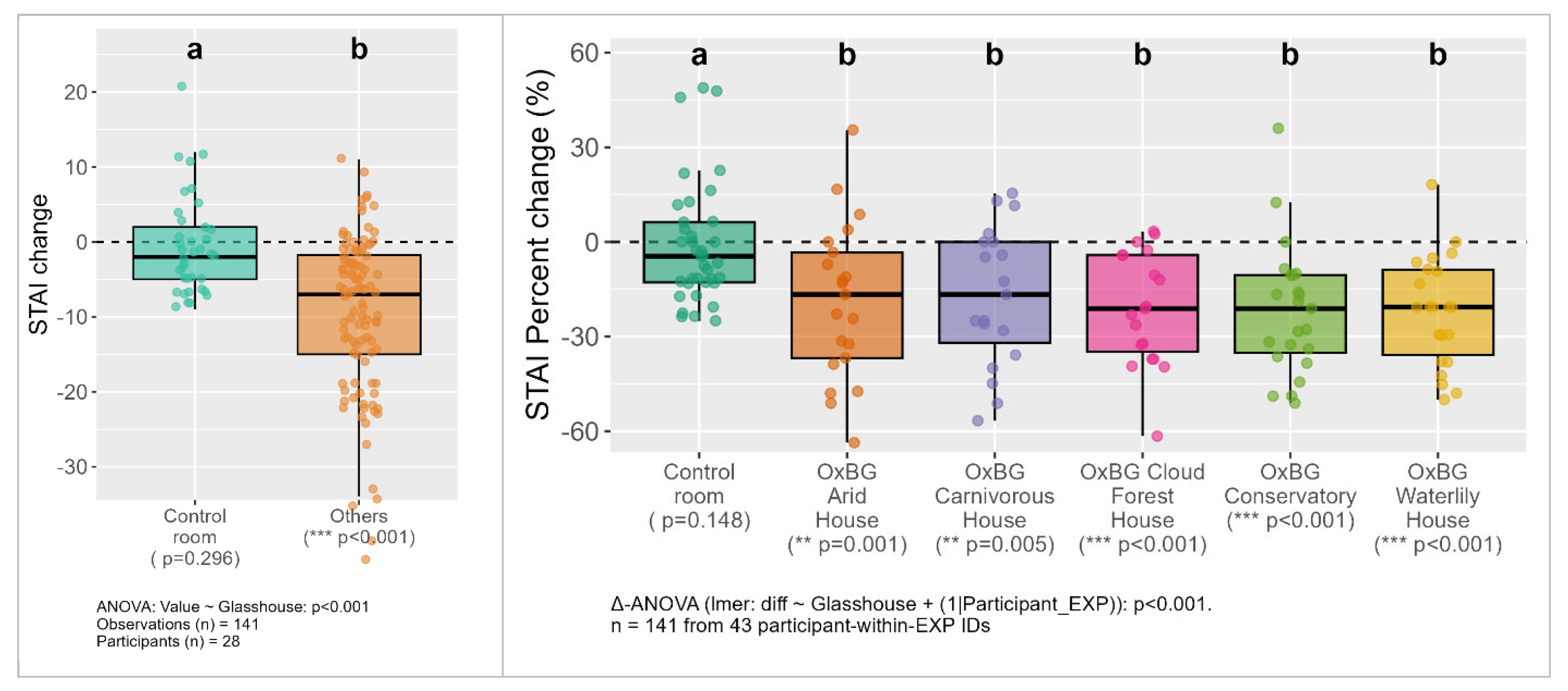
Figure 4.
Heart-beat rate (HR) and heart rate variability (SDNN) responses following exposure to Oxford Botanic Garden glasshouses and a control room. (A) Change in HR comparing the control room with all glasshouse environments combined. (B) Percentage change in HR across individual sampling environments. (C) Change in SDNN comparing the control room with all glasshouse environments combined. (D) Percentage change in SDNN across individual sampling environments. Points represent individual observations; boxplots show medians, interquartile ranges, and 1.5×IQR whiskers. Letters denote groupings based on one-way ANOVA ((A), (C)) or mixed-effects delta-ANOVA ((B), (D)) with participant-within-experiment included as a random effect and Tukey-adjusted post-hoc comparisons. Within-site p-values shown beneath x-axis labels correspond to paired Wilcoxon tests comparing pre- and post-exposure values. Dashed horizontal lines indicate no change from baseline.
Figure 4.
Heart-beat rate (HR) and heart rate variability (SDNN) responses following exposure to Oxford Botanic Garden glasshouses and a control room. (A) Change in HR comparing the control room with all glasshouse environments combined. (B) Percentage change in HR across individual sampling environments. (C) Change in SDNN comparing the control room with all glasshouse environments combined. (D) Percentage change in SDNN across individual sampling environments. Points represent individual observations; boxplots show medians, interquartile ranges, and 1.5×IQR whiskers. Letters denote groupings based on one-way ANOVA ((A), (C)) or mixed-effects delta-ANOVA ((B), (D)) with participant-within-experiment included as a random effect and Tukey-adjusted post-hoc comparisons. Within-site p-values shown beneath x-axis labels correspond to paired Wilcoxon tests comparing pre- and post-exposure values. Dashed horizontal lines indicate no change from baseline.
Disclaimer/Publisher’s Note: The statements, opinions and data contained in all publications are solely those of the individual author(s) and contributor(s) and not of MDPI and/or the editor(s). MDPI and/or the editor(s) disclaim responsibility for any injury to people or property resulting from any ideas, methods, instructions or products referred to in the content. |
© 2026 by the authors. Licensee MDPI, Basel, Switzerland. This article is an open access article distributed under the terms and conditions of the Creative Commons Attribution (CC BY) license (http://creativecommons.org/licenses/by/4.0/).
Copyright: This open access article is published under a Creative Commons CC BY 4.0 license, which permit the free download, distribution, and reuse, provided that the author and preprint are cited in any reuse.


