

Submitted:
12 January 2026
Posted:
14 January 2026
You are already at the latest version
Abstract
The use of Virtual Reality as a replacement for, or augmentation to, traditional flight simulators has gained significant attention in both academia and industry. The use of new technology or techniques in the training of pilots, including in flight simulation, requires careful evaluation of the success of transferring required skills. In order that the efficacy of a Virtual Reality flight simulator could be evaluated, in terms of its capacity to transfer several basic flying skills, a quasi-transfer study has been completed. A quasi-experimental, separate-sample pretest-posttest design was employed, with the ability to perform straight and level flight, and turning, within a set pattern being assessed. Results indicate a significant improvement in flight performance between pretest and posttest, with a large positive effect size (g = 0.946). The findings indicate that Virtual Reality flight simulators are effective for the training of basic flight skills during the initial stages of pilot training. However, several observed limitations of the technology require further research.
Keywords:
1. Introduction
2. Materials and Methods
3. Results
4. Discussion (Remember to Update Meta-Analysis References)
5. Conclusions
Author Contributions
Funding
Institutional Review Board Statement
Informed Consent Statement
Data Availability Statement
Conflicts of Interest
References
- Haber, R.N. Flight Simulation. Scientific American 1986, 255, 96–103. [Google Scholar] [CrossRef]
- Rolfe, J.M.; Staples, K.J. Flight simulation; Cambridge University Press: Cambridge, 1988. [Google Scholar]
- Bürki-Cohen, J.; Soja, N.N.; Longridge, T. Simulator platform motion-the need revisited. The International Journal of Aviation Psychology 1998, 8, 293–317. [Google Scholar] [CrossRef]
- Lee, A.T. Flight simulation: virtual environments in aviation; Ashgate: Aldershot, England, 2005. [Google Scholar]
- Prophet, W.W.; Boyd, H.A. Device-task fidelity and transfer of training: Aircraft cockpit procedures training; HumRRO Division No. 6 (Aviation), 1970; Volume 70. [Google Scholar]
- Povenmire, H.K.; Roscoe, S.N. An evaluation of ground-based flight trainers in routine primary flight training. Human Factors 1971, 13, 109–116. [Google Scholar] [CrossRef]
- Alce, G.; Klang, K.-J.; Andersson, D.; Nyström, S.; Wallergård, M.; Niehorster, D.C. Using augmented reality to train flow patterns for pilot students: an explorative study. In Augmented Reality, Virtual Reality, and Computer Graphics. AVR 2020. Lecture Notes in Computer Science; De Paolis, L., Bourdot, P., Eds.; Springer: Lecce, 2020; Volume 12242, pp. 215–231. [Google Scholar]
- Huddleston, H.; Rolfe, J. Behavioural factors influencing the use of flight simulators for training. Applied Ergonomics 1971, 2, 141–148. [Google Scholar] [CrossRef]
- Chap. Virtual Reality; Oxford University Press, 2021. [Google Scholar]
- Milgram, P.; Kishino, F. A taxonomy of mixed reality visual displays. IEICE TRANSACTIONS on Information 1994, E77-D, 1321–1329. [Google Scholar]
- Schaller, R.R. Moore's law: past, present and future. IEEE spectrum 1997, 34, 52–59. [Google Scholar] [CrossRef]
- Prensky, M. Digital game-based learning; Paragon House, 2001. [Google Scholar]
- Ross, G.A. Extended reality (xR) flight simulators as an adjunct to traditional flight training methods. Master's thesis, Massey University, 2022. [Google Scholar]
- Aka, M.; Frasson, C. ASIMIL: Overview of a distance learning flight-training system. Intelligent Tutoring Systems, 6th International Conference, ITS 2002, Biarritz & San Sebastian, 2002; Volume 2363, pp. 484–495. [Google Scholar]
- Zhang, T. Comparing Training Effects of Virtual Reality Flight Simulation to Conventional PC-Based Flight Simulation; Embry-Riddle, 2022. [Google Scholar]
- Valverde, H.H. A review of flight simulator transfer of training studies. Human Factors 1973, 15, 510–522. [Google Scholar] [CrossRef]
- Mdhlalose, D. Transfer of training: The revised review and analysis. Open Journal of Business and Management 2022, 10, 3245–3265. [Google Scholar] [CrossRef]
- Oritz, G.A. Transfer of learning effectiveness: PC-based flight simulation. Journal of Aviation/Aerospace Education & Research 1993, 3, 8. [Google Scholar] [CrossRef]
- Taylor, H.L.; Lintern, G.; Koonce, J.M. Quasi-transfer as a predictor of transfer from simulator to airplane. The Journal of general psychology 1993, 120, 257–276. [Google Scholar] [CrossRef]
- Somerville, A.; Joiner, K.; Lynar, T.; Wild, G. Applications of extended reality in pilot flight simulator training: a systematic review with meta-analysis. Visual Computing for Industry, Biomedicine, and Art 2025, 8, 1–30. [Google Scholar] [CrossRef]
- Auer, S.; Gerken, J.; Reiterer, H.; Jetter, H.C. Comparison between virtual reality and physical flight simulators for cockpit familiarization. In Proceedings of the Mensch und Computer, Ingolstadt, 2021; pp. 378–392. [Google Scholar]
- Guthridge, R.P. Evaluating Virtual Reality and Artificial Intelligence as Solutions for Delayed Flight Progress in Aviation Pilot Training. Ph.D, The University of North Dakota, Ann Arbor, 2022. [Google Scholar]
- Redei, A. Applications and Evaluation of a Motion Flight Simulator. Ph.D, University of Nevada, Reno, Ann Arbor, 2019. [Google Scholar]
- Civil Aviation Safety Authority. Flight Instructor Manual - Aeroplane; Department of Infrastructure, Transport, Regional Development, Communications and the Arts: Canberra, 2006. [Google Scholar]
- Campbell, D.T.; Stanley, J.C. Experimental and quasi-experimental designs for research; Ravenio books, 2015. [Google Scholar]
- Star, S.A.; Hughes, H.M. Report on an educational campaign: The Cincinnati plan for the United Nations. American Journal of Sociology 1950, 55, 389–400. [Google Scholar] [CrossRef]
- Markert, R.J.; O'Neill, S.C.; Bhatia, S.C. Using a quasi-experimental research design to assess knowledge in continuing medical education programs. Journal of Continuing Education in the Health Professions 2003, 23, 157–161. [Google Scholar] [CrossRef]
- AlFaris, E.; Naeem, N.; Irfan, F.; Qureshi, R.; Saad, H.; Al Sadhan, R.e.; Abdulghani, H.M.; Van der Vleuten, C. A one-day dental faculty workshop in writing multiple-choice questions: an impact evaluation. Journal of dental education 2015, 79, 1305–1313. [Google Scholar] [CrossRef]
- Phillips, J. Development of a low-cost virtual reality workstation for training and education. In Research Reports: 1995 NASA/ASEE Summer Faculty Fellowship Program; Marshall Space Flight Center: Hunstville, 1996. [Google Scholar]
- X-Plane 11 (Version 11.20) [Computer software]. Laminar Research, 2023.
- Guillemot Corporation S.A. THRUSTMASTER T.16000M FCS Hotas. Available online: https://www.thrustmaster.com/products/t-16000m-fcs-hotas/ (accessed on 10/02).
- Guillemot Corporation, S.A.; THRUSTMASTER, T. Flight Ruder Pedals. Available online: https://www.thrustmaster.com/products/t-flight-rudder-pedals/ (accessed on 10/02).
- Goss-Sampson, M. Statistical analysis in JASP: A guide for students; JASP, 2019. [Google Scholar]
- Hoenig, J.M.; Heisey, D.M. The abuse of power: the pervasive fallacy of power calculations for data analysis. The American Statistician 2001, 55, 19–24. [Google Scholar] [CrossRef]
- Zimmerman, D.W. Comparative Power of Student T Test and Mann-Whitney U Test for Unequal Sample Sizes and Variances. The Journal of Experimental Education 1987, 55, 171–174. [Google Scholar] [CrossRef]
- Tak, A.Y.; Ercan, I. Comprehensive Evaluation of Reference Values of Parametric and Non-Parametric Effect Size Methods for Two Independent Groups. International Journal of Statistics in Medical Research 2022, 11, 88–96. [Google Scholar] [CrossRef]
- Hopkins, C.O. How much should you pay for that box? Human Factors 1975, 17, 533–541. [Google Scholar] [CrossRef]
- Povenmire, H.K.; Roscoe, S.N. Incremental transfer effectiveness of a ground-based general aviation trainer. Human Factors 1973, 15, 534–542. [Google Scholar] [CrossRef]
- Lintern, G.; Roscoe, S.N.; Koonce, J.M.; Segal, L.D. Transfer of landing skills in beginning flight training. Human Factors 1990, 32, 319–327. [Google Scholar] [CrossRef]
- Eddowes, E.E.; Waag, W.L. The use of simulators for training in-flight and emergency procedures; AGARD, 1980. [Google Scholar]
- Woodruff, R.R. Full mission simulation in undergraduate pilot training: An exploratory study. American Psycholog. Ass. Journal Suppl. Abstract Service 1977. [Google Scholar]
- Langewiesche, W. Stick and rudder: An explanation of the art of flying; McGraw-Hill: New York, 1944. [Google Scholar]
- Branch, G.H. Low level awareness training and perceptual pop-ups; 162nd Tactical Fighter Training Group, Fighter Weapons School: Tucson, AZ, 1978. [Google Scholar]
- Roscoe, S.N.; Williams, A.C. Aviation psychology, 1st ed. ed.; Iowa State University Press: Ames, 1980. [Google Scholar]
- Ortiz, G.A. Effectiveness of PC-based flight simulation. The International Journal of Aviation Psychology 1994, 4, 285–291. [Google Scholar] [CrossRef]
- Lee, A.T. Vehicle Simulation: Perceptual Fidelity in the Design of Virtual Environments; CRC Press: Boca Raton, 2017. [Google Scholar]
- Daniels, R.; Hopper, D.G.; Beyer, S.; Peppler, P.W. High-definition displays for realistic simulator and trainer systems. In Proceedings of the Cockpit Displays V: Displays for Defense Applications, 1998; pp. 407–415. [Google Scholar]
- AGARD. Fidelity of simulation for pilot training; Advisory Group for Aerospace Research Development: Neuilly-sur-Seine, France, 1980. [Google Scholar]
- Kennedy, R.S.; Fowlkes, J.E. Simulator sickness is polygenic and polysymptomatic: Implications for research. The International Journal of Aviation Psychology 1992, 2, 23–38. [Google Scholar] [CrossRef]
- Kennedy, R.S.; Lane, N.E.; Berbaum, K.S.; Lilienthal, M.G. Simulator sickness questionnaire: An enhanced method for quantifying simulator sickness. The international journal of aviation psychology 1993, 3, 203–220. [Google Scholar] [CrossRef]
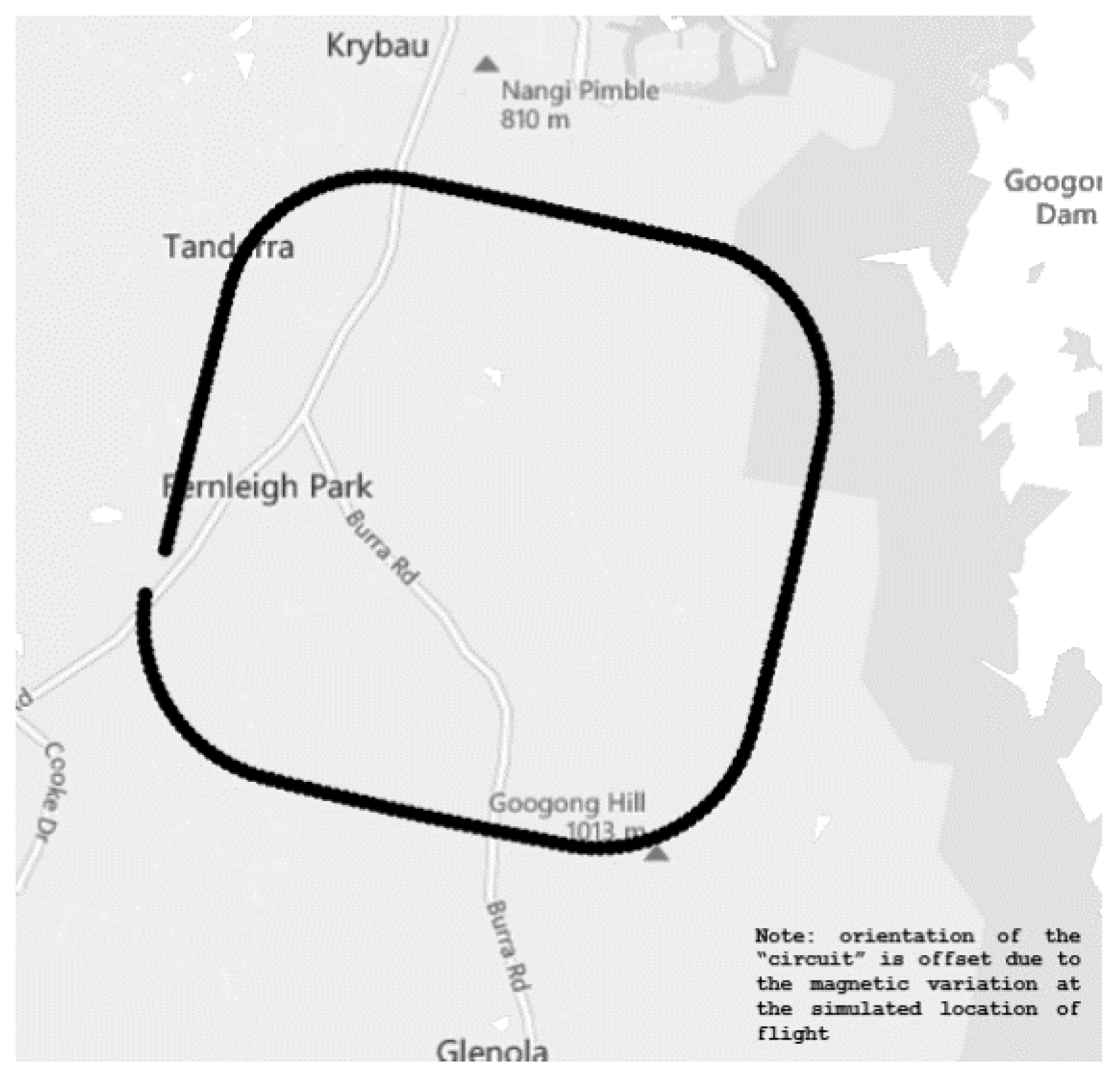
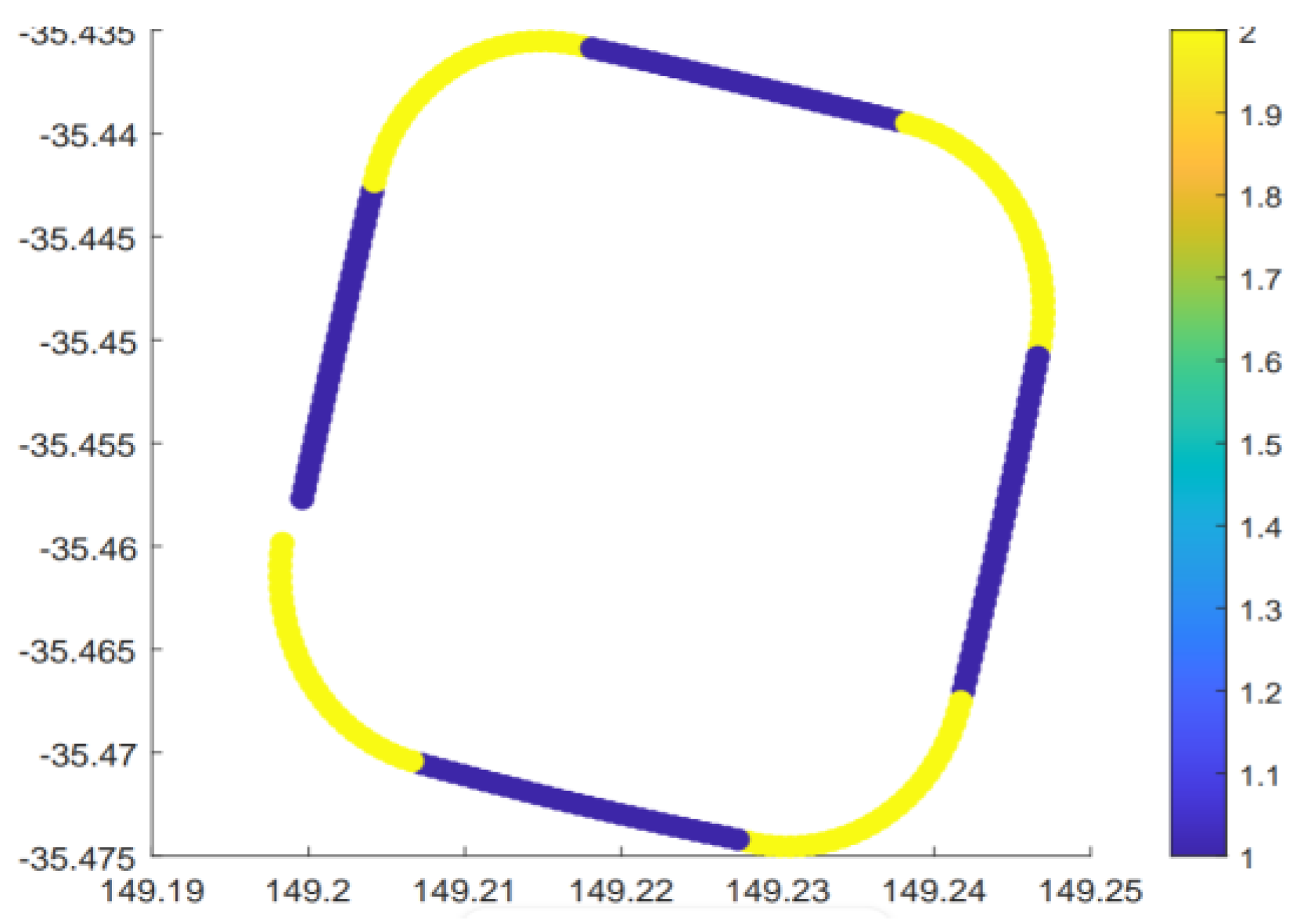
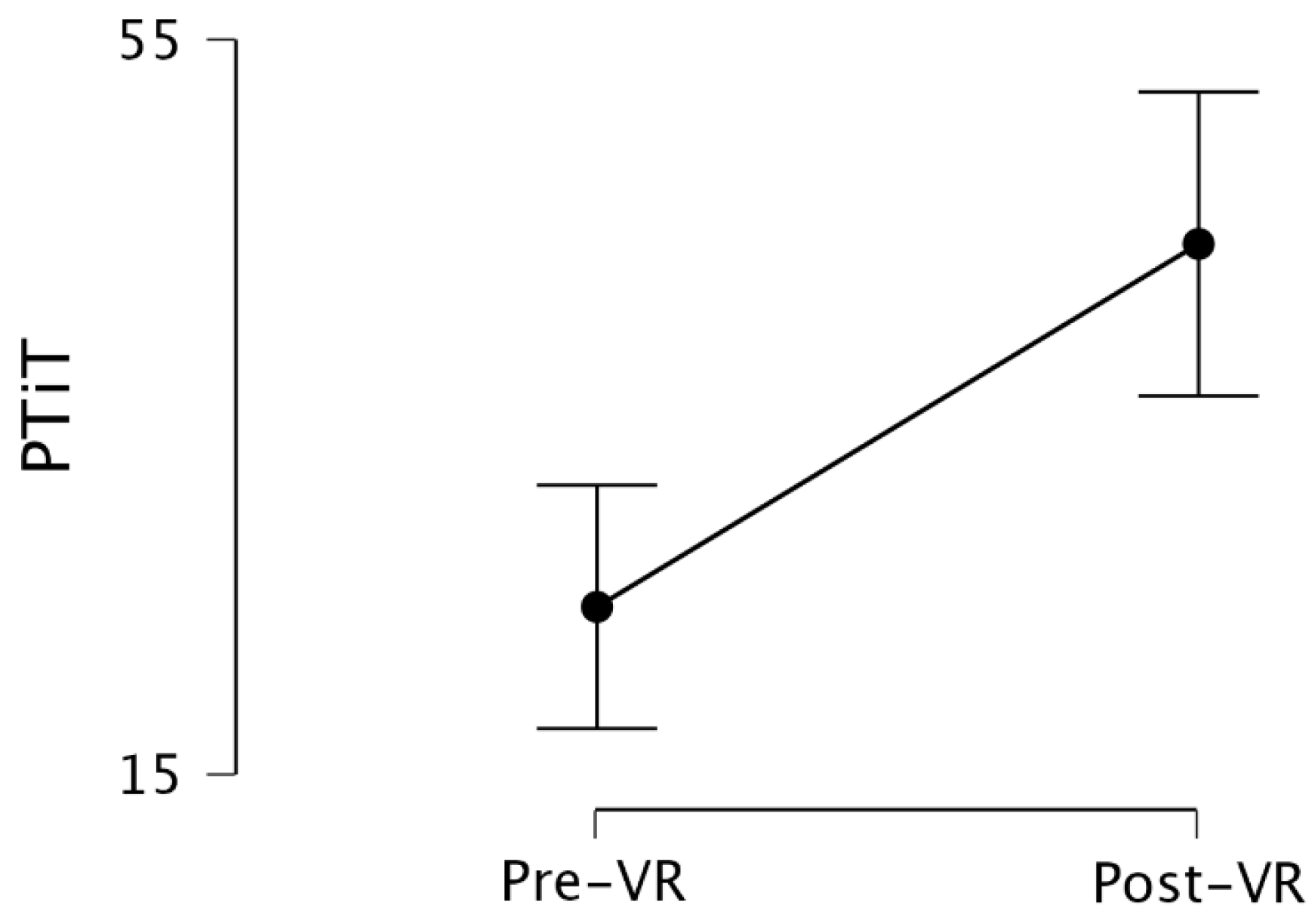

| Straight & Level | Turning | |
|---|---|---|
| Altitude | ±150ft | ±150ft |
| Airspeed | ±10knots | ±10knots |
| Nominated Heading 1 | ±10° | - |
| Bank Angle 1 | - | ±5° |
| W | p | Hodges-Lehmann Estimate | Rank-Biserial Correlation | SE rrb | |
|---|---|---|---|---|---|
| PTiT | 1969.000 | < .001 | 15.270 | 0.427 | 0.113 |
Disclaimer/Publisher’s Note: The statements, opinions and data contained in all publications are solely those of the individual author(s) and contributor(s) and not of MDPI and/or the editor(s). MDPI and/or the editor(s) disclaim responsibility for any injury to people or property resulting from any ideas, methods, instructions or products referred to in the content. |
© 2026 by the authors. Licensee MDPI, Basel, Switzerland. This article is an open access article distributed under the terms and conditions of the Creative Commons Attribution (CC BY) license (http://creativecommons.org/licenses/by/4.0/).