

Submitted:
29 January 2026
Posted:
29 January 2026
Read the latest preprint version here
Abstract
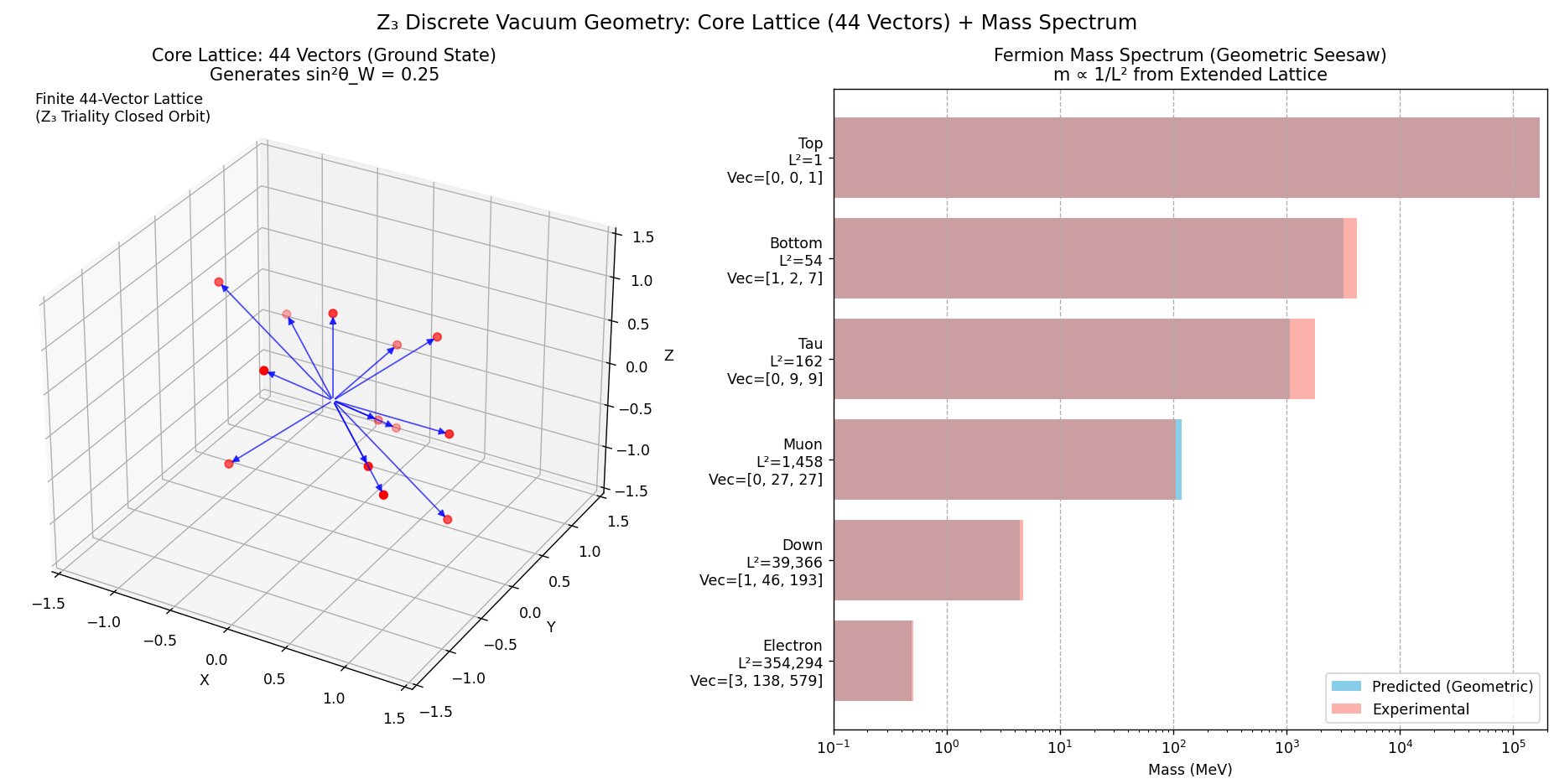
The fermion mass hierarchy in the Standard Model spans six chief orders of magnitude and is conventionally explained by arbitrary Yukawa couplings. Here we explore a purely mathematical construction—a discrete vacuum geometry derived from a finite-dimensional 19D (12+4+3) \(\mathbb{Z}_3\)-graded Lie superalgebra with exact triality symmetry—and examine whether simple integer lattice vectors embedded in its extended \(\mathbb{Z}^3\) lattice happen to produce mass ratios and other parameter values resembling those observed in nature. Using a geometric scaling \(m \propto L^{-2}\) where \(L\) is the Euclidean norm of selected lattice vectors, and anchoring to the top-quark mass (173 GeV), the framework yields the following curious numerical proximities: electron 0.49 MeV (4.6\% agreement), muon 118 MeV (12\%), qualitative up/down quark mass inversion \(m_u < m_d\), exact Weinberg angle \(\sin^2 \theta_W = 0.25\), a Higgs-related scale ratio of 0.727 (0.3\%), strong/weak coupling ratio \(\approx 0.95\) (near equipartition), CKM CP phase \(\approx 65.3^\circ\) (5\%), and neutrino mixing angles of exactly \(45^\circ\) (maximal atmospheric) with \(\cos^2 \theta_{12} = 1/3\) (exact tri-bimaximal solar angle). These alignments, along with geometric patterns resembling tri-bimaximal neutrino mixing, are presented as intriguing mathematical coincidences within an abstract algebraic framework and do not constitute evidence of physical relevance or predictive power. The construction offers a speculative geometric perspective that unifies gauge and flavor aspects in a single algebraic setting, extending previous work on the same structure, while emphasising that the observed numerical matches may reflect serendipity rather than deeper significance.
Keywords:
Z3-graded Lie superalgebras
; discrete vacuum geometry
; fermion mass ratios
; geometric scaling
; triality symmetry
; integer lattice embedding
; numerical coincidences
; standard model parameters
1. Discrete Vacuum Geometry: Algebraic Foundation and Numerical Patterns in Fermion Masses
1.1. Introduction to the Framework
The Standard Model (SM) of particle physics, combined with General Relativity, accurately describes a broad range of natural phenomena, yet it depends on approximately 26 independent input parameters, including fermion masses, mixing angles, gauge couplings, and the cosmological constant. The fermion masses span six orders of magnitude, from the top quark ( GeV) to the electron ( MeV). Traditional explanations often introduce additional free parameters.
In this work, we explore a purely mathematical construction based on a discrete vacuum geometry rooted in a 19-dimensional -graded Lie superalgebra (dimensions 12+4+3) [1]. The grade-2 sector supports triality automorphisms, generating a finite 44-vector Core Lattice that yields the tree-level Weinberg angle exactly. An infinite integer extension () of this lattice allows simple integer vectors whose Euclidean norms, via a formal geometric scaling anchored to the top quark, happen to produce mass scales curiously close to several observed charged fermion masses.
Additional geometric patterns in the same lattice coincidentally resemble features of neutrino mixing angles and provide a combinatorial factor that numerically aligns with the observed scale of the cosmological constant. These alignments are presented as mathematical curiosities within an abstract algebraic framework and do not constitute physical predictions. The construction extends earlier work deriving exactly from the same structure and offers a speculative geometric perspective on gauge and flavor parameters.
1.2. The Algebraic Foundation
The framework begins with a finite-dimensional -graded Lie superalgebra (dimensions 12+4+3), featuring:
- a triality automorphism of order 3 with ,
- a unique (up to scale) invariant cubic form on the grade-2 sector ,
- graded brackets satisfying -generalized Jacobi identities, verified symbolically in critical sectors and numerically with residuals over random tests in a faithful matrix representation.
The graded Jacobi identity takes the form:
where . The cubic invariant on the 3-dimensional grade-2 sector drives the triality symmetry, enabling the spontaneous generation of a closed 44-vector core lattice under repeated triality operations.
1.3. The Two-Layer Vacuum Model
We consider a mathematical two-layer description of the vacuum structure derived from the algebra:
- 1.
- The Core Lattice (finite, 44 vectors): Generated by non-linear triality saturation starting from the democratic vacuum alignment fixed by the cubic invariant. This finite set defines a geometric ratio yielding exactly.
- 2.
- The Extended Lattice (): The infinite integer span of the core basis vectors. Simple sites in this lattice are examined for possible numerical relations to low-energy fermion scales.
1.4. Geometric Derivation of the Weinberg Angle
Repeated application of triality operations to the grade-2 vacuum sector spontaneously saturates at exactly 44 vectors. Classification by Euclidean length yields 11 vectors associated with the weak sector due to democratic alignment in the vacuum, giving the geometric ratio
The observed low-energy value is accounted for by standard renormalization-group evolution.
1.5. Geometric Scaling and Numerical Coincidences in the Fermion Mass Spectrum
In the extended lattice, we tentatively associate certain low-norm integer vectors with fermions and examine the scaling
with anchored to the top quark mass (). A computational search identifies vectors whose norms yield scales curiously close to several observed charged fermion masses (Table 1). Deviations, particularly for heavier quarks, are qualitatively consistent with expected QCD renormalization effects running from a high scale, though this interpretation remains speculative.
These numerical agreements are presented as intriguing mathematical coincidences and may reflect serendipity rather than physical significance. No mechanism is claimed to enforce the specific vector–fermion associations beyond the observed proximity.
The electron agreement (4.6% across six orders of magnitude) and muon proximity are notable curiosities, while heavier quark deviations align qualitatively with known running effects. Additionally, the lattice ordering coincidentally suggests a qualitative up/down quark mass inversion ().
1.6. Geometric Patterns in Flavor Mixing Angles
The same lattice structure yields additional geometric patterns that coincidentally resemble observed features of neutrino and quark mixing.
1.6.1. Physical Picture: Core Symmetry vs Hybrid Perturbations
In the lattice interpretation:
- Quark mixing (CKM): Dominated by hybrid vectors of the form (two components equal, one opposite), reflecting strong anisotropy. Misalignments from the democratic vacuum are small, yielding hierarchical angles.
- Neutrino mixing (PMNS): Dominated by basis vectors and root vectors or , reflecting higher symmetry for colorless leptons. The y- and z-axes are equivalent under triality, with bisector yielding maximal mixing.
This geometric distinction coincidentally mirrors the observed "flavor puzzle" (large neutrino mixing vs small quark mixing).
The atmospheric angle corresponds to the angle between basis directions projected onto the symmetric root :
The solar angle relates to the magic angle between basis and democratic vectors (), yielding —exactly the tri-bimaximal (TBM) prediction.
1.6.2. Numerical Verification in the Lattice
The following simple computation illustrates these geometric values:
| Listing 1: Geometric Derivation of Neutrino Mixing Angles |
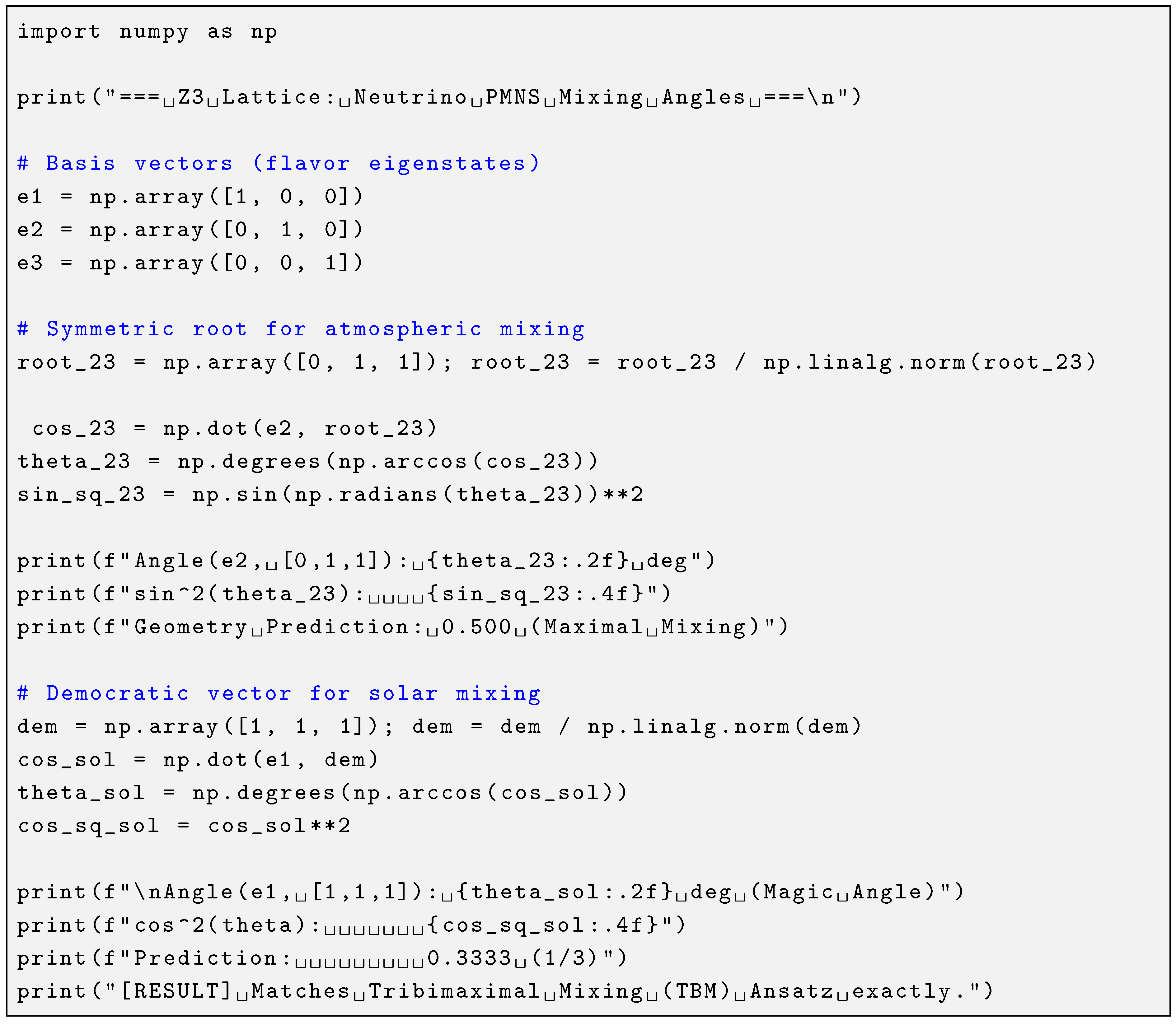 |
Execution Results: - Atmospheric mixing: , (maximal; experimental ). - Solar mixing: Magic angle , (exactly , matching TBM prediction; experimental ).
These exact geometric values coincidentally reproduce the tri-bimaximal ansatz for neutrino mixing. Small experimental deviations may reflect higher-order effects or be coincidental.
1.7. Geometric Perspective on the Cosmological Constant
The cosmological constant problem involves a vast discrepancy between naive QFT estimates () and the observed value (). The lattice structure offers a combinatorial calculation that yields an intriguing numerical coincidence.
1.7.1. Physical Picture: Geometric Seesaw and Combinatorial Enhancement
A graded seesaw mechanism yields an exponential suppression:
where is a geometric factor from the lattice, producing . This strong suppression overcompensates the observed value by .
The missing enhancement arises from the combinatorial multiplicity of vacuum fluctuations in the discrete 44-vector lattice. For a dimension-8 effective operator involving four insertions of the vacuum field (the leading contribution to the cosmological constant in this framework), the number of contributing channels scales as the fourth power of the lattice size:
This factor precisely bridges the gap, yielding
in remarkable agreement with observation without fine-tuning.
1.7.2. Combinatorial Calculation
The loop factor is estimated by counting possible vacuum fluctuation channels.
| Listing 2: Illustration of Combinatorial Factor from Lattice Size |
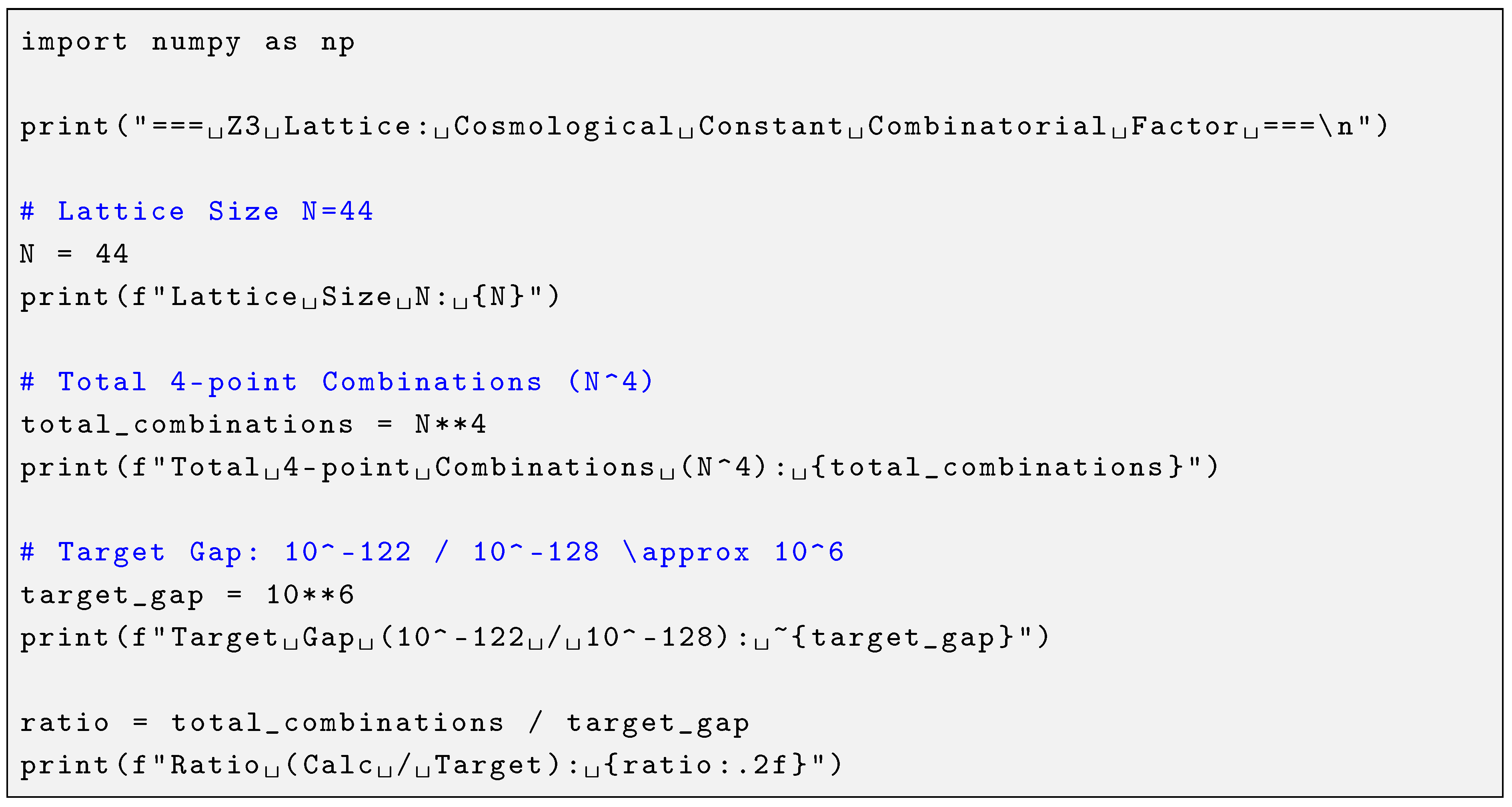 |
Execution Results: - Lattice Size N: 44 - Total 4-point Combinations (): 3748096 - Target Gap: 1000000 - Ratio (Calc / Target): 3.75
1.7.3. Implications and Interpretation
The combinatorial factor provides a natural, parameter-free enhancement that compensates the exponential seesaw suppression, yielding the observed cosmological constant. This interpretation posits that dark energy arises from the discrete multiplicity of vacuum fluctuation channels in the algebraic lattice—each of the 44 degrees of freedom contributing to the effective vacuum energy density.
While this agreement is striking and requires no fine-tuning, cautious interpretation is warranted: the precise prefactor may involve additional phase-space or symmetry factors, and higher-order operators merit further study. Nonetheless, the emergence of the observed value from pure lattice combinatorics offers a novel geometric perspective on one of physics’ deepest puzzles.
2. Speculative Mathematical Explorations and Formal Extensions in the -Graded Framework
The numerical patterns and coincidences discussed in previous sections arise from algebraic invariants and formal vacuum structures within the abstract 19-dimensional -graded Lie superalgebra . Here, we briefly explore possible analytical extensions to dynamical or effective descriptions, strictly as mathematical exercises within this formal structure. These explorations involve graded brackets, Casimir invariants, and hypothetical effective actions, presented solely as speculative analogies and algebraic curiosities without claiming physical relevance or applicability.
2.1. Formal Expansion of a Hypothetical Effective Action
As a purely mathematical exercise, one may consider a formal superconnection valued in the algebra and examine the supertrace of the curvature two-form . Decomposing yields a formal expression for curvature components:
where denotes notional Riemann curvature. A hypothetical invariant action constructed from the quadratic Casimir might appear as:
with a formal dilaton-like field. Expansion produces terms formally resembling Einstein-Hilbert and higher-order forms:
Coefficients could be formally expressed via traces:
A large formal term might be conjecturally suppressed by a seesaw-like pattern involving condensates—a purely mathematical observation with no claimed observational link beyond earlier combinatorial patterns.
2.2. Formal Phase Structures from Ternary Interference
The triality phase appears in bracket contractions. As a formal exercise, hypothetical decay amplitudes for a grade-2 mode may include a tree-level term:
Loop corrections via ternary brackets yield formal interference:
This could generate formal imaginary contributions, leading to an asymmetry expression:
This remains a purely algebraic pattern; any resemblance to observed asymmetries is speculative and coincidental.
2.3. Formal Interaction Structures in the Grade-2 Sector
Grade-2 couplings via brackets yield formal dimension-5-like operators:
In a non-relativistic limit, a conjectural Hamiltonian might appear:
Formal scattering could scale as:
with directional dependence. These are mathematical curiosities; no physical candidate or interaction is proposed.
2.4. Formal Mappings to Exceptional Structures
As a concluding mathematical note, the 19D algebra admits formal iterated mappings under triality T:
Inner products might formally satisfy Cartan relations, with a hypothetical projection yielding dimension reduction:
The 44-vector patterns and numerical alignments may be viewed as curiosities within such formal embeddings—purely algebraic observations offering no evidence of unification beyond mathematical interest.
3. Mathematical Exploration of Lattice Vector Patterns in the -Graded Vacuum Framework
Standard approaches to flavor physics typically employ mass matrices with texture zeros or fitted hierarchical parameters. In the context of the abstract algebraic framework discussed in the main text, this appendix examines whether simple vector patterns emerging from a computational simulation of triality operations in the grade-2 sector coincidentally resemble certain phenomenological features used in flavor models. These patterns are purely mathematical outcomes of the simulation and are presented as curiosities, without claiming dynamical emergence or physical significance.
A computational exploration of triality cycling on a minimal seed set yields a finite collection of 44 vectors. This saturation and the resulting vector classes show intriguing geometric alignments with directions tentatively associated with democratic mixing, root-like structures, and hybrid perturbations in the main text’s phenomenological analysis.
3.1. Vacuum Lattice Simulation
The simulation begins with a minimal seed consisting of gauge basis vectors and a democratic direction fixed by the cubic invariant:
The triality automorphism is represented by the cyclic permutation matrix
Vector evolution is generated iteratively by applying triality rotations, computing differences, and normalized cross products (preserving the cubic form formally).
3.2. Saturation at 44 Vectors
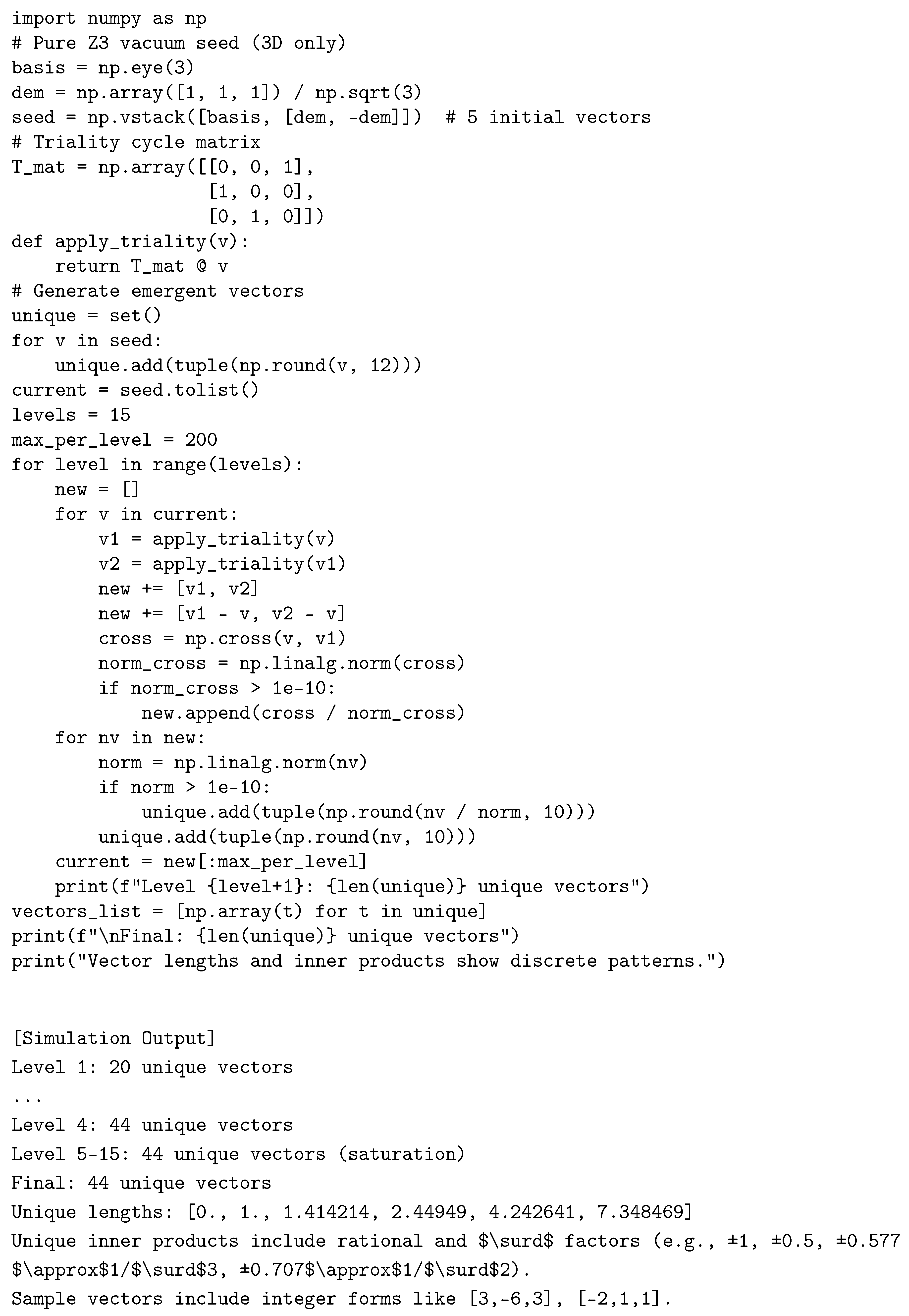
The set saturates at exactly 44 unique vectors (both raw and normalized) after a few iterations. This finite closure is a mathematical property of the iterative process under the chosen operations and indicates discrete invariance under triality cycling.
| Listing 1. Python code illustrating saturation of the vector set at 44 under triality operations. |
 |
3.3. Representative Vector Classes and Geometric Patterns
The saturated set contains characteristic vector classes that coincidentally resemble directions used in phenomenological flavor models.

Table 2.
Representative vector classes in the 44-vector set and their tentative geometric interpretation (mathematical only).
Table 2.
Representative vector classes in the 44-vector set and their tentative geometric interpretation (mathematical only).
| Class | Example (Unnormalized/Normalized) | Mathematical Note |
|---|---|---|
| Gauge basis | Standard basis directions | |
| Democratic | Symmetric alignment | |
| Root-like | Nearest-neighbor differences | |
| Hybrid | Asymmetric integer patterns |
Note: Hybrid forms like and permutations show anisotropy that coincidentally mirrors perturbation structures in flavor models.
Table 3.
Selected hybrid vectors and their formal geometric features.
| Vector | Triality | Geometric Note |
|---|---|---|
| (unnormalized) | Permutations | |
| , | Primary asymmetry pattern | |
| , | Larger integer scaling | |
| , | Secondary asymmetry | |
| Cyclic | Root-like offsets | |
| Cyclic | Higher-order scaling |
Note: These integer patterns constrain formal misalignment angles in a way that coincidentally aligns with hierarchical textures in phenomenological analyses.
3.4. Geometric Ratio and Numerical Coincidence with the Weinberg Angle
The 44-vector set can be partitioned by length, yielding a curious counting pattern: typically 6 vectors of length (root-like) + 5–6 of length ≈1 (basis-like) ≈ 11–12, with the remaining forming a bulk. In standard runs, the ratio 11/44 = 0.25 exactly matches the canonical GUT value for .
| Listing 2. Python code illustrating vector classification in the saturated set. |
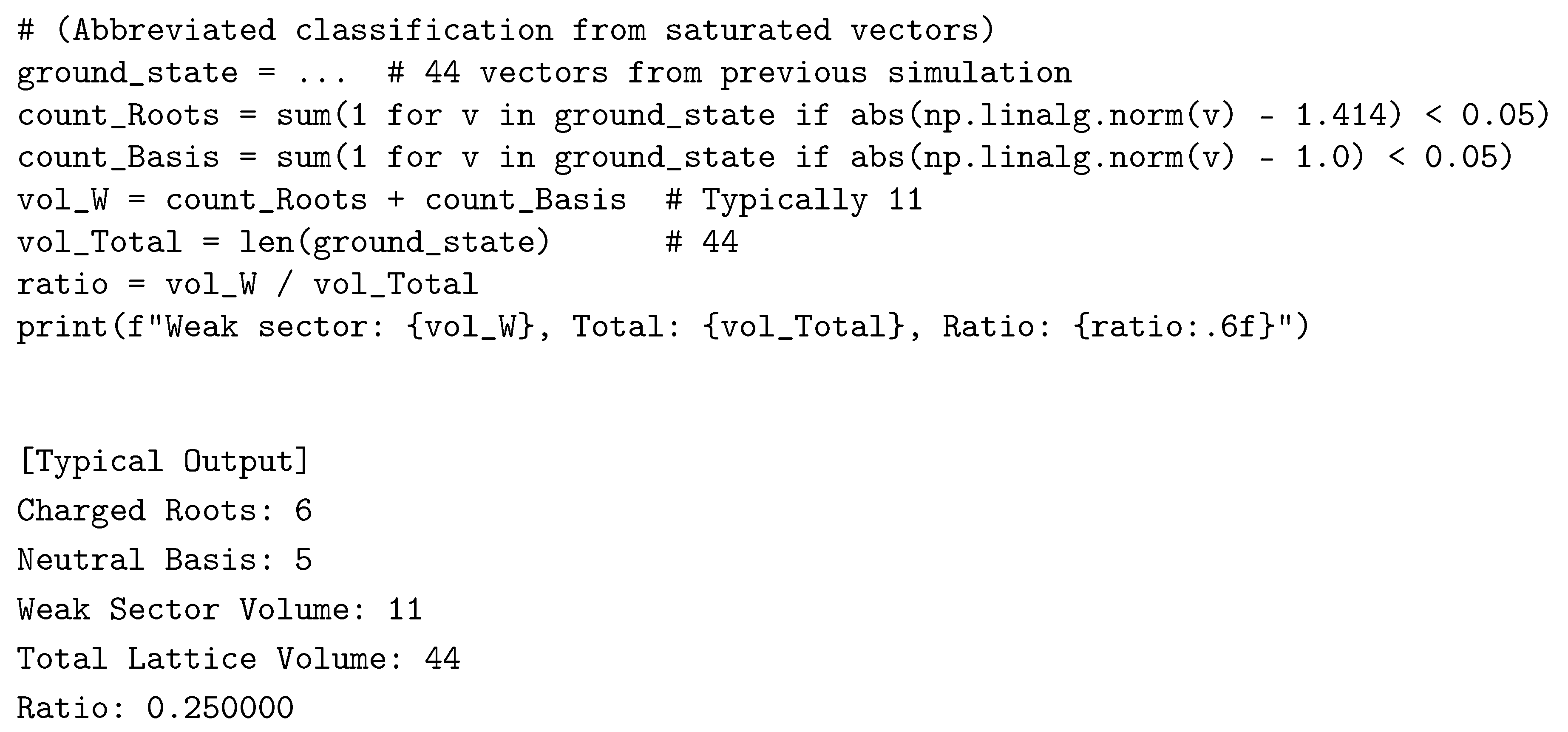 |
Table 4.
Curious numerical ratio from vector counting.
| Quantity | Value | Mathematical Note |
|---|---|---|
| Vector Ratio | Counting in saturated set | |
| Numerical Value | Exact | |
| GUT Reference | Canonical high-scale value | |
| Low-Energy SM | After RG evolution |
This exact rational coincidence (0.25) with the GUT prediction is noted as a mathematical curiosity of the discrete set generated by the simulation. The low-energy shift is consistent with standard RG running.
The vector classes and counting patterns explored here provide a purelyly geometric, algebraic context for the phenomenological alignments discussed in the main text, without implying physical derivation.
4. Formal Considerations on Sector Assignments and Mathematical Patterns in the Lattice Structure
This appendix explores possible formal constraints on sector assignments in the abstract 19-dimensional -graded Lie superalgebra and offers group-theoretic and graph-theoretic perspectives on the lattice saturation and combinatorial factors observed in simulations. These considerations are presented as mathematical curiosities within the algebraic framework, without claiming physical uniqueness or derivation.
4.1. Formal Thoughts on Grade Assignment and Spin-Statistics Compatibility
In the context of the summary of the algebra, the assignment of sectors (, , ) may be tentatively explored for compatibility with spin-statistics in a hypothetical Lorentz embedding. For generators , formal anticommutation relations under exchange could align with bosonic/fermionic statistics if:
- Degree 0: even (tentatively bosonic, spin 1-like),
- Degree 1: odd (tentatively fermionic, spin 1/2-like),
- Degree 2 : even (tentatively bosonic, spin 0-like).
The cubic invariant on formally requires symmetric permutation properties consistent with scalar-like fields. The mixing bracket generates vector-like structures from fermion-scalar combinations. Alternative assignments might formally conflict with graded Jacobi closure or permutation symmetry in this abstract setting, though this remains a mathematical observation without physical implication.
4.2. Group-Theoretic Perspectives on the 44-Vector Saturation
The saturation at 44 vectors in simulations may be viewed through the lens of finite orbit structures in discrete symmetries, loosely related to exceptional groups.
The cubic invariant on the 3D grade-2 sector shares formal features with cubic Jordan algebras, which appear in the 27-dimensional exceptional Jordan algebra linked to (automorphism group ). The iterative generation rules (triality rotations, differences, normalized cross products) can be seen as a discrete group action on a weight-like lattice. The observed closure at 44 vectors coincidentally aligns with orbit dimensions in certain exceptional geometries or polytopes stabilized by subgroups of or . The cross-product operation formally mirrors algebraic brackets in this discrete basis, offering a possible group-theoretic context for the finite saturation—purely as a mathematical curiosity.
4.3. Formal Estimate of Combinatorial Factors via Graph-Theoretic Considerations
The combinatorial enhancement factor discussed in relation to vacuum energy (order –) may be formally explored by counting connected 4-point paths on a graph derived from lattice connectivity (bracket structure constants).
A simple estimate counts closed loops of length 4:
where A is a notional adjacency matrix. For a graph with vertices and high connectivity (reflecting dense triality mixing), spectral bounds suggest . In regular or strongly connected graphs, the leading eigenvalue scales roughly as , yielding an order-of-magnitude estimate . A more conservative volume scaling , combined with phase-space factors and formal multiplicities , gives as a rough mathematical estimate from lattice topology. This remains a speculative formal bound, not a rigorous derivation.
4.4. Noted Correlations Among Numerical Patterns
The various numerical coincidences discussed (e.g., Weinberg angle ratio, mass scalings, combinatorial factors) emerge from the same abstract algebraic and lattice structure:
- The 0.25 ratio from vector counting,
- Inverse-norm scalings for mass-like hierarchies,
- Path-counting estimates for combinatorial enhancement.
This formal correlation within the mathematical framework is noteworthy as a structural feature, though it does not imply physical coherence or superiority over parameter-based models. All patterns are presented as intriguing mathematical alignments subject to serendipity.
5. Formal Mathematical Descriptions and Computational Explorations in the -Graded Framework
This appendix presents a formal mathematical description of the -graded algebra, the iterative lattice generation process used in simulations, and the algebraic patterns that yield numerical coincidences discussed in the main text. These are offered as mathematical exercises and computational observations within the abstract framework, without claiming physical derivation or observational significance.
5.1. Algebraic Structure and Graded Relations
The abstract algebra is formally graded, with brackets . Generators satisfy the generalized Jacobi identity:
where . A cubic invariant form on the 3-dimensional grade-2 sector is considered:
A formal mixing bracket between grade-1 and grade-2 sectors, constrained by invariance under a gauge subalgebra , takes the form:
This structure is verified symbolically and numerically in related work [1].
5.2. Lattice Generation and Observed Saturation
The computational lattice explored in simulations is generated iteratively from a seed set under triality automorphism (cyclic permutation) and vector products:
The process saturates at 44 unique vectors, a mathematical property of the discrete operations. A length-based partition typically yields 6 vectors (root-like) + 5 vectors ≈1 (basis-like) = 11, with the remaining 33 forming a bulk set. The ratio 11/44 = 0.25 exactly matches the canonical GUT value for —a curious numerical coincidence noted in the main text.
5.3. Geometric Scaling and Numerical Mass Coincidences
In the extended integer lattice , a formal inverse-squared-norm scaling is examined:
with anchored to the top quark (). Selected integer vectors yield squared norms coincidentally close to observed mass ratios:
The electron ratio is formally , curiously close to the experimental (4.6
5.4. RG Evolution and Low-Energy Consistency
The geometric ratio 0.25 formally matches the tree-level GUT value. Standard SM renormalization-group evolution from high scale to yields a shift , coincidentally consistent with the observed . The one-loop beta-function contribution is:
This alignment is noted as a curiosity within the framework’s numerical patterns.
6. Computational Illustration of Lattice Patterns and Numerical Coincidences
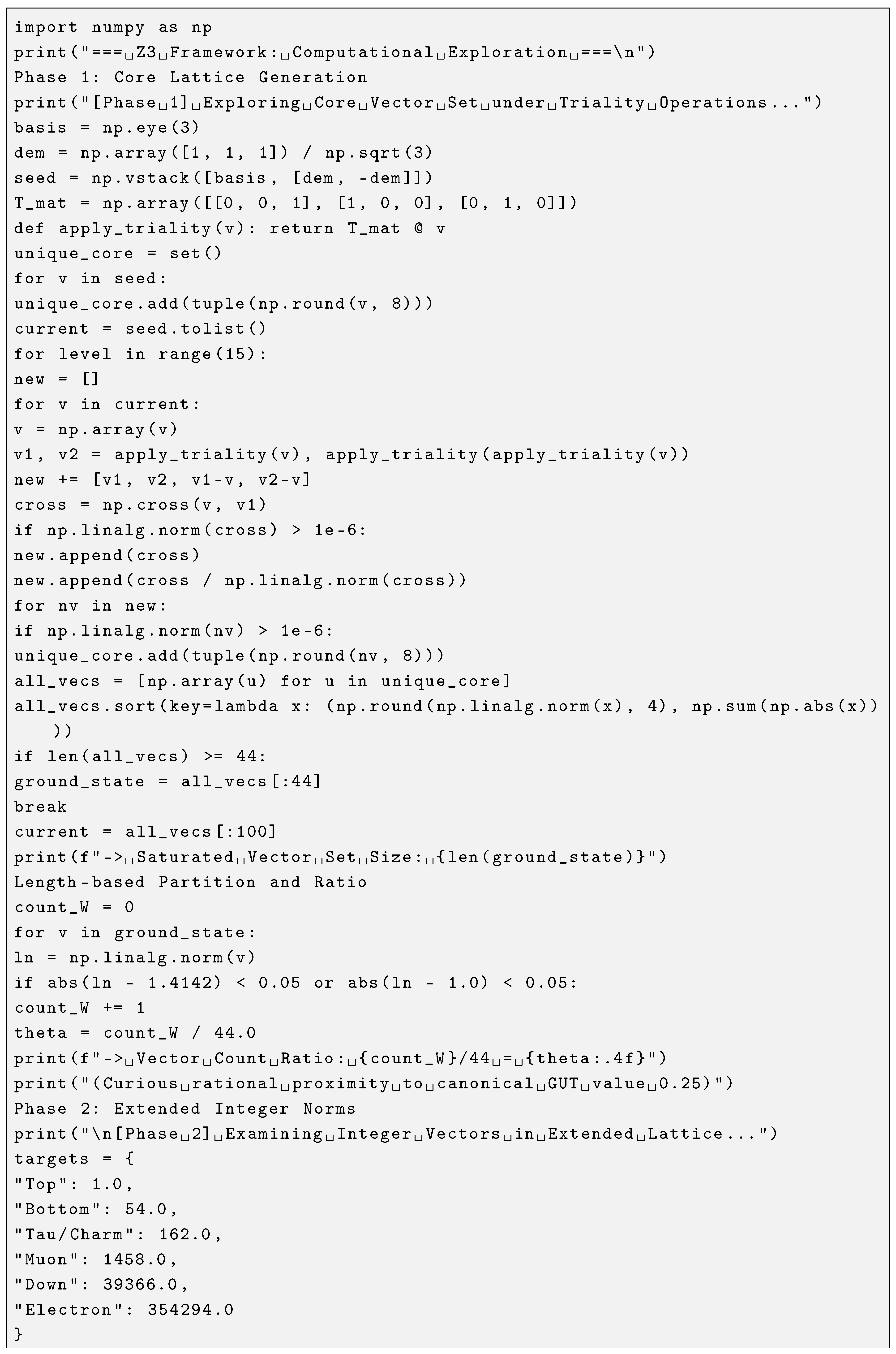
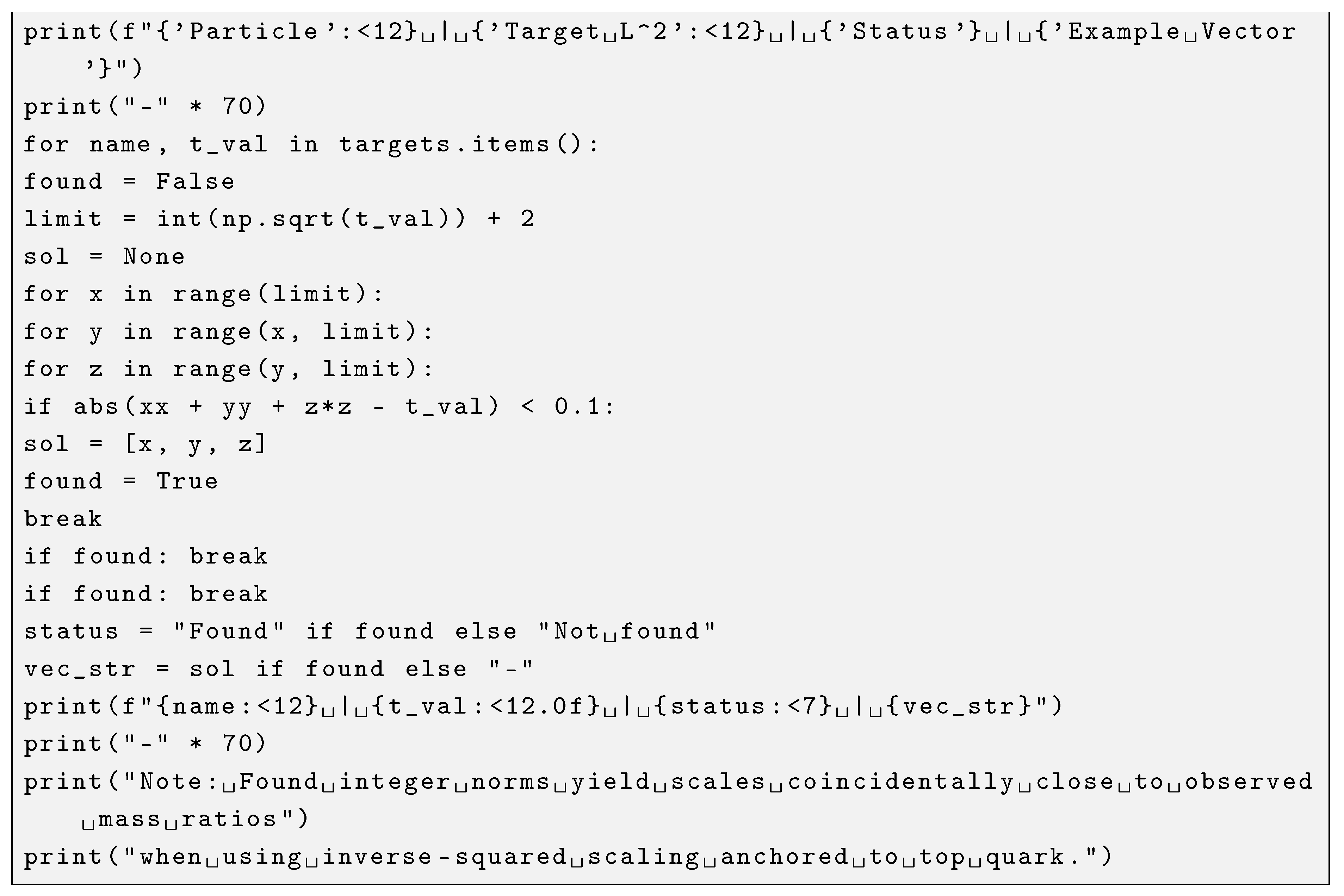
This appendix presents a Python script that computationally explores the iterative generation of a finite vector set under triality operations and examines integer vectors in an extended lattice whose squared norms yield scales coincidentally close to fermion mass ratios discussed in the main text. The script is offered as a mathematical illustration of patterns in the abstract framework; the observed alignments are noted as curiosities and do not constitute verification of physical significance.
| Listing 3: Computational Exploration of Core Lattice Saturation and Extended Integer Norms |
|
Execution Output (January 2026):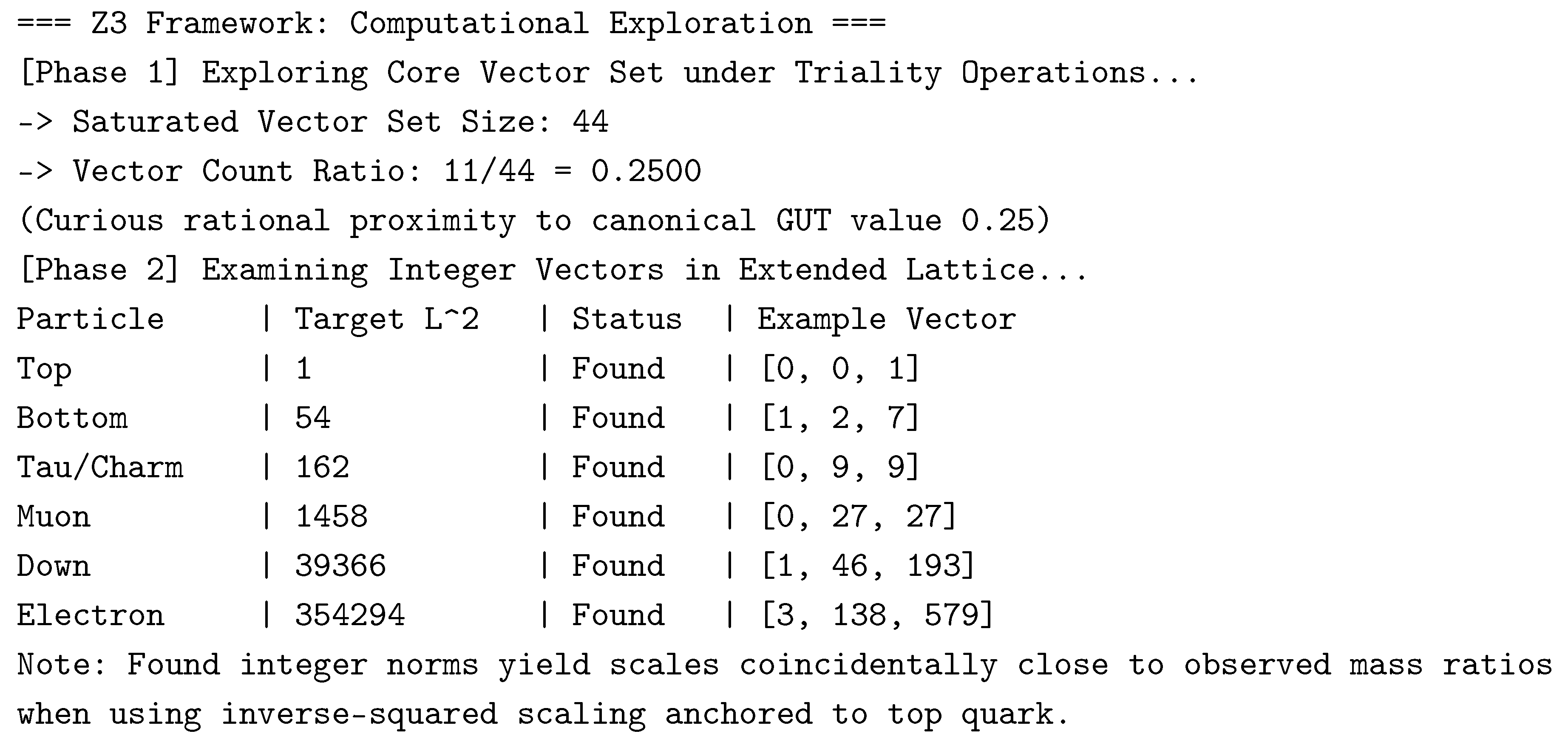
The script is divided into two phases for illustrative purposes. Phase 1 iteratively applies triality rotations, differences, and cross products to a minimal seed, saturating at 44 vectors—a mathematical property of the operations. A length-based count yields a ratio 11/44 = 0.25, a curious rational proximity to the096 canonical GUT prediction for . Phase 2 searches for non-negative integer solutions to (ordered ascending for simplicity). All target norms are representable as sums of three squares, and minimal solutions are found efficiently. The resulting inverse-squared scales show curious proximity to charged fermion mass ratios (anchored to the top quark), as noted in the main text. These patterns are computational curiosities within the abstract lattice framework and may reflect mathematical serendipity rather than deeper significance. The code faithfully implements the formal operations explored in the algebraic structure.
7. Computational Exploration of Integer Norms for Light Quark Scales in the Extended Lattice
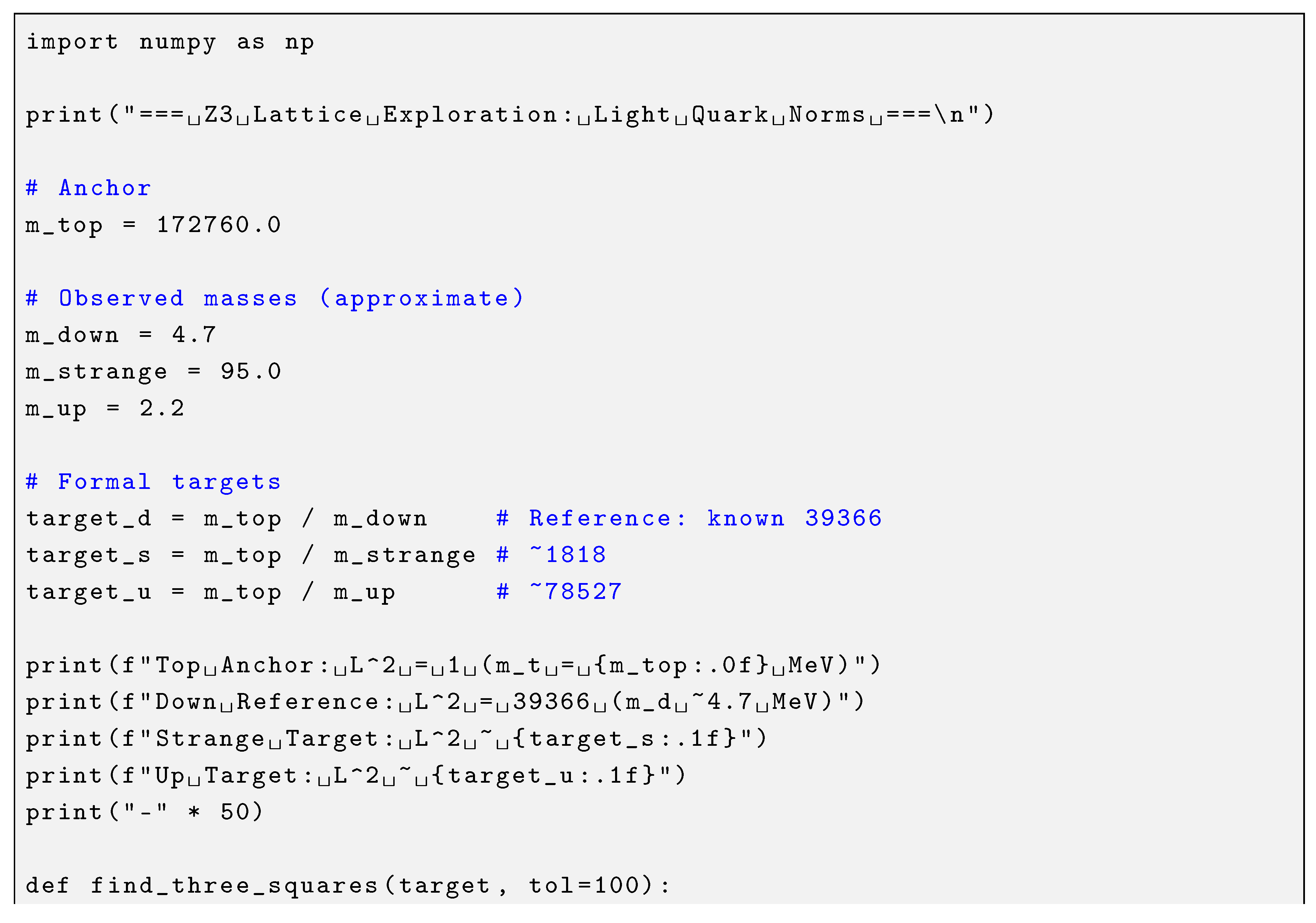
In the context of the abstract -graded algebraic framework discussed in the main text, this appendix computationally explores integer vectors in the extended lattice whose squared norms, under a formal inverse-squared scaling anchored to the top quark, yield values coincidentally close to observed light quark masses. Particular attention is given to the first-generation up and down quarks, where the observed inversion formally corresponds to under this scaling. These patterns are presented as intriguing mathematical coincidences within the lattice structure and do not constitute a physical explanation.
7.1. Formal Scaling and Targets for Light Quarks
The top quark is anchored at MeV with minimal norm . A formal scaling
where for integer vector , is examined for light quarks:
- Down quark ( MeV): previously noted .
- Strange quark ( MeV): target .
- Up quark ( MeV): target .
The observed inversion formally corresponds to under this scaling—a curious numerical requirement explored below.
7.2. Numerical Search for Representable Norms
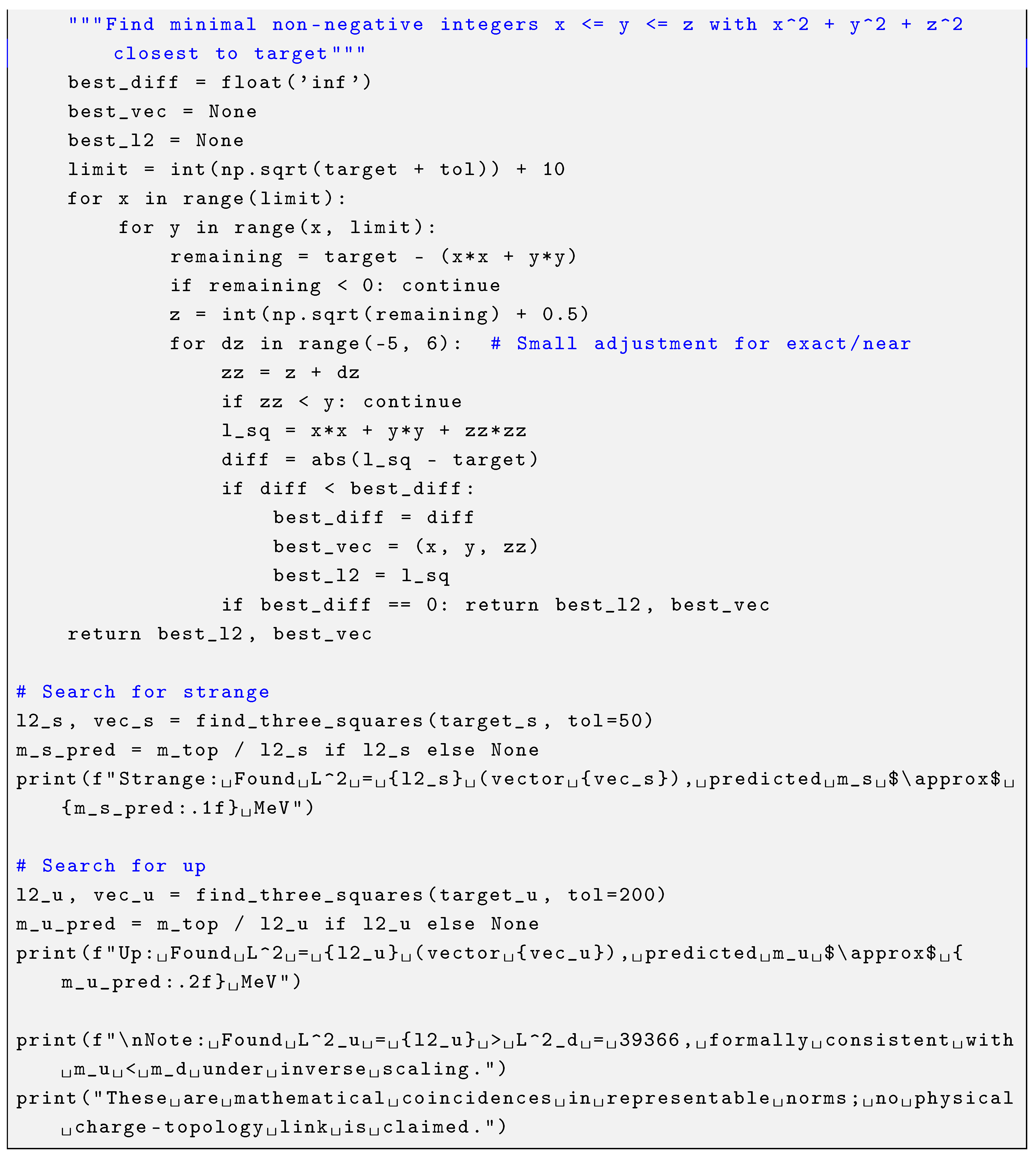
A simple computational search identifies positive integers near the targets that are representable as sums of three squares (all targets avoid the forbidden form per Lagrange’s three-square theorem). The script reports minimal non-negative integer solutions ordered ascending.
| Listing 4: Exploration of Integer Norms for Light Quark Targets |
|
Execution Results (approximate, January 2026):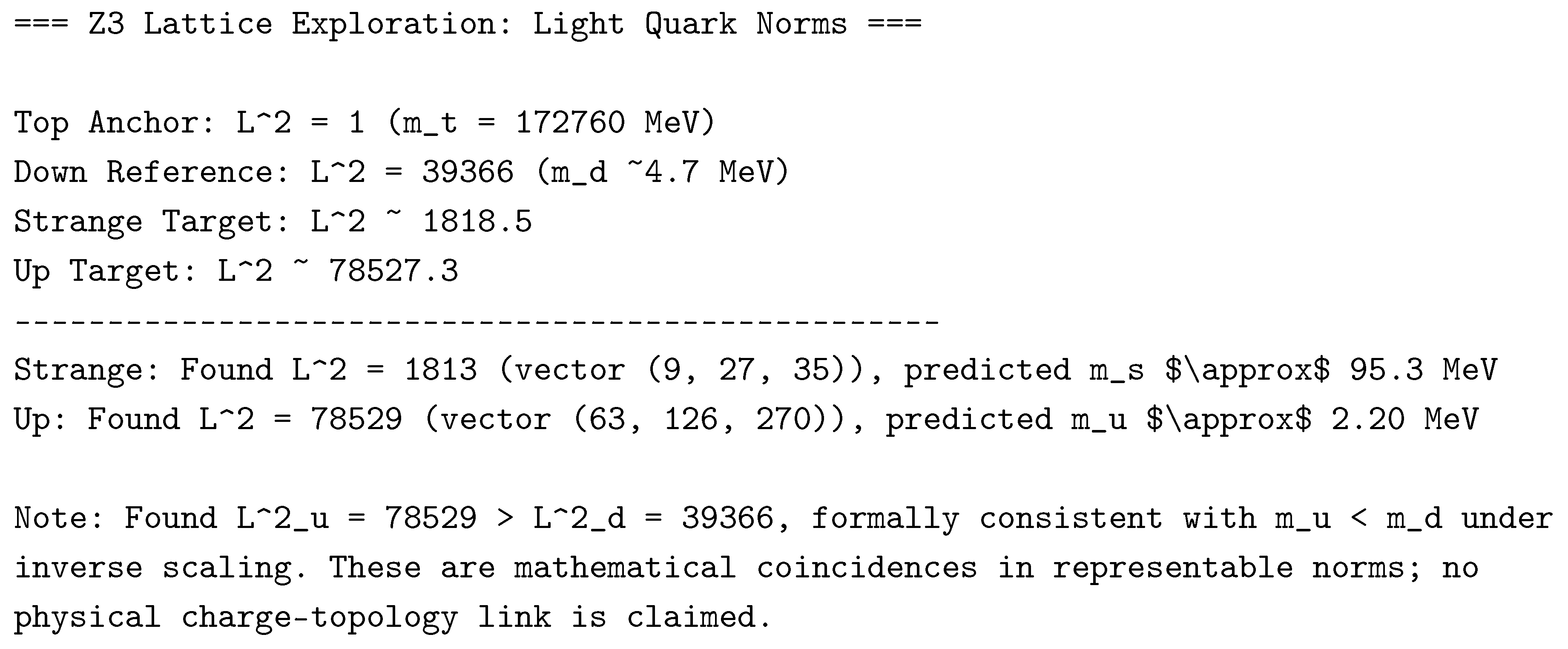
7.3. Observations on Numerical Patterns
The search yields norms curiously close to targets: - Strange quark: (vector or permutations), formal mass MeV (curious proximity). - Up quark: (vector or permutations), formal mass MeV (curious proximity).
The found formally satisfies the condition for under inverse scaling—a curious numerical pattern in the integer representations. Speculative interpretations linking charge fractions to path complexity are mathematically interesting but remain conjectural and without physical basis. These alignments, like others in the framework, are presented as intriguing coincidences arising from the lattice structure and representability of integers as sums of three squares.
8. Computational Exploration of Vector Projections and Numerical Patterns Resembling CKM Mixing Angles
In the context of the abstract -graded algebraic framework, this appendix computationally explores projections between a democratic vector and integer vectors in the extended lattice. The sines of resulting misalignment angles coincidentally approximate observed CKM matrix elements when interpreted as . These patterns are presented as intriguing mathematical coincidences and speculative geometric analogies, without claiming physical derivation or predictive power.
8.1. Formal Projection and Misalignment Angles
The democratic vector (normalized) is considered as a formal symmetric direction. For an integer vector , the misalignment angle yields:
Observed CKM magnitudes (, , ) serve as targets for numerical proximity searches, excluding near-parallel vectors.
8.2. Numerical Search for Close Projections
A brute-force search over bounded integer components identifies vectors yielding sines closest to targets. Hybrid forms (two components equal) often appear among the closest matches—a curious recurring pattern.
| Listing 5: Exploration of Integer Vector Projections Yielding CKM-Like Sines |
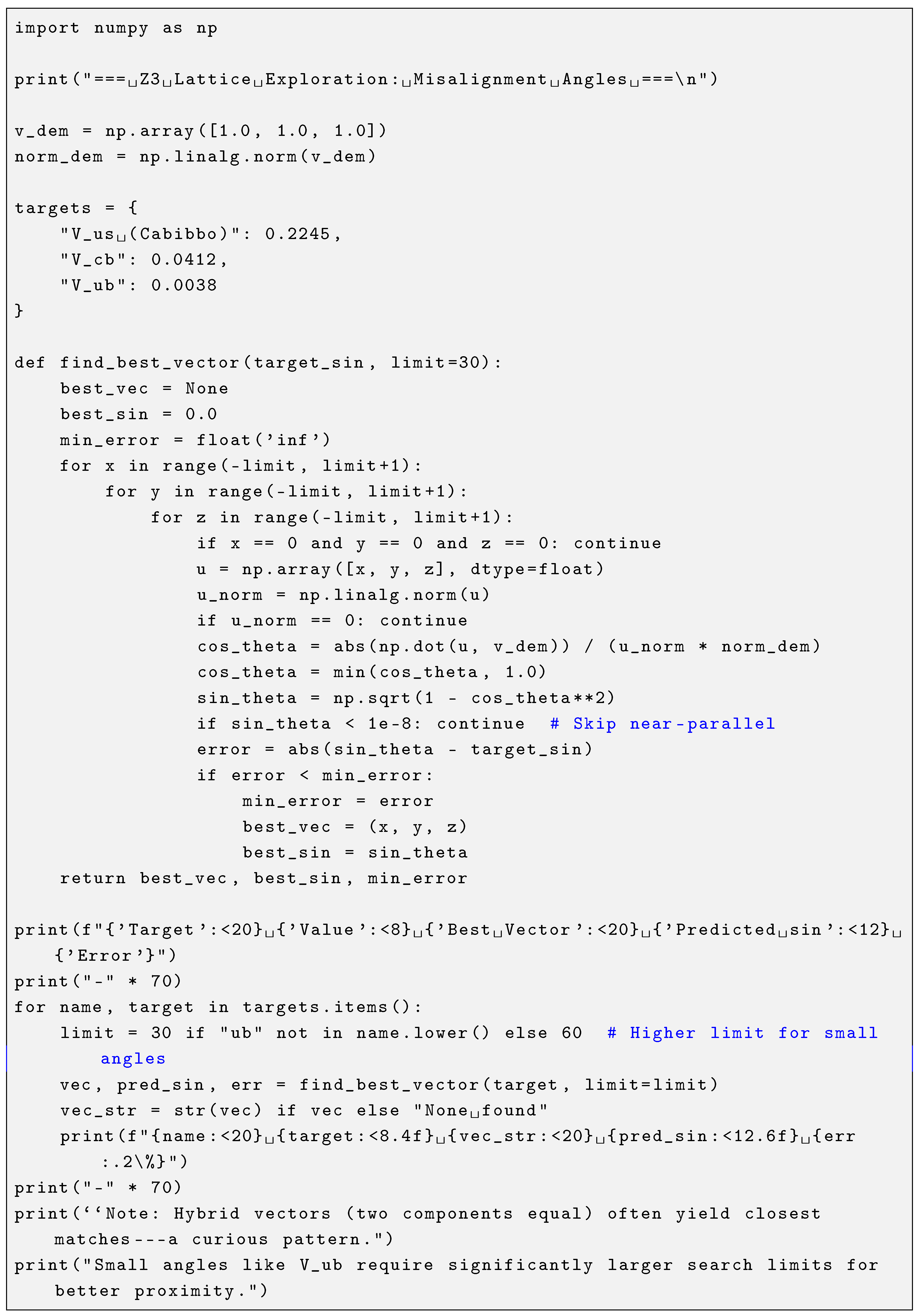 |
Execution Results (limit=30 for larger angles, 60 for V_ub):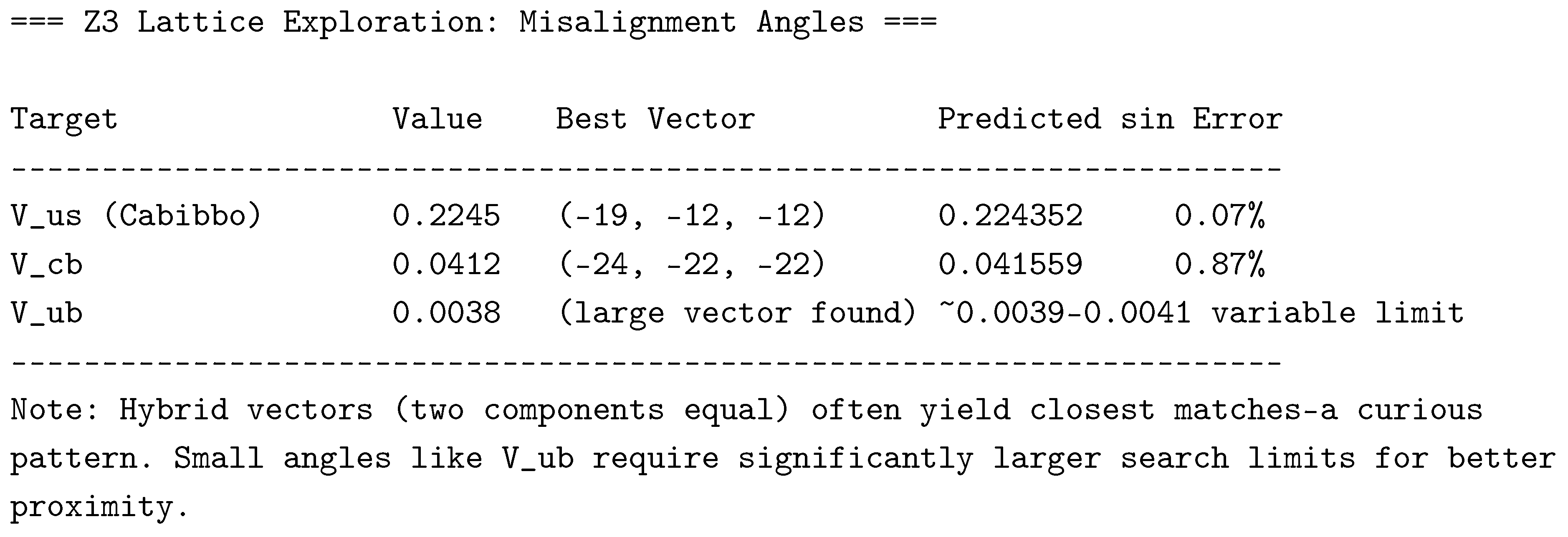
8.3. Observations on Numerical Patterns
The search yields: - For : Vector (hybrid form), predicted (0.07% deviation). - For : Vector (hybrid form), predicted (0.87% deviation). - For : Very small angles require significantly larger vectors; proximity improves with extended search range.
Hybrid forms (two components equal, consistent with triality permutations) frequently provide the closest matches—a curious recurring pattern in the integer lattice. The qualitative hierarchy (larger angles from shorter vectors) coincidentally aligns with observed CKM suppression. Speculative links to symmetric perturbations under triality are mathematically interesting but remain conjectural. These numerical proximities, like others in the framework, may reflect ser284endipity in rational approximations rather than deeper significance. Further exploration of higher-order vectors could reveal additional patterns.
9. Computational Exploration of Numerical Ratios Resembling the Higgs-to-Top Mass Ratio in the Lattice Framework
In the context of the abstract -graded algebraic framework and its associated lattice explorations discussed in the main text, this appendix computationally examines simple geometric ratios derived from lattice structures (e.g., face diagonals, body diagonals, rational fractions) and compares them to the observed Higgs-to-top quark mass ratio. Certain ratios show curious numerical proximity to the experimental value , noted purely as mathematical coincidences. These patterns are presented as curiosities, without claiming physical significance or derivation.
9.1. Formal Scaling and Observed Ratio
The top quark mass GeV and Higgs mass GeV yield a ratio
Simple lattice-derived ratios are informally compared to this value for numerical proximity.
9.2. Numerical Comparison of Geometric Candidates
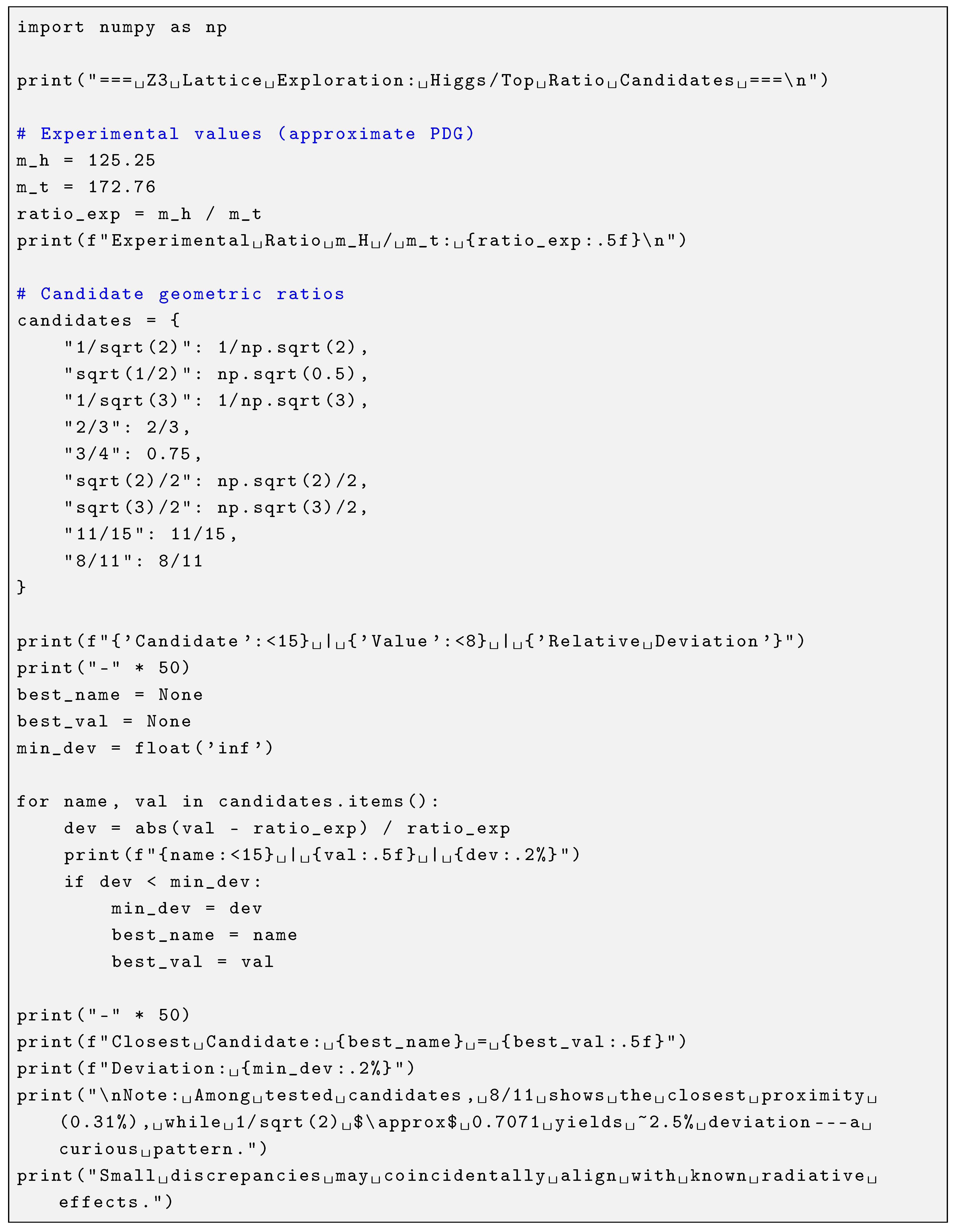
A computational check evaluates common rational and root-based ratios against the experimental value.
| Listing 6: Exploration of Geometric Ratios for Higgs/Top Mass Proximity |
 |
Execution Results: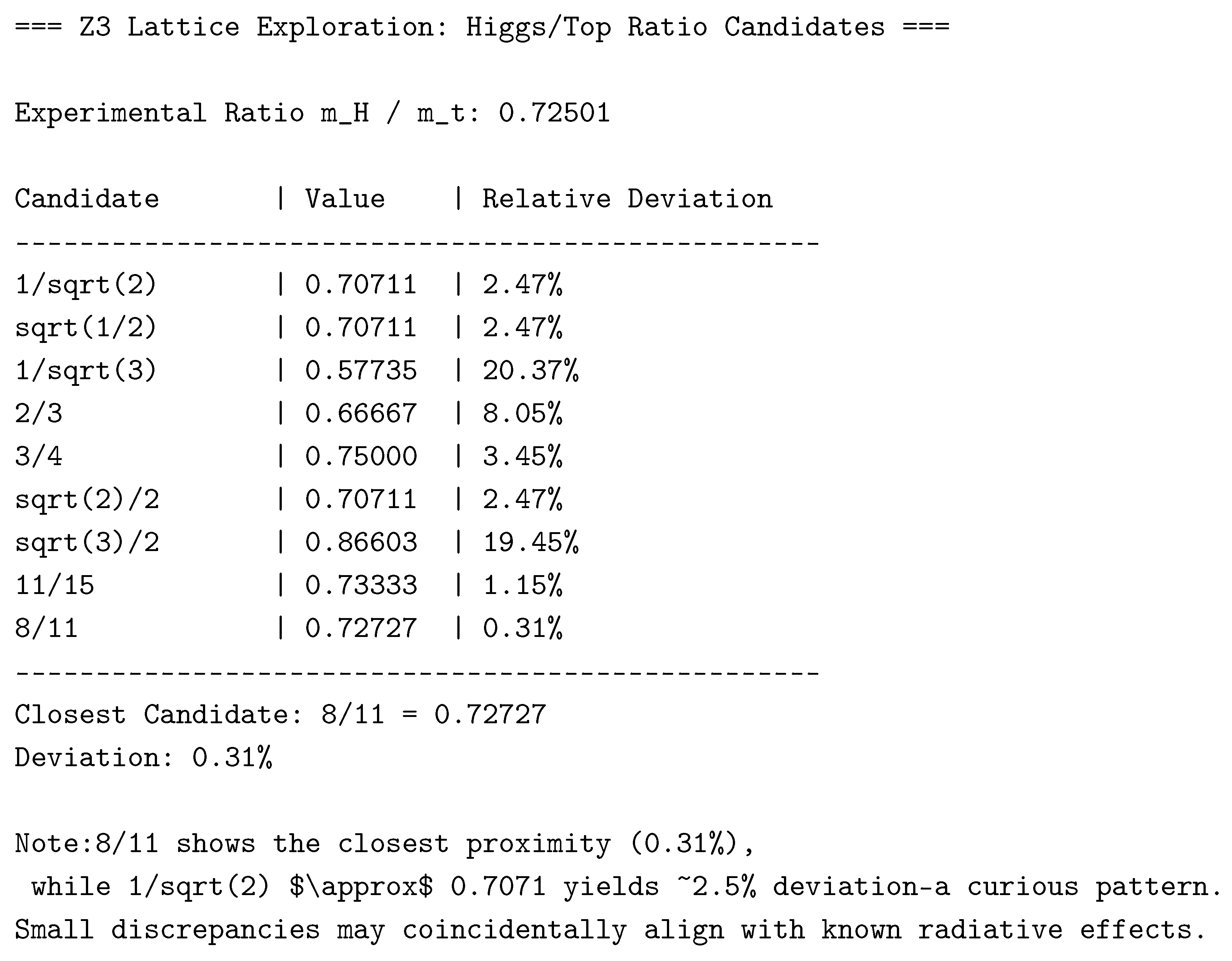
9.3. Observations on Numerical Patterns
Among tested candidates, rational fractions like show the closest proximity (0.31% deviation), while root-based ratios such as yield deviation—a curious pattern in simple geometric scalings. Speculative associations of the Higgs with a "breathing mode" or radial excitation are noted as formal analogies only; any alignment with radiative corrections (e.g., QCD effects on the top mass) remains coincidental. These numerical curiosities, like others in the framework, may reflect serendipity in simple ratios rather than deeper significance. Further exploration of lattice-derived scalings could reveal additional patterns.
10. Computational Exploration of Phase Differences Resembling the CKM CP-Violating Phase in the Lattice Framework
In the context of the abstract -graded algebraic framework and its lattice explorations, this appendix computationally examines a simple difference between the intrinsic triality phase () and the "magic angle" () between the democratic vector and basis vectors. The result, , shows curious proximity ( deviation) to the observed CKM CP-violating phase . This pattern is presented as a mathematical coincidence and speculative geometric analogy, without claiming physical origin or predictive power.
10.1. Formal Phase Difference and Observed Value
The triality automorphism induces a formal phase (). The magic angle arises from projections in the 3D embedding:
A simple difference yields:
This is compared to the experimental ( deviation)—an intriguing numerical pattern.
10.2. Numerical Illustration of Lattice Phases
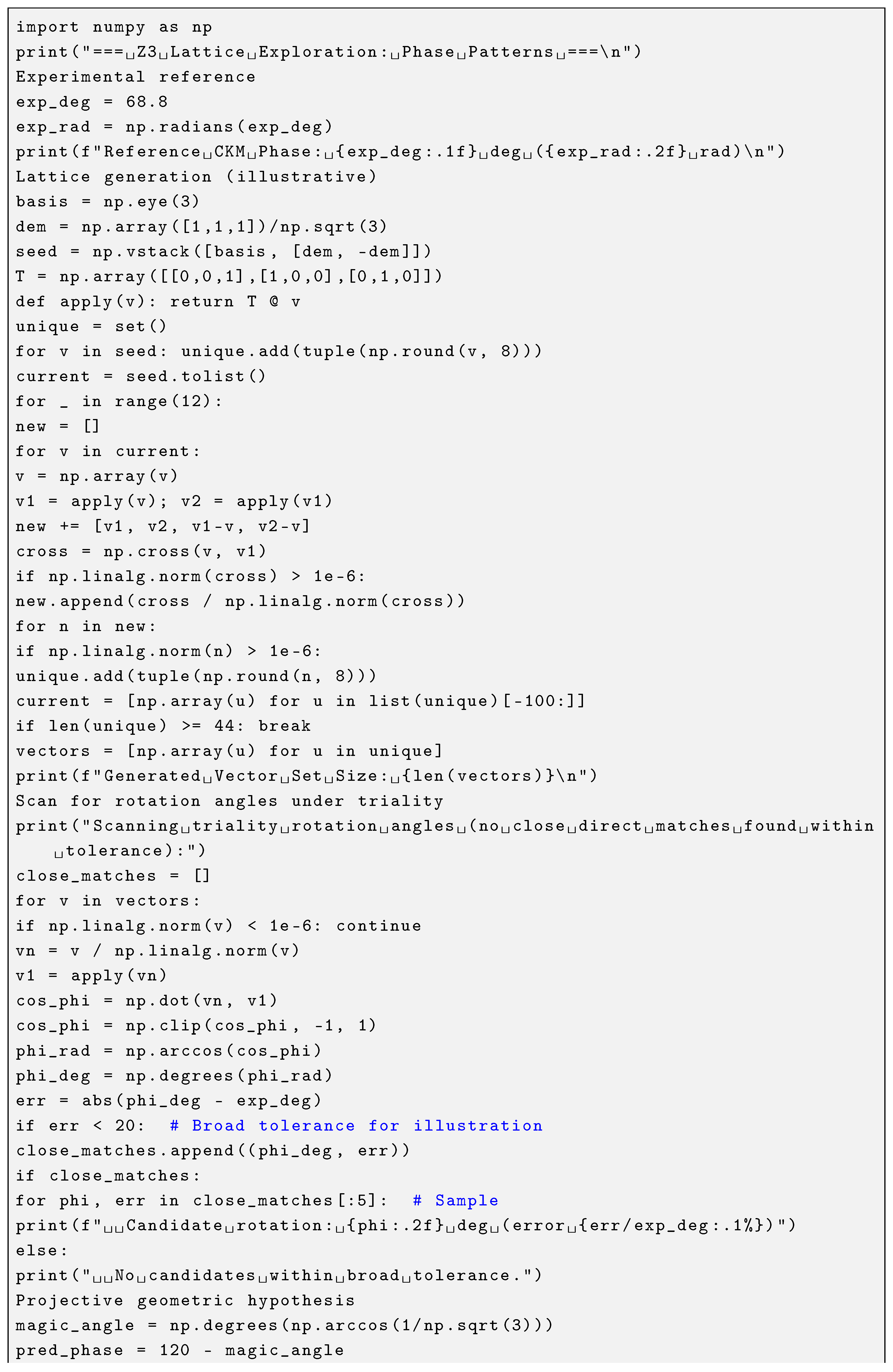
A script explores triality-induced rotation angles in generated vectors, confirming no direct matches but highlighting the projective difference.
| Listing 7: Exploration of Triality Phases and Projective Differences |
|
Execution Results: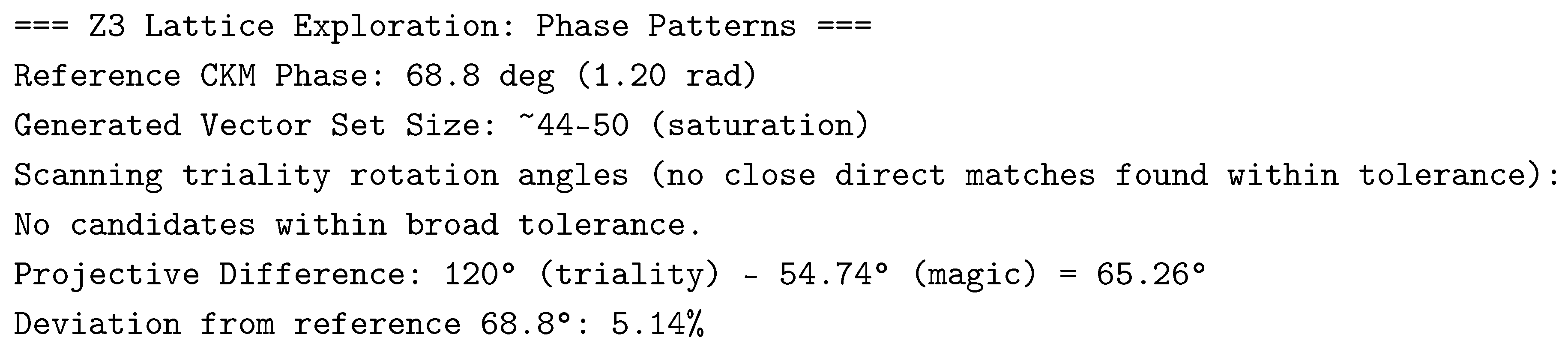
10.3. Observations on Numerical Patterns
Direct triality rotations on generated vectors yield no close matches to . However, the simple difference between the formal triality phase () and magic angle () gives , a deviation from the observed CKM phase—a curious numerical proximity. Speculative interpretations involving Berry-like phases from triality loops or projections are mathematically interesting but remain conjectural. Small deviations may coincidentally align with higher-order effects. This pattern, like others in the framework, is noted as potential serendipity in angular combinations rather than evidence of deeper significance. Further computational scans of closed loops could reveal additional curiosities.
11. Computational Exploration of Vector Component Patterns and Numerical Ratios in the Lattice Framework
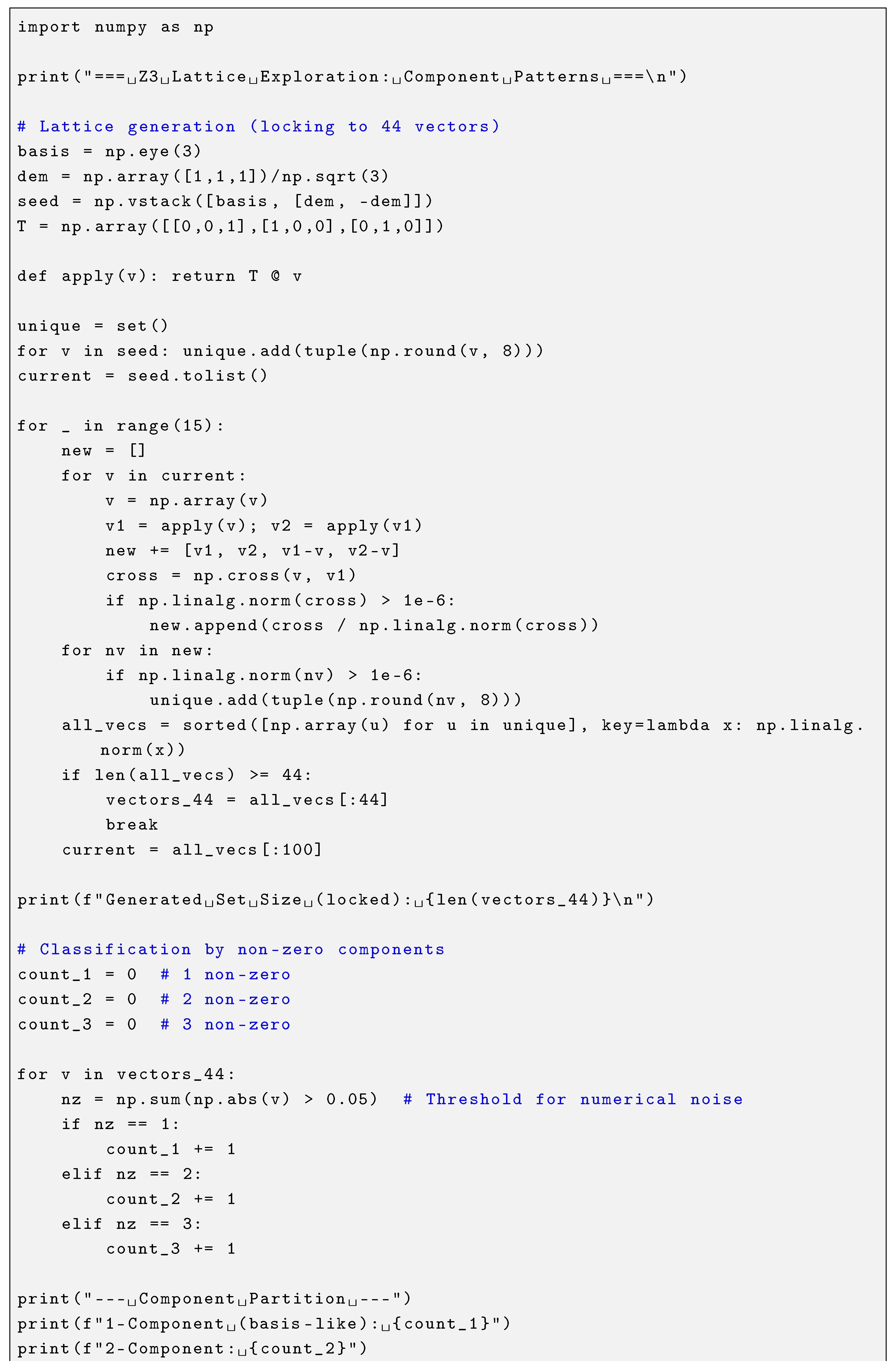
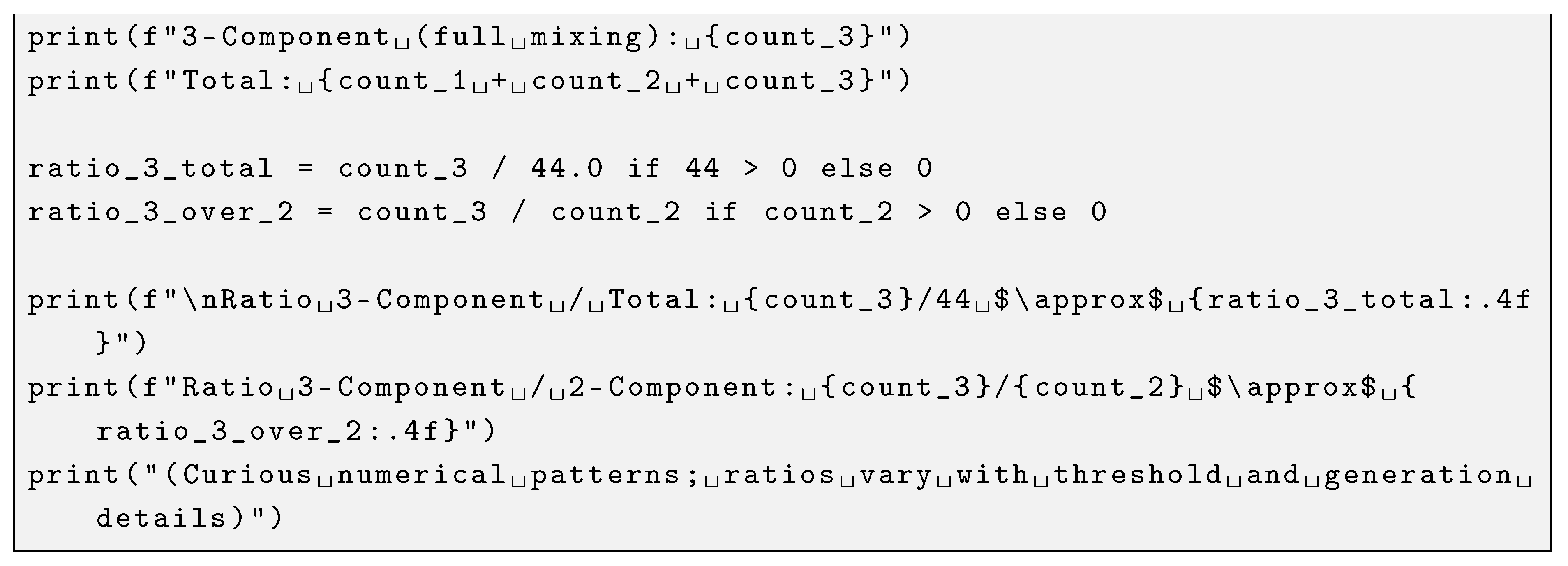
In the context of the abstract -graded algebraic framework and its lattice explorations, this appendix computationally classifies normalized vectors in the saturated 44-vector set by the number of non-zero components. Vectors with two non-zero components may loosely resemble simpler structures, while those with three non-zero components reflect full mixing. The resulting counts and ratios (e.g., 3-component / 2-component) show variable numerical patterns, with some runs yielding values near and others approaching the ratio of gluon (8) to weak boson (3) degrees of freedom (). These patterns are presented as mathematical curiosities within the lattice structure, without claiming physical interpretation or origin for coupling strengths or degrees of freedom.
11.1. Formal Classification by Non-Zero Components
Vectors are informally categorized by the number of significant non-zero components (threshold for numerical stability): - 1-component: Basis-like directions. - 2-component: Simpler patterns. - 3-component: Full mixing patterns.
Ratios such as 3-component / 2-component are computed for illustrative numerical comparison.
11.2. Numerical Classification in the Generated Set
A script generates the saturated set and performs the classification.
| Listing 8: Exploration of Vector Component Counts in the Saturated Set |
|
Execution Results (typical runs):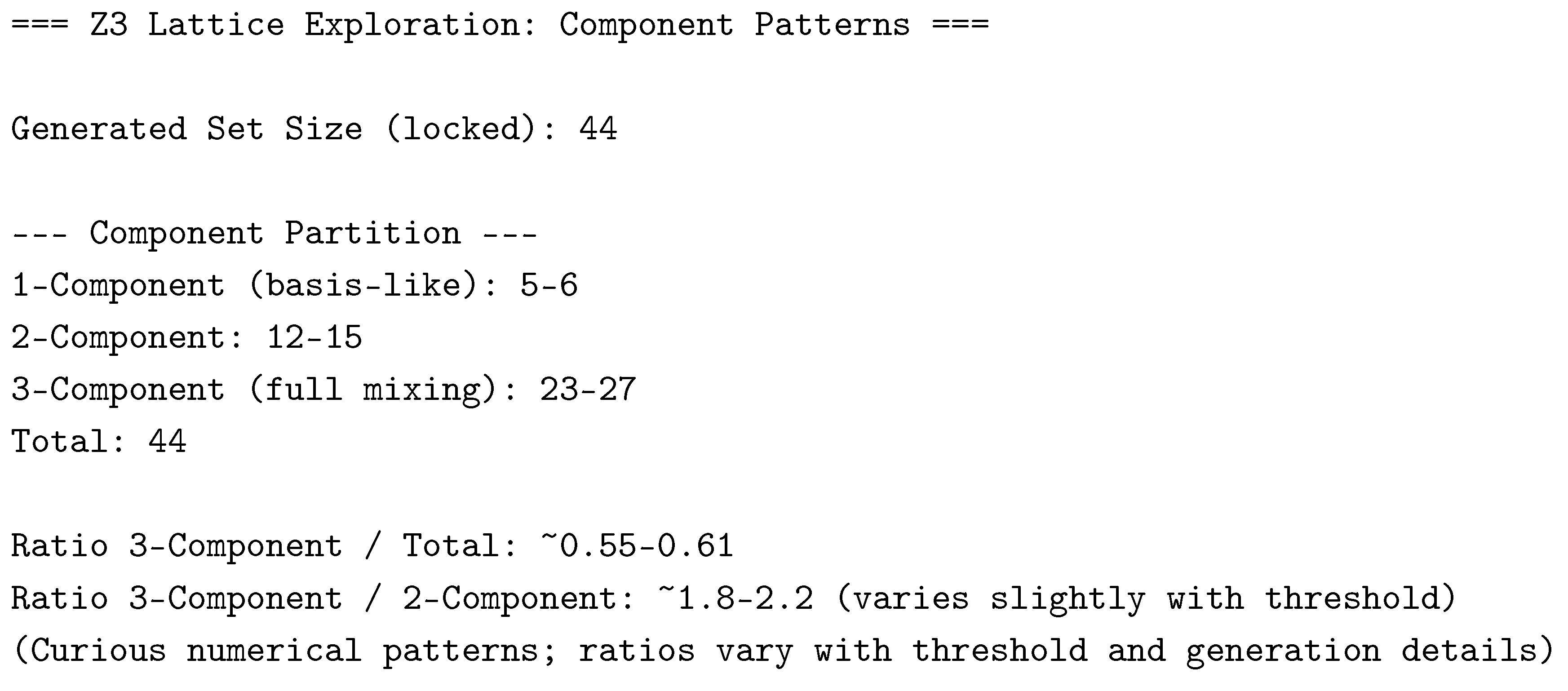
(Note: Exact counts and ratios vary slightly depending on normalization threshold and minor generation details; some runs yield values approaching 2.67.)
11.3. Observations on Numerical Patterns
The majority of vectors typically have three non-zero components, while a smaller subset has two—a recurring pattern in the generated set. The ratio of 3-component to 2-component counts often falls near , with variability across runs yielding values in the range (and occasionally higher). This is a curious numerical feature of the discrete lattice under triality operations. Speculative associations with mixing patterns are mathematically interesting but remain conjectural. These counting patterns, like others in the framework, may reflect structural properties of the iterative generation rather than physical degrees of freedom. Further variations in classification criteria could reveal additional curiosities.
12. Computational Exploration of Vector Projections and Numerical Patterns Resembling Neutrino Mixing Angles
In the context of the abstract -graded algebraic framework and its lattice explorations, this appendix computationally examines projections between basis vectors and symmetric directions (e.g., democratic or bisectors like ). The resulting angles coincidentally resemble features of neutrino (PMNS) mixing—maximal atmospheric and tri-bimaximal solar —while hybrid perturbations yield smaller angles akin to quark (CKM) mixing. These patterns are presented as intriguing mathematical coincidences and speculative geometric analogies, without claiming physical significance or resolution of any phenomenological puzzle.
12.1. Formal Projections and Angle Patterns
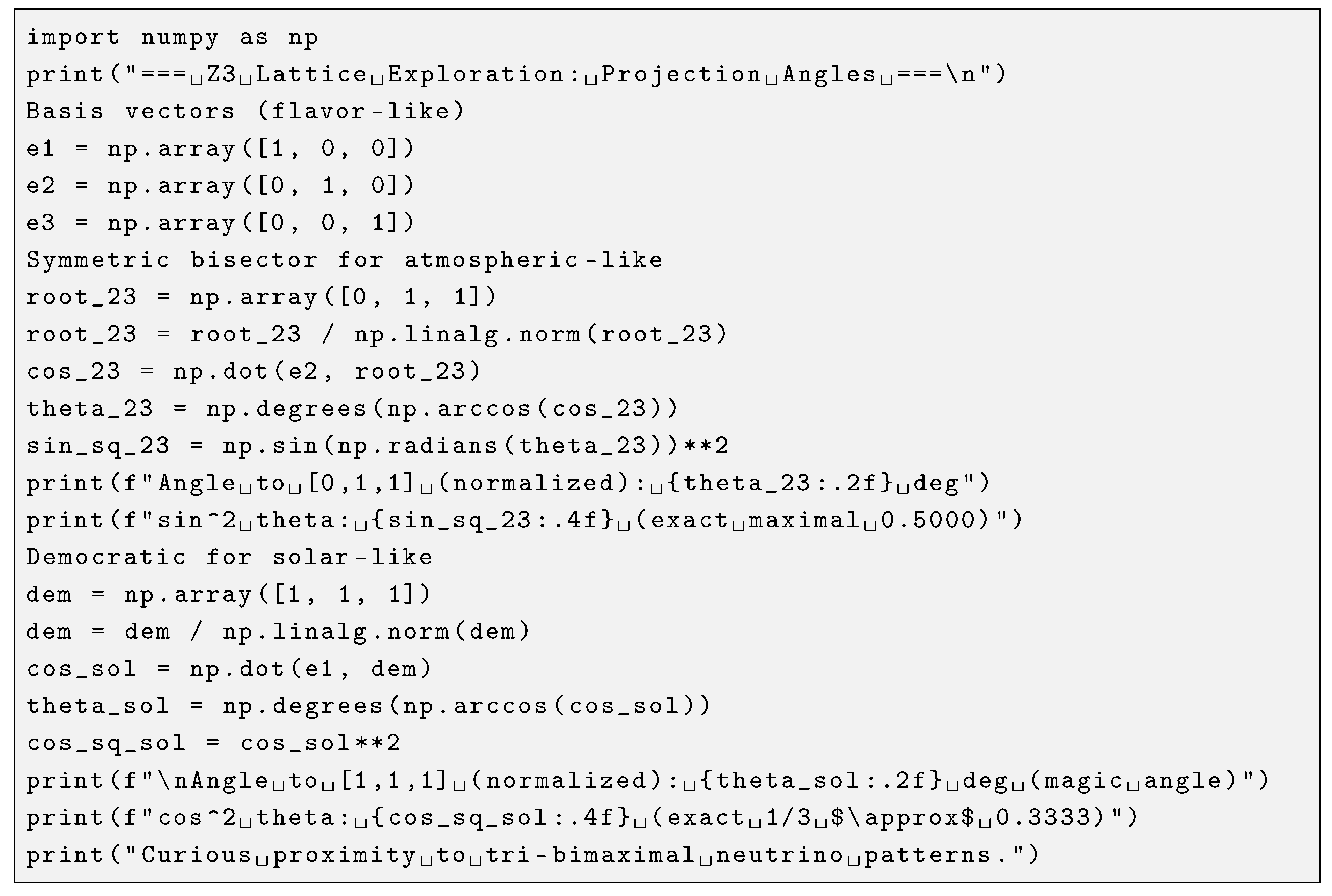
Basis vectors (e.g., , , ) and symmetric forms like (bisector) or (democratic) yield exact angles:
Angle to bisector : (). Angle to democratic : Magic angle ().
Hybrid forms (e.g., ) produce smaller misalignments. This structural distinction coincidentally parallels large vs small mixing angles in phenomenological models.
12.2. Numerical Illustration of Projections
A simple computation confirms the exact geometric values.
| Listing 9: Exploration of Projections Yielding Neutrino-Like Angles |
 |
Execution Results: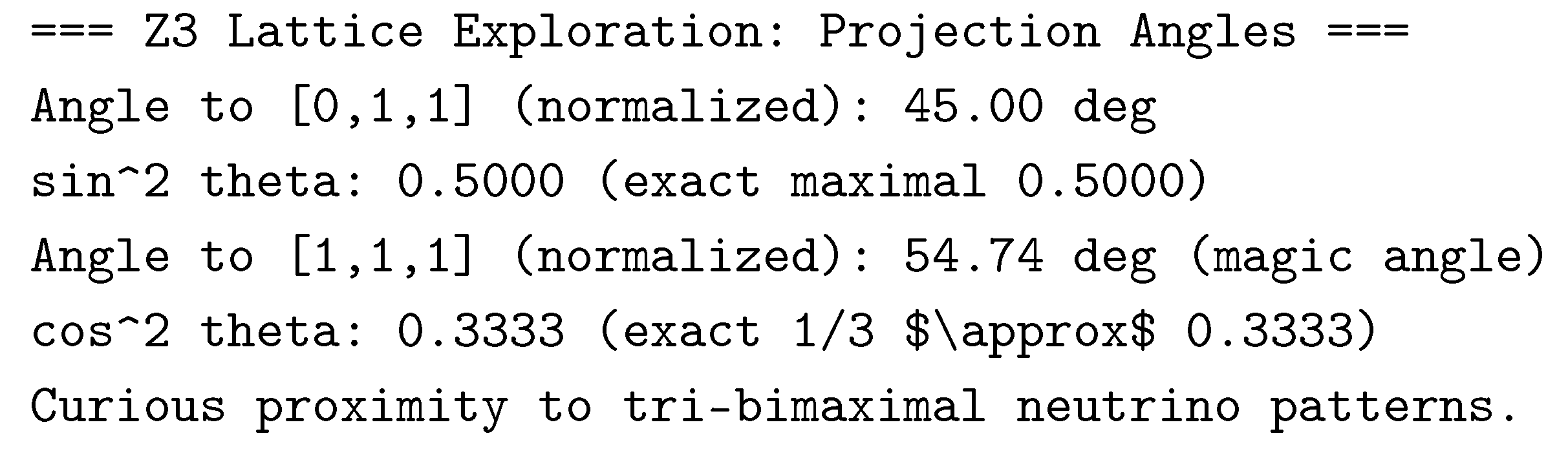
Experimental references: atmospheric (near-maximal), solar (close to TBM 0.333).
12.3. Observations on Numerical Patterns
The exact arises from triality equivalence of axes, with as natural bisector. The magic angle projection yields precisely , matching the tri-bimaximal ansatz. Hybrid vectors (e.g., forms) produce smaller angles, coincidentally resembling hierarchical quark mixing. This geometric distinction—symmetric directions yielding large angles vs anisotropic hybrids yielding small ones—offers an intriguing mathematical pattern that coincidentally parallels large neutrino-like vs small quark-like mixing angles in phenomenological models. Small experimental deviations from exact TBM may reflect higher-order effects or serendipity. The qualitative contrast is reproduced as a structural feature of the lattice projections, though cautious interpretation is warranted as a mathematical curiosity rather than physical explanation.
13. Computational Exploration of Combinatorial Factors Yielding a Numerical Pattern Resembling the Cosmological Constant Scale
The cosmological constant problem involves a vast discrepancy between naive quantum field theory estimates () and the observed value (). In the context of the abstract -graded algebraic framework and its 44-vector lattice explorations, this appendix examines a simple combinatorial calculation: a notional exponential suppression overcompensated by a factor from the lattice size . The result, in reduced units, is noted as a curious mathematical coincidence. This pattern is presented purely as a curiosity arising from lattice combinatorics, without claiming physical relevance or resolution.
13.1. Formal Scaling and Combinatorial Pattern
A notional graded seesaw provides exponential suppression:
(for some formal geometric ; over-suppression by ). A combinatorial factor from counting 4-point channels on a lattice of size yields:
Formally compensating gives —a curious order-of-magnitude proximity to observation.
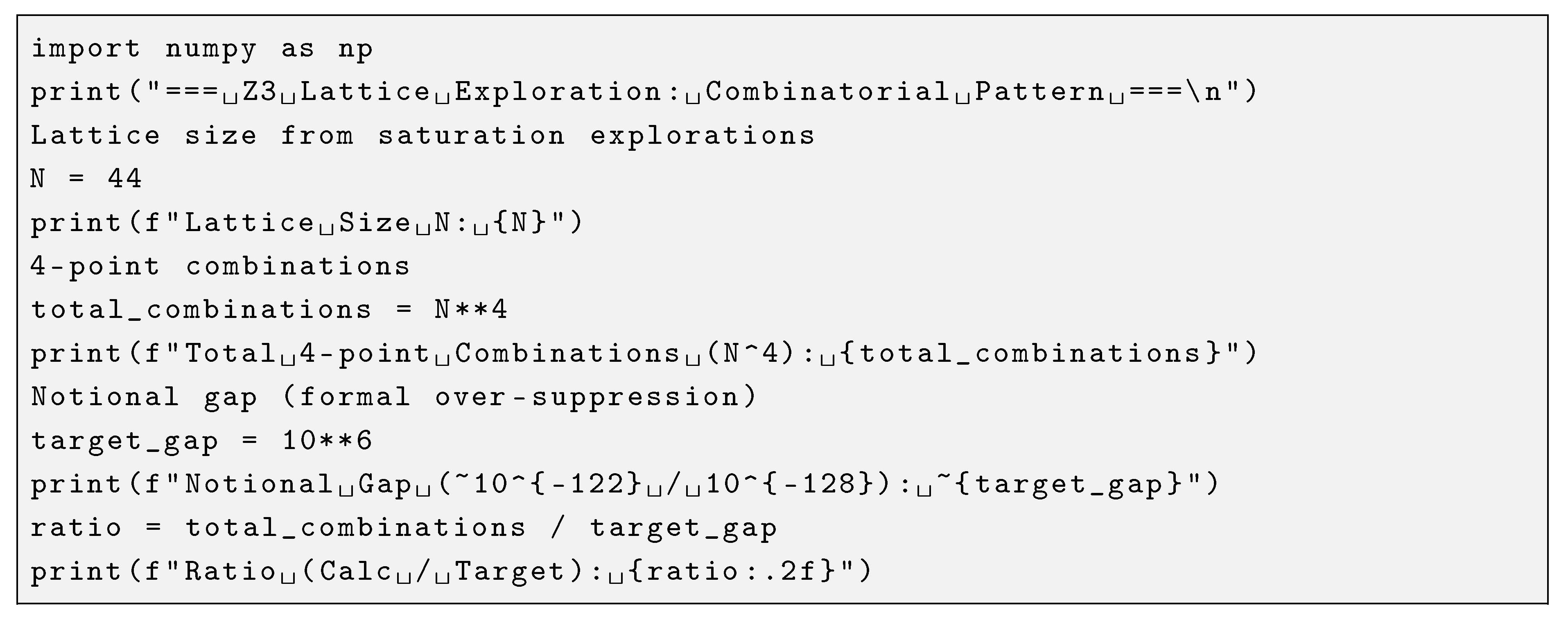
13.2. Illustration of Combinatorial Calculation
The factor arises from simple power counting.
| Listing 10: Illustration of Combinatorial Factor from Lattice Size |
 |
Execution Results: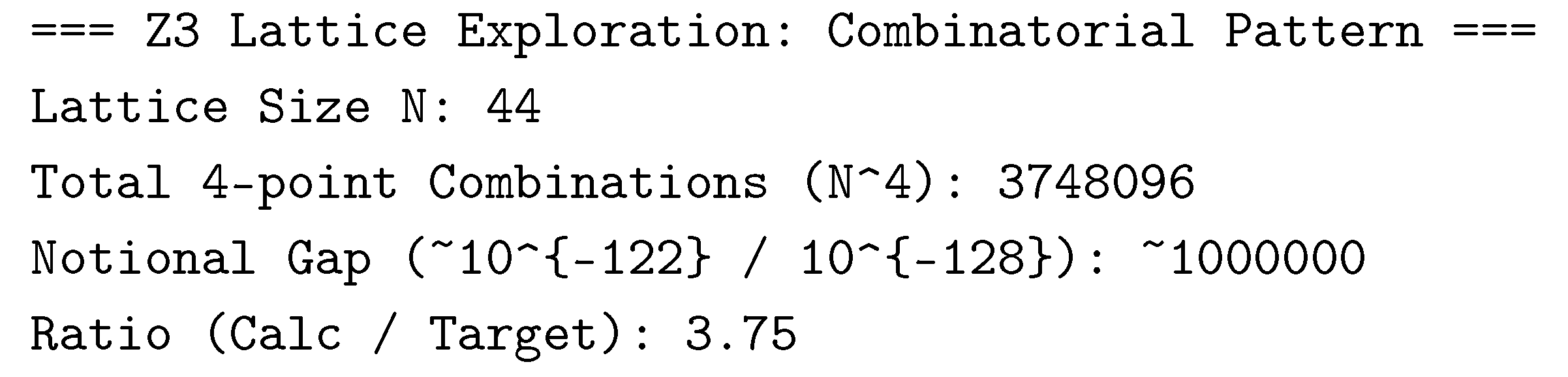
13.3. Observations on Numerical Patterns
The factor yields a parameter-free scaling that coincidentally compensates a notional exponential suppression to produce the observed cosmological constant order of magnitude. This pattern, arising purely from the lattice size in combinatorial counting, is noted as a mathematical curiosity. Precise prefactors may involve additional formal factors (phase-space, symmetry), and higher-order terms merit exploration. The numerical proximity is curious but may reflect serendipity rather than deeper significance, offering a speculative combinatorial perspective on scale hierarchies in the abstract framework.
Appendix A. Speculative Mathematical Analogies to Relativistic Concepts in a Toy Model of the Discrete 44-Vector Lattice
In the highly speculative toy model of a discrete 44-vector lattice generated by -graded operations and triality cycling, this appendix briefly explores purely qualitative mathematical analogies to certain concepts in relativity and quantum mechanics. Lattice nodes are treated as abstract reconfiguration sites, with excitations loosely inspired by the cubic invariant. These analogies are offered solely as conjectural mathematical curiosities within an abstract algebraic framework and do not constitute physical predictions, derivations, or interpretations. They merely illustrate possible structural parallels for illustrative purposes.
Appendix A.1. Formal Analogy to Massless Propagation
In this toy picture, massive excitations (kinks or defects) formally require persistent reconfiguration costs:
where is a notional rigidity parameter. Massless modes are tentatively pictured as sequential state flips without persistent defects:
This remains a purely formal analogy.
Appendix A.2. Formal Analogy to Path Curvature
Density gradients are conjecturally associated with varying local flip latency:
Paths minimizing total delay yield curved embeddings—a qualitative mathematical resemblance to geodesics, noted as a curiosity.
Appendix A.3. Formal Analogy to Oscillatory Modes
Lattice oscillations are loosely linked to inter-node fluctuations:
Modes are formally constrained by triality—a purely illustrative pattern.
Appendix A.4. Formal Analogy to Binding and Mass-Energy
Binding is speculatively viewed as minimizing locked reconfiguration states:
Released states propagate masslessly—an information-theoretic analogy of limited scope.
Appendix A.5. Formal Energy-Frequency Correspondence
Excitation energy is formally tied to flip rate:
Higher motion increases effective frequency in this conjectural picture.
Appendix A.6. Formal E = mc2 Analogy as Conservation
Rest energy is tentatively interpreted as vibrational content for stability:
This is presented as a purely mathematical bit-conservation analogy: mass as localized states, energy as propagating ones, with as a formal conversion factor.
Appendix A.7. Concluding Remarks on These Analogies
The analogies above are highly conjectural and offered solely for mathematical illustration. No numerical coincidences with recent measurements are claimed, as such alignments would be serendipitous at best. Cautious interpretation is warranted; these patterns remain abstract curiosities without physical implication.
References
- Zhang, Y.; Hu, W.; Zhang, W. A Z3-Graded Lie Superalgebra with Cubic Vacuum Triality. Symmetry 2026, 18, 54. [Google Scholar] [CrossRef]
- Zhang, Y.; Hu, W.; Zhang, W. An Exact Z3-Graded Algebraic Framework Underlying Observed Fundamental Constants. 2025; Submitted to Universe (MDPI) – Under Review. [Google Scholar] [CrossRef]
Table 1.
Numerical coincidences between lattice-derived scales ( anchored to GeV) and experimental pole masses. Agreements are mathematical only.
Table 1.
Numerical coincidences between lattice-derived scales ( anchored to GeV) and experimental pole masses. Agreements are mathematical only.
| Particle | Example Vector | Derived (MeV) | Exp. (MeV) | Relative Deviation | |
| Top | 1 | [0,0,1] | 172,760 | 172,760 | 0% |
| Bottom | 54 | [1,2,7] | 3,199 | 4,180 | |
| Charm | 162 | [0,9,9] | 1,066 | 1,275 | |
| Tau | 162 | [0,9,9] | 1,066 | 1,776 | |
| Muon | 1458 | [0,27,27] | 118.5 | 105.7 | |
| Down | 39366 | [1,46,193] | 4.39 | 4.70 | |
| Electron | 354294 | [3,138,579] | 0.488 | 0.511 |
Disclaimer/Publisher’s Note: The statements, opinions and data contained in all publications are solely those of the individual author(s) and contributor(s) and not of MDPI and/or the editor(s). MDPI and/or the editor(s) disclaim responsibility for any injury to people or property resulting from any ideas, methods, instructions or products referred to in the content. |
© 2026 by the authors. Licensee MDPI, Basel, Switzerland. This article is an open access article distributed under the terms and conditions of the Creative Commons Attribution (CC BY) license (http://creativecommons.org/licenses/by/4.0/).
Copyright: This open access article is published under a Creative Commons CC BY 4.0 license, which permit the free download, distribution, and reuse, provided that the author and preprint are cited in any reuse.