

Submitted:
11 January 2026
Posted:
12 January 2026
You are already at the latest version
Abstract
The adoption of static and dynamic code analysis techniques within modern software development environments is critical for early vulnerability detection and comprehensive quality assurance. Static code analysis scrutinizes source code without execution to uncover potential defects, security vulnerabilities, and coding standard violations early in the lifecycle. Dynamic code analysis complements this by examining the software's runtime behavior to identify issues such as memory leaks, race conditions, and interaction faults that only manifest during execution. The integration of both methodologies into automated security toolchains within continuous integration/continuous delivery (CI/CD) pipelines enables rapid feedback, efficient remediation, and elevated code quality. This combined approach fosters a culture of proactive security and accelerates the delivery of robust, secure software applications.
Keywords:
static code analysis
; dynamic code analysis
; software quality assurance
; automated security toolchains
; CI/CD integration
; secure software development lifecycle
1. Introduction
1.1. Importance of Security-Integrated Software Development
Integrating security into software development processes is essential in today’s increasingly complex and threat-prone digital environment. Security-integrated development ensures that vulnerabilities and risks are addressed from the earliest stages of design and coding rather than retrofitted after deployment [1].
This proactive posture not only reduces the likelihood of security breaches but also enhances software reliability and trustworthiness [2]. Embedding security practices into development workflows fosters a culture where developers, testers, and security specialists collaborate continuously to build resilient applications that withstand evolving cyber threats.
1.2. Rise of Vulnerability-Driven Software Failures
As software systems grow in complexity and scale, vulnerability-driven failures have escalated, leading to significant financial losses, reputational damage, and operational disruptions. High-profile breaches often trace back to preventable coding and architectural flaws that escaped detection during development [3]. These failures underscore the necessity of incorporating systematic vulnerability detection approaches within development cycles. By identifying security weaknesses early, organizations can mitigate their potential impact, reduce remediation costs, and avoid the cascading consequences of exploited vulnerabilities.
1.3. Need for Automated Quality Assurance in CI/CD Pipelines
Continuous Integration and Continuous Delivery (CI/CD) pipelines have revolutionized software delivery by enabling rapid, frequent releases. However, this speed introduces risks of inadvertently pushing insecure or defective code into production [5]. Automated quality assurance tools integrated into CI/CD pipelines provide a necessary guardrail, performing real-time static and dynamic code analyses, security scans, and compliance checks.
Automation accelerates feedback to developers, facilitates consistent enforcement of security policies, and reduces manual errors [6]. This seamless integration of security and quality gates ensures that every software build maintains high security and reliability standards amid agile development demands.
2. Literature Survey
The adoption of static and dynamic code analysis techniques in software development has been extensively studied to improve early vulnerability detection and overall code quality. Various methodologies emphasize the complementary nature of these analyses, with static analysis inspecting source code without execution to find coding errors and security flaws early, while dynamic analysis evaluates runtime behavior to detect issues that manifest only during execution, such as memory leaks and concurrency problems [8]. Researchers and practitioners agree that integrating both methods provides comprehensive coverage, facilitating more secure and robust software development. The comparison table below summarizes key features, strengths, and limitations of static and dynamic code analysis methodologies and related approaches discussed in literature [9].

Table 1.
Comparison of Static and Dynamic Code Analysis Methodologies.
| Aspect | Static Code Analysis | Dynamic Code Analysis |
| Timing of Analysis | Performed without code execution | Performed during runtime execution |
| Scope | Examines entire codebase structure | Focuses on executed code paths and runtime behavior |
| Types of Issues Detected | Syntax errors, security vulnerabilities, coding standards violations | Memory leaks, performance bottlenecks, runtime errors |
| Automation | Highly automated with tools scanning source code | Partial automation; requires runtime monitoring |
| Resource Requirements | Lower computational overhead | Higher resource consumption due to execution |
| Early Feedback to Developers | Provides early identification of issues | Finds issues observable only during execution |
| Limitations | Cannot detect runtime-specific issues | Limited to tested execution paths |
3. Overview of Code Analysis Techniques
3.1. Definition and Objectives
Code analysis refers to the systematic examination of software source code to uncover potential issues including bugs, vulnerabilities, inefficiencies, and deviations from coding standards [12]. The primary objective is to ensure that code is secure, reliable, maintainable, and compliant with industry guidelines before deployment. Loop-Dependent Variable Ops: for iteration .
Code analysis can be performed manually but is most commonly automated using specialized tools that enable early detection and correction of defects, reducing the risk of costly downstream failures and strengthening overall software quality [13].
3.2. Differences Between Static and Dynamic Analysis
Static code analysis examines the code without executing it, inspecting syntax, control flow, data flow, and structural patterns to identify errors and security vulnerabilities early in the development cycle [15]. In contrast, dynamic code analysis evaluates the software’s behavior during execution by monitoring runtime states, resource usage, and interaction patterns to detect issues like memory leaks, concurrency errors, and security flaws manifesting in operational conditions.
Static analysis offers comprehensive coverage of all code paths but may yield false positives, while dynamic analysis provides realistic test scenarios but may miss unexecuted paths [17]. Together, they complement each other to provide a robust assessment of software quality and security.
3.3. Role in Secure SDLC and DevSecOps Practices
In Secure Software Development Lifecycles (SDLC) and DevSecOps, code analysis techniques are integrated natively within CI/CD pipelines to enable continuous security and quality validation [18]. Static analysis tools are applied during coding and pull request stages for pre-emptive defect detection, while dynamic analysis is incorporated into testing and staging phases for runtime validation.
This integration accelerates developer feedback loops, enforces security policies automatically, and improves compliance adherence [20]. Mathematically, if indicates vulnerabilities detected by static analysis and those detected dynamically, combined vulnerability coverage can be modeled as:
maximizing the detection of diverse defect classes. This approach fosters secure, agile delivery by embedding risk management into everyday development activities.
4. Static Code Analysis for Early Vulnerability Detection
4.1. Source Code Parsing and Semantic Inspection
Static code analysis begins by parsing the source code to create a detailed syntactic and semantic representation, such as abstract syntax trees (AST) or control flow graphs [23]. This parsing allows analyzers to comprehend program structure, variable scopes, and data dependencies without executing the code.
Semantic inspection evaluates the meaning of code instructions and their interactions, enabling the detection of anomalies such as unreachable code, improper use of variables, or violations of coding standards [25]. These foundational steps ensure that static analyzers can accurately uncover vulnerabilities embedded within the code's logic and structure.
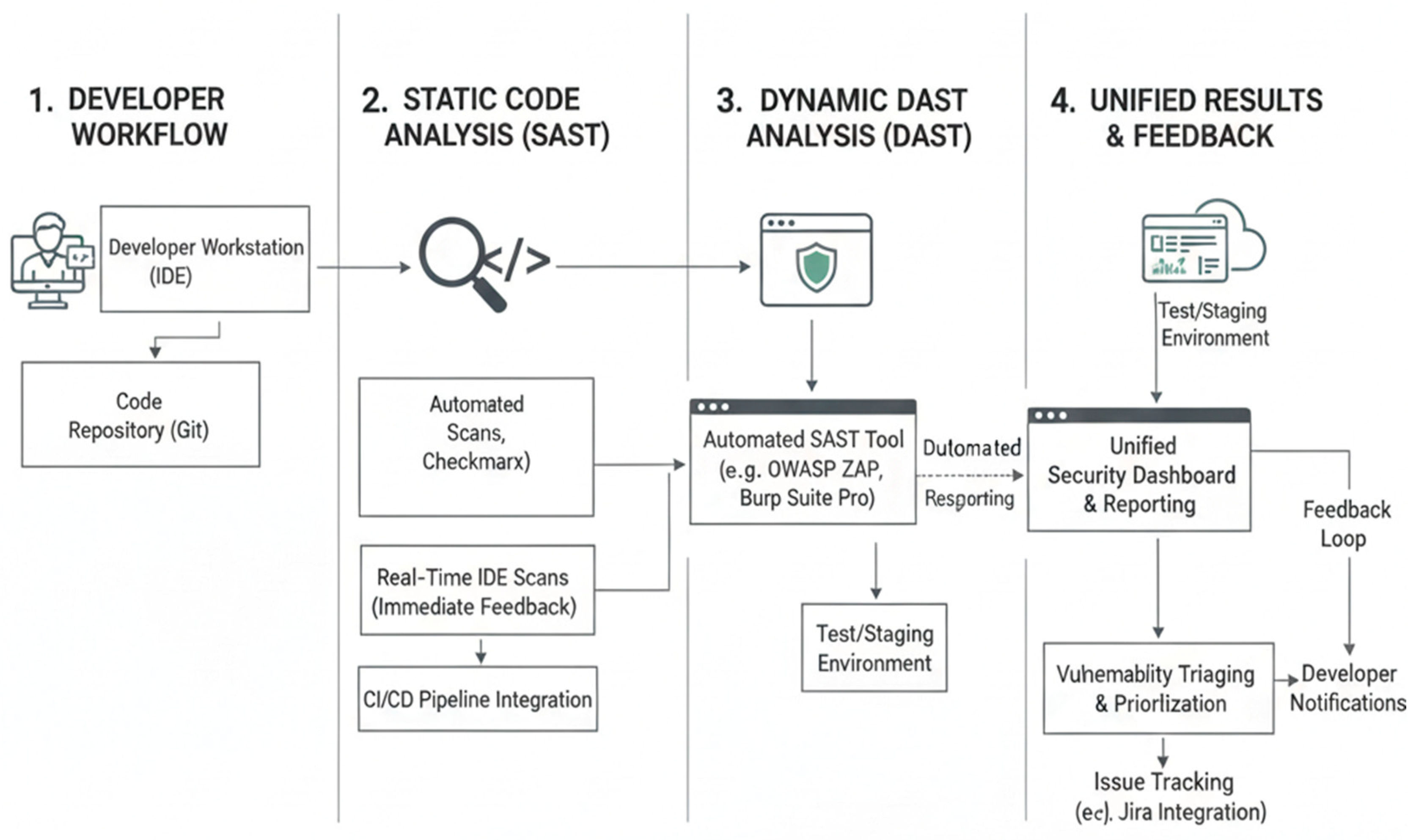
Figure 1.
Adoption of Static and Dynamic Code Analysis in Software Development Environments.
4.2. Rule-Based and Pattern-Based Vulnerability Identification
Once the code is parsed, static analyzers apply a set of pre-defined rules and pattern matching techniques to identify potential security weaknesses [28]. Rule-based detection uses security patterns, often derived from industry standards or vulnerability databases, to flag unsafe code constructs like buffer overflows or injection points.
Pattern-based identification involves scanning for known risky code snippets or anti-patterns. Together, these techniques provide a scalable mechanism to automate vulnerability detection, reducing reliance on manual code reviews and enabling early interception of defects [30].
4.3. Preventing OWASP Top 10 & Logic Flaws via SAST
Static Application Security Testing (SAST) tools are specialized static analyzers designed to detect vulnerabilities aligned with the OWASP Top 10, such as injection flaws, broken authentication, and sensitive data exposure [31]. They also identify complex logic flaws that can lead to business logic attacks.
By embedding SAST into the development lifecycle, organizations can systematically enforce secure coding standards, catching both common and sophisticated vulnerabilities before release [32]. This proactive approach decreases remediation costs and strengthens application security posture.
4.4. Integrating SCA (Software Composition Analysis) for Dependency Risks
Modern applications increasingly rely on third-party libraries and components, introducing dependency-related vulnerabilities [34]. Software Composition Analysis (SCA) complements static analysis by scanning these dependencies for known security issues and license compliance.
Integrating SCA into static code analysis workflows enables holistic vulnerability management, covering both in-house code and external components. It helps quantify risk exposure from dependencies, providing remediation recommendations [36]. This integration broadens the protective coverage of static analysis, ensuring comprehensive early vulnerability detection.
5. Dynamic Code Analysis for Runtime Security Validation
5.1. Execution-Level Monitoring and Behavior Profiling
Dynamic code analysis focuses on observing software behavior during actual execution to identify runtime vulnerabilities that static analysis alone cannot detect [38]. Execution-level monitoring instruments the running application, tracking control flows, API calls, and data manipulations to build detailed behavior profiles.
These profiles help to discover anomalies like invalid pointer dereferences, improper resource handling, and unauthorized data access [40]. By analyzing inputs and outputs correlated with internal states over time, dynamic analysis can reveal hidden bugs and security flaws exposed only under specific runtime conditions or workloads.
5.2. DAST Approaches for Web, Mobile, and Cloud Workloads
Dynamic Application Security Testing (DAST) techniques simulate real-world attacks on active applications across diverse environments including web, mobile, and cloud platforms [43]. DAST tools act like automated penetration testers by probing interfaces, submitting crafted malicious inputs, and analyzing application responses to detect vulnerabilities such as SQL injection, cross-site scripting (XSS), and authentication weaknesses.
DAST’s strength lies in its ability to validate the effectiveness of runtime defences and catch flaws arising from configuration errors or runtime dependencies typically missed by static methods.
5.3. Vulnerability Exploit Simulation and Fuzz Testing
Dynamic analysis leverages vulnerability exploit simulation and fuzz testing to generate a broad spectrum of unexpected or invalid inputs, systematically testing application robustness [46]. Fuzzing tools inject randomized or malformed data to trigger crashes, memory corruption, or logic errors, illuminating weak points unable to handle anomalous conditions.
Exploit simulation further tests specific known vulnerabilities by actively attempting to compromise security controls, enabling early detection of exploitable paths and validation of remediation effectiveness [47].
5.4. Memory Corruption, Leakage, and Runtime Integrity Checks
Detecting memory-related vulnerabilities such as buffer overflows, memory leaks, and use-after-free errors is a critical aspect of dynamic analysis [49]. Instrumentation techniques monitor memory allocation and access patterns during execution to identify corruptions and leaks that compromise application stability and security.
Runtime integrity checks ensure that critical application states remain unaltered by malicious actions, maintaining trustworthiness across the lifecycle [51]. These checks can be mathematically represented as invariants that must hold during execution sequences :
where any violation signals a potential runtime integrity breach requiring investigation.
6. Automated Security Toolchains in Development Environments
6.1. Integration in IDEs (VS Code, IntelliJ, Eclipse)
Modern integrated development environments (IDEs) such as Visual Studio Code, IntelliJ, and Eclipse provide native or extensible support for automated security toolchains [52]. These integrations enable developers to receive immediate feedback on code quality and security issues as they write code, promoting a shift-left security approach.
Static Application Security Testing (SAST), Software Composition Analysis (SCA), and linting tools are commonly embedded via plugins or extensions, streamlining vulnerability detection within the developer’s workflow [53]. Early detection through IDE integration reduces context switching and accelerates remediation, reinforcing secure coding practices in real time.
6.2. Secure CI/CD Pipeline Automation (Jenkins, GitLab, GitHub Actions)
In continuous integration and continuous delivery (CI/CD) environments, automated security toolchains are orchestrated to perform security validations seamlessly as part of build and deployment processes [60]. Tools like Jenkins, GitLab CI, and GitHub Actions facilitate the automated execution of static and dynamic scans, dependency analysis, and configuration checks.
By embedding security tests into pipelines, organizations enforce pre-deployment security gates and ensure that only builds passing defined security criteria proceed to production [62]. This automation accelerates feedback loops and enables rapid, consistent application of security policies at scale.
6.3. Policy-Driven Security Gates and Build Breakers
Policy-driven security gates act as automated enforcement points within the development pipeline that assess build artifacts against predefined security thresholds [64]. If security violations exceed accepted limits (e.g., number or severity of vulnerabilities), build breakers automatically halt progress, preventing insecure code from advancing.
These gates are defined through security policies codified as rules or thresholds, enabling repeatable and auditable compliance enforcement [66]. Formally, if is the vulnerability count in a build and the threshold, the build passes only if: This mechanism ensures rigorous gatekeeping aligned with organizational risk appetites and regulatory requirements.
6.4. Version Control Integration and Pre-Commit Hooks
Automated security is further strengthened by integrating analysis tools directly with version control systems such as Git [69]. Pre-commit hooks run security checks on code changes before they are committed, catching vulnerabilities early in the versioning process. These hooks can trigger lightweight scans, enforce coding standards, and reject commits with violations, embedding security controls within developers’ everyday version control activities.
This integration minimizes the propagation of insecure code and supports traceability and accountability across the development lifecycle [70].
7. Frameworks and Tools Supporting Static & Dynamic Analysis
7.1. SAST Tools
Static Application Security Testing (SAST) tools analyze source code or binaries without executing them to identify security vulnerabilities early in the development lifecycle [71]. SonarQube offers comprehensive code quality analysis with security rules integrated for multiple languages, seamlessly fitting into CI/CD pipelines.
Veracode provides cloud-based SAST with automation and detailed vulnerability prioritization, supporting large, multi-language projects. CodeQL leverages semantic code queries to detect complex patterns and security weaknesses with precision. Checkmarx is widely recognized for its scalable SAST capabilities combined with actionable remediation guidance [73]. These tools collectively facilitate early flaw detection, supporting compliance and reducing post-release defects.
7.2. DAST Tools
Dynamic Application Security Testing (DAST) tools operate on running applications to simulate real attack scenarios and identify runtime vulnerabilities. OWASP ZAP is a popular open-source scanner that performs automated and manual security testing for web applications [75]. Burp Suite integrates powerful proxy and scanner capabilities, widely favored for penetration testing and vulnerability verification.
Netsparker provides fully automated discovery of security flaws in web applications with proof-of-exploit functionality [77]. DAST tools are essential for uncovering issues like SQL injection, cross-site scripting (XSS), and authentication bypasses that manifest in live environments, complementing static analysis by validating defenses under operational conditions.
7.3. Hybrid Testing Systems and AI-Driven Scanning Tools
Hybrid testing systems combine static and dynamic analysis techniques to provide comprehensive vulnerability coverage across different stages of development and deployment [79]. Interactive Application Security Testing (IAST) tools monitor applications internally during runtime, offering real-time feedback with code-level context.
AI-driven scanning tools leverage machine learning models to predict vulnerabilities, reduce false positives, and optimize scanning efficiency by learning from historical data and evolving threat intelligence [80]. These advanced platforms enhance detection accuracy, adapt to new attack vectors, and integrate smoothly with DevSecOps pipelines, representing the next evolution in proactive, automated software security testing.
Mathematically, if indicates vulnerabilities detected by SAST and by DAST, the combined detection by hybrid tools is represented as:
maximizing vulnerability coverage and strengthening software security posture.
8. Use Cases and Case Studies
8.1. Enterprise CI Pipeline Security Integration
Large enterprises increasingly embed automated security tools within their Continuous Integration (CI) pipelines to proactively identify vulnerabilities during software builds [82]. For example, Hashgraph implemented Step Security’s platform to monitor outbound traffic, prevent source code tampering, and secure third-party GitHub Actions. This integration provided a unified visibility dashboard, enabling rapid detection of incidents and improving their security posture.
Automated security controls and policy enforcement led to consistent security across repositories, reduced manual overhead, and faster vulnerability remediation, demonstrating how CI pipeline security can scale across complex organizational operations [83].
8.2. Secure Software Release Workflow in Cloud-Native Apps
Cloud-native applications leveraged by financial services and e-commerce firms highlight the importance of integrating security early and continuously within CI/CD pipelines [85]. They embed static and dynamic application security testing, as well as software composition analysis to tackle dependency risks.
These workflows allow automated security audits at multiple pipeline stages from code commit to deployment ensuring vulnerabilities are detected and remediated before production [86]. Such holistic security integration enhances regulatory compliance, reduces risks associated with third-party components, and increases customer trust through safer application releases.
8.3. Application Security in IoT and Embedded Systems
Securing IoT and embedded systems presents unique challenges due to constrained environments and diverse hardware platforms. Case studies showcase the use of tailored static analysis tools and runtime monitoring integrated into secure build workflows for embedded firmware [87]. Early vulnerability detection in device drivers and communication protocols is critical to minimizing attack surfaces.
Furthermore, lightweight dynamic analysis and behavior profiling during device testing phases reveal runtime anomalies without impacting performance [88]. These practices ensure that devices deployed in critical infrastructure or consumer markets maintain robust security against evolving threats.
In deploying these use cases, organizations often quantify risk reduction as a function of detection effectiveness , remediation speed , and compliance adherence , expressed as:
where improvements in any factor contribute to lowering overall operational risk [89]. These practical applications reaffirm the value of integrated automated security toolchains and continuous validation in diverse, high-stakes software environments.
9. Quality Assurance and Performance Benefits
9.1. Reduction in Defect Density and Technical Debt
Automated security toolchains significantly reduce defect density, which measures the number of defects per unit size of software such as per thousand lines of code [90]. Early vulnerability detection through static and dynamic analysis prevents defect propagation and accumulation, thereby lowering technical debt unresolved flaws that complicate future development. Defect density can be calculated as:
where is the number of defects detected and the size of the codebase. This measurable reduction in defects leads to lower long-term maintenance costs and improved software stability.
9.2. Improved Code Maintainability and Review Efficiency
By embedding automated code checks, tools assist in enforcing coding standards and identifying issues before manual reviews, increasing reviewer focus on complex concerns rather than basic errors.
This enhances maintainability as cleaner, standardized code is easier to update and understand [91]. Review efficiency improves since automated tools provide preliminary filtering, reducing review cycle times and enabling more targeted interventions.
9.3. Faster Release Cycles Through Early-Fix Initiatives
Automated testing and security scans integrated into CI/CD pipelines enable early identification and remediation of vulnerabilities, minimizing bottlenecks near release [92]. Metrics such as Mean Time to Remediate (MTTR) track the average time from defect detection to resolution the lower the MTTR, the faster the release cycles. Mathematically, if is the remediation time for defect , the average MTTR is:
Accelerating defect fixes reduces production downtime and accelerates time-to-market while maintaining high security and quality standards.
10. Challenges and Limitations
10.1. False Positives, False Negatives, and Tool Noise
Automated security tools often face the challenge of producing false positives alerts flagging non-existent vulnerabilities and false negatives overlooking actual vulnerabilities. False positives create "alert fatigue," overwhelming security teams with excessive noise and leading to delays in genuine issue resolution or even complacency towards warnings. False negatives are critical as undetected vulnerabilities pose security risks, potentially exploited in production.
Reducing false positives requires meticulous tool calibration, context-aware scanning, and correlation of findings across multiple tools. However, false negatives result from limited coverage or insufficient testing scenarios, underscoring the need for updated, comprehensive vulnerability databases and threat modelling integration to guide testing focus.
10.2. Performance Overheads and Build Delays
Security analyses, especially deep static or dynamic scans, can impose significant performance overheads, extend build times and impact developer productivity. Lengthy scans cause delays in CI/CD pipelines, particularly in large, complex codebases or when multiple security tools run concurrently.
This trade-off between thoroughness and speed demands optimization strategies like incremental scans, parallelization, selective scanning, and risk-based prioritization to minimize disruptions while maintaining security rigor.
10.3. Limited Support for Proprietary Frameworks and Legacy Systems
Many automated tools have limited compatibility with proprietary, custom-built frameworks or legacy systems with outdated technologies [93]. Such environments may not be fully analyzable due to lack of tooling support, resulting in coverage gaps and blind spots in security assessments.
Addressing this limitation often requires tailored tooling extensions, manual reviews, or hybrid assessments combining automated and manual testing to ensure comprehensive coverage.
Conclusion and Future Enhancements
Automated security toolchains have become an indispensable component of modern software development, enabling early vulnerability detection, consistent enforcement of security policies, and continuous quality assurance. These integrated systems optimize security testing by combining static and dynamic analysis, thereby reducing defect density and technical debt while accelerating release cycles. As software environments grow more complex and heterogeneous, automated security toolchains help maintain resilience and compliance at scale.
Looking ahead, future enhancements are expected to center around advanced AI and machine learning integration, which will drive autonomous threat detection, predictive vulnerability management, and automated remediation efforts. Intelligent orchestration across multiple security tools will enable dynamic decision-making and seamless incident response with minimal human intervention. Additionally, improvements in automation optimization, including false positive reduction and performance tuning, will make security toolchains more efficient and developer-friendly. Emerging paradigms such as zero-trust automation and continuous cloud security validation will further strengthen defences by dynamically adapting to evolving threats.
Ultimately, the future of automated security toolchains lies in creating self-healing, adaptive security frameworks that seamlessly integrate into DevSecOps pipelines, empowering organizations to safeguard their software assets proactively and deliver secure applications rapidly despite increasing cyber risks.
References
- Jayalakshmi, N., & Sakthivel, K. (2024, December). A Hybrid Approach for Automated GUI Testing Using Quasi-Oppositional Genetic Sparrow Search Algorithm. In 2024 International Conference on Innovative Computing, Intelligent Communication and Smart Electrical Systems (ICSES) (pp. 1-7). IEEE.
- Sharma, A., Gurram, N. T., Rawal, R., Mamidi, P. L., & Gupta, A. S. G. (2025). Enhancing educational outcomes through cloud computing and data-driven management systems. Vascular and Endovascular Review, 8(11s), 429-435.
- Tatikonda, R., Thatikonda, R., Potluri, S. M., Thota, R., Kalluri, V. S., & Bhuvanesh, A. (2025, May). Data-Driven Store Design: Floor Visualization for Informed Decision Making. In 2025 International Conference in Advances in Power, Signal, and Information Technology (APSIT) (pp. 1-6). IEEE.
- Rajgopal, P. R. (2025). Secure Enterprise Browser-A Strategic Imperative for Modern Enterprises. International Journal of Computer Applications, 187(33), 53-66. [CrossRef]
- Chowdhury, P. (2025). Sustainable manufacturing 4.0: Tracking carbon footprint in SAP digital manufacturing with IoT sensor networks. Frontiers in Emerging Computer Science and Information Technology, 2(09), 12-19. [CrossRef]
- Sayyed, Z. (2025). Development of a simulator to mimic VMware vCloud Director (VCD) API calls for cloud orchestration testing. International Journal of Computational and Experimental Science and Engineering, 11(3). [CrossRef]
- Gupta, A., & Rajgopal, P. R. (2025). Cybersecurity platformization: Transforming enterprise security in an AI-driven, threat-evolving digital landscape. International Journal of Computer Applications, 186(80), 19-28. [CrossRef]
- Rajgopal, P. R. (2025). MDR service design: Building profitable 24/7 threat coverage for SMBs. International Journal of Applied Mathematics, 38(2s), 1114-1137. [CrossRef]
- Sharma, P., Naveen, S., JR, M. D., Sukla, B., Choudhary, M. P., & Gupta, M. J. (2025). Emotional Intelligence And Spiritual Awareness: A Management-Based Framework To Enhance Well-Being In High-Stressed Surgical Environments. Vascular and Endovascular Review, 8(10s), 53-62.
- Atheeq, C., Sultana, R., Sabahath, S. A., & Mohammed, M. A. K. (2024). Advancing IoT Cybersecurity: adaptive threat identification with deep learning in Cyber-physical systems. Engineering, Technology & Applied Science Research, 14(2), 13559-13566. [CrossRef]
- Ainapure, B., Kulkarni, S., & Janarthanan, M. (2025, December). Performance Comparison of GAN-Augmented and Traditional CNN Models for Spinal Cord Tumor Detection. In Sustainable Global Societies Initiative (Vol. 1, No. 1). Vibrasphere Technologies.
- Ainapure, B., Kulkarni, S., & Chakkaravarthy, M. (2025). TriDx: a unified GAN-CNN-GenAI framework for accurate and accessible spinal metastases diagnosis. Engineering Research Express, 7(4), 045241. [CrossRef]
- Shanmuganathan, C., & Raviraj, P. (2011, September). A comparative analysis of demand assignment multiple access protocols for wireless ATM networks. In International Conference on Computational Science, Engineering and Information Technology (pp. 523-533). Berlin, Heidelberg: Springer Berlin Heidelberg.
- Mulla, R., Potharaju, S., Tambe, S. N., Joshi, S., Kale, K., Bandishti, P., & Patre, R. (2025). Predicting Player Churn in the Gaming Industry: A Machine Learning Framework for Enhanced Retention Strategies. Journal of Current Science and Technology, 15(2), 103-103. [CrossRef]
- Shinkar, A. R., Joshi, D., Praveen, R. V. S., Rajesh, Y., & Singh, D. (2024, December). Intelligent solar energy harvesting and management in IoT nodes using deep self-organizing maps. In 2024 International Conference on Emerging Research in Computational Science (ICERCS) (pp. 1-6). IEEE.
- Ainapure, B., & Appasani, B. (2025). Machine Learning Algorithms and Sustainable AI-Driven IoT Systems: Paving the Way toward Environmental Stewardship. In Leveraging Artificial Intelligence in Cloud, Edge, Fog and Mobile Computing (pp. 217-234). Auerbach Publications.
- Raja, M. W., & Nirmala, D. K. (2016). Agile development methods for online training courses web application development. International Journal of Applied Engineering Research ISSN, 0973-4562.
- Vikram, V., & Soundararajan, A. S. (2021). Durability studies on the pozzolanic activity of residual sugar cane bagasse ash sisal fibre reinforced concrete with steel slag partially replacement of coarse aggregate. Caribb. J. Sci, 53, 326-344.
- Sayyed, Z. (2025). Application level scalable leader selection algorithm for distributed systems. International Journal of Computational and Experimental Science and Engineering, 11(3). [CrossRef]
- Inamdar, S. V., Kumar, R., & Chow, S. (2023). U.S. Patent No. 11,727,327. Washington, DC: U.S. Patent and Trademark Office.
- Siddiqui, A., Chand, K., & Shahi, N. C. (2021). Effect of process parameters on extraction of pectin from sweet lime peels. Journal of The Institution of Engineers (India): Series A, 102(2), 469-478. [CrossRef]
- Palaniappan, S., Joshi, S. S., Sharma, S., Radhakrishnan, M., Krishna, K. M., & Dahotre, N. B. (2024). Additive manufacturing of FeCrAl alloys for nuclear applications-A focused review. Nuclear Materials and Energy, 40, 101702. [CrossRef]
- Chowdhury, P. (2025). Global MES Rollout Strategies: Overcoming Localization Challenges in Multi-Country Deployments. Emerging Frontiers Library for The American Journal of Applied Sciences, 7(07), 30-38. [CrossRef]
- Inbaraj, R., & Ravi, G. (2021). Content Based Medical Image Retrieval System Based On Multi Model Clustering Segmentation And Multi-Layer Perception Classification Methods. Turkish Online Journal of Qualitative Inquiry, 12(7).
- Kumar, N., Kurkute, S. L., Kalpana, V., Karuppannan, A., Praveen, R. V. S., & Mishra, S. (2024, August). Modelling and Evaluation of Li-ion Battery Performance Based on the Electric Vehicle Tiled Tests using Kalman Filter-GBDT Approach. In 2024 International Conference on Intelligent Algorithms for Computational Intelligence Systems (IACIS) (pp. 1-6). IEEE.
- Saravanan, V., Sumalatha, A., Reddy, D. N., Ahamed, B. S., & Udayakumar, K. (2024, October). Exploring Decentralized Identity Verification Systems Using Blockchain Technology: Opportunities and Challenges. In 2024 5th IEEE Global Conference for Advancement in Technology (GCAT) (pp. 1-6). IEEE.
- Akat, G. B. (2022). OPTICAL AND ELECTRICAL STUDY OF SODIUM ZINC PHOSPHATE GLASS. MATERIAL SCIENCE, 21(05).
- Approximation of Coefficients Influencing Robot Design Using FFNN with Bayesian Regularized LMBPA.
- Naveen, S., & Sharma, P. (2025). Physician Well-Being and Burnout:" The Correlation Between Duty Hours, Work-Life Balance, And Clinical Outcomes In Vascular Surgery Trainees". Vascular and Endovascular Review, 8(6s), 389-395. [CrossRef]
- Rajgopal, P. R. (2025). SOC Talent Multiplication: AI Copilots as Force Multipliers in Short-Staffed Teams. International Journal of Computer Applications, 187(48), 46-62. [CrossRef]
- Atmakuri, A., Sahoo, A., Mohapatra, Y., Pallavi, M., Padhi, S., & Kiran, G. M. (2025). Securecloud: Enhancing protection with MFA and adaptive access cloud. In Advances in Electrical and Computer Technologies (pp. 147-152). CRC Press.
- Sharma, N., Gurram, N. T., Siddiqui, M. S., Soorya, D. A. M., Jindal, S., & Kalita, J. P. (2025). Hybrid Work Leadership: Balancing Productivity and Employee Well-being. Vascular and Endovascular Review, 8(11s), 417-424.
- Mahesh, K., & Balaji, D. P. (2022). A Study on Impact of Tamil Nadu Premier League Before and After in Tamil Nadu. International Journal of Physical Education Sports Management and Yogic Sciences, 12(1), 20-27. [CrossRef]
- Sultana, R., Ahmed, N., & Sattar, S. A. (2018). HADOOP based image compression and amassed approach for lossless images. Biomedical Research, 29(8), 1532-1542.
- Venkiteela, P. (2024). Strategic API modernization using Apigee X for enterprise transformation. Journal of Information Systems Engineering and Management.
- Kumar, J. D. S. (2015). Investigation on secondary memory management in wireless sensor network. Int J Comput Eng Res Trends, 2(6), 387-391.
- Lopez, S., Sarada, V., Praveen, R. V. S., Pandey, A., Khuntia, M., & Haralayya, D. B. (2024). Artificial intelligence challenges and role for sustainable education in india: Problems and prospects. Sandeep Lopez, Vani Sarada, RVS Praveen, Anita Pandey, Monalisa Khuntia, Bhadrappa Haralayya (2024) Artificial Intelligence Challenges and Role for Sustainable Education in India: Problems and Prospects. Library Progress International, 44(3), 18261-18271.
- Joshi, S., & Kumar, A. (2020). Multimodal biometrics system design using score level fusion approach. Int. J. Emerg. Technol, 11(3), 1005-1014.
- Thota, R., Potluri, S. M., Kaki, B., & Abbas, H. M. (2025, June). Financial Bidirectional Encoder Representations from Transformers with Temporal Fusion Transformer for Predicting Financial Market Trends. In 2025 International Conference on Intelligent Computing and Knowledge Extraction (ICICKE) (pp. 1-5). IEEE.
- Dachawar, M., Ainapure, B., Tong, V., & Hegde, M. (2025, August). The Evolution of Artificial Intelligence Enhanced Enterprise Resource Planning in Higher Education: A Comprehensive Meta-Data Analysis. In 2025 3rd International Conference on Sustainable Computing and Data Communication Systems (ICSCDS) (pp. 1574-1582). IEEE.
- ROBERTS, T. U., Polleri, A., Kumar, R., Chacko, R. J., Stanesby, J., & Yordy, K. (2022). U.S. Patent No. 11,321,614. Washington, DC: U.S. Patent and Trademark Office.
- Kumar, J., Radhakrishnan, M., Palaniappan, S., Krishna, K. M., Biswas, K., Srinivasan, S. G., ... & Dahotre, N. B. (2024). Cr content dependent lattice distortion and solid solution strengthening in additively manufactured CoFeNiCrx complex concentrated alloys–a first principles approach. Materials Today Communications, 40, 109485. [CrossRef]
- Parasar, D., & Rathod, V. R. (2017). Particle swarm optimisation K-means clustering segmentation of foetus ultrasound image. International Journal of Signal and Imaging Systems Engineering, 10(1-2), 95-103.
- Venkiteela, P. (2025). Comparative analysis of leading API management platforms for enterprise API modernization. International Journal of Computer Applications. [CrossRef]
- Sultana, R., Bilfagih, S. M., & Sabahath, S. A. (2021). A Novel Machine Learning system to control Denial-of-Services Attacks. Design Engineering, 3676-3683.
- Praveen, R. V. S., Hemavathi, U., Sathya, R., Siddiq, A. A., Sanjay, M. G., & Gowdish, S. (2024, October). AI Powered Plant Identification and Plant Disease Classification System. In 2024 4th International Conference on Sustainable Expert Systems (ICSES) (pp. 1610-1616). IEEE.
- Appaji, I., & Raviraj, P. (2020, February). Vehicular Monitoring Using RFID. In International Conference on Automation, Signal Processing, Instrumentation and Control (pp. 341-350). Singapore: Springer Nature Singapore.
- Nimma, D., Rao, P. L., Ramesh, J. V. N., Dahan, F., Reddy, D. N., Selvakumar, V., ... & Jangir, P. (2025). Reinforcement Learning-Based Integrated Risk Aware Dynamic Treatment Strategy for Consumer-Centric Next-Gen Healthcare. IEEE Transactions on Consumer Electronics. [CrossRef]
- Raja, M. W. (2024). Artificial intelligence-based healthcare data analysis using multi-perceptron neural network (MPNN) based on optimal feature selection. SN Computer Science, 5(8), 1034. [CrossRef]
- Mukherjee, D., Mani, S., Sinha, V. S., Ananthanarayanan, R., Srivastava, B., Dhoolia, P., & Chowdhury, P. (2010, July). AHA: Asset harvester assistant. In 2010 IEEE International Conference on Services Computing (pp. 425-432). IEEE.
- Patil, P. R., Parasar, D., & Charhate, S. (2024). Wrapper-based feature selection and optimization-enabled hybrid deep learning framework for stock market prediction. International Journal of Information Technology & Decision Making, 23(01), 475-500. [CrossRef]
- Zahir, S. (2025). Custom Email Template Creation Using Mustache for Scalable Communication. International journal of signal processing, embedded systems and VLSI design, 5(01), 35-61. [CrossRef]
- Naveen, S., Sharma, P., Veena, A., & Ramaprabha, D. (2025). Digital HR Tools and AI Integration for Corporate Management: Transforming Employee Experience. In Corporate Management in the Digital Age (pp. 69-100). IGI Global Scientific Publishing.
- Satheesh, N., & Sakthivel, K. (2024, December). A Novel Machine Learning-Enhanced Swarm Intelligence Algorithm for Cost-Effective Cloud Load Balancing. In 2024 International Conference on Innovative Computing, Intelligent Communication and Smart Electrical Systems (ICSES) (pp. 1-7). IEEE.
- Radhakrishnan, M., Sharma, S., Palaniappan, S., Pantawane, M. V., Banerjee, R., Joshi, S. S., & Dahotre, N. B. (2024). Influence of thermal conductivity on evolution of grain morphology during laser-based directed energy deposition of CoCrxFeNi high entropy alloys. Additive Manufacturing, 92, 104387. [CrossRef]
- Sahoo, A. K., Prusty, S., Swain, A. K., & Jayasingh, S. K. (2025). Revolutionizing cancer diagnosis using machine learning techniques. In Intelligent Computing Techniques and Applications (pp. 47-52). CRC Press.
- Praveen, R. V. S. (2024). Data Engineering for Modern Applications. Addition Publishing House.
- Nimavat, K. K., & Kumar, R. (2025). U.S. Patent No. 12,260,303. Washington, DC: U.S. Patent and Trademark Office.
- Sahoo, P. A. K., Aparna, R. A., Dehury, P. K., & Antaryami, E. (2024). Computational techniques for cancer detection and risk evaluation. Industrial Engineering, 53(3), 50-58.
- Gurram, N. T., Narender, M., Bhardwaj, S., & Kalita, J. P. (2025). A Hybrid Framework for Smart Educational Governance Using AI, Blockchain, and Data-Driven Management Systems. Advances in Consumer Research, 2(5).
- Inbaraj, R., & Ravi, G. (2021). Multi Model Clustering Segmentation and Intensive Pragmatic Blossoms (Ipb) Classification Method based Medical Image Retrieval System. Annals of the Romanian Society for Cell Biology, 25(3), 7841-7852.
- Juneja, M., & Juneja, P. (2025). The Rise of The Tech-Business Translator in The Age Of AI. International Research Journal of Advanced Engineering and Technology, 2(06), 05-15.
- Jadhav, Y., Patil, V., & Parasar, D. (2020, February). Machine learning approach to classify birds on the basis of their sound. In 2020 International Conference on Inventive Computation Technologies (ICICT) (pp. 69-73). IEEE.
- Suman, P., Parasar, D., & Rathod, V. R. (2015, December). Seeded region growing segmentation on ultrasound image using particle swarm optimization. In 2015 IEEE International Conference on Computational Intelligence and Computing Research (ICCIC) (pp. 1-6). IEEE.
- Akat, G. B. (2021). EFFECT OF ATOMIC NUMBER AND MASS ATTENUATION COEFFICIENT IN Ni-Mn FERRITE SYSTEM. MATERIAL SCIENCE, 20(06).
- Boopathy, D., & Balaji, P. (2023). Effect of different plyometric training volume on selected motor fitness components and performance enhancement of soccer players. Ovidius University Annals, Series Physical Education and Sport/Science, Movement and Health, 23(2), 146-154.
- Venkiteela, P. (2025). Real-Time Identity Federation: Replacing File-Based Sync with Okta APIs for GDPR-Compliant. European Journal of Information Technologies and Computer Science, 5(5), 7-13. [CrossRef]
- Joshi, S., & Kumar, A. (2011). Correlation Filter based on Fingerprint Verification System. In International Conference on VLSI, Communication and Instrumentation (pp. 19-22).
- Ganeshan, M. K., & Vethirajan, C. (2021). Trends and future of human resource management in the 21st century. Review of Management, Accounting, and Business Studies, 2(1), 17-21. [CrossRef]
- Samal, D. A., Sharma, P., Naveen, S., Kumar, K., Kotehal, P. U., & Thirulogasundaram, V. P. (2024). Exploring the role of HR analytics in enhancing talent acquisition strategies. South Eastern European Journal of Public Health, 23(3), 612-618. [CrossRef]
- Kamatchi, S., Preethi, S., Kumar, K. S., Reddy, D. N., & Karthick, S. (2025, May). Multi-Objective Genetic Algorithm Optimised Convolutional Neural Networks for Improved Pancreatic Cancer Detection. In 2025 3rd International Conference on Data Science and Information System (ICDSIS) (pp. 1-7). IEEE.
- Gupta, I. A. K. Blockchain-Based Supply Chain Optimization For Eco-Entrepreneurs: Enhancing Transparency And Carbon Footprint Accountability. International Journal of Environmental Sciences, 11(17s), 2025.
- Praveen, R. V. S., Hundekari, S., Parida, P., Mittal, T., Sehgal, A., & Bhavana, M. (2025, February). Autonomous Vehicle Navigation Systems: Machine Learning for Real-Time Traffic Prediction. In 2025 International Conference on Computational, Communication and Information Technology (ICCCIT) (pp. 809-813). IEEE.
- Mohammed Nabi Anwarbasha, G. T., Chakrabarti, A., Bahrami, A., Venkatesan, V., Vikram, A. S. V., Subramanian, J., & Mahesh, V. (2023). Efficient finite element approach to four-variable power-law functionally graded plates. Buildings, 13(10), 2577. [CrossRef]
- Juneja, M. (2025). Mentr: A Modular, On Demand Mentorship Platform for Personalized Learning and Guidance. The American Journal of Engineering and Technology, 7(06), 144-152. [CrossRef]
- Polleri, A., Kumar, R., Bron, M. M., Chen, G., Agrawal, S., & Buchheim, R. S. (2022). U.S. Patent Application No. 17/303,918.
- Sayyed, Z. (2025). Optimizing Callback Service Architecture for High-Throughput Applications. International journal of data science and machine learning, 5(01), 257-279. [CrossRef]
- Vidyabharathi, D., Mohanraj, V., Kumar, J. S., & Suresh, Y. (2023). Achieving generalization of deep learning models in a quick way by adapting T-HTR learning rate scheduler. Personal and Ubiquitous Computing, 27(3), 1335-1353. [CrossRef]
- Radhakrishnan, M., Sharma, S., Palaniappan, S., & Dahotre, N. B. (2024). Evolution of microstructures in laser additive manufactured HT-9 ferritic martensitic steel. Materials Characterization, 218, 114551. [CrossRef]
- Chowdhury, P. (2025). GENERATIVE AI FOR MES OPTIMIZATION LLM-DRIVEN DIGITAL MANUFACTURING CONFIGURATION RECOMMENDATION. International Journal of Applied Mathematics, 38(7s), 875-890. [CrossRef]
- Nasir, G., Chand, K., Azaz Ahmad Azad, Z. R., & Nazir, S. (2020). Optimization of Finger Millet and Carrot Pomace based fiber enriched biscuits using response surface methodology. Journal of Food Science and Technology, 57(12), 4613-4626. [CrossRef]
- Akat, G. B., & Magare, B. K. (2022). Mixed Ligand Complex Formation of Copper (II) with Some Amino Acids and Metoprolol. Asian Journal of Organic & Medicinal Chemistry.
- Thota, R., Potluri, S. M., Alzaidy, A. H. S., & Bhuvaneshwari, P. (2025, June). Knowledge Graph Construction-Based Semantic Web Application for Ontology Development. In 2025 International Conference on Intelligent Computing and Knowledge Extraction (ICICKE) (pp. 1-6). IEEE.
- RAJA, M. W., PUSHPAVALLI, D. M., BALAMURUGAN, D. M., & SARANYA, K. (2025). ENHANCED MED-CHAIN SECURITY FOR PROTECTING DIABETIC HEALTHCARE DATA IN DECENTRALIZED HEALTHCARE ENVIRONMENT BASED ON ADVANCED CRYPTO AUTHENTICATION POLICY. TPM–Testing, Psychometrics, Methodology in Applied Psychology, 32(S4 (2025): Posted 17 July), 241-255.
- Venkiteela, P. (2025). A Vendor-Agnostic Multi-Cloud Integration Framework Using Boomi and SAP BTP. Journal of Engineering Research and Sciences, 4(12), 1-14.
- Akat, G. B. (2023). Structural Analysis of Ni1-xZnxFe2O4 Ferrite System. MATERIAL SCIENCE, 22(05).
- Sivakumar, S., Prakash, R., Srividhya, S., & Vikram, A. V. (2023). A novel analytical evaluation of the laboratory-measured mechanical properties of lightweight concrete. Structural engineering and mechanics: An international journal, 87(3), 221-229.
- Inbaraj, R., John, Y. M., Murugan, K., & Vijayalakshmi, V. (2025). Enhancing medical image classification with cross-dimensional transfer learning using deep learning. 1, 10(4), 389.
- Chand, K., Singh, A., & Kulshrestha, M. (2012). Jaggery quality effected by hilly climatic conditions. Indian Journal of Traditional Knowledge, 11(1), 172-176.
- ROBERTS, T. U., Polleri, A., Kumar, R., Chacko, R. J., Stanesby, J., & Yordy, K. (2023). U.S. Patent No. 11,775,843. Washington, DC: U.S. Patent and Trademark Office.
- Reddy, D. N., Venkateswararao, P., Vani, M. S., Pranathi, V., & Patil, A. (2025). HybridPPI: A Hybrid Machine Learning Framework for Protein-Protein Interaction Prediction. Indonesian Journal of Electrical Engineering and Informatics (IJEEI), 13(2).
- Balakumar, B., & Raviraj, P. (2015). Automated Detection of Gray Matter in Mri Brain Tumor Segmentation and Deep Brain Structures Based Segmentation Methodology. Middle-East Journal of Scientific Research, 23(6), 1023-1029.
- Praveen, R. V. S., Raju, A., Anjana, P., & Shibi, B. (2024, October). IoT and ML for Real-Time Vehicle Accident Detection Using Adaptive Random Forest. In 2024 Global Conference on Communications and Information Technologies (GCCIT) (pp. 1-5). IEEE.
Disclaimer/Publisher’s Note: The statements, opinions and data contained in all publications are solely those of the individual author(s) and contributor(s) and not of MDPI and/or the editor(s). MDPI and/or the editor(s) disclaim responsibility for any injury to people or property resulting from any ideas, methods, instructions or products referred to in the content. |
© 2026 by the authors. Licensee MDPI, Basel, Switzerland. This article is an open access article distributed under the terms and conditions of the Creative Commons Attribution (CC BY) license (http://creativecommons.org/licenses/by/4.0/).
Copyright: This open access article is published under a Creative Commons CC BY 4.0 license, which permit the free download, distribution, and reuse, provided that the author and preprint are cited in any reuse.


