

Submitted:
09 January 2026
Posted:
13 January 2026
You are already at the latest version
Abstract
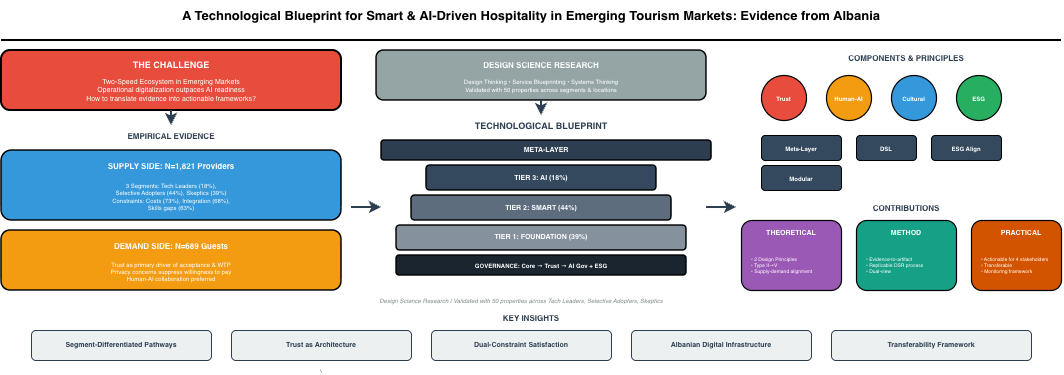
Emerging hospitality markets confront a two-speed ecosystem where operational digitalization outpaces strategic AI readiness, creating a benefit-feasibility gap. Providers recognize substantial technology value yet face implementation constraints from costs, integration complexity, and skills shortages, while guests demonstrate acceptance conditional on trust with privacy concerns suppressing willingness to pay. Drawing on dual-perspective empirical evidence derived from Albania's accommodation sector, integrating a national provider readiness assessment and a guest acceptance study, this Design Science Research study develops a segment-differentiated technological blueprint through systematic integration of Design Thinking, service blueprinting, and systems thinking methodologies.
Integrated TAM-TOE-DOI framework analysis reveals three distinct provider segments requiring differentiated implementation pathways: Tech Leaders positioned for AI capabilities, Selective Adopters benefiting from smart modules, and Skeptics requiring foundational capabilities. Empirical evidence establishes that regional ecosystem characteristics outweigh organizational scale in determining adoption feasibility, trust operates as gating condition moderating acceptance and financial commitment, and supply-demand misalignment creates bottlenecks invisible to single-perspective assessments.
Theoretical contributions extend TAM-TOE-DOI frameworks from explanatory constructs to design requirements, conceptualize supply-demand alignment as adoption mechanism, and generate two generalizable design principles: dual-constraint satisfaction requiring simultaneous provider feasibility and guest acceptance, and trust-as-architecture embedding trust mechanisms as structural properties. Practically, the blueprint provides differentiated guidance for policymakers, technology vendors, education providers, and accommodation providers, with transferability to Western Balkans, Mediterranean, and post-transition economies facing comparable heterogeneous readiness and resource constraints.
Keywords:
design science research
; hospitality digital transformation
; smart hospitality technologies
; technology acceptance
; emerging tourism markets
; trust-by-design
; segmentation-based implementation
1. Introduction
Building on two prior empirical investigations consisting of a national provider readiness assessment (N=1,821) [1] and a guest acceptance study (N=689) [2] , this Design Science Research study develops an evidence-based technological blueprint for smart and AI-driven hospitality adoption in emerging markets. Through systematic integration of Design Thinking, service blueprinting, and systems thinking methodologies, we translate dual-perspective empirical evidence into a modular, segment-differentiated implementation framework addressing the unique challenges of emerging hospitality ecosystems.
Over the last decade, the global hospitality industry has undergone sustained digital transformation from foundational "core" systems (property management systems, central reservation systems, channel management, booking engines, and payment processing) toward data-driven, interoperable service architectures enabling automation, personalization, and real-time operational control [3]. Recent research synthesizing digital transformation in tourism and hospitality highlights that competitive advantage increasingly depends on integrated information flows across the guest journey, organizational capabilities for data governance and analytics, and the ability to scale digital service innovation beyond isolated pilots [4,5,6]. Simultaneously, the industry's technology frontier has shifted rapidly with artificial intelligence (AI), including generative AI, being adopted for guest interaction, forecasting and revenue optimization, sentiment and reputation workflows, anomaly detection, and process automation [7]. Yet there is little commensurate maturity in cybersecurity, interoperability, and AI governance [8,9], creating a widening gap between operational digitalization (deploying individual tools) and strategic AI readiness (building the capabilities, governance, and compliant data foundations needed to implement AI responsibly at scale) [10].
In Europe, this readiness gap unfolds within the fast-moving regulatory push of the EU Artificial Intelligence Act [11], which aims to strengthen risk management, transparency, accountability, and human oversight, yet continues to face criticism for lagging technological progress, providing uneven incentives for research, and potentially discouraging exploration in high-risk or restricted AI domains [12,13]. For hospitality providers, especially small and medium-sized operations, practical challenges follow even when openness to AI-enabled services exists; implementation capacity is constrained by fragmented digital stacks, limited investment headroom, skills shortages, integration complexity, and uncertainty about compliance and data protection [14,15]. These tensions are particularly salient in emerging tourism markets, where hospitality firms frequently face a "two-speed" environment: tourism demand grows rapidly (often driven by international travel trends and market visibility), but supply-side digital maturity, financing constraints, and integration capabilities lag [16]. In such contexts, a blueprint approach proves valuable because it translates heterogeneous evidence such as technology adoption patterns, barriers, service needs, and guest expectations into staged, modular pathways realistic for providers with different starting points and constraints [17,18,19].
Albania represents a timely and policy-relevant setting for studying hospitality digital transformation in an emerging market [20,21] Positioned prominently on the international tourism stage as Host Country at ITB Berlin 2025 [22], Albania has experienced rapid growth in inbound tourism according to national and international reporting [23,24]. Parallel to rising demand, Albania has attracted major investment attention in tourism, including the entry or planned entry of 17 global hotel brand chains, signaling an upgrading accommodation market and intensifying competitive pressure on local providers [25,26]. A distinguishing feature of the Albanian context is the presence of an advanced national digital ecosystem that can lower transaction costs of business compliance and accelerate sector digitalization if hospitality technologies are designed to integrate with it rather than operate in parallel [21]. Unlike many emerging markets where digital transformation must be built from scratch, Albania offers existing digital infrastructure that hospitality providers can leverage [27].
The National Agency for Information Society (AKSHI) developed Albania's e-government platform (e-Albania) in 2015, which now provides approximately 1,254 online services representing 95% of public administrative functions through cross-register interoperability [28]. For hospitality providers, this matters because administrative friction, such as licensing, permits, tax documentation, and staff certifications, is part of the operational burden [20]. Reducing that friction creates space for providers to invest managerial attention in guest-facing and operational technology upgrades. In January 2025, AKSHI introduced Diella (meaning 'Sun' in Albanian), an AI-powered virtual assistant integrated into the e-Albania platform [29]. In its first few months, Diella answered over 390,000 inquiries, with version 3.0 enabling full interaction through voice commands, allowing citizens to complete service requests using simple conversational language [30]. The Albanian government elevated Diella to ministerial status in September 2025, positioning the AI as a tool for ensuring transparency in public procurement and combating corruption [31]. Diella represents Albania's initial steps in AI deployment and citizen acceptance, with significant challenges remaining ahead; however, this early experience with Albanian natural language processing creates opportunities for hospitality providers to explore similar design principles while leveraging e-Albania integration for streamlined licensing, tax compliance, and reporting [32,33,34].
Since 2020, Albania has implemented software-based fiscalization requiring real-time invoice declaration through the SelfCare portal, establishing a mandatory digital compliance baseline for all hospitality providers [35]. Features include XML invoice transmission, AKSHI certificate authentication, automatic VAT integration, accommodation-specific guidelines with 6% reduced VAT rate, and EU e-invoicing standards compliance (UBL 2.1, EN 16931). The existing fiscalization infrastructure means all Albanian hospitality providers, including those with minimal digital capabilities, already possess foundational digital tools. Albania has also embarked on the ambitious Cashless Albania 2030 initiative, targeting 60% digital payments by 2030, requiring all merchants to install electronic payment devices by end of 2026, and ensuring all public institutions accept electronic payments [36]. Albania's SEPA integration, achieved November 2024 with full operationalization October 2025 [37], standardizes cross-border payments aligned with European policies [38], creating a supportive environment for digitalization where digital payment adoption represents mandatory compliance rather than optional enhancement, facilitating seamless international guest transactions while reducing friction in tourist payment experience [39,40,41].
This Design Science Research study makes three primary contributions. First, methodologically, it demonstrates rigorous evidence-to-artifact translation by systematically integrating prior empirical findings with theoretical frameworks (TAM-TOE-DOI) through formal design science methodology, producing a purposefully designed blueprint that addresses identified problems through evidence-grounded specifications [42]. Second, theoretically, it extends integrated TAM-TOE-DOI frameworks by demonstrating how acceptance mechanisms (TAM), organizational feasibility constraints (TOE) [43], and diffusion patterns (DOI) become design requirements rather than merely explanatory constructs, while contributing to emerging-market adoption theory by highlighting feasibility constraints' dominance over attitudinal readiness [44]. Third, practically, it delivers a modular, segment-differentiated implementation framework embedding trust-by-design, human-AI collaboration models [45], cultural-linguistic localization, and ESG alignment as architectural requirements [46,47,48] rather than add-ons, providing actionable guidance for policymakers, technology vendors, educators, and accommodation providers across Western Balkans, Mediterranean, and post-transition economies facing similar heterogeneous readiness contexts.
The empirical foundation for blueprint development derives from two complementary investigations conducted in Albania [1,2]. The supply-side study [1] assessed digital readiness, adoption patterns, perceived benefits, and implementation barriers across 1,821 licensed accommodation providers using integrated TAM-TOE-DOI frameworks, identifying three distinct readiness segments: Tech Leaders, Selective Adopters, and Skeptics. The study revealed a two-speed ecosystem where operational digitalization contrasts with limited AI adoption, constrained by costs, integration complexity, and skills gaps despite high perceived benefits. The demand-side study [2] examined guest acceptance patterns among 689 hotel guests, establishing trust in responsible data handling as the primary driver of acceptance and willingness to pay, while identifying privacy concerns as disproportionately suppressing financial commitment, depersonalization concerns moderated by trust, and preferences for human-AI collaboration over replacement models. Together, these prior investigations establish the supply-side capabilities, constraints, and segmentation alongside demand-side acceptance patterns, trust requirements, and collaboration preferences that inform every stage of blueprint development through the Design Thinking process described in Section 3.
The paper proceeds as follows. Section 2 establishes the theoretical and empirical foundation, integrating TAM-TOE-DOI frameworks, synthesizing hospitality technology adoption literature, and presenting key findings from the prior supply-side [1] and demand-side [2] investigations that establish design requirements. Section 3 describes the Design Science Research methodology, explaining how Design Thinking stages and systems thinking principles guided the systematic translation of empirical evidence into blueprint specifications. Section 4 presents the technological blueprint as the primary research contribution, detailing architecture principles, segment-differentiated pathways for Tech Leaders, Selective Adopters, and Skeptics, cross-cutting components addressing trust, human-AI collaboration, cultural-linguistic localization, and sustainability, alongside phased implementation roadmap and monitoring framework. Section 5 discusses theoretical contributions emphasizing the evidence-to-artifact translation methodology, practical implications and recommendations for four stakeholder groups, blueprint transferability to other emerging markets, and study limitations. Section 6 concludes with key findings and future research directions.
2. Literature Review and Theoretical Background
Technological adoption outcomes in hospitality markets emerge from the interaction of individual acceptance mechanisms (TAM) [49], organizational feasibility constraints (TOE) [50], and temporal diffusion patterns (DOI) [51], with these interactions being particularly salient in emerging market contexts. Albania's accommodation sector exhibits a two-speed digitalization pattern: operational systems show moderate adoption while AI penetration remains limited, despite high perceived benefits across all domains. This benefit-feasibility gap, driven by costs, integration complexity, and skills shortages, structures the fundamental design challenge: translating dual-perspective evidence into implementable pathways that are simultaneously feasible for providers and acceptable for guests.
2.1. Theoretical Framework: Integrated TAM-TOE-DOI
This study adopts an integrated framework combining TAM, TOE, and DOI to explain AI and smart-technology adoption in emerging hospitality markets [1]. This integration addresses a fundamental limitation of single-theory approaches: adoption outcomes in resource-constrained contexts emerge from the simultaneous interaction of acceptance mechanisms (TAM), organizational feasibility (TOE), and diffusion heterogeneity (DOI) [52].
TAM conceptualizes adoption through Perceived Usefulness (PU) and Perceived Ease of Use (PEOU) [53], which shape behavioral intention [54]. In hospitality, intention-behavior relationships are moderated by trust, privacy risk, and human-AI service design considerations, rendering PU and PEOU necessary but insufficient predictors. TOE provides structural context through three domains: technological (compatibility, complexity), organizational (resources, skills, readiness), and environmental (competition, regulation) and it explains why providers with similar intentions diverge in adoption due to differences in digital maturity, integration capacity, and institutional pressures [55]. DOI explains temporal and spatial adoption heterogeneity through the innovation-decision process and adopter categories (innovators through laggards), providing principled basis for segmenting providers and designing differentiated pathways [56].
The integration logic operates hierarchically: TOE conditions shape feasibility and cost-risk profiles, which influence TAM beliefs regarding usefulness and ease of use [57,58]. Behavioral intention and adoption emerge from the joint influence of acceptance mechanisms (TAM) and capability structures (TOE), while DOI determines when and for whom adoption occurs through segment heterogeneity.
2.2. Technology Adoption in Hospitality: Literature Synthesis
Hospitality operations increasingly rely on layered technology stacks combining core systems (property management, channel management, payments), smart/IoT capabilities (sensors, energy monitoring), and AI applications (forecasting, automation, reputation analytics) [59]. Value creation depends on interconnectivity and interoperability across functions, forming ecosystems where data flows reliably across the guest journey [60]. AI diffusion presents both opportunity (automation, personalization, optimization) and governance challenge (data quality, transparency, cybersecurity, workforce adaptation) [61,62,63,64]. Literature identifies structural barriers for hospitality SMEs: limited investment capacity, skills gaps, fragmented infrastructure, and privacy concerns [65,66]. These barriers are mutually reinforcing, where weak integration increases complexity, reducing perceived returns and heightening resistance [67,68,69,70]. Emerging markets exhibit rapid demand growth alongside supply-side heterogeneity, with providers operating on thin margins and uneven access to skilled labor [71].
From the demand side, guest acceptance depends on perceived service improvements, trust in data handling, and maintaining human agency in service encounters [72]. AI is most accepted when augmenting staff rather than replacing human warmth [73], particularly for emotional or complex interactions. Trust is pivotal [74], with transparency, data integrity, fairness, and accountability driving intention to use. Privacy concerns moderate acceptance because many AI applications (personalization, recommendation, smart-room sensing) require data collection, meaning strong value propositions may not translate into acceptance when safeguards are unclear [75]. Depersonalization risk, the perceived loss of human touch, leads guests to prefer hybrid designs where AI supports efficiency while humans handle emotionally charged or recovery situations [76]. Willingness to pay (WTP) is heterogeneous and varies by segment [77], with WTP linked to friction reduction (faster check-in, improved control, safety). Cultural-linguistic alignment matters for conversational agents and voice assistants, with language adaptation strengthening engagement and trust [78].
Supply-side adoption and demand-side acceptance are structurally interdependent. Providers implement technologies to improve efficiency and competitiveness, yet realized value depends on guests' willingness to use technology-mediated encounters [79]. Guest expectations shape return on investment, influencing whether technologies are scaled or abandoned [80]. This justifies an integrated blueprint ensuring pathways are feasible under provider constraints while targeting service moments where guests exhibit higher acceptance.
2.3. Empirical Evidence: Supply-Side Patterns
The supply-side evidence base derives from a national provider assessment (N=1,821). Complete methodological details are available in the original publication [1] whereas key findings informing blueprint design are synthesized here. Analysis reveals a two-speed digitalization pattern where core operational systems show moderate adoption (channel managers 51%, PMS 37%), while AI-facing technologies remain at early penetration (chatbots 9%, reputation management 13%, building management systems 4%). Smart technologies show selective adoption in modular tools (security cameras 69%, keyless doors 28%, energy sensors 24%). This establishes the design requirement for staged pathways: core foundations to smart layers to AI capabilities.
Despite high perceived benefits (74-78% across all domains), adoption is constrained by feasibility barriers: implementation costs (73%), limited financial resources (72%), integration complexity (68%), and lack of technical expertise (63%). Privacy concerns (50%) rank below cost and capability constraints. This benefit-feasibility gap establishes modular architecture and incremental deployment as essential requirements. Empirical segmentation identifies three profiles: Tech Leaders (18%) in major hubs with the highest readiness; Selective Adopters (44%) with intermediate readiness, favoring pragmatic upgrades; and Skeptics (39%) in peripheral regions with fragile digital baselines. Structural modeling shows competitive pressure drives perceived usefulness (β≈0.87) and intention (β≈0.86), but intention translates to adoption mainly among Tech Leaders (β≈0.58). Regional context outweighs property size in determining readiness, establishing ecosystem-sensitive recommendations as a requirement.
2.4. Empirical Evidence: Demand-Side Patterns
The demand-side evidence derives from guest acceptance research (N=689). Complete methodological details are available in the original publication [2] and the key findings establishing design requirements are synthesized here. Analysis reveals that acceptance is shaped by distinct predictors. Prior exposure to AI-enabled services and higher awareness positively influence acceptance through familiarity effects. Trust in responsible data handling emerges as the primary driver of both acceptance and willingness to pay, establishing trust-by-design as an architectural requirement. Privacy concerns consistently reduce acceptance, with stronger effects on willingness to pay, indicating an attitudinal-financial gap where guests express openness but apply stricter criteria when expenditure is involved. This establishes transparency frameworks and opt-in controls as essential requirements.
Trust moderates depersonalization concerns. High trust weakens the negative implications of reduced personal touch, while low trust amplifies them and reduces willingness to pay. This establishes that trust-building mechanisms (consent cues, data-minimization, transparency statements, visible human support) are prerequisites for scaling guest-facing AI. Guests prefer human-AI collaboration over replacement, with qualitative themes emphasizing preserving human interaction, strong expectations for data protection, and comfort with technology when framed as supportive and optional. This establishes hybrid service design as a core principle, where AI enhances responsiveness while maintaining visible human agency and clear opt-in/opt-out boundaries.
Cultural-linguistic fit positively influences acceptance, particularly for conversational interfaces, establishing localization as a functional requirement. The most consequential finding is trust's primacy: it operates as a gating condition for acceptance and willingness to pay, and moderates depersonalization concerns, requiring that the blueprint treat trust not as a communication add-on but as a core architectural layer encompassing data governance, security controls, and transparent user experience patterns.
2.5. Design Requirements Synthesis
Systematic integration of supply-side constraints and demand-side acceptance patterns yields the following design requirements [81] presented in Table 1 and Table 2, which structure the blueprint proposed in this paper.
These design requirements establish that the blueprint must provide (a) segment-differentiated pathways matching varied readiness levels, (b) modular architecture addressing financial and integration constraints, (c) staged sequencing from foundations to advanced capabilities, (d) trust and transparency embedded as architectural requirements rather than add-ons, and (e) hybrid service models preserving human agency while leveraging AI for efficiency and responsiveness.
Evidence synthesis establishes two foundational design principles guiding blueprint architecture. First, the dual-constraint satisfaction principle recognizes that adoption success in service contexts requires simultaneous satisfaction of provider implementation feasibility and guest acceptance requirements. Supply-side evidence shows providers recognize high value but face dominant cost, integration, and skills constraints [1], while demand-side evidence establishes trust as the primary driver with privacy concerns creating attitudinal-financial gap [2]. Technologies must be simultaneously implementable and acceptable, requiring integrated rather than parallel design logic.
Second, the trust-as-architecture principle establishes that trust cannot be retrofitted through communication alone. Trust operates as a gating condition moderating depersonalization concerns and willingness to pay [2], requiring privacy-by-design, consent management, and human escalation embedded as structural properties rather than supplementary features. These principles inform all subsequent blueprint design decisions.
3. Materials and Methods
Blueprint development as research practice requires a methodological approach where the blueprint itself constitutes the primary research artifact rather than a derivative output of explanatory inquiry [82]. Design Science Research (DSR) provides the paradigmatic foundation for this artifact-centered logic, positioning knowledge generation through systematic problem-solving cycles of design, demonstration, and evaluation rather than through observation and theory testing alone[83]. The blueprint's prescriptive, solution-oriented character aligns with DSR's core mandate to produce actionable frameworks addressing identified problems under real-world constraints [84]. Design Thinking operationalizes DSR's abstract design cycles through concrete phases (empathy, ideation, prototyping, validation) [85] that translate stakeholder needs and empirical constraints into artifact specifications. Systems Thinking functions as the conceptual lens ensuring the artifact addresses ecosystem interdependencies among technological, organizational, and environmental components rather than optimizing isolated elements [86]. Grounding artifact construction in prior empirical studies satisfies DSR requirements for both rigor (systematic evidence integration) and relevance (stakeholder-validated utility) [83,87], with complete methodological details available in original publications.
3.1. Design Science Research Framework
Design Science Research (DSR) generates knowledge through purposeful artifact design that addresses identified problems. Unlike explanatory research that describes phenomena (Type II theory in Gregor's taxonomy) [88], DSR produces "design and action" theory (Type V) that says "how to do something" by providing explicit prescriptions, methods, techniques, and principles for constructing artifacts. The technological blueprint serves as the research artifact, designed to solve the problem of translating dual-perspective empirical evidence into implementable pathways for emerging hospitality markets. Blueprint development followed the six-phase DSR framework illustrated in Table 3.
The problem identification stage establishes the research motivation from Section 2 evidence revealing a benefit-feasibility gap: providers recognize high value (74-78% perceived benefits) but face adoption constraints from costs (73%), integration complexity (68%), and skills gaps (63%). Simultaneously, guests show acceptance conditional on trust and privacy safeguards. This supply-demand divergence establishes that generic technology recommendations fail in contexts with heterogeneous readiness and constrained resources. The problem definition motivates the blueprint as a differentiated solution matching provider capabilities with guest expectations, operationalizing DSR's principle that artifacts must address real-world problems under authentic constraints [89].
From this problem definition, solution objectives derive directly from design requirements synthesized in Section 2.5. The blueprint must provide segment-differentiated pathways reflecting empirically identified profiles (Tech Leaders 18%, Selective Adopters 44%, Skeptics 39%) [1], employ modular architecture enabling incremental adoption under financial constraints, embed trust-by-design responding to trust's primacy in acceptance and willingness to pay, incorporate staged sequencing (core to smart to AI) matching the two-speed adoption pattern, and ensure ecosystem-sensitive recommendations recognizing that regional context outweighs property size. These objectives operationalize DSR's requirement that solution specifications address identified problems through feasible, context-appropriate interventions rather than idealized prescriptions [90].
Blueprint construction then integrated theoretical frameworks (TAM-TOE-DOI), literature synthesis, and empirical evidence through the Design Thinking process detailed in Section 3.2. Each evidence pattern was systematically translated into design specifications: provider segmentation became pathway differentiation, feasibility constraints shaped modular architecture, trust findings drove transparency mechanisms, and collaboration preferences informed hybrid models. Continuous validation against empirical constraints ensured design decisions remained grounded in Albanian realities, with data-intensive AI features flagged for enhanced transparency responding to privacy concerns. This design and development process instantiates DSR's design cycle where artifact construction proceeds through iterative refinement informed by theoretical principles and empirical grounding [91].
The resulting blueprint was demonstrated through prototype presentations to accommodation providers, tourism experts, and technology practitioners across diverse segments and regions. Demonstrations illustrated segment-specific pathways, modular architecture, trust frameworks, and phased implementation logic. Stakeholder feedback revealed that initial emphasis on AI capabilities required rebalancing toward foundational interoperability and trust mechanisms as prerequisites, validating the empirical finding that feasibility constraints dominate adoption decisions more than benefit perceptions. This demonstration phase operationalizes DSR's principle that artifact utility emerges through concrete instantiation and stakeholder engagement [92] rather than theoretical speculation alone.
Formal evaluation subsequently engaged 50 accommodation properties representing diverse segments (Tech Leaders, Selective Adopters, Skeptics) and geographic locations (Tirana, Shkodër, Sarandë, Berat, Gjirokastër, Pogradec), alongside expert consultations. Evaluation criteria assessed feasibility (Can providers implement with available resources?), acceptability (Do pathways align with guest expectations?), completeness (Are enabling conditions addressed?), and utility (Does the blueprint improve decisions versus generic guidance?). Feedback validated segment pathways as matching operational realities, confirmed trust as an architectural requirement rather than optional feature, and refined integration with Albania's digital infrastructure (e-Albania, SelfCare, SEPA) and EU AI Act alignment. This evaluation process satisfies DSR's requirement for rigorous utility validation through stakeholder assessment using explicit criteria.
Finally, this paper serves as the communication artifact, presenting the blueprint with transparent traceability from theoretical foundations (Section 2.1) through literature synthesis (Section 2.2), empirical evidence (Section 2.3 and Section 2.4), design requirements (Section 2.5), methodology (Section 3), blueprint specifications (Section 4), to practical implications (Section 5). Communication prioritizes implementability by specifying prerequisites, sequencing logic, trust safeguards, and stakeholder responsibilities, addressing DSR's mandate that knowledge contribution extends beyond artifact construction to include transparent documentation enabling replication, adaptation, and critical evaluation [93]. The contribution operates across three dimensions: methodological (demonstrating rigorous evidence-to-artifact translation), theoretical (extending TAM-TOE-DOI frameworks as design requirements rather than purely explanatory constructs), and practical [94] (providing transferable blueprinting methodology for emerging hospitality markets confronting similar heterogeneous readiness and constrained resource contexts).
3.2. Design Thinking Process
Design Thinking provided the operational framework for translating theoretical and empirical evidence into the blueprint artifact. As a human-centered innovation methodology, Design Thinking supports systematic progression from stakeholder understanding through iterative solution development [95], proving particularly effective for complex socio-technical problems where solutions must balance technological capabilities with organizational constraints and user acceptance [96]. The five-stage process (Empathize, Define, Ideate, Prototype, Evaluate) structured blueprint development to ensure groundedness in stakeholder realities [1,2,97]
Stakeholder empathy building engaged 225+ accommodation providers through regional workshops, surfacing operational practices, perceived barriers, priority use cases, and resource constraints [98], operationalizing Design Thinking's principle that effective solutions emerge from deep contextual understanding. Workshops revealed providers prioritize technologies offering clear operational value (energy management, security, contactless convenience) over advanced AI, with peripheral regions (Berat, Gjirokastër, Pogradec) emphasizing infrastructure limitations while major hubs (Tirana, Durrës, Sarandë) highlighted competitive pressure. Prior empirical investigations [1,2] complemented workshops by establishing provider readiness patterns and guest acceptance mechanisms, confirming these findings accurately reflected operational realities.
Problem definition systematically converted empirical patterns from Section 2.3 and Section 2.4 into explicit design requirements (Section 2.5), reflecting Design Thinking's emphasis on translating observations into actionable problem statements [95,96]. Provider segmentation (Tech Leaders 18%, Selective 44%, Skeptics 39%) required differentiated pathways; feasibility constraints (costs 73%, integration 68%, skills 63%) required modular incrementalism; trust as primary acceptance driver required trust-by-design as architectural layer; privacy concerns suppressing willingness to pay required transparency and consent mechanisms; human-AI collaboration preferences required hybrid models where AI handles routine tasks while humans manage exceptions.
Solution ideation generated candidate architectures organized around three implementation tiers matching empirically observed adoption patterns: Tier 1 (Core foundations) for Skeptics, Tier 2 (Smart layer) for Selective Adopters, and Tier 3 (AI capabilities) for Tech Leaders. Each tier incorporated trust components scaled to data sensitivity, instantiating Design Thinking's principle of generating multiple solution alternatives before convergence [97]. Solution generation also addressed cross-cutting enablers including interoperability standards (e-Albania, SEPA, SelfCare), governance frameworks (EU AI Act alignment, data minimization), and workforce development (role-based competencies, responsible AI training).
Prototyping materialized specifications into the blueprint artifact (Section 4), following Design Thinking's prescription that ideas become tangible to enable concrete evaluation [99,100]. Blueprint architecture embeds four core principles: meta-layer design for standardized interfaces; domain-specific language incorporating Albanian regulatory requirements; ESG alignment; and modular scalability. Segment-specific pathways operationalize empirical segmentation, with tier prerequisites calibrated against actual adoption patterns. Cross-cutting components integrate trust frameworks (privacy-by-design, consent management, transparency, human escalation), human-AI collaboration models (task allocation, handoff protocols), cultural-linguistic localization (Albanian language support), and sustainability integration (energy monitoring, ESG reporting). Design decisions were continuously validated against empirical constraints, with data-intensive AI features flagged for enhanced transparency responding to privacy concerns (Section 2.4).
Evaluation engaged 50 properties across segments and regions, plus tourism experts, operationalizing Design Thinking's emphasis on iterative testing with actual stakeholders [95,97]. Evaluation followed Venable et al.'s framework for Design Science Research evaluation [92], employing naturalistic formative evaluation where the artifact is iteratively refined through stakeholder assessment in realistic organizational contexts. Evaluation criteria assessed both functional properties (feasibility: Can providers implement with available resources?) and non-functional properties (acceptability: Do pathways align with guest expectations?; completeness: Are enabling conditions addressed?; utility: Does the blueprint improve decisions versus generic guidance?). Feedback validated segment pathways as matching readiness heterogeneity, confirmed trust as an architectural requirement rather than an optional feature, and stress-tested sequencing under budget constraints. Stakeholder input led to pathway refinements allowing selective progression when foundational capabilities exist and validated integration opportunities with Albania's digital infrastructure (e-Albania, SelfCare, SEPA) while strengthening EU AI Act alignment. This naturalistic formative approach enabled continuous artifact improvement before final validation.
Through systematic Design Thinking application, blueprint development achieves three outcomes: solutions remain grounded in authentic stakeholder constraints; iterative prototyping enables continuous refinement based on empirical feedback; and explicit stakeholder validation ensures the blueprint addresses not only technological specifications but also organizational, human, and environmental factors determining implementation success [96,100]. This methodological rigor supports transferability to other emerging hospitality markets facing similar heterogeneous readiness and resource constraints.
3.3. System Thinking Orientation
Systems thinking provided the conceptual lens ensuring the blueprint addresses interdependencies among technological, organizational, human, and environmental components rather than optimizing isolated elements [101]. This perspective is essential for hospitality digital transformation, where value creation increasingly depends on coordinated data flows across the guest journey, requiring that technologies interconnect through interoperable architectures rather than functioning as standalone tools [60]. Systems thinking in information systems design emphasizes understanding wholes rather than parts, recognizing that interventions in one component create ripple effects throughout the ecosystem [102].
The systems perspective shaped three design dimensions grounded in established systems principles. First, the blueprint adopts a holistic view by addressing not only technology selection but also enabling conditions, including interoperability standards, governance frameworks, workforce capabilities, and stakeholder alignment. This holistic approach acknowledges that technical artifacts exist within broader social and organizational systems, requiring attention to human agency, institutional constraints, and power dynamics that shape technology adoption outcomes [103]. The meta-layer architecture (Section 4.1) operationalizes this by providing integration protocols ensuring modular components function as a coherent ecosystem. Second, the blueprint incorporates feedback loops through monitoring frameworks (Section 4.5), capturing adoption progress, trust metrics, and return on investment, enabling continuous adaptation as implementation proceeds and ecosystem conditions evolve. This reflects systems thinking's emphasis on dynamic behavior and recursive causality rather than linear cause-and-effect relationships [104]. Third, the blueprint recognizes boundary conditions including provider constraints (financial capacity, skills availability, infrastructure), guest expectations (trust requirements, privacy thresholds, human agency preferences), and environmental context (regulation, competition, digital infrastructure). Boundary setting is a critical systems practice that defines what is included within the system of interest and what constitutes its environment, acknowledging that boundaries are constructed through stakeholder perspectives rather than objectively given [105].
The systems orientation ensures the blueprint addresses how technologies interconnect, what organizational and environmental conditions enable effective use, and how feedback mechanisms between supply-side implementation and demand-side acceptance shape continuous improvement [106]. This perspective aligns with evidence that hospitality digital transformation represents ecosystem transformation rather than individual tool adoption, requiring coordinated evolution of technologies, processes, capabilities, and stakeholder relationships [107]. By treating the blueprint not as a static specification but as a framework for continuous learning and adaptation within a dynamic socio-technical system, the approach enables responsiveness to emerging needs and changing conditions that inevitably characterize implementation in complex real-world contexts [108].
4. Results
The technological blueprint developed through DSR methodology and grounded in theoretical frameworks and empirical evidence represents the study's primary contribution: a modular, segment-differentiated implementation framework translating dual-perspective evidence into actionable pathways for emerging hospitality markets. The blueprint addresses heterogeneous digital maturity through multi-tiered architecture encompassing core digital foundations, smart and IoT operational layers, and AI-enabled service capabilities. Differentiated pathways accommodate three empirically identified provider segments while cross-cutting components address trust, human-AI collaboration, cultural-linguistic localization, and sustainability integration.
4.1. Blueprint Architecture Principles
Four core architectural principles guide the blueprint design, each derived from systematic translation of empirical constraints into implementable specifications [109]. The first principle addresses scalability through meta-layer design, incorporating a dedicated layer above individual applications, ensuring interoperability, data portability, and extensibility [110]. This layer defines shared data definitions, standard APIs, access controls, audit logs, and minimum security controls [111]. Fragmented infrastructure creates fragmentation risk where disconnected solutions cannot support advanced automation [112]. The meta-layer enables heterogeneous implementations to evolve without breaking integration, operationalizing systems thinking that value emerges from coordinated interactions [113].
The second principle introduces domain-specific language for compliance, formalizing operational directives and compliance requirements as machine-readable policies [114]. Albania's mandatory compliance (SelfCare fiscalization, e-Albania integration) creates complexity when handled through ad-hoc interpretations. The DSL encodes fiscal rules, data retention, consent requirements, and audit evidence as executable policies supporting consistency, embedding governance within technical architecture rather than applying it retrospectively [115].
The third principle ensures ESG alignment to EU standards. All modules are ESG-aware by construction, mapped to Environmental (energy, water), Social (accessibility, workforce), and Governance (data protection, security) dimensions. Energy sustainability leads perceived benefits, while trust in data handling drives acceptance [2]. Blueprint aligns with CSRD and ESRS standards, recognizing ESG expectations shape tourism value chains even beyond legally scoped firms [116].
The fourth principle establishes modular scalability without vendor lock-in. The blueprint implements modular building blocks progressing from core through smart to AI services with clear prerequisites. Implementation costs, limited resources, and integration complexity establish that providers require staged investment. The graphical representation of the Layered Blueprint is provided in Figure 1. Modularity supports progression incrementally while maintaining system coherence through explicit integration points [117].
4.2. Segment-Differentiated Pathways
The blueprint provides differentiated implementation pathways reflecting empirically identified provider segments:: Tech Leaders concentrated in major tourism hubs with highest readiness, Selective Adopters (exhibiting intermediate readiness with pragmatic budget-driven incrementalism, and Skeptics prevalent in peripheral regions with fragile digital baselines [1], operationalizing design thinking principle of designing for specific user contexts while reflecting systems thinking recognition that providers operate within different ecosystem conditions shaping adoption feasibility [118].
Tech Leaders demonstrate the highest readiness through successful behavioral intention translation. These providers possess or can rapidly establish integrated core systems, higher digital skills, and stronger investment capacity, positioning them to pilot Tier 3 AI capabilities requiring deep data integration and governance maturity. Tier 3 technologies include AI-driven revenue management for dynamic pricing and demand forecasting, generative AI guest messaging and concierge with multilingual workflows and Albanian language support, predictive energy and maintenance via smart building management systems, service robots for controlled contexts, AI-enhanced reputation intelligence, biometric-enabled check-in as optional and tightly governed, and robotic process automation for administrative workflows. Implementation requires an interoperable core stack with a minimum of 12 months of clean operational data, a strong cybersecurity baseline with role-based access and logging, documented data governance, including retention policies and consent management, and staff competencies for AI-assisted workflows. Demand-side evidence establishes trust in responsible data handling as the primary driver, requiring Tier 3 deployments to adopt privacy-by-design through plain-language notices, clear purpose limitation, and opt-in mechanisms. Hybrid service design positions AI as an augmentation with visible human escalation, cultural-linguistic localization provides Albanian-language support, and monetization discipline applies price premiums only when benefits are demonstrable and ethical safeguards explicit, addressing attitudinal-financial gap where privacy concerns suppress willingness to pay more than general acceptance.
Selective Adopters, representing intermediate readiness, favor security and energy technologies with pragmatic incrementalism. The segment prioritizes technologies with clearer return on investment and lower integration risk, making them the primary target for Tier 2 modules delivering measurable benefits without requiring a full architectural overhaul. Evidence shows successful adoption of modular tools (security cameras, energy sensors, keyless doors) while hesitating at deeply integrated solutions. Tier 2 technologies include reputation and review management with AI monitoring support, smart energy optimization via IoT sensors with analytics, mobile keyless entry and basic digital room controls, guest engagement platforms for personalized offers, enhanced security monitoring with smart alerts, automated guest communications for routine messages, and basic revenue tools including rate shopping and rule-based pricing. Given that prior exposure and awareness predict acceptance, Tier 2 emphasizes low-risk introduction and learning loops. Benefit demonstration focuses on operational value rather than AI branding. Simple privacy communication clarifies data practices, addressing concerns that suppress willingness to pay. Hybrid human-AI service models position AI to handle routine tasks while humans manage complex situations. Incremental integration starts with modules running alongside core systems, then prioritizes interoperability as adoption expands. Financial constraints dominate the barrier profile, requiring the implementation of leverage shared services, subscription models, avoiding large upfront investments, and phased deployment. Technologies with measurable payback within 12-18 months are prioritized over speculative benefits.
Skeptics exhibit the lowest readiness and operate with fragile digital baselines. Evidence shows weak intention-to-adoption translation, with environmental competitive pressure and perceived usefulness insufficient to overcome capability thresholds. Regional context outweighs property size in determining readiness, indicating ecosystem support structures rather than firm characteristics determine adoption feasibility. Tier 1 technologies include lightweight cloud property management system with OTA integration, basic channel manager with booking engine, secure payment gateway supporting SelfCare fiscalization compliance, basic customer relationship management with consent-aware practices, simple energy-saving sensors with motion-activated controls, basic security cameras where absent, and website with accurate information and multilingual essentials. Acceptance requires visible but non-intrusive improvements with service delivery remaining human-centered. Upgrades are framed as convenience and reliability enhancements rather than transformation, reducing psychological barriers. Trust builds gradually via consistent outcomes and clear data practices. Local and authentic character is preserved while adding basic digital convenience, aligning with guest preferences for maintaining human touch and provider priorities for operational value over innovation signaling. Financial and capability constraints establish that Tier 1 adoption requires ecosystem-level support, including shared digital platforms reducing per-property investment, microfinance or subsidized bundles tied to measurable outcomes, government-supported infrastructure and skills programs, and cooperative purchasing with standardized contracts and interoperability requirements, operationalizing systems thinking that individual adoption depends on broader ecosystem support structures.
4.3. Cross-Cutting Components
Cross-cutting components span all tiers and segments, embedding trust, human agency, cultural appropriateness, and sustainability as architectural requirements.These components operationalize systems thinking principles by addressing interconnections and ensuring that technical modules function within trustworthy, culturally appropriate, and sustainable service systems.
Evidence establishes trust in responsible data handling as the primary driver of both acceptance and willingness to pay, with privacy concerns disproportionately suppressing financial commitment. Trust operates as a gating condition: high trust weakens depersonalization concerns while low trust amplifies negative evaluations. The blueprint treats trust as a system property [119] implemented through specific controls, interfaces, and evidence artifacts. Trust framework includes two-layer privacy notices with plain-language summaries at booking and check-in stating what data is collected, why, retention periods, sharing practices, and guest rights under GDPR-aligned principles. Opt-in and opt-out controls are embedded at the point of use with defaults off for non-essential processing, addressing evidence that privacy concerns suppress willingness to pay when practices unclear. Data-handling transparency provides "why this response" cues for AI outputs with visible data use badges creating immediate assurance [120]. Human escalation pathways enable one-step handoff from AI to staff with logged escalation reasons to improve workflows, directly addressing depersonalization concerns. Security certifications for Tier 3 properties include ISO/IEC 27001-aligned information security management, privacy management via ISO/IEC 27701, and AI governance via ISO/IEC 42001. Baseline documentation maintains a short data map, vendor register, retention schedule, and incident response procedures with proportional complexity.
Evidence establishes that guest acceptance strengthens when AI is framed as supporting staff rather than replacing meaningful human service. The blueprint operationalizes these findings as a service design pattern with explicit task boundaries. AI-first allocation applies to frequently asked questions, local information, routine requests, simple suggestions, and queue triage involving low emotional stakes and efficiency gains. Human-first allocation addresses complaints, refunds, service recovery, special needs, sensitive situations, disputes, and high-value exceptions requiring judgment, empathy, and accountability. Task boundaries protect human touch while extracting efficiency gains. AI messages disclose the role explicitly, making human oversight visible. Staff receive controlled interfaces including suggested replies with edit-and-approve functionality, translation aids, and knowledge base prompts, remaining accountable for final commitments with AI as decision support. Handoff triggers include negative sentiment detection, repeated AI failure, sensitive keywords, and guest explicit requests, implemented in DSL, ensuring escalation consistency across vendors. Conversational patterns, including greetings, politeness levels, and directness, are localized to Albanian hospitality norms with a consistent tone. Tech Leaders deploy full collaborative design with AI triage and staff approval workflows. Selective Adopters prioritize AI for back-office and low-risk communications. Skeptics maintain minimal visible AI with technology reducing friction while preserving human service as the primary mode.
Cultural-linguistic fit positively influences acceptance, particularly for conversational interfaces [121]. The blueprint treats localization as a non-functional requirement for guest-facing interfaces, requiring architectural embedding rather than superficial application. Full Albanian language capability includes natural language understanding trained on Albanian hospitality vocabulary, ensuring comprehension accuracy, text generation using Albanian-appropriate grammar and politeness markers, and voice recognition with Albanian phonetic models. Cultural adaptation rules embedded in prompts reflect politeness norms, including formal/informal address, conflict-sensitive phrasing, and relationship-building openings. Seasonal awareness incorporates Albanian holidays and festivals. Multilingual prioritization includes English baseline plus Italian and German, reflecting Albania's key source markets, with controlled translation ensuring accuracy for critical communications. The boundaries of the system properties and the interaction is represented in Figure 2.
Curated recommendations align with Albanian tourism assets including UNESCO heritage sites, natural attractions, and gastronomy with disclaimers when AI-suggested. Regional variation reflects linguistic diversity between coastal and northern regions with destination-specific content packs matching guest context.
Energy sustainability leads perceived benefits, while guest acceptance conditional on data security establishes that environmental and governance dimensions align with adoption priorities. The blueprint links each module to measurable ESG outcomes compatible with EU frameworks while remaining practical for SMEs through metrics proportionality. Environmental integration includes energy monitoring through smart metering with kWh per occupied room-night tracking, water monitoring with anomaly detection for leaks and consumption tracking, waste management through inventory-driven reduction with tracking by category, and carbon footprint estimation linked to energy mix. Social integration includes staff training pathways progressing from basic digital literacy through AI-assisted workflows to governance responsibilities, accessibility-by-design in digital interfaces, and a no-exclusion rule providing non-digital alternatives for essential services. Governance integration includes procurement ethics with vendor assessment, data protection by design embedding GDPR principles, and AI governance for Tier 3 properties, aligning lifecycle controls with ISO/IEC 42001 and EU AI Act expectations. Staged reporting maturity progresses from Tier 1 basic energy and water metrics with simple tracking tools, through Tier 2 multi-metric dashboards with regular reporting and benchmarking, to Tier 3 comprehensive ESG reporting compatible with ESRS disclosure formats.
4.4. Implementation Roadmap
Implementation is organized into three phases reflecting empirical segmentation of provider readiness and demand-side findings that trust and privacy concerns condition acceptance. Phasing logic is technical (progressing from core through smart to AI capabilities) and governance-first (each phase adding capability and controls, reducing later integration and trust risks), operationalizing design thinking principles of iterative development and systems thinking that components must be implemented in sequences respecting dependencies.
The foundational phase establishes a reliable digital baseline and prepares organizational capacity for interoperable adoption. All segments conduct digital infrastructure assessment, mapping the current stack, connectivity quality, and cybersecurity basics. Staff readiness evaluation through role-based skill inventory identifies minimum training needs. Vendor selection employs explicit criteria, including API availability, data export capabilities, localization support, security posture, and contractual data processing terms. Training programs focus on operational routines before introducing advanced features. Skeptics prioritize core enablement modules, including lightweight cloud PMS with OTA integration, basic booking engine and channel manager, secure payment gateway with guest-facing assurance, and basic website with multilingual essentials. Phase deliverables include a verified baseline stack, trained staff for routine usage, and a vendor ecosystem avoiding data lock-in.
The intermediate phase implements mid-complexity modules, yielding measurable benefits in efficiency and sustainability while expanding trust controls. Selective Adopters deploy Tier 2 modules, including energy management systems with analytics, keyless entry rollout, reputation management tools, and guest communication automation. Tech Leaders advance with AI capabilities, including revenue management for forecasting, smart building management deployment, and predictive analytics integration. Governance threshold requires that before guest-facing automation becomes prominent, providers operationalize a trust framework including privacy communication, basic opt-out choices, and escalation pathways. Phase deliverables include measurable operational improvements, stable integrations, and visible guest-facing assurances.
The advanced phase scales AI-enabled service while maintaining human-centered hospitality and ensuring auditability, privacy, and ESG alignment. Tech Leaders scale Tier 3 including generative AI services pilot with Albanian-language support, service robot testing in bounded contexts, and full AI ecosystem integration with unified data layer and governance controls.
Selective Adopters pursue an upgrade path with gradual adoption of higher-value modules as prerequisites are met, expanding from rule-based automation toward AI assistance while preserving hybrid service design. Skeptics consolidate foundational capabilities and selectively add smart energy sensors, enhanced security, and limited automation for routine interactions. The three tier implementation architecture with progressive governance is illustrated in Figure 3. Phase deliverables include scalable AI capabilities with governance-by-design and ESG-linked measurement maturity sufficient for credible reporting [122].
4.5. Monitoring Framework
Monitoring verifies that the blueprint produces measurable operational and guest-facing value [123], detects early signs of trust or service-quality risk [124], and supports segment migration by documenting capability gains over time. This operationalizes design science requirements that artifacts be evaluated against utility and relevance criteria.
Framework aligns provider-side feasibility constraints with demand-side acceptance dynamics, encouraging measurement proportionality with indicators feasible for SMEs.
Tech Leaders track adoption breadth (number of AI-enabled modules deployed), data quality metrics (completeness, timeliness, error rates), AI performance indicators (prediction accuracy, sentiment classification precision), integration health (API uptime, error rates, data flow latency), and innovation velocity. Selective Adopters measure operational efficiency gains (staff time saved), energy and sustainability metrics (kWh/room-night reduction), reputation responsiveness (review response time), guest satisfaction with specific modules, and return on investment for deployed modules (payback period, operational savings). Skeptics focus on core system adoption and stability (PMS uptime, booking accuracy, payment processing reliability), digital channel performance (direct bookings, OTA integration completeness), staff confidence and competency (self-reported comfort, error rates), guest experience continuity (service failures attributed to technology, guest complaints), and readiness for next-tier progression.
Trust metrics tracked across all segments include opt-out rates for personalization and marketing features indicating privacy concern levels, escalation volumes and reasons revealing AI limitation patterns and trust breakdowns, guest satisfaction specifically for AI-mediated interactions differentiated from overall satisfaction, and complaints related to privacy, data use, or depersonalization documenting trust risks. These metrics operationalize evidence that trust operates as a gating condition, enabling early detection of trust erosion.
ROI documentation includes baseline metrics before implementation establishing comparison basis [125], implementation costs comprehensively tracking licensing, integration, training, and ongoing support, tangible benefits measured quantitatively (energy savings, staff time reduction, direct booking increases, operational error reductions) and intangible benefits qualitatively (staff satisfaction, service quality improvements, competitive positioning enhancements), and segment-appropriate ROI metrics including simple payback period for Skeptics and Selective Adopters (time to recover investment) and net present value for Tech Leaders with longer planning horizons. Regular reviews compare actual to projected outcomes, adjusting implementation pace and priorities based on evidence, and sharing segment-level benchmarks through hospitality associations, enabling peer comparison and collective learning, reflecting systems thinking by treating monitoring as a feedback mechanism, enabling continuous adaptation [126].
5. Discussion
The blueprint development and dual-perspective evidence synthesis advance hospitality technology adoption literature through four dimensions while providing actionable guidance for stakeholders implementing digital transformation in emerging markets. Theoretical contributions extend integrated frameworks, conceptualize supply-demand alignment mechanisms, operationalize segmentation-based design methodology, and refine emerging-market adoption theory. Practical implications address the distinct needs of policymakers, technology vendors, education providers, and accommodation providers. Blueprint transferability to other emerging markets demonstrates methodological portability while acknowledging adaptation requirements and study limitations.
5.1. Theoretical Contributions
The research advances hospitality technology and innovation literature by moving from single-perspective explanations toward integrated, design-oriented accounts of how adoption becomes feasible, acceptable, and scalable in emerging tourism markets. Four theoretical contributions emerge from systematic evidence-to-artifact translation through DSR methodology.
The first contribution extends integrated TAM-TOE-DOI frameworks across supply and demand perspectives. Prior hospitality adoption research commonly applies these theories separately within single units of analysis. Integrating these lenses and applying them to both providers and guests clarifies that adoption outcomes emerge from joint influence of provider capability constraints and external pressures (TOE), perceived value and usability mechanisms (TAM), and uneven diffusion across segments and time (DOI). Provider-side results show competitive pressure strengthens perceived usefulness and intention, yet intention translates into action mainly in higher-readiness segments, consistent with capability-threshold interpretation within TOE-TAM logic. Guest evidence demonstrates acceptance and willingness to pay are strongly conditioned by trust and privacy sensitivities, implying adoption cannot be understood without incorporating demand-side gatekeepers operating beyond standard perceived usefulness and ease of use constructs. The integration transforms explanatory theoretical frameworks (Type II in Gregor's taxonomy [61]) into design requirements (Type V), operationalizing theoretical constructs as blueprint specifications rather than solely predictive relationships.
The second contribution conceptualizes supply-demand alignment as mechanism shaping adoption success. Most studies evaluate either provider readiness or guest willingness separately. The alignment analysis developed here shows adoption pathways are constrained by double conditions where providers must be capable of implementing technologies and guests must perceive them as acceptable and trustworthy. Analysis reveals high-leverage modules such as sustainability and efficiency-oriented smart technologies that simultaneously deliver operational value and align with guest preferences when communicated transparently, while clarifying why some technologies stall despite apparent benefits: providers may underweight trust governance while guests treat trust as prerequisite, particularly for financial commitment, generating adoption bottlenecks not captured by supply-only readiness metrics. The attitudinal-financial gap where privacy concerns suppress willingness to pay more than general acceptance (Section 2.4) exemplifies this asymmetry requiring explicit design attention to trust mechanisms as architectural requirements rather than communication add-ons.
The third contribution advances design science research by linking empirical clustering to differentiated implementation pathways. Rather than treating adoption as uniform process, the approach operationalizes DOI's heterogeneity logic through empirically observed segments paired with staged modules and governance thresholds. Segmentation becomes design parameter where each segment receives pathway with explicit prerequisites including core interoperability, skills, and trust controls, reducing risk of one-size-fits-all prescriptions common in policy and industry roadmaps. The method proves transferable to other emerging markets because it relies on segment identification through standardized readiness indicators and translation of segment profiles into modular adoption sequences. The blueprinting methodology demonstrates how Type V "design and action" theory [61] can be generated systematically from empirical evidence through structured translation processes, contributing to design science methodology literature by exemplifying rigorous evidence-to-artifact translation.
The fourth contribution refines emerging-market technology adoption theory in hospitality by highlighting dominance of feasibility constraints including cost, limited financial resources, integration complexity, skills and infrastructure gaps in shaping adoption outcomes even when perceived benefits are high. This supports theoretical refinement that in emerging markets, attitudinal readiness can be widespread without leading to implementation because adoption is bounded by institutional and resource constraints. Provider-side evidence shows 74-78% perceived benefits coexisting with 73% cost barriers and 68% integration complexity [36], establishing that attitude-behavior gap reflects not motivational deficits but capability thresholds. On demand side, evidence refines attitude-behavior discussion: guests may express openness to AI and smart services, but willingness to pay is constrained by privacy concerns and need for credible trust assurances [37], creating parallel feasibility boundary on consumption side. Together, these findings suggest that emerging-market adoption theory in hospitality should explicitly treat capability and governance thresholds, not only acceptance beliefs, as central explanatory constructs, with theoretical models incorporating resource constraints and trust mechanisms as mediators rather than control variables.
The fifth contribution generates two generalizable design principles extending beyond the situated blueprint artifact. The dual-constraint satisfaction principle establishes that adoption frameworks in service contexts must simultaneously address provider capability constraints and customer acceptance requirements, with misalignment creating bottlenecks invisible to single-perspective analysis. This principle challenges conventional adoption research treating supply or demand separately, requiring integrated design logic where feasibility and acceptability are evaluated jointly rather than sequentially. The trust-as-architecture principle establishes that in trust-sensitive contexts involving personal data and automated decision-making, trust mechanisms must be embedded as structural properties during initial design rather than added as communication supplements. Privacy-by-design, consent management, human escalation, and transparency become architectural requirements, not optional features, with trust operating as a gating condition that cannot be addressed through marketing or user education alone. These principles prove transferable beyond hospitality to any emerging market technology adoption involving heterogeneous capabilities and trust-sensitive consumer interactions, providing prescriptive guidance for future artifact development in comparable contexts.
5.2. Practical Implications
For policymakers allocating limited public resources, interventions require segment-targeted rather than uniform distribution [127].
Providers in peripheral regions exhibiting fragile digital baselines benefit most from interventions reducing fixed costs through shared platform infrastructure, connectivity enhancement programs, and subsidized technology bundles. Providers demonstrating intermediate readiness require targeted support for interoperability standards and workforce capability development, enabling return on investment from smart automation modules. Providers in competitive tourism hubs positioned for advanced adoption benefit from enabling frameworks supporting responsible AI experimentation, including governance templates and data protection guidance aligned with EU regulatory expectations. Given that trust and privacy assurances condition both acceptance and willingness to pay, policy frameworks must embed data protection architectures from initial design rather than addressing these as compliance afterthoughts. In Figure 4 is provided the proposed context-aligned policy intervention. Geographic targeting emerges as an essential policy lever, as regional ecosystem characteristics, including infrastructure availability, competitive intensity, and workforce accessibility, shape adoption feasibility more strongly than organizational scale.
Technology vendors pursuing emerging market opportunities must prioritize modularity and embedded governance over comprehensive enterprise architectures. Integration complexity and skills constraints identified as substantial adoption barriers establish that interoperability support, implementation services, and training constitute core product requirements rather than supplementary offerings. Guest-facing AI solutions require trust mechanisms, including opt-out controls, transparency cues, and human escalation pathways embedded as architectural properties rather than configurable options. Cultural-linguistic localization, including native language support and culturally adapted interaction patterns, constitutes a competitive necessity rather than an interface preference. Vendor business models emphasizing subscription pricing and managed service delivery align with emerging market financing constraints more effectively than capital-intensive deployment approaches.
Education providers developing hospitality digital competency curricula must address heterogeneous implementation capacity through role-based competency frameworks [128]. The foundational tier requires front-office digital operations encompassing property management systems, channel management, and payment processing. Intermediate tier necessitates digital service design, including guest communication workflows, escalation protocols, and hybrid human-AI collaboration models. Advanced tier demands cybersecurity and privacy routines including data minimization, consent management, and incident response procedures addressing governance thresholds. Training must emphasize responsible AI deployment maintaining human warmth and transparent data communication, as these factors condition acceptance and willingness to pay.
Accommodation providers implementing digital transformation face investment decisions under resource and capability constraints requiring self-assessment, segment-appropriate pathway selection, and trust-by-design practices. Providers with foundational gaps should prioritize Tier 1 capabilities, leveraging shared platforms and managed services. Providers with intermediate readiness should target Tier 2 modules demonstrating measurable return on investment in comparable contexts. Providers positioned as early adopters should engage pilot programs generating ecosystem-level learning. Procurement specifications must mandate data portability and integration standards, preventing vendor lock-in. Monetization of AI features requires transparent data practices and visible human escalation pathways, as guests apply stricter evaluative criteria when financial commitment is involved.
5.3. Transferability and Limitations
Although grounded in Albanian evidence, the blueprint's design logic proves portable because it is built around empirically derived readiness segmentation, modular core-to-smart-to-AI pathways, and cross-cutting governance requirements including trust, transparency, and human-AI collaboration. Blueprint structure fits broader tourism digitalization trajectories where online distribution and process digitalization typically precede higher-order data integration and AI-enabled services, with adoption constrained by capability thresholds rather than solely attitudinal resistance.
The framework applies most readily to Western Balkans destinations including Montenegro, North Macedonia, and Kosovo sharing destination-ecosystem characteristics including small and medium provider dominance, strong seasonality in coastal and nature areas, and uneven local infrastructure, where rapid growth dynamics and heterogeneous capacity across destinations make segmentation-based sequencing particularly relevant. Mediterranean emerging tourism destinations often combining accelerating demand with fragmented supplier bases and varying digital maturity benefit from the blueprint's emphasis on interoperability-first design and staged adoption reducing point-solution fragmentation. Post-transition economies with similar institutional and SME structures where digital transformation progresses through uneven institutional capacity and SME resource constraints align with the blueprint's tiered incentives, shared-platform options, and skills-first sequencing. Small Island Developing States with tourism focus frequently face binding constraints highlighted in this study, including limited finance, human capital, and uneven digital capabilities, while experiencing high tourism dependence, making the blueprint's modularity and managed-service delivery options well suited to these contexts. The methodological approach treating segmentation as design parameter rather than merely descriptive outcome, operationalizing capability and governance thresholds as explicit prerequisites, and embedding trust mechanisms as architectural requirements transfers across these contexts because these design principles address structural characteristics of emerging market adoption rather than Albania-specific idiosyncrasies.
Adaptation requirements include local regulatory context assessment where trust framework must be mapped to local data protection rules and cross-border compliance expectations, with GDPR-aligned principles potentially requiring adjustment for jurisdictions with different privacy regimes or data localization requirements. Cultural-linguistic localization treating language, politeness norms, and escalation etiquette as functional requirements for guest-facing AI rather than cosmetic translation steps requires investment in natural language processing capabilities for local languages and cultural adaptation rules embedded in interaction design. Segment distribution recalibration using local data to re-estimate proportions and thresholds avoids importation of Albania's distribution into settings where ecosystem maturity differs, with segment identification conducted through comparable readiness assessments but allowing thresholds and pathway specifications to vary based on local capability distributions and infrastructure availability. Infrastructure baseline evaluation assessing connectivity, payments, and cybersecurity identifies where cloud systems, secure payments, and monitoring tools are realistically deployable versus where shared platforms or regional hubs are required. The blueprint proves most transferable when used as a method encompassing segment-to-pathway-to-governance-thresholds-to-monitoring logic rather than copied as a fixed technology list, keeping architecture and sequencing logic stable while localizing rule sets, language interfaces, and financing and infrastructure instruments to destination ecosystems.
Several limitations warrant consideration. The cross-sectional design captures adoption at a specific period rather than observing provider migration between readiness states or guest attitude evolution after exposure, limiting causal interpretation. Longitudinal studies tracking trajectories over multiple seasons would enable observation of segment mobility and identify critical transition points. Self-reported measures risk overstating implementation capability or understating hidden integration gaps. Behavioral validation through actual booking data, usage analytics, and payment patterns would strengthen construct validity beyond attitudinal measures, particularly given the documented attitudinal-financial gap.
Context specificity reflects that the blueprint is grounded in Albania's institutional and tourism-development context, including regulatory trajectory (e-Albania platform, SelfCare fiscalization, EU accession alignment) and digital infrastructure environment (advanced public digital services coexisting with heterogeneous private sector readiness), making generalization to other emerging markets conditional on local adaptation encompassing regulation, infrastructure, cultural-linguistic context, and segment distribution. Modest segment separation where three-cluster segmentation is statistically meaningful but yields profiles without extreme differences in average readiness implies segment boundaries should be interpreted as practical categories for tailoring pathways rather than sharply distinct types, with segment assignment complemented by brief operational baseline checks covering core stack completeness, staff capability, and integration readiness before pathway selection. Guest sample concentration in Tirana may reflect the capital's market structure and international visitation patterns more than rural, coastal, or heritage destinations, where service propositions emphasize authenticity and local character with potentially different technology expectations. Non-probabilistic demand-side sampling precludes full population inference for all tourists visiting Albania, with findings best interpreted as analytically informative signals about trust, privacy concerns, and human-AI collaboration roles rather than definitive prevalence estimates of acceptance levels across all guest populations. These limitations motivate longitudinal validation studies, cross-country replication testing transferability claims, and mixed-method extensions complementing survey modeling with qualitative fieldwork explaining how constraints are negotiated in practice.
6. Conclusion
Albania's accommodation sector exhibits a two-speed digitalization pattern where operational systems show moderate adoption while AI penetration remains limited. Supply-side evidence reveals implementation constrained by costs, integration complexity, and skills gaps, creating a benefit-feasibility gap. Demand-side evidence demonstrates acceptance conditional on trust, with privacy concerns suppressing willingness to pay more than general acceptance. Supply-demand alignment analysis clarifies that successful adoption requires dual satisfaction: providers must possess implementation capability while guests perceive technologies as trustworthy and acceptable.
The technological blueprint developed through Design Science Research represents this study's primary contribution. Three empirically identified provider segments require differentiated pathways: Tech Leaders positioned for Tier 3 AI capabilities, Selective Adopters benefiting from Tier 2 smart modules, and Skeptics requiring Tier 1 foundational capabilities. Regional context outweighs property size in determining readiness. The blueprint embeds four architectural principles (meta-layer design, domain-specific language, ESG alignment, modular scalability), four cross-cutting components (trust framework, human-AI collaboration, cultural-linguistic localization, sustainability integration), and three-phase implementation roadmap with progressive governance building.
Theoretical contributions advance hospitality technology adoption literature through five dimensions: transforming TAM-TOE-DOI frameworks from explanatory constructs to design requirements; conceptualizing supply-demand alignment as adoption mechanism; operationalizing segmentation-based blueprinting methodology; refining emerging-market adoption theory emphasizing capability thresholds over attitudinal factors; and generating two generalizable design principles. The dual-constraint satisfaction principle establishes that service technologies must simultaneously satisfy provider feasibility and customer acceptance requirements. The trust-as-architecture principle establishes that trust mechanisms must be embedded as structural properties rather than communication supplements. Practical implications provide differentiated guidance for four stakeholder groups: policymakers requiring segment-targeted interventions; technology vendors needing modular architectures with built-in trust features; education providers developing role-based competency frameworks; and accommodation providers implementing trust-by-design practices.
Blueprint transferability extends to Western Balkans, Mediterranean emerging tourism markets, post-transition economies, and Small Island Developing States. Transferability depends on treating the blueprint as methodology rather than fixed technology list, with adaptation requirements including regulatory context assessment, cultural-linguistic localization, segment recalibration, and infrastructure evaluation.
Future research priorities include longitudinal transformation studies tracking provider trajectories and segment mobility; cross-country replication testing consistency of segment structures and trust dynamics; and impact evaluation through quasi-experimental designs estimating effects on operational performance while detecting unintended consequences.
Implementation success depends on coordinated ecosystem development addressing infrastructure, capabilities, governance, and stakeholder alignment as interdependent components. By treating heterogeneity as design parameter, embedding trust as architectural requirement, and operationalizing staged implementation respecting capability thresholds, the blueprint provides transferable methodology for emerging markets confronting accelerating digitalization amid heterogeneous readiness and constrained resources.
Author Contributions
Conceptualization, T.T. and M.G.; methodology, T.T..; validation, T.T., M.G. and M.N..; original draft preparation, T.T.; M.G.; visualization, T.T.; supervision, M.G and K.S.; funding acquisition, K.S. All authors have read and agreed to the published version of the manuscript.
Funding
This research was funded by the National Agency for Scientific Research and Innovation of Albania (AKKSHI) under Grant PTI 2024.
Institutional Review Board Statement
The study was approved by the Ethics Committee of the University of Tirana (protocol code NO.1007/1, date of approval: 5 July 2024).
Data Availability Statement
The data supporting the findings of this study are available from the corresponding author upon reasonable request owing to privacy restrictions.
Acknowledgments
The authors gratefully acknowledge the 50 accommodation providers who participated in the formal evaluation and shared valuable feedback across diverse segments and locations. We also thank the expert consultees for their insights, which helped refine the evaluation criteria: feasibility, acceptability, completeness, and utility.
Conflicts of Interest
The authors declare no conflicts of interest. The funders had no role in the study design; collection, analyses, or interpretation of data; writing of the manuscript; or decision to publish the results.:
Abbreviations
The following abbreviations are used in this manuscript:
| AI | Artificial Intelligence |
| TAM | Multidisciplinary Digital Publishing Institute |
| TOE | Technology-Organization-Environment |
| DOI | Diffusion of Innovation |
| DSR | Design Science Research |
| AKSHI | National Agency for Information Society (Albania) |
| DSL | Domain-Specific Language |
| ESG | Environmental, Social, and Governance |
| ESRS | European Sustainability Reporting Standards |
| PMS | Property Management System |
References
- Godolja, M.; Tavanxhiu, T.; Sevrani, K. Strategic Readiness for AI and Smart Technology Adoption in Emerging Hospitality Markets: A Tri-Lens Assessment of Barriers, Benefits, and Segments in Albania. Tourism and Hospitality 2025, 6, 187. [Google Scholar] [CrossRef]
- Godolja, M.; Muka, R.; Tavanxhiu, T.; Sevrani, K. Guest Acceptance of Smart and AI-Enabled Hotel Services in an Emerging Market: Evidence from Albania. Tourism and Hospitality 2026, 7, 14. [Google Scholar] [CrossRef]
- Peng, X.; Zhu, J.; Lee, S.; Zhou, D.; Song, W.; Ying, T. Digital Transformation in the Hospitality Industry: A Bibliometric Review from 2000 to 2023. International Journal of Hospitality Management 2024, 120, 103761. [Google Scholar] [CrossRef]
- Pencarelli, T. The Digital Revolution in the Travel and Tourism Industry. Information Technology & Tourism 2019, 22, 455–476. [Google Scholar] [CrossRef]
- Shamim, S.; Yang, Y.; Zia, N.U.; Shah, M.H. Big Data Management Capabilities in the Hospitality Sector: Service Innovation and Customer Generated Online Quality Ratings. Computers in Human Behavior 2021, 121, 106777. [Google Scholar] [CrossRef]
- Cheng, X.; Xue, T.; Yang, B.; Ma, B. A Digital Transformation Approach in Hospitality and Tourism Research. International Journal of Contemporary Hospitality Management 2023, 35, 2944–2967. [Google Scholar] [CrossRef]
- To, W.M.; Yu, B.T.W. Artificial Intelligence Research in Tourism and Hospitality Journals: Trends, Emerging Themes, and the Rise of Generative AI. Tourism and Hospitality 2025, 6, 63. [Google Scholar] [CrossRef]
- Dogru; True), T.; Line, N.; Mody, M.; Hanks, L.; Abbott, J.; Acikgoz, F.; Assaf, A.; Bakir, S.; Berbekova, A.; Bilgihan, A.; et al. Generative Artificial Intelligence in the Hospitality and Tourism Industry: Developing a Framework for Future Research. Journal of Hospitality & Tourism Research 2025, 49, 235–253. [Google Scholar] [CrossRef]
- Bulchand-Gidumal, J.; William Secin, E.; O’Connor, P.; Buhalis, D. Artificial Intelligence’s Impact on Hospitality and Tourism Marketing: Exploring Key Themes and Addressing Challenges. Current Issues in Tourism 2024, 27, 2345–2362. [Google Scholar] [CrossRef]
- Holmström, J. From AI to Digital Transformation: The AI Readiness Framework. Business Horizons 2022, 65, 329–339. [Google Scholar] [CrossRef]
- Regulation (EU) 2024/1689 of the European Parliament and of the Council of 13 June 2024 Laying down Harmonised Rules on Artificial Intelligence and Amending Regulations (EC) No 300/2008, (EU) No 167/2013, (EU) No 168/2013, (EU) 2018/858, (EU) 2018/1139 and (EU) 2019/2144 and Directives 2014/90/EU, (EU) 2016/797 and (EU) 2020/1828 (Artificial Intelligence Act) (Text with EEA Relevance). 2024.
- Kim, B.-J.; Jeong, S.; Cho, B.-K.; Chung, J.-B. AI Governance in the Context of the EU AI Act. IEEE Access 2025, 13, 144126–144142. [Google Scholar] [CrossRef]
- Laux, J.; Wachter, S.; Mittelstadt, B. Trustworthy Artificial Intelligence and the European Union AI Act: On the Conflation of Trustworthiness and Acceptability of Risk. Regulation & Governance 2024, 18, 3–32. [Google Scholar] [CrossRef]
- Oldemeyer, L.; Jede, A.; Teuteberg, F. Investigation of Artificial Intelligence in SMEs: A Systematic Review of the State of the Art and the Main Implementation Challenges. Management Review Quarterly 2024, 75, 1185–1227. [Google Scholar] [CrossRef]
- Zahidi, F.; Kaluvilla, B.B.; Mulla, T. Embracing the New Era: Artificial Intelligence and Its Multifaceted Impact on the Hospitality Industry. Journal of Open Innovation: Technology, Market, and Complexity 2024, 10, 100390. [Google Scholar] [CrossRef]
- Hu, B.; Fan, S.; Zhang, K. Does Digital Transformation Exacerbate or Mitigate Maturity Mismatch in Hospitality and Tourism Firms? International Journal of Hospitality Management 2024, 123, 103915. [Google Scholar] [CrossRef]
- Nadkarni, S.; Prügl, R. Digital Transformation: A Review, Synthesis and Opportunities for Future Research. Management Review Quarterly 2020, 71, 233–341. [Google Scholar] [CrossRef]
- Fischer, M.; Imgrund, F.; Janiesch, C.; Winkelmann, A. Strategy Archetypes for Digital Transformation: Defining Meta Objectives Using Business Process Management. Information & Management 2020, 57, 103262. [Google Scholar] [CrossRef]
- Verhoef, P.C.; Broekhuizen, T.; Bart, Y.; Bhattacharya, A.; Qi Dong, J.; Fabian, N.; Haenlein, M. Digital Transformation: A Multidisciplinary Reflection and Research Agenda. Journal of Business Research 2021, 122, 889–901. [Google Scholar] [CrossRef]
- Satka, E.; Zendeli, F.; Kosta, E. Digital Services in Albania. European Journal of Development Studies 2023, 3, 6–14. [Google Scholar] [CrossRef]
- Sinoimeri, D. The Impact of E-Governance Technologies on Public Service Delivery: Insights from e-Albania. Journal of Information Systems Engineering and Management 2025, 10, 653–672. [Google Scholar] [CrossRef]
- Signing of Partnership Agreement with Messe Berlin. Available online: https://www.itb.com/en/itb-360°/newsroom/albania-is-the-host-country-of-itb-2025.html (accessed on 5 January 2026).
- Ramosacaj, M.; Kushta, E. A Statistical Analysis of the Impact of Tourism on Economic Growth in Albania. WSEAS Transactions on Business and Economics. [CrossRef]
- Papp-Váry, Á.F.; Kadiu, A.; Szabó, Z. UNLOCKING SUSTAINABLE TOURISM THROUGH REGIONAL COLLABORATION: OPPORTUNITIES FOR ALBANIA AND THE WESTERN BALKANS. GTG 2025, 60, 1266–1278. [Google Scholar] [CrossRef]
- Liça, D.; Gashi, S. Attractiveness of Albania for Foreign Firms: An Analysis of Opportunities and Challenges. Interdisciplinary Journal of Research and Development 2024, 11, 168. [Google Scholar] [CrossRef]
- Gashi, S.; Qosja, E.; Liça, D. Hotels Industry: An Analysis of Business Approaches and Strategies. [CrossRef]
- Gjika, I.; Pano, N. Effects of ICT in Albanian Tourism Business. Academic Journal of Interdisciplinary Studies 2020, 9, 252. [Google Scholar] [CrossRef]
- Prifti, V.; Sinoimeri, D. Digital Transformation of Public Services in Albania: Evaluating the Impact of the e-Albania Platform. WSEAS Transactions on Information Science and Applications. [CrossRef]
- Artificial Intelligence, Real Politics: What Albania’s AI Minister Means for EU Accession | European Union Institute for Security Studies. Available online: https://www.iss.europa.eu/publications/commentary/artificial-intelligence-real-politics-what-albanias-ai-minister-means-eu?utm_source=chatgpt.com (accessed on 3 January 2026).
- EPC-Tirana. Available online: https://epctiranasummit.al/digital-revolution?utm_source=chatgpt.com (accessed on 3 January 2026).
- Diella. Albanian Government Council of Ministers.
- Kibirige, K.S.; Wandabwa, J. Enhancing Access to Service Delivery through Information Transparency: A RAG Based AI-Powered Conversational Chatbot for Algorithmic Transparency and Regulatory Compliance in Digital Governance. International Journal of Computational Science and Engineering Research 2025, 14, 59–75. [Google Scholar] [CrossRef]
- Savveli, I.; Rigou, M.; Balaskas, S. From E-Government to AI E-Government: A Systematic Review of Citizen Attitudes. Informatics 2025, 12, 98. [Google Scholar] [CrossRef]
- Ramadani, L.; Doko, F. Exploring RAG Solutions for a Specific Language: Albanian. European Journal of Information Technologies and Computer Science 2025, 5, 26–31. [Google Scholar] [CrossRef]
- Hoxha, E.; Mulla, G.; Vukatana, K. A Proposed Mobile Bill Payment Business Solution Based on the New Fiscalization Process in Albania. WSEAS Transactions on Environment and Development. [CrossRef]
- Ibrahimaj: 60% of Payments in Albania to Be Digital by 2030 | Albanian Telegraphic Agency. Available online: https://en.ata.gov.al/2025/12/04/ibrahimaj-60-of-payments-in-albania-to-be-digital-by-2030/ (accessed on 3 January 2026).
- Albania Joins SEPA: Sending Money to and from Albania Just Got Cheaper and Faster | EEAS. Available online: https://www.eeas.europa.eu/delegations/albania/albania-joins-sepa-sending-money-and-albania-just-got-cheaper-and-faster_en (accessed on 3 January 2026).
- Jantoń-Drozdowska, E.; Mikołajewicz-Woźniak, A. The Impact of the Distributed Ledger Technology on the Single Euro Payments Area Development. Equilibrium. Quarterly Journal of Economics and Economic Policy 2017, 12, 519?535. [Google Scholar] [CrossRef]
- Wang, R.; Chan, C.-S. A Systematic Literature Review on Payment Methods in Hospitality and Tourism. Information Technology & Tourism 2025, 27, 1–27. [Google Scholar] [CrossRef]
- Prawira, M.F.A.; Susanto, E.; Goeltom, A.D.L.; Furqon, C. Developing Cashless Tourism from a Tourist Perspective: The Role of TAM and AMO Theory. Journal of Environmental Management and Tourism 2022, 13, 2104–2112. [Google Scholar] [CrossRef]
- Nuryyev, G.; Spyridou, A.; Yeh, S.; Lo, C.-C. Factors of Digital Payment Adoption in Hospitality Businesses: A Conceptual Approach. European Journal of Tourism Research 2021, 29, 2905. [Google Scholar] [CrossRef]
- A Design Science Research Methodology for Information Systems Research. Journal of Management Information Systems Available online. Vol 24, No 3, https://www.tandfonline.com/doi/abs/10.2753/MIS0742-1222240302. (accessed on 5 January 2026).
- Julies, B.; Zuva, T. A Review on TAM and TOE Framework Progression and How These Models Integrate. Advances in Science, Technology and Engineering Systems Journal 2021, 6, 137–145. [Google Scholar] [CrossRef]
- Zin, R.M. Unraveling the Dynamics of User Acceptance on the Internet of Things: A Systematic Literature Review on the Theories and Elements of Acceptance and Adoption. Journal of Electrical Systems 2024, 20, 2217–2227. [Google Scholar] [CrossRef]
- Tjondronegoro, D.; Yuwono, E.; Richards, B.; Green, D.; Hatakka, S. Responsible AI Implementation: A Human-Centered Framework for Accelerating the Innovation Process 2022.
- Liu, Y.; Song, J.; Zhou, B.; Liu, J. Artificial Intelligence Applications and Corporate ESG Performance. International Review of Economics & Finance 2025, 104, 104559. [Google Scholar] [CrossRef]
- Mansour, M.; Zobi, M.A.; Alomair, M. Artificial Intelligence, ESG Governance, and Green Innovation Efficiency in Emerging Economies. Economies 2025, 14, 11. [Google Scholar] [CrossRef]
- Ha, H.; Jung, T.; Koo, I. AI-Led ESG, ESG-Led AI: A Strategic Convergence for Sustainable Transformation. [CrossRef]
- Davis, F.D. Perceived Usefulness, Perceived Ease of Use, and User Acceptance of Information Technology. MIS Quarterly 1989, 13, 319–340. [Google Scholar] [CrossRef]
- Eveland, J.; Tornatzky, L.G. Technological Innovation as a Process; 1990; pp. 27–50. [Google Scholar]
- Rogers, E.M. Diffusion of Innovations, 5th Edition ed; Simon and Schuster, 2003; ISBN 978-0-7432-5823-4. [Google Scholar]
- Alabdali, S.A.; Pileggi, S.F. A Research Framework to Identify Determinants for Smart Technology Adoption in Rural Regions. 2025. [Google Scholar] [CrossRef]
- Dhingra, M.; Mudgal, R.K. Applications of Perceived Usefulness and Perceived Ease of Use: A Review. In Proceedings of the 2019 8th International Conference System Modeling and Advancement in Research Trends (SMART), November 2019; pp. 293–298. [Google Scholar]
- Carter, P.E.; Thatcher, J.B.; Chudoba, K.M.; Marett, K. Post-Acceptance Intentions and Behaviors: An Empirical Investigation of Information Technology Use and Innovation. Available online: https://services.igi-global.com/resolvedoi/resolve.aspx? [CrossRef]
- Julies, B.; Zuva, T. A Review on TAM and TOE Framework Progression and How These Models Integrate. Advances in Science, Technology and Engineering Systems Journal 2021, 6, 137–145. [Google Scholar] [CrossRef]
- Rogers, E.M. Diffusion of Innovations, 3. ed.; Free Press [u.a.]: New York, NY, 1983; ISBN 978-0-02-926650-2. [Google Scholar]
- Jo, H.; Bang, Y. Understanding Continuance Intention of Enterprise Resource Planning (ERP): TOE, TAM, and IS Success Model. Heliyon 2023, 9, e21019. [Google Scholar] [CrossRef]
- Na, S.; Heo, S.; Han, S.; Shin, Y.; Roh, Y. Acceptance Model of Artificial Intelligence (AI)-Based Technologies in Construction Firms: Applying the Technology Acceptance Model (TAM) in Combination with the Technology–Organisation–Environment (TOE) Framework. Buildings 2022, 12, 90. [Google Scholar] [CrossRef]
- Doborjeh, Z.; Hemmington, N.; Doborjeh, M.; Kasabov, N. Artificial Intelligence: A Systematic Review of Methods and Applications in Hospitality and Tourism. International Journal of Contemporary Hospitality Management 2021, 34, 1154–1176. [Google Scholar] [CrossRef]
- Buhalis, D.; Leung, R. Smart Hospitality—Interconnectivity and Interoperability towards an Ecosystem. International Journal of Hospitality Management 2018, 71, 41–50. [Google Scholar] [CrossRef]
- Nam, K.; Dutt, C.S.; Chathoth, P.; Daghfous, A.; Khan, M.S. The Adoption of Artificial Intelligence and Robotics in the Hotel Industry: Prospects and Challenges. Electronic Markets 2020, 31, 553–574. [Google Scholar] [CrossRef]
- Wang, S.; Wang, Q.; Cui, Q.; Lan, T. Artificial Intelligence in Tourism: A Systematic Literature Review and Future Research Agenda. Sustainability 2025, 17, 9080. [Google Scholar] [CrossRef]
- Széchenyi István; Erdős, F.; Thinakaran, R.; Firuza, B.; Koloszár, L. THE RISE OF AI IN TOURISM - A SYSTEMATIC LITERATURE REVIEW. GTG 2025, 60, 1254–1265. [Google Scholar] [CrossRef]
- Law, R.; Lin, K.J.; Ye, H.; Fong, D.K.C. Artificial Intelligence Research in Hospitality: A State-of-the-Art Review and Future Directions. International Journal of Contemporary Hospitality Management 2023, 36, 2049–2068. [Google Scholar] [CrossRef]
- Kallmuenzer, A.; Mikhaylov, A.; Chelaru, M.; Czakon, W. Adoption and Performance Outcome of Digitalization in Small and Medium-Sized Enterprises. Review of Managerial Science 2024, 19, 2011–2038. [Google Scholar] [CrossRef]
- Seow, A.N.; Choong, Y.O.; Low, M.P.; Ismail, N.H.; Choong, C.K. Building Tourism SMEs’ Business Resilience through Adaptive Capability, Supply Chain Collaboration and Strategic Human Resource. Journal of Contingencies and Crisis Management 2024, 32, e12564. [Google Scholar] [CrossRef]
- Pappas, N.; Caputo, A.; Pellegrini, M.M.; Marzi, G.; Michopoulou, E. The Complexity of Decision-Making Processes and IoT Adoption in Accommodation SMEs. Journal of Business Research 2021, 131, 573–583. [Google Scholar] [CrossRef]
- Vaculčíková, Z.; Ramkissoon, H.; Dey, S.K. Circular Intentions, Minimal Actions: The Psychology of Doing Less in Hospitality – An Integrative Review. Acta Psychologica 2025, 259, 105267. [Google Scholar] [CrossRef]
- Mora-Contreras, R.; Álvarez, M.J.; Jaca, C.; Ormazabal, M.; Rodriguez-Ferradas, M.I.; Morer-Camo, P. Towards the Implementation of the Smart Circular Economy for Sustainable Development: A Systemic Framework of Barriers and Drivers in the Hospitality Sector. Sustainable Development 2025, 33, 8923–8948. [Google Scholar] [CrossRef]
- Madanchian, M.; Taherdoost, H. Barriers and Enablers of AI Adoption in Human Resource Management: A Critical Analysis of Organizational and Technological Factors. Information 2025, 16, 51. [Google Scholar] [CrossRef]
- Roberts, J.; Kayande, U.; Srivastava, R.K. What’s Different About Emerging Markets, and What Does It Mean for Theory and Practice? Customer Needs and Solutions 2015, 2, 245–250. [Google Scholar] [CrossRef]
- Song, M.; Xing, X.; Duan, Y.; Cohen, J.; Mou, J. Will Artificial Intelligence Replace Human Customer Service? The Impact of Communication Quality and Privacy Risks on Adoption Intention. Journal of Retailing and Consumer Services 2022, 66, 102900. [Google Scholar] [CrossRef]
- Wong, I.A.; Zhang, T.; Lin, Z. (CJ); Peng, Q. Hotel AI Service: Are Employees Still Needed? Journal of Hospitality and Tourism Management 2023, 55, 416–424. [Google Scholar] [CrossRef]
- Prentice, C.; Nguyen, M. Engaging and Retaining Customers with AI and Employee Service. Journal of Retailing and Consumer Services 2020, 56, 102186. [Google Scholar] [CrossRef]
- Artificial Intelligence Misuse and Concern for Information Privacy: New Construct Validation and Future Directions - Menard - 2025 - Information Systems Journal - Wiley Online Library. Available online: https://onlinelibrary.wiley.com/doi/10.1111/isj.12544. (accessed on 5 January 2026).
- Asif, N.H.; Mahmud, M.; Rahman, M.W.; Islam, M.B. The Trust Paradox in AI-Driven Customer Support: A Mixed-Methods Analysis of Human vs. AI Trust. American Journal of Data Science and Artificial Intelligence 2025, 1, 36–45. [Google Scholar] [CrossRef]
- Willingness-to-Pay for Robot-Delivered Tourism and Hospitality Services – an Exploratory Study. [CrossRef]
- Brandt, A.; Hazel, S. Towards Interculturally Adaptive Conversational AI. 2025. [Google Scholar] [CrossRef]
- García-López, A.M.; Galindo-Pérez-de-Azpillaga, L.; Foronda-Robles, C. The Flow of Digital Transition: The Challenges of Technological Solutions for Hotels. Social Indicators Research 2025, 178, 1323–1346. [Google Scholar] [CrossRef]
- Bilgihan, A.; Smith, S.; Ricci, P.; Bujisic, M. Hotel Guest Preferences of In-Room Technology Amenities. Journal of Hospitality and Tourism Technology 2016, 7, 118–134. [Google Scholar] [CrossRef]
- Zave, P.; Jackson, M. Four Dark Corners of Requirements Engineering. ACM Trans. Softw. Eng. Methodol. 1997, 6, 1–30. [Google Scholar] [CrossRef]
- Partelow, S. What Is a Framework? Understanding Their Purpose, Value, Development and Use. Journal of Environmental Studies and Sciences 2023, 13, 510–519. [Google Scholar] [CrossRef]
- Hevner, A.; R, A.; March, S.; T, S.; Park; Park, J.; Ram. Sudha Design Science in Information Systems Research. Management Information Systems Quarterly 2004, 28, 75. [Google Scholar] [CrossRef]
- Seckler, C.; Mauer, R.; vom Brocke, J.; Hanisch, M.; Schrage, S.; Terzidis, O.; Weißenberger, B.E. Design Science Across Disciplines: Building Bridges for Advancing Impactful Business Research. Schmalenbach Business Review 2025. [Google Scholar] [CrossRef]
- Bender-Salazar, R. Design Thinking as an Effective Method for Problem-Setting and Needfinding for Entrepreneurial Teams Addressing Wicked Problems. Journal of Innovation and Entrepreneurship 2023, 12, 24. [Google Scholar] [CrossRef]
- Meadows, D.H. Thinking in Systems: A Primer; Earthscan: London, 2009; ISBN 978-1-84407-726-7. [Google Scholar]
- March, S.T.; Smith, G.F. Design and Natural Science Research on Information Technology. Decision Support Systems 1995, 15, 251–266. [Google Scholar] [CrossRef]
- Gregor, S. The Nature of Theory in Information Systems1. MIS Quarterly 2006, 30, 611–642. [Google Scholar] [CrossRef]
- Chatterjee, S. Writing My next Design Science Research Master-Piece: But How Do I Make a Theoretical Contribution to DSR? ECIS 2015 Completed Research Papers 2015. [Google Scholar] [CrossRef]
- Distinguishing and Contrasting Two Strategies for Design Science Research: European Journal of Information Systems. No 1 - Get Access Available online. Vol 24. https://www.tandfonline.com/doi/full/10.1057/ejis.2013.35. (accessed on 6 January 2026).
- Baskerville, R.; Baiyere, A.; Gregor, S.; Hevner, A.; Rossi, M. Design Science Research Contributions: Finding a Balance between Artifact and Theory. Journal of the Association for Information Systems 2018, 19. [Google Scholar] [CrossRef]
- Venable, J.; Pries-Heje, J.; Baskerville, R. FEDS: A Framework for Evaluation in Design Science Research. European Journal of Information Systems 2016, 25, 77–89. [Google Scholar] [CrossRef]
- Hevner, A.R.; Parsons, J.; Brendel, A.B.; Lukyanenko, R.; Tiefenbeck, V.; Tremblay, M.C.; vom Brocke, J. Transparency in Design Science Research. Decision Support Systems 2024, 182, 114236. [Google Scholar] [CrossRef]
- Zare, F.; Jakeman, A.J.; Elsawah, S.; Guillaume, J.H.A. Bridging Practice and Science in Socio-Environmental Systems Research and Modelling: A Design Science Approach. Ecological Modelling 2024, 492, 110719. [Google Scholar] [CrossRef]
- Liedtka, J. Perspective: Linking Design Thinking with Innovation Outcomes through Cognitive Bias Reduction. Journal of Product Innovation Management 2015, 32, 925–938. [Google Scholar] [CrossRef]
- Carlgren, L.; Rauth, I.; Elmquist, M. Framing Design Thinking: The Concept in Idea and Enactment. Creativity and Innovation Management 2016, 25, 38–57. [Google Scholar] [CrossRef]
- Micheli, P.; Wilner, S.J.S.; Bhatti, S.H.; Mura, M.; Beverland, M.B. Doing Design Thinking: Conceptual Review, Synthesis, and Research Agenda. Journal of Product Innovation Management 2019, 36, 124–148. [Google Scholar] [CrossRef]
- Walther, J.; Miller, S.E.; Sochacka, N.W. A Model of Empathy in Engineering as a Core Skill, Practice Orientation, and Professional Way of Being. Journal of Engineering Education 2017, 106, 123–148. [Google Scholar] [CrossRef]
- Johansson-Sköldberg, U.; Woodilla, J.; Çetinkaya, M. Design Thinking: Past, Present and Possible Futures. Creativity and Innovation Management 2013, 22, 121–146. [Google Scholar] [CrossRef]
- Dorst, K. The Core of ‘Design Thinking’ and Its Application. Design Studies 2011, 32, 521–532. [Google Scholar] [CrossRef]
- Winby, S.; Mohrman, S.A. Digital Sociotechnical System Design. The Journal of Applied Behavioral Science 2018, 54, 399–423. [Google Scholar] [CrossRef]
- Linstone, H.A. Multiple Perspectives: Concept, Applications, and User Guidelines. Systems practice 1989, 2, 307–331. [Google Scholar] [CrossRef]
- Sheppard, J.W. Overview of Complex System Design 2025.
- Sterman, J. System Dynamics Modeling: Tools for Learning in a Complex World. In Engineering Management Review; IEEE, 2002; Volume 43, pp. 42–42. [Google Scholar] [CrossRef]
- Xu, L.D. Systems Thinking for Information Systems Development. Systems practice 1995, 8, 577–589. [Google Scholar] [CrossRef]
- Lingens, B.; Miehé, L.; Gassmann, O. The Ecosystem Blueprint: How Firms Shape the Design of an Ecosystem According to the Surrounding Conditions. Long Range Planning 2021, 54, 102043. [Google Scholar] [CrossRef]
- Seraj, A.H.A.; Hasanein, A.M.; Al-Romeedy, B.S.; Elziny, M.N. Redefining the Digital Frontier: Digital Leadership, AI, and Innovation Driving Next-Generation Tourism and Hospitality. Administrative Sciences 2025, 15, 369. [Google Scholar] [CrossRef]
- Behzadan, A.; Dabiri, A. Factors Influencing Human Trust in Intelligent Built Environment Systems. AI and Ethics 2025, 5, 5841–5855. [Google Scholar] [CrossRef]
- Systems Thinking, Systems Practice: Includes a 30-Year Retrospective. Wiley. Available online: https://www.wiley.com/en-us/Systems+Thinking%2C+Systems+Practice%3A+Includes+a+30-Year+Retrospective-p-9780471986065 (accessed on 7 January 2026).
- Gorton, I.; Teja Rayavarapu, V. Foundations of Scalable Software Architectures. In Proceedings of the 2022 IEEE 19th International Conference on Software Architecture Companion (ICSA-C), March 2022; pp. 233–236. [Google Scholar]
- Niranjan, V.; Anand, S.; Kunti, K. Shared Data Services: An Architectural Approach. In Proceedings of the IEEE International Conference on Web Services (ICWS’05), July 2005; p. 690. [Google Scholar]
- Fortuna, C.; Yetgin, H.; Mohorčič, M. Smart Infrastructures: Artificial Intelligence-Enabled Lifecycle Automation. IEEE Industrial Electronics Magazine 2023, 17, 37–47. [Google Scholar] [CrossRef]
- Systems of Systems Thinking | Springer Nature Link (Formerly SpringerLink). Available online: https://link.springer.com/chapter/10.1007/978-3-030-00114-8_44 (accessed on 7 January 2026).
- Birukou, A.; D’Andrea, V.; Leymann, F.; Serafinski, J.; Silveira, P.; Strauch, S.; Tluczek, M. An Integrated Solution for Runtime Compliance Governance in SOA. [PubMed]
- Caracciolo, A.E.F. On the Evaluation of a DSL for Architectural Consistency Checking. [CrossRef]
- Bosak, K.; McCool, S.F. Tourism and Sustainability: Transforming Global Value Chains to Networks; 2019. [Google Scholar]
- Kusiak, A. Integrated Product and Process Design: A Modularity Perspective. Journal of Engineering Design 2002, 13, 223–231. [Google Scholar] [CrossRef]
- Lee, J.H.; Ostwald, M.J.; Gu, N. Design Thinking and the Digital Ecosystem; 2020. [Google Scholar]
- Maciaszek, L.A. An Architectural Style for Trustworthy Adaptive Service Based Applications.
- Ngo, V.M. Balancing AI Transparency: Trust, Certainty, and Adoption. Information Development 2025, 02666669251346124. [Google Scholar] [CrossRef]
- Naidoo, V.; Chadha, K.K. Culturally Responsive AI Chatbots: From Framework to Field Evidence. Computers in Human Behavior: Artificial Humans 2025, 6, 100224. [Google Scholar] [CrossRef]
- Censi, R.; Campana, P.; Bellini, F.; Schettino, F.; De Pucchio, C. AI-Driven Process Mining for ESG Risk Assessment in Sustainable Management. Buildings 2025, 15, 4260. [Google Scholar] [CrossRef]
- Prat, N.; Wattiau, I.; Akoka, J. Artifact Evaluation in Information Systems Design Science Research ? A Holistic View. Proceedings - Pacific Asia Conference on Information Systems, PACIS, 2014. [Google Scholar]
- Rivera, C.; Martinez, A. Enhancing Reliability Through Effective System Monitoring. Science and Technology 2024, 8. [Google Scholar]
- Katragadda, V. Measuring ROI of AI Implementations in Customer Support: A Data-Driven Approach. Journal of Artificial Intelligence General science (JAIGS) ISSN:3006-4023 2024, 5, 133–140. [Google Scholar] [CrossRef]
- Proctor, E.; Silmere, H.; Raghavan, R.; Hovmand, P.; Aarons, G.; Bunger, A.; Griffey, R.; Hensley, M. Outcomes for Implementation Research: Conceptual Distinctions, Measurement Challenges, and Research Agenda. Adm Policy Ment Health 2011, 38, 65–76. [Google Scholar] [CrossRef]
- Schiff, D.; Borenstein, J.; Biddle, J.; Laas, K. AI Ethics in the Public, Private, and NGO Sectors: A Review of a Global Document Collection. IEEE Transactions on Technology and Society 2021, 2, 31–42. [Google Scholar] [CrossRef]
- Deri, M.; Ari Ragavan, N. Digital Future of the Global Hospitality Industry and Hospitality Education: Review of Related Literature. Asia-Pacific Journal of Futures in Education and Society 2023. [Google Scholar] [CrossRef]
Figure 1.
Blueprint Layered Architecture.
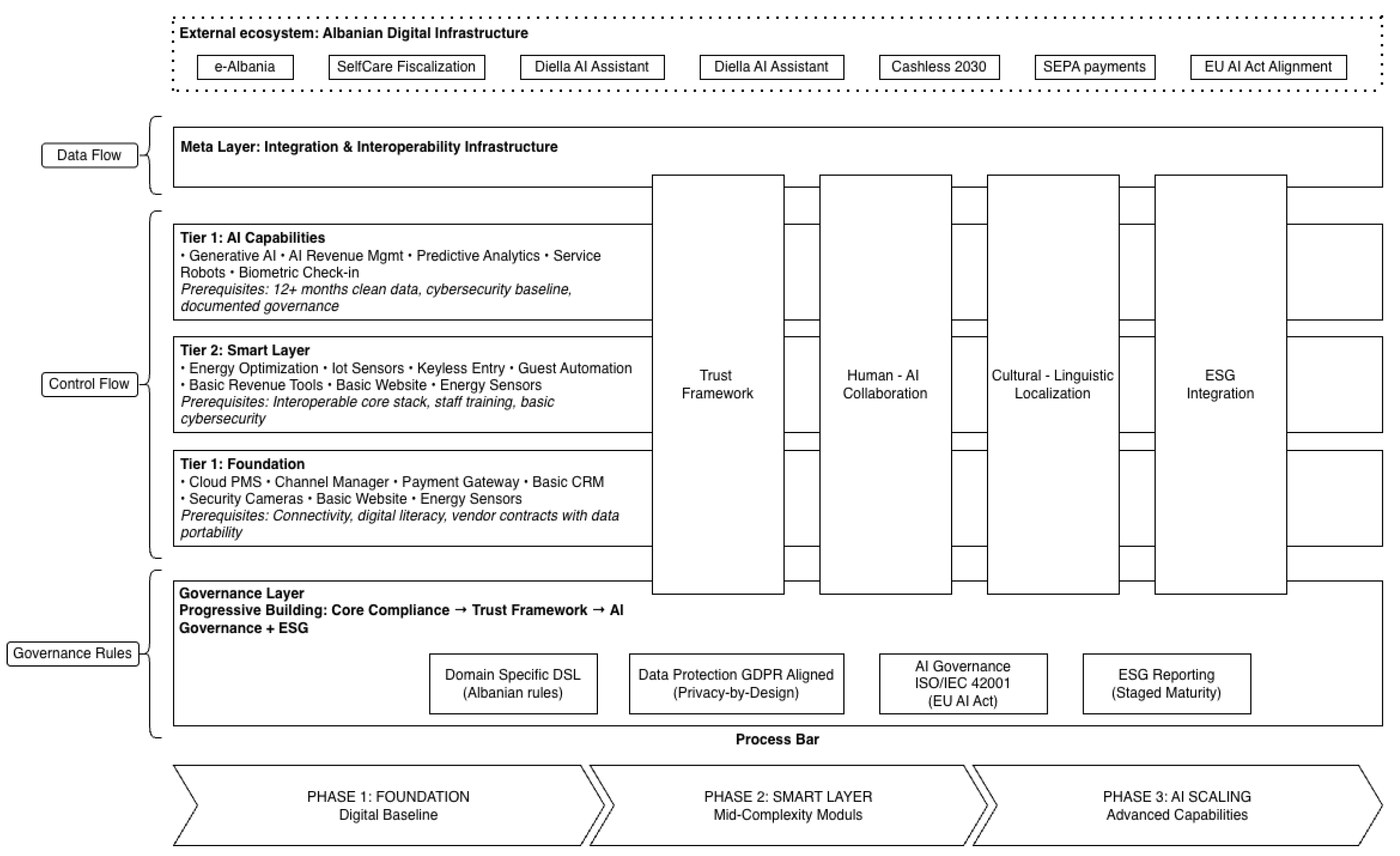
Figure 2.
Cross-Cutting System Properties Governing a Socio-Technical Service Artifact.
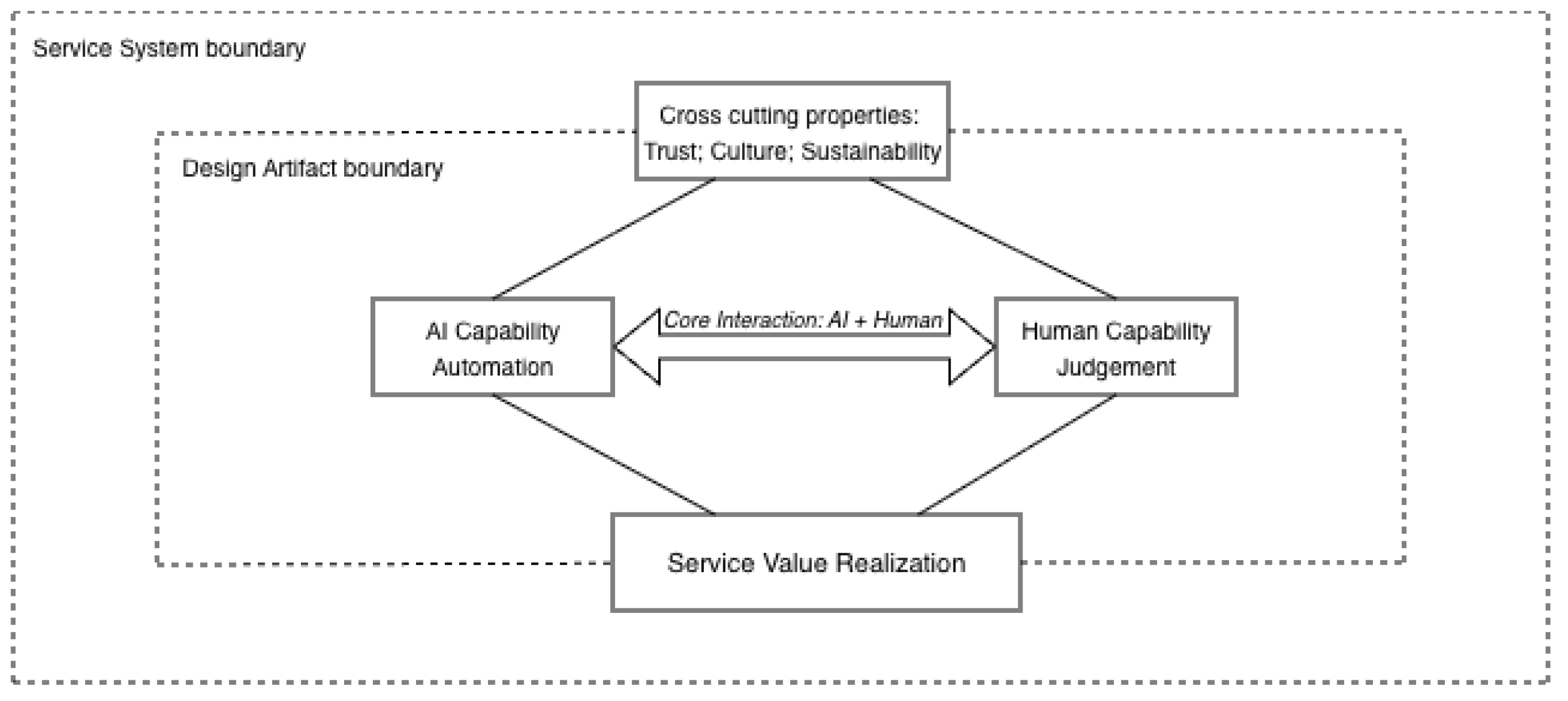
Figure 3.
Three-tier implementation architecture with progressive governance building.
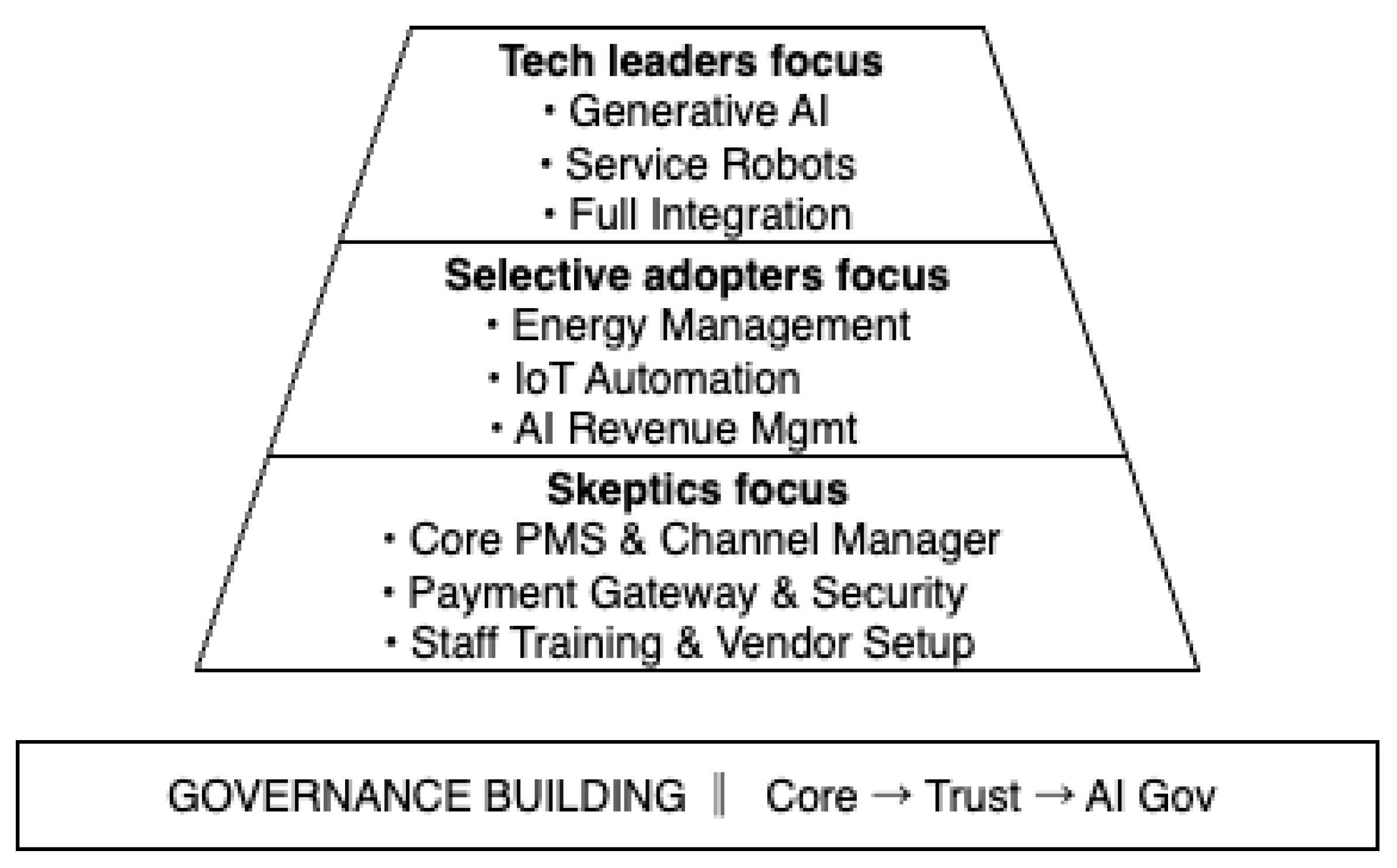
Figure 4.
From Uniform Allocation to Context-Aligned Policy Intervention.
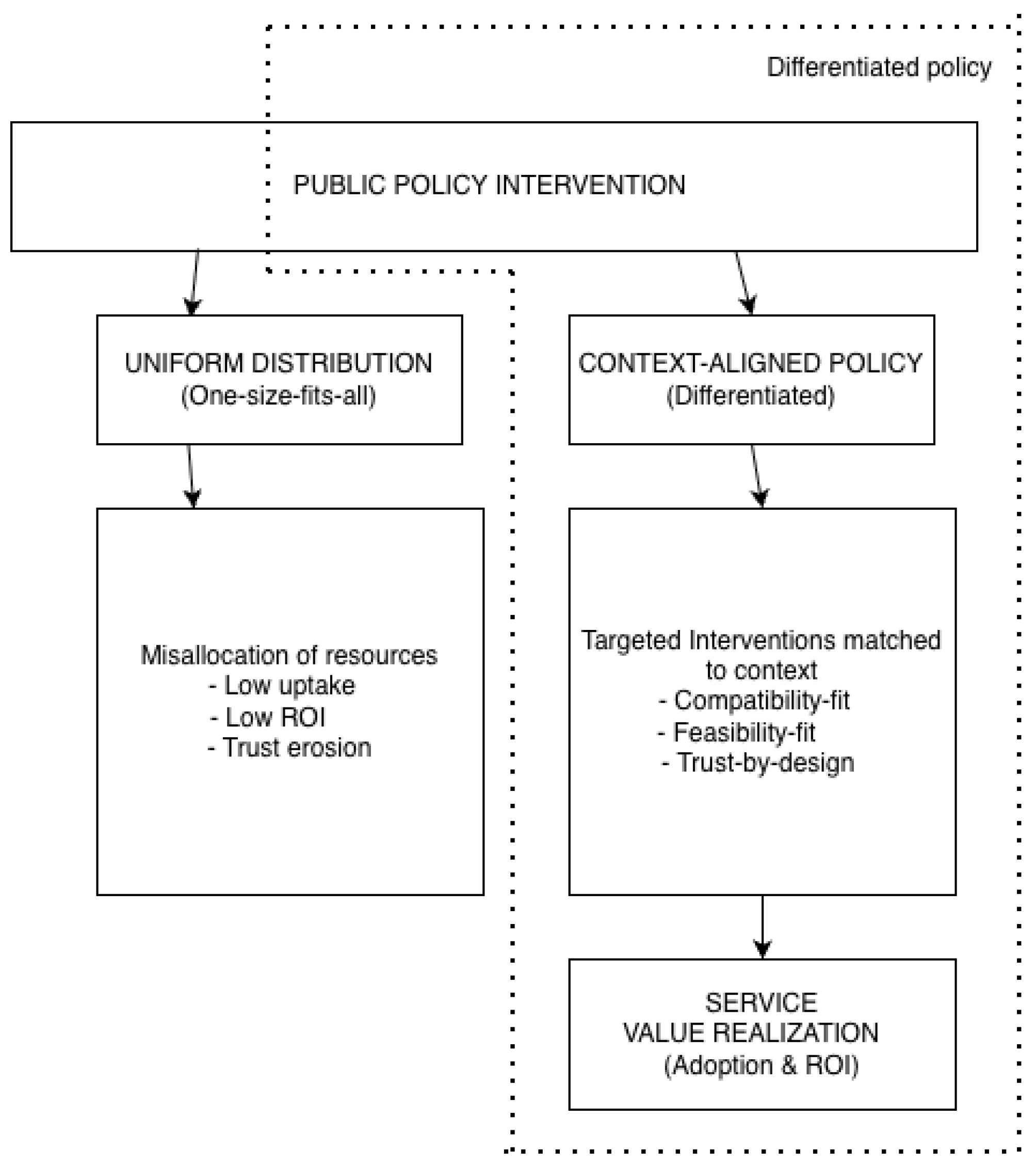

Table 1.
Design requirement synthesis from the Supply-Side Patterns.
| Evidence Pattern | Design Requirement |
| Provider segmentation: Tech Leaders (18%), Selective (44%), Skeptics (39%) | Differentiated implementation pathways |
| Dominant barriers: Costs (73%), Integration (68%), Skills (63%) | Modular, incremental architecture |
| Two-speed adoption: Core (37-51%) vs. AI (9%) | Staged progression: Core → Smart → AI |
| Regional context > property size | Ecosystem-sensitive recommendations |
Table 2.
Design requirement synthesis from the Demand-Side Patterns.
| Evidence Pattern | Design Requirement |
| Trust drives acceptance and WTP | Trust-by-design architectural layer |
| Privacy concerns suppress WTP | Transparency framework, opt-in controls |
| Preference for collaboration over replacement | Hybrid human-AI service models |
| Cultural-linguistic fit matters | Albanian localization requirement |
| Depersonalization moderated by trust | Human escalation pathways, visible agency |
Table 3.
Six-Phase Design Science Research Framework Application.
| Phase | Activity | Evidence Input | Output |
| Problem Identification | Define problem space | Session 2. Literature Review and Theoretical Background | Problem statement |
| Solution Objectives | Specify requirements | Subsection 2.5. Design requirements Synthesis | Objective specifications |
| Design & Development | Construct artifact | Design Thinking process | Blueprint prototype |
| Demonstration | Present prototype | Stakeholder presentations | Refined design |
| Evaluation | Validate utility | Feedback gathering from properties | Validated blueprint |
| Communication | Document artifact | This paper | Publish the framework |
Disclaimer/Publisher’s Note: The statements, opinions and data contained in all publications are solely those of the individual author(s) and contributor(s) and not of MDPI and/or the editor(s). MDPI and/or the editor(s) disclaim responsibility for any injury to people or property resulting from any ideas, methods, instructions or products referred to in the content. |
© 2026 by the authors. Licensee MDPI, Basel, Switzerland. This article is an open access article distributed under the terms and conditions of the Creative Commons Attribution (CC BY) license.
Copyright: This open access article is published under a Creative Commons CC BY 4.0 license, which permit the free download, distribution, and reuse, provided that the author and preprint are cited in any reuse.


