
Submitted:
09 January 2026
Posted:
12 January 2026
You are already at the latest version
Abstract
Cognitive bias introduces structural imbalance in exploration and exploitation within adaptive decision systems, yet existing approaches emphasize outcome accuracy or bias reduction while offering limited explanation of how internal decision structures regulate distortion during iterative search. This study develops a metaheuristic-based bias intervention module as a computational artifact for examining symmetry regulation at the process level of biased decision-making. Using controlled computational experiments, the study compares baseline, conventional metaheuristic, and intervention configurations through structural indicators that characterize decision accuracy, convergence stability, symmetry regulation, and bias reduction. The results show that adaptive decision coherence emerges through regulated structural adjustment rather than symmetry maximization. Across evaluated configurations, systems that maintain intermediate symmetry exhibit stable convergence and effective bias regulation, whereas configurations that preserve higher symmetry display structural rigidity and weaker regulation despite high outcome accuracy. These findings reposition cognitive bias as a structural force shaping adaptive rationality in algorithmic decision systems and advance design science research by expressing cognitive balance as measurable computational indicators for process-level analysis of regulated decision dynamics.
Keywords:
symmetry regulation
; symmetry breaking
; cognitive bias
; exploration–exploitation balance
; metaheuristics
; GA–PSO model
; adaptive decision systems
; structural regulation
; business development
1. Introduction
Decision systems change when heuristic shortcuts influence reasoning under uncertainty [1]. When this occurs, the relation between exploration and exploitation becomes uneven, and the system loses balance [2]. Cognitive bias operates as a source of this imbalance [3]. Bias alters how decision-makers interpret information, search for options, and evaluate outcomes [4]. Studies in behavioral decision research describe these effects through overconfidence, anchoring, and status-quo tendencies, which shape judgment and create asymmetric decision trajectories rather than neutral evaluations of possible actions [5]. This imbalance aligns with the broader characterization of bounded rationality, where simplified reasoning replaces comprehensive analysis [6,7].
Traditional approaches to reducing bias rely on awareness, procedural guidelines, or behavioral nudges [8]. These approaches assume stable cognitive tendencies and predictable behavioral adjustment. Decision environments have shifted toward computational complexity, high information velocity, and algorithmic mediation, where reasoning interacts with digital systems rather than operating in isolation [9,10]. Corrective mechanisms therefore require adaptive properties rather than static instruction because the structure of information and feedback evolves continuously [11].
Classical views associate symmetry with optimality and coherence; this study instead examines how excessive symmetry constrains structural flexibility. In dynamic decision environments, moderate symmetry enables controlled balance, allowing systems to sustain coherence while responding to bias-induced disturbances.
Metaheuristic algorithms provide a structure for such adaptive intervention [12]. These algorithms operate through iterative search, evaluation, and parameter adjustment [13]. Exploration identifies potential directions, while exploitation refines promising regions [14]. When bias disrupts this relation, the search process becomes premature, repetitive, or constrained [15]. This disruption reflects a symmetry-breaking condition in the decision system, where behavior diverges from balanced learning [16]. Symmetry refers to the measurable equilibrium between exploration and exploitation in iterative decision learning [17]. As bias intensifies, the system departs from equilibrium, and search patterns become narrow, fixed, or unresponsive [18].
This study introduces Metaheuristic Symmetry Regulation as a computational approach for examining symmetry breaking in algorithmic decision processes [19]. The approach integrates Genetic Algorithm and Particle Swarm Optimization principles to structure and regulate the exploration–exploitation relation during iterative search [20]. Rather than prescribing optimal choices or enforcing full symmetry regulation, the proposed mechanism treats symmetry as a process-level property and regulates it through the configuration of metaheuristic search dynamics [21]. In this context, symmetry functions as an operational construct that enables researchers to assess how decision processes respond to bias-induced disruption and how regulated structural adjustment supports stable convergence under uncertainty [22].
Methodological grounding follows a Design Science Research approach [23]. This study develops a computational artifact that addresses bias-induced asymmetry in algorithmic decision processes through structural regulation rather than outcome correction [11,24]. Evaluation emphasizes process-level indicators that capture internal decision dynamics. The Symmetry Regulation Index assesses the degree of balance maintained between exploration and exploitation across iterations [25]. Complementary indicators, including convergence stability and bias reduction, characterize the coherence and reliability of the resulting decision trajectories [9,27]. Together, these measures enable assessment of how different metaheuristic configurations regulate decision structure under bias, without relying on statistical mean comparison or feature-level attribution.
This research responds to three gaps. Prior studies document cognitive bias but leave its correction outside adaptive computational mechanisms [5,28]. Research on metaheuristics emphasizes optimization performance and excludes symmetry loss or regulation as a system property [12,25]. Design science research links artifacts and evaluation yet omits integration with behavioral decision theory and measurable equilibrium constructs in an operational intervention system [23,29].
These gaps motivate the following research question.
How can an algorithmic decision system regulate symmetry after cognitive bias disrupts the balance between exploration and exploitation, and how can metaheuristic mechanisms operationalize such regulation at the process level?
To address this question, the study develops and evaluates a computational structure that integrates adaptive metaheuristic mechanisms with symmetry-based evaluation. The resulting decision-support module restores balance rather than prescribes behavior and adapts rather than enforces.
This work makes theoretical, methodological, and applied contributions. Theoretically, it positions symmetry as a measurable property of decision systems that researchers can disrupt and restore. Methodologically, it demonstrates how adaptive metaheuristic mechanisms can serve as symmetry regulation processes. In application, it offers a structure that can support strategic reasoning in environments where uncertainty and feedback complexity shape decision quality, including business-development contexts [30,31].
2. Literature Review
2.1. Foundations of Symmetry in Decision Systems
Research on decision systems has examined how cognitive processes influence strategic reasoning under uncertainty [6]. These studies show that decision quality changes when heuristic reasoning shapes judgment and disrupts equilibrium in iterative evaluation [3,32].
2.2. Symmetry Breaking Through Cognitive Bias
Cognitive bias represents a primary mechanism of symmetry breaking in decision behavior [3,33]. Bias originates from heuristic processing that simplifies reasoning under cognitive limitation [6,32].
In organizational contexts, bias influences strategic planning, resource allocation, and partner selection [37]. Overconfidence increases perceived control and accelerates exploitation [34,38]. Anchoring restricts conceptual search. Confirmation bias reinforces initial assumptions and reduces adaptive correction [39].
Prior research shows that managers misjudge probabilities and outcomes due to bounded cognitive resources [40]. Group decision environments intensify these patterns through escalation of commitment, groupthink, and discounting of delayed outcomes [41]. While behavioral economics modules the mechanisms of distortion, interventions that restore equilibrium remain limited [42].
2.3. Metaheuristics as Symmetry Regulation Mechanisms
Metaheuristics provide computational structures that regulate decision processes under uncertainty by shaping the relation between exploration and exploitation [43,44]. These algorithms rely on iterative sampling, feedback, and search coordination to navigate large and complex solution spaces [45,46]. Exploration expands the range of potential directions, whereas exploitation concentrates search effort on promising regions [47,48]. When structural imbalance emerges, decision trajectories exhibit premature convergence, rigidity, or unstable oscillation, which reflects a loss of balance in the underlying search dynamics [49].
A wide range of metaheuristic designs implement distinct strategies for regulating search behavior. Genetic Algorithms, Particle Swarm Optimization, Ant Colony Optimization, Firefly Algorithm, and Gravitational Search Algorithm differ in how they allocate search effort, coordinate candidate solutions, and stabilize convergence patterns over time [50,51,52]. These design choices influence the coherence of diversification and intensification within decision processes, rather than directing search toward a single optimal configuration or a balanced terminal state.
Recent surveys emphasize hybrid architectures and configuration-level design as key directions in metaheuristic research [46,53]. This perspective frames regulation as an outcome of structural arrangement among search components, rather than as a consequence of continuous parameter tuning during execution. In this sense, metaheuristics support symmetry regulation by governing exploration–exploitation dynamics at the process level when bias-induced disruption alters search behavior in algorithmic decision systems [42,44].
2.4. Design Science as an Implementation Methodology
Design Science Research provides a methodological structure for developing and evaluating computational intervention systems that address organizational decision problems [23,54]. This approach centers on artifacts that integrate behavioral insight with technical design and evaluates performance through task-relevant criteria grounded in use contexts [55]. Within this methodology, researchers specify design objectives, construct artifacts, and assess outcomes through systematic comparison of configurations under controlled conditions [23,54].
A metaheuristic module functions as such an artifact by structuring search behavior and regulating decision dynamics in the presence of bias and uncertainty [12,45]. Design Science Research supports iterative refinement of artifact architecture and disciplined evaluation of process-level behavior without reliance on outcome prescription or statistical inference. Studies on algorithmic decision systems indicate that design choices in transparency, parameterization, and calibration shape decision behavior across contexts [56,57]. This methodological perspective enables integration of behavioral theory, metaheuristic design, and symmetry constructs within a coherent intervention architecture [58,59].
2.5. Integrated Perspective
Symmetry theory, cognitive bias research, and metaheuristic design establish a conceptual basis for examining regulated decision behavior in algorithmic systems. Cognitive bias introduces asymmetry in reasoning and search behavior, while metaheuristics provide structured means for organizing exploration and exploitation within decision processes. Design Science Research offers a systematic approach for implementing and evaluating such structures as computational artifacts [44,45,56].
Existing studies address these components in isolation, yet limited work integrates them within a single analytical perspective. Embedding symmetry constructs within metaheuristic configuration links behavioral theory with computational moduleing and enables measurement of process-level decision dynamics. This integrated view supports examination of how structural regulation shapes convergence behavior under uncertainty and bias without presuming optimal outcomes or corrective intervention [60,61].
2.6. Research Gap and Link to Methodology
The literature documents symmetry loss in decision behavior, identifies cognitive mechanisms that generate bias, and examines the search dynamics of metaheuristics under uncertainty. However, existing studies lack an operationalization of symmetry as a measurable, process-level property within decision systems and provide limited examination of how metaheuristic configurations regulate exploration–exploitation balance after bias-induced disruption [62,63]. Prior work explains how bias emerges and how computational search behaves, yet these streams remain separate in analytical scope and lack a unifying structure that links behavioral distortion to regulated decision dynamics.
This study addresses this gap by developing and evaluating a Metaheuristic Symmetry Regulation module as a computational artifact. The module conceptualizes symmetry as a structural property of decision processes, employs metaheuristic configurations to regulate search dynamics, and adopts Design Science Research to guide artifact construction and evaluation. By focusing on regulation rather than outcome correction or guaranteed regulation, the study establishes a coherent pathway for examining how decision systems maintain stable convergence under bias and uncertainty.
The module treats symmetry as a regulating structure that balances stability and flexibility. Its design emphasizes moderate proportionality, ensuring coherent decision dynamics while allowing controlled structural adjustment in biased environments. Within this view, moderate SRI values reflect structural equilibrium rather than reduced performance, representing a balanced state between coherence and adaptability.
3. Materials and Methods
3.1. Research Design
This study applies a Design Science Research methodology to construct and evaluate a Metaheuristic-Based Bias Intervention Module (MBIM). Design Science Research provides a structured approach for developing computational artifacts grounded in theoretical reasoning and systematic evaluation [23,55]. The research assumes that cognitive bias introduces asymmetry into decision behavior and that the study examines and regulates such asymmetry through structural configuration of metaheuristic search processes, rather than through prescriptive correction of decision outcomes.
The research design proceeds through three sequential phases. MBIM construction initiates the process through a hybrid Genetic Algorithm (GA) and Particle Swarm Optimization (PSO) architecture that defines exploration–exploitation dynamics at the process level. Controlled simulation experiments provide a basis for comparison across fixed metaheuristic configurations under bias conditions. Stability-oriented and comparative criteria guide assessment of decision trajectories, convergence patterns, and symmetry-related indicators. Table 1 summarizes the phases and their corresponding objectives.
3.2. Conceptual Foundation for Symmetry Regulation
The conceptual foundation rests on three theoretical elements that together define the analytical scope of the artifact. Cognitive bias functions as a source of asymmetry that alters decision reasoning and search behavior under uncertainty [64,65]. Metaheuristic design provides structured search processes that organize exploration and exploitation within complex decision spaces [63,66]. Symmetry represents a structural property of decision processes that reflects balance in search dynamics and supports stable convergence behavior [3,49].
The module establishes symmetry as a regulating principle of structural balance, replacing the traditional pursuit of maximal alignment with a framework of controlled proportionality. Within this design, stability and flexibility function as complementary forces that sustain coherence under bias and uncertainty. Maintaining proportional tension between these forces keeps the decision process ordered yet responsive. Moderate symmetry defines an operational equilibrium where coherence persists and local adjustments accommodate contextual disturbance.
Within this conceptual foundation, cognitive disturbance enters the decision process as an initial condition that shapes search trajectories. Metaheuristic configuration governs how search effort distributes across exploratory and exploitative activities throughout the decision sequence. Symmetry-related measures capture the resulting structure of decision dynamics and indicate the degree of balance maintained across iterations. This arrangement positions symmetry as an evaluative construct rather than a corrective objective.
The conceptual foundation links behavioral distortion, computational structure, and evaluative indicators within a single analytical system. Cognitive bias defines the form of asymmetry, metaheuristic configuration regulates process dynamics, and symmetry measures describe structural outcomes of search behavior. This alignment enables systematic examination of regulated decision processes without presuming outcome correction or adaptive parameter modification during execution.
3.3. Artifact Specification
A hybrid Genetic Algorithm–Particle Swarm Optimization architecture defines the computational structure of the Metaheuristic-Based Bias Intervention Module and governs search behavior in decision processes [67,68]. Population-based variation within the Genetic Algorithm supports broad exploration, whereas coordinated particle movement in Particle Swarm Optimization shapes convergence behavior across candidate solutions. Simulated business development contexts, including partner screening, investment prioritization, and opportunity evaluation, provide controlled settings that introduce bias-induced distortions into the decision process for comparative analysis across configurations [69].
Four coordinated components organize the artifact’s internal operation. Bias characterization represents asymmetry in decision inputs through variance- and entropy-based signals derived from behavioral and computational studies [28,42,46,49,70]. Search coordination executes GA and PSO routines under predefined configuration settings that specify exploration and exploitation patterns. A configuration interface maintains fixed parameter values for each experimental condition and ensures consistency across simulation runs. Symmetry assessment evaluates decision dynamics through the Symmetry Regulation Index as a process-level indicator of balance across iterations. Figure 1 illustrates data flow among these components.
This specification frames metaheuristic configuration as a structural design choice rather than as a mechanism for parameter modification during execution. Comparison across fixed configurations reveals differences in decision trajectories, search dynamics, and convergence patterns under bias conditions. The design supports examination of regulated decision processes without reliance on adaptive parameter adjustment or outcome correction during computation.
Figure 1 illustrates the internal architecture of the Metaheuristic-Based Bias Intervention Module and depicts the flow of information across bias characterization, search coordination, configuration control, and symmetry assessment components.
3.4. Mathematical Representation
Mathematical representation formalizes decision dynamics under bias and defines symmetry-related indicators for evaluation. The expressions specify how bias intensity, search dispersion, and convergence behavior enter the analytical structure, without implying parameter modification during execution.
The artifact’s computational logic is formalized using the following expressions. Decision quality under bias is represented as:
where denotes bias intensity. Parameter representation within the hybrid metaheuristic mechanism follows:
Exploration and exploitation dynamics follow the indicators below:
Symmetry regulation follows the index defined below:
Table 2 defines all variables and parameters used in the analytical representation.
3.5. Experimental Design and Evaluation Metrics
This study generated 1,200 simulated decision scenarios to evaluate artifact behavior across predefined configurations. The scenarios reflected business development contexts, including partner selection, resource allocation, and opportunity assessment. Controlled perturbation, framing, and weighting manipulation introduced cognitive distortions. Fixed algorithm parameters, dataset seeds, and iteration limits ensured reproducibility across trials.
The simulation environment used Python 3.13 with NumPy, SciPy, PyMetaheuristic 2.0, Matplotlib, and Pandas. Each configuration executed 500 iterations, and each scenario repeated 100 times to examine consistency and sensitivity under repeated bias exposure.
Performance evaluation employed seven quantitative indicators: decision accuracy, bias reduction rate, symmetry regulation index, convergence stability, computational efficiency, adaptivity index, and residual error. Together, these metrics characterize algorithmic behavior and structural alignment between bias-induced distortion and regulated decision dynamics. Table 3 reports the definitions and operational forms of each metric.
3.6. Validation and Evaluation Module
Validation relies on repeated computational experiments and comparative configuration analysis to assess the robustness of decision trajectories [54,55]. The study applies identical scenario generation rules, iteration budgets, and random seeds in each experimental setting to ensure reproducibility. Repeated runs reveal whether configuration-specific behavioral profiles persist across different forms of cognitive distortion.
The evaluation module focuses on characterizing stability and structural differentiation in decision trajectories across configurations. Convergence behavior and trajectory patterns indicate how the module maintains consistent dynamics under fixed configuration settings. Symmetry Regulation Indicators describe the relation between exploration and exploitation as an empirical property of the decision process, enabling systematic comparison among baseline, conventional metaheuristic, and MBIM configurations.
Validation emphasizes robustness as the consistency of metric patterns and trajectory properties observed across repeated trials. This module provides a structural regulation mechanism that shapes decision dynamics under bias exposure and supports systematic characterization and comparison through observable indicators derived from experimental outcomes.
4. Results
The findings demonstrate pronounced behavioral distinctions among the baseline configuration, the conventional metaheuristic, and the MBIM. Each configuration attains high accuracy under biased evaluation, yet their internal dynamics differ in scope and direction. Adaptivity reshapes the maintenance of structural symmetry rather than eliminating it, and optimization success reflects differentiated patterns of exploration–exploitation adjustment.
4.1. Output Characteristics
All configurations produced stable and valid outputs across repeated runs, with numerical divergence and computational failure absent. Convergence trajectories show that the baseline configuration, the conventional metaheuristic, and the MBIM each attain high performance levels under biased evaluation conditions.
Outcome levels remain comparable across configurations, yet convergence paths differ in internal structure. Baseline and MBIM trajectories follow smooth and monotonic patterns. Conventional metaheuristic trajectories reach high performance within a limited number of iterations and show oscillatory behavior during subsequent updates. These patterns signal differences in search allocation and control across the decision process.
Convergence behavior alone fails to capture structural properties of decision dynamics. Comparable outcome levels coexist with distinct patterns of exploration and exploitation adjustment. The MBIM sustains stable convergence and permits proportional reconfiguration during search, which reflects regulated adaptation rather than structural imbalance.
Figure 2 shows the convergence behavior of the three configurations under biased evaluation.
The figure illustrates the convergence trajectories of the baseline, conventional metaheuristic, and MBIM configurations under biased evaluation conditions. All configurations achieved stable convergence, showing distinct trajectory patterns that reflect structural differences in search dynamics.
4.2. Metric-Level Performance
4.2.1. Decision Accuracy
Decision accuracy remains high across all three configurations in the main experiment. Baseline configuration accuracy reaches a mean value of 0.970. MBIM accuracy reaches a mean value of 0.956. Conventional metaheuristic accuracy reaches a mean value of 0.911. These values indicate that each configuration achieves reliable outcome quality under biased evaluation conditions.
Accuracy levels show no alignment with structural distinctions among the modules. Baseline configuration performance exceeds that of the adaptive module despite static parameter control. MBIM performance remains high under adaptive regulation. Conventional metaheuristic performance remains lower despite stronger proportional symmetry. Decision accuracy captures outcome attainment rather than structural balance within the decision process.
4.2.2. Bias Reduction Rate
Bias reduction rate shows high values across all three configurations in the main experiment. Baseline configuration bias reduction reaches a mean value of 0.985. MBIM bias reduction reaches a mean value of 0.969. Conventional metaheuristic bias reduction reaches a mean value of 0.871. These results indicate that each configuration reduces bias magnitude under the evaluated conditions.
Bias reduction patterns differ from symmetry-related indicators. Baseline configuration exhibits the highest bias contraction despite a lower Symmetry Regulation Index. MBIM achieves strong bias reduction while maintaining intermediate symmetry levels. Conventional metaheuristic combines lower bias reduction with higher symmetry regulation. Bias reduction rate therefore reflects distortion contraction rather than proportional balance within the decision process.
4.2.3. Symmetry Regulation Index
Symmetry Regulation Index differentiates the three configurations relative to outcome-based indicators. Baseline configuration records a mean SRI value of 0.323. Conventional metaheuristic records a mean SRI value of 0.581. MBIM records a mean SRI value of 0.468. These values establish a distinct ordering of proportional balance across the decision processes.
Symmetry patterns diverge from bias reduction outcomes. Conventional metaheuristic maintains the highest proportional balance alongside lower bias reduction performance. Baseline configuration exhibits limited symmetry regulation alongside strong bias contraction. MBIM occupies an intermediate position that combines adaptive regulation with moderate proportional balance. This measure captures structural allocation between exploration and exploitation rather than outcome correction or distortion contraction.
4.2.4. Convergence Stability
Convergence stability remains high across the three configurations in the main experiment. Baseline configuration records a mean CS value of 0.993. MBIM records a mean CS value of 0.990. Conventional metaheuristic records a mean CS value of 0.985. These values indicate consistent convergence behavior across repeated runs under biased evaluation conditions.
Stability patterns show limited alignment with proportional symmetry or bias reduction outcomes. Baseline configuration combines the highest stability with lower symmetry regulation. MBIM sustains high stability alongside intermediate symmetry levels. Conventional metaheuristic records the highest Symmetry Regulation Index and the lowest bias reduction rate among the three configurations. Convergence stability therefore reflects trajectory consistency within the search process rather than proportional balance or distortion contraction.
4.2.5. Adaptivity Index
Adaptivity Index remained at zero across all three configurations in the main experiment. The baseline, conventional metaheuristic, and MBIM configurations showed no measurable parameter change during the evaluated runs. Structural design drives the observed differences, whereas parameter adjustment plays no role.
The absence of adaptivity clarifies the role of the proposed module. Symmetry-related effects reflect configuration-level design choices instead of dynamic parameter tuning under the given experimental conditions.
Across all configurations, AI held constant at zero, confirming that parameters stayed fixed throughout execution. This fixed-parameter design isolates structural regulation mechanisms and allows direct evaluation of equilibrium control without parametric interference. Consistent parameter control affirms the validity of the experimental design.
4.2.6. Algorithmic Efficiency
Algorithmic efficiency varies across the three configurations in the main experiment. Baseline configuration records a mean AE value of 0.005. MBIM records a mean AE value of 0.008. Conventional metaheuristic records a mean AE value of 0.011. These values indicate differences in performance gain per unit of computational effort among the evaluated modules.
Efficiency patterns diverge from accuracy, bias reduction, and symmetry indicators. Conventional metaheuristic achieves the highest efficiency alongside the highest Symmetry Regulation Index. Baseline configuration exhibits the lowest efficiency despite strong bias reduction and stable convergence. MBIM occupies an intermediate position that balances adaptive regulation with moderate computational efficiency. Algorithmic efficiency therefore reflects cost-normalized performance progression within the search process rather than outcome quality or structural balance.
Table 4 reports the metric values used in the analysis.
4.3. Cross-Module Behavioral Interpretation
Patterns across the structural indicators reveal three distinct behavioral signatures among the modules. The MBIM configuration combines high decision accuracy (DA = 0.956), high convergence stability (CS = 0.990), intermediate symmetry regulation (SRI = 0.468), strong bias reduction (BRR = 0.969), and moderate algorithmic efficiency (AE = 0.008). This profile reflects a regulated search behavior that balances proportional structure, bias response, and computational cost under biased evaluation.
A different behavioral pattern characterizes the conventional metaheuristic. This configuration exhibits the highest symmetry regulation (SRI = 0.581) and the highest algorithmic efficiency (AE = 0.011) alongside lower decision accuracy (DA = 0.911) and lower bias reduction (BRR = 0.871). The resulting behavior emphasizes proportional allocation and cost efficiency while allowing greater dispersion in corrected outcomes.
The baseline configuration presents a third behavioral profile. Highest decision accuracy (DA = 0.970), strongest bias reduction (BRR = 0.985), and highest convergence stability (CS = 0.993) characterize this configuration, alongside the lowest symmetry regulation (SRI = 0.323) and the lowest algorithmic efficiency (AE = 0.005). A contraction-oriented adjustment process stabilizes outcomes and suppresses distortion at the expense of proportional balance and computational efficiency.
Viewed together, the three configurations form stable behavioral patterns rather than random variation. One pattern prioritizes proportional balance and efficiency, another prioritizes outcome correction and stability, and a third integrates moderated symmetry with strong bias response and stable convergence. These profiles establish distinct modes of convergence behavior under biased conditions.
Table 5 presents the behavioral profiles derived from the cross-module interpretation.
4.4. Comparative Performance Synthesis
Differences among the three configurations appear when accuracy, symmetry, and stability indicators align. Decision accuracy alone provides limited separation, since all configurations reach high outcome quality. Baseline configuration records the highest accuracy (DA = 0.970). MBIM records an accuracy value of 0.956. Conventional metaheuristic records the lowest accuracy value (DA = 0.911). Structural behavior under biased evaluation provides the primary basis for differentiation.
Symmetry regulation reveals a clear separation across configurations. Conventional metaheuristic records the highest proportional balance (SRI = 0.581), indicating preservation of structural allocation during optimization. MBIM exhibits an intermediate symmetry level (SRI = 0.468), reflecting moderated proportional regulation under bias. Baseline configuration records the lowest symmetry regulation (SRI = 0.323), indicating limited proportional balance despite strong outcome correction.
Convergence stability patterns reinforce these distinctions. Baseline configuration records the highest stability level (CS = 0.993) and sustains consistent trajectory behavior under biased conditions. MBIM records a high stability level (CS = 0.990) and combines stable convergence with intermediate symmetry regulation. Conventional metaheuristic records a lower stability level (CS = 0.985) and combines stable convergence with stronger proportional rigidity.
Viewed together, the alignment between symmetry regulation and convergence stability distinguishes three performance synthesis patterns. One emphasizes proportional balance, another emphasizes outcome correction and stability, and a third integrates moderated symmetry with regulated convergence. These patterns clarify how structural properties shape decision behavior under biased evaluation without reliance on accuracy differences alone.
4.5. Qualitative Interpretation
Behavioral patterns observed across the configurations indicate systematic relationships between optimization structure and bias response. These patterns remain grounded in the reported indicators and reveal how structural properties shape reasoning behavior under biased evaluation.
Within the baseline configuration, high convergence stability (CS = 0.993) combines with strong bias reduction (BRR = 0.985) and low symmetry regulation (SRI = 0.323). This pattern indicates a contraction-oriented adjustment process where the search trajectory stabilizes through outcome correction rather than proportional balance. Reasoning activity absorbs distortion by narrowing dispersion while preserving trajectory consistency.
A different qualitative pattern characterizes the conventional metaheuristic. High symmetry regulation (SRI = 0.581) and high algorithmic efficiency (AE = 0.011) combine with lower decision accuracy (DA = 0.911) and weaker bias reduction (BRR = 0.871). This configuration emphasizes proportional allocation and cost efficient progression while allowing greater dispersion in corrected outcomes. Reasoning behavior follows a rigid structural template that prioritizes balance preservation over distortion contraction.
The MBIM expresses a third qualitative mode. High convergence stability (CS = 0.990) combines with high bias reduction (BRR = 0.969) and intermediate symmetry regulation (SRI = 0.468). This pattern reflects a regulated reorganization of the search trajectory that integrates bias response with structural moderation. Reasoning behavior adapts to distortion through controlled structural adjustment rather than direct suppression or rigid preservation.
Taken together, the qualitative patterns show that bias shapes the form of the reasoning pathway rather than outcome accuracy alone. Structural adjustment, stability maintenance, and bias response interact to produce distinct convergence behaviors across configurations. These results establish a descriptive foundation for subsequent discussion of theoretical implications.
4.6. Sensitivity and Robustness Analysis
Sensitivity analysis evaluated how iteration depth and noise intensity influenced convergence stability, symmetry regulation, bias reduction, and efficiency across configurations. Iteration budgets of 250, 500, and 1000 defined the sensitivity setting, and noise levels of 1.0, 1.5, and 2.0 defined the robustness setting. All configurations operated under identical bias conditions, and mean indicator values summarized performance across settings.
Across iteration depths, baseline configuration sustained high decision accuracy within a narrow range (DA = 0.970 to 0.971), high convergence stability (CS = 0.991 to 0.995), strong bias reduction (BRR = 0.981 to 0.986), and low algorithmic efficiency cost (AE = 0.005 to 0.006). Symmetry regulation increased with iteration depth (SRI = 0.163 to 0.452), while the overall behavioral profile remained consistent. Conventional metaheuristic exhibited stable accuracy levels (DA = 0.900), higher symmetry regulation (SRI = 0.508 to 0.586), moderate convergence stability (CS = 0.982 to 0.985), higher efficiency cost (AE = 0.019 to 0.021), and weaker bias reduction (BRR = 0.816 to 0.818). MBIM preserved high accuracy (DA = 0.955 to 0.957), high convergence stability (CS = 0.988 to 0.991), strong bias reduction (BRR = 0.965 to 0.971), intermediate symmetry regulation (SRI = 0.441 to 0.470), and moderate efficiency cost (AE = 0.007 to 0.008).
Under increasing noise intensity, baseline configuration maintained high stability (CS = 0.992 to 0.993) and strong bias reduction (BRR = 0.947 to 0.987), while decision accuracy declined from 0.971 to 0.943 and symmetry regulation increased from 0.320 to 0.454. Conventional metaheuristic showed a wider dispersion in bias reduction (BRR = 0.619 to 0.825) and a decline in decision accuracy (DA = 0.904 to 0.854), while symmetry regulation remained high (SRI = 0.582 to 0.616). MBIM preserved high convergence stability (CS = 0.989 to 0.990), strong bias reduction (BRR = 0.948 to 0.970), and intermediate symmetry regulation (SRI = 0.451 to 0.489), with decision accuracy ranging from 0.946 to 0.958.
Across sensitivity and robustness settings, indicator magnitudes varied while relative configuration profiles persisted. Iteration depth and noise intensity influenced symmetry and accuracy levels without altering the structural ordering across configurations. Table 6 reports the consolidated mean outcomes across all sensitivity and robustness conditions.
4.7. Structural Interpretation of Results
This study identifies three stable convergence profiles under biased evaluation. Decision accuracy remains high across configurations, with baseline configuration at 0.97, MBIM 0.96, and conventional metaheuristic 0.91 across evaluated conditions. Despite comparable outcome accuracy, the configurations differ in their internal structural organization.
Baseline configuration combines high convergence stability and strong bias reduction with limited symmetry regulation and low computational cost, as reflected by stability values near 0.99 and symmetry values near 0.32. Conventional metaheuristic combines higher symmetry regulation and efficiency with lower decision accuracy and weaker bias reduction, with symmetry values near 0.58 and efficiency costs near 0.02. MBIM occupies an intermediate structural position, combining high convergence stability and strong bias response with moderated symmetry regulation, with stability values near 0.99 and symmetry values near 0.47.
These structural distinctions persist across parameter variation and noise conditions examined in this study. Changes in computational settings influence indicator magnitudes while preserving the relative configuration profiles observed in the main experiment. This section summarizes the structural result patterns that motivate the discussion of theoretical implications.
5. Discussion
5.1. Interpretation of Core Results
Symmetry regulation in decision systems emerges after cognitive bias disrupts exploration–exploitation balance. Adaptive metaheuristic mechanisms operationalize this regulation through structural regulation rather than outcome correction.
Bias intervention through metaheuristic control operates through controlled structural adjustment rather than symmetry maximization. Across experimental conditions, the Metaheuristic-Based Bias Intervention Module maintains high convergence stability, CS = 0.99, and strong bias reduction, BRR = 0.97. Symmetry regulation remains intermediate, SRI = 0.45–0.50. These results address the first research question and show bias regulation as a process of controlled structural adjustment.
The role of symmetry in adaptive decision systems appears through comparative structural behavior. Higher symmetry regulation, SRI = 0.58, aligns with weaker bias reduction and lower stability relative to configurations at SRI = 0.32–0.47. Decision accuracy remains high, 0.91–0.97. Structural behavior reflects stability, symmetry regulation, and bias response. Adaptive decision performance emerges from regulated structural adjustment rather than proportional balance regulation.
5.2. Managerial Interpretation of Symmetry Regulation
The structural patterns observed in this study correspond to common managerial decision scenarios. In partner selection or alliance screening, managers begin with a broad evaluation set to preserve exploratory coverage. As market signals accumulate, attention and analytical resources concentrate on a smaller subset of candidates. Decision accuracy improves as low-potential options exit the process, while proportional balance across alternatives declines.
The MBIM configuration mirrors this managerial logic. Symmetry regulation stabilizes at an intermediate level with SRI = 0.47, and convergence stability remains high with CS = 0.99. This pattern reflects selective commitment rather than balanced evaluation. The decision system reallocates attention in response to distortion signals without attempting to preserve proportional symmetry across all options.
In business development settings such as partner selection, strong contraction in the baseline configuration produces accurate yet narrow outcomes and limits alternative options. The MBIM structure applies measured symmetry to extend the search range while keeping convergence stable. This balance between diversity and stability supports sustained adaptability and reveals broader opportunities.
By contrast, configurations with higher symmetry regulation, with SRI values of 0.58, resemble decision routines that maintain proportional evaluation after strong signals emerge. Such routines preserve structural balance but fail to strengthen bias reduction or stability. The results suggest that managerial systems benefit from controlled asymmetry when adapting to uncertain or biased information environments.
5.3. Adaptivity and Design Science Implications
From a design science perspective, MBIM functions as a behavioral computational artifact that embeds assumptions about rationality and control. The relationship between symmetry regulation and adaptivity indicates that symmetry operates as a diagnostic signal rather than a target state. Adaptivity adjusts learning parameters to regulate imbalance instead of correcting deviation toward symmetry.
This design logic aligns with decision support systems that assist managers under uncertainty. Monitoring symmetry, convergence stability, and bias reduction allows organizations to detect structural imbalance at the decision process level, preventing outcome distortion. Values observed in this study, including CS levels near 0.99 and BRR levels near 0.97, illustrate how adaptive regulation sustains coherent decision behavior without restoring proportional balance.
This study extends design science by operationalizing behavioral theory through computational structure. Rather than optimizing outcomes alone, the artifact enables examination of decision processes as regulated systems.
5.4. Theoretical and Managerial Implications
Symmetry functions in this study as a structural condition that governs adaptive rationality in decision systems.
Rather than framing bias as error or deviation, the analysis positions bias as a force that reshapes exploration–exploitation allocation. Stability and symmetry characterize learning dynamics under distortion. This perspective extends behavioral decision theory by expressing cognitive balance as an observable property of computational structure.
The findings advance design science research by demonstrating how behavioral principles enter algorithmic form. The Metaheuristic-Based Bias Intervention Module embeds feedback regulation within adaptive search logic and renders bias regulation measurable through structural indicators. Symmetry regulation, convergence stability, and bias reduction together define decision quality at the process level, moving beyond outcome-centered evaluation.
From a managerial perspective, the MBIM supports the design of decision processes that maintain coherence under uncertainty. Monitoring convergence stability, symmetry regulation, and bias reduction enables managers to assess decision structure during evaluation rather than relying on outcome signals alone. Such monitoring helps identify escalation risk, commitment imbalance, and distorted allocation during partner screening, resource allocation, and strategic forecasting.
Decision environments that involve staged commitment benefit from structural diagnostics. Declining symmetry under stable convergence concentrates attention and narrows evaluation. Collapsed stability under high symmetry signals a shift from regulation to rigidity. These patterns provide managers with interpretable signals that guide intervention at the process level rather than through corrective outcome control.
This study contributes to the literature in three respects. First, it reconceptualizes bias intervention as structural regulation rather than outcome correction. Second, it operationalizes symmetry regulation through a computational artifact that integrates metaheuristic adaptivity with behavioral feedback principles. Third, it establishes a set of structural indicators that distinguish decision performance by internal regulation rather than accuracy alone. Together, these contributions position bias regulation as a design problem within adaptive decision systems.
The analysis relies on controlled simulation to isolate structural dynamics under bias. This approach enables precise measurement of symmetry and stability but abstracts from organizational context, social interaction, and institutional constraint. Parameter settings represent stylized decision environments rather than domain-specific settings. Future research may extend this module through empirical validation, agent heterogeneity, and integration with reinforcement or Bayesian learning mechanisms. Such extensions would clarify how structural regulation operates across organizational levels and dynamic environments. The module provides a foundation for examining adaptive decision architecture beyond computational settings.
Although the baseline configuration achieves slightly higher numerical accuracy, the MBIM exhibits stronger robustness under sensitivity and noise perturbations. This consistent performance reflects the module’s structural stability and its ability to preserve reasoning coherence under uncertain or biased environments. Such resilience extends the theoretical implications of symmetry regulation to practical system design, where robustness becomes a central dimension of intelligent decision behavior.
6. Conclusion
This study establishes the Metaheuristic-Based Bias Intervention Module as a structural module for regulating bias in adaptive decision systems. Simulation results demonstrate that convergence stability, symmetry regulation, and algorithmic efficiency together define rational coherence within learning processes. Decision quality emerges through equilibrium within structural adjustment rather than parameter tuning or outcome optimization.
Symmetry regulation constitutes the central theoretical contribution of this work. The module translates cognitive balance into a measurable design principle and links feedback regulation with learning stability. Bias functions within this structure as a formative force that reshapes internal allocation during decision processing rather than as an external source of error.
The study’s primary innovation lies in redefining symmetry as a dynamic regulatory principle rather than a descriptive property. Through the Metaheuristic-Based Bias Intervention Module, it operationalizes symmetry as a mechanism of adaptive bias regulation, introducing quantitative indicators that capture structural balance within biased search dynamics. This approach bridges behavioral asymmetry and computational regulation, extending symmetry theory beyond its conventional physical and mathematical scope to the domain of decision science. Collectively, these contributions demonstrate that symmetry can serve as a unifying construct linking rational stability, algorithmic coherence, and adaptive intelligence.
From a design science perspective, this work embeds behavioral principles into a computational artifact that renders bias regulation observable at the process level. Structural indicators provide a basis for evaluating intelligent behavior through internal regulation rather than accuracy alone. This perspective integrates behavioral decision theory with computational intelligence under a unified structural logic.
Controlled computational experiments isolate symmetry regulation mechanisms within the present module. Extension to organizational settings with heterogeneous agents, stochastic signals, and delayed feedback can define a boundary condition beyond the current simulation scope. These conditions clarify how structural regulation operates under environmental volatility and dynamic commitment.
Supplementary Materials
The following supporting information can be downloaded at the website of this paper posted on Preprints.org. The supplementary files provide the Python source code and executable script used to reproduce the simulations reported in this study.
Author Contributions
The author confirms sole responsibility for all aspects of the manuscript. Conceptualization, methodology, formal analysis, investigation, data curation, original draft writing, review and editing, visualization, and project administration were all completed by the author.
Funding
This research received no funding.
Data Availability Statement
The original contributions presented in this study are included in the article/supplementary material. Further inquiries can be directed to the corresponding author.
Acknowledgments
The authors appreciate the feedback that informed the refinement of this research.
Conflicts of Interest
The author declares no conflict of interest.
Abbreviations
The following abbreviations are used in this manuscript:
| AE | Algorithmic Efficiency |
| AI | Adaptivity Index |
| BRR | Bias Reduction Rate |
| CS | Convergence Stability |
| DA | Decision Accuracy |
| DSR | Design Science Research |
| ER | Error Rate |
| GA | Genetic Algorithm |
| MBIM | Metaheuristic-Based Bias Intervention Module |
| PSO | Particle Swarm Optimization |
| SRI | Symmetry Regulation Index |
References
- Kurdoglu, R.S.; Ates, N.Y.; Lerner, D.A. Decision-Making under Extreme Uncertainty: Eristic Rather than Heuristic. Int. J. Entrep. Behav. Res. 2023, 29, 763–782. [Google Scholar] [CrossRef]
- Tversky, A.; Kahneman, D.; Slovic, P. Judgment under Uncertainty: Heuristics and Biases. In Judgment under Uncertainty: Heuristics and Biases; Kahneman, D., Slovic, P., Tversky, A., Eds.; Cambridge University Press: Cambridge, UK, 1982; pp. 3–20. [Google Scholar]
- March, J.G. Exploration and Exploitation in Organizational Learning. Organ. Sci. 1991, 2, 71–87. [Google Scholar] [CrossRef]
- Gomroki, G.; Behzadi, H.; Fattahi, R.; Salehi Fadardi, J. Identifying Effective Cognitive Biases in Information Retrieval. J. Inf. Sci. 2023, 49, 348–358. [Google Scholar] [CrossRef]
- Berthet, V. The Impact of Cognitive Biases on Professionals’ Decision-Making: A Review of Four Occupational Areas. Front. Psychol. 2022, 12, 802439. [Google Scholar] [CrossRef]
- Simon, H.A. A Behavioral Model of Rational Choice. Q. J. Econ. 1955, 69, 99–118. [Google Scholar] [CrossRef]
- Gigerenzer, G.; Goldstein, D.G. Reasoning the Fast and Frugal Way: Models of Bounded Rationality. Psychol. Rev. 1996, 103, 650–669. [Google Scholar] [CrossRef]
- Montibeller, G.; von Winterfeldt, D. Cognitive and Motivational Biases in Decision and Risk Analysis. Risk Anal. 2015, 35, 1230–1251. [Google Scholar] [CrossRef]
- Faraj, S.; Pachidi, S.; Sayegh, K. Working and Organizing in the Age of the Learning Algorithm. Inf. Organ. 2018, 28, 62–70. [Google Scholar] [CrossRef]
- Kellogg, K.C.; Valentine, M.A.; Christin, A. Algorithms at Work: The New Contested Terrain of Control. Acad. Manag. Ann. 2020, 14, 366–410. [Google Scholar] [CrossRef]
- Ashby, W.R. Requisite Variety and Its Implications for the Control of Complex Systems. In Facets of Systems Science; Klir, G.J., Ed.; Springer: Boston, MA, USA, 1991; pp. 405–417. [Google Scholar] [CrossRef]
- Talbi, E.-G. Metaheuristics: From Design to Implementation; Wiley: Hoboken, NJ, USA, 2009. [Google Scholar]
- Eiben, A.E.; Smith, J.E. Introduction to Evolutionary Computing, 2nd ed.; Springer: Berlin, Germany, 2015. [Google Scholar] [CrossRef]
- Jami, A.; Abbaszade, S.; Vahabie, A.H. A Review on Exploration–Exploitation Trade-Off in Psychiatric Disorders. BMC Psychiatry 2025, 25, 420. [Google Scholar] [CrossRef]
- Wilson, R.C.; Bonawitz, E.; Costa, V.D.; Ebitz, R.B. Balancing Exploration and Exploitation with Information and Randomization. Curr. Opin. Behav. Sci. 2021, 38, 49–56. [Google Scholar] [CrossRef]
- Leonardos, S.; Piliouras, G. Exploration-exploitation in multi-agent learning: Catastrophe theory meets game theory. Artificial Intelligence 2022, 304, 103653. [Google Scholar] [CrossRef]
- Lazo, Y.; Crawford, B.; Cisternas-Caneo, F.; Barrera-Garcia, J.; Soto, R.; Giachetti, G. Evolution and Trends of the Exploration–Exploitation Balance in Bio-Inspired Optimization Algorithms: A Bibliometric Analysis of Metaheuristics. Biomimetics 2025, 10, 517. [Google Scholar] [CrossRef]
- Park, S.; Puranam, P. Self-Confirming Biased Beliefs in Organizational “Learning by Doing”. Complexity 2021, 2021, 8865872. [Google Scholar] [CrossRef]
- Awad, A.; Hawash, A.; Abdalhaq, B. A Genetic Algorithm (GA) and Swarm-Based Binary Decision Diagram (BDD) Reordering Optimizer Reinforced with Recent Operators. IEEE Trans. Evol. Comput. 2023, 27, 535–549. [Google Scholar] [CrossRef]
- Papazoglou, G.; Biskas, P. Review and Comparison of Genetic Algorithm and Particle Swarm Optimization in the Optimal Power Flow Problem. Energies 2023, 16, 1152. [Google Scholar] [CrossRef]
- Solano-Rojas, B.J.; Villalón-Fonseca, R.; Batres, R. Micro Evolutionary Particle Swarm Optimization (MEPSO): A New Modified Metaheuristic. Syst. Soft Comput. 2023, 5, 200057. [Google Scholar] [CrossRef]
- Hadj Slama, A.; Saidi, L.; Saidi, M.; Benbouzid, M. Metaheuristic Optimization of Hybrid Renewable Energy Systems under Asymmetric Cost–Reliability Objectives: NSGA-II and MOPSO Approaches. Symmetry 2025, 17, 1412. [Google Scholar] [CrossRef]
- Hevner, A.R.; March, S.T.; Park, J.; Ram, S. Design Science in Information Systems Research. MIS Q. 2004, 28, 75–105. [Google Scholar] [CrossRef]
- Hevner, A.; Chatterjee, S. Design Research in Information Systems: Theory and Practice; Springer: New York, NY, USA, 2010. [Google Scholar]
- Boussaïd, I.; Lepagnot, J.; Siarry, P. A Survey on Optimization Metaheuristics. Inf. Sci. 2013, 237, 82–117. [Google Scholar] [CrossRef]
- Eiben, Á.E.; Hinterding, R.; Michalewicz, Z. Parameter Control in Evolutionary Algorithms. IEEE Trans. Evol. Comput. 1999, 3, 124–141. [Google Scholar] [CrossRef]
- Holland, J.H. Studying Complex Adaptive Systems. J. Syst. Sci. Complex. 2006, 19, 1–8. [Google Scholar] [CrossRef]
- Milkman, K.L.; Chugh, D.; Bazerman, M.H. How Can Decision Making Be Improved? Perspect. Psychol. Sci. 2009, 4, 379–383. [Google Scholar] [CrossRef]
- Venable, J.; Pries-Heje, J.; Baskerville, R. FEDS: A Framework for Evaluation in Design Science Research. Eur. J. Inf. Syst. 2016, 25, 77–89. [Google Scholar] [CrossRef]
- Sterman, J.D. Learning from Evidence in a Complex World. Am. J. Public Health 2006, 96, 505–514. [Google Scholar] [CrossRef] [PubMed]
- McGrath, R.G.; MacMillan, I.C. Discovery-Driven Growth: A Breakthrough Process to Reduce Risk and Seize Opportunity; Harvard Business Press: Boston, MA, USA, 2009. [Google Scholar]
- Tversky, A.; Kahneman, D. Judgment under Uncertainty: Heuristics and Biases. Science 1974, 185, 1124–1131. [Google Scholar] [CrossRef]
- Cohen, J.D.; McClure, S.M.; Yu, A.J. Should I Stay or Should I Go? How the Human Brain Manages the Trade-Off between Exploitation and Exploration. Philos. Trans. R. Soc. B 2007, 362, 933–942. [Google Scholar] [CrossRef] [PubMed]
- Lovallo, D.; Kahneman, D. Delusions of Success: How Optimism Undermines Executives’ Decisions. Harv. Bus. Rev. 2003, 81, 56–63. [Google Scholar]
- Ahmed, B.S. An Adaptive Metaheuristic Framework for Changing Environments. In Proceedings of the 2024 IEEE Congress on Evolutionary Computation (CEC); IEEE: Yokohama, Japan, 2024; pp. 1–10. [Google Scholar] [CrossRef]
- Wang, S.; Qiao, P.; Yue, Q.; Xu, Z.; Shang, Q. Research on Dynamic Particle Swarm Optimization for Multi-Objective Reconnaissance Task Allocation of UAVs. Drones 2025, 9, 556. [Google Scholar] [CrossRef]
- Gavetti, G. PERSPECTIVE—Toward a Behavioral Theory of Strategy. Organ. Sci. 2012, 23, 267–285. [Google Scholar] [CrossRef]
- Audia, P.G.; Brion, S. Reluctant to Change: Self-Enhancing Responses to Diverging Performance Measures. Organ. Behav. Hum. Decis. Process. 2007, 102, 255–269. [Google Scholar] [CrossRef]
- Nickerson, R.S. Confirmation Bias: A Ubiquitous Phenomenon in Many Guises. Rev. Gen. Psychol. 1998, 2, 175–220. [Google Scholar] [CrossRef]
- Bastian, B.; Acar, O.A.; Boom, H.; Smits, J. Management decisions under radical uncertainty. Management Decision 2025, 63, 714–729. [Google Scholar] [CrossRef]
- Geng, X.; Zhao, Y.; Xu, S.; Sun, X.; Zhou, X. Group collaboration reduces delay discounting of intertemporal choices and its duration. Judgment and Decision Making 2024, 19, e34. [Google Scholar] [CrossRef]
- Fasolo, B.; Heard, C.; Scopelliti, I. Mitigating cognitive bias to improve organizational decisions: An integrative review, framework, and research agenda. Journal of Management 2025, 51, 2182–2211. [Google Scholar] [CrossRef]
- Zabzina, N.; Dussutour, A.; Mann, R.P.; Sumpter, D.J.T.; Nicolis, S.C. Symmetry restoring bifurcation in collective decision-making. PLoS Comput. Biol. 2014, 10, e1003960. [Google Scholar] [CrossRef]
- Yukalov, V.I. Systems with symmetry breaking and Regulation. Symmetry 2010, 2, 40–68. [Google Scholar] [CrossRef]
- Swan, J.; Adriaensen, S.; Brownlee, A.E.; Hammond, K.; Johnson, C.G.; Kheiri, A.; White, D.R. Metaheuristics “in the large”. Eur. J. Oper. Res. 2022, 297, 393–406. [Google Scholar] [CrossRef]
- Bolufé-Röhler, A.; Tamayo-Vera, D. Machine learning for enhancing metaheuristics in global optimization: A comprehensive review. Mathematics 2025, 13, 2909. [Google Scholar] [CrossRef]
- Cai, Z.; Yang, X.; Zhou, M.; Zhan, Z.-H.; Gao, S. Toward explicit control between exploration and exploitation in evolutionary algorithms: A case study of differential evolution. Inf. Sci. 2023, 649, 119656. [Google Scholar] [CrossRef]
- Lazo, Y.; Crawford, B.; Cisternas-Caneo, F.; Barrera-Garcia, J.; Soto, R.; Giachetti, G. Evolution and trends of the exploration–exploitation balance in bio-inspired optimization algorithms: A bibliometric analysis of metaheuristics. Biomimetics 2025, 10, 517. [Google Scholar] [CrossRef] [PubMed]
- Osuna-Enciso, V.; Cuevas, E.; Castañeda, B.M. A diversity metric for population-based metaheuristic algorithms. Inf. Sci. 2022, 586, 192–208. [Google Scholar] [CrossRef]
- Dorigo, M.; Gambardella, L.M. Ant colony system: A cooperative learning approach to the traveling salesman problem. IEEE Trans. Evol. Comput. 1997, 1, 53–66. [Google Scholar] [CrossRef]
- Rashedi, E.; Nezamabadi-Pour, H.; Saryazdi, S. GSA: A gravitational search algorithm. Inf. Sci. 2009, 179, 2232–2248. [Google Scholar] [CrossRef]
- Yang, X.-S. Firefly algorithms for multimodal optimization. In Stochastic Algorithms: Foundations and Applications; Springer: Berlin, Heidelberg, 2009; pp. 169–178. [Google Scholar] [CrossRef]
- Karakatič, S.; Podgorelec, V. A survey of genetic algorithms for solving multi depot vehicle routing problem. Appl. Soft Comput. 2015, 27, 519–532. [Google Scholar] [CrossRef]
- Peffers, K.; Tuunanen, T.; Rothenberger, M.A.; Chatterjee, S. A design science research methodology for information systems research. J. Manag. Inf. Syst. 2007, 24, 45–77. [Google Scholar] [CrossRef]
- Gregor, S.; Hevner, A.R. Positioning and presenting design science research for maximum impact. MIS Q. 2013, 37, 337–355. [Google Scholar] [CrossRef]
- Mehrabi, N.; Morstatter, F.; Saxena, N.; Lerman, K.; Galstyan, A. A survey on bias and fairness in machine learning. ACM Comput. Surv. 2021, 54, 1–35. [Google Scholar] [CrossRef]
- van der Aalst, W.M.P.; Bichler, M.; Heinzl, A. Responsible data science. Bus. Inf. Syst. Eng. 2017, 59, 311–313. [Google Scholar] [CrossRef]
- vom Brocke, J.; Hevner, A.; Maedche, A. Introduction to design science research. In Design Science Research: Cases; Springer: Cham, Switzerland, 2020; pp. 1–13. [Google Scholar] [CrossRef]
- Kuechler, W.; Vaishnavi, V. A framework for theory development in design science research: Multiple perspectives. J. Assoc. Inf. Syst. 2012, 13, 395–423. [Google Scholar] [CrossRef]
- Wolpert, D.H.; Macready, W.G. No free lunch theorems for optimization. IEEE Trans. Evol. Comput. 1997, 1, 67–82. [Google Scholar] [CrossRef]
- Rai, A. Explainable AI: From black box to glass box. J. Acad. Mark. Sci. 2020, 48, 137–141. [Google Scholar] [CrossRef]
- Hogarth, R.M.; Makridakis, S. Forecasting and planning: An evaluation. Manag. Sci. 1981, 27, 115–138. [Google Scholar] [CrossRef]
- Blum, C.; Roli, A. Metaheuristics in combinatorial optimization: Overview and conceptual comparison. ACM Comput. Surv. 2003, 35, 268–308. [Google Scholar] [CrossRef]
- Kahneman, D.; Tversky, A. Prospect theory: An analysis of decision under risk. In Handbook of the Fundamentals of Financial Decision Making: Part I.; Baker, H.K., Nofsinger, J.R., Eds.; World Scientific: Singapore, 2013; pp. 99–127. [Google Scholar] [CrossRef]
- Bazerman, M.H.; Moore, D.A. Judgment in Managerial Decision Making; John Wiley & Sons: Hoboken, NJ, USA, 2012. [Google Scholar]
- Rajinikanth, V.; Razmjooy, N. A comprehensive survey of meta-heuristic algorithms. In Metaheuristics and Optimization in Computer and Electrical Engineering, Volume 2: Hybrid and Improved Algorithms; Springer: Cham, Switzerland, 2023; pp. 1–39. [Google Scholar] [CrossRef]
- Yang, X.-S. Nature-Inspired Metaheuristic Algorithms, 2nd ed.; Luniver Press: Bristol, UK, 2010. [Google Scholar]
- Hussain, K.; Mohd Salleh, M.N.; Cheng, S.; Shi, Y. Metaheuristic research: A comprehensive survey. Artif. Intell. Rev. 2019, 52, 2191–2233. [Google Scholar] [CrossRef]
- Rodríguez Carrillo, M.L.; Pérez-Domínguez, L.; Romero-López, R.; Luviano-Cruz, D.; León-Castro, E. A systematic literature review on the use of multicriteria decision making methods for small and medium-sized enterprises innovation assessment. Front. Artif. Intell. 2025, 8, 1605756. [Google Scholar] [CrossRef] [PubMed]
- Hodgkinson, G.P.; Healey, M.P. Psychological foundations of dynamic capabilities: Reflexion and reflection in strategic management. Strateg. Manag. J. 2011, 32, 1500–1516. [Google Scholar] [CrossRef]
- Lundberg, S.M.; Lee, S.-I. A unified approach to interpreting model predictions. Adv. Neural Inf. Process. Syst. 2017, 30, 4765–4774. [Google Scholar] [CrossRef]
Figure 1.
Architecture of the Metaheuristic-Based Bias Intervention Module (MBIM).
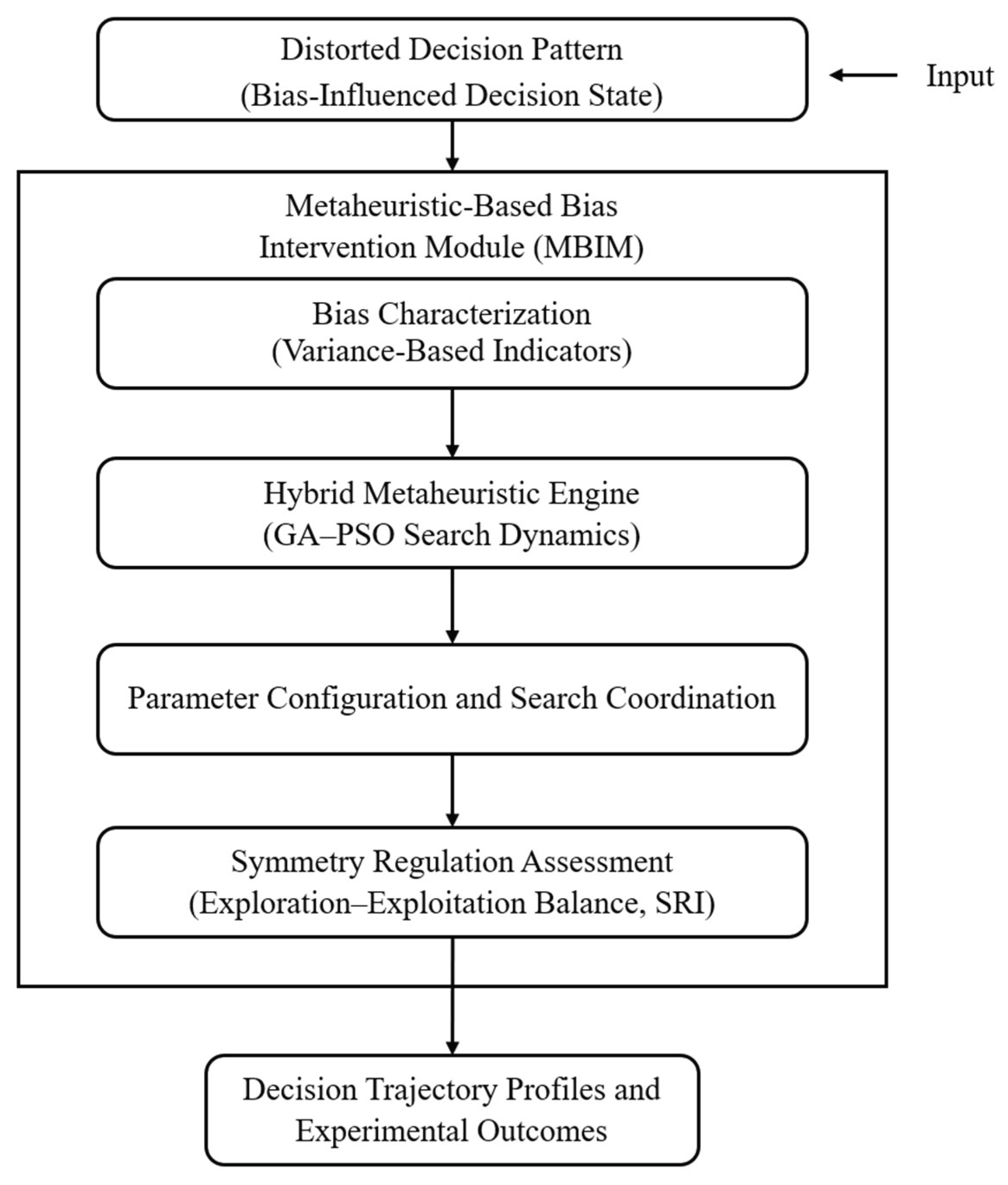
Figure 2.
Main Experiment Convergence.
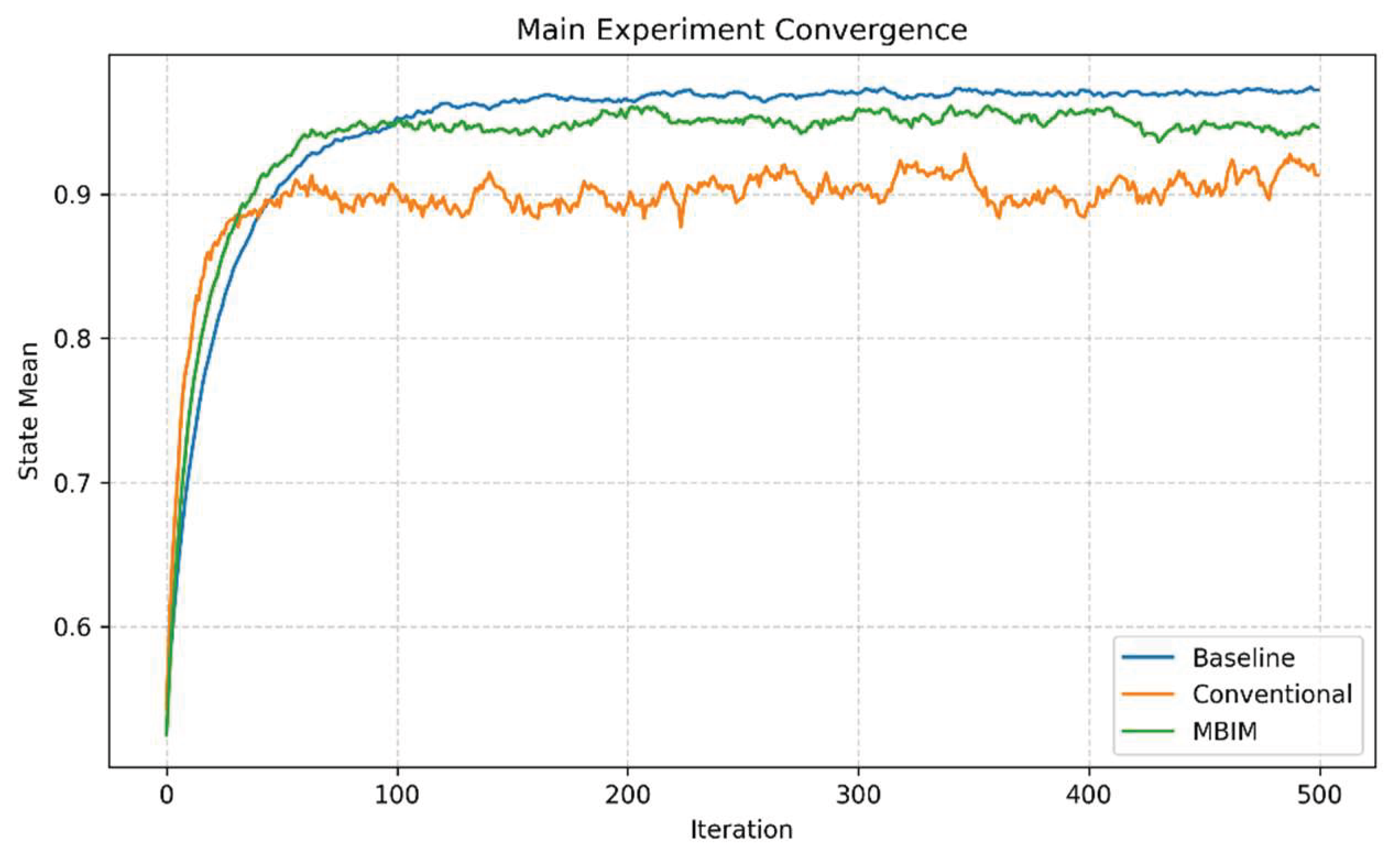

Table 1.
Overview of Research Design.
| DSR Stage | Objective | Key Activity | Output / Artifact | Evaluation Method |
| Problem Identification | Identify structural imbalance in decision processes under cognitive bias | Literature review and analytical synthesis | Bias characterization | Conceptual consistency check |
| Objective Definition | Define analytical objectives for symmetry regulation | Mapping relations between bias and exploration–exploitation structure | Symmetry representation | Internal coherence review |
| Design and Development | Develop the Metaheuristic-Based Bias Intervention Module (MBIM) | GA–PSO hybrid algorithm design | Executable module | Functional verification |
| Demonstration | Examine module behavior through computational experiments | Controlled decision scenarios | Experimental outcomes | Comparative configuration analysis |
| Evaluation | Assess robustness and structural differentiation of decision dynamics | Repeated experimental runs | Validated module behavior | Stability and pattern consistency assessment |
| Communication | Report findings and theoretical implications | Academic writing and dissemination | Research manuscript | Scholarly review process |
Table 2.
Definition of Symbols and Parameters.
| Symbol / Term | Definition | Role in Module |
| Decision quality at iteration (t) | Output variable representing decision performance under a given configuration | |
| Underlying decision strategy at iteration (t) | Baseline decision state prior to bias influence | |
| Bias intensity at iteration (t) | Distortion factor introducing asymmetry | |
| Metaheuristic parameter vector (mutation rate, inertia weight, learning coefficients) | Configuration parameter vector defining search behavior | |
| Update function defined by learning coefficients and inertia weight | Functional representation of parameter relationships within the GA–PSO structure | |
| Random perturbation term | Captures stochastic variation during convergence | |
| Exploration ratio | Measures search diversity relative to initial variance | |
| Variance of solution candidates at time (t) / initial variance | Used to compute exploration level | |
| Exploitation ratio | Represents convergence intensity and contraction of search spread | |
| Particle velocity decay factor | Determines contraction of the search radius in PSO cycles | |
| Symmetry Regulation Index at iteration (t) | Quantifies structural balance between exploration and exploitation | |
| Stabilization constant | Prevents division by zero in index computation |
Table 3.
Evaluation Metrics and Formulas.
| Metric | Formula | Interpretation | Interpretive Regime |
| Decision Accuracy (DA) | Mean decision quality level of the final state under a given configuration. | Higher values indicate stronger decision performance. | |
| Bias Reduction Rate (BRR) | Relative change in decision variance associated with bias-induced distortion across configurations. | Values closer to 1 indicate stronger variance contraction. | |
| Symmetry Regulation Index (SRI) | Quantifies the degree of structural regulation between exploration and exploitation within the decision process. | Higher SRI values indicate stronger symmetry regulation between exploration and exploitation, whereas lower values indicate increasing structural asymmetry in decision dynamics. | |
| Convergence Stability (CS) | Stability of convergence based on variability of stepwise state changes. | Higher values indicate more stable convergence behavior. | |
| Algorithmic Efficiency (AE) | Speed of convergence measured by iterations required to reach a near-final state. | Higher values indicate faster convergence. | |
| Adaptivity Index (AI) | Trend magnitude of the decision-state trajectory under fixed configurations. | Higher values indicate stronger upward trajectory trends. | |
| Error Rate (ER) | Proportion of suboptimal decision outcomes. | Lower values indicate better decision performance. |
Table 4.
Metric Values from the Main Experiment across Module Configurations
| Module | Decision Accuracy (DA) | Symmetry Regulation Index (SRI) | Convergence Stability (CS) | Algorithmic Efficiency (AE) | Bias Reduction Rate (BRR) | Adaptivity Index (AI)* |
| Baseline | 0.97 | 0.323 | 0.993 | 0.005 | 0.985 | 0 |
| Conventional | 0.911 | 0.581 | 0.985 | 0.011 | 0.871 | 0 |
| MBIM | 0.956 | 0.468 | 0.99 | 0.008 | 0.969 | 0 |
*AI = 0 indicates that the module achieved regulation through structural configuration rather than dynamic parameter adjustment.
Table 5.
Behavioral Profiles of Module Configurations under Biased Evaluation
| Module Configuration | Behavioral Orientation | Structural Pattern | Bias Response Mode | Stability and Cost Profile |
| Baseline | Outcome correction oriented | Low proportional symmetry with high stability | Strong bias contraction | High stability with low efficiency |
| Conventional | Proportional balance oriented | High symmetry preservation | Limited bias contraction | High efficiency with stable convergence |
| MBIM | Regulated integration oriented | Moderate symmetry with adaptive structure | Strong bias response with moderation | High stability with moderate efficiency |
Note. Behavioral profiles summarize cross-metric patterns reported in Table 4 and interpreted in Section 4.3. These profiles describe distinct modes of convergence behavior rather than relative performance rankings. No single profile dominates across all evaluated dimensions.
Table 6.
Sensitivity and Robustness Summary of Performance Indicators
| Module | DA (Range) | SRI (Range) | CS (Range) | AE (Range) |
| Baseline | 0.970–0.971 | 0.163–0.452 | 0.991–0.995 | 0.005–0.006 |
| Conventional | 0.854–0.904 | 0.582–0.616 | 0.982–0.985 | 0.019–0.021 |
| MBIM | 0.946–0.958 | 0.451–0.489 | 0.988–0.991 | 0.007–0.008 |
Note. Values summarize performance across sensitivity and robustness settings described in Section 4.6.
Disclaimer/Publisher’s Note: The statements, opinions and data contained in all publications are solely those of the individual author(s) and contributor(s) and not of MDPI and/or the editor(s). MDPI and/or the editor(s) disclaim responsibility for any injury to people or property resulting from any ideas, methods, instructions or products referred to in the content. |
© 2026 by the authors. Licensee MDPI, Basel, Switzerland. This article is an open access article distributed under the terms and conditions of the Creative Commons Attribution (CC BY) license (http://creativecommons.org/licenses/by/4.0/).
Copyright: This open access article is published under a Creative Commons CC BY 4.0 license, which permit the free download, distribution, and reuse, provided that the author and preprint are cited in any reuse.


