

Submitted:
09 January 2026
Posted:
12 January 2026
You are already at the latest version
Abstract
This preprint outlines a detailed theoretical framework for the "Ze System" (ZS), a proposed methodological paradigm for investigating phenomena that are not directly observable. It challenges the classical model of passive observation, positing that a significant portion of reality's structure exists in a latent, wave-like state of distributed possibilities (Zurek, 2003). The ZS is conceptualized as an active instrument designed to provoke the transition of these latent structures into a localized, observable ("particle") state. Its core operational principle is the deliberate engineering of predictive conflict: by forcing a system to resolve incompatible, high-precision predictions (e.g., Model A vs. Model B), hidden variables are compelled to manifest to avoid a logical-physical impasse. This manuscript elaborates the ontological foundations (reality as latent information flux), methodological pillars (predictive pressure, dual reading, manipulators), and the formal architecture of a ZS. We discuss potential applications in quantum phenomenology, pre-clinical disease detection, and cognitive science, while rigorously addressing the epistemological and ethical implications of an interventionist science. The framework synthesizes concepts from quantum measurement theory, predictive processing neuroscience, and complex systems biology into a novel proposal for experimental philosophy.
Keywords:
active inference
; engineered measurement
; latent reality
; predictive conflict
; quantum‐toclassical transition
; Ze System
Introduction: The Problem of the Latent
Conventional scientific methodology is built upon the paradigm of observation. From telescopes to particle colliders, the goal is to minimize perturbation to "see" what is already there. However, foundational theories, particularly quantum mechanics, assert that at a fundamental level, reality prior to measurement is not a set of definite objects but a set of possibilities described by a wave function (Schrödinger, 1926). The transition to the observed classical world occurs via processes like decoherence (Zurek, 2003). We extend this reasoning beyond quantum substrates: many phenomena of interest—incipient disease states, pre-conscious cognitive processes, social tipping points—exist in a "latent" phase, characterized by distributed, correlational information rather than localized, causal agents (Friston, 2010; Scheffer et al., 2009). Passive observation of such systems can only detect them after they have spontaneously localized, which is often too late for intervention (as in metastatic cancer) or after the causal window has closed. The central research gap addressed here is the lack of a generalized methodology for the active, pre-emptive detection of latent structures across physical, biological, and cognitive domains.
The Ze Proposition: We propose that latent structures can be forced to localize not by increasing observational sensitivity, but by engineering a specific crisis of prediction. If a system harbors a hidden variable H, and is subjected to an intervention π designed to create maximal divergence between the predictions of two otherwise viable models (one ignoring H, one incorporating it), then H must manifest to resolve the conflict. Detection is thus not of H itself, but of the characteristic, structured error it introduces into the failing model. The Ze System is the formal apparatus for designing and executing π and analyzing the resultant error-localization.
Theoretical Foundations
Ontological Premise: Reality as Latent Information Flux
We posit a substrate ontology where the primary element is an information flux, not matter or energy in a classical sense (Vedral, 2010). Observable events are localized bit strings decoded from this flux. Latent structures are stable, non-local correlations or constraints within the flux—hidden pages in the source code. In quantum terms, this is the wave function before collapse. In biology, it could be the specific, fragile conformation of a prion protein or the pre-malignant metabolic network of a cell (Jucker & Walker, 2013). The act of classical observation is a specific, often lossy, decoding protocol.
The Principle of Predictive Pressure (The Ze Engine)
This is the dynamic core. Passive error minimization (as in the Free-Energy Principle (Friston, 2010)) maintains a system. Predictive Pressure actively seeks to destabilize it to reveal its hidden constraints. A Ze agent (a model or instrument) does not simply predict an outcome O; it designs an intervention π such that:
- For a null model M₀ (lacking H), π leads to a predictable outcome O₀.
- For an alternative model Mₕ (incorporating latent structure H), π leads to a divergent outcome Oₕ.
- O₀ and Oₕ are mutually exclusive under the resolution of the measurement apparatus.
The application of π creates a forced choice. The system's actual response Oₐ will conform to either O₀ or Oₕ (or a third, unexpected path), thereby localizing the previously hidden truth. The "pressure" is the logical incompatibility of the two futures imposed by the experimental design.
The Dual Reading Protocol
Any event can be narrativized causally (forward: cause → effect) and teleologically (backward: effect ← constraint). Quantum mechanics formalizes this in the Two-State Vector Formalism (TSVF), where a system is described by both pre- and post-selected states (Aharonov et al., 1964). The Ze System explicitly employs both readings:
- Forward (Causal) Model (M_F): Simulates the physical dynamics from initial conditions + intervention π.
- Reverse (Constraint) Model (M_R): Starts from a hypothesized post-selected outcome (the "signature of H") and calculates the necessary conditions/precursors.
The Ze experiment is the search for an intervention π where the paths dictated by M_F and M_R intersect only if H is present. This intersection is the localization event.Proposed Architecture of a Ze System
Proof-of-Concept Applications & Simulations
Quantum Domain: Probing Non-Local Correlations
Hypothesis (H): A specific pair of particles (P1, P2) share non-local correlation C, beyond standard Bell-type entanglement.
- Ze Protocol:
- M₀: Models P1 and P2 as independent after separation.
- Mₕ: Models P1 and P2 as connected via C.
- π: Apply a sequence of weak measurements to P1 at times [t1, t2, t3], designed to be neutral in M₀ but to constructively interfere via C in Mₕ, affecting the final strong measurement outcome of P2.
- Localization: Statistically significant deviation of P2's outcomes from M₀'s prediction, aligning with Mₕ's forecast, localizes the existence and functional shape of C. This extends weak measurement protocols (Aharonov et al., 1988) into an active search for hypothesized hidden variables.
Biomedical Domain: Early Detection of Latent Pathology
Hypothesis (H): A tissue sample contains a sub-population of cells in a pre-malignant state S, characterized by metabolic vulnerability V.
- Ze Protocol:
- M₀: Predicts tissue viability/metabolic output under a mild stressor π (e.g., a brief oxidative challenge).
- Mₕ: Predicts a biphasic or catastrophic failure response due to the collapse of cells in state S.
- π: Apply a precise, titrated dose of a metabolic agent that targets pathway V.
- Localization: The tissue response curve (e.g., oxygen consumption rate, ATP levels) is analyzed. A response matching Mₕ—such as a non-linear drop in viability—localizes the presence of the S-state population. This is more sensitive than waiting for morphological changes (Hanahan & Weinberg, 2011).
Table 2 shows how a ZS, by titrating π, can force a diagnostic localization. Patient A's sample shows mild deviation at low π, but clear alignment with Mₕ at higher π, confirming the latent pathology.
Cognitive Domain: Unconscious Decision Biases
Hypothesis (H): A subject has an unconscious bias B affecting perceptual decision-making.
- Ze Protocol:
- M₀: Predicts choice reaction times based on stimulus clarity alone.
- Mₕ: Predicts a specific pattern of choice errors and reaction time delays when stimuli are congruent/incongruent with B.
- π: Use a rapid, masked priming sequence to activate B below conscious threshold, followed by a perceptual decision task.
- Localization: A deviation from M₀'s reaction time/accuracy curve that matches Mₕ's predicted pattern localizes the specific structure of bias B, even if the subject cannot report it (Dehaene et al., 1998).
Discussion: Implications and Limitations
The ZS framework proposes a paradigm shift from observational empiricism to interventionist epistemology. Its strength lies in providing a unified formalism for problems where the subject of interest is defined by its potential behavior under specific, non-natural conditions.
Epistemological Implications: Truth is redefined as "that which consistently causes a specific, elegant model to fail under a defined provocation." This aligns with strong Popperian falsification but makes the falsification attempt an active, designed product of the theory itself. It also raises profound questions about scientific realism: are we discovering H or creating a new phenomenon H' that only exists relative to our provocative measurement π? We argue for a relational realism: H is a real constraint in the latent field, but its classical instantiation is co-determined by π.
Ethical Implications: The ZS axiom "observation = intervention" carries direct ethical weight (Jonsen, 1998). Provoking latent disease states or unconscious biases for detection purposes requires rigorous ethical frameworks, informed consent that acknowledges the interventionist nature of the process, and a principle of minimal sufficient provocation.
Current Limitations & Future Work: The framework is currently theoretical. Key challenges include:
- The computational complexity of generating optimal π for non-trivial H.
- Avoiding "over-provocation" that destroys the system or creates artifactual phenomena.
-
Developing cross-domain manipulators (π-generators) and high-fidelity ε-mappers.Future work will involve building computational simulations of ZS loops for specific domains (e.g., using neural networks as M₀/Mₕ for cognitive tasks) and initiating collaborations for experimental pilot studies, particularly in non-invasive neurostimulation and controlled in vitro cell systems.
Conclusion
The Ze System framework offers a bold, synthetic approach to investigating the hidden layers of reality. By moving from passive observation to the active engineering of predictive conflict, it aims to develop a methodology for probing the latent structures that precede and underpin observable events. While currently a theoretical construct, it provides a clear roadmap for interdisciplinary research that bridges quantum foundations, systems biology, and cognitive neuroscience. Its ultimate validation will be the discovery of novel, non-trivial phenomena—latent variables H—that could not have been convincingly localized by any passive means.
References
- Aharonov, Y.; Albert, D. Z.; Vaidman, L. How the result of a measurement of a component of the spin of a spin-1/2 particle can turn out to be 100. Physical Review Letters 1988, 60(14), 1351–1354. [Google Scholar] [CrossRef] [PubMed]
- Aharonov, Y.; Bergmann, P. G.; Lebowitz, J. L. Time symmetry in the quantum process of measurement. Physical Review 1964, 134(6B), B1410–B1416. [Google Scholar] [CrossRef]
- Dehaene, S.; Naccache, L.; Le Clec'H, G.; Koechlin, E.; Mueller, M.; Dehaene-Lambertz, G.; Le Bihan, D. Imaging unconscious semantic priming. Nature 1998, 395(6702), 597–600. [Google Scholar] [CrossRef] [PubMed]
- Friston, K. The free-energy principle: a unified brain theory? Nature Reviews Neuroscience 2010, 11(2), 127–138. [Google Scholar] [CrossRef] [PubMed]
- Hanahan, D.; Weinberg, R. A. Hallmarks of cancer: the next generation. Cell 2011, 144(5), 646–674. [Google Scholar] [CrossRef] [PubMed]
- Jaba, T. Dasatinib and quercetin: short-term simultaneous administration yields senolytic effect in humans. Issues and Developments in Medicine and Medical Research 2022, Vol. 2, 22–31. [Google Scholar]
- Jonsen, A. R. The Birth of Bioethics; Oxford University Press, 1998. [Google Scholar]
- Jucker, M.; Walker, L. C. Self-propagation of pathogenic protein aggregates in neurodegenerative diseases. Nature 2013, 501(7465), 45–51. [Google Scholar] [CrossRef] [PubMed]
- Scheffer, M.; Bascompte, J.; Brock, W. A.; Brovkin, V.; Carpenter, S. R.; Dakos, V.; Sugihara, G. Early-warning signals for critical transitions. Nature 2009, 461(7260), 53–59. [Google Scholar] [CrossRef] [PubMed]
- Schrödinger, E. An undulatory theory of the mechanics of atoms and molecules. Physical Review 1926, 28(6), 1049–1070. [Google Scholar] [CrossRef]
- Vedral, V. Decoding Reality: The Universe as Quantum Information; Oxford University Press, 2010. [Google Scholar]
- Tkemaladze, J. Reduction, proliferation, and differentiation defects of stem cells over time: a consequence of selective accumulation of old centrioles in the stem cells? Molecular Biology Reports 2023, 50(3), 2751–2761. Available online: https://pubmed.ncbi.nlm.nih.gov/36583780/. [CrossRef] [PubMed]
- Tkemaladze, J. Editorial: Molecular mechanism of ageing and therapeutic advances through targeting glycative and oxidative stress. Front Pharmacol 2024, 14, 1324446. [Google Scholar] [CrossRef] [PubMed] [PubMed Central]
- Tkemaladze, J. Old Centrioles Make Old Bodies. Annals of Rejuvenation Science 2026, 1(1). [Google Scholar] [CrossRef]
- Tkemaladze, J. Visions of the Future. Longevity Horizon 2026, 2(1). [Google Scholar] [CrossRef]
- Zurek, W. H. Decoherence, einselection, and the quantum origins of the classical. Reviews of Modern Physics 2003, 75(3), 715–775. [Google Scholar] [CrossRef]
Figure 1.
Schematic Architecture of a Ze System.
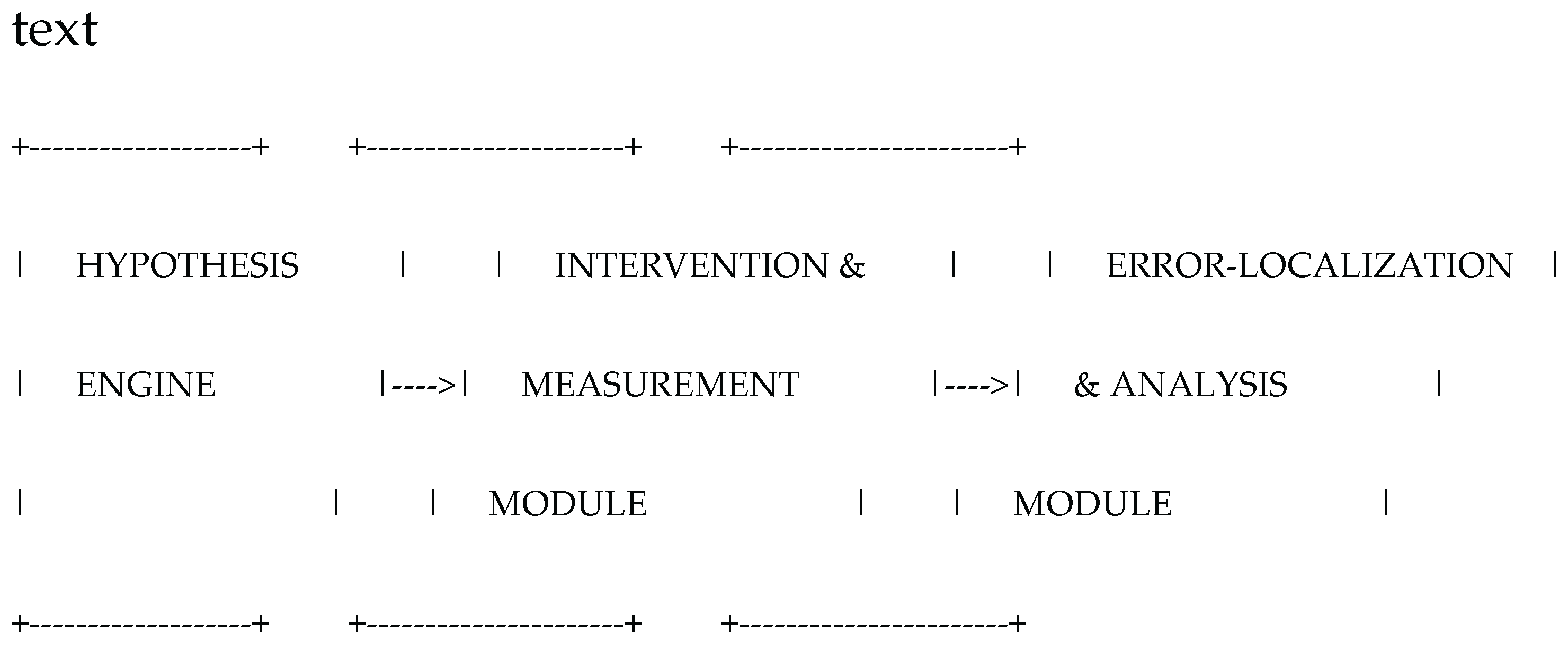
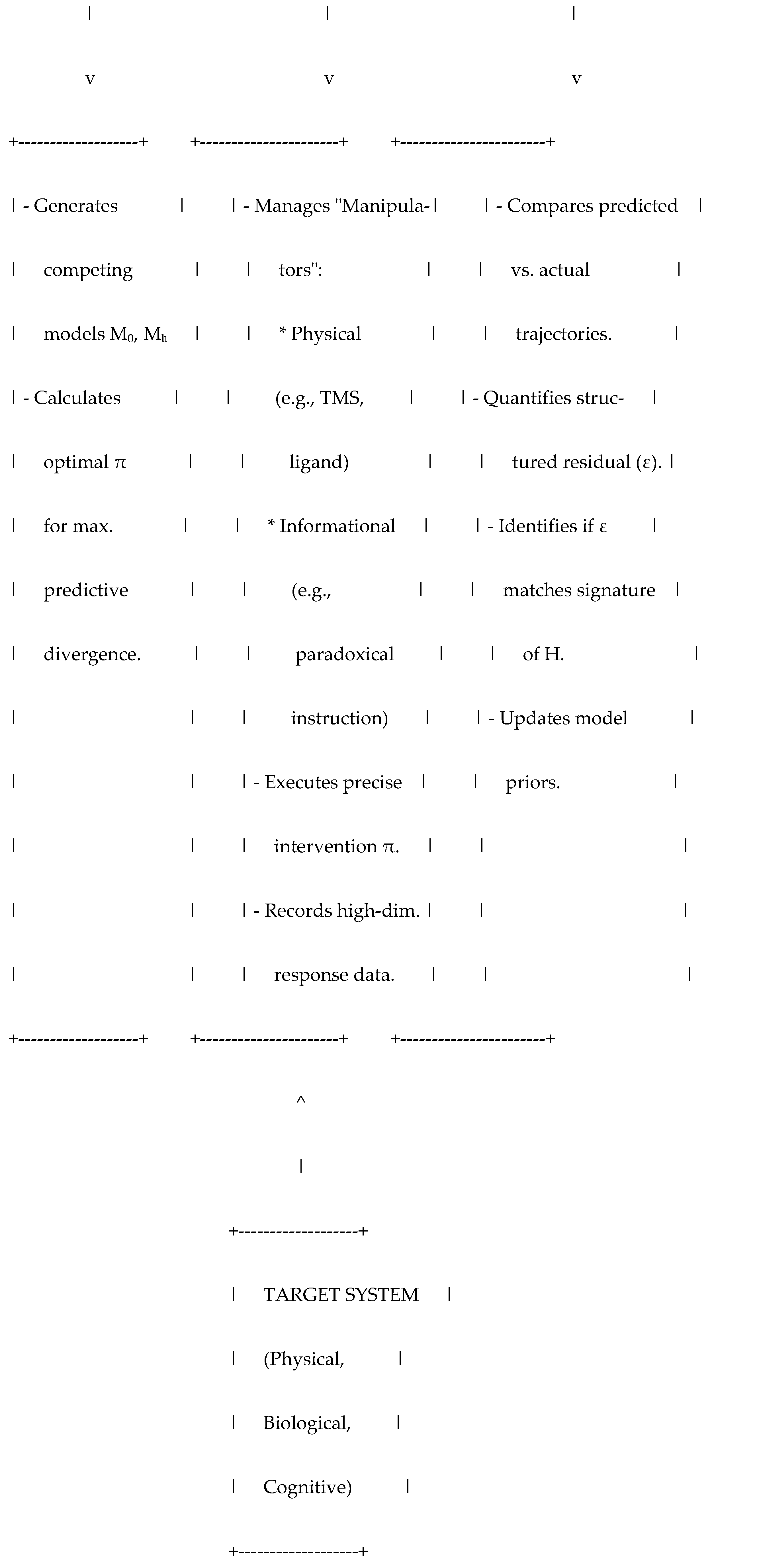

Table 1.
Functional Specifications of Core ZS Modules.
| Module | Primary Function | Key Sub-Components | Example Implementation |
| Hypothesis Engine | Formulates testable, conflicting predictions. | Model Bank, Divergence Optimizer, π-Calculation Unit. | Quantum: M₀ (no non-locality) vs. Mₕ (specific entangled channel). Medical: M₀ (normal tissue response) vs. Mₕ (pre-cancerous fragility). |
| Intervention Module | Executes the precise provocation π. | Manipulator Library, Spatiotemporal Controller, Calibration Sensors. | Physical: Transcranial Magnetic Stimulator (TMS) with neuro-navigation. Biochemical: Microfluidic chip for targeted metabolite pulse. |
| Analysis Module | Detects and interprets the localization signal. | High-Dimensional Data Pipeline, Residual (ε) Mapper, Bayesian Model Comparator. | Statistical: Pattern recognition on fMRI time-series post-TMS. Signal Processing: Phase coherence analysis in EEG following a cognitive probe. |
Table 2.
Simulated Data Output from a Biomedical ZS Application.
| Tissue Sample | Intervention π (Drug Dose, nM) | M₀ Predicted Viability (%) | Mₕ Predicted Viability (%) | Actual Oₐ Viability (%) | Inferred Latent State |
| Control (Healthy) | 10 | 95 ± 3 | 30 ± 10 | 93 ± 4 | Absent (M₀ correct) |
| Patient A | 10 | 95 ± 3 | 30 ± 10 | 85 ± 5 | Indeterminate |
| Patient A | 15 | 90 ± 3 | 15 ± 8 | 25 ± 6 | Present (Mₕ correct) |
| Patient B | 10 | 95 ± 3 | 30 ± 10 | 32 ± 7 | Present (Mₕ correct) |
Disclaimer/Publisher’s Note: The statements, opinions and data contained in all publications are solely those of the individual author(s) and contributor(s) and not of MDPI and/or the editor(s). MDPI and/or the editor(s) disclaim responsibility for any injury to people or property resulting from any ideas, methods, instructions or products referred to in the content. |
© 2026 by the authors. Licensee MDPI, Basel, Switzerland. This article is an open access article distributed under the terms and conditions of the Creative Commons Attribution (CC BY) license (http://creativecommons.org/licenses/by/4.0/).
Copyright: This open access article is published under a Creative Commons CC BY 4.0 license, which permit the free download, distribution, and reuse, provided that the author and preprint are cited in any reuse.


