
Submitted:
07 January 2026
Posted:
09 January 2026
You are already at the latest version
Abstract
Trees in urban environments provide essential ecosystem services, but root growth–pavement system conflicts often constrain tree longevity and degrade infrastructure performance. The study presents a conceptual model for green and grey infrastructure alignment to ensure tree longevity while maintaining pavement performance in the urban environment. Drawing on past research where roots were flattened when exposed to confining stresses greater than 0.35 MPa, we developed a series of finite element models in COMSOL Multiphysics to simulate root-induced stresses in concrete pavements under varying pavement thickness, base thickness, and root depth. Parametric analyses showed that an increase in root depth had the largest impact in reducing stress, followed by an increase in pavement thickness, then base thickness. Maximum single-root-induced stresses were approximately 0.55 MPa, below that of normal concrete flexural strength. From these results, design guidance is proposed for tree root accommodation and pavement in existing and new infrastructure, with emphasis on root growth enhancement, pavement durability, and cost-effectiveness measures.
Keywords:
concrete pavement
; numerical simulation
; root growth
; green infrastructure
Introduction
As living elements in the designed urban landscape, urban tree architecture is shaped by nearby structures and the physio-environmental loadings within the urban environment. Tree growth and form are also influenced by the level of competition for resources based on planting density coupled with access to soil, light, and-or water resources. Consequently, urban-grown individuals of a species often do not grow in the same manner as their counterpart within a forest stand or natural habitat. Trees are planted at a small relative size on a presumption of survival to become large and long-lived. Urban trees are perennial woody plants that hold a unique position in urban planning and design as they are expected to grow, in size and value, throughout their designed service life. In contrast, most other components of the design degrade over time.
Redevelopment cycles and changes in land use or land use zoning often impact the health of mature trees and can potentially result in their premature removal. Such losses mute and often outstrip the benefits presented by trees where often the larger or older trees of a given species provide greater canopy services because of larger canopy dimension and then stability of form over time. Tree growth over time skews a tree’s individual impact on the surrounding environment as a service toward longevity-conferred values in terms of environment, aesthetic and social consideration (Hitchmough, 1994; Nowak, et al., 2006; Wolf, et al., 2020). Within a vegetation system, the older, larger trees confer a larger benefit for an investment in a municipal population despite their reduced number of individuals within a population’s tree size distribution over time (Hitchmough, 1994; Leopold, 2022). For this reason, there is an advantage in extending tree longevity in urban landscapes (McPherson, 1994; Nowak, 2010)
Accepting a premise that tree canopy environmental and design services are increased with larger tree sizes, suggests conservation of trees in active growth beyond the service life and replacement of other infrastructure components such as pavement. Tree management for longevity becomes instrumental for the return on capital investments and accruals of added value. From a management planning view, this would suggest that green infrastructure components cycle on a different timeline than grey infrastructure, but a nested schedule of components can synchronize grey and green elements. To make such a mesh of components work, it is crucial to integrate such plans in a meaningful way within the design process across disciplines to make such effort practical for a structurally literate and biologically literate shared design approach. Just as a tree canopy can be large, so too can the root system. The root system’s large architecture influences mechanical support for the tree in the interception of wind and gravitational loading (Vogel, 1996; Stokes, 2002; Day et al., 2010; Watson et al., 2014).
Living systems typically scale to the resources available, and the concept of site carrying capacity is a convenient way to frame the expectation of growth of a tree, or tree community, to a site (Kimmons, 2004; Martire et al., 2015). In an urban tree design-management-planning context, it suggests the provision of space can support a tree with volumes of soil. In a limited space, successful management of the tree is predicated on the level of maintenance investment to supplement the lacking soil volume or site capacity to provide the desired tree size over time. An example of the space-to-maintenance tradeoff could be the need for irrigation and fertilization cost to ensure tree performance, or a relaxation of tree growth and-or longevity expectations resultant from occupation of a reduced soil space (Grabosky and Gilman 2004, Celestian and Martin, 2005; Sanders et al., 2013; Sanders and Grabosky, 2014; Leopold, 2022). Toward that end, models have been developed to estimate needed soil volumes for tree growth, setting the size expectation for the tree as the projected design size for a functional success (Architects, 2000; DeGaetano, 2000; Lindsey and Bassuk, 1991, 1992).
Beyond using those models to calculate a recommended tree soil volume in design, tree care professionals use several alternative methods to delineate tree root zone protection volumes for existing trees which could also be used to scale a soil volume in the design phase (Clark & Matheny, 1998). Of those many methods, there is a consensus method advanced by the ASTM A-300 part 5 for a tree protection zone focused on the biological tree, recommending a ratio of 6-18 units of distance for each equivalent unit of trunk diameter at 1.37 m elevation (Matheny et al., 2023). Thus, if a successful tree is envisioned to become 0.5 m in trunk diameter over a span of two decades, the root zone for protection would have a radius of 3-9 meters assuming a concentric circle for a root system. The suggested method places the protection zone beyond the observed root plates exposed from whole-tree storm failures in medium sized trees which may relate to tree mechanical stability (Mattheck et al., 1993; Grabosky et al., 2025).
In addition to soil volume, tree planting spaces should consider the minimum planting widths required to accommodate the larger surface roots associated with a tree’s root flare and the zone of rapid taper. While allometric equations have been developed to provide estimates of the buffer needed to prevent sidewalk lifting and asphalt buckling (North et al., 2015; Hilbert et al. 2020; Koeser et al., 2022), space comes at a premium in urban areas and sidewalk lifting remains a common and costly disservice associated with urban trees (McPherson, 2000; Roman et al., 2021). Past research has attempted to identify the manner in which tree roots grow under these paving surfaces as well as the pressures they exert as they grown in diameter and push pavements upwards (Grabosky and Gucunski, 2011; Grabosky et al., 2011). In contrast to these works, which often stop at describing how existing infrastructure interacts with tree roots, research is needed to design cost effective pavement solutions which resist cracking and lifting.
The soil volume and spacing needed for normal tree growth and function is typically larger than most planting sites where urban trees are placed and managed in the developed landscape. The integration of tree root zones and pavement section designs can be informed by imposition of root system architecture within pavement design systems if various disciplines work toward a common solution. We detail the progress on one such avenue to integrate trees and pavement; designed media to support pavement and enable root colonization. The goal is a sound pavement design and normal pavement lifespan matched to a growth mode for the tree over multiple pavement surface lives.
To accomplish this goal, we used past research findings which measured the pressure exerted by roots during radial expansion to develop a finite element model (FEM) to determine the cracking and lifting potential of paved surfaces. FEM testing is often used to guide design once system parameters are defined and provided (Rahardjo et al., 2009; Johnson, 2017). A series of testing efforts were developed to explore the stresses developed with soil displacements caused by growth of woody roots under the pavement surface (Grabosky and Gucunski, 2011; 2019). To parameterize an FEM to model root growth under pavement in a designed soil system we used data from previously tested systems in addition to results from the current study (Grabosky and Bassuk, 1996; Grabosky et al., 2009), and observations from mechanical models in compacted sand) (Grabosky and Gucunski, 2011). Further background on designed soil systems of this type is found in the supplemental material.
Methodology
An experimental program and a numerical investigation were developed to address the most common failure modes of pavement cracking by imposing radial stresses that exceeded the capacity of concrete in sidewalks and lifting of pavement segments by bulk soil displacement.
While the same effort could model the tipping sidewalk sections from the side or at section joints, it is not a case treated in this effort. The occurrence of each mode depends on several factors, some of which are the restraint of the panels, geometric aspects of the root, soil behavior, and pavement system competence (compaction and strength). In this paper, the failure mode (cracking) is investigated resultant of an experimental program to evaluate stresses imparted by the growing root, and implementation of numerical simulations to analyze the effects of such stress levels on concrete pavements. While being important, the lifting behavior of concrete pavements can be addressed in future extensions of the work as it radically shifts the loading models to levering as a lift from the edge of a pavement or the crack. An underlying assumption in the current study is that the pavements are in a sound condition, and the crack happens because of root growth.
To inform the FEM, a study was conducted on two common street tree species in Florida, USA to measure the impact of confinement strength on the morphology of secondary radial root growth, in effect when a root deforms rather than displaces confining material (Koeser et al., 2026). Tree roots ranged from 5-52 mm diameter. Root flattening (deformation) rather than displacement was observed with a very high probability (> 96%) when confining stress was above 0.16 MPa, and 100% probability when above 0.17 MPa; independent of species was observed. The observations were in large agreement with the findings in the literature on predominantly small annual and perennial crop species (Koeser et al., 2026) and observations in early testing of designed root media for tree roots and pavement support (Grabosky et al. 1996, 2001). With this data we modelled the root with analogous behavior as single root loading and as multiple root loading.
We chose to model a pavement layer system including standard wearing surface and base material layers. We included a subbase layer as a root-pavement synthesis layer, separated from the base by a geotextile to both aid layer separation and root exclusion from the base layer. The lower subgrade layer was then input via standard geotechnical soil parameters (see Table 1). The subbase was defined in reference to observed properties of a designed stone matrix root-pavement material (Grabosky et al., 2009; Grabosky, 2015)
COMSOL Multiphysics software was used in this study to produce 2D FEM simulations of the pavement response to root growth in a root-soil-pavement system, including the pavement, base, geotextile, subbase, and root. Figure 1a shows an overview of the components included in the models. Figure 1b shows a zoomed-in view at the region around the root and near the base-subbase interface, and Figure 1c shows the meshed model. Free tetrahedral elements with adaptive sizing were used to mesh the entire domain, with an average of 82,000 elements per model. While the geotextile can be modeled as a one-dimensional thin layer at the interface between the base and the subbase, the authors opted to include it as a distinct 2D domain to minimize stress singularities, excessive curling, and inform more intuitive behavior at negligible computational cost. All components except the root, were assigned a computationally infinite domain condition to enforce a plane strain, to minimize local effects. This can be true for the base, geotextile, and subbase layers, yet concrete pavements are not constructed monolithically, with joints between individual slabs that are typically 1 m (3 ft) long with small gaps in between. This inherently gives rise to local effects such as friction and different restraining conditions. Nevertheless, this may be more crucial when assessing lifting of the pavement in situations where the root would be near or directly below the joints. Since the aim of the models in this study is to assess the cracking behavior of the pavement, this effect can be excluded.
The numerical simulations of the effects of root growth on the stresses in the pavement were assessed in two different sets of models. The first was a stress/load-controlled model set (varying pressure). The aim of this step was to evaluate the effects of root growth. Flattening is not explicitly modelled, rather its effect is obtained from the stress-controlled study reflecting experimental results. The stress range obtained from the experimental program from initial stresses to stress at flattening from various roots was used as an input (between 0-0.35 MPa). After that, the results were extrapolated from the calibrated model to several parameterized cases with varying thickness of pavement, base, and depth to root (about 2800 points). The pavement thickness varied from 7.5 cm to 10 cm at a 0.75 cm interval. The base thickness was from 10 cm to 15 cm at a 2.5 cm interval. Lastly, the root depth varied from 0 to 40 cm at a 5 cm interval. The other set of models were displacement controlled, in which the diameter increase was used as the loading function that causes stresses, encapsulating growth from (0.01 – 0.08 m) (~50 cases). This set was established to assess the effect of root growth beyond the stress range obtained from the study, and typical stress values at which flattening or a high probability of it would have occurred already. In this model, only the depth of root below the geotextile was varied to assess how deep the root should be placed in the subbase so that surface/pavement stresses are within acceptable ranges. This was done to help develop design guidelines for tree roots in urban environments. All domains were modeled with linear elastic material models. While including soil plasticity, strain hardening, and soil yielding can lead to more accurate stress levels (Grabosky and Gucunski, 2019), the inherent overprediction of stress by using a linear model is sought to provide a factor of safety from an engineering perspective. Table 1 summarizes the main parameters used in the numerical simulations for domain properties.
Results and Discussion
Figure 2 shows a typical displacement field as an effect of root growth, shown at a diameter of 8.5 cm and a depth of 10 cm below the geotextile. It can be observed that the maximum displacement occurs around the root. Flattening may occur before the root reaches this diameter. Therefore, pressures generated and considered in this study are deemed to be a conservative estimate. The geotextile layer plays a crucial role in isolating the base and pavement from direct effects of the root growth, by providing additional stiffness along the length of the layer.
A parametric study was conducted to assess the effect of pavement and base thickness in mitigating stresses. The results generated from pressure-controlled models are provided as supplemental data files, see Figure 3 as an example. The reduced data detail is shown in Table 2, which defines the root placement and the stress at the pavement surface when the root is subject to confining stresses at the point of observed flattening (0.35 MPa) and at a higher level of 0.5 MPa.
The maximum stress induced by a single flattened root like the one from the experimental program onto the pavement is less than 550 kPa (Table 2). It is noted that beyond this stress, soil hardening may take place in the zone around the root causing a decrease in stress. Hence, linear approximation of soil stress-strain behavior is a conservative approach. Nevertheless, the stress in pavement could become closer to the cracking stress in concrete when influence zones around multiple roots interact in an overlapping manner. Hence, modelling the effect of multiple roots with varying geometric considerations is recommended for future research.
Table 3 summarizes the results of the numerical analysis to show the effect of each parameter. From the summary, the best strategy to reduce stress in the pavement is to increase root placement depth, followed by increasing pavement thickness, then increasing base thickness. This summary helps inform design decisions regarding soil-root-pavement systems. In addition, it provides a basis for cost-benefit evaluations. For example, increasing concrete thickness from 7.5 cm to 10 cm) can help reduce stress by about 100 kPa, when the root is placed at the same depth. This can be helpful; some pavements could be thicker than 10 cm, confirming the reduction in likelihood of cracking. On the other hand, the cost of varying these parameters is not equal. Balancing long-term longevity, cost, and promoting root growth in a controlled manner is required when designing pavements as part of green infrastructure. In general, providing thicker concrete can provide a significant boost to the overall performance in the system for an increase in costs, as could increasing the thickness of the generally cheaper base layer. Enabling root colonization depth below the geotextile layer could be productive. Thickening the base layer could also move the root deeper. Field observations of root behaviors indicate that they tend to grow deeper depending on temperature profile and moisture in the subbase layer (Grabosky and Bassuk, 2016; Grabosky et al., 2001). In summary, results included in this study could be used as a reference for expected stresses for trees and soils with similar mechanical properties.
To inform a design guideline, and to include stresses beyond what was measured from the experiments, a parametric study was also conducted in a displacement-controlled manner. Figure 4 shows the stress in the pavement as a function of root diameter incremental growth, starting from a root diameter of 5 cm. The limiting stress selected for the study is the flexural strength of concrete, which is about 2 MPa for concrete typically used for sidewalk applications. The figure shows that for a root that flattens at 10 cm diameter, for example, the root must be placed at least 5 cm below the geotextile level, which indicates that the root's top portion just touches the geotextile layer. Another example drawn from the graph is that if a root was initially placed at a depth of 30 cm, it is allowed to grow without flattening up to 13 cm before cracking the concrete pavement.
Based on the numerical simulation findings, a series of design illustrations were produced as a basis for guideline proposals. Essentially, the recommendation is to use a geotextile to prevent roots from colonizing a base material layer, to instead colonize a designed soil for root colonization and pavement support below. With proximity to a tree, the suggestion is a deeper base layer to allow a common pavement surface layer thickness at final grade. Observations from a series of root plates from trees overturned in the 2011 hurricane Sandy suggested a consistent root diameter size below 5 cm (Grabosky et al., 2024) and a structural root plate size similar to earlier German failure curve studies (Mattheck et al., 1993) suggesting plates limiting to within 3 meters distant from the tree. The schematics presented herein, at minimum, can be used as a starting point for sizing and positioning. However, slight alteration could be carried out supported by a similar analysis. In any case, it is highly likely that concrete could crack when root zone materials, or base materials not excluding root colonization are positioned just below the pavement in the base layer, as is typically observed in older existing infrastructure.
Based on the results obtained in this study, Figure 5, Figure 6 and Figure 7 illustrate a pavement design series where a tree could exist 1.8 m, 2.4m or 3.0 m (6ft, 8ft, or 10ft respectively) away from the pavement system. For the 3 m (10’) alternative shown in Figure 7 it is expected that pavement surface stresses would be much lower than in Figure 5 or Figure 6 given their increasing proximity to the tree structural root plate. Hence, minimum dimensions can adequately meet design requirements. The curb, shown in the figures, is not typically included in concrete sidewalks but could be used in street-side or parking lot situations. Similarly, the pavement wearing surface can be rendered as asphalt, which has been previously modelled (Grabosky and Gucunski, 2011; 2019). The findings inform layer thickness and assume that distance and growth criteria suggested in this study are met, and the geotextile is brought to the surface and affixed to the surface or edge surface to exclude the root colonization of the base layer with or without use of a curb. Root system colonization into the subgrade is represented but could be deemed unlikely depending on the subgrade definition, and level of compaction. Additionally, the tree would be influential in this expectation whether by species and individual effect, or by whether the tree was established before or after construction within the detail representation. In any case, the designed sub-base layer would be developed to provide any suggested root zone soil volume for the support of the tree.
Conclusions
This study presented results obtained from numerical simulations validated by experimental results, related to the effect of root growth on stresses in concrete pavements in urban environments. Overall, the integration of experimental data and FEM analysis provides a framework for designing sustainable root–soil–pavement systems. The results support urban planning approaches that align green infrastructure (trees) with grey infrastructure (pavements), extending tree longevity and reducing maintenance costs associated with pavement damage. The following are the main conclusions drawn from the current study:
- The experimental results showed that roots of the tested species flatten at as low as 0.17 MPa, with high likelihood of flattening beyond 0.35 MPa.
- From the numerical simulations, the stresses in the pavement are strongly influenced by root placement depth, followed by pavement thickness, then base thickness. The thickness of the geotextile layer used was kept at 1 mm.
- Increasing pavement thickness from 7.5 cm to 10 cm can reduce stress by up to 20%, while increasing root depth from 5 cm to 40 cm can reduce stress by up to 60%. These findings highlight practical design levels for balancing cost and performance.
- Stresses due to a single root in the considered geometrics were at 550 kPa as a maximum, which is lower than 2 MPa, the flexural strength of typical concrete used in sidewalks. Nevertheless, the presence of multiple roots may increase the stresses imparted onto the pavement, which needs to be studied in further studies.
- Design schematics for both existing and new infrastructure were proposed, emphasizing controlled root placement and adequate separation from pavement to mitigate cracking risks while supporting long-term tree health.
Supplementary Materials
The following supporting information can be downloaded at the website of this paper posted on Preprints.org.
Funding
This project was funded through the Florida Chapter of the International Society of Arboriculture’s research and education grant program. Funding for Grabosky was separately provided by the John and Eleanor Kuser Faculty Endowment in Urban and Community Forestry.
Credit Authorship Contribution Statement
Sharef Farrag: Writing – review & editing, Writing – original draft, Visualization, Validation, Software, Methodology, Investigation, Formal analysis, Data curation. Jason Grabosky: Writing – review & editing, Visualization, Supervision, Methodology, Investigation, Funding acquisition, Formal analysis, Data curation, Conceptualization. Joseph Leone: Writing – review & editing, Visualization, Supervision, Methodology, Investigation, Funding acquisition, Formal analysis, Data curation, Conceptualization. Andrew Koser: Writing – review & editing, Visualization, Supervision, Methodology, Investigation, Funding acquisition, Formal analysis, Data curation, Conceptualization.
Declaration of Competing Interest
Grabosky is listed as a co-inventor of a designed soil system (1996) patented by Cornell University (US Patent # 5,489,069). The published research of that designed soil was used in developing the model inputs for the designed subgrade of this study. The remaining authors declare that they have no known competing financial interests or personal relationships that could have appeared to influence the work reported in this paper..
Acknowledgments
The authors would like to thank Rutgers MLA student Josh Kover for his assistance in preparing Figure 5, Figure 6 and Figure 7 for this manuscript. We also thank Dr. Nenad Gucunski and Mustafa Khudhair from the Rutgers Center for Advanced Infrastructure and Transportation for initial work in transitioning from PLAXIS to COMSOL model systems, cross-checking consistency in outputs from earlier manuscripts in PLAXIS and an initial geotextile modeling study in COMSOL.
References
- Architects, A. I. O, 2000, Architectural Graphic Standards. In (pp. 1072). Hoboken, NJ: John Wiley & Sons.
- Celestian, S. B., Martin, C. A., 2005. Effects of parking lot location on size and physiology of four southwestern US landscape trees. Arboriculture & Urban Forestry, 31(4), 191-197. [CrossRef]
- Clark, J., Matheny, N., 1998. Trees and Development: A technical guide to preservation of trees during land development. ISA, Champaign, Illinois.
- Day, S. D., Wiseman, P. E., Dickinson, S. B., Harris, J. R., 2010. Contemporary concepts of root system architecture of urban trees. Arboriculture & Urban Forestry, 36(4), 149-159. [CrossRef]
- DeGaetano, A. T., 2000. Specification of soil volume and irrigation frequency for urban tree containers using climate data. Journal of Arboriculture, 26(3), 142-151. [CrossRef]
- Grabosky, J., 2015. Research note: Establishing a common method to compare soil systems designed for both tree growth and pavement support. Soil Science, 180(4/5), 207-213. [CrossRef]
- Grabosky J., Bassuk N. 2016. Seventeen years’ growth of street trees in structural soil compared with a tree lawn in New York City. Urban Forestry & Urban Greening 16:103-109. [CrossRef]
- Grabosky, J., Bassuk, N., 1996. Testing of structural urban tree soil materials for use under pavement to increase street tree rooting volumes. Arboriculture & Urban Forestry (AUF), 22(6), 255-263.
- Grabosky J, Bassuk N, Irwin L, van Es H., 2001. Shoot and root growth of three tree species in sidewalk profiles. Journal of Environmental Horticulture 19(4) 206-211. [CrossRef]
- Grabosky J., Bassuk N., 2016. Seventeen years’ growth of street trees in structural soil compared with a tree lawn in New York City. Urban Forestry & Urban Greening 16:103-109. [CrossRef]
- Grabosky J., Gilman E., 2004. Measurement and prediction of tree growth reduction from tree planting space design in established parking lots. Journal of Arboriculture 30(3): 154-164. [CrossRef]
- Grabosky, J. C., Gucunski, N., 2011. A method for simulation of upward root growth pressure in compacted sand. Arboriculture and Urban Forestry, 37(1), 27. [CrossRef]
- Grabosky, J., Gucunski, N., 2019. Modelling the influence of root position and growth on pavement tensile crack failure when occurring under three thicknesses of asphaltic concrete. Urban Forestry & Urban Greening, 41, 238-247. [CrossRef]
- Grabosky, J., Haffner, E., Bassuk, N., 2009. Plant available moisture in stone-soil media for use under pavement while allowing urban tree root growth. Arboriculture & Urban Forestry, 35(5), 271-278. [CrossRef]
- Grabosky, J., Pattanshetti, S., Zhang, T., Blake, T., Casario, B., Koeser, A., Miesbauer, J., 2025. Testing a modified pipe model approach to predict cross-sectional area of tree roots at specific distances from the tree. Arboriculture & Urban Forestry, 51(1), 14-28. [CrossRef]
- Grabosky, J., Smiley, E. T., & Dahle, G. A., 2011. Research note: Observed symmetry and force of Platanus X acerifolia (Ait.) Wild. roots occurring between foam layers under pavement. Arboriculture and Urban Forestry, 37, 35–40. [CrossRef]
- Hilbert, D. R., North, E. A., Hauer, R. J., Koeser, A. K., McLean, D. C., Northrop, R. J., Andreu, M., Parbs, S., 2020. Predicting trunk flare diameter to prevent tree damage to infrastructure. Urban Forestry & Urban Greening, 49, 126645. [CrossRef]
- Hitchmough, J., 1994. The management of trees in the urban landscape. Urban Landscape Management, 267-300.
- Johnson, T., 2017. Trees, Stormwater, Soil and Civil Infrastructure: Synergies Towards Sustainable Urban Design University of South Australia.
- Kimmons, J. P., 2004. Forest Ecology: A foundation for sustainable forest management and environmental ethics in forestry 3rd ED. Prentice-Hall, Hoboken, NJ Pp 611.
- Koeser, A., Leone, J., Farrag, S., Grabosky, J., 2026. Assessing The Limits of Radial Expansion in Woody Tree Roots. Arboriculture & Urban Forestry, In-Press.
- Koeser, A.K., Hauer, R.J., Hilbert, D.R., Northrop, R.J., Thorn, H., McLean, D.C., Salisbury, A.B., 2022. The tripping point – Minimum planting widths for small-stature trees in dense urban developments. Sustainability, 14(6), 3283. [CrossRef]
- Leopold, R. W., 2022. Growth rates and morphology of street trees: An analysis of different site types of urban areas in New Jersey Rutgers The State University of New Jersey, School of Graduate Studies.
- Lindsey, P., Bassuk, N., 1991. Specifying soil volumes to meet the water needs of mature urban street trees and trees in containers. Arboriculture & Urban Forestry, 17(6), 141-149. [CrossRef]
- Lindsey, P., Bassuk, N., 1992. Redesigning the urban forest from the ground below: A new approach to specifying adequate soil volumes for street trees. Arboricultural Journal, 16(1), 25-39. [CrossRef]
- Martire, S., Castellani, V., Sala, S., 2015. Carrying capacity assessment of forest resources: Enhancing environmental sustainability in energy production at local scale. Resources, Conservation and Recycling, 94, 11-20. [CrossRef]
- Matheny, N., Smiley, E. T., Gilpin, R., Hauer, R., 2023. Best Management Practices: Managing trees during site development and construction (3rd ed.). ISA.
- Mattheck, C., Bethge, K., Erb, D., 1993. Failure criteria for trees. Arboricultural Journal, 17(2), 201-209. [CrossRef]
- McPherson, E. G., 2000. Expenditures associated with conflicts between street tree root growth and hardscape in California, United States. Arboriculture & Urban Forestry, 26(6), 289-297. [CrossRef]
- North, E.A., Johnson, G.R., Burk, T.E. 2015. Trunk flare diameter predictions as an infrastructure planning tool to reduce tree and sidewalk conflicts. Urban Forestry & Urban Greening. 14, 65–71.
- Nowak, D. J., 2010. Assessing urban forest effects and values: Chicago's urban forest (Vol. 37). US Department of Agriculture, Forest Service, Northern Research Station.
- Nowak, D.J., Crane, D.E., Stevens, J.C. 2006. Air pollution removal by urban trees and shrubs in the United States. Urban Forestry & Urban Greening 4 2006, 115-123. [CrossRef]
- Rahardjo, H., Harnas, F., Leong, E., Tan, P., Fong, Y., Sim, E., 2009. Tree stability in an improved soil to withstand wind loading. Urban Forestry & Urban Greening, 8(4), 237-247. [CrossRef]
- Roman, L. A., Conway, T. M., Eisenman, T. S., Koeser, A. K., Ordóñez Barona, C., Locke, D. H., Jenerette, G. D., Östberg, J., Vogt, J., 2021. Beyond ‘trees are good’: Disservices, management costs, and tradeoffs in urban forestry. Ambio, 50, 615-630. [CrossRef]
- Sanders, J., Grabosky, J., Cowie, P., 2013. Establishing maximum size expectations for urban trees with regard to designed space. Arboriculture & Urban Forestry, 39(2), 68-73. [CrossRef]
- Sanders, J. R., Grabosky, J. C., 2014. 20 years later: Does reduced soil area change overall tree growth? Urban Forestry & Urban Greening, 13(2), 295-303. [CrossRef]
- Stokes, A., 2002. Chapter 10: Biomechanics of tree root anchorage. Plant Roots: The Hidden Half, 3rd Ed. CRC Press, Boca Raton, Florida, USA, 269-286.
- Vogel, S., 1996. Blowing in the wind: storm-resisting features of the design of trees. Arboriculture & Urban Forestry (AUF), 22(2), 92-98.
- Watson, G. W., Hewitt, A. M., Custic, M., Lo, M., 2014. The management of tree root systems in urban and suburban settings II: A review of strategies to mitigate human impacts. Arboriculture & Urban Forestry (AUF), 40(5), 249-271.
- Wolf, K.L., Lam, S.T., McKeen, J.K., Richardson, G.R.A., van den Bosch, M., Bardekjian, A.C., 2020 Urban Trees and Human Health: A Scoping Review. International Journal of Environmental Research and Public Health, 17, 4371. [CrossRef]
Figure 1.
(a) Overview of numerical domain and components, (b) magnified view of zone around root, and (c) illustration of mesh used.
Figure 1.
(a) Overview of numerical domain and components, (b) magnified view of zone around root, and (c) illustration of mesh used.
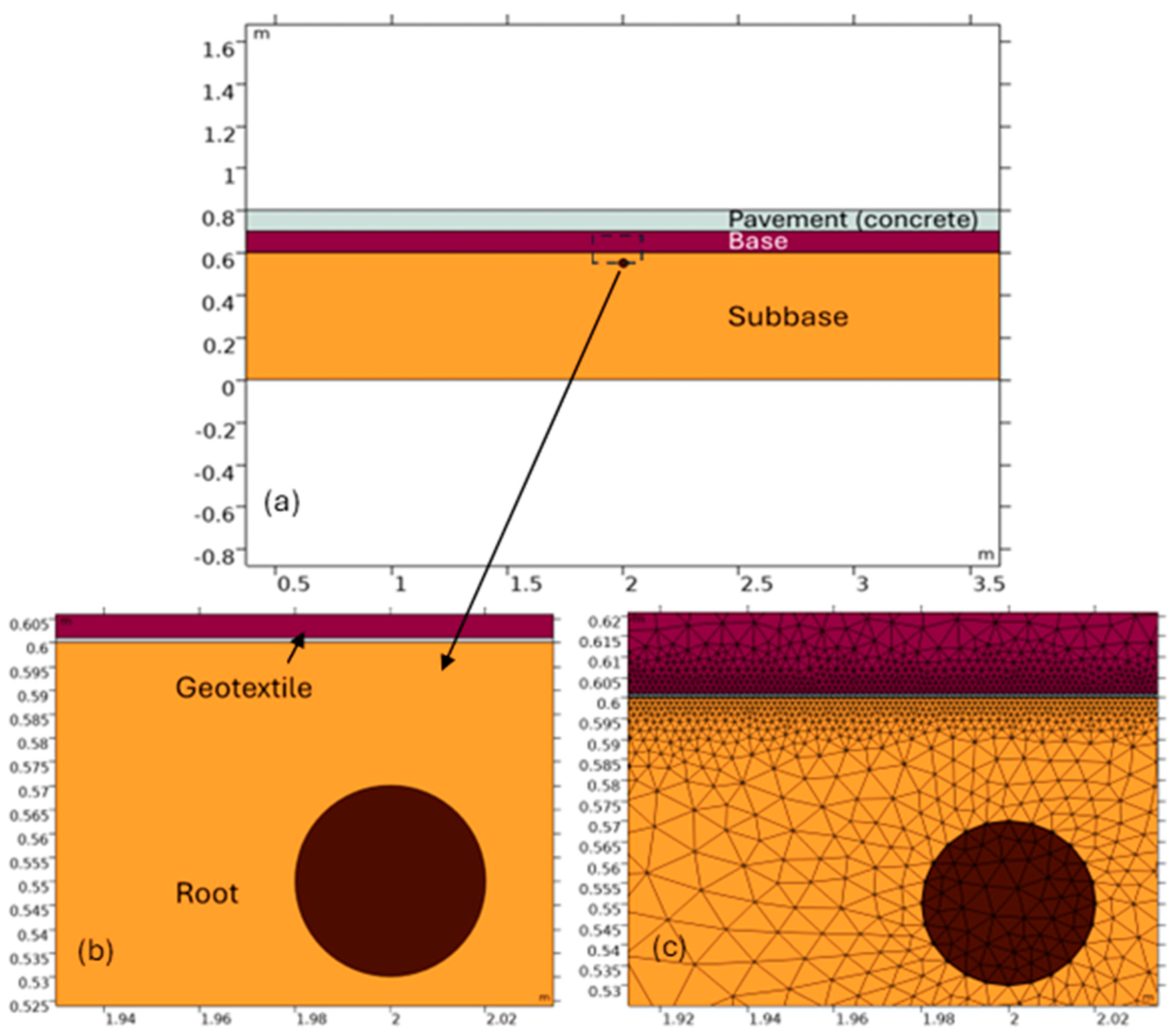
Figure 2.
The displacement field around the root grown to 8.5 cm at a depth of 10 cm below geotextile.
Figure 2.
The displacement field around the root grown to 8.5 cm at a depth of 10 cm below geotextile.
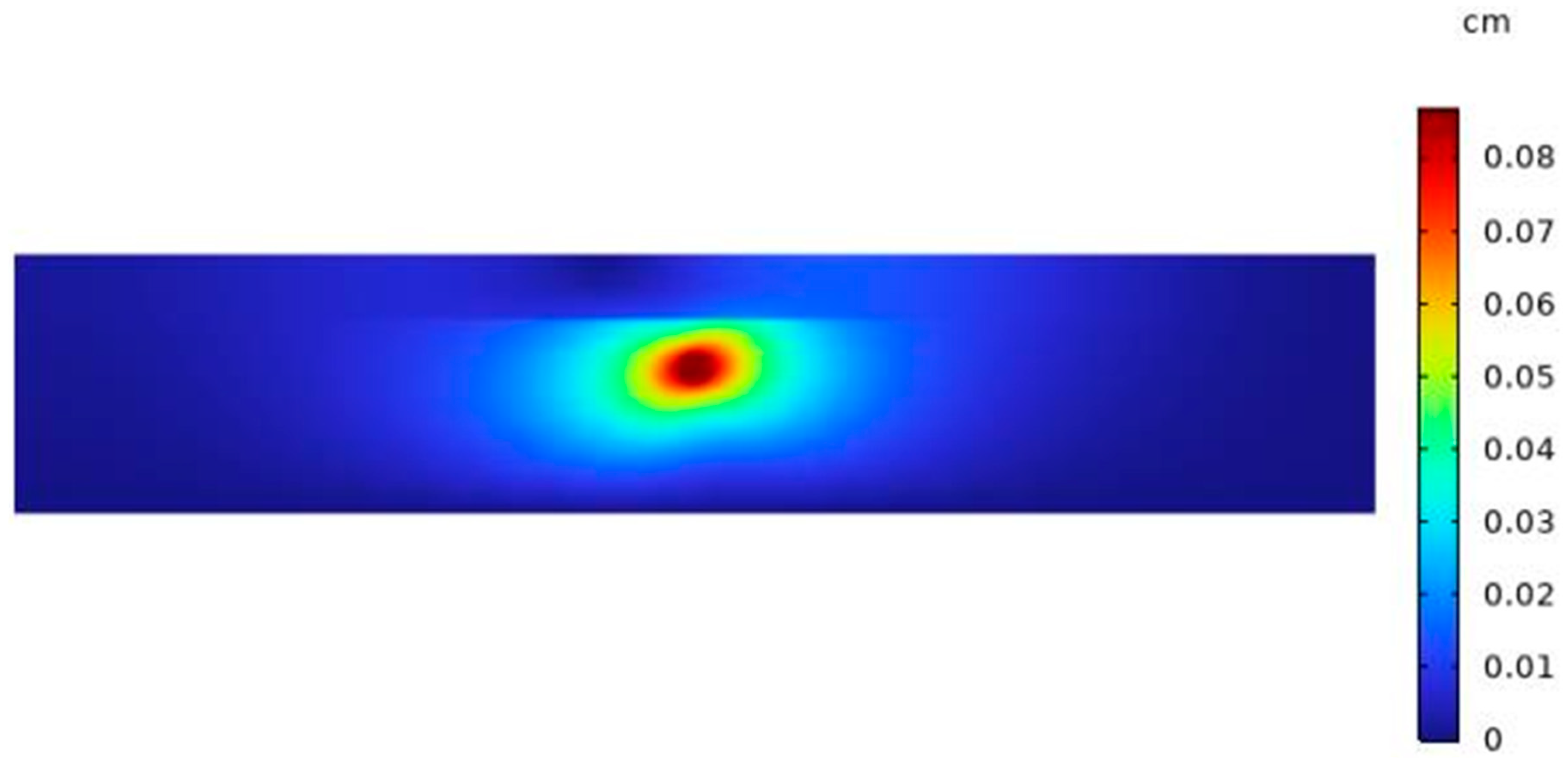
Figure 3.
Modeled stress in a concrete pavement at varying confining pressures when the pavement is underlain by a 10 cm thick base. The point at which roots have been observed to deform rather than displace (flattening) in secondary growth is noted by a dotted line.
Figure 3.
Modeled stress in a concrete pavement at varying confining pressures when the pavement is underlain by a 10 cm thick base. The point at which roots have been observed to deform rather than displace (flattening) in secondary growth is noted by a dotted line.
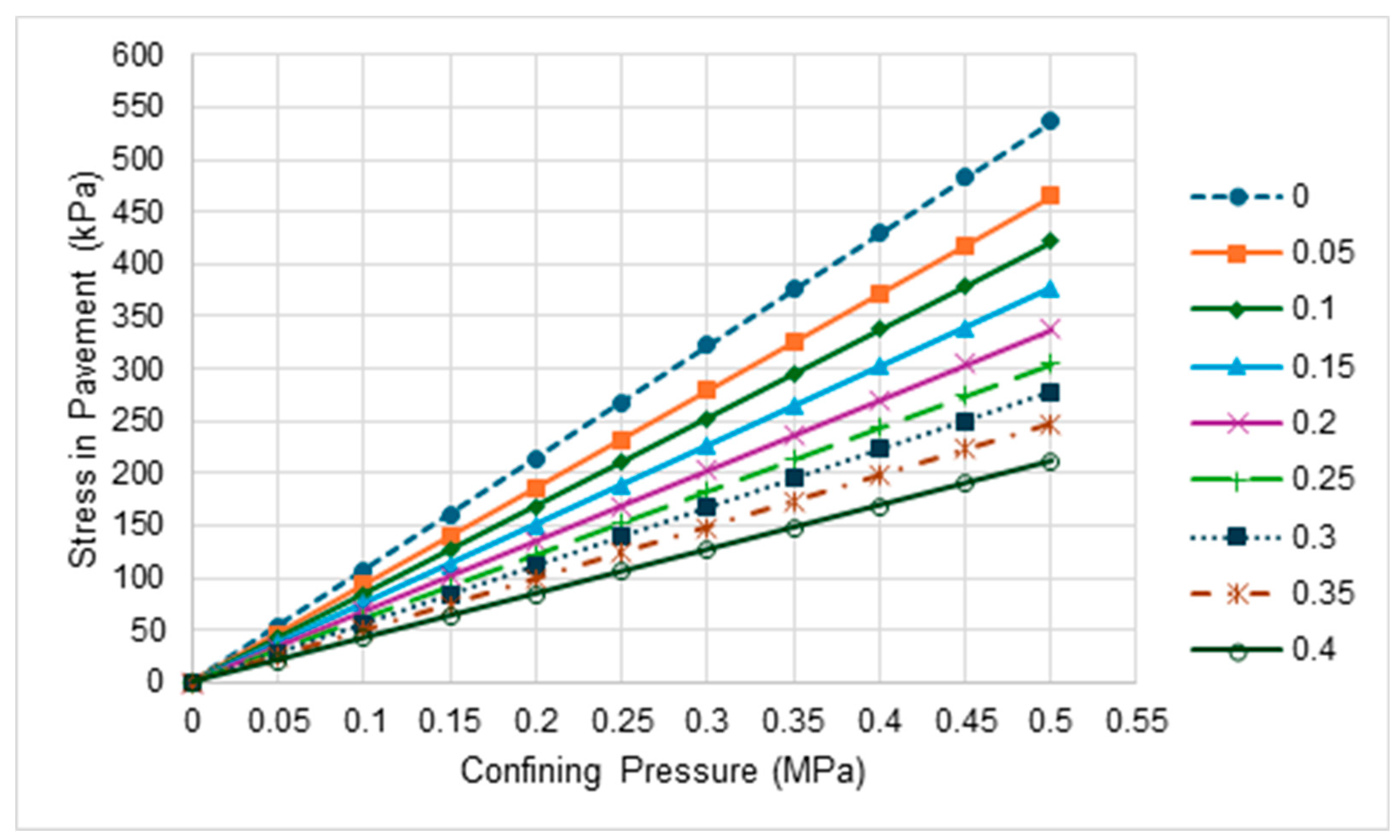
Figure 4.
Stresses in a 10 cm thick concrete pavement underlain by a 10 cm thick base, with root depths varying from 0 to 0.4 m below geotextile layer.
Figure 4.
Stresses in a 10 cm thick concrete pavement underlain by a 10 cm thick base, with root depths varying from 0 to 0.4 m below geotextile layer.
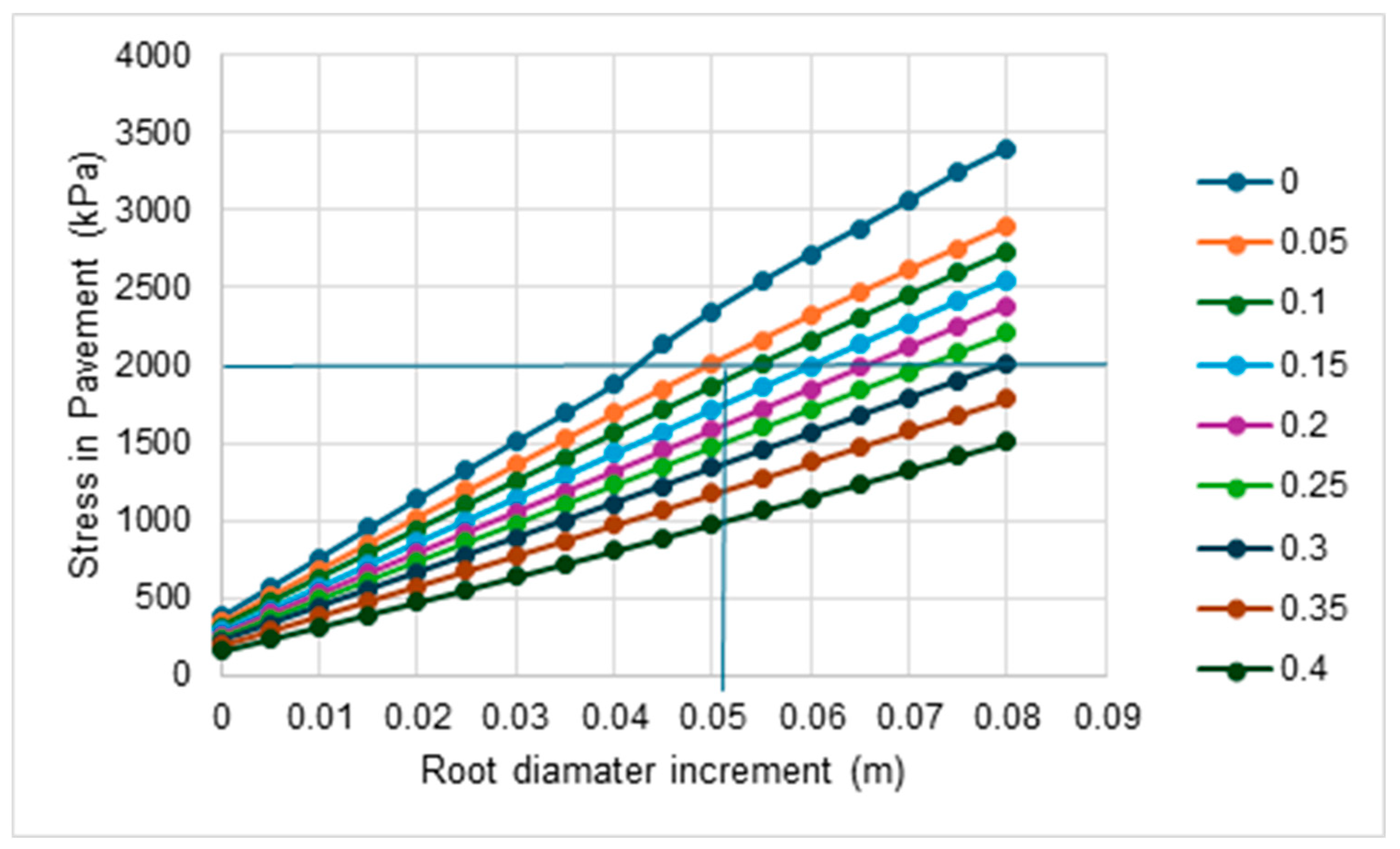
Figure 5.
Design schematic of root-soil-pavement system for in close proximity (1.8 m).
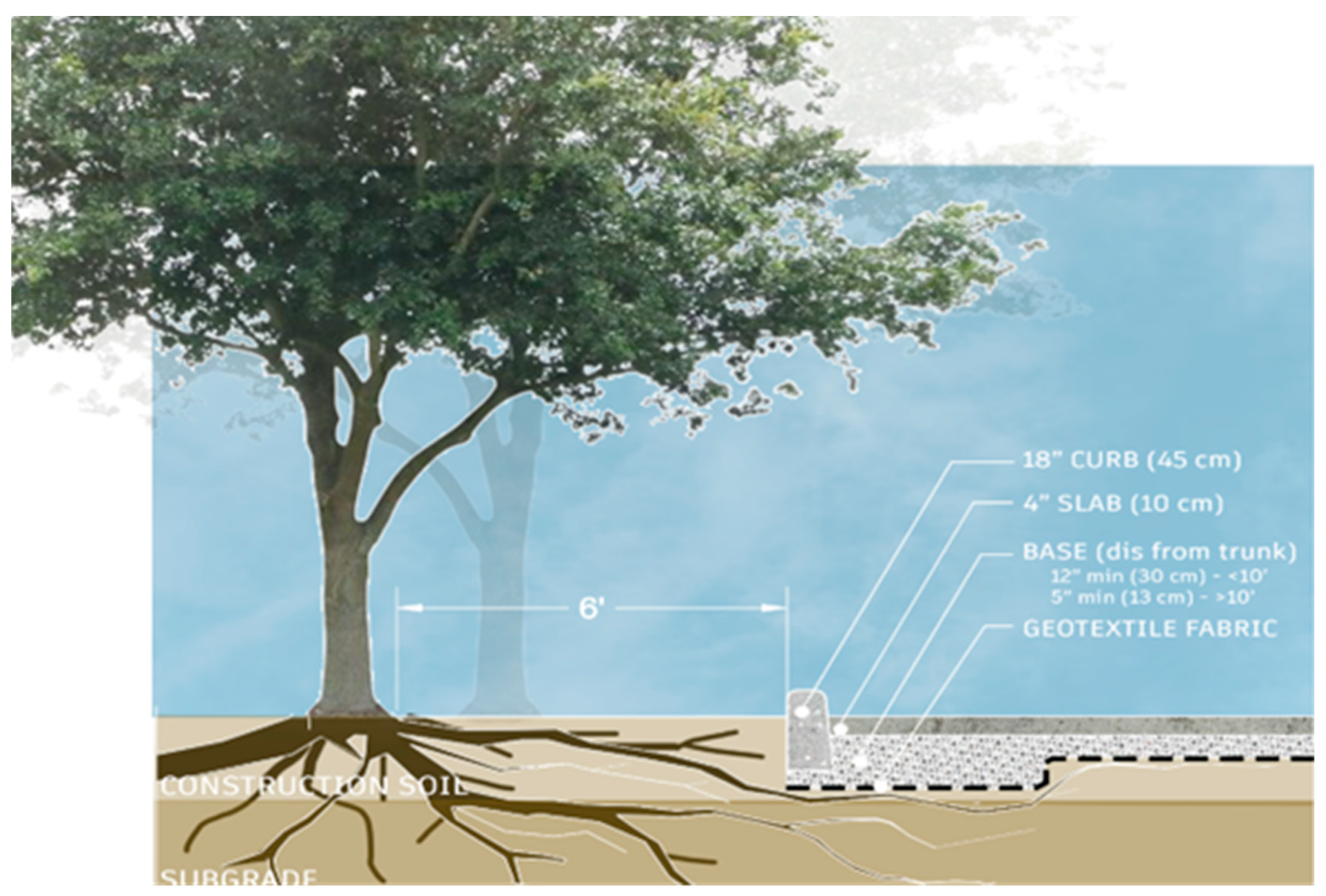
Figure 6.
Design schematic of root-soil-pavement system for tree placement 2.4 m away from tree base.
Figure 6.
Design schematic of root-soil-pavement system for tree placement 2.4 m away from tree base.
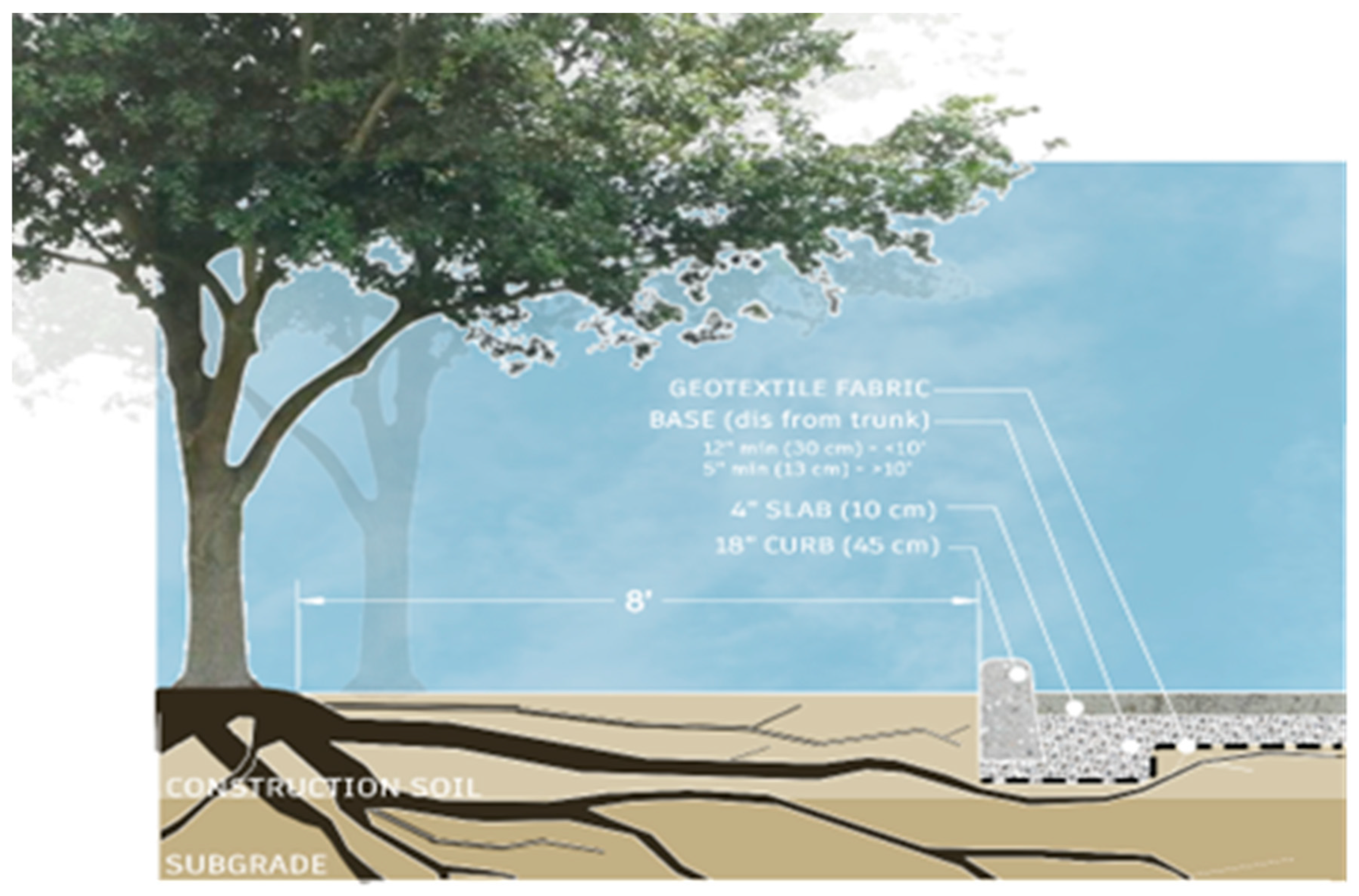
Figure 7.
Design schematic of root-soil-pavement system for tree placement 3 m away from tree base.
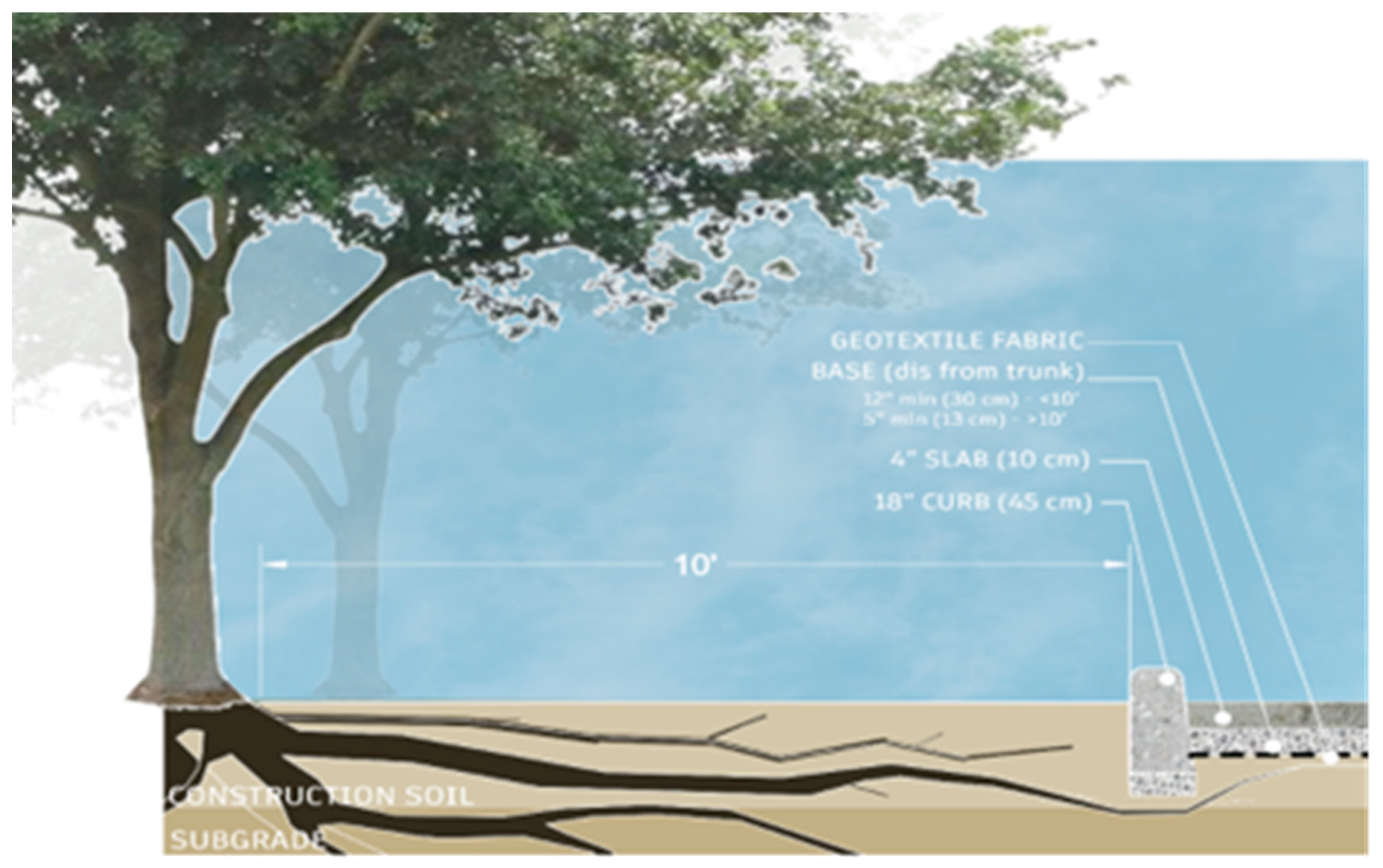

Table 1.
Summary of Parameters Used in Numerical Study.
| Parameter | Value | Description |
| Hsb | 0.6 m | Subbase thickness |
| W | 4 m | Width of numerical domain (graphical) |
| Hgtx | 0.001 m | Geotextile thickness |
| Hb | 0.1 m | Base thickness |
| Hp | 0.1 m | Pavement thickness |
| Dr | 0.01 m | Initial root Diameter |
| D | 0 m | Depth of root from geotextile |
| E | 0.01 m | Growth increment of root |
| ρp | 2200 kg/m3 | Mass density of pavement |
| ρb | 1936 kg/m3 | Mass density of base |
| ρsb | 1661 kg/m3 | Mass density of subbase |
| ρr | 595 kg/m3 | Mass density of root |
| Ep | 34.26 x 10⁷ kPa | Modulus of elasticity of pavement |
| Eb | 1.72 x 10⁵ kPa | Modulus of elasticity of base |
| Esb | 6.89 x 10⁴ kPa | Modulus of elasticity of subbase |
| Er | 173 kPa | Modulus of elasticity of root |
| Egtx | 1000 kPa | Modulus of elasticity of geotextile |
| Μ | 0.3 | Poisson’s ratio of all domains |
Table 2.
Stress (kPa) on a concrete pavement surface resulting from growth of a root element at 2 levels of confinement (MPa) within a factorial series of pavement surface thicknesses (from 7.5, 8.75 and 10 cm) and base thicknesses (10,12.5 and 15 cm thickness). A geotextile element was placed between the Base layer and Sub-base layer where the root element was placed.
Table 2.
Stress (kPa) on a concrete pavement surface resulting from growth of a root element at 2 levels of confinement (MPa) within a factorial series of pavement surface thicknesses (from 7.5, 8.75 and 10 cm) and base thicknesses (10,12.5 and 15 cm thickness). A geotextile element was placed between the Base layer and Sub-base layer where the root element was placed.
| Root position | Stress in pavement (kPa) | |||
| Surface thickness (cm) | Base thickness (cm) | Root depth in subbase (cm) | @ 0.35 MPa root confining stress | @ 0.50 MPa root confining stress |
| 7.5 | 10 | 0 | 375.57 | 536.52 |
| 7.5 | 10 | 2 | 236.58 | 337.98 |
| 7.5 | 10 | 4 | 147.9 | 211.29 |
| 8.75 | 10 | 0 | 331.41 | 473.44 |
| 8.75 | 10 | 2 | 216.22 | 308.89 |
| 8.75 | 10 | 4 | 138.72 | 198.17 |
| 10 | 10 | 0 | 294.59 | 420.84 |
| 10 | 10 | 2 | 197.22 | 281.75 |
| 10 | 10 | 4 | 129.33 | 184.75 |
| 7.5 | 12.5 | 0 | 358.96 | 512.8 |
| 7.5 | 12.5 | 2 | 226.47 | 323.53 |
| 7.5 | 12.5 | 4 | 140.08 | 200.11 |
| 8.75 | 12.5 | 0 | 318.27 | 454.67 |
| 8.75 | 12.5 | 2 | 207.88 | 296.96 |
| 8.75 | 12.5 | 4 | 132.39 | 189.12 |
| 10 | 12.5 | 0 | 284.65 | 406.65 |
| 10 | 12.5 | 2 | 191.23 | 273.19 |
| 10 | 12.5 | 4 | 124.16 | 177.37 |
| 7.5 | 15 | 0 | 339.85 | 485.5 |
| 7.5 | 15 | 2 | 217.59 | 310.85 |
| 7.5 | 15 | 4 | 132.3 | 189 |
| 8.75 | 15 | 0 | 304.77 | 435.38 |
| 8.75 | 15 | 2 | 201.47 | 287.82 |
| 8.75 | 15 | 4 | 125.47 | 180.67 |
| 10 | 15 | 0 | 276.86 | 395.52 |
| 10 | 15 | 2 | 186.61 | 266.58 |
| 10 | 15 | 4 | 118.96 | 169.94 |
Table 3.
Summary of Effect of Varying Parameters on Stresses Induced in Pavement.
| Parameter | Effect |
| Depth of Root Placement | In all nine considered scenarios, increasing the root depth from 0.05 m to 0.4 m led to a decrease in stresses by around 10% to 60%, respectively,. Regardless of pavement and base thickness |
| Pavement Thickness | For the same base thickness, increasing pavement thickness led to stress reduction of 11% (at 0.0875 m) and 20% (0.1 m) relative to the 0.075 cm pavement, when the root is placed at the top of the subbase. This reduction diminishes with increasing depth to 6% and 12%, respectively when the root is 0.4 cm deep in the subbase. |
| Base Thickness | For the same pavement thickness, increasing base thickness led to stress reduction of 3% (at 0.125 m) and 4.5% (at 0.15 m) relative to the 0.1 m base, when the root is placed at the top of the subbase. This reduction increases with increasing depth to 8% and 10%, respectively when the root is 0.4 cm deep in the subbase. |
Disclaimer/Publisher’s Note: The statements, opinions and data contained in all publications are solely those of the individual author(s) and contributor(s) and not of MDPI and/or the editor(s). MDPI and/or the editor(s) disclaim responsibility for any injury to people or property resulting from any ideas, methods, instructions or products referred to in the content. |
© 2026 by the authors. Licensee MDPI, Basel, Switzerland. This article is an open access article distributed under the terms and conditions of the Creative Commons Attribution (CC BY) license (http://creativecommons.org/licenses/by/4.0/).
Copyright: This open access article is published under a Creative Commons CC BY 4.0 license, which permit the free download, distribution, and reuse, provided that the author and preprint are cited in any reuse.


