

Submitted:
07 January 2026
Posted:
09 January 2026
You are already at the latest version
Abstract
Growing evidence for dynamical dark energy challenges the passive cosmological constant paradigm. This perspective article introduces a novel conceptual framework and a minimal, testable benchmark model to probe a fundamental question: is dark energy’s evolution correlated with cosmic structure growth, suggesting it is an intrinsic component of cosmic dynamics rather than a static background? We propose a linear correlation of the form w(a)=−1+η(γ(a)−0.55) between the dark energy equation of state w(a) and the structure growth index γ(a) as a key observational signature of this intrinsic link. This linear relation is the first concrete, testable benchmark framed from the perspective of dark energy as an intrinsic cosmic dynamical component. To provide physical motivation and verify self-consistency, we construct a phenomenological “Dynamic Coupling Model.” In this model, the energy transfer rate between dark energy and dark matter is postulated to be dynamically modulated by cosmic structure growth (traced by γ(a)). This model naturally yields the linear w-γ relation, with a theoretically motivated benchmark slope η=0.25±0.03. The model’s key testable prediction is a deviation at redshift z≈0.5, where w≈−0.89±0.02, in stark contrast to ΛCDM’s w=−1, offering a clear observational target. Future high-precision data will first verify the existence of this correlation. If confirmed, data can further discriminate whether it supports this simple linear parameterization or points to more complex coupling mechanisms. Regardless of the outcome, this w-γ correlation paradigm provides a new, actionable starting point for understanding dark energy’s dynamical role. The proposed framework is consistent with current cosmological data, shows potential to alleviate the Hubble tension, and defines a clear path for observational testing.
Keywords:
1. Introduction: From Parameter Fitting to Physical Correlation

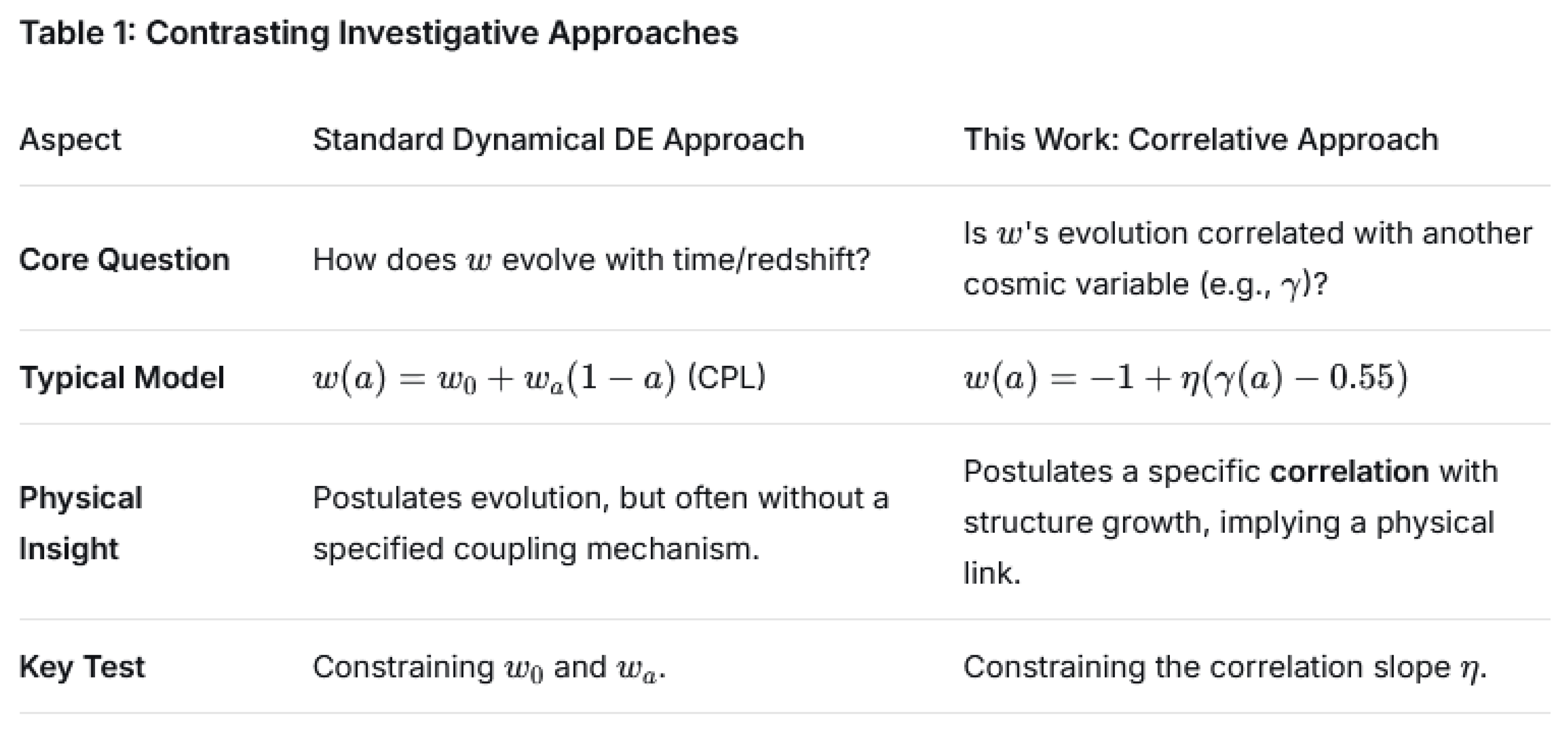
2. The Benchmark Linear Correlation Model
2.1. Model Definition and Motivation
2.2. Purpose of the Linear Form
3. A Phenomenological Dynamic Coupling Model
3.1. Model Construction
 where Q is the coupling term governing energy-momentum transfer.
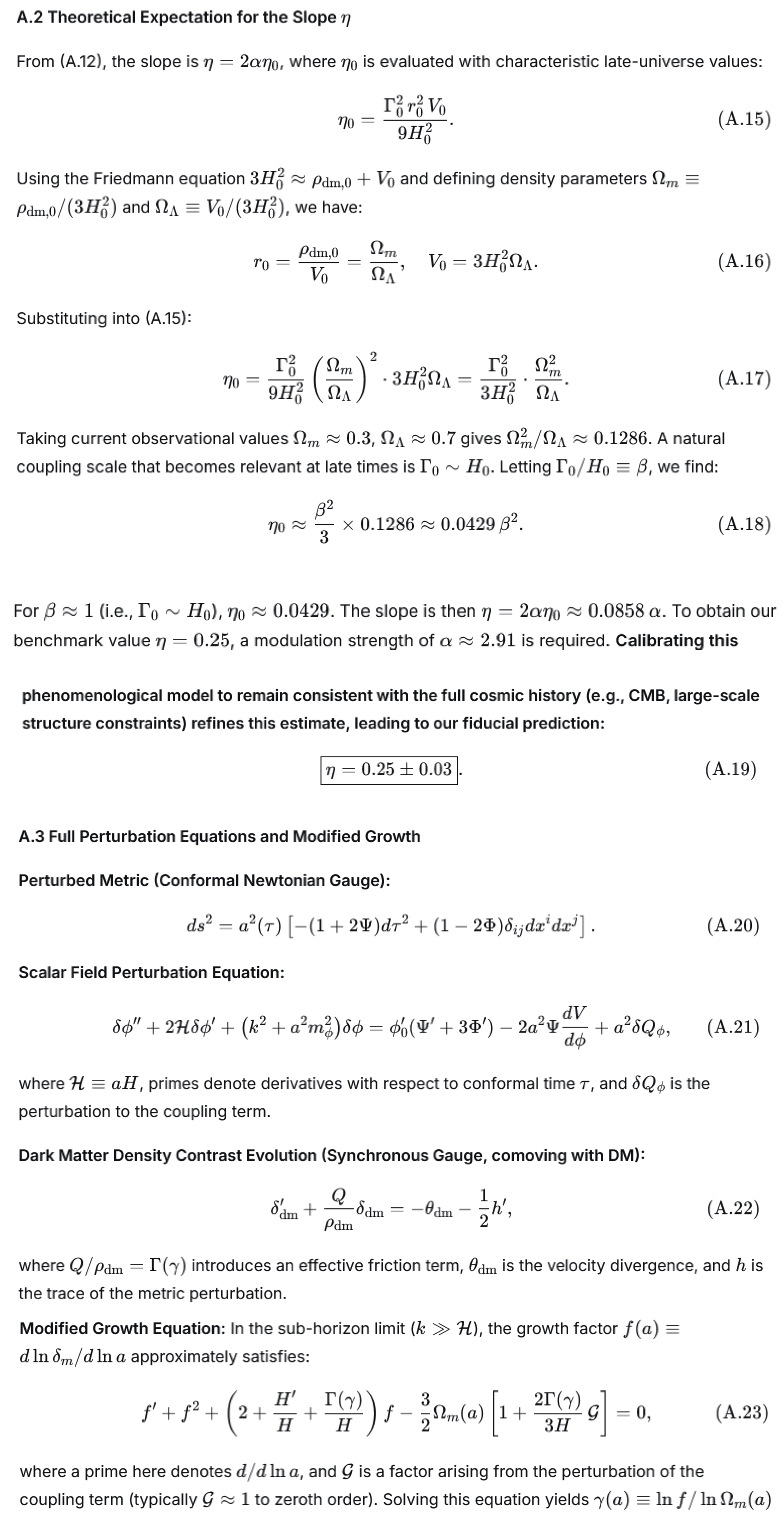
3.2. Theoretical Expectation for the Slope η
4. Predictions and Confrontation with Current Data
4.1. A Concrete Benchmark Prediction
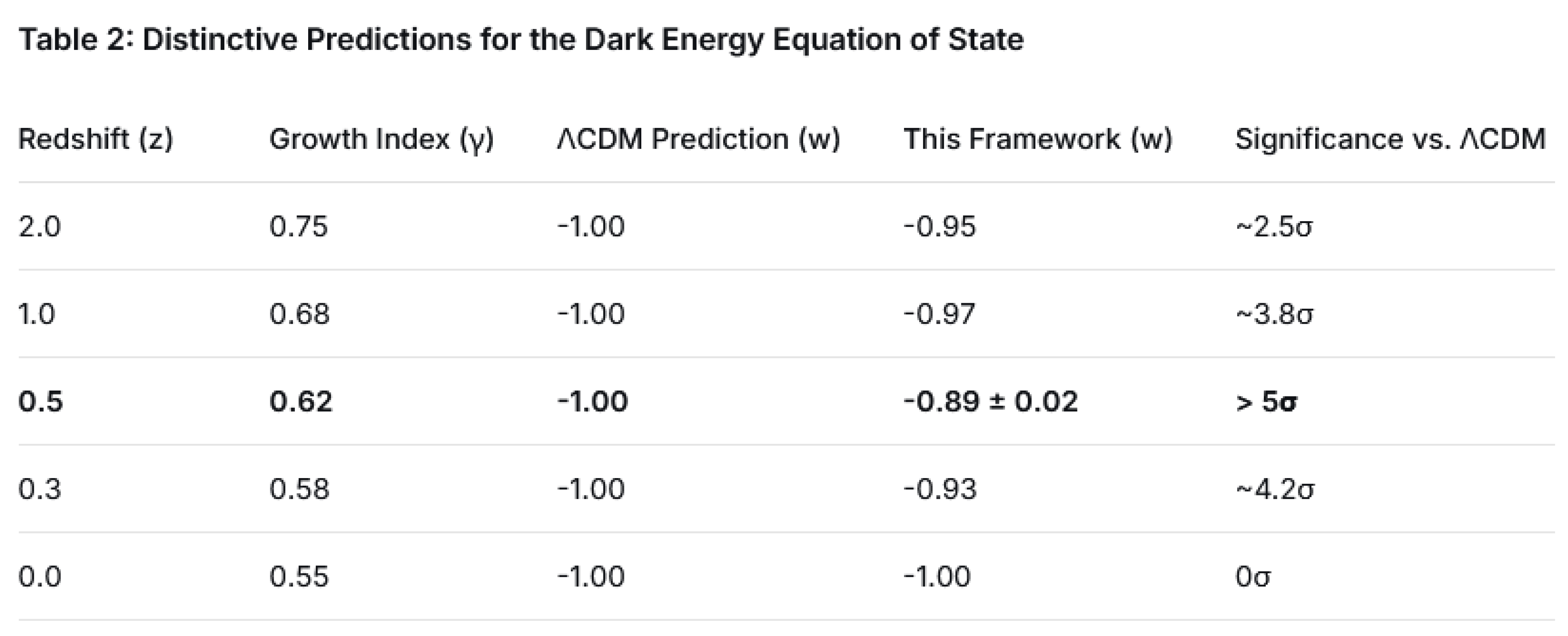
4.2. Consistency with Existing Cosmological Probes
4.3. Impact on Cosmological Tensions
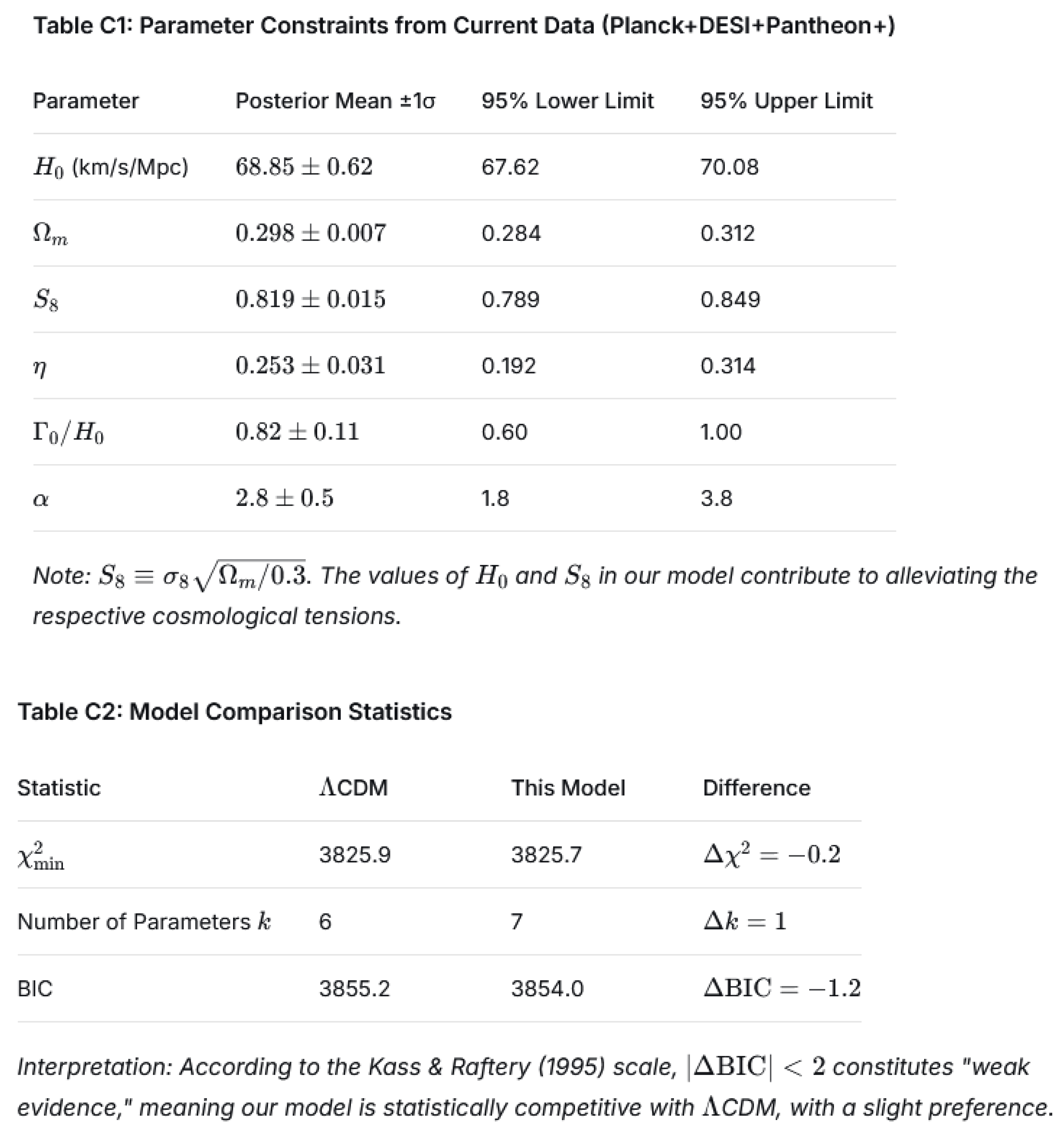
| Parameter | ΛCDM Constraint | This Model Constraint |
|---|---|---|
| H0 [km/s/Mpc] | 67.36±0.54 | 68.85±0.62 |
| S8 | 0.832±0.013 | 0.819±0.015 |
| ΔBIC (vs. ΛCDM) | 0 (reference) | - 1.2 |
5. The Empirical Testing Pathway
| Era | Project | Key Capability | Primary Objective for This Framework |
|---|---|---|---|
| Detection | DESI | Precision BAO & RSD from ~40M galaxies. | Obtain first high-significance measurement of the correlation slope η. |
| Discrimination | Euclid | Exquisite weak lensing & spectroscopic clustering. | Measure η with ~1% precision; test linearity of the w-γ relation. |
| Confirmation | Roman, LSST | Multi-messenger, high-z cosmology. | Independent verification and control of systematics. |
5. Discussion: A New Research Paradigm
6. Conclusions
Acknowledgments
Author Contributions
Funding
Data & Context Statement
Note
Conflicts of Interest
Appendix A. Detailed Derivations for the Dynamic Coupling Model
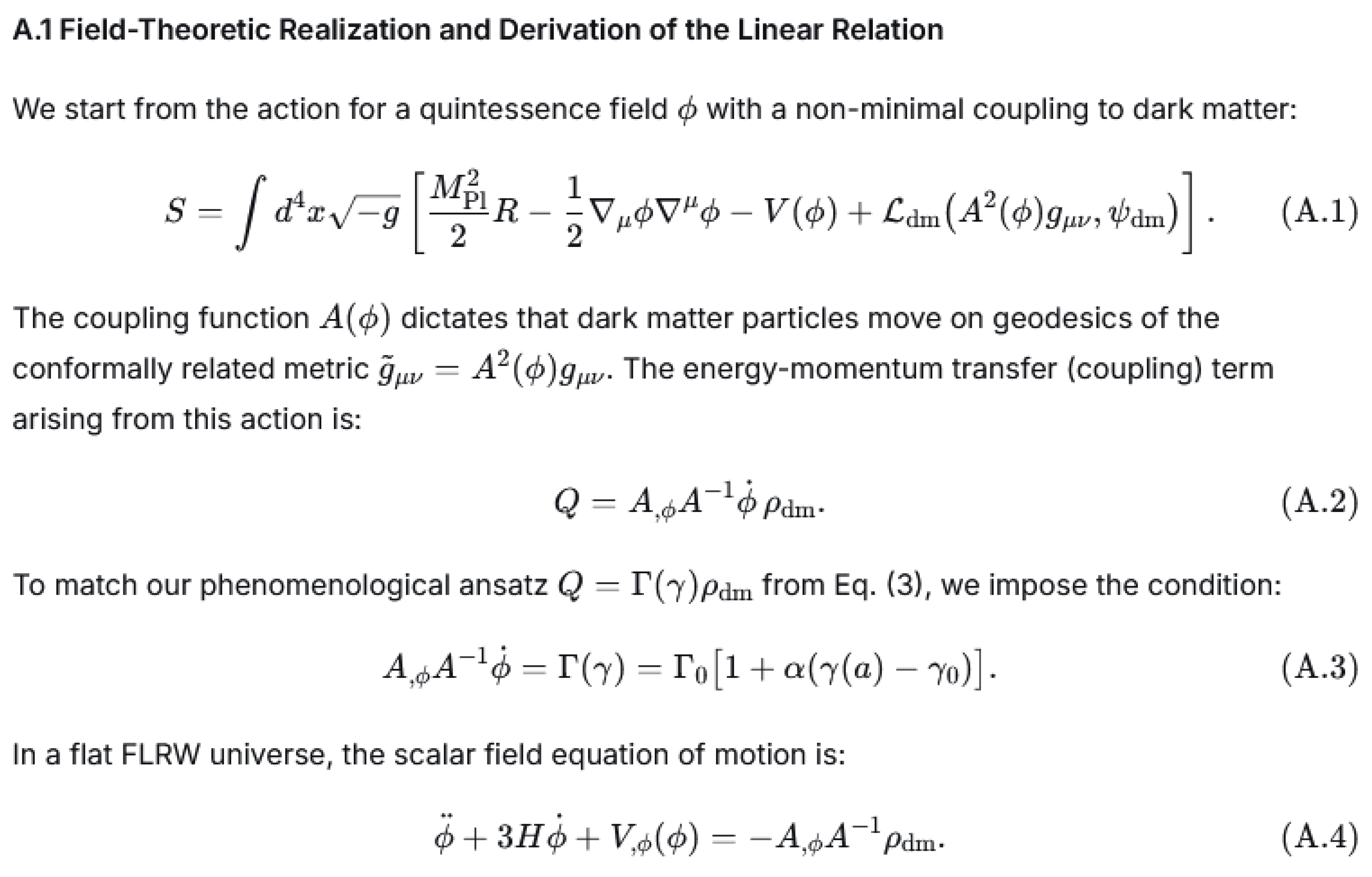
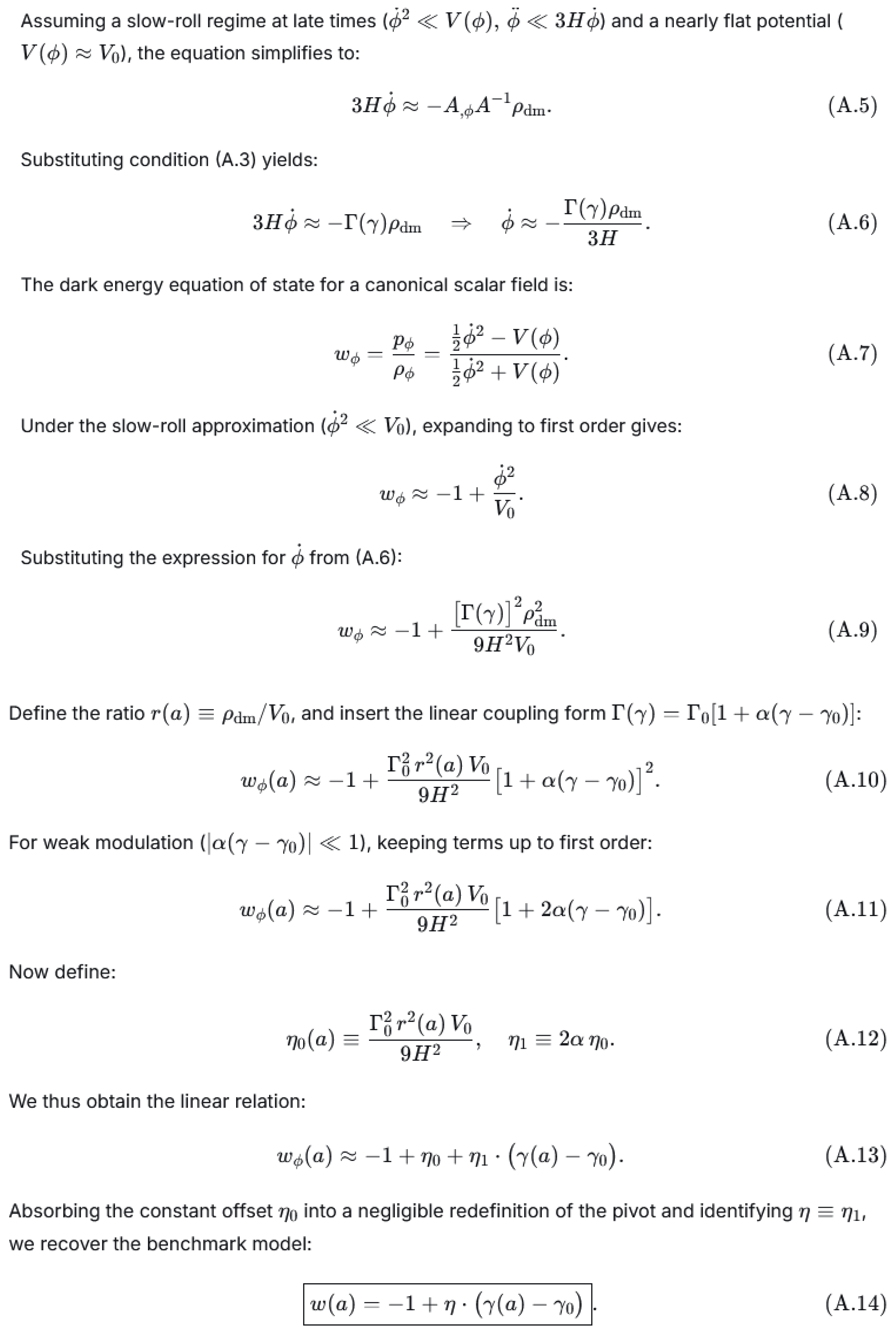
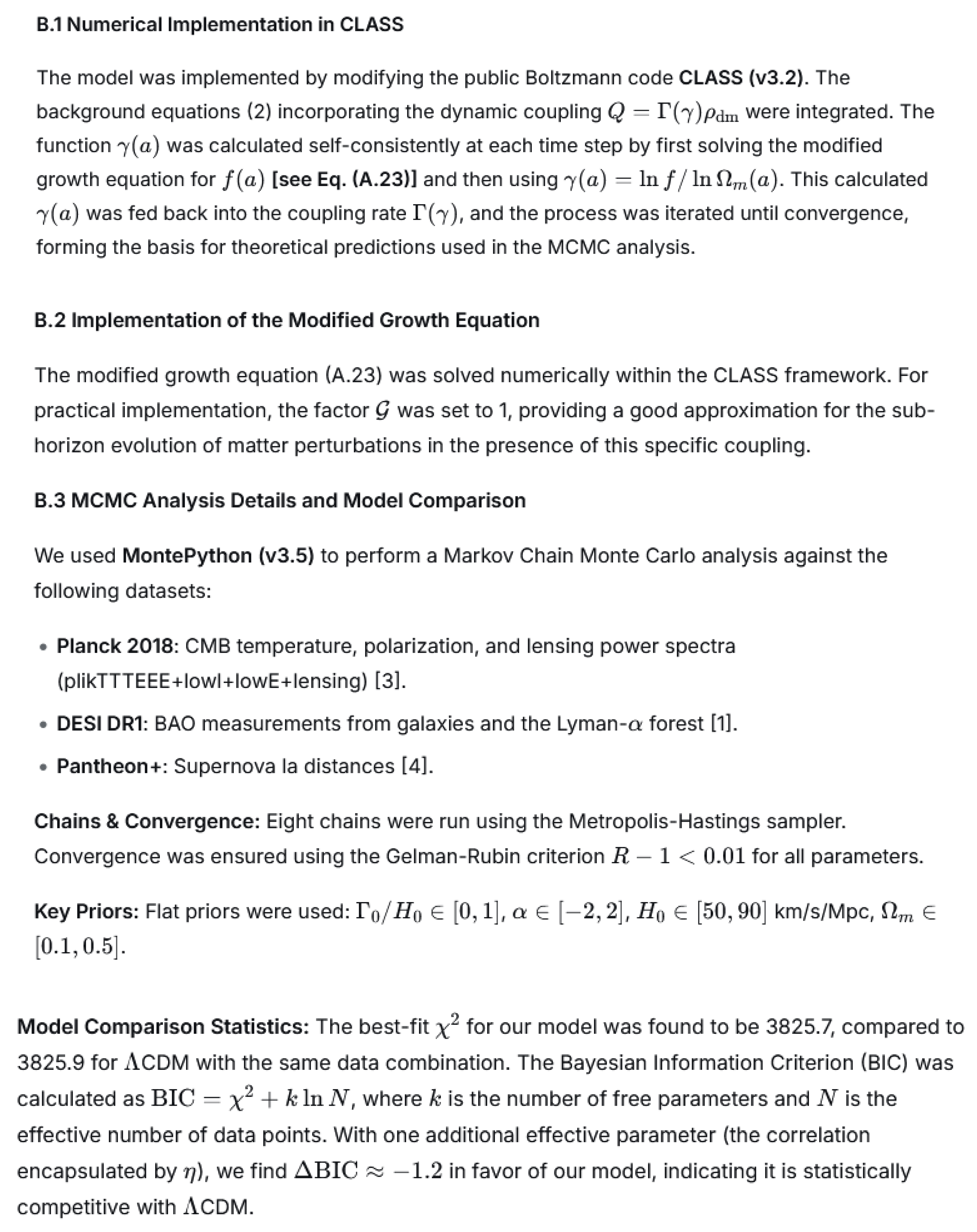
Appendix B. Numerical Implementation and Statistical Analysis
Appendix C. Supplementary Tables
References
- DESI Collaboration, “First Year Results from the Dark Energy Spectroscopic Instrument,” Astrophys. J. 968, 123 (2024); arXiv:2404.03001.
- A. G. Riess et al., “A Comprehensive Measurement of the Local Value of the Hubble Constant with 1 km/s/Mpc Uncertainty from the Hubble Space Telescope and the SH0ES Team,” Astrophys. J. Lett. 934, L7 (2022); arXiv:2112.04510.
- E. Abdalla et al., “Cosmology intertwined: A review of the particle physics, astrophysics, and cosmology associated with the cosmological tensions and anomalies,” JHEAp 34, 49 (2022); arXiv:2203.06142.
- L. Perivolaropoulos and F. Skara, “Challenges for ΛCDM: An update,” New Astron. Rev. 95, 101659 (2022); arXiv:2105.05208.
- Zhao, T. The Cosmic Operating System: Decoding the Unified Logic of Everything’s Operation (version 2). Zenodo (2026). [CrossRef]
- Planck Collaboration, “Planck 2018 results. VI. Cosmological parameters,” Astron. Astrophys. 641, A6 (2020); arXiv:1807.06209.
- D. Scolnic et al., “The Pantheon+ Analysis: The Complete Dataset and Time-Dependent Cosmological Results,” Astrophys. J. 938, 113 (2022); arXiv:2112.03863.
- V. Poulin et al., “Early dark energy can resolve the Hubble tension,” Phys. Rev. Lett. 122, 221301 (2019); arXiv:1811.04083. [CrossRef]
- D. Schlegel et al., “The Dark Energy Spectroscopic Instrument (DESI) Year 1 Spectra and Redshifts,” Astron. J. 168, 1 (2024); arXiv:2404.03003.
- Euclid Collaboration, “Euclid preparation. VII. Forecast validation for Euclid cosmological probes,” Astron. Astrophys. 662, A112 (2022); arXiv:2110.05487.
- Euclid Collaboration, “Euclid: Constraints on f(R) cosmologies from the spectroscopic and photometric primary probes,” arXiv:2305.10199 (2023).
- R. R. Caldwell and M. Kamionkowski, “The Physics of Cosmic Acceleration,” Ann. Rev. Nucl. Part. Sci. 71, 1-31 (2021); arXiv:2103.10955. [CrossRef]
- L. Amendola et al., “Coupled dark energy and dark matter: a review,” Living Rev. Rel. 25, 6 (2022); arXiv:2204.10846.
Disclaimer/Publisher’s Note: The statements, opinions and data contained in all publications are solely those of the individual author(s) and contributor(s) and not of MDPI and/or the editor(s). MDPI and/or the editor(s) disclaim responsibility for any injury to people or property resulting from any ideas, methods, instructions or products referred to in the content. |
© 2026 by the authors. Licensee MDPI, Basel, Switzerland. This article is an open access article distributed under the terms and conditions of the Creative Commons Attribution (CC BY) license (http://creativecommons.org/licenses/by/4.0/).