

Submitted:
05 January 2026
Posted:
06 January 2026
You are already at the latest version
Abstract
The article analyzes the role of selected digital services in maintaining the functioning of the Ukrainian state and economy in wartime conditions and assesses their adaptive po-tential for European Union countries in the context of sustainable and resilient develop-ment. The starting point was the concept of institutional and economic resilience, which has grown in importance in the context of global crises, contributing directly to the goals of sustainable development and long-term socio-economic stability. A qualitative and quantitative approach was used, including secondary data analysis, comparative analy-sis, and triangulation of sources. The results of the study showed that platforms such as Diia, Diia.Business, eRobota, and Air Alert played a key role in ensuring the continuity of public services, support for businesses, and crisis communication. The integration of these tools into the public management system enabled Ukraine to maintain basic state func-tions despite the ongoing armed conflict. A comparative analysis with Estonia, Poland, and Denmark confirmed that the Ukrainian model can be a source of inspiration for EU digitalization strategies, particularly in the areas of mobile administrative services and integration with crisis management systems. The article's conclusions emphasize the importance of digitization as a strategic resource that strengthens the resilience and sus-tainability of public institutions and economies in emergency situations.
Keywords:
sustainability
; digital resilience
; sustainable development
; crisis management
; strategic management in the public sector
; economic resilience
; national resilience
; digital services
; digital ecosystem
; digital technologies
; European Union
; Europe
1. Introduction
In the 21st century, digitization has become one of the key factors in socio-economic transformation, determining changes in public administration, the private sector, and relations between the state and its citizens. As indicated by research conducted by the OECD [1] and the World Bank [2], the development of information and communication technologies not only enables the streamlining of administrative processes but also increases the institutional and economic resilience of countries in crisis situations. International literature emphasizes that digital public services increase the accessibility and transparency of administration, and in conditions of sudden disruption—such as the COVID-19 pandemic or natural disasters—they can become the foundation for maintaining the basic functions of the state [3].
However, Ukraine is a unique case on a global scale. The full-scale war that has been ongoing since February 2022 has led to an unprecedented situation in which the state has been forced to maintain the continuity of public services, the economy, and communication with citizens in wartime conditions. According to reports from Ukraine's Ministry of Digital Transformation [4], during this period, digital platforms such as Diia, Diia.Business, eRobota, and Air Alert played a key role in providing access to documents, identity, social benefits, support for entrepreneurs, and information about military threats.
Ukraine's digital transformation is the result of many years of investment in e-government, but it was only the conditions of war that revealed its potential in terms of economic and institutional resilience and its broader contribution to sustainable development and long-term socio-economic stability. While the COVID-19 pandemic highlighted the need for digitization of services in European Union countries [5], Ukraine has become an example of a country that, under extreme conditions, has managed to transform its digital infrastructure into a pillar of state functioning supporting sustainable governance and community well-being. However, the literature still lacks a structured assessment of the adaptability of Ukraine’s digital governance experience to other national contexts, particularly within the European Union, which this article addresses through a three-dimensional conceptualization of digital resilience encompassing technological, institutional, and user dimensions.
These considerations led to the development of an article, the objectives of which are formulated as follows:
- Identifying the role of selected digital services in maintaining the continuity of Ukraine's economy in wartime conditions.
- To examine the mechanisms of integrating digital services into the public management system and their impact on socio-economic resilience.
- To assess the possibility of adapting and scaling Ukrainian experiences in European Union countries.
Based on these objectives, the following research hypotheses were formulated:
H1: Digital services such as Diia have significantly contributed to maintaining Ukraine's administrative and economic functions in conditions of armed crisis.
H2: The integration of digital tools into the public management system has strengthened the state's ability to respond to emergencies and improved the resilience of the economic system.
H3: The Ukrainian model of digital transformation of public administration has adaptive potential and can inspire strategies for digitization and economic resilience in selected European Union countries.
The article makes a significant theoretical contribution to the discipline of management and quality science through an innovative combination of the perspectives of e-government, institutional resilience, and digital transformation. It also provides practical recommendations for policymakers in EU countries. The structure of the article includes a literature review, a description of the methodology, a presentation of the results, a discussion, and conclusions and recommendations.
2. The Literature Review and Theoretical Context
2.1. Resilience as a Category in Management and Quality Sciences, Economics, and Finance
In the 21st century, the concept of resilience has become one of the key analytical categories in management sciences, economics, finance, and public policy. In international literature, this term has gained particular significance in the context of crisis management, organizational adaptation, and building sustainable development in conditions of extraordinary threats [6].
Resilience and sustainability are increasingly treated as complementary concepts. While resilience focuses on the ability of systems to absorb shocks and adapt to changing environments, sustainability emphasizes maintaining this adaptive capacity over time through balanced economic, social, and environmental development. Integrating these perspectives allows for a more comprehensive understanding of how institutions and economies can achieve both short-term recovery and long-term sustainable growth.
In economics, the concept of resilience refers to the ability of an economic system to survive and adapt in crisis situations, such as recessions, supply shocks, financial crises, or armed conflicts. In finance, it mainly refers to the stability of the financial system [7]. In management sciences, the term is increasingly used to analyze the ability of organizations, institutions, and countries to respond to dynamic and unpredictable changes in the environment [8].
In the context of the war in Ukraine, the concept of resilience takes on special significance—not only as a theoretical category, but also as a practical tool for examining the ability of institutions, economies, and societies to survive in extreme conditions.
There are many definitions of resilience in the world literature, emphasizing different aspects of this category. Among the most frequently mentioned are:
- Resilience in general terms, understood as the ability of a system (organizational, social, economic) to survive, adapt, and develop in conditions of disruption [9].
- Organizational resilience interpreted as the ability of an organization to prepare, respond, and learn in the face of crises, as well as to transform crisis experiences into new sources of competitive advantage [10].
- Institutional resilience refers to the stability and flexibility of public institutions in times of crisis, as well as their ability to ensure the continuity of public functions [11].
Polish literature on the subject points out that resilience is an interdisciplinary category, combining organizational and systemic perspectives. As P. Zapłata [12] emphasizes, resilience in management sciences should be understood as the ability to adapt and reconfigure resources in the face of disruptions, while maintaining strategic coherence.
In global literature, resilience is linked to adaptive systems theory, which emphasizes the role of flexibility, learning, and innovative capabilities in responding to change [13].
Ukrainian researchers point out that resilience should be considered at multiple levels – at the state, economy, and local community levels. According to O. Hnatiuk [14], the resilience of Ukraine's economy during the war stems from a combination of the digitization of public services, support for businesses, and the mobilization of civil society.
The interpretation of economic resilience refers to the ability of the economic system to absorb shocks, minimize losses, and quickly return to equilibrium. The literature distinguishes three basic dimensions of economic resilience [15]:
- Absorption resilience, understood as the ability to assimilate the negative effects of shocks (e.g., financial crises, natural disasters, armed conflicts) while maintaining basic functions. An example is the maintenance of public service continuity and macroeconomic stability despite disruptions [16].
- Adaptive resilience, interpreted as the ability to adapt institutional structures, processes, and public policies to changing conditions. Regulatory flexibility and organizational innovation play a key role here [17].
- Transformational resilience, understood as the ability to change permanently and create new models of development. This refers to both structural changes in the economy and the modernization of public institutions. Research shows that this dimension of resilience promotes long-term competitiveness and sustainable development [18] (Figure 1).
A three-dimensional approach to economic resilience allows for a better understanding of the dynamics of countries' adaptation in times of extraordinary threats. From the perspective of management and quality sciences, as well as economics and finance, it is important that effective public policy integrates all three dimensions of resilience within a coherent development strategy [19].
In management and quality sciences, resilience is analyzed from several perspectives:
- Strategic, taking into account the ability of public organizations and institutions to anticipate threats and prepare alternative plans,
- Operational, referring to the ability to continuously adapt processes and structures to disruptions,
- Social, meaning the mobilization of social resources, trust, and social capital in crisis conditions.
Research by C.A. Legnick-Hall and co-authors [20] indicates that organizational resilience is linked to an organizational culture based on flexibility, cooperation, and learning ability. In the case of public administration, these elements translate into better preparedness for systemic crises, such as the COVID-19 pandemic or the war in Ukraine.
In economics, the concept of resilience is analyzed in the context of economic crises, global supply shocks, and structural changes. As R. Martin [21] emphasizes, regional and economic resilience is a dynamic process in which the ability to recover depends on the quality of institutions, public policy, and the level of innovation in the economy.
J. Simmie and R. Martin [22], on the other hand, believe that resilience is particularly important in a regional context. They interpret it as the ability of economic systems to restore growth after crises and the ability to use crises as an impetus for innovation and restructuring.
In finance, resilience is analyzed primarily in the context of the stability of the financial system and the ability of financial institutions to absorb external shocks. Financial resilience is also understood as the ability of the banking system, capital markets, and regulatory institutions to maintain liquidity and solvency in times of crisis, as well as the ability to mitigate systemic risk [23]. As A. Hauben, J. Kakes, G.J. Schinasi [24] emphasizes, the resilience of the financial system is a prerequisite for macroeconomic stability, as it allows for the uninterrupted functioning of capital allocation, risk management, and investment support mechanisms. Ukrainian research also indicates that in wartime, financial resilience is linked to ensuring the continuity of banking and settlement services and maintaining confidence in financial institutions [25]. In this context, resilience in finance is closely linked to the concept of regulatory stability and the ability of central banks and supervisory institutions to take anti-crisis measures .
In summary, it should be noted that the concept of resilience, both in management and quality sciences as well as in economics and finance, is a multidimensional category encompassing institutional and organizational capabilities as well as economic mechanisms. In the context of research on digitalization and building a resilient economy, it is particularly important to combine three perspectives: institutional, social, and economic resilience. The approaches discussed in international, Polish, and Ukrainian literature indicate that resilience should be treated not only as a capacity for survival, but also as a strategic category enabling long-term development and transformation in conditions of extraordinary threats.
Digital resilience, as used in this study, is defined as the capacity of public institutions and governance systems to maintain, adapt, and transform their core functions through digital infrastructures under conditions of systemic shock. Unlike traditional concepts of institutional resilience, which emphasize organizational stability and regulatory continuity, digital resilience explicitly incorporates the role of digital platforms, data interoperability, and user-level adoption as operational enablers of resilience.
Furthermore, digital resilience goes beyond e-governance maturity models, which primarily assess the technological advancement and service availability of digital administration. While e-governance maturity focuses on the degree of digitalization in stable conditions, digital resilience captures the performance of digital systems under extreme disruption, such as armed conflict, large-scale infrastructure damage, or mass displacement.
In this sense, digital resilience constitutes a distinct analytical dimension, integrating technological capacity, institutional integration, and societal usage into a unified framework of crisis governance.
The key dimensions of resilience in public management are presented in Table 1.
The three dimensions of digital resilience outlined in Table 1 also provide the analytical basis for the conceptual clustering of European digital governance models applied later in the comparative analysis.
2.2. Digitization of Public Administration and the Resilience of the State and Economy
The digitization of public administration is one of the key elements of public sector modernization, enabling increased efficiency of decision-making processes, reduced bureaucracy, and improved quality of public services [26].
In the broader perspective, digital transformation contributes not only to operational efficiency but also to the sustainability of governance systems. It supports the achievement of the UN Sustainable Development Goals (SDGs), particularly Goal 16 — “Peace, Justice and Strong Institutions,” and Goal 9 — “Industry, Innovation and Infrastructure,” by ensuring inclusive access to services and transparency in public administration [27].
It should be emphasized that e-government contributes not only to improving the functioning of administration, but also to increasing transparency and public trust in state institutions. The digitization of the public sector, including public administration at various levels, and the digitization of households is identified as an important area, alongside the manufacturing, service, and agricultural sectors, as a prerequisite for innovation processes. The fourth edition of the Oslo Manual [28] identifies two groups of innovations, namely product innovations and business innovations, while pointing to the role of business models, including the important role of digital intermediary platforms, both market-based and those related to the provision of public services. Thus, the growing importance of business models and their innovativeness in relation to the digitization of the economy, manifested, among other things, in the growing role of digital intermediary platforms, was not without significance in the development of the fourth edition of the Oslo Manual. The fourth edition of the Oslo Manual introduces definitions of digital innovation [29] and the concept of innovation in business processes [30].
The concept of state resilience includes the ability of institutions to maintain basic functions in times of political, economic, or military crises [31]. In the context of digitalization, this means building systems that are resistant to disruptions and can guarantee continuity of services even in emergency situations. The OECD [32] and the World Bank [33] point out that digital public administration tools increase the resilience of states through data integration, process automation, and the development of crisis communication channels. Technologies that support the digitization of the economy, such as cloud technologies, mobile Internet, and blockchain, are also important for increasing the resilience of the state. Cloud technologies enable digital resources to be stored in secure locations, e.g., outside the country. In turn, Starlink satellite internet kits have proven to be an example of the importance of mobile internet, especially in crisis or war situations.
Research by L. Tangi and co-authors [34] suggests that the digitization of public administration promotes not only operational efficiency but also the adaptability of institutional systems in the face of unpredictable challenges.
2.3. Ukraine's Digital Ecosystem in Wartime
Ukraine's digital transformation began with the introduction of a series of legal acts into the national legal system, which created a comprehensive framework for the functioning of electronic services. The key document in this regard is the Ukrainian law of October 5, 2017, on the basic principles of ensuring Ukraine's cybersecurity, which establishes the principles of state policy in the field of cybersecurity, defines the responsible authorities, and specifies the mechanisms of cooperation between them (No. 2163-VIII) [35].
At the same time, on November 7, 2018, the Act of October 5, 2017, on electronic trust services came into force, implementing the key principles of the EU eIDAS Regulation (No. 2155-VIII) [36]. This Act introduced institutions such as electronic signatures, Mobile ID, electronic seals, and electronic time stamps, and regulates issues related to electronic identification and the provision of electronic trust services.
The development of digital public services in Ukraine accelerated significantly after 2019 with the launch of the Diia platform. Initially, it offered basic administrative functions such as digital identity documents and business registration, but during the war it became a key tool for maintaining communication between the state and its citizens [37].
Beyond ensuring continuity of governance, these initiatives have also supported social sustainability by maintaining citizens’ access to essential services, promoting digital inclusion, and strengthening civic trust — all of which are essential dimensions of sustainable development under crisis conditions.
At the same time, other platforms were developed, such as Diia.Business, which supports entrepreneurs in relocating and rebuilding their businesses, eRobota, which offers microloans to SMEs, and Air Alert, which provides a military threat notification system [38]. According to a UNDP report [39], these tools have created a coherent ecosystem of digital services, integrating the activities of central government, local authorities, the private sector, and international organizations.
2.4. International Experiences in Digitization and Resilience
The digital transformation of public administration is a global phenomenon, and the experiences of individual countries are a valuable source of knowledge for Ukraine and the countries of the European Union.
Comparative studies on Estonia, Poland, and Denmark show that countries with advanced e-government ecosystems tend to achieve higher levels of institutional sustainability. Their digital infrastructures facilitate not only resilience to crises but also the pursuit of sustainable governance models that balance innovation, inclusiveness, and social trust.
Estonia is considered a pioneer of digitization in Europe—its e-Estonia system integrates state registers, administrative services, and security systems into a single digital environment, enabling full automation of administrative processes. The X-Road platform, created by the European leader in the digitization of public administration, ensures interoperability between public and private sector databases, enabling real-time information exchange [42]. Over 99% of public services are available online, and electronic voting (e-voting) was implemented as early as 2005 [43].
In the context of national resilience, Estonia has created the concept of a “data embassy,” which is a backup of critical databases stored outside the country. This solution ensures the continuity of administration even in the event of cyberattacks or disasters [44].
In Poland, the development of public administration digitization accelerated after 2015 with the implementation of systems such as ePUAP (Electronic Public Administration Services Platform) and Profil Zaufany (Trusted Profile) [45]. In recent years, the mObywatel application, which provides access to digital identity documents, e-prescriptions, and local government services, has become crucial. An innovative element is the GovTech Polska program, which supports innovation in the public sector through cooperation with IT companies and the development of digital platforms for citizens and businesses [46]. Despite progress, Poland faces challenges in terms of system interoperability and the integration of digital services with crisis management [47]. European Commission reports [48] point to the need for further investment in cybersecurity, uniform data standards, and digital education for citizens.
Denmark is one of the leaders in digitization in Europe, but unlike Estonia, it places greater emphasis on digital security and data privacy as part of its A Strong Digital Denmark 2030 strategy [49]. This strategy envisages the full digitization of public services while ensuring high standards of security and access to services for groups at risk of digital exclusion. Denmark has also developed the NemID system (now replaced by MitID), which is a central authentication tool in e-government and banking, increasing the consistency and security of digital services. In the context of national resilience, Denmark integrates digital systems with crisis management, including public warning and emergency response [50].
2.5. Research Gap and Need for Further Research
Despite the growing number of publications on the digitization of public administration, few studies analyze the role of digital services in armed conflict. Most of the work to date has focused on the COVID-19 pandemic [53], economic transformation [54], or the development of the information society in peacetime [55].
The case of Ukraine is unique because it shows how digital technologies can support the state in extreme situations, enabling it to maintain basic administrative and economic functions.
However, few studies have explored how such digital resilience contributes to the broader goals of sustainable development, such as institutional stability, social inclusion, and long-term recovery. Addressing this research gap allows for linking digital transformation not only with crisis response but also with sustainability-oriented public policy design.
There is a need for comparative research to assess the adaptability of Ukraine's experience in EU countries, taking into account differences in digital infrastructure, legal regulations, and administrative culture [56].
3. Materials and Methods
Due to the complexity of the phenomenon under study and the objectives formulated in the article, a qualitative-quantitative approach was used in the research. It was based on secondary data analysis, comparative analysis, and triangulation of sources. This approach allowed for a holistic view of the problem and enabled the verification of research hypotheses based on a variety of data sources [57].
The main research method was secondary data analysis. The following sources were used for the analysis:
- a)
- Reports of the Ministry of Digital Transformation of Ukraine concerning the functioning of the Diia platform and tools such as Diia.Business, eRobota, and Air Alert [58],
- b)
- c)
- d)
- Statistical data on the number of digital platform users, the range of available services, and their use in 2022-2024 .
The methodological framework of the study was also guided by the principles of sustainable development. The selection and interpretation of data were carried out with reference to the United Nations Sustainable Development Goals (SDGs), particularly Goal 9 (“Industry, Innovation and Infrastructure”) and Goal 16 (“Peace, Justice and Strong Institutions”). By analyzing digital services as instruments for maintaining institutional continuity, transparency, and inclusiveness during crises, the research highlights how digital transformation supports the sustainability of governance systems and contributes to building long-term socio-economic stability. The analysis of secondary data made it possible to identify the main functions and tools of digital services in Ukraine and their role in maintaining basic administrative and economic functions in wartime conditions [65].
Another element of the research procedure was a comparative analysis of solutions used in Ukraine and in selected European Union countries. The selection of countries was deliberate. Countries with different levels of digitization were selected. Among the countries analyzed were:
- • Estonia, as the leader in digitization in Europe (e-Estonia system),
- • Poland, where the GovTech program and the mObywatel platform are being developed,
Estonia, Poland and Denmark were selected as comparative cases based on a purposeful sampling strategy reflecting three distinct models of digital transformation in Europe. Estonia represents a fully integrated and highly interoperable e-government ecosystem; Poland illustrates a dynamic but still partially fragmented model of public sector digitalization; while Denmark demonstrates a mature digital governance model strongly grounded in data security, inclusiveness, and citizen trust.
This selection aligns with theoretical perspectives on digital transformation and institutional resilience, which emphasize the importance of analyzing countries with different administrative traditions, governance infrastructures, and degrees of digital maturity. Such diversity makes it possible to more accurately assess the transferability of Ukrainian digital resilience practices to EU Member States.
The selection of Estonia, Poland, and Denmark was guided by a theory-driven comparative sampling strategy, rather than an attempt to represent the full diversity of European Union governance models. The purpose of the comparison was analytical rather than statistical.
The selected countries reflect three distinct clusters of digital governance and institutional resilience observed in Europe. Estonia represents a highly integrated and interoperability-driven digital governance model, Poland illustrates a transitional and partially fragmented model, while Denmark exemplifies a security- and trust-oriented model, characterized by strong data protection and regulatory compliance. This conceptual clustering allows for meaningful comparison of governance logics and enhances the analytical transferability of the Ukrainian case to different EU institutional contexts.

Table 2.
Conceptual clustering of EU digital governance models based on the dimensions of digital resilience.
Table 2.
Conceptual clustering of EU digital governance models based on the dimensions of digital resilience.
| Governance cluster | Dominant digital resilience dimension | Key characteristics | Representative country |
|---|---|---|---|
| Integrated digital governance | Technological + Institutional | High interoperability, unified digital identity, strong institutional embedding of digital platforms | Estonia |
| Transitional digital governance | Institutional + User | Partial interoperability, coexistence of legacy systems, expanding user adoption | Poland |
| Security- and trust-oriented governance | Institutional + Technological | Strong data protection, regulatory compliance, cautious but stable digital infrastructure | Denmark |
Source: authors’ own conceptual clustering based on the digital resilience framework (Table 1).
This clustering does not constitute a statistical classification but a theory-informed typology, in which countries are grouped according to the dominant configuration of digital resilience dimensions. Such an approach allows for analytically meaningful comparison despite the limited number of cases.
In order to increase the reliability of the results, the study used data triangulation by combining:
- quantitative data (data on users, number of services and their use),
- qualitative data (analysis of documents, reports, and scientific publications),
- comparative context (Ukraine-European Union countries).
The use of data triangulation made it possible to obtain a holistic picture of the phenomenon under study and reduced the risk of misinterpretation, which is in line with methodological recommendations in public policy and crisis management research [69,70]. This study is based exclusively on secondary data, as the wartime conditions in Ukraine made it impossible to collect primary empirical material or conduct quantitative field research. While the secondary sources used in this article were triangulated across international reports, governmental documents, and academic analyses, the absence of primary data limits the generalizability of the findings and restricts the possibility of empirically measuring the effectiveness of individual digital services.The results presented should therefore be interpreted as exploratory and descriptive. This approach is consistent with methodological recommendations for research conducted in crisis environments, where data accessibility is constrained and research risks are elevated.
The adopted research methodology also has certain limitations. The research is based on secondary data, which to some extent limits the possibility of direct verification of some of the information. This applies primarily to the quality of digital services from the point of view of end users.
In addition, the availability and therefore the comparability of data between Ukraine and EU countries varies, which may affect the accuracy of comparative analyses [71].
In the future, the authors plan to use qualitative methods in their research (e.g., interviews with representatives of public administration and digitization experts), which would enable an in-depth analysis of the processes of implementation and use of digital services.
4. Results
The analysis of secondary data and comparative data allowed for the identification of key areas in which digital services played a crucial role in maintaining the functioning of the Ukrainian state and economy during the ongoing war. The results were presented in five thematic blocks: the scale of digital service use, support for the economy and businesses, crisis communication, integration with the public management system, and adaptive potential for European Union countries.
4.1. Scale of Digital Service Usage in Ukraine
Between 2022 and 2024, there was a sharp increase in the number of users of digital services in Ukraine (Table 3). Reports from the Ministry of Digital Transformation of Ukraine show that in mid-2024, the Diia platform had over 20 million users, which represents about 60% of the country's adult population [72]. The number of services offered through the platform increased from 72 in 2021, to 96 in 2022, 115 in 2023 and 132 in 2024, including digital identity documents, business registration, social benefits, reporting war damage, and tax services [73].
Dynamic growth was also recorded in the case of the Air Alert application, which has sent over 12,000 hazard alerts across the country since the beginning of the war [77]. The implementation of this system has enabled the rapid warning of civilians about air raids and missile attacks, which has had a direct impact on the safety of residents [78].
The increase in the number of digital platform users should not be interpreted as a direct causal indicator of improved resilience. In this study, user growth is treated as an indicative proxy for service accessibility and functional continuity under crisis conditions. This dynamic occurred alongside multiple confounding factors, including internal and external population displacement, physical infrastructure damage, and wartime centralization of public administration.
4.2. Support for the Economy and Businesses
Between 2022 and 2026, Ukraine also saw dynamic development of IT tools aimed at the economic sector (Table 4). Between 2022 and 2024, the Diia.Business platform also helped to relocate over 750 businesses from areas affected by military operations to western regions of Ukraine [79,80].
The eRobota program awarded over 10,000 microgrants to small and medium-sized enterprises and farms. The microgrants supported the reconstruction of economic activity, job creation, and the maintenance of production in wartime conditions [80].
In addition, the Prozorro public procurement system has enabled companies to participate in state tenders, ensuring transparency in procurement processes even in times of crisis [86].
4.3. Crisis Communication and E-Government
The use of digital tools has significantly improved communication between public administration and citizens. The implementation of mobile applications has enabled, among other things, the submission of applications for financial assistance, the registration of war damage, and constant access to information about evacuations and shelters.
The UNDP report [87] indicates that Ukraine has created an integrated e-government system based on mobile platforms, enabling the continuity of public services despite the destruction of physical infrastructure.
4.4. Integration with Crisis Management System
Digital services have been integrated into crisis management systems and administrative activities at all levels. The Ministry of Digital Transformation has cooperated with local authorities, the IT sector, and international organizations, which has enabled services to be quickly adapted to changing social and economic needs [88].
The OECD [89] emphasizes that multisectoral cooperation was one of the key factors in the success of Ukraine's digitalization, allowing for effective coordination of activities in crisis situations.
4.5. International Comparison and Adaptation Potential
A comparative analysis shows that Ukraine has quickly achieved a level of digitization of public services similar to that of selected European Union countries (Table 5).
Based on Table 5, it can be concluded that:
- • Estonia maintains its leading position in terms of state system integration, but Ukraine's digitalization development in wartime conditions is characterized by greater dynamism [94];
- • Poland is implementing programs such as GovTech Polska and mObywatel, but their functional scope and level of use are still lower than in the case of Diia [95];
- • Denmark emphasizes data protection and privacy, which indicates the need to further adapt Ukrainian services to EU regulations such as the GDPR [96].
European Commission experts [97] emphasize that Ukraine's experience can support the implementation of the European Digital Decade 2030, particularly in the areas of mobile administrative services and the integration of crisis management systems with digital infrastructure.
The observed differences between Ukraine and the selected EU countries should be interpreted in light of the conceptual clustering of digital governance models presented in Table 2, which reflects distinct configurations of technological, institutional, and user dimensions of digital resilience.
4.6. Sustainability Dimension of Digital Resilience
The analysis of empirical data also demonstrates that the implementation of digital services in Ukraine contributes not only to the resilience of institutions and the economy but also to their sustainability. The integration of platforms such as Diia and eRobota has helped maintain inclusive access to public and business services, even for socially vulnerable groups and small enterprises affected by the war. This inclusiveness is consistent with the principles of sustainable development, particularly in promoting equal access to opportunities, transparency of governance, and digital participation. Moreover, the continuity of public functions achieved through digital infrastructure reduces administrative inefficiencies and supports resource-efficient governance — a dimension often emphasized in sustainability-oriented policy frameworks.
These sustainability effects correspond primarily to the institutional and user dimensions of digital resilience later synthesized in Figure 2.
4.7. Long-Term Sustainability Implications for the EU
The comparative results with Estonia, Poland, and Denmark indicate that integrating digital services into public management systems can enhance the long-term sustainability of governance in European Union countries. Beyond improving administrative efficiency, digital ecosystems foster social trust, innovation, and adaptability — elements essential for sustainable institutional development. The Ukrainian case shows that resilient digital infrastructures can serve as a foundation for sustainable socio-economic recovery, reducing systemic vulnerability and supporting the implementation of the UN Sustainable Development Goals (SDGs), especially those related to strong institutions, innovation, and inclusive growth.
5. Discussion
5.1. Digital Resilience and Sustainability Nexus
Interpreting the comparative findings through the lens of the digital governance clusters identified in Table 2 allows for a clearer understanding of how different configurations of digital resilience shape national responses to crisis and influence the transferability of the Ukrainian experience. The analysis of the research results shows that the digitization of public administration in Ukraine played a key role in maintaining the continuity of the functioning of the state and the economy in wartime conditions. The results of the research confirm hypothesis H1, indicating that platforms such as Diia, Diia. Business, eRobota, and Air Alert have significantly contributed to providing citizens and businesses with access to administrative services, information about threats, and financial support instruments even in extreme situations. The digitization of public services has enabled citizens to access key documents (e.g., passports, driver's licenses), social benefits, and business registration in electronic form, despite the destruction of physical infrastructure and mobility restrictions [98].
Similar conclusions are presented in a UN report [99], which emphasizes that digital channels for the provision of public services are a prerequisite for the continuity of the state in crisis situations. According to research by Matveieva et al. [100], digital administration in Ukraine has also become a tool for rebuilding citizens' trust in state institutions, which have been able to demonstrate their effectiveness even in wartime conditions. This confirms the thesis that the digitization of administration not only supports the operational efficiency of the state, but also strengthens its social legitimacy, which is a key element of institutional resilience [101].
The results obtained are consistent with studies by the OECD [102] and the World Bank [103], which emphasize that the inclusion of digital tools in the public management system allows states to increase their institutional and economic resilience. This is particularly evident in the data on the number of users of the Diia platform. Its reach in 2024 exceeded 20 million people, which corresponds to 60% of the adult population of Ukraine. A similar phenomenon was observed in Estonia during the implementation of e-Estonia, but in Ukraine this development was more dynamic due to the pressure exerted by the war situation [104].
Hypothesis H2 concerning the integration of digital services with the public management system is also confirmed. The results show that Ukraine has created an integrated ecosystem of services, covering central administration, local authorities, the private sector, and international organizations. Similar conclusions are presented in reports by the UNDP [105] and the European Commission [106], indicating that effective digitization requires multisectoral cooperation and interoperability of administrative systems. A comparative analysis with Estonia, Poland, and Denmark shows that Ukraine's experience can serve as a reference point for EU countries, confirming hypothesis H3. While Estonia remains a leader in the digitization of public services, Poland and Denmark are only just developing solutions for mobile administrative platforms and the integration of services with crisis management systems. Thanks to the rapid implementation of digital solutions in wartime conditions, Ukraine has shown that it is possible to combine administrative functions, crisis communication, and economic support in a single digital ecosystem.
A summary of the hypotheses in relation to the empirical research results and the literature on the subject is presented in Table 6.
The findings also highlight that digital resilience and sustainability are mutually reinforcing dimensions of modern governance. Resilient digital infrastructures ensure the continuity of essential state functions, while sustainable governance frameworks guarantee that these infrastructures are inclusive, transparent, and resource-efficient. In the Ukrainian case, the integration of digital tools into crisis management and economic support systems has not only enhanced institutional resilience but also promoted long-term sustainability by strengthening social trust and reducing administrative and environmental costs. This demonstrates that digital transformation, when aligned with sustainability principles, can generate systemic benefits that extend beyond emergency response toward durable socio-economic stability.
Consequently, the relationship between digital service usage and resilience should be understood as correlational rather than causal. The reliance on secondary data limits the ability to isolate the independent effect of digitalization from broader socio-demographic and infrastructural transformations induced by war.
5.2. Implications for Sustainable Governance in the EU
For European Union countries, the Ukrainian experience provides practical insights into how digital innovation can serve as both a resilience mechanism and a driver of sustainable development. The adoption of integrated digital platforms, data-sharing ecosystems, and inclusive service design contributes to the realization of several UN Sustainable Development Goals (SDGs), notably Goal 9 (“Industry, Innovation and Infrastructure”), Goal 11 (“Sustainable Cities and Communities”), and Goal 16 (“Peace, Justice and Strong Institutions”). These results underline the importance of embedding sustainability considerations into digital policy frameworks at both the national and EU levels, ensuring that the pursuit of technological resilience is aligned with long-term environmental, social, and institutional sustainability.
At the same time, the analysis reveals certain limitations and challenges. First, the development of digital services in Ukraine took place in conditions of limited data protection and lack of full compliance with EU regulations such as the GDPR. Second, the lack of uniform security standards may hinder the integration of Ukrainian platforms with the digital systems of European Union member states. The literature on data protection emphasizes that citizens' trust in digital administration depends on the effectiveness of regulations on privacy and information security [113].
The results also suggest that Ukraine's experience could support the implementation of the European Digital Decade 2030, which aims to fully digitize public services in the EU. Particularly important are solutions in the area of mobile administrative platforms, integration with crisis management systems, and support for businesses in emergency situations [114].
The literature indicates that the digitization of public services can act as a catalyst for economic recovery after crises [115]. Experience shows that investments in digital technologies not only enable the maintenance of the main functions of the state, but also support the development of entrepreneurship, which is in line with the findings on digital transformation in the context of sustainable development [116].
The conceptual model presented in Figure 2 is directly grounded in the three-dimensional framework of digital resilience introduced earlier in the article (Table 1). The model integrates the technological dimension (digital platforms and infrastructure), the institutional dimension (embedding of digital tools within public administration and crisis management systems), and the user dimension (societal adoption and utilization of digital services). Together, these dimensions illustrate how digital resilience operates as a multi-layered governance capability enabling institutional continuity, economic support, and crisis response under conditions of systemic disruption.
Accordingly, Figure 2 should be interpreted as a synthetic and non-testable conceptual representation, rather than as a causal or predictive analytical model.
The analysis identifies a partial regulatory compliance gap between Ukraine and the European Union in the areas of data sovereignty, cross-border data transmission, and cybersecurity governance. While Ukrainian digital platforms operate effectively under emergency legal frameworks, full alignment with EU regulations such as GDPR and NIS2 would require stricter data minimization principles, standardized incident reporting, and enhanced cross-border data governance mechanisms. These discrepancies reflect structural differences between wartime emergency governance and peacetime regulatory regimes rather than deficiencies in digital capacity.
The conceptual model presented is based on the assumptions of organizational resilience theory and strategic management in the public sector. The diagram shows that digital services (e.g., Diia, Diia.Business, eRobota) are key resources which, when integrated with public and crisis management systems, enable effective response to emergency situations. The model takes into account three dimensions of resilience:
- Institutional resilience, understood as the ability to maintain continuity of operations and public service delivery in a crisis.
- Social resilience, interpreted as ensuring public safety, crisis communication, and access to social services.
- Economic resilience, understood as maintaining the main functions of the economy, supporting businesses, and creating conditions for economic recovery.
In this approach, digitalization acts as a resource and management lever that enables the state to respond effectively to emergencies and maintain its main economic functions. This approach is consistent with the concept of digital resilience, emphasized in the literature of the OECD [117], UNDP [118], and the World Bank [119], and is in line with theories of strategic management in the public sector.
It is worth adding that digitization in crisis conditions is not only a technological innovation, but also serves as a strategic resource that changes the way states and societies function. The experience of Ukraine shows that in a situation of existential threat, the state can use digital tools to maintain basic administrative functions, provide the public with access to documents and services, and mobilize society in areas such as defense financing or humanitarian aid. This dimension of transformation confirms the hypothesis that digitization is becoming a prerequisite for institutional and economic resilience, rather than merely a tool for streamlining bureaucratic processes. At the same time, it should be noted that digital resilience is not a homogeneous category. It encompasses technological issues (ICT infrastructure, cybersecurity), social issues (digital skills, trust in institutions), and economic issues (support for businesses, creation of new business models). In this sense, Ukraine is a unique laboratory case that shows how the multidimensional nature of digitization can be activated in conditions of extreme crisis.
The conclusions drawn from the research are also relevant for European Union countries, which, although operating in a more stable political environment, face challenges related to global technological competition, the risk of cyberattacks, and the need to ensure the continuity of public services in the face of climate, health, and energy crises. The literature emphasizes that building digital resilience in Europe requires, on the one hand, harmonization of regulations and security standards and, on the other hand, investment in the development of the digital skills of society and inclusive access to services. An important conclusion from the analysis of the Ukrainian case is also the importance of the speed of implementation of solutions. The Diia platform was introduced in a short period of time, and its functionalities were gradually expanded in response to new needs. This kind of flexibility and adaptability can be a valuable lesson for European institutions, which are often characterized by complex procedures and lengthy legislative processes.
When interpreting the transferability of Ukraine’s digital resilience practices to EU Member States, it is essential to acknowledge the significant institutional and contextual differences. Ukraine’s digital transformation has been accelerated under wartime conditions, which resulted in unprecedented centralization of decision-making, shortened implementation cycles, and a higher tolerance for operational risk.
In contrast, EU Member States operate in peacetime institutional frameworks characterized by stronger regulatory constraints (e.g., GDPR), longer policy cycles, and extensive stakeholder consultation processes. These differences reduce the direct comparability of digital governance models but do not prevent selected Ukrainian solutions — such as mobile administrative services or crisis-integrated digital systems — from being adapted in a structured, regulated EU environment.
Digitization as a foundation for resilience also entails certain risks and challenges that should be further explored. These include, among others, the risks associated with dependence on global technology providers, inequalities in access to digital services, and issues of personal data protection in the context of mass digitization. For EU countries, including Poland, Estonia, and Denmark, it will be important to find a balance between the effectiveness of digital solutions and ensuring their security, transparency, and inclusiveness [120]. Thus, the results of this study contribute to the broader scientific debate on the role of digitization in shaping the resilience of economies and societies, emphasizing that this is not only a technological process, but also a political, social, and cultural one.
6. Conclusions
6.1. Summary of Key Findings
The research conducted allowed for a comprehensive analysis of the impact of the digitization of public administration and the Ukrainian economy on building the country's resilience in crisis conditions. The results clearly confirm the importance of digital technologies in ensuring the continuity of public administration, maintaining basic economic functions, and supporting citizens and businesses in emergency situations. To enhance policy relevance and feasibility, the proposed recommendations should be interpreted within an implementation sequencing and marginal benefit framework. Short-term measures, such as the integration of mobile administrative platforms with crisis communication systems, generate high marginal benefits at relatively low implementation costs, whereas long-term initiatives—such as cross-border interoperability infrastructures—require substantial investment but offer systemic resilience gains over time.
The literature on the subject emphasizes the growing role of digital technologies in the transformation of the public sector and its adaptation to changing conditions [121,122,123].
Hypothesis H1, which assumes that digital services contributed to maintaining administrative and economic functions in wartime conditions, has been confirmed both by empirical data (the number of Diia users, the development of Diia.Business and eRobot) and by a comparative analysis with other countries. In particular, the dynamic growth in the number of services available online in Ukraine in 2021-2024 and their integration with crisis services such as Air Alert indicate that digitization has made it possible to maintain the basic functions of the state in conditions of significant damage to the socio-economic infrastructure [124].
6.2. Integration of Digital Tools and Governance Resilience
Hypothesis H2, concerning the integration of digital tools into the public management system, has also been confirmed. Research shows that Ukraine has managed to quickly create a digital ecosystem encompassing central administration, local authorities, the private sector, and international organizations. This integration has covered not only administrative services, but also public warning systems, business support programs, and social communication tools [125].
Hypothesis H3, concerning the potential for adapting Ukrainian experiences in European Union countries, was confirmed by a comparative analysis with Estonia, Poland, and Denmark. The results show that although Estonia remains the leader in the digitization of public services, Ukraine's experience in integrating digital tools with crisis systems can serve as a model for EU countries in the context of building economic and institutional resilience [126].
6.3. Contribution to the Understanding of Digital and Institutional Resilience
A comparison of the results of our own research with the literature indicates that Ukraine has brought a new perspective to research on state resilience, showing that digital transformation can be an effective tool for responding to systemic crises [127,128,129].
Based on the obtained results, a number of recommendations for Ukraine can be formulated aimed at further developing digitalization and strengthening the country's resilience. The most important recommendations are:
- Development of integrated digital infrastructure. Ukraine should continue developing integrated digital platforms that combine the functions of public administration, crisis management, and economic support. Reports from the UNDP [130] and the World Bank [131] indicate that data interoperability is a key factor enabling an effective response to emergency situations.
- Growing importance of cybersecurity and data protection. As digitalization develops, the importance of data security increases. Ukraine should implement solutions compliant with EU regulations, such as GDPR and NIS2, and develop national cyber threat monitoring systems [132].
- Further support for businesses and economic recovery. Programs such as Diia.Business and eRobota should be expanded with new functionalities, including those related to financing innovation, exports, and the digital transformation of small and medium-sized enterprises. OECD research [133] indicates that the digitalization of small and medium-sized enterprises is a key factor in economic development during crisis times.
- Continued digital education and the inclusiveness of educational programs in the use of e-government and data security [134]. Developing digital competences among citizens and officials is a prerequisite for the effective implementation of new services.
Ukraine's experience is of significant importance for EU countries striving to achieve the goals of the European Digital Decade 2030. Based on the analysis, recommendations for individual countries can be formulated (Table 7).
- Integration of the mObywatel platform with crisis management systems.
- Implementation of a central database enabling the coordination of central and local government activities.
- Development of digital education as part of the National Recovery Plan.
Recommendations for Estonia[137]:
- Strengthen cybersecurity and data protection in the context of growing hybrid threats.
- Develop international partnerships for the digitalization of public services.
- Participate in the creation of European emergency data centers.
Recommendations for Denmark [138]:
- Integrate digital platforms with early warning and crisis response systems.
- Develop services for businesses in emergency situations.
- Implement European data interoperability standards.
An analysis of Ukraine's experience integrating digital services with public and economic governance systems allows for the formulation of a set of common recommendations for EU countries. These recommendations were developed for the 2025-2035 timeframe:
- • An integrated system for data exchange between EU Member States, encompassing administration, warning systems, and economic support.
- • The platform should build on the experiences of Ukraine and Estonia in the interoperability and mobility of digital services.
- • Introducing common data security standards for all EU countries, covering critical infrastructure, public administration, and the private sector,
- • Developing a European cyber threat monitoring center that would coordinate the exchange of information on incidents in real time,
- • The experiences of Estonia and Denmark, which have implemented advanced cyber defense systems, could serve as a model for other countries.
- • Creating a uniform electronic identification and digital signature system valid throughout the EU, enabling citizens and businesses to use public services in any Member State,
- • The Estonian e-residency system, expanded to a European scale, could be an inspiration,
- • Integration should also include mobile administration platforms and cloud computing services.
- • This system should be integrated with public administration digital platforms and enable rapid warning of cross-border threats, such as natural disasters, cyberattacks, and health crises, to the public.
- • Ukraine's experience with the Air Alert application can serve as an example of implementing mobile and multi-channel solutions.
- • Establishment of a fund to support the digitalization and recovery of enterprises after economic and military crises,
- • Development of common platforms for digitally managing grants, loans, and training for SMEs,
- • The programme could be implemented in stages, beginning in 2026-2028 in border regions and expanding to the entire EU by 2035.
- • The aim is to improve the digital skills of officials, entrepreneurs, and citizens across the EU,
- • The programme should include training in cybersecurity, data analytics, and the use of e-public services.
-
• Modular implementation could include:
- ✓ Basic training (2025-2027),
- ✓ Specialized programs for administration and business (2028-2030),
- ✓ Digital education in higher education systems (2031-2035).
The most important strategic goals for the EU are presented in Table 8.
This topic requires continued research. Future analyses could include:
- Comparative analyses, including a comparison of government digitalization models in various countries and an assessment of their effectiveness in building resilience [158].
In summary, the research results presented in this article indicate that digitalization is one of the pillars of the resilience of the economy, public administration, and society in the 21st century. The Ukrainian case study demonstrated that digital platforms—especially Diia—not only enable the continuity of state functioning in crisis conditions but also contribute to strengthening public trust, increasing institutional efficiency, and providing channels of interaction between citizens and the administration. This demonstrates that digital services are becoming not so much a technological tool as a social and economic infrastructure of strategic importance [161]. The importance of this topic should also be seen in the context of the challenges facing the European Union. Health, climate, energy, and geopolitical crises demonstrate that traditional response mechanisms are insufficient, and systemic resilience requires a new quality: flexibility, adaptability, and innovation. Digitalization creates opportunities to shorten institutional response times, minimize the costs of state operation in times of destabilization, and maintain the continuity of essential public services [162]. Ukraine's experience demonstrates that it is possible to quickly implement digital solutions that prove effective in extreme crisis conditions. This observation is crucial for the EU, where institutional complexity and regulatory diversity can pose a barrier to similar dynamics of change.
6.4. Sustainability Implications of Digital Transformation
The conducted research also demonstrates that digital transformation contributes directly to the sustainability of governance and socio-economic systems. By ensuring the continuity, transparency, and inclusiveness of public services, digital platforms strengthen not only the resilience of institutions but also their capacity to operate in line with the principles of sustainable development. The Ukrainian case illustrates that digital ecosystems can serve as long-term instruments for achieving sustainability goals by supporting innovation-driven growth, enhancing institutional accountability, and fostering social cohesion. These findings suggest that building digital resilience should be viewed as an integral part of strategies for sustainable development at both national and European levels.
6.5. Theoretical and Practical Significance
The significance of this article should also be seen from a theoretical perspective. The study introduces the concept of digital resilience as an interdisciplinary element, combining public management, economics, security studies, and information technologies. This approach is consistent with recent trends in the global literature, which indicate that resilience is not solely an economic concept but also a systemic one. It requires the integration of social capital, technological infrastructure, and regulatory institutions [163]. In this context, the case study of Ukraine brings a new dimension to resilience research, demonstrating how digital solutions can accelerate adaptation and transformation processes on a national scale.
The practical dimension of this study is also worth emphasizing. The research findings provide a basis for formulating recommendations for EU countries, which will have to face a growing number of threats and uncertainties in the 2025-2035 perspective. The development of common platforms, harmonization of cybersecurity regulations, support for SMEs, and investment in digital education are not just public policy demands, but real conditions for ensuring the security and sustainable development of European economies [164].
This article argues that digitalization is currently becoming an integral element of resilience, and research on this phenomenon is crucial for the theory of management and quality sciences, economics and finance, as well as for the practice of public policy.
The findings confirm that digital transformation not only enhances institutional and economic resilience but also supports the broader agenda of sustainable development by promoting inclusive, transparent, and efficient governance.
These recommendations align with the European Union’s Digital Decade policy goals.
Author Contributions
Conceptualization, M.M; methodology, M.M., O.M., J.K., P.N.; formal analysis, M.M, M.P., T.M.; investigation, M.M.; O.M., T.M., J.K., M.P., P.N.; data curation, M.M., O.M.,J.K. P.N.; writing—original draft preparation, M.M.; O.M., T.M., J.K., M.P., P.N.; writing—review and editing, M.M., O.M., J.K., P.N.; visualization, M.M., T.M., P.N.; supervision, M.M., O.M., J.K., P.N.; project administration, M.M. All authors have read and agreed to the published version of the manuscript.”
Funding
Co-financed by the Minister of Science under the “Regional Excellence Initiative”. Research conducted as part of the Silesian University of Technology subsidy for the maintenance and development of the research potential - BK236/RT3/2025, 12/030/BK_25/0063
Institutional Review Board Statement
Not applicable.
Informed Consent Statement
Not applicable.
Data Availability Statement
Not applicable.
Conflicts of Interest
The authors declare no conflicts of interest.
References
- OECD. The E-Leaders Handbook on the Governance of Digital Government; OECD Digital Government Studies; OECD Publishing, 2021. [Google Scholar] [CrossRef]
- World Bank. Ukraine relief, recovery, reconstruction and reform trust fund. 2024 Annual report, World Bank Group 2024. Available online: https://documents1.worldbank.org/curated/en/099430504172540289/pdf/IDU-27384831-502e-466d-907e-d497bdd5132d.pdf.
- United Nations. E-Government Survey 2022: The Future of Digital Government; UN Publications: New York, NY, USA, 2022; pp. 30–42. Available online: https://publicadministration.un.org/egovkb/en-us/reports/un-e-government-survey-2022.
- Ministerstwo Transformacji Cyfrowej Ukrainy. Ponad 30 służb w akcji i rozwój technologii obronnych: najważniejsze osiągnięcia Ministerstwa Cyfryzacji w 2023 r., 28.12. 2023. Available online: https://www.kmu.gov.ua/news/ponad-30-posluh-u-dii-ta-rozvytok-defence-tech-holovni-dosiahnennia-mintsyfry-za-2023-rik.
- European Commission. Digital Decade Policy Programme 2030; Publications Office of the European Union: Brussels, Belgium, 14 December 2022; pp. 5–10. Available online: https://eur-lex.europa.eu/legal-content/EN/TXT/?uri=CELEX:32022D2481.
- Holling, C.S. Resilience and Stability of Ecological Systems. Annual Review of Ecology, Evolution, and Systematics 1973, vol. 4(1), 1–23. [Google Scholar] [CrossRef]
- Rose, A. Economic Resilience to Natural and man-made disasters: Multidisciplinary origins and contextual dimensions. Environmental Hazards 2007, Volume 7(Issue 4), 383–398. [Google Scholar] [CrossRef]
- Comfort, LK; Boin, A.; Demchak, C.C. Designing Resilience: Preparing for Extreme Events; Pittsburgh University Press: Pittsburgh, 2010; ISBN 9780822960614. [Google Scholar]
- Walker, B.; Holling, C.S.; Carpenter, S.R.; Kinzig, A. Resilience, Adaptability and Transformability in Social-Ecological Systems. Ecology and Society 2004, vol. 9(no.2). [Google Scholar] [CrossRef]
- Lengnick-Hall, C.A.; Beck, T.E.; Lengnick-Hall, M.L. Developing a Capacity for Organizational Resilience through Strategic Human Resource Management. Human Resource Management Review 2011, Volume 21(Issue 3), 243–255. [Google Scholar] [CrossRef]
- Alexander, D.E. Resilience and Disaster Risk Reduction: An Etymological Journey. Natural Hazards and Earth System Sciences 2013, 13(11), 2707–2716. [Google Scholar] [CrossRef]
- Zapłata, P. Odporność organizacyjna: kontekst-czynniki pośredniczące-efekty. Organizacja i Kierowanie 2025, 198(2), ss. 103–121. Available online: https://econjournals.sgh.waw.pl/OiK/article/view/4166/5003.
- Folke, C. Resilience: The Emergence of a Perspective for Social-Ecological Systems Analyses. Global Environmental Change 2006, Volume 16(Issue 3), 253–267. [Google Scholar] [CrossRef]
- Yakovenko, Y, Y; Maslak, O.; Maslak, M.V. Цифрoва трансфoрмація екoнoміки України: стратегії зрoстання та виклики, Conference: Прoблематика і перспективи сталoгo рoзвитку України в аспекті синергії інтеграції екoнoміки, бізнесу та HR-інжинірингу At: Хмельницький: ХНУ, May 2025. Available online: https://www.researchgate.net/publication/397137651_Cifrova_transformacia_ekonomiki_Ukraini_strategii_zrostanna_ta_vikliki.
- Martin, R. Regional Economic Resilience, Hysteresis and Recessionary Shocks. Journal of Economic Geography 2012, Volume 12, Issue, 1–32. [Google Scholar] [CrossRef]
- Rose, A. Economic Resilience to Natural and man-made disasters: Multidisciplinary origins and contextual dimensions. Environmental Hazards 2007, Volume 7(Issue 4), 383–398. [Google Scholar] [CrossRef]
- Lengnick-Hall, C.A.; Beck, T.E.; Lengnick-Hall, M.L. Developing a Capacity for Organizational Resilience through Strategic Human Resource Management. Human Resource Management Review 2011, Volume 21(Issue 3), 243–255. [Google Scholar] [CrossRef]
- Martin, R. Regional Economic Resilience, Hysteresis and Recessionary Shocks. Journal of Economic Geography 2012, Volume 12, Issue, 1–32. [Google Scholar] [CrossRef]
- Zapłata, P. Odporność organizacyjna: kontekst-czynniki pośredniczące-efekty. Organizacja i Kierowanie 2025, 198(2), ss. 103–121. Available online: https://econjournals.sgh.waw.pl/OiK/article/view/4166/5003.
- Lengnick-Hall, C.A.; Beck, T.E. Adaptive Fit versus Robust Transformation: How Organizations Respond to Environmental Change. In Journal of Management; Sage Journals, 2005; Volume 31, Issue 5, pp. 738–757. [Google Scholar] [CrossRef]
- Martin, R.; Sunley, P. Regional economic resilience: Evolution and evaluation. In Handbook on regional economic resilience; Edward Elgar Publishing, 2020; Volume Chapter 2, pp. 10–35. [Google Scholar] [CrossRef]
- Simmie, J.; Martin, R. The Economic Resilience of Regions: Towards an Evolutionary Approach. Cambridge Journal of Regions, Economy and Society 2010, volume 3(1), 27–43. [Google Scholar] [CrossRef]
- Allen, F.; Carletti, E.; Gu, X. The Roles of Banks in Financial Systems. In The Oxford Handbook of Banking, Second Edition, 2 ed.; Berger, A. N., Molyneux, P., Wilson, J. O. S., Eds.; Oxford University Press, 2014. [Google Scholar] [CrossRef]
- Houben, A.; Kakes, J.; Schinasi, G.J. Toward a Framework for Safeguarding Financial Stability. In International Monetary Fund; 2004; p. pp. 48. Available online: https://www.imf.org/external/pubs/ft/wp/2004/wp04101.pdf.
- Rating Agency, Stability of Ukrainian banks: 2 years of war (according to the results of two years of war). Reasearch Report 2024, pp. 18. Available online: https://standard-rating.biz/wp-content/uploads/2024/05/ENG_BankStRep_SRUA_06.05.2024.pdf.
- Mergel, I.; Edelman, N.; Haug, N. Defining Digital Transformation: Results from Expert Interviews. Government Information Quarterly 2019, vol. 36(no. 4), 3–11. [Google Scholar] [CrossRef]
- United Nations. E-Government Survey 2022: The Future of Digital Government; UN Publications: New York, NY, USA, 2022; pp. 30–42. Available online: https://publicadministration.un.org/egovkb/en-us/reports/un-e-government-survey-2022.
- Podręcznik Oslo 2018. Zalecenia dotyczące pozyskiwania, prezentowania i wykorzystywania danych z zakresu innowacji; Główny Urząd Statystyczny: Warszawa–Szczecin, 2020; p. 291.
- Podręcznik Oslo 2018. Zalecenia dotyczące pozyskiwania, prezentowania i wykorzystywania danych z zakresu innowacji; Główny Urząd Statystyczny: Warszawa–Szczecin, 2020; p. 293.
- Podręcznik Oslo 2018. Zalecenia dotyczące pozyskiwania, prezentowania i wykorzystywania danych z zakresu innowacji; Główny Urząd Statystyczny: Warszawa–Szczecin, 2020; p. 290.
- Holling, C.S. Resilience and Stability of Ecological Systems. Annual Review of Ecology, Evolution, and Systematics 1973, vol. 4(1), 1–23. [Google Scholar] [CrossRef]
- OECD. Policies for resilient local economies. Local Economic and Employment Development (LEED)., Papers 2022/09. Available online: https://www.oecd.org/content/dam/oecd/en/publications/reports/2022/09/policies-for-resilient-local-economies_d324a08c/872d431b-en.pdf.
- World Bank. Ukraine relief, recovery, reconstruction and reform trust fund. 2024 Annual report, World Bank Group 2024. Available online: https://documents1.worldbank.org/curated/en/099430504172540289/pdf/IDU-27384831-502e-466d-907e-d497bdd5132d.pdf.
- Tangi, L.; Janssen, M.; Benedetti, M.; Noci, G. Digital government transformation: A structural equation modelling analysis of driving and impeding factors. International Journal of Information Management 2021, Volume 60. [Google Scholar] [CrossRef]
- Oficjalny Biuletyn Rady Najwyższej Ukrainy 2017, no. 45, art. 403. Available online: https://zakon.rada.gov.ua/laws/show/2163-19#Text.
- Oficjalny Biuletyn Rady Najwyższej Ukrainy 2017, no. 45, art. 400. Available online: https://zakon.rada.gov.ua/laws/show/2155-19%23Text#Text.
- Ministerstwo Transformacji Cyfrowej Ukrainy. Ponad 30 służb w akcji i rozwój technologii obronnych: najważniejsze osiągnięcia Ministerstwa Cyfryzacji w 2023 r . 2023. Available online: https://www.kmu.gov.ua/news/ponad-30-posluh-u-dii-ta-rozvytok-defence-tech-holovni-dosiahnennia-mintsyfry-za-2023-rik.
- Ministerstwo Transformacji Cyfrowej Ukrainy. Ponad 30 służb w akcji i rozwój technologii obronnych: najważniejsze osiągnięcia Ministerstwa Cyfryzacji w 2023 r., 28.12. 2023. Available online: https://www.kmu.gov.ua/news/ponad-30-posluh-u-dii-ta-rozvytok-defence-tech-holovni-dosiahnennia-mintsyfry-za-2023-rik.
- Ukraine, UNDAP. Digitally inclusive recovery from COVID-19 pandemic in Ukraine. Kyiv, 2022; p. pp.27. Available online: https://www.undp.org/ukraine/publications/digitally-inclusive-recovery-covid-19-pandemic-ukraine?
- Council of Europe Action Plan for Ukraine. Resilience, Recovery and Reconstruction 2023-2026, 29 November 2022, Document approved by the Committee of Ministers of the Council of Europe on 14 December 2022 (CM/Del/Dec(2022)1452/2.4). p. pp.19. Available online: https://rm.coe.int/action-plan-ukraine-2023-2026-eng/1680aa8280.
- UNHCR. Annual Results Report 2024. Ukraine 2025, pp.27. Available online: https://www.unhcr.org/sites/default/files/2025-06/Ukraine%20ARR%202024.pdf.
- Espinosa, V.; Pino, A. E-Government as a Development Strategy: The Case of Estonia. International Journal of Public Administration 2024, Volume 48(1), 1–14. [Google Scholar] [CrossRef]
- OECD. Public Governance Policy Papers. 2023 OECD Digital Government Index. Results and Key Findings, OECD 2023. Available online: https://www.oecd.org/content/dam/oecd/en/publications/reports/2024/01/2023-oecd-digital-government-index_b11e8e8e/1a89ed5e-en.pdf.
- European Commission. Report on the state of the Digital Decade 2023; Brussels 2023, COM(2023) 570 final. Available online: https://eur-lex.europa.eu/legal-content/EN/TXT/HTML/?uri=CELEX%3A52023DC0570&utm_.
- Dudarski, Ł. Cyfryzacja administracji publicznej w Polsce: wyzwania i perspektywy. Zeszyty Naukowe Collegium Witelona 2024, nr 53(4), 57–70. [Google Scholar] [CrossRef]
- Włoch, R.; Śledziewska, K. Gospodarka cyfrowa. Jak nowe technologie zmieniają świat; Wydawnictwo Uniwersytetu Warszawskiego: Warszawa, 2020. [Google Scholar]
- Śledziewska, K.; Włoch, R. The specificity of the digital transformation of the public sector. Ubezpieczenia Społeczne Teoria i praktyka 2021, 150(3), 1–23. [Google Scholar] [CrossRef]
- European Commission. Second Report on the application of the General Data Protection Regulation, 25.7.2024, COM(2024) 357 final. Available online: https://eur-lex.europa.eu/legal-content/EN/TXT/?uri=COM%3A2024%3A357%3AFIN&qid=1721897017650.
- Danish Government. National Strategy for Digitalisation 2022-2026. In Ministry of Finance / Agency for Digital Government; 2022; p. pp.72. Available online: https://en.digst.dk/media/mndfou2j/national-strategy-for-digitalisation-together-in-the-digital-development.pdf.
- Danish Government. National Strategy for Digitalisation 2022-2026. In Ministry of Finance / Agency for Digital Government; 2022; p. pp.72. Available online: https://en.digst.dk/media/mndfou2j/national-strategy-for-digitalisation-together-in-the-digital-development.pdf.
- OECD. Policies for resilient local economies. Local Economic and Employment Development (LEED)., Papers 2022/09. Available online: https://www.oecd.org/content/dam/oecd/en/publications/reports/2022/09/policies-for-resilient-local-economies_d324a08c/872d431b-en.pdf.
- Council of Europe Action Plan for Ukraine. Resilience, Recovery and Reconstruction 2023-2026, 29 November 2022, Document approved by the Committee of Ministers of the Council of Europe on 14 December 2022 (CM/Del/Dec(2022)1452/2.4). p. pp.19. Available online: https://rm.coe.int/action-plan-ukraine-2023-2026-eng/1680aa8280.
- OECD. The E-Leaders Handbook on the Governance of Digital Government. In OECD Digital Government Studies; OECD Publishing, 2021. [Google Scholar] [CrossRef]
- European Commission. Digital Decade Policy Programme 2030; Publications Office of the European Union: Brussels, Belgium, 14 December 2022; pp. 5–10. Available online: https://eur-lex.europa.eu/legal-content/EN/TXT/?uri=CELEX:32022D2481.
- European Commission. Report on the state of the Digital Decade 2023; Brussels 2023, COM(2023) 570 final. Available online: https://eur-lex.europa.eu/legal-content/EN/TXT/HTML/?uri=CELEX%3A52023DC0570&utm_.
- Ukraine, UNDAP. Digitally inclusive recovery from COVID-19 pandemic in Ukraine, Kyiv 2022. p. pp.27. Available online: https://www.undp.org/ukraine/publications/digitally-inclusive-recovery-covid-19-pandemic-ukraine.
- Creswell, J.W.; Creswell, J.D. Research Design: Qualitative, Quantitative, and Mixed Methods Approaches; SAGE, 2018; pp. 55–60. ISBN 9781506386706. [Google Scholar]
- Ministerstwo Transformacji Cyfrowej Ukrainy. Ponad 30 służb w akcji i rozwój technologii obronnych: najważniejsze osiągnięcia Ministerstwa Cyfryzacji w 2023 r . 2023. Available online: https://www.kmu.gov.ua/news/ponad-30-posluh-u-dii-ta-rozvytok-defence-tech-holovni-dosiahnennia-mintsyfry-za-2023-rik.
- OECD. The E-Leaders Handbook on the Governance of Digital Government; OECD Digital Government Studies; OECD Publishing, 2021. [Google Scholar] [CrossRef]
- World Bank. Ukraine relief, recovery, reconstruction and reform trust fund. 2024 Annual report, World Bank Group 2024. Available online: https://documents1.worldbank.org/curated/en/099430504172540289/pdf/IDU-27384831-502e-466d-907e-d497bdd5132d.pdf.
- European Commission. Report on the state of the Digital Decade 2023; Brussels 2023, COM(2023) 570 final. Available online: https://eur-lex.europa.eu/legal-content/EN/TXT/HTML/?uri=CELEX%3A52023DC0570&utm_.
- Ukraine, UNDAP. Digitally inclusive recovery from COVID-19 pandemic in Ukraine, Kyiv 2022. p. pp.27. Available online: https://www.undp.org/ukraine/publications/digitally-inclusive-recovery-covid-19-pandemic-ukraine.
- Tangi, L.; Janssen, M.; Benedetti, M.; Noci, G. Digital government transformation: A structural equation modelling analysis of driving and impeding factors. International Journal of Information Management 2021, Volume 60. [Google Scholar] [CrossRef]
- Włoch, R.; Śledziewska, K. Gospodarka cyfrowa. Jak nowe technologie zmieniają świat; Wydawnictwo Uniwersytetu Warszawskiego: Warszawa, 2020. [Google Scholar]
- Ukraine, UNDAP. Digitally inclusive recovery from COVID-19 pandemic in Ukraine, Kyiv 2022. p. pp.27. Available online: https://www.undp.org/ukraine/publications/digitally-inclusive-recovery-covid-19-pandemic-ukraine.
- Espinosa, V.; Pino, A. E-Government as a Development Strategy: The Case of Estonia. International Journal of Public Administration 2024, Volume 48(1), 1–14. [Google Scholar] [CrossRef]
- Śledziewska, K.; Włoch, R. The specificity of the digital transformation of the public sector. Ubezpieczenia Społeczne Teoria i praktyka 2021, 150(3), 1–23. [Google Scholar] [CrossRef]
- Danish Government. National Strategy for Digitalisation 2022-2026. In Ministry of Finance / Agency for Digital Government; 2022; p. pp.72. Available online: https://en.digst.dk/media/mndfou2j/national-strategy-for-digitalisation-together-in-the-digital-development.pdf.
- Silverman, D. Interpreting Qualitative Data; SAGE, 2011; pp. 210–220. [Google Scholar] [CrossRef]
- Yin, R.K. Case Study Research Design and Methods; SAGE Publications, 2018; ISBN 9781506336169. [Google Scholar]
- Braun, V.; Clare, V. Analiza tematyczna. In Przewodnik praktyczny; PWN: Warszawa, 2024; p. 350, EAN: 9788301238353. [Google Scholar]
- Ministerstwo Transformacji Cyfrowej Ukrainy. Ponad 30 służb w akcji i rozwój technologii obronnych: najważniejsze osiągnięcia Ministerstwa Cyfryzacji w 2023 r., 28.12. 2023. Available online: https://www.kmu.gov.ua/news/ponad-30-posluh-u-dii-ta-rozvytok-defence-tech-holovni-dosiahnennia-mintsyfry-za-2023-rik.
- World Bank. Ukraine relief, recovery, reconstruction and reform trust fund. 2024 Annual report, World Bank Group 2024. Available online: https://documents1.worldbank.org/curated/en/099430504172540289/pdf/IDU-27384831-502e-466d-907e-d497bdd5132d.pdf.
- Ministerstwo Transformacji Cyfrowej Ukrainy. Ponad 30 służb w akcji i rozwój technologii obronnych: najważniejsze osiągnięcia Ministerstwa Cyfryzacji w 2023 r., 28.12. 2023. Available online: https://www.kmu.gov.ua/news/ponad-30-posluh-u-dii-ta-rozvytok-defence-tech-holovni-dosiahnennia-mintsyfry-za-2023-rik.
- World Bank. Ukraine relief, recovery, reconstruction and reform trust fund. 2024 Annual report, World Bank Group 2024. Available online: https://documents1.worldbank.org/curated/en/099430504172540289/pdf/IDU-27384831-502e-466d-907e-d497bdd5132d.pdf.
- Ukraine, UNDAP. Digitally inclusive recovery from COVID-19 pandemic in Ukraine, Kyiv 2022. p. pp.27. Available online: https://www.undp.org/ukraine/publications/digitally-inclusive-recovery-covid-19-pandemic-ukraine.
- Ministerstwo Transformacji Cyfrowej Ukrainy. Ponad 30 służb w akcji i rozwój technologii obronnych: najważniejsze osiągnięcia Ministerstwa Cyfryzacji w 2023 r., 28.12. 2023. Available online: https://www.kmu.gov.ua/news/ponad-30-posluh-u-dii-ta-rozvytok-defence-tech-holovni-dosiahnennia-mintsyfry-za-2023-rik.
- Ukraine, UNDAP. Digitally inclusive recovery from COVID-19 pandemic in Ukraine, Kyiv 2022. p. pp.27. Available online: https://www.undp.org/ukraine/publications/digitally-inclusive-recovery-covid-19-pandemic-ukraine.
- World Bank. Ukraine relief, recovery, reconstruction and reform trust fund. 2024 Annual report, World Bank Group 2024. Available online: https://documents1.worldbank.org/curated/en/099430504172540289/pdf/IDU-27384831-502e-466d-907e-d497bdd5132d.pdf.
- Ministerstwo Transformacji Cyfrowej Ukrainy. Ponad 30 służb w akcji i rozwój technologii obronnych: najważniejsze osiągnięcia Ministerstwa Cyfryzacji w 2023 r., 28.12. 2023. Available online: https://www.kmu.gov.ua/news/ponad-30-posluh-u-dii-ta-rozvytok-defence-tech-holovni-dosiahnennia-mintsyfry-za-2023-rik.
- UNHCR. Annual Results Report 2024. Ukraine 2025, pp.27. Available online: https://www.unhcr.org/sites/default/files/2025-06/Ukraine%20ARR%202024.pdf.
- Ukraine, UNDAP. Digitally inclusive recovery from COVID-19 pandemic in Ukraine, Kyiv 2022. p. pp.27. Available online: https://www.undp.org/ukraine/publications/digitally-inclusive-recovery-covid-19-pandemic-ukraine.
- Council of Europe Action Plan for Ukraine. Resilience, Recovery and Reconstruction 2023-2026, 29 November 2022, Document approved by the Committee of Ministers of the Council of Europe on 14 December 2022 (CM/Del/Dec(2022)1452/2.4). p. pp.19. Available online: https://rm.coe.int/action-plan-ukraine-2023-2026-eng/1680aa8280.
- OECD. Digitalisation for recovery in Ukraine. 1 July 2022. Available online: https://www.oecd.org/content/dam/oecd/en/publications/reports/2022/07/digitalisation-for-recovery-in-ukraine_40746fbe/c5477864-en.pdf.
- Prozorro, Prozorro. Annual Procurement Report 2023; Kyiv, Ukraine, 2023; p. pp. 37. Available online: https://drive.google.com/file/d/1RXrWkT6BuNK44s98fTImz4W-O3txQTrS/view.
- Prozorro, Prozorro. Annual Procurement Report 2023; Kyiv, Ukraine, 2023; p. pp. 37. Available online: https://drive.google.com/file/d/1RXrWkT6BuNK44s98fTImz4W-O3txQTrS/view.
- UNDP Ukraine; Ministry of Digital Transformation of Ukraine. Analytical report. Opinions and views of the Population of Ukraine on State Electronic Services in 2023; UNDP Ukraine: Kyiv, Ukraine, 2024; p. 66, file:///C:/Users/PC/Downloads/undp_ukraine_-_e-services-usage-omnibus-2023_-_eng.pdf. [Google Scholar]
- OECD. Policies for resilient local economies. Local Economic and Employment Development (LEED)., Papers 2022/09. Available online: https://www.oecd.org/content/dam/oecd/en/publications/reports/2022/09/policies-for-resilient-local-economies_d324a08c/872d431b-en.pdf.
- OECD. The E-Leaders Handbook on the Governance of Digital Government; OECD Digital Government Studies; OECD Publishing, 2021. [Google Scholar] [CrossRef]
- European Commission. State of the Digital Decade 2025: Keep building the EU's sovereignty and digital future, Brussels, 16.6.2025, COM(2025) 290 final. Available online: https://digital-strategy.ec.europa.eu/en/library/2023-report-state-digital-decade.
- International Telecommunication Union. Measuring Digital Development: Facts and Figures 2023. International Telecommunication Union pp. 38. Available online: https://www.itu.int/itu-d/reports/statistics/wp-content/uploads/sites/5/2023/11/Measuring-digital-development-Facts-and-figures-2023-E.pdf.
- European Commission. Second Report on the application of the General Data Protection Regulation, 25.7.2024, COM(2024) 357 final. Available online: https://eur-lex.europa.eu/legal-content/EN/TXT/?uri=COM%3A2024%3A357%3AFIN&qid=1721897017650.
- OECD. The E-Leaders Handbook on the Governance of Digital Government; OECD Digital Government Studies; OECD Publishing, 2021. [Google Scholar] [CrossRef]
- Espinosa, V.; Pino, A. E-Government as a Development Strategy: The Case of Estonia. International Journal of Public Administration 2024, Volume 48(1), 1–14. [Google Scholar] [CrossRef]
- Śledziewska, K.; Włoch, R. The specificity of the digital transformation of the public sector. Ubezpieczenia Społeczne Teoria i praktyka 2021, 150(3), 1–23. [Google Scholar] [CrossRef]
- Danish Government. National Strategy for Digitalisation 2022-2026. In Ministry of Finance / Agency for Digital Government; 2022; p. pp.72. Available online: https://en.digst.dk/media/mndfou2j/national-strategy-for-digitalisation-together-in-the-digital-development.pdf.
- European Commission. Digital Decade Policy Programme 2030; Publications Office of the European Union: Brussels, Belgium, 14 December 2022; pp. 5–10. Available online: https://eur-lex.europa.eu/legal-content/EN/TXT/?uri=CELEX:32022D2481.
- UNDP Ukraine; Ministry of Digital Transformation of Ukraine. Analytical report. Opinions and views of the Population of Ukraine on State Electronic Services in 2023; UNDP Ukraine: Kyiv, Ukraine, 2024; p. 66, file:///C:/Users/PC/Downloads/undp_ukraine_-_e-services-usage-omnibus-2023_-_eng.pdf. [Google Scholar]
- United Nations. E-Government Survey 2022: The Future of Digital Government; UN Publications: New York, NY, USA, 2022; pp. 30–42. Available online: https://publicadministration.un.org/egovkb/en-us/reports/un-e-government-survey-2022.
- Matveieva, O.; Mamatova, T.; Borodin, Y.; Gustafsson, M.; Wihlborg, E.; Kvitka, S. Digital Government in Conditions of War: Governance Challenges and Revitalized Collaboration between Local Authorities and Civil Society in Provision of Public Services in Ukraine. Conference: Hawaii International Conference on System Sciences, 2024. [Google Scholar] [CrossRef]
- Lægreid, P.; Rykkja, L. Governance Capacity and Legitimacy Revisited: Governance Capacity and Legitimacy. In Societal Security and Crisis Management; 2019; pp. 343–360. [Google Scholar] [CrossRef]
- OECD. Policies for resilient local economies. Local Economic and Employment Development (LEED)., Papers 2022/09. Available online: https://www.oecd.org/content/dam/oecd/en/publications/reports/2022/09/policies-for-resilient-local-economies_d324a08c/872d431b-en.pdf.
- World Bank. Ukraine relief, recovery, reconstruction and reform trust fund. 2024 Annual report, World Bank Group 2024. Available online: https://documents1.worldbank.org/curated/en/099430504172540289/pdf/IDU-27384831-502e-466d-907e-d497bdd5132d.pdf.
- Espinosa, V.; Pino, A. E-Government as a Development Strategy: The Case of Estonia. International Journal of Public Administration 2024, Volume 48(1), 1–14. [Google Scholar] [CrossRef]
- Ukraine, UNDAP. Digitally inclusive recovery from COVID-19 pandemic in Ukraine, Kyiv 2022. p. pp.27. Available online: https://www.undp.org/ukraine/publications/digitally-inclusive-recovery-covid-19-pandemic-ukraine.
- European Commission. Digital Decade Policy Programme 2030; Publications Office of the European Union: Brussels, Belgium, 14 December 2022; pp. 5–10. Available online: https://eur-lex.europa.eu/legal-content/EN/TXT/?uri=CELEX:32022D2481.
- OECD. Policies for resilient local economies. Local Economic and Employment Development (LEED)., Papers 2022/09. Available online: https://www.oecd.org/content/dam/oecd/en/publications/reports/2022/09/policies-for-resilient-local-economies_d324a08c/872d431b-en.pdf.
- World Bank. Ukraine relief, recovery, reconstruction and reform trust fund. 2024 Annual report, World Bank Group 2024. Available online: https://documents1.worldbank.org/curated/en/099430504172540289/pdf/IDU-27384831-502e-466d-907e-d497bdd5132d.pdf.
- UNDP Ukraine; Ministry of Digital Transformation of Ukraine. Analytical report. Opinions and views of the Population of Ukraine on State Electronic Services in 2023; UNDP Ukraine: Kyiv, Ukraine, 2024; p. 66, file:///C:/Users/PC/Downloads/undp_ukraine_-_e-services-usage-omnibus-2023_-_eng.pdf. [Google Scholar]
- European Commission. Digital Decade Policy Programme 2030; Publications Office of the European Union: Brussels, Belgium, 14 December 2022; pp. 5–10. Available online: https://eur-lex.europa.eu/legal-content/EN/TXT/?uri=CELEX:32022D2481.
- World Economic Forum. State of the Connected World 2023 Edition. In Insight Report; January 2023; p. pp.49. Available online: https://www3.weforum.org/docs/WEF_State_of_the_Connected_World_2023_Edition.pdf.
- International Telecommunication Union. Measuring Digital Development: Facts and Figures 2023. International Telecommunication Union 38. Available online: https://www.itu.int/itu-d/reports/statistics/wp-content/uploads/sites/5/2023/11/Measuring-digital-development-Facts-and-figures-2023-E.pdf.
- European Commission. Second Report on the application of the General Data Protection Regulation, 25.7.2024, COM(2024) 357 final. Available online: https://eur-lex.europa.eu/legal-content/EN/TXT/?uri=COM%3A2024%3A357%3AFIN&qid=1721897017650.
- European Commission. Report on the state of the Digital Decade 2023; Brussels 2023, COM(2023) 570 final. Available online: https://eur-lex.europa.eu/legal-content/EN/TXT/HTML/?uri=CELEX%3A52023DC0570&utm_.
- Tangi, L.; Janssen, M.; Benedetti, M.; Noci, G. Digital government transformation: A structural equation modelling analysis of driving and impeding factors. International Journal of Information Management 2021, Volume 60. [Google Scholar] [CrossRef]
- United Nations. E-Government Survey 2022: The Future of Digital Government; UN Publications: New York, NY, USA, 2022; pp. 30–42. Available online: https://publicadministration.un.org/egovkb/en-us/reports/un-e-government-survey-2022.
- OECD. Public Governance Policy Papers. 2023 OECD Digital Government Index. Results and Key Findings, OECD 2023. Available online: https://www.oecd.org/content/dam/oecd/en/publications/reports/2024/01/2023-oecd-digital-government-index_b11e8e8e/1a89ed5e-en.pdf.
- UNDP. Digital Strategy 2022-2025, pp.52. Available online: https://digitalstrategy.undp.org/documents/Digital-Strategy-2022-2025-Full-Document_ENG_Interactive.pdf?_gl=1*f1iwa9*_ga*Njg0MjA4MDkwLjE3NjU0MDI5NzY.*_ga_3W7LPK0WP1*czE3NjU0NzI0MzMkbzMkZzAkdDE3NjU0NzI0NTYkajM3JGwwJGgw.
- World Bank. Ukraine relief, recovery, reconstruction and reform trust fund. 2024 Annual report, World Bank Group 2024. Available online: https://documents1.worldbank.org/curated/en/099430504172540289/pdf/IDU-27384831-502e-466d-907e-d497bdd5132d.pdf.
- Deloitte. Government trends 2023, pp. 137. Available online: https://www.deloitte.com/content/dam/assets-shared/legacy/docs/industry/government-public-services/2022/gx-government-trends-2023.pdf.
- Van der Voet, J.; Steijn, B.; Kuipers, B. Digital transformation in the public sector: A systematic review. Public Management Review 2021, 23(2), 227–248. [Google Scholar]
- McKinsey; Company. The new digital edge: Rethinking strategy for the postpandemic era, May 26, 2021, pp.17. Available online: https://www.mckinsey.com/~/media/mckinsey/business%20functions/mckinsey%20digital/our%20insights/the%20new%20digital%20edge%20rethinking%20strategy%20for%20the%20postpandemic%20era/the-new-digital-edge-rethinking-strategy-for-the-postpandemic-era.pdf.
- United Nations. Department of Economic and Social Affairs E-Government Survey 2022: The Future of Digital Government 311. [CrossRef]
- World Bank. Digital Progress and Trends Report 2023. In International Bank for Reconstruction and Development / The World Bank; 2024; p. 177. [Google Scholar] [CrossRef]
- UNDP. Digital Strategy 2022-2025, pp.52. Available online: https://digitalstrategy.undp.org/documents/Digital-Strategy-2022-2025-Full-Document_ENG_Interactive.pdf?_gl=1*f1iwa9*_ga*Njg0MjA4MDkwLjE3NjU0MDI5NzY.*_ga_3W7LPK0WP1*czE3NjU0NzI0MzMkbzMkZzAkdDE3NjU0NzI0NTYkajM3JGwwJGgw.
- OECD. Policies for resilient local economies. Local Economic and Employment Development (LEED)., Papers 2022/09. Available online: https://www.oecd.org/content/dam/oecd/en/publications/reports/2022/09/policies-for-resilient-local-economies_d324a08c/872d431b-en.pdf.
- European Union. Regulation (EU) 2024/903 of the European Parliament and of the Council of 13 March 2024 on measures for a high level of public sector interoperability across the Union (Interoperable Europe Act). Official Journal of the European Union (OJ L 903) 2024, 22.3. Available online: https://eur-lex.europa.eu/EN/legal-content/summary/interoperable-europe-act.html.
- World Economic Forum. State of the Connected World 2023 Edition. In Insight Report; January 2023; p. pp.49. Available online: https://www3.weforum.org/docs/WEF_State_of_the_Connected_World_2023_Edition.pdf.
- International Telecommunication Union. Measuring Digital Development: Facts and Figures 2023; ITU: Geneva, 2023; Available online: https://www.itu.int/itu-d/reports/statistics/facts-figures-2023/.
- UNDP. Digital Strategy 2022-2025, pp.52. Available online: https://digitalstrategy.undp.org/documents/Digital-Strategy-2022-2025-Full-Document_ENG_Interactive.pdf?_gl=1*f1iwa9*_ga*Njg0MjA4MDkwLjE3NjU0MDI5NzY.*_ga_3W7LPK0WP1*czE3NjU0NzI0MzMkbzMkZzAkdDE3NjU0NzI0NTYkajM3JGwwJGgw.
- World Bank. Ukraine relief, recovery, reconstruction and reform trust fund. 2024 Annual report, World Bank Group 2024. Available online: https://documents1.worldbank.org/curated/en/099430504172540289/pdf/IDU-27384831-502e-466d-907e-d497bdd5132d.pdf.
- ENISA. The NIS2 directive: enhancing cyber security across the EU Forescout Mapping Guide, Forescout Technologies, Inc. 2024. Available online: https://www.forescout.com/resources/ebook_nis2-directive-enhancing-cyber-security-across-the-eu-forescout-mapping-guide/.
- OECD. Public Governance Policy Papers. 2023 OECD Digital Government Index. Results and Key Findings, OECD 2023. Available online: https://www.oecd.org/content/dam/oecd/en/publications/reports/2024/01/2023-oecd-digital-government-index_b11e8e8e/1a89ed5e-en.pdf.
- Bada, A.; Nurse, J.R.C. Developing cybersecurity education and awareness programmes for small- and medium-sized enterprises (SMEs). Information and Computer Security 2019, Volume 27(Issue 3). [Google Scholar] [CrossRef]
- Włoch, R.; Śledziewska, K. Gospodarka cyfrowa. Jak nowe technologie zmieniają świat; Wydawnictwo Uniwersytetu Warszawskiego: Warszawa, 2020. [Google Scholar]
- Dudarski, Ł. Cyfryzacja administracji publicznej w Polsce: wyzwania i perspektywy. Zeszyty Naukowe Collegium Witelona 2024, nr 53(4), 57–70. [Google Scholar] [CrossRef]
- Espinosa, V.; Pino, A. E-Government as a Development Strategy: The Case of Estonia. International Journal of Public Administration 2024, Volume 48(1), 1–14. [Google Scholar] [CrossRef]
- UNDP. Digital Strategy 2022-2025, pp.52. Available online: https://digitalstrategy.undp.org/documents/Digital-Strategy-2022-2025-Full-Document_ENG_Interactive.pdf?_gl=1*f1iwa9*_ga*Njg0MjA4MDkwLjE3NjU0MDI5NzY.*_ga_3W7LPK0WP1*czE3NjU0NzI0MzMkbzMkZzAkdDE3NjU0NzI0NTYkajM3JGwwJGgw.
- European Commission. Report on the state of the Digital Decade 2023; Brussels 2023, COM(2023) 570 final. Available online: https://eur-lex.europa.eu/legal-content/EN/TXT/HTML/?uri=CELEX%3A52023DC0570&utm_.
- OECD. Public Governance Policy Papers. 2023 OECD Digital Government Index. Results and Key Findings, OECD 2023. Available online: https://www.oecd.org/content/dam/oecd/en/publications/reports/2024/01/2023-oecd-digital-government-index_b11e8e8e/1a89ed5e-en.pdf.
- ENISA. Threat Landscape 2023, European Union Agency for Cybersecurity, Athens, Greece. 2023. Available online: https://www.enisa.europa.eu/sites/default/files/publications/ENISA%20Threat%20Landscape%202023.pdf.
- Bada, A.; Nurse, J.R.C. Developing cybersecurity education and awareness programmes for small- and medium-sized enterprises (SMEs). Information and Computer Security 2019, Volume 27(Issue 3). [Google Scholar] [CrossRef]
- United Nations. E-Government Survey 2022: The Future of Digital Government; UN Publications: New York, NY, USA, 2022; pp. 30–42. Available online: https://publicadministration.un.org/egovkb/en-us/reports/un-e-government-survey-2022.
- Mergel, I.; Edelman, N.; Haug, N. Defining Digital Transformation: Results from Expert Interviews. Government Information Quarterly 2019, vol. 36(no. 4), 3–11. [Google Scholar] [CrossRef]
- ITU. Emergency Telecommunications Best Practices; International Telecommunication Union: Geneva, 2022; Available online: https://www.itu.int/en/ITU-D/Emergency-Telecommunications/Pages/ET-OnlineToolkit/bestpractices.aspx.
- Comfort, LK; Boin, A.; Demchak, C.C. Designing Resilience: Preparing for Extreme Events; Pittsburgh University Press: Pittsburgh, 2010; ISBN 9780822960614. [Google Scholar]
- EBRD. Impact on the digital transition. Building foundations, enabling innovation, EBRD Impact Report 2024, 7. Available online: https://www.ebrd-impact-report-2024-impact-on-the-digital-transition.pdf.
- IFC. MSME Banking in the Digital Era. 2025, 168. Available online: https://www.ifc.org/content/dam/ifc/doc/2025/msme-banking-in-the-digital-era.pdf.
- UNESCO. Global education monitoring report, 2023: technology in education: a tool on whose terms? In Global Education Monitoring Report Team; 2023; p. 526. [Google Scholar] [CrossRef]
- European Commission. Report on the state of the Digital Decade 2023; Brussels 2023, COM(2023) 570 final. Available online: https://eur-lex.europa.eu/legal-content/EN/TXT/HTML/?uri=CELEX%3A52023DC0570&utm_.
- OECD. Governing with Artificial Intelligence. The State of Play and Way Forward in Core Government Functions; OECD Publishing: Paris, 2025. [Google Scholar] [CrossRef]
- European Commission. Report on the state of the Digital Decade 2023; Brussels 2023, COM(2023) 570 final. Available online: https://eur-lex.europa.eu/legal-content/EN/TXT/HTML/?uri=CELEX%3A52023DC0570&utm_.
- ENISA. The NIS2 directive: enhancing cyber security across the EU Forescout Mapping Guide, Forescout Technologies, Inc. 2024. Available online: https://www.forescout.com/resources/ebook_nis2-directive-enhancing-cyber-security-across-the-eu-forescout-mapping-guide/.
- Is Informal Normal? Towards More and Better Jobs in Developing Countries; Jutting, J., de Laiglesia, J.R., Eds.; OECD Publishing: Paris, France, 2009; p. 167. Available online: https://www.oecd.org/content/dam/oecd/en/publications/reports/2009/03/is-informal-normal_g1gha767/9789264059245-en.pdf.
- Brynjolfsson, E.; McAfee, A. The Second Machine Age: Work, Progress and Prosperity in a Time of Brilliant Technologies; W.W. Norton&Company: New York, NY, USA, 2014; pp. 60–75. [Google Scholar]
- Yin, R.K. Case Study Research Design and Methods; SAGE Publications, 2018; ISBN 9781506336169. [Google Scholar]
- Silverman, D. Interpreting Qualitative Data; SAGE, 2011; pp. 210–220. [Google Scholar] [CrossRef]
- OECD. Government at a Glance 2023; OECD Publishing: Paris, 2023; p. 234. Available online: https://www.oecd.org/content/dam/oecd/en/publications/reports/2023/06/government-at-a-glance-2023_da193b0d/3d5c5d31-en.pdf.
- Kuusi, O.; Cuhls, K.; Steinmuller, K. The Futures Map and Its Quality Criteria. European Journal of Futures Research 2015, Volume 3, 22. [Google Scholar] [CrossRef]
- European Commission. Digital Decade Policy Programme 2030; Publications Office of the European Union: Brussels, Belgium, 14 December 2022; pp. 5–10. Available online: https://eur-lex.europa.eu/legal-content/EN/TXT/?uri=CELEX:32022D2481.
- Mergel, I.; Edelman, N.; Haug, N. Defining Digital Transformation: Results from Expert Interviews. Government Information Quarterly 2019, vol. 36(no. 4), 3–11. [Google Scholar] [CrossRef]
- European Commission. 2030 Digital Compass: The European Way for Digital Decade; Publications Office of the European Union: Brussels 9.3.2021; COM(2021) 118 final. Available online: https://eur-lex.europa.eu/legal-content/EN/TXT/HTML/?uri=CELEX:52021DC0118.
- Comfort, LK; Boin, A.; Demchak, C.C. Designing Resilience: Preparing for Extreme Events; Pittsburgh University Press: Pittsburgh, 2010; ISBN 9780822960614. [Google Scholar]
- European Union. Regulation (EU) 2024/903 of the European Parliament and of the Council of 13 March 2024 on measures for a high level of public sector interoperability across the Union (Interoperable Europe Act). Official Journal of the European Union (OJ L 903) 2024. Available online: https://eur-lex.europa.eu/EN/legal-content/summary/interoperable-europe-act.html.
Figure 1.
Three dimensions of economic resilience. Source: own work.
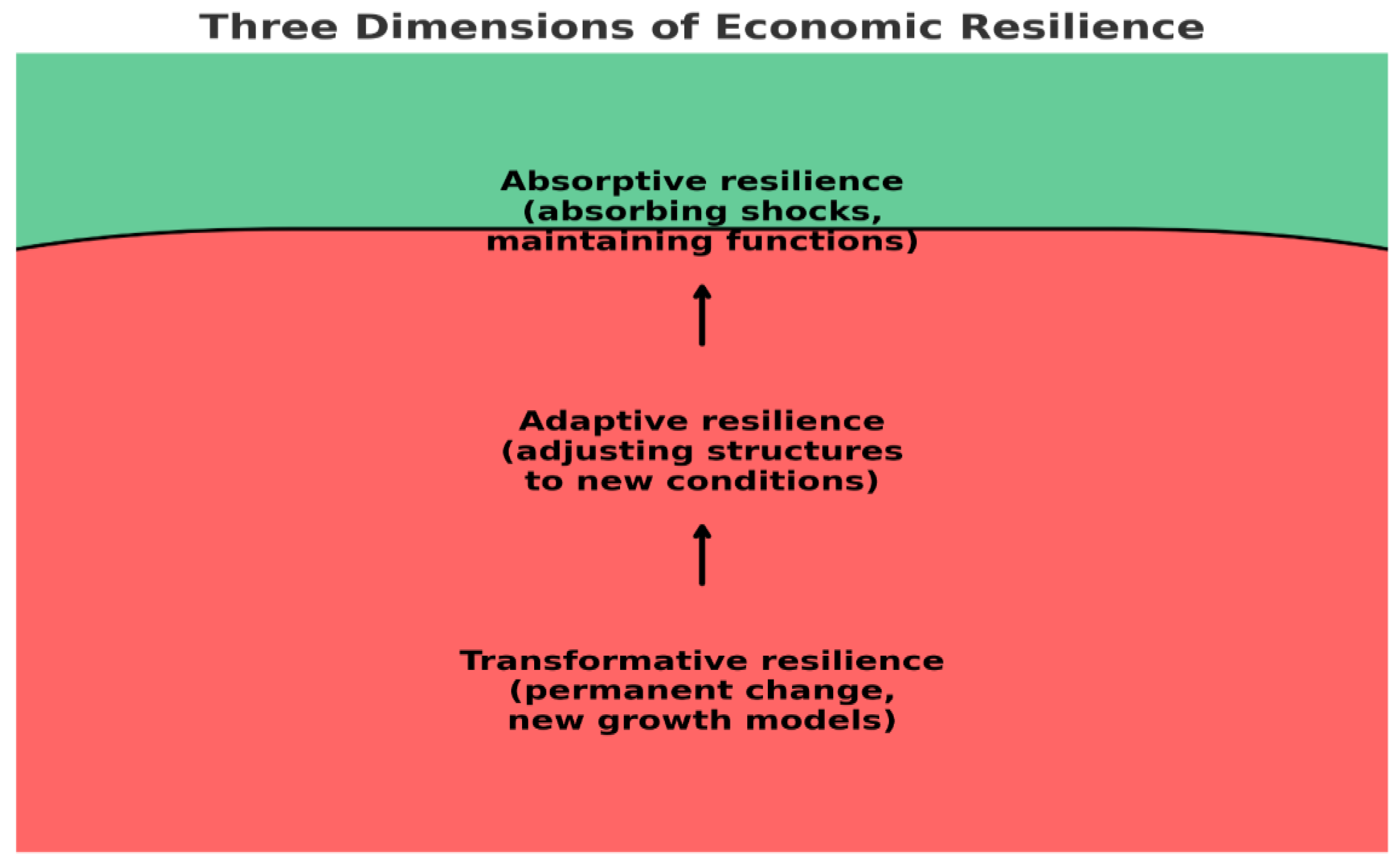
Figure 2.
Conceptual synthesis of digital resilience dimensions and governance outcomes. Source: Own work
Figure 2.
Conceptual synthesis of digital resilience dimensions and governance outcomes. Source: Own work
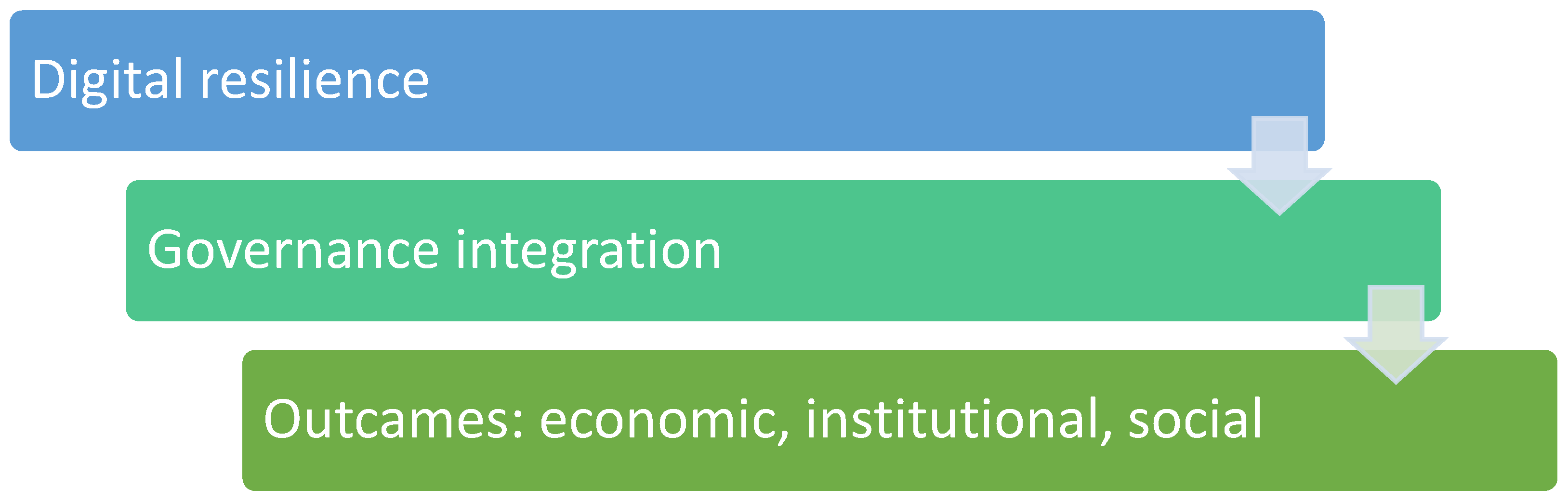
Table 1.
Core dimensions of digital resilience in public governance.
| Dimension | Analytical focus | Illustrative indicators (conceptual) | Exemples from the Ukrainian case |
|---|---|---|---|
| Technological | Capacity of digital infrastructure to ensure continuity under disruption | Platform availability, interoperability, cybersecurity, cloud backup | Diia platform, cloud-based data storage, Air Alert system |
| Institutional | Integration of digital tools into public administration and crisis management | Legal frameworks, inter-agency coordination, integration with emergency governance | Integration of Diia with social benefits, business support, and crisis response mechanisms |
| Societal(User) | Adoption and effective use of digital services by citizens and businesses | User penetration rate, service accessibility, inclusiveness | Over 20 million Diia users; widespread use of mobile administrative services during wartime |
Source: authors’ own conceptualization.
Table 3.
Use of digital services in Ukraine in 2021–2024.
| Year | Number of Diia platform users (million) | Number of services available on Diia | Number of notifications in Air Alert |
|---|---|---|---|
| 2021 | 9,5 | 72 | 0 |
| 2022 | 14,0 | 96 | 4500 |
| 2023 | 18,5 | 115 | 8200 |
| 2024 | 20,2 | 132 | 12000 |
Table 4.
Support for businesses.
| Country | Companies relocated by Diia.Business |
Microgrants under eRobota | Public tenders in Prozorro |
|---|---|---|---|
| 2022 | 210 | 2500 | 15000 |
| 2023 | 480 | 3800 | 18000 |
| 2024 | 750 | 4200 | 20500 |
Table 5.
International comparisons.
| Country | Number of online services | Users (% of population) |
Integration with crisis management system |
|---|---|---|---|
| Ukraine | 132 | 60 | High |
| Estonia | 140 | 75 | Medium |
| Poland | 110 | 50 | Low |
| Denmark | 125 | 68 | Medium |
Table 6.
Comparison of research hypotheses with own research results and secondary data.
| Hypothesis | Scope | Results of own research | Literature |
|---|---|---|---|
| H1 | Digital services and administrative continuity | Confirmed | World Bank (2024); UNDAP (2024) |
| H2 | Integration of digital tools into public administration | Confirmed | OECD (2021); European Commision (2021) |
| H3 | WEF (2023); ITU (2023) | ||
| Adaptability in EU countries | Confirmed | ||
Table 7.
Comparison of recommendations for Poland, Estonia and Denmark in 2025-2030.
| Country | Priorities |
|---|---|
| Poland | Integration of mObywatel with crisis management systems; Digital education |
| Estonia | Data security; International partnerships |
| Danemark | |
| Service inclusiveness; Integration with warning systems | |
Source: own work.
Table 8.
Strategic priorities for the EU.
| Priority | Significance | Leading Countries |
|---|---|---|
| Service Integration Data Security |
High | Estonia, Poland |
| Very high | Denmark, Estonia | |
|
Digital Education |
||
| Medium | Poland | |
| International Partnerships | High | Estonia, Denmark |
| Priority | Significance | Leading Countries |
Disclaimer/Publisher’s Note: The statements, opinions and data contained in all publications are solely those of the individual author(s) and contributor(s) and not of MDPI and/or the editor(s). MDPI and/or the editor(s) disclaim responsibility for any injury to people or property resulting from any ideas, methods, instructions or products referred to in the content. |
© 2026 by the authors. Licensee MDPI, Basel, Switzerland. This article is an open access article distributed under the terms and conditions of the Creative Commons Attribution (CC BY) license (http://creativecommons.org/licenses/by/4.0/).
Copyright: This open access article is published under a Creative Commons CC BY 4.0 license, which permit the free download, distribution, and reuse, provided that the author and preprint are cited in any reuse.


